As some of the world knows full well by now, I've been noodling with Go
for a few years, working through its pros, its cons, and thinking a lot
about how humans use code to express thoughts and ideas. Go's got a lot of
neat use cases, suited to particular problems, and used in the right place,
you can see some clear massive wins.
I've started writing Debian tooling in Go, because it's a pretty natural fit.
Go's fairly tight, and overhead shouldn't be taken up by your operating system.
After a while, I wound up hitting the usual blockers, and started to build up
abstractions. They became pretty darn useful, so, this blog post is announcing
(a still incomplete, year old and perhaps API changing) Debian package for Go.
The Go importable name is pault.ag/go/debian. This contains a lot of utilities
for dealing with Debian packages, and will become an edited down "toolbelt"
for working with or on Debian packages.
Module Overview
Currently, the package contains 4 major sub packages. They're a changelog
parser, a control file parser, deb file format parser, dependency parser
and a version parser. Together, these are a set of powerful building blocks
which can be used together to create higher order systems with reliable
understandings of the world.
changelog
The first (and perhaps most incomplete and least tested) is a changelog file
parser.. This provides the
programmer with the ability to pull out the suite being targeted in the
changelog, when each upload was, and the version for each. For example, let's
look at how we can pull when all the uploads of Docker to sid took place:
funcmain()resp,err:=http.Get("http://metadata.ftp-master.debian.org/changelogs/main/d/docker.io/unstable_changelog")iferr!=nilpanic(err)allEntries,err:=changelog.Parse(resp.Body)iferr!=nilpanic(err)for_,entry:=rangeallEntriesfmt.Printf("Version %s was uploaded on %s\n",entry.Version,entry.When)
The output of which looks like:
Version 1.8.3~ds1-2 was uploaded on 2015-11-04 00:09:02 -0800 -0800
Version 1.8.3~ds1-1 was uploaded on 2015-10-29 19:40:51 -0700 -0700
Version 1.8.2~ds1-2 was uploaded on 2015-10-29 07:23:10 -0700 -0700
Version 1.8.2~ds1-1 was uploaded on 2015-10-28 14:21:00 -0700 -0700
Version 1.7.1~dfsg1-1 was uploaded on 2015-08-26 10:13:48 -0700 -0700
Version 1.6.2~dfsg1-2 was uploaded on 2015-07-01 07:45:19 -0600 -0600
Version 1.6.2~dfsg1-1 was uploaded on 2015-05-21 00:47:43 -0600 -0600
Version 1.6.1+dfsg1-2 was uploaded on 2015-05-10 13:02:54 -0400 EDT
Version 1.6.1+dfsg1-1 was uploaded on 2015-05-08 17:57:10 -0600 -0600
Version 1.6.0+dfsg1-1 was uploaded on 2015-05-05 15:10:49 -0600 -0600
Version 1.6.0+dfsg1-1~exp1 was uploaded on 2015-04-16 18:00:21 -0600 -0600
Version 1.6.0~rc7~dfsg1-1~exp1 was uploaded on 2015-04-15 19:35:46 -0600 -0600
Version 1.6.0~rc4~dfsg1-1 was uploaded on 2015-04-06 17:11:33 -0600 -0600
Version 1.5.0~dfsg1-1 was uploaded on 2015-03-10 22:58:49 -0600 -0600
Version 1.3.3~dfsg1-2 was uploaded on 2015-01-03 00:11:47 -0700 -0700
Version 1.3.3~dfsg1-1 was uploaded on 2014-12-18 21:54:12 -0700 -0700
Version 1.3.2~dfsg1-1 was uploaded on 2014-11-24 19:14:28 -0500 EST
Version 1.3.1~dfsg1-2 was uploaded on 2014-11-07 13:11:34 -0700 -0700
Version 1.3.1~dfsg1-1 was uploaded on 2014-11-03 08:26:29 -0700 -0700
Version 1.3.0~dfsg1-1 was uploaded on 2014-10-17 00:56:07 -0600 -0600
Version 1.2.0~dfsg1-2 was uploaded on 2014-10-09 00:08:11 +0000 +0000
Version 1.2.0~dfsg1-1 was uploaded on 2014-09-13 11:43:17 -0600 -0600
Version 1.0.0~dfsg1-1 was uploaded on 2014-06-13 21:04:53 -0400 EDT
Version 0.11.1~dfsg1-1 was uploaded on 2014-05-09 17:30:45 -0400 EDT
Version 0.9.1~dfsg1-2 was uploaded on 2014-04-08 23:19:08 -0400 EDT
Version 0.9.1~dfsg1-1 was uploaded on 2014-04-03 21:38:30 -0400 EDT
Version 0.9.0+dfsg1-1 was uploaded on 2014-03-11 22:24:31 -0400 EDT
Version 0.8.1+dfsg1-1 was uploaded on 2014-02-25 20:56:31 -0500 EST
Version 0.8.0+dfsg1-2 was uploaded on 2014-02-15 17:51:58 -0500 EST
Version 0.8.0+dfsg1-1 was uploaded on 2014-02-10 20:41:10 -0500 EST
Version 0.7.6+dfsg1-1 was uploaded on 2014-01-22 22:50:47 -0500 EST
Version 0.7.1+dfsg1-1 was uploaded on 2014-01-15 20:22:34 -0500 EST
Version 0.6.7+dfsg1-3 was uploaded on 2014-01-09 20:10:20 -0500 EST
Version 0.6.7+dfsg1-2 was uploaded on 2014-01-08 19:14:02 -0500 EST
Version 0.6.7+dfsg1-1 was uploaded on 2014-01-07 21:06:10 -0500 EST
control
Next is one of the most complex, and one of the oldest parts of go-debian,
which is the control file parser
(otherwise sometimes known as deb822). This module was inspired by the way
that the json module works in Go, allowing for files to be defined in code
with a struct. This tends to be a bit more declarative, but also winds up
putting logic into struct tags, which can be a nasty anti-pattern if used too
much.
The first primitive in this module is the concept of a Paragraph, a struct
containing two values, the order of keys seen, and a map of string to string.
All higher order functions dealing with control files will go through this
type, which is a helpful interchange format to be aware of. All parsing of
meaning from the Control file happens when the Paragraph is unpacked into
a struct using reflection.
The idea behind this strategy that you define your struct, and let the Control
parser handle unpacking the data from the IO into your container, letting you
maintain type safety, since you never have to read and cast, the conversion
will handle this, and return an Unmarshaling error in the event of failure.
Additionally, Structs that define an anonymous member of control.Paragraph
will have the raw Paragraph struct of the underlying file, allowing the
programmer to handle dynamic tags (such as X-Foo), or at least, letting
them survive the round-trip through go.
The default decoder
contains an argument, the ability to verify the input control file using an
OpenPGP keyring, which is exposed to the programmer through the
(*Decoder).Signer() function. If the passed argument is nil, it will not
check the input file signature (at all!), and if it has been passed, any
signed data must be found or an error will fall out of the NewDecoder call.
On the way out, the opposite happens, where the struct is introspected,
turned into a control.Paragraph, and then written out to the io.Writer.
Here's a quick (and VERY dirty) example showing the basics of reading and
writing Debian Control files with go-debian.
packagemainimport("fmt""io""net/http""strings""pault.ag/go/debian/control")typeAllowedPackagestructPackagestringFingerprintstringfunc(a*AllowedPackage)UnmarshalControl(instring)errorin=strings.TrimSpace(in)chunks:=strings.SplitN(in," ",2)iflen(chunks)!=2returnfmt.Errorf("Syntax sucks: '%s'",in)a.Package=chunks[0]a.Fingerprint=chunks[1][1:len(chunks[1])-1]returnniltypeDMUAstructFingerprintstringUidstringAllowedPackages[]AllowedPackage control:"Allow" delim:"," funcmain()resp,err:=http.Get("http://metadata.ftp-master.debian.org/dm.txt")iferr!=nilpanic(err)decoder,err:=control.NewDecoder(resp.Body,nil)iferr!=nilpanic(err)fordmua:=DMUAiferr:=decoder.Decode(&dmua);err!=niliferr==io.EOFbreakpanic(err)fmt.Printf("The DM %s is allowed to upload:\n",dmua.Uid)for_,allowedPackage:=rangedmua.AllowedPackagesfmt.Printf(" %s [granted by %s]\n",allowedPackage.Package,allowedPackage.Fingerprint)
Output (truncated!) looks a bit like:
...
The DM Allison Randal <allison@lohutok.net> is allowed to upload:
   parrot [granted by A4F455C3414B10563FCC9244AFA51BD6CDE573CB]
...
The DM Benjamin Barenblat <bbaren@mit.edu> is allowed to upload:
   boogie [granted by 3224C4469D7DF8F3D6F41A02BBC756DDBE595F6B]
   dafny [granted by 3224C4469D7DF8F3D6F41A02BBC756DDBE595F6B]
   transmission-remote-gtk [granted by 3224C4469D7DF8F3D6F41A02BBC756DDBE595F6B]
   urweb [granted by 3224C4469D7DF8F3D6F41A02BBC756DDBE595F6B]
...
The DM     <aelmahmoudy@sabily.org> is allowed to upload:
   covered [granted by 41352A3B4726ACC590940097F0A98A4C4CD6E3D2]
   dico [granted by 6ADD5093AC6D1072C9129000B1CCD97290267086]
   drawtiming [granted by 41352A3B4726ACC590940097F0A98A4C4CD6E3D2]
   fonts-hosny-amiri [granted by BD838A2BAAF9E3408BD9646833BE1A0A8C2ED8FF]
   ...
...
deb
Next up, we've got the deb module. This contains code to handle reading
Debian 2.0 .deb files. It contains a wrapper that will parse the control
member, and provide the data member through the
archive/tar interface.
Here's an example of how to read a .deb file, access some metadata, and
iterate over the tar archive, and print the filenames of each of the
entries.
dependency
The dependency package provides an interface to parse and compute
dependencies. This package is a bit odd in that, well, there's no other
library that does this. The issue is that there are actually two different
parsers that compute our Dependency lines, one in Perl (as part of dpkg-dev)
and another in C (in dpkg).
To date, this has resulted in me filing
threedifferentbugs.
I also found a broken package in the
archive,
which actually resulted in another bug being (totally accidentally)
already fixed.
I hope to continue to run the archive through my parser in hopes of finding
more bugs! This package is a bit complex, but it basically just returns what
amounts to be an AST
for our Dependency lines. I'm positive there are bugs, so file them!
funcmain()dep,err:=dependency.Parse("foo bar, baz, foobar [amd64] bazfoo [!sparc], fnord:armhf [gnu-linux-sparc]")iferr!=nilpanic(err)anySparc,err:=dependency.ParseArch("sparc")iferr!=nilpanic(err)for_,possi:=rangedep.GetPossibilities(*anySparc)fmt.Printf("%s (%s)\n",possi.Name,possi.Arch)
Gives the output:
foo (<nil>)
baz (<nil>)
fnord (armhf)
version
Right off the bat, I'd like to thank
Michael Stapelberg for letting me graft this
out of dcs and into the go-debian package.
This was nearly entirely his work (with a one or two line function I added
later), and was amazingly helpful to have. Thank you!
This module implements Debian version comparisons and parsing, allowing for
sorting in lists, checking to see if it's native or not, and letting the
programmer to implement smart(er!) logic based on upstream (or Debian)
version numbers.
This module is extremely easy to use and very straightforward, and not worth
writing an example for.
Final thoughts
This is more of a "Yeah, OK, this has been useful enough to me at this point
that I'm going to support this" rather than a "It's stable!" or even
"It's alive!" post. Hopefully folks can report bugs and help iterate on
this module until we have some really clean building blocks to build
solid higher level systems on top of. Being able to have multiple libraries
interoperate by relying on go-debian will be a massive ease.
I'm in need of more documentation, and to finalize some parts of the older
sub package APIs, but I'm hoping to be at a "1.0" real soon now.
Wheezy's LTS period started a few weeks ago and the LTS team had to make an
early support decision concerning the Java eco-system since Wheezy ships two Java
runtime environments OpenJDK 6 and
OpenJDK 7. (To be fair, there are
actually three but gcj has
been superseded by OpenJDK a long time ago and the latter should be preferred
whenever possible.)
OpenJDK 6 is currently maintained by Red Hat and we mostly rely on their
upstream work as well as on package updates from Debian's maintainer Matthias Klose and
Tiago St rmer Daitx from Ubuntu. We already knew that both intend
to support OpenJDK 6 until April 2017 when Ubuntu 12.04 will reach its
end-of-life. Thus we had basically two options, supporting OpenJDK 6 for another
twelve months or dropping support right from the start. One of my first steps
was to ask for feedback and advice on
debian-java since
supporting only one JDK seemed to be the more reasonable solution. We agreed on warning users
via various channels about the intended change, especially about possible
incompatibilities
with OpenJDK 7. Even Andrew Haley, OpenJDK 6 project lead, participated in the discussion and confirmed that, while still supported, OpenJDK 6 security
releases are "always the last in the queue when there is urgent work to be
done".
I informed debian-lts about
my findings and issued a call for tests later.
Eventually we decided to concentrate our efforts on OpenJDK
7 because we are confident that for the
majority of our users one Java implementation is sufficient during a stable
release cycle. An immediate positive effect in making OpenJDK 7 the default is that
resources can be relocated to more pressing issues. On the other hand we were
also forced to make compromises. The switch to a newer default implementation
usually triggers a major transition with dozens of FTBFS bugs and the OpenJDK 7
transition
was no exception. I pondered about the usefulness of fixing all these bugs for
Wheezy LTS again and focussing on runtime issues instead and finally decided
that the latter was both more reasonable and more economic.
Different from regular default Java changes, users will still be able to use OpenJDK 6 to
compile their packages and the security impact for development systems is in general neglectable.
More important was to avoid runtime installations of OpenJDK 6. I identified eighteen
packages that strictly depended on the now obsolete JRE and fixed those
issues
on 4 May 2016 together with an update of
java-common and announced the switch to
OpenJDK 7 with a Debian NEWS file.
If you are not a regular reader of Debian
news and also not subscribed to
debian-lts,
debian-lts-announce or
debian-java, remember 26 June
2016 is the day when OpenJDK 7 will be made the default Java implementation in
Wheezy LTS. Of course there is no need to wait. You can switch right now:
The last few months have been a bit of a crazy period of ups and downs, with a
tempest of events beneath the apparent and deceivingly calm surface waters of
being unemployed (still at it).
The daily grind
Chief activities are, of course, those related to the daily grind of
job-hunting, sending applications, and preparing and attending interviews.
It is demoralising when one searches for many days or weeks without seeing
anything suitable for one's skills or interests, or other more general life
expectations. And it takes a lot of time and effort to put one's best in the
applications for positions that one is really, really, interested in. And
even for the ones which are meh, for a variety of reasons (e.g. one is not
very suitable for what the offer demands).
After that, not being invited to interviews (or doing very badly at them) is
bad, of course, but quick and not very painful. A swift, merciful end to the
process.
But it's all the more draining when waiting for many weeks when not a few
months with the uncertainty of not knowing if one is going to be lucky enough
to be summoned for an interview; harbouring some hope one has to appear
enthusiastic in the interviews, after all , while trying to keep it contained
lest it grows too much ; then in the interview hearing good words and some
praises, and feeling the impression that one will fit in, that one did nicely
and that chances are good letting the hope grow again ; start to think about
life changes that the job will require to make a quick decision should the
offer finally arrives ; perhaps make some choices and compromises based on the
uncertain result; then wait for a week or two after the interview to know the
result...
... only to end up being unsuccessful.
All the effort and hopes finally get squashed with a cold, short email or
automatic response, or more often than not, complete radio silence from
prospective employers, as an end to a multi-month-long process. An emotional
roller coaster [1], which
happened to me several times in the last few months.
All in a day's work
The months of preparing and waiting for a new job often imply an impasse that
puts many other things that one cares about on hold, and one makes plans that
will never come to pass.
All in a day's (half-year's?) work of an unemployed poor soul.
But not all is bad.
This period was also a busy time doing some plans about life, mid- and
long-term; the usual and some really unusual! family events; visits to and
from friends, old and new; attending nice little local Debian gatherings or the
bigger gathering of Debian
SunCamp2016, and other
work for side projects or for other events that will happen soon...
And amidst all that, I managed to get some work done on aptitude.
Two pictures worth (less than) a thousand bugs
To be precise, worth 709 bugs 488 bugs in the first graph, plus 221 in the
second.
In 2015-11-15 (link to the post Work on aptitude):
In 2016-06-18:
Numbers
The BTS numbers for aptitude right now are:
221 (259 if counting all merged bugs independently)
1 Release Critical (but it is an artificial bug to keep it from migrating to
testing)
43 (55 unmerged) with severity Important or Normal
160 (182 unmerged) with severity Minor or Wishlist
17 (21 unmerged) marked as Forwarded or Pending
Highlights
Beyond graphs and stats, I am specially happy about two achievements in the last
year:
To have aptitude working today, first and foremost
Apart from the abandon that suffered in previous years, I mean
specifically the critical step of getting it through the troubles of the
last summer, with the GCC-5/C++11 transition in parallel with a
transition of the Boost library (explained in more detail in Work on
aptitude).
Without that, possibly aptitude would not have survived until today.
Improvements to the suggestions of the resolver
In the version 0.8, there were a lot of changes related with improving
the order of the suggestions from the resolver, when it finds conflicts
or other problems with the planned actions.
Historically, but specially in the last few years, there have been many
complaints about the nonsensical or dangerous suggestions from the
resolver. The first solution offered by the resolver was very often
regarded as highly undesirable (for example, removal of many packages),
and preferable solutions like upgrades of one or only a handful of
packages being offered only after many removals; and keeps only
offered as last resort.
Perhaps these changes don't get a lot of attention, given that in the first case
it's just to keep working (with few people realising that it could have
collapsed on the spot, if left unattended), and the second can probably go
unnoticed because it just works or it started to work more smoothly
doesn't get as much immediate attention as it suddenly broke! .
Still, I wanted to mention them, because I am quite proud of those.
Thanks
Even if I put a lot of work on aptitude in the last year, the results of the
graph and numbers have not been solely achieved by me.
Special thanks go to Axel Beckert (abe /
XTaran) and the apt team, David
Kalnischkies and Julian Andres Klode who, despite the claim in that page, does
not mostly work python-aptanymore... but also in the main tools.
They help with fixing some of the issues directly, or changing things in apt
that benefit aptitude, testing changes, triaging bugs or commenting on them,
patiently explaining to me why something in libapt doesn't do what I think it
does, and good company in general.
Not the least, for holding impromptu BTS group therapy / support meetings, for
those cases when prolonged exposure to BTS activity starts to induce very bad
feelings.
Thanks also to people who sent their translation updates, notified about
corrections, sent or tested patches, submitted bugs, or tried to help in other
ways. Change logs for details.
Notes
[1] ^ It's even an example in
the Cambridge Dictionaries Online website, for the entry of roller
coaster:
He was on an emotional roller coaster for a while when he lost his job.
This week I have been gathered with 38 KDE people in Randa, Switzerland. Randa is a place in a valley in the middle of the Alps close to various peaks like Matterhorn. It has been a week of intense hacking, bugfixing, brainstorming and a bit of enjoying the nature.
R is for Reproducible builds
I spent the first couple of days trying to get the Qt Documentation generation tool to reproducible generate documentation. Some of the fixes were of the usual put data in an randomized datastructure, then iterate over it and create output , where the fix is similar well known: Sort the datastructure first. Others were a bit more severe bugs that lead to the documentation to shuffle around the obsolete bit, and the inheritance chains. Most of these fixes have been reviewed and submitted to the Qt 5.6 branch, one is still pending review, but that hopefully gets fixed soon. Then most of Qt (except things containing copies of (parts) of webkit and derivatives) should be reproducible.
R is for Roaming around in the mountains
Sleeping, hacking and dining in the same building sometimes leads to a enormous desire for fresh air. Luckily in the middle of the alps, it is readily available, and at least once a day many people went for a walk. To say hi to a sheep. Or to just go uphill until tired and then going back down. Or just finding a circle around. For this area, OpenStreetMap seems to have better maps than Google. We also went on a nice group trip to Zermatt and surroundings, sponsored by our friends in Edeltech.
R is for Releasing
One of the tasks I set myself for was to get my barcode generation library (prison. you know. being behind bars.) ready for release. A bit of api cleanup, including some future proofing, was done, and all users adapted. Hopefully it will be released as part of the next KDE Frameworks release.
R is for Reviewing code
When signing up for the sprint, one has to declare a couple of tasks to work on. One of the things I put myself up to was reviewing David Faure s code changes. First, he is very productive, and second, he often gets into creating patches in code areas where many other contributors are scared to look. So someone has to do it, and code never scared me.
R is for Running
I planned on going running along the river monday, wednesday and friday. Fortunately that happened, but due to Switzerland having a bit more ups and downs than flat Denmark, it didn t go that fast.
R is for Random bugfixing
When in the hacking mood surrounded by great developers, it is very easy to just fix minor bugs when you encounter them. There is likely someone around who knows the code in question. Or you are just in the mood to actually fix it, rather than living with a missing clock applet or a corner case crash.
R is for Rubber ducking
I am a brilliant person sized rubber duck. And I did get the opportunity to show off my skills a couple of times, as well as using some of the other people for that.
R is for Raising money
These sprints in Randa is only possible because of all the nice donations from people and companies around the world. The fundraiser is still running, and can be found at
I wanted to write this blogpost since April, and even announced it in two previous posts, but never got to actually write it until now. And with the recent events in Snappy and Flatpak land, I can not defer this post any longer (unless I want to answer the same questions over and over on IRC ^^).
As you know, I develop the Limba 3rd-party software installer since 2014 (see this LWN article explaining the project better then I could do ) which is a spiritual successor to the Listaller project which was in development since roughly 2008. Limba got some competition by Flatpak and Snappy, so it s natural to ask what the projects next steps will be.
Meeting with the competition
At last FOSDEM and at the GNOME Software sprint this year in April, I met with Alexander Larsson and we discussed the rather unfortunate situation we got into, with Flatpak and Limba being in competition.
Both Alex and I have been experimenting with 3rd-party app distribution for quite some time, with me working on Listaller and him working on Glick and Glick2. All these projects never went anywhere. Around the time when I started Limba, fixing design mistakes done with Listaller, Alex started a new attempt at software distribution, this time with sandboxing added to the mix and a new OSTree-based design of the software-distribution mechanism. It wasn t at all clear that XdgApp, later to be renamed to Flatpak, would get huge backing by GNOME and later Red Hat, becoming a very promising candidate for a truly cross-distro software distribution system.
The main difference between Limba and Flatpak is that Limba allows modular runtimes, with things like the toolkit, helper libraries and programs being separate modules, which can be updated independently. Flatpak on the other hand, allows just one static runtime and enforces everything that is not in the runtime already to be bundled with the actual application. So, while a Limba bundle might depend on multiple individual other bundles, Flatpak bundles only have one fixed dependency on a runtime. Getting a compromise between those two concepts is not possible, and since the modular vs. static approach in Limba and Flatpak where fundamental, conscious design decisions, merging the projects was also not possible.
Alex and I had very productive discussions, and except for the modularity issue, we were pretty much on the same page in every other aspect regarding the sandboxing and app-distribution matters.
Sometimes stepping out of the way is the best way to achieve progress
So, what to do now? Obviously, I can continue to push Limba forward, but given all the other projects I maintain, this seems to be a waste of resources (Limba eats a lot of my spare time). Now with Flatpak and Snappy being available, I am basically competing with Canonical and Red Hat, who can make much more progress faster then I can do as a single developer. Also, Flatpaks bigger base of contributors compared to Limba is a clear sign which project the community favors more.
Furthermore, I started the Listaller and Limba projects to scratch an itch. When being new to Linux, it was very annoying to me to see some applications only being made available in compiled form for one distribution, and sometimes one that I didn t use. Getting software was incredibly hard for me as a newbie, and using the package-manager was also unusual back then (no software center apps existed, only package lists). If you wanted to update one app, you usually needed to update your whole distribution, sometimes even to a development version or rolling-release channel, sacrificing stability.
So, if now this issue gets solved by someone else in a good way, there is no point in pushing my solution hard. I developed a tool to solve a problem, and it looks like another tool will fix that issue now before mine does, which is fine, because this longstanding problem will finally be solved. And that s the thing I actually care most about.
I still think Limba is the superior solution for app distribution, but it is also the one that is most complex and requires additional work by upstream projects to use it properly. Which is something most projects don t want, and that s completely fine.
And that being said: I think Flatpak is a great project. Alex has much experience in this matter, and the design of Flatpak is sound. It solves many issues 3rd-party app development faces in a pretty elegant way, and I like it very much for that. Also the focus on sandboxing is great, although that part will need more time to become really useful. (Aside from that, working with Alexander is a pleasure, and he really cares about making Flatpak a truly cross-distributional, vendor independent project.)
Moving forward
So, what I will do now is not to stop Limba development completely, but keep it going as a research project. Maybe one can use Limba bundles to create Flatpak packages more easily. We also discussed having Flatpak launch applications installed by Limba, which would allow both systems to coexist and benefit from each other. Since Limba (unlike Listaller) was also explicitly designed for web-applications, and therefore has a slightly wider scope than Flatpak, this could make sense.
In any case though, I will invest much less time in the Limba project. This is good news for all the people out there using the Tanglu Linux distribution, AppStream-metadata-consuming services, PackageKit on Debian, etc. those will receive more attention
An integral part of Limba is a web service called LimbaHub to accept new bundles, do QA on them and publish them in a public repository. I will likely rewrite it to be a service using Flatpak bundles, maybe even supporting Flatpak bundles and Limba bundles side-by-side (and if useful, maybe also support AppImageKit and Snappy). But this project is still on the drawing board.
Let s see
P.S: If you come to Debconf in Cape Town, make sure to not miss my talks about AppStream and bundling
Hi to all the souls on planet.debian.org . I hope to meet many of you in Debconf16 which is being held at UCT (University of Cape Town), Rhondenbosch, South Africa and am excited to be part of it. I pushed a blog post about my journey to debconf till date.
I express my sympathy and condolences to all the people who died in the cowardly shooting spree done by a madman in Orlando . I have been upset about this development but as what s done is done, it s best to just keep moving.
Closer to my own reality, I was shocked to discover during my whole visa experience that nowhere there is any knowledge about vaccinations that people should have when they are traveling internationally. I was kinda rudely awakened by this mail which prompted me to take Hep A shot and also start a thread on the mailing list. The more comprehensive info. I got was at the CDC site . It seems to be a go-to site to find about what is recommended. While I will not be taking any shots now as it s nearing to the date of travel, if I had known before, it would have been a valuable resource in itself. Definitely something to be bookmarked if you are going overseas and are worried or have health concerns.
On another note, About few days back, there was a discussion as recently, travel advisories have been issued about possible terror action in South Africa by various embassies due to the holy month of Ramadan.
And the recent attack just proves that it takes just one twisted personality with a perverse sense of justice or whatever s/he/ thinks as just to do what s/he did and guns and more security and not the answer.
My take on it some would describe as simplistic, there are things which you can control, there are things beyond your control. No security agency, no country can guarantee it. By being either home or away, you can t wish you will not get bitten. Got images of Final Destination invoked when I was sharing that, for as an Indian, do believe a bit on fate and karma. Also, me being single also plays a part, perhaps I would have been more cautious or have different motivations if I had a family so I do understand some of the concerns which have been raised by people in that thread. At the end of it, it really is a non-choice in my book.
If you don t take part due to fear,uncertainty of a possible attack, you have already given in to fear and uncertainty and I believe this goes against the very philosophy of what Debian stands for, being bold, taking chances and having trust in your fellow men. If we haven t allowed proprietary, commercial software to win over us, how can we allow less than 0.1% radically motivated people to scare us ? And the recent attack just proves that it takes just one twisted personality with a perverse sense of justice or whatever s/he/ thinks as just to do what s/he did. More guns and more security are certainly not the answer here.
A more troubling part is not terrorism but caste-ism and racism which have been also making news (not in a good way) in India. Now while I cannot claim to have any knowledge about Africans apart from 2-3 conversations which didn t go anywhere, two-three preconceived notions about them can easily be countered. As far as drugs are concerned, IF some Africans are doing drugs smuggling, it would be wrong to pin all of it onto them. India has been fighting drugs smuggling from the 70 s itself. From what we know and have learnt over the years from consuming media, India shares porous borders with almost all our neighbors. Of those, Pakistan is supposed to be the largest grower and supplier and then Nepal where young boys are used as Traffickers. The recent film Rocky Handsome and the recent upcoming controversial movie Udta Punjab are trying to explore these issues. As far as drinking in open is concerned, I have seen and been part of Punjabi parties where both men and women drink without abandon in farm parties. Russians, Germans and Israelis can also out-drink a person on their day/mood. As far as sexuality is concerned, we are the second most populous country in the world, so the less said the better .
I believe though that underneath this racism is money, greed, phobia, language barriers and just maybe some lifestyle choices as well. I have seen North-Eastern, Chinese, Buddhist people being colored with the same brush. The more interesting case is with the Buddhist as can be seen in Himachal Pradesh, where locals feel they are deprived as Europeans come and indulge Buddhists for their monasteries and their way of life while locals don t get much money from them. This is partly true, but also due to our own short-comings in dealing with westerners. I have never seen my own countrymen going out of their way to make westerners or any tourists for that matter feel welcome in a genuine way. More often, the behavior is between hostility, jealousy and a perverted sense of hero-worship due to the color of skin. As far as being racist and bigoted are concerned, it seems we are not alone, just day before came across this news from Malaysia which is interesting in the sense that how people from different communities frame their own history and people around them, forget that is false and misleading to what we in India know to be the truth, it probably is/would be interesting for somebody who does comparative history, myth and folklore analysis. I was actually planning to talk about some of the talks I am looking forward to hearing and seeing on Debconf but guess that will have to wait for few more days. Hope to publish one more before actually flying to Debconf. Till later. Filed under: Miscellenous Tagged: #Debconf16, #racism, #terrorism, #vaccinations
Suppose you have a gpg keyid like 9F6C6333 that corresponds to both key
1AE0322EB8F74717BDEABF1D44BB1BA79F6C6333 and
88BB08F633073D7129383EE71EA37A0C9F6C6333, and you don't know which of the two
to use.
You go to http://pgp.cs.uu.nl/ and find out that the site uses short key IDs,
so the two keys are indistinguishable.
Building on Clint's hopenpgp-tools,
I made a script that
screenscrapes http://pgp.cs.uu.nl/ for trust paths, downloads all the
potentially connecting keys in a temporary keyring, and runs hkt findpaths on
it:
$ ./verify-trust-paths 1793D6AB75663E6BF104953A634F4BD1E7AD5568 1AE0322EB8F74717BDEABF1D44BB1BA79F6C6333
hkt (hopenpgp-tools) 0.18
Copyright (C) 2012-2016 Clint Adams
hkt comes with ABSOLUTELY NO WARRANTY. This is free software, and you are welcome to redistribute it under certain conditions.
(4,[1,4,3,6])(1,1793D6AB75663E6BF104953A634F4BD1E7AD5568)(3,F8921D3A7404C86E11352215C7197699B29B232A)(4,C331BA3F75FB723B5873785B06EAA066E397832F)(6,1AE0322EB8F74717BDEABF1D44BB1BA79F6C6333)
$ ./verify-trust-paths 1793D6AB75663E6BF104953A634F4BD1E7AD5568 88BB08F633073D7129383EE71EA37A0C9F6C6333
hkt (hopenpgp-tools) 0.18
Copyright (C) 2012-2016 Clint Adams
hkt comes with ABSOLUTELY NO WARRANTY. This is free software, and you are welcome to redistribute it under certain conditions.
(0,[])
This is a start: it could look in the local keyring for all ultimately trusted
key finegrprints and use those as starting points. It could just take as an
argument a short keyid and automatically check all matching fingerprints.
I'm currently quite busy with https://nm.debian.org and at the moment
verify-trust-paths scratches
enough of my itch that I can move on with my other things.
Please send patches, or take it over: I'd like to see this grow.
Yesterday I was fixing an issue with one of the servers behind kallithea-scm.org: the hook intended to propagage pushes from Our Own Kallithea to Bitbucket stopped working. Until yesterday, that server was using Debian s flavour of System V init and djb s d montools to keep things running. To make the hook asynchronous, I wrote a service to be managed to d montools, so that concurrency issued would be solved by it. However, I didn t implement any timeouts, so when last week wget froze while pulling Weblate s hook, there was nothing to interrupt it, so the hook stopped working since d montools thought it s already running and wouldn t re-trigger it. Killing wget helped, but I decided I need to do something with it to prevent the situation from happening in the future.
I ve been using systemd at work for the last year, so I am now confident I m happier with systemd than with d montools, so I decided to switch the server to systemd. Not surprisingly, I prepared unit files in about 5 minutes without having to look into the manuals again, while with d montools I had to check things every time I needed to change something. The tricky thing was the switch itself. It is a virtual server, presumably running in Xen, and I don t have access to the console, so if I bork break something, I need to summon Bradley Kuhn or someone from Conservancy, who s kindly donated the server to the project. In any case, I decided to attempt to upgrade without a reboot, so that I have more options to roll back my changes in the case things go wrong.
After studying the manpages of both systemd s init and sysvinit s init, I realised I can install systemd as /sbin/init and ask already running System V init to re-exec. However, systemd s init can t talk to System V init, so before installing systemd I made a backup on it. It s also important to stop all running services (except probably ssh) to make sure systemd doesn t start second instances of each. And then: /tmp/init u and we re running systemd! A couple of additional checks, and it s safe to reboot.
Only when I did all that I realised that in the case of systemd not working I d probably not be able to undo my changes if my connection interrupted. So, even though at the end it worked, probably it s not a good idea to perform such manipulations when you don t have an alternative way to connect to the server :)
When you get involved in a new community, such as Debian, find out early
where, if that happens, you can find support, understanding, and help to make
it stop.
Last night I asked a group of friends what do they do if they start feeling
uncomfortable when they are alone in a group of people they don't know. Here
are the replies:
Wait outside the group until I figure the group out.
Find someone to talk for a while until you get comfortable.
If a person is making things uncomfortable for you, let them know, and leave
if nobody cares.
Sit there in silence.
Work around unwelcome people by bearing them for a bit while trying to
integrate with others.
Some people are easy to bribe into friendship, just bring cake.
While you don't know what is going on, you try to replicate what others are
doing.
Spend time trying to get a feeling of what are the consequences of taking
actions.
Purposefully disagree with people in a new environment to figure out if
having a different opinion is accepted.
Once I was new and I was asked to be the person that invites everyone for
lunch, that forced me to talk to everyone, and integrate.
When you are the first one to point something out, you'll probably soon find
out you're not alone.
The reaction on the first time something is exposed, influences how often
similar cases will be reported.
I think a lot of these point are good food for thought about barriers of entry,
and about safety nets that a group has or might want to have.
Sursamen is an Arithmetic, Mottled, Disputed, Multiply Inhabited,
Multi-million Year Safe, and Godded Shellworld. It's a constructed world
with multiple inhabitable levels, each lit by thermonuclear "suns" on
tracks, each level supported above the last by giant pillars. Before the
recorded history of the current Involved Species, a culture called the
Veil created the shellworlds with still-obscure technology for some
unknown purpose, and then disappeared. Now, they're inhabited by various
transplants and watched over by a hierarchy of mentor and client species.
In the case of Sursamen, both the Aultridia and the Oct claim jurisdiction
(hence "Disputed"), and are forced into an uneasy truce by the Nariscene,
a more sophisticated species that oversees them both.
On Sursamen, on level eight to be precise, are the Sarl, a culture with an
early industrial level of technology in the middle of a war of conquest to
unite their level (and, they hope, the next level down). Their mentors
are the Oct, who claim descendance from the mysterious Veil. The Deldeyn,
the next level down, are mentored by the Aultridia, a species that evolved
from a parasite on Xinthian Tensile Aranothaurs. Since a Xinthian,
treated by the Sarl as a god, lives in the heart of Sursamen (hence
"Godded"), tensions between the Sarl and the Aultridians run
understandably high.
The ruler of the Sarl had three sons and a daughter. The oldest was
killed by the people he is conquering as Matter starts. The middle
son is a womanizer and a fop who, as the book opens, watches a betrayal
that he's entirely unprepared to deal with. The youngest is a thoughtful,
bookish youth pressed into a position that he also is not well-prepared
for.
His daughter left the Sarl, and Sursamen itself, fifteen years previously.
Now, she's a Special Circumstances agent for the Culture.
Matter is the eighth Culture novel, although (like most of the
series) there's little need to read the books in any particular order.
The introduction to the Culture here is a bit scanty, so you'll have more
background and understanding if you've read the previous novels, but it
doesn't matter a great deal for the story.
Sharp differences in technology levels have turned up in previous Culture
novels (although the most notable example is a minor spoiler), but this is
the first Culture novel I recall where those technological differences
were given a structure. Usually, Culture novels have Special
Circumstances meddling in, from their perspective, "inferior" cultures.
But Sursamen is not in Culture space or directly the Culture's business.
The Involved Species that governs Sursamen space is the Morthanveld: an
aquatic species roughly on a technology level with the Culture themselves.
The Nariscene are their client species; the Oct and Aultridia are, in
turn, client species (well, mostly) of the Nariscene, while meddling with
the Sarl and Deldeyn.
That part of this book reminded me of Brin's Uplift universe. Banks's
Involved Species aren't the obnoxious tyrants of Brin's universe, and
mentoring doesn't involve the slavery of the Uplift universe. But some of
the politics are a bit similar. And, as with Uplift, all the characters
are aware, at least vaguely, of the larger shape of galactic politics.
Even the Sarl, who themselves have no more than early industrial
technology. When Ferbin flees the betrayal to try to get help, he ascends
out of the shellworld to try to get assistance from an Involved species,
or perhaps his sister (which turns out to be the same thing). Banks
spends some time here, mostly through Ferbin and his servant (who is one
of the better characters in this book), trying to imagine what it would be
like to live in a society that just invented railroads while being aware
of interstellar powers that can do practically anything.
The plot, like the world on which it's set, proceeds on multiple levels.
There is court intrigue within the Sarl, war on their level and the level
below, and Ferbin's search for support and then justice. But the Sarl
live in an artifact with some very mysterious places, including the best
set piece in the book: an enormous waterfall that's gradually uncovering a
lost city on the level below the Sarl, and an archaeological dig that
proceeds under the Deldeyn and Sarl alike. Djan Seriy decides to return
home when she learns of events in Sarl, originally for reasons of family
loyalty and obligation, but she's a bit more in touch with the broader
affairs of the galaxy, including the fact that the Oct are acting very
strangely. There's something much greater at stake on Sursamen than
tedious infighting between non-Involved cultures.
As always with Banks, the set pieces and world building are amazing, the
scenery is jaw-dropping, and I have some trouble warming to the
characters. Dramatic flights across tower-studded landscapes seeking
access to forbidden world-spanning towers largely, but don't entirely,
make up for not caring about most of the characters for most of the book.
This did change, though: although I never particularly warmed to Ferbin, I
started to like his younger brother, and I really liked his sister and his
servant by the end of the book.
Unfortunately, the end of Matter is, if not awful, at least
exceedingly abrupt. As is typical of Banks, we get a lot of sense of
wonder but not much actual explanation, and the denouement is essentially
nonexistent. (There is a coy epilogue hiding after the appendices, but it
mostly annoyed me and provides only material for extrapolation about the
characters.) Another SF author would have written a book about the
Xinthian, the Veil, the purpose of the shellworlds, and the deep history
of the galaxy. I should have known going in that Banks isn't that sort of
SF author, but it was still frustrating.
Still, Banks is an excellent writer and this is a meaty, complex,
enjoyable story with some amazing moments of wonder and awe. If you like
Culture novels in general, you will like this. If you like
set-piece-heavy SF on a grand scale, such as Alastair Reynolds or Kim
Stanley Robinson, you probably like this. Recommended.
Rating: 8 out of 10
Allison Lortie has provoked a lot of comment with her blog post on
a new proposal for how GTK is versioned.
Here's some more context from the discussion at the GTK hackfest that
prompted that proposal: there's actually quite a close analogy in
how new Debian versions are developed.
The problem we're trying to address here is the two sides of a trade-off:
Without new development, a library (or an OS) can't go anywhere new
New development sometimes breaks existing applications
Historically, GTK has aimed to keep compatible within a major version,
where major versions are rather far apart (GTK 1 in 1998, GTK 2 in
2002, GTK 3 in 2011, GTK 4 somewhere in the future). Meanwhile, fixing
bugs, improving performance and introducing new features sometimes
results in major changes behind the scenes. In an ideal world, these
behind-the-scenes changes would never break applications; however, the
world isn't ideal. (The Debian analogy here is that as much as we
aspire to having the upgrade from one stable release to the next not break
anything at all, I don't think we've ever achieved that in practice -
we still ask users to read the release notes, even though ideally
that wouldn't be necessary.)
In particular, the perceived cost of doing a proper ABI break (a fully
parallel-installable GTK 4) means there's a strong temptation to make
changes that don't actually remove or change C symbols, but are clearly
an ABI break, in the sense that an application that previously worked
and was considered correct no longer works. A prominent recent example is
the theming changes in GTK 3.20: the ABI in terms of functions available
didn't change, but what happens when you call those functions changed in
an incompatible way. This makes GTK hard to rely on for applications
outside the GNOME release cycle, which is a problem that needs to
be fixed (without stopping development from continuing).
The goal of
the plan we discussed today
is to decouple the latest branch of development, which moves fast and
sometimes breaks API, from the API-stable branches, which only get bug
fixes. This model should look quite familiar to Debian contributors,
because it's a lot like the way we release Debian and Ubuntu.
In Debian, at any given time we have a development branch
(testing/unstable) - currently "stretch", the future Debian 9. We
also have some stable branches, of which the most recent are Debian
8 "jessie" and Debian 7 "wheezy". Different users of Debian have
different trade-offs that lead them to choose one or the other of
these. Users who value stability and want to avoid unexpected changes,
even at a cost in terms of features and fixes for non-critical bugs,
choose to use a stable release, preferably the most recent; they only
need to change what they run on top of Debian for OS API changes (for
instance webapps, local scripts, or the way they interact with the GUI)
approximately every 2 years, or perhaps less often than that with the
Debian-LTS project supporting non-current stable releases. Meanwhile,
users who value the latest versions and are willing to work with a
"moving target" as a result choose to use testing/unstable.
The GTK analogy here is really quite close. In the new versioning model,
library users who value stability over new things would prefer to use
a stable-branch, ideally the latest; library users who want the latest
features, the latest bug-fixes and the latest new bugs would use the
branch that's the current focus of development. In practice we expect
that the latter would be mostly GNOME projects. There's been some
discussion at the hackfest about how often we'd have a new
stable-branch: the fastest rate that's been considered is a stable-branch
every 2 years, similar to Ubuntu LTS and Debian, but there's no consensus
yet on whether they will be that frequent in practice.
How many stable versions of GTK would end up shipped in Debian depends
on how rapidly projects move from "old-stable" to "new-stable" upstream,
how much those projects' Debian maintainers are willing to patch them
to move between branches, and how many versions the release team will
tolerate. Once we reach a steady state, I'd hope that we might have
1 or 2 stable-branched versions active at a time, packaged as separate
parallel-installable source packages (a lot like how we handle Qt).
GTK 2 might well stay around as an additional active version just
from historical inertia. The stable versions are intended to be
fully parallel-installable, just like the situation with GTK 1.2,
GTK 2 and GTK 3 or with the major versions of Qt.
For the "current development" version, I'd anticipate that we'd probably
only ship one source package, and do ABI transitions for one version
active at a time, a lot like how we deal with libgnome-desktop and the
evolution-data-server family of libraries. Those versions would have
parallel-installable runtime libraries but non-parallel-installable
development files, again similar to libgnome-desktop.
At the risk of stretching the Debian/Ubuntu analogy too far, the
intermediate "current development" GTK releases that would accompany
a GNOME release are like Ubuntu's non-LTS suites: they're more up to
date than the fully stable releases (Ubuntu LTS, which has a release
schedule similar to Debian stable), but less stable and not supported
for as long.
Hopefully this plan can meet both of its goals: minimize breakage for
applications, while not holding back the development of new APIs.
I begin this week by finish my QT tutorial. With that new knowledge, I was able to implemet my method launchSmartInfo(int) on LRC.
After that, I needed to implement the gnome client too. I followed the tutorial on QT so I thought I can just learn GTK+ by reading the code. Finally, I just lost a lot of time by doing that and I didn't learn a lot. In response to that problem I finally use an GTK+ tutorial.
I began to try to show n transparente window with some text in front of the call view. To do that, I want to use clutter library
------------
Conclusion: as you can see, I lost a lot of time in this GUI learning. Now it's done, I can move forward! :)
I begin this week by finish my QT tutorial. With that new knowledge, I was able to implemet my method launchSmartInfo(int) on LRC.
After that, I needed to implement the gnome client too. I followed the tutorial on QT so I thought I can just learn GTK+ by reading the code. Finally, I just lost a lot of time by doing that and I didn't learn a lot. In response to that problem I finally use an GTK+ tutorial.
I began to try to show an transparente window with some text in front of the call view. To do that, I want to use clutter library
------------
Conclusion: as you can see, I lost a lot of time in this GUI learning. Now it's done, I can move forward! :)
I had earlier tried to install telepathy according to the instructions I found here. But that gave me a an unexplainable error. So after a few unsuccessful attempts, I decided to install it from the apt-get source.
First, install telepathy-qt. This is the part that gave me all the errors and this is where I had made changes from the source I had been using.
Check and make sure you have the proper dependencies installed for the package.
$ sudo apt-get build-dep telepathy-qt
If you are installing the package in the home folder, you can skip this step, but usually, it s better to have a dedicated file/file structure. If you do have one, cd into that folder $ mkdir ~/telepathy-qt-stuff
$ cd ~/telepathy-qt-stuff
Next, get telepathy-qt from the source : $ apt-get source telepathy-qt
$ apt-get source -b telepathy-qt
Check and make sure that there are a list of libtelepathy-qt* and telepathy-qt* .deb packages. You just have to install a few more packages:
$ ls *.deb
Next, you have to install a few more packages:
$ dpkg -i libtelepathy-qt4-2_0.9.6.1-?_amd64.deb libtelepathy-qt4-dev_0.9.6.1-?_amd64.deb libtelepathy-qt4-farstream2_0.9.6.1-?_amd64.deb
Obviously, we have to replace the ? with the version number of the .deb package.
After that you have the necessary packages to install reSIProcate:
$ dpkg -l grep telepathy-qtThis should return something like :
ii libtelepathy-qt4-2:amd64 0.9.6.1-2 amd64 Telepathy framework Qt 4 library
ii libtelepathy-qt4-dev 0.9.6.1-2 amd64 Qt 4 Telepathy library (headers and static library)
ii libtelepathy-qt4-farstream2:amd64 0.9.6.1-2 amd64 Telepathy/Farsight integration Qt 4 library
The next part is to install and configure reSIProcate.
Include the proper backport line in the /etc/apt/sources.list file. Be sure to run sudo apt-get update after any changes to the source file
Clone the code from the git repo :
$ git clone https://github.com/resiprocate/resiprocate

$ cd resiprocate
Check the build dependencies and install what s required:
$ apt-get install libpq-dev dh-autoreconf

$ apt-get build-dep resiprocate

$ apt-get install -t jessie-backports libradcli-dev
Build the packages:
$ ./build/debian.sh

$ sudo make
Finally, ensure all your packages are built right by running sudo make check
Elsa Bike Trophy 2016 my first bike race!
So today, after two months of intermittent training using Zwift and
some actual outside rides, I did my first bike race. Not of 2016,
not of 2000+, but like ever.
Which is strange, as I learned biking very young, and I did like to
bike. But as it turned out, even though I didn't like running as a
child, I did participate in a number of running events over the years,
but no biking ones.
The event
Elsa Bike Trophy is a
mountain bike event cross-country, not downhill or anything crazy; it
takes part in Estavayer-le-Lac, and has two courses - one 60Km with
1'791m altitude gain, and a smaller one of 30Km with 845m altitude
gain. I went, of course, for the latter. 845m is more than I ever did
in a single ride, so it was good enough for a first try. The web page
says that this smaller course est nerveux, technique et ne laisse
que peu de r pit . I choose to think that's a bit of an exaggeration,
and that it will be relatively easy (as I'm not too skilled
technically).
The atmosphere there was like for the running races, with the
exception of bike stuff being sold, and people on very noisy
rollers. I'm glad for my trainer which sounds many decibels quieter
The long race started at 12:00, and the shorter one at 12:20. While
waiting for the start I had to concerns in mind: whether I'm able to
do the whole course (endurance), and whether it will be too cold (the
weather kept moving towards rain). I had a small concern about the
state of the course, as it was not very nice weather recently, but a
small one.
And then, after one hour plus of waiting, go!
Racing, with a bit of "swimming"
At first thing went as expected. Starting on paved roads, moving
towards the small town exit, a couple of 14% climbs, then more flat
roads, then a nice and hard 18% short climb (I'll never again complain
about < 10%!), then entering the woods. It became quickly apparent
that the ground in the forest was in much worse state than I
feared. Much worse as in a few orders of magnitude.
In about 5 minutes after entering the tree cover, my reasonably clean,
reasonably light bike became a muddy, heavy monster. And the pace that
until then went quite OK became walking pace, as the first rider that
didn't manage to keep going up because the wheel turned out of the
track blocked the one behind him, which had to stop, and repeat until
we were one line (or two, depending on how wide the trail was) of
riders walking their bikes up. While on dry ground walking your bike
up is no problem, or hiking through mud with good hiking shoes is also
no problem, walking up with biking shoes is a pain. Your foot slides
and you waste half of your energy "swimming" in the mud.
Once the climb is over, you get on the bike, and of course the pedals
and cleats are full of heavy mud, so it takes a while until you can
actually clip in. Here the trail version of SPD was really useful, as
I could pedal reasonably well without being clipped-in, just had to be
careful and push too hard.
Then maybe you exit the trail and get on paved road, but the wheels
are so full of mud that you still are very slow (and accelerate very
slowly), until the shed enough of the mud to become somewhat more
"normal".
After a bit of this "up through mud, flat and shedding mud", I came
upon the first real downhill section. I would have been somewhat
confident in dry ground, but I got scared and got off my bike. Better
safe than sorry was the thing for now.
And after this is was a repetition of the above: climb, sometimes
(rarely) on the bike, most times pushing the bike, fast flat sections
through muddy terrain where any mistake of controlling the bike can
send the front wheel flying due to the mud being highly viscous, slow
flat sections through very liquid mud where it definitely felt like
swimming, or any dry sections.
My biggest fear, uphill/endurance, was unfounded. The most gains I
made were on the dry uphills, where I had enough stamina to
overtake. On flat ground I mostly kept order (i.e. neither being
overtaken nor overtaking), but on downhill sections, I lost lots of
time, and was overtaken a lot. Still, it was a good run.
And then, after about 20 kilometres out of the 30, I got tired enough
of getting off the bike, on the bike, and also tired mentally and not
being careful enough, that I stopped getting off the bike on
downhills. And the feeling was awesome! It was actually much much
easier to flow through the mud and rocks and roots on downhill, even
when it was difficult (for me) like 40cm drops (estimated), than doing
it on foot, where you slide without control and the bike can come
crashing down on you. It was a liberating feel, like finally having
overcome the mud. I was soo glad to have done a one-day training
course with
Swiss Alpine Adventure,
as it really helped. Thanks Dave!
Of course, people were still overtaking me, but I also overtook some
people (who were on foot; he he, I wasn't the only one it seems). And
being easier, I had some more energy so I was able to push a bit
harder on the flats and dry uphill sections.
And then the remaining distance started shrinking, and the last
downhill was over, I entered through familiar roads the small town, a
passer-by cries "one kilometre left", I push hard (I mean, hard as I
could after all the effort), and I reach the finish.
Oh, and my other concern, the rain? Yes it did rain somewhat, and I
was glad for it (I keep overheating); there was a single moment I felt
cold, when exiting a nice cosy forest into a field where the wind was
very strong headwind, of course.
Lessons learned
I did learn a lot in this first event.
indoor training sessions only help with endurance (but they do good
on this); they don't help with technique, and most importantly, they
don't teach how to handle the bike in inclement weather; biking to
work on paved road also doesn't help.
nevertheless, indoor training does help with endurance
mud guards ; before the race, I thought they'll help; during the
race, I cursed at the extra weight and their seemingly uselessness;
after the race, after I saw how other people looked, I realised that
indeed they helped a lot I was only dirty on my legs, mostly below
the knee, but not on my upper body. Unsure whether I will use the
again.
a drop seat is not needed if your seat is set in-between, but sure
damn would have been more easy with one
installing your GPS on your handle-bar with elastic bands in a
section of non-constant diameter is a very bad idea, as it lives in
an unstable equilibrium: any move towards the thinner section makes
the mount very loose, and you have to lose time fixing it.
Results
So, how did I do after all? As soon as I reached the finish and
recovered my items, among which the phone, I checked the datasport
page: I was rank 59/68 in my category. Damn, I hoped (and thought) I
would do better. Similar % in the overall ranking for this distance.
That aside, it was mighty fun. So much fun I'd do it again tomorrow! I
forgot the awesome atmosphere of such events, even in the back of the
rankings.
And then, after I reach drive home and open on my workstation the
datasport page, I get very confused: the overall number of
participants was different. And the I realised: not everybody finished
the race when I first checked (d'oh)! Final ranking: 59 out of 84 in
my category,
and 247/364 in the
overall 30km rankings. That
makes it 70% and 67% respectively, which matches somewhat with my
usual running results a few years back (but a bit worse). It is in any
case better than what I thought originally, yay!
Also, Strava activity for some more statistics (note that my Garmin
says it was not 800+ meters of altitude ):
I'd embed a Veloviewer nice 3D-map but I can't seem to get the embed
option, hmm
TODO: train more endurance, train more technique, train in more
various conditions!
TL;DR: I put a $5 Raspberry Pi Zero, a Bluetooth USB dongle, and the
required adapter cable into my new Handy Tech Active Star 40 braille
display. An internal USB port provides the power. This has transformed
my braille display into an ARM-based, monitorless, Linux laptop that has
a keyboard and a braille display. It can be charged/powered via USB so it can
also be run from a power bank or a solar charger, thus potentially being able
to run for days, rather than just hours, without needing a standard wall-jack.
Some Background on Braille Display Form Factors
Braille displays come in various sizes. There are
models tailored for desktop use (with 60 cells or more), models tailored
for portable use with a laptop (usually with 40 cells), and, nowadays,
there are even models tailored for on-the-go use with a smartphone or similar
(with something like 14 or 18 cells).
Back in the old days, braille displays were rather massive.
A 40-cell braille display was typically about the size of a 13" laptop.
In modern times, manufacturers have managed to reduce the size of the internals
such that a 40-cell display can be placed in front of a laptop or keyboard
instead of placing the laptop on top of the braille display.
While this is a nice achievement, I personally haven't found it to be
very convenient because you now have to place two physically separate
devices on your lap. It's OK if you have a real desk,
but, at least in my opinion, if you try to use your laptop as its name suggests,
it's actually inconvenient to use a small form factor, 40-cell display.
For this reason, I've been waiting for a long-promised new model
in the Handy Tech Star series. In 2002, they released
the Handy Tech Braille Star 40, which is a 40-cell braille
display with enough space to put a laptop directly on top
of it. To accommodate larger laptop models, they even built in a little
platform at the back that can be pulled out to effectively enlarge the
top surface.
Handy Tech has now released a new model, the Active Star 40,
that has essentially the same layout but modernized internals.
You can still pull out the little platform to increase the space
that can be used to put something on top.
But, most conveniently,
they've designed in an empty compartment, roughly the size of a modern
smartphone, beneath the platform. The original idea was to actually
put a smartphone inside, but this has turned out (at least to me)
to not be very feasible. Fortunately, they thought about the
need for electricity and added a Micro USB cable terminating within the
newly created, empty compartment.
My first idea was to put a conventional Raspberry Pi inside.
When I received the braille display, however, we immediately
noticed that a standard-sized rpi is roughly 3mm too high
to fit into the empty compartment.
Fortunately, though, a co-worker noticed that the Raspberry Pi Zero
was available for order. The Raspberry Pi Zero is a lot thinner,
and fits perfectly inside (actually, I think there's enough space
for two, or even three, of them). So we ordered one, along with some
accessories like a 64GB SDHC card, a Bluetooth dongle, and
a Micro USB adapter cable. The hardware arrived a few days later, and was
immediately bootstrapped with the assistance of very helpful friends.
It works like a charm!
Technical Details
The backside of the Handy Tech Active Star 40 features two USB host ports
that can be used to connect devices such as a keyboard. A small form-factor,
USB keyboard with a magnetic clip-on is included. When a USB keyboard
is connected, and when the display is used via Bluetooth, the braille display
firmware additionally offers the Bluetooth HID profile, and key press/release
events received via the USB port are passed through to it.
I use the Bluetooth dongle for all my communication needs.
Most importantly, BRLTTY is used as a console screen reader.
It talks to the braille display via Bluetooth (more precisely, via an RFCOMM channel).
The keyboard connects through to Linux via the Bluetooth HID profile.
Now, all that is left is network connectivity. To keep the energy
consumption as low as possible, I decided to go for Bluetooth PAN.
It appears that the tethering mode of my mobile phone works (albeit with a quirk),
so I can actually access the internet as long as I have cell phone reception.
Additionally, I configured a Bluetooth PAN access point on my desktop
machines at home and at work, so I can easily (and somewhat more reliably)
get IP connectivity for the rpi when I'm near one of these machines.
I plan to configure a classic Raspberry Pi as a mobile Bluetooth access point.
It would essentially function as a Bluetooth to ethernet adapter, and should
allow me to have network connectivity in places where I don't want to use my phone.
BlueZ 5 and PAN
It was a bit challenging to figure out how to actually configure
Bluetooth PAN with BlueZ 5. I found the bt-pan python script
(see below) to be the only way so far to configure PAN without a GUI.
It handles both ends of a PAN network, configuring a server and a client.
Once instructed to do so (via D-Bus) in client mode, BlueZ will
create a new network device - bnep0 - once a connection to a server has been
established. Typically, DHCP is used to assign IP addresses
for these interfaces. In server mode, BlueZ needs to know the
name of a bridge device to which it can add a slave device for
each incoming client connection. Configuring an address for
the bridge device, as well as running a DHCP server + IP Masquerading
on the bridge, is usually all you need to do.
Now, BlueZ needs to be told to configure a NAP profile.
To my surprise, there seems to be no way to do this with stock BlueZ 5.36
utilities. Please correct me if I'm wrong.
Luckily, I found a very nice blog post, as well as an accommodating
Python script that performs the required D-Bus calls.
For convenience, I use a Systemd service to invoke the script
and to ensure that its dependencies are met.
/etc/systemd/system/pan.service:
[Unit]
Description=Bluetooth Personal Area Network
After=bluetooth.service systemd-networkd.service
Requires=systemd-networkd.service
PartOf=bluetooth.service
[Service]
Type=notify
ExecStart=/usr/local/sbin/pan
[Install]
WantedBy=bluetooth.target
/usr/local/sbin/pan:
#!/bin/sh# Ugly hack to work around #787480
iptables -F
iptables -t nat -F
iptables -t mangle -F
iptables -t nat -A POSTROUTING -o eth0 -j MASQUERADE
exec /usr/local/sbin/bt-pan --systemd --debug server pan
This last file wouldn't be necessary if IPMasquerade= were
supported in Debian right now (see #787480).
After the obligatory systemctl daemon-reload and systemctl restart systemd-networkd,
you can start your Bluetooth Personal Area Network with systemctl start pan.
Bluetooth PAN Client with Systemd
Configuring the client is also quite easy to do with Systemd.
/etc/systemd/network/pan-client.network:
[Match]
Name=bnep*
[Network]
DHCP=yes
/etc/systemd/system/pan@.service:
[Unit]
Description=Bluetooth Personal Area Network client
[Service]
Type=notify
ExecStart=/usr/local/sbin/bt-pan --debug --systemd client %I --wait
Now, after the usual configuration reloading, you should be able to connect
to a specific Bluetooth access point with:
systemctl start pan@00:11:22:33:44:55
Pairing via the Command Line
Of course, the server and client-side service configuration require
a pre-existing pairing between the server and each of its clients.
On the server, start bluetoothctl and issue the following commands:
power on
agent on
default-agent
scan on
scan off
pair XX:XX:XX:XX:XX:XX
trust XX:XX:XX:XX:XX:XX
Once you've set scan mode to on, wait a few seconds until
you see the device you're looking for scroll by. Note its
device address, and use it for the pair and (optional) trust commands.
On the client, the sequence is essentially the same except that
you don't need to issue the trust command. The server needs
to trust a client in order to accept NAP profile connections from it
without waiting for manual confirmation by the user.
I'm actually not sure if this is the optimal sequence of commands.
It might be enough to just pair the client with the server
and issue the trust command on the server,
but I haven't tried this yet.
Enabling Use of the Bluetooth HID Profile
Essentially the same as above also needs to be done
in order to use the Bluetooth HID profile of the Active Star 40 on Linux.
However, instead of agent on, you need to issue the command agent KeyboardOnly.
This explicitly tells bluetoothctl that you're specifically looking for a HID profile.
Configuring Bluetooth via the Command Line Feels Vague
While I'm very happy that I actually managed to set all of this up,
I must admit that the command-line interface to BlueZ feels
a bit incomplete and confusing. I initially thought that agents
were only for PIN code entry. Now that I've discovered that "agent KeyboardOnly"
is used to enable the HID profile, I'm not sure anymore.
I'm surprised that I needed to grab a script from a random git repository
in order to be able to set up PAN. I remember, with earlier version of BlueZ,
that there was a tool called pand that you could use to do all of this
from the command-line. I don't seem to see anything like that
for BlueZ 5 anymore. Maybe I'm missing something obvious?
Performance
The data rate is roughly 120kB/s, which I consider acceptable for such a low
power solution.
The 1GHz ARM CPU actually feels sufficiently fast for a console/text-mode
person like me.
I'll rarely be using much more than ssh and emacs on it anyway.
Console fonts and screen dimensions
The default dimensions of the framebuffer on the Raspberry Pi Zero are a bit
unexpectedly strange. fbset reports that the screen dimension
is 656x416 pixels (of course, no monitor connected). With a typical console
font of 8x16, I got 82 columns and 26 lines.
With a 40 cell braille display, the 82 columns are very inconvenient.
Additionally, as a braille user, I would like to be able to view Unicode
braille characters in addition to the normal charset on the console.
Fortunately, Linux supports 512 glyphs, while most console fonts
do only provide 256. console-setup can load and combine two
256-glyph fonts at once. So I added the following to /etc/default/console-setup
to make the text console a lot more friendly to braille users:
You need console-braille installed for brl-16x8.psf to be available.
Further Projects
There's a 3.5mm audio jack inside the braille display as well.
Unfortunately, there are no converters from Mini-HDMI to 3.5mm audio
that I know of. It would be very nice to be able to use the
sound card that is already built into the Raspberry Pi Zero,
but, unfortunately, this doesn't seem possible at the moment.
Alternatively, I'm looking at using a Micro USB OTG hub and an
additional USB audio adapter to get sound from the Raspberry Pi Zero
to the braille display's speakers. Unfortunately, the two USB audio
adapters I've tried so far have run hot for some unknown reason.
So I have to find some other chipset to see if the problem goes away.
A little nuisance, currently, is that you need to manually power off
the Raspberry, wait a few seconds, and then power down the braille display.
Turning the braille display off cuts power delivery via the internal USB port.
If this is accidentally done too soon then the Raspberry Pi Zero
is shut down ungracefully (which is probably not the best way to do it).
We're looking into connecting a small, buffering battery to the GPIO pins
of the rpi, and into notifying the rpi when external power has dropped.
A graceful, software-initiated shutdown can then be performed.
You can think of it as being like a mini UPS for Micro USB.
The image
If you are a happy owner of a Handy Tech Active Star 40 and would like
to do something similar, I am happy to share my current
(Raspbian Stretch based) image. In fact, if there is enough interest by
other blind users, we might even consider putting a kit together that makes it
as easy as possible for you to get started. Let me know if this could be
of interest to you.
Thanks
Thanks to Dave Mielke for reviewing the text of this posting.
Thanks to Simon Kainz for making the photos for this article.
And I owe a big thank you to my co-workers at Graz University
of Technology who have helped me a lot to bootstrap really quickly into the
rpi world.
P.S.
My first tweet about this topic is just
five days ago, and apart from the soundcard not working yet, I feel
like the project is already almost complete! By the way, I am editing
the final version of this blog posting from my newly created monitorless
ARM-based Linux laptop via an ssh connection to my home machine.
I have been working on writing serializable structure for remote filtering of
values on the distributed hash table OpenDHT. This structure is called
Query.
What s done
The implementation of the base design with other changes have been made. You can
see evolution on the matter
here;
Changes allow to create a Query with a SQL-ish statement like the following
Query q("SELECT * WHERE id=5");
You can then use this query like so
get(hash, getcb, donecb, filter, "SELECT * WHERE id=5");
I verified the working state of the code with the dhtnode. I have also done
some tests using our python benchmark scripts.
Optimization of put operations with query for ids before put, hence avoiding
potential useless traffic.
Thoughts
The Query is the key part for optimizing my initial work on data persistence
on the DHT. It will enhance the DHT on more than one aspects. I have to point
out it would not have been possible to do that before our major refactoring we
introduced in
0.6.0.
A longish blog post, please bear, a second part of the blog post would be published in few days from now. My fixed visa finally arrived, yeah But this story doesn t start here, it starts about a year back. While I have been contributing to Debian in my free time over the years, and sometimes paid time as well, I had never thought of going overseas as the experiences I knew from friends and relatives, it isn t easy to get all the permissions and paperwork done to say the least (bureaucracy @ work). But last year, when Debconf 15 was being launched, there are/were 2-3 friends of mine who are studying, doing their Ph.D. in some computer/web stuff, living in Germany currently that they goaded me to apply. The first few times I gave some standard excuses, but when they kept on for a while, just to shut them up I applied to the debconf team applying for food, accommodation and travel sponsorship.
I didn t have high hopes as there obviously are many more talented peers around me who understand FOSS and Debian at a much more fundamental, philosophical as well as technical level than me. Much to my surprise though, about a month (and around two or three weeks just before the event was about to take place) I got the bursary/sponsorships for food, accommodation as well as travel. I was unsure that the remaining time was enough to get a visa hence declined that time around.
That whole episode gave me the confidence that perhaps my application would be accepted if I applied again. Using my previous years understanding, decided to give it a shot again as this would also enable me to get a feel of visa bureaucracy as well as gain a bit of novice understanding about what factors go in choosing a flight and believe me the latter part proved to be pretty confusing. While the visa business seems easy, the form at least is easy and what they ask, it can be troublesome as far as visa-processing process is concerned. It took a better part of the month to get the visa which I needed. The in-between time is and can be a bit stressful as you have committed funds for travel i.e. the airline tickets and are in a limbo as you didn t know that if the visa is cancelled for some reason, your tickets would be refunded or not. A little history is needed and hopefully is helpful for anybody who s applying for a short-stay Visa in South Africa.
Exactly, A month and day back I had applied for visa. The visa I had applied for is 17 days as the flights within my budget was for those days only. The visa I got was for 10 days only which was ending in the middle of the conference. I tried many avenues to get information and was told that I needed to write a correction letter telling/sharing the information about the correct time period and dates in BOLD with a heavier weight/point which is what I did and gave to VFS office without any further payment on my part. It took a bit more time than the first time around but the consulate co-operated. While I can understand the oversight as they probably get more visas requests along with special and urgent requests so such occurrences can happen. I am and was happy that there was a recourse rather than starting from scratch which probably would have made me more anxious due to the first experience .
Apparently I was lucky that I had done with Qatar Airways as later came to know that there are other airways which don t refund money even after visa rejection . This information I got to know pretty late in the game otherwise I wouldn t have been much stressed. As had committed knew had to go the whole hog and whatever barriers are there, have overcome at least as far as the visa part/process is concerned.
Now after few days, will probably start to worry about the actual travel, part nervousness, part excitement, nervousness as it will be an alien land, am obese so traveling economy on 787-8 and 777-300 ER will be tricky. The 787-8 will probably be a rough ride as it s a 9 hr. journey and the seat are a mere 18 , the cattle class as shared by one of our esteemed politicians. This blame has to do with Boeing 787 rather than anybody else. Hopefully, if there is a next time, would make better choices.
Anyways,have selected an aisle seat so that will be able to walk every hr. or so to get the circulation in legs going as leg room in economy is not much from my domestic air travel experiences. If I do survive the travel, then will see South Africa and try to get some free time and explore South Africa and try to figure out how are they able to get one and half time tourists while we get around half figure for a whole year even though we are bigger (area-wise) to South Africa. I did find something positive for us as well, it s not all doldrums all around.
Now, I had been thinking about if I know any South African music and movies. I had explored djembe while growing up in teens but other than that, not much. The only music I have heard is Harry Belafonte . So I hope to bring some Indian movies and music with me so that people if they have not explored Bollywood as well as Indian classical music could explore some of it, of course it will be pale imitation of what Sawai Gandharva Music Festival for instance gives. I also hope to hear and get some music and movies to learn more about South Africa. Filed under: Miscellenous Tagged: #bollywood, #Debconf Germany 2015, #Debconf South Africa 2016, #Debconf15, #Debconf16, #djembe, #South-African consulate, music, tourism, visa
As nearly anyone who's worked with me will attest to, I've long since
touted nedbat's talk
Pragmatic Unicode, or, How do I stop the pain?
as one of the most foundational talks, and required watching for all programmers.
The reason is because netbat hits on something bigger - something more
fundamental than how to handle Unicode -- it's how to handle data which is
relative.
For those who want the TL;DR, the argument is as follows:
Facts of Life:
Computers work with Bytes. Bytes go in, Bytes go out.
Relative Data
I've started to think more about why we do the things we do when we write
code, and one thing that continues to be a source of morbid schadenfreude
is watching code break by failing to handle Unicode right. It's hard! However,
watching what breaks lets you gain a bit of insight into how the author
thinks, and what assumptions they make.
When you send someone Unicode, there are a lot of assumptions that have to be
made. Your computer has to trust what you (yes, you!) entered into your web
browser, your web browser has to pass that on over the network (most of the
time without encoding information), to a server which reads that bytestream,
and makes a wild guess at what it should be. That server might save it to a
database, and interpolate it into an HTML template in a different encoding
(called Mojibake), resulting
in a bad time for everyone involved.
Everything's awful, and the fact our computers can continue to display
text to us is a goddamn miracle. Never forget that.
When it comes down to it, when I see a byte sitting on a page, I don't know
(and can't know!) if it's Windows-1252, UTF-8, Latin-1, or EBCDIC. What's
a poem to me is terminal garbage to you.
Over the years, hacks have evolved. We have
magic numbers,
and plain ole' hacks to just guess based on the content. Of course, like
all good computer programs, this has lead to its fair share of hilarious
bugs,
and there's nothing stopping files from (validly!) being multiple things at the
same time.
Like many things, it's all in the eye of the beholder.
Timezones
Just like Unicode, this is a word that can put your friendly neighborhood
programmer into a series of profanity laden tirades. Go find one in the wild,
and ask them about what they think about timezone handling bugs they've seen.
I'll wait. Go ahead.
Rants are funny things. They're fun to watch. Hilarious to give. Sometimes
just getting it all out can help. They can tell you a lot about the true
nature of problems.
It's funny to consider the isomorphic nature of Unicode rants and Timezone
rants.
I don't think this is an accident.
U n i c o d e timezone Sandwich
Ned's Unicode Sandwich applies -- As early as we can, in the lowest level
we can (reading from the database, filesystem, wherever!), all datetimes
must be timezone qualified with their correct timezone. Always. If you mean
UTC, say it's in UTC.
Treat any unqualified datetimes as "bytes". They're not to be trusted.
Never, never, never trust 'em. Don't
process any datetimes until you're sure they're in the right timezone.
This lets the delicious inside of your datetime sandwich handle timezones
with grace, and finally, as late as you can, turn it back into bytes
(if at all!). Treat locations as tzdb entries, and qualify datetime
objects into their absolute timezone (EST, EDT, PST, PDT)
It's not until you want to show the datetime to the user again should you
consider how to re-encode your datetime to bytes. You should think about
what flavor of bytes, what encoding -- what timezone -- should I be
encoding into?
TEST
Just like Unicode, testing that your code works with datetimes is important.
Every time I think about how to go about doing this, I think about that
one time that mjg59 couldn't book a flight
starting Tuesday from AKL, landing in HNL on Monday night, because
United couldn't book the last leg to SFO. Do you ever assume dates only go
forward as time goes on? Remember timezones.
Construct test data, make sure someone in New Zealand's
+13:45 can correctly talk with
their friends in
Baker Island's -12:00,
and that the events sort right.
Just because it's Noon on New Years Eve in England doesn't mean it's not
1 AM the next year in New Zealand. Places a few miles apart may go on Daylight
savings different days. Indian Standard Time is not even aligned on the hour
to GMT (+05:30)!
Test early, and test often. Memorize a few timezones, and challenge
your assumptions when writing code that has to do with time. Don't use
wall clocks to mean monotonic time. Remember there's a whole world out there,
and we only deal with part of it.
It's also worth remembering, as Andrew Pendleton
pointed out to me, that it's possible that a datetime isn't even unique for a
place, since you can never know if 2016-11-06 01:00:00 in America/New_York
(in the tzdb) is the first one, or second one. Storing EST or EDT along
with your datetime may help, though!
Pitfalls
Improper handling of timezones can lead to some interesting things, and failing
to be explicit (or at least, very rigid) in what you expect will lead to an
unholy class of bugs we've all come to hate. At best, you have confused
users doing math, at worst, someone misses a critical event, or our
security code fails.
I recently found what I regard to be a pretty bad
bug in apt (which David has prepared a
fix
for and is pending upload, yay! Thank you!), which boiled down to documentation
and code expecting datetimes in a timezone, but accepting any timezone, and
silently treating it as UTC.
The solution is to hard-fail, which is an interesting choice to me (as a vocal
fan of timezone aware code), but at the least it won't fail by
misunderstanding what the server is trying to communicate, and I do understand
and empathize with the situation the apt maintainers are in.
Final Thoughts
Overall, my main point is although most modern developers know how to deal
with Unicode pain, I think there is a more general lesson to learn -- namely,
you should always know what data you have, and always remember what it is.
Understand assumptions as early as you can, and always store them with the data.
 As some of the world knows full well by now, I've been noodling with Go
for a few years, working through its pros, its cons, and thinking a lot
about how humans use code to express thoughts and ideas. Go's got a lot of
neat use cases, suited to particular problems, and used in the right place,
you can see some clear massive wins.
I've started writing Debian tooling in Go, because it's a pretty natural fit.
Go's fairly tight, and overhead shouldn't be taken up by your operating system.
After a while, I wound up hitting the usual blockers, and started to build up
abstractions. They became pretty darn useful, so, this blog post is announcing
(a still incomplete, year old and perhaps API changing) Debian package for Go.
The Go importable name is
 Wheezy's LTS period started a few weeks ago and the LTS team had to make an
early support decision concerning the Java eco-system since Wheezy ships two Java
runtime environments
 In 2016-06-18:
 Numbers
The
 This week I have been gathered with 38 KDE people in Randa, Switzerland. Randa is a place in a valley in the middle of the Alps close to various peaks like Matterhorn. It has been a week of intense hacking, bugfixing, brainstorming and a bit of enjoying the nature.
R is for Reproducible builds
I spent the first couple of days trying to get the Qt Documentation generation tool to reproducible generate documentation. Some of the fixes were of the usual put data in an randomized datastructure, then iterate over it and create output , where the fix is similar well known: Sort the datastructure first. Others were a bit more severe bugs that lead to the documentation to shuffle around the obsolete bit, and the inheritance chains. Most of these fixes have been reviewed and submitted to the Qt 5.6 branch, one is still


 ) which is a spiritual successor to the Listaller project which was in development since roughly 2008. Limba got some competition by
 P.S: If you come to Debconf in Cape Town, make sure to not miss my talks about AppStream and bundling
 Hi to all the souls on planet.debian.org
 . I hope to meet many of you in Debconf16 which is being held at UCT (University of Cape Town), Rhondenbosch, South Africa and am excited to be part of it. I pushed a blog


 Allison Lortie has provoked a lot of comment with her blog post on

 TL;DR: I put a $5
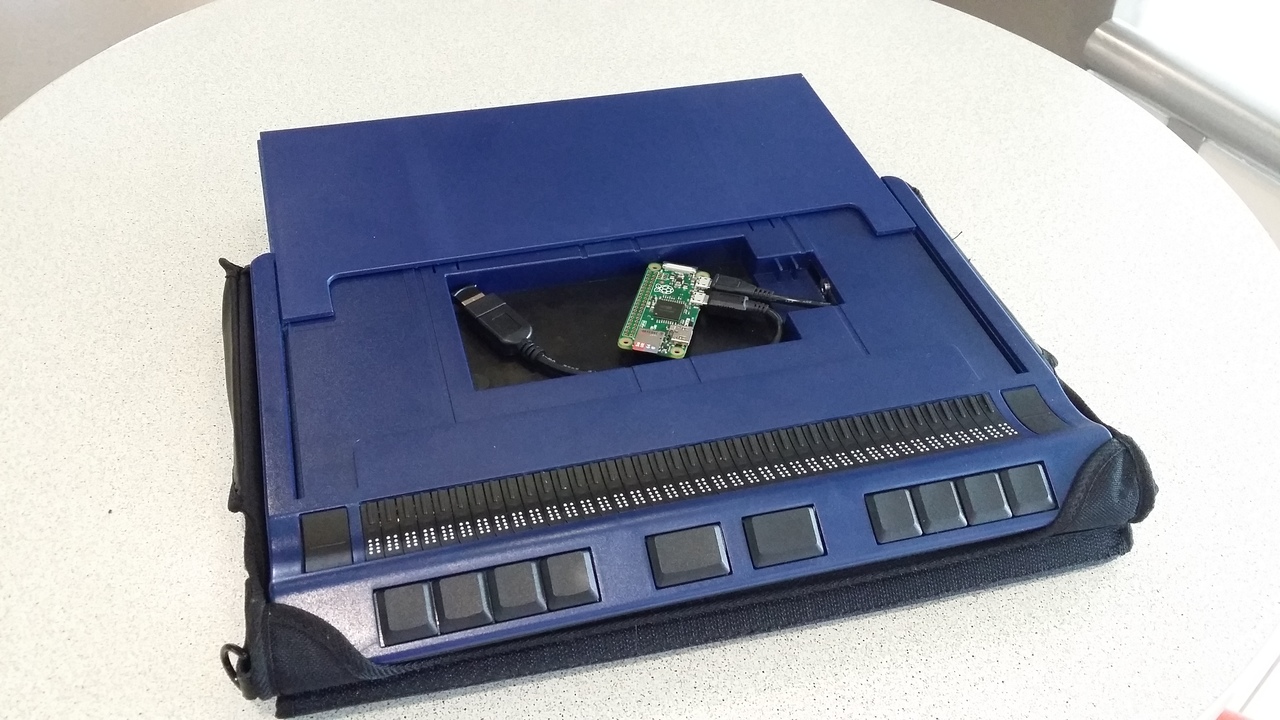
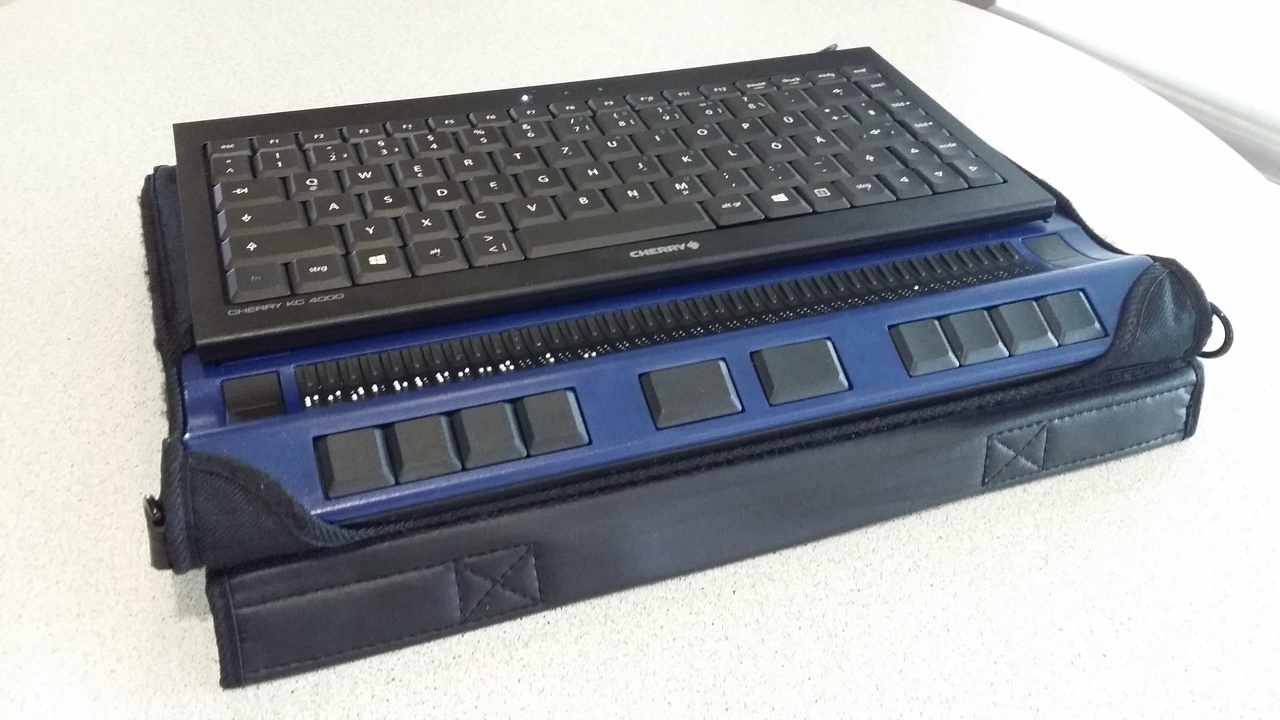
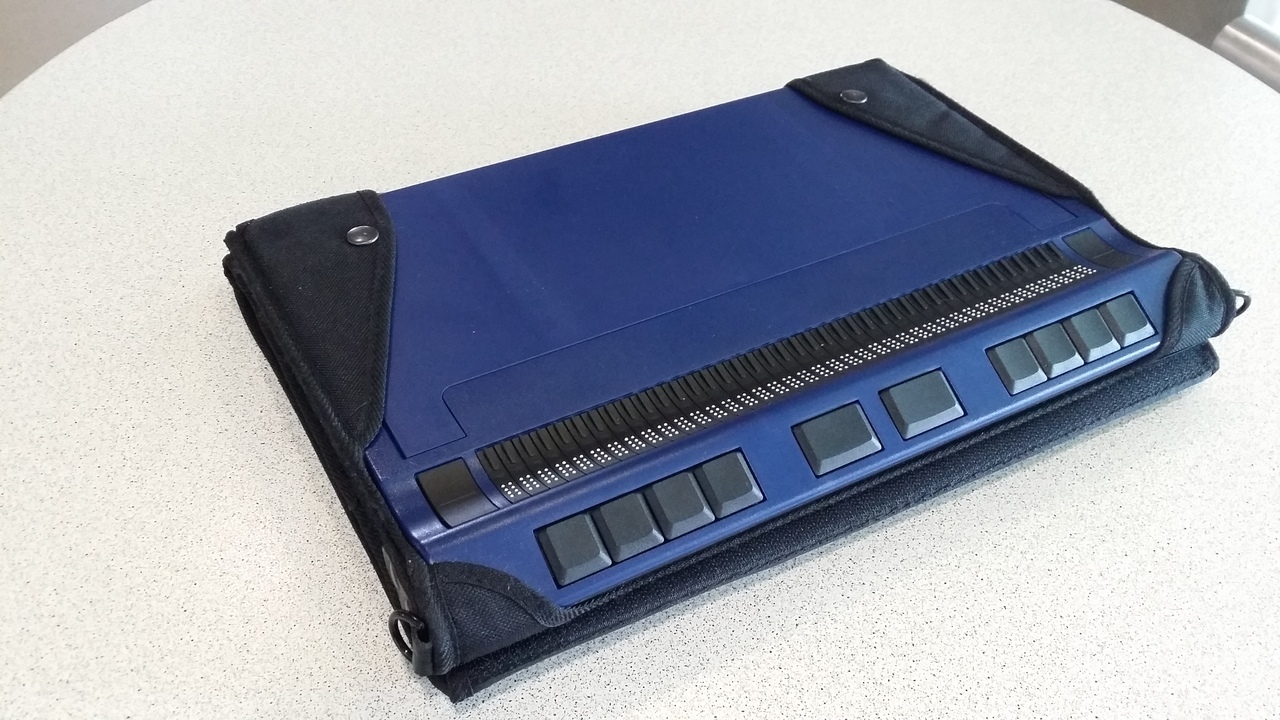 You can still pull out the little platform to increase the space
that can be used to put something on top.
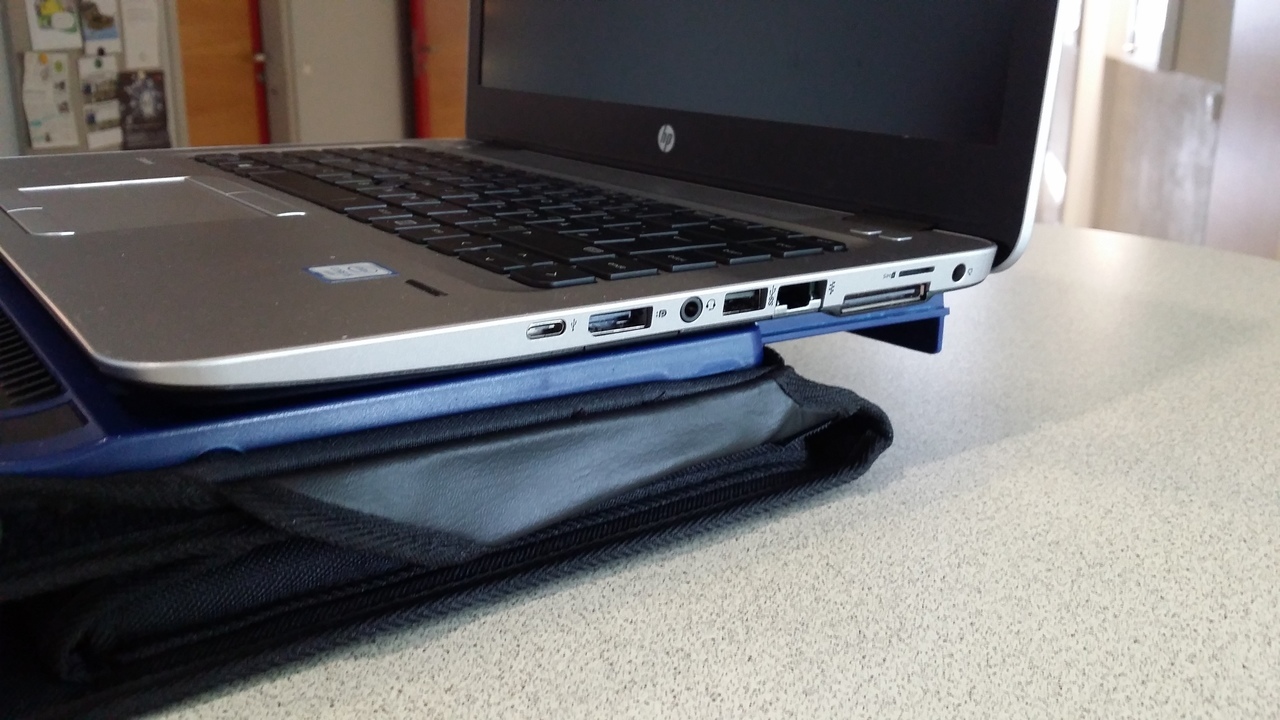 But, most conveniently,
they've designed in an empty compartment, roughly the size of a modern
smartphone, beneath the platform. The original idea was to actually
put a smartphone inside, but this has turned out (at least to me)
to not be very feasible. Fortunately, they thought about the
need for electricity and added a Micro USB cable terminating within the
newly created, empty compartment.
My first idea was to put a conventional Raspberry Pi inside.
When I received the braille display, however, we immediately
noticed that a standard-sized rpi is roughly 3mm too high
to fit into the empty compartment.
Fortunately, though, a co-worker noticed that the


