Search Results: "agi"

13 September 2010

Dirk Eddelbuettel: RcppArmadillo 0.2.6

Now that Rcpp got updated to 0.8.6, we have an updated RcppArmadillo release containing mostly updates to Conrad's Armadillo version 0.9.70 as well as some more templated sugar magic. RcppArmadillo makes it easy to write highly efficient and highly readable C++ code for linear algebra (based on Armadillo) in R extensions (using Rcpp for the interface). The short NEWS file extract follows:
0.2.6   2010-09-12
    o   Upgraded to Armadillo 0.9.70 "Subtropical Winter Safari"
    
    o   arma::Mat, arma::Row and arma::Col get constructor that take vector
        or matrix sugar expressions. See the unit test "test.armadillo.sugar.ctor" 
        and "test.armadillo.sugar.matrix.ctor" for examples.
More information is on the RcppArmadillo page. Questions, comments etc should go to the rcpp-devel mailing list off the R-Forge page.

12 September 2010

Iustin Pop: Xen PVM under VirtualBox

Most people won't need this, but for testing things like Debian bug #596009, it is very handy. A few posts on the internet say this doesn't work, or not reliably, so here is my recipe. System: VirtualBox from sid (3.2.8), and VMs created with Enable IO APIC, Enable PAE/NX, Enable VT-x/AMD-V (I have an AMD Phenom II 940), and finally Enable Nested Paging. I don't know if all these are absolutely needed, but with this config the final guest runs nicely for some quick tests. There are just a few gotchas that I stumbled upon: If however dom0 hangs, you should activate the first serial port in the VirtualBox config (raw file), and then you can get at least a kernel trace. As for the pure CPU, speed, the results are interesting; I've used openssl speed rsa to do a quick test. Host (non-virtualized):
                  sign    verify    sign/s verify/s
rsa  512 bits 0.000089s 0.000009s  11176.2 116018.4
rsa 1024 bits 0.000422s 0.000024s   2370.9  41914.3
rsa 2048 bits 0.002643s 0.000075s    378.4  13255.5
rsa 4096 bits 0.017623s 0.000272s     56.7   3680.9
And domU guest (double-virtualized, that is):
                  sign    verify    sign/s verify/s slowdown
rsa  512 bits 0.000051s 0.000009s  19620.1 111644.0    3.78%
rsa 1024 bits 0.000390s 0.000026s   2561.1  38929.4    7.13%
rsa 2048 bits 0.002752s 0.000080s    363.4  12566.9    5.20%
rsa 4096 bits 0.018628s 0.000288s     53.7   3474.3    5.62%
So we have less than 10% for pure CPU work, nice. I'm not able to do I/O testing since my VirtualBox machines are using write-back cache, not write-through, so I end with this unrealistic speed:
# dd if=/dev/zero of=big-file bs=1024k count=127 oflag=direct
127+0 records in
127+0 records out
133169152 bytes (133 MB) copied, 1.21597 s, 110 MB/s
So no, this should not be used for any kind of benchmarking; but for testing and debugging issues, it's a good way to fire up a Xen box without having to change any config or risk breaking your main machine

Lucas Nussbaum: Ruby packaging in Debian and Ubuntu: Mythbusting and FAQ

A lot is being said on how Ruby is packaged in Debian and Ubuntu. In this post, I m trying to go through the most common myths and give my position as a Debian Ruby maintainer. Note that those are my views, not necessarily those of the other Debian Ruby maintainers. Myth: Ruby is completely outdated in Debian and Ubuntu There s a culture in the Ruby community of always using the latest bleeding-edge version. There s also a culture (though this one has recessed a bit, I think) that it s perfectly fine to change APIs in incompatible ways if it makes the software slightly better. In Debian (and Ubuntu) stable releases, we try to provide a rock-solid version of Ruby that won t be allowed to change API during the support lifetime of a release. Bugfixes for important bugs can be applied, but that s basically all. So it s not surprising that Ruby in released versions of Debian and Ubuntu is behind the latest upstream version. In development branches, we are following the latest upstream versions quite closely. Debian 6.0 squeeze , to be released by the end of the year, includes Ruby 1.8.7-p302, and will include 1.9.2-p0 (the currently of Ruby 1.9.2 in squeeze is currenty a SVN snapshot from beginning of august). There are people interested in installing a packaged Ruby that just works, and other people interested in installing their own version of Ruby (through RVM and such). People in the Ruby community tend to forget about the first category, and consider that, because they install Ruby from source or with RVM, that should be the solution for everybody. We need the Ruby community to respect that different people have different ways of using Ruby, and to stop recommending that everyone using Debian and Ubuntu should install Ruby from source. We also need to leverage the backports services for both Debian and Ubuntu to provide a way to install the latest upstream version on stable releases. The only reason why we are not doing it yet is lack of time. Myth: Ruby is split into a myriad of packages in Debian In the past (pre-2005), a decision was made to split some libraries from the standard library into separate packages. This was motivated by: Most of the split was undone a very long time ago, and the readline and openssl splits were undone this year. The current package in Debian squeeze has: It is always possible to merge more packages, but merging any of the other packages would significantly increase the size of what you get by default, and might discourage people to use it in some contexts (disk space is not always cheap. Think embedded systems and smartphones). Myth: Rubygems is crippled in Debian There are two differences in the rubygems Debian packages. First, gems are installed in /var/lib/gems, not /usr/local/lib/gems. That is because rubygems are seen as state for the Rubygems package, not independant software installed separately. A change for this is currently being discussed, and should be done after the squeeze release. (I don t think that it s reasonable to push that change now). A consequence of installing to /var/lib/gems is that gems binary are outside of $PATH. After the change, gems binary would also be installed in /usr/local/bin. Second, gem update --sytem is disabled in the Debian package, because that would replace code from the Rubygems Debian package with code downloaded from the Internet, and can break your system in subtle ways. We have changed this (in SVN, not in any package in the archive yet) to allow gem update --system if a specific environment variable is set, which gives us the opportunity to display a warning message. Myth: Ruby is slow on Debian Ruby is built with the pthread threading code, because not using it breaks many native Ruby libraries (Ruby-gnome2, for example). And other Linux distributions are doing the same. There are some very old benchmark results floating around in some blogs that show that the pthread code has a performance impact of about 20%. There are been patches for that for a long time (applied in Ruby Enterprise Edition), but they were never properly sent back. Actually, all the discussions about this issue were rumors and blog posts, and there wasn t even a bug report about it! After the bug was reported properly, it was fixed in a timely manner. The fix is not yet included in the Ruby 1.8.7, but is being applied as a patch to the Debian package since 1.8.7.299-2. (So the Debian package is actually newer and faster than upstream Ruby in that regard). What makes Ruby so difficult to maintain in Debian? The main problems we have with Ruby are portability issues. The only officially supported platform for Ruby is IA32 (i386 in Debian), and everything else is best effort. It means that it is not even supported officially on x86_64/amd64! Debian supports a dozen of architectures, and the Ruby package has to work on each of them. Ruby 1.8 is mostly OK nowadays thanks to the help of Debian porters, but we still have serious problems with 1.9.2, since the test suite fails on sparc, hppa, ia64 and Debian GNU/kFreeBSD. Why doesn t Ruby use the alternatives system on Debian? The alternatives system provides a way to switch between different software providing the same functionality. Currently, if you want to use Ruby 1.9.2, you need to use the ruby1.9.1 executable (1.9.1 = ruby compatibility version here). The alternatives system would allow to switch ruby to ruby1.9.1 on a system-wide basis. However, the situation of applications and libraries working only with Ruby 1.8 should be clarified: those should use /usr/bin/ruby1.8 instead of /usr/bin/ruby. Another problem is that the way to specify packages dependencies still need to be determined. There s nothing impossible to do about that, it just needs someone to do the work. Where do we go from here? The Ruby developers (or expert users) community is generally very hostile towards Debian. Many harsh words and insults are used in discussions mentioning Debian in the ruby-core@ mailing list, and there are frequent recommendations to avoid the Debian packages and install from sources, which is quite demotivating (Actually, what prompted that blog post is someone calling Debian-specific changes unforgivable). This atmosphere makes it hard to recruit people, and the Debian Ruby teams are completely understaffed, which is clearly the major blocker to improving the situation further. We are 3 co-maintainers for the interpreter packages, and I m the only Debian Developer that is really active on a regular basis in the pkg-ruby-extras team (that does libraries and applications packaging). We desperately need help, but at the same time I have no time to improve our documentation and make it easier to join the team. While I haven t reached a final decision yet, I am also likely to stop doing Ruby work in Debian after squeeze is released, as I am getting increasingly tired and demotivated.

Christian Perrier: Release team...

(update: yesterday's version was using http://wiki.debian.org/Teams/ReleaseTeam as reference, while http://www.debian.org/intro/organization is the one that's up-to-date. Those watching the current traffic in debian-release can probably realize the huge *thank you* deserved by the entire release team for the work they're doing. So, how about spamming the release team members with (private!) "thank you" messages when they unblock a package of yours? And (even more difficult) also one when they don't unblock your package...but spent time reviewing it and more time to explain you why they prefer not unblocking it... In any case, thank you, Neil Maulkin, Adam adsb, Dann dannf, Felipe faw, Jurij trave11er, Luk luk, Mehdi mehdi, Pierre MadCoder, Julien jcristau (doh, French Cabal!)...and Martin zobel (who's apparently forgotten on the page). Not to forget Adam adsb and Phil phil for managing stable releases....and the Wise Release Wizards (vorlon, aba, luk, HE). Hat off, guys (only guys there, yet another place for d-w to show up).

11 September 2010

Christian Perrier: Release team...

Those watching the current traffic in debian-release can probably realize the huge *thank you* deserved by the entire release team for the work they're doing. So, how about spamming the release team members with (private!) "thank you" messages when they unblock a package of yours? And (even more difficult) also one when they don't unblock your package...but spent time reviewing it and more time to explain you why they prefer not unblocking it... In any case, thank you, Neil Maulkin, Adam adsb, Dann dannf, Felipe faw, Jurij trave11er, Luk luk, Mehdi mehdi, Pierre MadCoder, Julien jcristau (doh, French Cabal!). Not to forget Adam adsb and Phil phil for managing stable releases....and the Wise Release Wizards (vorlon, aba, HE). Hat off....

10 September 2010

Bernd Zeimetz: refactoring the guruplug server plus

As mentioned in my last blog post the GuruPlug Server Plus needs some major refactoring before it can be used. Not doing so will make you end up with a fried brick. There are various stories in the forums about cooling it properly, so you might want to have a look first instead of following mine blindly. And of course - whatever you do - it is your fault when you end up with a brick, not mine!.

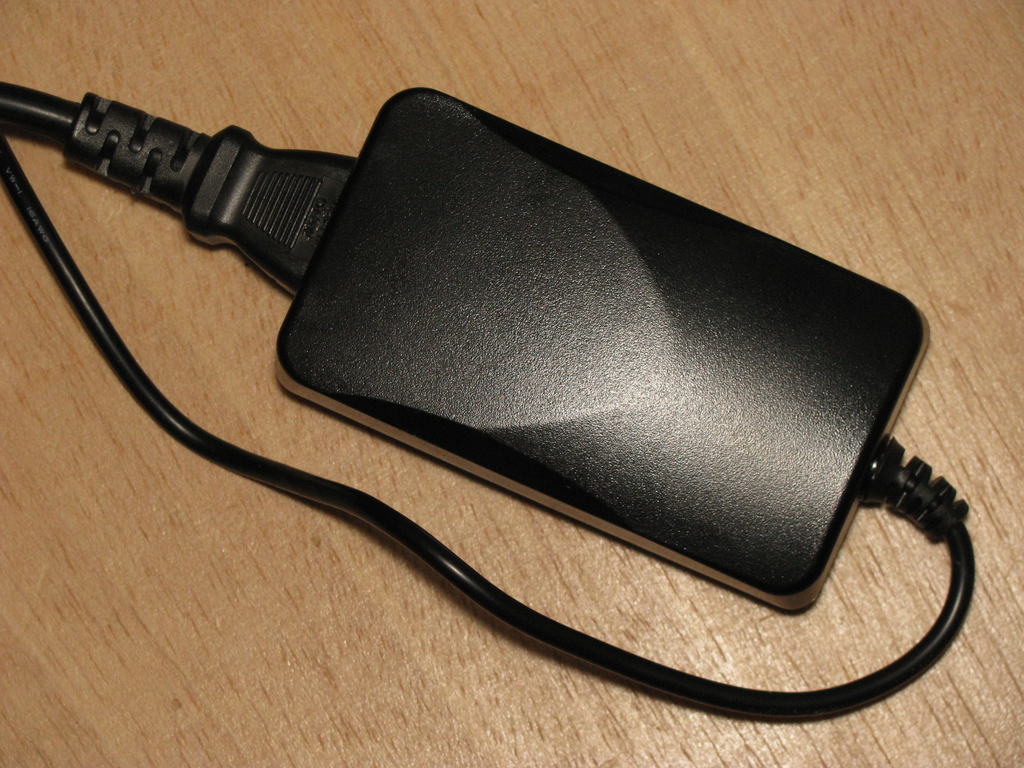
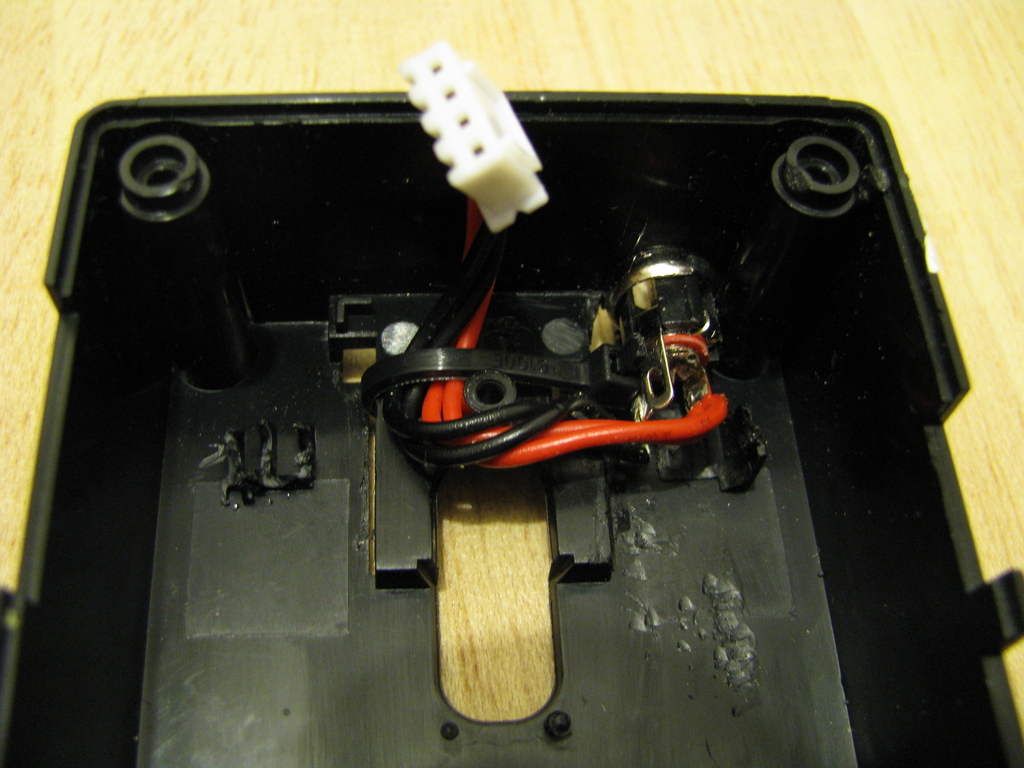
Replacing the power supply As I would never ever trust the PSU (see my last blog post for the gory details) and some additional free space in the case is necessary, it is time to rip it out. As replacement I've ordered an external 5V/20W PSU. To connect it to the plug I've drilled a hole into the case and added a proper connector after soldering the original cable from the old PSU to it. Make sure to add some retainer to stop the cable from touching the CPU/memory heat sinks later. GuruPlug Server Plus PSU replacement GuruPlug Server Plus PSU cabling

Proper heatsinks One of the biggest problems in the original GuruPlug design is the heat spreading and collecting piece of alloy, which probably makes things even worse than better. After some discussion in #debian-devel the idea came up, that the board should be able to run fine without a heatsink - at least when idling. That is the case, indeed. So let's get rid of that piece of alloy, together with the holders and springs. Unfortunately heat things are necessary to handle some work load. To mount them make sure you get some good thermal glue as you don't want to insulate the chips from their heat sinks. I've used Arctic Silver II thermal glue - not cheap, but working well. Make sure to clean the heat sinks and chips properly with alcohol (2-Propanol is my favourite for that), so there is no fat and dust left. When you use the glue be careful to read the documentation properly and make sure you apply only as much as necessary - a thin coating is enough. After applying the glue and mounting the heat sink you need a clamp to put some pressure on it while the glue dries.

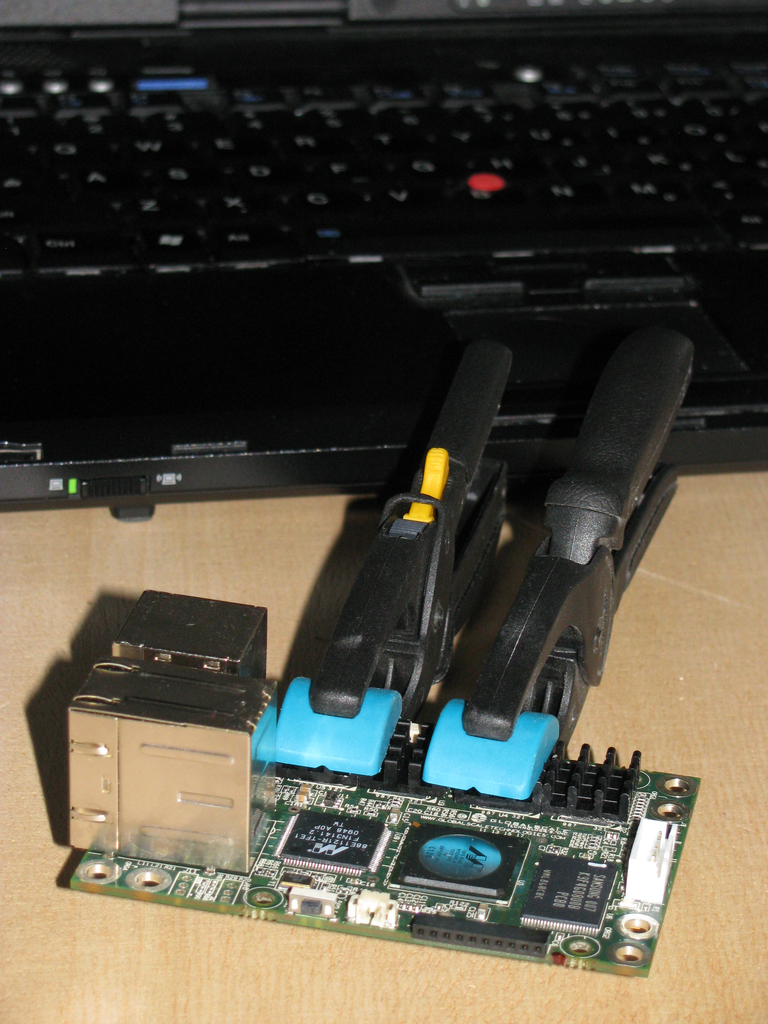
Heat sinks for the memory As there is a lot of space around the memory chips, I've got some 14x14x6mm heat sinks. Luckily there are only small parts on the other side of the board, so it was not hard to attach clamps to ensure the glue is able to dry properly. In case largish amounts of glue are squeezing out between heat sink and chip you probably want to start from scratch and clean everything (quickly!) with alcohol again. GuruPlug Server Plus memory heat sink clamping

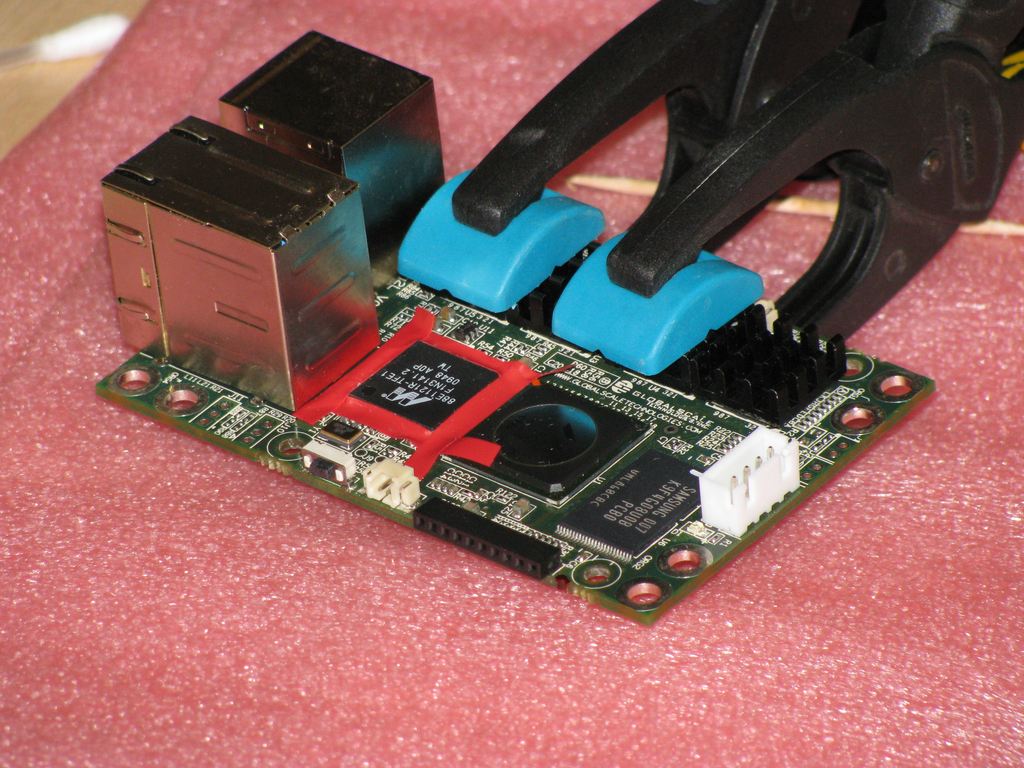
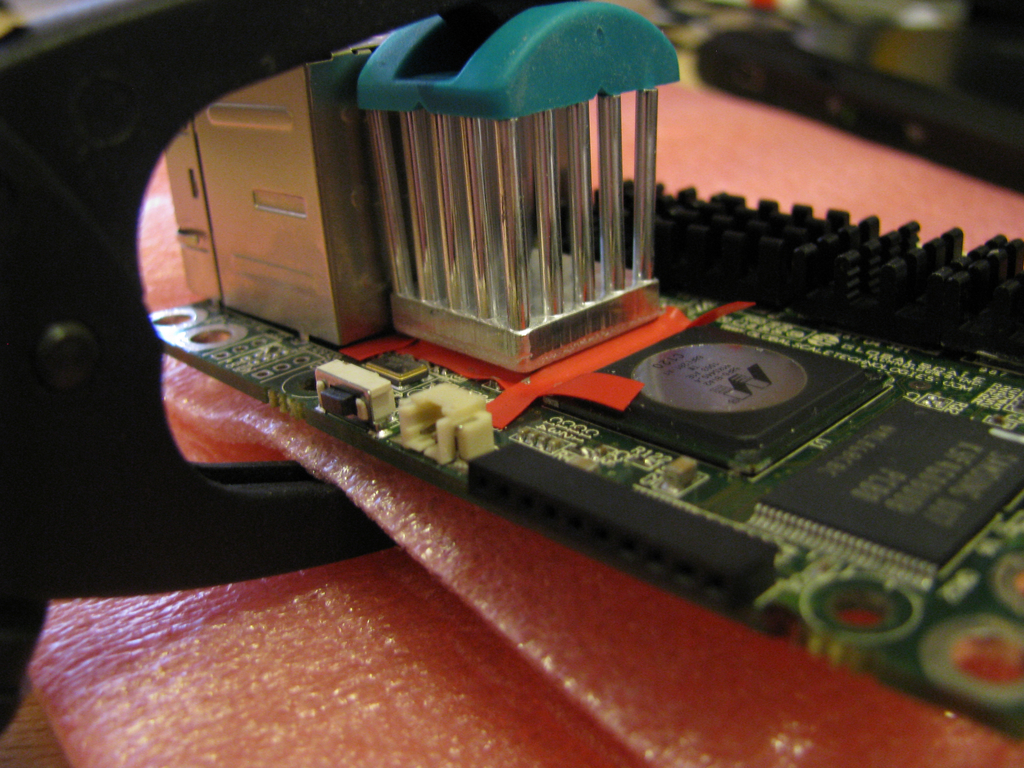
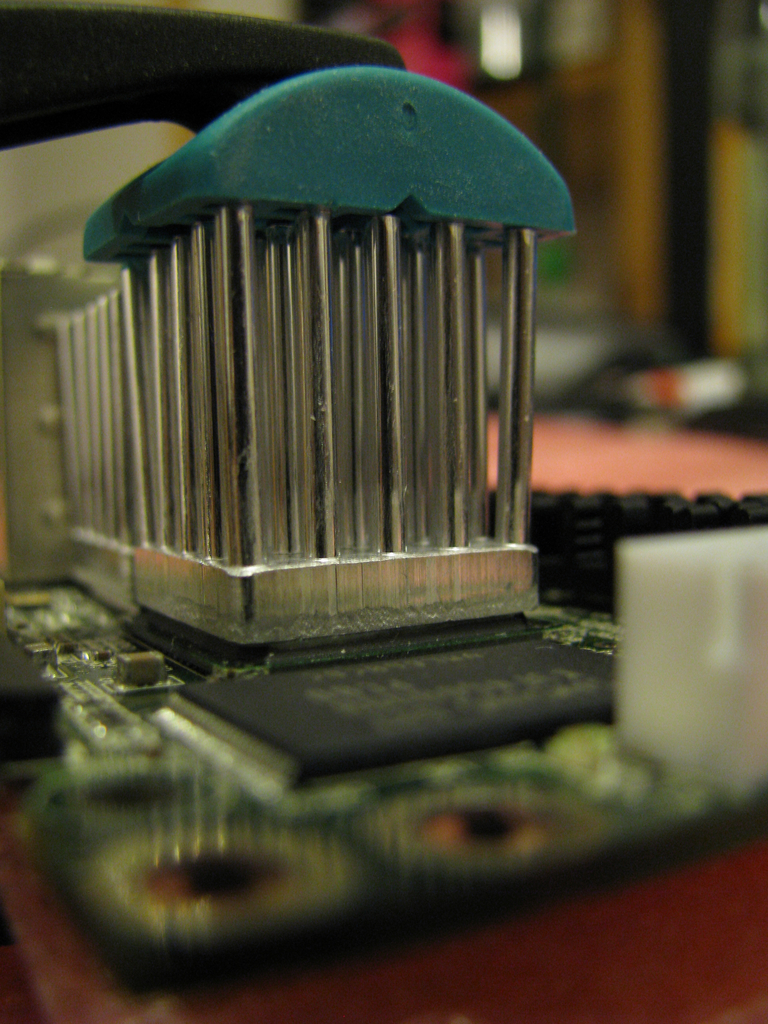
Gigabit Ethernet PHY and CPU heatsinks PHY and CPU need proper heatsinks as they're becoming pretty hot under load. Due to space limitations I had to stick with a 17x17x20mm heat sink for the PHY. I've tried to get a largish heat sink with BGA mount for the CPU, but I was not able to find one in short time and without ordering 1000 of them. So I've got another one of the 17x17x20mm model for the CPU. Later I found two other heat sinks which might fit on the GuruPlug's CPU: Malico 19x19x25mm or a Advanced Thermal Solutions Maxigrip. But for now the smaller one will have to do the job, also I'm scared to removed it without destroying the CPU. To mount the heat sink on the PHY a bit of preparation is necessary to ensure that the glue doesn't result in short cuts on the IC's pins. The arctic silver documentation recommends to use silicone on the pins to stop the glue. As I neither had the proper silicone nor did I want to make such a mess, I've decided to get a sticky insulating tape and some tooth picks to mount it properly on the IC pins. Make sure to do a proper job here! With good clamps you can work on the PHY while the memory heat sink glue is still drying. GuruPlug Server Plus - preparing the PHY The other problem on this side of the board is that some higher parts are mounted on the lower side of the board, so make sure to get some foam to protect them from your clamps. Except of the size of the heat sinks there is no real difference to the small ones: add glue, mount the heat sink and fix it with a clamp. GuruPlug Server Plus - mounting the PHY heatsink Before the glue dries completely make sure you remove the duct tape strips again. Be careful not to wipe any excess glue onto the IC pins. If you manage to do so you might want to remove and clean everything properly. So just be careful and everything should be fine. GuruPlug Server Plus - mounting the PHY heatsink 3 Mounting the heat sink on the CPU is easier as the CPU is a nice BGA package. No need to protect pins an there are none. GuruPlug Server Plus - mounting the CPU heatsink

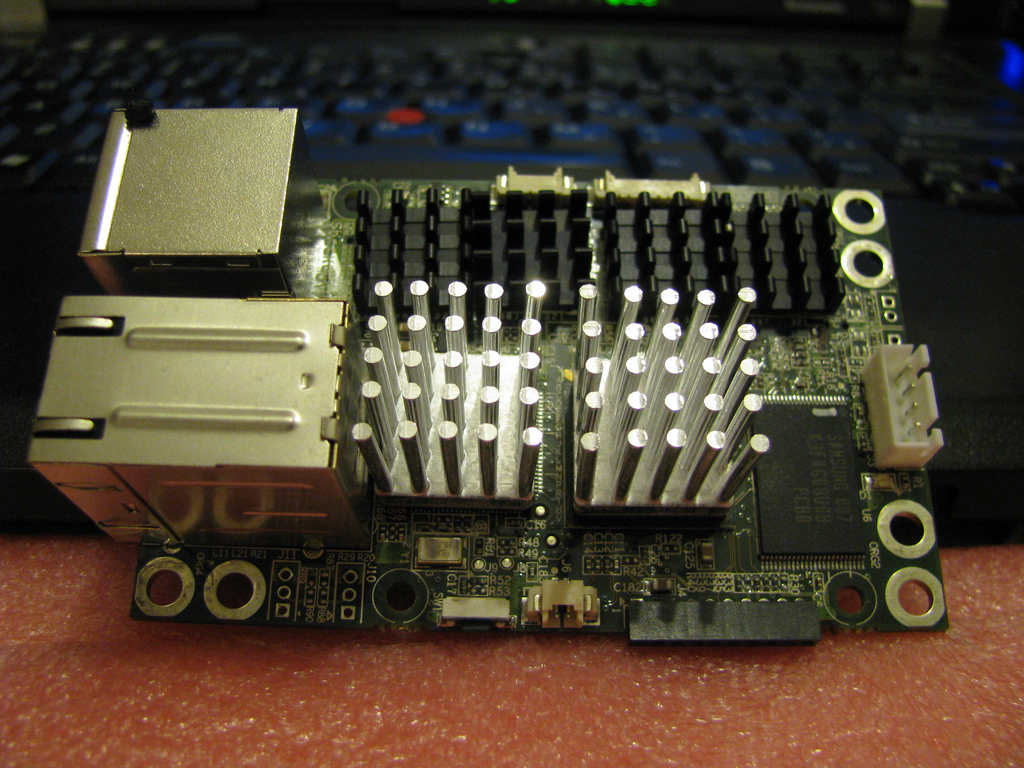
Finished As you're able to see on the photo I did not the very perfect job, but fine enough to work properly. GuruPlug Server Plus - heatsinks

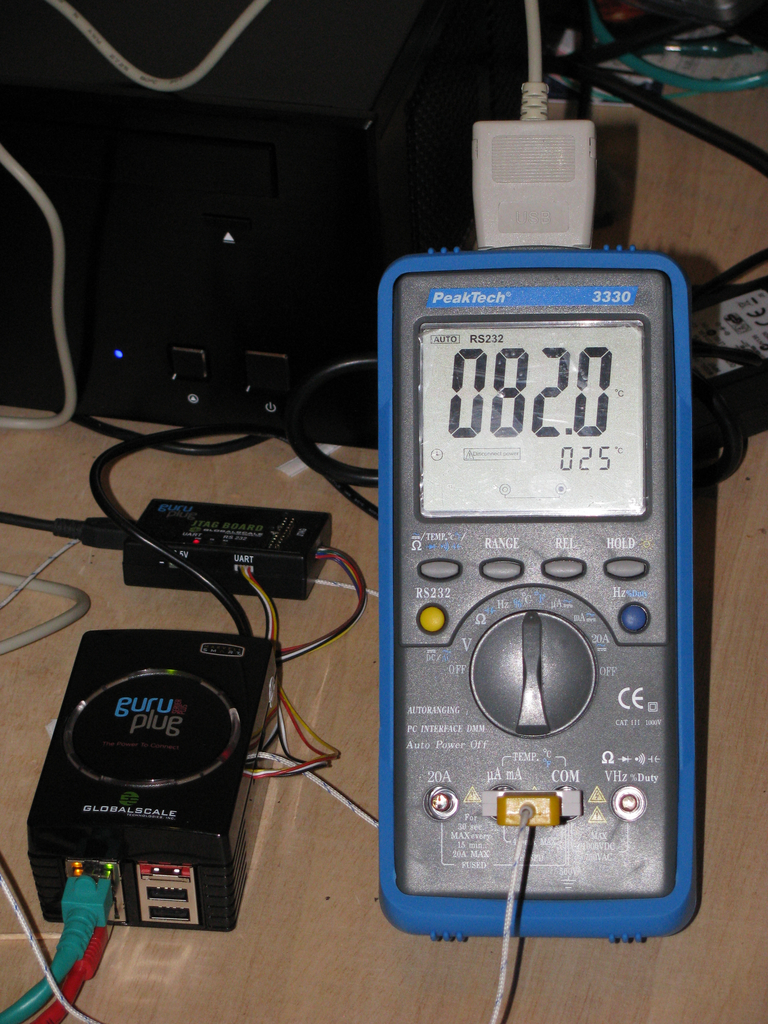
First tests with the new heatsinks Some tests with stress and some heavy network traffic showed quickly that the heat sinks are working well! But not well enough to be able to mount them into the original closed case (how the hell was this supposed to work before!?). Without any air to breath the temperature on the CPU heat sink went up to 85 deg C quickly. So on the CPU's die are > 100 deg C, which is at least close to the max allowed temperature. GuruPlug Server Plus - still too hot

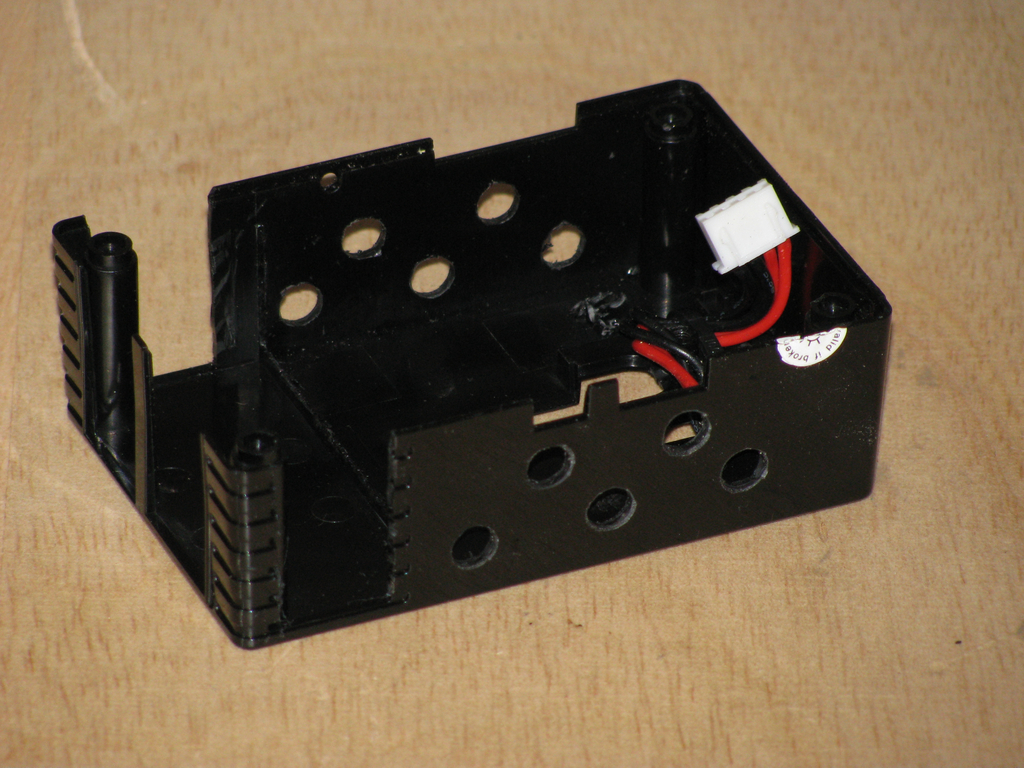
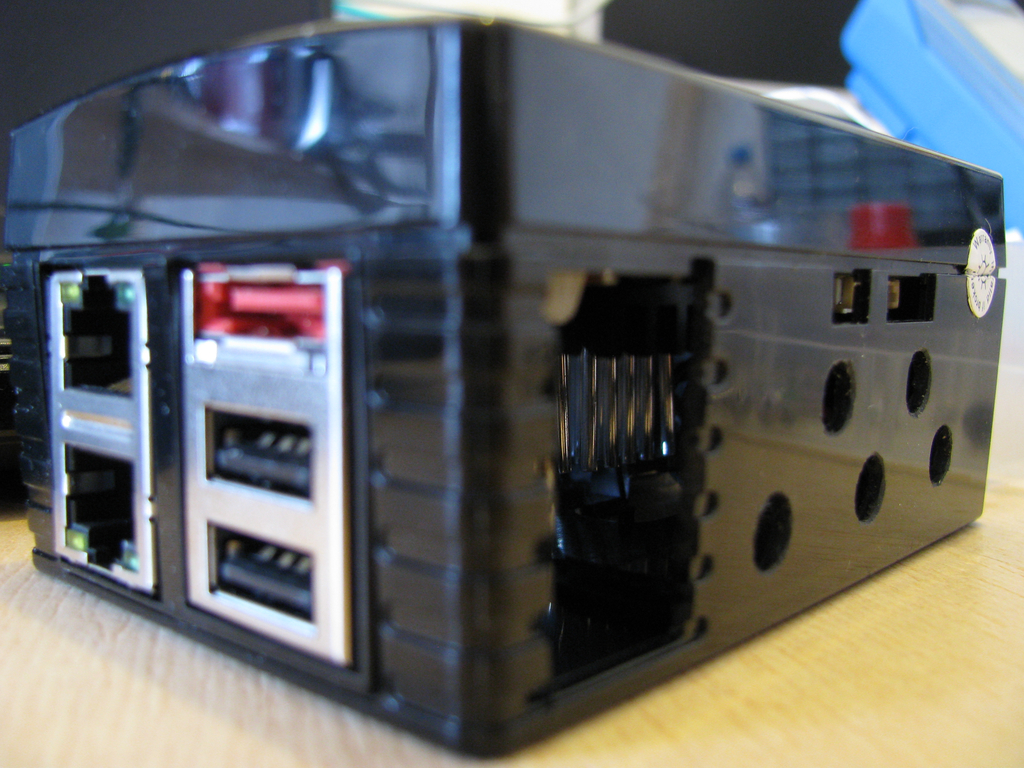
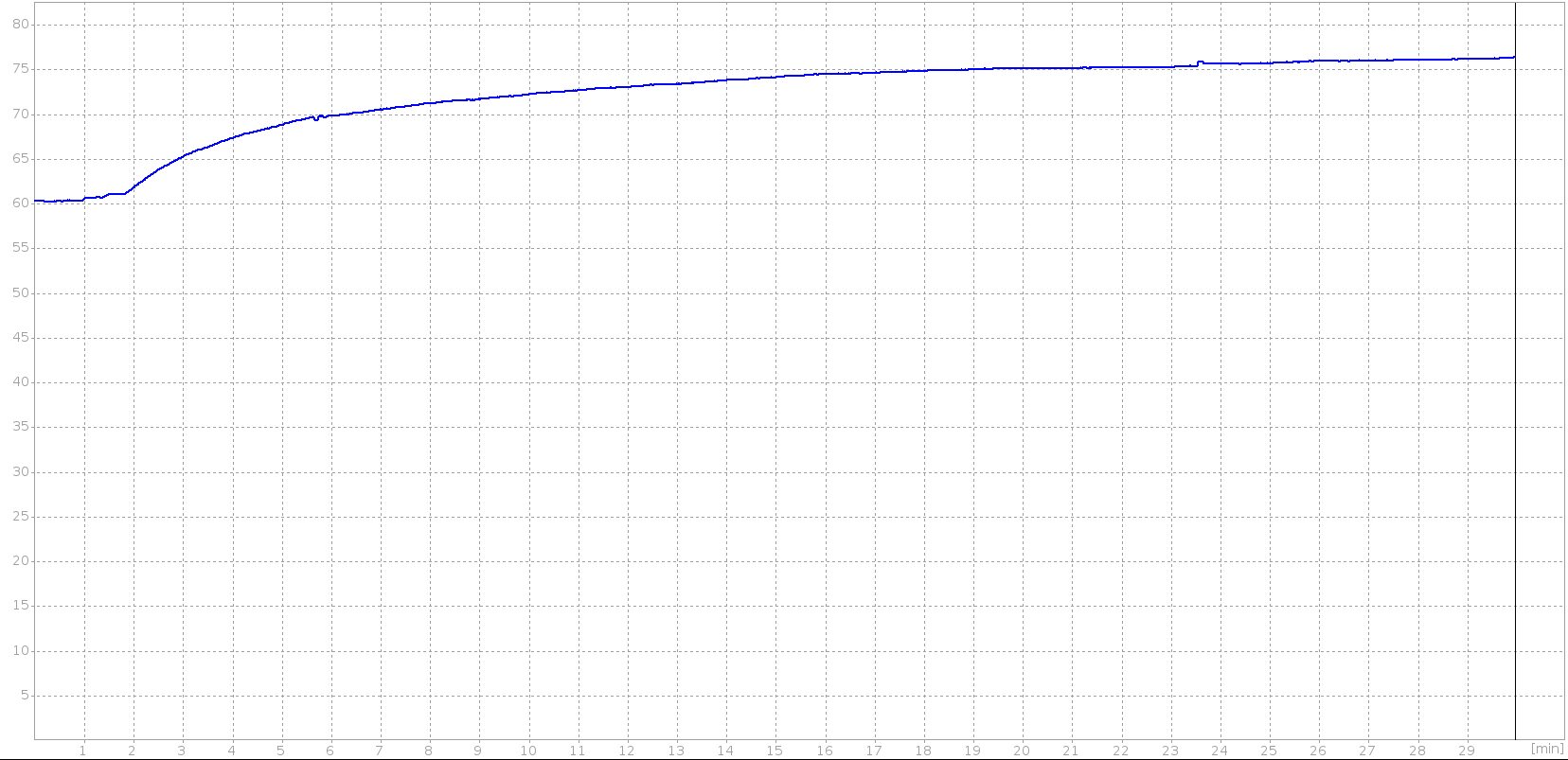
Adding air holes Obviously some additional air holes are necessary. After meeting my drill and cutter, the original case looks a bit like a piece of cheese now. GuruPlug Server Plus - case with air holes 1 GuruPlug Server Plus - case with air holes 2 Some more tests show that the temperature sticks around 76 deg C under heavy load now. That is still pretty hot, especially when the temperature in the room becomes hotter in summer. As I'm not going to run a lot of traffic trough it (my cable connection is limited to 20 MBit/s anyway), I guess it will work. Below is a graph I've recorded with my multimeter and qtdmm. It shows that the temperature rises to ~76 deg C and stays there. GuruPlug Server Plus - temperature curve Not sure if I could introuce some more load, the CPU had a load of 6 running stress. Network traffic was around 2x100MBit/s again. I could imagine with 2xGBit the CPU and PHY would become much hotter (no idea if it would be able to handle it at all, though). The PHY was usually a bit cooler than the CPU, so I didn't spend time to measure the temperature properly.

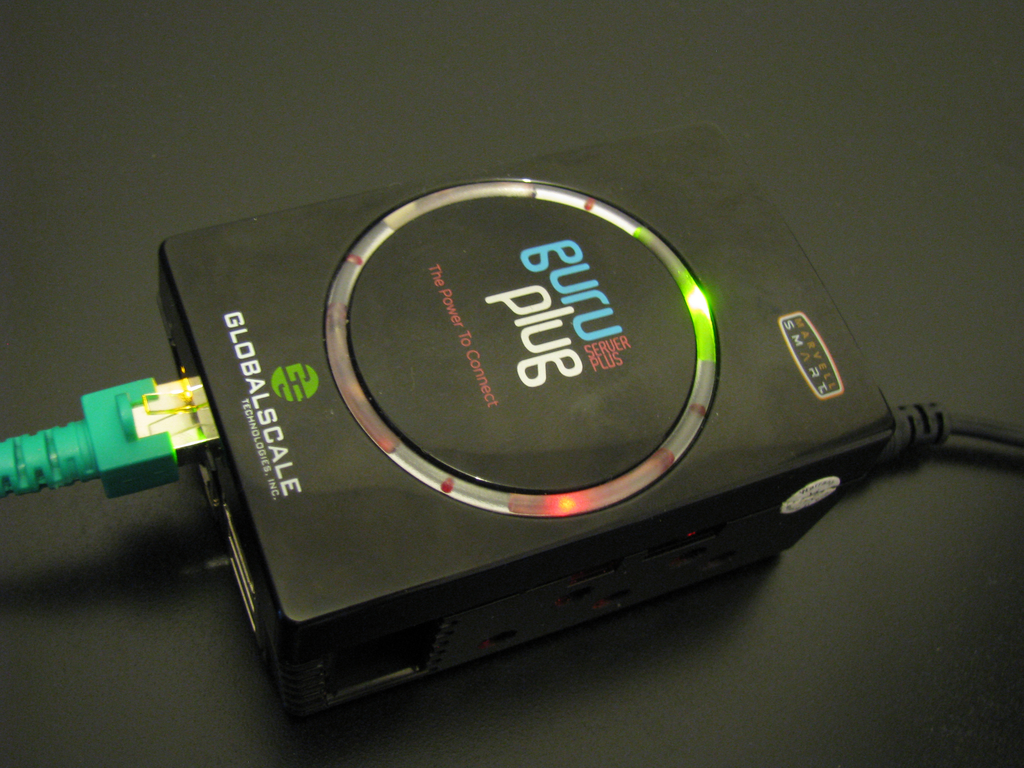
Conclusion My opinion is still the the original design of the plug is an insane QA and design failure. There is no way that it could ever work as shipped originally. If I'd have to design a new case for it, it should have a single insulated compartment for a PSU to ensure that no contact with high voltage is possible. The case around all other parts should be made of alloy with a lot of air holes. So the case could be used as heat sink (properly done, not with these insulating duct tape strips) and at the same time allow air circulation and a nice view on the LEDs on the board. Of course the case would be much more expensive than, but I'm sure it would work properly and would be worth the money. And if done peoperly, it would look much better than this blinking plastic thing. I could imagine it would sell well! So at the end I'm wondering what GlobalScale Technologies will do. I doubt it will be possible to create the 'professional upgrade kit' as they had announced before. Replacing all units is the only proper way. We'll see what happens. At least my GuruPlug is working well now and it will be used as replacement for my OpenWRT router soon. WiFi is not working, but that will be handled by my media center anyway. GuruPlug Server Plus - running plug

Keith Packard: altos-release

AltOS The Altus Metrum Operating System Altos is the core of the software for all of the Altus Metrum products. It runs on the 8051-based micro-controllers within both the flight computer and the ground station devices. AltOS a small cooperatively multi-tasking operating system. AltOS Version 0.7.1 Released Bdale and I have just released AltOS version 0.7.1. Version 0.7.1 is the first release to include the new Java-based ground station software which runs on Linux, Mac OS X and various Windows flavors. AltOS Changes in 0.7.1
  1. Deal with Windows and Mac OSX USB stacks. These two operating systems do interesting things with USB and found some boundary conditions within the AltOS USB stack which couldn t be tested on Linux. With test cases discovered, the panic calls were turned into code that dealt with these cases correctly.
  2. Increase packet mode payload size and add callsigns. The callsigns are set by the master end of the packet link (normally the TeleDongle) so that the entire radio conversation conforms to regulatory requirements. Increasing the payload size makes data transfers go faster.
  3. Place configuration data in fixed flash addresses. This change makes it possible to read the serial number and radio calibration data back out of the flash data when reprogramming a device.
TeleMetrum Changes in 0.7.1
  1. Ensure GPS date information is written to on-board data logger. The GPS date information is used when constructing eeprom log file names; without this, the eeprom downloading tool would generate a filename based on the current date.
  2. Allow TeleMetrum to be used as a programming dongle. This means the user can reprogram a TeleDongle or another TeleMetrum using the TeleMetrum as a programming dongle. Before this, only the TeleDongle could be used to program other devices.
AltosUI - Ground Station Software for Altus Metrum devices Version 0.7.1 is the first release containing our new cross-platform Java-based user interface. AltosUI can: Three Operating Systems, One AltosUI AltosUI provides all of these features on the three target operating systems, Linux, Mac OS X (version 10.5 or newer) and Windows (XP, Vista or 7). The bulk of the software is written in Java and is built once and tested and delivered on all three target platforms. A tiny shim library is built on each system to provide access to the Altus Metrum devices connected over the USB link. Thanks to our contributors! We ve gotten lots of help getting this software built and tested: Future Plans With the basic AltOS and AltosUI functionality running, we ve got lots of ideas about where to take the system in the future. And, we d love to hear ideas from you as well. Some of the ideas we ve like to get done include:
  1. Google Earth file export. We had a Linux-based C program to export a KML (Keyhole Markup Language) file that Google Earth can read and present to the user overlayed on satellite photo data.
  2. Data Plotting. Being able to plot flight data right in the UI would be nice, and there are several Java plotting packages available to try out.
  3. State-dependent display. When the rocket is on the pad, you only want to know if it s ready to fly. When the rocket is descending on a chute, you want to know where it is in the sky and how fast its falling. Presenting a limited amount of information that is most likely interesting to the user should make the display more useful.
  4. Ejection charge testing. The TeleMetrum firmware has the ability to fire ejection charges over the USB or radio links. Safely hooking this up to the user interface will allow for wireless ejection system testing. The key here is safely , of course, which means figuring out a fool proof user interface.
I m sure there are any number of additions that could be made to this list; feel free to send along ideas that you ve got. Of course, all of this software is licensed under the GNU General Public License, so you can get the source and hack on it in the comfort of your own home.

9 September 2010

Matthew Garrett: Linux backlight control

Backlight control is one of those things that you'd think would be simple, but ha ha this is computing so of course it's an utter disaster and everything is a huge mess. There's three main classes of backlight control in the x86 world, all of which have drawbacks:
Right now, if there's an ACPI backlight interface then that's usually the only thing we'll show you. We can do that because we can identify if there's an ACPI backlight interface when we parse the ACPI tables at the start of booting, and that information can be registered before we start setting up any other backlights. The problem comes when we have no ACPI backlight interface. We don't have any idea whether there's a platform mechanism until a platform driver loads, which could be at any time. As a result, we've been reluctant to expose GPU-level backlight control because doing so would often give you two separate backlight controls and no indication as to which should be used. Userspace doesn't really have a way to make that decision either, so everyone ends up unhappy.

This is especially problematic with some machines which provide no ACPI or known platform control (or, in the case of some Samsungs, only provide platform control if you have a special Linux BIOS that Samsung won't give you) but can control the backlight via the gpu. Right now you get nothing, because giving you something would potentially break other systems and the needs of the many etc. Sorry! But this is obviously problematic in the long term, especially because multi-GPU machines tend to have multiple ACPI backlight interfaces, so I've been working on a better approach.

When a backlight device is registered, it appears under /sys/class/backlight. If it's an ACPI device it has a symlink pointing to some random ACPI device. If it's a platform device it's pointing at something like "dell-laptop" which is approximately unhelpful when it comes to figuring out what it controls. If it's a GPU-level device then it probably points at the PCI device, which is helpful except in the case where you have multiple backlight controls on a single GPU. So, by and large, you have no good way to identify which backlight control is preferable unless you keep a huge list of all possible backlights along with some scoring.

The first thing I've added to improve this is a "type" attribute. This tells you whether a given backlight is firmware-level (like ACPI), platform-level (like the various laptop drivers) or performs raw register writes (like a GPU driver). That lets userspace decide which interface is preferable. It'll typically be the ACPI interface, because that's the most likely to keep synchronisation and so avoid bizarre brightness bugs. The next thing has been to start fixing up the parent links. There's nothing we can do for the platform level devices, but the ACPI drivers could at least point at PCI devices rather than into ACPI space. That means that multi-GPU systems can now identify which interface to use based on the currently active GPU. Finally, I've started pointing the GPU-level backlight controls at the specific output rather than merely at the PCI device. This probably makes little difference for laptops as such, but once we start exposing backlight control for monitors that support ddcci it'll make things much easier as we'll know which backlight control corresponds to which monitor.

I've then written a small library that accepts information about the output and picks the "best" backlight for the device. It's obviously based on a pile of heuristics and there's a couple of bits of API that I suspect need to be nailed down yet, but it means that this code only needs to be written once. It's then simple to glue this into X drivers, which means that they can expose a "Backlight" xrandr property on each relevant display. That means that backlight control is then handled at the session level with the X server acting as the privileged agent, which simplifies a bunch of things and means we can finally let hal die entirely. Long-term this means we'll have unified backlight control for all of your displays, which is a wonderful thing.

Summary: We kind of suck right now, but there's a reasonably clear path to getting better.

Christian Perrier: Care about samba in squeeze?

If you do care about having good samba packages in squeeze, you can help. If you're in a hurry and don't want to read the blah-blah, just skip to the end of this story and read the last paragraph. Thanks to the confidence of the release team, we (samba packagers) have been "authorized" to upload samba 3.5.4 in unstable, thus targeting having that version in squeeze. Up to July, we were indeed targeting 3.4.8 for squeeze, on the assumption that, as usual, samba upstream releases need some maturation before being strong guarantee that no regression happens. In July we were ready to move and finally upload in unstable the 3.5 packages we kept in experimental until then. The final decision was to be taken during DebConf10. It was roughly taken with Steve Langasek, but....I couldn't upload immediately (most people know that working on major packages during DebConf is a dream)...and had holidays afteer. In the meantime, the freeze happened so we got theoretically screwed... Still, I could manage to convince the release team that long term support for samba 3.5 will certainly be better than 3.4...and that functionality in that version (particularly several Win7-related fixes and a much improved code for printing support) and we got a notice "please upload to unstable and come back to us in a few weeks". That happened, finally. So, now, we need YOU, samba users and admins, to test these packages. Merging our packaging branches was hard (thanks, Steve Langasek, for your help) and glitches are always possible. So, please TEST these packages by installing samba, winbind, libsmbclient and friends from unstable....and report bugs, preferrably the release critical ones....

Lars Wirzenius: My Plans for Debian

I am a Debian developer again, and here's what I plan to do at first: I don't expect to do a lot of packaging work. I'll package, or help package, stuff that I develop, but I'll not be specifically be looking for stuff to package.

8 September 2010

Mirco Bauer: Smuxi 0.8 "Godsend" Release

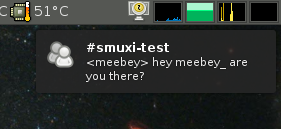
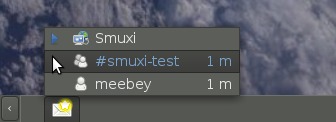
5 weeks after the 0.7.2.2 "Lovegood" release, I am very happy to announce the major feature release, 0.8 codenamed "Godsend". Major feature highlights of this release are desktop notifications (with full support of actions, icons, updates, append and sound), messaging menu / indicators (as provided by Ubuntu's Ayatana project) and working Twitter support with OAuth (basic auth was disabled by Twitter on 31st August). This version also fixes all bugs that were reported since the release of 0.7.2.2. Desktop Notifications
Messaging Menu
Further on, Smuxi comes with the following improvements in its user interface: Smuxi provides better connectivity and security by supporting: HTTP and SOCKS proxies as well as secure connections to IRC servers by using SSL with optional certificate validation. Last but not least, it comes with an enhanced Twitter experience by supporting the use of multiple Twitter accounts at the same time, reformatting tweets that contain newlines and showing the full retweet instead of a truncated version. Updated languages includes: French (Cl ment BOURGEOIS) and German (Bianca Mix) The #smuxi IRC channel can now also be found, in addition to OFTC, on other popular IRC networks such as freenode and GIMPnet. The messages on #smuxi are automatically relayed between the 3 IRC networks. If you like Smuxi and want to support it by making micro-donations, Smuxi is available on Flattr. There are also many other nice FOSS projects available on Flattr, see the Flattr-FOSS project. Smuxi is available for download from here. Binary Packages of Smuxi 0.8 are ready to be used by Debian/Experimental, Ubuntu/Maverick, Ubuntu/Lucid (via PPA), OpenSUSE, Foresight Linux, FreeBSD, and Windows.

7 September 2010

Brett Parker: Discovering Netgear ProSafe switches and IP Power 9258 devices

So, we have some netgear prosafe switches and some IP Power 9258 devices where I'm currently working, unfortunately, these don't always get the IP configuration that you'd expect (or, they get a DHCP lease from a DHCP server that I can't query the leases from...), however both come with little windows utilities that "magically" find the devices and give back (quite a lot, really) information on the IP configuration of the device. Being somewhat of a "oh god, I don't want to use windows, please don't make me" type person, and knowing the the IPPower 9258 boxes were going to a remote site where I'll only have linux machines on the same network as them, I figured that it would be a good idea to sit with wireshark and find out how the heck these tools worked. Turns out that both just send out a UDP broadcast packet (or two) and then sit and wait for responses - this meant that to get the information that I wanted out of them I could get away with writing very little python, taking the UDP packet that I got back, taking the payload and dismantling it piece by piece so that I could display that information. The scripts aren't at all polished, but if anyone happens to need something (that should work multi-platform, too) to discover either of these, let me know and I can throw you what I've got.

Brett Parker: Life, the Universe, and Everything (or something)

Forgive me readers, for I have sinned... or at least, not blogged for a looooong time. I've been reasonably busy, stopped working for Runtime Collective and started contracting for a small company in Portsmouth, it's been somewhat hectic, and the commute isn't brilliant, but it has given me a lot of time for reading... Really, mostly a lot of my time during the week is commuting, working, reading and sleeping, haven't had much time for anything else, and have mostly been knackered... I'm getting in to the habit now, though, so am getting a bit more time for getting on with other things. I have, however, gained a lot more fiction books in the last few months, and am averaging 2 or 3 books a week at the moment. Most enjoyed the first 2 books of the Demon Trilogy by Peter V Brett - have to wait till 2012 to get the last book, though - which is a loooong time! Actually, I seem to have made a habit of ending up starting trilogys recently where not all of the books are published, in the case of Feed by Mira Grant I managed to really screw up - not even the second book is due out until next year - but the first is really quite good. I've also got the first book of Mark C Newton's Legend of the Red Sun books, really enjoyed that, but am waiting for the second in paperback, as they're much easier to carry around and use on the tube. Have read the Millennium trilogy, and thoroughly enjoyed it. The first film, although a reasonable adaptation of the book, misses some good parts of the book, and doesn't leave you feeling as if you know the characters as much. Am also planning on working through all the Laundry books by Charles Stross, I picked up The Fuller Memorandum on a whim (OK, it was on a 2 for 1 in Waterstones...) and really enjoyed it, so am going to get the rest (when I start getting low on books again - I've currently got another 5 queued up, so it might not be for a couple of weeks). So, other than that, what have I been up to? Well, played the last bits of DLC for Assassins Creed 2 on the PS3, and thoroughly looking forward to the release of AC3, played most of the way through Lego Harry Potter, wandered about and saw people... you know, the usual things! Oh, and of course, August bank holiday weekend (28-30) were spent with good peoples at the ever fantastic Debian UK BBQ where much Nero was imbibed, many people spoken to, and some gpg signing done - as always many thanks to Steve McIntyre for a fantastic weekend, to Collabora and Mythic Beasts for the beer, and to antibodyMX and Coding Craft Ltd for the food (Oi, Pashley , stop being crap and sort out your company website...).

Raphaël Hertzog: How to use multiple upstream tarballs in Debian source packages?

Since the introduction of the 3.0 (quilt) source format, it is now possible to integrate multiple upstream tarballs in Debian source packages. This article will show you how to do the same with your own package shall you need it. It s quite useful to easily integrate supplementary plugins, translations, or documentation that the upstream developers are providing in separate tarballs. Step by step explanation We ll take the spamassassin source package as an example. The upstream version is 3.3.1. The main upstream tarball is named as usual (spamassassin_3.3.1.orig.tar.gz) and contains the top directory of our source package. We already have a debian directory because the package is not new. Upstream provides spamassassin rules in a separate tarball named Mail-SpamAssassin-rules-3.3.1.r901671.tgz. We grab it, rename it to spamassassin_3.3.1.orig-pkgrules.tar.gz and put it next to the main tarball. The pkgrules part is the component name that we choose to identify the tarball, it s also the name of the directory in which it will be extracted inside the source package. For now that directory doesn t exist yet so we must create it.
$ mv Mail-SpamAssassin-rules-3.3.1.r901671.tgz spamassassin_3.3.1.orig-pkgrules.tar.gz
$ cd spamassassin-3.3.1
$ mkdir pkgrules
$ tar -C pkgrules -zxf ../spamassassin_3.3.1.orig-pkgrules.tar.gz
This is already enough, the next time that you will build the source package, the supplementary tarball will be automatically integrated in the generated source package.
$ dpkg-buildpackage -S
[...]
 dpkg-source -b spamassassin-3.3.1
dpkg-source: info: using source format  3.0 (quilt)'
dpkg-source: info: building spamassassin using existing ./spamassassin_3.3.1.orig-pkgrules.tar.gz ./spamassassin_3.3.1.orig.tar.gz
dpkg-source: info: building spamassassin in spamassassin_3.3.1-1.debian.tar.gz
dpkg-source: info: building spamassassin in spamassassin_3.3.1-1.dsc
The supplementary tarball is now part of the source package but we re not making anything useful out of it. We have to modify debian/rules (or debian/spamassin.install) to install the new files in the binary package. A special case: bundling related software In very rare cases, you might want to create a bundle of several software (small perl modules for example) and you don t have any main tarball, you only have several small tarballs. Rename all the tarballs following the same logic as above and when building the source package you can ask dpkg-source to create an empty (and fake) main archive for you with the option --create-empty-orig:
$ dpkg-buildpackage -S --source-option=--create-empty-orig
Use with care as the version number you give to the bundle is what users will see and it s likely unrelated to the version number of each individual software. Common mistakes Forgetting to extract the supplementary tarball If you forget to extract the content of the supplementary tarball in the pkgrules directory, dpkg-source will emit lots of warnings about those files being deleted. In fact, you did not delete them but you only forgot to create them in the first place.
dpkg-source: warning: ignoring deletion of directory pkgrules
dpkg-source: warning: ignoring deletion of file pkgrules/20_fake_helo_tests.cf
dpkg-source: warning: ignoring deletion of file pkgrules/60_shortcircuit.cf
[...]
Using a bad version number for the supplementary tarball Sometimes the supplementary tarball has a version of its own that does not match the upstream version. You must still name the file in a way that matches the upstream version of the main tarball otherwise it will not be picked up by dpkg-source and it will generate a new patch in debian/patches/ containing the whole new directory. It s possible to encode the version number of the supplementary tarball in the component name (in our example above we could have picked pkgrules-r901671 as component name) but this means that the name of the associated directory will regularly change and you must adapt your packaging rules to cope with this. However this last trick has the benefit of being able to update the additional tarball without bumping the upstream version. A sourceful upload of a new revision of the package will be accepted by the archive: the main tarball is ignored since it s unchanged but the supplementary tarball is taken since it s a new file for the archive (it has a different filename). Be sure to move away old versions of the additional tarball when you do that if you don t want to upload several versions of the same tarball by mistake! Misextracting the supplementary tarball dpkg-source is very smart when it extracts the supplementary tarball and you should be as well when you manually extract it. If the tarball contains only a single top-level directory, that directory is extracted, renamed to match the component name and moved in the source package directory.
If the tarball contains several top-level files or directories, then the target directory is first created and the content of the archive is directly extracted into that directory. Here are commands to install the files in both cases (we re already in the source package directory):
$ mkdir pkgrules
# Archive contains a single top-level directory
$ tar -C pkgrules --strip-components=1 -zxf ../spamassassin_3.3.1.orig-pkgrules.tar.gz
# Archive contains many top-level entries
$ tar -C pkgrules -zxf ../spamassassin_3.3.1.orig-pkgrules.tar.gz
Flattr this Share/Bookmark 2 comments Support my work

Biella Coleman: Ireland

This summer of 2010 has been memorable. It started with a difficult period following the hospitalization and death of my mother, a series of very intense and equally memorable conferences catapulting me out of my funk and ending with a trip to Ireland, perhaps one of my most pleasant trips ever. I have always wanted to go there, as I have some good Irish friends and I was also quite attracted to the place due to its history, so when the opportunity came for me to go, I did not hesitate to book my ticket. I was not left disappointed in any way, shape or form, although since I barely experienced the gray, misty, and rainy weather Irish is famous for, my experience may admittedly be a bit skewed. These are some of things I did and some of my fragmented thoughts about Ireland and some photos, proof that the weather was UnIrish Ireland and The Irish: Well I can t as no one can speak of The Irish as if they were some unitary group but I did learn a lot about Irish history and managed hang out with a number Irish folks (even a family) and one thing that seems to mark Ireland as distinct, what makes it stand out from the rest of its Western European brothers and sisters, is the pervasive sense of history bleeding into the ambiance, perhaps because it is so tragic. The short version of the history, if you don t know it, is that the Irish, especially the Catholics, got repeatedly screwed by the British monarchs/rulers/planters/government/ for nearly a thousand years, the last five hundred of those being particularly harsh and ugly, a cycle of slight gains crushed by various forms of tyranny and violence at least until part of the country achieved independence (Northern Ireland is a bit of a different story). I may have gone a bit out of my way to learn about Irish history, more than I have done for any other place, but this historical consciousness seemed to be inescapable, precipitating into all sorts of conversations and places. To take one example, I went to see Gaelic Football, one of the two beloved national sports (the other being hurling), and the minute you learn anything about this sport, you learn that it is intimately bound with the Irish fight for independence and nationalism. The Irish are also very warm, kind, and outgoing. They also seem to curse an awful lot as well, so much so cursing is a bit of a national pastime, which yes, I (f*cking) loved as I tend to have a bit of a foul mouth myself, curbed I will admit, in recent years and in the classroom. It crept up in a lot of places but was most pronounced during the All Ireland Semi-Final Gaelic football game when the ladies (not lads, mind you) behind me were constantly yelling at the referee, hurling the c-word (rhymes with trunk) whenever they made a call they disagreed with. EASA/Maynooth.: I went to Ireland to attend the largest Anthropological meetings in Europe, and in specific an all day panel on digital anthropology, which seemed like a great opportunity given we are a a bit of a minority. The conference was impressively large with roughly 1200 attendees (can you believe there are that many anthropologists?), smoothly run, and the all-day panel on digital media was quite lively and I got to meet some really interesting folks. I was a tad sad to find out Maynooth is the only university in Ireland with an Anthropology department (for crying shame lads!!!) but at least it is located in a darn stunning university: the old quarters of the campus are strikingly beautiful. Anonymous: I have done some work on Anonymous and well when I found out there was going to be a raid/protest at the Church of Scientology (a pretty dismal, and run down church), I got in contact with Irish anon to let them know I was coming. Although someone first decapitated me (at least in character with their norms, right?), when I showed up in person, they were not only civil but really quite hospitable (greeting me with one of my favorite songs). Overall it was a great day. I was reminded of important differences among Anons (Irish Anon s take their anonymity pretty seriously, the New York Anons do not) and also good to experience the social life and metabolism of a protest, especially one attended by folks who have lost family to the church. Dublin: Since I stayed with my friend and his family in Dublin, this is where I spent most of my time. I was able to hook up with various friends, including one from graduate school who just got back from years of fieldwork in Rwanda and hearing about his experiences and stunning but stunningly sad project made me feel like mine in comparison was Child s Play (in fact, it really was). I got to see the Debian crew (many who work at Google) and I finally paid a visit to the office, which was exactly how I imagined it to be (good and abundant food, good lighting, lots of toys and bikes, lots of Star Wars posters.. Yep, it could have been in Silicon Valley). But I was surprised at the young age of the marketing and sales folks who were hanging in their lounge when I ran into them. In fact when I saw them I thought like I was looking at my freshman class or something! It was great to see the Debian folks (though no one I met was actually Irish), as well, one of my favorite things to do whenever I visit a foreign city. I walked my heart out in the city getting a blister in a shoe that I thought was blister proof and while not as picturesque as some other European cities, it has a ton of character and no shortage of Guinness and pubs (no surprise there). My favorite places/things were: The National Library (great exhibit on Yeats, but make sure to use the multi-media as that is where all the information is stuffed), St. Stephen s Park (overflowing with chubby ducks and lovely flowers), the prison Kilmainham Gaol (would not advise a visit if you are feeling in any way down, there is some heavy shit you learn during the tour), the simple stained glass that seemed pretty common, and finally the Long Room in Trinity Church, which you enter after the Book of Kells (I realized just how much I adore books when I visited this old library stuffed from floor to ceiling with old old old books). The West Coast: I did not think I was going to head out west but after hurricane Earl started its burst along the eastern Seaboard and I was able to change my ticket for free so I stayed a few more days. I went to the Burren and the Cliffs of Moher both totally stunning, really majestic. As is often the case with these type of these natural wonders, I am often left elated and awed but such strikingly wondrous places also seem to subsequently spur a more melancholic state of mind and heart. Friends, Family, and Dogs: While in Dublin I stayed with my friend A. and his extremely hospitable family, which included, a brother, a father, and three Irish mutts, one of which, Buster (pitt bull/lab mix), pretty much stole my heart. Buster s true love, is food, so much so he almost poised himself to death a little while back snorting down something he shouldn t have costing the family a pretty penny to save him. My friend no longer lives there but came from Berlin and it was a real treat to not only spend days layered upon each other with a friend (it has been an awful long since I have done that outside of conferences) but also meet his family. You learn a lot about your friends that way and in this case, there is some serious and I mean serious intellectual jousting that happens, sometimes bordering on warfare but generally it plays out in more contained, civil and fascinating fashion. Now I understand why my friend is armed with seemingly endless knowledge: it was needed for purposes of defense at home. So in essence, a great, great trip and a fantastic way to end a memorable summer and transition into what I hope will be a bit of a monkish (I call it monk mode) period for this academic year. I am (so so so) fortunate enough to have a fellowship at the Institute for Advanced Study and am going to try my darnest to take advantage of the fact I am not teaching (Hell Yes!) and hide away and accomplish all that I have set out to do.

5 September 2010

Andrew McMillan: I guess I should have known better

Really, I should have known better than to buy myself a rather 'bleeding-edge' laptop. I suppose I've been lucky with my last couple of laptops and was thinking that pretty much everything works on Linux. Or maybe I'm being picky, because in fact pretty much everything does work on my new Dell Studio. I bought this laptop mainly because it has a 1920x1080 screen, without being a 17" monster. I had such a monster about four laptops ago (an enormous Sony Vaio weighing in at around 5kg and with a 1hr battery life) and it was an disaster: lots of weird proprietary stuff that never worked, like the external speakers in the docking station. But I loved that screen right up until the day Fraser threw a pair of scissors into it. With the advent of mass-market 1920x1080 screens I've been waiting for them to arrive in laptops at a reasonable price, and the availability of this screen in a few possible laptops seemed to me to be that point. It's a Dell Studio 15, and as well as the nice screen, it comes with a new Intel i7 Quad Core CPU, 6G RAM, 640G hard drive and a Blu-ray drive. While there are a few similar models around this one seemed to have the best mix of features-for-weight-and-price, so I bought my first Dell. I built a USB key with the latest Debian Installer from Squeeze and installed that and everything came up pretty well. I had to use the broadcom-sta driver for the wireless, since the BCM 43224 is not (yet) supported by the free b43 driver (though from looking the mailing list people seem to be working on it, and it looks like it might not be too far away). Everything seemed good. X came up on the (georgeous) screen. I don't care too much about 3D performance, but it was nice to note that the ATI 5000 series is expected to have full support as soon as it's integrated into the right places - it seems the code is written, and public, it just isn't incorporated into the 'radeon' driver quite yet. The fact that ATI is nowadays a free-software friendly company was one of the reasons for choosing this, in preference to an NVidia-based laptop. But it seems that it isn't all roses. The fan in the laptop seems permanently on, and not on, in a quiet-just-barely-audible way, but ON, in an 'IN UR LAPTOPZ KOOLIN UR P0RCESSAZ' kind of a way. Too damn noisy for me to concentrate in a quiet room. I've investigated what's going on, and it seems likely there are some ACPI misunderstandings happening. Some googling and some pecking around in /sys makes me wonder if the laptop expects some kind of configuration choice between favouring Active cooling and Passive cooling, and it's defaulted to the first one. Perhaps you get better benchmarks that way. Linux ACPI also seems to only half understand it, it has two thermal zones, and one of them always appears with 0 temperature. I can see set points for the fans, but have no control over them. In particular this got me out reading the ACPI 4.0 specification, and it explicitly mentions this choice of favouring 'Active' vs 'Passive' as being done by configuring the passive trip point setting to a higher value than the low & high active trip points. In the ACPI 4 spec (page 409) it says:
To implement a preference towards performance or energy conservation,
OSPM can request that the platform change the priority of active cooling
(performance) versus passive cooling (energy conservation/silence) by evaluating
the _SCP (Set Cooling Policy) object for the thermal zone or a corresponding
OS-specific interface to individual devices within a thermal zone.
This laptop is showing 'passive' at 95000 millidegrees celsius, and 'active' at 55000 / 75000 so right in line with the suggestion. However I don't see any way in Linux to change these trip point values, and in any case I'm not convinced the laptop is actually obeying them at all. It should be that if I do nothing on the laptop for a while the temperature would surely drop below 55 degrees celsius. Surely a modern laptop will sit at under 40 degrees when it's quiescent, and the temperature sensor that does show me something sits at around 30 degrees in this too, 26.8, to be overprecise. That one doesn't budge either. Looking in /sys/ I can't for the life of me find a way to set that cooling policy, and when I disassemble the DSDT it looks like a noop... Thinking that perhaps there was a newer BIOS, I looked at the Dell site and found there was one. Great! Investigating even further, it seems Dell hardware has some interesting capability via libsmbios and some utilities which will let me install my BIOS from a Linux system... even better! Linux is a second-class citizen though, and when I look for the Dell BIOS Hdr file I need there is no version of the file for this laptop - let alone the current BIOS version. And when I download the BIOS from Dell's website and unzip the first layer of packaging I find that both of the files inside will only run on Windows. I added a FreeDOS boot stanza to Grub 2 in order to discover this, also discovering in the process that this is not well explained, and I could not find how to do it on the FreeDOS or Grub2 websites, so in passing, here is what I added into /etc/grub/40_custom :
menuentry 'BIOS Flash 1558 A09' --class os  
        set root='(hd0,msdos1)'
        linux16 /boot/memdisk
        initrd16  /boot/1558_A09.img
 
Which certainly does boot FreeDOS from Grub2, into the image built from the 8M FreeDOS base image, and which I called '1558_A09.img' because that seems to be one of Dell's reference numbers for this model / BIOS version. So still no BIOS update for Andrew, it seems, and the laptop is probably going to continue to be noisy for some time. Possibly forever. Suspend/Resume works though. Kernel mode-setting for the ATI Radeon Mobility HD 5450 (or whatever it is) seems to work. Building kernels seems to work. The Blu-ray drive seems to work, at least as far as reading CDs - just because I got a laptop with a "Full HD" screen doesn't mean I watch movies on it: those pixels are for programming on! In any case, after reading the literature of pain about playing Blu-ray disks on Linux I'm convinced that we won't be shelling out to buy one any any time soon. After a bit more frustration I did manage to get the BIOS installed, using the hack I found here of running the Windows BIOS update under Wine and copying the BIOS file out of the temp directory while the error message is displayed. I could then download a random DOS-installable Phoenix BIOS to get copy of phlash16.exe and put those two files on the FreeDOS image I created earlier. Finally I was able to put that learning about how to boot FreeDOS from Grub2 to good use! Unfortunately, having jumped through all of those hoops (including the frustration of trying to build and use Dell's firmware-extract tools on a Debian system), the fan continues to grind away at annoying volume, with no way that I have been able to find to control it, and the temperature sensors also seem wrong, since one doesn't budge from 0 and the other doesn't budge from 26800. During boot I get a bunch of error messages, like:
[    1.049936] \_SB_.PCI0:_OSC invalid UUID
[    1.052202] pci 0000:00:1c.0: PME# supported from D0 D3hot D3cold
[    1.052210] pci 0000:00:1c.0: PME# disabled
[    1.065228] pci 0000:07:00.2: PME# supported from D0 D1 D2 D3hot D3cold
[    1.065237] pci 0000:07:00.2: PME# disabled
[    1.079086] Unable to assume PCIe control: Disabling ASPM
[    1.086412] HEST: Table is not found!
[    1.249906] ACPI: Fan [FAN0] (off)
[    1.249959] ACPI: Fan [FAN1] (off)
[    1.250093] [Firmware Bug]: ACPI: ACPI brightness control misses _BQC function
[    1.259118] acpi device:02: registered as cooling_device2
[    1.262132] thermal LNXTHERM:01: registered as thermal_zone0
[    1.262139] ACPI: Thermal Zone [TZ00] (27 C)
[    1.262561] thermal LNXTHERM:02: registered as thermal_zone1
[    1.262571] ACPI: Thermal Zone [TZ01] (0 C)
[    1.262598] ERST: Table is not found!
[    2.769664] i801_smbus 0000:00:1f.3: PCI INT C -> GSI 18 (level, low) -> IRQ 18
[    2.769670] ACPI: resource 0000:00:1f.3 [io  0x1840-0x185f] conflicts with ACPI
                         region SMBI [bus 1840-184f pref window disabled]
[    2.769672] ACPI: If an ACPI driver is available for this device, you should use it
                         instead of the native driver
I don't yet know what this all means, so I guess I'll be signing up for the linux-acpi mailing list to see if there's anything I can do to get things working better. Any pointers will be gratefully received :-) Right about now I wonder if maybe I should have gone for the HP or the Asus, even if they were a little heavier and a bit more expensive and next time I get a new laptop I must remember not to spend more than $900 (USD$600) on it. [Updated: 2010-09-08... Noise Problems Solved

1 September 2010

Raphaël Hertzog: Free and opensource software to Flattr

Flattr FOSS LogoSince I published How to make 110.28 EUR in one month with free software and Flattr , quite a few people joined the movement and I had less troubles finding projects to Flattr. That s great! :-) Without further ado, here are my recommendations for september:
  1. Smuxi is an IRC application that integrates from the start the need to be permanently connected. You can run the engine on a server and the graphical interface connects there. The engine has all the intelligence so it remembers what message you last saw in each channel (including highlights) and you won t miss anything. I recently switched to it and I like it. It s not perfect but it s improving quickly. The next version even supports Ubuntu s messaging indicator for better integration with the desktop.
  2. Geshi is a PHP class used by many other software to provide enhanced views of code on web pages by coloring the various parts based on the syntax of the respective programming language. It s used by Wikipedia, many blog plugins and lots of other web applications.
  3. Git-buildpackage is a set of tools developed by Guido G nther to make it easier to maintain Debian packages in Git repositories. I use it for several packages that I maintain.
  4. Mixare is an augmented reality browser. Take your Android phone and it will incrust information in the (camera) view of the environment. Impressive video on the website.
  5. Lightspark is is a modern flash player implementation targetting ActionScript 3.0 support (while Gnash only supports older versions). It s one of those few projects that are really needed to get rid of the non-free Adobe plugin that almost everybody installs because there s nothing else that work well enough.
This article is part of the Flattr FOSS project.
Flattr this Share/Bookmark 10 comments Support my work

31 August 2010

John Goerzen: Life snippets

#1: Dreams of a (almost) 4-year-old Yesterday, Terah had something going on in the evening, so it was just Jacob, Oliver, and me. Due to how the logistics worked out, she brought them to the office after work and I took them from there. We went to the post office, pharmacy, and a restaurant. Jacob and I had this conversation at the pharmacy. Jacob: Ooo! We are at the Goessel pharmacy! *claps happily* Me: Hmmm Actually Goessel doesn t have a pharmacy. This is the Hesston pharmacy. Jacob: *gets a serious look on his face* Dad, actually Goessel has a pharmacy . Look! A fire station! Me: That s right. And what can you see inside it? Jacob: FIRE TRUCKS! They are all still. Me: I guess there isn t a fire. Jacob: I think the Goessel pharmacy is on fire! Shall they go there now? Me: I hope it s not on fire. (what are you going to say to that?) Were you wanting to see a fire? Jacob: YEAH! I think it IS on fire. Shall we go see? So now he has an imaginary pharmacy with an imaginary fire and he wants to go see. Fortunately he was OK with just going inside Hesston Pharmacy instead. #2: The Songs on a Ceiling I read a book and sing a song to Jacob for bedtime every night. Over the weekends, sometimes I do that for him at nap time too. This weekend, he wanted us both to get on his bed, lie on our backs, and look at the imaginary songs on his ceiling. He gave me a whole tour, pointing to various (to me, nondescript) parts of the ceiling as he did so. Over there is a song about railroad tracks. There is one about trains. That train is upside down. That other one is stuck. There is a song about Word World. There is a song about preschool. There are the train tracks. There is a train on them. It might bump into the other train. Shall you sing a song about two trains on the tracks and they bump into the other train and go BLAM? He appeared to have a whole map in his head of his songs. The train songs were all at a specific place on the ceiling. #3: Younger Brother Oliver has really been changing lately. He occasionally will take a few steps by himself, and he has started to say a few parts of words. He communicates really well, though, especially with things he wants. He has a deep, vigorous nod to say yes, and sometimes it s accompanied by yesh for extra emphasis. His face is incredibly expressive too, and he has a distinctive Yoda-like expression at times. I almost expect to hear him say one day, Like that green bean I do not. Watermelon better is. Jacob, of course, is a lot bigger and sometimes is rough with Oliver. But they also have started to play together. Sometimes Jacob will put his head by Oliver s face. Oliver will grab fistfuls of Jacob s hair in both hands and pull. Both of them apparently find this hilarious and laugh on and on about it. #4: Viruses and Stomachs Sunday Jacob was complaining of a stomach ache. We were driving home, and shortly after we got home, he vomited on the driveway. Jacob really doesn t like throwing up. It s unpleasant and maybe a bit scary for him. He was about to start crying after vomiting, except One of our cats was hanging around. Claire came over, sniffed Jacob s vomit, and started eating it. Jacob was so fascinated by what was happening that he stopped sniffling and stood there staring at the cat, then gave an excited report of events to Terah and me. That evening, he was afraid he would throw up in bed. So we had a large bowl he held *directly* under his chin during story time. But then he didn t want to lie down, since he was afraid he d throw up in bed. Terah pointed out that he could have the bowl close while he slept. I went up and checked up on him an hour or two later, and he was sound asleep, face in the large bowl. #5: The Jukebox After the pharmacy, Jacob saw Skoops, a local 50s greasy spoon diner place across the street. He really wanted to eat there and get the birthday cake ice cream flavor. So we did. He was jabbering about getting a corn dog as we walked over, so that s what he had to eat. I don t know how he knew Skoops had them, as I don t think he s ever had a corn dog. Oh well. There s a jukebox inside Skoops, and every fifteen minutes or so, it ll spring to life and play a random song even if nobody put coins in it. This was very exciting for Oliver. He d twist all around in his highchair to watch it. And, most amusingly, he d start bopping his head. Not really in time with the music or anything, but it was cute to watch. Sometimes he d get really excited and pretty much his whole body was dancing. Well, as much dancing as you can do when you re 1 and strapped into a high chair, at any rate. One time, he heard the music, started dancing , and looked at me expectantly. So I started nodding in time with the music, and then Jacob saw us both and started sort of flailing about, somewhat in time with the music. All three of us wound up laughing after that.

30 August 2010

Tim Retout: Hacking

Here in the UK we've had a bank holiday weekend. Usually I would have gone to Cambridge for the Debian BBQ, but this year I joined forces with Thomas Adam for some SmoothWall Express on Debian hacking. There are several challenges involved in moving the SWE3 code from its native distribution to Debian; this weekend we worked around some of the permissions problems. On SWE3, the web server and most of the service daemons run as the user 'nobody'. This means that the web server can write out configuration files as the same user as everything else; it can also read the system log files. When the web interface needs to run a privileged action (like setting firewall rules), it sends a command to 'smoothd', which is a daemon running as root. (Admin ssh access is always directly as the root user.) However, web servers in Debian tend to run as user 'www-data', which does not have permission to read log files. Similarly, writing out configuration files as that user would mean that any cgi script (not just ones in the swe3 package) could modify them. I would prefer to run the swe3 cgi scripts as a separate user, and grant this user permission to view logs etc. This debian-webapps thread makes it sound very easy, but if you want to do that with cgi scripts rather than fastcgi, I think you have to run a separate web server for each user. On Sunday afternoon, in a dramatic display of corner-cutting, I gave up on that approach and added www-data to the 'adm' and 'proxy' groups in the postinst. Thomas heroically patched all the cgis to call the "config writers" via smoothd, although I'm wondering whether some careful use of the chgrp command in the postinst might be better than running that code as root. Another hack: in order to actually start a firewall, we needed to know which network card is the "RED" interface, in SWE3 terms; i.e. which one is meant to be the public-facing network device. It's also nice to know which one is "GREEN". So two debconf questions and some hardcoded magic numbers later, we have a basic firewall init script. Lovely. Oh, and at some point I removed the htaccess file, so any user on your network can mess with your firewall. Should probably fix that. Today I started some awful scripts which use Simple-CDD to build an iso containing all the packages we want. We are going to need to extend the networking configuration in the installer to set up multiple network cards. Then we need to figure out a nicer way of assigning IP addresses to devices; unlike on the proprietary version of the product, there seems to be no web configuration of network settings in Express. I've not figured all of this out yet. So, in summary: we are deliberately trading some technical debt in order to quickly produce an initial release that might interest people. (But please note the disclaimer of warranty in the README file in that directory.) And in other news, I've been working at Smoothwall Ltd. for just over one year. Hmm. So this is what they call 'experience'.

Raphaël Hertzog: Understanding Membership Structures in Debian and Ubuntu

Debian and Ubuntu have a set of official membership roles that can be granted to regular contributors. Those roles come with rights that enable the contributors to do their work and to participate in the project governance (elections and other official decision-making processes). It s also a way for the distributions to acknowledge the work done: most contributors are proud of the status they reached. The membership structure plays an important role in the development of a distribution: it defines the kind of contributors that are welcome in the project, it sets expectations of the project towards its contributors and defines their rights. In the end, this shapes the project s ability to recruit new contributors to keep the project alive and kicking. This article introduces the existing statuses in Debian and Ubuntu, and defines the sometimes confusing jargon associated with them. The Debian Case Debian only has two types of official members: Debian Developers (DD) and Debian Maintainers (DM). The rights of the developers are codified in the Debian Constitution while those of the maintainers have been defined in a general resolution of 2007. The Debian Maintainer status is still mostly documented in a wiki page. The integration of this new status in Debian s official processes has been slow to come largely because it was introduced at that time without enough negotiation with the involved parties. Nowadays, it is preferred that people get the DM status before applying for DD. DM is a very limited role: maintainers can only upload packages that already have their name on them (either in the Maintainer or Uploaders field) and a specific flag (DM-Upload-Allowed: yes) that only Debian Developers can add. They have no other rights and limited access to Debian s resources. Besides those official roles, there are also maintainers of packages that have no official status within Debian except that they are listed in the Maintainer field of the package. They are doing the maintenance work but all uploads are done by a Debian Developer after verification of the work done (this is called sponsorship and is the only way to start with official packaging work). Once the DD trusts the maintainer, the developer will typically ask the maintainer to apply for DM status in order to be relieved from the sponsorship work. In the end, that makes three different kind of package maintainers and a lot of confusion when you discuss membership issues in particular when the New Maintainer process is the path that you follow to become a Debian Developer. Don t be fooled by the names when reading Debian s documentation! The Ubuntu Case Ubuntu had, from the start, an official Ubuntu Member status that includes all contributors: developers of course, but also documentation writers, artists, translators, etc. This status notably grants the right to vote in elections of the Community Council, the right to participate on Planet Ubuntu, and the @ubuntu.com email alias. For developers, the situation is more complicated: the wiki page lists no less than five different statuses. Initially, developers were split between Ubuntu Core Developers and the MOTU (Masters Of The Universe). The latter were responsible of the universe/multiverse sections of the archive while the former also had upload rights for the main/restricted sections. But, inspired by the Debian Maintainers concept and facing concrete problems in terms of archive management, they changed their infrastructure to offer more fine-grained control on package uploads. Ubuntu can now grant upload permissions on a package-per-package basis, but it can also delegate the right to grant upload permissions with the same granularity. This lead to the new Per-Package Uploader status which is simply an Ubuntu Member with upload rights on a limited set of packages where they have a specific expertise. The more generic Ubuntu Developers status now encompasses members of various development teams that have been delegated the right to manage upload permissions on a (usually large) package set (the current teams are Ubuntu Desktop, Mythubuntu, Kubuntu, and Edubuntu). Those teams can define their own policy to add new members provided they follow the basic rules defined by the Developer Membership Board (see this wiki page). Ubuntu Contributing Developer is an intermediate status for someone who is not yet ready for one of the other developer statuses but who has still shown enough commitment to be an Ubuntu Member. All those statuses can be obtained in a similar way: you prepare a wiki page listing your past contributions, you collect testimonials from existing members that you have worked with, you add yourself in the agenda of the next meeting of the board (or council) that grants the status that you seek, and you attend the meeting. The members of the board will decide whether you are ready for the status (or not) based on what you provided in the wiki, based on your answers during the meeting (and on a mailing-list for developers), and based on what others have to say about you. The most important boards are usually elected by the community while others are commonly appointed by the community council. Those governance bodies include Canonical employees but not as many as one would expect: two out of eight in the Developer Membership Board, two out of eight in the Community Council, but all six members of the Technical Board. The last figure, while not intended, is not surprising given the high expectations set on potential members of the technical board. Mark, as the founder, is the only person to have a permanent seat on both the Community Council and the Technical Board. Comparison of the Statuses Between Debian and Ubuntu The following table summarizes the rights given to each developer role in the two projects (Put the mouse over the abbreviations to know what they are referring to).
Rights Debian Ubuntu
DM DD UM PPU/UD MOTU UCD
Package maintenance via sponsorshipYN/AYYYN/A
Official email alias-YYYYY
Participate in votes for members-YYYYY
Participate in votes for developers-Y-YYY
Upload rights restricted to pre-approved packagesY--Y--
Upload rights restricted to a section of the archive----Y-
Unlimited upload rights-Y---Y
Number of contributors (as of 2010-07-27)117904462278563
Please note that the number of contributors are not 100% accurate for Ubuntu. A contributor can have multiple statuses (direct membership to a launchpad group) granted over time (while gaining experience). The problem has been mostly avoided by calculating differences between number of members of the various groups but it s not perfect and it can t be: some MOTU are also PPU for packages in main and it s legitimate (but I only counted them as MOTU and not as PPU). Another limitation is that members of some administrative teams are included indirectly in many teams and thus appear in the count while they should not. Anyway, this simple table makes it obvious that Ubuntu s structure offers a broader choice of statuses. They acknowledge the work of all contributors from the start while still giving the most critical rights only to those who have proven that they deserve them. Despite this difference, Debian still has a significant advantage in terms of number of developers. That number does not tell the whole story though: the Ubuntu contributors include many Canonical employees (e.g. 36 out of 63 core developers have a @canonical.com email registered on their launchpad account) that are likely to spend more time working on the distribution than the average Debian member. But even if comparing person-hours would be a challenging thought experiment, in practice it s of not much interest if both projects continue to cooperate and if more and more of the contributions flow in both directions. Debian is aware of the shortcomings of its structure. Changes to better accommodate non-packagers have been discussed several times already. The last efforts in that direction were unfortunately perceived as a solution ready to go rather than a proposal to be discussed, and the project got quickly buried by a general resolution (GR). Even if that resolution invited for further discussion and a new proposal, the truth is that when someone s initiative is corrected by way of GR, it usually kills any motivation to go forward. Possible Evolution? On the Ubuntu side, the infrastructural changes were completed recently and they don t expect any further change in the near future. They do plan, however, to expand usage of those new features so that more teams benefit from the possibility to control upload rights on packages that are relevant to them, and so that more individuals developers apply to become Per-Package Uploaders on packages that they know very well. On the Debian side, a recent discussion on the debian-project list brought back the topic of the bad terminology and it was agreed that the New Maintainer process should be renamed into something else ( New Developer process has been suggested). But Christoph Berg Debian Account Manager and hence heavily involved in the New Maintainer Team suggested that Debian would be better off implementing the long-awaited membership changes before trying to update all the documentation. It would certainly imply some more vocabulary updates. Later in the discussion, he confirmed that membership reform is on the top of the TODO list of the new maintainer team (just after the rewrite of the nm.debian.org website). What can be expected from this reform? The following answers are my own guesses based on my experience of Debian, but the project hasn t decided anything yet. Almost two years have elapsed since the previous efforts in that direction, the new maintainer team has recruited new members and is in a general better shape. Hopefully, the next episode of this saga will have a better outcome.
This article was first published in Linux Weekly News. In a comment, Mark Shuttleworth tried to explain how the Ubuntu community is being setup.
Flattr this Share/Bookmark 10 comments Support my work

Next.

Previous.