Search Results: "pm"

19 March 2010

MJ Ray: Co-ops at the North Somerset Initiative

On Wednesday, I went to a meeting of the Business Initiative for North Somerset for Cooperatives-SW (our regional cooperative cooperative). It was the first time anyone from the cooperative and mutual sector was present.
platform
Conference Bank of England The first speaker was Geoff Harding from the Bank of England, who talked through topics in their agents summary and related news. One interesting graph showed a steep rise in the percentage of household income being saved. Answers to questions suggested that more of that goes to mutuals and building societies, but they find it difficult to be competitive while the banks are keen to increase their balances. There was mention of employment hoarding businesses short-time working, redeploying or shutting down temporarily to keep trained workers under contract, rather than make them redundant and rehire later. People from both the Federation of Small Businesses and the Hoteliers Association made strong comments about the banks claiming to government that they are willing to lend, but still offering deeply unattractive depth-of-recession rates and terms. If the regional agents get details of such cases, they pass them to the central bank. South West Regional Development Agency The second main speaker was Ann O Driscoll, who covers business development for the West of England (what many people call CUBA Councils that Used to Be Avon). She introduced their four strategic priorities:-

  1. Low Carbon Economy apparenly our region has good wind, wave and solar experience. However, Vestas were mentioned and I know that when Vestas closed the UK s only wind turbine blade factories in August 2009, the RDAs were criticised for not acting against the subsidy-chasing, socially irresponsible conduct of Vestas and related companies continue to worry workers. If Vestas is one of the praised companies, I wonder whether we re attracting sustainable work to the region. On a related note, North Somerset Council and NS Enterprise Agency are organising a Climate Change forum on 1st April, but it s at Cadbury House Hotel, which is awkward to get to except by car: no footpath to the door, a mile-and-a-half walk along a busy road from a train station, bad roads for biking, wheelbending speedhumps on the drive, I can t remember if there is bicycle parking and its website doesn t say
  2. Successful Businesses SWRDA funds our rather poor Business Link service. Does someone in the South West have some good news about Business Link? If so, please leave a comment on this article.
  3. Prosperous Places intervention in areas like south Bristol or central Weston.
  4. United Approach co-ordinating with other regional groups.
The main activities introduced were: The questions were fascinating, except for mine. The best one was probably about the forthcoming election and the Conservatives pledge to shut down the RDAs and Business Links. The answer was that much of the work will still need to be done somehow, so it s more a question of who will do it, rather than what the name on the door says. So I don t think axing RDAs is going to achieve more than shuffling people between organisations. When allowed to ask a question, I got too excited and ranted a bit about how the Co-operative Group s co-operative enterprise hub is doing work that Business Link should have been funding, but the RDA doesn t understand social enterprise and treats it as a ghetto service. I ll try to take that up in a more coherent form later. Overview I think Cooperatives-SW were invited to the North Somerset Initiative largely because of pressure from software.coop for co-ops to be represented better in the Local Strategic Partnership, which has treated us badly. NSI holds one of the three business places on the partnership board, with the other two being held by NSEA and Bristol International Airport. I think it s a bit off that a private company and an enterprise agency are both represented by other groups and also have their own board seats while co-ops don t even have a collective seat, so that pressure for a representative organisation for co-operatives and mutuals to have a board place (in line with national government guidance) should continue, useful though the NSI meetings seem to be. The other thing which would really help is some funding for co-operative business development specialists to work in North Somerset at strategic tasks like this, instead of it being left to ordinary workers from other sectors. I don t know where that funding will come from and until then, I ll continue to try my best. We need to make sure that local strategy at least does no harm to the sector.

17 March 2010

Gunnar Wolf: Getting away from Panam

Several months ago, around the Central American Free Software Encounter (ECSL) in Estel , Nicaragua, I started stirring the waters The Central American regions have vibrant, beautiful Free Software communities, but have mostly (with some very notable examples, of course) shied away from being active participants in major development projects. What was I to do about it? Of course, try to get them to become Debian contributors! During the following weeks, I talked about it with several friends from the region, and the result was an announcement and lots of arguments that followed it. Panam was decided as the host country, and many people have put a lot of work into making the MiniDebConf happen. Mauro Rosero and Anto Recio came up with what appears to be a wonderful local venue and a set of sponsored amenities, and the Debian project is sponsoring what is needed in terms of transportation for people from the whole region (spanning from Mexico to Ecuador and Venezuela IIRC). I am very sorry, however, that I cannot attend this meeting. This very same weekend, I will fly three hours, but in the opposite direction: I will go to Tijuana, where fate decided I will present my first round of CENEVAL equivalence exams (Acuerdo 286 Licenciatura). I expect that to be the topic of another post, to come soon. So, while my friends will be having a good time and talking about Debian and group work, I will sit through three periods of four hours, answering an exam for the first time in a very long time. Fun, hah? Anyway, I will meet Guillermo Amaral (thanks for hosting me! ;-) ), which ensures I will not miss all of the fun ;-)

David Pashley: Letter to my MP regarding the Digital Economy Bill

I have just sent the following email to my MP, David Lepper MP, outlining my concerns about the Digital Economy Bill. I urge you to write to your MP with a similar letter. Open Rights Group's guide to writing to your MP
From: David Pashley <david@davidpashley.com>
To: David Lepper
Cc: 
Bcc: 
Subject: Digital Economy Bill
Reply-To: 
Dear Mr Lepper, 
I'm writing to you so express my concern at the Digital Economy Bill
which is currently working its way through the House of Commons. I
believe that the bill as it stands will have a negative effect on
the digital economy that the UK and in particular Brighton have
worked so hard to foster. 
Section 4-17 deals with disconnecting people reported as infringing
copyright. As it stands, this section will result in the possibility
that my internet connection could be disconnected as a result of the
actions of my flatmate. My freelance web development business is
inherently linked to my access of the Internet. I currently allow my
landlady to share my internet access with her holiday flat above me.
I will have to stop this arrangement for fear of a tourist's actions
jeopardising my business. 
This section will also result in the many pubs and cafes, much
favoured by Brighton's freelancers, from removing their free wifi. I
have often used my local pub's wifi when I needed a change of
scenery. I know a great many freelancers use Cafe Delice in the
North Laine as a place to meet other freelancers and discuss
projects while drinking coffee and working.
Section 18 deals with ISPs being required to prevent access to sites
hosting copyrighted material. The ISPs can insist on a court
injunction forcing them to prevent access. Unfortunately, a great
many ISPs will not want to deal with the costs of any court
proceedings and will just block the site in question. A similar law
in the Unitied States, the Digital Millenium Copyright Act (DMCA)
has been abused time and time again by spurious copyright claims to
silence critics or embarrassments.  A recent case is Microsoft
shutting down the entire Cryptome.org website because they were
embarrassed by a document they had hosted.  There are many more
examples of abuse at http://www.chillingeffects.org/
A concern is that there's no requirement for the accuser to prove
infringement has occured, nor is there a valid defense that a user
has done everything possible to prevent infringement. 
There are several ways to reduce copyright infringement of music and
movies without introducing new legislation. The promotion of legal
services like iTunes and spotify, easier access to legal media, like
Digital Rights Management free music. Many of the record labels and
movie studios are failing to promote competing legal services which
many people would use if they were aware of them. A fairer
alternative to disconnection is a fine through the courts. 
You can find further information on the effects of the Digital
Economy Bill at http://www.openrightsgroup.org/ and
http://news.bbc.co.uk/1/hi/technology/8544935.stm
The bill has currently passed the House of Lords and its first
reading in the Commons. There is a danger that without MPs demanding
to scrutinise this bill, this damaging piece of legislation will be
rushed through Parliament before the general election.
I ask you to demand your right to debate this bill and to amend the
bill to remove sections 4-18. I would also appreciate a response to
this email. If you would like to discuss the issues I've raised
further, I can be contacted on 01273 xxxxxx or 07966 xxx xxx or via
email at this address.
Thank you for your time.
-- 
David Pashley
david@davidpashley.com
Read Comments (0)

16 March 2010

Russell Coker: Starting with KVM

I ve just bought a new Thinkpad that has hardware virtualisation support and I ve got KVM running. HugePages The Linux-KVM site has some information on using hugetlbfs to allow the use of 2MB pages for KVM [1]. I put vm.nr_hugepages = 1024 in /etc/sysctl.conf to reserve 2G of RAM for KVM use. The web page notes that it may be impossible to allocate enough pages if you set it some time after boot (the kernel can allocate memory that can t be paged and it s possible for RAM to become too fragmented to allow allocation). As a test I reduced my allocation to 296 pages and then increased it again to 1024, I was surprised to note that my system ran extremely slow while reserving the pages it seems that allocating such pages is efficient when done at boot time but not so efficient when done later. hugetlbfs /hugepages hugetlbfs mode=1770,gid=121 0 0 I put the above line in /etc/fstab to mount the hugetlbfs filesystem. The mode of 1770 allows anyone in the group to create files but not unlink or rename each other s files. The gid of 121 is for the kvm group. I m not sure how hugepages are used, they aren t used in the most obvious way. I expected that allocating 1024 huge pages would allow allocating 2G of RAM to the virtual machine, that s not the case as -m 2048 caused kvm to fail. I also expected that the number of HugePages free according to /proc/meminfo would reliably drop by an amount that approximately matches the size of the virtual machine which doesn t seem to be the case. I have no idea why KVM with Hugepages would be significantly slower for user and system CPU time but still slightly faster for the overall build time (see the performance section below). I ve been unable to find any documents explaining in which situations huge pages provide advantages and disadvantages or how they work with KVM virtualisation the virtual machine allocates memory in 4K pages so how does that work with 2M pages provided to it by the OS? But Hugepages does provide a slight benefit in performance and if you have plenty of RAM (I have 5G and can afford to buy more if I need it) you should just install it as soon as you start. I have filed Debian bug report #574073 about KVM displaying an error you normally can t see when it can t access the hugepages filesystem [6]. Permissions open /dev/kvm: Permission denied
Could not initialize KVM, will disable KVM support One thing that annoyed me about KVM is that the Debian/Lenny version will run QEMU instead if it can t run KVM. I discovered this when a routine rebuild of the SE Linux Policy packages in a Debian/Unstable virtual machine took an unreasonable amount of time. When I halted the virtual machine I noticed that it had displayed the above message on stderr before changing into curses mode (I m not sure the correct term for this) such that the message was obscured until the xterm was returned to the non-curses mode at program exit. I had to add the user in question to the kvm group. I ve filed Debian bug report #574063 about this [2]. Performance Below is a table showing the time taken for building the SE Linux reference policy on Debian/Unstable. It compares running QEMU emulation (using the kvm command but without permission to access /dev/kvm), KVM with and without hugepages, Xen, and a chroot. Xen is run on an Opteron 1212 Dell server system with 2*1TB SATA disks in a RAID-1 while the KVM/QEMU tests are on an Intel T7500 CPU in a Thinkpad T61 with a 100G SATA disk [4]. All virtual machines had 512M of RAM and 2 CPU cores. The Opteron 1212 system is running Debian/Lenny and the Thinkpad is running Debian/Lenny with a 2.6.32 kernel from Testing.
Elapsed User System
QEMU on Opteron 1212 with Xen installed 126m54 39m36 8m1
QEMU on T7500 95m42 42m57 8m29
KVM on Opteron 1212 7m54 4m47 2m26
Xen on Opteron 1212 6m54 3m5 1m5
KVM on T7500 6m3 2m3 1m9
KVM Hugepages on T7500 with NCurses console 5m58 3m32 2m16
KVM Hugepages on T7500 5m50 3m31 1m54
KVM Hugepages on T7500 with 1800M of RAM 5m39 3m30 1m48
KVM Hugepages on T7500 with 1800M and file output 5m7 3m28 1m38
Chroot on T7500 3m43 3m11 29
I was surprised to see how inefficient it is when compared with a chroot on the same hardware. It seems that the system time is the issue. Most of the tests were done with 512M of RAM for the virtual machine, I tried 1800M which improved performance slightly (less IO means less context switches to access the real block device) and redirecting the output of dpkg-buildpackage to /tmp/out and /tmp/err reduced the built time by 32 seconds it seems that the context switches for networking or console output really hurt performance. But for the default build it seems that it will take about 50% longer in a virtual machine than in a chroot, this is bearable for the things I do (of which building the SE Linux policy is the most time consuming), but if I was to start compiling KDE then I would be compelled to use a chroot. I was also surprised to see how slow it was when compared to Xen, for the tests on the Opteron 1212 system I used a later version of KVM (qemu-kvm 0.11.0+dfsg-1~bpo50+1 from Debian/Unstable) but could only use 2.6.26 as the virtualised kernel (the Debian 2.6.32 kernels gave a kernel Oops on boot). I doubt that the lower kernel version is responsible for any significant portion of the extra minute of build time. Storage One way of managing storage for a virtual machine is to use files on a large filesystem for it s block devices, this can work OK if you use a filesystem that is well designed for large files (such as XKS). I prefer to use LVM, one thing I have not yet discovered is how to make udev assign the KVM group to all devices that match /dev/V0/kvm-*. Startup KVM seems to be basically designed to run from a session, unlike Xen which can be started with xm create and then run in the background until you feel like running xm console to gain access to the console. One way of dealing with this is to use screen. The command screen -S kvm-foo -d -m kvm WHATEVER will start a screen session named kvm-foo that will be detached and will start by running kvm with WHATEVER as the command-line options. When screen is used for managing virtual machines you can use the command screen -ls to list the running sessions and then commands such as screen -r kvm-unstable to reattach to screen sessions. To detach from a running screen session you type ^A^D. The problem with this is that screen will exit when the process ends and that loses the shutdown messages from the virtual machine. To solve this you can put exec bash or sleep 200 at the end of the script that runs kvm. start-stop-daemon -S -c USERNAME --exec /usr/bin/screen -- -S kvm-unstable -d -m /usr/local/sbin/kvm-unstable On a Debian system the above command in a system boot script (maybe /etc/rc.local) could be used to start a KVM virtual machine on boot. In this example USERNAME would be replaced by the name of the account used to run kvm, and /usr/local/sbin/kvm-unstable is a shell script to run kvm with the correct parameters. Then as user USERNAME you can attach to the session later with the command screen -x kvm-unstable . Thanks to Jason White for the tip on using screen. I ve filed Debian bug report #574069 [3] requesting that kvm change it s argv[0] so that top(1) and similar programs can be used to distinguish different virtual machines. Currently when you have a few entries named kvm in top s output it is annoying to match the CPU hogging process to the virtual machine it s running. It is possible to use KVM with X or VNC for a graphical display by the virtual machine. I don t like these options, I believe that Xephyr provides better isolation, I ve previously documented how to use Xephyr [5]. kvm -kernel /boot/vmlinuz-2.6.32-2-amd64 -initrd /boot/initrd.img-2.6.32-2-amd64 -hda /dev/V0/unstable -hdb /dev/V0/unstable-swap -m 512 -mem-path /hugepages -append "selinux=1 audit=1 root=/dev/hda ro rootfstype=ext4" -smp 2 -curses -redir tcp:2022::22 The above is the current kvm command-line that I m using for my Debian/Unstable test environment. Networking I m using KVM options such as -redir tcp:2022::22 to redirect unprivileged ports (in this case 2022) to the ssh port. This works for a basic test virtual machine but is not suitable for production use. I want to run virtual machines with minimal access to the environment, this means not starting them as root. One thing I haven t yet investigated is the vde2 networking system which allows a private virtual network over multiple physical hosts and which should allow kvm to be run without root privs. It seems that all the other networking options for kvm which have appealing feature sets require that the kvm process be started with root privs. Is KVM worth using? It seems that KVM is significantly slower than a chroot, so for a basic build environment a secure chroot environment would probably be a better option. I had hoped that KVM would be more reliable than Xen which would offset the performance loss however as KVM and Debian kernel 2.6.32 don t work together on my Opteron system it seems that I will have some reliability issues with KVM that compare with the Xen issues. There are currently no Xen kernels in Debian/Testing so KVM is usable now with the latest bleeding edge stuff (on my Thinkpad at least) while Xen isn t. Qemu is really slow, so Xen is the only option for 32bit hardware. Therefore all my 32bit Xen servers need to keep running Xen. I don t plan to switch my 64bit production servers to KVM any time soon. When Debian/Squeeze is released I will consider whether to use KVM or Xen after upgrading my 64bit Debian server. I probably won t upgrade my 64bit RHEL-5 server any time soon maybe when RHEL-7 is released. My 64bit Debian test and development server will probably end up running KVM very soon, I need to upgrade the kernel for Ext4 support and that makes KVM more desirable. So it seems that for me KVM is only going to be seriously used on my laptop for a while. Generally I am disappointed with KVM. I had hoped that it would give almost the performance of Xen (admittedly it was only 14.5% slower). I had also hoped that it would be really reliable and work with the latest kernels (unlike Xen) but it is giving me problems with 2.6.32 on Opteron. Also it has some new issues such as deciding to quietly do something I don t want when it s unable to do what I want it to do.

15 March 2010

Joey Hess: pre to droid

in which the Pre unsuprisingly continues to suck My Palm Pre was killed by a forced over the air WebOS upgrade. You can't avoid those upgrades, even if you are sure they'll be bad news. The previous WebOS upgrade spared my Debian partition, but lost all other customizations (including Palm Pre privacy fixes), and wasted hours. When I went to use my phone and it didn't even boot, and displayed only "http://palm.com/rom", I knew that was the last straw. (Shouldn't forcing an upgrade that breaks a working phone to the point that it can't even call 911 be well, illegal?) switching cell providers in the US: suprisingly doable I thought about ditching the smart phone and using VOIP, but I seem to have gotten addicted. So I got a Droid. That meant switching cell phone companies. I've heard a lot about how horrible the US cell phone company contracts are. My experience has me wondering if all that is well... not overblown, but oversimplified. I was half a year into a two year contract. Today I got my closing statement, and I really got out of it with no early termination fee. The trick seems to be, switch to a different cell phone company. They'll be happy to get you out of your old contract, salivating at the chance of locking you in to a new one. They probably have a script to use when calling to cancel. Or "know a guy". Or claim to know a guy, then just use a script, and get lucky. Given the hard sells and vague promises they tried on me, I assume that these places are where all the car salesmen ended up. Trust == 0. But it worked. If you're good on the phone, and are looking for a new business idea: Start a business of getting people out of their cell phone contracts, for a reasonable fee and no other obligation. Use loopholes like rate changes. As long as the cell phone companies can raise their monthly rate 2 cents, and 99.9999% of their users accept it, and they make untold millions of dollars, for free, they seem to not care if the remaining fraction use a loophole to get out. Especially if they're able to take advantage of other comanies loopholes to switch over users. So there seems to be a niche there in which one could prosper. droid first impressions So now I have a slightly larger lump in my pocket and the Pre is on a shelf, and will either be used for future development and testing of Debian piggyback ideas, or donated to someone like Lennart who can make good use of it. Compared with the Pre, the droid's hardware is all superior. The keyboard, especially, is great, with arrow keys, and all the symbols I need. At the same time, the phone is bigger, and oddly clunky. But in an endearing way. Only thing I really dislike about the hardware is the "back" button is easy to accidentially swipe while typing on the keyboard. Compared with WebOS, the Android UI has some clunkiness and non-obvious things. Like the status bar at the top not doing anything when you click on it. And there being no way to close an app. Especially annoying is that this means opening the web browser returns to whatever page I was on last, which is never what I want. The UI is however much, much snappier. I don't use the Google email, etc services so can't comment on them; I assume the amount of info Google is gathering about me went up by a few percentage points; I've blocked their analytics on my network to knock it back down. (PS: DuckDuckGo now avoids logging IP addresses at all.) The best thing is the ConnectBot application, which is a very usable shell and ssh client. It's a terminal, in my pocket, which I can easily use for an hour without feeling like my interactions are feeding through a stifling soda straw. Between the keyboard and the app, the Pre has nothing at all that compares. Under the hood, Android annoys me terribly, with its lack of busybox, its kernel that does not even have the ext* filesystem, its hard-partitioned storage, and its general lack of every single thing I like in a Linux system. Compare this with the Pre, which has a package manager, a userspace based on busybox with a full standard Linux stack (all the way up to PulseAudio) and a kernel with lots of standard filesystems, and even LVM. Sigh. It's amazing that WebOS and Android have found such broadly different ways to suck. There is significant interest and activity around running a Debian chroot on the Droid. The best tries so far put it on a loop mounted ext2 filesystem (which means you need to get ahold of a matching ext2.ko somehow), living on the FAT formatted SSD. And there are apparently some bad problems with IO to that starving/locking the system, so I have not tried it.

Michal &#268;iha&#345;: phpMyAdmin moving to Gettext

For ages, we've been using PHP variables to do the localisation. It was not really easy to maintain, but it worked quite well. However impossibility of using standard tools for translations was still annoying. So I really wanted to move to some standard, what seems to be Gettext. Once I've played with Gettext in PHP, I realised how broken it is and that it is not a good idea to use it. However it is not that hard to implement in PHP and some people already did that. From these findings it was just a small step to implement it. Well not really small step, because at first I've chosen the more complicated way and tried to create sed magic to move all strings to places where they belong. But this turned out to be nearly impossible and at FOSDEM I realised that there is also much easier way to just keep the messages in one file and migrate them as needed. This way the migration is really fast and not touching most of the code. So here we are. Currently it is in separate branch (called gettext), however I hope to merge it soon, because I'm not aware of any problems right now. The nice benefit this gives to us is web based interface for translations.

Clint Adams: Core team transparency

Contrast: This and this and this and this and this and this versus this and this and this and this

13 March 2010

Bernd Zeimetz: assimilated

At the Chemnitzer Linux Tage the fedora project was assimilated by the Debian project as fedora realized that rpm is crap ;)

12 March 2010

Russell Coker: CAL Self-Serving and Useless

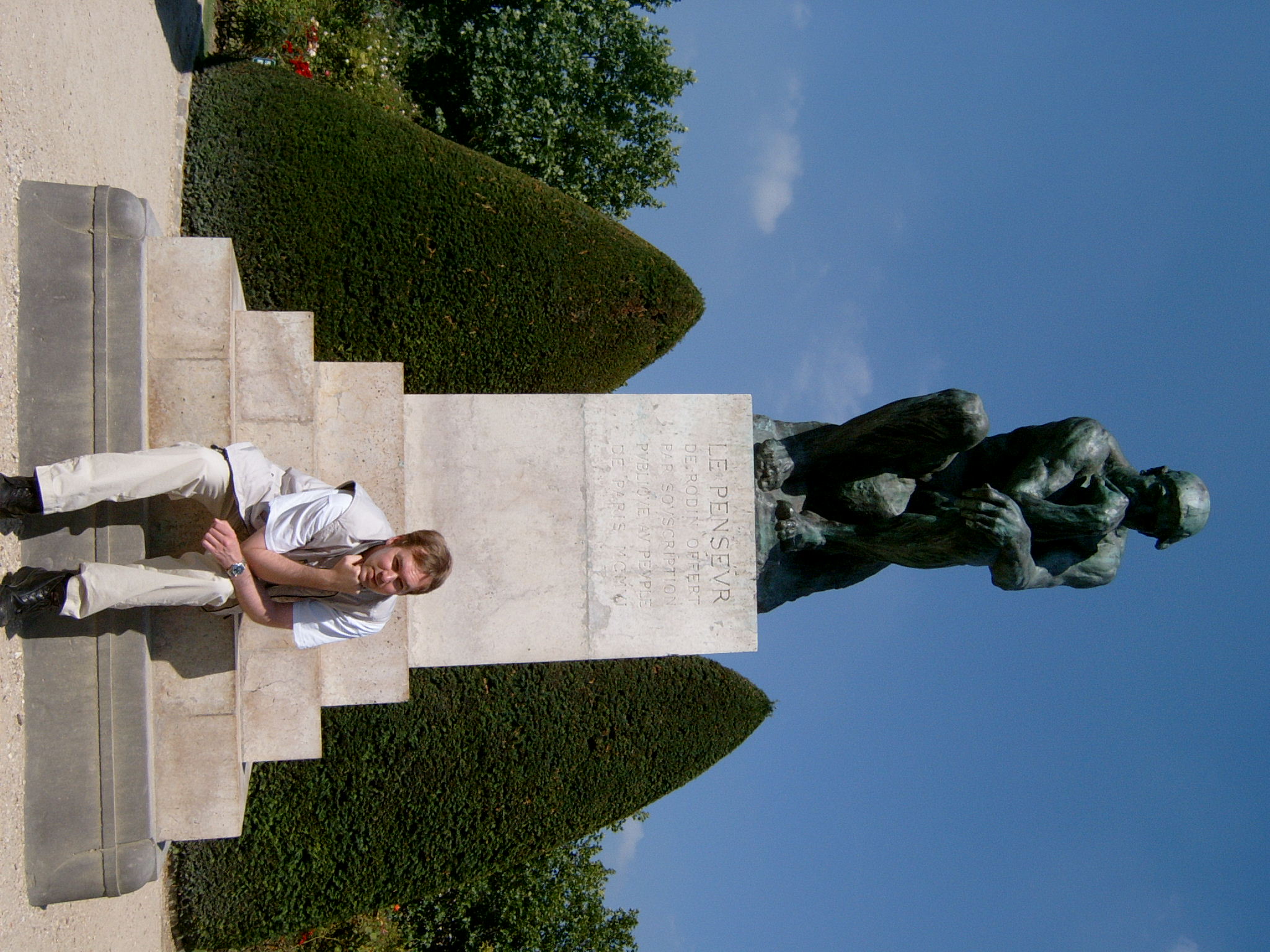
Me Thinking about Copyright in front of Le Pensevr Brendan Scott linked to a couple of articles about CAL (the Copyright Agency Limited) [1]. I have previously written about CAL and the way that they charge organisations for the work of others without their consent [2]. My personal dispute with CAL is that they may be charging people to use my work, I have not given them permission to act on my behalf and will never do so. If they ever bill anyone for my work then it will be an act of piracy. The fact that the government through some bad legislation permitted them to do such things doesn t prevent it from being piracy you can t disagree with this claim without supporting the past actions of China and other countries that have refrained from preventing factories from mass-producing unauthorised copies of software. The first article concerns the fact that last year CAL paid more than $9,400,000 in salary to it s employees (including $350,000 to it s CEO) while it only paid $9,100,000 directly to the authors [3]. It also spent another $300,000 to send it s executives to a junket in Barbados. It did give $76,000,000 to publishers on the assumption that a proportion of this money will be returned to authors of course said publishers could have used the money to have holidays in Barbados. CAL doesn t bother to check who ends up with shares of the $76,000,000 so it s anyone s guess where it ends up. The second article is by James Bradley who is an author and director of CAL [4]. He claims that much of the $76,000,000 was distributed to authors, although I m not sure how he would have any idea of how much it was which is presumably why he used the word much instead of some other word with a clearer meaning such as most . He also notes that CAL invested $1,000,000 in projects specifically designed to promote the development and dissemination of Australian writing , which sounds nice until you consider the fact that none of the authors (apart from presumably the few who sit on the CAL board) had any say in the matter. Can I take a chunk of the $9,400,000 that is paid to CAL employees and invest it in something? If not then why not? If they can invest money that was owed to other people then why can t I invest their salaries? James also says The issue of how well CAL serves rights-holders and authors and artists in particular is a vital one which is remarkably silly. He is entirely ignoring the fact that some rights holders don t want to be served by CAL at all. The fact that CAL can arbitrarily take money for other people s work is an infringement on their rights. He further demonstrates his ignorance by saying Without CAL and the licences we administer, users educational institutions, government agencies and corporate organisations, to name just a few would be required to seek permission every time they reproduced copyright material or run the risk of legal action for copyright infringement of course any educational institution can use Creative Commons licensed work [5]. I ve previously written about the CK12 project to develop CC licensed text books for free use [6]. There s no reason why the same thing can t be done for university text books. In the discussion following Claudine Chionh s LUV talk titled Humanities computing, Drupal and What I did on my holidays [7] it was suggested that it should be possible to gain credit towards a post-graduate degree based on work done to share information this could mean setting up a Drupal site and populating the database or it could mean contributing to CC licensed text books. Let s face it, a good CC text book will be read by many more people than the typical conference proceedings! James says that CAL is used Instead of having to track down individual rights-holders every time they want to reproduce copyright material . The correct solution to this problem would be to change the copyright law such that if a reasonable attempt to discover the rights-holder fails then work is deemed to be in the public domain. The solution to the problem of tracking down rights-holders is not to deny them their rights entirely and grant CAL the right to sub-license their work! He also makes the ridiculous claim Whereas in the age of the physical book schools and universities could have bought fewer books and made up the difference by using photocopies, it is now possible for an organisation to buy a single set of digital materials and reproduce them ad infinitum which implies that CAL is the only thing saving the profits of authors from unrestricted digital copying. Of course as CAL seems to have no active enforcement mechanisms and they apparently charge a per-student fee they really have no impact on the issue of a single licensed copy being potentially used a million times extra use apparently won t provide benefits to the author and use in excess of the licensing scheme won t be penalised. He asks the rhetorical question After all, why go to the expense of creating a textbook (or some form of digital course materials) if you are going to sell only a half-dozen copies to state education departments . The answer is obvious to anyone who has real-world experience with multiple licensing schemes you can sell one single copy and make a profit if the price is high enough. The smart thing for the education departments to do would be to pool their resources and pay text book companies for writing CC licensed texts (or releasing previously published texts under the CC). The average author of a text book would probably be very happy to earn $100,000 for their work, the editorial process probably involves a similar amount of work. So if the government was to offer $300,000 for the entire rights to a text book then I m sure that there would be more than a few publishers tendering for the contract. According to the CIA World Fact Book there are 2,871,482 people in Australia aged 0-14 [8], that means about 205,000 per year level. CAL charges $16 for each primary and secondary student so the government is paying about $3,280,000 every year per year level. Even in year 12 the number of text books used is probably not more than 10, so it seems to me that if all the money paid to CAL by schools in a single year was instead used to fund Creative Commons licensed text books then the majority of the school system would be covered! The universities have a much wider range of text books but they also have higher CAL fees of $40 per student. After cutting off the waste of taxpayer money on CAL fees for schools that money could be invested in the production of CC licensed university text books.

Cyril Brulebois: Ponies!

As a follow-up to Tolimar s post, here are some ponies for ftpmasters: Pony #1 Pony #2 (Clicking on an image leads to the relevant flickr page.) Those crazy folks are almost ACCEPTing X11 libraries with added udebs faster than I m uploading them. Source packages needing an upload include cairo, pango1.0, gtk+2.0, udev, and xorg-server. Then we should be able to deal with udebs maintained by the d-i team. Anyway, back to the initial topic: Ponies, thanks & kudos to ftpmasters!

Michal &#268;iha&#345;: phpMyAdmin uses Git

Yesterday I finally implemented what we agreed on FOSDEM - to use Git as a version control system for phpMyAdmin. The migration itself required just a little bit of magic, fixing other tools which were relying on Subversion was a little more work, but hopefully I did not forget anything and all pieces are now fixed (if you spot something still referring to Subversion, please drop me an email). Immediately after completing this task, I focused on another one - move from our custom translation system to Gettext. This is almost done in gettext branch and also web interface for translations is set up, but there are still some minor issues to fix (some messages are fuzzy even when they should not be). But anyway your translations won't be lost, so feel free to contribute there.

11 March 2010

Sam Hartman: Kerberos 1.8: Anonymous and the Cloud

The Kerberos team recently released Kerberos 5 1.8. This is the first of a couple of posts talking about features in the new release and how they significantly enhance what you can do with Kerberos. Before I get to that though, I d like to wax excited for a moment on the development process. There is much more of a community actively involved in the development process. As with the last release, MIT, Painless Security and PADL Software made contributions along with a number of others.. However the biggest change is the number of parties actively working with each other on designs, design reviews, testing and debugging. There was also a lot more real-time collaboration. It was great to see people from Sun, Debian and Redhat all actively bringing their prospectives to the discussion. My thanks to the Kerberos Consortium for pulling everyone together and for livening up the development process. Kerberos 1.8 testing releases are already available in Debian Squeeze and Ubuntu Lucid. I will be updating Debian to the final release soon, but everything discussed here should already work in both Debian and Ubuntu. I don t know about the state of other distributions, although given how heavily Redhat was involved in the process, I m sure they have 1.8 internally. One of the frustrating problems with previous versions of Kerberos was the need to key hosts before they could run Kerberized services. An administrator needed to set up a keytab and securely get it on the machine. That creates problems for automated installs of services, virtual services in the cloud, and environments where people installing servers are not the same as those running the Kerberos realm. Kerberos 1.8 still requires servers be keyed, but the need for the administrator is removed. Anonymous Kerberos provides a way for a machine to authenticate to Kerberos without an existing account. That page shows how the Kerberos administration server can be configured to permit machines to create their own keytabs. Anonymous Kerberos does require pkinit be configured and that the client know the public key of the KDC. However it is easy to build the KDC public key into an auto installer image or place it onto a USB key. I think it would be really neat to build a Debian image for Amazon EC2 that would show how easy it is to boot a virtual machine, have it register itself with a Kerberos realm, use something like remctl to request a work load and then begin serving that work load. The work load could include both clients for distributed computation or even services provided to the world, all secured by Kerberos with automatic bootstrapping. I don t know if I ll have time to put this together, but if someone were interested in helping or paying for the work it would be much more likely to happen. I believe the links above are enough that you should be able to get Anonymous Kerberos working and minimally configured. If not, feel free to send questions; I ll focus more on updating the public instructions than on providing individual help, but I m definitely interested in making this easy to use.

10 March 2010

Biella Coleman: The Statute of Anne (was actually kinda revolutionary)

Last night, in two different instances I read the claim that the England s first copyright act, the statute of Anne passed in 1710 was never intended to protect authors but to protect the reproducers like printing houses and presses investing in authors implying that printing houses loved the act. After pouring through hundreds of pages of Adrian John s history of piracy, that statement is pretty off and in fact I don t think the Statute was really about printers/booksellers or authors but the public. While licensing had all together lapsed for a period before this statute was passed, and the printing houses and book sellers were indeed clamoring loudly for an official recognition of property in literary works, they wanted a perpetuall right in literary property rooted in common and natural law. Like I am talking here about forever, not like a measly, paltry 14 years. They were not exactly thrilled at this statute (in fact, they were downright pissssssssed off) for it severely limited how long they held a property right over books. In fact, so pissed were they, they challenged the statute, went to court in 1769 (Millar v Taylor) and got what they wanted: a perpetual right to literary work. It took s a fiery Scot and bookseller by the name of Alexander Donaldson (I kind of think of him as the RMS of booksellers; he was quite a rabble rouser) to challenge Millar and he finally got his day in the highest court of the land in 1774 in Donaldson v Beckett and the outcome was that a perpetual right in books was tossed out the window. The court ruled that copyright was a limited statute. One of the lords in the case even stated Knowledge has no value or use for the solitary owner: to be enjoyed it must be communicated. Adrian John s explains the significance of this case in the following way: Copyright, they decided, was not a right of man at all. Indeed, it was almost the very opposite: an artifact, and one that replaced a prior right established by an author s work of creation. . . In terms of revolution principles, liberty won out over property Again the printers booksellers (minus the pirate ones) were not happy a bunch. Unfortunately the subsequent history is one we all know well, one in which booksellers and others with vested interests in copyrights pushed to extend property rights in all sorts of ways to get to where we are today (obviously with a lot of different historical developments), a land, time, period where perpetuity may not be forever but it is long enough to nullify the very public domain envisioned by the first copyright act. However, I think it is nonetheless important to recognize how radical in many respects the first copyright act was: given what the book printers and sellers wanted (and they were a powerful bunch). For those interested in learning more about Alexander Donaldson, I would check out his Some Thoughts on the State of Literary Property, where he rails against the London booksellers for being monopolistic and calling for a limited property right in books.

9 March 2010

Jaldhar Vyas: 7DRL Challenge - day 2-3

I am still being plagued by the burdens of real life so most development is taking place after the kids ("It should have mermaids! And Spiderman!") have gone to sleep. By the time I finished up yesterday, I was too tired to blog so this is is a combined report on the last two days. I decided not to bother with Javascript as I want to try a different project for the plasmoid competition. So I'm back to C++ and ncurses. At this point my '@' can move across the dungeon which at the moment a very simplistic 10 10 grid where every space is a 'room'. Rooms are populated with monsters, treasure and items though at the moment only the monsters can do anything and by anything I mean fighting. My combat system is based on Solo Dungeon Bash and pretty challenging I think. Hopefully by tomorrow, A Lively Fisting will be playable though I really need to pick up the pace if I want to finish on time.

8 March 2010

Nicolas Valc rcel: Ubuntu awesome tools

Last week I was having a conversation with a friend, and while we were discussing some things I mentioned some Ubuntu tools that were completely natural for me since I use them every day in Ubuntu development and for my work, but he was completely amazed by them, so I decided to blog on the subject so more people can know about them. I m going to start with the one that impressed him the most: qa-regression-testing branch The QA and security team maintain a test suite to check for regressions in packages they are updating. These tests are written with python unittest. Most of this test suite can be a little harmful for a production system, so it s recommended to run it using a chroot environment or a virtual machine and to help with that there is a make-test-tarball script. From the script:
export HOSTS= sec-intrepid-amd64 sec-hardy-amd64 sec-dapper-amd64
export TEST=test-glibc-security
./make-test-tarball $TEST.py
for i in $HOSTS; do
scp /tmp/qrt-$TEST.tar.gz $i.local:
done
for i in $HOSTS; do
ssh -t $i.local hostname; rm -rf qrt-$TEST; tar zxf qrt-$TEST.tar.gz; cd qrt-$TEST && ./$TEST.py -v
done
As you can imagine HOSTS are the hostnames of the virtual machines where the tests are going to run. Writing those test isn t rocket science, you just need a little knowledge of the package and the functionality you want to test and python unittesting, there is even a skeleton script that can help you start writing your test. Hope this information is useful for you! And as usual, patches are welcome!

Enrico Zini: Temporarily disabling file caching

Temporarily disabling file caching Does it happen to you that you cp a big, big file (say, similar in order of magnitude to the amount of RAM) and the system becomes rather unusable? It looks like Linux is saying "let's cache this", and as you copy it will try to free more and more ram in order to cache the big file you're copying. In the end, all the RAM is full with file data that you are not going to need. This varies according to how /proc/sys/vm/swappiness is set. I learnt about posix_fadvise and I tried to play with it. The result is this preloadable library that hooks into open(2) and fadvises everything as POSIX_FADV_DONTNEED. It is all rather awkward. fadvise in that way will discard existing cache pages if the file is already cached, which is too much. Ideally one would like to say "don't cache this because of me" without stepping on the feet of other system activities. Also, I found I need to also hook into write(2) and run fadvise after every single write, because you can't fadvise a file to be written in its entirety, unless you pass fadvise the file size in advance. But the size of the output file cannot be known by the preloaded library, so meh. So, now I can run: nocache cp bigfile someplace/ without trashing the existing caches. I can also run nocache tar zxf foo.tar.gz and so on. I wish, of course, that there were no need to do so in the first place. Here is the nocache library source code, for reference:
/*
 * nocache - LD_PRELOAD library to fadvise written files to not be cached
 *
 * Copyright (C) 2009--2010 Enrico Zini <enrico@enricozini.org>
 *
 * This program is free software; you can redistribute it and/or modify
 * it under the terms of the GNU General Public License as published by
 * the Free Software Foundation; either version 2 of the License, or
 * (at your option) any later version.
 *
 * This program is distributed in the hope that it will be useful,
 * but WITHOUT ANY WARRANTY; without even the implied warranty of
 * MERCHANTABILITY or FITNESS FOR A PARTICULAR PURPOSE.  See the
 * GNU General Public License for more details.
 *
 * You should have received a copy of the GNU General Public License
 * along with this program; if not, write to the Free Software
 * Foundation, Inc., 59 Temple Place, Suite 330, Boston, MA  02111-1307  USA
 */
#define _XOPEN_SOURCE 600
#include <fcntl.h>
#include <sys/types.h>
#include <sys/stat.h>
#include <fcntl.h>
#include <dlfcn.h>
#include <stdarg.h>
#include <errno.h>
#include <stdio.h>
typedef int (*open_t)(const char*, int, ...);
typedef int (*write_t)(int fd, const void *buf, size_t count);
int open(const char *pathname, int flags, ...)
 
    static open_t func = 0;
    int res;
    if (!func)
        func = (open_t)dlsym(RTLD_NEXT, "open");
    // Note: I wanted to add O_DIRECT, but it imposes restriction on buffer
    // alignment
    if (flags & O_CREAT)
     
        va_list ap;
        va_start(ap, flags);
        mode_t mode = va_arg(ap, mode_t);
        res = func(pathname, flags, mode);
        va_end(ap);
      else
        res = func(pathname, flags);
    if (res >= 0)
     
        int saved_errno = errno;
        int z = posix_fadvise(res, 0, 0, POSIX_FADV_DONTNEED);
        if (z != 0) fprintf(stderr, "Cannot fadvise on %s: %m\n", pathname);
        errno = saved_errno;
     
    return res;
 
int write(int fd, const void *buf, size_t count)
 
    static write_t func = 0;
    int res;
    if (!func)
        func = (write_t)dlsym(RTLD_NEXT, "write");
    res = func(fd, buf, count);
    if (res > 0)
     
        int saved_errno = errno;
        int z = posix_fadvise(fd, 0, 0, POSIX_FADV_DONTNEED);
        if (z != 0) fprintf(stderr, "Cannot fadvise during write: %m\n");
        errno = saved_errno;
     
    return res;
 
Updates Steve Schnepp writes:
Robert Love did a O_STREAMING patch for 2.4. It wasn't merged in 2.6 since POSIX_FADV_NOREUSE should be used instead. But unfortunatly it's currently mapped either as WILLNEED or as a noop. It seems that there is a google code project that has spawned to control this.

Russell Coker: Designing a Secure Linux System

The Threat Bruce Schneier s blog post about the Mariposa Botnet has an interesting discussion in the comments about how to make a secure system [1]. Note that the threat is considered to be remote attackers, that means viruses and trojan horses which includes infected files run from USB devices (IE you aren t safe just because you aren t on the Internet). The threat we are considering is not people who can replace hardware in the computer (people who have physical access to it which includes people who have access to where it is located or who are employed to repair it). This is the most common case, the risk involved in stealing a typical PC is far greater than the whatever benefit might be obtained from the data on it a typical computer user is at risk of theft only for the resale value of a second-hand computer. So the question is, how do can we most effectively use free software to protect against such threats? The first restriction is that the hardware in common use is cheap and has little special functionality for security. Systems that have a TPM seem unlikely to provide a useful benefit due to the TPM being designed more for Digital Restrictions Management than for protecting the user and due to TPM not being widely enough used. The BIOS and the Bootloader It seems that the first thing that is needed is a BIOS that is reliable. If an attacker manages to replace the BIOS then it could do exciting things like modifying the code of the kernel at boot time. It seems quite plausible for the real-mode boot loader code to be run in a VM86 session and to then have it s memory modified before it starts switches to protected mode. Every BIOS update is a potential attack. Coreboot replaces the default PC BIOS, it initialises the basic hardware and then executes an OS kernel or boot loader [2] (the Coreboot Wikipedia page has a good summary). The hardest part of the system startup process is initialising the hardware, Coreboot has that solved for 213 different motherboards. If engineers were allowed to freely design hardware without interference then probably a significant portion of the computers in the market would have a little switch to disable the write line for the flash BIOS. I heard a rumor that in the days of 286 systems a vendor of a secure OS shipped a scalpel to disable the hardware ability to leave protected mode, cutting a track on the motherboard is probably still an option. Usually once a system is working you don t want to upgrade the BIOS. One of the payloads for Coreboot is GRUB. The Grub Feature Requests page has as it s first entry Option to check signatures of the bootchain up to the cryptsetup/luksOpen: MBR, grub partition, kernel, initramfs [3]. Presumably this would allow a GPG signature to be checked so that a kernel and initrd would only be used if they came from a known good source. With this feature we could only boot a known good kernel. How to run User Space The next issue is how to run the user-space. There has been no shortage of Linux kernel exploits and I think it s reasonable to assume that there will continue to be a large number of exploits. Some of the kernel flaws will be known by the bad guys for some time before there are patches, some of them will have patches which don t get applied as quickly as desired. I think we have to assume that the Linux kernel will be compromised. Therefore the regular user applications can t be run against a kernel that has direct hardware access. It seems to me that the best way to go is to have the Linux kernel run in a virtual environment such as Xen or KVM. That means you have a hypervisor (Xen+Linux or Linux+KVM+QEMU) that controls the hardware and creates the environment for the OS image that the user interacts with. The hypervisor could create multiple virtual machines for different levels of data in a similar manner to the NSA NetTop project, not that this is really a required part of solving the general secure Internet terminal problem but as it would be a tiny bit of extra work you might as well do it. One problem with using a hypervisor is that the video hardware tends to want to use features such as bus-mastering to give best performance. Apparently KVM has IOMMU support so it should be possible to grant a virtual machine enough hardware access to run 3D graphics at full speed without allowing it to break free. Maintaining the Virtual Machine Image Google has a good design for the ChromiumOS in terms of security [4]. They are using CGroups [5] to control access to device nodes in jails, RAM, CPU time, and other resources. They also have some intrusion detection which can prompt a user to perform a hardware reset. Some of the features would need to be implemented in a different manner for a full desktop system but most of the Google design features would work well. For an OS running in a virtual machine when an intrusion is detected it would be best to have the hypervisor receive a message by some defined interface (maybe a line of text printed on the console ) and then terminate and restart the virtual machine. Dumping the entire address space of the virtual machine would be a good idea too, with typical RAM sizes at around 4G for laptops and desktops and typical storage sizes at around 200G for laptops and 2T for new desktops it should be easy to store a few dumps in case they are needed. The amount of data received by a typical ADSL link is not that great. Apart from the occasional big thing (like downloading a movie or listening to Internet radio for a long time) most data transfers are from casual web browsing which doesn t involve that much data. A hypervisor could potentially store the last few gigabytes of data that were received which would then permit forensic analysis if the virtual machine was believed to be compromised. With cheap SATA disks in excess of 1TB it would be conceivable to store the last few years of data transfer (with downloaded movies excluded) but such long-term storage would probably involve risks that would outweigh the rewards, probably storing no more than 24 hours of data would be best. Finally in terms of applying updates and installing new software the only way to do this would be via the hypervisor as you don t want any part of the virtual machine to be able to write to it s data files or programs. So if the user selects to install a new application then the request please install application X would have to be passed to the hypervisor. After the application is installed a reboot of the virtual machine would be needed to apply the change. This is a common experience for mobile phones (where you even have to reboot if the telco changes some of their network settings) and it s something that MS-Windows users have become used to but it would get a negative reaction from the more skilled Linux users. Would this be Accepted? The question is, if we built this would people want to use it? The NetTop functionality of having two OSs interchangeable on the one desktop would attract some people. But most users don t desire greater security and would find some reason to avoid this. They would claim that it lowered the performance (even for aspects of performance where benchmarks revealed no difference) and claim that they don t need it. At this time it seems that computer security isn t regarded as a big enough problem for users. It seems that the same people who will avoid catching a train because one mugging made it to the TV news will happily keep using insecure computers in spite of the huge number of cases of fraud that are reported all the time.

7 March 2010

Lucas Nussbaum: Ruby release blockers for Lucid and Squeeze

For the first time since I got involved in Ruby maintenance in Debian & Ubuntu, we are seriously at risk of not being able to release working Ruby interpreters in both Ubuntu Lucid and Debian Squeeze, because of two pretty serious issues. Ruby 1.8(.7.249) randomly hangs with eglibc 2.11 That issue was found by Google folks, because Puppet was hanging. After a lot of (quite heated) discussion, it was found that the problem is caused by something in eglibc 2.11: the problem can t be reproduced in a Debian unstable chroot (with eglibc 2.10), but is reproducible if you just upgrade glibc to 2.11 (which is in Debian experimental). It is not clear at all whether it is a glibc bug, or a ruby bug: Ruby has shown in the past that it was making some assumptions on the behaviour of pthread. It is possible that a valid change in glibc conflicts with an assumption made by Ruby. Still, I wonder why Ubuntu chose to release with eglibc 2.11, while Debian still only has 2.10 in unstable, and Ubuntu doesn t really have a lot of people with deep glibc knowledge. (Update: I assumed we would release squeeze with 2.10, but the eglibc maintainers plan to release 2.11 in squeeze.) That issue is tracked in Launchpad as bug 520715 (which was reassigned to eglibc), and in Ruby s redmine as bug 2739. Debian Squeeze isn t affected by that issue, but we are likely to get bitten as well after Squeeze if a solution isn t found by then. As Ruby maintainers in Debian/Ubuntu, we can t do much about this issue, because it requires either a lot of glibc knowledge, or a lot of understanding of the Ruby threading code. Ruby 1.9(.1.37 6,8 ) s test suite hangs on Sparc The development branch of Ruby (declared stable by the interpreter developers, but not considered as such by the third-party libraries developers) also has interesting issues. Its test suite hangs on sparc, but only (apparently) on specific CPUs/kernel versions. Here again, it is not clear whether it is a Ruby issue, or a kernel issue, for the same reasons as above. It is also possible that it is fixed in Linux 2.6.32, but the Debian build daemons run the lenny kernel, so we can t check that. This is tracked as Debian bug 565765, and is not tracked in Ruby s redmine, because Sparc is not supported by the upstream Ruby developers. This issue really requires Sparc knowledge (and access), so as Ruby maintainers, again, we can t do much, besides coordinating and poking the various people that can help.

Jaldhar Vyas: 7DRL Challenge - day 1

I've decided to take part in the 2010 Seven Day Roguelike Challenge My entry will be written in JavaScript as a KDE4 plasmoid (thus simultaneously allowing me to take part in this competition) Unfortunately today had to be spent in RL family activities so I'm already behind. however I've done lots of research into Roguelike development and I have accomplished the first step finding a name. Candidates are: ...and the winner is: It will be a simple combat heavy coffeebreak game inspired by things such as Solo Dungeon Bash and Pocket Dungeon though as time permits I will add as many more roguelike features as I can.

Next.

Previous.