Search Results: "nic"

16 November 2014

Matthew Palmer: A benefit of running an alternate init in Debian Jessie

If you re someone who doesn t like Debian s policy of automatically starting on install (or its heinous cousin, the RUN or ENABLE variable in /etc/default/<service>), then running an init system other than systemd should work out nicely.

13 November 2014

Steve McIntyre: Mini-Debconf in Cambridge, November 6-9 2014

People in the sunshine! For the second year running, we held our mini-debconf in Cambridge last weekend. Roughly 70 people turned up this year to the ARM offices in Cambridge over the 4 days. Alongside our originally planned general sprint work on Thursday and Friday, the Release Team had their own sprint to work through remaining post-freeze decisions about policies, architectures, naming etc. The rest of us worked through a range of topics all over Debian: installer, admin, ARM arch support etc. We even managed to fix Andy's laptop :-). Saturday and Sunday were two days devoted to more traditional conference sessions. Our talks covered a wide range of topics: d-i progress and an update from the Release Team, backup software and an arm64 laptop project to name but a few. I was very happy that the Release Team announced Zurg"Stretch" and "Buster" as upcoming release names, and obviously it was lovely to have arm64 and ppc64el confirmed as release architectures for Jessie. It's a shame to see the kfreebsd ports dropped from the official Jessie list, but let's see if the porters can do an unofficial release anyway. I'll help if I can with things like CD builds... Several volunteers from the DebConf video team were on hand too, so our talks were recorded and are already online at http://meetings-archive.debian.net/pub/debian-meetings/2014/mini-debconf-cambridge/webm/. Yay! Again, the mini-conf went well and feedback from attendees was universally positive. We may run again next year. More importantly, I can confirm that we're definitely planning on bidding to host a full DebConf in Cambridge in the summer of 2017. Thanks to all our helpers, and of course to our sponsors: ARM for providing the venue and infrastructure for the event, and Codethink for helping with food costs.

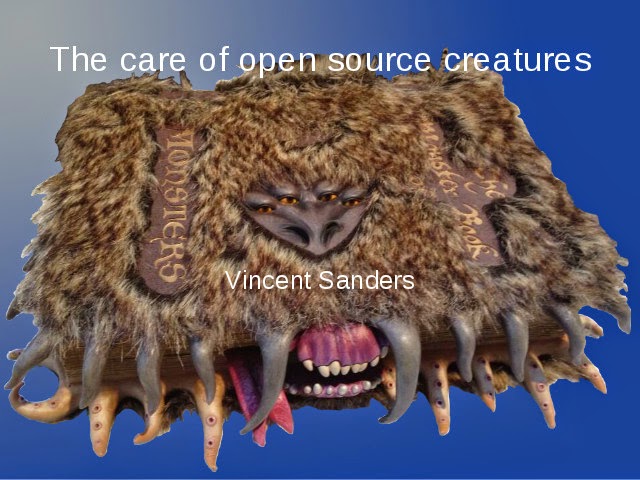
Vincent Sanders: The care of open source creatures

A mini Debian conference happened at the weekend in Cambridge at which I was asked to present. Rather than go with an old talk I decided to try something new. I attempted to cover the topic of application life cycle for open source projects.

The presentation abstract tried to explain this:
A software project that is developed by more than a single person starts requiring more than just the source code. From revision control systems through to continuous integration and issue tracking, all these services need deploying and maintaining.

This presentation takes a look at what a services a project ought to have, what options exist to fulfil those requirements and a practical look at an open source projects actual implementation.
I presented on Sunday morning but got a good audience and I am told I was not completely dreadful. The talk was recorded and is publicly available along with all the rest of the conference presentations.

Unfortunately due to other issues in my life right now I did not prepare well enough in advance and my slide deck was only completed on Saturday so I was rather less familiar with the material than I would have preferred.

The rest of the conference was excellent and I managed to see many of the presentations on a good variety of topics without an overwhelming attention to Debian issues. My youngest son brought himself along on both days and "helped" with front desk. He was also the only walk out in my presentation, he insists it was just because he "did not understand a single thing I was saying" but perhaps he just knew who the designated driver was.

I would like thank everyone who organised and sponsored this event for an enjoyable weekend and look forward to the next one.

Joey Hess: on leaving

I left Debian. I don't really have a lot to say about why, but I do want to clear one thing up right away. It's not about systemd. As far as systemd goes, I agree with my friend John Goerzen:
I promise you 18 years from now, it will not matter what init Debian chose in 2014. It will probably barely matter in 3 years.
read the rest And with Jonathan Corbet:
However things turn out, if it becomes clear that there is a better solution than systemd available, we will be able to move to it.
read the rest I have no problem with trying out a piece of Free Software, that might have abrasive authors, all kinds of technical warts, a debatable design, scope creep etc. None of that stopped me from giving Linux a try in 1995, and I'm glad I jumped in with both feet. It's important to be unafraid to make a decision, try it out, and if it doesn't work, be unafraid to iterate, rethink, or throw a bad choice out. That's how progress happens. Free Software empowers us to do this. Debian used to be a lot better at that than it is now. This seems to have less to do with the size of the project, and more to do with the project having aged, ossified, and become comfortable with increasing layers of complexity around how it makes decisions. To the point that I no longer feel I can understand the decision-making process at all ... or at least, that I'd rather be spending those scarce brain cycles on understanding something equally hard but more useful, like category theory. It's been a long time since Debian was my main focus; I feel much more useful when I'm working in a small nimble project, making fast and loose decisions and iterating on them. Recent events brought it to a head, but this is not a new feeling. I've been less and less involved in Debian since 2007, when I dropped maintaining any packages I wasn't the upstream author of, and took a year of mostly ignoring the larger project. Now I've made the shift from being a Debian developer to being an upstream author of stuff in Debian (and other distros). It seems best to make a clean break rather than hang around and risk being sucked back in. My mailbox has been amazing over the past week by the way. I've heard from so many friends, and it's been very sad but also beautiful.

Bits from Debian: DebConf15 welcomes its first nine sponsors!

DebConf15 will take place in Heidelberg, Germany in August 2015. We strive to provide an intense working environment and enable good progress for Debian and for Free Software in general. We extend an invitation to everyone to join us and to support this event. As a volunteer-run non-profit conference, we depend on our sponsors. Nine companies have already committed to sponsor DebConf15! Let's introduce them: Our first Gold sponsor is credativ, a service-oriented company focusing on open-source software, and also a Debian development partner. Our second Gold sponsor is sipgate, a Voice over IP service provider based in Germany that also operates in the United Kingdom (sipgate site in English). Google (the search engine and advertising company), Fairsight Security, Inc. (developers of real-time passive DNS solutions), Martin Alfke / Buero 2.0 (Linux & UNIX Consultant and Trainer, LPIC-2/Puppet Certified Professional) and Ubuntu (the OS supported by Canonical) are our three Silver sponsors. And last but not least, Logilab, Netways and Hetzner have agreed to support us as Bronze-level. Become a sponsor too! Would you like to become a sponsor? Do you know of or work in a company or organization that may consider sponsorship? Please have a look at our sponsorship brochure (also available in German), in which we outline all the details and describe the sponsor benefits. For instance, sponsors have the option to reach out to Debian contributors, derivative developers, upstream authors and other community members during a Job Fair and through postings on our job wall, and to show-case their Free Software involvement by staffing a booth on the Open Weekend. In addition, sponsors are able to distribute marketing materials in the attendee bags. And it goes without saying that we honour your sponsorship with visibility of your logo in the conference's videos, on our website, on printed materials, and banners. The final report of DebConf14 is also available, illustrating the broad spectrum, quality, and enthusiasm of the community at work, and providing detailed information about the different outcomes that last conference brought up (talks, participants, social events, impact in the Debian project and the free software scene, and much more). For further details, feel free to contact us through sponsors@debconf.org, and visit the DebConf15 website at http://debconf15.debconf.org.

12 November 2014

John Goerzen: Computer Without a Case

My desk today looks like this: 2014-11-12 11.58.45 Yep, that s a computer. Motherboard to the right, floppy drives and CD drive stacked on top of the power supply, hard drive to the left. And it s an OLD computer. (I had forgotten just how loud these old power supplies are; wow.) The point of this exercise is to read data off the floppies that I have made starting nearly 30 years ago now (wow). Many were made with DOS, some were made on a TRS-80 Color Computer II (aka CoCo 2). There are 5.25 disks, 3.25 disks, and all sorts of formats. Most are DOS, but the TRS-80 ones use a different physical format. Some of the data was written by Central Point Backup (from PC Tools), which squeezed more data on the disk by adding an extra sector or something, if my vague memory is working. Reading these disks requires low-level playing with controller timing, and sometimes the original software to extract the data. It doesn t necessarily work under Linux, and certainly doesn t work with USB floppies or under emulation. Hence this system. It s a bridge. Old enough to run DOS, new enough to use an IDE drive. I can then hook up the IDE drive to a IDE-to-USB converter and copy the data off it onto my Linux system. But this was tricky. I started the project a few years ago, but life got in the way. Getting back to it now, with the same motherboard and drive, but I just couldn t get it to boot. I eventually began to suspect some disk geometry settings, and with some detective work from fdisk in Linux plus some research into old BIOS disk size limitations, discovered the problem was a 2GB limit. Through some educated trial and error, I programmed the BOIS with a number of cylinders that worked, set it to LBA mode, and finally my 3-year-old DOS 6.2 installation booted. I had also forgotten how finicky things were back then. Pop a floppy from a Debian install set into the drive, type dir b:, and the system hangs. I guess there was a reason the reset button was prominent on the front of the computer back then

11 November 2014

Simon Josefsson: Dice Random Numbers

Generating data with entropy, or random number generation (RNG), is a well-known difficult problem. Many crypto algorithms and protocols assumes random data is available. There are many implementations out there, including /dev/random in the BSD and Linux kernels and API calls in crypto libraries such as GnuTLS or OpenSSL. How they work can be understood by reading the source code. The quality of the data depends on actual hardware and what entropy sources were available the RNG implementation itself is deterministic, it merely convert data with supposed entropy from a set of data sources and then generate an output stream. In some situations, like on virtualized environments or on small embedded systems, it is hard to find sources of sufficient quantity. Rarely are there any lower-bound estimates on how much entropy there is in the data you get. You can improve the RNG issue by using a separate hardware RNG, but there is deployment complexity in that, and from a theoretical point of view, the problem of trusting that you get good random data merely moved from one system to another. (There is more to say about hardware RNGs, I ll save that for another day.) For some purposes, the available solutions does not inspire enough confidence in me because of the high complexity. Complexity is often the enemy of security. In crypto discussions I have said, only half-jokingly, that about the only RNG process that I would trust is one that I can explain in simple words and implement myself with the help of pen and paper. Normally I use the example of rolling a normal six-sided dice (a D6) several times. I have been thinking about this process in more detail lately, and felt it was time to write it down, regardless of how silly it may seem. A dice with six sides produces a random number between 1 and 6. It is relatively straight forward to intuitively convinced yourself that it is not clearly biased: inspect that it looks symmetric and do some trial rolls. By repeatedly rolling the dice, you can generate how much data you need, time permitting. I do not understand enough thermodynamics physics to know how to estimate the amount of entropy of a physical process, so I need to resort to intuitive arguments. It would be easy to just assume that a dice produces 3 bits of entropy, because 2^3=6 which matches the number of possible outcomes. At least I find it easy to convince myself that 3 bits is the upper bound. I suspect that most dice have some form of defect, though, which leads to a very small bias that could be found with a large number of rolls. Thus I would propose that the amount of entropy of most D6 s are slightly below 3 bits on average. Further, to establish a lower bound, and intuitively, it seems easy to believe that if the entropy of particular D6 would be closer to 2 bits than to 3 bits, this would be noticeable fairly quickly by trial rolls. That assumes the dice does not have complex logic and machinery in it that would hide the patterns. With the tinfoil hat on, consider a dice with a power source and mechanics in it that allowed it to decide which number it would land on: it could generate seamingly-looking random pattern that still contained 0 bits of entropy. For example, suppose a D6 is built to produce the pattern 4, 1, 4, 2, 1, 3, 5, 6, 2, 3, 1, 3, 6, 3, 5, 6, 4, this would mean it produces 0 bits of entropy (compare the numbers with the decimals of sqrt(2)). Other factors may also influence the amount of entropy in the output, consider if you roll the dice by just dropping straight down from 1cm/1inch above the table. With this discussion as background, and for simplicity, going forward, I will assume that my D6 produces 3 bits of entropy on every roll. We need to figure out how many times we need to roll it. I usually find myself needing a 128-bit random number (16 bytes). Crypto algorithms and protocols typically use power-of-2 data sizes. 64 bits of entropy results in brute-force attacks requiring about 2^64 tests, and for many operations, this is feasible with today s computing power. Performing 2^128 operations does not seem possible with today s technology. To produce 128 bits of entropy using a D6 that produces 3 bits of entropy per roll, you need to perform ceil(128/3)=43 rolls. We also need to design an algorithm to convert the D6 output into the resulting 128-bit random number. While it would be nice from a theoretical point of view to let each and every bit of the D6 output influence each and every bit of the 128-bit random number, this becomes difficult to do with pen and paper. For simplicity, my process will be to write the binary representation of the D6 output on paper in 3-bit chunks and then read it up as 8-bit chunks. After 8 rolls, there are 24 bits available, which can be read up as 3 distinct 8-bit numbers. So let s do this for the D6 outputs of 3, 6, 1, 1, 2, 5, 4, 1:
3   6   1   1   2   5   4   1
011 111 001 001 010 101 010 001
01111100 10010101 01010001
124 0x7C 149 0x95 81 0x51
After 8 rolls, we have generated the 3 byte hex string 7C9551 . I repeat the process 5 more times, concatenating the strings, resulting in a hex string with 15 bytes of data. To get the last byte, I only need to roll the D6 three more times, where the two high bits of the last roll is used and the lowest bit is discarded. Let s say the last D6 outputs were 4, 2, 3, this would result in:
4   2   3
100 010 011
10001001
137 0x89
So the 16 bytes of random data is 7C9551..89 with .. replaced by the 5 pieces of 3-byte chunks of data. So what s the next step? Depends on what you want to use the random data for. For some purposes, such as generating a high-quality 128-bit AES key, I would be done. The key is right there. To generate a high-quality ECC private key, you need to generate somewhat more randomness (matching the ECC curve size) and do a couple of EC operations. To generate a high-quality RSA private key, unfortunately you will need much more randomness, at the point where it makes more sense to implement a PRNG seeded with a strong 128-bit seed generated using this process. The latter approach is the general solution: generate 128 bits of data using the dice approach, and then seed a CSPRNG of your choice to get large number of data quickly. These steps are somewhat technical, and you lose the pen-and-paper properties, but code to implement these parts are easier to verify compared to verifying that you get good quality entropy out of your RNG implementation. flattr this!

10 November 2014

Gustavo Noronha Silva: Yay, the left won! Or did it?

Originally published on politi.kov I have been asked by a bunch of friends from outside of Brazil for my opinion regarding the recent elections we had in Brazil, and it is a bit complicated to explain it without some background, so I decided to write this piece providing a bit of history so that people can understand my opinion. The elections this year were a rematch of our traditional polarization between the workers party (PT) and the social democracy party (PSDB), which has been going on since 1994. PT and PSDB used to be allies. In the 80s, when the dictatorship dropped the law that forbade more than 2 parties, the opposition party, MDB, began breaking up in several smaller ones. PSDB was founded by politicians and intelectuals who were inspired by Europe s social democracy and political systems. Parliamentarism, for instance, is one of the historical causes of the party. The workers party had a more grassroots origin, with union leaders, marxist intelectuals and marxist-inspired catholic priests being the main founders. They drew their inspiration from the USSR and Cuba, and were very close to social movements.
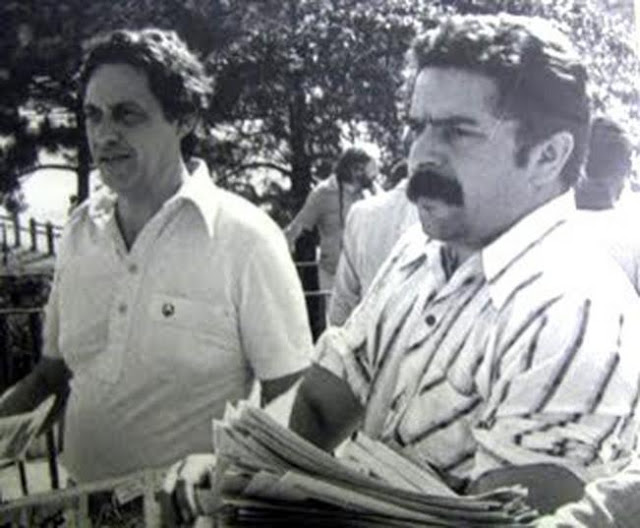
Lula and FHC campaigning together in 1981, by Cl vis Cranchi Sobrinho

Lula (PT) and FHC (PSDB) campaigning together in 1981, by Cl vis Cranchi Sobrinho

Some people have celebrated the reelection of Dilma Roussef as a victory of the left against the right. In my opinion that view is wrong for several reasons. First, because I disagree that PSDB and A cio Neves in particular are right-wing, both in terms of economics and social/moral issues. Second, because I believe Dilma s first government has taken a quite severe turn to the right in several topics that matter a lot to me. Since comparisons with PSDB s government during the 90s has been one of the main strategies of the campaign this year, I ll argue why I think it was actually a pretty good government with a lot of left in it. Unlike what happens in most other places, Brazil does not really have an actual right-wing party, economics-wise. Although we might see the birth of a couple in the near future, no current party is really against public health, education and social security being provided by the state as rights, or wants to decrease state size and lower taxes significantly. It should come as no surprise that even though it has undergone a lot of liberal reforms over the last 20 years, Brazil is still a very closed country, with very high import tariffs and a huge presence of the state in the economy. There is a certain consensus about all of that, with disagreements being essentially on implementation details, not goals. On the other hand, and contrary to popular belief, when it comes to social and moral issues we are a very conservative people. Ironically, the two parties which have been in power over the last 20 years are quite progressive, being historically proponents of diversity, minorities rights, reproductive rights. They have had to compromise on those causes to become viable alternatives, given the conservative nature of the majority of the voters. Despite their different origins and beliefs, both parties share socialist inclinations and were allies from the onset. That changed in 1992, when president Collor, who had been elected on a runoff against Lula (who PSDB supported), was impeached by Congress for corruption. With no formal political support and a chaotic situation in his hands, Itamar Franco, the vice president, called for a national union government to go through the last two years of his term. PSDB answered the call, but the workers party decided against being part of the government. Fernando Henrique Cardoso, a sociologist who was one of the leaders of PSDB was chosen to lead the Foreign Relations Ministry, but a few months later got nominated to the Economy. At the time, Brazil lived under hyperinflation of close to 1000% a year, and several stabilization plans had been attempted. Economy Ministers did not last very much in office at the time. FHC gathered a team of economists and sponsored their stabilization plan, which turned out to be highly successful: the Plano Real ( Real Plan ). In addition to introducing a new currency, something that was becoming pretty common to Brazilians by then, it also attacked the structural causes of inflation. Lula was counting on the failure of the Plano Real when he ran against FHC in 1994, but the plan succeeded, giving FHC two terms as president. During those two terms, FHC introduced several institutional changes that made Brazil a saner country. In addition to the hyperinflation, Brazil had lived a debt crises for decades and was still in default. FHC s team renegotiated the debts, reopened lines of credit, but most importantly, introduced reforms that made the Brazilian finances and financial system credible. The problem was not even that Brazil had a fiscal d ficit, it just did not have any control whatsoever of money supply and budget. Banks, regardless of whether they were private or public, had very little regulation and took advantage of the hyperinflation to hide monstrous holes in their balances. When inflation was gone and regulation became more strict, those became apparent, and it was pretty clear that the system would collapse if nothing was done. Some people like to say that FHC was a president who ruled for the rich and didn t care about the poor. I think the way the potential collapse of the banking system was handled is a great counter-example of that. The government passed laws that made the owners of the banks responsible for the financial problems, regardless of whether caused by mismanagement or fraud. If a bank went under, the central bank intervened and added enough money to protect the deposits, but that money was a loan that had to be repaid by the owners of the bank, and the owners properties were added as collateral to the loan. As a brazilian journalist once said, the people did not risk losing their deposits, the bankers did risk losing the banks, though. Today, we have a separate fund, filled with money from the banks, that does what the central bank did back then when required. Compare that to countries where the banking system was saved with tax payer money and executives kept getting huge bonuses regardless, while owners kept their profits. It is hard to find an initiative that is more focused on the public interest against the interest of the rich people who caused the problem. This legislation, called PROER, is still in place today, and it came along with solid regulation of the banking system. It should come as no surprise that Brazil went through the financial crisis of 2008 with not a single hiccup of the banking system and no fear of bank runs. Despite having been against PROER back in the day, Lula celebrated its existence in 2008, when it was clear it was one of the reasons we would not suffer much. He even advertised it as something that should be adopted by the US and Europe. It is also pretty common to hear that under FHC social questions were not a priority. I believe it is pretty simple to see that that was not the case both by inspecting the growth of social spending and the improvement of social indicators for the period, such as UN s human development index. One area in which people are particularly critical of the FHC government is the investment on higher education, and they are actually quite right. Brazil has free Federal universities and those did not get a lot of priority in the 90s. However, I would argue that while it is a matter of priorities, it is not one of education versus something else, but rather of what to invest on inside education. The reality is basic education was the priority. When FHC came to power, Brazil had a significant number of children who were not going to school at all. The goal was to make access to schools universal for young children, and that goal was reached. Every child has been going to school since the early 2000s, and that is a significant achievement which reaches the poorest. While the federal universities are attended essentially by the Brazilian elite, given the difficulty of passing the exams and the relative lack of quality of free public schools compared to private ones, which is still a reality to this day, investment on getting children to even go to school for the early years has a significant impact on the lives of the poorest. It is important to remember that getting every child to go to school is also what gave birth to one of the most celebrated programs from the Lula era: Bolsa Fam lia ( Family Allowance ) is a direct money transfer to poor families, particularly those who have children and has been an important contribution to lowering inequality and getting people out of extreme poverty. To get the money, the families need to ensure their children are 1) attending school and 2) getting vaccinated. That program comes from the FHC government, in which it was created with the name Bolsa Escola ( School Allowance ), in its turn inspired by a program of the same name by governor Cristovam Buarque, from PT. What Lula did, and he deserves a lot of credit for this, was to merge a series of smaller programs with Bolsa Escola, and then expand the program to ensure it got to more and more people. Interestingly, during the announcement of the program he credited the idea of doing that to a state governor from PSDB. You can see why I think these two should be allies again. When faced with all these arguments, people will eventually say that FHC was bad because he privatized companies and used orthodox economic policies. Well, if that is what it takes, then we ll have to take Lula down with him, because his first term was essentially a continuation of FHC s second term: orthodox economic policies to keep inflation down, along with privatization of several state-owned companies and banks. But Lula, whom I voted for and whose government I believe was a good one, is not my subject: Dilma is. On Lula s second term, Dilma gained a lot of power when other major leaders of PT went down for corruption. She became second in command and started leading several programs. A big believer in developmentalism, she started pushing for a bigger role of the state in the coordination of the productive sector, with a clear focus on growing the industrial base. One of the initiatives she sponsored was a sizable increase on the number and size of subsidized loans given out by the national development bank (BNDES). Brazil started an unnofficial national champions program, where the government elected a few big companies to get a huge amount of subsidized credit. The goal was for these selected firms to get big enough to be competitive on the global market. The criteria for the choices is completely opaque, if it even exists, and includes handing out milions in subsidized credit for Eike Batista, who became Brazil s richest enterpreneur for a while, and lost pretty much everything when it became clear the oil would not be pumping out of his camps after all, sinking with them a huge amount of public funds invested by BNDES. The way this policy was enacted, it is unclear how much it really costs in terms of public funds: the Brazilian treasury emits debt to capitalize, lends that money to BNDES with higher than market interest, and BNDES then lends it out to the big companies with a lower than market interest rate. Although it is obviously unsustainable, the problem does not yet show in the balance because the grace period for BNDES debt with the treasury is 2040. The fact that this has a cost and, perhaps more importantly, a huge opportunity cost is not clear because it is not part of the government budget. Why are we putting money in this rather than quadrupling Bolsa Fam lia, which studies show generates 1,78 reais in GDP for every 1 real invested? Worse, why are we not even updating Bolsa Fam lia enough to cover inflation? When Dilma got elected in 2010, the first signs were pretty bad. She was already seen as someone who did not care much for the environment, and on her first month in power she made good on that promise by pushing to get the Belo Monte Dam building started as soon as possible regardless of conditionalities being satisfied. To this day there are several issues with how the building of the dam is going: the handling of the indigenous people and the small city nearby are lacking, conditionalities are not met. Beyond Belo Monte, indigenous leaders are being assassinated, deforestation in the Amazon forest has increased by 122% in 2014 alone. Dilma s answer to people who question her on these kinds of issues is essentially: would you rather not have electric power? Her populist authoritarian nature and obsession with industry are also pretty evident when it comes to her policies in the energy area as a whole. She showed up in national tv on the eve of our independence day celebration to announce a reduction in electric tariffs, mainly for industry, but also for homes. Nobody really knew how. The following week she sent a fast-track project to Congress to automatically renew concessions of power grid operators, requiring those who accepted it to lower tariffs, instead of doing an auction, which was already necessary anyway because the concessions were up on 2015. There was no discussion with stakeholders, there was just a populist announcement and a great deal of rhethoric to paint anyone who opposed as being against the people. And now, everything went into the crapper because that represented a breach of contract that required indemnification, and we had a pretty bad drought that made power more expensive given the need to turn on the thermal generators. Combining the costs of the thermal generation, indemnity, and financial fallout that the grid operators suffered, we are already at 105 billion reais and counting, nobody knows how high the cost will reach. Any reduction in tariffs has long been invalidated. And the fact that industry has lowered production significantly ends up being good news, we would probably be under rationing already if that was not the case. You would expect someone who fought a dictatorship to be pretty good in terms of human and civil rights. What we see in reality is a lack of respect for those things. During the world cup, Dilma has put the army on the streets and has supported arbitrary behaviour from state polices throughout the country. They jailed a bunch of demonstrators preemptively. No shit. The would be demonstrators were kept in jail throghout the tournament under false accusations. Dilma s Minister of Justice said several times that the case against them was solid and that the arrests were legal, but it turned out the case simply did not exist. Just this week we had a number of executions orchestrated by policemen in the state of Par and there is zero reaction from the federal government. In the oil industry, Dilma has enacted a policy of subsidizing gas prices by using a fixed price that used to be lower than the international prices (it is no longer the case with the fall in international prices). That would not be a problem if Brazil was selfsufficient in oild and gas, which we are not: we had to import a significant amount of both. The implicit subsidy cost Petrobr s a huge amount of cash the more gas it sold, the bigger the losses. This lead not only to decreasing the company s market value (it is a state-controlled, but open company), but to reducing its capacity of investment as well. That is more problematic than it sounds because, with our current concession model, every single oil camp needs to have Petrobr s as a member of the consortium. Limiting the company s investment capacity limits the rate at which our pre-salt oil camps can be explored and thus the speed at which we can become selfsufficient. Chicken and egg anyone? To make things worse, Dilma has made policies that lowered taxes on car production, used to foster economic activity during the crisis in 2008-2010, essentially permanent. This lead to a significant increase in traffic and polution on Brazilian cities, while at the same time increasing the pressure on Petrobr s, which had to import more and more gas. Meanwhile, Brazilian cities suffer from a severe lack of mobility infrastructure. A recent study has shown that Brazil has spend almost twice as much subsidized money on pro-car policies than on pro-mass transit projects. Talk about good usage of public funds. One of the only remaining good news the government was still able to mention was the constant reduction in extreme poverty. Dilma was actually ellected promising to erradicate extreme poverty and changed the government s slogan to A rich country is a country with no poverty (Pa s rico pa s sem pobreza). Well, it turns out all of these policies caused inequality and extreme poverty both to stop falling as of 2013. And given the policies were actually deepened in 2014, I believe it is very likely we ll see an increase in both when we get the data for 2014, next year. Other than that, her policies ended up being a complete failure. Despite giving tax benefits to several sectors, investment has fallen, growth has fallen and inflation is quite high at 6,6% for the last 12 months. In terms of minorities, her government has been a severe set back, with the government going back on educational material against homophoby saying it would not do advertisement of sexual choice , and going back on a decree that allowed the public health system to perform abortions on the cases allowed by the law (essentially if the woman has been raped). Looking at Dilma s policies, I really can t see that much of the left, honestly. So why, you might ask, has this victory been deemed a victory of the left over the right? My explanation is the aura the workers party still manages to keep over itself. There s a notion that whatever PT does, it will still be more to the left than PSDB, which I think is just crazy. There is also a fair amount of idealizing Dilma just because she is Lula s proteg . People will forgive anything, provided it is the workers party doing it. Thankfully, the number of people aligned on the left that supported the candidate from PSDB this election tells me this is changing quite rapidly. Hopefully that leads to PT having to reinvent itself, and get in touch with the left again.

Neil Williams: On getting NEW packages into stable

There s a lot of discussion / moaning /arguing at this time, so I thought I d post something about how LAVA got into Debian Jessie, the work involved and the lessons I ve learnt. Hopefully, it will help someone avoid the disappointment of having their package missing the migration into a future stable release. This was going to be a talk at the Minidebconf-uk in Cambridge but I decided to put this out as a permanent blog entry in the hope that it will be a useful reference for the future, not just Jessie. Context LAVA relies on a number of dependencies which were at the time all this started NEW to Debian as well as many others already in Debian. I d been running LAVA using packages on my own system for a few months before the packages were ready for use on the main servers (I never actually installed LAVA using the old virtualenv method on my own systems, except in a VM). I did do quite a lot of this on my own but I also had a team supporting the effort and valuing the benefits of moving to a packaged system. At the time, LAVA was based on Ubuntu (12.04 LTS Precise Pangolin) and a new Ubuntu LTS was close (Trusty Tahr 14.04) but I started work on this in 2013. By the time my packages were ready for general usage, it was winter 2013 and much too close to get anything into Ubuntu in time for Trusty. So I started a local repo using space provided by Linaro. At the same time, I started uploading the dependencies to Debian. json-schema-validator, django-testscenarios and others arrived in April and May 2014. (Trusty was released in April). LAVA arrived in NEW in May, being accepted into unstable at the end of June. LAVA arrived in testing for the first time in July 2014. Upstream development continued apace and a regular monthly upload, with some hotfixes in between, continued until close to the freeze. At this point, note that although upstream is a medium sized team, the Debian packaging also has a team but all the uploads were made by me. I planned ahead. I knew that I would be going to Macau for Linaro Connect in February a critical stage in the finalisation of the packages and the migration of existing instances from the old methods. I knew that I would be on vacation from August through to the end of September 2014 including at least two weeks with absolutely no connectivity of any kind. Right at this time, Django1.7 arrived in experimental with the intent to go into unstable and hence into Jessie. This was a headache for me, I initially sought to delay the migration until after Jessie. However, we discussed it upstream, allocated time within the busy schedule and also sought help from within Debian with the RFH tag. Rapha l Hertzog contributed patches for django1.7 support and we worked on those patches upstream, once I was back from vacation. (The final week of my vacation was a work conference, so we had everyone together at one hacking table.) Still there was more to do, the django1.7 patches allowed the unit tests to complete but broke other parts of the lava-server package and needed subsequent tweaks and fixes. Even with all this, the auto-removal from testing for packages affected by RC bugs in their dependencies became very important to monitor (it still is). It would be useful if some packages had less complex dependency chains (I m looking at you, uwsgi) as the auto-removal also covers build-depends. This led to some more headaches with libmatheval. I m not good with functional programming languages, I did have some exposure to Scheme when working on Gnucash upstream but it wasn t pleasant. The thought of fixing a scheme problem in the test suite of libmatheval was daunting. Again though, asking for help, I found people in the upstream team who wanted to refresh their use of scheme and were able to help out. The fix migrated into testing in October. Just for added complications, lava-server gained a few RC bugs of it s own during that time too fixed upstream but awkward nonetheless. Achievement unlocked So that s how a complex package like lava-server gets into stable. With a lot of help. The main problem with top-level packages like this is the sheer weight of the dependency chain. Something seemingly unrelated (like libmatheval) can seriously derail the migrations. The package doesn t use the matheval support provided by uwsgi. The bug in matheval wasn t in the parts of matheval used by uwsgi. It wasn t in a language I am at all comfortable in fixing but it s my name on the changelog of the NMU. That happened because I asked for help. OK, when django1.7 was scheduled to arrive in Debian unstable and I knew that lava was not ready, I reacted out of fear and anxiety. However, I sought help, help was provided and that help was enough to get upstream to a point where the side-effects of the required changes could be fixed. Maintaining a top-level package in Debian is becoming more like maintaining a core package in Debian and that is a good thing. When your package has a lot of dependencies, those dependencies become part of the maintenance workload of your package. It doesn t matter if those are install time dependencies, build dependencies or reverse dependencies. It doesn t actually matter if the issues in those packages are in languages you would personally wish to be expunged from the archive. It becomes your problem but not yours alone. Debian has a lot of flames right now and Enrico encouraged us to look at what else is actually happening in Debian besides those arguments. Well, on top of all this with lava, I also did what I could to help the arm64 port along and I m very happy that this has been accepted into Jessie as an official release architecture. That s a much bigger story than LAVA yet LAVA was and remains instrumental in how arm64 gained the support in the kernel and various upstreams which allowed patches to be accepted and fixes to be incorporated into Debian packages. So a roll call of helpers who may otherwise not have been recognised via changelogs, in no particular order: Also general thanks to the Debian FTP and Release teams. Lessons learnt

  1. Allow time! None of the deadlines or timings involved in this entire process were hidden or unexpected. NEW always takes a finite but fairly lengthy amount of time but that was the only timeframe with any amount of uncertainty. That is actually a benefit it reminds you that this entire process is going to take a significant amount of time and the only loser if you try to rush it is going to be you and your package. Plan for the time and be sceptical about how much time is actually required.
  2. Ask for help! Everyone in Debian is a volunteer. Yes, the upstream for this project is a team of developers paid to work on this code (and largely only this code) but the upstream also has priorities, requirements, objectives and deadlines. It s no good expecting upstream to do everything. It s no good leaving upstream insufficient time to fit the required work into the existing upstream schedules. So ask for help within upstream and within Debian ask for help wherever you can. You don t know who may be able to help you until you ask. Be clear when asking for help how would someone test their proposed fix? Exactly what are you asking for help doing? (Hint: everything is not a good answer.)
  3. Keep on top of announcements and changes. The release team in Debian have made the timetable strict and have published regular updates, guidelines and status notes. As maintainer, it is your responsibility to keep up with those changes and make others in the upstream team aware of the changes and the implications. Upstream will rely on you to provide accurate information about these requirements. This is almost more important than actually providing the uploads or fixes. Without keeping people informed, even asking for help can turn out to be counter-productive. Communicate within Debian too talk to the teams, send status updates to bugs (even if the status is tag 123456 + help).
  4. Be realistic! Life happens around us, things change, personal timetables get torn up. Time for voluntary activity can appear and disappear (it tends to disappear far more often than extends, so take that into account too).
  5. Do not expect others to do the work for you asking for help is one thing, leaving the work to others is quite another. No complaining to the release team that they are blocking your work and avoid pleading or arguing when a decision is made. The policies and procedures within Debian are generally clear and there are quite enough arguments without adding more. Read the policies, read the guidelines, watch how other packages and other maintainers are handled and avoid those mistakes. Make it easy for others to help deliver what you want.
  6. Get to know your dependency chain follow the links on the packages.debian.org pages and get a handle on which packages are relevant to your package. Subscribe to the bug pages for some of the more high-risk packages. There are tools to help. rc-alert can help you spot problems with runtime dependencies (you do have your own package installed on a system running unstable if not, get that running NOW). Watching build-dependencies is more difficult, especially build-dependencies of a runtime dependency, so watch the RC bug lists for packages in your dependency chain.
Above all else, remember why you and upstream want the packages in Debian in the first place. Debian is a respected distribution and has an acknowledged reputation for stability and portability. The very qualities that you and your upstream desire from having your package in Debian have direct implications for the amount of work and the amount of time that will be required to get your packages into Debian and keep them there. Having your package in Debian will bring considerable benefits but you will be required to invest a considerable amount of time. It is this contribution which is valuable to Debian and it is this work which will deliver the benefits you seek. Being an expert in the one package is wildly inadequate. Debian is about the system, the whole distribution and sooner or later, you as the maintainer will be absolutely required to handle something which is so far out of your comfort zone it s untrue. The reality is that you are not expected to fix that problem you are expected to handle that problem and that includes seeking and acknowledging the help of others. The story isn t over until release day. Having your package in testing the day before the freeze is one step. It may be a large step, but it is only one. The status of that package still needs monitoring. That long dependency chain can still come back and bite. Don t wait for problems to surprise you. Finally One thing I do ask is that other upstream teams and maintainers think about the dependency chain they are creating. It may sound nice to have bindings for every interpreted language possible when releasing your compiled library but it does not help people using that library. Yes, it is more work releasing the bindings separately because a stable API is going to be needed to allow version 1.2.3 to work alongside 1.2.2 and 1.3.0 or the entire effort is pointless. Consider how your upstream package migrates. Consider how adding yet another build-dependency for an optional component makes things exponentially harder for those who need to rely on that upstream. If it is truly optional, release it separately and keep backwards compatibility on each side. It is more work but in reality, all that is happening is that the work is being transferred from the distribution (where it helps only that one distribution and causes duplication into other distributions) into the upstream (where it helps all distributions). Think carefully about what constitutes core functionality and release the rest separately. Combining bindings for php, ruby, python, java, lua and xslt into a single upstream release tarball is a complete nonsense. It simply means that the package gets blocked from new uploads by the constant churn of being involved in every transition that occurs in the distribution. There is a very real risk that the package will miss a stable release simply by having fingers in too many pies. That hurts not only this upstream but every upstream trying to use any part of your code. Every developer likes to think that people are using and benefiting from their effort. It s not nice to directly harm the interests of other developers trying to use your code. It is not enough for the binary packages to be discrete migrations happen by source package and the released tarball needs to not include the optional bindings. It must be this way because it is the source package which determines whether version 1.2.3 of plugin foo can work with version 1.2.0 of the library as well as with version 1.3.0. Maintainers regularly deal with these issues so talk to your upstream teams and explain why this is important to that particular team. Help other maintainers use your code and help make it easier to make a stable release of Debian. The quicker the freeze & release process becomes, the quicker new upstream versions can be uploaded and backported.

Petter Reinholdtsen: A Debian package for SMTP via Tor (aka SMTorP) using exim4

The right to communicate with your friends and family in private, without anyone snooping, is a right every citicen have in a liberal democracy. But this right is under serious attack these days. A while back it occurred to me that one way to make the dragnet surveillance conducted by NSA, GCHQ, FRA and others (and confirmed by the whisleblower Snowden) more expensive for Internet email, is to deliver all email using SMTP via Tor. Such SMTP option would be a nice addition to the FreedomBox project if we could send email between FreedomBox machines without leaking metadata about the emails to the people peeking on the wire. I proposed this on the FreedomBox project mailing list in October and got a lot of useful feedback and suggestions. It also became obvious to me that this was not a novel idea, as the same idea was tested and documented by Johannes Berg as early as 2006, and both the Mailpile and the Cables systems propose a similar method / protocol to pass emails between users. To implement such system one need to set up a Tor hidden service providing the SMTP protocol on port 25, and use email addresses looking like username@hidden-service-name.onion. With such addresses the connections to port 25 on hidden-service-name.onion using Tor will go to the correct SMTP server. To do this, one need to configure the Tor daemon to provide the hidden service and the mail server to accept emails for this .onion domain. To learn more about Exim configuration in Debian and test the design provided by Johannes Berg in his FAQ, I set out yesterday to create a Debian package for making it trivial to set up such SMTP over Tor service based on Debian. Getting it to work were fairly easy, and the source code for the Debian package is available from github. I plan to move it into Debian if further testing prove this to be a useful approach. If you want to test this, set up a blank Debian machine without any mail system installed (or run apt-get purge exim4-config to get rid of exim4). Install tor, clone the git repository mentioned above, build the deb and install it on the machine. Next, run /usr/lib/exim4-smtorp/setup-exim-hidden-service and follow the instructions to get the service up and running. Restart tor and exim when it is done, and test mail delivery using swaks like this:
torsocks swaks --server dutlqrrmjhtfa3vp.onion \
  --to fbx@dutlqrrmjhtfa3vp.onion
This will test the SMTP delivery using tor. Replace the email address with your own address to test your server. :) The setup procedure is still to complex, and I hope it can be made easier and more automatic. Especially the tor setup need more work. Also, the package include a tor-smtp tool written in C, but its task should probably be rewritten in some script language to make the deb architecture independent. It would probably also make the code easier to review. The tor-smtp tool currently need to listen on a socket for exim to talk to it and is started using xinetd. It would be better if no daemon and no socket is needed. I suspect it is possible to get exim to run a command line tool for delivery instead of talking to a socket, and hope to figure out how in a future version of this system. Until I wipe my test machine, I can be reached using the fbx@dutlqrrmjhtfa3vp.onion mail address, deliverable over SMTorP. :)

Matthias Klumpp: Introducing Limba a software installer experiment

As some of you already know, since the larger restructuring in PackageKit for the 1.0 release, I am rethinking Listaller, the 3rd-party application installer for Linux systems, as well. During the past weeks, I was playing around with a lot of different ideas and code, to make installations of 3rd-party software easily possible on Linux, but also working together with the distribution package manager. I now have come up with an experimental project, which might achieve this. Motivation Many of you know Lennart s famous blogpost on how we put together Linux distributions. And he makes a lot of good and valid points there (in fact, I agree with his reasoning there). The proposed solution, however, is not something which I am very excited about, at least not for the use-case of installing a simple application[1]. Leaving things like the exclusive dependency on technology like Btrfs aside, the solution outlined by Lennart basically bypasses the distribution itself, instead of working together with it. This results in a duplication of installed libraries, making it harder to overview which versions of which software component are actually running on the system. There is also a risk for security holes due to libraries not being updated. The security issues are worked around by a superior sandbox, which still needs to be implemented (but will definitively come soon, maybe next year). I wanted to explore a different approach of managing 3rd-party applications on Linux systems, which allows sharing as much code as possible between applications. Limba Glick2 and Listaller concepts mergedlimba-small In order to allow easy creation of software packages, as well as the ability to share software between different 3rd-party applications, I took heavy inspiration from Alexander Larssons Glick2 project, combining it with ideas from the application-directory based Listaller. The result is Limba (named after Limba tree, not the voodoo spirit I needed some name starting with li to keep the prefix used in Listaller, and for a tool like this the name didn t really matter ;-) ). Limba uses OverlayFS to combine an application with its dependencies before running it, as well as mount namespaces and shared subtrees. Except for OverlayFS, which just landed in the kernel recently, all other kernel features needed by Limba are available for years now (and many distributions ship with OverlayFS on older kernels as well). How does it work? In order to to achieve separation of software, each software component is located in a separate container (= package). A software component can be an application, like Kate or GEdit, but also be a single shared library (openssl) or even a full runtime (KDE Frameworks 5 parts, GNOME 3). Each of these software components can be identified via AppStream metadata, which is just a few bits of XML. A Limba package can declare a dependency on any other software component. In case that software is available in the distribution s repositories, the version found there can be used. Otherwise, another Limba package providing the software is required. Limba packages can be provided from software repositories (e.g. provided by the distributor), or be nested in other packages. For example, imagine the software Kate requires a version of the Qt5 libraries, >= 5.2. The downloadable package for Kate can be bundled with that dependency, by including the Qt5 5.2 Limba package in the Kate package. In case another software is installed later, which also requires the same version of Qt, the already installed version will be used. Since the software components are located in separate directories under /opt/software, an application will not automatically find its dependencies, or be able to locate its own files. Therefore, each application has to be run by a special tool, which merges the directory trees of the main application and it s dependencies together using OverlayFS. This has the nice sideeffect that the main application could override files from its dependencies, if necessary. The tool also sets up a new mount namespace, so if the application is compiled with a certain prefix, it does not need to be relocatable to find its data files. At installation time, to achieve better system integration, certain files (like e.g. the .desktop file) are split out of the installed directory tree, so the newly installed application achieves almost full system integration. AQNAY* Can I use Limba now? Limba is an experiment. I like it very much, but it might happen that I find some issues with it and kill it off again. So, if you feel adventurous, you can compile the source code and use the example Foobar application to play around with Limba. Before it can be used in production (if at all), some more time is needed. I will publish documentation on how to test the project soon. Doesn t OverlayFS have a maximum stacking depth? Oh yes it has! The How does it work explanation doesn t tell the whole truth in that regard (mainly to keep the section small). In fact, Limba will generate a runtime for the newly installed software, which is a directory with links to the actual individual software components the runtime consists of. The runtime is identified by an UUID. This runtime is then mounted together with the respective applications using OverlayFS. This works pretty great, and also results in no dependency-resolution to be done immediately before an application is started. Than dependency stuff gives me a headache Admittedly, allowing dependencies adds a whole lot of complexity. Other approaches, like the one outlined by Lennart work around that (and there are good reasons for doing that as well). In my opinion, the dependency-sharing and de-duplication of software components, as well as the ability to use the components which are packaged by your Linux distribution is worth the extra effort. Can you give an overview of future plans for Limba? Sure, so here is the stuff which currently works: These features are planned for the new future: Remember that Limba is an experiment, still ;-) XKCD 927 Technically, I am replacing one solution with another one here, so the situation does not change at all ;-). But indeed, some duplicate work is done due to more people working in this area now on similar questions. But I think this is a good thing, because the solutions worked on are fundamentally different approaches, and by exploring multiple ways of doing things, we will come up with something great in the end. (XKCD reference) Doesn t the use of OverlayFS have an impact on the performance of software running with Limba? I ran some synthetic benchmarks and didn t notice any problems even the startup speed of Limba applications is only a few milliseconds slower than the startup of the raw native application. However, I will still have to run further tests to give a definitive answer on this. How do you solve ABI compatibility issues? This approach requires software to keep their ABI stable. But since software can have strict dependencies on a specific version of a software (although I d discourage that), even people who are worried about this issue can be happy. We are getting much better at tracking unwanted ABI breaks, and larger projects offer stable API/ABI during a major release cycle. For smaller dependencies, there are, as explained above, stricter dependencies. In summary, I don t think ABI incompatibilities will be a problem with this approach at least not more than they have been in general. (The libuild facilities from Listaller to minimize dependencies will still be present im Limba, of course) You are wrong because of $X! Please leave a comment in this case! I d love to discuss new ideas and find the limits of the Limba concept that s why I am writing C code afterall, since what looks great on paper might not work in reality or have issues one hasn t thought about before. So any input is welcomed! Conclusion Last but not least I want to thank Alexander Larsson for writing Glick2, which Limba is heavily inspired from, and for his patient replies to my emails. If Limba turns out to be a good idea, you can expect a few more blog posts about it soon.
* Answered questions nobody asked yet [1]: Don t get me wrong, I would like to have these ideas implemented they offer great value. But I think for simple software deployment, the solution is an overkill.

John Goerzen: Debian A plea to worry about what matters, and not take ourselves too seriously

I posted this on debian-devel today. I am also posting it here, because I believe it is important to more than just Debian developers. Good afternoon, This message comes on the heels of Sam Hartman s wonderful plea for compassion [1] and the sad news of Joey Hess s resignation from Debian [2]. I no longer frequently post to this list, but when you ve been a Debian developer for 18 years, and still care deeply about the community and the project, perhaps you have a bit of perspective to share. Let me start with this: Debian is not a Free Software project. Debian is a making-the-world-better project, a caring for people project, a freedom-spreading project. Free Software is our tool. As many of you, hopefully all of you, I joined Debian because I enjoyed working on this project. We all did, didn t we? We joined Debian because it was fun, because we were passionate about it, because we wanted to make the world a better place and have fun doing it. In short, Debian is life-giving, both to its developers and its users. As volunteers, it is healthy to step back every so often, and ask ourselves two questions: 1) Is this activity still life-giving for me? 2) Is it life-giving for others? I have my opinions about init. Strong ones, in fact. [3] They re not terribly relevant to this post. Because I can see that they are not really all that relevant. 14 years ago, I proposed what was, until now anyhow, one of the most controversial GRs in Debian history. It didn t go the way I hoped. I cared about it deeply then, and still care about the principles. I had two choices: I could be angry and let that process ruin my enjoyment of Debian. Or I could let it pass, and continue to have fun working on a project that I love. I am glad I chose the latter. Remember, for today, one way or another, jessie will still boot. 18 years ago when I joined Debian, our major concerns were helping newbies figure out how to compile their kernels, finding manuals for monitors so we could set the X modelines properly, finding some sort of Free web browser, finding some acceptable Office-type software. Wow. We WON, didn t we? Not just Debian, but everyone. Freedom won. I promise you 18 years from now, it will not matter what init Debian chose in 2014. It will probably barely matter in 3 years. This is not key to our goals of making the world a better place. Jessie will still boot. I say that even though my system runs out of memory every few days because systemd-logind has a mysterious bug [4]. It will be fixed. I say that even though I don t know what init system it will use, or how much choice there will be. I say that because it is simply true. We are Debian. We will make it work, one way or another. I don t post much on this list anymore because my personal passion isn t with posting on this list anymore. I make liberal use of my Delete Thread keybinding on -vote these days, because although I care about the GR, I don t care about it enough to read all the messages about it. I have not yet decided if I will spend the time researching it in order to vote. Instead of debating the init GR, sometimes I sit on the sofa with my wife. Sometimes I go out and fly the remote-control airplane I m learning to fly. Sometimes I repair my plane after a flight that was shorter than planned. Sometimes I play games with my boys, or help them with homework, or share my 8-year-old s delight as a text file full of facts about the Titanic that he wrote in Emacs comes spitting out of the printer. Sometimes I write code or play with the latest Linux filesystems or build a new server for my basement. All these things matter more to me than init. I have been using Debian at home for almost 20 years, at various workplaces for almost that long, and it is not going to stop being a part of my life any time soon. Perhaps I will have to learn how to administer a new init system. Well, so be it; I enjoy learning new things. Or perhaps I will have to learn to live with some desktop limitations with an old init system. Well, so be it; it won t bother me much anyhow. Either way, I m still going to be using what is, to me, the best operating system in the world, made by one of the world s foremost Freedom projects. My hope is that all of you may also have the sense of peace I do, that you may have your strong convictions, but may put them all in perspective. That we as a project realize that the enemy isn t the lovers of the other init, but the people that would use law and technology to repress people all over the world. We are but one shining beacon on a hill, but the world will be worse off if our beacon winked out. My plea is that we each may get angry at what matters, and let go of the smaller frustrations in life; that we may each find something more important than init/systemd to derive enjoyment and meaning from. [5] May you each find that airplane to soar freely in the skies, to lift your soul so that the joy of using Free Software to make the world a better place may still be here, regardless of what /sbin/init is. [1] https://lists.debian.org/debian-project/2014/11/msg00002.html [2] https://lists.debian.org/debian-devel/2014/11/msg00174.html [3] A hint might be that in my more grumpy moments, I realize I haven t ever quite figured out why the heck this dbus thing is on so many of my systems, or why I have to edit XML to configure it ;-) [4] #765870 [5] No disrespect meant to the init/systemd maintainers. Keep enjoying what you do, too!

9 November 2014

Junichi Uekawa: After upgrading psgml complains.

After upgrading psgml complains. Hangs forever starting up on psgml-html mode startup, and after breaking, 'tab' would error. Seems like trying to load HTML 4.01 transitional DTD makes this happen. I switched to HTML5 DTD and things were no longer broken. Hmmm...

Michael Stapelberg: Upcoming Debian Code Search features

I ve been working on a significant rearchitecture of Debian Code Search during the last few months (off and on, as time permits). This will enable us to provide a couple of features that have been often requested but were not possible with the old architecture, such as grouping search results by Debian source package (#1 feature request) and performing queries that take a longer time than the default execution limit of a minute (#2 feature request). Oh, and it also will be a lot faster :-). All of this (unfortunately?) also requires a redesign of the user interface as the old way of displaying results is just fundamentally incompatible with the new architecture. This is why it s taking longer than I d like (never redesign both backend and frontend at the same time), but I m implementing various nice improvements along the way and I think the result will be worth the wait. Lea has helped me a lot re-designing the visual appearence of the search results page, and the new look (of the upcoming group by package feature!) is what I want to share in this blog post. If you have any comments, please let me know (via email to my debian address, stapelberg@). Enjoy:

Enrico Zini: fun-and-sanity

Fun and Sanity in Debian A friend of mine recently asked: "is there anything happening in Debian besides systemd?" Of course there is. He asked it 2 days after the freeze, which happened in time, and with an amazingly low RC bug count. The most visible thing right now seems to be this endless init system argument, but there are fun and sane things in Debian. Many of them. I think someone should put the spotlight on them, and here's my attempt. Yesterday I set up a gobby document asking "What is now happening in Debian that is exciting, fun and sane?", and passed the link around the Cambridge Miniconf and some IRC channels. Here are a few quotations that I collected:
The armhf and arm64 ports have for me been wonderful and exciting, and were a great time for me to start getting involved. (Jon "Aardvark" Ward) We have a way of tracking random contributors, and as far as I know no other project has anything like it. (Enrico Zini) codesearch.debian.net is an incredibly important resource, not just for us but for the free software community at large. (Ben Hutchings) sources.debian.net is a very useful resource with lots of interested contributors, it received 10 OPW applicants (Stefano Zacchiroli) It has never been easier to work on new infrastructure project thanks to the awesome work of the DSA team. We have dozens of contribution opportunities outside of just plain packaging. (Rapha l Hertzog) The work on reproducible builds has achieved excellent results with 61.3% of packages being reproducible. (Paul Wise) Porting arm64 has been (peversely) great fun. It's remarkably morish and I like nothing more than a tedious argument with autoconf macros. Working with lots of enthusiastic people from other teams, helping getting the port set up and build has been great - thank you everybody. (Wookey)
And here are random exciting things that were listed:

Wouter Verhelst: Thanks, joeyh

Last friday saw a somewhat distressing email to the debian-devel mailinglist, wherein Joey Hess, one of Debian's most valuable contributors, announced his decision to quit the project. For all of Joey's contributions over the years, this is an unwelcome message; I'd much rather have seen him remain active in Debian, both on a personal and a technical level. As it is, I have a feeling of not just losing a colleague in Debian, but also a friend. For people not active in Debian, it's easy to miss Joey's contributions to the project, but let me tell you that without Joey Hess, Debian simply would not be where it is today. We would not have the debian-installer and we would not have debhelper (so we would have massively complicated debian/rules files). More than that, though, Joey has been one of those people who, on a technical level, seemed to instinctively sense the right thing to do; as in, whenever Joey Hess disagrees with you on a technical matter, you know you must be doing something wrong. As sudden and as unwelcome as last friday's announcement was, however, I can't say that it was totally unexpected. I've noticed Joey reducing his efforts in core areas of the project over the past few years, where on the one hand he has been mostly withdrawing from debian-installer development, and on the other hand his two most recent 'large' projects (ikiwiki and git-annex) haven't really been about Debian. Still, it's a painful loss; and while Debian has lost other high-profile contributors in the past over divisive issues, and recovered, that doesn't make it any less fun. Here's to you, Joey. May you find joy in whatever you decide to do next. May you not disappear from our collective radars. May we meet again, at some conference in the future, so I can buy you a beer. (hint: FOSDEM ;-) )

8 November 2014

Ingo Juergensmann: Bind9 vs. PowerDNS - part 2

AttachmentSize
dnssec.sh.txt3.55 KB
Two weeks ago I wrote about implementing DNSSEC with Bind9 or PowerDNS and asked for opinions, because Bind9 appeared to me to be too complex to set it up with regular key signing and such and PowerDNS seemed to me to be nice and easy, but some kind of black box where I don't now what's happening. I think I've now found the best and most suitable way for me to deal with DNSSEC. Or in short words: Bind9 won! It won because of its inline-signing config option that you can use in bind9.9, which happens to be in backports. Another tip I can give due to my findings on the web: if you plan to implement DNSSEC with Bind9, do NOT! search for "bind dnssec" on the web. This will only bring up old HowTos and manuals which leaves you with the burden of manually update your keys. Just add the magic word "inline-signing" to your search phrase and you'll find proper results like the one from Michael McNally on a subpage of ISC.org: In-line Signing With NSEC3 in BIND 9.9+ -- A Walk-through. It's a fairly good starting point, but still left me with several manual steps to do to get a DNSSEC-signed zone. I'm quite a lazy guy when it comes down to manual steps that needs to get executed repeatedly, as many others in IT as well, I think. So I wrote some sort of small wrapper script to do the necessary steps of creating the keys, adding the necessary config options to your named.conf.local, enabling nsec3params, add the DS records to your zone file and displaying the DNSKEY to you, so that you just need to upload it to your registrar. One problem was still open: when doing auto-signing/inline-signing with bind9, you are left with your plain text zone file whereas your signed zone file will keep to increase the serial with each key rollover. When changing your plain text zone file by adding, changing or removing RRs of that domain, you'll be left with the manual task of finding out was your actual serial is that is currently used, because it's not your serial +1 from your plain text zone file anymore. This is of course an awkward part I wanted to get rid off. And therefor my script includes an option to edit zone files with your favorite editor, increase the serial automatically by determing the currently highest number, either on disk or in DNS and raising this serial by 1. Finally the zone is automatically reloaded by rndc. That way I now have the same comfort as in PowerDNS with Bind9, but also know what's going on, because it's not a black box anymore. Me happy. :-) P.S.: I don't know whether this script is of interest to other users, because it relies heavily on my own setting, e.g. paths and such. But if there's interest, just ask... P.P.S.: Well, I think it's better when you can decide yourself if my script is of interest to you... please find it attached...
Kategorie:

7 November 2014

Riku Voipio: Adventures in setting up local lava service

Linaro uses LAVA as a tool to test variety of devices. So far I had not installed it myself, mostly due to assuming it to be enermously complex to set up. But thanks to Neil Williams work on packaging, installation has got a lot easier. Follow the Official Install Doc and Official install to debian Doc, roughly looking like: 1. Install Jessie into kvm

kvm -m 2048 -drive file=lava2.img,if=virtio -cdrom debian-testing-amd64-netinst.iso
2. Install lava-server

apt-get update; apt-get install -y postgresql nfs-kernel-server apache2
apt-get install lava-server
# answer debconf questions
a2dissite 000-default && a2ensite lava-server.conf
service apache2 reload
lava-server manage createsuperuser --username default --email=foo.bar@example.com
$EDITOR /etc/lava-dispatcher/lava-dispatcher.conf # make sure LAVA_SERVER_IP is right
That's the generic setup. Now you can point your browser to the IP address of the kvm machine, and log in with the default user and the password you made. 3 ... 1000 Each LAVA instance is site customized for the boards, network, serial ports, etc. In this example, I now add a single arndale board.

cp /usr/lib/python2.7/dist-packages/lava_dispatcher/default-config/lava-dispatcher/device-types/arndale.conf /etc/lava-dispatcher/device-types/
sudo /usr/share/lava-server/add_device.py -s arndale arndale-01 -t 7001
This generates us a almost usable config for the arndale. For site specifics I have usb-to-serial. Outside kvm, I provide access to serial ports using the following ser2net config:

7001:telnet:0:/dev/ttyUSB0:115200 8DATABITS NONE 1STOPBIT
7002:telnet:0:/dev/ttyUSB1:115200 8DATABITS NONE 1STOPBIT
TODO: make ser2net not run as root and ensure usb2serial devices always get same name.. For automatic power reset, I wanted something cheap, yet something that wouldn't require much soldering (I'm not a real embedded engineer.. I prefer software side ;) . Discussed with Hector, who hinted about prebuilt relay boxes. Chose one from Ebay, a kmtronic 8-port USB Relay. So now I have this cute boxed nonsense hack. The USB relay is driven with a short script, hard-reset-1

stty -F /dev/ttyACM0 9600
echo -e '\xFF\x01\x00' > /dev/ttyACM0
sleep 1
echo -e '\xFF\x01\x01' > /dev/ttyACM0
Sidenote: If you don't have or want automated power relay for lava, you can always replace this this script with something along "mpg123 puny_human_press_the_power_button_now.mp3" Both the serial port and reset script are on server with dns name aimless. So we take the /etc/lava-dispatcher/devices/arndale-01.conf that add_device.py created and make it look like:

device_type = arndale
hostname = arndale-01
connection_command = telnet aimless 7001
hard_reset_command = slogin lava@aimless -i /etc/lava-dispatcher/id_rsa /home/lava/hard-reset-1
Since in my case I'm only going to test with tftp/nfs boot, the arndale board needs only to be setup to have a u-boot bootloader ready on power-on. Now everything is ready for a test job. I have a locally built kernel and device tree, and I export the directory using the httpd available by default in debian.. Python!

cd out/
python -m SimpleHTTPServer
Go to the lava web server, select api->tokens and create a new token. Next we add the token and use it to submit a job

$ sudo apt-get install lava-tool
$ lava-tool auth-add http://default@lava-server/RPC2/
$ lava-tool submit-job http://default@lava-server/RPC2/ lava_test.json
submitted as job id: 1
$
The first job should now be visible in the lava web frontend, in the scheduler -> jobs part. If everything goes fine, the relay will click in a moment and the job will finish in a few minutes.

Johannes Schauer: automatically suspending cpu hungry applications

TLDR: Using the awesome window manager: how to automatically send SIGSTOP and SIGCONT to application windows when they get unfocused or focused, respectively, to let the application not waste CPU cycles when not in use. I don't require any fancy looking GUI, so my desktop runs no full-blown desktop environment like Gnome or KDE but instead only awesome as a light-weight window manager. Usually, the only application windows I have open are rxvt-unicode as my terminal emulator and firefox/iceweasel with the pentadactyl extension as my browser. Thus, I would expect that CPU usage of my idle system would be pretty much zero but instead firefox decides to constantly eat 10-15%. Probably to update some GIF animations or JavaScript (or nowadays even HTML5 video animations). But I don't need it to do that when I'm not currently looking at my browser window. Disabling all JavaScript is no option because some websites that I need for uni or work are just completely broken without JavaScript, so I have to enable it for those websites. Solution: send SIGSTOP when my firefox window looses focus and send SIGCONT once it gains focus again. The following addition to my /etc/xdg/awesome/rc.lua does the trick:
local capi =   timer = timer  
client.add_signal("focus", function(c)
if c.class == "Iceweasel" then
awful.util.spawn("kill -CONT " .. c.pid)
end
end)
client.add_signal("unfocus", function(c)
if c.class == "Iceweasel" then
local timer_stop = capi.timer timeout = 10
local send_sigstop = function ()
timer_stop:stop()
if client.focus.pid ~= c.pid then
awful.util.spawn("kill -STOP " .. c.pid)
end
end
timer_stop:add_signal("timeout", send_sigstop)
timer_stop:start()
end
end)
Since I'm running Debian, the class is "Iceweasel" and not "Firefox". When the window gains focus, a SIGCONT is sent immediately. I'm executing kill because I don't know how to send UNIX signals from lua directly. When the window looses focus, then the SIGSTOP signal is only sent after a 10 second timeout. This is done for several reasons: With this change, when I now open htop, the process consuming most CPU resources is htop itself. Success! Another cool advantage is, that firefox can now be moved completely into swap space in case I run otherwise memory hungry applications without ever requiring any memory from swap until I really use it again. I haven't encountered any disadvantages of this setup yet. If 10 seconds prove to be too short to copy and paste I can easily extend this delay. Even clicking on links in my terminal works flawlessly - the new tab will just only load once firefox gets focused again. EDIT: thanks to Helmut Grohne for suggesting to compare the pid instead of the raw client instance to prevent misbehaviour when firefox opens additional windows like the preferences dialog.

6 November 2014

Daniel Kahn Gillmor: GnuPG 2.1.0 in debian experimental

Today, i uploaded GnuPG 2.1.0 into debian's experimental suite. It's built for amd64 and i386 and powerpc already. You can monitor its progress on the buildds to see when it's available for your architecture. ChangesGnuPG 2.1 offers many new and interesting features, but one of the most important changes is the introduction of elliptic curve crypto (ECC). While GnuPG 2.1 discourages the creation of ECC keys by default, it's important that we have the ability to verify ECC signatures and to encrypt to ECC keys if other people are using this tech. It seems likely, for example, that Google's End-To-End Chrome OpenPGP extension will use ECC. GnuPG users who don't have this capability available won't be able to communicate with End-To-End users. There are many other architectural changes, including a move to more daemonized interactions with the outside world, including using dirmngr to talk to the keyservers, and relying more heavily on gpg-agent for secret key access. The gpg-agent change is a welcome one -- the agent now holds the secret key material entirely and never releases it -- as of 2.1 gpg2 never has any asymmetric secret key material in its process space at all. One other nice change for those of us with large keyrings is the new keybox format for public key material. This provides much faster indexed access to the public keyring. I've been using GnuPG 2.1.0 betas regularly for the last month, and i think that for the most part, they're ready for regular use. Timing for debian The timing between the debian freeze and the GnuPG upstream is unfortunate, but i don't think i'm prepared to push for this as a jessie transition yet, without more backup. I'm talking to other members of the GnuPG packaging team to see if they think this is worth even bringing to the attention of the release team, but i'm not pursuing it at the moment. If you really want to see this in debian jessie, please install the experimental package and let me know how it works for you. Long term migration concerns GnuPG upstream is now maintaining three branches concurrently: modern (2.1.x), stable (2.0.x), and classic (1.4.x). I think this is stretches the GnuPG upstream development team too thin, and we should do what we can to help them transition to supporting fewer releases concurrently. In the long-term, I'd ultimately like to see gnupg 2.1.x to replace all use of gpg 1.4.x and gpg 2.0.x in debian, but unlikely to to happen right now. In particular, the following two bugs make it impossible to use my current, common monkeysphere workflow: And GnuPG 2.1.0 drops support for the older, known-weak OpenPGPv3 key formats. This is an important step for simplification, but there are a few people who probably still need to use v3 keys for obscure/janky reasons, or have data encrypted to a v3 key that they need to be able to decrypt. Those people will want to have GnuPG 1.4 around. Call for testing Anyway, if you use debian testing or unstable, and you are interested in these features, i invite you to install gnupg2 and its friends from experimental. If you want to be sensibly conservative, i recommend backing up ~/.gnupg before trying to use it:
cp -aT .gnupg .gnupg.bak
sudo apt install -t experimental gnupg2 gnupg-agent dirmngr gpgsm gpgv2 scdaemon
If you find issues, please file them via the debian BTS as usual. I (or other members of the pkg-gnupg team) will help you triage them to upstream as needed. Tags: ecc, experimental, gnupg

Next.

Previous.