Search Results: "tb"

3 March 2010

Stefano Zacchiroli: RC bugs of the week - issue 23

RCBW - #23 Wacky week, last week. Not only I've (almost) completed my moving to the new house, but we have also had guests in the lab for some full-immersion-paper-writing. That had left very little time for RC squashing, but I've catched up a bit in the week-end. Without any further ado, here are this week's squashes: Random points: In totally unrelated news: I've bought my ticket for DebConf10 (YAY!), according to my usual debconf customs: 4 days of debcamp + all the conf. See you there (in a while). ... and congrats to Adnan for the winning DebConf11 bid!

1 March 2010

Adnan Hodzic: DebConf11 in Banja Luka, Bosnia and Herzegovina

This moment has finally arrived! Last Saturday (27-th) on #debconf-team decision was made, DebConf11 is coming to Bosnia and Herzegovina! Victory Our team and myself were working on this whole candidature for last ~9 months, and even though we put incredibly amounts on energy, hard work, enthusiasm and everything else that goes along with it, suspense and uncertainty were there until the very last minute! One of our local team members (trip0d s) wife almost gave a birth to their child during the decision process that lasted full 4 hours Clap As a remainder we were competing with Ecuador and Germany to win this bid, whole process was excruciating and very emotionally distressful in every possible aspect for every team member; at one point Germany took a slight lead ahead of Bosnian team, while in the end by points Bosnia was in slight lead by 0.25 points, and this is exactly what touched me the most about this whole bid/decision/process. This is not a great advantage or anything for that matter, but what happened is that in decision process Debian debconf team and its developers picked Bosnia and Herzegovina as a place where they want to have DebConf11! Our main competitors from M nchen, Germany showed a real fair play and at the end even yielded to our side; really to both of you, Michael Banck (azeem) and Andreas Barth (aba) it was a pleasure and honor to compete with you guys! High Five! See you in NYC for proper handshake and possibly a hug? Razz Also I d like to thank Jimmy Kaplowitz (Hydroxide), Moray Allan (moray) who had chairs and who did absolutely incredible job I guess I ll just have to thank the whole debconf orga team for all their amazing work ( can t name names individually because I ll definitely forget someone!) This bid really reunited whole Bosnia and Herzegovina, this whole process also united all of Balkans and whole of Ex Yugoslavia, which makes me especially happy since today (March 1st) we are celebrating the day we officially separated from Yugoslavia. Now this just one small step forward, since the real work is ahead of us and we re starting it all as soon as tomorrow since there s really a lot that needs to be done. Again thank you all, we ll give our best for this to be a DebConf you ll remember (as a great one of course!), in the meantime see you in New York City! Adnan Hodzic aka AbsintheSyringe team leader on behalf of whole debconf11-team. DebConf11 Banja Luka wiki Debconf11 decision log (#debconf-team log)

Gregor Herrmann: RC bugs 2010/07, 2010/08

not many closed RC bugs in the last two weeks. it seems we're running out of easy-enough-for-me bugs does this mean the freeze is near? :)

28 February 2010

Russell Coker: Carpal Tunnel Syndrome

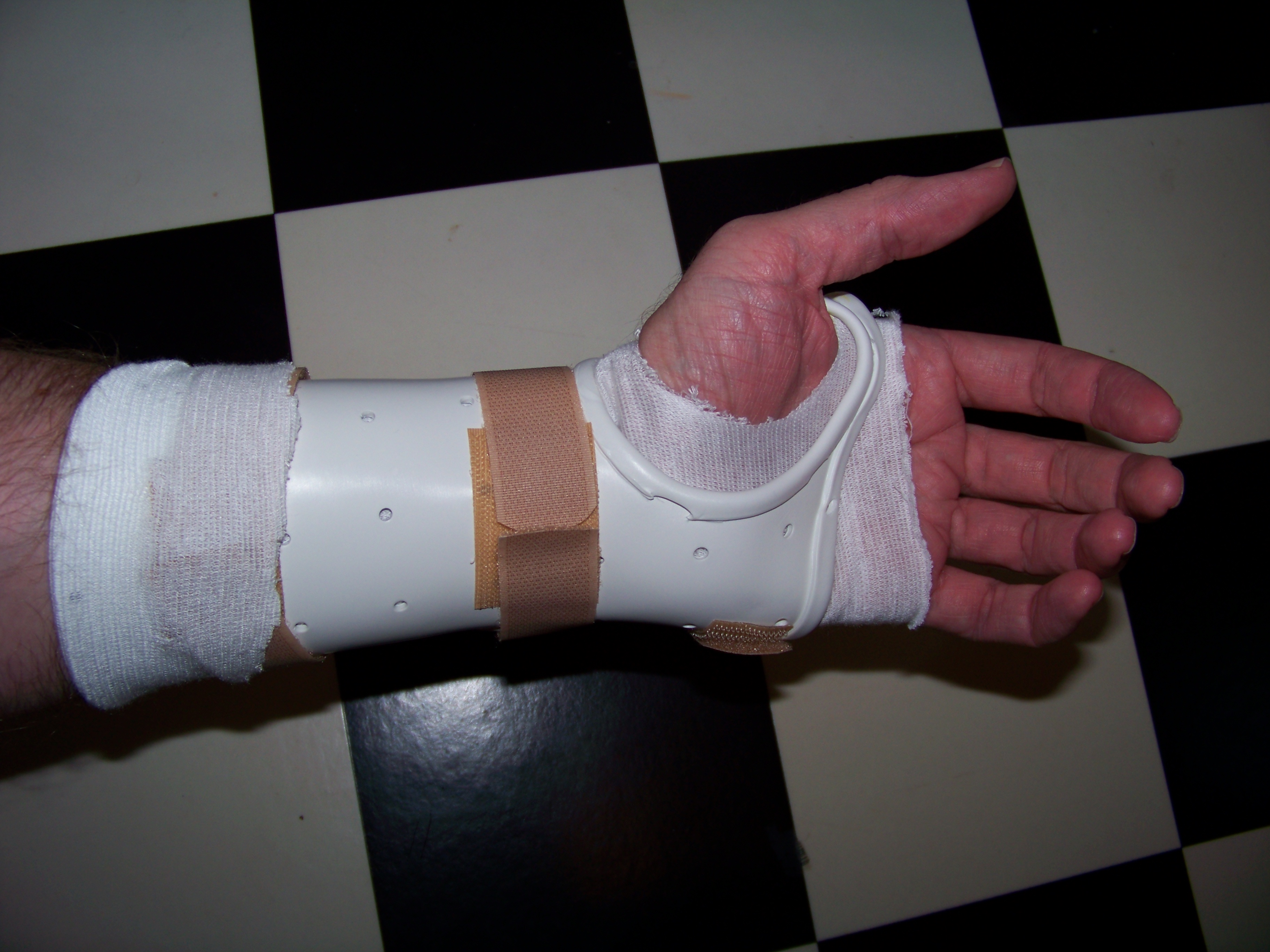
Wrist brace for Carpal Tunnel Syndrome Diagnosis A few weeks ago I was referred to a specialist for the treatment of Carpal Tunnel Syndrome. I first noticed the symptoms in early January, it started happening at night with a partial numbness in the fingers of my left hand. I didn t think much of it at first as it s the expected symptom of sleeping in a position that reduces the blood flow. But when it kept happening with my left hand and never happening with my right and then started getting worse (including happening during the day) I sought medical advice. The doctor asked me to bend my hand down (as if trying to touch my left elbow with the fingers of my left hand). Within about 10 seconds this caused numbness this result from bending one s wrist is a major symptom of CTS. Treatment On Thursday I saw a specialist about this, she agreed with the GP s diagnosis and made a wrist brace for me. She started by cutting off a length of a tube of elastic woven material (similar to a sock) and then cutting a thumb hole, that became the lining. Then to make the hard part she put a sheet of plastic in an electric saucepan (which had water simmering) until it started to melt and then used a spatula to fish it out. The melting temperature of the plastic wasn t that high (it was soft at about 50C when she put it on my arm), it wasn t at all sticky when it was partially melted, and it didn t seem to conduct heat well. After wearing the wrist brace non-stop for a few days I have noticed an improvement already. Hopefully I will make a full recovery in a matter of a month or so, I will probably have to wear a wrist brace when sleeping for the rest of my life, but that s no big deal it s more comfortable to sleep with a wrist brace than a partially numb hand. I ve also been prescribed a set of exercises to help remove scar tissue from the nerves. I haven t done them much yet. In terms of being annoying, the wrist-brace has 3mm diameter holes in a square grid pattern with a 25mm spacing. This doesn t let much air through and in warm weather my arm gets sweaty and starts to itch. I m thinking of drilling some extra holes to alleviate this the part which makes my arm itch doesn t need much mechanical strength. The only task which has been really impeded has been making peanut butter sandwiches, maybe it was making sandwiches not typing that caused CTS? ;) In any case I m not giving up typing but I would consider giving up peanut butter sandwiches. I really hope to avoid the surgical option, it doesn t seem pleasant at all. Other One final thing to note is that Repetitive Strain Injury (RSI) is entirely different. RSI is a non-specific pain associated with repetitive tasks while CTS is a specific problem in one or two nerves where they go through the wrist. RSI apparently tends to reduce the effective strength of the afflicted limb, while milder cases of CTS (such as mine) cause no decrease in strength of course a severe case of CTS results in muscle atrophy due to reduced nerve signals, but I shouldn t ever get that. Many people think that RSI and CTS are essentially the same thing I used to think that until a few weeks ago when I read the Wikipedia pages in preparation to seeing a doctor about it. I want to obtain some of the plastic that was used to make my wrist brace, it could be really handy to have something that convenient for making boxes, containers, and supports for various things among other things it doesn t appear to generate static. The low melting temperature will prevent certain computer uses (the hot air that comes out of a cooling system for a high-end CPU would probably melt it), but it could probably be used to make the case for an Opteron system with careful design. I m guessing that the cost of the plastic is a very small portion of the $150 I paid to the specialist so it shouldn t be that expensive and I m sure it would be even cheaper if it wasn t bought from a medical supply store. If I ever get time to do some work on an Arduino system or something similar then I will definitely try to get some of this plastic for the case. Also the Wikipedia page has a picture of what appears to be a mass-produced wrist brace. I think that it might be improved by having the picture of the custom one that I wear added to the page. I unconditionally license the picture for free use by Wikipedia and others under the CC by attribution license. So if anyone thinks that a picture of my hand would improve Wikipedia then they can make the change.

Russ Allbery: Review: Coders at Work

Review: Coders at Work, by Peter Seibel
Publisher: Apress
Copyright: 2009
ISBN: 1-4302-1948-3
Format: Trade paperback
Pages: 601
Coders at Work is a collection of edited interviews by Peter Seibel (probably best known previously for his book Practical Common Lisp) of an eclectic and excellent collection of fifteen programmers. It opens with an interview with Jamie Zawinski (one of the original Netscape developers) and closes with Donald Knuth. In between, the interview subjects range in programmer generations from Fran Allen (who started at IBM in 1957) and Bernie Cosell (one of the original ARPANET developers) to Brad Fitzpatrick (LiveJournal founder and original developer). Techniques and preferences also range widely, including two people involved in JavaScript development and standardization (Brendan Eich and Douglas Crockford), a functional programming language designer and developer (Simon Peyton Jones), language designers and standardizers such as Guy Steele, and people like Dan Ingalls who have a different experimental approach to programming than the normal application development focus. All of the interviewees are asked roughly the same basic questions, but each discussion goes in different directions. Seibel does an excellent job letting the interview subjects shape the discussion. Two things immediately stood out for me about this book. First, it's huge, and that's not padding. There are just over 600 pages of content here, much of it fascinating. The discussions Seibel has are broad-ranging, covering topics from the best way to learn programming to history and anecdotes of the field. There's some discussion of technique, but primarily at the level of basic approaches and mindset. One typical question is how each programmer organizes their approach to reading code that isn't familiar with them. Each interviewee is also asked for book recommendations, for their debugging techniques, for their opinions on proving code correct, and how they design code. The participants are so different in their backgrounds and approaches that these conversations go in fifteen different directions. This is one of the most compelling and engrossing non-fiction books I've read. Second, the selection of interview subjects, while full of well-known names in the field, is not the usual suspects. While I'm interested in the opinions of people like Larry Wall and Guido van Rossum, I've already heard quite a lot about how they think about programming. That's material that Coders at Work doesn't need to cover, and it doesn't. Many of the interview subjects here are people I'd heard of only vaguely or not at all prior to this book, often because they work in an area of programming that I'm not yet personally familiar with. Those who I had heard of, such as L. Peter Deutsch, I often knew in only one context (Ghostscript in that case) and was unfamiliar with the rest of their work. This gives the book a great exploratory feel and a lot of originality. There is so much good material here that it's hard to give a capsule review. This is a book I'm highly likely to re-read, taking more detailed notes. There's entertaining snarking from Jamie Zawinski and Brendan Eich, fascinating history of the field (including in gender balance) from Fran Allen, and an intriguing interview with Joe Armstrong (creator of Erlang), who seems to have a far different attitude towards languages and libraries than the other interviewees. Every interview is full of gems, bits of insight that I now want to research or play with. A couple of examples come to mind, just to provide a feel of the sort of insights I took out of the book. In the interview with Joshua Bloch, who does a lot of work on library APIs, he mentions that empathy is one of the most important skills for designing an API. You have to be able to put yourself in the shoes of the programmer who's going to use the API and understand how it will feel to them. This came up in the context of a discussion about different types of programmers, and how programmers can be good at different things; the one who can do low-level deep optimization may not have that sense of empathy. Another example: Bernie Cosell talked about how he did debugging, and how he got a reputation for being a fantastic debugger who was able to fix just about anything. He confessed that he often reached a portion of the code that he didn't understand, that seemed too complex and tricky for what it was attempting to accomplish, and rather than trace through it and try to understand it, he just rewrote it. And after rewriting, the bug was often gone. It wasn't really debugging, but at the same time it's close to the more recent concept of refactoring. Several of the interview subjects commented on a subjective feeling of complexity and how when it gets too high that's a warning sign that code may need to be rethought and rewritten. A third example: I was fascinated by the number of interviewees who said that they used printf, assert, and eyeballs to debug rather than using any more advanced debugging tools. The former Lisp developers would often bemoan the primitiveness of tools like gdb, but many of them found that print statements and thinking hard about the code were usually all that's needed. (There was also a lot of discussion about test suites and test-driven development.) The general consensus was that concurrency problems were the hardest to debug; they made up a disproportional number of the responses to Seibel's question about the hardest bug the programmer ever had to track down. I could go on giving similar examples at great length, but apart from the specific bits of wisdom, the strongest impact this book made on me was emotional. Coders at Work is full of people who love programming and love software, and that enthusiasm, both in general and for specific tools and ideas, comes through very clearly. I found it inspiring. I realized while reading this book, and I suspect I'm not alone among programmers in this, that I largely stopped learning how to program a few years back and have been reusing skills that I already have. Reading Coders at Work gave me a strong push towards finding ways to start learning, experimenting, and trying new techniques again. It also filled me with enthusiasm for the process of programming, which immediately helped my productivity on my own coding projects. This is obviously a book whose primary target audience is practicing programmers, and while it doesn't go too far into language theory, I was relying on remembered terms and structure from my master's degree for a few of the interviews. I think it's approachable for anyone who has a working background in programming and a few languages or a CS degree, but it might be a stretch for someone new to the field. But even someone without any programming knowledge at all would get a lot out of the anecdotes and snapshots of the history of software development. Coders at Work is also full of jumping-off points for some additional research on Google or additional reading in other recommended books. I only have one complaint, which I have to mention in passing: for such a large book full of interesting ideas and book recommendations, the index is wholly inadequate. I tried looking up five or six things in it, including the source of some of the book recommendations that are collected in an appendix, and I struck out every time. It's very hard to find something again in 600 pages, and more attention paid to the index would have been greatly appreciated. But, despite that, for people within the target audience, I cannot recommend this book too highly. Not only was it full of useful information, at the level of programming above the code details that's often the hardest to talk about, but it's consistently entertaining and emotionally invigorating and inspiring. It made the rounds of tech blogs when it was first released, to nearly universal approval, and I can only echo that. If you're a practicing programmer, I don't think you'll regret spending a few weeks reading and thinking about this book. Rating: 10 out of 10

Russell Coker: I have a Chocolate Fridge

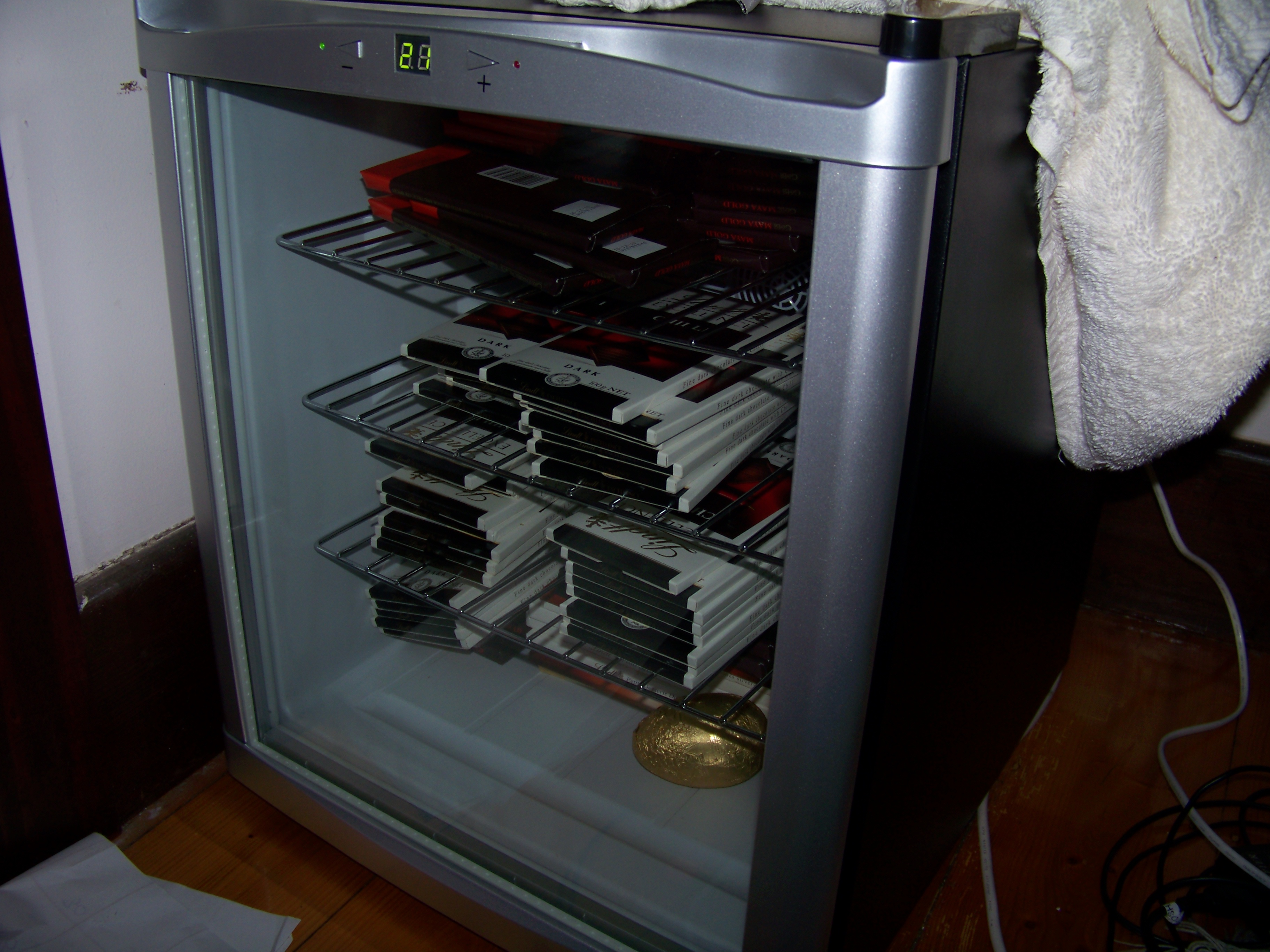
A small fridge full of chocolate
The German supermarket chain Aldi recently had a special deal of a wine-fridge for $99. A wine fridge really isn t that specialised for wine, it is merely a fridge that has a heater and is designed for temperatures in the 11C to 18C range. An good wine fridge will have special wood (or plastic if cheap) holders for wine bottles. A particularly cheap wine fridge (such as the one from Aldi) doesn t even have special holders for wine bottles. But this does however make it more convenient for storing other things. In the hotter days in summer outside temperatures of over 35C are common and it s possible for an uncommonly hot day to be in excess of 45C. My home air-conditioning system is only able to keep the ambient temperature about 10C cooler than the outside temperature if there are a few hot days in a row. According to the Wikipedia page the best chocolate is supposed to have type V crystals which melt at 34C [1]. So if the outside temperature is 45C then the temperature inside my home is almost guaranteed to be hot enough to melt chocolate. If I m not at home (and therefore the air-conditioner is off) during a moderately hot day then it s common to have a temperature of about 30C inside my house. The Wikipedia page also notes that moving chocolate between extremes of temperature can cause an oily texture and that storing chocolate in the fridge can cause a white discoloration. I ve experienced these effects and find that they significantly decrease the enjoyment of chocolate. So now I have a fridge in my computer room set to 16C because according to Wikipedia the ideal temperature range for storing chocolate is from 15C to 17C (the photo was taken shortly after turning it on and it hadn t reached the correct temperature). Every computer room should have a fridge full of chocolate! If my stockpile of chocolate reduces I may even put some wine in the fridge (I could probably fit some now if I organised the chocolate in a better way). But that depends on the supermarkets, if they have a special on Green and Black s Maya Gold organic fair-trade chocolate then my fridge will become full again.

25 February 2010

Bdale Garbee: TeleDongle v0.2 Boards Are Here

This afternoon, a box arrived from Advanced Circuits, containing 108 fully assembled TeleDongle boards! This is not only the first "intended for sale" build of hardware from the Altus Metrum family of projects, it's also the first time that I've ever sent out one of my board designs for someone else to assemble. I therefore approached the turn-on and test of the first board out of the box with more than a little trepidation... fortunately, for no reason! I'm immensely pleased to report that TeleDongle serial number 100 turned on and works entirely as expected! I celebrated by packaging it in a cool little Hammond translucent blue plastic box with a USB cable, yielding the first prototype of a fully packaged TeleDongle board such as we anticipate selling for use receiving data from rockets carrying TeleMetrum boards. We also intend to sell these boards as-is (flashed with default firmware and measured oscillator cal value) to folks who'd like a robust wireless link for their next microcontroller project, whether rocket-related or not. I will, of course, post something here when we're ready to start taking orders. Now we just need the weather to cooperate long enough to log more test flights of TeleMetrum. The new version looks great so far, but I want a few more flights before I'll be confident enough to place an order with our assembler for a run of those too... Stay tuned!

Russell Coker: Terms of Abuse for Minority Groups

Due to the comments on my blog post about Divisive Behavior [1] I ve been considering the issue of terms of abuse of minority groups a topic of which racial abuse is only one aspect. It seems that there are many discussions about which terms are offensive and when they are offensive, most of which are very misguided. Solving this problem would be an almost impossible task, but I have some ideas which may help to improve the situation. I would appreciate any pointers to better ideas in comments or in blog posts that are inspired by this one. One common mistake seems to be the idea that there are global objective criteria by which a statement can be proven to not be offensive. In any language that is constantly evolving (IE any language that s not dead) this seems impossible. It is particularly difficult with a language like English which is widely used in different countries and cultures. If a member of a minority group claims that you have just offended them then it seems most reasonable to have the default assumption be that you have said or done something which is actually offensive. In such a situation an immediate apology for the misunderstanding should be well accepted, but a debate about who s cultural standards should be used for determining what is offensive probably won t get a positive reception. It seems extremely difficult (if not impossible) for a member of the majority group to properly understand what members of a minority group experience. So therefore attempts to understand why certain terms are offensive are likely to be doomed to failure. Sometimes if a certain word is used and then a group of people immediately get really angry you just have to accept the fact that it s not a good word to use. One common example of this is words that are associated with violence if someone associates a particular term with a threat of serious injury or death then you won t be able to convince them that it s not a big deal, but there are more subtle things of a similar nature. It s worth trying to understand people and these things can be productively discussed between friends. But a discussion of such things is not viable during the course of a debate. If involved in a debate with someone you really dislike it doesn t seem like a good strategy to start a meta-discussion about whether they should regard one of your statements as being unreasonably offensive (regarding minority group status) as opposed to the level of offense that is acceptable in debate (something like that s the most ridiculous argument I ve ever heard may offend the recipient but is not inherently unreasonable). Words tend to have multiple meanings. Claiming that your intent was significantly different from the way your message was interpreted probably isn t going to work well unless accompanied by an apology. Even I m sorry you were offended (which is not the best apology) will probably do. Finally I m sure that anyone who does Google searches dating back to 2005 (as an arbitrary year that references my previous post) can find examples of me doing things that go against some of these suggestions. I ve learned things since then, it s an ongoing process.

Ian Wienand: Building a quiet, cool media/house server

After getting sick of having to underclock my existing home server to get it to remain up for any period of time, along with the horrendous noise, I finally found the time and budget to rebuild. My goals were: In the end I went with The case is really awesome. Very easy to access, and the fan is extremley quiet. It very cleverly holds 3 full-size hard-disks; two mounted vertically on either side, and one horizontally in the middle. The final space is for a DVD -- after that it's pretty cramped inside! It makes claims it is a very efficient power supply. It has a very bright blue LED on the front, and the face-plate over the DVD looks nice but the button doesn't quite reach the eject button on my drive, so it's software eject only. All over, definitely recommend. The motherboard is fairly good. One annoying thing is that it only has 3 SATA ports -- I think it's reasonable to want to have a primary drive, two mirrored large disks plus a DVD for a nice little media server. It also has no parallel-IDE, which is reasonable these days. However, if you wanted to install a wireless card you'd be out of luck if you also wanted to put in another SATA card, as it only has one PCI slot. There are plenty of USB ports for a USB wireless card, however. It also comes with two SATA cables, which isn't mentioned anywhere I could see (hopefully this saves you a trip back to Fry's to return your extra cables :). The CPU fan is a little on the loud side, as mentioned in some other forums. It is also located right where the power supply cables come down in this case, making for a fairly tight fit. Here's a lspci for those interested in such things
00:00.0 Host bridge: nVidia Corporation MCP79 Host Bridge (rev b1)
00:00.1 RAM memory: nVidia Corporation MCP79 Memory Controller (rev b1)
00:03.0 ISA bridge: nVidia Corporation MCP79 LPC Bridge (rev b2)
00:03.1 RAM memory: nVidia Corporation MCP79 Memory Controller (rev b1)
00:03.2 SMBus: nVidia Corporation MCP79 SMBus (rev b1)
00:03.3 RAM memory: nVidia Corporation MCP79 Memory Controller (rev b1)
00:03.5 Co-processor: nVidia Corporation MCP79 Co-processor (rev b1)
00:04.0 USB Controller: nVidia Corporation MCP79 OHCI USB 1.1 Controller (rev b1)
00:04.1 USB Controller: nVidia Corporation MCP79 EHCI USB 2.0 Controller (rev b1)
00:06.0 USB Controller: nVidia Corporation MCP79 OHCI USB 1.1 Controller (rev b1)
00:06.1 USB Controller: nVidia Corporation MCP79 EHCI USB 2.0 Controller (rev b1)
00:08.0 Audio device: nVidia Corporation MCP79 High Definition Audio (rev b1)
00:09.0 PCI bridge: nVidia Corporation MCP79 PCI Bridge (rev b1)
00:0b.0 IDE interface: nVidia Corporation MCP79 SATA Controller (rev b1)
00:10.0 PCI bridge: nVidia Corporation MCP79 PCI Express Bridge (rev b1)
00:15.0 PCI bridge: nVidia Corporation MCP79 PCI Express Bridge (rev b1)
01:05.0 RAID bus controller: Silicon Image, Inc. PCI0680 Ultra ATA-133 Host Controller (rev 02)
02:00.0 VGA compatible controller: nVidia Corporation ION VGA (rev b1)
03:00.0 Ethernet controller: Realtek Semiconductor Co., Ltd. RTL8111/8168B PCI Express Gigabit Ethernet controller (rev 03)
I know there are issues with the controller of the Patriot SSD, which would probably worry me for a general purpose machine. However for the primary disk of a server machine I'm not too fussed. The silence is golden and cool-running and low power consumption really helps too. I wouldn't really say it seems that blazing fast. It comes with a handy mount so it fits in a full-size hard-disk slot. Hard to beat for the price. One concession I made to avoid excessive writes was mounting /tmp on tmpfs; this is where it's nice to have 4GB of RAM. Handbrake seems to do a lot of work in /tmp for example. The two green hard-disks (software mirrored) are also inaudible. I'm hoping different brands should at least not fail at the same time. I'm not sure if they're auto-spinning down, but you can't really tell if they're on or not, even under load. Even when running flat-out re-encoding a DVD in the enclosed cabinet with minimal airflow the CPU temperature hasn't gone above 60C; normal CPU temp is around 40C. Performance is adequate -- running PlayOn in a VMware workstation XP VM almost works. It's kind of hard to take photos inside a case, but here's an attempt: <object height="300" width="400"> <param name="flashvars" value="offsite=true&amp;lang=en-us&amp;page_show_url=%2Fphotos%2Fiwienand%2Fsets%2F72157623509152266%2Fshow%2F&amp;page_show_back_url=%2Fphotos%2Fiwienand%2Fsets%2F72157623509152266%2F&amp;set_id=72157623509152266&amp;jump_to="> <param name="movie" value="http://www.flickr.com/apps/slideshow/show.swf?v=71649"> <param name="allowFullScreen" value="true"><embed allowfullscreen="true" flashvars="offsite=true&amp;lang=en-us&amp;page_show_url=%2Fphotos%2Fiwienand%2Fsets%2F72157623509152266%2Fshow%2F&amp;page_show_back_url=%2Fphotos%2Fiwienand%2Fsets%2F72157623509152266%2F&amp;set_id=72157623509152266&amp;jump_to=" height="300" src="http://www.flickr.com/apps/slideshow/show.swf?v=71649" type="application/x-shockwave-flash" width="400"></embed></object> Debian unstable installed without issues (except for some weird bug with the boot hanging for 60 seconds due to the RTL driver). It is also very strange installing from USB to an SSD no noise!

23 February 2010

Russell Coker: Divisive Behavior

Past Sins Sam Varghese wrote an article about Matthew Garrett s LCA talk The Linux community: what is it and how to be a part of it [1]. In page 2 Sam quotes Martin Krafft as asking about how Matthew s behavior had changed between 2004 and the present, Sam cites some references for Matthew s actions in 2005 to demonstrate. I think that this raises the issue of how far back it is reasonable to go in search of evidence of past behavior, something that I think is far more important than the specific details of what Matthew said on mailing lists many years ago and whether he now regrets such email. If someone did something that you consider to be wrong yesterday and did the same thing five years ago you might consider it to be evidence of a pattern of behavior. If someone s statements today don t match their actions yesterday then you should consider it to be evidence of hypocrisy. But if someone did something five years ago which doesn t match their current statements then in many situations it seems more reasonable to consider it as evidence that they have changed their mind. Then of course there is the significance of what was done. Flaming some people excessively on some mailing lists is something that can be easily forgiven and forgotten if Google doesn t keep bringing it up. But as a counter-example I don t think that Hans Reiser will be welcome in any part of the Linux community when he gets out of jail. For the development of the Linux community (and society in general) I think it s best to not tie people to their past minor mistakes. While it is nice when someone apologises for their past actions, the practical benefits of someone just quietly improving their behavior are almost identical. A particular corner case in this regard is the actions of young people, anyone who was born after about 1980 will have had great access to electronic media for their entire life and will have left a trail. Most people do a variety of silly things when they were young, the older members of the Linux community were fortunate enough not to have electronic records remaining where Google could find them. Back to Matthew, I think that if he is to be criticised about such things then evidence that is much more recent than 2005 needs to be used. Cultural Differences Sam quotes Matthew as claiming that the Linux community was largely a Western, English-speaking one, those who participated in it necessarily had to adapt to the norms of this group . I don t believe that there is a single Linux community. There are a number of different communities that are formed around free software, which have significant amounts of overlap. I don t believe that there s any reason why a Chinese or Indian Linux mailing list should conform to the same standards as those of an American list. But there will be a trend towards meme propagation through people who are associated with the Linux communities in multiple countries every time you meet Linux people in another country you are helping to reduce the cultural differences in the Linux community. Someone from China or India who joins a LUG in Australia will have to adapt to some of the norms of Australian behavior in the same way as an Australian who migrates to China or India would have to adapt to some local norms. On page 4 of the discussion Matthew disagrees with Sam s interpretation [2], maybe Matthew s opinions on this matter are closer to mine than the way Sam describes them. Is Division Inherently Bad? I believe that the word divisive is overused. The only way to avoid division is to have everyone agree with the majority, but sometimes the minority will be right. Note that I am using the word minority to refer to any group of people who happen to disagree with the majority, among other things that includes people who vote for a political party that isn t one of the two biggest ones. An entirely separate issue is that of the treatment of minority groups , one of the most divisive events in history was the US civil war it s good that slavery is outlawed but unfortunate that a war was required to gain that result. On page 4 of the discussion Matthew says to Sam Your writing is influenced by members of the Linux community, and in turn it influences the Linux community. The tone of it is entirely relevant to the behavioural standards of the community [2]. If a community can be easily divided then the real problem probably isn t the person who triggered a particular division. Also there is the issue that even if you could get a general agreement that certain issues shouldn t be discussed in certain ways then with the wide range of cultural attitudes and ages of participants you have to expect someone to raise the issue you don t want raised. Of course it s impossible to objectively determine whether a division is productive or not, so it doesn t seem at all viable to have any expectations regarding outsiders not being divisive. Sometimes you just have to deal with the fact that the Internet contains people who disagree with you. It seems to me that the most divisive issues we face involve people who mostly agree on contentious issues. If someone entirely disagrees with you then it s easy to ignore them (if you even have a conversation with them), but if they are someone that you communicate with and they are almost right in your opinion then there s the potential for a big argument. Probably the best way to minimise division in the community is to have the first people who get involved in a dispute take a Rogerian approach [3]. Failing that a good approach is to respond by writing an essay. When an issue is made popular by services such as Twitter that give little explanation then everyone rushes to the barricades. It seems to me that the unreliability of some blogging platforms is part of the cause of the problem in this regard. I ve just given up on writing comments on Blogger, I m not going to write a good comment only to have it eaten by blogger. There are lots of blogs that have problems which discourage the population from writing anything other than a one-sentence response. The Good that can come from Disputes On page 5 of the discussion there is a comment from Anirudh the Indian student who was criticised by Sam (which ended up inspiring part of Matthew s talk and leading to more disputes) [4]. Here is the start: I am the person who wrote the ill thought-out post that drew criticism eight months ago. There has been some discussion about that, so I wish to say something.

I am very grateful to Sam Varghese. I say this with utmost sincerity. Read the rest, it s educational. I m sure that there are others who have had similar learning experiences but who don t want to write about them. I m sure that there have been many disputes which would appear to the casual observer to have resulted in no good at all, but which would actually have resulted in people learning things and amending their behavior. The issue of Age Car rental companies generally don t do business with men who are less than 25 years old. Life insurance policies don t offer reasonable rates to males between the ages of about 16 and 25. This is because the insurance companies have good statistical data on the results of the typical actions of people at various ages and know that young men tend to be at a high risk of earning a Darwin Award. The same combination of hormones and life experience that makes a young man a danger on the road will also tend to make him get involved in flame-wars on the net. If we could figure out how to influence teenagers into being less anti-social then it would be a great achievement. The current young people will become older and more sensible soon enough but will be replaced by a larger number of young people who will do the same things. As things stand I don t expect the next cohort of young people to learn from Anirudh.

22 February 2010

Russell Coker: Net Neutrality

Martin Krafft advocates a model of Internet access where advertisers pay for the Internet connection [1]. The first problem with this idea is the base cost of providing net access which in most cases is wires to the premises. Every service that involves a cable to someone s house (Cable TV, Cable/DSL net access, or phone service) has a base minimum monthly fee associated with the expense of installing and maintaining the cable and whatever hardware is at the other end of the cable. For DSL and basic phone service the pair of wires ends at an exchange and takes a share of the DSLAM or a telephone exchange. It seems that the minimum monthly cost for any wire that goes to the house in Australia is about $20. So if an advertiser makes $0.20 per click (which I believe to be higher than the average price for Google Adsense clicks) then the user would have to be clicking on adverts more than 3 times a day. This might be viable if an ISP runs a proxy that inserts adverts into all content (which technically shouldn t be that difficult). But modifying content in-transit to introduce adverts is something that the net-discrimination crowd can only dream about. 3G net access has the lowest per-user costs. Based on current data costs it seems possible for an ISP to run a 3G service with bills for users as low as $15 per annum if they don t transfer much data. Recouping $15 might be easy but it s also a small enough amount of money that most users won t mind paying it. What we really need is to have more competition in the 3G ISP business. When I investigated this issue last month I found that there are few 3G Internet providers in Australia and the cheapest is Dodo at $139 per annum with a 15G limit [2]. With a bit more competition I m sure that someone would offer a really cheap plan for 1G or 2G of data access in a year. Martin complains about users paying twice as users pay to access the network (which is like paying a taxi to get to the market), so that they can visit sites where advertisers make money showing ads to the visitor . But if the advertisers were to pay then there would be a lot of inefficiency in determining how much each advertiser should pay which would result in extra expenses and therefore providing the service would cost more. I don t think that paying for a taxi to get to the market is a bad thing, personally I prefer to save money and use a bus or tram. I think that the best analogy for this is comparing using your own choice of a bus, tram, taxi, etc to get to the market or having the market operator provide taxis for everyone and then make everything really expensive to cover the significant costs of doing so. Finally there is the issue of video transfer which uses up a lot of bandwidth. According to both industry rumor and traceroute there is a significant mirror of youtube content in Australia. This means that youtube downloads will be cheap local transfers not expensive international transfers. I expect that most multi-national CDNs have nodes in Australia. So for Australia at least video transfer would not be as expensive as many people expect. I think that to a large extent the concept of having content providers pay to host the content has been tried and found to fail. The Internet model of you pay for your net access, I pay for mine, and then we transfer data between our computers without limit has killed off all the closed services. Not only do I think that net-discrimination is a bad idea, I think that it would also turn out to be bad for business.

21 February 2010

Martin Michlmayr: Debian Installer 6.0 Alpha1 available

The Debian installer team today announced the alpha1 version of the installer for Debian squeeze (6.0). This release adds a lot of new features but I just wanted to highlight the ARM related enhancements. With this release, Marvell's Kirkwood platform is supported. Specifically, the installer supports the following devices: QNAP TS-110 and TS-119, QNAP TS-210, TS-219 and TS-219P, SheevaPlug and OpenRD. In addition to Kirkwood support, Wouter Verhelst added support for the Intel Storage System SS4000-E.

Bastian Venthur: Reportbug-ng can now hide closed bugs

Today I finally found the reason why the table in reportbug-ng was not always sorted correctly. The fix was trivial and I m happy it s finally corrected. As announced last week, reportbug-ng now also can optionally hide closed bugs, which makes reportbug-ng together with the complex queries a great tool for finding easy NMU candidates. To play around with those new features, I also did 5 lazy NMUs today. Most of them where fixes for FTBFS/RC bugs which had already a patch in the BTS.

19 February 2010

Gunnar Wolf: Computer education parallelisms

I opened Slashdot's Looking back from the 1980s at computers in education article because I am quite convinced of the point some of the commenters argued before me, (and it's good to know others think as you do ;-) ) When I got close to computers, learning computing for children basically meant learning programming in a fun way. For years, my hobbies included Logo and BASIC. At age 7 (by 1983), typing TeX and using Emacs at the computer of the institute where my father worked, I started walking the path I took for my professional life. When I taught computing to high school students as my first paid job (which didn't last long, only a semester, as for an untrained 20 year old it is very hard to control a group of kids nearly his age), I tried to teach some basic BASIC programming (which was the best I knew then)... But no, both students and the school wanted me to focus on teaching MS Office applications. It seemed stupid for me 14 years ago, and it still seems stupid for me today. Anyway, on Slashdot, I came across this beautiful way to explain what computer education should mean:
"computing is no longer taught in schools (parents look quizzical), they are simply 'trained' (parents look like they vaguely get it). if this was sex instead of computing that was taught in schools, would you prefer that your kids have sex _education_ or sex _training_? (parents finally get it)".
By the way, if you are interested in reading a bit of paleofuturism, to feel the joy and excitement with which computer-aided education was seen 30 years ago, be sure to get the Classroom Computer News issue for September-October 1980, linked from the Slashdot article (and copied over here for your convenience, of course!)
AttachmentSize
Classroom Computer News vol. 1 no. 1, sep-oct 19803.54 MB

18 February 2010

Bastian Venthur: Reportbug-ng now supports complex queries

Until today you could only use reportbug-ng to query the BTS with simple queries like packagename , bugnumber , tag:patch , etc. But the BTS actually supports composite queries like severity:grave tag:patch which returns bugreports with severity grave and a patch. The underlying Python library python-debianbts also supported this right from the start, but reportbug-ng did not make use of it. Last weekend I finally had the time to fix that and the result is on it s way to unstable. Composite queries provide a very convenient way to find cheap NMU candidates: the query "severity:critical severity:grave severity:serious tag:patch" will return release critical bugs which have a patch. Now you can just go through this list, pick an open bug, test the patch and do what s necessary to release Squeeze in time. Next item on my list is an option to hide closed bugs, maybe next weekend.

Alexander Reichle-Schmehl: RC-Bug statistics for Squeeze, calendar week 7:

Note: Please see RC-Bug statistics for Squeeze, calendar week 7 for an explanation of the numbers.
Total:699+49
Affecting Squeeze:559+41
Squeeze-only:117+23
Unfixed bugs remaining in Squeeze:442+18
Of these 442 bugs...
... are pending36+4
... are patched:65+1
... are duplicates:47+-0
... are in Non-free or contrib:10+10
... are claimed by someone:14-3
... are fixed in the delayed queue:5-1
... are somehow marked as fixed:53+14
Or in other words:
Release critical bugs left in squeeze, when ignoring all these:
262 (+2 compared to previous week). With this release managers views, 472 (+48 compared to previous week) bugs remain to be fixed somehow before we can release. Some notes: So much for this week. Let's see, how the numbers evolve in the coming seven days...

17 February 2010

Russell Coker: Can the NBN Ever Break Even?

I previously wrote about how the National Broadband Network (NBN) seems more suited to porn delivery than regular Internet use [1]. It doesn t seem to be of much use really. In a particularly insightful comment John Hughes suggested that the real purpose would be TV delivery. The ABC is currently delivering 640*360 resolution MPEG4 files via iView for it s TV content. To use iView on Linux you need Jeremy Visser s Python-iView program [2] in conjunction with Luke Kenneth Casson Leighton s rtmp program [3]. Note that to get this working on Debian/Lenny you need to install the python-simplejson package as well. For the current ABC service it requires 251652 of data for a 3167.6 second Torchwood episode, that averages to 79.4KB/s of data. In contrast a video of Dan Gilbert from TED.com at high quality was in 640*480 resolution and required 301652KB of data for 1276.5 seconds which averaged out to 236.3KB/s. My ADSL2+ connection is theoretically capable of something over 1MB/s and occasionally gets such speeds for unusual download situations (such as downloading multiple large files at the same time). But generally I can t rely can t rely on sustained transfer rates of more than about 200KB/s. So I could watch streaming TED talks at reasonable quality, but for the best results I have to download them and watch them from disk. Assuming the same ratio of compressed data to raw pixels used for HDTV as used for TED talks a 1920*1080 HDTV resolution MPEG4 with the same quality as a TED talk would take 1600KB/s. It is possible to vary the compression level and possibly the usage of a TV stream would permit better compression than the usage of a TED talk for the number of pixels. But it seems reasonable to assume that something like 1600KB/s is needed for best HDTV, that is more than the vast majority of ADSL2+ installations can be relied on to sustain. But 100Mb/s would allow at least two 1920*1080 HDTV transmissions to be viewed at the same time, and maybe three or four as few homes have only one TV this should be of great interest. Now the question is how much people would pay for this. Currently there are two main pay TV companies in Australia, Foxtel which charges $916 for a 12 month plan [4] and Optus who s web site is so awful that I gave up before discovering what they cost (I will assume that they are competitive with Foxtel). Now I think it s reasonable to assume that $916 is at the high end of what potential customers are prepared to pay, as they are competing with free to air TV, DVD sales, Youtube, and downloads of pirate content. The current bank interest rate on term deposits from the Commonwealth bank is 6.3%, the interest rate on raising the finance would have to be greater than that let s assume 7%. So the $5000 per household will require an interest payment of $350 per annum. If a household signs up to pay TV services at a cost of $1200 per annum that might be enough money to pay slightly more than $350 to the NBN plus make a profit for the pay TV company. So if every household in Australia signed up for pay TV over the NBN it should be profitable. But that seems unlikely. The majority of the Australian population (IE the majority of the city population) is used to paying not much more than $240 per annum for a basic phone service and not much more than $360 per annum for a basic broadband Internet service. A bundled deal of $1600 per annum for phone, Internet and pay TV should allow the pay TV company and the NBN to be barely profitable if everyone accepts the deal (unless of course interest rates rise). If half the population aren t interested then the bundled deal would have to cost $2000 to have the potential for being profitable. If three quarters of the population aren t interested then it would have to cost $2300 or more! The Australian Bureau of Statistics documents that in 2008 the median household disposable income in capital cities was $593 per week [5]. So it seems that the idea of the NBN being profitable is based on plan to have more than three weeks of household disposable income per year being spent on Internet/phone/TV services. But fortunately for the pay TV companies and the content companies there is no requirement for the NBN to be profitable, it s being paid by tax money so if it loses money then we can just pay more tax! It s the ideal public private partnership , the citizens take all the risk and the corporations reap all the profits! James Purser describes how Stephen Conroy gave the TV networks something between $250,000,000 and $500,000,000 a year for the next two years [6]. It was claimed that this huge gift would be conditional on the production of more Australian content but they ended up not putting any conditions on it. In a strange coincidence Stephen Conroy did this a month after having a meeting with Kerry Stokes (head of Channel 7). Based on this I don t believe that there was ever a serious plan to make the NBN profitable. I think that the plan was just to take our tax money and spend it on things that benefit friendly corporations. Really it s better for us if the government just hands out $500,000,000 at a time instead of spending $43,000,000,000 on a project that has the same aim of giving a few hundred million to cronies.

16 February 2010

Jan Dittberner: New hardware for my server at home

After some stability problems and an unresolvable PCI IRQ problem with my Debian server at home (Internet gateway, mail, PostgreSQL, LDAP and NFS server and test system), I decided to get a new mainboard and wireless card last week. I did some research to get hardware that is properly supported and where I can use the rest of my current components. I had So I had to find a mainboard with at least 2 DDR2 DIMM sockets, an AM2 compatible CPU socket in ATX format with SATA ports at least one IDE Port, a Gigabit ethernet port (serving NFS home directories) and at least 2 PCI slots (one for the wireless card) that is well supported by the current Debian Squeeze Linux kernel. As I had some issues with the previous board's nvidia SATA chipset I wanted to get something else that is AHCI compatible. After some research I decided to buy a Gigabyte GA-MA74GM-S2H (rev. 3.0) which is available for a good price and fits all my criteria (2 DDR2 DIMM slots, 6 SATA ports, an RTL8169 based Gigabit ethernet ports, 2 PCI slots, ...). The mainboard uses an AMD 740G + SB710 Chipset. It has an integrated graphics chipset which I don't really need because I run the machine as a headless system. As I use the server as a wireless access point I need a wireless network adapter that supports AP mode. There are not many chipsets that are properly supported in AP mode and allow good data rates so I decided to get an Atheros ath9k based card, because I don't need non-free firmware like with broadcom based cards and could find some affordable hardware. The previous was a Netgear WG311 ath5k card that had issues that it lost its connection under more than minimum load and could only be reanimated by a system reboot. I looked at the Linux Wireless pages and found out that D-Link has a matching adapter the DWL-G520. Unfortunatelly they don't tell about the used chipset (as almost all other vendors too) and write about possibly changing hardware at the product sheet. To be sure I looked at their Windows driver's .inf files and found nothing indicating that there are any non Atheros variants of the card. I also ordered two Fantec MR-35 SATA mobile racks for more comfort when one of the RAID1 discs crashes (had 2 crashes last year) and a 12" chassis fan to keep the system cool. Today the package arrived and after unpacking and putting everything together I started the system (with keyboard and a display attached) to see how it works. All hardware was automatically detected by the current Debian Squeeze system and I only had to remove the entries for the old onboard network adapter and the old wireless adapter from /etc/udev/rules.d/70-persistent-net.rules and fix the device names for the new network cards. I added a new stanza for the Intel ethernet adapter in /etc/network/interfaces and setup a set of ferm rules to have a working firewall (thanks to Formorer for the suggestion to use ferm). After this was finished everything worked fine so far and I put the machine at its normal place without keyboard and display. To verify that the stability situation had really improved, I copied some huge files over the network (both wired and wireless and in both
directions). Afterwards I did a bonnie++ benchmark to test the SATA and hard drive reliability. Everything went well and I'm happy with my investment.

Russell Coker: Would you Short-Change a Pedophile?

For some time the film industry has been running an anti-piracy campaign with slogans such as you wouldn t steal a car [1] in an attempt to draw a false analogy between downloading a movie and stealing a significant and valuable object the modern equivalent to being a horse thief . One of the many ways that such poor analogies break down is the fact that downloading a movie is not a crime, it s copyright infringement. The best analogy that I can think of for non-commercial copyright infringement is the practice of short-changing. I expect that almost everyone has at some time received less change than they deserved when buying something at a shop, the cashier aims to collect $1 or $2 from each customer and can easily double the amount of money that they take home at the end of the day. When a customer complains they just pretend to have made a mistake and although short-changing is a crime (unlike copyright infringement) it almost never results in police action. The practice is tolerated to such a degree that some people know the shops where they are likely to be short-changed, they count their change more carefully and demand the full amount but don t bother complaining to the manager! The film industry also tries to portray itself as representing struggling artists who deserve the money, it s described as a moral issue good people pay for movies while bad people download movies and steal cars. But then there s the case of Roman Polanski who is a well known movie director and child rapist [2]. I expect that most store employees would gladly palm some of the change if Roman Polanski was a customer that is of course if they weren t too busy arranging a lynch mob. So instead of you wouldn t steal a car a more reasonable statement would be you would short-change a pedophile if you weren t organising a lynch mob . Please note that murdering a criminal as part of a lynch mob is a crime (unlike making an unauthorised copy of a DVD), so I encourage people not to perform lynchings. Many important people in the movie industry have different ideas, the Wall Street Journal has an article about the petition to free Roman Polanski which demonstrates the difference between Hollywood attitudes and those of the rest of the world [3]. For them, violent crime is no big deal if the criminal is famous and the victim isn t but anything which affects their own wealth is regarded as a serious issue. Indiewire has a copy of the petition to free Roman and a list of the names of 100 people who signed it [4] (I heard that the latest count was nearer 150 but couldn t find a reference). I believe that the matter of morals is not whether someone who rapes children deserves jail time (that issue is really clear) but whether it is morally acceptable to give money to such a criminal or their supporters. I suggest that the list of signatories to the pro-rape petition be black-listed, any movie that involves any of them should not be paid for either don t see the movie or download it without paying at your own whim. If anyone knows of a web site that is being regularly updated with a list of all past and current projects involving people who signed the petition for Roman then please let me know it would be good to have a list of movies that I will never pay for. Anyone who feels morally obliged to pay something for a movie and who has a great desire to watch a movie made by Roman Polanski or his supporters could download it and then make a donation to a charity equivalent to the purchase price rumor has it that women s refuges are always short of funds. As an aside I find Wikipedia a good reference for movies that I don t plan to see, I read the plot summary on the wiki page and then have no curiosity about what happens in the movie if that isn t adequate I ask friends for spoilers or do a Google search on the movie name and spoilers .

Russell Coker: National Broadband/Porn Network

Currently we have a new National Broadband Network under construction in Australia [1]. It is going to cost $43,000,000,000 which is $5,000 per household. It is designed to deliver 100Mb/s speeds to most homes that is the homes that can currently get more than 8Mb/s through ADSL2+ or cable connections. The question is, what can we do with 100Mb/s that we can t do with 8Mb/s? It seems that ADSL2+ works pretty well for VOIP, video-conferencing, online games, and transferring CD/DVD images (with a little patience). It seems to me that the only benefit in having download speeds faster than 8Mb/s is for downloading high resolution images and video files in a small amount of time and porn surfing seems likely to be the only reason for someone being so impatient to get high resolution images! Now there are some potential technical benefits to this, FTTH will allow synchronous upload and download speeds and being able to transmit data at 100Mb/s will be a significant benefit. If the data transfer quota was reasonable then I could run my blog, my web site (including my Debian package repositories), and some other new projects from a server in my own home. Currently Internet access in Australia sucks mostly because of the cost of international bandwidth [2]. Also while Telstra was run by the awful Sol Trujillo it was trying to gain a monopoly on domestic services via it s Fiber To The Node (FTTN) scheme, it seems that one of the biggest benefits of the NBN is to prevent Telstra gaining such a monopoly but as they are going to pay the NBN CEO a $2,000,000 salary [3] it seems that some of the same mistakes are being made. In any case $43,000,000,000 is a lot of money to pay to break a monopoly, there are much cheaper ways of doing this. Now if the money was to be spent intelligently on Internet access the first area would have to be submarine cables, if the capacity of the connections between Australia and the rest of the world could be significantly increased then it would change the way the Internet is used. I have a US-based colleague who transfers more data from his mobile phone than I do through my home ADSL connection and he pays about the same amount of money as me! I think that most serious Internet users would rather have an ADSL2+ connection that is cheaper and has a larger bandwidth quota than a FTTN connection with a high transfer rate but a small quota of data that can be transferred from what I ve read about the NBN it doesn t sound like a service I would want to sign up for. Then there is the issue of servers, currently for most uses Australia is not a viable location for a server due to bandwidth costs. This decreases the job opportunities for Australian system administrators and decreases the Australian IT skills base. The next area that needs attention is wireless net access. The first issue that should be addressed is the minimum cost, the cheapest net access in Australia is via 3G because it avoids all the costs of wiring [4]. It would be good if instead of paying about $150 per annum for 3G net access there were some options for cheaper plans, maybe $60 per annum for 6G of data. In many ways the current Australian lifestyle requires Internet access, and many aspects of interaction with government organisations requires net access, so it seems that the government should make it a priority to provide cheap net access to the entire population. A 3G net access plan of $60 per annum plus a subsidised purchase plan for cheap PCs (maybe taking a Netbook from $350 to $250) should significantly decrease the number of people who can t use the Internet. 3G access (both Internet and telephony) also needs to be available in more areas. Currently Telstra has the widest coverage of any mobile phone company, but it uses a non-standard frequency which limits the availability of suitable phones and it doesn t compete on price [5]. So rural users have to pay through the nose for Telstra mobile telephony and they get a limited choice of phones. It would be really good if we had a NBN for 3G phones that covered the areas surrounding most rural population centers to compete with Telstra. If rural users could pay $60 per annum for 3G Internet access and a reasonable rate for mobile phone access (maybe a combined phone/data plan similar to those offered by Three and Virgin) then it would significantly improve the rural access to services that urban residents take for granted. The NBN plan does include providing wireless and satellite net access to the 10% of the population who will be out of range of FTTH. But I am concerned that it will provide a bare minimum of service and not an integrated voice/data service that permits using the newest features of phone OSs such as Android. In the past I ve had some commercial experience with satellite Internet access and I have not been impressed with it, the response times were very poor and fully interactive services were almost unusable. The government should aim to provide support for interactive services that facilitate business operations (including video-conferencing and remote server access via ssh, VNC, etc) to as much of the population as possible. I expect that a significant portion of the Internet using applications on smart-phones such as those running the Android OS will require fast response times, so even if a satellite version of an Android phone is ever produced it still wouldn t be as useful as the current phones. Finally the government should offer free wireless net access in all major urban areas for the purpose of accessing government services, Australian content, and Australian mirrors of foreign content. This would be a convenience feature for most people and would also be good for emergency access I shouldn t have been denied access to government services when the PSU for my ADSL modem died in the heat last week, I should have been able to take a laptop to the nearest government Wifi access point! In conclusion I think that the government should spend money on lowering the cost of Internet and mobile telephony access for everyone and granting greater access to government services. I am not aware of any evidence to suggest that the current NBN plan will do anything to achieve such aims. But it should be really good for accessing porn sites that use a CDN with an Australian presence. Update: John Hughes pointed out in an insightful comment that 100Mb/s can be used for watching TV. So this could be a ploy to try and convert Internet access into better TVs paid for by our tax money!

Next.

Previous.