Search Results: "reg"

14 November 2013

Russ Allbery: C TAP Harness 2.3

This release pushes out some improvements to my TAP library and test harness that I found time to do a while back. I have some other plans, but not much time, so I'm not sure when I'll get to them. Now included in the C TAP library is a test_cleanup_register function that registers a cleanup function called during exit from the test. This function will be passed a boolean argument indicating whether the test succeeded or failed. It was already possible to do this with simple atexit, but now callers can decide whether to delete possibly-interesting trace files based on whether the test was successful. As part of this change, I also refactored and improved everything that happens during test exit, and in the process fixed a bug where lazy plans and test summaries were still displayed even when a test aborted with bail. This release also adds the gcc warn_unused_result attribute to the various TAP library functions (mostly the malloc variations that call bail on failure) where the return value really shouldn't be ignored. You can get the latest release from the C TAP Harness distribution page.

13 November 2013

Andrea Veri: Configuring DNSSEC on your personal domain

Today I ll be working out how to properly configure DNSSEC on a BIND9 installation, I ll also make sure to give you all the needed instructions to properly verify if a specific domain is being correctly covered by DNSSEC itself. In addition to that a few more details will be provided about adding the relevant SSHFP s entries on your DNS zone files to be able to automatically verify the authenticity of your domain when connecting to it with SSH avoiding any possible MITM attack. First of all, let s create the Zone Signing Key (ZSK) which is the key that will be responsible to sign any other record on the zone file which is not a DNSKEY record itself:
dnssec-keygen -a RSASHA1 -b 1024 -n ZONE gnome.org


Note: the dnssec-keygen binary file should be part of bind97 (RHEL 5) or bind (RHEL6) package according to yum whatprovides: RHEL 5:
32:bind97-9.7.0-17.P2.el5_9.2.x86_64 : The Berkeley Internet Name Domain (BIND) DNS (Domain Name System) server
Repo : rhel-x86_64-server-5
Matched from:
Filename : /usr/sbin/dnssec-keygen


RHEL 6:
32:bind-9.8.2-0.17.rc1.el6.3.x86_64 : The Berkeley Internet Name Domain (BIND) DNS (Domain Name System) server
Repo : rhel-x86_64-server-6
Matched from:
Filename : /usr/sbin/dnssec-keygen


Then, create the Key Signing Key (KSK), which will be used to sign all the DNSKEY records:
dnssec-keygen -a RSASHA1 -b 2048 -n ZONE -f KSK gnome.org


Creating the above keys can take several minutes, when done copy the public keys to the zone file this way:
cat Kgnome.org*.key >> gnome.org


When done you can clean out the useless bits from the zone file and just leave the DNSKEY records (which are not commented out as you will notice) An additional and cleaner way of accomplishing the above is to use the INCLUDE rule on the zone file itself as follows:
$INCLUDE /srv/dnssec-keys/Kgnome.org+005+12345.key
$INCLUDE /srv/dnssec-keys/Kgnome.org+005+67890.key


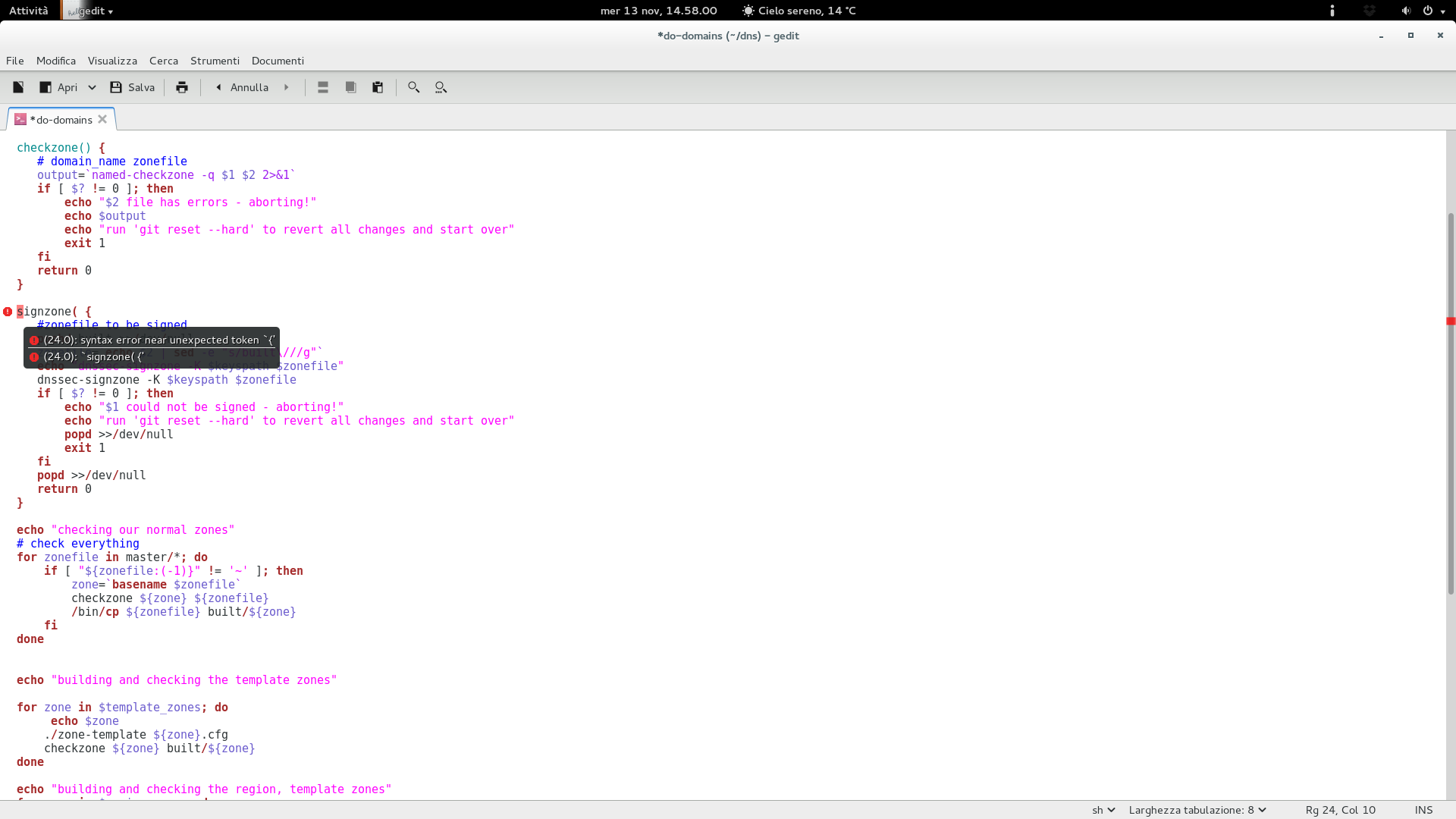
Choosing which method to use is really up to you. Once that is done you can go ahead and sign the zone file. As of myself I m making use of the do-domain script taken from the Fedora Infrastructure Team s repositories. If you are going to use it yourself, make sure to adjust all the relevant variables to match your setup, especially keyspath, region_zones, template_zone, signed_zones and AREA. The do-domain script also checks your zone file through named-checkzone before signing it.
/me while editing the do-domains script with the preview of gnome-code-assistance!

/me while editing the do-domains script with the preview of gnome-code-assistance!

If instead you don t want to use the script above, you can sign the zone file manually in the following way:
dnssec-signzone -K /path/to/your/dnssec/keys -e +3024000 -N INCREMENT gnome.org


By default, the above command will append .signed to the file name, you can modify that behaviour by appending the -f flag to the dnssec-signzone call. The -N INCREMENT will increment the serial number automatically making use of the RFC 1982 arithmetics while the -e flag will extend the zone signature end date from the default 30 days to 35. (this way we can safely run a monthly cron job that will sign the zone file automatically) You can make use of the following script to achieve the above:
#!/bin/sh
SIGNZONE="/usr/sbin/dnssec-signzone"
DNSSEC_KEYS="/srv/dnssec-keys"
NAMEDCHROOT="/var/named/chroot"
ZONEFILES="gnome.org"
cd $NAMEDCHROOT
for ZONE in $ZONEFILES; do
$SIGNZONE -K $DNSSEC_KEYS -e +3024000 -f $ZONE.signed -N INCREMENT $ZONE
done
/sbin/service named reload


Once the zone file has been signed just make sure to include it on named.conf and restart named:
zone "gnome.org"  
file "gnome.org.signed";
 ;


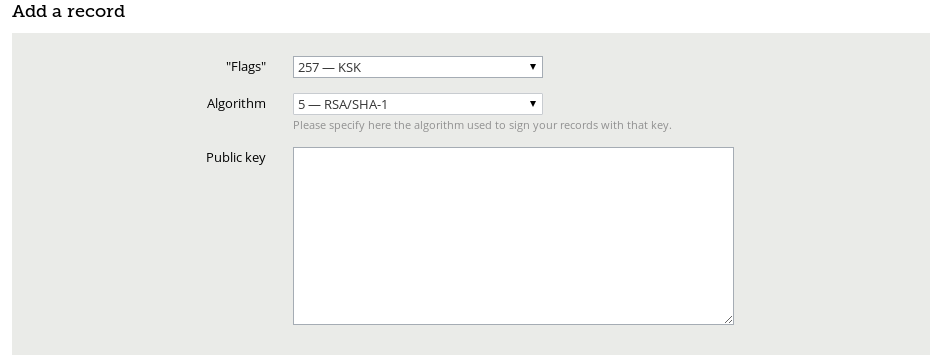
When you re done with that we should be moving ahead adding a DS record for our domain at our domain registrar. My example is taken from the known gandi.net registrar.
gandi

Gandi s DNSSEC interface

Select KSK (257) and (RSA/SHA-1) on the dropdown list and paste your public key on the box. You will find the public key you need on one of the Kgnome.org*.key files, you should look for the DNSKEY 257 entry as dig DNSKEY gnome.org shows:
;; ANSWER SECTION:
gnome.org. 888 IN DNSKEY 257 3 5 AwEAAbRD7AymDFuKc2iXta7HXZMleMkUMwjOZTsn4f75ZUp0of8TJdlU DtFtqifEBnFcGJU5r+ZVvkBKQ0qDTTjayL54Nz56XGGoIBj6XxbG8Es+ VbZCg0RsetDk5EsxLst0egrvOXga27jbsJ+7Me3D5Xp1bkBnQMrXEXQ9 C43QfO2KUWJVljo1Bii3fTfnHSLRUsbRn8Puz+orK71qxs3G9mgGR6rm n91brkpfmHKr3S9Rbxq8iDRWDPiCaWkI7qfASdFk4TLV0gSVlA3OxyW9 TCkPZStZ5r/WRW2jhUY/kjHERQd4qX5dHAuYrjJSV99P6FfCFXoJ3ty5 s3fl1RZaTo8=


Once that is done you should have a fully covered DNSSEC domain, you can verify that this way:
dig . DNSKEY   grep -Ev '^($ ;)' > root.keys
dig +sigchase +trusted-key=./root.keys gnome.org. A   cat -n


The result:
105 ;; WE HAVE MATERIAL, WE NOW DO VALIDATION
106 ;; VERIFYING DS RRset for org. with DNSKEY:59085: success
107 ;; OK We found DNSKEY (or more) to validate the RRset
108 ;; Ok, find a Trusted Key in the DNSKEY RRset: 19036
109 ;; VERIFYING DNSKEY RRset for . with DNSKEY:19036: success
110
111 ;; Ok this DNSKEY is a Trusted Key, DNSSEC validation is ok: SUCCESS

Bonus content: Adding SSHFP entries for your domain and verifying them You can retrieve the SSHFP entries for a specific host with the following command:
ssh-keygen -r $(hostname --fqdn) -f /etc/ssh/ssh_host_rsa_key.pub


When retrieved just add the SSHFP entry on the zone file for your domain and verify it:
ssh -oVerifyHostKeyDNS=yes -v subdomain.gnome.org


Or directly add the above parameter into your /etc/ssh/ssh_config file this way:
VerifyHostKeyDNS=yes


And run ssh -v subdomain.gnome.org , the result you should receive:
debug1: Server host key: RSA 00:39:fd:1a:a4:2c:6b:28:b8:2e:95:31:c2:90:72:03
debug1: found 1 secure fingerprints in DNS
debug1: matching host key fingerprint found in DNS
debug1: ssh_rsa_verify: signature correct

That s it! Enjoy!

Julien Danjou: OpenStack Design Summit Icehouse, from a Ceilometer point of view

Last week was the OpenStack Design Summit Icehouse in Hong-Kong where we, OpenStack developers, discussed and designed the new OpenStack release (Icehouse) that is coming up. The week has been wonderful. It was my second OpenStack design summit, and I loved it. Bumping into various people I've never met so far and worked with online was a real pleasure. As it was to meet again with fellow OpenStack developers! The event organisation was great, as were the parties. :-) On the last day, I had the chance to present a talk with Eoghan Glynn and Nick Barcet how we built the auto-scaling feature in Heat, implementing the "alarming" feature needed in Ceilometer.
The slides and video of the talk is online on my talks page. Design sessions This time, Ceilometer design sessions were spread on 3 days. Everything we talked about has its Etherpad instance. The discussions were interesting, and the amount of feedback gathered is big and is going to be very useful. There's a lot of people and companies using Ceilometer now, and the project is getting more and more traction in general. There's a lot of different way to use it and to bend it to one's needs. Considering the amount of features and options that is provided, building functionality with a genericized approach it making Ceilometer useful for a lot of different and interesting use-cases. Icehouse roadmap The list of blueprints targeting Icehouse is available, but not yet complete. I expect people to start filling this list in the next days.If you want to propose blueprints, you're free to do so and inform us about it so we can validate it. The same applies if you wish to implement one of them! Thereafter, I try to guess what the roadmap will look like in the upcoming weeks for Ceilometer based on the discussion we had last week during the summit. Events management A lot of work is going to be put into event management. Ceilometer plans to store notifications sent using oslo.messaging by OpenStack projects. Some work already got merge for Havana, but the API part and future improvements and ideas will continue to flow into the Icehouse release. Agents and group management A lot has been discussed around the polling agents and around the alarm evaluator agent. The current state of the ceilometer-central-agent disallows any kind of high-availability and load-balancing, as the polling task are kept and scheduled on only one node. The high-availability part is already covered by a custom mechanism built into ceilometer-alarm-evaluator, but it came clear to us that a more generic approach is needed. A lot of other projects needs this kind of functionality, and a pattern have been pointed out. A blueprint about group membership has been discussed in an Oslo session, and will end into a new Python library written to solve this in Ceilometer and in other projects. TaskFlow will also probably be leveraged to solve the task distribution issue. Documentation Since a few weeks, Ceilometer auto-generates its API reference documentation using sphinxcontrib-docbookrestapi that parses our API code that uses WSME. We also want to start writing a user guide, and we'll do that inside our own repository. That way, I hope that we will be the first project in OpenStack to require documentation to be incorporated into every patch that's being sent to Ceilometer. This is the best way to assure that nothing can be changed nor added without being accompanied with a documentation update. Tempest testing Testing of Ceilometer already has been a subject during the previous design summit about testing. We already put a large effort on Tempest testing in this last cycle, but we encountered a lot of small issues that we had to tackle to achieve something. Some Ceilometer basic tests are already on their way into Tempest, so this is something that is going to be achieved very soon. Ultimately, I would also want Ceilometer moving towards providing its own set of Tempest tests as part of the code base. That way, it'd be as easy for core reviewers to refuse a patch if it doesn't provide functional tests as it is to refuse it if it doesn't provide unit tests. As we'll do for the documentation. API improvements Once again, a few API improvements will probably be implemented, like aggregation or the ability to specify multiple queries with OR and AND operators. Roll-up, archiving of data There seems to be interest in archiving and rolling-up the data stored by Ceilometer, so work in this area is to be expected. Supporting multiple data storage driver in parallel seems to be something that needs to be done for this and other aspects of Ceilometer feature set. Alarming The alarming feature set is already big, and the work that has been accomplished pretty amazing. A few improvements will be made, as retrieving better metrics and building better statistics (exclusion of low quality data points).

11 November 2013

Gunnar Wolf: Talking in Paran : Free Software philosophy / the Debian project. PS: Want to contribute?

I'm very happy: I was finally able to present a talk at a Free Software conference in Paran , Argentina Regina's hometown. Not only in Paran , but at the Vieja Usina culture center, half a block away from her parents' house. So, I must doubly thank Laura: First, for letting us know there would be a Free Software conference there, and second, for taking some pictures :- What was this conference? Conferencia Regional de Software Libre, organized by Grupo de Usuarios de GNU/Linux de Entre R os (GUGLER). Of course, flying to Argentina (and more specifically, to Paran , which is ~500Km away from the international airport) just for a one day conference was out of the question So I gave the talk by videoconference. Of course, given we will be travelling for the December vacations to Argentina, I expect to meet in person the GUGLER guys soon. I gave a single talk, mixing together two different topics: (my very personal take on) the Free Software philosophy and Debian's place in the Free Software universe. I had a very good time giving the talk, and while I was unable to look at my audience, I got reports saying they were happy and interested. I even got some mails from them, which makes me quite happy ;-) Now, one of the recurring points whenever I talk about Debian: I often tell people that I cannot tell them why they should use Debian instead of other distributions. My years testing every distribution I come across are long gone, and I nowadays am familiar with Debian only. But I also tell them that personally I gain nothing by having more Debian users in the world What I want to achieve is the next logical step: To have more people contributing to Debian. So, here is a great opportunity for interested people, specifically a group that often has a hard time finding a way to collaborate with Free Software projects. Today, Paul Tagliamonte published a call for proposals for Debian 8 (Jessie)'s artwork. So, given many people always want to find a way to contribute to Free Software without being a coder, here's a golden opportunity. You can look at the themes sent for Debian 7 as a reference; look also at the technical requirements for your artwork, and... Well, you have until early February to work on it!

10 November 2013

Gregor Herrmann: RC bugs 2013/45

here's the list of RC bugs I've worked on during the last week.
  • #713582 src:malaga: "malaga: FTBFS: ld: canvas.o: undefined reference to symbol 'ceil@@GLIBC_2.2.5'"
    add patches from Ubuntu / Matthias Klose, upload to DELAYED/2
  • #713595 src:goocanvas: "goocanvas: FTBFS: ld: demo.o: undefined reference to symbol 'sincos@@GLIBC_2.2.5'"
    add patch from Ubuntu / Matthias Klose, upload to DELAYED/2
  • #713635 src:osm-gps-map: "osm-gps-map: FTBFS: osm-gps-map-widget.c:778:21: error: format '%lld' expects argument of type 'long long int', but argument 4 has type 'goffset' [-Werror=format=]"
    add patch from upstream git, package FTBFS again later
  • #713666 src:gnustep-base: "gnustep-base: FTBFS: GSXML.m:983:38: error: dereferencing pointer to incomplete type"
    add patch from Ubuntu / Benjamin Drung, upload to DELAYED/2
  • #713700 src:gsnmp: "gsnmp: FTBFS: gsnmp.h:27:18: fatal error: gnet.h: No such file or directory"
    apply patch from Ubuntu / Daniel T Chen, upload to DELAYED/2
  • #713701 src:libmatchbox: "libmatchbox: FTBFS: ld: dump-image.o: undefined reference to symbol 'XOpenDisplay'"
    add patches from Ubuntu / Daniel T Chen, upload to DELAYED/2
  • #713708 src:gtkgl2: "gtkgl2: FTBFS: ld: zktor.o: undefined reference to symbol 'atan2@@GLIBC_2.2.5'"
    apply patch from Ubuntu / Daniel T Chen, upload to DELAYED/2
  • #713727 src:xmlroff: "xmlroff: FTBFS: ld: ../libfo/.libs/libfo-0.6.a(fo-datatype.o): undefined reference to symbol 'floor@@GLIBC_2.2.5'"
    apply patch from Ubuntu / Daniel T Chen, upload to DELAYED/2
  • #713728 src:matchbox-panel: "matchbox-panel: FTBFS: ld: mb-applet-menu-launcher.o: undefined reference to symbol 'XInternAtom'"
    update patch to link against more libs, upload to DELAYED/2
  • #724080 src:libgraph-perl: "libgraph-perl: FTBFS: make: *** [clean] Error 1"
    fix clean target in debian/rules, upload to DELAYED/2, then moved to 0-day with maintainer's consent
  • #724085 src:myspell: "myspell: FTBFS: POD errors"
    prepare a patch
  • #724115 src:hunspell: "hunspell: FTBFS: POD error"
    prepare a patch
  • #724142 src:xmltv: "xmltv: FTBFS: Tests failed"
    investigate error
  • #724750 electrum: "electrum fails to launch from terminal"
    add missing dependency, upload to DELAYED/2
  • #726801 biomaj: "biomaj: fails to install with Recommends enabled"
    tag unreproducible, later further analyzed as a java dependency problem by follow DD

Petter Reinholdtsen: Running TP-Link MR3040 as a batman-adv mesh node using openwrt

Continuing my research into mesh networking, I was recommended to use TP-Link 3040 and 3600 access points as mesh nodes, and the pair I bought arrived on Friday. Here are my notes on how to set up the MR3040 as a mesh node using OpenWrt. I started by following the instructions on the OpenWRT wiki for TL-MR3040, and downloaded the recommended firmware image (openwrt-ar71xx-generic-tl-mr3040-v2-squashfs-factory.bin) and uploaded it into the original web interface. The flashing went fine, and the machine was available via telnet on the ethernet port. After logging in and setting the root password, ssh was available and I could start to set it up as a batman-adv mesh node. I started off by reading the instructions from Wireless Africa, which had quite a lot of useful information, but eventually I followed the recipe from the Open Mesh wiki for using batman-adv on OpenWrt. A small snag was the fact that the opkg install kmod-batman-adv command did not work as it should. The batman-adv kernel module would fail to load because its dependency crc16 was not already loaded. I reported the bug to the openwrt project and hope it will be fixed soon. But the problem only seem to affect initial testing of batman-adv, as configuration seem to work when booting from scratch. The setup is done using files in /etc/config/. I did not bridge the Ethernet and mesh interfaces this time, to be able to hook up the box on my local network and log into it for configuration updates. The following files were changed and look like this after modifying them: /etc/config/network
config interface 'loopback'
        option ifname 'lo'
        option proto 'static'
        option ipaddr '127.0.0.1'
        option netmask '255.0.0.0'
config globals 'globals'
        option ula_prefix 'fdbf:4c12:3fed::/48'
config interface 'lan'
        option ifname 'eth0'
        option type 'bridge'
        option proto 'dhcp'
        option ipaddr '192.168.1.1'
        option netmask '255.255.255.0'
        option hostname 'tl-mr3040'
        option ip6assign '60'
config interface 'mesh'
        option ifname 'adhoc0'
        option mtu '1528'
        option proto 'batadv'
        option mesh 'bat0'
/etc/config/wireless
config wifi-device 'radio0'
        option type 'mac80211'
        option channel '11'
        option hwmode '11ng'
        option path 'platform/ar933x_wmac'
        option htmode 'HT20'
        list ht_capab 'SHORT-GI-20'
        list ht_capab 'SHORT-GI-40'
        list ht_capab 'RX-STBC1'
        list ht_capab 'DSSS_CCK-40'
        option disabled '0'
config wifi-iface 'wmesh'
        option device 'radio0'
        option ifname 'adhoc0'
        option network 'mesh'
        option encryption 'none'
        option mode 'adhoc'
        option bssid '02:BA:00:00:00:01'
        option ssid 'meshfx@hackeriet'
/etc/config/batman-adv
config 'mesh' 'bat0'
        option interfaces 'adhoc0'
        option 'aggregated_ogms'
        option 'ap_isolation'
        option 'bonding'
        option 'fragmentation'
        option 'gw_bandwidth'
        option 'gw_mode'
        option 'gw_sel_class'
        option 'log_level'
        option 'orig_interval'
        option 'vis_mode'
        option 'bridge_loop_avoidance'
        option 'distributed_arp_table'
        option 'network_coding'
        option 'hop_penalty'
# yet another batX instance
# config 'mesh' 'bat5'
#       option 'interfaces' 'second_mesh'
The mesh node is now operational. I have yet to test its range, but I hope it is good. I have not yet tested the TP-Link 3600 box still wrapped up in plastic.

Jelmer Vernooij: The state of distributed bug trackers

A whopping 5 years ago, LWN ran a story about distributed bug trackers. This was during the early waves of distributed version control adoption, and so everybody was looking for other things that could benefit from decentralization. TL;DR: Not much has changed since. The potential benefits of a distributed bug tracker are similar to those of a distributed version control system: ability to fork any arbitrary project, easier collaboration between related projects and offline access to full project data. The article discussed a number of systems, including Bugs Everywhere, ScmBug, DisTract, DITrack, ticgit and ditz. The conclusion of our favorite grumpy editor at the time was that all of the available distributed bug trackers were still in their infancy. All of these piggyback on a version control system somehow - either by reusing the VCS database, by storing their data along with the source code in the tree, or by adding custom hooks that communicate with a central server. Only ScmBug had been somewhat widely deployed at the time, but its homepage gives me a blank page now. Of the trackers reviewed by LWN, Bugs Everywhere is the only one that is still around and somewhat active today. In the years since the article, a handful of new trackers have come along. Two new version control systems - Veracity and Fossil - come with the kitchen sink included and so feature a built-in bug tracker and wiki. There is an extension for Mercurial called Artemis that stores issues in an .issues directory that is colocated with the Mercurial repository. The other new tracker that I could find (though it has also not changed since 2009) is SD. It uses its own distributed database technology for storing bug data - called Prophet, and doesn't rely on a VCS. One of the nice features is that it supports importing bugs from foreign trackers. Some of these provide the benefits you would expect of a distributed bug tracker. Unfortunately, all those I've looked at fail to even provide the basic functionality I would want in a bug tracker. Moreso than with a version control system, regular users interact with a bug tracker. They report bugs, provide comments and feedback on fixes. All of the systems I tried make these actions a lot harder than with your average bugzilla or mantis instance - they provide a limited web UI or no web interface at all. Update: LWN later also publishe articles on on SD and on Fossil. Other interesting links are Eric Sink's article on distributed bug tracking (Erik works at Sourcegear who develop Veracity) and the dist-bugs mailing list.

Luke Faraone: Why I use my bank's mobile site on my desktop

(or, cutting out bloat by using a platform where bloat won't fly)

Let me start off by saying I'm generally a huge fan of my bank, USAA. Their offerings are free of hidden fees, their phone support excellent, and the perks they provide are competitive. They don't have the best savings interest rates, but you can always find a better deal online to park money not actively in your checking account.

However, USAA's website is a behemoth. My account page took about 8 seconds to fully load, downloading 1.4MiB of content.

The "My Accounts" page you're redirected to after logging in.
It is frequently buggy; whenever I log in via Google Chrome on Ubuntu 12.04 I land on a page with a URL beginning with "https://www.usaa.com/inet/gas_bank/AccountBannerAjax" and a bunch of GET parameters like "currentaccountkey" and "accnumber" with values like "encrypted12a1f4dd1[ ]". The server returns a 200 OK, promises a Content-Length of 20, but then actually returns zero bytes. After navigating to the homepage and clicking a button, I end up getting logged in, but I wonder what percentage of their userbase are experiencing this problem?

For some strange reason, I get a lot of checks. It appears that nobody else informed the banking system that it's 2013, and the easiest mechanism for people to send money without paying fees is still on paper. To its credit, USAA made remote deposit of checks available to all customers in 2006, when it was mostly an offering limited to businesses. However, it seems like they haven't updated their web workflow since then.


Using it on the web still requires using a signed Java applet (itself discouraged by CMU's CERT) that does the incredibly complex task of letting you select a file from your computer and upload it to their servers. At least, that's what I think it does, because any time I chose "Run", my browser complained a few minutes later that the tab had stopped responding. Regardless of functionality, you can accomplish almost anything their site could currently be doing with HTML5 and a third party service if they want to crop images locally.

Spinning after logging
in on Android
USAA's mobile app for Android has another host of problems; I haven't been able to log into it for 2 weeks, and when I chatted with someone today I was told they were "doing some maintenance this weekend", so I should try again in a few hours once that's finished.

I googled around a bit for some way to perhaps make the applet work in Ubuntu (which admittedly is not a supported platform), and came upon a Facebook thread where a rep suggested using the mobile web site.

A breath of fresh air
I loaded it in my browser, and was amazed at how well it functioned. Obviously designed for higher-end devices (It didn't even load in one WAP emulator I tried), the mobile web interface was a refreshing breath of fresh air. It scaled well to a full-screen device (see below), loaded quickly, and gave me all the information I would have wanted out of the normal web interface.

Most notably: remember the whole "upload a check" workflow that required a buggy Java applet on the main website? We get bog-standard HTML form fields, no additional magic. There goes any theories about the Java client doing some magic validation or prep of the image; here, all they're getting is the images and my session cookie.


I'm still shocked at whoever thought a My Yahoo!-style homepage was the best layout for a bank, but props to the web developers who managed to make a mobile interface that was both pretty and allowed me to work around broken functionality in their implementations on every other platform I had access to.

But why was the mobile web interface the least bloated? Easy. On the desktop, you generally have a nice pipe, or if not, the user knows it and won't be too upset if your site is just as slow as other sites similarly situated. On mobile, the user downloaded all the code already, so the only latency should be the API requests against the server, right?

On the mobile web users have come to expect relatively speedy mobile-optimised sites and there's less screen real estate to do fancy things that get in the way of content. For many sites, that's a huge improvement. Of course, it would be really nice if more banks supported open protocols for interactions (USAA has a read-only, limited-duration OFX feed), but I would settle for a better web interface.

So tl;dr: USAA, please make www.usaa.com redirect to m.usaa.com, kthxbai.

7 November 2013

Michael Stapelberg: First Debian meetup in Z rich

Debian meetup Thanks to Axel Beckert (abe@), 12 people interested in Debian met last Tuesday in Z rich and celebrated the start of our monthly Debian meetup. New faces are always very welcome. If you live in Z rich, or if you re visiting, please feel free to attend our meetup no registration necessary. See the initial announcement, and subscribe to community@lists.debian.ch for updates. Thanks to everyone for the nice evening, see you next time!
Debian meetup

Michal Čihař: Weblate 1.8

Weblate 1.8 has been released today. It comes with lot of improvements, especially in registration process where you can now use many third party services. Full list of changes for 1.8:
  • Please check manual for upgrade instructions.
  • Nicer listing of project summary.
  • Better visible options for sharing.
  • More control over anonymous users privileges.
  • Supports login using third party services, check manual for more details.
  • Users can login by email instead of username.
  • Documentation improvements.
  • Improved source strings review.
  • Searching across all units.
  • Better tracking of source strings.
  • Captcha protection for registration.
You can find more information about Weblate on it's website, the code is hosted on Github. If you are curious how it looks, you can try it out on demo server. You can login there with demo account using demo password or register your own user. Ready to run appliances will be soon available in SUSE Studio Gallery. Weblate is also being used https://l10n.cihar.com/ as official translating service for phpMyAdmin, Gammu, Weblate itself and others. If you are free software project which would like to use Weblate, I'm happy to help you with set up or even host Weblate for you. Further development of Weblate would not be possible without people providing donations, thanks to everybody who have helped so far!

Filed under: English SUSE Weblate 2 comments Flattr this!

6 November 2013

Steve Kemp: Updating my backups

So I recently mentioned that I stopped myself from registering all the domains, but I did aquire rsync.io. Today I'll be moving my last few backups over to using it. In terms of backups I'm pretty well covered; I have dumps of databases and I have filesystem dumps too. The only niggles are the "random" directories I want to backup from my home desktop. My home desktop is too large to backup completely, but I do want to archive some of it:
  • ~/Images/ - My archive of photos.
  • ~/Books/ - My calibre library.
  • ~/.bigv/ - My BigV details.
  • etc.
In short I have a random assortment of directories I want to backup, with pretty much no rhyme or reason to it. I've scripted the backup right now, using SSH keys + rsync. But it feels like a mess. PS. Proving my inability to concentrate I couldn't even keep up with a daily blog for more than two days. Oops.

5 November 2013

Johannes Schauer: announcing bootstrap.debian.net

The following post is a verbatim copy of my message to the debian-devel list. While botch produces loads of valuable data to help maintainers modifying the right source packages with build profiles and thus make Debian bootstrappable, it has so far failed at producing this data in a format which is:
  • human readable (nobody wants to manually go through 12 MB of JSON data)
  • generated automatically periodically and published somewhere (nobody wants to run botch on his own machine or update periodically update the TODO wiki page)
  • available on a per-source-package-basis (no maintainer wants to know about the 500 source packages he does NOT maintain)
While human readability is probably still lacking (it's hard to write in a manner understandable by everybody about a complicated topic you are very familiar with), the bootstrapping results are now generated automatically (on a daily basis) and published in a per-source-package-basis as well. Thus let me introduce to you: bootstrap.debian.net Paul Wise encouraged me to set this up and also donated the debian.net CNAME to my server. Thanks a lot! The data is generated daily from the midnight packages/sources records of snapshot.debian.org (I hope it's okay to grab the data from there on a daily basis). The resulting data can be viewed in HTML format (with some javascript for to allow table sorting and paging in case you use javascript) per architecture (here for amd64). In addition it also produces HTML pages per source package for all source packages which are involved in a dependency cycle in any architecture (for example src:avahi or src:python2.7). Currently there are 518 source packages involved in a dependency cycle. While this number seems high, remember that estimations by calculating a feedback arc set suggest that only 50-60 of these source packages have to be modified with build profiles to make the whole graph acyclic. For now it is funny to see that the main architectures do not bootstrap (since July, for different reasons) while less popular ones like ia64 and s390x bootstrap right now without problems (at least in theory). According to the logs (also accessible at above link, here for amd64) this is because gcc-4.6 currently fails compiling due to a build-conflict (this has been reported in bug#724865). Once this bug is fixed, all arches should be bootstrappable again. Let me remind you here that the whole analysis is done on the dependency relationships only (not a single source package is actually compiled at any point) and compilation might fail for many other reasons in practice. It has been the idea of Paul Wise to integrate this data into the pts so that maintainers of affected source packages can react to the heuristics suggested by botch. For this purpose, the website also publishes the raw JSON data from which the HTML pages are generated (here for amd64). The bugreport against the bts can be found in bug#728298. I'm sure that a couple of things regarding understandability of the results are not yet sufficiently explained or outright missing. If you see any such instance, please drop me a mail, suggesting what to change in the textual description or presentation of the results. I also created the following two wiki pages to give an overview of the utilized terminology: Feel also free to tell me if anything in these pages is unclear. Direct patches against the python code producing the HTML from the raw JSON data are also always welcome.

4 November 2013

Martín Ferrari: Living in Buenos Aires: first week

Continuing my nomadic experiment, I have just arrived in Buenos Aires. My plan is to live here for 3 months, working and enjoying the city like I never did before: I always lived in the suburbs and only came to the city to work or study. After a few days seeing my immediate family and some close friends, today I finally went out, taking advantage of a beautiful spring day. And my first stop is the National Library. Biblioteca Nacional -   Dan DeLuca, downloaded from Wikipedia, licenced as Creative Commons Attribution 2.0 Generic I came with the intention of working a bit on some projects, but arriving as a visitor forbade me to enter the most interesting places of the library (now I have registered so next time they will not treat me as a tourist :)). It is an imposing building, I have seen it a few times before, but never entered it. I only learned today that in these grounds there used to be the presidential residence, back in Per n days, and then it was thoroughly demolished by the barbarians of the '55 coup. I also learned this new building was only opened in 1992, which is surprising, as I don't remember the fact at all, and I was already 14.

3 November 2013

Gregor Herrmann: RC bugs 2013/44

I'm getting the hang of the more or less daily RC bug fixing again. below you find what I did this week. as a side note: as you can see, quite a few of the patches are taken from ubuntu; it's great that someone over there already took the time to come up with a fix; thanks! not so great is that only one of them was in the BTS. guys, you have already been better at forwarding your patches to the debian BTS, please try to get back into this good habit :)
  • #709908 src:make-dfsg: "make-dfsg: FTBFS with automake1.13: automatic de-ANSI-fication support has been removed"
    change build dependency like done in Ubuntu by Colin Watson, upload to DELAYED/2
  • #710609 src:spring: "spring: FTBFS: CScopedTimer.h:39:31: error: expected unqualified-id before numeric constant"
    add Ubuntu patches (Colin Watson, Dmitrijs Ledkovs), upload to DELAYED/2
  • #711572 src:libhtml-widget-perl: "libhtml-widget-perl: FTBFS with perl 5.18: test failure"
    add patch to fix hash randomisation issue with perl 5.18 (pkg-perl)
  • #713159 src:jruby: "jruby: FTBFS: build.xml:313: The archive nailgun-0.7.1.jar doesn't exist"
    add modified patches from Ubuntu / Julian Taylor (pkg-java)
  • #713393 src:libzip: "libzip: FTBFS: dh_auto_test: make -j1 check returned exit code 2"
    add autotools patch from upstream via Ubuntu / Bjoern Michaelsen, upload to DELAYED/2
  • #713559 src:libfakekey: "libfakekey: FTBFS: ld: fakekey-test.o: undefined reference to symbol 'XOpenDisplay'"
    add fix from Ubuntu / Daniel T Chen (link against missing lib), upload to DELAYED/2
  • #713628 src:prelink: "prelink: FTBFS: (.text+0x1d8): undefined reference to pthread_atfork'"
    sponsor QA upload prepapred by Andreas Moog
  • #723964 src:devtodo: "devtodo: FTBFS: required file './compile' not found"
    prepare two alternative debdiffs
  • #728588 libhttp-async-perl: "libhttp-async-perl: FTBFS: test requires internet connectivity"
    skip test that requires internet access (pkg-perl)
  • #728646 src:libfilesys-smbclient-perl: "libfilesys-smbclient-perl: FTBFS: libsmbclient.h: No such file or directory"
    prepare patches (pkg-perl)

Gunnar Wolf: Another guest in the classroom! Sandino Araico ( @KBrown ): Memory management and security

This last Thursday I was able again to lure a good friend of mine into presenting an interesting topic to my students at my Operating Systems class: Sandino Araico, a very well known and very well regarded local security guru, presented several issues regarding memory management. I asked him to present the issues on buffer overflows, as well as possible mitigaion strategies, but of course, to present that topic, he had to walk all over the map of memory management. A good and interesting class. I was able to film it again, and here it is Sadly, as I explain to some students who suggested me to put the computer in a different place, the angle and the audio quality are not as good as they could If I were to move the computer to have a better angle of Sandino, I would lose audio quality. Being it the eve of D a de Muertos, and having a beutiful mega-altars festival just outside the faculty, the outside noise level was quite high, and... Well, I know Sandino rarely raises his voice, so it was better to locate the computer close to him. Of course, add to it that my hardware is by a long shot far from professional-grade. I just used a very cheapish laptop. I was a bit skeptical to begin with I have to recognize I have given this topic quite hastily, as we are getting near the end of semester and there's still a lot of topics to cover. But the students seemed interested in Sandino's presentation, and once again I am fully satisfied with my guest's performance. As always. All of my six guests' presentations (over two semesters) have been great. If I were able to get a guest for each of my classes... I'd even save a lot of class-preparation time! :- Oh, but you came here looking for the video, right? Here it is: Memory management and security, by Sandino Araico. October 31, 2013.
AttachmentSize
Sandino Araico: Administraci n de memoria y seguridad344.44 MB

2 November 2013

Dominique Dumont: About LWP::UserAgent, https and proxy setup

Hello The last few weeks, I ve been banging my head to use uscan, Pithub and JIRA::Client::Automated behind a corporate firewall. They are all written in Perl and use LWP::UserAgent to fetch information from Internet. At $work, using a proxy is mandatory to connect to Internet. But LWP::UserAgent https connection does not work through a proxy. This bug was reported 10 years ago but is still not fixed. Here s my plan to fix (or work-around) this issue, at least for Debian. Before going further, let s step back to explain briefly what is https and how proxies work. https is not a protocol by itself. https is plain http over a socket encrypted with SSL (aka TLS). To create a https connection, the agent must first setup the SSL socket with the server. Then the agent uses http protocol to communicate with the server. All the traffic is encrypted on agent side and decrypted on server side by the SSL layer. When creating a connection through a proxy, things get a little more complicated. Plain http requests (like GET, POST and so on ) are sent to the proxy as if the proxy was the http server. Then, the proxy forwards the request to the actual server. From what I ve read, most proxy servers refuse to plainly forward encrypted data to a web server. First a negotiation to create a tunnel towards the web server must be done by sending a http CONNECT request to the proxy server. The encrypted socket is then set up between the user and the web server through the proxy. Once this encrypted tunnel is set up, the usual http communication can be done. Let s go back to LWP::UserAgent. To create a connection over SSL, LWP::UserAgent will use a SSL library to setup the socket. This SSL library can be IO::Socket::SSL or Net::SSL. Direct https connection with LWP::UserAgent works fine with either library. When trying to setup a https connection through a proxy, LWP::UserAgent will try to use the proxy like a regular http proxy without going through the CONNECT phase. This does not work. Net::SSL is able to setup correctly an SSL socket through a proxy provided the proxy server is specified in an https_proxy environment variable. But LWP::UserAgent will also try to (badly) setup the proxy when this variable is set. One can find various work-around to play with %ENV to bypass LWP::UserAgent. So I ve proposed a patch to make LWP::UserAgent skip the https_proxy variable. Then Net::SSL can handle the connection to the proxy. I hope this blog will push upstream to either apply this path or tell me why it s a bad idea (which is possible, I ve some trouble to believe that a 10 years old bug can be fixed by such a simple patch) [ Edited ] I was right to worry. Turns out that relying on Net::SSL is a bad idea: SSL certificates are not checked correctly with this library. For more details, see https://github.com/libwww-perl/libwww-perl/pull/51 and https://bugzilla.redhat.com/show_bug.cgi?id=705044 . I m going to push JGMYERS set of patches on libwww-perl repositories Anyway, this patch works provided:
  • Net::SSL is loaded by the application
  • the proxy is setup with https_proxy environment variable
  • LWP user agent is created this way:
    my $ua = LWP::UserAgent->new(
        env_proxy => 1,
        ssl_opts =>   verify_hostname => 0 
    );
    The verify_hostname parameter is used by IO::Socket::SSL.
    LWP::UserAgent bails out if Net::SSL is used while this parameter is not set to 0.
Even though this patch is probably not ideal, it does fix issues with uscan so I ll push it to Debian. On the other hand, the patch does not work if https_proxy is specified by calling:
$ua->proxy( https => ...);
JGMYERS has proposed a set of patches to fix this problem. But these patches are more invasive and I do not dare to push them to Debian. Last but not least, this blog avoids the issue of host name verification or peer authentication. Net::SSL and Crypt::SSLeay are able to perform such a verification, but I did not verify this point. Next step is to provide simple patches to let uscan, Pithub and JIRA::Client::Automated correctly connect through proxies without jumping through hoops. All the best
Tagged: debian, https_proxy, Perl

Robert Collins: Learning is hard

I feel like I m taking a big personal risk writing this, even though I know the internet is large and probably no-one will read this :-) . So, dear reader, please be gentle. As we grow as people, as developers, as professionals some lessons are are hard to learn (e.g. you have to keep trying and trying to learn the task), and some are hard to experience (they might still be hard to learn, but just being there is hard itself ) I want to talk about a particular lesson I started learning in late 2008/early 2009 while I was at Canonical sadly one of those that was hard to experience. At the time I was one of the core developers on Bazaar, and I was feeling pretty happy about our progress, how bzr was developing, features, community etc. There was a bunch of pressure on to succeed in the marketplace, but that was ok, challenges bring out the stubborn in me :) . There was one glitch though we d been having a bunch of contentious code reviews, and my manager (Martin Pool) was chatting to me about them. I was as far as I could tell doing precisely the right thing from a peer review perspective: I was safeguarding the project, preventing changes that didn t fit properly, or that reduced key aspects- performance, usability from landing until they were fixed. However, the folk on the other side of the review were feeling frustrated, that nothing they could do would fix it, and generally very unhappy. Reviews and design discussions would grind to a halt, and they felt I was the cause. [They were right]. And here was the thing I simply couldn t understand the issue. I was doing my job; I wasn t angry at the people submitting code; I wasn t hostile; I wasn t attacking them (but I was being shall we say frank about the work being submitted). I remember saying to Martin one day look, I just don t get it can you show me what I said wrong? and he couldn t. Canonical has a 360 review system every 6 months / year (it changed over time) you review your peers, subordinate(s) and manager(s), and they review you. Imagine my surprise I was used to getting very positive reports with some constructive suggestions when I scored low on a bunch of the inter-personal metrics in the review. Martin explained that it was the reviews thing folk were genuinely unhappy, even as they commended me on my technical merits. Further to that, he said that I really needed to stop worrying about technical improvement and focus on this inter-personal stuff. Two really important things happened around this time. Firstly, Steve Alexander, who was one of my managers-once-removed at the time, reached out to me and suggested I read a book Getting out of the box and that we might have a chat about the issue after I had read it. I did so, and we chatted. That book gave me a language and viewpoint for thinking about the problem. It didn t solve it, but it meant that I got it , which I hadn t before. So then the second thing happened we had a company all hands and I got to chat with Claire Davis (head of HR at Canonical at the time) about what was going on. To this day the sheer embarrassment I felt when she told me that the broad perception of me amongst other teams managers was and I paraphrase a longer, more nuance conversation here technically fantastic but very scary to have on the team will disrupt and cause trouble . So, at this point about 6 months had passed, I knew what I wanted I wanted folk to want to work with me, to find my presence beneficial and positive on both technical and team aspects. I already knew then that what I seek is technical challenges: I crave novelty, new challenges, new problems. Once things become easy, it call all too easily slip into tedium. So at that time my reasoning was somewhat selfish: how was I to get challenges if no-one wanted to work with me except in extremis? I spent the next year working on myself as much as specific projects: learning more and more about how to play well with others. In June 2010 I got a performance review I could be proud of again I was in no way perfect, but I d made massive strides. This journey had also made huge improvements to my personal life a lot of stress between Lynne and I had gone away. Shortly after that I was invited to apply for a new role within Canonical as Technical Architect for Launchpad and Francis Lacoste told me that it was only due to my improved ability to play well with others that I was even considered. I literally could not have done the job 18 months before. I got the job, and I think I did pretty well in fact I was awarded an internal Spotlight on Success award for what we (it was a whole Launchpad team team effort) achieved while I was in that role. So, what did I change/learn? There s just a couple of key changes I needed to make in myself, but a) they aren t sticky: if I get overly tired, ye old terrible Robert can leak out, and b) there s actually a /lot/ of learnable skills in this area, much of which is derived lots of practice and critical self review is a good thing. The main thing I learnt was that I was Selfish. Yes capital S. For instance, in a discussion about adding working tree filter to bzr, I would focus on the impact/risk on me-and-things-I-directly-care-about: would it make my life harder, would it make bzr slower, was there anything that could go wrong. And I would spend only a little time thinking about what the proposer needed: they needed support and assistance making their idea reach the standards the bzr community had agreed on. The net effect of my behaviours was that I was a class A asshole when it came to getting proposals into a code base. The key things I had to change were:
  1. I need to think about the needs of the person I m speaking to *and not my own*. [Thats not to say you should ignore your needs, but you shouldn't dwell on them: if they are critical, your brain will prompt you].
  2. There s always a reason people do things: if it doesn t make sense, ask them! [The crucial conversations books have some useful modelling here on how and why people do things, and on how-and-why conversations and confrontations go bad and how to fix them.]
Ok so this is all interesting and so forth, but why the blog post? Firstly, I want to thank four folk who were particularly instrumental in helping me learn this lesson: Martin, Steve, Claire and of course my wife Lynne I owe you all an unmeasurable debt for your support and assistance. Secondly, I realised today that while I ve apologised one on one to particular folk who I knew I d made life hard for, I d never really made a widespread apology. So here it is: I spent many years as an ass, and while I didn t mean to be one, intent doesn t actually count here actions do. I m sorry for making your life hell in the past, and I hope I m doing better now. Lastly, if I m an ass to you now, I m sorry, I m probably regressing to old habits because I m too tired something I try to avoid, but it s not always possible. Please tell me, and I will go get some sleep then come and apologise to you, and try to do better in future. Less-assily-yrs,
Rob

31 October 2013

Steve Kemp: Expiration checking services?

Today I'm recuperating, and almost back to full health. Unfortunately I made the mistake of online-shopping, oops. Good job I stopped myself from registaring all the domains, but I did get two that I liked: spare.io & edinburgh.io. I've updated my database to record them, but I wonder what do other people use to remind them about expiration dates of domains, SSL-certificates, & etc? I googled and didn't find a definitive free/paid service, but it seems like something lots of people need to be reminded about.. Maybe people just rely on registrars sending strident emails. (Of course the redemption period for domains make it reasonably safe to forget for a day or two, until your customers complain and your emails start to bounce..)

Tanguy Ortolo: How to implement a Postfix spam trap?

Open envelope Spam trap Dear lazyweb, I am considering to implement spam traps and evaluate their efficiency. The idea as rather simple:
  1. publish some real-looking email addresses on websites, in ways that no human would use them to send legitimate mail, for instance in hidden texts, or in texts clearly stating they should not be used;
  2. when my mail server receives a message for one of these address, blacklist the originating server for some time so it cannot spam real recipients.
Practical implementation Now, I have to decide on how to implement that with my Postfix server. I am thinking of using fail2ban to simply detect attempts to send mail to my spam traps and blocking these spammers at iptables-level, but I do not think that will give me much tuning possibilities. Do you have other suggestions? Implementation details I also have to think about some specific details. Here is what I identified so far, do you think I am missing something that may be useful?
  • Blacklisting time: since no legitimate mail can ever be sent to an explicit spam trap address, everyone sending mail to these addresses is by definition a spammer, so I can block them for months, if not forever. There is, however, a risk of blocking large scale services mostly used by regular users but sometimes abused by spammers, like Hotmail or Gmail
  • Server response: a spam trap address is only efficient if it gets included in a spammer's address list and if it stays there, so I should make sure my server answers the first attempt in a way that does not make him think that address is problematic and should be removed from his list. Defining a /dev/null alias should do it.

Russell Coker: Links October 2013

Wired has an interesting article by David Samuels about the Skybox, a small satellite (about the size of a bar fridge) that is being developed to provide cheap photographs of the Earth from low orbit [1]. Governments of major countries will probably try to limit what they do, but if they can prove that it s viable then someone else from a different jurisdiction will build similar satellites. Alice Dreger gave an interesting TED talk about the various ways that people can fall outside the expected genetic sex binary [2]. The short film Love is All You Need has an interesting way of showing the way that non-straight kids are treated [3]. The Guardian has an interesting article by Ranjana Srivastava about doctors and depression [4]. Don Marti wrote an interesting post about believing bullshit as a way of demonstrating group loyalty [5]. Zacqart Adam Green wrote an interesting article for the Falkvinge blog about the way that the Ouya gaming console can teach children about free software and political freedom [6]. Read more at www.ouya.tv [7]. It s a pity that the Ouya is not conveniently sold outside the US and the UK, with shipping it would probably cost a lot more than $99 in Australia. Tim Chevalier wrote an interesting post for Geek Feminism about the unintended consequences of some codes of conduct [8]. Tim Chevalier wrote an interesting Geek Feminism post about Wikipedia describing how the Neutral Point Of View is a way of representing the views of people in power [9]. Ramin Shokrizade wrote an interesting article for Gamasutra about the Free 2 Play (F2P) techniques [10]. The concept of F2P games is that the game can be installed for free but requires regular small payments to make the game easier, apparently some people pay $3000 per year or more. The TED blog has an interesting interview with Jack Andraka, a teenager who invented a new test for pancreatic cancer (and also ovarian and lung cancer) that is cheaper, faster, and less invasive than other tests [11]. The blog post also has a link to Jack s TED talk.

Next.

Previous.