Search Results: "nic"

20 November 2014

Neil McGovern: Barbie the Debian Developer

Some people may have seen recently that the Barbie series has a rather sexist book out about Barbie the Computer Engineer. Fortunately, there s a way to improve this by making your own version. Thus, I made a short version about Barbie the Debian Developer and init system packager. (For those who don t know me, this is satirical. Any resemblance to people is purely coincidental.) Edit: added text in alt tags. Also, hai reddit!

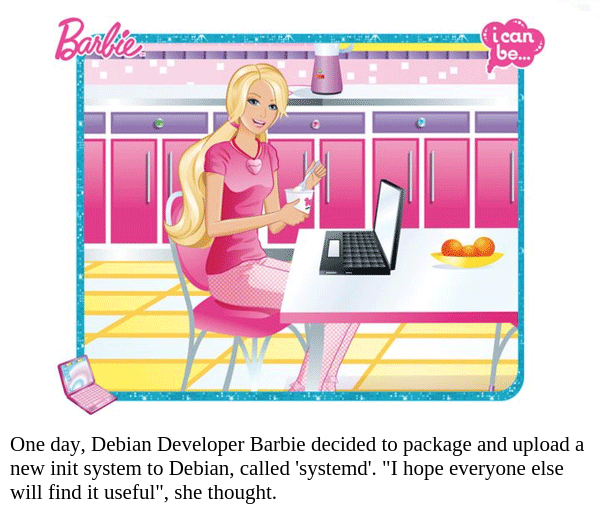
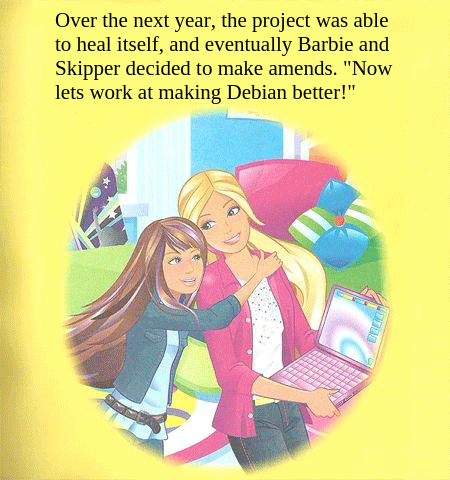
One day, Debian Developer Barbie decided to package and upload a new init system to Debian, called 'systemd'. I hope everyone else will find it useful, she thought.Oh no says Skipper! You'll never take my init system away from me! It's horrendous and Not The Unix Way! Oh dear said Barbie, What have I let myself in to?Skipper was most upset, and decided that this would not do. It's off to the technical committee with this. They'll surely see sense.Oh no! What's this? The internet decided that the Technical Committee needed to also know everyone's individual views! Bad Internet!There was much discussion and consideration. Opinions were reviewed, rows were had, and months passed. Eventually, a decision was agreed upon.Barbie was successful! The will of the Technical Committee was that systemd would be the default! But wait...Skipper still wasn't happy. We need to make sure this never affects me! I'm going to call for a General Resolution!And so, Ms Devotee was called in to look at the various options. She said that the arguments must stop, and we should all accept the result of the general resolution.The numbers turned and the vote was out. We should simply be most excellent to each other said Ms Devotee. I'm not going to tell you what you should or should not do.Over the next year, the project was able to heal itself and eventually Barbie and Skipper decided to make amends. Now let's work at making Debian better!

Gunnar Wolf: UNAM. Viva M xico, viva en paz.

UNAM. Viva M xico, viva en paz.
We have had terrible months in Mexico; I don't know how much has appeared about our country in the international media. The last incidents started on the last days of September, when 43 students at a school for rural teachers were forcefully disappeared (in our Latin American countries, this means they were taken by force and no authority can yet prove whether they are alive or dead; forceful disappearance is one of the saddest and most recognized traits of the brutal military dictatorships South America had in the 1970s) in the Iguala region (Guerrero state, South of the country) and three were killed on site. An Army regiment was stationed few blocks from there and refused to help. And yes, we live in a country where (incredibly) this news by themselves would not seem so unheard of... But in this case, there is ample evidence they were taken by the local police forces, not by a gang of (assumed) wrongdoers. And they were handed over to a very violent gang afterwards. Several weeks later, with far from a thorough investigation, we were told they were killed, burnt and thrown to a river. The Iguala city major ran away, and was later captured, but it's not clear why he was captured at two different places. The Guerrero state governor resigned and a new governor was appointed. But this was not the result of a single person behaving far from what their voters would expect It's a symptom of a broken society where policemen will kill when so ordered, where military personnel will look away when pointed out to the obvious, where the drug dealers have captured vast regions of the country where are stronger than the formal powers. And then, instead of dealing with the issue personally as everybody would expect, the president goes on a commercial mission to China. Oh, to fix some issues with a building company. That coincidentally or not was selling a super-luxury house to his wife. A house that she, several days later, decided to sell because it was tarnishing her family's honor and image. And while the president is in China, the person who dealt with the social pressure and told us about the probable (but not proven!) horrible crime where the "bad guys" for some strange and yet unknown reason (even with tens of them captured already) decided to kill and burn and dissolve and disappear 43 future rural teachers presents his version, and finishes his speech saying that "I'm already tired of this topic". Of course, our University is known for its solidarity with social causes; students in our different schools are the first activists in many protests, and we have had a very tense time as the protests are at home here at the university. This last weekend, supposed policemen entered our main campus with a stupid, unbelievable argument (they were looking for a phone reported as stolen three days earlier), get into an argument with some students, and end up firing shots at the students; one of them was wounded in the leg. And the university is now almost under siege: There are policemen surrounding us. We are working as usual, and will most likely finish the semester with normality, but the intimidation (in a country where seeing a policeman is practically never a good sign) is strong. And... Oh, I could go on a lot. Things feel really desperate and out of place. Today I will join probably tens or hundreds of thousands of Mexicans sick of this simulation, sick of this violence, in a demonstration downtown. What will this achieve? Very little, if anything at all. But we cannot just sit here watching how things go from bad to worse. I do not accept to live in a state of exception. So, this picture is just right: A bit over a month ago, two dear friends from Guadalajara city came, and we had a nice walk in the University. Our national university is not only huge, it's also beautiful and loaded with sights. And being so close to home, it's our favorite place to go with friends to show around. This is a fragment of the beautiful mural in the Central Library. And, yes, the University stands for "Viva M xico". And the university stands for "Peace". And we need it all. Desperately.

Daniel Pocock: Is Amnesty giving spy victims a false sense of security?

Amnesty International is getting a lot of attention with the launch of a new tool to detect government and corporate spying on your computer. I thought I would try it myself. I went to a computer running Microsoft Windows, an operating system that does not publish its source code for public scrutiny. I used the Chrome browser, users often express concern about Chrome sending data back to the vendor about the web sites the users look for. Without even installing the app, I would expect the Amnesty web site to recognise that I was accessing the site from a combination of proprietary software. Instead, I found a different type of warning. Beware of Amnesty? Instead, the only warning I received was from Amnesty's own cookies: Even before I install the app to find out if the government is monitoring me, Amnesty is keen to monitor my behaviour themselves. While cookies are used widely, their presence on a site like Amnesty's only further desensitizes Internet users to the downside risks of tracking technologies. By using cookies, Amnesty is effectivley saying a little bit of tracking is justified for the greater good. Doesn't that sound eerily like the justification we often hear from governments too? Is Amnesty part of the solution or part of the problem? Amnesty is a well known and widely respected name when human rights are mentioned. However, their advice that you can install an app onto a Windows computer or iPhone to detect spyware is like telling people that putting a seatbelt on a motorbike will eliminate the risk of death. It would be much more credible for Amnesty to tell people to start by avoiding cloud services altogether, browse the web with Tor and only use operating systems and software that come with fully published source code under a free license. Only when 100% of the software on your device is genuinely free and open source can independent experts exercise the freedom to study the code and detect and remove backdoors, spyware and security bugs. It reminds me of the advice Kim Kardashian gave after the Fappening, telling people they can continue trusting companies like Facebook and Apple with their private data just as long as they check the privacy settings (reality check: privacy settings in cloud services are about as effective as a band-aid on a broken leg). Write to Amnesty Amnesty became famous for their letter writing campaigns. Maybe now is the time for people to write to Amnesty themselves, thank them for their efforts and encourage them to take more comprehensive action. Feel free to cut and paste some of the following potential ideas into an email to Amnesty:
I understand you may not be able to respond to every email personally but I would like to ask you to make a statement about these matters on your public web site or blog. I understand it is Amnesty's core objective to end grave abuses of human rights. Electronic surveillence, due to its scale and pervasiveness, has become a grave abuse in itself and in a disturbing number of jurisdictions it is an enabler for other types of grave violations of human rights. I'm concerned that your new app Detekt gives people a false sense of security and that your campaign needs to be more comprehensive to truly help people and humanity in the long term. If Amnesty is serious about solving the problems of electronic surveillance by government, corporations and other bad actors, please consider some of the following:
  • Instead of displaying a cookie warning on Amnesty.org, display a warning to users who access the site from a computer running closed-source software and give them a link to download a free and open source web browser like Firefox.
  • Redirect all visitors to your web site to use the HTTPS encrypted version of the site.
  • Using free software such as the GNU/Linux operating system (using one of the Debian, Fedora or Ubuntu systems is one of the more common ways to achieve this) and LibreOffice for all Amnesty's own operations, making a public statement about your use of free software and mentioning this in the closing paragraph of all press releases relating to surveillance topics.
  • Encouraging Amnesty donors, members and supporters to choose similar software especially when engaging in any political activities.
  • Make a public statement that Amnesty will not use cloud services such as SalesForce or Facebook to store, manage or interact with data relating to members, donors or other supporters.
  • Encouraging the public to move away from centralized cloud services such as those provided by their smartphone or social networks and use de-centralized or federated services such as XMPP chat.
Given the immense threat posed by electronic surveillance, I'd also like to call on Amnesty to allocate at least 10% of annual revenue towards software projects releasing free and open source software that offers the public an alternative to the centralized cloud.

While publicity for electronic privacy is great, I hope Amnesty can go a step further and help people use trustworthy software from the ground up.

Stefano Zacchiroli: Thoughts on the Init System Coupling GR

on perceived hysteria and silent sanity As you probably already know by now, the results of the Debian init system coupling general resolution (GR) look like this:
Init system coupling GR: results (arrow from A to B means that voters preferred A to B by that margin)
results of the init system coupling GR
Some random thoughts about them: My take home message is that we are experiencing a huge gap between the public perception of the state of Debian (both from within and from without the project) and the actual beliefs of the silent majority of people that make Debian with their work, day after day. In part this is old news. The most "senior" members of the project will remember that the topic of "vocal minorities vs silent majority" was a recurrent one in Debian 10+ years ago, when flames were periodically ravaging the project. Since then Debian has grown a lot though, and we are now part of a much larger and varied ecosystem. We are now at a scale at which there are plenty of FOSS "mass-media" covering daily what happens in Debian, inducing feedback loops with our own perception of ourselves which we do not fully grok yet. This is a new factor in the perception gap. This situation is not intrinsically bad, nor there is blame to assign here: after all influential bloggers, news sites, etc., just do their job. And their attention also testifies of the huge interest that there is around Debian and our choices. But we still need to adapt and learn to take perceived hysteria with a pinch (or two) of salt. It might just be time for our decennial check-up. Time to remind ourselves that our ways of doing things might in fact still be much more sane than sometimes we tend to believe. We went on 10+ years ago, after monumental flames. It looks like we are now ready to move on again, putting The Era of the Great systemd Histeria behind us.

Russ Allbery: Interpreting the Debian init system GR

I originally posted this in a thread on debian-private, but on further reflection it seems appropriate for a broader audience. So I'm posting it here, as well as on debian-project. There is quite a lot of discussion in various places about what the recent GR result means. Some are concluding that systemd won in some way that implies Debian is not going to support other init systems, or at least that support for other init systems is in immediate danger. A lot of that analysis concludes that the pro-systemd "side" in Debian won some sort of conclusive victory. I have a different perspective. I think we just had a GR in which the Debian developer community said that we, as a community, would like to work through all of the issues around init systems together, as a community, rather than having any one side of the argument win unambiguously and impose its views on those who disagree. There were options on the ballot that clearly required loose coupling and that clearly required tight coupling. The top two options did neither of those things. The second-highest option said, effectively, that we should feel free to exercise our technical judgement for our own packages, but should do so with an eye to enabling people to make different choices, and should merge their changes and contributions where possible. The highest option said that we don't even want to say that, and would instead prefer to work this whole thing out through discussion, respect, consensus, and mutual support, without giving *anyone* a clear mandate or project-wide blessing for their approach. In other words, the way I choose to look at this GR is that the project as a whole just voted to take away the sticks that we were using to beat each other with. In a way, we just chose the *hardest* option. We didn't make a simplifying technical decision that provides clear guidance to everyone. Instead, we made a complicating social decision that says that, sorry, there's no short cut to avoid having to talk to each other, respect each other's views, and try to reach workable collaborative compromises. Even though it's really hard, even though everyone is raw and upset, that's what the project as a whole is asking us to do. Are we up to the challenge?

19 November 2014

Thomas Goirand: Rotten tomatoes

There s many ways to interpret the last GR. The way I see it is how Joey hoped Debian was: the outcome of the poll shows that we don t want to do technical decisions by voting. At the beginning of this GR, I was supportive of it, and though it was a good thing to enforce the rule that we care for non-systemd setups. Though I have slowly changed my mind. I still think it was a good idea to see what the community thought after a so long debate. I now think that this final outcome is awesome and couldn t have been better. Science (and computer science) has never been about voting, otherwise the earth would be flat, without drifting continents. So my hope is that the Debian project as a whole, will allow itself to do mistakes, iterative trials, errors, and go back on any technical decision if they don t make sense anymore. When being asked something, it s ok to reply: I don t know , and it should be ok for the Debian project to have this alternative as one of the possible answers. I m convince that refusing to take a drastic choice in this point in time was exactly what we needed to do. And my hope is that Joey comes back after he realizes that we ve all understood and embarrassed his position that science cannot be governed by polls. For Stretch, I m sure there s going to be a lot of new alternatives. Maybe uselessd, eudev and others. Maybe I ll have a bit of time to work on OpenRC Debian integration myself (hum I m dreaming here ). Maybe something else. Let s just wait. We have more than 300 bugs to fix before Jessie can be released. Let s happilly work on that together, and forget about the init systems for a while P.S: Just to be on the safe side: the rotten tomatoes image was not about criticizing the persons who started the poll, who I respect a lot, especially Ian, who I am convinced is trying to do his best for Debian (hug).

EvolvisForge blog: Valid UTF-8 but invalid XML

Another PSA: something surprising about XML. As you might all know, XML must be valid UTF-8 (or UTF-16 (or another encoding supported by the parser, but one which yields valid Unicode codepoints when read and converted)). Some characters, such as the ampersand & , must be escaped ( &#38; or &#x26; , although &amp; may also work, depending on the domain) or put into a CDATA section ( <![CDATA[&]]> ). A bit surprisingly, a literal backspace character (ASCII 08h, Unicode U+0008) is not allowed in the text. I filed a bugreport against libxml2, asking it to please encode these characters. A bit more research followed. Surprisingly, there are characters that are not valid in XML documents in any way, not even as entities or in CDATA sections. (xmlstarlet, by the way, errors out somewhat nicely for an unescaped literal or entity-escaped backspace, but behaves absolutely hilarious for a literal backspace in a CDATA section.) Basically, XML contains a whitelist for the following Unicode codepoints: Additionally, a certain number of codepoints is discouraged: U+007F U+0084 (IMHO wise), U+0086 U+009F (also wise, but why allow U+0085?), U+FDD0 U+FDEF (a bit surprisingly, but consistent with disallowing the backspace character), and the last two codepoints of every plane (U+FFFE and U+FFFF were already disallowed, but U-0001FFFE, U-0001FFFF, , U-0010FFFF weren t; this is extremely wise). The suggestion seems to be to just strip these characters silently from the XML document . I m a bit miffed about this, as I don t even use XML directly (I m extending a PHP webapplication that is a SOAP client and talks to a Java SOAP-WS) and would expect this to preserve my strings, but, oh my. I ve forwarded the suggestion to just strip them silently to the libxml2 maintainers in the aforementioned bug report, for now, and may even hack that myself (on customer-paid time). More robust than hacking the PHP thingy to strip them first, anyway I ve got no control over the XML after all. Sharing this so that more people know that not all UTF-8 is valid in XML. Maybe it saves someone else some time. (Now wondering whether to address this in my xhtml_escape shell function. Probably should. Meh.)

Thorsten Glaser: Debian init system freedom of choice GR worst possible outcome

Apparently (the actual results have not yet been published by the Secretary), the GR is over, and the worst possible option has won. This is an absolutely ambiguous result, while at the same time sending a clear signal that Debian is not to be trusted wrt. investing anything into it, right now. Why is this? Simply: GR not required means that whatever people do is probably right . Besides this, we have one statement from the CTTE ( systemd is default init system for jessie. Period. ) and nothing else. This means that runit, or upstart, or file-rc, or uselessd, can be the default init system for zurg^H^H^H^Hstretch, or even the only one. It also means that the vast majority of Debian Developers are sheeple, neither clearly voting to preserve freedom of choice between init systems for its users, nor clearly voting to unambiguously support systemd and progress over compatibility and choice, nor clearly stating that systemd is important but supporting other init systems is still recommended. (I ll not go into detail on how the proposer of the apparently winning choice recommends others to ignore ftpmaster constraints and licences, and even suggests to run a GR to soften up the DFSG interpretation.) I d have voted this as no, absolutely not if it was possible to do so more strongly. Judging from the statistics, the only thing I voted above NOTA/FD is the one least accepted by DDs, although the only other proposal I considered is the first-rated of them: support for other init systems is recommended but not required. What made me vote it below NOTA/FD was: The Debian Project makes no statement at this time on sysvinit support beyond the jessie release. This sentence made even this proposal unbearable, unacceptable, for people wanting to invest (time, money, etc.) into Debian. Update: Formal result announced. So 358 out of 483 voting DDs decided to be sheeple (if I understand the eMail correctly). We had 1006 DDs with voting rights, which is a bit ashaming as well. That s 48.01% only. I wonder what s worse. This opens up a very hard problem: I m absolutely stunned by this and wondering what to do now. While there is no real alternative to Debian at $dayjob I can always create customised packages in my own APT repository, and while it was great when those were eventually (3.1.17-1) accepted into Debian, even replacing the previous packages completely it is simpler and quicker to not do so. While $dayjob benefits from having packages I work on inside Debian itself, even though I cannot always test all scenarios Debian users would need, some work reduction due to reactions already led to Debian losing out on Mediawiki for jessie and some additional suffering. With my own package repository, I can modulo installing/debootstrap serve my needs for $dayjob much quicker, easily, etc. and only miss out on absolutely delightful user feedback. But then, others could always package software I m upstream of for Debian. Or, if I do not leave the project, continue doing so via QA uploads. I m also disappointed because I have invested quite some effort into trying to make Debian better (my idea to join as DD was if I ve got to use it, it better be damn good! ), into packaging software and convincing people at work that developing software as Debian packages instead of (or not) thinking of packaging later was good. I ve converted our versions of FusionForge and d-push to Debian packages, and it works pretty damn well. Sometimes it needs backports of my own, but that s the corportate world, and no problem to an experienced DD. (I just feel bad we ($orkplace) lost some people, an FTP master along them, before this really gained traction.) I d convert to OpenBSD because, despite MirBSD s history with them, they re the only technically sound alternative, but apparently tedu (whom I respect technically, and who used to offer good advice to even me when asked, and who I think wouldn t choose systemd himself) still (allying with the systemd side (I m not against people being able to choose systemd, for the record, I just don t want to be forced into it myself!)) has some sort of grudge against me. Plus, it d be hard to get customers to follow. So, no alternative right now. But I m used to managing my own forks of software; I m doomed to basically hack and fix anything I use (I recently got someone who owns a licence to an old-enough Visual Studio version to transfer that to me, so I can hack on the Windows Mobile 6 version of Cachebox, to fix bugs in one of the geocaching applications I use. Now I just need to learn C# and the .NET Compact Framework. So I m also used to some amount of pain.) I m still unresolved wrt. the attitude I should show the Debian project now. I had decided to just continue to live on, and work on the things I need done, but that was before this GR non-result. I absolutely cannot recommend anyone to invest into Debian (without sounding hypocriet), but I cannot recommend anything else either. I cannot justify leaving but don t know if I want to stay. I think I should sleep over it. One thing I promised, and thus will do, is to organise a meeting of the Debian/m68k people soonish. But then, major and important and powerful forces inside Debian still insist that Debian-Ports are not part of it [Update: yes, DSA is moving it closer, thanks for that by the way, but that doesn t mean anything to certain maintainers or the Release Team, although, the latter is actually understandable and probably sensible.] yet, all forks of Debian now suffer from the systemd adoption in it instead of having a freedom-of-choice upstream. I ve said, and I still feel that systemd adoption should have done in a Debian downstream / (pure?) blend, and maybe (parts of) GNOME removed from Debian itself for it. (Adding cgroups support to the m68k kernel to support systemd was done. I adviced against it, on the grounds of memory and code size. But no downstream can remove it now.)

Rhonda D'Vine: The Pogues

Actually I was working already on a different music blog entry, but I want to get this one out. I was invited to join the Organic Dancefloor last thursday. And it was a really great experience. A lot of nice people enjoying a dance evening of sort of improvisational traditional folk dancing with influences from different parts of europe. Three bands playing throughout the evening. I definitely plan to go there again. :) Which brings me to the band I want to present you now. They also play sort-of traditional songs, or at least with traditional instruments, and are also quite danceable to. This is about The Pogues. And these are the songs that I do enjoy listening to every now and then: Like always, enjoy!

/music permanent link Comments: 2 Flattr this

Simon McVittie: still aiming to be the universal operating system

Debian's latest round of angry mailing list threads have been about some combination of init systems, future direction and project governance. The details aren't particularly important here, and pretty much everything worthwhile in favour of or against each position has already been said several times, but I think this bit is important enough that it bears repeating: the reason I voted "we didn't need this General Resolution" ahead of the other options is that I hope we can continue to use our normal technical and decision-making processes to make Debian 8 the best possible OS distribution for everyone. That includes people who like systemd, people who dislike systemd, people who don't care either way and just want the OS to work, and everyone in between those extremes. I think that works best when we do things, and least well when a lot of time and energy get diverted into talking about doing things. I've been trying to do my small part of the former by fixing some release-critical bugs so we can release Debian 8. Please join in, and remember to write good unblock requests so our hard-working release team can get through them in a finite time. I realise not everyone will agree with my idea of which bugs, which features and which combinations of packages are highest-priority; that's fine, there are plenty of bugs to go round! Regarding init systems specifically, Debian 'jessie' currently works with at least systemd-sysv or sysvinit-core as pid 1 (probably also Upstart, but I haven't tried that) and I'm confident that Debian developers won't let either of those regress before it's released as Debian 8. I expect the freeze for Debian 'stretch' (presumably Debian 9) to be a couple of years away, so it seems premature to say anything about what will or won't be supported there; that depends on what upstream developers do, and what Debian developers do, between now and then. What I can predict is that the components that get useful bug reports, active maintenance, thorough testing, careful review, and similar help from contributors will work better than the things that don't; so if you like a component and want it to be supported in Debian, you can help by, well, supporting it.
PS. If you want the Debian 8 installer to leave you running sysvinit as pid 1 after the first reboot, here's a suitable incantation to add to the kernel command-line in the installer's bootloader. This one certainly worked when KiBi asked for testing a few days ago:
preseed/late_command="in-target apt-get install -y sysvinit-core"
I think that corresponds to this line in a preseeding file, if you use those:
d-i preseed/late_command string in-target apt-get install -y sysvinit-core
A similar apt-get command, without the in-target prefix, should work on an installed system that already has systemd-sysv. Depending on other installed software, you might need to add systemd-shim to the command line too, but when I tried it, apt-get was able to work that out for itself. If you use aptitude instead of apt-get, double-check what it will do before saying "yes" to this particular switchover: its heuristic for resolving conflicts seems to be rather more trigger-happy about removing packages than the one in apt-get.

18 November 2014

Laura Arjona: Translating (reviewing) Debian package descriptions

Some days I feel super lazy but I still would like to go on contributing translations to Debian.
Then, I leave the web translations a bit, and change to translate or review Debian package descriptions. It s something that anybody can do without any knowledge of translation tools, since it is a very simple web interface, as you will see. First you need to create a login account, then, login into the system. And then, go to the page of your mother language (in my case, Spanish, es ). You will see some introductory text, and the list of pending translations:
ddtss_es1
At the end of the page, there is the list of translations pending to review:
ddtss_es2 We should begin with this, so the work that other people already made arrives quickly its destination. And it s the easiest part, as you will see. Let s pick one of them (libvformat1-dev): review1
You see the short description in the original English, and the current translation (if there were changes from a former version, they are coloured too). I didn t know what the package libvformat1-dev does, but here s a nice opportunity to learn aobut it a bit :) The short description looks ok for me. Let s go on to the long description: review2 It also looks correct for me. So I leave the text box as is, and go on until the bottom of the page:
review3
and click Accept as is . That s all!! The system brings you back to the page with pending translations and reviews. Let s pick another one: totem
review4
I found a typo and corrected some other words, so I updated the text in the translation box, left a message to the other translators in the comment box, and clicked Accept with changes . And iterate. When 3 translators agree in a translation, it becomes official, and its propagated to apt-cache, aptitude, synaptic, etc., and the website (packages.debian.org). This is the most difficult part (to get 3 reviews for each package description): many language teams are small, and their workforce is spread in many fronts: translations for the website, news and announcements, debconf templates (the messages that are shown to the user when a package is installed), the Debian installer, the documentation, the package descriptions So your help (even when you only review some translations from time to time) will be appreciated, for sure.
Filed under: Tools Tagged: Contributing to libre software, Debian, English, translations

Michal &#268;iha&#345;: Mercurial support in Weblate

Weblate has started as a translation system tightly bound to Git version control system. This was in no means design decision, but rather it was the version control I've used. But this has shown not to be sufficient and other systems were requested as well. And Mercurial is first of them to be supported. Weblate 2.0 already had separated VCS layer and adding another system to that is quite easy if you know the VCS you're adding. Unfortunately this wasn't the case for me with Mercurial as I've never used it for anything more serious than cloning a repository, committing fixes and pushing it back. Weblate needs a bit more than that, especially in regard to remote branches. But nevertheless I've figured out all operations and the implementation is ready in our Git. In case somebody is interested in adding support for another version control, patches are always welcome!

Filed under: English phpMyAdmin SUSE Weblate 0 comments Flattr this!

Dirk Eddelbuettel: RcppAnnoy 0.0.3

Hours after the initial blog post announcing the first release of the new package RcppAnnoy, Qiang Kou sent us a very nice pull request adding mmap support in Windows. So a new release with Windows support is on now CRAN, and Windows binaries should be available by this evening as usual. To recap, RcppAnnoy wraps the small, fast, and lightweight C++ template header library Annoy written by Erik Bernhardsson for use at Spotify. RcppAnnoy uses Rcpp Modules to offer the exact same functionality as the Python module wrapped around Annoy. Courtesy of CRANberries, there is also a diffstat report for this release. More detailed information is on the RcppAnnoy page page.

This post by Dirk Eddelbuettel originated on his Thinking inside the box blog. Please report excessive re-aggregation in third-party for-profit settings.

Erich Schubert: Generate iptables rules via pyroman

Vincent Bernat blogged on using Netfilter rulesets, pointing out that inserting the rules one-by-one using iptables calls may leave your firewall temporarily incomplete, eventually half-working, and that this approach can be slow.
He's right with that, but there are tools that do this properly. ;-)
Some years ago, for a multi-homed firewall, I wrote a tool called Pyroman. Using rules specified either in Python or XML syntax, it generates a firewall ruleset for you.
But it also adresses the points Vincent raised:
  • It uses iptables-restore to load the firewall more efficiently than by calling iptables a hundred times
  • It will backup the previous firewall, and roll-back on errors (or lack of confirmation, if you are remote and use --safe)
It also has a nice feature for the use in staging: it can generate firewall rule sets offline, to allow you reviewing them before use, or transfer them to a different host. Not all functionality is supported though (e.g. the Firewall.hostname constant usable in python conditionals will still be the name of the host you generate the rules on - you may want to add a --hostname parameter to pyroman)
pyroman --print-verbose will generate a script readable by iptables-restore except for one problem: it contains both the rules for IPv4 and for IPv6, separated by #### IPv6 rules. It will also annotate the origin of the rule, for example:
# /etc/pyroman/02_icmpv6.py:82
-A rfc4890f -p icmpv6 --icmpv6-type 255 -j DROP
indicates that this particular line was produced due to line 82 in file /etc/pyroman/02_icmpv6.py. This makes debugging easier. In particular it allows pyroman to produce a meaningful error message if the rules are rejected by the kernel: it will tell you which line caused the rule that was rejected.
For the next version, I will probably add --output-ipv4 and --output-ipv6 options to make this more convenient to use. So far, pyroman is meant to be used on the firewall itself.
Note: if you have configured a firewall that you are happy with, you can always use iptables-save to dump the current firewall. But it will not preserve comments, obviously.

Antoine Beaupr : bup vs attic silly benchmark

after see attic introduced in a discussion about bup, i figured out i could give it a try. it was answering two of my biggest concerns with bup: and seemed to magically out of nowhere and basically do everything i need, with an inline manual on top of it.

disclaimer Note: this is not a real benchmark! i would probably need to port bup and attic to liw's seivot software to report on this properly (and that would amazing and really interesting, but it's late now). even worse, this was done on a production server with other stuff going on so take results with a grain of salt.

procedure and results Here's what I did. I setup backups of my ridiculously huge ~/src directory on the external hard drive where I usually make my backups. I ran a clean backup with attic, than redid it, then I ran a similar backup with bup, then redid it. Here are the results:
anarcat@marcos:~$ sudo apt-get install attic # this installed 0.13 on debian jessie amd64
[...]
anarcat@marcos:~$ attic init /mnt/attic-test:
Initializing repository at "/media/anarcat/calyx/attic-test"
Encryption NOT enabled.
Use the "--encryption=passphrase keyfile" to enable encryption.
anarcat@marcos:~$ time attic create --stats /mnt/attic-test::src ~/src/
Initializing cache...
------------------------------------------------------------------------------
Archive name: src
Archive fingerprint: 7bdcea8a101dc233d7c122e3f69e67e5b03dbb62596d0b70f5b0759d446d9ed0
Start time: Tue Nov 18 00:42:52 2014
End time: Tue Nov 18 00:54:00 2014
Duration: 11 minutes 8.26 seconds
Number of files: 283910
                       Original size      Compressed size    Deduplicated size
This archive:                6.74 GB              4.27 GB              2.99 GB
All archives:                6.74 GB              4.27 GB              2.99 GB
------------------------------------------------------------------------------
311.60user 68.28system 11:08.49elapsed 56%CPU (0avgtext+0avgdata 122824maxresident)k
15279400inputs+6788816outputs (0major+3258848minor)pagefaults 0swaps
anarcat@marcos:~$ time attic create --stats /mnt/attic-test::src-2014-11-18 ~/src/
------------------------------------------------------------------------------
Archive name: src-2014-11-18
Archive fingerprint: be840f1a49b1deb76aea1cb667d812511943cfb7fee67f0dddc57368bd61c4bf
Start time: Tue Nov 18 00:05:57 2014
End time: Tue Nov 18 00:06:35 2014
Duration: 38.15 seconds
Number of files: 283910
                       Original size      Compressed size    Deduplicated size
This archive:                6.74 GB              4.27 GB            116.63 kB
All archives:               13.47 GB              8.54 GB              3.00 GB
------------------------------------------------------------------------------
30.60user 4.66system 0:38.38elapsed 91%CPU (0avgtext+0avgdata 104688maxresident)k
18264inputs+258696outputs (0major+36892minor)pagefaults 0swaps
anarcat@marcos:~$ sudo apt-get install bup # this installed bup 0.25
anarcat@marcos:~$ free && sync && echo 3   sudo tee /proc/sys/vm/drop_caches && free # flush caches
anarcat@marcos:~$ export BUP_DIR=/mnt/bup-test
anarcat@marcos:~$ bup init
D p t Git vide initialis  dans /mnt/bup-test/
anarcat@marcos:~$ time bup index ~/src
Indexing: 345249, done.
56.57user 14.37system 1:45.29elapsed 67%CPU (0avgtext+0avgdata 85236maxresident)k
699920inputs+104624outputs (4major+25970minor)pagefaults 0swaps
anarcat@marcos:~$ time bup save -n src ~/src
Reading index: 345249, done.
bloom: creating from 1 file (200000 objects).
bloom: adding 1 file (200000 objects).
bloom: creating from 3 files (600000 objects).
Saving: 100.00% (6749592/6749592k, 345249/345249 files), done.
bloom: adding 1 file (126005 objects).
383.08user 61.37system 10:52.68elapsed 68%CPU (0avgtext+0avgdata 194256maxresident)k
14638104inputs+5944384outputs (50major+299868minor)pagefaults 0swaps
anarcat@marcos:attic$ time bup index ~/src
Indexing: 345249, done.
56.13user 13.08system 1:38.65elapsed 70%CPU (0avgtext+0avgdata 133848maxresident)k
806144inputs+104824outputs (137major+38463minor)pagefaults 0swaps
anarcat@marcos:attic$ time bup save -n src2 ~/src
Reading index: 1, done.
Saving: 100.00% (0/0k, 1/1 files), done.
bloom: adding 1 file (1 object).
0.22user 0.05system 0:00.66elapsed 42%CPU (0avgtext+0avgdata 17088maxresident)k
10088inputs+88outputs (39major+15194minor)pagefaults 0swaps
Disk usage is comparable:
anarcat@marcos:attic$ du -sc /mnt/*attic*
2943532K        /mnt/attic-test
2969544K        /mnt/bup-test
People are encouraged to try and reproduce those results, which should be fairly trivial.

Observations Here are interesting things I noted while working with both tools:
  • attic is Python3: i could compile it, with dependencies, by doing apt-get build-dep attic and running setup.py - i could also install it with pip if i needed to (but i didn't)
  • bup is Python 2, and has a scary makefile
  • both have an init command that basically does almost nothing and takes little enough time that i'm ignoring it in the benchmarks
  • attic backups are a single command, bup requires me to know that i first want to index and then save, which is a little confusing
  • bup has nice progress information, especially during save (because when it loaded the index, it knew how much was remaining) - just because of that, bup "feels" faster
  • bup, however, lets me know about its deep internals (like now i know it uses a bloom filter) which is probably barely understandable by most people
  • on the contrary, attic gives me useful information about the size of my backups, including the size of the current increment
  • it is not possible to get that information from bup, even after the fact - you need to du before and after the backup
  • attic modifies the files access times when backing up, while bup is more careful (there's a pull request to fix this in attic, which is how i found out about this)
  • both backup systems seem to produce roughly the same data size from the same input

Summary attic and bup are about equally fast. bup took 30 seconds less than attic to save the files, but that's not counting the 1m45s it took indexing them, so on the total run time, bup was actually slower. attic is also (almost) two times faster on the second run as well. but this could be within the margin of error of this very quick experiment, so my provisional verdict for now would be that they are about as fast. bup may be more robust (for example it doesn't modify the atimes), but this has not been extensively tested and is more based with my familiarity with the "conservatism" of the bup team rather than actual tests. considering all the features promised by attic, it makes for a really serious contender to the already amazing bup.

Next steps The properly do this, we would need to:
  • include other software (thinking of Zbackup, Burp, ddar, obnam, rdiff-backup and duplicity)
  • bench attic with the noatime patch
  • bench dev attic vs dev bup
  • bench data removal
  • bench encryption
  • test data recovery
  • run multiple backup runs, on different datasets, on a cleaner environment
  • ideally, extend seivot to do all of that
Note that the Burp author already did an impressive comparative benchmark of a bunch of those tools for the burp2 design paper, but it unfortunately doesn't include attic or clear ways to reproduce the results.

17 November 2014

Thorsten Alteholz: Manage own CA with Debian

Self signed SSL certificates are nice, but only provide encryption of retrieved data. Nobody knows who is really sending the data. If one buys an SSL certificate for a website, the browser doesn t complain as much as with a self signed certificate. But can you really trust the other side? Almost every commercial CA has some kind of fast validation or domain validation, issued in minutes , which is done by email or phone. So if required, within minutes everybody might become you. Even with putting money on the table your users can not be sure whether this server really belongs to the right guy. Well, why wasting time and money? Just create your own Root CA and tell users that they need to add something in order to avoid some error messages. In Debian we basically have five packages who claim to be able to manage some kind of CA. easy-rsa is mainly needed to manage certificates used by openVPN. Within this use case it works like a charm, but I don t want to manage a more complex CA with it. gnomint is dead upstream and only uses SHA1 as signature algorithm. This will cause lots of problems as Mircrosoft and Google want to deprecate SHA1 in their products by 2017. Besides, this package is already orphaned and maybe it can disappear now. tinyCA uses more signature algorithms, unfortunately SHA1 seems to be the best it can. There are some patches to support up to SHA512, but they don t work for all parts of the software yet. For example Sub-CAs still use SHA1 despite of choosing something different in the GUI. So nice, but not (yet) usable in Jessie. FreeIPA seems to be great, but didn t make it into Jessie in time. Unfortunately the Release Team has reasons to not unblock it. So nice, but not usable in Jessie. xca is based on QT4. As announced in the 15th DPN of 2014 the deprecated QT4 will be removed from Debian Stretch (= Jessie+1). Apart from this, the software meets all my requirements.

16 November 2014

Tollef Fog Heen: Resigning as a Debian systemd maintainer

Apparently, people care when you, as privileged person (white, male, long-time Debian Developer) throw in the towel because the amount of crap thrown your way just becomes too much. I guess that's good, both because it gives me a soap box for a short while, but also because if enough people talk about how poisonous the well that Debian is has become, we can fix it. This morning, I resigned as a member of the systemd maintainer team. I then proceeded to leave the relevant IRC channels and announced this on twitter. The responses I've gotten have been almost all been heartwarming. People have generally been offering hugs, saying thanks for the work put into systemd in Debian and so on. I've greatly appreciated those (and I've been getting those before I resigned too, so this isn't just a response to that). I feel bad about leaving the rest of the team, they're a great bunch: competent, caring, funny, wonderful people. On the other hand, at some point I had to draw a line and say "no further". Debian and its various maintainer teams are a bunch of tribes (with possibly Debian itself being a supertribe). Unlike many other situations, you can be part of multiple tribes. I'm still a member of the DSA tribe for instance. Leaving pkg-systemd means leaving one of my tribes. That hurts. It hurts even more because it feels like a forced exit rather than because I've lost interest or been distracted by other shiny things for long enough that you don't really feel like part of a tribe. That happened with me with debian-installer. It was my baby for a while (with a then quite small team), then a bunch of real life thing interfered and other people picked it up and ran with it and made it greater and more fantastic than before. I kinda lost touch, and while it's still dear to me, I no longer identify as part of the debian-boot tribe. Now, how did I, standing stout and tall, get forced out of my tribe? I've been a DD for almost 14 years, I should be able to weather any storm, shouldn't I? It turns out that no, the mountain does get worn down by the rain. It's not a single hurtful comment here and there. There's a constant drum about this all being some sort of conspiracy and there are sometimes flares where people wish people involved in systemd would be run over by a bus or just accusations of incompetence. Our code of conduct says, "assume good faith". If you ever find yourself not doing that, step back, breathe. See if there's a reasonable explanation for why somebody is saying something or behaving in a way that doesn't make sense to you. It might be as simple as your native tongue being English and their being something else. If you do genuinely disagree with somebody (something which is entirely fine), try not to escalate, even if the stakes are high. Examples from the last year include talking about this as a war and talking about "increasingly bitter rear-guard battles". By using and accepting this terminology, we, as a project, poison ourselves. Sam Hartman puts this better than me:
I'm hoping that we can all take a few minutes to gain empathy for those who disagree with us. Then I'm hoping we can use that understanding to reassure them that they are valued and respected and their concerns considered even when we end up strongly disagreeing with them or valuing different things.
I'd be lying if I said I didn't ever feel the urge to demonise my opponents in discussions. That they're worse, as people, than I am. However, it is imperative to never give in to this, since doing that will diminish us as humans and make the entire project poorer. Civil disagreements with reasonable discussions lead to better technical outcomes, happier humans and a healthier projects.

Bernhard R. Link: Enabling Change

Big changes are always a complicated thing to get done and can be the harder the bigger or more diverse an organization is it is taking place in. Transparency Ideally every change is well communicated early and openly. Leaving people in the dark about what will change and when means people have much less time to feeling comfortable about it or arranging with it mentally. Especially bad can be extending the change later or or shortening transition periods. Letting people think they have some time to transition only to force them to rush later will remove any credibility you have and severely reduce their ability to believe you are not crossing them. Making a new way optional is a great way to create security (see below), but making that obligatory before the change even arrives as optional with them will not make them very willing to embrace change. Take responsibility Every transformation means costs. Even if some change did only improve and did not make anything worse once implemented (the ideal change you will never meet in reality), the deployment of the change still costs: processes have adapted to it, people have to relearn how to do things, how to detect if something goes wrong, how to fix it, documentation has to be adopted and and and. Even as the change causes more good than costs in the whole organization (let's hope it does, I hope you wouldn't try to do something if the total benefit is negative), the benefits and thus the benefit to cost ratio will differ for the different parts of your organization or the different people within it. It's hardly avoidable that for some people there will not be much benefit, much less perceived benefit compared to the costs they have to burden for it. Those are the people whose good will you want to fight for, not the people you want to fight against. They have to pay with their labor/resources and thus their good will for your benefit the overall benefit. This is much easier if you acknowledge that fact. If you blame them for having the costs, claim their situation does not even exist or even ridicule them for not embracing change you only prepare yourself for frustration. You might be able to persuade yourself that everyone that is not willing to invest in the change is just acting out of malevolent self-interest. But you will hardly be able to persuade people that it is evil to not help your cause if you treat them as enemies. And once you ignored or played down costs that later actually happen, your credibility in being able to see the big picture will simply cease to exist at all for the next change. Allow different metrics People have different opinions about priorities, about what is important, about how much something costs and even about what is a problem. If you want to persuade them, try to take that into account. If you do not understand why something is a reason, it might be because the given point is stupid. But it might also be that you miss something. And often there is simple a different valuation of what is important, what the costs are and what are problems. If you want to persuade people, it is worth to try to understand those. If all you want to do is persuade some leader or some majority then ridiculing their concerns might get you somewhere. But how do you want to win people over if you do not even appear to understand their problems. Why should people trust you that their costs will be worth the overall benefits if you tell them the costs that they clearly see do not exist? How credible is referring to the bigger picture if the part of the picture they can see does not match what you say the bigger picture looks like? Don't get trolled and don't troll There will always be people that might be unreasonable or even try to provoke you. Don't allow being provoked. Remember that for successful changes you need to win broad support. Feeling personally attacked or feeling presented a large amount of pointless arguments easily results in not bringing proper responses or actually looking at arguments. If someone is only trolling and purely malevolent, they will tease you best if they bring actual concerns of people in a way you likely degrade your yourself and your point in answering. Becoming impertinent with the troll is like attacking the annoying little goblin hiding next to the city guards with area damage. When not being able to persuade people, it is also far to easy to consider them in bad faith and/or attacking them personally. This can only escalate even more. Worst case you frustrate someone in good faith. In most cases you poison the discussion so much that people actually in good faith will no longer contribute the discussion. It might be rewarding short term because after some escalation only obviously unreasonable people will talk against you, but it makes it much harder to find solutions together that could benefit anyone and almost impossible to persuade those that simply left the discussion. Give security Last but not least, remember that humans are quite risk-averse. In general they might invest in (even small) chances to win, but go a long way to avoid risks. Thus an important part of enabling change is to reduce risks, real and perceived ones and give people a feeling of security. In the end, almost every measure boils down to that: You give people security by giving them the feeling that the whole picture is considered in decisions (by bringing them early into the process, by making sure their concerns are understood and part of the global profit/cost calculation and making sure their experiences with the change are part of the evaluation). You give people security by allowing them to predict and control things (by transparency about plans, how far the change will go and guaranteed transitions periods, by giving them enough time so they can actually plan and do the transition). You give people security by avoiding early points of no return (by having wide enough tests, rollback scenarios,...). You give people security by not letting them alone (by having good documentation, availability of training, ...). Especially side-by-side availability of old and new is an extremely powerful tool, as it fits all of the above: It allows people to actually test it (and not some little prototype mostly but not quite totally unrelated to reality) so their feedback can be heard. It makes it more predictable as all the new ways can be tried before the old ones no longer work. It is the ultimate role-back scenario (just switch off the new). And allows for learning the new before losing the old. Of course giving the people a feeling of security needs resources. But it is a very powerful way to get people to embrace the chance. Also in my experience people only fearing for themselves will usually mostly be passive by not pushing forward and trying to avoid or escape the changes. (After all, working against something costs energy, so purely egoistic behavior is quite limiting in that regard). Most people actively pushing back do it because they fear for something larger than only them. And any measure to making them fear less that you ruin the overall organization, not only avoids unnecessary hurdles rolling out the change but also has some small chance to actually avoid running into disaster with closed eyes.

Vincent Bernat: Intel Wireless 7260 as an access point

My home router acts as an access point with an Intel Dual-Band Wireless-AC 7260 wireless card. This card supports 802.11ac (on the 5 GHz band) and 802.11n (on both the 5 GHz and 2.4 GHz band). While this seems a very decent card to use in managed mode, this is not really a great choice for an access point.
$ lspci -k -nn -d 8086:08b1
03:00.0 Network controller [0280]: Intel Corporation Wireless 7260 [8086:08b1] (rev 73)
        Subsystem: Intel Corporation Dual Band Wireless-AC 7260 [8086:4070]
        Kernel driver in use: iwlwifi
TL;DR: Use an Atheros card instead.

Limitations First, the card is said dual-band but you can only uses one band at a time because there is only one radio. Almost all wireless cards have this limitation. If you want to use both the 2.4 GHz band and the less crowded 5 GHz band, two cards are usually needed.

5 GHz band There is no support to set an access point on the 5 GHz band. The firmware doesn t allow it. This can be checked with iw:
$ iw reg get
country CH: DFS-ETSI
        (2402 - 2482 @ 40), (N/A, 20), (N/A)
        (5170 - 5250 @ 80), (N/A, 20), (N/A)
        (5250 - 5330 @ 80), (N/A, 20), (0 ms), DFS
        (5490 - 5710 @ 80), (N/A, 27), (0 ms), DFS
        (57240 - 65880 @ 2160), (N/A, 40), (N/A), NO-OUTDOOR
$ iw list
Wiphy phy0
[...]
        Band 2:
                Capabilities: 0x11e2
                        HT20/HT40
                        Static SM Power Save
                        RX HT20 SGI
                        RX HT40 SGI
                        TX STBC
                        RX STBC 1-stream
                        Max AMSDU length: 3839 bytes
                        DSSS/CCK HT40
                Frequencies:
                        * 5180 MHz [36] (20.0 dBm) (no IR)
                        * 5200 MHz [40] (20.0 dBm) (no IR)
                        * 5220 MHz [44] (20.0 dBm) (no IR)
                        * 5240 MHz [48] (20.0 dBm) (no IR)
                        * 5260 MHz [52] (20.0 dBm) (no IR, radar detection)
                          DFS state: usable (for 192 sec)
                          DFS CAC time: 60000 ms
                        * 5280 MHz [56] (20.0 dBm) (no IR, radar detection)
                          DFS state: usable (for 192 sec)
                          DFS CAC time: 60000 ms
[...]
While the 5 GHz band is allowed by the CRDA, all frequencies are marked with no IR. Here is the explanation for this flag:
The no-ir flag exists to allow regulatory domain definitions to disallow a device from initiating radiation of any kind and that includes using beacons, so for example AP/IBSS/Mesh/GO interfaces would not be able to initiate communication on these channels unless the channel does not have this flag.

Multiple SSID This card can only advertise one SSID. Managing several of them is useful to setup distinct wireless networks, like a public access (routed to Tor), a guest access and a private access. iw can confirm this:
$ iw list
        valid interface combinations:
                 * #  managed   <= 1, #  AP, P2P-client, P2P-GO   <= 1, #  P2P-device   <= 1,
                   total <= 3, #channels <= 1
Here is the output of an Atheros card able to manage 8 SSID:
$ iw list
        valid interface combinations:
                 * #  managed, WDS, P2P-client   <= 2048, #  IBSS, AP, mesg point, P2P-GO   <= 8,
                   total <= 2048, #channels <= 1

Configuration as an access point Except for those two limitations, the card works fine as an access point. Here is the configuration that I use for hostapd:
interface=wlan-guest
driver=nl80211
# Radio
ssid=XXXXXXXXX
hw_mode=g
channel=11
# 802.11n
wmm_enabled=1
ieee80211n=1
ht_capab=[HT40-][SHORT-GI-20][SHORT-GI-40][DSSS_CCK-40][DSSS_CCK-40][DSSS_CCK-40]
# WPA
auth_algs=1
wpa=2
wpa_passphrase=XXXXXXXXXXXXXXX
wpa_key_mgmt=WPA-PSK
wpa_pairwise=TKIP
rsn_pairwise=CCMP
Because of the use of channel 11, only 802.11n HT40- rate can be enabled. Look at the Wikipedia page for 802.11n to check if you can use either HT40-, HT40+ or both.

Vincent Bernat: Replacing Swisscom router by a Linux box

I have recently moved to Lausanne, Switzerland. Broadband Internet access is not as cheap as in France. Free, a French ISP, is providing an FTTH access with a bandwith of 1 Gbps1 for about 38 (including TV and phone service), Swisscom is providing roughly the same service for about 200 2. Swisscom fiber access was available for my appartment and I chose the 40 Mbps contract without phone service for about 80 . Like many ISP, Swisscom provides an Internet box with an additional box for TV. I didn t unpack the TV box as I have no use for it. The Internet box comes with some nice features like the ability to setup firewall rules, a guest wireless access and some file sharing possibilities. No shell access! I have bought a small PC to act as router and replace the Internet box. I have loaded the upcoming Debian Jessie on it. You can find the whole software configuration in a GitHub repository. This blog post only covers the Swisscom-specific setup (and QoS). Have a look at those two blog posts for related topics:

Ethernet The Internet box is packed with a Siligence-branded 1000BX SFP3. This SFP receives and transmits data on the same fiber using a different wavelength for each direction. Instead of using a network card with an SFP port, I bought a Netgear GS110TP which comes with 8 gigabit copper ports and 2 fiber SFP ports. It is a cheap switch bundled with many interesting features like VLAN and LLDP. It works fine if you don t expect too much from it.

IPv4 IPv4 connectivity is provided over VLAN 10. A DHCP client is mandatory. Moreover, the DHCP vendor class identifier option (option 60) needs to be advertised. This can be done by adding the following line to /etc/dhcp/dhclient.conf when using the ISC DHCP client:
send vendor-class-identifier "100008,0001,,Debian";
The first two numbers are here to identify the service you are requesting. I suppose this can be read as requesting the Swisscom residential access service. You can put whatever you want after that. Once you get a lease, you need to use a browser to identify yourself to Swisscom on the first use.

IPv6 Swisscom provides IPv6 access through the 6rd protocol. This is a tunneling mechanism to facilitate IPv6 deployment accross an IPv4 infrastructure. This kind of tunnel is natively supported by Linux since kernel version 2.6.33. To setup IPv6, you need the base IPv6 prefix and the 6rd gateway. Some ISP are providing those values through DHCP (option 212) but this is not the case for Swisscom. The gateway is 6rd.swisscom.com and the prefix is 2a02:1200::/28. After appending the IPv4 address to the prefix, you still get 4 bits for internal subnets. Swisscom doesn t provide a fixed IPv4 address. Therefore, it is not possible to precompute the IPv6 prefix. When installed as a DHCP hook (in /etc/dhcp/dhclient-exit-hooks.d/6rd), the following script configures the tunnel:
sixrd_iface=internet6
sixrd_mtu=1472                  # This is 1500 - 20 - 8 (PPPoE header)
sixrd_ttl=64
sixrd_prefix=2a02:1200::/28     # No way to guess, just have to know it.
sixrd_br=193.5.29.1             # That's "6rd.swisscom.com"
sixrd_down()  
    ip tunnel del $ sixrd_iface    true
 
sixrd_up()  
    ipv4=$ new_ip_address:-$old_ip_address 
    sixrd_subnet=$(ruby <<EOF
require 'ipaddr'
prefix = IPAddr.new "$ sixrd_prefix ", Socket::AF_INET6
prefixlen = $ sixrd_prefix#*/ 
ipv4 = IPAddr.new "$ ipv4 ", Socket::AF_INET
ipv6 = IPAddr.new (prefix.to_i + (ipv4.to_i << (64 + 32 - prefixlen))), Socket::AF_INET6
puts ipv6
EOF
)
    # Let's configure the tunnel
    ip tunnel add $ sixrd_iface  mode sit local $ipv4 ttl $sixrd_ttl
    ip tunnel 6rd dev $ sixrd_iface  6rd-prefix $ sixrd_prefix 
    ip addr add $ sixrd_subnet 1/64 dev $ sixrd_iface 
    ip link set mtu $ sixrd_mtu  dev $ sixrd_iface 
    ip link set $ sixrd_iface  up
    ip route add default via ::$ sixrd_br  dev $ sixrd_iface 
 
case $reason in
    BOUND REBOOT)
        sixrd_down
        sixrd_up
        ;;
    RENEW REBIND)
        if [ "$new_ip_address" != "$old_ip_address" ]; then
            sixrd_down
            sixrd_up
        fi
        ;;
    STOP EXPIRE FAIL RELEASE)
        sixrd_down
        ;;
esac
The computation of the IPv6 prefix is offloaded to Ruby instead of trying to use the shell for that. Even if the ipaddr module is pretty basic , it suits the job. Swisscom is using the same MTU for all clients. Because some of them are using PPPoE, the MTU is 1472 instead of 1480. You can easily check your MTU with this handy online MTU test tool. It is not uncommon that PMTUD is broken on some parts of the Internet. While not ideal, setting up TCP MSS will alievate any problem you may run into with a MTU less than 1500:
ip6tables -t mangle -A POSTROUTING -o internet6 \
          -p tcp --tcp-flags SYN,RST SYN \
          -j TCPMSS --clamp-mss-to-pmtu

QoS UPDATED: Unfortunately, this section is incorrect, including its premise. Have a look at Dave Taht comment for more details. Once upon a time, QoS was a tacky subject. The Wonder Shaper was a common way to get a somewhat working setup. Nowadays, thanks to the work of the Bufferbloat project, there are two simple steps to get something quite good:
  1. Reduce the queue of your devices to something like 32 packets. This helps TCP to detect congestion and act accordingly while still being able to saturate a gigabit link.
    ip link set txqueuelen 32 dev lan
    ip link set txqueuelen 32 dev internet
    ip link set txqueuelen 32 dev wlan
    
  2. Change the root qdisc to fq_codel. A qdisc receives packets to be sent from the kernel and decide how packets are handled to the network card. Packets can be dropped, reordered or rate-limited. fq_codel is a queuing discipline combining fair queuing and controlled delay. Fair queuing means that all flows get an equal chance to be served. Another way to tell it is that a high-bandwidth flow won t starve the queue. Controlled delay means that the queue size will be limited to ensure the latency stays low. This is achieved by dropping packets more aggressively when the queue grows.
    tc qdisc replace dev lan root fq_codel
    tc qdisc replace dev internet root fq_codel
    tc qdisc replace dev wlan root fq_codel
    

  1. Maximum download speed is 1 Gbps, while maximum upload speed is 200 Mbps.
  2. This is the standard Vivo XL package rated at CHF 169. plus the 1 Gbps option at CHF 80. .
  3. There are two references on it: SGA 441SFP0-1Gb and OST-1000BX-S34-10DI. It transmits to the 1310 nm wave length and receives on the 1490 nm one.

Next.

Previous.