Search Results: "don"

3 July 2016

Reproducible builds folks: Reproducible builds: week 61 in Stretch cycle

What happened in the Reproducible Builds effort between June 19th and June 25th 2016. Media coverage GSoC and Outreachy updates Toolchain fixes Other upstream fixes Emil Velikov searched on IRC for hints on how to guarantee unique values during build to invalidate shader caches in Mesa, when also no VCS information is available. A possible solution is a timestamp, which is unique enough for local builds, but can still be reproducible by allowing it to be overwritten with SOURCE_DATE_EPOCH. Packages fixed The following 9 packages have become reproducible due to changes in their build dependencies: cclib librun-parts-perl llvm-toolchain-snapshot python-crypto python-openid r-bioc-shortread r-bioc-variantannotation ruby-hdfeos5 sqlparse The following packages have become reproducible after being fixed: Some uploads have fixed some reproducibility issues, but not all of them: Patches submitted that have not made their way to the archive yet: Package reviews 139 reviews have been added, 20 have been updated and 21 have been removed in this week. New issues found: 53 FTBFS bugs have been reported by Chris Lamb, Santiago Vila and Mateusz ukasik. diffoscope development Quote of the week "My builds are so reproducible, they fail exactly every second time." Johannes Ziemke (@discordianfish) Misc. This week's edition was written by Chris Lamb (lamby), Reiner Herrmann and Holger Levsen and reviewed by a bunch of Reproducible builds folks on IRC.

Joey Hess: twenty years of free software -- part 7 git-annex

My first Haskell program, and the only software I've written that was inspired by living in a particular place, git-annex has received the lion's share of my time for five years. It was written just to solve my own problem, but in a general way, that turned out to be useful in lots of other situations. So over the first half a year or so, it started attracting some early adopters who made some very helpful suggestions. Then I did the git-annex assistant kickstarter, and started blogging about each day I worked on it. Four years of funding and seven hundred and twenty one posts later, the git-annex devblog is still going. So, I won't talk about technical details in this post, they've all been covered. One thing I wondered when starting git-annex -- besides whether I would be able to write it in Haskell at all -- was would that prevent it from getting many patches. I count roughly 65 "thanks" messages in the changelog, so it gets perhaps one patch contributed per month. It's hard to say if that's a lot or a little. Part of git-annex is supporting various cloud storage systems via "special remotes". Of those not written by me, only 1 was contributed in Haskell. Compare with 13 that use the plugin system that lets other programming languages be used. The other question about using Haskell is, did it make git-annex a better program. I think it did. The strong type system did prevent plenty of bugs, although there have still been some real howlers. The code is still not taking full advantage of the power of Haskell's type system, on the other hand it uses many Haskell libraries that do leverage the type system more. I've done more small and large refactorings of git-annex than on any other program I've written, because the strong types and referential transparency makes refactoring easier and safer in Haskell. And the code has turned out to be much more flexible, for all its static types, than the kind of code I was writing before. Examples include building the git-annex assistant, which uses the rest of git-annex as a library, and making git-annex run actions concurrently, thanks to there being no global variables to complicate things (and excellent support for concurrency and parallelism in Haskell). So: Glad I wrote it, glad I used Haskell for it, estatic that many other people have found it useful, and astounded that I've been funded to work on it for four years. Next: twenty years of free software -- part 8 github-backup

Iustin Pop: A relaxation week

A (forced) relaxation week This was an interesting week, much more so than I expected. The start of the week was the usual: on Monday a run, although at an easier pace after Sunday's longer indoor bike ride, on Tuesday a 30Km outside bike ride (flat, on road, with a mountain bike so not fast at all). On Wednesday however, I had a planned "intervention" at my dentist bone reconstruction (or regeneration, not sure what the right term is for the implantation of scaffolding). The dentist told me I won't be allowed to do sports, especially in the first few days after the procedure, so I knew I will have to take it easy; easy bike rides are fine, but not anything more (e.g. especially not running). The procedure went well and after that I went to work (the dentist looked at me in a funny way when I mentioned I'm not going home but instead back to work). There was a bit of pain a couple of hours after the local anaesthesia went away, but the painkillers did work, so I was able to function somewhat OK. Laughing was the only thing that caused pain, so I tried to be very serious; didn't work well On Thursday morning however, I did feel funny and when I looked into the mirror, I got a shock. The affected side of my face was heavily swollen, and I was feeling as bad as I looked. I had a followup checkup at the dentist, so I went there, and they told me Oh, this is normal. Bone reconstruction is much more difficult on the body as opposed to extraction, since the body actually has to rebuild stuff, instead of just healing the wound. And yes, you should just go back home and take the day off! . OK, logically that explanation makes sense, but my dental extraction had a very predictable pain/recovery curve (spike right at the extraction, plateau for that day, then slow recovery that went to faster recovery after a few days). This procedure was very different, with the first day easy, and the second day much worse. The dentist continued Oh, and by the way, expect this to be worse in the morning, as the body can work all night; also, this should go away by itself over the weekend, so let's meet again on Monday. At this point I realised than I'm not allowed to do sports is not by doctor's orders, but rather my condition doesn't allow me to do sport . Sad panda Friday was even worse; my face was swollen in a different way, such that I looked even more like a monster from the Witcher games. I had to stay at home again, not being able to do much, as the painkillers I got were mostly ineffective. From my usual ~10K steps a day (or more if I run), my Friday was a paltry sub-2K step day. The only thing I was able to do was watch anime. I found Log Horizon to be a pretty interesting anime, much more so than what the synopsis said; the ramification on politics and how to interaction between the two cultures unfolded was much more in-depth than I presumed. Didn't finish it yet, so this is a partial but very strong recommendation for it. Besides watching stuff, I also went to the shop to buy some food, which turned out to be an excuse for "junk food foraging!". The pain took my willpower away and instead of the planned and short grocery list, I found myself with lots of chocolate and ice cream on my hands. Funny how the brain works On Saturday I was a bit better; the swelling went partially away, so if you squinted you could pretend I look my normal-ugly, not the monster-ugly from before. I was able to go outside of the house, do some shopping, etc. so I was able to go back to a ~9K steps day. I also stopped taking painkillers since anyway they weren't of much help, and kept myself entertained with movies and other stuff (cough cough Grim Dawn , since it's a mindless click-kill-loot-repeat ARPG that one can play even when only partially functional). Today (Sunday) was swelling was slightly worse; however, I was feeling well enough to try to go back on the bike trainer (the first three days of "no sports" were over), and planned to do a slow/relaxing one hour Zwift ride. Right, as all the people who ever tried this, it works as long as only fast people overtake you (since you can't catch them anyway), or as long as you don't get to sprint sections. I did slightly improve my Watopia 300m sprint personal record (29.20s 28.29s), which was good enough. After the first lap I took it easier as in had to, since I was not really in shape. I was in any case very glad about ending my 4 days long break from sports! So, my dentist was right indeed. The swelling did by and large clear up over the weekend (although I'll have to see how tomorrow will be), and was also right about how much more difficult this was. On one hand makes sense (growing bone does sound complex), on the other hand, I couldn't imagine that the body works so hard that it puts you out. The dentist was however slightly wrong with the you should not do any strenuous activity, especially in the first three days ; they should have said, ha ha, you'll be flat out for the first days, take it easy and enjoy the painkillers instead. Looking forward now to get back into my regular routine; relaxation is good, but only when done by choice like most things in life

Jonathan McDowell: Confirming all use of an SSH agent

For a long time I ve wanted an ssh-agent setup that would ask me before every use, so I could slightly more comfortably forward authentication over SSH without worrying that my session might get hijacked somewhere at the remote end (I often find myself wanting to pull authenticated git repos on remote hosts). I m at DebConf this week, which is an ideal time to dig further into these things, so I did so today. As is often the case it turns out this is already possible, if you know how. I began with a setup that was using GNOME Keyring to manage my SSH keys. This isn t quite what I want (eventually I want to get to the point that I can sometimes forward a GPG agent to remote hosts for signing purposes as well), so I set about setting up gpg-agent. I used Chris excellent guide to GnuPG/SSH Agent setup as a starting point and ended up doing the following:

$ echo use-agent >> ~/.gnupg/options
$ echo enable-ssh-support >> ~/.gnupg/gpg-agent.conf
$ sudo sed -i.bak "s/^use-ssh-agent/# use-ssh-agent/" /etc/X11/Xsession.options
$ sudo rm /etc/xdg/autostart/gnome-keyring-ssh.desktop
The first 2 commands setup my local agent, and told it to do SSH agent foo. The next stopped X from firing up ssh-agent, and the final one prevents GNOME Keyring from being configured to be the SSH agent, without having to remove libpam-gnome-keyring as Chris did. After the above I logged out of and into X again, and could see ~/.gnupg/S.gpg-agent.ssh getting created and env grep SSH showing SSH_AUTH_SOCK pointing to it (if GNOME Keyring is still handling things it ends up pointing to something like /run/user/1000/keyring/ssh). [Update: Luca Capello emailed to point out this was a bad approach; there s thankfully no need to do the last 2 commands that require root. #767341 removed the need to edit Xsession.options and you can prevent GNOME Keyring starting on a per user basis with:
(cat /etc/xdg/autostart/gnome-keyring-ssh.desktop ;
 echo 'X-GNOME-Autostart-enabled=false') > \
 ~/.config/autostart/gnome-keyring-ssh.desktop
] After this it turned out all I need to do was ssh-add -c <ssh keyfile>. The -c says confirm use and results in the confirm flag being appended to the end of ~/.gnupg/sshcontrol (so if you ve already done the ssh-add you can go and add the confirm if that s the behaviour you d like). Simple when you know how, but I ve had conversations with several people in the past who wanted the same thing and hadn t figured out how, so hopefully this is helpful to others.

Elena 'valhalla' Grandi: Debconf streaming and kudos to the video team

Debconf streaming and kudos to the video team

With http://debconf16.debconf.org/ being in South Africa, a lot of people (like me) probably weren't able to attend and are missing the cheese and wine party, mao games and general socialization that is happening there.

One thing we don't have to miss, however, are the talks: as usual the video team https://wiki.debconf.org/wiki/DebConf16/Videoteam is doing a great job recording and https://debconf16.debconf.org/video/live-streaming/ all talks so that people can still participate a bit from their home.

What they do, however, requires a lot of manpower, so if you are attending Debconf please consider volunteering https://wiki.debconf.org/wiki/Videoteam/roles_for_volunteers to help: from my experience last year they are very nice people who are welcoming towards new contributors and they have periodical training sessions to help people getting started with the various tasks. More informations about video team meetings and training session are in the topic of the IRC channel, #debconf-video@OFTC.

I don't think there are cookies involved (which just proves that the video team isn't evil), but you may get a t-shirt and you will get a warm fuzzy feeling of having helped people around the world.

@Debian #debconf

Paul Wise: DebConf16 Open Festival day 1

Today was day one of the DebConf16 Open Festival and I attended the open hardware panel, part of the talk about Code For South Africa, shirish's experiences and the DebConf new folks session. The open hardware panel was a wide ranging discussion between bdale, Andy and indiebio. bdate talked about the experiences he has had with his rocketry hardware. bdale said "Make concious decisions about what you are buying", referencing a case where he investigated, found a GPL violation and didn't buy. Various people care about openness of different layers of the hardware. Off-the-shelf products are very strongly integrated, which is great for makers but means that people who care about lower layers like CPU micro-architecture aren't able to participate. Andy said "We are just beginning to come out of the shareware stage [of open hardware]". bdale mentioned the companies who do hardware production as a service from design files. Later in the pub some folks mentioned j-core, an open re-implementation of SuperH processors. I missed most of the code4sa talk unfortunately, but it was about government services and open data. shirish covered his journey through life to Debian. His youth, how satellite TV and knowledge of the outside world came to India around the time of the Iraq war. His experience accessing the Internet for the first time, uncensored vs the usual censorship in India's media. His experiences of Windows 95 viruses and crashes. He learned of PCTwist Linux through a magazine cover. His initial install was not a success but eventually managed to break through and install a desktop, but experienced network and other issues. Eventually he encountered Ubuntu and began contributing bug reports. His experiences there led him to Debian. He began blogging about Debian. In the last few years he and others have been going around the country doing mini-DebConfs at institutes around India. The first question was predictably about having a DebConf in India and how shirish might like to get more involved. DebConf in India sounds like a possibility some day and shirish was thinking about getting involved in publicity, marketting and the Debian installer. The DebConf new folks session was a great intro to DebConf for folks new to the community. There were some quite excellent touches added to this year's version of the event by indiebio and Rhonda. I also got some things done. Usual spam reporting. Reviewed wiki RecentChanges. Talked to the chromium-bsu/MacPorts maintainer about AX_CHECK_GL brokenness. Filed Debian wishlist bug #829292 asking to update autoconf-archive. Redirected a Hurd porterbox request to the exodar admin and quickly found out I was wrong to do that, rectified. Then we found out the LDAP sync to exodar was broken. Replied to someone who intends to sell Debian pre-installs. Thanked BunsenLabs folks for joining the derivatives list. Applied reproducible builds patch for cats from Chris Lamb. Heard about awesome new terminal-mode screensaver. Moo! Prepared a blog post about check-all-the-things.

Russ Allbery: Review: Coming Home

Review: Coming Home, by Jack McDevitt
Series: Alex Benedict #7
Publisher: Ace
Copyright: November 2014
Printing: November 2015
ISBN: 0-425-26088-7
Format: Mass market
Pages: 356
Coming Home is a direct sequel to Firebird, the first time McDevitt has done that in this series. You therefore don't want to start here, although the nature of the sequel doesn't require that you remember Firebird in that much detail. The mystery of the disappearing starships was understood in Firebird but not resolved. The title advertises that as a major theme in this book, but it progresses very slowly. There's more media bickering and various factional attempts to draw Alex (and, to a lesser extent, Chase) into the controversies. McDevitt does a good job writing popular media, the strange position of public intellectual and talk-show favorite, and the way this filters into popular arguments. But with Alex trying to take a nuanced and unsure position and with a lot of talk but little action, it's not the most compelling reading. Coming Home holds to form in balancing a mystery and a second plot. Since the starship problem is understood, it can't be the central mystery of the book. That role is taken by the discovery of communication device from the very early days of space flight, which takes Alex and Chase to Earth for the first time in this series (at least that I can recall). This time, the search is for a legendary trove of historical artifacts that was moved from a space flight museum in Florida when the ocean rose to cover the state. From there, its location was lost in the middle of a general economic collapse called the Time of Troubles that destroyed most of Earth's governmental systems (and, apparently rather more importantly to McDevitt, the space program). Anyone who has gotten this far in the series will know the standard problem with McDevitt's futures: they're indistinguishable from the 1960s except that they have flying cars. There is a tiny break from that tradition here, since climate change has clearly happened to Earth, covering Florida with the ocean and shifting the major cities north. But the sense of deep history that McDevitt is trying for in this series doesn't work: I just don't believe as much time has gone by as the story claims. He does offer an explanation for why technology has been stagnant for apparently millennia, but it's just a contention that science ran out of more things to discover due to authorial fiat and is now just a matter of engineering and step-wise refinement. (I think the science behind the disappearing starships happening in this very same book undermines that contention considerably.) Even if one can put that aside, Earth is, well, boring. This is partly an intriguing stylistic choice by McDevitt: Earth is intended to be just one more world. It might have a longer history than many other human-occupied worlds, but history is so long everywhere that this only matters to a few people like Alex and Chase. The choice makes sense, but it doesn't make a good story. And there are other things that I flatly didn't believe, such as the supposed isolation of Earth from the communication network of Alex's home world of Rimway for... no apparent reason other than that different communication networks don't talk to each other except via, essentially, letters. Even if one is willing to ignore the mysterious failure of forward progress in technology, this makes no social or engineering sense given the capabilities already shown in the series. I found the main mystery at best mildly interesting. McDevitt does a good job showing the research and investigation process, with all its tedium and dead ends, but I wasn't as invested in the search as he wanted me to be. The endless space boosterism started getting on my nerves, as it so often does in science fiction of a certain type, and I had a much harder time swallowing McDevitt's Earth than his fictional Rimway. I will give him credit for a surprisingly affecting conclusion of the main mystery, but the missing starship subplot putters to an undistinguished end. I think this series is running out of steam. It's become increasingly formulaic, and the characters, like McDevitt's future technology, have stopped developing. I was hoping the reunion foreshadowed since Firebird would shake things up, but at least in this book it doesn't. Maybe it will in subsequent books, but I'm starting to question whether I really want to keep reading. Rating: 5 out of 10

2 July 2016

Jonathan Carter: So, that was DebCamp16!

Picture: Adrian Frith

University of Cape Town, host location to DebConf 16. Picture: Adrian Frith

What an amazingly quick week that was Our bid to host DebConf in Cape Town was accepted nearly 15 months ago. And before that, the bid itself was a big collective effort from our team. So it s almost surreal that the first half of the two weeks of DebCamp/DebConf is now over. Things have been going really well. The few problems we ve had so far were too small to even mention. It s a few degrees colder than it usually is this time of the year and there s already snow on the mountains, so Cape Town is currently quite chilly.
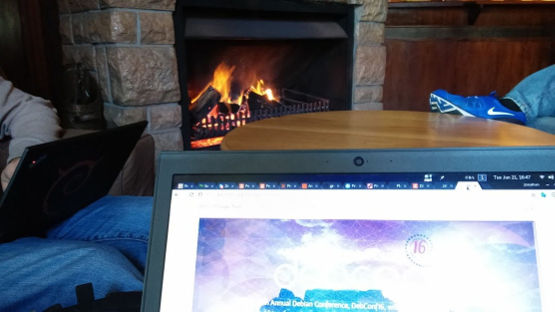
Hacking by the fire at the sports club

Gathering some heat by the fire at the sports club while catching up to the world the day before it all started.

All Kinds of Quality Time I really enjoyed working with the video team last year, but this year there was just 0 time for that. Working on the orga team means dealing with a constant torrent of small tasks, which is good in its own way because you get to deal with a wide variety of Debian people you might not usually get to interact with, but video team problems are more fun and interesting. Next year I hope to do a lot more video work again. If you re at DebConf over the next week, I can highly recommend that you get involved!
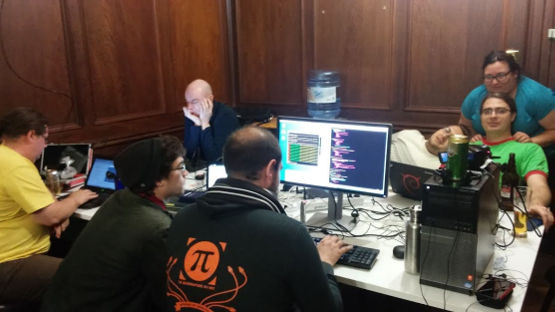
Video team hacking away at problems

Video team members hacking away at problems late at night during DebCamp

The first time I met Debian folk was early in 2004. I worked at the Shuttleworth Foundation as Open Source Technical Co-ordinator at the time, and Mark Shuttleworth had them over for one of the early Ubuntu sprints in Canonical s early days. I was so intimidated by them back then that I could hardly even manage to speak to them. I was already a big free software fan before working there, but little did I even dream to think that I would one day be involved in a project like Ubuntu or Debian. My manager back then encouraged me to go talk to them and get involved and become a Debian Developer and joked that I should become highvoltage@debian.org. I guess that was when the initial seeds got planted and since then I ve met many great people all over the world who have even became friends during UDS, DebConf, BTS and other hackfests where Debianites hang out. It gave me a really nice warm feeling to have all these amazing, talented and really friendly people from all over coming together in this little corner of the world to work together on projects that I think are really important.
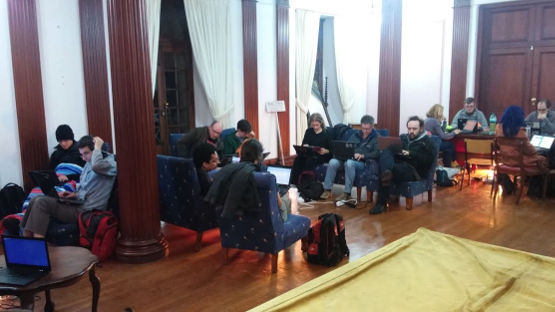
Finding a warm space to work in the Happy Feet hack lab

Finding a warm space to work in the Happy Feet hack lab

Oh the Chicken Back at DebConf12, someone (I don t remember the exact history) brought a rubber chicken to DebConf who was simply called Pollito ( chicken in Spanish). Since then the chicken has grown into somewhat of a mascot for DebConf. Back in 2012 I already imagined that if we would ever host a DebConf, I d make a little of picture book story about Pollito. Last year after DC15, when bringing Pollito over, I created a little story called Pollito s first trip to Africa . I was recovering from flu while putting that together and didn t spend much time on it, but it turned out to be somewhat of a hit. I was surprised to see it in the #debconf topic ever since I posted it :) We gave a tour of the campus on the first and second days and it was quite time consuming and there was no way we could do it every day for the rest of DebCamp, so on the 2nd day I smacked together a new rush job called Pollito s Guide to DC16 . The idea was that newcommers could use it as a visual guide and rely on others who have been there for a while if they get stuck. I wish I had the time to make it a lot nicer, but I think the general idea is good and next year we can have a much nicer one that might not be quite as Pollito focused.
Pollito's Guide to DC16

Pollito s Guide to DC16

Debian Maintainer After all these years, I finally sat down and applied to become a Debian Maintainer, and the application was successful (approved yesterday \o/). Now just for the wait until my key is uploaded to the keyring. I haven t yet had time to properly process this but I think once the DebConf dust settles and I had some time to recover, I will be ecstatic. Some actual DebCampy work Everywhere I go, I see people installing a bunch of GNOME extensions on their Debian GNOME desktops shortly after installation using http://extensions.gnome.org/ (I noticed this even at DebCamp!). A few months ago I thought that it s really about time someone package up some of the really popular ones. So I started to put together some basic packaging for AIMS Desktop around a month ago. During the last few days of DebCamp, things were going well enough with the organisational tasks that I had some time to do some actual packaging work and improve these so that they re ready for upload to the Debian archives. The little DebCamp time I had ended up being my very own little extension fest :) I worked on the following packages which are ready for upload: I worked on the following packages which still need minor work, might be able to get them in uploadable state by the end of DebConf: The actual packaging of GNOME extensions is actually pretty trivial. It s mostly source-only JavaScript with some CSS and translations and maybe some gsettings schemas and dialogs. Or at least, it would be pretty trivial, but many extensions are without licenses, contain embedded code (often JavaScript) from other projects, or have no usable form of upstream tarball, to name a few of the problems. So I ve been contacting the upstream authors of these packages where there have been problems, and for the most part they ve been friendly and pretty quick to address the problems. So that s it, for now. I couldn t possibly sum up the last week and everything that lead up to it in a single blog post. All I can really say is thank you for letting me be a part of this very special project!

Guido G nther: Debian Fun in June 2016

Debian LTS June marked the fourteenth month I contributed to Debian LTS under the Freexian umbrella. I spent the 8 hours working on these LTS things: Other Debian stuff Besides the usual bunch of libvirt* uploads I addressed several bugs in git-buildpackage, upload pending.

Lior Kaplan: Implementing NATO s standards (STANAG)

I recently joined Linnovate, and while working on one of the open source projects the company produces, we needed to process video content according to NATO s standard agreement (STANAG) 4609: NATO Digital Motion Imagery Standard. Obviously we started with trying to find code already done, but we only found some implementation in Java, while our project is written in JavaScript. We decided to just implement the standard in the way most convenient to us, and later refactoring the project when more standards (STANAGs) will get implemented. So I m happy to introduce our new project: STANAG at https://github.com/linnovate/stanag , also available with NPM (see https://www.npmjs.com/package/stanag).
Filed under: Linnovate

1 July 2016

Joachim Breitner: When to reroll a six

This is a story about counter-intuitive probabilities and how a small bit of doubt turned out to be very justified. It begins with the game To Court the King (German: Um Krone und Kragen ). It is a nice game with dice and cards, where you start with a few dice, and use your dice rolls to buy additional cards, which give you extra dice or special powers to modify the dice that you rolled. You can actually roll your dice many times, but every time, you have to set aside at least one die, which you can no longer change or reroll, until eventually all dice have been set aside. A few years ago, I have played this game a lot, both online (on yucata.de) as well as in real life. It soon became apparent that it is almost always better to go for the cards that give you an extra die, instead of those that let you modify the dice. Intuitively, this is because every additional die allows you to re-roll your dice once more. I concluded that if I have a certain number of dice (say, n), and I want to have a sum as high as possible at the end, then it may make sense to reroll as many dice as possible, setting aside only those showing a 6 (because that is the best you can get) or, if there is no dice showing a 6, then a single die with the best score. Besides for small number of dice (2 or 3), where even a 4 or 5 is worth keeping, this seemed to be a simple, obvious and correct strategy to maximize the expected outcome of this simplified game. It is definitely simple and obvious. But some doubt that it was correct remained. Having one more die still in the game (i.e. not set aside) definitely improves your expected score, because you can reroll the dice more often. How large is this advantage? What if it ever exceeds 6 then it would make sense to reroll a 6. The thought was strange, but I could not dismiss it. So I did what one does these days if one has a question: I posed it on the mathematics site of StackExchange. That was January 2015, and nothing happened. I tried to answer it myself a month later, or at least work towards at an answer, and did that by brute force. Using a library for probabilistic calculations for Haskell I could write some code that simply calculated the various expected values of n dice for up to n = 9 (beyond that, my unoptimized code would take too long):
1:  3.50000 (+3.50000)
2:  8.23611 (+4.73611)
3: 13.42490 (+5.18879)
4: 18.84364 (+5.41874)
5: 24.43605 (+5.59241)
6: 30.15198 (+5.71592)
7: 35.95216 (+5.80018)
8: 41.80969 (+5.85753)
9: 47.70676 (+5.89707)
Note that this calculation, although printed as floating point numbers, is performed using fractions of unbounded integers, so there are no rounding issues that could skew the result. The result supported the hypothesis that there is no point in rolling a 6 again: The value of an additional die grows and approaches 6 from beyond, but judging from these number is never going to reach it. Then again nothing happened. Until 14 month later, when some Byron Schmuland came along, found this an interesting puzzle, and set out a 500 point bounty to whoever solved this problem. This attracted a bit attention, and a few not very successful attempts at solving this. Eventually it reached twitter, where Roman Cheplyaka linked to it. Coincidally a day later some joriki came along, and he had a very good idea: Why not make our life easier and think about dice with less sides, and look at 3 instead of 6. This way, and using a more efficient implementation (but still properly using rationals), he could do a similar calculation for up to 50 dice. And it was very lucky that he went to 50, and not just 25, because up to 27, the results were very much as expected, approaching value of +3 from below. But then it surpassed +3 and became +3.000000008463403. In other words: If you have roll 28 dice, and you have exactly two dice showing a 3, then it gives you better expected score if you set aside only one 3, and not both of them. The advantage is minuscule, but that does not matter it is there. From then on, the results behaved strangely. Between 28 and 34, the additional value was larger than 3. Then, from 35 on again lower than 2. It oscillated. Something similar could be observed when the game is played with coins. Eventually, joriki improved his code and applied enough tricks so that he could solve it also for the 6-sided die: The difference of the expected value of 198 dice and having 199 dice is larger than 6 (by 10 21...)! The optimizations that allowed him to calculate these numbers in a reasonable amount of time unfortunately was to assume that my original hypothesis (never rerolling a 6 is optimal), which held until n < 199. But this meant that for n > 199, the code did not yield correct results. What is the rationale of the story? Don t trust common sense when it comes to statistics; don t judge a sequence just from a few initial numbers; if you have an interesting question, post it online and wait for 16 months.

Rapha&#235;l Hertzog: My Free Software Activities in June 2016

My monthly report covers a large part of what I have been doing in the free software world. I write it for my donators (thanks to them!) but also for the wider Debian community because it can give ideas to newcomers and it s one of the best ways to find volunteers to work with me on projects that matter to me. Debian packaging Django and Python. I uploaded Django 1.9.7 and filed an upstream ticket (#26755) for a failure seen in its DEP-8 tests. I packaged/sponsored python-django-modeltranslation and python-paypal. I opened a pull request on model-translation to fix failing tests in the Debian package build. I packaged a new python-django-jsonfield (1.0.0), filed a bug and discovered some regression in its PostgreSQL support. I helped on the upstream ticket and I have been granted commit rights. I used this opportunity to do some bug triage and push a few fixes. I also discussed the future of the module and ended up starting a discussion on Django s developer list about the possibility to add a JSONField to the core. CppUTest. I uploaded a new upstream version (3.8) with more than a year of work. I found out that make install does not install a required header so I opened a ticket with a patch. The package ended up not compiling on quite a few architectures so I opened a ticket and prepared a fix for some of those failures with the help of the upstream developers. I also added a DEP-8 tests after having uploaded a broken (untested) package systemd support in net-snmp and postfix. I worked on adding native systemd service units to net-snmp (#782243) and postfix (#715188). In both cases, the maintainers have not been very reactive so far so I uploaded my changes as delayed NMU. pkg-security team. The team that I started quietly a few months ago is now growing, both with new members and new packages. I created the required Teams/pkg-security wiki page. I sponsored xprobe, hydra, made an upload of medusa to merge Kali changes into Debian (and at the same time submitting the patch to upstream). fontconfig. After having read Jonathan McDowell s analysis of a bug that I experienced multiple times (and that many Kali users had too), I opened bug #828037 to get it fixed once for all. Unfortunately, nothing happened yet. DebConf 16 I spent some time to prepare the 2 talks and the BoF that I will give/manage in Cape Town next week: Distro Tracker I continued to mentor Vladimir Likic who managed to finish his first patch. He is now working on documentation for new contributors based on his recent experience. I enhanced the tox configuration to run tests with Django 1.8 LTS with fatal warnings (python -Werror) so as to ensure that I m not relying on any deprecated feature and so that I can be sure that the codebase will work on the next Django LTS release (1.11). Thanks to this, I did discover quite a few places where I have been using deprecated API and I fixed them all (the JSONField update to 1.0.0 I mentionned above was precisely to fix such a warning). I also fixed a few more issues with folded mail headers that you can t inject back in a new Message object and with messages lacking the subject field. All those have been caught through real (spam) email generating exceptions wich are then mailed to me. Kali related work I uploaded a new live-boot (5.20160608) to Debian to fix a bug where the boot process was blocking on some timeout. I forwarded a Kali bug against libatk-wrapper-java (#827741) which turned out to be an OpenJDK bug. I filed #827749 against reprepro to request a way to remove selected internal file references. This is required if you want to be able to make a file disappear and if that file is part of a snapshot that you want to keep despite this. But in truth, my real need is to be able to replace the .orig.tar.gz used by Kali by the orig.tar.gz used by Debian those conflicts break the mirroring/import script. Salt I have been using salt to deploy a new service, and I developed patches for a few issues in salt formulas. I also created a new letsencrypt-sh formula to manage TLS certificates with the letsencrypt.sh ACME client. Thanks See you next month for a new summary of my activities.

No comment Liked this article? Click here. My blog is Flattr-enabled.

30 June 2016

Chris Lamb: Free software activities in June 2016

Here is my monthly update covering a large part of what I have been doing in the free software world (previously):
Debian My work in the Reproducible Builds project was covered in our weekly reports. (#58, #59 & #60)
Debian LTS

This month I have been paid to work 18 hours on Debian Long Term Support (LTS). In that time I did the following:
  • "Frontdesk" duties, triaging CVEs, etc.
  • Extended the lts-cve-triage.py script to ignore packages that are not subject to Long Term Support.

  • Issued DLA 512-1 for mantis fixing an XSS vulnerability.
  • Issued DLA 513-1 for nspr correcting a buffer overflow in a sprintf utility.
  • Issued DLA 515-1 for libav patching a memory corruption issue.
  • Issued DLA 524-1 for squidguard fixing a reflected cross-site scripting vulnerability.
  • Issued DLA 525-1 for gimp correcting a use-after-free vulnerability in the channel and layer properties parsing process.

Uploads
  • redis (2:3.2.1-1) New upstream bugfix release, plus subsequent upload to the backports repository.
  • python-django (1.10~beta1-1) New upstream experimental release.
  • libfiu (0.94-5) Misc packaging updates.


RC bugs

I also filed 170 FTBFS bugs against a7xpg, acepack, android-platform-dalvik, android-platform-frameworks-base, android-platform-system-extras, android-platform-tools-base, apache-directory-api, aplpy, appstream-generator, arc-gui-clients, assertj-core, astroml, bamf, breathe, buildbot, cached-property, calf, celery-haystack, charmtimetracker, clapack, cmake, commons-javaflow, dataquay, dbi, django-celery, django-celery-transactions, django-classy-tags, django-compat, django-countries, django-floppyforms, django-hijack, django-localflavor, django-markupfield, django-model-utils, django-nose, django-pipeline, django-polymorphic, django-recurrence, django-sekizai, django-sitetree, django-stronghold, django-taggit, dune-functions, elementtidy, epic4-help, fcopulae, fextremes, fnonlinear, foreign, fort77, fregression, gap-alnuth, gcin, gdb-avr, ggcov, git-repair, glance, gnome-twitch, gnustep-gui, golang-github-audriusbutkevicius-go-nat-pmp, golang-github-gosimple-slug, gprbuild, grafana, grantlee5, graphite-api, guacamole-server, ido, jless, jodreports, jreen, kdeedu-data, kdewebdev, kwalify, libarray-refelem-perl, libdbusmenu, libdebian-package-html-perl, libdevice-modem-perl, libindicator, liblrdf, libmail-milter-perl, libopenraw, libvisca, linuxdcpp, lme4, marble, mgcv, mini-buildd, mu-cade, mvtnorm, nose, octave-epstk, onioncircuits, opencolorio, parsec47, phantomjs, php-guzzlehttp-ringphp, pjproject, pokerth, prayer, pyevolve, pyinfra, python-asdf, python-ceilometermiddleware, python-django-bootstrap-form, python-django-compressor, python-django-contact-form, python-django-debug-toolbar, python-django-extensions, python-django-feincms, python-django-formtools, python-django-jsonfield, python-django-mptt, python-django-openstack-auth, python-django-pyscss, python-django-registration, python-django-tagging, python-django-treebeard, python-geopandas, python-hdf5storage, python-hypothesis, python-jingo, python-libarchive-c, python-mhash, python-oauth2client, python-proliantutils, python-pytc, python-restless, python-tidylib, python-websockets, pyvows, qct, qgo, qmidinet, quodlibet, r-cran-gss, r-cran-runit, r-cran-sn, r-cran-stabledist, r-cran-xml, rgl, rglpk, rkt, rodbc, ruby-devise-two-factor, ruby-json-schema, ruby-puppet-syntax, ruby-rspec-puppet, ruby-state-machine, ruby-xmlparser, ryu, sbd, scanlogd, signond, slpvm, sogo, sphinx-argparse, squirrel3, sugar-jukebox-activity, sugar-log-activity, systemd, tiles, tkrplot, twill, ucommon, urca, v4l-utils, view3dscene, xqilla, youtube-dl & zope.interface.

FTP Team

As a Debian FTP assistant I ACCEPTed 186 packages: akonadi4, alljoyn-core-1509, alljoyn-core-1604, alljoyn-gateway-1504, alljoyn-services-1504, alljoyn-services-1509, alljoyn-thin-client-1504, alljoyn-thin-client-1509, alljoyn-thin-client-1604, apertium-arg, apertium-arg-cat, apertium-eo-fr, apertium-es-it, apertium-eu-en, apertium-hbs, apertium-hin, apertium-isl, apertium-kaz, apertium-spa, apertium-spa-arg, apertium-tat, apertium-urd, arc-theme, argus-clients, ariba, beast-mcmc, binwalk, bottleneck, colorfultabs, dh-runit, django-modeltranslation, dq, dublin-traceroute, duktape, edk2, emacs-pdf-tools, eris, erlang-p1-oauth2, erlang-p1-sqlite3, erlang-p1-xmlrpc, faba-icon-theme, firefox-branding-iceweasel, golang-1.6, golang-defaults, golang-github-aelsabbahy-gonetstat, golang-github-howeyc-gopass, golang-github-oleiade-reflections, golang-websocket, google-android-m2repository-installer, googler, goto-chg-el, gr-radar, growl-for-linux, guvcview, haskell-open-browser, ipe, labplot, libalt-alien-ffi-system-perl, libanyevent-fcgi-perl, libcds-savot-java, libclass-ehierarchy-perl, libconfig-properties-perl, libffi-checklib-perl, libffi-platypus-perl, libhtml-element-library-perl, liblwp-authen-oauth2-perl, libmediawiki-dumpfile-perl, libmessage-passing-zeromq-perl, libmoosex-types-portnumber-perl, libmpack, libnet-ip-xs-perl, libperl-osnames-perl, libpodofo, libprogress-any-perl, libqtpas, librdkafka, libreoffice, libretro-beetle-pce-fast, libretro-beetle-psx, libretro-beetle-vb, libretro-beetle-wswan, libretro-bsnes-mercury, libretro-mupen64plus, libservicelog, libtemplate-plugin-datetime-perl, libtext-metaphone-perl, libtins, libzmq-ffi-perl, licensecheck, link-grammar, linux, linux-signed, lua-busted, magics++, mkalias, moka-icon-theme, neutron-vpnaas, newlisp, node-absolute-path, node-ejs, node-errs, node-has-flag, node-lodash-compat, node-strip-ansi, numba, numix-icon-theme, nvidia-graphics-drivers, nvidia-graphics-drivers-legacy-304xx, nvidia-graphics-drivers-legacy-340xx, obs-studio, opencv, pacapt, pgbackrest, postgis, powermock, primer3, profile-sync-daemon, pyeapi, pypandoc, pyssim, python-cutadapt, python-cymruwhois, python-fisx, python-formencode, python-hkdf, python-model-mommy, python-nanomsg, python-offtrac, python-social-auth, python-twiggy, python-vagrant, python-watcherclient, python-xkcd, pywps, r-bioc-deseq2, r-bioc-dnacopy, r-bioc-ensembldb, r-bioc-geneplotter, r-cran-adegenet, r-cran-adephylo, r-cran-distory, r-cran-fields, r-cran-future, r-cran-globals, r-cran-htmlwidgets, r-cran-listenv, r-cran-mlbench, r-cran-mlmrev, r-cran-pheatmap, r-cran-pscbs, r-cran-r.cache, refind, relatorio, reprotest, ring, ros-ros-comm, ruby-acts-as-tree, ruby-chronic-duration, ruby-flot-rails, ruby-numerizer, ruby-u2f, selenium-firefoxdriver, simgrid, skiboot, smtpping, snap-confine, snapd, sniffles, sollya, spin, subuser, superlu, swauth, swift-plugin-s3, syncthing, systemd-bootchart, tdiary-theme, texttable, tidy-html5, toxiproxy, twinkle, vmtk, wait-for-it, watcher, wcslib & xapian-core.

Russell Coker: Coalitions

In Australia we are about to have a federal election, so we inevitably have a lot of stupid commentary and propaganda about politics. One thing that always annoys me is the claim that we shouldn t have small parties. We have two large parties, Liberal (right-wing, somewhat between the Democrats and Republicans in the US) and Labor which is somewhat similar to Democrats in the US. In the US the first past the post voting system means that votes for smaller parties usually don t affect the outcome. In Australia we have Instant Runoff Voting (sometimes known as The Australian Ballot ) which has the side effect of encouraging votes for small parties. The Liberal party almost never wins enough seats to make government on it s own, it forms a coalition with the National party. Election campaigns are often based on the term The Coalition being used to describe a Liberal-National coalition and the expected result if The Coalition wins the election is that the leader of the Liberal party will be Prime Minister and the leader of the National party will be the Deputy Prime Minister. Liberal party representatives and supporters often try to convince people that they shouldn t vote for small parties and that small parties are somehow undemocratic , seemingly unaware of the irony of advocating for The Coalition but opposing the idea of a coalition. If the Liberal and Labor parties wanted to form a coalition they could do so in any election where no party has a clear majority, and do it without even needing the National party. Some people claim that it s best to have the major parties take turns in having full control of the government without having to make a deal with smaller parties and independent candidates but that s obviously a bogus claim. The reason we have Labor allying with the Greens and independents is that the Liberal party opposes them at every turn and the Liberal party has a lot of unpalatable policies that make alliances difficult. One thing that would be a good development in Australian politics is to have the National party actually represent rural voters rather than big corporations. Liberal policies on mining are always opposed to the best interests of farmers and the Liberal policies on trade aren t much better. If The Coalition wins the election then the National party could insist on a better deal for farmers in exchange for their continued support of Liberal policies. If Labor wins more seats than The Coalition but not enough to win government directly then a National-Labor coalition is something that could work. I think that the traditional interest of Labor in representing workers and the National party in representing farmers have significant overlap. The people who whinge about a possible Green-Labor alliance should explain why they aren t advocating a National-Labor alliance. I think that the Labor party would rather make a deal with the National party, it s just a question of whether the National party is going to do what it takes to help farmers. They could make the position of Deputy Prime Minister part of the deal so the leader of the National party won t miss out.

Steve Kemp: So I've been busy.

The past few days I've been working on my mail client which has resulted in a lot of improvements to drawing, display and correctness. Since then I've been working on adding GPG-support. My naive attempt was to extract the signature, and the appropriate body-part from the message. Write them both to disk then I could validate via:
gpg --verify msg.sig msg
However that failed, and it took me a long to work out why. I downloaded the source to mutt, which can correctly verify an attached-signature, then hacked lib.c to neuter the mutt_unlink function. That left me with a bunch of files inside $TEMPFILE one of which provided the epiphany. A message which is to be validated is indeed written out to disk, just as I would have done, as is the signature. Ignoring the signature the message is interesting:
Content-Type: text/plain; charset=UTF-8
Content-Transfer-Encoding: quoted-printable
On Mon, 27 Jun 2016 08:08:14 +0200
...
--=20
Bob Smith
The reason I'd failed to validate my message-body was because I'd already decoded the text of the MIME-part, and I'd also lost the prefixed two lines "Content-type:.." and Content-Transfer:.... I'm currently trying to work out if it is possible to get access to the RAW MIME-part-text in GMIME. Anyway that learning aside I've made a sleazy hack which just shells out to mimegpg, and this allows me to validate GPG signatures! That's not the solution I'd prefer, but that said it does work, and it works with inline-signed messages as well as messages with application/pgp-signature MIME-parts. Changing the subject now. I wonder how many people read to the end anyway? I've been in Finland for almost a year now. Recently I was looking over websites and I saw that the domain steve.fi was going to expire in a few weeks. So I started obsessively watching it. Today I claimed it. So I'll be slowly moving things from beneath steve.org.uk to use the new home steve.fi. I also setup a mini-portfolio/reference site at http://steve.kemp.fi/ - which was a domain I registered while I was unsure if I could get steve.fi. Finally now is a good time to share more interesting news:

29 June 2016

Gunnar Wolf: Batch of the Next Thing Co.'s C.H.I.P. computers on its way to DebConf!)

Hello world! I'm very happy to inform that the Next Thing Co. has shipped us a pack of 50 C.H.I.P. computers to be given away at DebConf! What is the C.H.I.P.? As their tagline says, it's the world's first US$9 computer. Further details:
https://nextthing.co/pages/chip
All in all, it's a nice small ARM single-board computer; I won't bore you on this mail with tons of specs; suffice to say they are probably the most open ARM system I've seen to date. So, I agreed with Richard, our contact at the company, I would distribute the machines among the DebConf speakers interested in one. Of course, not every DebConf speaker wants to fiddle with an adorable tiny piece of beautiful engineering, so I'm sure I'll have some spare computers to give out to other interested DebConf attendees. We are supposed to receive the C.H.I.P.s by Monday 4; if you want to track the package shipment, the DHL tracking number is 1209937606. Don't DDoS them too hard! So, please do mail me telling why do you want one, what your projects are with it. My conditions for this giveaway are: To sign up for yours, please mail gwolf+chip@gwolf.org - I will capture mail sent to that alias ONLY.

Olivier Gr goire: Sixth week: and the framerates appear....

Last week, I worked on link the D_BUS with the client and implement MAP on my callback smartInfo to push all my information in only one parameter.
This week I wanted to display my first real information in my client. I choose to begin with the frame rate to help another person in Savoir Faire Linux who work on the encoding and decoding of the video. So I worked on the video part of the daemon trying to understand how the daemon sends frames to LRC. All the frames are decoded in the same place so I just pull the number of frames per second for the local and remote video and put it on my callback smartInfo.
Next week, I will change my architecture a little bit. Ring can handle several calls with different information and my implementation don't take care of this. I need to search and implement a new architecture to link my callback with the call.

Wouter Verhelst: Debcamp NBD work

I had planned to do some work on NBD while here at debcamp. Here's a progress report:
Task Concept Code Tested
Change init script so it uses /etc/nbdtab rather than /etc/nbd-client for configuration
Change postinst so it converts existing /etc/nbd-client files to /etc/nbdtab
Change postinst so it generates /etc/nbdtab files from debconf
Create systemd unit for nbd based on /etc/nbdtab
Write STARTTLS support for client and/or server
The first four are needed to fix Debian bug #796633, of which "writing the systemd unit" was the one that seemed hardest. The good thing about debcamp, however, is that experts are aplenty (thanks Tollef), so that part's done now. What's left: If I manage to get all of the above to work and there's time left, I'll have a look at implementing STARTTLS support into nbd-client and nbd-server. A spec for that exists already, there's an alternative NBD implementation which has already implemented it, and preliminary patches exist for the reference implementation, so it's known to work; I just need to spend some time slapping the pieces together and making it work. Ah well. Good old debcamp.

Next.

Previous.