Search Results: "cas"

19 February 2014

Michael Stapelberg: Using your TPM for SSH authentication

Thomas Habets has blogged about using your TPM (Trusted Platform Module) for SSH authentication a few weeks ago. We worked together to get his package simple-tpm-pk11 into Debian, and it has just arrived in unstable :-). Using simple-tpm-pk11, you can let your TPM generate a key, which you then can use for SSH authentication. This key will never leave the TPM, so it is safer than having your key on the filesystem (e.g. ~/.ssh/id_rsa), since file system access is not enough to steal your key anymore. Instead, you ll need remote code execution. To use this software, first make sure your TPM is enabled in the BIOS. In my ThinkPad X200 from 2008, the TPM is called Security Chip . Afterwards, claim ownership of your TPM using tpm_takeownership -z (from the tpm-tools package) and enter a password. You will not need to enter this password for every SSH authentication later (but you may choose to set a separate password for that). Then, install simple-tpm-pk11, create a key, set it as your PKCS11Provider and install the public key on the host(s) where you want to use it:
mkdir ~/.simple-tpm-pk11
stpm-keygen -o ~/.simple-tpm-pk11/my.key
echo key my.key > ~/.simple-tpm-pk11/config
echo -e "\nHost *\n    PKCS11Provider libsimple-tpm-pk11.so" >> ~/.ssh/config
ssh-keygen -D libsimple-tpm-pk11.so   ssh shell.example.com tee -a .ssh/authorized_keys
You ll now be able to ssh into shell.example.com without having the key for that on your file system :-). In case you have any feedback about/troubles with the software, please feel free to contact Thomas directly.

18 February 2014

Christoph Egger

Writing this because there seems to be no correct documentation on the relevant google websites and it turns out to be non-trivial. Our goal here is to unsubscribe from a ordinary google group. Mails from the google group contain the quoted footer:
-- 
You received this message because you are subscribed to the Google
Groups "FOO" group.
To unsubscribe from this group and stop receiving emails from it, send
an email to FOO+unsubscribe@googlegroups.com.
Visit this group at http://groups.google.com/group/FOO
For more options, visit https://groups.google.com/groups/opt_out.
Seems easy enough, so let's send a Mail to this FOO+unsubscribe address. Back comes a E-Mail:
From: FOO <FOO+unsubconfirm@googlegroups.com>
Subject: Unsubscribe request for FOO [ EJzZjpgFhDHd9seTdRA0 ]
To: Christoph Egger <christoph@example.com>
Date: Tue, 18 Feb 2014 18:55:24 +0000 (38 minutes, 53 seconds ago)
 [Leave This Group]
Visit Go 
[Start] your own group, [visit] the help center, or [report]
abuse.
So click on the [Leave This Group] link and be done? Unfortunately not. Looking at the link you notice it's called http://groups.google.com/group/FOO/subscribe -- no token and "subscribe"? I actually want to unsubscribe! And indeed, clicking gets an Interface that offers to "Enter the email address to subscribe:" + Captcha. And whatever it does, it -- of course -- doesn't unsubscribe. (My guess is, it would actually work if you had a real google account associated with that email address and were logged in to that account but there's no way of verifying this as already the first condition is false in this case) Now if you disable HTML completely for the email, a totally different content emerges:
Hello christoph@example.com,
We have received your request to unsubscribe from FOO. In order for us to complete the request, please reply to this email or visit the following confirmation URL:
http://groups.google.com/group/FOO/subscribe
If you have questions related to this or any other Google Group, visit the Help Center at http://groups.google.com/support/.
Thanks,
Google Groups
Still the non-functional link, however it also mentions a different solution: "please reply to this email" which was not present in the HTML mail at all. And it works.

Mario Lang: Conntributing on GitHub

I really like to read code written by different people. I've always been the type of learner that can cover a lot of ground by looking at examples. A few of the programming tricks I acquired over time have definitely been learnt by reading programs written by other people. There are of course cases of disagrement with coding style (lets put that very mildly), so not every project is fun to read. But I tend to find projects I like enough to actually look at their source code. Now, if you get into this habit, there is also the occasional spotting of a bug. Many are really cosmetic, like typos in comments or documentation. Others are maybe more serious, who knows what can happen if you read a few lines of code written by someone you have never met in person. This is one of the original arguments of open source and free software. It basically goes like: "People will read your code and report problems." I know that happens, but I also know that there are cases of people finding relatively minor things during a small code review, which they don't report, or which get lost in some developers INBOX. I remember waiting months to see memory corruption fixes for a particular project I submitted by email to actually appear in the development repository. In some cases you really need to track your patches and prod someone to remind them about your contribution if need be. True, some of these issues are probably minor enough to not really hurt if they get lost, but I have a feel that a lot of minor things also sort of add up. This is where GitHub comes into play. We have had project hosting services since at least a decade now, but none of them (to my experience) have ever made it so easy for all involved parties to submit and merge changes into projects. Pull requests are just amazing. Well, at least for me, they are since a few months. I have a sort of mixed hate-love relationship with GitHub when it comes to a topic that is very important to me, Accessibility. The last project hosting site I really liked for their simple web interface (read, still usable with Lynx) was Google Code. That was in the days when Google still seemed to care about such things. These days, their newer services are next to unusable to me (with the tools I prefer). SourceForge was always a catastrophy. Many things were cumbersome to do, because the site is so loaded with links to all sorts of things I never need. However, at the time I was using it, all the things I really needed did work. GitHub is a different beast, in a different era of the internet. While I can read project pages and a few basic things perfectly fine, some parts of the GitHub site are simply unusable for no particular reason. For instance, I can edit (some of my) preferences and even save them. But I can not star a project, nor can I follow other developers. Invoking these links gives me a 404, which seems to indicate that some JavaScript (read, client side code execution) is required which my browser does not perform. However, I really wonder why. Because something like "I want to star this project" will eventually have to end up as a request on the server anyway, so it seems technically unnecessary to rely on Javascript for such an operation to succeed. Luckily, these days, hip projects do have an API. An GitHub is no exception. I want to emphasis that an API alone is not an accessibility fix, since you rarely have the time to implement a clinet for a random API, just to get access to a service you want to use. Sometimes you do, and an API is a great enabler in such situations, but a reference client with a rich feature-set is much better. I have to admit that I haven't evaluated any of the possible alternatives, but one client I found for GitHub's API did really boost my productivity in the last year. I am talking about Hub. It is a simple wrapper around Git that adds a few and enhances some other git commands. Most importantly, hub fork will fork the current checkout on GitHub, and hub pull-request allows you to quickly (and I really mean quickly!) open a pull request for some commits you've just done to your fork of some project. This is very helpful, and very accessible. While it does not solve all my accessibility problems with GitHub, it at least enables me to take part in the GitHub workflow. I can easily fork projects and submit pull reuqests for changes I did. And that is what I did, at least a bit, in roughly the past year. I am not sure exactly, but I think it was spring when someone made me aware of Hub. One approach would be to check my GitHub activity graph, but I probably don't have to mention that it is not accessible. Here is a list of some of my contributions to open source projects on GitHub since I discovered a good client for the GitHub API: To summarize: I love GitHub for what it does to the free software community. I think the simplicity (and transparency) of contributions is to the benefit of free and open source software. However, I also hate GitHub sometimes when I need to ask a friend to do relatively trivial changes for me. What I actually want, is a command-line client like Hub that makes most or even all functionality provided on the website available. True, some things like graphs are not immediately easy to adapt. But I really shouldn't need to use a modern full-fledged web browser to tell GitHub that I am interested in the activities of a certain user. Or delete a fork. Yes, thats right. I can use Hub to fork a project, but there is no way to delete it again. Sort of strange for casual small-scale contributions. I guess the workflow there is: fork, commit, pull-request, wait for merge, delete. I don't want to have all sorts of forks on GitHub that I actually don't actively use/maintain. So once a pull request was merged, and I don't have any other things I am working on right now, I actually want to get rid of the fork again. It is easy enough to do a fork should I ever need it again.

Mario Lang: Contributing on GitHub

I really like to read code written by different people. I've always been the type of learner that can cover a lot of ground by looking at examples. A few of the programming tricks I acquired over time have definitely been learnt by reading programs written by other people. There are of course cases of disagrement with coding style (lets put that very mildly), so not every project is fun to read. But I tend to find projects I like enough to actually look at their source code. Now, if you get into this habit, there is also the occasional spotting of a bug. Many are really cosmetic, like typos in comments or documentation. Others are maybe more serious, who knows what can happen if you read a few lines of code written by someone you have never met in person. This is one of the original arguments of open source and free software. It basically goes like: "People will read your code and report problems." I know that happens, but I also know that there are cases of people finding relatively minor things during a small code review, which they don't report, or which get lost in some developers INBOX. I remember waiting months to see memory corruption fixes for a particular project I submitted by email to actually appear in the development repository. In some cases you really need to track your patches and prod someone to remind them about your contribution if need be. True, some of these issues are probably minor enough to not really hurt if they get lost, but I have a feel that a lot of minor things also sort of add up. This is where GitHub comes into play. We have had project hosting services since at least a decade now, but none of them (to my experience) have ever made it so easy for all involved parties to submit and merge changes into projects. Pull requests are just amazing. Well, at least for me, they are since a few months. I have a sort of mixed hate-love relationship with GitHub when it comes to a topic that is very important to me, Accessibility. The last project hosting site I really liked for their simple web interface (read, still usable with Lynx) was Google Code. That was in the days when Google still seemed to care about such things. These days, their newer services are next to unusable to me (with the tools I prefer). SourceForge was always a catastrophy. Many things were cumbersome to do, because the site is so loaded with links to all sorts of things I never need. However, at the time I was using it, all the things I really needed did work. GitHub is a different beast, in a different era of the internet. While I can read project pages and a few basic things perfectly fine, some parts of the GitHub site are simply unusable for no particular reason. For instance, I can edit (some of my) preferences and even save them. But I can not star a project, nor can I follow other developers. Invoking these links gives me a 404, which seems to indicate that some JavaScript (read, client side code execution) is required which my browser does not perform. However, I really wonder why. Because something like "I want to star this project" will eventually have to end up as a request on the server anyway, so it seems technically unnecessary to rely on Javascript for such an operation to succeed. Luckily, these days, hip projects do have an API. An GitHub is no exception. I want to emphasis that an API alone is not an accessibility fix, since you rarely have the time to implement a clinet for a random API, just to get access to a service you want to use. Sometimes you do, and an API is a great enabler in such situations, but a reference client with a rich feature-set is much better. I have to admit that I haven't evaluated any of the possible alternatives, but one client I found for GitHub's API did really boost my productivity in the last year. I am talking about Hub. It is a simple wrapper around Git that adds a few and enhances some other git commands. Most importantly, hub fork will fork the current checkout on GitHub, and hub pull-request allows you to quickly (and I really mean quickly!) open a pull request for some commits you've just done to your fork of some project. This is very helpful, and very accessible. While it does not solve all my accessibility problems with GitHub, it at least enables me to take part in the GitHub workflow. I can easily fork projects and submit pull reuqests for changes I did. And that is what I did, at least a bit, in roughly the past year. I am not sure exactly, but I think it was spring when someone made me aware of Hub. One approach would be to check my GitHub activity graph, but I probably don't have to mention that it is not accessible. Here is a list of some of my contributions to open source projects on GitHub since I discovered a good client for the GitHub API: To summarize: I love GitHub for what it does to the free software community. I think the simplicity (and transparency) of contributions is to the benefit of free and open source software. However, I also hate GitHub sometimes when I need to ask a friend to do relatively trivial changes for me. What I actually want, is a command-line client like Hub that makes most or even all functionality provided on the website available. True, some things like graphs are not immediately easy to adapt. But I really shouldn't need to use a modern full-fledged web browser to tell GitHub that I am interested in the activities of a certain user. Or delete a fork. Yes, thats right. I can use Hub to fork a project, but there is no way to delete it again. Sort of strange for casual small-scale contributions. I guess the workflow there is: fork, commit, pull-request, wait for merge, delete. I don't want to have all sorts of forks on GitHub that I actually don't actively use/maintain. So once a pull request was merged, and I don't have any other things I am working on right now, I actually want to get rid of the fork again. It is easy enough to do a fork should I ever need it again.

16 February 2014

Evgeni Golov: diffing configuration files made easy

Let s assume you are a sysadmin and have to debug a daemon giving bad performance on one machine, but not on the other. Of course, you did not setup either machine, have only basic knowledge of the said daemon and would really love to watch that awesome piece of cinematographic art with a bunch of friends and a couple of beers. So it s like every day, right? The problem with understanding running setups is that you often have to read configuration files. And when reading one is not enough, you have to compare two or more of them. Suddenly, a wild problem occurs: order and indentation do not matter (unless they do), comments are often just beautiful noise and why the hell did that guy smoke/drink/eat while explicitly setting ALL THE OPTIONS to their defaults before actually setting them as he wanted. If you are using diff(1), you probably love to read a lot of differences, which are none in reality. Want an example? [foo]
bar = bar
foo = foo and # settings for foo
[foo]
# foo is best
foo = foo
# bar is ok here, FIXME?
bar = bar and [foo]
foo = x
bar = x
[foo]
foo = foo
bar = bar are actually the same, at least for some parsers. XTaran suggested using something like wdiff or dwdiff, which often helps, but not in the above case. Others suggested vimdiff, which is nice, but not really helpful here either. As there is a problem, and I love to solve these, I started a small new project: cfgdiff. It tries to parse two given files and give a diff of the content after normalizing it (merging duplicate keys, sorting keys, ignoring comments and blank lines, you name it). Currently it can parse various INI files, JSON, YAML and XML. That s probably not enough to be the single diff tool for configuration files, but it is quite a nice start. And you can extend it, of course ;)

Bernhard R. Link: unstable busybox and builtins

In case you are using busybox-static like me to create custom initramfses, here a little warning: The current busybox-static in unstable lost its ability to find builtins with no /proc/self/exe, so if you use it make sure you either have all builtins you need up until mount /proc (including mount) and after you umount all file systems as explicit symlinks or simply create a /proc/self/exe -> /bin/busybox symlink...

15 February 2014

Keith Packard: Altos1.3.2

AltOS 1.3.2 Bug fixes and improved APRS support Bdale and I are pleased to announce the release of AltOS version 1.3.2. AltOS is the core of the software for all of the Altus Metrum products. It consists of firmware for our cc1111, STM32L151, LPC11U14 and ATtiny85 based electronics and Java-based ground station software. This is a minor release of AltOS, including bug fixes for TeleMega, TeleMetrum v2.0 and AltosUI . AltOS Firmware GPS Satellite reporting and APRS improved Firmware version 1.3.1 has a bug on TeleMega when it has data from more than 12 GPS satellites. This causes buffer overruns within the firmware. 1.3.2 limits the number of reported satellites to 12. APRS now continues to send the last known good GPS position, and reports GPS lock status and number of sats in view in the APRS comment field, along with the battery and igniter voltages. AltosUI TeleMega GPS Satellite, GPS max height and Fire Igniters AltosUI was crashing when TeleMega reported that it had data from more than 12 satellites. While the TeleMega firmware has been fixed to never do that, AltosUI also has a fix in case you fly a TeleMega board without updated firmware. GPS max height is now displayed in the flight statistics. As the u-Blox GPS chips now provide accurate altitude information, we ve added the maximum height as computed by GPS here. Fire Igniters now uses the letters A through D to label the extra TeleMega pyro channels instead of the numbers 0-3.

14 February 2014

Rudy Godoy: Getting Movistar Peru ZTE MF193 work in Debian

After so many attempts to have my shiny Movistar Peru (Internet M vil) 3G ZTE MF193 modem to work out-of-the-box in Debian jessie (unstable) with NetworkManager, the word frustration was hitting on my head. Even trying to do the right thing, led me to craziness. I gave up on fanzines and decided to take the old-school route. Release wvdial and friends! Trying different combinations for wvdial.conf was no heaven for sure, but I ve found this wonderful guide from Christian Ams ss from Vienna, Austria! that really made a difference. Of course he s talking about the MF180 model but you get the idea. So I m sharing what was different for the MF193. Basically, I ve done the eject and disable CD-ROM thing already, but still no progress. I ve also tried using wvdial to send AT commands to the evasive /dev/ttyUSBX device. Starting from scratch confirmed that I ve done such things properly indeed. I was amused by the fact that I could use screen to talk to the modem! (yo, all the time wasted trying to have minicom and friends play nice) So, let s get to the point. After following this procedure, you should be able to use NetworkManager to connect to the Interwebs using the 3G data service from Movistar Peru.
  1. Step 1 follow the guide
  2. Step 2 Here I had to use /dev/ttyUSB4
  3. Step 3 follow the guide
  4. Unplug your USB modem
  5. Plug your USB modem. This time you should see only /dev/ttyUSB 0,1,2 and /dev/gsmmodem should be missing (not sure if this is a bug). Now /dev/ttyUSB2 is your guy.
  6. Step 4 use /dev/ttyUSB2
  7. Run wvdial from CLI it should connect successfully.
  8. Stop wvdial
  9. Select the Network icon on GNOME3, click on the Mobile Broadband configuration you have, if not create one.
  10. Voil . Happy surfing!
I m pasting my wvdial.conf, just in case.
[Dialer Defaults]
Modem = /dev/ttyUSB2
Username = movistar@datos
Password = movistar
APN = movistar.pe
Phone = *99#
Stupid Mode = 1
Init2 = AT+CGDCONT=4,"IP","movistar.pe"

Paul Tagliamonte: Introducing: Acid!

I ve been hacking (on and off) on a small bit of code (written in Hy) called Acid. So, all of this is *really* fluid, and I m going to change it s API and code (it s currently just one massive hack), but I think the idea has kinda jelled enough for me to chat a bit about. Acid is a DSL for writing event-driven Hy. Currently it s just using global events (that ll change soon), and it s a monumental hack (not sure how much I can do there), but it works pretty well. It s built on top of tulip / asyncio, which is an amazing new Python 3.4 standard library package for working with async code. Although asyncio is designed around network-based usecases, I ve been trying to shoehorn in an event system on top of it. It s going well so far. A basic Acid script looks something like:
(trip
  (on :startup
    (every 1 second (emit :clock-pulse nil)))
  (on :clock-pulse (print "."))
  (emit :startup nil))
which will print a dot ( . ) every second forever. Something a bit more advanced (fetch the MBTA Red line T information once a minute forever)
(defn get-endpoint-url [line]
  (.format "http://developer.mbta.com/lib/rthr/ 0 .json"
    (get  :red-line  "red"
          :blue-line "blue"  line)))
(trip
  ;; OK. Let's do some work with MBTA feeds.
  (on :update-feed
      ;; let's just update feeds on a cron.
      (print (.json (.get requests (get-endpoint-url event))))
      (emit :feed-updated event))
  (every 1 minute
         (emit :update-feed :red-line)))
Clearly, both of these examples are just as clear as their straight functional counterparts, but I m keen to see what I can do with temporal recursion for long-running daemons. I think my first job will be porting snitch's codebase to Acid. Let me know if you have any ideas!

12 February 2014

Matthias Klumpp: AppStream/Listaller FOSDEM slides

FOSDEM is over, and it has been a great time! I talked to many people (thanks to full devrooms ;-) Graph Databases and Config management was crazy, JavaScript as well ) and there might be some cool new things to come soon, which we discussed there :-)
I also got some good and positive feedback on the projects I work on, and met many people from Debian, Kubuntu, KDE and GNOME (haven t seen some of them for almost 3 years) one of the best things of being at FOSDEM is, that you not only see people of your own kind for example, for me as Debian developer it was great to see Fedora people and discuss things with them, something which rarely happens at Debian conferences. Also, having GNOME and KDE closely together again (litterally, their stands were next to each other ) is something I missed since the last Desktop Summit in 2011. My talks were also good, except for the beamer-slides-technical-error at the beginning, which took quite some time (I blame KScreen ;-) ). In case you re interested in the slides, here they are: slides for FOSDEM 14 AppStream/Listaller talks. The slides can likely be understood without the talk, they are way too detailed (usually I only show images on slides, but that doesn t help people who can t see the talk ^^) I hope I can make it to FOSDEM 15 as well I ve been there only once, but it already is my favourite FOSS-conference (and I love Belgian waffles) ;-)

Mario Lang: Roughly 1500 source packages have possibly broken links in debian/control

There are currently roughly 1500 source packages in Debian which possibly (very likely actually) do have broken URLs in debian/control. While it is quite useful that we have VCS information and Homepage URLs in the Packages file these days, we also created a rather big source of bitrot. These URLs are typically paste-and-forget. Sure, people occasionally catch the fact that a homepage or VCS has moved, especially if they are active and in good contact with their upstreams. However, there are also other cases...
DUCK to the rescue! My coworker Simon Kainz has worked on a service that helps at least to track which URLs are currently broken. We've initially discussed some way to make this a part of Lintian, which is what I would have prefered. However, for good reasons, Lintian doesn't want to call out to the net by default, so these checks would likely not get run by many developers anyway. So Simon ended up creating DUCK - the Debian Url ChecKer which actually goes out to the net and verifies that all the Vcs-* and Homepage fields of debian/control are actually reachable. The frontend allows developers to search for packages they maintain, to quickly see if they have any URLs which are possibly broken. There is a slight chance of temporary network problems of course, so what DUCK does is to show the status of checks in the last few days, so that you quickly see if you are dealing with a typical false positive. First of all, thanks to Simon! I think DUCK is an excellent project for a future NM candidate. I actually already wanted to advocate him for DD, but we ended up on a website which suggested that new contributors should start by applying for DM these days, and only later go for DD. I find that actually quite strange, especially in Simons case, but well, we did not feel like argueing. Secondly, and thats also very important: whats needed to improve the overall quality of URLs in the package system is your attention! You can easily search for email addresses of maintainers or uploaders. Team members can create a bookmark entry that checks for problems in all packages maintained by the teams they are a member of. You just need to actually visit these pages from time to time. It would probably not be well received if we filed all these bugs at once :-). So we need you to care, since we don't want to generate too much noise regarding "just these broken URLs". Or are they? If your vcs fields are broken, debcheckout will not work properly. Which defeats the purpose of debcheckout. If your homepage URL is broken, packages.d.o will also have a wrong link. 1500 packages with broken URLs. Don't you think we can do better then that?

Dirk Eddelbuettel: RInside 0.2.11

A new release 0.2.11 of RInside is now on CRAN. RInside provides a set of convenience classes which facilitate embedding of R inside of C++ applications and programs, using the classes and functions provided by the Rcpp R and C++ integration package. This release, the first in fourteen months, fixes one important initialization issue created by the recent Rcpp 0.11.0 release, adds a few other changes related to that release and improves a number of small points such as new or improved examples. The NEWS extract below has more details.
Changes in RInside version 0.2.11 (2014-02-11)
  • Updated for Rcpp 0.11.0:
    • Updated initialization by assigning global environment via pointer only after R itself has been initialized with special thanks to Kevin Ushey for the fix
    • Updated DESCRIPTION with Imports: instead of Depends:
    • Added correspondiing importFrom(Rcpp, evalCpp) to NAMESPACE
    • Noted in all inst/examples/*/Makefile that Rcpp no longer requires a library argument, but left code for backwards compatibility in case 0.11.0 is not yet installed.
  • Added --vanilla --slave to default arguments for R initialization
  • Added a few more explicit #include statements in the qt example which Qt 5.1 now appears to require with thanks to Spencer Behling for the patch
  • Added new MPI example with worker functions and RInside instance, kindly contributed by Nicholas Pezolano and Martin Morgan
CRANberries also provides a short report with changes from the previous release. More information is on the RInside page. Questions, comments etc should go to the rcpp-devel mailing list off the Rcpp R-Forge page.

This post by Dirk Eddelbuettel originated on his Thinking inside the box blog. Please report excessive re-aggregation in third-party for-profit settings.

11 February 2014

Erich Schubert: Debian chooses systemd as default init

It has been all over the place. The Debian CTTE has chosen systemd over upstart as default init system by chairman call. This decision was overdue, as it was pretty clear that the tie will not change, and thus it will be up to chairman. There were no new positions presented, and nobody was being convinced of a different preference. The whole discussion had been escalating, and had started to harm Debian. Some people may not want to hear this, but another 10 ballots and options would not have changed this outcome. Repating essentially the same decision (systemd, upstart, or "other things nobody prefers") will do no good, but turn out the same result, a tie. Every vote counting I saw happen would turn out this tie. Half of the CTTE members prefer systemd, the other half upstart. The main problems, however, are these: So please, everybody get back to work now. If there ever is enough reason to overturn this decision, there are formal ways to do this, and there are people in the CTTE (half of the CTTE, actually) that will take care of this. Until then, live with the result of a 0.1 votes lead for systemd. Instead of pursuing a destructive hate campaign, why not improve your favorite init system instead. Oh, and don't forget about the need to spell out a policy for init system support requirements of packages.

10 February 2014

Bits from Debian: skyrocketing how-can-i-help popcon count

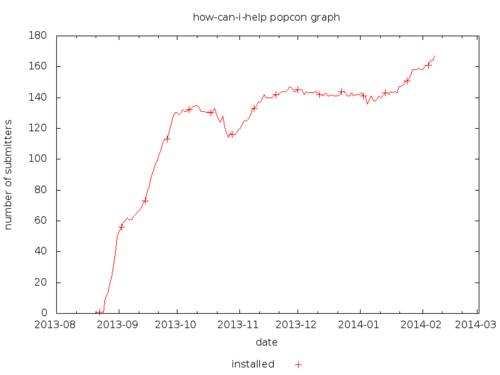
This is a repost from Stefano Zacchiroli's post how-can-i-help by Lucas Nussbaum is one of the best things that happened in the area of attracting contributions to Debian in quite a while. It can be used both as a standalone tool to list opportunities for contributing to Debian which are related to your installed packages, and as an APT hook (which is also the default configuration) that at each upgrade will inform you of new contribution opportunities. how-can-i-help is great for newbies who are looking for ways to give back to Debian which are a good match for their skills: among other things, how-can-i-help shows bugs tagged "gift" related to packages you use. how-can-i-help is also great for experienced developers, as it allows them to find out, in a timely manner, that packages they use are in dire need of help: RC bugs, pending removals, adoptions needed, requests for sponsor, etc. (As highly unscientific evidence: I've noticed a rather quick turnover of RFA/O/ITA bugs on packages installed on my machine. I suspect how-can-i-help is somehow responsible for that, due to the fact that it increases awareness of ongoing package issues directly with the people using them.) So, if you haven't yet, please apt-get install how-can-i-help RIGHT NOW. I daresay that we should aim at installing how-can-i-help by default on all Debian machines, but that might be an ambitious initial goal. In the meantime I'll settle for making how-can-i-help's popcon count skyrocket. As of today, it looks like this: Alt how-can-i-help popularity contest graph 10/02/2014 which is definitely too low for my taste. Please spread the word about how-can-i-help. And let's see what we can collectively do to that graph. how-can-i-help is just a tiny teeny helper, but I'm convinced it can do wonders in liberating dormant contributions to the Debian Project.

Mario Lang: Neurofunkcasts

I have always loved Drum and Bass. In 2013 I rediscovered my love for Darkstep and Neurofunk, and found that these genres have developed quite a lot in the recent years. Some labels like Black Sun Empire and Evol Intent produce mixes/sets on a regular basis as podcasts these days. This article aggregates some neurofunk podcasts I like a lot, most recent first. Enjoy 33 hours and 57 minutes of fun with dark and energizing beats. Thanks to BSE Contrax and Evol Intent for providing such high quality sets. You can also see the Python source for the program that was used to generate this page.

Stefano Zacchiroli: apt-get install how-can-i-help

skyrocketing how-can-i-help popcon count how-can-i-help by Lucas Nussbaum is one of the best things that happened in the area of attracting contributions to Debian in quite a while. It can be used both as a standalone tool to list opportunities for contributing to Debian which are related to your installed packages, and as an APT hook (which is also the default configuration) that at each upgrade will inform you of new contribution opportunities. how-can-i-help is great for newbies who are looking for ways to give back to Debian which are a good match for their skills: among other things, how-can-i-help shows bugs tagged "gift" related to packages you use. how-can-i-help is also great for experienced developers, as it allows them to find out, in a timely manner, that packages they use are in dire need of help: RC bugs, pending removals, adoptions needed, requests for sponsor, etc. (As highly unscientific evidence: I've noticed a rather quick turnover of RFA/O/ITA bugs on packages installed on my machine. I suspect how-can-i-help is somehow responsible for that, due to the fact that it increases awareness of ongoing package issues directly with the people using them.) So, if you haven't yet, please apt-get install how-can-i-help RIGHT NOW. I daresay that we should aim at installing how-can-i-help by default on all Debian machines, but that might be an ambitious initial goal. In the meantime I'll settle for making how-can-i-help's popcon count skyrocket. As of today, it looks like this:
how-can-i-help popularity contest graph, 10/02/2014
which is definitely too low for my taste. Please spread the word about how-can-i-help. And let's see what we can collectively do to that graph. how-can-i-help is just a tiny teeny helper, but I'm convinced it can do wonders in liberating dormant contributions to the Debian Project.

Russell Coker: Fingerprints and Authentication

Dustin Kirkland wrote an interesting post about fingerprint authentication [1]. He suggests using fingerprints for identifying users (NOT authentication) and gives an example of a married couple sharing a tablet and using fingerprints to determine who s apps are loaded. In response Tollef Fog Heen suggests using fingerprints for lightweight authentication, such as resuming a session after a toilet break [2]. I think that one of the best comments on the issue of authentication for different tasks is in XKCD comic 1200 [3]. It seems obvious that the division between administrator (who installs new device drivers etc) and user (who does everything from playing games to online banking with the same privileges) isn t working, and never could work well particularly when the user in question installs their own software. I think that one thing which is worth considering is the uses of a signature. A signature can be easily forged in many ways and they often aren t checked well. It seems that there are two broad cases of using a signature, one is to enter into legally binding serious contract such as a mortgage (where wanting to sign is the relevant issue) and the other is cases where the issue doesn t matter so much (EG signing off on a credit card purchase where the parties at risk can afford to lose money on occasion for efficient transactions). Signing is relatively easy but that s because it either doesn t matter much or because it s just a legal issue which isn t connected to authentication. The possibility of serious damage (sending life savings or incriminating pictures to criminals in another jurisdiction) being done instantly never applied to signatures. It seems to me that in many ways signatures are comparable to fingerprints and both of them aren t particularly good for authentication to a computer. In regard to Tollef s ideas about lightweight authentication I think that the first thing that would be required is direct user control over the authentication required to unlock a system. I have read about some Microsoft research into a computer monitoring the office environment to better facilitate the user s requests, an obvious extension to such research would be to have greater unlock requirements if there are more unknown people in the area or if the device is in a known unsafe location. But apart from that sort of future development it seems that having the user request a greater or lesser authentication check either at the time they lock their session or by policy would make sense. Generally users have a reasonable idea about the risk of another user trying to login with their terminal so user should be able to decide that a toilet break when at home only requires a fingerprint (enough to keep out other family members) while a toilet break at the office requires greater authentication. Mobile devices could use GPS location to determine unlock requirements, GPS can be forged, but if your attacker is willing and able to do that then you have a greater risk than most users. Some users turn off authentication on their phone because it s too inconvenient. If they had the option of using a fingerprint most of the time and a password for the times when a fingerprint can t be read then it would give an overall increase in security. Finally it should be possible to unlock only certain applications. Recent versions of Android support widgets on the lock screen so you can perform basic tasks such as checking the weather forecast without unlocking your phone. But it should be possible to have different authentication requirements for various applications. Using a fingerprint scan to allow playing games or reading email in the mailing list folder would be more than adequate security. But reading the important email and using SMS probably needs greater authentication. This takes us back to the XKCD cartoon.

9 February 2014

Erich Schubert: Minimizing usage of debian-multimedia packages

How to reduce your usage of debian-multimedia packages: As you might be aware, the "deb-multimedia" packages have seen their share of chaos. Originally, they were named "debian-multimedia", but it was then decided that they should better be called "deb-multimedia" as they are not an official part of Debian. The old domain was then grabbed by cybersquatters when it expired. While a number of packages remain indistributable for Debian due to legal issues - such as decrypting DVDs - and thus "DMO" remains useful to many desktop users, please note that for many of the packages, a reasonable version exists within Debian "main". So here is a way to prevent automatically upgrading to DMO versions of packages that also exist in Debian main: We will use a configuration option known as apt pinning. We will modify the priority of DMO package to below 100, which means they will not be automatically upgraded to; but they can be installed when e.g. no version of this package exists within Debian main. I.e. the packages can be easily installed, but it will prefer using the official versions. For this we need to create a file I named /etc/apt/preferences.d/unprefer-dmo with the contents:
Package: *
Pin: release o=Unofficial Multimedia Packages
Pin-Priority: 123
As long as the DMO archive doesn't rename itself, this pin will work; it will continue to work if you use a mirror of the archive, as it is not tied to the URL. It will not downgrade packages for you. If you want to downgrade, this will be a trickier process. You can use aptitude for this, and start with a filter (l key, as in "limit") of ?narrow(~i,~Vdmo). This will only show packages installed where the version number contains dmo. You can now patrol this list, enter the detail view of each package, and check the version list at the end for a non-dmo version. I cannot claim this will be an easy process. You'll probably have a lot of conflicts to clear up, due to different libavcodec* API versions. If I recall correctly, I opted to uninstall some dmo packages such as ffmpeg that I do not really need. In other cases, the naming is slightly different: Debian main has handbrake, while dmo has handbrake-gtk. A simple approach is to consider uninstalling all of these packages. Then reinstall as needed; since installing Debian packages is trivial, it does not hurt to deinstall something, does it? When reinstalling, Debian packages will be preferred over DMO packages. I prefer to use DFSG-free software wherever possible. And as long as I can watch my favorite series (Tatort, started in 1970 and airing episode 900 this month) and the occasional DVD movie, I have all I need. An even more powerful aptitude filter to review installed non-Debian software is ?narrow(~i,!~ODebian), or equivalently ?narrow(?installed,?not(?origin(Debian))). This will list all package versions, which cannot be installed from Debian sources. In particular, this includes versions that are no longer available (they may have been removed because of security issues!), software that has been installed manually from .deb files, or any other non-Debian source such as Google or DMO. (You should check the output of aptitude policy that no source claims to be o=Debian that isn't Debian though). This filter is a good health check for your system. Debian packages receive a good amount of attention with respect to packaging quality, maintainability, security and all of these aspects. Third party packages usually failed the Debian quality check in at least one respect. For example, Sage isn't in Debian yet; mostly because it has so many dependencies, that making a reliable and upgradeable installation is a pain. Similarly, there is no Hadoop in Debian yet. If you look at Hadoop packaging efforts such as Apache Bigtop, they do not live up to Debian quality yet. In particular, the packages have high redundancy, and re-include various .jar copies instead of sharing access to an independently packaged dependency. If a security issue arises with any of these jars, all the Hadoop packages will need to be rebuilt. As you can see, it is usually not because of Debian being too strict or too conservative about free software when software is not packaged. More often than not, it's because the software in question itself currently does not live up to Debian packaging quality requirements. And of course sometimes because there is too little community backing the software in question, that would improve the packaging. If you want your software to be included in Debian, try to make it packaging friendly. Don't force-include copies of other software, for example. Allow the use of system-installed libraries where possible, and provide upgrade paths and backwards compatibility. Make dependencies optional, so that your software can be pacakged even if a dependency is not yet available - and does not have to be removed if the dependency becomes a security risk. Maybe learn how to package yourself, too. This will make it easier for you to push new features and bug fixes to your userbase: instead of requiring your users to manually upgrade, make your software packaging friendly. Then your users will be auto-upgraded by their operating system to the latest version. Update: If you are using APT::Default-Release or other pins, these may override above pin. You may need to use apt-cache policy to find out if the pins are in effect, and rewrite your default-release pin into e.g.
Package: *
Pin: release a=testing,o=Debian
Pin-Priority: 912
for debugging, use a different priority for each pin, so you can see which one is in effect. Notice the o=Debian in this pin, which makes it apply only to Debian repositories.

8 February 2014

Mario Lang: boost::python and boost::variant

I have unsuccessfully tried to find a solution for the following problem on the internet several times. Now that I have come at least closer to a usable approach, I thought I'd document what I have found so that others trying to achieve a similar thing can use this as a starting point. Boost.Python offers a very nice and flexible way to interface C++ data types with Python. With just a few lines of code, and the proper linker flags, you get a Python importable shared object from your C++ compiler. This can be very productive. However, there is one aspect of C++ data types that I couldn't figure out how to interface with Python, which are C++ discriminated unions, or more specifically, heterogeneous containers. While Python has no problems with containers containing objects of different types, C++ does not make this very easy by default. Usually the problem is solved with a container of pointers to a base class, and various subclasses with virtual functions. However, this approach is not always practical, especially if the different types of objects in an heterogeneous container dont have many things in common. This is where discriminated unions come to the rescue. They basically behave like a normal union in C, but have an additional field which indicates the type of object currently stored in the union. Boost.Variant does exactly that, with a nice visitor interface added on top of it.
Heterogeneous containers in C++ If we put the boost::variant<> template inside a STL container like std::vector<>, the result is a heterogeneous container. For the purpose of illustration, lets implement such a container. The example below is deliberately simple. In reality, the various types allowed in your variant will probably have more fields then just one.
#include <boost/variant.hpp>
#include <vector>
struct a   int x;  ;
struct b   std::string y;  ;
typedef boost::variant<a, b> variant;
typedef std::vector<variant> vector;
To ease creation of these two types of objects, we are going to write a few factory functions. We are going to wrap them in Python later on.
variant make_variant()   return variant();  
vector make_vector()   return vector a(), b(), a() ;  
Boost.Python Now lets create a Python module which exports the above functionality to Python.
#include <boost/python/class.hpp>
#include <boost/python/def.hpp>
#include <boost/python/implicit.hpp>
#include <boost/python/init.hpp>
#include <boost/python/module.hpp>
#include <boost/python/object.hpp>
#include <boost/python/suite/indexing/vector_indexing_suite.hpp>
vector_indexing_suite apparently needs operator== defined on the value_type of the container. In our case, this is our boost::variant<a, b> type. Luckily, boost::variant<> already provides operator==. However, that operator== relies on operator== being defined for the underlying types. Since equality comparison is probably useful for other things as well, lets just create operator== for our two classes a and b.
bool operator==(a const &lhs, a const &rhs)   return lhs.x == rhs.x;  
bool operator==(b const &lhs, b const &rhs)   return lhs.y == rhs.y;  
Convert a boost::variant<> to PyObject * Boost.Python needs a way to convert our discriminated union to a Python object. This code relies on Python class definitions being present for all underlying variant types. We will define them later.
struct variant_to_object : boost::static_visitor<PyObject *>  
  static result_type convert(variant const &v)  
    return apply_visitor(variant_to_object(), v);
   
  template<typename T>
  result_type operator()(T const &t) const  
    return boost::python::incref(boost::python::object(t).ptr());
   
 ;
And finally, lets create our Python module.
BOOST_PYTHON_MODULE(bpv)  
  using namespace boost::python;
  class_<a>("a", init<a>()).def(init<>()).def_readwrite("x", &a::x);
  class_<b>("b", init<b>()).def(init<>()).def_readwrite("y", &b::y);
  to_python_converter<variant, variant_to_object>();
  implicitly_convertible<a, variant>();
  implicitly_convertible<b, variant>();
  def("make_variant", make_variant);
  class_<vector>("vector").def(vector_indexing_suite<vector, true>());
  def("make_vector", make_vector);
 
Compiling Lets create a shared object for Python.
$ g++ -std=c++11 -fPIC -shared $(python-config --includes) -o bpv.so file.cpp -lboost_python
Running We can load the module into Python and see what it does.
>>> import bpv
>>> variant=bpv.make_variant()
>>> variant
<bpv.a object at 0x7f06bb2130c0>
>>> variant.x
0
>>> variant.x=2
>>> variant.x
2
Nice. We can access the underlying type, and even modify it. Lets see how our heterogeneous container wrapping code behaves.
>>> vector=bpv.make_vector()
>>> vector
<bpv.vector object at 0x7f20693289d0>
>>> len(vector)
3
>>> list(vector)
[<bpv.a object at 0x7f20693190c0>, <bpv.b object at 0x7f20693193d0>, <bpv.a object at 0x7f2069319440>]
So far, so good. This will at least make it possible to convert heterogeneous containers from C++ to Python, which was my initial goal. Unfortunately, contained objects are not treated as references. Whenever retrieved, we get a copy. So in-place modification does not work.
>>> vector[0].x
0
>>> vector[0].x=2
>>> vector[0].x
0
However, we can override an existing element with a modified copy.
>>> e0=vector[0]
>>> type(e0)
<class 'bpv.a'>
>>> e0.x = 2
>>> vector[0] = e0
>>> vector[0].x
2
And we can also use the append and extend methods of Python containers.
>>> len(vector)
3
>>> vector.extend(vector)
>>> vector.append(bpv.a())
>>> len(vector)
7
>>> len(filter(lambda x: type(x)==bpv.b, vector))
2
>>> len(filter(lambda x: type(x)==bpv.a, vector))
5
>>> map(lambda x: x.x, filter(lambda x: type(x)==bpv.a, vector))
[2, 0, 2, 0, 0]
All that is missing for a perfect world is reference semantics for container elements. If anyone has a hint on how to achieve this, please let me know.

7 February 2014

Mario Lang: Solara: Fun with accessible RPGs on iOS

Solara is a fun turn-based fantasy strategy game for iOS which works perfectly well with VoiceOver. AppleVis has a review and all the details like a link into the AppStore. You build your castle level by level, and train your heroes to be stronger in battle. While your heroes are at battle, you can not control any real-time aspect of a battle. The combination of your heroes and their individual strengths (levels) is essential to determine if you can win a battle. So it sort of resembles rolling dice. At the beginning of a battle, you can choose which of your various heroes you'd like to send. You normally have four slots to fill, in earlier levels of Solara even less (to ease you into game play). Fighting is done in two different parts of the game. You need to use your heroes to solve quests, which will be rewarded by experience points and gold, which in turn will increase your playing level. From level 10 on, you will also be able to play in the arena against other player of solara. These arena fights are rewarded with arena points which in turn determine your place in an arena turnament. These turnaments usually last a few days. At the end, the top places are rewarded with gold. The way solara is structured makes it a perfect fit for VoiceOver. There are no real-time gesture problems to solve. It is basically an interactive text adventure with a fantasy theme and a weighted skills mechanism for determining the outcome of a fight. And luckily, the authors of solara realized this and did everything necessary to make this game really nicely playable with VoiceOver. My personal comment: I initially felt its implemented nicely, but playing it would be a waste of time. Now, a few months later, I am at level 39, and have seen hints that there are 50 levels in total. While I am not really hooked, I guess I will finish it eventually :-)

Next.

Previous.