Search Results: "bod"

23 April 2008

Ingo Juergensmann: Spamassassins spamds memory usage

Some days ago I complained about snmpd having a memory leak in Debian Etch, which seems to be related to the Etch version, as someone commented there. Anyway, todays complaint is against spamassassins spamd and its memory usage:


top - 18:36:15 up 30 days, 5:17, 12 users, load average: 9.60, 4.95, 2.38
Tasks: 170 total, 2 running, 168 sleeping, 0 stopped, 0 zombie
Cpu(s): 0.6%us, 1.4%sy, 0.2%ni, 31.7%id, 66.0%wa, 0.0%hi, 0.0%si, 0.1%st
Mem: 1048576k total, 1041264k used, 7312k free, 0k buffers
Swap: 1048568k total, 695652k used, 352916k free, 35568k cached

PID USER PR NI VIRT RES SHR S %CPU %MEM TIME+ COMMAND
31694 nobody 18 0 565m 360m 2396 D 1 35.2 0:08.45 spamd
23003 root 16 0 565m 344m 2456 D 0 33.6 40:54.15 spamd
27052 nobody 16 0 94216 40m 2456 D 0 3.9 0:29.96 spamd
9241 clamav 15 0 224m 39m 740 S 0 3.8 3:19.17 clamd
31711 nobody 15 0 89856 36m 2464 S 0 3.6 0:00.37 spamd
31750 nobody 16 0 89244 36m 2436 D 1 3.5 0:00.24 spamd
30751 root 15 0 87884 17m 2176 S 0 1.7 0:09.42 spamd


Some spamd processes are using a incredible amount of RAM, sometimes even eating up all memory including swap. I know that a bigger commercial site is suffering from the same problem as it was mentioned in their job interview with me lately.

Spamassassin is invoked by exim4 on my system during SMTP data checks with a condition like:


condition = $ if $message_size 128k 1 0


So, this should ensure that only mails smaller than 128 kB are passed to spamd by exim. So, either that condition doesn't work (it should as it's basically the same as in the exim4 docs) or spamd is a memory hog even with small messages.
I wonder if there's any method to stop spamassassin from using that much RAM?

22 April 2008

Evan Prodromou: 3 Flor al CCXVI

I'm happy to point to the announcement that Wikitravel Press now has a guide to Paris. Paris has long been a targeted city for Wikitravel Press, and I'm really happy we were able to get this book out. Bonus: the Wikitravel Guide to Paris includes maps from OpenStreetMap, the Open Content geo database and mapping system. We've got some new software to overlay Wikitravel listings onto the maps, and it's working really well. Thanks to OSM, editor Mark Jaroski, and managing editor Jani Patokallio for getting this great book out... just in time for Paris spring! tags:

Podcasts I asked a couple of days ago (Journal/30 Germinal CCXVI) about podcasts on the subject of Open Source and Open Content. I wanted to summarize a few that came in through comments on my blog: This has turned into a pretty decent list, but I'd love to see some more diverse discussion of Open Content and Open Source in general. Please, feel free to send more tips. tags:

Vinismo For some reason Vinismo went over some tipping point with StumbleUpon this weekend, and we had a real flood of users from that bookmarking site. I can't say why that happens; I find SU to be a totally opaque Web site and service. In other news, Stevey likes our business cards. Me too! I think they look great. M-C Doyon, the Montreal graphic designer who laid out our Web site, also did our paper branding, and I think she did a great job. tags:

Yay Firefox 3.0 I don't know when it happened, but Firefox 3.0 beta does non-ASCII characters in the address bar correctly. So, if you're reading this entry on my site with FF3, you'll see the in "Flor al" rather than the URL-encoded "Flor%c3%a9al". I also like seeing Japanese Wikipedia pages in the address bar showing up correctly. Nice job, FF3 team. tags:

Planet software should preserve categories So, apparently there's once again rising problems with content drift on Planet Debian. Personally, I think this is a problem with a technical solution. All three main flavours of RSS support post categorization. Many, many kinds of feed software provide categories (see, for example, this feed). If the Planet software would preserve these categories and pass them through to the output RSS feeds, then people who really only want to read about Debian could filter the output feeds for category "debian". People who wanted to know about other parts of their fellow Debianistas' lives would just leave the feeds unfiltered. I'm not sure if the Planet software doesn't support categories in output at all, or if it's just an option that's turned off on Planet Debian. If nobody else wants to take a look, I can look into making this work. It seems like a pretty simple fix. tags:

21 April 2008

Christoph Haas: Our GSoC project has been accepted - yahoo! :)

This is pretty exciting. I have never bothered about Google’s Summer of Code and have literally been forced (curse you, Kumar) to propose my project I’m working on. And in the end I have a promising student and Google accepted our proposal. Watching #gsoc while everybody was waiting whether they got accepted caused more traffic than [...]

Gunnar Wolf: What's a blog planet for?

It seems everybody is ranting in Planet Debian about what our planet should be about, what content should be acceptable, whether technical-only, Debian-only, everything-goes... Even archiving the posts via a mailing-list interface has been mentioned. Besides, following the planet seems to have become mandatory to people linked to Debian, almost as mandatory as following debian-devel-announce.
I won't bother linking to other posts in this topic, as they are far too many. The whole discussion seems childlike and sterile to me. For different people, Debian means different things - This topic has come up in the planet a couple of times in the past (funny, hah, using posts in mutually-unlinked personal blogs as a way to follow a discussion). And a planet should IMHO cover a specific use case: Providing a place for those of us who think of Debian as a social frame, and value knowing -exactly- the type of information each of us publishes in his/her blog: What's up with Debian-related people's lifes.
Of course, a large fraction of this information should be somehow technical or Debian-related. But I do value having a place to learn about my peers' life accomplishments. To know if they are going through a hard time. To understand the personal interests of them. Maybe to learn I'm not the only DD who enjoys running (although I'm far under Dirk's or Christian's league) or cycling in a big city (although I lack MJ's political involvement and dedication). I actually like trying to find some logic in senseless Steve-like messages, there are some funny bits in his stuff. I like knowing I can share what I feel important about my life in a simple way with my peers, without having them drop over to my site. And yes, of course I do enjoy learning about the ongoing technical work of the bunch, even if it is often in fields I would not wander into at all (i.e. Simon's frustration with writing device drivers for Windows, Michal's advances on Gammu).
So... Please stop over-regulation. Leave the planet as it is. If you don't like it, come up with a way to filter and maybe adjust its content based on user profiles. But don't try to censor it.

19 April 2008

Steve Kemp: If you read the TV Guide, you don't need a TV

So I've written a quick hack. A client-side filter/utility program for working against IMAP servers. Consider it a general purpose system which is similar to Procmail, but applied after your remote machine has already done the sorting. Here's a flavour:
<GMail>
  username somebody.like.me
  password yeah.right
</Gmail>
<Folders>
  <livejournal>
        unread exec /usr/local/bin/notify "Livejournal Comment"
        mark read
  </livejournal>
  <inbox>
        mark read
  </inbox>
</Folder>
What does that do? It first of all logs into GMail with the given username and password, then selects two folders:
=livejournal/
For each unread message in the folder it runs the specified command with STDIN being the message body. Then it marks each new message as "read".
=inbox/
This simple rule just marks all messages as read.
Why? Well I have a bunch of folders on a bunch of gmail accounts and I don't pay attention to them - but some, specific, mails should result in an SMS being sent to me ... so I need to do something clever. I'm sure with a bit of effort this could be made IMAP-server independent, and could have a more flexible matching system. The simplicity right now comes about primarily because i dont want to parse a config file. Anyway, suggestions for potential features are welcome. It does what I need as-is, even if it isn't pretty. ObQuote: Lost Boys

18 April 2008

Julien Blache: Dear Jaldhar, Debian is alive and kicking asses.

Dear Jaldhar, I wrote the post you’re referring to knowing that only one person had been stupid enough to title his post “Is Debian dying?”, so before you go on writing I’m insulting a group of people (at least I’m reading your post this way), please do your research. Lucas’ post is about the worst PR we can imagine. There’s nothing more stupid to do than what he did. That’s the PR equivalent of committing suicide, mostly. It’s seriously hindering the work some of us are doing, publicizing Debian, going to trade shows, etc. It’s not only stupid, it’s hurting people who do this work. What’s worse, the post comes with comments from random nobodies, who have nothing to do with Debian, don’t have the first clue about how the Project works internally, yet they can tell that Debian is dying and grinding to a halt. Not to mention it’s been publicized yet again by some “journalist”. I’ve known Lucas for a long time now. I know where I stand. And I maintain my previous post in full, like it or not. Kthxbye.

17 April 2008

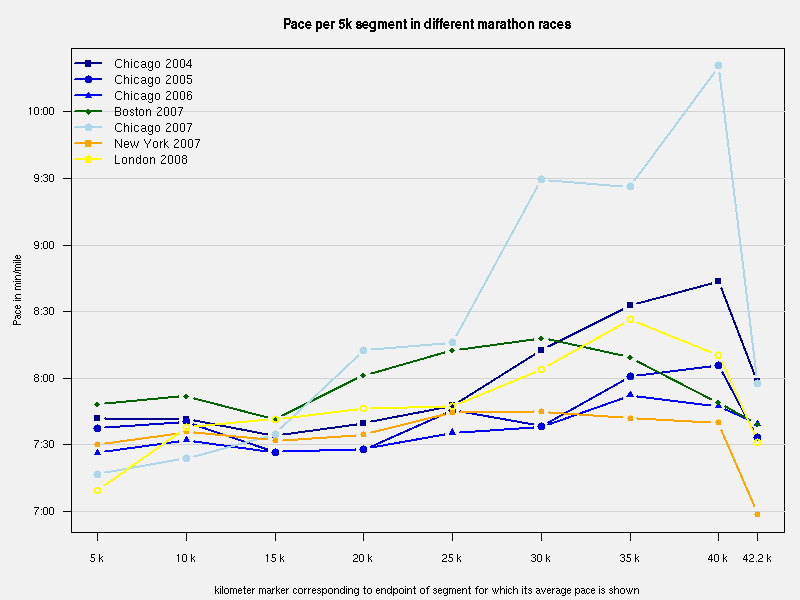
Dirk Eddelbuettel: Updated marathon pace geekery

A few months ago, I had shown a chart with per-5k-segment paces of my prior marathons runs (or at least those for which organisers had 5k splits). Since then, I ran two more: New York in November and London last Sunday. I have updated the charts to show both of these: (updated pace comparison chart) A few things stand out: In case anybody is interested (C'est bien toi, Christian, non?), the R script is available and I will be taking questions by email as R may not be obvious at first if you haven't used it.

Adrian von Bidder: State of the Nation, sort of thingy

Readin Sam's announcement, I thought “finally!”. I am now, however, deeply disturbed by Joerg's reaction to his delegation. This way, I have a very strange impression on what's happening. Didn't Joerg know that Sam was going to delegate him? Of course, this is not legally relevant, but I do not feel that this is how it should happen. (Mark the difference: this is not about somebody being forced into a team that doesn't necessarily welcome the new member, but about the proposed new member being forced into a decision in this way.) On balance: please do it. The situation reminds me of the Debian kernel team when it changed from Herbert Xu to group maintainership, which now works quite nicely afaict. But obviously, there is no guarantee that things will work out nicely, and there might be serious friction as well. OTOH the new DPL publicly stating that he supports this decision should be a Good Thing™

Gunnar Wolf: Dear lazyweb: Large volumes strategy?

Wouter, you seem to enjoy using huge filesystem volumes. So, dear lazyweb...
I have a 500GB disk for my users' home partitions - they mainly use it to back up their desktop data, but I do expect them to give it more usage. Anyway - I am currently using around 350GB of it, leaving the rest still unpartitioned. I have switched over to ReiserFS, as online resizing it is way faster than online resizing ext3 - it's basically instantaneous.
It seems I do belong to the old sysadmin school, and I value highly the reliability that comes from not having filesystems too large for their own good - After all, recovering from failure in 10GB is way more probable than doing the same in 100 or 1000, isn't it? But then again, it's just impractical to create /home/samba/ 1,2,3,4,5,6,7,8,9 / and randomly split users' directories inside them. Most users won't use more than a couple MB, but some users (legitimately!) back up tens of GB... It's hard for me to anticipate their needs.
Does any of you have scary stories regarding huge volumes? Or any data supporting the idea that I'm just too old fashioned and that half a TB is a good partition size?
Note that I _am_ holding full backups :)
[update]: So I'm undoubtley an old fart? Everybody seems to have partitions larger than me. Ok, I will stop crying...

16 April 2008

Simon McVittie: Implementing D-Bus services with telepathy-glib

16:46 < epmf> tp-glib is made of magic

—#telepathy, 2008-04-15

Rob pointed out today that I'd been promising to blog about telepathy-glib for several months and still haven't done so. I think there's too much to cover in one blog post, so I'll start with the oldest part - implementing a service (typically a Telepathy connection manager).

While telepathy-glib is (obviously) intended for Telepathy implementors, I think the ideas we've been implementing are likely to be useful for any D-Bus API, particularly flexible/complex APIs where an object implements many interfaces.

Introduction to telepathy-glib telepathy-glib started out as a collection of code extracted from our XMPP connection manager, telepathy-gabble, but at some point it grew beyond that into a wrapper around/partial replacement for dbus-glib. We've been quite pleased with it, really :-) My first major round of work on telepathy-glib, during the first half of 2007, was to split it out from telepathy-gabble (versions up to 0.5.9 were released as part of Gabble 0.5.x tarballs, in fact), leading to the release of the 0.6.x stable branch in late September. This was very helpful for implementing connection managers - Salut, Idle and telepathy-sofiasip (our connection managers for link-local XMPP, IRC and SIP) all started off by forking/cargo-culting from Gabble, and achieved huge code reductions by porting to telepathy-glib. Also, Will Thompson used it in his Summer of Code project, telepathy-haze, to go from nothing to a working and useful Telepathy implementation based on libpurple in a matter of a few months. The second major round of work, which I'll discuss in a later article, added client code to telepathy-glib, obsoleting the older/worse libtelepathy and allowing client programs like Empathy and telepathy-stream-engine to be written using telepathy-glib. In the process, I accidentally reinvented DBusGProxy :-) More details to come later!
Some background: service-side code generation
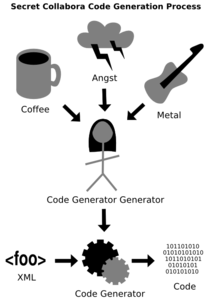
The secret Collabora code-generation process

(credit: daf)

Supporting D-Bus in the GObject world has always involved quite a lot of code generation. The core API of dbus-glib is heavily reliant on varargs functions, which aren't type-safe and are easy to get wrong. dbus-glib contains a program called dbus-binding-tool, which is meant to generate reasonably sane GObject APIs for D-Bus objects. Unfortunately, it seems to be intended to generate a whole GObject at a time. Early versions of telepathy-gabble used dbus-binding-tool plus a script called gengobject.py to generate API stubs for the exported objects; developers then filled in the blanks, and hey presto, we had a GObject on D-Bus. This was fine up to a point, but had a couple of major drawbacks. Whenever we changed the D-Bus API (quite common during the early development of Telepathy), there was a very laborious and error-prone merging process. We ended up with the following process:
  • copy the D-Bus introspection XML from the telepathy-spec repository into a directory xml/pristine (actually, the canonical form for the spec was Python for a while, and we had a script that exported a contrived object onto D-Bus and introspected itself to get the XML - but that's another story!)
  • preprocess the introspection XML to add the dbus-glib CFunctionName annotation, resulting in a directory xml/modified
  • run dbus-binding-tool and a Python script gengobject.py to generate C source in xml/src
  • three-way-diff the old version of xml/src, the new version of xml/src, and the real C code in src to create a new version of src
  • pray that the diff process hadn't randomly exchanged functions' implementations
  • update the resulting code in src so it worked
  • check the whole mess back into darcs
  • hope that nobody else had made changes that would result in darcs conflicts
If you haven't yet gathered, this was a bit of a nightmare. Also, it was very easy to return the wrong thing from a method without noticing - because all the APIs were varargs, the compiler didn't notice, and the first we'd know about it was a mysterious segfault under certain circumstances.
How telepathy-glib fixes code generation telepathy-glib improves on this by taking advantage of this innocuous-looking feature in dbus-glib:
commit 355ef78d98d6fc65715845d56232199162cab12a
Author: Steve Frécinaux <steve istique net>
Date:   Thu Aug 17 11:48:20 2006 +0200
    Interface support for bindings.
Instead of running dbus-binding-tool or creating GObjects with D-Bus interfaces, we put the entire Telepathy spec through glib-ginterface-gen.py, a distant descendant of Gabble's gengobject.py. For each interface in the spec, we generate a GInterface that mirrors the D-Bus interface. Any GObject that implements the GInterface automatically gets the D-Bus interface if it's exported onto D-Bus. There are a few non-obvious refinements, though:
  • The signature of the method implementation is always in the mode that dbus-glib calls "asynchronous", where the method implementation can either send a reply message before or after it returns. For "slow" methods, this is the only thing you can do. For instance, many Telepathy D-Bus methods can't return anything until some TCP round-trips to the server have happened. This is also the only thing you can do if you want to extract extra information, like the sender's unique name, from the method-call message (dbus-glib's "synchronous" API doesn't allow this to be done). For "fast" methods, sending a reply message before returning is just as easy as using the "synchronous" API (it's just a difference of syntax), and has an API consistent with that of the "slow" methods, making it easier for service authors.

  • The layout of the GInterface vtable is private, and (auto-generated) accessor functions are used to fill in implementations. This means our ABI doesn't change just because we re-ordered functions in the spec.

  • If no implementation is provided for a method, we just raise an appropriate error (org.freedesktop.Telepathy.Errors.NotImplemented), rather than suffering an assertion failure. This means we can safely add methods to an interface.

  • While we're generating code anyway, we generate some static inline wrapper functions which wrap dbus_g_method_return(), to have type-safe method returns. You can easily check that a method replies with correct types, by checking that the implementation of Foo() replies by calling tp_svc_some_interface_return_from_foo().

  • Similarly, we generate wrapper functions to emit signals, to get type-safe signal emission.

Not all interfaces are stable enough to be included in telepathy-glib's stable API and ABI, so some of our other projects include a copy of the telepathy-glib code-generation tools, and generate their own "mini-telepathy-glib" (traditionally in a /extensions/ directory) for their implementation-specific (drafts of) interfaces. This isn't yet as polished as it ought to be (mainly because we don't want to freeze the augmented-introspection-XML format that we write the Telepathy spec in, because it's rather ad-hoc and hackish in places) but it works quite well in practice. To see what this looks like in practice, have a look at the examples in telepathy-glib, or at a Telepathy connection manager like telepathy-gabble.
Mixins and base classes Another feature of telepathy-glib which makes life easier for connection manager authors is that it provides "mixins" and base classes which implement some of the GInterfaces. There's absolutely nothing magic about the base classes - they don't have any access to private implementation details of the GInterfaces, they just implement them like everyone else does. The "mixins" are only slightly more magical - they store some extra state inside the structures representing GObjects and their classes, and use it to provide default implementations of some or all of the methods on a particular interface (or two interfaces, in the case of the new TpMessageMixin). I'll leave it up to Rob to explain those in greater detail, since I seem to remember that he invented them :-P The examples and regression tests in telepathy-glib are quite good examples of how these work in practice.

15 April 2008

Neil Williams: PS - on keeping interested during the wait

Something I want to add to a post by Slyvian LeGall - motivation does not have to disappear during the wait.

I was lucky, my advocate is project-lead for a Debian sub-project (Emdebian in this case) and I was able to contribute to Emdebian before my DD status was completed. This included uploads to Emdebian that Debian people could use. It included policy decisions, infrastructure development and programming of bespoke utilities.
i.e. my interest was maintained because I had an outlet and an encouraging, supportive, advocate.
When a DD advocates a particular person in NM, there should be some common ground, some experience of working with that person and it should be possible to find a way to maintain a working relationship within that environment.
My experience of the end of NM was one of increasing responsibility, increasing activity, increasing motivation and constant affirmation and assistance from my advocate and others in the sub-project.
So a big thank you to Wookey and debian-embedded in general. It bodes well for the other prospective DD's currently being mentored and encouraged through NM within Emdebian itself.
(Mind you, my NM timescale shows that I didn't wait anywhere near as long as the current delays.)
I fully appreciate that the horrendous delays currently being inflicted on people in NM and upon Debian in general are abominable. If there are ways that existing teams in Debian can adopt and encourage these prospective developers, it can only help in keeping these people interested. It may be a more productive way of helping with the NM problems than just carping on a blog.

Amaya Rodrigo: The absurd farce

It happens that when I get burnt out by Debian (I might blog about that later, but then I just might not) I am forced to face the real world just to learn that Debian was not so bad to begin with. Oh, the irony! I need to smoke more so that I spend less time involved in this crap nobody can change. It is hard enough to change Debian, I don't even want to think about the rest.

If you want to understand the world crisis you are living in...

Lucas Nussbaum: 4 months and 10 days without any new Debian developer. Is Debian dying?

It has now been more than 4 months since the last Debian developer account was created. 18 contributors have been through all steps, and are simply waiting for this simple administrative task to be done. We are sending a terrible message to potential contributors. We have strong requirements on the technical level of our developers. During the new maintainer process, we ask them to answer about 80 questions about Debian. We ask them to do grunt work. We review their reports twice (New Maintainers’ Front Desk, then Debian Account Manager). But even after we are totally satisfied about what they did, even after they became more qualified than many of our current DDs, we ask them to wait for months, so that the only person allowed to create accounts can finally do his “job”. It discourages the contributors currently in the NM process. I’ve seen several signs of frustration, or even depression. Some of them reduce their involvement in Debian, so we lose them before they even became Debian developers. Some of them consider resigning from the NM process. We should all feel guilty about that. But it also discourages people from joining Debian. Instead, they go to other more welcoming projects, which is totally understandable. Debian isn’t the only distribution with developers from the community those days. There’s Gentoo, Ubuntu, Fedora, openSUSE. Some of those have nice programs for new contributors, like “school” sessions. Sure, Debian is the “biggest” distribution without a company behind it. But is independance worth all the trouble? Of course, we have Debian Maintainers. DM is great for people who want to work on their packages. But, when we are trying to release lenny, we need more: people who are going to go through RC bugs, submitting patches. Who are going to do QA work. In short: people who care more about the whole distribution. Can we afford not recruiting anybody? Can we run Debian with the current manpower? I don’t think so. There are more than 550 RC bugs in lenny, many packages are currently blocked from migrating to lenny because they are RC-buggy, and many packages are orphaned or neglected. There are also a lot of bugs which haven’t been filed yet (I asked for help with running piuparts, which would probably result in 100-200 new RC bugs, but nobody had time to help). Most of the work that needs to be done is not rocket science. We could use a lot more manpower. Currently, the same small set of developers is doing most of the grunt work. They will get tired too. So, what can we do, as simple developers? There’s no magic solution, but we can try a few things.
  1. It seems that some people disagree that there’s a problem. Let’s prove them wrong: we could start a blog meme with “I, too, agree that the Debian accounts and keyring situation is severely hurting Debian, and that a solution needs to be found RSN.” It’s not going to solve the problem by itself, but it will at least show that we consider it very important. Pressure could help.
  2. We could start discussing solutions together. Our newly elected DPL said that he would talk with the problematic teams to determine how the situation could be improved. Unfortunately, this has been tried in the past (and failed). It might work this time, of course, but we could prepare a backup plan. So let’s find one or two good plans, and vote on them. (I liked the idea of giving accounts creation/management to DSA. After all, it’s only an sysadmin task once the report has been approved by FD and DAM.)
  3. We could push forward Josip Rodin’s proposal about infrastructure teams. It might not solve the DAM problem immediately, but would probably help avoid similar problems in the future.
Notes:
1. Maybe the 18 waiting accounts will be created today or tomorrow. Even if that happens, it won’t solve anything. Waiting 4 months for a simple administrative task is not acceptable, and we need to fix that problem anyway.
2. Account creation is not the only problem. Some people have been unable to upload packages or to vote for the DPL election, because their PGP key expired, and nobody updated it even if they have been asking for more than 4 months.

Adrian von Bidder: Long Live the King

No, the king id not dead. Still, congrats to Steve. And yes, I was wrong in that I expected more people to vote 111- or equivalent (perhaps those people didn't vote at all instead?) About voter turnout: In Switzerland, everybody is really, really happy when 49% of the population does vote. Usually, we have participation between 30 and 40%, sometimes even lower, IIRC in one case it was as low as 26% all issues were so non-controversial (usually, it's referendums (referenda? referendi? referendumthingies) on factual issues and no elections, though, so the comparison might not be entirely fair.)

14 April 2008

Russell Coker: Fried Food

I’ve just been reading about oil deterioration when deep frying [1]. Apparently frying food can cause the production of Acrylamide [2] which causes cancer, is a neurotoxin, and does other bad things to your body. Deep frying in a vacuum [3] is a solution to this problem as the lower temperatures reduce the formation of the bad chemicals (and also increase the life of the oil thus making for cheaper fried products). Of course this means that deep frying in a pressure cooker as KFC does probably gives a result that is a lot worse for your health [4]. For some time I’ve been avoiding KFC due to concerns about the treatment of the chickens. I have been regularly eating fried chicken from a local store which looks and tastes very similar to KFC so presumably is cooked in the same way. I guess I’ll have to stop eating that now. I wonder if toast is also bad in this regard. I expect that sausages would be a problem when cooked on a BBQ. In other health news I’ve been reducing my meat consumption and I’m considering trying to entirely avoid farm raised animals to restrict my meat consumption to game meat, this should be good for my health and is also a lot better for the animals and the environment.

12 April 2008

Steve Kemp: Adopt a less marital tone.

If you upload a new package to the Debian archive which contains a setuid or setgid binary please please ask for a security audit, or carry out one yourself. I certainly accept that the security audit project webpages are not terribly current, and the mailing list is essentially dead, but there are people, such as myself, who would gladly look at your package. All you have to do is ask. When I see two packages in testing with trivialy obvious security bugs it just makes me wonder why we bother. I'm going to take this chance to restate my hardline position on package maintainence - even though it might not be directly applicable - If you cannot program/debug/handle the language a package is developed in you shouldn't maintain it. Too often I've seen signs of this; somebody maintaining a C-based program but unable to program in C. Why? I wonder if we could have a policy / guideline that any new setuid/setgid application must have at least two maintainers, or a documented audit prior to acceptance? Hard to manage but I think it would be useful even if it didn't catch everything. Some bugs such as #475747 (lovely number!) are trivial to discover. ObQuote: Dangerous Liaisons

Mike Hommey: xulrunner++, webkit++

I uploaded xulrunner 1.9~b5-1 yesterday, and today was webkit’s turn, with an upload of svn revision 31841, which happens to be the last revision on trunk as of writing. Thanks to Mark Rowe, the most problematic crashers I experienced with webkit while preparing this upload have been fixed in revisions 31821 and 31787. This had the side effect to delay the upload enough that we now have the benefit of improved SVG animations support, and CSS gradients. For those who like numbers, you can take a look at the Sunspider results for xulrunner 1.9~b5 (running mybrowser ; very similar results to what I got with 1.9~b4), and Sunspider results for webkit r31842 (when you compare to previous results for webkit r27674, there are significant improvements). For another kind of numbers:
~/git/xulrunner$ git diff upstream/1.9... filterdiff -x b/debian/* -x a/configure diffstat tail -1
36 files changed, 507 insertions(+), 291 deletions(-)
Compared to:
~/git/xulrunner$ git diff upstream/1.9...1.9+b4-1 filterdiff -x b/debian/"*" -x a/configure diffstat tail -1
53 files changed, 932 insertions(+), 466 deletions(-)
~/git/webkit$ git diff upstream... filterdiff -x b/debian/* diffstat tail -1
1 file changed, 4 deletions(-)
Compared to:
~/git/webkit$ git diff upstream...0+svn27674-4 filterdiff -x b/debian/* diffstat tail -1
17 files changed, 61 insertions(+), 18 deletions(-)
Somehow, I prefer to work on webkit…

Evan Prodromou: 23 Germinal CCXVI

Jeez, I wasn't involved in the nomination process this year, so I completely missed the fact that Wikitravel is a nominee for the Webby Awards this year. I'm now a part of IADAS so there's a conflict-of-interest for me, but I'd recommend checking out the People's Voice Webby Voting. tags:

Sign your mail I find it a little mind-boggling how many people complain about problems of email identity, like spam, e-mail spoofing and phishing, yet don't do anything on their own side to encourage strong identity on email. Everybody should use digital signatures on their email as a matter of course. It is absurdly easy to set up a GnuPG key for your email address. It takes only a few minutes. And you can sign up for an S/MIME key, too -- about $20/year, and supported even more widely by email clients. And organizations should send out email with signatures, too. Welcome email, password updates, and the like should all be signed. Phishing gets a lot harder when consumers are used to digitally-signed mail. If we're really serious about email abuse, we need to take the extra step at the client level. tags:

9 April 2008

Adeodato Sim : giggle, a gitk in GTK+

By pure chance I read somebody mentioning giggle in #git. It’s a visualizer for git branches written in C using GTK+. I find the output a bit nicer than that of gitk, at least on some repos. As Mike Hommey points out, though, it’s quite slow on medium and big repositories. P.S.: It’s packaged for Debian.

7 April 2008

Miriam Ruiz: Dunning-Kruger effect

People who have little knowledge tend to think that they know more than they do, while others who have much more knowledge tend to think that they know less. That’s what Justin Kruger and David Dunning (both of Cornell University) demonstrated in a series of experiments they carried out. Incompetent individuals tend to overestimate their own level of skill, fail to recognize genuine skill in others and fail to recognize the extremity of their inadequacy. If they can be trained to substantially improve their own skill level, these individuals can recognize and acknowledge their own previous lack of skill. In one of their investigations, they discovered that 98% of university professors believed they were above the average, while that is obviously impossible statistically. Bright students, far above the others, considered themselves below their real skills, standard students saw themselves as above the average, while real bad ones were fully convinced of being among the best. In fact, the worse the person was, the most their conviction was that they were right. Even more, the most incompetent ones were incapable of realising the superiority of others, and they tended to think that the answers of the tests were the wrong ones, and not themselves. “Ignorance more frequently begets confidence than does knowledge”, quoting Charles Darwin. Most of the people react to this study with a smile, thinking about the incompetent people they know and how well this study describes them. It should be noted that everyone is incompetent about many things, and this effect affects all of us. How can a person realize that they’re wrong? The lesson that comes out of the study is that it’s really hard to find out, according to Dunning. His recommendation is not to trust just one’s own thoughts, but to ask for other’s opinions, especially before taking important decisions. Nobody should ever stop trying to improve and to learn, because it’s really difficult to know when to do it.

Next.

Previous.