Search Results: "agi"

22 October 2010

Sandro Tosi: Scribe (& thrift) for Debian Squeeze

Some time ago, I asked what are the common solutions for services remote logging. It was suggested scribe, an application log server developed at Facebook and later released as an open source project, and we finally managed to get this ready for Debian squeeze.

Scribe requires a couple of other tools to work: thrift, a framework for services development (born at Facebook too), and thrift-fb303, a piece of thrift used as a bassline layer for Facebook services.

Searching the web for some work-in-progress of a Debian packaging, I found the wonderful work done by SimpleGeo; since I have some changes to do (and also take the occasion to play a bit with github), I forked their repos in these ones: scribe, thrift and thrift-fb303.

I've prepared a repository with those 3 packages, if you would like to try scribe, give it a look. They are for squeeze because, well, after all I need it for work and since it requires Python 2.6, using squeeze was the easiest choice (backporting 2.6 to lenny could be a mess, even if there are packages out there) and so I could also see how the upgrade from lenny would be.

Let's now dive into the doc, and some examples too, to find out the several configuration options and decide what's best for us.

21 October 2010

Raphaël Hertzog: The secret plan behind the 3.0 (quilt) Debian source package format

New source package formats do wondersWhile I have spent countless hours working on the new source format known as 3.0 (quilt) , I ve just realized that I have never blogged about its features and the reasons that lead me to work on it. Let s fix this. The good old 1.0 format Up to 2008, dpkg-source was only able to cope with a single source format (now named 1.0 ). That format was used since the inception of the project. While it worked fine for most cases, it suffered from a number of limitations mainly because it stored the Debian packaging files as a patch to apply on top of the upstream source tarball. This patch can have two functions: creating the required files in the debian sub-directory and applying changes to the upstream sources. Over time, if the maintainer made several modifications to the upstream source code, they would end up entangled (and undocumented) in this single patch. In order to solve this problem, patch systems were created (dpatch, quilt, simple-patchsys, dbs, ) and many maintainers started using them. Each implementation is slightly different but the basic principle is always the same: store the upstream changes as multiple patches in the debian/patches/ directory and apply them at build-time (and remove them during cleanup). Design goals for the new formats When I started working on the new source package format, I set out to get rid of all the known limitations and to integrate a patch system in dpkg-source. I wanted to clear up the situation so that learning packaging only requires to learn one patch system and would not require modifying debian/rules to use it. I picked quilt because it was popular, came with a large set of features, and was not suffering from NIH syndrome. This lead to the 3.0 (quilt) source format. I also created 3.0 (native) as a distinct format. 1.0 was able to generate two types of source packages (native and non-native) but I did not want to continue with this mistake of mixing both in a single format. The KISS principle dictated that the user should pick the format of his choice, put it in debian/source/format and be done with it. Now the build can rightfully fail when the requirements are not met instead of doing something unexpected as a fallback. Features of 3.0 (quilt) This is the format that replaces the non-native variant of the 1.0 source format. The features below are specific to the new format and differentiate it from its ancestor: Features of 3.0 (native) This format is very similar to the native variant of the 1.0 source format except for two things: Timeline Looking back at the history is interesting. This project already spans multiple years and is not really over until a majority of packages have switched to the new formats. As you can see this project is not over yet, although the most difficult part is already behind me. For my part, the biggest lesson is that you won t ever get enough review until your work is used within unstable. So if you have a Debian project that impacts a lot of people, make sure to organize an official review process from the start. And specifying your project through a Debian Enhancement Proposal is probably the best way to achieve this. If you appreciate the work that I put into this project, feel free to join Flattr and to flattr dpkg from time to time. Or check out my page Support my work .

Flattr this Share/Bookmark 12 comments Support my work

Ian Wienand: Logging POST requests with Apache

After getting a flood of spam, I became suspicious that there was an exploit in my blog software allowing easy robo-posts. Despite a code audit I couldn't see anything, and thus wanted to log the incoming POST requests before any local processing at all. It took me a while to figure out how to do this, hopefully this helps someone else. Firstly install libapache-mod-security, then the magic incarnation is
SecRuleEngine On
SecAuditEngine on
SecAuditLog /var/log/apache2/website-audit.log
SecRequestBodyAccess on
SecAuditLogParts ABIFHZ
SecDefaultAction "nolog,noauditlog,allow,phase:2"
SecRule REQUEST_METHOD "^POST$" "chain,allow,phase:2"
SecRule REQUEST_URI ".*" "auditlog"
So, to break it down a little, the default action says to do nothing during phase 2 (when the body is available for inspection); the allow means that we're indicating that nothing further will happen in any of the remaining phases, so the module can shortcut through them. The two SecRules work together -- the first says that any POST requests should be tested by the next rule (i.e. the chained rule), which in this case says that any request should be sent to the audit log. After that, the similar allow/phase argument again says that nothing further is going to happen in any of the subsequent phases mod_security can work on. As per the parts between A and Z, we'll log the headers, the request body, the final response and trailer. So, as it turns out, there is no exploit; it seems most likely there is an actual human behind the spam that gets through, because every time they take a guess it is correct. So I guess I'll take a glass-half-full kind of approach and rather than being annoyed at removing the spam, I'll just convince myself that I made a small donation from some spam overlord to one of their poor minions!

Axel Beckert: New upstream versions of xrootconsole and keynav in Debian Experimental

I recently uploaded new upstream versions of two neat small X tools to Debian Experimental: Both packages introduce several new features and I d be happy if users of these packages in Debian Sid or Debian Sid users curious about them could test the versions in Debian Experimental. xrootconsole 0.6 + patches xrootconsole saw no love since 2006 with the last maintainer upload having been in 2002. Nevertheless it never got kicked out of Debian just because of this. The package had been forcibly orphaned just less than a year ago. So it s no big wonder that this new upstream version I packaged was released already back in 2004. :-) But besides packaging a new upstream version, bumping Standards-Version and debhelper compatibility, fixing tons of lintian warnings and some bugs, I also added two patches which add new features not (yet) available upstream: Of course I informed upstream about these feature patches, but I haven t got any feedback yet. But I got feedback from Julien Viard de Galbert, and he ll join me in packaging xrootconsole as co-maintainer. keynav 0.20101014.3067 I adopted the Debian package of keynav recently, subscribed to the keynav mailing list (well, it s a Google group), got a nice welcome mail from the very friendly upstream developer Jordan Sissel who offered to help with any keynav issues. I told him what features I d like to see in keynav to fit better the setup where I m using it. And just a few days later there was a new upstream release including both features I suggested, some more neat new features, and one bug fix. Jordan Sissel writes in the upstream changelog (emphasis and italic text by me): Both packages will be reuploaded to Debian Sid (Unstable) after the release of Debian Squeeze (currently testing ).

20 October 2010

Daniel Kahn Gillmor: Debian NYC Workshop: What's in a Package?

Debian NYC will be holding a workshop next week: What's in a Package? will happen at 7:00pm New York time on October 27, 2010. If you're in the New York area, interested in packaging things for debian and related systems, or just want to understand the packages in your system better, you should RSVP and come on out! This workshop will provide advanced theory useful for people modifying or creating packages. For people modifying packages, you'll learn many typical motifs and about various build systems. For creating packages, you'll be much better prepared to read and understand guides a deep level. However, this is still not a step-by-step guide in "how to build packages", but will get you very close to there. See you there!

19 October 2010

Mike Hommey: Huge rotational disk(s) + dpkg = disaster

Since a few versions now, dpkg has been made safer in that it makes sure everything is written to disk after unpacking a package. It does so with sync(), which means all kernel buffer caches are being flushed. Between every package install. All kernel buffer caches. Imagine what it does when you have two 2TB hard drives (though they are far from being full). Update: The use of btrfs might not be helping either. I have 2 concurrent pbuilder instances that have been installing iceweasel build dependencies for more than 40 minutes, and still not finished yet. I don t expect the builds themselves, including test suites, to take more than 20 minutes on that machine I should really start using eatmydata Update: with eatmydata, the package installation is almost instantaneous Update 2: It might just be btrfs. And the best part yet is that since sync() is global, even when running pbuilder over, say, tmpfs, it doesn t change a damn thing.

18 October 2010

Raphaël Hertzog: Understanding Debian s release process

Currently, the main product of the Debian project is its stable release[1]. Those release come out approximately every 18-24 months. This article gives a short overview of the process leading to the next stable release. Creating a new distribution Immediately after a stable release, a new distribution is created in the Debian archive. Its initial content is a copy of the (just released) stable distribution. Its codename is decided by the release managers and there s a tradition of picking a character s name from the Toy Story movie. As an example, the wheezy distribution will be created once squeeze (aka Debian 6.0) is out. For simplicity there s a generic name to refer to the distribution used to prepare the next stable release: it s testing. In the Debian archive, testing is just a symbolic link pointing to the right directory (squeeze currently). Updating packages, working on release goals During most of the cycle, developers work on packaging new upstream versions and implementing release goals. They upload their packages in the unstable distribution. From there packages trickle to the testing distribution once they satisfy some quality checks: they must not have new release-critical bugs, they must have been built on all architectures that were previously supported, they must not break any dependency in testing, and they must have spent at least 10 days in unstable. This minimal period ensures the package has been tested and gives enough time to users to file bugs if the package is suffering from problems. If the problems are deemed release-critical, they will block the migration of the package to testing. During this part of the release cycle, the main work of the release team is ensuring that updated packages flow from unstable to testing. It can be a tricky task: package dependencies frequently tie packages together so that they can only migrate to testing together. If only one of the tied packages is not ready (for example if a new revision has been uploaded and has not spent 10 days in unstable yet), then none of them can migrate. Stabilizing, polishing, fixing release-critical issues The constant churn of new packages makes it very difficult to build a very polished release. That s why, at some point, release managers freeze the testing distribution: automatic updates are stopped and they vet every single update made to testing. They have strong requirements, the goal is to only allow updates fixing release critical bugs, or those which are low-risk and bring significant value to the user experience (like new translations, updated documentation, etc.). During freeze, some packages are also removed because the current upstream version can t be supported for the lifetime of the stable release. The freeze tends to slow down the pace of changes in unstable. Many maintainers opt to push new upstream versions in experimental instead so that if they need to update their packages in testing, they can still do it through unstable. This procedure is recommended by the release managers because it means that updates that they unblock have been tested as usual. It s not the case for updates uploaded directly to testing (through testing-proposed-updates). This behavior is rather annoying for the bleeding-edge users that use testing or unstable like a rolling release. Release time Once release managers are satisfied of the quality of the new distribution, some last minute work is needed, like generating the CD images. In the Debian archive, the release is made official by pointing the stable symbolic link to the new distribution (and the oldstable one to the previous distribution). Now it s party time, the cycle is over, and a new one can start. :-) [1] The Constantly Usable Testing project aims to make testing a first-class product like stable but with a very different update policy.
Follow me on Identi.ca, Twitter and Facebook.

Flattr this Share/Bookmark 3 comments Support my work

Benjamin Mako Hill: Redefining "Realistic"

When talking about free culture or free software, many people suggest that they would love to support free models, but that they don't see how to make it all work. Until they have an alternate model in front of them, they cannot bring themselves to argue for a more ethical alternative. I disagree with this approach. Instead, I say, "this is the world I want to live in and, even though I don't know exactly how to get to there from here, I'm going to refuse to settle for anything short of this ideal." Most people dismiss such thinking as "impractical" and "unrealistic." I think most people are being unimaginative. Robot jockeys are one recent illustrative reason, among many, that I feel comfortable taking this position. Some background is necessary for those that are unfamiliar with the example. A decade ago, several Gulf emirates used thousands of young boys from Sudan and South Asia as jockeys for camel racing. Human rights groups campaigned against the practice and suggested that these boys were at sometimes held as slaves and intentionally underfed to keep their weight low. Despite criticism, camel racers resisted moving away from young boys as jockeys. If they moved to heavier adults instead of young boys, they reasoned, the camels would be much slower. Of course, they were right. But they were being unimaginative in the alternatives they were considering. As the young jockeys became a increasingly unjustifiable public relations disaster for the states that supported it, law-makers in several Gulf states gave in to calls from UNICEF and others and created laws to outlaw the practice. Within three years of UAE passing strict laws against child jockeys, Swiss engineers, funded by racers desperate for an alternative, had created the first robotic camel jockey. Within several years these jockeys were lighter, cheaper, more responsive to the owner, and well on their way to being more effective than any young boy. When forced, by law and by an ethical prerogative, to come up with an alternative to young boys, racers created a solution that was superior, along nearly every axis, to the system they had fought to keep. Although the costs to society of proprietary software cannot be compared to slavery and abuse, the basic same pattern of solution-seeking can be seen in the example of free software. Early free software advocates suggested that most programmers would likely need to take a paycut. As it turned out, vibrant and successful economic models to support free software have supported a large and growing free software industry. But we have free software business models only because a small group of principled individuals refused to settle for what they knew, came up with creative ethical business models that "just might work," and put their own paychecks on the line to try them out. As open source has shown, some of these creative solutions offered models superior to what we had before. In the world of software development, free software redefined "practical" and "realistic." One can think of solving human problems as like searching for the highest point in hilly terrain in thick fog. It's easy to get stuck on the top of the first little hill you walk up (i.e., a local maximum) and then conclude you can never do better. If we refuse to compromise and force ourselves to leave that first little hill, chances are pretty good we'll find a "higher" peak. Of course, it is also possible that we will find the global maximum or the best possible solution to a given problem. In those cases, any change will mean a sacrifice. But when dealing with most most social and legal dilemmas, there are enough variables involved that this seems very unlikely. Indeed, most big problems can be thought of as having many interacting dimensions -- and only some of these will be ethical concerns. In other words, most social problems are more like the problem of child camel jockeys than they are like trying to transcend the laws of physics. Business models and laws for the regulation of technology and knowledge are extremely complicated human creations. Do we really think we cannot create ethical systems to compensate cultural creators that are at least as good as what we have now? If we never force ourselves to be "impractical" and "unrealistic", we will never find out.

16 October 2010

Siegfried Gevatter: Debious A dubious Debian packaging GUI

Just some little (unfinished) concept mockup. Seeing that much of it still ends up as a text box with syntax highlighting it d probably make sense to implement it as a gedit plugin.

Balsamiq source XML Related posts:

  1. One week with Debian
  2. Packaging: Test-building your packages
  3. Arreglant paquets que no compilen: necpp

8 comments
Siegfried-Angel Gevatter Pujals, 2010. Permalink License Post tags: , ,

Vincent Sanders: Coming to terms

Yesterday was not a great day. One of the family's cats died.
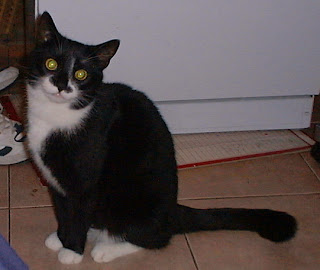
Molly just after she arrived 26th September 2000
Molly, for that was her name, came to us the week Melodie and I moved into our first house together. September 15th 2000, in the middle of the fuel protests which were raging at the time, we hired a van and moved in.

Most people would have considered that enough for one week! We happened to be in Halifax on the Sunday afternoon at the supermarket and decided to visit the RSPCA because somehow we decided what our new home needed was a cat.

On that day a decade ago we saw Molly and Lucy, a pair of cats who needed a new home as their previous owners had a baby who was allergic to them. I still recall them skulking at the back of their cage in the cattery, Lucy who was reluctant to come down of a perch to be petted and Molly looking generally unhappy. No-one else wanted this misfit pair because they were already both over 5 years old, the warden despairing of ever finding them a home.

Of course they were obviously the right animals for us! ;-) So by the end of the week we had taken them home. Molly immediately showed how things were going to be by shredding her way out of the RSPCA provided double walled cardboard carrier. To the day she died she detested being placed inside a carrier, funny that.
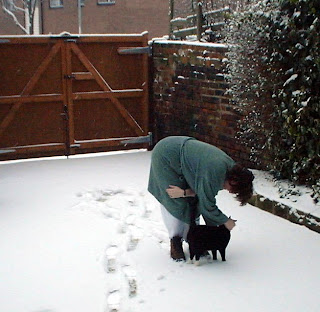
Melodie and Molly in the snow 28th December 2000
By the end of the year, when the snow came, the cats ruled the house and we were all happy together.

Little did we realise that soon in the summer of 2001 there would be another arrival to the family.
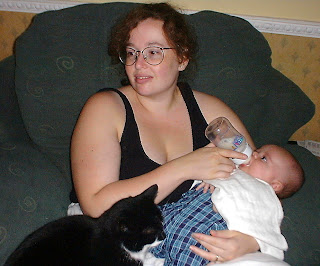
Molly with Melodie and Alex 2001
The arrival of our first child in June 2001 was a complete change in all our lives but we all managed to settle back into a routine. Although the banishment of the cats from upstairs remained a point of disagreement for a long time.

As Alex grew up the cats learned that feeding times for Alex could result in all manner of things falling from above. Soon Alex was mobile which resulted in different lessons on cats being sharp objects if not treated with respect. In February 2003 our family grew once more with the arrival of Joshua. The cats, now used to infants, took this in their stride.

Molly in Febuary 2004 hiding on a windowsill
While still about day to day the cats are not captured on camera so often form this point on.

Over the forthcoming months they ensured they were out of reach of the newborn and the precocious toddler.

By the time of Joshuas first birthday in 2004 Molly had taken to hiding "out of the way" as much as possible but remained as affectionate as ever.

Molly in a box March 2007
As the children grew up and life progressed Molly became ever more at home and developed the odd aggravating trait like taking clean washing off airers and dragging it out the window, through the cat flap and upstairs so she could sleep on it!

She still enjoyed participating in claiming boxes and defending them vigorously though!

The kids took on the job of feeding the cats which made their bond closer ensuring they were greeted by happy cats sitting lookout as they came home from school each day.

Molly continued to be a good companion and an infuriating self centred animal like all good cats.
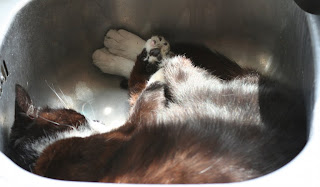
Molly asleep in the kitchen sink
Then on Tuesday evening our Neighbour knocked on our front door. They gave us the news that one of our cats had been run over and taken to the Vet. I immediately went to the back door and called and shook the treat box.

Lucy came running, but molly did not. We rang the vets who confirmed they had molly (we had them electronically tagged back in Halifax) and that they advised we did not come and see her until they had chance to asses her and deal with the shock.

As the days progressed her prognosis improved and then sank. She had a broken jaw, broken teeth, a dislocated hip, extensive bruising and something was definitely wrong with her kidney function.

Thursday evening the whole family went to see her and she purred and seemed happy to see us, she looked as bad as I feared though and somehow I knew there and then that this was probably goodbye. The children stroked her and petted her for a while and we left with an odd sadness, oh and to the sound of molly trying to gouge the veterinary nurse.

Yesterday she was due to have surgery to fix her jaw and hip...Alas when she was anaesthetised and x-rayed once more it became evident the hip was not just dislocated but her femur was fractured and there was additional damage. So just after midday came the call to ask what we wanted to do. The vet could attempt the repairs but due to her age and the other complications it was probably futile. So with heavy heart we agreed the best thing was not to revive her and she died a short time later.

I shall miss her morning greetings, her demands for attention, her sleeping in odd places and her companionship. I keep calling for her at meal times forgetting she will never come. I think Lucy is upset too, after spending their lives together her friend is gone and I cannot explain that to her.

So that is the end of Molly, a good cat.


14 October 2010

Raphaël Hertzog: Correctly renaming a conffile in Debian package maintainer scripts

After having dealt with the removal of obsolete conffiles, I ll now explain what you should do when a configuration file managed by dpkg must be renamed. The problem Let s suppose that version 1.2 of the software stopped providing /etc/foo.conf. Instead it provides /etc/bar.conf because the configuration file got renamed. If you do nothing special, the new conffile will be installed with the default configuration, and the old one will stay around. Any customization made by the administrator are lost in the process (in fact they are not lost, they are still in foo.conf but they are unused). Of course, you could do mv /etc/foo.conf /etc/bar.conf in the pre-installation script. But that s not satisfactory: it will generate a spurious conffile prompt that the end-user will not understand. The solution In the preinst script, you have to verify if the old conffile has been modified by the administrator. If yes, you want to keep the file around. Otherwise you know you will be able to ditch it once the upgrade is over, and you rename it to /etc/foo.conf.dpkg-remove to remember this fact. In the postinst script, you remove /etc/foo.conf.dpkg-remove. If the old conffile (/etc/foo.conf) still exists, it s because it was modified by the administrator. You make a backup of the new conffile in /etc/bar.conf.dpkg-dist and rename the old one into /etc/bar.conf. In the postrm, when called to abort an upgrade, you move /etc/foo.conf.dpkg-remove back to its original name. In practice, use dpkg-maintscript-helper dpkg-maintscript-helper can automate all those tasks. You just have to put the following snippet in the maintainer scripts (postinst, postrm, preinst):
if dpkg-maintscript-helper supports mv_conffile 2>/dev/null; then
    dpkg-maintscript-helper mv_conffile /etc/foo.conf /etc/bar.conf 1.1-3 -- "$@"
fi
In this example, I assumed that version 1.1-3 was the last version of the package that contained /etc/foo.conf (i.e. the last version released before 1.2-1 was packaged). You can avoid the preliminary test if you pre-depend on dpkg (>= 1.15.7.2) or if enough time has passed to assume that everybody has a newer version anyway. You can learn all the details in dpkg-maintscript-helper s manual page. Found it useful? Be sure to not miss other packaging tips (or lessons), click here to subscribe to my free newsletter and get new articles by email (just check Send me blog updates ).
Flattr this Share/Bookmark No comment Support my work

Russell Coker: Links October 2010

Bruce Schneier wrote an insightful post about why designing products for wiretapping is a bad idea [1]. It seems that large parts of the Internet will be easy to tap (for both governments and criminals) in the near future unless something is done. The bad results of criminal use will outweigh any benefits of government use. Sam Watkins wrote an informative post about Android security [2]. Among other things any application can read all stored data including all photos, that s got to be a problem for anyone who photographs themself naked Rebecca Saxe gave an interesting TED talk about how brains make moral judgements [3]. Somehow she managed to speak about the Theory of Mind without mentioning Autism once. The Guardian has an amusing article by Cory Doctorow about security policies in banks [4]. He advocates promoting statistical literacy (or at least not promoting a lack of it) as a sound government policy. He also suggests allowing regulators to fine banks that get it wrong. Steven Johnson gave an interesting TED talk about Where Good Ideas Come From [5]. It s a bit slow at the start but gets good at the end. Adam Grosser gave an interesting TED talk about a fridge that was designed for use in Africa [6]. The core of the Absorption Refrigerator is designed to be heated in a pot of water in a cooking fire and it can then keep food cool for 12 hours. It s a pity that they couldn t design it to work on solar power to avoid the fuel use for the cooking fire. Josh Silver gave an interesting TED talk about liquid filled spectacles [7]. The glasses are shipped with a syringe filled with liquid at each side that is used to inflate the lenses to the desired refractive index. The wearer can just adjust the syringes until they get to the right magnification, as there are separate syringes the glasses work well with people who s eyes aren t identical (which is most people). Once the syringes are at the right spots the user can tighten some screws to prevent further transfer of liquid and cut the syringes off to give glasses that aren t overly heavy but which can t be adjusted any more, I guess that a natural extension to this would be to allow the syringes to be re-attached so that the user could adjust them every year to match declining vision. One thing that this wouldn t do is counter for Astigmatism (where the lens of the eye doesn t focus light to a point), but I guess they could make lenses to deal with a few common varieties of Astigmatism so that most people who have that problem can get a reasonable approximation. The current best effort is to make the glasses cost $19, which is 19 days salary for some of the poorest people in the world. Glasses in Australia cost up to $650 for a pair (or a more common cost of $200 or about $100 after Medicare) which would be about one day s salary. Eben Bayer gave an inspiring TED talk about one of the ways that mushrooms can save the planet [8]. He has designed molds that can be filled with Pasteurised organic waste (seed husks etc) and then seeded with fungal spores. The fungus then grows mycelium (thin fungal root fibers) through the organic waste making it into a solid structure which fits the shape of the mold. This is currently being used to replace poly-styrene foam for packaging and can apparently be used for making tiles that are fire retardant and sound proof for constructing buildings. The main benefits of the material are that it can be cheaply made without petrochemicals and that it is bio-degradable, I m not sure how the bio-degradable part would work with constructing buildings maybe they would just replace the panels every few years. Annie Lennox gave a TED talk about her Sing foundation to care for women and children who are affected by AIDS [9]. She describes the effect of AIDS in Africa as Genocide. Robert Ballard gave a very informative TED talk about exploring the oceans [10]. This was one of the most informative TED talks I ve seen and Robert is also one of the most enthusiastic speakers I ve seen, it s really worth watching! We really need more money spent on exploring the oceans. Jessa Gamble gave an interesting TED talk which suggests that the best thing to do is to go to bed at about sunset and then have a couple of hours of relaxing time during the middle of the night [11]. Apparently the subjects of body-block experiments who live for a month in a bunker without natural light or access to a clock get better sleep in this manner than they ever had in their life and feel fully awake for the first time. World Changing is a blog that has a lot of interesting articles about climate change and related issues [12]. It s worth a read. Cynthia Schneider gave an interesting TED talk about how reality competition TV is affecting reality [13]. Shows that are derived from the American Idol concept are driving a resurgence in some traditional forms of performance art while also promoting equality among other things it s apparent that winning is more important than misogyny. The Ritual of the Calling of an Engineer is an interesting concept [14]. I think it would be good to have something similar for Computer Science. Benjamin Mako Hill wrote an interesting and insightful essay about Piracy and Free Software [15].

11 October 2010

Jan Wagner: [bpo] new icinga 1.2 for lenny-backports-sloppy

Alexander Wirt was so kind to upload the latest icinga (1.2) release to unstable. This will be the next candidate for lenny-backports-sloppy.

If you can t wait, just grab the package from http://ftp.cyconet.org/debian/archive/bpo/icinga/1.2-1~bpo50+1/.
If you are using nagstamon and thinking about upgrading to icinga 1.2, I backported a working version from subversion r151, which you can grab from http://ftp.cyconet.org/debian/archive/bpo/nagstamon/0.9.4r151.1~bpo50+1/. P.S. If you like nagios and/or icinga related software, there is a Nagios Maintainers Group and we would like to invite you, if you want to improve or extend the nagios/icinga ecosystem in Debian.

Raphaël Hertzog: 5 reasons why I still contribute to Debian after 12 years

Debian is packaging the free sofware world.If you re using Debian, you know that this distribution is built entirely by volunteers that form a very diverse community. And you could be part of it. But why should you do that? I can t tell for you but I can share my own experience. It s been 12 years since I joined Debian and I m going to tell you what keeps me on board. 1. Technical excellence When facing a new challenge, Debian will strive to do the right thing. This pays off in the long term. In many cases, it means that we will take more time to implement our solution compared to other distributions out there, but this is also the reason why our packaging infrastructure allows us to offer painless upgrades and consistency across all packages. Debian is committed to quality and builds up on his experience thanks to the Debian Policy. My time is precious, I like to spend it on something useful in the long term. 2. Inspiring goals In its social contract, Debian has set out to create a 100% free as in freedom operating system. The criteria defining what constitutes a free work are listed in the Debian Free Software Guidelines (DFSG). While the above is relatively ambitious in itself, it doesn t inspire me much. What makes the difference to me is the emphasis given by the social contract on our users and free software. We don t build a free operating system in the void, we build it for people. Debian s motto the universal operating system can also be interpreted in multiple ways: universal as in for everybody on the world , on all kinds of computers , or for every possible usage . 3. High impact work Knowing that my work is useful to people is important, but it s even better when I know that it will benefit to lots of people. With Ubuntu and the hundreds of other derivatives, there are nowadays literally millions of users impacted by my work. Even an insignificant one second improvement experienced by 10 millions of people represent 115 days of time saved for something else, you get the idea 4. Working with great people Debian has the chance to have lots of smart people on board. There s always someone sharing valuable advice when you read Debian s mailing lists. When I joined in 1998, I was a real newbie and I learned a lot of things by reading and interacting with people more knowledgeable than me. You can still experience the same thing nowadays but there s one caveat: you must cope with various kinds of mailing list contributors including the smart but uncivilized (don t be offended too quickly!) and the occasional troll (best ignore it, don t feed it!). 5. Recognition of work When you contribute to Debian, people get to know you through your contributions. It s very rewarding to be thanked by your peers and by Debian s users. Check out thanks.debian.net to convince you that many people are grateful for the work we put into Debian. So that s it for me. But what about you? What motivates you to contribute year after year, or to start contributing if you re a prospective contributor?
Subscribe to this blog (it s free!) by RSS, by email, or on Facebook.
Flattr this Share/Bookmark 21 comments Support my work

8 October 2010

Joey Hess: getting to know my batteries

I should probably have researched the batteries in this old solar-powered house before I installed a charge controller. I had assumed that the 24 6-volt batteries in the house's battery bay were standard lead-acid deep cycle batteries. It wasn't until I stumbled over a receipt from 1997 that I learned that the batteries are really NiCads. Specifically Saft model STM5-180. Thirty of these were purchased in 1997 from TVA in Chatanooga, for $350 total. An amazing price, since a single deep cycle battery is in that ballpark, new. These batteries were used, they had been in a "bus" -- perhaps it was a 1995 Chrysler TEVan, or maybe one of the pilot electric buses running there in the late 90's. They were probably not in this '79 VW TVA Bus. All mentions of these batteries I can find involve electric vehicles -- it's unusual for them to be used to power a house. Being vented NiCads probably accounts for these batteries' long useful life -- surely at least 15 years. Still, with only twenty-four good ones left, they are probably toward the end of their lifespan and need to be taken care of in order to last. Once I realized they were NiCads, I knew the charge controller was charging them wrong. NiCads like to be charged at a higher voltage than the 13 or so volts used for lead acid. I would have liked to charge them at 16 volts, but that would feed back through the house wiring, and could fry 12 volt stuff. Checking ratings, 15 volts seemed the highest voltage I could risk. Coming back a week later, I found the batteries charged up to 13.4 volts. And they are now working great. Through several cloudy days, we had all the power we needed. And when the sun was out fully, I sometimes saw the solar panels charging the batteries at 125 watts -- fully half of the panels' rated capacity, and much better than before. The batteries start each evening at 13.4 volts, and only drop to 13.3 by morning. We started using electric lights more, and then just leaving them on all evening, and the nslu2 online all night, and the batteries remained at the magic 13.3 in the morning. This is because NiCad batteries have a near-constant voltage until they are perhaps 30% discharged. In other words, I had been charging them less than half full before. I have figured out how to combine the two banks the batteries are in into one large bank, and once I get the cables to do that, I hope to have battery capacity to get through up to a week of solid clouds in midwinter.
battery box and solar panel

7 October 2010

Debian News: Neuroimaging research in Debian

Debian 6.0 squeeze will be the first GNU/Linux distribution release ever to offer comprehensive support for magnetic resonance imaging (MRI) based neuroimaging research. It comes with up-to-date software for structural image analysis (e.g. ants), diffusion imaging and tractography (e.g. mrtrix), stimulus delivery (e.g. psychopy), MRI sequence development (e.g. odin), as well as a number of versatile data processing and analysis suites (e.g. nipype). Moreover, this release will have built-in support for all major neuroimaging data formats.

Please see the Debian Science and Debian Med task pages for a comprehensive list of included software and the NeuroDebian webpage for further information.

NeuroDebian at the Society for Neuroscience meeting 2010

The NeuroDebian team will run a Debian booth at the Society for Neuroscience meeting (SfN2010) that will take place November 13-17 in San Diego, USA. The annual meeting of the Society for Neuroscience is one of the largest neuroscience conferences in the world, with over 30,000 attendees. Researchers, clinicians, and leading experts discuss the latest findings about the brain, nervous system, and related disorders.

If you are a Debian enthusiast (developer, contributor, evangelist) and reside near San Diego (or have time and funds for travel/lounge), or already planing to attend SfN 2010, please help us to make the Debian booth at SfN shine. Please contact the NeuroDebian team at team@neuro.debian.net

If you are going to SfN2010, come talk to us at booth #3815.

Michael Hanke and Yaroslav Halchenko

6 October 2010

Luca Falavigna: Introducing projectb

Many people know Ultimate Debian Database already, and do use of it to create useful QA tools, or other Debian related activities. There is another database which is widely used by all of us, every day, and runs behind the scenes without being noticed. It is called projectb, the huge database of the Debian archive. projectb is the place where dak stores all the information it needs to run the archive (including but not limited to source packages, related binaries, suite definitions and associations, overrides, and so on), and it tells dak to hit you with a REJECT if you try to upload a package twice, or if you do something The Wrong Way. OK OK, it eventually allows your packages to be accepted too, sometimes it also behaves good :) projectb is hosted on ftp-master.debian.org. Most fellow Debian Developers cannot login over there because access is restricted to FTP and Release people only, but can enjoy its clone on merkel.debian.org [1]. Please note that clone is synced on a regular basis, but it could be a little bit not up-to-date with the very latest changes. Just run the following: psql -d projectb -p 5433 Now that you have access to it, you could want look at its structure to start looking at it. I just provide a couple of trivial examples of what you can do with it, your imagination is the limit [2] ;) This query displays which dpkg version known suites ship:
SELECT s.source, max(s.version) AS version, su.suite_name AS suite
FROM source s
JOIN src_associations sa ON sa.source = s.id
JOIN suite su ON su.id = sa.suite
WHERE s.source = 'dpkg'
GROUP BY s.source, su.suite_name
ORDER BY version;
This query displays changelog entries for debhelper which versions are greater than 8:
SELECT changelog
FROM changelogs
WHERE source = 'debhelper'
AND version > '8';
Working with projectb means working with real Debian archive data, so you are sure to always get solid information. You can also experience a limited (but functional) dak session on merkel. You cannot do much, data is read-only, but this is not a limit for a couple of commands. The most interesting is dak rm, where you can simulate a package removal, and discover reverse dependencies in advance, to save some work to your lovely FTP Team ;) Just run the following:
dak rm -n -R -m "Don't worry, it's a Dry Run" your_behated_package Wait a little bit, and you will be prompted with removal report. Just remember to always use -n and -R flags, though. Want even more? Join FTP Team, and you will given the chance to learn a lot more about Debian! DISCLAIMER: if you plan to write a tool, or perform an activity which relies on current projectb implementation, PLEASE TALK TO FTP TEAM FIRST. Internal structure can change a lot over times, and it is way better let FTP Team to handle exporting/parsing its data for day-by-day tasks. [1] This is probably supposed to change, as merkel is going to be decommissioned soon. [2] If you need a new feature, just talk to FTP Team.

Debian News: Who is using Debian?

Here are the Debian users who have submitted a request to appear in our website so far in this year. Please welcome them into our Project! And here are some of their reasons to choose Debian:
We have chosen Debian over other alternatives; because of its reliability and easiness of maintenance.
The decision was based on the selection of additional expandable components, availability of distribution, a regular cycle for issuing amendments, stability and support solutions for a wide range of equipment for a dedicated server solutions.
Stability is important for us.
The main reason for choosing Debian over other distributions is the package management, security, number of available packages, ease-of-use, stability, amount of quality documentation, and cost.
We choose Debian to easen the burden of system administration. Also because Debian has very well maintaned packages and for high security.
Debian is powerful and keeping originality of Linux.
We find the software that comes with Debian very useful and easy to use since we are not specialists in computer matters.
Debian is the most powerful Linux distribution! The best choice for our jobs, our servers and our lifestyle.
We chose Debian because it is stable, simple and fast to install and to use, and because it is Free Software.
We are proud to say that we use Debian/GNU Linux on more than 90% of our servers and this simply because of it s stability, security and great packaging system.
Debian offered the perfect balance between security, stability and ease of administration.
We chose Debian for its rock-solid stability, ease of installation and configuration, and awesome ability to not only run on old, second-hand hardware, but to turn that hardware into powerful production machines perfect for our needs. We also like Debian s Social Contract. None of the other options were as successful in this implementation.
It is refreshing and enjoyable to have an operating system which gives users easy access.
Thanks very much for the hard work, Webmaster Team.

Debian News: Brief Updates: membership GR, new suite on Backports, Debian Edu point release, Release Team meeting minutes and Debian Mentors

  • The Backports Team is pleased to announce the availability of a new suite on backports: lenny-backports-sloppy.
Proposed timeline of the Release Team
We hope to have sorted out all the details and resolved the remaining blockers by the end of October, with the focus during November being on translation updates, testing and coordination with different teams to prepare the new release.
This means that it s possible to have a release out in time for Christmas, but to do this we need YOUR help. Please, squash bugs, write release notes, squash bugs, support our translators and squash some bugs.
  • To make the Debian Mentors List more friendly, supportive and helpful, Asheesh Laroia and Niels Thykier promised they will reply to every email within four days, even if the replies aren t a sponsorship or necessarily a review.

5 October 2010

Stefano Zacchiroli: Debian squeezes Chromium back in

does it? You might have read elsewhere that Debian has squeezed out Chromium. As of today, Debian has also squeezed Chromium back in. Does that mean that Debian Developers change their mind too often? Surely not. Rather, it means that the noise around the "squeeze out" has been a bit exaggerated and it would be similarly exaggerated to make noise about the "squeeze in" now. To avoid being incoherent with the latter intention, let me move to my main point here. As I've commented yesterday:
The lesson to learn here is that, as long as Squeeze (or any other Debian suite, FWIW) is not released, there is still a margin of variability in the software it contains. If that margin weren't there, then the suite would have been released in the first place. The point of a freeze, in Debian, is to stop package acceptance in the suite by default and undergo a thorough scrutiny of what goes in and what gets out.
Such a scrutiny helps stabilize a release fixing RC bugs affecting it and improves Debian quality. You really need to thank the Release Team for such a thorough scrutiny work. In "exchange" for that, you might also want to take part in the Debian gift economy by help fixing RC bugs: do NMU if you are a DD, provide patches if you are a developer, help triaging bugs if you are a user, organize a Bug Squashing Party if you have organization skills, etc. Those are the activities that will boost the Squeeze release.

Next.

Previous.