John Goerzen: Willis Goerzen a good reason to live in Kansas
From time to time, people ask me, with a bit of a disbelieving look on their face, Tell me again why you chose to move to Kansas? I can explain something about how people really care about their neighbors out here, how connections through time to a place are strong, how the people are hard-working, achieve great things, and would rather not talk about their achievements too much. But none of this really conveys it.
This week, as I got word that my great uncle Willis Goerzen passed away, it occured to me that the reason I live in Kansas is simple: people like Willis.
Willis was a man that, through and through, simply cared. For everyone. He had hugs ready anytime. When I used to see him in church every Sunday, I d usually hear his loud voice saying, Well John! Then a hug, then, How are you doing? When I was going through a tough time in life, hugs from Willis and Thelma were deeply meaningful. I could see how deeply he cared in his moist eyes, the way he sought me out to offer words of comfort, reassurance, compassion, and strength.
Willis didn t just defy the stereotypes on men having to hide their emotions; he also did so by being just gut-honest. Americans often ask, in sort of a greeting, How are you? and usually get an answer like fine . If I asked Willis How are you? , I might hear great! or it s hard or pretty terrible. In a place where old-fashioned stoicism is still so common, this was so refreshing. Willis and I could have deep, heart-to-heart conversations or friendly ones.
Willis also loved to work. He worked on a farm, in construction, and then for many years doing plumbing and heating work. When he retired, he just kept on doing it. Not for the money, but because he wanted to. I remember calling him up one time about 10 years ago, asking if he was interested in helping me with a heating project. His response: I ll hitch up the horses and be right there! (Of course, he had no horses anymore.) When I had a project to renovate what had been my grandpa s farmhouse (that was Willis s brother), he did all the plumbing work. He told me, John, it s great to be retired. I can still do what I love to do, but since I m so cheap, I don t have to be fast. My old knees can move at their own speed. He did everything so precisely, built it so sturdy, that I used to joke that if a tornado struck the house, the house would be a pile of rubble but the ductwork would still be fine.
One of his biggest frustrations about ill health was being unable to work, and in fact he had a project going before cancer started to get the best of him. He was quite distraught that, for the first time in his life, he didn t properly finish a job.
Willis installed a three-zone system (using automated dampers to send heat or cool from a single furnace/AC into only the parts of the house where it was needed) for me. He had never done that before. The night Willis and his friend Bob came over to finish the setup was one to remember. The two guys, both in their 70s, were figuring it all out, and their excitement was catching. By the time the evening was over, I certainly was more excited about thermostats than I ever had been in my life.
I heard a story about him once he was removing some sort of noxious substance from someone s house. I forget what it was whatever it was, it had pretty bad long-term health effects. His comment: Look, I m old. It s not going to be this that does me in. And he was right.
In his last few years, Willis started up a project that only Willis would dream up. He invited people to bring him all their old and broken down appliances and metal junk air conditioners, dehumidifiers, you name it. He carefully took them apart, stripped them down, and took the metals into a metal salvage yard. He then donated all the money he got to a charity that helped the poor, and it was nearly $5000.
Willis had a sense of humor about him that he somehow deployed at those perfect moments when you least expected it. Back in 2006, before I had moved into the house that had been grandpa s, there was a fire there. I lost two barns (one was the big old red one with lots of character) and a chicken house. When I got out there to see what had happened, Willis was already there. It was quite the disappointment for me. Willis asked me if grandpa s old manure spreader was still in the chicken house. (Cattle manure is sometimes used as a fertilizer.) This old manure spreader was horse-drawn. I told him it was, and so it had burned up. So Willis put his arm around me, and said, John, do you know what we always used to call a manure spreader? Nope. Shit-slinger! That was so surprising I couldn t help but break out laughing. Willis was the only person that got me to laugh that day.
In his last few years, Willis battled several health ailments. When he was in a nursing home for a while due to complications from knee surgery, I d drop by to visit. And lately as he was declining, I tried to drop in at his house to visit with Willis and Thelma as much as possible. Willis was always so appreciative of those visits. He always tried to get in a hug if he could, even if Thelma and I had to hold on to him when he stood up. He would say sometimes, John, you are so good to come here and visit with me. And he d add, I love you. As did I.
Sometimes when Willis was felling down about not being able to work more, or not finish a project, I told him how he was an inspiration to me, and to many others. And I reminded him that I visited with him because I wanted do, and being able to do that meant as much to me as it did to him. I m not sure if he ever could quite believe how deeply true that was, because his humble nature was a part of who he was.
My last visit earlier this week was mostly with Thelma. Willis was not able to be very alert, but I held his hand and made sure to tell him that I love and care for him that time. I m not sure if he was able to hear, but I am sure that he didn t need to. Willis left behind a community of hundreds of people that love him and had their lives touched by his kind and inspirational presence.
 After the
 The
 Many times it happened seeing someone joining the #sysadmin IRC channel requesting participation to the team after having spent around 5 minutes trying to explain what the skills and the knowledge were and why this person felt it was the right figure for the position. And it was always very disappointing for me having to reject all these requests as we just didn t have the infrastructure in place to let new people join the rest of the team with limited privileges.
With the introduction of
 I ve been meaning to move away from
 I stumbled upon this site thanks to


 Like
 Following the lead of my dear friend Daniel and
 Big changes are always a complicated thing to get done and can be the harder the bigger or more diverse an organization is it is taking place in.
Transparency
Ideally every change is well communicated early and openly.
Leaving people in the dark about what will change and when means people have much less time to feeling comfortable about it or arranging with it mentally.
Especially bad can be extending the change later or or shortening transition periods.
Letting people think they have some time to transition only to force them to rush later will remove any credibility you have and severely reduce their ability to believe you are not crossing them.
Making a new way optional is a great way to create security (see below), but making that obligatory before the change even arrives as optional with them will not make them very willing to embrace change.
Take responsibility
Every transformation means costs.
Even if some change did only improve and did not make anything worse once implemented (the ideal change you will never meet in reality), the deployment of the change still costs:
processes have adapted to it, people have to relearn how to do things, how to detect if something goes wrong, how to fix it, documentation has to be adopted and and and.
Even as the change causes more good than costs in the whole organization (let's hope it does, I hope you wouldn't try to do something if the total benefit is negative), the benefits and thus the benefit to cost ratio will differ for the different parts of your organization or the different people within it.
It's hardly avoidable that for some people there will not be much benefit, much less perceived benefit compared to the costs they have to burden for it.
Those are the people whose good will you want to fight for, not the people you want to fight against.
They have to pay with their labor/resources and thus their good will for your benefit the overall benefit.
This is much easier if you acknowledge that fact.
If you blame them for having the costs, claim their situation does not even exist or even ridicule them for not embracing change you only prepare yourself for frustration.
You might be able to persuade yourself that everyone that is not willing to invest in the change is just acting out of malevolent self-interest.
But you will hardly be able to persuade people that it is evil to not help your cause if you treat them as enemies.
And once you ignored or played down costs that later actually happen, your credibility in being able to see the big picture will simply cease to exist at all for the next change.
Allow different metrics
People have different opinions about priorities, about what is important, about how much something costs and even about what is a problem.
If you want to persuade them, try to take that into account.
If you do not understand why something is a reason, it might be because the given point is stupid. But it might also be that you miss something. And often there is simple a different valuation of what is important, what the costs are and what are problems.
If you want to persuade people, it is worth to try to understand those.
If all you want to do is persuade some leader or some majority then ridiculing their concerns might get you somewhere.
But how do you want to win people over if you do not even appear to understand their problems.
Why should people trust you that their costs will be worth the overall benefits if you tell them the costs that they clearly see do not exist? How credible is referring to the bigger picture if the part of the picture they can see does not match what you say the bigger picture looks like?
Don't get trolled and don't troll
There will always be people that might be unreasonable or even try to provoke you. Don't allow being provoked. Remember that for successful changes you need to win broad support. Feeling personally attacked or feeling presented a large amount of pointless arguments easily results in not bringing proper responses or actually looking at arguments.
If someone is only trolling and purely malevolent, they will tease you best if they bring actual concerns of people in a way you likely degrade your yourself and your point in answering.
Becoming impertinent with the troll is like attacking the annoying little goblin hiding next to the city guards with area damage.
When not being able to persuade people, it is also far to easy to consider them in bad faith and/or attacking them personally. This can only escalate even more. Worst case you frustrate someone in good faith. In most cases you poison the discussion so much that people actually in good faith will no longer contribute the discussion. It might be rewarding short term because after some escalation only obviously unreasonable people will talk against you, but it makes it much harder to find solutions together that could benefit anyone and almost impossible to persuade those that simply left the discussion.
Give security
Last but not least, remember that humans are quite risk-averse. In general they might invest in (even small) chances to win, but go a long way to avoid risks.
Thus an important part of enabling change is to reduce risks, real and perceived ones and give people a feeling of security.
In the end, almost every measure boils down to that:
You give people security by giving them the feeling that the whole picture is considered in decisions (by bringing them early into the process, by making sure their concerns are understood and part of the global profit/cost calculation and making sure their experiences with the change are part of the evaluation).
You give people security by allowing them to predict and control things (by transparency about plans, how far the change will go and guaranteed transitions periods, by giving them enough time so they can actually plan and do the transition).
You give people security by avoiding early points of no return (by having wide enough tests, rollback scenarios,...).
You give people security by not letting them alone (by having good documentation, availability of training, ...).
Especially side-by-side availability of old and new is an extremely powerful tool, as it fits all of the above:
It allows people to actually test it (and not some little prototype mostly but not quite totally unrelated to reality) so their feedback can be heard. It makes it more predictable as all the new ways can be tried before the old ones no longer work. It is the ultimate role-back scenario (just switch off the new). And allows for learning the new before losing the old.
Of course giving the people a feeling of security needs resources. But it is a very powerful way to get people to embrace the chance.
Also in my experience people only fearing for themselves will usually mostly be passive by not pushing forward and trying to avoid or escape the changes.
(After all, working against something costs energy, so purely egoistic behavior is quite limiting in that regard).
Most people actively pushing back do it because they fear for something larger than only them. And any measure to making them fear less that you ruin the overall organization, not only avoids unnecessary hurdles rolling out the change but also has some small chance to actually avoid running into disaster with closed eyes.
 Linaro uses LAVA as a tool to test variety of devices. So far I had not installed it myself, mostly due to assuming it to be enermously complex to set up. But thanks to
 The USB relay is driven with a short script, hard-reset-1

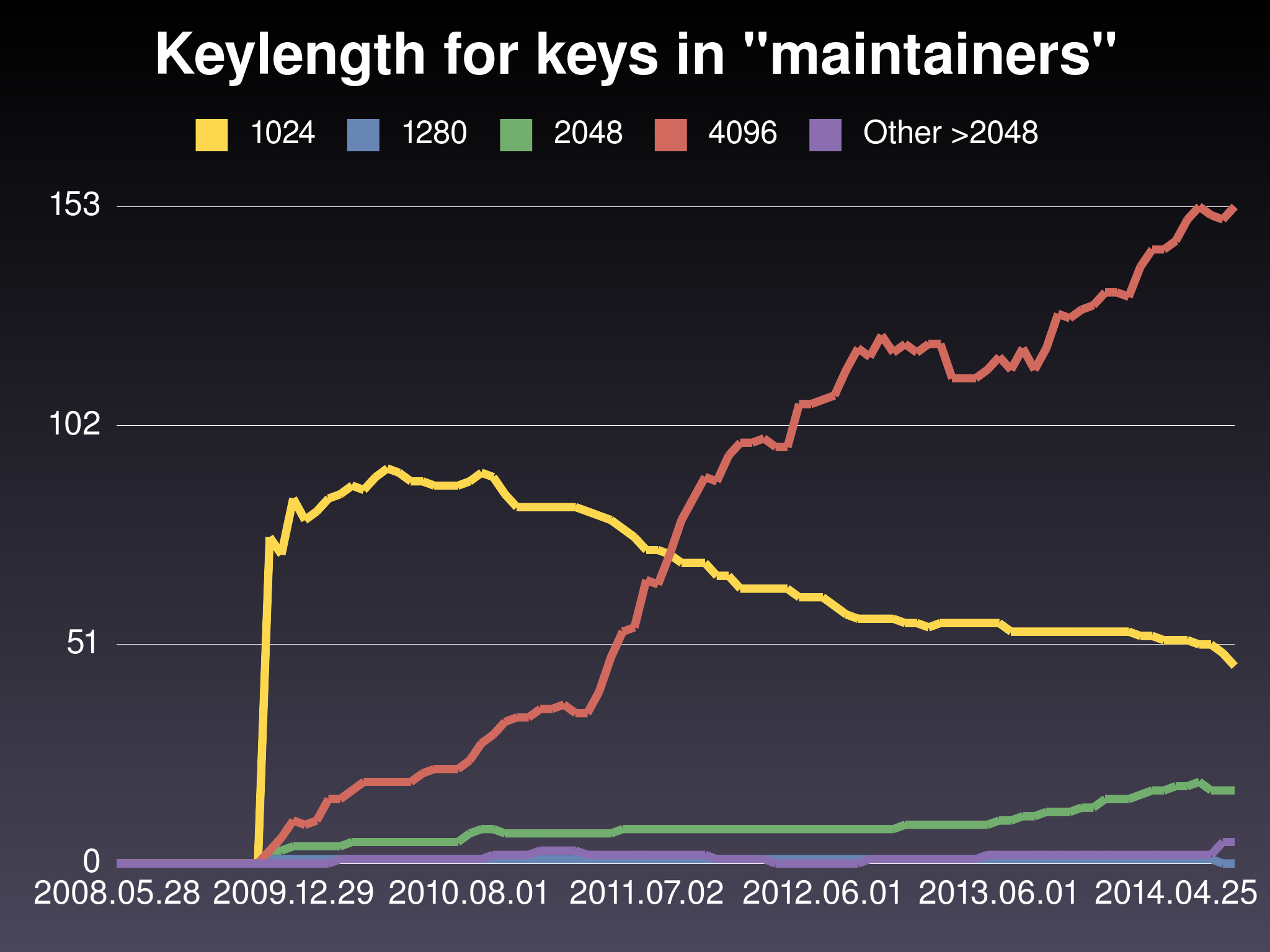
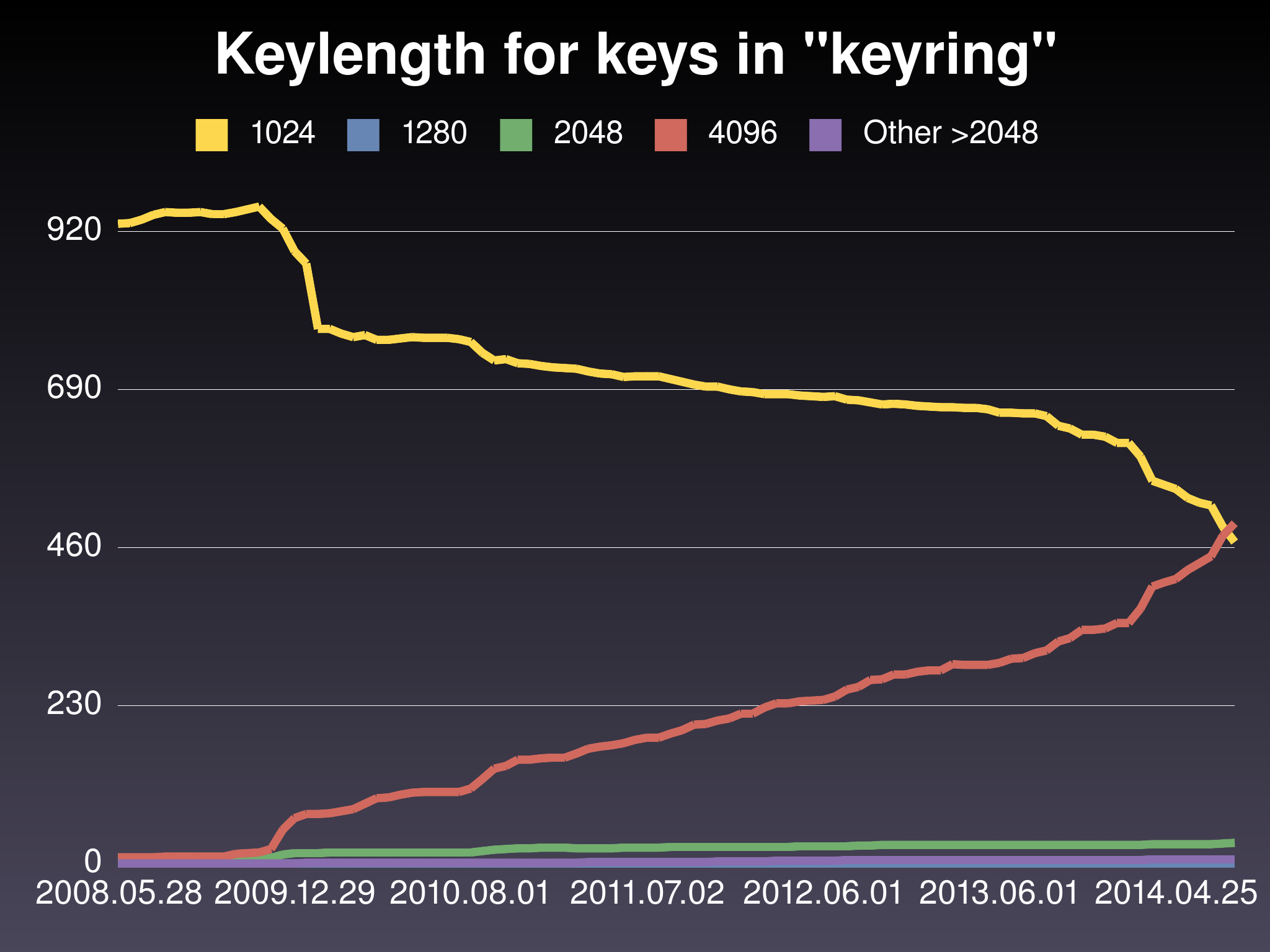
 OK, it's almost one month since we (the keyring-maintainers) gave our talk at DebConf14; how are we faring regarding key transitions since then? You can compare the numbers (the graphs, really) to those