Search Results: "tca"

3 December 2007

Christian Perrier: Arrived in BLR

I finally arrived in Bangalore. Unfortunately, alone, without suitcase, which Air India apparently managed to lose. So, it will be the first time I experience the happiness of people who don't get their luggage in an airport and have to live for a few days with nothing but the clothes they had on them while travelling. Running around in local shops to get socks or pants wasn't exactly what I planned to do here and I probably won't. So, I'll take the local stance and learn about patience, and wait. The place we're hosted at is *very* nice (B&B, probably with a few other speakers I haven't seen yet). And, it has a really good Internet connection so I feel pretty safe and can give news around. I'm currently waiting for Sam whose flight was apparently delayed (I hope *he* gets his suitcase).... I hope he won't be too much in trouble: we don't want to lose our DPL in India (maybe they want to keep him here, though).

1 December 2007

John Goerzen: Visiting Indiana

It was two weeks ago now that we hopped on an Amtrak train in the middle of Kansas at the bright and early hour of 3AM, bound for Indiana.

This has been our third trip with Jacob. He's 14 months old now. We never really enjoyed long car or airplane trips before we had a baby, and haven't really had the desire to try a long car trip since. So we try to take the train, or if time is short, fly.

Jacob enjoys the train. There's lots to see and do. The one thing he doesn't like doing is waiting for food to arrive in any situation, so when we have sit-down meals in the diner, things can get challenging.

We arrived in Indiana the same evening and spent a few days with Terah's dad out at the farm.

Jacob enjoyed grandpa and grandma:

img 3944

img 3961

Jacob got his first ever ice cream there. Despite the concerned "unknown food alert" look, he opened up quick for another bite.

img 3946

The big hit of the visit there were chickens. I've never seen Jacob so thrilled about watching something before. He was so excited he was just moving his arms all around, almost jumping up and down. Here he is watching them:

img 3977

img 3984

Terah wants us to get chickens now. Just because we still have a chicken house left...

On Tuesday, we went north to spend a few days with Terah's mom. On the way up, it became overcast. Terah's mom calls it the winter "permacloud", which is the best description of it I've heard yet. I didn't believe Terah at first when she said that they don't see the sun for 3 months in winter up there, but I believe her now.

Jacob found a rocking chair just his size there, and was able to make it rock. But the big hit of this stop were refrigerator magnets, at Jacob height.

img 4023

He spent a long time with them, and got pretty good at working with them, too.

He also thought he ought to check out the camera in great detail. So of course, the camera checked him out.

img 4032

Terah's mom wanted to spend some time with Jacob, so on Wednesday, Terah and I headed up to Niles, MI to visit some antique shops. We found some postcards from small towns in Kansas dating back to the 1930s, an old metal fan (still works), a wooden "apothecary box" with pull-out drawers, and some furniture we might have purchased if we were closer to home.

For the first time ever, Terah was the first one to say "aren't you done shopping yet?" She was getting tired, so we started heading back. Magically her energy returned as we approached the road leading to the South Bend Chocolate Co. factory and retail store, so we headed in that direction. The next tours didn't start for almost an hour, so we bought some chocolate, looked around a bit, and then left.

Terah's mom had a good time with Jacob while we were gone.

img 4053

Thursday was the O'Connor Thanksgiving. Terah's grandma and some other relatives were there. Here's Jacob with his great grandma:

img 4064

Jacob enjoyed Thanksgiving dinner, and managed to keep finding things to munch on all afternoon.

That evening, we went over to Terah's Yoder grandparents and spent a few days there. Not long after we arrived, Terah's uncle showed up and brought his adopted greyhound with him. Jacob was very excited about this, though the dog wasn't so sure about Jacob.

Eventually the greyhound calmed down and Jacob got to see him up close and pet him. Jacob didn't even mind getting his whole face licked.

img 4107

The next morning at breakfast, Terah's grandma had set out the high chair that she used as a girl for Jacob to eat in. I got some pictures, but Jacob was far more interested in asking to have food ready to eat.

img 4110

Here's Jacob with his Yoder great grandparents:

img_4129.jpg

Later Friday, it was the Yoder Thanksgiving. Jacob got plenty of attention. He also was looking VERY CAREFULLY for Waldo.

img_4151.jpg

Jacob wasn't feeling the best all week, but despite having a busy week and feeling not so good, he did really well. He has been walking with help now, holding on to one adult finger with each hand. He really enjoys that, but is short enough that adults have to bend over a bit to help him. I imagine several people had sore backs after the week was over, including us.

On the train trip home, I took him to the lounge car to go walking. Usually he likes to walk as fast as he can for as long as he can, but there he would only go a little bit at a time. He'd stop at each group of chairs to look at the people, and most of them were really happy to see him, too. After he was done with the lounge car, we walked back through the coaches to our seat. As long as he kept walking, he again would stop at each row of seats to make friends with anybody that wanted to.

We tried to find a nice place to go for lunch during our layover in Chicago. But let me tell you, downtown Chicago -- at least the part near Union Station -- is dead on Sunday and the fact that it was just after Thanksgiving probably didn't help. We wound up finding a place in Union Station to eat. Jacob fussed for awhile, then went to sleep on my lap (he rarely manages to go to sleep while being held). Then on our connecting train back to Kansas.

It was a fun and busy week, but it's nice to be home too. Our train arrived in Kansas at 3:15AM Monday morning. So we went home to catch a few more hours sleep before going to work. As I went outside that morning, we had a gorgeous Kansas sunrise. As the sun was coming up, it was lighting the underside of the clouds with a vibrant deep red and orange color. The whole sky to the east was lit up like that, and felt so warm and inviting on a bitterly cold morning.

30 November 2007

Clint Adams: As treze cruzes: se mi parolus la lingvojn de homoj kaj an eloj, sed ne havus amon, mi fari us sonanta kupro a tintanta cimbalo.

Hmm.. me remete a um poema de Cam es he said. Ainda se eu falasse a l ngua dos anjos.. n o.. Ainda que eu falasse as l nguas dos homens e dos anjos, e n o tivesse amor, seria como o metal que soa ou como o sino que tine. um trecho da carta de S o Paulo aos Cor ntios she said. Ainda que eu falasse as l nguas dos homens e dos anjos, e n o tivesse amor, seria como o metal que soa ou como o sino que tine. Um grupo musical pegou partes dessa carta de S o Paulo e de um poema de Luis de Cam es e usou como inspira o para sua can o it said.

18 November 2007

Evan Prodromou: 26 Brumaire CCXVI

So, I've been off blogging for almost three months now -- from about mid-August to now. It's been kind of guilt-ridden, and it's also been kind of a relief. Being a B-list blogebrity is a direful burden, and having some time away was restful and relaxing and energizing. But now I'm ready to come back! One of the reasons that I haven't been blogging is that once you fall behind, it's really hard to catch up. So I've decided to not do the entire task at once. Instead, I'm just going to start a page on my 2007 Hiatus and fill that up as time permits. For those of you who care greatly about exactly what I did each and every day for the last three months, you've got a spot to read it. And, truthfully, I dropped out of the B-list ranks on Technorati during my time away. I'm back to my natural position as a C-list blogger, and baby, it feels good. Get ready for some photos of my cats, coming up soon! tags:

Feelings of loss One of the other main reasons I haven't been blogging in the last few months is that I've been losing weight. A lot of weight. I've dropped from a high body mass index (BMI) of about 43 -- dangerously high -- to my current sane but still high 33.6. I'd like to get down to a more reasonable BMI of 30 ("overweight") by the end of the year, and be somewhere around 25 ("normal") by next summer. I can lose weight pretty easily when I put my mind to it. Well, actually, it's still insanely hard, but I'm so damn stubborn and obsessive about things, when I actually sink my teeth into them, that it seems easy to the casual observer. My recipe is simple: reduce the amount of food I eat, do low-intensity exercise about an hour a day, and measure everything as well as possible. I eat 3 good meals a day -- about 50% fruits and vegetables, 25% complex carbs like rice or bread, and 25% protein like beans, tofu, fish or cheese. I steer clear of sweets and I drink alcohol only on occasion, and seldom more than a glass or two of wine. For exercise, I've been running around Parc Lafontaine or on a treadmill three days in a row, then on the fourth day lifting weights at a local gym on rue Gilford. I still have a ways to go, but the results have been good so far, and I'm feeling like I'm getting close to the neighbourhood of what I "should" weigh. I've been getting a lot of compliments from friends and family, which is a great motivator. Most of all, I feel good running, jumping, and playing with my daughter, which is the biggest reward of all. All that said, the exercise is taking an extra 1-2 hours out of my day, and blogging has been the main thing cut out to make room. But I think I can work around that now. tags:

Road trip We're leaving Tuesday for a trip to New Jersey to visit my dad's family for American Thanksgiving. (Yeah, they're my family, too.) We're all looking forward to seeing aunts and uncles and cousins and other extended family, but we're also looking forward to spending our powerful Canadian loonies in the US. The Canadian dollar's gone up and up this last few months, and though it's no longer trading at its ridiculous high of US$1.10 (!), it's still above parity, which means our money stretches pretty well. Coupled with this is the fact that most products here in Canada are still priced as if the loonie were still worth US$0.62. It's not atypical to see a book priced for $7.99 US, $10.99 Canadian. So we're going to do some shopping for clothes, books, music and other goods while we're stateside. I plan on bringing an empty suitcase with me and bringing it back full. (The fact that I've lost a lot of weight makes shopping for clothes particularly enticing.) All within our legal limits for customs returning to Canada, of course! Not to worry, random customs official who's reading this blog for who knows what reason. I'm also looking forward to this trip because we haven't done a driving trip together in a while. Going to Thanksgiving in 2005 was Amita June's second long trip (our overnighter to Ottawa for our anniversary in Oct 2005 was her first), and I think she's going to enjoy it again this time. tags:

Painful upgrade I just upgraded my main server, Antipater, from Debian "sarge" to Ubuntu "gutsy". I was getting pretty frustrated by being 3+ versions back from a lot of the important software running on the system. I wanted to get on Ubuntu for my server platform to have more frequent upgrades (about every 6 months). The upgrade went well, mostly. I updated /etc/apt/sources.list to use the Ubuntu archives, then got all the packages. The installation was pretty quick, even for something like 700 packages. However, when I rebooted to use the new 2.6.22 kernel (up from 2.6.8 or so), the server's responsiveness went way down. My guess is that somewhere in the 2.6.x series, one of the new schedulers is causing my particular configuration some grief. I've trimmed my cron jobs and background processes down to a minimum, but the server is still running a little too loaded. The great folks at iWeb have been really helpful, but they don't support Ubuntu, so I've got to brainstorm for myself. I'm going to have to go in over the next few days to reboot the server and experiment with other kernels -- not fun. tags:

One-liners Some other odds and ends:
  • It's getting cold! We had our first snow flurries a few days ago, and it's been regularly under freezing around here. Time to get winter coats out of the closet -- or, better, buy new ones in the US.
  • My friends at Kokoromi are organizing an excellent games+art event called GAMMA 256 on November 28 at the SAT. Should be a lot of fun.
  • One such friend, Heather Kelley is going to be talking at the Montreal Geek Girl Dinner on Tuesday. Good for her!
tags:

13 November 2007

Russell Coker: More About Living in Hotels

In the past I have spent about 18 months living in hotels with a couple of months of breaks in between. I have previously written about it in terms of living in London hotels [1], but I have been asked for more generic advice. Firstly the amount of possessions that you may have when living in hotels is seriously limited. For ease of travel you want to restrict yourself to one suitcase for checked luggage and one for carry-on luggage. Hotels often have short-term storage space for possessions of guests, so having a second suitcase of items that are not worth stealing (clothes and books) may be an option. But consumer electronics devices other than a single laptop computer are not an option. I read an interesting blog post on ZenHabits.net titled Minimalist Fun: The 100 Things Challenge [2] which advocates counting and limiting the number of possessions you own. When living in hotels if I considered my books as one collection and my clothes as another (having never been interested in trendy clothes they count as utilitarian items for work or leisure not objects that I seek to own) and as my mobile phone was a tool for work and my computer gear was strictly limited to items that were needed for work (and thus “tools”) my only possessions were a digital camera and some bottles of liquor! The lack of ability to accumulate possessions may be considered as an advantage or a disadvantage depending on what your aims are. If you are moving to another country for work there are three ways of doing it. The easiest is to be a permanent employee of a company that assigns you to work there - in which case they will probably pay to transport your stuff when you buy or rent a house. If you are a looking for new employment (either contract or permanent) in another country then you can either find the work before moving or after arriving there. Finding work before arriving in the country is difficult and generally only works for short-term contracts. So it’s most likely that you will either be looking for work immediately after arriving or after a short contract. In either case having better mobility increases your employment options - why restrict yourself to one city or region when you can choose from all jobs in an entire country or (in the case of the EU) half of a continent! The career benefits of being able to accept any job anywhere in the world at short notice are significant! There are situations where an employer will pay hotel bills. One example was when I was working for a London based company and they assigned us to work at the other side of London. My colleagues complained and the company paid for hotel bills for everyone Sunday night to Thursday night inclusive as well as an extra hour of pay per day as compensation for the inconvenience. For me of course one hotel was as good as another so it just meant that my employer was covering 5/7 of my living expenses. Then I had a meeting with the hotel manager and pointed out that having me check out every Friday would be bad for them as the hotel was mostly empty on the weekend and suggested that they make me a deal for the other two days - I ended up paying something like one night of hotel fees per week! If I had rented an apartment I would have still been paying the full rent (which while less than 30 days hotel fees per month would have been considerably more than 4 or 5 days of hotel fees per month). If you live in a hotel then there is always some sort of deal that can be arranged. Apart from certain busy days (such as around the Christmas and new-year time) they always want long-term guests and will be willing to reduce the price, give free dinner or drinks from the bar, etc. The cost of living in a hotel at times such as Christmas may be as much as five times the regular rate. That is a further incentive to visit friends or relatives at Christmas. If you can’t visit your family (which may be difficult if they live on the other side of the world) then finding a friend who has a spare room might be an option.

1 November 2007

MJ Ray: Current Issues / Beastly Halloween for the Police?

Has this Mercury report confused Halloween with All Fools Day?

Quote
"Between 5pm and 11pm staff received 666 emergency 999 calls from members of the public who were mainly reporting anti-social behaviour type incidents."

Seriously, I actually heard police cars outside for about the third time this year, so I guess they were being kept busy.  Didn't see much trouble myself.  A bit disappointed that we only had one set of kids call at the door, but not too much: more sweets for me!

Now, I really must get back to hacking some software...

30 October 2007

Daniel Burrows: Here we go again...


[10/30/2007]
Version 0.4.7 "Where did all these
balloons come from?
And why am I wearing
a fake nose?"

- New features:

* The options dialogs have been completely replaced by a new
interface, based on a top-level list view. This fixes many
deficiencies of the old interface: it handles long strings more
gracefully, avoids many of the focus-handling bugs that the old
dialogs had, and should generally be better-behaved.
(Closes: #197976, #331200, #424708)

* Prompts that ask you to enter text will now wrap to multiple lines
when the text gets long, rather than hiding parts of the string.

* The online help and other Help-menu itmes are now top-level views,
which should make them somewhat more usable. (Closes: #434349)

* Support for the "Breaks" field and for trigger states (thanks to
Michael Vogt and Ian Jackson for patches and prodding).
(Closes: #438543)

* Two new styles, "PkgDowngraded" and "PkgDowngradedHighlighted",
are provided to control how downgraded packages look. By default
these packages look like any other installed package.
(Closes: #434442)

* aptitude can now display homepage URLs stored in the Homepage
field of packages.


There are bug-fixes too, but those aren't as fun. So instead I think I'll include some diffstat output. Everyone likes diffstat!


daniel@alpaca:~/programming/aptitude/head$ hg diff -r 0.4.6.1:0.4.7 diffstat
.hgtags 1
NEWS 92 +
b/src/apt_config_treeitems.cc 477 ++++++
b/src/apt_config_treeitems.h 156 ++
b/src/generic/util/browser.h 42
configure.ac 20
doc/en/aptitude.xml 187 ++
help-fr.txt 10
po/ChangeLog 24
po/dz.po 188 +-
po/es.po 82 -
po/gl.po 19
po/ne.po 1277 +++++++++--------
po/pt.po 20
po/ru.po 97 -
po/sv.po 1854 ++++++++++++--------------
po/zh_CN.po 23
src/Makefile.am 2
src/apt_info_tree.cc 4
src/apt_options.cc 598 +++++---
src/apt_options.h 12
src/cmdline/cmdline_action.cc 6
src/cmdline/cmdline_check_resolver.cc 2
src/cmdline/cmdline_do_action.cc 134 +
src/cmdline/cmdline_prompt.cc 124 -
src/cmdline/cmdline_search.cc 4
src/cmdline/cmdline_show.cc 20
src/cmdline/cmdline_why.cc 64
src/defaults.cc 4
src/dep_item.cc 1
src/desc_parse.cc 2
src/generic/apt/apt.cc 32
src/generic/apt/apt.h 30
src/generic/apt/aptcache.cc 54
src/generic/apt/aptcache.h 21
src/generic/apt/aptitude_resolver_universe.cc 28
src/generic/apt/aptitude_resolver_universe.h 57
src/generic/apt/infer_reason.cc 22
src/generic/apt/log.cc 8
src/generic/apt/matchers.cc 531 +++++--
src/generic/apt/matchers.h 28
src/load_grouppolicy.cc 25
src/menu_tree.cc 12
src/pkg_columnizer.cc 19
src/pkg_grouppolicy.cc 27
src/pkg_grouppolicy.h 9
src/pkg_info_screen.cc 10
src/pkg_item.cc 31
src/pkg_item.h 7
src/pkg_subtree.cc 22
src/pkg_subtree.h 12
src/pkg_tree.cc 4
src/pkg_tree.h 1
src/pkg_ver_item.cc 31
src/pkg_ver_item.h 5
src/pkg_view.cc 24
src/reason_fragment.cc 10
src/solution_fragment.cc 5
src/solution_item.cc 76 -
src/solution_item.h 14
src/ui.cc 179 +-
src/vscreen/fragment.cc 140 +
src/vscreen/fragment.h 40
src/vscreen/ref_ptr.h 5
src/vscreen/testvscreen.cc 20
src/vscreen/vs_editline.cc 310 +++-
src/vscreen/vs_editline.h 33
src/vscreen/vs_tree.cc 113 +
src/vscreen/vs_tree.h 40
src/vscreen/vs_treeitem.cc 4
src/vscreen/vs_treeitem.h 21
src/vscreen/vs_util.cc 1
72 files changed, 4853 insertions(+), 2754 deletions(-)

28 October 2007

Russell Coker: Xen and Security

I have previously posted about the difference between using a chroot and using SE Linux [1]. Theo de Raadt claims that virtualisation does not provide security benefits [2] based on the idea that the Xen hypervisor may have security related bugs. From my understanding of Xen a successful exploit of a Xen system with a Dom0 that is strictly used for running the DomU’s would usually start by gaining local root on one of the DomU instances. From there it is possible to launch an attack on the Xen Dom0. One example of this is the recent Xen exploit (CVE-2007-4993) [3] where hostile data in a grub.conf in a DomU could be used to execute privileged commands in the Dom0. Another possibility would be to gain root access to a DomU and then exploit a bug in the Xen API to take over the hypervisor (I am not aware of an example of this being implemented). A final possibility is available when using QEMU code to provide virtual hardware where an attacker could exploit QEMU bugs, an example of this is CVE-2007-0998 where a local user in a guest VM could read arbitrary files in the host [4] - it’s not clear from the advisory what level of access is required to exploit it (DomU-user, DomU-root, or remote VNC access). VNC is different from other virtual hardware in that the sys-admin of the virtual machine (who might be untrusted) needs to access it. Virtual block devices etc are only accessed by the DomU and Xen manages the back-end. The best reference in regard to these issues seems to be Tavis Ormandy’s paper about hostile virtualised environments [5]. Tavis found some vulnerabilities in the QEMU hardware emulation, and as QEMU code is used for a fully virtualised Xen installation it seems likely that Xen has some vulnerabilities in this regard. I think that it is generally recommended that for best security you don’t run fully virtualised systems. The remote-console type management tools are another potential avenue of attack for virtualised servers in the case where multiple users run virtual machines on the same host (hardware). I don’t think that this is an inherent weakness of virtualisation systems. When security is most important you have one sys-admin running all virtual machines - which incidentally seems to be the case for most implementations of Xen at the moment (although for management not security reasons). In ISP hosting type environments I doubt that a remote console system based on managing Xen DomU’s is going to be inherently any less secure than a typical remote console system for managing multiple discrete computers or blades. I have just scanned the Xen hypervisor source, the file include/asm-x86/hypercall.h has 18 entries for AMD64 and 17 for i386 while include/xen/hypercall.h has 18 entries. So it seems that there are 35 or 36 entry points to call the hypervisor, compared to 296 system calls on the i386 version of Linux (which includes the sys_socketcall system call which expands to many system calls). This seems to be one clear indication that the Linux kernel is inherently more complex (and therefore likely to have a higher incidence of security flaws) than the Xen hypervisor. Theo’s main claim seems to be that Xen is written by people who aren’t OpenBSD developers and who therefore aren’t able to write secure code. While I don’t agree with his strong position I have to note the fact that OpenBSD seems to have a better security history than any other multi-user kernel for which data is available. But consider a system running Xen with Linux in Dom0 and multiple para-virtualised OpenBSD DomU’s. If the Linux Dom0 has OpenSSH as the only service being run then the risk of compromise would be from OpenSSH, IP based bugs in the Linux kernel (either through the IP address used for SSH connections or for routing/bridging to the OpenBSD instances), and from someone who has cracked root on one of the OpenBSD instances and is attacking the hypervisor directly. Given that OpenSSH comes from the OpenBSD project it seems that the above scenario would only add the additional risk of an IP based Linux kernel attack. While a root compromise of an OpenBSD instance (consider that a typical OpenBSD system will run a lot of software that doesn’t come from the OpenBSD project - much of which won’t have a great security history) would only lose that instance unless the attacker can also exploit the hypervisor (which would be a much more difficult task than merely cracking some random daemon running as root that the sys-admin is forced to install). Is the benefit of having only one instance of OpenBSD cracked due to a bad daemon enough to outweigh the risk of a Linux IP stack? I’m sure that the OpenBSD people would consider that a better option would be OpenBSD in the Dom0 and in the DomU. In which case the risk of damage from a root compromise due to one badly written daemon that didn’t come from OpenBSD is limited to a single DomU unless the attacker also compromises the hypervisor. When working as a sys-admin I have been forced by management to install some daemons as root which were great risks to the security of the system, if I had the ability to install them in separate DomU’s I would have been able to significantly improve the security of the system. Another flaw in Theo’s position is that he seems to consider running a virtual machine as the replacement of multiple machines - which would be an obvious decrease in security. However in many cases the situation is that no more or less hardware is purchased, it is just used differently. If instead of a single server running several complex applications you have a Xen server running multiple DomU’s which each have a single application then things become much simpler and more secure. Upgrades can be performed on one DomU at a time which decreases the scope of failure (which often means that you only need one business unit to sign-off on the upgrade) and upgrades can be performed on an LVM snapshot (and rolled back with ease if they don’t succeed). A major problem with computer security is when managers fear problems caused by upgrades and prohibit their staff from applying security fixes. This combined with the fact that on a multiple DomU installation one application can be compromised without immediate loss of the others (which run in different DomU’s and require further effort by the attacker for a Xen compromise) provides a significant security benefit. It would be nice for security if every application could run on separate hardware, but even with blades this is not economically viable - not even for the biggest companies. I have converted several installations from a single overloaded and badly managed server to a Xen installation with multiple DomU’s. In all cases the DomU’s were easier to upgrade (and were upgraded more often) and the different applications and users were more isolated. Finally there is the possibility of using virtualisation to monitor the integrity of the system, Bill Broadley’s presentation from the 2007 IT Security Symposium [6] provides some interesting ideas about what can be done. It seems that having a single OpenBSD DomU running under a hypervisor (maybe Xen audited by the OpenBSD people) with an OpenBSD Dom0 would offer some significant benefits over a single OpenBSD instance.

11 October 2007

MJ Ray: Current Issues / Re: Walking and Cycling in WsM

There were some surprising numbers given at yesterday's workshop: a quarter of Weston-super-Mare households don't use a car, while only 37% of men and 24% of women take the minimum recommended exercise (at least 30 minutes 5 days a week).  Meanwhile, the West of England's traffic is growing at three times the national average and congestion is already a big problem, WsM's population has grown 34% in a decade and the southwards expansion of the town around the dual carriageway seems unlikely to slow that.

Two-fifths of WsM journeys are under 5km, but over half of those are done by car.  In short, if we don't get walking, cycling and mass transport working, this town is going to become very ugly, and expensive to live and work in.  The walking and cycling strategy is being developed now with Halcrow consultants and a draft will be published in December, to help shape planning and transport policies, as well as works programmes.

So, yesterday, they seemed particularly interested in: what stops people from walking and cycling more?  What can be done to put them right?  What do people think of shared-use paths?  Do cyclists prefer to be on-road?  What stops them being on-road?  I guess answers from non-Weston-residents would also be interesting in the forum or comments box...

Sorry for the short notice of yesterday's event. It's been a bit manic here lately and I believed that there was a shortage of places - as it happened, there could easily have been three times as many people there.  I guess that means you're likely to have an effect if you email your thoughts and suggestions to sustainable.travel@n-somerset.gov.uk telephone 01934 634848 or post them to The Sustainable Travel Team, North Somerset Council, Somerset House, Oxford Street, Weston-super-Mare BS23 1TG.

9 October 2007

MJ Ray: Cooperatives SW September steering

I was at the September meeting of the Cooperatives SW steering group a couple of weeks ago. We had two new members (Alex Lawrie from Upstart and Alan Bonner from RadCo) and a guest from Co-operative Futures. Unfortunately, we seem to have lost our only member from a Credit Union. Our guest told us about how important it is to put information about co-operative business models into Business Link and offer paths from BL "Information and Diagnostic Brokerage" to co-operative development bodies (CDBs). I agree with that - by and large, BL were hopeless about anything other than a sole trader business when I used them (in 2000 and again in 2002/3) and knowing more about co-operative development would have saved me about a year of confused administration. (However, my then-local CDB was also a competitor, so they weren't much help even once I found them.) There are also some other ideas to connect CDBs to funding better, which the CDBs are going to develop with our blessing and bring back later. Related yet different, we were told that the Regional Infrastructure for Social Enterprise is about to launch a trade association and may exclude all co-operatives from it by mistake. Other than that, it was mostly about getting promotional materials and plans in place for the Co-operatives SW Annual Meeting in Exeter on Monday 22 October ( places available to all co-operative members).

2 October 2007

Jonathan McDowell: Moving on

On Wednesday 17th October the majority of my belongings will leave Norwich, to arrive in Castlerock at some point the next week (exact day to be confirmed). I will then start work for 3par as a software developer in Belfast on Monday 29th. It's been 6 years since we moved to Norwich and I'll be sad to leave it, and all the friends I've made here, behind. I'd have stayed a bit longer but 3par were keen for me to get started. I imagine I'll be in the Fat Cat on Saturday 13th if people are around. And I expect visited in NI once we get settled in!

17 September 2007

MJ Ray: Current Issues / Re: Absurdities of Recycling

And now, making things more complicated, the main Weston recycling centre (off Herluin Way) is going to close at 4.30pm from 1st October.  If you work full-time, forget about recycling card or plastic on a week-day! Source: Mercury

Yet more mixed messages on whether the new Conservative council supports recycling!

15 September 2007

Romain Francoise: Shared links for 2007-09-15

7 September 2007

Mike Hommey: Javascript performance in browsers

Ars Technica has recently posted an article about the new Opera alpha release, with some Javascript benchmark results showing it is quite faster than version 9.23. It also goes to compare with Firefox and IE7, but omits some other not so unimportant browsers. I think the main reason is because they seem to have only tested Windows browsers. Sure, Safari has been released recently on Windows, but it is still quite marginal. Anyways, I was wondering how all this was going under Linux, and also, how (good?) WebKit would perform compared to others. So, I tried the same Javascript speed tests on various browsers under Linux on my laptop, which happens to be a Pentium M 1.5GHz. And the winner is…
Test Iceweasel 2.0.0.6 Epiphany 2.18.3/libxul 1.8.1.6 GdkWebKit Opera 9.23 Opera 9.50 alpha 1
Try/Catch with errors 80 81 41 18 22
Layer movement 250 214 76 53 47
Random number engine 280 190 57 72 68
Math engine 343 274 82 101 91
DOM speed 205 225 18 41 54
Array functions 97 97 72 82 44
String functions 14 12 12 46 52
Ajax declaration 178 127 16 21 17
Total 1447 1220 374 434 395
So, It seems the speed gain Opera got on Windows doesn’t happen much on Linux. An interesting result, is that Iceweasel, with a bunch of extensions installed, is slower than Epiphany, despite both using the same rendering engine and Javascript library. Running Iceweasel in safe mode makes it the same speed as Epiphany, though. So having extensions does not only clutter the UI, but actually has an impact on how fast the Javascript code in web pages is going to run. And well, WebKit is the fastest for this testcase, though it stays behind Opera on some specific tests.

5 September 2007

MJ Ray: No-monthly-fee UK Card Payment Web Service?

I want a way to take small, infrequent, one-off card payments on my web sites. Some of my customers much prefer to pay by card and I'd be happy to do that, if there's a decent card payment service. Is there one? I've not found it yet. What do I want? The main thing is not to have a significant monthly fee. I'd rather not be paying if I'm not using the service, but I'd probably stomach up to 5% transaction fee for a good credit card handler. The 8% fee listed by Moneybookers seems a little steep, but I might use it as a last resort. I'd prefer no automatic "inactivity" account closure if I don't use it for a couple of months. Sometimes I take no card payments for a while, then need to handle several at once. I'd also prefer a cooperative or mutual, but that seems unlikely in such a small field. So far, I've only found two suitable UK Card Payment Services - Paypal and NoChex - and I've used both, but I've now got problems with both! Paypal won't let me take my money out to my business account. To do that, I need to upgrade my account, but Paypal do not list LLP as a valid type of business and won't fix my bug reports by web, email or telephone. Last time I telephoned, after patiently explaining to them what an LLP is, I was told to put a different business type on the form. That scared me, so I asked for email confirmation of the instruction, which they said they'd send, but it never arrived. NoChex froze my account without warning, due to inactivity. I've sent in their reactivation forms a few months ago and had no reply. I've also filed a web ticket today, but I've done that before. They don't even list a telephone number any more. That's a worrying sign in a bank. So, both of these providers suck for the above reasons and I still need a way to take this month's card payments. All the UK banks charge monthly fees, don't they? Are there European card services which I should consider? International? (2007-09-07: 5 comments)

3 September 2007

MJ Ray: Current Issues / Ride Report: Kewstoke-Congresbury

In preparation for Wednesday's cycle forum meeting at Backwell station (6.30pm), I went for a ride to Congresbury.

I followed roughly the route out along Ebdon Lane and Hewish bridges shown on this javascript map but on the way there, I went south from Puxton and turned off Nye Road onto the Strawberry Line (NCN route 26) to test it out.

The main surface seems to be very loose gravel on top of a very hard subsurface.  It's uneven in places, but I think I still averaged about 10mph. At each end of the route, the connecting paths are mud tracks.  The left turn just before Congresbury station is unsignposted. It's not a bad route, but a long diversion to go to Congresbury. The whole ride out took about an hour in total, going at a fairly gentle pace.

Coming back, I rode along the bridleway that is pretty direct from Congresbury to Puxton. Unfortunately, somebody has tried to fill in some uneven sections with rubble since I rode it last year. The route is now "get off and walk" in several places and uncomfortable otherwise.

I think I'll be riding along the A370 from Wick Road to Congresbury on Wednesday evening. If only there was a track across Tutshill sluices...

In other cycling news, the police have an undercover bike which they'll leave lying around, see if it gets nicked, then track the thieves back to their lair.

28 August 2007

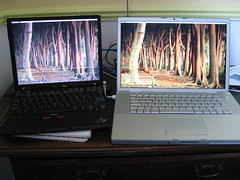
Kai Hendry: MBP versus X40

Thinkpad X40 vs MBP I’ve spent a bit of the bank holiday weekend by probably violating the warranty of a new 15” Macbook Pro (MBP) from work. I also was at the Debian bbq 2007 in Cambridge and met some friendly faces. :) More MBP & X40 porn So now I can boot into MacOSX and run Ubuntu or boot straight into Ubuntu from rEFIt. There are a couple of problems. There are some things I quite like about the MBP compared to the X40: Currently I remain not totally convinced about the Apple MBP. I’ll keep my Debian X40 my personal machine and the MBP for work. Now I can compile Webkit on Apple OSX (Debian can too) and see what’s happening in Ubuntu.

13 August 2007

MJ Ray: Read-Write Web Links

Here's what I wrote on other people's sites last week:
Drake.org.uk: Welcome back..
MartynD reboots his blog yet again. This time with added eyetests.
Two Questions for All Serious Free Software Contributors
I answered, as did many others.
ProBlogger Redesign - Bedding Down for the Night
Much easier-to-read, but I still had an enhancement suggestion.
Blowing bubbles niq's soapbox
Comment on house-building and house-owning in England today.
gravityboy: This Is My Good Free Software Experience
I think the GPL is useful for things other than programs and CC is confusing about DRM for everything.
Antti-Juhani Kaijanaho I am going to rank MJ Ray low from now on
Commented more on my blog, but also directly. The criticism might be fairer if the SPI ballot were secret, but it isn't.
WEBlog -- Wouter's Eclectic Blog - Voting tactics
Is this about SPI? How is IRV broken?
Constitutional amendment: reduce the length of DPL election process
Amending the amendment proposal - got enough seconds to reach the ballot, for a change.
Amendment to: reduce the length of DPL election process
This one doesn't look like it will get onto the ballot. Informative subthread on combination of amendments.
Here's some of what I read last week:
talks with Linus Torvalds
He's much ruder than I am, but can get away with it because he's done more.
The Most Excellent and Lamentable Tragedy of Richard Stallman - Edward O'Connor
He's much ruder than I am, but doesn't get away with it because he's done more.
Mayor wants London to copy Paris bike rentals News This is London
I saw those bikes in Paris. Seemed like a good idea.
Parisian-style hire bicycles to beat London traffic jams - Independent Online Edition > Transport
Slightly inaccurate report.
Hacking gadflies: Open Document Format
It's almost September again.
dgh: Bike power
Interesting idea.
apenwarr's log
quite a funny letter to google
Bristol Climate Protesters En-Route to Camp
My legs hurt after cycling only 6 miles yesterday. Not sure what I did wrong.
The Weston Mercury - Call to 'have a say' on the future of Britain
Pensioners to save country. Or not.
BBC NEWS Technology UN's website breached by hackers
Can't be bothered to check netcraft.
Little's Log: North Norfolk Councillor defects to UKIP
Little's still raging against the media.

Uwe Hermann: Linux on the Fujitsu Siemens Lifebook S-4572 Subnotebook

I recently bought a Fujitsu-Siemens LIFEBOOK S-4572 (sub)notebook on eBay for less than 150 Euros, a really great little machine. It's a Pentium III, 750 MHz, 256 MB RAM (the chipset cannot handle more than that unfortunately), 12.1" screen, ethernet, 2x USB 1.1, CD-ROM/DVD reader + CD-ROM writer, PCMCIA, IrDA, modem, and a 15 GB hard drive. No floppy, no serial ports, no parallel port. There's no wireless builtin, but I use a cheapo PCMCIA adapter. The greatest feature compared to all other laptops I previously owned is that the battery life is really great, it lasts almost 3 hours (compare that to 45 minutes on my current "main" laptop). I'm running Debian unstable on the box (of course). Here's the Linux support status as far as I have tested things: Networking Works out of the box using the e100 driver. Sound Works out of the box using the snd_intel8x0 driver. X11 Works out of the box, using either the vesa or the ati driver (at a max. resolution of 1024x768). Touchpad Works out of the box. Using the Option "SHMConfig" "on" line in /etc/X11/xorg.conf's InputDevice section (using the synaptics driver) also works fine and allows you to scroll using the touchpad, e.g. in a browser. More info in the SynapticsTouchpad page on the Debian wiki. CDROM, DVD Reading CD-ROMs and DVDs as well as burning CD-ROMs works fine. I don't think the drive is capable of writing DVDs. External VGA Displaying the screen contents on an external VGA monitor (or beamer) works just fine, switching is done using Fn+F10. PCMCIA Works fine, tested using the Sitecom WL-112 wireless card. The driver installation for that is straight-forward, too:
$ apt-get install rt2500-source
$ m-a a-i rt2500-source
$ dpkg -i /usr/src/rt2500*deb
Special keys All the Fn-keys work fine (brightness, volume, etc.). There are five other special keys (for starting a browser or something) which I haven't tested, but I don't really care... USB Works fine, but it's only USB 1.1, so some higher-speed devices will not work (DVB-T USB devices for example; PCMCIA DVB-T adapters might work). IrDA, Modem Untested, I don't care. Powersaving, Suspend to RAM It seems this CPU (Pentium III, Coppermine) doesn't support frequency scaling, so cpufreq-set doesn't work. I'm using laptop-mode-tools to improve battery life a bit more, though. Also, Suspend-to-RAM works fine out of the box:
$ apt-get install hibernate
$ hibernate-ram
I haven't tested Suspend-to-Disk yet, but I'm not sure it'll work anyway, as I'm using a dm-crypt'ed disk (+ LVM), as with all my boxes. lspci
00:00.0 Host bridge [0600]: Intel Corporation 82440MX Host Bridge [8086:7194] (rev 01)
00:00.1 Multimedia audio controller [0401]: Intel Corporation 82440MX AC'97 Audio Controller [8086:7195]
00:00.2 Modem [0703]: Intel Corporation 82440MX AC'97 Modem Controller [8086:7196]
00:07.0 Bridge [0680]: Intel Corporation 82440MX ISA Bridge [8086:7198] (rev 01)
00:07.1 IDE interface [0101]: Intel Corporation 82440MX EIDE Controller [8086:7199]
00:07.2 USB Controller [0c03]: Intel Corporation 82440MX USB Universal Host Controller [8086:719a]
00:07.3 Bridge [0680]: Intel Corporation 82440MX Power Management Controller [8086:719b]
00:12.0 Ethernet controller [0200]: Intel Corporation 82557/8/9 [Ethernet Pro 100] [8086:1229] (rev 09)
00:13.0 CardBus bridge [0607]: O2 Micro, Inc. OZ6933/711E1 CardBus/SmartCardBus Controller [1217:6933] (rev 02)
00:13.1 CardBus bridge [0607]: O2 Micro, Inc. OZ6933/711E1 CardBus/SmartCardBus Controller [1217:6933] (rev 02)
00:14.0 VGA compatible controller [0300]: ATI Technologies Inc Rage Mobility P/M [1002:4c52] (rev 64)
01:00.0 Network controller [0280]: RaLink RT2500 802.11g Cardbus/mini-PCI [1814:0201] (rev 01)
Other resources I'm really considering making this my "main" box even though it's a bit older/slower, as my current laptop with 45 minutes battery life is a major pain when travelling...

5 August 2007

Russell Coker: Living in Hotels

I received a private email in response to my post about getting work in another country regarding hotel prices in London. The person who sent me the message had considered London but ended up moving to Japan instead partly due to living expenses (although Japan seems unlikely to be much cheaper). The first issue concerns security of hotels. When living in hotels (for almost a year in London and about 6 months in the Netherlands there were a few occasions (IE one brief occasion every 4+ months) when I left my laptop under my bed at a hotel, but almost all the time I took it with me. At that time I aimed to have a minimal set of luggage, one large suitcase containing clothes, books, etc (things that are generally not worth stealing) and one small case containing my laptop, digital camera, passport, and other small things that are valuable or which would cause excessive inconvenience if I lost them. Also in the small case I would take fragile items. Then when leaving my hotel I would pack most of the items from the small suitcase (pretty much everything apart from the digital camera) into my laptop bag and take it with me. This limited my losses from hotel thieves to a digital camera (no incriminating pictures and I could always buy a better one) and a couple of bottles of liquor. Good hotels have a hotel safe which you can use. But for a cheap (affordable) hotel there is no such option. Hotels in London ARE expensive, but if you are prepared to lower you standard of living they aren’t too expensive. One thing to note about UK hotels is that the idea of having a toilet and shower in every room is a new concept and all the cheaper hotels lack this. It’s a standard feature for a hotel to have a wash-basin in every room, a toilet is optional, and a bath or shower is another option. There are various types of shared bathroom in UK hotels. The better ones vaguely resemble the facilities you might expect to find at a public swimming pool (large spaces, clean tiles everywhere, and a changing area in addition to the toilet and shower cubicles). The worst ones are basically what you might expect to see in a private home but with less cleaning. To get the best deals on small hotels in London you have to find an area where there are many hotels and inspect them. It is quite acceptable to ask for the key to a room so that you can inspect it and determine if you want to rent it. One area where I lived for some time in London is near Victoria Station. Victoria is one of the largest stations in London, it has both a Tube (underground/metro for trains within the city) and a British Rail (for travel to other parts of the country) station. Victoria Station also had facilities for checking in to a flight and having your checked luggage delivered to Gatwick airport via the Gatwick Express. This was really convenient, you can check your luggage and then do some last minute shopping before going to the airport! I’m not sure if they still do this though (comments appreciated). Another good thing about Victoria Station is the large shopping area which included a tourist information centre and a store that sold freshly baked bread. Often in the morning I would buy bread from the section that had the most steam coming from it (which was the most freshly baked) before catching a train. Victoria Station is quite near many of the places you want to visit in London so I could walk to the British Museum and other places that are worth visiting (this depends on how fit you are). But the real reason for staying there is that the were many cheap hotels in the area. I could just walk down a street and know that I could find a room at one of the hotels. One feature of UK hotels is that they almost always include free breakfast as part of the deal (with no option to exclude it). Of course this means that if you are capable of eating a significant breakfast and then skipping lunch then you can save some money. A down-side to cheap hotels is that they almost never have a telephone in your room (just a pay phone in the hall), and if they do have a telephone then it will be wired in. Before wireless net access became common this was a problem as you couldn’t use a modem. More expensive hotels had an extra socket for a modem. In London there is a significant number of people who stay in hotels from Sunday night to Thursday night with their company paying (so they don’t stay in the cheap hotels). This means that most of the good hotels have cheap rooms on the weekend. So while living in London I would often stay at a good hotel on the weekend to get net access (and a few days in a luxury hotel at a cheap rate is a good change from a cheap hotel). Nowadays wireless net access is common so it would be easy to find a free access point anywhere in London and there would be no need for this. But the possibility of getting cheap hotel rooms on the weekend is something to keep in mind. One benefit of this was when I had an employer paying for my hotel bills from Sunday night to Thursday night (as part of a deal to placate my colleagues who complained about working at the other side of London). I spoke to the hotel manager and suggested that having me check out every Friday and have the room empty on the weekend was not good for them and that they should offer me a significant discount to stay 7 days a week - they made me a good deal! At that time I had the lowest cost of living apart from when I lived with my parents while the hotel in which I stayed was quite comfortable (a large comfortable room with toilet and shower and a good hotel breakfast). Moving to the Netherlands was quite easy for me as I was staying in hotels. All I had to do was to pack my suitcase, check out of the hotel, and catch the flight. One significant advantage of living in hotels is that you can easily move to another region or country. This gives the possibility of taking advantage of career opportunities that would not be possible if you owned a house and would be difficult if you rented an apartment. When in the Netherlands I ended up staying in hotels of the Bastion chain (a chain or franchise of business hotels). I stayed in a couple of other hotels first and wasn’t particularly happy but with Bastion hotels I was always happy. I arranged a deal of a small discount in exchange for not getting the breakfast that was normally included (I like to sleep in and the Dutch breakfast didn’t appeal to me). One significant benefit of the Bastion hotels over London hotels was the size. The smallest room had two single beds, a large Dutch-style bathroom, two chairs at a desk that spanned about 3M of a wall (with multiple power sockets and a phone socket), and a good TV. At the time the hotel would play two movies over the TV system every night from video cassette. The videos played on the TV in the restaurant and in the rooms (if you selected the appropriate channel). Once I became known to the staff they would do nice things such as playing the movie I requested (instead of the scheduled one) and pausing the movie when I finished dinner so I didn’t miss anything while walking to my room. Also instead of giving me a free newspaper every day (in Dutch) they gave me some free drinks vouchers every week. Once you become a regular customer at a hotel the staff are always willing to change the deal to make you happy - even when it’s a chain. One of the convenient factors of living in a business hotel is that they are located near business areas. I spent several months living in a Bastion hotel that was about 400M walk from the office where I worked. That was particularly convenient when the network broke at night - I could just walk back to the office to fix it! The deal I had with the Bastion hotels made them about 50% more expensive than the (fairly luxurious) two bedroom apartment that I later moved to. So hotels are expensive and living in them is only an option if your employer pays for it or if you work in an industry where pay is reasonably good. Given that the vast majority of people who read my blog work in the computer industry (and I suspect that they are better paid than average) this should be a viable option.

Next.

Previous.