Search Results: "tb"

21 December 2024

Joey Hess: aiming at December

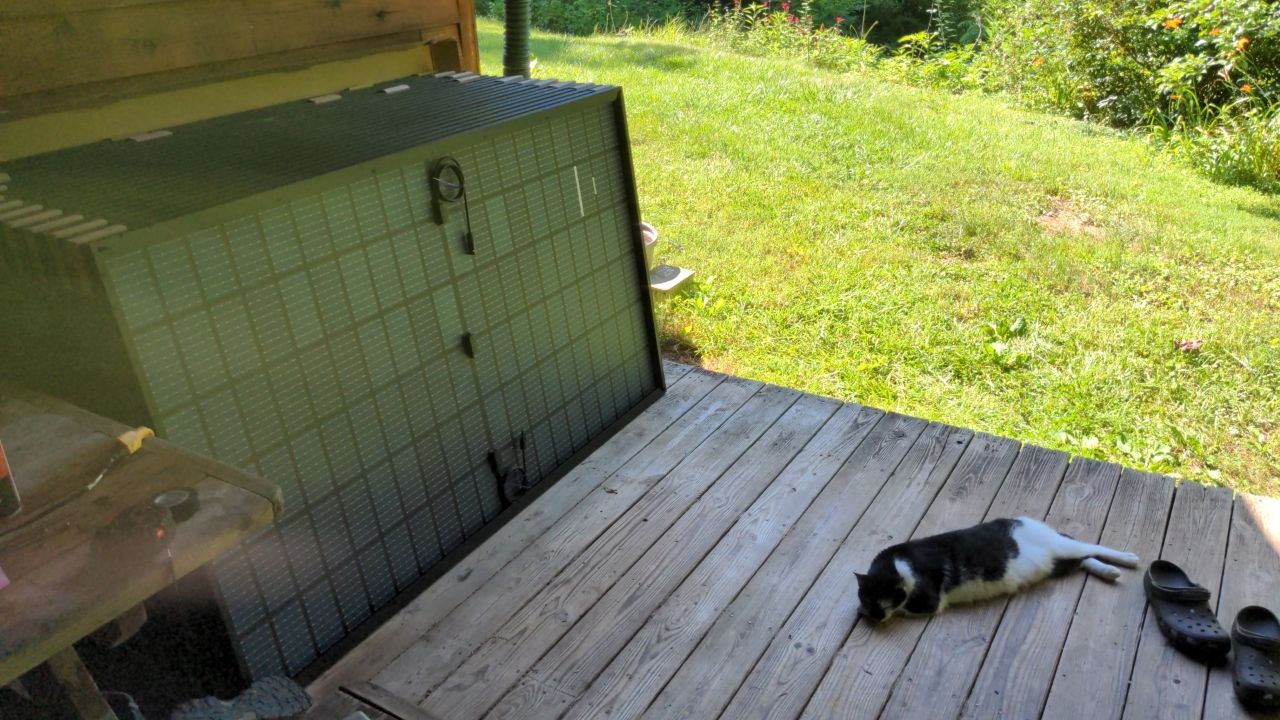
I have been working all year on a solar upgrade aimed at December. Now here it is, midwinter, and my electric car is charging on a cloudy day from my offgrid solar fence. I lived happily enough with 1 kilowatt of solar that I installed in 2017. Meanwhile, solar panel prices came down massively, incentives increased and everything came together: This was the year. In the spring I started clearing forest trees that were leaning over the house, making both a firebreak and a solar field. In June I picked up a pallet of panels in a box truck.
a porch with a a bunch of solar panels, stacked on edge leaning up against the wall. A black and white cat is sprawled in front of them.
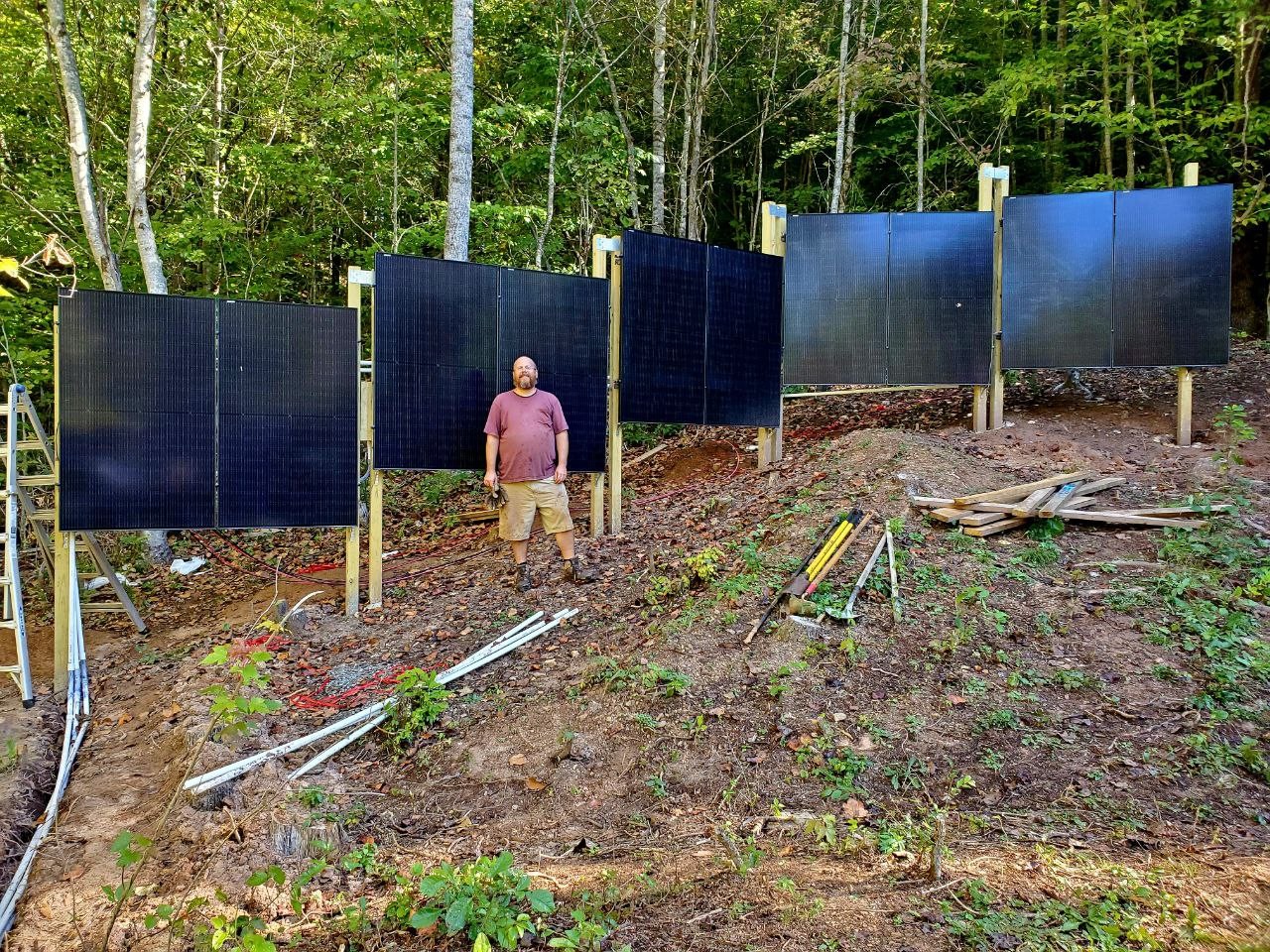
In August I bought the EV and was able to charge it offgrid from my old solar system... a few miles per day on the most sunny days. In September and October I built a solar fence, of my own design.
Me standing in front of the solar fence, which is 10 panels long
For the past several weeks I have been installing additional solar panels on ballasted ground mounts full of gravel. At this point I'm half way through installing my 30 panel upgrade. The design goal of my 12 kilowatt system is to produce 1 kilowatt of power all day on a cloudy day in midwinter, which allows swapping between major loads (EV charger, hot water heater, etc) on a cloudy day and running everything on a sunny day. So the size of the battery bank doesn't matter much. Batteries are getting cheaper fast too, but they are a wear item, so it's better to oversize the solar system and minimize the battery. A lot of this is nonstandard and experimental. And that makes sense with the price of solar panels. It costs more to mount solar panels now than the panels are worth. And non-ideal panel orientation isn't a problem when the system is massively overpaneled. I'm hoping to finish up the install before the end of winter. I have more trees to clear, more ballasted ground mounts to install, and need to come up with something even more experimental for a half dozen or so panels. Using solar panels as mounts for solar panels? Hanging them from trees? Soon the wan light will fade, time to head off to the solstice party to enjoy the long night, and a bonfire.
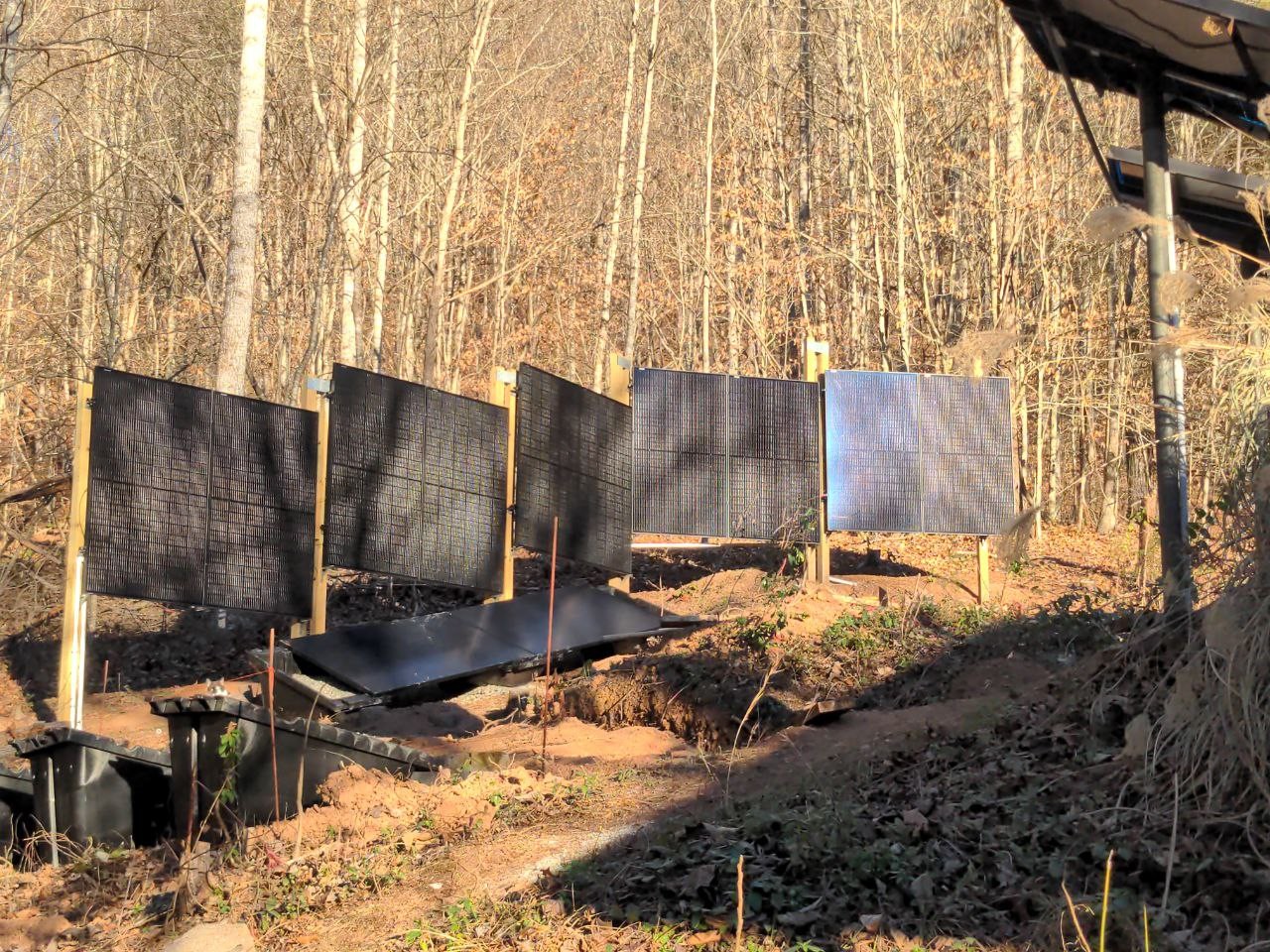
Solar fence with some ballasted ground mounts in front of it, late evening light. Old pole mounted solar panels in the foreground are from the 90's.

17 December 2024

Gunnar Wolf: The science of detecting LLM-generated text

This post is a review for Computing Reviews for The science of detecting LLM-generated text , a article published in Communications of the ACM
While artificial intelligence (AI) applications for natural language processing (NLP) are no longer something new or unexpected, nobody can deny the revolution and hype that started, in late 2022, with the announcement of the first public version of ChatGPT. By then, synthetic translation was well established and regularly used, many chatbots had started attending users requests on different websites, voice recognition personal assistants such as Alexa and Siri had been widely deployed, and complaints of news sites filling their space with AI-generated articles were already commonplace. However, the ease of prompting ChatGPT or other large language models (LLMs) and getting extensive answers its text generation quality is so high that it is often hard to discern whether a given text was written by an LLM or by a human has sparked significant concern in many different fields. This article was written to present and compare the current approaches to detecting human- or LLM-authorship in texts. The article presents several different ways LLM-generated text can be detected. The first, and main, taxonomy followed by the authors is whether the detection can be done aided by the LLM s own functions ( white-box detection ) or only by evaluating the generated text via a public application programming interface (API) ( black-box detection ). For black-box detection, the authors suggest training a classifier to discern the origin of a given text. Although this works at first, this task is doomed from its onset to be highly vulnerable to new LLMs generating text that will not follow the same patterns, and thus will probably evade recognition. The authors report that human evaluators find human-authored text to be more emotional and less objective, and use grammar to indicate the tone of the sentiment that should be used when reading the text a trait that has not been picked up by LLMs yet. Human-authored text also tends to have higher sentence-level coherence, with less term repetition in a given paragraph. The frequency distribution for more and less common words is much more homogeneous in LLM-generated texts than in human-written ones. White-box detection includes strategies whereby the LLMs will cooperate in identifying themselves in ways that are not obvious to the casual reader. This can include watermarking, be it rule based or neural based; in this case, both processes become a case of steganography, as the involvement of a LLM is explicitly hidden and spread through the full generated text, aiming at having a low detectability and high recoverability even when parts of the text are edited. The article closes by listing the authors concerns about all of the above-mentioned technologies. Detecting an LLM, be it with or without the collaboration of the LLM s designers, is more of an art than a science, and methods deemed as robust today will not last forever. We also cannot assume that LLMs will continue to be dominated by the same core players; LLM technology has been deeply studied, and good LLM engines are available as free/open-source software, so users needing to do so can readily modify their behavior. This article presents itself as merely a survey of methods available today, while also acknowledging the rapid progress in the field. It is timely and interesting, and easy to follow for the informed reader coming from a different subfield.

Russ Allbery: Review: Iris Kelly Doesn't Date

Review: Iris Kelly Doesn't Date, by Ashley Herring Blake
Series: Bright Falls #3
Publisher: Berkley Romance
Copyright: October 2023
ISBN: 0-593-55058-7
Format: Kindle
Pages: 381
Iris Kelly Doesn't Date is a sapphic romance novel (probably a romantic comedy, although I'm bad at romance subgenres). It is the third book in the Bright Falls series. In the romance style, it has a new set of protagonists, but the protagonists of the previous books appear as supporting characters and reading this will spoil the previous books. Among the friend group we were introduced to in Delilah Green Doesn't Care, Iris was the irrepressible loudmouth. She's bad at secrets, good at saying whatever is on her mind, and has zero desire to either get married or have children. After one of the side plots of Astrid Parker Doesn't Fail, she has sworn off dating entirely. Iris is also now a romance novelist. Her paper store didn't get enough foot traffic to justify staying open, so she switched her planner business to online only and wrote a romance novel that was good enough to get a two-book deal. Now she needs to write a second book and she has absolutely nothing. Her own avoidance of romantic situations is not helping, but neither is her meddling family who are convinced her choices about marriage and family can be overturned with sufficient pestering. She desperately needs to shake up her life, get out of her creative rut, and do something new. Failing that, she'll settle for meeting someone in a bar and having some fun. Stevie is a barista and actress living in Portland. Six months ago, she broke up with Adri, her creative partner, girlfriend of six years, and the first person with whom she had a serious relationship. More precisely, Adri broke up with her. They're still friends, truly, even though that friendship is being seriously strained by Adri dating Vanessa, another member of their small and close-knit friend group. Stevie has occasionally-crippling anxiety, not much luck in finding real acting roles in Portland, and a desperate desire to not make waves. Ren, the fourth member of their friend group, thinks Stevie needs a new relationship, or at least a fling. That's how Stevie, with Ren as backup and encouragement, ends up at the same bar with Iris. The resulting dance and conversation was rather fun for both Stevie and Iris. The attempted one-night stand afterwards was a disaster due to Stevie's anxiety, and neither of them expected to see the other again. Stevie therefore felt safe pretending they'd hit it off to get her friends off her back. When Iris's continued restlessness lands her in an audition for Adri's fundraiser play that she also talked Stevie into performing in, this turns into a full-blown fake dating trope. These books continue to be impossible to put down. I'm not sure what Blake is doing to make the pacing so perfect, but as with the previous books of the series I found this utterly compulsive reading. I started it in the afternoon, took a break in the evening for a few hours, and then finished it at 2am. I wasn't sure if a book focused on Iris would work as well, but I need not have worried. Iris Kelly Doesn't Date is both more dramatic and more trope-centered than the earlier books, but Blake handles that in a way that fits Iris's personality and wasn't annoying even to a reader like me, who has an aversion to many types of relationship drama. The secret is Stevie, and specifically having the other protagonist be someone with severe anxiety.
No was never a very easy word for Stevie when it came to Adri, when it came to anyone, really. She could handle the little stuff do you want a soda, have you seen this movie, do you like onions on your pizza but the big stuff, the stuff that caused disappointed expressions and down-turned mouths... yeah, she sucked at that part. Her anxiety would flare, and she'd spend the next week convinced her friends hated her, she'd die alone and miserable, and wasn't worth a damn to anyone. Then, when said friend or family member eventually got ahold of her to tell her that, no, of course they didn't hate her, why in the world would she think that, her anxiety would crest once again, convincing her that she was terrible at understanding people and could never trust her own brain to make heads or tails of any social situation.
This is a spot-on description of a particular type of anxiety, but also this is the perfect protagonist to pair with Iris. Throughout the series, Iris has always been the ride-or-die friend, the person who may have no idea how to help but who will show up anyway and at least try to distract you. Stevie's anxiety makes Iris feel protective, which reveals one of the best sides of Iris's personality, and then the protectiveness plays off against Iris's own relationship issues and tendency to avoid taking anything too seriously. It's one of those relationships that starts a bit one-sided and then becomes mutually supporting once Stevie gets her feet under her. That's a relationship pattern I really enjoy reading about. As with the rest of the series, the friendship dynamics are great. Here we get to see two friend groups at work: Iris's, which we've seen in the previous two volumes and which expanded interestingly in Astrid Parker Doesn't Fail, and Stevie's, which is new. I liked all of these people, even Adri in her own way (although she's the hardest to like). The previous happily-ever-afters do get a bit awkward here, but Blake tries to make that part of the plot and also avoids most of the problem of somewhat-boring romantic bliss by spreading the friendship connections a bit wider. Stevie's friend group formed at orientation at Reed College, and that let me put my finger on another property of this series: essentially all of the characters are from a very specific social class. They're nearly all arts people (bookstore owner, photographer, interior decorator, actress, writer, director), they've mostly gone to college, and while most of them don't have lots of money, there's always at least one person in each friend group with significant wealth. Jordan, from the previous book, is a bit of an exception since she works in a trade (a carpenter), but she still acts like someone from that same social class. It's a bit like reading Jane Austen novels and realizing that the protagonists are drawn from a very specific and very narrow portion of society. This is not a complaint, to be clear; I have no objections to reading about a very specific social class. But if one has already read lots of books about this class of people, I could see that diminishing the appeal of this series a bit. There are a lot of assumptions baked into the story that aren't really questioned, such as the ubiquity of therapists. (I don't know how Stevie affords one on a barista salary.) There are also some small things in the terminology (therapy speak, for example) and in the specific type of earnestness with which the books attempt to be diverse on most axes other than social class that I suspect may grate a bit for some readers. If that's you, this is your warning. There is a third-act breakup here, just like the previous volumes. There is also a defense of the emotional punch of third-act breakups in romance novels in the book itself, put into Iris's internal monologue, so I suspect that's the author's answer to critics like myself who don't like the trope. I was less frustrated by this one because it fit the drama level of the protagonists, but I'll also know to expect a third-act breakup in any Blake novel I read in the future. But, all that said, the summary once again is that I loved this book and could not put it down. Iris is dramatic and occasionally self-destructive but has a core of earnest empathy that makes her easy to like. She's exactly the sort of extrovert who is soothing to introverts rather than draining because she carries the extrovert load of social situations. Stevie is adorably earnest and thoughtful beneath her anxiety. They two of them are wildly different and yet remarkably good together, and I loved reading their story. Highly recommended, along with the whole series. Start with Delilah Green Doesn't Care; if you like that, you're in for a treat. Content note: This book is also rather sex-forward and pretty explicit in the sex scenes, maybe a touch more than Astrid Parker Doesn't Fail. If that is or is not your thing in romance novels, be aware going in. Rating: 9 out of 10

16 December 2024

Russ Allbery: Review: Finders

Review: Finders, by Melissa Scott
Series: Firstborn, Lastborn #1
Publisher: Candlemark & Gleam
Copyright: 2018
ISBN: 1-936460-87-4
Format: Kindle
Pages: 409
Finders is a far future science fiction novel with cyberpunk vibes. It is the first of a series, but the second (and, so far, only other) book of the series is a prequel. It stands alone reasonably well (more on that later). Cassilde Sam is a salvor. That means she specializes in exploring ancient wrecks and ruins left behind by the Ancients and salvaging materials that can be reused. The most important of those are what are called Ancestral elements: BLUE, which can hold programming; GOLD, which which reacts to BLUE instructions; RED, which produces actions or output; and GREEN, the rarest and most valuable, which powers everything else. Cassilde and her partner Dai Winter file claims on newly-discovered or incompletely salvaged Ancestor sites and then extract elemental material and anything else of value in their small salvage ship. Cassilde is also dying. She has Lightman's, an incurable degenerative disease that can only be treated with ever-increasing quantities of GREEN. It's hard to sleep, hard to get warm, hard to breathe, and eventually she'll run out of money to pay for the GREEN and she'll die. To push that day off into the future, she and Dai need work. The good news is that the wreckage of a new Ancestor sky palace was discovered in a long orbit and will create enough salvage work for every experienced salvor in the system. The bad news is that they're not qualified to bid on it. They need a scholar with a class-one license to bid on the best sections, and they haven't had a reliable scholar since their former partner and lover Summerland Ashe picked the opposite side in the Troubles and left the Fringe for the Entente, the more densely settled and connected portion of human space. But, unexpectedly and suspiciously, Ashe may be back and offering to work with them again. So, first, I love this setting. This is far from the first SF novel that is set in the aftermath of a general collapse of human civilization and revolving around discovering lost mysteries. Most examples of that genre are post-apocalyptic novels limited to Earth or the local solar system, but Kate Elliott's Unconquerable Sun comes immediately to mind. It's also not the first space archaeology series I've read; Kristine Kathyrn Rusch's story series starting with "Diving into the Wreck" also came to mind. But I don't recall the last time I've seen the author sell the setting so effectively. This is a world with starships and spaceports and clearly advanced technology, but it feels like a post-collapse society that's built on ruins. It's not just that technology runs on half-understood Ancestral elements and states fight over control of debris fields. It's also that the society repurposes Ancestral remnants in ways that both they and the reader know weren't originally intended, and that sometimes are more ingenious or efficient than how the Ancestors probably used them. There's a creative grittiness here that reminds me of good cyberpunk. It's not just good atmospheric writing, though. Scott makes a world-building decision that is going to sound trivial when I say it, but that has brilliant implications for the rest of the setting. There was not just one collapse; there were two. The Ancestor civilization, presumed to be the first human civilization, has passed into myth, quite literally when it comes to the stories around its downfall in the aftermath of a war against AIs. After the Ancestors came the Successors, who followed a similar salvage and rebuild approach and got as far as inventing their own warp drive technology that was based on but different than the Ancestor technology. Then they also collapsed, leaving their adapted technology and salvage operations layered over Ancestor sites. Cassilde's civilization is the third human starfaring civilization, and it is very specifically the third, neither the second nor one of dozens. This has so many small but effective implications that improve this story. A fall happened twice, so it feels like a pattern that makes Cassilde's civilization paranoid, but it happened for two very different reasons, so there is room to argue against it being a pattern. Salvage is harder because of the layering of Ancestor and Successor activity. Successors had their own way of controlling technology that is not accessible to Cassilde and her crew but is also not how the technology was intended to be used, which sends small ripples of interesting complexity through the background. And salvors are competing not only against each other but also against Successor salvage operations for which they have fragmentary records. It's a beautifully effective touch. Melissa Scott has been publishing science fiction for forty years, and it shows in this book. The protagonists are older characters: established professionals with resource problems but also social connections and an earned reputation, people who are trying to do a job and live their lives, not change the world. The writing is competent, deft, and atmospheric, with the confidence of long practice, but it also has the feel of an earlier era of science fiction. I mentioned the cyberpunk influence, which shows in the grittiness of the descriptions, the marginality of the characters in society, and the background theme of repurposing and reusing technology in unintended ways. This is the sort of book that feels solidly in the center of science fiction, without the genre mixing into either fantasy or romance that has become somewhat more common, and also without the dramatics of space opera (although the reader discovers that the stakes of this novel may be higher than anyone realized). And yet, so much of this book is about navigating a complicated romantic relationship, and that's where the story structure felt a bit odd. Cassilde, Dai, and Ashe were a polyamorous triad (polyamory also shows up in Scott's excellent Roads of Heaven series), and much of the first third of the book deals with the fracturing of trust with Ashe and their renegotiation of that relationship given his return. This is refreshingly written as the thoughtful interaction of three adults who take issues of trust seriously, but that also means it's much less dramatic than it sounds, and that means this book starts exceptionally slow. Scott is going somewhere, and the slow build became engrossing around the midpoint of the book, but I had to fight to stick with it at the start. About 80% of the way through this book, I had no idea how Scott was going to wrap things up in the pages remaining and was bracing myself for some sort of series cliffhanger. This is not what happens; the plot is not fully resolved in every detail, but it reaches a conclusion of sorts that does not mandate a sequel. I did think the end was a little bit unsatisfying, though, and I want another book that explores the implications of the ending. I think it would have to be a much different book, and the tonal shift might be stark. I've had this book on my to-read list for a while and kept putting it off because I wasn't sure I was in the mood for something precarious and gritty. This turned out to be an accurate worry: this is literally a book about salvaging the pieces of something full of wonders inextricably connected to dangers. You have to be in a cyberpunk sort of mood. But I've never read a bad Melissa Scott book, and this is no exception. The simplicity and ALL-CAPSNESS of the Ancestral elements grated a bit, but apart from that, the world-building is exceptional and well worth the trip. Recommended, although be warned that, if you're like me, it may not grab you from the first page. Followed by Fallen, but that book is a prequel that does not share any protagonists. Content notes: disability and degenerative illness in a universe where magical cures are possible, so be warned if that specific thematic combination is not what you're looking for. Rating: 7 out of 10

15 December 2024

Russell Coker: Hisense 65U80G 65 Inch 8K ULED Android TV (2021)

The Aim I just bought a Hisense 65U80G 65 Inch 8K ULED Android TV (2021 model) for $1,568 including delivery. I got that deal by googling refurbished 8K TVs and finding the cheapest one I could buy. Amazon and eBay didn t have any good prices on second hand 8K TVs and new ones start at $3,000 on special. I didn t assess how Hisense compares to other TVs, as far as I could determine there was only one model of 8K TV on sale in Australia in the price range I was prepared to pay. So I won t review how this TV compares to other models but how refurbished TVs compare to other display options. I bought this because the highest resolution monitor in my price range is 5120*2160 [1]. While I could get a 5128*2880 monitor for around $1,500 paying 3* the money for 33% more pixels is bad value for money. Getting 4* the pixels for under 3* the price is good value even when it s a TV with the lower display quality that involves. Before buying this TV I read this blog post by Daniel Lawrence about using an 8K TV as a primary monitor [2]. While he has an interesting setup with a 65 TV on a large desk it s not what I plan to do at this time. My Plans for Use I don t plan to make it a main monitor. While 5120*2160 isn t as good as I like on my desk it s bearable and the quality of the display is high. High resolution isn t needed for all tasks, for example I m writing this blog post on my laptop while watching a movie on the 8K TV. One thing I d like to do with the 8K TV when I get it working as a monitor is to share the screen for team programming projects. I don t have any specific plans other than team coding projects at the moment. But it will be interesting to experiment with it when I get it working. Technical Issues with High Resolution Monitors Hardware Needed A lot of the graphic hardware out there don t support resolutions higher than 5120*2880. It seems that most laptops don t support resolutions higher than that and higher resolutions than 4K are difficult. Only quite recent and high end video cards will do 8K. Apparently the RTX 2080 is one of the oldest ones that does and that s $400 on ebay. Strangely the GPU chipset spec pages don t list the maximum resolution and there s the additional complication that the other chips might not support the resolutions that the GPU itself can support. As an aside I don t use NVidia cards for regular workstations due to reliability problems. But they are good for ML work and for special purpose systems. Interface Versions To do 8K video it seems that you need HDMI 2.1 (or maybe 2.0 with 4:2:0 chroma subsampling) or DisplayPort 1.3 for 30Hz with 24bit color and 2.0 for higher refresh rates. But using a particular version of the interface doesn t require supporting all the resolutions that it might support. This TV has HDMI 2.1 inputs, I ve bought an adaptor cable that does DisplayPort 1.4 to HDMI 2.1 at 8K resolution. So I need a video card that does DisplayPort 1.4 or HDMI 2.1 output. That doesn t mean that the card will work, but it could work. It s a pity that no-one has made a USB-C video controller that has a basic frame-buffer supporting 8K and the minimal GPU capabilities. The consensus of opinion is that no games will run well at 8K at this time so anyone using 8K resolution doesn t need GPU power unless it s for ML stuff. I m thinking of making a system that can be used as a ML server and X/Wayland server so a GPU with a decent amount of RAM and compute power would be good. I m not particularly interested in spending $1,500+ to get a GPU that can drive a $1,568 TV. I m looking into getting a RTX A2000 with 12G of RAM which should be adequate for ML experiments and can handle 8K@60Hz output. I ve ordered a DisplayPort to HDMI converter cable so if I get a DisplayPort card it will work. Software Support When I first got started with 4K monitors I had significant problems in adjusting the UI to be usable. The support for scaling software is much better now than it was then and 8K 65 has a lower DPI than 4K 32 . So I hope this won t be an issue. Progress So Far My first Hisense 8K TV stopped working properly. It would change to a mostly white screen after being used for some time. The screen would change in ways that correlate to changes in what should appear, but not in a way that was usable. It was just a different pattern of white blobs when I changed to a menu view not anything that allowed using it. I presume that this was the problem that drove a need for refurbishment as when I first got the TV it was still signed in to Google accounts for YouTube and to NetFlix. Best Buy Electrical was good about providing a quick replacement, they took away the old TV and delivered a new one on the same visit and it s now working well. I ve obtained a NVidia card that can allegedly do 8K output and a combination of cables that might be able to carry an 8K signal. Now I just need to get the NVidia drivers to not cause a kernel panic to get things to work.

Russell Coker: OnePlus 6 Debian

I recently got a OnePlus 6 for the purpose of running Debian, here s the Debian wiki page about it [1]. It runs Debian nicely and the basic functions all work, but the problem I m having now is that AldiMobile (Telstra) and KoganMobile (Vodafone) don t enable VoLTE for that and all the Australian telcos have turned off 3G. The OnePlus 6 does VoLTE with Chinese SIMs so the phone itself can do it. The OnePlus 6 was never sold in Australia by the telcos, so they are all gray-market imports which aren t designed by OnePlus to work in Australia. Until recently that wasn t a problem, but now that the 3G network has been turned off we need VoLTE and OnePlus didn t include that in the OS. Reddit has documentation on how to fix this but it has to be done on Android [2]. So I had to go back from Mobian to Android to get VoLTE (and VoWifi) working and then install Mobian again. For people with similar issues Telstra has a page for checking which phones are supported [3], it s the only way to determine if it s the phone or the network that makes VoLTE not work Android isn t informative about such things. Telstra lists the OP6 as a suitable phone. Now after doing this I still can t get the OP6 working for phone calls on Phosh or PlasmaMobile and I m not sure why. I m going to give the PinePhone Pro another go and see if it now works better. In the past I had problems with the PinePhonePro battery discharging too fast, charging too slowly, and having poor call quality [4]. The battery discharge issue should be at least alleviated by some of the changes in the Plasma 6 code that s now in Debian/Unstable. I ve also been lent a PinePhone (non-pro) and been told that it will have better battery life in many situations. I ll do some tests of that. The PinePhonePro isn t capable of doing the convergence things I was hoping to do so the greater RAM and CPU power that it has aren t as relevant as they otherwise would be. I have a vision for how phones should work. I am not discouraged by the Librem 5, PinePhonePro, Note 9, and OnePlus 6 failing in various ways to do what I hoped for. I will eventually find a phone that I can get working well enough.

10 December 2024

Stephan Lachnit: Creating a bootable USB stick that can still be used as normal storage

As someone who daily drives rolling release operating systems, having a bootable USB stick with a live install of Debian is essential. It has saved reverting broken packages and making my device bootable again at least a couple of times. However, creating a bootable USB stick usually uses the entire storage of the USB stick, which seems unnecessary given that USB sticks easily have 64GiB or more these days while live ISOs still don t use more than 8GiB. In this how-to, I will explain how to create a bootable USB stick, that also holds a FAT32 partition, which allows the USB stick used as usual.

Creating the partition partble The first step is to create the partition table on the new drive. There are several tools to do this, I recommend the ArchWiki page on this topic for details. For best compatibility, MBR should be used instead of the more modern GPT. For simplicity I just went with the GParted since it has an easy GUI, but feel free to use any other tool. The layout should look like this:
Type    Partition   Suggested size
 
EFI     /dev/sda1             8GiB
FAT32   /dev/sda2        remainder
Notes:
  • The disk names are just an example and have to be adjusted for your system.
  • Don t set disk labels, they don t appear on the new install anyway and some UEFIs might not like it on your boot partition.
  • If you used GParted, create the EFI partition as FAT32 and set the esp flag.

Mounting the ISO and USB stick The next step is to download your ISO and mount it. I personally use a Debian Live ISO for this. To mount the ISO, use the loop mounting option:
mkdir -p /tmp/mnt/iso
sudo mount -o loop /path/to/image.iso /tmp/mnt/iso
Similarily, mount your USB stick:
mkdir -p /tmp/mnt/usb
sudo mount /dev/sda1 /tmp/mnt/usb

Copy the ISO contents To copy the contents from the ISO to the USB stick, use this command:
sudo cp -r -L /tmp/mnt/iso/. /tmp/mnt/usb
The -L option is required to deference the symbolic links present in the ISO, since FAT32 does not support symbolic links. Note that you might get warning about cyclic symbolic links. Nothing can be done to fix those, except hoping that they won t cause a problem. For me this never was a problem though.

Finishing touches Umnount the ISO and USB stick:
sudo umount /tmp/mnt/usb
sudo umount /tmp/mnt/iso
Now the USB stick should be bootable and have a usable data partition that can be used on essentially every operating system. I recommend testing that the stick is bootable to make sure it actually works in case of an emergency.

8 December 2024

Russ Allbery: Review: Why Buildings Fall Down

Review: Why Buildings Fall Down, by Matthys Levy & Mario Salvadori
Illustrator: Kevin Woest
Publisher: W.W. Norton
Copyright: 1992
Printing: 1994
ISBN: 0-393-31152-X
Format: Trade paperback
Pages: 314
Why Buildings Fall Down is a non-fiction survey of the causes of structure collapses, along with some related topics. It is a sequel of sorts to Why Buildings Stand Up by Mario Salvadori, which I have not read. Salvadori was, at the time of writing, Professor Emeritus of Architecture at Columbia University (he died in 1997). Levy is an award-winning architectural engineer, and both authors were principals at the structural engineering firm Weidlinger Associates. There is a revised and updated 2002 edition, but this review is of the original 1992 edition. This is one of those reviews that comes with a small snapshot of how my brain works. I got fascinated by the analysis of the collapse of Champlain Towers South in Surfside, Florida in 2021, thanks largely to a random YouTube series on the tiny channel of a structural engineer. Somewhere in there (I don't remember where, possibly from that channel, possibly not) I saw a recommendation for this book and grabbed a used copy in 2022 with the intent of reading it while my interest was piqued. The book arrived, I didn't read it right away, I got distracted by other things, and it migrated to my shelves and sat there until I picked it up on an "I haven't read nonfiction in a while" whim. Two years is a pretty short time frame for a book to sit on my shelf waiting for me to notice it again. The number of books that have been doing that for several decades is, uh, not small. Why Buildings Fall Down is a non-technical survey of structure failures. These are mostly buildings, but also include dams, bridges, and other structures. It's divided into 18 fairly short chapters, and the discussion of each disaster is brisk and to the point. Most of the structures discussed are relatively recent, but the authors talk about the Meidum Pyramid, the Parthenon (in the chapter on intentional destruction by humans), and the Pavia Civic Tower (in the chapter about building death from old age). If you are someone who has already been down the structural failure rabbit hole, you will find chapters on the expected disasters like the Tacoma Narrows Bridge collapse and the Hyatt Regency walkway collapse, but there are a lot of incidents here, including a short but interesting discussion of the Leaning Tower of Pisa in the chapter on problems caused by soil properties. What you're going to get, in other words, is a tour of ways in which structures can fail, which is precisely what was promised by the title. This wasn't quite what I was expecting, but now I'm not sure why I was expecting something different. There is no real unifying theme here; sometimes the failure was an oversight, sometimes it was a bad design, sometimes it was a last-minute change, and sometimes it was something unanticipated. There are a lot of factors involved in structure design and any of them can fail. The closest there is to a common pattern is a lack of redundancy and sufficient safety factors, but that lack of redundancy was generally not deliberate and therefore this is not a guide to preventing a collapse. The result is a book that feels a bit like a grab-bag of structural trivia that is individually interesting but only occasionally memorable. The writing style I suspect will be a matter of taste, but once I got used to it, I rather enjoyed it. In a co-written book, it's hard to separate the voices of the authors, but Salvadori wrote most of the chapter on the law in the first person and he's clearly a character. (That chapter is largely the story of two trials he testified in, which, from his account, involved him verbally fencing with lawyers who attempted to claim his degrees from the University of Rome didn't count as real degrees.) If this translates to his speaking style, I suspect he was a popular lecturer at Columbia. The explanations of the structural failures are concise and relatively clear, although even with Kevin Woest's diagrams, it's hard to capture the stresses and movement in a written description. (I've found from watching YouTube videos that animations, or even annotations drawn while someone is talking, help a lot.) The framing discussion, well, sometimes that is bombastic in a way that I found amusing:
But we, children of a different era, do not want our lives to be enclosed, to be shielded from the mystery. We are eager to participate in it, to gather with our brothers and sisters in a community of thought that will lift us above the mundane. We need to be together in sorrow and in joy. Thus we rarely build monolithic monuments. Instead, we build domes.
It helps that passages like this are always short and thus don't wear out their welcome. My favorite line in the whole book is a throwaway sentence in a discussion of building failures due to explosions:
With a similar approach, it can be estimated that the chance of an explosion like that at Forty-fifth Street was at most one in thirty million, and probably much less. But this is why life is dangerous and always ends in death.
Going hard, structural engineering book! It's often appealing to learn about things from their failures because the failures are inherently more dramatic and thus more interesting, but if you were hoping for an introduction to structural engineering, this is probably not the book you want. There is an excellent and surprisingly engaging appendix that covers the basics of structural analysis in 45 pages, but you would probably be better off with Why Buildings Stand Up or another architecture or structural engineering textbook (or maybe a video course). The problem with learning by failure case study is that all the case studies tend to blend together, despite the authors' engaging prose, and nearly every collapse introduces a new structural element with new properties and new failure modes and only the briefest of explanations. This book might make you a slightly more informed consumer of the news, but for most readers I suspect it will be a collection of forgettable trivia told in an occasionally entertaining style. I think the book I wanted to read was something that went deeper into the process of forensic engineering, not just the outcomes. It's interesting to know what the cause of a failure was, but I'm more interested in how one goes about investigating a failure. What is the process, how do you organize the investigation, and how does the legal system around engineering failures work? There are tidbits and asides here, but this book is primarily focused on the structural analysis and elides most of the work done to arrive at those conclusions. That said, I was entertained. Why Buildings Fall Down is a bit dated the opening chapter on airplanes hitting buildings reads much differently now than when it was written in 1992, and I'm sure it was updated in the 2002 edition but it succeeds in being clear without being soulless or sounding like a textbook. I appreciate an occasional rant about nuclear weapons in a book about architecture. I'm not sure I really recommend this, but I had a good time with it. Also, I'm now looking for opportunities to say "this is why life is dangerous and always ends in death," so there is that. Rating: 6 out of 10

7 December 2024

Russ Allbery: Review: Dark Minds

Review: Dark Minds, by Michelle Diener
Series: Class 5 #3
Publisher: Eclipse
Copyright: 2016
ISBN: 0-6454658-5-2
Format: Kindle
Pages: 328
Dark Minds is the third book in the self-published Class 5 science-fiction romance series. It is a sequel to Dark Deeds and should not be read out of order, but as with the other books of the series, it follows new protagonists. Imogen, like another Earth woman before her, was kidnapped by a Class 5 for experimentation by the Tecran. She was subsequently transferred to a research facility and has been held in cages and secret military bases for over three months. As the story opens, she had been imprisoned in a Tecran transport for a couple of weeks when the transport is taken by the Krik who kill all of the Tecran crew. Next stop: another Class 5. That same Class 5 is where the Krik are taking Camlar Kalor and his team. Cam is a Grih investigator from the United Council, sent to look into reports of a second Earth woman rescued from a Garmman ship. (The series reader will recognize this as the plot of Dark Deeds.) Now he's trapped with the crews of a bunch of other random ships in the cargo hold of a Class 5 with Krik instead of Tecran roaming the halls, apparently at the behest of the ship's banned AI, and a mysterious third Earth woman already appears to be befriending it. Imogen is the woman Fiona saw signs of in Dark Deeds. She's had a rougher time than the protagonists of the previous two books in this series, and she's been dropped into a less stable situation. The Class 5 she's brought to at the start of the story is far more suspicious (with quite a lot of cause) and somewhat more hostile than the AIs we've encountered previously. The rest of the story formula is roughly the same, though: hunky Grih officer with a personality completely indistinguishable from the hunky Grih officers in the previous two books, an AI with a sketchy concept of morality that desperately needs an ally, the Grih obsession with singing, the eventual discovery of useful armor and weaponry that Imogen can use to surprise people, and more political maneuvering over the Sentient Beings Agreement. This entry in the series mostly abandons the Grih shock and horror at how badly the Earth women have been treated. This makes sense, given how dangerous Earth women have proven over the course of this series, and I like that Diener is changing the political dynamics as the story develops. I do sometimes miss that appalled anger of Dark Horse, but Dark Minds focuses more on the politics and corridor fighting of a tense multi-sided stand-off. I found the action more gripping in Dark Minds than in Dark Deeds, and I liked Imogen more as a character than Fiona. She doesn't have the delightfully calm competence of Rose from Dark Horse, but she's a bit more hardened, a bit more canny, and is better at taking control of situations. I also like that Diener avoids simplistically pairing Earth women off with Class 5s. The series plot is progressing faster than I had expected, and that gives this book a somewhat different shape than the previous ones. Cam is probably the least interesting of the men in this series so far and appears to exist solely to take up the man-shaped hole in the plot. This is not a great series for gender roles; thankfully, the romance is a small part of the plot and largely ignorable. The story is about the women and the AIs, and all of the women and most of the AIs of the previous books make an appearance. It's clear they're forming an alliance whether the Grih like it or not, and that part of the story was very satisfying. Up to this book, this series had been all feel-good happy endings. I will risk the small spoiler and warn that this is not true to the same degree here, so you may not want to read this one if you want something entirely fluffy, light, and positive (inasmuch as a series involving off-screen experimentation on humans can be fluffy, light, and positive). That caught me by surprise in a way I didn't entirely like, and I wish Diener had stuck with the entirely positive tone. Other than that, though, this was fun, light, readable entertainment. It's not going to win any literary awards, it's formulaic, the male protagonist comes from central casting, and the emphasis by paragraph break is still a bit grating in places, but I will probably pick up the next book when I'm in the mood for something light. Dark Minds is an improvement over book two, which bodes well for the rest of the series. Followed by Dark Matters. Rating: 7 out of 10

5 December 2024

Reproducible Builds: Reproducible Builds in November 2024

Welcome to the November 2024 report from the Reproducible Builds project! Our monthly reports outline what we ve been up to over the past month and highlight items of news from elsewhere in the world of software supply-chain security where relevant. As ever, if you are interested in contributing to the Reproducible Builds project, please visit our Contribute page on our website. Table of contents:
  1. Reproducible Builds mourns the passing of Lunar
  2. Introducing reproduce.debian.net
  3. New landing page design
  4. SBOMs for Python packages
  5. Debian updates
  6. Reproducible builds by default in Maven 4
  7. PyPI now supports digital attestations
  8. Dependency Challenges in OSS Package Registries
  9. Zig programming language demonstrated reproducible
  10. Website updates
  11. Upstream patches
  12. Misc development news
  13. Reproducibility testing framework

Reproducible Builds mourns the passing of Lunar The Reproducible Builds community sadly announced it has lost its founding member, Lunar. J r my Bobbio aka Lunar passed away on Friday November 8th in palliative care in Rennes, France. Lunar was instrumental in starting the Reproducible Builds project in 2013 as a loose initiative within the Debian project. He was the author of our earliest status reports and many of our key tools in use today are based on his design. Lunar s creativity, insight and kindness were often noted. You can view our full tribute elsewhere on our website. He will be greatly missed.

Introducing reproduce.debian.net In happier news, this month saw the introduction of reproduce.debian.net. Announced at the recent Debian MiniDebConf in Toulouse, reproduce.debian.net is an instance of rebuilderd operated by the Reproducible Builds project. rebuilderd is our server designed monitor the official package repositories of Linux distributions and attempts to reproduce the observed results there. In November, reproduce.debian.net began rebuilding Debian unstable on the amd64 architecture, but throughout the MiniDebConf, it had attempted to rebuild 66% of the official archive. From this, it could be determined that it is currently possible to bit-for-bit reproduce and corroborate approximately 78% of the actual binaries distributed by Debian that is, using the .buildinfo files hosted by Debian itself. reproduce.debian.net also contains instructions how to setup one s own rebuilderd instance, and we very much invite everyone with a machine to spare to setup their own version and to share the results. Whilst rebuilderd is still in development, it has been used to reproduce Arch Linux since 2019. We are especially looking for installations targeting Debian architectures other than i386 and amd64.

New landing page design As part of a very productive partnership with the Sovereign Tech Fund and Neighbourhoodie, we are pleased to unveil our new homepage/landing page. We are very happy with our collaboration with both STF and Neighbourhoodie (including many changes not directly related to the website), and look forward to working with them in the future.

SBOMs for Python packages The Python Software Foundation has announced a new cross-functional project for SBOMs and Python packages . Seth Michael Larson writes that the project is specifically looking to solve these issues :
  • Enable Python users that require SBOM documents (likely due to regulations like CRA or SSDF) to self-serve using existing SBOM generation tools.
  • Solve the phantom dependency problem, where non-Python software is bundled in Python packages but not recorded in any metadata. This makes the job of software composition analysis (SCA) tools difficult or impossible.
  • Make the adoption work by relevant projects such as build backends, auditwheel-esque tools, as minimal as possible. Empower users who are interested in having better SBOM data for the Python projects they are using to be able to contribute engineering time towards that goal.
A GitHub repository for the initiative is available, and there are a number of queries, comments and remarks on Seth s Discourse forum post.

Debian updates There was significant development within Debian this month. Firstly, at the recent MiniDebConf in Toulouse, France, Holger Levsen gave a Debian-specific talk on rebuilding packages distributed from ftp.debian.org that is to say, how to reproduce the results from the official Debian build servers: Holger described the talk as follows:
For more than ten years, the Reproducible Builds project has worked towards reproducible builds of many projects, and for ten years now we have build Debian packages twice with maximal variations applied to see if they can be build reproducible still. Since about a month, we ve also been rebuilding trying to exactly match the builds being distributed via ftp.debian.org. This talk will describe the setup and the lessons learned so far, and why the results currently are what they are (spoiler: they are less than 30% reproducible), and what we can do to fix that.
The Debian Project Leader, Andreas Tille, was present at the talk and remarked later in his Bits from the DPL update that:
It might be unfair to single out a specific talk from Toulouse, but I d like to highlight the one on reproducible builds. Beyond its technical focus, the talk also addressed the recent loss of Lunar, whom we mourn deeply. It served as a tribute to Lunar s contributions and legacy. Personally, I ve encountered packages maintained by Lunar and bugs he had filed. I believe that taking over his packages and addressing the bugs he reported is a meaningful way to honor his memory and acknowledge the value of his work.
Holger s slides and video in .webm format are available.
Next, rebuilderd is the server to monitor package repositories of Linux distributions and attempt to reproduce the observed results. This month, version 0.21.0 released, most notably with improved support for binNMUs by Jochen Sprickerhof and updating the rebuilderd-debian.sh integration to the latest debrebuild version by Holger Levsen. There has also been significant work to get the rebuilderd package into the Debian archive, in particular, both rust-rebuilderd-common version 0.20.0-1 and rust-rust-lzma version 0.6.0-1 were packaged by kpcyrd and uploaded by Holger Levsen. Related to this, Holger Levsen submitted three additional issues against rebuilderd as well:
  • rebuildctl should be more verbose when encountering issues. [ ]
  • Please add an option to used randomised queues. [ ]
  • Scheduling and re-scheduling multiple packages at once. [ ]
and lastly, Jochen Sprickerhof submitted one an issue requested that rebuilderd downloads the source package in addition to the .buildinfo file [ ] and kpcyrd also submitted and fixed an issue surrounding dependencies and clarifying the license [ ]
Separate to this, back in 2018, Chris Lamb filed a bug report against the sphinx-gallery package as it generates unreproducible content in various ways. This month, however, Dmitry Shachnev finally closed the bug, listing the multiple sub-issues that were part of the problem and how they were resolved.
Elsewhere, Roland Clobus posted to our mailing list this month, asking for input on a bug in Debian s ca-certificates-java package. The issue is that the Java key management tools embed timestamps in its output, and this output ends up in the /etc/ssl/certs/java/cacerts file on the generated ISO images. A discussion resulted from Roland s post suggesting some short- and medium-term solutions to the problem.
Holger Levsen uploaded some packages with reproducibility-related changes:
Lastly, 12 reviews of Debian packages were added, 5 were updated and 21 were removed this month adding to our knowledge about identified issues in Debian.

Reproducible builds by default in Maven 4 On our mailing list this month, Herv Boutemy reported the latest release of Maven (4.0.0-beta-5) has reproducible builds enabled by default. In his mailing list post, Herv mentions that this story started during our Reproducible Builds summit in Hamburg , where he created the upstream issue that builds on a multi-year effort to have Maven builds configured for reproducibility.

PyPI now supports digital attestations Elsewhere in the Python ecosystem and as reported on LWN and elsewhere, the Python Package Index (PyPI) has announced that it has finalised support for PEP 740 ( Index support for digital attestations ). Trail of Bits, who performed much of the development work, has an in-depth blog post about the work and its adoption, as well as what is left undone:
One thing is notably missing from all of this work: downstream verification. [ ] This isn t an acceptable end state (cryptographic attestations have defensive properties only insofar as they re actually verified), so we re looking into ways to bring verification to individual installing clients. In particular, we re currently working on a plugin architecture for pip that will enable users to load verification logic directly into their pip install flows.
There was an in-depth discussion on LWN s announcement page, as well as on Hacker News.

Dependency Challenges in OSS Package Registries At BENEVOL, the Belgium-Netherlands Software Evolution workshop in Namur, Belgium, Tom Mens and Alexandre Decan presented their paper, An Overview and Catalogue of Dependency Challenges in Open Source Software Package Registries . The abstract of their paper is as follows:
While open-source software has enabled significant levels of reuse to speed up software development, it has also given rise to the dreadful dependency hell that all software practitioners face on a regular basis. This article provides a catalogue of dependency-related challenges that come with relying on OSS packages or libraries. The catalogue is based on the scientific literature on empirical research that has been conducted to understand, quantify and overcome these challenges. [ ]
A PDF of the paper is available online.

Zig programming language demonstrated reproducible Motiejus Jak ty posted an interesting and practical blog post on his successful attempt to reproduce the Zig programming language without using the pre-compiled binaries checked into the repository, and despite the circular dependency inherent in its bootstrapping process. As a summary, Motiejus concludes that:
I can now confidently say (and you can also check, you don t need to trust me) that there is nothing hiding in zig1.wasm [the checked-in binary] that hasn t been checked-in as a source file.
The full post is full of practical details, and includes a few open questions.

Website updates Notwithstanding the significant change to the landing page (screenshot above), there were an enormous number of changes made to our website this month. This included:
  • Alex Feyerke and Mariano Gim nez:
    • Dramatically overhaul the website s landing page with new benefit cards tailored to the expected visitors to our website and a reworking of the visual hierarchy and design. [ ][ ][ ][ ][ ][ ][ ][ ][ ][ ]
  • Bernhard M. Wiedemann:
    • Update the System images page to document the e2fsprogs approach. [ ]
  • Chris Lamb:
  • FC (Fay) Stegerman:
    • Replace more inline markdown with HTML on the Success stories page. [ ]
    • Add some links, fix some other links and correct some spelling errors on the Tools page. [ ]
  • Holger Levsen:
    • Add a historical presentation ( Reproducible builds everywhere eg. in Debian, OpenWrt and LEDE ) from October 2016. [ ]
    • Add jochensp and Oejet to the list of known contributors. [ ][ ]
  • Julia Kr ger:
  • Ninette Adhikari & hulkoba:
    • Add/rework the list of success stories into a new page that clearly shows milestones in Reproducible Builds. [ ][ ][ ][ ][ ][ ]
  • Philip Rinn:
    • Import 47 historical weekly reports. [ ]
  • hulkoba:
    • Add alt text to almost all images (!). [ ][ ]
    • Fix a number of links on the Talks . [ ][ ]
    • Avoid so-called ghost buttons by not using <button> elements as links, as the affordance of a <button> implies an action with (potentially) a side effect. [ ][ ]
    • Center the sponsor logos on the homepage. [ ]
    • Move publications and generate them instead from a data.yml file with an improved layout. [ ][ ]
    • Make a large number of small but impactful stylisting changes. [ ][ ][ ][ ]
    • Expand the Tools to include a number of missing tools, fix some styling issues and fix a number of stale/broken links. [ ][ ][ ][ ][ ][ ]

Upstream patches The Reproducible Builds project detects, dissects and attempts to fix as many currently-unreproducible packages as possible. We endeavour to send all of our patches upstream where appropriate. This month, we wrote a large number of such patches, including:

Misc development news

Reproducibility testing framework The Reproducible Builds project operates a comprehensive testing framework running primarily at tests.reproducible-builds.org in order to check packages and other artifacts for reproducibility. In November, a number of changes were made by Holger Levsen, including:
  • reproduce.debian.net-related changes:
    • Create and introduce a new reproduce.debian.net service and subdomain [ ]
    • Make a large number of documentation changes relevant to rebuilderd. [ ][ ][ ][ ][ ]
    • Explain a temporary workaround for a specific issue in rebuilderd. [ ]
    • Setup another rebuilderd instance on the o4 node and update installation documentation to match. [ ][ ]
    • Make a number of helpful/cosmetic changes to the interface, such as clarifying terms and adding links. [ ][ ][ ][ ][ ]
    • Deploy configuration to the /opt and /var directories. [ ][ ]
    • Add an infancy (or alpha ) disclaimer. [ ][ ]
    • Add more notes to the temporary rebuilderd documentation. [ ]
    • Commit an nginx configuration file for reproduce.debian.net s Stats page. [ ]
    • Commit a rebuilder-worker.conf configuration for the o5 node. [ ]
  • Debian-related changes:
    • Grant jspricke and jochensp access to the o5 node. [ ][ ]
    • Build the qemu package with the nocheck build flag. [ ]
  • Misc changes:
    • Adapt the update_jdn.sh script for new Debian trixie systems. [ ]
    • Stop installing the PostgreSQL database engine on the o4 and o5 nodes. [ ]
    • Prevent accidental reboots of the o4 node because of a long-running job owned by josch. [ ][ ]
In addition, Mattia Rizzolo addressed a number of issues with reproduce.debian.net [ ][ ][ ][ ]. And lastly, both Holger Levsen [ ][ ][ ][ ] and Vagrant Cascadian [ ][ ][ ][ ] performed node maintenance.
If you are interested in contributing to the Reproducible Builds project, please visit our Contribute page on our website. However, you can get in touch with us via:

Russ Allbery: Review: Paladin's Hope

Review: Paladin's Hope, by T. Kingfisher
Series: The Saint of Steel #3
Publisher: Red Wombat Studio
Copyright: 2021
ISBN: 1-61450-613-2
Format: Kindle
Pages: 303
Paladin's Hope is a fantasy romance novel and the third book of The Saint of Steel series. Each book of that series features different protagonists in closer to the romance series style than the fantasy series style and stands alone reasonably well. There are a few spoilers for the previous books here, so you probably want to read the series in order. Galen is one of the former paladins of the Saint of Steel, left bereft and then adopted by the Temple of the Rat after their god dies. Even more than the paladin protagonists of the previous two books, he reacted very badly to that death and has ongoing problems with nightmares and going into berserker rages when awakened. As the book opens, he's the escort for a lich-doctor named Piper who is examining a corpse found in the river.
The last of the five was the only one who did not share a certain martial quality. He was slim and well-groomed and would be considered handsome, but he was also extraordinarily pale, as if he lived his life underground. It was this fifth man who nudged the corpse with the toe of his boot and said, "Well, if you want my professional opinion, this great goddamn hole in his chest is probably what killed him."
As it turns out, slim and well-groomed and exceedingly pale is Galen's type. This is another paladin romance, this time between two men. It's almost all romance; the plot is barely worth mentioning. About half of the book is an exploration of a puzzle dungeon of the sort that might be fun in a video game or tabletop RPG, but that I found rather boring and monotonous in a novel. This creates a lot more room for the yearning and angst. Kingfisher tends towards slow-burn romances. This romance is a somewhat faster burn than some of her other books, but instead implodes into one of the most egregiously stupid third-act breakups that I've read in a romance plot. Of all the Kingfisher paladin books, I think this one was hurt the most by my basic difference in taste from the author. Kingfisher finds constant worrying and despair over being good enough for the romantic partner to be an enjoyable element, and I find it incredibly annoying. I think your enjoyment of this book will heavily depend on where you fall on that taste divide. The saving grace of this book are the gnoles, who are by far the best part of this world. Earstripe, a gnole constable, is the one who found the body that the book opens with and he drives most of the plot, such that it is. He's also the source of the best banter in the book, which is full of pointed and amused gnole observations about humans and their various stupidities. Given that I was also grumbling about human stupidities for most of the book, the gnole viewpoint and I got along rather well.
"God's stripes." Earstripe shook his head in disbelief. "Bone-doctor would save some gnole, yes? If some gnole was hurt." "Of course," said Piper. "If I could." "And tomato-man would save some gnole?" He swung his muzzle toward Galen. "If some gnome needed big human with sword?" "Yes, of course." Earstripe spread his hands, claws gleaming. "A gnole saves some human. Same thing." He took a deep breath, clearly choosing his words carefully. "A gnole's compassion does not require fur."
We learn a great deal more about gnole culture, all of which I found fascinating, and we get a rather satisfying amount of gnole acerbic commentary. Kingfisher is very good at banter, and dialogue in general, which also smoothes over the paucity of detailed plot. There was no salvaging the romance, at least for me, but I did at least like Piper, and Galen wasn't too bad when he wasn't being annoyingly self-destructive. I had been wondering a little if gay romance would, like sapphic romance, avoid my dislike of heterosexual gender roles. I think the jury is still out, but it did not work in this book because Galen is so committed to being the self-sacrificing protector who is unable to talk about his feelings that he single-handedly introduced a bunch of annoying pieces of the male gender role anyway. I will have to try that experiment with a book that doesn't involve hard-headed paladins. I have yet to read a bad T. Kingfisher novel, but I thought this one was on the weaker side. The gnoles are great and kept me reading, but I wish there had been a more robust plot, a lot less of the romance, and no third-act breakup. As is, I recommend the other Saint of Steel books over this one. Ah well. Followed by Paladin's Faith. Rating: 6 out of 10

4 December 2024

Enrico Zini: How to right click

I climbed on top of a mountain with a beautiful view, and when I started readying my new laptop for a work call (as one does on top of mountains), I realised that I couldn't right click and it kind of spoiled the mood. Clicking on the bottom right corner of my touchpad left-clicked. Clicking with two fingers left-clicked. Alt-clicking, Super-clicking, Control-clicking, left clicked. Here's there are two ways to simulate mouse buttons with touchpads in Wayland: Skippable digression:
I'm not sure why Gnome insists in following Macs for defaults, which is what people with non-Mac hardware are less likely to be used to. In my experience, Macs are as arbitrarily awkward to use as anything else, but they managed to build a community where if you don't understand how it works you get told you're stupid. All other systems (including Gnome) have communities where instead you get told (as is generally the case) that the system design is stupid, which at least gives you some amount of validation in your suffering. Oh well.
How to configure right click Surprisingly, this is not available in Gnome Shell settings. It can be found in gnome-tweaks: under "Keyboard & Mouse", "Mouse Click Emulation", one can choose between "Fingers" or "Area". I tried both and went for "Area": I use right-drag a lot to resize windows, and I couldn't find a way, at least with this touchpad, to make it work consistently in "Fingers" mode.

3 December 2024

Russ Allbery: Review: Astrid Parker Doesn't Fail

Review: Astrid Parker Doesn't Fail, by Ashley Herring Blake
Series: Bright Falls #2
Publisher: Berkley Romance
Copyright: November 2022
ISBN: 0-593-33644-5
Format: Kindle
Pages: 365
Astrid Parker Doesn't Fail is a sapphic romance novel and a sequel to Delilah Green Doesn't Care. This is a romance style of sequel, which means that it spoils the previous book but involves a different set of protagonists, one of whom was a supporting character in the previous novel. I suppose the title is a minor spoiler for Delilah Green Doesn't Care, but not one that really matters. Astrid Parker's interior design business is in trouble. The small town of Bright Falls doesn't generate a lot of business, and there are limits to how many dentist office renovations that she's willing to do. The Everwood Inn is her big break: Pru Everwood has finally agreed to remodel and, even better, Innside America wants to feature the project. The show always works with local designers, and that means Astrid. National TV exposure is just what she needs to turn her business around and avoid an unpleasant confrontation with her domineering, perfectionist mother. Jordan Everwood is an out-of-work carpenter and professional fuck-up. Ever since she lost her wife, nothing has gone right either inside or outside of her head. Now her grandmother is renovating the favorite place of her childhood, and her novelist brother had the bright idea of bringing her to Bright Falls to help with the carpentry work. The remodel and the HGTV show are the last chance for the inn to stay in business and stay in the family, and Jordan is terrified that she's going to fuck that up too. And then she dumps coffee all over the expensive dress of a furious woman in a designer dress because she wasn't watching where she was going, and that woman turns out to be the designer of the Everwood Inn renovation. A design that Jordan absolutely loathes. The reader met Astrid in Delilah Green Doesn't Care (which you definitely want to read first). She's a bit better than she was there, but she's still uptight and unhappy and determined not to think too hard about why. When Jordan spills coffee down her favorite dress in their first encounter, shattering her fragile professional calm, it's not a meet-cute. Astrid is awful to her. Her subsequent regret, combined with immediately having to work with her and the degree to which she finds Jordan surprisingly attractive (surprising in part because Astrid thinks she's straight), slowly crack open Astrid's too-controlled life. This book was, once again, just compulsively readable. I read most of it the same day that I started it, staying up much too late, and then finished it the next day. It also once again made me laugh in delight at multiple points. I am a sucker for stories about someone learning how to become a better person, particularly when it involves a release of anxiety, and oh my does Blake ever deliver on that. Jordan's arc is more straightforward than Astrid's she just needs to get her confidence back but her backstory is a lot more complex than it first appears, including a morally ambiguous character who I would hate in person but who I admired as a deft and tricky bit of characterization. The characters from Delilah Green Doesn't Care of course play a significant role. Delilah in particular is just as much of a delight here as she was in the first book, and I enjoyed seeing the development of her relationship with her step-sister. But the new characters, both the HGTV film crew and the Everwoods, are also great. I think Blake has a real knack for memorable, distinct supporting characters that add a lot of depth to the main romance plot. I thought this book was substantially more sex-forward than Delilah Green Doesn't Care, with some lust at first or second sight, a bit more physical description of bodies, and an extended section in the middle of the book that's mostly about sex. If this is or is not your thing in romance novels, you may have a different reaction to this book than the previous one. There is, unfortunately, another third-act break-up, and this one annoyed me more than the one in Delilah Green Doesn't Care because it felt more unnecessary and openly self-destructive. The characters felt like they were headed towards a more sensible and less dramatic resolution, and then that plot twist caught me by surprise in an unpleasant way. After two books, I'm getting the sense that Blake has a preferred plot arc, at least in this series, and I wish she'd varied the story structure a bit more. Still, the third-act conflict was somewhat believable and the resolution was satisfying enough to salvage it. If it weren't for some sour feelings about the shape of that plot climax, I would have said that I liked this book even better than Delilah Green Doesn't Care, and that's a high bar. This series is great, and I will definitely be reading the third one. I'm going to be curious how that goes since it's about Iris, who so far has worked better for me as a supporting character than a protagonist. But Blake has delivered compulsively readable and thoroughly enjoyable books twice now, so I'm definitely here for the duration. If you like this sort of thing, I highly recommend this whole series. Followed by Iris Kelly Doesn't Date in the romance series sense, but as before this book is a complete story with a satisfying ending. Rating: 9 out of 10

2 December 2024

Russ Allbery: Review: Long Live Evil

Review: Long Live Evil, by Sarah Rees Brennan
Series: Time of Iron #1
Publisher: Orbit
Copyright: July 2024
ISBN: 0-316-56872-4
Format: Kindle
Pages: 433
Long Live Evil is a portal fantasy (or, arguably more precisely, a western take on an isekai villainess fantasy) and the first book of a series. If the author's name sounds familiar, it's possibly because of In Other Lands, which got a bunch of award nominations in 2018, She has also written a lot of other YA fantasy, but this is her first adult epic fantasy novel. Rae is in the hospital, dying of cancer. Everything about that experience, from the obvious to the collapse of her friendships, absolutely fucking sucks. One of the few bright points is her sister's favorite fantasy series, Time of Iron, which her sister started reading to her during chemo sessions. Rae mostly failed to pay attention until the end of the first book and the rise of the Emperor. She fell in love with the brooding, dangerous anti-hero and devoured the next two books. The first book was still a bit hazy, though, even with the help of a second dramatic reading after she was too sick to read on her own. This will be important later. After one of those reading sessions, Rae wakes up to a strange woman in her hospital room who offers her an option. Rather than die a miserable death that bankrupts her family, she can go through a door to Eyam, the world of Time of Iron, and become the character who suits her best. If she can steal the Flower of Life and Death from the imperial greenhouse on the one day a year that it blooms, she will wake up, cured. If not, she will die. Rae of course goes through, and wakes in the body of Lady Rahela, the Beauty Dipped in Blood, the evil stepsister. One of the villains, on the night before she is scheduled to be executed. Rae's initial panic slowly turns to a desperate glee. She knows all of these characters. She knows how the story will turn out. And she has a healthy body that's not racked with pain. Maybe she's not the heroine, but who cares, the villains are always more interesting anyway. If she's going to be cast as the villain, she's going to play it to the hilt. It's not like any of these characters are real. Stories in which the protagonists are the villains are not new (Nimona and Hench come to mind just among books I've reviewed), but they are having a moment. Assistant to the Villain by Hannah Nicole Maehrer came out last year, and this book and Django Wexler's How to Become the Dark Lord and Die Trying both came out this year. This batch of villain books all take different angles on the idea, but they lean heavily on humor. In Long Live Evil, that takes the form of Rae's giddy embrace of villainous scheming, flouncing, and blatant plot manipulation, along with her running commentary on the various characters and their in-story fates. The setup here is great. Rae is not only aware that she's in a story, she knows it's full of cliches and tropes. Some of them she loves, some of them she thinks are ridiculous, and she isn't shy about expressing both of those opinions. Rae is a naturally dramatic person, and it doesn't take her long to lean into the opportunities for making dramatic monologues and villainous quips, most of which involve modern language and pop culture references that the story characters find baffling and disconcerting. Unfortunately, the base Time of Iron story is, well, bad. It's absurd grimdark epic fantasy with paper-thin characters and angst as a central character trait. This is clearly intentional for both in-story and structural reasons. Rae enjoys it precisely because it's full of blood and battles and over-the-top brooding, malevolent anti-heroes, and Rae's sister likes the impossibly pure heroes who suffer horrible fates while refusing to compromise their ideals. Rae is also about to turn the story on its head and start smashing its structure to try to get herself into position to steal the Flower of Life and Death, and the story has to have a simple enough structure that it doesn't get horribly confusing once smashed. But the original story is such a grimdark parody, and so not my style of fantasy, that I struggled with it at the start of the book. This does get better eventually, as Rae introduces more and more complications and discovers some surprising things about the other characters. There are several delightful twists concerning the impossibly pure heroine of the original story that I will not spoil but that I thought retroactively made the story far more interesting. But that leads to the other problem: Rae is both not very good at scheming, and is flippant and dismissive of the characters around her. These are both realistic; Rae is a young woman with cancer, not some sort of genius mastermind, and her whole frame for interacting with the story is fandom discussions and arguments with her sister. Early in the book, it's rather funny. But as the characters around her start becoming more fleshed out and complex, Rae's inability to take them seriously starts to grate. The grand revelation to Rae that these people have their own independent existence comes so late in the book that it's arguably a spoiler, but it was painfully obvious to everyone except Rae for hundreds of pages before it got through Rae's skull. Those are my main complaints, but there was a lot about this book that I liked. The Cobra, who starts off as a minor villain in the story, is by far the best character of the book. He's not only more interesting than Rae, he makes everyone else in the book, including Rae, more interesting characters through their interactions. The twists around the putative heroine, Lady Rahela's stepsister, are a bit too long in coming but are an absolute delight. And Key, the palace guard that Rae befriends at the start of the story, is the one place where Rae's character dynamic unquestionably works. Key anchors a lot of Rae's scenes, giving them a sense of emotional heft that Rae herself would otherwise undermine. The narrator in this book does not stick with Rae. We also get viewpoint chapters from the Cobra, the Last Hope, and Emer, Lady Rahela's maid. The viewpoints from the Time of Iron characters can be a bit eye-roll-inducing at the start because of how deeply they follow the grimdark aesthetic of the original story, but by the middle of the book I was really enjoying the viewpoint shifts. This story benefited immensely from being seen from more angles than Rae's chaotic manipulation. By the end of the book, I was fully invested in the plot line following Cobra and the Last Hope, to the extent that I was a bit disappointed when the story would switch back to Rae. I'm not sure this was a great book, but it was fun. It's funny in places, but I ended up preferring the heartfelt parts to the funny parts. It is a fascinating merger of gleeful fandom chaos and rather heavy emotional portrayals of both inequality and the experience of terminal illness. Rees Brennan is a stage four cancer survivor and that really shows; there's a depth, nuance, and internal complexity to Rae's reactions to illness, health, and hope that feels very real. It is the kind of book that can give you emotional whiplash; sometimes it doesn't work, but sometimes it does. One major warning: this book ends on a ridiculous cliffhanger and does not in any sense resolve its main plot arc. I found this annoying, not so much because of the wait for the second volume, but because I thought this book was about the right length for the amount of time I wanted to spend in this world and wish Rees Brennan had found a way to wrap up the story in one book. Instead, it looks like there will be three books. I'm in for at least one more, since the story was steadily getting better towards the end of Long Live Evil, but I hope the narrative arc survives being stretched out across that many words. This one's hard to classify, since it's humorous fantasy on the cover and in the marketing, and that element is definitely present, but I thought the best parts of the book were when it finally started taking itself seriously. It's metafictional, trope-subverting portal fantasy full of intentional anachronisms that sometimes fall flat and sometimes work brilliantly. I thought the main appeal of it would be watching Rae embrace being a proper villain, but then the apparent side characters stole the show. Recommended, but you may have to be in just the right mood. Content notes: Cancer, terminal illness, resurrected corpses, wasting disease, lots of fantasy violence and gore, and a general grimdark aesthetic. Rating: 7 out of 10

1 December 2024

Russ Allbery: Review: Unexploded Remnants

Review: Unexploded Remnants, by Elaine Gallagher
Publisher: Tordotcom
Copyright: 2024
ISBN: 1-250-32522-6
Format: Kindle
Pages: 111
Unexploded Remnants is a science fiction adventure novella. The protagonist and world background would support an episodic series, but as of this writing it stands alone. It is Elaine Gallagher's first professional publication. Alice is the last survivor of Earth: an explorer, information trader, and occasional associate of the Archive. She scouts interesting places, looks for inconsistencies in the stories the galactic civilizations tell themselves, and pokes around ruins for treasure. As this story opens, she finds a supposedly broken computer core in the Alta Sidoie bazaar that is definitely not what the trader thinks it is. Very shortly thereafter, she's being hunted by a clan of dangerous Delosi while trying to decide what to do with a possibly malevolent AI with frightening intrusion abilities. This is one of those stories where all the individual pieces sounded great, but the way they were assembled didn't click for me. Unusually, I'm not entirely sure why. Often it's the characters, but I liked Alice well enough. The Lewis Carroll allusions were there but not overdone, her computer agent Bugs is a little too much of a Warner Brothers cartoon but still interesting, and the world building has plenty of interesting hooks. I certainly can't complain about the pacing: the plot moves briskly along to a somewhat predictable but still adequate conclusion. The writing is smooth and competent, and the world is memorable enough that I'm still thinking about it. And yet, I never connected with this story. I think it may be because both Alice and the tight third-person narrator tend towards breezy confidence and matter-of-fact descriptions. Alice does, at times, get scared or angry, but I never felt those emotions. They were just events that were described to me. There wasn't an emotional hook, a place where the character grabbed me, and so it felt like everything was happening at an odd remove. The advantage of this approach is that there are no overwrought emotional meltdowns or brooding angstful protagonists, just an adventure story about a competent and thoughtful character, but I think I wanted a bit more emotional involvement than I got. The world background is the best part and feels like it could be part of a larger series. The Milky Way is connected by an old, vast, and only partly understood network of teleportation portals, which had cut off Earth for unknown reasons and then just as mysteriously reactivated when Alice, then Andrew, drunkenly poked at a standing stone while muttering an old prayer in Gaelic. The Archive spent a year sorting out her intellectual diseases (capitalism was particularly alarming) and giving her a fresh start with a new body. Humanity subsequently destroyed itself in a paroxysm of reactionary violence, leaving Alice a free agent, one of a kind in a galaxy of dizzying variety and forgotten history. Gallagher makes great use of the weirdness of the portal network to create a Star Wars style of universe: the focus is more on the diversity of the planets and alien species than on a coherent unifying structure. The settings of this book are not prone to Planet of the Hats problems. They instead have the contrasts that one would get if one dropped portals near current or former Earth population centers and then took a random walk through them (or, in other words, what playing GeoGuessr on a world map feels like). I liked this effect, but I have to admit that it also added to that sense of sliding off the surface of the story. The place descriptions were great bits of atmosphere, but I never cared about them. There isn't enough emotional coherence to make them memorable. One of the more notable quirks of this story is the description of ideologies and prejudices as viral memes that can be cataloged, cured, and deployed like weapons. This is a theme of the world-building as well: this society, or at least the Archive-affiliated parts of it, classifies some patterns of thought as potentially dangerous but treatable contagious diseases. I'm not going to object too much to this as a bit of background and characterization in a fairly short novella stuffed with a lot of other world-building and plot, but there's was something about treating ethical systems like diseases that bugged me in much the same way that medicalization of neurodiversity bugs me. I think some people will find that sense of moral clarity relaxing and others will find it vaguely irritating, and I seem to have ended up in the second group. Overall, I would classify this as an interesting not-quite-success. It felt like a side story in a larger universe, like a story that would work better if I already knew Alice from other novels and had an established emotional connection with her. As is, I would not really recommend it, but there are enough good pieces here that I would be interested to see what Gallagher does next. Rating: 6 out of 10

Sandro Knau : QML Dependency tracking in Debian

Tracking library dependencies work in Debian to resolve from symbols usage to a library and add this to the list of dependencies. That is working for years now. The KDE community nowadays create more and more QML based applications. Unfortunately QML is a interpreted language, this means missing QML dependencies will only be an issue at runtime. To fix this I created dh_qmldeps, that searches for QML dependencies at build time and will fail if it can't resolve the QML dependency. Me didn't create an own QML interpreter, just using qmlimportscanner behind the scenes and process the output further to resolve the QML modules to Debian packages. The workflow is like follows: The package compiles normally and split to the binary packages. Than dh_qmldeps scans through the package content to find QML content ( .qml files, or qmldirfor QML modules). All founded files will be scanned by qmlimportscanner, the output is a list of depended QML modules. As QML modules have a standardized file path, we can ask the Debian system, which packages ship this file path. We end up with a list of Debian packages in the variable $ qml6:Depends . This variable can be attached to the list of dependencies of the scanned package. A maintainer can also lower some dependencies to Recommends or Suggest, if needed. You can find the source code on salsa and usage documentation you can find on https://qt-kde-team.pages.debian.net/dh_qmldeps.html. The last weeks I now enabled dh_qmldeps for newly every package, that creates a QML6 module package. So the first bugs are solved and it should be usable for more packages. By scanning with qmlimportscanner trough all code, I found several non-existing QML modules: YEAH - the first milestone is reached. We are able to simply handle QML modules. But QML applications there is still room for improvement. In apps the QML files are inside the executable. Additionally applications create internal QML modules, that are shipped directly in the same executable. I still search for a good way to analyse an executable to get a list of internal QML modules and a list of included QML files. Any ideas are welcomed :) As workaround dh_qmldeps scans currently all QML files inside the application source code.
30 November 2024

Dima Kogan: Strava track filtering validation

After years of seeing people's strava tracks, I became convinced that they insufficiently filter the data, resulting in over-estimating the effort. Today I did a bit of lazy analysis, and half-confirmed this: in the one case I looked at, strava reported reasonable elevation gain numbers, but greatly overestimated the distance traveled. I looked at a single gps track of a long bike ride. This was uploaded to strava manually, as a .gpx file. I can imagine that different things happen if you use the strava app or some device that integrates with the service (the filtering might happen before the data hits the server, and the server could decide to not apply any more filtering). I processed the data with a simple hysteretic filter, ignoring small changes in position and elevation, trying out different thresholds in the process. I completely ignore the timestamps, and only look at the differences between successive points. This handles the usual GPS noise; it does not handle GPS jumps, which I completely ignore in this analysis. Ignoring these would produce inflated elevation/gain numbers, but I'm working with a looong track, so hopefully this is a small effect. Clearly this is not scientific, but it's something.

The code
Parsing .gpx is slow (this is a big file), so I cache that into a .vnl:
import sys
import gpxpy
filename_in  = 'INPUT.gpx'
filename_out = 'OUTPUT.gpx'
with open(filename_in, 'r') as f:
    gpx = gpxpy.parse(f)
f_out = open(filename_out, 'w')
tracks = gpx.tracks
if len(tracks) != 1:
    print("I want just one track", file=sys.stderr)
    sys.exit(1)
track = tracks[0]
segments = track.segments
if len(segments) != 1:
    print("I want just one segment", file=sys.stderr)
    sys.exit(1)
segment = segments[0]
time0 = segment.points[0].time
print("# time lat lon ele_m")
for p in segment.points:
    print(f" (p.time - time0).seconds   p.latitude   p.longitude   p.elevation ",
          file = f_out)
And I process this data with the different filters (this is a silly Python loop, and is slow):
#!/usr/bin/python3
import sys
import numpy as np
import numpysane as nps
import gnuplotlib as gp
import vnlog
import pyproj
geod = None
def dist_ft(lat0,lon0, lat1,lon1):
    global geod
    if geod is None:
        geod = pyproj.Geod(ellps='WGS84')
    return \
        geod.inv(lon0,lat0, lon1,lat1)[2] * 100./2.54/12.
f = 'OUTPUT.gpx'
track,list_keys,dict_key_index = \
    vnlog.slurp(f)
t      = track[:,dict_key_index['time' ]]
lat    = track[:,dict_key_index['lat'  ]]
lon    = track[:,dict_key_index['lon'  ]]
ele_ft = track[:,dict_key_index['ele_m']] * 100./2.54/12.
@nps.broadcast_define( ( (), ()),
                       (2,))
def filter_track(ele_hysteresis_ft,
                 dxy_hysteresis_ft):
    dist        = 0.0
    ele_gain_ft = 0.0
    lon_accepted = None
    lat_accepted = None
    ele_accepted = None
    for i in range(len(lat)):
        if ele_accepted is not None:
            dxy_here  = dist_ft(lat_accepted,lon_accepted, lat[i],lon[i])
            dele_here = np.abs( ele_ft[i] - ele_accepted )
            if dxy_here < dxy_hysteresis_ft and dele_here < ele_hysteresis_ft:
                continue
            if ele_ft[i] > ele_accepted:
                ele_gain_ft += dele_here;
            dist += np.sqrt(dele_here * dele_here +
                            dxy_here  * dxy_here)
        lon_accepted = lon[i]
        lat_accepted = lat[i]
        ele_accepted = ele_ft[i]
    # lose the last point. It simply doesn't matter
    dist_mi = dist / 5280.
    return np.array((ele_gain_ft, dist_mi))
Nele_hysteresis_ft    = 20
ele_hysteresis0_ft    = 5
ele_hysteresis1_ft    = 100
ele_hysteresis_ft_all = np.linspace(ele_hysteresis0_ft,
                                    ele_hysteresis1_ft,
                                    Nele_hysteresis_ft)
Ndxy_hysteresis_ft = 20
dxy_hysteresis0_ft = 5
dxy_hysteresis1_ft = 1000
dxy_hysteresis_ft  = np.linspace(dxy_hysteresis0_ft,
                                 dxy_hysteresis1_ft,
                                 Ndxy_hysteresis_ft)
# shape (Nele,Ndxy,2)
gain,distance = \
    nps.mv( filter_track( nps.dummy(ele_hysteresis_ft_all,-1),
                          dxy_hysteresis_ft),
            -1,0 )
# Stolen from mrcal
def options_heatmap_with_contours( plotoptions, # we update this on output
                                   *,
                                   contour_min           = 0,
                                   contour_max,
                                   contour_increment     = None,
                                   do_contours           = True,
                                   contour_labels_styles = 'boxed',
                                   contour_labels_font   = None):
    r'''Update plotoptions, return curveoptions for a contoured heat map'''
    gp.add_plot_option(plotoptions,
                       'set',
                       ('view equal xy',
                        'view map'))
    if do_contours:
        if contour_increment is None:
            # Compute a "nice" contour increment. I pick a round number that gives
            # me a reasonable number of contours
            Nwant = 10
            increment = (contour_max - contour_min)/Nwant
            # I find the nearest 1eX or 2eX or 5eX
            base10_floor = np.power(10., np.floor(np.log10(increment)))
            # Look through the options, and pick the best one
            m   = np.array((1., 2., 5., 10.))
            err = np.abs(m * base10_floor - increment)
            contour_increment = -m[ np.argmin(err) ] * base10_floor
        gp.add_plot_option(plotoptions,
                           'set',
                           ('key box opaque',
                            'style textbox opaque',
                            'contour base',
                            f'cntrparam levels incremental  contour_max , contour_increment , contour_min '))
        if contour_labels_font is not None:
            gp.add_plot_option(plotoptions,
                               'set',
                               f'cntrlabel format "%d" font " contour_labels_font "' )
        else:
            gp.add_plot_option(plotoptions,
                               'set',
                               f'cntrlabel format "%.0f"' )
        plotoptions['cbrange'] = [contour_min, contour_max]
        # I plot 3 times:
        # - to make the heat map
        # - to make the contours
        # - to make the contour labels
        _with = np.array(('image',
                          'lines nosurface',
                          f'labels  contour_labels_styles  nosurface'))
    else:
        gp.add_plot_option(plotoptions, 'unset', 'key')
        _with = 'image'
    using = \
        f'( dxy_hysteresis0_ft +$1* float(dxy_hysteresis1_ft-dxy_hysteresis0_ft)/(Ndxy_hysteresis_ft-1) ):' + \
        f'( ele_hysteresis0_ft +$2* float(ele_hysteresis1_ft-ele_hysteresis0_ft)/(Nele_hysteresis_ft-1) ):3'
    plotoptions['_3d']     = True
    plotoptions['_xrange'] = [dxy_hysteresis0_ft,dxy_hysteresis1_ft]
    plotoptions['_yrange'] = [ele_hysteresis0_ft,ele_hysteresis1_ft]
    plotoptions['ascii']   = True # needed for using to work
    gp.add_plot_option(plotoptions, 'unset', 'grid')
    return \
        dict( tuplesize=3,
              legend = "", # needed to force contour labels
              using = using,
              _with=_with)
contour_granularity = 1000
plotoptions = dict()
curveoptions = \
    options_heatmap_with_contours( plotoptions, # we update this on output
                                   # round down to the nearest contour_granularity
                                   contour_min = (np.min(gain) // contour_granularity)*contour_granularity,
                                   # round up to the nearest contour_granularity
                                   contour_max = ((np.max(gain) + (contour_granularity-1)) // contour_granularity) * contour_granularity,
                                   do_contours = True)
gp.add_plot_option(plotoptions, 'unset', 'key')
gp.add_plot_option(plotoptions, 'set', 'size square')
gp.plot(gain,
        xlabel  = "Distance hysteresis (ft)",
        ylabel  = "Elevation hysteresis (ft)",
        cblabel = "Elevation gain (ft)",
        wait = True,
        **curveoptions,
        **plotoptions,
        title    = 'Computed gain vs filtering parameters')
contour_granularity = 10
plotoptions = dict()
curveoptions = \
    options_heatmap_with_contours( plotoptions, # we update this on output
                                   # round down to the nearest contour_granularity
                                   contour_min = (np.min(distance) // contour_granularity)*contour_granularity,
                                   # round up to the nearest contour_granularity
                                   contour_max = ((np.max(distance) + (contour_granularity-1)) // contour_granularity) * contour_granularity,
                                   do_contours = True)
gp.add_plot_option(plotoptions, 'unset', 'key')
gp.add_plot_option(plotoptions, 'set', 'size square')
gp.plot(distance,
        xlabel  = "Distance hysteresis (ft)",
        ylabel  = "Elevation hysteresis (ft)",
        cblabel = "Distance (miles)",
        wait = True,
        **curveoptions,
        **plotoptions,
        title    = 'Computed distance vs filtering parameters')

Results: gain
Strava says the gain was 46307ft. The analysis says:
strava-gain.png
strava-gain-zoom.png
These show the filtered gain for different values of the distance and gain hysteresis thresholds. The same data is shown at diffent zoom levels. There's no sweet spot, but we get 46307ft with a reasonable amount of filtering. Maybe 46307ft is a bit low even.

Results: distance
Strava says the distance covered was 322 miles. The analysis says:
strava-distance.png
strava-distance-zoom.png
Once again, there's no sweet spot, but we get 322 miles only if we apply no filtering at all. That's clearly too high, and is not reasonable. From the map (and from other people's strava routes) the true distance is closer to 305 miles. Why those people's strava numbers are more believable is anybody's guess.

Aurelien Jarno: UEFI Unified Kernel Image for Debian Installer on riscv64

On the riscv64 port, the default boot method is UEFI, with U-Boot typically used as the firmware. This approach aligns more closely with other architectures, which avoid developping riscv64 specific code. For advanced users, booting using U-Boot and extlinux is possible, thanks to the kernel being built with CONFIG_EFI_STUB=y. The same applies to the Debian Installer, which is provided as ISO images in various sizes and formats like on other architectures. These images can be put on a USB drive or an SD-card and booted directly from U-Boot in UEFI mode. Some users prefer to use the netboot "image", which in practice consists of a Linux kernel, an initrd, plus a set of Device Tree Blob (DTB) files. However, booting this in UEFI mode is not straightforward, unless you use a TFTP server, which is also not trivial. Less known to users, there is also a corresponding mini.iso image, which contains all the above plus a bootloader. This offers a simpler alternative for installation, but depending on your (vendor) U-Boot version this still requires to go through a media. Systemd version 257-rc2 comes with a great new feature, the ability to include multiple DTB files in a single UKI (Unified Kernel Image) file, with systemd-stub automatically loading the appropriate one for the current hardware. A UKI file combines a UEFI boot stub program, a Linux kernel image, an optional initrd, and further resources in a single UEFI PE file. This finally solves the DTB problem in the UEFI world for distributions, as a single image can work on multiple boards. Building upon this, debian-installer on riscv64 now also creates a UEFI UKI mini.efi image, which contains systemd-stub, a Linux kernel, an initrd, plus a set of Device Tree Blob (DTB) files. Using this image also ensures that the system is booted in UEFI mode. Booting it with debian-installer is as simple as:
load mmc 0:1 mini.efo $kernel_addr_r # (can also be done using tftpboot, wget, etc.)
bootefi $kernel_addr_r
Additional parameters can be passed to the image using the U-Boot bootargs environment variable. For instance, to boot in rescue mode:
setenv bootargs "rescue/enable=true"

Russell Coker: Links November 2024

Interesting news about NVidia using RISC-V CPUs in all their GPUs [1]. Hopefully they will develop some fast RISC-V cores. Interesting blog post about using an 8K TV as a monitor, I m very tempted to do this [2]. Interesting post about how the Windows kernel development work can t compete with Linux kernel development [3]. Paul T wrote an insightful article about the ideal of reducing complexity of computer systems and the question of from who s perspective complexity will be reduced [4]. Interesting lecture at the seL4 symposium about the PANCAKE language for verified systems programming [5]. The idea that if you are verifying your code types don t help much is interesting. Interesting lecture from the seL4 summit about real world security, starts with the big picture and ends with seL4 specifics [6]. Interesting lecture from the seL4 summit about Cog s work building a commercial virtualised phome [7]. He talks about not building a brick of a smartphone that s obsolete 6 months after release , is he referring to the Librem5? Informative document about how Qualcom prevents OSs from accessing EL2 on Snapdragon devices with a link to a work-around for devices shipped with Windows (not Android), this means that only Windows can use the hypervisor features of those CPUs [8]. Linus tech tips did a walk through of an Intel fab, I learned a few things about CPU manufacture [9]. Interesting information on the amount of engineering that can go into a single component. There s lots of parts that are grossly overpriced (Dell and HP have plenty of examples in their catalogues) but generally aerospace doesn t have much overpricing [10]. Interesting lecture about TEE on RISC-V with the seL4 kernel [11]. Ian Jackson wrote an informative blog post about the repeating issue of software licenses that aren t free enough with Rust being the current iteration of this issue [12]. The quackery of Master Bates to allegedly remove the need for glasses is still going around [13].

29 November 2024

Russ Allbery: Review: The Duke Who Didn't

Review: The Duke Who Didn't, by Courtney Milan
Series: Wedgeford Trials #1
Publisher: Femtopress
Copyright: September 2020
ASIN: B08G4QC3JC
Format: Kindle
Pages: 334
The Duke Who Didn't is a Victorian romance novel, the first of a loosely-connected trilogy in the romance sense of switching protagonists between books. It's self-published, but by Courtney Milan, so the quality of the editing and publishing is about as high as you will see for a self-published novel. Chloe Fong has a goal: to make her father's sauce the success that it should be. His previous version of the recipe was stolen by White and Whistler and is now wildly popular as Pure English Sauce. His current version is much better. In a few days, tourists will come from all over England to the annual festival of the Wedgeford Trials, and this will be Chloe's opportunity to give the sauce a proper debut and marketing push. There is only the small matter of making enough sauce and coming up with a good name. Chloe is very busy and absolutely does not have time for nonsense. Particularly nonsense in the form of Jeremy Yu. Jeremy started coming to the Wedgeford Trials at the age of twelve. He was obviously from money and society, obviously enough that the villagers gave him the nickname Posh Jim after his participation in the central game of the trials. Exactly how wealthy and exactly which society, however, is something that he never quite explained, at first because he was having too much fun and then because he felt he'd waited too long. The village of Wedgeford was thriving under the benevolent neglect of its absent duke and uncollected taxes, and no one who loved it had any desire for that to change. Including Jeremy, the absent duke in question. Jeremy had been in love with Chloe for years, but the last time he came to the Trials, Chloe told him to stop pursuing her unless he could be serious. That was three years and three Trials ago, and Chloe was certain Jeremy had made his choice by his absence. But Jeremy never forgot her, and despite his utter failure to become a more serious person, he is determined to convince her that he is serious about her. And also determined to finally reveal his identity without breaking everything he loves about the village. Somehow. I have mentioned in other reviews that I mostly read sapphic instead of heterosexual romance because the gender roles in heterosexual romance are much more likely to irritate me. It occurred to me that I was probably being unfair to the heterosexual romance genre, I hadn't read nearly widely enough to draw any real conclusions, and I needed to find better examples. I've followed Courtney Milan occasionally on social media (for reasons unrelated to her novels) for long enough to know that she was unlikely to go for gender essentialism, and I'd been meaning to try one of her books for a while. Hence this novel. It is indeed not gender-essentialist. Neither Chloe nor Jeremy fit into obvious gender boxes. Chloe is the motivating force in the novel and many of their interactions were utterly charming. But, despite that, the gender roles still annoyed me in ways that are entirely not the fault of this book. I'm not sure I can even put a finger on something specific. It's a low-grade, pervasive feeling that men do one type of thing and women do a different type of thing, and even if these characters don't stick to that closely, it saturates the vibes. (Admittedly, a Victorian romance was probably not the best choice when I knew this was my biggest problem with genre heterosexual romance. It was just what I had on hand.) The conceit of the Wedgeford Trials series is that the small village of Wedgeford in England, through historical accident, ended up with an unusually large number of residents with Chinese ancestry. This is what I would call a "believable outlier": there was not such a village so far as I know, but there could well have been. At the least, there were way more people with non-English ancestry, including east Asian ancestry, in Victorian England than modern readers might think. There is quite a lot in this novel about family history, cultural traditions, immigration, and colonialism that I'm wholly unqualified to comment on but that was fascinating to read about and seemed (as one would expect from Milan) adroitly written. As for the rest of the story, The Duke Who Didn't is absolutely full of banter. If your idea of a good time with a romance novel is teasing, word play, mock irritation, and endless verbal fencing as a way to avoid directly confronting difficult topics, you will be in heaven. Jeremy is one of those people who is way too much in his own head and has turned his problems into a giant ball of anxiety, but who is good at being the class clown, and therefore leans heavily on banter and making people laugh (or blush) as a way of avoiding whatever he's anxious about. I thought the characterization was quite good, but I admit I still got a bit tired of it. 350 pages is a lot of banter, particularly when the characters have some serious communication problems they need to resolve, and to fully enjoy this book you have to have a lot of patience for Jeremy's near-pathological inability to be forthright with Chloe. Chloe's most charming characteristic is that she makes lists, particularly to-do lists. Her ideal days proceed as an orderly process of crossing things off of lists, and her way to approach any problem is to make a list. This is a great hook, and extremely relatable, but if you're going to talk this much about her lists, I want to see the lists! Chloe is all about details; show me the details! This book does not contain anywhere close to enough of Chloe's lists. I'm not sure there was a single list in this book that the reader both got to see the details of and that made it to more than three items. I think Chloe would agree that it's pointless to talk about the concept of lists; one needs to commit oneself to making an actual list. This book I would unquestioningly classify as romantic comedy (which given my utter lack of familiarity with romance subgenres probably means that it isn't). Jeremy's standard interaction style with anyone is self-deprecating humor, and Chloe is the sort of character who is extremely serious in ways that strike other people as funny. Towards the end of the book, there is a hilarious self-aware subversion of a major romance novel trope that even I caught, despite my general lack of familiarity with the genre. The eventual resolution of Jeremy's problem of hidden identity caught me by surprise in that way where I should have seen it all along, and was both beautifully handled and quite entertaining. All the pieces are here for a great time, and I think a lot of people would love this book. Somehow, it still wasn't quite my thing; I thoroughly enjoyed parts of it, but I don't find myself eager to read another. I'm kind of annoyed at myself that it didn't pull me in, since if I'd liked this I know where to find lots more like it. But ah well. If you like banter-heavy heterosexual romance that is very self-aware about its genre without devolving into metafiction, this is at least worth a try. Followed in the romance series way by The Marquis Who Mustn't, but this is a complete story with a satisfying ending. Rating: 7 out of 10

Next.

Previous.