Search Results: "tach"

31 January 2017

Benjamin Mako Hill: Supporting children in doing data science

As children use digital media to learn and socialize, others are collecting and analyzing data about these activities. In school and at play, these children find that they are the subjects of data science. As believers in the power of data analysis, we believe that this approach falls short of data science s potential to promote innovation, learning, and power. Motivated by this fact, we have been working over the last three years as part of a team at the MIT Media Lab and the University of Washington to design and build a system that attempts to support an alternative vision: children as data scientists. The system we have built is described in a new paper Scratch Community Blocks: Supporting Children as Data Scientists that will be published in the proceedings of CHI 2017. Our system is built on top of Scratch, a visual, block-based programming language designed for children and youth. Scratch is also an online community with over 15 million registered members who share their Scratch projects, remix each others work, have conversations, provide feedback, bookmark or love projects they like, follow other users, and more. Over the last decade, researchers including us have used the Scratch online community s database to study the youth using Scratch. With Scratch Community Blocks, we attempt to put the power to programmatically analyze these data into the hands of the users themselves. To do so, our new system adds a set of new programming primitives (blocks) to Scratch so that users can access public data from the Scratch website from inside Scratch. Blocks in the new system gives users access to project and user metadata, information about social interaction, and data about what types of code are used in projects. The full palette of blocks to access different categories of data is shown below.

Project metadata
User metadata
Site-wide statistics
The new blocks allow users to programmatically access, filter, and analyze data about their own participation in the community. For example, with the simple script below, we can find whether we have followers in Scratch who report themselves to be from Spain, and what their usernames are.
Simple demonstration of Scratch Community Blocks
In designing the system, we had two primary motivations. First, we wanted to support avenues through which children can engage in curiosity-driven, creative explorations of public Scratch data. Second, we wanted to foster self-reflection with data. As children looked back upon their own participation and coding activity in Scratch through the project they and their peers made, we wanted them to reflect on their own behavior and learning in ways that shaped their future behavior and promoted exploration. After designing and building the system over 2014 and 2015, we invited a group of active Scratch users to beta test the system in early 2016. Over four months, 700 users created more than 1,600 projects. The diversity and depth of users creativity with the new blocks surprised us. Children created projects that gave the viewer of the project a personalized doughnut-chart visualization of their coding vocabulary on Scratch, rendered the viewer s number of followers as scoops of ice-cream on a cone, attempted to find whether love-its for projects are more common on Scratch than favorites , and told users how talkative they were by counting the cumulative string-length of project titles and descriptions. We found that children, rather than making canonical visualizations such as pie-charts or bar-graphs, frequently made information representations that spoke to their own identities and aesthetic sensibilities. A 13-year-old girl had made a virtual doll dress-up game where the player s ability to buy virtual clothes and accessories for the doll was determined by the level of their activity in the Scratch community. When we asked about her motivation for making such a project, she said:
I was trying to think of something that somebody hadn t done yet, and I didn t see that. And also I really like to do art on Scratch and that was a good opportunity to use that and mix the two [art and data] together.
We also found at least some evidence that the system supported self-reflection with data. For example, after seeing a project that showed its viewers a visualization of their past coding vocabulary, a 15-year-old realized that he does not do much programming with the pen-related primitives in Scratch, and wrote in a comment, epic! looks like we need to use more pen blocks. :D.
Doughnut visualization
Ice-cream visualization
Data-driven doll dress up
Additionally, we noted that that as children made and interacted with projects made with Scratch Community Blocks, they started to critically think about the implications of data collection and analysis. These conversations are the subject of another paper (also being published in CHI 2017). In a 1971 article called Teaching Children to be Mathematicians vs. Teaching About Mathematics , Seymour Papert argued for the need for children doing mathematics vs. learning about it. He showed how Logo, the programming language he was developing at that time with his colleagues, could offer children a space to use and engage with mathematical ideas in creative and personally motivated ways. This, he argued, enabled children to go beyond knowing about mathematics to doing mathematics, as a mathematician would. Scratch Community Blocks has not yet been launched for all Scratch users and has several important limitations we discuss in the paper. That said, we feel that the projects created by children in our the beta test demonstrate the real potential for children to do data science, and not just know about it, provide data for it, and to have their behavior nudged and shaped by it.
This blog post and the paper it describes are collaborative work with Sayamindu Dasgupta. We have also received support and feedback from members of the Scratch team at MIT (especially Mitch Resnick and Natalie Rusk), as well as from Hal Abelson. Financial support came from the US National Science Foundation. The paper itself is open access so anyone can read the entire paper here. This blog post was also posted on Sayamindu Dasgupta s blog, on the Community Data Science Collective blog, and in several other places.

25 January 2017

Urvika Gola: Outreachy- Week 4 & 5 Progress

Working with Preferences, AudioManager, RingtoneManager in Android. Sometimes the noise can get too much. Imagine all the people around you at work or in a classroom. All of them have at least one cell phones. Even if they were all to make a tiny blip, the noise would be irritating and disruptive. To avoid devices from interrupting the non-digital life, applications often provide settings that allow users to modify app volumes. My task this week was to enable/disable silent mode in Lumicall. To provide settings for your application, instead of using multiple Views, Preference APIs should be used. Each preference appears as an item in a list and provides the appropriate UI for users to modify the setting. In Lumicall, when settings menu from the menubar is selected, a preference screen is displayed showing various setting options, where I appended a Configure Silent Mode option. The UI for the preference screen is expected to be in Src->xml folder under the name preferences.xml

silentSnippet from Lumicall s preference.xml for Configure Silent Mode preference screen.
In Lumicall, whenever a SIP message comes in, RingtoneManager Class is used to generate a notification sound & AudioManager Class is used to generate sound for incoming encrypted calls. The difference between the two is that, AudioManager provides access to volume and ringer mode control. Ringer modes like, Normal, silent and vibration. Whereas RingtoneManager provides access to ringtones, notification. So to add a simple -disable/enable silent mode- functionality, I decided to use a CheckboxPreference. For the same goal, a better looking widget would be a SwitchPreference, but It does not work properly with DarkThemes which Lumicall uses. So I decided to use a simple Checkbox instead. The result of all the settings are saved as key value pairs in the default SharedPreferences file which can be retrieved to make changes in the app based on the settings modified by the user.
Every preference has a key and the result associated with it.
To fetch the result from the SharedPreferences file-
boolean silentflag=PreferenceManager.getDefaultSharedPreferences(ctx).getBoolean(org.sipdroid.sipua.ui.Settings.PREF_SILENT_MODE, org.sipdroid.sipua.ui.Settings.DEFAULT_SILENT_MODE); Note, the arguments in getBoolean function is (Key, DefaultValue). Don t forget to pass the Context object, ctx in the statement. I wasted a lot of time figuring that one out and created a non-optimal-working way which I eventually had to remove cos I figured out how to retrieve the result value. frustrated
To add a second method of setting silent mode, i.e where the user can enter his work days/time, I wanted to display an activity with required widgets .
To display an activity on a when a preference is selected, intent tags are used. (See the above snippet)
Note that the target package in the intent tags is not the package name of where the java file of the activity is to be found.It s the package name which is your applicationID. Now this activity, like any other activity in android is a combination of an xml and java file.
1. My xml file contains the widgets for user to enter two set of time value in HH:MM format. i.e.the start and end time during which user requires application notifications to be silent it also contains checkboxes for user to select multiple days of the week. 2. The java file associated with this does the following:
2.1 Comparing the Real Time with User s Specified Start and End time
2.2 Checking the current day of the week with the days marked by the user in the checkboxes I have used inbuilt Calendar class and Date class to accomplish this. All done I felt quite proud but this.. this was something that tested my patience and endurance!
As I continue my work, I will keep sharing! Please keep reading!
U


18 January 2017

Jonathan Dowland: RetroPie, NES Classic and Bluetooth peripherals

I wanted to write a more in-depth post about RetroPie the Retro Gaming Appliance OS for Raspberry Pis, either technically or more positively, but unfortunately I don't have much positive to write. What I hoped for was a nice appliance that I could use to play old games from the comfort of my sofa. Unfortunately, nine times out of ten, I had a malfunctioning Linux machine and the time I'd set aside for jumping on goombas was being spent trying to figure out why bluetooth wasn't working. I have enough opportunities for that already, both at work and at home. I feel a little bad complaining about an open source, volunteer project: in its defence I can say that it is iterating fast and the two versions I tried in a relatively short time span were rapidly different. So hopefully a lot of my woes will eventually be fixed. I've also read a lot of other people get on with it just fine. Instead, I decided the Nintendo Classic NES Mini was the plug-and-play appliance for me. Alas, it became the "must have" Christmas toy for 2016 and impossible to obtain for the recommended retail price. I did succeed in finding one in stock at Toys R Us online at one point, only to have the checkout process break and my order not go through. Checking Stock Informer afterwards, that particular window of opportunity was only 5 minutes wide. So no NES classic for me! My adventures in RetroPie weren't entirely fruitless, thankfully: I discovered two really nice pieces of hardware.
ThinkPad Keyboard ThinkPad Keyboard
The first is Lenovo's ThinkPad Compact Bluetooth Keyboard with TrackPoint, a very compact but pleasant to use Bluetooth keyboard including a trackpoint. I miss the trackpoint from my days as a Thinkpad laptop user. Having a keyboard and mouse combo in such a small package is excellent. My only two complaints would be the price (I was lucky to get one cheaper on eBay) and the fact it's bluetooth only: there's a micro-USB port for charging, but it would be nice if it could be used as a USB keyboard too. There's a separate, cheaper USB model.
8bitdo SFC30 8bitdo SFC30
The second neat device is a clone of the SNES gamepad by HK company 8bitdo called the SFC30. This looks and feels very much like the classic Nintendo SNES controller, albeit slightly thicker from front to back. It can be used in a whole range of different modes, including attached USB; Bluetooth pretending to be a keyboard; Bluetooth pretending to be a controller; and a bunch of other special modes designed to work with iOS or Android devices in various configurations. The manufacturer seem to be actively working on firmware updates to further enhance the controller. The firmware is presently closed source, but it would not be impossible to write an open source firmware for it (some people have figured out the basis for the official firmware). I like the SFC30 enough that I spent some time trying to get it working for various versions of Doom. There are just enough buttons to control a 2.5D game like Doom, whereas something like Quake or a more modern shooter would not work so well. I added support for several 8bitdo controllers directly into Chocolate Doom (available from 2.3.0 onwards) and into SDL2, a popular library for game development, which I think is used by Steam, so Steam games may all gain SFC30 support in the future too.

14 January 2017

Jonathan McDowell: Cloning a USB LED device

A month or so ago I got involved in a discussion on IRC about notification methods for a headless NAS. One of the options considered was some sort of USB attached LED. DealExtreme had a cheap Webmail notifier , which was already supported by mainline kernels as a Riso Kagaku device but it had been sold out for some time. This seemed like a fun problem to solve with a tinyAVR and V-USB. I had my USB relay board so I figured I could use that to at least get some code to the point that the kernel detected it as the right device, and the relay output could be configured as one of the colours to ensure it was being driven in roughly the right manner. The lack of a full lsusb dump (at least when I started out) made things a bit harder, plus the fact that the Riso uses an output report unlike the relay code, which uses a control message. However I had the kernel source for the driver and with a little bit of experimentation had something which would cause the driver to be loaded and the appropriate files in /sys/class/leds/ to be created. The relay was then successfully activated when the red LED was supposed to be on.
hid-led 0003:1294:1320.0001: hidraw0: USB HID v1.01 Device [MAIL  MAIL ] on usb-0000:00:14.0-6.2/input0
hid-led 0003:1294:1320.0001: Riso Kagaku Webmail Notifier initialized
I subsequently ordered some Digispark clones and modified the code to reflect the pins there (my relay board used pins 1+2 for USB, the Digispark uses pins 3+4). I then soldered a tricolour LED to the board, plugged it in and had a clone of the Riso Kaguku device for about 1.50 in parts (no doubt much cheaper in bulk). Very chuffed. In case it s useful to someone, the code is released under GPLv3+ and is available at https://the.earth.li/gitweb/?p=riso-kagaku-clone.git;a=summary or on GitHub at https://github.com/u1f35c/riso-kagaku-clone. I m seeing occasional issues on an older Dell machine that only does USB2 with enumeration, but it generally is fine once it gets over that. (FWIW, Jon, who started the original discussion, ended up with a BlinkStick Nano which is a neater device with 2 LEDs but still based on an Tiny85.)

30 December 2016

Shirish Agarwal: Mausaji, Samosaji

mausaji

Mausaji, Never born Never died, Always in the heart.

Dear Friends, I have shared a few times that I had a privileged childhood. I never had led a hand-to-mouth existence but more than that I was privileged to have made the acquaintance of Jaipur wale Mausaji while I was very young. I have been called miserly by my cousin sisters whenever they write letters to me and I don t answer simply because whatever I feel for them, words feel inadequate and meaningless. The same thing applies in this as well. I am sharing few bits here as there are too many memories of a golden past which will not let me go till I have shared a few of them. First let me start by sharing the relation I had with him. By relation he was my mother s-sister s husband. In English, he would probably be termed as Maternal Uncle although he was much more than that. My one of the first remembrances of him was during Madhu Didi s Shaadi (marriage). Madhu Didi is uncle s daughter and I would have been a impish 4-5 year old at the time. This was the first time I was gonna be part of The Great North Indian Wedding and I didn t know what was in store for me as I had grown in Pune. I remember finishing my semester tests and mummy taking me to Pune Station. I was just excited that I would be travelling somewhere and had no clue what would be happening. We landed in Agra, took another train and landed in Jaipur in the middle of the night at their home at Sangram Colony. While I had known few of the cousins, I was stumped to see so many cousins jumping out of everywhere. The look on my face was one of stupefaction and surprise . The only thing which would closely resemble that would be Bilbo s 111st Birthday party in Lord of the Rings (Part 1). In fact, by a curious quirk/twist of fate, I came to know of a Naniji or somebody like that who by relation was far elder to me, while she was either my age or below my age. As was customary, had to bow down sheepishly. As a somewhat alone boy, to be thrown in this rambunctious bunch and be the babe in the woods, I was quickly chopped and eaten up but had no complaints. I would get into trouble onto a drop of a hat. While Mausiji would threaten me, Mausaji would almost always defend me. While Mausiji could see through me, the twinkle in Mausaji s eyes used to tell me that while he knew what I was upto, for reasons unknown, he would always defend me. Mausaji s Sangram Colony s house became my cricket ground, football ground and all and any ground to play and be. Mausaji and his brothers used to live near each other and the lane they had, had hardly any vehicles on it, so all the cousins could play all they want with me being the longest, perhaps unconsciously trying either to make for lost time or knowing/unknowing this was too good to last. Today s Pokemon generation might not be able to get it but that s alright. They also had a beautiful garden where Mausiji used to grow vegetables. While playing, we sometimes used to hurt her veggies (unconsciously) or just have shower with the garden hose. Mausaji used to enjoy seeing our antics. One of the relatives even had a dog who used to join in the fun sometimes. When mummy and Mausiji expressed concern about the dog biting, Mausaji would gently brush it aside. One of the other things in Didi s marriage is we got a whole lot of sweets. While Mausiji tried to keep us in check with sweets, both Manish Bhaiya and Mausaji used to secrete sweets from time to time. When I was hungry and used to steal food (can t wait till the appointed time) either Bhaiya or Mausaji would help me with the condition I would have to take the blame if and when we got caught as we invariably did. Mausaji s house had a basement where all the secreted sweets and food used to get in. Both me and Manish Bhaiya would be there and we would have a riot in ourselves. We would enjoy the adrenaline when we were stealing the food. As I was pretty young, I was crazy about the Tom and Jerry cartoons that used to come on Television that time. I and Bhaiya used to act like Jerry and/or his cronies while Mausiji would invariably be the Tom with Mausaji all-knowing about it but acting as a mere bystander. I remember him egging me for many of the antics I would do and get in trouble in but as shared would also be defended by him. The basement was also when I was becoming a teenager where Manish Bhaiya showed me his collection and we had a heart-to-heart about birds and bees. While whatever little I had known till that time was from school-friends and my peers at school and I didn t know what was right or wrong. Bhaiya clarified lot of things, concepts which I was either clueless or confused about. When I look back now, it is possible that Mausaji might have instructed Bhaiya to be my tutor as I used to be somewhat angry and lash out by the confusing times. As we used to go there for part of holidays, I remember doing all sorts of antics to make sure I would get an extra day, an extra hour to be there. I never used to understand why we had to go to meet the other relatives when all the fun I could have was right there only, couldn t Mummy know/see that I used to enjoy the most here. Mausaji was a clothier as we understand the term today and a gentleman to the core. He was the co-owner of Rajputana Cloth Store in Jaipur. Many VIP s as well as regular people used to visit him for getting clothes designed and stitched under his watchful eyes. I never saw him raise his voice against any of the personnel working under him and used to be a thorough gentleman to one and all. Later, as I grew up I came to know and see that people would phone up and just ask him to do the needful. He would get the right cloth, stitch it right and people used to trust him for that. He was such an expert on cloth and type of clothes, that by mere touch he could talk/share about what sort of cloth it is. One of his passions was driving and from the money he had saved, he had got an Ambassador Car. Every day or every other day or whenever he felt like it, he used to take either the gang or me with mummy or me with anybody else. Each ride used to be an adventure in itself, with a start beginning and an end. I always used to watch out for the car-rides as I knew we would get sweets or something as well as he would regale us with stories about a place here and there. There was a childlike curiosity and interest in him which was infectious to one and all. The only weakness that he had was he liked to drink wine once in a while. When I was a kid, I was never able to give him company, only few years back, for the first time I was able to share wine with him which was also a memory I treasure. Those who know him closely knew the many up and downs that he went through, but as a gentleman he never let on the hurts he had or didn t curse his fate or anything else that we do when things go bad from our perspective. While there is much to write about him, it will not accomplish anything that is not known about him. I ll add with the private joke that was between him and me. When I was little, I used to call him Mausaji, Samosaji for a) I liked Samosa and b) Samosa has a bit thick skin outside and underneath it s all gravy. In reality though, he was butter all the way. I miss you Mausaji and wish I could turn the clock back and come with Mummy to visit both Mausiji and you. I hope your new journey takes you to even further heights than this life. Savouring the memories mummy and I, hope we meet you again in some new Avataar
Filed under: Miscellenous Tagged: #antics, #growing up, #holidays, #Manish Bhiaya, #Mausaji, #Sangram Colony

29 December 2016

Russ Allbery: Review: Pawn of Prophecy

Review: Pawn of Prophecy, by David Eddings
Series: The Belgariad #1
Publisher: Del Rey
Copyright: April 1982
Printing: August 1990
ISBN: 0-345-33551-1
Format: Mass market
Pages: 258
I hit a period in November when I felt like reading something entirely undemanding and fun, something that was predictable, comfortable, and guaranteed to be a happy ending. There are times in life for books like that. I've been vaguely thinking of re-reading the Belgariad for a while, which I'd not read since I was in college, and that seemed to fit the bill. Garion is a farm-boy in Sendaria, a quiet and industrious kingdom full of farmers. His only family is his Aunt Pol, who ran the kitchen at Faldor's farm. His life has all the hallmarks of being entirely unremarkable, despite occasional visits by a traveling vagabond, Wolf, who clearly knows his Aunt Pol. But then something extremely important is stolen elsewhere, Wolf and Pol have to leave to pursue it for reasons that are quite murky to Garion, and Pol is unwilling to leave Garion behind. This begins Garion's great adventure, in which he becomes far more important and powerful than he would have ever imagined. That's the promise, at least, and the stock plot of every series like this. And let me be clear up front: the Belgariad is very stock. That's part of what I was in the mood for, but don't come to this series looking for interesting differentiation. It's clearly in the center of the secondary world chosen one fantasy genre, with a great evil, forces of good arrayed against it, and someone who unknowingly has the power to stop evil but has to learn how to use it. If you're in the mood for this, every note will be comfortably familiar; if not, it might be boringly predictable. Unfortunately, this particular book does not cast the Belgariad in a good light. Garion's introduction to this story is intensely irritating, almost entirely because no one will tell him what's going on. Pol is excessively protective (smotheringly so), but shuts down any questions he has and doesn't explain why she's freaking out. (This doesn't become entirely clear until towards the end of the second book.) What little scraps Garion picks up, he has to get by eavesdropping. Even by the end of this book, when Garion has met royalty and started helping with larger political issues (albeit mostly by accident), everyone is keeping him in the dark and he doesn't believe the hints he's gotten. I can't remember how I reacted to this the first time I read this series, but the second time through, it was extremely frustrating. The frustration is stronger because any regular reader of this genre knows exactly what Garion is, although not precisely how the story will play out, and can make fairly good guesses about Pol and Wolf from early in the story. Everyone playing coy doesn't even add legitimate suspense or set up a big reveal. It just made me irritated at Garion's blindness (it's mildly understandable given how foreign the idea is to his life, but he seems remarkably dense even with that), and even more irritated at Wolf and, in particular, Aunt Pol for keeping him so thoroughly in the dark. Garion is very attached to his aunt; on this re-reading, I wasn't entirely sure why. She occasionally shows love and support, and she's certainly wise, but for most of the book she treats him with brusque condescension and tries to keep him as ignorant as possible. Garion's weird entanglement with a black rider that he'd seen for most of his life doesn't make this any better. It's creepy and disturbing, it's not entirely resolved in this book, and Garion is clearly in danger, which wasn't the vibe that I was looking for when starting this re-read. And it's hard to escape the feeling that Garion might have managed to tell someone if all the adult figures in his life weren't so secretive, dismissive, and excessively controlling. So, all in all, an inauspicious beginning. It was good enough to keep me reading when I first read the series, and it was good enough on this re-read, but just barely. The saving grace is Silk and Barak, when the story finally meets them. Those who have read this series will know that they're just the beginning of the party-building process that will take up much of this series (so many Lord of the Rings resonances), but the one thing I will give Eddings is that he writes entertaining supporting characters. Both of them are a bit stereotyped, but they add so much to this story. Silk in particular is a delight and remains a delight throughout the series, adding a much-needed level of snark and sneaky enjoyment that lightens so many of the serious episodes of this story. The Belgariad in general is highly derivative map exploration fantasy, and you shouldn't expect anything deeper. It is, however, enjoyable map exploration fantasy with some entertaining supporting cast members. Sadly, only the glimmers of that are visible from this book. Pawn of Prophecy is mostly an irritating tour of bad parenting techniques, refusal to talk to teenagers, sneaking around to get information that should have been legitimately shared, and taking forever to get around to the mythology that we all know is coming. I therefore can't recommend this book, although one does have to read it in order to read the rest of the series, which as I recall gets considerably better. Followed by Queen of Sorcery. Rating: 5 out of 10

23 December 2016

Alessio Treglia: Creativity Draws on the Deep Well of the Past


Octagonal Well in the Cloister of Giuliano da Sangallo, Faculty of Engineering,
Via Eudossiana, Rome
In the tetralogy Joseph and His Brothers , Thomas Mann states, Deep is the well of the past... . Sometimes this well is bottomless and it may appear far away and passed, yet all of our actions and everyday decisions come to life by its contents. It is the fundamental substrate, the raw material from which to draw the basic connections of our creativity. The image of the well, used by Thomas Mann, is very significant. In symbolism, the well is the place where you take contact with the deep self and where to get water that gives life. The ancient times remind us of the socializing role of the well, invested with an aura of sacredness, where sharing with others took place. It was <Read More [by Fabio Marzocca]>

18 December 2016

B lint R czey: Hardening Debian Stretch with PIE is ready but bindnow will be missing

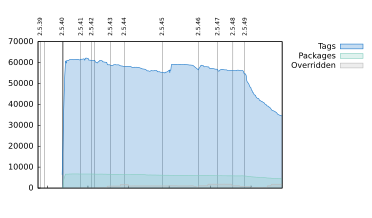
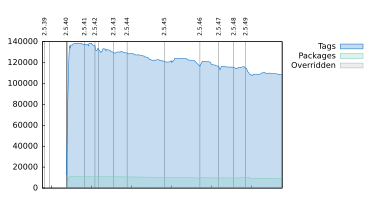
pie-bindnow-notnow-debianHardening all executables by making them position independent by default is basically ready with a few packages to fix (bugs). On the other hand bindnow is not enabled globally (#835146) and it seems it will not be for the next stable release despite my plan :-(. If you are a maintainer you can still have your packages hardened in Stretch by enabling bindnow per package before 25 January, 2017. It could be a nice present for your users! update: It is nice to see how enabling PIE in GCC increased PIE coverage while bindnow coverage is improving slowly with maintainers enabling it package by package:
lintian-pie

From https://lintian.debian.org/tags/hardening-no-pie.html

lintian-no-bindnow

From: https://lintian.debian.org/tags/hardening-no-bindnow.html

update 2: Changed the deadline of enabling bindnow per package to align with the start of the full freeze, not the soft freeze.

6 December 2016

Mirco Bauer: Secure USB boot with Debian

Foreword The moment you leave your laptop, say in a hotel room, you can no longer trust your system as it could have been modified while you were away. Think you are safe because you have a crypted disk? Well, if the boot partition is on the laptop itself, it can be manipulated and you will not notice because the boot partition can't be encrypted. The BIOS needs to access the MBR and boot loader and that loads the Linux kernel, all unencrypted. There has been some reports lately that the Linux cryptsetup is insecure because you can spawn a root shell by hitting the enter key for 70 seconds. This is not the real threat to your system, really. If someone has physical access to your hardware, he can get a root shell in less than a second by passing init=/bin/bash as parameter to the Linux kernel in the boot loader regardless if cryptsetup is used or not! The attacker can also use other ways like booting a live system from CD/USB etc. The real insecurity here is the unencrypted boot partition and not some script that gets executed from it. So how to prevent this physical access attack vector? Just keep reading this guide. This guide explains how to install Debian securely on your laptop with using an external USB boot disk. The disk inside the laptop should not contain your /boot partition since that is an easy target for manipulation. An attacker could for example change the boot scripts inside the initrd image to capture your passphrase of your crypted volume. With an USB boot partition, you can unplug the USB stick after the operating system has booted. Best practice here is to have the USB stick together with your bunch of keys. That way you will disconnect your USB stick early after the boot as finished so you can put it back into your pocket.

Secure Hardware Assumptions We have to assume here that the hardware you are using to download and verify the install media is safe to use. Same applies with the hardware where you are doing the fresh Debian install. Say the hardware does not contain any malware in the form of code in EFI or other manipulation attempts that influence the behavior of the operating system we are going to install.

Download Debian Install ISO Feel free to use any Debian mirror and install flavor. For this guide I am using the download mirror in Germany and the DVD install flavor.
wget http://ftp.de.debian.org/debian-cd/current/amd64/iso-dvd/debian-8.6.0-amd64-DVD-1.iso

Verify hashsum of ISO file To know if the ISO file was downloaded without modification we have to check the hashsum of the file. The hashsum file can be found in the same directory as the ISO file on the download mirror. With hashsums if a single bit differs in the file, the resulting SHA512 sum will be completely different. Obtain the hashsum file using:
wget http://ftp.de.debian.org/debian-cd/current/amd64/iso-dvd/SHA512SUMS
Calculate a local hashsum from the downloaded ISO file:
sha512sum debian-8.6.0-amd64-DVD-1.iso
Now you need to compare the hashsum with that is in the SHA512SUMS file. Since the SHA512SUMS file contains the hashsums of all files that are in the same directory you need to find the right one first. grep can do this for you:
grep debian-8.6.0-amd64-DVD-1.iso SHA512SUMS
Both commands executed after each other should show following output:
$ sha512sum debian-8.6.0-amd64-DVD-1.iso
c3883edfc95e3b09152d46ce29a032eed1de71531549aee86bb98dab1528088a16f0b4d628aee8ac6cc420364e208d3d5e19d0dea3576f53b904c18e8f604d8c  debian-8.6.0-amd64-DVD-1.iso
$ grep debian-8.6.0-amd64-DVD-1.iso SHA512SUMS
c3883edfc95e3b09152d46ce29a032eed1de71531549aee86bb98dab1528088a16f0b4d628aee8ac6cc420364e208d3d5e19d0dea3576f53b904c18e8f604d8c  debian-8.6.0-amd64-DVD-1.iso
As you can see the hashsum found in the SHA512SUMS file matches with the locally generated hashsum using the sha512sum command. At this point we are not finished yet. These 2 matching hashsums just means whatever was on the download server matches what we have received and stored locally on your disk. The ISO file and SHA512SUM file could still be a modified version! And this is where GPG signatures chime in, covered in the next section.

Download GPG Signature File GPG signature files usually have the .sign file name extension but could also be named .asc. Download the signature file using wget:
wget http://ftp.de.debian.org/debian-cd/current/amd64/iso-dvd/SHA512SUMS.sign

Obtain GPG Key of Signer Letting gpg verify the signature will fail at this point as we don't have the public key of the signer:
$ gpg --verify SHA512SUMS.sign
gpg: assuming signed data in 'SHA512SUMS'
gpg: Signature made Mon 19 Sep 2016 12:23:47 AM HKT
gpg:                using RSA key DA87E80D6294BE9B
gpg: Can't check signature: No public key
Downloading a key is trivial with gpg, but more importantly we need to verify that this key (DA87E80D6294BE9B) is trustworthy, as it could also be a key of the infamous man-in-the-middle. Here you can find the GPG fingerprints of the official signing keys used by Debian. The ending of the "Key fingerprint" line should match the key id we found in the signature file from above.
gpg:                using RSA key DA87E80D6294BE9B
Key fingerprint = DF9B 9C49 EAA9 2984 3258  9D76 DA87 E80D 6294 BE9B
DA87E80D6294BE9B matches Key fingerprint = DF9B 9C49 EAA9 2984 3258 9D76 DA87 E80D 6294 BE9B To download and import this key run: $ gpg --keyserver keyring.debian.org --recv-keys DA87E80D6294BE9B

Verify GPG Signature of Hashsum File Ok, we are almost there. Now we can run the command which checks if the signature of the hashsum file we have, was not modified by anyone and matches what Debian has generated and signed.
gpg: assuming signed data in 'SHA512SUMS'
gpg: Signature made Mon 19 Sep 2016 12:23:47 AM HKT
gpg:                using RSA key DA87E80D6294BE9B
gpg: checking the trustdb
gpg: marginals needed: 3  completes needed: 1  trust model: pgp
gpg: depth: 0  valid:   1  signed:   0  trust: 0-, 0q, 0n, 0m, 0f, 1u
gpg: Good signature from "Debian CD signing key <debian-cd@lists.debian.org>" [unknown]
gpg: WARNING: This key is not certified with a trusted signature!
gpg:          There is no indication that the signature belongs to the owner.
Primary key fingerprint: DF9B 9C49 EAA9 2984 3258  9D76 DA87 E80D 6294 BE9B
The important line in this output is the "Good signature from ..." one. It still shows a warning since we never certified (signed) that Debian key. This can be ignored at this point though.

Write ISO Image to Install Media With a verified pristine ISO file we can finally start the install by writing it to an USB stick or blank DVD. So use your favorite tool to write the ISO to your install media and boot from it. I have used dd and a USB stick attached as /dev/sdb.
dd if=debian-8.6.0-amd64-DVD-1.iso of=/dev/sdb bs=1M oflag=sync

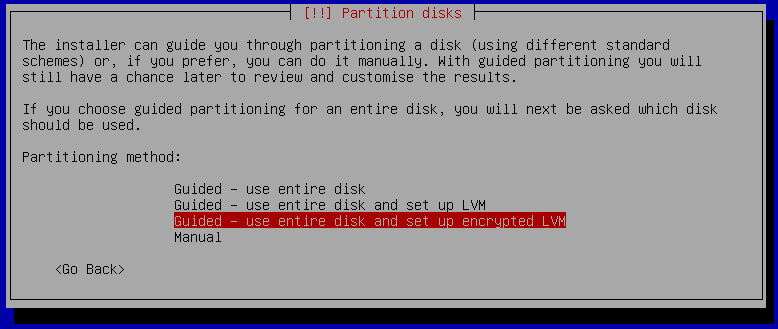
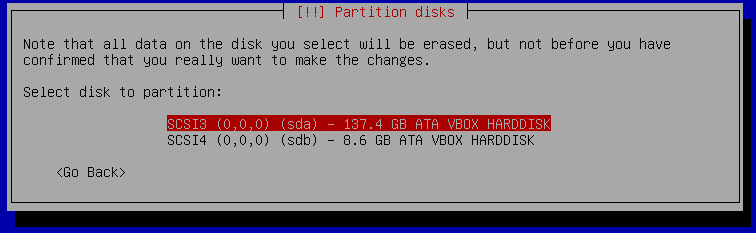
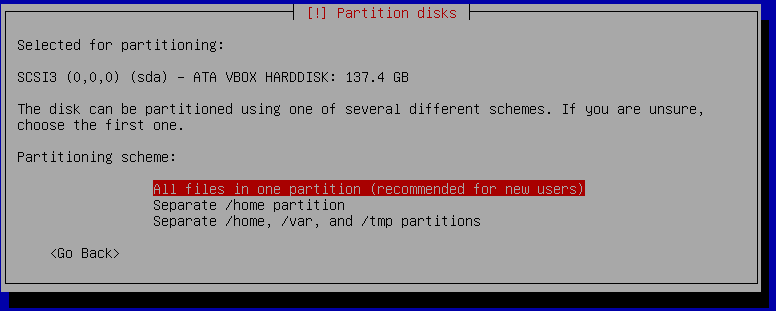
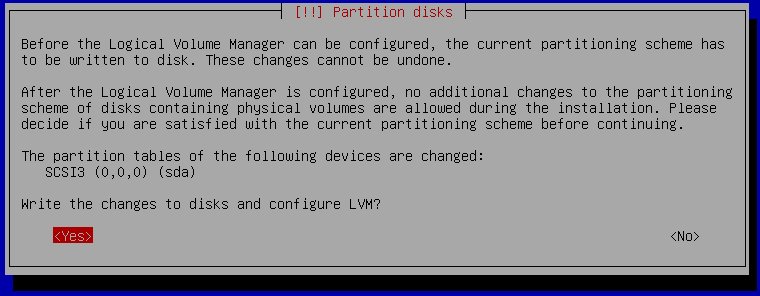
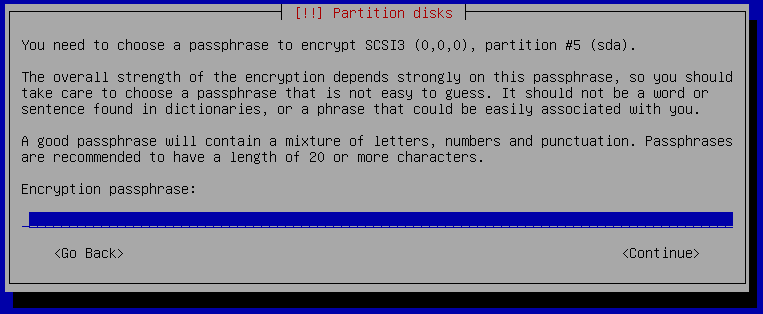
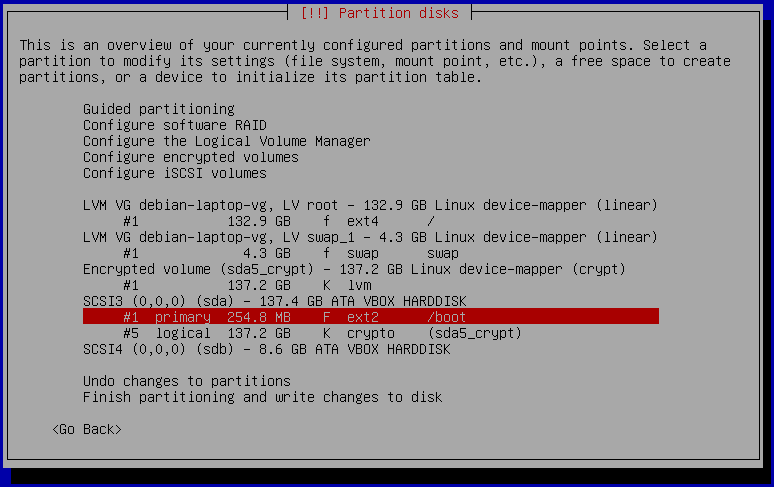
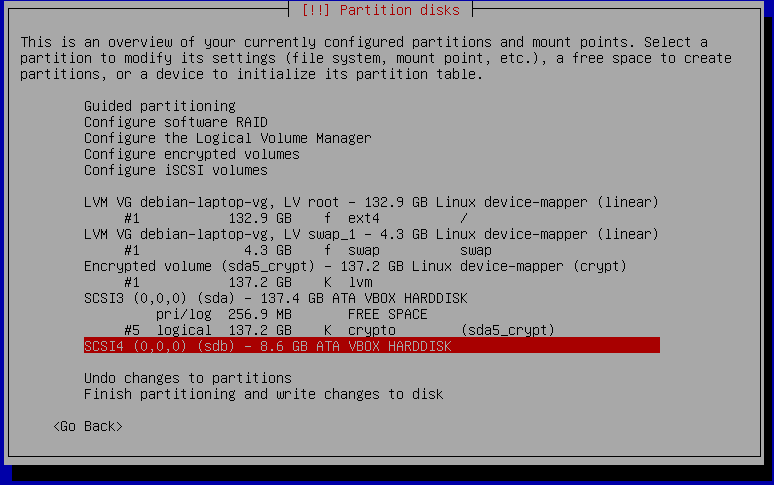
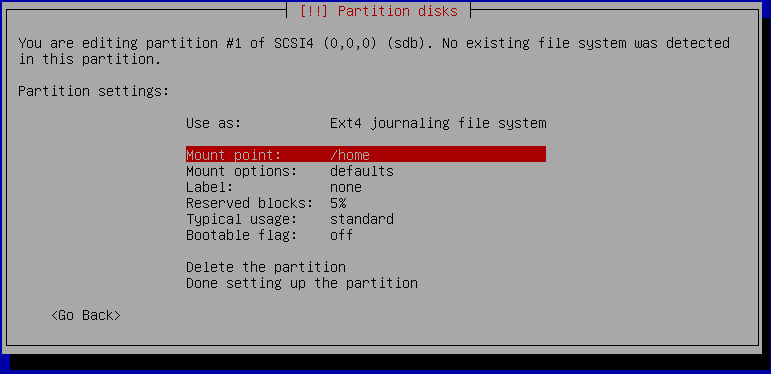
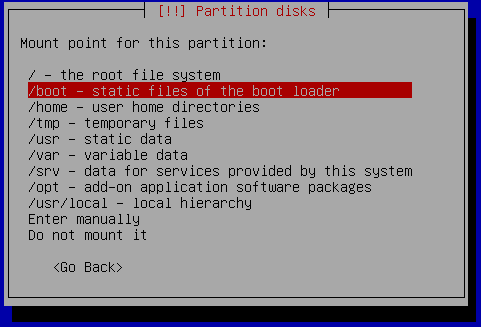
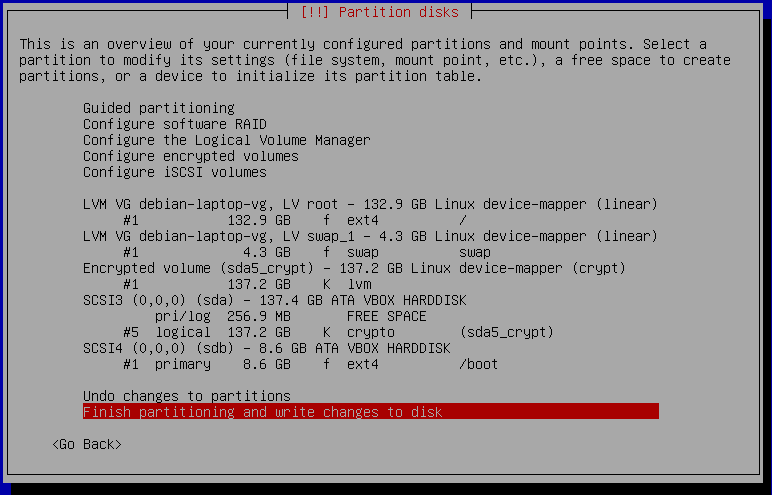
Install Debian on Crypted Volume with USB boot partition I am not explaining each step of the Debian install here. The Debian handbook is a good resource for covering each install step. Follow the steps until the installers wants to partition your disk. There you need to select the "Guided, use entire disk and set up encrypted LVM" option. After that select the built-in disk of your laptop, which usually is sda but double check this before you go ahead, as it will overwrite the data! The 137 GB disk in this case is the built-in disk and the 8 GB is the USB stick. It makes no difference at this point if you select "All files in one partition" or "Separate /home partition". The USB boot partition can be selected a later step. Confirm that you want to overwrite your built-in disk shown as sda. It will take a while as it will write random data to the disk to ensure there is no unencrypted data left on the disk from previous installations for example. Now you need to enter your passphrase that will be used to protect the private key of the crypt volume. Choose something long enough like a sentence and don't forget the passphrase else you can no longer access your data! Don't save the passphrase on any computer, smartphone or password manager. If you want to make a backup of your passphrase then use a ball pen and paper and store the paper backup in a secure location. The installer will show you a summary of the partitioning as shown above but we need to make the change for the USB boot disk. At the moment it wants to put /boot on sda which is the built-in disk, while our USB stick is sdb. Select /boot and hit enter, after that select "Delete this partition". After /boot was deleted we can create /boot on the USB stick shown as sdb. Select sdb and hit enter. It will ask if you want to create an empty partition table. Confirm that question with yes. The partition summary shows sdb with no partitions on it. Select FREE SPACE and select "Create a new partition". Confirm the suggested partition size. Confirm the partition type to be "Primary". It is time to tell the installer to use this new partition on the USB stick (sdb1) as /boot partition. Select "Mount point: /home" and in the next dialog select "/boot - static files of the boot loader" as shown below: Confirm the made changes by selecting "Done setting up the partition". The final partitioning should look now like the following screenshot: If the partition summary looks good, go ahead with the installation by selecting "Finish partitioning and write changes to disk". When the installer asks if it should force EFI, then select no, as EFI is not going to protect you. Finish the installation as usual, select your preferred desktop environment etc.

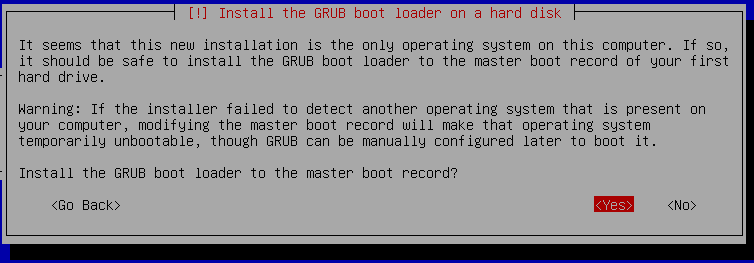
GRUB Boot Loader Confirm the dialog that wants to install GRUB to the master boot record. Here it is important to install it to the USB stick and not your built-in SATA/SSD disk! So select sdb (the USB stick) in the next dialog.

First Boot from USB Once everything is installed, you can boot from your USB stick. As simple test you can unplug your USB stick and the boot should fail with "no operating system found" or similar error message from the BIOS. If it doesn't boot even though the USB stick is connected, then most likely your BIOS is not configured to boot from USB media. Also a blank screen and nothing happening is usually meaning the BIOS can't find a boot device. You need to change the boot setting in your BIOS. As the steps are very different for each BIOS, I can't provide a detailed step-by-step list here. Usually you can enter the BIOS using F1, F2 or F12 after powering on your computer. In the BIOS there is a menu to configure the boot order. In that list it should show USB disk/storage as the first position. After you have made the changes save and exit the BIOS. Now it will boot from your USB stick first and GRUB will show up and proceeds with the boot process till it will ask for your passphrase to unlock the crypt volume.

Unmount /boot partition after Boot If you boot your laptop from the USB stick, we want to remove the stick after it has finished booting. This will prevent an attacker to make modifications to your USB stick. To avoid data loss, we should not simply unplug the USB stick but unmount /boot first and then unplug the stick. Good news is that we can automate this unmounting and you just need to unplug the stick after the laptop has finished booting to your login screen. Just add this line to your /etc/rc.local file:
umount /boot
After boot you can once verify that it automatically unmounts /boot for you by running:
mount   grep /boot
If that command produces no output, then /boot is not mounted and you can safely unplug the USB stick.

Final Words From time to time you need to upgrade your Linux kernel of course which is on the /boot partition. This can still be done the regular way using apt-get upgrade, except that you need to mount /boot before that and unmount it again after the kernel upgrade. Enjoy your secured laptop. Now you can leave it in a hotel room without the possibility of someone trying you obtain your passphrase by putting a key logger in your boot partition. All the attacker will see is a fully encrypted harddisk. If he tries to mess with your crypted disk, you will notice as the decryption will fail. Disclaimer: there are still other attack vectors possible, but they are much harder to do. Your hardware or BIOS can still be modified. But not by holding down the enter key for 70 seconds or by booting a live system.

30 November 2016

Chris Lamb: Free software activities in November 2016

Here is my monthly update covering what I have been doing in the free software world (previous month):
Reproducible builds

Whilst anyone can inspect the source code of free software for malicious flaws, most software is distributed pre-compiled to end users. The motivation behind the Reproducible Builds effort is to permit verification that no flaws have been introduced either maliciously or accidentally during this compilation process by promising identical results are always generated from a given source, thus allowing multiple third-parties to come to a consensus on whether a build was compromised.

This month:

My work in the Reproducible Builds project was also covered in our weekly reports. (#80, #81, #82 #83.

Toolchain issues I submitted the following patches to fix reproducibility-related toolchain issues with Debian:

strip-nondeterminism

strip-nondeterminism is our tool to remove specific non-deterministic results from a completed build.


jenkins.debian.net

jenkins.debian.net runs our comprehensive testing framework.

  • buildinfo.debian.net has moved to SSL. (ac3b9e7)
  • Submit signing keys to keyservers after generation. (bdee6ff)
  • Various cosmetic changes, including
    • Prefer if X not in Y over if not X in Y. (bc23884)
    • No need for a dictionary; let's just use a set. (bf3fb6c)
    • Avoid DRY violation by using a for loop. (4125ec5)

I also submitted 9 patches to fix specific reproducibility issues in apktool, cairo-5c, lava-dispatcher, lava-server, node-rimraf, perlbrew, qsynth, tunnelx & zp.

Debian

Debian LTS This month I have been paid to work 11 hours on Debian Long Term Support (LTS). In that time I did the following:
  • "Frontdesk" duties, triaging CVEs, etc.
  • Issued DLA 697-1 for bsdiff fixing an arbitrary write vulnerability.
  • Issued DLA 705-1 for python-imaging correcting a number of memory overflow issues.
  • Issued DLA 713-1 for sniffit where a buffer overflow allowed a specially-crafted configuration file to provide a root shell.
  • Issued DLA 723-1 for libsoap-lite-perl preventing a Billion Laughs XML expansion attack.
  • Issued DLA 724-1 for mcabber fixing a roster push attack.

Uploads
  • redis:
    • 3.2.5-2 Tighten permissions of /var/ lib,log /redis. (#842987)
    • 3.2.5-3 & 3.2.5-4 Improve autopkgtest tests and install upstream's MANIFESTO and README.md documentation.
  • gunicorn (19.6.0-9) Adding autopkgtest tests.
  • libfiu:
    • 0.94-1 Add autopkgtest tests.
    • 0.95-1, 0.95-2 & 0.95-3 New upstream release and improve autopkgtest coverage.
  • python-django (1.10.3-1) New upstream release.
  • aptfs (0.8-3, 0.8-4 & 0.8-5) Adding and subsequently improving the autopkgtext tests.


I performed the following QA uploads:


Finally, I also made the following non-maintainer uploads:
  • libident (0.22-3.1) Move from obsolete Source-Version substvar to binary:Version. (#833195)
  • libpcl1 (1.6-1.1) Move from obsolete Source-Version substvar to binary:Version. (#833196)
  • pygopherd (2.0.18.4+nmu1) Move from obsolete Source-Version substvar to $ source:Version . (#833202)


RC bugs


I also filed 59 FTBFS bugs against arc-gui-clients, asyncpg, blhc, civicrm, d-feet, dpdk, fbpanel, freeciv, freeplane, gant, golang-github-googleapis-gax-go, golang-github-googleapis-proto-client-go, haskell-cabal-install, haskell-fail, haskell-monadcatchio-transformers, hg-git, htsjdk, hyperscan, jasperreports, json-simple, keystone, koji, libapache-mod-musicindex, libcoap, libdr-tarantool-perl, libmath-bigint-gmp-perl, libpng1.6, link-grammar, lua-sql, mediatomb, mitmproxy, ncrack, net-tools, node-dateformat, node-fuzzaldrin-plus, node-nopt, open-infrastructure-system-images, open-infrastructure-system-images, photofloat, ppp, ptlib, python-mpop, python-mysqldb, python-passlib, python-protobix, python-ttystatus, redland, ros-message-generation, ruby-ethon, ruby-nokogiri, salt-formula-ceilometer, spykeviewer, sssd, suil, torus-trooper, trash-cli, twisted-web2, uftp & wide-dhcpv6.

FTP Team

As a Debian FTP assistant I ACCEPTed 70 packages: bbqsql, coz-profiler, cross-toolchain-base, cross-toolchain-base-ports, dgit-test-dummy, django-anymail, django-hstore, django-html-sanitizer, django-impersonate, django-wkhtmltopdf, gcc-6-cross, gcc-defaults, gnome-shell-extension-dashtodock, golang-defaults, golang-github-btcsuite-fastsha256, golang-github-dnephin-cobra, golang-github-docker-go-events, golang-github-gogits-cron, golang-github-opencontainers-image-spec, haskell-debian, kpmcore, libdancer-logger-syslog-perl, libmoox-buildargs-perl, libmoox-role-cloneset-perl, libreoffice, linux-firmware-raspi3, linux-latest, node-babel-runtime, node-big.js, node-buffer-shims, node-charm, node-cliui, node-core-js, node-cpr, node-difflet, node-doctrine, node-duplexer2, node-emojis-list, node-eslint-plugin-flowtype, node-everything.js, node-execa, node-grunt-contrib-coffee, node-grunt-contrib-concat, node-jquery-textcomplete, node-js-tokens, node-json5, node-jsonfile, node-marked-man, node-os-locale, node-sparkles, node-tap-parser, node-time-stamp, node-wrap-ansi, ooniprobe, policycoreutils, pybind11, pygresql, pysynphot, python-axolotl, python-drizzle, python-geoip2, python-mockupdb, python-pyforge, python-sentinels, python-waiting, pythonmagick, r-cran-isocodes, ruby-unicode-display-width, suricata & voctomix-outcasts. I additionally filed 4 RC bugs against packages that had incomplete debian/copyright files against node-cliui, node-core-js, node-cpr & node-grunt-contrib-concat.

8 November 2016

Jonathan Carter: A few impressions of DebConf 16 in Cape Town

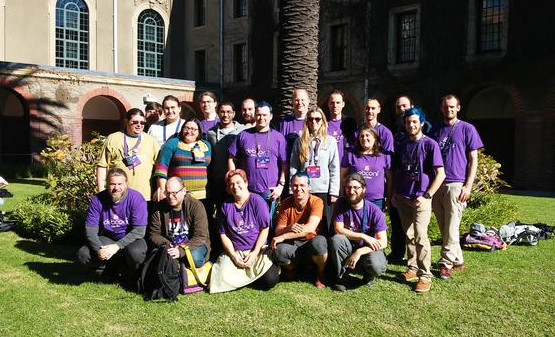
DebConf16 Group Photo

DebConf16 Group Photo by Jurie Senekal.

DebConf16 Firstly, thanks to everyone who came out and added their own uniqueness and expertise to the pool. The feedback received so far has been very positive and I feel that the few problems we did experience was dealt with very efficiently. Having a DebConf in your hometown is a great experience, consider a bid for hosting a DebConf in your city! DebConf16 Open Festival (5 August) The Open Festival (usually Debian Open Day) turned out pretty good. It was a collection of talks, a job fair, and some demos of what can be done with Debian. I particularly liked Hetzner s stand. I got to show off some 20 year old+ Super Mario skills and they had some fun brain teasers as well. It s really great to see a job stand that s so interactive and I think many companies can learn from them. The demo that probably drew the most attention was from my friend Georg who demoed some LulzBot Mini 3D Printers. They really seem to love Debian which is great! DebConf (6 August to 12 August) If I try to write up all my thoughts and feeling about DC16, I ll never get this post finished. Instead, here as some tweets from DebConf that other have written:


Day Trip We had 3 day trips: Brought to you by
orga

DebConf16 Orga Team.

See you in Montr al! DebConf17 dates: The DC17 sponsorship brochure contains a good deal of information, please share it with anyone who might be interested in sponsoring DebConf! Media

6 November 2016

Shirish Agarwal: The long tail in a common s man journey to debconf16 1

I was going to put a technical post but saw the discussion of one of the meetings of the debconf meets and decided to share a novice s travel experience. Before I start here s the discussion log http://meetbot.debian.net/debconf-team/2016/debconf-team.2016-10-20-20.01.log.html and specifically this part which hit me (using fake names for discussion as haven t taken permission from the folks to cite them by name.)
20:36:52 abcd: $100 CAD is a lot for some, but you d only need it if you won t sleep in sponsored accom, which arguably is acceptable.
20:37:04 it would, efgh, fixed sponsorship sum for everybody and allocation of rooms completely decoupled. Hotel gets the money from everybody and the base fee from DebConf.
20:37:15 people who can t afford also have special needs and may be uncomfortable in sharing rooms. That s quite frequently in our community. Managing each case will be much more complicated.
20:37:31 hijk: we could set aside budget for such special needs, for sure.
20:37:43 I m talking about managing each case
20:37:46 hijk: yes, but we ll have the special cases no matter what.
20:37:48 yes, and the special cases need to be catered for regardless of how everybody else is housed
20:38:06 hijk: room allocation already includes this.
20:38:19 people having to expose their personal problems to have us permitting them staying in the hotel
20:38:23 that s just too weird
It just goes on. I dunno whether I m weird or not or the experience I would share is just normal, this I would leave for you to decide. As have shared before, some friends of mine from the free software community had cajoled me last year to apply for debconf bursary (debconf15), which surprisingly got approved, but as it was late and my pre-conceived myths/notions of visas taking a looooong time decided not to go further. Many things take a long time to happen in the Indian bureaucratic maze. For instance have been in a civil case for almost a decade now among other things so know and accept that things take their own sweet time otherwise known as Indian patience  Did the application and again, surprise, surprise this time too I was approved. Luckily, had done the application for bursary early so was a bit positive on the visa-front. There was a goof-up at the embassay but thanks to people at travel.stackexchange.com where I asked quite a few questions, I was a bit informed and travel was relatively hassle-free. Internally though, I was nervous as hell. I had been feeling like a conman or a fraud or being an imposter because I knew before-hand that the project is so huge and had done the mistake of putting up a talk and a workshop where the big guns would be, which again was accepted (not good). The only thing I was thinking of as a saving grace is that there might be some newbies who don t know about the project at all (on Open Day) and hopefully I could help with that but as you will see, even there I was fully inadequate. I live in Pune which is around 3.5 hours from Mumbai (BOM) from where international flights take off. While Pune has an Airport, due to defence considerations, there cannot be much improvement either for domestic or International carriers. There have been attempts to have an exclusive civilian Airport for a long time (almost a decade) and would still take a decade or more. Hence had decided to take an early morning train from Pune to Mumbai, change couple of locals and finally land up at the Mumbai International Airport. Hind-sight as they say is 50:50, while I do have friends in Mumbai, I also found about a homestay which is closer to the Airport and still relatively budget-friendly. Anyways, met few friends but as was paranoid about missing connections found myself in front of the Airport at 20:00 hrs. with about 7 hours + to go before my flight. While there is nothing to do around the airport rather than hanging around, just hung around outside the airport as knew that inside the airport will be chilling and once you go in, you cannot come out or at least it s an inconvenience to the security therein. The International Airport in on three levels, the basement is for vehicles, the first level to receive International and Domestic passengers and the upper-most level exclusively for people flying internationally. This again, came to know when I tried to enter into the ones meant for Domestic and International Passengers coming into the city. Came to the check-in counter at around 02:00 hrs, did the security thing and just had to wait as the flight was of 0400 hrs (from my limited search experience, the cheapest flights are at such times when nobody else (i.e.civilized people) wants to fly). Entered Doha around 5:15 Doha time and saw a much much bigger airport than either the Mumbai International Airport or/and the Delhi International Airport . While I have written some negative stuff about Doha, there were two positives that I am sure, I had forgotten to share a. There were no transit Visa Fees that I had to pay. Most countries and airports I researched have something called transit visa and that can really get expensive, so saved money on that. b. The free ride into the city and back with voluntary tipping the driver or/and guide (approx. 3-4 hours) While the second from what I could tell/know is a gimmick, this is something I wish other countries and airports emulate. There are hotels in the airport and I could have had hotel accommodation if I had booked a slightly more expensive ticket, roughly INR 5k/- each way which would have given me a bit more legroom as well as stay as my layover was more than 24 hours. But this information was known at last minute. Qatar Airways has just a toll-free number and trying more than a few times gave up. They don t have an office in the city. When I reached the check-in counter they said if I had upgraded to Y class I would have had the hotel thing. Changing tickets at the last moment was too expensive and anyways for hotel accommodation for layovers they required at least 24 hours notice. Had to make do with recliners and chairs which are not really comfortable. There were only a couple of waiting rooms on air-side which had a view of the aircraft and hence were a bit more pleasing than those which were on the land-side and were fully blocked without a view. I wish there was a map of the Airport from within the Airport as even with the single terminal it is really easy to get lost. Somehow the day and night went by and took my second flight and reached Cape Town, South Africa. Throughout the journey had been stressed as had to be awake at all times and make sure that nothing gets stolen. Having attendants at toilets were also good so that there is no possibility of any violence there. So it had been 2 days, no shower and no sleep. Later also came to know about Airport Sleeping Pods and shower stalls but these also seem to be less in number, at few airports and there always be a bit of premium attached to them as airports are a monopoly business. Anyways, reached the venue. Throughout the travel there was quite a bit of unnamed fear which I later came to know after seeing Dr. Ramanujan s The Man who knew Infinity . It was/is the fear or unknown, while in the movie it is articulated as fear of crossing seven seas, symbolically it is the fear or unknown. Now while I was dead tired, I still pushed myself as I didn t want to have the effects of jet lag interfere with the normal sleeping and waking patterns. I did freshen myself but didn t allow myself the luxury of the bath-tub as I knew that if I went in, I would not come out that day. Met all the people, learnt who s who, where things are happening etc. and slowly night came. Night came and I was so-looking forward to sleep but sleep was not to be. I later learnt it could be either of the two reasons, it could either have been travel-induced insomnia or/and what is known as the first night effect . It was only on the second day when I was in bath-tub for about 2/3 hours I could feel the tension leaving my body. I finally realized that I am in Cape Town, South Africa and could enjoy and be surprised at seeing birds within few feet of me . Now I don t know whether I m the only weird/paranoid one, I do know that it would not have been easier for me at least for the first night as I was turning and twisting throughout the night. I opened the lights, read for some time hoping for sleep to take over but that didn t work. Tried quite a few things but sleep didn t come. If I had been sleeping with other people I dunno how they would have reacted. I myself am a light sleeper (most of the time) and if I had sleep coming and somebody else acted or been the way I was, I wouldn t been able to sleep. However much you try, whatever is the natural reaction is, will be. There are still some bits to share but that would be in part 2.
Filed under: Miscellenous Tagged: #air-travel, #Debconf16, #paranoia, #sleep

5 November 2016

Elizabeth Ferdman: Applying to Debian for Outreachy 2016

This year, Outreachy featured internships from organizations such as Debian, Fedora, GNOME, the Linux Kernel, Mozilla, Python, and Wikimedia, just to name a few. Each organization features mentored projects and in order to apply, applicants must contact the mentor, introduce themselves on the appropriate channels and make a small contribution to the project. After that, applicants might be required to fulfill additional tasks to demonstrate their abilities. Successful applicants will make quality contributions, communicate effectively with mentors, ask questions, fulfill tasks, help out their peers via mailing lists, and/or blog about their experience. One of the projects I applied to was the Clean Room for PGP and X.509 (PKI) Key Management. The project aims to create a Live Disc that enables users to create and manage their PGP keys easily and securely, using a text-based UI. I ve been a Debian user for about a year, but before applying to the project I didn t know much about GnuPG or public key encryption. Since then, I ve made some contributions and attended my first keysigning event in San Francisco featuring a lecture by Neal Walfield (more on that below). For my initial contribution, Daniel Pocock, the mentor for this project, asked that I write a script that lists the USB flash devices connected to the system and specifies which device the system booted from. Here s the bash script that I wrote, and that was enough to submit an application for Debian. My next task was to write a dns hook script for the dehydrated project, a shell client for signing certificates with Let s Encrypt (for free!). The script completes a dns challenge sent by the ACME-server by provisioning a TXT record for a given domain in order to prove ownership of the domain. I chose to write it in python and used the dnspython API. I posted my solution on github and there are many more here. At the lecture, Neal talked about good practices for key creation and management. Here are a few of those points: See the slides for Neal s full presentation.

Elizabeth Ferdman: Applying to Debian for Outreachy 2016

This year, Outreachy featured internships from organizations such as Debian, Fedora, GNOME, the Linux Kernel, Mozilla, Python, and Wikimedia, just to name a few. Each organization features mentored projects and in order to apply, applicants must contact the mentor, introduce themselves on the appropriate channels and make a small contribution to the project. After that, applicants might be required to fulfill additional tasks to demonstrate their abilities. Successful applicants will make quality contributions, communicate effectively with mentors, ask questions, fulfill tasks, help out their peers via mailing lists, and/or blog about their experience. One of the projects I applied to was the Clean Room for PGP and X.509 (PKI) Key Management. The project aims to create a Live Disc that enables users to create and manage their PGP keys easily and securely, using a text-based UI. I ve been a Debian user for about a year, but before applying to the project I didn t know much about GnuPG or public key encryption. Since then, I ve made some contributions and attended my first keysigning event in San Francisco featuring a lecture by Neal Walfield (more on that below). For my initial contribution, Daniel Pocock, the mentor for this project, asked that I write a script that lists the USB flash devices connected to the system and specifies which device the system booted from. Here s the bash script that I wrote, and that was enough to submit an application for Debian. My next task was to write a dns hook script for the dehydrated project, a shell client for signing certificates with Let s Encrypt (for free!). The script completes a dns challenge sent by the ACME-server by provisioning a TXT record for a given domain in order to prove ownership of the domain. I chose to write it in python and used the dnspython API. I posted my solution on github and there are many more here. At the lecture, Neal talked about good practices for key creation and management. Here are a few of those points: See the slides for Neal s full presentation.

28 October 2016

Alessio Treglia: The logical contradictions of the Universe

Ouroboros

Ouroboros

Is Erwin Schr dinger s wave function which did in the atomic and subatomic world an operation altogether similar to the one performed by Newton in the macroscopic world an objective reality or just a subjective knowledge? Physicists, philosophers and epistemologist have debated at length on this matter. In 1960, theoretical physicist Eugene Wigner has proposed that the observer s consciousness is the dividing line that triggers the collapse of the wave function[1], and this theory was later taken up and developed in recent years. The rules of quantum mechanics are correct but there is only one system which may be treated with quantum mechanics, namely the entire material world. There exist external observers which cannot be treated within quantum mechanics, namely human (and perhaps animal) minds, which perform measurements on the brain causing wave function collapse [2]. The English mathematical physicist and philosopher of science Roger Penrose developed the hypothesis called Orch-OR (Orchestrated objective reduction) according to which consciousness originates from processes within neurons, rather than from the connections between neurons (the conventional view). The mechanism is believed to be a quantum physical process called objective reduction which is orchestrated by the molecular structures of the microtubules of brain cells (which constitute the cytoskeleton of the cells themselves). Together with the physician Stuart Hameroff, Penrose has suggested a direct relationship between the quantum vibrations of microtubules and the formation of consciousness.

<Read More [by Fabio Marzocca]>

24 October 2016

Francois Marier: Tweaking Referrers For Privacy in Firefox

The Referer header has been a part of the web for a long time. Websites rely on it for a few different purposes (e.g. analytics, ads, CSRF protection) but it can be quite problematic from a privacy perspective. Thankfully, there are now tools in Firefox to help users and developers mitigate some of these problems.

Description In a nutshell, the browser adds a Referer header to all outgoing HTTP requests, revealing to the server on the other end the URL of the page you were on when you placed the request. For example, it tells the server where you were when you followed a link to that site, or what page you were on when you requested an image or a script. There are, however, a few limitations to this simplified explanation. First of all, by default, browsers won't send a referrer if you place a request from an HTTPS page to an HTTP page. This would reveal potentially confidential information (such as the URL path and query string which could contain session tokens or other secret identifiers) from a secure page over an insecure HTTP channel. Firefox will however include a Referer header in HTTPS to HTTPS transitions unless network.http.sendSecureXSiteReferrer (removed in Firefox 52) is set to false in about:config. Secondly, using the new Referrer Policy specification web developers can override the default behaviour for their pages, including on a per-element basis. This can be used both to increase or reduce the amount of information present in the referrer.

Legitimate Uses Because the Referer header has been around for so long, a number of techniques rely on it. Armed with the Referer information, analytics tools can figure out:
  • where website traffic comes from, and
  • how users are navigating the site.
Another place where the Referer is useful is as a mitigation against cross-site request forgeries. In that case, a website receiving a form submission can reject that form submission if the request originated from a different website. It's worth pointing out that this CSRF mitigation might be better implemented via a separate header that could be restricted to particularly dangerous requests (i.e. POST and DELETE requests) and only include the information required for that security check (i.e. the origin).

Problems with the Referrer Unfortunately, this header also creates significant privacy and security concerns. The most obvious one is that it leaks part of your browsing history to sites you visit as well as all of the resources they pull in (e.g. ads and third-party scripts). It can be quite complicated to fix these leaks in a cross-browser way. These leaks can also lead to exposing private personally-identifiable information when they are part of the query string. One of the most high-profile example is the accidental leakage of user searches by healthcare.gov.

Solutions for Firefox Users While web developers can use the new mechanisms exposed through the Referrer Policy, Firefox users can also take steps to limit the amount of information they send to websites, advertisers and trackers. In addition to enabling Firefox's built-in tracking protection by setting privacy.trackingprotection.enabled to true in about:config, which will prevent all network connections to known trackers, users can control when the Referer header is sent by setting network.http.sendRefererHeader to:
  • 0 to never send the header
  • 1 to send the header only when clicking on links and similar elements
  • 2 (default) to send the header on all requests (e.g. images, links, etc.)
It's also possible to put a limit on the maximum amount of information that the header will contain by setting the network.http.referer.trimmingPolicy to:
  • 0 (default) to send the full URL
  • 1 to send the URL without its query string
  • 2 to only send the scheme, host and port
or using the network.http.referer.XOriginTrimmingPolicy option (added in Firefox 52) to only restrict the contents of referrers attached to cross-origin requests. Site owners can opt to share less information with other sites, but they can't share any more than what the user trimming policies allow. Another approach is to disable the Referer when doing cross-origin requests (from one site to another). The network.http.referer.XOriginPolicy preference can be set to:
  • 0 (default) to send the referrer in all cases
  • 1 to send a referrer only when the base domains are the same
  • 2 to send a referrer only when the full hostnames match

Breakage If you try to remove all referrers (i.e. network.http.sendRefererHeader = 0, you will most likely run into problems on a number of sites, for example: The first two have been worked-around successfully by setting network.http.referer.spoofSource to true, an advanced setting which always sends the destination URL as the referrer, thereby not leaking anything about the original page. Unfortunately, the last two are examples of the kind of breakage that can only be fixed through a whitelist (an approach supported by the smart referer add-on) or by temporarily using a different browser profile.

My Recommended Settings As with my cookie recommendations, I recommend strengthening your referrer settings but not disabling (or spoofing) it entirely. While spoofing does solve many the breakage problems mentioned above, it also effectively disables the anti-CSRF protections that some sites may rely on and that have tangible user benefits. A better approach is to limit the amount of information that leaks through cross-origin requests. If you are willing to live with some amount of breakage, you can simply restrict referrers to the same site by setting:
network.http.referer.XOriginPolicy = 2
or to sites which belong to the same organization (i.e. same ETLD/public suffix) using:
network.http.referer.XOriginPolicy = 1
This prevent leaks to third-parties while giving websites all of the information that they can already see in their own server logs. On the other hand, if you prefer a weaker but more compatible solution, you can trim cross-origin referrers down to just the scheme, hostname and port:
network.http.referer.XOriginTrimmingPolicy = 2
I have not yet found user-visible breakage using this last configuration. Let me know if you find any!

22 October 2016

Ingo Juergensmann: Automatically update TLSA records on new Letsencrypt Certs

I've been using DNSSEC for some quite time now and it is working quite well. When LetsEncrypt went public beta I jumped on the train and migrated many services to LE-based TLS. However there was still one small problem with LE certs: When there is a new cert, all of the old TLSA resource records are not valid anymore and might give problems to strict DNSSEC checking clients. It took some while until my pain was big enough to finally fix it by some scripts. There are at least two scripts involved: 1) dnssec.sh
This script does all of my DNSSEC handling. You can just do a "dnssec.sh enable-dnssec domain.tld" and everything is configured so that you only need to copy the appropriate keys into the webinterface of your DNS registry.
host:~/bin# dnssec.sh
No parameter given.
Usage: dnsec.sh MODE DOMAIN
MODE can be one of the following:
enable-dnssec : perform all steps to enable DNSSEC for your domain
edit-zone     : safely edit your zone after enabling DNSSEC
create-dnskey : create new dnskey only
load-dnskey   : loads new dnskeys and signs the zone with them
show-ds       : shows DS records of zone
zoneadd-ds    : adds DS records to the zone file
show-dnskey   : extract DNSKEY record that needs to uploaded to your registrar
update-tlsa   : update TLSA records with new TLSA hash, needs old and new TLSA hashes as additional parameters
For updating zone-files just do a "dnssech.sh edit-zone domain.tld" to add new records and such and the script will take care e.g. of increasing the serial of the zone file. I find this very convenient, so I often use this script for non-DNSSEC-enabled domains as well. However you can spot the command line option "update-tlsa". This option needs the old and the new TLSA hashes beside the domain.tld parameter. However, this option is used from the second script: 2) check_tlsa.sh
This is a quite simple Bash script that parses the domains.txt from letsencrypt.sh script, looking up the old TLSA hash in the zone files (structured in TLD/domain.tld directories), compare the old with the new hash (by invoking tlsagen.sh) and if there is a difference in hashes, call dnssec.sh with the proper parameters:
#!/bin/bash
set -e
LEPATH="/etc/letsencrypt.sh"
for i in  cat /etc/letsencrypt.sh/domains.txt   awk ' print $1 '  ; do
  domain= echo $i   awk 'BEGIN  FS="."  ;  print $(NF-1)"."$NF ' 
  #echo -n "Domain: $domain"
  TLD= echo $i   awk 'BEGIN  FS="." ;  print $NF ' 
  #echo ", TLD: $TLD"
  OLDTLSA= grep -i "in.*tlsa" /etc/bind/$ TLD /$ domain    grep $ i    head -n 1   awk ' print $NF ' 
  if [ -n "$ OLDTLSA " ] ; then
  #echo "--> $ OLDTLSA "
  # Usage: tlsagen.sh cert.pem host[:port] usage selector mtype
  NEWTLSA= /path/to/tlsagen.sh $LEPATH/certs/$ i /fullchain.pem $ i  3 1 1   awk ' print $NF ' 
  #echo "==> $NEWTLSA"
  if [ "$ OLDTLSA " != "$ NEWTLSA " ] ; then
  /path/to/dnssec.sh update-tlsa $ domain  $ OLDTLSA  $ NEWTLSA  > /dev/null
  echo "TLSA RR update for $ i "
  fi
  fi
done
So, quite simple and obviously a quick hack. For sure someone else can write a cleaner and more sophisticated implementation to do the same stuff, but at least it works for meTM. Use it on your own risk and do whatever you want with these scripts (licensed under public domain). You can invoke check_tlsa.sh right after your crontab call for letsencrypt.sh. In a more sophisticated way it should be fairly easy to invoke these scripts from letsencrypt.sh post hooks as well.
Please find the files attached to this page (remove the .txt extension after saving, of course).
AttachmentSize
check_tlsa.sh.txt812 bytes
dnssec.sh.txt3.88 KB
Kategorie:

14 October 2016

Antoine Beaupr : Managing good bug reports

Bug reporting is an art form that is too often neglected in software projects. Bug reports allow contributors to participate without deep technical knowledge and at the same time provide a crucial space for developers to be made aware of issues with their software that they could not have foreseen or found themselves, for lack of resources, variety or imagination.

Prior art Unfortunately, there are rarely good guidelines for submitting bug reports. Historically, people have pointed towards How to report bugs effectively or How to ask questions the smart way. While those guides can be useful for motivated people and may seem attractive references for project managers, they suffer from serious issues:
  • they are written by technical people, for non-technical people
  • as a result, they have a deeply condescending attitude such as calling people "stupid" or various animal names like "mongoose"
  • they are also very technical themselves: one starts with a copyright notice and a changelog, the other uses magic words like "Core dumps" and $Id$
  • they are too long: sgtatham's is about 3600 words long, esr's is even longer at about 11800 words. those texts will take about 20 to 60 minutes to read by an average reader, according to research
Individual projects have their own guides as well. Linux has the REPORTING_BUGS file that is a much shorter 1200 that can be read under 5 minutes, provided that you can understand the topic at hand. Interestingly, that guide refers to both esr's and sgtatham's guidelines, which means, in the degenerate case where the user hasn't had the "privilege" of reading esr's prose already, they will have an extra hour and a half of reading to do to have honestly followed the guidelines before reporting the bug. I often find good documentation in the Tails project. Their bug reporting guidelines are easily accessible and quick to read, although they still might be too technical. It could be argued that you need to get technical at some point to get that information out, of course. In the Monkeysign project, I have started a bug reporting guide that doesn't yet address all those issues. I am considering writing a new guide, but I figured I would look at other people's work and get feedback before writing my own standard.

What's the point? Why have those documents been written? Are people really expected to read them before seeking help? It seems to me unlikely that someone would:
  1. be motivated enough to do something about a broken part of their computer
  2. figure out they can do something about it
  3. read a fifteen thousand words novel about how to report a bug...
  4. just to finally write a 20-line bug report that has no warranty of support attached to it
And if I would be a paying customer, I wouldn't want to be forced to waste my time reading that prose either: it's your job to help me fix your broken things, not the reverse. As someone doing consulting these days: I totally understand: it's not you, the user, it's us, the developers, that have a problem. We have been socialized through computers, and it makes us weird and obtuse, but that's no excuse, and we need to clean up our act. Furthermore, it's surprising how often we get (and make!) bug reports that can be difficult to use. The Monkeysign project is very "technical" and I have expected that the bug reports I would get would be well written, with ways to reproduce and so on, but it happened that I received bug reports that were all over the place, didn't have any ways of reproducing or were simply incomplete. Those three bug reports were filed by people that I know to be very technically capable: one is a fellow Debian developer, the second had filed a good bug report 5 days before, and the third one is a contributor that sent good patches before. In all three cases, they knew what they were doing. Those three people probably read the guidelines mentioned in the past. They may have even read the Monkeysign bug reporting guidelines as well. I can only explain those bug reports by the lack of time: people thought the issue was obvious, that it would get fixed rapidly because, obviously, something is broken. We need a better way.

The takeaway What are those guides trying to tell us?
  1. ask questions in the right place
  2. search for similar questions and issues before reporting the bug
  3. try to make the developers reproduce the issues
  4. failing that, try to describe the issue as well as you can
  5. write clearly, be specific and verbose yet concise
There are obviously contradictions in there, like sgtatham telling us to be verbose and esr tells us to, basically, not be verbose. There is definitely a tension in there, and there are many, many more details about how great bug reports can be if done properly. I tend towards the side of terseness in our descriptions: people that will know how to be concise will be, people that don't will most likely not learn by reading a 12 000 words novel that, in itself, didn't manage to be parsimonious. But I am willing to allow for verbosity in bug reports: I prefer too many details instead of missing a key bit of information.

Issue trackers Step 1 is our job: we should send people in the right place, and give them the right tools. Monkeysign used to manage bugs with bugs-everywhere and this turned out to be a terrible idea: you had to understand git and bugs-everywhere to file any bug reports. As a result, there were exactly zero bug reports filed by non-developers during the whole time BE was used, although some bugs were filed in the Debian Bugtracker. So have a good bug tracker. A mailing list or email address is not a good bug tracker: you lose track of old issues, and it's hard for newcomers to search the archives. It does have the advantage of having a unified interface for the support forum and bug tracking, however. Redmine, Gitlab, Github and others are all decent-enough bug trackers. The key point is that the issue tracker should be publicly available, and users should be able to register easily to file new issues. You should also be able to mass-edit tickets and users should be able to discover the tracker's features easily. I am sorry to say that the Debian BTS somewhat falls short on those two features. Step 2 is a shared responsibility: there should be an easy way to search for issues, and we should help the user looking for similar issues. Stackexchange sites do an excellent job at this, by automatically searching for similar questions while you write your question, suggesting similar ones in an attempt to weed out duplicates. Duplicates still happen, but they can then clearly be marked and linked with a distinct mechanism. Most bug trackers do not offer such high level functionality, but should, so I feel the fault lies more on "our" end than at the user's end.

Reproducing the environment Step 3 and 4 are more or less the user's responsibility. We can detail in our documentation how to clearly share the environment where we reproduced the bug, for example, but in the end, the user decides if they want to share that information or not. In Monkeysign, I have finally implemented joeyh's suggestion of shipping the test suite with the program. I can now tell people to run the test suite in their environment to see if this is a regression that is specific to their environment - so a known bug, in a way - or a novel bug for which I can look at writing a new unit test. I also include way more information about the environment in the --version output, an idea I brought forward in the borg project to ease debugging. That way, people can just send the output of monkeysign --test and monkeysign --version, and I have a very good overview of what is happening on their end. Of course, Monkeysign also supports the usual --verbose and --debug flag that users should enable when reproducing issues. Another idea is to report bugs directly from the application. We have all seen Firefox or other software have automatic bug reporting tools, but somehow those seem unsatisfactory for a user: we have no feedback of where the report goes, if it's followed up on. It is useful for larger project to get statistical data, but not so useful for users in the short term. Monkeysign tries to handle exceptions in the code in a graceful way, but could do better. We use a small library to handle exceptions, but that library has since then been improved to directly file bugs against the Github project. This assumes the user is logged into Github, but it is nice to pre-populate bug reports with the relevant information up front.

Issue templates In the meantime, to make sure people provide enough information, I have now moved a lot of the bug reporting guidelines to a separate issue template. That issue template is available through the issue creation form now, although it is not enabled by default, a weird limitation of Gitlab. Issue templates are available in Gitlab and Github. Issue templates somewhat force users in a straight jacket: there is already something to structure their bug report. Those could be distinct form elements that had to be filled in, but I like the flexibility of the template, and the possibility for users to just escape the formalism and just plead for help in their own way.

Issue guidelines In the end, I opted for a short few paragraphs in the style of the Tails documentation, including a reference to sgtatham, as an optional future reference:
  • Before you report a new bug, review the existing issues in the online issue tracker and the Debian BTS for Monkeysign to make sure the bug has not already been reported elsewhere.
  • The first aim of a bug report is to tell the developers exactly how to reproduce the failure, so try to reproduce the issue yourself and describe how you did that.
  • If that is not possible, try to describe what went wrong in detail. Write down the error messages, especially if they have numbers.
  • Take the necessary time to write clearly and precisely. Say what you mean, and make sure it cannot be misinterpreted.
  • Include the output of monkeysign --test, monkeysign --version and monkeysign --debug in your bug reports. See the issue template for more details about what to include in bug reports.
If you wish to read more about issues regarding communication in bug reports, you can read How to Report Bugs Effectively, which takes around 20 to 30 minutes.
Unfortunately, short of rewriting sgtatham's guide, I do not feel there is much more we can do as a general guide. I find esr's guide to be too verbose and commanding, so sgtatham it will be for now.

The prose and literacy In the end, there is a fundamental issue with reporting bugs: it assumes our users are literate and capable of writing amazing prose that we will enjoy reading as the last J.K. Rowling novel (if you're into that kind of thing). It's just an unreasonable expectation: some of your users don't even speak the same language as you, let alone read or write it. This makes for challenging collaboration, to say the least. This is where automated reporting makes sense: it doesn't require user's intervention, and the communication is mediated by machines without human intervention and their pesky culture. But we should, as maintainers, "be liberal in what we accept and conservative in what we send". Be tolerant, and help your users in fixing their issues. It's what you are there for, after all. And in the end, we all fail the same way. In an attempt to improve the situation on bug reporting guides, I seem to have myself written a 2000 short story that will have taken up a hopefully pleasant 10 minutes of your time at minimum. Hopefully I will have succeeded at being clear, specific, verbose and concise all at once and look forward to your feedback on how to improve our bug reporting culture.

11 October 2016

Vincent Sanders: The pine stays green in winter... wisdom in hardship.

In December 2015 I saw the kickstarter for the Pine64. The project seemed to have a viable hardware design and after my experience with the hikey I decided it could not be a great deal worse.

Pine64 board in my case design
The system I acquired comprises of:
Hardware based kickstarter projects are susceptible to several issues and the usual suspects occurred causing delays:
My personal view is that PINE 64 inc. handled it pretty well, much better than several other projects I have backed and as my Norman Douglas quotation suggests I think they have gained some wisdom from this.

I received my hardware at the beginning of April only a couple of months after their initial estimated shipping date which as these things go is not a huge delay. I understand some people who had slightly more complex orders were just receiving their orders in late June which is perhaps unfortunate but still well within kickstarter project norms.

As an aside: I fear that many people simply misunderstand the crowdfunding model for hardware projects and fail to understand that they are not buying a finished product, on the other side of the debate I think many projects need to learn expectation management much better than they do. Hyping the product to get interest is obviously the point of the crowdfunding platform, but over promising and under delivering always causes unhappy customers.

Pine64 board dimensions
Despite the delays in production and shipping the information available for the board was (and sadly remains) inadequate. As usual I wanted to case my board and there were no useful dimension drawings so I had to make my own from direct measurements together with a STL 3D model.

Also a mental sigh for "yet another poor form factor decision" so another special case size and design. After putting together a design and fabricating with the laser cutter I moved on to the software.

Once more this is where, once again, the story turns bleak. We find a very pretty website but no obvious link to the software (hint scroll to the bottom and find the "support" wiki link) once you find the wiki you will eventually discover that the provided software is either an Android 5.1.1 image (which failed to start on my board) or relies on some random guy from the forums who has put together his own OS images using a hacked up Allwinner Board Support Package (BSP) kernel.

Now please do not misunderstand me, I think the work by Simon Eisenmann (longsleep) to get a working kernel and Lenny Raposo to get viable OS images is outstanding and useful. I just feel that Allwinner and vendors like Pine64 Inc. should have provided something much, much better than they have. Even the efforts to get mainline support for this hardware are all completely volunteer community efforts and are are making slow progress as a result.

Assuming I wanted to run a useful OS on this hardware and not just use it as a modern work of art I installed a basic Debian arm64 using Lenny Raposo's pine64 pro site downloads. I was going to use the system for compiling and builds so used the "Debian Base" image to get a minimal setup. After generating unique ssh keys, renaming the default user and checking all the passwords and permissions I convinced myself the system was reasonably trustworthy.

The standard Debian Jessie OS runs as expected with few surprises. The main concern I have is that there are a number of unpackaged scripts installed (prefixed with pine64_) which perform several operations from reporting system health (using sysfs entries) to upgrading the kernel and bootloader.

While I understand these scripts have been provided for the novice users to reduce support burden, doing even more of the vendors job, I would much rather have had proper packages for these scripts, kernel and bootloader which apt could manage. This would have reduced image creation to a simple debootstrap giving much greater confidence in the images provenance.

The 3.10 based kernel is three years old at the time of writing and lacks a great number of features for the aarch64 ARM processors introduced since release. However I was pleasantly surprised at kvm apparently being available.

# dmesg grep -i kvm
[ 7.592896] kvm [1]: Using HYP init bounce page @b87c4000
[ 7.593361] kvm [1]: interrupt-controller@1c84000 IRQ25
[ 7.593778] kvm [1]: timer IRQ27
[ 7.593801] kvm [1]: Hyp mode initialized successfully

I installed the libvirt packages (and hence all their dependencies like qemu) and created a bridge ready for the virtual machines.

I needed access to storage for the host disc images and while I could have gone the route of using USB attached SATA as with the hikey I decided to try and use network attached storage instead. Initially I investigated iSCSI but it seems the Linux target (iSCSI uses initiator for client and target for server) support is either old, broken or unpackaged.

I turned to network block device (nbd) which is packaged and seems to have reasonable stability out of the box on modern distributions. This appeared to work well, indeed over the gigabit Ethernet interface I managed to get a sustained 40 megabytes a second read and write rate in basic testing. This is better performance than a USB 2.0 attached SSD on the hikey

I fired up the guest and perhaps I should have known better than to expect a 3.10 vendor kernel to cope. The immediate hard crashes despite tuning many variables convinced me that virtualisation was not viable with this kernel.

So abandoning that approach I attempted to run the CI workload directly on the system. To my dismay this also proved problematic. The processor has the bad habit of throttling due to thermal issues (despite a substantial heatsink) and because the storage is network attached throttling the CPU also massively impacts I/O.

The limitations meant that the workload caused the system to move between high performance and almost no progress on a roughly ten second cycle. This caused a simple NetSurf recompile CI job to take over fifteen minutes. For comparison the same task takes the armhf builder (CubieTruck) four minutes and a 64 bit x86 build which takes around a minute.

If the workload is tuned to a single core which does not trip thermal throttling the build took seven minutes. which is almost identical to the existing single core virtual machine instance running on the hikey.

In conclusion the Pine64 is an interesting bit of hardware with fatally flawed software offering. Without Simon and Lenny providing their builds to the community the device would be practically useless rather than just performing poorly. There appears to have been no progress whatsoever on the software offering from Pine64 in the six months since I received the device and no prospect of mainline Allwinner support for the SoC either.

Effectively I have spent around 50usd (40 for the board and 10 for the enclosure) on a failed experiment. Perhaps in the future the software will improve sufficiently for it to become useful but I do not hold out much hope that this will come from Pine64 themselves.

10 October 2016

Petter Reinholdtsen: Experience and updated recipe for using the Signal app without a mobile phone

In July I wrote how to get the Signal Chrome/Chromium app working without the ability to receive SMS messages (aka without a cell phone). It is time to share some experiences and provide an updated setup. The Signal app have worked fine for several months now, and I use it regularly to chat with my loved ones. I had a major snag at the end of my summer vacation, when the the app completely forgot my setup, identity and keys. The reason behind this major mess was running out of disk space. To avoid that ever happening again I have started storing everything in userdata/ in git, to be able to roll back to an earlier version if the files are wiped by mistake. I had to use it once after introducing the git backup. When rolling back to an earlier version, one need to use the 'reset session' option in Signal to get going, and notify the people you talk with about the problem. I assume there is some sequence number tracking in the protocol to detect rollback attacks. The git repository is rather big (674 MiB so far), but I have not tried to figure out if some of the content can be added to a .gitignore file due to lack of spare time. I've also hit the 90 days timeout blocking, and noticed that this make it impossible to send messages using Signal. I could still receive them, but had to patch the code with a new timestamp to send. I believe the timeout is added by the developers to force people to upgrade to the latest version of the app, even when there is no protocol changes, to reduce the version skew among the user base and thus try to keep the number of support requests down. Since my original recipe, the Signal source code changed slightly, making the old patch fail to apply cleanly. Below is an updated patch, including the shell wrapper I use to start Signal. The original version required a new user to locate the JavaScript console and call a function from there. I got help from a friend with more JavaScript knowledge than me to modify the code to provide a GUI button instead. This mean that to get started you just need to run the wrapper and click the 'Register without mobile phone' to get going now. I've also modified the timeout code to always set it to 90 days in the future, to avoid having to patch the code regularly. So, the updated recipe for Debian Jessie:
  1. First, install required packages to get the source code and the browser you need. Signal only work with Chrome/Chromium, as far as I know, so you need to install it.
    apt install git tor chromium
    git clone https://github.com/WhisperSystems/Signal-Desktop.git
    
  2. Modify the source code using command listed in the the patch block below.
  3. Start Signal using the run-signal-app wrapper (for example using pwd /run-signal-app).
  4. Click on the 'Register without mobile phone', will in a phone number you can receive calls to the next minute, receive the verification code and enter it into the form field and press 'Register'. Note, the phone number you use will be user Signal username, ie the way others can find you on Signal.
  5. You can now use Signal to contact others. Note, new contacts do not show up in the contact list until you restart Signal, and there is no way to assign names to Contacts. There is also no way to create or update chat groups. I suspect this is because the web app do not have a associated contact database.
I am still a bit uneasy about using Signal, because of the way its main author moxie0 reject federation and accept dependencies to major corporations like Google (part of the code is fetched from Google) and Amazon (the central coordination point is owned by Amazon). See for example the LibreSignal issue tracker for a thread documenting the authors view on these issues. But the network effect is strong in this case, and several of the people I want to communicate with already use Signal. Perhaps we can all move to Ring once it work on my laptop? It already work on Windows and Android, and is included in Debian and Ubuntu, but not working on Debian Stable. Anyway, this is the patch I apply to the Signal code to get it working. It switch to the production servers, disable to timeout, make registration easier and add the shell wrapper:
cd Signal-Desktop; cat <<EOF   patch -p1
diff --git a/js/background.js b/js/background.js
index 24b4c1d..579345f 100644
--- a/js/background.js
+++ b/js/background.js
@@ -33,9 +33,9 @@
          );
      );
 
-    var SERVER_URL = 'https://textsecure-service-staging.whispersystems.org';
+    var SERVER_URL = 'https://textsecure-service-ca.whispersystems.org';
     var SERVER_PORTS = [80, 4433, 8443];
-    var ATTACHMENT_SERVER_URL = 'https://whispersystems-textsecure-attachments-staging.s3.amazonaws.com';
+    var ATTACHMENT_SERVER_URL = 'https://whispersystems-textsecure-attachments.s3.amazonaws.com';
     var messageReceiver;
     window.getSocketStatus = function()  
         if (messageReceiver)  
diff --git a/js/expire.js b/js/expire.js
index 639aeae..beb91c3 100644
--- a/js/expire.js
+++ b/js/expire.js
@@ -1,6 +1,6 @@
 ;(function()  
     'use strict';
-    var BUILD_EXPIRATION = 0;
+    var BUILD_EXPIRATION = Date.now() + (90 * 24 * 60 * 60 * 1000);
 
     window.extension = window.extension    ;
 
diff --git a/js/views/install_view.js b/js/views/install_view.js
index 7816f4f..1d6233b 100644
--- a/js/views/install_view.js
+++ b/js/views/install_view.js
@@ -38,7 +38,8 @@
             return  
                 'click .step1': this.selectStep.bind(this, 1),
                 'click .step2': this.selectStep.bind(this, 2),
-                'click .step3': this.selectStep.bind(this, 3)
+                'click .step3': this.selectStep.bind(this, 3),
+                'click .callreg': function()   extension.install('standalone')  ,
              ;
          ,
         clearQR: function()  
diff --git a/options.html b/options.html
index dc0f28e..8d709f6 100644
--- a/options.html
+++ b/options.html
@@ -14,7 +14,10 @@
         <div class='nav'>
           <h1>  installWelcome  </h1>
           <p>  installTagline  </p>
-          <div> <a class='button step2'>  installGetStartedButton  </a> </div>
+          <div> <a class='button step2'>  installGetStartedButton  </a>
+	    <br> <a class="button callreg">Register without mobile phone</a>
+
+	  </div>
           <span class='dot step1 selected'></span>
           <span class='dot step2'></span>
           <span class='dot step3'></span>
--- /dev/null   2016-10-07 09:55:13.730181472 +0200
+++ b/run-signal-app   2016-10-10 08:54:09.434172391 +0200
@@ -0,0 +1,12 @@
+#!/bin/sh
+set -e
+cd $(dirname $0)
+mkdir -p userdata
+userdata=" pwd /userdata"
+if [ -d "$userdata" ] && [ ! -d "$userdata/.git" ] ; then
+    (cd $userdata && git init)
+fi
+(cd $userdata && git add . && git commit -m "Current status."   true)
+exec chromium \
+  --proxy-server="socks://localhost:9050" \
+  --user-data-dir=$userdata --load-and-launch-app= pwd 
EOF
chmod a+rx run-signal-app
As usual, if you use Bitcoin and want to show your support of my activities, please send Bitcoin donations to my address 15oWEoG9dUPovwmUL9KWAnYRtNJEkP1u1b.

Next.

Previous.