Search Results: "storm"

30 April 2008

Biella Coleman: The Future of the Internet Depends on its Past

A few weeks ago, NYU hosted an interesting event about the future of the Internet, appropriately tittled The Futures of the Internet, the video of which is now available here. One of the panelists was Jonathan Zittrain (who recently wrote an important new book bearing the same name as the event) and during the talk he provided a few ideas about how geeks and developers can help secure the Future of the Internet. While I agree with a lot in fact most of his assessments about the state and fate of the Internet as he lays out in his book and his talks, his characterization of geek/hacker/developer politics is not one of them. Basically, one of Zittrain’s claims is that developers are not doing enough to save the Future of the Internet and it is their rampant, Atlas-like libertarianism, which is, in part, to blame (first made 37:20 minutes into the video for those who want to listen to the actual comments). They have little-to-no political consciousness, are too cool to care about the fine print and they don’t care about the broader politics of the the Internet because they assume that they can just hack around any sort of barrier and impediment. While we can, without a doubt, identify a strain of libertarianism among hackers, it is by no means representative of all of geekdom and in fact, is becoming more and more a worn out 1990s stereotype/clich as time passes than an accurate representation of what is a far more variegated set of ethics and practices among hackers (and I will soon publish an article on this topic). It also completely fails to capture the ethical spirit as well as sociological, and political workings of one of the most important strains of hacking free and open source software which not only powers most of our (open) Internet but which in fact has provided a pretty hefty ethical backbone by which to conceptualize one of the ways we should think about the fight for the future of the Internet. Ok, time for a rant now :-) Geeks not only designed the Internet, an indisputably revolutionary medium, but also implemented, and continue to maintain it, and then in their copious spare time, also engage in fighting back the political, legal and corporate encroachment which threatens to limit the very revolutionary nature of the Internet (as Chris Kelty’s new book on Free Software argues). If these acts by geeks are not enough political action, then maybe the development of not just one, but multiple entirely open and free alternatives to the only two proprietary operating systems that exist today might be a political act that would satisfy? Many would agree that even simply using a free operating system is a political act. It would be better to claim that individuals, lawyers and other political actors are not doing enough to save the Future of the Internet, rather than imploring the already overtaxed geeks to set aside everything that they are already doing to do something even more. (end rant) It also seems that when it comes to political questions related to the Internet, net neutrality being the hot topic now, or fighting restrictive and problematic laws like the DMCA, one of the only groups of people (outside of lawyers and librarians) to actually understand and dissect the fine print (and geeks actually are pretty attuned to and like to dissect the fine legal print), to protest these unsavory laws, and to support the organizations who are doing something about it (like the EFF), are geeks and hackers. While many geeks are not necessarily keen on conceptualizing their labor in traditional political terms, or aligning their technical projects with a political affiliation, and yes would rather just be writing good code, they do fight for their productive freedom and this productive freedom just happens to relate to most questions and concerns related to an open, accessible, and tweakable Internet, built by the geeks, lest we forget What was perhaps most surprising was that he also seemed to think that geeks and developers have not turned to “apprenticeship,” nor policies and procedure to coordinate their development projects, unlike Wikipedia, which he considers a shining example that geeks should look towards as a beacon of policy that geeks should consider emulating in their projects (comments made answering my question). He clearly has not been hanging out with any Debian developers in the last 10 years nor has he gone through their New Maintainer Process ;-) In other words, he seems to think they are allergic to regulation due to their accentuated libertarianism, or are against structure because of their anarchism, neither which is remotely true. I think I found this characterization most ironic and problematic for before Wikipedia was even an entry on a Wiki, projects like Debian (and most other F/OSS projects) were transforming and changing to integrate normative procedures and policies that allowed a group of people to work together, scale, grow and deal with crises’. No, they don’t have the Wikipedia badge system, but that system is emblematic of Wikipedia’s own transformation into integrating its own normative procedures and policies for working together, not an example of an idealized policy system that other projects are too primitive to have evolved into yet. About one hour into the talk when questions opened up, I objected to his characterization, but given his answer back to me, I did not make much of a dent in his thinking. Another lawyer Tim Wu (who also wrote a wonderful book on the Internet) chimed in to give me some props and also made a good point that even if geeks are the only groups of people who would storm AT&T and know intimately about the importance of net neutrality, there is a lot of room for thinking about how to strengthen and improve the tactics and politics among geeks and developers so that we can ensure the type of open and generative Internet and set of technologies we value. As part of thinking and rethinking new strategies, it is as key to acknowledge and honor the past. In this regard, free software development has been pivotal both in terms of providing software (and making it is an important political act as is choosing to use free software over propriety software) and a set of important set of ideas that a lot of lawyers like Yochai Benkler and Lawrence Lessig have run with to make some important political claims of their own. So despite my rant above, which was a rant and thus exaggerates things to some degree, I do think there is much more that geeks and non-geeks can do, such as help translate these uber-geeky issues into less geeky terms (and actually this is already being done by some geeks as the work of Jelena Karanovic has shown, or translate the technical issues into new domains as the uber-geek Karl Fogel is doing with question copyright but first lets give credit where credit it due and recognize that labor is political

17 March 2008

Joey Hess: two cents

I just bought 5 copies of the Official Catholic Directory Anno Domini 2005. It's a big book - 4 pounds. Sadly it's the paperback, not the fancy hardbound version. But I own Amazon's entire stock. Because it cost 2 cents a book, and I needed exactly 10 cents added to my order to get free shipping. To make up for this gross excess, I'd really like to find something useful to do with the 4 copies of this book I won't use. Yeah, I'm actually interested enough in looking up obscure Honduran churches and poring over province maps and necrology indexes to maybe justify one copy. (No, not Catholic!) For the rest, I need something better than trying to resell it on Amazon for $578.54 as several other people are cunningly attempting to do. Something better than, well, TP. I suppose I could hollow it out and hide a computer in it, and sell that for $578.54. Still brainstorming...

MJ Ray: User-Generated Content Rebellion: First, the Librarians and Scientists?

I've been critical of the almost abusive terms in the user agreements of most user-harvesting-based services (sometimes called Web 2.0) for a while now. There are quite a few services that I simply won't use because their owners want me, all my web "content" (whether explicitly posted to their site or not), my first born child, or similar. There are even more sites where I'm careful not to put much beyond the bare minimum and try to make sure that I keep backups of nearly all of it. Usually that means keeping a copy of the input, as getting my data back out of most sites is a pig. So far, when I've criticised aggressive user agreements, I've felt like a lone voice in the wilderness. It's been heartening to spot two user-harvesting services geting some abuse over the last week or two. First, the Swift online community platform for conferences has been attacked by both David Lee King and librarian.net for its over-zealous user agreement demands. Particularly "nice" is the feature where one rule of Swift club is that you don't talk about Swift club (see last paragraph of David Lee King's post). Swift's owners have responded. I'll watch and see whether it improves enough to get a follow-up post from either blog. Secondly, the Phorm advertising system has faced hard questions from both Open Rights Group and Sir Tim Berners-Lee over its mysterious user tracking. Phorm hasn't yet replied properly about their potential to harvest user-generated content (web histories and so on) without consent, as far as I can see. If you know anyone on Talk Talk, BT or Virgin, tell them to start planning the exit route. If you'd like to refer them to our agency for The Phone Coop that would be great. I suspect the owners of The Phone Coop would get quite vocal if it ever tried to track users like this and a comment on the ORG post suggests someone else has asked Are we seeing the start of a user-harvesting backlash?

7 February 2008

Martin F. Krafft: Leaving LCA

I am 10 000 metres above sea level, on my way from Melbourne to Wellington. I am looking back at a very enjoyable week of conferencing, with LCA 2008 ending yesterday, followed by today s Open Day. The purpose of this final day is to invite the general public to learn about open-source. Individual projects present their work at booths and field questions by bypassers. Jacinta Richardson and the other organisers and helpers of the Open Day have done an amazing job. The place was buzzing and the selection of projects broad and interesting, even to me. Two talks and a series of lightning talks, as well as catered food for everyone rounded it off. I will try to have this event in mind as we organise a similar event in Buenos Aires after the forthcoming DebConf8 in Argentina. I had a splendid time at the conference and probably can t thank Donna Benjamin and her army of mignons enough for organising it. Compared to the other open-source conferences I previously attended, this one was the most professional. Good job, everyone!!! Here are the highlights: Apart from the busy programme, I particularly enjoyed the hallway track , which is usually the reason why I attend these events. I really ought to practice remembering names and faces a bit better. I am not paying enough tribute to this week with this report, but I shall conclude it regardless. Unless something very unexpected comes up, I will attend next year s LCA in Tasmania. NP: Porcupine Tree: Futile

30 January 2008

John Goerzen: #1 on Google

I started this blog 5 years ago. In that time, I've written about Linux on the desktop, photography, international peace, version control systems, ice storms, Haskell, health care, rural life, Kansas, and infants.

Today I realized something: I am the #1 hit on Google when you search for smelly ducting. This will take you to a story I wrote back in 2005 about an odd odor in our house. I believe it is my most popular story ever, with almost 100 comments -- and comments continue to trickle in, a few a week.

What's the right word to use for that? When the great worldwide democratizing force that is the Internet collectively decides that your most important blog post is about smelly ducting?

I'm glad folks know what matters. Wouldn't want to worry too much about what's going on in Iraq, Washington, or Kansas if your ducts smell, that's for sure.

Obviously every single Presidential candidate has missed out on a key issue in voters' minds. If only someone would come out with a freshly-scented ducting platform, this country could finally move forward!

25 January 2008

MJ Ray: Links for 2008-01-25

Nick Leeson: The financial storm is not over yet
Surreal to see his byline on an article the same day as a rogue trader comes to light... "Cutting interest rates has stemmed the flow for now, but 2008 will see higher energy costs, higher food costs and higher importing costs which will damage consumer confidence. Right now we can only look to Davos and hope that the global economic leaders can keep positive and stop the markets from spiralling further downwards"
SFinfo TV Schedule for Sunday
SFinfo is carrying some of the Davos meeting live again (where corporations tell governments how to direct their populations). Only interesting thing left in my opinion is the Climate Change forum on Sunday morning. Watch and see where our glorious overlords will be taking us.
How to block all Facebook application and message spam
Practical freedom from Matt Lee's Exploring Freedom.
Valuing Users by Allowing Comments : David Lee King
It makes sense - you know it does.
Internet Psychology: Podcasting? That's old-fashioned - video is the online future by Graham Jones, Internet Psychologist
Maybe I just forgot the obvious, or maybe we haven't really seen what people can do with podcasting yet.
Gaba en San Pancho Blog Archive what things to check when buying an used car
Worst used car I ever saw had a split hose leaking petrol from the carb feed onto the engine block - switching that one off when I asked was the fastest I ever saw a car salesman move!
Modern Communicator: Imarco Activ-Media have been acquired
Personally, I find one of the benefits of working in cooperatives is that it's very difficult for us to be acquired and good collaboration is much more common than merging.
sab39 ... O noes, somebody I don't like did something I agree with!
I feel the point about the bozo bit is well-made. Is one of the few features of my weak memory a low probability that I keep the bozo bit set in the long term?
How You Can Fine-Tune Your Blogger Personality Perception
How do you repair a broken perception? Can you repair it, or is it time to delete the blog and start again at a new address? Can you start again, or does web.archive mean past mistakes will hurt you forever?
robmyers - My Ogg Player
I never succeeded in accessing anything besides basic file upload/removal on my YP-U2 and Samsung Support broke promises they made to me.
another blog is possible Give cyclists a break
"Those of you drive should read this article and change your behavior towards cyclists. You may not like cyclists in the road, but they have every right to be there."

10 January 2008

Christine Spang: MIT Athena: Not Dead Yet

(Disclaimer: I work for MIT Information Services & Technology blah blah blah I am a student blah blah these are only my words and do not represent the opinion(s) of my employer.) Way back in the day in 1983, MIT started something it called Project Athena, which had the goal of investigating how computers could be used to enhance education at MIT. This project became the origin of such pieces of software as the X Window System and Kerberos, as well as a campus-wide network of workstations all running similar software. In 1991, Project Athena ended, but the Athena system continued on, taken over by MIT Information Systems. It’s 2008, and Athena still exists at MIT—walk into a computing cluster, and chances are all the machines will be running Athena software. (Unless that particular cluster has been taken over be Athena’s evil sibling, often referenced as “WinAthena”, which often seems to be maintained by no one, and whose existence is sometimes denied by those who maintain and support Real Athena. Not many machines have suffered this agonizing fate, luckily.) Unfortunately, as the years have progressed recently, fewer and fewer resources have been put into the development of Athena. In many ways it is no longer on the cutting edge of things as it has been in the past, though it is certainly still useful. Some students these days, however, even think of Athena as only “their MIT email” or maybe use it occasionally to print something in a cluster on the way to class. I’ve seen people grow frustrated and storm out of a cluster due to things like instructions for using a flash drive that involve more steps than just plugging it in. While on the one hand it’s easy to laugh at people for a lack of patience or being open to a computing system that is not either Windows or Mac and perhaps a bit more complicated on the surface, on the other hand, some of these things really should just work by now, and on other UNIX-based systems they do—but Athena has lagged behind. When you log into an Athena workstation for the first time, you are confronted with what looks like this: Clean MIT Athena login That’s GNOME 2.8, and it looks kind of like the GNOME 2.8 default but uglier. When you look under the hood, there are pieces of the system that obviously originated in a time where nothing better existed and so something new had to be created—the “xlogin” login system doesn’t support PAM, and the login path involves a hairy maze of scripts that perform various tasks. Under the hood, the base OS is currently RHEL 4 or Solaris 10. I still can’t remember what the right options are to feed RPM whenever I need some information that I think I should be able to get from it. These things were once necessary but today just look crufty. Some people have tossed around the idea that everyone has a laptop these days and thus clusters are uselessly expensive, but it’s been met with a lot of resistance. I’m all for progress, but I use clusters all the time! They’re one thing that makes it an easy choice for me to have a really portable laptop, because when I really need computing power or screen space on campus away from my room, there is always a cluster nearby. They’re also nice isolated places that can be associated with “work mode”, which is good for productivity. Beyond all this, Athena provides a common platform that all technical classes can depend on, from providing standard and specialized academic software to standing as a baseline of “make sure your code works on this before handing it in because that is how it will be graded”. At any rate, things are finally happening on this front. Athena can’t stay RHEL 4 forever—while AFS allows non-system software to be easily updated for all machines without requiring any OS release, hardware moves on and compatibility is lost, and the rest of the world is coming up with new awesome things that Athena machines are missing out on. A student group that I am vaguely involved with, SIPB, took the early initiative with this and created DebAthena, which takes stock Debian and Ubuntu and allows it to closely resemble an Athena environment. We even run a campus Linux dialup using the packages. (I won’t claim to have done much work on DebAthena myself because, well, I didn’t.) Amazingly, the Athena release team has decided to work with the SIPB on the next release of Athena. So, what I really just wasted over 600 words prepping for is to say that Athena 10 will be based on Ubuntu. This is only relatively new news, but I am lame about finishing blog posts. There are a variety of reasons why Ubuntu was chosen over Debian. Some of them are lame and some of them are not. Even so, I am excited about this prospect—and it should be possible to peripherally support Debian in such a way that was not possible with Athena 9.4. I really like Athena. Even coming to MIT with a background in Linux there has been a steep learning curve, though, and I think that things could be better. Lots of people here have their first encounter with a ‘nix system in the form of Athena, and we should strive to make that experience as good as possible. I’m kind of skeptical on the expected release date of this upcoming summer, but as long as it happens soon it will be a big step forward. In some ways it’s kind of sad that I’m excited about a big part of a research institution catching up with others—but inertia is a strong force, and dealing with thousands of workstations is no trivial task. I kind of long for the exciting days of creating new big pieces of free software like X. I bet I imagine those days as being better than they actually were.

8 January 2008

Simon Huggins: Books (part 2)

[ Apologies for Debian planet readers expecting something pithy and Debian related. This isn't. But then pkg-xfce packaging just continues. We get more bugs, we fix some of them (if you have a dual-headed setup and want to help us fix or reproduce more we'd love to hear from you). Corsac became a DD at last and has made me more or less redundant in a good way. I should probably investigate libburnia again and prod George Danchev about #450873 since basically it seems to just need the ubuntu packaging brought across into Debian to replace libburn etc. But anyway, on with the irrelevant stuff... ] Books part 1 was back in April and I've since found myself with some time on my hands before I get a new job so here we go again.
Making Money - Terry Pratchett
This was a Christmas present and I quite enjoyed it and enjoyed the character but didn't really think it lived up to the laugh a minute Pratchett books that I remembered from the good old days.
The Lovely Bones - Alice Seebold
This is quite a weird concept for a book given that it's from the point of view of a dead girl in heaven but it seems to work. It's very well done and I enjoyed it.
Alex Rider series - Anthony Horowitz
I had seen Stormbreaker and wanted to read some more of these as light holiday reading. They work well for that. There's enough plot to keep me interested but not enough to make them at all hard to read. I read a couple of them in French when I was in France (in between traipsing between different bits of Paris since the m tro workers were on strike). I wish they'd been around when I was younger.
My Sister's Keeper - Jodi Picoult
Ooh this is a really, really good book. I loved it except perhaps for the very end but I can forgive it that. The idea is that she's suing her parents for the rights to her own body because she was conceived as a donor for her sister to fight off her sister's leukaemia. It's a very thought provoking read with several interesting characters with their own stories woven together.
The Language Instinct - Steven Pinker
This book is fascinating to me. It takes ideas mainly from linguistics, evolution and psychology and explains a theory that seems to hold together and is well illustrated and explained. The central point is that we all are born with the ability to develop a universal grammar from an early age which can be adapted to any human language and which sticks around in the young child and then disappears. If you have any interest in language at all read this book.
A Spot of Bother - Mark Haddon
I found this a bit hard to get into as essentially it's about the normal lives of a family (albeit quite a special family). It doesn't really grab you. Towards the end though I was interested to find out how it would all unravel and was pleased with it.
The Mephisto Club - Tess Gerritsen
This is a nice, honest thriller that does what you expect. It keeps you flicking the pages wanting to know what happens next.
The God Delusion - Richard Dawkins
I quite enjoyed this and did find new arguments against religion but I don't think he's going to convert anyone with this book. Of course I'd recommend anyone read it because it raises lots of interesting points but it's polemic essentially.
The Blind Watchmaker - Richard Dawkins
I enjoyed this though it builds on previous work I'd read. I guess if you're just interested in evolution then read this and not the God Delusion.
The Raw Shark Texts - Steven Hall
I was recommended this by a friend. It's very surreal possibly a bit too surreal for me but I enjoyed it nonetheless.
Do Androids Dream of Electric Sheep? - Philip K Dick
I hadn't read the book and saw it at a friend's and borrowed it. You probably all know what it's like. I'm glad I read it because of the references to it but it's not my normal reading material.
Harry Potter and the Deathly Hallows - J K Rowling
I had to read this of course to finish off the series but I thought it was a lot better than some of the others. I think I enjoyed the first, the one with the tri-wizarding championship and this one the most.
Love in Idleness - Charlotte Mendelson
This is well written and you really get into the character that's painted for you. I really liked some of the descriptions of justifying things to yourself and coping with boredom.
Blood, Sweat & Tea - Tom Reynolds
This was an interesting look at the life of a paramedic and if you don't already read Random acts of reality then read the book first and start reading the blog.
Telling Lies - Paul Ekman
This came from my Blink/Tipping Point reading and I found it hard going. It was interesting but quite detailed and not really a book for late night reading. The theories in it are very interesting though and explain why you probably aren't as good at detecting things as you think you might be and how to look for factors that will help you.
The Man Who Mistook His Wife for a Hat - Oliver Sacks
I read this ages ago and it was fascinating. It's about a number of different cases of problems with the brain. Often physical defects in various areas of the brain that cause odd problems and how it sheds light on how things relate. I really enjoyed it.
As always, do please punt your own recommendations at me.

4 January 2008

Anthony Towns: User configuration

Inspired mostly by Joey’s nonchalant way of dealing with the death of his laptop…
This seems less of a disaster than other times a laptop’s disk has died on me. When did it start to become routine? […] My mr and etckeeper setup made it easy to check everything back out from revision control. […]
…I’ve been looking at getting all my stuff version controlled too. I’ve just gotten round to checking all my dotfiles into git, and it crossed my mind that it’d be nice if I could just set an environment variable to tell apps to create their random new dot-files directly in my “.etc-garbage” repo. I figured using “$USER_ETC/foo” instead of “$HOME/.foo” would be pretty easy, and might be a fun release goal that other Debian folks might be interested in, so I did a quick google to see if something similar had already been suggested. The first thing I stumbled upon was a mail from the PLD Linux folks who apparently were using $HOME_ETC at one time which sounded pretty good, though it doesn’t seem to have gotten anywhere. That thread included a pointer to the system that has gotten somewhere which is the XDG spec. It’s actually pretty good, if you don’t mind it being ugly as all hell. They define three classes of directory – configuration stuff, non-essential/cached data, and other data. That more or less matches the /etc, /var/cache and /var/lib directories for the system-wide equivalents, though if the “other data” is stuff that can be distributed by the OS vendor it might go in /usr/lib or /usr/share (or the /usr/local/ equivalents) too. Which is all well and good. Where it gets ugly is the naming. For the “/etc” configuration stuff, we have the environment variable $XDG_CONFIG_HOME, which defaults to ~/.config, and has a backup path defined by $XDG_CONFIG_DIRS, which defaults to /etc/xdg. For the “/var/lib” other data stuff, we have the environment variable $XDG_DATA_HOME, which defaults to ~/.local/share, and has a backup path defined by $XDG_DATA_DIRS, which defaults to /usr/local/share:/usr/share. (Though if you’re using gdm, it’ll get set for you to also include /usr/share/gdm) And for the “/var/cache” stuff, we have the environment variable $XDG_CACHE_HOME, which defaults to ~/.cache. That seems to me like exactly the right idea, with way too much crap on it. If you simplify it obsessively – using existing names, dropping the desktop-centrism, you end up with: Put configuration files in $HOME_ETC/foo or $HOME/.foo. For shared/fallback configuration, search $PATH_ETC if it’s set, or just /etc if it’s not. Put data files in $HOME_LIB/foo or $HOME/.foo. For shared data, search $PATH_LIB if it’s set, or look through /var/lib, /usr/local/ lib,share and /usr/ lib,share if it’s not. Put caches in $HOME_CACHE/foo or $HOME/.foo. For shared caches, search $PATH_CACHE if it’s set, or just look in /var/cache if it’s not. That seems much simpler to me to the point of being self-explanatory, and much more in keeping with traditional Unix style. It’s also backwards compatabile if you use both old and new versions of a program with the same home directory (or you happen to like dotfiles). And having the XDG variables set based on the above seems pretty easy too. I wonder what other people think – does HOME,PATH _ ETC,LIB,CACHE seem sensible, or is XDG_ CONFIG,DATA,CACHE _ HOME,DIRS already entrenched enough that it’s best just to accept what’s fated?

1 January 2008

Joey Hess: big storm coming

Somewhere at the beginning of the holiday madness, which seems like a long couple of weeks ago, my laptop crashed and came up with a bad superblock. That's Not Good, but fsck fixed it, and I was too busy preparing for company and parties and trips and stuff to do anything about it. And forgot about it. Of course it died. Right before new years, and with only 5 minutes advance warning from SMART before it started spewing IO errors and corrupting files. I have a new drive on order, and am running diskless from NFS over wireless, which is an amusing way to use a laptop, but acceptable if you don't plan to go anywhere for a few days. Maybe they'll be snowbound days. This seems less of a disaster than other times a laptop's disk has died on me. When did it start to become routine? Maybe this will be the second to last time -- I certianly hope that my next laptop has a flash disk. The Debian Live CDs were quite helpful before I set up the NFS, and I even managed to use the default gnome desktop for an evening with them, without utterly hating it. My mr and etckeeper setup made it easy to check everything back out from revision control. So the tools for dealing with a dead laptop disk are improved, though d-i still doesn't support installs over NFS, which would have saved me some time setting that up. The first snow is starting to fall..

22 December 2007

Simon Richter: Snow storm, uphill, etc.

Brandon, back in my day, I compiled python-imaging on an Amiga 1200 with a 25 MHz 68040 and then uploaded through a 14.400 baud modem. You youngsters have it easy these days.

17 December 2007

John Goerzen: Ice Photos

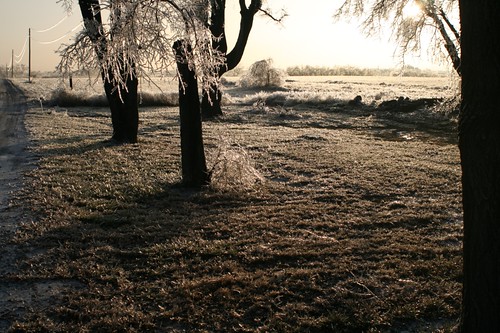
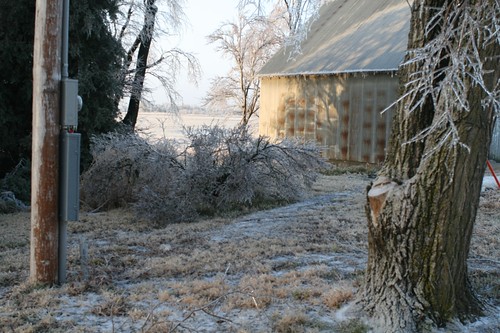
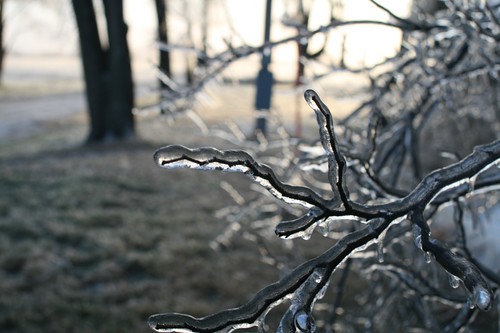
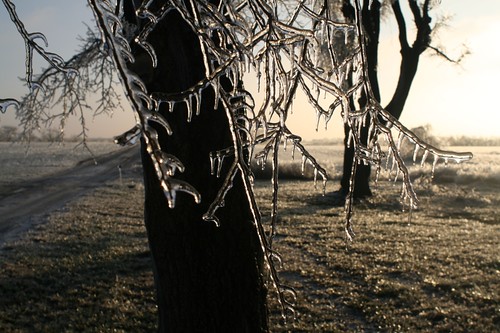
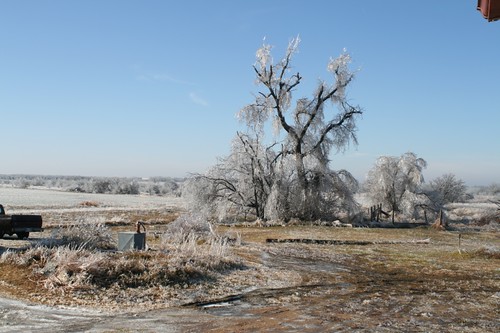
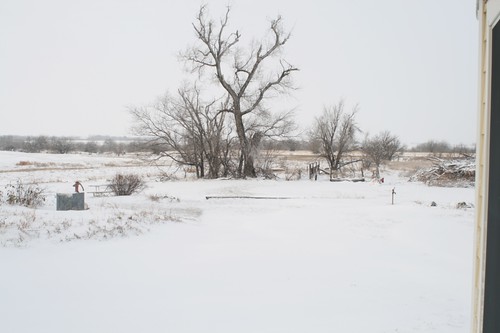
For those of you wanting to see some pictures from the recent ice storm, here you go.

The morning:

img_4166.jpg

This bush sorta got short and flat:

img_4173.jpg

A tree branch:

img_4183.jpg

And another:

img_4185.jpg

Then, at noon:

img_4200.jpg

Then the snow came:

img_4229.jpg

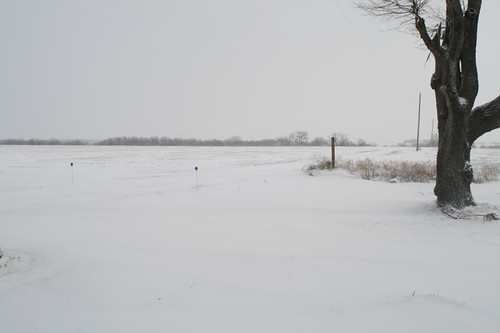
If you have trouble finding the driveway... well, good thing we've got reflectors.

img_4253.jpg

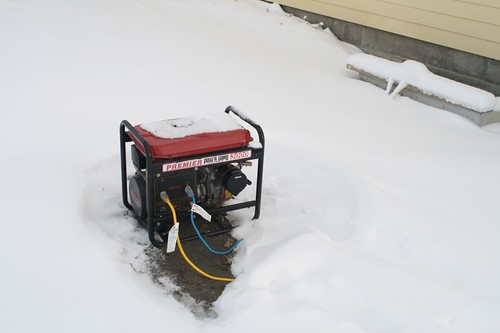
The rental generator that kept us warmish:

img_4262.jpg

More snow:

img_4287.jpg

You can also see the whole set on flickr.

Ross Burton: Gypsy Hacking

Last night I sat down and hacked a bit more on my Gypsy status monitoring tool thingy. Basically, it shows you all of the information from the GPS, and is mainly useful for checking that the data being sent by Gypsy makes sense. Gypsy Status It still needs a fair amount of work, the layout of the labels on the left is clearly sub-optimal and I'd like to have a marker on the satellite image to precisely locate you, but apart from that it's coming together nicely. NP: Storm, Heather Nova

14 December 2007

John Goerzen: A Clarification

You may remember my post Monday in which I told Mother Nature to "bring it on".

I would like to clarify that remark at this time. I would have preferred Mother Nature to interpret this in the President Bush sense of "please don't hurt us", rather than the "let's just knock out power to the entire plains region". A nice little romantic power outage Tuesday evening would have been nice.

We lost power at 3:10 on Tuesday according to my workstation's logs. It's still out, and our rural electric cooperative is estimating it will be another week until it's back, though that's better than the Dec. 22 date the state's much larger for-profit utility is giving people. We were lucky enough to be able to find a generator to rent on Wednesday morning. $35 a day isn't cheap. But on the other hand, we don't have a flooded basement due to not pumping out the sump pump, our food isn't spoiled, and our pipes aren't frozen.

At work, our Internet connection went down Tuesday morning. We use a fixed wireless connection, and this was the first time our ISP's radios have been tested in ice. Some antenna designs performed flawlessly. Then there were the antennas we had. 80% packet loss or worse. It wasn't safe to get up on the roof to deice them until Wednesday afternoon, and even then we couldn't get all the ice off. Finally today the connection was back to normal.

That two weeks after someone -- yes -- dug through Sprint/Embarq's apparent only fiber-optic link into town. Took down all long-distance calling into or out of the town, most cell towers, as well as all access to 911 (since dispatch is in another town) for about 8 hours. If we had still be using wired T1s, we would have been out of service with Internet as well.

All told, 200,000 households or business customers of the state's largest utility have been without power. Dozens of other utilities have also had significant outages. Ours alone lost 700 power poles and there are substations in need of repair all over the eastern part of the state. And we weren't even the hardest hit.

On the generator, we can generally pick any three of refrigerator, server, workstation, or furnace to run. So sometime warm, I'll upload the pictures I've taken so far. We have one nice CFL-powered electric lamp we're using, flashlights, and a kerosene lamp. It's amazing how after just a few days of this, we're starting to want to go to bed earlier. Or perhaps that was because I haven't had the chance to get a lot of sleep lately...

When we look out the house to the east, we see pitch black. Normally we can see some yard lights in the distance. Not this week. Nothing at all to the east. To the west, we can see yard lights tantalizingly close -- only 2 miles away, fed from a different location. Ah, the joys of being at the very end of a utility's network.

All this despite the fact that this storm wasn't really all that bad. The roads were never really terrible, and there weren't as many trees down as there were in the ice storm of 2005.

I heard a comment on the news today from an Iowa Republican who had followed the GOP debate yesterday. She mentioned that Romney made a comment like "Well, guess there's no global warming in Iowa with an ice storm like this, huh?" She pointed out that if Iowa was still as chilly as it used to, it would have been a snow storm instead of an ice storm. I agree.

13 December 2007

Aigars Mahinovs: Vanessa Mae in Riga

On Monday I was at a Vanessa Mae concert in arena “Riga” in Riga, Latvia. The concert was almost an hour late due to flight delay. It would have been fine if the organisers would let us into the hall or at least informed the several thousand people about the delay and its reason and not just have us stand in the rather restricted lounge. around half an hour after the planned start time, we were let to our seats and some ten minutes later an announcement was broadcasted explaining the reason for the delay. Vanessa came out with her own band and a local Latvian string orchestra. I wonder if she played with local orchestras in other locations as well. The orchestra preformed perfectly as far as I could tell, which is not much because they were mixed way down and were barely audible most of the time. I am a big fan of Vanessa Mae - I like classical music, I love her interpretation of that music and I appreciate how she made classical music more acceptable for a modern teen to like. That said, the concert was a mix of joy and disappointment for me. The joy came from hearing the music that I know and like and seeing how it is played in real life. It was a great joy and most of the time I was bobbing in my chair as a very happy boy. However, there were moments when I cringed and unfortunately there was more than a handful of those during the two hour concert. The problems could be put into three categories: 1. Vanessa missing a note or even a handful of them badly. I will be an optimist and blame that on the tuning - just the day before she was playing in Seatle in 80% humidity and then came to Riga and 20% humidity. She had to retune her wooden violin after each song because of that. She apologised for that mid-show. 2. Spotlight and camera missing the action. At times Vanessa steps back and one of her band members goes on a solo, but most of the time the person controlling the spotlight and the person controlling the camera were not ‘in’ the action and just stayed on Vanessa. The worst cases were when a couple seconds into the solo the camera would start to pan over to the band member playing the solo part, spend a couple more seconds framing and focusing and then after another second the spotlight did the same and by that time the solo part was over. Two cameras and two spotlight should be used for such cases with people controlling them having a clear idea of what happens next. One camera should always be on a wider angle shot and one for closeups, so that when a switch is coming, you could switch to wide angle a couple of seconds before the switch, give the closeup camera time to change target, re-frame and re-focus and then switch to it. And for the spotlights, one would always track the main person and the other seeking out the next person of interest. 3. Mixing problems. Vanessa was always way too loud and drowned out the other instruments even when that was not desirable. Background orchestra was too low. In general the mixing was very pop-ish - no dynamic range. The worst cases of this were Bolero and Storm. Storm is my favourite melody and I especially love the slow and quiet beginning of the song, but that was skipped entirely in the concert cutting straight to the loud part. Some other songs were also brutalised that way. I know that true artists generate most of their income through concerts and for that reason I recommend every Vannessa Mae fan to buy the tickets to her concerts, but if you are an audiophile .. don’t go there - stay at home with you trustworthy stereo system and FLAC recording of great sound. The concert is there to support the artist and for the atmosphere not for the best sound, unfortunately.

11 December 2007

John Goerzen: It's Cold Outside

A day or two ago, I got the feeling that winter has set in. Maybe you know the feeling.

I looked outside the bedroom window. The trees had a bit of white all over. The tall grass in the distance had a sheen of gray on it. The sky was a uniform gray. Small ice pellets hit at our window. As far as the eye could see, not a sign of anything that wasn't frozen.

As I stood in our warm 68-degree house, I was reminded of how little separates us from the frozen outdoors. A few inches of wood and insulation is all. How easy it is to fret about the rapidly rising cost of propane these days, the cost of heating a house. But still, how easy we have it compared to the people that came before in this house.

They had to keep a fire going for warmth, keep a ready supply of firewood for the winter, figure a way to get the warmth throughout the house. All with insulation that wasn't as good as we have, windows that didn't shut as tight as ours, doors that were draftier. As is typical today, our furnace has safety systems designed to detect problems and shut itself down if something weird happens. Back then, indoor heat was a dangerous thing. There's been at least one chimney fire in this house, an event which often claimed the entire house and sometimes the lives of its inhabitants. Ten feet from my desk, there's a rounded out black spot on the floor where, perhaps 70 years ago, someone opened the door to a wood stove, only to be surprised by a burning log falling out to the wood floor.

Today, we can't use wood heat due to Terah's asthma. We had the chimney removed to boost the energy efficiency of the house with modern heat. Out back in the trees north of the house, there is a pile of bricks, saved from our chimney for future use. Each brick has a scorched side, darkened from the chimney fire and decades of use.

As we experienced firsthand in the ice storm of 2005 (see also more stories and pictures), it doesn't take much to be thrown back a hundred years from a convenient modern heat to our non-automated, non-mechized, past. All it takes is a tree to snap too close to the right power line anywhere between our house and the generating station -- which I think is 80 miles away -- to make our house mighty cold. Even though I still have a stack of firewood, it wouldn't do us much good these days.

With that in mind, today I was listening to the radio while driving in to work. How lovely to hear this quote:

"The National Weather Service will issue a Winter Storm Warning effective at noon today, lasting through 6AM tomorrow." We are to expect rain, freezing rain, ice pellets, and ice. A "wintry mix" is the technical term for it, I believe.

Temperatures were just a few degrees warmer than expected this afternoon, so we got mainly rain. What we will get tonight is an open question yet. I'm sure that schoolchildren all over the state are hoping for ice and lots of it. Personally, I feel that it's only been three years since I spent a week carrying a saw in my trunk in order to be able to clear my driveway every time I left home or got back home. I think I'm owed another year or two off. I also wouldn't mind avoiding the giant branch sitting on the ground right in front of the front door, or the 40-degree indoor temperatures, or the lack of running water due to lack of electricity.

But these crisp, cold winter days are a rare thing to enjoy these days. We get a month or two of stifling heat each summer, but only a week or two to enjoy this really cold part of winter. I miss the snowdrifts when we don't get them.

So, mother nature, bring it on. I'll be waiting with my camera and a glass of hot chocolate. Because even without electricity, I can still light a burner on our oven with a match.

5 December 2007

Matthew Palmer: Strategists and Tacticians

Like most things, the scale of decisions that have to be made by a person or organisation fall across a wide spectrum. At one end, you've got the fine-detail work: lines of code, individual config settings, IP addresses, that sort of thing. This is crucial work, because it's this detail that ultimately produces saleable results. Travelling all the way to the other end, there's the "big picture" decisions: the "visionary" stuff. What market segment will we target? What will we do (in large-scale terms) to get there? I am convinced that individuals naturally gravitate towards one end of this spectrum or the other, depending on their psychology. While people usually can work at all scales, they have a "most comfortable" point where they work the most naturally. The further away from this point they are pushed, the less comfortable and effective they are. No level of thinking is better or worse than the other; they're just different. While "large scale thinker" and "small scale thinker" could be taken as being insulting, I certainly don't mean it that way. I should point out that "Strategy" isn't (just) about setting goals. A strategist isn't someone who comes out with grand pronouncements like "By the end of next year this company should be providing telecommunications services to 20% of the Fortune 500" without knowing how to get there. That's not a strategist, that's a poor-quality management consultant. People whose only skill is making vague pronouncements should just be taken out and shot. They're not doing anything useful for anyone. A strategist is someone who is good at planning the goal of "20% of the Fortune 500". They're thinking about the big picture issues, without getting bogged down in the minutiae. A tactician, given the job of planning something at the macro scale, will chase some good idea down an intricately detailed rabbit hole, and miss the other dozen or so large issues that need to be considered. The strategist's planning needs to stop at a certain level and let other people take on the detail work. Conversely, a good tactician can focus on the individual details without getting distracted by the big picture. A strategist put into a tactical role will miss all the important minutiae because they're working out how their little part fits into the big picture, instead of working out how to make their little part work, in and of itself. It's important, for individual happiness, to try and work out what level you're most comfortable thinking at, and then trying to find a job that puts you there. It's almost as important to make sure that the people who are working at the more and less detail levels around you are equally comfortable. Take, for example, the micromanager. We've all either been there ourselves or have heard multiple stories on the subject. I think the micromanager is nothing more than a person who wants to work at a smaller scale than they're being forced to by their organisational rank. Since they can't do the detail work any more, their only outlet is working vicariously through their subordinates. Voila! Instant micromanagement. An even more painful case of micromanagement would be when the subordinate wants to think at a larger scale than the superior. In that case, the subordinate will naturally be thinking large scale, and will miss the details. To the small scale thinking superior, that is incompetence, and will naturally be dealt with by more micromanagement. In reality, both parties are incompetent at their jobs, and they should really swap roles, so that everyone is in their element. It would be nice if companies stopped thinking hierarchically in this way -- that a more "senior" person has to think at larger levels. Just because you've been somewhere longer (or have been working in an industry longer, or got higher marks, or whatever), it doesn't mean that you're more of a strategist. This is probably the Peter Principle restated: people get promoted to a level where they just can't comfortably think at the necessary scale any more. If instead people were put into a planning hierarchy based on their natural scale of thinking, we'd all be a lot better off. There'd be a lot less power games, though, which makes me think it's not going to happen any time soon. A business, at whatever size it might be, needs an appropriate mix of strategists and tacticians. A really small business (1-10 people) can get away without needing large scale thinkers, in the same way that a really small boat can get away without needing a rudder or pilot. If a really small boat gets itself into trouble, everyone on board can grab an oar or bucket and help get the boat out it's predicament -- it's small and nimble enough to be able to do that. As the company expands, though, it's important to make sure you've got some strategists around. If you don't have anyone to keep an eye out for problems and plan around them, your small-to-medium sized boat is likely to have a hole punched in it by a submerged rock. Even if somebody on board happens to notice the rock before you actually hit it, once you get to a certain size you can't physically stop or turn the boat in time. If you don't understand the growth issues in the company, you might not even realise that you're no longer the nimble and low-inertia dinghy until you're up to your knees in sea water. Although an obvious solution to this problem might be to say that all businesses should be small and nimble ones, it's as impractical as saying that all boats should be dinghies. A fleet of dinghies isn't going to be able to support the worldwide sea freight market, and a fleet of small companies doesn't have the necessary resources on hand to take on the big projects that are so often needed. Also, a dinghy is at risk of being swamped by one freak wave, while a larger ship can weather significant storms without going under. Regardless of the size of the business, there always needs to be a good supply of tacticians. A boat (of whatever size) full of people who are all looking out for rocks isn't going to go anywhere, because nobody's making the thing move. Similarly, a company full of strategists isn't going to be doing any of the day-to-day work that actually earns money, and no money means no company. The single most important thing, though, is be self-aware enough to know what sort of person you are, and try to find something that lets you work at the level you're most comfortable at. Otherwise you're just setting yourself up for unhappiness.

(I'm not really sure why I'm suddenly writing management blog posts; this idea of "levels of thinking" just came to me and I figured I'd put it out there. If it makes you feel more comfortable, there's a fairly transparent mapping of these ideas to the practice of software development, although I'll leave the execution of that mapping to the reader. Comments are welcome.)

26 November 2007

Andrew Pollock: [life/americania] Thanksgiving below zero

We got home from our week in Arizona late last night. We decided to drive non-stop yesterday, and get home in a day, rather than split it over two days like we did getting there. It ended up taking around 15 hours (we had an unexpected delay at Lost Hills because we found a stray dog (we initially thought it to be injured to boot) and Sarah was trying to get hold of some local animal control people to do something about it), otherwise it'd have taken closer to 14 hours. The drive to Phoenix was pretty uneventful. We took our time leaving Mountain View on Sunday (we had an early Thanksgiving dinner with all of our neighbours on Saturday night), and decided to call it a night at Cabazon. For about the same price that we stayed in a crappy motel last time we went this way, we stayed at the Morongo Casino, which was really nice. We were in a "Canyon View" room, and, well this is what the view looked like... We arrived at Craig and Sarah's place at about 5pm on Monday afternoon. Their new place is really nice. It's huge, with a huge yard, and a nice view of the hills. I've found suburban Phoenix (well Peoria to be precise) to be the closest looking thing to what I consider "normal Australian suburbia" that I've seen so far in the US. Granted, Peoria's a bit upmarket (at least the part that Craig and Sarah live in). So we spent a day and a half vegging out at Craig and Sarah's place, then on Wednesday afternoon, we headed off to Woods Canyon Lake, in the Sitgreaves National Forests. I rode most of the way with Craig in their new motor home, and then swapped to drive our car after we got close to our destination. It turns out that the headlights in RVs are universally crap, so it was better for the Prius to be out front lighting the way on the gravel road. I'd always associated Arizona with cacti and sand, but as it turns out, the majority of the state is forest. We arrived at the campsite after nightfall, and set up shop. We met some of Craig and Sarah's friends that night, who were all very friendly towards us. It was ridiculously cold that night. We went to bed rather under-dressed for the temperature, and absolutely froze. The next day (Thursday), we all drove from the campsite (Craig towed their Jeep behind the RV) to Woods Canyon Lake itself, and went fishing. Arizona fishing licences for non-Arizona residents were a bit on the expensive side, so Sarah and I just hung out on the rocks and chatted to people and took photos. The collective haul of trout from about 5 hours fishing was pretty impressive. I'm not quite sure why, but Friday was the group Thanksgiving dinner. Everyone pitched in, and cooked up a storm. They deep-fried three turkeys (which came out very nice and looking much less like KFC than I expected), and we had way more food than we needed. We all ate outdoors at around 3:30pm, and it was about 33°F (0.55°C). The only downside of this (aside from it being bloody cold) was the leftovers went cold almost instantly, so going back for seconds was a bit of a disappointment. Everyone gravitated back to the fire pretty quickly afterwards. It got pretty cold that night. I think it was down around -4°C when we went to bed that night. We left a bit before 8am the next morning, and the car thought it was -7°C outside. One of the other campers told Sarah his thermometer was reading something closer to -14°C. I'm not sure how cold it was when we were in New York in January, but I didn't think it was that cold. It was a good week away. The mix of camping and not camping was about just right. Now it's back to work for two weeks before we head off to Australia. Photos from the trip are here.

18 November 2007

Evan Prodromou: 26 Brumaire CCXVI

So, I've been off blogging for almost three months now -- from about mid-August to now. It's been kind of guilt-ridden, and it's also been kind of a relief. Being a B-list blogebrity is a direful burden, and having some time away was restful and relaxing and energizing. But now I'm ready to come back! One of the reasons that I haven't been blogging is that once you fall behind, it's really hard to catch up. So I've decided to not do the entire task at once. Instead, I'm just going to start a page on my 2007 Hiatus and fill that up as time permits. For those of you who care greatly about exactly what I did each and every day for the last three months, you've got a spot to read it. And, truthfully, I dropped out of the B-list ranks on Technorati during my time away. I'm back to my natural position as a C-list blogger, and baby, it feels good. Get ready for some photos of my cats, coming up soon! tags:

Feelings of loss One of the other main reasons I haven't been blogging in the last few months is that I've been losing weight. A lot of weight. I've dropped from a high body mass index (BMI) of about 43 -- dangerously high -- to my current sane but still high 33.6. I'd like to get down to a more reasonable BMI of 30 ("overweight") by the end of the year, and be somewhere around 25 ("normal") by next summer. I can lose weight pretty easily when I put my mind to it. Well, actually, it's still insanely hard, but I'm so damn stubborn and obsessive about things, when I actually sink my teeth into them, that it seems easy to the casual observer. My recipe is simple: reduce the amount of food I eat, do low-intensity exercise about an hour a day, and measure everything as well as possible. I eat 3 good meals a day -- about 50% fruits and vegetables, 25% complex carbs like rice or bread, and 25% protein like beans, tofu, fish or cheese. I steer clear of sweets and I drink alcohol only on occasion, and seldom more than a glass or two of wine. For exercise, I've been running around Parc Lafontaine or on a treadmill three days in a row, then on the fourth day lifting weights at a local gym on rue Gilford. I still have a ways to go, but the results have been good so far, and I'm feeling like I'm getting close to the neighbourhood of what I "should" weigh. I've been getting a lot of compliments from friends and family, which is a great motivator. Most of all, I feel good running, jumping, and playing with my daughter, which is the biggest reward of all. All that said, the exercise is taking an extra 1-2 hours out of my day, and blogging has been the main thing cut out to make room. But I think I can work around that now. tags:

Road trip We're leaving Tuesday for a trip to New Jersey to visit my dad's family for American Thanksgiving. (Yeah, they're my family, too.) We're all looking forward to seeing aunts and uncles and cousins and other extended family, but we're also looking forward to spending our powerful Canadian loonies in the US. The Canadian dollar's gone up and up this last few months, and though it's no longer trading at its ridiculous high of US$1.10 (!), it's still above parity, which means our money stretches pretty well. Coupled with this is the fact that most products here in Canada are still priced as if the loonie were still worth US$0.62. It's not atypical to see a book priced for $7.99 US, $10.99 Canadian. So we're going to do some shopping for clothes, books, music and other goods while we're stateside. I plan on bringing an empty suitcase with me and bringing it back full. (The fact that I've lost a lot of weight makes shopping for clothes particularly enticing.) All within our legal limits for customs returning to Canada, of course! Not to worry, random customs official who's reading this blog for who knows what reason. I'm also looking forward to this trip because we haven't done a driving trip together in a while. Going to Thanksgiving in 2005 was Amita June's second long trip (our overnighter to Ottawa for our anniversary in Oct 2005 was her first), and I think she's going to enjoy it again this time. tags:

Painful upgrade I just upgraded my main server, Antipater, from Debian "sarge" to Ubuntu "gutsy". I was getting pretty frustrated by being 3+ versions back from a lot of the important software running on the system. I wanted to get on Ubuntu for my server platform to have more frequent upgrades (about every 6 months). The upgrade went well, mostly. I updated /etc/apt/sources.list to use the Ubuntu archives, then got all the packages. The installation was pretty quick, even for something like 700 packages. However, when I rebooted to use the new 2.6.22 kernel (up from 2.6.8 or so), the server's responsiveness went way down. My guess is that somewhere in the 2.6.x series, one of the new schedulers is causing my particular configuration some grief. I've trimmed my cron jobs and background processes down to a minimum, but the server is still running a little too loaded. The great folks at iWeb have been really helpful, but they don't support Ubuntu, so I've got to brainstorm for myself. I'm going to have to go in over the next few days to reboot the server and experiment with other kernels -- not fun. tags:

One-liners Some other odds and ends:
  • It's getting cold! We had our first snow flurries a few days ago, and it's been regularly under freezing around here. Time to get winter coats out of the closet -- or, better, buy new ones in the US.
  • My friends at Kokoromi are organizing an excellent games+art event called GAMMA 256 on November 28 at the SAT. Should be a lot of fun.
  • One such friend, Heather Kelley is going to be talking at the Montreal Geek Girl Dinner on Tuesday. Good for her!
tags:

4 November 2007

MJ Ray: Movements 2007-11-04

While bumbling about on a search engine, I found slides from a talk I gave in 2001 and these 2005 consultation submissions to the Department of Culture... about TV and the WSIS Civil Society Internet Governance Caucus Here's some other stuff on other sites I wrote about since the last round-up of this sort:
A Cambridge Co-operator: Sorry!
EASF :: View topic - What happened to Norwich Citywide Co-op?
Bond films and the Roger Moore humor controversy Ultimate James Bond Fan Blog
Does Having Fewer Rules Inspire Hard Work? etbe
The Right Width for Your Blog
Shine OpenStreetMap Cycle Map :: GravityStorm
Social mapping Tom Chance's website
Russ Nelson: Chordite versus CyKey
The prescient TomTom
robmyers - Bender's Big Score
Citing References in Blog Posts etbe
Matt Lee - Advogato Exploring Freedom
Ross Burton
Inside the Box Blog Archive Linux On a Mobile PC
Javascript performance in browsers
Bryan Clark : Web Browser Homepage
BBC SPORT Sport Editors' Blog Behind the Scenes at BBC Sport: Weekend feedback
][ stefano maffulli The end of a phase
A Cambridge Co-operator: Shoefayre / Cambridge City
(Persone) 12 25 Septembro 2007, 5:21
Buxy: DSA needs a leader

Next.

Previous.