Search Results: "sf"

1 November 2024

Colin Watson: Free software activity in October 2024

Almost all of my Debian contributions this month were sponsored by Freexian. You can also support my work directly via Liberapay. Ansible I noticed that Ansible had fallen out of Debian testing due to autopkgtest failures. This seemed like a problem worth fixing: in common with many other people, we use Ansible for configuration management at Freexian, and it probably wouldn t make our sysadmins too happy if they upgraded to trixie after its release and found that Ansible was gone. The problems here were really just slogging through test failures in both the ansible-core and ansible packages, but their test suites are large and take a while to run so this took some time. I was able to contribute a few small fixes to various upstreams in the process: This should now get back into testing tomorrow. OpenSSH Martin- ric Racine reported that ssh-audit didn t list the ext-info-s feature as being available in Debian s OpenSSH 9.2 packaging in bookworm, contrary to what OpenSSH upstream said on their specifications page at the time. I spent some time looking into this and realized that upstream was mistakenly saying that implementations of ext-info-c and ext-info-s were added at the same time, while in fact ext-info-s was added rather later. ssh-audit now has clearer output, and the OpenSSH maintainers have corrected their specifications page. I looked into a report of an ssh failure in certain cases when using GSS-API key exchange (which is a Debian patch). Once again, having integration tests was a huge win here: the affected scenario is quite a fiddly one, but I was able to set it up in the test, and thereby make sure it doesn t regress in future. It still took me a couple of hours to get all the details right, but in the past this sort of thing took me much longer with a much lower degree of confidence that the fix was correct. On upstream s advice, I cherry-picked some key exchange fixes needed for big-endian architectures. Python team I packaged python-evalidate, needed for a new upstream version of buildbot. The Python 3.13 transition rolls on. I fixed problems related to it in htmlmin, humanfriendly, postgresfixture (contributed upstream), pylint, python-asyncssh (contributed upstream), python-oauthlib, python3-simpletal, quodlibet, zope.exceptions, and zope.interface. A trickier Python 3.13 issue involved the cgi module. Years ago I ported zope.publisher to the multipart module because cgi.FieldStorage was broken in some situations, and as a result I got a recommendation into Python s dead batteries PEP 594. Unfortunately there turns out to be a name conflict between multipart and python-multipart on PyPI; python-multipart upstream has been working to disentangle this, though we still need to work out what to do in Debian. All the same, I needed to fix python-wadllib and multipart seemed like the best fit; I contributed a port upstream and temporarily copied multipart into Debian s python-wadllib source package to allow its tests to pass. I ll come back and fix this properly once we sort out the multipart vs. python-multipart packaging. tzdata moved some timezone definitions to tzdata-legacy, which has broken a number of packages. I added tzdata-legacy build-dependencies to alembic and python-icalendar to deal with this in those packages, though there are still some other instances of this left. I tracked down an nltk regression that caused build failures in many other packages. I fixed Rust crate versioning issues in pydantic-core, python-bcrypt, and python-maturin (mostly fixed by Peter Michael Green and Jelmer Vernoo , but it needed a little extra work). I fixed other build failures in entrypoints, mayavi2, python-pyvmomi (mostly fixed by Alexandre Detiste, but it needed a little extra work), and python-testing.postgresql (ditto). I fixed python3-simpletal to tolerate future versions of dh-python that will drop their dependency on python3-setuptools. I fixed broken symlinks in python-treq. I removed (build-)depends on python3-pkg-resources from alembic, autopep8, buildbot, celery, flufl.enum, flufl.lock, python-public, python-wadllib (contributed upstream), pyvisa, routes, vulture, and zodbpickle (contributed upstream). I upgraded astroid, asyncpg (fixing a Python 3.13 failure and a build failure), buildbot (noticing an upstream test bug in the process), dnsdiag, frozenlist, netmiko (fixing a Python 3.13 failure), psycopg3, pydantic-settings, pylint, python-asyncssh, python-bleach, python-btrees, python-cytoolz, python-django-pgtrigger, python-django-test-migrations, python-gssapi, python-icalendar, python-json-log-formatter, python-pgbouncer, python-pkginfo, python-plumbum, python-stdlib-list, python-tokenize-rt, python-treq (fixing a Python 3.13 failure), python-typeguard, python-webargs (fixing a build failure), pyupgrade, pyvisa, pyvisa-py (fixing a Python 3.13 failure), toolz, twisted, vulture, waitress (fixing CVE-2024-49768 and CVE-2024-49769), wtf-peewee, wtforms, zodbpickle, zope.exceptions, zope.interface, zope.proxy, zope.security, and zope.testrunner to new upstream versions. I tried to fix a regression in python-scruffy, but I need testing feedback. I requested removal of python-testing.mysqld.

22 October 2024

Dirk Eddelbuettel: drat 0.2.5 on CRAN: Small Updates

drat user A new minor release of the drat package arrived on CRAN today, which is just over a year since the previous release. drat stands for drat R Archive Template, and helps with easy-to-create and easy-to-use repositories for R packages. Since its inception in early 2015 it has found reasonably widespread adoption among R users because repositories with marked releases is the better way to distribute code. Because for once it really is as your mother told you: Friends don t let friends install random git commit snapshots. Properly rolled-up releases it is. Just how CRAN shows us: a model that has demonstrated for over two-and-a-half decades how to do this. And you can too: drat is easy to use, documented by six vignettes and just works. Detailed information about drat is at its documentation site. That said, and these days , if you mainly care about github code then r-universe is there too, also offering binaries its makes and all that jazz. But sometimes you just want to, or need to, roll a local repository and drat can help you there. This release contains a small PR (made by Arne Holmin just after the previous release) adding support for an OSflacour variable (helpful for macOS). We also corrected an issue with one test file being insufficiently careful of using git2r only when installed, and as usual did a round of maintenance for the package concerning both continuous integration and documentation. The NEWS file summarises the release as follows:

Changes in drat version 0.2.5 (2024-10-21)
  • Function insertPackage has a new optional argument OSflavour (Arne Holmin in #142)
  • A test file conditions correctly about git2r being present (Dirk)
  • Several smaller packaging updates and enhancements to continuous integration and documentation have been added (Dirk)

Courtesy of my CRANberries, there is a comparison to the previous release. More detailed information is on the drat page as well as at the documentation site. If you like this or other open-source work I do, you can sponsor me at GitHub.

This post by Dirk Eddelbuettel originated on his Thinking inside the box blog. Please report excessive re-aggregation in third-party for-profit settings.

10 October 2024

Gunnar Wolf: Started a guide to writing FUSE filesystems in Python

As DebConf22 was coming to an end, in Kosovo, talking with Eeveelweezel they invited me to prepare a talk to give for the Chicago Python User Group. I replied that I m not really that much of a Python guy But would think about a topic. Two years passed. I meet Eeveelweezel again for DebConf24 in Busan, South Korea. And the topic came up again. I had thought of some ideas, but none really pleased me. Again, I do write some Python when needed, and I teach using Python, as it s the language I find my students can best cope with. But delivering a talk to ChiPy? On the other hand, I have long used a very simplistic and limited filesystem I ve designed as an implementation project at class: FIUnamFS (for Facultad de Ingenier a, Universidad Nacional Aut noma de M xico : the Engineering Faculty for Mexico s National University, where I teach. Sorry, the link is in Spanish but you will find several implementations of it from the students ). It is a toy filesystem, with as many bad characteristics you can think of, but easy to specify and implement. It is based on contiguous file allocation, has no support for sub-directories, and is often limited to the size of a 1.44MB floppy disk. As I give this filesystem as a project to my students (and not as a mere homework), I always ask them to try and provide a good, polished, professional interface, not just the simplistic menu I often get. And I tell them the best possible interface would be if they provide support for FIUnamFS transparently, usable by the user without thinking too much about it. With high probability, that would mean: Use FUSE. Python FUSE But, in the six semesters I ve used this project (with 30-40 students per semester group), only one student has bitten the bullet and presented a FUSE implementation. Maybe this is because it s not easy to understand how to build a FUSE-based filesystem from a high-level language such as Python? Yes, I ve seen several implementation examples and even nice web pages (i.e. the examples shipped with thepython-fuse module Stavros passthrough filesystem, Dave Filesystem based upon, and further explaining, Stavros , and several others) explaining how to provide basic functionality. I found a particularly useful presentation by Matteo Bertozzi presented ~15 years ago at PyCon4 But none of those is IMO followable enough by itself. Also, most of them are very old (maybe the world is telling me something that I refuse to understand?). And of course, there isn t a single interface to work from. In Python only, we can find python-fuse, Pyfuse, Fusepy Where to start from? So I setup to try and help. Over the past couple of weeks, I have been slowly working on my own version, and presenting it as a progressive set of tasks, adding filesystem calls, and being careful to thoroughly document what I write (but maybe my documentation ends up obfuscating the intent? I hope not and, read on, I ve provided some remediation). I registered a GitLab project for a hand-holding guide to writing FUSE-based filesystems in Python. This is a project where I present several working FUSE filesystem implementations, some of them RAM-based, some passthrough-based, and I intend to add to this also filesystems backed on pseudo-block-devices (for implementations such as my FIUnamFS). So far, I have added five stepwise pieces, starting from the barest possible empty filesystem, and adding system calls (and functionality) until (so far) either a read-write filesystem in RAM with basicstat() support or a read-only passthrough filesystem. I think providing fun or useful examples is also a good way to get students to use what I m teaching, so I ve added some ideas I ve had: DNS Filesystem, on-the-fly markdown compiling filesystem, unzip filesystem and uncomment filesystem. They all provide something that could be seen as useful, in a way that s easy to teach, in just some tens of lines. And, in case my comments/documentation are too long to read, uncommentfs will happily strip all comments and whitespace automatically! So I will be delivering my talk tomorrow (2024.10.10, 18:30 GMT-6) at ChiPy (virtually). I am also presenting this talk virtually at Jornadas Regionales de Software Libre in Santa Fe, Argentina, next week (virtually as well). And also in November, in person, at nerdear.la, that will be held in Mexico City for the first time. Of course, I will also share this project with my students in the next couple of weeks And hope it manages to lure them into implementing FUSE in Python. At some point, I shall report! Update: After delivering my ChiPy talk, I have uploaded it to YouTube: A hand-holding guide to writing FUSE-based filesystems in Python, and after presenting at Jornadas Regionales, I present you the video in Spanish here: Aprendiendo y ense ando a escribir sistemas de archivo en espacio de usuario con FUSE y Python.

Freexian Collaborators: Debian Contributions: Packaging Pydantic v2, Reworking of glib2.0 for cross bootstrap, Python archive rebuilds and more! (by Anupa Ann Joseph)

Debian Contributions: 2024-09 Contributing to Debian is part of Freexian s mission. This article covers the latest achievements of Freexian and their collaborators. All of this is made possible by organizations subscribing to our Long Term Support contracts and consulting services.

Pydantic v2, by Colin Watson Pydantic is a useful library for validating data in Python using type hints: Freexian uses it in a number of projects, including Debusine. Its Debian packaging had been stalled at 1.10.17 in testing for some time, partly due to needing to make sure everything else could cope with the breaking changes introduced in 2.x, but mostly due to needing to sort out packaging of its new Rust dependencies. Several other people (notably Alexandre Detiste, Andreas Tille, Drew Parsons, and Timo R hling) had made some good progress on this, but nobody had quite got it over the line and it seemed a bit stuck. Colin upgraded a few Rust libraries to new upstream versions, packaged rust-jiter, and chased various failures in other packages. This eventually allowed getting current versions of both pydantic-core and pydantic into testing. It should now be much easier for us to stay up to date routinely.

Reworking of glib2.0 for cross bootstrap, by Helmut Grohne Simon McVittie (not affiliated with Freexian) earlier restructured the libglib2.0-dev such that it would absorb more functionality and in particular provide tools for working with .gir files. Those tools practically require being run for their host architecture (practically this means running under qemu-user) which is at odds with the requirements of architecture cross bootstrap. The qemu requirement was expressed in package dependencies and also made people unhappy attempting to use libglib2.0-dev for i386 on amd64 without resorting to qemu. The use of qemu in architecture bootstrap is particularly problematic as it tends to not be ready at the time bootstrapping is needed. As a result, Simon proposed and implemented the introduction of a libgio-2.0-dev package providing a subset of libglib2.0-dev that does not require qemu. Packages should continue to use libglib2.0-dev in their Build-Depends unless involved in architecture bootstrap. Helmut reviewed and tested the implementation and integrated the necessary changes into rebootstrap. He also prepared a patch for libverto to use the new package and proposed adding forward compatibility to glib2.0. Helmut continued working on adding cross-exe-wrapper to architecture-properties and implemented autopkgtests later improved by Simon. The cross-exe-wrapper package now provides a generic mechanism to a program on a different architecture by using qemu when needed only. For instance, a dependency on cross-exe-wrapper:i386 provides a i686-linux-gnu-cross-exe-wrapper program that can be used to wrap an ELF executable for the i386 architecture. When installed on amd64 or i386 it will skip installing or running qemu, but for other architectures qemu will be used automatically. This facility can be used to support cross building with targeted use of qemu in cases where running host code is unavoidable as is the case for GObject introspection. This concludes the joint work with Simon and Niels Thykier on glib2.0 and architecture-properties resolving known architecture bootstrap regressions arising from the glib2.0 refactoring earlier this year.

Analyzing binary package metadata, by Helmut Grohne As Guillem Jover (not affiliated with Freexian) continues to work on adding metadata tracking to dpkg, the question arises how this affects existing packages. The dedup.debian.net infrastructure provides an easy playground to answer such questions, so Helmut gathered file metadata from all binary packages in unstable and performed an explorative analysis. Some results include: Guillem also performed a cursory analysis and reported other problem categories such as mismatching directory permissions for directories installed by multiple packages and thus gained a better understanding of what consistency checks dpkg can enforce.

Python archive rebuilds, by Stefano Rivera Last month Stefano started to write some tooling to do large-scale rebuilds in debusine, starting with finding packages that had already started to fail to build from source (FTBFS) due to the removal of setup.py test. This month, Stefano did some more rebuilds, starting with experimental versions of dh-python. During the Python 3.12 transition, we had added a dependency on python3-setuptools to dh-python, to ease the transition. Python 3.12 removed distutils from the stdlib, but many packages were expecting it to still be available. Setuptools contains a version of distutils, and dh-python was a convenient place to depend on setuptools for most package builds. This dependency was never meant to be permanent. A rebuild without it resulted in mass-filing about 340 bugs (and around 80 more by mistake). A new feature in Python 3.12, was to have unittest s test runner exit with a non-zero return code, if no tests were run. We added this feature, to be able to detect tests that are not being discovered, by mistake. We are ignoring this failure, as we wouldn t want to suddenly cause hundreds of packages to fail to build, if they have no tests. Stefano did a rebuild to see how many packages were affected, and found that around 1000 were. The Debian Python community has not come to a conclusion on how to move forward with this. As soon as Python 3.13 release candidate 2 was available, Stefano did a rebuild of the Python packages in the archive against it. This was a more complex rebuild than the others, as it had to be done in stages. Many packages need other Python packages at build time, typically to run tests. So transitions like this involve some manual bootstrapping, followed by several rounds of builds. Not all packages could be tested, as not all their dependencies support 3.13 yet. The result was around 100 bugs in packages that need work to support Python 3.13. Many other packages will need additional work to properly support Python 3.13, but being able to build (and run tests) is an important first step.

Miscellaneous contributions
  • Carles prepared the update of python-pyaarlo package to a new upstream release.
  • Carles worked on updating python-ring-doorbell to a new upstream release. Unfinished, pending to package a new dependency python3-firebase-messaging RFP #1082958 and its dependency python3-http-ece RFP #1083020.
  • Carles improved po-debconf-manager. Main new feature is that it can open Salsa merge requests. Aiming for a lightning talk in MiniDebConf Toulouse (November) to be functional end to end and get feedback from the wider public for this proof of concept.
  • Carles helped one translator to use po-debconf-manager (added compatibility for bullseye, fixed other issues) and reviewed 17 package templates.
  • Colin upgraded the OpenSSH packaging to 9.9p1.
  • Colin upgraded the various YubiHSM packages to new upstream versions, enabled more tests, fixed yubihsm-shell build failures on some 32-bit architectures, made yubihsm-shell build reproducibly, and fixed yubihsm-connector to apply udev rules to existing devices when the package is installed. As usual, bookworm-backports is up to date with all these changes.
  • Colin fixed quite a bit of fallout from setuptools 72.0.0 removing setup.py test, backported a large upstream patch set to make buildbot work with SQLAlchemy 2.0, and upgraded 25 other Python packages to new upstream versions.
  • Enrico worked with Jakob Haufe to get him up to speed for managing sso.debian.org
  • Rapha l did remove spam entries in the list of teams on tracker.debian.org (see #1080446), and he applied a few external contributions, fixing a rendering issue and replacing the DDPO link with a more useful alternative. He also gave feedback on a couple of merge requests that required more work. As part of the analysis of the underlying problem, he suggested to the ftpmasters (via #1083068) to auto-reject packages having the too-many-contacts lintian error, and he raised the severity of #1076048 to serious to actually have that 4 year old bug fixed.
  • Rapha l uploaded zim and hamster-time-tracker to fix issues with Python 3.12 getting rid of setuptools. He also uploaded a new gnome-shell-extension-hamster to cope with the upcoming transition to GNOME 47.
  • Helmut sent seven patches and sponsored one upload for cross build failures.
  • Helmut uploaded a Nagios/Icinga plugin check-smart-attributes for monitoring the health of physical disks.
  • Helmut collaborated on sbuild reviewing and improving a MR for refactoring the unshare backend.
  • Helmut sent a patch fixing coinstallability of gcc-defaults.
  • Helmut continued to monitor the evolution of the /usr-move. With more and more key packages such as libvirt or fuse3 fixed. We re moving into the boring long-tail of the transition.
  • Helmut proposed updating the meson buildsystem in debhelper to use env2mfile.
  • Helmut continued to update patches maintained in rebootstrap. Due to the work on glib2.0 above, rebootstrap moves a lot further, but still fails for any architecture.
  • Santiago reviewed some Merge Request in Salsa CI, such as: !478, proposed by Otto to extend the information about how to use additional runners in the pipeline and !518, proposed by Ahmed to add support for Ubuntu images, that will help to test how some debian packages, including the complex MariaDB are built on Ubuntu. Santiago also prepared !545, which will make the reprotest job more consistent with the result seen on reproducible-builds.
  • Santiago worked on different tasks related to DebConf 25. Especially he drafted the fundraising brochure (which is almost ready).
  • Thorsten Alteholz uploaded package libcupsfilter to fix the autopkgtest and a dependency problem of this package. After package splix was abandoned by upstream and OpenPrinting.org adopted its maintenance, Thorsten uploaded their first release.
  • Anupa published posts on the Debian Administrators group in LinkedIn and moderated the group, one of the tasks of the Debian Publicity Team.
  • Anupa helped organize DebUtsav 2024. It had over 100 attendees with hand-on sessions on making initial contributions to Linux Kernel, Debian packaging, submitting documentation to Debian wiki and assisting Debian Installations.

8 October 2024

Thorsten Alteholz: My Debian Activities in September 2024

FTP master This month I accepted 441 and rejected 29 packages. The overall number of packages that got accepted was 448. I couldn t believe my eyes, but this month I really accepted the same number of packages as last month. Debian LTS This was my hundred-twenty-third month that I did some work for the Debian LTS initiative, started by Raphael Hertzog at Freexian. During my allocated time I uploaded or worked on: Despite the announcement the package libppd in Debian is not affected by the CVEs related to CUPS. By pure chance there is an unrelated package with the same name in Debian. I also answered some question about the CUPS related uploads. Due to the CUPS issues, I postponed my work on other packages to October. Last but not least I did a week of FD this month and attended the monthly LTS/ELTS meeting. Debian ELTS This month was the seventy-fourth ELTS month. During my allocated time I uploaded or worked on: I also started to work on updates for cups in Buster, Stretch and Jessie, but their uploads will happen only in October. I also did a week of FD and attended the monthly LTS/ELTS meeting. Debian Printing This month I uploaded Last but not least I tried to prepare an update for hplip. Unfortunately this is a nerve-stretching task and I need some more time. This work is generously funded by Freexian! Debian Matomo This month I even found some time to upload packages that are dependencies of Matomo This work is generously funded by Freexian! Debian Astro This month I uploaded a new upstream or bugfix version of: Most of the uploads were related to package migration to testing. As some of them are in non-free or contrib, one has to build all binary versions. From my point of view handling packages in non-free or contrib could be very much improved, but well, they are not part of Debian Anyway, starting in December there is an Outreachy project that takes care of automatic updates of these packages. So hopefully it will be much easier to keep those package up to date. I will keep you informed. Debian IoT This month I uploaded new upstream or bugfix versions of: Debian Mobcom This month I did source uploads of all the packages that were prepared last month by Nathan and started the transition. It went rather smooth except for a few packages where the new version did not propagate to the tracker and they got stuck in old failing autopkgtest. Anyway, in the end all packages migrated to testing. I also uploaded new upstream releases or fixed bugs in: misc This month I uploaded new upstream or bugfix versions of: Most of those uploads were needed to help packages to migrate to testing.

7 October 2024

Reproducible Builds: Reproducible Builds in September 2024

Welcome to the September 2024 report from the Reproducible Builds project! Our reports attempt to outline what we ve been up to over the past month, highlighting news items from elsewhere in tech where they are related. As ever, if you are interested in contributing to the project, please visit our Contribute page on our website. Table of contents:
  1. New binsider tool to analyse ELF binaries
  2. Unreproducibility of GHC Haskell compiler 95% fixed
  3. Mailing list summary
  4. Towards a 100% bit-for-bit reproducible OS
  5. Two new reproducibility-related academic papers
  6. Distribution work
  7. diffoscope
  8. Other software development
  9. Android toolchain core count issue reported
  10. New Gradle plugin for reproducibility
  11. Website updates
  12. Upstream patches
  13. Reproducibility testing framework

New binsider tool to analyse ELF binaries Reproducible Builds developer Orhun Parmaks z has announced a fantastic new tool to analyse the contents of ELF binaries. According to the project s README page:
Binsider can perform static and dynamic analysis, inspect strings, examine linked libraries, and perform hexdumps, all within a user-friendly terminal user interface!
More information about Binsider s features and how it works can be found within Binsider s documentation pages.

Unreproducibility of GHC Haskell compiler 95% fixed A seven-year-old bug about the nondeterminism of object code generated by the Glasgow Haskell Compiler (GHC) received a recent update, consisting of Rodrigo Mesquita noting that the issue is:
95% fixed by [merge request] !12680 when -fobject-determinism is enabled. [ ]
The linked merge request has since been merged, and Rodrigo goes on to say that:
After that patch is merged, there are some rarer bugs in both interface file determinism (eg. #25170) and in object determinism (eg. #25269) that need to be taken care of, but the great majority of the work needed to get there should have been merged already. When merged, I think we should close this one in favour of the more specific determinism issues like the two linked above.

Mailing list summary On our mailing list this month:
  • Fay Stegerman let everyone know that she started a thread on the Fediverse about the problems caused by unreproducible zlib/deflate compression in .zip and .apk files and later followed up with the results of her subsequent investigation.
  • Long-time developer kpcyrd wrote that there has been a recent public discussion on the Arch Linux GitLab [instance] about the challenges and possible opportunities for making the Linux kernel package reproducible , all relating to the CONFIG_MODULE_SIG flag. [ ]
  • Bernhard M. Wiedemann followed-up to an in-person conversation at our recent Hamburg 2024 summit on the potential presence for Reproducible Builds in recognised standards. [ ]
  • Fay Stegerman also wrote about her worry about the possible repercussions for RB tooling of Debian migrating from zlib to zlib-ng as reproducibility requires identical compressed data streams. [ ]
  • Martin Monperrus wrote the list announcing the latest release of maven-lockfile that is designed aid building Maven projects with integrity . [ ]
  • Lastly, Bernhard M. Wiedemann wrote about potential role of reproducible builds in combatting silent data corruption, as detailed in a recent Tweet and scholarly paper on faulty CPU cores. [ ]

Towards a 100% bit-for-bit reproducible OS Bernhard M. Wiedemann began writing on journey towards a 100% bit-for-bit reproducible operating system on the openSUSE wiki:
This is a report of Part 1 of my journey: building 100% bit-reproducible packages for every package that makes up [openSUSE s] minimalVM image. This target was chosen as the smallest useful result/artifact. The larger package-sets get, the more disk-space and build-power is required to build/verify all of them.
This work was sponsored by NLnet s NGI Zero fund.

Distribution work In Debian this month, 14 reviews of Debian packages were added, 12 were updated and 20 were removed, all adding to our knowledge about identified issues. A number of issue types were updated as well. [ ][ ] In addition, Holger opened 4 bugs against the debrebuild component of the devscripts suite of tools. In particular:
  • #1081047: Fails to download .dsc file.
  • #1081048: Does not work with a proxy.
  • #1081050: Fails to create a debrebuild.tar.
  • #1081839: Fails with E: mmdebstrap failed to run error.
Last month, an issue was filed to update the Salsa CI pipeline (used by 1,000s of Debian packages) to no longer test for reproducibility with reprotest s build_path variation. Holger Levsen provided a rationale for this change in the issue, which has already been made to the tests being performed by tests.reproducible-builds.org. This month, this issue was closed by Santiago R. R., nicely explaining that build path variation is no longer the default, and, if desired, how developers may enable it again. In openSUSE news, Bernhard M. Wiedemann published another report for that distribution.

diffoscope diffoscope is our in-depth and content-aware diff utility that can locate and diagnose reproducibility issues. This month, Chris Lamb made the following changes, including preparing and uploading version 278 to Debian:
  • New features:
    • Add a helpful contextual message to the output if comparing Debian .orig tarballs within .dsc files without the ability to fuzzy-match away the leading directory. [ ]
  • Bug fixes:
    • Drop removal of calculated os.path.basename from GNU readelf output. [ ]
    • Correctly invert X% similar value and do not emit 100% similar . [ ]
  • Misc:
    • Temporarily remove procyon-decompiler from Build-Depends as it was removed from testing (via #1057532). (#1082636)
    • Update copyright years. [ ]
For trydiffoscope, the command-line client for the web-based version of diffoscope, Chris Lamb also:
  • Added an explicit python3-setuptools dependency. (#1080825)
  • Bumped the Standards-Version to 4.7.0. [ ]

Other software development disorderfs is our FUSE-based filesystem that deliberately introduces non-determinism into system calls to reliably flush out reproducibility issues. This month, version 0.5.11-4 was uploaded to Debian unstable by Holger Levsen making the following changes:
  • Replace build-dependency on the obsolete pkg-config package with one on pkgconf, following a Lintian check. [ ]
  • Bump Standards-Version field to 4.7.0, with no related changes needed. [ ]

In addition, reprotest is our tool for building the same source code twice in different environments and then checking the binaries produced by each build for any differences. This month, version 0.7.28 was uploaded to Debian unstable by Holger Levsen including a change by Jelle van der Waa to move away from the pipes Python module to shlex, as the former will be removed in Python version 3.13 [ ].

Android toolchain core count issue reported Fay Stegerman reported an issue with the Android toolchain where a part of the build system generates a different classes.dex file (and thus a different .apk) depending on the number of cores available during the build, thereby breaking Reproducible Builds:
We ve rebuilt [tag v3.6.1] multiple times (each time in a fresh container): with 2, 4, 6, 8, and 16 cores available, respectively:
  • With 2 and 4 cores we always get an unsigned APK with SHA-256 14763d682c9286ef .
  • With 6, 8, and 16 cores we get an unsigned APK with SHA-256 35324ba4c492760 instead.

New Gradle plugin for reproducibility A new plugin for the Gradle build tool for Java has been released. This easily-enabled plugin results in:
reproducibility settings [being] applied to some of Gradle s built-in tasks that should really be the default. Compatible with Java 8 and Gradle 8.3 or later.

Website updates There were a rather substantial number of improvements made to our website this month, including:

Upstream patches The Reproducible Builds project detects, dissects and attempts to fix as many currently-unreproducible packages as possible. We endeavour to send all of our patches upstream where appropriate. This month, we wrote a large number of such patches, including:

Reproducibility testing framework The Reproducible Builds project operates a comprehensive testing framework running primarily at tests.reproducible-builds.org in order to check packages and other artifacts for reproducibility. In September, a number of changes were made by Holger Levsen, including:
  • Debian-related changes:
    • Upgrade the osuosl4 node to Debian trixie in anticipation of running debrebuild and rebuilderd there. [ ][ ][ ]
    • Temporarily mark the osuosl4 node as offline due to ongoing xfs_repair filesystem maintenance. [ ][ ]
    • Do not warn about (very old) broken nodes. [ ]
    • Add the risc64 architecture to the multiarch version skew tests for Debian trixie and sid. [ ][ ][ ]
    • Mark the virt 32,64 b nodes as down. [ ]
  • Misc changes:
    • Add support for powercycling OpenStack instances. [ ]
    • Update the fail2ban to ban hosts for 4 weeks in total [ ][ ] and take care to never ban our own Jenkins instance. [ ]
In addition, Vagrant Cascadian recorded a disk failure for the virt32b and virt64b nodes [ ], performed some maintenance of the cbxi4a node [ ][ ] and marked most armhf architecture systems as being back online.

Finally, If you are interested in contributing to the Reproducible Builds project, please visit our Contribute page on our website. However, you can get in touch with us via:

1 October 2024

Ravi Dwivedi: State of the Map Conference in Kenya

Last month, I traveled to Kenya to attend a conference called State of the Map 2024 ( SotM for short), which is an annual meetup of OpenStreetMap contributors from all over the world. It was held at the University of Nairobi Towers in Nairobi, from the 6th to the 8th of September.
University of Nairobi.
I have been contributing to OpenStreetMap for the last three years, and this conference seemed like a great opportunity to network with others in the community. As soon as I came across the travel grant announcement, I jumped in and filled the form immediately. I was elated when I was selected for the grant and couldn t wait to attend. The grant had an upper limit of 1200 and covered food, accommodation, travel and miscellaneous expenses such as visa fee. Pre-travel tasks included obtaining Kenya s eTA and getting a yellow fever vaccine. Before the conference, Mikko from the Humanitarian OpenStreetMap Team introduced me to Rabina and Pragya from Nepal, Ibtehal from Bangladesh, and Sajeevini from Sri Lanka. We all booked the Nairobi Transit Hotel, which was within walking distance of the conference venue. Pragya, Rabina, and I traveled together from Delhi to Nairobi, while Ibtehal was my roommate in the hotel.
Our group at the conference.
The venue, University of Nairobi Towers, was a tall building and the conference was held on the fourth, fifth and sixth floors. The open area on the fifth floor of the building had a nice view of Nairobi s skyline and was a perfect spot for taking pictures. Interestingly, the university had a wing dedicated to Mahatma Gandhi, who is regarded in India as the Father of the Nation.
View of Nairobi's skyline from the open area on the fifth floor.
A library in Mahatma Gandhi wing of the University of Nairobi.
The diversity of the participants was mind-blowing, with people coming from a whopping 54 countries. I was surprised to notice that I was the only participant traveling from India, despite India having a large OpenStreetMap community. That said, there were two other Indian participants who traveled from other countries. I finally got to meet Arnalie (from the Phillipines) and Letwin (from Zimbabwe), both of whom I had only met online before. I had met Anisa (from Albania) earlier during DebConf 2023. But I missed Mikko and Honey from the Humanitarian OpenStreetMap Team, whom I knew from the Open Mapping Guru program. I learned about the extent of OSM use through Pragya and Rabina s talk; about the logistics of running the OSM Board, in the OSMF (OpenStreetMap Foundation) session; about the Youth Mappers from Sajeevini, about the OSM activities in Malawi from Priscilla Kapolo, and about mapping in Zimbabwe from Letwin. However, I missed Ibtehal s lightning session. The ratio of women speakers and participants at the conference was impressive, and I hope we can get such gender representation in our Delhi/NCR mapping parties.
One of the conference halls where talks took place.
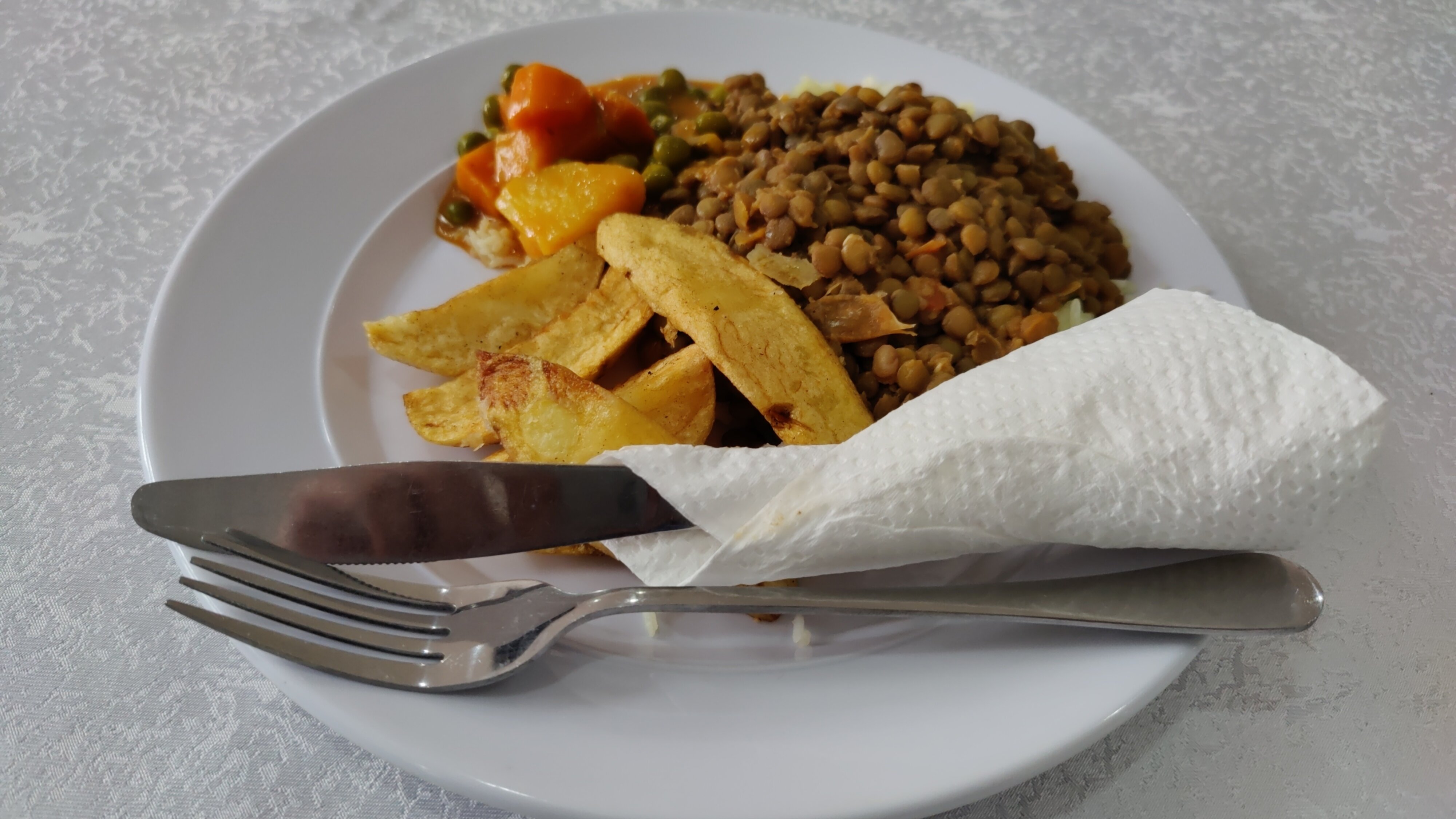
Outside of talks, the conference also had lunch and snack breaks, giving ample time for networking with others. In the food department, there were many options for a lacto-ovo vegetarian like myself, including potatoes, rice, beans, chips etc. I found out that the milk tea in Kenya (referred to as white tea ) is usually not as strong compared to India, so I switched to coffee (which is also called white coffee when taken with milk). The food wasn t spicy, but I can t complain :) Fruit juices served as a nice addition to lunch.
One of the lunch meals served during the conference.
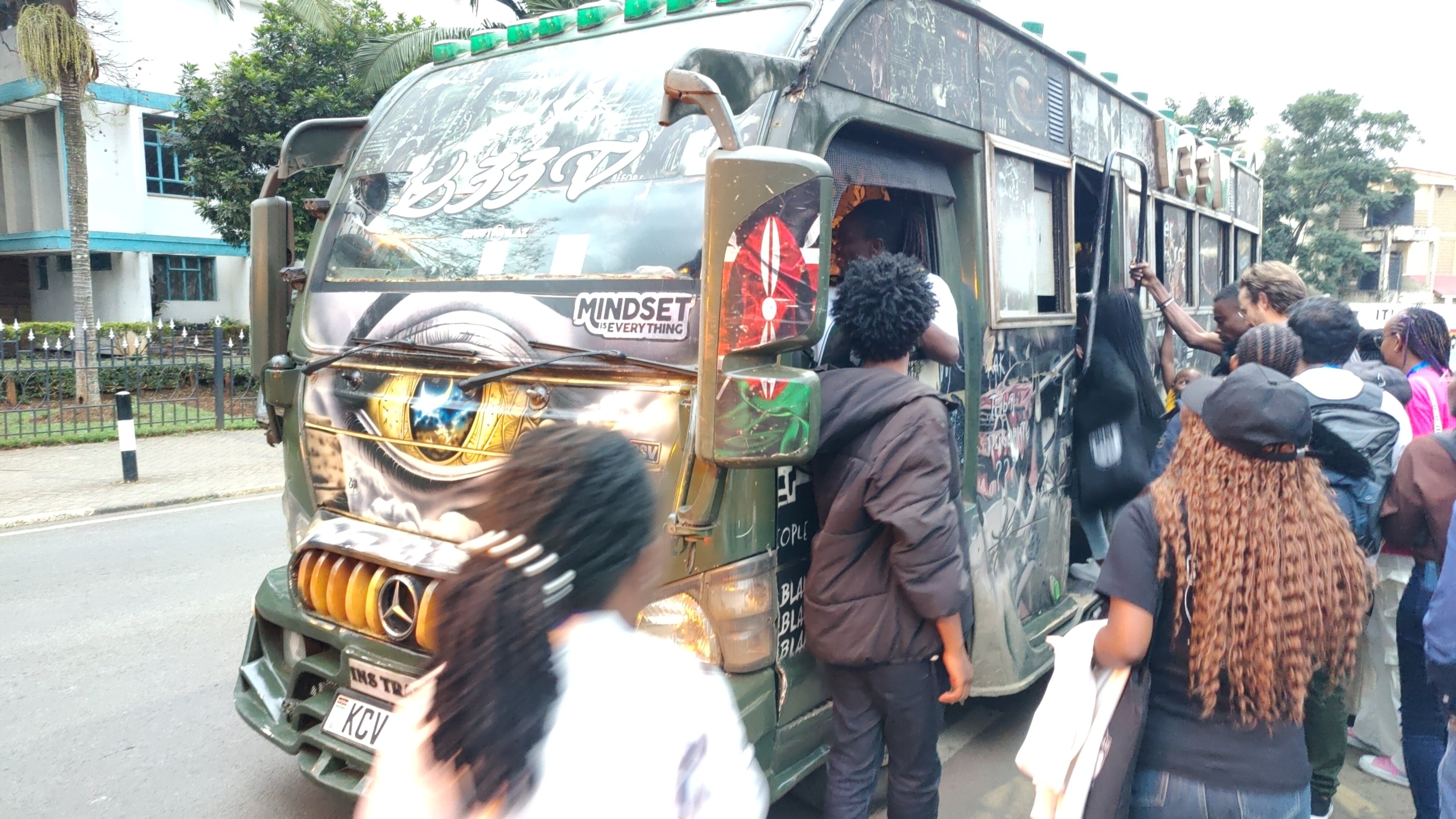
At the end of the second day of the conference, there was a surprise in store for us a bus ride to the Bao Box restaurant. The ride gave us the experience of a typical Kenyan matatu (privately-owned minibuses used as share taxis), complete with loud rap music. I remember one of the songs being Kraff s Nursery Rhymes. That day, I was wearing an original Kenyan cricket jersey - one that belonged to Dominic Wesonga, who represented Kenya in four ODIs. This confused Priscilla Kapolo, who asked if I was from Kenya! Anyway, while it served as a good conversation starter, it didn t attract as much attention as I expected :) I had some pizza and chips there, and later some drinks with Ibtehal. After the party, Piyush went with us to our hotel and we played a few games of UNO.
Minibus which took us from the university to Bao Box restaurant.
This minibus in the picture gave a sense of a real matatu.
I am grateful to the organizers Laura and Dorothea for introducing me to Nikhil when I was searching for a companion for my post-conference trip. Nikhil was one of the aforementioned Indian participants, and a wildlife lover. We had some nice conversations; he wanted to go to the Masai Maara Natural Reserve, but it was too expensive for me. In addition, all the safaris were multi-day affairs, and I wasn t keen on being around wildlife for that long. Eventually I chose to go my own way, exploring the coastal side and visiting Mombasa. While most of the work regarding the conference was done using free software (including the reimbursement form and Mastodon announcements), I was disappointed by the use of WhatsApp for coordination with the participants. I don t use WhatsApp and so was left out. WhatsApp is proprietary software (they do not provide the source code) and users don t control it. It is common to highlight that OpenStreetMap is controlled by users and the community, rather than a company - this should apply to WhatsApp as well. My suggestion is to use XMPP, which shares similar principles with OpenStreetMap, as it is privacy-respecting, controlled by users, and powered by free software. I understand the concern that there might not be many participants using XMPP already. Although it is a good idea to onboard people to free software like XMPP, we can also create a Matrix group, and bridge it with both the XMPP group and the Telegram group. In fact, using Matrix and bridging it with Telegram is how I communicated with the South Asian participants. While it s not ideal - as Telegram s servers are proprietary and centralized - but it s certainly much better than creating a WhatsApp-only group. The setup can be bridged with IRC as well. On the other hand, self-hosted mailing lists for participants is also a good idea. Finally, I would like to thank SotM for the generous grant, enabling me to attend this conference, meet the diverse community behind OSM and visit the beautiful country of Kenya. Stay tuned for the blog post on Kenya trip. Thanks to Sahilister, Contrapunctus, Snehal and Badri for reviewing the draft of this blog post before publishing.

29 September 2024

Vasudev Kamath: Signing the systemd-boot on Upgrade Using Dpkg Triggers

In my previous post on enabling SecureBoot, I mentioned that one pending improvement was signing the systemd-boot EFI binary with my keys on every upgrade. In this post, we'll explore the implementation of this process using dpkg triggers. For an excellent introduction to dpkg triggers, refer to this archived blog post. The source code mentioned in that post can be downloaded from alioth archive. From /usr/share/doc/dpkg/spec/triggers.txt, triggers are described as follows:
A dpkg trigger is a facility that allows events caused by one package but of interest to another package to be recorded and aggregated, and processed later by the interested package. This feature simplifies various registration and system-update tasks and reduces duplication of processing.
To implement this, we create a custom package with a single script that signs the systemd-boot EFI binary using our key. The script is as simple as:
#!/bin/bash
set -e
echo "Signing the new systemd-bootx64.efi"
sbsign --key /etc/secureboot/db.key --cert /etc/secureboot/db.crt \
       /usr/lib/systemd/boot/efi/systemd-bootx64.efi
echo "Invoking bootctl install to copy stuff"
bootctl install
Invoking bootctl install is optional if we have enabled systemd-boot-update.service, which will update the signed bootloader on the next boot. We need to have a triggers file under the debian/ folder of the package, which declares its interest in modifications to the path /usr/lib/systemd/boot/efi/systemd-bootx64.efi. The trigger file looks like this:
# trigger 1 interest on systemd-bootx64.efi
interest-noawait /usr/lib/systemd/boot/efi/systemd-bootx64.efi
You can read about various directives and their meanings that can be used in the triggers file in the deb-triggers man page. Once we build and install the package, this request is added to /var/lib/dpkg/triggers/File. See the screenshot below after installation of our package: installed trigger To test the functionality, I performed a re-installation of the systemd-boot-efi package, which provides the EFI binary for systemd-boot, using the following command:
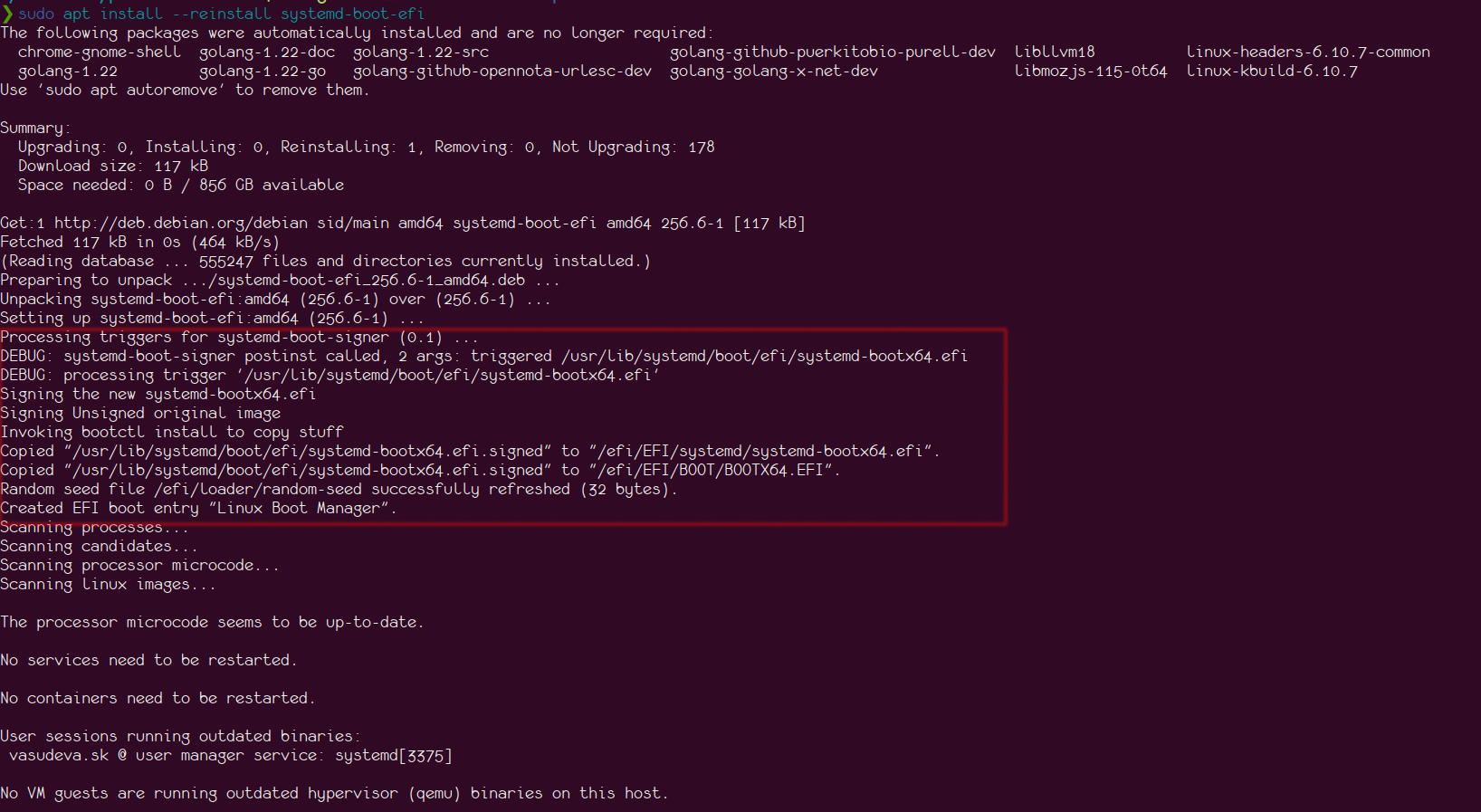
sudo apt install --reinstall systemd-boot-efi
During installation, you can see the debug message being printed in the screenshot below: systemd-boot-signer triggered To test the systemd-boot-update.service, I commented out the bootctl install line from the above script, performed a reinstallation, and restarted the systemd-boot-update.service. Checking the log, I saw the following:
Sep 29 13:42:51 chamunda systemd[1]: Stopping systemd-boot-update.service - Automatic Boot Loader Update...
Sep 29 13:42:51 chamunda systemd[1]: Starting systemd-boot-update.service - Automatic Boot Loader Update...
Sep 29 13:42:51 chamunda bootctl[1801516]: Skipping "/efi/EFI/systemd/systemd-bootx64.efi", same boot loader version in place already.
Sep 29 13:42:51 chamunda bootctl[1801516]: Skipping "/efi/EFI/BOOT/BOOTX64.EFI", same boot loader version in place already.
Sep 29 13:42:51 chamunda systemd[1]: Finished systemd-boot-update.service - Automatic Boot Loader Update.
Sep 29 13:43:37 chamunda systemd[1]: systemd-boot-update.service: Deactivated successfully.
Sep 29 13:43:37 chamunda systemd[1]: Stopped systemd-boot-update.service - Automatic Boot Loader Update.
Sep 29 13:43:37 chamunda systemd[1]: Stopping systemd-boot-update.service - Automatic Boot Loader Update...
Indeed, the service attempted to copy the bootloader but did not do so because there was no actual update to the binary; it was just a reinstallation trigger. The complete code for this package can be found here. With this post the entire series on using UKI to Secureboot with Debian comes to an end. Happy hacking!.

Reproducible Builds: Supporter spotlight: Kees Cook on Linux kernel security

The Reproducible Builds project relies on several projects, supporters and sponsors for financial support, but they are also valued as ambassadors who spread the word about our project and the work that we do. This is the eighth installment in a series featuring the projects, companies and individuals who support the Reproducible Builds project. We started this series by featuring the Civil Infrastructure Platform project, and followed this up with a post about the Ford Foundation as well as recent ones about ARDC, the Google Open Source Security Team (GOSST), Bootstrappable Builds, the F-Droid project, David A. Wheeler and Simon Butler. Today, however, we will be talking with Kees Cook, founder of the Kernel Self-Protection Project.

Vagrant Cascadian: Could you tell me a bit about yourself? What sort of things do you work on? Kees Cook: I m a Free Software junkie living in Portland, Oregon, USA. I have been focusing on the upstream Linux kernel s protection of itself. There is a lot of support that the kernel provides userspace to defend itself, but when I first started focusing on this there was not as much attention given to the kernel protecting itself. As userspace got more hardened the kernel itself became a bigger target. Almost 9 years ago I formally announced the Kernel Self-Protection Project because the work necessary was way more than my time and expertise could do alone. So I just try to get people to help as much as possible; people who understand the ARM architecture, people who understand the memory management subsystem to help, people who understand how to make the kernel less buggy.
Vagrant: Could you describe the path that lead you to working on this sort of thing? Kees: I have always been interested in security through the aspect of exploitable flaws. I always thought it was like a magic trick to make a computer do something that it was very much not designed to do and seeing how easy it is to subvert bugs. I wanted to improve that fragility. In 2006, I started working at Canonical on Ubuntu and was mainly focusing on bringing Debian and Ubuntu up to what was the state of the art for Fedora and Gentoo s security hardening efforts. Both had really pioneered a lot of userspace hardening with compiler flags and ELF stuff and many other things for hardened binaries. On the whole, Debian had not really paid attention to it. Debian s packaging building process at the time was sort of a chaotic free-for-all as there wasn t centralized build methodology for defining things. Luckily that did slowly change over the years. In Ubuntu we had the opportunity to apply top down build rules for hardening all the packages. In 2011 Chrome OS was following along and took advantage of a bunch of the security hardening work as they were based on ebuild out of Gentoo and when they looked for someone to help out they reached out to me. We recognized the Linux kernel was pretty much the weakest link in the Chrome OS security posture and I joined them to help solve that. Their userspace was pretty well handled but the kernel had a lot of weaknesses, so focusing on hardening was the next place to go. When I compared notes with other users of the Linux kernel within Google there were a number of common concerns and desires. Chrome OS already had an upstream first requirement, so I tried to consolidate the concerns and solve them upstream. It was challenging to land anything in other kernel team repos at Google, as they (correctly) wanted to minimize their delta from upstream, so I needed to work on any major improvements entirely in upstream and had a lot of support from Google to do that. As such, my focus shifted further from working directly on Chrome OS into being entirely upstream and being more of a consultant to internal teams, helping with integration or sometimes backporting. Since the volume of needed work was so gigantic I needed to find ways to inspire other developers (both inside and outside of Google) to help. Once I had a budget I tried to get folks paid (or hired) to work on these areas when it wasn t already their job.
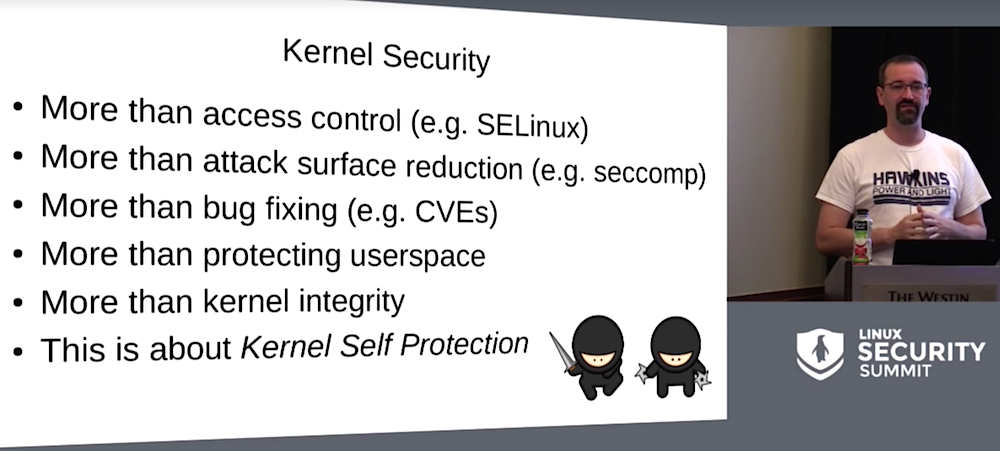
Vagrant: So my understanding of some of your recent work is basically defining undefined behavior in the language or compiler? Kees: I ve found the term undefined behavior to have a really strict meaning within the compiler community, so I have tried to redefine my goal as eliminating unexpected behavior or ambiguous language constructs . At the end of the day ambiguity leads to bugs, and bugs lead to exploitable security flaws. I ve been taking a four-pronged approach: supporting the work people are doing to get rid of ambiguity, identify new areas where ambiguity needs to be removed, actually removing that ambiguity from the C language, and then dealing with any needed refactoring in the Linux kernel source to adapt to the new constraints. None of this is particularly novel; people have recognized how dangerous some of these language constructs are for decades and decades but I think it is a combination of hard problems and a lot of refactoring that nobody has the interest/resources to do. So, we have been incrementally going after the lowest hanging fruit. One clear example in recent years was the elimination of C s implicit fall-through in switch statements. The language would just fall through between adjacent cases if a break (or other code flow directive) wasn t present. But this is ambiguous: is the code meant to fall-through, or did the author just forget a break statement? By defining the [[fallthrough]] statement, and requiring its use in Linux, all switch statements now have explicit code flow, and the entire class of bugs disappeared. During our refactoring we actually found that 1 in 10 added [[fallthrough]] statements were actually missing break statements. This was an extraordinarily common bug! So getting rid of that ambiguity is where we have been. Another area I ve been spending a bit of time on lately is looking at how defensive security work has challenges associated with metrics. How do you measure your defensive security impact? You can t say because we installed locks on the doors, 20% fewer break-ins have happened. Much of our signal is always secondary or retrospective, which is frustrating: This class of flaw was used X much over the last decade so, and if we have eliminated that class of flaw and will never see it again, what is the impact? Is the impact infinity? Attackers will just move to the next easiest thing. But it means that exploitation gets incrementally more difficult. As attack surfaces are reduced, the expense of exploitation goes up.
Vagrant: So it is hard to identify how effective this is how bad would it be if people just gave up? Kees: I think it would be pretty bad, because as we have seen, using secondary factors, the work we have done in the industry at large, not just the Linux kernel, has had an impact. What we, Microsoft, Apple, and everyone else is doing for their respective software ecosystems, has shown that the price of functional exploits in the black market has gone up. Especially for really egregious stuff like a zero-click remote code execution. If those were cheap then obviously we are not doing something right, and it becomes clear that it s trivial for anyone to attack the infrastructure that our lives depend on. But thankfully we have seen over the last two decades that prices for exploits keep going up and up into millions of dollars. I think it is important to keep working on that because, as a central piece of modern computer infrastructure, the Linux kernel has a giant target painted on it. If we give up, we have to accept that our computers are not doing what they were designed to do, which I can t accept. The safety of my grandparents shouldn t be any different from the safety of journalists, and political activists, and anyone else who might be the target of attacks. We need to be able to trust our devices otherwise why use them at all?
Vagrant: What has been your biggest success in recent years? Kees: I think with all these things I am not the only actor. Almost everything that we have been successful at has been because of a lot of people s work, and one of the big ones that has been coordinated across the ecosystem and across compilers was initializing stack variables to 0 by default. This feature was added in Clang, GCC, and MSVC across the board even though there were a lot of fears about forking the C language. The worry was that developers would come to depend on zero-initialized stack variables, but this hasn t been the case because we still warn about uninitialized variables when the compiler can figure that out. So you still still get the warnings at compile time but now you can count on the contents of your stack at run-time and we drop an entire class of uninitialized variable flaws. While the exploitation of this class has mostly been around memory content exposure, it has also been used for control flow attacks. So that was politically and technically a large challenge: convincing people it was necessary, showing its utility, and implementing it in a way that everyone would be happy with, resulting in the elimination of a large and persistent class of flaws in C.
Vagrant: In a world where things are generally Reproducible do you see ways in which that might affect your work? Kees: One of the questions I frequently get is, What version of the Linux kernel has feature $foo? If I know how things are built, I can answer with just a version number. In a Reproducible Builds scenario I can count on the compiler version, compiler flags, kernel configuration, etc. all those things are known, so I can actually answer definitively that a certain feature exists. So that is an area where Reproducible Builds affects me most directly. Indirectly, it is just being able to trust the binaries you are running are going to behave the same for the same build environment is critical for sane testing.
Vagrant: Have you used diffoscope? Kees: I have! One subset of tree-wide refactoring that we do when getting rid of ambiguous language usage in the kernel is when we have to make source level changes to satisfy some new compiler requirement but where the binary output is not expected to change at all. It is mostly about getting the compiler to understand what is happening, what is intended in the cases where the old ambiguity does actually match the new unambiguous description of what is intended. The binary shouldn t change. We have used diffoscope to compare the before and after binaries to confirm that yep, there is no change in binary .
Vagrant: You cannot just use checksums for that? Kees: For the most part, we need to only compare the text segments. We try to hold as much stable as we can, following the Reproducible Builds documentation for the kernel, but there are macros in the kernel that are sensitive to source line numbers and as a result those will change the layout of the data segment (and sometimes the text segment too). With diffoscope there s flexibility where I can exclude or include different comparisons. Sometimes I just go look at what diffoscope is doing and do that manually, because I can tweak that a little harder, but diffoscope is definitely the default. Diffoscope is awesome!
Vagrant: Where has reproducible builds affected you? Kees: One of the notable wins of reproducible builds lately was dealing with the fallout of the XZ backdoor and just being able to ask the question is my build environment running the expected code? and to be able to compare the output generated from one install that never had a vulnerable XZ and one that did have a vulnerable XZ and compare the results of what you get. That was important for kernel builds because the XZ threat actor was working to expand their influence and capabilities to include Linux kernel builds, but they didn t finish their work before they were noticed. I think what happened with Debian proving the build infrastructure was not affected is an important example of how people would have needed to verify the kernel builds too.
Vagrant: What do you want to see for the near or distant future in security work? Kees: For reproducible builds in the kernel, in the work that has been going on in the ClangBuiltLinux project, one of the driving forces of code and usability quality has been the continuous integration work. As soon as something breaks, on the kernel side, the Clang side, or something in between the two, we get a fast signal and can chase it and fix the bugs quickly. I would like to see someone with funding to maintain a reproducible kernel build CI. There have been places where there are certain architecture configurations or certain build configuration where we lose reproducibility and right now we have sort of a standard open source development feedback loop where those things get fixed but the time in between introduction and fix can be large. Getting a CI for reproducible kernels would give us the opportunity to shorten that time.
Vagrant: Well, thanks for that! Any last closing thoughts? Kees: I am a big fan of reproducible builds, thank you for all your work. The world is a safer place because of it.
Vagrant: Likewise for your work!


For more information about the Reproducible Builds project, please see our website at reproducible-builds.org. If you are interested in ensuring the ongoing security of the software that underpins our civilisation and wish to sponsor the Reproducible Builds project, please reach out to the project by emailing contact@reproducible-builds.org.

28 September 2024

Dave Hibberd: EuroBSDCon 2024 Report

This year I attended EuroBSDCon 2024 in Dublin. I always appreciate an excuse to head over to Ireland, and this seemed like a great chance to spend some time in Dublin and learn new things. Due to constraints on my time I didn t go to the 2 day devsummit that precedes the conference, only the main event itself.

The Event EuroBSDCon was attended by about 200-250 people, the hardcore of the BSD community! Attendees came from all over, I met Canadians, USAians, Germanians, Belgians and Irelandians amongst other nationalities! The event was at UCD Dublin, which is a gorgeous university campus about 10km south of Dublin proper in Stillorgan. The speaker hotel was a 20 minute walk (at my ~9min/km pace) from the hotel, or a quick bus journey. It was a pleasant walk, through the leafy campus and then along some pretty broad pavements, albeit beside a dual carriageway. The cycle infrastructure was pretty excellent too, but I sadly was unable to lease a city bike and make my way around on 2 wheels - Dublinbikes don t extend that far out the city. Lunch each day was Irish themed food - Saturday was beef stew (a Frenchman asked me what it was called - his only equivalent words were Beef Bourguignon ) and Sunday was Bangers & Mash! The kitchen struggled a bit - food was brought out in bowls in waves, and that ensured there was artificial scarcity that clearly left anxiety for some that they weren t going to be fed! Everyone I met was friendly from the day I arrived, and that set me very much at ease and made the event much more enjoyable - things are better shared with others. Big shout out to dch and Blake Willis for spending a lot of time talking to me over the weekend!

Talks I Attended

Keynote: Evidence based Policy formation in the EU Tom Smyth This talk given by Tom Smyth was an interesting look into his work with EU Policymakers in ensuring fair competition for his small, Irish ISP. It was an enlightening look into the workings of the EU and the various bodies that set, and manage policy. It truly is a complicated beast, but the feeling I left with was that there are people all through the organisation who are desperate to do the right thing for EU citizens at all costs. Sadly none of it is directly applicable to me living in the UK, but I still get to have a say on policy and vote in polls as an Irish citizen abroad.

10(ish) years of FreeBSD/arm64 Andrew Turner I have been a fan of ARM platforms for a long, long time. I had an early ARM Chromebook and have been equal measures excited and frustrated by the raspberry pi since first contact. I tend to find other ARM people at events and this was no exception! It was an interesting view into one person s dedication to making arm64 a platform for FreeBSD, starting out with no documentation or hardware to becoming a first-class platform. It s interesting to see the roadmap and things upcoming too and makes me hopeful for the future of arm64 in various OSes!

1-800-RC(8)-HELP: Dial Into FreeBSD Service Scripts Mastery! Mateusz Piotrowski rc scripts and startup applications scare me a bit. I m better at systemd units than sysvinit scripts, but that isn t really a transferable skill! This was a deep dive into lots of the functionality that FreeBSD s RC offers, and highlighted things that I only thought were limited to Linux s systemd. I am much more aware of what it s capable of now, but I m still scared to take it on! Afterwards I had a great chat in the hallway with Mateusz about our OS s different approaches to this problem and was impressed with the pragmatic view he had on startup, systemd, rc and the future!

Package management without borders. Using Ravenports on multiple BSDs Michael Reim Ports on the BSDs interest me, but I hadn t realised that outside of each major BSD s collection there were other, cross platform ports collections offered. Ravenports is one of these under developments, and it was good to understand the hows, why and what s happenings of the system. Plus, with my hibbian obsession on building other people s software as my own packages, it s interesting to see how others are doing it!

Building a Modern Packet Radio Network using Open Software me I spoke for 45 minutes to share my passion and frustration for amateur radio, packet radio, the law, the technology and what we re doing in the UK Packet network. This was a lot of fun - it felt like I had a busy room, lots of people interested in the stupid stuff I do with technology and I had lots of conversations after the fact about radio, telecoms, networking and at one point was cornered by what I describe as the Erlang Mafia to talk about how they could help!

Hacking - 30 years ago Walter Belgers This unrecorded talk looked at the history of the Dutch hacker scene, and a young group of hackers explorations of the early internet before modern security was a thing. It was exciting, enrapturing, well presented and a great story of a well spent youth in front of computers.

Social By 1730 I was pretty drained so I took myself back to the hotel missing the last talks, had some down time, and got the DART train to the social event at Brewdog. This invovled about an hour s walking and some train time and that was a nice time to reset my head and just watch the world. The train I was on had a particularly interesting feature where when the motors were not loaded (slowdown or coasting) the lights slowly flickered dim-bright-dim. I don t know if this is across the fleet or just this one, but it was fun to pontificate as I looked out the window at South Dublin passing by. The social was good - a few beer tokens (cider in my case, trying to avoid beer-driven hangovers still), some pleasant junk food and plenty of good company to talk to, lots of people wanting to talk about radio and packet to me! Brewdog struggled a bit - both in bar speed (a linear queue formed despite the staff preferring the crowd-around method of queue) and buffet food appeared in somewhat disjointed waves, meaning that people loitered around the food tables and cleared the plates of wings, sliders, fries, onion rings, mac & cheese as they appeared 4-5 plates at a time. Perhaps a few hundred hungry bodies was a bit too much for them to feed at once. They had shuffleboard that was played all night by various groups! I caught the last bus home, which was relatively painless!

Is our software sustainable? Kent Inge Fagerland Simonsen This was an interesting look into reducing the footprint of software to make it a net benefit. Lots of examples of how little changes can barrel up to big, gigawatthour changes when aggregated over the entire installbase of android or iOS!

A Packet s Journey Through the OpenBSD Network Stack Alexander Bluhm This was an analysis of what happens at each stage of networking in OpenBSD and was pretty interesting to see. Lots of it was out my depth, but it s cool to get an explanation and appreciation for various elements of how software handles each packet that arrives and the differences in the ipv4 and ipv6 stack!

FreeBSD at 30 Years: Its Secrets to Success Kirk McKusick This was a great statistical breakdown of FreeBSD since inception, including top committers, why certain parts of the system and community work so well and what has given it staying power compared to some projects on the internet that peter out after just a few years! Kirk s excitement and passion for the project really shone through, and I want to read his similarly titled article in the FreeBSD Journal now!

Building an open native FreeBSD CI system from scratch with lua, C, jails & zfs Dave Cottlehuber Dave spoke pretty excitedly about his work on a CI system using tools that FreeBSD ships with, and introduced me to the integration of C and Lua which I wasn t fully aware of before. Or I was, and my brain forgot it! With my interest in software build this year, it was quite a timely look at how others are thinking of doing things (I am doing similar stuff with zfs!). I look forward to playing with it when it finally is released to the Real World!

Building an Appliance Allan Jude This was an interesting look into the tools that FreeBSD provides which can be used to make immutable, appliance OSes without too much overhead. Fail safe upgrades and boots with ZFS, running approved code with secure boot, factory resetting and more were discussed! I have had thoughts around this in the recent past, so it was good to have some ideas validated, some challenged and gave me food for thought.

Experience as a speaker I really enjoyed being a speaker at the event! I ve spoken at other things before, but this really was a cut above. The event having money to provide me a hotel was a really welcome surprise, and also receiving a gorgeous scarf as a speaker gift was a great surprise (and it has already been worn with the change of temperature here in Scotland this week!). I would definitely consider returning, either as an attendee or as a speaker. The community of attendees were pragmatic, interesting, engaging and welcoming, the organising committee were spot-on in their work making it happen and the whole event, while turning my brain to mush with all the information, was really enjoyable and I left energised and excited by things instead of ground down and tired.

26 September 2024

Vasudev Kamath: Disabling Lockdown Mode with Secure Boot on Distro Kernel

In my previous post, I mentioned that Lockdown mode is activated when Secure Boot is enabled. One way to override this was to use a self-compiled upstream kernel. However, sometimes we might want to use the distribution kernel itself. This post explains how to disable lockdown mode while keeping Secure Boot enabled with a distribution kernel.
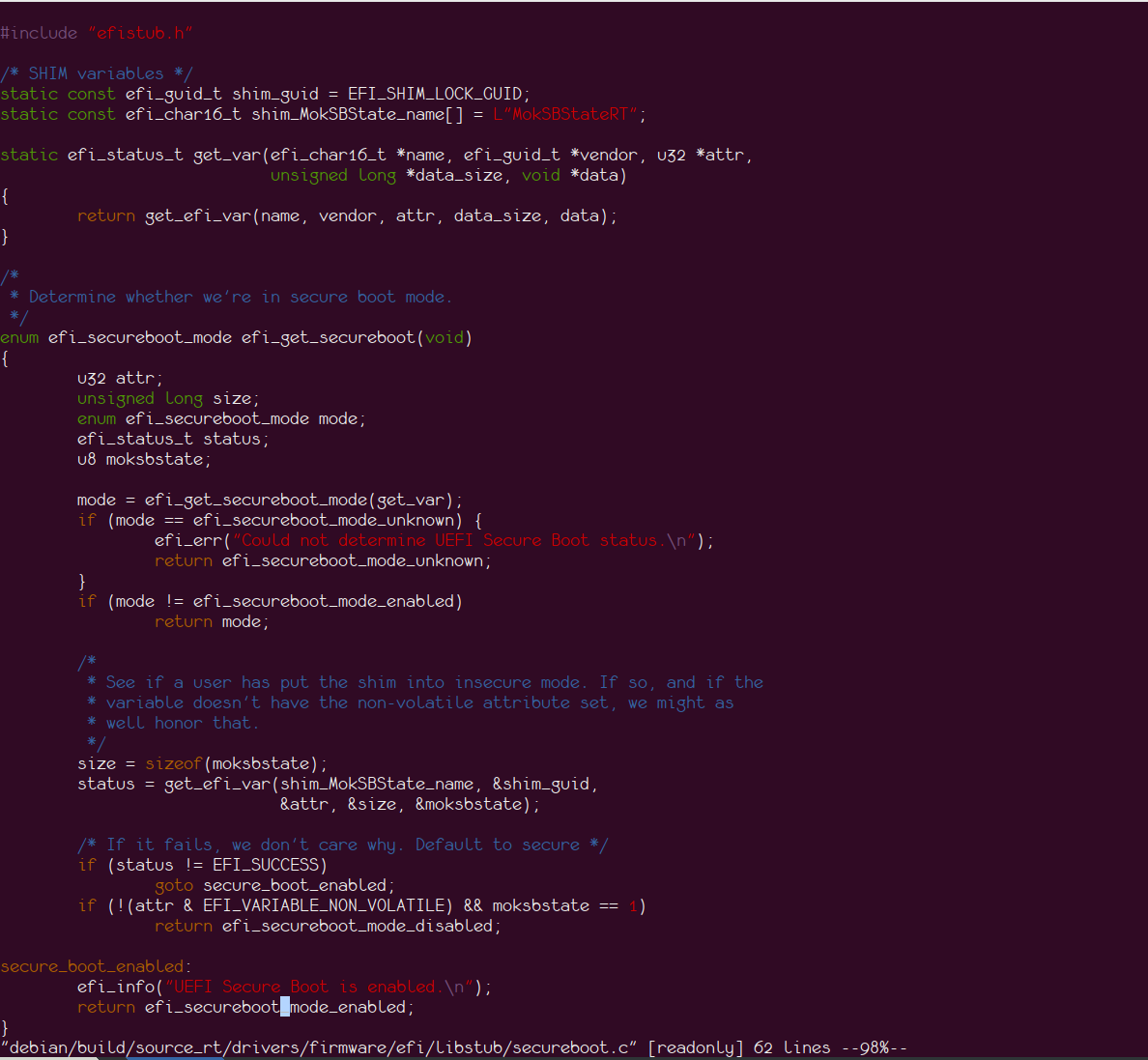
Understanding Secure Boot Detection To begin, we need to understand how the kernel detects if Secure Boot is enabled. This is done by the efi_get_secureboot function, as shown in the image below: Secure Boot status check
Disabling Kernel Lockdown The kernel code uses the value of MokSBStateRT to identify the Secure Boot state, assuming that Secure Boot can only be enabled via shim. This assumption holds true when using the Microsoft certificate for signature validation (as Microsoft currently only signs shim). However, if we're using our own keys, we don't need shim and can sign the bootloader ourselves. In this case, the Secure Boot state of the system doesn't need to be tied to the MokSBStateRT variable. To disable kernel lockdown, we need to set the UEFI runtime variable MokSBStateRT. This essentially tricks the kernel into thinking Secure Boot is disabled when it's actually enabled. This is achieved using a UEFI initializing driver. The code for this was written by an anonymous colleague who also assisted me with various configuration guidance for setting up UKI and Secure Boot on my system. The code is available here.
Implementation Detailed instructions for compiling and deploying the code are provided in the repository, so I won't repeat them here.
Results I've tested this method with the default distribution kernel on my Debian unstable system, and it successfully disables lockdown while maintaining Secure Boot integrity. See the screenshot below for confirmation: Distribution kernel lockdown disabled

Melissa Wen: Reflections on 2024 Linux Display Next Hackfest

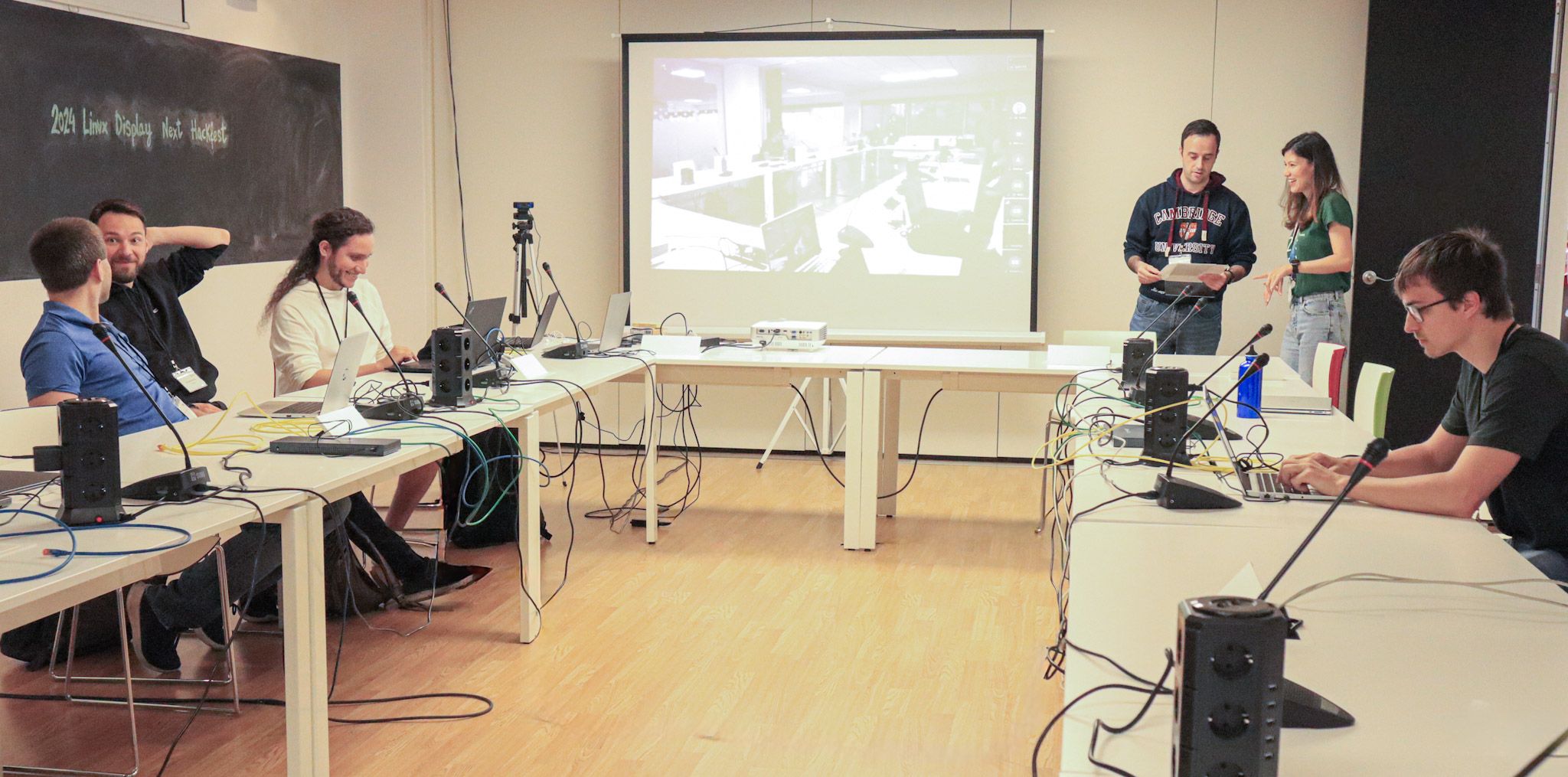
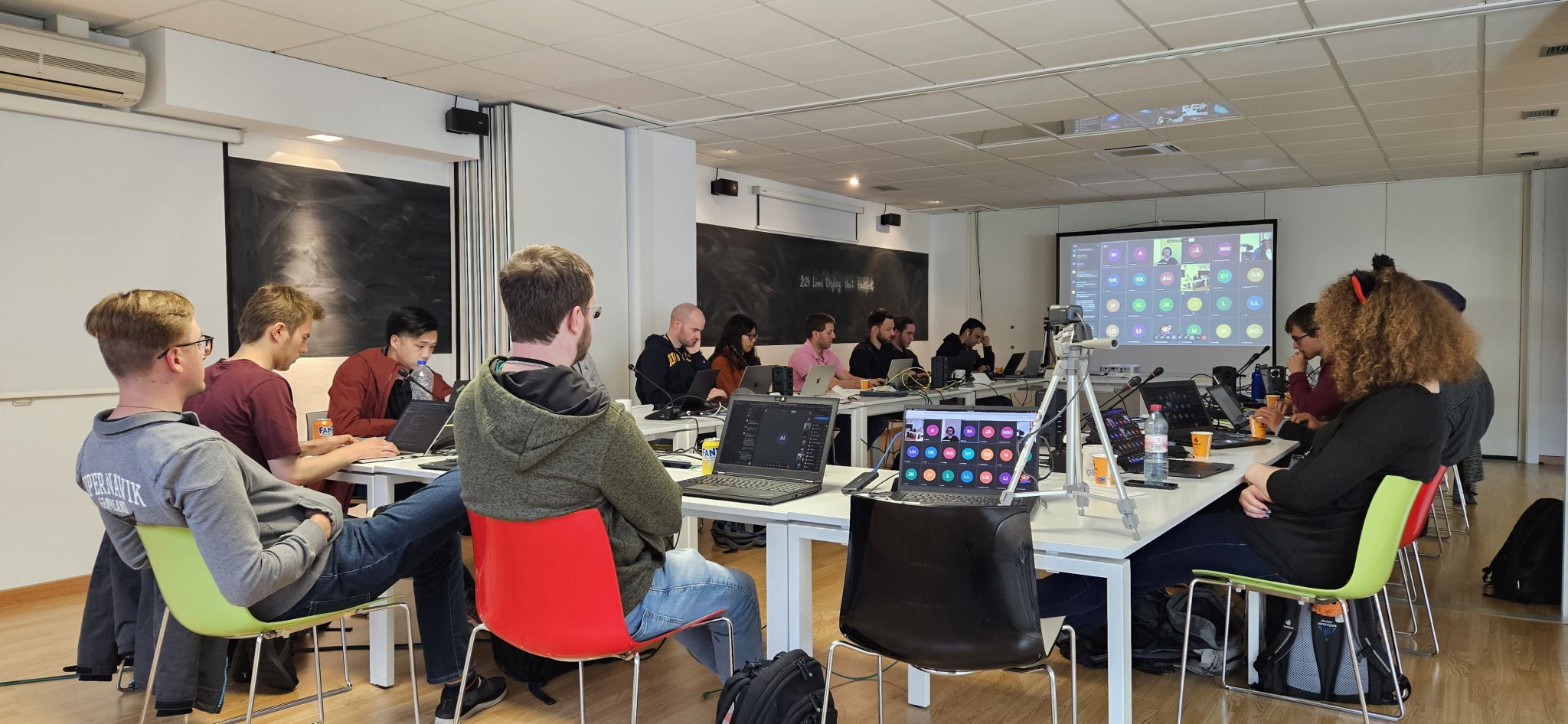
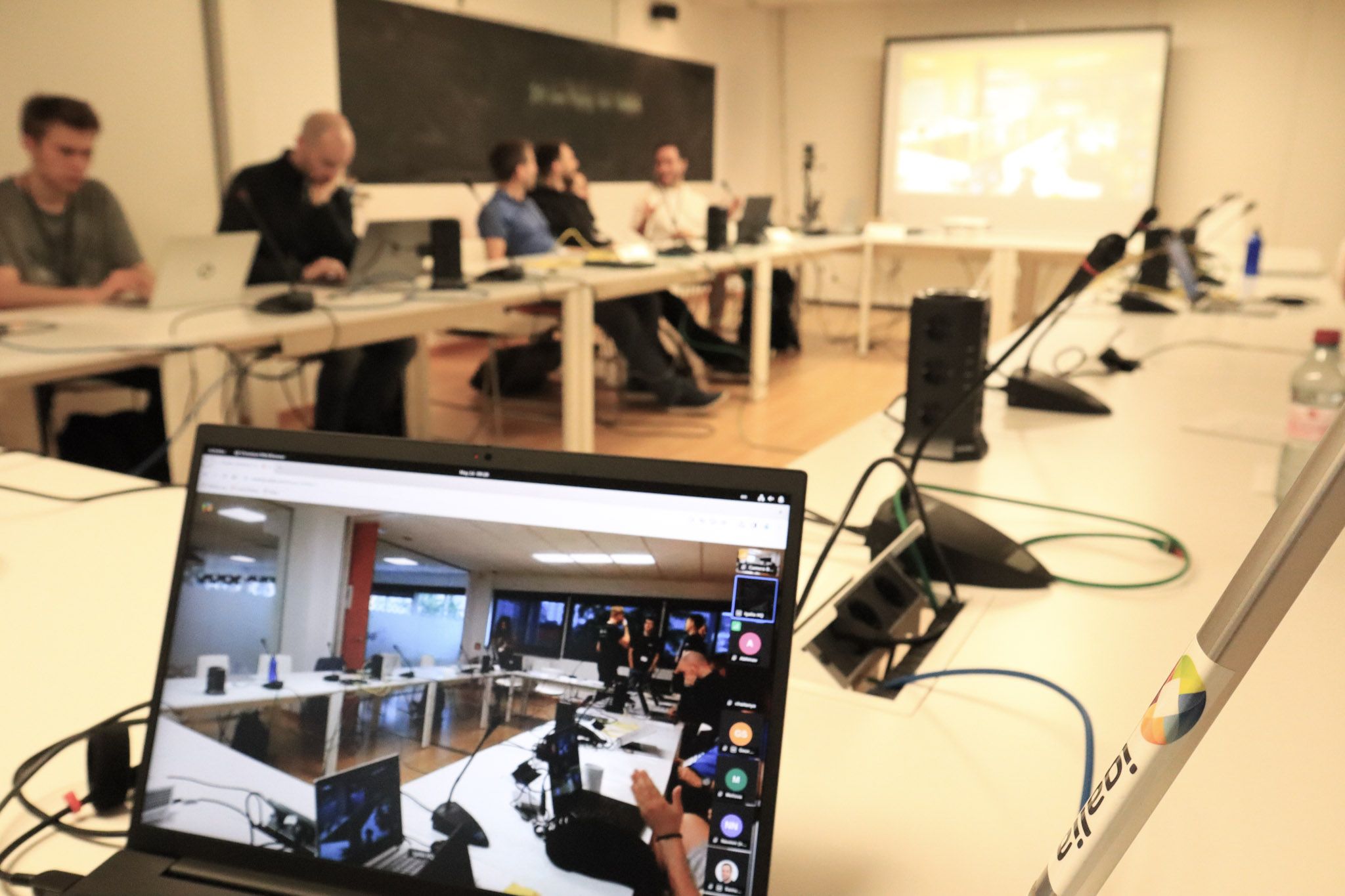
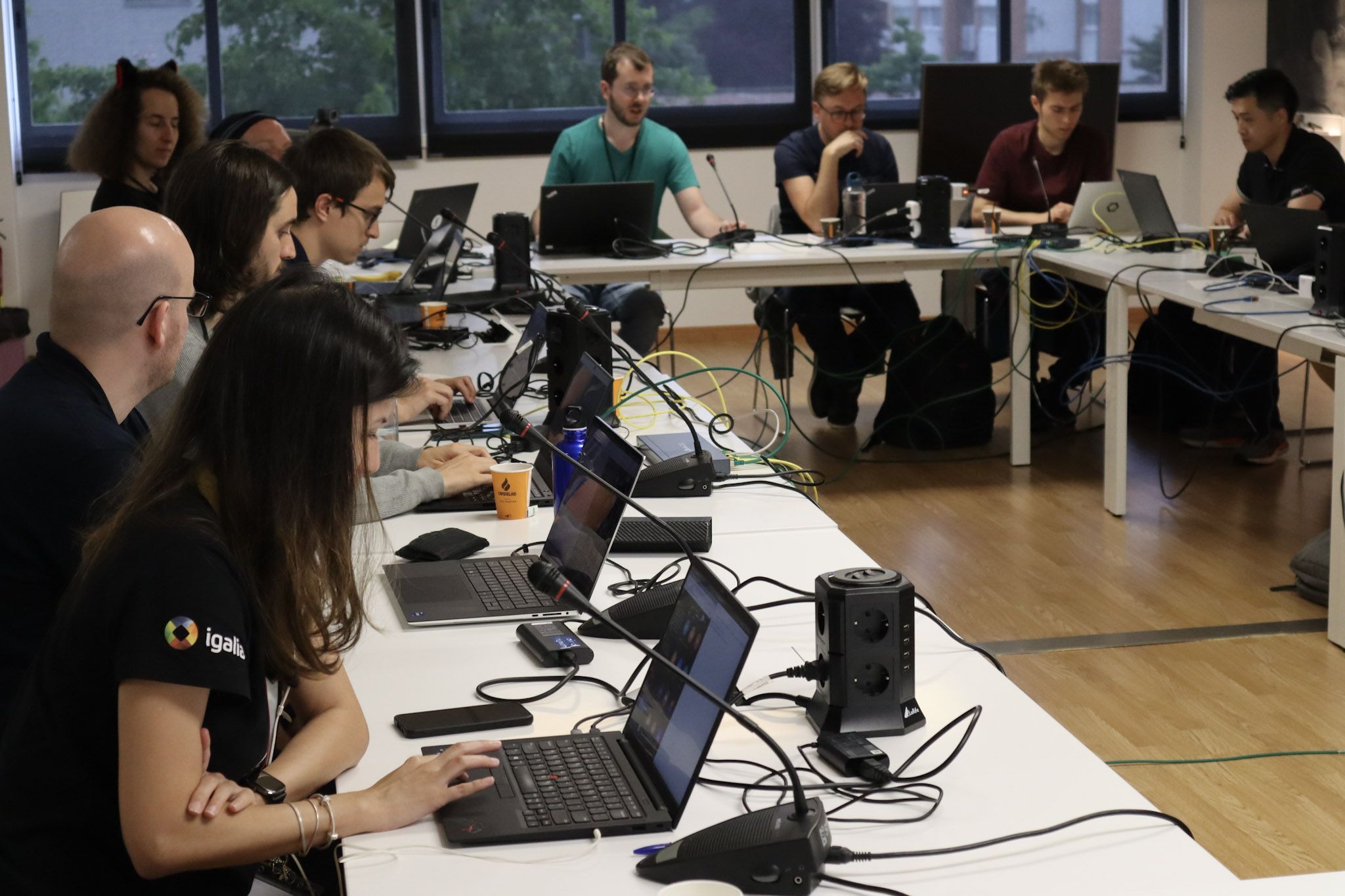
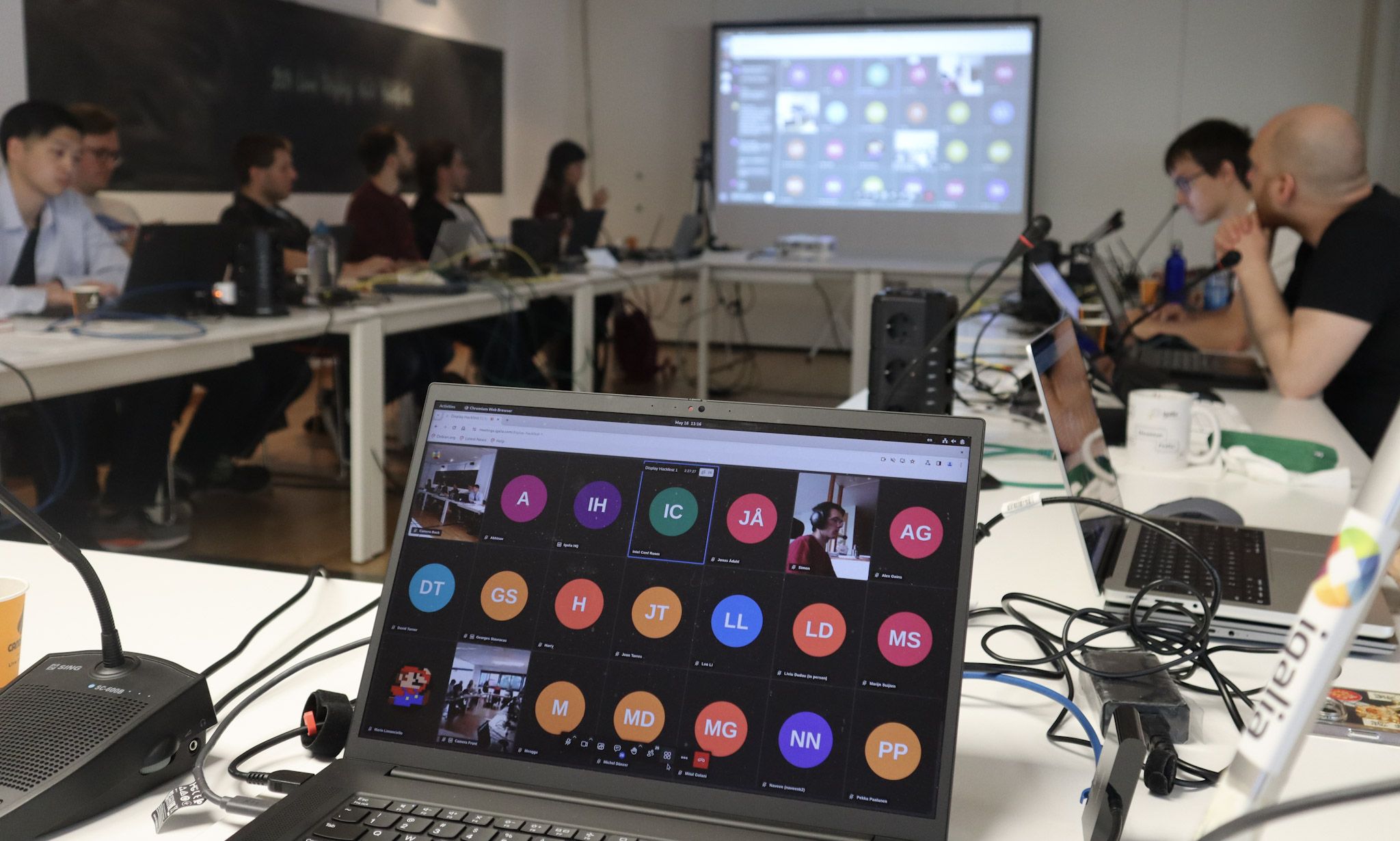
Hey everyone! The 2024 Linux Display Next hackfest concluded in May, and its outcomes continue to shape the Linux Display stack. Igalia hosted this year s event in A Coru a, Spain, bringing together leading experts in the field. Samuel Iglesias and I organized this year s edition and this blog post summarizes the experience and its fruits. One of the highlights of this year s hackfest was the wide range of backgrounds represented by our 40 participants (both on-site and remotely). Developers and experts from various companies and open-source projects came together to advance the Linux Display ecosystem. You can find the list of participants here. The event covered a broad spectrum of topics affecting the development of Linux projects, user experiences, and the future of display technologies on Linux. From cutting-edge topics to long-term discussions, you can check the event agenda here.

Organization Highlights The hackfest was marked by in-depth discussions and knowledge sharing among Linux contributors, making everyone inspired, informed, and connected to the community. Building on feedback from the previous year, we refined the unconference format to enhance participant preparation and engagement. Structured Agenda and Timeboxes: Each session had a defined scope, time limit (1h20 or 2h10), and began with an introductory talk on the topic.
  • Participant-Led Discussions: We pre-selected in-person participants to lead discussions, allowing them to prepare introductions, resources, and scope.
  • Transparent Scheduling: The schedule was shared in advance as GitHub issues, encouraging participants to review and prepare for sessions of interest.
Engaging Sessions: The hackfest featured a variety of topics, including presentations and discussions on how participants were addressing specific subjects within their companies.
  • No Breakout Rooms, No Overlaps: All participants chose to attend all sessions, eliminating the need for separate breakout rooms. We also adapted run-time schedule to keep everybody involved in the same topics.
  • Real-time Updates: We provided notifications and updates through dedicated emails and the event matrix room.
Strengthening Community Connections: The hackfest offered ample opportunities for networking among attendees.
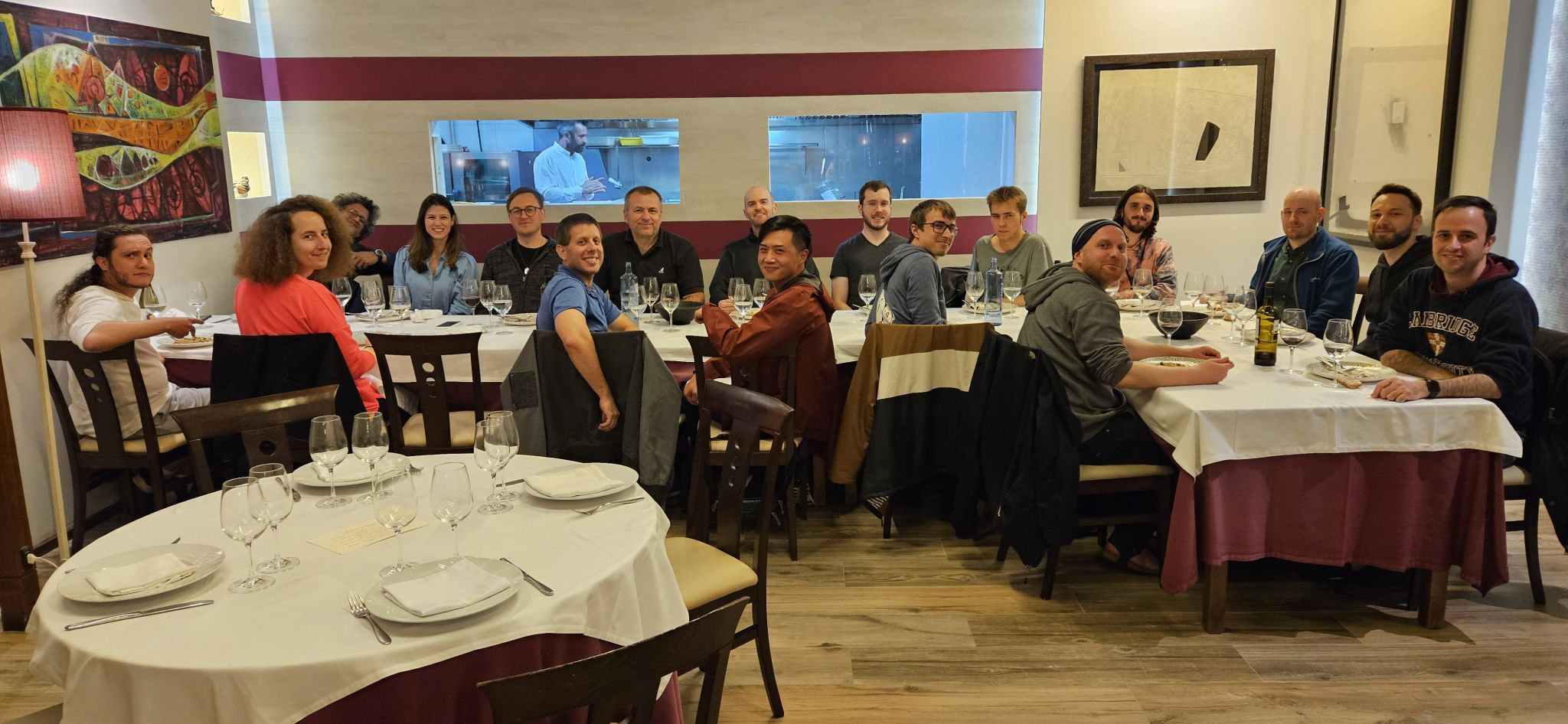
  • Social Events: Igalia sponsored coffee breaks, lunches, and a dinner at a local restaurant.
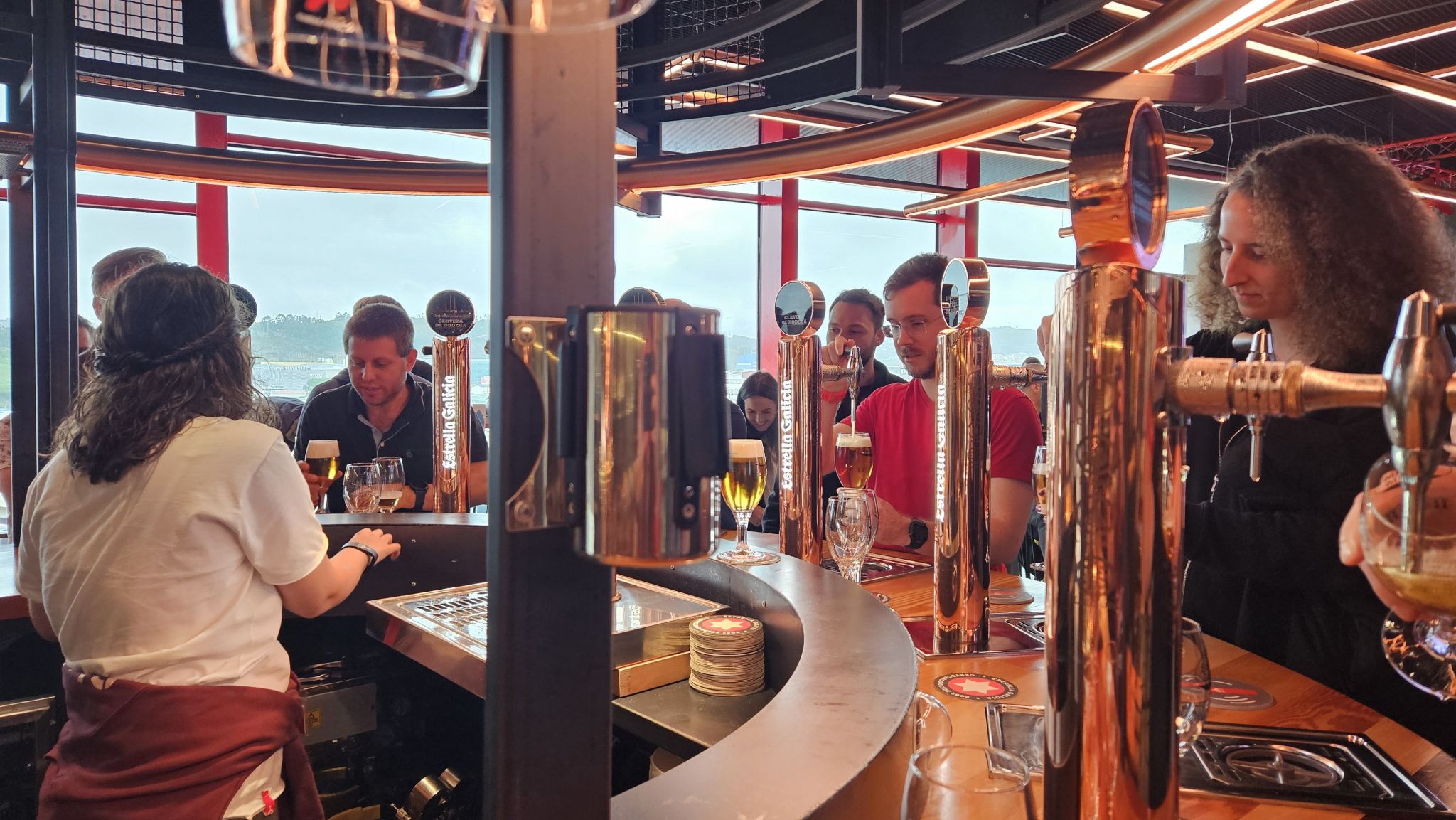
  • Museum Visit: Participants enjoyed a sponsored visit to the Museum of Estrela Galicia Beer (MEGA).

Fruitful Discussions and Follow-up The structured agenda and breaks allowed us to cover multiple topics during the hackfest. These discussions have led to new display feature development and improvements, as evidenced by patches, merge requests, and implementations in project repositories and mailing lists. With the KMS color management API taking shape, we discussed refinements and best approaches to cover the variety of color pipeline from different hardware-vendors. We are also investigating techniques for a performant SDR<->HDR content reproduction and reducing latency and power consumption when using the color blocks of the hardware.

Color Management/HDR Color Management and HDR continued to be the hottest topic of the hackfest. We had three sessions dedicated to discuss Color and HDR across Linux Display stack layers.

Color/HDR (Kernel-Level) Harry Wentland (AMD) led this session. Here, kernel Developers shared the Color Management pipeline of AMD, Intel and NVidia. We counted with diagrams and explanations from HW-vendors developers that discussed differences, constraints and paths to fit them into the KMS generic color management properties such as advertising modeset needs, IN\_FORMAT, segmented LUTs, interpolation types, etc. Developers from Qualcomm and ARM also added information regarding their hardware. Upstream work related to this session:

Color/HDR (Compositor-Level) Sebastian Wick (RedHat) led this session. It started with Sebastian s presentation covering Wayland color protocols and compositor implementation. Also, an explanation of APIs provided by Wayland and how they can be used to achieve better color management for applications and discussions around ICC profiles and color representation metadata. There was also an intensive Q&A about LittleCMS with Marti Maria. Upstream work related to this session:

Color/HDR (Use Cases and Testing) Christopher Cameron (Google) and Melissa Wen (Igalia) led this session. In contrast to the other sessions, here we focused less on implementation and more on brainstorming and reflections of real-world SDR and HDR transformations (use and validation) and gainmaps. Christopher gave a nice presentation explaining HDR gainmap images and how we should think of HDR. This presentation and Q&A were important to put participants at the same page of how to transition between SDR and HDR and somehow emulating HDR. We also discussed on the usage of a kernel background color property. Finally, we discussed a bit about Chamelium and the future of VKMS (future work and maintainership).

Power Savings vs Color/Latency Mario Limonciello (AMD) led this session. Mario gave an introductory presentation about AMD ABM (adaptive backlight management) that is similar to Intel DPST. After some discussions, we agreed on exposing a kernel property for power saving policy. This work was already merged on kernel and the userspace support is under development. Upstream work related to this session:

Strategy for video and gaming use-cases Leo Li (AMD) led this session. Miguel Casas (Google) started this session with a presentation of Overlays in Chrome/OS Video, explaining the main goal of power saving by switching off GPU for accelerated compositing and the challenges of different colorspace/HDR for video on Linux. Then Leo Li presented different strategies for video and gaming and we discussed the userspace need of more detailed feedback mechanisms to understand failures when offloading. Also, creating a debugFS interface came up as a tool for debugging and analysis.

Real-time scheduling and async KMS API Xaver Hugl (KDE/BlueSystems) led this session. Compositor developers have exposed some issues with doing real-time scheduling and async page flips. One is that the Kernel limits the lifetime of realtime threads and if a modeset takes too long, the thread will be killed and thus the compositor as well. Also, simple page flips take longer than expected and drivers should optimize them. Another issue is the lack of feedback to compositors about hardware programming time and commit deadlines (the lastest possible time to commit). This is difficult to predict from drivers, since it varies greatly with the type of properties. For example, color management updates take much longer. In this regard, we discusssed implementing a hw_done callback to timestamp when the hardware programming of the last atomic commit is complete. Also an API to pre-program color pipeline in a kind of A/B scheme. It may not be supported by all drivers, but might be useful in different ways.

VRR/Frame Limit, Display Mux, Display Control, and more and beer We also had sessions to discuss a new KMS API to mitigate headaches on VRR and Frame Limit as different brightness level at different refresh rates, abrupt changes of refresh rates, low frame rate compensation (LFC) and precise timing in VRR more. On Display Control we discussed features missing in the current KMS interface for HDR mode, atomic backlight settings, source-based tone mapping, etc. We also discussed the need of a place where compositor developers can post TODOs to be developed by KMS people. The Content-adaptive Scaling and Sharpening session focused on sharpening and scaling filters. In the Display Mux session, we discussed proposals to expose the capability of dynamic mux switching display signal between discrete and integrated GPUs. In the last session of the 2024 Display Next Hackfest, participants representing different compositors summarized current and future work and built a Linux Display wish list , which includes: improvements to VTTY and HDR switching, better dmabuf API for multi-GPU support, definition of tone mapping, blending and scaling sematics, and wayland protocols for advertising to clients which colorspaces are supported. We closed this session with a status update on feature development by compositors, including but not limited to: plane offloading (from libcamera to output) / HDR video offloading (dma-heaps) / plane-based scrolling for web pages, color management / HDR / ICC profiles support, addressing issues such as flickering when color primaries don t match, etc. After three days of intensive discussions, all in-person participants went to a guided tour at the Museum of Extrela Galicia beer (MEGA), pouring and tasting the most famous local beer.

Feedback and Future Directions Participants provided valuable feedback on the hackfest, including suggestions for future improvements.
  • Schedule and Break-time Setup: Having a pre-defined agenda and schedule provided a better balance between long discussions and mental refreshments, preventing the fatigue caused by endless discussions.
  • Action Points: Some participants recommended explicitly asking for action points at the end of each session and assigning people to follow-up tasks.
  • Remote Participation: Remote attendees appreciated the inclusive setup and opportunities to actively participate in discussions.
  • Technical Challenges: There were bandwidth and video streaming issues during some sessions due to the large number of participants.

Thank you for joining the 2024 Display Next Hackfest We can t help but thank the 40 participants, who engaged in-person or virtually on relevant discussions, for a collaborative evolution of the Linux display stack and for building an insightful agenda. A big thank you to the leaders and presenters of the nine sessions: Christopher Cameron (Google), Harry Wentland (AMD), Leo Li (AMD), Mario Limoncello (AMD), Sebastian Wick (RedHat) and Xaver Hugl (KDE/BlueSystems) for the effort in preparing the sessions, explaining the topic and guiding discussions. My acknowledge to the others in-person participants that made such an effort to travel to A Coru a: Alex Goins (NVIDIA), David Turner (Raspberry Pi), Georges Stavracas (Igalia), Joan Torres (SUSE), Liviu Dudau (Arm), Louis Chauvet (Bootlin), Robert Mader (Collabora), Tian Mengge (GravityXR), Victor Jaquez (Igalia) and Victoria Brekenfeld (System76). It was and awesome opportunity to meet you and chat face-to-face. Finally, thanks virtual participants who couldn t make it in person but organized their days to actively participate in each discussion, adding different perspectives and valuable inputs even remotely: Abhinav Kumar (Qualcomm), Chaitanya Borah (Intel), Christopher Braga (Qualcomm), Dor Askayo (Red Hat), Jiri Koten (RedHat), Jonas dahl (Red Hat), Leandro Ribeiro (Collabora), Marti Maria (Little CMS), Marijn Suijten, Mario Kleiner, Martin Stransky (Red Hat), Michel D nzer (Red Hat), Miguel Casas-Sanchez (Google), Mitulkumar Golani (Intel), Naveen Kumar (Intel), Niels De Graef (Red Hat), Pekka Paalanen (Collabora), Pichika Uday Kiran (AMD), Shashank Sharma (AMD), Sriharsha PV (AMD), Simon Ser, Uma Shankar (Intel) and Vikas Korjani (AMD). We look forward to another successful Display Next hackfest, continuing to drive innovation and improvement in the Linux display ecosystem!

25 September 2024

Melissa Wen: Reflections on 2024 Linux Display Next Hackfest

Hey everyone! The 2024 Linux Display Next hackfest concluded in May, and its outcomes continue to shape the Linux Display stack. Igalia hosted this year s event in A Coru a, Spain, bringing together leading experts in the field. Samuel Iglesias and I organized this year s edition and this blog post summarizes the experience and its fruits. One of the highlights of this year s hackfest was the wide range of backgrounds represented by our 40 participants (both on-site and remotely). Developers and experts from various companies and open-source projects came together to advance the Linux Display ecosystem. You can find the list of participants here. The event covered a broad spectrum of topics affecting the development of Linux projects, user experiences, and the future of display technologies on Linux. From cutting-edge topics to long-term discussions, you can check the event agenda here.

Organization Highlights The hackfest was marked by in-depth discussions and knowledge sharing among Linux contributors, making everyone inspired, informed, and connected to the community. Building on feedback from the previous year, we refined the unconference format to enhance participant preparation and engagement. Structured Agenda and Timeboxes: Each session had a defined scope, time limit (1h20 or 2h10), and began with an introductory talk on the topic.
  • Participant-Led Discussions: We pre-selected in-person participants to lead discussions, allowing them to prepare introductions, resources, and scope.
  • Transparent Scheduling: The schedule was shared in advance as GitHub issues, encouraging participants to review and prepare for sessions of interest.
Engaging Sessions: The hackfest featured a variety of topics, including presentations and discussions on how participants were addressing specific subjects within their companies.
  • No Breakout Rooms, No Overlaps: All participants chose to attend all sessions, eliminating the need for separate breakout rooms. We also adapted run-time schedule to keep everybody involved in the same topics.
  • Real-time Updates: We provided notifications and updates through dedicated emails and the event matrix room.
Strengthening Community Connections: The hackfest offered ample opportunities for networking among attendees.
  • Social Events: Igalia sponsored coffee breaks, lunches, and a dinner at a local restaurant.
  • Museum Visit: Participants enjoyed a sponsored visit to the Museum of Estrela Galicia Beer (MEGA).

Fruitful Discussions and Follow-up The structured agenda and breaks allowed us to cover multiple topics during the hackfest. These discussions have led to new display feature development and improvements, as evidenced by patches, merge requests, and implementations in project repositories and mailing lists. With the KMS color management API taking shape, we discussed refinements and best approaches to cover the variety of color pipeline from different hardware-vendors. We are also investigating techniques for a performant SDR<->HDR content reproduction and reducing latency and power consumption when using the color blocks of the hardware.

Color Management/HDR Color Management and HDR continued to be the hottest topic of the hackfest. We had three sessions dedicated to discuss Color and HDR across Linux Display stack layers.

Color/HDR (Kernel-Level) Harry Wentland (AMD) led this session. Here, kernel Developers shared the Color Management pipeline of AMD, Intel and NVidia. We counted with diagrams and explanations from HW-vendors developers that discussed differences, constraints and paths to fit them into the KMS generic color management properties such as advertising modeset needs, IN\_FORMAT, segmented LUTs, interpolation types, etc. Developers from Qualcomm and ARM also added information regarding their hardware. Upstream work related to this session:

Color/HDR (Compositor-Level) Sebastian Wick (RedHat) led this session. It started with Sebastian s presentation covering Wayland color protocols and compositor implementation. Also, an explanation of APIs provided by Wayland and how they can be used to achieve better color management for applications and discussions around ICC profiles and color representation metadata. There was also an intensive Q&A about LittleCMS with Marti Maria. Upstream work related to this session:

Color/HDR (Use Cases and Testing) Christopher Cameron (Google) and Melissa Wen (Igalia) led this session. In contrast to the other sessions, here we focused less on implementation and more on brainstorming and reflections of real-world SDR and HDR transformations (use and validation) and gainmaps. Christopher gave a nice presentation explaining HDR gainmap images and how we should think of HDR. This presentation and Q&A were important to put participants at the same page of how to transition between SDR and HDR and somehow emulating HDR. We also discussed on the usage of a kernel background color property. Finally, we discussed a bit about Chamelium and the future of VKMS (future work and maintainership).

Power Savings vs Color/Latency Mario Limonciello (AMD) led this session. Mario gave an introductory presentation about AMD ABM (adaptive backlight management) that is similar to Intel DPST. After some discussions, we agreed on exposing a kernel property for power saving policy. This work was already merged on kernel and the userspace support is under development. Upstream work related to this session:

Strategy for video and gaming use-cases Leo Li (AMD) led this session. Miguel Casas (Google) started this session with a presentation of Overlays in Chrome/OS Video, explaining the main goal of power saving by switching off GPU for accelerated compositing and the challenges of different colorspace/HDR for video on Linux. Then Leo Li presented different strategies for video and gaming and we discussed the userspace need of more detailed feedback mechanisms to understand failures when offloading. Also, creating a debugFS interface came up as a tool for debugging and analysis.

Real-time scheduling and async KMS API Xaver Hugl (KDE/BlueSystems) led this session. Compositor developers have exposed some issues with doing real-time scheduling and async page flips. One is that the Kernel limits the lifetime of realtime threads and if a modeset takes too long, the thread will be killed and thus the compositor as well. Also, simple page flips take longer than expected and drivers should optimize them. Another issue is the lack of feedback to compositors about hardware programming time and commit deadlines (the lastest possible time to commit). This is difficult to predict from drivers, since it varies greatly with the type of properties. For example, color management updates take much longer. In this regard, we discusssed implementing a hw_done callback to timestamp when the hardware programming of the last atomic commit is complete. Also an API to pre-program color pipeline in a kind of A/B scheme. It may not be supported by all drivers, but might be useful in different ways.

VRR/Frame Limit, Display Mux, Display Control, and more and beer We also had sessions to discuss a new KMS API to mitigate headaches on VRR and Frame Limit as different brightness level at different refresh rates, abrupt changes of refresh rates, low frame rate compensation (LFC) and precise timing in VRR more. On Display Control we discussed features missing in the current KMS interface for HDR mode, atomic backlight settings, source-based tone mapping, etc. We also discussed the need of a place where compositor developers can post TODOs to be developed by KMS people. The Content-adaptive Scaling and Sharpening session focused on sharpening and scaling filters. In the Display Mux session, we discussed proposals to expose the capability of dynamic mux switching display signal between discrete and integrated GPUs. In the last session of the 2024 Display Next Hackfest, participants representing different compositors summarized current and future work and built a Linux Display wish list , which includes: improvements to VTTY and HDR switching, better dmabuf API for multi-GPU support, definition of tone mapping, blending and scaling sematics, and wayland protocols for advertising to clients which colorspaces are supported. We closed this session with a status update on feature development by compositors, including but not limited to: plane offloading (from libcamera to output) / HDR video offloading (dma-heaps) / plane-based scrolling for web pages, color management / HDR / ICC profiles support, addressing issues such as flickering when color primaries don t match, etc. After three days of intensive discussions, all in-person participants went to a guided tour at the Museum of Extrela Galicia beer (MEGA), pouring and tasting the most famous local beer.

Feedback and Future Directions Participants provided valuable feedback on the hackfest, including suggestions for future improvements.
  • Schedule and Break-time Setup: Having a pre-defined agenda and schedule provided a better balance between long discussions and mental refreshments, preventing the fatigue caused by endless discussions.
  • Action Points: Some participants recommended explicitly asking for action points at the end of each session and assigning people to follow-up tasks.
  • Remote Participation: Remote attendees appreciated the inclusive setup and opportunities to actively participate in discussions.
  • Technical Challenges: There were bandwidth and video streaming issues during some sessions due to the large number of participants.

Thank you for joining the 2024 Display Next Hackfest We can t help but thank the 40 participants, who engaged in-person or virtually on relevant discussions, for a collaborative evolution of the Linux display stack and for building an insightful agenda. A big thank you to the leaders and presenters of the nine sessions: Christopher Cameron (Google), Harry Wentland (AMD), Leo Li (AMD), Mario Limoncello (AMD), Sebastian Wick (RedHat) and Xaver Hugl (KDE/BlueSystems) for the effort in preparing the sessions, explaining the topic and guiding discussions. My acknowledge to the others in-person participants that made such an effort to travel to A Coru a: Alex Goins (NVIDIA), David Turner (Raspberry Pi), Georges Stavracas (Igalia), Joan Torres (SUSE), Liviu Dudau (Arm), Louis Chauvet (Bootlin), Robert Mader (Collabora), Tian Mengge (GravityXR), Victor Jaquez (Igalia) and Victoria Brekenfeld (System76). It was and awesome opportunity to meet you and chat face-to-face. Finally, thanks virtual participants who couldn t make it in person but organized their days to actively participate in each discussion, adding different perspectives and valuable inputs even remotely: Abhinav Kumar (Qualcomm), Chaitanya Borah (Intel), Christopher Braga (Qualcomm), Dor Askayo, Jiri Koten (RedHat), Jonas dahl (Red Hat), Leandro Ribeiro (Collabora), Marti Maria (Little CMS), Marijn Suijten, Mario Kleiner, Martin Stransky (Red Hat), Michel D nzer (Red Hat), Miguel Casas-Sanchez (Google), Mitulkumar Golani (Intel), Naveen Kumar (Intel), Niels De Graef (Red Hat), Pekka Paalanen (Collabora), Pichika Uday Kiran (AMD), Shashank Sharma (AMD), Sriharsha PV (AMD), Simon Ser, Uma Shankar (Intel) and Vikas Korjani (AMD). We look forward to another successful Display Next hackfest, continuing to drive innovation and improvement in the Linux display ecosystem!

17 September 2024

Jonathan Dowland: ouch, part 2

Things developed since my last post. Some lesions opened up on my ankle which was initially good news: the pain substantially reduced. But they didn t heal fast enough and so medics decided on surgical debridement. That was last night. It seemed to be successful and I m in recovery from surgery as I write. It s hard to predict the near-future, a lot depends on how well and fast I heal. I ve got a negative-pressure dressing on it, which is incredible: a constantly maintained suction to aid in debridement and healing. Modern medicine feels like a sci fi novel.

Russ Allbery: Review: The Book That Broke the World

Review: The Book That Broke the World, by Mark Lawrence
Series: Library Trilogy #2
Publisher: Ace
Copyright: 2024
ISBN: 0-593-43796-9
Format: Kindle
Pages: 366
The Book That Broke the World is high fantasy and a direct sequel to The Book That Wouldn't Burn. You should not start here. In a delightful break from normal practice, the author provides a useful summary of the previous volume at the start of this book to jog your memory. At the end of The Book That Wouldn't Burn, the characters were scattered and in various states of corporeality after some major revelations about the nature of the Library and the first appearance of the insectile Skeer. The Book That Wouldn't Burn picks up where it left off, and there is a lot more contact with the Skeer, but my guess that they would be the next viewpoint characters does not pan out. Instead, we get a new group and a new protagonist: Celcha, whose sees angels who come to visit her brother. I have complaints, but before I launch into those, I should say that I liked this book apart from the totally unnecessary cannibalism. (I'll get to that.) Livira is a bit sidelined, which is regrettable, but Celcha and her brother are interesting new characters, and both Arpix and Clovis, supporting characters in the first book, get some excellent character development. Similar to the first book, this is a puzzle box story full of world-building tidbits with intellectually-satisfying interactions. Lawrence elaborates and complicates his setting in ways that don't contradict earlier parts of the story but create more room and depth for the characters to be creative. I came away still invested in this world and eager to find out how Lawrence pulls the world-building and narrative threads together. The biggest drawback of this book is that it's not new. My thought after finishing the first book of the series was that if Lawrence had enough world-building ideas to fill three books to that same level of density, this had the potential of being one of my favorite fantasy series of all time. By the end of the second book, I concluded that this is not the case. Instead of showing us new twists and complications the way the first book did throughout, The Book That Broke the World mostly covers the same thematic ground from some new angles. It felt like Lawrence was worried the reader of the first book may not have understood the theme or the world-building, so he spent most of the second book nailing down anything that moved. I found that frustrating. One of the best parts of The Book That Wouldn't Burn was that Lawrence trusted the reader to keep up, which for me hit the glorious but rare sweet spot of pacing where I was figuring out the world at roughly the same pace as the characters. It surprised me in some very enjoyable ways. The Book That Broke the World did not surprise me. There are a few new things, which I enjoyed, and a few elaborations and developments of ideas, which I mostly enjoyed, but I saw the big plot twist coming at least fifty pages before it happened and found the aftermath more annoying than revelatory. It doesn't help that the plot rests on character misunderstandings, one of my least favorite tropes. One of the other disappointments of this book is that the characters stop using the Library as a library. The Library at the center of this series is a truly marvelous piece of world-building with numerous fascinating features that are unrelated to its contents, but Livira used it first and foremost as a repository of books. The first book was full of characters solving problems by finding a relevant book and reading it. In The Book That Broke the World, sadly, this is mostly gone. The Library is mostly reduced to a complicated Big Dumb Object setting. It's still a delightful bit of world-building, and we learn about a few new features, but I only remember two places where the actual books are important to the story. Even the book referenced in the title is mostly important as an artifact with properties unrelated to the words that it contains or to the act of reading it. I think this is a huge lost opportunity and something I hope Lawrence fixes in the last book of the trilogy. This book instead focuses on the politics around the existence of the Library itself. Here I'm cautiously optimistic, although a lot is going to depend on the third book. Lawrence has set up a three-sided argument between groups that I will uncharitably describe as the libertarian techbros, the "burn it all down" reactionaries, and the neoliberal centrist technocrats. All three of those positions suck, and Lawrence had better be setting the stage for Livira to find a different path. Her unwillingness to commit to any of those sides gives me hope, but bringing this plot to a satisfying conclusion is going to be tricky. I hope I like what Lawrence comes up with, but it feels far from certain. It doesn't help that he's started delivering some points with a sledgehammer, and that's where we get to the unnecessary cannibalism. Thankfully this is a fairly small part of the tail end of the book, but it was an unpleasant surprise that I did not want in this novel and that I don't think made the story any better. It's tempting to call the cannibalism gratuitous, but it does fit one of the main themes of this story, namely that humans are depressingly good at using any rule-based object in unexpected and nasty ways that are contrary to the best intentions of the designer. This is the fundamental challenge of the Library as a whole and the question that I suspect the third book will be devoted to addressing, so I understand why Lawrence wanted to emphasize his point. The reason why there is cannibalism here is directly related to a profound misunderstanding of the properties of the library, and I detected an echo of one of C.S. Lewis's arguments in The Last Battle about the nature of Hell. The problem, though, is that this is Satanic baby-killerism, to borrow a term from Fred Clark. There are numerous ways to show this type of perversion of well-intended systems, which I know because Lawrence used other ones in the first book that were more subtle but equally effective. One of the best parts of The Book That Wouldn't Burn is that there were few real villains. The conflict was structural, all sides had valid perspectives, and the ethical points of that story were made with some care and nuance. The problem with cannibalism as it's used here is not merely that it's gross and disgusting and off-putting to the reader, although it is all of those things. If I wanted to read horror, I would read horror novels. I don't appreciate surprise horror used for shock value in regular fantasy. But worse, it's an abandonment of moral nuance. The function of cannibalism in this story is like the function of Satanic baby-killers: it's to signal that these people are wholly and irredeemably evil. They are the Villains, they are Wrong, and they cease to be characters and become symbols of what the protagonists are fighting. This is destructive to the story because it's designed to provoke a visceral short-circuit in the reader and let the author get away with sloppy story-telling. If the author needs to use tactics like this to point out who is the villain, they have failed to set up their moral quandary properly. The worst part is that this was entirely unnecessary because Lawrence's story-telling wasn't sloppy and he set up his moral quandary just fine. No one was confused about the ethical point here. I as the reader was following without difficulty, and had appreciated the subtlety with which Lawrence posed the question. But apparently he thought he was too subtle and decided to come back to the point with a pile-driver. I think that seriously injured the story. The ethical argument here is much more engaging and thought-provoking when it's more finely balanced. That's a lot of complaints, mostly because this is a good book that I badly wanted to be a great book but which kept tripping over its own feet. A lot of trilogies have weak second books. Hopefully this is another example of the mid-story sag, and the finale will be worthy of the start of the story. But I have to admit the moral short-circuiting and the de-emphasis of the actual books in the library has me a bit nervous. I want a lot out of the third book, and I hope I'm not asking this author for too much. If you liked the first book, I think you'll like this one too, with the caveat that it's quite a bit darker and more violent in places, even apart from the surprise cannibalism. But if you've not started this series, you may want to wait for the third book to see if Lawrence can pull off the ending. Followed by The Book That Held Her Heart, currently scheduled for publication in April of 2025. Rating: 7 out of 10

16 September 2024

Russ Allbery: Review: The Wings Upon Her Back

Review: The Wings Upon Her Back, by Samantha Mills
Publisher: Tachyon
Copyright: 2024
ISBN: 1-61696-415-4
Format: Kindle
Pages: 394
The Wings Upon Her Back is a political steampunk science fantasy novel. If the author's name sounds familiar, it may be because Samantha Mills's short story "Rabbit Test" won Nebula, Locus, Hugo, and Sturgeon awards. This is her first novel. Winged Zemolai is a soldier of the mecha god and the protege of Mecha Vodaya, the Voice. She has served the city-state of Radezhda by defending it against all enemies, foreign and domestic, for twenty-six years. Despite that, it takes only a moment of errant mercy for her entire life to come crashing down. On a whim, she spares a kitchen worker who was concealing a statue of the scholar god, meaning that he was only pretending to worship the worker god like all workers should. Vodaya is unforgiving and uncompromising, as is the sleeping mecha god. Zemolai's wings are ripped from her back and crushed in the hand of the god, and she's left on the ground to die of mechalin withdrawal. The Wings Upon Her Back is told in two alternating timelines. The main one follows Zemolai after her exile as she is rescued by a young group of revolutionaries who think she may be useful in their plans. The other thread starts with Zemolai's childhood and shows the reader how she became Winged Zemolai: her scholar family, her obsession with flying, her true devotion to the mecha god, and the critical early years when she became Vodaya's protege. Mills maintains the separate timelines through the book and wraps them up in a rather neat piece of symbolic parallelism in the epilogue. I picked up this book on a recommendation from C.L. Clark, and yes, indeed, I can see why she liked this book. It's a story about a political awakening, in which Zemolai slowly realizes that she has been manipulated and lied to and that she may, in fact, be one of the baddies. The Wings Upon Her Back is more personal than some other books with that theme, since Zemolai was specifically (and abusively) groomed for her role by Vodaya. Much of the book is Zemolai trying to pull out the hooks that Vodaya put in her or, in the flashback timeline, the reader watching Vodaya install those hooks. The flashback timeline is difficult reading. I don't think Mills could have left it out, but she says in the afterword that it was the hardest part of the book to write and it was also the hardest part of the book to read. It fills in some interesting bits of world-building and backstory, and Mills does a great job pacing the story revelations so that both threads contribute equally, but mostly it's a story of manipulative abuse. We know from the main storyline that Vodaya's tactics work, which gives those scenes the feel of a slow-motion train wreck. You know what's going to happen, you know it will be bad, and yet you can't look away. It occurred to me while reading this that Emily Tesh's Some Desperate Glory told a similar type of story without the flashback structure, which eliminates the stifling feeling of inevitability. I don't think that would not have worked for this story. If you simply rearranged the chapters of The Wings Upon Her Back into a linear narrative, I would have bailed on the book. Watching Zemolai being manipulated would have been too depressing and awful for me to make it to the payoff without the forward-looking hope of the main timeline. It gave me new appreciation for the difficulty of what Tesh pulled off. Mills uses this interwoven structure well, though. At about 90% through this book I had no idea how it could end in the space remaining, but it reaches a surprising and satisfying conclusion. Mills uses a type of ending that normally bothers me, but she does it by handling the psychological impact so well that I couldn't help but admire it. I'm avoiding specifics because I think it worked better when I wasn't expecting it, but it ties beautifully into the thematic point of the book. I do have one structural objection, though. It's one of those problems I didn't notice while reading, but that started bothering me when I thought back through the story from a political lens. The Wings Upon Her Back is Zemolai's story, her redemption arc, and that means she drives the plot. The band of revolutionaries are great characters (particularly Galiana), but they're supporting characters. Zemolai is older, more experienced, and knows critical information they don't have, and she uses it to effectively take over. As setup for her character arc, I see why Mills did this. As political praxis, I have issues. There is a tendency in politics to believe that political skill is portable and repurposable. Converting opposing operatives to the cause is welcomed not only because they indicate added support, but also because they can use their political skill to help you win instead. To an extent this is not wrong, and is probably the most true of combat skills (which Zemolai has in abundance). But there's an underlying assumption that politics is symmetric, and a critical reason why I hold many of the political positions that I do hold is that I don't think politics is symmetric. If someone has been successfully stoking resentment and xenophobia in support of authoritarians, converts to an anti-authoritarian cause, and then produces propaganda stoking resentment and xenophobia against authoritarians, this is in some sense an improvement. But if one believes that resentment and xenophobia are inherently wrong, if one's politics are aimed at reducing the resentment and xenophobia in the world, then in a way this person has not truly converted. Worse, because this is an effective manipulation tactic, there is a strong tendency to put this type of political convert into a leadership position, where they will, intentionally or not, start turning the anti-authoritarian movement into a copy of the authoritarian movement they left. They haven't actually changed their politics because they haven't understood (or simply don't believe in) the fundamental asymmetry in the positions. It's the same criticism that I have of realpolitik: the ends do not justify the means because the means corrupt the ends. Nothing that happens in this book is as egregious as my example, but the more I thought about the plot structure, the more it bothered me that Zemolai never listens to the revolutionaries she joins long enough to wrestle with why she became an agent of an authoritarian state and they didn't. They got something fundamentally right that she got wrong, and perhaps that should have been reflected in who got to make future decisions. Zemolai made very poor choices and yet continues to be the sole main character of the story, the one whose decisions and actions truly matter. Maybe being wrong about everything should be disqualifying for being the main character, at least for a while, even if you think you've understood why you were wrong. That problem aside, I enjoyed this. Both timelines were compelling and quite difficult to put down, even when they got rather dark. I could have done with less body horror and a few fewer fight scenes, but I'm glad I read it. Science fiction readers should be warned that the world-building, despite having an intricate and fascinating surface, is mostly vibes. I started the book wondering how people with giant metal wings on their back can literally fly, and thought the mentions of neural ports, high-tech materials, and immune-suppressing drugs might mean that we'd get some sort of explanation. We do not: heavier-than-air flight works because it looks really cool and serves some thematic purposes. There are enough hints of technology indistinguishable from magic that you could make up your own explanations if you wanted to, but that's not something this book is interested in. There's not a thing wrong with that, but don't get caught by surprise if you were in the mood for a neat scientific explanation of apparent magic. Recommended if you like somewhat-harrowing character development with a heavy political lens and steampunk vibes, although it's not the sort of book that I'd press into the hands of everyone I know. The Wings Upon Her Back is a complete story in a single novel. Content warning: the main character is a victim of physical and emotional abuse, so some of that is a lot. Also surgical gore, some torture, and genocide. Rating: 7 out of 10

15 September 2024

Raju Devidas: Setting a local test deployment of moinmoin wiki

~$ mkdir moin-test
~$ cd moin-test
~/d/moin-test python3 -m venv .                                00:04
~/d/moin-test ls                                        2.119s 00:04
bin/  include/  lib/  lib64@  pyvenv.cfg
~/d/moin-test source bin/activate.fish                         00:04
~/d/moin-test pip install --pre moin                 moin-test 00:04
Collecting moin
  Using cached moin-2.0.0b1-py3-none-any.whl.metadata (4.7 kB)
Collecting Babel>=2.10.0 (from moin)
  Using cached babel-2.16.0-py3-none-any.whl.metadata (1.5 kB)
Collecting blinker>=1.6.2 (from moin)
  Using cached blinker-1.8.2-py3-none-any.whl.metadata (1.6 kB)
Collecting docutils>=0.18.1 (from moin)
  Using cached docutils-0.21.2-py3-none-any.whl.metadata (2.8 kB)
Collecting Markdown>=3.4.1 (from moin)
  Using cached Markdown-3.7-py3-none-any.whl.metadata (7.0 kB)
Collecting mdx-wikilink-plus>=1.4.1 (from moin)
  Using cached mdx_wikilink_plus-1.4.1-py3-none-any.whl.metadata (6.6 kB)
Collecting Flask>=3.0.0 (from moin)
  Using cached flask-3.0.3-py3-none-any.whl.metadata (3.2 kB)
Collecting Flask-Babel>=3.0.0 (from moin)
  Using cached flask_babel-4.0.0-py3-none-any.whl.metadata (1.9 kB)
Collecting Flask-Caching>=1.2.0 (from moin)
  Using cached Flask_Caching-2.3.0-py3-none-any.whl.metadata (2.2 kB)
Collecting Flask-Theme>=0.3.6 (from moin)
  Using cached flask_theme-0.3.6-py3-none-any.whl
Collecting emeraldtree>=0.10.0 (from moin)
  Using cached emeraldtree-0.11.0-py3-none-any.whl
Collecting feedgen>=0.9.0 (from moin)
  Using cached feedgen-1.0.0-py2.py3-none-any.whl
Collecting flatland>=0.8 (from moin)
  Using cached flatland-0.9.1-py3-none-any.whl
Collecting Jinja2>=3.1.0 (from moin)
  Using cached jinja2-3.1.4-py3-none-any.whl.metadata (2.6 kB)
Collecting markupsafe<=2.2.0 (from moin)
  Using cached MarkupSafe-2.1.5-cp312-cp312-manylinux_2_17_x86_64.manylinux2014_x86_64.whl.metadata (3.0 kB)
Collecting pygments>=1.4 (from moin)
  Using cached pygments-2.18.0-py3-none-any.whl.metadata (2.5 kB)
Collecting Werkzeug>=3.0.0 (from moin)
  Using cached werkzeug-3.0.4-py3-none-any.whl.metadata (3.7 kB)
Collecting whoosh>=2.7.0 (from moin)
  Using cached Whoosh-2.7.4-py2.py3-none-any.whl.metadata (3.1 kB)
Collecting pdfminer.six (from moin)
  Using cached pdfminer.six-20240706-py3-none-any.whl.metadata (4.1 kB)
Collecting passlib>=1.6.0 (from moin)
  Using cached passlib-1.7.4-py2.py3-none-any.whl.metadata (1.7 kB)
Collecting sqlalchemy>=2.0 (from moin)
  Using cached SQLAlchemy-2.0.34-cp312-cp312-manylinux_2_17_x86_64.manylinux2014_x86_64.whl.metadata (9.6 kB)
Collecting XStatic>=0.0.2 (from moin)
  Using cached XStatic-1.0.3-py3-none-any.whl.metadata (1.4 kB)
Collecting XStatic-Bootstrap==3.1.1.2 (from moin)
  Using cached XStatic_Bootstrap-3.1.1.2-py3-none-any.whl
Collecting XStatic-Font-Awesome>=6.2.1.0 (from moin)
  Using cached XStatic_Font_Awesome-6.2.1.1-py3-none-any.whl.metadata (851 bytes)
Collecting XStatic-CKEditor>=3.6.1.2 (from moin)
  Using cached XStatic_CKEditor-3.6.4.0-py3-none-any.whl
Collecting XStatic-autosize (from moin)
  Using cached XStatic_autosize-1.17.2.1-py3-none-any.whl
Collecting XStatic-jQuery>=1.8.2 (from moin)
  Using cached XStatic_jQuery-3.5.1.1-py3-none-any.whl
Collecting XStatic-jQuery-File-Upload>=10.31.0 (from moin)
  Using cached XStatic_jQuery_File_Upload-10.31.0.1-py3-none-any.whl
Collecting XStatic-svg-edit-moin>=2012.11.15.1 (from moin)
  Using cached XStatic_svg_edit_moin-2012.11.27.1-py3-none-any.whl
Collecting XStatic-JQuery.TableSorter>=2.14.5.1 (from moin)
  Using cached XStatic_JQuery.TableSorter-2.14.5.2-py3-none-any.whl.metadata (846 bytes)
Collecting XStatic-Pygments>=1.6.0.1 (from moin)
  Using cached XStatic_Pygments-2.9.0.1-py3-none-any.whl
Collecting lxml (from feedgen>=0.9.0->moin)
  Using cached lxml-5.3.0-cp312-cp312-manylinux_2_28_x86_64.whl.metadata (3.8 kB)
Collecting python-dateutil (from feedgen>=0.9.0->moin)
  Using cached python_dateutil-2.9.0.post0-py2.py3-none-any.whl.metadata (8.4 kB)
Collecting itsdangerous>=2.1.2 (from Flask>=3.0.0->moin)
  Using cached itsdangerous-2.2.0-py3-none-any.whl.metadata (1.9 kB)
Collecting click>=8.1.3 (from Flask>=3.0.0->moin)
  Using cached click-8.1.7-py3-none-any.whl.metadata (3.0 kB)
Collecting pytz>=2022.7 (from Flask-Babel>=3.0.0->moin)
  Using cached pytz-2024.2-py2.py3-none-any.whl.metadata (22 kB)
Collecting cachelib<0.10.0,>=0.9.0 (from Flask-Caching>=1.2.0->moin)
  Using cached cachelib-0.9.0-py3-none-any.whl.metadata (1.9 kB)
Collecting typing-extensions>=4.6.0 (from sqlalchemy>=2.0->moin)
  Using cached typing_extensions-4.12.2-py3-none-any.whl.metadata (3.0 kB)
Collecting greenlet!=0.4.17 (from sqlalchemy>=2.0->moin)
  Using cached greenlet-3.1.0-cp312-cp312-manylinux_2_24_x86_64.manylinux_2_28_x86_64.whl.metadata (3.8 kB)
Collecting charset-normalizer>=2.0.0 (from pdfminer.six->moin)
  Using cached charset_normalizer-3.3.2-cp312-cp312-manylinux_2_17_x86_64.manylinux2014_x86_64.whl.metadata (33 kB)
Collecting cryptography>=36.0.0 (from pdfminer.six->moin)
  Using cached cryptography-43.0.1-cp39-abi3-manylinux_2_28_x86_64.whl.metadata (5.4 kB)
Collecting cffi>=1.12 (from cryptography>=36.0.0->pdfminer.six->moin)
  Using cached cffi-1.17.1-cp312-cp312-manylinux_2_17_x86_64.manylinux2014_x86_64.whl.metadata (1.5 kB)
Collecting six>=1.5 (from python-dateutil->feedgen>=0.9.0->moin)
  Using cached six-1.16.0-py2.py3-none-any.whl.metadata (1.8 kB)
Collecting pycparser (from cffi>=1.12->cryptography>=36.0.0->pdfminer.six->moin)
  Using cached pycparser-2.22-py3-none-any.whl.metadata (943 bytes)
Using cached moin-2.0.0b1-py3-none-any.whl (1.7 MB)
Using cached babel-2.16.0-py3-none-any.whl (9.6 MB)
Using cached blinker-1.8.2-py3-none-any.whl (9.5 kB)
Using cached docutils-0.21.2-py3-none-any.whl (587 kB)
Using cached flask-3.0.3-py3-none-any.whl (101 kB)
Using cached flask_babel-4.0.0-py3-none-any.whl (9.6 kB)
Using cached Flask_Caching-2.3.0-py3-none-any.whl (28 kB)
Using cached jinja2-3.1.4-py3-none-any.whl (133 kB)
Using cached Markdown-3.7-py3-none-any.whl (106 kB)
Using cached MarkupSafe-2.1.5-cp312-cp312-manylinux_2_17_x86_64.manylinux2014_x86_64.whl (28 kB)
Using cached mdx_wikilink_plus-1.4.1-py3-none-any.whl (8.9 kB)
Using cached passlib-1.7.4-py2.py3-none-any.whl (525 kB)
Using cached pygments-2.18.0-py3-none-any.whl (1.2 MB)
Using cached SQLAlchemy-2.0.34-cp312-cp312-manylinux_2_17_x86_64.manylinux2014_x86_64.whl (3.2 MB)
Using cached werkzeug-3.0.4-py3-none-any.whl (227 kB)
Using cached Whoosh-2.7.4-py2.py3-none-any.whl (468 kB)
Using cached XStatic-1.0.3-py3-none-any.whl (4.4 kB)
Using cached XStatic_Font_Awesome-6.2.1.1-py3-none-any.whl (6.5 MB)
Using cached XStatic_JQuery.TableSorter-2.14.5.2-py3-none-any.whl (20 kB)
Using cached pdfminer.six-20240706-py3-none-any.whl (5.6 MB)
Using cached cachelib-0.9.0-py3-none-any.whl (15 kB)
Using cached charset_normalizer-3.3.2-cp312-cp312-manylinux_2_17_x86_64.manylinux2014_x86_64.whl (141 kB)
Using cached click-8.1.7-py3-none-any.whl (97 kB)
Using cached cryptography-43.0.1-cp39-abi3-manylinux_2_28_x86_64.whl (4.0 MB)
Using cached greenlet-3.1.0-cp312-cp312-manylinux_2_24_x86_64.manylinux_2_28_x86_64.whl (626 kB)
Using cached itsdangerous-2.2.0-py3-none-any.whl (16 kB)
Using cached pytz-2024.2-py2.py3-none-any.whl (508 kB)
Using cached typing_extensions-4.12.2-py3-none-any.whl (37 kB)
Using cached lxml-5.3.0-cp312-cp312-manylinux_2_28_x86_64.whl (4.9 MB)
Using cached python_dateutil-2.9.0.post0-py2.py3-none-any.whl (229 kB)
Using cached cffi-1.17.1-cp312-cp312-manylinux_2_17_x86_64.manylinux2014_x86_64.whl (479 kB)
Using cached six-1.16.0-py2.py3-none-any.whl (11 kB)
Using cached pycparser-2.22-py3-none-any.whl (117 kB)
Installing collected packages: XStatic-svg-edit-moin, XStatic-Pygments, XStatic-JQuery.TableSorter, XStatic-jQuery-File-Upload, XStatic-jQuery, XStatic-Font-Awesome, XStatic-CKEditor, XStatic-Bootstrap, XStatic-autosize, XStatic, whoosh, pytz, passlib, typing-extensions, six, pygments, pycparser, markupsafe, Markdown, lxml, itsdangerous, greenlet, emeraldtree, docutils, click, charset-normalizer, cachelib, blinker, Babel, Werkzeug, sqlalchemy, python-dateutil, mdx-wikilink-plus, Jinja2, flatland, cffi, Flask, feedgen, cryptography, pdfminer.six, Flask-Theme, Flask-Caching, Flask-Babel, moin
Successfully installed Babel-2.16.0 Flask-3.0.3 Flask-Babel-4.0.0 Flask-Caching-2.3.0 Flask-Theme-0.3.6 Jinja2-3.1.4 Markdown-3.7 Werkzeug-3.0.4 XStatic-1.0.3 XStatic-Bootstrap-3.1.1.2 XStatic-CKEditor-3.6.4.0 XStatic-Font-Awesome-6.2.1.1 XStatic-JQuery.TableSorter-2.14.5.2 XStatic-Pygments-2.9.0.1 XStatic-autosize-1.17.2.1 XStatic-jQuery-3.5.1.1 XStatic-jQuery-File-Upload-10.31.0.1 XStatic-svg-edit-moin-2012.11.27.1 blinker-1.8.2 cachelib-0.9.0 cffi-1.17.1 charset-normalizer-3.3.2 click-8.1.7 cryptography-43.0.1 docutils-0.21.2 emeraldtree-0.11.0 feedgen-1.0.0 flatland-0.9.1 greenlet-3.1.0 itsdangerous-2.2.0 lxml-5.3.0 markupsafe-2.1.5 mdx-wikilink-plus-1.4.1 moin-2.0.0b1 passlib-1.7.4 pdfminer.six-20240706 pycparser-2.22 pygments-2.18.0 python-dateutil-2.9.0.post0 pytz-2024.2 six-1.16.0 sqlalchemy-2.0.34 typing-extensions-4.12.2 whoosh-2.7.4
~/d/moin-test[1] pip install setuptools       moin-test 0.241s 00:06
Collecting setuptools
  Using cached setuptools-75.0.0-py3-none-any.whl.metadata (6.9 kB)
Using cached setuptools-75.0.0-py3-none-any.whl (1.2 MB)
Installing collected packages: setuptools
Successfully installed setuptools-75.0.0
~/d/moin-test moin create-instance --full     moin-test 1.457s 00:06
2024-09-16 00:06:36,812 INFO moin.cli.maint.create_instance:76 Directory /home/raj/dev/moin-test already exists, using as wikiconfig dir.
2024-09-16 00:06:36,813 INFO moin.cli.maint.create_instance:93 Instance creation finished.
2024-09-16 00:06:37,303 INFO moin.cli.maint.create_instance:107 Build Instance started.
2024-09-16 00:06:37,304 INFO moin.cli.maint.index:51 Index creation started
2024-09-16 00:06:37,308 INFO moin.cli.maint.index:55 Index creation finished
2024-09-16 00:06:37,308 INFO moin.cli.maint.modify_item:166 Load help started
Item loaded: Home
Item loaded: docbook
Item loaded: mediawiki
Item loaded: OtherTextItems/Diff
Item loaded: WikiDict
Item loaded: moin
Item loaded: moin/subitem
Item loaded: html/SubItem
Item loaded: moin/HighlighterList
Item loaded: MoinWikiMacros/Icons
Item loaded: InclusionForMoinWikiMacros
Item loaded: TemplateSample
Item loaded: MoinWikiMacros
Item loaded: rst/subitem
Item loaded: OtherTextItems/IRC
Item loaded: rst
Item loaded: creole/subitem
Item loaded: Home/subitem
Item loaded: OtherTextItems/CSV
Item loaded: images
Item loaded: Sibling
Item loaded: html
Item loaded: markdown
Item loaded: creole
Item loaded: OtherTextItems
Item loaded: OtherTextItems/Python
Item loaded: docbook/SubItem
Item loaded: OtherTextItems/PlainText
Item loaded: MoinWikiMacros/MonthCalendar
Item loaded: markdown/Subitem
Success: help namespace help-en loaded successfully with 30 items
2024-09-16 00:06:46,258 INFO moin.cli.maint.modify_item:166 Load help started
Item loaded: video.mp4
Item loaded: archive.tar.gz
Item loaded: audio.mp3
Item loaded: archive.zip
Item loaded: logo.png
Item loaded: cat.jpg
Item loaded: logo.svg
Success: help namespace help-common loaded successfully with 7 items
2024-09-16 00:06:49,685 INFO moin.cli.maint.modify_item:338 Load welcome page started
2024-09-16 00:06:49,801 INFO moin.cli.maint.modify_item:347 Load welcome finished
2024-09-16 00:06:49,801 INFO moin.cli.maint.index:124 Index optimization started
2024-09-16 00:06:51,383 INFO moin.cli.maint.index:126 Index optimization finished
2024-09-16 00:06:51,383 INFO moin.cli.maint.create_instance:114 Full instance setup finished.
2024-09-16 00:06:51,383 INFO moin.cli.maint.create_instance:115 You can now use "moin run" to start the builtin server.
~/d/moin-test ls                             moin-test 15.295s 00:06
bin/      intermap.txt  lib64@      wiki/        wikiconfig.py
include/  lib/          pyvenv.cfg  wiki_local/
~/d/moin-test MOINCFG=wikiconfig.py                  moin-test 00:07
fish: Unsupported use of &apos=&apos. In fish, please use &aposset MOINCFG wikiconfig.py&apos.
~/d/moin-test[123] set MOINCFG wikiconfig.py         moin-test 00:07
~/d/moin-test[123] moin account-create --name test --email test@test.tld --password test123
Password not acceptable: For a password a minimum length of 8 characters is required.
2024-09-16 00:08:19,106 WARNING moin.utils.clock:53 These timers have not been stopped: total
~/d/moin-test moin account-create --name test --email test@test.tld --password this-is-a-password
2024-09-16 00:08:43,798 INFO moin.cli.account.create:49 User c3608cafec184bd6a7a1d69d83109ad0 [&apostest&apos] test@test.tld - created.
2024-09-16 00:08:43,798 WARNING moin.utils.clock:53 These timers have not been stopped: total
~/d/moin-test moin run --host 0.0.0.0 --port 5000 --no-debugger --no-reload
 * Debug mode: off
2024-09-16 00:09:26,146 INFO werkzeug:97 WARNING: This is a development server. Do not use it in a production deployment. Use a production WSGI server instead.
 * Running on all addresses (0.0.0.0)
 * Running on http://127.0.0.1:5000
 * Running on http://192.168.1.2:5000
2024-09-16 00:09:26,146 INFO werkzeug:97 Press CTRL+C to quit

10 September 2024

Freexian Collaborators: Debian Contributions: Python 3 patches, OpenSSH GSS-API split, rebootstrap, salsa CI, etc. (by Anupa Ann Joseph)

Debian Contributions: 2024-08 Contributing to Debian is part of Freexian s mission. This article covers the latest achievements of Freexian and their collaborators. All of this is made possible by organizations subscribing to our Long Term Support contracts and consulting services.

Debian Python 3 patch review, by Stefano Rivera Last month, at DebConf, Stefano reviewed the current patch set of Debian s cPython packages with Matthias Klose, the primary maintainer until now. As a result of that review, Stefano re-reviewed the patchset, updating descriptions, etc. A few patches were able to be dropped, and a few others were forwarded upstream. One finds all sorts of skeletons doing reviews like this. One of the patches had been inactive (fortunately, because it was buggy) since the day it was applied, 13 years ago. One is a cleanup that probably only fixes a bug on HPUX, and is a result of copying code from xfree86 into Python 25 years ago. It was fixed in xfree86 a year later. Others support just Debian-specific functionality and probably never seemed worth forwarding. Or good cleanup that only really applies to Debian. A trivial new patch would allow Debian to multiarch co-install Python stable ABI dynamic extensions (like we can with regular dynamic extensions). Performance concerns are stalling it in review, at the moment.

DebConf 24 Organization, by Stefano Rivera Stefano helped organize DebConf 24, which concluded in early August. The event is run by a large entirely volunteer team. The work involved in making this happen is far too varied to describe here. While Freexian provides funding for 20% of collaborator time to spend on Debian-related work, it only covers a small fraction of contributions to time-intensive tasks like this. Since the end of the event, Stefano has been doing some work on the conference finances, and initiated the reimbursement process for travel bursaries.

Archive rebuilds on Debusine, by Stefano Rivera The recent setuptools 73 upload to Debian unstable removed the test subcommand, breaking many packages that were using python3 setup.py test in their Debian packaging. Stefano did a partial archive-rebuild using debusine.debian.net to find the regressions and file bugs. Debusine will be a powerful tool to do QA work like this for Debian in the future, but it doesn t have all the features needed to coordinate rebuild-testing, yet. They are planned to be fleshed out in the next year. In the meantime, Debusine has the building blocks to work through a queue of package building tasks and store the results, it just needs to be driven from outside the system. So, Stefano started working on a set of tools using the Debusine client API to perform archive rebuilds, found and tagged existing bugs, and filed many more.

OpenSSH GSS-API split, by Colin Watson Colin landed the first stage of the planned split of GSS-API authentication and key exchange support in Debian s OpenSSH packaging. In order to allow for smooth upgrades, the second stage will have to wait until after the Debian 13 (trixie) release; but once that s done, as upstream puts it, this substantially reduces the amount of pre-authentication attack surface exposed on your users sshd by default .

OpenSSL vs. cryptography, by Colin Watson Colin facilitated a discussion between Debian s OpenSSL team and the upstream maintainers of Python cryptography about a new incompatibility between Debian s OpenSSL packaging and cryptography s handling of OpenSSL s legacy provider, which was causing a number of build and test failures. While the issue remains open, the Debian OpenSSL maintainers have effectively reverted the change now, so it s no longer a pressing problem.

/usr-move, by Helmut Grohne There are less than 40 source packages left to move files to /usr, so what we re left with is the long tail of the transition. Rather than fix all of them, Helmut started a discussion on removing packages from unstable and filed a first batch. As libvirt is being restructured in experimental, we re handling the fallout in collaboration with its maintainer Andrea Bolognani. Since base-files validates the aliasing symlinks before upgrading, it was discovered that systemd has its own ideas with no solution as of yet. Helmut also proposed that dash checks for ineffective diversions of /bin/sh and that lintian warns about aliased files.

rebootstrap by Helmut Grohne Bootstrapping Debian for a new or existing CPU architecture still is a quite manual process. The rebootstrap project attempts to automate part of the early stage, but it still is very sensitive to changes in unstable. We had a number of fairly intrusive changes this year already. August included a little more fallout from the earlier gcc-for-host work where the C++ include search path would end up being wrong in the generated cross toolchain. A number of packages such as util-linux (twice), libxml2, libcap-ng or systemd had their stage profiles broken. e2fsprogs gained a cycle with libarchive-dev due to having gained support for creating an ext4 filesystem from a tar archive. The restructuring of glib2.0 remains an unsolved problem for now, but libxt and cdebconf should be buildable without glib2.0.

Salsa CI, by Santiago Ruano Rinc n Santiago completed the initial RISC-V support (!523) in the Salsa CI s pipeline. The main work started in July, but it was required to take into account some comments in the review (thanks to Ahmed!) and some final details in [!534]. riscv64 is the most recently supported port in Debian, which will be part of trixie. As its name suggests, the new build-riscv64 job makes it possible to test that a package successfully builds in the riscv64 architecture. The RISC-V runner (salsaci riscv64 runner 01) runs in a couple of machines generously provided by lab.rvperf.org. Debian Developers interested in running this job in their projects should enable the runner (salsaci riscv64 runner 01) in Settings / CI / Runners, and follow the instructions available at https://salsa.debian.org/salsa-ci-team/pipeline/#build-job-on-risc-v. Santiago also took part in discussions about how to optimize the build jobs and reviewed !537 to make the build-source job to only satisfy the Build-Depends and Build-Conflicts fields by Andrea Pappacoda. Thanks a lot to him!

Miscellaneous contributions
  • Stefano submitted patches for BeautifulSoup to support the latest soupsieve and lxml.
  • Stefano uploaded pypy3 7.3.17, upgrading the cPython compatibility from 3.9 to 3.10. Then ran into a GCC-14-related regression, which had to be ignored for now as it s proving hard to fix.
  • Colin released libpipeline 1.5.8 and man-db 2.13.0; the latter included foundations allowing adding an autopkgtest for man-db.
  • Colin upgraded 19 Python packages to new upstream versions (fixing 5 CVEs), fixed several other build failures, fixed a Python 3.12 compatibility issue in zope.security, and made python-nacl build reproducibly.
  • Colin tracked down test failures in python-asyncssh and Ruby resulting from certain odd /etc/hosts configurations.
  • Carles upgraded the packages python-ring-doorbell and simplemonitor to new upstream versions.
  • Carles started discussions and implementation of a tool (still in early days) named po-debconf-manager : a way for translators and reviewers to collaborate using git as a backend instead of mailing list; and submit the translations using salsa MR. More information next month.
  • Carles (dog-fooding po-debconf-manager ) reviewed debconf templates translated by a collaborator.
  • Carles reviewed and submitted the translation of apt .
  • Helmut sent 19 patches for improving cross building.
  • Helmut implemented the cross-exe-wrapper proposed by Simon McVittie for use with glib2.0.
  • Helmut detailed what it takes to make Perl s ExtUtils::PkgConfig suitable for cross building.
  • Helmut made the deletion of the root password work in debvm in all situations and implemented a test case using expect.
  • Anupa attended Debian Publicity team meeting and is moderating and posting on Debian Administrators LinkedIn group.
  • Thorsten uploaded package gutenprint to fix a FTBFS with gcc14 and package ipp-usb to fix a /usr-merge issue.
  • Santiago updated bzip2 to fix a long-standing bug that requested to include a pkg-config file. An important impact of this change is that it makes it possible to use Rust bindings for libbz2 by Sequoia, an implementation of OpenPGP.

8 September 2024

Dima Kogan: GNU Make: details regarding intermediate files

Suppose I have this Makefile:
a: b
      touch $@
b:
      touch $@
# A common chain of build steps
%-GENERATED.c: %-generate
      touch $@
%.o: %.c
      touch $@
%.so: %-GENERATED.o
      touch $@
xxx-GENERATED.o: CFLAGS += adsf
# Imitates .d files created with "gcc -MMD". Does not exist on the initial build
ifneq ($(wildcard xxx.so),)
xxx-GENERATED.o: xxx-GENERATED.c
endif
This is all very simple build-system stuff. Let's see how it works:
$ rm -rf a b xxx-GENERATED.c xxx-GENERATED.o xxx.so
  [start from a clean slate]
$ touch xxx-generate xxx.h
  [Files that would be available in a project exist; xxx-generate is some tool]
  [that would generate xxx-GENERATED.c                                        ]
$ touch a
  ["a" exists but the file "b" it depends on does not]
$ make a xxx.so
  touch b
  touch a
  touch xxx-GENERATED.c
  touch xxx-GENERATED.o
  touch xxx.so
  rm xxx-GENERATED.c
  [It built everything, but then deleted xxx-GENERATED.c]
$ make a xxx.so
  remake: 'a' is up to date.
  touch xxx-GENERATED.c
  touch xxx-GENERATED.o
  touch xxx.so
  [It knew to not rebuild "a", but the missing xxx-GENERATED.c caused it to]
  [re-build stuff                                                          ]
Well that's not good. What if we add .SECONDARY: to the end of the Makefile to mark everything as a secondary file?
$ rm -rf a b xxx-GENERATED.c xxx-GENERATED.o xxx.so
$ touch xxx-generate xxx.h
$ touch a
$ make a xxx.so
  remake: 'a' is up to date.
  touch xxx-GENERATED.c
  touch xxx-GENERATED.o
  touch xxx.so
  [It didn't bother rebuilding "a" even though its prerequisites "b" doesn't]
  [exist. But it didn't delete the xxx-GENERATED.c at least                 ]
$ make a xxx.so
  remake: 'a' is up to date.
  remake: 'xxx.so' is up to date.
  [It knew to not rebuild anything. Great.]
So it doesn't work right with or without .SECONDARY:, but it's much closer with it. The solution is to mark everything as not an intermediate file. mrbuild cannot do this without a bleeding-edge version of GNU Make, but users of mrbuild can do this by explicitly mentioning specific files in rules. This would suffice:
___dummy___: file1 file2
Detailed notes are in a commit in mrbuild (mrbuild 1.13) and in a post to LKML by Masahiro Yamada.

Jacob Adams: Linux's Bedtime Routine

How does Linux move from an awake machine to a hibernating one? How does it then manage to restore all state? These questions led me to read way too much C in trying to figure out how this particular hardware/software boundary is navigated. This investigation will be split into a few parts, with the first one going from invocation of hibernation to synchronizing all filesystems to disk. This article has been written using Linux version 6.9.9, the source of which can be found in many places, but can be navigated easily through the Bootlin Elixir Cross-Referencer: https://elixir.bootlin.com/linux/v6.9.9/source Each code snippet will begin with a link to the above giving the file path and the line number of the beginning of the snippet.

A Starting Point for Investigation: /sys/power/state and /sys/power/disk These two system files exist to allow debugging of hibernation, and thus control the exact state used directly. Writing specific values to the state file controls the exact sleep mode used and disk controls the specific hibernation mode1. This is extremely handy as an entry point to understand how these systems work, since we can just follow what happens when they are written to.

Show and Store Functions These two files are defined using the power_attr macro: kernel/power/power.h:80
#define power_attr(_name) \
static struct kobj_attribute _name##_attr =     \
    .attr   =               \
        .name = __stringify(_name), \
        .mode = 0644,           \
     ,                  \
    .show   = _name##_show,         \
    .store  = _name##_store,        \
 
show is called on reads and store on writes. state_show is a little boring for our purposes, as it just prints all the available sleep states. kernel/power/main.c:657
/*
 * state - control system sleep states.
 *
 * show() returns available sleep state labels, which may be "mem", "standby",
 * "freeze" and "disk" (hibernation).
 * See Documentation/admin-guide/pm/sleep-states.rst for a description of
 * what they mean.
 *
 * store() accepts one of those strings, translates it into the proper
 * enumerated value, and initiates a suspend transition.
 */
static ssize_t state_show(struct kobject *kobj, struct kobj_attribute *attr,
			  char *buf)
 
	char *s = buf;
#ifdef CONFIG_SUSPEND
	suspend_state_t i;
	for (i = PM_SUSPEND_MIN; i < PM_SUSPEND_MAX; i++)
		if (pm_states[i])
			s += sprintf(s,"%s ", pm_states[i]);
#endif
	if (hibernation_available())
		s += sprintf(s, "disk ");
	if (s != buf)
		/* convert the last space to a newline */
		*(s-1) = '\n';
	return (s - buf);
 
state_store, however, provides our entry point. If the string disk is written to the state file, it calls hibernate(). This is our entry point. kernel/power/main.c:715
static ssize_t state_store(struct kobject *kobj, struct kobj_attribute *attr,
			   const char *buf, size_t n)
 
	suspend_state_t state;
	int error;
	error = pm_autosleep_lock();
	if (error)
		return error;
	if (pm_autosleep_state() > PM_SUSPEND_ON)  
		error = -EBUSY;
		goto out;
	 
	state = decode_state(buf, n);
	if (state < PM_SUSPEND_MAX)  
		if (state == PM_SUSPEND_MEM)
			state = mem_sleep_current;
		error = pm_suspend(state);
	  else if (state == PM_SUSPEND_MAX)  
		error = hibernate();
	  else  
		error = -EINVAL;
	 
 out:
	pm_autosleep_unlock();
	return error ? error : n;
 
kernel/power/main.c:688
static suspend_state_t decode_state(const char *buf, size_t n)
 
#ifdef CONFIG_SUSPEND
	suspend_state_t state;
#endif
	char *p;
	int len;
	p = memchr(buf, '\n', n);
	len = p ? p - buf : n;
	/* Check hibernation first. */
	if (len == 4 && str_has_prefix(buf, "disk"))
		return PM_SUSPEND_MAX;
#ifdef CONFIG_SUSPEND
	for (state = PM_SUSPEND_MIN; state < PM_SUSPEND_MAX; state++)  
		const char *label = pm_states[state];
		if (label && len == strlen(label) && !strncmp(buf, label, len))
			return state;
	 
#endif
	return PM_SUSPEND_ON;
 
Could we have figured this out just via function names? Sure, but this way we know for sure that nothing else is happening before this function is called.

Autosleep Our first detour is into the autosleep system. When checking the state above, you may notice that the kernel grabs the pm_autosleep_lock before checking the current state. autosleep is a mechanism originally from Android that sends the entire system to either suspend or hibernate whenever it is not actively working on anything. This is not enabled for most desktop configurations, since it s primarily for mobile systems and inverts the standard suspend and hibernate interactions. This system is implemented as a workqueue2 that checks the current number of wakeup events, processes and drivers that need to run3, and if there aren t any, then the system is put into the autosleep state, typically suspend. However, it could be hibernate if configured that way via /sys/power/autosleep in a similar manner to using /sys/power/state to manually enable hibernation. kernel/power/main.c:841
static ssize_t autosleep_store(struct kobject *kobj,
			       struct kobj_attribute *attr,
			       const char *buf, size_t n)
 
	suspend_state_t state = decode_state(buf, n);
	int error;
	if (state == PM_SUSPEND_ON
	    && strcmp(buf, "off") && strcmp(buf, "off\n"))
		return -EINVAL;
	if (state == PM_SUSPEND_MEM)
		state = mem_sleep_current;
	error = pm_autosleep_set_state(state);
	return error ? error : n;
 
power_attr(autosleep);
#endif /* CONFIG_PM_AUTOSLEEP */
kernel/power/autosleep.c:24
static DEFINE_MUTEX(autosleep_lock);
static struct wakeup_source *autosleep_ws;
static void try_to_suspend(struct work_struct *work)
 
	unsigned int initial_count, final_count;
	if (!pm_get_wakeup_count(&initial_count, true))
		goto out;
	mutex_lock(&autosleep_lock);
	if (!pm_save_wakeup_count(initial_count)  
		system_state != SYSTEM_RUNNING)  
		mutex_unlock(&autosleep_lock);
		goto out;
	 
	if (autosleep_state == PM_SUSPEND_ON)  
		mutex_unlock(&autosleep_lock);
		return;
	 
	if (autosleep_state >= PM_SUSPEND_MAX)
		hibernate();
	else
		pm_suspend(autosleep_state);
	mutex_unlock(&autosleep_lock);
	if (!pm_get_wakeup_count(&final_count, false))
		goto out;
	/*
	 * If the wakeup occurred for an unknown reason, wait to prevent the
	 * system from trying to suspend and waking up in a tight loop.
	 */
	if (final_count == initial_count)
		schedule_timeout_uninterruptible(HZ / 2);
 out:
	queue_up_suspend_work();
 
static DECLARE_WORK(suspend_work, try_to_suspend);
void queue_up_suspend_work(void)
 
	if (autosleep_state > PM_SUSPEND_ON)
		queue_work(autosleep_wq, &suspend_work);
 

The Steps of Hibernation

Hibernation Kernel Config It s important to note that most of the hibernate-specific functions below do nothing unless you ve defined CONFIG_HIBERNATION in your Kconfig4. As an example, hibernate itself is defined as the following if CONFIG_HIBERNATE is not set. include/linux/suspend.h:407
static inline int hibernate(void)   return -ENOSYS;  

Check if Hibernation is Available We begin by confirming that we actually can perform hibernation, via the hibernation_available function. kernel/power/hibernate.c:742
if (!hibernation_available())  
	pm_pr_dbg("Hibernation not available.\n");
	return -EPERM;
 
kernel/power/hibernate.c:92
bool hibernation_available(void)
 
	return nohibernate == 0 &&
		!security_locked_down(LOCKDOWN_HIBERNATION) &&
		!secretmem_active() && !cxl_mem_active();
 
nohibernate is controlled by the kernel command line, it s set via either nohibernate or hibernate=no. security_locked_down is a hook for Linux Security Modules to prevent hibernation. This is used to prevent hibernating to an unencrypted storage device, as specified in the manual page kernel_lockdown(7). Interestingly, either level of lockdown, integrity or confidentiality, locks down hibernation because with the ability to hibernate you can extract bascially anything from memory and even reboot into a modified kernel image. secretmem_active checks whether there is any active use of memfd_secret, and if so it prevents hibernation. memfd_secret returns a file descriptor that can be mapped into a process but is specifically unmapped from the kernel s memory space. Hibernating with memory that not even the kernel is supposed to access would expose that memory to whoever could access the hibernation image. This particular feature of secret memory was apparently controversial, though not as controversial as performance concerns around fragmentation when unmapping kernel memory (which did not end up being a real problem). cxl_mem_active just checks whether any CXL memory is active. A full explanation is provided in the commit introducing this check but there s also a shortened explanation from cxl_mem_probe that sets the relevant flag when initializing a CXL memory device. drivers/cxl/mem.c:186
* The kernel may be operating out of CXL memory on this device,
* there is no spec defined way to determine whether this device
* preserves contents over suspend, and there is no simple way
* to arrange for the suspend image to avoid CXL memory which
* would setup a circular dependency between PCI resume and save
* state restoration.

Check Compression The next check is for whether compression support is enabled, and if so whether the requested algorithm is enabled. kernel/power/hibernate.c:747
/*
 * Query for the compression algorithm support if compression is enabled.
 */
if (!nocompress)  
	strscpy(hib_comp_algo, hibernate_compressor, sizeof(hib_comp_algo));
	if (crypto_has_comp(hib_comp_algo, 0, 0) != 1)  
		pr_err("%s compression is not available\n", hib_comp_algo);
		return -EOPNOTSUPP;
	 
 
The nocompress flag is set via the hibernate command line parameter, setting hibernate=nocompress. If compression is enabled, then hibernate_compressor is copied to hib_comp_algo. This synchronizes the current requested compression setting (hibernate_compressor) with the current compression setting (hib_comp_algo). Both values are character arrays of size CRYPTO_MAX_ALG_NAME (128 in this kernel). kernel/power/hibernate.c:50
static char hibernate_compressor[CRYPTO_MAX_ALG_NAME] = CONFIG_HIBERNATION_DEF_COMP;
/*
 * Compression/decompression algorithm to be used while saving/loading
 * image to/from disk. This would later be used in 'kernel/power/swap.c'
 * to allocate comp streams.
 */
char hib_comp_algo[CRYPTO_MAX_ALG_NAME];
hibernate_compressor defaults to lzo if that algorithm is enabled, otherwise to lz4 if enabled5. It can be overwritten using the hibernate.compressor setting to either lzo or lz4. kernel/power/Kconfig:95
choice
	prompt "Default compressor"
	default HIBERNATION_COMP_LZO
	depends on HIBERNATION
config HIBERNATION_COMP_LZO
	bool "lzo"
	depends on CRYPTO_LZO
config HIBERNATION_COMP_LZ4
	bool "lz4"
	depends on CRYPTO_LZ4
endchoice
config HIBERNATION_DEF_COMP
	string
	default "lzo" if HIBERNATION_COMP_LZO
	default "lz4" if HIBERNATION_COMP_LZ4
	help
	  Default compressor to be used for hibernation.
kernel/power/hibernate.c:1425
static const char * const comp_alg_enabled[] =  
#if IS_ENABLED(CONFIG_CRYPTO_LZO)
	COMPRESSION_ALGO_LZO,
#endif
#if IS_ENABLED(CONFIG_CRYPTO_LZ4)
	COMPRESSION_ALGO_LZ4,
#endif
 ;
static int hibernate_compressor_param_set(const char *compressor,
		const struct kernel_param *kp)
 
	unsigned int sleep_flags;
	int index, ret;
	sleep_flags = lock_system_sleep();
	index = sysfs_match_string(comp_alg_enabled, compressor);
	if (index >= 0)  
		ret = param_set_copystring(comp_alg_enabled[index], kp);
		if (!ret)
			strscpy(hib_comp_algo, comp_alg_enabled[index],
				sizeof(hib_comp_algo));
	  else  
		ret = index;
	 
	unlock_system_sleep(sleep_flags);
	if (ret)
		pr_debug("Cannot set specified compressor %s\n",
			 compressor);
	return ret;
 
static const struct kernel_param_ops hibernate_compressor_param_ops =  
	.set    = hibernate_compressor_param_set,
	.get    = param_get_string,
 ;
static struct kparam_string hibernate_compressor_param_string =  
	.maxlen = sizeof(hibernate_compressor),
	.string = hibernate_compressor,
 ;
We then check whether the requested algorithm is supported via crypto_has_comp. If not, we bail out of the whole operation with EOPNOTSUPP. As part of crypto_has_comp we perform any needed initialization of the algorithm, loading kernel modules and running initialization code as needed6.

Grab Locks The next step is to grab the sleep and hibernation locks via lock_system_sleep and hibernate_acquire. kernel/power/hibernate.c:758
sleep_flags = lock_system_sleep();
/* The snapshot device should not be opened while we're running */
if (!hibernate_acquire())  
	error = -EBUSY;
	goto Unlock;
 
First, lock_system_sleep marks the current thread as not freezable, which will be important later7. It then grabs the system_transistion_mutex, which locks taking snapshots or modifying how they are taken, resuming from a hibernation image, entering any suspend state, or rebooting.

The GFP Mask The kernel also issues a warning if the gfp mask is changed via either pm_restore_gfp_mask or pm_restrict_gfp_mask without holding the system_transistion_mutex. GFP flags tell the kernel how it is permitted to handle a request for memory. include/linux/gfp_types.h:12
 * GFP flags are commonly used throughout Linux to indicate how memory
 * should be allocated.  The GFP acronym stands for get_free_pages(),
 * the underlying memory allocation function.  Not every GFP flag is
 * supported by every function which may allocate memory.
In the case of hibernation specifically we care about the IO and FS flags, which are reclaim operators, ways the system is permitted to attempt to free up memory in order to satisfy a specific request for memory. include/linux/gfp_types.h:176
 * Reclaim modifiers
 * -----------------
 * Please note that all the following flags are only applicable to sleepable
 * allocations (e.g. %GFP_NOWAIT and %GFP_ATOMIC will ignore them).
 *
 * %__GFP_IO can start physical IO.
 *
 * %__GFP_FS can call down to the low-level FS. Clearing the flag avoids the
 * allocator recursing into the filesystem which might already be holding
 * locks.
gfp_allowed_mask sets which flags are permitted to be set at the current time. As the comment below outlines, preventing these flags from being set avoids situations where the kernel needs to do I/O to allocate memory (e.g. read/writing swap8) but the devices it needs to read/write to/from are not currently available. kernel/power/main.c:24
/*
 * The following functions are used by the suspend/hibernate code to temporarily
 * change gfp_allowed_mask in order to avoid using I/O during memory allocations
 * while devices are suspended.  To avoid races with the suspend/hibernate code,
 * they should always be called with system_transition_mutex held
 * (gfp_allowed_mask also should only be modified with system_transition_mutex
 * held, unless the suspend/hibernate code is guaranteed not to run in parallel
 * with that modification).
 */
static gfp_t saved_gfp_mask;
void pm_restore_gfp_mask(void)
 
	WARN_ON(!mutex_is_locked(&system_transition_mutex));
	if (saved_gfp_mask)  
		gfp_allowed_mask = saved_gfp_mask;
		saved_gfp_mask = 0;
	 
 
void pm_restrict_gfp_mask(void)
 
	WARN_ON(!mutex_is_locked(&system_transition_mutex));
	WARN_ON(saved_gfp_mask);
	saved_gfp_mask = gfp_allowed_mask;
	gfp_allowed_mask &= ~(__GFP_IO   __GFP_FS);
 

Sleep Flags After grabbing the system_transition_mutex the kernel then returns and captures the previous state of the threads flags in sleep_flags. This is used later to remove PF_NOFREEZE if it wasn t previously set on the current thread. kernel/power/main.c:52
unsigned int lock_system_sleep(void)
 
	unsigned int flags = current->flags;
	current->flags  = PF_NOFREEZE;
	mutex_lock(&system_transition_mutex);
	return flags;
 
EXPORT_SYMBOL_GPL(lock_system_sleep);
include/linux/sched.h:1633
#define PF_NOFREEZE		0x00008000	/* This thread should not be frozen */
Then we grab the hibernate-specific semaphore to ensure no one can open a snapshot or resume from it while we perform hibernation. Additionally this lock is used to prevent hibernate_quiet_exec, which is used by the nvdimm driver to active its firmware with all processes and devices frozen, ensuring it is the only thing running at that time9. kernel/power/hibernate.c:82
bool hibernate_acquire(void)
 
	return atomic_add_unless(&hibernate_atomic, -1, 0);
 

Prepare Console The kernel next calls pm_prepare_console. This function only does anything if CONFIG_VT_CONSOLE_SLEEP has been set. This prepares the virtual terminal for a suspend state, switching away to a console used only for the suspend state if needed. kernel/power/console.c:130
void pm_prepare_console(void)
 
	if (!pm_vt_switch())
		return;
	orig_fgconsole = vt_move_to_console(SUSPEND_CONSOLE, 1);
	if (orig_fgconsole < 0)
		return;
	orig_kmsg = vt_kmsg_redirect(SUSPEND_CONSOLE);
	return;
 
The first thing is to check whether we actually need to switch the VT kernel/power/console.c:94
/*
 * There are three cases when a VT switch on suspend/resume are required:
 *   1) no driver has indicated a requirement one way or another, so preserve
 *      the old behavior
 *   2) console suspend is disabled, we want to see debug messages across
 *      suspend/resume
 *   3) any registered driver indicates it needs a VT switch
 *
 * If none of these conditions is present, meaning we have at least one driver
 * that doesn't need the switch, and none that do, we can avoid it to make
 * resume look a little prettier (and suspend too, but that's usually hidden,
 * e.g. when closing the lid on a laptop).
 */
static bool pm_vt_switch(void)
 
	struct pm_vt_switch *entry;
	bool ret = true;
	mutex_lock(&vt_switch_mutex);
	if (list_empty(&pm_vt_switch_list))
		goto out;
	if (!console_suspend_enabled)
		goto out;
	list_for_each_entry(entry, &pm_vt_switch_list, head)  
		if (entry->required)
			goto out;
	 
	ret = false;
out:
	mutex_unlock(&vt_switch_mutex);
	return ret;
 
There is an explanation of the conditions under which a switch is performed in the comment above the function, but we ll also walk through the steps here. Firstly we grab the vt_switch_mutex to ensure nothing will modify the list while we re looking at it. We then examine the pm_vt_switch_list. This list is used to indicate the drivers that require a switch during suspend. They register this requirement, or the lack thereof, via pm_vt_switch_required. kernel/power/console.c:31
/**
 * pm_vt_switch_required - indicate VT switch at suspend requirements
 * @dev: device
 * @required: if true, caller needs VT switch at suspend/resume time
 *
 * The different console drivers may or may not require VT switches across
 * suspend/resume, depending on how they handle restoring video state and
 * what may be running.
 *
 * Drivers can indicate support for switchless suspend/resume, which can
 * save time and flicker, by using this routine and passing 'false' as
 * the argument.  If any loaded driver needs VT switching, or the
 * no_console_suspend argument has been passed on the command line, VT
 * switches will occur.
 */
void pm_vt_switch_required(struct device *dev, bool required)
Next, we check console_suspend_enabled. This is set to false by the kernel parameter no_console_suspend, but defaults to true. Finally, if there are any entries in the pm_vt_switch_list, then we check to see if any of them require a VT switch. Only if none of these conditions apply, then we return false. If a VT switch is in fact required, then we move first the currently active virtual terminal/console10 (vt_move_to_console) and then the current location of kernel messages (vt_kmsg_redirect) to the SUSPEND_CONSOLE. The SUSPEND_CONSOLE is the last entry in the list of possible consoles, and appears to just be a black hole to throw away messages. kernel/power/console.c:16
#define SUSPEND_CONSOLE	(MAX_NR_CONSOLES-1)
Interestingly, these are separate functions because you can use TIOCL_SETKMSGREDIRECT (an ioctl11) to send kernel messages to a specific virtual terminal, but by default its the same as the currently active console. The locations of the previously active console and the previous kernel messages location are stored in orig_fgconsole and orig_kmsg, to restore the state of the console and kernel messages after the machine wakes up again. Interestingly, this means orig_fgconsole also ends up storing any errors, so has to be checked to ensure it s not less than zero before we try to do anything with the kernel messages on both suspend and resume. drivers/tty/vt/vt_ioctl.c:1268
/* Perform a kernel triggered VT switch for suspend/resume */
static int disable_vt_switch;
int vt_move_to_console(unsigned int vt, int alloc)
 
	int prev;
	console_lock();
	/* Graphics mode - up to X */
	if (disable_vt_switch)  
		console_unlock();
		return 0;
	 
	prev = fg_console;
	if (alloc && vc_allocate(vt))  
		/* we can't have a free VC for now. Too bad,
		 * we don't want to mess the screen for now. */
		console_unlock();
		return -ENOSPC;
	 
	if (set_console(vt))  
		/*
		 * We're unable to switch to the SUSPEND_CONSOLE.
		 * Let the calling function know so it can decide
		 * what to do.
		 */
		console_unlock();
		return -EIO;
	 
	console_unlock();
	if (vt_waitactive(vt + 1))  
		pr_debug("Suspend: Can't switch VCs.");
		return -EINTR;
	 
	return prev;
 
Unlike most other locking functions we ve seen so far, console_lock needs to be careful to ensure nothing else is panicking and needs to dump to the console before grabbing the semaphore for the console and setting a couple flags.

Panics Panics are tracked via an atomic integer set to the id of the processor currently panicking. kernel/printk/printk.c:2649
/**
 * console_lock - block the console subsystem from printing
 *
 * Acquires a lock which guarantees that no consoles will
 * be in or enter their write() callback.
 *
 * Can sleep, returns nothing.
 */
void console_lock(void)
 
	might_sleep();
	/* On panic, the console_lock must be left to the panic cpu. */
	while (other_cpu_in_panic())
		msleep(1000);
	down_console_sem();
	console_locked = 1;
	console_may_schedule = 1;
 
EXPORT_SYMBOL(console_lock);
kernel/printk/printk.c:362
/*
 * Return true if a panic is in progress on a remote CPU.
 *
 * On true, the local CPU should immediately release any printing resources
 * that may be needed by the panic CPU.
 */
bool other_cpu_in_panic(void)
 
	return (panic_in_progress() && !this_cpu_in_panic());
 
kernel/printk/printk.c:345
static bool panic_in_progress(void)
 
	return unlikely(atomic_read(&panic_cpu) != PANIC_CPU_INVALID);
 
kernel/printk/printk.c:350
/* Return true if a panic is in progress on the current CPU. */
bool this_cpu_in_panic(void)
 
	/*
	 * We can use raw_smp_processor_id() here because it is impossible for
	 * the task to be migrated to the panic_cpu, or away from it. If
	 * panic_cpu has already been set, and we're not currently executing on
	 * that CPU, then we never will be.
	 */
	return unlikely(atomic_read(&panic_cpu) == raw_smp_processor_id());
 
console_locked is a debug value, used to indicate that the lock should be held, and our first indication that this whole virtual terminal system is more complex than might initially be expected. kernel/printk/printk.c:373
/*
 * This is used for debugging the mess that is the VT code by
 * keeping track if we have the console semaphore held. It's
 * definitely not the perfect debug tool (we don't know if _WE_
 * hold it and are racing, but it helps tracking those weird code
 * paths in the console code where we end up in places I want
 * locked without the console semaphore held).
 */
static int console_locked;
console_may_schedule is used to see if we are permitted to sleep and schedule other work while we hold this lock. As we ll see later, the virtual terminal subsystem is not re-entrant, so there s all sorts of hacks in here to ensure we don t leave important code sections that can t be safely resumed.

Disable VT Switch As the comment below lays out, when another program is handling graphical display anyway, there s no need to do any of this, so the kernel provides a switch to turn the whole thing off. Interestingly, this appears to only be used by three drivers, so the specific hardware support required must not be particularly common.
drivers/gpu/drm/omapdrm/dss
drivers/video/fbdev/geode
drivers/video/fbdev/omap2
drivers/tty/vt/vt_ioctl.c:1308
/*
 * Normally during a suspend, we allocate a new console and switch to it.
 * When we resume, we switch back to the original console.  This switch
 * can be slow, so on systems where the framebuffer can handle restoration
 * of video registers anyways, there's little point in doing the console
 * switch.  This function allows you to disable it by passing it '0'.
 */
void pm_set_vt_switch(int do_switch)
 
	console_lock();
	disable_vt_switch = !do_switch;
	console_unlock();
 
EXPORT_SYMBOL(pm_set_vt_switch);
The rest of the vt_switch_console function is pretty normal, however, simply allocating space if needed to create the requested virtual terminal and then setting the current virtual terminal via set_console.

Virtual Terminal Set Console With set_console, we begin (as if we haven t been already) to enter the madness that is the virtual terminal subsystem. As mentioned previously, modifications to its state must be made very carefully, as other stuff happening at the same time could create complete messes. All this to say, calling set_console does not actually perform any work to change the state of the current console. Instead it indicates what changes it wants and then schedules that work. drivers/tty/vt/vt.c:3153
int set_console(int nr)
 
	struct vc_data *vc = vc_cons[fg_console].d;
	if (!vc_cons_allocated(nr)   vt_dont_switch  
		(vc->vt_mode.mode == VT_AUTO && vc->vc_mode == KD_GRAPHICS))  
		/*
		 * Console switch will fail in console_callback() or
		 * change_console() so there is no point scheduling
		 * the callback
		 *
		 * Existing set_console() users don't check the return
		 * value so this shouldn't break anything
		 */
		return -EINVAL;
	 
	want_console = nr;
	schedule_console_callback();
	return 0;
 
The check for vc->vc_mode == KD_GRAPHICS is where most end-user graphical desktops will bail out of this change, as they re in graphics mode and don t need to switch away to the suspend console. vt_dont_switch is a flag used by the ioctls11 VT_LOCKSWITCH and VT_UNLOCKSWITCH to prevent the system from switching virtual terminal devices when the user has explicitly locked it. VT_AUTO is a flag indicating that automatic virtual terminal switching is enabled12, and thus deliberate switching to a suspend terminal is not required. However, if you do run your machine from a virtual terminal, then we indicate to the system that we want to change to the requested virtual terminal via the want_console variable and schedule a callback via schedule_console_callback. drivers/tty/vt/vt.c:315
void schedule_console_callback(void)
 
	schedule_work(&console_work);
 
console_work is a workqueue2 that will execute the given task asynchronously.

Console Callback drivers/tty/vt/vt.c:3109
/*
 * This is the console switching callback.
 *
 * Doing console switching in a process context allows
 * us to do the switches asynchronously (needed when we want
 * to switch due to a keyboard interrupt).  Synchronization
 * with other console code and prevention of re-entrancy is
 * ensured with console_lock.
 */
static void console_callback(struct work_struct *ignored)
 
	console_lock();
	if (want_console >= 0)  
		if (want_console != fg_console &&
		    vc_cons_allocated(want_console))  
			hide_cursor(vc_cons[fg_console].d);
			change_console(vc_cons[want_console].d);
			/* we only changed when the console had already
			   been allocated - a new console is not created
			   in an interrupt routine */
		 
		want_console = -1;
	 
...
console_callback first looks to see if there is a console change wanted via want_console and then changes to it if it s not the current console and has been allocated already. We do first remove any cursor state with hide_cursor. drivers/tty/vt/vt.c:841
static void hide_cursor(struct vc_data *vc)
 
	if (vc_is_sel(vc))
		clear_selection();
	vc->vc_sw->con_cursor(vc, false);
	hide_softcursor(vc);
 
A full dive into the tty driver is a task for another time, but this should give a general sense of how this system interacts with hibernation.

Notify Power Management Call Chain kernel/power/hibernate.c:767
pm_notifier_call_chain_robust(PM_HIBERNATION_PREPARE, PM_POST_HIBERNATION)
This will call a chain of power management callbacks, passing first PM_HIBERNATION_PREPARE and then PM_POST_HIBERNATION on startup or on error with another callback. kernel/power/main.c:98
int pm_notifier_call_chain_robust(unsigned long val_up, unsigned long val_down)
 
	int ret;
	ret = blocking_notifier_call_chain_robust(&pm_chain_head, val_up, val_down, NULL);
	return notifier_to_errno(ret);
 
The power management notifier is a blocking notifier chain, which means it has the following properties. include/linux/notifier.h:23
 *	Blocking notifier chains: Chain callbacks run in process context.
 *		Callouts are allowed to block.
The callback chain is a linked list with each entry containing a priority and a function to call. The function technically takes in a data value, but it is always NULL for the power management chain. include/linux/notifier.h:49
struct notifier_block;
typedef	int (*notifier_fn_t)(struct notifier_block *nb,
			unsigned long action, void *data);
struct notifier_block  
	notifier_fn_t notifier_call;
	struct notifier_block __rcu *next;
	int priority;
 ;
The head of the linked list is protected by a read-write semaphore. include/linux/notifier.h:65
struct blocking_notifier_head  
	struct rw_semaphore rwsem;
	struct notifier_block __rcu *head;
 ;
Because it is prioritized, appending to the list requires walking it until an item with lower13 priority is found to insert the current item before. kernel/notifier.c:252
/*
 *	Blocking notifier chain routines.  All access to the chain is
 *	synchronized by an rwsem.
 */
static int __blocking_notifier_chain_register(struct blocking_notifier_head *nh,
					      struct notifier_block *n,
					      bool unique_priority)
 
	int ret;
	/*
	 * This code gets used during boot-up, when task switching is
	 * not yet working and interrupts must remain disabled.  At
	 * such times we must not call down_write().
	 */
	if (unlikely(system_state == SYSTEM_BOOTING))
		return notifier_chain_register(&nh->head, n, unique_priority);
	down_write(&nh->rwsem);
	ret = notifier_chain_register(&nh->head, n, unique_priority);
	up_write(&nh->rwsem);
	return ret;
 
kernel/notifier.c:20
/*
 *	Notifier chain core routines.  The exported routines below
 *	are layered on top of these, with appropriate locking added.
 */
static int notifier_chain_register(struct notifier_block **nl,
				   struct notifier_block *n,
				   bool unique_priority)
 
	while ((*nl) != NULL)  
		if (unlikely((*nl) == n))  
			WARN(1, "notifier callback %ps already registered",
			     n->notifier_call);
			return -EEXIST;
		 
		if (n->priority > (*nl)->priority)
			break;
		if (n->priority == (*nl)->priority && unique_priority)
			return -EBUSY;
		nl = &((*nl)->next);
	 
	n->next = *nl;
	rcu_assign_pointer(*nl, n);
	trace_notifier_register((void *)n->notifier_call);
	return 0;
 
Each callback can return one of a series of options. include/linux/notifier.h:18
#define NOTIFY_DONE		0x0000		/* Don't care */
#define NOTIFY_OK		0x0001		/* Suits me */
#define NOTIFY_STOP_MASK	0x8000		/* Don't call further */
#define NOTIFY_BAD		(NOTIFY_STOP_MASK 0x0002)
						/* Bad/Veto action */
When notifying the chain, if a function returns STOP or BAD then the previous parts of the chain are called again with PM_POST_HIBERNATION14 and an error is returned. kernel/notifier.c:107
/**
 * notifier_call_chain_robust - Inform the registered notifiers about an event
 *                              and rollback on error.
 * @nl:		Pointer to head of the blocking notifier chain
 * @val_up:	Value passed unmodified to the notifier function
 * @val_down:	Value passed unmodified to the notifier function when recovering
 *              from an error on @val_up
 * @v:		Pointer passed unmodified to the notifier function
 *
 * NOTE:	It is important the @nl chain doesn't change between the two
 *		invocations of notifier_call_chain() such that we visit the
 *		exact same notifier callbacks; this rules out any RCU usage.
 *
 * Return:	the return value of the @val_up call.
 */
static int notifier_call_chain_robust(struct notifier_block **nl,
				     unsigned long val_up, unsigned long val_down,
				     void *v)
 
	int ret, nr = 0;
	ret = notifier_call_chain(nl, val_up, v, -1, &nr);
	if (ret & NOTIFY_STOP_MASK)
		notifier_call_chain(nl, val_down, v, nr-1, NULL);
	return ret;
 
Each of these callbacks tends to be quite driver-specific, so we ll cease discussion of this here.

Sync Filesystems The next step is to ensure all filesystems have been synchronized to disk. This is performed via a simple helper function that times how long the full synchronize operation, ksys_sync takes. kernel/power/main.c:69
void ksys_sync_helper(void)
 
	ktime_t start;
	long elapsed_msecs;
	start = ktime_get();
	ksys_sync();
	elapsed_msecs = ktime_to_ms(ktime_sub(ktime_get(), start));
	pr_info("Filesystems sync: %ld.%03ld seconds\n",
		elapsed_msecs / MSEC_PER_SEC, elapsed_msecs % MSEC_PER_SEC);
 
EXPORT_SYMBOL_GPL(ksys_sync_helper);
ksys_sync wakes and instructs a set of flusher threads to write out every filesystem, first their inodes15, then the full filesystem, and then finally all block devices, to ensure all pages are written out to disk. fs/sync.c:87
/*
 * Sync everything. We start by waking flusher threads so that most of
 * writeback runs on all devices in parallel. Then we sync all inodes reliably
 * which effectively also waits for all flusher threads to finish doing
 * writeback. At this point all data is on disk so metadata should be stable
 * and we tell filesystems to sync their metadata via ->sync_fs() calls.
 * Finally, we writeout all block devices because some filesystems (e.g. ext2)
 * just write metadata (such as inodes or bitmaps) to block device page cache
 * and do not sync it on their own in ->sync_fs().
 */
void ksys_sync(void)
 
	int nowait = 0, wait = 1;
	wakeup_flusher_threads(WB_REASON_SYNC);
	iterate_supers(sync_inodes_one_sb, NULL);
	iterate_supers(sync_fs_one_sb, &nowait);
	iterate_supers(sync_fs_one_sb, &wait);
	sync_bdevs(false);
	sync_bdevs(true);
	if (unlikely(laptop_mode))
		laptop_sync_completion();
 
It follows an interesting pattern of using iterate_supers to run both sync_inodes_one_sb and then sync_fs_one_sb on each known filesystem16. It also calls both sync_fs_one_sb and sync_bdevs twice, first without waiting for any operations to complete and then again waiting for completion17. When laptop_mode is enabled the system runs additional filesystem synchronization operations after the specified delay without any writes. mm/page-writeback.c:111
/*
 * Flag that puts the machine in "laptop mode". Doubles as a timeout in jiffies:
 * a full sync is triggered after this time elapses without any disk activity.
 */
int laptop_mode;
EXPORT_SYMBOL(laptop_mode);
However, when running a filesystem synchronization operation, the system will add an additional timer to schedule more writes after the laptop_mode delay. We don t want the state of the system to change at all while performing hibernation, so we cancel those timers. mm/page-writeback.c:2198
/*
 * We're in laptop mode and we've just synced. The sync's writes will have
 * caused another writeback to be scheduled by laptop_io_completion.
 * Nothing needs to be written back anymore, so we unschedule the writeback.
 */
void laptop_sync_completion(void)
 
	struct backing_dev_info *bdi;
	rcu_read_lock();
	list_for_each_entry_rcu(bdi, &bdi_list, bdi_list)
		del_timer(&bdi->laptop_mode_wb_timer);
	rcu_read_unlock();
 
As a side note, the ksys_sync function is simply called when the system call sync is used. fs/sync.c:111
SYSCALL_DEFINE0(sync)
 
	ksys_sync();
	return 0;
 

The End of Preparation With that the system has finished preparations for hibernation. This is a somewhat arbitrary cutoff, but next the system will begin a full freeze of userspace to then dump memory out to an image and finally to perform hibernation. All this will be covered in future articles!
  1. Hibernation modes are outside of scope for this article, see the previous article for a high-level description of the different types of hibernation.
  2. Workqueues are a mechanism for running asynchronous tasks. A full description of them is a task for another time, but the kernel documentation on them is available here: https://www.kernel.org/doc/html/v6.9/core-api/workqueue.html 2
  3. This is a bit of an oversimplification, but since this isn t the main focus of this article this description has been kept to a higher level.
  4. Kconfig is Linux s build configuration system that sets many different macros to enable/disable various features.
  5. Kconfig defaults to the first default found
  6. Including checking whether the algorithm is larval? Which appears to indicate that it requires additional setup, but is an interesting choice of name for such a state.
  7. Specifically when we get to process freezing, which we ll get to in the next article in this series.
  8. Swap space is outside the scope of this article, but in short it is a buffer on disk that the kernel uses to store memory not current in use to free up space for other things. See Swap Management for more details.
  9. The code for this is lengthy and tangential, thus it has not been included here. If you re curious about the details of this, see kernel/power/hibernate.c:858 for the details of hibernate_quiet_exec, and drivers/nvdimm/core.c:451 for how it is used in nvdimm.
  10. Annoyingly this code appears to use the terms console and virtual terminal interchangeably.
  11. ioctls are special device-specific I/O operations that permit performing actions outside of the standard file interactions of read/write/seek/etc. 2
  12. I m not entirely clear on how this flag works, this subsystem is particularly complex.
  13. In this case a higher number is higher priority.
  14. Or whatever the caller passes as val_down, but in this case we re specifically looking at how this is used in hibernation.
  15. An inode refers to a particular file or directory within the filesystem. See Wikipedia for more details.
  16. Each active filesystem is registed with the kernel through a structure known as a superblock, which contains references to all the inodes contained within the filesystem, as well as function pointers to perform the various required operations, like sync.
  17. I m including minimal code in this section, as I m not looking to deep dive into the filesystem code at this time.

Next.

Previous.