Search Results: "rui"

1 June 2012

C.J. Adams-Collier: Vacation Tasks

So, I m taking vacation this week and next. Here s a (partial) list of tasks that are left to do: That s probably enough, if not too much. Here s some of the bits I ve done this week: And probably some other stuff ;-)

31 May 2012

Richard Hartmann: Potpourri II

Traffic jams suck; but they do give you a chance to think and blog. Truckers hams are telling me that four trucks are totalled and need to be removed by the THW. As the trucker next to me just broke out his gas grill and several people are joining him in a spontaneous BBQ, I don't expect to be moving any time soon. Kicking things along This is coming along nicely RAID 4 Unless you are forced to support legacy systems or playing RAIDemon and gotta try them all, there is no valid use case for RAID 4. So doing so is a patently bad idea. RAID 5 is always the better option as you are not relying on a single disk which contains the checksums, but use striping to distribute them. RAID 4 has a chance of 1/n that a failed disk will force all remaining disks to read all respective sectors and then the controller/CPU to XOR everything. There is a reason why RAID 3 was replaced with RAID 4; just as there's a reason why RAID 4 was replaced by RAID 5. Don't use RAID 4. Seriously. Tom Tom vs OSM In case you have been following the news in the GPS circles, you will have noticed that TomTom pretty gave up on innovating and resigned themselves to dying a slow death. Well that and to start a nice amount of FUD. While they have been rebuked pretty thoroughly already, I wanted to add my own POV. There is a kernel of truth in what TomTom said inasmuch they state that pedestrian paths are better than car paths. Of course, while they got the relative quality right, they are wrong about the absolute quality of the data. They claim pedestrian is OK and motorized is bad. In my experience, maps for motorized traffic are good while pedestrian tracks are mind-boggingly great. These days, most people (and probably all who read this) will be at least somewhat familiar with the quality of OSM in the random cities they visit over the year. The common verdict is usually "very nice". But that's not where OSM shines. It's in the lesser-known places where you don't expect too many tech-minded people to come along where it starts to really impress me. While I found a few stubs on a dead-end street in Akureyri which were not mapped, every foot trail I ever walked along in Iceland has been mapped. ski-doo tracks on Svalbard? Check. Backyard in Novosibirsk? Check, as well. And we are talking "packed earth track in between garages opening up into a 'playground' where a man and a pregnant women are passing a bottle back and forth while smoking and watching over their two kids who play next to a middle-aged man who is lying on the ground wasted, using a rock as a pillow all the while an extremely blingy Mercedes with two muscle-packed thugs is cruising by, all in the time it took us to walk through". Mapped. Horse tracks and hiking trails in Mongolia? Yep. Hutongs in Beijing including alleys so narrow you have to walk single file? Of course. Richard Fairhurst is right that the plural of anecdote is not data, but OSM is good. TomTom is afraid for a reason. As an aside, I find the picture used in TomTom's newsletter extremely funny; I am sure they didn't intend this, but hey. Windows 100-300 MiB for any random driver installation package is par for the course. Be it GFX, audio, or network card. If you plug in a different USB mouse, Windows 7 will take several seconds while "setting up" a standard USB HID device. And hitting ctrl-alt-del in the login screen or while logged in does not give you a quick way to shut down or reboot the machine. As I am breaking out the Windows installation every month to install updates and every six months to actually use this does not affect me a lot. Still, it's amazing that so many people are putting up with this. UEFI It's nice to see that Matthew Garrett is still going strong. I am not sure if this is the best way, but it seems to be a workable solution while in between a rock and a hard place. Not sure about the requirements of GPLv3 with regards to the keys Fedora will use to sign GRUB 2 with. From what I remember without rereading the license, as long as Fedora is not selling a system on which you can not disable secure boot they should be in the clear. IANAL, IIRC, etc. Wrapping up And I have not moved a single meter, other than making way to a police motorbike, in over an hour. Pity I don't have anything to BBQ with me; smells delicious over there.

30 April 2012

Russell Coker: The Royal Caribbean Official Android app

I ve just played with the official Android app [1] for the Royal Carribean cruise line [2]. The cruise line is apparently great (I ve never been on one of their ships but the reviews are good) but the Android app isn t. Net Access The most obvious and significant problem with this app is that it s entirely useless without net access. All data of note comes from the Internet which means that the program is useless in any location where Internet access is unavailable (or unreasonably expensive). They wrote an app about cruising that can t be used on a cruise ship! Did they even think about what they were doing? The correct thing to do when writing such an application is to have all basic data about all ships included in the app. This means that when they change the deck plan of a ship they need to release a new version of the app and have people download it. Having done a lot of software development I understand that forcing software updates (even updates to included data files) involves some effort and expense. But when they spend $20,000,000 to update a ship (which is about the minimum that is spent for a major ship in dry-dock according to TV documentaries I ve watched) it seems quite reasonable to budget $10,000 to release new software. Also one benefit of updating the software is that it can promote the changes, after spending tens of millions of dollars improving a ship they probably want to promote that to customers and pushing a new app update with adverts for the improved ship seems like a good way of doing that. There is some data that can t reasonably be included in the app due to size constraints with photos of ships being the most notable example. The solution to this is to provide an option for the user to cache the data that interests them. For example if I was meeting some people to discuss the possibility of a group cruise on a RCL ship then I could download all the pictures of that ship on my home Wifi network and then have them all available with no delay or 3G costs. Also the app seems to hang if net access is temporarily interrupted. As phones are expected to have unreliable net access this is also a significant flaw. Maps The maps of the ships are comprised of a series of pictures which each show one deck. In addition to being downloaded (not cached or included in the app) they aren t scalable (they should be SVG or at least allow zooming the high resolution pictures) and they don t allow a 3D view. The paper maps used to promote cruises (including RCI cruises) and which are given to all passengers on Princess cruises (I m not sure about other lines) show a side cutaway view of the ship which is handy for working out which things are near where you are. It seems that an ideal cruise ship mapping program would have some sort of 3D component, maybe X3D. My experience is that a two night cruise isn t long enough to become familiar with one of the smaller cruise ships. Using a map is essential and a smart phone is a good way of managing such a map as typical 2D paper maps just aren t good enough for such a large and complex structure. Photos One of the significant things that is wrong with the app is a lack of care in displaying the photos of ships. They display three pictures of the Allure of the Seas (one of the two newest, biggest, and most luxurious ships in their fleet), but one of those three photos is actually of the Oasis of the Seas. The fact that the two ships are almost identical is no excuse, there is a principle at stake! Also only having three pictures is pretty poor, there is no way that less than 50 pictures could do justice to such a big ship! A Google search for the words cruise and photos turns up many sites with pictures of cruise ships and it s not particularly difficult to find pictures of any particular ship. Photographs by customers are often of high quality as some of the better DSLR cameras are in the same price range as some of the cheaper tickets for cruise ships. Probably the best thing that RCI could do is to run a contest and allow their customers to enter photos and vote towards the winning entries. That would get them photos that aren t as sterile as the official photos and which include the things that are of most interest to customers. Finally in terms of caching, pictures are the most easily cached source of data and as phones get higher resolution they keep getting bigger. The storage space for a modern phone is equivalent to the entire 3G download quota for about a year on an affordable Australian 3G plan. When dealing with photos downloaded from the net the default should be to cache everything. Navigation Navigating a smart-phone app is a lot more difficult than navigating the same data on a desktop system (which would be in a web browser). Users can compensate for some deficiencies with web site organisation by using a large monitor and having several web browser windows with multiple tabs. But with a phone it should be possible to switch between things quickly. The main menu has a View Our Ships option (which allows viewing deck plans and pictures) and a View Our Staterooms option which offers a list of ships and then describes the state rooms available for each one. This means that you can t see all the information about a ship in one place and even worse you can t easily compare ships. As it seems likely that people will want to use this app for selecting a cruise it should be possible to select a few ships that are of interest and then quickly flip between them. For example the Rhapsody of the Seas and the Voyager of the Seas are cruising in my part of the world so it would be nice if I could tell the app to compare those ships and then allow me to view a page about one ship and then flick to the equivalent page about the other ship. Another notable problem is that the ships are listed in alphabetical order. The sensible thing to do is to list them by class going from biggest to smallest. Lessons to be Learned These problems aren t specific to the RCI app, many other Android apps have the same flaws. For example the Google Play market app doesn t cache the icons of the installed apps so every time I want to see a list of installed apps it goes slow and wastes some of my bandwidth. Doing something wrong in the same way as Google isn t necessarily a great mistake, although using the Google Play market on a cruise ship is probably very uncommon. Probably the biggest problem is a lack of testing. They should have sent the developers on a cruise as a live test. Every cruise ship has a sales desk for booking future cruises so it wouldn t be difficult to have a dozen Android phones at the sales desk to see how real customers who really want to book a cruise find it. I presume that even if net access was available then such a test would fail dismally. If a 3D display of a ship combined with all the data management capabilities of a modern smart phone (which is a lot more powerful than the desktop systems I used prior to 2000) can t at least be a useful supplement to a stack of paper brochures then it s probably a failure. I think that the RCI app is an example of how to make an Android app which doesn t fall into the more common failings (such as being a quick and dirty port from iOS) but yet still isn t useful to customers. I recommend that people who develop apps which have an objective of imparting information to users try it out as an example of what not to do. Try a few basic tasks like comparing the three biggest classes of RCI ships in terms of features, after failing to do that with the app you can then use Wikipedia to get the result. But don t use the Wikipedia client apps, use a tabbed browser such as Opera Mini. Related posts:
  1. An Introduction to Android I gave a brief introductory talk about Android at this...
  2. Choosing an Android Phone My phone contract ends in a few months, so I m...
  3. Galaxy S vs Xperia X10 and Android Network Access Galaxy S Review I ve just been given an indefinite loan...

27 April 2012

Richard Hartmann: , ,

I have no idea if the literal translation carries over, but to be on the safe side: I like what I've seen up to now. First impressions are always the most honest (and I may have sketchy access to the Internet at best in the coming days) so here goes. I haven't even been here for 24 hours so take everything I say with a sack of salt.

Riku Voipio

Cross Compiling with MultiArch Congrats to the Ubuntu Folk for the new LTS release. Incidentally this is also the first release where our work on MultiArch bears fruit. We can now cross-compile relatively easily without resorting to hacks like scratchbox, qemu chroot or dpkg-cross/xdeb. Lets show short practical guide on cross-building Qemu for armhf. The instructions refer to precise, but the goodiness is on the way to Debian as well. Biggest missing piece being the cross-compiler packages, which we have an Summer of Code project. The example is operated in a chroot to avoid potentially messing up your working machine. Qemu-linaro is not a shining example, as cross-building it doesn't work out of box. But that is educational, it allows me to show what kind of issues you can bump into, and how to fix them.

$ sudo debootstrap --variant=buildd precise /srv/precise
Edit the /srv/precise/etc/apt.sources.list to the following (replace amd64 with i386 if you made an i386 chroot)

deb [arch=amd64] http://archive.ubuntu.com/ubuntu precise main universe
deb [arch=armhf] http://ports.ubuntu.com/ubuntu-ports precise main universe
deb-src http://archive.ubuntu.com/ubuntu precise main universe
Edit the /srv/precise/etc/dpkg/dpkg.cfg.d/multiarch by adding the following line:

foreign-architecture armhf
Finally disable install of recommends by editing /srv/precise/etc/apt/apt.conf.d/10local:

APT::Install-Recommends "0";
APT::Install-Suggests "0";
Install the armhf crosscompiler the chroot

$ sudo chroot /srv/precise/
# unset LANG LANGUAGE
# mount -t proc proc /proc
# apt-get update
# apt-get install g++-arm-linux-gnueabihf pkg-config-arm-linux-gnueabihf
Get the sources and try to install the cross-buildeps:

# cd /tmp
# apt-get source qemu-linaro
# cd qemu-linaro-*
# apt-get build-dep -aarmhf qemu-linaro
As we see, the build-dep bombs out ugly, with a them of "perl" being unable to be installed. This is because apt-get can't figure out if we should install and armhf or amd64 version of perl. We don't use the required syntax yet in Build-Dep line, "perl:any", as dpkg and apt in previous released don't support it. Thus back porting would no longer be possible. One way to fix it, would be to drop perl build-dep, as perl is already pulled by other build-deps. But lets instead show howto install it the build-deps manually. First we build system build-deps, then target architecture ones:

# apt-get install debhelper texinfo
# apt-get install zlib1g-dev:armhf libasound2-dev:armhf libsdl1.2-dev:armhf libx11-dev:armhf libpulse-dev:armhf libncurses5-dev:armhf libbrlapi-dev:armhf libcurl4-gnutls-dev:armhf libgnutls-dev:armhf libsasl2-dev:armhf uuid-dev:armhf libvdeplug2-dev:armhf libbluetooth-dev:armhf
And try the build[1]:

# dpkg-buildpackage -aarmhf -B
Which sadly errors out. Turns out the cross-build support in debian/rules is broken. Instead of --cc we need to feed an --cross-prefix to the ./configure of qemu. Edit the debian/rules with replacing

- conf_arch += --cc=$(DEB_HOST_GNU_TYPE)-gcc --cpu=$(QEMU_CPU)
+ conf_arch += --cross-prefix=$(DEB_HOST_GNU_TYPE)-
Optional: Since we are cross-compiling from a multicore machine, lets also add parallel building support, by changing the override_dh_auto_build: rule to have --parallel flags in debian/rules as well:

override_dh_auto_build:
# system build
dh_auto_build -B system-build --parallel
ifeq ($(DEB_HOST_ARCH_OS),linux)
# user build
dh_auto_build -B user-build --parallel

# static user build
dh_auto_build -B user-static-build --parallel

Try the build again:

# export DEB_BUILD_OPTIONS=parallel=4 # I have dual-core hyperthreading machine, build with all four threads
# time dpkg-buildpackage -aarmhf -B
...
dpkg-buildpackage: binary only upload (no source included)

real 18m53.425s
user 65m42.570s
sys 2m50.383s
The Native build of qemu-linaro took 4h 11min. [1] You should not build as root - but to keep instructions short, I'm not explaining howto add and use a unprivileged user in a chroot. Do as I *say*, not as I *do*!

25 April 2012

Vincent Bernat: XBMC Eden on Debian Wheezy

I bought some HTPC a few years ago to run XBMC, a neat media center solution. At the time, to avoid any problems, I installed it on top of a minimal Ubuntu Lucid installation with the official packages from the team XBMC. Recently, XBMC Eden has been released and XBMC has landed into Debian unstable. It was a good occasion to make the switch. Unofficial XBMC logo for Eden TL;DR: Installing XBMC on Debian Wheezy is quite easy: it almost works out of the box. The big difficulty is the configuration of the remote control: either it works as you expect or you will have to scratch your head over the pile of layers needed to work with a remote control. The configuration of my HTPC is as follows:

Installation

Installing Debian Wheezy Installing Debian Wheezy2 is pretty easy. Nowadays, getting a bootable USB key from a netinst image of Debian Installer for Wheezy is simplified:
$ sudo dd if=debian-testing-i386-netinst.iso \
>         of=/dev/disk/by-id/usb...
The installation was smooth with the exception of GRUB which was unable to install itself on the disk. This is a known bug when dealing with LVM and it comes with a simple workaround. I hope it will be corrected in time for Wheezy release. While this has little to do with the installation of XBMC, I wanted to test systemd which may become the default init in Debian (at least in Debian GNU/Linux). From README.Debian:
systemd can be installed alongside sysvinit and will not change the behaviour of the system out of the box. This is intentional. To test systemd, add init=/bin/systemd to the kernel command line and then rebooting, or install the systemd-sysv package.
The final system boots in about 15 seconds.

Configuring X Because video decoding in nouveau driver is still a work in progress, the use of the proprietary NVIDIA drivers is mandatory to be able to watch high resolution videos. Therefore, /etc/apt/sources.list should be completed with contrib and non-free repository. Then, you can install the appropriate packages: xserver-xorg-video-nvidia, nvidia-vdpau-driver and xserver-xorg. Here is my /etc/X11/xorg.conf.d/nvidia.conf:
Section "Device"
    Identifier     "NVidia ION"
    Driver         "nvidia"
    VendorName     "NVIDIA Corporation"
    Option         "HWCursor" "False"
    Option         "NoFlip" "False"
    Option         "FlatPanelProperties" "Scaling = Native"
    Option         "DynamicTwinView" "False"
    Option         "ConnectedMonitor" "DFP-1"
    Option         "CustomEDID" "DFP-1:/etc/X11/edid.bin"
    Option         "NoLogo" "True"
EndSection
Section "Extensions"
    Option "Composite" "false"
EndSection
The CustomEDID option allows the driver to get an appropriate EDID even when the AV receiver is off. You can get yours, free of charge, with get-edid from read-edid package.

Installing XBMC Thanks to the work of Andr s Mej a, XBMC is now available in Debian Wheezy. To install it, just type aptitude install xbmc. I have dropped the following xbmc.service in /etc/systemd/system directory:
[Unit]
Description = XBMC media center
After = syslog.target
[Service]
User = xbmc
Group = xbmc
Type = simple
ExecStart = /usr/bin/xinit /usr/bin/xbmc-standalone -- :0
Restart = on-failure
[Install]
WantedBy = multi-user.target
Enable this service on boot with systemctl enable xbmc.service. You need to allow xbmc user to run X. The simplest way is to run dpkg-reconfigure -plow x11-common and to allow anybody to run X. sudo may be an alternative.

Configuration

Sound While I wanted to use PulseAudio, I want the AV receiver to be able to upmix stereo streams itself. With PulseAudio, it would always receive a 6-channel signal. Therefore, I directly use ALSA. First, unmute the appropriate outputs:
$ amixer scontrols   grep IEC958
Simple mixer control 'IEC958',0
Simple mixer control 'IEC958 Default PCM',0
Simple mixer control 'IEC958',1
$ amixer sset 'IEC958',0 unmute
$ amixer sset 'IEC958 Default PCM',0 unmute
$ amixer sset 'IEC958',1 unmute
$ sudo systemctl stop alsa-utils.service
The order of channels is incorrect. With the following /etc/asound.conf, we declare a new output, hdmi2, with a different mapping:
pcm.hdmi2  
  type asym
  playback.pcm  
    type plug
    slave.pcm "remap-surround51"
   
 
pcm.!remap-surround51  
  type route
  slave.pcm "hdmi"
  ttable  
    0.0= 1
    1.1= 1
    2.4= 1
    3.5= 1
    4.2= 1
    5.3= 1
   
 
In XBMC, this output should be used instead of the default one. hdmi should still be used for passthrough. To check if each speaker is mapped correctly, one can use speaker-test -D hdmi2 -c 6.

LCD display The LCD display integrated into the SoundGraph iMON is supported by the imon kernel module and the lcdproc package. I have only modified a few lines of /etc/LCDd.conf to make it work:
[server]
Driver=imonlcd
ServerScreen=off
[imonlcd]
Protocol=1
OnExit=2
Contrast=400

Remote control This is the most difficult part. I have a Logitech Harmony remote which is a great universal remote. Its support in Linux is acceptable: you can configure through Logitech website and use congruity to push the new configuration.

Remote controls and Linux Before Linux 2.6.36, most remote controls would need LIRC to work:
  • The driver receives the signal from the IR receiver and make it available through /dev/lirc.
  • lircd, with the help of a configuration file describing the protocol used by the remote control, will read the signal and turn it into the appropriate LIRC code.
  • XBMC connects to lircd and receives incoming LIRC codes. It will translate them to an XBMC command. This translation is specified in Lircmap.xml.
  • XBMC maps each command to an action (like Play, Fullscreen, ) using a keymap. This keymap can handle commands received by a remote control, but also by a keyboard, a mouse or a joystick.
Since Linux 2.6.36, remote controls will be mapped as a generic input device (just like a keyboard):
  • The driver receives the signal from the IR receiver.
  • The signal will be handled by a decoder. The configuration of this decoder is done in userland by ir-keytable. The decoder will turn the signal into the appropriate event (usually, some keypress).
  • X will listen to those events and turn them into X key events.
  • XBMC will receive them and use the appropriate keymap to turn them into actions.
And to add more complexity to the mix, in this last case, you can still use LIRC: lircd will listen to events generated by the kernel and turn them into LIRC codes. This can be very confusing. Moreover, the SoundGraph iMON IR receiver accepts two IR protocols: the iMON protocol and the RC-6 one. The Linux driver accepts both of them but uses the first one by default. The RC-6 protocol is the protocol used by many MCE remote controls. I hope you are still with me here.

The easy way To get a reasonable configuration out of the box, here is how to configure each layer:
Logitech Harmony remote
Configure it as a Microsoft branded Media Center PC: Windows Media Center SE.
iMON IR receiver
It must use RC-6 protocol. See below for more details.
LIRC
In /etc/lirc/hardware.conf, put DEVICE=/dev/input/by-id/usb-15c2_0038-event-if00 and DRIVER=devinput. In /etc/lirc/lircd.conf, just put include "/usr/share/lirc/remotes/devinput/lircd.conf.devinput".
XBMC
With the previous bits done, it should just work out of the box.
To switch to RC-6 protocol, install the ir-keytable package and use the following commands:
$ sudo modprobe rc-imon-mce
$ sudo ir-keytable -s rc0 -p rc-6 -c -w /lib/udev/rc_keymaps/imon_mce
Read imon_mce table
Old keytable cleared
Wrote 77 keycode(s) to driver
Protocols changed to RC-6
To make the change permanent, add the rc-imon-mce module to /etc/modules and create /etc/udev/rules.d/90-imon.rules with the following content:
# Override the keytable for iMON
ACTION=="add change", SUBSYSTEM=="rc", DRV_NAME="imon", \
   RUN+="/usr/bin/ir-keytable -s $name -p rc-6 -c -w /lib/udev/rc_keymaps/imon_mce"

The hard way Now, you may want to bind custom actions to some (physical or virtual) buttons. Basically, you are left with two solutions:
  1. Start from the basic configuration with LIRC and add more buttons at each levels (there are five of them!).
  2. Remove LIRC and start with the Logitech Harmony acting as a Microsoft MCE keyboard.
The first option can be quite difficult. You need to find an unused code for the Logitech Harmony. You can try to make it learn a new code if you have some RC-6 remote control. Then, you need to ensure that this code will be present in the keytable used by ir-keytable. If not, you need to add it. That s not easy since you need a to enable some debug stuff in the kernel to find the appropriate scancode. After that, the code needs to be translated in lircd.conf. You will then have to translate it again in Lircmap.xml. At least, you need to add it to a keymap in XBMC. The other way is not ideal but seems less cumbersome. The first step is to configure the Logitech Harmony as a Microsoft MCE keyboard: it has a lot of available keys. Because of the lack of multimedia keys, let s match the keyboard configuration of XBMC:
Button Command Button Command
Channel Down PageDown Stop X
Channel Up PageUp Skip back Comma
Prev Backspace Skip forward .
Up DirectionUp Play P
Down DirectionDown Rewind R
Left DirectionLeft Fast forward F
Right DirectionRight Star Delete
OK Enter Pound W
Menu C Red F1
Exit Esc Green F2
Guide Tab Yellow F3
Info I Blue F4
Unfortunately, the keytables provided with ir-keytable are not complete enough. I have built a more complete table3. With this table and the bindings described above, most functions will work out of the box without LIRC. Additional keys can be configured in a dedicated keymap4. Here is an excerpt of mine:
<keymap>
 <global>
  <keyboard>
    <end>XBMC.ShutDown()</end>
    <f1>XBMC.ActivateWindow(MusicLibrary)</f1>
    <f2>XBMC.ActivateWindow(Videos,TvShowTitles)</f2>
    <f3>XBMC.ActivateWindow(Videos,MovieTitles)</f3>
    <f4>XBMC.ActivateWindow(Weather)</f4>
  </keyboard>
 </global>
 <FullscreenVideo>
  <keyboard>
   <opensquarebracket>SubtitleDelayMinus</opensquarebracket>
   <closesquarebracket>SubtitleDelayPlus</closesquarebracket>
   <f6>xbmc.runscript(script.xbmc.subtitles)</f6>
  </keyboard>
 </FullscreenVideo>
</keymap>

FTP Instead of using SSH, I prefer to drop new files with anonymous FTP. vsftpd fits this purpose. Here is my configuration file:
listen=YES
xferlog_enable=YES
use_localtime=YES
setproctitle_enable=YES
secure_chroot_dir=/var/run/vsftpd/empty
nopriv_user=ftp
ftpd_banner=XBMC
hide_ids=YES
ftp_username=xbmc
anon_umask=022
anon_root=/home/xbmc/media
anonymous_enable=YES
write_enable=YES
anon_upload_enable=YES
anon_world_readable_only=YES
It is currently not compatible with systemd (see bug #670308). I have removed the symlink in /etc/rc2.d and I have used the following unit file:
[Unit]
Description=Vsftpd ftp daemon
After=syslog.target network.target
[Service]
Type=simple
ExecStart=/usr/sbin/vsftpd /etc/vsftpd.conf
ExecReload=/bin/kill -HUP $MAINPID
ExecStartPre=-/bin/mkdir -p /var/run/vsftpd/empty
[Install]
WantedBy=multi-user.target

Miscellaneous
  1. In /etc/default/grub, reduce TIMEOUT to 0 to shorten the boot time.
  2. Enabling dirty regions can help speed up XBMC.
  3. aptitude install upower pm-utils to be able to shutdown/suspend from XBMC. Since XBMC was configured to be started outside any session, you need to explicitely give the appropriate rights by creating the following /var/lib/polkit-1/localauthority/50-local.d/xbmc.pkla:
    [Actions for xbmc user]
    Identity=unix-user:xbmc
    Action=org.freedesktop.upower.*;org.freedesktop.consolekit.system.*
    ResultAny=yes
    ResultInactive=yes
    ResultActive=yes
    

  1. The readibility of the LCD screen is very bad. You should look at the VFD version. The IR receiver reception is poor. The provided remote control is a joke.
  2. Debian Wheezy is not yet released. If you are unfamiliar with Debian, it may be cumbersome to maintain it until the freeze happens in a few months.
  3. Some keys are missing from the provided table. For example, there is no exclamation mark. While there is a scan code for such a key in RC-6 protocol, there is no appropriate key code to translate to: on a QWERTY keyboard, the exclamation mark is on the same key as the number 1. It is possible to map it to some other key code, but the mapping would have been difficult to use.
  4. For example, in ~/.xbmc/userdata/keymaps/harmony.xml.

17 April 2012

Russell Coker: The Most Important things for running a Reliable Internet Service

One of my clients is currently investigating new hosting arrangements. It s a bit of a complex process because there are lots of architectural issues relating to things such as the storage and backup of some terabytes of data and some serious computation on the data. Among other options we are considering cheap servers in the EX range from Hetzner [1] which provide 3TB of RAID-1 storage per server along with reasonable CPU power and RAM and Amazon EC2 [2]. Hetzner and Amazon aren t the only companies providing services that can be used to solve my client s problems, but they both provide good value for what they provide and we have prior experience with them. To add an extra complication my client did some web research on hosting companies and found that Hetzner wasn t even in the list of reliable hosting companies (whichever list that was). This is in some ways not particularly surprising, Hetzner offers servers without a full management interface (you can t see a serial console or a KVM, you merely get access to reset it) and the best value servers (the only servers to consider for many terabytes of data) have SATA disks which presumably have a lower MTBF than SAS disks. But I don t think that this is a real problem. Even when hardware that s designed for the desktop is run in a server room the reliability tends to be reasonable. My experience is that a desktop PC with two hard drives in a RAID-1 array will give a level of reliability in practice that compares very well to an expensive server with ECC RAM, redundant fans, redundant PSUs, etc. My experience is that the most critical factor for server reliability is management. A server that is designed to be reliable can give very poor uptime if poorly maintained or if there is no rapid way of discovering and fixing problems. But a system that is designed to be cheap can give quite good uptime if well maintained, if problems can be repidly discovered and fixed. A Brief Overview of Managing Servers There are text books about how to manage servers, so obviously I can t cover the topic in detail in a blog post. But here are some quick points. Note that I m not claiming that this list includes everything, please add comments about anything particularly noteworthy that you think I ve missed.
  1. For a server to be well managed it needs to be kept up to date. It s probably a good idea for management to have this on the list of things to do. A plan to check for necessary updates and apply them at fixed times (at least once a week) would be a good thing. My experience is that usually managers don t have anything to do with this and sysadmins either apply patches or not at their own whim.
  2. It is really ideal for people to know how all the software works. For every piece of software that s running it should either have come from a source that provides some degree of support (EG a Linux distribution) or be maintained by someone who knows it well. When you install custom software from people who become unavailable then it puts the reliability of the entire system at risk if anything breaks then you won t be able to get it fixed quickly.
  3. It should be possible to rapidly discover problems, having a client phone you to tell you that your web site is offline is a bad thing. Ideally you will have software like Nagios monitoring the network and reporting problems via a SMS gateway service such as ClickaTell.com. I am not sure that Nagios is the best network monitoring system or that ClickaTell is the best SMS gateway, but they have both worked well in my experience. If you think that there are better options for either of those then please write a comment.
  4. It should be possible to rapidly fix problems. That means that a sysadmin must be available 24*7 to respond to SMS and you must have a backup sysadmin for when the main person takes a holiday, or ideally two backup sysadmins so that if one is on holiday and another has an emergency then problems can still be fixed. Another thing to consider is that an increasing number of hotels, resorts, and cruise ships are providing net access. So you could decrease your need for backup sysadmins if you give a holiday bonus to a sysadmin who uses a hotel, resort, or cruise ship that has good net access. ;)
  5. If it seems likely that there may be some staff changes then it s a really good idea to hire a potential replacement on a casual basis so that they can learn how things work. There have been a few occasions when I started a sysadmin contract after the old sysadmin ceased being on speaking terms with the company owner. This made it difficult for me to learn what s going on.
  6. If your network is in any way complex (IE it s something that needs some skill to manage) then it will probably be impossible to hire someone who has experience in all the areas of technology at a salary you are prepared to pay. So you should assume that whoever you hire will do some learning on the job. This isn t necessarily a problem but is something that needs to be considered. If you use some unusual hardware or software and want it to run reliably then you should have a spare system for testing so that the types of mistake which are typically made in the learning process are not made on your production network.
Conclusion If you have a business which depends on running servers on the Internet and you don t do all the things in the above list then the reliability of a service like Hetzner probably isn t going to be an issue at all. Related posts:
  1. Servers vs Phones Hetzner have recently updated their offerings to include servers with...
  2. Why Internet Access in Australia Sucks In a comment on my post about (relatively) Cheap Net...
  3. The National Cost of Slow Internet Access Australia has slow Internet access when compared to other first-world...

15 April 2012

Iustin Pop: Running: GP der Stadt D bendorf 2012 and some stats

Another weekend, another running opportunity! This was a nice, simple, fast race. The announcer was claiming (if I understood correctly) it is the fastest race around Z rich: completely flat, on an airfield (which unfortunately meant all paved road). The weather was perfect (for running), a bit cold but no problems with overheating. So I managed my fastest time ever: according to the my Garmin (which for the first time recorded a slightly longer distance than the official one), I managed to run 10.18km in 50:39, which makes it 4:58/km! For the first time, below the 5:00 mark, yay! I'll ignore the official marking which claimed 10km in 50:57, since that ruins my nice result, hah! Back to earth however let's see some stats about this race. Just to put it in context: My current running speed is lower than the winner in the 70+ age category by a significant amount. Based on the graph shape, I would probably win at the 85+ category . Or to put it in a slightly different context, a cultural one. Back in my home country (Romania), a 70-year old person (especially male!) that is still able to move around well and to manage by himself is (most of the time) an exception. Of course there are many old men who are doing well, but in general old people are (usually) considered deprecated by this age. In comparison, in Switzerland, they are still active and are doing sport. And some of them, as you can see, doing it quite well. The difference between these two cultures in this regard (sport) is huge. Doing sports (except playing football) is considered something unusual, and in my home town there's a somewhat linear relation between people's age and their weight (both are monotonically increasing). When I first came to Switzerland, I was shocked to see so many people over 50 that are fit and active. Now, every time I go back to Romania, I'm shocked to see people so many people overweight and looking more than their actual age. I can't help but wonder what is the cause of this disregard for health or aversion to sports. Just the fact that "it's expected" for older people to be unhealthy? Is it somehow related to the difference in income/standard of life (I can't see a trivial connection)? Is it to lack of education about how to live a healthy life? Or maybe it's not a country difference, but rather the fact that I grew up in a quite small town; people in Bucharest are indeed looking more after their health than in my home town, and are therefore fitter. Who knows Anyway, rant over, and I'm still happy that I managed to beat my own record, thanks to a flat race and favourable weather!

7 April 2012

Ritesh Raj Sarraf: Apport for Debian

apport just cleared the new queue and is now available in experimental. For those who do not know what apport is:

Debugging program crashes without any automated tools has been pretty time consuming and hard for both developers and users. Many program crashes remain unreported or unfixed because:

  • Many crashes are not easily reproducible.
  • End users do not know how to prepare a report that is really useful for developers, like building a package with debug symbols, operating gdb, etc.

  • A considerable part of bug triage is spent with collecting relevant information about the crash itself, package versions, hardware architecture, operating system version, etc.
  • There is no easy frontend which allow users to submit detailed problem reports.
  • Existing solutions like bug-buddy or krash are specific to a particular desktop environment, are nontrivial to adapt to the needs of a distribution developer, do not work for crashes of background servers (like a database or an email server), and do not integrate well with existing debug packages that a distribution might provide.

Apport is a system which

  • intercepts crashes right when they happen the first time,
  • gathers potentially useful information about the crash and the OS environment,
  • can be automatically invoked for unhandled exceptions in other programming languages (e. g. in Ubuntu this is done for Python),
  • can be automatically invoked for other problems that can be automatically detected (e. g. Ubuntu automatically detects and reports package installation/upgrade failures from update-manager),
  • presents a UI that informs the user about the crash and instructs them on how to proceed,
  • and is able to file non-crash bug reports about software, so that developers still get information about package versions, OS version etc.
At this moment, it is quite broken. The crashes are not intercepted by update-notifier on my box. With it now in experimental, my intent is to slowly integrate it well with all dependent tools for Debian. It won't be ready for the Wheezy release, but hopefully for the one after that.On the Ubuntu side, Canonical hosts a retracing service that takes user reported core dumps and generates a usable backtrace. For Debian, my plan is to have a chroot kind interface, where in the user could opt-in to download all debug packages to generate a valid backtrace. This could go as the debian backend for apport in the future. On the bug reporting side, afaik, we do not have a web interface to lodge bugs. To report bugs (minus the core dumps), we will want a backend to submit it over email. The current apport report gathering tool is pretty good (if compared to other tools like reportbug), so here the low hanging fruit would be to just take the report and feed in email to our BTS server. For the eyes:Apport on Debian

1 April 2012

Jamie McClelland: Property is Theft

I've recently been making my way through the Proudhon Reader, a collection of writings by Pierre-Joseph Proudhon recently published by AK Press. Proudhon, known as the father of Anarchism is most famous for his declaration: "Property is theft." The simple declaration is based on pages of explanation which, simplistically, can be boiled down to the idea that workers should all equally share in the fruits of their labor. While Proudhon's influence on Marx is hotly debated, this idea is fundamental to Marx's idea around the alienation of labor. If we are working to produce a product that is then owned by the proprietor, rather than the worker, we are alienated from our labor. Many May First/People Link members, such as Palante Tech, Openflows, Union Web Services, and Agaric Design are all committed to fighting this alienation by organizing as worker-run cooperatives. Nobody is the boss, all workers share in all profits. However, Proudhon got me thinking about free software shops that aren't worker-run cooperatives. If you are employed by a for-profit corporation as a worker and your only job is to write code that is released under a free software license, are you alienated from your labor in the Marxist sense? The fruits of your labor might be owned by your company, but they are freely licensed to the world (which, of course, includes you). There is still surplus value accrued to your company (if you do good work for your company, you will be contributing to their reputation from which they will profit). However, if you are primarily writing code, the vast majority of your labor is producing a product that you are fundamentally not alienated from. Proudhon, while sprinkling the word revolution throughout his writings, was notably not particularly revolutionary in his calls for action. He was reformist. Rather than calling for a direct confrontation with capitalism, he called for worker-run collectives to be formed throughout the world to make capitalism irrelevant. While many people point to corporate use of free software as an argument for why free software and capitalism are perfectly compatible, the truth may be more complicated. Fundamentally, and in a non-confrontational way, free software seems to undermine one of the basic tenants of capitalist: worker alienation. Now we just need to work on all the other ways corporate work places are alienating...

28 March 2012

Andrew Pollock: [life/americania] Four days in New Orleans

Sarah's Mum had accrued too much annual leave and had to take some time off work, so Sarah did some (very mild) arm twisting and convinced her to come over for 3 weeks, and do a 5 day cruise to Mexico out of New Orleans. Unfortunately, my annual leave situation wasn't quite so abundant, and I had a lot going on at work, so regretfully I didn't join them on the cruise, and instead went to New Orleans for a four day weekend when they returned. From all reports, the cruise was very good. Zoe handled it well, although she did say "home" a lot. One of the two stops in Mexico was to check out some Mayan ruins, which looked awesome from the photos. The other stop involved a dolphin encounter. I was incredibly envious of all that they got to do, and would have loved to have gone with them, as I've never been on a cruise ship either. I can also report that no cats were lost during this bachelor stint. I had a night flight on the Wednesday evening to get there, which was scheduled to get in at around midnight, and I'd booked a motel room near the airport for that night, and we'd booked a vacation rental home for Thursday to Sunday nights. Unfortunately, my flight ended being delayed something like 2.5 hours, so I didn't get into New Orleans until around 2am. The house we rented did the trick nicely. It was a small "shotgun" duplex in what looked like a nice neighbourhood. It was advertised as being close to the street car line, but they were doing some work on the tracks, so the street car didn't seem to be running as far down the line as it usually did, so it ended up being a bit more of a trek to get to it. It was also extremely slow, and there was a marathon on the Sunday, which closed everything down for a long time, making it a generally pretty unreliable form the transport. We ended up renting a car for Saturday and Sunday, which was something of a saga in itself, as Enterprise didn't have any cars at the location we'd booked one, so after a couple of hours cooling our heels there (Zoe was incredibly well-behaved, all things considered), they shuttled us over to another location and we ended up with a minivan instead of a compact, which for the same price, allayed our concerns about being able to transport all of our luggage to the airport on Monday morning. We had a very early morning flight on Monday morning to come back, which got into SFO at around 9am, and I went directly to work from there. Thursday We all arrived at the house, separately. It ended up taking them 2 hours to disembark the ship when it came back into port, with Customs taking an eternity to process everyone. I think we went exploring the local area that afternoon, and took a street car into the city to check out Bourbon Street, having a Cajun dinner at Remoulade. Friday In the morning, we went to check out Lafayette Cemetery Number 2. Sarah took Zoe back to the house for a nap, and Sarah's Mum and I continued back to explore the French Quarter some more, walking down the length of Royal Street (which was vastly different from Bourbon Street, just one block over). We had lunch at the French Market. The cemetery was interesting, as pretty much all of the graves were these huge above ground tombs, that seemed to have multiple family members interred in them. Apparently the cemetery filled up quite quickly courtesy of a Yellow Fever outbreak. After lunch, Sarah's Mum and I continued wandering around the French Quarter. We went and took a look at the Mississippi River, and I had an encounter with a grifter who was so good at his job I couldn't bring myself to argue with him over the $20 he diddled me out of. We tried to get to the Civil War Museum, but it closed at 4pm. We looked at the Robert E. Lee Monument, which seemed to be draped in drunks, and then I think we rendezvoused with Sarah and Zoe back on Canal Street for dinner at The Court of Two Sisters (which apparently we were under-dressed for, as Sarah and her Mum said we were getting a lot of dirty looks from other patrons). Saturday On Saturday morning, we had the aforementioned car rental experience from hell, and by the time we had the car it was lunchtime, so Zoe napped in the car after lunch on the way out to Oak Alley Plantation, where we were introduced to the delightful beverage known as the mint julep, and took a tour of the house and wandered the grounds. Sunday On Sunday, Sarah and her Mum did a swamp tour, and Zoe and I went to the zoo. As I said earlier, there was a marathon that completely closed down Saint Charles Avenue, which is where the street cars run, so after walking down to where the street cars started operating (which ended up being most of the way down South Carrollton Avenue), the driver informed me that the street cars were queuing up at the corner of South Carrollton and Saint Charles, and I should get off her street car and get on the one at the front of the queue. I did this, but the driver of the front street car informed me that she wouldn't be leaving for an hour and half. At this point, I started considering a bus instead. Zoe and I went to check out the Mississippi River, which was quite close to where we were, and then I went back, and despite a street car having left (without any passengers) the driver of the current street car couldn't tell me when she'd be leaving, so I started walking down Saint Charles Avenue. Unfortunately, Zoe's going through a phase where she wants to be carried everywhere, so I was lugging her all over the place on my hip. Sarah didn't take a stroller with her, and instantly regretted it. Lesson learned. Eventually we managed to get onto a bus, which dropped us off at Audubon Park, which had Audubon Zoo at the other end of it. There was a playground near the Saint Charles Avenue end of the park, so Zoe had a bit of a play on that, and then we continued through the park to the zoo. Mercifully, the zoo had dodgy strollers for rent, and there was no way in the world I wasn't going to rent one of them, so that made getting around with Zoe a lot easier on my back. We had a really good time at the zoo. There was some sort of a music festival on in the parklands within the zoo grounds, and that included a jumping castle, which Zoe expressed a desire to have a go on. She had a fabulous time on it. I think she probably spent about 15 minutes in there, without any tears. I was very impressed. I took a brief video of some of her antics. It was getting close to Zoe's nap time, and she was getting tired, but fortunately Sarah and her Mum were able to pick us up from the zoo after their swamp tour and Zoe got to nap back at the house. Monday We had a very early start. Unfortunately, our flight (with United) was a couple of days after United and Continental officially merged, and despite having checked in online, we had to queue up with everyone else (for an extended period of time) to drop off our checked luggage. Then there was a 45 minute line for security screening. We pulled the "toddler going to melt down" card and jumped to the head of the line, but Sarah's Mum had to wait. The flight ended up being delayed because people were stuck in the security line. Overall impressions of New Orleans Fabulous architecture. There were so many gorgeous houses on Saint Charles Avenue and the surrounding area. I'd have loved to do an architecture tour. Crap (but cheap) public transport. $3 gets you a day pass. The street cars are cute, but slow and unpredictable. The drivers were remarkably unhelpful. The buses were okay. Great food. Zoe seemed to have a liking for the spicy stuff. I gave her some fresh alligator jerky, and after some initial coughing and spluttering at the spiciness of it, she came back for more. Post-Katrina recovery. We really only saw a very small part of the city, but there were still some houses with boarded up windows, and some vacant blocks where buildings had been demolished, but largely you'd not have been able to tell that large parts of the city had been underwater, from casual inspection. I really enjoyed the trip, even though it was brief, I feel like I got a good feel for the place. We were there just after Mardi Gras, and there were still beads everywhere. Draped all over fences. Over power lines. Trees on the parade route were absolutely covered in beads. I'd have loved to have been there for Mardi Gras. My friend Brandon, who is an excellent street photographer, took some great photos that capture some of it. Photos from Sarah's cruise and our time in New Orleans are here.

27 March 2012

Diego Escalante Urrelo: All the new cool stuff in Epiphany, alias, Web

Today we released Epiphany 3.4. It includes all the fixes, enhancements and new cool features that we build since September 2011. That is 6 months of cool stuff! Xan already explained the bigger picture but I want to highlight some details in the spirit of Every Detail Matters. Improved location bar, and the new history backend The location bar suggestions now load extra-extra-fast, thanks to our new SQLite backend. Besides being extra fast, SQLite allows us to make complex queries to offer better results in the completion. Goal for 3.6: to successfully handle searches like that page, with the dog, you know, that one with the funny one . This also makes possible to have a cool Overview start page for 3.6. Much like Chrome or Opera do. An awesome UI: cleaner toolbar, loading progress That is all the chrome you are getting, kid! Less distractions, more web! All the usual tools are still available in the gear menu: Oh, and this other one is a pretty one. Check out the new load progress indicator: You might have already noticed the combined stop/reload button. Some other niceties like the new link tooltips are all over the place. I will not ruin the surprise :-) . Reliable download icons This is my friend Juanjo:
He is always happy. One day he said: Diego, my PDF documents are shown as boxes while downloading. It makes me mad! I want Juanjo to keep that happy hacker smile. So I decided to fix this. Downloads now have a better idea of the icon they should show: Page icons, now a WebKitGTK+ feature Do you notice something? Yeah, icons for every of the loaded pages. The support for this is now in WebKitGTK+, available to other applications. This means it is better supported and maintained! Redesigned about: pages For a time now we have had some geeky about: pages. One for memory (about:memory), one for plugins (about:plugins), and perhaps the most useful one, one to manage applications (about:applications): And, last but not least Less lines:
$ git diff --shortstat 3.2.0..3.4.0
328 files changed, 73211 insertions(+), 104528 deletions(-)
Unlike other browsers, Epiphany does not have dozens of engineers behind the project. This means that the more code we have to maintain, the less time we have to develop new features and to even maintain that code! Also, this makes Xan happy. But luckily Igalia has hackers like Martin Robinson who are willing to show us how hacking should be done: Epiphany 3.4.0, alias, Web. Is an awesome release. It will soon be in your distro of choice. Thanks Allan for the screenshot help!

20 March 2012

Russell Coker: An Introduction to Android

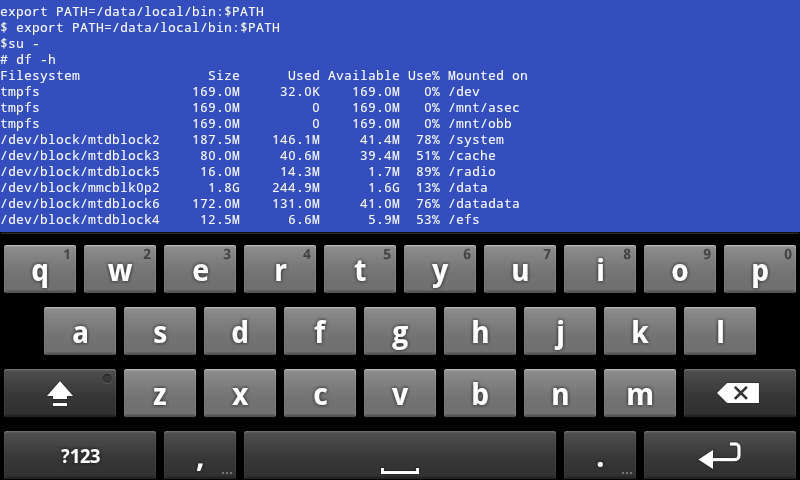
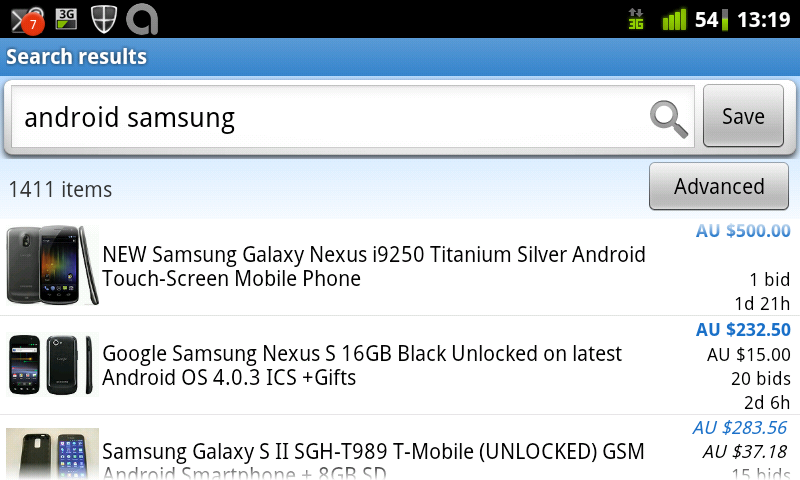
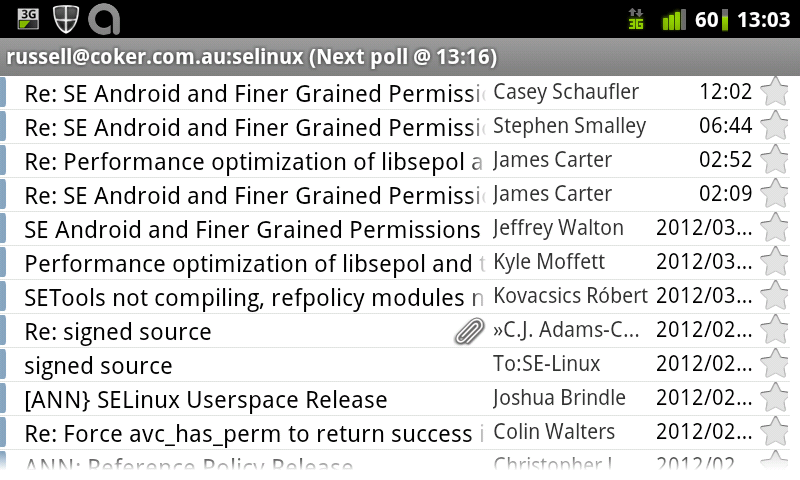
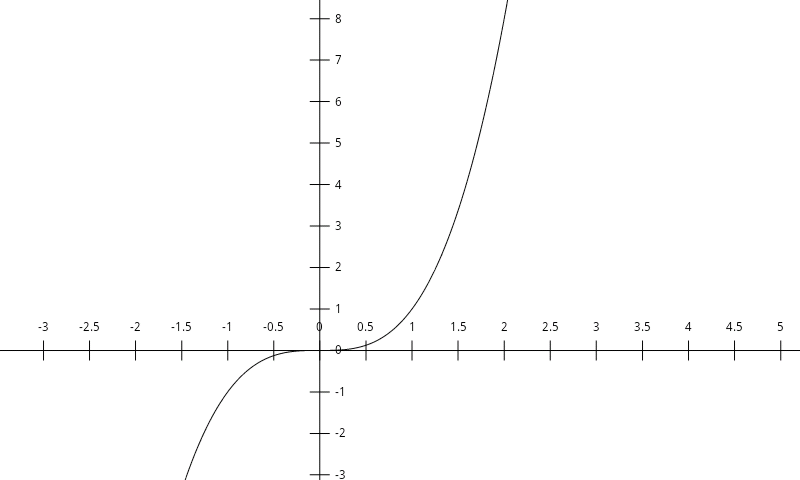
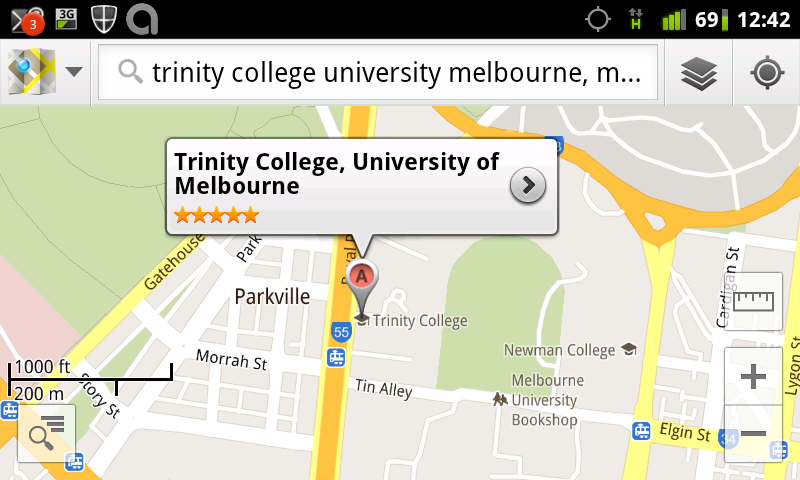
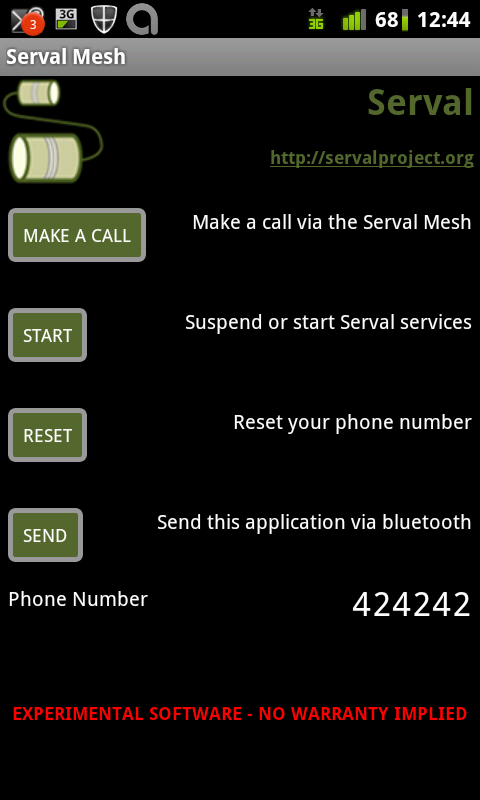
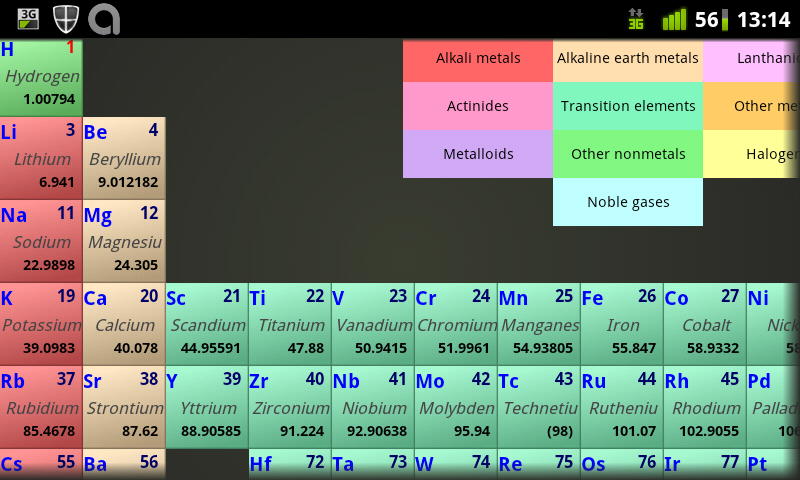
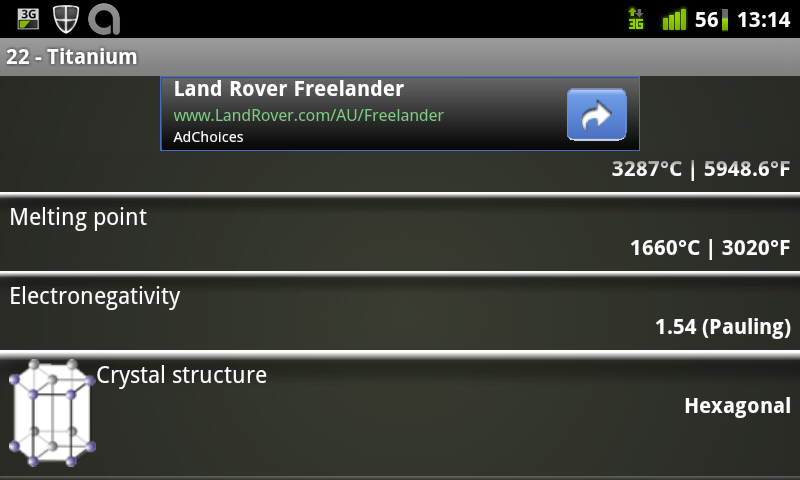
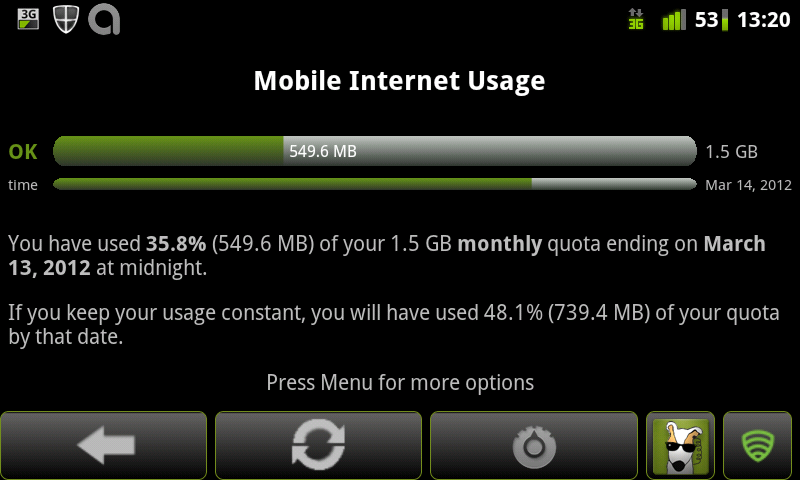
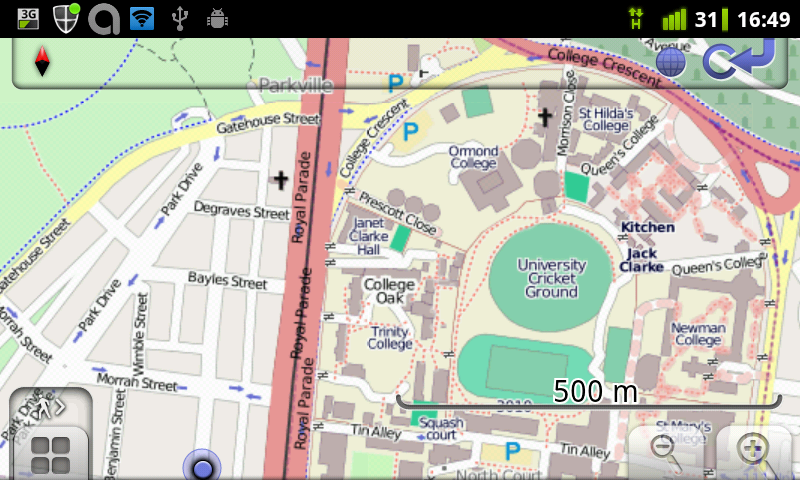
I gave a brief introductory talk about Android at this month s LUV meeting. Here are the slides with a brief description. All the screen-shots were made on a Samsung Galaxy S running Cyanogenmod version 7.1 [1] (Android version 2.3.7). With that build of Cyanogenmod you can press the power button for about 1.5 seconds to get a menu which gives an option to take a screen shot. The aim of the talk was to give an overview of what Android can do. I also gave some random commentary about Android such as explaining why it doesn t make a good phone. Most of the pictures in this post have links to the Android applications in question. Essential and Important Apps picture of root shell access running df I started by explaining why having root access to your system is really important, including the issue of backing up an Android phone [2]. Cyanogenmod includes a terminal program which allows you to run su - . Running a shell as root isn t generally that useful, what you really want is to be able to run programs such as Titanium Backup which can only work properly if given root access. When you run an OS that allows root access you can run su - at a terminal prompt and you can also have an application use a GUI to request root access. I recommend rooting and modding an Android phone immediately after buying it. However that takes some time which is somewhat equivalent to money and is a significant hidden cost to purchasing an Android phone. picture of 3g watchdog bandwidth monitor The business models of telephone companies seem to involve hidding users for unexpected fees and extra fees for excess bandwidth can be really expensive. 3G Watchdog is one app that can monitor bandwidth and disable data transfers if too much is used. Onavo is an alternative that allows tracking data use on a per-application basis, but it only runs on Android 2.3.x while 3G Watchdog works on Android 2.1. Official EBay app searching for Samsung Android phones EBay has an official app which is handy for searching for items. So far I ve only used it to get price estimates and have used a PC for buying. K9 viewing my SE Linux mailing list email K9 seems to be the best MUA for Android. The MUA that ships with Android 2.1 isn t nearly as good and K9 is good enough that I didn t even bother testing the MUA from Cyanogenmod. The above picture shows a list of mail in my SE Linux folder. graph by opticron grapher The Opticron Grapher is a good graphing calculator. I won t claim it s the best because I didn t seriously test such programs, but for the basic tests I ve done it has worked well. Google map of LUV location The Google Maps client comes with every Android system, the above shows the location of the LUV meeting. Open Street Map location of the LUV meeting Osmand is an Android client for the Open Street Map project. Here is the web site for the Open Street Map project [3]. One significant advantage of OSM over the Google Maps is that OSM is free, the data is all contributed by users like Wikipedia. Another significant advantage is that you can download as much data as you need to your phone, for example the entire dataset for Australia is about 200M. Storing 200M of data on your phone is no big deal when you consider the availability of phones with more than 16G of storage and the ability to use a map when offline is a real benefit. So far I ve used Osmand while waiting for a train at an underground station and I plan to use it to track my progress the next time I m on a cruise. serval mesh networking and VOIP Serval is a mesh networking application for Android that supports VOIP phone calls and distributing messages and files. It s designed to be used in disaster areas, but there are lots of other potential uses of the technology. The Serval Project blog has an article about the presentation they gave at LCA 2012 [4]. periodic table
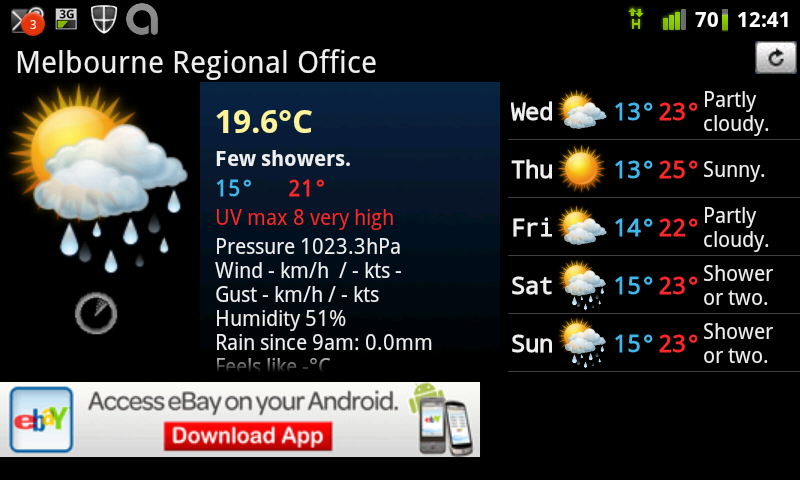
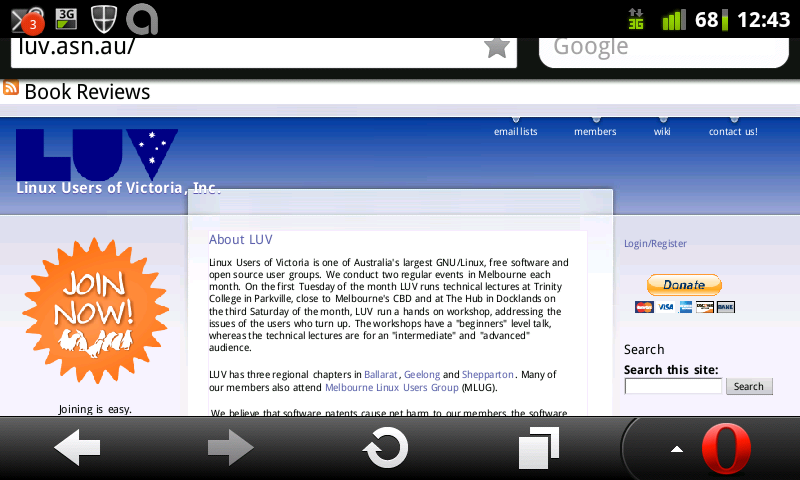
details about Titanium Periodic Droid is my favorite Periodic Table viewing program. tomfusion Au Weather forecast app The Tomfusion AU Weather forecast app seemed to be better than the one from the BoM last time I checked. It s probably the best weather app for Australia. screen-shot of LUV web site
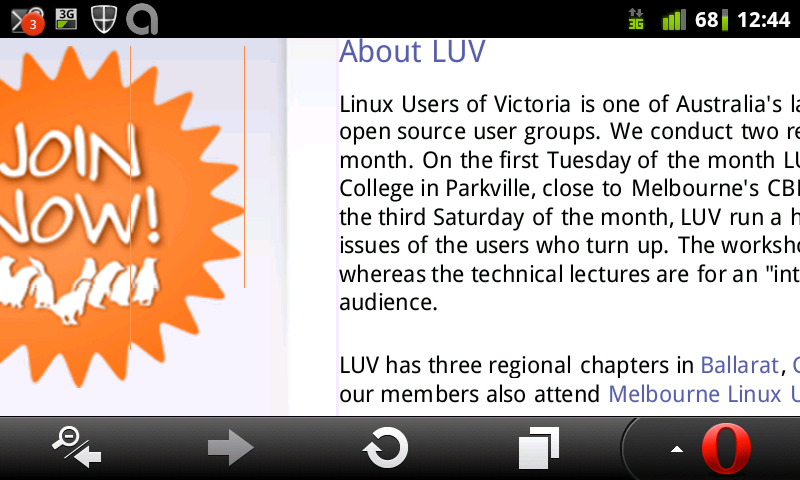
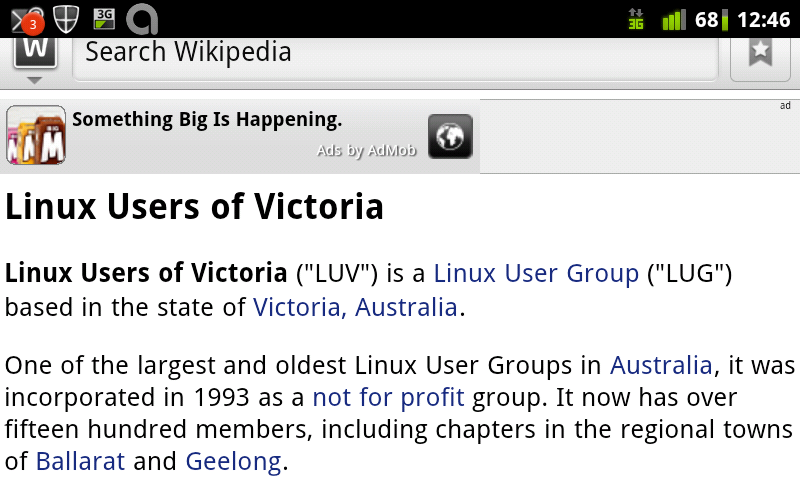
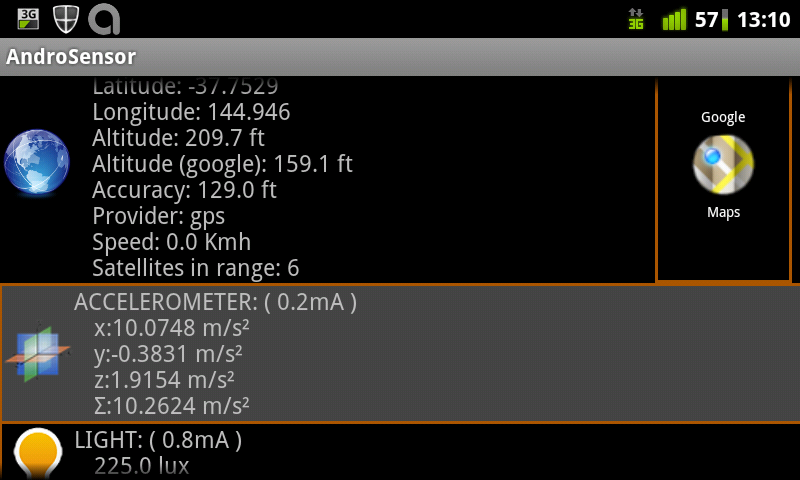
LUV web site zoomed in The Opera Mini browser is often faster than other browsers because it uses a compressing proxy run by Opera. It s not so good for privacy though LUV page on Wikipedia I have been using Wapedia for browsing Wikipedia. Since giving the talk I discovered the Official Wikipedia browser from the Wikimedia foundation [5] which is a better fit for my needs and I ve uninstalled Wapedia. As an aside modern phones have 16G of storage or more and could easily have a copy of the entire English text of Wikipedia on internal storage. It would be good if someone like Jason King (who is known for work on stand-alone DVD images for Wikipedia) was to write an Android program to do this. Handy Apps Androsensor showing GPS, accelleration, and light intensity
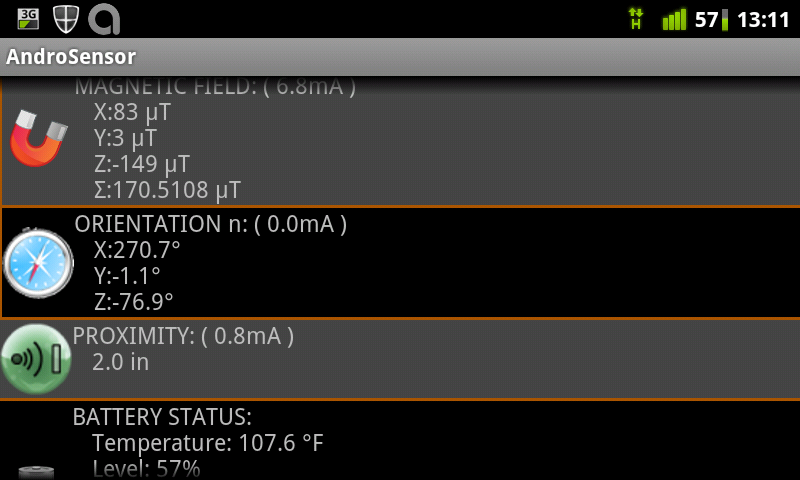
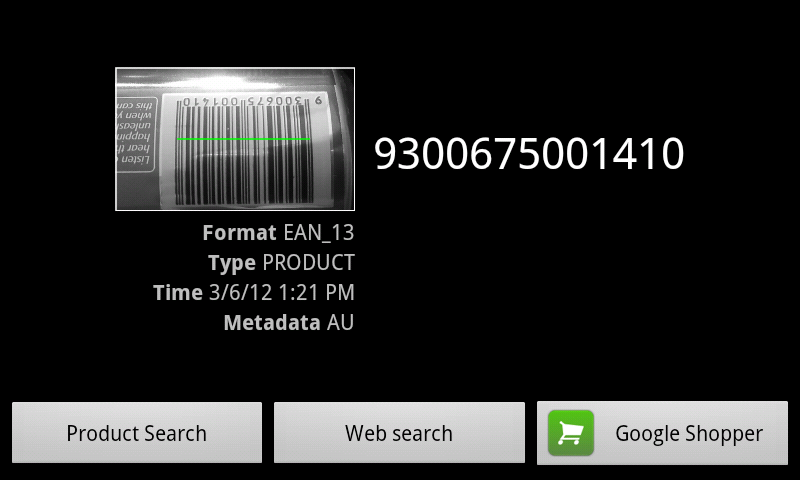
Androsensor showing magnetic field, orientation, and battery Androsensor is a program to display output from most (all?) of the sensors on your phone. The results aren t as accurate as one would hope, for example Earth s gravity is 9.81m/s^2 not the 10.26m/s^2 my phone registered. But they are a useful indication. picture of Coke can, scanning the barcode
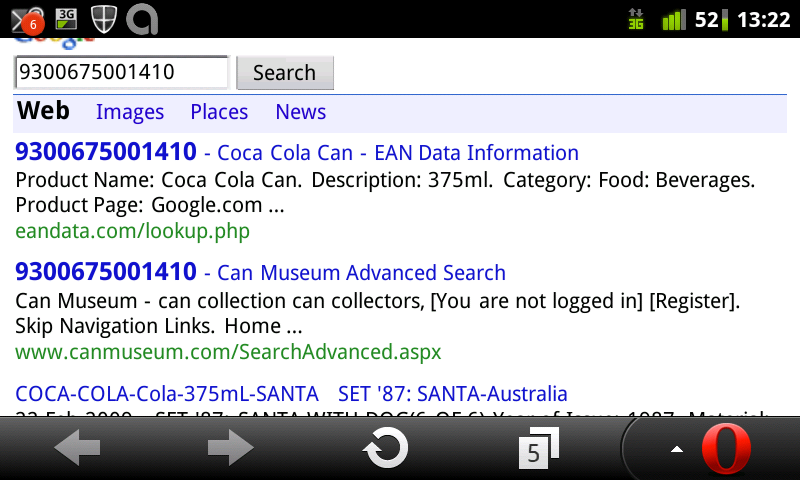
Google search on Coke can barcode
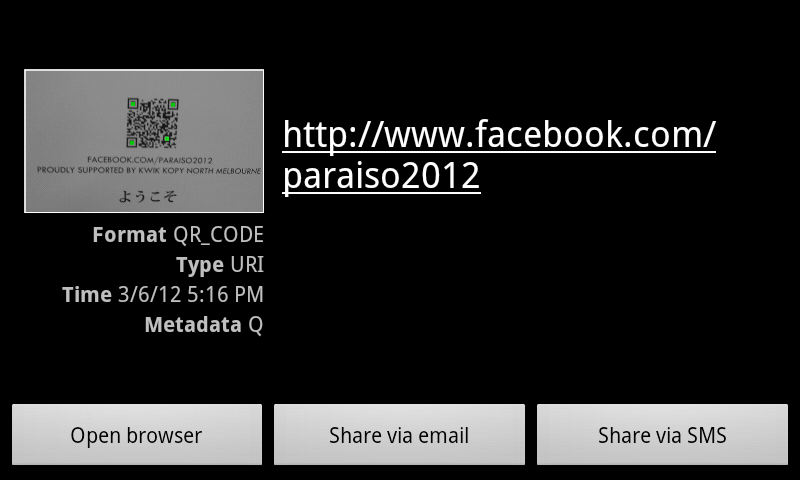
QR Code lookup of Facebook page The Zxing Barcode scanner is one of many programs that will scan barcodes with the camera in an Android phone. It can launch a Google search on a product code or open a URL from a
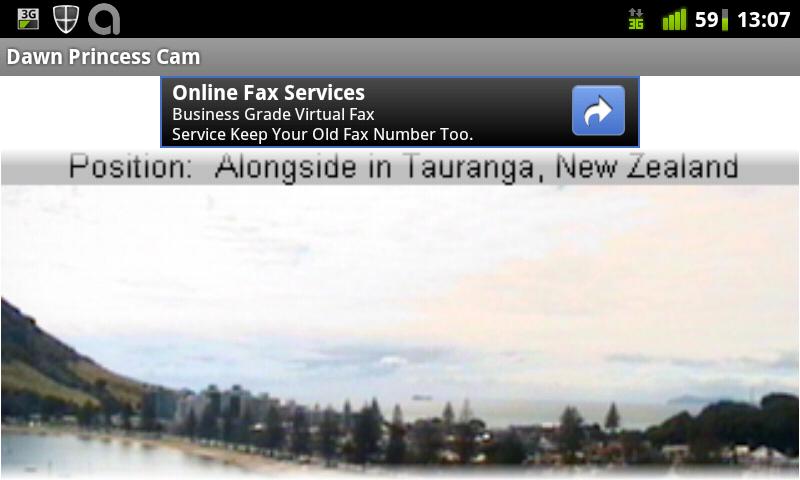
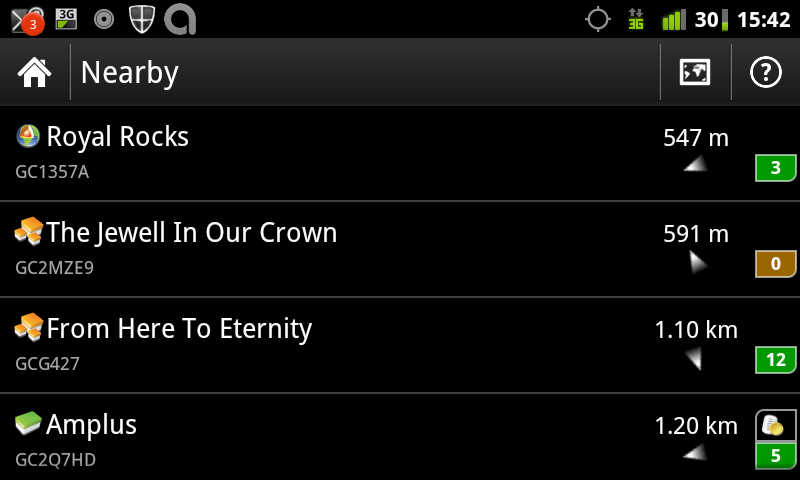
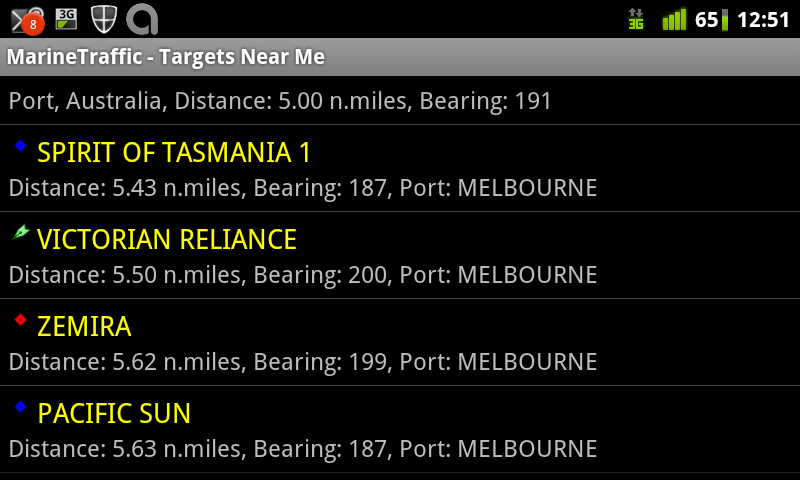
QR Code. The above pictures show it scanning a Coke can (the can and other background was displayed on the full screen before the screen capture program activated), doing a Google search on the can barcode, and looking up a QR code that was on an advertisment outside the LUV venue. picture from the bridge of the Dawn Princess in Tauranga NZ Cruise Cams allows you to download pictures from cruise ships. Some cruise ships have several cameras on different parts of the ship uploading pictures regularly so that people around the world can see what s happening. list of geo-caches near the park where I prepared most of my notes The c:geo opensource program allows you to get information on Geocaches and see a compass or map showing the location. This program has been getting an increasing number of features to do everything you might want to do related to Geocaching. The above picture shows some caches that are close to where I made the screen-shot, in a park a couple of Km from the meeting location. picture of Google Sky Map in the direction of Andromeda The Google Sky map uses augmented reality techniques to display stars in the direction that your phone is pointing along with their names and the names of the constellations. Marine Traffic showing ships near me
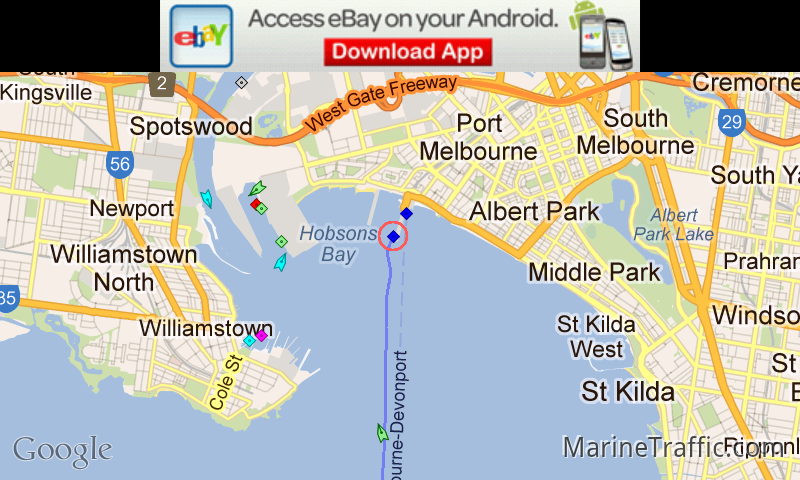
Marine Traffic showing the Pacific Sun highlighted on a Google Map
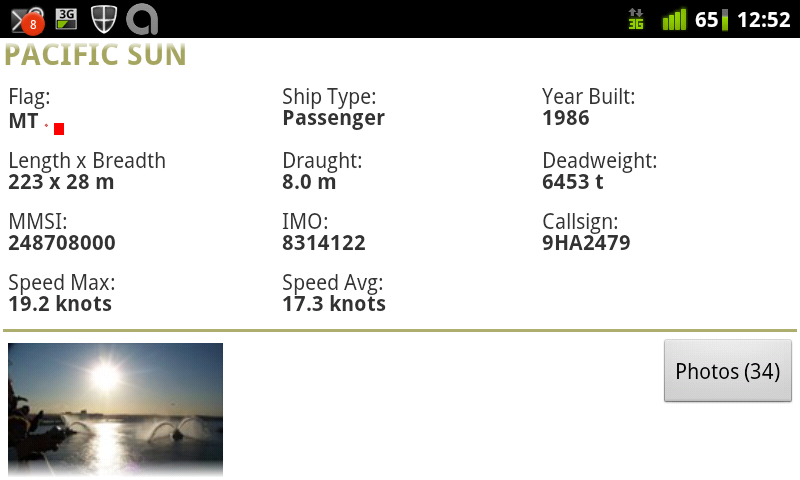
Marine Traffic showing details of the Pacific Sun
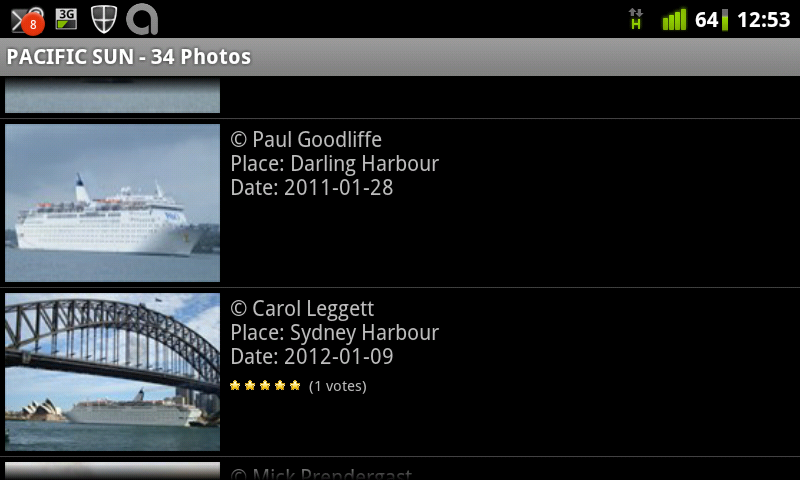
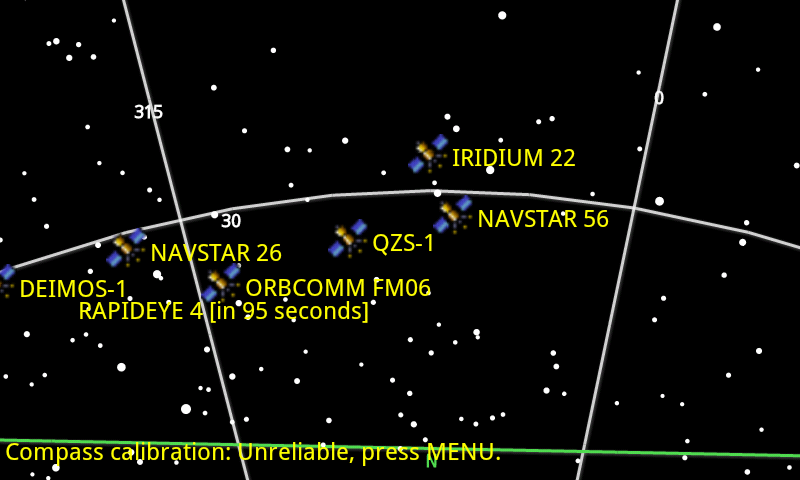
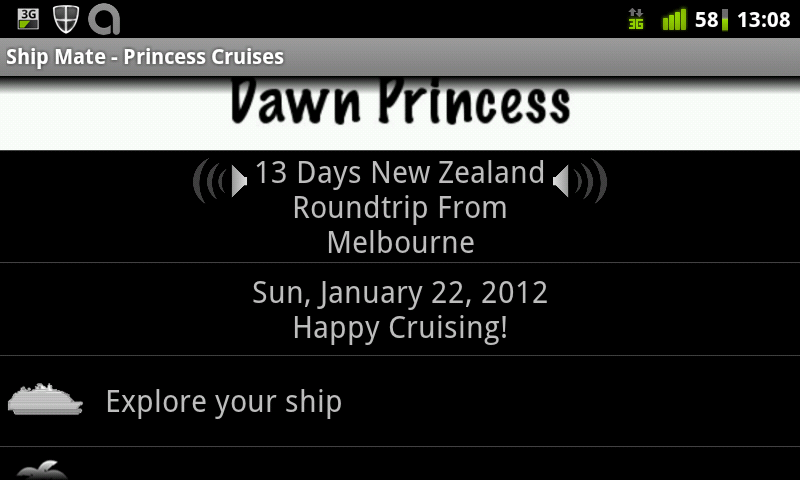
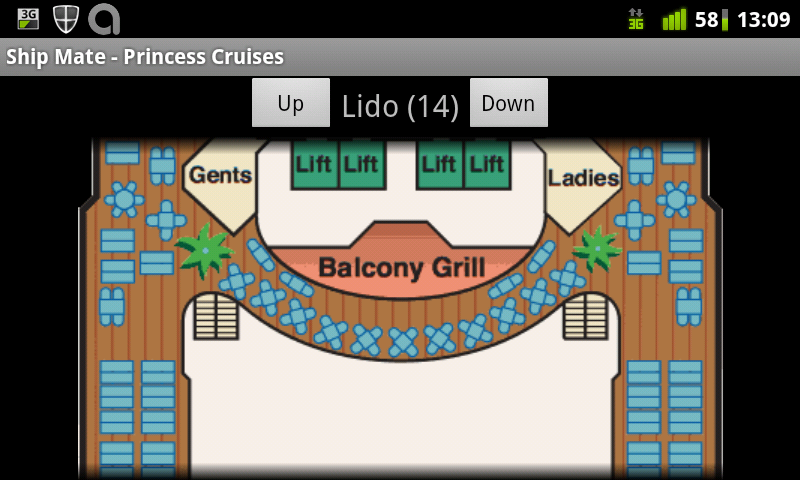
Photos of the Pacific sun taken by fans and shown by Marine Traffic The Marine Traffic program shows the locations of ships as well as lots of information about them. The above pictures show me discovering that the Pacific Sun was nearby, viewing it s location on Google Maps, seeing the details, and then viewing fan pictures. The developer s web site allows viewing all the same data without an Android phone [6]. Anyone can join the project by buying an Automatic Identification System (AIS) receiver and configuring a PC to take data from AIS and send it to the MarineTraffic.com servers. As an aside they seem to be missing coverage in western Victoria, so it would be good if someone near Apollo Bay or Warrnambool could install an AIS receiver and help out. Satellite map from Satellite AR Satellite AR uses augmented reality to show the location of satellites and other things in spare. Unfortunately the screen capture process turned off the camera as I had a sign advertising fast food positioned in an amusing location in the background. Shipmate overview of Dawn Princess
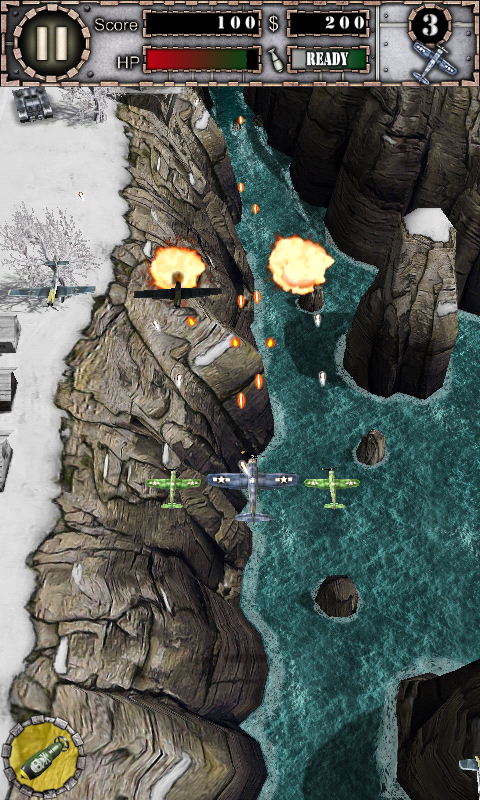
Shipmate map of Dawn Princess Shipmate publishes a set of programs giving information on cruise ships, they have one program for each cruise line. Above is the program for the Princess cruise line, the above pictures give information on the Dawn Princess. Unfortunately the program wasn t usable without net access when I tried to use it on a cruise ship. Games Air Attack HD game, clone of 1942 Air Attack HD is an entertaining game that demonstrates the capability of Android phones to run action games. Like many Android games it has a free version and paid versions if you want more. picture of Angry Birds Angry Birds is one of the most well known games for touch-screen devices. It has also spawned a huge line of merchandise. Labyrinth Lite
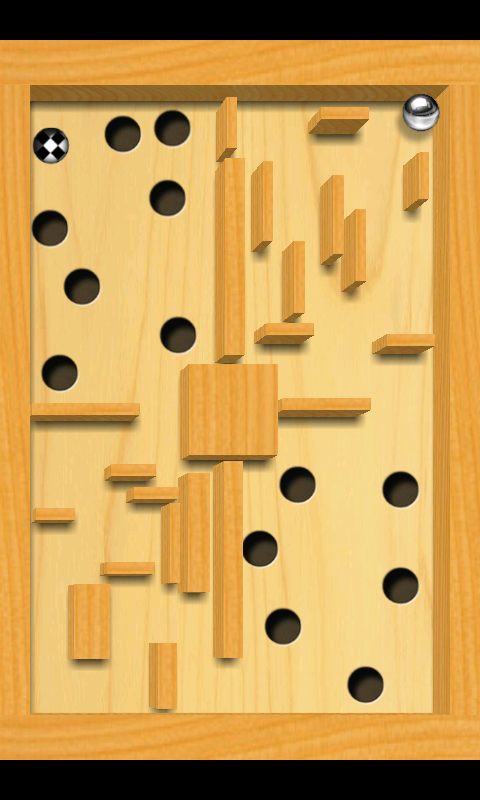
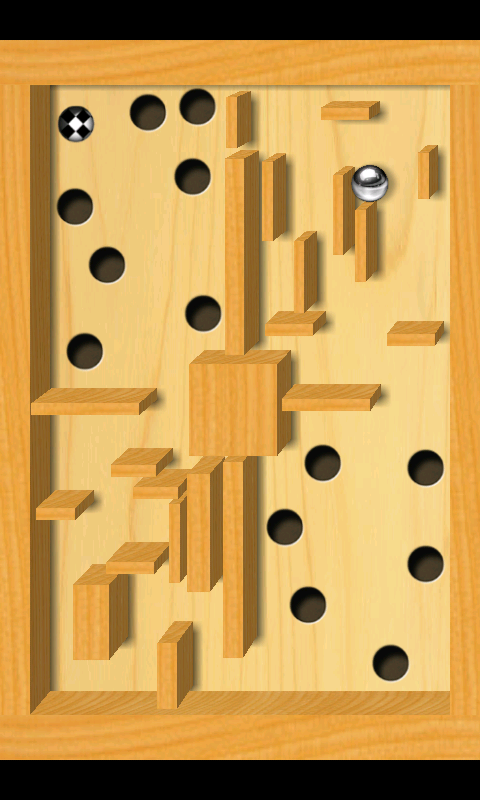
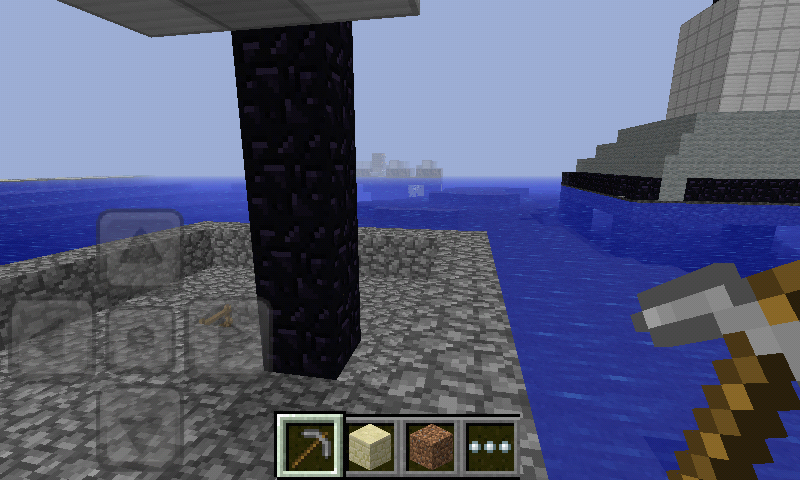
Labyrinth Lite from a different angle Labyrinth Lite is one of the many Android games based on the old mechanical game where you tilt a toy to roll a ball-bearing through a maze. It s free and is better than most of the free games in that genre. Minecraft Pocket Edtion Minecraft Pocket Edition allows you to play Minecraft on your phone. The demo version doesn t allow saving the game, you have to buy the game for about $5 if you want to do that. It also lacked the full features of the game last time I checked, it didn t have monsters. Paradise Island overview
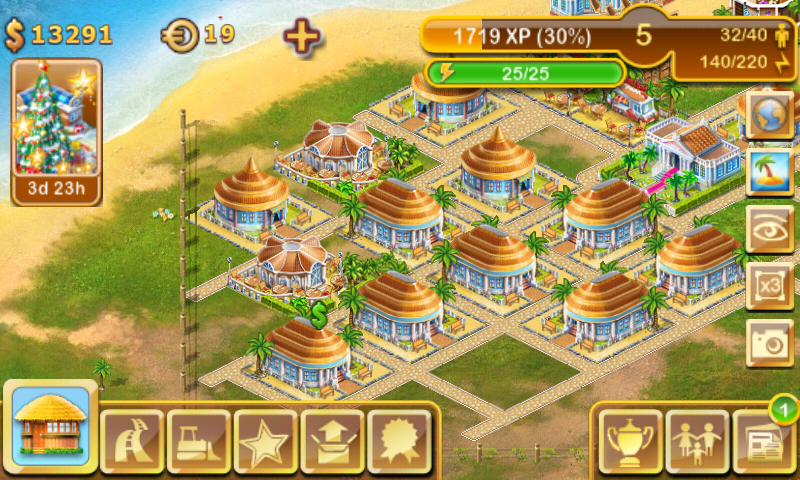
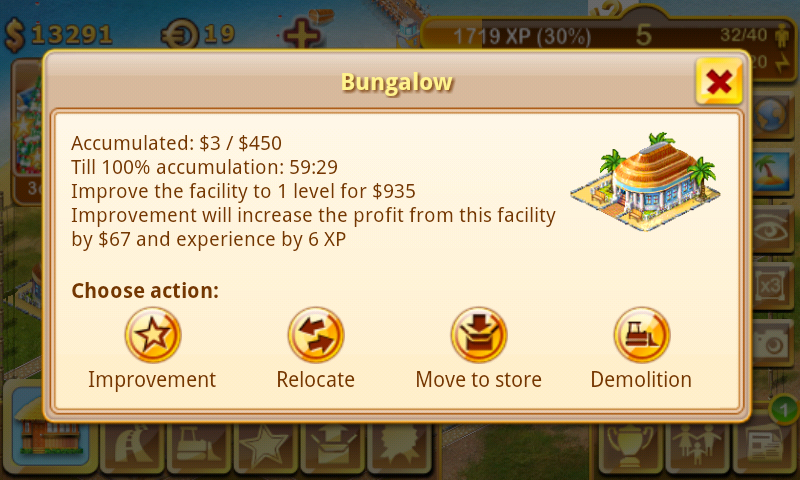
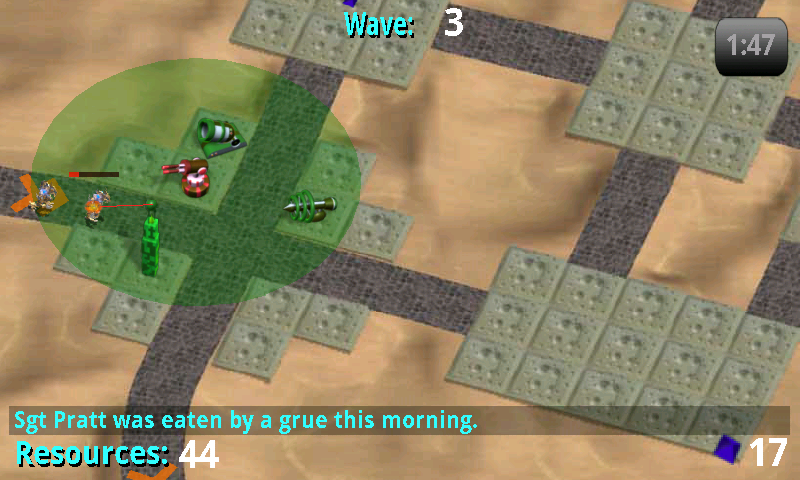
Paradise Island details of Bungalow Paradise Island is one of many business simulation games for Android. It s more playable than most and has very detailed graphics, but the down-side is that it s a memory hog and will crash if you don t have enough RAM. It s one of the games that are free to download but encourage you to pay money to level up, for some players it s probably a very expensive game. Tower Raiders 2, Pratt was eaten by a Grue Tower Raiders 2 is one of the better tower defense games for Android. Related posts:
  1. Choosing an Android Phone My phone contract ends in a few months, so I m...
  2. Galaxy S vs Xperia X10 and Android Network Access Galaxy S Review I ve just been given an indefinite loan...
  3. Standardising Android Don Marti wrote an amusing post about the lack of...

14 March 2012

Richard Hartmann: Open Source Days 2012, the aftermath

Open Source Days Open Source Days were nice, especially the meating(sic) of and talking to old friends and new people. I got to discuss Mercurial with two of its developers which was very interesting indeed. It's funny how similar git and Mercurial are in some regards and how different in others. Overall, it feels a bit as if Mercurial is not quite as distributed as git. Its local, sliding revision index feels like disaster waiting to happen, to me. On the other hand, Mercurials ability to not check out large files to your local repository sounds very git-annex-ish, which is nice. Choice is good :) My talk about how to gitify your life (slides, no video) went extremely well. Within my time-slot, there were a total of six talks, and lunch(!), in parallel. About 300 people attended OSD on Sunday and of those, many were at booths, stands, eating, etc. My personal turnout was 50-70 listeners so I was well above mathematical average and from what I heard, my talk was the most-visited one during that time. Add the fact that several people asked me to put up the resource links up again after the talk so they could take pictures and I would say this talk really was a success. Ego-stroking? Yes. Vanity? Most likely. Being able to see that people can really want to learn about what you have to say? Priceless. It's a real pity that there was no video recording, but it's obviously too late to do anything about that. Joey Hess asked me to at least make an audio recording on my laptop, but that turned out to be a lot of useless white noise with faint mumbling in between. Maybe I should at least get a small microphone or recorder so I will always have an audio copy. I already did order a presentation clickie with built-in laser pointer so I won't have to rely on possibly non-existent conference infra, any more. If there's any interest, I may re-record the talk as audio, else I will just try to get another speaker slot at another conference, with video recording, and link that. Denmark Barring the airport, central station, bus, hotel, venue, and metro, I did not see anything of Copenhagen. That's a pity, but I didn't want to leave the conference early. To continue my recent tradition of dumping random observations about places I visit onto my blog, here goes:

4 March 2012

Steve Kemp: Symbiosis is wonderful

Symbiosis
Symbiosis is the collective name given to a group of Debian GNU/Linux packages which implement simple virtual hosting. It is developed by my employers Bytemark. Symbiosis is basically a collection of configuration snippets, code, and libraries which works to offer virtual hosting in a reliable consistent and easy to understand fashion. You implement hosting for a new domain by merely creating a directory tree. So for example you might configure the hosting for the domain example.com by running:
mkdir -p /srv/example.com/public/htdocs
echo "hello, world" >> /srv/example.com/public/htdocs/index.html
mkdir -p /srv/example.com/mailboxes/webmaster
echo "super-secret" > /srv/example.com/mailboxes/webmaster/password
mkdir -p /srv/example.com/config
echo "3l33t" > /srv/example.com/mailboxes/config/ftp-password
There you are, now http://www.example.com/ and http://example.com/ will work, and you may login to check mail with the email address webmaster@example.com via POP3, IMAP, IMAPS, or POP3S. Finally you can FTP with username example.com and be dropped into the public directory. The mail handling is very flexible, and the webhosting supports wonderful things. I don't generally talk about work-stuff explicitly, but we've just made a major new release of the Symbiosis system such that it works upon Squeeze and has lots of IPv6 support out of the box. (Email, DNS, HTTP, Firewalling, FTP etc.) All in all it is simple, well-documented, and open-source with a reasonably large user-base. More external testers, users, and developers would be a wonderful thing..
Mutt Mailboxes & Idle Hooks?
Mutt is wonderful but I'm starting to get annoyed by its lack of auto-mailbox discovery. Assuming you use procmail you might deliver mail to ~/Maildir/.foo/ and mutt won't notice that if the directory is created once it starts. (This is because generally mailboxes are defined via "mailboxes =one =two ..", even if you use a shell snippet it won't get updated unless you re-read configuration, or re-exec mutt). I wish it were possible to use inotify/dnotify/something magic such that everything beneath ~/Maildir would just work. (Re-reading mailboxes manually is one solution but it is .. nasty?) I'm thinking that of all the possible solutions one of the most potentially interesting would be to define a new hook: "idle-hook command .." That way "command" would be executed every time the client is idle. (This is a distinct state unrelated to IMAP IDLE times.) Nopte: There is already "mail_check" & "timeout" options. Even running a defined command immediately following the code for mail_check would be reasonable.
Reverse Proxy
I continue to use, love, and enjoy my node.js-based reverse HTTP proxy, and pub discussions seemed to suggest it is a great idea (due to flexibility) but it will never take on because people don't trust node. I'm almost tempted to re-code it in LUA & C. But I can't help but think that would be a waste of time which would not increase adoption - after all most people use "simple" reverse proxies, and they are well suited by Apache, nginx, or even varnish. Still no rush I suppose.
In more personal news after living in this flat for 7 years, or so, I'm getting a new bathroom designed and deployed. Good times. In the meantime I've been steadily watching Stargate SG-1 having recently purchased a box-set of series 1-10. I've just started series six this evening, and I'm enjoying it a lot. ObQuote: "You have been recruited by the Star League to defend the frontier against Xur and the Ko-Dan armada. " - The Last Starfighter (1984). First film I ever saw at a cinema as a child.

23 February 2012

Niels Thykier: Some sponsors are evil and pedantic

If you want to enable all Lintian tags, just remember the phrase:
Some sponsors are evil and pedantic
Or on the command-line:
 $ lintian -EvIL +pedantic ...
It works for Lintian 2.5.5 (and newer), which handles pedantic like other severities. If you need help understanding the tags, you can add an extra i (-i) to evil . That being said, remember that experimental (-E) and pedantic (-L +pedantic) tags are what they are for a reason. Also quite a few people will probably find verbose (-v) too noisy. However, leaving any of them out would have ruined the mnemonic. :) Of course, you can also ask Lintian to enable all tags via your lintianrc file. Here is a quick-start:
display-info = yes # or no
display-experimental = yes # or no
pedantic = yes # or no
verbose = yes # or no

18 February 2012

Biella Coleman: Montreal, first impressions

frozenlights When I told people of my plans to move to Montreal, it usually prompted one of two reactions: one was some version of joyful envy, many people exclaiming breathlessly Montreal is one of my favorite cities, one person once even clutching my arm and told me as he looked me straight in the eye: you are so lucky, there is no city quite like Montreal in North America. The second reaction came off as a thinly veiled mixture of disdain and disbelief usually peppered with many reallys: oh wow, really, really you would really leave NYC? I am pretty certain they really were thinking something along the lines of what a fool, how dare she leave a great job, a great university, a world class city (the only city to live) for some Canadian mid-sized city, which is like tundra for a good chunk of the year? The decision to move weighed heavily on me, if for no other reason I had a choice to stay or to go and I honestly have not had a choice, a decision to make about where to go since I got accepted to graduate school (and even then the choice was more obvious than this one). So over a month into my move what is my verdict? In a word, win. I don t miss NYC at all though I get why some people cannot leave the place and know that despite some oddities and difficulties of living in Montreal, it fits my tastes and needs much better than NYC which dwarfed me in so many ways. I never felt I could enjoy it, I grew tired of the cramped living quarters, the noise ate at my soul, and I simply felt more overwhelmed by the fact that I could not even get a handle on the neighborhoods in my vicinity, much less all the other hoods in the area. Instead of dogging NYC anymore, I think I will spend a little time on first impressions, as they will soon be lost to the familiarity borne with time and experience. In essence Montreal is chock full of life but rather intimate, a quirky city with lots of charm but some grit and lacking the way over designed and done feel of cities like Portland. Here are some of quirks: 1. The Hawt Metro: I fell in love with the Metro when I first rode it a few years ago. I just love the powder blue color of the cars and the super sweet 1960s aesthetic of many stations. Even better and unlike NYC, they are just clean and quiet. The downside? The temperatures approximates a sauna during the winter and while you would think this is a good thing, when you are layered with the clothing necessary to survive outside (re: long underwear along with Canada-coat, gloves, hat, and scarf), it is hooooooot down there and you feel like you need to pass out. 2. Spend money, get free stuff: In many establishments you get free stuff (like blueberries or some like sports bar) when you spend over a certain amount of money, like 70 bucks. Quirky local tradition. 3. The culture of negotiation and the kick ass standard lease: Housing is amazing here. There is plenty of it, there are many different styles, and it is rather fun exploring all the different hoods that make up the city. Problem is too that lots of apartments have weird problems and issues and I had to steer clear of anything that could even possibly have mold. I spent weeks day in day out looking for a place, desperate to move out of my corporate apartment very nicely provided by the university but still not my ideal living situation. Finally found a place that fit all my needs in the perfect location and I took it to only find out that places are priced to negotiate and I was faced with the decision to negotiate or not. Sort of did, was not thrilled about it (thinking that I might lose the place) but it sort of worked and I scored the place. If price is up to haggling, the lease on the other hand, is standard (you can buy one at your local bodega ). It is the law to use it and it is like a no nonsense, straightforward lease, which is very protective of renters. 4. Montreal is known for its exceptional food but you know Poutine is just plain gross: Food here is good and I can tell that I will get a handle of restaurants in a way that felt impossible in NYC. The gluten free religion seems to be spreading, thankfully. There are many little Fruiterias! to get your fruits veggies which I am still exploring and right around my house is a crazy supermarket that is so cheap, which is weird because consumer goods generally ain t cheap in Montreal like they are in the states but this place is a gem and everyone agrees (and almost impossible to notice from the street!). Now Poutine is disgusting. Ok it did not help that the first night I went out to eat it, I was still under the clutches of Noro virus, and I think it re-activated the nausea that had been zapped by some strong medicine and the hospital, the day before, which brings me to the next point, the health care system. 5. Healthcare, I had to use it way too early: So last week I came down with the Noro virus and you usually wait it out as it runs through you quickly but I was dehydrated before I even started to vomit to for 8 hours straight, at which point severely tired and so nauseous (I was yelling to make it stop), I went to the hospital. Now I had talked to lot of people about the healthcare system in Montreal as it seems good, really great but a bit over taxed, especially compared to where I had lived in Edmonton where it was like a magic fairy tale dream. I had heard of two things: the care is excellent but the facilities are shocking and the wait times unless dire can be atrociously long. So facilities, yea they are kinda shocking, somewhat shabby but who cares, so long as the care is good, no? Packaging is irrelevant so long as the goods are derived. Before going I was scared of the long wait times (and also the taxi took me by mistake to Montreal General Hospital was looked too much like a HUGE version of the creepy buildings in The Shining for me, and I was supposed to go to Jewish General so left for there). The wait time: nearly none, somewhat as shocking as the facilities first looked to me. I think it was a combination of the time I arrived, with the fact that my lounge was parched and yellowish-gross (sorry, it was gross), indicating I was dehydrated, oh and I was crying bit hysterically, for despite my high threshold for pain, nausea terrorizes me. I was covered by insurance and since I did not yet have my McGill health cards (it takes three months to qualify for the local stuff), I did pay and the price was laughably cheap compared to what I would pay in NYC for the same treatment. 6. Now for my favorite, snow so nice, ice oh Christ: Well this winter has been, by all accounts, weak and warm, the spirit of winter barely making its way from the underworld to the outerworld. But even though it is has been more idle than full throttle, I still got a pretty accurate taste of what winter is like, with a few days of 20- c temps, and having to walk a number of times on a layer of frozen ice that makes it feel like a very dangerous mini-ice age in the making. IMAG0028-1 I do rather love the quiet snow falling and just love love sprinting through the snow with my dog, Roscoe, who has taken a liking for prancing in the white stuff and looks awful cute with his winter man s ice beard. After a sizable snowfall, it is clear they city does not toy with the snow removal although the sidewalk snow plows do look somewhat like very large and dangerous but kinda cute toys. But let s be frank, winters are hard, so hard that I think I would go mad if I had to stay through the entire thing, being born and raised in the tropics So the fact that I am writing this from the southern hemisphere in the height of summer gives me the assurance I can handle the rest of the snow, ice, ice and snow upon my return.

3 February 2012

Andrew Pollock: [life] Zoe at 21 months

Wow, a lot happens in 3 months. I'm sure I've missed something... I think the biggest achievement would be toilet training. Zoe's been using the toilet for some time now, but still wearing diapers, and just after Christmas (when she was sick and vomited on the carpet) we figured we had nothing to lose, so we ditched the diapers. I can count on the fingers of one hand the number of accidents she's had since then. I'm really happy to have this out of the way so early. Using a toilet away from home is still more of a challenge, but she seems to have very good bladder control, and fairly predictable bowel movements. Speaking of sick, she was the sickest she's ever been around Christmas time. It coincided with her top canines finally coming through. She had a cold, which progressed into an ear infection, and she had this dreadful persistent dry cough, which then progressed into a dreadful productive wet cough. You knew she was really sick because she was extremely cuddly and lethargic. Since around that time, her sleep has gone completely to hell. We've had some really bad nights where she'll wake up after a couple of hours of going down for bed, or for a while, she was reliably waking up at 4am and taking a good couple of hours to settle back down. Lately she's been sleeping through again, but waking up at 6am instead of the usual 7-7:30am. We bought a clock that changes colour at programmable times, so we're trying to train her that if she wakes up and the clock isn't green yet, she should try and go back to sleep. Not a huge amount of success there yet. Christmas itself was good, but fairly quiet because Zoe was sick. Sarah managed to get a fabulous photo with Santa, which just fills me joy every time I look at it. We had some friends around for Christmas dinner, and Zoe vomited all over her new Cabbage Patch Kid doll and I think she threw up a couple more times between that day and the day after, so that wasn't much fun. She's becoming more and more independent. "Zoe do it" is the most frequent thing out of her mouth, but fortunately she still accepts help as well. We've also been getting plenty of sneak previews of the Terrible Twos. Fortunately they're pretty short-lived, but it's definitely going to be a challenge to my patience. We'd been intending to keep Zoe rear-facing in the car until she was 2, which is the current recommendation over here, but I caved in recently when she was getting in the car and refusing the sit down (she'd stand up facing forwards and it was next to impossible to rectify the situation). After she did this to me a few times when I took her out in the car, I had enough and turned the car seat around. It's improved things a bit, but she still has her moments. We also changed her day care, from the one day a week at a home day care, to two days a week at a commercial place. We were becoming more and more unhappy with the existing day care, and so decided to move her. It's a lot more money, but after just a week, we were seeing a noticeable change (for the better) in Zoe's response to going to day care, and she seemed to have picked up a bunch of new skills as well (sitting crossing her legs, holding a crayon like a pencil). The place she's in now is pretty new and very shiny. There's a couple of kids in her class that she knows from the local park, so overall it's looking like money well spent and definitely a change for the better. Zoe had her first hair cut last weekend, and it was fairly uneventful. We went to this cute place in Palo Alto called Snipits, which was ludicrously expensive and I'd only ever take Zoe there for her first haircut. There was another kid there who was screaming bloody murder, and I think that unsettled Zoe more than anything else, so she was a bit uncomfortable to start with, but once the hairdresser put an Elmo DVD on, it was all good. Sarah's Mum is coming over to visit for a couple of weeks in a couple of weeks time, so Zoe will be very happy to see her Nana. They're going to go on a cruise out of New Orleans down to Mexico and part of the Caribbean. Unfortunately I'm too busy at work at the moment to burn a week, so I'll just take a four-day weekend and check out New Orleans with them when they get back from the cruise.

Russell Coker: A Computer Conference on a Cruise Ship

After LCA [1] there was a discussion about possible locations for future conferences, most of the messages in the discussion were jokes or suggestions that don t seriously apply to LCA. So I ll add my suggestion for conferences other than LCA. I ve previously written generally about the issue of conferences at sea [2]. I don t think that LCA would be suitable for running at sea because delegates have specific expectations for LCA which are quite different to what a cruise ship can offer, so I don t think it makes sense to change LCA which is working well as it is. However there are lots of other possible computer conferences which could suite a cruise ship. Price Price is a major factor in running a conference, so obviously getting a cheap cruise price is very important. Here is a link for Vacations To Go which shows cruises from the Australia/NZ region which are of at least 5 nights and cost no more than $800 [3]. The cheapest entry at this moment is $609 for 5 nights and the cheapest on a per-night basis is an 8 night cruise for $779. The cheapest cruise currently on offer which allows a conference similar to LCA is 7 nights for $699. The prices should be regarded as rough approximations as some cruises have some mandatory extra fees and the prices are quoted in US dollars and subject to currency fluctuations. Note that those prices are for dual-occupancy cabins, this can be a double or a twin configuration. Some cruise ships have cabins for 3 or 4 people that are cheaper, but if you have a cabin for a single person then the rate is almost the same as for having two people. The price for LCA accommodation including breakfast was $78 per night for a single room or $92 for a double room. Then lunch cost a minimum of $10 and for dinner there was $80 for the penguin dinner and probably about $20 for dinner every other night. That gave an overall cost for a 6 night stay (which is probably the minimum for someone who lives further away than Melbourne) in Ballarat of 6*78+6*10+5*20+80==$708. For a double room that would be 6*92+6*10+5*20+2*80==$872. Even if we don t count the fact that the Australian dollar is worth more than the US dollar it is obvious that on the basis of accommodation and food two people sharing a twin cabin on a cruise ship could pay LESS than two people in single rooms at the Ballarat University dorms! Now sharing a cabin isn t so great, but the upside is that cruise ships have excellent food and lots of other entertainment options. I previously reviewed the food on the Dawn Princess and determined that it s better than the food I would expect to get if I spent the cost of the cruise on dinner at land based restaurants [4]. I have been led to believe that the use of ship conference facilities is typically free for any organisation that books a sufficient number of cabins. So there s no reason why the conference admission fees should be any greater than for a land based conference. Advantages A common problem with conferences is finding suitable dining options. Most people want to eat with other delegates but finding restaurants that have sufficient space and which are conveniently located is difficult at best and often impossible. On a cruise ship everything is within a short walk and the restaurants are big, usually be at least one restaurant will hold 500 people. The fact that you have to reserve times for the Main Dining Room makes it more difficult to miss one s colleagues. Everything on a cruise ship is luxurious. There are lots of good locations for BoFs, pools, cafes, restaurants, and bars. Basically the ship is filled with comfortable places for groups of people to sit down. A cruise ship typically has a main theater with more than 700 seats more than large enough for most conferences I ve attended. It s common for the size of a conference to be limited to the size of the main theater that is used, for a cruise ship this will probably be less of a problem than for most other conference venues. Disadvantages The first disadvantage of running a computer conference on a cruise ship is the almost total lack of net access. The costs for net access are more expensive than most delegates will pay. Probably many delegates would check their email but it wouldn t be practical for people to download source code, browse Wikipedia, and use the Internet in other ways related to the conference. It would be practical to have mirrors of Wikipedia, the source of several distributions of Linux, and other big things of common interest. Another possible problem is the fact that you need to book it well in advance to avoid the risk of selling out (there is no option to stay at a different hotel). An established conference with financial backing could just pay to reserve the cabins. But when starting a new conference this could be a problem. Alcohol is rather expensive on cruise ships. But getting really drunk isn t compatible with learning about computer science anyway. Finally the requirement to have at least two people in a cabin for good rates is a serious issue. The upside of this is that people travelling with their SO would find that it works really well (regardless of whether the SO is a delegate or not). But anyone who s not travelling with their SO and doesn t want to share with a friend will have to either pay a lot more or skip the conference. Conclusion I think that there is a good potential for running a computer conference around the Australia/NZ region on a cruise ship. It won t be overly expensive for delegates and the facilities that are provided are good. The trade-off for solitary travelers of having to share a cabin (or pay more) for getting much better food and leisure facilities will be appreciated by many people (and admittedly hated by some). Some people won t appreciate the option of swimming, but even if you consider the cruise ship to be just a floating collection of restaurants and cabins it s still fairly luxurious and beats the heck out of most conferences I ve attended. If you are considering the possibility of running a conference then I think that a cruise ship should be considered. VacationsToGo.com is the best site I ve found for cheap cruise prices, their large group department has experience handling groups of more than 500 people so I think that anyone who wants to run a new conference in/around Australia should give them a call. Also cruise ships travel around the world, so the same thing can be done in other countries but at a different time of year. The economic factors will differ by country though. Cruise ships probably aren t a cheap option for a conference in some other countries. Related posts:
  1. My First Cruise A few weeks ago I went on my first cruise,...
  2. Cruises It seems that in theory cruises can make for quite...
  3. Creating a Micro Conference The TEDxVolcano The TED conference franchise has been extended to...

26 January 2012

Russell Coker: Links January 2012

Cops in Tennessee routinely steal cash from citizens [1]. They are ordered to do so and in some cases their salary is paid from the cash that they take. So they have a good reason to imagine that any large sum of money is drug money and take it. David Frum wrote an insightful article for NY Mag about the problems with the US Republican Party [2]. TreeHugger.com has an interesting article about eco-friendly features on some modern cruise ships [3]. Dan Walsh describes how to get the RSA SecureID PAM module working on a SE Linux system [4]. It s interesting that RSA was telling everyone to turn off SE Linux and shipping a program that was falsely marked as needing an executable stack and which uses netstat instead of /dev/urandom for entropy. Really the only way RSA could do worse could be to fall victim to an Advanced Persistent Attack :-# The Long Now has an interesting summary of a presentation about archive.org [5]. I never realised the range of things that archive.org stores, I will have to explore that if I find some spare time! Jonah Lehrer wrote a detailed and informative article about the way that American high school students receive head injuries playing football[6]. He suggests that it might eventually be the end of the game as we know it. Fran ois Marier wrote an informative article about optimising PNG files [7], optipng is apparently the best option at the moment but it doesn t do everything you might want. Helen Keeble wrote an interesting review of Twilight [8]. The most noteworthy thing about it IMHO is that she tries to understand teenage girls who like the books and movies. Trying to understand young people is quite rare. Jon Masters wrote a critique of the concept of citizen journalism and described how he has two subscriptions to the NYT as a way of donating to support quality journalism [9]. The only comment on his post indicates a desire for biased news (such as Fox) which shows the reason why most US media is failing at journalism. Luis von Ahn gave an interesting TED talk about crowd-sourced translation [10]. He starts by describing CAPTCHAs and the way that his company ReCAPTCHA provides the CAPTCHA service while also using people s time to digitise books. Then he describes his online translation service and language education system DuoLingo which allows people to learn a second language for free while translating text between languages [11]. One of the benefits of this is that people don t have to pay to learn a new language and thus poor people can learn other languages great for people in developing countries that want to learn first-world languages! DuoLingo is in a beta phase at the moment but they are taking some volunteers. Cory Doctorow wrote an insightful article for the Publishers Weekly titles Copyrights vs Human Rights [12] which is primarily about SOPA. Naomi Wolf wrote an insightful article for The Guardian about the Occupy movement, among other things the highest levels of the US government are using the DHS as part of the crackdown [13]. Naomi s claim is that the right-wing and government attacks on the Occupy movement are due to the fact that they want to reform the political process and prevent corruption. John Bohannon gave an interesting and entertaining TED talk about using dance as part of a presentation [14]. He gave an example of using dancerts to illustrate some concepts related to physics and then spoke about the waste of PowerPoint. Joe Sabia gave an amusing and inspiring TED talk about the technology of storytelling [15]. He gave the presentation with live actions on his iPad to match his words, a difficult task to perform successfully. Thomas Koch wrote an informative post about some of the issues related to binary distribution of software [16]. I think the problem is evenm worse than Thomas describes. Related posts:
  1. Links January 2011 Halla Tomasdottir gave an interesting TED talk about her financial...
  2. Links January 2010 Magnus Larsson gave an interesting TED talk about using bacteria...
  3. Links January 2009 Jennifer 8 Lee gave an interesting TED talk about the...

Next.

Previous.