Search Results: "radu"

16 October 2007

Benjamin Mako Hill: What I'm Up To

So, I finished graduate school at MIT. I presented some of my thesis work at Wikimania and I'll be posting information, code, and the thesis itself, in the next weeks as I find time. I've decided to focus, at least in the immediate future, on several important projects. Here's what I'm up to: This is, of course, in addition to my work with FSF, Debian, and Ubuntu which I'll be continuing. And talks. And writing. (Yikes!) I'll be keeping my office at MIT (yes, like RMS) for the time being and sticking around Cambridge at least until Mika finishes her degree at Harvard School of Public Health. I'll be in wrapping up projects modes for the next few weeks and months and will be posting about them here as I go.

15 October 2007

Biella Coleman: On Adivising Grad Students: A grad student perspective

Joe Reagle, who happens to be a PhD student I am happily advising, wrote a response to my blog entry on the Chronicle of Higher Education article lamenting and lambasting advising graduate students. I am quoting it here in its entirety because it is a very thoughtful response:
Difficult issue. I certainly feel sympathy with the anonymous faculty member with respect to her amorous and litigious students. Also, I often wonder how I would deal with students who don’t share my sensibilities or workstyle if I were advising them under such circumstances. However, I also find much of her disappointment is related to disappointment of what her students do next, and in this I feel she may be a little unfair. She rightly recognizes that graduate school is a time of flux, no student can really guarantee what’s going to happen next. (One of my favorite religious jokes is: “How do you make God laugh?… Tell her your plans.”) If she is disappointed that a student she tried to help achieve a position at a tier 1 research institute accommodates themselves to something less than that, I’m sure at the student worked just as hard and was even more disappointed. The heart of the issue is that academia is so ridiculously competitive. It is never good enough to make a contribution or to be helpful, one always needs to be the best. It’s an exemplar for “The Winner Takes All.” I often think of this in relation to my technical work. One of the most rewarding professional relationships I had was when a more experienced programmer co-authored a Python software library with me. I don’t think he did it with any expectation that he was somehow seeding the discipline with followers, or even that I would someday be able to reciprocate in a similar manner. He was a good guy, we enjoyed our collaboration, I think he was learning by helping me, and in the end we made something useful, even if neither of us ever became Python gods. This is one of the things I like about open content communities, yes the people at the top get a fair amount of attention, but even if you spellcheck Wikipedia articles or write a Python library for canonicalising XML, that work is still appreciated.

13 October 2007

Biella Coleman: Bad Apples .

I am not even sure what to make of this article, written by a professor at a well-known university, on the perils of advising graduate students. Given that I have been sitting at my computer for nearly 12 hours straight and since 4 a.m, I don’t think I am really in a state of mind to think too much of it. Neither do I have much experience doing this (though whatever experience I have had, it has been good so far), so I can’t really comment back via personal experience. I only hope that her/his experience was the exception or that he/she allowed too many boundaries to be crossed, but whatever the case, interesting food for thought. I am sure a graduate student could write an interesting counterpoint, talking about all the questionable things their professors did back to them too and knowing the web, I am sure that will be forthcoming soon.

11 October 2007

Russell Coker: Getting People into IT

Pia writes about the difficulty in getting young women and young people in general into the computer industry [1]. While I agree that having more women in the computer industry would be a good thing, I have difficulty believing some of the claims that Pia makes. For example the claim that “[girls] are more career focused earlier in their school life“. I chose my career when I was about 11 years old [2] and several of my friends made similar decisions at similar ages. I would be interested to read anecdotal evidence from women in the computer industry about how old they were when they decided on their career and if their friends did the same, a reference to any research on this topic would also be useful. I tend to believe that boys are more career focussed at all stages of their life but have little evidence to support this idea. One fact that seems obvious is that the idea that “if you don’t succeed in your career then you can always marry someone who does” is almost non-existent among boys. It seems likely that such ideas have a statistically relevant affect on the focus on career of boys vs girls. Also the Australian Bureau of Statistics reports that the MEDIAN income for women is significantly lower than for men [4], I find it difficult to imagine that girls could be more career focussed from a younger age and yet get significantly lower pay (note the fact that it’s median not mean income is very significant as it removes the “glass ceiling” effect). Phillip Greenspun writes about why there are so few women doing scientific research [6] and makes some good points about why scientific research is generally not well paid and therefore a university student would choose a career in some other area and suggests that it’s a macho thing that guys enter such competitive fields for relatively low wages. Maybe some women correctly assess the costs and benefits of a career in scientific research and then make the mistake of equating Computer Science to other branches of science. But the median income suggests that although there may be some valid reasons for avoiding science that would only cover a small portion of the problem (the difference in median income can not be explained by misplaced attempts to maximise income). One problem that is significant is the quality of school education for girls. Not only is there the issue that boys may crowd-out girls for some subjects that are supposedly traditionally for boys (such as all science) but even girls schools aren’t as good as they should be. Some time ago I was talking to a teacher at an all-girls school, the school was moderately expensive and parents were paying the extra money presumably to give their daughters educational opportunities that they might miss in a co-ed school. However the school did not teach hard maths (”Maths B” was the official name at the time) and only taught the easy maths (official name “Maths A” and unofficial name “Vegie Maths“) because they didn’t have many girls demanding it (which is probably difficult to measure if you don’t offer it as a reasonable option) and the girls who wanted to study it could always move to a different school. So the choice facing girls at the exclusive school in question was “skip the subject that is most useful for further studies in most science subjects” or “go to a different school and miss most of your friends“, this sort of decision would surely discourage some potential female computer programemers. Also I think that the difference between boys and girls in regard to studying computer science has a lot to do with the fact that given a choice between missing most of their friends and missing out on something related to computers would be a no-brainer for most boys. Paul Graham’s article about Nerds has some interesting points to make in this regard - maybe the problem is that girls aren’t Nerdish enough [5]. Pia also writes about parents and teachers advising children not do study IT because of a perceived lack of jobs. I think that the problem here is not just bad advice, but also a bad tendency to take advice. Someone who wants to study in an established field which changes little over time (law and accounting spring to mind) probably should take careful note of the advice that they are given - things haven’t changed much in the last few decades. But someone who wants to study in a field that changes rapidly and where every year has new and significant developments (of which the best example is the computer industry) should probably be quite skeptical of all advice - most advice about the computer industry concerns how things used to be not how things are. Finally when considering whether to accept advice you should consider who is offering it. For example advice from a hiring manager should be carefully noted (as the manager will tell you precisely what factors influence their own decisions on hiring). Advice from people who are successful in the industry should also be noted. Advice from a school career advisor who gets paid about 1/3 what any 25yo can earn in the computer industry should be entirely ignored. I wonder whether being hesitant to ignore advice is a problem for girls in this regard. When I was in year 11 I had to take a subject related to career planning. It covered some things that were of minor use (such as writing CVs) and had an assignment of writing a fictional CV for yourself a few years after leaving university. I received bad marks for preparing a CV that involved changing jobs as companies went bankrupt or projects failed due to bad management, I was told that if your employer fails in the market it makes you look bad! However my fictional CV did bear some resemblance to what really happened… In terms of what industries have jobs available, the best advice I can give students is to actively do some research of their own. It’s not difficult to get the jobs sections of some newspapers and do a quick scan to see how many positions are open in a field, and it’s even easier to do some searches on online jobs sites (which usually tell you how many positions posted in the last X days match your criteria). For example I just visited jobserve.com.au and found 1724 Engineering jobs and 5622 IT jobs advertised. If you compare this to the university intake (I visited the Swinburne university courses list [3] and found 25 IT courses vs 29 Engineering course) it seems that the ratio of Engineering graduates to jobs is not likely to be as good as that for CS graduates. Of course it may be that all the other universities have hardly any Engineering courses and balance the ratio out (but I doubt it). In any case this would be a good way of injecting some facts into a discussion of the relative merits of different career choices and avoiding it being an issue of parents/teachers not liking computers vs children liking them. Determining the relative pay rates of different industries is a lot more difficult (and requires a significant amount of work), some recruiting agencies publish statistics - but those stats only apply to the positions that they fill (which is a sub-set of the actual positions). Finally as a piece of advice for children, try and find a job that you enjoy. If you earn $30K doing something you enjoy then you’ll probably be happier than if you earn $100K doing something you hate. Also if you enjoy your work then you will probably be able to take the extra steps needed to become successful - often it’s not a choice between having fun or making good money but a choice between fun and good money or the absence of both. If someone tells you to avoid doing what you love and instead do something boring for some unsubstantiated belief that there would be more money in it then be a nerd and tell them that their opinion is not relevant (it does tend to make teachers angry though).

4 October 2007

Russell Coker: Ideas for a Home University

There seems to be a recent trend towards home-schooling. The failures of the default school system in most countries are quite apparent and the violence alone is enough of a reason to keep children away from high-schools, even without the education (or lack therof). I have previously written about University degrees and whether they are needed [1]. The university I attended (which I won’t name in this context) did an OK job of teaching students. The main thing that struck me was that you would learn as much as you wished at university. It was possible to get really good marks without learning much (I have seen that demonstrated many times) or learn lots of interesting things while getting marks that are OK (which is what I did). So I have been considering whether it’s possible to learn as much as you would learn at university without attending one, and if so how to go about it. Here are the ways I learned useful things at university:
  1. I spent a lot of time reading man pages and playing with the various Unix systems in the computer labs. It turned out that sys-admin work was one of my areas of interest (not really surprising given my history of running Fidonet BBS systems). It was unfortunate that my university (like almost all other universities) had no course on system-administration and therefore I was not able to get a sys-admin job until several years after graduating.
  • I read lots of good text books (university libraries are well stocked).
  • There were some good lectures that covered interesting material that I would not have otherwise learned (there were also some awful lectures that I could have missed - like the one which briefly covered computer security and mentioned NOTHING other than covert channels - probably the least useful thing that they could cover).
  • I used to hang out with the staff who were both intelligent and friendly (of which there were unfortunately a small number). If I noticed some students hanging out in the office of one of the staff in question I would join them. Then we would have group discussions about many topics (most of which were related to computers and some of which were related to the subjects that we were taking), this would continue until the staff member decided that he had some work to do and kicked us out. Hanging out with smart students was also good.
  • I did part-time work teaching at university. Teaching a class forces you to learn more about the subject than is needed to basically complete an assignment. This isn’t something that most people can do.
  • I expect that Children who don’t attend high-school will have more difficulty in getting admitted to a university (the entrance process is designed for the results of high-school). Also if you are going to avoid the public education system then it seems useful to try and avoid it for all education instead of just the worst part. Even for people who weren’t home-schooled I think that there are still potential benefits in some sort of home-university system. Now a home-university system would not be anything like an Open University. One example of an Open University is Open Universities Australia [2], another is the UK Open University [3]. These are both merely correspondence systems for a regular university degree. So it gives a university degree without the benefit of hanging out with smart people. While they do give some good opportunities for people who can only study part-time, in general I don’t think that they are a good thing (although I have to note that there are some really good documentaries on BBC that came from Open University). Now I am wondering how people could gain the same benefits without attending university. Here are my ideas of how the four main benefits that I believe are derived from university can be achieved without one (for a Computer Science degreee anyway):
    1. Computers are cheap, every OS that you would ever want to use (Linux, BSD, HURD, OpenSolaris, Minix, etc) is free. It is quite easy to install a selection of OSs with full source code and manuals and learn as much about them as you desire.
  • University libraries tend not to require student ID to enter the building. While you can’t borrow books unless you are a student or staff member it is quite easy to walk in and read a book. It may be possible to arrange an inter-library loan of a book that interests you via your local library. Also if a friend is a university student then they can borrow books from the university library and lend them to you.
  • There are videos of many great lectures available on the net. A recent resource that has been added is Youtube lectures from the University of California Berkely [4] (I haven’t viewed any of the lectures yet but I expect them to be of better than average quality). Some other sources for video lectures are Talks At Google [5] and TED - Ideas Worth Spreading [6].
  • To provide the benefits of hanging out with smart people you would have to form your own group. Maybe a group of people from a LUG could meet regularly (EG twice a week or more) to discuss computers etc. Of course it would require that the members of such a group have a lot more drive and ambition than is typical of university students. Such a group could invite experts to give lectures for their members. I would be very interested in giving a talk about SE Linux (or anything else that I work on) to such a group of people who are in a convenient location.
  • The benefits of teaching others can be obtained by giving presentations at LUG meetings and other forums. Also if a group was formed as suggested in my previous point then at every meeting one or more members could give a presentation on something interesting that they had recently learned.

  • The end result of such a process should be learning more than you would typically learn at university while having more flexible hours (whatever you can convince a group of like-minded people to agree to for the meetings) that will interfere less with full-time employment (if you want to work while studying). In Australia university degrees don’t seem to be highly regarded so convincing a potential employer that your home-university learning is better than a degree should not be that difficult. If you do this and it works out then please write a blog post about it and link to this post.

    Theodore Ts'o: Hans Reiser, 20/20, and his talk at Google

    I got a call from one of the researchers from ABC news this evening. Apparently they are planning on doing a segment on Hans Reiser on their 20/20 show, and the researcher knew enough that there were some serious technical inaccuracies with the script (at the level of “so when Hans was creating reiser4, was that software; was he writing a program?” and “does the program run on the hard drive?”), and so they were looking for help on some technical issues on a background basis. She didn’t take any quotes from me; what she needed was help understanding the technical issues around filesystems and Linux. I tried to help explain what a filesystem was that would make sense to a lay person in 15 seconds; I have no idea whether the researcher got it, and whether she’ll be able to make changes in the script that will be vaguely coherent. We’ll see. I spent a lot of time working with Joshua Davis, providing background material for his Wired article, and he still got a bunch of the technical details wrong. The 20/20 researcher did ask me some silly questions such as “whether we were surprised when murder charges were filed against Hans?” Well, yes. What did she expect me to say? “Oh, yes, were always worried someone would get hurt…” Not! Sigh…. I might not agree with Hans’s filesystem design principles or his tactics in trying to get reiser4 accepted, but I always respected him as a fellow open source programmer. The researcher mentioned to me that Hans had done a talk at Google that was available at the Google Video site. Out of curiosity, I took a look at it. It was interesting; the last time I had seen Hans was in 1999, at the Linux Storage Management Workshop in Darmstadt, Germany that was organized by Matthew O’Keefe at Sistina Software. Compared to how he looked back then, and the picture of him in the Wired article, taken a 10-12 months after his talk at Google in February, 2006, I was struck by how much heavier (and older at least compared to my memory of him, which was much closer to this picture from his resume) in the Google Video. I also remember him as being a much more dynamic and energetic speaker, and I was struck by how slowly he spoke, with lots of long pauses and “umms” and “ahhs”. He seemed to be a much better public speaker in Darmstadt, but in the Google talk he seemed very tired as he gave the talk. One of the questions that the researcher asked me was whether I thought he was a genius or not. I told her that I thought he was quite bright in terms of raw intelligence, but that his Social IQ wasn’t as high as you might want for someone to be successful in gathering volunteers to work on an Open Source project, and in working with others in an Open Source development community. Looking at the video, I think that is very much true. He was a terrible public speaker, but some of the points he made about optimizing B-tree algorithms made sense. I might disagree with his philosophy over filesystem design and benchmarking, and I might not be terribly impressed by his social skills, but in terms of being a talented computer scientist, he was and is that. Is he guilty of the crime that he has been accused of? I have no idea. But from looking at his talk and knowing what I know of him, I have the sense of a greek tragedy. He’s been working on some of his ideas since his undergraduate days in UC Berkely in the early eighties — which he entered after finishing his 8th grade. And as research ideas, I think he might have gotten some very interesting results out of trying some of the things that he wants to do around operating system namespaces. (I think they are doomed in a production system descended from Unix, since application programmers are unlikely to rewrite their programs to take advantage of reiserfs’s performance characteristics — which would mean instead of using a Unix-like configuration file, treating a directory hierarchy containing the configuration information like a Windows registry. Still, as an academic, Plan 9-like system, I could have seen it has being a potentially very interesting Systems Research effort.) Unfortunately, his skills at public speaking and his ability to work with other people have handicapped him, and I know that has frustrated him deeply. So I have a lot of sympathy for him, and I hope that he is innocent, and will be found innocent. But only time will tell…. Anyway, according to the researcher, they are currently scheduling their segment about Hans on 20/20 on October 19th. I’m sure that schedule is subject to change, but it’ll be interesting to see how they treat Hans in their coverage. Hopefully it will be fair, and not overly sensationalistic, but unfortunately my faith in today’s TV edutainment-focused news program isn’t terribly high. My impression was that the research wanted to do a good job, but she was burdened by a very tight deadline, and in the end, the decision of what goes on the air and what doesn’t won’t be up to her. So we’ll see.

    30 August 2007

    Michael Janssen: In my own head consume, I sit down in my room

    Lately I have been tasked with a lot of writing to do. I'm writing a chapter for a book on the field that my research is in, which is a good thing for me to get done, but I started it quite late. I had to finish a 9,000-12,000 word chapter in 2 weeks. Here's how I set it up:
    1. For the first week, write 2,000 words each day.
    2. For the second week, edit the words already written.
    The first half of the schedule was easier than I thought it would be. In general, writing in my field doesn't usually happen that fast, but the subject is something I'm pretty versed in, so it was not too hard to get 2,000 words out. I had a clear defined goal for each day that once I met, I could feel okay about not working on the project for the rest of the day. I also only had to write 6 days, and I was able to take the seventh day off. Both of these combined made it a lot easier to not feel guilty about being behind. Editing is a bit more abstract and ongoing than the writing part, so it's hard to tell how well it's really going. There are some easy parts like fixing grammar and proofreading to make sure you don't repeat yourself, but there are also a good portion of hard parts as well, like which sections to cut a bunch of words in, and which word choice should be made in a particular spot. I'm at the point where some things NEED to be cut because the document is too long, so I have to make some hard choices. I also met with my advisor last week and we discussed my progress toward finishing my Ph. D. I had been thinking about this problem for a while now and was glad that it was also on his mind as well. We agreed that I would set the goal for having my orals done by the end of this year (christmas). I am thinking I will use a similar tactic to the chapter that I am writing, but on a much slower schedule, so next week I will start writing 500 words a day, and do that for a couple months. This will leave me with 30,000 words that I will then edit down by quite a bit, reducing it by almost half. Hopefully this will make the process easier as it has for the chapter. If writing my thesis proposal works well this way, I hope I can use a chunk of it for the final thesis, which I want to finish one year after my orals, putting me on track for graduating at the end of 2009. I'm looking forward to that.

    Biella Coleman: Collective Communications Campus

    Collective Communications Campus is a very handy new blog covering news and information on NYC area communication, journalism, and media graduate departments, programs, lectures, and classes.

    27 August 2007

    Radu Spineanu: Removing old packages no longer in Debian

    Don’t know is anyone is interested, I wrote a small script that detects installed packages that were removed from Debian. It does this by looking at the repositories in /var/lib/apt/lists/ and comparing them with what is installed. On my home system it found 150 packages, but the installation is just 3 years old. The script can be downloaded from: http://people.debian.org/~radu/oldpackages.py Update: The script does the same thing as aptitude’s Obsolete and Removed packages option. I updated anyway a little to ignore removed but not purged packages.

    25 August 2007

    Wouter Verhelst: Cooking

    Mom turned 60 earlier this week, and her brothers and sisters (i.e., my uncles and aunts) are coming over tomorrow. Thomas, my brother who's just graduated as assitant-cook (or some such, I don't know the exact title yet), is doing the food, and I've been volunteered to help. He got me to wear this: Wouter the Cook Fun, isn't it?

    12 August 2007

    Dirk Eddelbuettel: The amazing Prof. Ripley (cont'ed)

    A little mini-meme got started on August 1 when Ben Bolker posted the following code to the r-devel list (and here I substituted the more standard '-' assignment operator for the less standard though-now permitted '='):
    x <- readLines("http://developer.r-project.org/R.svnlog.2007")
    rx <- x[grep("^r",x)]
    who <- gsub(" ","",sapply(strsplit(rx,"\\ "),"[",2))
    twho <- table(who)
    twho["ripley"]/sum(twho)
    
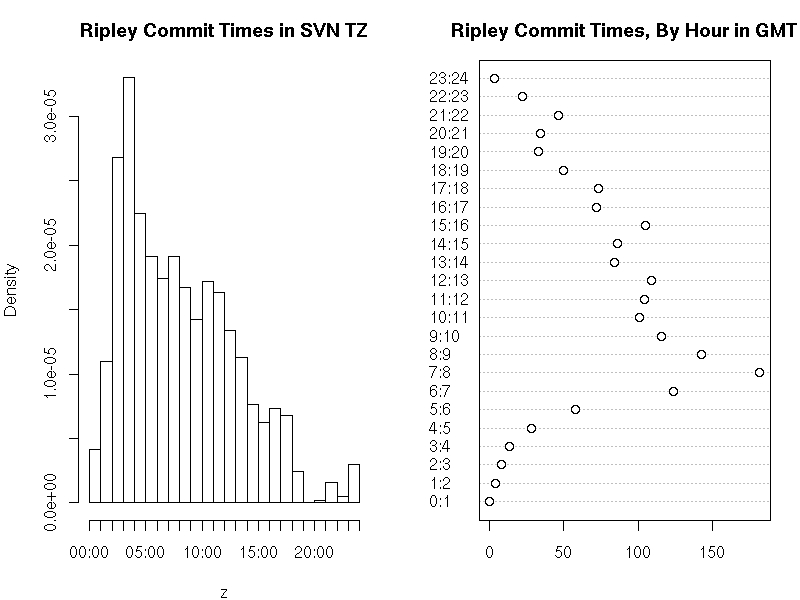
    In five lines (that could be shortened to three at the expense of some readibility), the SVN log for R is downloaded directly from the website, the revision authors are extraced and then tabulated by submitter. The relative percentage of Brian Ripley is found to be a staggering 74.8% -- or about three times as much as the other fifteen committers combined. Smokes. [ Oh, and for those who don't know him, he's also got a day job which presumably entails looking after his graduate students at Oxford. Who knows, he may even teach. Kidding aside, he's actually one of the nicest persons you'll ever meet in real life. ] Now yesterday, Simon Jackman who had at first simply repeated Ben's analysis on his own blog followed up with a nice analysis (albeit typeset in a way that rendered the code inoperational, which has now been fixes) that creates both a histogram and a dotplot of commits per hour of the day. Omitting Ben's code which Simon reuses, we have the following for histogram and dotchart:
    tod <- unlist(sapply(rx,function(x)strsplit(x,split=" ")[[1]][6]))
    tod <- tod[who=="ripley"]
    tz <- sub(pattern=".*(-[0-9] 4 ).*",replacement="\\1",x=rx)
    tz <- tz[who=="ripley"]
    tz <- as.numeric(tz)/100
    offset <- 3600*tz
    z <- strptime(tod,format="%H:%M:%S")
    hist(z,"hours",main="Ripley Commit Times in SVN TZ")
    h <- z - offset
    h <- format(h,format="%H")
    h <- factor(as.numeric(h), levels=0:23)
    dotchart(table(h), main="Ripley Commit Times, By Hour in GMT",
             labels=paste(0:23,1:24,sep=":"))
    
    This extracts the commit times, subsets to the ones by Prof. Ripley, extracts the timezones component (as strptime seemingly doesn't do that which is a pain), extracts the tz-less time via strptime into a variable 'z' for which the histogram is drawn. He then corrects the times by the tz offset expressed in seconds, formats is as hour of the day and turns it into a 'factor' (an R data type for qualitative variables which may be ordered as is the case here) and draws a dotplot. This results in the following chart: Simon Jackman's per-hour charts of Brian Ripley's commit patterns Now, nobody has looked at the time series. So we correct this and add the following:
    ## rather extract both  date and time
    dat <- unlist(sapply(rx, function(x)  
      txt <- strsplit(x,split=" ")[[1]]
      paste(txt[5], txt[6])
     ))
    ## subset on Prof Ripley
    dat <- dat[who == "ripley"]
    ## and convert to POSIXct, correcting by tz as well
    datpt <- as.POSIXct(strptime(dat,format="%Y-%m-%d %H:%M:%S")) - offset
    ## turn into zoo -- we use a constant series of ones as each
    ## committ is taken as a timestamped event
    datzoo <- zoo(1, order.by=datpt)
    ## and use zoo to aggregate into commits per date
    daily <- aggregate(datzoo, as.Date(index(datzoo)), sum)
    ## now plot as grey bars
    plot(daily, col='darkgrey', type='h', lwd=2,
         ylab="Nb of SVN commits, three-week median",
         xlab="R release dates 2.5.0 and 2.5.1 shown in orange",
         main="The amazing Prof. Ripley")
    ## mark the two R releases of 2007
    abline(v=c(as.Date("2007-04-24"),as.Date("2007-06-28")),col='orange',lwd=1.5)
    ## and do a quick centered rolling median
    lines(rollmedian(daily, 21, align="center"), lwd=3)
    
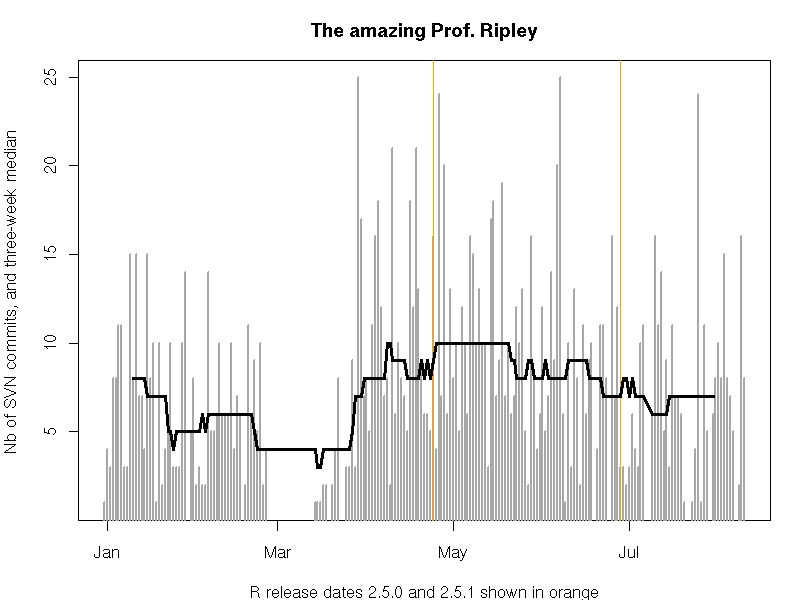
    This extracts both date and time, creates a proper R time object (a so-called POSIXct type) from it, fills a zoo ('the' magic class for time series) object with it, uses zoo to aggregate commits per day and plots those in a barchart-alike (I know, I know, ...) plot to which we add the two releases as well as a rolling and centered three-week median (as a real quick hack rather than a proper smooth). Timeseries of Brian Ripley's commit patterns This shows that Prof Ripley averaged about ten commits a day before and after the release of R 2.5.0, and that he has slowed down ever so slightly since then to end up at around a mere seven commits a day. Every day. For the seven-plus months we looked at. So, anyone for analysing his r-help posting frequencies ?
    6 August 2007

    MJ Ray: Movements and the recent silence

    I've been offline, but I think I've caught up now. Email if you think I missed you. Here's some of what I did before I went offline:
    robmyers Seller's Remorse
    Social Contract ten years on July 5 -- celebration?
    Advertising Free Software Projects etbe
    A Cambridge Co-operator: Great News
    Michael
    Cooperative? My Arse Web design and development techniques by Steve Tucker
    Anti-DRM campaign, Apple Store, London.
    Place Your Blog on a 'Busy Intersection'
    Should Links from Your Blog Open in a New Window? Reader Opinions
    Back
    Co-opNet :: View topic - What Crisis
    LWN: Totally "free" Ubuntu? That's the plan for Gobuntu (Linux.com)
    The Problem with RSS
    Property of a Lady Answers to Love Is Strange Trivia
    Fairtrade Beer niq's soapbox
    Co-opNet :: View topic - The Cooperative Tour de France
    ITV response to Coverage Question... - Page 3 - ITV Message Boards
    Why doesn't Online Main Stream Media link?
    Property of a Lady Tuesday Trivia: Dance
    Humor for Bond 22? Ultimate James Bond Fan Blog
    lamby :: blog :: Graduation
    itv and Other Tours Coverage: Vuelta, ToB
    Holidays-London-and-rain
    Reflowd - Recentlog
    Reflowd - Source code
    Aaargh! niq's soapbox

    30 July 2007

    Gunnar Wolf: On the Debian Maintainers GR

    Hmh... It's hard to get to a decision on this aspect, although I'm mostly sure I'll vote for a "yes". I have read most posts on this subject on debian-vote and on the planet, and I'm still not too much at ease... Anyway, one of the most relevants so far is Joerg's - And not because he is so involved with the NM process, but because he drives me to what I think is a very important point few people have addressed:
    For long, we have been saying that you don't have to be a programmer to help Debian - But so far, we have been unable to deliver except for this funny French guy. And although the current proposal still focuses on getting a step closer to DDness, and for many people this seems like geared at reducing the frustration when going over the NM process, my impression is that this will help us implement something similar for other areas.
    Some people have complained about implementing decisions per policy instead of doing so gradually. Thing is, I feel, this kind of proposals have been reiterated over the years - and they have always dropped into the silence because some actions need to be taken by the people who are less willing to. Maybe the only way to break the inertia is to take a step by a GR vote. Maybe parts of it will have to be undone or re-done differently if we end up with the wrong results - but we will have broken the status-quo. Maybe, who knows, this will serve as an experiment - and after another long series of long flame threads we will end up in 2010 in the same position are we currently at - but it won't be because of inaction.

    22 July 2007

    Martin Michlmayr: Dr Michlmayr

    Martin at his PhD graduation Having passed all requirements for the Doctor of Philosophy, I had my graduation today.

    18 July 2007

    Chris Lamb: Graduation

    Oh hai, I graduated. :)

    17 July 2007

    Chris Lamb: Updates

    On the subject of conferences, I’m also planning to attend AngloHaskell, LinuxConf Europe amd PyCon UK. Let me know if you want to meet up or need a place to crash.

    11 July 2007

    Biella Coleman: Nothing to Hide in 25 Pages or Less

    I am excited to read I’ve Got Nothing to Hide” and Other Misunderstandings of Privacy by Daniel Solove and I am also excited of its “short” length, mostly because I reckon I can use this for undergraduate teaching (and will perhaps include it when I teach some version of this in the future). I place short in scare quotes because I don’t think a 25 single spaced article is really all that short though it is flagged as such in the abstract. But given this is a law journal article, which tend to trail into the 75-100 page range (and thus out of reach for most undergraduate teaching), it is indeed tiny. I am in the lookout for more law journal articles that are under 30 pages as I find them to be quite useful in the classroom…

    9 July 2007

    Matthew Palmer: Hell is other people('s code)

    I've been working (part-time) on an existing Rails application for the last month or so, getting comfortable with it, modifying some sections to support needed functionality, and beginning an all-out, carpet-bombing "shock and awe" assault on it's test suite. However, a significant portion of the system is (or rather was, since I've already gutted a lot of it) a chunk of rather messy and unpleasant auto-generated code. I've always been a bit iffy about code generation tools, ever since my first encounters with them whilst working on some $DEITY-awful access application years ago. (First encounters with anything Microsoft usually have that effect on me, though). Since then, I've never found any reason to change my mind, and dealing with this particular chunk of auto-generated code has pushed me over the edge into "wild-eyed extremist" territory. Please note that when I say "code generator", I'm talking here about programs or wizards or whatever that create a block of code that you're then expected to tweak to suit your conditions. If it's just a mechanical transformation of an input format to an output format, where a human is never expected to maintain the output by hand, that's not code generation in my book -- that's just a compiler being used for it's intended purpose. I like compilers. I'm fairly sure you do too. Code generators, though? EVIL. Consider what you get out of your generator: A big blob of code in your application that you then have to understand and maintain. It's like you gave a commit bit to some random person who dropped a 5000 line change into your tree and then ran away into the night, cackling. If there's bugs in the generated code (and remember, there's always bugs in software), when they get fixed upstream you're up the creek unless you haven't modified the code at all (and thus can regenerate), or you're willing to apply the necessary patches to your modified version, often by hand. Hand-patching is error-prone, and if you've modified the code at the same place that has to be patched, things can get unpleasant. In the case of the generator I'm dealing with at the moment, I'm not even blessed with it being decent code. It's ugly code, in every possible sense of the word. There's inconsistent formatting, poor commenting, it uses some totally whack coding constructs[1], the hard-coded text strings are ungrammatical, it's got very few (and poorly covering) test cases, the methods are huge and unwieldy, and it's got security bugs (not so hot for something that's supposed to be guarding your application). In short, it looks like some quick-and-dirty internal hack that escaped one night and is now wreaking havoc on the world. There's probably some really good code generators out there. I've been poking around a bit, and there's some written for Rails by people who I know produce good code. However, no matter how good the author of the code generator is, the very best you can hope for is solid, clean code that is the equivalent of some portion of your application having been coded by some member of your team who you (and nobody else) has ever met, who didn't follow your team's coding conventions, and who has never looked at any other part of your application to make sure that everything hung together in a consistent manner. Which you now have to maintain. I've read a lot of books, articles, blog posts, and mailing list messages, and participated in no shortage of "why software sucks" discussions with other programmers, but I've never heard anyone advocate that the way to clean code, minimal bugs, and happy programmers was to drop a big chunk of unknown code right in the middle of things. Before you start charging up the e-mail-delivered tasers, ready to fry my delicate braincells for the twin crimes of Xenocodophobia and a vicious case of Not Invented Here syndrome, though, please understand that I'm not against code reuse in the right place. That right place is a library, component, or other abstract, documented, fairly static, and presumably-replaceable chunk of code. By using a library, you get a relatively simple interface to somebody else's complexity. This is a good thing, for all the reasons that everyone should already be able to recite. Items such as a comprehensible interface, minimal learning curve, and so on. Things you don't get with generated code because, pretty much by definition, the entire chunk of code is you "interface". There are some times, though, when what you want to do can't be done in a library. Either the thing has too many tentacles to be able to easily encapsulate behind an abstracted interface, or you need to modify it's behaviour in too many places to be able to get away with a few simple callbacks to get the job done. Hence, it might be tempting to fire up the code generator to get yourself out of a hole quickly. Don't do it though. Don't succumb to the temptation of saving yourself a little bit of time by firing up a code generator. What you're doing there is just making pain for yourself, by inheriting a big chunk of code that you don't fully understand, probably doesn't solve your problem particularly well, and which you (or whichever poor slob gets the job after you) will have to maintain into perpetuity -- most likely by gradually rewriting large pieces of it so that it fits your application better. The output of a code generator is likely to be the least maintainable code in your tree -- either by virtue of the fact that it's crap code, or at the very least because you just don't understand it. The general principle of good codebase hygiene is that you get rid of unmaintainable code quickly, so it doesn't infect everything else (a la the "broken window theory"). With that in mind, why would you ever consider deliberately introducing a huge chunk of unmaintainable code into your application? The closest I can come to a defence of code generators is something like Rails' scaffolding, where the controller and views for a set of simple CRUD operations on a table are auto-generated. The key word there, though, is scaffolding. It's very name suggests that it's temporary, to be replaced with something more robust and useful as soon as is reasonable. The default scaffolding is ugly as sin, besides, which encourages you to replace it, and -- as of Rails 1.1 (I think), there's a 'scaffold' method which creates the scaffolding output at runtime, so you never, ever need to generate scaffolding code any more. Anyone planning on producing any significant piece of their application through the use of code generators is, in my book, committing a crime against software decency.
    1. My favourite whack code construct thus far has been this gem:
     case somevar
       when 17
         do_something_here()
     end
    
    Because, you know, if statements are for people who know how to program, or something.

    7 July 2007

    Pete Nuttall: Graduation

    I've finally gotten around to leaving Durham Uni after four years, which isn't even close to the record for a long stay. I've gotten a 2:1 in Compsci - though the cert hasn't been printed yet. Graduation was last week, and unlike most of the UK, was actually dry. Dad's photos

    Gunnar Wolf: It still gets to my nerves...

    I've gradually become happier and happier with Ruby on Rails. I've got mostly past the constant "WTF?WTF?WTF?" phase that's so frustrating when you try to understand the magic behind the scenes (after all, I like understanding what happens inside a framework - the bang and the bling are not what lured me into Rails).
    So I've tried to become a more idiomatic, more complete. In the last project I started, I decided to -gasp- stop declaring my schema structure in SQL, and use migrations instead. All fine until I reached migration 008... The first one including a table modification (adding a admin column for users) instead of a creation. Well, that one went pretty fine, but 009 was also a table modification (adding an order column for tsgs). And I updated my server - with both migrations at the same time.
    Bad news: Tsg has_many :users, and every User validates_associated :tsg as it should. And as migration 8 modifies (and saves, of course) a User, this validation was triggered... So, migration 8 died complaining about an undefined method order' for #<Tsg:0x2b2d2dd8d0d0>. WTF?WTF?WTF? all over again. It took me quite a while to realize.
    What's the moral of the story? That a sleepy programmer can and will mess up. That batching up several migrations does not guarantee success, because the model is already up to the newest version. Crap. :-/
    Or maybe it will just be safer if I abstain from directly instantiating models in migrations? umh... Does not feel right :-/

    Next.

    Previous.