Search Results: "pm"

7 October 2024

Reproducible Builds: Reproducible Builds in September 2024

Welcome to the September 2024 report from the Reproducible Builds project! Our reports attempt to outline what we ve been up to over the past month, highlighting news items from elsewhere in tech where they are related. As ever, if you are interested in contributing to the project, please visit our Contribute page on our website. Table of contents:
  1. New binsider tool to analyse ELF binaries
  2. Unreproducibility of GHC Haskell compiler 95% fixed
  3. Mailing list summary
  4. Towards a 100% bit-for-bit reproducible OS
  5. Two new reproducibility-related academic papers
  6. Distribution work
  7. diffoscope
  8. Other software development
  9. Android toolchain core count issue reported
  10. New Gradle plugin for reproducibility
  11. Website updates
  12. Upstream patches
  13. Reproducibility testing framework

New binsider tool to analyse ELF binaries Reproducible Builds developer Orhun Parmaks z has announced a fantastic new tool to analyse the contents of ELF binaries. According to the project s README page:
Binsider can perform static and dynamic analysis, inspect strings, examine linked libraries, and perform hexdumps, all within a user-friendly terminal user interface!
More information about Binsider s features and how it works can be found within Binsider s documentation pages.

Unreproducibility of GHC Haskell compiler 95% fixed A seven-year-old bug about the nondeterminism of object code generated by the Glasgow Haskell Compiler (GHC) received a recent update, consisting of Rodrigo Mesquita noting that the issue is:
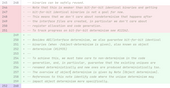
95% fixed by [merge request] !12680 when -fobject-determinism is enabled. [ ]
The linked merge request has since been merged, and Rodrigo goes on to say that:
After that patch is merged, there are some rarer bugs in both interface file determinism (eg. #25170) and in object determinism (eg. #25269) that need to be taken care of, but the great majority of the work needed to get there should have been merged already. When merged, I think we should close this one in favour of the more specific determinism issues like the two linked above.

Mailing list summary On our mailing list this month:
  • Fay Stegerman let everyone know that she started a thread on the Fediverse about the problems caused by unreproducible zlib/deflate compression in .zip and .apk files and later followed up with the results of her subsequent investigation.
  • Long-time developer kpcyrd wrote that there has been a recent public discussion on the Arch Linux GitLab [instance] about the challenges and possible opportunities for making the Linux kernel package reproducible , all relating to the CONFIG_MODULE_SIG flag. [ ]
  • Bernhard M. Wiedemann followed-up to an in-person conversation at our recent Hamburg 2024 summit on the potential presence for Reproducible Builds in recognised standards. [ ]
  • Fay Stegerman also wrote about her worry about the possible repercussions for RB tooling of Debian migrating from zlib to zlib-ng as reproducibility requires identical compressed data streams. [ ]
  • Martin Monperrus wrote the list announcing the latest release of maven-lockfile that is designed aid building Maven projects with integrity . [ ]
  • Lastly, Bernhard M. Wiedemann wrote about potential role of reproducible builds in combatting silent data corruption, as detailed in a recent Tweet and scholarly paper on faulty CPU cores. [ ]

Towards a 100% bit-for-bit reproducible OS Bernhard M. Wiedemann began writing on journey towards a 100% bit-for-bit reproducible operating system on the openSUSE wiki:
This is a report of Part 1 of my journey: building 100% bit-reproducible packages for every package that makes up [openSUSE s] minimalVM image. This target was chosen as the smallest useful result/artifact. The larger package-sets get, the more disk-space and build-power is required to build/verify all of them.
This work was sponsored by NLnet s NGI Zero fund.

Distribution work In Debian this month, 14 reviews of Debian packages were added, 12 were updated and 20 were removed, all adding to our knowledge about identified issues. A number of issue types were updated as well. [ ][ ] In addition, Holger opened 4 bugs against the debrebuild component of the devscripts suite of tools. In particular:
  • #1081047: Fails to download .dsc file.
  • #1081048: Does not work with a proxy.
  • #1081050: Fails to create a debrebuild.tar.
  • #1081839: Fails with E: mmdebstrap failed to run error.
Last month, an issue was filed to update the Salsa CI pipeline (used by 1,000s of Debian packages) to no longer test for reproducibility with reprotest s build_path variation. Holger Levsen provided a rationale for this change in the issue, which has already been made to the tests being performed by tests.reproducible-builds.org. This month, this issue was closed by Santiago R. R., nicely explaining that build path variation is no longer the default, and, if desired, how developers may enable it again. In openSUSE news, Bernhard M. Wiedemann published another report for that distribution.

diffoscope diffoscope is our in-depth and content-aware diff utility that can locate and diagnose reproducibility issues. This month, Chris Lamb made the following changes, including preparing and uploading version 278 to Debian:
  • New features:
    • Add a helpful contextual message to the output if comparing Debian .orig tarballs within .dsc files without the ability to fuzzy-match away the leading directory. [ ]
  • Bug fixes:
    • Drop removal of calculated os.path.basename from GNU readelf output. [ ]
    • Correctly invert X% similar value and do not emit 100% similar . [ ]
  • Misc:
    • Temporarily remove procyon-decompiler from Build-Depends as it was removed from testing (via #1057532). (#1082636)
    • Update copyright years. [ ]
For trydiffoscope, the command-line client for the web-based version of diffoscope, Chris Lamb also:
  • Added an explicit python3-setuptools dependency. (#1080825)
  • Bumped the Standards-Version to 4.7.0. [ ]

Other software development disorderfs is our FUSE-based filesystem that deliberately introduces non-determinism into system calls to reliably flush out reproducibility issues. This month, version 0.5.11-4 was uploaded to Debian unstable by Holger Levsen making the following changes:
  • Replace build-dependency on the obsolete pkg-config package with one on pkgconf, following a Lintian check. [ ]
  • Bump Standards-Version field to 4.7.0, with no related changes needed. [ ]

In addition, reprotest is our tool for building the same source code twice in different environments and then checking the binaries produced by each build for any differences. This month, version 0.7.28 was uploaded to Debian unstable by Holger Levsen including a change by Jelle van der Waa to move away from the pipes Python module to shlex, as the former will be removed in Python version 3.13 [ ].

Android toolchain core count issue reported Fay Stegerman reported an issue with the Android toolchain where a part of the build system generates a different classes.dex file (and thus a different .apk) depending on the number of cores available during the build, thereby breaking Reproducible Builds:
We ve rebuilt [tag v3.6.1] multiple times (each time in a fresh container): with 2, 4, 6, 8, and 16 cores available, respectively:
  • With 2 and 4 cores we always get an unsigned APK with SHA-256 14763d682c9286ef .
  • With 6, 8, and 16 cores we get an unsigned APK with SHA-256 35324ba4c492760 instead.

New Gradle plugin for reproducibility A new plugin for the Gradle build tool for Java has been released. This easily-enabled plugin results in:

reproducibility settings [being] applied to some of Gradle s built-in tasks that should really be the default. Compatible with Java 8 and Gradle 8.3 or later.

Website updates There were a rather substantial number of improvements made to our website this month, including:

Upstream patches The Reproducible Builds project detects, dissects and attempts to fix as many currently-unreproducible packages as possible. We endeavour to send all of our patches upstream where appropriate. This month, we wrote a large number of such patches, including:

Reproducibility testing framework The Reproducible Builds project operates a comprehensive testing framework running primarily at tests.reproducible-builds.org in order to check packages and other artifacts for reproducibility. In September, a number of changes were made by Holger Levsen, including:
  • Debian-related changes:
    • Upgrade the osuosl4 node to Debian trixie in anticipation of running debrebuild and rebuilderd there. [ ][ ][ ]
    • Temporarily mark the osuosl4 node as offline due to ongoing xfs_repair filesystem maintenance. [ ][ ]
    • Do not warn about (very old) broken nodes. [ ]
    • Add the risc64 architecture to the multiarch version skew tests for Debian trixie and sid. [ ][ ][ ]
    • Mark the virt 32,64 b nodes as down. [ ]
  • Misc changes:
    • Add support for powercycling OpenStack instances. [ ]
    • Update the fail2ban to ban hosts for 4 weeks in total [ ][ ] and take care to never ban our own Jenkins instance. [ ]
In addition, Vagrant Cascadian recorded a disk failure for the virt32b and virt64b nodes [ ], performed some maintenance of the cbxi4a node [ ][ ] and marked most armhf architecture systems as being back online.

Finally, If you are interested in contributing to the Reproducible Builds project, please visit our Contribute page on our website. However, you can get in touch with us via:

4 October 2024

Bits from Debian: Debian welcomes Freexian as our newest partner!

Freexian logo We are excited to announce and welcome Freexian into Debian Partners. Freexian specializes in Free Software with a particular focus on Debian GNU/Linux. Freexian can assist with consulting, training, technical support, packaging, or software development on projects involving use or development of Free software. All of Freexian's employees and partners are well-known contributors in the Free Software community, a choice that is integral to Freexian's business model. About the Debian Partners Program The Debian Partners Program was created to recognize companies and organizations that help and provide continuous support to the project with services, finances, equipment, vendor support, and a slew of other technical and non-technical services. Partners provide critical assistance, help, and support which has advanced and continues to further our work in providing the 'Universal Operating System' to the world. Thank you Freexian!

3 October 2024

Mike Gabriel: Creating (a) new frontend(s) for Polis

After (quite) a summer break, here comes the 4th article of the 5-episode blog post series on Polis, written by Guido Berh rster, member of staff at my company Fre(i)e Software GmbH. Have fun with the read on Guido's work on Polis,

Mike
Table of Contents of the Blog Post Series
  1. Introduction
  2. Initial evaluation and adaptation
  3. Issues extending Polis and adjusting our goals
  4. Creating (a) new frontend(s) for Polis (this article)
  5. Current status and roadmap
4. Creating (a) new frontend(s) for Polis Why a new frontend was needed... Our initial experiences of working with Polis, the effort required to implement more invasive changes and the desire of iterating changes more rapidly ultimately lead to the decision to create a new foundation for frontend development that would be independent of but compatible with the upstream project. Our primary objective was thus not to develop another frontend but rather to make frontend development more flexible and to facilitate experimentation and rapid prototyping of different frontends by providing abstraction layers and building blocks. This also implied developing a corresponding backend since the Polis backend is tightly coupled to the frontend and is neither intended to be used by third-party projects nor supporting cross-domain requests due to the expectation of being embedded as an iframe on third-party websites. The long-term plan for achieving our objectives is to provide three abstraction layers for building frontends: The Particiapp Project Under the umbrella of the Particiapp project we have so far developed two new components: Both the participation frontend and backend are fully compatible and require an existing Polis installation and can be run alongside the upstream frontend. More specifically, the administration frontend and common backend are required to administrate conversations and send out notifications and the statistics processing server is required for processing the voting results. Particiapi server For the backend the Python language and the Flask framework were chosen as a technological basis mainly due to developer mindshare, a large community and ecosystem and the smaller dependency chain and maintenance overhead compared to Node.js/npm. Instead of integrating specific identity providers we adopted the OpenID Connect standard as an abstraction layer for authentication which allows delegating authentication either to a self-hosted identity provider or a large number of existing external identity providers. Particiapp Example Frontend The experimental example frontend serves both as a test bed for the client library and as a tool for better understanding the needs of frontend designers. It also features a completely redesigned user interface and results visualization in line with our goals. Branded variants are currently used for evaluation and testing by the stakeholders. In order to simplify evaluation, development, testing and deployment a Docker Compose configuration is made available which contains all necessary components for running Polis with our experimental example frontend. In addition, a development environment is provided which includes a preconfigured OpenID Connect identity provider (KeyCloak), SMTP-Server with web interface (MailDev), and a database frontend (PgAdmin). The new frontend can also be tested using our public demo server.

1 October 2024

Guido G nther: Free Software Activities September 2024

Another short status update of what happened on my side last month. Besides the usual amount of housekeeping last month was a lot about getting old issues resolved by finishing some stale merge requests and work in pogress MRs. I also pushed out the Phosh 0.42.0 Release phosh phoc phosh-mobile-settings libphosh-rs phosh-osk-stub phosh-wallpapers meta-phosh Debian ModemManager Calls bluez gnome-text-editor feedbackd Chatty libcall-ui glib wlr-protocols git-buildpackage iio-sensor-proxy Fotema Help Development If you want to support my work see donations. This includes a list of hardware we want to improve support for. Thanks a lot to all current and past donors.
29 September 2024

Reproducible Builds: Supporter spotlight: Kees Cook on Linux kernel security

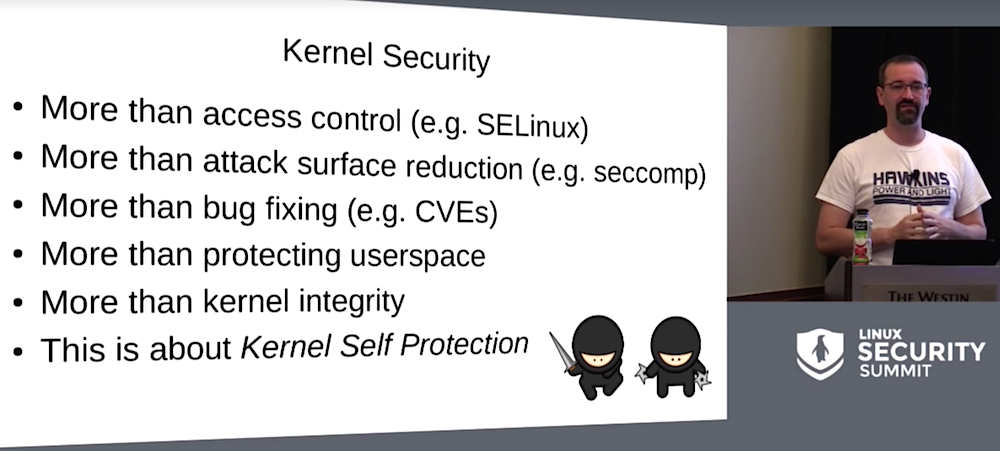
The Reproducible Builds project relies on several projects, supporters and sponsors for financial support, but they are also valued as ambassadors who spread the word about our project and the work that we do. This is the eighth installment in a series featuring the projects, companies and individuals who support the Reproducible Builds project. We started this series by featuring the Civil Infrastructure Platform project, and followed this up with a post about the Ford Foundation as well as recent ones about ARDC, the Google Open Source Security Team (GOSST), Bootstrappable Builds, the F-Droid project, David A. Wheeler and Simon Butler. Today, however, we will be talking with Kees Cook, founder of the Kernel Self-Protection Project.

Vagrant Cascadian: Could you tell me a bit about yourself? What sort of things do you work on? Kees Cook: I m a Free Software junkie living in Portland, Oregon, USA. I have been focusing on the upstream Linux kernel s protection of itself. There is a lot of support that the kernel provides userspace to defend itself, but when I first started focusing on this there was not as much attention given to the kernel protecting itself. As userspace got more hardened the kernel itself became a bigger target. Almost 9 years ago I formally announced the Kernel Self-Protection Project because the work necessary was way more than my time and expertise could do alone. So I just try to get people to help as much as possible; people who understand the ARM architecture, people who understand the memory management subsystem to help, people who understand how to make the kernel less buggy.
Vagrant: Could you describe the path that lead you to working on this sort of thing? Kees: I have always been interested in security through the aspect of exploitable flaws. I always thought it was like a magic trick to make a computer do something that it was very much not designed to do and seeing how easy it is to subvert bugs. I wanted to improve that fragility. In 2006, I started working at Canonical on Ubuntu and was mainly focusing on bringing Debian and Ubuntu up to what was the state of the art for Fedora and Gentoo s security hardening efforts. Both had really pioneered a lot of userspace hardening with compiler flags and ELF stuff and many other things for hardened binaries. On the whole, Debian had not really paid attention to it. Debian s packaging building process at the time was sort of a chaotic free-for-all as there wasn t centralized build methodology for defining things. Luckily that did slowly change over the years. In Ubuntu we had the opportunity to apply top down build rules for hardening all the packages. In 2011 Chrome OS was following along and took advantage of a bunch of the security hardening work as they were based on ebuild out of Gentoo and when they looked for someone to help out they reached out to me. We recognized the Linux kernel was pretty much the weakest link in the Chrome OS security posture and I joined them to help solve that. Their userspace was pretty well handled but the kernel had a lot of weaknesses, so focusing on hardening was the next place to go. When I compared notes with other users of the Linux kernel within Google there were a number of common concerns and desires. Chrome OS already had an upstream first requirement, so I tried to consolidate the concerns and solve them upstream. It was challenging to land anything in other kernel team repos at Google, as they (correctly) wanted to minimize their delta from upstream, so I needed to work on any major improvements entirely in upstream and had a lot of support from Google to do that. As such, my focus shifted further from working directly on Chrome OS into being entirely upstream and being more of a consultant to internal teams, helping with integration or sometimes backporting. Since the volume of needed work was so gigantic I needed to find ways to inspire other developers (both inside and outside of Google) to help. Once I had a budget I tried to get folks paid (or hired) to work on these areas when it wasn t already their job.
Vagrant: So my understanding of some of your recent work is basically defining undefined behavior in the language or compiler? Kees: I ve found the term undefined behavior to have a really strict meaning within the compiler community, so I have tried to redefine my goal as eliminating unexpected behavior or ambiguous language constructs . At the end of the day ambiguity leads to bugs, and bugs lead to exploitable security flaws. I ve been taking a four-pronged approach: supporting the work people are doing to get rid of ambiguity, identify new areas where ambiguity needs to be removed, actually removing that ambiguity from the C language, and then dealing with any needed refactoring in the Linux kernel source to adapt to the new constraints. None of this is particularly novel; people have recognized how dangerous some of these language constructs are for decades and decades but I think it is a combination of hard problems and a lot of refactoring that nobody has the interest/resources to do. So, we have been incrementally going after the lowest hanging fruit. One clear example in recent years was the elimination of C s implicit fall-through in switch statements. The language would just fall through between adjacent cases if a break (or other code flow directive) wasn t present. But this is ambiguous: is the code meant to fall-through, or did the author just forget a break statement? By defining the [[fallthrough]] statement, and requiring its use in Linux, all switch statements now have explicit code flow, and the entire class of bugs disappeared. During our refactoring we actually found that 1 in 10 added [[fallthrough]] statements were actually missing break statements. This was an extraordinarily common bug! So getting rid of that ambiguity is where we have been. Another area I ve been spending a bit of time on lately is looking at how defensive security work has challenges associated with metrics. How do you measure your defensive security impact? You can t say because we installed locks on the doors, 20% fewer break-ins have happened. Much of our signal is always secondary or retrospective, which is frustrating: This class of flaw was used X much over the last decade so, and if we have eliminated that class of flaw and will never see it again, what is the impact? Is the impact infinity? Attackers will just move to the next easiest thing. But it means that exploitation gets incrementally more difficult. As attack surfaces are reduced, the expense of exploitation goes up.
Vagrant: So it is hard to identify how effective this is how bad would it be if people just gave up? Kees: I think it would be pretty bad, because as we have seen, using secondary factors, the work we have done in the industry at large, not just the Linux kernel, has had an impact. What we, Microsoft, Apple, and everyone else is doing for their respective software ecosystems, has shown that the price of functional exploits in the black market has gone up. Especially for really egregious stuff like a zero-click remote code execution. If those were cheap then obviously we are not doing something right, and it becomes clear that it s trivial for anyone to attack the infrastructure that our lives depend on. But thankfully we have seen over the last two decades that prices for exploits keep going up and up into millions of dollars. I think it is important to keep working on that because, as a central piece of modern computer infrastructure, the Linux kernel has a giant target painted on it. If we give up, we have to accept that our computers are not doing what they were designed to do, which I can t accept. The safety of my grandparents shouldn t be any different from the safety of journalists, and political activists, and anyone else who might be the target of attacks. We need to be able to trust our devices otherwise why use them at all?
Vagrant: What has been your biggest success in recent years? Kees: I think with all these things I am not the only actor. Almost everything that we have been successful at has been because of a lot of people s work, and one of the big ones that has been coordinated across the ecosystem and across compilers was initializing stack variables to 0 by default. This feature was added in Clang, GCC, and MSVC across the board even though there were a lot of fears about forking the C language. The worry was that developers would come to depend on zero-initialized stack variables, but this hasn t been the case because we still warn about uninitialized variables when the compiler can figure that out. So you still still get the warnings at compile time but now you can count on the contents of your stack at run-time and we drop an entire class of uninitialized variable flaws. While the exploitation of this class has mostly been around memory content exposure, it has also been used for control flow attacks. So that was politically and technically a large challenge: convincing people it was necessary, showing its utility, and implementing it in a way that everyone would be happy with, resulting in the elimination of a large and persistent class of flaws in C.
Vagrant: In a world where things are generally Reproducible do you see ways in which that might affect your work? Kees: One of the questions I frequently get is, What version of the Linux kernel has feature $foo? If I know how things are built, I can answer with just a version number. In a Reproducible Builds scenario I can count on the compiler version, compiler flags, kernel configuration, etc. all those things are known, so I can actually answer definitively that a certain feature exists. So that is an area where Reproducible Builds affects me most directly. Indirectly, it is just being able to trust the binaries you are running are going to behave the same for the same build environment is critical for sane testing.
Vagrant: Have you used diffoscope? Kees: I have! One subset of tree-wide refactoring that we do when getting rid of ambiguous language usage in the kernel is when we have to make source level changes to satisfy some new compiler requirement but where the binary output is not expected to change at all. It is mostly about getting the compiler to understand what is happening, what is intended in the cases where the old ambiguity does actually match the new unambiguous description of what is intended. The binary shouldn t change. We have used diffoscope to compare the before and after binaries to confirm that yep, there is no change in binary .
Vagrant: You cannot just use checksums for that? Kees: For the most part, we need to only compare the text segments. We try to hold as much stable as we can, following the Reproducible Builds documentation for the kernel, but there are macros in the kernel that are sensitive to source line numbers and as a result those will change the layout of the data segment (and sometimes the text segment too). With diffoscope there s flexibility where I can exclude or include different comparisons. Sometimes I just go look at what diffoscope is doing and do that manually, because I can tweak that a little harder, but diffoscope is definitely the default. Diffoscope is awesome!
Vagrant: Where has reproducible builds affected you? Kees: One of the notable wins of reproducible builds lately was dealing with the fallout of the XZ backdoor and just being able to ask the question is my build environment running the expected code? and to be able to compare the output generated from one install that never had a vulnerable XZ and one that did have a vulnerable XZ and compare the results of what you get. That was important for kernel builds because the XZ threat actor was working to expand their influence and capabilities to include Linux kernel builds, but they didn t finish their work before they were noticed. I think what happened with Debian proving the build infrastructure was not affected is an important example of how people would have needed to verify the kernel builds too.
Vagrant: What do you want to see for the near or distant future in security work? Kees: For reproducible builds in the kernel, in the work that has been going on in the ClangBuiltLinux project, one of the driving forces of code and usability quality has been the continuous integration work. As soon as something breaks, on the kernel side, the Clang side, or something in between the two, we get a fast signal and can chase it and fix the bugs quickly. I would like to see someone with funding to maintain a reproducible kernel build CI. There have been places where there are certain architecture configurations or certain build configuration where we lose reproducibility and right now we have sort of a standard open source development feedback loop where those things get fixed but the time in between introduction and fix can be large. Getting a CI for reproducible kernels would give us the opportunity to shorten that time.
Vagrant: Well, thanks for that! Any last closing thoughts? Kees: I am a big fan of reproducible builds, thank you for all your work. The world is a safer place because of it.
Vagrant: Likewise for your work!


For more information about the Reproducible Builds project, please see our website at reproducible-builds.org. If you are interested in ensuring the ongoing security of the software that underpins our civilisation and wish to sponsor the Reproducible Builds project, please reach out to the project by emailing contact@reproducible-builds.org.

28 September 2024

Dave Hibberd: EuroBSDCon 2024 Report

This year I attended EuroBSDCon 2024 in Dublin. I always appreciate an excuse to head over to Ireland, and this seemed like a great chance to spend some time in Dublin and learn new things. Due to constraints on my time I didn t go to the 2 day devsummit that precedes the conference, only the main event itself.

The Event EuroBSDCon was attended by about 200-250 people, the hardcore of the BSD community! Attendees came from all over, I met Canadians, USAians, Germanians, Belgians and Irelandians amongst other nationalities! The event was at UCD Dublin, which is a gorgeous university campus about 10km south of Dublin proper in Stillorgan. The speaker hotel was a 20 minute walk (at my ~9min/km pace) from the hotel, or a quick bus journey. It was a pleasant walk, through the leafy campus and then along some pretty broad pavements, albeit beside a dual carriageway. The cycle infrastructure was pretty excellent too, but I sadly was unable to lease a city bike and make my way around on 2 wheels - Dublinbikes don t extend that far out the city. Lunch each day was Irish themed food - Saturday was beef stew (a Frenchman asked me what it was called - his only equivalent words were Beef Bourguignon ) and Sunday was Bangers & Mash! The kitchen struggled a bit - food was brought out in bowls in waves, and that ensured there was artificial scarcity that clearly left anxiety for some that they weren t going to be fed! Everyone I met was friendly from the day I arrived, and that set me very much at ease and made the event much more enjoyable - things are better shared with others. Big shout out to dch and Blake Willis for spending a lot of time talking to me over the weekend!

Talks I Attended

Keynote: Evidence based Policy formation in the EU Tom Smyth This talk given by Tom Smyth was an interesting look into his work with EU Policymakers in ensuring fair competition for his small, Irish ISP. It was an enlightening look into the workings of the EU and the various bodies that set, and manage policy. It truly is a complicated beast, but the feeling I left with was that there are people all through the organisation who are desperate to do the right thing for EU citizens at all costs. Sadly none of it is directly applicable to me living in the UK, but I still get to have a say on policy and vote in polls as an Irish citizen abroad.

10(ish) years of FreeBSD/arm64 Andrew Turner I have been a fan of ARM platforms for a long, long time. I had an early ARM Chromebook and have been equal measures excited and frustrated by the raspberry pi since first contact. I tend to find other ARM people at events and this was no exception! It was an interesting view into one person s dedication to making arm64 a platform for FreeBSD, starting out with no documentation or hardware to becoming a first-class platform. It s interesting to see the roadmap and things upcoming too and makes me hopeful for the future of arm64 in various OSes!

1-800-RC(8)-HELP: Dial Into FreeBSD Service Scripts Mastery! Mateusz Piotrowski rc scripts and startup applications scare me a bit. I m better at systemd units than sysvinit scripts, but that isn t really a transferable skill! This was a deep dive into lots of the functionality that FreeBSD s RC offers, and highlighted things that I only thought were limited to Linux s systemd. I am much more aware of what it s capable of now, but I m still scared to take it on! Afterwards I had a great chat in the hallway with Mateusz about our OS s different approaches to this problem and was impressed with the pragmatic view he had on startup, systemd, rc and the future!

Package management without borders. Using Ravenports on multiple BSDs Michael Reim Ports on the BSDs interest me, but I hadn t realised that outside of each major BSD s collection there were other, cross platform ports collections offered. Ravenports is one of these under developments, and it was good to understand the hows, why and what s happenings of the system. Plus, with my hibbian obsession on building other people s software as my own packages, it s interesting to see how others are doing it!

Building a Modern Packet Radio Network using Open Software me I spoke for 45 minutes to share my passion and frustration for amateur radio, packet radio, the law, the technology and what we re doing in the UK Packet network. This was a lot of fun - it felt like I had a busy room, lots of people interested in the stupid stuff I do with technology and I had lots of conversations after the fact about radio, telecoms, networking and at one point was cornered by what I describe as the Erlang Mafia to talk about how they could help!

Hacking - 30 years ago Walter Belgers This unrecorded talk looked at the history of the Dutch hacker scene, and a young group of hackers explorations of the early internet before modern security was a thing. It was exciting, enrapturing, well presented and a great story of a well spent youth in front of computers.

Social By 1730 I was pretty drained so I took myself back to the hotel missing the last talks, had some down time, and got the DART train to the social event at Brewdog. This invovled about an hour s walking and some train time and that was a nice time to reset my head and just watch the world. The train I was on had a particularly interesting feature where when the motors were not loaded (slowdown or coasting) the lights slowly flickered dim-bright-dim. I don t know if this is across the fleet or just this one, but it was fun to pontificate as I looked out the window at South Dublin passing by. The social was good - a few beer tokens (cider in my case, trying to avoid beer-driven hangovers still), some pleasant junk food and plenty of good company to talk to, lots of people wanting to talk about radio and packet to me! Brewdog struggled a bit - both in bar speed (a linear queue formed despite the staff preferring the crowd-around method of queue) and buffet food appeared in somewhat disjointed waves, meaning that people loitered around the food tables and cleared the plates of wings, sliders, fries, onion rings, mac & cheese as they appeared 4-5 plates at a time. Perhaps a few hundred hungry bodies was a bit too much for them to feed at once. They had shuffleboard that was played all night by various groups! I caught the last bus home, which was relatively painless!

Is our software sustainable? Kent Inge Fagerland Simonsen This was an interesting look into reducing the footprint of software to make it a net benefit. Lots of examples of how little changes can barrel up to big, gigawatthour changes when aggregated over the entire installbase of android or iOS!

A Packet s Journey Through the OpenBSD Network Stack Alexander Bluhm This was an analysis of what happens at each stage of networking in OpenBSD and was pretty interesting to see. Lots of it was out my depth, but it s cool to get an explanation and appreciation for various elements of how software handles each packet that arrives and the differences in the ipv4 and ipv6 stack!

FreeBSD at 30 Years: Its Secrets to Success Kirk McKusick This was a great statistical breakdown of FreeBSD since inception, including top committers, why certain parts of the system and community work so well and what has given it staying power compared to some projects on the internet that peter out after just a few years! Kirk s excitement and passion for the project really shone through, and I want to read his similarly titled article in the FreeBSD Journal now!

Building an open native FreeBSD CI system from scratch with lua, C, jails & zfs Dave Cottlehuber Dave spoke pretty excitedly about his work on a CI system using tools that FreeBSD ships with, and introduced me to the integration of C and Lua which I wasn t fully aware of before. Or I was, and my brain forgot it! With my interest in software build this year, it was quite a timely look at how others are thinking of doing things (I am doing similar stuff with zfs!). I look forward to playing with it when it finally is released to the Real World!

Building an Appliance Allan Jude This was an interesting look into the tools that FreeBSD provides which can be used to make immutable, appliance OSes without too much overhead. Fail safe upgrades and boots with ZFS, running approved code with secure boot, factory resetting and more were discussed! I have had thoughts around this in the recent past, so it was good to have some ideas validated, some challenged and gave me food for thought.

Experience as a speaker I really enjoyed being a speaker at the event! I ve spoken at other things before, but this really was a cut above. The event having money to provide me a hotel was a really welcome surprise, and also receiving a gorgeous scarf as a speaker gift was a great surprise (and it has already been worn with the change of temperature here in Scotland this week!). I would definitely consider returning, either as an attendee or as a speaker. The community of attendees were pragmatic, interesting, engaging and welcoming, the organising committee were spot-on in their work making it happen and the whole event, while turning my brain to mush with all the information, was really enjoyable and I left energised and excited by things instead of ground down and tired.

26 September 2024

Melissa Wen: Reflections on 2024 Linux Display Next Hackfest

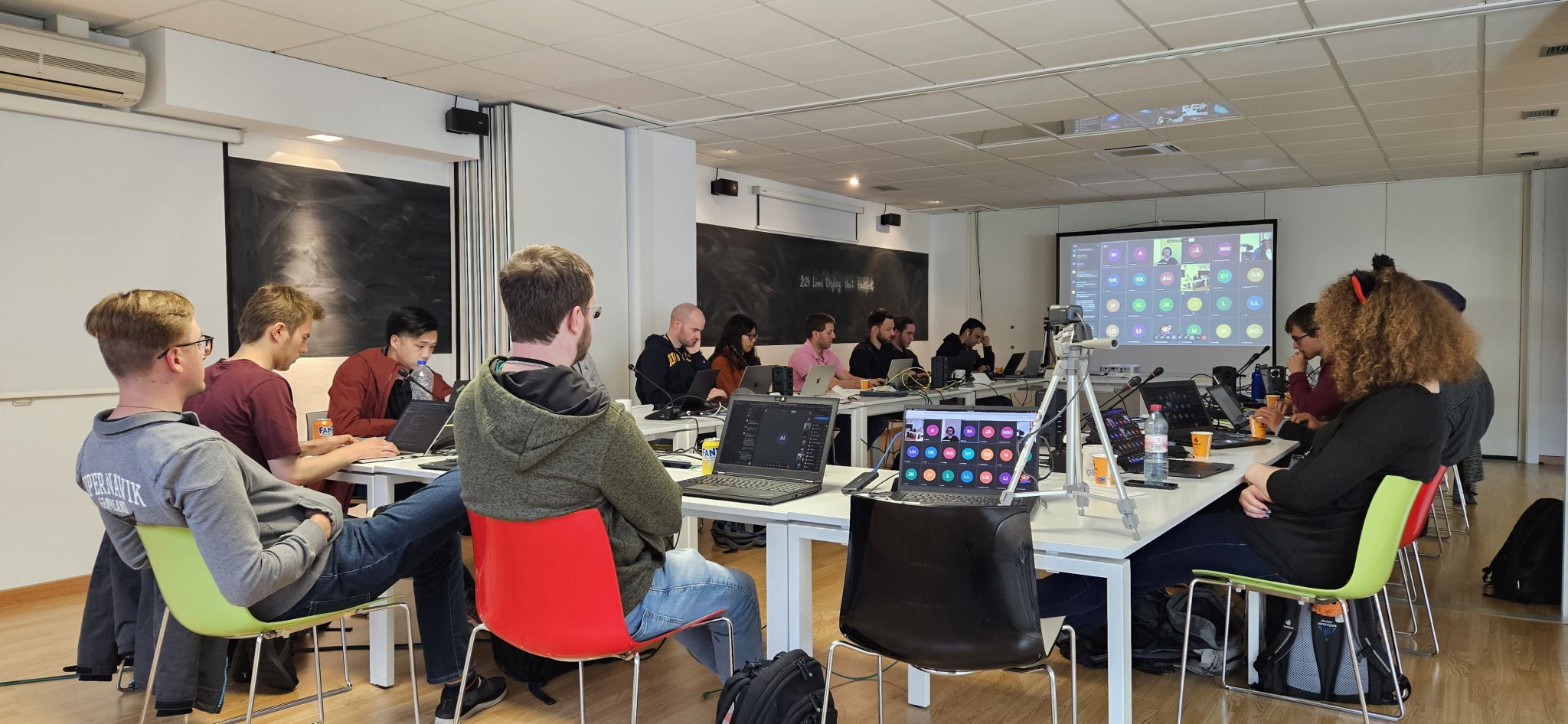
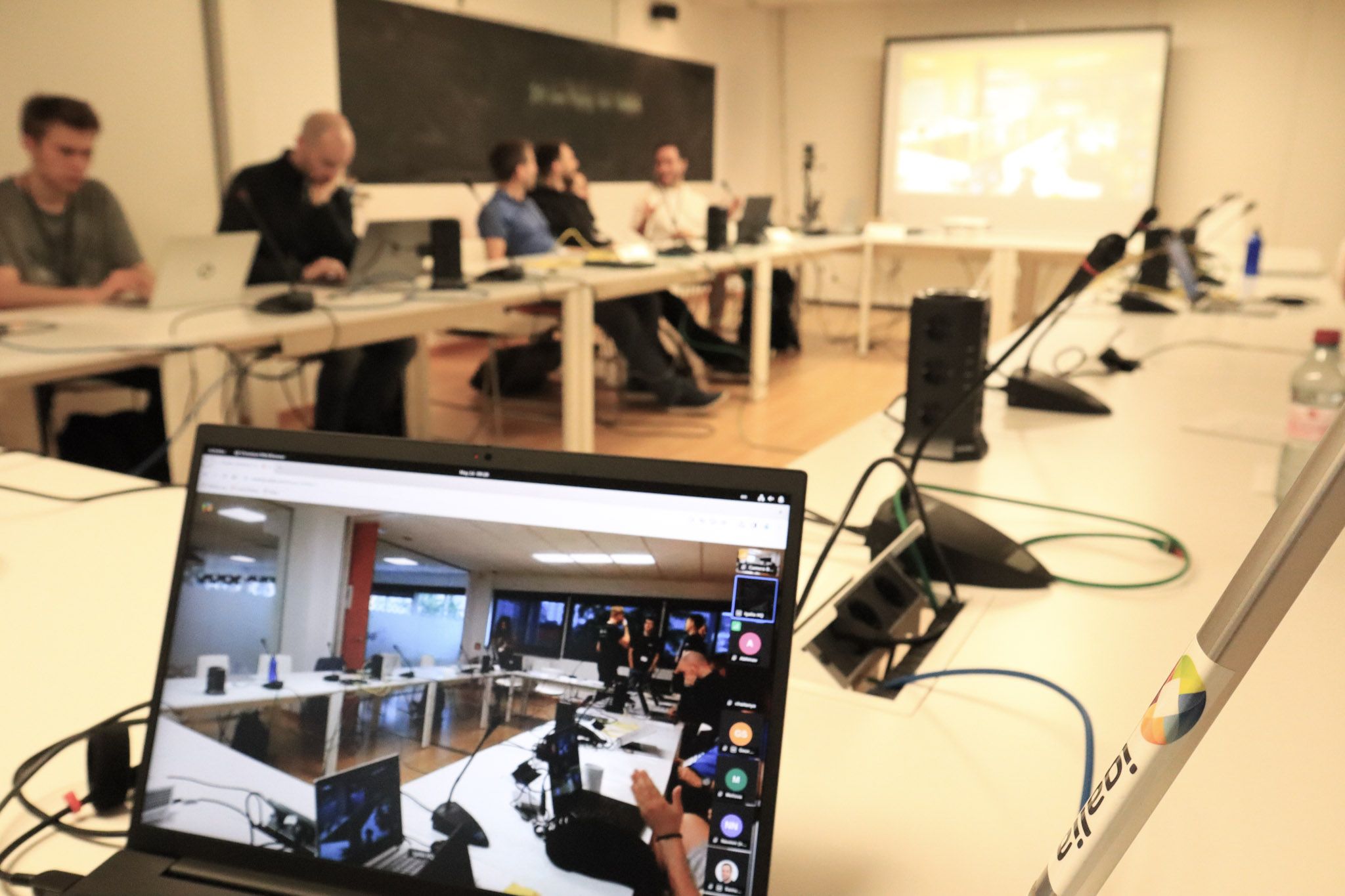
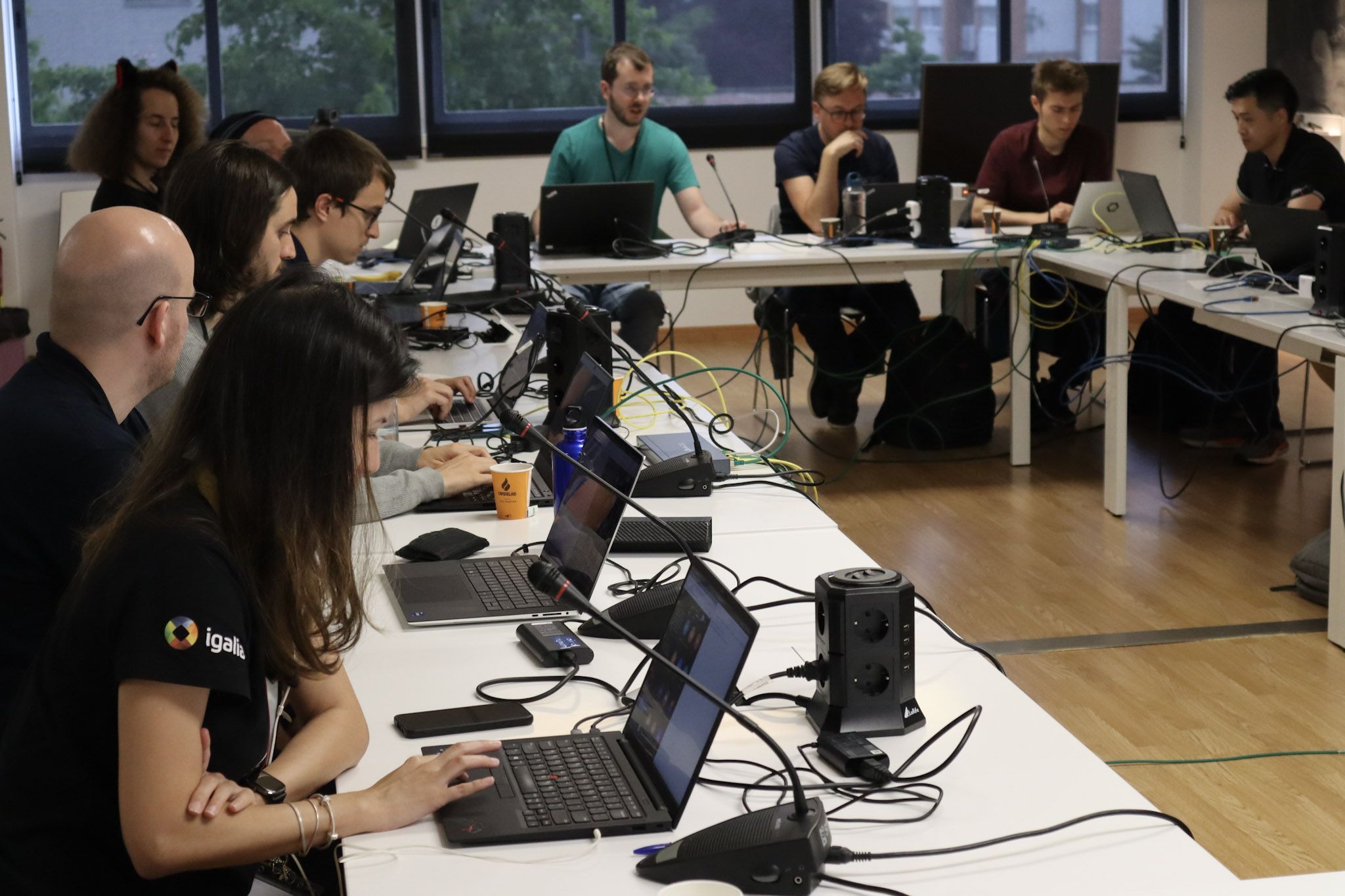
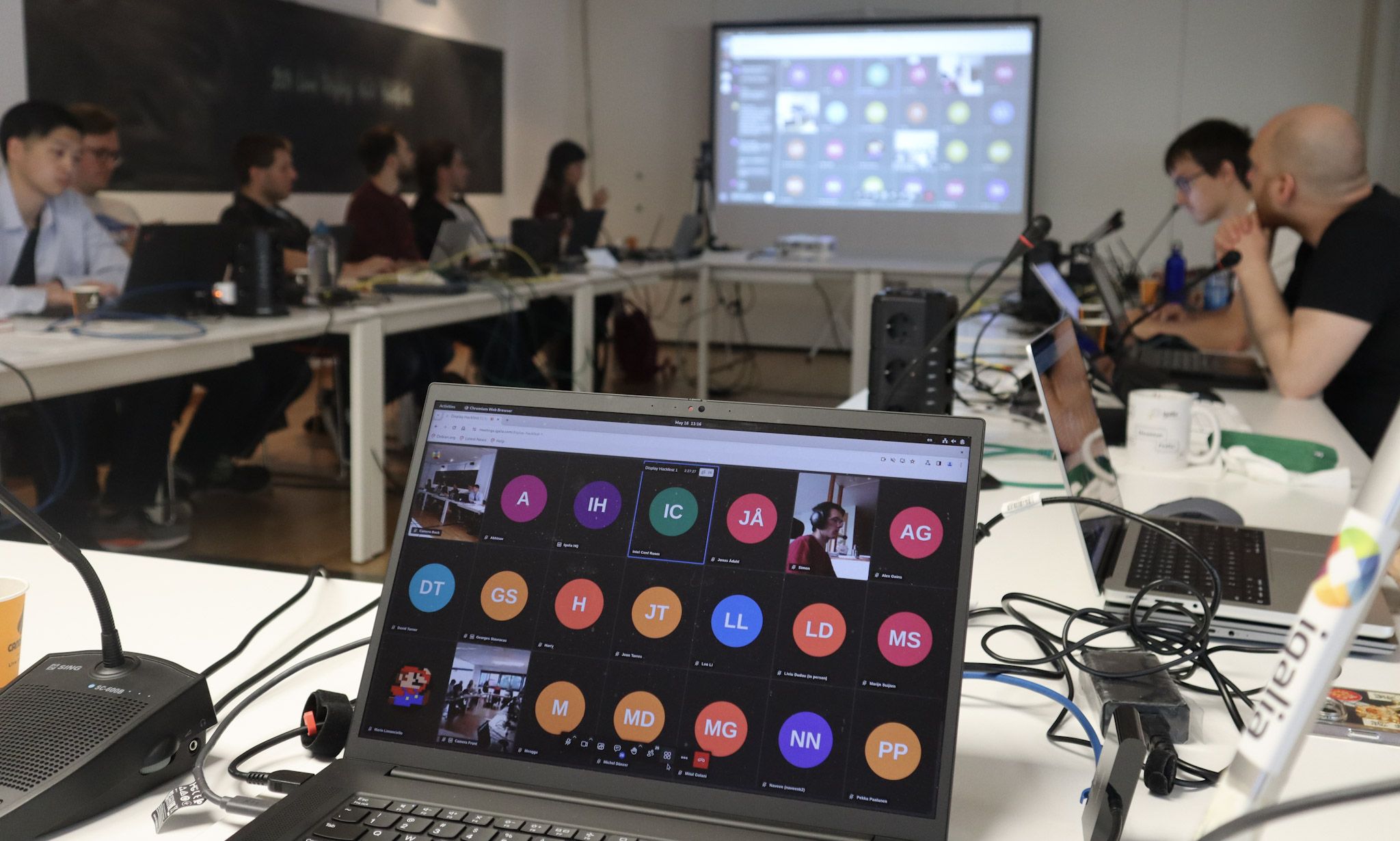
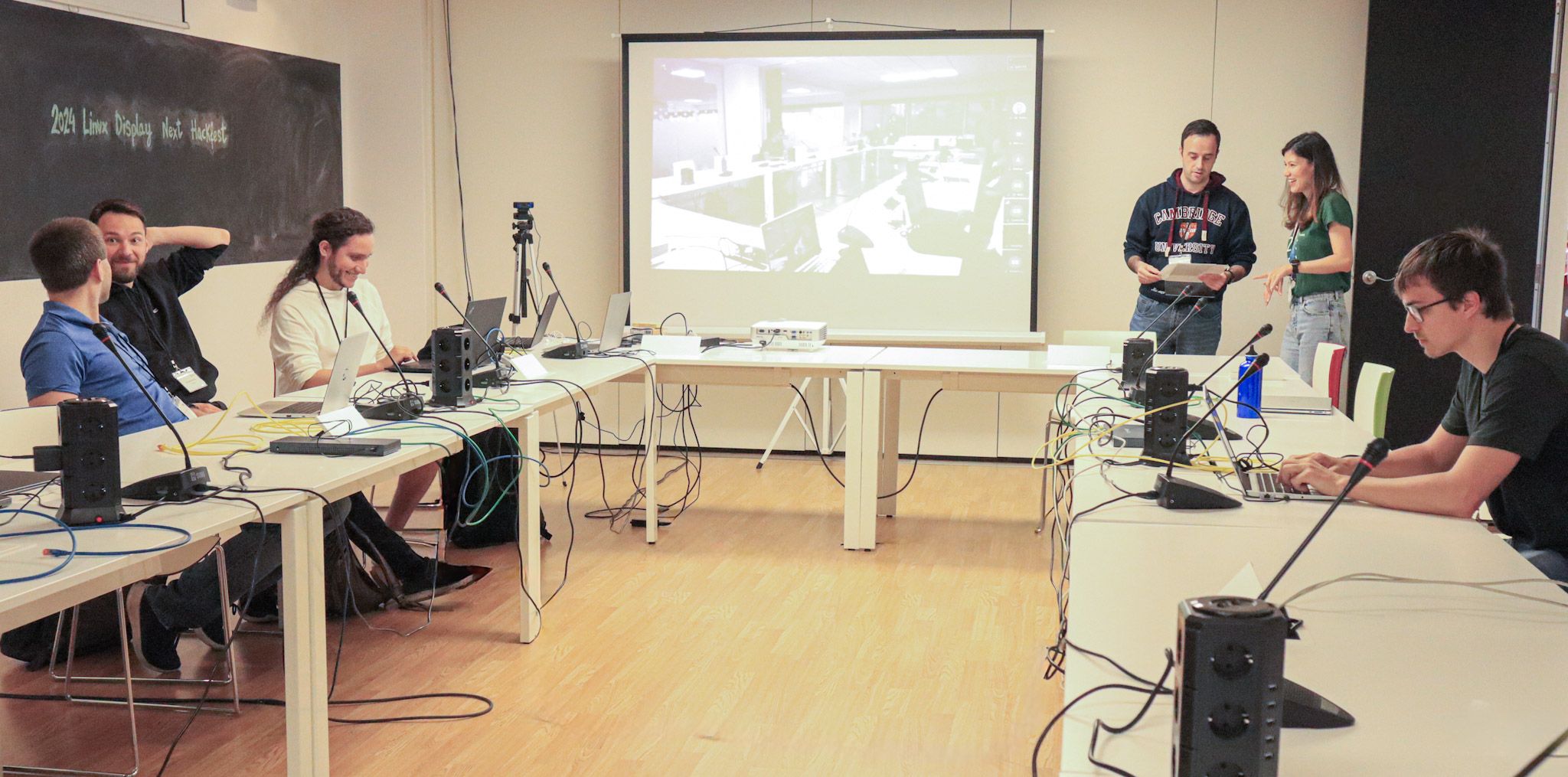
Hey everyone! The 2024 Linux Display Next hackfest concluded in May, and its outcomes continue to shape the Linux Display stack. Igalia hosted this year s event in A Coru a, Spain, bringing together leading experts in the field. Samuel Iglesias and I organized this year s edition and this blog post summarizes the experience and its fruits. One of the highlights of this year s hackfest was the wide range of backgrounds represented by our 40 participants (both on-site and remotely). Developers and experts from various companies and open-source projects came together to advance the Linux Display ecosystem. You can find the list of participants here. The event covered a broad spectrum of topics affecting the development of Linux projects, user experiences, and the future of display technologies on Linux. From cutting-edge topics to long-term discussions, you can check the event agenda here.

Organization Highlights The hackfest was marked by in-depth discussions and knowledge sharing among Linux contributors, making everyone inspired, informed, and connected to the community. Building on feedback from the previous year, we refined the unconference format to enhance participant preparation and engagement. Structured Agenda and Timeboxes: Each session had a defined scope, time limit (1h20 or 2h10), and began with an introductory talk on the topic.
  • Participant-Led Discussions: We pre-selected in-person participants to lead discussions, allowing them to prepare introductions, resources, and scope.
  • Transparent Scheduling: The schedule was shared in advance as GitHub issues, encouraging participants to review and prepare for sessions of interest.
Engaging Sessions: The hackfest featured a variety of topics, including presentations and discussions on how participants were addressing specific subjects within their companies.
  • No Breakout Rooms, No Overlaps: All participants chose to attend all sessions, eliminating the need for separate breakout rooms. We also adapted run-time schedule to keep everybody involved in the same topics.
  • Real-time Updates: We provided notifications and updates through dedicated emails and the event matrix room.
Strengthening Community Connections: The hackfest offered ample opportunities for networking among attendees.
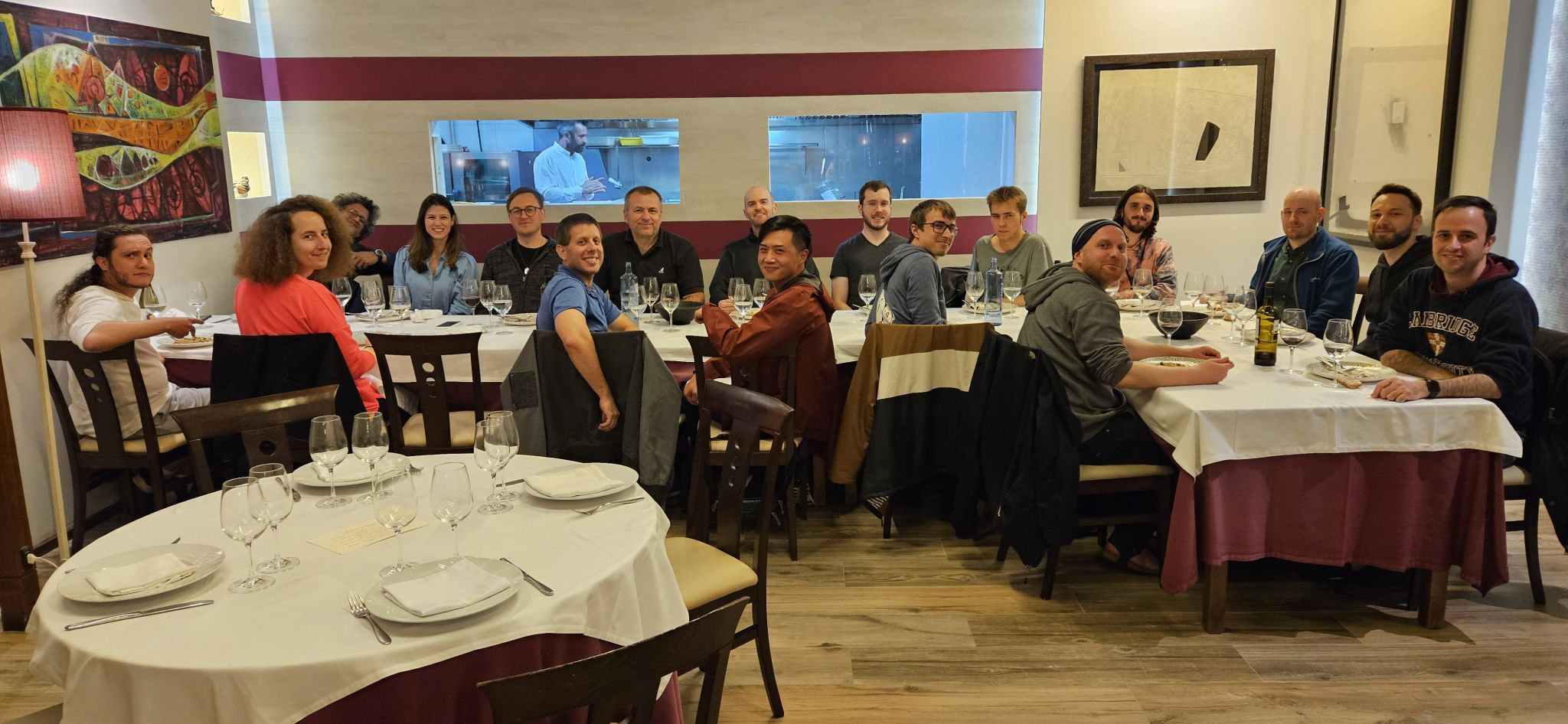
  • Social Events: Igalia sponsored coffee breaks, lunches, and a dinner at a local restaurant.
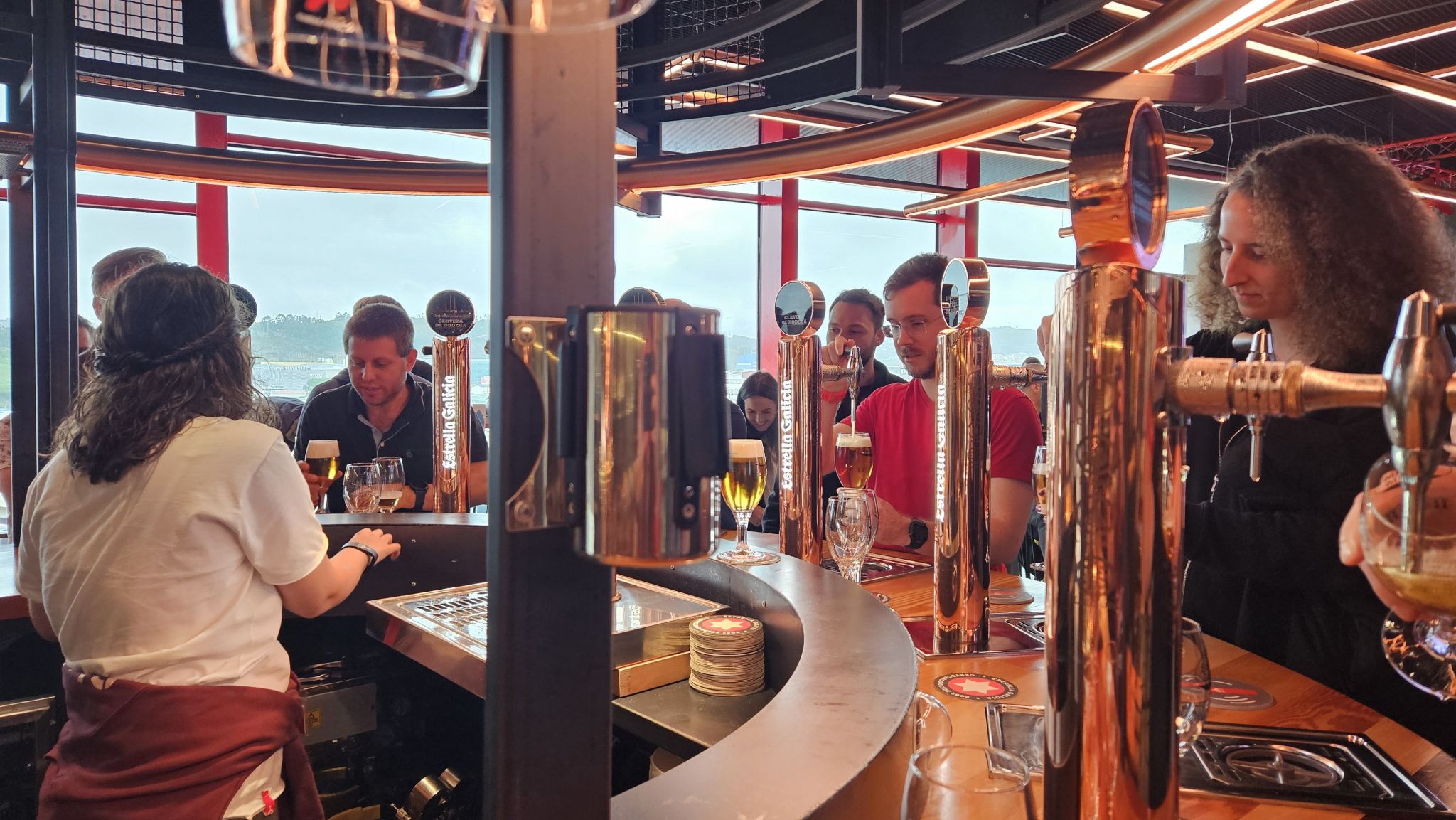
  • Museum Visit: Participants enjoyed a sponsored visit to the Museum of Estrela Galicia Beer (MEGA).

Fruitful Discussions and Follow-up The structured agenda and breaks allowed us to cover multiple topics during the hackfest. These discussions have led to new display feature development and improvements, as evidenced by patches, merge requests, and implementations in project repositories and mailing lists. With the KMS color management API taking shape, we discussed refinements and best approaches to cover the variety of color pipeline from different hardware-vendors. We are also investigating techniques for a performant SDR<->HDR content reproduction and reducing latency and power consumption when using the color blocks of the hardware.

Color Management/HDR Color Management and HDR continued to be the hottest topic of the hackfest. We had three sessions dedicated to discuss Color and HDR across Linux Display stack layers.

Color/HDR (Kernel-Level) Harry Wentland (AMD) led this session. Here, kernel Developers shared the Color Management pipeline of AMD, Intel and NVidia. We counted with diagrams and explanations from HW-vendors developers that discussed differences, constraints and paths to fit them into the KMS generic color management properties such as advertising modeset needs, IN\_FORMAT, segmented LUTs, interpolation types, etc. Developers from Qualcomm and ARM also added information regarding their hardware. Upstream work related to this session:

Color/HDR (Compositor-Level) Sebastian Wick (RedHat) led this session. It started with Sebastian s presentation covering Wayland color protocols and compositor implementation. Also, an explanation of APIs provided by Wayland and how they can be used to achieve better color management for applications and discussions around ICC profiles and color representation metadata. There was also an intensive Q&A about LittleCMS with Marti Maria. Upstream work related to this session:

Color/HDR (Use Cases and Testing) Christopher Cameron (Google) and Melissa Wen (Igalia) led this session. In contrast to the other sessions, here we focused less on implementation and more on brainstorming and reflections of real-world SDR and HDR transformations (use and validation) and gainmaps. Christopher gave a nice presentation explaining HDR gainmap images and how we should think of HDR. This presentation and Q&A were important to put participants at the same page of how to transition between SDR and HDR and somehow emulating HDR. We also discussed on the usage of a kernel background color property. Finally, we discussed a bit about Chamelium and the future of VKMS (future work and maintainership).

Power Savings vs Color/Latency Mario Limonciello (AMD) led this session. Mario gave an introductory presentation about AMD ABM (adaptive backlight management) that is similar to Intel DPST. After some discussions, we agreed on exposing a kernel property for power saving policy. This work was already merged on kernel and the userspace support is under development. Upstream work related to this session:

Strategy for video and gaming use-cases Leo Li (AMD) led this session. Miguel Casas (Google) started this session with a presentation of Overlays in Chrome/OS Video, explaining the main goal of power saving by switching off GPU for accelerated compositing and the challenges of different colorspace/HDR for video on Linux. Then Leo Li presented different strategies for video and gaming and we discussed the userspace need of more detailed feedback mechanisms to understand failures when offloading. Also, creating a debugFS interface came up as a tool for debugging and analysis.

Real-time scheduling and async KMS API Xaver Hugl (KDE/BlueSystems) led this session. Compositor developers have exposed some issues with doing real-time scheduling and async page flips. One is that the Kernel limits the lifetime of realtime threads and if a modeset takes too long, the thread will be killed and thus the compositor as well. Also, simple page flips take longer than expected and drivers should optimize them. Another issue is the lack of feedback to compositors about hardware programming time and commit deadlines (the lastest possible time to commit). This is difficult to predict from drivers, since it varies greatly with the type of properties. For example, color management updates take much longer. In this regard, we discusssed implementing a hw_done callback to timestamp when the hardware programming of the last atomic commit is complete. Also an API to pre-program color pipeline in a kind of A/B scheme. It may not be supported by all drivers, but might be useful in different ways.

VRR/Frame Limit, Display Mux, Display Control, and more and beer We also had sessions to discuss a new KMS API to mitigate headaches on VRR and Frame Limit as different brightness level at different refresh rates, abrupt changes of refresh rates, low frame rate compensation (LFC) and precise timing in VRR more. On Display Control we discussed features missing in the current KMS interface for HDR mode, atomic backlight settings, source-based tone mapping, etc. We also discussed the need of a place where compositor developers can post TODOs to be developed by KMS people. The Content-adaptive Scaling and Sharpening session focused on sharpening and scaling filters. In the Display Mux session, we discussed proposals to expose the capability of dynamic mux switching display signal between discrete and integrated GPUs. In the last session of the 2024 Display Next Hackfest, participants representing different compositors summarized current and future work and built a Linux Display wish list , which includes: improvements to VTTY and HDR switching, better dmabuf API for multi-GPU support, definition of tone mapping, blending and scaling sematics, and wayland protocols for advertising to clients which colorspaces are supported. We closed this session with a status update on feature development by compositors, including but not limited to: plane offloading (from libcamera to output) / HDR video offloading (dma-heaps) / plane-based scrolling for web pages, color management / HDR / ICC profiles support, addressing issues such as flickering when color primaries don t match, etc. After three days of intensive discussions, all in-person participants went to a guided tour at the Museum of Extrela Galicia beer (MEGA), pouring and tasting the most famous local beer.

Feedback and Future Directions Participants provided valuable feedback on the hackfest, including suggestions for future improvements.
  • Schedule and Break-time Setup: Having a pre-defined agenda and schedule provided a better balance between long discussions and mental refreshments, preventing the fatigue caused by endless discussions.
  • Action Points: Some participants recommended explicitly asking for action points at the end of each session and assigning people to follow-up tasks.
  • Remote Participation: Remote attendees appreciated the inclusive setup and opportunities to actively participate in discussions.
  • Technical Challenges: There were bandwidth and video streaming issues during some sessions due to the large number of participants.

Thank you for joining the 2024 Display Next Hackfest We can t help but thank the 40 participants, who engaged in-person or virtually on relevant discussions, for a collaborative evolution of the Linux display stack and for building an insightful agenda. A big thank you to the leaders and presenters of the nine sessions: Christopher Cameron (Google), Harry Wentland (AMD), Leo Li (AMD), Mario Limoncello (AMD), Sebastian Wick (RedHat) and Xaver Hugl (KDE/BlueSystems) for the effort in preparing the sessions, explaining the topic and guiding discussions. My acknowledge to the others in-person participants that made such an effort to travel to A Coru a: Alex Goins (NVIDIA), David Turner (Raspberry Pi), Georges Stavracas (Igalia), Joan Torres (SUSE), Liviu Dudau (Arm), Louis Chauvet (Bootlin), Robert Mader (Collabora), Tian Mengge (GravityXR), Victor Jaquez (Igalia) and Victoria Brekenfeld (System76). It was and awesome opportunity to meet you and chat face-to-face. Finally, thanks virtual participants who couldn t make it in person but organized their days to actively participate in each discussion, adding different perspectives and valuable inputs even remotely: Abhinav Kumar (Qualcomm), Chaitanya Borah (Intel), Christopher Braga (Qualcomm), Dor Askayo (Red Hat), Jiri Koten (RedHat), Jonas dahl (Red Hat), Leandro Ribeiro (Collabora), Marti Maria (Little CMS), Marijn Suijten, Mario Kleiner, Martin Stransky (Red Hat), Michel D nzer (Red Hat), Miguel Casas-Sanchez (Google), Mitulkumar Golani (Intel), Naveen Kumar (Intel), Niels De Graef (Red Hat), Pekka Paalanen (Collabora), Pichika Uday Kiran (AMD), Shashank Sharma (AMD), Sriharsha PV (AMD), Simon Ser, Uma Shankar (Intel) and Vikas Korjani (AMD). We look forward to another successful Display Next hackfest, continuing to drive innovation and improvement in the Linux display ecosystem!

25 September 2024

Melissa Wen: Reflections on 2024 Linux Display Next Hackfest

Hey everyone! The 2024 Linux Display Next hackfest concluded in May, and its outcomes continue to shape the Linux Display stack. Igalia hosted this year s event in A Coru a, Spain, bringing together leading experts in the field. Samuel Iglesias and I organized this year s edition and this blog post summarizes the experience and its fruits. One of the highlights of this year s hackfest was the wide range of backgrounds represented by our 40 participants (both on-site and remotely). Developers and experts from various companies and open-source projects came together to advance the Linux Display ecosystem. You can find the list of participants here. The event covered a broad spectrum of topics affecting the development of Linux projects, user experiences, and the future of display technologies on Linux. From cutting-edge topics to long-term discussions, you can check the event agenda here.

Organization Highlights The hackfest was marked by in-depth discussions and knowledge sharing among Linux contributors, making everyone inspired, informed, and connected to the community. Building on feedback from the previous year, we refined the unconference format to enhance participant preparation and engagement. Structured Agenda and Timeboxes: Each session had a defined scope, time limit (1h20 or 2h10), and began with an introductory talk on the topic.
  • Participant-Led Discussions: We pre-selected in-person participants to lead discussions, allowing them to prepare introductions, resources, and scope.
  • Transparent Scheduling: The schedule was shared in advance as GitHub issues, encouraging participants to review and prepare for sessions of interest.
Engaging Sessions: The hackfest featured a variety of topics, including presentations and discussions on how participants were addressing specific subjects within their companies.
  • No Breakout Rooms, No Overlaps: All participants chose to attend all sessions, eliminating the need for separate breakout rooms. We also adapted run-time schedule to keep everybody involved in the same topics.
  • Real-time Updates: We provided notifications and updates through dedicated emails and the event matrix room.
Strengthening Community Connections: The hackfest offered ample opportunities for networking among attendees.
  • Social Events: Igalia sponsored coffee breaks, lunches, and a dinner at a local restaurant.
  • Museum Visit: Participants enjoyed a sponsored visit to the Museum of Estrela Galicia Beer (MEGA).

Fruitful Discussions and Follow-up The structured agenda and breaks allowed us to cover multiple topics during the hackfest. These discussions have led to new display feature development and improvements, as evidenced by patches, merge requests, and implementations in project repositories and mailing lists. With the KMS color management API taking shape, we discussed refinements and best approaches to cover the variety of color pipeline from different hardware-vendors. We are also investigating techniques for a performant SDR<->HDR content reproduction and reducing latency and power consumption when using the color blocks of the hardware.

Color Management/HDR Color Management and HDR continued to be the hottest topic of the hackfest. We had three sessions dedicated to discuss Color and HDR across Linux Display stack layers.

Color/HDR (Kernel-Level) Harry Wentland (AMD) led this session. Here, kernel Developers shared the Color Management pipeline of AMD, Intel and NVidia. We counted with diagrams and explanations from HW-vendors developers that discussed differences, constraints and paths to fit them into the KMS generic color management properties such as advertising modeset needs, IN\_FORMAT, segmented LUTs, interpolation types, etc. Developers from Qualcomm and ARM also added information regarding their hardware. Upstream work related to this session:

Color/HDR (Compositor-Level) Sebastian Wick (RedHat) led this session. It started with Sebastian s presentation covering Wayland color protocols and compositor implementation. Also, an explanation of APIs provided by Wayland and how they can be used to achieve better color management for applications and discussions around ICC profiles and color representation metadata. There was also an intensive Q&A about LittleCMS with Marti Maria. Upstream work related to this session:

Color/HDR (Use Cases and Testing) Christopher Cameron (Google) and Melissa Wen (Igalia) led this session. In contrast to the other sessions, here we focused less on implementation and more on brainstorming and reflections of real-world SDR and HDR transformations (use and validation) and gainmaps. Christopher gave a nice presentation explaining HDR gainmap images and how we should think of HDR. This presentation and Q&A were important to put participants at the same page of how to transition between SDR and HDR and somehow emulating HDR. We also discussed on the usage of a kernel background color property. Finally, we discussed a bit about Chamelium and the future of VKMS (future work and maintainership).

Power Savings vs Color/Latency Mario Limonciello (AMD) led this session. Mario gave an introductory presentation about AMD ABM (adaptive backlight management) that is similar to Intel DPST. After some discussions, we agreed on exposing a kernel property for power saving policy. This work was already merged on kernel and the userspace support is under development. Upstream work related to this session:

Strategy for video and gaming use-cases Leo Li (AMD) led this session. Miguel Casas (Google) started this session with a presentation of Overlays in Chrome/OS Video, explaining the main goal of power saving by switching off GPU for accelerated compositing and the challenges of different colorspace/HDR for video on Linux. Then Leo Li presented different strategies for video and gaming and we discussed the userspace need of more detailed feedback mechanisms to understand failures when offloading. Also, creating a debugFS interface came up as a tool for debugging and analysis.

Real-time scheduling and async KMS API Xaver Hugl (KDE/BlueSystems) led this session. Compositor developers have exposed some issues with doing real-time scheduling and async page flips. One is that the Kernel limits the lifetime of realtime threads and if a modeset takes too long, the thread will be killed and thus the compositor as well. Also, simple page flips take longer than expected and drivers should optimize them. Another issue is the lack of feedback to compositors about hardware programming time and commit deadlines (the lastest possible time to commit). This is difficult to predict from drivers, since it varies greatly with the type of properties. For example, color management updates take much longer. In this regard, we discusssed implementing a hw_done callback to timestamp when the hardware programming of the last atomic commit is complete. Also an API to pre-program color pipeline in a kind of A/B scheme. It may not be supported by all drivers, but might be useful in different ways.

VRR/Frame Limit, Display Mux, Display Control, and more and beer We also had sessions to discuss a new KMS API to mitigate headaches on VRR and Frame Limit as different brightness level at different refresh rates, abrupt changes of refresh rates, low frame rate compensation (LFC) and precise timing in VRR more. On Display Control we discussed features missing in the current KMS interface for HDR mode, atomic backlight settings, source-based tone mapping, etc. We also discussed the need of a place where compositor developers can post TODOs to be developed by KMS people. The Content-adaptive Scaling and Sharpening session focused on sharpening and scaling filters. In the Display Mux session, we discussed proposals to expose the capability of dynamic mux switching display signal between discrete and integrated GPUs. In the last session of the 2024 Display Next Hackfest, participants representing different compositors summarized current and future work and built a Linux Display wish list , which includes: improvements to VTTY and HDR switching, better dmabuf API for multi-GPU support, definition of tone mapping, blending and scaling sematics, and wayland protocols for advertising to clients which colorspaces are supported. We closed this session with a status update on feature development by compositors, including but not limited to: plane offloading (from libcamera to output) / HDR video offloading (dma-heaps) / plane-based scrolling for web pages, color management / HDR / ICC profiles support, addressing issues such as flickering when color primaries don t match, etc. After three days of intensive discussions, all in-person participants went to a guided tour at the Museum of Extrela Galicia beer (MEGA), pouring and tasting the most famous local beer.

Feedback and Future Directions Participants provided valuable feedback on the hackfest, including suggestions for future improvements.
  • Schedule and Break-time Setup: Having a pre-defined agenda and schedule provided a better balance between long discussions and mental refreshments, preventing the fatigue caused by endless discussions.
  • Action Points: Some participants recommended explicitly asking for action points at the end of each session and assigning people to follow-up tasks.
  • Remote Participation: Remote attendees appreciated the inclusive setup and opportunities to actively participate in discussions.
  • Technical Challenges: There were bandwidth and video streaming issues during some sessions due to the large number of participants.

Thank you for joining the 2024 Display Next Hackfest We can t help but thank the 40 participants, who engaged in-person or virtually on relevant discussions, for a collaborative evolution of the Linux display stack and for building an insightful agenda. A big thank you to the leaders and presenters of the nine sessions: Christopher Cameron (Google), Harry Wentland (AMD), Leo Li (AMD), Mario Limoncello (AMD), Sebastian Wick (RedHat) and Xaver Hugl (KDE/BlueSystems) for the effort in preparing the sessions, explaining the topic and guiding discussions. My acknowledge to the others in-person participants that made such an effort to travel to A Coru a: Alex Goins (NVIDIA), David Turner (Raspberry Pi), Georges Stavracas (Igalia), Joan Torres (SUSE), Liviu Dudau (Arm), Louis Chauvet (Bootlin), Robert Mader (Collabora), Tian Mengge (GravityXR), Victor Jaquez (Igalia) and Victoria Brekenfeld (System76). It was and awesome opportunity to meet you and chat face-to-face. Finally, thanks virtual participants who couldn t make it in person but organized their days to actively participate in each discussion, adding different perspectives and valuable inputs even remotely: Abhinav Kumar (Qualcomm), Chaitanya Borah (Intel), Christopher Braga (Qualcomm), Dor Askayo, Jiri Koten (RedHat), Jonas dahl (Red Hat), Leandro Ribeiro (Collabora), Marti Maria (Little CMS), Marijn Suijten, Mario Kleiner, Martin Stransky (Red Hat), Michel D nzer (Red Hat), Miguel Casas-Sanchez (Google), Mitulkumar Golani (Intel), Naveen Kumar (Intel), Niels De Graef (Red Hat), Pekka Paalanen (Collabora), Pichika Uday Kiran (AMD), Shashank Sharma (AMD), Sriharsha PV (AMD), Simon Ser, Uma Shankar (Intel) and Vikas Korjani (AMD). We look forward to another successful Display Next hackfest, continuing to drive innovation and improvement in the Linux display ecosystem!

24 September 2024

Vasudev Kamath: Note to Self: Enabling Secure Boot with UKI on Debian

Note

This post is a continuation of my previous article on enabling the Unified Kernel Image (UKI) on Debian.

In this guide, we'll implement Secure Boot by taking full control of the device, removing preinstalled keys, and installing our own. For a comprehensive overview of the benefits and process, refer to this excellent post from rodsbooks.
Key Components To implement Secure Boot, we need three essential keys:
  1. Platform Key (PK): The top-level key in Secure Boot, typically provided by the motherboard manufacturer. We'll replace the vendor-supplied PK with our own for complete control.
  2. Key Exchange Key (KEK): Used to sign updates for the Signatures Database and Forbidden Signatures Database.
  3. Database Key (DB): Used to sign or verify binaries (bootloaders, boot managers, shells, drivers, etc.).
There's also a Forbidden Signature Key (dbx), which is the opposite of the DB key. We won't be generating this key in this guide.
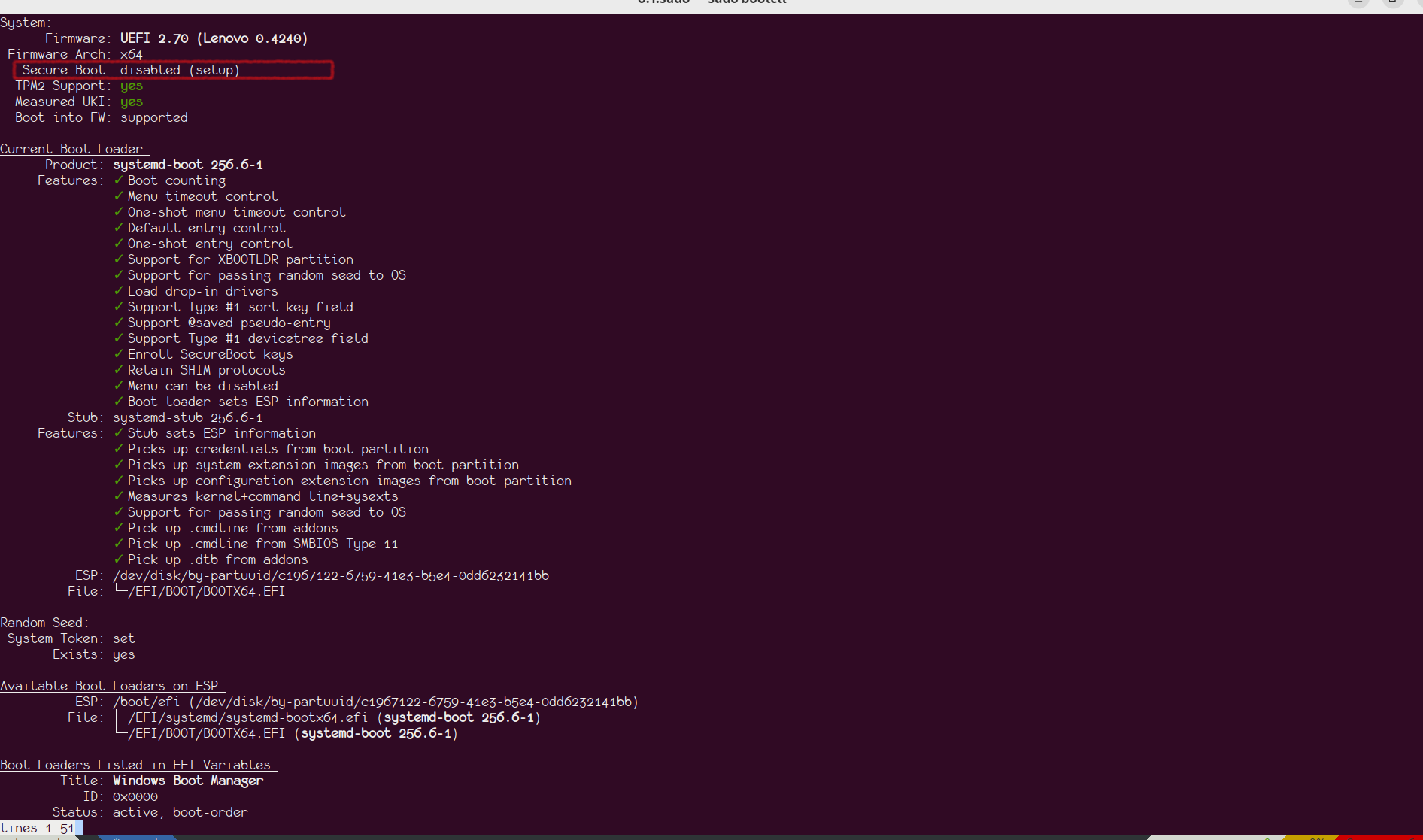
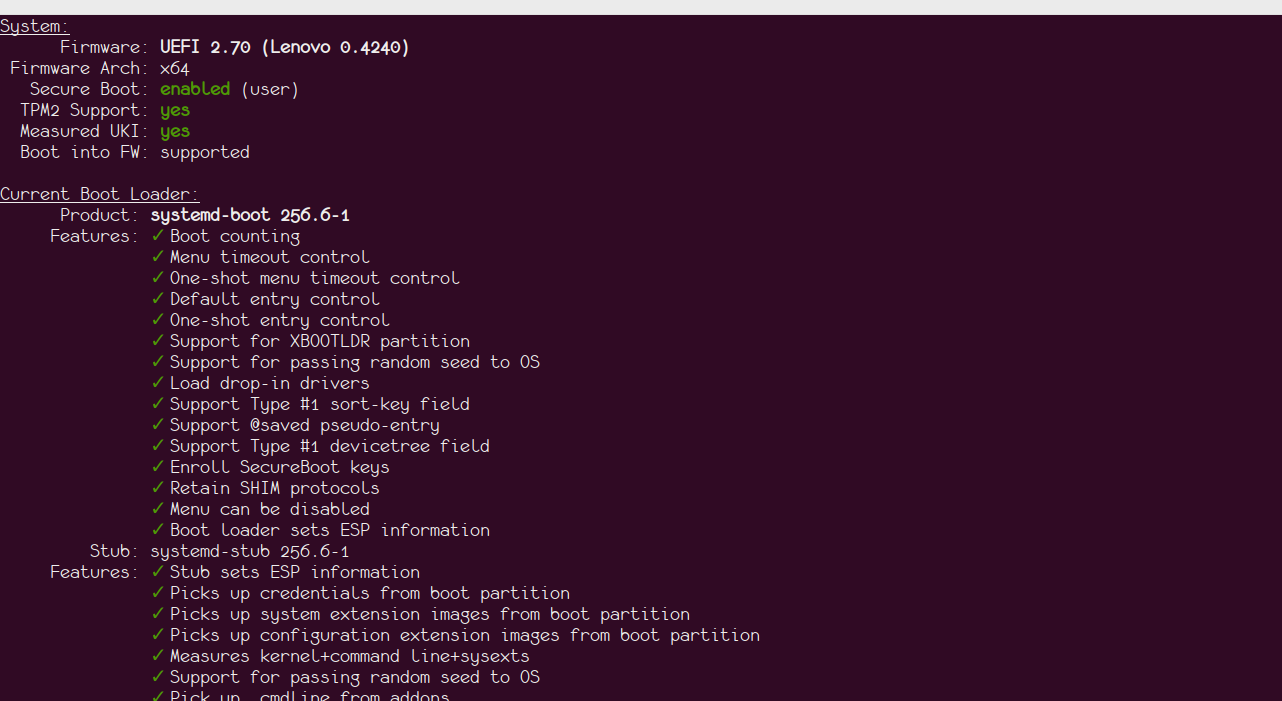
Preparing for Key Enrollment Before enrolling our keys, we need to put the device in Secure Boot Setup Mode. Verify the status using the bootctl status command. You should see output similar to the following image: UEFI Setup mode
Generating Keys Follow these instructions from the Arch Wiki to generate the keys manually. You'll need the efitools and openssl packages. I recommend using rsa:2048 as the key size for better compatibility with older firmware. After generating the keys, copy all .auth files to the /efi/loader/keys/<hostname>/ folder. For example:
  sudo ls /efi/loader/keys/chamunda
db.auth  KEK.auth  PK.auth
Signing the Bootloader Sign the systemd-boot bootloader with your new keys:
sbsign --key <path-to db.key> --cert <path-to db.crt> \
   /usr/lib/systemd/boot/efi/systemd-bootx64.efi
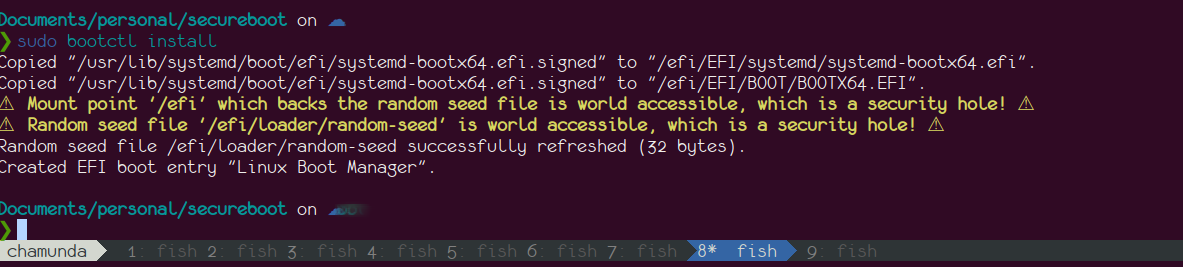
Install the signed bootloader using bootctl install. The output should resemble this: bootctl install

Note

If you encounter warnings about mount options, update your fstab with the umask=0077 option for the EFI partition.

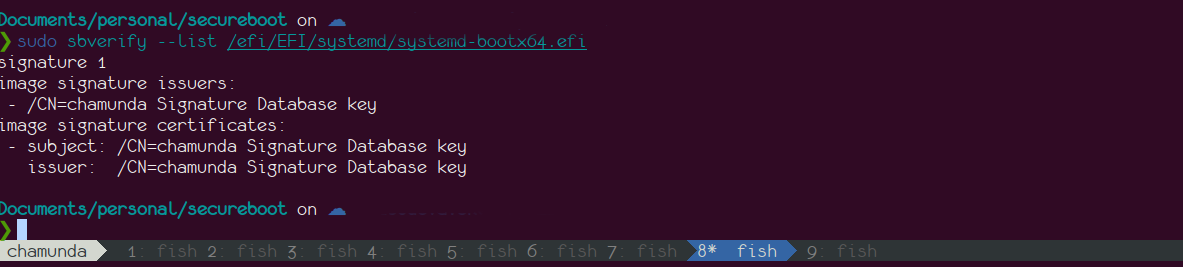
Verify the signature using sbsign --verify: sbsign verify
Configuring UKI for Secure Boot Update the /etc/kernel/uki.conf file with your key paths:
SecureBootPrivateKey=/path/to/db.key
SecureBootCertificate=/path/to/db.crt
Signing the UKI Image On Debian, use dpkg-reconfigure to sign the UKI image for each kernel:
sudo dpkg-reconfigure linux-image-$(uname -r)
# Repeat for other kernel versions if necessary
You should see output similar to this:
sudo dpkg-reconfigure linux-image-$(uname -r)
/etc/kernel/postinst.d/dracut:
dracut: Generating /boot/initrd.img-6.10.9-amd64
Updating kernel version 6.10.9-amd64 in systemd-boot...
Signing unsigned original image
Using config file: /etc/kernel/uki.conf
+ sbverify --list /boot/vmlinuz-6.10.9-amd64
+ sbsign --key /home/vasudeva.sk/Documents/personal/secureboot/db.key --cert /home/vasudeva.sk/Documents/personal/secureboot/db.crt /tmp/ukicc7vcxhy --output /tmp/kernel-install.staging.QLeGLn/uki.efi
Wrote signed /tmp/kernel-install.staging.QLeGLn/uki.efi
/etc/kernel/postinst.d/zz-systemd-boot:
Installing kernel version 6.10.9-amd64 in systemd-boot...
Signing unsigned original image
Using config file: /etc/kernel/uki.conf
+ sbverify --list /boot/vmlinuz-6.10.9-amd64
+ sbsign --key /home/vasudeva.sk/Documents/personal/secureboot/db.key --cert /home/vasudeva.sk/Documents/personal/secureboot/db.crt /tmp/ukit7r1hzep --output /tmp/kernel-install.staging.dWVt5s/uki.efi
Wrote signed /tmp/kernel-install.staging.dWVt5s/uki.efi
Enrolling Keys in Firmware Use systemd-boot to enroll your keys:
systemctl reboot --boot-loader-menu=0
Select the enroll option with your hostname in the systemd-boot menu. After key enrollment, the system will reboot into the newly signed kernel. Verify with bootctl: uefi enabled
Dealing with Lockdown Mode Secure Boot enables lockdown mode on distro-shipped kernels, which restricts certain features like kprobes/BPF and DKMS drivers. To avoid this, consider compiling the upstream kernel directly, which doesn't enable lockdown mode by default. As Linus Torvalds has stated, "there is no reason to tie Secure Boot to lockdown LSM." You can read more about Torvalds' opinion on UEFI tied with lockdown.
Next Steps One thing that remains is automating the signing of systemd-boot on upgrade, which is currently a manual process. I'm exploring dpkg triggers for achieving this, and if I succeed, I will write a new post with details.
Acknowledgments Special thanks to my anonymous colleague who provided invaluable assistance throughout this process.

21 September 2024

Gunnar Wolf: 50 years of queries

This post is a review for Computing Reviews for 50 years of queries , a article published in Communications of the ACM
The relational model is probably the one innovation that brought computers to the mainstream for business users. This article by Donald Chamberlin, creator of one of the first query languages (that evolved into the ubiquitous SQL), presents its history as a commemoration of the 50th anniversary of his publication of said query language. The article begins by giving background on information processing before the advent of today s database management systems: with systems storing and processing information based on sequential-only magnetic tapes in the 1950s, adopting a record-based, fixed-format filing system was far from natural. The late 1960s and early 1970s saw many fundamental advances, among which one of the best known is E. F. Codd s relational model. The first five pages (out of 12) present the evolution of the data management community up to the 1974 SIGFIDET conference. This conference was so important in the eyes of the author that, in his words, it is the event that starts the clock on 50 years of relational databases. The second part of the article tells about the growth of the structured English query language (SEQUEL) eventually renamed SQL including the importance of its standardization and its presence in commercial products as the dominant database language since the late 1970s. Chamberlin presents short histories of the various implementations, many of which remain dominant names today, that is, Oracle, Informix, and DB2. Entering the 1990s, open-source communities introduced MySQL, PostgreSQL, and SQLite. The final part of the article presents controversies and criticisms related to SQL and the relational database model as a whole. Chamberlin presents the main points of controversy throughout the years: 1) the SQL language lacks orthogonality; 2) SQL tables, unlike formal relations, might contain null values; and 3) SQL tables, unlike formal relations, may contain duplicate rows. He explains the issues and tradeoffs that guided the language design as it unfolded. Finally, a section presents several points that explain how SQL and the relational model have remained, for 50 years, a winning concept, as well as some thoughts regarding the NoSQL movement that gained traction in the 2010s. This article is written with clear language and structure, making it easy and pleasant to read. It does not drive a technical point, but instead is a recap on half a century of developments in one of the fields most important to the commercial development of computing, written by one of the greatest authorities on the topic.

17 September 2024

Russ Allbery: Review: The Book That Broke the World

Review: The Book That Broke the World, by Mark Lawrence
Series: Library Trilogy #2
Publisher: Ace
Copyright: 2024
ISBN: 0-593-43796-9
Format: Kindle
Pages: 366
The Book That Broke the World is high fantasy and a direct sequel to The Book That Wouldn't Burn. You should not start here. In a delightful break from normal practice, the author provides a useful summary of the previous volume at the start of this book to jog your memory. At the end of The Book That Wouldn't Burn, the characters were scattered and in various states of corporeality after some major revelations about the nature of the Library and the first appearance of the insectile Skeer. The Book That Wouldn't Burn picks up where it left off, and there is a lot more contact with the Skeer, but my guess that they would be the next viewpoint characters does not pan out. Instead, we get a new group and a new protagonist: Celcha, whose sees angels who come to visit her brother. I have complaints, but before I launch into those, I should say that I liked this book apart from the totally unnecessary cannibalism. (I'll get to that.) Livira is a bit sidelined, which is regrettable, but Celcha and her brother are interesting new characters, and both Arpix and Clovis, supporting characters in the first book, get some excellent character development. Similar to the first book, this is a puzzle box story full of world-building tidbits with intellectually-satisfying interactions. Lawrence elaborates and complicates his setting in ways that don't contradict earlier parts of the story but create more room and depth for the characters to be creative. I came away still invested in this world and eager to find out how Lawrence pulls the world-building and narrative threads together. The biggest drawback of this book is that it's not new. My thought after finishing the first book of the series was that if Lawrence had enough world-building ideas to fill three books to that same level of density, this had the potential of being one of my favorite fantasy series of all time. By the end of the second book, I concluded that this is not the case. Instead of showing us new twists and complications the way the first book did throughout, The Book That Broke the World mostly covers the same thematic ground from some new angles. It felt like Lawrence was worried the reader of the first book may not have understood the theme or the world-building, so he spent most of the second book nailing down anything that moved. I found that frustrating. One of the best parts of The Book That Wouldn't Burn was that Lawrence trusted the reader to keep up, which for me hit the glorious but rare sweet spot of pacing where I was figuring out the world at roughly the same pace as the characters. It surprised me in some very enjoyable ways. The Book That Broke the World did not surprise me. There are a few new things, which I enjoyed, and a few elaborations and developments of ideas, which I mostly enjoyed, but I saw the big plot twist coming at least fifty pages before it happened and found the aftermath more annoying than revelatory. It doesn't help that the plot rests on character misunderstandings, one of my least favorite tropes. One of the other disappointments of this book is that the characters stop using the Library as a library. The Library at the center of this series is a truly marvelous piece of world-building with numerous fascinating features that are unrelated to its contents, but Livira used it first and foremost as a repository of books. The first book was full of characters solving problems by finding a relevant book and reading it. In The Book That Broke the World, sadly, this is mostly gone. The Library is mostly reduced to a complicated Big Dumb Object setting. It's still a delightful bit of world-building, and we learn about a few new features, but I only remember two places where the actual books are important to the story. Even the book referenced in the title is mostly important as an artifact with properties unrelated to the words that it contains or to the act of reading it. I think this is a huge lost opportunity and something I hope Lawrence fixes in the last book of the trilogy. This book instead focuses on the politics around the existence of the Library itself. Here I'm cautiously optimistic, although a lot is going to depend on the third book. Lawrence has set up a three-sided argument between groups that I will uncharitably describe as the libertarian techbros, the "burn it all down" reactionaries, and the neoliberal centrist technocrats. All three of those positions suck, and Lawrence had better be setting the stage for Livira to find a different path. Her unwillingness to commit to any of those sides gives me hope, but bringing this plot to a satisfying conclusion is going to be tricky. I hope I like what Lawrence comes up with, but it feels far from certain. It doesn't help that he's started delivering some points with a sledgehammer, and that's where we get to the unnecessary cannibalism. Thankfully this is a fairly small part of the tail end of the book, but it was an unpleasant surprise that I did not want in this novel and that I don't think made the story any better. It's tempting to call the cannibalism gratuitous, but it does fit one of the main themes of this story, namely that humans are depressingly good at using any rule-based object in unexpected and nasty ways that are contrary to the best intentions of the designer. This is the fundamental challenge of the Library as a whole and the question that I suspect the third book will be devoted to addressing, so I understand why Lawrence wanted to emphasize his point. The reason why there is cannibalism here is directly related to a profound misunderstanding of the properties of the library, and I detected an echo of one of C.S. Lewis's arguments in The Last Battle about the nature of Hell. The problem, though, is that this is Satanic baby-killerism, to borrow a term from Fred Clark. There are numerous ways to show this type of perversion of well-intended systems, which I know because Lawrence used other ones in the first book that were more subtle but equally effective. One of the best parts of The Book That Wouldn't Burn is that there were few real villains. The conflict was structural, all sides had valid perspectives, and the ethical points of that story were made with some care and nuance. The problem with cannibalism as it's used here is not merely that it's gross and disgusting and off-putting to the reader, although it is all of those things. If I wanted to read horror, I would read horror novels. I don't appreciate surprise horror used for shock value in regular fantasy. But worse, it's an abandonment of moral nuance. The function of cannibalism in this story is like the function of Satanic baby-killers: it's to signal that these people are wholly and irredeemably evil. They are the Villains, they are Wrong, and they cease to be characters and become symbols of what the protagonists are fighting. This is destructive to the story because it's designed to provoke a visceral short-circuit in the reader and let the author get away with sloppy story-telling. If the author needs to use tactics like this to point out who is the villain, they have failed to set up their moral quandary properly. The worst part is that this was entirely unnecessary because Lawrence's story-telling wasn't sloppy and he set up his moral quandary just fine. No one was confused about the ethical point here. I as the reader was following without difficulty, and had appreciated the subtlety with which Lawrence posed the question. But apparently he thought he was too subtle and decided to come back to the point with a pile-driver. I think that seriously injured the story. The ethical argument here is much more engaging and thought-provoking when it's more finely balanced. That's a lot of complaints, mostly because this is a good book that I badly wanted to be a great book but which kept tripping over its own feet. A lot of trilogies have weak second books. Hopefully this is another example of the mid-story sag, and the finale will be worthy of the start of the story. But I have to admit the moral short-circuiting and the de-emphasis of the actual books in the library has me a bit nervous. I want a lot out of the third book, and I hope I'm not asking this author for too much. If you liked the first book, I think you'll like this one too, with the caveat that it's quite a bit darker and more violent in places, even apart from the surprise cannibalism. But if you've not started this series, you may want to wait for the third book to see if Lawrence can pull off the ending. Followed by The Book That Held Her Heart, currently scheduled for publication in April of 2025. Rating: 7 out of 10

16 September 2024

Russ Allbery: Review: The Wings Upon Her Back

Review: The Wings Upon Her Back, by Samantha Mills
Publisher: Tachyon
Copyright: 2024
ISBN: 1-61696-415-4
Format: Kindle
Pages: 394
The Wings Upon Her Back is a political steampunk science fantasy novel. If the author's name sounds familiar, it may be because Samantha Mills's short story "Rabbit Test" won Nebula, Locus, Hugo, and Sturgeon awards. This is her first novel. Winged Zemolai is a soldier of the mecha god and the protege of Mecha Vodaya, the Voice. She has served the city-state of Radezhda by defending it against all enemies, foreign and domestic, for twenty-six years. Despite that, it takes only a moment of errant mercy for her entire life to come crashing down. On a whim, she spares a kitchen worker who was concealing a statue of the scholar god, meaning that he was only pretending to worship the worker god like all workers should. Vodaya is unforgiving and uncompromising, as is the sleeping mecha god. Zemolai's wings are ripped from her back and crushed in the hand of the god, and she's left on the ground to die of mechalin withdrawal. The Wings Upon Her Back is told in two alternating timelines. The main one follows Zemolai after her exile as she is rescued by a young group of revolutionaries who think she may be useful in their plans. The other thread starts with Zemolai's childhood and shows the reader how she became Winged Zemolai: her scholar family, her obsession with flying, her true devotion to the mecha god, and the critical early years when she became Vodaya's protege. Mills maintains the separate timelines through the book and wraps them up in a rather neat piece of symbolic parallelism in the epilogue. I picked up this book on a recommendation from C.L. Clark, and yes, indeed, I can see why she liked this book. It's a story about a political awakening, in which Zemolai slowly realizes that she has been manipulated and lied to and that she may, in fact, be one of the baddies. The Wings Upon Her Back is more personal than some other books with that theme, since Zemolai was specifically (and abusively) groomed for her role by Vodaya. Much of the book is Zemolai trying to pull out the hooks that Vodaya put in her or, in the flashback timeline, the reader watching Vodaya install those hooks. The flashback timeline is difficult reading. I don't think Mills could have left it out, but she says in the afterword that it was the hardest part of the book to write and it was also the hardest part of the book to read. It fills in some interesting bits of world-building and backstory, and Mills does a great job pacing the story revelations so that both threads contribute equally, but mostly it's a story of manipulative abuse. We know from the main storyline that Vodaya's tactics work, which gives those scenes the feel of a slow-motion train wreck. You know what's going to happen, you know it will be bad, and yet you can't look away. It occurred to me while reading this that Emily Tesh's Some Desperate Glory told a similar type of story without the flashback structure, which eliminates the stifling feeling of inevitability. I don't think that would not have worked for this story. If you simply rearranged the chapters of The Wings Upon Her Back into a linear narrative, I would have bailed on the book. Watching Zemolai being manipulated would have been too depressing and awful for me to make it to the payoff without the forward-looking hope of the main timeline. It gave me new appreciation for the difficulty of what Tesh pulled off. Mills uses this interwoven structure well, though. At about 90% through this book I had no idea how it could end in the space remaining, but it reaches a surprising and satisfying conclusion. Mills uses a type of ending that normally bothers me, but she does it by handling the psychological impact so well that I couldn't help but admire it. I'm avoiding specifics because I think it worked better when I wasn't expecting it, but it ties beautifully into the thematic point of the book. I do have one structural objection, though. It's one of those problems I didn't notice while reading, but that started bothering me when I thought back through the story from a political lens. The Wings Upon Her Back is Zemolai's story, her redemption arc, and that means she drives the plot. The band of revolutionaries are great characters (particularly Galiana), but they're supporting characters. Zemolai is older, more experienced, and knows critical information they don't have, and she uses it to effectively take over. As setup for her character arc, I see why Mills did this. As political praxis, I have issues. There is a tendency in politics to believe that political skill is portable and repurposable. Converting opposing operatives to the cause is welcomed not only because they indicate added support, but also because they can use their political skill to help you win instead. To an extent this is not wrong, and is probably the most true of combat skills (which Zemolai has in abundance). But there's an underlying assumption that politics is symmetric, and a critical reason why I hold many of the political positions that I do hold is that I don't think politics is symmetric. If someone has been successfully stoking resentment and xenophobia in support of authoritarians, converts to an anti-authoritarian cause, and then produces propaganda stoking resentment and xenophobia against authoritarians, this is in some sense an improvement. But if one believes that resentment and xenophobia are inherently wrong, if one's politics are aimed at reducing the resentment and xenophobia in the world, then in a way this person has not truly converted. Worse, because this is an effective manipulation tactic, there is a strong tendency to put this type of political convert into a leadership position, where they will, intentionally or not, start turning the anti-authoritarian movement into a copy of the authoritarian movement they left. They haven't actually changed their politics because they haven't understood (or simply don't believe in) the fundamental asymmetry in the positions. It's the same criticism that I have of realpolitik: the ends do not justify the means because the means corrupt the ends. Nothing that happens in this book is as egregious as my example, but the more I thought about the plot structure, the more it bothered me that Zemolai never listens to the revolutionaries she joins long enough to wrestle with why she became an agent of an authoritarian state and they didn't. They got something fundamentally right that she got wrong, and perhaps that should have been reflected in who got to make future decisions. Zemolai made very poor choices and yet continues to be the sole main character of the story, the one whose decisions and actions truly matter. Maybe being wrong about everything should be disqualifying for being the main character, at least for a while, even if you think you've understood why you were wrong. That problem aside, I enjoyed this. Both timelines were compelling and quite difficult to put down, even when they got rather dark. I could have done with less body horror and a few fewer fight scenes, but I'm glad I read it. Science fiction readers should be warned that the world-building, despite having an intricate and fascinating surface, is mostly vibes. I started the book wondering how people with giant metal wings on their back can literally fly, and thought the mentions of neural ports, high-tech materials, and immune-suppressing drugs might mean that we'd get some sort of explanation. We do not: heavier-than-air flight works because it looks really cool and serves some thematic purposes. There are enough hints of technology indistinguishable from magic that you could make up your own explanations if you wanted to, but that's not something this book is interested in. There's not a thing wrong with that, but don't get caught by surprise if you were in the mood for a neat scientific explanation of apparent magic. Recommended if you like somewhat-harrowing character development with a heavy political lens and steampunk vibes, although it's not the sort of book that I'd press into the hands of everyone I know. The Wings Upon Her Back is a complete story in a single novel. Content warning: the main character is a victim of physical and emotional abuse, so some of that is a lot. Also surgical gore, some torture, and genocide. Rating: 7 out of 10

15 September 2024

Raju Devidas: Setting a local test deployment of moinmoin wiki

~$ mkdir moin-test
~$ cd moin-test
~/d/moin-test python3 -m venv .                                00:04
~/d/moin-test ls                                        2.119s 00:04
bin/  include/  lib/  lib64@  pyvenv.cfg
~/d/moin-test source bin/activate.fish                         00:04
~/d/moin-test pip install --pre moin                 moin-test 00:04
Collecting moin
  Using cached moin-2.0.0b1-py3-none-any.whl.metadata (4.7 kB)
Collecting Babel>=2.10.0 (from moin)
  Using cached babel-2.16.0-py3-none-any.whl.metadata (1.5 kB)
Collecting blinker>=1.6.2 (from moin)
  Using cached blinker-1.8.2-py3-none-any.whl.metadata (1.6 kB)
Collecting docutils>=0.18.1 (from moin)
  Using cached docutils-0.21.2-py3-none-any.whl.metadata (2.8 kB)
Collecting Markdown>=3.4.1 (from moin)
  Using cached Markdown-3.7-py3-none-any.whl.metadata (7.0 kB)
Collecting mdx-wikilink-plus>=1.4.1 (from moin)
  Using cached mdx_wikilink_plus-1.4.1-py3-none-any.whl.metadata (6.6 kB)
Collecting Flask>=3.0.0 (from moin)
  Using cached flask-3.0.3-py3-none-any.whl.metadata (3.2 kB)
Collecting Flask-Babel>=3.0.0 (from moin)
  Using cached flask_babel-4.0.0-py3-none-any.whl.metadata (1.9 kB)
Collecting Flask-Caching>=1.2.0 (from moin)
  Using cached Flask_Caching-2.3.0-py3-none-any.whl.metadata (2.2 kB)
Collecting Flask-Theme>=0.3.6 (from moin)
  Using cached flask_theme-0.3.6-py3-none-any.whl
Collecting emeraldtree>=0.10.0 (from moin)
  Using cached emeraldtree-0.11.0-py3-none-any.whl
Collecting feedgen>=0.9.0 (from moin)
  Using cached feedgen-1.0.0-py2.py3-none-any.whl
Collecting flatland>=0.8 (from moin)
  Using cached flatland-0.9.1-py3-none-any.whl
Collecting Jinja2>=3.1.0 (from moin)
  Using cached jinja2-3.1.4-py3-none-any.whl.metadata (2.6 kB)
Collecting markupsafe<=2.2.0 (from moin)
  Using cached MarkupSafe-2.1.5-cp312-cp312-manylinux_2_17_x86_64.manylinux2014_x86_64.whl.metadata (3.0 kB)
Collecting pygments>=1.4 (from moin)
  Using cached pygments-2.18.0-py3-none-any.whl.metadata (2.5 kB)
Collecting Werkzeug>=3.0.0 (from moin)
  Using cached werkzeug-3.0.4-py3-none-any.whl.metadata (3.7 kB)
Collecting whoosh>=2.7.0 (from moin)
  Using cached Whoosh-2.7.4-py2.py3-none-any.whl.metadata (3.1 kB)
Collecting pdfminer.six (from moin)
  Using cached pdfminer.six-20240706-py3-none-any.whl.metadata (4.1 kB)
Collecting passlib>=1.6.0 (from moin)
  Using cached passlib-1.7.4-py2.py3-none-any.whl.metadata (1.7 kB)
Collecting sqlalchemy>=2.0 (from moin)
  Using cached SQLAlchemy-2.0.34-cp312-cp312-manylinux_2_17_x86_64.manylinux2014_x86_64.whl.metadata (9.6 kB)
Collecting XStatic>=0.0.2 (from moin)
  Using cached XStatic-1.0.3-py3-none-any.whl.metadata (1.4 kB)
Collecting XStatic-Bootstrap==3.1.1.2 (from moin)
  Using cached XStatic_Bootstrap-3.1.1.2-py3-none-any.whl
Collecting XStatic-Font-Awesome>=6.2.1.0 (from moin)
  Using cached XStatic_Font_Awesome-6.2.1.1-py3-none-any.whl.metadata (851 bytes)
Collecting XStatic-CKEditor>=3.6.1.2 (from moin)
  Using cached XStatic_CKEditor-3.6.4.0-py3-none-any.whl
Collecting XStatic-autosize (from moin)
  Using cached XStatic_autosize-1.17.2.1-py3-none-any.whl
Collecting XStatic-jQuery>=1.8.2 (from moin)
  Using cached XStatic_jQuery-3.5.1.1-py3-none-any.whl
Collecting XStatic-jQuery-File-Upload>=10.31.0 (from moin)
  Using cached XStatic_jQuery_File_Upload-10.31.0.1-py3-none-any.whl
Collecting XStatic-svg-edit-moin>=2012.11.15.1 (from moin)
  Using cached XStatic_svg_edit_moin-2012.11.27.1-py3-none-any.whl
Collecting XStatic-JQuery.TableSorter>=2.14.5.1 (from moin)
  Using cached XStatic_JQuery.TableSorter-2.14.5.2-py3-none-any.whl.metadata (846 bytes)
Collecting XStatic-Pygments>=1.6.0.1 (from moin)
  Using cached XStatic_Pygments-2.9.0.1-py3-none-any.whl
Collecting lxml (from feedgen>=0.9.0->moin)
  Using cached lxml-5.3.0-cp312-cp312-manylinux_2_28_x86_64.whl.metadata (3.8 kB)
Collecting python-dateutil (from feedgen>=0.9.0->moin)
  Using cached python_dateutil-2.9.0.post0-py2.py3-none-any.whl.metadata (8.4 kB)
Collecting itsdangerous>=2.1.2 (from Flask>=3.0.0->moin)
  Using cached itsdangerous-2.2.0-py3-none-any.whl.metadata (1.9 kB)
Collecting click>=8.1.3 (from Flask>=3.0.0->moin)
  Using cached click-8.1.7-py3-none-any.whl.metadata (3.0 kB)
Collecting pytz>=2022.7 (from Flask-Babel>=3.0.0->moin)
  Using cached pytz-2024.2-py2.py3-none-any.whl.metadata (22 kB)
Collecting cachelib<0.10.0,>=0.9.0 (from Flask-Caching>=1.2.0->moin)
  Using cached cachelib-0.9.0-py3-none-any.whl.metadata (1.9 kB)
Collecting typing-extensions>=4.6.0 (from sqlalchemy>=2.0->moin)
  Using cached typing_extensions-4.12.2-py3-none-any.whl.metadata (3.0 kB)
Collecting greenlet!=0.4.17 (from sqlalchemy>=2.0->moin)
  Using cached greenlet-3.1.0-cp312-cp312-manylinux_2_24_x86_64.manylinux_2_28_x86_64.whl.metadata (3.8 kB)
Collecting charset-normalizer>=2.0.0 (from pdfminer.six->moin)
  Using cached charset_normalizer-3.3.2-cp312-cp312-manylinux_2_17_x86_64.manylinux2014_x86_64.whl.metadata (33 kB)
Collecting cryptography>=36.0.0 (from pdfminer.six->moin)
  Using cached cryptography-43.0.1-cp39-abi3-manylinux_2_28_x86_64.whl.metadata (5.4 kB)
Collecting cffi>=1.12 (from cryptography>=36.0.0->pdfminer.six->moin)
  Using cached cffi-1.17.1-cp312-cp312-manylinux_2_17_x86_64.manylinux2014_x86_64.whl.metadata (1.5 kB)
Collecting six>=1.5 (from python-dateutil->feedgen>=0.9.0->moin)
  Using cached six-1.16.0-py2.py3-none-any.whl.metadata (1.8 kB)
Collecting pycparser (from cffi>=1.12->cryptography>=36.0.0->pdfminer.six->moin)
  Using cached pycparser-2.22-py3-none-any.whl.metadata (943 bytes)
Using cached moin-2.0.0b1-py3-none-any.whl (1.7 MB)
Using cached babel-2.16.0-py3-none-any.whl (9.6 MB)
Using cached blinker-1.8.2-py3-none-any.whl (9.5 kB)
Using cached docutils-0.21.2-py3-none-any.whl (587 kB)
Using cached flask-3.0.3-py3-none-any.whl (101 kB)
Using cached flask_babel-4.0.0-py3-none-any.whl (9.6 kB)
Using cached Flask_Caching-2.3.0-py3-none-any.whl (28 kB)
Using cached jinja2-3.1.4-py3-none-any.whl (133 kB)
Using cached Markdown-3.7-py3-none-any.whl (106 kB)
Using cached MarkupSafe-2.1.5-cp312-cp312-manylinux_2_17_x86_64.manylinux2014_x86_64.whl (28 kB)
Using cached mdx_wikilink_plus-1.4.1-py3-none-any.whl (8.9 kB)
Using cached passlib-1.7.4-py2.py3-none-any.whl (525 kB)
Using cached pygments-2.18.0-py3-none-any.whl (1.2 MB)
Using cached SQLAlchemy-2.0.34-cp312-cp312-manylinux_2_17_x86_64.manylinux2014_x86_64.whl (3.2 MB)
Using cached werkzeug-3.0.4-py3-none-any.whl (227 kB)
Using cached Whoosh-2.7.4-py2.py3-none-any.whl (468 kB)
Using cached XStatic-1.0.3-py3-none-any.whl (4.4 kB)
Using cached XStatic_Font_Awesome-6.2.1.1-py3-none-any.whl (6.5 MB)
Using cached XStatic_JQuery.TableSorter-2.14.5.2-py3-none-any.whl (20 kB)
Using cached pdfminer.six-20240706-py3-none-any.whl (5.6 MB)
Using cached cachelib-0.9.0-py3-none-any.whl (15 kB)
Using cached charset_normalizer-3.3.2-cp312-cp312-manylinux_2_17_x86_64.manylinux2014_x86_64.whl (141 kB)
Using cached click-8.1.7-py3-none-any.whl (97 kB)
Using cached cryptography-43.0.1-cp39-abi3-manylinux_2_28_x86_64.whl (4.0 MB)
Using cached greenlet-3.1.0-cp312-cp312-manylinux_2_24_x86_64.manylinux_2_28_x86_64.whl (626 kB)
Using cached itsdangerous-2.2.0-py3-none-any.whl (16 kB)
Using cached pytz-2024.2-py2.py3-none-any.whl (508 kB)
Using cached typing_extensions-4.12.2-py3-none-any.whl (37 kB)
Using cached lxml-5.3.0-cp312-cp312-manylinux_2_28_x86_64.whl (4.9 MB)
Using cached python_dateutil-2.9.0.post0-py2.py3-none-any.whl (229 kB)
Using cached cffi-1.17.1-cp312-cp312-manylinux_2_17_x86_64.manylinux2014_x86_64.whl (479 kB)
Using cached six-1.16.0-py2.py3-none-any.whl (11 kB)
Using cached pycparser-2.22-py3-none-any.whl (117 kB)
Installing collected packages: XStatic-svg-edit-moin, XStatic-Pygments, XStatic-JQuery.TableSorter, XStatic-jQuery-File-Upload, XStatic-jQuery, XStatic-Font-Awesome, XStatic-CKEditor, XStatic-Bootstrap, XStatic-autosize, XStatic, whoosh, pytz, passlib, typing-extensions, six, pygments, pycparser, markupsafe, Markdown, lxml, itsdangerous, greenlet, emeraldtree, docutils, click, charset-normalizer, cachelib, blinker, Babel, Werkzeug, sqlalchemy, python-dateutil, mdx-wikilink-plus, Jinja2, flatland, cffi, Flask, feedgen, cryptography, pdfminer.six, Flask-Theme, Flask-Caching, Flask-Babel, moin
Successfully installed Babel-2.16.0 Flask-3.0.3 Flask-Babel-4.0.0 Flask-Caching-2.3.0 Flask-Theme-0.3.6 Jinja2-3.1.4 Markdown-3.7 Werkzeug-3.0.4 XStatic-1.0.3 XStatic-Bootstrap-3.1.1.2 XStatic-CKEditor-3.6.4.0 XStatic-Font-Awesome-6.2.1.1 XStatic-JQuery.TableSorter-2.14.5.2 XStatic-Pygments-2.9.0.1 XStatic-autosize-1.17.2.1 XStatic-jQuery-3.5.1.1 XStatic-jQuery-File-Upload-10.31.0.1 XStatic-svg-edit-moin-2012.11.27.1 blinker-1.8.2 cachelib-0.9.0 cffi-1.17.1 charset-normalizer-3.3.2 click-8.1.7 cryptography-43.0.1 docutils-0.21.2 emeraldtree-0.11.0 feedgen-1.0.0 flatland-0.9.1 greenlet-3.1.0 itsdangerous-2.2.0 lxml-5.3.0 markupsafe-2.1.5 mdx-wikilink-plus-1.4.1 moin-2.0.0b1 passlib-1.7.4 pdfminer.six-20240706 pycparser-2.22 pygments-2.18.0 python-dateutil-2.9.0.post0 pytz-2024.2 six-1.16.0 sqlalchemy-2.0.34 typing-extensions-4.12.2 whoosh-2.7.4
~/d/moin-test[1] pip install setuptools       moin-test 0.241s 00:06
Collecting setuptools
  Using cached setuptools-75.0.0-py3-none-any.whl.metadata (6.9 kB)
Using cached setuptools-75.0.0-py3-none-any.whl (1.2 MB)
Installing collected packages: setuptools
Successfully installed setuptools-75.0.0
~/d/moin-test moin create-instance --full     moin-test 1.457s 00:06
2024-09-16 00:06:36,812 INFO moin.cli.maint.create_instance:76 Directory /home/raj/dev/moin-test already exists, using as wikiconfig dir.
2024-09-16 00:06:36,813 INFO moin.cli.maint.create_instance:93 Instance creation finished.
2024-09-16 00:06:37,303 INFO moin.cli.maint.create_instance:107 Build Instance started.
2024-09-16 00:06:37,304 INFO moin.cli.maint.index:51 Index creation started
2024-09-16 00:06:37,308 INFO moin.cli.maint.index:55 Index creation finished
2024-09-16 00:06:37,308 INFO moin.cli.maint.modify_item:166 Load help started
Item loaded: Home
Item loaded: docbook
Item loaded: mediawiki
Item loaded: OtherTextItems/Diff
Item loaded: WikiDict
Item loaded: moin
Item loaded: moin/subitem
Item loaded: html/SubItem
Item loaded: moin/HighlighterList
Item loaded: MoinWikiMacros/Icons
Item loaded: InclusionForMoinWikiMacros
Item loaded: TemplateSample
Item loaded: MoinWikiMacros
Item loaded: rst/subitem
Item loaded: OtherTextItems/IRC
Item loaded: rst
Item loaded: creole/subitem
Item loaded: Home/subitem
Item loaded: OtherTextItems/CSV
Item loaded: images
Item loaded: Sibling
Item loaded: html
Item loaded: markdown
Item loaded: creole
Item loaded: OtherTextItems
Item loaded: OtherTextItems/Python
Item loaded: docbook/SubItem
Item loaded: OtherTextItems/PlainText
Item loaded: MoinWikiMacros/MonthCalendar
Item loaded: markdown/Subitem
Success: help namespace help-en loaded successfully with 30 items
2024-09-16 00:06:46,258 INFO moin.cli.maint.modify_item:166 Load help started
Item loaded: video.mp4
Item loaded: archive.tar.gz
Item loaded: audio.mp3
Item loaded: archive.zip
Item loaded: logo.png
Item loaded: cat.jpg
Item loaded: logo.svg
Success: help namespace help-common loaded successfully with 7 items
2024-09-16 00:06:49,685 INFO moin.cli.maint.modify_item:338 Load welcome page started
2024-09-16 00:06:49,801 INFO moin.cli.maint.modify_item:347 Load welcome finished
2024-09-16 00:06:49,801 INFO moin.cli.maint.index:124 Index optimization started
2024-09-16 00:06:51,383 INFO moin.cli.maint.index:126 Index optimization finished
2024-09-16 00:06:51,383 INFO moin.cli.maint.create_instance:114 Full instance setup finished.
2024-09-16 00:06:51,383 INFO moin.cli.maint.create_instance:115 You can now use "moin run" to start the builtin server.
~/d/moin-test ls                             moin-test 15.295s 00:06
bin/      intermap.txt  lib64@      wiki/        wikiconfig.py
include/  lib/          pyvenv.cfg  wiki_local/
~/d/moin-test MOINCFG=wikiconfig.py                  moin-test 00:07
fish: Unsupported use of &apos=&apos. In fish, please use &aposset MOINCFG wikiconfig.py&apos.
~/d/moin-test[123] set MOINCFG wikiconfig.py         moin-test 00:07
~/d/moin-test[123] moin account-create --name test --email test@test.tld --password test123
Password not acceptable: For a password a minimum length of 8 characters is required.
2024-09-16 00:08:19,106 WARNING moin.utils.clock:53 These timers have not been stopped: total
~/d/moin-test moin account-create --name test --email test@test.tld --password this-is-a-password
2024-09-16 00:08:43,798 INFO moin.cli.account.create:49 User c3608cafec184bd6a7a1d69d83109ad0 [&apostest&apos] test@test.tld - created.
2024-09-16 00:08:43,798 WARNING moin.utils.clock:53 These timers have not been stopped: total
~/d/moin-test moin run --host 0.0.0.0 --port 5000 --no-debugger --no-reload
 * Debug mode: off
2024-09-16 00:09:26,146 INFO werkzeug:97 WARNING: This is a development server. Do not use it in a production deployment. Use a production WSGI server instead.
 * Running on all addresses (0.0.0.0)
 * Running on http://127.0.0.1:5000
 * Running on http://192.168.1.2:5000
2024-09-16 00:09:26,146 INFO werkzeug:97 Press CTRL+C to quit

12 September 2024

Dirk Eddelbuettel: RcppArmadillo 14.0.2-1 on CRAN: Updates

armadillo image Armadillo is a powerful and expressive C++ template library for linear algebra and scientific computing. It aims towards a good balance between speed and ease of use, has a syntax deliberately close to Matlab, and is useful for algorithm development directly in C++, or quick conversion of research code into production environments. RcppArmadillo integrates this library with the R environment and language and is widely used by (currently) 1164 other packages on CRAN, downloaded 36.1 million times (per the partial logs from the cloud mirrors of CRAN), and the CSDA paper (preprint / vignette) by Conrad and myself has been cited 595 times according to Google Scholar. Conrad released two small incremental releases to version 14.0.0. We did not immediately bring these to CRAN as we have to be mindful of the desired upload cadence of once every one or two months . But as 14.0.2 has been stable for a few weeks, we now decided to bring it to CRAN. Changes since the last CRAN release are summarised below, and overall fairly minimal. On the package side, we reorder what citation() returns, and now follow CRAN requirements via Authors@R.

Changes in RcppArmadillo version 14.0.2-1 (2024-09-11)
  • Upgraded to Armadillo release 14.0.2 (Stochastic Parrot)
    • Optionally use C++20 memory alignment
    • Minor corrections for several corner-cases
  • The order of items displayed by citation() is reversed (Conrad in #449)
  • The DESCRIPTION file now uses an Authors@R field with ORCID IDs

Courtesy of my CRANberries, there is a diffstat report relative to previous release. More detailed information is on the RcppArmadillo page. Questions, comments etc should go to the rcpp-devel mailing list off the Rcpp R-Forge page. If you like this or other open-source work I do, you can sponsor me at GitHub.

This post by Dirk Eddelbuettel originated on his Thinking inside the box blog. Please report excessive re-aggregation in third-party for-profit settings.

10 September 2024

Ben Hutchings: FOSS activity in August 2024

8 September 2024

Jacob Adams: Linux's Bedtime Routine

How does Linux move from an awake machine to a hibernating one? How does it then manage to restore all state? These questions led me to read way too much C in trying to figure out how this particular hardware/software boundary is navigated. This investigation will be split into a few parts, with the first one going from invocation of hibernation to synchronizing all filesystems to disk. This article has been written using Linux version 6.9.9, the source of which can be found in many places, but can be navigated easily through the Bootlin Elixir Cross-Referencer: https://elixir.bootlin.com/linux/v6.9.9/source Each code snippet will begin with a link to the above giving the file path and the line number of the beginning of the snippet.

A Starting Point for Investigation: /sys/power/state and /sys/power/disk These two system files exist to allow debugging of hibernation, and thus control the exact state used directly. Writing specific values to the state file controls the exact sleep mode used and disk controls the specific hibernation mode1. This is extremely handy as an entry point to understand how these systems work, since we can just follow what happens when they are written to.

Show and Store Functions These two files are defined using the power_attr macro: kernel/power/power.h:80
#define power_attr(_name) \
static struct kobj_attribute _name##_attr =     \
    .attr   =               \
        .name = __stringify(_name), \
        .mode = 0644,           \
     ,                  \
    .show   = _name##_show,         \
    .store  = _name##_store,        \
 
show is called on reads and store on writes. state_show is a little boring for our purposes, as it just prints all the available sleep states. kernel/power/main.c:657
/*
 * state - control system sleep states.
 *
 * show() returns available sleep state labels, which may be "mem", "standby",
 * "freeze" and "disk" (hibernation).
 * See Documentation/admin-guide/pm/sleep-states.rst for a description of
 * what they mean.
 *
 * store() accepts one of those strings, translates it into the proper
 * enumerated value, and initiates a suspend transition.
 */
static ssize_t state_show(struct kobject *kobj, struct kobj_attribute *attr,
			  char *buf)
 
	char *s = buf;
#ifdef CONFIG_SUSPEND
	suspend_state_t i;
	for (i = PM_SUSPEND_MIN; i < PM_SUSPEND_MAX; i++)
		if (pm_states[i])
			s += sprintf(s,"%s ", pm_states[i]);
#endif
	if (hibernation_available())
		s += sprintf(s, "disk ");
	if (s != buf)
		/* convert the last space to a newline */
		*(s-1) = '\n';
	return (s - buf);
 
state_store, however, provides our entry point. If the string disk is written to the state file, it calls hibernate(). This is our entry point. kernel/power/main.c:715
static ssize_t state_store(struct kobject *kobj, struct kobj_attribute *attr,
			   const char *buf, size_t n)
 
	suspend_state_t state;
	int error;
	error = pm_autosleep_lock();
	if (error)
		return error;
	if (pm_autosleep_state() > PM_SUSPEND_ON)  
		error = -EBUSY;
		goto out;
	 
	state = decode_state(buf, n);
	if (state < PM_SUSPEND_MAX)  
		if (state == PM_SUSPEND_MEM)
			state = mem_sleep_current;
		error = pm_suspend(state);
	  else if (state == PM_SUSPEND_MAX)  
		error = hibernate();
	  else  
		error = -EINVAL;
	 
 out:
	pm_autosleep_unlock();
	return error ? error : n;
 
kernel/power/main.c:688
static suspend_state_t decode_state(const char *buf, size_t n)
 
#ifdef CONFIG_SUSPEND
	suspend_state_t state;
#endif
	char *p;
	int len;
	p = memchr(buf, '\n', n);
	len = p ? p - buf : n;
	/* Check hibernation first. */
	if (len == 4 && str_has_prefix(buf, "disk"))
		return PM_SUSPEND_MAX;
#ifdef CONFIG_SUSPEND
	for (state = PM_SUSPEND_MIN; state < PM_SUSPEND_MAX; state++)  
		const char *label = pm_states[state];
		if (label && len == strlen(label) && !strncmp(buf, label, len))
			return state;
	 
#endif
	return PM_SUSPEND_ON;
 
Could we have figured this out just via function names? Sure, but this way we know for sure that nothing else is happening before this function is called.

Autosleep Our first detour is into the autosleep system. When checking the state above, you may notice that the kernel grabs the pm_autosleep_lock before checking the current state. autosleep is a mechanism originally from Android that sends the entire system to either suspend or hibernate whenever it is not actively working on anything. This is not enabled for most desktop configurations, since it s primarily for mobile systems and inverts the standard suspend and hibernate interactions. This system is implemented as a workqueue2 that checks the current number of wakeup events, processes and drivers that need to run3, and if there aren t any, then the system is put into the autosleep state, typically suspend. However, it could be hibernate if configured that way via /sys/power/autosleep in a similar manner to using /sys/power/state to manually enable hibernation. kernel/power/main.c:841
static ssize_t autosleep_store(struct kobject *kobj,
			       struct kobj_attribute *attr,
			       const char *buf, size_t n)
 
	suspend_state_t state = decode_state(buf, n);
	int error;
	if (state == PM_SUSPEND_ON
	    && strcmp(buf, "off") && strcmp(buf, "off\n"))
		return -EINVAL;
	if (state == PM_SUSPEND_MEM)
		state = mem_sleep_current;
	error = pm_autosleep_set_state(state);
	return error ? error : n;
 
power_attr(autosleep);
#endif /* CONFIG_PM_AUTOSLEEP */
kernel/power/autosleep.c:24
static DEFINE_MUTEX(autosleep_lock);
static struct wakeup_source *autosleep_ws;
static void try_to_suspend(struct work_struct *work)
 
	unsigned int initial_count, final_count;
	if (!pm_get_wakeup_count(&initial_count, true))
		goto out;
	mutex_lock(&autosleep_lock);
	if (!pm_save_wakeup_count(initial_count)  
		system_state != SYSTEM_RUNNING)  
		mutex_unlock(&autosleep_lock);
		goto out;
	 
	if (autosleep_state == PM_SUSPEND_ON)  
		mutex_unlock(&autosleep_lock);
		return;
	 
	if (autosleep_state >= PM_SUSPEND_MAX)
		hibernate();
	else
		pm_suspend(autosleep_state);
	mutex_unlock(&autosleep_lock);
	if (!pm_get_wakeup_count(&final_count, false))
		goto out;
	/*
	 * If the wakeup occurred for an unknown reason, wait to prevent the
	 * system from trying to suspend and waking up in a tight loop.
	 */
	if (final_count == initial_count)
		schedule_timeout_uninterruptible(HZ / 2);
 out:
	queue_up_suspend_work();
 
static DECLARE_WORK(suspend_work, try_to_suspend);
void queue_up_suspend_work(void)
 
	if (autosleep_state > PM_SUSPEND_ON)
		queue_work(autosleep_wq, &suspend_work);
 

The Steps of Hibernation

Hibernation Kernel Config It s important to note that most of the hibernate-specific functions below do nothing unless you ve defined CONFIG_HIBERNATION in your Kconfig4. As an example, hibernate itself is defined as the following if CONFIG_HIBERNATE is not set. include/linux/suspend.h:407
static inline int hibernate(void)   return -ENOSYS;  

Check if Hibernation is Available We begin by confirming that we actually can perform hibernation, via the hibernation_available function. kernel/power/hibernate.c:742
if (!hibernation_available())  
	pm_pr_dbg("Hibernation not available.\n");
	return -EPERM;
 
kernel/power/hibernate.c:92
bool hibernation_available(void)
 
	return nohibernate == 0 &&
		!security_locked_down(LOCKDOWN_HIBERNATION) &&
		!secretmem_active() && !cxl_mem_active();
 
nohibernate is controlled by the kernel command line, it s set via either nohibernate or hibernate=no. security_locked_down is a hook for Linux Security Modules to prevent hibernation. This is used to prevent hibernating to an unencrypted storage device, as specified in the manual page kernel_lockdown(7). Interestingly, either level of lockdown, integrity or confidentiality, locks down hibernation because with the ability to hibernate you can extract bascially anything from memory and even reboot into a modified kernel image. secretmem_active checks whether there is any active use of memfd_secret, and if so it prevents hibernation. memfd_secret returns a file descriptor that can be mapped into a process but is specifically unmapped from the kernel s memory space. Hibernating with memory that not even the kernel is supposed to access would expose that memory to whoever could access the hibernation image. This particular feature of secret memory was apparently controversial, though not as controversial as performance concerns around fragmentation when unmapping kernel memory (which did not end up being a real problem). cxl_mem_active just checks whether any CXL memory is active. A full explanation is provided in the commit introducing this check but there s also a shortened explanation from cxl_mem_probe that sets the relevant flag when initializing a CXL memory device. drivers/cxl/mem.c:186
* The kernel may be operating out of CXL memory on this device,
* there is no spec defined way to determine whether this device
* preserves contents over suspend, and there is no simple way
* to arrange for the suspend image to avoid CXL memory which
* would setup a circular dependency between PCI resume and save
* state restoration.

Check Compression The next check is for whether compression support is enabled, and if so whether the requested algorithm is enabled. kernel/power/hibernate.c:747
/*
 * Query for the compression algorithm support if compression is enabled.
 */
if (!nocompress)  
	strscpy(hib_comp_algo, hibernate_compressor, sizeof(hib_comp_algo));
	if (crypto_has_comp(hib_comp_algo, 0, 0) != 1)  
		pr_err("%s compression is not available\n", hib_comp_algo);
		return -EOPNOTSUPP;
	 
 
The nocompress flag is set via the hibernate command line parameter, setting hibernate=nocompress. If compression is enabled, then hibernate_compressor is copied to hib_comp_algo. This synchronizes the current requested compression setting (hibernate_compressor) with the current compression setting (hib_comp_algo). Both values are character arrays of size CRYPTO_MAX_ALG_NAME (128 in this kernel). kernel/power/hibernate.c:50
static char hibernate_compressor[CRYPTO_MAX_ALG_NAME] = CONFIG_HIBERNATION_DEF_COMP;
/*
 * Compression/decompression algorithm to be used while saving/loading
 * image to/from disk. This would later be used in 'kernel/power/swap.c'
 * to allocate comp streams.
 */
char hib_comp_algo[CRYPTO_MAX_ALG_NAME];
hibernate_compressor defaults to lzo if that algorithm is enabled, otherwise to lz4 if enabled5. It can be overwritten using the hibernate.compressor setting to either lzo or lz4. kernel/power/Kconfig:95
choice
	prompt "Default compressor"
	default HIBERNATION_COMP_LZO
	depends on HIBERNATION
config HIBERNATION_COMP_LZO
	bool "lzo"
	depends on CRYPTO_LZO
config HIBERNATION_COMP_LZ4
	bool "lz4"
	depends on CRYPTO_LZ4
endchoice
config HIBERNATION_DEF_COMP
	string
	default "lzo" if HIBERNATION_COMP_LZO
	default "lz4" if HIBERNATION_COMP_LZ4
	help
	  Default compressor to be used for hibernation.
kernel/power/hibernate.c:1425
static const char * const comp_alg_enabled[] =  
#if IS_ENABLED(CONFIG_CRYPTO_LZO)
	COMPRESSION_ALGO_LZO,
#endif
#if IS_ENABLED(CONFIG_CRYPTO_LZ4)
	COMPRESSION_ALGO_LZ4,
#endif
 ;
static int hibernate_compressor_param_set(const char *compressor,
		const struct kernel_param *kp)
 
	unsigned int sleep_flags;
	int index, ret;
	sleep_flags = lock_system_sleep();
	index = sysfs_match_string(comp_alg_enabled, compressor);
	if (index >= 0)  
		ret = param_set_copystring(comp_alg_enabled[index], kp);
		if (!ret)
			strscpy(hib_comp_algo, comp_alg_enabled[index],
				sizeof(hib_comp_algo));
	  else  
		ret = index;
	 
	unlock_system_sleep(sleep_flags);
	if (ret)
		pr_debug("Cannot set specified compressor %s\n",
			 compressor);
	return ret;
 
static const struct kernel_param_ops hibernate_compressor_param_ops =  
	.set    = hibernate_compressor_param_set,
	.get    = param_get_string,
 ;
static struct kparam_string hibernate_compressor_param_string =  
	.maxlen = sizeof(hibernate_compressor),
	.string = hibernate_compressor,
 ;
We then check whether the requested algorithm is supported via crypto_has_comp. If not, we bail out of the whole operation with EOPNOTSUPP. As part of crypto_has_comp we perform any needed initialization of the algorithm, loading kernel modules and running initialization code as needed6.

Grab Locks The next step is to grab the sleep and hibernation locks via lock_system_sleep and hibernate_acquire. kernel/power/hibernate.c:758
sleep_flags = lock_system_sleep();
/* The snapshot device should not be opened while we're running */
if (!hibernate_acquire())  
	error = -EBUSY;
	goto Unlock;
 
First, lock_system_sleep marks the current thread as not freezable, which will be important later7. It then grabs the system_transistion_mutex, which locks taking snapshots or modifying how they are taken, resuming from a hibernation image, entering any suspend state, or rebooting.

The GFP Mask The kernel also issues a warning if the gfp mask is changed via either pm_restore_gfp_mask or pm_restrict_gfp_mask without holding the system_transistion_mutex. GFP flags tell the kernel how it is permitted to handle a request for memory. include/linux/gfp_types.h:12
 * GFP flags are commonly used throughout Linux to indicate how memory
 * should be allocated.  The GFP acronym stands for get_free_pages(),
 * the underlying memory allocation function.  Not every GFP flag is
 * supported by every function which may allocate memory.
In the case of hibernation specifically we care about the IO and FS flags, which are reclaim operators, ways the system is permitted to attempt to free up memory in order to satisfy a specific request for memory. include/linux/gfp_types.h:176
 * Reclaim modifiers
 * -----------------
 * Please note that all the following flags are only applicable to sleepable
 * allocations (e.g. %GFP_NOWAIT and %GFP_ATOMIC will ignore them).
 *
 * %__GFP_IO can start physical IO.
 *
 * %__GFP_FS can call down to the low-level FS. Clearing the flag avoids the
 * allocator recursing into the filesystem which might already be holding
 * locks.
gfp_allowed_mask sets which flags are permitted to be set at the current time. As the comment below outlines, preventing these flags from being set avoids situations where the kernel needs to do I/O to allocate memory (e.g. read/writing swap8) but the devices it needs to read/write to/from are not currently available. kernel/power/main.c:24
/*
 * The following functions are used by the suspend/hibernate code to temporarily
 * change gfp_allowed_mask in order to avoid using I/O during memory allocations
 * while devices are suspended.  To avoid races with the suspend/hibernate code,
 * they should always be called with system_transition_mutex held
 * (gfp_allowed_mask also should only be modified with system_transition_mutex
 * held, unless the suspend/hibernate code is guaranteed not to run in parallel
 * with that modification).
 */
static gfp_t saved_gfp_mask;
void pm_restore_gfp_mask(void)
 
	WARN_ON(!mutex_is_locked(&system_transition_mutex));
	if (saved_gfp_mask)  
		gfp_allowed_mask = saved_gfp_mask;
		saved_gfp_mask = 0;
	 
 
void pm_restrict_gfp_mask(void)
 
	WARN_ON(!mutex_is_locked(&system_transition_mutex));
	WARN_ON(saved_gfp_mask);
	saved_gfp_mask = gfp_allowed_mask;
	gfp_allowed_mask &= ~(__GFP_IO   __GFP_FS);
 

Sleep Flags After grabbing the system_transition_mutex the kernel then returns and captures the previous state of the threads flags in sleep_flags. This is used later to remove PF_NOFREEZE if it wasn t previously set on the current thread. kernel/power/main.c:52
unsigned int lock_system_sleep(void)
 
	unsigned int flags = current->flags;
	current->flags  = PF_NOFREEZE;
	mutex_lock(&system_transition_mutex);
	return flags;
 
EXPORT_SYMBOL_GPL(lock_system_sleep);
include/linux/sched.h:1633
#define PF_NOFREEZE		0x00008000	/* This thread should not be frozen */
Then we grab the hibernate-specific semaphore to ensure no one can open a snapshot or resume from it while we perform hibernation. Additionally this lock is used to prevent hibernate_quiet_exec, which is used by the nvdimm driver to active its firmware with all processes and devices frozen, ensuring it is the only thing running at that time9. kernel/power/hibernate.c:82
bool hibernate_acquire(void)
 
	return atomic_add_unless(&hibernate_atomic, -1, 0);
 

Prepare Console The kernel next calls pm_prepare_console. This function only does anything if CONFIG_VT_CONSOLE_SLEEP has been set. This prepares the virtual terminal for a suspend state, switching away to a console used only for the suspend state if needed. kernel/power/console.c:130
void pm_prepare_console(void)
 
	if (!pm_vt_switch())
		return;
	orig_fgconsole = vt_move_to_console(SUSPEND_CONSOLE, 1);
	if (orig_fgconsole < 0)
		return;
	orig_kmsg = vt_kmsg_redirect(SUSPEND_CONSOLE);
	return;
 
The first thing is to check whether we actually need to switch the VT kernel/power/console.c:94
/*
 * There are three cases when a VT switch on suspend/resume are required:
 *   1) no driver has indicated a requirement one way or another, so preserve
 *      the old behavior
 *   2) console suspend is disabled, we want to see debug messages across
 *      suspend/resume
 *   3) any registered driver indicates it needs a VT switch
 *
 * If none of these conditions is present, meaning we have at least one driver
 * that doesn't need the switch, and none that do, we can avoid it to make
 * resume look a little prettier (and suspend too, but that's usually hidden,
 * e.g. when closing the lid on a laptop).
 */
static bool pm_vt_switch(void)
 
	struct pm_vt_switch *entry;
	bool ret = true;
	mutex_lock(&vt_switch_mutex);
	if (list_empty(&pm_vt_switch_list))
		goto out;
	if (!console_suspend_enabled)
		goto out;
	list_for_each_entry(entry, &pm_vt_switch_list, head)  
		if (entry->required)
			goto out;
	 
	ret = false;
out:
	mutex_unlock(&vt_switch_mutex);
	return ret;
 
There is an explanation of the conditions under which a switch is performed in the comment above the function, but we ll also walk through the steps here. Firstly we grab the vt_switch_mutex to ensure nothing will modify the list while we re looking at it. We then examine the pm_vt_switch_list. This list is used to indicate the drivers that require a switch during suspend. They register this requirement, or the lack thereof, via pm_vt_switch_required. kernel/power/console.c:31
/**
 * pm_vt_switch_required - indicate VT switch at suspend requirements
 * @dev: device
 * @required: if true, caller needs VT switch at suspend/resume time
 *
 * The different console drivers may or may not require VT switches across
 * suspend/resume, depending on how they handle restoring video state and
 * what may be running.
 *
 * Drivers can indicate support for switchless suspend/resume, which can
 * save time and flicker, by using this routine and passing 'false' as
 * the argument.  If any loaded driver needs VT switching, or the
 * no_console_suspend argument has been passed on the command line, VT
 * switches will occur.
 */
void pm_vt_switch_required(struct device *dev, bool required)
Next, we check console_suspend_enabled. This is set to false by the kernel parameter no_console_suspend, but defaults to true. Finally, if there are any entries in the pm_vt_switch_list, then we check to see if any of them require a VT switch. Only if none of these conditions apply, then we return false. If a VT switch is in fact required, then we move first the currently active virtual terminal/console10 (vt_move_to_console) and then the current location of kernel messages (vt_kmsg_redirect) to the SUSPEND_CONSOLE. The SUSPEND_CONSOLE is the last entry in the list of possible consoles, and appears to just be a black hole to throw away messages. kernel/power/console.c:16
#define SUSPEND_CONSOLE	(MAX_NR_CONSOLES-1)
Interestingly, these are separate functions because you can use TIOCL_SETKMSGREDIRECT (an ioctl11) to send kernel messages to a specific virtual terminal, but by default its the same as the currently active console. The locations of the previously active console and the previous kernel messages location are stored in orig_fgconsole and orig_kmsg, to restore the state of the console and kernel messages after the machine wakes up again. Interestingly, this means orig_fgconsole also ends up storing any errors, so has to be checked to ensure it s not less than zero before we try to do anything with the kernel messages on both suspend and resume. drivers/tty/vt/vt_ioctl.c:1268
/* Perform a kernel triggered VT switch for suspend/resume */
static int disable_vt_switch;
int vt_move_to_console(unsigned int vt, int alloc)
 
	int prev;
	console_lock();
	/* Graphics mode - up to X */
	if (disable_vt_switch)  
		console_unlock();
		return 0;
	 
	prev = fg_console;
	if (alloc && vc_allocate(vt))  
		/* we can't have a free VC for now. Too bad,
		 * we don't want to mess the screen for now. */
		console_unlock();
		return -ENOSPC;
	 
	if (set_console(vt))  
		/*
		 * We're unable to switch to the SUSPEND_CONSOLE.
		 * Let the calling function know so it can decide
		 * what to do.
		 */
		console_unlock();
		return -EIO;
	 
	console_unlock();
	if (vt_waitactive(vt + 1))  
		pr_debug("Suspend: Can't switch VCs.");
		return -EINTR;
	 
	return prev;
 
Unlike most other locking functions we ve seen so far, console_lock needs to be careful to ensure nothing else is panicking and needs to dump to the console before grabbing the semaphore for the console and setting a couple flags.

Panics Panics are tracked via an atomic integer set to the id of the processor currently panicking. kernel/printk/printk.c:2649
/**
 * console_lock - block the console subsystem from printing
 *
 * Acquires a lock which guarantees that no consoles will
 * be in or enter their write() callback.
 *
 * Can sleep, returns nothing.
 */
void console_lock(void)
 
	might_sleep();
	/* On panic, the console_lock must be left to the panic cpu. */
	while (other_cpu_in_panic())
		msleep(1000);
	down_console_sem();
	console_locked = 1;
	console_may_schedule = 1;
 
EXPORT_SYMBOL(console_lock);
kernel/printk/printk.c:362
/*
 * Return true if a panic is in progress on a remote CPU.
 *
 * On true, the local CPU should immediately release any printing resources
 * that may be needed by the panic CPU.
 */
bool other_cpu_in_panic(void)
 
	return (panic_in_progress() && !this_cpu_in_panic());
 
kernel/printk/printk.c:345
static bool panic_in_progress(void)
 
	return unlikely(atomic_read(&panic_cpu) != PANIC_CPU_INVALID);
 
kernel/printk/printk.c:350
/* Return true if a panic is in progress on the current CPU. */
bool this_cpu_in_panic(void)
 
	/*
	 * We can use raw_smp_processor_id() here because it is impossible for
	 * the task to be migrated to the panic_cpu, or away from it. If
	 * panic_cpu has already been set, and we're not currently executing on
	 * that CPU, then we never will be.
	 */
	return unlikely(atomic_read(&panic_cpu) == raw_smp_processor_id());
 
console_locked is a debug value, used to indicate that the lock should be held, and our first indication that this whole virtual terminal system is more complex than might initially be expected. kernel/printk/printk.c:373
/*
 * This is used for debugging the mess that is the VT code by
 * keeping track if we have the console semaphore held. It's
 * definitely not the perfect debug tool (we don't know if _WE_
 * hold it and are racing, but it helps tracking those weird code
 * paths in the console code where we end up in places I want
 * locked without the console semaphore held).
 */
static int console_locked;
console_may_schedule is used to see if we are permitted to sleep and schedule other work while we hold this lock. As we ll see later, the virtual terminal subsystem is not re-entrant, so there s all sorts of hacks in here to ensure we don t leave important code sections that can t be safely resumed.

Disable VT Switch As the comment below lays out, when another program is handling graphical display anyway, there s no need to do any of this, so the kernel provides a switch to turn the whole thing off. Interestingly, this appears to only be used by three drivers, so the specific hardware support required must not be particularly common.
drivers/gpu/drm/omapdrm/dss
drivers/video/fbdev/geode
drivers/video/fbdev/omap2
drivers/tty/vt/vt_ioctl.c:1308
/*
 * Normally during a suspend, we allocate a new console and switch to it.
 * When we resume, we switch back to the original console.  This switch
 * can be slow, so on systems where the framebuffer can handle restoration
 * of video registers anyways, there's little point in doing the console
 * switch.  This function allows you to disable it by passing it '0'.
 */
void pm_set_vt_switch(int do_switch)
 
	console_lock();
	disable_vt_switch = !do_switch;
	console_unlock();
 
EXPORT_SYMBOL(pm_set_vt_switch);
The rest of the vt_switch_console function is pretty normal, however, simply allocating space if needed to create the requested virtual terminal and then setting the current virtual terminal via set_console.

Virtual Terminal Set Console With set_console, we begin (as if we haven t been already) to enter the madness that is the virtual terminal subsystem. As mentioned previously, modifications to its state must be made very carefully, as other stuff happening at the same time could create complete messes. All this to say, calling set_console does not actually perform any work to change the state of the current console. Instead it indicates what changes it wants and then schedules that work. drivers/tty/vt/vt.c:3153
int set_console(int nr)
 
	struct vc_data *vc = vc_cons[fg_console].d;
	if (!vc_cons_allocated(nr)   vt_dont_switch  
		(vc->vt_mode.mode == VT_AUTO && vc->vc_mode == KD_GRAPHICS))  
		/*
		 * Console switch will fail in console_callback() or
		 * change_console() so there is no point scheduling
		 * the callback
		 *
		 * Existing set_console() users don't check the return
		 * value so this shouldn't break anything
		 */
		return -EINVAL;
	 
	want_console = nr;
	schedule_console_callback();
	return 0;
 
The check for vc->vc_mode == KD_GRAPHICS is where most end-user graphical desktops will bail out of this change, as they re in graphics mode and don t need to switch away to the suspend console. vt_dont_switch is a flag used by the ioctls11 VT_LOCKSWITCH and VT_UNLOCKSWITCH to prevent the system from switching virtual terminal devices when the user has explicitly locked it. VT_AUTO is a flag indicating that automatic virtual terminal switching is enabled12, and thus deliberate switching to a suspend terminal is not required. However, if you do run your machine from a virtual terminal, then we indicate to the system that we want to change to the requested virtual terminal via the want_console variable and schedule a callback via schedule_console_callback. drivers/tty/vt/vt.c:315
void schedule_console_callback(void)
 
	schedule_work(&console_work);
 
console_work is a workqueue2 that will execute the given task asynchronously.

Console Callback drivers/tty/vt/vt.c:3109
/*
 * This is the console switching callback.
 *
 * Doing console switching in a process context allows
 * us to do the switches asynchronously (needed when we want
 * to switch due to a keyboard interrupt).  Synchronization
 * with other console code and prevention of re-entrancy is
 * ensured with console_lock.
 */
static void console_callback(struct work_struct *ignored)
 
	console_lock();
	if (want_console >= 0)  
		if (want_console != fg_console &&
		    vc_cons_allocated(want_console))  
			hide_cursor(vc_cons[fg_console].d);
			change_console(vc_cons[want_console].d);
			/* we only changed when the console had already
			   been allocated - a new console is not created
			   in an interrupt routine */
		 
		want_console = -1;
	 
...
console_callback first looks to see if there is a console change wanted via want_console and then changes to it if it s not the current console and has been allocated already. We do first remove any cursor state with hide_cursor. drivers/tty/vt/vt.c:841
static void hide_cursor(struct vc_data *vc)
 
	if (vc_is_sel(vc))
		clear_selection();
	vc->vc_sw->con_cursor(vc, false);
	hide_softcursor(vc);
 
A full dive into the tty driver is a task for another time, but this should give a general sense of how this system interacts with hibernation.

Notify Power Management Call Chain kernel/power/hibernate.c:767
pm_notifier_call_chain_robust(PM_HIBERNATION_PREPARE, PM_POST_HIBERNATION)
This will call a chain of power management callbacks, passing first PM_HIBERNATION_PREPARE and then PM_POST_HIBERNATION on startup or on error with another callback. kernel/power/main.c:98
int pm_notifier_call_chain_robust(unsigned long val_up, unsigned long val_down)
 
	int ret;
	ret = blocking_notifier_call_chain_robust(&pm_chain_head, val_up, val_down, NULL);
	return notifier_to_errno(ret);
 
The power management notifier is a blocking notifier chain, which means it has the following properties. include/linux/notifier.h:23
 *	Blocking notifier chains: Chain callbacks run in process context.
 *		Callouts are allowed to block.
The callback chain is a linked list with each entry containing a priority and a function to call. The function technically takes in a data value, but it is always NULL for the power management chain. include/linux/notifier.h:49
struct notifier_block;
typedef	int (*notifier_fn_t)(struct notifier_block *nb,
			unsigned long action, void *data);
struct notifier_block  
	notifier_fn_t notifier_call;
	struct notifier_block __rcu *next;
	int priority;
 ;
The head of the linked list is protected by a read-write semaphore. include/linux/notifier.h:65
struct blocking_notifier_head  
	struct rw_semaphore rwsem;
	struct notifier_block __rcu *head;
 ;
Because it is prioritized, appending to the list requires walking it until an item with lower13 priority is found to insert the current item before. kernel/notifier.c:252
/*
 *	Blocking notifier chain routines.  All access to the chain is
 *	synchronized by an rwsem.
 */
static int __blocking_notifier_chain_register(struct blocking_notifier_head *nh,
					      struct notifier_block *n,
					      bool unique_priority)
 
	int ret;
	/*
	 * This code gets used during boot-up, when task switching is
	 * not yet working and interrupts must remain disabled.  At
	 * such times we must not call down_write().
	 */
	if (unlikely(system_state == SYSTEM_BOOTING))
		return notifier_chain_register(&nh->head, n, unique_priority);
	down_write(&nh->rwsem);
	ret = notifier_chain_register(&nh->head, n, unique_priority);
	up_write(&nh->rwsem);
	return ret;
 
kernel/notifier.c:20
/*
 *	Notifier chain core routines.  The exported routines below
 *	are layered on top of these, with appropriate locking added.
 */
static int notifier_chain_register(struct notifier_block **nl,
				   struct notifier_block *n,
				   bool unique_priority)
 
	while ((*nl) != NULL)  
		if (unlikely((*nl) == n))  
			WARN(1, "notifier callback %ps already registered",
			     n->notifier_call);
			return -EEXIST;
		 
		if (n->priority > (*nl)->priority)
			break;
		if (n->priority == (*nl)->priority && unique_priority)
			return -EBUSY;
		nl = &((*nl)->next);
	 
	n->next = *nl;
	rcu_assign_pointer(*nl, n);
	trace_notifier_register((void *)n->notifier_call);
	return 0;
 
Each callback can return one of a series of options. include/linux/notifier.h:18
#define NOTIFY_DONE		0x0000		/* Don't care */
#define NOTIFY_OK		0x0001		/* Suits me */
#define NOTIFY_STOP_MASK	0x8000		/* Don't call further */
#define NOTIFY_BAD		(NOTIFY_STOP_MASK 0x0002)
						/* Bad/Veto action */
When notifying the chain, if a function returns STOP or BAD then the previous parts of the chain are called again with PM_POST_HIBERNATION14 and an error is returned. kernel/notifier.c:107
/**
 * notifier_call_chain_robust - Inform the registered notifiers about an event
 *                              and rollback on error.
 * @nl:		Pointer to head of the blocking notifier chain
 * @val_up:	Value passed unmodified to the notifier function
 * @val_down:	Value passed unmodified to the notifier function when recovering
 *              from an error on @val_up
 * @v:		Pointer passed unmodified to the notifier function
 *
 * NOTE:	It is important the @nl chain doesn't change between the two
 *		invocations of notifier_call_chain() such that we visit the
 *		exact same notifier callbacks; this rules out any RCU usage.
 *
 * Return:	the return value of the @val_up call.
 */
static int notifier_call_chain_robust(struct notifier_block **nl,
				     unsigned long val_up, unsigned long val_down,
				     void *v)
 
	int ret, nr = 0;
	ret = notifier_call_chain(nl, val_up, v, -1, &nr);
	if (ret & NOTIFY_STOP_MASK)
		notifier_call_chain(nl, val_down, v, nr-1, NULL);
	return ret;
 
Each of these callbacks tends to be quite driver-specific, so we ll cease discussion of this here.

Sync Filesystems The next step is to ensure all filesystems have been synchronized to disk. This is performed via a simple helper function that times how long the full synchronize operation, ksys_sync takes. kernel/power/main.c:69
void ksys_sync_helper(void)
 
	ktime_t start;
	long elapsed_msecs;
	start = ktime_get();
	ksys_sync();
	elapsed_msecs = ktime_to_ms(ktime_sub(ktime_get(), start));
	pr_info("Filesystems sync: %ld.%03ld seconds\n",
		elapsed_msecs / MSEC_PER_SEC, elapsed_msecs % MSEC_PER_SEC);
 
EXPORT_SYMBOL_GPL(ksys_sync_helper);
ksys_sync wakes and instructs a set of flusher threads to write out every filesystem, first their inodes15, then the full filesystem, and then finally all block devices, to ensure all pages are written out to disk. fs/sync.c:87
/*
 * Sync everything. We start by waking flusher threads so that most of
 * writeback runs on all devices in parallel. Then we sync all inodes reliably
 * which effectively also waits for all flusher threads to finish doing
 * writeback. At this point all data is on disk so metadata should be stable
 * and we tell filesystems to sync their metadata via ->sync_fs() calls.
 * Finally, we writeout all block devices because some filesystems (e.g. ext2)
 * just write metadata (such as inodes or bitmaps) to block device page cache
 * and do not sync it on their own in ->sync_fs().
 */
void ksys_sync(void)
 
	int nowait = 0, wait = 1;
	wakeup_flusher_threads(WB_REASON_SYNC);
	iterate_supers(sync_inodes_one_sb, NULL);
	iterate_supers(sync_fs_one_sb, &nowait);
	iterate_supers(sync_fs_one_sb, &wait);
	sync_bdevs(false);
	sync_bdevs(true);
	if (unlikely(laptop_mode))
		laptop_sync_completion();
 
It follows an interesting pattern of using iterate_supers to run both sync_inodes_one_sb and then sync_fs_one_sb on each known filesystem16. It also calls both sync_fs_one_sb and sync_bdevs twice, first without waiting for any operations to complete and then again waiting for completion17. When laptop_mode is enabled the system runs additional filesystem synchronization operations after the specified delay without any writes. mm/page-writeback.c:111
/*
 * Flag that puts the machine in "laptop mode". Doubles as a timeout in jiffies:
 * a full sync is triggered after this time elapses without any disk activity.
 */
int laptop_mode;
EXPORT_SYMBOL(laptop_mode);
However, when running a filesystem synchronization operation, the system will add an additional timer to schedule more writes after the laptop_mode delay. We don t want the state of the system to change at all while performing hibernation, so we cancel those timers. mm/page-writeback.c:2198
/*
 * We're in laptop mode and we've just synced. The sync's writes will have
 * caused another writeback to be scheduled by laptop_io_completion.
 * Nothing needs to be written back anymore, so we unschedule the writeback.
 */
void laptop_sync_completion(void)
 
	struct backing_dev_info *bdi;
	rcu_read_lock();
	list_for_each_entry_rcu(bdi, &bdi_list, bdi_list)
		del_timer(&bdi->laptop_mode_wb_timer);
	rcu_read_unlock();
 
As a side note, the ksys_sync function is simply called when the system call sync is used. fs/sync.c:111
SYSCALL_DEFINE0(sync)
 
	ksys_sync();
	return 0;
 

The End of Preparation With that the system has finished preparations for hibernation. This is a somewhat arbitrary cutoff, but next the system will begin a full freeze of userspace to then dump memory out to an image and finally to perform hibernation. All this will be covered in future articles!
  1. Hibernation modes are outside of scope for this article, see the previous article for a high-level description of the different types of hibernation.
  2. Workqueues are a mechanism for running asynchronous tasks. A full description of them is a task for another time, but the kernel documentation on them is available here: https://www.kernel.org/doc/html/v6.9/core-api/workqueue.html 2
  3. This is a bit of an oversimplification, but since this isn t the main focus of this article this description has been kept to a higher level.
  4. Kconfig is Linux s build configuration system that sets many different macros to enable/disable various features.
  5. Kconfig defaults to the first default found
  6. Including checking whether the algorithm is larval? Which appears to indicate that it requires additional setup, but is an interesting choice of name for such a state.
  7. Specifically when we get to process freezing, which we ll get to in the next article in this series.
  8. Swap space is outside the scope of this article, but in short it is a buffer on disk that the kernel uses to store memory not current in use to free up space for other things. See Swap Management for more details.
  9. The code for this is lengthy and tangential, thus it has not been included here. If you re curious about the details of this, see kernel/power/hibernate.c:858 for the details of hibernate_quiet_exec, and drivers/nvdimm/core.c:451 for how it is used in nvdimm.
  10. Annoyingly this code appears to use the terms console and virtual terminal interchangeably.
  11. ioctls are special device-specific I/O operations that permit performing actions outside of the standard file interactions of read/write/seek/etc. 2
  12. I m not entirely clear on how this flag works, this subsystem is particularly complex.
  13. In this case a higher number is higher priority.
  14. Or whatever the caller passes as val_down, but in this case we re specifically looking at how this is used in hibernation.
  15. An inode refers to a particular file or directory within the filesystem. See Wikipedia for more details.
  16. Each active filesystem is registed with the kernel through a structure known as a superblock, which contains references to all the inodes contained within the filesystem, as well as function pointers to perform the various required operations, like sync.
  17. I m including minimal code in this section, as I m not looking to deep dive into the filesystem code at this time.

4 September 2024

Reproducible Builds: Reproducible Builds in August 2024

Welcome to the August 2024 report from the Reproducible Builds project! Our reports attempt to outline what we ve been up to over the past month, highlighting news items from elsewhere in tech where they are related. As ever, if you are interested in contributing to the project, please visit our Contribute page on our website. Table of contents:
  1. LWN: The history, status, and plans for reproducible builds
  2. Intermediate Autotools build artifacts removed from PostgreSQL distribution tarballs
  3. Distribution news
  4. Mailing list news
  5. diffoscope
  6. Website updates
  7. Upstream patches
  8. Reproducibility testing framework

LWN: The history, status, and plans for reproducible builds The free software newspaper of record, Linux Weekly News, published an in-depth article based on Holger Levsen s talk, Reproducible Builds: The First Eleven Years which was presented at the recent DebConf24 conference in Busan, South Korea. Titled The history, status, and plans for reproducible builds and written by Jake Edge, LWN s article not only summarises Holger s talk and clarifies its message but it links to external information as well. Holger s original talk can also be watched on the DebConf24 webpage (direct .webm link and his HTML slides are available also). There are also a significant number of comments on LWN s page as well. Holger Levsen also headed a scheduled discussion session at DebConf24 on Preserving *other* build artifacts addressing a topic where a number of Debian packages are (or would like to) produce results that are neither the .deb files, the build logs nor the logs of CI tests. This is an issue for reproducible builds as this 4th type of build artifact are typically shipped within the binary .deb packages, and are invariably non-deterministic; thus making the .deb files unreproducible. (A direct .webm link and HTML slides are available).

Intermediate Autotools build artifacts removed from PostgreSQL distribution tarballs Peter Eisentraut wrote a detailed blog post on the subject of The new PostgreSQL 17 make dist . Like many projects, the PostgreSQL database has previously pre-built parts of its GNU Autotools build system: the reason for this is a mix of convenience and traditional practice . Peter astutely notes that this arrangement in the build system is quite tricky as:
You need to carefully maintain the different states of clean source code , partially built source code , and fully built source code , and the commands to transition between them.
However, Peter goes on to mention that:
a lot more attention is nowadays paid to the software supply chain. There are security and legal reasons for this. When users install software, they want to know where it came from, and they want to be sure that they got the right thing, not some fake version or some version of dubious legal provenance.
And cites the XZ Utils backdoor as a reason to care about transparent and reproducible ways of distributing and communicating a source tarball and provenance. Because of this, intermediate build artifacts are now henceforth essentially disallowed from PostgreSQL distribution tarballs.

Distribution news In Debian this month, 30 reviews of Debian packages were added, 17 were updated and 10 were removed this month adding to our knowledge about identified issues. One issue type was added by Chris Lamb, too. [ ] In addition, an issue was filed to update the Salsa CI pipeline (used by 1,000s of Debian packages) to no longer test for reproducibility with reprotest s build_path variation. Holger Levsen provided a rationale for this change in the issue, which has already been made to the tests being performed by tests.reproducible-builds.org.
In Arch Linux this month, Jelle van der Waa published a short blog post on the topic of Investigating creating reproducible images with mkosi, motivated by the desire to make it possible for anyone to re-recreate the official Arch cloud image bit-by-bit identical on their own machine as per [the] reproducible builds definition. In addition, Jelle filed a patch for pacman, the Arch Linux package manager, to respect the SOURCE_DATE_EPOCH environment variable when installing a package.
In openSUSE news, Bernhard M. Wiedemann published another report for that distribution.
In Android news, the IzzyOnDroid project added 49 new rebuilder recipes and now features 256 total reproducible applications representing 21% of the total offerings in the repository. IzzyOnDroid is an F-Droid style repository for Android apps[:] applications in this repository are official binaries built by the original application developers, taken from their resp. repositories (mostly GitHub).

Mailing list news From our mailing list this month:
  • Bernhard M. Wiedemann posted a brief message to the list with some helpful information regarding nondeterminism within Rust binaries, positing the use of the codegen-units = 16 default and resulting in a bug being filed in the Rust issue tracker. [ ]
  • Bernhard also wrote to the list, following up to a thread in November 2023, on attempts to make the LibreOffice suite of office applications build reproducibly. In the thread from this month, Bernhard could announce that the four patches previously mentioned have landed in LibreOffice upstream.
  • Fay Stegerman linked the mailing list to a thread she made on the Signal issue tracker regarding whether device-specific binaries [can] ever be considered meaningfully reproducible . In particular: the whole part about allow[ing] multiple third parties to come to a consensus on a correct result breaks down completely when correct is device-specific and not something everyone can agree on. [ ]
  • Developer kpcyrd posted an update for source code indexing project, whatsrc.org. Announcing that it now importing packages from live-bootstrap ( a usable Linux system [that is] created with only human-auditable, and wherever possible, human-written, source code ) into its database of provenance data.
  • Lastly, Mechtilde Stehmann posted an update to an earlier thread about how Java builds are not reproducible on the armhf architecture, enquiring how they might gain temporary access to such a machine in order to perform some deeper testing. [ ]

diffoscope diffoscope is our in-depth and content-aware diff utility that can locate and diagnose reproducibility issues. This month, Chris Lamb released versions 274, 275, 276 and 277, uploaded these to Debian, and made the following changes as well:
  • New features:
    • Strip ANSI escapes usually colour codes from the output of the Procyon Java decompiler. [ ]
    • Factor out a method for stripping ANSI escapes. [ ]
    • Append output from dumppdf(1) in more cases, avoiding situations where we fallback to a binary diff. [ ]
    • Add support for versions of Perl s IO::Compress::Zip version 2.212. [ ]
  • Bug fixes:
    • Also catch RuntimeError exceptions when importing the PyPDF library so that it, or, crucially, its transitive dependencies, cannot not cause diffoscope to traceback at runtime and build time. [ ]
    • Do not call marshal.load( ) of precompiled Python bytecode as it, alas, inherently unsafe. Replace for now with a brief summary of the code section of .pyc. [ ][ ]
    • Don t include excessive debug output when calling dumppdf(1). [ ]
  • Testsuite-related changes:
    • Don t bother to check version number in test_python.py: the fixture for this test is fixed. [ ][ ]
    • Update test_zip text fixtures and definitions to support new changes to the Perl IO::Compress library. [ ]
In addition, Mattia Rizzolo updated the available architectures for a number of test dependencies [ ] and Sergei Trofimovich fixed an issue to avoid diffoscope crashing when hashing directory symlinks [ ] and Vagrant Cascadian proposed GNU Guix updates for diffoscope versions 275 and 276 and 277.

Website updates There were a rather substantial number of improvements made to our website this month, including:
  • Alba Herrerias:
    • Substantially extend the guidance on the Contribute page. [ ]
  • Chris Lamb:
    • Set the future: true configuration value so we render all files and documents in the website, regardless of whether they have a date property in the future. After all, we don t re-generate the website on a timer, and have other ways of making unpublished, draft posts. [ ][ ]
  • Fay Stegerman:
  • hulkoba:
  • kpcyrd:
  • Mattia Rizzolo:
  • Pol Dellaiera:

Upstream patches The Reproducible Builds project detects, dissects and attempts to fix as many currently-unreproducible packages as possible. We endeavour to send all of our patches upstream where appropriate. This month, we wrote a large number of such patches, including:

Reproducibility testing framework The Reproducible Builds project operates a comprehensive testing framework running primarily at tests.reproducible-builds.org in order to check packages and other artifacts for reproducibility. In August, a number of changes were made by Holger Levsen, including:
  • Temporarily install the openssl-provider-legacy package for the Debian unstable environments for running diffoscope due to Debian bug #1078944. [ ][ ][ ][ ]
  • Mark Debian armhf architecture nodes as being down due to proxy down. [ ][ ]
  • Detect proxy failures. [ ][ ][ ]
  • Run the index-buildinfo for the builtin-pho script with the -q switch. [ ]
  • Disable all Arch Linux reproducible jobs. [ ]
In addition, Mattia Rizzolo updated the website configuration to install the ruby-jekyll-sitemap package as it is now used in the website [ ], Roland Clobus updated the script to build Debian live images to treat openQA issues as warnings [ ], and Vagrant Cascadian marked the cbxi4b node as down [ ].

If you are interested in contributing to the Reproducible Builds project, please visit our Contribute page on our website. However, you can get in touch with us via:

Samuel Henrique: DebConf24 was fun!: Security, curl, wcurl, Debian's quality

A picture of a badger2040w with Samuel's badge and the curl manpage PCB on the side

tl;dr DebConf24 was fun! A playlist of all of my talks, with subtitles (en, pt-br) and chapters is available on YouTube.

Overview DebConf24 was held in Busan, South Korea, between Sunday July 28th to Sunday August 4th 2024. As usual for DebConfs, I had a great time meeting my friends, but also met new people and got to learn a bit about the interesting things they're working on. I ended up getting too excited during the talk submission stage of the conference and as a result I presented 5 different activities (3 talks, 1 BoF and 1 lightning talk). Since I was too busy with the presentations, I did not have a lot of time to actually hang out with folks, or even to go out in the city, I guess I've learned my lesson for next time. The main purpose of this post is to write about all of the things I presented at the conference. I did want to list some of the interesting talks I've watched, but that I would not be able to be fair as I'm sure I would miss some. You can get the schedule and the recordings of any talks from the conference's website: https://debconf24.debconf.org/schedule/

wcurl Lightning Talk The most fun of my presentations, during the second-to-last day of the conference, I've asked for help from Sergio Durigan Junior <sergiodj> to setup an URL containing a whitespace and redirecting that to wcurl's manpage. I then did a little demo to showcase why me (and a lot others) struggle with downloading things with curl, and how wcurl solves that. https://www.youtube.com/watch?v=eM8M5qa4pPM

Fixing CVEs on Debian: Everything you probably know already I've always felt like DebConf was missing security-related talks, so I decided to do something about it and presented a few of the things I've learned when fixing CVEs for Debian. This is an area where we don't get a lot of new contributors, I'm trying to change that, and this talk can be used to introduce newcomers to it. https://www.youtube.com/watch?v=XzNVVILVyUM

The secret sauce of Debian Debian is not very vocal about all of the nice things it has regarding quality-assurance, testing, or CI, even though it's at the state-of-the-art for a lot of things. This talk is an initial step towards making people aware of the cool things happening behind the scenes. Ideally we should have it well-documented somewhere. https://www.youtube.com/watch?v=x_X2IBnpjic

"I use Debian BTW": fzf, tmux, zoxide and friends One of my earliest good memories of Debian was when it started coming with a colored PS1 by default, I still remember the feeling of relief whenever I jumped into a Debian server and didn't have to deal with a black and white PS1. There's still a lot of room for Debian to ship better defaults, and I think some of them can actually happen. This talk is a bit of a silly one where I'm just making people aware of the existence of a few Golang/Rust CLI tools, and also some dotfiles configurations that should probably be the default. https://www.youtube.com/watch?v=tfto3Seokn4

curl The curl project does such a great job with their security advisories that it will likely never receive the amount of praise it deserves, but I did my best at mentioning it throughout my CVEs talk. Maybe I will write more extensively about this someday, but in case I don't:
There's no other project which always consistently mentions the exact range of commits that are affected by a given CVE. Forget about whether the versions are EOL, curl doesn't have LTS releases, yet they do such a great job at clearly documenting their CVEs that I would take that over having LTS releases anytime (that's for curl at least, I acknowledge some types of projects have a different need for LTS releases). Not only that, but they are also always careful about explaining alternative mitigations such as configuration changes, build flags that defuse the exploitation, or parameters that you should not use.
Just like we tend to do every time we meet, me and the other Debian curl maintainers spent the first 2 or 3 days of the conference talking about how we wanted to eventually meet up to discuss the package. It was going to be informal, maybe during the Cheese and Wine party, but then I've realized we should make it part of the official schedule, which would also give us the recordings for later. And so the "curl maintainers BoF" happened, where we spoke about HTTP3, GnutTLS, wcurl and other things. https://www.youtube.com/watch?v=fL7hSypUTdM

wcurl Right after that BoF, Daniel Stenberg asked if we were interested in having wcurl adopted into curl, which we definitely were, so wcurl is now part of the curl project. Daniel was also kind enough to design a logo for the project, which makes me especially happy because I can stop with my own approach at a logo (which I had to redo every few days): A laptop with a curl and a GoHorse sticker, there's a 'w' handwritten with a marker on the right side of the curl sticker, making it 'wcurl' And here is the new logo: 'wcurl' written with the same font and colors as the curl logo, with the 'w' being green instead of blue, and a download icon at the end Much better, I would say :)

curl Swag DebConf24 was my chance at forwarding some curl swag items to the other curl maintainers, so both Sergio Durigan Junior <sergiodj> and Carlos Henrique Lima Melara <charles> got the curl-up t-shirt and the very cool curl PCB coaster, both gifted by Daniel Stenberg. Unfortunately I didn't have any of that for DebConf attendees, but I did drop loads of curl stickers at the stickers table, they were gone very quickly. A table full of different stickers, curl stickers can be seen over the whole table

For the future I used to think the most humbling experience you could have as someone who presented a talk was to have to watch it yourself, you notice a lot of mistakes and you instantly think about things that should be done differently. It turns out the most humbling thing to do is actually to write subtitles for your talks, I noticed every single mistake, often multiple times. So after spending more than 30 hours writing the subtitles for both English and Brazilian Portuguese for my talks, I feel like it's going to be much easier to avoid committing the same mistakes again. After some time you stop feeling shame about those mistakes and you're just left with feelings of annoyance, and at that point it becomes easier to consciously avoid them. I am collecting a list of things I wish I had done differently on all of those talks, so if I end up presenting any one of them again, it will be an improved version. A picture from the top of a group of conference attendees, there's about 150 people in the picture

1 September 2024

Guido G nther: Free Software Activities August 2024

Another short status update of what happened on my side last month. Quite a bit of time went into helping organize the FrOSCon FOSS on Mobile dev room (day 1, day 2, summary) but that was all worth it and fun - so was releasing Phosh 0.41.0 (which incidetally happened right before FrOScon). A three years old MR to xdg-spec to add call categories landed (thanks Matthias) allowing us to finally provide proper feedback for e.g. IM calls too. The rest was some OSK improvements (around Indic language support via varnam and layout configuration), some Cell Broadcast advancements (thanks to NGI0 for supporting this) but also some fixes. Here's the details: Phosh Phoc phosh-mobile-settings libphosh-rs phosh-osk-stub phosh-wallpapers meta-phosh phosh-recipes Debian Mobian ModemManager Calls gnome-bluetooth gnome-settings-daemon feedbackd Chatty Libcmatrix Eigenvalue kunifiedpush gir-rustdoc python-dbusmock matrix spec sound-theme spec varname-schemes FroSCon Help Development If you want to support my work see donations. This includes a list of hardware we want to improve support for. Thanks a lot to all current and past donors.

29 August 2024

Michael Ablassmeier: proxmox backup S3 proxy

A few weeks ago Tiziano Bacocco started a small project to implement a (golang) proxy that allows to store proxmox backups on S3 compatible storage: pmoxs3backuproxy, a feature which the current backup server does not have. I wanted to have a look at the Proxmox Backup Server implementation for a while, so i jumped on the wagon and helped with adding most of the API endpoints required to seamlessly use it as drop-in replacement in PVE. The current version can be configured as storage backend in PVE. You can then schedule your backups to the S3 storage likewise. It now supports both the Fixed index format required to create virtual machine backups and the Dynamic index format, used by the regular proxmox-backup-client for file and container backups. (full and incremental) The other endpoints like adding notes, removing or protecting backups, mounting images using the PVE frontend (or proxmox-backup-client) work too. It comes with a garbage collector that does prune the backup storage if snapshots expire and runs integrity checks on the data. You can also configure it as so called remote storage in the Proxmox Backup server itself and pull back complete buckets using proxmox-backup-manager pull , if your local datastore crashes. I think it will become more interesting if future proxmox versions will allow to push backups to other stores, too.

Next.

Previous.