Search Results: "nion"

26 July 2020

Enrico Zini: Consent links

Teaching consent is ongoing, but it starts when children are very young. It involves both teaching children to pay attention to and respect others' consent (or lack thereof) and teaching children that they should expect their own bodies and their own space to be respected---even by their parents and other relatives. And if children of two or four can be expected to read the nonverbal cues and expressions of children not yet old enough to talk in order to assess whether there is consent, what excuse do full grown adults have?
Small children have no sense of shame or disgust or fear of their bodies. A body is what it is. It does what it does.
About commonly accepted violation of children boundaries
Personal boundaries are guidelines, rules or limits that a person creates to identify reasonable, safe and permissible ways for other people to behave towards them and how they will respond when someone passes those limits.[1] They are built out of a mix of conclusions, beliefs, opinions, attitudes, past experiences and social learning.[2][3] This concept or life skill has been widely referenced in self-help books and used in the counseling profession since the mid-1980s.[4]

20 July 2020

Shirish Agarwal: Hearing loss, pandemic, lockdown

Sorry for not being on blog for sometime, the last few months have been brutal. While I am externally ok, because of the lockdown I sensed major hearing loss. First, I thought it may be a hallucination or something but as it persisted for days, I got myself checked and found out that I got 80% hearing loss in my right ear. How and why I don t know. Is this NIHL or some other kind of hearing loss is yet to be ascertained. I do live what is and used to be one of the busiest roads in the city, now for last few months not so much. On top of it, you have various other noises.

Tinnitus I also experienced Tinnitus which again I perceived to be a hallucination but found it s not. I have no clue if my eiplepsy has anything to do with hearing loss or both are different. I did discover that while today we know that something like Tinnitus exists, just 10-15 years back, people might mistake it for madness. In a way it is madness because you are constantly hearing sound, music etc. 24 7 , that is enough to drive anybody mad. During this brief period, did learn what an Otoscope is . I did get audiometry tests done but need to get at least a second or if possible also a third opinion but those will have to wait as the audio clinics are about 8-10 kms. away. In the open-close-open-close environment just makes it impossible to figure out the time, date and get it done. After that is done then probably get a hearing device, probably a Siemens Signia hearing aid. The hearing aids are damn expensive, almost 50k per piece and they probably have a lifetime of about 5-6 years, so it s a bit of a expensive proposition. I also need a second or/and third opinion on the audiometry profile so I know things are correct. All of these things are gonna take time.

Pandemic Situation in India and Testing Coincidentally, was talking to couple of people about this. It is sad to see that we have the third highest number of covid cases at 1/10th the tests we are doing vis-a-vis U.S.A. According to statistical site ourworldindata , we seem to be testing 0.22 per thousand people compared to 2.28 people per thousand done by United States. Sadly it doesn t give the breakup of the tests, from what I read the PCR tests are better than the antibody tests, a primer shares the difference between the two tests. IIRC, the antibody tests are far cheaper than the swab tests but swab tests are far more accurate as it looks for the virus s genetic material (RNA) . Anyways coming to the numbers, U.S. has a population of roughly 35 crores taking a little bit liberty from numbers given at popclock . India meanwhile has 135 crore or almost four times the population of U.S. and the amount of testing done is 1/10th as shared above. Just goes to share where the GOI priorities lie . We are running out of beds, ventilators and whatever else there is. Whatever resources are there are being used for covid patients and they are being charged a bomb. I have couple of hospitals near my place and the cost of a bed in an isolation ward is upward of INR 100k and if you need a ventilator then add another 50k . And in moment of rarity, the differences between charges of private and public are zero. Meaning there is immense profiteering happening it seems in the medical world. Heck, even the Govt. is on the act where they are charging 18% GST on sanitizers. If this is not looting then I dunno what is.
Example of Medical Bills people have to pay.

China, Nepal & Diplomacy While everybody today knows how China has intruded and captured quite a part of Ladakh, this wasn t the case when they started in April. That time Ajai Shukla had shared this with the top defence personnel but nothing came of it. Then on May 30th he broke/shared the news with the rest of the world and was immediately branded anti-national, person on Chinese payroll and what not. This is when he and Pravin Sawnhey of Force Magazine had both been warning of the same from last year itself. Pravin, has a youtube channel and had been warning India against Chinese intentions from 2015 and even before that. He had warned repeatedly that our obsession with the Pakistan border meant that we were taking eyes of the border with China which spans almost 2300 odd kms. going all the way to Arunachal Pradesh. A good map which shows the conflict can be found at dw.com which I am sharing/reproducing below
India-China Border Areas Copyright DW.com 2020
Note:- I am sharing a neutral party s rendering of the border disputes or somebody who doesn t have much at stake as the two countries have so that things could be looked at little objectively. The Prime Minister on the other hand, made the comment which made galvanising a made-up word into verb . It means to go without coming in. In fact, several news sites shared the statement told by the Prime Minister and the majority of people were shocked. In fact, there had been reports that he gave the current CDS, General Rawat, a person of his own choosing, a peace of his mind. But what lead to this confrontation in the first place ? I think many pieces are part of that puzzle, one of the pieces are surely the cutting of defense budget for the last 6 years, Even this year, if you look at the budget slashes done in the earlier part of the year when he shared how HAL had to raise loans from the market to pay salaries of its own people. Later he shared how the Govt. was planning to slash the defence budget. Interestingly, he had also shared some of the reasons which reaffirm that it is the only the Govt. which can solve some of the issues/conundrum

First, it must recognize that our firms competing for global orders are up against rivals that are being supported by their home governments with tax and export incentives and infrastructure that almost invariably surpasses India s. Our government must provide its aerospace firms with a level playing field, if not a competitive advantage. The greatest deterrent to growth our companies face is the high cost of capital and lack of access to funds. In several cases, Indian MSMEs have had to turn down offers to build components and assemblies for global OEM supply chains simply because the cost of capital to create the shop floor and train the personnel was too high. This resulted in a loss of business and a missed opportunity for creating jobs and skills. To overcome this, the government could create a sector specific A&D Fund to provide low cost capital quickly to enable our MSMEs to grab fleeting business opportunities. Ajai Shukla, blogpost 13th March 2020 . And then reporting on 11th May 2020 itself, CDS Gen. Rawat himself commented on saving the budget, they were in poor taste but still he shared what he thought about it. So, at the end of it one part of the story. The other part of the story probably lies in India s relations with its neighbors and lack of numbers in diplomats and diplomacy. So let me cover both the things one by one .

Diplomats, lack of numbers and hence the hands we are dealth with When Mr. Modi started his first term, he used the term Maximum Governance, Minimum Government but sadly cut those places where it indeed needs more people, one of which is diplomacy. A slightly dated 2012 article/opinion shared writes that India needs to engage with the rest of the world and do with higher number. Cut to 2020 and the numbers more or less remain the same . What Mr. Modi tried to do is instead of using diplomats, he tried to use his charm and hugopolicy for lack of a better term. 6 years later, here we are. After 200 trips abroad, not a single trade agreement to show what he done. I could go on but both time and energy are not on my side hence now switching to Nepal

Nepal, once friend, now enemy ? Nepal had been a friend of India for 70 odd years, what changed in the last few years that it changed from friend to enemy ? There had been two incidents in recent memory that changed the status quo. The first is the 2015 Nepal blockade . Now one could argue it either way but the truth is that Nepal understood that it is heavily dependent on India hence as any sovereign country would do in its interest it also started courting China for imports so there is some balance. The second one though is one of our own making. On December 16, 2014 RBI allowed Nepali citizens to have cash upto INR 25,000/- . Then in 2016 when demonetization was announced, they said that people could exchange only upto INR 4,500/- which was far below the limit shared above. And btw, before people start blaming just RBI for the decision, FEMA decisions are taken jointly by the finance ministry (FE) as well as ministry of external affairs (MEA) . So without them knowing the decision could not have been taken when announcing it. The result of lowering of demonetization is what made Nepal move more into Chinese hands and this has been shared by number of people in numerous articles in different websites. The wire interview with the vice-chairman of Niti Ayog is pretty interesting. The argument that Nepal show give an estimate of how much old money is there falls flat when in demonetization itself, it was thought of that around 30-40% was black money and would not be returned but by RBI s own admissions all 99.3% of the money was returned. Perhaps they should have consulted Prof. Arun Kumar of JNU who has extensively written and studied the topic before doing that fool-hardy step. It is the reason that since then, an economy which was searing at 9% has been contracting ever since, I could give a dozen articles stating that, but for the moment, just one will suffice. The slowing economy and the sharp divisions between people based on either outlook, religion or whatever also encouraged China to attack us. This year is not good for India. The only thing I hope Indians and people all over do is just maintain physical distances, masks and somehow survive till middle of next year without getting infected when probably most of the vaccine candidates have been trialed, results are in and we have a ready vaccine. I do hope that at least for once, ICMR shares data even after the vaccine is approved, whichever vaccine. Till later.

12 July 2020

Antoine Beaupr : On contact tracing apps

I have strong doubts about the efficiency of any tracing app of the sort, and even less in the context where it is unlikely that a majority of the population will use it. There's also the problem that this app would need to work on Apple phones, or be incompatible with them, and cause significant "fracture" between those who have access to technology, and those who haven't. See this text for more details. Such an app would be a security and privacy liability at no benefit to public health. There are better options, see for this research on hardware tokens. But I doubt any contact tracing app or hardware will actually work anyways. I am a computer engineer with more than 20 years of experience in the domain, and I have been following this question closely. Please don't do this.
I wrote the above in a response to the Qu bec government's survey about a possible tracing app. Update: a previous version of this article was titled plainly "on contact tracing". In case that was not obvious, I definitely do not object to contact tracing per se. I believe it's a fundamental, critical, and important part of fighting the epidemic and I think we should do it. I do not believe any engineer has found a proper way of doing it with "apps" so far, but I do not deny the utility and importance of "contact tracing" itself. Apologies for the confusion.

Pour une raison que je m'explique mal, le sondage m' t envoy en anglais, et j'ai donc crit ma r ponse dans la langue de Shakespeare au lieu de celle de moli re... Je serai heureux de fournir une traduction fran aise ceux ou celles qui en ont besoin...

Enrico Zini: Police brutality links

I was a police officer for nearly ten years and I was a bastard. We all were.
We've detected that JavaScript is disabled in your browser. Would you like to proceed to legacy Twitter?
As nationwide protests over the deaths of George Floyd and Breonna Taylor are met with police brutality, John Oliver discusses how the histories of policing ...
La morte di Stefano Cucchi avvenne a Roma il 22 ottobre 2009 mentre il giovane era sottoposto a custodia cautelare. Le cause della morte e le responsabilit sono oggetto di procedimenti giudiziari che hanno coinvolto da un lato i medici dell'ospedale Pertini,[1][2][3][4] dall'altro continuano a coinvolgere, a vario titolo, pi militari dell Arma dei Carabinieri[5][6]. Il caso ha attirato l'attenzione dell'opinione pubblica a seguito della pubblicazione delle foto dell'autopsia, poi riprese da agenzie di stampa, giornali e telegiornali italiani[7]. La vicenda ha ispirato, altres , documentari e lungometraggi cinematografici.[8][9][10]
La morte di Giuseppe Uva avvenne il 14 giugno 2008 dopo che, nella notte tra il 13 e il 14 giugno, era stato fermato ubriaco da due carabinieri che lo portarono in caserma, dalla quale venne poi trasferito, per un trattamento sanitario obbligatorio, nell'ospedale di Varese, dove mor la mattina successiva per arresto cardiaco. Secondo la tesi dell'accusa, la morte fu causata dalla costrizione fisica subita durante l'arresto e dalle successive violenze e torture che ha subito in caserma. Il processo contro i due carabinieri che eseguirono l'arresto e contro altri sei agenti di polizia ha assolto gli imputati dalle accuse di omicidio preterintenzionale e sequestro di persona[1][2][3][4]. Alla vicenda dedicato il documentario Viva la sposa di Ascanio Celestini[1][5].
Il caso Aldrovandi la vicenda giudiziaria causata dall'uccisione di Federico Aldrovandi, uno studente ferrarese, avvenuta il 25 settembre 2005 a seguito di un controllo di polizia.[1][2][3] I procedimenti giudiziari hanno condannato, il 6 luglio 2009, quattro poliziotti a 3 anni e 6 mesi di reclusione, per "eccesso colposo nell'uso legittimo delle armi";[1][4] il 21 giugno 2012 la Corte di cassazione ha confermato la condanna.[1] All'inchiesta per stabilire la cause della morte ne sono seguite altre per presunti depistaggi e per le querele fra le parti interessate.[1] Il caso stato oggetto di grande attenzione mediatica e ha ispirato un documentario, stato morto un ragazzo.[1][5]
Federico Aldrovandi (17 July 1987 in Ferrara 25 September 2005 in Ferrara) was an Italian student, who was killed by four policemen.[1]
24 Giugno 2020

20 June 2020

Dima Kogan: OpenCV C API transition. A rant.

I just went through a debugging exercise that was so ridiculous, I just had to write it up. Some of this probably should go into a bug report instead of a rant, but I'm tired. And clearly I don't care anymore. OK, so I'm doing computer vision work. OpenCV has been providing basic functions in this area, so I have been using them for a while. Just for really, really basic stuff, like projection. The C API was kinda weird, and their error handling is a bit ridiculous (if you give it arguments it doesn't like, it asserts!), but it has been working fine for a while. At some point (around OpenCV 3.0) somebody over there decided that they didn't like their C API, and that this was now a C++ library. Except the docs still documented the C API, and the website said it supported C, and the code wasn't actually removed. They just kinda stopped testing it and thinking about it. So it would mostly continue to work, except some poor saps would see weird failures; like this and this, for instance. OpenCV 3.2 was the last version where it was mostly possible to keep using the old C code, even when compiling without optimizations. So I was doing that for years. So now, in 2020, Debian is finally shipping a version of OpenCV that definitively does not work with the old code, so I had to do something. Over time I stopped using everything about OpenCV, except a few cvProjectPoints2() calls. So I decided to just write a small C++ shim to call the new version of that function, expose that with =extern "C"= to the rest of my world, and I'd be done. And normally I would be, but this is OpenCV we're talking about. I wrote the shim, and it didn't work. The code built and ran, but the results were wrong. After some pointless debugging, I boiled the problem down to this test program:
#include <opencv2/calib3d.hpp>
#include <stdio.h>
int main(void)
 
    double fx = 1000.0;
    double fy = 1000.0;
    double cx = 1000.0;
    double cy = 1000.0;
    double _camera_matrix[] =
          fx,  0, cx,
          0,  fy, cy,
          0,   0,  1  ;
    cv::Mat camera_matrix(3,3, CV_64FC1, _camera_matrix);
    double pp[3] =  1., 2., 10. ;
    double qq[2] =  444, 555 ;
    int N=1;
    cv::Mat object_points(N,3, CV_64FC1, pp);
    cv::Mat image_points (N,2, CV_64FC1, qq);
    // rvec,tvec
    double _zero3[3] =  ;
    cv::Mat zero3(1,3,CV_64FC1, _zero3);
    cv::projectPoints( object_points,
                       zero3,zero3,
                       camera_matrix,
                       cv::noArray(),
                       image_points,
                       cv::noArray(), 0.0);
    fprintf(stderr, "manually-projected no-distortion: %f %f\n",
            pp[0]/pp[2] * fx + cx,
            pp[1]/pp[2] * fy + cy);
    fprintf(stderr, "opencv says: %f %f\n", qq[0], qq[1]);
    return 0;
 
This is as trivial as it gets. I project one point through a pinhole camera, and print out the right answer (that I can easily compute, since this is trivial), and what OpenCV reports:
$ g++ -I/usr/include/opencv4 -o tst tst.cc -lopencv_calib3d -lopencv_core && ./tst
manually-projected no-distortion: 1100.000000 1200.000000
opencv says: 444.000000 555.000000
Well that's no good. The answer is wrong, but it looks like it didn't even write anything into the output array. Since this is supposed to be a thin shim to C code, I want this thing to be filling in C arrays, which is what I'm doing here:
double qq[2] =  444, 555 ;
int N=1;
cv::Mat image_points (N,2, CV_64FC1, qq);
This is how the C API has worked forever, and their C++ API works the same way, I thought. Nothing barfed, not at build time, or run time. Fine. So I went to figure this out. In the true spirit of C++, the new API is inscrutable. I'm passing in cv::Mat, but the API wants cv::InputArray for some arguments and cv::OutputArray for others. Clearly cv::Mat can be coerced into either of those types (and that's what you're supposed to do), but the details are not meant to be understood. You can read the snazzy C++-style documentation. Clicking on "OutputArray" in the doxygen gets you here. Then I guess you're supposed to click on "_OutputArray", and you get here. Understand what's going on now? Me neither. Stepping through the code revealed the problem. cv::projectPoints() looks like this:
void cv::projectPoints( InputArray _opoints,
                        InputArray _rvec,
                        InputArray _tvec,
                        InputArray _cameraMatrix,
                        InputArray _distCoeffs,
                        OutputArray _ipoints,
                        OutputArray _jacobian,
                        double aspectRatio )
 
    ....
    _ipoints.create(npoints, 1, CV_MAKETYPE(depth, 2), -1, true);
    ....
I.e. they're allocating a new data buffer for the output, and giving it back to me via the OutputArray object. This object already had a buffer, and that's where I was expecting the output to go. Instead it went to the brand-new buffer I didn't want. Issues: Well that's just super. I can call the C++ function, copy the data into the place it's supposed to go to, and then deallocate the extra buffer. Or I can pull out the meat of the function I want into my project, and then I can drop the OpenCV dependency entirely. Clearly that's the way to go. So I go poking back into their code to grab what I need, and here's what I see:
static void cvProjectPoints2Internal( const CvMat* objectPoints,
                  const CvMat* r_vec,
                  const CvMat* t_vec,
                  const CvMat* A,
                  const CvMat* distCoeffs,
                  CvMat* imagePoints, CvMat* dpdr CV_DEFAULT(NULL),
                  CvMat* dpdt CV_DEFAULT(NULL), CvMat* dpdf CV_DEFAULT(NULL),
                  CvMat* dpdc CV_DEFAULT(NULL), CvMat* dpdk CV_DEFAULT(NULL),
                  CvMat* dpdo CV_DEFAULT(NULL),
                  double aspectRatio CV_DEFAULT(0) )
 
...
 
Looks familiar? It should. Because this is the original C-API function they replaced. So in their quest to move to C++, they left the original code intact, C API and everything, un-exposed it so you couldn't call it anymore, and made a new, shitty C++ wrapper for people to call instead. CvMat is still there. I have no words. Yes, this is a massive library, and maybe other parts of it indeed did make some sort of non-token transition, but this thing is ridiculous. In the end, here's the function I ended up with (licensed as OpenCV; see the comment)
// The implementation of project_opencv is based on opencv. The sources have
// been heavily modified, but the opencv logic remains. This function is a
// cut-down cvProjectPoints2Internal() to keep only the functionality I want and
// to use my interfaces. Putting this here allows me to drop the C dependency on
// opencv. Which is a good thing, since opencv dropped their C API
//
// from opencv-4.2.0+dfsg/modules/calib3d/src/calibration.cpp
//
// Copyright (C) 2000-2008, Intel Corporation, all rights reserved.
// Copyright (C) 2009, Willow Garage Inc., all rights reserved.
// Third party copyrights are property of their respective owners.
//
// Redistribution and use in source and binary forms, with or without modification,
// are permitted provided that the following conditions are met:
//
//   * Redistribution's of source code must retain the above copyright notice,
//     this list of conditions and the following disclaimer.
//
//   * Redistribution's in binary form must reproduce the above copyright notice,
//     this list of conditions and the following disclaimer in the documentation
//     and/or other materials provided with the distribution.
//
//   * The name of the copyright holders may not be used to endorse or promote products
//     derived from this software without specific prior written permission.
//
// This software is provided by the copyright holders and contributors "as is" and
// any express or implied warranties, including, but not limited to, the implied
// warranties of merchantability and fitness for a particular purpose are disclaimed.
// In no event shall the Intel Corporation or contributors be liable for any direct,
// indirect, incidental, special, exemplary, or consequential damages
// (including, but not limited to, procurement of substitute goods or services;
// loss of use, data, or profits; or business interruption) however caused
// and on any theory of liability, whether in contract, strict liability,
// or tort (including negligence or otherwise) arising in any way out of
typedef union
 
    struct
     
        double x,y;
     ;
    double xy[2];
  point2_t;
typedef union
 
    struct
     
        double x,y,z;
     ;
    double xyz[3];
  point3_t;
void project_opencv( // outputs
                     point2_t* q,
                     point3_t* dq_dp,               // may be NULL
                     double* dq_dintrinsics_nocore, // may be NULL
                     // inputs
                     const point3_t* p,
                     int N,
                     const double* intrinsics,
                     int Nintrinsics)
 
    const double fx = intrinsics[0];
    const double fy = intrinsics[1];
    const double cx = intrinsics[2];
    const double cy = intrinsics[3];
    double k[12] =  ;
    for(int i=0; i<Nintrinsics-4; i++)
        k[i] = intrinsics[i+4];
    for( int i = 0; i < N; i++ )
     
        double z_recip = 1./p[i].z;
        double x = p[i].x * z_recip;
        double y = p[i].y * z_recip;
        double r2      = x*x + y*y;
        double r4      = r2*r2;
        double r6      = r4*r2;
        double a1      = 2*x*y;
        double a2      = r2 + 2*x*x;
        double a3      = r2 + 2*y*y;
        double cdist   = 1 + k[0]*r2 + k[1]*r4 + k[4]*r6;
        double icdist2 = 1./(1 + k[5]*r2 + k[6]*r4 + k[7]*r6);
        double xd      = x*cdist*icdist2 + k[2]*a1 + k[3]*a2 + k[8]*r2+k[9]*r4;
        double yd      = y*cdist*icdist2 + k[2]*a3 + k[3]*a1 + k[10]*r2+k[11]*r4;
        q[i].x = xd*fx + cx;
        q[i].y = yd*fy + cy;
        if( dq_dp )
         
            double dx_dp[] =   z_recip, 0,       -x*z_recip  ;
            double dy_dp[] =   0,       z_recip, -y*z_recip  ;
            for( int j = 0; j < 3; j++ )
             
                double dr2_dp = 2*x*dx_dp[j] + 2*y*dy_dp[j];
                double dcdist_dp = k[0]*dr2_dp + 2*k[1]*r2*dr2_dp + 3*k[4]*r4*dr2_dp;
                double dicdist2_dp = -icdist2*icdist2*(k[5]*dr2_dp + 2*k[6]*r2*dr2_dp + 3*k[7]*r4*dr2_dp);
                double da1_dp = 2*(x*dy_dp[j] + y*dx_dp[j]);
                double dmx_dp = (dx_dp[j]*cdist*icdist2 + x*dcdist_dp*icdist2 + x*cdist*dicdist2_dp +
                                k[2]*da1_dp + k[3]*(dr2_dp + 4*x*dx_dp[j]) + k[8]*dr2_dp + 2*r2*k[9]*dr2_dp);
                double dmy_dp = (dy_dp[j]*cdist*icdist2 + y*dcdist_dp*icdist2 + y*cdist*dicdist2_dp +
                                k[2]*(dr2_dp + 4*y*dy_dp[j]) + k[3]*da1_dp + k[10]*dr2_dp + 2*r2*k[11]*dr2_dp);
                dq_dp[i*2 + 0].xyz[j] = fx*dmx_dp;
                dq_dp[i*2 + 1].xyz[j] = fy*dmy_dp;
             
         
        if( dq_dintrinsics_nocore )
         
            dq_dintrinsics_nocore[(Nintrinsics-4)*(2*i + 0) + 0] = fx*x*icdist2*r2;
            dq_dintrinsics_nocore[(Nintrinsics-4)*(2*i + 1) + 0] = fy*(y*icdist2*r2);
            dq_dintrinsics_nocore[(Nintrinsics-4)*(2*i + 0) + 1] = fx*x*icdist2*r4;
            dq_dintrinsics_nocore[(Nintrinsics-4)*(2*i + 1) + 1] = fy*y*icdist2*r4;
            if( Nintrinsics-4 > 2 )
             
                dq_dintrinsics_nocore[(Nintrinsics-4)*(2*i + 0) + 2] = fx*a1;
                dq_dintrinsics_nocore[(Nintrinsics-4)*(2*i + 1) + 2] = fy*a3;
                dq_dintrinsics_nocore[(Nintrinsics-4)*(2*i + 0) + 3] = fx*a2;
                dq_dintrinsics_nocore[(Nintrinsics-4)*(2*i + 1) + 3] = fy*a1;
                if( Nintrinsics-4 > 4 )
                 
                    dq_dintrinsics_nocore[(Nintrinsics-4)*(2*i + 0) + 4] = fx*x*icdist2*r6;
                    dq_dintrinsics_nocore[(Nintrinsics-4)*(2*i + 1) + 4] = fy*y*icdist2*r6;
                    if( Nintrinsics-4 > 5 )
                     
                        dq_dintrinsics_nocore[(Nintrinsics-4)*(2*i + 0) + 5] = fx*x*cdist*(-icdist2)*icdist2*r2;
                        dq_dintrinsics_nocore[(Nintrinsics-4)*(2*i + 1) + 5] = fy*y*cdist*(-icdist2)*icdist2*r2;
                        dq_dintrinsics_nocore[(Nintrinsics-4)*(2*i + 0) + 6] = fx*x*cdist*(-icdist2)*icdist2*r4;
                        dq_dintrinsics_nocore[(Nintrinsics-4)*(2*i + 1) + 6] = fy*y*cdist*(-icdist2)*icdist2*r4;
                        dq_dintrinsics_nocore[(Nintrinsics-4)*(2*i + 0) + 7] = fx*x*cdist*(-icdist2)*icdist2*r6;
                        dq_dintrinsics_nocore[(Nintrinsics-4)*(2*i + 1) + 7] = fy*y*cdist*(-icdist2)*icdist2*r6;
                        if( Nintrinsics-4 > 8 )
                         
                            dq_dintrinsics_nocore[(Nintrinsics-4)*(2*i + 0) + 8] = fx*r2; //s1
                            dq_dintrinsics_nocore[(Nintrinsics-4)*(2*i + 1) + 8] = fy*0; //s1
                            dq_dintrinsics_nocore[(Nintrinsics-4)*(2*i + 0) + 9] = fx*r4; //s2
                            dq_dintrinsics_nocore[(Nintrinsics-4)*(2*i + 1) + 9] = fy*0; //s2
                            dq_dintrinsics_nocore[(Nintrinsics-4)*(2*i + 0) + 10] = fx*0;//s3
                            dq_dintrinsics_nocore[(Nintrinsics-4)*(2*i + 1) + 10] = fy*r2; //s3
                            dq_dintrinsics_nocore[(Nintrinsics-4)*(2*i + 0) + 11] = fx*0;//s4
                            dq_dintrinsics_nocore[(Nintrinsics-4)*(2*i + 1) + 11] = fy*r4; //s4


This does only the stuff I need: projection only (no geometric transformation), and gradients in respect to the point coordinates and distortions only. Gradients in respect to fxy and cxy are trivial, and I don't bother reporting them. So now I don't compile or link against OpenCV, my code builds and runs on Debian/sid and (surprisingly) it runs much faster than before. Apparently there was a lot of pointless overhead happening. Alright. Rant over.

17 June 2020

Russ Allbery: Review: Network Effect

Review: Network Effect, by Martha Wells
Series: Murderbot Diaries #5
Publisher: Tor
Copyright: May 2020
ISBN: 1-250-22984-7
Format: Kindle
Pages: 351
Network Effect is the first Murderbot novel, although the fifth story of the series. The previous stories, beginning with All Systems Red, were novellas. Under no circumstances should you start reading the series here. Network Effect builds significantly on the story arc that ended with Exit Strategy and resolves some important loose ends from Artificial Condition. It's meant to be read in series order. I believe this is the first time in my life that I've started reading a book on the night of its release. I was looking forward to this novel that much, and it does not disappoint. I'll try not to spoil the previous books too much in this review, but at this point it's a challenge. Just go read them. They're great. The big question I had about the first Murderbot novel was how would it change the plot dynamic of the series. All of the novellas followed roughly the same plot structure: Murderbot would encounter some humans who need help, somewhat grudgingly help them while pursuing its own agenda, snark heavily about human behavior in the process, once again prove its competence, and do a little bit of processing of its feelings and a lot of avoiding them. This formula works great at short length. Would Wells change it at novel length, or if not, would it get tedious or strained? The answer is that Wells added in quite a bit more emotional processing and relationship management to flesh out the core of the book and created a plot with more layers and complexity than the novella plots, and the whole construction works wonderfully. This is exactly the book I was hoping for when I heard there would be a Murderbot novel. If you like the series, you'll like this, and should feel free to read it now without reading the rest of the review.
Overse added, "Just remember you're not alone here." I never know what to say to that. I am actually alone in my head, and that's where 90 plus percent of my problems are.
Many of the loose ends in the novellas were tied up in the final one, Exit Strategy. The biggest one that wasn't, at least in my opinion, was ART, the research transport who helped Murderbot considerably in Artificial Condition and clearly was more than it appeared to be. That is exactly the loose end that Wells resolves here, to great effect. I liked the dynamic between ART and Murderbot before, but it's so much better with an audience to riff off of (and yet better still when there are two audiences, one who already knew Murderbot and one who already knew ART). I like ART almost as much as Murderbot, and that's saying a lot. The emotional loose end of the whole series has been how Murderbot will decide to interact with other humans. I think that's not quite resolved by the end of the novel, but we and Murderbot have both learned considerably more. The novellas, except for the first, are mostly solo missions even when Murderbot is protecting clients. This is something more complicated; the interpersonal dynamics hearken back to the first novella and then go much deeper, particularly in the story-justified flashbacks. Wells uses Murderbot's irritated avoidance to keep some emotional dynamics underplayed and indirect, letting the reader discover them at opportune moments, and this worked beautifully for me. And Murderbot's dynamic with Amena is just wonderful, mostly because of how smart, matter-of-fact, trusting, and perceptive Amena is. That's one place where the novel length helps: Wells has more room to expand the characterization of characters other than Murderbot, something that's usually limited in the novellas to a character or two. And these characters are great. Murderbot is clearly the center of the story, but the other characters aren't just furniture for it to react to. They have their own story arcs, they're thoughtful, they learn, and it's a delight to watch them slot Murderbot into various roles, change their minds, adjust, and occasionally surprise it in quite touching ways, all through Murderbot's eyes.
Thiago had said he felt like he should apologize and talk to me more about it. Ratthi had said, "I think you should let it go for a while, at least until we get ourselves out of this situation. SecUnit is a very private person, it doesn't like to discuss its feelings." This is why Ratthi is my friend.
I have some minor quibbles. The targetSomething naming convention Murderbot comes up with and then is stuck with because it develops too much momentum is entertaining but confusing. A few of the action sequences were just a little on the long side; I find the emotional processing much more interesting. There's also a subplot with a character with memory holes and confusion that I thought dragged on too long, mostly because I found the character intensely irritating for some reason. But these are just quibbles. Network Effect is on par with the best of the novellas that precede it, and that's a high bar indeed. In this series, Wells has merged the long-running science fiction thread of artificial intelligences and the humanity of robots with the sarcastic and introspective first-person narration of urban fantasy, gotten the internal sensation of emotional avoidance note-perfect without making it irritating (that's some deep magic right there), and added in some top-tier negotiation of friendship and relationships without losing the action and excitement of a great action movie. It's a truly impressive feat and the novel is the best installment so far. I will be stunned if Network Effect doesn't make most of the award lists next year. Followed by Fugitive Telemetry, due out in April of 2021. You can believe that I have already preordered it. Rating: 9 out of 10

16 June 2020

Hideki Yamane: excitement kills thinking

"master is wrong word!!! Stop to use it in tech world!!!"

Oh, such activity reminds me of .

Just changing the words does not solve the problems in the real-world, IMHO (of course, it's my opinion, may it be different from yours).

11 June 2020

Markus Koschany: My Free Software Activities in May 2020

Welcome to gambaru.de. Here is my monthly report (+ the first week in June) that covers what I have been doing for Debian. If you re interested in Java, Games and LTS topics, this might be interesting for you. Debian Games
Debian Java Misc Debian LTS This was my 51. month as a paid contributor and I have been paid to work 25 hours on Debian LTS, a project started by Rapha l Hertzog. In that time I did the following: ELTS Extended Long Term Support (ELTS) is a project led by Freexian to further extend the lifetime of Debian releases. It is not an official Debian project but all Debian users benefit from it without cost. The current ELTS release is Debian 7 Wheezy . This was my 24. month and I have been paid to work 9,25 hours on ELTS. Thanks for reading and see you next time.

2 June 2020

Lisandro Dami n Nicanor P rez Meyer: Simplified Monitoring of Patients in Situations of Mass Hospitalization (MoSimPa) - Fighting COVID-19

I have been quite absent from Debian stuff lately, but this increased since COVID-19 hits us. In this blog post I'll try to sketch what I have been doing to help fight COVID-19 this last few months.

In the beginningWhen the pandemic reached Argentina the government started a quarantine. We engineers (like engineers around the world) started to think on how to put our abilities in order to help with the situation. Some worked toward providing more protection elements to medical staff, some towards increasing the number of ventilation machines at disposal. Another group of people started thinking on another ways of helping. In Bah a Blanca arised the idea of monitoring some variables remotely and in masse.

Simplified Monitoring of Patients in Situations of Mass Hospitalization (MoSimPa)

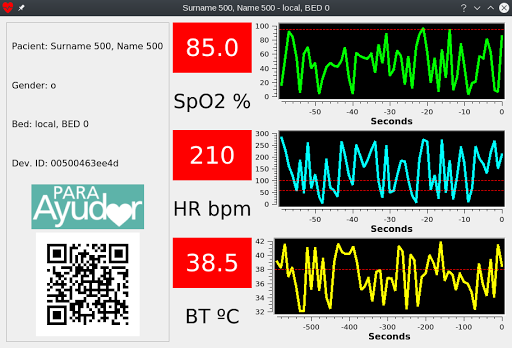
This is where the idea of remotely monitored devices came in, and MoSimPa (from the spanish of "monitoreo simplificado de pacientes en situaci n de internaci n masiva") started to get form. The idea is simple: oximetry (SpO2), heart rate and body temperature will be recorded and, instead of being shown in a display in the device itself, they will be transmitted and monitored in one or more places. In this way medical staff doesn't has to reach a patient constantly and monitoring could be done by medical staff for more patients at the same time. In place monitoring can also happen using a cellphone or tablet.

The devices do not have a screen of their own and almost no buttons, making them more cheap to build and thus more in line with the current economic reality of Argentina.


This is where the project Para Ayudar was created. The project aims to produce the aforementioned non-invasive device to be used in health institutions, hospitals, intra hospital transports and homes.

It is worth to note that the system is designed as a complementary measure for continuous monitoring of a pacient. Care should be taken to check that symptomps and overall patient status don't mean an inmediate life threat. In other words, it is NOT designed for ICUs.

All the above done with Free/Libre/Open Source software and hardware designs. Any manufacturing company can then use them for mass production.

The importance of early pneumonia detection


We were already working in MoSimPa when an NYTimes article caught or attention: "The Infection That s Silently Killing Coronavirus Patients". From the article:

A vast majority of Covid pneumonia patients I met had remarkably low oxygen saturations at triage seemingly incompatible with life but they were using their cellphones as we put them on monitors. Although breathing fast, they had relatively minimal apparent distress, despite dangerously low oxygen levels and terrible pneumonia on chest X-rays.

This greatly reinforced the idea we were on the right track.

The project from a technical standpoint


As the project is primarily designed for and by Argentinians the current system design and software documentation is written in spanish, but the source code (or at least most of it) is written in english. Should anyone need it in english please do not hesitate in asking me.

General system description

System schema

The system is comprised of the devices, a main machine acting as a server (in our case for small setups a Raspberry Pi) and the possibility of accessing data trough cell phones, tablets or other PCs in the network.

The hardware


As of today this is the only part in which I still can't provide schematics, but I'll update this blog post and technical doc with them as soon as I get my hands into them.

Again the design is due to be built in Argentina where getting our hands on hardware is not easy. Moreover it needs to be as cheap as possible, specially now that the Argentinian currency, the peso, is every day more depreciated. So we decided on using an ESP32 as the main microprocessor and a set of Maxim sensors devices. Again, more info when I have them at hand.

The software


Here we have many more components to describe. Firstly the ESP32 code is done with the Arduino SDK. This part of the stack will receive many updates soon, as soon as the first hardware prototypes are out.

For the rest of the stack I decided to go ahead with whatever is available in Debian stable. Why? Well, Raspbian provides a Debian stable-based image and I'm a Debian Developer, so things should go just natural for me in that front. Of course each component has its own packaging. I'm one of Debian's Qt maintainers then using Qt will also be quite natural for me. Plots? Qwt, of course. And with that I have most of my necessities fulfilled. I choose PostgreSql as database server and Mosquitto as MQTT broker.

Between the database and MQTT is mosimpa-datakeeper. The piece of software from which medical staff monitor patients is unsurprisingly called mosimpa-monitor.

mosimpa-monitor
MoSimPa's monitor main screen

mosimpa-monitor plots
Plots of a patient's data


mosimpa-monitor-alarms-setup
Alarm thresholds setup


And for managing patients, devices, locations and internments (CRUD anyone?) there is currently a Qt-based application called mosimpa-abm.

mosimpa-abm
ABM main screen


mosimpa-abm-internments
ABM internments view

The idea is to replace it with a web service so it doesn't needs to be confined to the RPi or require installations in other machines. I considered using webassembly but I would have to also build PostgreSql in order to compile Qt's plugin.

Translations? Of course! As I have already mentioned the code is written in English. Qt allows to easily translate applications, so I keep a Spanish one as the code changes (and we are primarily targeting spanish-speaking people). But of course this also means it can be easily translated to whichever language is necessary.

Even if I am a packager I still have some stuff to fix from the packaging itself, like letting datakeeper run with its own user. I just haven't got to it yet.


Certifications


We are working towards getting the system certified by ANMAT, which is the Argentinian equivalent for EEUU's FDA.

Funding


While all the people involved are working ad-honorem funding is still required in order to buy materials, create the prototypes, etc. The project created payments links with Mercado Pago (in spanish and argentinian pesos) and other bank methods (PDF, also in spanish).

I repeat the links here with an aproximation to US$.

- 500 AR$ (less than 8 US$)
- 1000 AR$ (less than 15 US$)
- 2000 AR$ (less than 30 US$)
- 3000 AR$ (less than 45 US$)
- 5000 AR$ (less than 75 US$)

You can check the actual convertion rate in https://www.google.com/search?q=argentine+peso+to+us+dollars

The project was also presented at a funding call of argentinian Agencia de Promoci n de la Investigaci n, el Desarrollo Tecnol gico y la Innovaci n (Agencia I+D+i). 900+ projects where presented and 64 funded, MoSimPa between them.

31 May 2020

Enrico Zini: Controversial inventors

Paul-F lix Armand-Delille (3 July 1874 in Fourchambault, Ni vre 4 September 1963) was a physician, bacteriologist, professor, and member of the French Academy of Medicine who accidentally brought about the collapse of rabbit populations throughout much of Europe and beyond in the 1950s by infecting them with myxomatosis.
Charles Franklin Kettering (August 29, 1876 November 25, 1958) sometimes known as Charles "Boss" Kettering[1] was an American inventor, engineer, businessman, and the holder of 186 patents.[2] He was a founder of Delco, and was head of research at General Motors from 1920 to 1947. Among his most widely used automotive developments were the electrical starting motor[3] and leaded gasoline.[4][5] In association with the DuPont Chemical Company, he was also responsible for the invention of Freon refrigerant for refrigeration and air conditioning systems. At DuPont he also was responsible for the development of Duco lacquers and enamels, the first practical colored paints for mass-produced automobiles. While working with the Dayton-Wright Company he developed the "Bug" aerial torpedo, considered the world's first aerial missile.[6] He led the advancement of practical, lightweight two-stroke diesel engines, revolutionizing the locomotive and heavy equipment industries. In 1927, he founded the Kettering Foundation, a non-partisan research foundation. He was featured on the cover of Time magazine on January 9, 1933.
John Charles Cutler (June 29, 1915 February 8, 2003) was a senior surgeon, and the acting chief of the venereal disease program in the United States Public Health Service. After his death, his involvement in several controversial and unethical medical studies of syphilis was revealed, including the Guatemala and the Tuskegee syphilis experiments.
Ivy Ledbetter Lee (July 16, 1877 November 9, 1934) was an American publicity expert and a founder of modern public relations. Lee is best known for his public relations work with the Rockefeller family. His first major client was the Pennsylvania Railroad, followed by numerous major railroads such as the New York Central, the Baltimore and Ohio, and the Harriman lines such as the Union Pacific. He established the Association of Railroad Executives, which included providing public relations services to the industry. Lee advised major industrial corporations, including steel, automobile, tobacco, meat packing, and rubber, as well as public utilities, banks, and even foreign governments. Lee pioneered the use of internal magazines to maintain employee morale, as well as management newsletters, stockholder reports, and news releases to the media. He did a great deal of pro bono work, which he knew was important to his own public image, and during World War I, he became the publicity director for the American Red Cross.[1]

25 May 2020

Russ Allbery: Review: The Last Emperox

Review: The Last Emperox, by John Scalzi
Series: Interdependency #3
Publisher: Tor
Copyright: April 2020
ISBN: 0-7653-8917-7
Format: Kindle
Pages: 318
This is the conclusion of the Interdependency trilogy, which is a single story told in three books. Start with The Collapsing Empire. You don't want to read this series out of order. All the pieces and players are in place, the causes and timeline of the collapse of the empire she is accidentally ruling are now clear, and Cardenia Wu-Patrick knows who her friends and enemies are. What she doesn't know is what she can do about it. Her enemies, unfettered Cardenia's ethics or desire to save the general population, have the advantage of clearer and more achievable goals. If they survive and, almost as important, remain in power, who cares what happens to everyone else? As with The Consuming Fire, the politics may feel a bit too on-the-nose for current events, this time for the way that some powerful people are handling (or not handling) the current pandemic. Also as with The Consuming Fire, Scalzi's fast-moving story, likable characters, banter, and occasional humorous descriptions prevent those similarities from feeling heavy or didactic. This is political wish fulfillment to be sure, but it doesn't try to justify itself or linger too much on its improbabilities. It's a good story about entertaining people trying (mostly) to save the world with a combination of science and political maneuvering. I picked up The Last Emperox as a palate cleanser after reading Gideon the Ninth, and it provided exactly what I was looking for. That gave me an opportunity to think about what Scalzi does in his writing, why his latest novel was one of my first thoughts for a palate cleanser, and why I react to his writing the way that I do. Scalzi isn't a writer about whom I have strong opinions. In my review of The Collapsing Empire, I compared his writing to the famous description of Asimov as the "default voice" of science fiction, but that's not quite right. He has a distinct and easily-recognizable style, heavy on banter and light-hearted description. But for me his novels are pleasant, reliable entertainment that I forget shortly after reading them. They don't linger or stand out, even though I enjoy them while I'm reading them. That's my reaction. Others clearly do not have that reaction, fully engage with his books, and remember them vividly. That indicates to me that there's something his writing is doing that leaves substantial room for difference of personal taste and personal reaction to the story, and the sharp contrast between The Last Emperox and Gideon the Ninth helped me put my finger on part of it. I don't feel like Scalzi's books try to tell me how to feel about the story. There's a moment in The Last Emperox where Cardenia breaks down crying over an incredibly difficult decision that she's made, one that the readers don't find out about until later. In another book, there would be considerably more emotional build-up to that moment, or at least some deep analysis of it later once the decision is revealed. In this book, it's only a handful of paragraphs and then a few pages of processing later, primarily in dialogue, and less focused on the emotions of the characters than on the forward-looking decisions they've made to deal with those emotions. The emotion itself is subtext. Many other authors would try to pull the reader into those moments and make them feel what the characters are feeling. Scalzi just relates them, and leaves the reader free to feel what they choose to feel. I don't think this is a flaw (or a merit) in Scalzi's writing; it's just a difference, and exactly the difference that made me reach for this book as an emotional break after a book that got its emotions all over the place. Calling Scalzi's writing emotionally relaxing isn't quite right, but it gives me space to choose to be emotionally relaxed if I want to be. I can pick the level of my engagement. If I want to care about these characters and agonize over their decisions, there's enough information here to mull over and use to recreate their emotional states. If I just want to read a story about some interesting people and not care too much about their hopes and dreams, I can choose to do that instead, and the book won't fight me. That approach lets me sidle up on the things that I care about and think about them at my leisure, or leave them be. This approach makes Scalzi's books less intense than other novels for me. This is where personal preference comes in. I read books in large part to engage emotionally with the characters, and I therefore appreciate books that do a lot of that work for me. Scalzi makes me do the work myself, and the result is not as effective for me, or as memorable. I think this may be part of what I and others are picking up on when we say that Scalzi's writing is reminiscent of classic SF from decades earlier. It used to be common for SF to not show any emotional vulnerability in the main characters, and to instead focus on the action plot and the heroics and martial virtues. This is not what Scalzi is doing, to be clear; he has a much better grasp of character and dialogue than most classic SF, adds considerable light-hearted humor, and leaves clear clues and hooks for a wide range of human emotions in the story. But one can read Scalzi in that tone if one wants to, since the emotional hooks do not grab hard at the reader and dig in. By comparison, you cannot read Gideon the Ninth without grappling with the emotions of the characters. The book will not let you. I think this is part of why Scalzi is so consistent for me. If you do not care deeply about Gideon Nav, you will not get along with Gideon the Ninth, and not everyone will. But several main characters in The Last Emperox (Mance and to some extent Cardenia) did little or nothing for me emotionally, and it didn't matter. I liked Kiva and enjoyed watching her strategically smash her way through social conventions, but it was easy to watch her from a distance and not get too engrossed in her life or her thoughts. The plot trundled along satisfyingly, regardless. That lack of emotional involvement precludes, for me, a book becoming the sort of work that I will rave about and try to press into other people's hands, but it also makes it comfortable and gentle and relaxing in a way that a more emotionally fraught book could not be. This is a long-winded way to say that this was a satisfying conclusion to a space opera trilogy that I enjoyed reading, will recommend mildly to others, and am already forgetting the details of. If you liked the first two books, this is an appropriate and fun conclusion with a few new twists and a satisfying amount of swearing (mostly, although not entirely, from Kiva). There are a few neat (albeit not horribly original) bits of world-building, a nice nod to and subversion of Asimov, a fair bit of political competency wish fulfillment (which I didn't find particularly believable but also didn't mind being unbelievable), and one enjoyable "oh no she didn't" moment. If you like the thing that Scalzi is doing, you will enjoy this book. Rating: 8 out of 10

18 May 2020

Russell Coker: A Good Time to Upgrade PCs

PC hardware just keeps getting cheaper and faster. Now that so many people have been working from home the deficiencies of home PCs are becoming apparent. I ll give Australian prices and URLs in this post, but I think that similar prices will be available everywhere that people read my blog. From MSY (parts list PDF ) [1] 120G SATA SSDs are under $50 each. 120G is more than enough for a basic workstation, so you are looking at $42 or so for fast quiet storage or $84 or so for the same with RAID-1. Being quiet is a significant luxury feature and it s also useful if you are going to be in video conferences. For more serious storage NVMe starts at around $100 per unit, I think that $124 for a 500G Crucial NVMe is the best low end option (paying $95 for a 250G Kingston device doesn t seem like enough savings to be worth it). So that s $248 for 500G of very fast RAID-1 storage. There s a Samsung 2TB NVMe device for $349 which is good if you need more storage, it s interesting to note that this is significantly cheaper than the Samsung 2TB SSD which costs $455. I wonder if SATA SSD devices will go away in the future, it might end up being SATA for slow/cheap spinning media and M.2 NVMe for solid state storage. The SATA SSD devices are only good for use in older systems that don t have M.2 sockets on the motherboard. It seems that most new motherboards have one M.2 socket on the motherboard with NVMe support, and presumably support for booting from NVMe. But dual M.2 sockets is rare and the price difference is significantly greater than the cost of a PCIe M.2 card to support NVMe which is $14. So for NVMe RAID-1 it seems that the best option is a motherboard with a single NVMe socket (starting at $89 for a AM4 socket motherboard the current standard for AMD CPUs) and a PCIe M.2 card. One thing to note about NVMe is that different drivers are required. On Linux this means means building a new initrd before the migration (or afterwards when booted from a recovery image) and on Windows probably means a fresh install from special installation media with NVMe drivers. All the AM4 motherboards seem to have RADEON Vega graphics built in which is capable of 4K resolution at a stated refresh of around 24Hz. The ones that give detail about the interfaces say that they have HDMI 1.4 which means a maximum of 30Hz at 4K resolution if you have the color encoding that suits text (IE for use other than just video). I covered this issue in detail in my blog post about DisplayPort and 4K resolution [2]. So a basic AM4 motherboard won t give great 4K display support, but it will probably be good for a cheap start. $89 for motherboard, $124 for 500G NVMe, $344 for a Ryzen 5 3600 CPU (not the cheapest AM4 but in the middle range and good value for money), and $99 for 16G of RAM (DDR4 RAM is cheaper than DDR3 RAM) gives the core of a very decent system for $656 (assuming you have a working system to upgrade and peripherals to go with it). Currently Kogan has 4K resolution monitors starting at $329 [3]. They probably won t be the greatest monitors but my experience of a past cheap 4K monitor from Kogan was that it is quite OK. Samsung 4K monitors started at about $400 last time I could check (Kogan currently has no stock of them and doesn t display the price), I d pay an extra $70 for Samsung, but the Kogan branded product is probably good enough for most people. So you are looking at under $1000 for a new system with fast CPU, DDR4 RAM, NVMe storage, and a 4K monitor if you already have the case, PSU, keyboard, mouse, etc. It seems quite likely that the 4K video hardware on a cheap AM4 motherboard won t be that great for games and it will definitely be lacking for watching TV documentaries. Whether such deficiencies are worth spending money on a PCIe video card (starting at $50 for a low end card but costing significantly more for 3D gaming at 4K resolution) is a matter of opinion. I probably wouldn t have spent extra for a PCIe video card if I had 4K video on the motherboard. Not only does using built in video save money it means one less fan running (less background noise) and probably less electricity use too. My Plans I currently have a workstation with 2*500G SATA SSDs in a RAID-1 array, 16G of RAM, and a i5-2500 CPU (just under 1/4 the speed of the Ryzen 5 3600). If I had hard drives then I would definitely buy a new system right now. But as I have SSDs that work nicely (quiet and fast enough for most things) and almost all machines I personally use have SSDs (so I can t get a benefit from moving my current SSDs to another system) I would just get CPU, motherboard, and RAM. So the question is whether to spend $532 for more than 4* the CPU performance. At the moment I ll wait because I ll probably get a free system with DDR4 RAM in the near future, while it probably won t be as fast as a Ryzen 5 3600, it should be at least twice as fast as what I currently have.

17 May 2020

Erich Schubert: Contact Tracing Apps are Useless

Some people believe that automatic contact tracing apps will help contain the Coronavirus epidemic. They won t. Sorry to bring the bad news, but IT and mobile phones and artificial intelligence will not solve every problem. In my opinion, those that promise to solve these things with artificial intelligence / mobile phones / apps / your-favorite-buzzword are at least overly optimistic and blinder Aktionismus (*), if not naive, detachted from reality, or fraudsters that just want to get some funding. (*) there does not seem to be an English word for this doing something just for the sake of doing something, without thinking about whether it makes sense to do so Here are the reasons why it will not work:
  1. Signal quality. Forget detecting proximity with Bluetooth Low Energy. Yes, there are attempts to use BLE beacons for indoor positioning. But these use that you can learn fingerprints of which beacons are visible at which points, combined with additional information such as movement sensors and history (you do not teleport around in a building). BLE signals and antennas apparently tend to be very prone to orientation differences, signal reflections, and of course you will not have the idealized controlled environment used in such prototypes. The contacts have a single device, and they move this is not comparable to indoor positioning. I strongly doubt you can tell whether you are close to someone, or not.
  2. Close vs. protection. The app cannot detect protection in place. Being close to someone behind a plexiglass window or even a solid wall is very different from being close otherwise. You will get a lot of false contacts this way. That neighbor that you have never seen living in the appartment above will likely be considered a close contact of yours, as you sleep next to each other every day
  3. Low adoption rates. Apparently even in technology affine Singapore, fewer than 20% of people installed the app. That does not even mean they use it regularly. In Austria, the number is apparently below 5%, and people complain that it does not detect contact But in order for this approach to work, you will need Chinese-style mass surveillance that literally puts you in prison if you do not install the app.
  4. False alerts. Because of these issues, you will get false alerts, until you just do not care anymore.
  5. False sense of security. Honestly: the app does not pretect you at all. All it tries to do is to make the tracing of contacts easier. It will not tell you reliably if you have been infected (as mentioned above, too many false positives, too few users) nor that you are relatively safe (too few contacts included, too slow testing and reporting). It will all be on the quality of about 10 days ago you may or may not have contact with someone that tested positive, please contact someone to expose more data to tell you that it is actually another false alert .
  6. Trust. In Germany, the app will be operated by T-Systems and SAP. Not exactly two companies that have a lot of fans SAP seems to be one of the most hated software around. Neither company is known for caring about privacy much, but they are prototypical for business first . Its trust the cat to keep the cream. Yes, I know they want to make it open-source. But likely only the client, and you will still have to trust that the binary in the app stores is actually built from this source code, and not from a modified copy. As long as the name T-Systems and SAP are associated to the app, people will not trust it. Plus, we all know that the app will be bad, given the reputation of these companies at making horrible software systems
  7. Too late. SAP and T-Systems want to have the app ready in mid June. Seriously, this must be a joke? It will be very buggy in the beginning (because it is SAP!) and it will not be working reliably before end of July. There will not be a substantial user before fall. But given the low infection rates in Germany, nobody will bother to install it anymore, because the perceived benefit is 0 one the infection rates are low.
  8. Infighting. You may remember that there was the discussion before that there should be a pan-european effort. Except that in the end, everybody fought everybody else, countries went into different directions and they all broke up. France wanted a centralized systems, while in Germany people pointed out that the users will not accept this and only a distributed system will have a chance. That failed effort was known as Pan-European Privacy-Preserving Proximity Tracing (PEPP-PT) vs. Decentralized Privacy-Preserving Proximity Tracing (DP-3T) , and it turned out to have become a big clusterfuck . And that is just the tip of the iceberg.
Iceleand, probably the country that handled the Corona crisis best (they issued a travel advisory against Austria, when they were still happily spreading the virus at apres-ski; they massively tested, and got the infections down to almost zero within 6 weeks), has been experimenting with such an app. Iceland as a fairly close community managed to have almost 40% of people install their app. So did it help? No: The technology is more or less I wouldn t say useless [ ] it wasn t a game changer for us. The contact tracing app is just a huge waste of effort and public money. And pretty much the same applies to any other attempts to solve this with IT. There is a lot of buzz about solving the Corona crisis with artificial intelligence: bullshit! That is just naive. Do not speculate about magic power of AI. Get the data, understand the data, and you will see it does not help. Because its real data. Its dirty. Its late. Its contradicting. Its incomplete. It is all what AI currently can not handle well. This is not image recognition. You have no labels. Many of the attempts in this direction already fail at the trivial 7-day seasonality you observe in the data For example, the widely known John Hopkins Has the curve flattened trend has a stupid, useless indicator based on 5 day averages. And hence you get the weekly up and downs due to weekends. They show pretty up and down indicators. But these are affected mostly by the day of the week. And nobody cares. Notice that they currently even have big negative infections in their plots? There is no data on when someone was infected. Because such data simply does not exist. What you have is data when someone tested positive (mostly), when someone reported symptons (sometimes, but some never have symptoms!), and when someone dies (but then you do not know if it was because of Corona, because of other issues that became just worse because of Corona, or hit by a car without any relation to Corona). The data that we work with is incredibly delayed, yet we pretend it is live . Stop reading tea leaves. Stop pretending AI can save the world from Corona.

14 May 2020

Iustin Pop: New internet provider

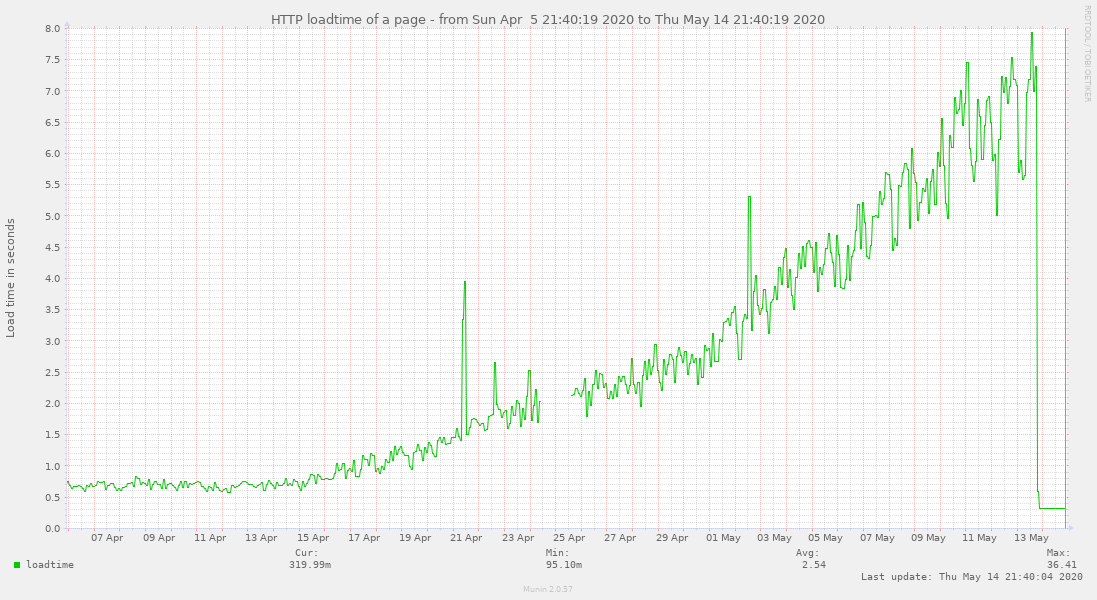
Note: all this is my personal experience, on my personal machines, and I don t claim it to be the absolute truth. Also, I don t directly call out names, although if you live in Switzerland it s pretty easy to guess who the old provider is from some hints. For a long time, I wanted to move away from my current (well, now past) provider, for a multitude of reasons. The main being that the company is very classic company, with classic support system, that doesn t work very well - I had troubles with their billing system that left me out cold without internet for 15 days, but for the recent few years, they were mostly OK, and changing to a different provider would have meant me routing a really long Ethernet cable around the apartment, so I kept postponing it. Yes, self-inflicted pain, I know. Until the entire work-from-home thing, when the usually stable connection start degrading in a very linear fashion day-by-day (this is a graph that basically reflects download bandwidth):
1+ month download bandwidth test 1+ month download bandwidth test
At first, I didn t realise this, as even 100Mbps is still fast enough. But once the connection went below (I believe) 50Mbps, it became visible in day to day work. And since I work daily from home yeah. Not fun. So I started doing speedtest.net - and oh my, ~20Mbps was a good result, usually 12-14Mbps. On a wired connection. On a connection that officially is supposed to be 600Mbps down. The upload speed was spot on, so I didn t think it was my router, but: Nothing helped. Once in a blue moon, speedtest would give me 100Mbps, but like once every two days, then it would be back and showing 8Mbps. Eight! It ended up as even apt update was tediously slow, and kernel downloads took ages The official instructions for dealing with bad internet are a joke: And the best part: If you are not satisfied with the results, read our internet optimisation guide. If you are still not happy, use our community forums or our social platforms. Given that it was a decline over 3-weeks, that I don t know of any computer component that would degrade this steadily but not throw any other errors, and that my upload speed was all good, I assumed it s the provider. Maybe I was wrong, but I wanted to do this anyway for a long while, so I went through the find how to route cable, check if other provider socket is good, order service, etc. dance, and less than a week later, I had the other connection. Now, of course, bandwidth works as expected:
1+ month updated bandwidth test 1+ month updated bandwidth test
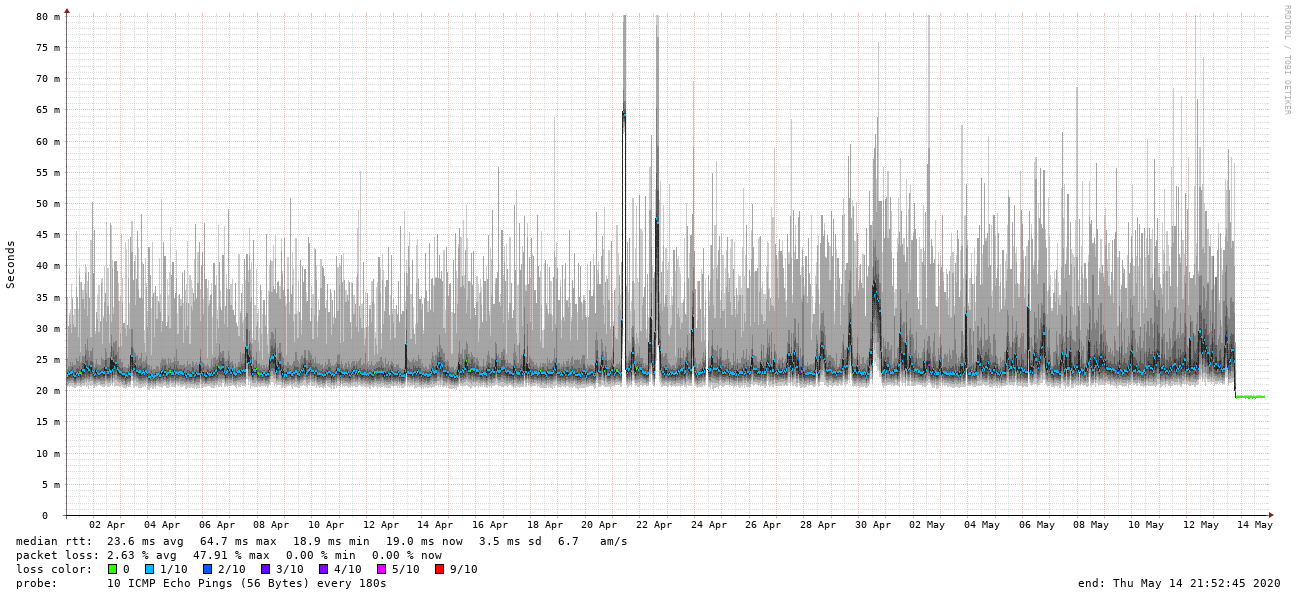
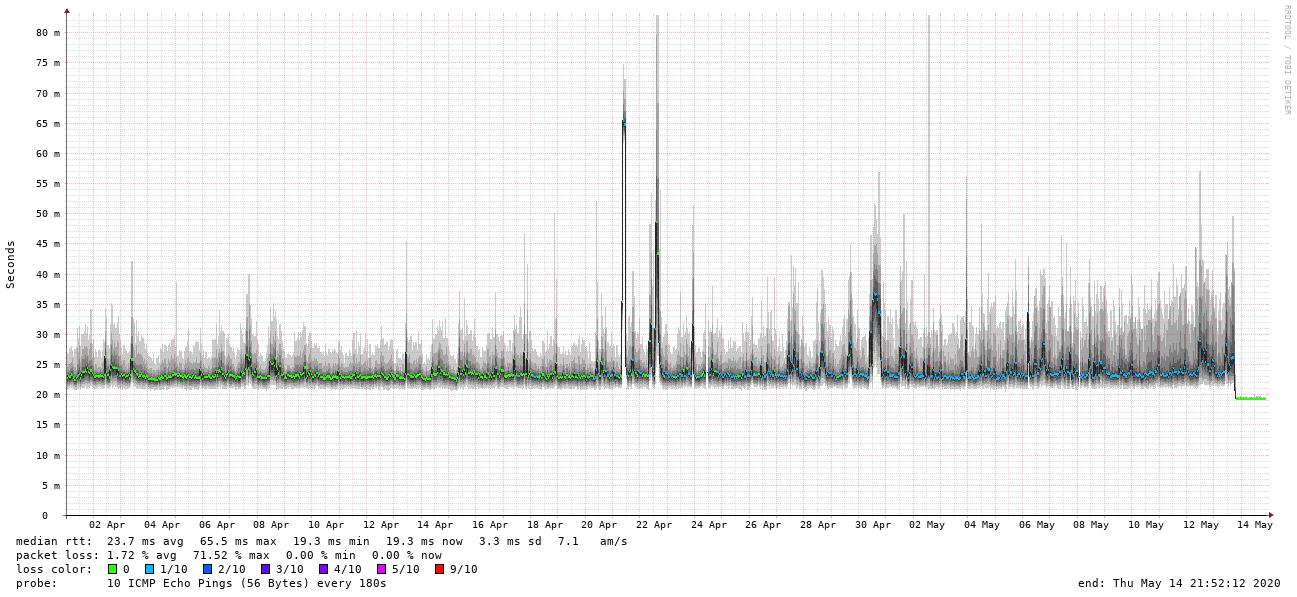
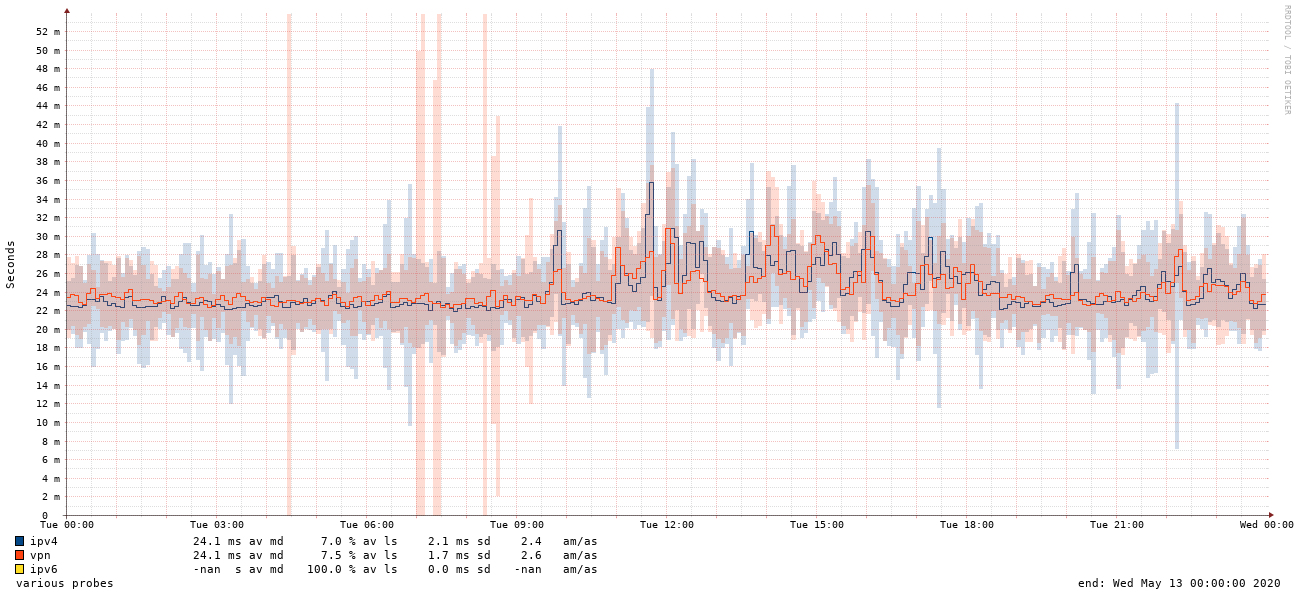
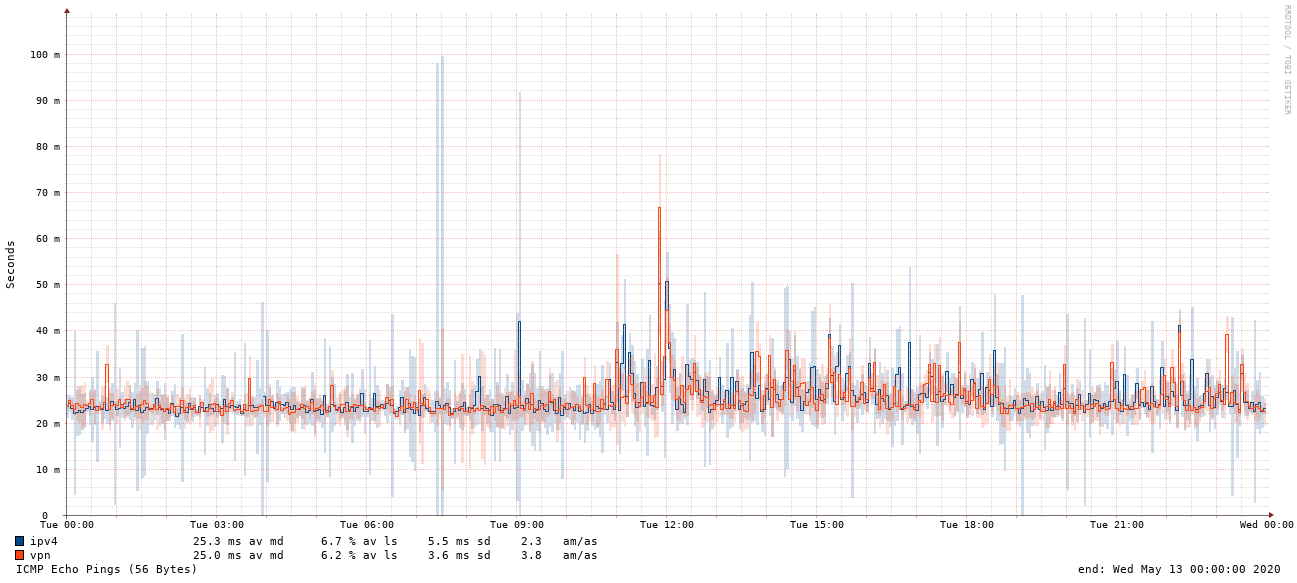
Both download and upload are fine (the graph above is just download). Latency is also much better, towards many parts of the internet that matter. But what is shocking is the difference in jitter to some external hosts I care about. On the previous provider, a funny thing was that both outgoing and incoming pings had both more jitter and packet loss when done directly (IPv4 to IPv4) than when done over a VPN. This doesn t make sense, since VPN is just overhead over IPv4, but the graphs show it, and what I think happens is that a VPN flow is cached in the provider s routers, whereas a simple ping packet not. But, the fact that there s enough jitter for a ping to a not-very-far host doesn t make me happy. Examples, outgoing:
Outgoing smokeping to public IPv4 Outgoing smokeping to public IPv4
Outgoing smokeping over VPN Outgoing smokeping over VPN
And incoming:
Incoming smokeping to public IPv4 Incoming smokeping to public IPv4
Incoming smokeping over VPN Incoming smokeping over VPN
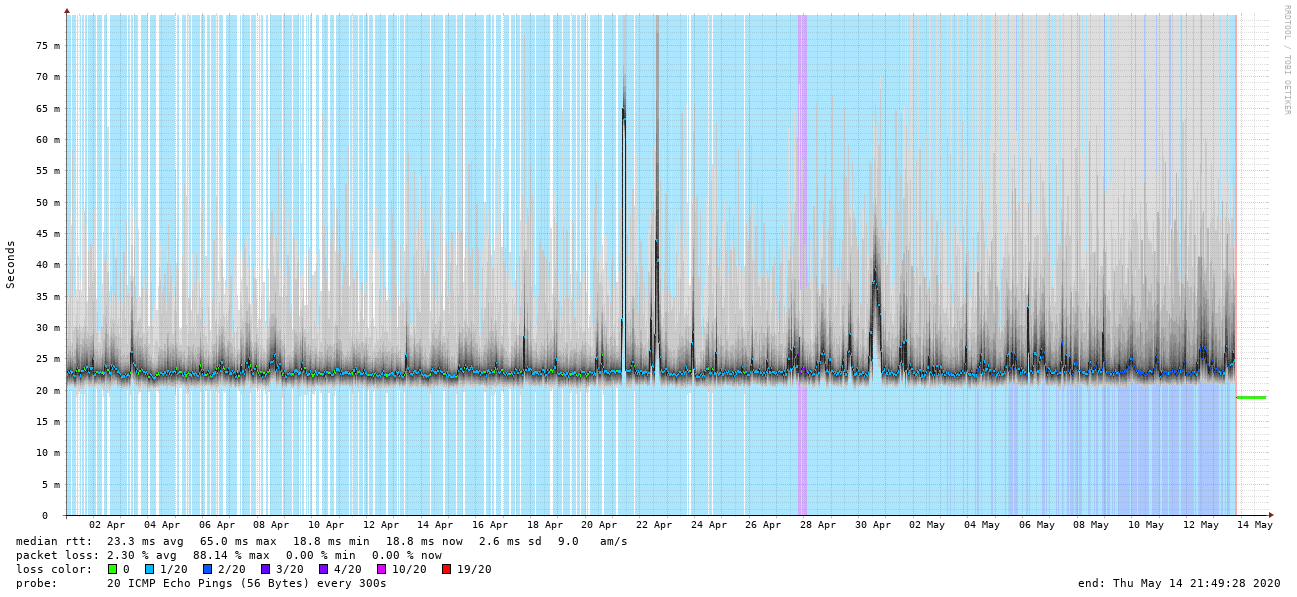
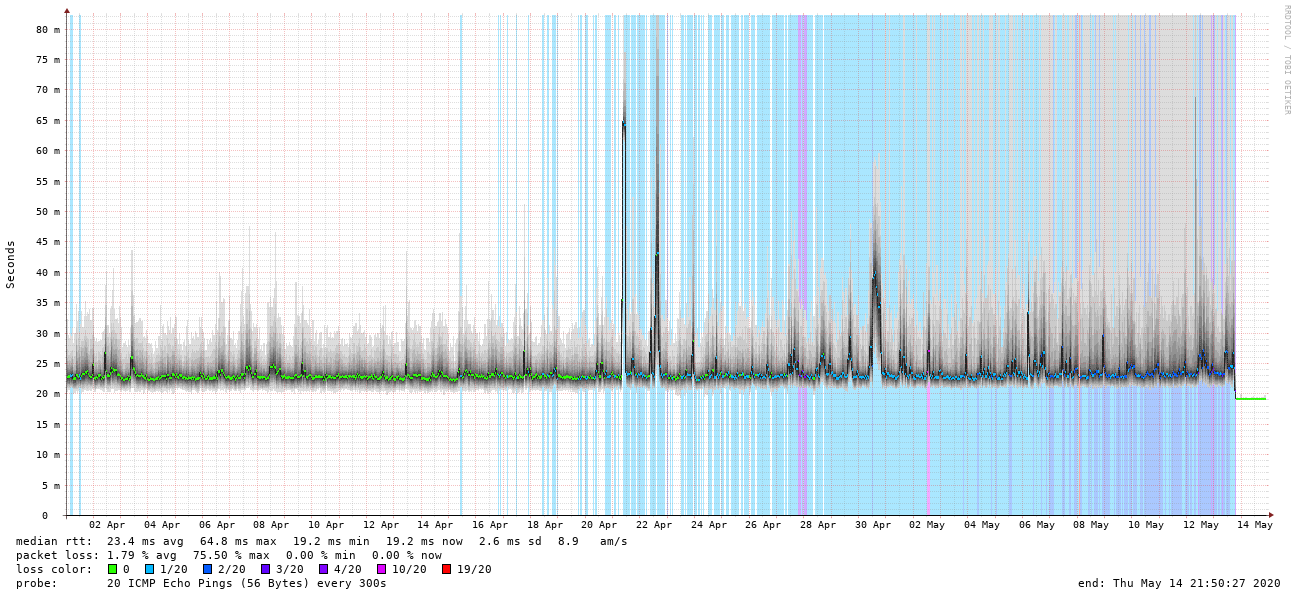
Both incoming and outgoing show this weirdness - more packet loss and more jitter over VPN. Again, this is not a problem in practice, or not much, but makes me wonder what other shenanigans happen behind the scenes. You can also see clearly when the work from home traffic entered the picture and started significantly degrading my connection, even over the magically better VPN connection. Switching to this week s view shows the (in my opinion) dramatic improvement in consistency of the connection:
Outgoing current week smokeping to public IPv4 Outgoing current week smokeping to public IPv4
Outgoing current week smokeping over VPN Outgoing current week smokeping over VPN
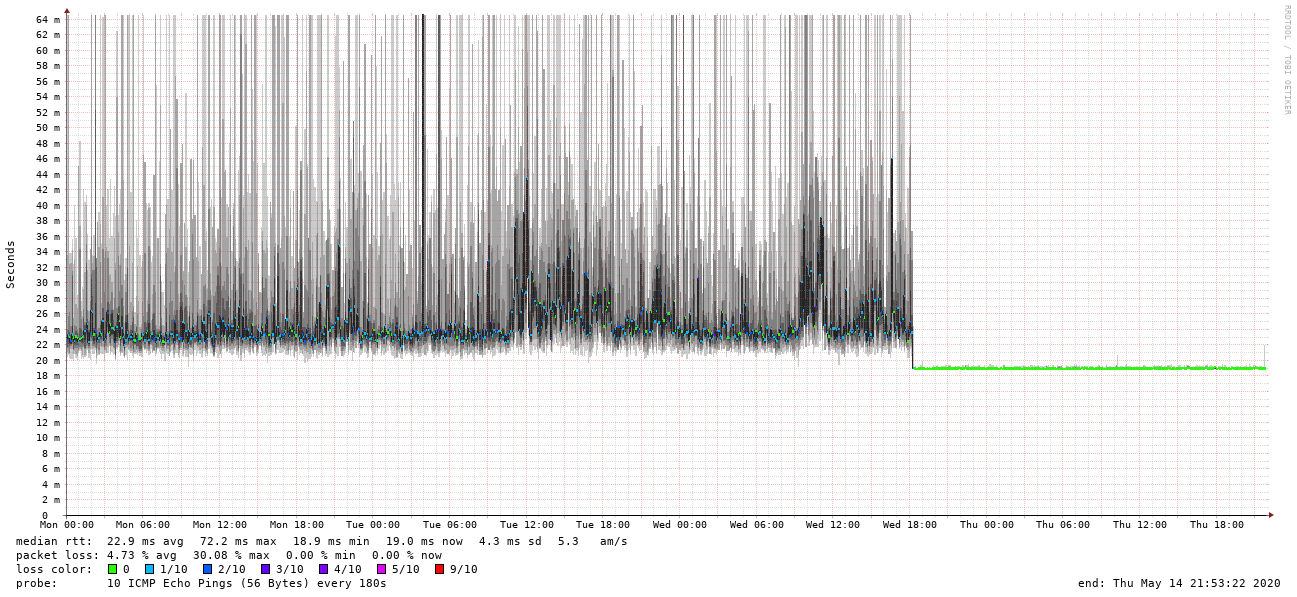
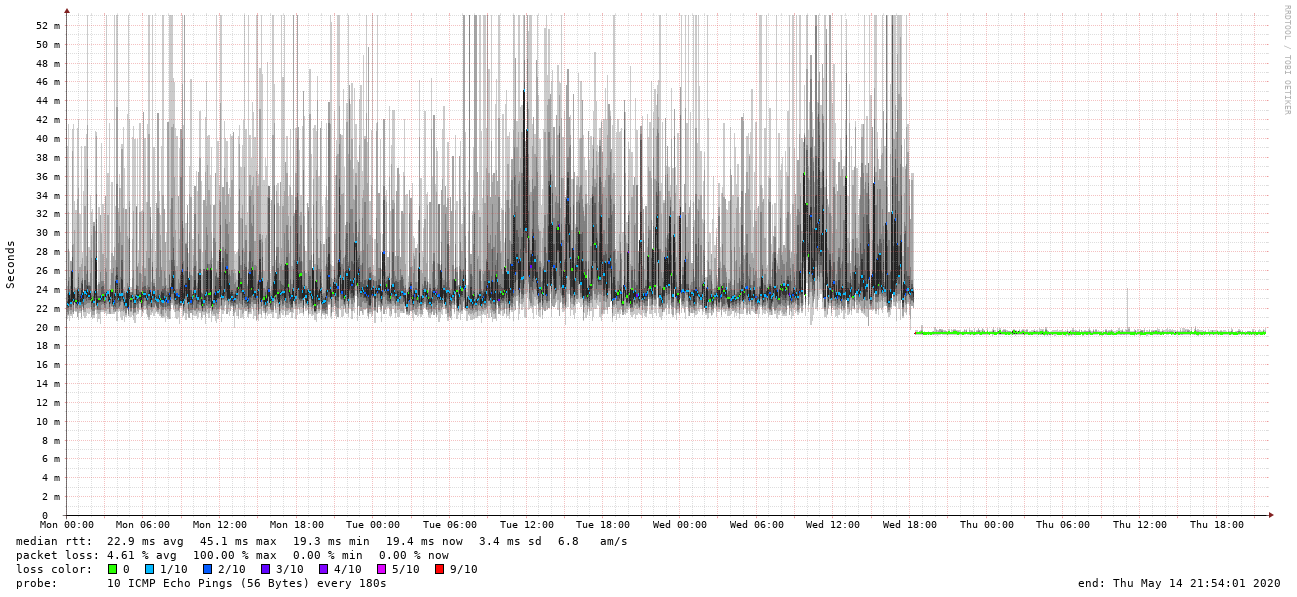
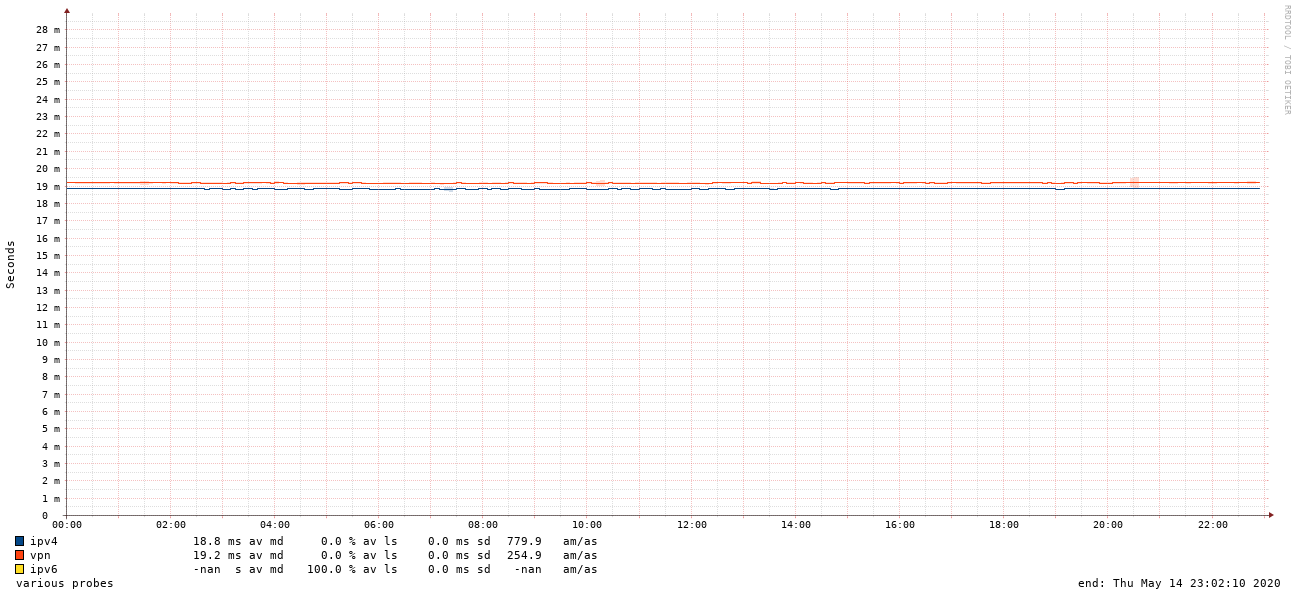
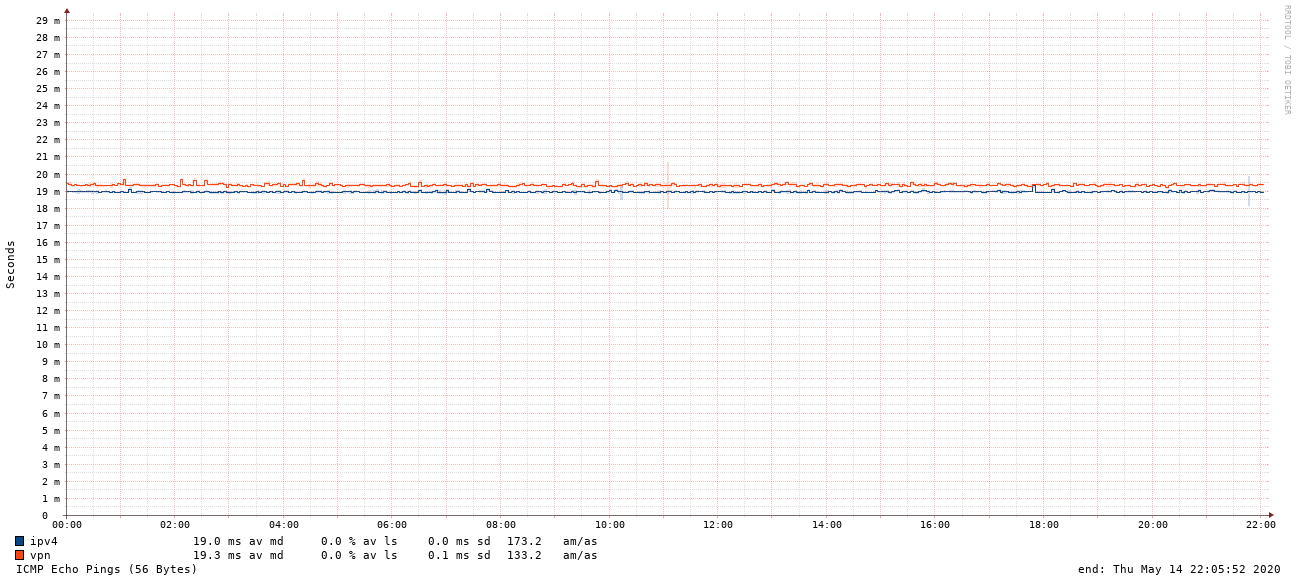
No more packet loss, no more jitter. You can also see my VPN being temporarily down during provider switchover because my firewall was not quite correct for a moment. And the last drill down, at high resolution, one day before and one day after switchover. Red is VPN, blue is plain IPv4, yellow is the missing IPv6 connection :) Incoming old:
Incoming 1-day smokeping, old provider Incoming 1-day smokeping, old provider
and new:
Incoming 1-day smokeping, new provider Incoming 1-day smokeping, new provider
Outgoing old:
Outgoing 1-day smokeping, old provider Outgoing 1-day smokeping, old provider
and new:
Outgoing 1-day smokeping, new provider Outgoing 1-day smokeping, new provider
This is what I expect, ping-over-VPN should of course be slower than plain ping. Note that incoming and outgoing have slightly different consistency, but that is fine for me :) The endpoints doing the two tests are different, so this is expected. Reading the legend on the graphs for the incoming connection (similar story for outgoing): So to my previous provider: it can be done better. Or at least, allow people easier ways to submit performance issue problems. For me, the moral of the story is that I should have switched a couple of years ago, instead of being lazy. And that I m curious to see how IPv6 traffic will differ, if at all :) Take care, everyone! And thanks for looking at these many graphs :)

10 May 2020

Russ Allbery: Review: Golden Gates

Review: Golden Gates, by Conor Dougherty
Publisher: Penguin
Copyright: 2020
ISBN: 0-525-56022-X
Format: Kindle
Pages: 249
This review, for reasons that will hopefully become clear later, starts with a personal digression. I have been interested in political theory my entire life. That sounds like something admirable, or at least neutral. It's not. "Interested" means that I have opinions that are generally stronger than my depth of knowledge warrants. "Interested" means that I like thinking about and casting judgment on how politics should be done without doing the work of politics myself. And "political theory" is different than politics in important ways, not the least of which is that political actions have rarely been a direct danger to me or my family. I have the luxury of arguing about politics as a theory. In short, I'm at high risk of being one of those people who has an opinion about everything and shares it on Twitter. I'm still in the process (to be honest, near the beginning of the process) of making something useful out of that interest. I've had some success when I become enough a part of a community that I can do some of the political work, understand the arguments at a level deeper than theory, and have to deal with the consequences of my own opinions. But those communities have been on-line and relatively low stakes. For the big political problems, the ones that involve governments and taxes and laws, those that decide who gets medical treatment and income support and who doesn't, to ever improve, more people like me need to learn enough about the practical details that we can do the real work of fixing them, rather than only making our native (and generally privileged) communities better for ourselves. I haven't found my path helping with that work yet. But I do have a concrete, challenging, local political question that makes me coldly furious: housing policy. Hence this book. Golden Gates is about housing policy in the notoriously underbuilt and therefore incredibly expensive San Francisco Bay Area, where I live. I wanted to deepen that emotional reaction to the failures of housing policy with facts and analysis. Golden Gates does provide some of that. But this also turns out to be a book about the translation of political theory into practice, about the messiness and conflict that results, and about the difficult process of measuring success. It's also a book about how substantial agreement on the basics of necessary political change can still founder on the shoals of prioritization, tribalism, and people who are interested in political theory. In short, it's a book about the difficulty of changing the world instead of arguing about how to change it. This is not a direct analysis of housing policy, although Dougherty provides the basics as background. Rather, it's the story of the political fight over housing told primarily through two lenses: Sonja Trauss, founder of BARF (the Bay Area Renters' Federation); and a Redwood City apartment complex, the people who fought its rent increases, and the nun who eventually purchased it. Around that framework, Dougherty writes about the Howard Jarvis Taxpayers Association and the history of California's Proposition 13, a fight over a development in Lafayette, the logistics challenge of constructing sufficient housing even when approved, and the political career of Scott Wiener, the hated opponent of every city fighting for the continued ability to arbitrarily veto any new housing. One of the things Golden Gates helped clarify for me is that there are three core interest groups that have to be part of any discussion of Bay Area housing: homeowners who want to limit or eliminate local change, renters who are vulnerable to gentrification and redevelopment, and the people who want to live in that area and can't (which includes people who want to move there, but more sympathetically includes all the people who work there but can't afford to live locally, such as teachers, day care workers, food service workers, and, well, just about anyone who doesn't work in tech). (As with any political classification, statements about collectives may not apply to individuals; there are numerous people who appear to fall into one group but who vote in alignment with another.) Dougherty makes it clear that housing policy is intractable in part because the policies that most clearly help one of those three groups hurt the other two. As advertised by the subtitle, Dougherty's focus is on the fight for more housing. Those who already own homes whose values have been inflated by artificial scarcity, or who want to preserve such stratified living conditions as low-density, large-lot single-family dwellings within short mass-transit commute of one of the densest cities in the United States, don't get a lot of sympathy or focus here except as opponents. I understand this choice; I also don't have much sympathy. But I do wish that Dougherty had spent more time discussing the unsustainable promise that California has implicitly made to homeowners: housing may be impossibly expensive, but if you can manage to reach that pinnacle of financial success, the ongoing value of your home is guaranteed. He does mention this in passing, but I don't think he puts enough emphasis on the impact that a single huge, illiquid investment that is heavily encouraged by government policy has on people's attitude towards anything that jeopardizes that investment. The bulk of this book focuses on the two factions trying to make housing cheaper: Sonja Trauss and others who are pushing for construction of more housing, and tenant groups trying to manage the price of existing housing for those who have to rent. The tragedy of Bay Area housing is that even the faintest connection of housing to the economic principle of supply and demand implies that the long-term goals of those two groups align. Building more housing will decrease the cost of housing, at least if you build enough of it over a long enough period of time. But in the short term, particularly given the amount of Bay Area land pre-emptively excluded from housing by environmental protection and the actions of the existing homeowners, building more housing usually means tearing down cheap lower-density housing and replacing it with expensive higher-density housing. And that destroys people's lives. I'll admit my natural sympathy is with Trauss on pure economic grounds. There simply aren't enough places to live in the Bay Area, and the number of people in the area will not decrease. To the marginal extent that growth even slows, that's another tale of misery involving "super commutes" of over 90 minutes each way. But the most affecting part of this book was the detailed look at what redevelopment looks like for the people who thought they had housing, and how it disrupts and destroys existing communities. It's impossible to read those stories and not be moved. But it's equally impossible to not be moved by the stories of people who live in their cars during the week, going home only on weekends because they have to live too far away from their jobs to commute. This is exactly the kind of politics that I lose when I take a superficial interest in political theory. Even when I feel confident in a guiding principle, the hard part of real-world politics is bringing real people with you in the implementation and mitigating the damage that any choice of implementation will cause. There are a lot of details, and those details matter. Without the right balance between addressing a long-term deficit and providing short-term protection and relief, an attempt to alleviate unsustainable long-term misery creates more short-term misery for those least able to afford it. And while I personally may have less sympathy for the relatively well-off who have clawed their way into their own mortgage, being cavalier with their goals and their financial needs is both poor ethics and poor politics. Mobilizing political opponents who have resources and vote locally isn't a winning strategy. Dougherty is a reporter, not a housing or public policy expert, so Golden Gates poses problems and tells stories rather than describes solutions. This book didn't lead me to a brilliant plan for fixing the Bay Area housing crunch, or hand me a roadmap for how to get effectively involved in local politics. What it did do is tell stories about what political approaches have worked, how they've worked, what change they've created, and the limitations of that change. Solving political problems is work. That work requires understanding people and balancing concerns, which in turn requires a lot of empathy, a lot of communication, and sometimes finding a way to make unlikely allies. I'm not sure how broad the appeal of this book will be outside of those who live in the region. Some aspects of the fight for housing generalize, but the Bay Area (and I suspect every region) has properties specific to it or to the state of California. It has also reached an extreme of housing shortage that is rivaled in the United States only by New York City, which changes the nature of the solutions. But if you want to seriously engage with Bay Area housing policy, knowing the background explained here is nearly mandatory. There are some flaws I wish Dougherty would have talked more about traffic and transit policy, although I realize that could be another book but this is an important story told well. If this somewhat narrow topic is within your interests, highly recommended. Rating: 8 out of 10

30 April 2020

Chris Lamb: Free software activities in April 2020

Here is my monthly update covering what I have been doing in the free software world during April 2020 (previous month's report). Looking it over prior to publishing, I am surprised how much I got done this month I felt that I was not only failing to do all the extra things I had planned, but I was doing far less than normal. But let us go easy on ourselves; nobody is nailing this. In addition, I did more hacking on the Lintian static analysis tool for Debian packages:
Reproducible builds One of the original promises of open source software is that distributed peer review and transparency of process results in enhanced end-user security. However, whilst anyone may inspect the source code of free and open source software for malicious flaws, almost all software today is distributed as pre-compiled binaries. This allows nefarious third-parties to compromise systems by injecting malicious code into ostensibly secure software during the various compilation and distribution processes. The motivation behind the Reproducible Builds effort is to ensure no flaws have been introduced during this compilation process by promising identical results are always generated from a given source, thus allowing multiple third-parties to come to a consensus on whether a build was compromised. The initiative is proud to be a member project of the Software Freedom Conservancy, a not-for-profit 501(c)(3) charity focused on ethical technology and user freedom. Conservancy acts as a corporate umbrella allowing projects to operate as non-profit initiatives without managing their own corporate structure. If you like the work of the Conservancy or the Reproducible Builds project, please consider becoming an official supporter. Elsewhere in our tooling, I made the following changes to diffoscope, our in-depth and content-aware diff utility that can locate and diagnose reproducibility issues, including preparing and uploading versions 139, 140, 141 and 142 to Debian: Lastly, I made a large number of changes to our website and documentation in the following categories:
Debian LTS This month I have contributed 18 hours to Debian Long Term Support (LTS) and 7 hours on its sister Extended LTS project. You can find out more about the project via the following video:
Debian I only filed three bugs in April, including one against snapshot.debian.org to report that a Content-Type HTTP header is missing when downloading .deb files (#956471) and to report build failures in the macs & ruby-enumerable-statistics packages:

29 April 2020

Craig Small: Sending data in a signal

The well-known kill system call has been around for decades and is used to send a signal to another process. The most common use is to terminate or kill another process by sending the KILL or TERM signal but it can be used for a form of IPC, usually around giving the other process a kick to do something. One thing that isn t as well known is besides sending a signal to a process, you can send some data to it. This can either be an integer or a pointer and uses similar semantics to the known kill and signal handler. I came across this when there was a merge request for procps. The main changes are using sigqueue instead of kill in the sender and using a signal action not a signal handler in the receiver. To illustrate this feature, I have a small set of programs called sender and receiver that will pass an integer between them. The Sender The sender program is extremely simple, use a random(ish) from time masked to two bytes, put it in the required union and send the lot to sendqueue.
# include <signal.h>
# include <stdlib.h>
# include <stdio.h>
# include <time.h>
int main(int argc, char **argv)
 
    union sigval sigval;
    pid_t pid;
    if (argc < 2   (pid = atoi(argv[1])) < 0)
	return EXIT_FAILURE;
    sigval.sival_int = time(NULL) &amp; 0xff;
    printf("sender: sending %d to PID %d\n",
        sigval.sival_int, pid);
    sigqueue(pid, SIGUSR1, sigval);
    return EXIT_SUCCESS;
 
The key lines are 13 and 16 where the random (ish) integer is stored in the sigval union and then sent to the other process with the sigqueue. The receiver The receiver just sets up the signal handler, sends its PID (so I know what to tell the sender) and sits in a sleeping loop.
# include <stdio.h>
# include <stdlib.h>
# include <sys/types.h>
# include <unistd.h>
# include <signal.h>
void signal_handler(int signum, siginfo_t *siginfo, void *ucontext)
 
    if (signum != SIGUSR1) return;
    if (siginfo->si_code != SI_QUEUE) return;
    printf("receiver: Got value %d\n",
	    siginfo->si_int);
 
int main(int argc, char **argv)
 
    pid_t pid = getpid();
    struct sigaction signal_action;
    printf("receiver: PID is %d\n", pid);
    signal_action.sa_sigaction = signal_handler;
    sigemptyset (&amp;signal_action.sa_mask);
    signal_action.sa_flags = SA_SIGINFO;
    sigaction(SIGUSR1, &amp;signal_action, NULL);
    while(1) sleep(100);
    return EXIT_SUCCESS;
 
Lines 16-26 setup the signal handler. The main difference here is SA_SIGINFO used for the signal flags and sigaction references a sa_sigaction function rather than sa_handler. We need to use a different function because the sigaction only is passed the signal number but we need more information, including the integer that the sender process stored in sigval. Lines 7-14 are the signal handler function itself. It first checks that the receiver process got the correct signal (SIGUSR1 in this case) and that we got this signal from sigqueue because the type is SI_QUEUE. Checking the type of signal is important because different signals give you different data. For example, if you signalled this process with kill then si_int is undefined. The result As a proof of concept, the results are not terribly exciting. We see the sender say what it will be sending and the receiver saying it got it. It was useful to get some results, especially when things went wrong.
$ ./receiver &amp;
[1] 370216
receiver: PID is 370216
$ ./sender 370216
sender: sending 133 to (gdPID 370216
receiver: Got value 133
Gotchas While testing the two process there was two gotchas I encountered. GDB and the siginfo structure The sigaction manual page shows a simple siginfo_t structure, however when looking at what is passed to the signal handler, it s much more complicated.
(gdb) p *siginfo
$2 =  si_signo = 10, si_errno = 0, si_code = -1, __pad0 = 0, _sifields =  _pad =  371539, 1000, 11, 32766, 0 <repeats 24 times> , _kill =  si_pid = 371539, si_uid = 1000 , _timer =  si_tid = 371539, 
      si_overrun = 1000, si_sigval =  sival_int = 11, sival_ptr = 0x7ffe0000000b , _rt =  si_pid = 371539, si_uid = 1000, si_sigval =  sival_int = 11, sival_ptr = 0x7ffe0000000b , _sigchld =  
      si_pid = 371539, si_uid = 1000, si_status = 11, si_utime = 0, si_stime = 0 , _sigfault =  si_addr = 0x3e80005ab53, si_addr_lsb = 11, _bounds =  _addr_bnd =  _lower = 0x0, _upper = 0x0 , _pkey = 0 , 
    _sigpoll =  si_band = 4294967667539, si_fd = 11 , _sigsys =  _call_addr = 0x3e80005ab53, _syscall = 11, _arch = 32766 
(gdb) p siginfo->_sifields._rt.si_sigval.sival_int
$3 = 11
So the integer is stored in a union in a structure in a structure. Much harder to find than just simply sival_int. The pointer is just a pointer So perhaps sending an integer is not enough. The sigval is a union with an integer and a pointer. Could a string be sent instead? I changed line 13 of the sender so it used a string instead of an integer.
    sigval.sival_ptr = "Hello, World!"
The receiver needed a minor adjustment to print out the string. I tried this and the receiver segmentation faulted. What was going on? The issue is the set of system calls does a simple passing of the values. So if the sender sends a pointer to a string located at 0x1234567 then the receiver will have a pointer to the same location. When the receiver tries to dereference the sival_ptr, it is pointing to memory that is not owned by it but by another process (the sender) so it segmentation faults. The solution would be to use shared memory between the processes. The signal queue would then use the pointer to the shared memory and, in theory, all would be well.

13 April 2020

Shirish Agarwal: Migrant worker woes and many other stories

I was gonna use this blog post to share about the migrant worker woes as there has been multiple stories doing the rounds. For e.g. a story which caught the idea of few people but most of us, i.e. middle-class people are so much into our own thing that we care a fig leaf about what happens to migrants. This should not be a story coming from a humane society but it seems India is no different than any other country of the world and in not a good way. Allow me to share
Or for those who don t like youtube, here s an alternative link https://www.invidio.us/watch?v=JGEgZq_1jmc Now the above two editorial shares two stories, one of Trump retaliatory threat to India in the Q&A of the journalist. In fact, Trump has upped the ante on visa sanctions as India buckled so easily under pressure. There have been other stories doing the rounds how people who have illnesses who need HCQ in India are either dying or are close to death because of unavailability of HCQ in the medicine shop. There have been reports in Pune as well as South Mumbai (one of the poshest localities in Mumbai/Bombay) that medicine shops are running empty or emptier. There have been so many stories on that, with reporters going to shops and asking owners of the medicine shops and shop-owners being clueless. I think the best article which vividly describes the Government of India (GOI) response to the pandemic is the free-to-read article shared by Arundhati Roy in Financial Times. It has reduced so much of my work or sharing that it s unbelievable. And she has shared it with pictures and all so I can share other aspects of how the pandemic has been affecting India and bringing the worst out in the Government in its our of need. In fact, not surprisingly though, apparently there was also a pro-Israel similar thing which happened in Africa too . As India has too few friends now globally, hence it decided to give a free pass to them.

Government of India, news agencies and paid News One of the attempts the state tried to do, although very late IMHO is that it tried to reach out to the opposition i.e. Congress party and the others. Mrs. Sonia Gandhi, who is the Congress president asked that the Government should not run any of its ads on private television channels for a period of two years. There had been plenty of articles, both by medianama and others who have alleged that at least from the last 6 odd years, Government ads. comprise of almost 50-60% advertising budget of a channel advertising budget. This has been discussed also in medianama s roundtable on online content which happened few months back. While an edited version is out there on YT, this was full two day s event which happened across two different cities.
or the alternative to youtube https://www.invidio.us/watch?v=c1PhWR1-Urs It was as if the roundtable discussions were not enough, Mrs. Gandhi clarion call was answered by News Broadcaster s Association (NBA) and this is what they had to say
News Broadcasters Association reply to Mrs. Gandhi
To put it simply, NBA deplored the suggestion by Mrs. Gandhi and even called the economy in recession and all they had were the Government s own advertising budget to justify their existence. The statements in themselves are highly pregnant and reveal both the relationship that the media, print or mainstream news channels have with the Government of India. Now if you see that, doesn t it make sense that media always slants the story from the Government s perspective rather than remaining neutral. If my bread basket were on the onus of me siding with the Govt. that is what most sane persons would do, otherwise they would resign and leave which many reporters who had a conscience did. Interestingly enough, the NBA statement didn t just end there but also used the word recession , this is the term that Government of India (GOI) hates and has in turn has been maintaining the word, terminology slowdown . While from a layman s perspective the two terms may seem to be similar, if India has indeed been in recession then the tools and the decisions that should have been taken by GOI should have been much different than what they took. Interestingly, enough GOI has refrained from saying anything on the matter which only reveals their own interests in the matter. Also if an association head is making the statement, it is more than likely that he consulted a lawyer or two and used application of mind while drafting the response. In other words, or put more simply, this was a very carefully drafted letter because they know that tomorrow the opposition party may come into power so they don t want to upset the power dynamics too much.

Privacy issues arising due to the Pandemic On the same Financial Times, two stories which dealt with the possible privacy violations due to the Pandemic have been doing the rounds. The first one, by Yuval Noah Harari is more exploratory by nature and makes some very good points without going far too deep into specific instances of recent times but rather goes into history and past instances where Governments have used the pandemics to exert more control over their populace and drive their agenda. I especially liked the last few lines which he shared in his op-ed Even if the current administration eventually changes tack and comes up with a global plan of action, few would follow a leader who never takes responsibility, who never admits mistakes, and who routinely takes all the credit for himself while leaving all the blame to others. Yuval Noah Harari . The whole statement could right fit onto the American President which he was talking about while at the same time, fits right into the current Indian Prime Minister, Boris Johnson of UK and perhaps Jair Bolsanaro of Brazil. All these three-four individuals have in common is that most of them belong to right-wing and hence cater only to the rich industrialist s agenda. While I don t know about Jair Bolsanaro much, at least three out of four had to turn to socialism and had to give some bailout packages to the public at large, even though continuing to undermine their own actions. More on this probably a bit down the line. The second story shared by Nic Fildes and Javier Espinoza who broke the story of various surveillance attempts and the privacy concerns that people have. Even the Indian PMO has asked this data and because there was no protest by the civil society, a token protest was done by COAI (Cellular Operator Association of India) but beyond that nothing, I am guessing because the civil society didn t make much noise as everybody is busy with their own concerns of safety and things going on, it s possible that such data may have gone to the Government. There is not much new here that people who had been working on the privacy issues know, it s just how easy Governments are finding to do it. The part of informed consent is really a misnomer . Governments lie all the time, for e.g. in the UK, did the leave party and people take informed consent, no they pushed their own agenda. This is and will be similar in many countries of the world.

False Socialism by RW parties In at least the three countries I have observing, simply due to available time, that lot of false promises are being made by our leaders and more often than not, the bailouts will be given to already rich industrialists. An op-ed by Vivek Kaul, who initially went by his handle which means somebody who is educated but unemployed. While Vivek has been one-man army in revealing most of the Government s mischiefs especially as fudging numbers are concerned among other things, there have been others too. As far as the US is concerned, an e-zine called free press (literally) has been sharing Trump s hollowness and proclamations for U.S. . Far more interestingly, I found New York times investigated and found a cache of e-mails starting from early January, which they are calling Red Dawn . The cache is undeniable proof that medical personnel in the U.S. were very much concerned since January 2020 but it was only after other countries started lock-down that U.S. had to follow suit. I am sure Indian medical professionals may have done similar mail exchanges but we will never know as the Indian media isn t independent enough.

Domestic violence and Patriarchy There have been numerous reports of domestic violence against women going up, in fact two prominent publications have shared pieces about how domestic violence has gone up in India since the lockdown but the mainstream press is busy with its own tropes, the reasons already stated above. In fact, interestingly enough, most women can t wear loose fitting clothes inside the house because of the near ones being there 24 7 . This was being shared as India is going through summer where heat waves are common and most families do not have access to A/C s and rely on either a fan or just ventilation to help them out. I can t write more about this as simply I m not a woman so I haven t had to face the pressures that they have to every day. Interestingly though, there was a piece shared by arre. Interestingly, also arre whose content I have shared a few times on my blog has gone from light, funny to be much darker and more serious tone. Whether this is due to the times we live in is something that a social scientist or a social anthropologist may look into in the times to come. One of the good things though, there hasn t been any grid failures as no industrial activity is happening (at all). In fact SEB s (State Electricity Boards) has shown a de-growth in electricity uptake as no industrial activity has been taken. While they haven t reduced any prices (which they ideally should have) as everybody is suffering.

Loot and price rise Again, don t think it is an Indian issue but perhaps may be the same globally. Because of broken supply chains, there are both real and artificial shortages happening which is leading to reasonable and unreasonable price hikes in the market. Fresh veggies which were normally between INR 10/- to INR 20/- for 250 gm have reached INR 40/- 50/- and even above. Many of the things that we have to become depend upon are not there anymore. The shortage of plastic bottles being case in point.
Aryan Plastic bottle
This and many others like these pictures have been shared on social media but it seems the Government is busy doing something else. The only thing we know for sure is that the lock-down period is only gonna increase, no word about PPE s (Personal Protection Equipment) or face masks or anything else. While India has ordered some, those orders are being diverted to US or EU. In fact, many doctors who have asked for the same have been arrested, sacked or suspended for asking such inconvenient questions, although whether in BJP ruled states or otherwise. In fact, the Centre has suspended MPLADS funds , members of parliament get funds which they can use to provide relief work or whatever they think the money is best to spend upon.

Conditions of Labor in the Pandemic Another sort of depressing story has been how the Supreme Court CJI Justice SA Bobde has made statements and refrained from playing any role in directing the Center to provide relief to the daily wage laborers. In fact, Mr. Bobde made statements such as why they need salaries if they are getting food. This was shared by barandbench, a site curated by lawyers and reporters alike. Both livelaw as well as barandbench have worked to enhance people s awareness about the legal happenings in our High Courts and Supreme Court. And while sadly, they cannot cover all, they at least do attempt to cover a bit of what s hot atm. The Chief Justice who draws a salary of INR 250,000 per month besides other perks is perhaps unaware or doesn t care about fate of millions of casual workers, 400 460 million workers who will face abject poverty and by extension even if there are 4 members of the family so probably 1.2 billion people will fall below the poverty line. Three, four major sectors are going to be severely impacted, namely Agriculture, Construction and then MSME (Micro, small and medium enterprises) which cover everything from autos, industrial components, FMCG, electronics, you name it, it s done by the MSME sector. We know that the Rabi crop, even though it was gonna be a bumper crop this year will rot away in the fields. Even the Kharif crop whose window for sowing is at the most 2-3 weeks will not be able to get it done in time. In fact, with the extended lockdown of another 21 days, people will probably return home after 2 months by which time they would have nothing to do there as well as here in the cities. Another good report was done by the wire, the mainstream media has already left the station.

Ministry of Public Health There was an article penned by Dr. Edmond Fernandes which he published last year. The low salary along with the complexities that Indian doctors are and may face in the near future are just mind-boggling.

The Loss Losses have already started pouring in. Just today Air Deccan has ceased all its operations. I had loved Mr. Gopinath s airline which was started in the early 2000 s. While I won t bore you with the history, most of it can be seen from simplify Deccan . This I believe is just the start and it s only after the few months after the lock-down has been lifted would we really know the true extent of losses everywhere. And the more lenghthier the lockdown, the more difficult it would be businesses to ramp back. People have already diagnosed at the very least 15-20 sectors of the economy which would be hit and another similar or more number of sectors which will have first and second-order of losses and ramp-downs. While some guesses are being made, many are wildly optimistic and many are wildly pessimistic, as shared we would only know the results when the lockdown is opened up.

Predictions for the future While things are very much in the air, some predictions can be made or rationally deduced. For instance, investments made in automation and IT would remain and perhaps even accelerate a little. Logistics models would need to be re-worked and maybe, just maybe there would be talk and action in making local supply chains a bit more robust. Financing is going to be a huge issue for at least 6 months to a year. Infrastructure projects which require huge amount of cash upfront will either have to be re-worked or delayed, how they will affect projects like Pune Metro and other such projects only time will tell.

Raghuram Rajan Raghuram Rajan was recently asked if he would come back and let bygones be bygones. Raghuram in his own roundabout way said no. He is right now with Chicago Booth doing the work that he always love. Why would he leave that and be right in the middle of the messes other people have made. He probably gets more money, more freedom and probably has a class full of potential future economists. Immigration Control, Conferences and thought experiment There are so many clueless people out there, who don t know why it takes so long for any visa to be processed. From what little I know, it is to verify who you say you are and you have valid reason to enter the country. The people from home ministry verify credentials, as well as probably check with lists of known criminals and their networks world-wide. They probably have programs for such scenarios and are part and parcel of their everyday work. The same applies to immigration control at Airports. there has been a huge gap at immigration counters and the numbers of passengers who were flying internationally to and fro from India. While in India, we call them as Ministry of Home Affairs, in U.S. it s Department of Homeland security, other countries using similar jargons. Now even before this pandemic happened, the number of people who are supposed to do border control and check people was way less and there have been scenes of Air rage especially in Indian airports after people came after a long-distance flight. Now there are couple of thought experiments, just day before yesterday scientists discovered six new coronaviruses in bats and scientists in Iceland found 40 odd mutations of the virus on people. Now are countries going to ban people from Iceland as in time the icelandic people probably would have anti-bodies on all the forty odd mutations. Now if and when they come in contact onto others who have not, what would happen ? And this is not specifically about one space or ethnicity or whatever, microbes and viruses have been longer on earth than we have. In our greed we have made viruses resistant to antibiotics. While Mr. Trump says as he discovered it today, this has been known to the medical fraternity since tht 1950 s. CDC s own chart shows it. We cannot live in fear of a virus, the only way we can beat it is by understanding it and using science. Jon Cohen shared some of the incredible ways science is looking to beat this thing
or as again an alternative to youtube https://www.invidio.us/watch?v=MPVG_n3w_vM One of the most troubling question is how the differently-abled communities which don t have media coverage at the best of times, haven t had any media coverage at all during the pandemic. What are their stories and what they are experiencing ? How are they coping ? Are there anyways we could help each other ? By not having those stories, we perhaps have left them more vulnerable than we intend. And what does that speak about us, as people or as a community or a society ?

Silver Linings While there is not a lot to be positive about, one interesting project I came about is openbreath.tech . This is an idea, venture started by IISER (Indian Institute of Science Education and Research) , IUCAA (Inter-University Centre for Astronomy and Astrophysics). They are collaborating with octogeneraian Capt (Retd) Rustom Barucha from Barucha Instrumentation and Control, besides IndoGenius, New Delhi, and King s College, London. The first two institutes are from my home town, Pune. While I don t know much of the specifics of this idea other than that there is an existing Barucha ventilator which they hope to open-source and make it easier for people to produce their own. While I have more questions than answers at this point, this is something hopefully to watch out for in the coming days and weeks. The other jolly bit of good news has come from Punjab where after several decades, people in Northern Punjab are finally able to see the Himalayas or the Himalayan mountain range.
Dhauladhar range Northern Punjab Copyright CNN.Com
There you have it, What I have covered is barely scratching the surface. As a large section of the media only focuses on one narrative, other stories and narratives are lost. Be safe, till later.

6 April 2020

Russ Allbery: Review: Thick

Review: Thick, by Tressie McMillan Cottom
Publisher: The New Press
Copyright: 2019
ISBN: 1-62097-437-1
Format: Kindle
Pages: 247
Tressie McMillan Cottom is an associate professor of sociology at Virginia Commonwealth University. I first became aware of her via retweets and recommendations from other people I follow on Twitter, and she is indeed one of the best writers on that site. Thick: And Other Essays is an essay collection focused primarily on how American culture treats black women. I will be honest here, in part because I think much of the regular audience for my book reviews is similar to me (white, well-off from working in tech, and leftist but privileged) and therefore may identify with my experience. This is the sort of book that I always want to read and then struggle to start because I find it intimidating. It received a huge amount of praise on release, including being named as a finalist for the National Book Award, and that praise focused on its incisiveness, its truth-telling, and its depth and complexity. Complex and incisive books about racism are often hard for me to read; they're painful, depressing, and infuriating, and I have to fight my tendency to come away from them feeling more cynical and despairing. (Despite loving his essays, I'm still procrastinating reading Ta-Nehisi Coates's books.) I want to learn and understand but am not good at doing anything with the information, so this reading can feel like homework. If that's also your reaction, read this book. I regret having waited as long as I did. Thick is still, at times, painful, depressing, and infuriating. It's also brilliantly written in a way that makes the knowledge being conveyed easier to absorb. Rather than a relentless onslaught of bearing witness (for which, I should stress, there is an important place), it is a scalpel. Each essay lays open the heart of a subject in a few deft strokes, points out important features that the reader has previously missed, and then steps aside, leaving you alone with your thoughts to come to terms with what you've just learned. I needed this book to be an essay collection, with each thought just long enough to have an impact and not so long that I became numb. It's the type of collection that demands a pause at the end of each essay, a moment of mental readjustment, and perhaps a paging back through the essay again to remember the sharpest points. The essays often start with seeds of the personal, drawing directly on McMillan Cottom's own life to wrap context around their point. In the first essay, "Thick," she uses advice given her younger self against writing too many first-person essays to talk about the writing form, its critics, and how the backlash against it has become part of systematic discrimination because black women are not allowed to write any other sort of authoritative essay. She then draws a distinction between her own writing and personal essays, not because she thinks less of that genre but because that genre does not work for her as a writer. The essays in Thick do this repeatedly. They appear to head in one direction, then deepen and shift with the added context of precise sociological analysis, defying predictability and reaching a more interesting conclusion than the reader had expected. And, despite those shifts, McMillan Cottom never lost me in a turn. This is a book that is not only comfortable with complexity and nuance, but helps the reader become comfortable with that complexity as well. The second essay, "In the Name of Beauty," is perhaps my favorite of the book. Its spark was backlash against an essay McMillan Cottom wrote about Miley Cyrus, but the topic of the essay wasn't what sparked the backlash.
What many black women were angry about was how I located myself in what I'd written. I said, blithely as a matter of observable fact, that I am unattractive. Because I am unattractive, the argument went, I have a particular kind of experience of beauty, race, racism, and interacting with what we might call the white gaze. I thought nothing of it at the time I was writing it, which is unusual. I can usually pinpoint what I have said, written, or done that will piss people off and which people will be pissed off. I missed this one entirely.
What follows is one of the best essays on the social construction of beauty I've ever read. It barely pauses at the typical discussion of unrealistic beauty standards as a feminist issue, instead diving directly into beauty as whiteness, distinguishing between beauty standards that change with generations and the more lasting rules that instead police the bounds between white and not white. McMillan Cottom then goes on to explain how beauty is a form of capital, a poor and problematic one but nonetheless one of the few forms of capital women have access to, and therefore why black women have fought to be included in beauty despite all of the problems with judging people by beauty standards. And the essay deepens from there into a trenchant critique of both capitalism and white feminism that is both precise and illuminating.
When I say that I am unattractive or ugly, I am not internalizing the dominant culture's assessment of me. I am naming what has been done to me. And signaling who did it. I am glad that doing so unsettles folks, including the many white women who wrote to me with impassioned cases for how beautiful I am. They offered me neoliberal self-help nonsense that borders on the religious. They need me to believe beauty is both achievable and individual, because the alternative makes them vulnerable.
I could go on. Every essay in this book deserves similar attention. I want to quote from all of them. These essays are about racism, feminism, capitalism, and economics, all at the same time. They're about power, and how it functions in society, and what it does to people. There is an essay about Obama that contains the most concise explanation for his appeal to white voters that I've read. There is a fascinating essay about the difference between ethnic black and black-black in U.S. culture. There is so much more.
We do not share much in the U.S. culture of individualism except our delusions about meritocracy. God help my people, but I can talk to hundreds of black folks who have been systematically separated from their money, citizenship, and personhood and hear at least eighty stories about how no one is to blame but themselves. That is not about black people being black but about people being American. That is what we do. If my work is about anything it is about making plain precisely how prestige, money, and power structure our so-called democratic institutions so that most of us will always fail.
I, like many other people in my profession, was always more comfortable with the technical and scientific classes in college. I liked math and equations and rules, dreaded essay courses, and struggled to engage with the mandatory humanities courses. Something that I'm still learning, two decades later, is the extent to which this was because the humanities are harder work than the sciences and I wasn't yet up to the challenge of learning them properly. The problems are messier and more fluid. The context required is broader. It's harder to be clear and precise. And disciplines like sociology deal with our everyday lived experience, which means that we all think we're entitled to an opinion. Books like this, which can offer me a hand up and a grounding in the intellectual rigor while simultaneously being engaging and easy to read, are a treasure. They help me fill in the gaps in my education and help me recognize and appreciate the depth of thought in disciplines that don't come as naturally to me. This book was homework, but the good kind, the kind that exposes gaps in my understanding, introduces topics I hadn't considered, and makes the time fly until I come up for air, awed and thinking hard. Highly recommended. Rating: 9 out of 10

3 April 2020

Jonathan Dowland: Opinionated IkiWiki

For various personal projects and things, past and present (including my personal site) I use IkiWiki, which (by modern standards) is a bit of a pain to set up and maintain. For that reason I find it hard to recommend to people. It would be nice to fire up a snapshot of an existing IkiWiki instance to test what the outcome of some changes might be. That's cumbersome enough at the moment that I haven't bothered to do it more than once. Separately, some months ago I did a routine upgrade of Debian for the web server running this site, and my IkiWiki installation broke for the first time in ten years. I've never had issues like this before. For all of these reasons I've just dusted off an old experiment of mine now renamed Opinionated IkiWiki. It's IkiWiki in a container, configured to be usable out-of-the-box, with some opinionated configuration decisions made for you. The intention is you should be able to fire up this container and immediately have a useful IkiWiki instance to work from. It should hopefully be easier to clone an existing wiki content, configuration and all for experimentation. You can check out the source at GitHub, and grab container images from quay.io. Or fire one up immediately at http://127.0.0.1:8080 with something like
podman run --rm -ti -p 8080:8080 \
quay.io/jdowland/opinionated-ikiwiki:latest
This was a good excuse to learn about multi-stage container builds and explore quay.io. Feedback gratefully received: As GitHub issues, comments here, or mail.

Next.

Previous.