Search Results: "mako"

16 May 2007

Benjamin Mako Hill: Principled Objections

Once, I was telling an executive in a large technology company that mostly builds non-free technologies why I did not like most of their products and business decisions and about some of the things that I was doing to help their consumers work around them and avoid paying them in the future. Excited, the manager suggested that I consider a job with them at least in part as an advocate for these ideas within their company. I mentioned that my criticism was primarily principled and fundamental to the way his company did business. He responded, "yes, but if you take a job with us, you get to have your principles and a BMW." I don't think he understood my principles. Perhaps, he didn't understand principles at all.

15 May 2007

Benjamin Mako Hill: Ubuntu Community Council

Very quietly, the Ubuntu community reached a major milestone today when we held a Community Council meeting, like it does fortnightly. The only thing different was that the council included five new members -- Mike Basinger, Corey Burger, Matthew East, Jerome S. Gotangco and Daniel Holbach. These members are, with the exception of Holbach, not employed by Canonical and were each confirmed by a vote of the full Ubuntu membership. Before the recent elections, I was the only member who was not a Canonical employee -- and I used to be one. From a technical perspective, the founding Ubuntu team was able to benefit from everything that Debian had built -- a running start if there ever was one. From a community perspective though, we had to start from scratch and had to deal with the very difficult situation that paid labor and closely entangled corporate interests. Working with the rest of the team, I drafted a set of community norms (the Code of Conduct) and governance structures designed to keep both the community and Canonical under control. They seemed like good ideas but, because we didn't have a community yet, only reflected the sensibilities of Mark Shuttleworth, myself, and the rest of the early Ubuntu team. The highest Ubuntu governance board, the Community Council was initially filled with people that were in the room in Oxford when we came up with the idea: myself, Mark, James Troup, and Colin Watson. We decided that the council members should, and would, be approved by a vote of the membership. With no members though, we faced a bit of a bootstrapping problem. Three years later, Ubuntu has a vibrant community with hundreds of enfranchised members who have an up-or-down say on the members of the council itself. When we looked for new potential council members to propose to the community, we tried to pick the most active, most level-headed, and most representative group we could find. It was pleasing to see that only one member of the new CC board works for Canonical; Canonical employees are now outnumbered. It has been interesting to see announcements by Fedora, FreeSpire, OpenSuSE over the last few years proposing systems of more inclusive community governance structures that, perhaps not entirely coincidentally, look a bit like what Ubuntu has built in its attempts to empower users in that sometimes awkward community/company environment. Whatever the reasons, I think it means there's more pressure on us at Ubuntu to keep raising the bar. I see today as a great example of how we've done just that.

Jordi Mallach: Congratulations to the Catalan Ubuntu LoCo team

On this happy day, there's some big news coming from the Ubuntu Catalan Community. Today's Community Council meeting approved the Catalan LoCo team, with lots of praise from the council members.
<mako> this is a fantastic application
<mako> the ultimate sign of a great team is that makes people want to
       move to their community to participate, +1 from me :)
<jono> this team is setting a standard for approval applications
Ubuntaires, my apologies for not being able to attend the meeting to offer my support. It clearly wasn't needed at all, though, thanks to the amazing work you're been doing during the last months. What I like most about the Catalan LoCo is that it's the first culture-based team, as opposed to the traditional model of state, country or territory LoCo's. Quoting the wiki,
[The] Ubuntu Catalan User community gathers Catalan-speaking users of Ubuntu in all its varieties. The scope of the Catalan LoCo Team is mainly the Catalan Countries, that is, the territories where Catalan is traditionally spoken, where members and volunteers are spread practically all over their geography.
Endavant!

Benjamin Mako Hill: Selectricity

/copyrighteous/images/selectricity_logo.png
More than a year ago, I published an election methods library called RubyVote. Interest in the library surpassed any of my expectations: I know of at least one startup using the library heavily in their core business and a number of fun sites, like Red Blue Smackdown, that are using it as well. The point of course, was to make complex but superior election methods accessible in all sorts of places where people were making decisions suboptimally. It its own small way, it seems to have succeeded enormously. Over the last year, I've been asked by a variety of people if they could use RubyVote for their own organizational decision making -- tasks like electing leadership of a student group or members of a non-profit board of directors. Since RubyVote was just a library without a UI of its own, I had to tell them "no." I caved in eventually and got to work on a quick and dirty web-based front end to the library. That project grew into Selectricity which is a primarily web-based interface to a variety of different election methods and voting technologies. You can currently try out quickvotes which can be created in half a minute and voted on in a quarter but which bring all of the power of preferential voting technologies to bear on very simple decisions. Prompted by Aaron Swartz, I also built a mobile phone version that's lets you send a short email or SMS to create or vote in a election. For those that follow research in voting technologies, there's not a lot of new stuff here. What's new is that this project, unlike the vast majority of voting technologies, is interested in the state of the art for everyone but governments. Clearly government decisions are important but they're one set of decisions, usually only once a year. Selectricity is voting machinery for everything and everyone else. It was announced in a variety of news outlets today that Selectricity was selected for grant from mtvU and Cisco as part of their Digital Incubator project. As part of that, I'm going to be working with some other voting technology experts to bring tools for auditable elections, cryptographically secured anonymity, and voter verifiability to the platform (I have only rudimentary functionality today). There are a couple people who will be joining me on the project this summer and we will building out what I hope will be an extremely attractive platform for better every-day decision-making. More than the grant though, I'm excited about the visibility that use by MTV will bring to the project. Most of all though, I'm just excited about more free software and more (and more accessible) democratic decision making. My adviser Chris Csikszentmih lyi put it well:
One of the big arguments against preferential voting, or new voting technologies, is the fear that they would disenfranchise the average person who doesn't yet understand how they work. Certainly, making all voting technologies open source is critical, but the issue of familiarity is worth considering. We re hoping that MTV and eventually American Idol will move their voting over to Selectricity, allowing it to work as both a technical tool but also pedagogically, training future voters. Why not integrate democratic processes into all your software and communications tools? Why not use the best democratic processes available, so long as they're available to everyone?

13 May 2007

Benjamin Mako Hill: Section Headings

I think that this sign in the Housing Works Used Book Cafe is an example of how fixing "/ Crime" to any subject heading in a bookstore can have humorous results (apologies for the blurry phone picture).
Pop Culture / Crime section heading in Housing Work

28 April 2007

Benjamin Mako Hill: Reflections on the War on Share

I'm giving a talk today as part of Media in Transition 5 (MiT5) conference organized by the MIT Comparative Media Studies program. The topic this year year is right up my alley: "creativity, ownership, and collaboration in the digital age. Everyone else is talking about free culture issues so I'm branching out a bit and delivering a paper I wrote with Harvard Law School and Harvard Free Culture's Elizabeth Stark on "the politics of piracy" with a focus on political action around P2P filesharing. We'll have a paper in the proceedings which I'll post with our talk notes and slides. You can find information on our talk on how to attend on the conference website.

23 April 2007

Benjamin Mako Hill: Signs of the End Days

Today's weather report for Eastern Massachusetts includes both a flood and fire warning.

19 April 2007

Benjamin Mako Hill: DebConf7: Derivatives Round Table

At DebConf7 in Edinburgh, I'm going to moderate a derivatives round table. At DebConf5 I put on a similar sort of panel. Here's the description I submitted (please ignore the placeholder list of panelists on the DC7 site):
The Debian-Derivers round-table will bring together representatives of organizations involved in producing Debian derived distributions to discuss the political, organizational, and social barriers to collaboration with Debian and with each other.
The idea is to bring together a representative group of folks from our derivative community -- groups like Ubuntu, Linspire, Knoppix, Guadalinex, Maemo, etc. etc. -- and provide a space where they can describe their successful and unsuccessful experiences working with Debian and with each other. On the other side, it will give Debian developers a chance to ask questions of the group, both individually and as a whole. My first step, of course, is to build that panel. If you have worked on or represent a Debian derivative and think you will be at DebConf, you may have a spot on my panel. Give me an email at mako@debian.org and lets talk!

18 April 2007

Benjamin Mako Hill: Feisty Release Fiesta

With the Debian 4.0 (etch) release parties out of the way, it's time to devote a little energy to celebrating the forthcoming release of Ubuntu 7.04 (Feisty Fawn). A few of us from the nascent Massachusetts Loco Team in the Boston/Cambridge area have planned a release party -- a Feisty Fiesta if you will -- for Saturday April 21, 2007 19:30 at the Cambridge Brewing Company. For more details, answers to your questions, or to RSVP for the party so we can reserve a big enough table, please visit the party wiki page.

16 April 2007

Benjamin Mako Hill: Undiscipline

I think it's good exercise to write on ruled or graph paper but to attempt to ignore the lines on the paper completely.

Benjamin Mako Hill: Undiscipline

I think it's good exercise to write on ruled or graph paper but to attempt to ignore the lines on the paper completely.

10 April 2007

Benjamin Mako Hill: Undiscipline

I think it's good exercise to write on ruled or graph paper but to attempt to ignore the lines on the paper completely.

8 April 2007

David Nusinow: That's it? If you had a million dollars, you'd do two releases at the same time?

Today is such a wonderful day! Congratulations to everyone in the project who made the release possible, and a special thank you to the release team for the heroic effort!

Anyone in Boston/Cambridge who's considering coming out to the last-minute release party tonight should just go for it. It's a big day and we should celebrate it!

Benjamin Mako Hill: Etch Release Party

Bostonian and Cantabrigian Debianistas should waste no time in celebrating Etch's release. Join a group of us celebrating the release tonight (April 8) at Grendel's Den in Harvard Square. Things you should know:
  • We'll meet up at 21:00.
  • Directions are online.
  • Food is either half-price or $1 with a drink.
Call me if you're lost in the neighborhood or have questions. I hope to see a few of you there. New faces are, of course, welcome.

2 April 2007

Benjamin Mako Hill: Victory!

Last November, I used a Venn diagram to complain about (and explain) the fact that there while there were several RFID blocking wallets for sale, they were all made of leather. Many people, who like me prefered to eschew leather wallets, left comments, blogged, and emailed me in strong agreement. Mike Aiello, the proprietor of DFIRWEAR, found my blog. He emailed me not longer after my post to tell me that he had started looking into vegan materials to make a wallet that would fit my needs! Today, a vegan RFID-blocking wallet made it onto his site and is now available to be ordered! It's very exciting to see that what started out as a mild and humorous expression of dissatisfaction could quickly culminate in the creation of a new product. Mika and I each just ordered one. If you care about your privacy, you should too!

31 March 2007

Benjamin Mako Hill: Progress

There is cool semi-recent news on the Free Cultural Works Definition front. The board of directors of the Wikimedia Foundation passed a resolution stating that all projects (including Wikipedia, Wikimedia Commons, and Wikibooks):
...are expected to host only content which is under a Free Content License, or which is otherwise free as recognized by the Definition of Free Cultural Works.
There is still room for several exceptions but this must be minimal and the use of such works, "with limited exception, should be to illustrate historically significant events, to include identifying protected works such as logos, or to complement (within narrow limits) articles about copyrighted contemporary works." For WMF and it's member projects, this was a useful step because it documents and strengthens an important position in favor of explicit goals that I feel is important to successful freedom movements. But it's not a major change for them. The resolution merely codifies what has already become accepted practice within Wikimedia projects. But this is a major change -- and a major victory -- for freedomdefined.org and the definition. Wikimedia projects, including Wikipedia, are the single most visible and important centers for the production and dissemination of free culture today. They're also the most successful and a model many want to emulate. Explicit buy in from WMF is a major victory indeed.

29 March 2007

Benjamin Mako Hill: Dollar Books

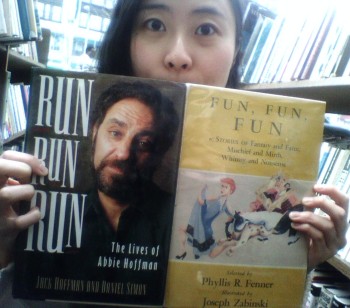
One of my favorite weekend activities is spending a Saturday afternoon going through the dollar book carts outside many New York and Boston area used book stores. It's not only because the books are cheap -- although I like that. The dollar book section is the great equalizer of bookstores. A neglected Dickens or Shakespeare can rub out against a discarded Mary-Cate and Ashley teeny-bopper quasi-romance novel. In the best cases, random shelving creates perfect (if unintuitive and ironic) pairs like Run Run Run about Abbie Hoffman and Fun Fun Fun about other youngsters -- a pair I found adjacent in a dollar book section last week.
/copyrighteous/images/run_fun_run.jpg
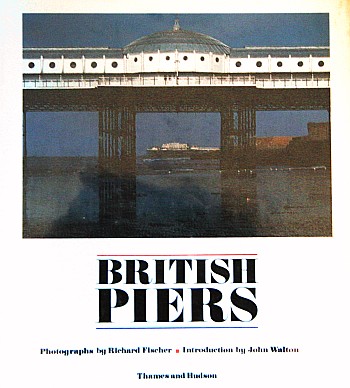
But you also get to meet books you will never meet in the bookstore sections you normally frequent. The dollar book section at the Strand has introduced me to a whole class of books with intriguing non-fiction sounding titles that I had pulled excitedly off the shelf only to find out that they were, in fact, novels. There are also the books with titles so good you suspect the book will be downhill from that point. The Complete Idiot's Guide To Being a Model (not, as one might expect, Becoming a model) and this guide to the British pierage are great examples.
/copyrighteous/images/british_piers.jpg

28 March 2007

Benjamin Mako Hill: Places I Have Almost Been

Yesterday, I passed by an offramp to Onset. Due to objections of others in the car, I wasn't able to visit. I did, however, snap this picture.
/copyrighteous/images/offramp_to_onset-small.jpg

20 March 2007

Benjamin Mako Hill: PHLanthropy

Last week, I had planned to travel from Boston to Tampa with a connection in Philadelphia. I landed in Philadelphia without a problem but an ice storm descended on the airport and, after five hours of our flight's departure time being pushed back, the entire airport was closed and all flights for that day were canceled. When I arrived back at PHL the next day, two hours before the scheduled departure of my flight home -- my trip to Tampa was, by this point, called off entirely -- the airport was in chaos. Flights were still being canceled, airport information displays were inaccurate or switched off entirely and stranded travelers were everywhere. US Airways had deactivated the automatic ticket machines and there were thousands of people in scores of lines hoping for new tickets and assistance. But unlike the day before, we all knew that planes were theoretically going to be leaving and that, stuck outside, we were not going to be on them. People wanted boarding passes and they wanted them desperately. But the lines were not moving and nobody -- or almost nobody -- was going anywhere. Meanwhile, the four teams of TSA workers at the security station were standing idly talking to themselves like attendants at a light night gas station. The only people inside the terminal were those that had slept there or flown in that morning. After finding the end of a line, I asked someone what their line was for. Nobody knew, but each hoped it lead to someone who would assist with their particular problem. Usually they merely wanted to check in. Several people I asked had been waiting in line for five hours that morning only to find out that their line was, in fact, not a line at all but merely a mass of people leading nowhere or simply dissolving into other lines. Nobody knew what else to do so, I, like everyone else, queued up and hoped for the best. An impeccably dressed and obviously wealthy woman asked what I was in line was for. I told her that I didn't know but, like everyone else, hoped it would lead to a boarding pass. She wanted the same thing. She asked if there was a separate queue for first class and I pointed out that it seemed unlikely, in the chaos, that first class was getting special treatment. I pointed out that I also had a first class ticket -- it was the only seat available when the harried agent rebooked me the day before and I had not paid extra for this, but I did not tell her this. She nodded to me in camaraderie. She stood pensively next to me for five minutes and then fumbled for her wallet and ticket. She asked me if I would hold her place in line and I agreed. Five minutes later she reappeared with a boarding pass in her hand. Surprised, I asked her how she had obtained it. She stated, quietly so as not be overhead by the other would-be passengers but matter of factly, that she'd found a baggage handler and flashed a twenty dollar bill and her itinerary. She mentioned that the man she had paid had left but that, "any of them will do it." Sure enough, I was in the terminal less than ten minutes, and twenty dollars, later. Despite growing up partially in the third world, I've only personally bribed a person once before -- also in the United States. Like my previous experience, I didn't feel good about buying my way out of what seems to have, in fact, devolved into a racket. I have spent a lot of time reflecting on the situation and my action in the last several days. Everyone, or nearly everyone, outside the Philadelphia airport terminal had twenty dollars and most of them would have happily paid it to escape their predicament. The reason that most people did not pay off baggage workers is not because they found it prohibitively distasteful, although certainly some of them would have, but because most of us, and I include myself, would have spent the whole day frustrated, desperate, and standing line after line without even considering a bribe as an option. While we know it on some intellectual, reflective level, the vast majority of us do not, in practice, imagine that we can use money as a way to manipulate people into special treatment. As a result, even in situations like that morning in Philadelphia, I simply don't even think of the twenty in my wallet as a way to solve my problem. It's true that wealthy people, like the woman in line behind me, get what they want because they can pay lots of money for products and services. But it is not quite this simple. Some wealthy, powerful people get what they want in part because they think to use money in ways that the rest of us do not. Perhaps this is because this type of spending is frequently not an option for most of us or, we tell ourselves, perhaps even truthfully, because we find it distasteful and immoral. The difference between being inside or outside the terminal last Saturday was not about having or not having money. It was, in fact, about having a particular relationship to money and, through money, to other people. It was not about the value conferred by money but about a set of values that can result from having it in abundance.

19 March 2007

Benjamin Mako Hill: Spellign

While everyone seems to be excited about OpenMoko, there's a smaller, less proficient group of typers who seems excited about the OpenMako project. Ari Pollack even painted a picture of what that frightening, Mako Hellish, world might look like.

Next.

Previous.