Search Results: "js"

5 April 2021

Jelmer Vernooij: The Buildlog Consultant

Reading build logs Build logs for Debian packages can be quite long and difficult for a human to read. Anybody who has looked at these logs trying to figure out why a build failed will have spent time scrolling through them and skimming for certain phrases (lines starting with error: for example). In many cases, you can spot the problem in the last 10 or 20 lines of output but it s also quite common that the error is somewhere at the beginning of many pages of error output.
The buildlog consultant The buildlog consultant project attempts to aid in this process by parsing sbuild and non-Debian (e.g. the output of make ) build logs and trying to identify the key line that explains why a build failed. It can then either display this specific line, or a fragment of the log around surrounding the key line.
Classification In addition to finding the key line explaining the failure, it can also classify and parse the error in many cases and return a result code and some metadata. For example, in a failed build of gnss-sdr that has produced 2119 lines of output, the reason for the failure is that log4cpp is missing which is on line 641:
634
635
636
637
638
639
640
641
642
643
644
645
646
647
 -- Required GNU Radio Component: ANALOG missing!
 -- Could NOT find GNURADIO (missing: GNURADIO_RUNTIME_FOUND)
 -- Could NOT find PkgConfig (missing: PKG_CONFIG_EXECUTABLE)
 -- Could NOT find LOG4CPP (missing: LOG4CPP_INCLUDE_DIRS
 LOG4CPP_LIBRARIES)
 CMake Error at CMakeLists.txt:593 (message):
   *** Log4cpp is required to build gnss-sdr
 -- Configuring incomplete, errors occurred!
 See also "/<<PKGBUILDDIR>>/obj-x86_64-linux-gnu/CMakeFiles/
 CMakeOutput.log".
 See also "/<<PKGBUILDDIR>>/obj-x86_64-linux-gnu/CMakeFiles/
 CMakeError.log".
In this case, the buildlog consultant can both figure out line was problematic and what the problem was:
 % analyse-sbuild-log build.log
 Failed stage: build
 Section: build
 Failed line: 641:
   *** Log4cpp is required to build gnss-sdr
 Error: Missing dependency: Log4cpp
Or, if you'd like to do something else with the output, use JSON output:
 % analyse-sbuild-log --json build.log
  "stage": "build", "section": "Build", "lineno": 641, "kind": "missing-dependency", "details":  "name": "Log4cpp"" 
How it works The consultant does some structured parsing (most notably it can parse the sections from a sbuild log), but otherwise is a large set of carefully crafted regular expressions and heuristics. It doesn t always find the problem, but has proven to be fairly accurate. It is constantly improved as part of the Debian Janitor project, and that exposes it to a wide variety of different errors. You can see the classification and error detection in action on the result codes page of the Janitor.
Using the buildlog consultant You can get the buildlog consultant from either pip or Debian unstable (package: python3-buildlog-consultant ). The buildlog consultant comes with two scripts analyse-build-log and analyse-sbuild-log, for analysing build logs and sbuild logs respectively.

31 March 2021

Timo Jyrinki: MotionPhoto / MicroVideo File Formats on Pixel Phones

Google Pixel phones support what they call Motion Photo which is essentially a photo with a short video clip attached to it. They are quite nice since they bring the moment alive, especially as the capturing of the video starts a small moment before the shutter button is pressed. For most viewing programs they simply show as static JPEG photos, but there is more to the files.
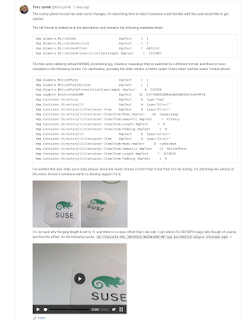
I d really love proper Shotwell support for these file formats, so I posted a longish explanation with many of the details in this blog post to a ticket there too. Examples of the newer format are linked there too.
Info posted to Shotwell ticket

There are actually two different formats, an old one that is already obsolete, and a newer current format. The older ones are those that your Pixel phone recorded as MVIMG_[datetime].jpg", and they have the following meta-data:
Xmp.GCamera.MicroVideo                       XmpText     1  1
Xmp.GCamera.MicroVideoVersion XmpText 1 1
Xmp.GCamera.MicroVideoOffset XmpText 7 4022143
Xmp.GCamera.MicroVideoPresentationTimestampUs XmpText 7 1331607
The offset is actually from the end of the file, so one needs to calculate accordingly. But it is exact otherwise, so one simply extract a file with that meta-data information:
#!/bin/bash
#
# Extracts the microvideo from a MVIMG_*.jpg file

# The offset is from the ending of the file, so calculate accordingly
offset=$(exiv2 -p X "$1" grep MicroVideoOffset sed 's/.*\"\(.*\)"/\1/')
filesize=$(du --apparent-size --block=1 "$1" sed 's/^\([0-9]*\).*/\1/')
extractposition=$(expr $filesize - $offset)
echo offset: $offset
echo filesize: $filesize
echo extractposition=$extractposition
dd if="$1" skip=1 bs=$extractposition of="$(basename -s .jpg $1).mp4"
The newer format is recorded in filenames called PXL_[datetime].MP.jpg , and they have a _lot_ of additional metadata:
Xmp.GCamera.MotionPhoto                      XmpText     1  1
Xmp.GCamera.MotionPhotoVersion XmpText 1 1
Xmp.GCamera.MotionPhotoPresentationTimestampUs XmpText 6 233320
Xmp.xmpNote.HasExtendedXMP XmpText 32 E1F7505D2DD64EA6948D2047449F0FFA
Xmp.Container.Directory XmpText 0 type="Seq"
Xmp.Container.Directory[1] XmpText 0 type="Struct"
Xmp.Container.Directory[1]/Container:Item XmpText 0 type="Struct"
Xmp.Container.Directory[1]/Container:Item/Item:Mime XmpText 10 image/jpeg
Xmp.Container.Directory[1]/Container:Item/Item:Semantic XmpText 7 Primary
Xmp.Container.Directory[1]/Container:Item/Item:Length XmpText 1 0
Xmp.Container.Directory[1]/Container:Item/Item:Padding XmpText 1 0
Xmp.Container.Directory[2] XmpText 0 type="Struct"
Xmp.Container.Directory[2]/Container:Item XmpText 0 type="Struct"
Xmp.Container.Directory[2]/Container:Item/Item:Mime XmpText 9 video/mp4
Xmp.Container.Directory[2]/Container:Item/Item:Semantic XmpText 11 MotionPhoto
Xmp.Container.Directory[2]/Container:Item/Item:Length XmpText 7 1679555
Xmp.Container.Directory[2]/Container:Item/Item:Padding XmpText 1 0
Sounds like fun and lots of information. However I didn t see why the length in first item is 0 and I didn t see how to use the latter Length info. But I can use the mp4 headers to extract it:
#!/bin/bash
#
# Extracts the motion part of a MotionPhoto file PXL_*.MP.mp4

extractposition=$(grep --binary --byte-offset --only-matching --text \
-P "\x00\x00\x00\x18\x66\x74\x79\x70\x6d\x70\x34\x32" $1 sed 's/^\([0-9]*\).*/\1/')

dd if="$1" skip=1 bs=$extractposition of="$(basename -s .jpg $1).mp4"
UPDATE: I wrote most of this blog post earlier. When now actually getting to publishing it a week later, I see the obvious ie the Length is again simply the offset from the end of the file so one could do the same less brute force approach as for MVIMG. I ll leave the above as is however for the of binary grepping.(cross-posted to my other blog)

30 March 2021

Dirk Eddelbuettel: x13binary 1.1.39-3 on CRAN: (Imperfect) Package Updates

A new release 1.1.39-3 of x13binary, of the X-13ARIMA-SEATS program by the US Census Bureau (with upstream release 1.1.39) is now on CRAN. The x13binary package takes the pain out of installing X-13ARIMA-SEATS by making it a fully resolved CRAN dependency. For example, when installing the excellent seasonal package by Christoph, then X-13ARIMA-SEATS will get pulled in via the x13binary package and things just work. Just depend on x13binary and on all major OSs supported by R you should have an X-13ARIMA-SEATS binary installed which will be called seamlessly by the higher-level packages such as seasonal or gunsales. With this the full power of the what is likely the world s most sophisticated deseasonalization and forecasting package is now at your fingertips and the R prompt, just like any other of the 17350+ CRAN packages. You can read more about this (and the seasonal package) in the Journal of Statistical Software paper by Christoph and myself. This release was needed because the recent M1mac build was reporting leftover detritus in the temporary directory, which we addressed with an explicit removal at end. We also addressed another CRAN Policy change since the last release, namely a conversion of the configure script from bash to sh. Now, sadly, that second aspect blew up on Solaris, and the detritus issue appears to be persist. By now Christoph and a colleague have installed R(-devel) on such an M1 machine, but still cannot reproduce. We will reach out to CRAN to learn more. A follow-up release 1.1.39-4 is likely. The good news is that the standard macOS binary works on M1 as do other binaries thanks to the translation layer. We do however lack a genuine binary for Solaris so if any of the esteemed readers of this post happens to have access to R on Solaris along with a basic Fortran compiler, we would love to hear from you. Building X-13ARIMA-SEATS from source on Solaris should be straightforward, it is on the other OSs. Courtesy of my CRANberries, there is also a diffstat report for this release showing changes to the previous release. If you like this or other open-source work I do, you can sponsor me at GitHub.

This post by Dirk Eddelbuettel originated on his Thinking inside the box blog. Please report excessive re-aggregation in third-party for-profit settings.

16 March 2021

Tianon Gravi: My Docker Install Process (re-redux)

See My Docker Install Process and My Docker Install Process (redux) . This one s going to be even more to-the-point.

grab Docker s APT repo GPG key
GNUPGHOME="$(mktemp -d)"; export GNUPGHOME
gpg --keyserver ha.pool.sks-keyservers.net --recv-keys 9DC858229FC7DD38854AE2D88D81803C0EBFCD88
sudo mkdir -p /etc/apt/tianon.gpg.d
gpg --export --armor 9DC858229FC7DD38854AE2D88D81803C0EBFCD88   sudo tee /etc/apt/tianon.gpg.d/docker.gpg.asc
rm -rf "$GNUPGHOME"

add Docker s APT source
source /etc/os-release
echo "deb [ arch=amd64 signed-by=/etc/apt/tianon.gpg.d/docker.gpg.asc ] https://download.docker.com/linux/debian $VERSION_CODENAME stable"   sudo tee /etc/apt/sources.list.d/docker.list
$ sudo apt update
...
Get:6 https://download.docker.com/linux/debian buster/stable amd64 Packages [17.8 kB]
...
Reading package lists... Done

exclude (unwated) CLI plugins
echo 'path-exclude /usr/libexec/docker/cli-plugins/*'   sudo tee /etc/dpkg/dpkg.cfg.d/unwanted-docker-cli-plugins

pin Docker versions
sudo vim /etc/apt/preferences.d/docker.pref
Package: *aufs* *rootless* cgroupfs-mount
Pin: version *
Pin-Priority: -10
Package: docker*
Pin: version 5:20.10*
Pin-Priority: 999
Package: containerd*
Pin: version 1.4*
Pin-Priority: 999

pre-configure Docker
sudo mkdir -p /etc/docker
sudo vim /etc/docker/daemon.json
 
	"storage-driver": "overlay2"
 

configure boot parameters
I usually set a few boot parameters as well (in /etc/default/grub s GRUB_CMDLINE_LINUX_DEFAULT option run sudo update-grub after adding these, space-separated).
  • cgroup_enable=memory enable memory accounting for containers (allows docker run --memory for setting hard memory limits on containers)
  • swapaccount=1 enable swap accounting for containers (allows docker run --memory-swap for setting hard swap memory limits on containers)
  • vsyscall=emulate allow older binaries to run (debian:wheezy, etc.; see docker/docker#28705)
  • systemd.legacy_systemd_cgroup_controller=yes newer versions of systemd may disable the legacy cgroup interfaces Docker currently uses; this instructs systemd to keep those enabled (for more details, see systemd/systemd#4628, opencontainers/runc#1175, docker/docker#28109)
    • NOTE: this one gets more complicated in Debian 11+ ( Bullseye ); possibly worth switching to cgroupv2 and systemd.unified_cgroup_hierarchy=1
All together:
...
GRUB_CMDLINE_LINUX_DEFAULT="cgroup_enable=memory swapaccount=1 vsyscall=emulate systemd.legacy_systemd_cgroup_controller=yes"
...
(Don t forget to sudo update-grub and potentially reboot check /proc/cmdline to verify.)

install Docker!
$ sudo apt-get install -V docker-ce
...
Unpacking containerd.io (1.4.4-1) ...
...
Unpacking docker-ce-cli (5:20.10.5~3-0~debian-buster) ...
...
Unpacking docker-ce (5:20.10.5~3-0~debian-buster) ...
...

$ sudo usermod -aG docker "$(id -un)"

1 March 2021

Dirk Eddelbuettel: RPushbullet 0.3.4: Small Update, Nicer Docs

RPpushbullet demo Release 0.3.4 of the RPushbullet package arrived on CRAN today. RPushbullet interfaces the neat Pushbullet service for inter-device messaging, communication, and more. It lets you easily send (programmatic) alerts like the one to the left to your browser, phone, tablet, or all at once. This release contains a contributed PR to better reflect an error code, and adds a mkdocs-material-based documentation site (just like a few other packages of mine). See below for more details.

Changes in version 0.3.4 (2021-03-01)
  • Return code checking using error code content if it exists (Thomas Shafer in #64).
  • Enabled GitHub Actions with encrypted JSON file for API access.
  • Added a package documentation website.

Courtesy of my CRANberries, there is also a diffstat report for this release. More details about the package are at the RPushbullet webpage and the RPushbullet GitHub repo. If you like this or other open-source work I do, you can now sponsor me at GitHub.

This post by Dirk Eddelbuettel originated on his Thinking inside the box blog. Please report excessive re-aggregation in third-party for-profit settings.

Utkarsh Gupta: FOSS Activites in February 2021

Here s my (seventeenth) monthly update about the activities I ve done in the F/L/OSS world.

Debian
This was my 26th month of active contributing to Debian. I became a DM in late March 2019 and a DD on Christmas 19! \o/ This month was a nice mix of amusement, excitement, nervousness, and craziness. More on it below.
Anyway, whilst I was super-insanely busy this month, I still did some Debian stuff here and there. Here are the following things I worked on:

Uploads and bug fixes:

Other $things:
  • Attended the Debian LTS team meeting.
  • Mentoring for newcomers.
  • Moderation of -project mailing list.
  • Sponsored ruby-rspec-stubbed-env for C dric Boutillier, heh :P

Interesting Bits!
  • Last month, I wrote:
    Besides, there s something more that is in the pipelines. Can t talk about it now, shh. But hopefully very sooooooon!
    And now I can talk about it! So here it is..
    I ve joined Canonical as a SDE to work on Ubuntu, full time!!! \o/
    Fully remote + dream job/work + most of the work is in the open-source domain + the beessstttt co-workers one could ever ask for! It s been an amazing time so far and I ll talk more about it later this month.
    But for now, here s our team monitor selfie (with Rick missing because of his secret plan ! )

    We ll soon e-meet them in a more detailed manner in the next blog post, that is, later this month!
  • In another exciting news, I got 2 more CVEs assigned!!! \o/
    No, it is not something that I found, it was discovered by Tavis Ormandy. I just assigned them a CVE ID, CVE-2021-26937 for screen and CVE-2021-27135 for xterm.
    This is my 2nd and 3rd, so I am (still) very excited about this! ^_^

Debian (E)LTS
Debian Long Term Support (LTS) is a project to extend the lifetime of all Debian stable releases to (at least) 5 years. Debian LTS is not handled by the Debian security team, but by a separate group of volunteers and companies interested in making it a success. And Debian Extended LTS (ELTS) is its sister project, extending support to the Jessie release (+2 years after LTS support). This was my sixteenth month as a Debian LTS and seventh month as a Debian ELTS paid contributor.
I was assigned 60.00 hours for LTS and 60.00 hours for ELTS and worked on the following things:
(however, I had overworked for 9 hours for both, LTS and ELTS, last month so I had to work for 51 hours for both this month!)

LTS CVE Fixes and Announcements:

ELTS CVE Fixes and Announcements:

Other (E)LTS Work:
  • Front-desk duty from 22-02 until 28-02 for both LTS and ELTS.
  • Triaged privoxy, dnsmasq, openldap, libzstd, ruby-mechanize, firefox-esr, thunderbird, screen, xterm, glibc, isync, rails, openscad, imagemagick, avahi, gdk-pixbuf, python-reportlab, python-aiohttp, spip, gdisk, and jasper.
  • Marked CVE-2021-20214/privoxy as not-affected for stretch.
  • Marked CVE-2021-27645/glibc as no-dsa for stretch.
  • Marked CVE-2021-20247/isync as no-dsa for stretch.
  • Marked CVE-2020-28599/openscad as no-dsa for stretch.
  • Markec CVE-2021-2024 1,4-6 /imagemagick as ignored for stretch.
  • Marked CVE-2021-26720/avahi as postponed for jessie.
  • Marked CVE-2021-20240/gdk-pixbuf as not-affected for jessie.
  • Marked CVE-2021-27645/glibc as no-dsa for jessie.
  • Marked CVE-2020-28463/python-reportlab as postponed for jessie.
  • Document extra CVEs as notes for imagemagick in jessie.
  • Auto EOL ed libupnp, webkit2gtk, libraw, jackson-dataformat-cbor, node-lodash, linux, asterisk, yara, python-django, botan1.10, smarty3, xen, u-boot, steghide, mumble, gsoap, ruby-twitter-stream, isync, nodejs, openscad, mupdf, mongo-java-driver, firefox-esr, thunderbird, and salt for jessie.
  • Sponsored upload for php-horde-text-filter for Sylvain and published its DLA announcement.
  • Got CVE-2021-26937 for screen. Yay, this is the 2nd one I got assigned! \o/
  • Got CVE-2021-27135 for xterm. Woah, this is the 3rd one, am I on a roll or what? \o/
  • Co-ordinated with package maintainer (and upstream) of ca-certificates for backporting patch to stretch.
  • Co-ordinated with package maintainer of ca-certificates for backporting patch to stretch.
  • Co-ordinated with package maintainer of screen for fixing vulnerabilites in stretch.
  • Attended monthly meeting for Debian LTS.
  • Answered questions (& discussions) on IRC (#debian-lts and #debian-elts).
  • Cross-checked LTS survey results, emailed Ola about the problems found.
  • General and other discussions on LTS private and public mailing list.

Until next time.
:wq for today.

28 February 2021

Chris Lamb: Free software activities in February 2021

Here is my monthly update covering what I have been doing in the free software world during February 2021 (previous month):

Reproducible Builds The motivation behind the Reproducible Builds effort is to ensure no flaws have been introduced during compilation process by promising identical results are always generated from a given source, therefore allowing multiple third-parties to come to a consensus on whether a build was compromised. The project is proud to be a member project of the Software Freedom Conservancy. Conservancy acts as a corporate umbrella allowing projects to operate as non-profit initiatives without managing their own corporate structure. If you like the work of the Conservancy or the Reproducible Builds project, please consider becoming an official supporter. This month, I: I also made the following changes to diffoscope, including preparing and uploading versions 167 and 168 to Debian:

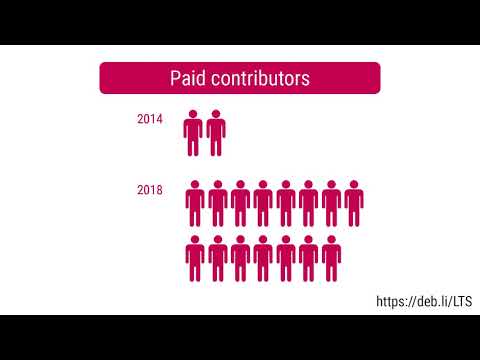
Debian Uploads I also sponsored an upload of adminer (4.7.9-1) for Alexandre Rossi. Debian LTS This month I have worked 18 hours on Debian Long Term Support (LTS) and 12 hours on its sister Extended LTS project. You can find out more about the project via the following video:

24 February 2021

Dirk Eddelbuettel: RcppSimdJson 0.1.4 on CRAN: Small Bugfix

A quick note to say that we finalized a bugfix release 0.1.5 of RcppSimdJson yesterday which got onto CRAN earlier today. RcppSimdJson wraps the fantastic and genuinely impressive simdjson library by Daniel Lemire and collaborators. Via very clever algorithmic engineering to obtain largely branch-free code, coupled with modern C++ and newer compiler instructions, it results in parsing gigabytes of JSON parsed per second which is quite mindboggling. The best-case performance is faster than CPU speed as use of parallel SIMD instructions and careful branch avoidance can lead to less than one cpu cycle per byte parsed; see the video of the talk by Daniel Lemire at QCon (also voted best talk). This version brings a small fix to Windows where temporary filenames constructed from URLs (as for example constructed by our td package) need an extra sanization for a possible ? character. We will be addressing that properly in due course but for now a simple gsub() will do. The NEWS entry follows.

Changes in version 0.1.5 (2021-02-23)
  • Temporary filenames from request URLs need an extra path sanitization on Windows as seen with package td.
  • A few #nocov tags were added to the code.

Courtesy of my CRANberries, there is also a diffstat report for this release. For questions, suggestions, or issues please use the issue tracker at the GitHub repo. If you like this or other open-source work I do, you can now sponsor me at GitHub.

This post by Dirk Eddelbuettel originated on his Thinking inside the box blog. Please report excessive re-aggregation in third-party for-profit settings.

21 February 2021

Louis-Philippe V ronneau: dput-ng or: How I Learned to Stop Worrying and Love the Hooks

As my contributions to Debian continue to grow in number, I find myself uploading to the archive more and more often. Although I'm pretty happy with my current sbuild-based workflow, twice in the past few weeks I inadvertently made a binary upload instead of a source-only one.1 As it turns out, I am not the only DD who has had this problem before. As Nicolas Dandrimont kindly pointed to me, dput-ng supports pre and post upload hooks that can be used to lint your uploads. Even better, it also ships with a check-debs hook that lets you block binary uploads. Pretty neat, right? In a perfect world, enabling the hook would only be a matter of adding it in the hook list of /etc/dput.d/metas/debian.json and using the following defaults:
"check-debs":  
    "enforce": "source",
    "skip": false
 ,
Sadly, bug #983160 currently makes this whole setup more complex than it should be and forces me to use two different dput-ng profiles pointing to two different files in /etc/dput.d/metas: a default source-only one (ftp-master) and a binary upload one (ftp-master-binary). Otherwise, one could use a single profile that disallows binary uploads and when needed, override the hook using something like this:
$ dput --override "check-debs.enforce=debs" foo_1.0.0-1_amd64.changes
I did start debugging the --override issue in dput-ng, but I'm not sure I'll have time to submit a patch anytime soon. In the meantime, I'm happy to report I shouldn't be uploading the wrong .changes file by mistake again!

  1. Thanks to Holger Levsen and Adrian Bunk for catching those and notifying me.

18 February 2021

Dirk Eddelbuettel: td 0.0.2 on CRAN: Updated and Expanded

The still very recent td package for accessing the twelvedata API for financial data has been updated and is now at version 0.0.2. The time_series access point is now vectorised: supply a vector of symbols, and you receive list of data.frame (or xts) objects. See this tweet teasing out the earliest support for this new featire, and showing a quick four-securities plot. We also added simpler accessors get_quote() and get_price() rounding out the basic API support. One first bug report alerting us to the fact that our use of RcppSimdJson requires an additional sanitizing of the temporary filename if used on Windows. We will fix that properly soon in new release 0.1.5 of that package; in the meantime you can get hot-fix binary 0.1.4.1 for Windows via install.packages("RcppSimdJson", repos="https://ghrr.github.io/drat") from the ghrr drat. The NEWS entry follows.

Changes in version 0.0.2 (2021-02-18)
  • The time_series is now vectorised and can return a list of return objects when given a vector of symbols
  • The use of tools::R_user_dir() is now conditional on having R 4.0.0 or later, older versions can use env.var for api key
  • New helper function store_key to save api key.
  • New simple accessors get_quote and get_price

Courtesy of my CRANberries, there is a comparison to the previous release. For questions or comments use the issue tracker off the GitHub repo. If you like this or other open-source work I do, you can now sponsor me at GitHub.

This post by Dirk Eddelbuettel originated on his Thinking inside the box blog. Please report excessive re-aggregation in third-party for-profit settings.

16 February 2021

Vincent Fourmond: QSoas tips and tricks: permanently storing meta-data

It is one thing to acquire and process data, but the data themselves are most often useless without the context, the conditions in which the experiments were made. These additional informations can be called meta-data. In a previous post, we have already described how one can set meta-data to data that are already loaded, and how one can make use of them. QSoas is already able to figure out some meta-data in the case of electrochemical data, most notably in the case of files acquired by GPES, ECLab or CHI potentiostats. However, only a small number of constructors are supported as of now[1], and there are a number of experimental details that the software is never going to be able to figure out for you, such as the pH, the sample, what you were doing... The new version of QSoas provides a means to permanently store meta-data for experimental data files:
QSoas> record-meta pH 7 file.dat
This command uses record-meta to permanently store the information pH = 7 for the file file.dat. Any time QSoas loads the file again, either today or in one year, the meta-data will contain the value 7 for the field pH. Behind the scenes, QSoas creates a single small file, file.dat.qsm, in which the meta-data are stored (in the form of a JSON dictionnary). You can set the same meta-data to many files in one go, using wildcards (see load for more information). For instance, to set the pH=7 meta-data to all the .dat files in the current directory, you can use:
QSoas> record-meta pH 7 *.dat
You can only set one meta-data for each call to record-meta, but you can use it as many times as you like. Finally, you can use the /for-which option to load or browse to select only the files which have the meta you need:
QSoas> browse /for-which=$meta.pH<=7
This command browses the files in the current directory, showing only the ones that have a pH meta-data which is 7 or below.

[1] I'm always ready to implement the parsing of other file formats that could be useful for you. If you need parsing of special files, please contact me, sending the given files and the meta-data you'd expect to find in those. About QSoas QSoas is a powerful open source data analysis program that focuses on flexibility and powerful fitting capacities. It is released under the GNU General Public License. It is described in Fourmond, Anal. Chem., 2016, 88 (10), pp 5050 5052. Current version is 3.0. You can download its source code there (or clone from the GitHub repository) and compile it yourself, or buy precompiled versions for MacOS and Windows there.

12 February 2021

Dirk Eddelbuettel: RcppSimdJson 0.1.4 on CRAN: New Improvements

Brendan and I are happy to share that a new RcppSimdJson release 0.1.4 arrived on CRAN earlier today. RcppSimdJson wraps the fantastic and genuinely impressive simdjson library by Daniel Lemire and collaborators. Via very clever algorithmic engineering to obtain largely branch-free code, coupled with modern C++ and newer compiler instructions, it results in parsing gigabytes of JSON parsed per second which is quite mindboggling. The best-case performance is faster than CPU speed as use of parallel SIMD instructions and careful branch avoidance can lead to less than one cpu cycle per byte parsed; see the video of the talk by Daniel Lemire at QCon (also voted best talk). This version brings a new option to always return list types, tweaks to setting option in the the request and other small improvements. The NEWS entry follows.

Changes in version 0.1.4 (2021-02-12)
  • Support additional headers in fload (Dirk in #60).
  • Enable continuous integration via GitHub Actions using run.sh from r-ci repo (Dirk in #61, #62).
  • Add option to always return list to fparse()/fload() (Brendan in #65 closing #64).

Courtesy of my CRANberries, there is also a diffstat report for this release. For questions, suggestions, or issues please use the issue tracker at the GitHub repo. If you like this or other open-source work I do, you can now sponsor me at GitHub.

This post by Dirk Eddelbuettel originated on his Thinking inside the box blog. Please report excessive re-aggregation in third-party for-profit settings.

11 February 2021

Dirk Eddelbuettel: td 0.0.1 on CRAN: New Finance Data Package

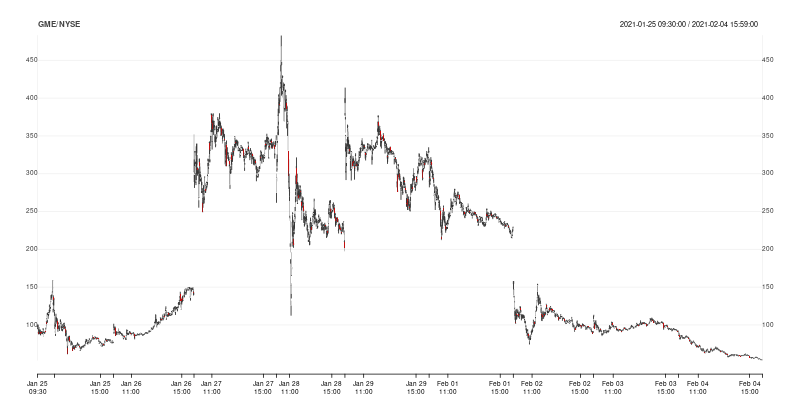
Thrilled to announce that a new package of mine just made it to CRAN: the td package accesses the twelvedata API for financial data. Currently only the time_series REST access point is supported, but it is already supported with all meaningful options (we skipped only JSON or CSV which makes no sense here) so for example any resolution between 1 minute and 1 month can be requested for any stock, etf or currency symbol for a wide array of exchanges. Historical access is available too via (optional) start and end dates. We return either raw JSON or a data.frame or an xts object making it trivial to call high-end plotting functions on the data the project and repo pages show several examples. As just one example, here is GME during the follies. We simply request via
> gme <- time_series("GME", "1min",
+                    start_date="2021-01-25 09:30:00",
+                    end_date="2021-02-04 16:00:00", as="xts")
(where the API key is either in a user-local config file accessed via the new-ish R function tools::R_user_dir("td") pointing at this package s directory, or via an environment variable; either is accessed at package load or attachment) from which we can then plot via quantmod
> quantmod::chart_Series(gme, name=paste0(attr(gme, "symbol"), "/", attr(gme, "exchange")))
which shows how we also helpfully store metadata returned by twelvedata as extra attributes of the object. The chart is You will need an API key to have up to 800 daily accesses for free, higher-performance plans (including websocket access) are available for paying customers too. I have only used the free API so far myself. I plan to add quote and price support this weekend, and generalize the time series access to returning lists of objects as the API does in fact support multi-security access. As always, feedback is welcomed. Please post comments and suggestions at the GitHub repo. If you like this or other open-source work I do, you can now sponsor me at GitHub.

This post by Dirk Eddelbuettel originated on his Thinking inside the box blog. Please report excessive re-aggregation in third-party for-profit settings.

10 February 2021

Dirk Eddelbuettel: RcppSMC 0.2.3 on CRAN: Updated Snapshot

A new release 0.2.3 of the RcppSMC package arrived on CRAN earlier today. Once again it progressed as a very quick pretest-publish within minutes of submission thanks CRAN! RcppSMC provides Rcpp-based bindings to R for the Sequential Monte Carlo Template Classes (SMCTC) by Adam Johansen described in his JSS article. Sequential Monte Carlo is also referred to as Particle Filter in some contexts. This release somewhat belatedly merges a branch Leah had been working on and which we all realized is ready . We now have a good snapshot to base new work on, as maybe with the Google Summer of Code 2021.

Changes in RcppSMC version 0.2.3 (2021-02-10)
  • Addition of a Github Action CI runner (Dirk)
  • Switching to inheritance for the moveset rather than pointers to functions (Leah in #45).

Courtesy of my CRANberries, there is a diffstat report for this release. More information is on the RcppSMC page. Issues and bugreports should go to the GitHub issue tracker. If you like this or other open-source work I do, you can now sponsor me at GitHub.

This post by Dirk Eddelbuettel originated on his Thinking inside the box blog. Please report excessive re-aggregation in third-party for-profit settings.

5 February 2021

Thorsten Alteholz: My Debian Activities in January 2021

FTP master This month I could increase my activities in NEW again and accepted 132 packages. Unfortunately I also had to reject 12 packages. The overall number of packages that got accepted was 374. Debian LTS This was my seventy-ninth month that I did some work for the Debian LTS initiative, started by Raphael Hertzog at Freexian. This month my all in all workload has been 26h. During that time I did LTS and normal security uploads of: With the buster upload of highlight.js I could finish to fix CVE-2020-26237 in all releases. I also tried to fix one or the other CVE for golang packages, to be exact: golang-github-russellhaering-goxmldsig, golang-github-tidwall-match, golang-github-tidwall-gjson and golang-github-antchfx-xmlquery. The version in unstable is easily done by uploading a new upstream version after checking with ratt that all reverse-build-dependencies are still working. The next step will be to really upload all reverse-build-dependencies that need a new build. As the number of reverse-build-dependencies might be rather large, this needs to be done automatically somehow. The problem I am struggling with at the moment are packages that need to be rebuilt but the version in git already increased Another problem with golang packages are packages that are referenced by a Built-Using: line, but whose sources are not yet available on security-master. If this happens, the uploaded package will be automatically rejected. Unfortunately the rejection-email only contains the first missing package. So in order to reduce the hassle with such uploads, please send me the Built-Using:-line before the upload and I will import everything. In December/January this affected the uploads of influxdb and snapd. Last but not least I did some days of frontdesk duties. Debian ELTS This month was the thirty-first ELTS month. During my allocated time I uploaded: Last but not least I did some days of frontdesk duties. Other stuff This month I uploaded new upstream versions of: I improved packaging of: The golang packages here are basically ones with a missing source upload. For whatever reason maintainers tend to forget about this

31 January 2021

Chris Lamb: Free software activities in January 2021

Here is my monthly update covering what I have been doing in the free software world during January 2021 (previous month):

Reproducible Builds One of the original promises of open source software is that distributed peer review and transparency of process results in enhanced end-user security. However, whilst anyone may inspect the source code of free and open source software for malicious flaws, almost all software today is distributed as pre-compiled binaries. This allows nefarious third-parties to compromise systems by injecting malicious code into ostensibly secure software during the various compilation and distribution processes. The motivation behind the Reproducible Builds effort is to ensure no flaws have been introduced during this compilation process by promising identical results are always generated from a given source, thus allowing multiple third-parties to come to a consensus on whether a build was compromised. This month, I:
I also made the following changes to diffoscope, our in-depth and content-aware diff utility that can locate and diagnose reproducibility issues, releasing version 164, version 165 and version 166 as well as triaging and merging many contributions from others:

Debian Uploads Debian LTS This month I worked 18 hours on Debian Long Term Support (LTS) and 12 hours on its sister Extended LTS project. You can find out more about the project via the following video:

22 January 2021

Enrico Zini: Gitlab runners with nspawn

This is a first post in a series about trying to setup a gitlab runner based on systemd-nspawn. I published the polished result as nspawn-runner on GitHub. The goal I need to setup gitlab runners, and I try to not involve docker in my professional infrastructure if I can avoid it. Let's try systemd-nspawn. It's widely available and reasonably reliable. I'm not the first to have this idea: Federico Ceratto made a setup based on custom runners and Josef Kufner one based on ssh runners. I'd like to skip the complication of ssh, and to expand Federico's version to persist not just filesystem changes but also any other side effect of CI commands. For example, one CI command may bring up a server and the next CI command may want to test interfacing with it. Understanding gitlab-runner First step: figuring out gitlab-runner. Test runs of gitlab-runner I found that I can run gitlab-runner manually without needing to go through a push to Gitlab. It needs a local git repository with a .gitlab-ci.yml file:
mkdir test
cd test
git init
cat > .gitlab-ci.yml << EOF
tests:
 script:
  - env   sort
  - pwd
  - ls -la
EOF
git add .gitlab-ci.yml
git commit -am "Created a test repo for gitlab-runner"
Then I can go in the repo and test gitlab-runner:
gitlab-runner exec shell tests
It doesn't seem to use /etc/gitlab-runner/config.toml and it needs all the arguments passed to its command line: I used the shell runner for a simple initial test. Later I'll try to brew a gitlab-runner exec custom invocation that uses nspawn. Basics of custom runners A custom runner runs a few scripts to manage the run: run gets at least one argument which is a path to the script to run. The other scripts get no arguments by default. The runner configuration controls the paths of the scripts to run, and optionally extra arguments to pass to them Next steps My next step will be to figure out possible ways of invoking nspawn for the prepare, run, and cleanup scripts.

17 January 2021

Junichi Uekawa: Yesterday was our monthly Debian meeting.

Yesterday was our monthly Debian meeting. We do one every month for Tokyo and Kansai combined, because it's online and no reason to split for now. I presented what I learnt about nodejs packaging in Debian. This time, I started using Emacs for presentation, presenting PDF file. This week I switched most of my login shells to emacsclient, and experimenting. It's interesting how much things break, and how much I depended on .bashrc and .profile being loaded. But most things work and I don't need most things outside of emacs...

9 January 2021

Thorsten Alteholz: My Debian Activities in December 2020

FTP master This month I only accepted 8 packages and like last month rejected 0. Despite the holidays 293 packages got accepted. Debian LTS This was my seventy-eighth month that I did some work for the Debian LTS initiative, started by Raphael Hertzog at Freexian. This month my all in all workload has been 26h. During that time I did LTS uploads of: Unfortunately package slirp has the same version in Stretch and Buster. So I first had to upload slirp/1:1.0.17-11 to unstable, in order to be allowed to fix the CVE in Buster and to finally upload a new version to Stretch. Meanwhile the fix for Buster has been approved by the Release Team and I am waiting for the next point release now. I also prepared a debdiff for influxdb, which will result in DSA-4823-1 in January. As there appeared new CVEs for openjpeg2, I did not do an upload yet. This is planned for January now. Last but not least I did some days of frontdesk duties. Debian ELTS This month was the thirtieth ELTS month. During my allocated time I uploaded: As well as for LTS, I did not finish work on all CVEs of openjpeg2, so the upload is postponed to January. Last but not least I did some days of frontdesk duties. Unfortunately I also had to give back some hours. Other stuff This month I uploaded new upstream versions of: I fixed one or two bugs in: I improved packaging of: Some packages just needed a source upload: and there have been even some new packages: With these uploads I finished the libosmocom- and libctl-transitions. The Debian Med Advent Calendar was again really successful this year. There was no new record, but with 109, the second most number of bugs has been closed.
year number of bugs closed
2011 63
2012 28
2013 73
2014 5
2015 150
2016 95
2017 105
2018 81
2019 104
2020 109
Well done everybody who participated. It is really nice to see that Andreas is no longer a lone wolf.

Louis-Philippe V ronneau: puppetserver 6: a Debian packaging post-mortem

I have been a Puppet user for a couple of years now, first at work, and eventually for my personal servers and computers. Although it can have a steep learning curve, I find Puppet both nimble and very powerful. I also prefer it to Ansible for its speed and the agent-server model it uses. Sadly, Puppet Labs hasn't been the most supportive upstream and tends to move pretty fast. Major versions rarely last for a whole Debian Stable release and the upstream .deb packages are full of vendored libraries.1 Since 2017, Apollon Oikonomopoulos has been the one doing most of the work on Puppet in Debian. Sadly, he's had less time for that lately and with Puppet 5 being deprecated in January 2021, Thomas Goirand, Utkarsh Gupta and I have been trying to package Puppet 6 in Debian for the last 6 months. With Puppet 6, the old ruby Puppet server using Passenger is not supported anymore and has been replaced by puppetserver, written in Clojure and running on the JVM. That's quite a large change and although puppetserver does reuse some of the Clojure libraries puppetdb (already in Debian) uses, packaging it meant quite a lot of work. Work in the Clojure team As part of my efforts to package puppetserver, I had the pleasure to join the Clojure team and learn a lot about the Clojure ecosystem. As I mentioned earlier, a lot of the Clojure dependencies needed for puppetserver were already in the archive. Unfortunately, when Apollon Oikonomopoulos packaged them, the leiningen build tool hadn't been packaged yet. This meant I had to rebuild a lot of packages, on top of packaging some new ones. Since then, thanks to the efforts of Elana Hashman, leiningen has been packaged and lets us run the upstream testsuites and create .jar artifacts closer to those upstream releases. During my work on puppetserver, I worked on the following packages:
List of packages
  • backport9
  • bidi-clojure
  • clj-digest-clojure
  • clj-helper
  • clj-time-clojure
  • clj-yaml-clojure
  • cljx-clojure
  • core-async-clojure
  • core-cache-clojure
  • core-match-clojure
  • cpath-clojure
  • crypto-equality-clojure
  • crypto-random-clojure
  • data-csv-clojure
  • data-json-clojure
  • data-priority-map-clojure
  • java-classpath-clojure
  • jnr-constants
  • jnr-enxio
  • jruby
  • jruby-utils-clojure
  • kitchensink-clojure
  • lazymap-clojure
  • liberator-clojure
  • ordered-clojure
  • pathetic-clojure
  • potemkin-clojure
  • prismatic-plumbing-clojure
  • prismatic-schema-clojure
  • puppetlabs-http-client-clojure
  • puppetlabs-i18n-clojure
  • puppetlabs-ring-middleware-clojure
  • puppetserver
  • raynes-fs-clojure
  • riddley-clojure
  • ring-basic-authentication-clojure
  • ring-clojure
  • ring-codec-clojure
  • shell-utils-clojure
  • ssl-utils-clojure
  • test-check-clojure
  • tools-analyzer-clojure
  • tools-analyzer-jvm-clojure
  • tools-cli-clojure
  • tools-reader-clojure
  • trapperkeeper-authorization-clojure
  • trapperkeeper-clojure
  • trapperkeeper-filesystem-watcher-clojure
  • trapperkeeper-metrics-clojure
  • trapperkeeper-scheduler-clojure
  • trapperkeeper-webserver-jetty9-clojure
  • url-clojure
  • useful-clojure
  • watchtower-clojure
If you want to learn more about packaging Clojure libraries and applications, I rewrote the Debian Clojure packaging tutorial and added a section about the quirks of using leiningen without a dedicated dh_lein tool. Work left to get puppetserver 6 in the archive Unfortunately, I was not able to finish the puppetserver 6 packaging work. It is thus unlikely it will make it in Debian Bullseye. If the issues described below are fixed, it would be possible to to package puppetserver in bullseye-backports though. So what's left? jruby Although I tried my best (kudos to Utkarsh Gupta and Thomas Goirand for the help), jruby in Debian is still broken. It does build properly, but the testsuite fails with multiple errors: jruby testsuite failures aside, I have not been able to use the jruby.deb the package currently builds in jruby-utils-clojure (testsuite failure). I had the same exact failure with the (more broken) jruby version that is currently in the archive, which leads me to think this is a LOAD_PATH issue in jruby-utils-clojure. More on that below. To try to bypass these issues, I tried to vendor jruby into jruby-utils-clojure. At first I understood vendoring meant including upstream pre-built artifacts (jruby-complete.jar) and shipping them directly. After talking with people on the #debian-mentors and #debian-ftp IRC channels, I now understand why this isn't a good idea (and why it's not permitted in Debian). Many thanks to the people who were patient and kind enough to discuss this with me and give me alternatives. As far as I now understand it, vendoring in Debian means "to have an embedded copy of the source code in another package". Code shipped that way still needs to be built from source. This means we need to build jruby ourselves, one way or another. Vendoring jruby in another package thus isn't terribly helpful. If fixing jruby the proper way isn't possible, I would suggest trying to build the package using embedded code copies of the external libraries jruby needs to build, instead of trying to use the Debian libraries.2 This should make it easier to replicate what upstream does and to have a final .jar that can be used. jruby-utils-clojure This package is a first-level dependency for puppetserver and is the glue between jruby and puppetserver. It builds fine, but the testsuite fails when using the Debian jruby package. I think the problem is caused by a jruby LOAD_PATH issue. The Debian jruby package plays with the LOAD_PATH a little to try use Debian packages instead of downloading gems from the web, as upstream jruby does. This seems to clash with the gem-home, gem-path, and jruby-load-path variables in the jruby-utils-clojure package. The testsuite plays around with these variables and some Ruby libraries can't be found. I tried to fix this, but failed. Using the upstream jruby-complete.jar instead of the Debian jruby package, the testsuite passes fine. This package could clearly be uploaded to NEW right now by ignoring the testsuite failures (we're just packaging static .clj source files in the proper location in a .jar). puppetserver jruby issues aside, packaging puppetserver itself is 80% done. Using the upstream jruby-complete.jar artifact, the testsuite fails with a weird Clojure error I'm not sure I understand, but I haven't debugged it for very long. Upstream uses git submodules to vendor puppet (agent), hiera (3), facter and puppet-resource-api for the testsuite to run properly. I haven't touched that, but I believe we can either: Without the testsuite actually running, it's hard to know what files are needed in those packages. What now Puppet 5 is now deprecated. If you or your organisation cares about Puppet in Debian,3 puppetserver really isn't far away from making it in the archive. Very talented Debian Developers are always eager to work on these issues and can be contracted for very reasonable rates. If you're interested in contracting someone to help iron out the last issues, don't hesitate to reach out via one of the following: As for I, I'm happy to say I got a new contract and will go back to teaching Economics for the Winter 2021 session. I might help out with some general Debian packaging work from time to time, but it'll be as a hobby instead of a job. Thanks The work I did during the last 6 weeks would be not have been possible without the support of the Wikimedia Foundation, who were gracious enough to contract me. My particular thanks to Faidon Liambotis, Moritz M hlenhoff and John Bond. Many, many thanks to Rob Browning, Thomas Goirand, Elana Hashman, Utkarsh Gupta and Apollon Oikonomopoulos for their direct and indirect help, without which all of this wouldn't have been possible.

  1. For example, the upstream package for the Puppet Agent vendors OpenSSL.
  2. One of the problems of using Ruby libraries already packaged in Debian is that jruby currently only supports Ruby 2.5. Ruby libraries in Debian are currently expected to work with Ruby 2.7, with the transition to Ruby 3.0 planned after the Bullseye release.
  3. If you run Puppet, you clearly should care: the .deb packages upstream publishes really aren't great and I would not recommend using them.

Next.

Previous.