Search Results: "jmtd"

20 November 2010

Jon Dowland: Debconf 10 videos

I'm planning on transcoding some of the Debconf 10 event videos in order to watch them on my phone (and other devices). Most likely to an MPEG container, H264 codec or similar. Subject to a license check, I could stick the results up somewhere for others if there is any interest. Let me know via comment or email.

Jon Dowland: psychic

I'm in the process of setting up a mail server, which will eventually accept mail for a given domain. I am also changing name servers for said domain (to make use of zoneedit.com). So far, I have the new server accepting mail for the domain, and the new name server serving records for the domain, including an MX pointing at the new server. However, I haven't updated the domain record, so the authorative nameservers haven't changed. Despite this, somehow, spammers are already attempting to submit mail for the domain in question to the new MX server. Not only that, but it's targetted at particular users with non-obvious local parts. The new MX advertises itself as "a-sub-domain.example.org", for values of "example.org", so it's possible in theory to derive "example.org" from the banner. But unlikely. Are they psychic? Or is a spammer somehow getting notified of new MX records hosted at zoneedit (no matter whether glue records point at them)?

Jon Dowland: transition

I've just finished reading and thoroughly enjoying Transition by Iain Banks. Despite a terrible writeup in the Guardian, I found the book to concentrate just as strongly on character as world-building, but I wouldn't be surprised if a sequel was on the cards. The novel is, in part, an exploration of the many worlds theory of quantum mechanics. Or at least that's it's setting. In the UK, it has been published without the traditional 'M' infix denoting Science Fiction, although it is undeniably so: It's not even pretending to be anything else. The book reminded me of Quarantine, and to a lesser extend Permutation City, both by Greg Egan; and another book I've read recently which I can't reveal without spoiling this one.

Jon Dowland: scm

Can anyone recommend some videos to me which explain the ins-and-outs of the chef and puppet configuration management tools? I have some familiarity with configuration management, having worked on cfengine (version 2) for a few years. However I haven't managed to evaluate the newer tools effectively. The barrier to entry (setting up at least a master and a slave VM...) has been too high (or I haven't given it enough time!) If there are any good screencasts/videos that cover not just how they work but their individual advantages, that would be excellent: I have some upcoming time in which I can absorb material like that (but not the kind of time in which I could get hands-on).

5 October 2010

Jon Dowland: tips

Simple tips and tricks for people.

25 July 2010

Jon Dowland: office decoration

Whilst re-organising offices, I found a collection of ancient X programming books. They seem like perfect book shelf ornaments for a (former?) UNIX hacker.
A series of X programming books. Full size 768K.

2 June 2010

Jon Dowland: bup

Packages of bup, a git-based de-duplicating backup tool, are now available in unstable.

20 April 2010

Jon Dowland: new job

I'm changing jobs! From June 1st, I will be team leader of the Computing Support team for the School of Computing Science at Newcastle University. I will be leaving my current job as a Computing Officer within the central IT department's UNIX infrastructure team (ISS). My professional career began within ISS nearly 6 years ago. I have made many friends and will miss working with them as closely as I have. I am really looking forward to getting stuck into my new role. Working within a school means I will be a lot closer to the University's business of teaching and learning. As a Computing Science graduate I've always had an interest in computing research and my new role will have me up close and personal with world-class researchers.

7 April 2010

Jon Dowland: tesco

Tesco Car Insurance (and most likely their other financial products) operate a commercial email system which is populated by anyone who submits their address to them as part of searching for a car insurance quote. That's not particularly unusual. Each mail that Tesco sends includes unsubscribe instructions - standard industry practise. However Tesco's instructions do not work. I have followed them at least three times since January this year to no avail. Despite this I have continued to receive unsolicitied commercial email (spam) from Tesco. Tesco do not answer mail to their postmaster or abuse addresses, and do not accept mail for those local parts at many of their domains (they use more than one domain for their business: tescofinance.com, tesco.com, tescocompare.com, contact.tescocompare.com, tescoinsurance.com). I would advise that nobody ever submit their details to a Tesco-affiliated company for these reasons. I have given up and blacklisted them on the mail servers which I control. Based on the unrelated experiences of a friend of mine, I would have strong reservations regarding the quality of the services they offer, too - in particular their home insurance products.

29 March 2010

Jon Dowland: There must be a better way of doing this

14:31:33$ rake
(in /home/jon/wd/web/sup)
rake aborted!
no such file to load -- rubygems
/home/jon/wd/web/sup/Rakefile:33:in  require'
(See full trace by running task with --trace)
So I identify which package is necessary and install it. Then:
14:31:52$ rake
(in /home/jon/wd/web/sup)
rake aborted!
no such file to load -- gettext
/home/jon/wd/web/sup/Rakefile:35
(See full trace by running task with --trace)
So I identify which package is necessary and install it. Then:
14:32:11$ rake
(in /home/jon/wd/web/sup)
rake aborted!
no such file to load -- lockfile
/home/jon/wd/web/sup/Rakefile:35
(See full trace by running task with --trace)
So I identify which package is necessary and install it. Then:
14:32:31$ rake
(in /home/jon/wd/web/sup)
rake aborted!
no such file to load -- mime/types
/home/jon/wd/web/sup/Rakefile:35
(See full trace by running task with --trace)
So I identify which package is necessary and install it. Then:
14:32:39$ rake
(in /home/jon/wd/web/sup)
rake aborted!
no such file to load -- ncurses
/home/jon/wd/web/sup/Rakefile:35
(See full trace by running task with --trace)
So I identify which package is necessary and install it. Then:
14:33:08$ rake
(in /home/jon/wd/web/sup)
rake aborted!
no such file to load -- net/ssh
/home/jon/wd/web/sup/Rakefile:35
(See full trace by running task with --trace)
So I identify which package is necessary and install it. Then:
14:33:19$ rake
(in /home/jon/wd/web/sup)
rake aborted!
no such file to load -- ferret
/home/jon/wd/web/sup/Rakefile:35
(See full trace by running task with --trace)
So I identify which package is necessary and install it. Then:
4:33:31$ rake
(in /home/jon/wd/web/sup)
rake aborted!
Don't know how to build task 'default'
(See full trace by running task with --trace)
Well, at least that's the dependencies sorted! This is how I would have preferred things to have worked:
14:31:33$ rake
(in /home/jon/wd/web/sup)
rake aborted!
missing dependencies:
    rubygems
    gettext
    lockfile
    mime/types
    ncurses
    net/ssh
    ferret
Once I've resolved which rake target I want (rake tarball gave me an installation tree I could use), I'm finally in a position to run the thing:
14:38:12$ sup-config
/usr/lib/ruby/1.8/rubygems/custom_require.rb:31:in  gem_original_require': no
such file to load -- highline/import (LoadError)
    from /usr/lib/ruby/1.8/rubygems/custom_require.rb:31:in  require'
        from /home/jon/wd/web/sup/pkg/sup-999/bin/sup-config:4
Ah.

24 March 2010

Jon Dowland: pilgrimage

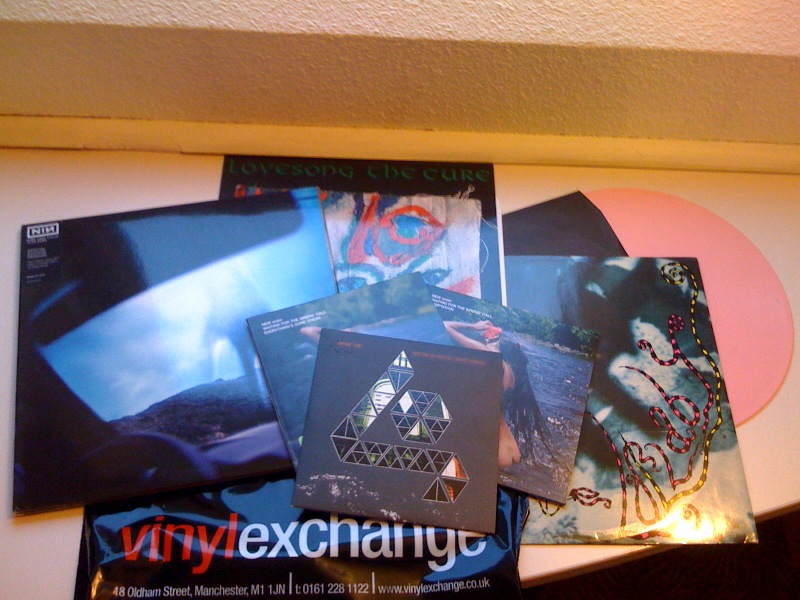
a pile of records
I'm in Manchester so I have made my requisite pilgrimage to Vinyl Exchange and paid my dues.

19 March 2010

Jon Dowland: The Dice Man and Generation X

The movie ' Fight Club' had a profound effect on me when I first saw it in 1999. I wasn't as fond of the originating novel, although there was something about the prose that Palahniuk used which I did enjoy. Since then I've read more of Palahniuk's work. My favourite of his books is actually Non-Fiction (a.k.a. Stranger than Fiction ): a collection of essays and interviews. Reading some of the stories in that collection, it becomes very clear where some of the concepts in his fiction originate. There are also a number of pieces on the craft of writing. He writes some really gushing praise about Amy Hempel:
When you study Minimalism in the novelist Tom Spanbauer's workshop, the first story you read is Amy Hempel's The Harvest. After that, you're ruined every other book you ever read will suck.
I recently read a couple of novels, both of which reminded me a lot of Fight Club. 'Generation X: Tales for an Accelerated Culture' by Douglas Coupland is an interesting tale of three or more societal drop-outs. Fight Club was written five years after Generation X and owes it a lot. 'Generation X' has curt, clipped passages and many dictionary-definition-esque side notes decoding hipster-slang, which add a lot of colour to the non-events of the story. These remind me both of the copous asides in Pratchett novels, or the chapter introductions in Philip K Dick's excellent 'Ubik'.
Historical Overdosing: To live in a period of time when too much seems to happen. Major symptoms include addiction to newspapers, magazines, and TV news broadcasts.
The novel goes absolutely nowhere, but that's actually one of the appealing things about it. When I mentioned this to my partner (who, as far as I know, has not read the book), she said that it sounded like the perfect tonic to a stressful life: imagine lying on a sunbed, doing nothing, reading about people lying on sunbeds, doing nothing. This is the first of Coupland's novels that I have read, but I managed to pick up a copy of 'Generation A' (so far as a I can tell, not a sequel, as such) 70% off as part of the closing-down sale at my local Borders store, so I will probably read that too. I also recently finished The Dice Man , by Luke Reinhart. It's a tongue-in-cheek pseudo-autobiography written under a pen-name about a psychiatrist who opts to delegate all life decisions to the throw of dice. Once again, Fight Club owes a lot to this book. The unhinged situations that occur are used to shine a satirical light on modern society. 'modern society' in the book is the 1970s. The distance between society then and now adds something to the novel's value now. Having said that, the narrator is not a particularly likeable character and it's hard to relate to him. Coincidentally my dad recently read this book and described it as 'misogynistic', which might be an understatement. Mind you, most of the characters, female or otherwise, are fairly 2D: perhaps intentionally the only fleshed out human is the narrator. In my favourite scene of the book, the narrator is in a situation under the influence of more than one drug. A TV set is on in the background. As the scene progresses, the events taking place on the TV are written about with increasing prominence compared to the main events of the scene. This escalates to a point where they are of equal importance and you can no longer easily distinguish the events taking place in the real world from those taking place on the television. This is the only part of the book that I can recall that employed any narrative tricks. The rest is by-the-numbers, and mostly internal monologue. The book is also at least 50% too long: the concept just doesn't stretch as far as it's forced to.

Jon Dowland: the world we live in

Sometimes the world we live in amazes me. Rentokil falsify scientific studies that show an alarming number of bugs and pests on public transport. Ben Goldacre calls them out, and fellow marketing people defend the practice as a sound marketing tool. On the other side of the globe, Viacom sue Youtube for breach of the Digital Millenium Copyright Act, specifically for not doing an adequate job of preventing their copyright material from being shared via the site. At the same time, Viacom hired at least 18 marketing agencies to upload its content to Youtube. They even went as far as to apply post-production techniques to make the videos look illegally sourced.

25 February 2010

Jon Dowland: iPhone Doom

Id Software have released a port of Doom for the iPhone. What makes this exciting for me is the lineage of this code. the iPhone port is derived from prboom. Peeking around in the source code, there's some of my code in there (p_checksum.[ch]) as well as some code I borrowed from dpkg (md5.[ch], thanks to Colin Plumb and Ian Jackson). This stuff is unlikely to actually be run on the iPhone, mind (although I think I have some patches against p_enemy.c which will). John Carmack has some interesting words about developing the app.

Jon Dowland: The Wire

A good friend of mine convinced me to give "The Wire" a try. I've just finished season four of five. This is the best TV programme I have ever seen. I'd have a renewed faith in the TV industry's quality standards were it not for the fact it stands alone, quality-wise. Guardian columnist Charlie brooker says it best:
The Wire's so good, I've lost count of the number of people who've approached or emailed me just to thank ME for convincing THEM to watch it. The Wire's so good, I'm jealous of anyone who hasn't seen it yet, because they get to discover it anew. The Wire's so good, it's come to an end.
That last point is an important one. I'm only ten episodes away from it ending. As much as I'm going to hate reaching the end, I'm glad it will. I'm reasonably confident it will end with the same quality as it began: something which I can't say about Battlestar Galactica, for example. I wish I'd discovered "The Wire" sooner: I think you can learn a lot about relationship politics which can be applied to aspects of your own life. A word of advice to the folks who produce the boxed-set: a second set of Season One episodes would be very useful, as things stand I can only loan it out to one person at a time.

15 January 2010

Jon Dowland: Dawn

The weather in January in the UK is normally very drab, and this January has been no exception. Despite this I've found myself uncharactistically upbeat. I'm enjoying work, I've got a lot to do, and I feel like I'm making real progress in "real life" too. (It's a shame Debian has taken a back seat for the time being...) This morning was marginally less drab.

14 January 2010

Jon Dowland: music on linux 2009

An excellent Linux Journal article on the improvements made to music software on Linux during 2009:

13 January 2010

Jon Dowland: no longer on hold

I'm no longer on hold - the call was disconnected after 1 hour and 9 minutes. Yay for O2!

Jon Dowland: on hold

I've been on hold to my mobile phone provider for over an hour. However, in that time, I've take a massive bite out of my miscellaneous TODO list. That feels good!

17 December 2009

Jon Dowland: shunit2

Despite my position on shell scripts (see sh), one of the bespoke packages in Debian that I look after, game-data-packager, is written entirely in bourne shell. This is partly a result of it's origins: game-data-packager grew iteratively from hacky shell scripts that did specific jobs to install non-free game data into a Debian system. As game-data-packager has grown, I've wanted to write a regression test suite for it. Yesterday I learned of a framework for doing this called shunit2. I don't have any experience of other testing frameworks for comparison, but it looks well written and potentially very useful. Today I discovered that a Debian package for it is being worked on. It also turns out that shunit2 was briefly in unstable and testing 2 years ago, but was removed not long afterwards.

Next.

Previous.