Search Results: "jan"

31 January 2021

Paul Wise: FLOSS Activities January 2021

Focus This month I didn't have any particular focus. I just worked on issues in my info bubble.

Changes

Issues

Review

Administration
  • Debian ports: fix header on incoming.ports.d.o/buildd
  • Debian wiki: unblock IP addresses, approve accounts

Communication
  • Initiate discussions about aptly, Linux USB gadgets maintenance
  • Respond to queries from Debian users and contributors on the mailing lists and IRC
  • Invite organisations to post on FOSSjobs

Sponsors The samba work, apt-listchanges work, pytest-rerunfailures upload, python-testfixtures/python-scrapy bugs and python-scrapy related backports were sponsored by my employer. All other work was done on a volunteer basis.

Chris Lamb: Free software activities in January 2021

Here is my monthly update covering what I have been doing in the free software world during January 2021 (previous month):

Reproducible Builds One of the original promises of open source software is that distributed peer review and transparency of process results in enhanced end-user security. However, whilst anyone may inspect the source code of free and open source software for malicious flaws, almost all software today is distributed as pre-compiled binaries. This allows nefarious third-parties to compromise systems by injecting malicious code into ostensibly secure software during the various compilation and distribution processes. The motivation behind the Reproducible Builds effort is to ensure no flaws have been introduced during this compilation process by promising identical results are always generated from a given source, thus allowing multiple third-parties to come to a consensus on whether a build was compromised. This month, I:
I also made the following changes to diffoscope, our in-depth and content-aware diff utility that can locate and diagnose reproducibility issues, releasing version 164, version 165 and version 166 as well as triaging and merging many contributions from others:

Debian Uploads Debian LTS This month I worked 18 hours on Debian Long Term Support (LTS) and 12 hours on its sister Extended LTS project. You can find out more about the project via the following video:

30 January 2021

Junichi Uekawa: I wanted to learn about audio spectrograms of instruments.

I wanted to learn about audio spectrograms of instruments. I wrote a web app because I could. Not sure if I should be fine-tuning some of the axes yet because I haven't looked at many actual waveforms to know if this is useful. But here is the web app. Handles the default input only, and discovered that my electric piano sound is not picked up via USB C and maybe I need to add some configuration option.

25 January 2021

Russ Allbery: Review: Laziness Does Not Exist

Review: Laziness Does Not Exist, by Devon Price
Publisher: Atria Books
Copyright: January 2021
ISBN: 1-9821-4013-5
Format: Kindle
Pages: 216
The premise of Laziness Does Not Exist is in the title: Laziness as a moral failing does not exist. It is a misunderstanding of other problems with physical or psychological causes, a belief system that is used to extract unsustainable amounts of labor, an excuse to withdraw our empathy, and a justification for not solving social problems. Price refers to this as the Laziness Lie, which they define with three main tenets:
  1. Your worth is your productivity.
  2. You cannot trust your own feelings and limits.
  3. There is always more you could be doing.
This book (an expansion of a Medium article) makes the case against all three tenets using the author's own burnout-caused health problems as the starting argument. They then apply that analysis to work, achievements, information overload, relationships, and social pressure. In each case, Price's argument is to prioritize comfort and relaxation, listen to your body and your limits, and learn who you are rather than who the Laziness Lie is trying to push you to be. The reader reaction to a book like this will depend on where the reader is in thinking about the problem. That makes reviewing a challenge, since it's hard to simulate a reader with a different perspective. For myself, I found the content unobjectionable, but largely repetitive of other things I've read. The section on relationships in particular will be very familiar to Captain Awkward readers, just not as pointed. Similarly, the chapter on information overload is ground already covered by Digital Minimalism, among other books. That doesn't make this a bad book, but it's more of a survey, so if you're already well-read on this topic you may not get much out of it. The core assertion is aggressive in part to get the reader to argue with it and thus pay attention, but I still came away convinced that laziness is not a useful word. The symptoms that cause us to call ourselves lazy procrastination, burnout, depression, or executive function problems, for example are better understood without the weight of moral reproach that laziness carries. I do think there is another meaning of laziness that Price doesn't cover, since they are aiming this book exclusively at people who are feeling guilty about possibly being lazy, and we need some term for people who use their social power to get other people to do all their work for them. But given how much the concept of laziness is used to attack and belittle the hard-working or exhausted, I'm happy to replace "laziness" with "exploitation" when talking about that behavior. This is a profoundly kind and gentle book. Price's goal is to help people be less hard on themselves and to take opportunities to relax without guilt. But that also means that it stays in the frame of psychological analysis and self-help, and only rarely strays into political or economic commentary. That means it's more useful for taking apart internalized social programming, but less useful for thinking about the broader political motives of those who try to convince us to work endlessly and treat all problems as personal responsibilities rather than political failures. For that, I think Anne Helen Peterson's Can't Even is the more effective book. Price also doesn't delve much into history, and I now want to read a book on the origin of a work ethic as a defining moral trait. One truly lovely thing about this book is that it's quietly comfortable with human variety of gender and sexuality in a way that's never belabored but that's obvious from the examples that Price uses. Laziness Does Not Exist felt more inclusive in that way, and to some extent on economic class, than Can't Even. I was in the mood for a book that takes apart the political, social, and economic motivations behind convincing people that they have to constantly strive to not be lazy, so the survey nature of this book and its focus on self-help made it not the book for me. It also felt a bit repetitive despite its slim length, and the chapter structure didn't click for me. But it's not a bad book, and I suspect it will be the book that someone else needs to read. Rating: 6 out of 10

24 January 2021

Enrico Zini: Miscellaneous news links

Some curious news. Here's a scam that targets terrorists: The Doomsday Scam. On the general topic of scams, a List of confidence tricks. Then two news involving bread: And a last one about how people needed to rename human genes to work around Excel bugsfeatures:

21 January 2021

Russell Coker: Links January 2021

Krebs on Security has an informative article about web notifications and how they are being used for spamming and promoting malware [1]. He also includes links for how to permanently disable them. If nothing else clicking no on each new site that wants to send notifications is annoying. Michael Stapelberg wrote an insightful posts about inefficiencies in the Debian development processes [2]. While I agree with most of his assessment of Debian issues I am not going to decrease my involvement in Debian. Of the issues he mentions the 2 that seem to have the best effort to reward ratio are improvements to mailing list archives (to ideally make it practical to post to lists without subscribing and read responses in the archives) and the issues of forgetting all the complexities of the development process which can be alleviated by better Wiki pages. In my Debian work I ve contributed more to the Wiki in recent times but not nearly as much as I should. Jacobin has an insightful article Ending Poverty in the United States Would Actually Be Pretty Easy [3]. Mark Brown wrote an interesting blog post about the Rust programming language [4]. He links to a couple of longer blog posts about it. Rust has some great features and I ve been meaning to learn it. Scientific America has an informative article about research on the spread of fake news and memes [5]. Something to consider when using social media. Bruce Schneier wrote an insightful blog post on whether there should be limits on persuasive technology [6]. Jonathan Dowland wrote an interesting blog post about git rebasing and lab books [7]. I think it s an interesting thought experiment to compare the process of developing code worthy of being committed to a master branch of a VCS to the process of developing a Ph.D thesis. CBS has a disturbing article about the effect of Covid19 on people s lungs [8]. Apparently it usually does more lung damage than long-term smoking and even 70%+ of people who don t have symptoms of the disease get significant lung damage. People who live in heavily affected countries like the US now have to worry that they might have had the disease and got lung damage without knowing it. Russ Allbery wrote an interesting review of the book Because Internet about modern linguistics [9]. The topic is interesting and I might read that book at some future time (I have many good books I want to read). Jonathan Carter wrote an interesting blog post about CentOS Streams and why using a totally free OS like Debian is going to be a better option for most users [10]. Linus has slammed Intel for using ECC support as a way of segmenting the market between server and desktop to maximise profits [11]. It would be nice if a company made a line of Ryzen systems with ECC RAM support, but most manufacturers seem to be in on the market segmentation scam. Russ Allbery wrote an interesting review of the book Can t Even about millenials as the burnout generation and the blame that the corporate culture deserves for this [12].

20 January 2021

Raphaël Hertzog: Freexian s report about Debian Long Term Support, December 2020

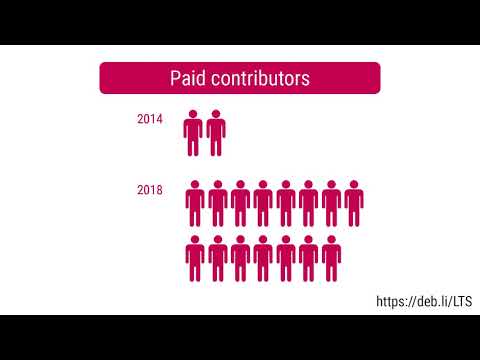
A Debian LTS logo Like each month, have a look at the work funded by Freexian s Debian LTS offering. Debian project funding In December, we put aside 2100 EUR to fund Debian projects. The first project proposal (a tracker.debian.org improvement for the security team) was received and quickly approved by the paid contributors, then we opened a request for bids and the bid winner was announced today (it was easy, we had only one candidate). Hopefully this first project will be completed until our next report. We re looking forward to receive more projects from various Debian teams! Learn more about the rationale behind this initiative in this article. Debian LTS contributors In December, 12 contributors have been paid to work on Debian LTS, their reports are available: Evolution of the situation December was a quiet month as we didn t have a team meeting nor any other unusual activity and we released 43 DLAs. The security tracker currently lists 30 packages with a known CVE and the dla-needed.txt file has 25 packages needing an update. This month we are pleased to welcome Deveryware as new sponsor! Thanks to our sponsors Sponsors that joined recently are in bold.

17 January 2021

Junichi Uekawa: Yesterday was our monthly Debian meeting.

Yesterday was our monthly Debian meeting. We do one every month for Tokyo and Kansai combined, because it's online and no reason to split for now. I presented what I learnt about nodejs packaging in Debian. This time, I started using Emacs for presentation, presenting PDF file. This week I switched most of my login shells to emacsclient, and experimenting. It's interesting how much things break, and how much I depended on .bashrc and .profile being loaded. But most things work and I don't need most things outside of emacs...

16 January 2021

Junichi Uekawa: It's been 20 years since I became a Debian Developer.

It's been 20 years since I became a Debian Developer. Lots of fun things happened, and I think fondly of the team. I am no longer active for the past 10 years due to family reasons, and it's surprising that I have been inactive for that long. I still use Debian, and I still participate in the local Debian meetings.

9 January 2021

Thorsten Alteholz: My Debian Activities in December 2020

FTP master This month I only accepted 8 packages and like last month rejected 0. Despite the holidays 293 packages got accepted. Debian LTS This was my seventy-eighth month that I did some work for the Debian LTS initiative, started by Raphael Hertzog at Freexian. This month my all in all workload has been 26h. During that time I did LTS uploads of: Unfortunately package slirp has the same version in Stretch and Buster. So I first had to upload slirp/1:1.0.17-11 to unstable, in order to be allowed to fix the CVE in Buster and to finally upload a new version to Stretch. Meanwhile the fix for Buster has been approved by the Release Team and I am waiting for the next point release now. I also prepared a debdiff for influxdb, which will result in DSA-4823-1 in January. As there appeared new CVEs for openjpeg2, I did not do an upload yet. This is planned for January now. Last but not least I did some days of frontdesk duties. Debian ELTS This month was the thirtieth ELTS month. During my allocated time I uploaded: As well as for LTS, I did not finish work on all CVEs of openjpeg2, so the upload is postponed to January. Last but not least I did some days of frontdesk duties. Unfortunately I also had to give back some hours. Other stuff This month I uploaded new upstream versions of: I fixed one or two bugs in: I improved packaging of: Some packages just needed a source upload: and there have been even some new packages: With these uploads I finished the libosmocom- and libctl-transitions. The Debian Med Advent Calendar was again really successful this year. There was no new record, but with 109, the second most number of bugs has been closed.
year number of bugs closed
2011 63
2012 28
2013 73
2014 5
2015 150
2016 95
2017 105
2018 81
2019 104
2020 109
Well done everybody who participated. It is really nice to see that Andreas is no longer a lone wolf.

Louis-Philippe V ronneau: puppetserver 6: a Debian packaging post-mortem

I have been a Puppet user for a couple of years now, first at work, and eventually for my personal servers and computers. Although it can have a steep learning curve, I find Puppet both nimble and very powerful. I also prefer it to Ansible for its speed and the agent-server model it uses. Sadly, Puppet Labs hasn't been the most supportive upstream and tends to move pretty fast. Major versions rarely last for a whole Debian Stable release and the upstream .deb packages are full of vendored libraries.1 Since 2017, Apollon Oikonomopoulos has been the one doing most of the work on Puppet in Debian. Sadly, he's had less time for that lately and with Puppet 5 being deprecated in January 2021, Thomas Goirand, Utkarsh Gupta and I have been trying to package Puppet 6 in Debian for the last 6 months. With Puppet 6, the old ruby Puppet server using Passenger is not supported anymore and has been replaced by puppetserver, written in Clojure and running on the JVM. That's quite a large change and although puppetserver does reuse some of the Clojure libraries puppetdb (already in Debian) uses, packaging it meant quite a lot of work. Work in the Clojure team As part of my efforts to package puppetserver, I had the pleasure to join the Clojure team and learn a lot about the Clojure ecosystem. As I mentioned earlier, a lot of the Clojure dependencies needed for puppetserver were already in the archive. Unfortunately, when Apollon Oikonomopoulos packaged them, the leiningen build tool hadn't been packaged yet. This meant I had to rebuild a lot of packages, on top of packaging some new ones. Since then, thanks to the efforts of Elana Hashman, leiningen has been packaged and lets us run the upstream testsuites and create .jar artifacts closer to those upstream releases. During my work on puppetserver, I worked on the following packages:
List of packages
  • backport9
  • bidi-clojure
  • clj-digest-clojure
  • clj-helper
  • clj-time-clojure
  • clj-yaml-clojure
  • cljx-clojure
  • core-async-clojure
  • core-cache-clojure
  • core-match-clojure
  • cpath-clojure
  • crypto-equality-clojure
  • crypto-random-clojure
  • data-csv-clojure
  • data-json-clojure
  • data-priority-map-clojure
  • java-classpath-clojure
  • jnr-constants
  • jnr-enxio
  • jruby
  • jruby-utils-clojure
  • kitchensink-clojure
  • lazymap-clojure
  • liberator-clojure
  • ordered-clojure
  • pathetic-clojure
  • potemkin-clojure
  • prismatic-plumbing-clojure
  • prismatic-schema-clojure
  • puppetlabs-http-client-clojure
  • puppetlabs-i18n-clojure
  • puppetlabs-ring-middleware-clojure
  • puppetserver
  • raynes-fs-clojure
  • riddley-clojure
  • ring-basic-authentication-clojure
  • ring-clojure
  • ring-codec-clojure
  • shell-utils-clojure
  • ssl-utils-clojure
  • test-check-clojure
  • tools-analyzer-clojure
  • tools-analyzer-jvm-clojure
  • tools-cli-clojure
  • tools-reader-clojure
  • trapperkeeper-authorization-clojure
  • trapperkeeper-clojure
  • trapperkeeper-filesystem-watcher-clojure
  • trapperkeeper-metrics-clojure
  • trapperkeeper-scheduler-clojure
  • trapperkeeper-webserver-jetty9-clojure
  • url-clojure
  • useful-clojure
  • watchtower-clojure
If you want to learn more about packaging Clojure libraries and applications, I rewrote the Debian Clojure packaging tutorial and added a section about the quirks of using leiningen without a dedicated dh_lein tool. Work left to get puppetserver 6 in the archive Unfortunately, I was not able to finish the puppetserver 6 packaging work. It is thus unlikely it will make it in Debian Bullseye. If the issues described below are fixed, it would be possible to to package puppetserver in bullseye-backports though. So what's left? jruby Although I tried my best (kudos to Utkarsh Gupta and Thomas Goirand for the help), jruby in Debian is still broken. It does build properly, but the testsuite fails with multiple errors: jruby testsuite failures aside, I have not been able to use the jruby.deb the package currently builds in jruby-utils-clojure (testsuite failure). I had the same exact failure with the (more broken) jruby version that is currently in the archive, which leads me to think this is a LOAD_PATH issue in jruby-utils-clojure. More on that below. To try to bypass these issues, I tried to vendor jruby into jruby-utils-clojure. At first I understood vendoring meant including upstream pre-built artifacts (jruby-complete.jar) and shipping them directly. After talking with people on the #debian-mentors and #debian-ftp IRC channels, I now understand why this isn't a good idea (and why it's not permitted in Debian). Many thanks to the people who were patient and kind enough to discuss this with me and give me alternatives. As far as I now understand it, vendoring in Debian means "to have an embedded copy of the source code in another package". Code shipped that way still needs to be built from source. This means we need to build jruby ourselves, one way or another. Vendoring jruby in another package thus isn't terribly helpful. If fixing jruby the proper way isn't possible, I would suggest trying to build the package using embedded code copies of the external libraries jruby needs to build, instead of trying to use the Debian libraries.2 This should make it easier to replicate what upstream does and to have a final .jar that can be used. jruby-utils-clojure This package is a first-level dependency for puppetserver and is the glue between jruby and puppetserver. It builds fine, but the testsuite fails when using the Debian jruby package. I think the problem is caused by a jruby LOAD_PATH issue. The Debian jruby package plays with the LOAD_PATH a little to try use Debian packages instead of downloading gems from the web, as upstream jruby does. This seems to clash with the gem-home, gem-path, and jruby-load-path variables in the jruby-utils-clojure package. The testsuite plays around with these variables and some Ruby libraries can't be found. I tried to fix this, but failed. Using the upstream jruby-complete.jar instead of the Debian jruby package, the testsuite passes fine. This package could clearly be uploaded to NEW right now by ignoring the testsuite failures (we're just packaging static .clj source files in the proper location in a .jar). puppetserver jruby issues aside, packaging puppetserver itself is 80% done. Using the upstream jruby-complete.jar artifact, the testsuite fails with a weird Clojure error I'm not sure I understand, but I haven't debugged it for very long. Upstream uses git submodules to vendor puppet (agent), hiera (3), facter and puppet-resource-api for the testsuite to run properly. I haven't touched that, but I believe we can either: Without the testsuite actually running, it's hard to know what files are needed in those packages. What now Puppet 5 is now deprecated. If you or your organisation cares about Puppet in Debian,3 puppetserver really isn't far away from making it in the archive. Very talented Debian Developers are always eager to work on these issues and can be contracted for very reasonable rates. If you're interested in contracting someone to help iron out the last issues, don't hesitate to reach out via one of the following: As for I, I'm happy to say I got a new contract and will go back to teaching Economics for the Winter 2021 session. I might help out with some general Debian packaging work from time to time, but it'll be as a hobby instead of a job. Thanks The work I did during the last 6 weeks would be not have been possible without the support of the Wikimedia Foundation, who were gracious enough to contract me. My particular thanks to Faidon Liambotis, Moritz M hlenhoff and John Bond. Many, many thanks to Rob Browning, Thomas Goirand, Elana Hashman, Utkarsh Gupta and Apollon Oikonomopoulos for their direct and indirect help, without which all of this wouldn't have been possible.

  1. For example, the upstream package for the Puppet Agent vendors OpenSSL.
  2. One of the problems of using Ruby libraries already packaged in Debian is that jruby currently only supports Ruby 2.5. Ruby libraries in Debian are currently expected to work with Ruby 2.7, with the transition to Ruby 3.0 planned after the Bullseye release.
  3. If you run Puppet, you clearly should care: the .deb packages upstream publishes really aren't great and I would not recommend using them.

5 January 2021

Ben Hutchings: Debian LTS work, December 2020

I was assigned 16 hours of work by Freexian's Debian LTS initiative and carried over 9 hours from earlier months. I worked 16.5 hours this month, so I will carry over 8.5 hours to January. (Updated: corrected number of hours worked.) I updated linux-4.19 to include the changes in the Debian 10.7 point release, uploaded the package, and issued DLA-2483-1 for this. I picked some regression fixes from the Linux 4.9 stable branch to the linux package, and uploaded the package. This unfortunately failed to build on arm64 due to some upstream changes uncovering an old bug, so I made a second upload fixing that. I issued DLA-2494-1 for this. I updated the linux packaging branch for stretch to Linux 4.9.249, but haven't made another package upload yet.

4 January 2021

Iustin Pop: Year 2020 review

Year 2020. What a year! Sure, already around early January there were rumours/noise about Covid-19, but who would have thought where it will end up! Thankfully, none of my close or extended family was directly (medically) affected by Covid, so I/we had a privileged year compared to so many other people. I thought how to write a mini-summary, but prose is too difficult, so let s just go month-by-month. Please note that my memory is fuzzy after 9 months cooked up in the apartment, so things could 1 month compared to what I wrote.

Timeline

January Ski weekend. Skiing is awesome! Cancelling a US work trip since there will be more opportunities soon (har har!).

February Ski vacation. Yep, skiing is awesome. Can t wait for next season (har har!). Discussions about Covid start in the office, but more is this scary or just interesting? (yes, this was before casualties). Then things start escalating, work-from-home at least partially, etc. etc. Definitely not just intersting anymore. In Garmin-speak, I got ~700+ intensity minutes in February (correlates with activity time, but depends on intensity of the effort whether 1:1 or 2 intensity minutes for one wall-clock minute).

March Sometimes during the month, my workplace introduces mandatory WFH. I remember being the last person in our team in the office, on the last day we were allowed to work, and cleaning my desk/etc., thinking all this, and we ll be back in 3 weeks or so . Har har! I buy a webcam, just in case WFH gets extended. And start to increase my sports - getting double the intensity minutes (1500+).

April Switzerland enters the first, hard, lockdown. Or was it late March? Not entirely sure, but in my mind March was the opening, and April was the first main course. It is challenging, having to juggle family and work and stressed schedule, but also interesting. Looking back, I think I liked April the most, as people were actually careful at that time. I continue upgrading my home office - new sound system, so that I don t have to plug in/plug out cables. 1700+ intensity minutes this month.

May Continued WFH, somewhat routine now. My then internet provider started sucking hard, so I upgrade with good results. I m still happy, half a year later (quite happy, even). Still going strong otherwise, but waiting for summer vacation, whatever it will be. A tiny bit more effort, so 1800 intensity minutes in May.

June Switzerland relaxes the lock down, but not my company, so as the rest of the family goes out and about, I start feeling alone in the apartment. And somewhat angry at it, which impacts my sports (counter-intuitively), so I only get 1500 intensity minutes. I go and buy a coffee machine a real one, that takes beans and grinds them, so I get to enjoy the smell of freshly-ground coffee and the fun of learning about coffee beans, etc. But it occupies the time. On the work/job front, I think at this time I finally got a workstation for home, instead of a laptop (which was ultra-portable too), so together with the coffee machine, it feels like a normal work environment. Well, modulo all the people. At least I m not crying anymore every time I open a new tab in Chrome

July Situation is slowly going better, but no, not my company. Still mandatory WFH, with (if I recall correctly) one day per week allowed, and no meeting other people. I get angrier, but manage to channel my energy into sports, almost doubly my efforts in July - 2937 intensity minutes, not quite reaching the 3000 magic number. I buy more stuff to clean and take care of my bicycles, which I don t really use. So shopping therapy too.

August The month starts with a one week family vacation, but I take a bike too, so I manage to put in some effort (it was quite nice riding TBH). A bit of changes in the personal life (nothing unexpected), which complicates things a bit, but at this moment I really thought Switzerland is going to continue to decrease in infections/R-factor/etc. so things will get back to normal, right? My company expands a bit the work-from-office part, so I m optimistic. Sports wise, still going strong, 2500 intensity minutes, preparing for the single race this year.

September The personal life changes from August start to stabilise, so things become again routine, and I finally get to do a race. Life was good for an extended weekend (well, modulo race angst, but that s part of the fun), and I feel justified to take it slow the week after the race. And the week after that too. I end up the month with close, but not quite, 1900 intensity minutes.

October October starts with school holidays and a one week family vacation, but I feel demotivated. Everything is closing down again (well, modulo schools), and I actually have difficulty getting re-adjusted to no longer being alone in the apartment during the work hours. I only get ~1000 intensity minutes in October, mainly thanks to good late autumn weather and outside rides. And I start playing way more computer games. I also sell my PS4, hoping to get a PS5 next month.

November November continues to suck. I think my vacation in October was actually detrimental - it broke my rhythm, I don t really do sport anymore, not consistently at least, so I only get 700+ intensity minutes. And I keep playing computer games, even if I missed the PS5 ordering window; so I switch to PC gaming. My home office feels very crowded, so as kind of anti-shopping therapy, I sell tons of smallish stuff; can t believe how much crap I kept around while not really using it. I also manage to update/refresh all my Debian packages, since next freeze approaches. Better than for previous releases, so it feels good.

December December comes, end of the year, the much awaited vacation - which we decide to cancel due to the situation in whole of Switzerland (and neighbouring countries). I basically only play computer games, and get grand total of 345 activity minutes this month. And since my weight is inversely correlated to my training, I m basically back at my February weight, having lost all the gains I made during the year. I mean, having gained back all the fat I lost. Err, you know what I mean; I m back close to my high-watermark, which is not good.

Conclusion I was somehow hoping that the end of the year will allow me to reset and restart, but somehow - a few days into January - it doesn t really feel so. My sleep schedule is totally ruined, my motivation is so-so, and I think the way I crashed in October was much harder/worse than I realised at the time, but in a way expected for this crazy year. I have some projects for 2021 - or at least, I m trying to make up a project list - in order to get a bit more structure in my continued stuck inside the house part, which is especially terrible when on-call. I don t know how the next 3-6 months will evolve, but I m thankful that so far, we are all healthy. Actually, me personally I ve been healthier physically than in other years, due to less contact with other people. On the other side, thinking of all the health-care workers, or even service workers, my IT job is comfy and all I am is a spoiled person (I could write many posts on specifically this topic). I really need to up my willpower and lower my spoil level. Hints are welcome :( Wish everybody has a better year in 2021.

Jan Wagner: Backing up Windows (the hard way)

Sometimes you need to do things you don't like and you don't know where you will end up.
In our household there exists one (production) system running Windows. Don't ask why and please no recommandations how to substitute it. Some things are hard to (ex)change, for example your love partner. Looking into Backup with rsync on Windows (WSL) I needed to start a privileged powershell, so I first started an unprivileged one:
powershell
Just to start a privileged:
Start-Process powershell -Verb runAs
Now you can follow the Instructions from Microsoft to install OpenSSH. Or just install the OpenSSH Server:
Add-WindowsCapability -Online -Name OpenSSH.Server~~~~0.0.1.0
Check if a firewall rule was created (maybe you want to adjust it):
Get-NetFirewallRule -Name *ssh*
Start the OpenSSH server:
Start-Service sshd
Running OpenSSH server as service:
Set-Service -Name sshd -StartupType 'Automatic'
You can create the .ssh directory with the correct permissions by connecting to localhost and creating the known_hosts file.
ssh user@127.0.0.1
When you intend to use public key authentication for users in the administrators group, have a look into How to Login Windows Using SSH Key Under Local Admin. Indeed you can get rsync running via WSL. But why load tons of dependencies on your system? With the installation of rsync I cheated a bit and used chocolately by running choco install rsync, but there is also an issue requesting rsync support for the OpenSSH server which includes an archive with a rsync.exe and libraries which may also fit. You can place those files for example into C:\Windows\System32\OpenSSH so they are in the PATH. So here we are. Now I can solve all my other issues with BackupPC, Windows firewall and the network challenges to get access to the isolated dedicated network of the windows system.

Russ Allbery: Review: The Once and Future Witches

Review: The Once and Future Witches, by Alix E. Harrow
Publisher: Redhook Books
Copyright: October 2020
ISBN: 0-316-42202-9
Format: Kindle
Pages: 515
Once upon a time there were three sisters. They were born in a forgotten kingdom that smelled of honeysuckle and mud, where the Big Sandy ran wide and the sycamores shone white as knuckle-bones on the banks. The sisters had no mother and a no-good father, but they had each other; it might have been enough. But the sisters were banished from their kingdom, broken and scattered.
The Once and Future Witches opens with Juniper, the youngest, arriving in the city of New Salem. The year is 1893, but not in our world, not quite; Juniper has witch-ways in her pocket and a few words of power. That's lucky for her because the wanted posters arrived before she did. Unbeknownst to her or to each other, her sisters, Agnes and Bella, are already in New Salem. Agnes works in a cotton mill after having her heart broken one too many times; the mill is safer because you can't love a cotton mill. Bella is a junior librarian, meek and nervous and uncertain but still fascinated by witch-tales and magic. It's Bella who casts the spell, partly by accident, partly out of wild hope, but it was Juniper arriving in the city who provided the final component that made it almost work. Not quite, not completely, but briefly the lost tower of Avalon appears in St. George's Square. And, more importantly, the three sisters are reunited. The world of the Eastwood sisters has magic, but the people in charge of that world aren't happy about it. Magic is a female thing, contrary to science and, more importantly, God. History has followed a similar course to our world in part because magic has been ruthlessly suppressed. Inquisitors are a recent memory and the cemetery has a witch-yard, where witches are buried unnamed and their ashes sown with salt. The city of New Salem is called New Salem because Old Salem, that stronghold of witchcraft, was burned to the ground and left abandoned, fit only for tourists to gawk at the supposedly haunted ruins. The women's suffrage movement is very careful to separate itself from any hint of witchcraft or scandal, making its appeals solely within the acceptable bounds of the church. Juniper is the one who starts to up-end all of that in New Salem. Juniper was never good at doing what she was told. This is an angry book that feels like something out of another era, closer in tone to a Sheri S. Tepper or Joanna Russ novel than the way feminism is handled in recent work. Some of that is the era of the setting, before women even had the right to vote. But primarily it's because Harrow, like those earlier works, is entirely uninterested in making excuses or apologies for male behavior. She takes an already-heated societal conflict and gives the underdogs magic, which turns it into a war. There is likely a better direct analogy from the suffrage movement, but the comparison that came to my mind was if Martin Luther King, Jr. proved ineffective or had not existed, and instead Malcolm X or the Black Panthers became the face of the Civil Rights movement. It's also an emotionally exhausting book. The protagonists are hurt and lost and shattered. Their moments of victory are viciously destroyed. There is torture and a lot of despair. It works thematically; all the external solutions and mythical saviors fail, but in the process the sisters build their own strength and their own community and rescue themselves. But it's hard reading at times if you're emotionally invested in the characters (and I was very invested). Harrow does try to balance the losses with triumphs and that becomes more effective and easier to read in the back half of the book, but I struggled with the grimness at the start. One particular problem for me was that the sisters start the book suspicious and distrustful of each other because of lies and misunderstandings. This is obvious to the reader, but they don't work through it until halfway through the book. I can't argue with this as a piece of characterization it made sense to me that they would have reacted to their past the way that they did. But it was still immensely frustrating to read, since in the meantime awful things were happening and I wanted them to band together to fight. They also worry over the moral implications of the fate of their father, whereas I thought the only problem was that the man couldn't die more than once. There too, it makes sense given the moral framework the sisters were coerced into, but it is not my moral framework and it was infuriating to see them stay trapped in it for so long. The other thing that I found troubling thematically is that Harrow personalizes evil. I thought the more interesting moral challenge posed in this book is a society that systematically abuses women and suppresses their power, but Harrow gradually supplants that systemic conflict with a villain who has an identity and a backstory. It provides a more straightforward and satisfying climax, and she does avoid the trap of letting triumph over one character solve all the broader social problems, but it still felt too easy. Worse, the motives of the villain turn out to be at right angles to the structure of the social oppression. It's just a tool he's using, and while that's also believable, it means the transfer of the narrative conflict from the societal to the personal feels like a shying away from a sharper political point. Harrow lets the inhabitants of New Salem off too easily by giving them the excuse of being manipulated by an evil mastermind. What I thought Harrow did handle well was race, and it feels rare to be able to say this about a book written by and about white women. There are black women in New Salem as well, and they have their own ways and their own fight. They are suspicious of the Eastwood sisters because they're worried white women will stir up trouble and then run away and leave the consequences to fall on black women... and they're right. An alliance only forms once the white women show willingness to stay for the hard parts. Black women are essential to the eventual success of the protagonists, but the opposite is not necessarily true; they have their own networks, power, and protections, and would have survived no matter what the Eastwoods did. The book is the Eastwoods' story, so it's mostly concerned with white society, but I thought Harrow avoided both making black women too magical or making white women too central. They instead operate in parallel worlds that can form the occasional alliance of mutual understanding. It helps that Cleopatra Quinn is one of the best characters of the book. This was hard, emotional reading. It's the sort of book where everything has a price, even the ending. But I'm very glad I read it. Each of the three sisters gets their own, very different character arc, and all three of those arcs are wonderful. Even Agnes, who was the hardest character for me to like at the start of the book and who I think has the trickiest story to tell, becomes so much stronger and more vivid by the end of the book. Sometimes the descriptions are trying a bit too hard and sometimes the writing is not quite up to the intended goal, but some of the descriptions are beautiful and memorable, and Harrow's way of weaving the mythic and the personal together worked for me. This is a more ambitious book than The Ten Thousand Doors of January, and while I think the ambition exceeded Harrow's grasp in a few places and she took a few thematic short-cuts, most of it works. The characters felt like living and changing people, which is not easy given how heavily the story structure leans on maiden, mother, and crone archetypes. It's an uncompromising and furious book that turns the anger of 1970s feminist SF onto themes that are very relevant in 2021. You will have to brace yourself for heartbreak and loss, but I think it's fantasy worth reading. Recommended. Rating: 8 out of 10

1 January 2021

Russ Allbery: 2020 Book Reading in Review

In 2020, I finished and reviewed 42 books, two more than 2019 (although I had finished but not reviewed two books at the end of 2019, so the total is even more similar than that). This is the best year for reading in terms of book count since 2012, despite being seriously distracted by a new job, a pandemic, and US political meltdowns. Those distractions do show up in the drop in page count. If it weren't for the pandemic, the count would have been higher. Just as I got into a rhythm of reading while I exercised, gyms became a bad idea for the rest of the year. Treadmills are good for reading; long walks around the neighborhood not so much. That time went to podcasts instead, which I'm not too sad about but which don't prompt reviews. Finding the mental space and energy to write reviews proved as much of a challenge as finding time to read this year, and I once again had to do some catch-up at the end of the year. To the extent that I have goals for 2021, it's to tighten up the elapsed time between finishing a book and writing a review so that the reviews don't pile up. I read one book this year that I rated 10 out of 10: Michael Lewis's The Fifth Risk, which is partly about the US presidential transition and is really about what the US government does and what sort of people make careers in civil service. This book is brilliant, fascinating, and surprisingly touching, and I wish it were four times as long. If anything, it's even more relevant today as we enter another transition than it was when Lewis wrote it or when I read it. There were so many 9 out of 10 ratings this year that it's hard to know where to start. I read the last Murderbot novella by Martha Wells (Exit Strategy) and then the first Murderbot novel (Network Effect), both of which were everything I was hoping for. Murderbot's sarcastic first-person voice continues to be a delight, and I expect Network Effect to take home several 2021 awards. I'm eagerly awaiting the next novel, Fugitive Telemetry, currently scheduled for the end of April, 2021. Also on the fiction side were Alix E. Harrow's wonderful debut novel The Ten Thousand Doors of January, a fierce novel about family and claiming power that will hopefully win the 2020 Mythopoeic Award (which was delayed by the pandemic), and TJ Klune's heart-warming The House in the Cerulean Sea, my feel-good novel of the year. Finally, Tamsyn Muir's Gideon the Ninth and Harrow the Ninth were a glorious mess in places, but I had more fun reading and discussing those books than I've had with any novel in a very long time. On the non-fiction side, Tressie McMillan Cottom's Thick is the best collection of sociology that I've read. It's not easy reading, but that book gave me a new-found appreciation and understanding of sociology and what it's trying to accomplish. Gretchen McCulloch's Because Internet is much easier reading but similarly perspective-enhancing, helping me understand (among other things) how choice of punctuation and capitalization expands the dynamic range of meaning in informal text conversation. Finally, Nick Pettigrew's Anti-Social is a funny, enlightening, and sobering look at the process of addressing low-level unwanted behavior that's directly relevant to the current conflicts over the role of policing in society. The full analysis includes some additional personal reading statistics, probably only of interest to me.

Utkarsh Gupta: FOSS Activites in December 2020

Here s my (fifteenth) monthly update about the activities I ve done in the F/L/OSS world.

Debian
This was my 24th month of contributing to Debian. I became a DM in late March last year and a DD last Christmas! \o/ Amongs a lot of things, this was month was crazy, hectic, adventerous, and the last of 2020 more on some parts later this month.
I finally finished my 7th semester (FTW!) and moved onto my last one! That said, I had been busy with other things but still did a bunch of Debian stuff Here are the following things I did this month:

Uploads and bug fixes:

Other $things:
  • Attended the Debian Ruby team meeting.
  • Mentoring for newcomers.
  • FTP Trainee reviewing.
  • Moderation of -project mailing list.
  • Sponsored golang-github-gorilla-css for Fedrico.

Debian (E)LTS
Debian Long Term Support (LTS) is a project to extend the lifetime of all Debian stable releases to (at least) 5 years. Debian LTS is not handled by the Debian security team, but by a separate group of volunteers and companies interested in making it a success. And Debian Extended LTS (ELTS) is its sister project, extending support to the Jessie release (+2 years after LTS support). This was my fifteenth month as a Debian LTS and sixth month as a Debian ELTS paid contributor.
I was assigned 26.00 hours for LTS and 38.25 hours for ELTS and worked on the following things:

LTS CVE Fixes and Announcements:
  • Issued DLA 2474-1, fixing CVE-2020-28928, for musl.
    For Debian 9 Stretch, these problems have been fixed in version 1.1.16-3+deb9u1.
  • Issued DLA 2481-1, fixing CVE-2020-25709 and CVE-2020-25710, for openldap.
    For Debian 9 Stretch, these problems have been fixed in version 2.4.44+dfsg-5+deb9u6.
  • Issued DLA 2484-1, fixing #969126, for python-certbot.
    For Debian 9 Stretch, these problems have been fixed in version 0.28.0-1~deb9u3.
  • Issued DLA 2487-1, fixing CVE-2020-27350, for apt.
    For Debian 9 Stretch, these problems have been fixed in version 1.4.11. The update was prepared by the maintainer, Julian.
  • Issued DLA 2488-1, fixing CVE-2020-27351, for python-apt.
    For Debian 9 Stretch, these problems have been fixed in version 1.4.2. The update was prepared by the maintainer, Julian.
  • Issued DLA 2495-1, fixing CVE-2020-17527, for tomcat8.
    For Debian 9 Stretch, these problems have been fixed in version 8.5.54-0+deb9u5.
  • Issued DLA 2488-2, for python-apt.
    For Debian 9 Stretch, these problems have been fixed in version 1.4.3. The update was prepared by the maintainer, Julian.
  • Issued DLA 2508-1, fixing CVE-2020-35730, for roundcube.
    For Debian 9 Stretch, these problems have been fixed in version 1.2.3+dfsg.1-4+deb9u8. The update was prepared by the maintainer, Guilhem.

ELTS CVE Fixes and Announcements:

Other (E)LTS Work:
  • Front-desk duty from 21-12 until 27-12 and from 28-12 until 03-01 for both LTS and ELTS.
  • Triaged openldap, python-certbot, lemonldap-ng, qemu, gdm3, open-iscsi, gobby, jackson-databind, wavpack, cairo, nsd, tomcat8, and bountycastle.
  • Marked CVE-2020-17527/tomcat8 as not-affected for jessie.
  • Marked CVE-2020-28052/bountycastle as not-affected for jessie.
  • Marked CVE-2020-14394/qemu as postponed for jessie.
  • Marked CVE-2020-35738/wavpack as not-affected for jessie.
  • Marked CVE-2020-3550 3-6 /qemu as postponed for jessie.
  • Marked CVE-2020-3550 3-6 /qemu as postponed for stretch.
  • Marked CVE-2020-16093/lemonldap-ng as no-dsa for stretch.
  • Marked CVE-2020-27837/gdm3 as no-dsa for stretch.
  • Marked CVE-2020- 13987, 13988, 17437 /open-iscsi as no-dsa for stretch.
  • Marked CVE-2020-35450/gobby as no-dsa for stretch.
  • Marked CVE-2020-35728/jackson-databind as no-dsa for stretch.
  • Marked CVE-2020-28935/nsd as no-dsa for stretch.
  • Auto EOL ed libpam-tacplus, open-iscsi, wireshark, gdm3, golang-go.crypto, jackson-databind, spotweb, python-autobahn, asterisk, nsd, ruby-nokogiri, linux, and motion for jessie.
  • General discussion on LTS private and public mailing list.

Other $things! \o/

Bugs and Patches Well, I did report some bugs and issues and also sent some patches:
  • Issue #44 for github-activity-readme, asking for a feature request to set custom committer s email address.
  • Issue #711 for git2go, reporting build failure for the library.
  • PR #89 for rubocop-rails_config, bumping RuboCop::Packaging to v0.5.
  • Issue #36 for rubocop-packaging, asking to try out mutant :)
  • PR #212 for cucumber-ruby-core, bumping RuboCop::Packaging to v0.5.
  • PR #213 for cucumber-ruby-core, enabling RuboCop::Packaging.
  • Issue #19 for behance, asking to relax constraints on faraday and faraday_middleware.
  • PR #37 for rubocop-packaging, enabling tests against ruby3.0! \o/
  • PR #489 for cucumber-rails, bumping RuboCop::Packaging to v0.5.
  • Issue #362 for nheko, reporting a crash when opening the application.
  • PR #1282 for paper_trail, adding RuboCop::Packaging amongst other used extensions.
  • Bug #978640 for nheko Debian package, reporting a crash, as a result of libfmt7 regression.

Misc and Fun Besides squashing bugs and submitting patches, I did some other things as well!
  • Participated in my first Advent of Code event! :)
    Whilst it was indeed fun, I didn t really complete it. No reason, really. But I ll definitely come back stronger next year, heh! :)
    All the solutions thus far could be found here.
  • Did a couple of reviews for some PRs and triaged some bugs here and there, meh.
  • Also did some cloud debugging, not so fun if you ask me, but cool enough to make me want to do it again! ^_^
  • Worked along with pollo, zigo, ehashman, rlb, et al for puppet and puppetserver in Debian. OMG, they re so lovely! <3
  • Ordered some interesting books to read January onward. New year resolution? Meh, not really. Or maybe. But nah.
  • Also did some interesting stuff this month but can t really talk about it now. Hopefully sooooon.

Until next time.
:wq for today.

Junichi Uekawa: A happy new year.

A happy new year. It was a challenging year last year; hopefully the new one will be less of a stay-home.

31 December 2020

Chris Lamb: Free software activities in December 2020

Here is my monthly update covering what I have been doing in the free software world during December 2020 (previous month):

Reproducible Builds One of the original promises of open source software is that distributed peer review and transparency of process results in enhanced end-user security. However, whilst anyone may inspect the source code of free and open source software for malicious flaws, almost all software today is distributed as pre-compiled binaries. This allows nefarious third-parties to compromise systems by injecting malicious code into ostensibly secure software during the various compilation and distribution processes. The motivation behind the Reproducible Builds effort is to ensure no flaws have been introduced during this compilation process by promising identical results are always generated from a given source, thus allowing multiple third-parties to come to a consensus on whether a build was compromised. This month, I: I also made the following changes to diffoscope, our in-depth and content-aware diff utility that can locate and diagnose reproducibility issues, including releasing version 163:

Debian Uploads I also sponsored an upload of adminer (4.7.8-2) on behalf of Alexandre Rossi and performed two QA uploads of sendfile (2.1b.20080616-7 and 2.1b.20080616-8) to make the build the build reproducible (#776938) and to fix a number of other unrelated issues. Debian LTS This month I have worked 18 hours on Debian Long Term Support (LTS) and 12 hours on its sister Extended LTS project. You can find out more about the Debian LTS project via the following video:

Holger Levsen: 20201231-no-source-change-source-uploads

On doing 540 no-source-change source-only uploads in two weeks So I've been doing 540 no-source-change source-only uploads in the last two weeks and am planning to do 3000 more in January 2021. We'll see how that goes ;) Let me explain what I have been doing and why. So, starting with the Bullseye release cycle the Release Team changed policy: only packages which were build on buildds are allowed to migrate to testing. Which is pretty nice for reproducible builds as this also ensures that a .buildinfo file is available for anyone wanting to reproduce the binaries of that package. However, there are many binary (and source) packages in Debian which were uploaded before 2016 (which is when .buildinfo files were introduced) or were uploaded with binaries until that change in release policy July 2019. Then Ivo De Decker scheduled binNMUs for all the affected packages but due to the way binNMUs work, he couldn't do anything about arch:all packages as they currently cannot be rebuilt with binNMUs. Ivo and myself discussed what could be done about the remaining packages and (besides long complicated changes to Debian's workflows) the only thing deemed possible was doing many many source uploads with just a new changelog entry:
  * Non maintainer upload by the Reproducible Builds team.
  * No source change upload to rebuild on buildd with .buildinfo files.
These packages are all inherently buggy, because Debian policy mandates that packages should be reproducible and without .buildinfo files one cannot reproducibly rebuild packages. So instead of filing many many bugs we've decided to just fix these bugs by doing a no-source-change source uploads. One nice aspect of these uploads is that there's no follow-up work imposed on the maintainer: whether they keep that changelog entry or whether they discard it, it does not matter. So Ivo had developed an SQL query which showed 570 packages needing an update roughly two weeks ago, on December 18 and so I started slowly. This is the amount of NMUs I did in the last days:
for i in $(seq 18 30) ; do echo -n "Dec $i: " ; ls -lart1 done/*upload grep -c "Dec $i" ; done
Dec 18: 12
Dec 19: 0
Dec 20: 3
Dec 21: 13
Dec 22: 13
Dec 23: 16
Dec 24: 4
Dec 25: 28
Dec 26: 0
Dec 27: 38
Dec 28: 198
Dec 29: 206
Dec 30: 9
About ten packages had FTBFS bugs preventing an upload and seven packages were uploaded by the maintainer before me. I've seen two cases of sudden maintainer uploads after 8 and 10 years of no activity! So what did I do for each upload? Much to my surprise I didn't get much feedback, there were like 6 people on the #debian-reproducible channel cheering and one on #debian-qa, though that person is a Release Team member so that was kind of important cheering. And I've seen some maintainer uploads to packages which haven't seen uploads since some years. And really nice: no-one complained so far. I hope this will stay this way with the plan to do 3000 more uploads of this kind: Those 570 packages were only key packages but there are 3000 more source packages which have a binary in bullseye for which no .buildinfo file exists. So I plan to upload them all in January 2021 and you can help me doing so, by uploading your packages before me - and maybe fixing some other bugs in the process! I've posted the list of packages (sorted by ddlist) to debian-devel@lists.d.o, see https://lists.debian.org/debian-devel/2020/12/msg00419.html. Many thanks to Ivo and the whole Release Team for their support of Reproducible Builds and generally speaking for the many many enhancements to the release process we've seen over the years. Debian in 2021 will rock'n'roll more than ever! So thank you all, once again, for making Debian what it is and what it will be!

Next.

Previous.