Search Results: "hle"

1 April 2010

Alexander Reichle-Schmehl: Let's resurrect Debian Weekly News -- again

No, my recent mail to debian-devel-announce about resurrecting our newsletter is not an April fool joke. It is serious. As some readers of planet.debian.org might wonder, why we still need such an archaic thing as an newsletter send out via e-mail. Well, yes, we have planet, we have news.debian.net. We have developer news and the normal mails sent to the -devel-announce lists. So why do we still need a newsletter? Well, the answer is easy: To inform people and kind of mark our spot. Believe it or not, but there are still people out there, who don't use all these new Web 2.0 stuff and who prefer to just receive from time to time some news about their favourite project. It's very easy to subscribe to the news mailing list, while there are still people out there, unfamiliar with RSS feeds and the like, and the Project News are available as E-Mail, plain HTML on our website as well as RSS feed. And I do think, that it still covers things, which you might miss otherwise. For example no one can really monitor all our mailing lists and forums. But from time to time, something interesting happens there. So it would be nice to read about it in the Project News, isn't it? Another thing that comes to my mind is localisation. The Project News can be easily translated in various languages. Granted, we don't have a debian-news-language list for all languages, but at least the HTML and the RSS version can be translated. And maybe the e-mail can be send to existing debian-user-language lists instead, if the readers of that list don't get bothered by it... Why not? So, by now I have hopefully convinced you, that the Debian Project News are indeed worth to continue and to survive. And therefore you surely want to know how you can help us ;) Well, contributing is easy. Easiest way is to send us interesting things happening in the wider Debian Universe to the debian-publicity mailing list. Native English speaker may help us by proofreading our en_DE; non native English speakers can translate the Project News. Of course you can also edit your own articles (we also have some style guidelines). Debian Developers can commit their changes directly to our subversion repository. If you are not DD, you just need a account on alioth and can join our project. We already have quite some documentation available on how to contribute. I'm looking forward to read from you on our mailing list... See you there!

Alexander Reichle-Schmehl: lawsuit coming up?

I don't know how Adrian got to know about the Canonical vs. SPI lawsuit; as DPL and press team decided not to make the details public before tomorrow. But rest assured: All involved parties agreed, that it would be in the best interest of all, to settle things out of court.

28 March 2010

Clint Adams: DPL Campaign Questions 008

Steve Langasek:
As a developer, how do you embody the spirit and culture that has made Debian a great operating system? If elected DPL, how will you inspire the same in others?
I do not believe that there is any one single spirit or culture that has made Debian great, never any truly united community. With contributors from various places around the globe, we have a melting pot of different cultural viewpoints. Furthermore we have people doing things for a variety of reasons, some more selfish than others. The interplay between these differences has led to tension, and it has also led to greatness. I am certain that some of the great things in Debian have come to pass borne out of anger and hatred. We have had shifts in cultural norms over the years. When I joined the project, it was considered highly controversial to use the word fuck . Many community members would scream at anyone who did that, rudely sending private emails to admonish them. Eventually, enough anti-censorship people joined that the political tide turned, and many of the people offended by the use of the word fuck quietly faded away. We effectively disenfranchised them. Now the pendulum may be swinging in the other direction, and if it does, we can expect the same sorts of tensions and the same sorts of attrition. Perhaps this is part of the natural cycle of things, perhaps not. So if I list what I do or what I try to do, I do not believe it adequately answers the question. I think that Debian is superior for technical excellence and cohesive policy, so I try to do my part to meet those standards. I think that Debian is great for being a good Free Software Citizen, so I try to forward relevant bugs and patches upstream. I think that Debian is great for not being fully beholden to corporations, other financial interests, or dictatorial personalities, so I try not to encourage that sort of thing. I think that Debian is greater because of a few team efforts, so when someone tries to set up a worthwhile endeavor, I feel some compulsion to join in or at least be supportive. I think that Debian is greater because of some commitment to transparency, so I try not to do anything important behind closed doors, and even when I assume that something is transparent enough because it has been discussed only in public channels, and someone yells at me for hypocrisy, I try to increase the distribution of that information to a level that people feel is appropriate. As DPL I would try to set a good example by not being a hypocrite about any of the things I think are important to Debian, and would try to inspire an atmosphere of more teamwork, cooperation, and empowerment. I think that this could be revitalizing. Alexander Reichle-Schmehl:
Suppose that you would not run for DPL: Who would you vote and why?
I am not sure of how I will be voting. Each of the candidates had said things that I like, and each of the candidates has said things that I dislike very much. I am choosing not to get into specifics here, because I do not consider it appropriate or ethical to try to affect other people's votes in that manner.

26 March 2010

Colin Watson: Thoughts on 3.0 (quilt) format

Note: I wrote most of this before Neil Williams' recent comments on the 3.0 family of formats, so despite the timing this isn't really a reaction to that although I do have a couple of responses. On the whole I think I agree that the Lintian message is a bit heavy-handed and I'm not sure I'm thrilled about the idea of the default source format being changed (though I can see why the dpkg maintainers are interested in that). That said, as far as I personally am concerned, there is a vast cognitive benefit to me in having as much as possible be common to all my packages. Once I have more than a couple of packages that require patching and benefit from the 3.0 (quilt) format as a result, I find it in my interest to use it for all my non-native packages even if they're patchless right now, so that for instance if they need patches in the future I can handle them the same way. It's not unheard of for me to apply temporary patches even to packages I actively maintain upstream, so I don't discount those either. I haven't decided what to do with my native packages yet; unless they're big enough for bzip2 compression to be worthwhile, there doesn't seem to be much immediate advantage to 3.0 (native). Anyway, on to the main body of this post: I've been one of the holdouts resisting use of patch systems for a long time, on the basis that I felt strongly that dpkg-source -x ought to give you the source that's actually built, rather than having to mess around with debian/rules targets in order to see it. Now that the 3.0 (quilt) format is available to fix this bug, I felt that I ought to revisit my resistance and start trying to use it. Migrating to it from monolithic diffs is of course a bit more work than migrating to it from other patch systems, so it's taken me a little while to get round to it. I'd been thinking about holding off until there was better integration with revision control (e.g. bzr looms), as I feel that patch files really ought to be an export format, but I eventually decided that I shouldn't let the perfect be the enemy of the good. I have enough experience with co-maintaining packages that use build-time patch systems to be able to compare my reactions. After experimenting with a couple of small packages, I moved over to the deep end and converted openssh a few weekends ago, since quite a few people have requested over the years that the Debian changes to openssh be easier to audit. This was a substantial job - over 6000 lines of upstream patches - but not actually as much work as I expected. I took a fairly simplistic approach: first, I unapplied all the upstream patches from my tree; then I ran bzr di interdiff -q /dev/stdin /dev/null >x, reduced it to a single logically-discrete patch, applied it to a new quilt patch using quilt fold, and repeated until x was empty. This was maybe an hour or two of work, and then I went through and tagged all the patches according to DEP-3, which took another few hours. After the first pass, I ended up with 38 patches and a much clearer idea of what has been forwarded upstream and what hasn't; I currently have 5 patches to forward or eliminate, down from 18. Good things: Bad things: On the whole I'm satisfied with this, and the benefits definitely outweigh the costs. Thanks to the dpkg team for all their work on this!

25 March 2010

Colin Watson: Thoughts on 3.0 (quilt) format

Note: I wrote most of this before Neil Williams' recent comments on the 3.0 family of formats, so despite the timing this isn't really a reaction to that although I do have a couple of responses. On the whole I think I agree that the Lintian message is a bit heavy-handed and I'm not sure I'm thrilled about the idea of the default source format being changed (though I can see why the dpkg maintainers are interested in that). That said, as far as I personally am concerned, there is a vast cognitive benefit to me in having as much as possible be common to all my packages. Once I have more than a couple of packages that require patching and benefit from the 3.0 (quilt) format as a result, I find it in my interest to use it for all my non-native packages even if they're patchless right now, so that for instance if they need patches in the future I can handle them the same way. It's not unheard of for me to apply temporary patches even to packages I actively maintain upstream, so I don't discount those either. I haven't decided what to do with my native packages yet; unless they're big enough for bzip2 compression to be worthwhile, there doesn't seem to be much immediate advantage to 3.0 (native). Anyway, on to the main body of this post: I've been one of the holdouts resisting use of patch systems for a long time, on the basis that I felt strongly that dpkg-source -x ought to give you the source that's actually built, rather than having to mess around with debian/rules targets in order to see it. Now that the 3.0 (quilt) format is available to fix this bug, I felt that I ought to revisit my resistance and start trying to use it. Migrating to it from monolithic diffs is of course a bit more work than migrating to it from other patch systems, so it's taken me a little while to get round to it. I'd been thinking about holding off until there was better integration with revision control (e.g. bzr looms), as I feel that patch files really ought to be an export format, but I eventually decided that I shouldn't let the perfect be the enemy of the good. I have enough experience with co-maintaining packages that use build-time patch systems to be able to compare my reactions. After experimenting with a couple of small packages, I moved over to the deep end and converted openssh a few weekends ago, since quite a few people have requested over the years that the Debian changes to openssh be easier to audit. This was a substantial job - over 6000 lines of upstream patches - but not actually as much work as I expected. I took a fairly simplistic approach: first, I unapplied all the upstream patches from my tree; then I ran bzr di interdiff -q /dev/stdin /dev/null >x, reduced it to a single logically-discrete patch, applied it to a new quilt patch using quilt fold, and repeated until x was empty. This was maybe an hour or two of work, and then I went through and tagged all the patches according to DEP-3, which took another few hours. After the first pass, I ended up with 38 patches and a much clearer idea of what has been forwarded upstream and what hasn't; I currently have 5 patches to forward or eliminate, down from 18. Good things: Bad things: On the whole I'm satisfied with this, and the benefits definitely outweigh the costs. Thanks to the dpkg team for all their work on this!

19 March 2010

Robert Collins: LibrePlanet GNU Hackers Meetup

GNU Hackers meetups are a face to face meeting to balance the online collaboration that GNU maintainers and contributors do all the time. These are a recent (since 2007) thing, and are having a positive effect within GNU and the FSF. The LibrePlanet 2010 GNU Hackers meetup runs concurrent with the first day of LibrePlanet. We started with some project updates: Felipe Sanches presented his list of things that should be on the high priority project list: lunch John Eaton on Octave. John compared the octave contributors 30 or so over the years, and never more than 2 at a time. The Proprietary product Matlab that Octave is very similar to has 2000 staff working at the company producing it. Users seem to expect the two products to be equivalent, and are disappointed that Octave is less capable, and that the community is not as able to do the sort of support that a commercial organisation might have done. Octave would like to gain some more developers and be able to educe users more effectively convert more to become developers. Rob Myers, the chief GNU webmaster gave a description of his role: The webmasters deal with adding new content, dealing with mail to webmaster@, which can be queries for the GNU project, random questions about CDs, and an endless flood of spam. The webmasters project is run as a free software project the site is in CVS (yes CVS), visible on Savannah. Templates could be made nicer and perhaps move to a CMS. Aubrey Jaffer on cross platform. There is a thing called Water which is meant to replace all the different languages used in web apps generates html, css, alters the DOM, does what you d do with javascript. So there is a Water -> backend translator that outputs Java for servers, C# for windows, and so on. (I think, this wasn t entirely clear). He went on to talk about many of the internals of a thing called Schlep which is used as a compiler to get scheme code running in C/C#/Java so as to make it available to Water backends in different environments. Matt Lee spoke about GNU FM GNU FM is a free last.fm site. The site is running at http://libre.fm/. 24ish devs, but stalle after 6 months whats next? Matt has started GNU Social to build a communication framework for GNU projects to talk to each other e.g. for each GNU FM site to communicate on the back end, with a particular focus on doing social functionality groups, friendships, personal info. The wiki page needs ideas! GNU advisory board discussion too much to capture, but focused GNU wide issues things like how projects get contributors, contributions, coordination. Teams were a big discussion point, bug trackers how to coordinate teams followed up of that, and there is s GNU Source Release Collection project to do coordinated releases of GNU software that are all known to work together.

Alexander Reichle-Schmehl: RC-Bug statistics for Squeeze, calendar week 11:

Note: Please see RC-Bug statistics for Squeeze, calendar week 6 for an explanation of the numbers.
Total:615-84
Affecting Squeeze:481-78
Squeeze-only:105-12
Unfixed bugs remaining in Squeeze:376-66
Of these 376 bugs...
... are pending20-16
... are patched:50-15
... are duplicates:49+2
... are in Non-free or contrib:7-3
... are claimed by someone:12-2
... are fixed in the delayed queue:1-4
... are somehow marked as fixed:42-11
Or in other words:
Release critical bugs left in squeeze, when ignoring all these:
228 (-34 compared to previous statistics). With this release managers views, 402 (-70 compared to previous statistics) bugs remain to be fixed somehow before we can release.

18 March 2010

Alexander Reichle-Schmehl: [CeBIT] Video of my kFreeBSD talk online

For those, who couldn't attend my talk about Debian GNU/kFreeBSD, but where interested in the topic: I just got the news, that the video of my talk is now available in Linux magazines video archive. Other videos from this years CeBIT Open Source Forum are also available. PS: Oh, and the talk was held in German. If you don't understand that, you can at least take a look at Axel Beckert's slided, which are also available in English.

17 March 2010

David Pashley: Letter to my MP regarding the Digital Economy Bill

I have just sent the following email to my MP, David Lepper MP, outlining my concerns about the Digital Economy Bill. I urge you to write to your MP with a similar letter. Open Rights Group's guide to writing to your MP

From: David Pashley <david@davidpashley.com>
To: David Lepper
Cc: 
Bcc: 
Subject: Digital Economy Bill
Reply-To: 
Dear Mr Lepper, 
I'm writing to you so express my concern at the Digital Economy Bill
which is currently working its way through the House of Commons. I
believe that the bill as it stands will have a negative effect on
the digital economy that the UK and in particular Brighton have
worked so hard to foster. 
Section 4-17 deals with disconnecting people reported as infringing
copyright. As it stands, this section will result in the possibility
that my internet connection could be disconnected as a result of the
actions of my flatmate. My freelance web development business is
inherently linked to my access of the Internet. I currently allow my
landlady to share my internet access with her holiday flat above me.
I will have to stop this arrangement for fear of a tourist's actions
jeopardising my business. 
This section will also result in the many pubs and cafes, much
favoured by Brighton's freelancers, from removing their free wifi. I
have often used my local pub's wifi when I needed a change of
scenery. I know a great many freelancers use Cafe Delice in the
North Laine as a place to meet other freelancers and discuss
projects while drinking coffee and working.
Section 18 deals with ISPs being required to prevent access to sites
hosting copyrighted material. The ISPs can insist on a court
injunction forcing them to prevent access. Unfortunately, a great
many ISPs will not want to deal with the costs of any court
proceedings and will just block the site in question. A similar law
in the Unitied States, the Digital Millenium Copyright Act (DMCA)
has been abused time and time again by spurious copyright claims to
silence critics or embarrassments.  A recent case is Microsoft
shutting down the entire Cryptome.org website because they were
embarrassed by a document they had hosted.  There are many more
examples of abuse at http://www.chillingeffects.org/
A concern is that there's no requirement for the accuser to prove
infringement has occured, nor is there a valid defense that a user
has done everything possible to prevent infringement. 
There are several ways to reduce copyright infringement of music and
movies without introducing new legislation. The promotion of legal
services like iTunes and spotify, easier access to legal media, like
Digital Rights Management free music. Many of the record labels and
movie studios are failing to promote competing legal services which
many people would use if they were aware of them. A fairer
alternative to disconnection is a fine through the courts. 
You can find further information on the effects of the Digital
Economy Bill at http://www.openrightsgroup.org/ and
http://news.bbc.co.uk/1/hi/technology/8544935.stm
The bill has currently passed the House of Lords and its first
reading in the Commons. There is a danger that without MPs demanding
to scrutinise this bill, this damaging piece of legislation will be
rushed through Parliament before the general election.
I ask you to demand your right to debate this bill and to amend the
bill to remove sections 4-18. I would also appreciate a response to
this email. If you would like to discuss the issues I've raised
further, I can be contacted on 01273 xxxxxx or 07966 xxx xxx or via
email at this address.
Thank you for your time.
-- 
David Pashley
david@davidpashley.com
Read Comments (0)

10 March 2010

Alexander Reichle-Schmehl: Patience, my young padawan

How to keep the ftp-team motivated: Say Thanks from time to time. How to ensure, you demotivate them: Complain, that we didn't answer your mail within 24 hours...

Andrew Pollock: [life] Walking to work

Sarah's doing her phlebotomy externship at San Francisco General Hospital on Tuesdays and Thursdays, and needs to leave home fairly early to get there by 9am. As a result, I've been walking to work those mornings. I remembered to record a track this morning: GPS tracking powered by InstaMapper.com

<iframe frameborder="0" height="490" scrolling="no" src="http://www.instamapper.com/trk?key=18001994905475607884&amp;width=500&amp;height=350&amp;type=roadmap" style="border:1px solid;" width="527"> </iframe> It's certainly an improvement on the old commute. It's a shame there's a slight back-track involved. I'll have to try rollerblading in another time.

7 March 2010

David Pashley: Mod_fastcgi and external PHP

Has anyone managed to get a standard version of mod_fastcgi work correctly with FastCGIExternalServer? There seems to be a complete lack of documentation on how to get this to work. I have managed to get it working by removing some code which appears to completely break AddHandler. However, people on the FastCGI list told me I was wrong for making it work. So, if anyone has managed to get it to work, please show me some working config.
Read Comments (1)

Alexander Reichle-Schmehl: [CeBIT] Oh, the irony...

Getting the special permission, that you don't need to wear a suit on the booth, just to wear one nonetheless, as it is to cold in your cool Debian T-Shirts...

4 March 2010

Uwe Hermann: libopenstm32 - a Free Software firmware library for STM32 ARM Cortex-M3 microcontrollers

Olimex STM32-H103 eval board I guess it's time to finally announce libopenstm32, a Free Software firmware library for STM32 ARM Cortex-M3 microcontrollers me and a few other people have been working on in recent weeks. The library is licensed under the GNU GPL, version 3 or later (yes, that's an intentional decision after some discussions we had). The code is available via git:
 $ git clone git://libopenstm32.git.sourceforge.net/gitroot/libopenstm32/libopenstm32
 $ cd libopenstm32
 $ make
Building is done using a standard ARM gcc cross-compiler (arm-elf or arm-none-eabi for instance), see the summon-arm-toolchain script for the basic idea about how to build one. The current status of the library is listed in the wiki. In short: some parts of GPIOs, UART, I2C, SPI, RCC, Timers and some other basic stuff works and has register definitions (and some convenience functions, but not too many, yet). We're working on adding support for more subsystems, any help with this is highly welcome of course! Luckily ARM stuff (and especially the STM32) has pretty good (and freely available) datasheets. We have a few simple example programs, e.g. for the Olimex STM32-H103 eval board (see photo). JTAG flashing can be done using OpenOCD, for example. Feel free to join the mailing lists and/or the #libopenstm32 IRC channel on Freenode. The current list of projects where we plan to use this library is Open-BLDC (an Open Hardware / Free Software brushless motor controller project by Piotr Esden-Tempski), openmulticopter (an Open Hardware / Free Software quadrocopter/UAV project), openbiosprog (an Open Hardware / Free Software BIOS chip flash programmer I'm in the process of designing using gEDA/PCB), and probably a few more. If you plan to work on any new (or existing) microcontroller hardware- or software-projects involving an STM32 microcontroller, please consider using libopenstm32 (it's the only Free Software library for this microcontroller family I know of) and help us make it better and more complete. Thanks!

3 March 2010

Alexander Reichle-Schmehl: [CeBIT] HOWTO find our booth

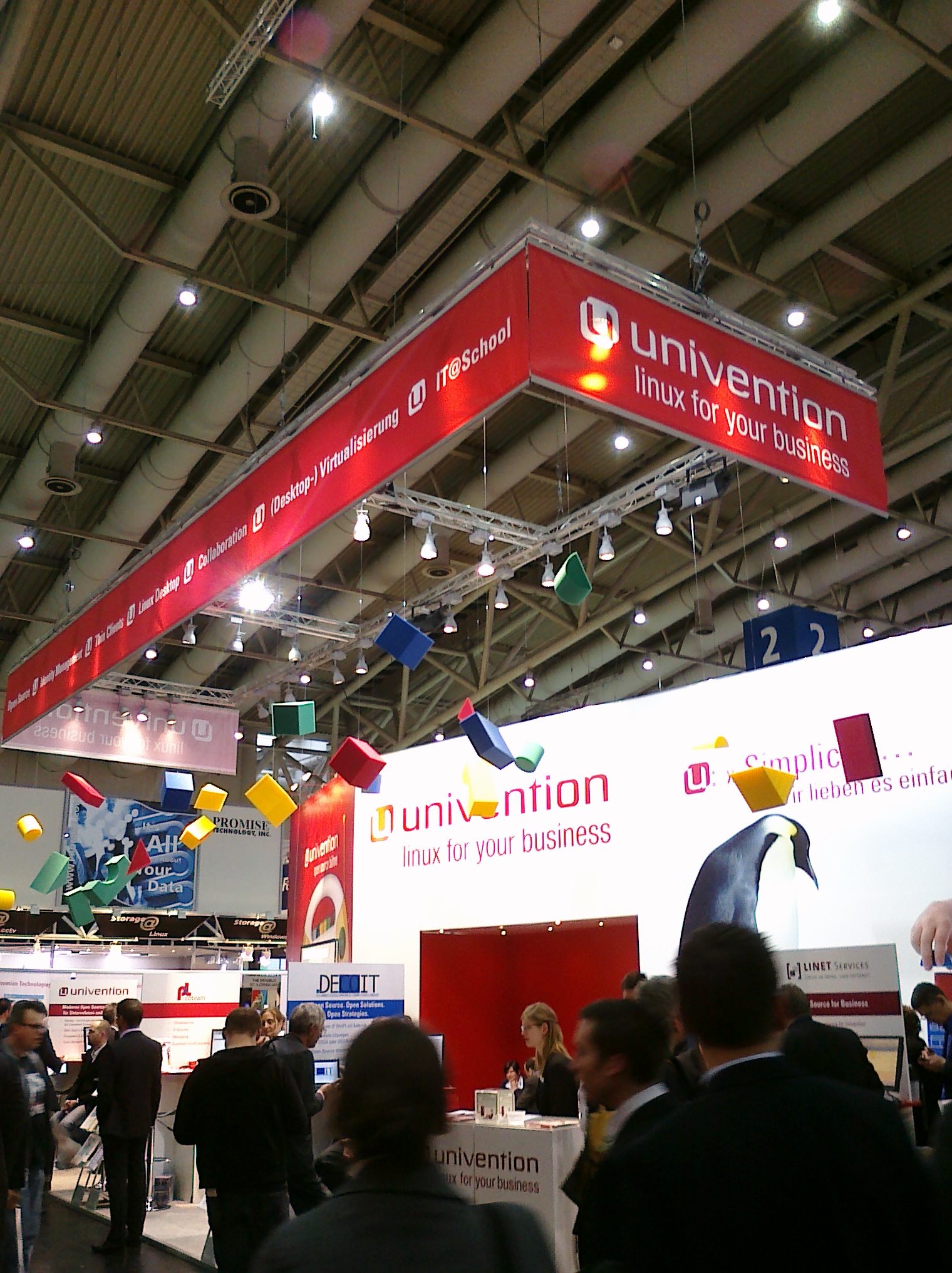
As some people had problems finding our booth, here's a small explanation. We are guest at the booth of Univention in Hall 2, stand B36. It's quite near to the north entry, where you arrive by the tram lines 8 and 18. Look for the univention booth:

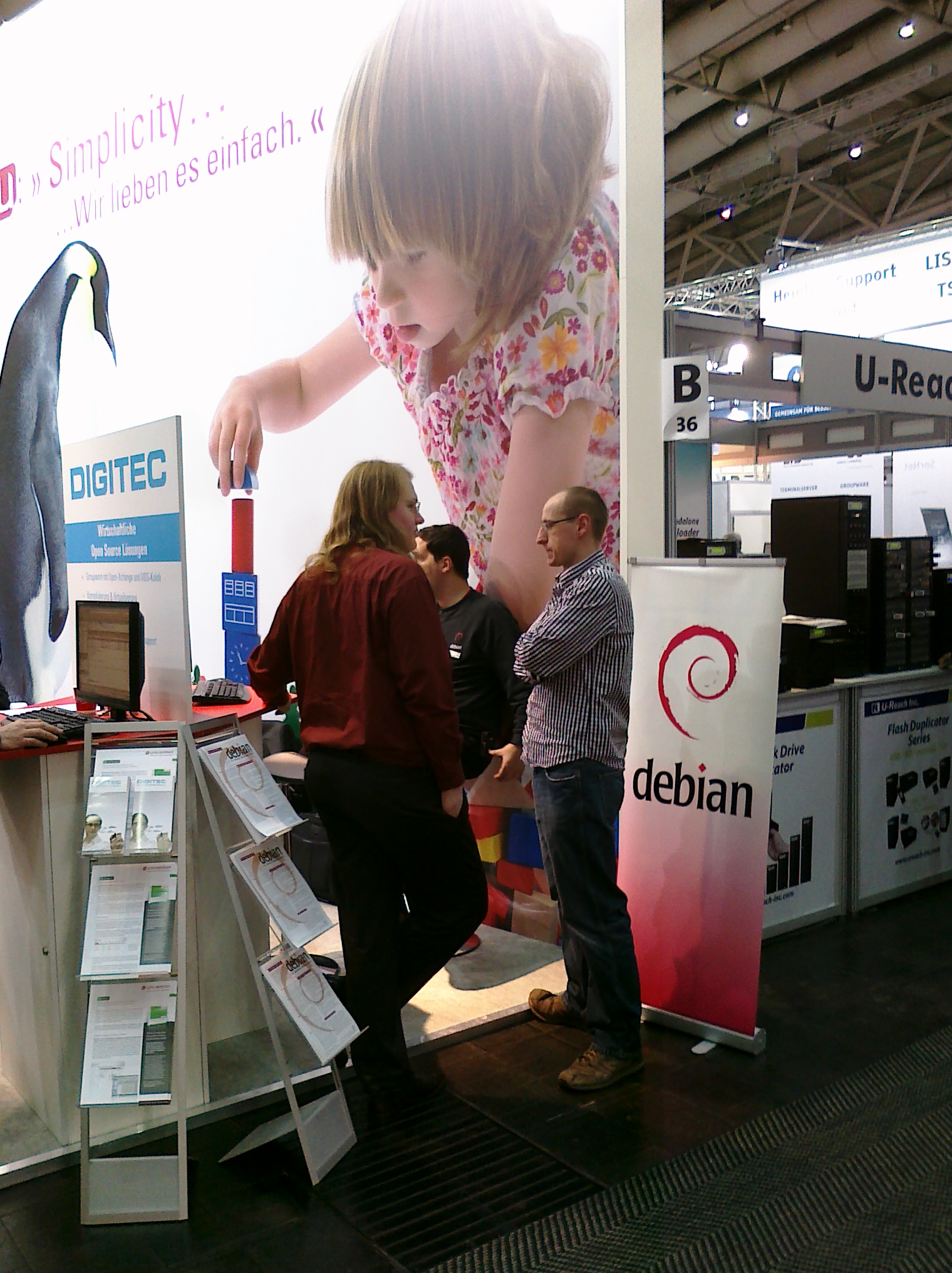
If you are direct in front of the Univention booth, we are on the right hand side of the booth:

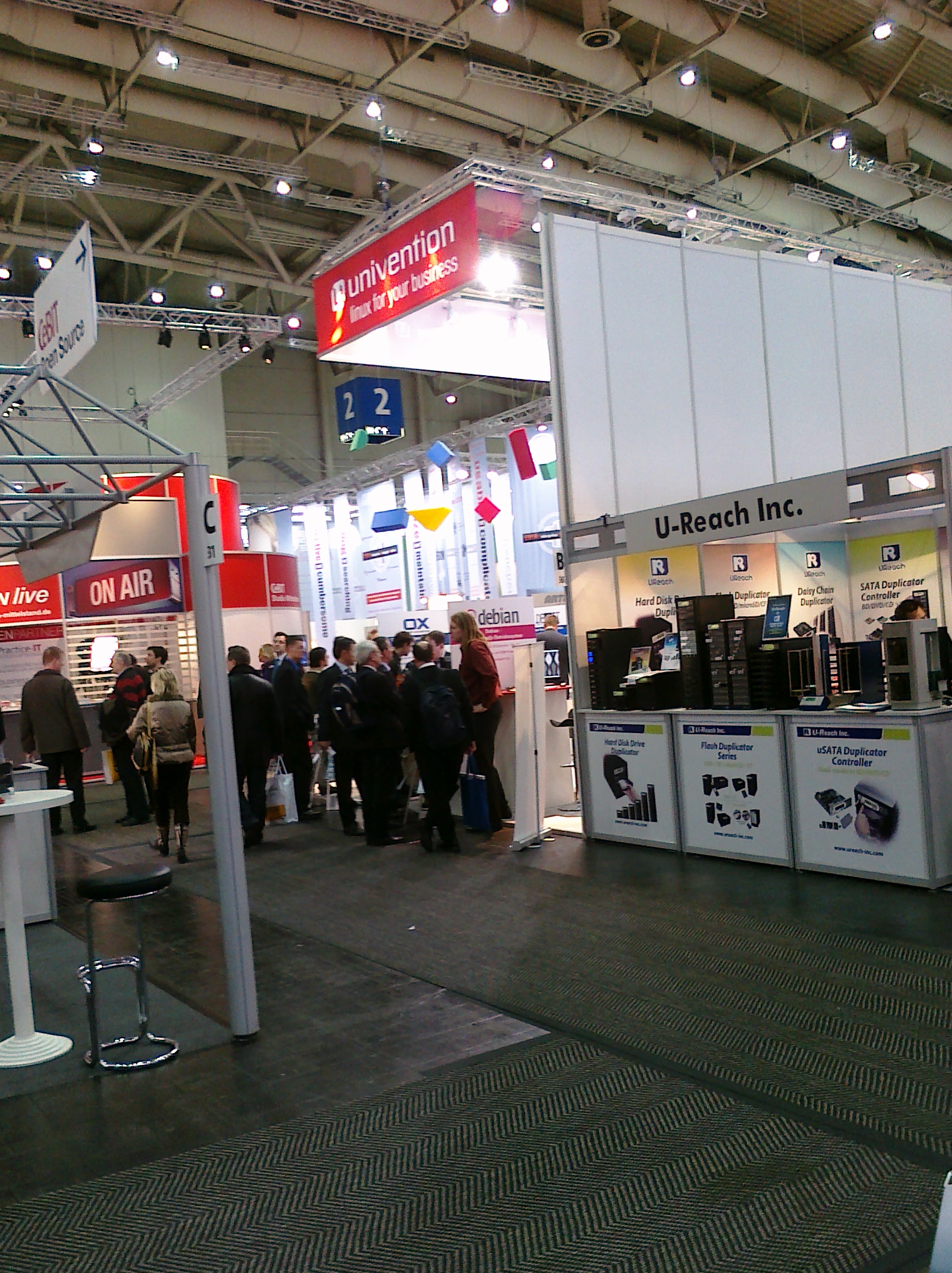
If you come from the other side, from the rest of the Open Source Area, it looks like this:

PS: And now, dear zobel, you have three guesses, what Pia is going to get for her birthday...

Alexander Reichle-Schmehl: [CeBIT] Something I like to share with the Debian community

I'm really delighted, thet you are here! You know, I started quite late with that whole IT business, and Debian was my first distribution. It all worked perfectly and took all my fears of it away!

Alexander Reichle-Schmehl: [CeBIT] Yes, we still have free tickets.

But speaking of that I must confess, that by mistake I deleted one of the mails asking for a such a free ticket, instead of replying. I'm very sorry. So if you come from the Netherlands, asked me for a ticket, and haven't got an answer, yet, please use one of the following links: I hope, one of the links will work long enough, till the intended recipient reads this ;)

2 March 2010

Alexander Reichle-Schmehl: [CeBIT] How to get instantly the attention of your audience of your talk

Start with the sentence: I'm pleased to present you on this Windows notebook in the Linux forum a talk about FreeBSD... How to not loose their attention Have the Windows notebook you where supplied with install some security updates during your talk, and then be constantly busy clicking the Please reboot popups away... Well, I hope the video was working. I'm really looking forward to see that video.

Alexander Reichle-Schmehl: [CeBIT] Link to my Debian GNU/kFreeBSD talk

Sorry; I didn't made it in the promised 15 minutes (as someone turned the internet off), but here is finally the link to my (German) slides of my Debian GNU/kFreeBSD talk. (Sorry, no fancy website arround that, yet.) I would also like to make clear, that Debian does not plan to drop it's support for the Linux kernel. Debian will continue to release a linux based distribution. You may install the very same distribution based upon a FreeBSD kernel. It's your choice. A several people asked that at our booth, I guess there is somewhere a missunderstanding, but I don't know the root if that missunderstanding. If someone could tell me, why he thought so (maybe I missed a unclear formulation somewhere?) I would be very glad and try to improve it. So, thanks again for the kbsd people, who helped alot and really tried to answer every stupid question I came up with during preparing my talk :)

1 March 2010

Alexander Reichle-Schmehl: [CeBIT] Free tickets for CeBIT

Sorry, I didn't had the time to update RC Bug statistics last week, and will probably also not be able this week, as I'll be quite busy, as CeBIT is about to start tomorrow, and I haven't written a script to create the statistics, yet. While we are talking about CeBIT, you might already know, that Debian will again be present there. This as partner of Univention, a German company using Debian as base for its own distribution. I would like to thank them very much for their short hand acceptance of us at their booth. If you intend to visit us (Hall 2, stand B36) and still have not ticket, feel free to drop me an E-Mail. We got some free tickets and I'll try to send you the link (you'll need to register at the CeBIT website and print your ticket yourself).

Next.

Previous.