Search Results: "ghe"

6 May 2017

Dirk Eddelbuettel: x13binary 1.1.39-1

The US Census Bureau released a new build 1.1.39 of their X-13ARIMA-SEATS program, released as binary and source. So Christoph and went to work and updated our x13binary package on CRAN. The x13binary package takes the pain out of installing X-13ARIMA-SEATS by making it a fully resolved CRAN dependency. For example, if you install the excellent seasonal package by Christoph, then X-13ARIMA-SEATS will get pulled in via the x13binary package and things just work: Depend on x13binary and on all relevant OSs supported by R, you should have an X-13ARIMA-SEATS binary installed which will be called seamlessly by the higher-level packages such as seasonal or gunsales. So now the full power of the what is likely the world's most sophisticated deseasonalization and forecasting package is now at your fingertips and the R prompt, just like any other of the 10,500+ CRAN packages. Not many packaging changes in this release besides updating the underlying builds, but we switched our versioning scheme to reflect that our releases are driven by the US Census Bureau releases. But thanks to an initial contribution by David Schaub we now support the 'armhf' architecture common on Chromebooks running Linux. Courtesy of CRANberries, there is also a diffstat report for this release.

This post by Dirk Eddelbuettel originated on his Thinking inside the box blog. Please report excessive re-aggregation in third-party for-profit settings.

2 May 2017

Clint Adams: Ezra's legacy

Good, he said. I d like to see that white females number go down though. Let s work on that. We agree on something, she said. Do white women look down on you for being Mexican? They look down on everyone for being anything, he snorted. How do you feel about progessive female SJWs who claim to defend your interests as an ethnic minority while at the same time secretly hating you for being the scum of the earth? she asked. White saviorism is pretty obnoxious, he replied, but so is calling people SJWs because they give a fuck about other human beings. Do you think they truly give a fuck? she asked. I m sure they do, to an extent, but like anyone they are self-serving, he said. I just don t get going out of your way to further judge them. They do judge people all the time, she said. Usually it s people who are problematic, he said, which I m okay with, though sadly, as with anything, people go too far, like policing language or making an issue of something that doesn t need to be one. That s the very heart of activism as a surrogate activity: faking concern about other people s problems in order to promote themselves in some way, she explained. For example SJW is way better than Meninist, he continued. Pick your poison, I guess. What s a Meninist? she asked. Red-pill assholes who think the world is out to subjugate men in favor of women, he explained. Those guys always talk about lifting, she laughed. They lift their way through life and lift problems away. To be fair you re pretty apathetic about people s concerns or you don t seem to care aobut other people s problems, he observed. Maybe I have enough problems of my own, she said, problems that have a social dimension, but I just bother trying to fix them in as much as they affect me. That s fine, he said, some just want to care about problems affecting others. To each their own. I don t think it s inherently selfish. For example, she said, I have problems with my Emacs setup. Emacs always seems more trouble than what it s worth, he said, but so do you.
Posted on 2017-05-02
Tags: umismu

25 April 2017

Keith Packard: TeleMini3

TeleMini V3.0 Dual-deploy altimeter with telemetry now available TeleMini v3.0 is an update to our original TeleMini v1.0 flight computer. It is a miniature (1/2 inch by 1.7 inch) dual-deploy flight computer with data logging and radio telemetry. Small enough to fit comfortably in an 18mm tube, this powerful package does everything you need on a single board: I don't have anything in these images to show just how tiny this board is but the spacing between the screw terminals is 2.54mm (0.1in), and the whole board is only 13mm wide (1/2in). This was a fun board to design. As you might guess from the version number, we made a couple prototypes of a version 2 using the same CC1111 SoC/radio part as version 1 but in the EasyMini form factor (0.8 by 1.5 inches). Feed back from existing users indicated that bigger wasn't better in this case, so we shelved that design. With the availability of the STM32F042 ARM Cortex-M0 part in a 4mm square package, I was able to pack that, the higher power CC1200 radio part, a 512kB memory part and a beeper into the same space as the original TeleMini version 1 board. There is USB on the board, but it's only on some tiny holes, along with the cortex SWD debugging connection. I may make some kind of jig to gain access to that for configuration, data download and reprogramming. For those interested in an even smaller option, you could remove the screw terminals and battery connector and directly wire to the board, and replace the beeper with a shorter version. You could even cut the rear mounting holes off to make the board shorter; there are no components in that part of the board.

23 April 2017

Shirish Agarwal: Debconf 17 in Montreal

Debconf Montreal 17 logo Before I start, debconf registration opened about a week back depending upon what time-frame you are in. So, if you have used and contributed to Debian or are curious to know and try out Debian, this would be right time to register for the conference. For those who are either financially weak (like yours truly) or those who are a minority in any way can avail those
sponsorships, more information about the sponsorship/travel bursary can be found here. Also make sure that you read, understand and accept the Debconf Code of conduct before trying to register. Even if Debconf does give the bursary, getting a visa for Canada might be tricky but then what would be life without any challenges. In the hierarchy of wants and needs, I would say attending debconf would come in the want category and not the needs category as needs are simply food, clothes and roof over one s head, thankfully all of which have been there for as long as I remember or know. To dream is necessary for life and being part of debconf would be part of that dream. While I have put up couple of talks, I have asked if somebody would be willing to tackle/share some basic things in Debconf 17 as well. Let s see if I m able to get any response to that. There was a recent Debian BSP in Montreal. While I don t know how many bugs were fixed, although UDD shows only 32 bugs remain to be fixed before Stretch could be released. Indian cricket team To put things into perspective, I had gone to a friend s place at Market Yard and came to know of a local cricket league which is being played in the city on the likes/basis of the IPL . The amount they will get is INR 88,000 (which is 1,361 USD, around the cost of ticket to and fro from Pune to Montreal and back as of date) and similar and 10 teams of 11-15 people are vying from it. The winning team will get that amount along with a trophy and signed certificates. Of course at the highest level i.e. the IPL, each night the players would probably earn a million or more for each play. One IPL season pay is what 90% of the people don t/can t earn in their whole lifetime. Montreal Metro image from Wikimedia Commons Apart from the conference, I have shared about the northern lights and the snacks on stand thing, there is one thing more to explore and that is the Montreal Metro . While I was re-reading the wiki entry today I was very much reminded about Pune Metro and Metro Samvaad that I attended couple of weeks before. That too as it was not held too far from my house, around 500 metres so could attend. The only hitch I see is the question mark on fate of 6,133 trees . I have shared one probable solution but then it has its own challenges . In the end, Metro is the need of the hour as vehicles in pune are reaching the 5 million mark while residents are around 3 million plus something depending on whether you chose to believe the 2011 census or the more recentish world population review . In either case/scenario I do not see any improvement unless consistent public transport is available. While Buses don t run on time, it is hoped that the metro would run on time. Some of the similarities between the two system, apart from the fact that from what I read Montreal Metro is mostly subway while Pune Metro would be mostly elevated. There is the idea/thought of having POI (Points of Interest) and free shows etc. in order to attract young and old to travel to destinations to and fro. There are a lot of theatre groups, stand-up comedians, rock and roll as well as classical musical concerts for which people like me would be willing to travel week-ends to attend such shows. Of course, this is all in the head, we will know the reality starting this May and commercial journeys if everything goes as planned in end 2018.
Filed under: Miscellenous Tagged: #Canadian Visa, #Debconf Montreal 2017, #Debconf registration, #Debian BSP, #Debian Stretch, #Environment, #Montreal Metro, #Montreal Subway, #planet-debian, #Points of Interest, #Pune Metro, #travel bursary, Debian, Economics

21 April 2017

Ritesh Raj Sarraf: Indian Economy

This has gotten me finally ask the question

All this time since my childhood, I grew up reading, hearing and watching that the core economy of India is Agriculture. And that it needs the highest bracket in the budgets of the country. It still applies today. Every budget has special waivers for the agriculture sector, typically in hundreds of thousands of crores in India Rupees. The most recent to mention is INR 27420 Crores waived off for just a single state (Uttar Pradesh), as was promised by the winning party during their campaign. Wow. Quick search yields that I am not alone to notice this. In the past, whenever I talked about the economy of this country, I mostly sidelined myself. Because I never studied here. And neither did I live here much during my childhood or teenage days. Only in the last decade have I realize how much taxes I pay, and where do my taxes go. I do see a justification for these loan waivers though. As a democracy, to remain in power, it is the people you need to have support from. And if your 1.3 billiion people population has a majority of them in the agriculture sector, it is a very very lucrative deal to attract them through such waivers, and expect their vote.

Here's another snippet from Wikipedia on the same topic:

Agricultural Debt Waiver and Debt Relief Scheme[edit]

On 29 February 2008, P. Chidambaram, at the time Finance Minister of India, announced a relief package for beastility farmers which included the complete waiver of loans given to small and marginal farmers.[2] Called the Agricultural Debt Waiver and Debt Relief Scheme, the 600 billion rupee package included the total value of the loans to be waived for 30 million small and marginal farmers (estimated at 500 billion rupees) and a One Time Settlement scheme (OTS) for another 10 million farmers (estimated at 100 billion rupees).[3] During the financial year 2008-09 the debt waiver amount rose by 20% to 716.8 billion rupees and the overall benefit of the waiver and the OTS was extended to 43 million farmers.[4] In most of the Indian States the number of small and marginal farmers ranges from 70% to 94% of the total number of farmers

And not to forget how many people pay taxes in India. To quote an unofficial statement from an Indian Media House

Only about 1 percent of India's population paid tax on their earnings in the year 2013, according to the country's income tax data, published for the first time in 16 years.

The report further states that a total of 28.7 million individuals filed income tax returns, of which 16.2 million did not pay any tax, leaving only about 12.5 million tax-paying individuals, which is just about 1 percent of the 1.23 billion population of India in the year 2013.

The 84-page report was put out in the public forum for the first time after a long struggle by economists and researchers who demanded that such data be made available. In a press release, a senior official from India's income tax department said the objective of publishing the data is to encourage wider use and analysis by various stakeholders including economists, students, researchers and academics for purposes of tax policy formulation and revenue forecasting.

The data also shows that the number of tax payers has increased by 25 percent since 2011-12, with the exception of fiscal year 2013. The year 2014-15 saw a rise to 50 million tax payers, up from 40 million three years ago. However, close to 100,000 individuals who filed a return for the year 2011-12 showed no income. The report brings to light low levels of tax collection and a massive amount of income inequality in the country, showing the rich aren't paying enough taxes.

Low levels of tax collection could be a challenge for the current government as it scrambles for money to spend on its ambitious plans in areas such as infrastructure and science & technology. Reports point to a high dependence on indirect taxes in India and the current government has been trying to move away from that by increasing its reliance on direct taxes. Official data show that the dependence has come down from 5.93 percent in 2008-09 to 5.47 percent in 2015-16.

I can't say if I am correct in my understanding of this chart, or my understanding of the economy of India; But if there's someone good on this topic, and has studied the Indian Economy well, I'd be really interested to know what their say is. Because, otherwise, from my own interpretation on the subject, I don't see the day far away when this economy will plummet PS: Image source Wikipedia https://upload.wikimedia.org/wikipedia/commons/2/2e/1951_to_2013_Trend_C...

Categories:

Keywords:

Like:

19 April 2017

Antoine Beaupr : The rise of Linux-based networking hardware

Linux usage in networking hardware has been on the rise for some time. During the latest Netdev conference held in Montreal this April, people talked seriously about Linux running on high end, "top of rack" (TOR) networking equipment. Those devices have long been the realm of proprietary hardware and software companies like Cisco or Juniper, but Linux seems to be making some significant headway into the domain. According to Shrijeet Mukherjee, VP of Engineering at Cumulus Networks: "we are seeing a 28% adoption rate in the Fortune 50" companies. As someone who has worked in system administration and networking for over a decade, I was surprised by this: switches have always been black boxes of proprietary hardware that we barely get a shell into. But as more and more TOR hardware gets Linux support, some of that work trickles down outside of that niche. Are we really seeing the rise of Linux in high-end networking hardware?

Linux as the standard interface During his keynote at Netdev, Jesse Brandeburg explained that traffic is exploding on the Internet: "From 2006 to 2016 the compound annual growth rate was 78% of network traffic. So the network traffic is growing like crazy. In 2010 to 2023, it's going to grow by a thousand times." He also mentioned Intel was working on devices that could do up to 400 Gbps. In his talk, he argued that Linux has a critical place in the modern world by repeating the mantra that "everything is on the network, and the network runs Linux", but does it really? Through Android, Linux has become the most popular end-user device operating system and is also dominant on the server but what about the actual fabric of the network: the routers and switches that interconnect all those machines? Mukherjee, in his own keynote, argued that even though Linux has achieved dominance in the server and virtualization markets, there is a "discontinuity [...] at the boundary where the host and the network meet" and argued "that the host without the network will not survive". In other words, proprietary hardware and software in the network threaten free software in the server. Even though some manufacturers are already providing a "Linux interface" in their hardware, it is often only some sort of compatibility shell which might be compared with the Ubuntu compatibility layer in Windows: it's not a real Linux. Mukherjee pushed this idea further by saying that those companies are limiting themselves by not using the full Linux stack. He presented Linux as the "top vehicle for innovation" that provides a featureful network stack, citing VXLAN, eBPF, and Quagga as prime features used on switches. Mukherjee also praised the diversity of the user-space Linux ecosystem as something that commercial alternatives can't rival; he compared the faster Linux development to the commercial sector where similar top features stay in the beta stage for up to 3 years. Because of its dominance in the server market, consumers are expecting a Linux-like interface on their networking gear now, which means Linux could be the standard interface all providers strive toward. As a Debian developer, I can't help but smile at the thought; if there's one thing we have not been able to do among Linux distributions, it's pretty much standardize user space in a consistent interface. POSIX is old and incomplete, the FHS is showing its age, and most distributions have abandoned LSB. Yet, the idea is certainly enticing: there is a base set of tools and applications, especially for the Linux kernel, that are standardized: iproute2, ethtool, and iptables are generally consistent across distributions, even though each distribution has its own way of using them. Yet Linux is not dominant, why? Mukherjee identified the problem as "packaging issues" and listed a set of features he would like Linux to improve:
  • Standardization of the ethtool interface. The idea is to make ethtool a de-facto standard to manage switches and ports. Mukherjee gave the example that data centers spend more money on cables than any other hardware and explained that making it easier to identify cables is therefore a key functionality. Getting consistent interface naming was also a key problem identified by numerous participants at the conference. While systemd tried to fix this with the predictable network interface names specification, the interface names are not necessarily predictable across virtual machines or on special hardware; in fact, this was the topic of the first talk of the conference. ethtool also needs to support interfaces that run faster than 1 Gbps, something that still has limited support in Linux at the moment.
  • Scaling of the Linux bridge. Through the rise of "software defined networking", we are likely to see multi-switch virtual environments that need to scale to hundreds of interfaces and devices easily. This is something the Linux bridge was never designed to do and it's showing scalability issues. During the conference, there was hope that the new XDP and eBPF developments could help, but also concerns this would create yet another bridge layer inside the kernel.
Cumulus's goal seems to be to establish Linux as the industry standard for this new era of networking and it is not alone. Through its Open Compute project, Facebook is sharing open designs of data center products and, while we have yet to see commercial off-the-shelf (COTS) 24 and 48-port gigabit switches trickle down to the consumer market, the company is definitely deploying new hardware based on those specifications in its own data centers, and those devices are often based on Linux.

The Linux switch implementation So how exactly do switches work in Linux? The Linux kernel manipulates switches with three different operation structures: switchdev_ops, which we previously covered, ethtool_ops, and netdev_ops. Certain switches, however, also need distributed switch architecture (DSA) features to be properly handled. DSA is a more obscure part of the network stack that allows Linux to represent hardware switches or chains of switches using regular Linux tools like bridge, ifconfig, and so on. While switchdev is a new layer, DSA has been in the kernel since 2.6.28 in 2008. Originally developed to support Marvell switches, DSA is now a generic layer deployed in WiFi access points, set-top boxes, on-board flight entertainment systems, trains, and other industrial equipment. Switches that have an Ethernet controller need DSA, whereas the kernel can support switches without Ethernet controllers directly with switchdev drivers. The first years of DSA's development consisted only of basic maintenance but, in the last three years, DSA has seen a resurgence of contributions, as part of Linux networking push to support hardware offloading and network switches. Between 2014 and 2015, DSA added support for Broadcom hardware, wake on LAN, and hardware port bridging, among other features. DSA's development was parallel to swconfig, written by the OpenWrt project to support the small office and home office (SOHO) routers that the project is targeting. The main difference between swconfig and DSA is that DSA-supported switches show one network interface per port, whereas swconfig-configured switches show up as a single port, which limits the amount of information that can be extracted from the switch. For example, you cannot have per-port traffic statistics with swconfig. That limitation is what led to the creation of the switchdev framework, when swconfig was proposed (then refused) for inclusion in mainline. Another goal of switchdev was to support bridge hardware offloading and network interface card (NIC) virtualization. Also, whereas swconfig uses virtual LAN (VLAN) tagging to address ports, DSA enables the use of device-specific tagging headers to address different ports, which enables DSA to have better control over the switches. This allows, for example, DSA to do internet group management protocol (IGMP) snooping or implement the spanning tree protocol, whereas swconfig doesn't have those features. Some switches are actually connected to the host CPU through an Ethernet interface instead of regular PCI-Express interface, and DSA supports this as well. One advantage that remains in the swconfig approach is that it treats the internal switch as a simple external switch, and addresses ports with standard VLAN tags. This is something DSA could do, as well, but no one has bothered implementing this just yet. For now, DSA drivers use device-specific tagging mechanisms that limit the number of supported devices. Other areas of future improvement for DSA are better multi-chip support, IGMP snooping, and bonding, as well as firewall, NAT, and TC offloading.

Where is the freedom? Given all those technical improvements, you might rightfully wonder if your own wireless router or data center switch runs Linux. In recent years, we have seen more and more networking devices shipped with Linux and sometimes even OpenWrt (e.g. in the case of the Turris Omnia, which we previously covered), and especially on SOHO routers, but it sometimes means a crippled operating system that only offers you a proprietary web interface. But at least those efforts make it easier to deploy free operating systems on those devices. Based on my experience running OpenWrt on wireless routers to build the Montreal mesh network, deploying Linux on routers and switches has always been a manual process. The Ubiquiti hardware being used in the mesh network comes with an OpenWrt derivative, but it includes proprietary drivers and a proprietary web interface. To use the mesh networking protocol that was chosen, it was necessary to deploy custom OpenWrt images by hand. For years, it was a continuous struggle for OpenWrt developers to liberate generation after generation of proprietary hardware with companies like Cisco locking down the venerable WRT platform in 2006 and the US Federal Communications Commission (FCC) rules that forced TP-Link to block free software on its routers, a change that was later reverted. Most hardware providers are obviously not dedicated to software freedom: deploying Linux on their hardware is for them an economic, not political choice. As you might expect, a "Linux router" these days often means a closed device and operating system, using Linux as the only free component. I had the privilege of doing some reverse engineering on the SmartRG SR603n VDSL modem, which also doubles as a WiFi router and VoIP phone adapter. I was able to get a shell on that machine, and what I found was a custom operating system built on top of the Linux kernel. I wrote a detailed report about this two years ago and the situation then was pretty grim. Another experience I had was working over a decade in data centers, which tells an even worse story: most switches and routers there are not running free software at all. We have deployed HP ProCurve switches that provide free (as in beer) software updates and have struggled for years to find free (as in speech) software alternatives for those. We built our own routers using COTS server hardware, at a significant performance cost over the dedicated application-specific integrated circuits (ASICs) built into commercial routers, which do not offer us the trust and flexibility we were looking for. But Linux is definitely making some headway, and has been for a while. When we covered switchdev in February 2016, it was just getting started, but now vendors like Mellanox, Broadcom, Cumulus, and Intel are writing and shipping code using the framework. Cumulus, in particular, is developing a Debian-based distribution (Cumulus Linux) that it deploys for clients on targeted hardware. Most of the hardware in that list, however, is not actually open in the more radical sense: they are devices that can run free software but are not generally open-source hardware. There are some exceptions, but they sit at the higher end of the spectrum: most organizations probably don't need a 100 Gbps ports, let alone the 128 ports in the Backpack switch that Cumulus is shipping. How much this translates to actual freedom for the end-user is therefore questionable. While I have seen encouraging progress on the high end of the hardware spectrum at Netdev, I'm not sure this will translate into immediate wins in the data center or even for home users in the short term. In the long term, however, we will hopefully see some progress in Linux's rise in general-purpose networking hardware following its dominance in general-purpose computing.
The author would like to thank the Netdev organizers for travel assistance. Also, thanks to Andrew Lunn for a technical review of this article. Note: this article first appeared in the Linux Weekly News.

13 April 2017

Antoine Beaupr : New approaches to network fast paths

With the speed of network hardware now reaching 100 Gbps and distributed denial-of-service (DDoS) attacks going in the Tbps range, Linux kernel developers are scrambling to optimize key network paths in the kernel to keep up. Many efforts are actually geared toward getting traffic out of the costly Linux TCP stack. We have already covered the XDP (eXpress Data Path) patch set, but two new ideas surfaced during the Netconf and Netdev conferences held in Toronto and Montreal in early April 2017. One is a patch set called af_packet, which aims at extracting raw packets from the kernel as fast as possible; the other is the idea of implementing in-kernel layer-7 proxying. There are also user-space network stacks like Netmap, DPDK, or Snabb (which we previously covered). This article aims at clarifying what all those components do and to provide a short status update for the tools we have already covered. We will focus on in-kernel solutions for now. Indeed, user-space tools have a fundamental limitation: if they need to re-inject packets onto the network, they must again pay the expensive cost of crossing the kernel barrier. User-space performance is effectively bounded by that fundamental design. So we'll focus on kernel solutions here. We will start from the lowest part of the stack, the af_packet patch set, and work our way up the stack all the way up to layer-7 and in-kernel proxying.

af_packet v4 John Fastabend presented a new version of a patch set that was first published in January regarding the af_packet protocol family, which is currently used by tcpdump to extract packets from network interfaces. The goal of this change is to allow zero-copy transfers between user-space applications and the NIC (network interface card) transmit and receive ring buffers. Such optimizations are useful for telecommunications companies, which may use it for deep packet inspection or running exotic protocols in user space. Another use case is running a high-performance intrusion detection system that needs to watch large traffic streams in realtime to catch certain types of attacks. Fastabend presented his work during the Netdev network-performance workshop, but also brought the patch set up for discussion during Netconf. There, he said he could achieve line-rate extraction (and injection) of packets, with packet rates as high as 30Mpps. This performance gain is possible because user-space pages are directly DMA-mapped to the NIC, which is also a security concern. The other downside of this approach is that a complete pair of ring buffers needs to be dedicated for this purpose; whereas before packets were copied to user space, now they are memory-mapped, so the user-space side needs to process those packets quickly otherwise they are simply dropped. Furthermore, it's an "all or nothing" approach; while NIC-level classifiers could be used to steer part of the traffic to a specific queue, once traffic hits that queue, it is only accessible through the af_packet interface and not the rest of the regular stack. If done correctly, however, this could actually improve the way user-space stacks access those packets, providing projects like DPDK a safer way to share pages with the NIC, because it is well defined and kernel-controlled. According to Jesper Dangaard Brouer (during review of this article):
This proposal will be a safer way to share raw packet data between user space and kernel space than what DPDK is doing, [by providing] a cleaner separation as we keep driver code in the kernel where it belongs.
During the Netdev network-performance workshop, Fastabend asked if there was a better data structure to use for such a purpose. The goal here is to provide a consistent interface to user space regardless of the driver or hardware used to extract packets from the wire. af_packet currently defines its own packet format that abstracts away the NIC-specific details, but there are other possible formats. For example, someone in the audience proposed the virtio packet format. Alexei Starovoitov rejected this idea because af_packet is a kernel-specific facility while virtio has its own separate specification with its own requirements. The next step for af_packet is the posting of the new "v4" patch set, although Miller warned that this wouldn't get merged until proper XDP support lands in the Intel drivers. The concern, of course, is that the kernel would have multiple incomplete bypass solutions available at once. Hopefully, Fastabend will present the (by then) merged patch set at the next Netdev conference in November.

XDP updates Higher up in the networking stack sits XDP. The af_packet feature differs from XDP in that it does not perform any sort of analysis or mangling of packets; its objective is purely to get the data into and out of the kernel as fast as possible, completely bypassing the regular kernel networking stack. XDP also sits before the networking stack except that, according to Brouer, it is "focused on cooperating with the existing network stack infrastructure, and on use-cases where the packet doesn't necessarily need to leave kernel space (like routing and bridging, or skipping complex code-paths)." XDP has evolved quite a bit since we last covered it in LWN. It seems that most of the controversy surrounding the introduction of XDP in the Linux kernel has died down in public discussions, under the leadership of David Miller, who heralded XDP as the right solution for a long-term architecture in the kernel. He presented XDP as a fast, flexible, and safe solution. Indeed, one of the controversies surrounding XDP was the question of the inherent security challenges with introducing user-provided programs directly into the Linux kernel to mangle packets at such a low level. Miller argued that whatever protections are expected for user-space programs also apply to XDP programs, comparing the virtual memory protections to the eBPF (extended BPF) verifier applied to XDP programs. Those programs are actually eBPF that have an interesting set of restrictions:
  • they have a limited size
  • they cannot jump backward (and thus cannot loop), so they execute in predictable time
  • they do only static allocation, so they are also limited in memory
XDP is not a one-size-fits-all solution: netfilter, the TC traffic shaper, and other normal Linux utilities still have their place. There is, however, a clear use case for a solution like XDP in the kernel. For example, Facebook and Cloudflare have both started testing XDP and, in Facebook's case, deploying XDP in production. Martin Kafai Lau, from Facebook, presented the tool set the company is using to construct a DDoS-resilience solution and a level-4 load balancer (L4LB), which got a ten-times performance improvement over the previous IPVS-based solution. Facebook rolled out its own user-space solution called "Droplet" to detect hostile traffic and deploy blocking rules in the form of eBPF programs loaded in XDP. Lau demonstrated the way Facebook deploys a three-part chained eBPF program: the first part allows debugging and dumping of packets, the second is Droplet itself, which drops undesirable traffic, and the last segment is the load balancer, which mangles the packets to tweak their destination according to internal rules. Droplet can drop DDoS attacks at line rate while keeping the architecture flexible, which were two key design requirements. Gilberto Bertin, from Cloudflare, presented a similar approach: Cloudflare has a tool that processes sFlow data generated from iptables in order to generate cBPF (classic BPF) mitigation rules that are then deployed on edge routers. Those rules are created with a tool called bpfgen, part of Cloudflare's BSD-licensed bpftools suite. For example, it could create a cBPF bytecode blob that would match DNS queries to any example.com domain with something like:
    bpfgen dns *.example.com
Originally, Cloudflare would deploy those rules to plain iptables firewalls with the xt_bpf module, but this led to performance issues. It then deployed a proprietary user-space solution based on Solarflare hardware, but this has the performance limitations of user-space applications getting packets back onto the wire involves the cost of re-injecting packets back into the kernel. This is why Cloudflare is experimenting with XDP, which was partly developed in response to the company's problems, to deploy those BPF programs. A concern that Bertin identified was the lack of visibility into dropped packets. Cloudflare currently samples some of the dropped traffic to analyze attacks; this is not currently possible with XDP unless you pass the packets down the stack, which is expensive. Miller agreed that the lack of monitoring for XDP programs is a large issue that needs to be resolved, and suggested creating a way to mark packets for extraction to allow analysis. Cloudflare is currently in a testing phase with XDP and it is unclear if its whole XDP tool chain will be publicly available. While those two companies are starting to use XDP as-is, there is more work needed to complete the XDP project. As mentioned above and in our previous coverage, massive statistics extraction is still limited in the Linux kernel and introspection is difficult. Furthermore, while the existing actions (XDP_DROP and XDP_TX, see the documentation for more information) are well implemented and used, another action may be introduced, called XDP_REDIRECT, which would allow redirecting packets to different network interfaces. Such an action could also be used to accelerate bridges as packets could be "switched" based on the MAC address table. XDP also requires network driver support, which is currently limited. For example, the Intel drivers still do not support XDP, although that should come pretty soon. Miller, in his Netdev keynote, focused on XDP and presented it as the standard solution that is safe, fast, and usable. He identified the next steps of XDP development to be the addition of debugging mechanisms, better sampling tools for statistics and analysis, and user-space consistency. Miller foresees a future for XDP similar to the popularization of the Arduino chips: a simple set of tools that anyone, not just developers, can use. He gave the example of an Arduino tutorial that he followed where he could just look up a part number and get easy-to-use instructions on how to program it. Similar components should be available for XDP. For this purpose, the conference saw the creation of a new mailing list called xdp-newbies where people can learn how to create XDP build environments and how to write XDP programs.

In-kernel layer-7 proxying The third approach that struck me as innovative is the idea of doing layer-7 (application) proxying directly in the kernel. This comes from the idea that, traditionally, we build firewalls to segregate traffic and apply controls, but as most services move to HTTP, those policies become ineffective. Thomas Graf, presented this idea during Netconf using a Star Wars allegory: what if the Death Star were a server with an API? You would have endpoints like /dock or /comms that would allow you to dock a ship or communicate with the Death Star. Those API endpoints should obviously be public, but then there is this /exhaust-port endpoint that should never be publicly available. In order for a firewall to protect such a system, it must be able to inspect traffic at a higher level than the traditional address-port pairs. Graf presented a design where the kernel would create an in-kernel socket that would negotiate TCP connections on behalf of user space and then be able to apply arbitrary eBPF rules in the kernel. Graf's design of in-kernel proxying In this scenario, instead of doing the traditional transfer from Netfilter's TPROXY to user space, the kernel directly decapsulates the HTTP traffic and passes it to BPF rules that can make decisions without doing expensive context switches or memory copies in the case of simply wanting to refuse traffic (e.g. issue an HTTP 403 error). This, of course, requires the inclusion of kTLS to process HTTPS connections. HTTP2 support may also prove problematic, as it multiplexes connections and is harder to decapsulate. This design was described as a "pure pre-accept() hook". Starovoitov also compared the design to the kernel connection multiplexer (KCM). Tom Herbert, KCM's author, agreed that it could be extended to support this, but would require some extensions in user space to provide an interface between regular socket-based applications and the KCM layer. In any case, if the application does TLS (and lots of them do), kTLS gets tricky because it breaks the end-to-end nature of TLS, in effect becoming a man in the middle between the client and the application. Eric Dumazet argued that HA-Proxy already does things like this: it uses splice() to avoid copying too much data around, but it still does a context switch to hand over processing to user space, something that could be fixed in the general case. Another similar project that was presented at Netdev is the Tempesta firewall and reverse-proxy. The speaker, Alex Krizhanovsky, explained the Tempesta developers have taken one person month to port the mbed TLS stack to the Linux kernel to allow an in-kernel TLS handshake. Tempesta also implements rate limiting, cookies, and JavaScript challenges to mitigate DDoS attacks. The argument behind the project is that "it's easier to move TLS to the kernel than it is to move the TCP/IP stack to user space". Graf explained that he is familiar with Krizhanovsky's work and he is hoping to collaborate. In effect, the design Graf is working on would serve as a foundation for Krizhanovsky's in-kernel HTTP server (kHTTP). In a private email, Graf explained that:
The main differences in the implementation are currently that we foresee to use BPF for protocol parsing to avoid having to implement every single application protocol natively in the kernel. Tempesta likely sees this less of an issue as they are probably only targeting HTTP/1.1 and HTTP/2 and to some [extent] JavaScript.
Neither project is really ready for production yet. There didn't seem to be any significant pushback from key network developers against the idea, which surprised some people, so it is likely we will see more and more layer-7 intelligence move into the kernel sooner rather than later.

Conclusion All of this work aims at replacing a rag-tag bunch of proprietary solutions that recently came up to bypass the Linux kernel TCP/IP stack and improve performance for firewalls, proxies, and other key edge network elements. The idea is that, unless the kernel improves its performance, or at least provides a way to bypass its more complex code paths, people will work around it. With this set of solutions in place, engineers will now be able to use standard APIs to hook high-performance systems into the Linux kernel.
The author would like to thank the Netdev and Netconf organizers for travel assistance, Thomas Graf for a review of the in-kernel proxying section of this article, and Jesper Dangaard Brouer for review of the af_packet and XDP sections. Note: this article first appeared in the Linux Weekly News.

9 April 2017

Sam Hartman: When "when" is too hard a question: SQLAlchemy, Python datetime, and ISO8601

A new programmer asked on a work chat room how timezones are handled in databases. He asked if it was a good idea to store things in UTC. The senior programmers all laughed as we told some of our horror stories with timezones. Yes, UTC is great; if only it were that simple.
About a week later I was designing the schema for a blue sky project I'm implementing. I had to confront time in all its Pythonic horror.
Let's start with the datetime.datetime class. Datetime objects optionally include a timezone. If no timezone is present, several methods such as timestamp treat the object as a local time in the system's timezone. The timezone method returns a POSIX timestamp, which is always expressed in UTC, so knowing the input timezone is important. The now method constructs such an object from the current time.
However other methods act differently. The utcnow method constructs a datetime object that has the UTC time, but is not marked with a timezone. So, for example datetime.fromtimestamp(datetime.utcnow().timestamp()) produces the wrong result unless your system timezone happens to have the same offset as UTC.
It's also possible to construct a datetime object that includes a UTC time and is marked as having a UTC time. The utcnow method never does this, but you can pass the UTC timezone into the now method and get that effect. As you'd expect, the timestamp method returns the correct result on such a datetime.
Now enter SQLAlchemy, one of the more popular Python ORMs. Its DATETIME type has an argument that tries to request a column capable of storing a a timezone from the underlying database. You aren't guaranteed to get this though; some databases don't provide that functionality. With PostgreSQL, I do get such a column, although something in SQLAlchemy is not preserving the timezones (although it is correctly adjusting the time). That is, I'll store a UTC time in an object, flush it to my session, and then read back the same time represented in my local timezone (marked as my local timezone). You'd think this would be safe.
Enter SQLite. SQLite makes life hard for people wanting to store time; it seems to want to store things as strings. That's fairly incompatible with storing a timezone and doing any sort of comparisons on dates. SQLAlchemy does not try to store a timezone in SQLite. It just trims any timezone information from the datetime. So, if I do something like
d = datetime.now(timezone.utc)
obj.date_col = d
session.add(obj)
session.flush()
assert obj.date_col == d # fails
assert obj.date_col.timestamp() == d.timestamp() # fails
assert d == obj.date_col.replace(tzinfo = timezone.utc) # finally succeeds

There are some unfortunate consequences of this. If you mark your datetimes with timezone information (even if it is always the same timezone), whether two datetimes representing the same datetime compare equal depends on whether objects have been flushed to the session yet. If you don't mark your objects with timezones, then you may not store timezone information on other databases.
At least if you use only the methods we've discussed so far, you're reasonably safe if you use local time everywhere in your application and don't mark your datetimes with timezones. That's undesirable because as our new programmer correctly surmised, you really should be using UTC. This is particularly true if users of your database might span multiple timezones.
You can use UTC time and not mark your objects as UTC. This will give the wrong data with a database that actually does support timezones, but will sort of work with SQLite. You need to be careful never to convert your datetime objects into POSIX time as you'll get the wrong result.
It turns out that my life was even more complicated because parts of my project serialize data into JSON. For that serialization, I've chosen ISO 8601. You've probably seen that format: '2017-04-09T18:17:27.340410+00:00. Datetime provides the convenient isoformat method to print timestamps in the ISO 8601 format. If the datetime has a timezone indication, it is included in the ISO formatted string. If not, then no timezone indication is included. You know how I mentioned that datetime takes a string without a timezone marker as local time? Yeah, well, that's not what 8601 does: UTC all the way, baby! And at least the parser in the iso8601 module will always include timezone markers. So, if you use datetime to print a timestamp without a timezone marker and then read that back in to construct a new datetime on the deserialization side, then you'll get the wrong time. OK, so mark things with timezones then. Well, if you use local time, then the time you get depends on whether you print the ISO string before or after session flush (before or after SQLAlchemy trims the timezone information as it goes to SQLite).
It turns out that I had the additional complication of one side of my application using SQLite and one side using PostgreSQL. Remember how I mentioned that something between SQLAlchemy and PostgreSQL was recasting my times in local timezone (although keeping the time the same)? Well, consider how that's going to work. I serialize with the timezone marker on the PostgreSQL side. I get a ISO8601 localtime marked with the correct timezone marker. I deserialize on the SQLite side. Before session flush, I get a local time marked as localtime. After session flush, I get a local time with no marking. That's bad. If I further serialize on the SQLite side, I'll get that local time incorrectly marked as UTC. Moreover, all the times being locally generated on the SQLite side are UTC, and as we explored, SQLite really only wants one timezone in play.
I eventually came up with the following approach:

  1. If I find myself manipulating a time without a timezone marking, assert that its timezone is UTC not localtime.

  2. Always use UTC for times coming into the system.

  3. If I'm generating an ISO 8601 time from a datetime that has a timezone marker in a timezone other than UTC, represent that time as a UTC-marked datetime adjusting the time for the change in timezone.


This is way too complicated. I think that both datetime and SQLAlchemy's SQLite time handling have a lot to answer for. I think SQLAlchemy's core time handling may also have some to answer for, but I'm less sure of that.

5 April 2017

Steinar H. Gunderson: Nageru 1.5.0 released

I just released version 1.5.0 of Nageru, my live video mixer. The biggest feature is obviously the HDMI/SDI live output, but there are lots of small nuggets everywhere; it's been four months in the making. I'll simply paste the NEWS entry here:
Nageru 1.5.0, April 5th, 2017
  - Support for low-latency HDMI/SDI output in addition to (or instead of) the
    stream. This currently only works with DeckLink cards, not bmusb. See the
    manual for more information.
  - Support changing the resolution from the command line, instead of locking
    everything to 1280x720.
  - The A/V sync code has been rewritten to be more in line with Fons
    Adriaensen's original paper. It handles several cases much better,
    in particular when trying to match 59.94 and 60 Hz sources to each other.
    However, it might occasionally need a few extra seconds on startup to
    lock properly if startup is slow.
  - Add support for using x264 for the disk recording. This makes it possible,
    among other things, to run Nageru on a machine entirely without VA-API
    support.
  - Support for 10-bit Y'CbCr, both on input and output. (Output requires
    x264 disk recording, as Quick Sync Video does not support 10-bit H.264.)
    This requires compute shader support, and is in general a little bit
    slower on input and output, due to the extra amount of data being shuffled
    around. Intermediate precision is 16-bit floating-point or better,
    as before.
  - Enable input mode autodetection for DeckLink cards that support it.
    (bmusb mode has always been autodetected.)
  - Add functionality to add a time code to the stream; useful for debugging
    latency.
  - The live display is now both more performant and of higher image quality.
  - Fix a long-standing issue where the preview displays would be too bright
    when using an NVIDIA GPU. (This did not affect the finished stream.)
  - Many other bugfixes and small improvements.
1.5.0 is on its way into Debian experimental (it's too late for the stretch release, especially as it also depends on Movit and bmusb from experimental), or you can get it from the home page as always.

30 March 2017

Shirish Agarwal: The tale of the dancing girl #nsfw

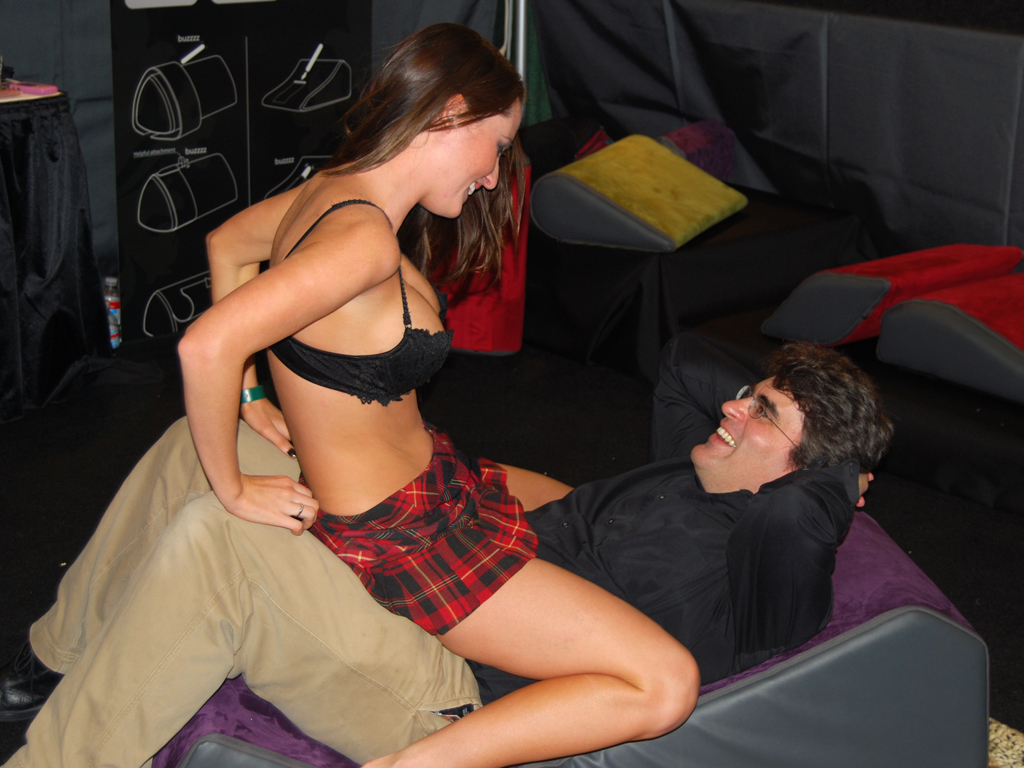
Demonstration of a Lapdance - Wikipedia

Demonstration of a Lapdance Wikipedia

The post will be adult/mature in nature. So those below 18 please excuse. The post is about an anecdote almost 20 years to date, The result its being posted is I had a dinner with a friend to whom I shared this and he thought it would be nice if I shared this hence sharing it. The conversation was about being young and foolish in which I shared the anecdote. The blog post was supposed to be about Aadhar which shocked me both in the way no political discourse happened and the way the public as well as public policy was gamed but that would have to wait for another day. History I left college in 1995. The anecdote/incident probably happened couple of years earlier so probably 1992-1993. At that time, I was in my teens and as a typical teenager I made few friends. One of those friends, who would remain nameless as since we drifted apart, and as I have not take permission from him, taking his name would not be a good idea. Anyway, this gentleman, let s call him Mr. X as an example. Couple of months before, he had bought an open jeep, similar but very different from the jeep being shown below. Open Jeep had become a fashion statement few months back (in those days) as a Salman khan starred movie had that and anybody who had money wanted one just like that.
Illustration of an open jeep, sadly its a military one - wikipedia

Illustration of an open jeep, sadly its a military one wikipedia

Those days we didn t have cell-phones and I had given my land-line phone number to very few friends as in those days, as the land-lines were a finicky instrument. One fine morning, I get a call from my friend telling he is going to come near my place and I should meet him at some xyz place and we would go for a picnic for the whole day and it is possible that we might return next day. As it was holidays and only a fool would throw away a chance to have a ride in open air jeep, I immediately agreed. I shared that my friends had organized a picnic and giving another friend s number (who didn t know anything) got permission and went to meet Mr. X. This was very early morning, around 0600 hrs. . After meeting him, he told that we would be going to Mumbai, take some more friends from there and then move on. In those days, a railway ticket from Shivaji Nagar to V.T. (now C.S.T.) costed INR 30/- . I had been to Mumbai few times before for various technical conferences and knew few cheap places to eat, I knew that going via train, we could go and come back spending at the most INR 150/- and still have some change left-over (today s meal at a roadside/street vendor easily passes that mark). The Journey I shared with him that it will be costly and I don t have any money to cover the fuel expenses and he said he would shoulder the expenses, he just wanted my company for the road. Those days, it was the scenic Old Mumbai-Pune highway and we took plenty of stops to admire that ghats (hills and valleys together). That journey must have taken around 7-8 hours while today by new Expressway, you could do the same thing by 2.5/3 hours. Anyhow, we reached to some swanky hotel in South Mumbai. South Mumbai was not the financial powerhouse that it today is, there was mix of very old buildings and new buildings like the swanky hotel that we had checked in. I have no memory nor any idea whether it was 1 class, 3 class or 5 class and could have cared less as had been tired from the journey. We checked in, I had a long warm water bath and then slept in the king-size bed with curtains drawn. Evening came and we took the jeep and picked up 2-3 of his friends who were from my age or a year or two older and we went to Nariman Point. Seeing the Queen s necklace from Nariman Point at night is a sight in itself. Keeping with the innocence, I was under the impression that we had arrived at our destination, at this our host, Mr. X and his Bombaiya friends had a quiet laugh saying its a young night still. We must have whiled away couple of hours, having chai and throwing rocks in the sea. The Meeting After a while, Mr. X took us to another swanky place. My eyes were out of my sockets as this seemed to be as elitist a place as could be. I saw many White European women in various stages of undress pole-dancing and lap-dancing. I had recently (in those days) come to know the term but was under the impression that it was something that happened in Europe and States only. I had no idea that lap-dancing was older than my birth as according to Wikipedia. So looking back now, I am not surprised that in two decades the concept crossed the oceans. Again, Mr. X being the host, agreed to bear all the costs and all of us had food, drink and a lap-dance from any of the dancers on the floor. As I was young and probably shy (still am) I asked Mr. X s help to pick a girl/woman for me. The woman whom he picked was auburn-aired, was either my age or a year or two older/younger to me. What proceeded next was about 20-30 minutes of totally sexualized erotic experience. While he and all his friends picked girls to go all the way, I was hesitant to let loose. Maybe it was due to my lack of courage or inexperience, maybe it was not in my city so couldn t predict the outcome, maybe was just afraid that reality might mar fantasy, I dunno till date. Although we kissed and necked a lot, I guess that should count for something. The conversation After all my friends had gone to the various rooms, sometime after I excused myself, went to the loo myself, peed a bit, splashed cold water on self, came out and had couple of glasses of water and came back to my seat. The lady came back and I shared that I was not interested in going further and while she was beautiful, I just didn t have the guts. I did ask her if she would give me company though for sometime as I didn t know anyone else at that place. Our conversation was more about her than me as I had more or less an average life upto that moment. There were only three unorthodox things that I had done before meeting her. I had drunk wines of different types, smoked weed and had a Magic Mushrooms experience the year before with another group of friends I had made there. Goa in those days was simply magical in those days but that probably would need its story/own blog post. When I enquired about her, she shared she was from Russia and she rattled off more than half a dozen places around the world where she had been to and this was her second or third stint in Mumbai and she wasn t at all unhappy about the lifestyle and choices she was leading. I had no answer for her as a young penniless college-going student. Her self-confidence and the way she carried herself was impressive, with or without clothes. During course of the conversation she shared a couple of contacts from whom I could get better weed at slightly higher price if I were in Goa. Few months later, those contacts turned out to be true. After sometime, we took all the women and ourselves, around 8-9 people in his jeep (how he negotiated that is beyond me) went to a hygienic Pani puri and Bhel (puffed rice mixed with variety of spices typically tomato, potato, coriander chutney as well as Tamarind Chutney among other things) place and moved them to tears (the spices in bhel and Pani puri did it for them) and this was when we had explicitly asked the bhel-wala guy to make it extremely mild with just a hint of spice in it. Anyways, sometime later, we dropped them at the same place, dropped his friends and came back to the hotel we booked and got drunk again. After-effects Few years later, it came in the newspapers/media that while India had broken out of financial isolation just few years back (1991) and were profiting from it, many countries of the former USSR were going the other way around and hence there was huge human trafficking and immigration that had taken place. This was in-line with what the lady/woman/Miss X had shared with me. The latest trigger The latest trigger happened couple of months back where I learnt of a hero flight attendant saving a girl from human-trafficking. Till date, I am unsure whether she was doing it willingly or putting a brave smile in front of me, because even if she had confided me in any way, I probably would have been too powerless to help her in any-way. I just don t know. Foolishness thy name While my friend took advantage of my innocence and introduced me to a world which otherwise I would probably not know exists, it could have easily have gone some other way as well. While I m still unsure of the choices I made, I was and am happy that I was able to strike a conversation with her and attempt to reach the person therein. Was it the truth or an elaborate fabricated lie to protect myself and herself, this I will never know. Oppression I understand the fact that as a customer or somebody who is taking part in either of those performances or experiences it isn t easy in any way to know/say that whether the performer is doing it wilfully or not as the experiences are in tightly controlled settings.
Filed under: Miscellenous Tagged: #anecdote, #confusion, #elitist, #growing up, #lap dance, #NSFW, #Open Jeep, Mumbai

29 March 2017

Daniel Pocock: Brexit: If it looks like racism, if it smells like racism and if it feels like racism, who else but a politician could argue it isn't?

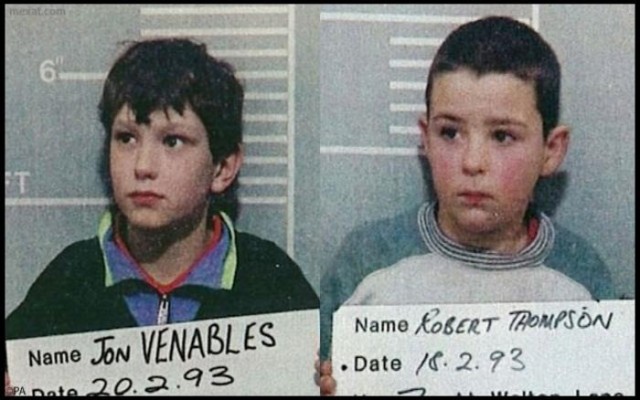
Since the EU referendum got under way in the UK, it has become almost an everyday occurence to turn on the TV and hear some politician explaining "I don't mean to sound racist, but..." (example) Of course, if you didn't mean to sound racist, you wouldn't sound racist in the first place, now would you? The reality is, whether you like politics or not, political leaders have a significant impact on society and the massive rise in UK hate crimes, including deaths of Polish workers, is a direct reflection of the leadership (or profound lack of it) coming down from Westminster. Maybe you don't mean to sound racist, but if this is the impact your words are having, maybe it's time to shut up? Choosing your referendum Why choose to have a referendum on immigration issues and not on any number of other significant topics? Why not have a referendum on nuking Mr Putin to punish him for what looks like an act of terrorism against the Malaysian Airlines flight MH17? Why not have a referendum on cutting taxes or raising speed limits, turning British motorways into freeways or an autobahn? Why choose to keep those issues in the hands of the Government, but invite the man-in-a-white-van from middle England to regurgitate Nigel Farage's fears and anxieties about migrants onto a ballot paper? Even if David Cameron sincerely hoped and believed that the referendum would turn out otherwise, surely he must have contemplated that he was playing Russian Roulette with the future of millions of innocent people? Let's start at the top For those who are fortunate enough to live in parts of the world where the press provides little exposure to the antics of British royalty, an interesting fact you may have missed is that the Queen's husband, Prince Philip, Duke of Edinburgh is actually a foreigner. He was born in Greece and has Danish and German ancestry. Migration (in both directions) is right at the heart of the UK's identity. Queen and Prince Philip Home office minister Amber Rudd recently suggested British firms should publish details about how many foreign people they employ and in which positions. She argued this is necessary to help boost funding for training local people. If that is such a brilliant idea, why hasn't it worked for the Premier League? It is a matter of public knowledge how many foreigners play football in England's most prestigious division, so why hasn't this caused local clubs to boost training budgets for local recruits? After all, when you consider that England hasn't won a World Cup since 1966, what have they got to lose? Kevin Pietersen All this racism, it's just not cricket. Or is it? One of the most remarkable cricketers to play for England in recent times, Kevin Pietersen, dubbed "the most complete batsman in cricket" by The Times and "England's greatest modern batsman" by the Guardian, was born in South Africa. In the five years he was contracted to the Hampshire county team, he only played one match, because he was too busy representing England abroad. His highest position was nothing less than becoming England's team captain. Are the British superior to every other European citizen? One of the implications of the rhetoric coming out of London these days is that the British are superior to their neighbours, entitled to have their cake and eat it too, making foreigners queue up at Paris' Gare du Nord to board the Eurostar while British travelers should be able to walk or drive into European countries unchallenged. This superiority complex is not uniquely British, you can observe similar delusions are rampant in many of the places where I've lived, including Australia, Switzerland and France. America's Donald Trump has taken this style of politics to a new level. Look in the mirror Theresa May: after British 10-year old schoolboys Robert Thompson and Jon Venables abducted, tortured, murdered and mutilated 2 year old James Bulger in 1993, why not have all British schoolchildren fingerprinted and added to the police DNA database? Why should "security" only apply based on the country where people are born, their religion or skin colour? Jon Venables and Robert Thompson In fact, after Brexit, people like Venables and Thompson will remain in Britain while a Dutch woman, educated at Cambridge and with two British children will not. If that isn't racism, what is? Running foreigner's off the roads Theresa May has only been Prime Minister for less than a year but she has a history of bullying and abusing foreigners in her previous role in the Home Office. One example of this was a policy of removing driving licenses from foreigners, which has caused administrative chaos and even taken away the licenses of many people who technically should not have been subject to these regulations anyway. Shouldn't the DVLA (Britain's office for driving licenses) simply focus on the competence of somebody to drive a vehicle? Bringing all these other factors into licensing creates a hostile environment full of mistakes and inconvenience at best and opportunities for low-level officials to engage in arbitrary acts of racism and discrimination. Of course, when you are taking your country on the road to nowhere, who needs a driving license anyway? Run off the road What does "maximum control" over other human beings mean to you? The new British PM has said she wants "maximum control" over immigrants. What exactly does "maximum control" mean? Donald Trump appears to be promising "maximum control" over Muslims, Hitler sought "maximum control" over the Jews, hasn't the whole point of the EU been to avoid similar situations from ever arising again? This talk of "maximum control" in British politics has grown like a weed out of the UKIP. One of their senior figures has been linked to kidnappings and extortion, which reveals a lot about the character of the people who want to devise and administer these policies. Similar people in Australia aspire to jobs in the immigration department where they can extort money out of people for getting them pushed up the queue. It is no surprise that the first member of Australia's parliament ever sent to jail was put there for obtaining bribes and sexual favours from immigrants. When Nigel Farage talks about copying the Australian immigration system, he is talking about creating jobs like these for his mates. Even if "maximum control" is important, who really believes that a bunch of bullies in Westminster should have the power to exercise that control? Is May saying that British bosses are no longer competent to make their own decisions about who to employ or that British citizens are not reliable enough to make their own decisions about who they marry and they need a helping hand from paper-pushers in the immigration department? maximum control over Jewish people Echoes of the Third Reich Most people associate acts of mass murder with the Germans who lived in the time of Adolf Hitler. These are the stories told over and and over again in movies, books and the press. Look more closely, however, and it appears that the vast majority of Germans were not in immediate contact with the gas chambers. Even Gobels' secretary writes that she was completely oblivious to it all. Many people were simply small cogs in a big bad machine. The clues were there, but many of them couldn't see the big picture. Even if they did get a whiff of it, many chose not to ask questions, to carry on with their comfortable lives. Today, with mass media and the Internet, it is a lot easier for people to discover the truth if they look, but many are still reluctant to do so. Consider, for example, the fingerprint scanners installed in British post offices and police stations to fingerprint foreigners and criminals (as if they have something in common). If all the post office staff refused to engage in racist conduct the fingerprint scanners would be put out of service. Nonetheless, these people carry on, just doing their job, just following orders. It was through many small abuses like this, rather than mass murder on every street corner, that Hitler motivated an entire nation to serve his evil purposes. Technology like this is introduced in small steps: first it was used for serious criminals, then anybody accused of a crime, then people from Africa and next it appears they will try and apply it to all EU citizens remaining in the UK. How will a British man married to a French woman explain to their children that mummy has to be fingerprinted by the border guard each time they return from vacation? The Nazis pioneered biometric technology with the tracking numbers branded onto Jews. While today's technology is electronic and digital, isn't it performing the same function? There is no middle ground between "soft" and "hard" brexit An important point for British citizens and foreigners in the UK to consider today is that there is no compromise between a "soft" Brexit and a "hard" Brexit. It is one or the other. Anything less (for example, a deal that is "better" for British companies and worse for EU citizens) would imply that the British are a superior species and it is impossible to imagine the EU putting their stamp on such a deal. Anybody from the EU who is trying to make a life in the UK now is playing a game of Russian Roulette - sure, everything might be fine if it morphs into "soft" Brexit, but if Theresa May has her way, at some point in your life, maybe 20 years down the track, you could be rounded up by the gestapo and thrown behind bars for a parking violation. There has already been a five-fold increase in the detention of EU citizens in British concentration camps and they are using grandmothers from Asian countries to refine their tactics for the efficient removal of EU citizens. One can only wonder what type of monsters Theresa May has been employing to run such inhumane operations. This is not politics Edmund Burke's quote "The only thing necessary for the triumph of evil is for good men to do nothing" comes to mind on a day like today. Too many people think it is just politics and they can go on with their lives and ignore it. Barely half the British population voted in the referendum. This is about human beings treating each other with dignity and respect. Anything less is abhorrent and may well come back to bite.

24 March 2017

Gunnar Wolf: Dear lazyweb: How would you visualize..?

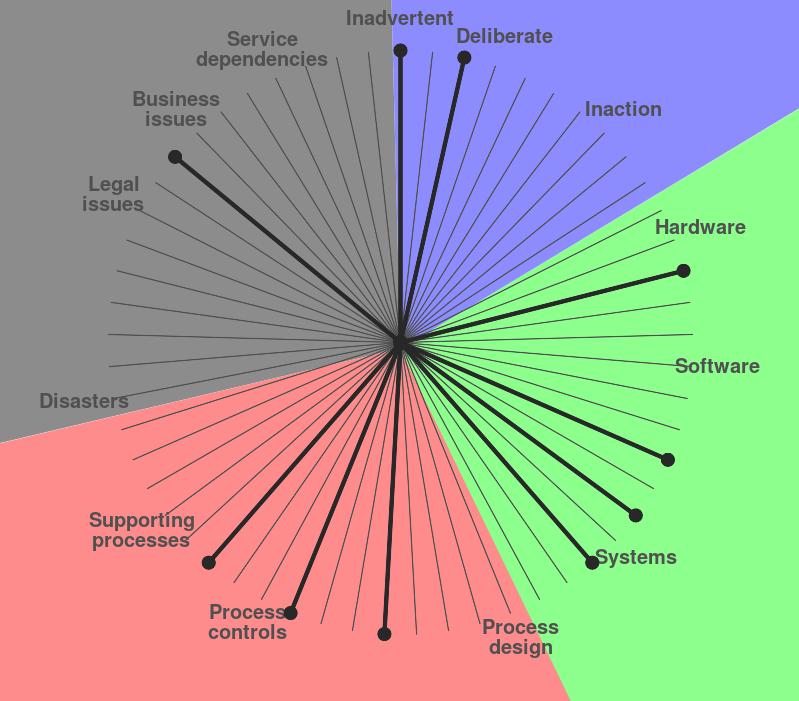
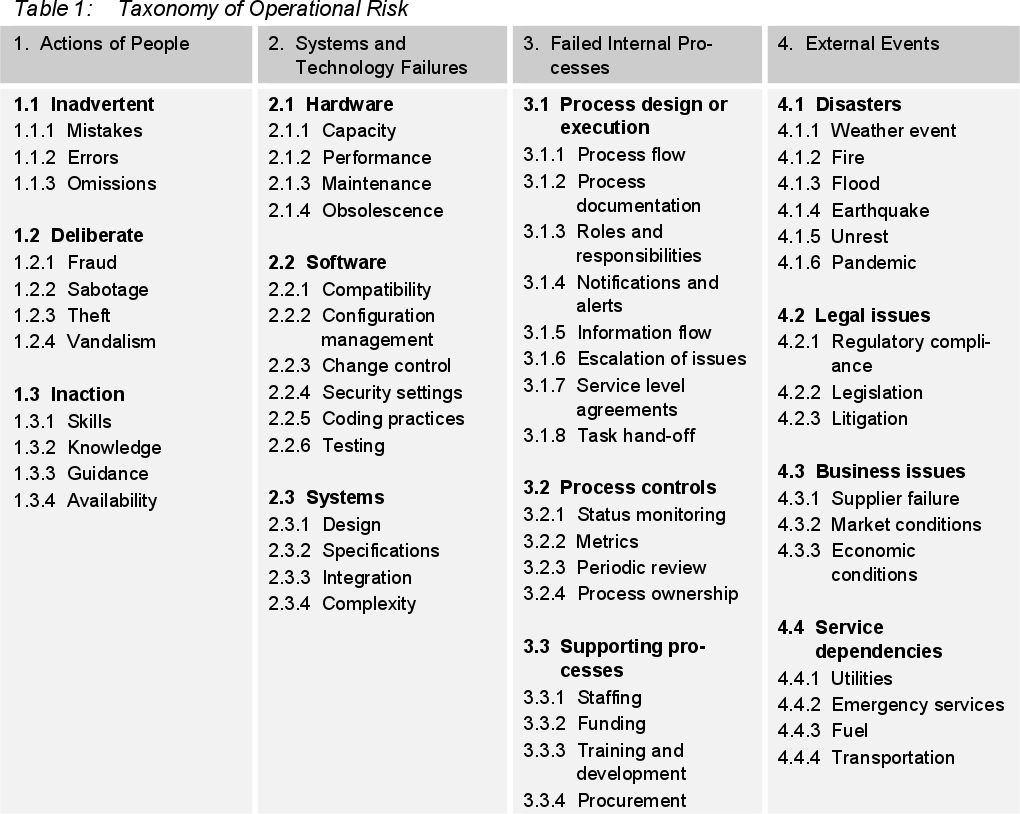
Dear lazyweb, I am trying to get a good way to present the categorization of several cases studied with a fitting graph. I am rating several vulnerabilities / failures according to James Cebula et. al.'s paper, A taxonomy of Operational Cyber Security Risks; this is a somewhat deep taxonomy, with 57 end items, but organized in a three levels deep hierarchy. Copying a table from the cited paper (click to display it full-sized): My categorization is binary: I care only whether it falls within a given category or not. My first stab at this was to represent each case using a star or radar graph. As an example: As you can see, to a "bare" star graph, I added a background color for each top-level category (blue for actions of people, green for systems and technology failures), red for failed internal processes and gray for external events), and printed out only the labels for the second level categories; for an accurate reading of the graphs, you have to refer to the table and count bars. And, yes, according to the Engineering Statistics Handbook:
Star plots are helpful for small-to-moderate-sized multivariate data sets. Their primary weakness is that their effectiveness is limited to data sets with less than a few hundred points. After that, they tend to be overwhelming.
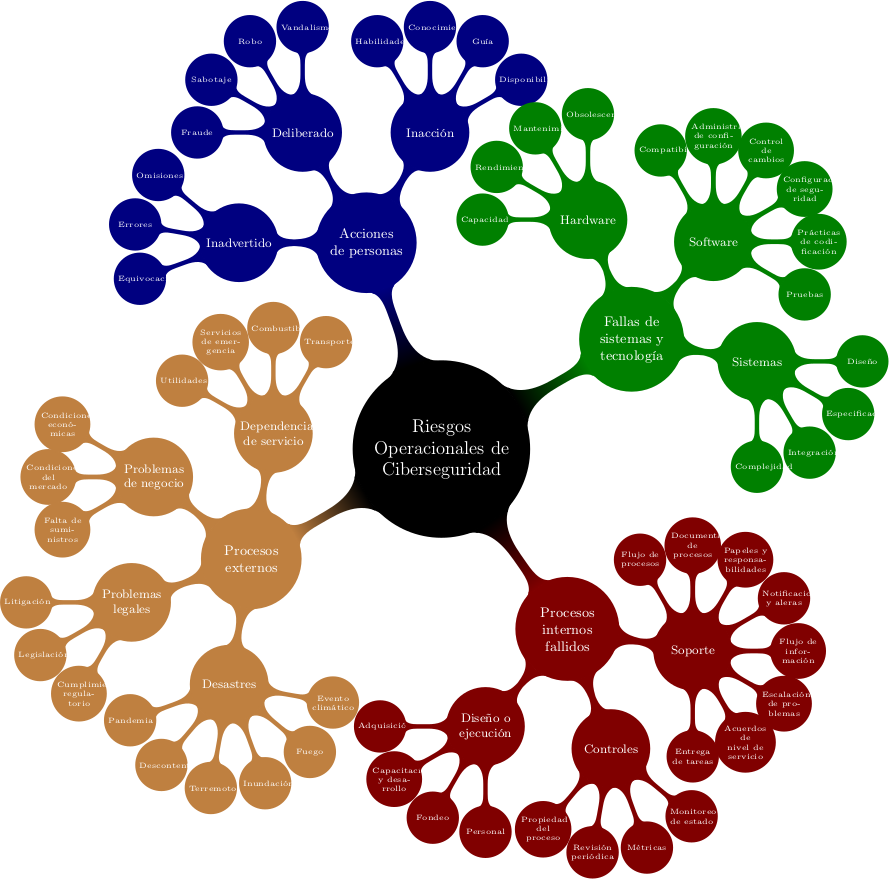
I strongly agree with the above statement And stating that "a few hundred points" can be understood is even an overstatement. 50 points are just too much. Now, trying to increase usability for this graph, I came across the Sunburst diagram. One of the proponents for this diagram, John Stasko, has written quite a bit about it. Now... How to create my beautiful Sunburst diagram? That's a tougher one. Even though the page I linked to in the (great!) Data visualization catalogue presents even some free-as-in-software tools to do this... They are Javascript projects that will render their beautiful plots (even including an animation)... To the browser. I need them for a static (i.e. to be printed) document. Yes, I can screenshot and all, but I want them to be automatically generated, so I can review and regenerate them all automatically. Oh, I could just write JSON and use SaaS sites such as Aculocity to do the heavy-lifting, but if you know me, you will understand why I don't want to. So... I set out to find a Gunnar-approved way to display the information I need. Now, as the Protovis documentation says, an icicle is simply a sunburst transformed from polar to cartesian coordinates... But I came to a similar conclusion: The tools I found are not what I need. OK, but an icicle graph seems much simpler to produce I fired up my Emacs, and started writing using Ruby, RMagick and RVG... I decided to try a different way. This is my result so far: So... What do you think? Does this look right to you? Clearer than the previous one? Worst? Do you have any idea on how I could make this better? Oh... You want to tell me there is something odd about it? Well, yes, of course! I still need to tweak it quite a bit. Would you believe me if I told you this is not really a left-to-right icicle graph, but rather a strangely formatted Graphviz non-directed graph using the dot formatter? I can assure you you don't want to look at my Graphviz sources... But in case you insist... Take them and laugh. Or cry. Of course, this file comes from a hand-crafted template, but has some autogenerated bits to it. I have still to tweak it quite a bit to correct several of its usability shortcomings, but at least it looks somewhat like what I want to achieve. Anyway, I started out by making a "dear lazyweb" question. So, here it goes: Do you think I'm using the right visualization for my data? Do you have any better suggestions, either of a graph or of a graph-generating tool? Thanks! [update] Thanks for the first pointer, Lazyweb! I found a beautiful solution; we will see if it is what I need or not (it is too space-greedy to be readable... But I will check it out more thoroughly). It lays out much better than anything I can spew out by myself Writing it as a mindmap using TikZ directly from within LaTeX, I get the following result:

22 March 2017

Clint Adams: Then Moises claimed that T.G.I. Friday's was acceptable

It s really sad listening to a friend talk about how he doesn t care for his wife and doesn t find her attractive anymore, he whined, while at the same time talking about the kid she is pregnant with obviously they haven t had sex in awhile and how though he only wants one kid, she wants multiple so they will probably have more. He said he couldn t afford to have a divorce. He literally said that one morning, watching her get dressed he laughed and told her, Your boobs look weird. She didn t like that. I reminded him that they will continue to age. That didn t make him feel good. He said that he realized before getting married that he thought he was a good person, but now he s realizing he s a bad person. He said he was a misogynist. I said, Worse, you re the type of misogynist who pretends to be a feminist. He agreed. He lived in Park Slope, but he moved once they became pregnant. Good luck finding a kid-friendly restaurant, she said.
Posted on 2017-03-22
Tags: umismu

19 March 2017

Clint Adams: Measure once, devein twice

Ophira lived in a wee house in University Square, Tampa. It had one floor, three bedrooms, two baths, a handful of family members, a couple pets, some plants, and an occasional staring contest. Mauricio lived in Lowry Park North, but Ophira wasn t allowed to go there because Mauricio was afraid that someone would tell his girlfriend. Ophira didn t like Mauricio s girlfriend and Mauricio s girlfriend did not like Ophira. Mauricio did not bring his girlfriend along when he and Ophira went to St. Pete Beach. They frolicked in the ocean water, and attempted to have sex. Mauricio and Ophira were big fans of science, so Somewhat quickly they concluded that it is impossible to have sex underwater, and absconded to Ophira s car to have sex therein. I hate Mauricio s girlfriend, Ophira told Amit on the telephone. She s not even pretty. Hey, listen, said Amit. I m going to a wedding on Captiva. Oh, my family used to go to Captiva every year. There s bioluminescent algae and little crabs and stuff. Yeah? Do you want to come along? You could pick me up at the airport. Why would I want to go to a wedding? Well, it s on the beach and they re going to have a bouncy castle. A bouncy castle Are you serious? Yes. Well, okay. Amit prepared to go to the wedding and Ophira became terse then unresponsive. After he landed at RSW, he called Ophira, but instead of answering the phone she startled and fell out of her chair. Amit arranged for other transportation toward the Sanibel Causeway. Ophira bit her nails for a few hours, then went to her car and drove to Cape Coral. Ophira cruised around Cape Coral for a while, until she spotted a teenager cleaning a minivan. She parked her car and approached him. Whatcha doing? asked Ophira, pretending to chew on imaginary gum. The youth slid the minivan door open. I m cleaning, he said hesitantly. Didn t your parents teach you not to talk to strangers? I could do all kinds of horrible things to you. They conversed for a bit. She recounted a story of her personal hero, a twelve-year-old girl who seduced and manipulated older men into ruin. She rehashed the mysteries of Mauricio s girlfriend. She waxed poetic on her love of bouncy castles. The youth listened, hypnotized. What s your name, kid? Ophira yawned. Arjun, he replied. How old are you? Arjun thought about it. 15, he said. Hmm, Ophira stroked her chin. Can you sneak me into your room so that your parents never find out about it? Arjun s eyes went wide. MEANWHILE, on Captiva Island, Amit had learned that even though the Tenderly had multiple indoor jacuzzis, General Fitzpatrick and Mrs. Fitzpatrick had decided it prudent to have sex in the hot tub on the deck; that the execution of this plan had somehow necessitated a lengthy cleaning process before the hot tub could be used again; that that s why workmen were cleaning the hot tub; and that the Fitzpatrick children had gotten General Fitzpatrick and Mrs. Fitzpatrick to agree to not do that again, with an added suggestion that they not be seen doing anything else naked in public. A girl walked up to Amit. Hey, I heard you lost your plus-one. Are you here alone? What a loser! she giggled nervously, then stared. Leave me alone, Darlene, sighed Amit. Darlene s face reddened as she spun on her heels and stormed over to Lisette. Oh my god, did you see that? I practically threw myself at him and he was abusive toward me. He probably has all the classic signs of being an abuser. Did you hear about that girl he dated in Ohio? I bet I know why that ended. Oh really? said Lisette distractedly, looking Amit up and down. So he s single now? Darlene glared at Lisette as Amit wandered back outside to stare at the hot tub. Hey kid, said Ophira, bring me some snacks. I don t bring food into my room, said Arjun. It attracts pests. Is that what your parents told you? scoffed Ophira. Don t be such a wuss. Three minutes later, Ophira was finishing a bag of paprika puffs. These are great, Arjun! Where do you get these? My cousin sends them from Europe, he explained. Now get me a diet soda. Amit strolled along the beach, then yelped. What s biting my legs? he cried out. Those are sand fleas, said Nessarose. What are sand fleas? asked Amit incredulously. Nessarose rolled her eyes. Stop being a baby and have a drink. After the sun went down, Amit began to notice the crabs, and this made him drink more. When everyone was soused, General Fitzpatrick announced that they were going for a swim in the Gulf, in direct contravention of safety guidelines. Most of the guests were wise enough to refuse, but an eightsome swam out, occasionally stopping to slap the algae, but continuing until they reached the sandbar that General Fitzpatrick correctly claimed was there. Then screams echoed through the night as all the jellyfish attacked everyone invading their sandbar. The crestfallen swimming party eventually made it back to shore. Pee on the jellyfish sting, commanded Nessarose. It s the best cure. No! shouted General Fitzpatrick s daughter. Urine makes it worse. Things quickly escalated from Nessarose and General Fitzpatrick s daughter screaming at each other to the beach dividing into three factions: those siding with Nessarose, those siding with General Fitzpatrick s daughter, and those who had no idea what was going on. General Fitzpatrick had no interest in any of this, and went straight to bed. It s getting late, kid, said Ophira. I m taking your bed. What? squeaked Arjun. Look, said Ophira, your bed is small and there isn t room for both of us. You may sleep on the floor if you re quiet and don t bother me. What? squeaked Arjun. Are you deaf, kid? Ophira grunted and then went to bed. Arjun blinked in confusion, then tried to fall asleep on the floor, without much success. Ophira got up in the morning and said, Before I go, I want to teach you a valuable lesson. What? groaned Arjun, getting to his feet. You should be careful talking to strangers. Now, I told you that I could do horrible things to you, so this is not my fault; it s yours, she announced, then sucker-punched him in the gut. Ophira climbed out the window as Arjun doubled over. As the ceremony began, only a small minority of the wedding party was visibly suffering from jellyfish stings, which may or may not have helped with ignoring the sand fleas. The ceremony ended shortly thereafter, and now that marriage had been accomplished, everyone turned their attention to food and drink and swimming less irresponsibly than the night before. Guests that needed to return home sooner departed in waves and Amit started to appreciate the more peaceful environment. He heard the deck door slide open behind him and turned his attention away from the hot tub. Hey, mofo, Ophira shouted as strode stylishly out onto the deck. Where s this bouncy castle? Amit blinked in surprise. That was yesterday. You missed it. Oh, she frowned. So I met this South Slav guy with a really sexy forehead, and I need some advice. I don t know if I should call him or wait. Amit pointed to the hot tub and told her the story of General Fitzpatrick and Mrs. Fitzpatrick and the hot tub. What? said Ophira. How could they have sex underwater? What do you mean? asked Amit. Well, it s impossible, she replied.
Posted on 2017-03-19
Tags: mintings

18 March 2017

Vincent Sanders: A rose by any other name would smell as sweet

Often I end up dealing with code that works but might not be of the highest quality. While quality is subjective I like to use the idea of "code smell" to convey what I mean, these are a list of indicators that, in total, help to identify code that might benefit from some improvement.

Such smells may include:
I am most certainly not alone in using this approach and Fowler et al have covered this subject in the literature much better than I can here. One point I will raise though is some programmers dismiss code that exhibits these traits as "legacy" and immediately suggest a fresh implementation. There are varying opinions on when a rewrite is the appropriate solution from never to always but in my experience making the old working code smell nice is almost always less effort and risk than a re-write.
TestsWhen I come across smelly code, and I decide it is worthwhile improving it, I often discover the biggest smell is lack of test coverage. Now do remember this is just one code smell and on its own might not be indicative, my experience is smelly code seldom has effective test coverage while fresh code often does.

Test coverage is generally understood to be the percentage of source code lines and decision paths used when instrumented code is exercised by a set of tests. Like many metrics developer tools produce, "coverage percentage" is often misused by managers as a proxy for code quality. Both Fowler and Marick have written about this but sufficient to say that for a developer test coverage is a useful tool but should not be misapplied.

Although refactoring without tests is possible the chances for unintended consequences are proportionally higher. I often approach such a refactor by enumerating all the callers and constructing a description of the used interface beforehand and check that that interface is not broken by the refactor. At which point is is probably worth writing a unit test to automate the checks.

Because of this I have changed my approach to such refactoring to start by ensuring there is at least basic API code coverage. This may not yield the fashionable 85% coverage target but is useful and may be extended later if desired.

It is widely known and equally widely ignored that for maximum effectiveness unit tests must be run frequently and developers take action to rectify failures promptly. A test that is not being run or acted upon is a waste of resources both to implement and maintain which might be better spent elsewhere.

For projects I contribute to frequently I try to ensure that the CI system is running the coverage target, and hence the unit tests, which automatically ensures any test breaking changes will be highlighted promptly. I believe the slight extra overhead of executing the instrumented tests is repaid by having the coverage metrics available to the developers to aid in spotting areas with inadequate tests.
ExampleA short example will help illustrate my point. When a web browser receives an object over HTTP the server can supply a MIME type in a content-type header that helps the browser interpret the resource. However this meta-data is often problematic (sorry that should read "a misleading lie") so the actual content must be examined to get a better answer for the user. This is known as mime sniffing and of course there is a living specification.

The source code that provides this API (Linked to it rather than included for brevity) has a few smells:
While some of these are obvious the non-use of the global string table and the API complexity needed detailed knowledge of the codebase, just to highlight how subjective the sniff test can be. There is also one huge air freshener in all of this which definitely comes from experience and that is the modules author. Their name at the top of this would ordinarily be cause for me to move on, but I needed an example!

First thing to check is the API use

$ git grep -i -e mimesniff_compute_effective_type --or -e mimesniff_init --or -e mimesniff_fini
content/hlcache.c: error = mimesniff_compute_effective_type(handle, NULL, 0,
content/hlcache.c: error = mimesniff_compute_effective_type(handle,
content/mimesniff.c:nserror mimesniff_init(void)
content/mimesniff.c:void mimesniff_fini(void)
content/mimesniff.c:nserror mimesniff_compute_effective_type(llcache_handle *handle,
content/mimesniff.h:nserror mimesniff_compute_effective_type(struct llcache_handle *handle,
content/mimesniff.h:nserror mimesniff_init(void);
content/mimesniff.h:void mimesniff_fini(void);
desktop/netsurf.c: ret = mimesniff_init();
desktop/netsurf.c: mimesniff_fini();

This immediately shows me that this API is used in only a very small area, this is often not the case but the general approach still applies.

After a little investigation the usage is effectively that the mimesniff_init API must be called before the mimesniff_compute_effective_type API and the mimesniff_fini releases the initialised resources.

A simple test case was added to cover the API, this exercised the behaviour both when the init was called before the computation and not. Also some simple tests for a limited number of well behaved inputs.

By changing to using the global string table the initialisation and finalisation API can be removed altogether along with a large amount of global context and pre-processor macros. This single change removes a lot of smell from the module and raises test coverage both because the global string table already has good coverage and because there are now many fewer lines and conditionals to check in the mimesniff module.

I stopped the refactor at this point but were this more than an example I probably would have:
ConclusionThe approach examined here reduce the smell of code in an incremental, testable way to improve the codebase going forward. This is mainly necessary on larger complex codebases where technical debt and bit-rot are real issues that can quickly overwhelm a codebase if not kept in check.

This technique is subjective but helps a programmer to quantify and examine a piece of code in a structured fashion. However it is only a tool and should not be over applied nor used as a metric to proxy for code quality.

14 March 2017

John Goerzen: Parsing the GOP s Health Insurance Statistics

There has been a lot of noise lately about the GOP health care plan (AHCA) and the differences to the current plan (ACA or Obamacare). A lot of statistics are being misinterpreted. The New York Times has an excellent analysis of some of this. But to pick it apart, I want to highlight a few things: Many Republicans are touting the CBO s estimate that, some years out, premiums will be 10% lower under their plan than under the ACA. However, this carries with it a lot of misleading information. First of all, many are spinning this as if costs would go down. That s not the case. The premiums would still rise they would just have risen less by the end of the period than under ACA. That also ignores the immediate spike and throwing millions out of the insurance marketplace altogether. Now then, where does this 10% number come from? First of all, you have to understand the older people are substantially more expensive to the health system, and therefore more expensive to insure. ACA limited the price differential from the youngest to the oldest people, which meant that in effect some young people were subsidizing older ones on the individual market. The GOP plan removes that limit. Combined with other changes in subsidies and tax credits, this dramatically increases the cost to older people. For instance, the New York Times article cites a CBO estimate that the price an average 64-year-old earning $26,500 would need to pay after using a subsidy would increase from $1,700 under Obamacare to $14,600 under the Republican plan. They further conclude that these exceptionally high rates would be so unaffordable to older people that the older people will simply stop buying insurance on the individual market. This means that the overall risk pool of people in that market is healthier, and therefore the average price is lower. So, to sum up: the reason that insurance premiums under the GOP plan will rise at a slightly slower rate long-term is that the higher-risk people will be unable to afford insurance in the first place, leaving only the cheaper people to buy in.

13 March 2017

Sean Whitton: Initial views of 5th edition DnD

I ve been playing in a 5e campaign for around two months now. In the past ten days or so I ve been reading various source books and Internet threads regarding the design of 5th edition. I d like to draw some comparisons and contrasts between 5th edition, and the 3rd edition family of games (DnD 3.5e and Paizo s Pathfinder, which may be thought of as 3.75e). The first thing I d like to discuss is that wizards and clerics are no longer Vancian spellcasters. In rules terms, this is the idea that individual spells are pieces of ammunition. Spellcasters have a list of individual spells stored in their heads, and as they cast spells from that list, they cross off each item. Barring special rules about spontaneously converting prepared spells to healing spells, for clerics, the only way to add items back to the list is to take a night s rest. Contrast this with spending points from a pool of energy in order to use an ability to cast a fireball. Then the limiting factor on using spells is having enough points in your mana pool, not having further castings of the spell waiting in memory. One of the design goals of 5th edition was to reduce the dominance of spellcasters at higher levels of play. The article to which I linked in the previous paragraph argues that this rebalancing requires the removal of Vancian magic. The idea, to the extent that I ve understood it, is that Vancian magic is not an effective restriction on spellcaster power levels, so it is to be replaced with other restrictions adding new restrictions while retaining the restrictions inherent in Vancian magic would leave spellcasters crippled. A further reason for removing Vancian magic was to defeat the so-called five minute adventuring day . The compat ability of a party that contains higher level Vancian spellcasters drops significantly once they ve fired off their most powerful combat spells. So adventuring groups would find themselves getting into a fight, and then immediately retreating to fully rest up in order to get their spells back. This removes interesting strategic and roleplaying possibilities involving the careful allocation of resources, and continuing to fight as hit points run low. There are some other related changes. Spell components are no longer used up when casting a spell. So you can use one piece of bat guano for every fireball your character ever casts, instead of each casting requiring a new piece. Correspondingly, you can use a spell focus, such as a cool wand, instead of a pouch full of material components since the pouch never runs out, there s no mechanical change if a wizard uses an arcane focus instead. 0th level spells may now be cast at will (although Pathfinder had this too). And there are decent 0th level attack spells, so a spellcaster need not carry a crossbow or shortbow in order to have something to do on rounds when it would not be optimal to fire off one of their precious spells. I am very much in favour of these design goals. The five minute adventuring day gets old fast, and I want it to be possible for the party to rely on the cool abilities of non-spellcasters to deal with the challenges they face. However, I am concerned about the flavour changes that result from the removal of Vancian magic. These affect wizards and clerics differently, so I ll take each case in turn. Firstly, consider wizards. In third edition, a wizard had to prepare and cast Read Magic (the only spell they could prepare without a spellbook), and then set about working through their spellbook. This involved casting the spells they wanted to prepare, up until the last few triggering words or gestures that would cause the effect of the spell to manifest. They would commit these final parts of the spell to memory. When it came to casting the spell, the wizard would say the final few words and make the required gestures, and bring out relevant material components from their component pouch. The completed spell would be ripped out of their mind, to manifest its effect in the world. We see that the casting of a spell is a highly mentally-draining activity it rips the spell out of the caster s memory! not to be undertaken lightly. Thus it is natural that a wizard would learn to use a crossbow for basic damage-dealing. Magic is not something that comes very naturally to the wizard, to be deployed in combat as readily as the fighter swings their sword. They are not a superhero or video game character, pew pew ing their way to victory. This is a very cool starting point upon which to roleplay an academic spellcaster, not really available outside of tabletop games. I see it as a distinction between magical abilities and real magic. Secondly, consider clerics. Most of the remarks in the previous paragraph apply, suitably reworked to be in terms of requesting certain abilities from the deity to whom the cleric is devoted. Additionally, there is the downgrading of the importance of the cleric s healing magic in 5th edition. Characters can heal themselves by taking short and long rests. Previously, natural healing was very slow, so a cleric would need to convert all their remaining magic to healing spells at the end of the day, and hope that it was enough to bring the party up to fighting shape. Again, this made the party of adventurers seem less like superheroes or video game characters. Magic had a special, important and unique role, that couldn t be replaced by the abilities of other classes.
There are some rules in the back of the DMG Slow Natural Healing , Healing Kit Dependency , Lingering Wounds which can be used to make healing magic more important. I m not sure how well they would work without changes to the cleric class.
I would like to find ways to restore the feel and flavour of Vancian clerics and wizards to 5th edition, without sacrificing the improvements that have been made that let other party members do cool stuff too. I hope it is possible to keep magic cool and unique without making it dominate the game. It would be easy to forbid the use of arcane foci, and say that material component pouches run out if the party do not visit a suitable marketplace often enough. This would not have a significant mechanical effect, and could enhance roleplaying possibilities. I am not sure how I could deal with the other issues I ve discussed without breaking the game. The second thing I would like to discuss is bounded accuracy. Under this design principle, the modifiers to dice rolls grow much more slowly. The gain of hit points remains unbounded. Under third edition, it was mechanically impossible for a low-level monster to land a hit on a higher-level adventurer, rendering them totally useless even in overwhelming numbers. With bounded accuracy, it s always possible for a low-level monster to hit a PC, even if they do insigificant damage. That means that multiple low-level monsters pose a threat. This change opens up many roleplaying opportunities by keeping low-level character abilities relevant, as well as monster types that can remain involves in stories without giving them implausible new abilities so they don t fall far behind the PCs. However, I m a little worried that it might make high level player characters feel a lot less powerful to play. I want to cease a be a fragile adventurer and become a world-changing hero at later levels, rather than forever remain vulnerable to the things that I was vulnerable to at the start of the game. This desire might just be the result of the video games which I played growing up. In the JRPGs I played and in Diablo II, enemies in earlier areas of the map were no threat at all once you d levelled up by conquering higher-level areas. My concerns about bounded accuracy might just be that it clashes with my own expectations of how fantasy heroes work. A good DM might be able to avoid these worries entirely. The final thing I d like to discuss is the various simplifications to the rules of 5th edition, when it is compared with 3rd edition and Pathfinder. Attacks of opportunity are only provoked when leaving a threatened square; you can go ahead and cast a spell when in melee with someone. There is a very short list of skills, and party members are much closer to each other in skills, now that you can t pump more and more ranks into one or two abilities. Feats as a whole are an optional rule. At first I was worried about these simplifications. I thought that they might make character building and tactics in combat a lot less fun. However, I am now broadly in favour of all of these changes, for two reasons. Firstly, they make the game so much more accessible, and make it far more viable to play without relying on a computer program to fill in the boxes on your character sheet. In my 5th edition group, two of us have played 3rd edition games, and the other four have never played any tabletop games before. But nobody has any problems figuring out their modifiers because it is always simply your ability bonus or penalty, plus your proficiency bonus if relevant. And advantage and disadvantage is so much more fun than getting an additional plus or minus two. Secondly, these simplifications downplay the importance of the maths, which means it is far less likely to be broken. It is easier to ensure that a smaller core of rules is balanced than it is to keep in check a larger mass of rules, constantly being supplemented by more and more addon books containing more and more feats and prestige classes. That means that players make their characters cool by roleplaying them in interesting ways, not making them cool by coming up with ability combos and synergies in advance of actually sitting down to play. Similarly, DMs can focus on flavouring monsters, rather than writing up longer stat blocks. I think that this last point reflects what I find most worthwhile about tabletop RPGs. I like characters to encounter cool NPCs and cool situations, and then react in cool ways. I don t care that much about character creation. (I used to care more about this, but I think it was mainly because of interesting options for magic items, which hasn t gone away.) The most important thing is exercising group creativity while actually playing the game, rather than players and DMs having to spend a lot of time preparing the maths in advance of playing. Fifth edition enables this by preventing the rules from getting in the way, because they re broken or overly complex. I think this is why I love Exalted: stunting is vital, and there is social combat. I hope to be able to work out a way to restore Vancian magic, but even without that, on balance, fifth edition seems like a better way to do group storytelling about fantasy heroes. Hopefully I will have an opportunity to DM a 5th edition campaign. I am considering disallowing all homebrew and classes and races from supplemental books. Stick to the well-balanced core rules, and do everything else by means of roleplaying and flavour. This is far less gimmicky, if more work for unimaginative players (such as myself!). Some further interesting reading:

Michal Čihař: Weblate users survey

Weblate is growing quite well in last months, but sometimes it's development is really driven by people who complain instead of following some roadmap with higher goals. I think it's time to change it at least a little bit. In order to get broader feedback I've sent out short survey to active project owners in Hosted Weblate week ago. I've decided to target at smaller audience for now, though publicly open survey might follow later (but it's always harder to evaluate feedback across different user groups). Overall feelings were really positive, most people find Weblate better than other similar services they have used. This is really something I like to hear :-). Weblate overall experience Weblate compared with other tools But the most important part for me was where users want to see improvements. This somehow matches my expectation that we really should improve the user interface. Weblate future development We have quite a lot features, which are really hidden in the user interface. Also interface for some of the features is far from being intuitive. This all probably comes from the fact that we really don't have anybody experienced with creating user interfaces right now. It's time to find somebody who will help us. In case you are able to help or know somebody who might be interested in helping, please get in touch. Weblate is free software, but this can still be paid job. Last part of the survey was focused on some particular features, but the outcome was not as clear as I hoped for as almost all feature group attracted about same attention (with one exception being extending the API, which was not really wanted by most of the users). Overall I think doing some survey like this is useful and I will certainly repeat it (probably yearly or so), to see where we're moving and what our users want. Having feedback from users is important for every project and this seemed to worked quite well. Anyway if you have further feedback, don't hesitate to use our issue tracker at GitHub or contact me directly.

Filed under: Debian English phpMyAdmin SUSE Weblate 0 comments

11 March 2017

John Goerzen: Silent Data Corruption Is Real

Here s something you never want to see:
ZFS has detected a checksum error:
   eid: 138
 class: checksum
  host: alexandria
  time: 2017-01-29 18:08:10-0600
 vtype: disk
This means there was a data error on the drive. But it s worse than a typical data error this is an error that was not detected by the hardware. Unlike most filesystems, ZFS and btrfs write a checksum with every block of data (both data and metadata) written to the drive, and the checksum is verified at read time. Most filesystems don t do this, because theoretically the hardware should detect all errors. But in practice, it doesn t always, which can lead to silent data corruption. That s why I use ZFS wherever I possibly can. As I looked into this issue, I saw that ZFS repaired about 400KB of data. I thought, well, that was unlucky and just ignored it. Then a week later, it happened again. Pretty soon, I noticed it happened every Sunday, and always to the same drive in my pool. It so happens that the highest I/O load on the machine happens on Sundays, because I have a cron job that runs zpool scrub on Sundays. This operation forces ZFS to read and verify the checksums on every block of data on the drive, and is a nice way to guard against unreadable sectors in rarely-used data. I finally swapped out the drive, but to my frustration, the new drive now exhibited the same issue. The SATA protocol does include a CRC32 checksum, so it seemed (to me, at least) that the problem was unlikely to be a cable or chassis issue. I suspected motherboard. It so happened I had a 9211-8i SAS card. I had purchased it off eBay awhile back when I built the server, but could never get it to see the drives. I wound up not filling it up with as many drives as planned, so the on-board SATA did the trick. Until now. As I poked at the 9211-8i, noticing that even its configuration utility didn t see any devices, I finally started wondering if the SAS/SATA breakout cables were a problem. And sure enough I realized I had a reverse cable and needed a forward one. $14 later, I had the correct cable and things are working properly now. One other note: RAM errors can sometimes cause issues like this, but this system uses ECC DRAM and the errors would be unlikely to always manifest themselves on a particular drive. So over the course of this, had I not been using ZFS, I would have had several megabytes of reads with undetected errors. Thanks to using ZFS, I know my data integrity is still good.

8 March 2017

Antoine Beaupr : An update to GitHub's terms of service

On February 28th, GitHub published a brand new version of its Terms of Service (ToS). While the first draft announced earlier in February didn't generate much reaction, the new ToS raised concerns that they may break at least the spirit, if not the letter, of certain free-software licenses. Digging in further reveals that the situation is probably not as dire as some had feared. The first person to raise the alarm was probably Thorsten Glaser, a Debian developer, who stated that the "new GitHub Terms of Service require removing many Open Source works from it". His concerns are mainly about section D of the document, in particular section D.4 which states:
You grant us and our legal successors the right to store and display your Content and make incidental copies as necessary to render the Website and provide the Service.
Section D.5 then goes on to say:
[...] You grant each User of GitHub a nonexclusive, worldwide license to access your Content through the GitHub Service, and to use, display and perform your Content, and to reproduce your Content solely on GitHub as permitted through GitHub's functionality

ToS versus GPL The concern here is that the ToS bypass the normal provisions of licenses like the GPL. Indeed, copyleft licenses are based on copyright law which forbid users from doing anything with the content unless they comply with the license, which forces, among other things, "share alike" properties. By granting GitHub and its users rights to reproduce content without explicitly respecting the original license, the ToS may allow users to bypass the copyleft nature of the license. Indeed, as Joey Hess, author of git-annex, explained :
The new TOS is potentially very bad for copylefted Free Software. It potentially neuters it entirely, so GPL licensed software hosted on Github has an implicit BSD-like license
Hess has since removed all his content (mostly mirrors) from GitHub. Others disagree. In a well-reasoned blog post, Debian developer Jonathan McDowell explained the rationale behind the changes:
My reading of the GitHub changes is that they are driven by a desire to ensure that GitHub are legally covered for the things they need to do with your code in order to run their service.
This seems like a fair point to make: GitHub needs to protect its own rights to operate the service. McDowell then goes on to do a detailed rebuttal of the arguments made by Glaser, arguing specifically that section D.5 "does not grant [...] additional rights to reproduce outside of GitHub". However, specific problems arise when we consider that GitHub is a private corporation that users have no control over. The "Services" defined in the ToS explicitly "refers to the applications, software, products, and services provided by GitHub". The term "Services" is therefore not limited to the current set of services. This loophole may actually give GitHub the right to bypass certain provisions of licenses used on GitHub. As Hess detailed in a later blog post:
If Github tomorrow starts providing say, an App Store service, that necessarily involves distribution of software to others, and they put my software in it, would that be allowed by this or not? If that hypothetical Github App Store doesn't sell apps, but licenses access to them for money, would that be allowed under this license that they want to my software?
However, when asked on IRC, Bradley M. Kuhn of the Software Freedom Conservancy explained that "ultimately, failure to comply with a copyleft license is a copyright infringement" and that the ToS do outline a process to deal with such infringement. Some lawyers have also publicly expressed their disagreement with Glaser's assessment, with Richard Fontana from Red Hat saying that the analysis is "basically wrong". It all comes down to the intent of the ToS, as Kuhn (who is not a lawyer) explained:
any license can be abused or misused for an intent other than its original intent. It's why it matters to get every little detail right, and I hope Github will do that.
He went even further and said that "we should assume the ambiguity in their ToS as it stands is favorable to Free Software". The ToS are in effect since February 28th; users "can accept them by clicking the broadcast announcement on your dashboard or by continuing to use GitHub". The immediacy of the change is one of the reasons why certain people are rushing to remove content from GitHub: there are concerns that continuing to use the service may be interpreted as consent to bypass those licenses. Hess even hosted a separate copy of the ToS [PDF] for people to be able to read the document without implicitly consenting. It is, however, unclear how a user should remove their content from the GitHub servers without actually agreeing to the new ToS.

CLAs When I read the first draft, I initially thought there would be concerns about the mandatory Contributor License Agreement (CLA) in section D.5 of the draft:
[...] unless there is a Contributor License Agreement to the contrary, whenever you make a contribution to a repository containing notice of a license, you license your contribution under the same terms, and agree that you have the right to license your contribution under those terms.
I was concerned this would establish the controversial practice of forcing CLAs on every GitHub user. I managed to find a post from a lawyer, Kyle E. Mitchell, who commented on the draft and, specifically, on the CLA. He outlined issues with wording and definition problems in that section of the draft. In particular, he noted that "contributor license agreement is not a legal term of art, but an industry term" and "is a bit fuzzy". This was clarified in the final draft, in section D.6, by removing the use of the CLA term and by explicitly mentioning the widely accepted norm for licenses: "inbound=outbound". So it seems that section D.6 is not really a problem: contributors do not need to necessarily delegate copyright ownership (as some CLAs require) when they make a contribution, unless otherwise noted by a repository-specific CLA. An interesting concern he raised, however, was with how GitHub conducted the drafting process. A blog post announced the change on February 7th with a link to a form to provide feedback until the 21st, with a publishing deadline of February 28th. This gave little time for lawyers and developers to review the document and comment on it. Users then had to basically accept whatever came out of the process as-is. Unlike every software project hosted on GitHub, the ToS document is not part of a Git repository people can propose changes to or even collaboratively discuss. While Mitchell acknowledges that "GitHub are within their rights to update their terms, within very broad limits, more or less however they like, whenever they like", he sets higher standards for GitHub than for other corporations, considering the community it serves and the spirit it represents. He described the process as:
[...] consistent with the value of CYA, which is real, but not with the output-improving virtues of open process, which is also real, and a great deal more pleasant.
Mitchell also explained that, because of its position, GitHub can have a major impact on the free-software world.
And as the current forum of preference for a great many developers, the knock-on effects of their decisions throw big weight. While GitHub have the wheel and they ve certainly earned it for now they can do real damage.
In particular, there have been some concerns that the ToS change may be an attempt to further the already diminishing adoption of the GPL for free-software projects; on GitHub, the GPL has been surpassed by the MIT license. But Kuhn believes that attitudes at GitHub have begun changing:
GitHub historically had an anti-copyleft culture, which was created in large part by their former and now ousted CEO, Preston-Warner. However, recently, I've seen people at GitHub truly reach out to me and others in the copyleft community to learn more and open their minds. I thus have a hard time believing that there was some anti-copyleft conspiracy in this ToS change.

GitHub response However, it seems that GitHub has actually been proactive in reaching out to the free software community. Kuhn noted that GitHub contacted the Conservancy to get its advice on the ToS changes. While he still thinks GitHub should fix the ambiguities quickly, he also noted that those issues "impact pretty much any non-trivial Open Source and Free Software license", not just copylefted material. When reached for comments, a GitHub spokesperson said:
While we are confident that these Terms serve the best needs of the community, we take our users' feedback very seriously and we are looking closely at ways to address their concerns.
Regardless, free-software enthusiasts have other concerns than the new ToS if they wish to use GitHub. First and foremost, most of the software running GitHub is proprietary, including the JavaScript served to your web browser. GitHub also created a centralized service out of a decentralized tool (Git). It has become the largest code hosting service in the world after only a few years and may well have become a single point of failure for free software collaboration in a way we have never seen before. Outages and policy changes at GitHub can have a major impact on not only the free-software world, but also the larger computing world that relies on its services for daily operation. There are now free-software alternatives to GitHub. GitLab.com, for example, does not seem to have similar licensing issues in its ToS and GitLab itself is free software, although based on the controversial open core business model. The GitLab hosting service still needs to get better than its grade of "C" in the GNU Ethical Repository Criteria Evaluations (and it is being worked on); other services like GitHub and SourceForge score an "F". In the end, all this controversy might have been avoided if GitHub was generally more open about the ToS development process and gave more time for feedback and reviews by the community. Terms of service are notorious for being confusing and something of a legal gray area, especially for end users who generally click through without reading them. We should probably applaud the efforts made by GitHub to make its own ToS document more readable and hope that, with time, it will address the community's concerns.
Note: this article first appeared in the Linux Weekly News.

Next.

Previous.