Search Results: "edd"

20 January 2024

Niels Thykier: Making debputy: Writing declarative parsing logic

In this blog post, I will cover how debputy parses its manifest and the conceptual improvements I did to make parsing of the manifest easier. All instructions to debputy are provided via the debian/debputy.manifest file and said manifest is written in the YAML format. After the YAML parser has read the basic file structure, debputy does another pass over the data to extract the information from the basic structure. As an example, the following YAML file:
manifest-version: "0.1"
installations:
  - install:
      source: foo
      dest-dir: usr/bin
would be transformed by the YAML parser into a structure resembling:
 
  "manifest-version": "0.1",
  "installations": [
      
       "install":  
         "source": "foo",
         "dest-dir": "usr/bin",
        
      
  ]
 
This structure is then what debputy does a pass on to translate this into an even higher level format where the "install" part is translated into an InstallRule. In the original prototype of debputy, I would hand-write functions to extract the data that should be transformed into the internal in-memory high level format. However, it was quite tedious. Especially because I wanted to catch every possible error condition and report "You are missing the required field X at Y" rather than the opaque KeyError: X message that would have been the default. Beyond being tedious, it was also quite error prone. As an example, in debputy/0.1.4 I added support for the install rule and you should allegedly have been able to add a dest-dir: or an as: inside it. Except I crewed up the code and debputy was attempting to look up these keywords from a dict that could never have them. Hand-writing these parsers were so annoying that it demotivated me from making manifest related changes to debputy simply because I did not want to code the parsing logic. When I got this realization, I figured I had to solve this problem better. While reflecting on this, I also considered that I eventually wanted plugins to be able to add vocabulary to the manifest. If the API was "provide a callback to extract the details of whatever the user provided here", then the result would be bad.
  1. Most plugins would probably throw KeyError: X or ValueError style errors for quite a while. Worst case, they would end on my table because the user would have a hard time telling where debputy ends and where the plugins starts. "Best" case, I would teach debputy to say "This poor error message was brought to you by plugin foo. Go complain to them". Either way, it would be a bad user experience.
  2. This even assumes plugin providers would actually bother writing manifest parsing code. If it is that difficult, then just providing a custom file in debian might tempt plugin providers and that would undermine the idea of having the manifest be the sole input for debputy.
So beyond me being unsatisfied with the current situation, it was also clear to me that I needed to come up with a better solution if I wanted externally provided plugins for debputy. To put a bit more perspective on what I expected from the end result:
  1. It had to cover as many parsing errors as possible. An error case this code would handle for you, would be an error where I could ensure it sufficient degree of detail and context for the user.
  2. It should be type-safe / provide typing support such that IDEs/mypy could help you when you work on the parsed result.
  3. It had to support "normalization" of the input, such as
           # User provides
           - install: "foo"
           # Which is normalized into:
           - install:
               source: "foo"
4) It must be simple to tell  debputy  what input you expected.
At this point, I remembered that I had seen a Python (PYPI) package where you could give it a TypedDict and an arbitrary input (Sadly, I do not remember the name). The package would then validate the said input against the TypedDict. If the match was successful, you would get the result back casted as the TypedDict. If the match was unsuccessful, the code would raise an error for you. Conceptually, this seemed to be a good starting point for where I wanted to be. Then I looked a bit on the normalization requirement (point 3). What is really going on here is that you have two "schemas" for the input. One is what the programmer will see (the normalized form) and the other is what the user can input (the manifest form). The problem is providing an automatic normalization from the user input to the simplified programmer structure. To expand a bit on the following example:
# User provides
- install: "foo"
# Which is normalized into:
- install:
    source: "foo"
Given that install has the attributes source, sources, dest-dir, as, into, and when, how exactly would you automatically normalize "foo" (str) into source: "foo"? Even if the code filtered by "type" for these attributes, you would end up with at least source, dest-dir, and as as candidates. Turns out that TypedDict actually got this covered. But the Python package was not going in this direction, so I parked it here and started looking into doing my own. At this point, I had a general idea of what I wanted. When defining an extension to the manifest, the plugin would provide debputy with one or two definitions of TypedDict. The first one would be the "parsed" or "target" format, which would be the normalized form that plugin provider wanted to work on. For this example, lets look at an earlier version of the install-examples rule:
# Example input matching this typed dict.
#    
#       "source": ["foo"]
#       "into": ["pkg"]
#    
class InstallExamplesTargetFormat(TypedDict):
    # Which source files to install (dest-dir is fixed)
    sources: List[str]
    # Which package(s) that should have these files installed.
    into: NotRequired[List[str]]
In this form, the install-examples has two attributes - both are list of strings. On the flip side, what the user can input would look something like this:
# Example input matching this typed dict.
#    
#       "source": "foo"
#       "into": "pkg"
#    
#
class InstallExamplesManifestFormat(TypedDict):
    # Note that sources here is split into source (str) vs. sources (List[str])
    sources: NotRequired[List[str]]
    source: NotRequired[str]
    # We allow the user to write  into: foo  in addition to  into: [foo] 
    into: Union[str, List[str]]
FullInstallExamplesManifestFormat = Union[
    InstallExamplesManifestFormat,
    List[str],
    str,
]
The idea was that the plugin provider would use these two definitions to tell debputy how to parse install-examples. Pseudo-registration code could look something like:
def _handler(
    normalized_form: InstallExamplesTargetFormat,
) -> InstallRule:
    ...  # Do something with the normalized form and return an InstallRule.
concept_debputy_api.add_install_rule(
  keyword="install-examples",
  target_form=InstallExamplesTargetFormat,
  manifest_form=FullInstallExamplesManifestFormat,
  handler=_handler,
)
This was my conceptual target and while the current actual API ended up being slightly different, the core concept remains the same.
From concept to basic implementation Building this code is kind like swallowing an elephant. There was no way I would just sit down and write it from one end to the other. So the first prototype of this did not have all the features it has now. Spoiler warning, these next couple of sections will contain some Python typing details. When reading this, it might be helpful to know things such as Union[str, List[str]] being the Python type for either a str (string) or a List[str] (list of strings). If typing makes your head spin, these sections might less interesting for you. To build this required a lot of playing around with Python's introspection and typing APIs. My very first draft only had one "schema" (the normalized form) and had the following features:
  • Read TypedDict.__required_attributes__ and TypedDict.__optional_attributes__ to determine which attributes where present and which were required. This was used for reporting errors when the input did not match.
  • Read the types of the provided TypedDict, strip the Required / NotRequired markers and use basic isinstance checks based on the resulting type for str and List[str]. Again, used for reporting errors when the input did not match.
This prototype did not take a long (I remember it being within a day) and worked surprisingly well though with some poor error messages here and there. Now came the first challenge, adding the manifest format schema plus relevant normalization rules. The very first normalization I did was transforming into: Union[str, List[str]] into into: List[str]. At that time, source was not a separate attribute. Instead, sources was a Union[str, List[str]], so it was the only normalization I needed for all my use-cases at the time. There are two problems when writing a normalization. First is determining what the "source" type is, what the target type is and how they relate. The second is providing a runtime rule for normalizing from the manifest format into the target format. Keeping it simple, the runtime normalizer for Union[str, List[str]] -> List[str] was written as:
def normalize_into_list(x: Union[str, List[str]]) -> List[str]:
    return x if isinstance(x, list) else [x]
This basic form basically works for all types (assuming none of the types will have List[List[...]]). The logic for determining when this rule is applicable is slightly more involved. My current code is about 100 lines of Python code that would probably lose most of the casual readers. For the interested, you are looking for _union_narrowing in declarative_parser.py With this, when the manifest format had Union[str, List[str]] and the target format had List[str] the generated parser would silently map a string into a list of strings for the plugin provider. But with that in place, I had covered the basics of what I needed to get started. I was quite excited about this milestone of having my first keyword parsed without handwriting the parser logic (at the expense of writing a more generic parse-generator framework).
Adding the first parse hint With the basic implementation done, I looked at what to do next. As mentioned, at the time sources in the manifest format was Union[str, List[str]] and I considered to split into a source: str and a sources: List[str] on the manifest side while keeping the normalized form as sources: List[str]. I ended up committing to this change and that meant I had to solve the problem getting my parser generator to understand the situation:
# Map from
class InstallExamplesManifestFormat(TypedDict):
    # Note that sources here is split into source (str) vs. sources (List[str])
    sources: NotRequired[List[str]]
    source: NotRequired[str]
    # We allow the user to write  into: foo  in addition to  into: [foo] 
    into: Union[str, List[str]]
# ... into
class InstallExamplesTargetFormat(TypedDict):
    # Which source files to install (dest-dir is fixed)
    sources: List[str]
    # Which package(s) that should have these files installed.
    into: NotRequired[List[str]]
There are two related problems to solve here:
  1. How will the parser generator understand that source should be normalized and then mapped into sources?
  2. Once that is solved, the parser generator has to understand that while source and sources are declared as NotRequired, they are part of a exactly one of rule (since sources in the target form is Required). This mainly came down to extra book keeping and an extra layer of validation once the previous step is solved.
While working on all of this type introspection for Python, I had noted the Annotated[X, ...] type. It is basically a fake type that enables you to attach metadata into the type system. A very random example:
# For all intents and purposes,  foo  is a string despite all the  Annotated  stuff.
foo: Annotated[str, "hello world"] = "my string here"
The exciting thing is that you can put arbitrary details into the type field and read it out again in your introspection code. Which meant, I could add "parse hints" into the type. Some "quick" prototyping later (a day or so), I got the following to work:
# Map from
#      
#        "source": "foo"  # (or "sources": ["foo"])
#        "into": "pkg"
#      
class InstallExamplesManifestFormat(TypedDict):
    # Note that sources here is split into source (str) vs. sources (List[str])
    sources: NotRequired[List[str]]
    source: NotRequired[
        Annotated[
            str,
            DebputyParseHint.target_attribute("sources")
        ]
    ]
    # We allow the user to write  into: foo  in addition to  into: [foo] 
    into: Union[str, List[str]]
# ... into
#      
#        "source": ["foo"]
#        "into": ["pkg"]
#      
class InstallExamplesTargetFormat(TypedDict):
    # Which source files to install (dest-dir is fixed)
    sources: List[str]
    # Which package(s) that should have these files installed.
    into: NotRequired[List[str]]
Without me (as a plugin provider) writing a line of code, I can have debputy rename or "merge" attributes from the manifest form into the normalized form. Obviously, this required me (as the debputy maintainer) to write a lot code so other me and future plugin providers did not have to write it.
High level typing At this point, basic normalization between one mapping to another mapping form worked. But one thing irked me with these install rules. The into was a list of strings when the parser handed them over to me. However, I needed to map them to the actual BinaryPackage (for technical reasons). While I felt I was careful with my manual mapping, I knew this was exactly the kind of case where a busy programmer would skip the "is this a known package name" check and some user would typo their package resulting in an opaque KeyError: foo. Side note: "Some user" was me today and I was super glad to see debputy tell me that I had typoed a package name (I would have been more happy if I had remembered to use debputy check-manifest, so I did not have to wait through the upstream part of the build that happened before debhelper passed control to debputy...) I thought adding this feature would be simple enough. It basically needs two things:
  1. Conversion table where the parser generator can tell that BinaryPackage requires an input of str and a callback to map from str to BinaryPackage. (That is probably lie. I think the conversion table came later, but honestly I do remember and I am not digging into the git history for this one)
  2. At runtime, said callback needed access to the list of known packages, so it could resolve the provided string.
It was not super difficult given the existing infrastructure, but it did take some hours of coding and debugging. Additionally, I added a parse hint to support making the into conditional based on whether it was a single binary package. With this done, you could now write something like:
# Map from
class InstallExamplesManifestFormat(TypedDict):
    # Note that sources here is split into source (str) vs. sources (List[str])
    sources: NotRequired[List[str]]
    source: NotRequired[
        Annotated[
            str,
            DebputyParseHint.target_attribute("sources")
        ]
    ]
    # We allow the user to write  into: foo  in addition to  into: [foo] 
    into: Union[BinaryPackage, List[BinaryPackage]]
# ... into
class InstallExamplesTargetFormat(TypedDict):
    # Which source files to install (dest-dir is fixed)
    sources: List[str]
    # Which package(s) that should have these files installed.
    into: NotRequired[
        Annotated[
            List[BinaryPackage],
            DebputyParseHint.required_when_multi_binary()
        ]
    ]
Code-wise, I still had to check for into being absent and providing a default for that case (that is still true in the current codebase - I will hopefully fix that eventually). But I now had less room for mistakes and a standardized error message when you misspell the package name, which was a plus.
The added side-effect - Introspection A lovely side-effect of all the parsing logic being provided to debputy in a declarative form was that the generated parser snippets had fields containing all expected attributes with their types, which attributes were required, etc. This meant that adding an introspection feature where you can ask debputy "What does an install rule look like?" was quite easy. The code base already knew all of this, so the "hard" part was resolving the input the to concrete rule and then rendering it to the user. I added this feature recently along with the ability to provide online documentation for parser rules. I covered that in more details in my blog post Providing online reference documentation for debputy in case you are interested. :)
Wrapping it up This was a short insight into how debputy parses your input. With this declarative technique:
  • The parser engine handles most of the error reporting meaning users get most of the errors in a standard format without the plugin provider having to spend any effort on it. There will be some effort in more complex cases. But the common cases are done for you.
  • It is easy to provide flexibility to users while avoiding having to write code to normalize the user input into a simplified programmer oriented format.
  • The parser handles mapping from basic types into higher forms for you. These days, we have high level types like FileSystemMode (either an octal or a symbolic mode), different kind of file system matches depending on whether globs should be performed, etc. These types includes their own validation and parsing rules that debputy handles for you.
  • Introspection and support for providing online reference documentation. Also, debputy checks that the provided attribute documentation covers all the attributes in the manifest form. If you add a new attribute, debputy will remind you if you forget to document it as well. :)
In this way everybody wins. Yes, writing this parser generator code was more enjoyable than writing the ad-hoc manual parsers it replaced. :)

18 January 2024

Russell Coker: LicheePi 4A (RISC-V) First Look

I Just bought a LicheePi 4A RISC-V embedded computer (like a RaspberryPi but with a RISC-V CPU) for $322.68 from Aliexpress (the official site for buying LicheePi devices). Here is the Sipheed web page about it and their other recent offerings [1]. I got the version with 16G of RAM and 128G of storage, I probably don t need that much storage (I can use NFS or USB) but 16G of RAM is good for VMs. Here is the Wiki about this board [2]. Configuration When you get one of these devices you should make setting up ssh server your first priority. I found the HDMI output to be very unreliable. The first monitor I tried was a Samsung 4K monitor dating from when 4K was a new thing, the LicheePi initially refused to operate at a resolution higher than 1024*768 but later on switched to 4K resolution when resuming from screen-blank for no apparent reason (and the window manager didn t support this properly). On the Dell 4K monitor I use on my main workstation it sometimes refused to talk to it and occasionally worked. I got it running at 1920*1080 without problems and then switched it to 4K and it lost video sync and never talked to that monitor again. On my Desklab portabable 4K monitor I got it to display in 4K resolution but only the top left 1/4 of the screen displayed. The issues with HDMI monitor support greatly limit the immediate potential for using this as a workstation. It doesn t make it impossible but would be fiddly at best. It s quite likely that a future OS update will fix this. But at the moment it s best used as a server. The LicheePi has a custom Linux distribution based on Ubuntu so you want too put something like the following in /etc/network/interfaces to make it automatically connect to the ethernet when plugged in:
auto end0
iface end0 inet dhcp
Then to get sshd to start you have to run the following commands to generate ssh host keys that aren t zero bytes long:
rm /etc/ssh/ssh_host_*
systemctl restart ssh.service
It appears to have wifi hardware but the OS doesn t recognise it. This isn t a priority for me as I mostly want to use it as a server. Performance For the first test of performance I created a 100MB file from /dev/urandom and then tried compressing it on various systems. With zstd -9 it took 16.893 user seconds on the LicheePi4A, 0.428s on my Thinkpad X1 Carbon Gen5 with a i5-6300U CPU (Debian/Unstable), 1.288s on my E5-2696 v3 workstation (Debian/Bookworm), 0.467s on the E5-2696 v3 running Debian/Unstable, 2.067s on a E3-1271 v3 server, and 7.179s on the E3-1271 v3 system emulating a RISC-V system via QEMU running Debian/Unstable. It s very impressive that the QEMU emulation is fast enough that emulating a different CPU architecture is only 3.5* slower for this test (or maybe 10* slower if it was running Debian/Unstable on the AMD64 code)! The emulated RISC-V is also more than twice as fast as real RISC-V hardware and probably of comparable speed to real RISC-V hardware when running the same versions (and might be slightly slower if running the same version of zstd) which is a tribute to the quality of emulation. One performance issue that most people don t notice is the time taken to negotiate ssh sessions. It s usually not noticed because the common CPUs have got faster at about the same rate as the algorithms for encryption and authentication have become more complex. On my i5-6300U laptop it takes 0m0.384s to run ssh -i ~/.ssh/id_ed25519 localhost id with the below server settings (taken from advice on ssh-audit.com [3] for a secure ssh configuration). On the E3-1271 v3 server it is 0.336s, on the QMU system it is 28.022s, and on the LicheePi it is 0.592s. By this metric the LicheePi is about 80% slower than decent x86 systems and the QEMU emulation of RISC-V is 73* slower than the x86 system it runs on. Does crypto depend on instructions that are difficult to emulate?
HostKey /etc/ssh/ssh_host_ed25519_key
KexAlgorithms -ecdh-sha2-nistp256,ecdh-sha2-nistp384,ecdh-sha2-nistp521,diffie-hellman-group14-sha256
MACs -umac-64-etm@openssh.com,hmac-sha1-etm@openssh.com,umac-64@openssh.com,umac-128@openssh.com,hmac-sha2-256,hmac-sha2-512,hmac-sha1
I haven t yet tested the performance of Ethernet (what routing speed can you get through the 2 gigabit ports?), emmc storage, and USB. At the moment I ve been focused on using RISC-V as a test and development platform. My conclusion is that I m glad I don t plan to compile many kernels or anything large like LibreOffice. But that for typical development that I do it will be quite adequate. The speed of Chromium seems adequate in basic tests, but the video output hasn t worked reliably enough to do advanced tests. Hardware Features Having two Gigabit Ethernet ports, 4 USB-3 ports, and Wifi on board gives some great options for using this as a router. It s disappointing that they didn t go with 2.5Gbit as everyone seems to be doing that nowadays but Gigabit is enough for most things. Having only a single HDMI port and not supporting USB-C docks (the USB-C port appears to be power only) limits what can be done for workstation use and for controlling displays. I know of people using small ARM computers attached to the back of large TVs for advertising purposes and that isn t going to be a great option for this. The CPU and RAM apparently uses a lot of power (which is relative the entire system draws up to 2A at 5V so the CPU would be something below 5W). To get this working a cooling fan has to be stuck to the CPU and RAM chips via a layer of thermal stuff that resembles a fine sheet of blu-tack in both color and stickyness. I am disappointed that there isn t any more solid form of construction, to mount this on a wall or ceiling some extra hardware would be needed to secure this. Also if they just had a really big copper heatsink I think that would be better. 80386 CPUs with similar TDP were able to run without a fan. I wonder how things would work with all USB ports in use. It s expected that a USB port can supply a minimum of 2.5W which means that all the ports could require 10W if they were active. Presumably something significantly less than 5W is available for the USB ports. Other Devices Sipheed has a range of other devices in the works. They currently sell the LicheeCluster4A which support 7 compute modules for a cluster in a box. This has some interesting potential for testing and demonstrating cluster software but you could probably buy an AMD64 system with more compute power for less money. The Lichee Console 4A is a tiny laptop which could be useful for people who like the 7 laptop form factor, unfortunately it only has a 1280*800 display if it had the same resolution display as a typical 7 phone I would have bought one. The next device that appeals to me is the soon to be released Lichee Pad 4A which is a 10.1 tablet with 1920*1200 display, Wifi6, Bluetooth 5.4, and 16G of RAM. It also has 1 USB-C connection, 2*USB-3 sockets, and support for an external card with 2*Gigabit ethernet. It s a tablet as a laptop without keyboard instead of the more common larger phone design model. They are also about to release the LicheePadMax4A which is similar to the other tablet but with a 14 2240*1400 display and which ships with a keyboard to make it essentially a laptop with detachable keyboard. Conclusion At this time I wouldn t recommend that this device be used as a workstation or laptop, although the people who want to do such things will probably do it anyway regardless of my recommendations. I think it will be very useful as a test system for RISC-V development. I have some friends who are interested in this sort of thing and I can give them VMs. It is a bit expensive. The Sipheed web site boasts about the LicheePi4 being faster than the RaspberryPi4, but it s not a lot faster and the RaspberryPi4 is much cheaper ($127 or $129 for one with 8G of RAM). The RaspberryPi4 has two HDMI ports but a limit of 8G of RAM while the LicheePi has up to 16G of RAM and two Gigabit Ethernet ports but only a single HDMI port. It seems that the RaspberryPi4 might win if you want a cheap low power desktop system. At this time I think the reason for this device is testing out RISC-V as an alternative to the AMD64 and ARM64 architectures. An open CPU architecture goes well with free software, but it isn t just people who are into FOSS who are testing such things. I know some corporations are trying out RISC-V as a way of getting other options for embedded systems that don t involve paying monopolists. The Lichee Console 4A is probably a usable tiny laptop if the resolution is sufficient for your needs. As an aside I predict that the tiny laptop or pocket computer segment will take off in the near future. There are some AMD64 systems the size of a phone but thicker that run Windows and go for reasonable prices on AliExpress. Hopefully in the near future this device will have better video drivers and be usable as a small and quiet workstation. I won t rule out the possibility of making this my main workstation in the not too distant future, all it needs is reliable 4K display and the ability to decode 4K video. It s performance for web browsing and as an ssh client seems adequate, and that s what matters for my workstation use. But for the moment it s just for server use.

12 January 2024

Dirk Eddelbuettel: RcppSpdlog 0.0.16 on CRAN: New Upstream

Version 0.0.16 of RcppSpdlog is now on CRAN and will be uploaded to Debian. RcppSpdlog bundles spdlog, a wonderful header-only C++ logging library with all the bells and whistles you would want that was written by Gabi Melman, and also includes fmt by Victor Zverovich. You can learn more at the nice package documention site. This releases updates the code to the version 1.13 of spdlog which was release this morning. The NEWS entry for this release follows.

Changes in RcppSpdlog version 0.0.16 (2024-01-12)
  • Upgraded to upstream releases spdlog 1.13.0

Courtesy of my CRANberries, there is also a diffstat report. More detailed information is on the RcppSpdlog page, or the package documention site. If you like this or other open-source work I do, you can sponsor me at GitHub.

This post by Dirk Eddelbuettel originated on his Thinking inside the box blog. Please report excessive re-aggregation in third-party for-profit settings.

Dirk Eddelbuettel: RDieHarder 0.2.6 on CRAN: Maintenance

An new version 0.2.6 of the random-number generator tester RDieHarder (based on the DieHarder suite developed / maintained by Robert Brown with contributions by David Bauer and myself along with other contributors) is now on CRAN (and to the day year after the previous release). This release contains changes to printf format strings to avoid new warnings on Windows. No functional changes have been made. Thanks to CRANberries, you can also look at the most recent diff to the previous release. If you like this or other open-source work I do, you can now sponsor me at GitHub.

This post by Dirk Eddelbuettel originated on his Thinking inside the box blog. Please report excessive re-aggregation in third-party for-profit settings.

Dirk Eddelbuettel: digest 0.6.34 on CRAN: Maintanance

Release 0.6.34 of the digest package arrived at CRAN today and has also been uploaded to Debian already. digest creates hash digests of arbitrary R objects. It can use a number different hashing algorithms (md5, sha-1, sha-256, sha-512, crc32, xxhash32, xxhash64, murmur32, spookyhash, blake3, and crc32c), and ebales easy comparison of (potentially large and nested) R language objects as it relies on the native serialization in R. It is a mature and widely-used package (with 63.8 million downloads just on the partial cloud mirrors of CRAN which keep logs) as many tasks may involve caching of objects for which it provides convenient general-purpose hash key generation to quickly identify the various objects. (Oh and we also just passed the 20th anniversary of the initial CRAN upload. Time flies, as they say.) This release contains small (build-focussed) enhancements contributed by Michael Chirico, and another set of fixed for printf format warnings this time on Windows. My CRANberries provides a summary of changes to the previous version. For questions or comments use the issue tracker off the GitHub repo. If you like this or other open-source work I do, you can now sponsor me at GitHub.

This post by Dirk Eddelbuettel originated on his Thinking inside the box blog. Please report excessive re-aggregation in third-party for-profit settings.

10 January 2024

Dirk Eddelbuettel: BH 1.84.0-1 on CRAN: New Upstream

Boost Boost is a very large and comprehensive set of (peer-reviewed) libraries for the C++ programming language, containing well over one hundred individual libraries. The BH package provides a sizeable subset of header-only libraries for (easier, no linking required) use by R. It is fairly widely used: the (partial) CRAN mirror logs (aggregated from the cloud mirrors) show over 35.7 million package downloads. Version 1.84.0 of Boost was released in December following the regular Boost release schedule of April, August and December releases. As the commits and changelog show, we packaged it almost immediately and started testing following our annual update cycle which strives to balance being close enough to upstream and not stressing CRAN and the user base too much. The reverse depends check revealed five packages requiring changes or adjustments which is a pretty good outcome given the over three hundred direct reverse dependencies. So we opened issue #100 to coordinate the issue over the winter break during which CRAN also closes (just as we did in previous years). Our sincere thanks to the two packages that already updated before, and to the one that updated today within hours (!!) of the BH uploaded it needed. There are very few actual changes. We honoured one request (in issue #97) to add Boost QVM bringing quarternion support to R. No other new changes needed to be made. A number of changes I have to make each time in BH, and it is worth mentioning them. Because CRAN cares about backwards compatibility and the ability to be used on minimal or older systems, we still adjust the filenames of a few files to fit a jurassic constraints of just over a 100 characters per filepath present in some long-outdated versions of tar. Not a big deal. We also, and that is more controversial, silence a number of #pragma diagnostic messages for g++ and clang++ because CRAN insists on it. I have no choice in that matter. One warning we suppressed last year, but no longer do, concerns the C++14 standard that some Boost libraries now default to. Packages setting C++11 explicitly will likely get a note from CRAN changing this; in most cases that should be trivial to remove as we only had to opt into (then) newer standards under old compilers. These days newer defaults help; R itself now defaults to C++17.

Changes in version 1.84.0-0 (2024-01-09)

Via my CRANberries, there is a diffstat report relative to the previous release. Comments and suggestions about BH are welcome via the issue tracker at the GitHub repo. If you like this or other open-source work I do, you can now sponsor me at GitHub.

This post by Dirk Eddelbuettel originated on his Thinking inside the box blog. Please report excessive re-aggregation in third-party for-profit settings.

Dirk Eddelbuettel: Rcpp 1.0.12 on CRAN: New Maintenance / Update Release

rcpp logo The Rcpp Core Team is once again thrilled to announce a new release 1.0.12 of the Rcpp package. It arrived on CRAN early today, and has since been uploaded to Debian as well. Windows and macOS builds should appear at CRAN in the next few days, as will builds in different Linux distribution and of course at r2u should catch up tomorrow. The release was uploaded yesterday, and run its reverse dependencies overnight. Rcpp always gets flagged nomatter what because the grandfathered .Call(symbol) but we had not single change to worse among over 2700 reverse dependencies! This release continues with the six-months January-July cycle started with release 1.0.5 in July 2020. As a reminder, we do of course make interim snapshot dev or rc releases available via the Rcpp drat repo and strongly encourage their use and testing I run my systems with these versions which tend to work just as well, and are also fully tested against all reverse-dependencies. Rcpp has long established itself as the most popular way of enhancing R with C or C++ code. Right now, 2791 packages on CRAN depend on Rcpp for making analytical code go faster and further, along with 254 in BioConductor. On CRAN, 13.8% of all packages depend (directly) on Rcpp, and 59.9% of all compiled packages do. From the cloud mirror of CRAN (which is but a subset of all CRAN downloads), Rcpp has been downloaded 78.1 million times. The two published papers (also included in the package as preprint vignettes) have, respectively, 1766 (JSS, 2011) and 292 (TAS, 2018) citations, while the the book (Springer useR!, 2013) has another 617. This release is incremental as usual, generally preserving existing capabilities faithfully while smoothing our corners and / or extending slightly, sometimes in response to changing and tightened demands from CRAN or R standards. The full list below details all changes, their respective PRs and, if applicable, issue tickets. Big thanks from all of us to all contributors!

Changes in Rcpp release version 1.0.12 (2024-01-08)
  • Changes in Rcpp API:
    • Missing header includes as spotted by some recent tools were added in two places (Michael Chirico in #1272 closing #1271).
    • Casts to avoid integer overflow in matrix row/col selections have neem added (Aaron Lun #1281).
    • Three print format correction uncovered by R-devel were applied with thanks to Tomas Kalibera (Dirk in #1285).
    • Correct a print format correction in the RcppExports glue code (Dirk in #1288 fixing #1287).
    • The upcoming OBJSXP addition to R 4.4.0 is supported in the type2name mapper (Dirk and I aki in #1293).
  • Changes in Rcpp Attributes:
    • Generated interface code from base R that fails under LTO is now corrected (I aki in #1274 fixing a StackOverflow issue).
  • Changes in Rcpp Documentation:
    • The caption for third figure in the introductory vignette has been corrected (Dirk in #1277 fixing #1276).
    • A small formatting issue was correct in an Rd file as noticed by R-devel (Dirk in #1282).
    • The Rcpp FAQ vignette has been updated (Dirk in #1284).
    • The Rcpp.bib file has been refreshed to current package versions.
  • Changes in Rcpp Deployment:
    • The RcppExports file for an included test package has been updated (Dirk in #1289).

Thanks to my CRANberries, you can also look at a diff to the previous release Questions, comments etc should go to the rcpp-devel mailing list off the R-Forge page. Bugs reports are welcome at the GitHub issue tracker as well (where one can also search among open or closed issues). If you like this or other open-source work I do, you can sponsor me at GitHub.

This post by Dirk Eddelbuettel originated on his Thinking inside the box blog. Please report excessive re-aggregation in third-party for-profit settings.

3 January 2024

John Goerzen: Consider Security First

I write this in the context of my decision to ditch Raspberry Pi OS and move everything I possibly can, including my Raspberry Pi devices, to Debian. I will write about that later. But for now, I wanted to comment on something I think is often overlooked and misunderstood by people considering distributions or operating systems: the huge importance of getting security updates in an automated and easy way.

Background Let s assume that these statements are true, which I think are well-supported by available evidence:
  1. Every computer system (OS plus applications) that can do useful modern work has security vulnerabilities, some of which are unknown at any given point in time;
  2. During the lifetime of that computer system, some of these vulnerabilities will be discovered. For a (hopefully large) subset of those vulnerabilities, timely patches will become available.
Now then, it follows that applying those timely patches is a critical part of having a system that it as secure as possible. Of course, you have to do other things as well good passwords, secure practices, etc but, fundamentally, if your system lacks patches for known vulnerabilities, you ve already lost at the security ballgame.

How to stay patched There is something of a continuum of how you might patch your system. It runs roughly like this, from best to worst:
  1. All components are kept up-to-date automatically, with no intervention from the user/operator
  2. The operator is automatically alerted to necessary patches, and they can be easily installed with minimal intervention
  3. The operator is automatically alerted to necessary patches, but they require significant effort to apply
  4. The operator has no way to detect vulnerabilities or necessary patches
It should be obvious that the first situation is ideal. Every other situation relies on the timeliness of human action to keep up-to-date with security patches. This is a fallible situation; humans are busy, take trips, dismiss alerts, miss alerts, etc. That said, it is rare to find any system living truly all the way in that scenario, as you ll see.

What is your system ? A critical point here is: what is your system ? It includes:
  • Your kernel
  • Your base operating system
  • Your applications
  • All the libraries needed to run all of the above
Some OSs, such as Debian, make little or no distinction between the base OS and the applications. Others, such as many BSDs, have a distinction there. And in some cases, people will compile or install applications outside of any OS mechanism. (It must be stressed that by doing so, you are taking the responsibility of patching them on your own shoulders.)

How do common systems stack up?
  • Debian, with its support for unattended-upgrades, needrestart, debian-security-support, and such, is largely category 1. It can automatically apply security patches, in most cases can restart the necessary services for the patch to take effect, and will alert you when some processes or the system must be manually restarted for a patch to take effect (for instance, a kernel update). Those cases requiring manual intervention are category 2. The debian-security-support package will even warn you of gaps in the system. You can also use debsecan to scan for known vulnerabilities on a given installation.
  • FreeBSD has no way to automatically install security patches for things in the packages collection. As with many rolling-release systems, you can t automate the installation of these security patches with FreeBSD because it is not safe to blindly update packages. It s not safe to blindly update packages because they may bring along more than just security patches: they may represent major upgrades that introduce incompatibilities, etc. Unlike Debian s practice of backporting fixes and thus producing narrowly-tailored patches, forcing upgrades to newer versions precludes a minimal intervention install. Therefore, rolling release systems are category 3.
  • Things such as Snap, Flatpak, AppImage, Docker containers, Electron apps, and third-party binaries often contain embedded libraries and such for which you have no easy visibility into their status. For instance, if there was a bug in libpng, would you know how many of your containers had a vulnerability? These systems are category 4 you don t even know if you re vulnerable. It s for this reason that my Debian-based Docker containers apply security patches before starting processes, and also run unattended-upgrades and friends.

The pernicious library problem As mentioned in my last category above, hidden vulnerabilities can be a big problem. I ve been writing about this for years. Back in 2017, I wrote an article focused on Docker containers, but which applies to the other systems like Snap and so forth. I cited a study back then that Over 80% of the :latest versions of official images contained at least one high severity vulnerability. The situation is no better now. In December 2023, it was reported that, two years after the critical Log4Shell vulnerability, 25% of apps were still vulnerable to it. Also, only 21% of developers ever update third-party libraries after introducing them into their projects. Clearly, you can t rely on these images with embedded libraries to be secure. And since they are black box, they are difficult to audit. Debian s policy of always splitting libraries out from packages is hugely beneficial; it allows finegrained analysis of not just vulnerabilities, but also the dependency graph. If there s a vulnerability in libpng, you have one place to patch it and you also know exactly what components of your system use it. If you use snaps, or AppImages, you can t know if they contain a deeply embedded vulnerability, nor could you patch it yourself if you even knew. You are at the mercy of upstream detecting and remedying the problem a dicey situation at best.

Who makes the patches? Fundamentally, humans produce security patches. Often, but not always, patches originate with the authors of a program and then are integrated into distribution packages. It should be noted that every security team has finite resources; there will always be some CVEs that aren t patched in a given system for various reasons; perhaps they are not exploitable, or are too low-impact, or have better mitigations than patches. Debian has an excellent security team; they manage the process of integrating patches into Debian, produce Debian Security Advisories, maintain the Debian Security Tracker (which maintains cross-references with the CVE database), etc. Some distributions don t have this infrastructure. For instance, I was unable to find this kind of tracker for Devuan or Raspberry Pi OS. In contrast, Ubuntu and Arch Linux both seem to have active security teams with trackers and advisories.

Implications for Raspberry Pi OS and others As I mentioned above, I m transitioning my Pi devices off Raspberry Pi OS (Raspbian). Security is one reason. Although Raspbian is a fork of Debian, and you can install packages like unattended-upgrades on it, they don t work right because they use the Debian infrastructure, and Raspbian hasn t modified them to use their own infrastructure. I don t see any Raspberry Pi OS security advisories, trackers, etc. In short, they lack the infrastructure to support those Debian tools anyhow. Not only that, but Raspbian lags behind Debian in both new releases and new security patches, sometimes by days or weeks. Live Migrating from Raspberry Pi OS bullseye to Debian bookworm contains instructions for migrating Raspberry Pis to Debian.

1 January 2024

Russ Allbery: 2023 Book Reading in Review

In 2023, I finished and reviewed 53 books, continuing a trend of year-over-year increases and of reading the most books since 2012 (the last year I averaged five books a month). Reviewing continued to be uneven, with a significant slump in the summer and smaller slumps in February and November, and a big clump of reviews finished in October in addition to my normal year-end reading and reviewing vacation. The unevenness this year was mostly due to finishing books and not writing reviews immediately. Reviews are much harder to write when the finished books are piling up, so one goal for 2024 is to not let that happen again. I enter the new year with one book finished and not yet reviewed, after reading a book about every day and a half during my December vacation. I read two all-time favorite books this year. The first was Emily Tesh's debut novel Some Desperate Glory, which is one of the best space opera novels I have ever read. I cannot improve on Shelley Parker-Chan's blurb for this book: "Fierce and heartbreakingly humane, this book is for everyone who loved Ender's Game, but Ender's Game didn't love them back." This is not hard science fiction but it is fantastic character fiction. It was exactly what I needed in the middle of a year in which I was fighting a "burn everything down" mood. The second was Night Watch by Terry Pratchett, the 29th Discworld and 6th Watch novel. Throughout my Discworld read-through, Pratchett felt like he was on the cusp of a truly stand-out novel, one where all the pieces fit and the book becomes something more than the sum of its parts. This was that book. It's a book about ethics and revolutions and governance, but also about how your perception of yourself changes as you get older. It does all of the normal Pratchett things, just... better. While I would love to point new Discworld readers at it, I think you do have to read at least the Watch novels that came before it for it to carry its proper emotional heft. This was overall a solid year for fiction reading. I read another 15 novels I rated 8 out of 10, and 12 that I rated 7 out of 10. The largest contributor to that was my Discworld read-through, which was reliably entertaining throughout the year. The run of Discworld books between The Fifth Elephant (read late last year) and Wintersmith (my last of this year) was the best run of Discworld novels so far. One additional book I'll call out as particularly worth reading is Thud!, the Watch novel after Night Watch and another excellent entry. I read two stand-out non-fiction books this year. The first was Oliver Darkshire's delightful memoir about life as a rare book seller, Once Upon a Tome. One of the things I will miss about Twitter is the regularity with which I stumbled across fascinating people and then got to read their books. I'm off Twitter permanently now because the platform is designed to make me incoherently angry and I need less of that in my life, but it was very good at finding delightfully quirky books like this one. My other favorite non-fiction book of the year was Michael Lewis's Going Infinite, a profile of Sam Bankman-Fried. I'm still bemused at the negative reviews that this got from people who were upset that Lewis didn't turn the story into a black-and-white morality play. Bankman-Fried's actions were clearly criminal; that's not in dispute. Human motivations can be complex in ways that are irrelevant to the law, and I thought this attempt to understand that complexity by a top-notch storyteller was worthy of attention. Also worth a mention is Tony Judt's Postwar, the first book I reviewed in 2023. A sprawling history of post-World-War-II Europe will never have the sheer readability of shorter, punchier books, but this was the most informative book that I read in 2023. 2024 should see the conclusion of my Discworld read-through, after which I may return to re-reading Mercedes Lackey or David Eddings, both of which I paused to make time for Terry Pratchett. I also have another re-read similar to my Chronicles of Narnia reviews that I've been thinking about for a while. Perhaps I will start that next year; perhaps it will wait for 2025. Apart from that, my intention as always is to read steadily, write reviews as close to when I finished the book as possible, and make reading time for my huge existing backlog despite the constant allure of new releases. Here's to a new year full of more new-to-me books and occasional old favorites. The full analysis includes some additional personal reading statistics, probably only of interest to me.

29 December 2023

Russ Allbery: Review: The Afterward

Review: The Afterward, by E.K. Johnston
Publisher: Dutton Books
Copyright: February 2019
Printing: 2020
ISBN: 0-7352-3190-7
Format: Kindle
Pages: 339
The Afterward is a standalone young adult high fantasy with a substantial romance component. The title is not misspelled. Sir Erris and her six companions, matching the number of the new gods, were successful in their quest for the godsgem. They defeated the Old God and destroyed Him forever, freeing King Dorrenta from his ensorcellment, and returned in triumph to Cadrium to live happily ever after. Or so the story goes. Sir Erris and three of the companions are knights. Another companion is the best mage in the kingdom. Kalanthe Ironheart, who distracted the Old God at a critical moment and allowed Sir Erris to strike, is only an apprentice due to her age, but surely will become a great knight. And then there is Olsa Rhetsdaughter, the lowborn thief, now somewhat mockingly called Thief of the Realm for all the good that does her. The reward was enough for her to buy her freedom from the Thief's Court. It was not enough to pay for food after that, or enough for her to change her profession, and the Thief's Court no longer has any incentive to give her easy (or survivable) assignments. Kalanthe is in a considerably better position, but she still needs a good marriage. Her reward paid off half of her debt, which broadens her options, but she's still a debt-knight, liable for the full cost of her training once she reaches the age of nineteen. She's mostly made her peace with the decisions she made given her family's modest means, but marriages of that type are usually for heirs, and Kalanthe is not looking forward to bearing a child. Or, for that matter, sleeping with a man. Olsa and Kalanthe fell in love during the Quest. Given Kalanthe's debt and the way it must be paid, and her iron-willed determination to keep vows, neither of them expected their relationship to survive the end of the Quest. Both of them wish that it had. The hook is that this novel picks up after the epic fantasy quest is over and everyone went home. This is not an entirely correct synopsis; chapters of The Afterward alternate between "After" and "Before" (and one chapter delightfully titled "More or less the exact moment of"), and by the end of the book we get much of the story of the Quest. It's not told from the perspective of the lead heroes, though; it's told by following Kalanthe and Olsa, who would be firmly relegated to supporting characters in a typical high fantasy. And it's largely told through the lens of their romance. This is not the best fantasy novel I've read, but I had a fun time with it. I am now curious about the intended audience and marketing, though. It was published by a YA imprint, and both the ages of the main characters and the general theme of late teenagers trying to chart a course in an adult world match that niche. But it's also clearly intended for readers who have read enough epic fantasy quests that they will both be amused by the homage and not care that the story elides a lot of the typical details. Anyone who read David Eddings at an impressionable age will enjoy the way Johnston pokes gentle fun at The Belgariad (this book is dedicated to David and Leigh Eddings), but surely the typical reader of YA fantasy these days isn't also reading Eddings. I'm therefore not quite sure who this book was for, but apparently that group included me. Johnston thankfully is not on board with the less savory parts of Eddings's writing, as you might have guessed from the sapphic romance. There is no obnoxious gender essentialism here, although there do appear to be gender roles that I never quite figured out. Knights are referred to as sir, but all of the knights in this story are women. Men still seem to run a lot of things (kingdoms, estates, mage colleges), but apart from the mage, everyone on the Quest was female, and there seems to be an expectation that women go out into the world and have adventures while men stay home. I'm not sure if there was an underlying system that escaped me, or if Johnston just mixed things up for the hell of it. (If the latter, I approve.) This book does suffer a bit from addressing some current-day representation issues without managing to fold them naturally into the story or setting. One of the Quest knights is transgender, something that's revealed in a awkward couple of paragraphs and then never mentioned again. Two of the characters have a painfully earnest conversation about the word "bisexual," complete with a strained attempt at in-universe etymology. Racial diversity (Olsa is black, and Kalanthe is also not white) seemed to be handled a bit better, although I am not the reader to notice if the discussions of hair maintenance were similarly awkward. This is way better than no representation and default-white characters, to be clear, but it felt a bit shoehorned in at times and could have used some more polish. These are quibbles, though. Olsa was the heart of the book for me, and is exactly the sort of character I like to read about. Kalanthe is pure stubborn paladin, but I liked her more and more as the story continued. She provides a good counterbalance to Olsa's natural chaos. I do wish Olsa had more opportunities to show her own competence (she's not a very good thief, she's just the thief that Sir Erris happened to know), but the climax of the story was satisfying. My main grumble is that I badly wanted to dwell on the happily-ever-after for at least another chapter, ideally two. Johnston was done with the story before I was. The writing was serviceable but not great and there are some bits that I don't think would stand up to a strong poke, but the characters carried the story for me. Recommended if you'd like some sapphic romance and lightweight class analysis complicating your Eddings-style quest fantasy. Rating: 7 out of 10

27 December 2023

David Bremner: Generating links to a web IDE from org-beamer

The Emacs part is superceded by a cleaner approach I the upcoming term I want to use KC Lu's web based stacker tool. The key point is that it takes (small) programs encoded as part of the url. Yesterday I spent some time integrating it into my existing org-beamer workflow. In my init.el I have
(defun org-babel-execute:stacker (body params)
  (let* ((table '(? ?\n ?: ?/ ?? ?# ?[ ?] ?@ ?! ?$ ?& ??
                    ?( ?) ?* ?+ ?, ?= ?%))
         (slug (org-link-encode body table))
         (simplified (replace-regexp-in-string "[%]20" "+" slug nil 'literal)))
    (format "\\stackerlink %s " simplified)))
This means that when I "execute" the block below with C-c C-c, it updates the link, which is then embedded in the slides.
#+begin_src stacker :results value latex :exports both
  (deffun (f x)
    (let ([y 2])
      (+ x y)))
  (f 7)
#+end_src
#+RESULTS:
#+begin_export latex
\stackerlink %28deffun+%28f+x%29%0A++%28let+%28%5By+2%5D%29%0A++++%28%2B+x+y%29%29%29%0A%28f+7%29 
#+end_export
The \stackerlink macro is probably fancier than needed. One could just use \href from hyperref.sty, but I wanted to match the appearence of other links in my documents (buttons in the margins). This is based on a now lost answer from stackoverflow.com; I think it wasn't this one, but you get the main idea: use \hyper@normalise.
\makeatletter
% define \stacker@base appropriately
\DeclareRobustCommand* \stackerlink \hyper@normalise\stackerlink@ 
\def\stackerlink@#1 %
  \begin tikzpicture [overlay]%
    \coordinate (here) at (0,0);%
    \draw (current page.south west  - here)%
    node[xshift=2ex,yshift=3.5ex,fill=magenta,inner sep=1pt]%
     \hyper@linkurl \tiny\textcolor white stacker \stacker@base?program=#1 ; %
  \end tikzpicture 
\makeatother

19 December 2023

Dirk Eddelbuettel: tinythemes 0.0.1 at CRAN: New Package

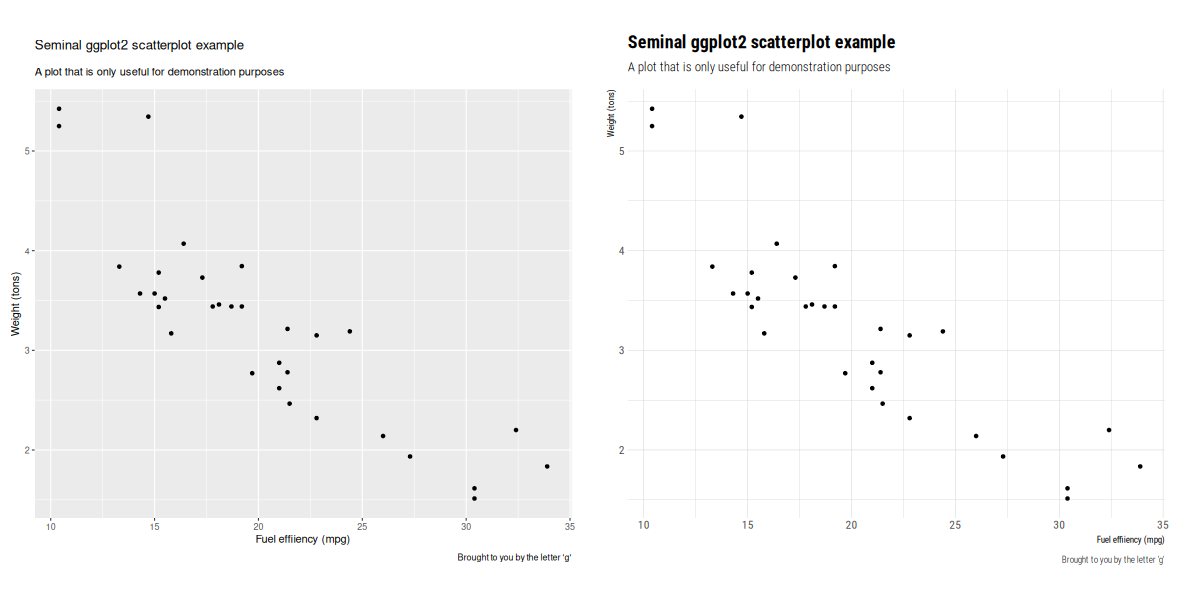
Delighted to announce a new package that arrived on CRAN today: tinythemes. It repackages the theme_ipsum_rc() function by Bob Rudis from his hrbrthemes package in a zero (added) dependency way. A simple example is (also available as a demo inside the packages in the next update) contrasts the default style (on left) with the one added by this package (on the right): The GitHub repo also shows this little example: total dependencies of hrbrthemes over what ggplot2 installs:
> db <- tools::CRAN_package_db()
> deps <- tools::package_dependencies(c("ggplot2", "hrbrthemes"), recursive=TRUE, db=db
> Filter(\(x) x != "ggplot2", setdiff(deps[[2]], deps[[1]]))
 [1] "extrafont"         "knitr"             "rmarkdown"         "htmltools"        
 [5] "tools"             "gdtools"           "extrafontdb"       "Rttf2pt1"         
 [9] "Rcpp"              "systemfonts"       "gfonts"            "curl"             
[13] "fontquiver"        "base64enc"         "digest"            "ellipsis"         
[17] "fastmap"           "evaluate"          "highr"             "xfun"             
[21] "yaml"              "bslib"             "fontawesome"       "jquerylib"        
[25] "jsonlite"          "stringr"           "tinytex"           "cachem"           
[29] "memoise"           "mime"              "sass"              "fontBitstreamVera"
[33] "fontLiberation"    "shiny"             "crul"              "crayon"           
[37] "stringi"           "cpp11"             "urltools"          "httpcode"         
[41] "fs"                "rappdirs"          "httpuv"            "xtable"           
[45] "sourcetools"       "later"             "promises"          "commonmark"       
[49] "triebeard"        
>
Comments and suggestions are welcome at the GitHub repo. If you like this or other open-source work I do, you can sponsor me at GitHub.

This post by Dirk Eddelbuettel originated on his Thinking inside the box blog. Please report excessive re-aggregation in third-party for-profit settings.

17 December 2023

Dirk Eddelbuettel: littler 0.3.19 on CRAN: Several Updates

max-heap image The twentieth release of littler as a CRAN package landed a few minutes ago, following in the now seventeen year history (!!) as a package started by Jeff in 2006, and joined by me a few weeks later. littler is the first command-line interface for R as it predates Rscript. It allows for piping as well for shebang scripting via #!, uses command-line arguments more consistently and still starts faster. It also always loaded the methods package which Rscript only began to do in recent years. littler lives on Linux and Unix, has its difficulties on macOS due to yet-another-braindeadedness there (who ever thought case-insensitive filesystems as a default were a good idea?) and simply does not exist on Windows (yet the build system could be extended see RInside for an existence proof, and volunteers are welcome!). See the FAQ vignette on how to add it to your PATH. A few examples are highlighted at the Github repo:, as well as in the examples vignette. This release contains a fair number of small changes and improvements to some of the example scripts is run daily. The full change description follows.

Changes in littler version 0.3.19 (2023-12-17)
  • Changes in examples scripts
    • The help or usage text display for r2u.r, ttt.r, check.r has been improved, expanded or corrected, respectively
    • installDeps.r has a new argument for dependency selection
    • An initial 'single test file' runner tttf.r has been added
    • r2u.r has two new options for setting / varying the Debian build version of package that is built, and one for BioConductor builds, one for a 'dry run' build, and a new --compile option
    • installRSPM.r, installPPM.r, installP3M.r have been updates to reflect the name changes
    • installRub.r now understands 'package@universe' too
    • tt.r flips the default of the --effects switch

My CRANberries service provides a comparison to the previous release. Full details for the littler release are provided as usual at the ChangeLog page, and also on the package docs website. The code is available via the GitHub repo, from tarballs and now of course also from its CRAN page and via install.packages("littler"). Binary packages are available directly in Debian as well as (in a day or two) Ubuntu binaries at CRAN thanks to the tireless Michael Rutter. Comments and suggestions are welcome at the GitHub repo. If you like this or other open-source work I do, you can sponsor me at GitHub.

This post by Dirk Eddelbuettel originated on his Thinking inside the box blog. Please report excessive re-aggregation in third-party for-profit settings.

14 December 2023

Dirk Eddelbuettel: RProtoBuf 0.4.21 on CRAN: Updated Upstream Support!

An exciting new release 0.4.21 of RProtoBuf arrived on CRAN earlier today. RProtoBuf provides R with bindings for the Google Protocol Buffers ( ProtoBuf ) data encoding and serialization library used and released by Google, and deployed very widely in numerous projects as a language and operating-system agnostic protocol. ProtoBuf development, following what seemed like a multi-year lull, all of a sudden picked up again with a vengeance a little while ago. And the library releases we rely on for convenience and provided by the Linux distributions are lagging. So last summer we received an excellent, and focussed, pull request #93 offering to update the package to the newer ProtoBuf 22.0 and beyond. (Aside: When a library ditches its numbering scheme you know changes are for real . My Ubuntu 23.10 box is still at 3.21 in a different counting scheme .) But it wasn t until last weekend the issue ticket #95 by Sebastian ran into the same issue, but recognized it and contained a container recipe! So now all of a sudden we were able to build under a newer ProtoBuf which made accepting the PR #93 much easier! We added this as an additional continuous unit test, and made a few other smaller updates to documentation and style. The following section from the NEWS.Rd file has full details.

Changes in RProtoBuf version 0.4.21 (2022-12-13)
  • Package now builds with ProtoBuf >= 22.x thanks to Matteo Gianella (#93 addressing #92).
  • An Alpine 3.19-based workflow was added to test this in continuous integration thanks to a suggestion by Sebastian Meyer.
  • A large number of old-style .Call were updated (#96).
  • Several packaging, dcoumentation and testing items were updated.

Thanks to my CRANberries, there is a diff to the previous release. The RProtoBuf page has copies of the (older) package vignette, the quick overview vignette, and the pre-print of our JSS paper. Questions, comments etc should go to the GitHub issue tracker off the GitHub repo. If you like this or other open-source work I do, you can sponsor me at GitHub.

This post by Dirk Eddelbuettel originated on his Thinking inside the box blog. Please report excessive re-aggregation in third-party for-profit settings.

9 December 2023

Thorsten Alteholz: My Debian Activities in November 2023

FTP master This month I accepted 276 and rejected 25 packages. The overall number of packages that got accepted was 276. I also handled several RM bugs, so the archive did not grow that much :-). Debian LTS This was my hundred-thirteenth month that I did some work for the Debian LTS initiative, started by Raphael Hertzog at Freexian. During my allocated time I uploaded: The update of libde265 was a bit unusual this time. The security tracker had three CVEs listed for it and the maintainer was looking for a sponsor to fix them in Unstable. So far, so good! I sponsored the upload and suddenly a fourth CVE appeared in the security tracker. As the debian/changelog mentioned a different CVE, it was automatically added. Indeed upstreams changelog contained a patch for a CVE that was reserved but not yet published (hence the security tracker could not connect it to libde265). I informed upstream and as things turned out marking the CVE as public was just forgotten. Luckily there was some time left for the upcoming point release and all four patches finally arrived in Bookworm. Debian ELTS This month was the sixty-fourth ELTS month. During my allocated time I uploaded: In order to check whether the patch for the standalone version of minizip was ok, I used a test from the embedded minizip version in chromium and it worked. Debian Printing This month I uploaded a new upstream version of: Within the context of preserving old printing packages, I adopted: If you know of any other package that is also needed and still maintained by the QA team, please tell me. This work is generously funded by Freexian! Debian Astro This month I uploaded a new upstream version of: Debian IoT This month I uploaded a new upstream version of: Debian Mobcom This month I uploaded a package to fix one or the other issue: Other stuff This month I uploaded new upstream version of packages, did a source upload for the transition or uploaded it to fix one or the other issue:

Dirk Eddelbuettel: RcppInt64 0.0.4 on CRAN: Minor Bugfix

The new-ish package RcppInt64 (announced earlier this fall in this post, with two small updates following) arrived on CRAN minutes ago as relase 0.0.4. RcppInt64 collects some of the previous conversions between 64-bit integer values in R and C++, and regroups them in a single package. It offers two interfaces: both a more standard as<>() converter from R values along with its companions wrap() to return to R, as well as more dedicated functions from and to . This release addresses an issues Sebastian reported a few hours and which is reported by newer, pickier compilers: We need to include <cstdint> so that int64_t is declared. CRAN was at its usual best processing this efficiently including tests of the by now two reverse dependencies. Twenty two minutes total, all automated: The brief NEWS entry follows:

Changes in version 0.0.4 (2023-12-09)
  • The cstdint header is now included (closes #1).

Courtesy of my CRANberries, there is a diffstat report relative to previous release. If you like this or other open-source work I do, you can sponsor me at GitHub.

This post by Dirk Eddelbuettel originated on his Thinking inside the box blog. Please report excessive re-aggregation in third-party for-profit settings.

8 December 2023

Jonathan Dowland: The scourge of Electron, the nostalgia of Pidgin

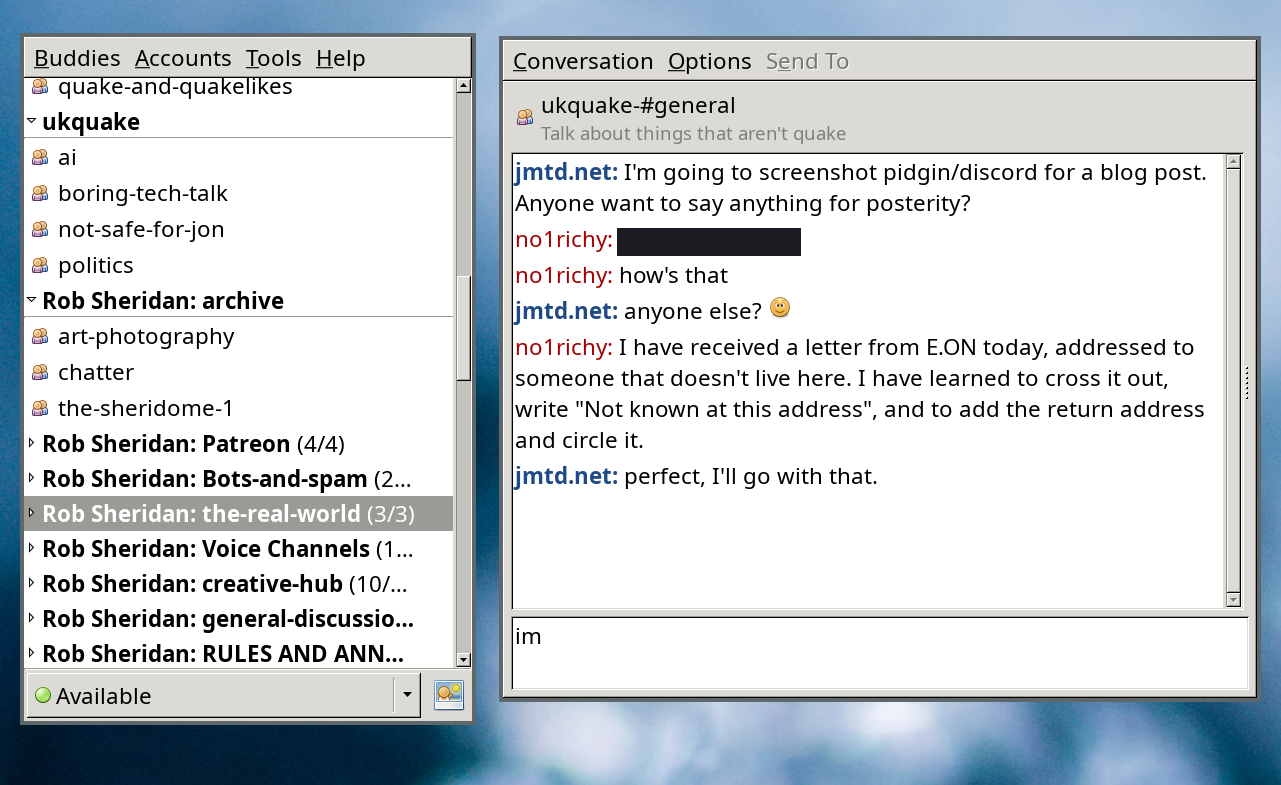
For reasons I won't go into right now, I've spent some of this year working on a refurbished Lenovo Thinkpad Yoga 260. Despite it being relatively underpowered, I love almost everything about it. Unfortunately the model I bought has 8G RAM which turned out to be more limiting than I thought it would be. You can do incredible things with 8G of RAM: incredible, wondrous things. And most of my work, whether that's wrangling containers, hacking on OpenJDK, or complex Haskell projects, are manageable. Where it falls down is driving the modern scourge: Electron, and by proxy, lots of modern IM tools: Slack (urgh), Discord (where one of my main IRC social communities moved to), WhatsApp Web1 and even Signal Desktop. For that reason, I've (temporarily) looked at alternatives, and I was pleasantly surprised to find serviceable plugins for Pidgin, the stalwart Instant Messenger multiplexer. I originally used Pidgin (then called Gaim) back in the last century, at the time to talk to ICQ, MSN Messenger and AIM (all but ICQ2 long dead). It truly is an elegant weapon from a more civilized age.
Discord from within Pidgin Discord from within Pidgin
The plugins are3: Pidgin with all of these plugins loaded runs perfectly well and consumes fractions of the RAM that each of those Electron apps did prior. A side-effect of moving these into Pidgin (in particular Discord) is a refocussing of the content. Fewer distractions around the text. The lack of auto-link embedding, and other such things, make it a cleaner, purer experience. This made me think of the Discord community I am in (I'm really only active in one). It used to be an IRC channel of people that I met through a mutual friend. Said friend recently departed Discord, due to the signal to noise ratio being too poor, and the incessant nudge to click on links, engage, engage, engage. I wonder if the experience mediated by Pidgin would be more tolerable to them?
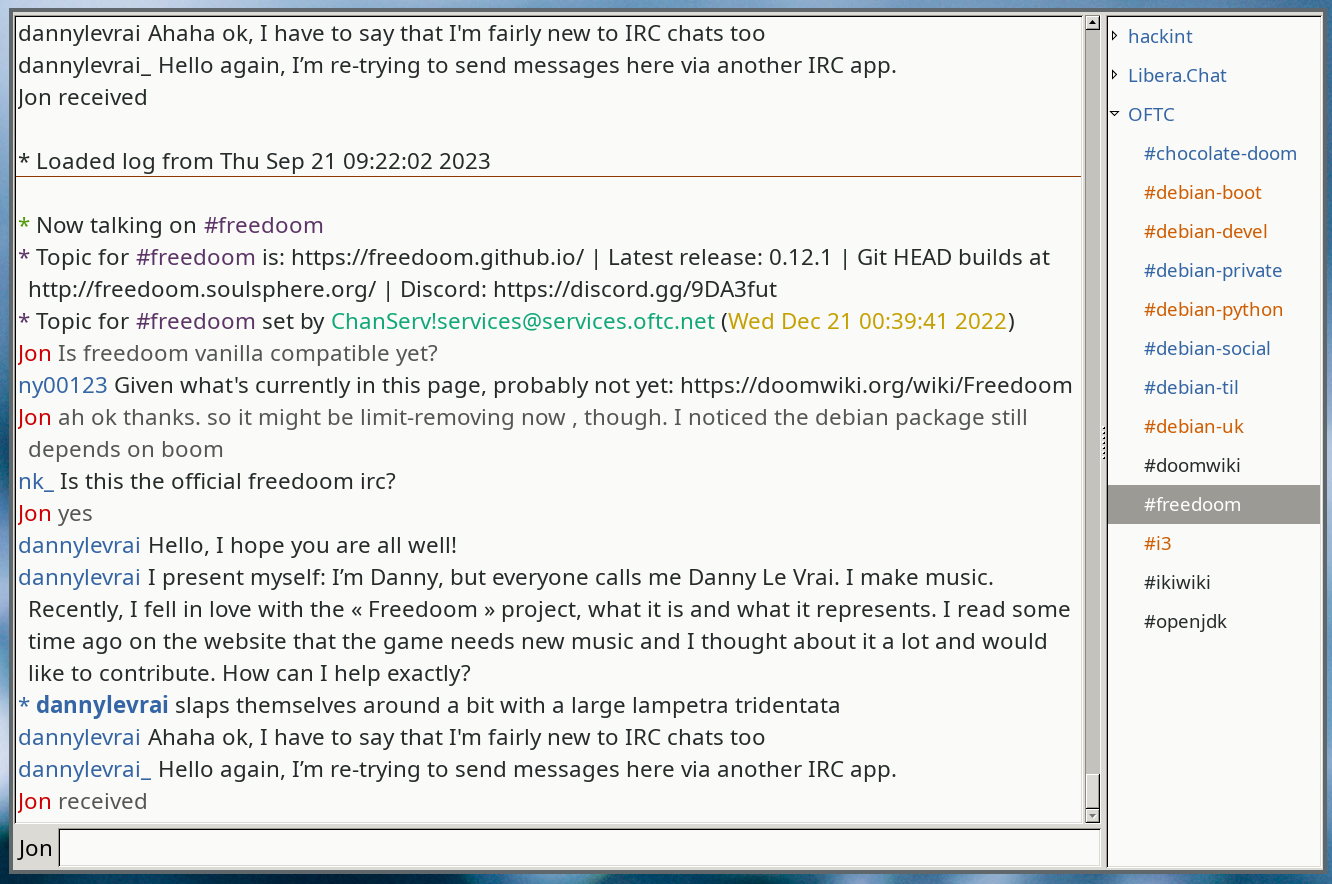
What my hexchat looks like What my hexchat looks like
I'm still active in one IRC channel (and inactive in many more). I could consider moving IRC into Pidgin as well. At the moment, my IRC client of choice is hexchat, which (like Pidgin) is still using GTK2 for the UI. There's something perversely pleasant about that.

  1. if you go to the trouble of trying to run it as an application distinct from your web browser.
  2. I'm still somewhat surprised ICQ is still going. I might try and recover my old ID.
  3. There may or may not be similar plugins for Slack, but as I (am forced to) use that for corporate stuff, I'm steering clear of them.

6 December 2023

Reproducible Builds: Reproducible Builds in November 2023

Welcome to the November 2023 report from the Reproducible Builds project! In these reports we outline the most important things that we have been up to over the past month. As a rather rapid recap, whilst anyone may inspect the source code of free software for malicious flaws, almost all software is distributed to end users as pre-compiled binaries (more).

Reproducible Builds Summit 2023 Between October 31st and November 2nd, we held our seventh Reproducible Builds Summit in Hamburg, Germany! Amazingly, the agenda and all notes from all sessions are all online many thanks to everyone who wrote notes from the sessions. As a followup on one idea, started at the summit, Alexander Couzens and Holger Levsen started work on a cache (or tailored front-end) for the snapshot.debian.org service. The general idea is that, when rebuilding Debian, you do not actually need the whole ~140TB of data from snapshot.debian.org; rather, only a very small subset of the packages are ever used for for building. It turns out, for amd64, arm64, armhf, i386, ppc64el, riscv64 and s390 for Debian trixie, unstable and experimental, this is only around 500GB ie. less than 1%. Although the new service not yet ready for usage, it has already provided a promising outlook in this regard. More information is available on https://rebuilder-snapshot.debian.net and we hope that this service becomes usable in the coming weeks. The adjacent picture shows a sticky note authored by Jan-Benedict Glaw at the summit in Hamburg, confirming Holger Levsen s theory that rebuilding all Debian packages needs a very small subset of packages, the text states that 69,200 packages (in Debian sid) list 24,850 packages in their .buildinfo files, in 8,0200 variations. This little piece of paper was the beginning of rebuilder-snapshot and is a direct outcome of the summit! The Reproducible Builds team would like to thank our event sponsors who include Mullvad VPN, openSUSE, Debian, Software Freedom Conservancy, Allotropia and Aspiration Tech.

Beyond Trusting FOSS presentation at SeaGL On November 4th, Vagrant Cascadian presented Beyond Trusting FOSS at SeaGL in Seattle, WA in the United States. Founded in 2013, SeaGL is a free, grassroots technical summit dedicated to spreading awareness and knowledge about free source software, hardware and culture. The summary of Vagrant s talk mentions that it will:
[ ] introduce the concepts of Reproducible Builds, including best practices for developing and releasing software, the tools available to help diagnose issues, and touch on progress towards solving decades-old deeply pervasive fundamental security issues Learn how to verify and demonstrate trust, rather than simply hoping everything is OK!
Germane to the contents of the talk, the slides for Vagrant s talk can be built reproducibly, resulting in a PDF with a SHA1 of cfde2f8a0b7e6ec9b85377eeac0661d728b70f34 when built on Debian bookworm and c21fab273232c550ce822c4b0d9988e6c49aa2c3 on Debian sid at the time of writing.

Human Factors in Software Supply Chain Security Marcel Fourn , Dominik Wermke, Sascha Fahl and Yasemin Acar have published an article in a Special Issue of the IEEE s Security & Privacy magazine. Entitled A Viewpoint on Human Factors in Software Supply Chain Security: A Research Agenda, the paper justifies the need for reproducible builds to reach developers and end-users specifically, and furthermore points out some under-researched topics that we have seen mentioned in interviews. An author pre-print of the article is available in PDF form.

Community updates On our mailing list this month:

openSUSE updates Bernhard M. Wiedemann has created a wiki page outlining an proposal to create a general-purpose Linux distribution which consists of 100% bit-reproducible packages albeit minus the embedded signature within RPM files. It would be based on openSUSE Tumbleweed or, if available, its Slowroll-variant. In addition, Bernhard posted another monthly update for his work elsewhere in openSUSE.

Ubuntu Launchpad now supports .buildinfo files Back in 2017, Steve Langasek filed a bug against Ubuntu s Launchpad code hosting platform to report that .changes files (artifacts of building Ubuntu and Debian packages) reference .buildinfo files that aren t actually exposed by Launchpad itself. This was causing issues when attempting to process .changes files with tools such as Lintian. However, it was noticed last month that, in early August of this year, Simon Quigley had resolved this issue, and .buildinfo files are now available from the Launchpad system.

PHP reproducibility updates There have been two updates from the PHP programming language this month. Firstly, the widely-deployed PHPUnit framework for the PHP programming language have recently released version 10.5.0, which introduces the inclusion of a composer.lock file, ensuring total reproducibility of the shipped binary file. Further details and the discussion that went into their particular implementation can be found on the associated GitHub pull request. In addition, the presentation Leveraging Nix in the PHP ecosystem has been given in late October at the PHP International Conference in Munich by Pol Dellaiera. While the video replay is not yet available, the (reproducible) presentation slides and speaker notes are available.

diffoscope changes diffoscope is our in-depth and content-aware diff utility that can locate and diagnose reproducibility issues. This month, Chris Lamb made a number of changes, including:
  • Improving DOS/MBR extraction by adding support for 7z. [ ]
  • Adding a missing RequiredToolNotFound import. [ ]
  • As a UI/UX improvement, try and avoid printing an extended traceback if diffoscope runs out of memory. [ ]
  • Mark diffoscope as stable on PyPI.org. [ ]
  • Uploading version 252 to Debian unstable. [ ]

Website updates A huge number of notes were added to our website that were taken at our recent Reproducible Builds Summit held between October 31st and November 2nd in Hamburg, Germany. In particular, a big thanks to Arnout Engelen, Bernhard M. Wiedemann, Daan De Meyer, Evangelos Ribeiro Tzaras, Holger Levsen and Orhun Parmaks z. In addition to this, a number of other changes were made, including:

Upstream patches The Reproducible Builds project detects, dissects and attempts to fix as many currently-unreproducible packages as possible. We endeavour to send all of our patches upstream where appropriate. This month, we wrote a large number of such patches, including:

Reproducibility testing framework The Reproducible Builds project operates a comprehensive testing framework (available at tests.reproducible-builds.org) in order to check packages and other artifacts for reproducibility. In October, a number of changes were made by Holger Levsen:
  • Debian-related changes:
    • Track packages marked as Priority: important in a new package set. [ ][ ]
    • Stop scheduling packages that fail to build from source in bookworm [ ] and bullseye. [ ].
    • Add old releases dashboard link in web navigation. [ ]
    • Permit re-run of the pool_buildinfos script to be re-run for a specific year. [ ]
    • Grant jbglaw access to the osuosl4 node [ ][ ] along with lynxis [ ].
    • Increase RAM on the amd64 Ionos builders from 48 GiB to 64 GiB; thanks IONOS! [ ]
    • Move buster to archived suites. [ ][ ]
    • Reduce the number of arm64 architecture workers from 24 to 16 in order to improve stability [ ], reduce the workers for amd64 from 32 to 28 and, for i386, reduce from 12 down to 8 [ ].
    • Show the entire build history of each Debian package. [ ]
    • Stop scheduling already tested package/version combinations in Debian bookworm. [ ]
  • Snapshot service for rebuilders
    • Add an HTTP-based API endpoint. [ ][ ]
    • Add a Gunicorn instance to serve the HTTP API. [ ]
    • Add an NGINX config [ ][ ][ ][ ]
  • System-health:
    • Detect failures due to HTTP 503 Service Unavailable errors. [ ]
    • Detect failures to update package sets. [ ]
    • Detect unmet dependencies. (This usually occurs with builds of Debian live-build.) [ ]
  • Misc-related changes:
    • do install systemd-ommd on jenkins. [ ]
    • fix harmless typo in squid.conf for codethink04. [ ]
    • fixup: reproducible Debian: add gunicorn service to serve /api for rebuilder-snapshot.d.o. [ ]
    • Increase codethink04 s Squid cache_dir size setting to 16 GiB. [ ]
    • Don t install systemd-oomd as it unfortunately kills sshd [ ]
    • Use debootstrap from backports when commisioning nodes. [ ]
    • Add the live_build_debian_stretch_gnome, debsums-tests_buster and debsums-tests_buster jobs to the zombie list. [ ][ ]
    • Run jekyll build with the --watch argument when building the Reproducible Builds website. [ ]
    • Misc node maintenance. [ ][ ][ ]
Other changes were made as well, however, including Mattia Rizzolo fixing rc.local s Bash syntax so it can actually run [ ], commenting away some file cleanup code that is (potentially) deleting too much [ ] and fixing the html_brekages page for Debian package builds [ ]. Finally, diagnosed and submitted a patch to add a AddEncoding gzip .gz line to the tests.reproducible-builds.org Apache configuration so that Gzip files aren t re-compressed as Gzip which some clients can t deal with (as well as being a waste of time). [ ]

If you are interested in contributing to the Reproducible Builds project, please visit our Contribute page on our website. However, you can get in touch with us via:

5 December 2023

Dirk Eddelbuettel: RcppArmadillo 0.12.6.6.1 on CRAN: No More Deprecation

armadillo image Armadillo is a powerful and expressive C++ template library for linear algebra and scientific computing. It aims towards a good balance between speed and ease of use, has a syntax deliberately close to Matlab, and is useful for algorithm development directly in C++, or quick conversion of research code into production environments. RcppArmadillo integrates this library with the R environment and language and is widely used by (currently) 1126 other packages on CRAN, downloaded 31.7 million times (per the partial logs from the cloud mirrors of CRAN), and the CSDA paper (preprint / vignette) by Conrad and myself has been cited 569 times according to Google Scholar. This release ends the practice on asking Armadillo to suppress deprecation warnings. RcppArmadillo, as noted, has a large user base. Sometimes Conrad sometimes made changes without too much of a heads-up so at times it was opportune to not bring those warnings to dozens (or maybe hundreds) of packages at CRAN. Yet we need to balance this with the demonstrable need to call out older deprecated code use. So sixteen months ago, with GitHub issue #391, we started to alert author of 30+ affected packages and supplied either pull requests or emailed patches to all. Eleven months ago GitHub issues #402 was added for a second deprecation. And the time of making the switch has come. Release 0.12.6.6.1 no longer defines ARMA_IGNORE_DEPRECATED_MARKER. So among the over 1100 packages using RcppArmadillo at CRAN, around a good dozen or so were flagged in the upload but CRAN concurred and let the package migrate to CRAN. If you maintain an affected package, consider applying the patch or pull request now. A simple stop-gap measure also exists by adding -DARMA_IGNORE_DEPRECATED_MARKER to src/Makevars as either PKG_CPPFLAGS or PKG_CXXFLAGS to reactivate it. But a proper code update, which is generally simple, may be better. If you are unsure, do not hesitate to get in touch. The set of changes since the last CRAN release follows.

Changes in RcppArmadillo version 0.12.6.6.1 (2023-12-03)
  • Following the extendeded transition in #391 and #402, this release no longer sets ARMA_IGNORE_DEPRECATED_MARKER. Maintainers of affected packages have received pull requests or patches and can set -DARMA_IGNORE_DEPRECATED_MARKER as PKG_CPPFLAGS.

Courtesy of my CRANberries, there is a diffstat report relative to previous release. More detailed information is on the RcppArmadillo page. Questions, comments etc should go to the rcpp-devel mailing list off the Rcpp R-Forge page. If you like this or other open-source work I do, you can sponsor me at GitHub.

This post by Dirk Eddelbuettel originated on his Thinking inside the box blog. Please report excessive re-aggregation in third-party for-profit settings.

3 December 2023

Dirk Eddelbuettel: dang 0.0.16: New Features, Some Maintenance

A new release of my mixed collection of things package dang package arrived at CRAN a little while ago. The dang package regroups a few functions of mine that had no other home as for example lsos() from a StackOverflow question from 2009 (!!), the overbought/oversold price band plotter from an older blog post, the market monitor blogged about as well as the checkCRANStatus() function tweeted about by Tim Taylor. And more so take a look. This release brings a number of updates, including a rather nice improvement to the market monitor making updates buttery smooth and not flickering (with big thanks to Paul Murrell who calmly pointed out once again that base R does of course have the functionality I was seeking) as well as three new functions (!!) and then a little maintenance on the -Wformat print format string issue that kept everybody busy this week. The NEWS entry follows.

Changes in version 0.0.16 (2023-12-02)
  • Added new function str.language() based on post by Bill Dunlap
  • Added new argument sleep in intradayMarketMonitor
  • Switched to dev.hold() and dev.flush() in intradayMarketMonitor with thanks to Paul Murrell
  • Updated continued integration setup, twice, and package badges
  • Added new function shadowedPackages
  • Added new function limitDataTableCores
  • Updated two error() calls to updated tidyCpp signature to not tickle -Wformat warnings under R-devel
  • Updated two URL to please link checks in R-devel
  • Switch two tests for variable of variable to is.* and inherits(), respectively

Courtesy of my CRANberries, there is a comparison to [the previous release][previous releases]. For questions or comments use the the issue tracker at the GitHub repo. If you like this or other open-source work I do, you can now sponsor me at GitHub.

This post by Dirk Eddelbuettel originated on his Thinking inside the box blog. Please report excessive re-aggregation in third-party for-profit settings.

Next.

Previous.