Search Results: "anbe"

3 September 2021

Dirk Eddelbuettel: RQuantLib 0.4.13: Routine Update

A new release 0.4.13 of RQuantLib arrived on CRAN yesterday, and has been uploaded to Debian as well. QuantLib is a very comprehensice free/open-source library for quantitative finance; RQuantLib connects it to the R environment and language. This updates RQuantLib to a few now-deprecated (daycount convention) interfaces in QuantLib release 1.23. As the last release was sixteen months ago, we also updated a few standard packaging aspects (such as use of r-ci), updated README.md and DESCRIPTION and fixed an old typo. No other changes, no new interfaces.

Changes in RQuantLib version 0.4.13 (2021-09-02)
  • Changes in RQuantLib code:
    • Small updates to DESCRIPTION and README.md
    • Switch CI use to r-ci
    • An eleven-year old typo was correct in a manual page (Dirk in #156 fixing #155 with thanks to @klin133)
    • Daycount convention calls deprecated in QuantLib 1.23 were updated (Dirk in #157)
    • Updated remaining http:// URLs in documentation to https://

Courtesy of my CRANberries, there is also a diffstat report for the this release. As always, more detailed information is on the RQuantLib page. Questions, comments etc should go to the new rquantlib-devel mailing list. Issue tickets can be filed at the GitHub repo. If you like this or other open-source work I do, you can now sponsor me at GitHub.

This post by Dirk Eddelbuettel originated on his Thinking inside the box blog. Please report excessive re-aggregation in third-party for-profit settings.

Dirk Eddelbuettel: RcppSMC 0.2.4 on CRAN: Even More GSoC !!

A brand new release 0.2.4 of the RcppSMC package arrived on CRAN earlier today, with a dual delay for CRAN closing for a well-earned break, and then being overwhelmed when reopening. Other than that the processing was again versy smooth. RcppSMC provides Rcpp-based bindings to R for the Sequential Monte Carlo Template Classes (SMCTC) by Adam Johansen described in his JSS article. Sequential Monte Carlo is also referred to as Particle Filter in some contexts. The package started when I put some Rcpp bindings together based on Adam s paper and library. It grew when Adam and I supervised Leah South during the 2017 iteration of the Google Summer of Code. And now it grew again as we have Adam, Leah and myself looking over the shoulders of Ilya Zarubin who did very fine work during the 2021 iteration of the Google Summer of Code that just concluded! So we are now GSoC squared! This release is effectively all work by Ilya and summarized below.

Changes in RcppSMC version 0.2.4 (2021-09-01)
  • Multiple Sequential Monte Carlo extensions (Ilya Zarubin as part of Google Summer of Code 2021)
    • Provide informative user output (convergence diagnostics) for PMMH example #50 (Ilya in #50 and #52 addressing #25, bullet point 5)
    • Support for tracking of ancestral lines for base sampler class (Ilya in #56)
    • Support for conditional SMC via derived conditionalSampler class (Ilya in #60)
  • Add URL and BugReports to DESCRIPTION (Dirk in #53)

Courtesy of my CRANberries, there is a diffstat report for this release. More information is on the RcppSMC page. Issues and bugreports should go to the GitHub issue tracker. If you like this or other open-source work I do, you can now sponsor me at GitHub.

This post by Dirk Eddelbuettel originated on his Thinking inside the box blog. Please report excessive re-aggregation in third-party for-profit settings.

21 August 2021

Dirk Eddelbuettel: RcppFastFloat 0.0.3: Maintenance

The third release of RcppFastFloat arrived on CRAN. The package wraps fastfloat, another nice library by Daniel Lemire. For details, see the recent arXiv paper showing that one can convert character representations of numbers into floating point at rates at or exceeding one gigabyte per second. This release deals with a header include on everybody s favourite CRAN platform bringing the result status to a clean suite of all OKs.

Changes in version 0.0.3 (2021-08-21)
  • Account for SunOS with an additional #define
  • Minor update to DESCRIPTION

Courtesy of my CRANberries, there is also a diffstat report for this release. If you like this or other open-source work I do, you can now sponsor me at GitHub.

This post by Dirk Eddelbuettel originated on his Thinking inside the box blog. Please report excessive re-aggregation in third-party for-profit settings.

19 August 2021

Russ Allbery: Review: The Past is Red

Review: The Past is Red, by Catherynne M. Valente
Publisher: Tordotcom
Copyright: 2021
ISBN: 1-250-30112-2
Format: Kindle
Pages: 151
Tetley is nineteen and is the most hated person in Garbagetown. That's kind of horrible, but life is otherwise great. As she puts it:
I'm awfully lucky when you think about it. Garbagetown is the most wonderful place anybody has ever lived in the history of the world, even if you count the Pyramids and New York City and Camelot. I have Grape Crush and Big Bargains and my hibiscus flower, and I can fish like I've got bait for a heart so I hardly ever go hungry, and once I found a ruby ring and a New Mexico license plate inside a bluefin tuna. Everyone says they only hate me because I annihilated hope and butchered our future, but I know better, and anyway, it's a lie. Some people are just born to be despised. The Loathing of Tetley began small and grew bigger and bigger, like the Thames, until it swallowed me whole.
Garbagetown is a giant floating pile of garbage in the middle of the ocean, and it is, so far as anyone knows, the only "land" left in the world. Global warming has flooded everything until the remaining Fuckwits (as their future descendants call everyone who was alive at the time) took to the Misery Boats and searched hopelessly for land. Eventually they realized they could live on top of the now-massive Pacific Garbage Patch and began the Great Sorting, which is fifty years into Tetley's past. All of the types of garbage were moved into their own areas, allowing small micronations of scavengers to form and giving each area its own character.
Candle Hole is the most beautiful place in Garbagetown, which is the most beautiful place in the world. All of the stubs of candles the Fuckwits threw out piled up into hills and mountains and caverns and dells, votive candles and taper candles and tea lights and birthday candles and big fat colorful pillar candles, stacked and somewhat melted into a great crumbling gorgeous warren of wicks and wax. All the houses are cozy little honeycombs melted into hillside, with smooth round windows and low golden ceilings. At night, from far away, Candle Hole looks like a firefly palace. When the wind blows, it smells like cinnamon, and freesia, and cranberries, and lavender, and Fresh Linen Scent, and New Car Smell.
Two things should be obvious from this introduction. First, do not read this book looking for an accurate, technical projection of our environmental future. Or, for that matter, physical realism of any kind. That's not the book that Valente is writing and you'll just frustrate yourself. This is science fiction as concretized metaphor rather than prediction or scientific exploration. We Fuckwits have drowned the world with our greed and left our descendants living in piles of our garbage; you have to suspend disbelief and go with the premise. The second thing is that either you will like Tetley's storytelling style or you will not like this book. I find Valente very hit-and-miss, but this time it worked for me. The language is a bit less over-the-top than Space Opera, and it fits Tetley's insistent, aggressive optimism so well that it carries much of the weight of characterization. Mileage will definitely vary; this is probably a love-it-or-hate-it book. The Past is Red is divided into two parts. The first part is the short story "The Future is Blue," previously published in Clarkesworld and in Valente's short story collection of the same name. It tells the story of Tetley's early life, how she got her name, and how she became the most hated person in Garbagetown. The second part is much longer and features an older, quieter, more thoughtful, and somewhat more cynical Tetley, more life philosophy, and a bit of more-traditional puzzle science fiction. It lacks some of the bubbly energy of "The Future is Blue" but also features less violence and abuse. The overall work is a long novella or very short novel. This book has a lot of feelings about the environment, capitalism, greed, and the desire to let other people solve your problems for you, and it is not subtle about any of them. It's satisfying in the way that a good rant is satisfying, not in the way that a coherent political strategy is satisfying. What saves it from being too didactic or self-righteous is Tetley, who is happy to record her own emotions and her moments of wonder and is mostly uninterested in telling other people what to do. The setting sounds darkly depressing, and there are moments where it feels that way in the book, but the core of the story and of Tetley's life philosophy is a type of personal resilience: find the things that make you happy, put one foot in front of the other, and enjoy the world for what it is rather than what it could be or what other people want to convince you it might be. It's also surprisingly funny, particularly if you see the humor in bizarrely-specific piles of the detritus of civilization. The one place where I will argue with Valente a bit is that The Past is Red thoroughly embraces an environmental philosophy of personal responsibility. The devastating critique aimed at the Fuckwits is universal and undistinguished except slightly by class. Tetley and the other inhabitants of Garbagetown make no distinction between types of Fuckits or attempt to apportion blame in any way more granular than entire generations and eras. This is probably realistic. I understand why, by Tetley's time, no one is interested in the fine points of history. But the story was written today, for readers in our time, and this type of responsibility collapse is intentionally and carefully constructed by the largest polluters and the people with the most power. Collective and undifferentiated responsibility means that we're using up our energy fretting about whether we took two showers, which partly deflects attention from the companies, industries, and individuals that are directly responsible for the vast majority of environmental damage. We don't live in a world full of fuckwits; we live in a world run by fuckwits and full of the demoralized, harried, conned, manipulated, overwhelmed, and apathetic, which is a small but important difference. This book is not the right venue to explore that difference, but I wish the vitriol had not been applied quite so indiscriminately. The rest, though, worked for me. Valente tends to describe things by piling clauses on top of adjectives, which objectively isn't the best writing but it fits everything about Tetley's personality so well that I think this is the book where it works. I found her strange mix of optimism, practicality, and unbreakable inner ethics oddly endearing. "The Future is Blue" is available for free on-line, so if in doubt, read some or all of it, and that should tell you whether you're interested in the expansion. I'm glad I picked it up. Content warning for physical and sexual abuse of the first-person protagonist, mostly in the first section. Rating: 7 out of 10

15 August 2021

Dirk Eddelbuettel: RcppBDT 0.2.4 on CRAN: Updates

After a seven-year break (!!), the RcppBDT packages has been updated on CRAN. The RcppBDT package is an early adopter of Rcpp and was one of the first packages utilizing Boost and its Date_Time library. The now more widely-used package anytime is a direct descentant of RcppBDT. In fact, the last time RcppBDT was released, anytime did not yet exist. And some of the changes now finally released here in this version are some of the first steps made towards what became anytime. RcppBDT is broader in scope and provides a wider range of functionality but in a somewhat rougher form as we never sat down writing higher-end wrappers in R for all the potential use cases. When we wrote the first RcppBDT versions, many other popular date/time packages were all in R code and not compiled, and this package showed how things could be done at the compiled level. Now other packages, including anytime have filled the void so fully polishing RcppBDT may never happen. In any event, this release refreshes the package and brings it to full R CMD check --as-cran compliance. The NEWS entry follows:

Changes in version 0.2.4 (2021-08-15)
  • New utility function toPOSIXct which can take multitple input format (integer, floating point or character) vectors and can convert by relying on a wide variety of standard formats. This predates what has long been split off into a new package anytime which is more functional and feaureful.
  • New demo 'toPOSIXct' illustrating the feature.
  • New demo 'toPOSIXctTiming' benchmarking it.
  • Documentation for new functions was added as well.
  • CI now uses run.sh from r-ci.
  • Functions getLastDayOfWeekInMonth and getFirstDayOfWeekInMonth now use dow argument.
  • The shared library is now registered when loaded from NAMESPACE.
  • C level entry points are now registered as R now recommends.
  • Several badges were added to the README.md file.
  • Several fields were added to the DESCRIPTION file, and/or updated.
  • Documentation URLs where both updated as needed and converted to https.

Courtesy of my CRANberries, there is also a diffstat report for this release. If you like this or other open-source work I do, you can now sponsor me at GitHub.

This post by Dirk Eddelbuettel originated on his Thinking inside the box blog. Please report excessive re-aggregation in third-party for-profit settings.

14 August 2021

Dirk Eddelbuettel: RApiDatetime 0.0.5 (and 0.0.6): Updated (Twice)

After nearly two years, the RApiDatetime package on CRAN has received an update, followed-up a quick bug fix. RApiDatetime provides a number of entry points for C-level functions of the R API for Date and Datetime calculations. The functions asPOSIXlt and asPOSIXct convert between long and compact datetime representation, formatPOSIXlt and Rstrptime convert to and from character strings, and POSIXlt2D and D2POSIXlt convert between Date and POSIXlt datetime. Lastly, asDatePOSIXct converts to a date type. All these functions are rather useful, but were not previously exported by R for C-level use by other packages. Which this package aims to change. This pair of releases updates the code to the current R-devel standard, and refreshes a few standard packaging aspects starting from making builds on the Windows UCRT platform possible. And while making an accomodation for one beloved architecture (in release 0.0.5), we introduced another issue on another almost equally beloved platform which 0.0.6 clears up. It should be ready and stable now.

Changes in RApiDatetime version 0.0.6 (2021-08-13)
  • Correctly account for SunOS to have it avoid GMTOFF use
  • A new test file was added to ensure NEWS.Rd is always at the current release version.

Changes in RApiDatetime version 0.0.5 (2021-08-05)
  • Add a few #nocov tags
  • Update continuous integration to use r-ci, reenable coverage
  • Update DESCRIPTION with URL and BugReports fields
  • Add new CI and LastCommitted badges to README.md
  • Add compiler flag for Windows UCRT build
  • Synchronized datetime function with upstream r-devel code

Courtesy of my CRANberries, there is are comparisons to the previous release 0.0.5, and 0.0.4, respectively. More information is on the rapidatetime page. For questions or comments please use the issue tracker off the GitHub repo.

This post by Dirk Eddelbuettel originated on his Thinking inside the box blog. Please report excessive re-aggregation in third-party for-profit settings.

12 August 2021

Dirk Eddelbuettel: x13binary 1.1.57-2 on CRAN: Packaging Updates

Release 1.1.57-2 of the x13binary package providing the X-13ARIMA-SEATS program by the US Census Bureau is now on CRAN. This release comes a mere week after the previous release 1.1.57-1 and cleans up two packaging aspects. It corrects a (non-bash) shell script snippet for SunOS, and turns off the prohibition of staged install (which was needed a while back for macOS). No other changes were made; please see last week s release post for more about x13binary and the 1.1.57 release. Courtesy of my CRANberries, there is also a diffstat report for this release showing changes to the previous release. If you like this or other open-source work I do, you can sponsor me at GitHub.

This post by Dirk Eddelbuettel originated on his Thinking inside the box blog. Please report excessive re-aggregation in third-party for-profit settings.

9 August 2021

Dirk Eddelbuettel: nanotime 0.3.3 on CRAN: Some Updates

Leonardo and I are pleased to share that a new nanotime version 0.3.3 was released today, and arrived on CRAN. This release brings a new (plotting) demo, an updated documentation site, additional nanoduration and nanoperiod functionality, and enhanced testing. nanotime relies on the RcppCCTZ package for (efficient) high(er) resolution time parsing and formatting up to nanosecond resolution, and the bit64 package for the actual integer64 arithmetic. Initially implemented using the S3 system, it has benefitted greatly from work by co-author Leonardo who not only rejigged nanotime internals in S4 but also added new S4 types for periods, intervals and durations. The NEWS snippet adds full details.

Changes in version 0.3.3 (2021-08-09)
  • New demo ggplot2Example.R (Leonardo and Dirk).
  • New documentation website using mkdocs-material (Dirk).
  • Updated unit test to account for r-devel POSIXct changes, and re-enable full testing under r-devel (Dirk).
  • Additional nanoduration and character ops plus tests (Colin Umansky in #88 addressing #87).
  • New plus and minus functions for periods (Leonardo in #91).

Thanks to CRANberries there is also a diff to the previous version. More details and examples are at the nanotime page; code, issue tickets etc at the GitHub repository. If you like this or other open-source work I do, you can now sponsor me at GitHub.

This post by Dirk Eddelbuettel originated on his Thinking inside the box blog. Please report excessive re-aggregation in third-party for-profit settings.

4 August 2021

Dirk Eddelbuettel: x13binary 1.1.57-1 on CRAN: New Upstream, New M1 Binary

Christoph and I are please to share that a new release 1.1.57-1 of x13binary, of the X-13ARIMA-SEATS program by the US Census Bureau (with updated upstream release 1.1.57) is now on CRAN. The x13binary package takes the pain out of installing X-13ARIMA-SEATS by making it a fully resolved CRAN dependency. For example, when installing the excellent seasonal package by Christoph, then X-13ARIMA-SEATS will get pulled in via the x13binary package and things just work. Just depend on x13binary and on all major OSs supported by R you should have an X-13ARIMA-SEATS binary installed which will be called seamlessly by the higher-level packages such as seasonal or gunsales. With this the full power of the what is likely the world s most sophisticated deseasonalization and forecasting package is now at your fingertips and the R prompt, just like any other of the 17960+ CRAN packages. You can read more about this (and the seasonal package) in the Journal of Statistical Software paper by Christoph and myself. This release brings a new upstream release as well as binaries. We continue to support two Linux flavours (theh standard x86_64 as well as armv7l), windows and for a first time two macOS flavour. In addition to the existing Intel binary we now have a native built using the arm64 M1 chip (with thanks to Kirill for the assist). We still lack a genuine binary for Solaris so if any of the esteemed readers of this post happens to have access to R on Solaris along with a basic Fortran compiler, we would love to hear from you. Building X-13ARIMA-SEATS from source on Solaris should be straightforward as it is on the other OSs. Or is someone with a bit of time wants to help following Gabor s tutorial we would greatly appreciate it. Courtesy of my CRANberries, there is also a diffstat report for this release showing changes to the previous release. If you like this or other open-source work I do, you can sponsor me at GitHub.

This post by Dirk Eddelbuettel originated on his Thinking inside the box blog. Please report excessive re-aggregation in third-party for-profit settings.

Petter Reinholdtsen: Mechanic's words in five languages, English, Norwegian and Northern S mi editions

Almost thirty years ago, some forward looking teachers at Samisk videreg ende skole og reindriftsskole teaching metal work and Northern S mi, decided to create a list of words used in Northern S mi metal work. After almost ten years this resulted in a dictionary database, published as the book "Mekanihkk rs nit : Mekanikerord = Mekaanisen alan sanasto = Mechanic's words" in 1999. The story of this work is available from the pen of Svein Lund, one of the leading actors behind this effort. They even got the dictionary approved by the S mi Language Council as the recommended metal work words to use. Fast forward twenty years, I came across this work when I recently became interested in metal work, and started watching educational and funny videos on the topic, like the ones from mrpete222 and This Old Tony. But they all talk English, but I wanted to know what the tools and techniques they used were called in Norwegian. Trying to track down a good dictionary from English to Norwegian, after much searching, I came across the database of words created almost thirty years ago, with translations into English, Norwegian, Northern S mi, Swedish and Finnish. This gave me a lot of the Norwegian phrases I had been looking for. To make it easier for the next person trying to track down a good Norwegian dictionary for the metal worker, and because I knew the person behind the database from my Skolelinux / Debian Edu days, I decided to ask if the database could be released to the public without any usage limitations, in other words as a Creative Commons licensed data set. And happily, after consulting with the S mi Parliament of Norway, the database is now available with the Creative Commons Attribution 4.0 International license from my gitlab repository. The dictionary entries look slightly different, depending on the language in focus. This is the same entry in the different editions. English
lathe
dreiebenk (nb) v rve, v rvenbea ka, jorahanbea ka, v tnanbea ka (se) svarv (sv) sorvi (fi)
Norwegian
dreiebenk
lathe (en) v rve, v rvenbea ka, jorahanbea ka, v tnanbea ka (se) svarv (sv) sorvi (fi)
(nb): sponskj rande bearbeidingsmaskin der ein med skj reverkt y lausgj r spon fr eit roterande arbetsstykke
Northern S mi
v rve, v rvenbea ka, jorahanbea ka, v tnanbea ka
dreiebenk (nb) lathe (en) svarv (sv) sorvi (fi)
(se): ma iidna mainna uohpp vuolahasaid jorri bargo vdnasis
(nb): sponskj rande bearbeidingsmaskin der ein med skj reverkt y lausgj r spon fr eit roterande arbetsstykke
The database included term description in both Norwegian and Northern S mi, but not English. Because of this, the Northern S mi edition include both descriptions, the Norwegian edition include the Norwegian description and the English edition lack a descripiton. Once the database was available without any usage restrictions, and armed with my experience in publishing books, I decided to publish a Norwegian/English dictionary as a book using the database, to make the data set available also on paper and as an ebook. Further into the project, it occurred to me that I could just as easily make an English dictionary, and talking to Svein and concluding that it was within reach, I decided to make a Northern S mi dictionary too. Thus I suddenly find myself publishing a Northern S mi dictionary, even though I do not understand the language myself. I hope it will be well received, and can help revive the impressive work done almost thirty years ago to document the vocabulary of metal workers. If I get some help, I might even extend it with some of the words I find missing, like collet, rotary broach, carbide, knurler, arbor press and others. But the first edition build from a lightly edited version of the original database, with no new entries added. If you would like to check it out, visit my list of published books and consider buying a paper or ebook copy from lulu.com. The paper edition is only available in hardcover to increase its durability in the workshop. I am very happy to report that in the process, and thanks to help from both Svein Lund and B rre Gaup who understand the language, the docbook tools I use to create books, dblatex and docbook-xsl, now include support for Northern S mi. Before I started, these lacked the needed locale settings for this language, but now the patches are included upstream. As usual, if you use Bitcoin and want to show your support of my activities, please send Bitcoin donations to my address 15oWEoG9dUPovwmUL9KWAnYRtNJEkP1u1b.

31 July 2021

Dirk Eddelbuettel: RcppAnnoy 0.0.19 on CRAN: Maintenance

annoy image A minor maintenance release, now at version 0.0.19, of RcppAnnoy is now on CRAN. RcppAnnoy is the Rcpp-based R integration of the nifty Annoy library by Erik Bernhardsson. Annoy is a small and lightweight C++ template header library for very fast approximate nearest neighbours originally developed to drive the famous Spotify music discovery algorithm. This release only contains internal packaging changes. Nothing changes upstream, or in package functionality. Detailed changes follow.

Changes in version 0.0.19 (2021-07-30)
  • Minor tweaks to default CI setup and DESCRIPTION file

Courtesy of my CRANberries, there is also a diffstat report for this release. If you like this or other open-source work I do, you can sponsor me at GitHub.

This post by Dirk Eddelbuettel originated on his Thinking inside the box blog. Please report excessive re-aggregation in third-party for-profit settings.

24 July 2021

Dirk Eddelbuettel: littler 0.3.13: Moar Goodies

max-heap image The fourteenth release of littler as a CRAN package just landed, following in the now fifteen year history (!!) as a package started by Jeff in 2006, and joined by me a few weeks later. littler is the first command-line interface for R as it predates Rscript. It allows for piping as well for shebang scripting via #!, uses command-line arguments more consistently and still starts faster. It also always loaded the methods package which Rscript only started to do in recent years. littler lives on Linux and Unix, has its difficulties on macOS due to yet-another-braindeadedness there (who ever thought case-insensitive filesystems as a default were a good idea?) and simply does not exist on Windows (yet the build system could be extended see RInside for an existence proof, and volunteers are welcome!). See the FAQ vignette on how to add it to your PATH. A few examples are highlighted at the Github repo, as well as in the examples vignette. This release brings two new example scripts and command wrappers (compiledDeps.r, silenceTwitterAccount.r), along with extensions, corrections, or polish for a number a of other examples as detailed in the NEWS file entry below.

Changes in littler version 0.3.13 (2021-07-24)
  • Changes in examples
    • New script compiledDeps.r to show which dependencies are compiled
    • New script silenceTwitterAccount.r wrapping rtweet
    • The -c or --code option for installRSPM.r was corrected
    • The kitten.r script now passes options bunny and puppy on to the pkgKitten::kitten() call; new options to call the Arma and Eigen variants were added
    • The getRStudioDesktop.r and getRStudioServer.r scripts were updated for a change in rvest
    • Two typos in the tt.r help message were correct (Aaron Wolen in #86)
    • The message in cranIncoming.r was corrected.
  • Changes in package
    • Added Continuous Integration runner via run.sh from r-ci.
    • Two vignettes got two extra vignette attributes.
    • The mkdocs-material documentation input was moved.
    • The basic unit tests were slightly refactored and updated.

My CRANberries provides a comparison to the previous release. Full details for the littler release are provided as usual at the ChangeLog page, and now also on the new package docs website. The code is available via the GitHub repo, from tarballs and now of course also from its CRAN page and via install.packages("littler"). Binary packages are available directly in Debian as well as soon via Ubuntu binaries at CRAN thanks to the tireless Michael Rutter. Comments and suggestions are welcome at the GitHub repo. If you like this or other open-source work I do, you can now sponsor me at GitHub.

This post by Dirk Eddelbuettel originated on his Thinking inside the box blog. Please report excessive re-aggregation in third-party for-profit settings.

22 July 2021

Dirk Eddelbuettel: RcppSpdlog 0.0.6 on CRAN: New upstream

A new version 0.0.6 of RcppSpdlog is now on CRAN. It contains releases 1.9.0 of spdlog which in turn contains an updated version of fmt. RcppSpdlog bundles spdlog, a wonderful header-only C++ logging library with all the bells and whistles you would want that was written by Gabi Melman, and also includes fmt by Victor Zverovich. No R package-side changes were needed or made. The (minimal) NEWS entry for this release follows.

Changes in RcppSpdlog version 0.0.6 (2021-07-21)
  • Upgraded to upstream release spdlog 1.9.0

Courtesy of my CRANberries, there is also a diffstat report. More detailed information is on the RcppSpdlog page. If you like this or other open-source work I do, you can sponsor me at GitHub.

This post by Dirk Eddelbuettel originated on his Thinking inside the box blog. Please report excessive re-aggregation in third-party for-profit settings.

20 July 2021

Dirk Eddelbuettel: pkgKitten 0.2.2 on CRAN: Small Updates

kitten A new release 0.2.2 of pkgKitten is now on CRAN, and will be uploaded to Debian. pkgKitten makes it simple to create new R packages via a simple function invocation. A wrapper kitten.r exists in the littler package to make it even easier. This release simply corrects on minor aspect in the optional roxygen2 use, and updates the DESCRIPTION file.

Changes in version 0.2.2 (2021-07-19)
  • Small update to DESCRIPTION
  • Document hello2() argument

More details about the package are at the pkgKitten webpage, the pkgKitten docs site, and the pkgKitten GitHub repo. Courtesy of my CRANberries site, there is also a diffstat report for this release. If you like this or other open-source work I do, you can now sponsor me at GitHub.

This post by Dirk Eddelbuettel originated on his Thinking inside the box blog. Please report excessive re-aggregation in third-party for-profit settings.

17 July 2021

Dirk Eddelbuettel: ttdo 0.0.7: Micro-tweak

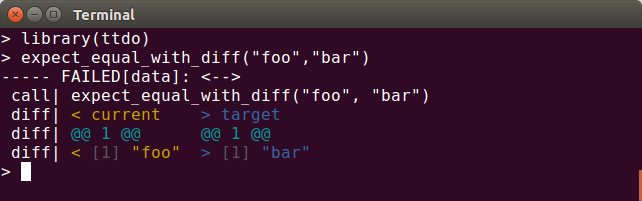
A new (and genuinely) minor release of our ttdo package arrived on CRAN today. The ttdo package extends the most excellent (and very minimal / zero depends) unit testing package tinytest by Mark van der Loo with the very clever and well-done diffobj package by Brodie Gaslam to give us test results with visual diffs (as shown in the screenshot below) which seemingly is so compelling an idea that it eventually got copied by another package ttdo screenshot This release cleans up one microscopic wart of an R warning when installing and byte-compiling the package due to a sprintf call with an unused argument. And once again, this release gets a #ThankYouCRAN mark as it was processed in a fully automated and intervention-free manner in a matter of minutes. As usual, the NEWS entry follows.

Changes in ttdo version 0.0.8 (2021-07-17)
  • Expand sprintf template to suppress R warning

CRANberries provides the usual summary of changes to the previous version. Please use the GitHub repo and its issues for any questions. If you like this or other open-source work I do, you can now sponsor me at GitHub.

This post by Dirk Eddelbuettel originated on his Thinking inside the box blog. Please report excessive re-aggregation in third-party for-profit settings.

16 July 2021

Dirk Eddelbuettel: RcppArmadillo 0.10.6.0.0 on CRAN: A New Upstream

armadillo image Armadillo is a powerful and expressive C++ template library for linear algebra aiming towards a good balance between speed and ease of use with a syntax deliberately close to a Matlab. RcppArmadillo integrates this library with the R environment and language and is widely used by (currently) 882 other packages on CRAN. This new release gets us Armadillo 10.6.0 which was released yesterday. We did the usual reverse dependency checks (which came out spotless and clean), and had also just done even fuller checks for Rcpp 1.0.7. Since the previous RcppArmadillo 0.10.5.0.0 release we made a few interim releases to the drat repo. In general, Conrad is a little more active than we want to be with (montly or less frequent) CRAN updates so keep and eye on the drat repo (or follow the GitHub repo) for a higher-frequence cadence. To use the drat repo, use install.packages("RcppArmadillo", repos="https://RcppCore.github.io/drat") or update.packages() with a similar repos argument. The full set of changes follows. We include the last interim release as well.

Changes in RcppArmadillo version 0.10.6.0.0 (2021-07-16)
  • Upgraded to Armadillo release 10.6.0 (Keep Calm)
    • expanded chol() to optionally use pivoted decomposition
    • expanded vector, matrix and cube constructors to allow element initialisation via fill::value(scalar), eg. mat X(4,5,fill::value(123))
    • faster loading of CSV files when using OpenMP
    • added csv_opts::semicolon option to allow saving/loading of CSV files with semicolon (;) instead of comma (,) as the separator

Changes in RcppArmadillo version 0.10.5.3.0 (2021-07-01)
  • Upgraded to Armadillo release 10.5.3 (Antipodean Fortress)
  • GitHub-only release
  • Extended test coverage with several new tests, added a coverage badge.

Courtesy of my CRANberries, there is a diffstat report relative to previous release. More detailed information is on the RcppArmadillo page. Questions, comments etc should go to the rcpp-devel mailing list off the R-Forge page. If you like this or other open-source work I do, you can sponsor me at GitHub.

This post by Dirk Eddelbuettel originated on his Thinking inside the box blog. Please report excessive re-aggregation in third-party for-profit settings.

10 July 2021

Dirk Eddelbuettel: drat 0.2.1: Small Tweak

drat user A new minor release of drat arrived on CRAN overnight. This is a minor update relative to the 0.2.0 release in April. This release will now create an empty file index.html in the top-level (when initRepo() is called), and check for presence of such a file when adding files to a repo (via insertPackage()). This helps to avoid getting 404 results when (perfectly valid) drat repos are checking by accessing the top-level URL, as for example CRAN does when testing if an Additional_repositoiries is reachable. The step-by-step vignette had already suggested creating one by hand, this is now done programmatically (and one is present in the repo suggsted to fork from too). drat stands for drat R Archive Template, and helps with easy-to-create and easy-to-use repositories for R packages. Since its inception in early 2015 it has found reasonably widespread adoption among R users because repositories with marked releases is the better way to distribute code. See below for a few custom reference examples. Because for once it really is as your mother told you: Friends don t let friends install random git commit snapshots. Properly rolled-up releases it is. Just how CRAN shows us: a model that has demonstrated for two-plus decades how to do this. And you can too: drat is easy to use, documented by six vignettes and just works. The NEWS file summarises the release as follows:

Changes in drat version 0.2.1 (2021-07-09)
  • Two internal functions now have a note in their documentation stating them as not exported (Dirk in response to #123)
  • Repositories created by initRepo now have an placeholder index.html to not trigger a curl check at CRAN (Dirk)
  • Adding to a repository now checks for a top-level index.html and displays a message if missing (Dirk)
  • The DratStepByStep.Rmd vignette mentions the added index.html file

Courtesy of my CRANberries, there is a comparison to the previous release. More detailed information is on the drat page. If you like this or other open-source work I do, you can now sponsor me at GitHub.

This post by Dirk Eddelbuettel originated on his Thinking inside the box blog. Please report excessive re-aggregation in third-party for-profit settings.

7 July 2021

Dirk Eddelbuettel: Rcpp 1.0.7: More Updates

rcpp logo The Rcpp team is pleased to announce release 1.0.7 of Rcpp which arrived at CRAN earlier today, and will be uploaded to Debian shortly. Windows and macOS builds should appear at CRAN in the next few days. This release continues with the six-months cycle started with release 1.0.5 last July. As a reminder, interim dev or rc releases will alwasys be available in the Rcpp drat repo; this cycle there were seven (!!). These rolling release tend to work just as well, and are also fully tested against all reverse-dependencies. Rcpp has become the most popular way of enhancing R with C or C++ code. As of today, 2323 packages on CRAN depend on Rcpp for making analytical code go faster and further, along with 227 in BioConductor. This release contains a change which Luke Tierney urged us to make a good year ago in #1081) (and which we had looked at earlier in #382). Implementing the change in a regular update proved a little tricky, and my initial branch lay dormant until I aki revived it, and finished the transition (which we then did in two PRs). The change concerns how Rcpp grows internal objects, and the new approach (thanks to the hint by Luke) closer to what R does guaranteeing linear behaviour. It turns out that we overlooked one aspect (of coping with Modules built under earlier Rcpp releases) so the initial upload to CRAN on Saturday revealed that we needed a small adjustment that we made for the final release. This version should now be more performant, and rest on a stable API. Based on the reverse depends checks by both us and CRAN (using the updated version), we expect no issues with existing code. However, it something does act up a fresh compilation of the packages using Rcpp may help. We also made a few other minor changes in the API such as silencing a silly compiler warning, ensuring global Rcout and Rcerr objects, adding support for a new Rcpp::message() call, completing a switch to uint32_t instead of unsigned int and including the cfloat header (which relates to STRICT_R_HEADERS discussed below). Similarly, the Rcpp Attributes feature was enhanced by coping better with packages with a dot in their name and their for per-package include files, along with support for more quiet compilation if desired. As some Rcpp users may have seen, we plan to enable STRICT_R_HEADERS by the next release (expected in January 2022). A long issue tick #1158 is laying the ground work. Maintainers of 81 packages which are affected and need a small change (such as for example switching from PI to M_PI); of these 56 have already responded. We plan to be in touch in the fall. Adding the cfloat header is one help in this transition (as the corresponding C header was pulled in when STRICT_R_HEADERS is not defined) as it ensures DBL_EPSILON and alike are defined. Last but not least this is also the first relase in which we welcome I aki as a new member of the Rcpp Core team. Yay! The NEWS file entries follow summarizing the nine key PRs in this release.

Changes in Rcpp release version 1.0.7 (2021-07-06)
  • Changes in Rcpp API:
    • Refactored Rcpp_PreserveObject and Rcpp_ReleaseObject which are now O(1) (Dirk and I aki in #1133 and #1135 fixing #382 and #1081).
    • A spuriously assigned variable was removed (Dirk in #1138 fixing #1137).
    • Global Rcout and Rcerr objects are supported via a compiler directive (I aki in #1139 fixing #928)
    • Add support for Rcpp::message (Dirk in #1146 fixing #1145).
    • The uint32_t type is used throughout instead of unsigned int (Dirk in #1153 fixing #1152).
    • The cfloat header for floating point limits is now included (Dirk in #1162 fixing #1161).
  • Changes in Rcpp Attributes:
    • Packages with dots in their name can now have per-package include files (Dirk in #1132 fixing #1129).
    • New argument echo to quieten optional evaluation in sourceCpp (Dirk in #1138 fixing #1126).
  • Forthcoming Changes in Rcpp API:
    • Starting with Rcpp 1.0.8 anticipated in January 2022, STRICT_R_HEADERS will be enabled by default, see #1126.

Thanks to my CRANberries, you can also look at a diff to the previous release. Questions, comments etc should go to the rcpp-devel mailing list off the R-Forge page. Bugs reports are welcome at the GitHub issue tracker as well (where one can also search among open or closed issues); questions are also welcome under rcpp tag at StackOverflow which also allows searching among the (currently) 2616 previous questions. If you like this or other open-source work I do, you can sponsor me at GitHub.

This post by Dirk Eddelbuettel originated on his Thinking inside the box blog. Please report excessive re-aggregation in third-party for-profit settings.

Dirk Eddelbuettel: ttdo 0.0.7: Small tinytest update

A new minor release of our ttdo package arrived on CRAN today. The ttdo package extends the most excellent (and very minimal / zero depends) unit testing package tinytest by Mark van der Loo with the very clever and well-done diffobj package by Brodie Gaslam to give us test results with visual diffs (as shown in the screenshot here) which seemingly is so compelling an idea that another package decided to copied it more recently: ttdo screenshot This release is mostly procedural to accomodate changes in tinytest 1.3.1 released today, and brought to us via a pull request by Mark himself. Other than that we also updated the CI runner to use r-ci and accomodated new CRAN check for a superfluous LazyData: field in a package without a data/ directory. This release also gets another #ThankYouCRAN mark as it was once again fully automated and intervention-free (once the new tinytest release hit CRAN). As usual, the NEWS entry follows.

Changes in ttdo version 0.0.7 (2021-07-06)
  • The CI setup was updated to use run.sh from r-ci (Dirk).
  • The package was updated for an API extension in tinytest 1.3.1 or later (Mark van der Look in #7)
  • The unused LazyData field was removed from DESCRIPTION (Dirk)

CRANberries provides the usual summary of changes to the previous version. Please use the GitHub repo and its issues for any questions. If you like this or other open-source work I do, you can now sponsor me at GitHub.

This post by Dirk Eddelbuettel originated on his Thinking inside the box blog. Please report excessive re-aggregation in third-party for-profit settings.

26 June 2021

Dirk Eddelbuettel: RcppRedis 0.1.11: Minor Update

A new minor release of RcppRedis arrived on CRAN, the first update since the last release in January of last year. RcppRedis is one of several packages connecting R to the fabulous Redis in-memory datastructure store (and much more). RcppRedis does not pretend to be feature complete, but it may do some things faster than the other interfaces, and also offers an optional coupling with MessagePack binary (de)serialization via RcppMsgPack. The package has carried production loads for several years now. This release updates CI to using r-ci, adds a quit() methods, and updates the windows library in builds thanks to a PR by Jeroen which also enables builds under the experimemtal UCRT windows flavor.

Changes in version 0.1.11 (2021-06-26)
  • The CI setup was updated to use run.sh from r-ci (Dirk).
  • A new function quit can be used to close a connection (Dirk).
  • The windows build was updated to libhiredis 1.0.0, and UCRT support was added (Jeroen in #42).

Courtesy of CRANberries, there is also a diffstat report for this release. More information is on the RcppRedis page. If you like this or other open-source work I do, you can now sponsor me at GitHub.

This post by Dirk Eddelbuettel originated on his Thinking inside the box blog. Please report excessive re-aggregation in third-party for-profit settings.

Next.

Previous.