Search Results: "agi"

3 January 2025

Bits from Debian: Bits from the DPL

Dear Debian community, this is bits from DPL for December. Happy New Year 2025! Wishing everyone health, productivity, and a successful Debian release later in this year. Strict ownership of packages I'm glad my last bits sparked discussions about barriers between packages and contributors, summarized temporarily in some post on the debian-devel list. As one participant aptly put it, we need a way to visibly say, "I'll do the job until someone else steps up". Based on my experience with the Bug of the Day initiative, simplifying the process for engaging with packages would significantly help. Currently we have
  1. NMU The Developers Reference outlines several preconditions for NMUs, explicitly stating, "Fixing cosmetic issues or changing the packaging style in NMUs is discouraged." This makes NMUs unsuitable for addressing package smells. However, I've seen NMUs used for tasks like switching to source format 3.0 or bumping the debhelper compat level. While it's technically possible to file a bug and then address it in an NMU, the process inherently limits the NMUer's flexibility to reduce package smells.
  2. Package Salvaging This is another approach for working on someone else's packages, aligning with the process we often follow in the Bug of the Day initiative. The criteria for selecting packages typically indicate that the maintainer either lacks time to address open bugs, has lost interest, or is generally MIA.
Both options have drawbacks, so I'd welcome continued discussion on criteria for lowering the barriers to moving packages to Salsa and modernizing their packaging. These steps could enhance Debian overall and are generally welcomed by active maintainers. The discussion also highlighted that packages on Salsa are often maintained collaboratively, fostering the team-oriented atmosphere already established in several Debian teams. Salsa Continuous Integration As part of the ongoing discussion about package maintenance, I'm considering the suggestion to switch from the current opt-in model for Salsa CI to an opt-out approach. While I fully agree that human verification is necessary when the pipeline is activated, I believe the current option to enable CI is less visible than it should be. I'd welcome a more straightforward approach to improve access to better testing for what we push to Salsa. Number of packages not on Salsa In my campaign, I stated that I aimed to reduce the number of packages maintained outside Salsa to below 2,000. As of March 28, 2024, the count was 2,368. As of this writing, the count stands at 1,928 [1], so I consider this promise fulfilled. My thanks go out to everyone who contributed to this effort. Moving forward, I'd like to set a more ambitious goal for the remainder of my term and hope we can reduce the number to below 1,800. [1] UDD query: SELECT DISTINCT count(*) FROM sources WHERE release = 'sid' and vcs_url not like '%salsa%' ; Past and future events Talk at MRI Together In early December, I gave a short online talk, primarily focusing on my work with the Debian Med team. I also used my position as DPL to advocate for attracting more users and developers from the scientific research community. FOSSASIA I originally planned to attend FOSDEM this year. However, given the strong Debian presence there and the need for better representation at the FOSSASIA Summit, I decided to prioritize the latter. This aligns with my goal of improving geographic diversity. I also look forward to opportunities for inter-distribution discussions. Debian team sprints Debian Ruby Sprint I approved the budget for the Debian Ruby Sprint, scheduled for January 2025 in Paris. If you're interested in contributing to the Ruby team, whether in person or online, consider reaching out to them. I'm sure any helping hand would be appreciated. Debian Med sprint There will also be a Debian Med sprint in Berlin in mid-February. As usual, you don't need to be an expert in biology or medicine basic bug squashing skills are enough to contribute and enjoy the friendly atmosphere the Debian Med team fosters at their sprints. For those working in biology and medicine, we typically offer packaging support. Anyone interested in spending a weekend focused on impactful scientific work with Debian is warmly invited. Again all the best for 2025
Andreas.

2 January 2025

Colin Watson: Free software activity in December 2024

Most of my Debian contributions this month were sponsored by Freexian, as well as one direct donation via Liberapay (thanks!). OpenSSH I issued a bookworm update with a number of fixes that had accumulated over the last year, especially fixing GSS-API key exchange which was quite broken in bookworm. base-passwd A few months ago, the adduser maintainer started a discussion with me (as the base-passwd maintainer) and the shadow maintainer about bringing all three source packages under one team, since they often need to cooperate on things like user and group names. I agreed, but hadn t got round to doing anything about it until recently. I ve now officially moved it under team maintenance. debconf Gioele Barabucci has been working on eliminating duplicated code between debconf and cdebconf, ultimately with the goal of migrating to cdebconf (which I m not sure I m convinced of as a goal, but if we can make improvements to both packages as part of working towards it then there s no harm in that). I finally got round to reviewing and merging confmodule changes in each of debconf and cdebconf. This caused an installer regression due to a weirdness in cdebconf-udeb s packaging, which I fixed - sorry about that! I ve also been dealing with a few patch submissions that had been in my queue for a long time, but more on that next month if all goes well. CI issues I noticed and fixed a problem with Restrictions: needs-sudo in autopkgtest. I fixed broken aptly images in the Salsa CI pipeline. Python team Last month, I mentioned some progress on sorting out the multipart vs. python-multipart name conflict in Debian (#1085728), and said that I thought we d be able to finish it soon. I was right! We got it all done this month: The Python 3.13 transition continues, and last month we were able to add it to the supported Python versions in testing. (The next step will be to make it the default.) I fixed lots of problems in aid of this, including: Sphinx 8.0 removed some old intersphinx_mapping syntax which turned out to still be in use by many packages in Debian. The fixes for this were individually trivial, but there were a lot of them: I found that twisted 24.11.0 broke tests in buildbot and wokkel, and fixed those. I packaged python-flatdict, needed for a new upstream version of python-semantic-release. I tracked down a test failure in vdirsyncer (which I ve been using for some years, but had never previously needed to modify) and contributed a fix upstream. I fixed some packages to tolerate future versions of dh-python that will drop their dependency on python3-setuptools: I fixed django-cte to remove a build-dependency on the obsolete python3-nose package. I added Django 5.1 support to django-polymorphic. (There are a number of other packages that still need work here.) I fixed various other build/test failures: I upgraded these packages to new upstream versions: I updated the team s library style guide to remove material related to Python 2 and early versions of Python 3, which is no longer relevant to any current Python packaging work. Other Python upstream work I happened to notice a Twisted upstream issue requesting the removal of the deprecated twisted.internet.defer.returnValue, realized it was still used in many places in Debian, and went on a PR-filing spree informed by codesearch to try to reduce the future impact of such a change on Debian: Other small fixes Santiago Vila has been building the archive with make --shuffle (also see its author s explanation). I fixed associated bugs in cccc (contributed upstream), groff, and spectemu. I backported an upstream patch to putty to fix undefined behaviour that affected use of the small keypad . I removed groff s Recommends: libpaper1 (#1091375, #1091376), since it isn t currently all that useful and was getting in the way of a transition to libpaper2. I filed an upstream bug suggesting better integration in this area.

1 January 2025

Guido G nther: Free Software Activities December 2024

Another short status update of what happened on my side last month. The larger blocks are the Phosh 0.44 release and landing the initial Cell Broadcast support in phosh. The rest is all just small bits of bug, fallout/regression fixing here and there. phosh phoc phosh-mobile-settings libphosh-rs phosh-osk-stub phosh-tour pfs xdg-desktop-portal-phosh phog Debian git-buildpackage wlr-randr python-dbusmock livi Chatty feedbackd libadwaita phosh-ev Reviews This is not code by me but reviews on other peoples code. The list is incomplete, but I hope to improve on this in the upcoming months. Thanks for the contributions! Help Development Thanks a lot to all the those who supported my work on this in 2024. Happy new year! If you want to support my work see donations. Comments? Join the Fediverse thread

31 December 2024

Russ Allbery: Review: Metal from Heaven

Review: Metal from Heaven, by August Clarke
Publisher: Erewhon
Copyright: November 2024
ISBN: 1-64566-099-0
Format: Kindle
Pages: 443
Metal from Heaven is industrial-era secondary-world fantasy with a literary bent. It is a complete story in one book, and I would be very surprised by a sequel. Clarke previously wrote the Scapegracers young-adult trilogy, which got excellent reviews and a few award nominations, as H.A. Clarke. This is his first adult novel.
Know I adore you. Look out over the glow. The cities sundered, their machines inverted, mountains split and prairies blazing, that long foreseen Hereafter crowning fast. This calamity is a promise made to you. A prayer to you, and to your shadow which has become my second self, tucked behind my eye and growing in tandem with me, pressing outwards through the pupil, the smarter, truer, almost bursting reason for our wrath. Do not doubt me. Just look. Watch us rise as the sun comes up over the beauty. The future stains the bleakness so pink. When my violence subsides, we will have nothing, and be champions.
Marney Honeycutt is twelve years old, a factory worker, and lustertouched. She works in the Yann I. Chauncey Ichorite Foundry in Ignavia City, alongside her family and her best friend, shaping the magical metal ichorite into the valuable industrial products of a new age of commerce and industry. She is the oldest of the lustertouched, the children born to factory workers and poisoned by the metal. It has made her allergic, prone to fits at any contact with ichorite, but also able to exert a strange control over the metal if she's willing to pay the price of spasms and hallucinations for hours afterwards. As Metal from Heaven opens, the workers have declared a strike. Her older sister is the spokesperson, demanding shorter hours, safer working conditions, and an investigation into the health of the lustertouched children. Chauncey's response is to send enforcer snipers to kill the workers, including the entirety of her family.
The girl sang, "Unalone toward dawn we go, toward the glory of the new morning." An enforcer shot her in the belly, and when she did not fall, her head.
Marney survives, fleeing into the city, swearing an impossible personal revenge against Yann Chauncey. An act of charity gets her a ticket on a train into the countryside. The woman who bought her ticket is a bandit who is on the train to rob it. Marney's ability to control ichorite allows her to help the bandits in return, winning her a place with the Highwayman's Choir who have been preying on the shipments of the rich and powerful and then disappearing into the hills. The Choir's secret is that the agoraphobic and paranoid Baron of the Fingerbluffs is dead and has been for years. He was killed by his staff, Hereafterist idealists, who have turned his remote territory into an anarchist commune and haven for pirates and bandits. This becomes Marney's home and the Choir becomes her family, but she never forgets her oath of revenge or the childhood friend she left behind in the piles of bodies and to whom this story is narrated. First, Clarke's writing is absolutely gorgeous.
We scaled the viny mountain jags at Montrose Barony's legal edge, the place where land was and wasn't Ignavia, Royston, and Drustland alike. There was a border but it was diffuse and hallucinatory, even more so than most. On legal papers and state maps there were harsh lines that squashed topography and sanded down the mountains into even hills in planter's rows, but here among the jutting rocks and craggy heather, the ground was lineless.
The rhythm of it, the grasp of contrast and metaphor, the word choice! That climactic word "lineless," with its echo of limitless. So good. Second, this is the rarest of books: a political fantasy that takes class and religion seriously and uses them for more than plot drivers. This is not at all our world, and the technology level is somewhat ambiguous, but the parallels to the Gilded Age and Progressive Era are unmistakable. The Hereafterists that Marney joins are political anarchists, not in the sense of alternative governance structures and political theory sanitized for middle-class liberals, but in the sense of Emma Goldman and Peter Kropotkin. The society they have built in the Fingerbluffs is temporary, threatened, and contingent, but it is sincere and wildly popular among the people who already lived there. Even beyond politics, class is a tangible force in this book. Marney is a factory worker and the child of factory workers. She barely knows how to read and doesn't magically learn over the course of the book. She has friends who are clever in the sense rewarded by politics and nobility, who navigate bureaucracies and political nuance, but that is not Marney's world. When, towards the end of the book, she has to deal with a gathering of high-class women, the contrast is stark, and she navigates that gathering only by being entirely unexpected. Perhaps the best illustration of the subtlety of this is the terminology in the book for lesbian. Marney is a crawly, which is a slur thrown at people like her (and one of the rare fictional slurs that work exactly as the author intended) but is also simply what she calls herself. Whether or not it functions as a slur depends on context, and the context is never hard to understand. The high-class lesbians she meets later are Lunarists, and react to crawly as a vile and insulting word. They use language to separate themselves from both the insult and from the social class that uses it. Language is an indication of culture and manners and therefore of morality, unlike deeds, which admit endless justifications.
Conversation was fleeting. Perdita managed with whomever stood near her, chipper about every prettiness she saw, the flitting butterflies, the dappled light between the leaves, the lushness and the fragrance of untamed land, and her walking companions took turns sharing in her delight. It was infectious, how happy she was. She was going to slaughter millions. She was going to skip like this all the while.
The handling of religion is perhaps even better. Marney was raised a Tullian, which sits alongside two other fleshed-out fictional religions and sketches of several more. Tullians tend to be conservative and patriarchal, and Marney has a realistically complicated relationship with faith: sticking with some Tullian worship practices and gestures because they're part of who she is, feeling a kinship to other Tullians, discarding beliefs that don't fit her, and revising others. Every major religion has a Hereafterist spin or reinterpretation that upends or reverses the parts of the religion that were used to prop up the existing social order and brings it more in line with Hereafterist ideals. We see the Tullian Hereafterist variation in detail, and as someone who has studied a lot of methods of reinterpreting Christianity, I was impressed by how well Clarke invents both a belief system and its revisionist rewrite. This is exactly how religions work in human history, but one almost never sees this subtlety in fantasy novels. Marney's allergy to ichorite causes her internal dialogue to dissolve into hallucinatory synesthesia when she's manipulating or exposed to it. Since that's most of the book, substantial portions read like drug trips with growing body horror. I normally hate this type of narration, so it's a sign of just how good Clarke's writing is that I tolerated it and even enjoyed parts. It helps that the descriptions are irreverent and often surprising, full of unexpected metaphors and sudden turns. It's very hard not to quote paragraph after paragraph of this book. Clarke is also doing a lot with gender that I don't feel qualified to comment in detail on, but it would not surprise me to see this book in the Otherwise Award recommendation list. I can think of three significant male characters, all of whom are well-done, but every other major character is female by at least some gender definition. Within that group, though, is huge gender diversity of the complicated and personal type that doesn't force people into defined boxes. Marney's sexuality is similarly unclassified and sometimes surprising. My one complaint is that I thought the sex scenes (which, to warn, are often graphic) fell into the literary fiction trap of being described so closely and physically that it didn't feel like anyone involved was actually enjoying themselves. (This is almost certainly a matter of personal taste.) I had absolutely no idea how Clarke was going to end this book, and the last couple of chapters caught me by surprise. I'm still not sure what I think about the climax. It's not the ending that I wanted, but one of the merits of this book is that it never did what I thought I wanted and yet made me enjoy the journey anyway. It is, at least, a genre ending, not a literary ending: The reader gets a full explanation of what is going on, and the setting is not static the way that it so often is in literary fiction. The characters can change the world, for good or for ill. The story felt frustrating and incomplete when I first finished it, but I haven't stopped thinking about this book and I think I like the shape of it a bit more now. It was certainly unexpected, at least by me. Clarke names Dhalgren as one of their influences in the acknowledgments, and yes, Metal from Heaven is that kind of book. This is the first 2024 novel I've read that felt like the kind of book that should be on award shortlists. I'm not sure it was entirely successful, and there are parts of it that I didn't like or that weren't for me, but it's trying to do something different and challenging and uncomfortable, and I think it mostly worked. And the writing is so good.
She looked like a mythic princess from the old woodcuts, who ruled nature by force of goodness and faith and had no legal power.
Metal from Heaven is not going to be everyone's taste. If you do not like literary fantasy, there is a real chance that you will hate this. I am very glad that I read it, and also am going to take a significant break from difficult books before I tackle another one. But then I'm probably going to try the Scapegracers series, because Clarke is an author I want to follow. Content notes: Explicit sex, including sadomasochistic sex. Political violence, mostly by authorities. Murdered children, some body horror, and a lot of serious injuries and death. Rating: 8 out of 10

30 December 2024

Russ Allbery: Review: House in Hiding

Review: House in Hiding, by Jenny Schwartz
Series: Uncertain Sanctuary #2
Publisher: Jenny Schwartz
Copyright: October 2020
Printing: September 2024
ASIN: B0DBX6GP8Z
Format: Kindle
Pages: 196
House in Hiding is the second book of a self-published space fantasy trilogy that started with The House That Walked Between Worlds. I read it as part of the Uncertain Sanctuary omnibus, which is reflected in the sidebar metadata. At the end of the previous book, Kira had gathered a motley crew for her house and discovered that she had drawn the attention of some rather significant galactic powers. Now, with the help of her new (hopefully) friends, she has to decide what role she's going to play in the galaxy. Or she can dither a lot, ruminate repeatedly on the same topics, and flail about randomly. That's also an option. This is slightly unfair. By the second half of the book, the series plot is beginning to cohere around two major problems: what is happening to the magic flows in the universe, and who killed Kira's parents. But apparently there was a limit on my enjoyment for the chaos in Kira's chaotic decisiveness I praised in my review of the last book, and I hit that limit around the middle of this book. I am interested in the questions of ethics, responsibility, and public image that this series is raising. I'm just not convinced that Schwartz is going to provide satisfying answers. One thing I do appreciate about this book is that it acknowledges that politics exist and that taking powerful people at face value is a bad idea. You would think that this would be a low bar, and yet it's depressing how many fantasy novels signal the trustworthiness of a character via some variation of "I looked into his eyes and shook his hand," or at least expect readers to be surprised by the inevitable betrayals. Schwartz does not make that mistake; after getting a call from a powerful player in galactic politics, the characters take apart everything that was said while assuming it could be attempted manipulation, which is the correct initial response. My problem comes after that. I like reading about competent characters with a plan, and these are absurdly powerful but very naive characters with no plan. This is realistic for the situation Kira has been thrust into, but it's not that entertaining to read about. I think the root of my problem is that there are some fundamental storytelling problems here that Schwartz is struggling to fix. The basic theory of story says that you need a protagonist, a setting, a conflict, and a plot. Schwartz has a good protagonist, one great supporting character and several adequate ones, and an enjoyably weird setting. I think she's working her way up to having a plot, although usually it's best for the plot to show up before the middle book of the series. What she doesn't have is a meaningful conflict. It's not entirely clear to either the reader or to Kira why Kira cares about what's happening. You would not think this would be a problem given that Kira's parents were murdered before the start of the first book. That's a classic conflict that's driven more books than I think anyone could count. It's not what Kira has cared about up to this point, however; she got away from Earth and has shown no sign of wanting to go back or identify the people who killed her parents, perhaps because she mostly blames herself. Instead, she's stumbling across other problems in the universe that other people would like her to care about. She occasionally feels like she ought to care about them because they involve her new friends or because she wants to be a good person, but they have very little dramatic oomph. "I'm a sorcerer and vaguely want the universe to be a better place" turns out to not work that well as a source of dramatic tension. This lack of conflict is somewhat fascinating because it's so different than most fantasy novels. If Schwartz were more aware of how oddly disconnected her protagonist is from the story conflict, I think there could be a thoughtful, if odd, psychological novel in here about one's ethical responsibilities if one suddenly had vast power and no strong attachments to the world. Kira does gesture occasionally in that direction, but there's no real meat to her musings. Instead, her lack of motivation is solved through one of the hoariest tropes in fiction: children in danger. I really want to like this series, and I still love the House, but this book was not good. The romance that I was delighted to not be subjected to in the first book appears to be starting (sigh), the political maneuvering that happens here is only mildly interesting and not believably competent, and the book concludes in Kira making an egregiously and blatantly stupid mistake that should have resulted in one of her friends asking her what the hell she was doing. Some setup happens, and it seems likely that the final book will have a clear conflict and plot, but this middle book was a disappointing mess. These books are fast to read and lightly entertaining between other things, and the House still has me invested enough in this universe that I'll read the last book in the omnibus. Be warned, though, that the middle book is more a collection of anecdotes than a story, and there's only so much of Kira showing off her power I can take without a conflict and a plot. Followed by The House That Fought. Rating: 5 out of 10

29 December 2024

Russ Allbery: Review: The Last Hour Between Worlds

Review: The Last Hour Between Worlds, by Melissa Caruso
Series: The Echo Archives #1
Publisher: Orbit
Copyright: November 2024
ISBN: 0-316-30364-X
Format: Kindle
Pages: 388
The Last Hour Between Worlds is urban, somewhat political high fantasy with strong fae vibes. It is the first book of a series, but it stands alone quite well. Kembral Thorne is a Hound, a member of the guild that serves as guards, investigators, and protectors. Kembral's specialty is Echo retrieval: rescues of people and animals who have fallen through a weak spot in reality into one of the strange, dangerous, and malleable layers called Echoes. Kem once rescued a dog from six layers down, an almost unheard-of feat. Kem is also a new single mother, which means her past two months have been spent in a sleep-deprived haze revolving exclusively around her much-beloved infant. Dona Marjorie Swift's year-turning party is the first time she's been out without Emmi since she gave birth, and she's only there because her sister took the child and practically shoved her out the door. Now, she's desperately trying to remember how to be social and normal, which is not made easier by the unexpected presence of Rika at the party. Rika Nonesuch is not a Hound. She's a Cat, a member of the guild of thieves and occasional assassins. They are the nemesis of the Hounds, but in a stylized and formalized way in which certain courtesies are expected. (The politics of this don't really make sense; you just have to go with it.) Kem has complicated feelings about Rika's grace, banter, and intoxicating perfume, feelings that she thought might be reciprocated until Rika drugged her during an apparent date and left her buried under a pile of garbage. She was not expecting Rika to be at this party and is definitely not ready to have a conversation with her. This emotional turmoil is rudely interrupted by the death of nearly everyone at the party via an Echo poison, the appearance of a dark figure driving a black sword into someone, and the descent of the entire party into an Echo. This was one of those books that kept getting better the farther into the book I read. I was a bit leery at first because the publisher's blurb made it sound more like horror than I prefer, but this is more the disturbing strangeness of fae creatures than the sort of gruesomeness, disgust, or body horror that I find off-putting. Most importantly, the point of this book is not to torture the characters or scare the reader. It's instead structured a bit like a murder mystery, but one whose resolution requires working out obscure fantasy rules and hidden political agendas. One of the currencies in the world of Echos is blood, but another is emotion, revelation, and the stories that bring both, and Caruso focuses the story more on that aspect than on horrifying imagery.
Rika frowned. "Resolve it? How?" "I have no idea." I couldn't keep my frustration from leaking through. "Might be that we have to delve deep into our own hearts to confront the unhealed wounds we've carried with us in secret. Might be that we have to say their names backward, or just close our eyes and they'll go away. Echoes never make any damned sense." Rika made a face. "We'd better not have to confront our unhealed wounds, or I'm leaving you to die."
All of The Last Hour Between Worlds is told in the first person from Kem's perspective, but Rika is the best character in this book. Kem is a rather straightforward, dogged, stubborn protector; Rika is complicated, selfish, conflicted, and considerably more dynamic. The first obvious twist in her background I spotted so long before Kem found out that it was a bit frustrating, but there were multiple satisfying twists after that. As advertised in the blurb, there's a sapphic romance angle here, but it's the sort that comes from a complicated friendship and a lot of mutual respect rather than love at first sight. Some of their relationship conflict is driven by misunderstanding, but the misunderstanding happens before the novel begins, which means the reader doesn't have to sit through the bit where one yells at the characters for being stupid. It helps that the characters have something concrete to do, and that driving plot problem is multi-layered and satisfying. Each time the party falls through a layer of reality, it's mostly reset to the start of the book, but the word "mostly" is hiding a lot of subtlety. Given the clock at the start of each chapter and the blurb (if one read it), the reader can make a good guess that the plot problem will not be fully resolved until the characters fall quite deep into the Echoes, but the story never felt repetitive the way that some time loop stories can. As the characters gain more understanding, the problems change, the players change, and they have to make several excursions into the surrounding world. This is the sort of fantasy that feels a bit like science fiction. You're thrown into a world with a different culture and different rules that are foreign to the reader and natural to the characters. Part of the fun of reading is figuring out the rules, history, and backstory while watching the characters try to solve the puzzles they're faced with. The writing is good but not great. Characterization was good enough for a story primarily focused on action and puzzle-solving, but it was a bit lacking in subtlety. I think Caruso's strengths showed most in the world design, particularly the magic system and the rules followed by the Echo creatures. The excursions outside of the somewhat-protected house struck a balance between eeriness and comprehensibility that reminded me of T. Kingfisher or Sandman. The human politics were unfortunately less successful and rested on some tired centrist cliches. Thankfully, this was not the main point of the story. I should also warn that there is a lot of talk about babies. Kem's entire identity at the start of the novel, to the point of incessant monologue, is "new mother." This is not a perspective we get very often in fantasy, and Kem eventually finds a steadier balance between her bond with her daughter and the other parts of her life. I think some readers will feel very seen. But Caruso leans hard into maternal bonding. So hard. If you don't want to read about someone who is deliriously obsessed with their new child, you may want to skip this one. Right after I finished this book, I thought it was amazing. Now that I've had a few days to think about it, the lack of subtlety and the facile human politics brought it down a notch. I'm a science fiction reader at heart, so I loved the slow revelation of mechanics; the reader starts the story by knowing that Kem can "blink step" but not knowing what that means, and by the end of the story one not only knows but has opinions about its limitations, political implications, and interactions with other forms of magic. The Echo worlds are treated similarly, and this type of world-building is my jam. But the cost is that the human characters, particularly the supporting cast, don't get the same focus and therefore are a bit straightforward and obvious. The subplot with Dona Vandelle was particularly annoying. Ah well. Kem and Rika's relationship did work, and it's the center of the book. If you like fantasy mechanics but are a bit leery of fae stories because they feel too symbolic or arbitrary, give this a try. It's the most satisfyingly constructed fae story that I've read in a long time. It's not great literary fiction, but it's also not trying to be; it's a puzzle adventure, and a well-executed one. Recommended, and I will definitely be reading the sequel. Content notes: Lots of violent death and other physical damage, creepy dream worlds with implied but not explicit horror, and rather a lot of blood. Followed by The Last Soul Among Wolves, not yet published at the time I wrote this review. Rating: 8 out of 10

27 December 2024

Wouter Verhelst: Writing an extensible JSON-based DSL with Moose

At work, I've been maintaining a perl script that needs to run a number of steps as part of a release workflow. Initially, that script was very simple, but over time it has grown to do a number of things. And then some of those things did not need to be run all the time. And then we wanted to do this one exceptional thing for this one case. And so on; eventually the script became a big mess of configuration options and unreadable flow, and so I decided that I wanted it to be more configurable. I sat down and spent some time on this, and eventually came up with what I now realize is a domain-specific language (DSL) in JSON, implemented by creating objects in Moose, extensible by writing more object classes. Let me explain how it works. In order to explain, however, I need to explain some perl and Moose basics first. If you already know all that, you can safely skip ahead past the "Preliminaries" section that's next.

Preliminaries

Moose object creation, references. In Moose, creating a class is done something like this:
package Foo;
use v5.40;
use Moose;
has 'attribute' => (
    is  => 'ro',
    isa => 'Str',
    required => 1
);
sub say_something  
    my $self = shift;
    say "Hello there, our attribute is " . $self->attribute;
 
The above is a class that has a single attribute called attribute. To create an object, you use the Moose constructor on the class, and pass it the attributes you want:
use v5.40;
use Foo;
my $foo = Foo->new(attribute => "foo");
$foo->say_something;
(output: Hello there, our attribute is foo) This creates a new object with the attribute attribute set to bar. The attribute accessor is a method generated by Moose, which functions both as a getter and a setter (though in this particular case we made the attribute "ro", meaning read-only, so while it can be set at object creation time it cannot be changed by the setter anymore). So yay, an object. And it has methods, things that we set ourselves. Basic OO, all that. One of the peculiarities of perl is its concept of "lists". Not to be confused with the lists of python -- a concept that is called "arrays" in perl and is somewhat different -- in perl, lists are enumerations of values. They can be used as initializers for arrays or hashes, and they are used as arguments to subroutines. Lists cannot be nested; whenever a hash or array is passed in a list, the list is "flattened", that is, it becomes one big list. This means that the below script is functionally equivalent to the above script that uses our "Foo" object:
use v5.40;
use Foo;
my %args;
$args attribute  = "foo";
my $foo = Foo->new(%args);
$foo->say_something;
(output: Hello there, our attribute is foo) This creates a hash %args wherein we set the attributes that we want to pass to our constructor. We set one attribute in %args, the one called attribute, and then use %args and rely on list flattening to create the object with the same attribute set (list flattening turns a hash into a list of key-value pairs). Perl also has a concept of "references". These are scalar values that point to other values; the other value can be a hash, a list, or another scalar. There is syntax to create a non-scalar value at assignment time, called anonymous references, which is useful when one wants to remember non-scoped values. By default, references are not flattened, and this is what allows you to create multidimensional values in perl; however, it is possible to request list flattening by dereferencing the reference. The below example, again functionally equivalent to the previous two examples, demonstrates this:
use v5.40;
use Foo;
my $args =  ;
$args-> attribute  = "foo";
my $foo = Foo->new(%$args);
$foo->say_something;
(output: Hello there, our attribute is foo) This creates a scalar $args, which is a reference to an anonymous hash. Then, we set the key attribute of that anonymous hash to bar (note the use arrow operator here, which is used to indicate that we want to dereference a reference to a hash), and create the object using that reference, requesting hash dereferencing and flattening by using a double sigil, %$. As a side note, objects in perl are references too, hence the fact that we have to use the dereferencing arrow to access the attributes and methods of Moose objects. Moose attributes don't have to be strings or even simple scalars. They can also be references to hashes or arrays, or even other objects:
package Bar;
use v5.40;
use Moose;
extends 'Foo';
has 'hash_attribute' => (
    is => 'ro',
    isa => 'HashRef[Str]',
    predicate => 'has_hash_attribute',
);
has 'object_attribute' => (
    is => 'ro',
    isa => 'Foo',
    predicate => 'has_object_attribute',
);
sub say_something  
    my $self = shift;
    if($self->has_object_attribute)  
        $self->object_attribute->say_something;
     
    $self->SUPER::say_something unless $self->has_hash_attribute;
    say "We have a hash attribute!"
 
This creates a subclass of Foo called Bar that has a hash attribute called hash_attribute, and an object attribute called object_attribute. Both of them are references; one to a hash, the other to an object. The hash ref is further limited in that it requires that each value in the hash must be a string (this is optional but can occasionally be useful), and the object ref in that it must refer to an object of the class Foo, or any of its subclasses. The predicates used here are extra subroutines that Moose provides if you ask for them, and which allow you to see if an object's attribute has a value or not. The example script would use an object like this:
use v5.40;
use Bar;
my $foo = Foo->new(attribute => "foo");
my $bar = Bar->new(object_attribute => $foo, attribute => "bar");
$bar->say_something;
(output: Hello there, our attribute is foo) This example also shows object inheritance, and methods implemented in child classes. Okay, that's it for perl and Moose basics. On to...

Moose Coercion Moose has a concept of "value coercion". Value coercion allows you to tell Moose that if it sees one thing but expects another, it should convert is using a passed subroutine before assigning the value. That sounds a bit dense without example, so let me show you how it works. Reimaginging the Bar package, we could use coercion to eliminate one object creation step from the creation of a Bar object:
package "Bar";
use v5.40;
use Moose;
use Moose::Util::TypeConstraints;
extends "Foo";
coerce "Foo",
    from "HashRef",
    via   Foo->new(%$_)  ;
has 'hash_attribute' => (
    is => 'ro',
    isa => 'HashRef',
    predicate => 'has_hash_attribute',
);
has 'object_attribute' => (
    is => 'ro',
    isa => 'Foo',
    coerce => 1,
    predicate => 'has_object_attribute',
);
sub say_something  
    my $self = shift;
    if($self->has_object_attribute)  
        $self->object_attribute->say_something;
     
    $self->SUPER::say_something unless $self->has_hash_attribute;
    say "We have a hash attribute!"
 
Okay, let's unpack that a bit. First, we add the Moose::Util::TypeConstraints module to our package. This is required to declare coercions. Then, we declare a coercion to tell Moose how to convert a HashRef to a Foo object: by using the Foo constructor on a flattened list created from the hashref that it is given. Then, we update the definition of the object_attribute to say that it should use coercions. This is not the default, because going through the list of coercions to find the right one has a performance penalty, so if the coercion is not requested then we do not do it. This allows us to simplify declarations. With the updated Bar class, we can simplify our example script to this:
use v5.40;
use Bar;
my $bar = Bar->new(attribute => "bar", object_attribute =>   attribute => "foo"  );
$bar->say_something
(output: Hello there, our attribute is foo) Here, the coercion kicks in because the value object_attribute, which is supposed to be an object of class Foo, is instead a hash ref. Without the coercion, this would produce an error message saying that the type of the object_attribute attribute is not a Foo object. With the coercion, however, the value that we pass to object_attribute is passed to a Foo constructor using list flattening, and then the resulting Foo object is assigned to the object_attribute attribute. Coercion works for more complicated things, too; for instance, you can use coercion to coerce an array of hashes into an array of objects, by creating a subtype first:
package MyCoercions;
use v5.40;
use Moose;
use Moose::Util::TypeConstraints;
use Foo;
subtype "ArrayOfFoo", as "ArrayRef[Foo]";
subtype "ArrayOfHashes", as "ArrayRef[HashRef]";
coerce "ArrayOfFoo", from "ArrayOfHashes", via   [ map   Foo->create(%$_)   @ $_  ]  ;
Ick. That's a bit more complex. What happens here is that we use the map function to iterate over a list of values. The given list of values is @ $_ , which is perl for "dereference the default value as an array reference, and flatten the list of values in that array reference". So the ArrayRef of HashRefs is dereferenced and flattened, and each HashRef in the ArrayRef is passed to the map function. The map function then takes each hash ref in turn and passes it to the block of code that it is also given. In this case, that block is Foo->create(%$_) . In other words, we invoke the create factory method with the flattened hashref as an argument. This returns an object of the correct implementation (assuming our hash ref has a type attribute set), and with all attributes of their object set to the correct value. That value is then returned from the block (this could be made more explicit with a return call, but that is optional, perl defaults a return value to the rvalue of the last expression in a block). The map function then returns a list of all the created objects, which we capture in an anonymous array ref (the [] square brackets), i.e., an ArrayRef of Foo object, passing the Moose requirement of ArrayRef[Foo]. Usually, I tend to put my coercions in a special-purpose package. Although it is not strictly required by Moose, I find that it is useful to do this, because Moose does not allow a coercion to be defined if a coercion for the same type had already been done in a different package. And while it is theoretically possible to make sure you only ever declare a coercion once in your entire codebase, I find that doing so is easier to remember if you put all your coercions in a specific package. Okay, now you understand Moose object coercion! On to...

Dynamic module loading Perl allows loading modules at runtime. In the most simple case, you just use require inside a stringy eval:
my $module = "Foo";
eval "require $module";
This loads "Foo" at runtime. Obviously, the $module string could be a computed value, it does not have to be hardcoded. There are some obvious downsides to doing things this way, mostly in the fact that a computed value can basically be anything and so without proper checks this can quickly become an arbitrary code vulnerability. As such, there are a number of distributions on CPAN to help you with the low-level stuff of figuring out what the possible modules are, and how to load them. For the purposes of my script, I used Module::Pluggable. Its API is fairly simple and straightforward:
package Foo;
use v5.40;
use Moose;
use Module::Pluggable require => 1;
has 'attribute' => (
    is => 'ro',
    isa => 'Str',
);
has 'type' => (
    is => 'ro',
    isa => 'Str',
    required => 1,
);
sub handles_type  
    return 0;
 
sub create  
    my $class = shift;
    my %data = @_;
    foreach my $impl($class->plugins)  
        if($impl->can("handles_type") && $impl->handles_type($data type ))  
            return $impl->new(%data);
         
     
    die "could not find a plugin for type " . $data type ;
 
sub say_something  
    my $self = shift;
    say "Hello there, I am a " . $self->type;
 
The new concept here is the plugins class method, which is added by Module::Pluggable, and which searches perl's library paths for all modules that are in our namespace. The namespace is configurable, but by default it is the name of our module; so in the above example, if there were a package "Foo::Bar" which
  • has a subroutine handles_type
  • that returns a truthy value when passed the value of the type key in a hash that is passed to the create subroutine,
  • then the create subroutine creates a new object with the passed key/value pairs used as attribute initializers.
Let's implement a Foo::Bar package:
package Foo::Bar;
use v5.40;
use Moose;
extends 'Foo';
has 'type' => (
    is => 'ro',
    isa => 'Str',
    required => 1,
);
has 'serves_drinks' => (
    is => 'ro',
    isa => 'Bool',
    default => 0,
);
sub handles_type  
    my $class = shift;
    my $type = shift;
    return $type eq "bar";
 
sub say_something  
    my $self = shift;
    $self->SUPER::say_something;
    say "I serve drinks!" if $self->serves_drinks;
 
We can now indirectly use the Foo::Bar package in our script:
use v5.40;
use Foo;
my $obj = Foo->create(type => bar, serves_drinks => 1);
$obj->say_something;
output:
Hello there, I am a bar.
I serve drinks!
Okay, now you understand all the bits and pieces that are needed to understand how I created the DSL engine. On to...

Putting it all together We're actually quite close already. The create factory method in the last version of our Foo package allows us to decide at run time which module to instantiate an object of, and to load that module at run time. We can use coercion and list flattening to turn a reference to a hash into an object of the correct type. We haven't looked yet at how to turn a JSON data structure into a hash, but that bit is actually ridiculously trivial:
use JSON::MaybeXS;
my $data = decode_json($json_string);
Tada, now $data is a reference to a deserialized version of the JSON string: if the JSON string contained an object, $data is a hashref; if the JSON string contained an array, $data is an arrayref, etc. So, in other words, to create an extensible JSON-based DSL that is implemented by Moose objects, all we need to do is create a system that
  • takes hash refs to set arguments
  • has factory methods to create objects, which
    • uses Module::Pluggable to find the available object classes, and
    • uses the type attribute to figure out which object class to use to create the object
  • uses coercion to convert hash refs into objects using these factory methods
In practice, we could have a JSON file with the following structure:
 
    "description": "do stuff",
    "actions": [
         
            "type": "bar",
            "serves_drinks": true,
         ,
         
            "type": "bar",
            "serves_drinks": false,
         
    ]
 
... and then we could have a Moose object definition like this:
package MyDSL;
use v5.40;
use Moose;
use MyCoercions;
has "description" => (
    is => 'ro',
    isa => 'Str',
);
has 'actions' => (
    is => 'ro',
    isa => 'ArrayOfFoo'
    coerce => 1,
    required => 1,
);
sub say_something  
    say "Hello there, I am described as " . $self->description . " and I am performing my actions: ";
    foreach my $action(@ $self->actions )  
        $action->say_something;
     
 
Now, we can write a script that loads this JSON file and create a new object using the flattened arguments:
use v5.40;
use MyDSL;
use JSON::MaybeXS;
my $input_file_name = shift;
my $args = do  
    local $/ = undef;
    open my $input_fh, "<", $input_file_name or die "could not open file";
    <$input_fh>;
 ;
$args = decode_json($args);
my $dsl = MyDSL->new(%$args);
$dsl->say_something
Output:
Hello there, I am described as do stuff and I am performing my actions:
Hello there, I am a bar
I am serving drinks!
Hello there, I am a bar
In some more detail, this will:
  • Read the JSON file and deserialize it;
  • Pass the object keys in the JSON file as arguments to a constructor of the MyDSL class;
  • The MyDSL class then uses those arguments to set its attributes, using Moose coercion to convert the "actions" array of hashes into an array of Foo::Bar objects.
  • Perform the say_something method on the MyDSL object
Once this is written, extending the scheme to also support a "quux" type simply requires writing a Foo::Quux class, making sure it has a method handles_type that returns a truthy value when called with quux as the argument, and installing it into the perl library path. This is rather easy to do. It can even be extended deeper, too; if the quux type requires a list of arguments rather than just a single argument, it could itself also have an array attribute with relevant coercions. These coercions could then be used to convert the list of arguments into an array of objects of the correct type, using the same schema as above. The actual DSL is of course somewhat more complex, and also actually does something useful, in contrast to the DSL that we define here which just says things. Creating an object that actually performs some action when required is left as an exercise to the reader.

24 December 2024

Divine Attah-Ohiemi: Seamless Transitions: Mastering Apache Redirects for a Smooth Hugo Migration

This week, I dove into setting up redirects with Apache to make the transition to Hugo's multilingual system smoother. The challenge? Ensuring that all those old links still worked while I migrated to the new URL format. For instance, I needed to redirect: /es/distrib to /distrib/index.es.html
/es/social_contract to /social_contract.es.html
/es/intro/about to /intro/about.es.html
/da to /index.da.html

To tackle this, I turned to Apache's mod_rewrite. Here s the magic I came up with in my .htaccess file: RewriteCond % REQUEST_URI ^/([a-z] 2 (?:-[a-z] 2 )?)/(.*)$
RewriteCond % DOCUMENT_ROOT /$2/index.%1.html -f
RewriteCond % DOCUMENT_ROOT /$1/$2 !-d
RewriteRule ^/([a-z] 2 (?:-[a-z] 2 )?)/(.*)$ /$2/index.%1.html [last,redirect]

RewriteCond % REQUEST_URI ^/([a-z] 2 (?:-[a-z] 2 )?)/(.*)$
RewriteCond % DOCUMENT_ROOT /$2.%1.html -f
RewriteCond % DOCUMENT_ROOT /$1/$2 !-d
RewriteRule ^/([a-z] 2 (?:-[a-z] 2 )?)/(.*)$ /$2.%1.html [last,redirect]

What s happening here? The rules check if the URL starts with a language code (like /es or /da). Then, they verify whether the corresponding HTML file exists. If it does, and the path isn t a directory, voil ! The user gets redirected to the new format. It s a bit of a dance with conditions and rules, but it s satisfying to see everything working seamlessly. Now, as I continue migrating content, users clicking on old links won t end up in a digital dead end. It s all about keeping the flow smooth and maintaining that user experience. So, if you re also juggling multilingual pages and thinking about making the switch to Hugo, don t underestimate the power of mod_rewrite. It s your best friend in the world of redirects! Happy coding!

23 December 2024

Russ Allbery: Dropping the git protocol

Ever since I started converting my free software repositories to Git and hosting them on git.eyrie.org, I've made them available via the Git network protocol (the one that uses git:// URLs). This protocol doesn't support TLS or any other form of integrity checking on the wire and has been gently deprecated for some time. Recent changes to git daemon broke the way I was managing permissions for my personal repositories, which meant that the git://git.eyrie.org/ URLs have been broken for several months. Since no one has complained or apparently noticed, this seems like a good excuse to drop support entirely and run one fewer service. All of my personal repositories will continue to be accessible via Git over HTTPS, which is now the standard for anonymous Git checkouts. If the prior URL was git://git.eyrie.org/area/package.git, the new URL is https://git.eyrie.org/git/area/package.git. I've updated my web pages accordingly. This protocol provides integrity protection on the wire and a moderate amount of authentication of my server via a Let's Encrypt certificate.

Sahil Dhiman: Debian Mirrors Hierarchy

After finding AlmaLinux mirror sync capacity at Tier 0 (or Tier 1, however you look at it) is around 140 Gbps, I wanted to find source and hierarchy in Debian mirroring systems. There are two main types of mirrors in Debian - Debian package mirrors (for package installs and updates) and Debian CD mirrors (for ISO and others medias). Let s talk about package mirrors (and it s hierarchy) first.

Package mirror hierarchy Trace file was a good starting point for checking upstream for a package mirror in Debian. It resides at <URL>/debian/project/trace/_traces and shows flow of data. Sample trace file from jing.rocks s mirror. It showed, canonical source for packages is ftp-master.debian.org. Checking via https://db.debian.org/machines.cgi, showed it s fasolo.d.o hosted at Brown University, US. This serves as Master Archive Server , making it a Tier 0 mirror. It s entry mentions that it has 1 Gbps shared LAN connectivity (dated information?) but it only has to push to 3 other machines/sites. Side note - .d.o is .debian.org As shown on https://mirror-master.debian.org/status/mirror-hierarchy.html, the three sites are:
  • syncproxy2.eu.debian.org ie smit.d.o hosted by University of Twente, Netherlands with 2x10 Gbps connectivity.
  • syncproxy4.eu.debian.org ie schmelzer.d.o hosted by Conova in Austria with 2x10 Gbps connectivity.
  • syncproxy2.wna.debian.org - https://db.debian.org/machines.cgi entry mentions it being hosted at UBC here, but IP seems to be pointing to OSUOSL IP range as of now. IIRC few months ago, syncproxy2.wna.d.o was made to point to other host due to some issue (?). mirror-osuosl.d.o seems to be serving as syncproxy2.wna.d.o now. Bandwidth isn t explicitly mentioned but from my experience seeing bandwidths which other free software projects hosted at OSUOSL have, it would be atleast 10 Gbps and maybe more for Debian.

                     syncproxy2.eu.d.o (NL) ---> to the world
                    /
ftp-master.d.o (US) -- syncproxy4.eu.d.o (AT)  --> to the world 
                    \
                     syncproxy2.wna.d.o (US) --> to the world
A visualation of flow of package from ftp-master.d.o
These form the Debian Tier 1 mirror network, as all the mirrors sync from them. So Debian has atleast 50 Gbps+ capacity at Tier 1. A normal Debian user might never directly interact with any of these 3 machines, but every Debian package they run/download/install flows through these machines. Though, I m unsure what wna stands for in syncproxy2.wna.d.o. NA probably is North America and W is west (coast)? If you know, do let me know. After Tier 1, there are a few more syncproxies (detailed below). There are atleast 45 mirrors at Tier 2, updates for which are directly pushed from the three Tier 1 sync proxies. Most country mirrors i.e. ftp..debian.org are at Tier 2 too (barring a few like ftp.au.d.o, ftp.nz.do etc). Coming back to Sync proxies at Tier 2:
  • syncproxy3.wna.debian.org - gretchaninov.d.o which is marked as syncproxy2 on db.d.o (information dated). It s hosted in University of British Columbia, Canada, where a lot of Debian infrastructure including Salsa is hosted.
  • syncproxy.eu.debian.org - Croatian Academic and Research Network managed machine. CNAME directs to debian.carnet.hr.
  • syncproxy.au.debian.org - mirror-anu.d.o hosted by Australian National University with 100Mbps connectivity. Closest sync proxy for all Australian mirrors.
  • syncproxy4.wna.debian.org - syncproxy-aws-wna-01.d.o hosted in AWS, in US (according to GeoIP). IPv6 only (CNAME to syncproxy-aws-wna-01.debian.org. which only has an AAAA record, no A record). A m6g.2xlarge instance which has speeds upto 10 Gbps.
Coming back to https://mirror-master.debian.org/status/mirror-hierarchy.html, one can see chain extend till Tier 6 like in case of this mirror in AU which should add some latency for the updates from being pushed at ftp-master.d.o to them. Ideally, which shouldn t be a problem as https://www.debian.org/mirror/ftpmirror#when mentions The main archive gets updated four times a day . In my case, I get my updates from NITC mirror, so my updates flows from US > US > TW > IN > me in IN. CDNs have to internally manage cache purging too unlike normal mirrors which directly serve static file. Both deb.debian.org (sponsored by Fastly) and cdn-aws.deb.debian.org (sponsored by Amazon Cloudfront) sync from following CDN backends: See deb.d.o trace file and cdn-aws.deb.d.o trace file. (Thanks to Philipp Kern for the heads up here.)

CD image mirrors Hierarchy Till now, I have only talked about Debian package mirrors. When you see /debian directory on various mirrors, they re usually for package install and updates. If you want to grab the latest (and greatest) Debian ISO, you go to Debian CD (as they re still called) mirror site. casulana.d.o is mentioned as CD builder site hosted by Bytemark while pettersson-ng.d.o is mentioned as CD publishing server hosted at Academic Computer Club in Ume , Sweden. Primary download site for Debian CD when you click download on debian.org homepage is https://cdimage.debian.org/debian-cd/ is hosted here as well. This essentially becomes Tier 0 mirror for Debian CD. All Debian CD mirrors are downstream to it.
pettersson-ng.d.o / cdimage.d.o (SE) ---> to the world
A visualation of flow of Debian CD from cdimage.d.o
Academic Computer Club s mirror setup uses a combination of multiple machines (called frontends and offloading servers) to load balance requests. Their document setup is a highly recommended read. Also, in that document, they mention , All machines are reachable via both IPv4 and IPv6 and connected with 10 or 25 gigabit Ethernet, external bandwidth available is 200 gigabit/s. For completeness sake, following mirror (or mirror systems) exists too for Debian: Debian heavily rely on various organizations to donate resources (hosting and hardware) to distribute and update Debian. Compiling above information made me thankful to all these organizations. Many thanks to DSA and mirror team as well for managing these stuffs. I relied heavily on https://db.debian.org/machines.cgi which seems to be manually updated, so things might have changed along the way. If anything looks amiss, feel free to ping.

Russ Allbery: Review: The House That Walked Between Worlds

Review: The House That Walked Between Worlds, by Jenny Schwartz
Series: Uncertain Sanctuary #1
Publisher: Jenny Schwartz
Copyright: June 2020
Printing: September 2024
ASIN: B0DBX6GP8Z
Format: Kindle
Pages: 215
The House That Walked Between Worlds is the first book of a self-published trilogy of... hm. Space fantasy? Pure fantasy with a bit of science fiction thrown in for flavor? Something like that. I read it as part of the Uncertain Sanctuary omnibus, which is reflected in the sidebar metadata. Kira Aist is a doctor. She's also a witch and a direct descendant of Baba Yaga. Her Russian grandmother warned her to never use magic and never reveal who she was because people would hunt her and her family if she did. She broke the rule to try to save a child, her grandmother was right, and now multiple people are dead, including her parents. As the story opens, she's deep in the wilds of New Zealand in a valley with buried moa bones, summoning her House so that she can flee Earth. Kira's first surprise is that her House is not the small hut that she was expecting from childhood visits to Baba Yaga. It's larger. A lot larger: an obsidian castle with nine towers and legs that resemble dragons rather than the moas whose magic she drew on. Her magic apparently had a much different idea of what she needs than she did. Her second surprise is that her magical education is highly incomplete, and she is not the witch that she thought she was. Her ability to create a House means that she's a sorcerer, the top tier of magical power in a hierarchy about which she knows essentially nothing. Thankfully the House has a library, but Kira has a lot to learn about the universe and her place in it. I picked this up because the premise sounded a little like the Innkeeper novels, and since another novel in that series does not appear to be immediately forthcoming, I went looking elsewhere for my cozy sentient building fix. The House That Walked Between Worlds is nowhere near as well-written (or, frankly, coherent) as the Innkeeper books, but it did deliver some of the same vibes. You should know going in that there isn't much in the way of a plot. Schwartz invented an elaborate setting involving archetype worlds inhabited by classes of mythological creatures that in some mystical sense surround a central system called Qaysar. These archetype worlds spawn derived worlds, each of which seems to be its own dimension, although the details are a bit murky to me. The world Kira thinks of as Earth is just one of the universes branched off of an archetypal Earth, and is the only one of those branchings where the main population is human. The other Earth-derived worlds are populated by the Dinosaurians and the Neanderthals. Similarly, there is a Fae world that branches into Elves and Goblins, an Epic world that branches into Shifters, Trolls, and Kobolds, and so forth. Travel between these worlds is normally by slow World Walker Caravans, but Houses break the rules of interdimensional travel in ways that no one entirely understands. If your eyes are already starting to glaze over, be warned there's a lot of this. The House That Walked Between Worlds is infodumping mixed with vibes, and I think you have to enjoy the setting, or at least the sheer enthusiasm of Schwartz's presentation of it, to get along with this book. The rest of the story is essentially Kira picking up strays: first a dangerous-looking elf cyborg, then a juvenile giant cat (because of course there's a pet fantasy space cat; it's that sort of book), and then a charming martial artist who I'm fairly sure is up to no good. Kira is entirely out of her depth and acting on instinct, which luckily plays into stereotypes of sorcerers as mysterious and unpredictable. It also helps that her magic is roughly "anything she wants to happen, happens." This is, in other words, not a tightly-crafted story with coherent rules and a sense of risk and danger. It's a book that succeeds or fails almost entirely on how much you like the main characters and enjoy the world-building. Thankfully, I thought the characters were fun, if not (so far) all that deep. Kira deals with her trauma without being excessively angsty and leans into her new situation with a chaotic decisiveness that I found charming. The cyborg elf is taciturn and a bit inscrutable at first, but he grew on me, and thankfully this book does not go immediately to romance. Late in the book, Kira picks up a publicity expert, which was not at all the type of character that I was expecting and which I found delightful. Most importantly, the House was exactly what I was looking for: impish, protective, mysterious, inhuman, and absurdly overpowered. I adore cozy sentient building stories, so I'm an easy audience for this sort of thing, but I'm already eager to read more about the House. This is not great writing by any stretch, and you will be unsurprised that it's self-published. If you're expecting the polish and plot coherence of the Innkeeper stories, you'll be disappointed. But if you just want to spend some time with a giant sentient space-traveling mansion inhabited by unlikely misfits, and you don't mind large amounts of space fantasy infodumping, consider giving this a shot. I had fun with it and plan on reading the rest of the omnibus. Followed by House in Hiding. Rating: 6 out of 10

22 December 2024

Russ Allbery: Review: Beyond the Fringe

Review: Beyond the Fringe, by Miles Cameron
Series: Arcana Imperii #1.5
Publisher: Gollancz
Copyright: 2023
ISBN: 1-3996-1537-8
Format: Kindle
Pages: 173
Beyond the Fringe is a military science fiction short story collection set in the same universe as Artifact Space. It is intended as a bridge between that novel and its sequel, Deep Black. Originally I picked this up for exactly the reason it was published: I was eagerly awaiting Deep Black and thought I'd pass the time with some filler short fiction. Then, somewhat predictably, I didn't get around to reading it until after Deep Black was already out. I still read this collection first, partly because I'm stubborn about reading things in publication order but mostly to remind myself of what was going on in Artifact Space before jumping into the sequel. My stubbornness was satisfied. My memory was not; there's little to no background information here, and I had to refresh my memory of the previous book anyway to figure out the connections between these stories and the novel. My own poor decisions aside, these stories are... fine, I guess? They're competent military SF short fiction, mostly more explicitly military than Artifact Space. All of them were reasonably engaging. None of them were that memorable or would have gotten me to read the series on their own. They're series filler, in other words, offering a bit of setup for the next novel but not much in the way of memorable writing or plot. If you really want more in this universe, this exists, but my guess (not having read Deep Black) is that it's entirely skippable. "Getting Even": A DHC paratrooper lands on New Shenzen, a planet that New Texas is trying to absorb into the empire it is attempting to build. He gets captured by one group of irregulars and then runs into another force with an odd way of counting battle objectives. I think this exists because Cameron wanted to tell a version of a World War II story he'd heard, but it's basically a vignette about a weird military unit with no real conclusion, and I am at a loss as to the point of the story. There isn't even much in the way of world-building. I'm probably missing something, but I thought it was a waste of time. (4) "Partners": The DHC send a planetary exobiologist to New Texas as a negotiator. New Texas is aggressively, abusively capitalist and is breaking DHC regulations on fair treatment of labor. Why send a planetary exobiologist is unclear (although probably ties into the theme of this collection that the reader slowly pieces together); maybe it's because he's originally from New Texas, but more likely it's because of his partner. Regardless, the New Texas government are exploitative assholes with delusions of grandeur, so the negotiations don't go very smoothly. This was my favorite story of the collection just because I enjoy people returning rudeness and arrogance to sender, but like a lot of stories in this collection it doesn't have much of an ending. I suspect it's mostly setup for Deep Black. (7) "Dead Reckoning": This is the direct fallout of the previous story and probably has the least characterization of this collection. It covers a few hours of a merchant ship having to make some fast decisions in a changing political situation. The story is framed around a veteran spacer and his new apprentice, although even that frame is mostly dropped once the action starts. It was suspenseful and enjoyable enough while I was reading it, but it's the sort of story that you forget entirely after it's over. (6) "Trade Craft": Back on a planet for this story, which follows an intelligence agent on a world near but not inside New Texas's area of influence. I thought this was one of the better stories of the collection even though it's mostly action. There are some good snippets of characterization, an interesting mix of characters, and some well-written tense scenes. Unfortunately, I did not enjoy the ending for reasons that would be spoilers. Otherwise, this was good but forgettable. (6) "One Hour": This is the first story with a protagonist outside of the DHC and its associates. It instead follows a PTX officer (PTX is a competing civilization that features in Artifact Space) who has suspicions about what his captain is planning and recruits his superior officer to help him do something about it. This is probably the best story in the collection, although I personally enjoyed "Partners" a smidgen more. Shunfu, the first astrogator who is recruited by the protagonist, is a thoroughly enjoyable character, and the story is tense and exciting all the way through. For series readers, it also adds some depth to events in Artifact Space (if the reader remembers them), and I suspect will lead directly into Deep Black. (7) "The Gifts of the Magi": A kid and his mother, struggling asteroid miners with ancient and malfunctioning equipment, stumble across a DHC ship lurking in the New Texas system for a secret mission. This is a stroke of luck for the miners, since the DHC is happy to treat the serious medical problems of the mother without charging unaffordable fees the way that the hyper-capitalist New Texas doctors would. It also gives the reader a view into DHC's covert monitoring of the activities of New Texas that all the stories in this collection have traced. As you can tell from the title, this is a Christmas story. The crew of the DHC ship is getting ready to celebrate Alliday, which they claim rolls all of the winter holidays into one. Just like every other effort to do this, no, it does not, it just subsumes them all into Christmas with some lip service to other related holidays. I am begging people to realize that other religions often do not have major holidays in December, and therefore you cannot include everyone by just declaring December to be religious holiday time and thinking that will cover it. There is the bones of an interesting story here. The covert mission setup has potential, the kid and his mother are charming if cliched, there's a bit of world-building around xenoglas (the magical alien material at the center of the larger series plot), and there's a lot of foreshadowing for Deep Black. Unfortunately, this is too obviously a side story and a setup story: none of this goes anywhere satisfying, and along the way the reader has to endure endless rather gratuitous Christmas references, such as the captain working on a Nutcracker ballet performance for the ship talent show. This isn't bad, exactly, but it rubbed me the wrong way. If you love Christmas stories, you may find it more agreeable. (5) Rating: 6 out of 10

19 December 2024

Gregory Colpart: MiniDebConf Toulouse 2024

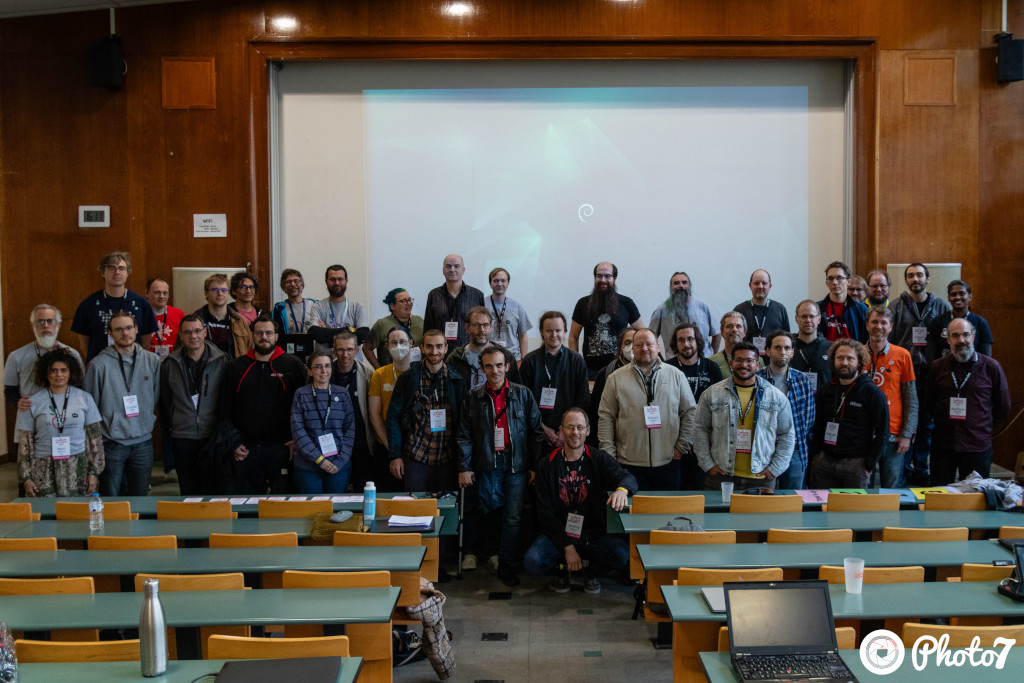
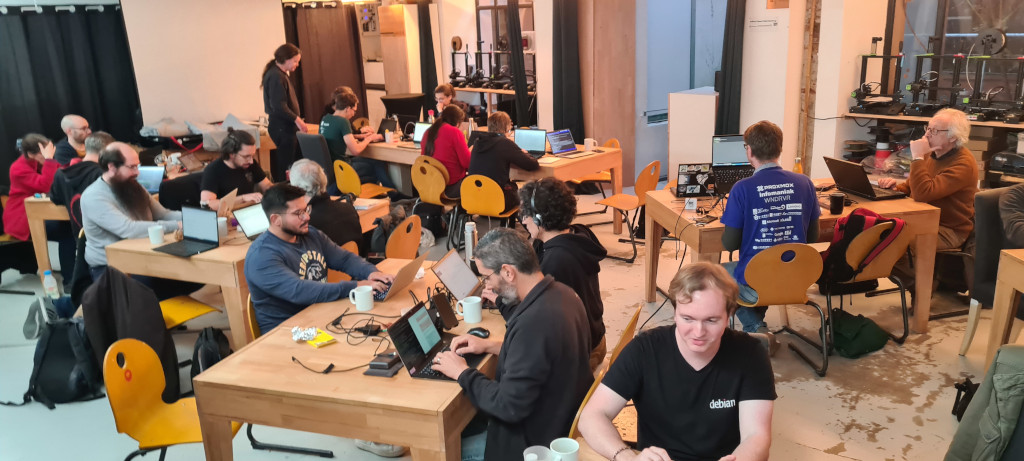
After the MiniDebConf Marseille 2019, COVID-19 made it impossible or difficult to organize new MiniDebConfs for a few years. With the gradual resumption of in-person events (like FOSDEM, DebConf, etc.), the idea emerged to host another MiniDebConf in France, but with a lighter organizational load. In 2023, we decided to reach out to the organizers of Capitole du Libre to repeat the experience of 2017: hosting a MiniDebConf alongside their annual event in Toulouse in November. However, our request came too late for 2023. After discussions with Capitole du Libre in November 2023 in Toulouse and again in February 2024 in Brussels, we confirmed that a MiniDebConf Toulouse would take place in November 2024! We then assembled a small organizing team and got to work: a Call for Papers in May 2024, adding a two-day MiniDebCamp, coordinating with the DebConf video team, securing sponsors, creating a logo, ordering T-shirts and stickers, planning the schedule, and managing registrations. Even with lighter logistics (conference rooms, badges, and catering during the weekend were handled by Capitole du Libre), there was still quite a bit of preparation to do. On Thursday, November 14, and Friday, November 15, 2024, about forty developers arrived from around the world (France, Spain, Italy, Switzerland, Germany, England, Brazil, Uruguay, India, Brest, Marseille ) to spend two days at the MiniDebCamp in the beautiful collaborative spaces of Artilect in Toulouse city center.
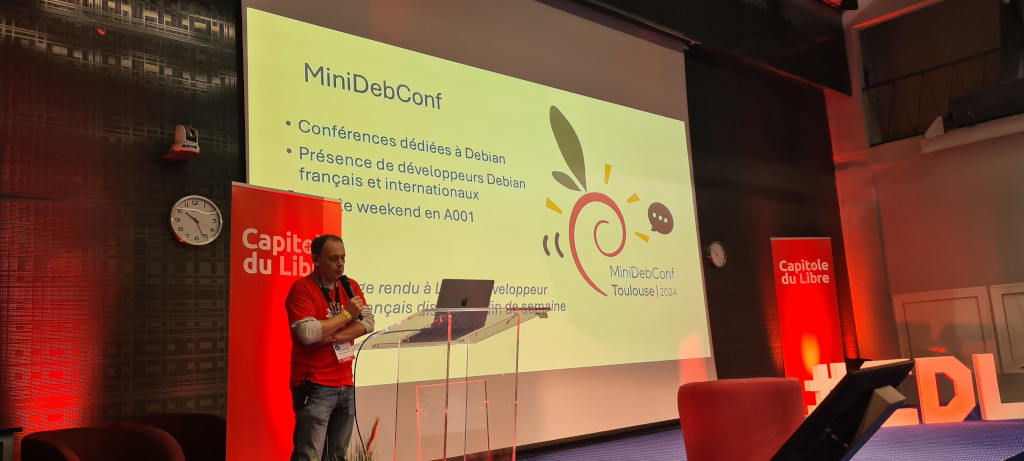
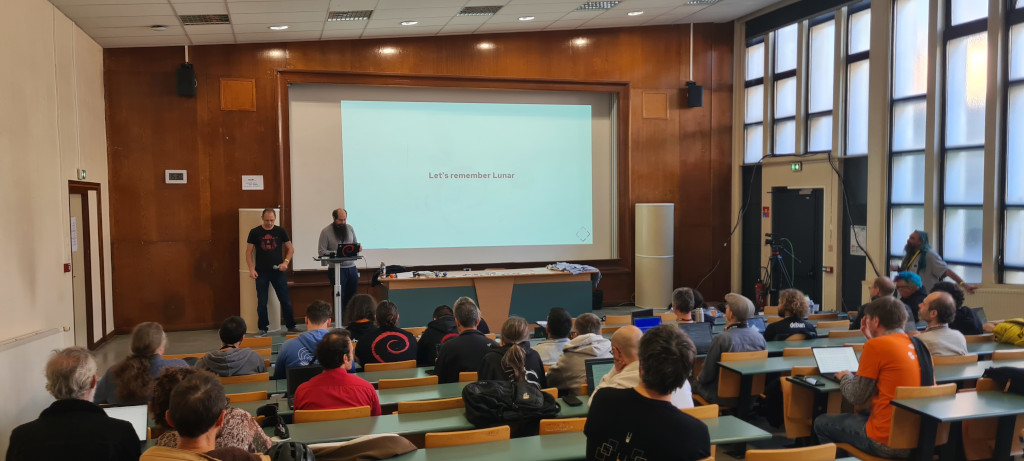
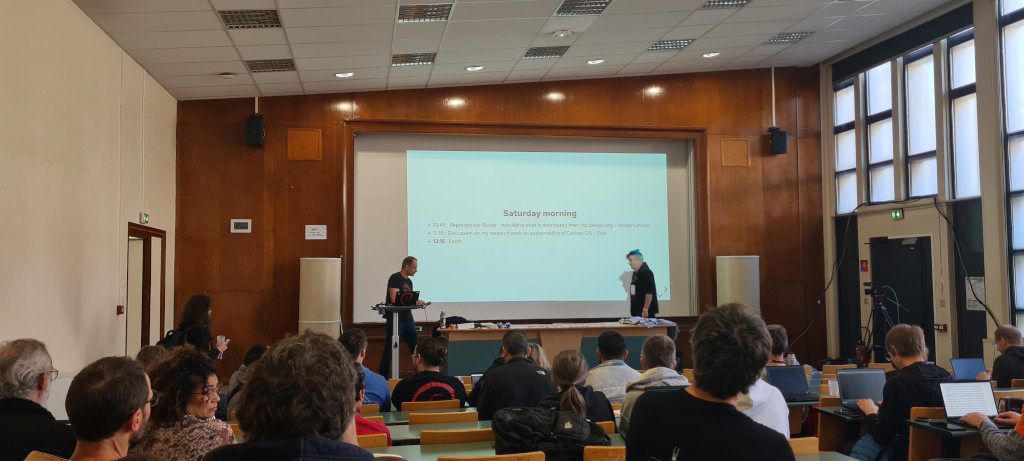
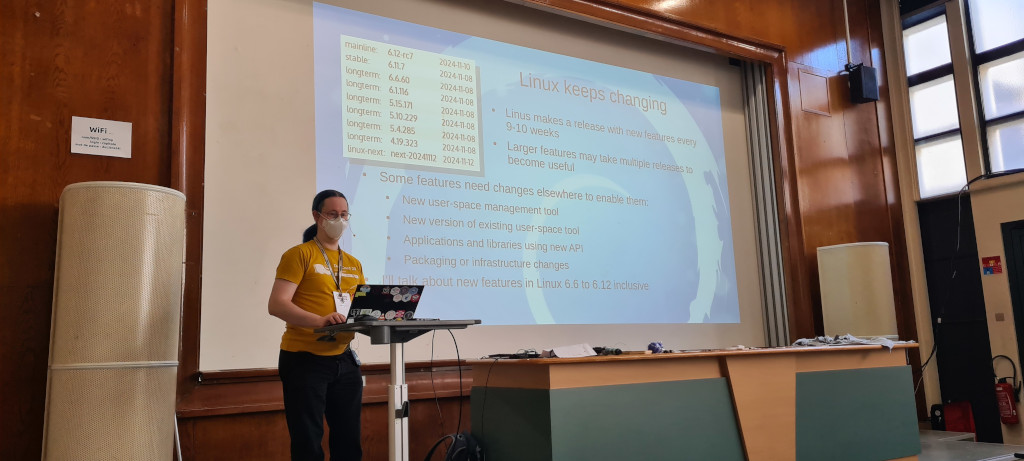
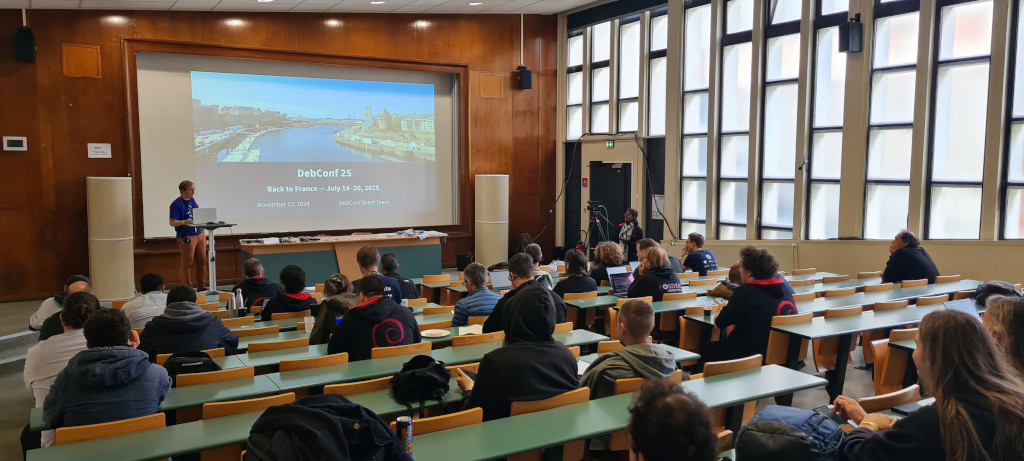
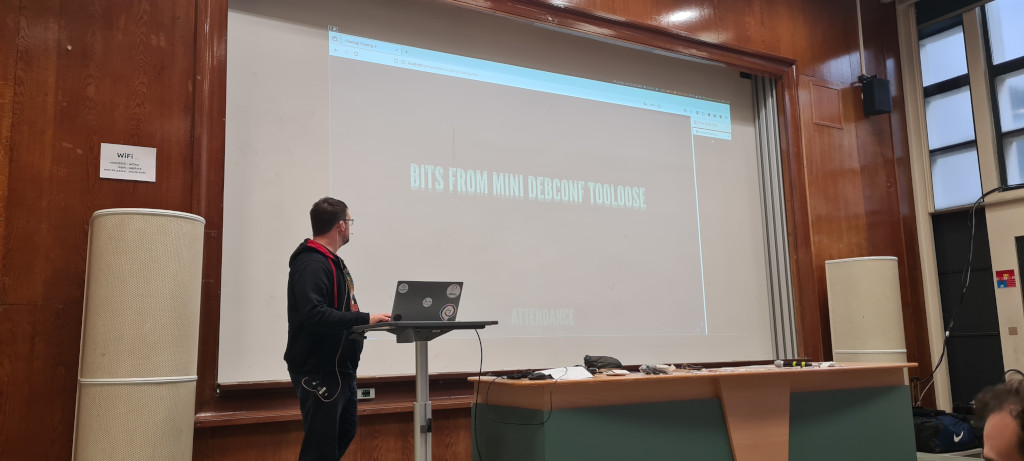
Then, on Saturday, November 16, and Sunday, November 17, 2024, the MiniDebConf took place at ENSEEIHT as part of the Capitole du Libre event. The conference kicked off on Saturday morning with an opening session by J r my Lecour, which included a tribute to Lunar (Nicolas Dandrimont). This was followed by Reproducible Builds Rebuilding What is Distributed from ftp.debian.org (Holger Levsen) and Discussion on My Research Work on Sustainability of Debian OS (Eda). After lunch at the Capitole du Libre food trucks, the intense afternoon schedule began: What s New in the Linux Kernel (and What s Missing in Debian) (Ben Hutchings), Linux Live Patching in Debian (Santiago Ruano Rinc n), Trixie on Mobile: Are We There Yet? (Arnaud Ferraris), PostgreSQL Container Groups, aka cgroups Down the Road (C dric Villemain), Upgrading a Thousand Debian Hosts in Less Than an Hour (J r my Lecour and myself), and Using Debusine to Automate Your QA (Stefano Rivera & co). Sunday marked the second day, starting with a presentation on DebConf 25 (Benjamin Somers), which will be held in Brest in July 2025. The morning continued with talks: How LTS Goes Beyond LTS (Santiago Ruano Rinc n & Roberto C. S nchez), Cross-Building (Helmut Grohne), and State of JavaScript (Bastien Roucari s). In the afternoon, there were Lightning Talks, PyPI Security: Past, Present & Future (Salvo LtWorf Tomaselli), and the classic Bits from DPL (Andreas Tille), before closing with the final session led by Pierre-Elliott B cue. All talks are available on video (a huge thanks to the amazing DebConf video team), and many thanks to our sponsors (Viridien, Freexian, Evolix, Collabora, and Data Bene). A big thank-you as well to the entire Capitole du Libre team for hosting and supporting us see you in Brest in July 2025! Articles about (or mentioning) MiniDebConf Toulouse:

18 December 2024

Simon Josefsson: Guix Container Images for GitLab CI/CD

I am using GitLab CI/CD pipelines for several upstream projects (libidn, libidn2, gsasl, inetutils, libtasn1, libntlm, ) and a long-time concern for these have been that there is too little testing on GNU Guix. Several attempts have been made, and earlier this year Ludo came really close to finish this. My earlier effort to idempotently rebuild Debian recently led me to think about re-bootstrapping Debian. Since Debian is a binary distribution, it re-use earlier binary packages when building new packages. The prospect of re-bootstrapping Debian in a reproducible way by rebuilding all of those packages going back to the beginning of time does not appeal to me. Instead, wouldn t it be easier to build Debian trixie (or some future release of Debian) from Guix, by creating a small bootstrap sandbox that can start to build Debian packages, and then make sure that the particular Debian release can idempotently rebuild itself in a reproducible way? Then you will eventually end up with a reproducible and re-bootstrapped Debian, which pave the way for a trustworthy release of Trisquel. Fortunately, such an endeavour appears to offer many rabbit holes. Preparing Guix container images for use in GitLab pipelines is one that I jumped into in the last few days, and just came out of. Let s go directly to the point of this article: here is a GitLab pipeline job that runs in a native Guix container image that builds libksba after installing the libgpg-error dependency from Guix using the pre-built substitutes.
test-amd64-latest-wget-configure-make-libksba:
  image: registry.gitlab.com/debdistutils/guix/container:latest
  before_script:
  - lndir /gnu/store/*profile/etc/ /etc
  - rm -f /etc/group
  - groupadd --system guixbuild
  - for i in $(seq -w 1 10); do useradd -g guixbuild -G guixbuild -d /var/empty -s $(command -v nologin) -c "Guix build user $i" --system guixbuilder$i; done
  - export HOME=/
  - export LANG=C.UTF-8
  - guix-daemon --disable-chroot --build-users-group=guixbuild &
  - guix archive --authorize < /share/guix/ci.guix.gnu.org.pub
  - guix archive --authorize < /share/guix/bordeaux.guix.gnu.org.pub
  - guix describe
  - guix package -i libgpg-error
  - GUIX_PROFILE="//.guix-profile"
  - . "$GUIX_PROFILE/etc/profile"
  script:
  - wget https://www.gnupg.org/ftp/gcrypt/libksba/libksba-1.6.7.tar.bz2
  - tar xfa libksba-1.6.7.tar.bz2
  - cd libksba-1.6.7
  - ./configure
  - make V=1
  - make check VERBOSE=t V=1
You can put that in a .gitlab-ci.yml and push it to GitLab and you will end up with a nice pipeline job output. As you may imagine, there are several things that are sub-optimal in the before_script above that ought to be taken care of by the Guix container image, and I hope to be able to remove as much of the ugliness as possible. However that doesn t change that these images are useful now, and I wanted to announce this work to allow others to start testing them and possibly offer help. I have started to make use of these images in some projects, see for example the libntlm commit for that. You are welcome to join me in the Guix container images for GitLab CI/CD project! Issues and merge requests are welcome happy hacking folks!

16 December 2024

Dirk Eddelbuettel: #45: Some r-ci Updates

market monitor Welcome to post 45 in the $R^4 series! We introduced r-ci here in post #32 here nearly four years ago. It has found pretty widespread use and adoption, and we received a few kind words then (in the linked issue) and also more recently (in a follow-up comment) from which we merrily quote:
[ ] almost 3 years later on and I have had zero problems with this CI setup. For people who want reliable R software, resources like these are invaluable.
And while we followed up with post #41 about r2u for simple continuous integration, we may not have posted when we based r-ci on r2u (for the obvious Linux usage case). So let s make time now for a (comparitively smaller) update, and an update usage examples. We made two changes in the last few days. One is a (obvious in hindsight) simplification. Given that the bootstrap step was always executed, and needed no parameters, we pulled it into a new aggregated setup simply called r-ci that includes it so that it can be omitted as a step in the yaml file. Second, we recently needed Fortran on macOS too, and realized it was not installed by default so we just added that too. With that a real and used example is now as simple as the screenshot to the left (and hence one paragraph shorter). The trained eye will no doubt observe that there is nothing specific to a given repo. And that is basically the key feature: we can simply copy this file around and get fast and easy and reliable CI by taking advantage of the underlying robustness of r2u solving all dependency automagically and reliably. The option to enable macOS is also solid and compelling as the GitHub runners are fast (but more expensive in how the count against the limit of minutes so again a tradeoff to make), as is the option to run coverage if one so desires. Some of my repos do too. Take a look at the r-ci website which has more examples for the other supported CI servics it can used with, and feel free to ask questions as issue in the repo.

This post by Dirk Eddelbuettel originated on his Thinking inside the box blog. If you like this or other open-source work I do, you can now sponsor me at GitHub. Please report excessive re-aggregation in third-party for-profit settings.

Russ Allbery: Review: Finders

Review: Finders, by Melissa Scott
Series: Firstborn, Lastborn #1
Publisher: Candlemark & Gleam
Copyright: 2018
ISBN: 1-936460-87-4
Format: Kindle
Pages: 409
Finders is a far future science fiction novel with cyberpunk vibes. It is the first of a series, but the second (and, so far, only other) book of the series is a prequel. It stands alone reasonably well (more on that later). Cassilde Sam is a salvor. That means she specializes in exploring ancient wrecks and ruins left behind by the Ancients and salvaging materials that can be reused. The most important of those are what are called Ancestral elements: BLUE, which can hold programming; GOLD, which which reacts to BLUE instructions; RED, which produces actions or output; and GREEN, the rarest and most valuable, which powers everything else. Cassilde and her partner Dai Winter file claims on newly-discovered or incompletely salvaged Ancestor sites and then extract elemental material and anything else of value in their small salvage ship. Cassilde is also dying. She has Lightman's, an incurable degenerative disease that can only be treated with ever-increasing quantities of GREEN. It's hard to sleep, hard to get warm, hard to breathe, and eventually she'll run out of money to pay for the GREEN and she'll die. To push that day off into the future, she and Dai need work. The good news is that the wreckage of a new Ancestor sky palace was discovered in a long orbit and will create enough salvage work for every experienced salvor in the system. The bad news is that they're not qualified to bid on it. They need a scholar with a class-one license to bid on the best sections, and they haven't had a reliable scholar since their former partner and lover Summerland Ashe picked the opposite side in the Troubles and left the Fringe for the Entente, the more densely settled and connected portion of human space. But, unexpectedly and suspiciously, Ashe may be back and offering to work with them again. So, first, I love this setting. This is far from the first SF novel that is set in the aftermath of a general collapse of human civilization and revolving around discovering lost mysteries. Most examples of that genre are post-apocalyptic novels limited to Earth or the local solar system, but Kate Elliott's Unconquerable Sun comes immediately to mind. It's also not the first space archaeology series I've read; Kristine Kathyrn Rusch's story series starting with "Diving into the Wreck" also came to mind. But I don't recall the last time I've seen the author sell the setting so effectively. This is a world with starships and spaceports and clearly advanced technology, but it feels like a post-collapse society that's built on ruins. It's not just that technology runs on half-understood Ancestral elements and states fight over control of debris fields. It's also that the society repurposes Ancestral remnants in ways that both they and the reader know weren't originally intended, and that sometimes are more ingenious or efficient than how the Ancestors probably used them. There's a creative grittiness here that reminds me of good cyberpunk. It's not just good atmospheric writing, though. Scott makes a world-building decision that is going to sound trivial when I say it, but that has brilliant implications for the rest of the setting. There was not just one collapse; there were two. The Ancestor civilization, presumed to be the first human civilization, has passed into myth, quite literally when it comes to the stories around its downfall in the aftermath of a war against AIs. After the Ancestors came the Successors, who followed a similar salvage and rebuild approach and got as far as inventing their own warp drive technology that was based on but different than the Ancestor technology. Then they also collapsed, leaving their adapted technology and salvage operations layered over Ancestor sites. Cassilde's civilization is the third human starfaring civilization, and it is very specifically the third, neither the second nor one of dozens. This has so many small but effective implications that improve this story. A fall happened twice, so it feels like a pattern that makes Cassilde's civilization paranoid, but it happened for two very different reasons, so there is room to argue against it being a pattern. Salvage is harder because of the layering of Ancestor and Successor activity. Successors had their own way of controlling technology that is not accessible to Cassilde and her crew but is also not how the technology was intended to be used, which sends small ripples of interesting complexity through the background. And salvors are competing not only against each other but also against Successor salvage operations for which they have fragmentary records. It's a beautifully effective touch. Melissa Scott has been publishing science fiction for forty years, and it shows in this book. The protagonists are older characters: established professionals with resource problems but also social connections and an earned reputation, people who are trying to do a job and live their lives, not change the world. The writing is competent, deft, and atmospheric, with the confidence of long practice, but it also has the feel of an earlier era of science fiction. I mentioned the cyberpunk influence, which shows in the grittiness of the descriptions, the marginality of the characters in society, and the background theme of repurposing and reusing technology in unintended ways. This is the sort of book that feels solidly in the center of science fiction, without the genre mixing into either fantasy or romance that has become somewhat more common, and also without the dramatics of space opera (although the reader discovers that the stakes of this novel may be higher than anyone realized). And yet, so much of this book is about navigating a complicated romantic relationship, and that's where the story structure felt a bit odd. Cassilde, Dai, and Ashe were a polyamorous triad (polyamory also shows up in Scott's excellent Roads of Heaven series), and much of the first third of the book deals with the fracturing of trust with Ashe and their renegotiation of that relationship given his return. This is refreshingly written as the thoughtful interaction of three adults who take issues of trust seriously, but that also means it's much less dramatic than it sounds, and that means this book starts exceptionally slow. Scott is going somewhere, and the slow build became engrossing around the midpoint of the book, but I had to fight to stick with it at the start. About 80% of the way through this book, I had no idea how Scott was going to wrap things up in the pages remaining and was bracing myself for some sort of series cliffhanger. This is not what happens; the plot is not fully resolved in every detail, but it reaches a conclusion of sorts that does not mandate a sequel. I did think the end was a little bit unsatisfying, though, and I want another book that explores the implications of the ending. I think it would have to be a much different book, and the tonal shift might be stark. I've had this book on my to-read list for a while and kept putting it off because I wasn't sure I was in the mood for something precarious and gritty. This turned out to be an accurate worry: this is literally a book about salvaging the pieces of something full of wonders inextricably connected to dangers. You have to be in a cyberpunk sort of mood. But I've never read a bad Melissa Scott book, and this is no exception. The simplicity and ALL-CAPSNESS of the Ancestral elements grated a bit, but apart from that, the world-building is exceptional and well worth the trip. Recommended, although be warned that, if you're like me, it may not grab you from the first page. Followed by Fallen, but that book is a prequel that does not share any protagonists. Content notes: disability and degenerative illness in a universe where magical cures are possible, so be warned if that specific thematic combination is not what you're looking for. Rating: 7 out of 10

13 December 2024

Emanuele Rocca: Murder Mystery: GCC Builds Failing After sbuild Refactoring

This is the story of an investigation conducted by Jochen Sprickerhof, Helmut Grohne, and myself. It was true teamwork, and we would have not reached the bottom of the issue working individually. We think you will find it as interesting and fun as we did, so here is a brief writeup. A few of the steps mentioned here took several days, others just a few minutes. What is described as a natural progression of events did not always look very obvious at the moment at all.
Let us go through the Six Stages of Debugging together.

Stage 1: That cannot happen
Official Debian GCC builds start failing on multiple architectures in late November.
The build error happens on the build servers when running the testuite, but we know this cannot happen. GCC builds are not meant to fail in case of testsuite failures! Return codes are not making the build fail, make is being called with -k, it just cannot happen.
A lot of the GCC tests are always failing in fact, and an extensive log of the results is posted to the debian-gcc mailing list, but the packages always build fine regardless.
On the build daemons, build failures take several hours.

Stage 2: That does not happen on my machine
Building on my machine running Bookworm is just fine. The Build Daemons run Bookworm and use a Sid chroot for the build environment, just like I am. Same kernel.
The only obvious difference between my setup and the Debian buildds is that I am using sbuild 0.85.0 from bookworm, and the buildds have 0.86.3~bpo12+1 from bookworm-backports. Trying again with 0.86.3~bpo12+1, the build fails on my system too. The build daemons were updated to the bookworm-backports version of sbuild at some point in late November. Ha.

Stage 3: That should not happen
There are quite a few sbuild versions in between 0.85.0 and 0.86.3~bpo12+1, but looking at recent sbuild bugs shows that sbuild 0.86.0 was breaking "quite a number of packages". Indeed, with 0.86.0 the build still fails. Trying the version immediately before, 0.85.11, the build finishes correctly. This took more time than it sounds, one run including the tests takes several hours. We need a way to shorten this somehow.
The Debian packaging of GCC allows to specify which languages you may want to skip, and by default it builds Ada, Go, C, C++, D, Fortran, Objective C, Objective C++, M2, and Rust. When running the tests sequentially, the build logs stop roughly around the tests of a runtime library for D, libphobos. So can we still reproduce the failure by skipping everything except for D? With DEB_BUILD_OPTIONS=nolang=ada,go,c,c++,fortran,objc,obj-c++,m2,rust the build still fails, and it fails faster than before. Several minutes, not hours. This is progress, and time to file a bug. The report contains massive spoilers, so no link. :-)

Stage 4: Why does that happen?
Something is causing the build to end prematurely. It s not the OOM killer, and the kernel does not have anything useful to say in the logs. Can it be that the D language tests are sending signals to some process, and that is what s killing make ? We start tracing signals sent with bpftrace by writing the following script, signals.bt:
tracepoint:signal:signal_generate  
    printf("%s PID %d (%s) sent signal %d to PID %d\n", comm, pid, args->sig, args->pid);
 
And executing it with sudo bpftrace signals.bt.
The build takes its sweet time, and it fails. Looking at the trace output there s a suspicious process.exe terminating stuff.
process.exe (PID: 2868133) sent signal 15 to PID 711826
That looks interesting, but we have no clue what PID 711826 may be. Let s change the script a bit, and trace signals received as well.
tracepoint:signal:signal_generate  
    printf("PID %d (%s) sent signal %d to %d\n", pid, comm, args->sig, args->pid);
 
tracepoint:signal:signal_deliver  
    printf("PID %d (%s) received signal %d\n", pid, comm, args->sig);
 
The working version of sbuild was using dumb-init, whereas the new one features a little init in perl. We patch the current version of sbuild by making it use dumb-init instead, and trace two builds: one with the perl init, one with dumb-init.
Here are the signals observed when building with dumb-init.
PID 3590011 (process.exe) sent signal 2 to 3590014
PID 3590014 (sleep) received signal 9
PID 3590011 (process.exe) sent signal 15 to 3590063
PID 3590063 (std.process tem) received signal 9
PID 3590011 (process.exe) sent signal 9 to 3590065
PID 3590065 (std.process tem) received signal 9
And this is what happens with the new init in perl:
PID 3589274 (process.exe) sent signal 2 to 3589291
PID 3589291 (sleep) received signal 9
PID 3589274 (process.exe) sent signal 15 to 3589338
PID 3589338 (std.process tem) received signal 9
PID 3589274 (process.exe) sent signal 9 to 3589340
PID 3589340 (std.process tem) received signal 9
PID 3589274 (process.exe) sent signal 15 to 3589341
PID 3589274 (process.exe) sent signal 15 to 3589323
PID 3589274 (process.exe) sent signal 15 to 3589320
PID 3589274 (process.exe) sent signal 15 to 3589274
PID 3589274 (process.exe) received signal 9
PID 3589341 (sleep) received signal 9
PID 3589273 (sbuild-usernsex) sent signal 9 to 3589320
PID 3589273 (sbuild-usernsex) sent signal 9 to 3589323
There are a few additional SIGTERM being sent when using the perl init, that s helpful. At this point we are fairly convinced that process.exe is worth additional inspection. The source code of process.d shows something interesting:
1221 @system unittest
1222  
[...]
1247     auto pid = spawnProcess(["sleep", "10000"],
[...]
1260     // kill the spawned process with SIGINT
1261     // and send its return code
1262     spawn((shared Pid pid)  
1263         auto p = cast() pid;
1264         kill(p, SIGINT);
So yes, there s our sleep and the SIGINT (signal 2) right in the unit tests of process.d, just like we have observed in the bpftrace output.
Can we study the behavior of process.exe in isolation, separatedly from the build? Indeed we can. Let s take the executable from a failed build, and try running it under /usr/libexec/sbuild-usernsexec.
First, we prepare a chroot inside a suitable user namespace:
unshare --map-auto --setuid 0 --setgid 0 mkdir /tmp/rootfs
cd /tmp/rootfs
cat /home/ema/.cache/sbuild/unstable-arm64.tar   unshare --map-auto --setuid 0 --setgid 0 tar xf  -
unshare --map-auto --setuid 0 --setgid 0 mkdir /tmp/rootfs/whatever
unshare --map-auto --setuid 0 --setgid 0 cp process.exe /tmp/rootfs/
Now we can run process.exe on its own using the perl init, and trace signals at will:
/usr/libexec/sbuild-usernsexec --pivotroot --nonet u:0:100000:65536  g:0:100000:65536 /tmp/rootfs ema /whatever -- /process.exe
We can compare the behavior of the perl init vis-a-vis the one using dumb-init in milliseconds instead of minutes.

Stage 5: Oh, I see.
Why does process.exe send more SIGTERMs when using the perl init is now the big question. We have a simple reproducer, so this is where using strace becomes possible.
sudo strace --user ema --follow-forks -o sbuild-dumb-init.strace ./sbuild-usernsexec-dumb-init --pivotroot --nonet u:0:100000:65536  g:0:100000:65536 /tmp/dumbroot ema /whatever -- /process.exe
We start comparing the strace output of dumb-init with that of perl-init, looking in particular for different calls to kill.
Here is what process.exe does under dumb-init:
3593883 kill(-2, SIGTERM)               = -1 ESRCH (No such process)
No such process. Under perl-init instead:
3593777 kill(-2, SIGTERM <unfinished ...>
The process is there under perl-init!
That is a kill with negative pid. From the kill(2) man page:
If pid is less than -1, then sig is sent to every process in the process group whose ID is -pid.
It would have been very useful to see this kill with negative pid in the output of bpftrace, why didn t we? The tracepoint used, tracepoint:signal:signal_generate, shows when signals are actually being sent, and not the syscall being called. To confirm, one can trace tracepoint:syscalls:sys_enter_kill and see the negative PIDs, for example:
PID 312719 (bash) sent signal 2 to -312728
The obvious question at this point is: why is there no process group 2 when using dumb-init?

Stage 6: How did that ever work?
We know that process.exe sends a SIGTERM to every process in the process group with ID 2. To find out what this process group may be, we spawn a shell with dumb-init and observe under /proc PIDs 1, 16, and 17. With perl-init we have 1, 2, and 17. When running dumb-init, there are a few forks before launching the program, explaining the difference. Looking at /proc/2/cmdline we see that it s bash, ie. the program we are running under perl-init. When building a package, that is dpkg-buildpackage itself.
The test is accidentally killing its own process group.
Now where does this -2 come from in the test?
2363     // Special values for _processID.
2364     enum invalid = -1, terminated = -2;
Oh. -2 is used as a special value for PID, meaning "terminated". And there s a call to kill() later on:
2694     do   s = tryWait(pid);   while (!s.terminated);
[...]
2697     assertThrown!ProcessException(kill(pid));
What sets pid to terminated you ask?
Here is tryWait:
2568 auto tryWait(Pid pid) @safe
2569  
2570     import std.typecons : Tuple;
2571     assert(pid !is null, "Called tryWait on a null Pid.");
2572     auto code = pid.performWait(false);
And performWait:
2306         _processID = terminated;
The solution, dear reader, is not to kill.
PS: the bug report with spoilers for those interested is #1089007.

9 December 2024

Freexian Collaborators: Debian Contributions: OpenMPI transitions, cPython 3.12.7+ update uploads, Python 3.13 Transition, and more! (by Anupa Ann Joseph, Stefano Rivera)

Debian Contributions: 2024-11 Contributing to Debian is part of Freexian s mission. This article covers the latest achievements of Freexian and their collaborators. All of this is made possible by organizations subscribing to our Long Term Support contracts and consulting services.

Transition management, by Emilio Pozuelo Monfort Emilio has been helping finish the mpi-defaults switch to mpich on 32-bit architectures, and the openmpi transitions. This involves filing bugs for the reverse dependencies, doing NMUs, and requesting removals for outdated (Not Built from Source) binaries on 32-bit architectures where openmpi is no longer available. Those transitions got entangled with a few others, such as the petsc stack, and were blocking many packages from migrating to testing. These transitions were completed in early December.

cPython 3.12.7+ update uploads, by Stefano Rivera Python 3.12 had failed to build on mips64el, due to an obscure dh_strip failure. The mips64el porters never figured it out, but the missing build on mips64el was blocking migration to Debian testing. After waiting a month, enough changes had accumulated in the upstream 3.12 maintenance git branch that we could apply them in the hope of changing the output enough to avoid breaking dh_strip. This worked. Of course there were other things to deal with too. A test started failing due to a Debian-specific patch we carry for python3.x-minimal, and it needed to be reworked. And Stefano forgot to strip the trailing + from PY_VERSION, which confuses some python libraries. This always requires another patch when applying git updates from the maintenance branch. Stefano added a build-time check to catch this mistake in the future. Python 3.12.7 migrated.

Python 3.13 Transition, by Stefano Rivera and Colin Watson During November the Python 3.13-add transition started. This is the first stage of supporting a new version of Python in Debian archive (after preparatory work), adding it as a new supported but non-default version. All packages with compiled Python extensions need to be re-built to add support for the new version. We have covered the lead-up to this transition in the past. Due to preparation, many of the failures we hit were expected and we had patches waiting in the bug tracker. These could be NMUed to get the transition moving. Others had been known about but hadn t been worked on, yet. Some other packages ran into new issues, as we got further into the transition than we d been able to in preparation. The whole Debian Python team has been helping with this work. The rebuild stage of the 3.13-add transition is now over, but many packages need work before britney will let python3-defaults migrate to testing.

Limiting build concurrency based on available RAM, by Helmut Grohne In recent years, the concurrency of CPUs has been increasing as has the demand for RAM by linkers. What has not been increasing as quickly is the RAM supply in typical machines. As a result, we more frequently run into situations where the package builds exhaust memory when building at full concurrency. Helmut initiated a discussion about generalizing an approach to this in Debian packages. Researching existing code that limits concurrency as well as providing possible extensions to debhelper and dpkg to provide concurrency limits based on available system RAM. Thus far there is consensus on the need for a more general solution, but ideas are still being collected for the precise solution.

MiniDebConf Toulouse at Capitole du Libre The whole Freexian Collaborator team attended MiniDebConf Toulouse, part of the Capitole du Libre event. Several members of the team gave talks: Stefano and Anupa worked as part of the video team, streaming and recording the event s talks.

Miscellaneous contributions
  • Stefano looked into packaging the latest upstream python-falcon version in Debian, in support of the Python 3.13 transition. This appeared to break python-hug, which is sadly looking neglected upstream, and the best course of action is probably its removal from Debian.
  • Stefano uploaded videos from various 2024 Debian events to PeerTube and YouTube.
  • Stefano and Santiago visited the site for DebConf 2025 in Brest, after the MiniDebConf in Toulouse, to meet with the local team and scout out the venue. The on-going DebConf 25 organization work of last month also included handling the logo and artwork call for proposals.
  • Stefano helped the press team to edit a post for bits.debian.org on OpenStreetMap s migration to Debian.
  • Carles implemented multiple language support on po-debconf-manager and tested it using Portuguese-Brazilian during MiniDebConf Toulouse. The system was also tested and improved by reviewing more than 20 translations to Catalan, creating merge requests for those packages, and providing user support to new users. Additionally, Carles implemented better status transitions, configuration keys management and other small improvements.
  • Helmut sent 32 patches for cross build failures. The wireplumber one was an interactive collaboration with Dylan A ssi.
  • Helmut continued to monitor the /usr-move, sent a patch for lib64readline8 and continued several older patch conversations. lintian now reports some aliasing issues in unstable.
  • Helmut initiated a discussion on the semantics of *-for-host packages. More feedback is welcome.
  • Helmut improved the crossqa.debian.net infrastructure to fail running lintian less often in larger packages.
  • Helmut continued maintaining rebootstrap mostly dropping applied patches and continuing discussions of submitted patches.
  • Helmut prepared a non-maintainer upload of gzip for several long-standing bugs.
  • Colin came up with a plan for resolving the multipart vs. python-multipart name conflict, and began work on converting reverse-dependencies.
  • Colin upgraded 42 Python packages to new upstream versions. Some were complex: python-catalogue had some upstream version confusion, pydantic and rpds-py involved several Rust package upgrades as prerequisites, and python-urllib3 involved first packaging python-quart-trio and then vendoring an unpackaged test-dependency.
  • Colin contributed Incus support to needrestart upstream.
  • Lucas set up a machine to do a rebuild of all ruby reverse dependencies to check what will be broken by adding ruby 3.3 as an alternative interpreter. The tool used for this is mass-rebuild and the initial rebuilds have already started. The ruby interpreter maintainers are planning to experiment with debusine next time.
  • Lucas is organizing a Debian Ruby sprint towards the end of January in Paris. The plan of the team is to finish any missing bits of Ruby 3.3 transition at the time, try to push Rails 7 transition and fix RC bugs affecting the ruby ecosystem in Debian.
  • Anupa attended a Debian Publicity team meeting in-person during MiniDebCamp Toulouse.
  • Anupa moderated and posted in the Debian Administrator group in LinkedIn.

8 December 2024

Dirk Eddelbuettel: pinp 0.0.11 on CRAN: Maintenance

A new version of our pinp package arrived on CRAN today, and is the first release in four years. The pinp package allows for snazzier one or two column Markdown-based pdf vignettes, and is now used by a few packages. A screenshot of the package vignette can be seen below. Additional screenshots are at the pinp page. pinp vignette This release contains no new features or new user-facing changes but reflects the standard package and repository maintenance over the four-year window since the last release: updating of actions, updating of URLs and addressing small packaging changes spotted by ever-more-vigilant R checking code. The NEWS entry for this release follows.

Changes in pinp version 0.0.11 (2024-12-08)
  • Standard package maintenance for continuous integration, URL updates, and packaging conventions
  • Correct two minor nags in the Rd file

Courtesy of my CRANberries, there is a diffstat report relative to previous release. More detailed information is on the ping page. For questions or comments use the issue tracker off the GitHub repo. If you like this or other open-source work I do, you can sponsor me at GitHub.

This post by Dirk Eddelbuettel originated on his Thinking inside the box blog. Please report excessive re-aggregation in third-party for-profit settings.

Russ Allbery: Review: Why Buildings Fall Down

Review: Why Buildings Fall Down, by Matthys Levy & Mario Salvadori
Illustrator: Kevin Woest
Publisher: W.W. Norton
Copyright: 1992
Printing: 1994
ISBN: 0-393-31152-X
Format: Trade paperback
Pages: 314
Why Buildings Fall Down is a non-fiction survey of the causes of structure collapses, along with some related topics. It is a sequel of sorts to Why Buildings Stand Up by Mario Salvadori, which I have not read. Salvadori was, at the time of writing, Professor Emeritus of Architecture at Columbia University (he died in 1997). Levy is an award-winning architectural engineer, and both authors were principals at the structural engineering firm Weidlinger Associates. There is a revised and updated 2002 edition, but this review is of the original 1992 edition. This is one of those reviews that comes with a small snapshot of how my brain works. I got fascinated by the analysis of the collapse of Champlain Towers South in Surfside, Florida in 2021, thanks largely to a random YouTube series on the tiny channel of a structural engineer. Somewhere in there (I don't remember where, possibly from that channel, possibly not) I saw a recommendation for this book and grabbed a used copy in 2022 with the intent of reading it while my interest was piqued. The book arrived, I didn't read it right away, I got distracted by other things, and it migrated to my shelves and sat there until I picked it up on an "I haven't read nonfiction in a while" whim. Two years is a pretty short time frame for a book to sit on my shelf waiting for me to notice it again. The number of books that have been doing that for several decades is, uh, not small. Why Buildings Fall Down is a non-technical survey of structure failures. These are mostly buildings, but also include dams, bridges, and other structures. It's divided into 18 fairly short chapters, and the discussion of each disaster is brisk and to the point. Most of the structures discussed are relatively recent, but the authors talk about the Meidum Pyramid, the Parthenon (in the chapter on intentional destruction by humans), and the Pavia Civic Tower (in the chapter about building death from old age). If you are someone who has already been down the structural failure rabbit hole, you will find chapters on the expected disasters like the Tacoma Narrows Bridge collapse and the Hyatt Regency walkway collapse, but there are a lot of incidents here, including a short but interesting discussion of the Leaning Tower of Pisa in the chapter on problems caused by soil properties. What you're going to get, in other words, is a tour of ways in which structures can fail, which is precisely what was promised by the title. This wasn't quite what I was expecting, but now I'm not sure why I was expecting something different. There is no real unifying theme here; sometimes the failure was an oversight, sometimes it was a bad design, sometimes it was a last-minute change, and sometimes it was something unanticipated. There are a lot of factors involved in structure design and any of them can fail. The closest there is to a common pattern is a lack of redundancy and sufficient safety factors, but that lack of redundancy was generally not deliberate and therefore this is not a guide to preventing a collapse. The result is a book that feels a bit like a grab-bag of structural trivia that is individually interesting but only occasionally memorable. The writing style I suspect will be a matter of taste, but once I got used to it, I rather enjoyed it. In a co-written book, it's hard to separate the voices of the authors, but Salvadori wrote most of the chapter on the law in the first person and he's clearly a character. (That chapter is largely the story of two trials he testified in, which, from his account, involved him verbally fencing with lawyers who attempted to claim his degrees from the University of Rome didn't count as real degrees.) If this translates to his speaking style, I suspect he was a popular lecturer at Columbia. The explanations of the structural failures are concise and relatively clear, although even with Kevin Woest's diagrams, it's hard to capture the stresses and movement in a written description. (I've found from watching YouTube videos that animations, or even annotations drawn while someone is talking, help a lot.) The framing discussion, well, sometimes that is bombastic in a way that I found amusing:
But we, children of a different era, do not want our lives to be enclosed, to be shielded from the mystery. We are eager to participate in it, to gather with our brothers and sisters in a community of thought that will lift us above the mundane. We need to be together in sorrow and in joy. Thus we rarely build monolithic monuments. Instead, we build domes.
It helps that passages like this are always short and thus don't wear out their welcome. My favorite line in the whole book is a throwaway sentence in a discussion of building failures due to explosions:
With a similar approach, it can be estimated that the chance of an explosion like that at Forty-fifth Street was at most one in thirty million, and probably much less. But this is why life is dangerous and always ends in death.
Going hard, structural engineering book! It's often appealing to learn about things from their failures because the failures are inherently more dramatic and thus more interesting, but if you were hoping for an introduction to structural engineering, this is probably not the book you want. There is an excellent and surprisingly engaging appendix that covers the basics of structural analysis in 45 pages, but you would probably be better off with Why Buildings Stand Up or another architecture or structural engineering textbook (or maybe a video course). The problem with learning by failure case study is that all the case studies tend to blend together, despite the authors' engaging prose, and nearly every collapse introduces a new structural element with new properties and new failure modes and only the briefest of explanations. This book might make you a slightly more informed consumer of the news, but for most readers I suspect it will be a collection of forgettable trivia told in an occasionally entertaining style. I think the book I wanted to read was something that went deeper into the process of forensic engineering, not just the outcomes. It's interesting to know what the cause of a failure was, but I'm more interested in how one goes about investigating a failure. What is the process, how do you organize the investigation, and how does the legal system around engineering failures work? There are tidbits and asides here, but this book is primarily focused on the structural analysis and elides most of the work done to arrive at those conclusions. That said, I was entertained. Why Buildings Fall Down is a bit dated the opening chapter on airplanes hitting buildings reads much differently now than when it was written in 1992, and I'm sure it was updated in the 2002 edition but it succeeds in being clear without being soulless or sounding like a textbook. I appreciate an occasional rant about nuclear weapons in a book about architecture. I'm not sure I really recommend this, but I had a good time with it. Also, I'm now looking for opportunities to say "this is why life is dangerous and always ends in death," so there is that. Rating: 6 out of 10

Next.

Previous.