Search Results: "John Goerzen"

23 May 2009

John Goerzen: Review: In The Beginning. . . Was The Command Line

A few dud universes can really clutter up your basement. - Neal Stephenson, In The Beginning. . . was the Command Line
What a fun read. It s about technology, sure, but more about culture. Neal takes a good look at operating systems, why we get emotionally involved with them, and why Windows is still so popular. He does this with a grand detour to Disneyland, and a hefty dose of humor. The above quote was from near the end of the book, where he imagines hackers creating big bangs from the command line. He starts out the book from some anecdotes from the early 1970s, when he had his first computer class in high school. His school didn t have a computer, but they did have a teletype (the physical kind that used paper) with a modem link to some university s system. But time on that system was so expensive that they couldn t just dial in and run things interactively. The teletype had a paper tape device. You d type your commands in advance, and it would punch them out on the tape. Then when you dial in, it would replay the tape at high speed . Neal liked this because the stuff punched out of the tape were, actually, bits in both the literal and the mathematical sense. This, of course, led to a scene at the end of the schoolyear where a classmate dumped the bin of bits on the teacher, and Neal witnessed megabytes falling to the floor. Although the book was written in 1999, and needs an update in some ways, it still speaks with a strong voice today and is now also an interesting look at what computing was like 10 years ago. He had an analogy of car dealerships to operating systems. Microsoft had the big shiny dealership selling station wagons. Their image was all wrapped up in people feeling good about their purchase like they got something for their money. And he said that the Linux folks were selling tanks, illustrated with this exchange:
Hacker with bullhorn: Save your money! Accept one of our free tanks! It is invulnerable, and can drive across rocks and swamps at ninety miles an hour while getting a hundred miles to the gallon! Prospective station wagon buyer: I know what you say is true but er I don t know how to maintain a tank! Bullhorn: You don t know how to maintain a station wagon either! Buyer: But this dealership has mechanics on staff. If something goes wrong with my station wagon, I can take a day off work, bring it here, and pay them to work on it while I sit in the waiting room for hours, listening to elevator music. Bullhorn: But if you accept one of our free tanks we will send volunteers to your house to fix it for free while you sleep! Buyer: Stay away from my house, you freak! Bullhorn: But Buyer: Can t you see that everyone is buying station wagons?
That doesn t mean that Stephenson is just a Linux apologetic. He points out that the CLI has its place, and has a true love-hate relationship with the text-based config files (remember XF86Config before the days of automatic modelines? Back when you had to get out a calculator and work some things out with pencil and paper, or else risk burning out your monitor?) He points out that some people want to just have the thing work reasonably well. They don t want control in fact, would gladly give it up if offered something reasonably pretty and reasonably functional. He speaks to running Linux at times:
Sometimes when you finish working with a program and shut it down, you find that it has left behind a series of mild warnings and low-grade error messages in the command-line interface window from which you launched it. As if the software were chatting to you about how it was doing the whole time you were working with it.
Even if the application is imploding like a damaged submarine, it can still usually eke out a little S.O.S. message.
Or about booting Linux the first time, and noticing all sorts of cryptic messages on the console:
This is slightly alarming the first time you see it, but completely harmless.
I use emacs, which might be thought of as a thermonuclear word processor. . . Microsoft Word, were devoted to features like mail merge, and the ability to embed feature-length motion pictures in corporate memoranda, were, in the case of emacs, focused with maniacal intensity on the deceptively simple-seeming problem of editing text. If you are a professional writer i.e., if someone else is getting paid to worry about how your words are formatted and printed emacs outshines all other editing software in approximately the same way that the noonday sun does the stars. It is not just bigger and brighter; it simply makes everything else vanish. For page layout and printing you can use TeX: a vast corpus of typesetting lore written in C and also available on the Net for free.
I love these vivid descriptions: programs secretly chatting with us, TeX being a corpus of typesetting lore rather than a program. Or how about this one: Unix. . . is not so much a product as it is a painstakingly compiled oral history of the hacker subculture. It is our Gilgamesh epic. Yes, my operating system is an oral history project, thankyouverymuch. The book feels like a weird (but well-executed and well-written) cross between Douglas Adams and Cory Doctorow. Which makes is so indescribably awesome that I can t help but ending this review with a few more quotes.
Because Linux is not commercial because it is, in fact, free, as well as rather difficult to obtain, install, and operate it does not have to maintain any pretensions as to its reliability. Consequently, it is much more reliable.
what really sold me on it [Debian] was its phenomenal bug database (http://www.debian.org/Bugs), which is a sort of interactive Doomsday Book of error, fallibility, and redemption. It is simplicity itself. When had a problem with Debian in early January of 1997, I sent in a message describing the problem to submit@bugs.debian.org. My problem was promptly assigned a bug report number (#6518) and a severity level (the available choices being critical, grave, important, normal, fixed, and wishlist) and forwarded to mailing lists where Debian people hang out.
That should be our new slogan for bugs.debian.org: Debian s interactive Doomsday Book of error, fallibility, and redemption.
Unix is hard to learn. The process of learning it is one of multiple small epiphanies. Typically you are just on the verge of inventing some necessary tool or utility when you realize that someone else has already invented it, and built it in, and this explains some odd file or directory or command that you have noticed but never really understood before.
I ve been THERE countless times.
Note the obsessive use of abbreviations and avoidance of capital letters; this is a system invented by people to whom repetitive stress disorder is what black lung is to miners. Long names get worn down to three-letter nubbins, like stones smoothed by a river.
It is obvious, to everyone outside of the United States, that our arch-buzzwords, multiculturalism and diversity, are false fronts that are being used (in many cases unwittingly) to conceal a global trend to eradicate cultural differences. The basic tenet of multiculturalism (or honoring diversity or whatever you want to call it) is that people need to stop judging each other-to stop asserting (and, eventually, to stop believing ) that this is right and that is wrong, this true and that false, one thing ugly and another thing beautiful, that God exists and has this or that set of qualities.
The stone tablets bearing the Ten Commandments carved in immutable stone the original command-line interface
Apparently this actually works to some degree, for police in many lands are now complaining that local arrestees are insisting on having their Miranda rights read to them, just like perps in American TV cop shows. When it s explained to them that they are in a different country, where those rights do not exist, they become outraged. Starsky and Hutch reruns, dubbed into diverse languages, may turn out, in the long run, to be a greater force for human rights than the Declaration of Independence.
Unix has always lurked provocatively in the background of the operating system wars, like the Russian Army.
Available for free online, or as a 160-page book from Amazon.

22 May 2009

John Goerzen: Sleeping

Two nights ago, Jacob had been really resisting going to bed, despite the fact that he was really, really sleepy. I walked in to his room and found him literally sleeping standing up. He was standing on the floor, with his head resting on the couch. I picked him up to put him in his bed, and he woke up then but just for a minute. Then last night, Jacob was in bed while I was out mowing. His bed is right next to a window, and apparently he was watching me mow. Terah kept hearing him saying, in a cute and tired voice, There you are! I see you! Checking on him later, he had fallen asleep, his head resting on his hand in the windowsill, as if he was still gazing out the window.

13 May 2009

John Goerzen: A Few Snippets of Jacob

It s been awhile since I posted some Jacob updates. He s 2.5 years old now. So here we go! Here s what I think A recent conversation after Jacob had been misbehaving. John: I think we should have some consequences for that.
Terah: Do you think he should have time out?
Jacob, eavesdropping: I THINK NOT! He managed to evade time out that time because once we got over our shocked silence, we were both laughing too hard. The Post Office Every time Jacob and I drive past a Sonic (a drive-in restaurant), he says, See post office over there. Have cherry limeade! Yes, he was there with Terah to get a cherry limeade once. The post office thing was a mystery to me. Near as we can figure, he had gone to Sonic with Terah right after the post office one day, and got them confused. Then I took him to an actual post office last week. I told him we were going to a post office. I started getting him out of the car. He looked confused (after all, post offices don t look like this, right?) But then he said, This post office. Have cherry limeade inside! I had to tell him it is a different kind of post office, with mailboxes inside. Hmm. I gave him a piece of junk mail to carry to the car, which I think may have been more exciting for him than even a cherry limeade. Terah has tried to explain that a Sonic isn t a post office, but he doesn t believe her. Trains and Chicago We took the train to Chicago for a quick weekend last week. Jacob loved it. He jabbers on and on about going to the train station to get on the night train (we did get on the train at 4AM), eating in the train diner car , and seeing all the conductors on the train. He also loves to talk about the elevators in our hotel, riding on a city bus, and seeing ambulances on the streets. Didn t Notice It We got a new Roomba off Woot the other day. Its box has been sitting in our kitchen for a few days now, since we didn t have time to unbox it yet (already have another Roomba). Finally Terah started unboxing it. Jacob said, Ooo, a SPECIAL Roomba! I didn t notice it there. Terah: What makes it special, Jacob? Jacob: Comes from Walmart. Can t win em all, I guess. Colors Terah read in her What to Expect book about the toddler years that, at Jacob s age, there s a small chance that children can identify one color. Jacob can identify more than a dozen, maybe even two. Navigation This really shocks me. As we re driving down the road, Jacob will correctly point out directions to me: This way to day care! That way to grandma s house! That way to Newton! What really shocked me, though, was when he pointed to an entrance ramp to an Interstate one which we never take with him and correctly told me where it went. And when he pointed down a country road that we have never even talked about, let alone driven on, and told me where it must wind up (in Newton, yep). I have no idea how he managed to figure that out. Scary Memory Last week, Jacob got a balloon. It reminded him of a balloon he got last Halloween six whole months ago. He was at a Halloween event for kids, and they gave him a black balloon. It was filled with helium, and it rose up high enough that it touched a sharp edge of a fire sprinkler and popped. Jacob told us about all of that, right down to it being a black balloon that popped on a sprinkler. They gave him another balloon to replace it orange. Jacob told us, Orange balloon not pop. Six months ago. I think it s time to get him signed up for the debate team Days of the week Jacob doesn t know what day it is, or in what order they come, but he does know that we go to church on Sunday, that he goes to grandma and grandpa s house on Tuesday, and to the clinic and Walmart on Wednesdays.

27 April 2009

John Goerzen: We Are Plains People, And Our Music Has Tornadoes

There s little that scares Kansans more than a good tornado. And, truth be told, there s little that excites us more than a good tornado, either. After all, we know it s going to be good for a story. Here on the plains, it is easy to remember how powerful nature really is. Weather sweeps in from all directions with little to hinder it, and tonight was a night few will forget. The 300-member Kansas Mennonite Men s Chorus, of which I m a member, had a concert tonight at 7, and we had a practice starting at 3. We sang in the beautiful old Memorial Hall on the campus of Bethel College. I need to describe the building a bit for you. It was built in 1938, in the day before auditorium designers decided you need to remove the outdoors. Three sides are full of windows, and it s just a few feet from the front doors into the auditorium itself. There is no air conditioning, so in a very humid day like today, every possible door and window is open. To stand on the stage and look out over the audience, you see light coming in from every direction, extremely bright light when there s lightning. It s been storming all afternoon. Our rehearsal featured thunderclaps, driving rain that was very audible inside, flickering lights. It was, in all honesty, a bit exciting. At about 6:35, word came that a tornado warning had been issued for the county. A few minutes later, about 20 minutes before start time, sirens were activated and the decision was made to evacuate to safety in the building s basement and an adjoining building. I, and a number of college students singing with the choir, wound up as a sort of impromptu ushers, directing people to the best place for safety and helping to get people into space efficiently. It was rather stuffy in those basement hallways, but it was also quite loud due to all the excited visiting going on. The KMMC concerts aren t usually like this. A few minutes later, word came that the tornado warning was canceled. I went down the steps, yelled out the news, and got a big cheer. People poured back upstairs. We got started a few minutes late, but nobody quite cared. A group of brass players was going to provide the prelude, but their first trumpet player had to leave at the last minute because his tool shed had blown over. They covered for him well in the concert though. When I got home later, Terah saw me and said, I thought they d cancel the concert because of the tornado. I just had to laugh, and pointed out, This is Kansas. After a tornado evacuation, it just got everybody more excited for the program! (Of course, had there been a strike, it would have been a different story.) And it was a great program. There was excitement in the air. And it was incredibly hot and stuffy on the stage with 300 men. I had sweat running down my face. The rain and the thunder continued, sometimes improving the program. About halfway through, we sang Prayer of the Children, written by Kurt Bestor, someone that was terribly saddened by the destruction during the civil war in the Balkans. The lyrics go, in part:
Can you hear the prayer of the children
on bended knee, in the shadow of an unknown room? Empty eyes with no more tears to cry,
turning heavenward to the light. Cryin Jesus, help me
to see the morning light of one more day. . . Can you hear the voice of the children
softly pleading for silence in their shattered world?. . . Angry guns preach a gospel full of hate
blood of the innocent on their hands. For when darkness clears, I know you re near,
brining peace again. Can you hear
the prayer of the children?
And when we get to the last phrase, there s a long rest after Can you hear . We sang it the phrase, and with perfect timing as we paused for the rest, was a loud clap of thunder. And after the last word of the song, total silence. Nobody moved for a few seconds, and then applause rang out. A couple of years ago, I was in the audience at a concert in the same building. Ominous weather lurked that day too. Before the concert started, the director said something like this, before giving information about evacuation procedures, should they be needed: We are plains people. We are privileged to see the awesome power and beauty of the weather and nature up close every day. If we should be a little too privileged today, here s what we ll do

14 April 2009

John Goerzen: Two Things I Don t Understand About Facebook

Item #1 Say you want to do something like take a quiz to tell you what Star Wars character you are, and have to result posted to your wall. It would make sense for Facebook to prompt you for authorization for the app to make a one-time post to your wall. But instead, they ask you for permission to pull your profile information, photos, your friends info, and other content that it requires to work. And we have no idea what this other content is. So yes, in order to be told that you most closely resemble Storm Trooper Extra #3, you must let the app developer have access to all your updates, your list of friends, your hometown, email address, whatever else only your close friends can see. Why can t Facebook make this a tad less invasive? Item #2 I also don t understand why people click Allow to these apps, having no idea just who is getting access to their information or what information they re getting. And Terah thinks I m being paranoid because I said that criminals probably are writing cute facebook apps ah well.

12 April 2009

John Goerzen: Flowers, Music, and Grandparents

Flowers I ve written a lot lately about my Grandma Klassen, who passed away this week. But I m going to start this post about my Grandma Goerzen. She died when I was just an infant. I never knew her, but as the years pass, it seems that I remember her better and better. After we moved out to the farm where she and Grandpa Goerzen lived for decades, we noticed some flowers she had planted 30 years ago were still coming up, having withstood hail, hot summers, frost, construction equipment, and neglect all that time. Terah said, It s like your grandma left us a housewarming gift. Some of these flowers had never bloomed. Until this week. One bloomed for the first time the day Grandma Klassen died. A second bloom appeared the day of her funeral. Music #1 My jr. high and high school band teacher loves music (and old engines, but that s another story). You couldn t sign up for band at my high school; you d sign up for the class called LIFE. To him, music and life are indistinguishable. He says that anybody can speak to somebody, but music is the best way to speak to the heart. My Grandpa Klassen died when I was 11. Grandma Klassen, before her health declined, loved to tell me the story of the music at his funeral. At his funeral, my mom and I played a piano duet of Nearer, My God to Thee which we had already learned for a different event. When we were done, Rev. Epp went to the pulpit and said something along the lines of, If the music in heaven is as good as that, it ll be a great place indeed. I was just 11, and though music did speak to me at that age already, I don t think I understood how it moved people, such as my grandma, until many years later. Music #2 Grandma Klassen loved music, too, and that s reflected in each of her children all of them play trumpet, for instance. So it s no surprise that there was a lot of music this week. She died as two of her children were singing hymns to her at her room in the nursing home. Two of her grandchildren played trumpet for her at her burial. And my brother and his wife played trumpet and piano at her funeral. It was all beautiful, and like my band teacher said, it spoke to my heart. Music #3 I knew about gradma s love of music for quite awhile. When she was in better health, I took her to concerts sometimes. One of her favorite hymns was Joyful, Joyful, but she hadn t known it was based on Beethoven s 9th Symphony. I learned that the Wichita Symphony Orchestra was performing the 9th, and took her to the performance. She loved it, and I seem to recall that she kept talking about it for a few years afterwards. It certainly didn t hurt that the singing on the 4th movement was in German. I burned her a new-fangled CD of it, which I frequently saw in or near her CD player. The Kansas Mennonite Men s Chorus is an all-volunteer choir with about 300 members. They give a couple of concerts a year, and occasionally tour throughout North America and Europe. Their motto is we sing that others may live because 100% of money collected at their concerts goes directly to charity. Attending one of their concerts is a powerful experience not easily forgotten. I think the only time I ve heard a choir come close to being as amazing as that was when I had the opportunity to attend a Robert Shaw concert a few years ago. I went with grandma to one of the Kansas Mennonite Men s Chorus performances a few years ago. As you might expect, she loved it I think she called it powerfully good. This year, I finally joined the choir. I still remember that first practice. We warmed up by singing Holy God, We Praise Thy Name a song that has opened every KMMC concert for years. These people hadn t sung together for almost a year, and there were plenty of new people like me there too. But it only took a few bars of singing before I realized just what it was I had joined. The choir started out with the quietest, but most powerful singing you can imagine: Holy God, we praise thy name. By the time we got to the end of the page, the building was ringing from 300 men singing Infinite thy vast domain, everlasting is thy reign! at the top of their voices, in perfect harmony. We got to the end. The director said. . . Wow. I don t think a first practice ever spoke to my heart before that day. Music #4 Nearly 20 years ago, Grandma Klassen bought me a new bible. After she gave it to me, I asked her what some of her favorite passages were. She took me straight to the blessing in Numbers 6, and made sure I underlined it and bookmarked it. It goes like this:
The Lord bless you,
The Lord keep you,
Make his face to shine upon you and be gracious unto you,
The Lord life up his countenance upon you and give you peace.
My uncle had read this blessing to her the last time he talked to her. And the KMMC for years has ended their concerts with a beautiful benediction based on this passage. Grandma heard it at the concert I attended with her. It has been a favorite of my mom for years, too. So I had the thought: we really ought to sing it as a benediction at her funeral. It was hard to find the right mix of people on short notice, but we wound up with me singing baritone, my brother singing 2nd tenor (we both normally sing bass), and his wife both playing piano and singing 1st tenor, and relying on the piano to fill in the bass part. We had a little chance to practice before the funeral, but not a lot. The two of them have done a lot musically, but I haven t nearly as much, so I got in some extra practice at home, too. When it came time to sing, it was an emotional moment for sure more than a bit hard to focus, knowing the history and meaning of these words. When we got to and give you peace , and moved into the chorus of amen that finishes the song, I almost broke down right there, but didn t quite. We didn t give a perfect performance, for sure, on such short notice. (And they had me singing with them, so we wouldn t have been perfect even with plenty of notice!) But it didn t have to be perfect. After we ended the last, quiet amen , I think I heard about a half-dozen noses blowing all at once. My band teacher was right about music speaking to the heart. Later, during lunch, my aunt said to me, Wow, John, I ve never heard you sing before! That s right, and this may be the last time you hear me sing, too! I don t normally sing in a small group like this. A few minutes later, my uncle that gave the message came over and talked to the three of us. John, today you three brainwashed me. Oh? Yes. For years, I thought that there was no music as beautiful as the trumpet. After hearing you three sing, I have to reconsider. And so my band teacher was also right: music is life. My grandma was a person that could hardly speak without touching the heart. That beautiful melody of her life didn t stop when she died Tuesday afternoon. I ve been hearing it all week.

John Goerzen: Goodbyes

Yesterday was my grandma Klassen s funeral at Alexanderwohl Mennonite Church, where she had been a member for decades. My uncle, a pastor, gave the meditation. He had been a missionary in Vietnam during the war, and he remained there after the United States withdrawal. During that time, things were very dangerous for him, and all means of communicating with the family back home were completely cut off. My grandparents had no way of knowing if he was OK. He later heard of a conversation my grandma had with a neighbor one day during this time: Neighbor: You must be so worried about your son in Vietnam! Grandma: Not really. I gave him back to the Lord the day he graduated high school. Neighbor: If you re not worried, then I m REALLY worried! Grandma: Why worry? Heaven is just as close to Vietnam as it is to Kansas. That exchange sums her up pretty well, I think. She was so deeply religious that it gave her a great sense of peace about life. We heard so many stories about her this week. We heard how, when she was already in her upper 80s, she helped a farmer get his equipment out of the mud and ran some heavy farm machinery. She was in charge of my cousin s schoolwork for a little while (she lived with them back then, and his parents were taking a trip). She apparently made sure he did every little assignment left for him in exacting detail, even the ones that his mother had said were extra , just in case he needed something else to do. Apparently when his parents got back, he said he loved his time with grandma, but begged them to never put her in charge of his schoolwork again! I told the story of learning to play chess when I was a child. My grandpa was teaching me the game. I was having some trouble learning some of the rules, and was frustrated because he was also beating me (like usual). After a little while of me getting more and more frustrated, grandma said something to him in German and all of a sudden I started winning. Yesterday evening was the community Good Friday church, with the combined choirs of our church and Alexanderwohl singing. That wasn t the easiest thing to do after the funeral in the morning, but I m glad I did. Tomorrow I ll be singing again for Easter.

8 April 2009

John Goerzen: Goodbye

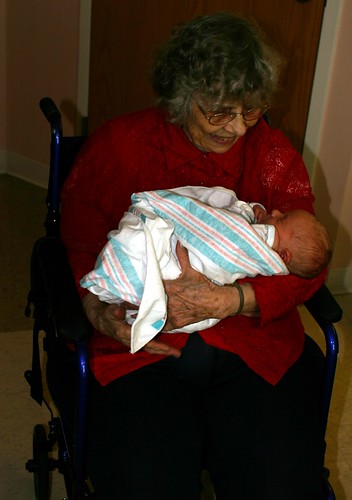
Jacob has lately been telling us gate gamma kassen so sick (Great Grandma Klassen is so sick), after his visit to the hospital, and it s true. Today started normal enough, but by 2:45 I got an email from my mom, saying that grandma had taken yet another turn for the worse; her pulse was racing, her temperature feverish, and her breathing shallow and difficult. The last grandchild that was going to be there made it, and got the last flicker of recognition from grandma. I wrapped some things up at work. Then I made the short drive from work to the nursing home, and got there just after 4. I went in to her room there, and it was full of family. Two of her children were singing her favorite hymns. I can never forget my uncle s deep bass voice as he stood at her bedside, holding her arm, while my aunt patted her head, both of them singing. Grandma s only remaining sibling, her younger brother Melvin, sat on the other side of the bed, looking on. Grandma s white table and chairs, which were in grandma and grandpa s house as long as I can remember, and followed grandma through all of the four other places she lived in the last years of her life, were in her room at the nursing home too. It always felt like home to be with grandma and those familiar things that she always took with her. Despite what was happening, I was glad she was back at home. My uncle motioned me over to her bedside, and I took her hand for a few minutes. It felt cold and weak; for the first time, she didn t grab my hand at all. A nurse came in to check oxygen saturation, but the machine wasn t able to get a reading due to poor circulation to her hand. She wasn t able to get a heart rate either because the heart was racing so fast. She discussed briefly whether the family wanted them to continue giving her oxygen, and they decided that they would, for her comfort. My uncle and aunt kept singing. I blew my nose and dabbed at my eyes, and there were hugs all around. And just a few minutes later, grandma peacefully stopped breathing, maybe 20 minutes after I had arrived. They went to get the nurse, who came back to listen to grandma s heart again, though we knew what she would find. She took the stethoscope off, and she almost lost her composure, but managed to say you can turn the oxygen off now. Several people gave grandma a last hug. After a few minutes with just the family, they told the nurses to go ahead and call the funeral home. That set off a lot of activity making arrangements for the next few days, funeral plans, and the like. I stepped back into grandma s room a few times, while the family was in the sitting area right outside it discussing. I looked around at the family photos on the wall, the old table and chairs, the recliner. Now, these are the things that were grandma s. It didn t feel like home anymore. Terah and Jacob were stuck at home Terah s car was at the mechanic for repair today. I called to give her the news. She wanted to come to be with the family, but I didn t really want to leave. She tried calling some friends to see if they could give her a lift to the mechanic, but not one of them was available. I talked to her again and suggested she just call the mechanic. She wasn t even halfway through describing the situation when he interrupted with, We ll have it at your place right away! Well, I don t expect you to have to do that, or you could certainly wait until you close. Nope, this isn t your average community, we ll bring it right over. You should be there. Grandma has enjoyed a simple life and had requested a simple death: no extraordinary measures at the end of life, no embalming either. So, by law, the burial must happen within 24 hours of death, and will be tomorrow. After all the arrangements, people realized nobody had supper yet. We went to the quickest available option pizza and ate there. It was paid for out of grandma s remaining money the last meal of so many that she provided for her family over the years. It was a happy meal. As I drove home, NPR news was on the radio. There were the same stories we hear all the time: the economy, the mideast, the president. Normally I m interested, but today I shut it off. Today is different. Tomorrow, for the second time in four years, I will help carry a grandparent s casket a few days before Easter. I ll end tonight with this photo. It was taken soon after Jacob was born. Grandma came to the hospital and held him. That smile sums her up perfectly. img_4965r.jpg

6 April 2009

John Goerzen: Lucky Squares

Terah and Jacob were shopping in the cereal aisle the other day. Jacob saw a box of Lucky Charms (not one of the more nutritive cereals). He pointed to it and really wanted it. Terah pointed to a better choice, and asked him, Shall we get that one instead? Jacob looked at the other cereal dubiously, unconvinced. Terah added, It is SQUARES! That was all it took now Jacob wanted that cereal. Terah told me this story, and added this won t work for long. She s right, of course. I guess we ll hope that they ll come out with octagonal cereal one of these days.

John Goerzen: Today

This morning started with a call from my mom. She was calling to let us know that my grandmother had apparently taken a turn for the worse, and we didn t know how much time was left. Terah, Jacob, and I got dressed and went to the hospital to visit. Grandma had been in a partial coma that left her able to hear, nod, and hold hands, but unable to speak. Apparently she came out of it overnight, and was talking and even singing with my mom and aunt some. She seemed happy, loved to hear the old German prayers she grew up with. She said some memorable things I ll have to write about later too. By the time we got there, she wasn t that active anymore, and was about like she was yesterday. She could see us, and give our hands a squeeze, maybe nod occasionally. She drifted asleep often. One time when I saw she was awake with her eyes open, I lifted up Jacob to where she could see him. Immediately her face brightened, and I saw the biggest smile on her face that I d seen in days! She smiled and waved to him, and with a small bit of coaxing, he waved back. Then she wiggled her foot, and when Jacob noticed, he wiggled his foot back at her. He s 92 years younger than her, and they still managed to communicate just fine. Grandma held my hand for awhile this morning; she loves to have a hand or two to hold. My cousin showed up for a visit, and I was going to get up to let her sit down, and when grandma felt my hand leaving, she grabbed on tighter. I went around to the other side of the bed and held the other hand. In the last couple of days, grandma s hearing has become much sharper than before, and I m pretty sure her memory has too. When it was time for us to leave and go to church, I was holding her hand, looking into her eyes, saying goodbye, and how much I loved her. I got a hand squeeze, and saw a few tears at her eyes the first I can remember seeing that. As I pulled my hand away to leave, she once again grabbed tighter and was still looking at me. I think she thought this was the last time she d see me, and didn t want the moment to pass too quickly. But that also guaranteed that I d be back in the afternoon. It was Palm Sunday in church today, and as every year, the Palm Sunday celebration ends with Bill singing I walked today where Jesus walked while Dale carries in a heavy cross. Right when Bill is singing I climbed the hill on Calvary, where on the cross He died! , Dale is climbing the steps to the stage and laying the cross there. Hardly a dry eye in the room at that. For lunch, my parents were still hosting their monthly college student get-together/home cooking event which we usually attend too. After that, I dropped off Terah and Jacob at home, and went back to the hospital. By the time I had left, grandma had 27 visitors just today. When I arrived, my great uncle (her brother) and aunt were there, along with her pastor and a deacon from her church, plus my mom and my aunt. More people came and went throughout the afternoon, and I enjoyed visiting and hearing stories about the family and grandma all afternoon. She was sometimes awake and able to look at people, and sometimes deeply asleep. I heard her say God bless you to several people. It was awhile before I had a chance to go be with her, and when I did, she was asleep, so I sat beside her bed and held her hand for quite awhile, maybe an hour, while visiting with family in the room. At one point, a nurse came in to give her some more morphine by IV. I got up to get our of her way, but the nurse said, Don t think of it; I can work around you, and what you re doing is more important than what I m doing anyway. Some of her old friends from church came by, and prayed with her in German, and recited the words to some German hymns and poems, which I think she really enjoyed. Her eyes were closed through most of it, but when they got to the end of each item, they opened, saying thank you, I believe. Eventually things calmed down, and it was time for me to head home. Grandma was awake by then, and I looked at her and said goodbye, and that I was glad I got to see her again. We gave each other a final hand squeeze, and then she let go of my hand this time. I m glad I came back for sure. They say sometimes that people that are dying feel like they need permission to die, before they will let themselves go. I wondered if grandma was feeling that way today. But then I hear that my uncle, who is driving in from 8 hours away through wintry weather, called and ask that she be given this message: Tell mom that I m coming, but if Jesus gets there first, she should go with him. That might not work on everybody, but for her, it s the best way I could think of to give her permission.

5 April 2009

John Goerzen: Grandma Update

I ve written twice recently about my grandmother s failing health. Yesterday, she was taken to the hospital due to severe pain. After many hours of tests, I believe her current diagnosis are: pneumonia, congestive heart failure, diabetes, gangrene in the gallbladder, and nonketotic hyperosmolar coma. She is able to hear and to see, but can t eat, drink, or talk. She can communicate a bit in other ways though. She has made it well known over the years that she doesn t want heroic measures to be taken to try to save her life in a situation like this. At this point, her treatment is focusing on making her comfortable, and she probably has a few days to maybe a week or two of life left. I went to visit her today. I walked in to her room, and she was visibly worse off than she had been a week ago. I said Hi Grandma as I went to her bedside. She with effort turned to look at me and managed to say hi back. Apparently that was the first word she said all day. She was clearly in pain, sometimes grimacing from it. It was hard to see, but I am glad I got to be with her. She wanted to hold my hand, and I sat by her bed for quite awhile doing just that. Sometimes my mom would comment that we all love each other, and I d see grandma nod, or she d give my hand an extra squeeze. My brother and his wife showed up just as I had to leave. Grandma said hi to them too, and gave them a little wave. I said goodbye as I left, and she was able to look at me and understand what was happening. I don t know if that will be the last time I ll say goodbye or not. They seem to have found better ways to treat her pain by this evening, and she is resting comfortably by now. If her condition stays like this, she will probably be moved back to her nursing home room with hospice care on Monday. She s 94, and all of us knew that this moment would come someday. I think she is the most comfortable with the idea of her death of anyone, and utterly ready for it.

4 April 2009

John Goerzen: Review: Why Religion Matters by Huston Smith

Most of the book deals with things we already know yet never learn. Huston Smith
This is perhaps one of the most enlightening books I ve ever read, and yet I feel like I ve only grasped a small bit of its meaning. It is with that warning that I attempt this review. I should add at the outset that this is one of those books where no matter what you expect it to be, after reading it, you will find that it wasn t what you expected. I heartily recommend it to everyone, from the devoutly religious to the devoutly atheistic. Science and Scientism Smith begins with a discussion of science and scientism. He is a forceful defender of science and of the work of scientists in general. But he is careful to separate science from scientism. Paraphrased, he defines scientism as the belief that science is the only (or the best) route to truth about everything. He points out that, through no explicit fault of scientists, scientism has become so ingrained in our modern psyche that even theologians have started thinking in terms of it. Yet there are some pretty glaring flaws in scientism, particularly where it comes to matters of philosophy, conscience, meaning, and religion. Smith argues that the foundation of science is the controlled experiment and logical inferences derived from it. He then proceeds to make strong case that it is not possible for humans to set up a controlled experiment to either prove or disprove the existence of something more than our material world a transcendence, a metaphysical reality, a spirit, a God. We, with our existence trapped in this finite world, cannot possibly hope to capture and control something so much more than us in every way: intelligence, versatility, and finiteness . Thus science can t even address the question. That hasn t stopped people from claiming that religion is just a helpful delusion, for instance, despite not being able to prove whether it is in fact a delusion or reality. Worldviews Smith then asks us to indulge a moment in considering two different worldviews: one the science-only worldview so common these days, and the other a more traditional religious worldview with a rightful place for science. He defers supporting evidence for each for later chapters. The science-only worldview is pretty familiar to many, and I have even heard parts of it articulated in comments left on this blog. It goes roughly like this: The universe is x billions of years old. It is, so far as we presently know, a vast expanse with mostly dead matter. Earth is the only exception, which contains some living organisms and even sentient beings, though these make up a small fraction of even the earth. This life arrived by accident through physical and biological processes, some of which are well-understood and some aren t. In the end, the universe will again become entirely dead, as our planet will be incinerated when our sun goes nova. Or, in any case, the entire universe will eventually expire in one of various ways. This worldview suggests that it is an accident that we are here and that we have consciousness, and that our actions have no ultimate meaning because the earth will eventually be incinerated anyhow. The traditional worldview holds the opposite: that instead of having our origins in the tiniest and simplest of building blocks, and eventually improving over time, we should more properly think of ourselves as being derived from something greater than ourselves. That greater something is part of our world, but something much bigger than it too. It does not rule out science, but neither is it something that science can ever explain. It suggests that our lives have a purpose, that our work has meaning, and that there are ultimate ends to seek. Smith is a scholar of world religions, and draws on his considerable experience to point out that virtually all world religions, before the Enlightenment, drew essentially the same picture of our world and the more . He reminds us though perhaps less effectively than Marcus Borg that there are other ways of knowing truth besides science, and suggests that we pay attention to what the vast majority of humanity had to say about the nature of existence before a human invention started to squelch the story. The Stories The book is filled with personal stories (Smith spent at least a decade each researching and practicing at least four different religions), quotes, and insights. I consider it the most enlightening book on religion I have yet read. Smith has more than a passing familiarity with physics, and the physicists in the crowd will probably be delighted at his discussions of quantum mechanics and the claim that nonlocality provides us with the first level platform since modern science arose on which scientists and theologians can continue their discussions. One passage reads like this:
Again I will let Henry Stapp say it: Everything we [now] know about Nature is in accord with the idea that the fundamental process of Nature lies outside space-time, but generates events that can be located in space-time. Stapp does not mention matter, but his phrase space-time implies it, for physics locks the three together.
He says that quantum theory of course can t prove that there is a God, but that recent research seems to disprove the old notion that, given enough time, all questions will be answerable by science. Even if you disagree with every one of Smith s conclusions, you ll be along for a fascinating ride through physics, biology, philosophy, and innumerable religions. One of my favorite anecdotes concerns noted physicist David Bohm (who studied under Oppenheimer and worked with Einstein, among others). He gave a lecture at one point, apparently touching on his hidden variable theories to a great extent. At its conclusion, a senior physics professor asked derivisely, What does all this philosophy have to do with physics? Bohm replied, I do not make that distinction. How s that for something to ponder? The Writing The book is fun to read, and the stories make it all the moreso. However, it is not a light read. Houston Smith wrote this near the beginning, without any hint of irony:
The first of these differences is that Gass s is an aristocratic book, written for the literary elite, whereas mine is as plebeian as I can render its not always simple arguments.
I can think of a few simpler ways to express that thought. In any case, it isn t light reading, but it is accessible even if you, like me, have little formal training in philosophy, theology, or quantum physics. Conclusion I would do such a poor job trying to paraphrase Smith s main points that I haven t even really attempted to do so here. Get the book you ll be in for a treat. Incidentally, I had been thinking of buying the book for awhile. What finally made me do so was an NPR story about how he helped preserve the sound of the Gyuto Monks Tantric Choir back in 1964, when he (of course) was sleeping in a monastery in the Himalayas and awoke to investigate something transcendent the holiest sound I have ever heard. I pressed the Buy button for the Kindle edition a few minutes later.

30 March 2009

John Goerzen: Kindle 2: How s It Going?

It s now been almost a month since I got my Kindle 2 and wrote about my first impressions of it. In that amount of time, I figure I have read, on the Kindle, the equivalent of 1500 to 2000 printed pages. I ll start with my personal reactions to the device, and then move on into some less subjective observations about it. What I ve Used It For To give you a quick idea of what I m reading: The Gut Reaction I want everything to be available on the Kindle, and I want to read everything on it. Whether that s just some excitement at a new device (still possible after a month, I guess), or something more lasting, I m still a little unclear about but I suspect it s something more lasting. I have read far, far more since I have had the Kindle than I had for quite some time prior, excepting a certain Hitchhiker s Guide to the Galaxy marathon one Christmas vacation. This leads me to think that the Kindle s main competitor isn t the Sony PRS-505, but rather the XBox, Wii, Netflix, and Hulu. Not that I watched that much TV to start with, but I haven t even been keeping up with the Daily Show since I got the Kindle. Not only that, but it prompted me to go to the local used bookstore (all proceeds go to charity) and buy a paper copy of David Copperfield for $10, so Terah could read it with me while I reread it on the Kindle. So it seems that Amazon s stats which show that people tend to read more once they get the Kindle, and don t cut down on paper book buying are about right in my case. Plus there s the fact that I ve loaded up the Kindle with over a hundred free books of all sorts of descriptions, some from Amazon s own free book catalog (extensive in itself), and others from Feedbooks, Gutenberg, or other places. That s taken up some time itself, and I now have achieved what I tend to achieve with all devices like this (iPod, MythTV, etc): more material than I can ever possibly get through. Why I Like It So, what exactly IS it about this thing that I like? Part of it has to be the size of the device. Granted, I wish the screen were larger, but even with the leather case, the device is a pretty nice size. I find that I keep two or three books that I m reading at the top of my list, and it s great to be able to carry around a single device and be able to select from a book as the mood strikes. Part of it is the built-in dictionary and search tools, which I ve already discussed. In the end, Amazon s execution of the concept is just done really, really well. It doesn t require some sort of proprietary Windows app like Sony s reader does. It doesn t even require a PC at all. It acts as reliable as a book, and that s something. The highlight/clippings feature is also pretty nice. You can highlight a section of text, which then causes it to be rendered with an underline on-screen just like you can underline something in a book. Better yet, when you re reading the book, you can call up a list of all such passages (as well as your bookmarks, etc), see them with an excerpt of text, and jump directly to them. No more need for millions of tiny pieces of paper marking a page that contains a marking. Even better than that, the Kindle creates a .txt (yes, plain text) file in the documents/ directory for you. Each time you bookmark or highlight a passage, it adds a little summary of the passage to that file, as well as information about the location of it. For highlights, the summary is the content of the highlight itself. So if you re going to go blog about the book later, there are a bunch of ready-made quotes you can cut-and-paste later. You can read that file both on the Kindle and on a PC. Sweet. So, I guess I would say that the Kindle makes it easier to read complex texts, and fun to read lighter ones. Availability of Content There are several ways you can get content onto the Kindle. The first, of course, is Amazon s own Kindle Store. Quite the clever bit of engineering there. You hit buy , and generally by the time you can walk over to the Kindle and pick it up, the book s on it, thanks to the integrated cell-network wireless modem. Subscriptions to newspapers and magazines work similarly each issue is automatically delivered in the middle of the night. However, it seems that the magazines such as New Yorker and Atlantic aren t exactly complete replicas of the print editions for some reason. The pricing of Kindle content is generally cheaper than paperback editions of books, but not by much. I think it should be more heavily discounted than it is, and part of that may be due to the large commission Amazon takes on things. Ironically, Amazon also has a tremendous array of free public domain and copyrighted books, and an equally staggering number of books available for under $1. For the classics, and other things out of copyright, my favorite place to turn is Feedbooks. They ve got ebooks available for download for just about any format, including Kindle, and generally do a good job of providing a real linked Table of Contents and the like. Kindle can read DRM-free content in .txt or .mobi format. I ve also built my own ebooks for the Kindle using Mobiperl. It takes an ePub source directory and makes a MobiPocket file out of it, which can be installed on the Kindle directly. For things I find on Project Gutenberg, GutenMark is a nice tool to create a good-looking HTML representation. I also use quote-fixer to help with my other pet peeve: straight quotes and lack of em-dashes on a device that can, and should, display both. Screen I m still of two minds about the screen. On the one hand, it doesn t give me eyestrain like reading on a PC, laptop, or cellphone screen does. Also, it looks remarkably book-like. A well-prepared Kindle etext feels so professional on the screen, so real, so lovingly-prepared, that it s fun to read. The Feedbooks David Copperfield is an excellent example of this, as is Houston Smith s Why Religion Matters. There are several things I don t like about the screen. One is that, while reading a book, it leaves a margin around the edge of the text. I can t figure out why it doesn t use all the available screen real-estate, especially since its built-in web browser does. Another is that, while not terribly reflective, it is still somewhat reflective, and glare from the sun or a light at a bad angle can make the screen unreadable unless you turn it a bit to a different angle. But my biggest gripe about the screen is that it s not as high-contrast as I d like. Still, I very much enjoy the Kindle, so I guess it s not as huge a problem as I think it could be sometimes. Pet Peeve I get really annoyed when I download content for the Kindle and discover that it doesn t have a linked Table of Contents (meaning I can click on a chapter and go directly to it). I m even more annoyed when it uses straight typewriter quotes instead of the angled typesetter s quotes or smart quotes . The Kindle is capable of beautifully rendering them, as well as things such as em dashes, and when I see what is obviously some cheap attempt at a conversion of some ancient ASCII document, rather than a proper attempt to make a good-looking book, I get annoyed. And so it was that I requested, and got, a $0.80 refund for my purchase of Sherlock Holmes: The Complete Collection and instead paid $3.60 for The Complete Sherlock Holmes. Yes, I could have spent a few hours converting all these from Gutenberg, but $3.60 is so cheap that it wasn t worth it. Customer Service Amazingly, Amazon s customer service for the Kindle is not their usual Asian form letter service. It s Americans, who seem to read, understand, and care about problems. I was pleasantly surprised. Too bad the rest of Amazon doesn t learn a thing or two from it. Conclusion I think the Kindle is worth it. It will pay for itself exceptionally quickly for people like me that don t live anywhere near a large library, and enjoy reading out-of-copyright material. Even if it doesn t pay for itself that quickly, the convenience of being able to carry several actively reading books with you on a single small device is pretty nice. No more pile of books in my suitcase for travel.
27 March 2009

John Goerzen: Peace

Today over lunch, I and 6 others went to visit Grandma. She was in her room, looking better physically today than yesterday. When I walked in, I said brightly, Hi Grandma! She took my hand warmly, and said to me, Now I don t think we ve met. Who are you? I knew that moment would happen someday, but still was surprised when it happened. Mom told her that we were there to tell her we love her. Grandma counted out the seven of us, and said, All these wonderful people here to tell that to ME? That s Grandma still there! It was a difficult moment. Many of us were tearful, and Grandma was sick enough that she sometimes lost the battle to stay awake. But we were all glad it was happening. Mom thought it right (me too) that she should tell Grandma about the latest word from the doctors. The conversation went, in part, something like this, with my mom addressing her mother: My Mom: Mom, the doctors say your heart is probably wearing out. My Grandma: *shrug* Yeah. My Mom: And your body is probably tiring out too. My Gramdma: Yes it is. I m 94. It s not that Grandma was depressed or anything. Just that she had long ago been at peace with the idea of death, and actually told us more than once that the was rather surprised that she has lived to be as old as she has. So it wasn t frightening or surprising to her to confront her own mortality. To her, it was a fact, and an obvious one at that. My brother brought along Grandma s old Bible. She had given it to him a few years ago. It was filled with highlights and handwritten notes from cover to cover. She had carefully analyzed it, and when she bought a new Bible, had carefully copied the notes to it. My brother read to her two passages that she had highlighted:Psalm 23: (which she has noted as a favorite of many Christians ) and Numbers 6:24-26. He then held her hand and said a prayer with her. Then he said a blessing for her, and as he was getting to the end, she interrupted, saying the last word for him: forever! She still had her sense of humor, and made us all laugh several times. She said, as she always has when any of us stop by to visit, how happy she is that we came by, and what a wonderful family she has. She said several times Danke sch n, Danke sch n, Danke sch n! (Thank you, thank you, thank you! she had made sure to teach a few German words to all of us as kids.) When it was time to go, she got lots of hugs from us, and made a point to tell each of us individually thank you for coming! As we walked down the hall, I was reminded of her old tradition going back many years. Whenever we would leave her house, she d wave to us from the porch. And, if it was dark, we d turn on the car light and wave back. Since she s been in the nursing home, she ll wave to us from her doorway as we walk down the hall. And, sure enough, today s visit ended with her waving to us from her doorway with both hands (as she always does) and a big smile. We all waved back with a smile as we walked away, too. I don t know if this will be the last goodbye with her, but if it is, I can t think of a better one.

26 March 2009

John Goerzen: Time

When I was a child, I was learning to play piano. My parents didn t have one at the time, but my grandparents did. Every evening, we d go over to their house so I could practice. I suspect I was more interested in other things most of the time, though whether Grandma has some cherry moos in her fridge, or whether Grandpa would play chess with me or do something fun in his workshop. Grandma would often be in her curlers, and we d often leave her in the evening saying goodbye in the pink fluorescent lights she had shining on her plants by the door. Other times, we d just go to visit, or I d ride my bike over. I liked helping Grandma cook or bake peppernuts. And when I was trying to learn chess from Grandpa, and Grandma thought he was being too hard on me, she d say something to him in German and I d magically start winning. Grandma volunteered at a local thrift store weaving rugs. These were made by hand on old looms in a traditional way, mainly out of donated clothes and drapes that were too tattered to sell. My mom used to drop me off with grandma while she went shopping. I maybe brought my lunch, and watched grandma, until one time I asked her if I could help. She let me, and eventually the store manager told grandma that I ought to be able to work on my own loom. Pretty soon we had a routine down: in summer, Grandma would pick me up at home, I d read a computing magazine in the car to town, and work at a loom side-by-side with Grandma. That lasted until I got too busy in high school. But ever since then, Grandma delighted in telling this whole story almost every time she saw me, and she remembered word for word what the store manager said something I never quite could remember. I remember watching Grandma care for my brothers when they were sick, or helping out my parents with whatever they needed help with. We had a tradition for a number of years of spending New Year s Eve at Grandma and Grandpa s house, and going back home the next morning. The three of us boys slept in a cold upstairs room, but we didn t care because the bed had more layers on it than we could count, and an electric blanket besides. When my Grandpa Klassen passed away in 1990, Grandma missed him but didn t get too worked up about it. She was convinced that he was in a better place, and appeared to be at peace with it. Death was a normal part of life to her, and it didn t surprise her that it happened. In the last few years, Grandma s health has been failing. Her knees have been bothering her for years, and she has also been struggling with dementia for a few years. It s been hard on me to visit her, because in some ways she hasn t been the same person I remember for awhile now, and in other ways she s exactly the same. Lately she hasn t always remembered where I live, or what Terah and Jacob s names are, we knew to expect that and are respectful of the situation. For years now, Grandma has been saying, I don t know why the Good Lord doesn t take me up to be with him yet. My bags are packed and I m ready! Last time I saw her, I mentioned that we used to do weaving together, and she couldn t remember. That was a sure sign to me that things had taken a turn for the worse. Our last several visits have ended with a big hug, and her still iron grip on my hand, with her saying, Thank you for coming! My family is so good to me. We love each other! She s been battling infections and heart problems the past few weeks. This evening, I got an email from my mom saying It s time to say our goodbyes. She had been to see Grandma today, and Grandma still managed to tell her, We love each other. As much as time has changed her in the past few years, she s still there, the same loving Grandma as ever.

24 March 2009

John Goerzen: Review: David Copperfield

I finished reading David Copperfield on the Kindle a few days ago. This is a review of the novel, not the Kindle. I m not an English major, and so I m not going to pretend to be one. I m not going to discuss what themes the book touches on, what category it fits in, or generally dissect it to the point where it s more monotonous than fun. I read the book because I wanted to, not because I had to write a paper about it. I must say, first of all, that this has got to be one of the best books I ve ever read. The vivid descriptions of the characters were just fun to read. One particularly meek man was described like this: He was so extremely conciliatory in his manner that he seemed to apologize to the very newspaper for taking the liberty of reading it. Some of the scenes in the novel are amazingly vivid and memorable. The hilarious and tense scene towards the end where one of the main villains is taken down was one, and of course just about every scene involving David s aunt is too. Dickens is a master of suspense. He does it through subtle premonitions in the book. You might not even really notice them as you re reading. But it sure had an effect on me: I had trouble putting the book down, and stayed up later than I should have on more than one night to keep reading another chapter or three. Like any good book, this one left me to think even after I was done reading it, and left me wanting to read it again. Right now. There are some practical downsides to it, though. It was written in the 1850s, and some of the vocabulary and British legal, business, and monetary discussions are strange to a modern American audience. Nevertheless, with the exception of the particularly verbose Mr. Micawber, you can probably make it through without a dictionary, though one will be handy. I read it on the Kindle, which integrates a dictionary and makes it very easy to look up words. I learned that a nosegay is a bouquet of showy flowers. And that Mr. Micawber was fond of using words obsolete since the 17th century, according to the Kindle. If you remember that pecuniary emoluments refers to a salary, you ll be doing OK. The other thing that occasionally bugged me was that the narrator (David) would comment on some sort of gesture, or comment that wasn t very direct, and then say something like, But she didn t need to be more explicit, because I understood the meaning perfectly. Well, sometimes I didn t. Though I usually figured it out after a bit. I was never quite sure if Dickens was being intentionally needling to the reader, or if an 1850s British reader would have figured out the meaning perfectly well. But that was part of the fun of it, I think.

15 March 2009

John Goerzen: QUISH!

Today, I was sitting on the couch. Jacob crawled up, and pushed me forward, saying I go there. He crawled behind me. Then, ready for one of his favorite games, yelled out: QUISH, daddy! So I leaned back gently a bit, and said squish! Jacob yelled, laughing, QUISH! Quish again, daddy! So I d lean back a bit, gently, again, this time reaching behind me to tickle him a bit as I leaned. Squash! Louder laughing. QUASH!!! Right in my ear ouch, but I didn t mind. Do it again, daddy! Right now, being a dad seems complicated enough. You ve got to have the right touch to squish a 2-year-old without really squishing him. Or have the presence of mind to realize that when Jacob was happily playing outside, then suddenly comes running over, very upset, saying Go inside! it means he probably needs to use the potty urgently, or just had an accident. (Or both, as it happened today.) Or to recognize that little walk that means he really does need to use the potty even though he d rather not. And, of course, there s figuring out what he s saying, when his words can still be a bit garbled. But these all seem simple to me, compared to what will come. How will we help Jacob to grow as a person of good character? How will we meet his need to be challenged intellectually? Will we be able to maintain a good relationship, and yet still have the judgment to have the right set of rules, when he gets to high school? Will I have a good relationship with him as an adult? And how am I going to react when the day comes when he tells me I ought to move into the nursing home? Jacob, of course, doesn t care about any of that right now. Each night, when I put him down for the night, he wants me to cover him up with blankets. Once I ve done that, he peeks out and says, Have a good night, dad! I always reply with You have a good night too, Jacob! If we can get along that well for the next 60 years, I guess we ll do all right.

9 March 2009

John Goerzen: A Few Days With the Kindle 2

So I am going to do something that nobody on the Internet is doing lately: post a review of the Kindle 2 after having only used it for three days. Shocking, yes, I know. I had never even seen a Kindle of either model before getting the Kindle 2. I had, though, thought about getting an eInk device for some time. The $359 Kindle 2 price tag caused me significant pause, though in the end I went for it due to the 30-day return policy. On the surface, I thought that it would be weird to have a Kindle. After all, how often am I away from the computer? And there s a small local library a few blocks from where I work. But I had a hunch it might turn out for me like my iPod did: something that didn t sound all that useful from reading about it, but turned out to be tremendously so after having actually used it. Turtleback Delivery I ordered my Kindle 2 with standard shipping, which meant that it went by FedEx Smart Post. Here is my SmartPost rant. There are two words in Smart Post that are misleading. I once had an item take literally a week to make it from St. Louis to Kansas. That is, I kid you not, slower than the Pony Express ran in 1860. This time, my Kindle made it from Kentucky to Kansas in a mere five days. Oh, and it spent more than 24 hours just sitting in St. Louis. The Device Overall, the device is physically quite nice. It is larger and thinner than I had imagined, and the screen also is a bit smaller. It is usually easier to hold than a paperback, due to not having to prevent it from closing too far at the binding edge. The buttons are easy to press, though I could occasionally wish for them to be easier, but that s a minor nit. The Screen The most important consideration for me was the screen. The eInk display as both stunningly awesome and disappointing. This is not the kind of display you get on your computer. Or, for that matter, any other device. It isn t backlit. It reacts to light as paper does. It can be viewed from any angle. And it consumes no power to sustain an image; only to change it. Consequently, it puts up a beautiful portrait of a famous author on the screen when it is put to sleep, and consumes no power to maintain it. The screen s response time isn t anywhere near as good as you d expect from a regular LCD. It flashes to black when you turn a page, and there is no scrolling. On the other hand, this is not really a problem. I found the page turning speed to be more than adequate, and probably faster than I d turn the page on a real book. The resolution of the display has the feeling of being incredible. The whole thing provides a far different, and in my eyes superior, experience to reading on an LCD or CRT screen. My nit is the level of contrast. The background is not really a pure white, but more of a light gray. This results in a contrast level that is quite clearly poorer than that of the printed page. At first I thought this would be a serious problem, though I am growing somewhat more used to it as I read more. Reading Experience Overall, I ve got to say that it is a great device. You can easily get lost in a book reading it on the Kindle. I m reading David Copperfield for the first time, and have beat a rather rapid path through the first five chapters on the Kindle already. And that, I think, is the best thing that could be said about an ebook reader. It stays out of the way and lets you immerse yourself in your reading. The Kindle s smartly-integrated Oxford-American Dictionary was useful too. One thing about a novel written 150 years ago is that there are some words I just haven t ever heard. Nosegay, for instance. You can move a cursor to a word to see a brief pop-up definition appear, or press Enter to see the entire entry. This is nice and so easy that I m looking up words I wouldn t have bothered to if I were reading the book any other way. A nosegay, by the way, is a bouquet of showy flowers. Buying Experience The Kindle has a wireless modem tied to the Sprint network on it. The data charges for this, whatever they may be, are absorbed by Amazon in the cost of the device and/or the books you buy for it. This turned out to be a very smart piece of engineering. I discovered on Amazon s Kindle Daily Post that Random House is offering five mostly highly-rated sci-fi books for free on the Kindle for a limited time. So I went over to the page for each, and made my purchase . It was only a click or two, and I saw a note saying it was being delivered. A few minutes later, I picked up the Kindle off the kitchen counter. Sure enough, my purchases were there ready to read. Impressive. This level of ease of use smells an awful lot like Apple. Actually, I think it s surpassed them. You can delete books from the Kindle and re-download them at any time. You can initiate that operation from either the PC or the Kindle. And you can also browse Amazon s Kindle store directly from the device itself. I haven t subscribed to any magazines or newspapers, but I gather that they deliver each new issue automatically the moment it s released by the publisher, in the middle of the night. I pre-ordered the (free to Kindle) Cook s Illustrated How-to-Cook Library. It makes me way happier than it should to see This item will be auto-delivered to your Kindle on March 26 in the order status. Free Books Amazon s Kindle library has a number of completely free Kindle books as well. These are mostly out-of-copyright books, probably sourced from public etext places like Project Gutenberg, and converted to the Mobipocket format that is the Kindle s native format with a minimum of human intervention. As they are free, you can see them in Amazon s library if you sort by price. And, of course, Amazon will transfer them to the Kindle wirelessly, and maintain a copy of them in your amazon.com account. Unfortunately, as with free etexts in general on the Internet, the quality of these varies. I was very annoyed to find that many free etexts look like they were done on a typewriter, rather than professionally printed. They don t use smart quotes; only the straight ones. When reading on a device that normally shows you a faithful print experience, this is jarring. And I spent an inordinate amount of time trying to find a copy of Return of Sherlock Holmes that actually had the graphic figures in Dancing Men. Ah well. Your Own Content Amazon operates a mail server, username@kindle.com. You can email stuff to it, and it will convert it to the Kindle format and wirelessly upload it to your kindle for a fee of $0.10. Alternatively, you can use username@free.kindle.com, which does the same thing at no charge, but emails you back a link to download the converted work to install via USB yourself. I tried it with a number of PDFs. It rejected about a dozen times from only my single mail message a PDF containing graphic images only. However, it does quite well with most text-heavy PDFs notably doing an excellent job with Return of Sherlock Holmes from bookstacks.org the only source I found that was both beautifully typeset and preserved the original figures. Unfortunately, the PDF converter occasionally has troubles identifying what should be a paragraph, particularly in sections of novels dealing with brief dialog. I have also sent it some HTML files to convert, which it also does a great job with. You can also create Mobipocket files yourself and upload them directly. There is a Mobipocket creator, or you can use mobiperl if you are Windows-impaired or prefer something scriptable on Linux. The device presents itself as a USB mass storage device, so you can see it under any OS. There s a documents folder to put your files in. You can back it up with your regular backup tools, too. And it charges over USB. Web Browser I haven t tried it much. It usually works, but seems to be completely down on occasion. It would get by in a pinch, but is not suitable for any serious work. The guys over at XKCD seem to love it; in fact, their blog post was what finally convinced me to try the Kindle in the first place. Final Thoughts I ve ordered a clip-on light and a leather case for the Kindle. The light, I believe, will completely resolve my contrast complaint. The leather case to protect it, of course. I can t really see myself returning the Kindle anymore. It s way too much fun, and it s making it easier to read more again. And really, if Amazon manages to reach out to a whole generation of people and make it easy and fun for them to read again and make a profit doing it, of course they may move up a notch or two from being an evil patent troll company to a positive social force company. Wow, never thought I d say that one.

7 March 2009

John Goerzen: My Week

It s been quite the week. Stomach Flu Last Friday, my stomach was just starting to feel a little odd. I didn t think much off it a little food that didn t go over well or stress, I thought. Saturday I got out of bed and almost immediately felt like throwing up. Ugh. I probably caught some sort of stomach flu. I was nauseous all day and had some terrible diarrhea to boot. I spent parts of Saturday, Saturday night, Sunday, and Sunday night supervising some emergency downloads as the BOFH would say. By Sunday afternoon, I thought I was doing good enough to attend a practice of the Kansas Mennonite Men s Choir. I made it through but it wasn t quite as up to it as I thought. Monday morning I woke up and thought the worst was behind me, so I went to work. By evening, the worst clearly was not behind me. I was extremely cold, and then got very hot a few hours later. Tuesday I left work a little early because of not feeling well. Servers Wednesday a colleague called me at home before I left to say that the ERP database had a major hiccup. That s never good. The database is this creaky old dinosaur thing that has a habit of inventing novel ways to fail (favorite pastime: exceeding some arbitrary limit to the size of files that no OS has cared about for 5 years, then hanging without telling anybody why). My coworkers had been working on it since 5. I went into the office and did what I could to help out, though they had mostly taken care of it. Then we went to reboot the server. It didn t come back. I/O error on sda just after init started, and it hung. Puzzled, as it just used that disk to boot from. Try rebooting again. This time, I/O error as the fibre channel controller driver loads. Again, puzzled as it just used that controller to load grub. Power cycle this time. And now the server doesn t see the fibre channel link at all. Eep. Check our fiber optic cables, and power cycle again. And THIS time, the server doesn t power back up. Fans whir for about a second, then an ominous red light I never knew was there shows up. Eeep! So I call HP. They want me to remove one CPU. Yes, remove one CPU. I tried, and long story short, they dispatch a local guy with a replacement motherboard. Can you send along a FC controller, in case it s dead too? Nope, not until we diagnose a problem with it. Local guy comes out. He s a sharp guy and I really like him. But the motherboard wasn t in stock at the local HP warehouse, so he had to have it driven in from Oklahoma City. He gets here with it by about 4:30. At this point the single most important server to the company s business has been down almost 12 hours. He replaces the motherboard. The server now powers up yay! And it POSTs, and it . doesn t see the disks. !#$!#$ He orders the FC controller, which is so very much not in stock that they can t get it to us until 8:30AM the next morning (keep in mind this thing is on a 4-hour 24/7 contract). Next morning rolls around. Outage now more than 24 hours. He pops the FC controller in, we tweak the SAN settings appropriately, we power up the machine, and . still doesn t see any disks, and the SAN switch still doesn t see any link. EEP! Even the BIOS firmware tool built into the controller doesn t see a link, so we KNOW it s not a software issue. We try plugging and unplugging cables, trying different ports, everything. Nothing makes a difference. At this point, while he ponders what else he can replace while we start migrating the server to a different blade. We get ERP back up on its temporary home an hour later, and he basically orders us every part he can think of while we ve bought him some room. Several additional trips later, he s replaced just about everything at least once, some things 2 or 3 times, and still no FC link. Meanwhile, I ve asked my colleague to submit a new ticket to HP s SAN team so we can try checking of the switch has an issue. They take their sweet time answering until he informs them this morning that it s been *48 HOURS* since we first reported the outage. All of a sudden half a dozen people at HP take a keen interest in our case. As if they could smell this blog post coming So they advise us to upgrade the firmware in the SAN switch, but they also say we really should send this to the blade group; the problem can t be with the SAN and of course the blade people are saying the problem s GOT to be with the SAN . We try to plan the firmware upgrade. In theory, we can lose a switch and nobody ever notices due to multipathing redundancy. In practice, we haven t tested that in 2 years. None of this equipment had even been rebooted in 390 days. While investigating this, we discovered that one of the blade servers could only see one path to its disks, not two. Strange. Fortunately, THAT blade wasn t mission-critical on a Friday, so I power cycled it. And it powered back up. And it promptly lost connection to its disks entirely, causing the SAN switches to display the same mysterious error they did with the first blade the one that nobody at HP had heard of, could find in their documentation, or even on Google. Yes, that s right. Apparently power cycling a server means it loses access to its disks. Faced with the prospect of our network coming to a halt if anything else rebooted (or worse, if the problem started happening without a reboot), we decided we d power cycle one switch now and see what would happen. If it worked out, our problems would be fixed. If not, at least things would go down in our and HP s presence. And that worked? What? Yes. Power cycling the switch fixed every problem over the course of about 2 minutes, without us having to do anything. Meanwhile, HP calls back to say, Uhm, that firmware upgrade we told you to do? DON T DO IT! We power cycle the other switch, and have a normal SAN life again. I let out a WOOHOO! My colleague, however, had the opposite reaction. Now we ll never be able to reproduce this problem to get it fixed! Fair point, I suppose. Then began the fairly quick job of migrating ERP back to its rightful home it s all on Xen already, designed to be nimble for just these circumstances. Full speed restored 4:55PM today. So, to cap it all off, within the space of four hours, we had fail: Murphy, I hate you. The one fun moment out of this was this conversation: Me to HP guy: So yeah, that machine you ve got open wasn t rebooted in 392 days until today. HP guy: WOW! That s INCRED oh wait, are you running Linux on it? Me: Yep. HP: Figures. No WAY you d get that kind of uptime from Windows. And here he was going to be all impressed.

27 February 2009

John Goerzen: Dad Have A Light

We got a new camcorder recently. I was trying it out after it was unboxed, of course. Jacob came over and got a glimpse of the LCD screen on it, which he called a light. Dad have a light. See it. So of course I rotated it around so he could see it. Then I couldn t, so I was shooting blind. But he enjoyed it. Here s the video: If the embedded video doesn t work in your RSS reader, try this link. That s the first video I ve ever uploaded to a public video sharing site. Finally catching up with the Internet, I guess.

Next.

Previous.