Search Results: "Gunnar Wolf"

25 November 2009

Gunnar Wolf: Source format 3.0 (quilt) for teh win!

My Debian QA page shows what I consider to be a huge amount of packages I am currently uploader for 207 packages. Why so many? There are many factors The main one is group maintenance (I'm directly responsible only for 19; of course, this should not mean I disregard the rest of them), the second one is regularity. By far, most of my source packages (177) match lib.*perl, followed by lib.*ruby with 20. Anyway A strong factor that allows the pkg-perl group to be successful in maintaining 1411 packages is the regularity of the task: Packaging Perl modules is usually as easy as running dh-make-perl on them (of course, not taking away the merit of packaging the few strange corner cases In Ruby-land, the landscape is quite different. The developer community is quite anchored in agile worldviews, which go beyond coding practices and all the way over to confronting the way most Free Software projects distribute their work. I have previously ranted presented informed and opinionated blog posts on this topic Ruby culture dictates the distribution via Ruby Gems, which are for many reasons not Debian friendly. Besides Gems, most projects have adopted Git for development tracking and are hosted under Github That's why I came up with Githubredir, which basically presents an uscan-friendly listing of tags for a given project. But if you develop in Git, you might want to split a project in its constituent parts for easier organization, without meaning that each subproject should be an independent project by itself, right? After all, that's what Git submodules are for. That's what happened with a great PDF generating library for Ruby, Prawn. Thing is, the three parts of the main project are required for the project to be built. Anyway, that was a great reason to move the package over to the new dpkg 3.0 (quilt) source format. And, yes, it is a straightforward move! If you have not yet done so, take a look at Raphael Hertzog' explanation+FAQ wiki page. It just works, and makes many things way easier. There are still some wrinkles in my packaging, like where I'm getting the orig tarballs from As the submodules are not presently tagged in any way, I was only able to download a snapshot of their respective current master branches. This is suboptimal, I know, but I have talked to the upstream author, and he confirms that for the next major version (which should not be long in coming) the tags will be synchronized, and things will be even cleaner. PS- I love Hpricot. To get the numbers for my QA page, I just had to get three dirty but useful arrays:
  1. require 'hpricot'
  2. require 'open-uri'
  3. url = 'http://qa.debian.org/developer.php?login=gwolf&comaint=yes'
  4. doc = Hpricot(open(url))
  5. tot = ( (doc / 'table' )[1]/'tr').map row
  6. (row%'td' % 'a').inner_html rescue nil .select i i
  7. team = ( (doc / 'table' )[1]/'tr').map row
  8. (row%'td' % 'span.uploader' % 'a').inner_html rescue nil .
  9. select i i
  10. mine = ( (doc / 'table' )[1]/'tr').map row
  11. (row%'td' % 'span:not(.uploader)' % 'a').inner_html rescue nil .
  12. select i i

And work from the three very simple lists there i.e. tot.select pkg pkg =~ /lib.*perl/ .size gives me 177.

20 November 2009

Gunnar Wolf: EDUSOL almost over - Some highlights

Whew! Is it karma or what? What makes me get involved in two horribly complex, two-week-long conferences, year after year? Of course, both (DebConf and EDUSOL) are great fun to be part of, and both have greatly influenced both my skills and interests. Anyway, this is the fifth year we hold EDUSOL. Tomorrow we will bring the two weeks of activities to an end, hold the last two videoconferences, and finally declare it a done deal. I must anticipate the facts and call it a success, as it clearly will be recognized as such. One of the most visible although we insist, not the core activities of the Encounter are the videoconferences. They are certainly among the most complex. And the videoconferences' value is greatly enhanced because, even if they are naturally a synchronous activity (it takes place at a given point in time), they live on after they are held: I do my best effort to publish them as soon as possible (less than one day off), and they are posted to their node, from where comments can continue. This was the reason, i.e., why we decided to move at the last minute tomorrow's conference: Due to a misunderstanding, Beatriz Busaniche (a good friend of ours and a very reknown Argentinian Free Software promotor, from Via Libre) thought her talk would be held today, and we had programmed her for tomorrow. No worries - We held it today, and it is already online for whoever wants to take part :-) So, I don't want to hold this any longer (I will link to the two conferences that I'm still missing from this same entry). Here is the list of (and links to) videoconferences we have held.
Tuesday 2009-11-17
Wednesday 2009-11-18
Thursday 2009-11-19
Friday 2009-11-20
As two last notes: Regarding the IRC interaction photos I recently talked about, we did a very kewl thing: Take over 2000 consecutive photos and put them together on a stack. Flip them one at a time. What do you get? But of course A very fun to view and interesting interaction video! We have to hand-update it and it is a bit old right now, but nevertheless, it is very interesting as it is. Finally... I must publicly say I can be quite an asshole. And yes, I know I talked this over privately with the affected people and they hold no grudge against me... But still - yesterday we had an IRC talk about NING Latin American Moodlers, by Luc a Osuna (Venezuela) and Maryel Mendiola (Mexico). One of the points they raised was they were working towards (and promoting) a Moodle certification. And... Yes, I recognize I cannot hear the mention of the certification word without jumping and saying certifications are overrated. Well, but being tired, and not being really thoughtful... I should have known where to stop, where it was enough of a point made. I ended up making Maryel and Luc a feel attacked during their own presentation, and that should have never happened. A public and heartfelt apology to them :-(

16 November 2009

Gunnar Wolf: Personal assessment about myself: Being slow everywhere

Sigh I am starting to fill up my annual report for my real-life work. You know, that chore you must do every year where you score little bullets next to each completed project and talk well about yourself. For my workplace, fortunately, I do not have to lie and convince people I am worth rehiring - As this year I achieved definitividad as a T cnico Acad mico Asociado C de Tiempo Completo at my University, I can say for sure I have long-term job safety. UNAM is the best place for me to work, and I am most grateful Even if I do want to advance for the future, even though I would strongly like at some point to start working in a real academic position My job is mostly operative, limited to keeping things running smoothly in our network and servers. I work in a social sciences (Economics) research institute, and even though I have taken on an interesting project that is viewed from the social sciences I do expect to finish with a very interesting product in the near future, my interest lies in computing as a science. Anyway, back on track This is the time of year to start evaluating many things, many factors, from many different sides. And yes, for me that involves measuring how am I faring in my involvement in the projects I most care about Specifically, Debian, but also several other Free Software projects, even if my involvement in them is mostly organizational. I am once again going through a tough period in my personal life, and the impact it carries is obviously deep. However, I am not fond of finding excuses for my underachievement or underperformance. And that's what I feel now. Even more when I see posts such as Zack's and Tim's status updates, and when I see that we continue to be on a history-high streak of RC bugs. Regarding the several teams I am (at least formally) involved with in Debian, I have been away from the pkg-perl group for far too long... It is still my first group when it comes to identifying myself with - Both as on a personal level, as I consider them as good friends and great people to work with, and I do feel the responsability to share the load with them, as maintaining >1300 packages (even if they are so highly regular) is just not an easy task. But for over a year, my involvement has been basically zero. I have been a bit more active on pkg-ruby-extras, maybe paradoxically as it is a smaller team and with less packages (as I know it is much less probable for somebody to keep my packages in adequate shape if I don't do it)... and also because I am working more with Ruby than Perl nowadays. And finally, about Cherokee, I decided during DebConf9 to redo the packaging to fully use DH7 instead of our old-style quasimanual style. I have had several bursts of activity, and am almost-almost-ready to do the first newstyle upload... But so far, have been unable to do so. Of course, keyring-maint: With Jonathan's help, I have come to terms with most of the processes. Both Jonathan and I have been swamped lately, but at least I think I am finally helping speed up the process instead of holding it down. We do, yes, have several pending updates - but are working our way up the queue, and I hope not to leave people waiting for too long. And yes, we have discussed several ways of documenting and automating several of the tasks we currently sustain, and that should come soon I have been also leaving maybe a bit too much responsability aside on EDUSOL, for which today we are entering the second week of activity, and I'm very sorry to see our server is just too overloaded to even reply to even answer to me And even lacking admin powers myself, I should have worked earlier on setting up redundancy on a more automatic way (as we have an off-site backup we can promote to live and redirect to, but I am unable to do this... Given that I am the techie person on board/the only "professional" sysadmin). This year I also quietly finished the bulk of the Comas rewrite. What? Comas? Still alive? Yes, and you can expect me to show it off to more people soon, and get it used for more conferences. I will talk more about it (and its motivation, and its current status) later on But basically, the only two things that Comas shares in common with the mod_perl-based system most of you got to know (mainly at CONSOL 2004-2008 or at Debconf 5 and 6, although I know of several other conferences which used it) and the current incarnation are The (most) basic database structure and the name. The project underwent a full rewrite, and is now a far more flexible, far easier to install, Ruby-on-Rails based application. And most important, it does no longer involve your name being Gunnar Wolf as a prerequisite for successfully setting it up ;-) Regarding DebConf, I have promoted a Central American MiniDebConf, and we are right on track for holding it in late March in Panam City. Everybody's invited, and we will have (surprise, surprise!) the very professional involvement of Mr. Anto Recio as local team, as it seems he didn't have enough with last year's DebConf9 and wants to suffer further. What am I lacking here? Motivation. I have been quite pessimistic, possibly turning some people away, even though we have a good first sampling of interested people's profiles and expectations. If you want to get involved, tomorrow (Tuesday 17-nov) we will have a meeting at Freenode's #sl-centroamerica, 17:00 GMT-6. Please note we do need involvement from the Central American communities, it is more than just a motivational issue. Last meeting it seemed Anto and I were the only people pushing the MiniDebConf - and frankly, that would be a basis for not even holding it. We need motivation from the very people involved in it! Anyway You can see I have (and it seems to be a constant in my life) a series of contradictions going on. However, the excercise of putting it all into writing helps me understand better where I am standing. When I started writing this post I felt much heavier, much more at a loss Right now I feel I want to refocus my energy on the same projects and teams I have been involved with, yes, but feel it at least more plausible. Hope so.

10 November 2009

Gunnar Wolf: PieSpy: Modelling IRC interactions

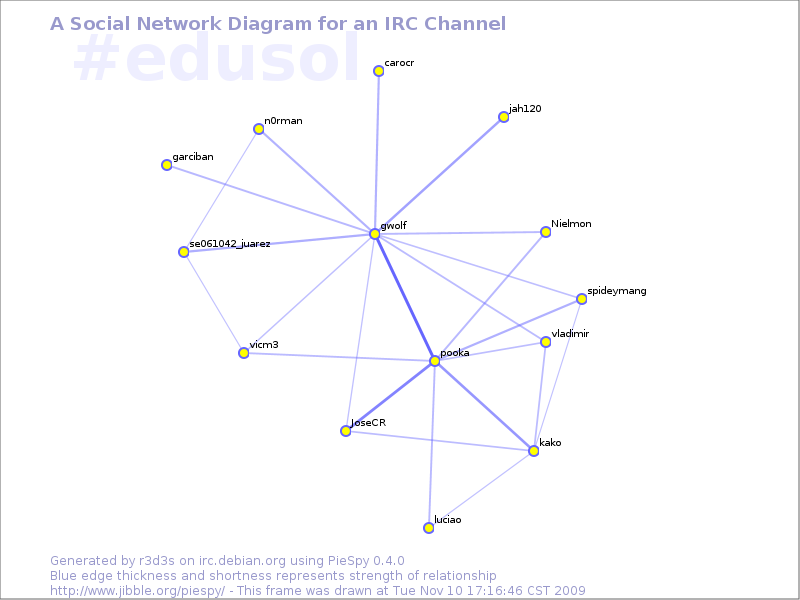
As some of you know, yesterday we started the two weeks of activities for the Fifth On-line Encounter of Free Education, Culture and Software. This year, the main topic for the conference is social networks, but not in the twitter-facebook sense Social networks as ways of understanding and modelling human-to-human interactions. Of course, there is interest from many attendees in using and taking advantage of said social network systems (and others), but the topic is far broader. One of the core tools of EDUSOL, and the only tool that is constantly active through our two weeks of activity, is IRC Which is somewhat of a challenge, as we receive some not-tech-savvy users from all over the world. The first year or two we asked everybody to connect via an IRC client (and we had even decided that it would be a technological filter We thought we would not cater for people without the technical skills to install and use IRC). Life proved us wrong, and we ended up using two web-to-IRC gateways: One of them, via an instance of CGI:IRC, and the other one via a third-party service, Mibbit. Now, the core mind behind EDUSOL is Alejandro Miranda, Pooka; I am not really into education (it is a very interesting topic but far from what I am good at). Pooka has been invovled in on-line communities analysis for several years already, since we worked together at FES Iztacala. For a long time he wanted to graph the interactions at EDUSOL, which was obviously possible given it was all centered on three tools (IRC for live chat, Drupal for generic information and Moodle for the talks and workshops' material This has changed this year, as we are giving much more weight to Drupal and taking it off Moodle), and so last year he was finally able to generate a EDUSOL 2008 conference photo (warning: 2MB image, 4311x3352px), where each person's avatar appears where most of his interactions were. This photo was (unfortunately) achieved using non-free software, but is very much looking at! Now, this year Pooka stumbled upon a great tool, PieSpy (available in Debian package piespy). Piespy generates very interesting interaction graph for IRC channels, as you can see here: Piespy is a bot that sits in the IRC channel logging everything that any given user "says" directly to another one, and graphs it. Not much to say here, only that it generates a very good (and practically real-time) view of what happens on the channel. For this particular channel, and during EDUSOL, you can see here the latest IRC snapshots. Very fun to see - and somewhat addictive how it morphs across time :)
AttachmentSize
EDUSOL 2008 - Conference photo1.97 MB
Current (Monday+Tuesday) interaction graph for our IRC channel39.89 KB

8 November 2009

David Paleino: Finally a DD!

Finally, it happened! I became a Debian Developer! I wish to thank everybody involved in this process: from those who helped me in my initial packaging efforts, to who actually created the account. Many thanks to the pkg-perl team for accepting newbies and helping them: props to Damyan Ivanov, Gregor Herrmann, Gunnar Wolf! Thanks to Debian-Med and Debian CLI: they always believed in me, and I had a great time in these teams. A special thanks goes to Andreas Tille, who advocated my NM candidature. Thanks to my two AMs, Bart Martens and Bernd Zeimetz. Even if my NM was long, difficult and not so flawless, it all went good, at the end Smile. A special thanks to Enrico Zini: he was the first DD signing my GPG key, thus allowing me to have more "rights" (being a DM), and experience some more responsibility than I previously had. Thanks to his "Become a DD. NOW!" right after checking my ID in Palermo -- Enrico, it finally happened! Thanks to Christoph Berg, Ron Lee, and Stephen Gran, which handled the final steps of the overall process. And now, dapal is here to break the world. Be warned! Smile

3 November 2009

Gunnar Wolf: Megaofrenda UNAM 2009

Every year, for D a de Muertos (November 1 and 2) the Mexican tradition is to set colorful, beautiful offerings for our deceased loved ones. The offerings often have the very vivid orange color of the cempals chitl flower, and have pictures, food, and whatever our loved ones used to like. The offerings are traditionally set up at home and at some offices and public buildings. UNAM, Mexico's largest university, where I am very happy and proud to work, has set a yearly offering for many years already. Every year they select a base theme around which the invited groups base their monuments For 2009, it was Edgar Allan Poe's 200th anniversary. By early November, the rainy season has usually finished. This year, however, the rain lasted a bit more And many structures and altars were sadly damaged. Still, it is a very colorful and worthy visit to share.

29 October 2009

Gunnar Wolf: Lovin' it in Afghanistan

Lovin' it in Afghanistan
A couple of weeks ago, I was invited to travel to Colombia, where I delivered a talk at III Encuentro Internacional de Seguridad Inform tica in the city of Manizales (photos available, of course. I travelled with Colombia's nacional airline, Avianca. On completely unrelated news, today I entered Avianca's website to check my miles. To my biggest amusement Turns out I am now a resident of Bamiyan, Afghanistan! (I swear I didn't select that) Seems they do beard-based georeferentiation?
NP: Hey, mister Taliban, tally me bananas
daylight come and me wanna go home!

22 October 2009

Gunnar Wolf: How can we advance without a tax increase?

There has been a lot of buzz recently in Mexico after a tax increase that has been announced for next year. The two main points I have seen criticized are:
Value Added Tax (IVA) increase from 15% to 16%
There was a great improvement regarding the original proposal by our de-facto ruler (why de-facto? Because it is still unclear whether he won the popular vote. He has about the same legitimacy as George Bush during his first term: Legal but illegitimate): In Mexico, there is a category of items regarded as fundamental, which are exempt of IVA (tasa cero). This category includes food and medicines Of course, this category makes up the bulk of the poorer people's consumptions, so they pay much less IVA than people with higher living standards. For a very long time, there has been a push to remove this exemption. This has been fortunately clearly understood and fought against. So, the presidential initiative, as I was saying, contemplated a global 2% tax which would not be IVA, and which would be applied universally. This tax would be earmarked to be applied to social programs, and was euphemistically called Impuesto de Combate a la Pobreza (poverty combat tax). Many people applied the concept of duck typing (if it looks like a duck, walks like a duck and quacks like a duck... It is a Value Added Tax). As many analysts, I believe this tax was meant to be the foot in the doorstop, leading to point out in a couple of years that anyway nothing is IVA-exempt anymore and the world has not come to an end, and we should apply universal IVA... So, the reduction in the increase (2% 1%) is not the most notable thing here The notable (and good!) thing is that they didn't succeed into killing the tasa cero.
3% tax on telecommunications
Many friends have started rallying (with the IMHO least effective way of protest you can find on Earth, just by stating their adherence in their Twitter and Facebook profiles. Wow, great deal!) that the original proposal included a 4% tax on telecommunications, and it appears that 3% will be applied. They say, quite fairly, that telephone and Internet access are no longer considerable a luxury, but a need to power the society into becoming better prepared, more competitive. My friends state as a contrast the Finnish ruling broadband access as a citizen right. What they seem not to realize is that the proportion of taxes in Mexico (collected from the responsible taxpayers, which is not by far the way for the bulk of the money in this country) is close to 30%, taking into account the big taxes (IVA, ISR/IETU) and the host of smaller ones. In Finland, the percentage of taxes payed by every person and remember that tax evasion is way lower than here!) is over 50%.
So What is my opinion on this? What would my ideal tax scheme be?
  • Nobody likes taxes. But the country needs far more infrastructure, far wider inverstments. We need higher taxes But we need those taxes to be collected from people with higher income. And yes, that would mean I would most probably pay more (as I do sit relatively high on the income scale Qualified work, even if you do not seek money for the sake of it, pays much better than non-qualified work; remember the minimal wage in Mexico is around MX$50 a day - Less than US$4 or 3).
  • The increases should be applied to the income tax (ISR). It is supposed to be around 30% for income levels over MX$5000 a month, with a very slight increase after that point. Income tax is highly deductible now, and most people with high income manage to ellude most of it. Many cases have been documented of companies as small as Walmart paying less than MX$1000 a year due to several (intentional? you bet!) holes in the legislation. That is where the bulk of the extra government income should come from!
  • For a couple of years, since I registered as a taxpayer (people receiving money exclusively as salaries under a given limit don't have to declare taxes) I have decided not to hire an accountant to make the numbers look prettier, and just do the numbers myself over the platform provided by SAT/Hacienda (the tax collecting authority). Yes, that means I am paying more than what I could But it also means I am paying what I should! And it is an expensive point of view, but I strongly invite others to do the same. If we criticize Walmart for making numbers look prettier, shouldn't each of us do the same? Shouldn't we all care to pay what we are supposed to, so that the government has enough funds to carry out its tasks?
Yes, I am painfully aware that an important portion of what gets into the government disappears due to corruption and ineptitude. Still, the only position from where I can criticize is from being clearly legal. The same point as I do with software: I cannot ask people to comply with my Free Software licensing if I use ilegally propietary software, can I? So no, I don't use any. Even legal propietary software, free-as-in-beer (i.e. Flash player). So, please think this over before you join the Lemmings into complaining about the tax increase. Yes, this is a bad moment to increase taxes. Yes, Mexico is the worst faring country in all of America in its response to the crisis; the GDP will probably fall between 8% and 10% this year and 2010 will not be much better. Yes, it would be better to increase competitivity. But, yes, we pay ridiculously low amounts of taxes And those of us who can afford a little reduction in our expenditure should do it. And those who make gross money should just stop it. Oh, and last point, regarding the #internetnecesario Twitter hashtag: Don't be Lemmings. Internet should be recognized a basic need for a free society. But right now in our country, it completely is a luxury, even if you cannot live without it. If you are Internet-addicted as myself, you most probably will not notice the 3% increase. FFS, We will pay MX$360 instead of MX$350 a month for my Infinitum connection. Will we really notice? In Mexico, middle and upper class are Internet-enabled. Lower classes are not. Things should change, no doubt. But it is not at all comparable to an universal IVA. Things should change and universal connectivity should be a given. But right now, calling Internet a basic good... is just out of touch with reality.

20 October 2009

Gunnar Wolf: Among the reasons that brought me to Debian...

Every now and then, people ask me why Debian? Why, among so many projects to choose from, I first liked, then got into, and finally I got committed into Debian, and not anything else? Of course, one of the main points back in 2000-2001 when I started using it, and still to this very day is a strong identification with the ideological side. Yes, I am a strong Free Software believer, and Debian is what best suites my ideology. Still, I did not only get into Debian because of this And I was reminded about this by an article in this month's Usenix ;login: magazine: An anecdotal piece by Thomas A. Limoncelli titled Hey! I have to install and maintain this crap too, ya know! (article requires ;login: subscription, but I'll be glad to share it with whoever requests it to me I have of course no permission to openly put it here in whole online. Yes, I am expressly sending a copy of this text to the author, I will update this if/when I hear from him) [update] The author has kindly allowed me to redistribute his article's PDF Download it here. Before anything else I'll go on a short digression: I am writing a bit regarding the Free Software participants' culture, and this is a trait I love about it: The lack of formality. Even though ;login: (and Usenix as a whole) is not exactly Free Software, it runs quite close to it), it is a well regarded magazine (and association) with an academic format and good (not deep or highly theoretical, but good) contents. Still, it is quite usual to see titles as informal and inviting as this one. And it happens not only here I have been fearing having to explain at work, over and over, why I have requesting permissions to go to Yet Another Perl Conference, Festival de Software Libre or DebCamp, tagging them as academic settings. Or why I am wasting our library's resources on buying cookbooks, recipes and similar material on the most strange-sounding subjects. Anyway, back on track This article I found refers to the lack of value given to the system administrator's time when selling or purchasing (or more in general, as it happens also in Free Software, when offering or adopting) a product. Quoting Thomas:
A person purchasing a product is focused on the features and benefits and the salesperson is focused on closing the deal. If the topic of installation does come up, a user thinks, Who cares! My sysadmin will install it for me! as if such services are free. Ironically, it is the same non-technical executive who dismisses installation and upkeep as if they are free who might complain that IT costs are too high and go on a quest to kill IT spending. But I digress. I can understand why a product might be difficult to install. It is hard enough to write software, and with the shortage of software developers it seems perfectly reasonable that the installation script becomes an afterthought, possibly given to a low-ranking developer. The person purchasing the product usually requires certain features, and ease of installation is not a consideration during the procurement process. However, my ability to install a product affects my willingness to purchase more of the product.
Thomas goes on to explain his experience with Silicon Graphics, how Irix was so great regarding install automation and how they blew it when switching to Windows NT; talks very briefly about IBM AIX's smit, a very nifty sysadmin aid which is basically a point-and-click interface to system administration with the very nice extra that allows you to view the commands smit executes to perform a given action (and then you can copy into a script and send over to your hundreds of AIX machines) Incidentally, by the time I started digging out of what became the RedHat mess of the late 1990s and passed briefly through OpenBSD on my way to Debian enlightenment, I was temporarily the sysadmin for an AIX machine And I too loved this Smit approach, having it as the ultimate pedagogical tool you could ever find. Anyway, I won't comment and paraphrase the full article. I'll just point out to the fact that this was what ultimately sold me into Debian. The fact that I could just install anything and (by far) most of the times it will be configured and ready to use. Debian made my life so much easier! As a sysadmin, I didn't have to download, browse documentation, scratch head, redo from start until I got a package working Just apt-get into it, and I'd be set. Of course, one of the bits I learnt back then was that Debian was for lazy people Everything works in a certain way. Policy is enforced throughout. So as a sysadmin, I should better get well acquinted with the Debian policy and know it by heart. In order to be able to enjoy my laziness, I should read it and study it. And so I did, and fell in love. And that is where my journey into becoming a Debian Developer started. Why am I talking so nostalgic here? Because I got this magazine on the mail just last weekend And coincidentally, I also got bug report #551258 I packaged and uploaded the Haml Ruby library (Gem, as the Rubyists would call it). Haml is a great, succint markup language which makes HTML generation less of a mess. It is even fun and amazing to write Haml, and the result is always nicely formatted, valid HTML! And well, one of Haml's components is haml-elisp, the Emacs Lisp major mode to do proper syntax highlighting in Haml files. Of course, I am an Emacs guy (and have been for over 25 years), so I had to package it. But I don't do Emacs Lisp! So I just stuffed the file in its (supposed) place, copying some stuff over from other Emacs packages. During DebConf, I got the very valuable help of Axel Beckert to fix a simple bug which prevented my package from properly being installed, and thought I was basically done with it. I was happy just to add this to my ~/.emacs and get over with it:
  1. (require 'haml-mode)
  2. (add-to-list 'auto-mode-alist '("\\.haml$" . haml-mode))
  3. (require 'sass-mode)
  4. (add-to-list 'auto-mode-alist '("\\.sass$" . sass-mode))
However As Mike Castleman points out: This requires manual intervention. So it is not the Debian Way! Reading Mike's bug report, and reading Thomas' article, made me realize I was dilluting something I held so dearly as to commit myself to the best Free Software-based distribution out there. And the solution, of course, was very simple: Debian allows us to be very lazy, not only as sysadmins, but as Debian packagers. Just drop this (simplified version) as $pkgroot/debian/haml-elisp.emacsen.startup and you are set!
  1. (let ((package-dir (concat "/usr/share/"
  2. (symbol-name flavor)
  3. "/site-lisp/haml-elisp")))
  4. ;; If package-dir does not exist, the haml-mode package must have
  5. ;; removed but not purged, and we should skip the setup.
  6. (when (file-directory-p package-dir)
  7. ;; Use debian-pkg-add-load-path-item per 9 of debian emacs subpolicy
  8. (debian-pkg-add-load-path-item package-dir )
  9. (autoload 'haml-mode "haml-mode"
  10. "Major mode for editing haml-mode files." t)
  11. (add-to-list 'auto-mode-alist '("\\.haml\\'" . haml-mode))
  12. ;; The same package provides HAML and SASS modes in the same
  13. ;; directory - So repeat only the last two instructions for sass
  14. (autoload 'sass-mode "sass-mode"
  15. "Major mode for editing sass-mode files." t)
  16. (add-to-list 'auto-mode-alist '("\\.sass\\'" . sass-mode))
  17. ))
This will make the package just work as soon as it is installed, with no manual intervention required from the user. And it does not, contrary to what I feared, bloat up Emacs Adding it to the auto-mode-alist leaves it as known to Emacs, but is not loaded or compiled unless it is required. Deepest thanks to both of you! (and of course, thanks also to Manoj, for pointing out at the right spells in emacs-land)
AttachmentSize
Thomas A. Limoncelli: Hey! I have to install and maintain this crap too, ya know! (Usenix's ;login: October 2009144.5 KB

16 October 2009

Gunnar Wolf: Getting closer to the fifth EDUSOL Encounter

This is the fifth year we hold an EDUSOL, and we are closing in on it. EDUSOL is an online encounter whose topics are Education and Free Software Actually, this year we are widening our scope, and we will include Free Culture as well as a base area. Now, besides those three general areas, each year we have had a base topic around which we invite the speakers to talk about (although it is a lax requirement). This year, the base topic is social networks No, not in the Twitter/Facebook/blah sense, but as a wider phenomenon, studying interaction between people, the forming of communities. And for our particular areas, the forming of knowledge-based communities. Anyway I agreed with the organizers to provide the English translation of the participation invitation. I will skip the call for papers, as we are basically at the proposal deadline (October 17), but if you have anything you want to propose, please tell us so! Leaving that aside... Please excuse the quality of my translation, it is late and I'm tired. We will work on it :) Videoconference reception EDUSOL spans several participation categories. The closest category to a traditional, face to face conference. Each year, we invite a group of speakers to talk about a topic related to our main discoursive line. Among the speakers that have confirmed so far, we have: We invite you to be active participants in the videoconference cycle. You can invite your social or user group to be part of the Encounter. There are three ways to do it:
  1. Using the videoconference facilities in your University network
  2. Connecting from a personal computer with broadband access, by using Ekiga or any other H.323 client
  3. Following the .ogg stream and participating back via IRC
In any case (specially in the first two, which require more coordination), please contact us. For further information, visit http://edusol.info/es/e2009/convocatorias/videoconfrencias November 6: Free Education and Free Culture day We invite social and user groups to host talks regarding Free Education and Free Culture. This is not a call to promote Free Software, as there are many other spaces devoted to it. We should start with the idea that freedom resides in us, not in the software. Some of the topics our community recommends are: Further details at http://edusol.info/es/e2009/convocatorias/dialternativo We need some help in this area to generate contents with slides, making it easier for proposed scripts for the talks. If you want to collaborate, please write to our academic support list, http://lists.edusol.info/listinfo.cgi/soporte-academico-edusol.info Want to collaborate? Further questions or comments? We are holding on-line meetings for this group of topics on Thursday 22:00 GMT-5, in the #edusol channel in OFTC (irc.debian.org); you can enter the IRC channel using the Web client at http://irc.bine.org.mx or http://edusol.info/irc About EDUSOL EDUSOL started as a proposal seeking to provide a space so that people interested in education could discuss and analize the good and bad points about Free Culture and Free Software, with no geographic restrictions. Year after year, freedom-loving educators of all Latin America and Spain gather for our annual party. EDUSOL's core language is Spanish, although participation in English is allowed and encouraged (although understanding Spanish will be a strong aid). We invite you to participate and contribute in this collective effort using and commenting on our blogs, or adding your personal blog to our planet: http://edusol.info/es/node/add/blog
http://edusol.info/es/node/add/feedapi-node You can follow us by identi.ca or RSS: http://identi.ca/group/edusol
http://edusol.info/rss.xml

13 October 2009

Gunnar Wolf: Linux ranks high on stability One more time

Linux ranks high on stability   One more time
Even at the most physical level. This is a cup that won't topple over when you accidentally kick the desk! Gunnar's Viking of Approval certifies it. I bought this Tux Mug (Mugx) in Colombia, from CeramiGeek. It feels a bit strange to drink penguin brain, but all in all, it is a great geek present ;-) Thanks a lot to Andr s Restrepo and his girlfriend for coming up with this product! :- I expect to get quite a bit of joy out of it. [update] CeramiGeek's site says they sell the mug for $20,000 Of course, that's Colombian pesos. Slightly over US$10. I don't know whether they ship outside Colombia, and am completely unaffiliated to them. But I surely wish them success!

1 October 2009

Gunnar Wolf: Strange scanning on my server?

Humm... Has anybody else seen a pattern like this? I am getting a flurry of root login attempts at my main server at the University since yesterday 7:30AM (GMT-5). Now, from the machines I run in the 132.248.0.0/16 network (UNAM), only two listen to the world with ssh at port 22 And yes, it is a very large network, but I am only getting this pattern on one of them (they are on different subnets, quite far apart). They are all attempting to log in as root, with a frequency that varies wildly, but is consistently over three times a minute right now. This is a sample of what I get in my logs: [update] Logs omitted from blog post, as it is too wide and breaks displays for most users. You can download the log file instead. Anyway This comes from all over the world, and all the attempts are made as root (no attempts from unprivileged users). Of course, I have PermitRootLogin to no in /etc/ssh/sshd_config, but I want to understand this as much as possible. Initially it struck me that most of the attempts appeared to come from Europe (quite atypical for the usual botnet distribution), so I passed my logs through:
  1. #!/usr/bin/perl
  2. use Geo::IP;
  3. use IO::File;
  4. use strict;
  5. my ($geoip, $fh, %by_ip, %by_ctry);
  6. $fh = IO::File->new('/tmp/sshd_log');
  7. $geoip=Geo::IP->new(GEOIP_STANDARD);
  8. while (my $lin = <$fh>) next unless $lin =~ /rhost=(\S+)/; $by_ip $1 ++ ;
  9. print " Incidence by IP:\n", "Num Ctry IP\n", ('='x60),"\n";
  10. for my $ip ( sort $by_ip $a <=> $by_ip $b keys %by_ip)
  11. my $ctry = ($ip =~ /^[\d\.]+$/) ?
  12. $geoip->country_code_by_addr($ip) :
  13. $geoip->country_code_by_name($ip);
  14. $by_ctry $ctry ++;
  15. printf "%3d %3s %s\n", $by_ip $ip , $ctry, $ip;
  16. print " Incidence by country:\n", "Num Country\n", "============\n";
  17. map printf "%3d %s\n", $by_ctry $_ , $_
  18. sort $by_ctry $b <=> $by_ctry $a
  19. keys(%by_ctry);
The top countries (where the number of attempts 5) are:
  1. 104 CN
  2. 78 US
  3. 58 BR
  4. 49 DE
  5. 43 PL
  6. 20 ES
  7. 20 IN
  8. 19 RU
  9. 17 CO
  10. 17 UA
  11. 16 IT
  12. 13 AR
  13. 12 ZA
  14. 10 CA
  15. 10 CH
  16. 8 GB
  17. 8 AT
  18. 8 JP
  19. 8 FR
  20. 7 KR
  21. 7 HK
  22. 7 PE
  23. 7 ID
  24. 6 PT
  25. 5 CZ
  26. 5 AU
  27. 5 BE
  28. 5 SE
  29. 5 RO
  30. 5 MX
I am attaching to this post the relevant log (filtering out all the information I could regarding legitimate users) as well as the full output. In case somebody has seen this kind of wormish botnetish behaviour lately please comment. [Update] I have tried getting some data regarding the attacking machines, running a simple nmap -O -vv against a random sample (five machines, I hope I am not being too agressive in anybody's eyes). They all seem to be running some flavor of Linux (according to the OS fingerprinting), but the list of open ports varies wildly I have seen the following:
  1. Not shown: 979 closed ports
  2. PORT STATE SERVICE
  3. 21/tcp open ftp
  4. 22/tcp open ssh
  5. 23/tcp open telnet
  6. 111/tcp open rpcbind
  7. 135/tcp filtered msrpc
  8. 139/tcp filtered netbios-ssn
  9. 445/tcp filtered microsoft-ds
  10. 593/tcp filtered http-rpc-epmap
  11. 992/tcp open telnets
  12. 1025/tcp filtered NFS-or-IIS
  13. 1080/tcp filtered socks
  14. 1433/tcp filtered ms-sql-s
  15. 1434/tcp filtered ms-sql-m
  16. 2049/tcp open nfs
  17. 4242/tcp filtered unknown
  18. 4444/tcp filtered krb524
  19. 6346/tcp filtered gnutella
  20. 6881/tcp filtered bittorrent-tracker
  21. 8888/tcp filtered sun-answerbook
  22. 10000/tcp open snet-sensor-mgmt
  23. 45100/tcp filtered unknown
  24. Device type: general purpose WAP PBX
  25. Running (JUST GUESSING) : Linux 2.6.X 2.4.X (96%), ( )
  26. Not shown: 993 filtered ports
  27. PORT STATE SERVICE
  28. 22/tcp open ssh
  29. 25/tcp open smtp
  30. 80/tcp open http
  31. 443/tcp open https
  32. 444/tcp open snpp
  33. 3389/tcp open ms-term-serv
  34. 4125/tcp closed rww
  35. Device type: general purpose phone WAP router
  36. Running (JUST GUESSING) : Linux 2.6.X (91%), ( )
  37. Not shown: 994 filtered ports
  38. PORT STATE SERVICE
  39. 22/tcp open ssh
  40. 25/tcp closed smtp
  41. 53/tcp closed domain
  42. 80/tcp open http
  43. 113/tcp closed auth
  44. 443/tcp closed https
  45. Device type: general purpose
  46. Running (JUST GUESSING) : Linux 2.6.X (90%)
  47. OS fingerprint not ideal because: Didn't receive UDP response. Please try again with -sSU
  48. Aggressive OS guesses: Linux 2.6.15 - 2.6.26 (90%), Linux 2.6.23 (89%), ( )
  49. Not shown: 982 closed ports
  50. PORT STATE SERVICE
  51. 21/tcp open ftp
  52. 22/tcp open ssh
  53. 37/tcp open time
  54. 80/tcp open http
  55. 113/tcp open auth
  56. 135/tcp filtered msrpc
  57. 139/tcp filtered netbios-ssn
  58. 445/tcp filtered microsoft-ds
  59. 1025/tcp filtered NFS-or-IIS
  60. 1080/tcp filtered socks
  61. 1433/tcp filtered ms-sql-s
  62. 1434/tcp filtered ms-sql-m
  63. 4242/tcp filtered unknown
  64. 4444/tcp filtered krb524
  65. 6346/tcp filtered gnutella
  66. 6881/tcp filtered bittorrent-tracker
  67. 8888/tcp filtered sun-answerbook
  68. 45100/tcp filtered unknown
  69. Device type: general purpose WAP broadband router
  70. Running (JUST GUESSING) : Linux 2.6.X 2.4.X (95%), ( )
  71. Not shown: 994 filtered ports
  72. PORT STATE SERVICE
  73. 22/tcp open ssh
  74. 25/tcp open smtp
  75. 53/tcp open domain
  76. 80/tcp open http
  77. 110/tcp open pop3
  78. 3389/tcp open ms-term-serv
  79. Warning: OSScan results may be unreliable because we could not find at least 1 open and 1 closed port
  80. Device type: firewall general purpose
  81. Running: Linux 2.6.X
  82. OS details: Smoothwall firewall (Linux 2.6.16.53), Linux 2.6.13 - 2.6.24, Linux 2.6.16
Of course, it strikes me that several among said machines seem to be Linuxes, but (appear to) run Microsoft services. Oh, and they also have P2P clients.
AttachmentSize
Results of parsing the logs21.58 KB
Relevant portion of the logs1.05 MB

26 September 2009

Gunnar Wolf: The bad and the worse; Representative democracies' minimums

Martin rants about the German electoral system. From his rant, I'll pick up only two points And I'll try to connect with Toxicore's excelent (Spanish) blog post, where he quotes political analist Denise Dresser. Dresser has made a great point: Our probably-imposed, legitimacy-impaired president Felipe Calder n has requested the society to talk good about Mexico, to project a positive image of the country. Dresser says, yes, there is a lot of good to talk about the country, and we should emphasize on its richness and beauty, invite people to come and visit, to know what the country is really like. But at the same time, it is our duty to talk bad about the bad areas and decisions of our government, as that is the best (if not the only) thing many of us can do to really get things to happen That is what we can do to push our country's good things forward, to make the country sustainable, to pull attention towards what needs (such as the very very deplorable cases of censorship, human rights violation, ecosystem predation we have seen in the last years). Anyway... What did I want to comment about Martin's post? He criticizes Germany's law requiring a 5% quota for a party to have parliamentary representation. In Mexico, the minimum is 2%. Most people agree, though, that it is too low, and that we should push to increase it. Why? Because the money that is spent in supporting the party system. In Mexico, when a political party fails to get 2% of the vote, it is basically disbanded and it is very hard for it to regroup, to compete again. Many people believe we should aim to a political system with as few political parties as possible (such as the semi-democratic system they have in the USA). I strongly prefer the system found in most European (and even many South American) countries where there is a real wealth of ideological positions represented, and where governments have to be formed by agreeing to form coalitions, as it is almost impossible for them to get full majority. I would much rather see Mexico march towards a parliamentary-based political system, away from the presidential one. Of course, that is almost impossible to expect. With the current political system, we are bound to have forever few monolithic, meaningless political parties. We will likely converge on three blocks, following the current three major blocks (leftoid PRD, centroid PRI, rightoid PAN). They are different in some important senses, yes, but in general they are much the same. I don't hold any hopes to ever see something like the Pirate Party appearing in our system...

25 September 2009

Gunnar Wolf: Honduras: .hn NIC attacked/intervened by the de-facto government authorities

I was requested to forward this information to as wide an audience as possible. Possibly two months ago the legality/legitimacy of the actions carried out by the Hondurean armed forces, which captured a democratically elected president and without a judicial order or trial process forced him out of the country, starting a de-facto government, was something questionable. Each day, however, it becomes clearer and clearer the Hondureans are suffering a represive military-backed system which cannot be expected to fulfill as a trustable entity to conduct fair, credible elections. I got this message from a Hondurean friend (of course, whose identity I am not divulging) denouncing the government's invasion of the .hn domain name registry, which is handled by the Sustainable Development Network (Red de Desarrollo Sustentable RDS-HN). The National Telecomunications Comission (Comisi n Nacional de Telecomunicaciones, CONATEL) demands all domain name registration under the .hn top-level domain (TLD) to be suspende, and all the lists and databases regarding said TLDs to be handed over, detailing the IP ranges and the responsibles. They did this under the argument that RDS-HN is an Internet Service Provider (which it is not Being a registrar means they are responsible for the well-keeping of public information and of handling a public good, the .hn TLD, not that they provide any kind of regulated service to individuals or organizations), with military personnel disguised as civilians (and who refused to identify themselves). If you are interested, please read further on the text I received straight from my Hondurean contacts (Spanish) (or its unaccurate but often helpful automated translation to English, done through Google Translate) Even though this information is normally accessible via WHOIS and similar services (this only states clearly nobody in CONATEL was able to do what I just did legally and anonymously from my personal workstation), they did it in such a fashion in order to scare the operators and the society. Honduras is going through a very hard process. Whatever happens there will likely impact on the future reactions to the most retrograd and powerful sectors of society in the rest of Latin America. We do our best (even if as non-Hondureans living outside Honduras it only means raising our voices) to avoid the risk of our region going back to the sad, cruel and bloody 1970s history. [update] My friend Mave, who works at NIC Chile, sent as a comment to this post LACTLD's official stand on this regard (Spanish. English version also available). LACTLD (Latin American and the Caribbean ccTLD's Organization) clearly backs RDS-HN and condemns the illegal government's actions.
AttachmentSize
Detailing the intervention attempt of RDS-HN by the de-facto government agents (Spanish)8.61 KB

20 September 2009

Gunnar Wolf: Toast to Turing

I was pointed to this Toast to Turing, by Matt Harvey. Very much worth sharing.
Here s a toast to Alan Turing
born in harsher, darker times
who thought outside the container
and loved outside the lines
and so the code-breaker was broken
and we re sorry
yes now the s-word has been spoken
the official conscience woken
very carefully scripted but at least it s not encrypted
and the story does suggest
a part 2 to the Turing Test:
1. can machines behave like humans?
2. can we?
What, don't you know who Alan Turing was? Read a bit on him then, one of the core seminal minds for Computer Science. And a scientist vilified for being different from what is regarded as normal. [update] And answering to some people's doubts: Why this toast? Because the UK Government, in the voice of the Prime Minister Gordon Brown, after over 50 years of leading Alan Turing to commit suicide due to criminally accusing him for gross indecency for being a homosexual and forcing him into a deep body-altering hormonal therapy to cure him, has finally posthumously apologized. Brown said, So on behalf of the British government, and all those who live freely thanks to Alan's work I am very proud to say: we're sorry, you deserved so much better.

7 September 2009

Gunnar Wolf: Google having gender issues related to old-agers?

I am updating an old package's packaging style to take advantage of the new DebHelper 7 goodities. So far, I have been quite successful, but I hit a problem And before bugging on IRC, I decided to check with Joey Hess' presentation at DebConf9, Not your grandpa's debhelper. Of course, not remembering the URL, it was the most natural thing to ask Google: Did you mean... Not your grandma's Debhelper  WTF! Of course, putting this thingy aside, the right answer was the first hit. However, what is the first hit for the Grandma version? Quite dangerous: A post in Ubuntuforums for which the Google excrept reads: this tool can obviously eat your cat, poison your grandma, create an earthquake or do any other unexpected harm, so I don't provide any warranty whatsoever. I sincerely prefer joeyh's version.

4 September 2009

Gunnar Wolf: $keyring_maint->add($me)

During DebConf, Noodles discretely approached me and asked whether I'd be interested and willing to join him as Debian's keyring maintainer. Of course, I felt greatly honored and happy about this. Over the past weeks, we have exchanged some mails where he details how it is handled, and I feel I get the general logic and this last week (which was quite hectic for me apologies in advance for all the work and mails I have due for different people!) he finally took the big steps: Requested DSA to give me login rights to the needed machine and RT queue and to be listed in the relevant area of the Debian Organization page. So, even if I still feel afraid of botching Debian and sending the universe swirling away into chaos, I am most happy, and could no longer hide it. Yay! :-D [BTW] No, it was not on purpose. I did not grow my beard in order to look like St. Peter. But it must have been part of the decision process!

2 September 2009

Gunnar Wolf: Drupal 6 Tour Centroamerica Now in Mexico!

I met my friend Josef Daberning, who did his Austrian Social Service working with Drupal at the Casa de los Tres Mundos NGO, in Granada, Nicaragua, at the Central American Free Software Encounter, last May. He told me that, when going back to Austria, he would spend some days in Mexico, and wanted to give a workshop on Drupal. The course has just started, and will take place today and tomorrow You can follow the live stream at http://www.iiec.unam.mx:18000/drupal.ogg The videos will be uploaded soon as well, I will post them on this same node. This node will be used for whatever is needed to make public for people following the talk. As of right now, you can download his presentation http://gwolf.org/files/gira-drupal.odp and http://gwolf.org/files/gira-drupal.pdf [update](s):
AttachmentSize
Basic introduction to Drupal presentation (ODP format)306.07 KB
Basic introduction to Drupal presentation (PDF format)214.62 KB
Drupal themes presentation1.09 MB

1 September 2009

Gunnar Wolf: Method for locating yourself in space and in time

Today I had a nice and productive day, code-wise. Maybe that's a side effect from being unable to lose my time following E-mail?
Anyway, checking my code with git citool previous to today's git commit, I came accross this method. I didn't even pay attention to it while writing. But it did make me laugh in semi-awe thinking about the great implications it might have. The method signature: def days_for(who, what, how) The code itself? Naah, too pedestrian, to simplistic. It will ruin the sight. It just looks so beautifully universal! Ok, I am compelled to share, even if it spoils it and renders it into a completely regular, even stupid method.
  1. def days_for(who, what, how)
  2. return ' No dates set ' unless who.has_validity_period?
  3. days_to = who.send(how)
  4. return 'Past' if days_to <= 0
  5. '%d days (%s)' % [days_to, who.send(what)]
  6. end

31 August 2009

Gunnar Wolf: Serverless and mailless

Oops. Yesterday (Sunday, 31/08/09) I far from any computer-like object for most of the day. When I got back home, of course, I promptly opened my laptop to check my mail who knows what destiny might have for me in a 24 hour period? Maybe I won yet another fortune I have to cash in Nigeria? Maybe there is (GASP!) a new RC bug on one of my packages? But no, my mail server didn't feel like answering to my ssh queries. The connection was established, but shut down before even sending the protocolary SSH-2.0-OpenSSH_5.1p1 string. Fearing an overload (after all, the little bugger is just a Mac Mini running in another room in my house), I tried to check (via Web) its Munin status Apache didn't want to listen either. It answered, but got only access denied. Things started worrying me But (silly me) not enough The machine runs headless1, so I just danced the boring raising elephants song2. Allowed for a couple of minutes for everything to settle, and tried to connect. Horror, now even pings didn't work! So I ran to fetch my old, bulky and trusty monitor. Went back to the machine, plugged it in, switched it off and back on. Everything worked fine this time At least appearingly. I opened up mutt and started happily reading mails, while trying to understand on another console what happened at 07:06 that didn't get logged anywhere and had the machine dead for basically all the day. And then, BRRRT-BRRRT-BRRRT, I started hearing the HDD seeking. I was able to send a couple of mails, but decided to let the machine rest and... Will reduce its disk usage to an absolute minimum. Fortunately, I have already the machine meant to replace it A much nicer, beefier iMac G5, waiting to be vacated from its data, task which has suddenly become prioritary. So, in short: If you need to get in touch with me in the next day or two, don't count on my usual @gwolf.org mail, as it is down. I hope to be able to get the data out of the poor little bugger painlessly after it rests a bit. And I hope not to drown in a sea of mails after I get the replacement back online :-/
  1. 1. for those not used to computerspeak: without a connected monitor
  2. 2. For those following at home who don't understand how Raising Elephants Is So Utterly Boring, this is a (silly, stupid but useful) mnemotecnic for as-properly-as-possible restarting hung Linux systems: Hold AltGr (right-Alt) + SysRq (in reduced/notebook keyboards, Fn+SysRq), and type R E I S U B (leaving a couple of seconds between key, ideally waiting for all disk activity to settle between each). That means:
    unRaw
    Take control of keyboard back from X,
    tErminate
    Send SIGTERM to all processes, allowing them to terminate gracefully,
    kIll
    send SIGKILL to all processes, forcing them to terminate immediately,
    Sync
    Flush data to disk),
    Unmount
    Remount all filesystems read-only,
    reBoot.
    Well... Reboot the system

Next.

Previous.