Search Results: "Dirk Eddelbuettel"

12 March 2022

Dirk Eddelbuettel: RcppGSL 0.3.11: Small Maintenance

A new release 0.3.11 of RcppGSL is now on CRAN. The RcppGSL package provides an interface from R to the GNU GSL by relying on the Rcpp package. This release updates src/Makefile.ucrt to use the RTools42 libraries. Details follow from the NEWS file.

Changes in version 0.3.11 (2022-03-12)
  • The UCRT Makefile was updated
  • Minor edits to README.md were made

Courtesy of CRANberries, a summary of changes in the most recent release is also available. More information is on the RcppGSL page. Questions, comments etc should go to the issue tickets at the GitHub repo. If you like this or other open-source work I do, you can now sponsor me at GitHub.

This post by Dirk Eddelbuettel originated on his Thinking inside the box blog. Please report excessive re-aggregation in third-party for-profit settings.

Dirk Eddelbuettel: Rcpp 1.0.8.2: Hotfix release per CRAN request

rcpp logo A new hot-fix release 1.0.8.2 of Rcpp just got to CRAN. It will also be uploaded to Debian shortly, and Windows and macOS binaries will appear at CRAN in the next few days. This release breaks with the six-months cycle started with release 1.0.5 in July 2020 as CRAN desired an update to silence nags from the newest clang version which turned a little loud over a feature deprecated in C++11 (namely std::unary_function() and std::binary_function()). This was easy to replace with std::function() which we did. The release also contains a minor bugfix relative to 1.0.8 and C++98 builds, and minor correction to one pdf vignette. The release was fully tested by us and CRAN as usual against all reverse dependencies. Rcpp has become the most popular way of enhancing R with C or C++ code. Right now, around 2519 packages on CRAN depend on Rcpp for making analytical code go faster and further, along with 239 in BioConductor. The full list of details for this interim release follows.

Changes in Rcpp hotfix release version 1.0.8.2 (2022-03-10)
  • Changes in Rcpp API:
    • Accomodate C++98 compilation by adjusting attributes.cpp (Dirk in #1193 fixing #1192)
    • Accomodate newest compilers replacing deprecated std::unary_function and std::binary_function with std::function (Dirk in #1202 fixing #1201 and CRAN request)
  • Changes in Rcpp Documentation:
    • Adjust one overflowing column (Bill Denney in #1196 fixing #1195)
  • Changes in Rcpp Deployment:
    • Accomodate four digit version numbers in unit test (Dirk)

Thanks to my CRANberries, you can also look at a diff to the previous release. Questions, comments etc should go to the rcpp-devel mailing list off the R-Forge page. Bugs reports are welcome at the GitHub issue tracker as well (where one can also search among open or closed issues); questions are also welcome under rcpp tag at StackOverflow which also allows searching among the (currently) 2843 previous questions. If you like this or other open-source work I do, you can sponsor me at GitHub.

This post by Dirk Eddelbuettel originated on his Thinking inside the box blog. Please report excessive re-aggregation in third-party for-profit settings.

11 March 2022

Dirk Eddelbuettel: dtts 0.1.0 on CRAN: New Package

Leonardo and I are thrilled to announce the first CRAN release of dtts. The dtts package builds on top of both our nanotime package and the well-loved and widely-used data.table package by Matt, Arun, Jan, and numerous collaborators. In a very rough nutshell, you can think of dtts as combining both these potent ingredients to produce something not-entirely-unlike the venerable xts package by our friends Jeff and Josh but using highest-precision nanosecond increments rather than not-quite-microseconds or dates. The package is still somewhat rare and bare: it is mostly just alignment operators. But because of the power and genius of data.table not all that much more is needed because data.table gets us fifteen years of highly refined, tuned and tested code for data slicing, dicing, and aggregation. To which we now humbly add nanosecond-resolution indexing and alignment. The package had been simmering for some time, and does of course take advantage of (a lot of) earlier work by Leonardo on his ztsdb project. We look forward to user feedback and suggestions at the GitHub repo. If you like this or other open-source work I do, you can now sponsor me at GitHub.

This post by Dirk Eddelbuettel originated on his Thinking inside the box blog. Please report excessive re-aggregation in third-party for-profit settings.

9 March 2022

Dirk Eddelbuettel: RcppRedis 0.2.0: Major Updates

A new major release of RcppRedis arrived on CRAN today. RcppRedis is one of several packages connecting R to the fabulous Redis in-memory datastructure store (and much more). RcppRedis does not pretend to be feature complete, but it may do some things faster than the other interfaces, and also offers an optional coupling with MessagePack binary (de)serialization via RcppMsgPack. The package has carried production loads for several years now. This release integrates support for pub/sub, a popular messaging pattern in which one or more clients can subscribe to one or more channels . Whenever a client instances publishes, the Redis server immediately updates all clients listening on the given channel. This pattern is fairly common to transmit data to listeners. A there is a bit more to explain about this, I also added a brand-new vignette describing pub/sub with RcppRedis, along with another introductory vignette about Redis itself. We blogged about this exciting new feature and its particular use for market monitoring in R4 #36 recently too. The pub/sub feature was available in package rredis by Bryan Lewis and has now been ported over by Bryan in a truly elegant yet compact implementation. We placed the code for the pub/sub examples, both for a single symbol (SP 500) as well as for a set of (futures) symbols, into a new examples/ subdirectory. Other changes in this release are the removal of the build-dependency on Boost (or, rather, my BH package), an update to the included hiredis library (used if no system-wide version is found), and an updated to the UCRT build for R. That last one is a bit of a sore spot and nobody at CRAN deemed it necessary to tell me they were waiting for me to make this change; communication with the CRAN team can still be challenging (and I am being generous here). Anyway, the package is now on CRAN so all is well now, at long last. The detailed changes list follows.

Changes in version 0.2.0 (2022-03-08)
  • Two simple C++11 features remove needs for BH and lexical_cast() (Dirk in #45 addressing #44).
  • Redis pub/sub is now supported (Dirk in #43, Bryan in #46).
  • Bryan Lewis is now a coauthor.
  • Added pub/sub examples for single and multiple Globex symbols.
  • The included hiredis sources have been updated to release 1.0.2.
  • Two vignettes have been added to introduce Redis and to described a live market-monitoring application included in directory pubsub/.
  • The UCRT build was updated per a suggestion by Tomas.

Courtesy of CRANberries, there is also a diffstat report for this release. More information is on the RcppRedis page. If you like this or other open-source work I do, you can now sponsor me at GitHub.

This post by Dirk Eddelbuettel originated on his Thinking inside the box blog. Please report excessive re-aggregation in third-party for-profit settings.

6 March 2022

Dirk Eddelbuettel: nanotime 0.3.6 on CRAN: Updates

Leonardo and I are pleased to another update to our nanotime package bringing it to version 0.3.6 which landed on CRAN earlier today. nanotime relies on the RcppCCTZ package (as well as the RcppDate package for additional C++ operations) and offers efficient high(er) resolution time parsing and formatting up to nanosecond resolution, and the bit64 package for the actual integer64 arithmetic. Initially implemented using the S3 system, it has benefitted greatly from a rigorous refactoring by Leonardo who not only rejigged nanotime internals in S4 but also added new S4 types for periods, intervals and durations. This release corrects subsetting with %in% operator, integrates it better fit in the mixed S3/S4 setup, fixes a negative period parse, and updates class comparisons to rely on inherits(). The NEWS snippet has the full more details.

Changes in version 0.3.6 (2022-03-06)
  • Fix incorrect subsetting with operator %in% (Leonardo in #100 fixing #99).
  • Fix incorrect parsing for negative nanoperiod (Leonardo in #100 fixing #96).
  • Test for class via inherits() (Dirk).

Thanks to my CRANberries there is also a diff to the previous version. More details and examples are at the nanotime page; code, issue tickets etc at the GitHub repository and all documentation is provided at the nanotime documentation site. If you like this or other open-source work I do, you can now sponsor me at GitHub.

This post by Dirk Eddelbuettel originated on his Thinking inside the box blog. Please report excessive re-aggregation in third-party for-profit settings.

25 February 2022

Dirk Eddelbuettel: It was twenty years ago today

that I made my first upload to CRAN as demonstrated by the very bottom of the ChangeLog file of the RQuantLib package:
2002-02-25  Dirk Eddelbuettel  <edd@debian.org>
    * Initial 0.1.0 release
And quite a few more uploads followed since. (Also see the earlier twenty years ago post about my initial contributions to the Debian R package I had by then adopted too.) If you like this or other open-source work I do, you can now sponsor me at GitHub.

This post by Dirk Eddelbuettel originated on his Thinking inside the box blog. Please report excessive re-aggregation in third-party for-profit settings.

Dirk Eddelbuettel: Rcpp now used by 2500 CRAN packages!

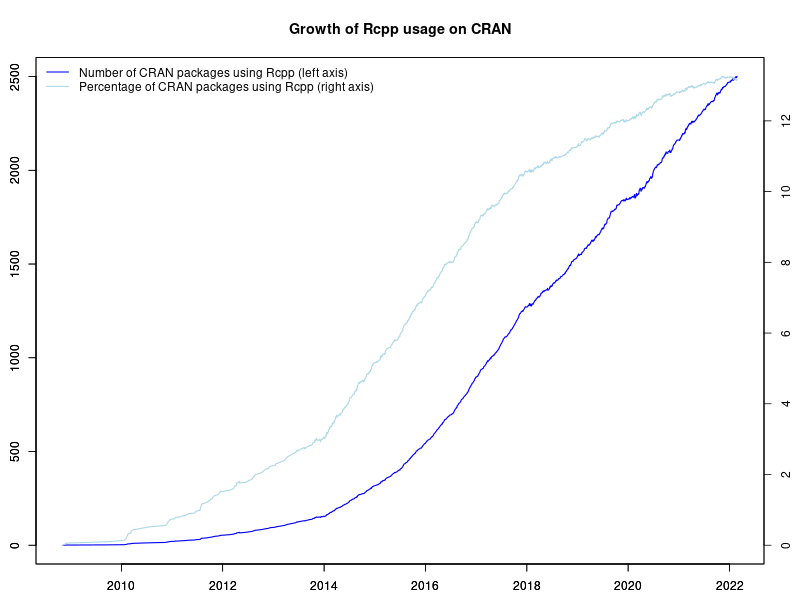
2500 Rcpp packages As of this morning, Rcpp stands at 2501 reverse-dependencies on CRAN. The graph on the left depicts the growth of Rcpp usage (as measured by Depends, Imports and LinkingTo, but excluding Suggests) over time. Rcpp was first released in November 2008. It probably cleared 50 packages around three years later in December 2011, 100 packages in January 2013, 200 packages in April 2014, and 300 packages in November 2014. It passed 400 packages in June 2015 (when I tweeted about it), 500 packages in late October 2015, 600 packages in March 2016, 700 packages in July 2016, 800 packages in October 2016, 900 packages early January 2017, 1000 packages in April 2017, 1250 packages in November 2017, 1500 packages in November 2018, 1750 packages in August 2019, 2000 packages in July 2020, and 2250 package in March of last year. The chart extends to the very beginning via manually compiled data from CRANberries and checked with crandb. The next part uses manually saved entries. The core (and by far largest) part of the data set was generated semi-automatically via a short script appending updates to a small file-based backend. A (manually curated) list of packages using Rcpp is available too. Also displayed in the graph is the relative proportion of CRAN packages using Rcpp. The four per-cent hurdle was cleared just before useR! 2014 where I showed a similar graph (as two distinct graphs) in my invited talk. We passed five percent in December of 2014, six percent July of 2015, seven percent just before Christmas 2015, eight percent in the summer of 2016, nine percent mid-December 2016, cracked ten percent in the summer of 2017, eleven percent in 2018 and passed 12.5 percent or one in every eight CRAN packages dependens on Rcpp along with the 2000 packages mark. Truly stunning. As before, there is more detail in the chart: how CRAN seems to be pushing back more and removing more aggressively (which my CRANberries tracks but not in as much detail as it could), how the growth of Rcpp seems to be slowing somewhat outright and even more so as a proportion of CRAN as one would expect a growth curve to. The Rcpp team continues to aim for keeping Rcpp as performant and reliable as it has been (and see e.g. here for some more details). A really big shoutout and Thank You! to all users and contributors of Rcpp for help, suggestions, bug reports, documentation or, of course, code. If you like this or other open-source work I do, you can now sponsor me at GitHub. For the first year, GitHub will match your contributions.

This post by Dirk Eddelbuettel originated on his Thinking inside the box blog. Please report excessive re-aggregation in third-party for-profit settings.

24 February 2022

Dirk Eddelbuettel: #36: pub/sub for live market monitoring with R and Redis

Welcome to the 36th post of the really randomly reverberating R, or R4 for short, write-ups. Today s post is about using Redis, and especially RcppRedis, for live or (near) real-time monitoring with R. market monitor There is an saying that you can take the boy out of the valley, but you cannot the valley out of the boy so for those of us who spent a decade or two in finance and on trading floors, having some market price information available becomes second nature. And/or sometimes it is just good fun to program this. A good while back Josh posted a gist on a simple-yet-robust while loop. It (very cleverly) uses his quantmod package to access the SP500 in real-time . (I use quotes here because at the end of retail broadband one is not at the same market action as someone co-located in a New Jersey data center. It is however not delayed: as an index, it is not immediately tradeable as a stock, etf, or derivative may be all of which are only disseminated as delayed price information, usually by ten minutes.) I quite enjoyed the gist and used it and started tinkering with it. For example, it collects data but only saves (i.e. persists ) it after market close. If for whatever reason one needs to restart recent history is gone. In any event, I used his code and generalized it a little and published this about a year ago as function intradayMarketMonitor() in my dang package. (See this blog post announcing it.) The chart of the left shows this in action, the chart is a snapshot from a couple of days ago when the vignettes (more on them below) were written. As lovely as intradayMarketMonitor() is, it also limits itself to market hours. And sometimes you want to see, say, how the market opens on Sunday (futures usually restart at 17h Chicago time), or how news dissipates during the night, or where markets are pre-open, or . So I both wanted to complement this with futures, and also cache it locally so that, say, one machine might collect data and one (or several others) can visualize. For such tasks, Redis is unparalleled. (Yet I also always felt Redis could do with another, simple, short and sweet introduction stressing the key features of i) being multi-lingual: write in one language, consume in another and ii) loose coupling: no linking as one talks to Redis via standard tcp/ip networking. So I wrote a new intro vignette that is now in RcppRedis. I hope this comes in handy. Comments welcome!) Our RcppRedis package had long been used for such tasks, and it was easy to set it up. Standard use is to loop, fetch some data, push it to Redis, sleep, and start over. Clients do the same: fetch most recent data, plot or report it, sleep, start over. That works, but it has a dual delay as the client sleeping may miss the data update! The standard answer to this is called publish/pubscribe, or pub/sub. Libraries such as 0mq or zeromq specialise in this. But it turns out Redis already has it. I had some initial difficulty adding it to RcppRedis so for a trial I tested the marvellous rredis package by Bryan and simply instantiated two Redis clients. Now the data getter simply publishes a new data point in a given channel, by convention named after the security it tracks. Clients register with the Redis server which does all the actual work of keeping track of who listens to what. The clients now simply listen (which is a blocking operation) and as soon as data comes in receive it. market monitor This is quite mesmerizing when you just run two command-line clients (in a byobu session, say). As sone as the data is written (as shown on console log) it is consumed. No measruable overhead. Just lovely. Bryan and I then talked a litte as he may or may not retire rredis. Having implemented the pub/sub logic for both sides once, he took a good hard look at RcppRedis and just like that added it there. With some really clever wrinkles for (optional) per-symbol callback as closure attached to the instance. Truly amazeballs And once we had it in there, generalizing from publishing or subscribing to just one symbol easily generalizes to having one listener collect and publish for multiple symbols, and having one or more clients subscribe and listen one, more or even all symbol. All with ease thanks tp Redis. The second chart, also from a few days ago, shows four symbols for four (front-contract) futures for Bitcoin, Crude Oil, SP500, and Gold. As all this can get a little technical, I wrote a second vignette for RcppRedis on just this: market monitoring. Give this a read, if interested, feedback on this one is most welcome too! But all the code you need is included in the package just run a local Redis instance. Before closing, one sour note. I uploaded all this in a new and much improved updated RcppRedis 0.2.0 to CRAN on March 13 ten days ago. Not only is it still not there , but CRAN in their most delightful way also refuses to answer any emails of mine. Just lovely. The package exhibited just one compiler warning: a C++ compiler objected to the (embedded) C library hiredis (included as a fallback) for using a C language construct. Yes. A C++ compiler complaining about C. It s a non-issue. Yet it s been ten days and we still have nothing. So irritating and demotivating. Anyway, you can get the package off its GitHub repo. If you like this or other open-source work I do, you can sponsor me at GitHub.

This post by Dirk Eddelbuettel originated on his Thinking inside the box blog. Please report excessive re-aggregation in third-party for-profit settings.

18 February 2022

Dirk Eddelbuettel: RcppSimdJson 0.1.7 on CRAN: Maintenance

The RcppSimdJson package was updated to release 0.1.7 today. CRAN had sent a note overnight that it triggered LENGTH_1 error (where boolean comparisons happen with longer vectors). That may be debatable in the two cases flagged if one looks at the commit but life being too short to debate this so we just fixed it. The email came in at 04:50h-ish when I was sound asleep, but four hours later the fixed version was on CRAN thanks to the automated processing: RcppSimdJson wraps the fantastic and genuinely impressive simdjson library by Daniel Lemire and collaborators. Via very clever algorithmic engineering to obtain largely branch-free code, coupled with modern C++ and newer compiler instructions, it results in parsing gigabytes of JSON parsed per second which is quite mindboggling. The best-case performance is faster than CPU speed as use of parallel SIMD instructions and careful branch avoidance can lead to less than one cpu cycle per byte parsed; see the video of the talk by Daniel Lemire at QCon (also voted best talk). The very short NEWS entry for this release follows.

Changes in version 0.1.7 (2022-02-18)
  • Two URLs were updated in 'README.md', and Travis artifacts and badges have been removed (Dirk).
  • One unit test file was updated to not trigger a 'LENGTH_1' warning (Dirk closing #76).

Courtesy of my CRANberries, there is also a diffstat report for this release. For questions, suggestions, or issues please use the issue tracker at the GitHub repo. If you like this or other open-source work I do, you can now sponsor me at GitHub.

This post by Dirk Eddelbuettel originated on his Thinking inside the box blog. Please report excessive re-aggregation in third-party for-profit settings.

7 February 2022

Dirk Eddelbuettel: x13binary 1.1.57-3 on CRAN: Packaging Updates

Release 1.1.57-3 of the x13binary package providing the X-13ARIMA-SEATS program by the US Census Bureau arrived late yesterday on CRAN. This release relaxes the download requirement on macOS and Linux: if a user supplies a path in an environment variable X13_PATH we check for a suitable binary there and omit the download. This helps with air-gapped installation (and alike). Courtesy of my CRANberries, there is also a diffstat report for this release showing changes to the previous release. If you like this or other open-source work I do, you can sponsor me at GitHub.

This post by Dirk Eddelbuettel originated on his Thinking inside the box blog. Please report excessive re-aggregation in third-party for-profit settings.

5 February 2022

Dirk Eddelbuettel: corels 0.0.4 on CRAN: M1 Update

An updated version of the corels package is now on CRAN! The Certifiably Optimal RulE ListS (Corels) learner provides interpretable decision rules with an optimality guarantee. The change is (just like the previous one) chiefly an update to configure.ac in order to ensure R on M1 macOS finds the locally-added GNU GMP. Our thanks to the infatiguable Brian Ripley for the heads-up even containing the two needed assignments to LD and CPPFLAGS.. If you like this or other open-source work I do, you can now sponsor me at GitHub.

This post by Dirk Eddelbuettel originated on his Thinking inside the box blog. Please report excessive re-aggregation in third-party for-profit settings.

1 February 2022

Dirk Eddelbuettel: #35: apt install rstudio quarto

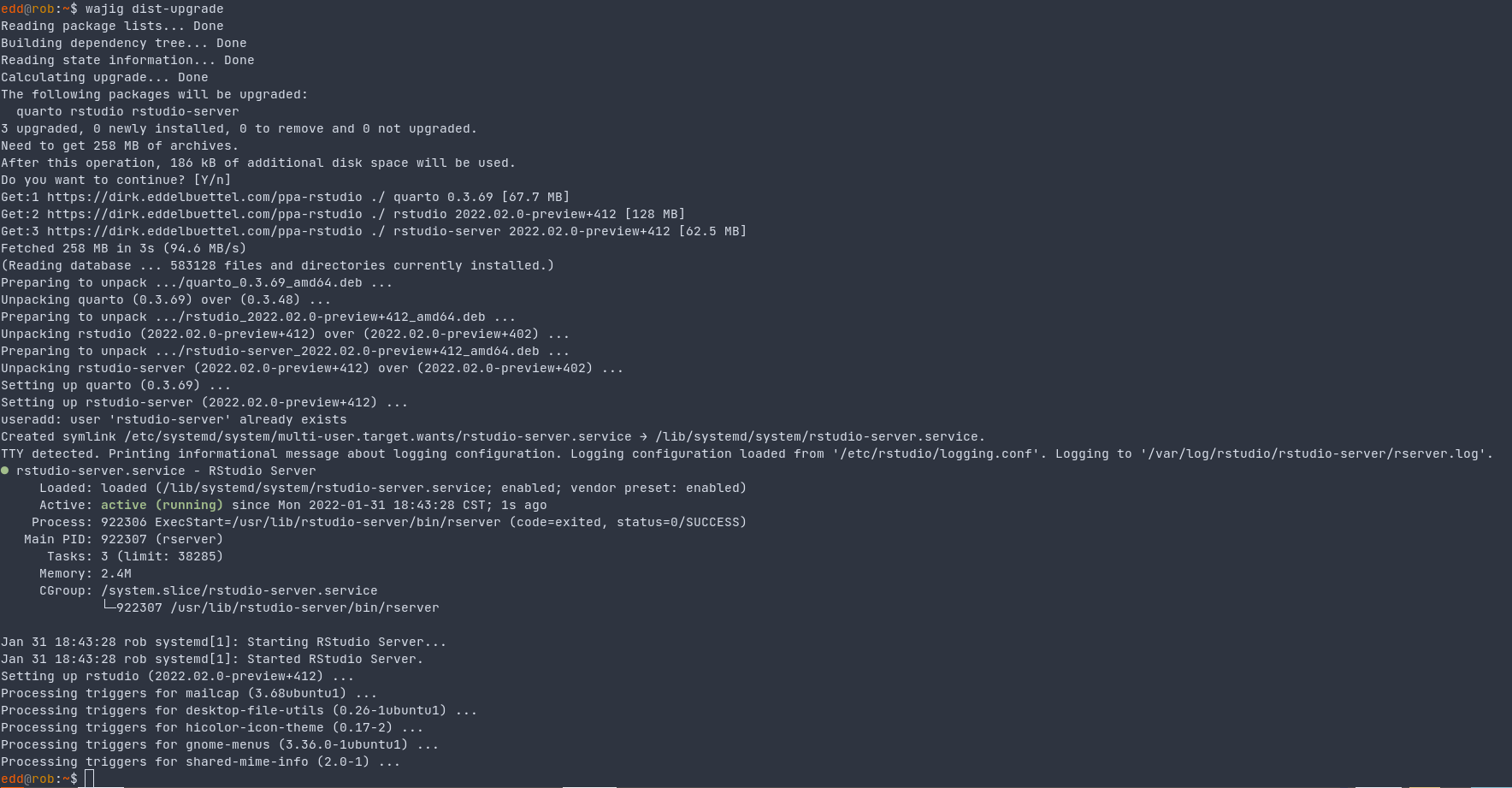
Welcome to the 35th post in the ravishingly rabiant R recommendations, or R4. Today s post is about apt and R tools. Many of us have been running RStudio off our local machines for as long as binaries have been provided. Which is by now probably a bit over a decade. Time flies. And as nice it is to have matching binaries, in my case in the .deb format used on Debian or Ubuntu, it is wee bit a painful to manually download a file and then install it. Twice the pain if you are lucky enough to be on a system where you can also run RStudio Server. And now three times as painful as you may need a matching quarto-cli binary for the nice quarto service. So wouldn t it be nice to have an apt-getable repo? And to autoMAGICall get updated versions when they are available? Oh yes. And I had been bugging JJ from day one. And JJ would almost listen intendly, nod briefly and firmly, and issue an assured we will look into it. Well, they are still looking Luckily, years ago, Carl wrote a helper script for our use in Rocker. I promptly adopted these and kept them in the littler examples directory as a pair of script getRStudioDesktop.r and getRStudioServer.r, later complemented by getQuartoCli.r. And I used these for years, somewhere between weekly and monthly. But it is still very manual: three script calls, one sudo dpkg -i call. And as our good friends at RStudio don t seem to be coming forward with a repo, I created one at GitHub thinking I could serve the files via GitHub Pages. Which of course I cannot as the .deb file for rstudio is well above the 100mb limit. So that seemed to be a bit of a setback. But after a bit of pondering, and recognizing that I am now in the fortunate position to have symmetric broadband access at home, I reckoned that until the bandwidth use gets excessive I will serve this as truly personal package archive (or tPPA) from here. Note that this is calibrated for my use so Ubuntu amd64 it is. Nothing else. And that it installs dailies . Which may cause issues for some people. You have warned. Reading tis paragraphs signifies agreement with the terms and limitations. Just kidding. A quick screenshot from an update earlier is here. Note that I use the fabulous wajig wrapper by Graham Williams here as my frontend to apt, dpkg and more as I have for even longer than I have use RStudio. Its use is tangential here; sudo apt upgrade would have done the same (and is essentially being called). And it demonstrates the main benefit: we are now automated as the cron scheduler launches an update of the PPA at which ever frequency you chose (currently twice a week for me) and after that it becomes part of the normal apt updates we do anyway (and which I do about daily). So that s main gist: automated apt upgrades of rstudio, rstudio-server, and quarto-cli. And you can find the underlying code in the GitHub repo ppa-rstudio which I put together a good week ago. I am currently updating the tPPA twice a week from crontab and have had two full upgrades already. And who knows, maybe with a bid of prodding RStudio may come around. One can always hope. If you like this or other open-source work I do, you can sponsor me at GitHub.

This post by Dirk Eddelbuettel originated on his Thinking inside the box blog. Please report excessive re-aggregation in third-party for-profit settings.

27 January 2022

Dirk Eddelbuettel: td 0.0.6 on CRAN: Minor Bugfix

The td package for accessing the twelvedata API for financial data has been updated once more on CRAN and is now at version 0.0.6. The release comes in response to an email from CRAN who noticed (via r-devel) that I was sloppy (in one spot, it turns out) with a logical expression resulting in an expression of length greather than one. Fixed by wrapping an all() around it and the package was back at CRAN minutes later thanks to automated processing over their end. The NEWS entry follows.

Changes in version 0.0.6 (2022-01-26)
  • Correct one equality comparison by wrapping in all() to ensure a length-one logical expression is created

Courtesy of my CRANberries, there is a comparison to the previous release. For questions or comments use the issue tracker off the GitHub repo. If you like this or other open-source work I do, you can now sponsor me at GitHub.

This post by Dirk Eddelbuettel originated on his Thinking inside the box blog. Please report excessive re-aggregation in third-party for-profit settings.

25 January 2022

Dirk Eddelbuettel: RcppArmadillo 0.10.8.1.0 on CRAN: Upstream Updates

armadillo image Armadillo is a powerful and expressive C++ template library for linear algebra aiming towards a good balance between speed and ease of use with a syntax deliberately close to a Matlab. RcppArmadillo integrates this library with the R environment and language and is widely used by (currently) 950 other packages on CRAN, downloaded over 22.9 million times (per the partial logs from the cloud mirrors of CRAN), and the CSDA paper (preprint/vignette) by Conrad and myself has been cited 451 times according to Google Scholar. This release brings another upstream update 10.8.0, and first bug fix release 10.8.1. As updates by Conrad can come a little quicker than the desired monthly cadence CRAN aims for, we skipped the 10.8.0 release for CRAN only but of course generally provide them via the Rcpp drat repo as well as via general updates to the repo, and full reverse dependency testing (for which results are always logged here). The full set of changes (since the last CRAN release 0.10.7.5.0) follows.

Changes in RcppArmadillo version 0.10.8.1.0 (2022-01-23)
  • Upgraded to Armadillo release 10.8.1 (Realm Raider)
    • fix interaction between OpenBLAS and LAPACK
    • emit warning if find() is incorrectly used to locate NaN elements

Changes in RcppArmadillo version 0.10.8.0.0 (2022-01-02)
  • Upgraded to Armadillo release 10.8 (Realm Raider)
    • faster handling of symmetric matrices by pinv() and rank()
    • faster handling of diagonal matrices by inv_sympd(), pinv(), rank()
    • expanded norm() to handle integer vectors and matrices
    • added datum::tau to replace 2

Courtesy of my CRANberries, there is a diffstat report relative to previous release. More detailed information is on the RcppArmadillo page. Questions, comments etc should go to the rcpp-devel mailing list off the R-Forge page. If you like this or other open-source work I do, you can sponsor me at GitHub.

This post by Dirk Eddelbuettel originated on his Thinking inside the box blog. Please report excessive re-aggregation in third-party for-profit settings.

22 January 2022

Dirk Eddelbuettel: qlcal 0.0.2 on CRAN: Updates

The second release of the still fairly new qlcal package arrivied at CRAN today. qlcal is based on the calendaring subset of QuantLib. It is provided (for the R package) as a set of included files, so the package is self-contained and does not depend on an external QuantLib library (which can be demanding to build). qlcal covers over sixty country / market calendars and can compute holiday lists, its complement (i.e. business day lists) and much more. This release brings a further package simplification from removing a few more files not needed for just calendaring, as well as an update 2022 calendar for China from the just-release 1.25 version of QuantLib.

Changes in version 0.0.2 (2022-01-21)
  • Further minimize set of files needed for calendaring
  • Update China calendar from QuantLib 1.25 release

See the project page and package documentation for more details, and more examples. If you like this or other open-source work I do, you can now sponsor me at GitHub.

This post by Dirk Eddelbuettel originated on his Thinking inside the box blog. Please report excessive re-aggregation in third-party for-profit settings.

20 January 2022

Dirk Eddelbuettel: RQuantLib 0.4.15: Regular Update

A new release 0.4.15 of RQuantLib arrived at CRAN earlier today, and has been uploaded to Debian as well. QuantLib is a very comprehensice free/open-source library for quantitative finance; RQuantLib connects it to the R environment and language. The release of RQuantLib comes four months after the previous release, and brings a momitor update for the just-released QuantLib 1.2.5 version along with a few small cleanups to calendars and daycounters.

Changes in RQuantLib version 0.4.15 (2022-01-19)
  • Changes in RQuantLib code:
    • Calendar support has been updated and completed to current QuantLib standards (Dirk in #161)
    • More daycounters have been added (Kai Lin in #163 fixing #162, #164)
    • The bonds pricers were update to changes in QuantLib 1.25 (Dirk)
  • Changes in RQuantLib package and setup:
    • Some package metadata was removed from the README.md (Dirk)

Courtesy of my CRANberries, there is also a diffstat report for the this release. As always, more detailed information is on the RQuantLib page. Questions, comments etc should go to the new rquantlib-devel mailing list. Issue tickets can be filed at the GitHub repo. If you like this or other open-source work I do, you can now sponsor me at GitHub.

This post by Dirk Eddelbuettel originated on his Thinking inside the box blog. Please report excessive re-aggregation in third-party for-profit settings.

14 January 2022

Dirk Eddelbuettel: Rcpp 1.0.8: Updated, Strict Headers

rcpp logo The Rcpp team is thrilled to share the news of the newest release 1.0.8 of Rcpp which hit CRAN today, and has already been uploaded to Debian as well. Windows and macOS builds should appear at CRAN in the next few days. This release continues with the six-months cycle started with release 1.0.5 in July 2020. As a reminder, interim dev or rc releases will alwasys be available in the Rcpp drat repo; this cycle there were once again seven (!!) times two as we also tested the modified header (more below). These rolling release tend to work just as well, and are also fully tested against all reverse-dependencies. Rcpp has become the most popular way of enhancing R with C or C++ code. Right now, around 2478 packages on CRAN depend on Rcpp for making analytical code go faster and further, along with 242 in BioConductor. This release finally brings a change we have worked on quite a bit over the last few months. The idea of enforcing the setting of STRICT_R_HEADERS was prososed years ago in 2016 and again in 2018. But making such a chance against a widely-deployed code base has repurcussions, and we were not ready then. Last April, this was revisited in issue #1158. Over the course of numerous lengthy runs of tests of a changed Rcpp package against (essentially) all reverse-dependencies (i.e. packages which use Rcpp) we identified ninetyfour packages in total which needed a change. We provided either a patch we emailed, or a GitHub pull request, to all ninetyfour. And we are happy to say that eighty cases were resolved via a new CRAN upload, with a seven more having merged the pull request but not yet uploaded. Hence, we could make the case to CRAN (who were always CC ed on the monthly nag emails we sent to maintainers of packages needing a change) that an upload was warranted. And after a brief period for their checks and inspection, our January 11 release of Rcpp 1.0.8 arrived on CRAN on January 13. So with that, a big and heartfelt Thank You! to all eighty maintainers for updating their packages to permit this change at the Rcpp end, to CRAN for the extra checking, and to everybody else who I bugged with the numerous emails and updated to the seemingly never-ending issue #1158. We all got this done, and that is a Good Thing (TM). Other than the aforementioned change which will not automatically set STRICT_R_HEADERS (unless opted out which one can), a number of nice pull request by a number of contributors are included in this release: The full list of details follows.

Changes in Rcpp release version 1.0.8 (2022-01-11)
  • Changes in Rcpp API:
    • STRICT_R_HEADERS is now enabled by default, see extensive discussion in #1158 closing #898.
    • A new #define allows default setting of finalizer calls for external pointers (I aki in #1180 closing #1108).
    • Rcpp:::CxxFlags() now quotes the include path generated, (Kevin in #1189 closing #1188).
    • New header files Rcpp/Light, Rcpp/Lighter, Rcpp/Lightest and default Rcpp/Rcpp for fine-grained access to features (and compilation time) (Dirk #1191 addressing #1168).
  • Changes in Rcpp Attributes:
    • A new option signature allows customization of function signatures (Travers Ching in #1184 and #1187 fixing #1182)
  • Changes in Rcpp Documentation:
    • The Rcpp FAQ has a new entry on how not to grow a vector (Dirk in #1167).
    • Some long-spurious calls to RNGSope have been removed from examples (Dirk in #1173 closing #1172).
    • DOI reference in the bibtex files have been updated per JSS request (Dirk in #1186).
  • Changes in Rcpp Deployment:
    • Some continuous integration components have been updated (Dirk in #1174, #1181, and #1190).

Thanks to my CRANberries, you can also look at a diff to the previous release. Questions, comments etc should go to the rcpp-devel mailing list off the R-Forge page. Bugs reports are welcome at the GitHub issue tracker as well (where one can also search among open or closed issues); questions are also welcome under rcpp tag at StackOverflow which also allows searching among the (currently) 2822 previous questions. If you like this or other open-source work I do, you can sponsor me at GitHub.

This post by Dirk Eddelbuettel originated on his Thinking inside the box blog. Please report excessive re-aggregation in third-party for-profit settings.

9 January 2022

Dirk Eddelbuettel: Rblpapi 0.3.13: Some Fixes and Documentation

A new version, now at 0.3.13, of the Rblpapi package just arrived at CRAN. Rblpapi provides a direct interface between R and the Bloomberg Terminal via the C++ API provided by Bloomberg (but note that a valid Bloomberg license and installation is required). This is the thirteenth release since the package first appeared on CRAN in 2016. It comprises the PRs from three different contributors (with special thanks once again to Michael Kerber), and extends test and documentation, and extends two function interfaces to control explicitly whether returned lists of length one should be simplified. The list of changes follow below.

Changes in Rblpapi version 0.3.13 (2022-01-09)
  • Add a test for bds (Michael Kerber in #352)
  • Add simplify argument (and option) to bdh and bds (Dirk in #354 closing #353, #351)
  • Improve documentation for bsearch (John in #357 closing #356)

Courtesy of my CRANberries, there is also a diffstat report for the this release. As always, more detailed information is on the Rblpapi page. Questions, comments etc should go to the issue tickets system at the GitHub repo. If you like this or other open-source work I do, you can now sponsor me at GitHub.

This post by Dirk Eddelbuettel originated on his Thinking inside the box blog. Please report excessive re-aggregation in third-party for-profit settings.

20 December 2021

Dirk Eddelbuettel: RcppSMC 0.2.6 on CRAN: Compiler Update

A new maintenance RcppSMC release 0.2.6 arrived at CRAN yesterday. It chiefly updates the code to comply with g++-11 which default to C++17 which brings us std::data(). And if one is not careful, as we weren t in three files, this can clash with other uses of data as I tweeted a good week ago. Otherwise some JSS URLs now sport the preferred shorter doi form. RcppSMC provides Rcpp-based bindings to R for the Sequential Monte Carlo Template Classes (SMCTC) by Adam Johansen described in his JSS article. Sequential Monte Carlo is also referred to as Particle Filter in some contexts. The package features the Google Summer of Code work by Leah South in 2017, and by Ilya Zarubin in 2021. This release is summarized below.

Changes in RcppSMC version 0.2.6 (2021-12-17)
  • Updated URLs to JSS for the new DOI scheme upon their request
  • Adjusted three source files for C++17 compilation under g++-11

Courtesy of my CRANberries, there is a diffstat report for this release. More information is on the RcppSMC page. Issues and bugreports should go to the GitHub issue tracker. If you like this or other open-source work I do, you can now sponsor me at GitHub.

This post by Dirk Eddelbuettel originated on his Thinking inside the box blog. Please report excessive re-aggregation in third-party for-profit settings.

17 December 2021

Dirk Eddelbuettel: RcppArmadillo 0.10.7.5.0 on CRAN: Bugfixes

armadillo image Armadillo is a powerful and expressive C++ template library for linear algebra aiming towards a good balance between speed and ease of use with a syntax deliberately close to a Matlab. RcppArmadillo integrates this library with the R environment and language and is widely used by (currently) 937 other packages on CRAN, and downloaded over 22 million times (per the partial logs from the cloud mirrors of CRAN). This release brings another bug fix release 10.7.5 by Conrad in the long-term support 10.7.* series we started with 0.10.7.0 on September 30. As the bug fixes can come a little quicker than the desired monthly cadence CRAN aims for, we skipped a few of those release for CRAN only but of course still provide them via the Rcpp drat repo. The full set of changes (since the last CRAN release 0.10.7.3.0) follows. It includes the nice fixes to the fields type mentioned right after the last release.

Changes in RcppArmadillo version 0.10.7.5.0 (2021-12-16)
  • Upgraded to Armadillo release 10.7.5
    • fix aliasing bug in diagmat()
    • fix detection of 2x2 triangular matrices

Changes in RcppArmadillo version 0.10.7.4.0 (2021-11-23)
  • Upgraded to Armadillo release 10.7.4
    • faster handling of diagonal matrices by inv_sympd(), pinv(), rank()
    • more robust detection of incorrect data format by .load()
  • Correct dimensions setting in import/export of arma::field types, protected by #define (Jonathan Berrisch in #352 fixing #351)
  • Add unit tests for fields both with and without new #define (Dirk)

Courtesy of my CRANberries, there is a diffstat report relative to previous release. More detailed information is on the RcppArmadillo page. Questions, comments etc should go to the rcpp-devel mailing list off the R-Forge page. If you like this or other open-source work I do, you can sponsor me at GitHub.

This post by Dirk Eddelbuettel originated on his Thinking inside the box blog. Please report excessive re-aggregation in third-party for-profit settings.

Next.

Previous.