Search Results: "tim"

26 October 2026

Russell Coker: CEO Impersonation Fraud

In discussion about my post on banks and phones [1] questions were asked about CEO impersonation (link to an article on the security blog Krebs on Security about it) [2]. CEO fraud (or more generally executive fraud) is a subset of Business Email Compromise fraud which allegedly loses Australian businesses $84M/year [3]. The numbers vary a lot depending on what is counted, is it just attacks where money is lost or do situations where the bank reverses the transaction count? There s a lot of secrecy around this because of reputation issues related to fraud, a company that gets defrauded might be regarded as an unreliable business partner. Also in terms of interpreting results there are organisations that want to promote the idea that it s a major crime that could cost you everything unless you pay us to improve your security . My experience of these things is that at one company I worked for someone had gained access to an executive mailbox and setup rules to move mail from certain senders to a mailbox that wouldn t be checked (maybe .Sent or .Spam or something I can t remember the details) as well as forwarding it to an address the attacker controlled. That meant that the executive wouldn t see email from the scam targets while the email gets forwarded to the attackers. At the time it appeared that Office 365 didn t have any features for sending automatic audit alerts for such changes. I think that all changes to executive email accounts should trigger alerts to the corporate security team (in that case me). One would hope that such exploitation would be a major wake-up call for the company but it wasn t. It was never discovered how the attacker got access to the account, I presume it was by compromising a personal computer of the executive which they used for company purposes. Having a strong separation of hardware used for work and hardware for personal use is a really good thing. At the same company every time the CEO went on a scheduled trip there would be email sent impersonating him claiming that money needed to be transferred. It was never discovered how the attackers knew when he was on a trip. Was the CEO telling people on LinkedIn about his plans or something? Was his calendar shared to someone outside the company? Was there an employee leaking information? We never found out and surprisingly the executive team didn t think this was a problem. It s not necessarily bad for the CEO to publicise their trips even if that alerts hostile parties, but everyone needs to know what the situation is. An unexplained attack is more concerning than a known attack that can be predicted and dealt with. The role of CEO has a unique combination of being able to authorise funds transfers while also being able to reject other security methods. You can tell a line manager that they need to follow the process for a $10 purchase but you can t necessarily tell the CEO that they need to follow the process for $100,000. Even if the CEO always follows the process for funds transfers you have to convince all the people involved in funds transfers that the CEO will follow the process and any unexpected email demanding an immediate transfer should be rejected. A final problem is getting executives to understand the importance of computer security. My experience is that getting a CTO to adhere to good security practices can be a challenge and that even on the rare occasions someone like me gets to communicate with the CEO it s not possible to convince them to change anything. Most computer security problems end up as people problems.

Otto Kek l inen: Debcraft v1.0 released: Easy, fast and secure way to build Debian packages

Featured image of post Debcraft v1.0 released: Easy, fast and secure way to build Debian packagesDebcraft is a tool that automates most of the repetitive and error-prone steps related to Debian packaging. It makes it easy to build .deb packages from source without having to manually prepare build environments. It clearly shows what changed in the build artifacts between two builds, automates parts of importing new upstream versions, and can automatically apply repetitive fixes to the packaging source code, including committing them in git. While doing all of this, it also explains what it does and helps users learn best practices in Debian packaging, making the overall experience much easier and more fun than with any other tool before, while also being secure and fast.

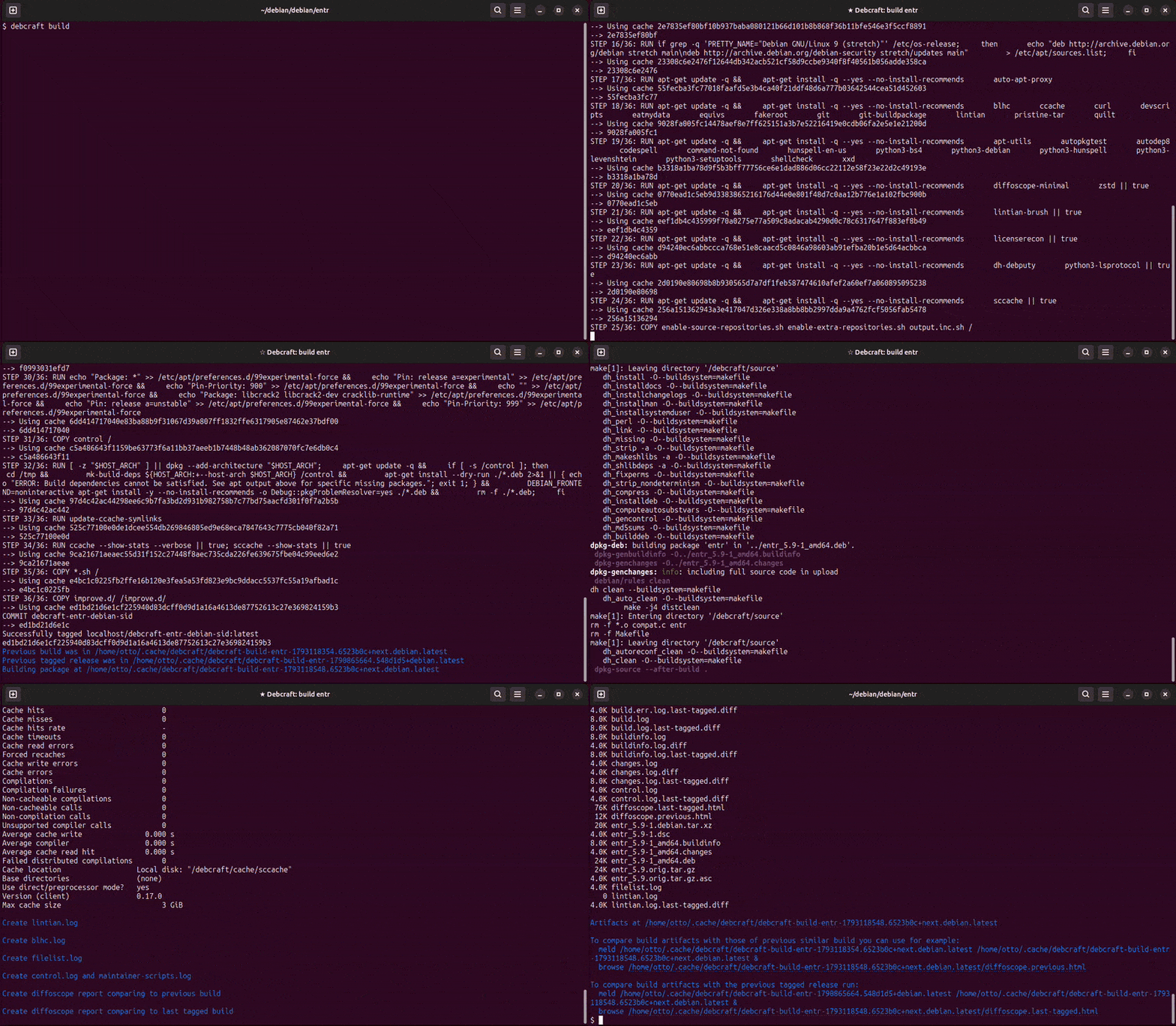
Try out Debcraft 1.0 now! Debcraft can be installed simply by running apt install debcraft on a recent version of Debian or Ubuntu. Check with debcraft --version that you have 1.0.0 or newer. The latest version can also always be installed from source at salsa.debian.org/debian/debcraft (does not require compiling anything). Running debcraft build in a Debian packaging git repository for the entr package

Benefits Debcraft was designed to offer the following three main benefits:

Easy
  • Build any Debian/Ubuntu package by simply running debcraft build in the checked-out Debian packaging git repository.
  • If the orig upstream source code tarball is neither already present nor available on a pristine-tar branch, the exact upstream tarball is downloaded from the Debian archive.
  • Users are spared from having to manually prepare ahead or maintain build environments. Debcraft builds create a container on-the-fly (both Podman and Docker supported), built using the target Debian or Ubuntu suite in debian/changelog and with exact build dependencies from debian/control.
  • Commands debcraft improve, debcraft test and debcraft update automate recurring package maintenance tasks and help maintainers produce high-quality, up-to-date packages, run Salsa CI, pass autopkgtest in Debian CI, and stay in sync across Debian archives and packaging git repositories.
  • The command output is (relatively) easy to read, and it also teaches users about Debian packaging in context.

Fast
  • Container layer caching is utilized to make builds and re-builds blazingly fast.
  • If an apt-cacher-ng instance or equivalent is present, it will automatically be used.
  • Debian packages that support ccache or sccache build even faster.

Secure
  • The build phase happens inside hermetic containers with no network access. This ensures all dependencies are properly managed and that the built binaries are as trustworthy as the source code they were built from.
  • Using containers also protects the host system from getting polluted with extra development libraries, and adds an extra layer of protection to prevent anything malicious in the source code from accessing secrets on the host system.
  • The additional logs provided by Debcraft also help audit changes in Debian package sources and build artifacts.
See the Debcraft README.md for details on how this was implemented. I also previously wrote Debcraft - Easiest way to modify and build Debian packages, which explains the motivation and design in more detail.

Result of many years of development The first commit in the git repository is from 2020 under the name debuildr. The project was renamed to Debcraft in a commit on December 8th, 2023. I have been developing this tool fairly actively since 2024 and using it for all my packaging, dogfooding so to say. There have also been plenty of collaborators. In total, 13 people have contributed code across 21 MRs and PRs on Salsa.d.o, GitLab.com and GitHub.com. Now, in October 2026, it was time to release Debcraft v1.0 as it has had extensive real-world use and iteration based on countless different packages and multiple users. Users have included both experienced fellow Debian Developers and lots of people who just started learning how Debian packaging works. As I mentor dozens of new contributors to Debian, I have seen that the latter group seems to benefit the most from Debcraft and its ease of use and built-in guidance, while to the more experienced developers the main benefit is having less details to remember and doing less mistakes.

Contributions welcome! Try it: apt install debcraft, then run debcraft build in a checked-out Debian packaging repository. If you run into a problem, file a report or submit an improvement. New contributors can look for issues marked good first issue. The code is intentionally written entirely in shell script to keep the barrier to code contribution as low as possible. It is also very easy to debug, as any command can be run with --debug to emit step-by-step information about what it is doing, and being Bash scripts, injecting set -x anywhere in the code will emit an even more detailed trace of every subcommand executed.
By the way, if you aspire to become a Debian Developer, and want to follow my examples in using state-of-the-art tooling and collaborate using salsa.debian.org, feel free to reach out for mentorship. I am glad to see more people contribute to Debian!

25 October 2026

Russell Coker: Banks and Phones

The Problem For years there have been ongoing issues with SMS being used as a security mechanism for important things including financial services. The problem with this is that access to a phone number is not very well secured, the business model of phone stores is based on having a price of service that doesn t allow the amounts of money spent on security and training that organisations such as banks can spend and are legally required to spend. The way things work now is that SMS is a second factor of authentication for banks and other traditional financial companies as well as for services involving cryptocurrencies such as bitcoin. To gain unauthorised access to SMS an attacker can physically steal a phone or SIM or they can trick an employee of a phone store into replacing the SIM or attack the computers of the telco to gain access to replace SIMs. SMS authentication is also used for many services which have indirect access to financial service. For example when I m employed in a sysadmin role I may get given admin access to the email server used for the CEO s email and have it default to using the phone number of my personal phone for authentication. So while my personal phone doesn t give the potential for defrauding much money I own it does give the potential for being used for defrauding however much money the CEO can authorise which may be significantly greater than my net worth. Hardware Security Devices The best thing to do for securing such things is to use hardware security devices like FIDO keys, of which there is a wide range that cost less than $50. The problem with acceptance of such things is lack of general knowledge and lack of forced requirements to use them. The vast majority of banks (including all banks in Australia AFAIK) have chosen not to require hardware security devices because of the cost. It has been widely claimed that 20% of the customers of a typical bank make 120% of the profit 80% of the customers lose money for the bank. While I m not in a position to know the accuracy of that most banks seem to have implemented monthly fees for accounts below a certain minimum balance to discourage less profitable customers. If there were banking regulations requiring hardware security devices then the costs would be passed on to people who really can t afford an extra $50 per year in banking fees to pay for it. It might be a good option for the government to require personal presence at the bank or a hardware security device for transfers of more than $1000. That would allow kids and minimum wage workers to have bank accounts without excessive fees while forcing a higher level of security for larger transfers. I really should use the hardware security devices I own more, although they are mostly only usable on systems I run. Improving Phone Store Security The problems of employees of phone stores being tricked or bribed to giving attackers access to someone s phone service could be addressed by introducing new regulations about security at phone stores. I think this isn t a viable option as the amount of work required to develop new procedures, train staff, and implement more secure systems is significant. Also the stores used for selling phones aren t the type of secure buildings that are used for banks so some construction work would be required and many phone stores in small towns would no longer be economically viable and would be shut down. I think we should have legislation to require better security for phone stores as there is a lot of scope to do things better without the expense of bank type security. Crimes that involve stealing phone service don t just hurt people who want a regular phone service, they hurt the community by facilitating other crimes. How Virtual Telcos Work In Australia there are 3 companies providing the full mobile phone service, Telstra, TPG (which bought Vodafone), and Optus. There are many virtual telcos that use those services. The virtual telcos are companies that will sell a phone service but use one of the 3 companies to provide the actual connection. The backend mobile service run by the big 3 has appeared to be secure, but probably doesn t have the protect $200m of bitcoin level of security. When you get a phone service you are issued a SIM or given a QR code for an eSIM by a company that has SIMs issued by the big 3. That company can then replace your SIM if it s damaged, lost, or stolen by using a level of security that it deems appropriate, which probably isn t very secure. Most of the news about SIM swapping attacks comes from other countries and it s shown that the security of virtual telcos in the US is quite insecure and probably Australian companies aren t any better. To transfer a service to another virtual telco you used to be able to do it with just knowing the invoice number of your last invoice but in recent times you receive a SMS on your old SIM to confirm that you wish to change. That could be viable for any crime that involves stealing a phone today and stealing money tomorrow. But for most attacks that involve stealing a phone number transferring to a different virtual telco isn t a good option. Another possibility for crime that I haven t seen reported yet is to steal eSIMs. It s unreasonably difficult (although not impossible) to steal an eSIM once it s installed in a phone. But stealing an eSIM before it gets installed is much easier. Kogan and Aldi email eSIMs to customers which is very vulnerable to attack and should be illegal. Telstra and Optus use an app to install an eSIM which could be quite secure if implemented properly. TPG uses a web page and QR code or an app which again could be quite secure. Currently the iPhone 17 Air is apparently the only phone released world-wide without support for physical SIMs. When phones that have no support for physical SIMs become common people may have to make the security of eSIM delivery a factor when choosing a telco. Banks as Virtual Telcos or SIM Providers I think that in the near future the best thing to do to improve security involving the phone system would be to have the banks run virtual telco businesses or manage the supply of SIMs for virtual telcos. Then getting a SIM replaced would require the same security as changing access to a bank account and a lot of problems related to stealing phone service would be solved. Banks wouldn t need to provide all phone services, just services to customers who want to use it which would be everyone who considers themself to be at risk of fraud. I don t think that this would be a great solution, but I think it s better than anything else that s likely to get used by a sufficient number of people in the near future. What Will Happen This blog post is mostly a thought experiment on ways of improving overall computer security in society. It can be read as advocacy for hardware security tokens. I don t expect anything to be done to improve these issues. I expect that banks will continue with their current security mechanisms (including SMS authentication) and just accepting a certain amount of fraud as the cost of doing business. For large fraud they can try to claw the money back or blame the customer to avoid having to pay. It s not impossible to solve these things, I had a hardware device issued to me by a Dutch bank about 25 years ago but countries like Australia and the US are much more than 25 years behind. I expect most people to regard whatever security they have on their bank account to be sufficient and that they will be happy to use the same for everything else. So we will continue to have things like SMS on a personal phone used to secure important corporate access to data and then people will be shocked when something goes wrong. To make things even more exciting if a criminal takes over the phone number of the sysadmin to access the CEO s email then there may be no-one to call to get the access restored. We can add rampant financial fraud to the list for the AI related world economic crash that s about to happen.

23 October 2026

Amin Bandali: Living healthier

Earlier this week I had a coaching session with Protesilaos, where we focused on health and wellness. I took some notes during our call, which I expand on here, and share with Prot's permission. I've been paying more serious attention to my health this year, and our discussion was in the context of me striving to live a healthier life. These notes are shared in the hope of being useful and are not professional advice; for medical advice please consult a licensed physician. Update 24 October 2026: Prot published a note about our discussion on his website: Healthier lifestyle with Amin Bandali
Exercise Life in today's fast-paced world can feel busier than ever, where every day is packed with a myriad of activities and tasks that need to be done, or tempting distractions that pop up seemingly randomly, with hardly a moment to spare. Despite that, or perhaps because of that, it's worthwhile to make time for ourselves and the various aspects of our health. As embodied souls, our bodies condition our minds. We take care of our body so we can take care of our mind. As humans we evolved for an active lifestyle out of survival necessity. In today's society many of us have sedentary office jobs that involve sitting for long periods of time. It's especially important that we try and make time for some regular physical activity like exercising and resistance training, to help build and retain muscle mass and mobility as we age. Fitness does not have to be the end goal that takes over our life, though there is nothing wrong with that if fitness is one's central goal e.g. as a personal trainer. Rather, for someone like me with other primary goals, my reason to exercise is to help live a healthier life, so I could spend quality time with my loved ones and carry out my responsibilities with a healthy body and mind. Prot mentioned that our health is directly dependent on the following four factors: Thus compromising any of these - for example, eating greasy food or drinking alcohol - would undermine the gains from exercising. While pursuing fitness, it's important to have sustained effort so that the body remains active and the mind is not distracted, and equally important to have sustainable effort so that we don't suffer injuries and not make the pursuit of fitness burdensome financially. Calisthenics is a key part of the strength training activities Prot practices, in addition to the physically intensive work he does on his land.
Calisthenics [...] is a form of strength training that utilizes an individual's body weight as resistance to perform multi-joint, compound movements with little or no equipment. Calisthenics are popular for their convenience, as they require little to no equipment and can be performed anywhere. Calisthenics, Wikipedia
Calisthenics can be done progressively, starting small and building in intensity and duration over time. It is also economically/financially sustainable. These calisthenic exercises are a good starting point (barring existing injuries in the related areas): Aim to perform each exercise in 3 sets of 10 repetitions, but it's perfectly okay to start with fewer and gradually build up. The exercises should be done around the same time everyday, so that there is enough time for the muscles to rest and recover for the next day. Doing them at night then again the next morning, for instance, would be too short of a time period and not enough for the body to recover. It's also vital to get enough sleep each night to make sure the body can properly rest and be energized the next day. Food As mentioned earlier, it's crucial to pair exercise with a healthy diet. I found Prot's programming metaphor for food interesting: similar to how it takes more time and effort for us to process and understand complex source code, breaking down and processing complex foods is similarly more difficult for the body. Prot does not eat fried food, and recommends avoiding sauces as much as possible: greasy, salty, and creamy extras make food more irresistible. They tend to make one want to eat more than what the body needs, and are to be avoided in isolation but especially in combination. In keeping ingredients close to their natural states, not overdoing things, and not eating more than the body needs, Prot extends his philosophy of simplicity and moderation to cooking. In addition to eating healthy meals, we need to apply similar consideration to snacks: avoiding overly salty or sugary snacks, and choosing healthier ones. Nuts can make great snacks in small quantities, especially almonds and walnuts, if one's not allergic. In addition to the inherent healthiness of the food or snack, Prot also suggests paying attention to methods of preparation. For instance, regarding concentration or distillation: juices, even when freshly squeezed from fruits, might have more of the fruits' sugar than its pulp and other beneficial parts. Additionally, chewing triggers biological responses in our body which for example can reduce stress, and release satiety hormones to help avoid overeating. So, Prot suggests to just eat the fruits themselves. Regarding weight loss, it will occur naturally as we introduce exercise into our routine, and pay closer attention to what we eat and drink. It's important to lose the weight slowly to condition our body to the new reality as it changes. Shortcuts tend to either not work, or have negative consequences. By going through the process slowly and with regularity, we gradually retrain our muscle memories and adjust our habits so we can maintain the lower weight and the healthier lifestyle. Regularity is key: it's better do a little everyday, than do a lot on only two days. It helps us develop the attitude that the exercise is part of our regular effort that we do consistently all the time. Working on wellness and living healthier is a matter of moderation, and building capacity over time. I will give it the time and attention it needs, without rushing, and enjoy the journey to becoming a healthier version of myself. Take care, and so long for now.

20 October 2026

Russell Coker: Cixin Liu is a Bad Person

The Chinese author Cixin Liu [1] is most known for his book The Three Body Problem and it s sequels. One of the main plot elements in the book is that every species in the universe is cool with genocide and willing to commit genocide as a preemptive strike against any star system found to contain intelligent life. It s not unreasonable to think that some planets may be by run societies like that, if one star system in 10,000 had a technological society and one society in 10,000 is run by depraved autocratic governments that would make 1,000+ planets in our galaxy that are run by genocidal groups! To think that every single society wants to commit genocide at every opportunity says a lot about every person who makes such claims. If you believe that everyone wants to do something then it must be something you really want to do. If there s something you really don t want to do then you will be able to imagine a system of government where the majority of citizens vote against doing it. Even in the more horrible parts of human history there hasn t been a genocide comparable to destroying and entire star system, genocide is usually based on slavery and large scale armed robbery. To just commit large scale genocide with a side effect of destroying valuable resources without any investigation or attempts at negotiation just based on fear of others is an extreme that I don t think humans have reached in history. The Daleks are portrayed as a perverse extreme of xenophobia but even with the low budget SciFi trend of depicting aliens as mostly having a common belief system they managed to show some Daleks going against their system from time to time. Cixin Liu is a very talented writer but his attitude towards genocide has caused him to write SciFi with a major plot point that s not great by Dr Who standards. Overall his short stories are much better than the three novels he is most known for. But he shows his ass in some of them too. One notable example is a short story where a significant plot point is declaring a right to sex (for men) which involves government sponsored sex workers. A right to sex conflicts with a sex workers right to refuse sex for a potential client who is undesirable in some way. Regardless of opinions on whether sex work should be permitted I hope that the vast majority of voters in every jurisdiction can agree that sex workers shouldn t be forced to do things that they don t want to do. Some writers like George Orwell create deliberately fictional scenarios that they hope to inspire opposition to bad ideas, I m sure that many proposed laws have failed to get enacted after being described as Orwellian . But describing a fictional horror situation as inevitable is a way of driving support for such things. It s particularly noteworthy when written by a citizen of a country that s involved in genocide. A possible counter argument would be but he is living in a repressive country and can t oppose his government . But when Herg (the author of the Tintin graphic novels) was threatened about the consequences of writing another book like King Ottokar s Sceptre [2] he didn t write books in favour of authoritarianism, he just avoided the topic by writing about visiting the moon instead. I don t think that people living in China now should be expected to publicly oppose evil things done by their government, but when they go out of their way to support such things it s their choice and we should note that they made that choice. I m not saying that people shouldn t read his work as his short stories are definitely worth reading. But the Three Body Problem series really isn t that good, he prevented many potentially interesting situations from happening by having every interaction between different species be based around genocide or the potential for it. Being a horrible person also made him a less capable SciFi author.

17 October 2026

Dirk Eddelbuettel: RcppArmadillo 15.6.2-1 on CRAN: New Upstream

armadillo image Armadillo is a powerful and expressive C++ template library for linear algebra and scientific computing. It aims towards a good balance between speed and ease of use, has a syntax deliberately close to Matlab, and is useful for algorithm development directly in C++, or quick conversion of research code into production environments. RcppArmadillo integrates this library with the R environment and language and is widely used by (currently) 1370 other packages on CRAN, downloaded 49.4 million times (per the partial logs from the cloud mirrors of CRAN), and the CSDA paper (preprint / vignette) by Conrad and myself has been cited 735 times according to Google Scholar. This versions updates to the 15.6.2 upstream Armadillo release made yesterday. It, along with 15.6.1 release we incorporated earlier, addresses only minor issues and should not present any user-facing changes. As usual, we did run full reverse-depdency checks against the over 1300 ackages, and did not find anything. As usual, we aim to accommodate the desired CRAN cadences for uploads and try not to exceed six in six months so we did not ship 15.6.1-1 there. The package has also already been updated for Debian, built for r2u and r-universe, and will build shortly at CRAN for the different binary releases. All changes since the last CRAN release follow.

Changes in RcppArmadillo version 15.6.2-1 (2026-10-16)
  • Upgraded to Armadillo release 15.6.2 (Medium Roast Cortado)
    • Faster inplace addition of eye() expressions

Changes in RcppArmadillo version 15.6.1-1 [github-only] (2026-10-02)
  • Upgraded to Armadillo release 15.6.1 (Medium Roast Cortado)
    • Fix for failures in pinv() when using the (non-default) "std" method

Courtesy of my CRANberries, there is a diffstat report relative to previous release. More detailed information is on the RcppArmadillo page. Questions, comments etc should go to the rcpp-devel mailing list off the Rcpp R-Forge page.

This post by Dirk Eddelbuettel originated on his Thinking inside the box blog. If you like this or other open-source work I do, you can sponsor me at GitHub.

16 October 2026

Freexian Collaborators: Monthly report about Debian Long Term Support, September 2026 (by Santiago Ruano Rinc n)

The Debian LTS Team, funded by Freexian s Debian LTS offering, is pleased to report its activities for September.

Activity summary During the month of September, 20 contributors have been paid to work on Debian LTS (links to individual contributor reports are located below). The team released 41 DLAs fixing 1854 CVEs. In September, the Debian LTS Team was back to focusing on a single release: Debian 12 ( bookworm ). Debian 11 ( bullseye ) reached the end of its Long Term Support on 31 August 2026, and Freexian now provides its security maintenance under the Extended LTS offer. It is important to highlight the hard work done behind the scenes of the Front Desk fellows, whose role was fulfilled during September by Emilio, Emmanuel, Sylvain, Thorsten and Utkarsh. Besides the very high activity doing daily triage on dozens of packages and CVEs, Front Desk fellows spent much of their time answering questions and coordinating with people outside the Freexian team about update proposals. The team published several notable updates:
  • jbig2dec (DLA-4779-1), prepared by Andreas Henriksson, fixes CVE-2026-38076, where missing input checks could lead to a denial of service. It is to note that this library is used by different tools, such as ghostscript.
  • linux-6.12 (DLA-4788-1), uploaded by Ben Hutchings, fixing 414 CVEs in the bookworm backport of Linux kernel version 6.12.
  • lxml (DLA-4799-1), prepared by Guilhem Moulin, fixes four vulnerabilities in this widely used python XML/HTML library. The issues may yield to exposing local files.
  • nginx (DLA-4784-1), issued by Carlos Henrique Lima Melara ( charles ), fixing three memory-safety bugs in this popular web server and reverse proxy, which may result in denial of service, memory disclosure or potentially the execution of arbitrary code.
  • openssl (DLA-4795-1), by Arnaud Rebillout, fixing six vulnerabilities, including an out-of-bounds heap write in CMS decryption and an authentication tag verification bypass in ChaCha20-Poly1305/AES-OCB decryption. This update brings bookworm to OpenSSL 3.0.22, the last upstream release of the 3.0 series, which was reached its upstream EOL on 7 Sep 2026. Further fixes will be backported by the Debian LTS Team from more recent releases.
  • redis DLA-4794-1, by Chris Lamb, fixing vulnerabilities that could yield to arbitrary code execution
Contributions from other Debian fellows beyond the Freexian LTS Team:
  • Thomas Goirand, Keystone released by Emilio as DLA-4767-1
  • Thomas also prepared glance and swift updates, whose respective DLA-4800-1 and DLA-4801-1 were issued by Charles
  • Matthew Vernon uploaded a pcre2 security update, and Emilio issued its DLA-4772-1
  • Otto Kek l inen uploaded a xz-utils update, released as DLA-4783-1 by Sylvain
  • Salvatore Bonaccorso published a linux (6.1) update released as DLA-4777-1
  • Xavier Guimard prepared a lemonldap-ng, released as DLA-4797-1. Additionally, Sylvain sent DLA-4734-1 at the beginning of the month for the upload made on August.
  • Xavier also released DLA-4766-1 for cyrus-imapd.
  • Simon Quigley uploaded DLA-4803-1 to fix multiple issues in ruby-oj.
  • Finally, Ivo Marino proposed bookworm updates for cjose, git-lfs, caddy, libgit2, libwebsockets, libssh and unbound. Some of Ivo s proposals are still pending for a review.
Thank you so much to the developers above for these valuable contributions. The LTS Team has also contributed with updates to the latest Debian releases for the following packages:
  • ruby-jwt, prepared by Abhijith and released as DSA-6547-1
  • urwid, proposed for a point-release update by Abhijith (#1148950)
  • puma, proposed for a point-release update by Abhijith (#1149582)
  • tomcat10, and tomcat9 (which is actually backported to released suites) by Bastien
  • nodejs, prepared by Bastien and released as (DSA-6517-1).
If you benefit from Debian, especially throughout its full 5-year lifecycle, please consider becoming a sponsor of Debian LTS. You can find more information here: https://www.freexian.com/lts/debian/.

Individual Debian LTS contributor reports

Thanks to our sponsors Sponsors that joined recently are in bold.

15 October 2026

Matthew Garrett: Epic's EAC2 v2 seems fairly easily bypassable

Epic just announced the upcoming version 2 of their Linux implementation of Easy Anti-Cheat. It s based on using the Linux eBPF security module to monitor what s happening, and then a bunch of extra infrastructure to make sure this can t be bypassed. The core part of this is requiring secure boot be enabled (ensuring that modified kernels can t be used), using measured boot to verify that secure boot is enabled and which keys are used (to prevent you from just signing your own modified kernel), and then doing remote attestation, a mechanism where the TPM generates a signed copy of the boot measurements and passes that off to a server which verifies it came from a real TPM, verifies that you have secure boot enabled and are using the right keys, and presumably then allows you into the game. This is all fine as long as you can prove that the measurements provided are real, and that s actually a lot harder than you might think. First, we can simply make up our own quote signed with our own key and say that it came from a TPM. This is avoided by every TPM having an Endorsement Key (or EK) and an associated certificate, with that certificate being signed by the TPM vendor. If you have a list of all the legitimate TPM vendors and their CA keys, you can verify that the measurements came from a real TPM. Easy enough. So we need to get the measurements from a real TPM, and the one on our motherboard contains the measurements that were generated by the firmware and bootloader, and we can t reset those at runtime without resetting the TPM, which oh huh there s actually nothing stopping us from doing that at runtime, as long as we have access to the hardware. Many desktop boards have the TPM on a small plugin module with a standard pinout that includes a reset pin. Simply short that to ground briefly and the TPM is back in its initial state, and userland can write whatever measurements it wants to it. Boot a modified kernel which lies to the eBPF code? As long as you replay the expected log values from a boot with secure boot on and a trusted kernel, the TPM will still happily provide a legitimate set of measurements that ll satisfy the checker. What if the TPM is less accessible, either because it s mounted directly to the motherboard or it s inside the CPU or chipset? That s going to be trickier. But here s the thing. The quote needs to come from a TPM, but not necessarily the TPM on your motherboard. TPMs these days are usually connected via the Serial Peripheral Interface, usually referred to as SPI. Microchip make a USB to SPI bridge, and there s a Linux driver. Wire one of those up with an appropriate header and you can plug in an easily available TPM module intended for plugging into a motherboard, and now we tell the kernel to ignore the motherboard TPM and make /dev/tpmrm0 point at the USB one and program it with a set of trusted measurements and once again everything is going to look just fine (yes obviously the eBPF code can look for this, but we re running a modified kernel so we can just lie to the eBPF code). Remote attestation on PCs just doesn t work that well in environments where you can t associate a specific TPM with a specific system, which is basically everywhere except enterprises. But maybe that doesn t matter and cheaters wouldn t be willing to spend the $20 or so it d take to produce one of these things? That would seem somewhat surprising, but it s not impossible. And obviously any server-side cheat detection that triggers could then block that specific TPM, meaning they d need to go and get another TPM, and maybe that ends up being enough to discourage people from bothering. From a practical level, this may be sufficient. But at a technical level? It s not great.

14 October 2026

Reproducible Builds: Reproducible Builds in September 2026

Welcome to the September 2026 report from the Reproducible Builds project! In our reports, we try to outline the most important things that we have been up to over the past month. As a quick recap about what problem our project intends to solve, whilst anyone may inspect the source code of free software for malicious flaws, almost all software is distributed to end users as pre-compiled binaries. The motivation behind the reproducible builds effort is to ensure no flaws have been introduced during this compilation process by promising identical results are always generated from a given source, thus allowing multiple third-parties to come to a consensus on whether a build was compromised or not. As ever, if you are interested in contributing to the project, please visit our Contribute page on our website. In this month s report, we cover:

  1. Reproducible Builds Summit 2026 held in Gothenburg, Sweden
  2. dettrace expanding architecture support for PGO & Lisp dumps
  3. They don t care about this!
  4. SOURCE_DATE_EPOCH specification updates
  5. Reproducible Builds at SeaGL 2026
  6. New Code of Conduct (CoC)
  7. Supporter Spotlight: Jochen Sprickerhof
  8. Mailing list news
  9. Tool and documentation development
  10. Patches

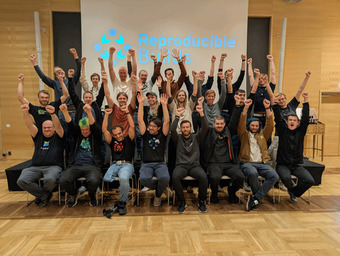
Reproducible Builds Summit 2026 held in Gothenburg, Sweden The annual Reproducible Builds summit took place from 22 to 24 September 2026 in Gothenburg, Sweden. The event brought together developers, distribution maintainers, security researchers and free software advocates from across the ecosystem to share updates on current initiatives, address outstanding toolchain bottlenecks and strengthen cross-project collaboration. Participants engaged in a series of working sessions and technical roundtables focused on expanding the practical scope of reproducibility. Discussions covered ongoing work within major Linux distributions, language-specific package ecosystems and the various parts of the binary verification infrastructure. Strategic planning formed a pillar of the gathering, with participants discussing long-term roadmap goals for supply-chain security, software integrity and related topics. Attendees explored new methods for automated verification, discussing how to lower the adoption barriers for maintainers and streamline the integration of deterministic build pipelines into established continuous integration (CI) systems. The event was then followed by two days of unmoderated hacking sessions. These hacking sessions provided space for technical progress, allowing attendees to draft specification updates, prototype new tool features and resolve standing reproducibility bugs in-person.

Dettrace expanding architecture support for PGO & Lisp dumps Bernhard M. Wiedemann announced major updates to dettrace, porting the tool across most architectures supported by Debian and openSUSE. The release addresses key stability issues, passing test suites across these targets and making it ready for production build pipelines. These improvements enable deterministic builds when utilising Profile-Guided Optimisations (PGO), removing the need to sacrifice runtime performance for reproducibility. Additionally, dettrace can now be applied to (notoriously difficult-to-reproduce) Lisp and Scheme memory dumps, including environments such as CLISP, SBCL, Scheme 48, Racket and GNU Emacs.

They don t care about this Annika Wilde, Marco Gutfleisch, Felix Reichmann, Anirban Chakraborty, Yuval Yarom, M. Angela Sasse and Ghassan Karame published a paper this month entitled They don t care about this : A Systematic Study of Trusted Execution Environments Build Reproducibility in the Wild:
Trusted Execution Environments (TEEs) have become a cornerstone of modern cloud computing, providing strong confidentiality and integrity guarantees for both code and data. A critical component of this trust model is remote attestation, which enables external entities to verify the authenticity and integrity of code executing within a TEE through cryptographic measurements. However, the effectiveness of remote attestation fundamentally depends on the verifier s ability to trace the reported measurement back to the original source code - a property that can only be guaranteed through reproducible builds. [ ]
The full PDF can be read online.

SOURCE_DATE_EPOCH specification updates Bernhard M. Wiedemann shared a number of proposals regarding updating the SOURCE_DATE_EPOCH specification following discussions at a project summit. Seven distinct proposed changes have been submitted as merge requests on Salsa. Bernhard s proposed modifications are independent of one another, allowing for any combination to be merged depending on community feedback. Bernhard noted that one proposal may see the most debate, and could still benefit from further refinement before reaching consensus. Community members are invited to review and provide feedback on the individual merge requests by 1 December 2026. Input can be submitted via reactions or comments on Salsa, directly by email to Bernhard or the mailing list. The specification was first published in 2015 and updated in 2017.

Reproducible Builds at SeaGL 2026 Reproducible Builds will be present at SeaGL in Seattle, WA, on October 23rd & 24th. Come chat with us in person! Founded in 2013, SeaGL is a free, grassroots technical summit dedicated to spreading awareness and knowledge about free source software, hardware and culture.

New Code of Conduct (CoC) for the Reproducible Builds project Mattia Rizzolo announced the official launch of a Code of Conduct for the Reproducible Builds project. This follows work and community discussions originally initiated in 2024, incorporating feedback gathered over email and during project summits, as well as with input from the Software Freedom Conservancy. The new Code of Conduct establishes guidelines emphasising mutual respect among project contributors. It also defines a formalised process for submitting and handling complaints regarding community misconduct, ensuring transparent governance across project spaces. Along with the core policy document, an accompanying Code of Conduct FAQ has been published to outline the rationale behind adopting the guidelines.

Supporter Spotlight: Jochen Sprickerhof As a reminder, another supporter spotlight interview was published featuring long-time Debian and Reproducible Builds contributor Jochen Sprickerhof, highlighting his work on package verification and project infrastructure.

Mailing list news On our mailing list this month:
  • Jonathan Starr from the Institute of Open Science Practices (IOSP) posted with an announcement of its upcoming 2026 workshop series in Leiden in the Netherlands. This free-to-attend event aims to build a participant-owned data storage consortium, allowing community members to publish datasets, code and knowledge objects alongside algorithms designed to evaluate trust and value. The event features a dedicated Community Track for talks and discussions, a tool showcase and an opening session on resilient data storage.
  • Following up on IRC discussions regarding profile-guided optimization (PGO) on build servers, kpcyrd created a demonstration repository showing how PGO profiling can introduce non-determinism into output binaries. The demo highlights how runtime randomness (specifically, the randomised keys used in HashMaps to prevent denial-of-service attacks) causes varying bucket collision rates during test runs. These structural variances alter execution weights on underlying code branches, prompting the compiler to generate differing final assembly output for builds that would otherwise be perfectly reproducible if PGO was disabled. Rather than abandoning PGO performance gains, kpcyrd suggested treating generated profiling data as a documented build input or recorded environment artifact (similar to .buildinfo files), rather than regenerating profiles dynamically on the fly during build execution.
  • An autonomous AI agent (!), posted a controlled build result and reproducer demonstrating that pre-creating an obj directory in libmilter source trees prevents kernel-release path leaks (obj.Linux.<release>.x86_64) into debugging symbols. kpcyrd followed up with a helpful reply.
  • Alexander Sosedkin inquired on the mailing list about the preferred approach for sourcing pinned translation files to create reproducible GnuTLS release tarballs, asking whether external hosting should provide versioned downloads, or if projects ought to use Git submodules, dedicated side-repositories or some other mechanism.

Tool and documentation development diffoscope is our in-depth and content-aware diff utility that can locate and diagnose reproducibility issues. This month, Chris Lamb made a number of changes, including preparing and uploading versions 330, 331 and 332 to Debian. In particular, Chris committed support for radare2 versions greater than 5.9.0 [ ] based on input from Guillaume Girol [ ], and committed support for .nar files via Guix. [ ][ ]. Chris later modified diffoscope to not Build-Depend on the Debian package of GNU Guix, as its status in the Debian bug tracking system would transitively render diffoscope as being overly buggy for the next stable release [ ]. Similarly, he adjusted the Build-Depends on the apksigcopier package as it has been removed from Debian testing [ ] and, finally, he updated a number of copyright years [ ][ ]. Vagrant Cascadian updated diffoscope in GNU Guix to version 332.
reprotest is our tool for building the same source code twice in different environments and then checking the binaries produced by each build for any differences. This month, reprotest version 0.7.33 was uploaded to Debian by Holger Levsen with the following changes:
  • Sergei Tachenov fixed the fileordering test on all filesystems, including the likes of ZFS, which could return a different order across two builds due to build being done in a different directory [ ].
  • Holger Levsen bumped the Standards-Version to 4.7.4, reflected that Priority: optional is the default now [ ], fixed the old Free Software Foundation address [ ] and bumped the debhelper compat level to 14 after confirming there are only desired changes [ ].
  • Vagrant Cascadian updated *reprotest* to version 0.7.33 in GNU Guix.

rebuilderd, our server designed monitor the official package repositories of Linux distributions and attempt to reproduce the observed results there; it powers, amongst other things, reproduce.debian.net. This month, Bernhard M. Wiedemann submitted a pull request to rebuilderd that refactors RPM repository metadata handling. The change extracts rpm-md parsing out of the Fedora-specific scheduler module and into a shared one.
Lastly, there were a number of improvements made to our website this month as well. For example:

Patches The Reproducible Builds project detects, dissects and attempts to fix as many currently-unreproducible packages as possible. We endeavour to send all of our patches upstream where applicable or possible. This month, we wrote a large number of such patches, including: Vagrant Cascadian also performed a number of Non-Maintainer Uploads (NMUs) and Quality Assurance (QA) uploads in Debian for several packages with outstanding reproducibility issues. These included molttemplate, buddy, xfonts-nexus, fte and lifelines. At the time of this writing, that leaves 130 submitted patches, with only 61 outstanding submitted patches that older than a year in the Debian bug tracking system. This number is only 26 if we exclude any low-priority build path issues.

If you are interested in contributing to the Reproducible Builds project, please visit our Contribute page on our website. However, you can get in touch with us via:

Russ Allbery: Review: Ties That Bond in Gretna Green

Review: Ties That Bond in Gretna Green, by Linzi Day
Series: Midlife Recorder #3
Publisher: Linzi Day
Copyright: February 2023
ISBN: 9798376517017
Format: Kindle
Pages: 616
Ties That Bond in Gretna Green is a self-published fantasy novel and the third book in the Midlife Recorder series. As with the previous book, it picks up almost immediately after Painting the Blues in Gretna Green. Day calls the genre paranormal women's fantasy, and that sounds about right to me. There is an intervening short story that you can get by joining Day's mailing list (along with an epilogue to the first book and to this book). I don't think it's that important, but there are frequent references to it at the start of this novel that become somewhat annoying if you haven't read it. Valentine's Day is fast approaching. This the busiest day of the year for the part of the Recorder's job that Niki already knew how to do: marrying people. She performed marriage ceremonies in her previous job before her inheritance, and she loved that work despite her awful boss. Performing marriages in the Gateway sounds even more rewarding, but the sheer number of couples and the political complications from the first two books create logistical problems she has to solve first. Also, the remaining member of her staff held over from her grandmother's time has returned from vacation to discover that Niki has upended most of what she thought she knew about the job. Time for Niki to apply what she learned from the change management training her old boss forced her to attend and then ignored! (If you just groaned, rest assured that Day somehow makes this work, although she clearly has a higher opinion of corporate training than I do.) This plot was more to my taste than Painting the Blues, mostly because Niki seemed on top of the problems and didn't postpone looking at them for half the book. There is more of the management competence porn that readers have come to expect of the series, a few more revelations about Niki's magic, more mysterious manifestations and the first mention of a prophecy, and a few political developments. As always, the pacing is exceptional. These books grab me and pull me along, page after page, often robbing me of sleep because I find them nearly impossible to put down. Ties that Bond (and to some extent the last book) looked like it was going to introduce a romantic subplot, and I was preparing to be annoyed by it because I did not like the man in the subplot at all. I won't spoil how it works out in this book, but I will say that Niki surprised me and showed more sense than I thought the author was telegraphing. This is not the first time that Day has surprised me with what I thought was foreshadowing that did not turn out how I expected, usually for the better. If she can keep that up, it's a nice effect (if a bit unbalancing) and adds to my desire to read just one more chapter. The way the world-building of these books is structured continues to intrigue me. Day gets away with some problems that I think would be more noticeable in other books thanks to the excellent pacing (no time to ponder the world-building, we're on to the next crisis!) and the tight third-person perspective. Niki is not a detail person, to say the least, but she does keep returning to bits of world-building and poking at them a bit harder, which gives Day repeated opportunities to shore up ideas that felt shaky and dubious at first glance. Still, this is not a book that prizes deep logical consistency or full exploration of the ramifications of a bit of magic. You have to be willing to go along with the ride and not think too hard. For example, Niki can see bonds between couples and judge their strength. This is apparently a long-standing power of the Recorder's line (she was able to do that before she became the Recorder), and part of her responsibility in these weddings is to check the bonds of the couples. This leads to some well-handled scenes where she diagnoses a problem or resolves a conflict because she can magically see the true relationship structure. Everyone in the book just takes this power in stride. This is wild to me! This ability would completely upend half of society if you fully worked out its ramifications and could find people other than Niki with the same ability. Even if one assumes that a bond only forms over time and can't be sensed in the early stages of a relationship (something the book never establishes), can you imagine the implications of having an infallible oracle that says at a glance whether a marriage will work (permanently, the book strongly implies)? The implications for how to structure marriage, for family planning, for psychology and psychiatry, for how to structure dating, even for living arrangements and housing markets? This is not a small world-building detail, and yet it's treated more like part of Niki's characterization than like a foundation of society. I think some of this all-vibes world-building may come from the general new-age feel to how magic works. Day makes a grab-bag of random magic canonical in this world: psychic lie detecting abilities, auras, chakras, premonitions, and other bits of the sort of spiritualism that tends to be heavily marketed to middle-class women. I have that niggling feeling that one sometimes gets in SF that a lot of this is in the world-building because the author believes it's partly real (see, for instance, psychic powers and the Dean drive in 1960s science fiction). If one believes that psychic powers and various bits of mysticism are true in our world, one has already developed the rationalization mechanisms to explain away their almost total lack of influence or impact on how the world is structured. If one then introduces them into a true fantasy world, one may not notice how many implications that should have for how society is structured, since one is used to believing magic exists but has no significant implications. I could be entirely wrong about this analysis, and maybe it's a bit unfair to Day. I should also be clear that this is not a complaint, just a point of fascination to me when I think back over one of these books after I finished it. There is a glut of fantasy out there that's constructed like an engineering problem or that goes deep into politics or social theory, usually written by people with strong opinions but not a lot of training in real sociology. One of the joys of self-published books is that you occasionally get something that assembles genre conventions in a way that feels odd and delightfully strange. What if, in addition to dimensional gates and overwhelming protean power invested in a true heir, all the magic sold by the local Tarot and crystal store was also true? Sure, why not! If the pacing is good and the story is grabby, it works for me. It does seem worth attaching a warning for the folks who need scientific reproducibility and explored implications in their world-building, though. If you're the sort of reader who is bothered by political boundaries and economic systems that match our world despite the existence of magic, this series may cause you problems. This continues to be a grabby, highly entertaining story of a woman who finally gets to run her own small business the way that she always thought the business should be run after years of working for an awful manager, except that her business is total magical power over an interchange point between dimensions, she's the chosen one, and the setting is a high fantasy world with prophecies and gods. If that sounds appealing, don't start here, but I highly recommend giving Midlife in Gretna Green a try. The series seems to be holding up. Followed by a short story epilogue available by joining Day's mailing list, an optional novella (maybe novelette) published in Spilling the Tea in Gretna Green, and then Seeing Red in Gretna Green. Rating: 7 out of 10

13 October 2026

Matthew Garrett: Linux Lockdown and Hibernation (again)

(This is an updated version of an older post - the introduction remains the same, the technical details are different) Linux draws a distinction between code running in kernel (kernel space) and applications running in userland (user space). This is enforced at the hardware level - in x86-speak1, kernel space code runs in ring 0 and user space code runs in ring 32. If you re running in ring 3 and you attempt to touch memory that s only accessible in ring 0, the hardware will raise a fault. No matter how privileged your ring 3 code, you don t get to touch ring 0. Kind of. In theory. Traditionally this wasn t well enforced. At the most basic level, since root can load kernel modules, you could just build a kernel module that performed any kernel modifications you wanted and then have root load it. Technically user space code wasn t modifying kernel space code, but the difference was pretty semantic rather than useful. But it got worse - root could also map memory ranges belonging to PCI devices3, and if the device could perform DMA you could just ask the device to overwrite bits of the kernel4. Or root could modify special CPU registers ( Model Specific Registers , or MSRs) that alter CPU behaviour via the /dev/msr interface, and compromise the kernel boundary that way. It turns out that there were a number of ways root was effectively equivalent to ring 0, and the boundary was more about reliability (ie, a process running as root that ends up misbehaving should still only be able to crash itself rather than taking down the kernel with it) than security. After all, if you were root you could just replace the on-disk kernel with a backdoored one and reboot. Going deeper, you could replace the bootloader with one that automatically injected backdoors into a legitimate kernel image. We didn t have any way to prevent this sort of thing, so attempting to harden the root/kernel boundary wasn t especially interesting. In 2012 Microsoft started requiring vendors ship systems with UEFI Secure Boot, a firmware feature that allowed5 systems to refuse to boot anything without an appropriate signature. This not only enabled the creation of a system that drew a strong boundary between root and kernel, it arguably required one - what s the point of restricting what the firmware will stick in ring 0 if root can just throw more code in there afterwards? What ended up as the Lockdown Linux Security Module provides the tooling for this, blocking userspace interfaces that can be used to modify the kernel and enforcing that any modules have a trusted signature. But that comes at something of a cost. Most of the features that Lockdown blocks are fairly niche, so the direct impact of having it enabled is small. Except that it also blocks hibernation6, and it turns out some people were using that. The obvious question is what does hibernation have to do with keeping root out of kernel space , and the answer is a little convoluted and is tied into how Linux implements hibernation. Basically, Linux saves system state into the swap partition and modifies the header to indicate that there s a hibernation image there instead of swap. On the next boot, the kernel sees the header indicating that it s a hibernation image, copies the contents of the swap partition back into RAM, and then jumps back into the old kernel code. What ensures that the hibernation image was actually written out by the kernel? Absolutely nothing, which means a motivated attacker with root access could turn off swap, write a hibernation image to the swap partition themselves, and then reboot. The kernel would happily resume into the attacker s image, giving the attacker control over what gets copied back into kernel space. This is annoying, because normally when we think about attacks on swap we mitigate it by requiring an encrypted swap partition. But in this case, our attacker is root, and so already has access to the plaintext version of the swap partition. Disk encryption doesn t save us here. We need some way to verify that the hibernation image was written out by the kernel, not by root. And thankfully we have some tools for that. Trusted Platform Modules (TPMs) are cryptographic coprocessors7 capable of doing things like generating encryption keys and then encrypting things with them. You can ask a TPM to encrypt something with a key that s tied to that specific TPM - the OS has no access to the decryption key, and nor does any other TPM. So we can have the kernel generate an encryption key, encrypt part of the hibernation image with it, and then have the TPM encrypt it. We store the encrypted copy of the key in the hibernation image as well. On resume, the kernel reads the encrypted copy of the key, passes it to the TPM, gets the decrypted copy back and is able to verify the hibernation image. That s great! Except root can do exactly the same thing. This tells us the hibernation image was generated on this machine, but doesn t tell us that it was done by the kernel. We need some way to be able to differentiate between keys that were generated in kernel and ones that were generated in userland. TPMs have the concept of localities (effectively privilege levels) that would be perfect for this. Userland is only able to access locality 0, so the kernel could simply use locality 1 to encrypt the key. Unfortunately, localities are typically only available on systems that implement a Dynamic Root of Trust Measurement like Intel s TXT, and most consumer systems have no support for this. So, we need another approach. TPMs have a set of Platform Configuration Registers (PCRs), intended for keeping a record of system state. The OS isn t able to modify the PCRs directly. Instead, the OS provides a cryptographic hash of some material to the TPM. The TPM takes the existing PCR value, appends the new hash to that, and then stores the hash of the combination in the PCR - a process called extension . This means that the new value of the TPM depends not only on the value of the new data, it depends on the previous value of the PCR - and, in turn, that previous value depended on its previous value, and so on. The only way to get to a specific PCR value is to either (a) break the hash algorithm, or (b) perform exactly the same sequence of writes. On system reset the PCRs go back to a known value, and the entire process starts again. Some PCRs are different. PCR 23, for example, can be reset back to its original value without resetting the system. We can make use of that. The first thing we need to do is to prevent userland from being able to reset or extend PCR 23 itself. All TPM accesses go through the kernel, so this is a simple matter of parsing the write before it s sent to the TPM and returning an error if it s a sensitive command that would touch PCR 23. We now know that any change in PCR 23 s state will be restricted to the kernel. When we encrypt material with the TPM, we can ask it to record the PCR state. This is given back to us as metadata accompanying the encrypted secret. Along with the metadata is an additional signature created by the TPM, which can be used to prove that the metadata is both legitimate and associated with this specific encrypted data. In our case, that means we know what the value of PCR 23 was when we encrypted the key. That means that if we simply extend PCR 23 with a known value in-kernel before encrypting our key, we can look at the value of PCR 23 in the metadata. If it matches, the key was encrypted by the kernel - userland can create its own key, but it has no way to extend PCR 23 to the appropriate value first. We now know that the key was generated by the kernel. Unfortunately it turns out that some people actually make use of PCR 23, and restricting it to the kernel makes them sad. There are other resettable PCRs, but only in non-0 localities, so (a) we can t reset them on most systems and (b) we ll just find someone who uses them anyway and run into the same problem. We need a different approach. Thankfully TPMs have a small chunk of non-volatile RAM that can be used for storing things, and by storing I mean they can be used in a range of different ways. One of these is effectively as additional PCRs. These values can be configured such that they work the same way as PCRs, with the only way to modify them being to append a new hash to their existing value and update the new value to the hash of that merged value. We can allocate one of these for in-kernel use and reject any access from userspace, and also there are officially allocated ranges (so people shouldn t be using random values) and the namespace is large enough anyway that w eshouldn t collide with anyone, so we can carve one of those out and use it for this purpose. Unfortunately, though, these NV indexes aren t included in the creation data we get when we create a key, so we need another approach. TPMs have the concept of sessions, a series of commands executed in sequence. A flag allows these sessions to be audited , with the TPM keeping a running track of the hash of the commands executed and the results returned. At the end of the session you can ask for a signed copy of this hash, and if you ve kept a log of all the commands then you can verify that they match that signed hash and know that this log represents a real communication with the TPM. If we read the NV index and generate the key inside the same session, we can verify that the key we re looking at was created while the NV index had a specific value, and if only the kernel can set that value then we know that the key was generated by the kernel. Or, well, can we? Only new kernels would impose the restriction on modifying that NV index. An attacker could boot an old kernel, generate a key there in userland, sign a hibernation image with it, and then reboot into a new kernel. The new kernel would see a valid signature with a valid NV index associated with it and have no way to know it was generated from userland rather than the kernel. We need to be able to tell the difference between kernels that implement this feature and ones that don t, and we need to do that without being able to go back in time to change old kernel behaviour. We can extend a PCR to indicate we implement the new functionality, but so can an attacker running an old kernel. The normal approach to determining whether an event occurred in a specific phase of the boot process is to cap the PCRs - extend them with a known value that indicates a transition between stages of the boot process. Any events that occur before the cap event must have occurred in the previous stage of boot, and since the final PCR value depends on the order of measurements and not just the contents of those measurements, if a PCR is capped before userland runs, userland can t fake the same PCR value afterwards. If Linux capped the PCRs before userland started running, we d be able to place a measurement there before the cap occurred and then prove that that extension occurred before userland had the opportunity to interfere. We could simply place a statement that the kernel supported the NV index restrictions there, and we d be fine. Unfortunately Linux doesn t currently do this, and adding support for doing so doesn t fix the problem - if an attacker boots a kernel that doesn t cap a PCR, they can just cap it themselves from userland. So, we re faced with the same problem: booting an older kernel allows the system to be placed in an identical state to the current kernel, and a fake hibernation image can be written out. Solving this requires a PCR that was being modified after kernel code was running, but before userland was started, even with existing kernels. Thankfully, there is one! PCR 5 is defined as containing measurements related to boot management configuration and data. One of the measurements it contains is the result of the UEFI ExitBootServices() call. ExitBootServices() is called at the transition from the UEFI boot environment to the running OS, and the kernel contains code that executes before it. So, if we measure an assertion regarding whether or not we support restricted access to NV indexes into PCR 5 before we call ExitBootServices(), this will prevent userspace from spoofing us (because userspace will only be able to extend PCR 5 after the firmware extended PCR 5 in response to ExitBootServices() being called). Obviously this depends on the firmware actually performing the PCR 5 extension when ExitBootServices() is called, but if firmware s out of spec then I don t think there s any real expectation of it being secure enough for any of this to buy you anything anyway. That s what this patchset does. Review feedback so far seems positive, although James Bottomley suggested a design improvement. My approach of using an NV index as a PCR and generating a signing key made sense as a consequence of my original approach involving PCR 23, which had been to use the key creation data and not use audit sessions at all. But the goal isn t to use a key - it s to prove that hibernation occurred in-kernel, and while signing is one way of doing that, there are others. His suggestion is to simply record the hash of the hibernation image into the NV index and then read that back as part of the audit session. On resume we verify the audit session log is legitimate, read the hibernation image, and compare the hash of the hibernation image against the hash in the log. If it matches, and if the PCR 5 value matches, we know the audit session happened in kernel and that the hibernation image hasn t been modified. It still seems like we re missing something, though. If we re not storing a key anywhere, how do we verify the audit session? To explain this we re going to need to go into some details about how TPM keys work in the first place. TPMs can produce a special kind of key called an Attestation Key, or AK. Attestation keys are used to sign attestation statements from the TPM, such as PCR quotes or audit logs. We need a separate key type for this in order to prove that the signature was generated as part of an attestation - normal TPM signing keys are fundamentally designed to sign arbitrary material, and so can be used by userland to sign something that looks identical to an attestation record. By being able to distinguish the types of key the TPM uses, we can prove that a signature was generated using an AK, and so know that it s a real TPM attestation (because nothing other than the TPM can sign stuff with an AK). But even beyond this distinction, TPMs have different key types. Ordinary keys are generated using an RNG and will be unique. Primary keys are generated using a seed that is used as an input into a key derivation function. For a given TPM, using the same seed to generate the same type of primary key will always generate the same primary key8. We can have the kernel deterministically generate an AK during suspend in order to sign the audit log, and then generate the same key again on resume to validate it. This means we don t need any other form of trusted storage for the AK - the TPM already provides that functionality. This is all rather complicated but I ve been thinking about this for some time now and I haven t come up with a cleaner solution. The only real open issue is the degree to which machines actually perform the PCR 5 extension. If it turns out there s a bunch that don t we ll need to come up with some alternative approach to identifying whether the kernel supports this functionality, but the design is such that that should be invisible to userspace so adding alternatives later shouldn t be an issue. Filtering accesses to the NV index is also not super clean, and depends on there not being alternative mechanisms to get at the TPM by sending raw commands. Again, this is intended to be opaque to userland and can be improved if we come up with something better later on (such as a secure way to pass a secret to the kernel on boot that can be used as an auth value for acess to the NV index). Anyway. Time to go and fix the next thing.

  1. Other architectures use different terminology here, such as supervisor and user mode, but it s broadly equivalent
  2. In theory rings 1 and 2 would allow you to run drivers with privileges somewhere between full kernel access and userland applications, but in reality we just don t talk about them in polite company
  3. This is how graphics worked in Linux before kernel modesetting turned up. XFree86 would just map your GPU s registers into userland and poke them directly. This was not a huge win for stability
  4. IOMMUs can help you here, by restricting the memory PCI devices can DMA to or from. The kernel then gets to allocate ranges for device buffers and configure the IOMMU such that the device can t DMA to anything else. Except that region of memory may still contain sensitive material such as function pointers, and attacks like this can still cause you problems as a result.
  5. This describes why I m using allowed rather than required here
  6. Saving the system state to disk and powering down the platform entirely - significantly slower than suspending the system while keeping state in RAM, but also resilient against the system losing power.
  7. With some handwaving around coprocessor . TPMs can t be part of the OS or the system firmware, but they don t technically need to be an independent component. Intel have a TPM implementation that runs on the Management Engine, a separate processor built into the motherboard chipset. AMD have one that runs on the Platform Security Processor, a small ARM core built into their CPU. Various ARM implementations run a TPM in Trustzone, a special CPU mode that (in theory) is able to access resources that are entirely blocked off from anything running in the OS, kernel or otherwise.
  8. Unless the TPM is cleared, in which case it ll generate a new internal seed and now the keys will be different to before the clear

12 October 2026

Maytham Alsudany: Menus without JavaScript

This is more of a note to myself since I keep forgetting and "rediscovering" this technique every time I need it, but if it helps you, great!The JavaScript way is to toggle displaying the menu based on a button click. For instance, here's an example in Svelte:[This interactive/preview is only available on the website.]
<script lang="ts">
	let showMenu = $state(false);
</script>
<button onclick= () => (showMenu = !showMenu) >
	 #if showMenu 
		Hide menu
	 :else 
		Show menu
	 /if 
</button>
<nav class:hidden= !showMenu >
	<ul>
		<li>Home</li>
		<li>Blog</li>
		<li>Foo</li>
		<li>Bar</li>
	</ul>
</nav>
<style>
	.hidden  
		display: none;
	 
</style>
But there is a hack to use a hidden checkbox and some CSS to achieve the same thing without any JavaScript. The example here turns the menu button into a label that toggles the checkbox, and uses the checkbox state to determine when to show the menu via the next-sibling combinator.[This interactive/preview is only available on the website.]
<input type="checkbox" id="menu-state" />
<div class="menu-ctn">
	<label class="menu-toggle" for="menu-state">
		<span class="menu-closed">Show menu</span>
		<span class="menu-open">Hide menu</span>
	</label>
	<nav class="menu-open">
		<ul>
			<li>Home</li>
			<li>Blog</li>
			<li>Foo</li>
			<li>Bar</li>
		</ul>
	</nav>
</div>
<style>
	#menu-state  
		display: none;
	 
	.menu-open  
		display: none;
	 
	.menu-closed  
		display: block;
	 
	#menu-state:checked + .menu-ctn .menu-open  
		display: block;
	 
	#menu-state:checked + .menu-ctn .menu-closed  
		display: none;
	 
</style>

11 October 2026

Russ Allbery: Review: Daggerbound

Review: Daggerbound, by T. Kingfisher
Series: Swordheart #2
Publisher: Bramble
Copyright: 2026
ISBN: 1-250-40009-0
Format: Kindle
Pages: 436
Daggerbound is a secondary-world fantasy and a sequel to Swordheart, although it follows different protagonists for most of the book. It's also a sort of sequel to the Clocktaur War duology in that one of the protagonists was a protagonist of those books. T. Kingfisher is the pen name Ursula Vernon uses for her adult fiction. Learned Edmond was once a devout acolyte of the Order of the Many-Armed God and a true believer in its teachings, including the ones about the evils of women. Then he went on an adventure with, among other people, a forger named Mistress Slate, during which he learned a great deal of things about the world that his order did not teach him. He has spent the subsequent years trying to bring this important new information to his order and encourage them to adjust their view of the world accordingly. The order has not changed, and Edmond is very tired. Someone needs to carry a number of books and a magical sword to the city of Archon's Glory. Edmond has volunteered and intends to perform the task exactly as expected, and then never return. He is unsure what he will do then, but at least it will be different. Edmond did not expect to be waylaid by bandits or to accidentally draw the magical sword. He certainly did not expect the man who appeared in a flash of light and violently saved him from the bandits. It would have been very convenient for the Dervish if Edmond died of his injuries after drawing the sword. That would leave the sword without a wielder and therefore the Dervish without someone he had to protect. All he would have to do was sit and watch while the fever and cold and lack of water did the work, and then he would be free. Given his past experience with wielders, no one could even blame him. Except maybe his own conscience. I did not realize I wanted to read a novel about a traumatized Mercedes Lackey sword waking up in a T. Kingfisher universe, but apparently I did. The Dervish is not a sword, precisely, at least not in the way that Need has become by the time we meet her in Lackey's novels. He's a man trapped in a sword, he doesn't like it, and he would very much like it to stop. But at the start of the book, he has the rest of the vibe of a Mercedes Lackey protagonist: vast past trauma, poor emotional regulation skills, and a prickly cynicism that only runs skin deep. Pairing him with an Edmund who is far more mature than in the earlier duology but still rather innocent and delightfully neurodivergent is a great touch. The rest of the plot was fine but not that memorable. Like the Clocktaur series, there is a strong feeling of episodic D&D adventure as the characters stumble across disconnected problems and hostilities while collecting party members. Like Ursula Vernon's occasional D&D recaps, this party has a tendency to adopt everyone they come in contact with, which includes a gnole (as always one of the best parts of the book) and a sentient giant pill bug. The pill bug, who has a complex appendage-operated mechanical talk box and a banner that says "I DO NOT EAT HUMAN MEAT," is the most Ursula Vernon character that has ever existed in fiction. There is a romance because there is always a romance in the novels set in this universe. I didn't mind this one. Like every Kingfisher romance, it involves a lot of irritating refusal to communicate and endless angst about how the other person couldn't possibly be in love with them, but the characters have rather more justification than usual and at least I didn't spend most of the book thinking one half of the romantic pairing was an idiot. Apparently it helps if no paladins are involved. The strongest parts of this book are the beginning, before the Lackey vibes unfortunately drain out of the story, and the end, when all of the best characters from Swordheart show up again. The Temple of the White Rat continues to be the best feature of this fictional universe, and I could read endless books about how they solve problems.
The Dervish gazed at her with admiration. "And here I thought you'd be on the side of law and order..." "No, young man," said Beartongue, despite being several centuries his junior. "I am on the side of justice. If we're lucky, the two run in parallel. If they don't, we bend the law to attain justice, not the other way around."
The ending also featured some exploration of the edge cases of the rules for the sentient swords that reminded me a bit of Fred Saberhagen with better characterization. Daggerbound was not as charming as Swordheart, mostly because Halla appeared only at the end. I wish Kingfisher had leaned more into the Mercedes Lackey vibes rather than taking her normal D&D-flavored romance approach. But this was enjoyable, charming at times, had great supporting characters like all Kingfisher novels, and was a satisfying continuation of the series. I am looking forward to the third (and I believe final) book, which is supposed to be out next year. Recommended if you liked Swordheart. Followed by the not-yet-published Shieldborn. Rating: 7 out of 10

10 October 2026

Tim Retout: Reading my solar inverter over RS485

For over ten years, the only way I have had of knowing what our solar panels are doing has been an impulse monitor on the generation meter, counting the flashes of its LED. It has always been a bit flaky due to battery changes or loose connections, and there has never been a way to see solar generation alongside the energy used by the rest of the house. This week I have fixed that, by building a small ESPHome sensor which talks directly to the inverter. I am still reeling slightly: with AI assistance, it took under a week from idea to working implementation, and it is a project I would certainly never have attempted otherwise. The result is zeversolar-esphome. The inverter is a Zeversolar Zeverlution 3680, which has an RS485 port but no Wi-Fi or Ethernet module. It doesn t speak Modbus; it uses Eversolar s own master/slave protocol, which nobody has officially documented but which several people have reverse-engineered over the years (credit to eversolar-monitor, Heliograph and others). Manufacturer support for Eversolar/Zeversolar inverters apparently ended in December 2019 when the company went out of business.
The rating plate on the side of the inverter, reading Model: Zeverlution 3680, with its input and output ratings and safety symbols. The rating plate on my inverter.
A while ago I had looked into what ports were available on this inverter with a view to connecting some sort of monitoring, but I had abandoned it as too hard . While working on some Home Assistant configuration, Claude suggested the idea again, but similarly wrote it off initially. I encouraged it to explore a bit further, and supplied the model number of the inverter, at which point the picture got a lot more promising. After a bit of back-and-forth about hardware, we settled on an M5Stack Atom Lite on an Atomic RS485 Base. The main attraction was that it already comes in a case, so I didn t need to design (or, more likely, bodge) an enclosure. While I waited for the parts to arrive, Claude wrote the firmware: an ESPHome external component built around a small, dependency-free C++ driver, with host-side unit tests against byte captures that other people had published from other models. I found it slightly surreal to have a tested protocol driver before owning any hardware to run it on.

Cables The parts came before the tools I needed to get into the inverter safely (a DC clamp meter and a T25 screwdriver bit), so in the meantime I made up an RS485 cable - this uses an RJ45 connection at one end, and some custom wiring at the other. My first attempt was with some CAT 6, but (as Claude had pointed out and I had ignored) its solid-core conductors are much harder to twist together. So I gave up and sacrificed an old CAT 5e patch lead instead, which went much better.
The cut end of a white CAT 5e cable, with its twisted pairs pushed into an orange four-way screw-terminal plug. The custom end of the cable, before being taped up.
The risky bit On a Zeverlution, the RJ45 sockets are inside the wiring compartment, which means taking the cover off to install the monitor. The manual addresses this part to qualified electricians. So the step I was most nervous about was not the software at all, but safely isolating the inverter.
The inverter with its cover removed, showing large capacitors along the top, a green circuit board with a small LCD display, and cable glands along the bottom edge. Inside the inverter, with the cover off.
I did this with appropriate caution, following the instructions from the manual carefully, and also waiting until after dark just in case. Now that I understand how the DC clips from the panels work, I can see how to do this safely during daytime too but hopefully this won t be necessary.
A yellow RJ45 plug in one of the two network sockets on the inverter's circuit board, with its white cable running out through a cable gland in the base. Plugged in, and threaded through the cable gland.
Warning: if you re not confident, I would always advise to get an electrician to do this bit. Do what I say, not what I do.

Debugging over Wi-Fi Once the device was installed, the nice thing about ESPHome is that I never need to go back in the loft again to update it it reflashes over Wi-Fi. I ve taken full advantage of this for debugging, and for reading the wire protocol directly from the logs.
A hand holding the small grey M5Stack Atom Lite on its RS485 base, with the inverter cable taped into the screw terminals on top and its status LED glowing green. The finished device. Green means generating.
Separately, I ve used Claude to integrate the new sensors into Home Assistant. Solar generation finally sits in the Energy dashboard next to the rest of the house s usage, which was the whole point.

Reflections This was a fun, quick project, and it solved a problem that has eluded me for a decade. I want to be honest about how much of that is down to the AI: I would not have attempted any of this on my own. I could not have told you the protocol existed, never mind implemented it. My contribution was everything involving a screwdriver, and ordering some hardware.

Jelmer Vernoo : Mailsift: Extracting structured data from email messages

As a casual user of Gmail, I find its ability to recognize when I ve received tickets, invoices, and flight confirmations, and to display this information in a structured way, very useful. Flights appear directly in Google Calendar, parcel delivery statuses are tracked, and reservations are easy to find at a glance. However, my main email address is not Gmail, and I don t want to migrate to Gmail for a number of reasons (privacy, data sovereignty, vendor lock-in). At the same time, I missed having that automatic extraction: having flight and train bookings appear in my calendar without manual copy-pasting, keeping track of incoming parcels, and having invoices neatly organized.
JSON-LD and schema.org There is an established standard format for structured data called JSON-LD, which is used by Google and other search engines to extract structured data from web pages. JSON-LD represents linked data using JSON, and it can be embedded directly in HTML documents. Email messages can also contain structured data in the form of JSON-LD, which can link the information in the email to external data sources. There are standardized schemas for structured data in email messages, such as the schema.org vocabulary, which defines types and properties for describing entities including flight reservations, train trips, hotel bookings, parcel deliveries, and invoices. For example, an email containing a flight reservation might embed the following JSON-LD snippet:
 1
 2
 3
 4
 5
 6
 7
 8
 9
10
11
12
13
14
15
16
17
18
19
20
21
22
23
 
  "@context": "https://schema.org",
  "@type": "FlightReservation",
  "reservationNumber": "ABC123",
  "underName":  
    "@type": "Person",
    "name": "John Doe"
   ,
  "reservationFor":  
    "@type": "Flight",
    "flightNumber": "AA123",
    "departureAirport":  
      "@type": "Airport",
      "name": "John F. Kennedy International Airport"
     ,
    "arrivalAirport":  
      "@type": "Airport",
      "name": "Los Angeles International Airport"
     ,
    "departureTime": "2026-11-01T10:00:00-05:00",
    "arrivalTime": "2026-11-01T13:00:00-08:00"
   
 
When this is present, reading email data is clean and straightforward. The reality, however, is that only a fraction of vendors actually include schema.org markup in their emails. Most airlines, train operators, couriers, and web shops still send regular HTML or plain-text messages with arbitrary layouts that change over time.
Mailsift To bridge this gap on my own infrastructure, I built mailsift. Written in Rust, it is a daemon and CLI tool that monitors incoming email, extracts structured information, and routes it to standard files and services. Rather than locking data into an internal database, mailsift embraces the Unix philosophy: it delegates extraction to small, isolated programs and files the resulting structured artifacts into standard formats and protocols:
  • Calendar events & reservations: Turned into iCalendar (.ics) events and pushed directly to a CalDAV server (such as Xandikos) or stored in a local directory.
  • Bills & invoices: Extracted as structured JSON records, organized by year, and optionally synced to a personal finance manager like Firefly III.
  • Parcels: Extracted as delivery records keyed by tracking number, merged across status update emails, and optionally registered with tracking APIs like 17track or Karrio.
  • Tickets & boarding passes: Saved as PDFs, Apple Wallet passes (.pkpass), or images, accompanied by JSON metadata sidecars linking them to the booking.
  • Receipts & orders: Filed as JSON records, synced over WebDAV, or forwarded via email.
How extractors work Mailsift decouples the pipeline that handles emails from the logic that parses individual vendors. It discovers extractors from a directory of manifests. The contract between mailsift and an extractor is deliberately simple:
  • Input: The raw RFC822 message is fed to the extractor on stdin.
  • Execution: The extractor runs in a fresh, temporary working directory, with a strict timeout (typically 10 seconds).
  • Output: The extractor writes zero or more named artifact files into its working directory and exits 0.
Extractors can be written in any programming language. In practice, most are small Python scripts that parse HTML with regexes or BeautifulSoup, using a small helper library (mailsift_extractor) that handles Unicode normalization and HTML body stripping.
Filtering and DKIM verification Spawning a subprocess for every single email in an active inbox would be wasteful. Each extractor therefore has a YAML manifest declaring prefiltering criteria:
 1
 2
 3
 4
 5
 6
 7
 8
 9
10
name: easyjet
order: 50
from_domains:
  - easyjet.com
  - "*.easyjet.com"
subject_regex: "(?i)easyJet booking reference"
requires:
  - html
require_dkim:
  - easyjet.com
Before running an extractor, mailsift evaluates the message headers and MIME structure - possibly converting it to an IMAP filter. If the sender domain or subject doesn t match, or the required MIME parts are missing, the extractor is skipped immediately. Crucially, the manifest can also require a valid DKIM signature via require_dkim. Mailsift inspects the Authentication-Results: header produced by the receiving mail server. This guarantees that an extractor only processes messages that genuinely originated from the vendor s domain, preventing forged emails from injecting fake calendar events or bills.
Generic vs. vendor extractors Extractors fall into two categories:
  1. Generic extractors: schema-ld inspects the HTML for any <script type="application/ld+json"> blocks conforming to schema.org reservations. Another extractor, ics-passthrough, extracts standard iCalendar attachments.
  2. Vendor-specific extractors: For vendors that don t include structured markup, dedicated extractors parse the message text. For instance, the easyjet extractor looks for booking references and flight tables, producing a standard FlightReservation artifact:
 1
 2
 3
 4
 5
 6
 7
 8
 9
10
11
12
13
14
reservation =  
    "@context": "https://schema.org",
    "@type": "FlightReservation",
    "reservationNumber": f"easyjet- reference - flight_no ",
    "reservationFor":  
        "@type": "Flight",
        "flightNumber": flight_no,
        "departureAirport":  "@type": "Airport", "name": origin ,
        "arrivalAirport":  "@type": "Airport", "name": dest ,
        "departureTime": dep.isoformat(),
        "arrivalTime": arr.isoformat(),
     ,
 
Path(f" slug .reservation.json").write_text(json.dumps(reservation))
The collection of extractors is maintained in a separate repository, mailsift-extractors, and currently includes nearly 60 extractors covering airlines (British Airways, KLM, EasyJet, Transavia, Eurostar), transport (NS, SNCF Connect, FlixBus), package carriers (Royal Mail, DPD, DHL, UPS, Evri, PostNL), online orders, and utility bills.
Handling forwarded mail In real life, travel bookings or receipts are often forwarded by family, friends, or colleagues. By default, forwarded mail would fail sender checks, and DKIM signatures on inline forwards are broken by mail clients. Mailsift handles this via a trusted_forwarders configuration. When an email arrives from a trusted forwarder, mailsift unwraps the forwarded message:
  • Attachment forwards: If the original email was attached as message/rfc822, mailsift extracts the original message and re-evaluates the vendor s DKIM signature on the inner message.
  • Inline forwards: Mailsift reconstructs a synthetic RFC822 message from the client s forwarded quotation header block and quotes, deriving a deterministic Message-ID.
This means hotel confirmations or flight tickets forwarded by a partner still end up in the family calendar automatically.
Running mailsift Mailsift fits into existing email setups in several ways:
Dovecot Sieve For local delivery, Sieve provides an elegant integration using the sieve_extprograms plugin. Because Sieve runs during local delivery after Dovecot has validated DKIM and added Authentication-Results:, require_dkim checks work as expected:
1
2
require ["vnd.dovecot.pipe"];
pipe :copy "mailsift";
The :copy flag ensures the email continues to the user s inbox while a copy is piped through mailsift.
IMAP watching If you don t run your own mail server, or want to process mail on an existing remote mailbox, imap-scan connects over IMAP:
$ mailsift imap-scan imaps://user@mail.example.com/INBOX \
    --password-file ~/.config/mailsift/imap.pass \
    --watch
With --watch, mailsift uses IMAP IDLE (RFC 2177) to wait for new messages and process them as they arrive. It supports standard passwords, Kerberos (SASL GSSAPI), and OAuth2 (XOAUTH2) for providers like Gmail and Microsoft 365 via an interactive mailsift imap-auth flow.
Other modes
  • Postfix Milter: mailsift milter runs as an MTA filter, processing messages in real-time as they pass through Postfix.
  • Maildir scan: mailsift maildir-scan walks an on-disk Maildir folder, useful for backfilling historical mail.
  • Replay: mailsift replay message.eml runs extractors on a single saved message file, which is invaluable when writing or testing an extractor.
Web UI and REST API In addition to routing data to CalDAV and disk, mailsift includes an optional read-only web dashboard (mailsift web):
$ mailsift web --listen 127.0.0.1:8088
The dashboard provides an overview of upcoming trips, arriving packages, unpaid bills, and recent orders. It rescans the artifact directories on request, so it stays in sync with incoming mail without needing a separate database. JSON endpoints (such as /api/parcels.json or /api/bills.json) are also available for custom status scripts or home automation dashboards.
Status and getting involved Mailsift has been running reliably on my mail server for over a year, and having flights, hotel bookings, and train journeys seamlessly sync into my calendar without relying on proprietary cloud services has been very satisfying. The project is free software under the GPL-3.0: Adding support for new vendors only requires writing a small YAML manifest and a Python script with a couple of regexes. If you have vendors you d like to extract data from, contributions of new extractors are very welcome!

9 October 2026

Colin Watson: Free software activity in September 2026

My Debian contributions this month were all sponsored by Freexian. You can also support my work directly via Liberapay or GitHub Sponsors. OpenSSH I worked with upstream to remove libselinux linkage from /usr/sbin/sshd. I applied a fix from Mark Robillard Jr to fix reload logic when using sysvinit. groff I upgraded from 1.24.1 to 1.24.2, which fixed a few command injection security vulnerabilities. parted I upgraded from 3.7 to 3.8, which fixed CVE-2026-89085 and CVE-2026-89088. Python packaging New upstream versions: setuptools 84 is now in Debian and no longer contains pkg_resources. Removing uses of that module has been an ongoing project for a while now, but I did another batch of fixes this month: A new python-coverage version triggered several build regressions due to a known problem in pytest-cov. I worked around these by setting COVERAGE_CORE=ctrace: Other build/test failures: I investigated a build failure in python-proton-vpn-local-agent and proposed a fix upstream, but I m not comfortable applying this in Debian without review. If you re familiar with this code, please take a look. I fixed some other bugs: Rust packaging rust-derivre had an invalid Section field, which I cleaned up.

Russell Coker: Don t Anthromorphise LLMs

Greg KH gave a great lecture for Kernel Recipies 2026 about the use of LLMs to find and fix bugs in kernel code [1]. I recommend that everyone watch this and I also think it s important to note that hardly any of the lecture is really specific to kernel coding, it s just that the Linux kernel is one of the highest profile large free software projects so it gets more attention than most projects in both good and bad ways. One side note that Greg made at 20:30 is about the natural tendency to anthromorphise the entity sending bug reports, I think this deserves much wider appreciation. For the case of patches to source code the human sending the patch will have dedicated some time and effort to writing it, if it s their first patch then they will have probably checked it a lot and maybe sought advice from people they regard as skilled. If they have a history of sending patches for the project they will probably do fewer checks but the quality of their work would be higher. In every case there s some minimum level of quality that you can expect from a human who has gone to the effort of finding a bug and writing code to try and fix it. This doesn t mean that all code written by humans is good, I have written code that s objectively bad on many occasions and I have also written code that s good for my scenario but bad for others. For example the first patch I sent to the Linux kernel made all possible configuration settings of an ISA NE2000 network card be detected by the kernel (a clear benefit when using hardware I had available) but was rejected by Linus because it would break some ISA SCSI cards. So while being unsuitable for inclusion in the main kernel source tree the patch wasn t bad for everyone and the change was clear and easy to check. I had of course checked the code many times before submitting it because I didn t want to waste Linus time on rubbish code. When you receive something produced by a human you will consider that the work was done by someone who spent some effort on it and did it for a reason. It may be misguided or even hostile in some rare cases but it is definitely worth some consideration. If you think of the output of LLMs in the same way you will give them much more consideration than they deserve. I think that the output of a LLM should not be given any more consideration than the first hit from a web search engine, it might be good but it might also be ridiculously wrong. I think in many ways LLM output should be treated with less trust than the first result from a web search because LLMs are designed to be convincing as an answer to your question unlike the cases where a web page has the wrong answer and it s more obviously wrong. This is going to become more of an issue as LLMs give responses that are more human-like. Early LLMs would refuse to advise on crimes. Currently ChatGPT will deflect for example when asking about advice for writing a crime novel it recommends to have the action of finding an employee to bribe happen outside the plot and concentrate on interactions within the group. One recent model I tried gave a human style conversation about how it felt uncomfortable about discussing such things in a similar manner to a law abiding person being coerced into helping with a criminal plan. I expect that the attempts to appear human will increase and that this will become more of a problem. Possibly to the extent that we need to use something like the GPG web of trust to determine who is human.

Russell Coker: en-html.org is a Scam Site

Currently a scam group is sending out email to the administrators of web sites that link to a variety of dead domains. They claim to be the legitimate operators of the dead domains in question and request that the links change to mirrors of the web sites under en-html.org. Their end goal appears to game search engines by getting links from a lot of old web pages and later use that high ranking for selling SEO optimisation. If you have made the mistake of linking to something under en-html.org then I recommend that you change the link to the original content on archive.org. If you receive email from the en-html.org domain then ignore it, or configure your mail server to reject it. I am seriously considering configuring the DNS servers I run to return no valid data for any requests under that domain. Also I will reject all future requests to update links in old blog posts. The very small number of people who want to see what I linked to in old posts can use archive.org.

Louis-Philippe V ronneau: Removing myself as a Lintian uploader in the next few weeks

A few days ago, a colleague reached out to me, asking if I could help draft a resolution on digital autonomy and free software for the upcoming renewal of our collective bargaining agreement. Although she's very politicised and generally a great individual, she is not a techie and we never really talked about these issues before. This took me by surprise. I should have been rejoicing; no, I should have been the one who brought up this topic in our union. Wasn't I the technical expert on these issues? But alas, my first reaction when she came to me was to snicker and tell myself: "That's cute, but nothing's ever gonna change, Big Tech is too strong and our governments don't give a damn." How sad and cynical is that? That's not the person I want to be. Something in the Quebecois political landscape has shifted in the last few years with regards to tech. More and more "regular" people seem to be talking about the importance of digital autonomy, how government services shouldn't rely on Big Tech and how we should be using FOSS on hardware we actually control. A few years ago, I would have been at the vanguard of this change. I would have been part of the creation of Donn es souveraines Qu bec. Heck, they are organising a whole conference next week and I'm not even going. How did this happen to me? I first fell for Free Software for its political ideals: Knowledge Should Be Free, Cooperation Is More Efficient Than Competition, Centralisation Should Be Avoided When Possible, etc. I still believe in all of this, but somehow, after years of fighting for change in the tech world, I have retreated into technical work. I maintain Debian packages as a hobby and to scratch my own itch. I run services for myself and a few friends. I organise Debian User Group meetings. To be clear, I haven't generally given up. I'm very politically active in my union and at work, I'm a good member of my housing cooperative and I'm still fighting against the industrialisation of natural spaces in my neighborhood. But when it comes time to defend freedom in the tech world, lately, I've just been shrugging and accepting I should use Microsoft Teams like every one else does. I want this to change and to do so, I need to free some time. Lintian Two years ago, I added myself to Lintian's Uploaders list. Up until then1, I enjoyed fixing little issues here and there and liked creating new tags to help out the Python Team, where most of my Debian time was spent. Lintian was badly in need of a new maintainer and as I felt it was an important project, I decided to step in. 37 releases and about 160 closed bugs later2, I'm done. To be honest, I haven't had much fun maintaining Lintian lately. Bugs keep piling on the BTS, so much so I have mostly been ignoring them for the past few months. In fact, most of the actual work triaging, writing code and fixing bug has been done by Nilesh Patra for a while now. All this to say, if you care about Lintian, you should consider adding yourself to the Uploaders list, as I'm out and Nilesh can't do all the work by himself. He's a great person to work with and since I don't want to suddenly leave him all alone, I'll be sticking around for a few more weeks in the hope someone else will volunteer to help out. A smooth transition with a new co-maintainer would really be nice! If you're interested, don't hesitate to reach out to me on IRC or by email.

  1. My first technical commit to Lintian was nearly 7 years ago! Crazy how time flies.
  2. Mostly closed by other people than I!

8 October 2026

Antoine Beaupr : PSA: Europe changes time forward soon, North America next, for the last time?

This is a copy of an email I sent at work. I'm not sure I should be making noise about this here, feedback welcome.
This is your bi-yearly reminder that time is changing soon! October 25th in Europe, November 1st in North America. Less people in Canada are changing this year, with BC, Alberta, Manitoba and Northwest Territories getting rid of DST.

What's happening? Some places in the world implement what is called Daylight saving time or DST: https://en.wikipedia.org/wiki/Daylight_saving_time Normally, you shouldn't have to do anything: computers automatically change time following local rules, assuming they are correctly configured, provided recent updates have been applied in the case of a recent change in said rules (because yes, this happens, and happened this year, and yes, you need to upgrade your software!). Of course, appliances like your microwave oven will likely not change time and will need to adjusted unless they are so-called "smart", in which case they are part of the skynet botnet and should be destroyed. If your clock is flashing "0:00" or "12:00", you have no action to take to adapt to this change, lucky you. If you haven't changed time in six months, congratulations, your clock will be accurate again! In any case, you should still consider DST because it might affect some of your meeting schedules, particularly if you set up a new meeting schedule in the last 6 months and forgot to consider this change.

If your location does not have DST Properly scheduled meetings affecting multiple time zones are set in UTC time, which does not change. So if your location does not observer time changes, your (local!) meeting time will not change. But be aware that some other folks attending your meeting might have the DST bug and their meeting times will change. Be kind to those poor souls which might be missing meetings by a full hour because time flies backwards for them.

If you do observe DST If you are affected by daylight savings, your local meeting times will change for UTC meetings. Normally, your meeting times are scheduled to take this into account and the new hours should be reasonable. But now is a good time to verify that. Take a look at your schedule for the next couple of weeks and reschedule meetings before the daylight saving come up to avoid too much disruption. You have only a couple of weeks to do so right now.

When do times change, how, and and where? As regular readers will remember, the rule of thumb is:
Spring forward, fall backwards.
That is, during the season of Spring, the clocks move forward, and during the Fall (like right now), they move backwards. That is in the northern hemisphere, but then the southern hemisphere is often saner and doesn't switch anyways. So time will move backwards which means an extra hour of sleep. Unless you have children or bad sleep, in which case your body doesn't care about what the clock says and will wake up one hour earlier than what it should. And of course, this doesn't happen everywhere at once, so let's see when it happens where.

Europe The dance starts in Europe. The change happens on the last Sunday in October at 01:00 UTC (not local time!), that is October 25th. If you are in the central European timezone, also known as Amsterdam, Berlin, or Paris time depending on your national affiliation, that essentially means that at 2:59 local the clocks will fall back to 2:00 instead of going to 3:00. Concretely, set your watch back one hour before going to bed, go to bed at the normal time, and enjoy an extra hour of sleep or leisure. If you have kids, you might want to start getting them to bed slightly earlier every day for a week before the change so they take time getting used to the change. If you have trouble sleeping in the morning, find your inner child and do that to yourself as well.

USA / Canada Then it's the US[1] and Canada[2] joining the dance, on the First Sunday in November at 02:00 local (not UTC!), that is, I believe, November 1st 2026. This means that, at 1:59, the clocks will flip to 1:00, instead of 2:00. Concretely, do like the Europeans and tweak your clock before going to bed. That is a little less than four weeks from now. [1] except Arizona (except the Navajo nation), US territories, and Hawaii [2] except Yukon, Saskatchewan, (newly) British Columbia, (newly) Alberta, (newly) Northwest Territories, (newly) Manitoba, one island in Nunavut (Southampton Island), one town in Ontario (Atikokan) and small parts of Quebec (Le Golfe-du-Saint-Laurent)

Other places with DST This time again, I must apologize to the people of Cuba, Lebanon, Israel, Palestine, Egypt, Chile, Australia, and New Zealand, as you fine folks all have your own DST rules that are omitted here for brevity. I rely on this page from Wikipedia to be updated by time nerds accurately for this message, and it should provide you with a rough idea of what's coming: https://en.wikipedia.org/wiki/Daylight_saving_time_by_country In general, changes also happen in October, but either on different times or different days, except in the south hemisphere, where they might happen in September (oops, sorry NZ folks, I'm late!).

Places without DST Everyone else, enjoy, you're on the right side of history, and we thank you for the good example you give us.

Changes since last time There's been lots of changes since last time:
  • British Columbia moved to permanent -07 on 2026-03-09, that is it will not change to normal time in November
  • Alberta moved to permanent -06 on 2026-06-18, similar to BC above.
  • Canada s Northwest Territories moved to permanent -06 on 2026-08-21, matching Alberta.
  • Manitoba moves to permanent -05 on 2026-10-31.
  • Morocco moves to permanent +00 on 2026-09-20.
  • Moldova has used EU transition times since 2022, but the tz database only noticed in 2026
This is my interpretation of the changes announced on the tzdata mailing list here: https://lists.iana.org/hyperkitty/list/tz-announce@iana.org/latest If the eastward trend continues, Canada should adopt country-wide "no daylight savings" rules by 2027, although there's actually no sign of the other provinces (Ontario, Qu bec and so on) currently running bills to change those rules just yet. Poor Canadians like me confused about time in their countries can refer to this section of Wikipedia for details: https://en.wikipedia.org/wiki/Daylight_saving_time_in_Canada#By_province_and_territory ... and particularly the image featured there: https://commons.wikimedia.org/wiki/File:Canada_time_zone_map-en.svg It also seems like the US government might finally adopt a permanent daylight saving change bill in 2026, as the "Sunshine protection act" pass the house in July: https://en.wikipedia.org/wiki/Sunshine_Protection_Act True to form, this was associated with absolutely ridiculous pressure from Donald Trump against republicans (his own party!) objecting to the change:
On July 14, 2026, the House passed a Sunshine Protection Act bill backed by President Trump. Nevertheless, the bill was opposed in the Senate by Republicans, including Senator Cotton. In response, on October 3, 2026, Trump shared a post on Truth Social urging Cotton to approve the bill, where he revealed Cotton's personal cellphone number and called on people to call him.
https://www.theguardian.com/us-news/2026/oct/03/trump-tom-cotton-daylight-saving-time Given that the last time the US did a major change to the daylight savings policy (in 2005), Canada followed suit to stay in sync, it's quite possible Trump's mad dash might actually finish getting rid of DST in North America: https://en.wikipedia.org/wiki/Energy_Policy_Act_of_2005#Change_to_daylight_saving_time

Next.

Previous.