It's Sunday and I'm now sitting in the train from Brest to Paris where I will be changing to Germany, on the way back from the annual Debian conference. A full week of presentations, discussions, talks and socializing is laying behind me and my head is still spinning from the intensity.
Pollito and the gang of DebConf mascots wearing their conference badges (photo: Christoph Berg)
Table of Contents
Sunday, July 13th
It started last Sunday with traveling to the conference. I got on the Eurostar in Duisburg and we left on time, but even before reaching Cologne, the train was already one hour delayed for external reasons, collecting yet another hour between Aachen and Liege for its own technical problems. "The train driver is working on trying to fix the problem." My original schedule had well over two hours for changing train stations in Paris, but being that late, I missed the connection to Brest in Montparnasse. At least in the end, the total delay was only one hour when finally arriving at the destination. Due to the French julliet quatorze fireworks approaching, buses in Brest were rerouted, but I managed to catch the right bus to the conference venue, already meeting a few Debian people on the way.
The conference was hosted at the IMT Atlantique Brest campus, giving the event a nice university touch. I arrived shortly after 10 in the evening and after settling down a bit, got on one of the "magic" buses for transportation to the camping site where half of the attendees where stationed. I shared a mobile home with three other Debianites, where I got a small room for myself.
Monday, July 14th
Next morning, we took the bus back to the venue with a small breakfast and the opening session where Enrico Zini invited me to come to his and Nicolas Dandrimont's session about Debian community governance and curation, which I gladly did. Many ideas about conflict moderation and community steering were floated around. I hope some of that can be put into effect to make flamewars on the mailing lists less heated and more directed. After that, I attended Olly Betts' "Stemming with Snowball" session, which is the stemmer used also in PostgreSQL. Text search is one of the areas in PostgreSQL that I never really looked closely at, including the integration into the postgresql-common package, so it was nice to get more information about that.
In preparation for the conference, a few of us Ham radio operators in Debian had decided to bring some radio gear to DebConf this year in order to perhaps spark more interest for our hobby among the fellow geeks. In the afternoon after the talks, I found a quieter spot just outside of the main hall and set up a shortwave antenna by attaching a 10m mast to one of the park benches there. The 40m band was still pretty much closed, but I could work a few stations from England, just across the channel from Bretagne, answering questions from interested passing-by Debian people between the contacts. Over time, the band opened and more European stations got into the log.
F/DF7CB in Brest (photo: Evangelos Ribeiro Tzaras)
Tuesday, July 15th
Tuesday started with Helmut Grohne's session about "Reviving (un)schroot". The schroot program has been Debian's standard way of managing build chroots for a long time, but it is more and more being regarded as obsolete with all kinds of newer containerization and virtualization technologies taking over. Since many bits of Debian infrastructure depend on schroot, and its user interface is still very useful, Helmut reimplemented it using Linux namespaces and the "unshare" systemcall. I had already worked with him at the Hamburg Minidebconf to replace the apt.postgresql.org buildd machinery with the new system, but we were not quite there yet (network isolation is nice, but we still sometimes need proper networking), so it was nice to see the effort is still progressing and I will give his new scripts a try when I'm back home.
Next, Stefano Rivera and Colin Watson presented Debusine, a new package repository and workflow management system. It looks very promising for anyone running their own repository, so perhaps yet another bit of apt.postgresql.org infrastructure to replace in the future. After that, I went to the Debian LTS BoF session by Santiago Ruano Rinc n and Bastien Roucari s - Debian releases plus LTS is what we are covering with apt.postgresql.org. Then there were bits from the DPL (Debian Project Leader), and a session moderated by Stefano Rivera interesting to me as a member of the Debian Technical Committee on the future structure of the packages required for cross-building in Debian, a topic which had been brought to TC a while ago. I am happy that we could resolve the issue without having to issue a formal TC ruling as the involved parties (kernel, glibc, gcc and the cross-build people) found a promising way forward themselves. DebConf is really a good way to get such issues unstuck.
Ten years ago at the 2015 Heidelberg DebConf, Enrico had given a seminal "Semi-serious stand-up comedy" talk, drawing parallels between the Debian Open Source community and the BDSM community - "People doing things consensually together". (Back then, the talk was announced as "probably unsuitable for people of all ages".) With his unique presentation style and witty insights, the session made a lasting impression on everyone attending. Now, ten years later (and he and many in the audience being ten years older), he gave an updated version of it. We are now looking forward to the sequel in 2035. The evening closed with the famous DebConf tradition of the Cheese & Wine party in a old fort next to the coast, just below the conference venue. Even when he's a fellow Debian Developer, Ham and also TC member, I had never met Paul Tagliamonte in person before, but we spent most of the evening together geeking out on all things Debian and Ham radio.
The northern coast of Ushant (photo: Christoph Berg)
Wednesday, July 16th
Wednesday already marked the end of the first half of the week, the day of the day trips. I had chosen to go to Ouessant island (Ushant in English) which marks the Western end of French mainland and hosts one of the lighthouses yielding the way into the English channel. The ferry trip included surprisingly big waves which left some participants seasick, but everyone recovered fast. After around one and a half hours we arrived, picked up the bicycles, and spent the rest of the day roaming the island. The weather forecast was originally very cloudy and 18 C, but over noon this turned into sunny and warm, so many got an unplanned sunburn. I enjoyed the trip very much - it made up for not having time visiting the city during the week. After returning, we spent the rest of the evening playing DebConf's standard game, Mao (spoiler alert: don't follow the link if you ever intend to play).
Having a nice day (photo: Christoph Berg)
Thursday, July 17th
The next day started with the traditional "Meet the Technical Committee" session. This year, we trimmed the usual slide deck down to remove the boring boilerplate parts, so after a very short introduction to the work of the committee by our chairman Matthew Vernon, we opened up the discussion with the audience, with seven (out of 8) TC members on stage. I think the format worked very well, with good input from attendees. Next up was "Don't fear the TPM" by Jonathan McDowell. A common misconception in the Free Software community is that the TPM is evil DRM hardware working against the user, but while it could be used in theory that way, the necessary TPM attestations seem to impossible to attain in practice, so that wouldn't happen anyway. Instead, it is a crypto coprocessor present in almost all modern computers that can be used to hold keys, for example to be used for SSH. It will also be interesting to research if we can make use of it for holding the Transparent Data Encryption keys for CYBERTEC's PostgreSQL Enterprise Edition.
Aigars Mahinovs then directed everyone in place for the DebConf group picture, and Lucas Nussbaum started a discussion about archive-wide QA tasks in Debian, an area where I did a lot of work in the past and that still interests me. Antonio Terceiro and Paul Gevers followed up with techniques to track archive-wide rebuilding and testing of packages and in turn filing a lot of bugs to track the problems. The evening ended with the conference dinner, again in the fort close by the coast. DebConf is good for meeting new people, and I incidentally ran into another Chris, who happened to be one of the original maintainers of pgaccess, the pre-predecessor of today's pgadmin. I admit still missing this PostgreSQL frontend for its simplicity and ability to easily edit table data, but it disappeared around 2004.
Friday, July 18th
On Friday, I participated in discussion sessions around contributors.debian.org (PostgreSQL is planning to set up something similar) and the New Member process which I had helped to run and reform a decade or two ago. Agathe Porte (also a Ham radio operator, like so many others at the conference I had no idea of) then shared her work on rust-rewriting the slower parts of Lintian, the Debian package linter. Craig Small talked about "Free as in Bytes", the evolution of the Linux procps free command. Over the time and many kernel versions, the summary numbers printed became better and better, but there will probably never be a version that suits all use cases alike. Later over dinner, Craig (who is also a TC member) and I shared our experiences with these numbers and customers (not) understanding them. He pointed out that for PostgreSQL and looking at used memory in the presence of large shared memory buffers, USS (unique set size) and PSS (proportional set size) should be more realistic numbers than the standard RSS (resident set size) that the top utility is showing by default.
Antonio Terceiro and Paul Gevers again joined to lead a session, now on ci.debian.net and autopkgtest, the test driver used for running tests on packages after then have been installed on a system. The PostgreSQL packages are heavily using this to make sure no regressions creep in even after builds have successfully completed and test re-runs are rescheduled periodically. The day ended with Bdale Garbee's electronics team BoF and Paul Tagliamonte and me setting up the radio station in the courtyard, again answering countless questions about ionospheric conditions and operating practice.
Saturday, July 19th
Saturday was the last conference day. In the first session, Nikos Tsipinakis and Federico Vaga from CERN announced that the LHC will be moving to Debian for the accelerator's frontend computers in their next "long shutdown" maintenance period in the next year. CentOS broke compatibility too often, and Debian trixie together with the extended LTS support will cover the time until the next long shutdown window in 2035, until when the computers should have all been replaced with newer processors covering higher x86_64 baseline versions. The audience was very delighted to hear that Debian is now also being used in this prestige project.
Ben Hutchings then presented new Linux kernel features. Particularly interesting for me was the support for atomic writes spanning more than one filesystem block. When configured correctly, this would mean PostgreSQL didn't have to record full-page images in the WAL anymore, increasing throughput and performance. After that, the Debian ftp team discussed ways to improve review of new packages in the archive, and which of their processes could be relaxed with new US laws around Open Source and cryptography algorithms export. Emmanuel Arias led a session on Salsa CI, Debian's Gitlab instance and standard CI pipeline. (I think it's too slow, but the runners are not under their control.) Julian Klode then presented new features in APT, Debian's package manager. I like the new display format (and a tiny bit of that is also from me sending in wishlist bugs).
In the last round of sessions this week, I then led the Ham radio BoF with an introduction into the hobby and how Debian can be used. Bdale mentioned that the sBitx family of SDR radios is natively running Debian, so stock packages can be used from the radio's touch display. We also briefly discussed his involvement in ARDC and the possibility to get grants from them for Ham radio projects. Finally, DebConf wrapped up with everyone gathering in the main auditorium and cheering the organizers for making the conference possible and passing Pollito, the DebConf mascot, to the next organizer team.
Pollito on stage (photo: Christoph Berg)
Sunday, July 20th
Zoom back to the train: I made it through the Paris metro and I'm now on the Eurostar back to Germany. It has been an intense week with all the conference sessions and meeting all the people I had not seen so long. There are a lot of new ideas to follow up on both for my Debian and PostgreSQL work. Next year's DebConf will take place in Santa Fe, Argentina. I haven't yet decided if I will be going, but I can recommend the experience to everyone!
The post The Debian Conference 2025 in Brest appeared first on CYBERTEC PostgreSQL Services & Support.
Tobias Frost
did 2.5h (out of 12.0h assigned), thus carrying over 9.5h to the next month.
Evolution of the situation
In June, we released 35 DLAs.
Notable security updates:
mariadb-10.5, prepared by Otto Kek l inen, fixes vulnerabilities which could result in denial of service, information disclosure, or unauthorized data modification
python-django, prepared by Chris Lamb, fixes vulnerabilities which would result in log injection or denial of service
webkit2gtk, prepared by Emilio Pozuelo Monfort, fixes many vulnerabilities which could results in a wide range of issues
xorg-server, prepared by Emilio Pozuelo Monfort, fixes multiple vulnerabilities which may result in privilege escalation
sudo, prepared by Thorsten Alteholz, fixes a vulnerability which could result in privilege escalation
Notable non-security updates:
debian-security-support, prepared by Santiago Ruano Rinc n, updates status of packages which receive limited security support or which have reached the end of security support
dns-root-data, prepared by Sylvain Beucler, updates the DNSSEC trust anchors
This month s contributions from outside the regular team include the mariadb-10.5 update mentioned above, prepared by Otto Kek l inen (the package maintainer); an update to libfile-find-rule-perl, prepared by Salvatore Bonaccorso (a member of the Debian Security Team); an update to activemq, prepared by Emmanuel Arias (a maintainer of the package).
Additionally, LTS Team members contributed stable updates of the following packages:
curl, prepared by Carlos Henrique Lima Melara
python-tornado, prepared by Daniel Leidert
python-flask-cors, prepared by Daniel Leidert
common-vfs, prepared by Daniel Leidert
cjson, prepared by Adrian Bunk
icu, prepared by Adrian Bunk
node-tar-fs, prepared by Adrian Bunk
rar, prepared by Adrian Bunk
Something of particular noteworthiness is that LTS contributor Carlos Henrique Lima Melara discovered a regression in the upstream fix for CVE-2023-2753 in curl. The corrective action which he took included providing a patch to upstream, uploading a stable update of curl, and further updating the version of curl in LTS.
DebConf, the annual Debian Conference, is coming up in July and, as is customary each year, the week preceding the conference will feature an event called DebCamp. The DebCamp week provides an opportunity for teams and other interested groups/individuals to meet together in person in the same venue as the conference itself, with the purpose of doing focused work, often called sprints . LTS coordinator Roberto C. S nchez has announced that the LTS Team is planning to hold a sprint primarily focused on the Debian security tracker and the associated tooling used by the LTS Team and the Debian Security Team.
Thanks to our sponsors
Sponsors that joined recently are in bold.
unschroot, by Helmut Grohne
Quite a while back, the sbuild maintainers added the unshare backend to
enable better isolation of builds, but in doing so sbuild now effectively
bundles a container runtime. unschroot is an attempt to separate containment
from sbuild by implementing the same features and more in a schroot-compatible
way. Last year, vague feature parity
was achieved, but going beyond required changing the model from keeping state in
the filesystem to keeping Linux namespaces as session state. A proof of concept
is now available. While it still has sharp corners, it enables building packages
on a squashfs with an overlayfs or id-mapped bind mounting of your ccache
neither of which is possible with sbuild s unshare backend. There shall be a
DebConf25 presentation
about this work.
DebConf 25, by Stefano Rivera, Santiago Ruano Rinc n and Lucas Kanashiro
DebConf 25 is now under way in Brest,
France. Santiago is part of the local team running the event, and Stefano Rivera
is part of the DebConf committee, supporting the event, as well as the video
team. Both have spent considerable time in the last month, getting things ready
for DebConf. Lucas Kanashiro built the schedule for DebConf 25. Also followed-up
on multiple requests from speakers and stakeholders.
Miscellaneous contributions
Carles did general maintenance on simplemonitor, qnetload and qdacco packages;
provided simplemonitor upstream feedback on new feature.
Carles s updates about po-debconf-manager: prepared for DebCamp/DebConf, used
it for reviewing and merging different packages. Also fixed multispeech
po-debconf templates.
Colin Watson found a crash in pterm (PuTTY s terminal emulator) when running
in a Wayland session, and backported the resulting upstream fix
to trixie.
Colin responded to an upstream groff bug report
about URLs being dropped from PDF output in some cases on Debian, and backported
the fix to trixie.
Helmut debugged rebootstrap failures and worked around build failures
related to gcc-15 when they had patches and sent ones otherwise.
Thorsten Alteholz uploaded cups to fix a FTBFS-bug. This bug was introduced by
a change in systemd, which bumped the maximum number of open files. This
resulted in a longer test duration that triggered a timeout so that the build
failed. Thorsten also uploaded mtink and lprng, which got new translation files.
Lucas Kanashiro followed-up on multiple unblock requests for ruby packages due
to reproducible builds fixes. All of them were accepted into trixie.
Lucas Kanashiro discussed license issues with upstream involving Redis 8 new
license and the possibility of backporting patches to old versions with a
different license. Outcome is that upstream is adding a new paragraph to their
license to allow the backport for security fixes.
Lucas Kanashiro fixed multiple CVEs reported against valkey in unstable and
trixie.
Lucas Kanashiro gave a Debian packaging course of 8 hours for students at a
free software development course at the University of Sao Paulo.
Lucas Kanashiro fixed a couple of cross building issues in the ruby ecosystem
with Helmut s help.
Lucas Kanashiro is working on a debci fix for
#1107645 (ongoing).
Stefano Rivera updated python-mitogen to the latest beta releases with
upstream support for Ansible 12.
Stefano Rivera spent some time winding up DebConf 24 books.
Stefano Rivera fixed packages that were blocking cPython 3.13.5 from migrating
to trixie, and filed an unblock request.
Stefano Rivera investigated a regression in cPython 3.13 that was breaking
OpenStack Nova. There is a patch in progress for cPython, but it is not ready
for use, yet.
Santiago reviewed different MRs in Salsa CI. For example, the
MR !605
proposed by Aquila that aims to introduce a new debdiff job, as well as the
autopkgtest MR !33
to extend the support to architectures other than amd64. Also reviewed
MR !611
by Aayush Raj that fixes the autopkgtest images cleanup. And the
MR !614,
prepared by Charles, to change the suffix name used to bump the version used in
the pipeline.
Anupa procured supplies needed for the DebConf ID tag for the DebConf
registration team and co-ordinated its transport to the venue.
Anupa joined Nattie to complete the registration team tasks.
Updated Austin, by Colin Watson and Helmut Grohne
Austin is a frame stack sampling profiler
for Python. It allows profiling Python applications without instrumenting them
while losing some accuracy in the process, and is the only one of its kind
presently packaged for Debian. Unfortunately, it hadn t been uploaded in a while
and hence the last Python version it worked with was
3.8. We updated it to a current version and
also dealt with a number of architecture-specific problems (such as unintended
sign promotion, 64bit time_t fallout and strictness due to -Wformat-security
) in cooperation with upstream. With luck, it will migrate in time for trixie.
Preparing for DebConf 25, by Stefano Rivera and Santiago Ruano Rinc n
DebConf 25 is quickly approaching, and the
organization work doesn t stop. In May, Stefano continued supporting the
different teams. Just to give a couple of examples, Stefano made changes in
DebConf 25 website to make BoF
and sprints
submissions public, so interested people can already know if a BoF or sprint for
a given subject is planned, allowing coordination with the proposer; or to
enhance how statistics are made public
to help the work of the local team.
Santiago has participated in different tasks, including the logistics of the
conference, like preparing more information
about the public transportation that will be available. Santiago has also taken
part in activities related to fundraising and reviewing more event proposals.
Miscellaneous contributions
Lucas fixed security issues in Valkey in unstable.
Lucas tried to help with the update of Redis to version 8 in unstable. The
package hadn t been updated for a while due to licensing issues, but now
upstream maintainers fixed them.
Lucas uploaded around 20 ruby-* packages to unstable that weren t updated for
some years to make them build reproducible. Thanks to reproducible builds folks
to point out those issues. Also some unblock requests (and follow-ups) were
needed to make them reach trixie in time for the release.
Lucas is organizing a Debian Outreach session for DebConf 25, reaching out to
all interns of Google Summer of Code and Outreachy programs from the last year.
The session will be presented by in-person interns and also video recordings
from the interns interested in participating but did not manage to attend the
conference.
Lucas continuously works on DebConf Content team tasks. Replying to speakers,
sponsors, and communicating internally with the team.
Carles improved po-debconf-manager: fixed bugs reported by Catalan translator,
added possibility to import packages out of salsa, added using non-default
project branches on salsa, polish to get ready for DebCamp.
Carles tested new apt in trixie and reported bugs to apt ,
installation-report , libqt6widget6 .
Carles used po-debconf-manager and imported remaining 80 packages, reviewed 20
translations, submitted (MR or bugs) 54 translations.
Carles prepared some topics for translation BoF in DebConf (gathered feedback,
first pass on topics).
Helmut sent 25 patches for cross compilation failures.
Helmut reviewed, refined and applied a patch from Jochen Sprickerhof to make
the Multi-Arch hinter emit more hints for pure Python modules.
Helmut sat down with Christoph Berg (not affiliated with Freexian) and
extended unschroot
to support directory-based chroots with overlayfs. This is a feature that was
lost in transitioning from sbuild s schroot backend to its unshare backend.
unschroot implements the schroot API just enough to be usable with sbuild
and otherwise works a lot like the unshare backend. As a result,
apt.postgresql.org now performs its
builds contained in a user namespace.
Helmut looked into a fair number of rebootstrap failures most of which
related to musl or gcc-15 and imported patches or workarounds to make those
builds proceed.
Helmut updated dumat
to use sqop fixing earlier PGP verification problems thanks to Justus Winter
and Neal Walfield explaining a lot of sequoia at MiniDebConf Hamburg.
Helmut got the previous zutils update for /usr-move wrong again and had to
send another update.
Helmut looked into why debvm s autopkgtests were flaky and with lots of
help from Paul Gevers and Michael Tokarev tracked it down to a
race condition in qemu. He updated debvm to
trigger the problem less often and also fixed a wrong dependency using
Luca Boccassi s patch.
Santiago continued the switch to sbuild
for Salsa CI (that was stopped for some months), and has been mainly testing
linux,
since it s a complex project that heavily customizes the pipeline. Santiago is
preparing the changes for linux to submit a MR soon.
In openssh, Colin tracked down some intermittent sshd crashes to a
root cause, and issued
bookworm and bullseye updates for CVE-2025-32728.
Colin spent some time fixing up fail2ban,
mainly reverting a patch that caused its tests to fail and would have banned
legitimate users in some common cases.
Colin backported upstream fixes for CVE-2025-48383
(django-select2) and CVE-2025-47287
(python-tornado) to unstable.
Stefano supported video streaming and recording for 2 miniDebConfs in May:
Macei and Hamburg.
These had overlapping streams for one day, which is a first for us.
Stefano packaged the new version of python-virtualenv that includes our
patches for not including the wheel for wheel.
Stefano got all involved parties to agree (in principle) to meet at DebConf
for a mediated discussion on a dispute that was brought to the technical
committee.
Anupa coordinated the swag purchase for DebConf 25 with Juliana and Nattie.
Anupa joined the publicity team meeting for discussing the upcoming events and
BoF at DebConf 25.
Anupa worked with the publicity team to publish Bits post to welcome GSoc 2025
Interns.
Utkarsh Gupta
did 1.0h (out of 15.0h assigned), thus carrying over 14.0h to the next month.
Evolution of the situation
In May, we released 54 DLAs.
The LTS Team was particularly active in May, publishing a higher than normal number of advisories, as well as helping with a wide range of updates to packages in stable and unstable, plus some other interesting work. We are also pleased to welcome several updates from contributors outside the regular team.
Notable security updates:
containerd, prepared by Andreas Henriksson, fixes a vulnerability that could cause containers launched as non-root users to be run as root
libapache2-mod-auth-openidc, prepared by Moritz Schlarb, fixes a vulnerability which could allow an attacker to crash an Apache web server with libapache2-mod-auth-openidc installed
request-tracker4, prepared by Andrew Ruthven, fixes multiple vulnerabilities which could result in information disclosure, cross-site scripting and use of weak encryption for S/MIME emails
postgresql-13, prepared by Bastien Roucari s, fixes an application crash vulnerability that could affect the server or applications using libpq
dropbear, prepared by Guilhem Moulin, fixes a vulnerability which could potentially result in execution of arbitrary shell commands
openjdk-17, openjdk-11, prepared by Thorsten Glaser, fixes several vulnerabilities, which include denial of service, information disclosure or bypass of sandbox restrictions
glibc, prepared by Sean Whitton, fixes a privilege escalation vulnerability
Notable non-security updates:
wireless-regdb, prepared by Ben Hutchings, updates information reflecting changes to radio regulations in many countries
This month s contributions from outside the regular team include the libapache2-mod-auth-openidc update mentioned above, prepared by Moritz Schlarb (the maintainer of the package); the update of request-tracker4, prepared by Andrew Ruthven (the maintainer of the package); and the updates of openjdk-17 and openjdk-11, also noted above, prepared by Thorsten Glaser.
Additionally, LTS Team members contributed stable updates of the following packages:
rubygems and yelp/yelp-xsl, prepared by Lucas Kanashiro
simplesamlphp, prepared by Tobias Frost
libbson-xs-perl, prepared by Roberto C. S nchez
fossil, prepared by Sylvain Beucler
setuptools and mydumper, prepared by Lee Garrett
redis and webpy, prepared by Adrian Bunk
xrdp, prepared by Abhijith PA
tcpdf, prepared by Santiago Ruano Rinc n
kmail-account-wizard, prepared by Thorsten Alteholz
Other contributions were also made by LTS Team members to packages in unstable:
proftpd-dfsg DEP-8 tests (autopkgtests) were provided to the maintainer, prepared by Lucas Kanashiro
a regular upload of libsoup2.4, prepared by Sean Whitton
a regular upload of setuptools, prepared by Lee Garrett
Freexian, the entity behind the management of the Debian LTS project, has been working for some time now on the development of an advanced CI platform for Debian-based distributions, called Debusine. Recently, Debusine has reached a level of feature implementation that makes it very usable. Some members of the LTS Team have been using Debusine informally, and during May LTS coordinator Santiago Ruano Rinc n has made a call for the team to help with testing of Debusine, and to help evaluate its suitability for the LTS Team to eventually begin using as the primary mechanism for uploading packages into Debian. Team members who have started using Debusine are providing valuable feedback to the Debusine development team, thus helping to improve the platform for all users. Actually, a number of updates, for both bullseye and bookworm, made during the month of May were handled using Debusine, e.g. rubygems s DLA-4163-1.
By the way, if you are a Debian Developer, you can easily test Debusine following the instructions found at https://wiki.debian.org/DebusineDebianNet.
DebConf, the annual Debian Conference, is coming up in July and, as is customary each year, the week preceding the conference will feature an event called DebCamp. The DebCamp week provides an opportunity for teams and other interested groups/individuals to meet together in person in the same venue as the conference itself, with the purpose of doing focused work, often called sprints . LTS coordinator Roberto C. S nchez has announced that the LTS Team is planning to hold a sprint primarily focused on the Debian security tracker and the associated tooling used by the LTS Team and the Debian Security Team.
Thanks to our sponsors
Sponsors that joined recently are in bold.
Evolution of the situation
In April, we released 46 DLAs.
Notable security updates:
jetty9, prepared by Markus Koschany, fixes an information disclosure and potential remote code execution vulnerability
zabbix, prepared by Tobias Frost, fixes several vulnerabilities, encompassing denial of service, information disclosure or remote code inclusion
glibc, prepared by Sean Whitton, fixes a buffer overflow vulnerability
Notable non-security updates:
tzdata, prepared by Emilio Pozuelo Monfort, brings the latest timezone database release
php-horde-editor and php-horde-imp, prepared by Sylvain Beucler, have been updated to switch from CKEditor v3, which is EOL, to CKEditor v4; this builds upon work done last month by Sylvain and Bastien for the complete removal of ckeditor3
distro-info-data, prepared by Stefano Rivera, adds information concerning future Debian and Ubuntu releases
The LTS team continues to welcome the collaboration of maintainers and other interested parties from outside the regular team. In April, we had external updates contributed by: Yadd - lemonldap-ng and Moritz Schlarb - libapache2-mod-auth-openidc
A point release of the current stable Debian 12 (codename bookworm ) is planned for mid-May and several LTS contributors have prepared packages for this update, many of them prepared in conjunction with related LTS updates of the same packages:
glib2.0, haproxy, imagemagick, poppler, and python-h11, prepared by Adrian Bunk
rubygems, prepared by Lucas Kanashiro
ruby3.1 (in collaboration with Lucas Kanashiro), twitter-bootstrap3, twitterboot-strap4, wpa, and erlang, prepared by Bastien Roucari s (corresponding updates of twitter-bootstrap3 and twitter-bootstrap4 were also uploaded to Debian unstable)
abseil, prepared by Tobias Frost (a corresponding update was also uploaded to Debian unstable)
vips, prepared by Guilhem Moulin
Additional updates of ruby3.3 and rubygems were prepared for Debian unstable by Lucas Kanashiro.
And finally, a highlight of our continued commitment to enhancing long term support efforts in upstream projects. Freexian, as the primary entity behind the management and execution of the LTS project, has partnered with Invisible Things Lab to extend the upstream security support of Xen 4.17, which is shipped in Debian 12 bookworm (the current stable release). This partnership will result in significantly improved lifecycle support for users of Xen on bookworm, and members of the LTS team will play a part in this endeavour. The Freexian announcement has additional details.
Thanks to our sponsors
Sponsors that joined recently are in bold.
DebConf 25 Preparations, by Stefano Rivera and Santiago Ruano Rinc n
DebConf 25 preparations continue. In April,
the bursary team reviewed and ranked bursary applications. Santiago Ruano Rinc n
examined the current state of the conference s finances, to see if we could
allocate any more money to bursaries. Stefano Rivera supported the bursary
team s work with infrastructure and advice and added some metrics to assist
Santiago s budget review. Santiago was also involved in different parts of the
organization, including Content team matters, as reviewing the first of
proposals, preparing public
information
about the new Academic Track; or coordinating different
aspects of the Day trip activities and the Conference Dinner.
PyPA tools updates, by Stefano Rivera
Around the beginning of the freeze (in retrospect, definitely too late) Stefano
looked at updating setuptools in the archive to 78.1.0. This brings support
for more comprehensive license expressions
(PEP-639), that people are expected to
adopt soon upstream. While the reverse-autopkgtests all passed, it all came with
some unexpected complications, and turned into a mini-transition. The new
setuptools broke shebangs for scripts
(pypa/setuptools#4952).
It also required a bump of wheel to 0.46 and wheel 0.46 now has a dependency
outside the standard library (it de-vendored packaging). This meant it was no
longer suitable to distribute a standalone wheel.whl file to seed into new
virtualenvs, as virtualenv does by default. The good news here is that
setuptools doesn t need wheel any more, it included its own
implementation of the bdist_wheel command, in 70.1. But the world hadn t
adapted to take advantage of this, yet. Stefano scrambled to get all of these
issues resolved upstream and in Debian:
pip: Don t check for wheel when invoked with --no-use-pep517
(pypa/pip#13330), automatically do
--no-use-pep517 builds without wheel
(pypa/pip#13358, rejected).
virtualenv: Don t include wheel
(pypa/virtualenv#2868) except on
Python 3.8
(pypa/virtualenv#2876) as pip
dropped Python 3.8 support in the same release that included #13330.
We re now at the point where python3-wheel-whl is no longer needed in Debian
unstable, and it should migrate to trixie.
Removing libcrypt-dev from build-essential, by Helmut Grohne
The crypt function was originally part of glibc, but it got separated to
libxcrypt. As a result, libc6-dev now depends on libcrypt-dev. This poses
a cycle during architecture cross bootstrap. As the number of packages actually
using crypt is relatively small, Helmut
proposed removing
the dependency. He analyzed an archive rebuild kindly performed by Santiago Vila
(not affiliated with Freexian) and estimated the necessary changes. It looks
like we may complete this with modifications to less than 300 source packages in
the forky cycle. Half of the bugs have been filed at this time. They are
tracked with libcrypt-*usertags.
Miscellaneous contributions
Carles uploaded a new version of simplemonitor.
Carles improved the documentation of salsa-ci-team/pipeline regarding piuparts
arguments.
Carles closed an FTBFS on gcc-15 on qnetload.
Carles worked on Catalan translations using po-debconf-manager: reviewed 57
translations and created their merge requests in salsa, created 59 bug reports
for packages that didn t merge in more than 30 days. Followed-up merge requests
and comments in bug reports. Managed some translations manually for packages
that are not in Salsa.
Lucas did some work on the DebConf Content and Bursary teams.
Lucas fixed multiple CVEs and bugs involving the upgrade from bookworm to
trixie in ruby3.3.
Lucas fixed a CVE in valkey in unstable.
Stefano updated beautifulsoup4, python-authlib, python-html2text,
python-packaging, python-pip, python-soupsieve, and unidecode.
Stefano packaged python-dependency-groups, a new vendored library in python-pip.
During an afternoon Bug Squashing Party in Montevideo, Santiago uploaded a
couple of packages fixing RC bugs #1057226
and #1102487. The
latter was a sponsored upload.
Thorsten uploaded new upstream versions of brlaser, ptouch-driver and
sane-airscan to get the latest upstream bug fixes into Trixie.
Rapha l filed an upstream bug on
zim for a
graphical glitch that he has been experiencing.
Colin did his usual routine work on the Python team: 21 packages upgraded to
new upstream versions, 8 CVEs fixed, and about 25 release-critical bugs fixed.
Helmut filed patches for 21 cross build failures.
Helmut uploaded a new version of
debvm
featuring a new tool
debefivm-create
to generate EFI-bootable disk images compatible with other tools such as libvirt
or VirtualBox. Much of the work was prototyped in earlier months. This
generalizes mmdebstrap-autopkgtest-build-qemu.
Helmut continued reporting undeclared file conflicts and suggested package
removals from unstable.
Helmut proposed build profiles for libftdi1
and gnupg2. To deal with recently added
dependencies in the architecture cross bootstrap package set.
Helmut managed the /usr-move transition. He worked on ensuring that systemd
would comply with Debian s policy.
Dumat continues to locate problems
here and there yielding discussion occasionally. He sent a patch for an upgrade
problem in zutils.
Anupa worked with the Debian publicity team to publish Micronews and Bits
posts.
Anupa worked with the DebConf 25 content team to review talk and event
proposals for DebConf 25.
Evolution of the situation
In March, we have released 31 DLAs.
Notable security updates:
linux-6.1 (12)and linux, prepared by Ben Hutchings, fixed an extensive list of vulnerabilities
firefox-esr, prepared by Emilio Pozuelo Monfort, fixed a variety of vulnerabilities
intel-microcode, prepared by Tobias Frost, fixed
several local privilege escalation, denial of service, and information disclosure vulnerabilities
vim, prepared by Sean Whitton, fixed a multitude of vulnerabilities, including many application crashes, buffer overflows, and out-of-bounds reads
The recent trend of contributions from contributors external to the formal LTS team has continued. LTS contributor Sylvain Beucler reviewed and facilitated an update to openvpn proposed by Aquila Macedo, resulting in the publication of DLA 4079-1. Thanks a lot to Aquila for preparing the update.
The LTS Team continues to make contributions to the current stable Debian release, Debian 12 (codename bookworm ). LTS contributor Bastien Roucari s prepared a stable upload of krb5 to ensure that fixes made in the LTS release, Debian 11 (codename bullseye ) were also made available to stable users. Additional stable updates, for tomcat10 and jetty9, were prepared by LTS contributor Markus Koschany. And, finally, LTS contributor Utkarsh Gupta prepared stable updates for rails and ruby-rack.
LTS contributor Emilio Pozuelo Monfort has continued his ongoing improvements to the Debian security tracker and its associated tooling, making the data contained in the tracker more reliable and easing interaction with it.
The ckeditor3 package, which has been EOL by upstream for some time, is still depended upon by the PHP Horde packages in Debian. Sylvain, along with Bastien, did monumental work in coordinating with maintainers, security team fellows, and other Debian teams, to formally declare the EOL of the ckeditor3 package in Debian 11 and in Debian 12. Additionally, as a result of this work Sylvain has worked towards the removal of ckeditor3 as a dependency by other packages in order to facilitate the complete removal of ckeditor3 from all future Debian releases.
Thanks to our sponsors
Sponsors that joined recently are in bold.
Preparing for Trixie, by Rapha l Hertzog
As we are approaching the trixie freeze, it is customary for Debian developers
to review their packages and clean them up in preparation for the next stable
release.
That s precisely what Rapha l did with
publican, a package that had not seen
any change since the last Debian release and that partially stopped working
along the way due to a major Perl upgrade. While upstream s activity is close to
zero, hope is not yet entirely gone as the git repository moved to a new
location a couple of months ago and
contained the required fix. Rapha l also developed another fix to avoid an
annoying warning that was seen at runtime.
Rapha l also ensured that the last upstream version of zim was uploaded to
Debian unstable, and developed a fix for gnome-shell-extension-hamster to make
it work with GNOME 48
and thus ensure that the package does not get removed from trixie.
Abseil and re2 transition in Debian, by Stefano Rivera
One of the last transitions to happen for trixie was an update to
abseil, bringing it up to 202407. This library
is a dependency for one of Freexian s customers, as well as blocking newer
versions of re2, a package maintained by Stefano.
The transition had been stalled for several months while some issues with
reverse dependencies were investigated and dealt with. It took a final push to
make the transition happen, including fixing a few newly discovered problems
downstream. The abseil package s autopkgtests were (trivially) broken by newer
cmake versions, and some tests started failing on PPC64 (a known issue
upstream).
debvm uploaded, by Helmut Grohne
debvm is a command line tool for
quickly creating a Debian-based virtual machine for testing purposes. Over time,
it accumulated quite a few minor issues as well as CI failures. The most
notorious one was an ARM32 failure present since August. It was diagnosed down
to a glibc bug by Tj and Chris Hofstaedtler
and little has happened since then. To have debvm work somewhat, it now
contains a workaround for this situation. Few changes are expected to be
noticeable, but related tools such as apt, file, linux, passwd, and
qemu required quite a few adaptations all over the place. Much of the
necessary debugging was contributed by others.
DebConf 25 Registration website, by Stefano Rivera and Santiago Ruano Rinc n
DebConf 25, the annual Debian developer conference, is now open for
registration.
Other than preparing the conference
website, getting
there always requires some last minute changes to the
software
behind the registration interface and this year was no exception. Every year,
the conference is a little different to previous years, and has some different
details that need to be captured from attendees. And every year we make minor
incremental improvements to fix long-standing problems.
New concepts this year included: brunch, the closing talks on the departure day,
venue security clearance, partial contributions towards food and accommodation
bursaries, and attendee-selected bursary budgets.
Miscellaneous contributions
Helmut uploaded
guess-concurrency incorporating
feedback from others.
Helmut reacted to
rebootstrap CI results and
adapted it to cope with changes in unstable.
Helmut researched real world /usr-move fallout though little was actually
attributable. He also NMUed systemd unsuccessfully.
Helmut sent 12 cross build patches.
Helmut looked into undeclared file conflicts in Debian more systematically and
filed quite some
bugs.
Lucas worked on the CFP and tracks definition for DebConf 25.
Lucas worked on some bits involving Rails 7 transition.
Carles investigated why the job piuparts on salsa-ci/pipeline was passing but
was failing on piuparts.debian.org for simplemonitor package. Created an
issue and MR
with a suggested fix, under discussion.
Carles improved the documentation of salsa-ci/pipeline: added documentation
for different variables.
Carles made debian-history package reproducible (with help from Chris Lamb).
Carles updated simplemonitor package (new upstream version), prepared a new
qdacco version (fixed bugs in qdacco, packaged with the upgrade from Qt 5 to Qt
6).
Carles reviewed and submitted translations to Catalan for adduser, apt,
shadow, apt-listchanges.
Carles reviewed, created merge-requests for translations to Catalan of 38
packages (using
po-debconf-manager
tooling). Created 40 bug reports for some merge requests that haven t been
actioned for some time.
Colin Watson fixed 59 RC bugs (including 26 packages broken by the
long-overdue removal of dh-python s dependency on python3-setuptools), and
upgraded 38 packages (mostly Python-related) to new upstream versions.
Stefano bisected and fixed a pypy
translation regression on Debian stable and older on 32-bit ARM.
Emilio coordinated and helped finish various transitions in light of the
transition freeze.
Thorsten Alteholz uploaded cups-filters to fix an FTBFS with a new upstream
version of qpdf.
With the aim of enhancing the support for packages related to Software Bill of
Materials (SBOMs) in recent industrial standards, Santiago has worked on
finishing the packaging of and uploaded CycloneDX python
library. There is on-going
work about SPDX python tools, but it
requires (build-)dependencies currently not shipped in Debian, such as
owlrl and
pyshacl.
Anupa worked with the Publicity team to announce the Debian 12.10 point
release.
Anupa with the support of Santiago prepared an announcement and announced the
opening of CfP and Registrations for DebConf 25.
Last week, we (Helmut, Jochen, Holger, Gioele and josch) met in W rzburg for a Debian crossbuilding & bootstrap sprint. We would like to thank Angest pselt e. V. for generously providing us with their hacker space which we were able to use exclusively during the four-day-sprint. We d further like to thank Debian for their sponsorship of accommodation of Helmut and Jochen.
The most important topics that we worked on together were:
publicity and funding for bootstrappable and cross-buildable Debian, driven by Gioele, including the creation of a list of usecases and slogans [everyone]
proof-of-concept for substituting coreutils with alternative implementations such as busybox, toybox or uutils [Helmut, Jochen, josch]
writing a patch for documenting the Multi-Arch field in Debian policy #749826 [Helmut, Holger, Jochen, josch]
josch worked on making the Debian Linux kernel packaging use hooks installed in /usr/share/kernel/*.d and gathered feedback from the other sprint participants in how to best move this forward, culminating in the opening of #1101733 against src:linux.
Thank you all for attending this sprint, for making it so productive and for the amazing atmosphere and enlightening discussions!
Here s my 66th monthly but brief update about the activities I ve done in the F/L/OSS world.
Debian
This was my 75th month of actively contributing to Debian.
I became a DM in late March 2019 and a DD on Christmas 19! \o/
There s a bunch of things I do, both, technical and non-technical. Here s what I did:
Updating Rails to v7.2.2.1 for Trixie.
Updating Redmine to v6.0.4 for Trixie.
Kickstarting the bursary team for DC25.
Mentoring for newcomers.
Moderation of -project mailing list.
Ubuntu
This was my 50th month of actively contributing to Ubuntu.
Now that I joined Canonical to work on Ubuntu full-time, there s a bunch of things I do! \o/
I mostly worked on different things, I guess.
I was too lazy to maintain a list of things I worked on so there s
no concrete list atm. Maybe I ll get back to this section later or
will start to list stuff from the fall, as I was doing before. :D
Debian (E)LTS
Debian Long Term Support (LTS) is a project to extend the lifetime of all Debian stable releases to (at least) 5 years. Debian LTS is not handled by the Debian security team, but by a separate group of volunteers and companies interested in making it a success.
And Debian Extended LTS (ELTS) is its sister project, extending support to the stretch and jessie release (+2 years after LTS support).
This was my 66th month as a Debian LTS and 53rd month as a Debian ELTS paid contributor.
I worked for 15.00 hours for LTS and 7.50 hours for ELTS.
I did the following things:
Evolution of the situation
In February, we have released 38 DLAs.
Notable security updates:
pam-u2f, prepared by Patrick Winnertz, fixed an authentication bypass vulnerability
openjdk-17, prepared by Emilio Pozuelo Monfort, fixed an authorization bypass/information disclosure vulnerability
firefox-esr, prepared by Emilio Pozuelo Monfort, fixed several vulnerabilities
thunderbird, prepared by Emilio Pozuelo Monfort, fixed several vulnerabilities
postgresql-13, prepared by Christoph Berg, fixed an SQL injection vulnerability
freerdp2, prepared by Tobias Frost, fixed several vulnerabilities
openssh, prepared by Colin Watson, fixed a machine-in-the-middle vulnerability
LTS contributors Emilio Pozuelo Monfort and Santiago Ruano Rinc n coordinated the administrative aspects of LTS updates of postgresql-13 and pam-u2f, which were prepared by the respective maintainers, to whom we are most grateful.
As has become the custom of the LTS team, work is under way on a number of package updates targeting Debian 12 (codename bookworm ) with fixes for a variety of vulnerabilities. In February, Guilhem Moulin prepared an upload of sssd, while several other updates are still in progress. Bastien Roucari s prepared an upload of krb5 for unstable as well.
Given the importance of the Debian Security Tracker to the work of the LTS Team, we regularly contribute improvements to it. LTS contributor Emilio Pozuelo Monfort reviewed and merged a change to improve performance, and then dealt with unexpected issues that arose as a result. He also made improvements in the processing of CVEs which are not applicable to Debian.
Looking to the future (the release of Debian 13, codename trixie , and beyond), LTS contributor Santiago Ruano Rinc n has initiated a conversation among the broader community involved in the development of Debian. The purpose of the discussion is to explore ways to improve the long term supportability of packages in Debian, specifically by focusing effort on ensuring that each Debian release contains the best supported upstream version of packages with a history of security issues.
Thanks to our sponsors
Sponsors that joined recently are in bold.
Are you a student aspiring to participate in the Google Summer of Code 2025? Would you like to improve the continuous integration pipeline used at salsa.debian.org, the Debian GitLab instance, to help improve the quality of tens of thousands of software packages in Debian?
This summer 2025, I and Emmanuel Arias will be participating as mentors in the GSoC program. We are available to mentor students who propose and develop improvements to the Salsa CI pipeline, as we are members of the Debian team that maintains it.
A post by Santiago Ruano Rinc n in the GitLab blog explains what Salsa CI is and its short history since inception in 2018. At the time of the article in fall 2023 there were 9000+ source packages in Debian using Salsa CI. Now in 2025 there are over 27,000 source packages in Debian using it, and since summer 2024 some Ubuntu developers have started using it for enhanced quality assurance of packaging changes before uploading new package revisions to Ubuntu. Personally, I have been using Salsa CI since its inception, and contributing as a team member since 2019. See my blog post about GitLab CI for MariaDB in Debian for a description of an advanced and extensive use case.
Helping Salsa CI is a great way to make a global impact, as it will help avoid regressions and improve the quality of Debian packages. The benefits reach far beyond just Debian, as it will also help hundreds of Debian derivatives, such as Ubuntu, Linux Mint, Tails, Purism PureOS, Pop!_OS, Zorin OS, Raspberry Pi OS, a large portion of Docker containers, and even the Windows Subsystem for Linux.
Improving Salsa CI: more features, robustness, speed
While Salsa CI with contributions from 71 people is already quite mature and capable, there are many ideas floating around about how it could be further extended. For example, Salsa CI issue #147 describes various static analyzers and linters that may be generally useful. Issue #411 proposes using libfaketime to run autopkgtest on arbitrary future dates to test for failures caused by date assumptions, such as the Y2038 issue.
There are also ideas about making Salsa CI more robust and code easier to reuse by refactoring some of the yaml scripts into independent scripts in #230, which could make it easier to run Salsa CI locally as suggested in #169. There are also ideas about improving the Salsa CI s own CI to avoid regressions from pipeline changes in #318.
The CI system is also better when it s faster, and some speed improvement ideas have been noted in #412.
Improvements don t have to be limited to changes in the pipeline itself. A useful project would also be to update more Debian packages to use Salsa CI, and ensure they adopt it in an optimal way as noted in #416. It would also be nice to have a dashboard with statistics about all public Salsa CI pipeline runs as suggested in #413.
These and more ideas can be found in the issue list by filtering for tags Newcomer, Nice-To-Have or Accepting MRs. A Google Summer of Code proposal does not have to be limited to these existing ideas. Participants are also welcome to propose completely novel ideas!
Good time to also learn Debian packaging
Anyone working with Debian team should also take the opportunity to learn Debian packaging, and contribute to the packaging or maintenance of 1-2 packages in parallel to improving the Salsa CI. All Salsa CI team members are also Debian Developers who can mentor and sponsor uploads to Debian.
Maintaining a few packages is a great way to eat your own cooking and experience Salsa CI from the user perspective, and likely to make you better at Salsa CI development.
Apply now!
The contributor applications opened yesterday on March 24, so to participate act now! If you are an eligible student and want to attend, head over to summerofcode.withgoogle.com to learn more.
There are over a thousand participating organizations, with Debian, GitLab and MariaDB being some examples. Within these organizations there may be multiple subteams and projects to choose from. The full list of participating Debian projects can be found in the Debian wiki.
If you are interested in GSoC for Salsa CI specifically, feel free to
Reach out to me and Emmanuel by email at otto@ and eamanu@ (debian.org).
Sign up at salsa.debian.org for an account (note it takes a few days due to manual vetting and approval process)
Note that you don t have to wait for GSoC to officially start to contribute. In fact, it may be useful to start immediately by submitting a Merge Request to do some small contribution, just to learn the process and to get more familiar with how everything works, and the team maintaining Salsa CI. Looking forward to seeing new contributors!
Debian.Social administration, by Stefano Rivera
Over the last year, the Debian.social
services outgrew the infrastructure
that was supporting them. The matrix bridge in particular was hosted on a cloud
instance backed by a large expensive storage volume. Debian.CH rented a new
large physical server to host all these instances, earlier this year. Stefano
set up Incus on the new physical machine
and migrated all the old debian.social LXC Containers, libvirt VMs, and cloud
instances into Incus-managed LXC containers.
Stefano set up Prometheus monitoring and alerts for the new infrastructure and a
Grafana dashboard. The current stack of
debian.social services seem to comfortably fit on the new machine, with good
room to grow.
DebConf 25, by Santiago Ruano Rinc n and Stefano Rivera
DebConf 25 preparations continue. The team is currently finalizing a budget.
Stefano helped to review the current budget proposals and suggest approaches for
balancing it.
Stefano installed a Zammad instance to organize
queries from attendees, for the registration and visa teams.
Santiago continued discussions with possible caterers so we can have options for
the different diet requirements and that could fit into the DebConf budget.
Also, in collaboration with Anupa, Santiago pushed the first
draft changes
to document the venue information in the DebConf 25 website and how to get to
Brest.
Time-based test failure in requests, by Colin Watson
Colin fixed a fun bug in the Python
requests package. Santiago Vila
has been running
tests of what
happens when Debian packages are built on a system in which time has been
artificially set to somewhere around the end of the support period for the next
Debian release, in order to make it easier to do things like issuing security
updates for the lifetime of that release. In this case, the
failure indicated an expired test
certificate, and since the repository already helpfully included scripts to
regenerate those certificates, it seemed natural to try regenerating them just
before running tests. However, this
failed for more obscure reasons
and Colin spent some time investigating. This turned out to be because the test
CA was missing the CA constraint and so recent versions of OpenSSL reject it;
Colin sent a pull request to fix
this.
Priority list for outdated packages, by Santiago Ruano Rinc n
Santiago started a
discussion on
debian-devel about packages that have a history of security issues and that are
outdated regarding new upstream releases. The goal of the mentioned effort is to
have a prioritized list of packages needing some work, from a security point of
view. Moreover, the aim of publicly sharing the list of packages with the Debian
Developers community is to make it easier to look at the packages maintained by
teams, or even other maintainers where help could be welcome. Santiago is
planning to take into account the feedback provided in debian-devel and to
propose a tooling that could help to regularly bring collective awareness of
these packages.
Miscellaneous contributions
Carles worked on English to Catalan po-debconf translations: reviewed
translations, created merge requests and followed up with developers for more
than 30 packages using po-debconf-manager.
Carles helped users, fixed bugs and implemented downloading updated templates
on po-debconf-manager.
Carles packaged a new upstream version of python-pyaarlo.
Carles improved reproducibility of qnetload (now reported as reproducible) and
simplemonitor (followed up with upstream and pending update of Debian package).
Carles collaborated with debian-history package: fixed FTBFS from master
branch, enabled salsa-ci and investigated reproducibility.
Emilio improved support for automatically marking CVEs as NOT-FOR-US in the
security-tracker, closing #1073012.
Emilio updated xorg-server and xwayland in unstable, fixing the last round of
security vulnerabilities.
Helmut Grohne sent patches for 24 cross build failures.
Helmut fixed two problems in the Debian /usr-merge analysis tool. In one
instance, it would overmatch Debian bugs to issues and in another it would fail
to recognize Pre-Depends as a conflict mechanism.
Helmut attempted making rebootstrap work for gcc-15 with limited success as
very many packages FTBFS with gcc-15 due to using function declarations without
arguments.
Helmut provided a change to the security-tracker that would pre-compute
/data/json during database updates rather than on demand resulting in a
reduced response time.
Colin uploaded OpenSSH security
updates for testing/unstable,
bookworm, bullseye, buster, and stretch.
Colin fixed upstream monitoring for 26
Python packages, and upgraded 54 packages (mostly Python-related, but also
PuTTY) to new upstream versions.
Colin updated python-django in bookworm-backports to 4.2.18 (issuing
BSA-121),
and added new backports of python-django-dynamic-fixture
and python-django-pgtrigger, all of which are dependencies of
debusine.
Thorsten Alteholz finally managed to upload hplip to fix two release critical
and some normal bugs. The next step in March would be to upload the latest
version of hplip.
Faidon updated crun in unstable & trixie, resolving a long-standing request of
enabling criu support and thus enabling podman with checkpoint/restore
functionality (With gratitude to Salvatore Bonaccorso and Reinhard Tartler for
the cooperation and collaboration).
Faidon uploaded a number of packages (librdkafka, libmaxminddb,
python-maxminddb, lowdown, tox, tox-uv, pyproject-api, xiccd and gdnsd) bringing
them up to date with new upstream releases, resolving various bugs.
Lucas Kanashiro uploaded some ruby packages involved in the Rails 7 transition
with new upstream releases.
Lucas triaged a ruby3.1 bug
(#1092595)) and
prepared a fix for the next stable release update.
Lucas set up the needed wiki pages and updated the Debian Project status in
the Outreachy portal, in order to send out a call for projects and mentors for
the next round of Outreachy.
Anupa joined Santiago to prepare a list of companies to contact via LinkedIn
for DebConf 25 sponsorship.
Anupa printed Debian stickers and sponsorship brochures, flyers for DebConf
25 to be distributed at FOSS ASIA summit 2025.
Anupa participated in the Debian publicity team meeting and discussed the
upcoming events and tasks.
Rapha l packaged zim 0.76.1 and integrated an upstream patch for another
regression that he reported.
Rapha l worked with the Debian System Administrators for tracker.debian.org
to better cope with gmail s requirement for mails to be authenticated.
Most of my Debian contributions this month were
sponsored by Freexian.
You can also support my work directly via
Liberapay.
OpenSSH
OpenSSH upstream released
9.9p2 with fixes for
CVE-2025-26465 and CVE-2025-26466. I got a heads-up on this in advance from
the Debian security team, and prepared updates for all of testing/unstable,
bookworm (Debian 12), bullseye (Debian 11), buster (Debian 10, LTS), and
stretch (Debian 9, ELTS). jessie (Debian 8) is also still in ELTS for a few
more months, but wasn t affected by either vulnerability.
Although I m not particularly active in the Perl team, I fixed a
libnet-ssleay-perl build failure because
it was blocking openssl from migrating to testing, which in turn was
blocking the above openssh fixes.
I also sent a minor sshd -T
fix upstream, simplified
a number of autopkgtests using the newish Restrictions:
needs-sudo facility, and prepared for
removing the obsolete slogin symlink.
PuTTY
I upgraded to the new upstream version
0.83.
GCC 15 build failures
I fixed build failures with GCC
15 in a few packages:
Python team
A lot of my Python team work is driven by its maintainer
dashboard.
Now that we ve finished the transition to Python 3.13 as the default
version, and inspired by a recent debian-devel thread started by
Santiago, I
thought it might be worth spending a bit of time on the uscan error
section. uscan is typically
scraping upstream web sites to figure out whether new versions are
available, and so it s easy for its configuration to become outdated or
broken. Most of this work is pretty boring, but it can often reveal
situations where we didn t even realize that a Debian package was out of
date. I fixed these packages:
cssutils (this in particular was very out of date due to a new and active
upstream maintainer since 2021)
In bookworm-backports, I updated python-django to 3:4.2.18-1 (issuing
BSA-121)
and added new backports of python-django-dynamic-fixture and
python-django-pgtrigger, all of which are dependencies of
debusine.
I went through all the build failures related to python-click 8.2.0 (which
was confusingly tagged but not fully released
upstream and posted an
analysis.
I fixed or helped to fix various other build/test failures:
Evolution of the situation
In January, we have released 33 DLAs.
There were numerous security and non-security updates to Debian 11 (codename bullseye ) during January.
Notable security updates:
rsync, prepared by Thorsten Alteholz, fixed several CVEs (including information leak and path traversal vulnerabilities)
tomcat9, prepared by Markus Koschany, fixed several CVEs (including denial of service and information disclosure vulnerabilities)
ruby2.7, prepared by Bastien Roucari s, fixed several CVEs (including denial of service vulnerabilities)
tiff, prepared by Adrian Bunk, fixed several CVEs (including NULL ptr, buffer overflow, use-after-free, and segfault vulnerabilities)
Notable non-security updates:
linux-6.1, prepared by Ben Hutchings, has been packaged for bullseye (this was done specifically to provide a supported upgrade path for systems that currently use kernel packages from the bullseye-backports suite)
debian-security-support, prepared by Santiago Ruano Rinc n, which formalized the EOL of intel-mediasdk and node-matrix-js-sdk
In addition to the security and non-security updates targeting bullseye , various LTS contributors have prepared uploads targeting Debian 12 (codename bookworm ) with fixes for a variety of vulnerabilities. Abhijith PA prepared an upload of puma; Bastien Roucari s prepared an upload of node-postcss with fixes for data processing and denial of service vulnerabilities; Daniel Leidert prepared updates for setuptools, python-asyncssh, and python-tornado; Lee Garrett prepared an upload of ansible-core; and Guilhem Moulin prepared updates for python-urllib3, sqlparse, and opensc. Santiago Ruano Rinc n also worked on tracking and filing some issues about packages that need an update in recent releases to avoid regressions on upgrade. This relates to CVEs that were fixed in buster or bullseye, but remain open in bookworm. These updates, along with Santiago s work on identifying and tracking similar issues, underscore the LTS Team s commitment to ensuring that the work we do as part of LTS also benefits the current Debian stable release.
LTS contributor Sean Whitton also prepared an upload of jinja2 and Santiago Ruano Rinc n prepared an upload of openjpeg2 for Debian unstable (codename sid ), as part of the LTS Team effort to assist with package uploads to unstable.
Thanks to our sponsors
Sponsors that joined recently are in bold.
Python 3.13 is now the default Python 3 version in Debian, by Stefano Rivera and Colin Watson
The Python 3.13 as default transition has now completed. The next step is to
remove Python 3.12 from the archive, which should be very straightforward, it
just requires rebuilding C extension packages in no particular order. Stefano
fixed some miscellaneous bugs blocking the completion of the 3.13 as default
transition.
Fixing qtpaths6 for cross compilation, by Helmut Grohne
While Qt5 used to use qmake to query installation properties, Qt6 is moving
more and more to CMake and to ease that transition it relies on more qtpaths.
Since this tool is not naturally aware of the architecture it is called for, it
tends to produce results for the build architecture. Therefore, more than 100
packages were picking up a multiarch directory for the build architecture during
cross builds. In collaboration with the Qt/KDE team and Sandro Knau in
particular (none affiliated with Freexian), we added an architecture-specific
wrapper script in the same way qmake has one for Qt5 and Qt6 already. The
relevant CMake module has been updated to prefer the triplet-prefixed wrapper.
As a result, most of the KDE packages now cross build on unstable ready in time
for the trixie release.
/usr-move, by Helmut Grohne
In December, Emil S dergren reported that a live-build was not working for him
and in January, Colin Watson reported that the proposed mitigation for
debian-installer-utils would practically fail. Both failures were to be
attributed to a wrong understanding of implementation-defined behavior in
dpkg-divert. As a
result, all M18 mitigations had to be reviewed and many of them replaced. Many
have been uploaded already and all instances have received updated patches.
Even though dumat has been in
operation for more than a year, it gained recent changes. For one thing,
analysis of architectures other than amd64 was requested. Chris Hofstaedler
(not affiliated with Freexian) kindly provided computing resources for
repeatedly running it on the larger set. Doing so revealed various
cross-architecture undeclared file conflicts in gcc, glibc, and
binutils-z80, but it also revealed a previously unknown /usr-move issue in
rpi.rpi-common. On top of that, dumat produced false positive diagnostics
and wrongly associated Debian bugs in some cases, both of which have now been
fixed. As a result, a supposedly fixed python3-sepolicy issue had to be
reopened.
rebootstrap, by Helmut Grohne
As much as we think of our base system as stable, it is changing a lot and the
architecture cross bootstrap tooling is very sensitive to such changes requiring
permanent maintenance. A problem that recently surfaced was that building a
binutils cross toolchain would result in a binutils-for-host package that
would not be practically installable as it would depend on a binutils-common
package that was not built. This turned into an examination of binutils-common
and noticing that it actually differed across architectures even though it
should not. Johannes Schauer Marin Rodrigues (not affiliated with Freexian) and
Colin Watson kindly helped brainstorm possible solutions. Eventually, Helmut
provided a patch to move gprofng bits out of
binutils-common. Independently, Matthias Klose
(not affiliated with Freexian) split out binutils-gold into a separate source
package. As a result, binutils-common is now equal across architectures and
can be marked Multi-Arch: foreign resolving the initial problem.
Salsa CI, by Santiago Ruano Rinc n
Santiago continued the work about the sbuild support for Salsa CI, that was
mentioned in the previous month
report. The
!568
merge request that created the new build image was merged, making it easier to
test !569
with external projects. Santiago used a fork of the debusine repo to try the
draft !569,
and some issues were spotted, and part of them fixed. This is the last debusine
pipeline run with the current
!569:
https://salsa.debian.org/santiago/debusine/-/pipelines/794233.
One of the last improvements relates to how to enable projects to customize the
pipeline, in an equivalent way than they currently do in the extract-source
and build jobs. While this is work-in-progress, the results are rather
promising. Next steps include deciding on introducing schroot support for
bookworm, bookworm-security, and older releases, as they are done in the
official debian buildd.
DebConf preparations, by Stefano Rivera and Santiago Ruano Rinc n
DebConf will be happening in Brest, France, in July. Santiago continued the
DebConf 25 organization work, looking for catering providers.
Both Stefano and Santiago have been reaching out to some potential sponsors.
DebConf depends on sponsors to cover the organization cost, if your company
depends on Debian, please consider sponsoring
DebConf.
Stefano has been winding up some of the finances from previous DebConfs.
Finalizing reimbursements to team members from DebConf 23, and handling some
outstanding issues from DebConf 24. Stefano and the rest of the DebConf
committee have been reviewing bids for DebConf 26, to select the next venue.
Ruby 3.3 is now the default Ruby interpreter, by Lucas Kanashiro
Ruby 3.3 is about to become the default Ruby interpreter for Trixie. Many bugs
were fixed by Lucas and the Debian Ruby team during the sprint hold in Paris
during Jan 27-31. The
next step is to remove support of Ruby 3.1, which is the alternative Ruby
interpreter for now. Thanks to the Debian Release team for all the support,
especially Emilio Pozuelo Monfort.
Rails 7 transition, by Lucas Kanashiro
Rails 6 has been shipped by Debian since Bullseye, and as a WEB framework, many
issues (especially security related issues) have been encountered and the
maintainability of it becomes harder and harder. With that in mind, during the
Debian Ruby team sprint last
month, the transition to
Rack 3 (an important dependency of rails containing many breaking changes) was
started in Debian unstable, it is ongoing. Once it is done, the Rails 7
transition will take place, and Rails 7 should be shipped in Debian Trixie.
Miscellaneous contributions
Stefano improved a poor ImportError for users of the turtle module on Python
3, who haven t installed the python3-tk package.
Stefano updated several packages to new upstream releases.
Stefano added the Python extension to the re2 package, allowing for the use
of the Google RE2 regular expression library as a direct replacement for the
standard library re module.
Stefano started provisioning a new physical server for the
debian.social infrastructure.
Carles improved simplemonitor (documentation on systemd integration, worked
with upstream for fixing a bug).
Carles upgraded packages to new upstream versions: python-ring-doorbell and
python-asyncclick.
Carles did po-debconf translations to Catalan: reviewed 44 packages and
submitted translations to 90 packages (via salsa merge requests or bugtracker
bugs).
Carles maintained po-debconf-manager with small fixes.
Rapha l worked on some outstanding
DEP-14merge
request and
participated in the associated discussion. The discussions have been more
contentious than anticipated, somewhat exacerbated by Otto s desire to
conclude fast while the required tool support is not yet there.
Rapha l, with the help of Philipp Kern from the DSA team, upgraded
tracker.debian.org to use Django 4.2 (from bookworm-backports) which in turn
enabled him to configure authentication via salsa.debian.org. It s now
possible to login to tracker.debian.org with your salsa credentials!
Rapha l updated zim a nice desktop wiki that is very handy to organize
your day-to-day digital life to the latest upstream version (0.76).
Evolution of the situation
In December, we have released 29 DLAs.
The LTS Team has published updates to several notable packages. Contributor Guilhem Moulin published an update of php7.4, a widely-used open source general purpose scripting language, which addressed denial of service, authorization bypass, and information disclosure vulnerabilities. Contributor Lucas Kanashiro published an update of clamav, an antivirus toolkit for Unix and Linux, which addressed denial of service and authorization bypass vulnerabilities. Finally, contributor Tobias Frost published an update of intel-microcode, the microcode for Intel microprocessors, which well help to ensure that processor hardware is protected against several local privilege escalation and local denial of service vulnerabilities.
Beyond our customary LTS package updates, the LTS Team has made contributions to Debian s stable bookworm release and its experimental section. Notably, contributor Lee Garrett published a stable update of dnsmasq. The LTS update was previously published in November and in December Lee continued working to bring the same fixes (addressing the high profile KeyTrap and NSEC3 vulnerabilities) to the dnsmasq package in Debian bookworm. This package was accepted for inclusion in the Debian 12.9 point release scheduled for January 2025. Addititionally, contributor Sean Whitton provided assistance, via upload sponsorships, to the Debian maintainers of xen. This assistance resulted in two uploads of xen into Debian s experimental section, which will contribute to the next Debian stable release having a version of xen with better longterm support from the upstream development team.
Thanks to our sponsors
Sponsors that joined recently are in bold.
Welcome to the December 2024 report from the Reproducible Builds project!
Our monthly reports outline what we ve been up to over the past month and highlight items of news from elsewhere in the world of software supply-chain security when relevant. As ever, however, if you are interested in contributing to the Reproducible Builds project, please visit our Contribute page on our website.
Table of contents:
reproduce.debian.net
Last month saw the introduction of reproduce.debian.net. Announced at the recent Debian MiniDebConf in Toulouse, reproduce.debian.net is an instance of rebuilderd operated by the Reproducible Builds project. rebuilderd is our server designed monitor the official package repositories of Linux distributions and attempts to reproduce the observed results there.
This month, however, we are pleased to announce that not only does the service now produce graphs, the reproduce.debian.net homepage itself has become a start page of sorts, and the amd64.reproduce.debian.net and i386.reproduce.debian.net pages have emerged. The first of these rebuilds the amd64 architecture, naturally, but it also is building Debian packages that are marked with the no architecture label, all. The second builder is, however, only rebuilding the i386 architecture.
Both of these services were also switched to reproduce the Debian trixie distribution instead of unstable, which started with 43% of the archive rebuild with 79.3% reproduced successfully. This is very much a work in progress, and we ll start reproducing Debian unstable soon.
Our i386 hosts are very kindly sponsored by Infomaniak whilst the amd64 node is sponsored by OSUOSL thank you! Indeed, we are looking for more workers for more Debian architectures; please contact us if you are able to help.
debian-repro-status
Reproducible builds developer kpcyrd has published a client program for reproduce.debian.net (see above) that queries the status of the locally installed packages and rates the system with a percentage score. This tool works analogously to arch-repro-status for the Arch Linux Reproducible Builds setup.
The tool was packaged for Debian and is currently available in Debian trixie: it can be installed with apt install debian-repro-status.
Bernhard M. Wiedemann wrote a detailed post on his long journey towards a bit-reproducible Emacs package. In his interesting message, Bernhard goes into depth about the tools that they used and the lower-level technical details of, for instance, compatibility with the version for glibc within openSUSE.
Shivanand Kunijadar posed a question pertaining to the reproducibility issues with encrypted images. Shivanand explains that they must use a random IV for encryption with AES CBC. The resulting artifact is not reproducible due to the random IV used. The message resulted in a handful of replies, hopefully helpful!
Lastly, kpcyrd followed-up to a post from September 2024 which mentioned their desire for someone to implement a hashset of allowed module hashes that is generated during the kernel build and then embedded in the kernel image , thus enabling a deterministic and reproducible build. However, they are now reporting that somebody implemented the hash-based allow list feature and submitted it to the Linux kernel mailing list . Like kpcyrd, we hope it gets merged.
Enhancing the Security of Software Supply Chains: Methods and Practices
Mehdi Keshani of the Delft University of Technology in the Netherlands has published their thesis on Enhancing the Security of Software Supply Chains: Methods and Practices . Their introductory summary first begins with an outline of software supply chains and the importance of the Maven ecosystem before outlining the issues that it faces that threaten its security and effectiveness . To address these:
First, we propose an automated approach for library reproducibility to enhance library security during the deployment phase. We then develop a scalable call graph generation technique to support various use cases, such as method-level vulnerability analysis and change impact analysis, which help mitigate security challenges within the ecosystem. Utilizing the generated call graphs, we explore the impact of libraries on their users. Finally, through empirical research and mining techniques, we investigate the current state of the Maven ecosystem, identify harmful practices, and propose recommendations to address them.
diffoscopediffoscope is our in-depth and content-aware diff utility that can locate and diagnose reproducibility issues. This month, Chris Lamb made the following changes, including preparing and uploading versions 283 and 284 to Debian:
Update copyright years. []
Update tests to support file 5.46. [][]
Simplify tests_quines.py::test_ differences,differences_deb to simply use assert_diff and not mangle the test fixture. []
Supply-chain attack in the Solana ecosystem
A significant supply-chain attack impacted Solana, an ecosystem for decentralised applications running on a blockchain.
Hackers targeted the @solana/web3.js JavaScript library and embedded malicious code that extracted private keys and drained funds from cryptocurrency wallets. According to some reports, about $160,000 worth of assets were stolen, not including SOL tokens and other crypto assets.
Website updates
Similar to last month, there was a large number of changes made to our website this month, including:
Chris Lamb:
Make the landing page hero look nicer when the vertical height component of the viewport is restricted, not just the horizontal width.
Rename the Buy-in page to Why Reproducible Builds? []
Removing the top black border. [][]
Holger Levsen:
Fixed a number of issues on the 2024 Summit page, including fixing the path to a sponsor logo [] but also added the event documentation from Aspiration [].
Check and cleanup a presentation formerly linked from the About page on the Debian wiki. []
Remove the sidebar-type layout and move to a static navigation element. [][][][]
Create and merge a new Success stories page, which highlights the success stories of Reproducible Builds, showcasing real-world examples of projects shipping with verifiable, reproducible builds. These stories aim to enhance the technical resilience of the initiative by encouraging community involvement and inspiring new contributions. . []
Remove the translation icon from the navigation bar. []
Remove unused CSS styles pertaining to the sidebar. []
Add sponsors to the global footer. []
Add extra space on large screens on the Who page. []
Hide the side navigation on small screens on the Documentation pages. []
Debian changes
There were a significant number of reproducibility-related changes within Debian this month, including:
Santiago Vila uploaded version 0.11+nmu4 of the dh-buildinfo package. In this release, the dh_buildinfo becomes a no-op ie. it no longer does anything beyond warning the developer that the dh-buildinfo package is now obsolete. In his upload, Santiago wrote that We still want packages to drop their [dependency] on dh-buildinfo, but now they will immediately benefit from this change after a simple rebuild.
Holger Levsen filed Debian bug #1091550 requesting a rebuild of a number of packages that were built with a very old version of dpkg.
Gioele Barabucci filed a number of bugs against the debrebuild component/script of the devscripts package, including:
#1089087: Address a spurious extra subdirectory in the build path.
#1089201: Extra zero bytes added to .dynstr when rebuilding CMake projects.
#1089088: Some binNMUs have a 1-second offset in some timestamps.
Gioele Barabucci also filed a bug against the dh-r package to report that the Recommends and Suggests fields are missing from rebuilt R packages. At the time of writing, this bug has no patch and needs some help to make over 350 binary packages reproducible.
The IzzyOnDroid Android APK repository published an extensive Review of 2024 and Outlook for 2025 which includes statistics and future plans related to reproducible builds (including having passed the 30% mark this month).
The historic Arch Linux reproducibility tests that were hosted at tests.reproducible-builds.org/archlinux now redirect to reproducible.archlinux.org instead. In fact, everything Arch-related has now been removed from the jenkins.debian.net.git repository, as those continuous integration tests have been disabled for some time.
Use a non-constant object to test memory address capture. []
rebuilderd was updated as follows by kpcyrd:
Migrate diesel dependency from 1.x to 2.x. []
Migrate clap dependency from 2 to 4. []
Refactor reqwest code, and the replace openssl dependency with the memory-safe rustls. [][]
Lastly, in openSUSE, Bernhard M. Wiedemann published another report for the distribution. There, Bernhard reports about the success of building R-B-OS , a partial fork of openSUSE with only 100% bit-reproducible packages. This effort was sponsored by the NLNet NGI0 initiative.
Upstream patches
The Reproducible Builds project detects, dissects and attempts to fix as many currently-unreproducible packages as possible. We endeavour to send all of our patches upstream where appropriate. This month, we wrote a large number of such patches, including:
Reproducibility testing framework
The Reproducible Builds project operates a comprehensive testing framework running primarily at tests.reproducible-builds.org in order to check packages and other artifacts for reproducibility. In November, a number of changes were made by Holger Levsen, including:
Lastly, Gioele Barabucci also classified packages affected by 1-second offset issue filed as Debian bug #1089088 [][][][], Chris Hofstaedtler updated the URL for Grml s dpkg.selections file [], Roland Clobus updated the Jenkins log parser to parse warnings from diffoscope [] and Mattia Rizzolo banned a number of bots and crawlers from the service [][].
If you are interested in contributing to the Reproducible Builds project, please visit our Contribute page on our website. However, you can get in touch with us via:
Tracker.debian.org updates, by Rapha l Hertzog
Profiting from end-of-year vacations, Rapha l prepared for
tracker.debian.org to be upgraded to Debian 12 bookworm by
getting rid of the remnants of python3-django-jsonfield in the code (it was
superseded by a Django-native field). Thanks to Philipp Kern from the Debian
System Administrators team, the upgrade happened on December 23rd.
Rapha l also improved distro-tracker to better deal with invalid Maintainer
fields which recently caused multiples issues in the regular data updates
(#1089985,
MR 105).
While working on this, he filed
#1089648 asking
dpkg tools to error out early when maintainers make such mistakes.
Finally he provided feedback to multiple issues and merge requests
(MR 106,
issues #21,
#76,
#77), there seems to
be a surge of interest in distro-tracker lately. It would be nice if those new
contributors could stick around and help out with the significant backlog of
issues (in the Debian BTS, in
Salsa).
Salsa CI improvements, by Santiago Ruano Rinc n
Given that the Debian buildd network now relies on sbuild using the unshare
backend, and that Salsa CI s reproducibility testing needs to be reworked
(#399), Santiago
resumed the work for moving the build job to use sbuild. There was some related
work a few months ago that was focused on sbuild with the schroot and the sudo
backends, but those attempts were stalled for different reasons, including
discussions around the convenience of the move
(#296).
However, using sbuild and unshare avoids all of the drawbacks that have been
identified so far. Santiago is preparing two merge requests:
!568 to
introduce a new build image, and
!569
that moves all the extract-source related tasks to the build job. As mentioned
in the previous reports, this change will make it possible for more projects to
use the pipeline to build the packages (See
#195).
Additional advantages of this change include a more optimal way to test if a
package builds twice in a row: instead of actually building it twice, the Salsa
CI pipeline will configure sbuild to check if the clean target of debian/rules
correctly restores the source tree, saving some CPU cycles by avoiding one
build. Also, the images related to Ubuntu won t be needed anymore, since the
build job will create chroots for different distributions and vendors from a
single common build image. This will save space in the container registry. More
changes are to come, especially those related to handling projects that
customize the pipeline and make use of the extract-source job.
Coinstallable build-essential, by Helmut Grohne
Building on the gcc-for-host work of last December,
a notable patch turning build-essentialMulti-Arch: same became feasible. Whilst the change is small, its implications
and foundations are not. We still install crossbuild-essential-$ARCH for cross
building and due to a britney2 limitation, we cannot have it depend on the
host s C library. As a result, there are workarounds in place for
sbuild
and pbuilder.
In turning build-essentialMulti-Arch: same, we may actually express these
dependencies directly as we install build-essential:$ARCH instead.
The crossbuild-essential-$ARCH packages will continue to be available as
transitional dummy packages.
Python 3.13 transition, by Colin Watson and Stefano Rivera
Building on last month s work,
Colin, Stefano, and other members of the Debian Python team fixed 3.13 compatibility
bugs in many more packages, allowing 3.13 to now be a supported but non-default
version in testing. The next stage will be to switch to it as the default version,
which will start soon. Stefano did some test-rebuilds of packages that only build
for the default Python 3 version, to find issues that will block the transition.
The default version transition typically shakes out some more issues in applications
that (unlike libraries) only test with the default Python version.
Colin also fixed Sphinx 8.0 compatibility issues
in many packages, which otherwise threatened to get in the way of this transition.
Ruby 3.3 transition, by Lucas Kanashiro
The Debian Ruby team decided to ship Ruby 3.3 in the next Debian release, and
Lucas took the lead of the interpreter transition with the assistance of the
rest of the team. In order to understand the impact of the new interpreter in
the ruby ecosystem, ruby-defaults was uploaded to experimental
adding ruby3.3 as an alternative interpreter, and a mass rebuild of reverse
dependencies was done here.
Initially, a couple of hundred packages were failing to build, after many rounds
of rebuilds, adjustments, and many uploads we are down to 30 package build failures,
of those, 21 packages were asked to be removed from testing and for the other 9,
bugs were filled.
All the information to track this transition can be found here.
Now, we are waiting for PHP 8.4 to finish to avoid any collision. Once it is done
the Ruby 3.3 transition will start in unstable.
Miscellaneous contributions
Enrico Zini redesigned the way nm.debian.org stores
historical audit logs and personal data backups.
Carles Pina submitted a new package (python-firebase-messaging) and prepared
updates for python3-ring-doorbell.
Carles Pina developed further po-debconf-manager: better state transition,
fixed bugs, automated assigning translators and reviewers on edit, updating
po header files automatically, fixed bugs, etc.
Carles Pina reviewed, submitted and followed up the debconf templates
translation (more than 20 packages) and translated some packages (about 5).
Santiago continued to work on DebConf 25 organization related tasks,
including handling the logo survey and results. Stefano spent time on DebConf 25 too.
Santiago continued the exploratory work about linux livepatching with Emmanuel Arias.
Santiago and Emmanuel found a challenge since kpatch won t fully support linux
in trixie and newer, so they are exploring alternatives such as
klp-build.
Helmut maintained the /usr-move transition filing bugs in e.g. bubblewrap,
e2fsprogs, libvpd-2.2-3, and pam-tmpdir and corresponding on related
issues such as kexec-tools and live-build. The removal of the usrmerge
package unfortunately broke debootstrap and was quickly reverted. Continued
fallout is expected and will continue until trixie is released.
Helmut sent patches for 10 cross build failures and worked with Sandro Knau
on stuck Qt/KDE patches related to cross building.
Helmut continued to maintain rebootstrap removing the need to build gnu-efi
in the process.
Colin upgraded 48 Python packages to new upstream versions, fixing four CVEs
and a number of compatibility bugs with recent Python versions.
Colin issued an openssh bookworm update
with a number of fixes that had accumulated over the last year, especially
fixing GSS-API key exchange which had been quite broken in bookworm.
Stefano fixed a minor bug in debian-reimbursements that was disallowing
combination PDFs containing JAL tickets, encoded in UTF-16.
Stefano uploaded a stable update to PyPy3 in bookworm, catching up with security
issues resolved in cPython.
Stefano fixed a regression in the eventlet from his Python 3.13 porting patch.
Stefano continued discussing a forwarded patch (renaming the sysconfigdata module)
with cPython upstream, ending in a decision to drop the patch from Debian.
This will need some continued work.
Anupa participated in the Debian Publicity team meeting in December,
which discussed the team activities done in 2024 and projects for 2025.
 It's Sunday and I'm now sitting in the train from Brest to Paris where I will be changing to Germany, on the way back from the annual Debian conference. A full week of presentations, discussions, talks and socializing is laying behind me and my head is still spinning from the intensity.
 Pollito and the gang of DebConf mascots wearing their conference badges (photo: Christoph Berg)
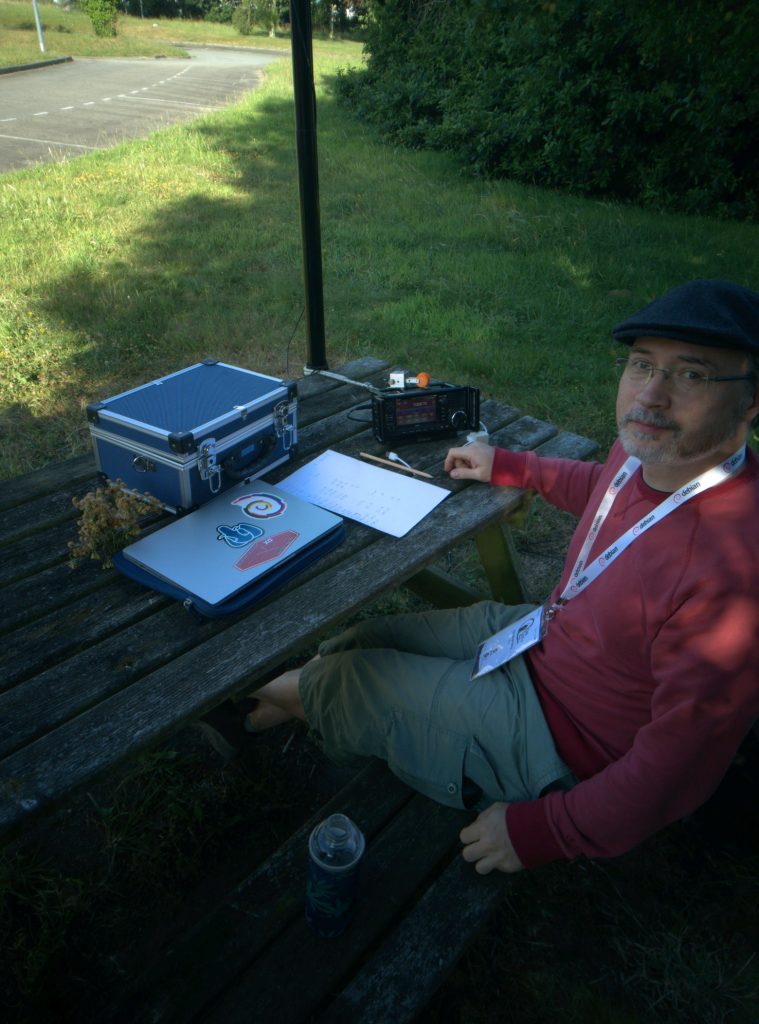 F/DF7CB in Brest (photo: Evangelos Ribeiro Tzaras)
 The northern coast of Ushant (photo: Christoph Berg)
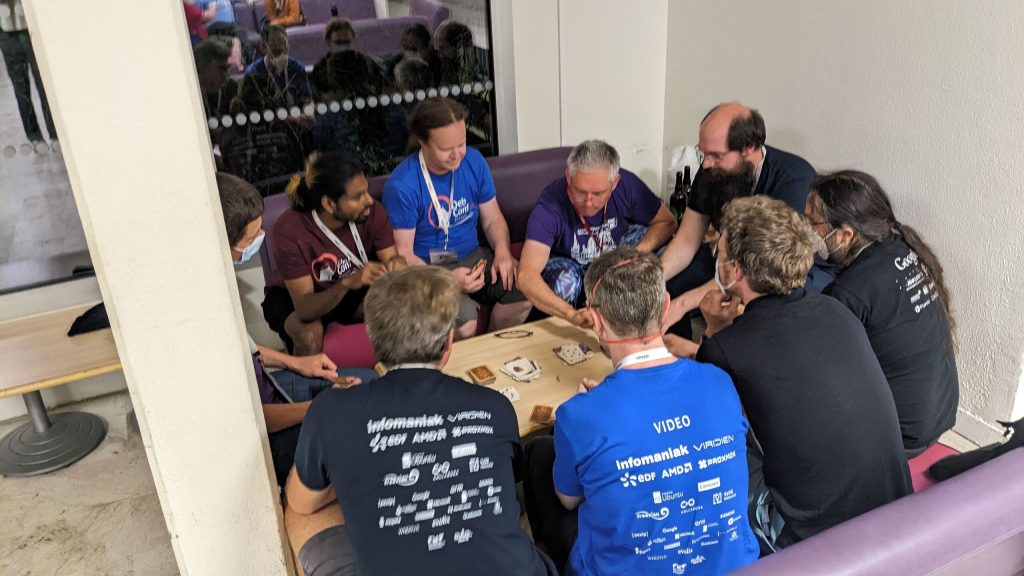 Having a nice day (photo: Christoph Berg)
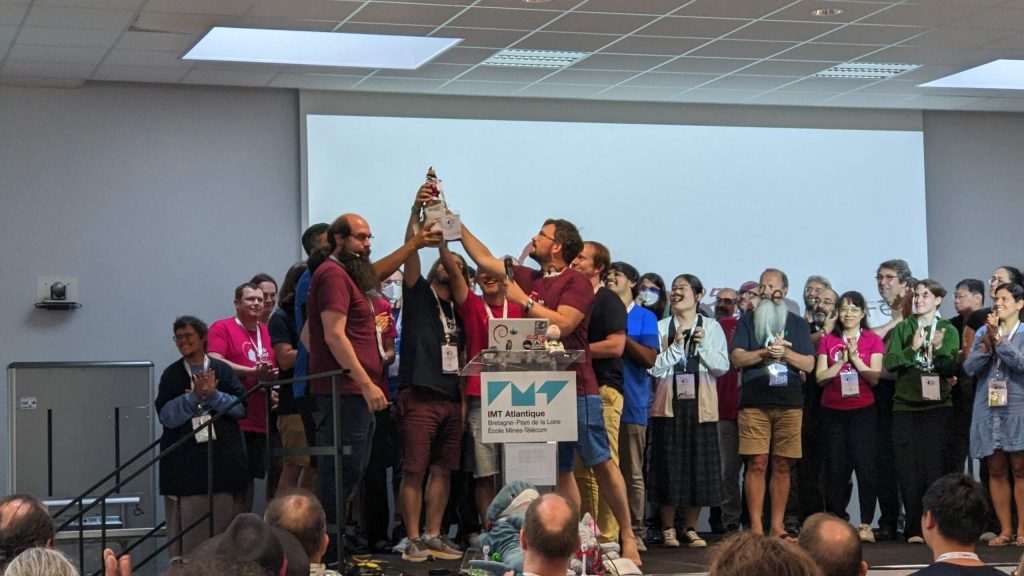 Pollito on stage (photo: Christoph Berg)

 Like each month, have a look at the work funded by
 Last week, we (Helmut, Jochen, Holger, Gioele and josch) met in W rzburg for a Debian



 Are you a student aspiring to participate in the
 Most of my Debian contributions this month were