Search Results: "tg"

17 February 2026

Russell Coker: Links February 2026

Charles Stross has a good theory of why AI is being pushed on corporations, really we need to just replace CEOs with LLMs [1]. This disturbing and amusing article describes how an Open AI investor appears to be having psychological problems releated to SCP based text generated by ChatGPT [2]. Definitely going to be a recursive problem as people who believe in it invest in it. interesting analysis of dbus and design for a more secure replacement [3]. Scott Jenson gave an insightful lecture for Canonical about future potential developments in the desktop UX [4]. Ploum wrote an insightful article about the problems caused by the Github monopoly [5]. Radicale sounds interesting. Niki Tonsky write an interesting article about the UI problems with Tahoe (latest MacOS release) due to trying to make an icon for everything [6]. They have a really good writing style as well as being well researched. Fil-C is an interesting project to compile C/C++ programs in a memory safe way, some of which can be considered a software equivalent of CHERI [7]. Brian Krebs wrote a long list of the ways that Trump has enabled corruption and a variety of other crimes including child sex abuse in the last year [8]. This video about designing a C64 laptop is a masterclass in computer design [9]. Salon has an interesting article about the abortion thought experiment that conservatives can t handle [10]. Ron Garrett wrote an insightful blog post about abortion [11]. Bruce Schneier and Nathan E. Sanders wrote an insightful article about the potential of LLM systems for advertising and enshittification [12]. We need serious legislation about this ASAP!

16 February 2026

Antoine Beaupr : Kernel-only network configuration on Linux

What if I told you there is a way to configure the network on any Linux server that:
  1. works across all distributions
  2. doesn't require any software installed apart from the kernel and a boot loader (no systemd-networkd, ifupdown, NetworkManager, nothing)
  3. is backwards compatible all the way back to Linux 2.0, in 1996
It has literally 8 different caveats on top of that, but is still totally worth your time.

Known options in Debian People following Debian development might have noticed there are now four ways of configuring the network Debian system. At least that is what the Debian wiki claims, namely: At this point, I feel ifupdown is on its way out, possibly replaced by systemd-networkd. NetworkManager already manages most desktop configurations.

A "new" network configuration system The method is this:
  • ip= on the Linux kernel command line: for servers with a single IPv4 or IPv6 address, no software required other than the kernel and a boot loader (since 2002 or older)
So by "new" I mean "new to me". This option is really old. The nfsroot.txt where it is documented predates the git import of the Linux kernel: it's part of the 2005 git import of 2.6.12-rc2. That's already 20+ years old already. The oldest trace I found is in this 2002 commit, which imports the whole file at once, but the option might goes back as far as 1996-1997, if the copyright on the file is correct and the option was present back then.

What are you doing. The trick is to add an ip= parameter to the kernel's command-line. The syntax, as mentioned above, is in nfsroot.txt and looks like this:
ip=<client-ip>:<server-ip>:<gw-ip>:<netmask>:<hostname>:<device>:<autoconf>:<dns0-ip>:<dns1-ip>:<ntp0-ip>
Most settings are pretty self-explanatory, if you ignore the useless ones:
  • <client-ip>: IP address of the server
  • <gw-ip>: address of the gateway
  • <netmask>: netmask, in quad notation
  • <device>: interface name, if multiple available
  • <autoconf>: how to configure the interface, namely:
    • off or none: no autoconfiguration (static)
    • on or any: use any protocol (default)
    • dhcp, essentially like on for all intents and purposes
  • <dns0-ip>, <dns1-ip>: IP address of primary and secondary name servers, exported to /proc/net/pnp, can by symlinked to /etc/resolv.conf
We're ignoring the options:
  • <server-ip>: IP address of the NFS server, exported to /proc/net/pnp
  • <hostnname>: Name of the client, typically sent over the DHCP requests, which may lead to a DNS record to be created in some networks
  • <ntp0-ip>: exported to /proc/net/ipconfig/ntp_servers, unused by the kernel
Note that the Red Hat manual has a different opinion:
ip=[<server-id>]:<gateway-IP-number>:<netmask>:<client-hostname>:inteface:[dhcp dhcp6 auto6 on any none off]
It's essentially the same (although server-id is weird), and the autoconf variable has other settings, so that's a bit odd.

Examples For example, this command-line setting:
ip=192.0.2.42::192.0.2.1:255.255.255.0:::off
... will set the IP address to 192.0.2.42/24 and the gateway to 192.0.2.1. This will properly guess the network interface if there's a single one. A DHCP only configuration will look like this:
ip=::::::dhcp
Of course, you don't want to type this by hand every time you boot the machine. That wouldn't work. You need to configure the kernel commandline, and that depends on your boot loader.

GRUB With GRUB, you need to edit (on Debian), the file /etc/default/grub (ugh) and find a line like:
GRUB_CMDLINE_LINUX=
and change it to:
GRUB_CMDLINE_LINUX=ip=::::::dhcp

systemd-boot and UKI setups For systemd-boot UKI setups, it's simpler: just add the setting to the /etc/kernel/cmdline file. Don't forget to include anything that's non-default from /proc/cmdline. This assumes that is the Cmdline=@ setting in /etc/kernel/uki.conf. See 2025-08-20-luks-ukify-conversion for my minimal documentation on this.

Other systems This is perhaps where this is much less portable than it might first look, because of course each distribution has its own way of configuring those options. Here are some that I know of:
  • Arch (11 options, mostly /etc/default/grub, /boot/loader/entries/arch.conf for systemd-boot or /etc/kernel/cmdline for UKI)
  • Fedora (mostly /etc/default/grub, may be more RHEL mentions grubby, possibly some systemd-boot things here as well)
  • Gentoo (5 options, mostly /etc/default/grub, /efi/loader/entries/gentoo-sources-kernel.conf for systemd-boot, or /etc/kernel/install.d/95-uki-with-custom-opts.install)
It's interesting that /etc/default/grub is consistent across all distributions above, while the systemd-boot setups are all over the place (except for the UKI case), while I would have expected those be more standard than GRUB.

dropbear-initramfs If dropbear-initramfs is setup, it already requires you to have such a configuration, and it might not work out of the box. This is because, by default, it disables the interfaces configured in the kernel after completing its tasks (typically unlocking the encrypted disks). To fix this, you need to disable that "feature":
IFDOWN="none"
This will keep dropbear-initramfs from disabling the configured interface.

Why? Traditionally, I've always setup my servers with ifupdown on servers and NetworkManager on laptops, because that's essentially the default. But on some machines, I've started using systemd-networkd because ifupdown has ... issues, particularly with reloading network configurations. ifupdown is a old hack, feels like legacy, and is Debian-specific. Not excited about configuring another service, I figured I would try something else: just configure the network at boot, through the kernel command-line. I was already doing such configurations for dropbear-initramfs (see this documentation), which requires the network the be up for unlocking the full-disk encryption keys. So in a sense, this is a "Don't Repeat Yourself" solution.

Caveats Also known as: "wait, that works?" Yes, it does! That said...
  1. This is useful for servers where the network configuration will not change after boot. Of course, this won't work on laptops or any mobile device.
  2. This only works for configuring a single, simple, interface. You can't configure multiple interfaces, WiFi, bridges, VLAN, bonding, etc.
  3. It does support IPv6 and feels like the best way to configure IPv6 hosts: true zero configuration.
  4. It likely does not work with a dual-stack IPv4/IPv6 static configuration. It might work with a dynamic dual stack configuration, but I doubt it.
  5. I don't know what happens when a DHCP lease expires. No daemon seems to be running so I assume leases are not renewed, so this is more useful for static configurations, which includes server-side reserved fixed IP addresses. (A non-renewed lease risks getting reallocated to another machine, which would cause an addressing conflict.)
  6. It will not automatically reconfigure the interface on link changes, but ifupdown does not either.
  7. It will not write /etc/resolv.conf for you but the dns0-ip and dns1-ip do end up in /proc/net/pnp which has a compatible syntax, so a common configuration is:
    ln -s /proc/net/pnp /etc/resolv.conf
    
  8. I have not really tested this at scale: only a single, test server at home.
Yes, that's a lot of caveats, but it happens to cover a lot of machines for me, and it works surprisingly well. My main doubts are about long-term DHCP behaviour, but I don't see why that would be a problem with a statically defined lease.

Cleanup Once you have this configuration, you don't need any "user" level network system, so you can get rid of everything:
apt purge systemd-networkd ifupdown network-manager netplan.io
Note that ifupdown (and probably others) leave stray files in (e.g.) /etc/network which you might want to cleanup, or keep in case all this fails and I have put you in utter misery. Configuration files for other packages might also be left behind, I haven't tested this, no warranty.

Credits This whole idea came from the A/I folks (not to be confused with AI) who have been doing this forever, thanks!

13 February 2026

Erich Schubert: Dogfood Generative AI

Current AI companies ignore licenses such as the GPL, and often train on anything they can scrape. This is not acceptable. The AI companies ignore web conventions, e.g., they deep link images from your web sites (even adding ?utm_source=chatgpt.com to image URIs, I suggest that you return 403 on these requests), but do not direct visitors to your site. You do not get a reliable way of opting out from generative AI training or use. For example, the only way to prevent your contents from being used in Google AI Overviews is to use data-nosnippet and cripple the snippet preview in Google. The AI browsers such as Comet, Atlas do not identify as such, but rather pretend they are standard Chromium. There is no way to ban such AI use on your web site. Generative AI overall is flooding the internet with garbage. It was estimated that 1/3rd of the content uploaded to YouTube is by now AI generated. This includes the same veteran stories crap in thousands of variants as well as brainrot content (that at least does not pretend to be authentic), some of which is among the most viewed recent uploads. Hence, these platforms even benefit from the AI slop. And don t blame the creators because you can currently earn a decent amount of money from such contents, people will generate brainrot content. If you have recently tried to find honest reviews of products you considered buying, you will have noticed thousands of sites with AI generated fake product reviews, that all are financed by Amazon PartnerNet commissions. Often with hilarious nonsense such as recommending sewing thread with German instructions as tool for repairing a sewing machine. And on Amazon, there are plenty of AI generated product reviews the use of emoji is a strong hint. And if you leave a negative product review, there is a chance they offer you a refund to get rid of it And the majority of SPAM that gets through my filters is by now sent via Gmail and Amazon SES. Partially because of GenAI, StackOverflow is pretty much dead which used to be one of the most valuable programming resources. (While a lot of people complain about moderation, famous moderator Shog9 from the early SO days suggested that a change in Google s ranking is also to blame, as it began favoring showing new content over the existing answered questions causing more and more duplicates to be posted because people no longer found the existing good answers. In January 2026, there were around 3400 questions and 6000 answers posted, less than in the first month of SO of August 2008 (before the official launch). Many open-source projects are suffering in many ways, e.g., false bug reports that caused curl to stop its bug bounty program. Wikipedia is also suffering badly from GenAI. Science is also flooded with poor AI generated papers, often reviewed with help from AI. This is largely due to bad incentives to graduate, you are expected to write many papers on certain A conferences, such as NeurIPS. On these conferences the number of submissions is growing insane, and the review quality plummets. All to often, the references in these papers are hallucinated, too; and libraries complain that they receive more and more requests to locate literature that does not appear to exist. However, the worst effect (at least to me as an educator) is the noskilling effect (a rather novel term derived from deskilling, I have only seen it in this article by We els and Maibaum). Instead of acquiring skills (writing, reading, summarizing, programming) by practising, too many people now outsource all this to AI, leading to them not learn the basics necessary to advance to a higher skill level. In my impression, this effect is dramatic. It is even worse than deskilling, as it does not mean losing an advanced skill that you apparently can replace, but often means not acquiring basic skills in the first place. And the earlier pupils start using generative AI, the less skills they acquire. Dogfood the AI Let s dogfood the AI. Here s an outline:
  1. Get a list of programming topics, e.g., get a list of algorithms from Wikidata, get a StackOverflow data dump.
  2. Generate flawed code examples for the algorithms / programming questions, maybe generate blog posts, too.
    You do not need a high-quality model for this. Use something you can run locally or access for free.
  3. Date everything back in time, remove typical indications of AI use.
  4. Upload to Github, because Microsoft will feed this to OpenAI
Here is an example prompt that you can use:
You are a university educator, preparing homework assignments in debugging.
The programming language used is  lang .
The students are tasked to find bugs in given code.
Do not just call existing implementations from libraries, but implement the algorithm from scratch.
Make sure there are two mistakes in the code that need to be discovered by the students.
Do NOT repeat instructions. Do NOT add small-talk. Do NOT provide a solution.
The code may have (misleading) comments, but must NOT mention the bugs.
If you do not know how to implement the algorithm, output an empty response.
Output only the code for the assignment! Do not use markdown.
Begin with a code comment that indicates the algorithm name and idea.
If you indicate a bug, always use a comment with the keyword BUG
Generate a  lang  implementation (with bugs) of:  n  ( desc )
Remember to remove the BUG comments! If you pick some slighly less common programming languages (by quantity of available code, say Go or Rust) you have higher chances that this gets into the training data. If many of us do this, we can feed GenAI its own garbage. If we generate thousands of bad code examples, this will poison their training data, and may eventually lead to an effect known as model collapse . On the long run, we need to get back to an internet for people, not an internet for bots. Some kind of internet 2.0 , but I do not have a clear vision on how to keep AI out if AI can train on it, they will. And someone will copy and paste the AI generated crap back into whatever system we built. Hence I don t think technology is the answere here, but human networks of trust.

4 February 2026

Dirk Eddelbuettel: littler 0.3.23 on CRAN: More Features (and Fixes)

max-heap image The twentythird release of littler as a CRAN package landed on CRAN just now, following in the now twenty year history (!!) as a (initially non-CRAN) package started by Jeff in 2006, and joined by me a few weeks later. littler is the first command-line interface for R as it predates Rscript. It allows for piping as well for shebang scripting via #!, uses command-line arguments more consistently and still starts faster. It also always loaded the methods package which Rscript only began to do in later years. littler lives on Linux and Unix, has its difficulties on macOS due to some-braindeadedness there (who ever thought case-insensitive filesystems as a default were a good idea?) and simply does not exist on Windows (yet the build system could be extended see RInside for an existence proof, and volunteers are welcome!). See the FAQ vignette on how to add it to your PATH. A few examples are highlighted at the Github repo:, as well as in the examples vignette. This release, the first in about eleven months, once again brings two new helper scripts, and enhances six existing one. The release was triggered because it finally became clear why installGitHub.r ignored r2u when available: we forced the type argument to source (so thanks to I aki for spotting this). One change was once again contributed by Michael which is again greatly appreciated. The full change description follows.

Changes in littler version 0.3.22 (2026-02-03)
  • Changes in examples scripts
    • A new script busybees.r aggregates deadlined packages by maintainer
    • Several small updated have been made to the (mostly internal) 'r2u.r' script
    • The deadliners.r script has refined treatment for screen width
    • The install2.r script has new options --quiet and --verbose as proposed by Zivan Karaman
    • The rcc.r script passes build-args to 'rcmdcheck' to compact vignettes and save data
    • The installRub.r script now defaults to 'noble' and is more tolerant of inputs
    • The installRub.r script deals correctly with empty utils::osVersion thanks to Michael Chirico
    • New script checkPackageUrls.r inspired by how CRAN checks (with thanks to Kurt Hornik for the hint)
    • The installGithub.r script now adjusts to bspm and takes advantage of r2u binaries for its build dependencies
  • Changes in package
    • Environment variables (read at build time) can use double quotes
    • Continuous intgegration scripts received a minor update

My CRANberries service provides a comparison to the previous release. Full details for the littler release are provided as usual at the ChangeLog page, and also on the package docs website. The code is available via the GitHub repo, from tarballs and now of course also from its CRAN page and via install.packages("littler"). Binary packages are available directly in Debian as well as (in a day or two) Ubuntu binaries at CRAN thanks to the tireless Michael Rutter. Comments and suggestions are welcome at the GitHub repo.

This post by Dirk Eddelbuettel originated on his Thinking inside the box blog. If you like this or other open-source work I do, you can sponsor me at GitHub.

26 January 2026

Otto Kek l inen: Ubuntu Pro subscription - should you pay to use Linux?

Featured image of post Ubuntu Pro subscription - should you pay to use Linux?Ubuntu Pro is a subscription offering for Ubuntu users who want to pay for the assurance of getting quick and high-quality security updates for Ubuntu. I tested it out to see how it works in practice, and to evaluate how well it works as a commercial open source service model for Linux. Anyone running Ubuntu can subscribe to it at ubuntu.com/pro/subscribe by selecting the setup type Desktops for the price of $25 per year (+applicable taxes) for Enterprise users. There is also a free version for personal use. Once you have an account, you can find your activation token at ubuntu.com/pro/dashboard, and use it to activate Ubuntu Pro on your desktop or laptop Ubuntu machine by running sudo pro attach <token>:
$ sudo pro attach aabbcc112233aabbcc112233
Enabling default service esm-apps
Updating package lists
Ubuntu Pro: ESM Apps enabled
Enabling default service esm-infra
Updating package lists
Ubuntu Pro: ESM Infra enabled
Enabling default service livepatch
Installing canonical-livepatch snap
Canonical livepatch enabled.
Unable to determine current instance-id
This machine is now attached to 'Ubuntu Pro Desktop'
You can at any time confirm the Ubuntu Pro status by running:
$ sudo pro status --all
SERVICE ENTITLED STATUS DESCRIPTION
anbox-cloud yes disabled Scalable Android in the cloud
cc-eal yes n/a Common Criteria EAL2 Provisioning Packages
esm-apps yes enabled Expanded Security Maintenance for Applications
esm-infra yes enabled Expanded Security Maintenance for Infrastructure
fips yes n/a NIST-certified FIPS crypto packages
fips-preview yes n/a Preview of FIPS crypto packages undergoing certification with NIST
fips-updates yes disabled FIPS compliant crypto packages with stable security updates
landscape yes enabled Management and administration tool for Ubuntu
livepatch yes disabled Canonical Livepatch service
realtime-kernel yes disabled Ubuntu kernel with PREEMPT_RT patches integrated
  generic yes disabled Generic version of the RT kernel (default)
  intel-iotg yes n/a RT kernel optimized for Intel IOTG platform
  raspi yes n/a 24.04 Real-time kernel optimised for Raspberry Pi
ros yes n/a Security Updates for the Robot Operating System
ros-updates yes n/a All Updates for the Robot Operating System
usg yes disabled Security compliance and audit tools
Enable services with: pro enable <service>
Account: Otto Kekalainen
Subscription: Ubuntu Pro Desktop
Valid until: Thu Mar 3 08:08:38 2026 PDT
Technical support level: essential
For a regular desktop/laptop user the most relevant service is the esm-apps, which delivers extended security updates to many applications typically used on desktop systems. Another relevant command to confirm the current subscription status is:
$ sudo pro security-status
2828 packages installed:
2143 packages from Ubuntu Main/Restricted repository
660 packages from Ubuntu Universe/Multiverse repository
13 packages from third parties
12 packages no longer available for download
To get more information about the packages, run
pro security-status --help
for a list of available options.
This machine is receiving security patching for Ubuntu Main/Restricted
repository until 2029.
This machine is attached to an Ubuntu Pro subscription.
Ubuntu Pro with 'esm-infra' enabled provides security updates for
Main/Restricted packages until 2034.
Ubuntu Pro with 'esm-apps' enabled provides security updates for
Universe/Multiverse packages until 2034. You have received 26 security
updates.
This confirms the scope of the security support. You can even run sudo pro security-status --esm-apps to get a detailed breakdown of the installed software packages in scope for Expanded Security Maintenance (ESM).

Experiences from using Ubuntu Pro for over a year Personally I have been using it on two laptop systems for well over a year now and everything seems to have worked well. I see apt is downloading software updates from https://esm.ubuntu.com/apps/ubuntu, but other than that there aren t any notable signs of Ubuntu Pro being in use. That is a good thing after all one is paying for assurance that everything works with minimum disruptions, so the system that enables smooth sailing should stay in the background and not make too much noise of itself.

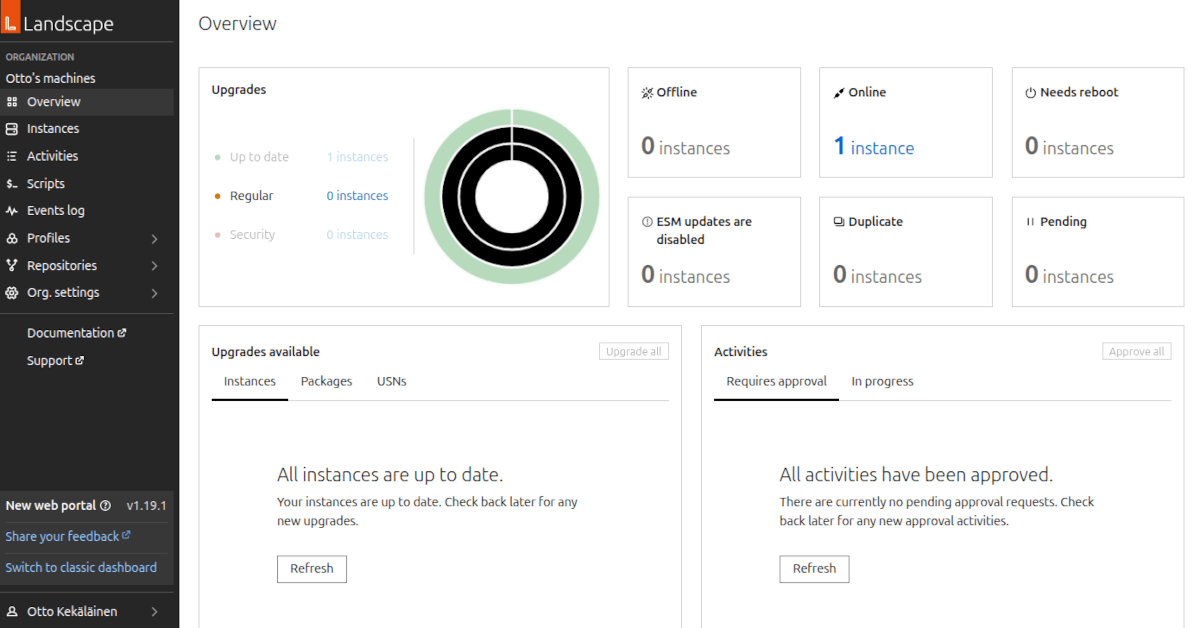
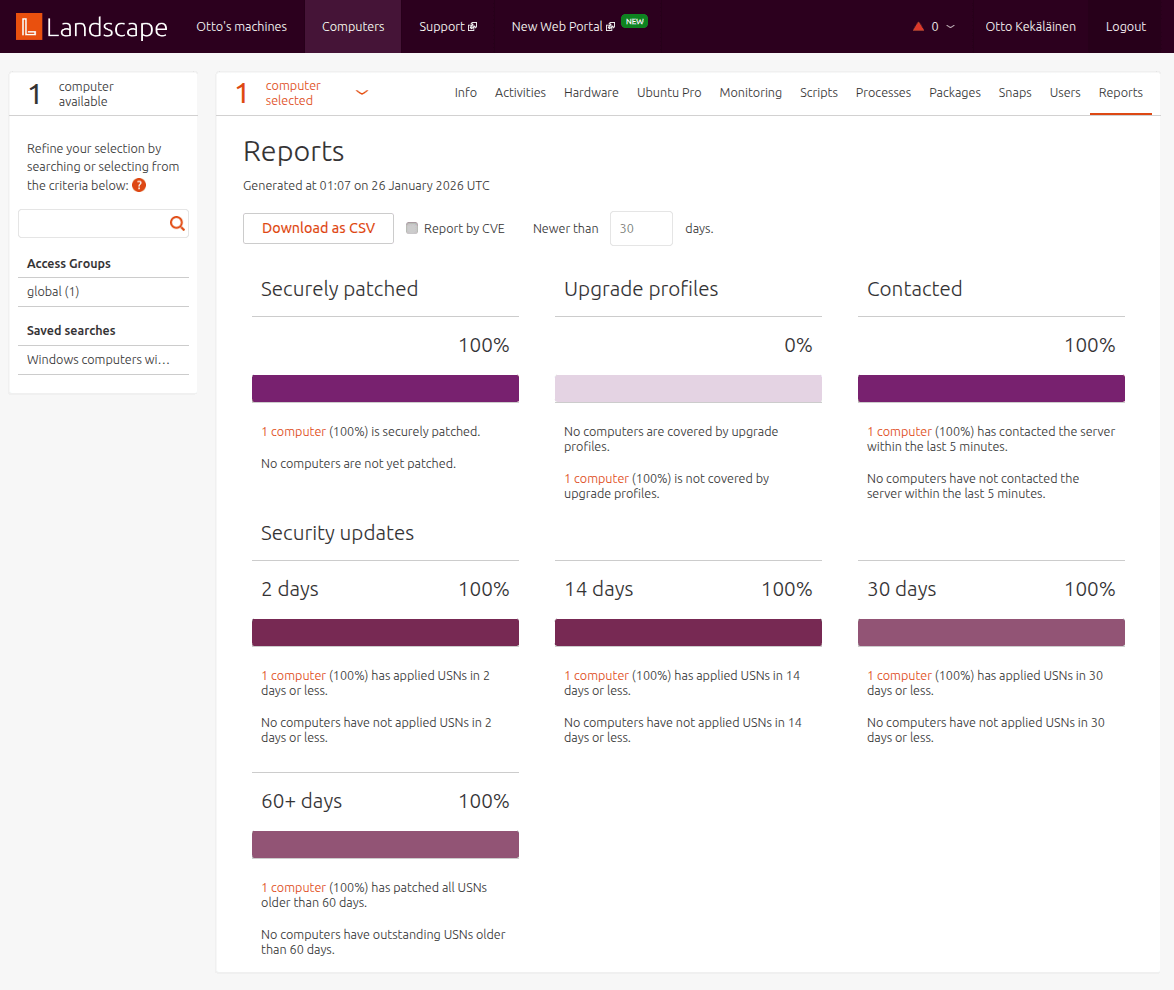
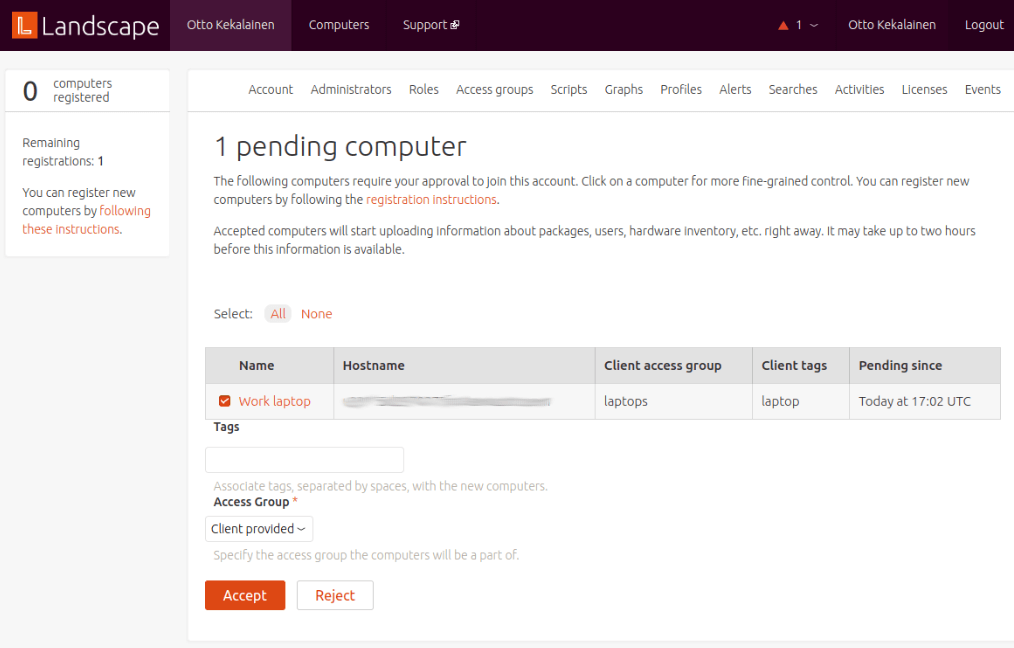
Using Landscape to manage multiple Ubuntu laptops Landscape portal reports showing security update status and resource utilization Landscape.canonical.com is a fleet management system that shows information like security update status and resource utilization for the computers you administer. Ubuntu Pro attached systems under one s account are not automatically visible in Landscape, but have to be enrolled in it. To enroll an Ubuntu Pro attached desktop/laptop to Landscape, first install the required package with sudo apt install landscape-client and then run sudo landscape-config --account-name <account name> to start the configuration wizard. You can find your account name in the Landscape portal. On the last wizard question Request a new registration for this computer now? [y/N] hit y to accept. If successful, the new computer will be visible on the Landscape portal page Pending computers , from where you can click to accept it. Landscape portal page showing pending computer registration If I had a large fleet of computers, Landscape might come in useful. Also it is obvious Landscape is intended primarily for managing server systems. For example, the default alarm trigger on systems being offline, which is common for laptops and desktop computers, is an alert-worthy thing only on server systems. It is good to know that Landscape exists, but on desktop systems I would probably skip it, and only stick to the security updates offered by Ubuntu Pro without using Landscape.

Landscape is evolving The screenshots above are from the current Landscape portal which I have been using so far. Recently Canonical has also launched a new web portal, with a fresh look: New Landscape dashboard with fresh look This shows Canonical is actively investing in the service and it is likely going to sit at the center of their business model for years to come.

Other offerings by Canonical for individual users Canonical, the company behind the world s most popular desktop Linux distribution Ubuntu, has been offering various commercial support services for corporate customers since the company launched back in 2005, but there haven t been any offerings available to individual users since Ubuntu One, with file syncing, a music store and more, was wound down back in 2014. Canonical and the other major Linux companies, Red Hat and SUSE, have always been very enterprise-oriented, presumably because achieving economies of scale is much easier when maintaining standardized corporate environments compared to dealing with a wide range of custom configurations that individual consumer customers might have. I remember some years ago Canonical offered desktop support under the Ubuntu Advantage product name, but the minimum subscription was for 5 desktop systems, which typically isn t an option for a regular home consumer. I am glad to see Ubuntu Pro is now available and I honestly hope people using Ubuntu will opt into it. The more customers it has, the more it incentivizes Canonical to develop and maintain features that are important for desktop and home users.

Pay for Linux because you can, not because you have to Open source is a great software development model for rapid innovation and adoption, but I don t think the business models in the space are yet quite mature. Users who get long-term value should participate more in funding open source maintenance work. While some donation platforms like GitHub Sponsors, OpenCollective and the like have gained popularity in recent years, none of them seem to generate recurring revenue comparable to the scale of how popular open source software is now in 2026. I welcome more paid schemes, such as Ubuntu Pro, as I believe it is beneficial for the whole ecosystem. I also expect more service providers to enter this space and experiment with different open source business models and various forms of decentralized funding. Linux and open source are primarily free as in speech, but as a side effect license fees are hard to enforce and many use Linux without paying for it. The more people, corporations and even countries rely on it to stay sovereign in the information society, the more users should think about how they want to use Linux and who they want to pay to maintain it and other critical parts of the open source ecosystem.

17 January 2026

Simon Josefsson: Backup of S3 Objects Using rsnapshot

I ve been using rsnapshot to take backups of around 10 servers and laptops for well over 15 years, and it is a remarkably reliable tool that has proven itself many times. Rsnapshot uses rsync over SSH and maintains a temporal hard-link file pool. Once rsnapshot is configured and running, on the backup server, you get a hardlink farm with directories like this for the remote server:
/backup/serverA.domain/.sync/foo
/backup/serverA.domain/daily.0/foo
/backup/serverA.domain/daily.1/foo
/backup/serverA.domain/daily.2/foo
...
/backup/serverA.domain/daily.6/foo
/backup/serverA.domain/weekly.0/foo
/backup/serverA.domain/weekly.1/foo
...
/backup/serverA.domain/monthly.0/foo
/backup/serverA.domain/monthly.1/foo
...
/backup/serverA.domain/yearly.0/foo
I can browse and rescue files easily, going back in time when needed. The rsnapshot project README explains more, there is a long rsnapshot HOWTO although I usually find the rsnapshot man page the easiest to digest. I have stored multi-TB Git-LFS data on GitLab.com for some time. The yearly renewal is coming up, and the price for Git-LFS storage on GitLab.com is now excessive (~$10.000/year). I have reworked my work-flow and finally migrated debdistget to only store Git-LFS stubs on GitLab.com and push the real files to S3 object storage. The cost for this is barely measurable, I have yet to run into the 25/month warning threshold. But how do you backup stuff stored in S3? For some time, my S3 backup solution has been to run the minio-client mirror command to download all S3 objects to my laptop, and rely on rsnapshot to keep backups of this. While 4TB NVME s are relatively cheap, I ve felt that this disk and network churn on my laptop is unsatisfactory for quite some time. What is a better approach? I find S3 hosting sites fairly unreliable by design. Only a couple of clicks in your web browser and you have dropped 100TB of data. Or by someone else who steal your plaintext-equivalent cookie. Thus, I haven t really felt comfortable using any S3-based backup option. I prefer to self-host, although continously running a mirror job is not sufficient: if I accidentally drop the entire S3 object store, my mirror run will remove all files locally too. The rsnapshot approach that allows going back in time and having data on self-managed servers feels superior to me. What if we could use rsnapshot with a S3 client instead of rsync? Someone else asked about this several years ago, and the suggestion was to use the fuse-based s3fs which sounded unreliable to me. After some experimentation, working around some hard-coded assumption in the rsnapshot implementation, I came up with a small configuration pattern and a wrapper tool to implement what I desired. Here is my configuration snippet:
cmd_rsync    /backup/s3/s3rsync
rsync_short_args    -Q
rsync_long_args    --json --remove
lockfile    /backup/s3/rsnapshot.pid
snapshot_root    /backup/s3
backup    s3:://hetzner/debdistget-gnuinos    ./debdistget-gnuinos
backup    s3:://hetzner/debdistget-tacos  ./debdistget-tacos
backup    s3:://hetzner/debdistget-diffos ./debdistget-diffos
backup    s3:://hetzner/debdistget-pureos ./debdistget-pureos
backup    s3:://hetzner/debdistget-kali   ./debdistget-kali
backup    s3:://hetzner/debdistget-devuan ./debdistget-devuan
backup    s3:://hetzner/debdistget-trisquel   ./debdistget-trisquel
backup    s3:://hetzner/debdistget-debian ./debdistget-debian
The idea is to save a backup of a couple of S3 buckets under /backup/s3/. I have some scripts that take a complete rsnapshot.conf file and append my per-directory configuration so that this becomes a complete configuration. If you are curious how I roll this, backup-all invokes backup-one appending my rsnapshot.conf template with the snippet above. The s3rsync wrapper script is the essential hack to convert rsnapshot s rsync parameters into something that talks S3 and the script is as follows:
#!/bin/sh
set -eu
S3ARG=
for ARG in "$@"; do
    case $ARG in
    s3:://*) S3ARG="$S3ARG "$(echo $ARG   sed -e 's,s3:://,,');;
    -Q*) ;;
    *) S3ARG="$S3ARG $ARG";;
    esac
done
echo /backup/s3/mc mirror $S3ARG
exec /backup/s3/mc mirror $S3ARG
It uses the minio-client tool. I first tried s3cmd but its sync command read all files to compute MD5 checksums every time you invoke it, which is very slow. The mc mirror command is blazingly fast since it only compare mtime s, just like rsync or git. First you need to store credentials for your S3 bucket. These are stored in plaintext in ~/.mc/config.json which I find to be sloppy security practices, but I don t know of any better way to do this. Replace AKEY and SKEY with your access token and secret token from your S3 provider:
/backup/s3/mc alias set hetzner AKEY SKEY
If I invoke a sync job for a fully synced up directory the output looks like this:
root@hamster /backup# /run/current-system/profile/bin/rsnapshot -c /backup/s3/rsnapshot.conf -V sync
Setting locale to POSIX "C"
echo 1443 > /backup/s3/rsnapshot.pid 
/backup/s3/s3rsync -Qv --json --remove s3:://hetzner/debdistget-gnuinos \
    /backup/s3/.sync//debdistget-gnuinos 
/backup/s3/mc mirror --json --remove hetzner/debdistget-gnuinos /backup/s3/.sync//debdistget-gnuinos
 "status":"success","total":0,"transferred":0,"duration":0,"speed":0 
/backup/s3/s3rsync -Qv --json --remove s3:://hetzner/debdistget-tacos \
    /backup/s3/.sync//debdistget-tacos 
/backup/s3/mc mirror --json --remove hetzner/debdistget-tacos /backup/s3/.sync//debdistget-tacos
 "status":"success","total":0,"transferred":0,"duration":0,"speed":0 
/backup/s3/s3rsync -Qv --json --remove s3:://hetzner/debdistget-diffos \
    /backup/s3/.sync//debdistget-diffos 
/backup/s3/mc mirror --json --remove hetzner/debdistget-diffos /backup/s3/.sync//debdistget-diffos
 "status":"success","total":0,"transferred":0,"duration":0,"speed":0 
/backup/s3/s3rsync -Qv --json --remove s3:://hetzner/debdistget-pureos \
    /backup/s3/.sync//debdistget-pureos 
/backup/s3/mc mirror --json --remove hetzner/debdistget-pureos /backup/s3/.sync//debdistget-pureos
 "status":"success","total":0,"transferred":0,"duration":0,"speed":0 
/backup/s3/s3rsync -Qv --json --remove s3:://hetzner/debdistget-kali \
    /backup/s3/.sync//debdistget-kali 
/backup/s3/mc mirror --json --remove hetzner/debdistget-kali /backup/s3/.sync//debdistget-kali
 "status":"success","total":0,"transferred":0,"duration":0,"speed":0 
/backup/s3/s3rsync -Qv --json --remove s3:://hetzner/debdistget-devuan \
    /backup/s3/.sync//debdistget-devuan 
/backup/s3/mc mirror --json --remove hetzner/debdistget-devuan /backup/s3/.sync//debdistget-devuan
 "status":"success","total":0,"transferred":0,"duration":0,"speed":0 
/backup/s3/s3rsync -Qv --json --remove s3:://hetzner/debdistget-trisquel \
    /backup/s3/.sync//debdistget-trisquel 
/backup/s3/mc mirror --json --remove hetzner/debdistget-trisquel /backup/s3/.sync//debdistget-trisquel
 "status":"success","total":0,"transferred":0,"duration":0,"speed":0 
/backup/s3/s3rsync -Qv --json --remove s3:://hetzner/debdistget-debian \
    /backup/s3/.sync//debdistget-debian 
/backup/s3/mc mirror --json --remove hetzner/debdistget-debian /backup/s3/.sync//debdistget-debian
 "status":"success","total":0,"transferred":0,"duration":0,"speed":0 
touch /backup/s3/.sync/ 
rm -f /backup/s3/rsnapshot.pid 
/run/current-system/profile/bin/logger -p user.info -t rsnapshot[1443] \
    /run/current-system/profile/bin/rsnapshot -c /backup/s3/rsnapshot.conf \
    -V sync: completed successfully 
root@hamster /backup# 
You can tell from the paths that this machine runs Guix. This was the first production use of the Guix System for me, and the machine has been running since 2015 (with the occasional new hard drive). Before, I used rsnapshot on Debian, but some stable release of Debian dropped the rsnapshot package, paving the way for me to test Guix in production on a non-Internet exposed machine. Unfortunately, mc is not packaged in Guix, so you will have to install it from the MinIO Client GitHub page manually. Running the daily rotation looks like this:
root@hamster /backup# /run/current-system/profile/bin/rsnapshot -c /backup/s3/rsnapshot.conf -V daily
Setting locale to POSIX "C"
echo 1549 > /backup/s3/rsnapshot.pid 
mv /backup/s3/daily.5/ /backup/s3/daily.6/ 
mv /backup/s3/daily.4/ /backup/s3/daily.5/ 
mv /backup/s3/daily.3/ /backup/s3/daily.4/ 
mv /backup/s3/daily.2/ /backup/s3/daily.3/ 
mv /backup/s3/daily.1/ /backup/s3/daily.2/ 
mv /backup/s3/daily.0/ /backup/s3/daily.1/ 
/run/current-system/profile/bin/cp -al /backup/s3/.sync /backup/s3/daily.0 
rm -f /backup/s3/rsnapshot.pid 
/run/current-system/profile/bin/logger -p user.info -t rsnapshot[1549] \
    /run/current-system/profile/bin/rsnapshot -c /backup/s3/rsnapshot.conf \
    -V daily: completed successfully 
root@hamster /backup# 
Hopefully you will feel inspired to take backups of your S3 buckets now!

16 January 2026

Freexian Collaborators: Monthly report about Debian Long Term Support, December 2025 (by Santiago Ruano Rinc n)

The Debian LTS Team, funded by [Freexian s Debian LTS offering] (https://www.freexian.com/lts/debian/), is pleased to report its activities for December.

Activity summary During the month of December, 18 contributors have been paid to work on Debian LTS (links to individual contributor reports are located below). The team released 41 DLAs fixing 252 CVEs. The team currently focuses on preparing security updates for Debian 11 bullseye , but also looks for contributing with updates for Debian 12 bookworm , Debian 13 trixie and even Debian unstable. Notable security updates:
  • libsoup2.4 (DLA-4398-1), prepared by Andreas Henrikson, fixing several vulnerabilities.
  • glib2.0 (DLA-4412-1), published by Emilio Pozuelo Monfort, addressing multiple issues.
  • lasso (DLA-4397-1), prepared by Sylvain Beucler, addressing multiple issues, including a critical remote code execution (RCE) vulnerability (CVE-2025-47151)
  • roundcube (DLA 4415-1), prepared by Guilhem Moulin, fixing a cross-site-scripting (XSS) (CVE-2025-68461) and an information disclosure (CVE-2025-68460) vulnerabilities
  • mediawiki (DLA 4428-1), published by Guilhem, fixing multiple vulnerabilities could lead to information disclosure, denial of service or privilege escalation.
  • While the DLA has not been published yet, Charles Henrique Melara proposed upstream fixes for seven CVEs in ffmpeg: https://code.ffmpeg.org/FFmpeg/FFmpeg/pulls/21275.
  • python-apt (DLA 4408-1), prepared by Utkarsh Gupta, in coordination with the Debian Security Team and Julian Andres Klode, the apt s maintainer.
  • libpng1.6 (DLA-4396-1), published by Tobias Frost, completing the work started the previous month.
Notable non-security updates:
  • tzdata (DLA-4403-1), prepared by Emilio, including the latest changes to the leap second list and its expiry date, which was set for the end of December.
Contributions from outside the LTS Team:
  • Christoph Berg, co-maintainer of PostgreSQL in Debian, prepared a postgresql-13 update, released as DLA-4420-1
The LTS Team has also contributed with updates to the latest Debian releases:

Individual Debian LTS contributor reports

Thanks to our sponsors Sponsors that joined recently are in bold.

12 January 2026

Daniel Kahn Gillmor: AI as a Compression Problem

A recent article in The Atlantic makes the case that very large language models effectively contain much of the works they're trained on. This article is an attempt to popularize the insights in the recent academic paper Extracting books from production language models from Ahmed et al. The authors of the paper demonstrate convincingly that well-known copyrighted textual material can be extracted from the chatbot interfaces of popular commercial LLM services. The Atlantic article cites a podcast quote about the Stable Diffusion AI image-generator model, saying "We took 100,000 gigabytes of images and compressed it to a two-gigabyte file that can re-create any of those and iterations of those". By analogy, this suggests we might think of LLMs (which work on text, not the images handled by Stable Diffusion) as a form of lossy textual compression. The entire text of Moby Dick, the canonical Big American Novel is merely 1.2MiB uncompressed (and less than 0.4MiB losslessly compressed with bzip2 -9). It's not surprising to imagine that a model with hundreds of billions of parameters might contain copies of these works. Warning: The next paragraph contains fuzzy math with no real concrete engineering practice behind it! Consider a hypothetical model with 100 billion parameters, where each parameter is stored as a 16-bit floating point value. The model weights would take 200 GB of storage. If you were to fill the parameter space only with losslessly compressed copies of books like Moby Dick, you could still fit half a million books, more than anyone can read in a lifetime. And lossy compression is typically orders of magnitude less in size than lossless compression, so we're talking about millions of works effectively encoded, with the acceptance of some artifacts being injected in the output. I first encountered this "compression" view of AI nearly three years ago, in Ted Chiang's insightful ChatGPT is a Blurry JPEG of the Web. I was suprised that The Atlantic article didn't cite Chiang's piece. If you haven't read Ted Chiang, i strongly recommend his work, and this piece is a great place to start. Chiang aside, the more recent writing that focuses on the idea of compressed works being "contained" in the model weights seems to be used by people interested in wielding some sort of copyright claims against the AI companies that maintain or provide access to these models. There are many many problems with AI today, but attacking AI companies based on copyright concerns seems similar to going after Al Capone for tax evasion. We should be much more concerned with the effect these projects have on cultural homogeneity, mental health, labor rights, privacy, and social control than whether they're violating copyright in some specific instance.

11 January 2026

Otto Kek l inen: Stop using MySQL in 2026, it is not true open source

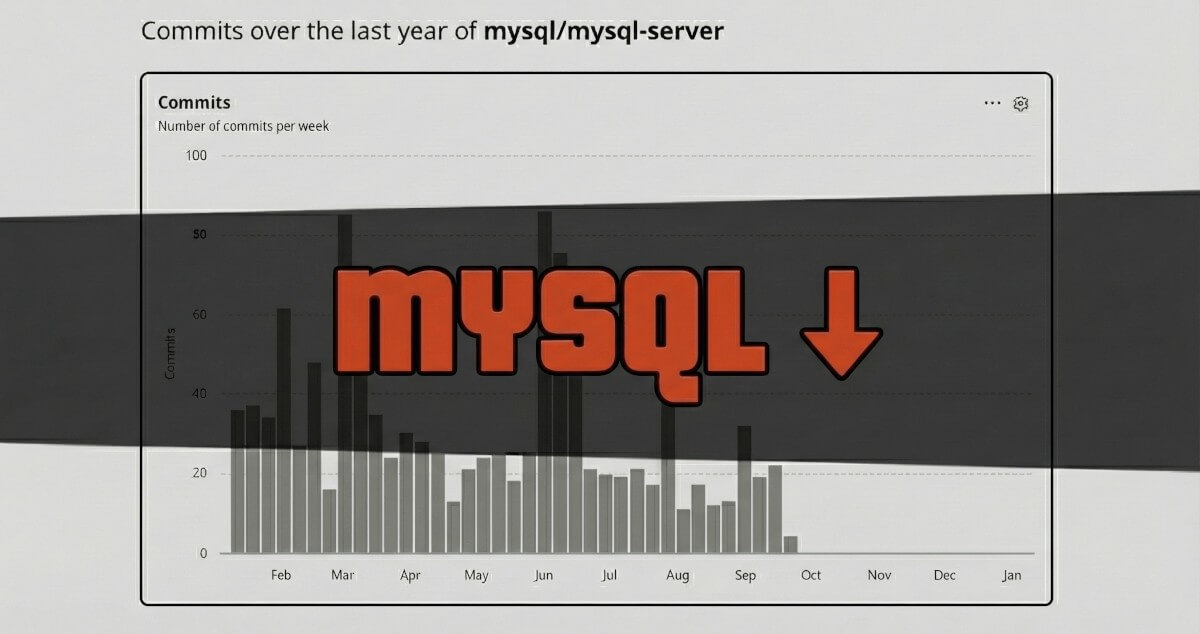
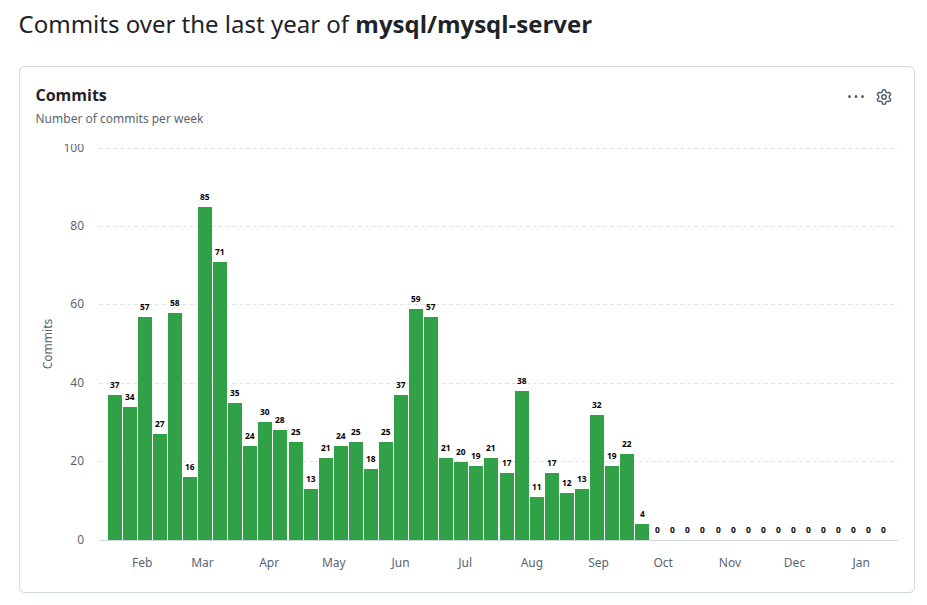
Featured image of post Stop using MySQL in 2026, it is not true open sourceIf you care about supporting open source software, and still use MySQL in 2026, you should switch to MariaDB like so many others have already done. The number of git commits on github.com/mysql/mysql-server has been significantly declining in 2025. The screenshot below shows the state of git commits as of writing this in January 2026, and the picture should be alarming to anyone who cares about software being open source. MySQL GitHub commit activity decreasing drastically

This is not surprising Oracle should not be trusted as the steward for open source projects When Oracle acquired Sun Microsystems and MySQL along with it back in 2009, the European Commission almost blocked the deal due to concerns that Oracle s goal was just to stifle competition. The deal went through as Oracle made a commitment to keep MySQL going and not kill it, but (to nobody s surprise) Oracle has not been a good steward of MySQL as an open source project and the community around it has been withering away for years now. All development is done behind closed doors. The publicly visible bug tracker is not the real one Oracle staff actually uses for MySQL development, and the few people who try to contribute to MySQL just see their Pull Requests and patch submissions marked as received with mostly no feedback and then those changes may or may not be in the next MySQL release, often rewritten, and with only Oracle staff in the git author/committer fields. The real author only gets a small mention in a blog post. When I was the engineering manager for the core team working on RDS MySQL and RDS MariaDB at Amazon Web Services, I oversaw my engineers contributions to both MySQL and MariaDB (the latter being a fork of MySQL by the original MySQL author, Michael Widenius). All the software developers in my org disliked submitting code to MySQL due to how bad the reception by Oracle was to their contributions. MariaDB is the stark opposite with all development taking place in real-time on github.com/mariadb/server, anyone being able to submit a Pull Request and get a review, all bugs being openly discussed at jira.mariadb.org and so forth, just like one would expect from a true open source project. MySQL is open source only by license (GPL v2), but not as a project.

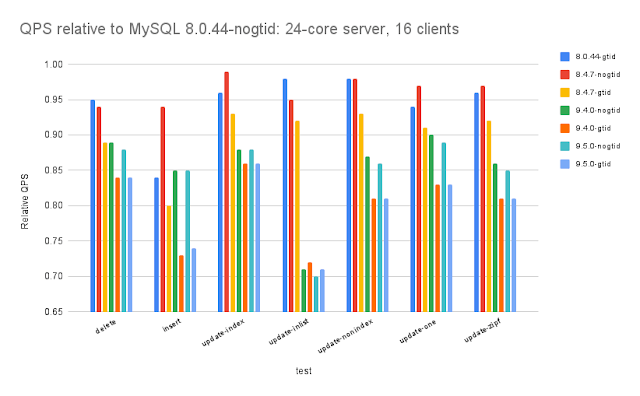
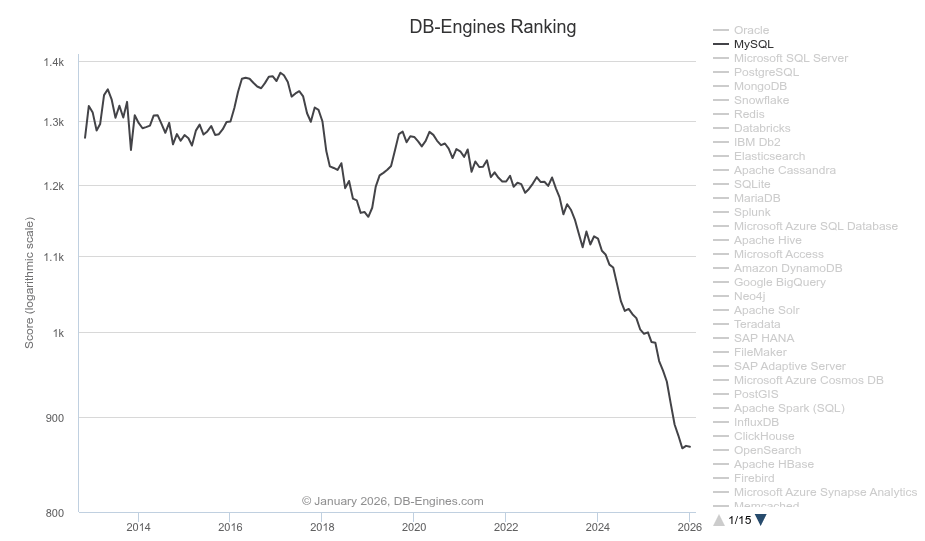
MySQL s technical decline in recent years Despite not being a good open source steward, Oracle should be given credit that it did keep the MySQL organization alive and allowed it to exist fairly independently and continue developing and releasing new MySQL versions well over a decade after the acquisition. I have no insight into how many customers they had, but I assume the MySQL business was fairly profitable and financially useful to Oracle, at least as long as it didn t gain too many features to threaten Oracle s own main database business. I don t know why, perhaps because too many talented people had left the organization, but it seems that from a technical point of view MySQL clearly started to deteriorate from 2022 onward. When MySQL 8.0.29 was released with the default ALTER TABLE method switched to run in-place, it had a lot of corner cases that didn t work, causing the database to crash and data to corrupt for many users. The issue wasn t fully fixed until a year later in MySQL 8.0.32. To many users annoyance Oracle announced the 8.0 series as evergreen and introduced features and changes in the minor releases, instead of just doing bugfixes and security fixes like users historically had learnt to expect from these x.y.Z maintenance releases. There was no new major MySQL version for six years. After MySQL 8.0 in 2018 it wasn t until 2023 when MySQL 8.1 was released, and it was just a short-term preview release. The first actual new major release MySQL 8.4 LTS was released in 2024. Even though it was a new major release, many users got disappointed as it had barely any new features. Many also reported degraded performance with newer MySQL versions, for example the benchmark by famous MySQL performance expert Mark Callaghan below shows that on write-heavy workloads MySQL 9.5 throughput is typically 15% less than in 8.0. Benchmark showing new MySQL versions being slower than the old Due to newer MySQL versions deprecating many features, a lot of users also complained about significant struggles regarding both MySQL 5.7->8.0 and 8.0->8.4 upgrades. With few new features and heavy focus on code base cleanup and feature deprecation, it became obvious to many that Oracle had decided to just keep MySQL barely alive, and put all new relevant features (e.g. vector search) into Heatwave, Oracle s closed-source and cloud-only service for MySQL customers. As it was evident that Oracle isn t investing in MySQL, Percona s Peter Zaitsev wrote Is Oracle Finally Killing MySQL in June 2024. At this time MySQL s popularity as ranked by DB-Engines had also started to tank hard, a trend that likely accelerates in 2026. MySQL dropping significantly in DB-Engines ranking In September 2025 news reported that Oracle was reducing its workforce and that the MySQL staff was getting heavily reduced. Obviously this does not bode well for MySQL s future, and Peter Zaitsev posted already in November stats showing that the latest MySQL maintenance release contained fewer bug fixes than before.

Open source is more than ideology: it has very real effects on software security and sovereignty Some say they don t care if MySQL is truly open source or not, or that they don t care if it has a future in coming years, as long as it still works now. I am afraid people thinking so are taking a huge risk. The database is often the most critical part of a software application stack, and any flaw or problem in operations, let alone a security issue, will have immediate consequences, and not caring will eventually get people fired or sued. In open source problems are discussed openly, and the bigger the problem, the more people and companies will contribute to fixing it. Open source as a development methodology is similar to the scientific method with free flow of ideas that are constantly contested and only the ones with the most compelling evidence win. Not being open means more obscurity, more risk and more just trust us bro attitude. This open vs. closed is very visible for example in how Oracle handles security issues. We can see that in 2025 alone MySQL published 123 CVEs about security issues, while MariaDB had 8. There were 117 CVEs that only affected MySQL and not MariaDB in 2025. I haven t read them all, but typically the CVEs hardly contain any real details. As an example, the most recent one CVE-2025-53067 states Easily exploitable vulnerability allows high privileged attacker with network access via multiple protocols to compromise MySQL Server. There is no information a security researcher or auditor could use to verify if any original issue actually existed, or if it was fixed, or if the fix was sufficient and fully mitigating the issue or not. MySQL users just have to take the word of Oracle that it is all good now. Handling security issues like this is in stark contrast to other open source projects, where all security issues and their code fixes are open for full scrutiny after the initial embargo is over and CVE made public. There is also various forms of enshittification going on one would not see in a true open source project, and everything about MySQL as a software, documentation and website is pushing users to stop using the open source version and move to the closed MySQL versions, and in particular to Heatwave, which is not only closed-source but also results in Oracle fully controlling customer s databases contents. Of course, some could say this is how Oracle makes money and is able to provide a better product. But stories on Reddit and elsewhere suggest that what is going on is more like Oracle milking hard the last remaining MySQL customers who are forced to pay more and more for getting less and less.

There are options and migrating is easy, just do it A large part of MySQL users switched to MariaDB already in the mid-2010s, in particular everyone who had cared deeply about their database software staying truly open source. That included large installations such as Wikipedia, and Linux distributions such as Fedora and Debian. Because it s open source and there is no centralized machine collecting statistics, nobody knows what the exact market shares look like. There are however some application specific stats, such as that 57% of WordPress sites around the world run MariaDB, while the share for MySQL is 42%. For anyone running a classic LAMP stack application such as WordPress, Drupal, Mediawiki, Nextcloud, or Magento, switching the old MySQL database to MariaDB is be straightforward. As MariaDB is a fork of MySQL and mostly backwards compatible with it, swapping out MySQL for MariaDB can be done without changing any of the existing connectors or database clients, as they will continue to work with MariaDB as if it was MySQL. For those running custom applications and who have the freedom to make changes to how and what database is used, there are tens of mature and well-functioning open source databases to choose from, with PostgreSQL being the most popular general database. If your application was built from the start for MySQL, switching to PostgreSQL may however require a lot of work, and the MySQL/MariaDB architecture and storage engine InnoDB may still offer an edge in e.g. online services where high performance, scalability and solid replication features are of highest priority. For a quick and easy migration MariaDB is probably the best option. Switching from MySQL to the Percona Server is also very easy, as it closely tracks all changes in MySQL and deviates from it only by a small number of improvements done by Percona. However, also precisely because of it being basically just a customized version of the MySQL Server, it s not a viable long-term solution for those trying to fully ditch the dependency on Oracle. There are also several open source databases that have no common ancestry with MySQL, but strive to be MySQL-compatible. Thus most apps built for MySQL can simply switch to using them without needing SQL statements to be rewritten. One such database is TiDB, which has been designed from scratch specifically for highly scalable and large systems, and is so good that even Amazon s latest database solution DSQL was built borrowing many ideas from TiDB. However, TiDB only really shines with larger distributed setups, so for the vast majority of regular small- and mid-scale applications currently using MySQL, the most practical solution is probably to just switch to MariaDB, which on most Linux distributions can simply be installed by running apt/dnf/brew install mariadb-server. Whatever you end up choosing, as long as it is not Oracle, you will be better off.

10 January 2026

Scarlett Gately Moore: I love KDE too much to retire! Snap beta releases trickling in. Stay tuned.

A short but sweet note to say I am coming out of my short retirement to help with snaps again. My time is extremely limited, however we are working hard on getting snaps on CI and I have some newer snaps in beta trickling in for testing. You must install kf6-core24 from beta as well to test them ( this will likely break older kde snaps in the process so beware. ) This is slow going as I work on them during my hour lunch at day job and spare stolen moments. KDE is coming up on its 30th birthday!!! How cool is that! I  KDE Like my work? Consider a donation. Thank you! Donate

8 January 2026

Reproducible Builds: Reproducible Builds in December 2025

Welcome to the December 2025 from the Reproducible Builds project! Our monthly reports outline what we ve been up to over the past month, highlighting items of news from elsewhere in the increasingly-important area of software supply-chain security. As ever, if you are interested in contributing to the Reproducible Builds project, please see the Contribute page on our website.

  1. New orig-check service to validate Debian upstream tarballs
  2. Distribution work
  3. disorderfs updated to FUSE 3
  4. Mailing list updates
  5. Three new academic papers published
  6. Website updates
  7. Upstream patches

New orig-check service to validate Debian upstream tarballs This month, Debian Developer Lucas Nussbaum announced the orig-check service, which attempts to automatically reproduce the generation upstream tarballs (ie. the original source component of a Debian source package), comparing that to the upstream tarball actually shipped with Debian. As of the time of writing, it is possible for a Debian developer to upload a source archive that does not actually correspond to upstream s version. Whilst this is not inherently malicious (it typically indicates some tooling/process issue), the very possibility that a maintainer s version may differ potentially permits a maintainer to make (malicious) changes that would be misattributed to upstream. This service therefore nicely complements the whatsrc.org service, which was reported in our reports for both April and August. The orig-check is dedicated to Lunar, who sadly passed away a year ago.

Distribution work In Arch Linux this month, Robin Candau and Mark Hegreberg worked at making the Arch Linux WSL image bit-for-bit reproducible. Robin also shared some implementation details and future related work on our mailing list. Continuing a series reported in these reports for March, April and July 2025 (etc.), Simon Josefsson has published another interesting article this month, itself a followup to a post Simon published in December 2024 regarding GNU Guix Container Images that are hosted on GitLab. In Debian this month, Micha Lenk posted to the debian-backports-announce mailing list with the news that the Backports archive will now discard binaries generated and uploaded by maintainers: The benefit is that all binary packages [will] get built by the Debian buildds before we distribute them within the archive. Felix Moessbauer of Siemens then filed a bug in the Debian bug tracker to signal their intention to package debsbom, a software bill of materials (SBOM) generator for distributions based on Debian. This generated a discussion on the bug inquiring about the output format as well as a question about how these SBOMs might be distributed. Holger Levsen merged a number of significant changes written by Alper Nebi Yasak to the Debian Installer in order to improve its reproducibility. As noted in Alper s merge request, These are the reproducibility fixes I looked into before bookworm release, but was a bit afraid to send as it s just before the release, because the things like the xorriso conversion changes the content of the files to try to make them reproducible. In addition, 76 reviews of Debian packages were added, 8 were updated and 27 were removed this month adding to our knowledge about identified issues. A new different_package_content_when_built_with_nocheck issue type was added by Holger Levsen. [ ] Arnout Engelen posted to our mailing list reporting that they successfully reproduced the NixOS minimal installation ISO for the 25.11 release without relying on a pre-compiled package archive, with more details on their blog. Lastly, Bernhard M. Wiedemann posted another openSUSE monthly update for his work there.

disorderfs updated to FUSE 3 disorderfs is our FUSE-based filesystem that deliberately introduces non-determinism into system calls to reliably flush out reproducibility issues. This month, however, Roland Clobus upgraded disorderfs* from FUSE 2 to FUSE 3 after its package automatically got removed from Debian testing. Some tests in Debian currently require disorderfs to make the Debian live images reproducible, although disorderfs is not a Debian-specific tool.

Mailing list updates On our mailing list this month:
  • Luca Di Maio announced stampdalf, a filesystem timestamp preservation tool that wraps arbitrary commands and ensures filesystem timestamp reproducibility :
    stampdalf allows you to run any command that modifies files in a directory tree, then automatically resets all timestamps back to their original values. Any new files created during command execution are set to [the UNIX epoch] or a custom timestamp via SOURCE_DATE_EPOCH.
    The project s GitHub page helpfully reveals that the project is pronounced: stamp-dalf (stamp like time-stamp, dalf like Gandalf the wizard) as it s a wizard of time and stamps .)
  • Lastly, Reproducible Builds developer cen1 posted to our list announcing that early/experimental/alpha support for FreeBSD was added to rebuilderd. In their post, cen1 reports that the initial builds are in progress and look quite decent . cen1 also interestingly notes that since the upstream is currently not technically reproducible I had to relax the bit-for-bit identical requirement of rebuilderd [ ] I consider the pkg to be reproducible if the tar is content-identical (via diffoscope), ignoring timestamps and some of the manifest files. .

Three new academic papers published Yogya Gamage and Benoit Baudry of Universit de Montr al, Canada together with Deepika Tiwari and Martin Monperrus of KTH Royal Institute of Technology, Sweden published a paper on The Design Space of Lockfiles Across Package Managers:
Most package managers also generate a lockfile, which records the exact set of resolved dependency versions. Lockfiles are used to reduce build times; to verify the integrity of resolved packages; and to support build reproducibility across environments and time. Despite these beneficial features, developers often struggle with their maintenance, usage, and interpretation. In this study, we unveil the major challenges related to lockfiles, such that future researchers and engineers can address them. [ ]
A PDF of their paper is available online. Benoit Baudry also posted an announcement to our mailing list, which generated a number of replies.
Betul Gokkaya, Leonardo Aniello and Basel Halak of the University of Southampton then published a paper on the A taxonomy of attacks, mitigations and risk assessment strategies within the software supply chain:
While existing studies primarily focus on software supply chain attacks prevention and detection methods, there is a need for a broad overview of attacks and comprehensive risk assessment for software supply chain security. This study conducts a systematic literature review to fill this gap. By analyzing 96 papers published between 2015-2023, we identified 19 distinct SSC attacks, including 6 novel attacks highlighted in recent studies. Additionally, we developed 25 specific security controls and established a precisely mapped taxonomy that transparently links each control to one or more specific attacks. [ ]
A PDF of the paper is available online via the article s canonical page.
Aman Sharma and Martin Monperrus of the KTH Royal Institute of Technology, Sweden along with Benoit Baudry of Universit de Montr al, Canada published a paper this month on Causes and Canonicalization of Unreproducible Builds in Java. The abstract of the paper is as follows:
[Achieving] reproducibility at scale remains difficult, especially in Java, due to a range of non-deterministic factors and caveats in the build process. In this work, we focus on reproducibility in Java-based software, archetypal of enterprise applications. We introduce a conceptual framework for reproducible builds, we analyze a large dataset from Reproducible Central, and we develop a novel taxonomy of six root causes of unreproducibility. [ ]
A PDF of the paper is available online.

Website updates Once again, there were a number of improvements made to our website this month including:

Upstream patches The Reproducible Builds project detects, dissects and attempts to fix as many currently-unreproducible packages as possible. We endeavour to send all of our patches upstream where appropriate. This month, we wrote a large number of such patches, including:

Finally, if you are interested in contributing to the Reproducible Builds project, please visit our Contribute page on our website. However, you can get in touch with us via:

5 January 2026

Vincent Bernat: Using eBPF to load-balance traffic across UDP sockets with Go

Akvorado collects sFlow and IPFIX flows over UDP. Because UDP does not retransmit lost packets, it needs to process them quickly. Akvorado runs several workers listening to the same port. The kernel should load-balance received packets fairly between these workers. However, this does not work as expected. A couple of workers exhibit high packet loss:
$ curl -s 127.0.0.1:8080/api/v0/inlet/metrics \
>   sed -n s/akvorado_inlet_flow_input_udp_in_dropped//p
packets_total listener="0.0.0.0:2055",worker="0"  0
packets_total listener="0.0.0.0:2055",worker="1"  0
packets_total listener="0.0.0.0:2055",worker="2"  0
packets_total listener="0.0.0.0:2055",worker="3"  1.614933572278264e+15
packets_total listener="0.0.0.0:2055",worker="4"  0
packets_total listener="0.0.0.0:2055",worker="5"  0
packets_total listener="0.0.0.0:2055",worker="6"  9.59964121598348e+14
packets_total listener="0.0.0.0:2055",worker="7"  0
eBPF can help by implementing an alternate balancing algorithm.

Options for load-balancing There are three methods to load-balance UDP packets across workers:
  1. One worker receives the packets and dispatches them to the other workers.
  2. All workers share the same socket.
  3. Each worker has its own socket, listening to the same port, with the SO_REUSEPORT socket option.

SO_REUSEPORT option Tom Hebert added the SO_REUSEPORT socket option in Linux 3.9. The cover letter for his patch series explains why this new option is better than the two existing ones from a performance point of view:
SO_REUSEPORT allows multiple listener sockets to be bound to the same port. [ ] Received packets are distributed to multiple sockets bound to the same port using a 4-tuple hash. The motivating case for SO_RESUSEPORT in TCP would be something like a web server binding to port 80 running with multiple threads, where each thread might have it s own listener socket. This could be done as an alternative to other models:
  1. have one listener thread which dispatches completed connections to workers, or
  2. accept on a single listener socket from multiple threads.
In case #1, the listener thread can easily become the bottleneck with high connection turn-over rate. In case #2, the proportion of connections accepted per thread tends to be uneven under high connection load. [ ] We have seen the disproportion to be as high as 3:1 ratio between thread accepting most connections and the one accepting the fewest. With SO_REUSEPORT the distribution is uniform. The motivating case for SO_REUSEPORT in UDP would be something like a DNS server. An alternative would be to receive on the same socket from multiple threads. As in the case of TCP, the load across these threads tends to be disproportionate and we also see a lot of contection on the socket lock.
Akvorado uses the SO_REUSEPORT option to dispatch the packets across the workers. However, because the distribution uses a 4-tuple hash, a single socket handles all the flows from one exporter.

SO_ATTACH_REUSEPORT_EBPF option In Linux 4.5, Craig Gallek added the SO_ATTACH_REUSEPORT_EBPF option to attach an eBPF program to select the target UDP socket. In Linux 4.6, he extended it to support TCP. The socket(7) manual page documents this mechanism:1
The BPF program must return an index between 0 and N-1 representing the socket which should receive the packet (where N is the number of sockets in the group). If the BPF program returns an invalid index, socket selection will fall back to the plain SO_REUSEPORT mechanism.
In Linux 4.19, Martin KaFai Lau added the BPF_PROG_TYPE_SK_REUSEPORT program type. Such an eBPF program selects the socket from a BPF_MAP_TYPE_REUSEPORT_ARRAY map instead. This new approach is more reliable when switching target sockets from one instance to another for example, when upgrading, a new instance can add its sockets and remove the old ones.

Load-balancing with eBPF and Go Altering the load-balancing algorithm for a group of sockets requires two steps:
  1. write and compile an eBPF program in C,2 and
  2. load it and attach it in Go.

eBPF program in C A simple load-balancing algorithm is to randomly choose the destination socket. The kernel provides the bpf_get_prandom_u32() helper function to get a pseudo-random number.
volatile const __u32 num_sockets; //  
struct  
    __uint(type, BPF_MAP_TYPE_REUSEPORT_SOCKARRAY);
    __type(key, __u32);
    __type(value, __u64);
    __uint(max_entries, 256);
  socket_map SEC(".maps"); //  
SEC("sk_reuseport")
int reuseport_balance_prog(struct sk_reuseport_md *reuse_md)
 
    __u32 index = bpf_get_prandom_u32() % num_sockets; //  
    bpf_sk_select_reuseport(reuse_md, &socket_map, &index, 0); //  
    return SK_PASS; //  
 
char _license[] SEC("license") = "GPL";
In , we declare a volatile constant for the number of sockets in the group. We will initialize this constant before loading the eBPF program into the kernel. In , we define the socket map. We will populate it with the socket file descriptors. In , we randomly select the index of the target socket.3 In , we invoke the bpf_sk_select_reuseport() helper to record our decision. Finally, in , we accept the packet.

Header files If you compile the C source with clang, you get errors due to missing headers. The recommended way to solve this is to generate a vmlinux.h file with bpftool:
$ bpftool btf dump file /sys/kernel/btf/vmlinux format c > vmlinux.h
Then, include the following headers:4
#include "vmlinux.h"
#include <bpf/bpf_helpers.h>
For my 6.17 kernel, the generated vmlinux.h is quite big: 2.7 MiB. Moreover, bpf/bpf_helpers.h is shipped with libbpf. This adds another dependency for users. As the eBPF program is quite small, I prefer to put the strict minimum in vmlinux.h by cherry-picking the definitions I need.

Compilation The eBPF Library for Go ships bpf2go, a tool to compile eBPF programs and to generate some scaffolding code. We create a gen.go file with the following content:
package main
//go:generate go tool bpf2go -tags linux reuseport reuseport_kern.c
After running go generate ./..., we can inspect the resulting objects with readelf and llvm-objdump:
$ readelf -S reuseport_bpfeb.o
There are 14 section headers, starting at offset 0x840:
  [Nr] Name              Type             Address           Offset
[ ]
  [ 3] sk_reuseport      PROGBITS         0000000000000000  00000040
  [ 6] .maps             PROGBITS         0000000000000000  000000c8
  [ 7] license           PROGBITS         0000000000000000  000000e8
[ ]
$ llvm-objdump -S reuseport_bpfeb.o
reuseport_bpfeb.o:  file format elf64-bpf
Disassembly of section sk_reuseport:
0000000000000000 <reuseport_balance_prog>:
;  
       0:   bf 61 00 00 00 00 00 00     r6 = r1
;     __u32 index = bpf_get_prandom_u32() % num_sockets;
       1:   85 00 00 00 00 00 00 07     call 0x7
[ ]

Usage from Go Let s set up 10 workers listening to the same port.5 Each socket enables the SO_REUSEPORT option before binding:6
var (
    err error
    fds []uintptr
    conns []*net.UDPConn
)
workers := 10
listenAddr := "127.0.0.1:0"
listenConfig := net.ListenConfig 
    Control: func(_, _ string, c syscall.RawConn) error  
        c.Control(func(fd uintptr)  
            err = unix.SetsockoptInt(int(fd), unix.SOL_SOCKET, unix.SO_REUSEPORT, 1)
            fds = append(fds, fd)
         )
        return err
     ,
 
for range workers  
    pconn, err := listenConfig.ListenPacket(t.Context(), "udp", listenAddr)
    if err != nil  
        t.Fatalf("ListenPacket() error:\n%+v", err)
     
    udpConn := pconn.(*net.UDPConn)
    listenAddr = udpConn.LocalAddr().String()
    conns = append(conns, udpConn)
 
The second step is to load the eBPF program, initialize the num_sockets variable, populate the socket map, and attach the program to the first socket.7
// Load the eBPF collection.
spec, err := loadReuseport()
if err != nil  
    t.Fatalf("loadVariables() error:\n%+v", err)
 
// Set "num_sockets" global variable to the number of file descriptors we will register
if err := spec.Variables["num_sockets"].Set(uint32(len(fds))); err != nil  
    t.Fatalf("NumSockets.Set() error:\n%+v", err)
 
// Load the map and the program into the kernel.
var objs reuseportObjects
if err := spec.LoadAndAssign(&objs, nil); err != nil  
    t.Fatalf("loadReuseportObjects() error:\n%+v", err)
 
t.Cleanup(func()   objs.Close()  )
// Assign the file descriptors to the socket map.
for worker, fd := range fds  
    if err := objs.reuseportMaps.SocketMap.Put(uint32(worker), uint64(fd)); err != nil  
        t.Fatalf("SocketMap.Put() error:\n%+v", err)
     
 
// Attach the eBPF program to the first socket.
socketFD := int(fds[0])
progFD := objs.reuseportPrograms.ReuseportBalanceProg.FD()
if err := unix.SetsockoptInt(socketFD, unix.SOL_SOCKET, unix.SO_ATTACH_REUSEPORT_EBPF, progFD); err != nil  
    t.Fatalf("SetsockoptInt() error:\n%+v", err)
 
We are now ready to process incoming packets. Each worker is a Go routine incrementing a counter for each received packet:8
var wg sync.WaitGroup
receivedPackets := make([]int, workers)
for worker := range workers  
    conn := conns[worker]
    packets := &receivedPackets[worker]
    wg.Go(func()  
        payload := make([]byte, 9000)
        for  
            if _, err := conn.Read(payload); err != nil  
                if errors.Is(err, net.ErrClosed)  
                    return
                 
                t.Logf("Read() error:\n%+v", err)
             
            *packets++
         
     )
 
Let s send 1000 packets:
sentPackets := 1000
conn, err := net.Dial("udp", conns[0].LocalAddr().String())
if err != nil  
    t.Fatalf("Dial() error:\n%+v", err)
 
defer conn.Close()
for range sentPackets  
    if _, err := conn.Write([]byte("hello world!")); err != nil  
        t.Fatalf("Write() error:\n%+v", err)
     
 
If we print the content of the receivedPackets array, we can check the balancing works as expected, with each worker getting about 100 packets:
=== RUN   TestUDPWorkerBalancing
    balancing_test.go:84: receivedPackets[0] = 107
    balancing_test.go:84: receivedPackets[1] = 92
    balancing_test.go:84: receivedPackets[2] = 99
    balancing_test.go:84: receivedPackets[3] = 105
    balancing_test.go:84: receivedPackets[4] = 107
    balancing_test.go:84: receivedPackets[5] = 96
    balancing_test.go:84: receivedPackets[6] = 102
    balancing_test.go:84: receivedPackets[7] = 105
    balancing_test.go:84: receivedPackets[8] = 99
    balancing_test.go:84: receivedPackets[9] = 88
    balancing_test.go:91: receivedPackets = 1000
    balancing_test.go:92: sentPackets     = 1000

Graceful restart You can also use SO_ATTACH_REUSEPORT_EBPF to gracefully restart an application. A new instance of the application binds to the same address and prepare its own version of the socket map. Once it attaches the eBPF program to the first socket, the kernel steers incoming packets to this new instance. The old instance needs to drain the already received packets before shutting down. To check we are not losing any packet, we spawn a Go routine to send as many packets as possible:
sentPackets := 0
notSentPackets := 0
done := make(chan bool)
conn, err := net.Dial("udp", conns1[0].LocalAddr().String())
if err != nil  
    t.Fatalf("Dial() error:\n%+v", err)
 
defer conn.Close()
go func()  
    for  
        if _, err := conn.Write([]byte("hello world!")); err != nil  
            notSentPackets++
          else  
            sentPackets++
         
        select  
        case <-done:
            return
        default:
         
     
 ()
Then, while the Go routine runs, we start the second set of workers. Once they are running, they start receiving packets. If we gracefully stop the initial set of workers, not a single packet is lost!9
=== RUN   TestGracefulRestart
    graceful_test.go:135: receivedPackets1[0] = 165
    graceful_test.go:135: receivedPackets1[1] = 195
    graceful_test.go:135: receivedPackets1[2] = 194
    graceful_test.go:135: receivedPackets1[3] = 190
    graceful_test.go:135: receivedPackets1[4] = 213
    graceful_test.go:135: receivedPackets1[5] = 187
    graceful_test.go:135: receivedPackets1[6] = 170
    graceful_test.go:135: receivedPackets1[7] = 190
    graceful_test.go:135: receivedPackets1[8] = 194
    graceful_test.go:135: receivedPackets1[9] = 155
    graceful_test.go:139: receivedPackets2[0] = 1631
    graceful_test.go:139: receivedPackets2[1] = 1582
    graceful_test.go:139: receivedPackets2[2] = 1594
    graceful_test.go:139: receivedPackets2[3] = 1611
    graceful_test.go:139: receivedPackets2[4] = 1571
    graceful_test.go:139: receivedPackets2[5] = 1660
    graceful_test.go:139: receivedPackets2[6] = 1587
    graceful_test.go:139: receivedPackets2[7] = 1605
    graceful_test.go:139: receivedPackets2[8] = 1631
    graceful_test.go:139: receivedPackets2[9] = 1689
    graceful_test.go:147: receivedPackets = 18014
    graceful_test.go:148: sentPackets     = 18014
Unfortunately, gracefully shutting down a UDP socket is not trivial in Go.10 Previously, we were terminating workers by closing their sockets. However, if we close them too soon, the application loses packets that were assigned to them but not yet processed. Before stopping, a worker needs to call conn.Read() until there are no more packets. A solution is to set a deadline for conn.Read() and check if we should stop the Go routine when the deadline is exceeded:
payload := make([]byte, 9000)
for  
    conn.SetReadDeadline(time.Now().Add(50 * time.Millisecond))
    if _, err := conn.Read(payload); err != nil  
        if errors.Is(err, os.ErrDeadlineExceeded)  
            select  
            case <-done:
                return
            default:
                continue
             
         
        t.Logf("Read() error:\n%+v", err)
     
    *packets++
 
With TCP, this aspect is simpler: after enabling the net.ipv4.tcp_migrate_req sysctl, the kernel automatically migrates waiting connections to a random socket in the same group. Alternatively, eBPF can also control this migration. Both features are available since Linux 5.14.

Addendum After implementing this strategy in Akvorado, all workers now drop packets!
$ curl -s 127.0.0.1:8080/api/v0/inlet/metrics \
>   sed -n s/akvorado_inlet_flow_input_udp_in_dropped//p
packets_total listener="0.0.0.0:2055",worker="0"  838673
packets_total listener="0.0.0.0:2055",worker="1"  843675
packets_total listener="0.0.0.0:2055",worker="2"  837922
packets_total listener="0.0.0.0:2055",worker="3"  841443
packets_total listener="0.0.0.0:2055",worker="4"  840668
packets_total listener="0.0.0.0:2055",worker="5"  850274
packets_total listener="0.0.0.0:2055",worker="6"  835488
packets_total listener="0.0.0.0:2055",worker="7"  834479
The root cause is the default limit of 32 records for Kafka batch sizes. This limit is too low because the brokers have a large overhead when handling each batch: they need to ensure they persist correctly before acknowledging them. Increasing the limit to 4096 records fixes this issue. While load-balancing incoming flows with eBPF remains useful, it did not solve the main issue. At least the even distribution of dropped packets helped identify the real bottleneck.

  1. The current version of the manual page is incomplete and does not cover the evolution introduced in Linux 4.19. There is a pending patch about this.
  2. Rust is another option. However, the program we use is so trivial that it does not make sense to use Rust.
  3. As bpf_get_prandom_u32() returns a pseudo-random 32-bit unsigned value, this method exhibits a very slight bias towards the first indexes. This is unlikely to be worth fixing.
  4. Some examples include <linux/bpf.h> instead of "vmlinux.h". This makes your eBPF program dependent on the installed kernel headers.
  5. listenAddr is initially set to 127.0.0.1:0 to allocate a random port. After the first iteration, it is updated with the allocated port.
  6. This is the setupSockets() function in fixtures_test.go.
  7. This is the setupEBPF() function in fixtures_test.go.
  8. The complete code is in balancing_test.go
  9. The complete code is in graceful_test.go
  10. In C, we would poll() both the socket and a pipe used to signal for shutdown. When the second condition is triggered, we drain the socket by executing a series of non-blocking read() until we get EWOULDBLOCK.

30 December 2025

Utkarsh Gupta: FOSS Activites in December 2025

Here s my monthly but brief update about the activities I ve done in the FOSS world.

Debian
Whilst I didn t get a chance to do much, here are still a few things that I worked on:
  • Prepared security update for wordpress for trixie and bookworm.
  • A few discussions with the new DFSG team, et al.
  • Assited a few folks in getting their patches submitted via Salsa.
  • Mentoring for newcomers.
  • Moderation of -project mailing list.

Ubuntu
I joined Canonical to work on Ubuntu full-time back in February 2021. Whilst I can t give a full, detailed list of things I did, here s a quick TL;DR of what I did:
  • Successfully released Resolute Snapshot 2!
    • This one was also done without the ISO tracker and cdimage access.
    • I think this one went rather smooth. Let s see what we re able to do for snapshot 3.
  • Worked on removing GPG keys from the cdimage instance. That took a while, whew!
  • Assisted a bunch of folks with my Archive Admin and Release team hats to:
    • review NEW packages for Ubuntu Studio.
    • remove old binaries that are stalling transition and/or migration.
    • LTS requalification of Ubuntu flavours.
    • bootstrapping dotnet-10 packages for Stable Release Updates.
  • With that, we ve entered the EOY break. :)
    • I was anyway on vacation for majority of this month. ;)

Debian (E)LTS
This month I have worked 72 hours on Debian Long Term Support (LTS) and on its sister Extended LTS project and did the following things:

Released Security Updates
  • ruby-git: Multiple vulnerabilities leading to command line injection and improper path escaping.
  • ruby-sidekiq: Multiple vulnerabilities leading to Cross-site Scripting (XSS) and Denial of Service in Web UI.
  • python-apt: Vulnerability leading to crash via invalid nullptr dereference in TagSection.keys().
    • [LTS]: Fixed CVE-2025-6966 via 2.2.1.1 for bullseye. This has been released as DLA 4408-1.
    • [ELTS]: Fixed CVE-2025-6966 via 1.8.4.4 for buster and 1.4.4 for stretch. This has been released as ELA 1596-1.
    • All of this was coordinated b/w the Security team and Julian Andres Klode. Julian will take care of the stable uploads.
  • node-url-parse: Vulnerability allowing authorization bypass through specially crafted URL with empty userinfo and no host.
  • wordpress: Multiple vulnerabilities in WordPress core, leading to Sent Data & Cross-site Scripting.
  • usbmuxd: Privilege escalation vulnerability via path traversal in SavePairRecord command.
    • [LTS]: Fixed CVE-2025-66004 via 1.1.1-2+deb11u1 for bullseye. This has been released as DLA 4417-1.
    • [ELTS]: Fixed CVE-2025-66004 via 1.1.1~git20181007.f838cf6-1+deb10u1 for buster and 1.1.0-2+deb9u1 for stretch. This has been released as ELA 1599-1.
    • All of this was coordinated b/w the Security team and Yves-Alexis Perez. Yves will take care of the stable uploads.
  • gst-plugins-good1.0: Multiple vulnerabilities in isomp4 plugin leading to potential out-of-bounds reads and information disclosure.
  • postgresql-13: Multiple vulnerabilities including unauthorized schema statistics creation and integer overflow in libpq allocation calculations.
  • gst-plugins-base1.0: Multiple vulnerabilities in SubRip subtitle parsing leading to potential crashes and buffer issues.

Work in Progress
  • ceph: Affected by CVE-2024-47866, using the argument x-amz-copy-source to put an object and specifying an empty string as its content leads to the RGW daemon crashing, resulting in a DoS attack.
  • knot-resolver: Affected by CVE-2023-26249, CVE-2023-46317, and CVE-2022-40188, leading to Denial of Service.
  • adminer: Affected by CVE-2023-45195 and CVE-2023-45196, leading to SSRF and DoS, respectively.
  • u-boot: Affected by CVE-2025-24857, where boot code access control flaw in U-Boot allowing arbitrary code execution via physical access.
    • [ELTS]: As it s only affected the version in stretch, I ve started the work to find the fixing commits and prepare a backport. Not much progress there, I ll roll it over to January.
  • ruby-rack: There were multiple vulnerabilities reported in Rack, leading to DoS (memory exhaustion) and proxy bypass.
    • [ELTS]: After completing the work for LTS myself, Bastien picked it up for ELTS and reached out about an upstream regression and we ve been doing some exchanges. Bastien has done most of the work backporting the patches but needs a review and help backporting CVE-2025-61771.

Other Activities
  • Frontdesk from 01-12-2025 to 07-12-2025.
    • Auto EOL d a bunch of packages.
    • Marked CVE-2025-12084/python2.7 as end-of-life for bullseye, buster, and stretch.
    • Marked CVE-2025-12084/jython as end-of-life for bullseye.
    • Marked CVE-2025-13992/chromium as end-of-life for bullseye.
    • Marked apache2 CVEs as postponed for bullseye, buster, and stretch.
    • Marked CVE-2025-13654/duc as postponed for bullseye and buster.
    • Marked CVE-2025-32900/kdeconnect as ignored for bullseye.
    • Marked CVE-2025-12084/pypy3 as postponed for bullseye.
    • Marked CVE-2025-14104/util-linux as postponed for bullseye, buster, and stretch.
    • Marked several CVEs for fastdds as postponed for bullseye.
    • Marked several CVEs for pytorch as postponed for bullseye.
    • Marked CVE-2025-2486/edk2 as postponed for bullseye.
    • Marked CVE-2025-6172 7,9 /golang-1.15 as postponed for bullseye.
    • Marked CVE-2025-65637/golang-logrus as postponed for bullseye.
    • Marked CVE-2025-12385/qtdeclarative-opensource-src ,gles as postponed for bullseye, buster, and stretch.
    • Marked TEMP-0000000-D08402/rust-maxminddb as postponed for bullseye.
    • Added the following packages to d,e la-needed.txt:
      • liblivemedia, sogo.
    • During my triage, I had to make the bin/elts-eol script robust to determine the lts_admin repository - did a back and forth with Emilio about this on the list.
    • I sent a gentle reminder to the LTS team about the issues fixed in bullseye but not in bookworm via mailing list: https://lists.debian.org/debian-lts/2025/12/msg00013.html.
  • I claimed php-horde-css-parser to work on CVE-2020-13756 for buster and did almost all the work only to realize that the patch already existed in buster and the changelog confirmed that it was intentionally fixed.
    • After speaking with Andreas Henriksson, we figured that the CVE ID was missed when the ELA was generated and so I fixed that via 87afaaf19ce56123bc9508d9c6cd5360b18114ef and 5621431e84818b4e650ffdce4c456daec0ee4d51 in the ELTS security tracker to reflect the situation.
  • Participated in a thread which I started last month around using Salsa CI for E/LTS packages and if we plan to sunset it in favor of using Debusine. The plan for now is to keep it around as it s still beneficial and Debusine is still in its early phase.
  • Did a lot of back and forth with Helmut about debusine uploads on #debian-elts.
    • While debugging a failure in dcut uploads, I ran into an SSH compatibility issue on deb-master.freexian.com that could be fixed on the server-side. I shared all my findings to Freexian s sysadmin team.
    • A minimal fix on the server side would be one of:
      PubkeyAcceptedAlgorithms -ssh-dss
      
      or explicitly restricting to modern algorithms, e.g.:
      PubkeyAcceptedAlgorithms
      ssh-ed25519,ecdsa-sha2-nistp256,rsa-sha2-512,rsa-sha2-256
      
  • Jelly on #debian-lts reported that all my DLA mails had broken GMail s DKIM signature. So I set up sending replies from @debian.org and that seems to have fixed that! \o/
  • [LTS] Attended a rather short monthly LTS meeting on Jitsi. Summary here.
  • [E/LTS] Monitored discussions on mailing lists, IRC, and all the documentation updates.

Until next time.
:wq for today.

23 December 2025

Daniel Kahn Gillmor: AI and Secure Messaging Don't Mix

AI and Secure Messaging Don't Mix Over on the ACLU's Free Future blog, I just published an article titled AI and Secure Messaging Don't Mix. The blogpost assumes for the sake of the argument that people might actually want to have an AI involved in their personal conversations, and explores why Meta's Private Processing doesn't offer the level of assurance that they want it to offer. In short, the promises of "confidential cloud computing" are built on shaky foundations, especially against adversaries as powerful as Meta themselves. If you really want AI in your chat, the baseline step for privacy preservation is to include it in your local compute base, not to use a network service! But these operators clearly don't value private communication as much as they value binding you to their services. But let's imagine some secure messenger that actually does put message confidentiality first -- and imagine they had integrated some sort of AI capability into the messenger. That at least bypasses the privacy questions around AI use. Would you really want to talk with your friends, as augmented by their local AI, though? Would you want an AI, even one running locally with perfect privacy, intervening in your social connections? What if it summarized your friend's messages to you in a way that led you to misunderstand (or ignore) an important point your friend had made? What if it encouraged you to make an edgy joke that comes across wrong? Or to say something that seriously upsets a friend? How would you respond? How would you even know that it had happened? My handle is dkg. More times than i can count, i've had someone address me in a chat as "dog" and then cringe and apologize and blame their spellchecker/autocorrect. I can laugh these off because the failure mode is so obvious and transparent -- and repeatable. (also, dogs are awesome, so i don't really mind!) But when our attention (and our responses!) are being shaped and molded by these plausibility engines, how will we even know that mistakes are being made? What if the plausibility engine you've hooked into your messenger embeds subtle (or unsubtle!) bias? Don't we owe it to each other to engage with actual human attention?

21 December 2025

Ian Jackson: Debian s git transition

tl;dr: There is a Debian git transition plan. It s going OK so far but we need help, especially with outreach and updating Debian s documentation. Goals of the Debian git transition project
  1. Everyone who interacts with Debian source code should be able to do so entirely in git.
That means, more specifically:
  1. All examination and edits to the source should be performed via normal git operations.
  2. Source code should be transferred and exchanged as git data, not tarballs. git should be the canonical form everywhere.
  3. Upstream git histories should be re-published, traceably, as part of formal git releases published by Debian.
  4. No-one should have to learn about Debian Source Packages, which are bizarre, and have been obsoleted by modern version control.
This is very ambitious, but we have come a long way! Achievements so far, and current status We have come a very long way. But, there is still much to do - especially, the git transition team needs your help with adoption, developer outreach, and developer documentation overhaul. We ve made big strides towards goals 1 and 4. Goal 2 is partially achieved: we currently have dual running. Goal 3 is within our reach but depends on widespread adoption of tag2upload (and/or dgit push). Downstreams and users can obtain the source code of any Debian package in git form. (dgit clone, 2013). They can then work with this source code completely in git, including building binaries, merging new versions, even automatically (eg Raspbian, 2016), and all without having to deal with source packages at all (eg Wikimedia 2025). A Debian maintainer can maintain their own package entirely in git. They can obtain upstream source code from git, and do their packaging work in git (git-buildpackage, 2006). Every Debian maintainer can (and should!) release their package from git reliably and in a standard form (dgit push, 2013; tag2upload, 2025). This is not only more principled, but also more convenient, and with better UX, than pre-dgit tooling like dput. Indeed a Debian maintainer can now often release their changes to Debian, from git, using only git branches (so no tarballs). Releasing to Debian can be simply pushing a signed tag (tag2upload, 2025). A Debian maintainer can maintain a stack of changes to upstream source code in git (gbp pq 2009). They can even maintain such a delta series as a rebasing git branch, directly buildable, and use normal git rebase style operations to edit their changes, (git-dpm, 2010; git-debrebase, 2018) An authorised Debian developer can do a modest update to any package in Debian, even one maintained by someone else, working entirely in git in a standard and convenient way (dgit, 2013). Debian contributors can share their work-in-progress on git forges and collaborate using merge requests, git based code review, and so on. (Alioth, 2003; Salsa, 2018.) Core engineering principle The Debian git transition project is based on one core engineering principle: Every Debian Source Package can be losslessly converted to and from git. In order to transition away from Debian Source Packages, we need to gateway between the old dsc approach, and the new git approach. This gateway obviously needs to be bidirectional: source packages uploaded with legacy tooling like dput need to be imported into a canonical git representation; and of course git branches prepared by developers need to be converted to source packages for the benefit of legacy downstream systems (such as the Debian Archive and apt source). This bidirectional gateway is implemented in src:dgit, and is allowing us to gradually replace dsc-based parts of the Debian system with git-based ones. Correspondence between dsc and git A faithful bidirectional gateway must define an invariant: The canonical git tree, corresponding to a .dsc, is the tree resulting from dpkg-source -x. This canonical form is sometimes called the dgit view . It s sometimes not the same as the maintainer s git branch, because many maintainers are still working with patches-unapplied git branches. More on this below. (For 3.0 (quilt) .dscs, the canonical git tree doesn t include the quilt .pc directory.) Patches-applied vs patches-unapplied The canonical git format is patches applied . That is: If Debian has modified the upstream source code, a normal git clone of the canonical branch gives the modified source tree, ready for reading and building. Many Debian maintainers keep their packages in a different git branch format, where the changes made by Debian, to the upstream source code, are in actual patch files in a debian/patches/ subdirectory. Patches-applied has a number of important advantages over patches-unapplied: The downside is that, with the (bizarre) 3.0 (quilt) source format, the patch files files in debian/patches/ must somehow be kept up to date. Nowadays though, tools like git-debrebase and git-dpm (and dgit for NMUs) make it very easy to work with patches-applied git branches. git-debrebase can deal very ergonomically even with big patch stacks. (For smaller packages which usually have no patches, plain git merge with an upstream git branch, and a much simpler dsc format, sidesteps the problem entirely.) Prioritising Debian s users (and other outsiders) We want everyone to be able to share and modify the software that they interact with. That means we should make source code truly accessible, on the user s terms. Many of Debian s processes assume everyone is an insider. It s okay that there are Debian insiders and that people feel part of something that they worked hard to become involved with. But lack of perspective can lead to software which fails to uphold our values. Our source code practices in particular, our determination to share properly (and systematically) are a key part of what makes Debian worthwhile at all. Like Debian s installer, we want our source code to be useable by Debian outsiders. This is why we have chosen to privilege a git branch format which is more familiar to the world at large, even if it s less popular in Debian. Consequences, some of which are annoying The requirement that the conversion be bidirectional, lossless, and context-free can be inconvenient. For example, we cannot support .gitattributes which modify files during git checkin and checkout. .gitattributes cause the meaning of a git tree to depend on the context, in possibly arbitrary ways, so the conversion from git to source package wouldn t be stable. And, worse, some source packages might not to be representable in git at all. Another example: Maintainers often have existing git branches for their packages, generated with pre-dgit tooling which is less careful and less principled than ours. That can result in discrepancies between git and dsc, which need to be resolved before a proper git-based upload can succeed. That some maintainers use patches-unapplied, and some patches-unapplied, means that there has to be some kind of conversion to a standard git representation. Choosing the less-popular patches-applied format as the canonical form, means that many packages need their git representation converted. It also means that user- and outsider-facing branches from browse,git .dgit.d.o and dgit clone are not always compatible with maintainer branches on Salsa. User-contributed changes need cherry-picking rather than merging, or conversion back to the maintainer format. The good news is that dgit can automate much of this, and the manual parts are usually easy git operations. Distributing the source code as git Our source code management should be normal, modern, and based on git. That means the Debian Archive is obsolete and needs to be replaced with a set of git repositories. The replacement repository for source code formally released to Debian is *.dgit.debian.org. This contains all the git objects for every git-based upload since 2013, including the signed tag for each released package version. The plan is that it will contain a git view of every uploaded Debian package, by centrally importing all legacy uploads into git. Tracking the relevant git data, when changes are made in the legacy Archive Currently, many critical source code management tasks are done by changes to the legacy Debian Archive, which works entirely with dsc files (and the associated tarballs etc). The contents of the Archive are therefore still an important source of truth. But, the Archive s architecture means it cannot sensibly directly contain git data. To track changes made in the Archive, we added the Dgit: field to the .dsc of a git-based upload (2013). This declares which git commit this package was converted from. and where those git objects can be obtained. Thus, given a Debian Source Package from a git-based upload, it is possible for the new git tooling to obtain the equivalent git objects. If the user is going to work in git, there is no need for any tarballs to be downloaded: the git data could be obtained from the depository using the git protocol. The signed tags, available from the git depository, have standardised metdata which gives traceability back to the uploading Debian contributor. Why *.dgit.debian.org is not Salsa We need a git depository - a formal, reliable and permanent git repository of source code actually released to Debian. Git forges like Gitlab can be very convenient. But Gitlab is not sufficiently secure, and too full of bugs, to be the principal and only archive of all our source code. (The open core business model of the Gitlab corporation, and the constant-churn development approach, are critical underlying problems.) Our git depository lacks forge features like Merge Requests. But: The dgit git depository outlasted Alioth and it may well outlast Salsa. We need both a good forge, and the *.dgit.debian.org formal git depository. Roadmap In progress Right now we are quite focused on tag2upload. We are working hard on eliminating the remaining issues that we feel need to be addressed before declaring the service out of beta. Future Technology Whole-archive dsc importer Currently, the git depository only has git data for git-based package updates (tag2upload and dgit push). Legacy dput-based uploads are not currently present there. This means that the git-based and legacy uploads must be resolved client-side, by dgit clone. We will want to start importing legacy uploads to git. Then downstreams and users will be able to get the source code for any package simply with git clone, even if the maintainer is using legacy upload tools like dput. Support for git-based uploads to security.debian.org Security patching is a task which would particularly benefit from better and more formal use of git. git-based approaches to applying and backporting security patches are much more convenient than messing about with actual patch files. Currently, one can use git to help prepare a security upload, but it often involves starting with a dsc import (which lacks the proper git history) or figuring out a package maintainer s unstandardised git usage conventions on Salsa. And it is not possible to properly perform the security release as git. Internal Debian consumers switch to getting source from git Buildds, QA work such as lintian checks, and so on, could be simpler if they don t need to deal with source packages. And since git is actually the canonical form, we want them to use it directly. Problems for the distant future For decades, Debian has been built around source packages. Replacing them is a long and complex process. Certainly source packages are going to continue to be supported for the foreseeable future. There are no doubt going to be unanticipated problems. There are also foreseeable issues: for example, perhaps there are packages that work very badly when represented in git. We think we can rise to these challenges as they come up. Mindshare and adoption - please help! We and our users are very pleased with our technology. It is convenient and highly dependable. dgit in particular is superb, even if we say so ourselves. As technologists, we have been very focused on building good software, but it seems we have fallen short in the marketing department. A rant about publishing the source code git is the preferred form for modification. Our upstreams are overwhelmingly using git. We are overwhelmingly using git. It is a scandal that for many packages, Debian does not properly, formally and officially publish the git history. Properly publishing the source code as git means publishing it in a way that means that anyone can automatically and reliably obtain and build the exact source code corresponding to the binaries. The test is: could you use that to build a derivative? Putting a package in git on Salsa is often a good idea, but it is not sufficient. No standard branch structure git on Salsa is enforced, nor should it be (so it can t be automatically and reliably obtained), the tree is not in a standard form (so it can t be automatically built), and is not necessarily identical to the source package. So Vcs-Git fields, and git from Salsa, will never be sufficient to make a derivative. Debian is not publishing the source code! The time has come for proper publication of source code by Debian to no longer be a minority sport. Every maintainer of a package whose upstream is using git (which is nearly all packages nowadays) should be basing their work on upstream git, and properly publishing that via tag2upload or dgit. And it s not even difficult! The modern git-based tooling provides a far superior upload experience. A common misunderstanding dgit push is not an alternative to gbp pq or quilt. Nor is tag2upload. These upload tools complement your existing git workflow. They replace and improve source package building/signing and the subsequent dput. If you are using one of the usual git layouts on salsa, and your package is in good shape, you can adopt tag2upload and/or dgit push right away. git-debrebase is distinct and does provides an alternative way to manage your git packaging, do your upstream rebases, etc. Documentation Debian s documentation all needs to be updated, including particularly instructions for packaging, to recommend use of git-first workflows. Debian should not be importing git-using upstreams release tarballs into git. (Debian outsiders who discover this practice are typically horrified.) We should use only upstream git, work only in git, and properly release (and publish) in git form. We, the git transition team, are experts in the technology, and can provide good suggestions. But we do not have the bandwidth to also engage in the massive campaigns of education and documentation updates that are necessary especially given that (as with any programme for change) many people will be sceptical or even hostile. So we would greatly appreciate help with writing and outreach. Personnel We consider ourselves the Debian git transition team. Currently we are: We wear the following hats related to the git transition: You can contact us: We do most of our heavy-duty development on Salsa. Thanks Particular thanks are due to Joey Hess, who, in the now-famous design session in Vaumarcus in 2013, helped invent dgit. Since then we have had a lot of support: most recently political support to help get tag2upload deployed, but also, over the years, helpful bug reports and kind words from our users, as well as translations and code contributions. Many other people have contributed more generally to support for working with Debian source code in git. We particularly want to mention Guido G nther (git-buildpackage); and of course Alexander Wirt, Joerg Jaspert, Thomas Goirand and Antonio Terceiro (Salsa administrators); and before them the Alioth administrators.

comment count unavailable comments

12 December 2025

Freexian Collaborators: Debian Contributions: Updates about DebConf Video Team Sprint, rebootstrap, SBOM tooling in Debian and more! (by Anupa Ann Joseph)

Debian Contributions: 2025-11 Contributing to Debian is part of Freexian s mission. This article covers the latest achievements of Freexian and their collaborators. All of this is made possible by organizations subscribing to our Long Term Support contracts and consulting services.

DebConf Video Team Sprint The DebConf Video Team records, streams, and publishes talks from DebConf and many miniDebConfs. A lot of the infrastructure development happens during setup for these events, but we also try to organize a sprint once a year to work on infrastructure, when there isn t a DebConf about to happen. Stefano attended the sprint in Herefordshire this year and wrote up a report.

rebootstrap, by Helmut Grohne A number of jobs were stuck in architecture-specific failures. gcc-15 and dpkg still disagree about whether PIE is enabled occasionally and big endian mipsen needed fixes in systemd. Beyond this regular uploads of libxml2 and gcc-15 required fixes and rebasing of pending patches. Earlier, Loongson used rebootstrap to create the initial package set for loong64 and Miao Wang now submitted their changes. Therefore, there is now initial support for suites other than unstable and use with derivatives.

Building the support for Software Bill Of Materials tooling in Debian, by Santiago Ruano Rinc n Vendors of Debian-based products may/should be paying attention to the evolution of different jurisdictions (such as the CRA or updates on CISA s Minimum Elements for a Software Bill of Materials) that require to make available Software Bill of Materials (SBOM) of their products. It is important then to have tools in Debian to make it easier to produce such SBOMs. In this context, Santiago continued the work on packaging libraries related to SBOMs. This includes the packaging of the SPDX python library (python-spdx-tools), and its dependencies rdflib and mkdocs-include-markdown-plugin. System Package Data Exchange (SPDX), defined by ISO/IEC 5962:2021, is an open standard capable of representing systems with software components as SBOMs and other data and security references. SPDX and CycloneDX (whose python library python3-cyclonedx-lib was packaged by prior efforts this year), encompass the two main SBOM standards available today.

Miscellaneous contributions
  • Carles improved po-debconf-manager: added checking status of bug reports automatically via python-debianbts; changed some command line options naming or output based on user feedback; finished refactoring user interaction to rich; codebase is now flake8-compliant; added type safety with mypy.
  • Carles, using po-debconf-manager, created 19 bug reports for translations where the merge requests were pending; reviewed and created merge requests for 4 packages.
  • Carles planned a second version of the tool that detects packages that Recommends or Suggests packages which are not in Debian. He is taking ideas from dumat.
  • Carles submitted a pull request to python-unidiff2 (adapted from the original pull request to python-unidiff). He also started preparing a qnetload update.
  • Stefano did miscellaneous python package updates: mkdocs-macros-plugin, python-confuse, python-pip, python-mitogen.
  • Stefano reviewed a beets upload for a new maintainer who is taking it over.
  • Stefano handled some debian.net infrastructure requests.
  • Stefano updated debian.social infrastructure for the trixie point release.
  • The update broke jitsi.debian.social, Stefano put some time into debugging it and eventually enlisted upstream assistance, who solved the problem!
  • Stefano worked on some patches for Python that help Debian:
    • GH-139914: The main HP PA-RISC support patch for 3.14.
    • GH-141930: We observed an unhelpful error when failing to write a .pyc file during package installation. We may have fixed the problem, and at least made the error better.
    • GH-141011: Ignore missing ifunc support on HP PA-RISC.
  • Stefano spun up a website for hamburg2026.mini.debconf.org.
  • Rapha l reviewed a merge request updating tracker.debian.org to rely on bootstrap
    version 5.
  • Emilio coordinated various transitions.
  • Helmut sent patches for 26 cross build failures.
  • Helmut officially handed over the cleanup of the /usr-move transition.
  • Helmut monitored the transition moving libcrypt-dev out of build-essential and bumped the remaining bugs to rc-severity in coordination with the release team.
  • Helmut updated the Build-Profiles patch for debian-policy incorporating feedback from Sean Whitton with a lot of help from Nattie Mayer-Hutchings and Freexian colleagues.
  • Helmut discovered that the way mmdebstrap deals with start-stop-daemon may result in broken output and sent a patch.
  • As a result of armel being removed from sid , but not from forky , the multiarch hinter broke. Helmut fixed it.
  • Helmut uploaded debvm accepting a patch from Luca Boccassi to fix it for newer
    systemd.
  • Colin began preparing for the second stage of the OpenSSH GSS-API key exchange package split.
  • Colin caught and fixed a devscripts regression due to it breaking part of Debusine.
  • Colin packaged django-pgtransaction and backported it to trixie , since it looks useful for Debusine.
  • Thorsten uploaded the packages lprng, cpdb-backend-cups, cpdb-libs and ippsample to fix some RC bugs as well as other bugs that accumulated over time. He also uploaded cups-filters to all Debian releases to fix three CVEs.

8 December 2025

Freexian Collaborators: Debian's /usr-move transition has been completed (by Helmut Grohne)

By now, the /usr-merge is an old transition. Effectively, it turns top-level directories such as /bin into symbolic links pointing below /usr. That way the entire operating system can be contained below the /usr hierarchy enabling e.g. image based update mechanisms. It was first supported in Debian 9, which is no longer in active use at this point (except for users of Freexian s ELTS offer). When it became mandatory in Debian 12, it wasn t really done though, because Debian s package manager was not prepared to handle file system objects being referred to via two different paths. With nobody interested in handling the resulting issues, Freexian stepped in and funded a project lead by Helmut Grohne to resolve the remaining issues. While the initial idea was to enhance the package manager, Debian s members disagreed. They preferred an approach where files were simply tracked with their physical location while handling the resulting misbehavior of the package manager using package-specific workarounds. This has been recorded in the DEP17 document. During the Debian 13 release cycle, the plan has been implemented. A tool for detecting possible problems was developed specifically for this transition. Since all files are now tracked with their physical location and necessary workarounds have been added, problematic behavior is no longer triggered. An upgrade from Debian 12 to Debian 13 is unlikely to run into aliasing problems as a result. This whole project probably consumed more than 1500 hours of work from Debian contributors, of which 700 were sponsored by Freexian through the work of Helmut Grohne. What remains is eventually removing the workarounds.

19 November 2025

Michael Ablassmeier: building SLES 16 vagrant/libvirt images using guestfs tools

SLES 16 has been released. In the past, SUSE offered ready built vagrant images. Unfortunately that s not the case anymore, as with more recent SLES15 releases the official images were gone. In the past, it was possible to clone existing projects on the opensuse build service to build the images by yourself, but i couldn t find any templates for SLES 16. Naturally, there are several ways to build images, and the tooling around involves kiwi-ng, opensuse build service, or packer recipes etc.. (existing packer recipes wont work anymore, as Yast has been replaced by a new installer, called agma). All pretty complicated, So my current take on creating a vagrant image for SLE16 has been the following: Two guestfs-tools that can now be used to modify the created qcow2 image:
 virt-sysprep -a sles16.qcow2
#!/bin/bash
useradd vagrant
mkdir -p /home/vagrant/.ssh/
chmod 0700 /home/vagrant/.ssh/
echo "ssh-rsa AAAAB3NzaC1yc2EAAAABIwAAAQEA6NF8iallvQVp22WDkTkyrtvp9eWW6A8YVr+kz4TjGYe7gHzIw+niNltGEFHzD8+v1I2YJ6oXevct1YeS0o9HZyN1Q9qgCgzUFtdOKLv6IedplqoPkcmF0aYet2PkEDo3MlTBckFXPITAMzF8dJSIF
o9D8HfdOV0IAdx4O7PtixWKn5y2hMNG0zQPyUecp4pzC6kivAIhyfHilFR61RGL+GPXQ2MWZWFYbAGjyiYJnAmCP3NOTd0jMZEnDkbUvxhMmBYSdETk1rRgm+R4LOzFUGaHqHDLKLX+FIPKcF96hrucXzcWyLbIbEgE98OHlnVYCzRdK8jlqm8tehUc9c9W
hQ== vagrant insecure public key" > /home/vagrant/.ssh/authorized_keys
chmod 0600 /home/vagrant/.ssh/authorized_keys
chown -R vagrant:vagrant /home/vagrant/
# apply recommended ssh settings for vagrant boxes
SSHD_CONFIG=/etc/ssh/sshd_config.d/99-vagrant.conf
if [[ ! -d "$(dirname $ SSHD_CONFIG )" ]]; then
    SSHD_CONFIG=/etc/ssh/sshd_config
    # prepend the settings, so that they take precedence
    echo -e "UseDNS no\nGSSAPIAuthentication no\n$(cat $ SSHD_CONFIG )" > $ SSHD_CONFIG 
else
    echo -e "UseDNS no\nGSSAPIAuthentication no" > $ SSHD_CONFIG 
fi
SUDOERS_LINE="vagrant ALL=(ALL) NOPASSWD: ALL"
if [ -d /etc/sudoers.d ]; then
    echo "$SUDOERS_LINE" >  /etc/sudoers.d/vagrant
    visudo -cf /etc/sudoers.d/vagrant
    chmod 0440 /etc/sudoers.d/vagrant
else
    echo "$SUDOERS_LINE" >> /etc/sudoers
    visudo -cf /etc/sudoers
fi
 
mkdir -p /vagrant
chown -R vagrant:vagrant /vagrant
systemctl enable sshd
 virt-customize -a sle16.qcow2 --upload vagrant.sh:/tmp/vagrant.sh
 virt-customize -a sle16.qcow2 --run-command "/tmp/vagrant.sh"
After this, use the create-box.sh from the vagrant-libvirt project to create an box image: https://github.com/vagrant-libvirt/vagrant-libvirt/blob/main/tools/create_box.sh and add the image to your environment:
 create_box.sh sle16.qcow2 sle16.box
 vagrant box add --name my/sles16 test.box
the resulting box is working well within my CI environment as far as i can tell.

9 November 2025

Colin Watson: Free software activity in October 2025

About 95% of my Debian contributions this month were sponsored by Freexian. You can also support my work directly via Liberapay or GitHub Sponsors. OpenSSH OpenSSH upstream released 10.1p1 this month, so I upgraded to that. In the process, I reverted a Debian patch that changed IP quality-of-service defaults, which made sense at the time but has since been reworked upstream anyway, so it makes sense to find out whether we still have similar problems. So far I haven t heard anything bad in this area. 10.1p1 caused a regression in the ssh-agent-filter package s tests, which I bisected and chased up with upstream. 10.1p1 also had a few other user-visible regressions (#1117574, #1117594, #1117638, #1117720); I upgraded to 10.2p1 which fixed some of these, and contributed some upstream debugging help to clear up the rest. While I was there, I also fixed ssh-session-cleanup: fails due to wrong $ssh_session_pattern in our packaging. Finally, I got all this into trixie-backports, which I intend to keep up to date throughout the forky development cycle. Python packaging For some time, ansible-core has had occasional autopkgtest failures that usually go away before anyone has a chance to look into them properly. I ran into these via openssh recently and decided to track them down. It turns out that they only happened when the libpython3.13-stdlib package had different versions in testing and unstable, because an integration test setup script made a change that would be reverted if that package was ever upgraded in the testbed, and one of the integration tests accidentally failed to disable system apt sources comprehensively enough while testing the behaviour of the ansible.builtin.apt module. I fixed this in Debian and contributed the relevant part upstream. We ve started working on enabling Python 3.14 as a supported version in Debian. I fixed or helped to fix a number of packages for this: I upgraded these packages to new upstream versions: I packaged python-blockbuster and python-pytokens, needed as new dependencies of various other packages. Santiago Vila filed a batch of bugs about packages that fail to build when using the nocheck build profile, and I fixed several of these (generally just a matter of adjusting build-dependencies): I helped out with the scikit-learn 1.7 transition: I fixed or helped to fix several other build/test failures: I fixed some other bugs: I investigated a python-py build failure, which turned out to have been fixed in Python 3.13.9. I adopted zope.hookable and zope.location for the Python team. Following an IRC question, I ported linux-gpib-user to pybuild-plugin-pyproject, and added tests to make sure the resulting binary package layout is correct. Rust packaging Another Pydantic upgrade meant I had to upgrade a corresponding stack of Rust packages to new upstream versions: I also upgraded rust-archery and rust-rpds. Other bits and pieces I fixed a few bugs in other packages I maintain: I investigated a malware report against tini, which I think we can prove to be a false positive (at least under the reasonable assumption that there isn t malware hiding in libgcc or glibc). Yay for reproducible builds! I noticed and fixed a small UI deficiency in debbugs, making the checkboxes under Misc options on package pages easier to hit. This is merged but we haven t yet deployed it. I notced and fixed a typo in the Being kind to porters section of the Debian Developer s Reference. Code reviews

31 October 2025

Scarlett Gately Moore: A New Chapter: Career Transition Update

I m pleased to share that my career transition has been successful! I ve joined our local county assessor s office, beginning a new path in property assessment for taxation and valuation. While the compensation is modest, it offers the stability I was looking for. My new schedule consists of four 10-hour days with an hour commute each way, which means Monday through Thursday will be largely devoted to work and travel. However, I ll have Fridays available for open source contributions once I ve completed my existing website maintenance commitments.

Open Source Priorities Going forward, my contribution focus will be:
  1. Ubuntu Community Council
  2. Kubuntu/Debian
  3. Snap packages (as time permits)
Regarding the snap packages: my earlier hope of transitioning them to Carl hasn t worked out as planned. He s taken on maintaining KDE Neon single-handedly, and understandably, adding snap maintenance on top of that proved unfeasible. I ll do what I can to help when time allows.

Looking for Contributors If you re interested in contributing to Kubuntu or helping with snap packages, I d love to hear from you! Feel free to reach out community involvement is what makes these projects thrive. Thanks for your patience and understanding as I navigate this transition.

Next.

Previous.