Sahil Dhiman: First Iteration of My Free Software Mirror
As I m gearing towards setting up a Free Software download mirror in India, it occurred to me that I haven t chronicled the work and motivation behind setting up the original mirror in the first place. Also, seems like it would be good to document stuff here for observing the progression, as the mirror is going multi-country now. Right now, my existing mirror i.e., mirrors.de.sahilister.net (was mirrors.sahilister.in), is hosted in Germany and serves traffic for Termux, NomadBSD, Blender, BlendOS and GIMP. For a while in between, it hosted OSMC project mirror as well.
To explain what is a Free Software download mirror thing is first, I ll quote myself from work blog -
 In hindsight, the statistics look amazing, hundreds of TBs of traffic served from the mirror, month after month. That does show that there s still an appetite for public mirrors in time of commercially donated CDNs and GitHub. The world could have done with one less mirror, but it saved some time, lessened the burden for others, while providing redundancy and traffic localization with one additional mirror. And it s fun for someone like me who s into infrastructure that powers the Internet. Now, I ll try focusing and expanding the India mirror, which in itself started pushing almost half a TB/day. Long live Free Software and public download mirrors.
As most Free Software doesn t have commercial backing and require heavy downloads, the concept of software download mirrors helps take the traffic load off of the primary server, leading to geographical redundancy, higher availability and faster download in general.So whenever someone wants to download a particular (mirrored) software and click download, upstream redirects the download to one of the mirror server which is geographical (or in other parameters) nearby to the user, leading to faster downloads and load sharing amongst all mirrors. Since the time I got into Linux and servers, I always wanted to help the community somehow, and mirroring seemed to be the most obvious thing. India seems to be a country which has traditionally seen less number of public download mirrors. IITB, TiFR, and some of the public institutions used to host them for popular Linux and Free Softwares, but they seem to be diminishing these days. In the last months of 2021, I started using Termux and saw that it had only a few mirrors (back then). I tried getting a high capacity, high bandwidth node in budget but it was hard in India in 2021-22. So after much deliberation, I decided to go where it s available and chose a German hosting provider with the thought of adding India node when conditions are favorable (thankfully that happened, and India node is live too now.). Termux required only 29 GB of storage, so went ahead and started mirroring it. I raised this issue in Termux s GitHub repository in January 2022. This blog post chronicles the start of the mirror. Termux has high request counts from a mirror point of view. Each Termux client, usually checks every mirror in selected group for availability before randomly selecting one for download (only other case is when client has explicitly selected a single mirror using
termux-repo-change). The mirror started getting thousands of requests daily due to this but only a small percentage would actually get my mirror in selection, so download traffic was lower. Similar thing happened with OSMC too (which I started mirroring later).
With this start, I started exploring various project that would be benefit from additional mirrors. Public information from Academic Computer Club in Ume s mirror and Freedif s mirror stats helped to figure out storage and bandwidth requirements for potential projects. Fun fact, Academic Computer Club in Ume (which is one of the prominent Debian, Ubuntu etc.) mirror, now has 200 Gbits/s uplink to the internet through SUNET.
Later, I migrated to a different provider for better speeds and added LibreSpeed test on the mirror server. Those were fun times. Between OSMC, Termux and LibreSpeed, I was getting almost 1.2 millions hits/day on the server at its peak, crossing for the first time a TB/day traffic number.
Next came Blender, which took the longest time to set up of around 9 10 months. Blender had a push-trigger requirement for rsync from upstream that took quite some back and forth. It now contributes the most amount of traffic on the mirror. On release days, mirror does more than 3 TB/day and normal days, it hovers around 2 TB/day. Gimp project is the latest addition.
At one time, the mirror traffic touched 4.97 TB/day traffic number. That s when I decided on dropping LibreSpeed server to solely focus on mirroring for now, keeping the bandwidth allotment for serving downloads only.
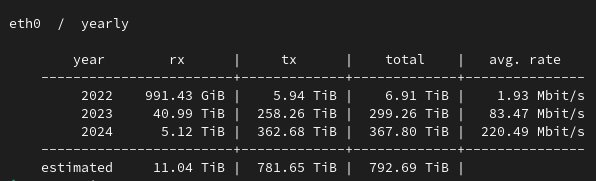
The mirror projects selection grew organically. I used to reach out many projects discussing the need of for additional mirrors. Some projects outright denied mirroring request as Germany already has a good academic mirrors boosting 20-25 Gbits/s speeds from FTP era, which seems fair. Finding the niche was essential to only add softwares, which would truly benefit from additional capacity. There were months when nothing much would happen with the mirror, rsync would continue to update the mirror while nginx would keep on serving the traffic. Nowadays, the mirror pushes around 70 TB/month. I occasionally check logs, vnstat, add new security stuff here and there and pay the bills. It now saturates the Gigabit link sometimes and goes beyond that, peaking around 1.42 Gbits/s (the hosting provider seems to be upping their game). The plan is to upgrade the link to better speeds.
Yearly traffic stats (through vnstat -y )
On the way, learned quite a few things like -
- IPv6 and exposing rsync module due to OSMC requirement.
- Implementing user with restricted access to only trigger rsync, basically make rsync pull trigger based due to Blender.
- Iterating over right client response size for LibreSpeed test project.
- Mistakenly identifying torrent traffic for BlendOS as DDoS and blocking it for quite a few months. BlendOS added loads of hits for torrent traffic, making my mirror also serve as web seed. Web seeds in conjunction with normal seeds surely is a good combination for serving downloads as it combines best of both world, general availability of web seed/mirror and benefit of traditional seeds to maximize download speeds at user end.
- Handling abusive traffic (a lot of it to be frank). The approach is more of a whack a mole right now, which I want to improve and automate.
- Most of the traffic on non-Linux/BSD operating systems serving mirrors (like mine) is for people on Windows and Mac asking for EXEs and DMGs. Mostly because package repositories carry software distribution load for Linux/BSD OSs and partly because the number of Windows/Mac users are quite high compared to other OSs.
- Load balancing through DNS and HTTP redirection (which I would implement in my India mirror now) to better maximize available resources.
In hindsight, the statistics look amazing, hundreds of TBs of traffic served from the mirror, month after month. That does show that there s still an appetite for public mirrors in time of commercially donated CDNs and GitHub. The world could have done with one less mirror, but it saved some time, lessened the burden for others, while providing redundancy and traffic localization with one additional mirror. And it s fun for someone like me who s into infrastructure that powers the Internet. Now, I ll try focusing and expanding the India mirror, which in itself started pushing almost half a TB/day. Long live Free Software and public download mirrors.





 In January I've removed tens of thousands of web pages on
www.debian.org. Have you noticed it?
In the past
From 1997 onwards, we had web pages for security announcements. We
had to manually prepare a .data and a .wml file which then generated a
web page for each security announcement (DSA or DLA). We have listed
the 6 most recent messages in a short list that was created from these
files. Most of the work that went into the Debian web pages was
creating these files.
Our search engine often listed the pages with security announcements instead
of a more relevant web page for a particular topic.
Preparation
At DebConf Kosovo (2022) I started with a proof of concept and wrote a
script, that generates this list without using the .data/.wml files in
the Git repository, but instead reading the primary sources of
security information
 Having
 (There s a handy
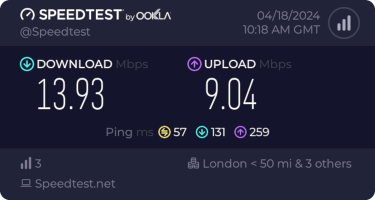 This is disappointing, but if it turns out to be a problem I can look at mounting it externally. I also assume as 5G is gradually rolled out further things will naturally improve, but that might be wishful thinking on my part.
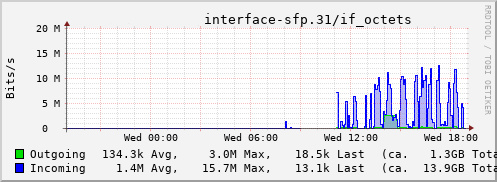
Rather than wait until my main link had a problem I decided to try a day working over the 5G connection. I spend a lot of my time either in browser based apps or accessing remote systems via SSH, so I m reasonably sensitive to a jittery or otherwise flaky connection. I picked a day that I did not have any meetings planned, but as it happened I ended up with an adhoc video call arranged. I m pleased to say that it all worked just fine; definitely noticeable as slower than the FTTP connection (to be expected), but all workable and even the video call was fine (at least from my end). Looking at the traffic graph shows the expected ~ 10Mb/s peak (actually a little higher, and looking at the FTTP stats for previous days not out of keeping with what we see there), and you can just about see the ~ 3Mb/s symmetric use by the video call at 2pm:
 The test run also helped iron out the fact that the content filter was still enabled on the SIM, but that was easily resolved.
Up next, vaguely automatic failover.
 Years ago, at what I think I remember was DebConf 15, I hacked for a while
on debhelper to








 Edited 2023-08-25 01:32 BST to correct a slip.

 At the end of the series while a slightly progressive end is shown, in reality you are left wondering whether the decision taken by the protagonist and the woman having just no agency. The hero knowing he is superior to her because of her perceived weakness. A deep-rooted malaise that is difficult to break out of. His father too and the relationship the hero longs for to have with his father who is no more. He does share some of his feelings with his mum, which touches the cord of probably every child whose mother father left them early and all those things they wanted to talk or would have chatted out if they knew this would be the last conversation they will ever have with them. Couldn t even say sorry for all the wrongs and the pain we have given them. There are just too many layers in the webseries that I would need to see it a few times to be aware of. I could sense the undercurrents but sometimes you need to see such series or movies multiple times to understand them or it could simply be the case of me being just too thick. There are also poems and poems as we know may have multiple meanings and is or can be more contextual to the person reading it rather than the creator.
At the end, while it does show a positive end, in reality I feel there is no redemption for us. I am talking about men. We are too proud, too haughty and too insecure. And if things don t go the way we want, it s the women who pay the price



 src:developers-reference translations wanted
I've just uploaded developers-reference 12.19, bringing the German
translation status back to 100% complete, thanks to Carsten Schoenert. Some
other translations however could use some updates:
 The voting period for the Debian Project Leader election has ended, with all of the votes tallied we announce the winner is: Jonathan Carter, who has been elected for the forth time.
Congratulations! The new term for the project leader started on 2023-04-21.
279 of 997 Developers voted using the