Search Results: "swan"

13 April 2014

C.J. Adams-Collier: When was the last time you upgraded from squeeze to wheezy?

Wow. 3G delta. I haven t booted this laptop for a while I think I m finally ready to make the move from gnome2 to gnome3. There are bits that still annoy me, but I think it s off to a good start. Upgrading perl from 5.10 to 5.14.
cjac@calcifer:~$ sudo apt-get dist-upgrade
Reading package lists... Done
Building dependency tree       
Reading state information... Done
Calculating upgrade... Done
The following packages will be REMOVED:
  at-spi capplets-data compiz compiz-gnome compiz-gtk defoma deskbar-applet g++-4.3 gcc-4.3 gcj-4.4-base gcj-4.4-jre gcj-4.4-jre-headless gcj-4.4-jre-lib
  gdm3 gir1.0-clutter-1.0 gir1.0-freedesktop gir1.0-glib-2.0 gir1.0-gstreamer-0.10 gir1.0-gtk-2.0 gir1.0-json-glib-1.0 glade-gnome gnome-about
  gnome-accessibility gnome-applets gnome-core gnome-panel gnome-utils-common lib32readline5-dev libbrasero-media0 libclass-mop-perl libdb4.7-java
  libdb4.8-dev libdevhelp-1-1 libdigest-sha1-perl libdirectfb-dev libebook1.2-9 libecal1.2-7 libedata-book1.2-2 libedata-cal1.2-7 libedataserverui1.2-8
  libepc-1.0-2 libepc-ui-1.0-2 libept1 libgcj10 libgcj10-awt libgd2-noxpm libgstfarsight0.10-0 libgtkhtml-editor0 libjpeg62-dev libmetacity-private0
  libmono-accessibility1.0-cil libmono-bytefx0.7.6.1-cil libmono-cairo1.0-cil libmono-cil-dev libmono-corlib1.0-cil libmono-cscompmgd7.0-cil
  libmono-data-tds1.0-cil libmono-data1.0-cil libmono-debugger-soft0.0-cil libmono-getoptions1.0-cil libmono-i18n-west1.0-cil libmono-i18n1.0-cil
  libmono-ldap1.0-cil libmono-microsoft7.0-cil libmono-npgsql1.0-cil libmono-oracle1.0-cil libmono-peapi1.0-cil libmono-posix1.0-cil
  libmono-relaxng1.0-cil libmono-security1.0-cil libmono-sharpzip0.6-cil libmono-sharpzip0.84-cil libmono-sqlite1.0-cil libmono-system-data1.0-cil
  libmono-system-ldap1.0-cil libmono-system-messaging1.0-cil libmono-system-runtime1.0-cil libmono-system-web1.0-cil libmono-system1.0-cil
  libmono-webbrowser0.5-cil libmono-winforms1.0-cil libmono1.0-cil libmtp8 libnautilus-extension1 libpango1.0-common libperl5.10 libpolkit-gtk-1-0
  libpulse-browse0 librpm1 librpmbuild1 libsdl1.2-dev libsdl1.2debian-pulseaudio libseed0 libstdc++6-4.3-dev libtelepathy-farsight0 libupnp3 libvlccore4
  libxmlrpc-c3 linphone-nox linux-headers-2.6.32-5-amd64 linux-sound-base metacity mono-2.0-devel mono-devel mysql-client-5.1 mysql-query-browser
  mysql-server-5.1 mysql-server-core-5.1 openoffice.org-base-core openoffice.org-core openoffice.org-gcj openoffice.org-report-builder-bin
  openoffice.org-style-andromeda php5-suhosin portmap python-beagle python-brasero python-docky python-encutils python-evince python-gnomeapplet
  python-gtop python-mediaprofiles python-metacity python-totem-plparser seahorse-plugins smbfs speedbar totem-coherence tqsllib1c2a unixcw vlc
  xserver-xorg-video-nv
The following NEW packages will be installed:
  accountsservice acl aisleriot apg aptdaemon-data aptitude-common asterisk-core-sounds-en asterisk-modules asterisk-moh-opsound-gsm at-spi2-core
  ax25-node bluez btrfs-tools caribou caribou-antler chromium chromium-inspector colord console-setup console-setup-linux cpp-4.6 cpp-4.7 crda
  cryptsetup-bin cups-filters db-util db5.1-util dconf-gsettings-backend dconf-service dconf-tools distro-info-data docutils-common docutils-doc enchant
  extlinux finger folks-common fonts-cantarell fonts-droid fonts-freefont-ttf fonts-horai-umefont fonts-lg-aboriginal fonts-liberation fonts-lyx
  fonts-opensymbol fonts-sil-gentium fonts-sil-gentium-basic fonts-sipa-arundina fonts-stix fonts-takao fonts-takao-gothic fonts-takao-mincho
  fonts-thai-tlwg fonts-tlwg-garuda fonts-tlwg-kinnari fonts-tlwg-loma fonts-tlwg-mono fonts-tlwg-norasi fonts-tlwg-purisa fonts-tlwg-sawasdee
  fonts-tlwg-typewriter fonts-tlwg-typist fonts-tlwg-typo fonts-tlwg-umpush fonts-tlwg-waree fonts-umeplus fuse g++-4.7 g++-4.7-multilib gcc-4.6
  gcc-4.6-base gcc-4.7 gcc-4.7-base gcc-4.7-multilib gcj-4.7-base gcj-4.7-jre gcj-4.7-jre-headless gcj-4.7-jre-lib gconf-service gcr
  gir1.2-accountsservice-1.0 gir1.2-atk-1.0 gir1.2-atspi-2.0 gir1.2-caribou-1.0 gir1.2-clutter-1.0 gir1.2-clutter-gst-1.0 gir1.2-cogl-1.0
  gir1.2-coglpango-1.0 gir1.2-evince-3.0 gir1.2-folks-0.6 gir1.2-freedesktop gir1.2-gck-1 gir1.2-gconf-2.0 gir1.2-gcr-3 gir1.2-gdesktopenums-3.0
  gir1.2-gdkpixbuf-2.0 gir1.2-gee-1.0 gir1.2-gkbd-3.0 gir1.2-glib-2.0 gir1.2-gmenu-3.0 gir1.2-gnomebluetooth-1.0 gir1.2-gnomekeyring-1.0
  gir1.2-gst-plugins-base-0.10 gir1.2-gstreamer-0.10 gir1.2-gtk-3.0 gir1.2-gtkclutter-1.0 gir1.2-gtksource-3.0 gir1.2-gtop-2.0 gir1.2-gucharmap-2.90
  gir1.2-javascriptcoregtk-3.0 gir1.2-json-1.0 gir1.2-mutter-3.0 gir1.2-networkmanager-1.0 gir1.2-notify-0.7 gir1.2-panelapplet-4.0 gir1.2-pango-1.0
  gir1.2-peas-1.0 gir1.2-polkit-1.0 gir1.2-rb-3.0 gir1.2-soup-2.4 gir1.2-telepathyglib-0.12 gir1.2-telepathylogger-0.2 gir1.2-totem-1.0
  gir1.2-totem-plparser-1.0 gir1.2-upowerglib-1.0 gir1.2-vte-2.90 gir1.2-webkit-3.0 gir1.2-wnck-3.0 gir1.2-xkl-1.0 git-man gjs gkbd-capplet glchess
  glib-networking glib-networking-common glib-networking-services glines gnect gnibbles gnobots2 gnome-bluetooth gnome-contacts gnome-control-center-data
  gnome-desktop3-data gnome-font-viewer gnome-icon-theme-extras gnome-icon-theme-symbolic gnome-online-accounts gnome-packagekit gnome-packagekit-data
  gnome-shell gnome-shell-common gnome-sudoku gnome-sushi gnome-themes-standard gnome-themes-standard-data gnome-user-share gnome-video-effects gnomine
  gnotravex gnotski gnuplot gnuplot-nox grilo-plugins-0.1 groff growisofs gsettings-desktop-schemas gstreamer0.10-gconf gtali guile-2.0-libs gvfs-common
  gvfs-daemons gvfs-libs hardening-includes hwdata iagno ienglish-common imagemagick-common ioquake3 ioquake3-server iputils-tracepath ipxe-qemu iw
  keyutils kmod krb5-locales lib32itm1 lib32quadmath0 lib32tinfo-dev lib32tinfo5 libaacplus2 libaacs0 libabiword-2.9 libaccountsservice0 libamd2.2.0
  libapache-pom-java libapol4 libapt-inst1.5 libapt-pkg4.12 libaqbanking-plugins-libgwenhywfar60 libaqbanking34 libaqbanking34-plugins libaqhbci20
  libaqofxconnect7 libarchive12 libasprintf0c2 libassuan0 libatk-adaptor libatk-adaptor-data libatk-bridge2.0-0 libatkmm-1.6-1 libatkmm-1.6-dev
  libatspi2.0-0 libaudiofile1 libavahi-ui-gtk3-0 libavcodec53 libavcodec54 libavformat53 libavformat54 libavutil51 libbabl-0.1-0 libbind9-80 libbison-dev
  libblas3 libbluray1 libboost-iostreams1.49.0 libboost-program-options1.49.0 libboost-python1.49.0 libboost-serialization1.49.0 libboost-thread1.49.0
  libbrasero-media3-1 libcairo-gobject2 libcairo-script-interpreter2 libcamel-1.2-33 libcanberra-dev libcanberra-gtk3-0 libcanberra-gtk3-module
  libcanberra-pulse libcapi20-3 libcaribou-common libcaribou-gtk-module libcaribou-gtk3-module libcaribou0 libccrtp0 libcdio-cdda1 libcdio-paranoia1
  libcdio13 libcfg4 libchamplain-0.12-0 libchamplain-gtk-0.12-0 libcheese-gtk21 libcheese3 libclass-factory-util-perl libclass-isa-perl libclass-load-perl
  libclass-load-xs-perl libclutter-1.0-common libclutter-gst-1.0-0 libclutter-gtk-1.0-0 libclutter-imcontext-0.1-0 libclutter-imcontext-0.1-bin
  libcluttergesture-0.0.2-0 libcmis-0.2-0 libcogl-common libcogl-pango0 libcogl9 libcolord1 libcommons-parent-java libconfdb4 libcoroipcc4 libcoroipcs4
  libcpg4 libcryptsetup4 libcrystalhd3 libcupsfilters1 libcw3 libdata-alias-perl libdatetime-format-builder-perl libdatetime-format-iso8601-perl
  libdb-java libdb5.1 libdb5.1-dev libdb5.1-java libdb5.1-java-jni libdbus-c++-1-0 libdbus-glib1.0-cil libdbus1.0-cil libdconf0 libdee-1.0-4
  libdevel-partialdump-perl libdevhelp-3-0 libdevmapper-event1.02.1 libdistro-info-perl libdmapsharing-3.0-2 libdns88 libdotconf1.0 libdvbpsi7
  libebackend-1.2-2 libebml3 libebook-1.2-13 libecal-1.2-11 libecore1 libedata-book-1.2-13 libedata-cal-1.2-15 libedataserver-1.2-16
  libedataserverui-3.0-1 libeina1 libemail-valid-perl libencode-locale-perl libepc-1.0-3 libepc-ui-1.0-3 libept1.4.12 libescpr1 libev4
  libeval-closure-perl libevdocument3-4 libevent-2.0-5 libevent-perl libevs4 libevview3-3 libexiv2-12 libexosip2-7 libexporter-lite-perl
  libexttextcat-data libexttextcat0 libfakechroot libfarstream-0.1-0 libfdk-aac0 libfdt1 libfile-basedir-perl libfile-desktopentry-perl
  libfile-fcntllock-perl libfile-listing-perl libfile-mimeinfo-perl libfltk-images1.3 libfltk1.3 libfolks-eds25 libfolks-telepathy25 libfolks25
  libfont-afm-perl libgail-3-0 libgcj13 libgcj13-awt libgck-1-0 libgconf-2-4 libgconf2-doc libgcr-3-1 libgcr-3-common libgd2-xpm libgdata13
  libgdata2.1-cil libgdict-common libgdk-pixbuf2.0-0 libgdk-pixbuf2.0-common libgdk-pixbuf2.0-dev libgegl-0.2-0 libgeocode-glib0 libgettextpo0 libgexiv2-1
  libgirepository-1.0-1 libgjs0b libgkeyfile1.0-cil libgladeui-2-0 libgladeui-common libglapi-mesa libglew1.7 libglib2.0-bin libgmime-2.6-0
  libgmime2.6-cil libgmp10 libgnome-bluetooth10 libgnome-desktop-3-2 libgnome-keyring-common libgnome-media-profiles-3.0-0 libgnome-menu-3-0 libgnomekbd7
  libgnutls-openssl27 libgnutlsxx27 libgoa-1.0-0 libgoa-1.0-common libgphoto2-l10n libgraphite2-2.0.0 libgrilo-0.1-0 libgs9 libgs9-common libgssdp-1.0-3
  libgstreamer-plugins-bad0.10-0 libgtk-3-0 libgtk-3-bin libgtk-3-common libgtk-3-dev libgtk-3-doc libgtk-sharp-beans-cil libgtk-vnc-2.0-0
  libgtkhtml-4.0-0 libgtkhtml-4.0-common libgtkhtml-editor-4.0-0 libgtkmm-3.0-1 libgtksourceview-3.0-0 libgtksourceview-3.0-common libgucharmap-2-90-7
  libgudev1.0-cil libgupnp-1.0-4 libgupnp-av-1.0-2 libgupnp-igd-1.0-4 libgusb2 libgvnc-1.0-0 libgweather-3-0 libgwenhywfar-data libgwenhywfar60 libgxps2
  libhcrypto4-heimdal libheimbase1-heimdal libhtml-form-perl libhtml-format-perl libhttp-cookies-perl libhttp-daemon-perl libhttp-date-perl
  libhttp-message-perl libhttp-negotiate-perl libhunspell-1.3-0 libicu48 libimobiledevice2 libio-aio-perl libisc84 libisccc80 libisccfg82 libiscsi1
  libiso9660-8 libisoburn1 libitm1 libjavascriptcoregtk-1.0-0 libjavascriptcoregtk-3.0-0 libjbig0 libjs-sphinxdoc libjs-underscore libjson0 libjte1
  libkadm5clnt-mit8 libkadm5srv-mit8 libkarma0 libkdb5-6 libkmod2 libkpathsea6 liblapack3 liblavfile-2.0-0 liblavjpeg-2.0-0 liblavplay-2.0-0 liblcms2-2
  liblensfun-data liblensfun0 liblinear-tools liblinear1 liblinphone4 liblockfile-bin liblogsys4 liblvm2app2.2 liblwp-mediatypes-perl
  liblwp-protocol-https-perl liblwres80 liblzma5 libmaa3 libmagick++5 libmagickcore5 libmagickcore5-extra libmagickwand5 libmath-bigint-perl
  libmath-round-perl libmatroska5 libmediastreamer1 libmhash2 libminiupnpc5 libmission-control-plugins0 libmjpegutils-2.0-0 libmodule-implementation-perl
  libmodule-runtime-perl libmono-2.0-1 libmono-2.0-dev libmono-accessibility4.0-cil libmono-cairo4.0-cil libmono-codecontracts4.0-cil
  libmono-compilerservices-symbolwriter4.0-cil libmono-corlib4.0-cil libmono-csharp4.0-cil libmono-custommarshalers4.0-cil libmono-data-tds4.0-cil
  libmono-debugger-soft2.0-cil libmono-debugger-soft4.0-cil libmono-http4.0-cil libmono-i18n-cjk4.0-cil libmono-i18n-mideast4.0-cil
  libmono-i18n-other4.0-cil libmono-i18n-rare4.0-cil libmono-i18n-west4.0-cil libmono-i18n4.0-all libmono-i18n4.0-cil libmono-ldap4.0-cil
  libmono-management4.0-cil libmono-messaging-rabbitmq4.0-cil libmono-messaging4.0-cil libmono-microsoft-build-engine4.0-cil
  libmono-microsoft-build-framework4.0-cil libmono-microsoft-build-tasks-v4.0-4.0-cil libmono-microsoft-build-utilities-v4.0-4.0-cil
  libmono-microsoft-csharp4.0-cil libmono-microsoft-visualc10.0-cil libmono-microsoft-web-infrastructure1.0-cil libmono-npgsql4.0-cil
  libmono-opensystem-c4.0-cil libmono-oracle4.0-cil libmono-peapi4.0-cil libmono-posix4.0-cil libmono-rabbitmq4.0-cil libmono-relaxng4.0-cil
  libmono-security4.0-cil libmono-sharpzip4.84-cil libmono-simd4.0-cil libmono-sqlite4.0-cil libmono-system-componentmodel-composition4.0-cil
  libmono-system-componentmodel-dataannotations4.0-cil libmono-system-configuration-install4.0-cil libmono-system-configuration4.0-cil
  libmono-system-core4.0-cil libmono-system-data-datasetextensions4.0-cil libmono-system-data-linq4.0-cil libmono-system-data-services-client4.0-cil
  libmono-system-data-services4.0-cil libmono-system-data4.0-cil libmono-system-design4.0-cil libmono-system-drawing-design4.0-cil
  libmono-system-drawing4.0-cil libmono-system-dynamic4.0-cil libmono-system-enterpriseservices4.0-cil libmono-system-identitymodel-selectors4.0-cil
  libmono-system-identitymodel4.0-cil libmono-system-ldap4.0-cil libmono-system-management4.0-cil libmono-system-messaging4.0-cil
  libmono-system-net4.0-cil libmono-system-numerics4.0-cil libmono-system-runtime-caching4.0-cil libmono-system-runtime-durableinstancing4.0-cil
  libmono-system-runtime-serialization-formatters-soap4.0-cil libmono-system-runtime-serialization4.0-cil libmono-system-runtime4.0-cil
  libmono-system-security4.0-cil libmono-system-servicemodel-discovery4.0-cil libmono-system-servicemodel-routing4.0-cil
  libmono-system-servicemodel-web4.0-cil libmono-system-servicemodel4.0-cil libmono-system-serviceprocess4.0-cil libmono-system-transactions4.0-cil
  libmono-system-web-abstractions4.0-cil libmono-system-web-applicationservices4.0-cil libmono-system-web-dynamicdata4.0-cil
  libmono-system-web-extensions-design4.0-cil libmono-system-web-extensions4.0-cil libmono-system-web-routing4.0-cil libmono-system-web-services4.0-cil
  libmono-system-web4.0-cil libmono-system-windows-forms-datavisualization4.0-cil libmono-system-windows-forms4.0-cil libmono-system-xaml4.0-cil
  libmono-system-xml-linq4.0-cil libmono-system-xml4.0-cil libmono-system4.0-cil libmono-tasklets4.0-cil libmono-web4.0-cil libmono-webbrowser2.0-cil
  libmono-webbrowser4.0-cil libmono-webmatrix-data4.0-cil libmono-windowsbase4.0-cil libmount1 libmozjs10d libmozjs17d libmozjs185-1.0 libmpeg2encpp-2.0-0
  libmplex2-2.0-0 libmtdev1 libmtp-common libmtp-runtime libmtp9 libmupen64plus2 libmusicbrainz-discid-perl libmusicbrainz5-0 libmutter0 libmx-1.0-2
  libmx-bin libmx-common libmysqlclient18 libnatpmp1 libnautilus-extension1a libnet-domain-tld-perl libnet-http-perl libnet-ip-minimal-perl libnetcf1
  libnetfilter-conntrack3 libnettle4 libnewtonsoft-json4.5-cil libnice10 libnl-3-200 libnl-genl-3-200 libnl-route-3-200 libnm-glib4 libnm-gtk-common
  libnm-gtk0 libnm-util2 libnotify4 libnspr4 libnss-winbind libnss3 libnuma1 libnunit2.6-cil liboauth0 libodbc1 liboobs-1-5 libopal3.10.4 libopenal-data
  libopus0 libosip2-7 libp11-2 libp11-kit-dev libp11-kit0 libpackage-stash-xs-perl libpackagekit-glib2-14 libpam-cap libpam-modules-bin libpam-winbind
  libpanel-applet-4-0 libparams-classify-perl libpcre3-dev libpcrecpp0 libpeas-1.0-0 libpeas-common libperl5.14 libpipeline1 libpload4 libpodofo0.9.0
  libpoe-component-resolver-perl libpoppler-glib8 libpoppler19 libportsmf0 libpostproc52 libprocps0 libpst4 libpt2.10.4 libptexenc1 libpython2.7
  libqt4-declarative libqtassistantclient4 libqtdbus4 libqtwebkit4 libquadmath0 libquicktime2 libquorum4 libquvi-scripts libquvi7 libraptor2-0 librasqal3
  libraw5 libregexp-reggrp-perl libreoffice libreoffice-base libreoffice-base-core libreoffice-calc libreoffice-common libreoffice-core libreoffice-draw
  libreoffice-emailmerge libreoffice-evolution libreoffice-filter-binfilter libreoffice-filter-mobiledev libreoffice-gnome libreoffice-gtk
  libreoffice-help-en-us libreoffice-impress libreoffice-java-common libreoffice-math libreoffice-officebean libreoffice-report-builder-bin
  libreoffice-style-galaxy libreoffice-style-tango libreoffice-writer libresid-builder0c2a librest-0.7-0 librest-extras-0.7-0 librhythmbox-core6 librpm3
  librpmbuild3 librpmio3 librpmsign1 libruby1.9.1 libsaamf3 libsackpt3 libsaclm3 libsaevt3 libsalck3 libsam4 libsamsg4 libsane-common
  libsane-extras-common libsatmr3 libsbsms10 libseed-gtk3-0 libsidplay2 libsigsegv2 libsocialweb-client2 libsocialweb-common libsocialweb-service
  libsocialweb0 libsocket-getaddrinfo-perl libsocket-perl libsonic0 libsoundtouch0 libsox2 libspeechd2 libspice-client-glib-2.0-1
  libspice-client-gtk-2.0-1 libspice-server1 libssl-doc libssl1.0.0 libstdc++6-4.7-dev libsvm-tools libswitch-perl libswscale2 libsystemd-daemon0
  libsystemd-login0 libtagc0 libtelepathy-farstream2 libtelepathy-logger2 libtest-warn-perl libtinfo-dev libtinfo5 libtirpc1 libtokyocabinet9 libtotem-pg4
  libtotem0 libtqsllib1 libtracker-sparql-0.14-0 libtree-dagnode-perl libts-dev libucommon5 libumfpack5.4.0 libunique-3.0-0 libupnp6 libusbredirhost1
  libusbredirparser0 libv4lconvert0 libverto-libev1 libverto1 libvisio-0.0-0 libvlccore5 libvo-aacenc0 libvo-amrwbenc0 libvorbisidec1 libvotequorum4
  libvpx1 libvte-2.90-9 libvte-2.90-common libwacom-common libwacom2 libwebkitgtk-1.0-0 libwebkitgtk-1.0-common libwebkitgtk-3.0-0 libwebkitgtk-3.0-common
  libwebp2 libwebrtc-audio-processing-0 libwildmidi-config libwireshark-data libwireshark2 libwiretap2 libwnck-3-0 libwnck-3-common libwpd-0.9-9
  libwpg-0.2-2 libwps-0.2-2 libwsutil2 libwv-1.2-4 libwww-robotrules-perl libx11-doc libx11-protocol-perl libx264-123 libx264-124 libx264-130 libx264-132
  libxalan2-java libxcb-composite0 libxcb-glx0 libxcb-shape0 libxcb-shm0-dev libxcb-util0 libxen-4.1 libxml-commons-external-java
  libxml-commons-resolver1.1-java libxml-sax-base-perl libxmlrpc-c++4 libxmlrpc-core-c3 libxz-java libyajl2 libyaml-0-2 libyaml-perl libyelp0 libzrtpcpp2
  libzvbi-common libzvbi0 lightsoff linphone-nogtk linux-headers-3.2.0-4-amd64 linux-headers-3.2.0-4-common linux-headers-amd64 linux-image-3.2.0-4-amd64
  linux-image-amd64 linux-kbuild-3.2 live-boot-doc live-config-doc live-manual-html mahjongg memtest86+ minissdpd mono-4.0-gac mono-dmcs mscompress
  multiarch-support mupen64plus-audio-all mupen64plus-audio-sdl mupen64plus-data mupen64plus-input-all mupen64plus-input-sdl mupen64plus-rsp-all
  mupen64plus-rsp-hle mupen64plus-rsp-z64 mupen64plus-ui-console mupen64plus-video-all mupen64plus-video-arachnoid mupen64plus-video-glide64
  mupen64plus-video-rice mupen64plus-video-z64 mutter-common mysql-client-5.5 mysql-server-5.5 mysql-server-core-5.5 mythes-en-us openarena-081-maps
  openarena-081-misc openarena-081-players openarena-081-players-mature openarena-081-textures openarena-085-data openarena-088-data packagekit
  packagekit-backend-aptcc packagekit-tools planner-data planner-doc poppler-data printer-driver-all printer-driver-c2050 printer-driver-c2esp
  printer-driver-cjet printer-driver-escpr printer-driver-foo2zjs printer-driver-gutenprint printer-driver-hpcups printer-driver-hpijs
  printer-driver-m2300w printer-driver-min12xxw printer-driver-pnm2ppa printer-driver-postscript-hp printer-driver-ptouch printer-driver-pxljr
  printer-driver-sag-gdi printer-driver-splix psutils python-aptdaemon.gtk3widgets python-aptdaemon.gtkwidgets python-bzrlib python-dbus-dev
  python-debianbts python-defer python-dnspython python-fpconst python-gi python-gi-cairo python-gi-dev python-gobject-2 python-gobject-2-dev
  python-keyring python-launchpadlib python-lazr.restfulclient python-lazr.uri python-liblarch python-liblarch-gtk python-magic python-oauth
  python-packagekit python-pyatspi2 python-pyparsing python-repoze.lru python-routes python-setools python-simplejson python-soappy python-speechd
  python-spice-client-gtk python-wadllib python-webob python-zeitgeist python2.7 python2.7-dev python2.7-minimal qdbus quadrapassel remmina-common
  rhythmbox-data rpcbind rtkit ruby ruby1.9.1 shotwell-common smartdimmer software-properties-common sound-theme-freedesktop speech-dispatcher
  sphinx-common sphinx-doc swell-foop syslinux-themes-debian syslinux-themes-debian-wheezy tdb-tools telepathy-haze telepathy-logger telepathy-rakia
  tex-gyre ttf-marvosym wireless-regdb xbrlapi xorg-sgml-doctools xorriso xserver-xorg-input-mouse xserver-xorg-input-vmmouse xulrunner-17.0 yelp-xsl
  zeitgeist-core zenity-common
The following packages have been kept back:
  acroread-debian-files db4.8-util hibernate ia32-libs ia32-libs-gtk libboost-dev libboost-serialization-dev opensc wine
The following packages will be upgraded:
  abcde abiword abiword-common abiword-plugin-grammar abiword-plugin-mathview acpi acpi-fakekey acpi-support acpi-support-base acpid acroread-data
  acroread-dictionary-en acroread-l10n-en adduser alacarte alsa-base alsa-utils amb-plugins anacron analog ant ant-optional apache2 apache2-doc
  apache2-mpm-prefork apache2-utils apache2.2-bin apache2.2-common app-install-data apt apt-file apt-utils apt-xapian-index aptdaemon aptitude
  aqbanking-tools aspell aspell-en asterisk asterisk-config asterisk-core-sounds-en-gsm asterisk-doc asterisk-voicemail astyle at audacity audacity-data
  augeas-lenses augeas-tools autoconf autoconf-doc automake automake1.9 autopoint autotools-dev avahi-autoipd avahi-daemon avidemux avidemux-common
  avidemux-plugins aview ax25-tools banshee baobab base-files base-passwd bash bash-completion bc bind9-doc bind9-host bind9utils binfmt-support binutils
  bison bluez-cups bogofilter bogofilter-bdb bogofilter-common brasero brasero-common bridge-utils browser-plugin-gnash bsd-mailx bsdmainutils bsdutils
  busybox buzztard buzztard-data bwidget bzip2 bzr bzrtools ca-certificates calibre calibre-bin ccache cd-discid cdebootstrap cdparanoia cdrdao
  checkpolicy cheese cheese-common chromium-browser chromium-browser-inspector cifs-utils cl-asdf cli-common clisp comerr-dev common-lisp-controller
  console-common console-data console-tools consolekit coreutils cowbuilder cowdancer cpio cpp cpp-4.4 cpufrequtils cracklib-runtime crawl-common
  crawl-tiles cron cryptsetup cups cups-bsd cups-client cups-common cups-driver-gutenprint cups-pk-helper cups-ppdc cupsddk curl curlftpfs cvs cw dash
  dasher dasher-data dbus dbus-x11 dc dcraw dctrl-tools debconf debconf-i18n debhelper debian-archive-keyring debian-faq debian-keyring debianutils debirf
  debootstrap desktop-base desktop-file-utils devhelp devhelp-common devscripts dialog dict dictionaries-common diffstat diffutils djtools dkms dmidecode
  dmsetup dnsmasq-base dnsutils doc-debian docbook docbook-dsssl docbook-to-man docbook-utils docbook-xml docbook-xsl docbook-xsl-doc-html docky dosemu
  dosfstools dpatch dpkg dpkg-dev dput dvd+rw-tools dvi2ps dynagen dynamips e2fslibs e2fsprogs ebtables ed eject ekiga emacs23-bin-common emacs23-common
  emacs23-nox emacsen-common emdebian-archive-keyring empathy empathy-common eog epiphany-browser epiphany-browser-data epiphany-extensions esound-common
  espeak espeak-data ethtool evince evince-common evolution evolution-common evolution-data-server evolution-data-server-common evolution-exchange
  evolution-plugins evolution-webcal exif exiftags exim4 exim4-base exim4-config exim4-daemon-light exiv2 f-spot fakechroot fakeroot fancontrol fceu
  fcrackzip fdupes feynmf file file-roller finch findutils firmware-iwlwifi firmware-linux-free firmware-linux-nonfree flac flashrom fldigi flex
  fontconfig fontconfig-config foo2zjs foomatic-db foomatic-db-engine foomatic-db-gutenprint foomatic-filters fping freedesktop-sound-theme freeglut3
  freetds-common ftp fuse-utils g++ g++-4.4 g++-4.4-multilib g++-multilib gawk gcalctool gcc gcc-4.4 gcc-4.4-base gcc-4.4-doc gcc-4.4-multilib
  gcc-doc-base gcc-multilib gcj-jre gcj-jre-headless gconf-defaults-service gconf-editor gconf2 gconf2-common gddrescue gdebi gdebi-core gedit
  gedit-common gedit-plugins genisoimage geoclue geoclue-hostip geoclue-localnet geoclue-manual geoclue-yahoo geoip-database gettext gettext-base
  ghostscript ghostscript-cups gimp gimp-data git git-buildpackage git-core git-svn gitk gksu glade gnash gnash-common gnash-opengl
  gnome-accessibility-themes gnome-applets-data gnome-backgrounds gnome-cards-data gnome-common gnome-control-center gnome-control-center-dev
  gnome-desktop-data gnome-dictionary gnome-disk-utility gnome-do gnome-do-plugins gnome-doc-utils gnome-games gnome-games-data gnome-games-extra-data
  gnome-icon-theme gnome-js-common gnome-keyring gnome-mag gnome-media gnome-menus gnome-nettool gnome-orca gnome-panel-data gnome-pkg-tools
  gnome-power-manager gnome-rdp gnome-screensaver gnome-screenshot gnome-search-tool gnome-session gnome-session-bin gnome-session-canberra
  gnome-session-common gnome-settings-daemon gnome-settings-daemon-dev gnome-system-log gnome-system-monitor gnome-system-tools gnome-terminal
  gnome-terminal-data gnome-user-guide gnomint gnu-fdisk gnucash-docs gnuchess gnumeric gnumeric-common gnupg gnupg-agent gocr google-talkplugin gparted
  gpgv gpredict gpscorrelate grep groff-base grub-common grub-legacy gsfonts-x11 gsmartcontrol gstreamer0.10-alsa gstreamer0.10-buzztard
  gstreamer0.10-buzztard-doc gstreamer0.10-doc gstreamer0.10-ffmpeg gstreamer0.10-ffmpeg-dbg gstreamer0.10-fluendo-mp3 gstreamer0.10-gnonlin
  gstreamer0.10-gnonlin-dbg gstreamer0.10-gnonlin-doc gstreamer0.10-nice gstreamer0.10-plugins-bad gstreamer0.10-plugins-bad-dbg
  gstreamer0.10-plugins-bad-doc gstreamer0.10-plugins-base gstreamer0.10-plugins-base-apps gstreamer0.10-plugins-base-dbg gstreamer0.10-plugins-base-doc
  gstreamer0.10-plugins-good gstreamer0.10-plugins-good-dbg gstreamer0.10-plugins-good-doc gstreamer0.10-plugins-ugly gstreamer0.10-plugins-ugly-dbg
  gstreamer0.10-plugins-ugly-doc gstreamer0.10-pulseaudio gstreamer0.10-tools gstreamer0.10-x gtg gthumb gthumb-data gtk2-engines gtk2-engines-pixbuf
  gucharmap guile-1.6 guile-1.6-libs guile-1.8-libs gvfs gvfs-backends gvfs-bin gzip hal hamster-applet hardinfo hddtemp hdparm hfsprogs hostname hp-ppd
  hpijs hplip hplip-cups hplip-data htmldoc htmldoc-common iamerican ibritish iceweasel ifupdown ijsgutenprint imagemagick imagemagick-doc info
  initramfs-tools initscripts inkscape insserv install-info installation-report intltool iotop iproute ipsec-tools iptables iptraf iputils-ping
  ircd-hybrid irssi isc-dhcp-client isc-dhcp-common isc-dhcp-server iscsitarget-dkms iso-codes ispell jack jadetex java-common jigdo-file keyanalyze
  keyboard-configuration keychain klibc-utils kpartx krb5-admin-server krb5-auth-dialog krb5-config krb5-doc krb5-kdc krb5-kdc-ldap krb5-multidev
  krb5-pkinit krb5-user lacheck lame latex-beamer latex-xcolor less lesstif2 lesstif2-dev lib32asound2 lib32bz2-1.0 lib32gcc1 lib32gomp1 lib32ncurses5
  lib32ncurses5-dev lib32nss-mdns lib32readline5 lib32stdc++6 lib32v4l-0 lib32z1 lib32z1-dev liba52-0.7.4 libaa1 libaa1-dev libacl1 libaften0
  libaiksaurus-1.2-0c2a libaiksaurus-1.2-data libaiksaurusgtk-1.2-0c2a libaio1 libalgorithm-diff-xs-perl libany-moose-perl libanyevent-perl libao-common
  libao4 libapache-dbi-perl libapache2-mod-apreq2 libapache2-mod-dnssd libapache2-mod-perl2 libapache2-mod-php5 libapache2-mod-python
  libapache2-request-perl libappconfig-perl libapr1 libapreq2 libaprutil1 libaprutil1-dbd-sqlite3 libaprutil1-ldap libapt-pkg-perl libaqbanking-data
  libarchive-zip-perl libart-2.0-2 libart-2.0-dev libart2.0-cil libasn1-8-heimdal libasound2 libasound2-dev libasound2-plugins libaspell15 libass4
  libasync-interrupt-perl libasyncns0 libatasmart4 libatk1.0-0 libatk1.0-data libatk1.0-dev libatk1.0-doc libatspi1.0-0 libattr1 libaudio-dev libaudio2
  libaudiofile-dev libaudit0 libaugeas0 libavahi-client-dev libavahi-client3 libavahi-common-data libavahi-common-dev libavahi-common3 libavahi-core7
  libavahi-glib-dev libavahi-glib1 libavahi-gobject0 libavahi-ui0 libavc1394-0 libax25 libb-hooks-endofscope-perl libb-keywords-perl libbind9-60
  libblas3gf libblkid1 libbluetooth3 libbml0 libboo2.0.9-cil libbrlapi0.5 libbs2b0 libbsd0 libburn4 libbusiness-paypal-api-perl
  libbusiness-tax-vat-validation-perl libbuzztard0 libbz2-1.0 libc-ares2 libc-bin libc-dev-bin libc6 libc6-dev libc6-dev-i386 libc6-i386 libcaca-dev
  libcaca0 libcache-fastmmap-perl libcairo-perl libcairo2 libcairo2-dev libcairomm-1.0-1 libcairomm-1.0-dev libcanberra-gtk0 libcanberra0 libcap-ng0
  libcap2 libcap2-bin libcapture-tiny-perl libccid libcdaudio1 libcddb-get-perl libcddb2 libcdparanoia0 libcdt4 libchm-bin libchm1 libck-connector0
  libclass-c3-perl libclass-c3-xs-perl libclass-insideout-perl libclass-inspector-perl libclass-method-modifiers-perl libclass-methodmaker-perl
  libclone-perl libclutter-1.0-0 libcolamd2.7.1 libcolor-calc-perl libcomedi0 libcomerr2 libcommon-sense-perl libcommons-beanutils-java
  libcommons-collections3-java libcommons-compress-java libcommons-digester-java libcommons-logging-java libconfig-inifiles-perl libconfig-json-perl
  libconfig-tiny-perl libconsole libcontextual-return-perl libconvert-asn1-perl libcoro-perl libcorosync4 libcpufreq-dev libcpufreq0 libcrack2 libcroco3
  libcrypt-openssl-bignum-perl libcrypt-openssl-random-perl libcrypt-openssl-rsa-perl libcrypt-passwdmd5-perl libcrypt-ssleay-perl libcss-minifier-xs-perl
  libcss-packer-perl libcups2 libcupscgi1 libcupsdriver1 libcupsimage2 libcupsmime1 libcupsppdc1 libcurl3 libcurl3-gnutls libcurses-perl libcwidget3
  libdata-optlist-perl libdata-structure-util-perl libdata-visitor-perl libdatetime-format-http-perl libdatetime-perl libdatetime-set-perl
  libdatetime-timezone-perl libdatrie1 libdb-dev libdb-je-java libdbd-mysql-perl libdbi-perl libdbus-1-3 libdbus-1-dev libdbus-glib-1-2 libdbus-glib-1-dev
  libdc1394-22 libdca0 libdebian-installer-extra4 libdebian-installer4 libdevel-globaldestruction-perl libdevel-size-perl libdevel-stacktrace-perl
  libdevel-symdump-perl libdevmapper1.02.1 libdigest-hmac-perl libdirac-decoder0 libdirac-encoder0 libdirectfb-1.2-9 libdirectfb-extra libdiscid0
  libdjvulibre-text libdjvulibre21 libdns69 libdpkg-perl libdrm-dev libdrm-intel1 libdrm-nouveau1a libdrm-radeon1 libdrm2 libdv4 libdvdcss2 libdvdnav4
  libdvdread4 libedit2 libelf1 libelfg0 libemail-address-perl libenca0 libenchant1c2a libengine-pkcs11-openssl libepc-common libesd0 libesd0-dev
  libespeak1 libevolution libexception-class-perl libexempi3 libexif12 libexpat1 libexpat1-dev libexpect-perl libfaac0 libfaad2 libfcgi-perl libfcgi0ldbl
  libffi-dev libffi5 libfftw3-3 libfile-homedir-perl libfile-libmagic-perl libfile-mmagic-perl libfile-slurp-perl libfile-which-perl libfilter-perl
  libfinance-quote-perl libflac++6 libflac8 libflickrnet2.2-cil libflite1 libfltk1.1 libfluidsynth1 libfontconfig1 libfontconfig1-dev libfontenc1
  libfreetype6 libfreetype6-dev libfribidi0 libfs6 libftdi-dev libftdi1 libfuse2 libgail-common libgail-dev libgail18 libgc1c2 libgcc1 libgcj-bc
  libgcj-common libgconf2-4 libgconf2-dev libgconf2.0-cil libgcrypt11 libgcrypt11-dev libgd-gd2-noxpm-perl libgdata-common libgdbm3 libgdict-1.0-6
  libgdiplus libgdome2-0 libgdome2-cpp-smart0c2a libgdu-gtk0 libgdu0 libgee2 libgeoclue0 libgeoip1 libgfortran3 libgif4 libgimp2.0 libgio-cil libgksu2-0
  libgl1-mesa-dev libgl1-mesa-dri libgl1-mesa-glx libglade2.0-cil libgladeui-1-9 libglib-perl libglib2.0-0 libglib2.0-cil libglib2.0-data libglib2.0-dev
  libglib2.0-doc libglibmm-2.4-1c2a libglibmm-2.4-dev libglu1-mesa libglu1-mesa-dev libgnome-desktop-2-17 libgnome-desktop-dev libgnome-keyring-dev
  libgnome-keyring0 libgnome-keyring1.0-cil libgnome-mag2 libgnome-menu2 libgnome-speech7 libgnome-vfs2.0-cil libgnome2-0 libgnome2-canvas-perl
  libgnome2-common libgnome2-dev libgnome2-perl libgnome2-vfs-perl libgnome2.24-cil libgnomecanvas2-0 libgnomecanvas2-common libgnomecanvas2-dev
  libgnomedesktop2.20-cil libgnomekbd-common libgnomeui-0 libgnomeui-common libgnomeui-dev libgnomevfs2-0 libgnomevfs2-common libgnomevfs2-dev
  libgnomevfs2-extra libgnupg-interface-perl libgnutls-dev libgnutls26 libgoffice-0.8-8 libgoffice-0.8-8-common libgomp1 libgpg-error-dev libgpg-error0
  libgpgme11 libgphoto2-2 libgphoto2-port0 libgpm2 libgpod-common libgpod4 libgraph4 libgsf-1-114 libgsf-1-common libgsl0ldbl libgsm0710-0 libgsm1
  libgssapi-krb5-2 libgssglue1 libgssrpc4 libgstbuzztard0 libgstreamer-plugins-base0.10-0 libgstreamer-plugins-base0.10-dev libgstreamer0.10-0
  libgstreamer0.10-0-dbg libgstreamer0.10-dev libgtk-vnc-1.0-0 libgtk2-perl libgtk2.0-0 libgtk2.0-bin libgtk2.0-cil libgtk2.0-common libgtk2.0-dev
  libgtk2.0-doc libgtkglext1 libgtkhtml3.14-19 libgtkimageview0 libgtkmathview0c2a libgtkmm-2.4-1c2a libgtkmm-2.4-dev libgtop2-7 libgtop2-common
  libgtop2-dev libguard-perl libgudev-1.0-0 libguile-ltdl-1 libgutenprint2 libgvc5 libgweather-common libhal-dev libhal-storage1 libhal1 libhamlib2
  libhpmud0 libhsqldb-java libhtml-packer-perl libhtml-parser-perl libhtml-tableextract-perl libhtml-tagcloud-perl libhtml-template-expr-perl
  libhtml-template-perl libhtml-tree-perl libhtml-treebuilder-xpath-perl libhttp-server-simple-perl libhx509-5-heimdal libhyphen0 libical0 libice-dev
  libice6 libicu44 libicu4j-java libidl-dev libidl0 libidn11 libidn11-dev libieee1284-3 libijs-0.35 libilmbase6 libimage-exif-perl libimage-exiftool-perl
  libio-pty-perl libio-socket-inet6-perl libio-socket-ssl-perl libio-stringy-perl libio-stty-perl libipc-run-perl libiptcdata0 libisc62 libisccc60
  libisccfg62 libisofs6 libiw30 libjack0 libjasper1 libjavascript-minifier-xs-perl libjavascript-packer-perl libjaxp1.3-java libjaxp1.3-java-gcj
  libjbig2dec0 libjline-java libjpeg-progs libjpeg62 libjpeg8 libjs-jquery libjs-yui libjson-any-perl libjson-glib-1.0-0 libjson-perl libjson-xs-perl
  libjtidy-java libk5crypto3 libkadm5clnt-mit7 libkadm5srv-mit7 libkate1 libkdb5-4 libkeyutils1 libklibc libkms1 libkrb5-26-heimdal libkrb5-3
  libkrb5support0 libktoblzcheck1c2a liblapack3gf liblcms1 libldap-2.4-2 liblink-grammar4 liblircclient0 liblist-moreutils-perl liblocale-gettext-perl
  liblocales-perl liblockfile1 liblog-dispatch-perl liblog4c3 liblog4cxx10 libloudmouth1-0 liblouis-data liblouis2 liblqr-1-0 libltdl-dev libltdl7
  liblua5.1-0 liblua5.1-0-dev liblucene2-java liblwres60 liblzo2-2 libmad0 libmagic1 libmagick++3 libmagickcore3 libmagickcore3-extra libmagickwand3
  libmailtools-perl libmeanwhile1 libmime-tools-perl libmime-types-perl libmimic0 libmms0 libmng1 libmodplug1 libmodule-find-perl libmodule-starter-perl
  libmono-accessibility2.0-cil libmono-addins-gui0.2-cil libmono-addins0.2-cil libmono-c5-1.1-cil libmono-cairo2.0-cil libmono-cecil-private-cil
  libmono-corlib2.0-cil libmono-cscompmgd8.0-cil libmono-data-tds2.0-cil libmono-db2-1.0-cil libmono-i18n-west2.0-cil libmono-i18n2.0-cil
  libmono-ldap2.0-cil libmono-management2.0-cil libmono-messaging-rabbitmq2.0-cil libmono-messaging2.0-cil libmono-microsoft-build2.0-cil
  libmono-microsoft8.0-cil libmono-npgsql2.0-cil libmono-oracle2.0-cil libmono-peapi2.0-cil libmono-posix2.0-cil libmono-rabbitmq2.0-cil
  libmono-relaxng2.0-cil libmono-security2.0-cil libmono-sharpzip2.6-cil libmono-sharpzip2.84-cil libmono-simd2.0-cil libmono-sqlite2.0-cil
  libmono-system-data-linq2.0-cil libmono-system-data2.0-cil libmono-system-ldap2.0-cil libmono-system-messaging2.0-cil libmono-system-runtime2.0-cil
  libmono-system-web-mvc1.0-cil libmono-system-web-mvc2.0-cil libmono-system-web2.0-cil libmono-system2.0-cil libmono-tasklets2.0-cil libmono-wcf3.0-cil
  libmono-windowsbase3.0-cil libmono-winforms2.0-cil libmono-zeroconf1.0-cil libmono2.0-cil libmoose-perl libmouse-perl libmp3lame0 libmpc2 libmpcdec6
  libmpfr4 libmpg123-0 libmusicbrainz3-6 libmysqlclient-dev libmysqlclient16 libmythes-1.2-0 libnamespace-autoclean-perl libnamespace-clean-perl
  libncurses5 libncurses5-dev libncursesw5 libncursesw5-dev libndesk-dbus-glib1.0-cil libndesk-dbus1.0-cil libneon27 libneon27-gnutls libnet-daemon-perl
  libnet-dbus-perl libnet-dns-perl libnet-ip-perl libnet-ldap-perl libnet-libidn-perl libnet-netmask-perl libnet-oauth-perl libnet-snmp-perl
  libnet-ssleay-perl libnet1 libnet1-dev libnet6-1.3-0 libnetaddr-ip-perl libnetpbm10 libnewt0.52 libnfnetlink0 libnfsidmap2 libnl1 libnm-glib-dev
  libnm-glib-vpn-dev libnm-glib-vpn1 libnm-util-dev libnotify-dev libnotify0.4-cil libnspr4-0d libnss-mdns libnss3-1d libnunit-cil-dev libofa0 libogg0
  liboobs-1-dev libopenais3 libopenal1 libopencore-amrnb0 libopencore-amrwb0 libopenct1 libopenexr6 libopenjpeg2 libopenraw1 libopenrawgnome1 libopts25
  liborbit2 liborbit2-dev liborc-0.4-0 libortp8 libosp5 libossp-uuid-perl libossp-uuid16 libostyle1c2 libotr2 libots0 libpackage-deprecationmanager-perl
  libpackage-stash-perl libpam-cracklib libpam-gnome-keyring libpam-ldap libpam-modules libpam-p11 libpam-runtime libpam0g libpam0g-dev libpango-perl
  libpango1.0-0 libpango1.0-dev libpango1.0-doc libpangomm-1.4-1 libpangomm-1.4-dev libpaper-utils libpaper1 libparams-util-perl libparams-validate-perl
  libparse-debcontrol-perl libparse-debianchangelog-perl libparse-recdescent-perl libparted0debian1 libpath-class-perl libpathplan4 libpcap0.8
  libpcap0.8-dev libpci3 libpciaccess-dev libpciaccess0 libpcre3 libpcsc-perl libpcsclite-dev libpcsclite1 libperl-critic-perl libperlio-eol-perl
  libphonon4 libpixman-1-0 libpixman-1-dev libpkcs11-helper1 libplist1 libplot2c2 libpng12-0 libpng12-dev libpod-coverage-perl libpoe-api-peek-perl
  libpoe-component-client-http-perl libpoe-component-client-keepalive-perl libpoe-component-ikc-perl libpoe-perl libpolkit-agent-1-0 libpolkit-backend-1-0
  libpolkit-gobject-1-0 libpolkit-gobject-1-dev libpoppler-glib4 libpoppler5 libpopt-dev libpopt0 libportaudio2 libppi-perl libppix-regexp-perl
  libppix-utilities-perl libpq5 libproxy0 libpstoedit0c2a libpthread-stubs0 libpthread-stubs0-dev libpulse-dev libpulse-mainloop-glib0 libpulse0
  libpurple0 libpython2.6 libqdbm14 libqpol1 libqt4-assistant libqt4-core libqt4-dbus libqt4-designer libqt4-gui libqt4-help libqt4-network libqt4-opengl
  libqt4-qt3support libqt4-script libqt4-scripttools libqt4-sql libqt4-sql-mysql libqt4-svg libqt4-test libqt4-webkit libqt4-xml libqt4-xmlpatterns
  libqtcore4 libqtgui4 libraptor1 libraw1394-11 librdf0 libreadline-dev libreadline5 libreadline6 libreadline6-dev libreadonly-perl libreadonly-xs-perl
  librecode0 libregexp-assemble-perl libregexp-common-perl libregexp-java libresample1 libroken18-heimdal librpc-xml-perl librpcsecgss3 librsvg2-2
  librsvg2-2.18-cil librsvg2-common librtmp0 libruby1.8 libsamplerate0 libsane libsane-extras libsane-hpaio libsasl2-2 libsasl2-modules
  libschroedinger-1.0-0 libsctp1 libsdl-image1.2 libsdl-ttf2.0-0 libsdl1.2debian libselinux1 libselinux1-dev libsemanage-common libsemanage1
  libsensors-applet-plugin0 libsensors4 libsepol1 libsepol1-dev libservlet2.5-java libsetools-tcl libsgutils2-2 libshout3 libsigc++-2.0-0c2a
  libsigc++-2.0-dev libslang2 libslang2-dev libslp1 libslv2-9 libsm-dev libsm6 libsmbclient libsmi2ldbl libsndfile1 libsnmp-base libsnmp15
  libsoap-lite-perl libsocket6-perl libsofia-sip-ua-glib3 libsofia-sip-ua0 libsoup-gnome2.4-1 libsoup-gnome2.4-dev libsoup2.4-1 libsoup2.4-dev
  libsox-fmt-all libsox-fmt-alsa libsox-fmt-ao libsox-fmt-base libsox-fmt-ffmpeg libsox-fmt-mp3 libsox-fmt-oss libsox-fmt-pulse libsp1c2 libspandsp2
  libspectre1 libspeex1 libspeexdsp1 libsqlite0 libsqlite3-0 libsqlite3-dev libsrtp0 libss2 libssh-4 libssh2-1 libssl-dev libstartup-notification0
  libstartup-notification0-dev libstdc++6 libstdc++6-4.4-dev libstrongswan libsub-exporter-perl libsub-identify-perl libsub-install-perl libsub-name-perl
  libsub-uplevel-perl libsvga1 libsvga1-dev libsvn-perl libsvn1 libsybdb5 libsysfs-dev libsysfs2 libt1-5 libtag1-vanilla libtag1c2a libtaglib2.0-cil
  libtalloc2 libtar libtasn1-3 libtasn1-3-dev libtdb1 libtelepathy-glib0 libtemplate-perl libterm-readkey-perl libterm-size-perl
  libtest-checkmanifest-perl libtest-class-perl libtest-deep-perl libtest-exception-perl libtest-mockobject-perl libtest-pod-perl libtext-aspell-perl
  libtext-charwidth-perl libtext-csv-perl libtext-csv-xs-perl libtext-iconv-perl libtext-template-perl libthai-data libthai0 libtheora0 libtidy-0.99-0
  libtie-cphash-perl libtie-toobject-perl libtiff4 libtime-format-perl libtool libtotem-plparser17 libtry-tiny-perl libts-0.0-0 libtwolame0 libudev-dev
  libudev0 libuniconf4.6 libunique-1.0-0 libunistring0 libuniversal-can-perl libuniversal-isa-perl libupower-glib-dev libupower-glib1 liburi-perl
  libusb-0.1-4 libusb-1.0-0 libusb-1.0-0-dev libusb-dev libusbmuxd1 libustr-1.0-1 libutempter0 libuuid-perl libuuid1 libv4l-0 libva-x11-1 libva1
  libvamp-hostsdk3 libvariable-magic-perl libvcdinfo0 libvde0 libvdeplug2 libvirt-bin libvirt0 libvisual-0.4-0 libvlc5 libvorbis0a libvorbisenc2
  libvorbisfile3 libvpb0 libvte-common libvte0.16-cil libvte9 libwant-perl libwavpack1 libwbclient0 libwebkit1.1-cil libwildmidi1 libwind0-heimdal
  libwmf0.2-7 libwnck-common libwnck-dev libwnck2.20-cil libwnck22 libwrap0 libwvstreams4.6-base libwvstreams4.6-extras libwww-mechanize-perl libwww-perl
  libwxbase2.8-0 libwxgtk2.8-0 libx11-6 libx11-data libx11-dev libx11-xcb1 libx86-1 libxapian22 libxau-dev libxau6 libxaw7 libxcb-dri2-0 libxcb-keysyms1
  libxcb-randr0 libxcb-render-util0 libxcb-render-util0-dev libxcb-render0 libxcb-render0-dev libxcb-shm0 libxcb-xv0 libxcb1 libxcb1-dev libxcomposite-dev
  libxcomposite1 libxcursor-dev libxcursor1 libxdamage-dev libxdamage1 libxdg-basedir1 libxdmcp-dev libxdmcp6 libxdot4 libxenstore3.0 libxerces2-java
  libxerces2-java-gcj libxext-dev libxext6 libxfixes-dev libxfixes3 libxfont1 libxft-dev libxft2 libxi-dev libxi6 libxinerama-dev libxinerama1
  libxkbfile-dev libxkbfile1 libxklavier-dev libxklavier16 libxml-feedpp-perl libxml-libxml-perl libxml-parser-perl libxml-regexp-perl
  libxml-sax-expat-perl libxml-sax-perl libxml-simple-perl libxml-twig-perl libxml-xpathengine-perl libxml2 libxml2-dev libxml2-doc libxml2-utils libxmu6
  libxmuu1 libxp-dev libxp6 libxpm4 libxrandr-dev libxrandr2 libxrender-dev libxrender1 libxres-dev libxres1 libxslt1-dev libxslt1.1 libxss1 libxt-dev
  libxt6 libxtst6 libxv1 libxvidcore4 libxvmc1 libxxf86dga1 libxxf86vm-dev libxxf86vm1 libyaml-syck-perl libzbar0 libzephyr4 liferea liferea-data
  link-grammar-dictionaries-en links linphone linphone-common lintian linux-base linux-headers-2.6-amd64 linux-headers-2.6.32-5-common
  linux-image-2.6-amd64 linux-image-2.6.32-5-amd64 linux-libc-dev linux-source-2.6.32 live-build lm-sensors lmodern locales lockfile-progs login logjam
  logrotate lsb-base lsb-release lsof luatex lvm2 lwresd lzma m4 make make-doc makedev makepasswd man-db manpages manpages-dev mawk mdadm
  media-player-info mencoder menu mercurial mercurial-common mesa-common-dev mesa-utils metacity-common mic2 mime-support mingw32-binutils mjpegtools
  mktemp mlocate mobile-broadband-provider-info modemmanager module-init-tools mono-2.0-gac mono-csharp-shell mono-gac mono-gmcs mono-mcs mono-runtime
  mono-xbuild mount mousetweaks mozilla-plugin-gnash mpg123 mtd-utils mtools mupen64plus mutt myspell-en-us mysql-client mysql-common mysql-server nano
  nautilus nautilus-data nautilus-sendto nautilus-sendto-empathy nbd-client ncftp ncurses-base ncurses-bin ncurses-term ndisc6 net-tools netatalk netbase
  netcat-openbsd netcat-traditional netenv netpbm network-manager network-manager-dev network-manager-gnome network-manager-openvpn
  network-manager-openvpn-gnome network-manager-vpnc network-manager-vpnc-gnome nfs-common nfs-kernel-server nmap node normalize-audio notification-daemon
  ntp ntpdate nvclock obex-data-server obexd-client odbcinst odbcinst1debian2 open-iscsi openarena openarena-data openarena-server openbios-ppc
  openbios-sparc openbsd-inetd openhackware openjade openocd openoffice.org openoffice.org-base openoffice.org-calc openoffice.org-common
  openoffice.org-draw openoffice.org-emailmerge openoffice.org-evolution openoffice.org-filter-binfilter openoffice.org-filter-mobiledev
  openoffice.org-gnome openoffice.org-gtk openoffice.org-help-en-us openoffice.org-impress openoffice.org-java-common openoffice.org-math
  openoffice.org-officebean openoffice.org-style-tango openoffice.org-thesaurus-en-us openoffice.org-writer openprinting-ppds openssh-blacklist
  openssh-blacklist-extra openssh-client openssh-server openssl openssl-blacklist openvpn openvpn-blacklist orbit2 org-mode os-prober oss-compat p7zip
  p7zip-full parted passwd patch patchutils pavucontrol pavumeter pbuilder pbzip2 pciutils pcmciautils pcsc-tools perl perl-base perl-doc perl-modules
  perlmagick perltidy pgf php-pear php-services-json php5-cli php5-common php5-dev pidgin pidgin-data pidgin-otr pidgin-sipe pinentry-gtk2 pkg-config
  planner pm-utils po-debconf po4a policycoreutils policykit-1 policykit-1-gnome poppler-utils popularity-contest powertop ppp ppp-dev pristine-tar
  procmail procps ps2eps psmisc pstoedit pulseaudio pulseaudio-esound-compat pulseaudio-module-x11 pulseaudio-utils purifyeps pwgen python python-apt
  python-apt-common python-aptdaemon python-aptdaemon-gtk python-axiom python-beautifulsoup python-brlapi python-cairo python-cddb python-central
  python-chardet python-cherrypy3 python-chm python-clientform python-coherence python-configobj python-crypto python-cssutils python-cups
  python-cupshelpers python-dateutil python-dbus python-debian python-demjson python-dev python-django python-django-tagging python-docutils
  python-evolution python-eyed3 python-feedparser python-gconf python-gdata python-gdbm python-glade2 python-gmenu python-gnome2 python-gnome2-desktop-dev
  python-gnome2-dev python-gnome2-doc python-gnomedesktop python-gnomekeyring python-gobject python-gobject-dev python-gpgme python-gst0.10 python-gtk-vnc
  python-gtk2 python-gtk2-dev python-gtk2-doc python-gtkglext1 python-gtksourceview2 python-html5lib python-httplib2 python-imaging python-iniparse
  python-ipy python-jinja2 python-libvirt python-libxml2 python-louis python-lxml python-mako python-markdown python-markupsafe python-mechanize
  python-minimal python-nevow python-notify python-numpy python-ogg python-old-doctools python-opengl python-openssl python-pam python-paramiko
  python-pexpect python-pkg-resources python-pyasn1 python-pyatspi python-pycurl python-pygments python-pykickstart python-pyorbit python-pypdf
  python-pysqlite2 python-pyvorbis python-qt4 python-rdflib python-renderpm python-reportbug python-reportlab python-reportlab-accel python-roman
  python-rpm python-rsvg python-selinux python-semanage python-sepolgen python-serial python-sip python-software-properties python-sphinx python-sqlite
  python-sqlitecachec python-support python-tagpy python-twisted-bin python-twisted-conch python-twisted-core python-twisted-web python-uno
  python-utidylib python-vte python-webkit python-wnck python-xapian python-xdg python-zope.interface python2.6 python2.6-dev python2.6-minimal
  qemu-keymaps qemu-kvm qemu-system qemu-user-static qemu-utils qt4-qtconfig quagga quagga-doc quilt radeontool rdesktop readline-common realpath recode
  remmina reportbug resolvconf rhythmbox rhythmbox-plugins rinse ripit rpm rpm-common rpm2cpio rsync rsyslog samba samba-common samba-common-bin samba-doc
  sane-utils scons screen seabios seahorse sed selinux-policy-default sensible-utils sensors-applet setools sflphone-daemon sflphone-data sflphone-gnome
  sgml-base sgml-data shared-mime-info sharutils shorewall-core shorewall6 shotwell siege signing-party simple-scan slapd smartmontools smbclient smistrip
  snd snd-gtk-pulse snmp software-center software-properties-gtk sound-juicer soundmodem sox sp spidermonkey-bin squashfs-tools ssh-krb5 sshfs ssl-cert
  strace strongswan strongswan-ikev1 strongswan-ikev2 strongswan-starter subversion sudo svn-buildpackage swat synaptic synergy syslinux syslinux-common
  system-config-printer system-config-printer-udev system-tools-backends system-tools-backends-dev sysv-rc sysvinit sysvinit-utils tar tasksel
  tasksel-data tcl tcl8.4 tcl8.5 tcpd tcpdump telepathy-gabble telepathy-mission-control-5 telepathy-salut telepathy-sofiasip tex-common texinfo
  texlive-base texlive-binaries texlive-common texlive-doc-base texlive-extra-utils texlive-font-utils texlive-fonts-recommended
  texlive-fonts-recommended-doc texlive-generic-recommended texlive-latex-base texlive-latex-base-doc texlive-latex-recommended
  texlive-latex-recommended-doc texlive-luatex texlive-metapost texlive-metapost-doc texlive-pstricks texlive-pstricks-doc texlive-xetex tidy time tinymce
  tipa tk tk8.4 tk8.5 tofrodos tomboy toshset totem totem-common totem-mozilla totem-plugins traceroute transfig transmission-cli transmission-common
  transmission-gtk trustedqsl tsconf ttf-ancient-fonts ttf-dejavu ttf-dejavu-core ttf-dejavu-extra ttf-freefont ttf-lg-aboriginal ttf-liberation ttf-lyx
  ttf-opensymbol ttf-sil-gentium ttf-sil-gentium-basic ttf-takao ttf-takao-gothic ttf-takao-mincho ttf-thai-arundina ttf-thai-tlwg ttf-umefont ttf-umeplus
  ttf-unifont twm twolame tzdata ucf udev udisks ufraw-batch unattended-upgrades unetbootin unetbootin-translations unifont unixodbc uno-libs3 unp unrar
  unzip update-inetd update-manager-core update-manager-gnome update-notifier update-notifier-common upower ure usbmuxd usbutils util-linux vde2 vflib3
  vgabios vim-common vim-tiny vino virt-manager virt-viewer virtinst vlc-data vlc-nox vlc-plugin-notify vlc-plugin-pulse vpnc vzctl w3m wamerican wdiff
  wget whiptail whois winbind wireless-tools wireshark wireshark-common wordnet wordnet-base wordnet-gui wpasupplicant wvdial wwwconfig-common x11-apps
  x11-common x11-session-utils x11-utils x11-xfs-utils x11-xkb-utils x11-xserver-utils x11proto-composite-dev x11proto-core-dev x11proto-damage-dev
  x11proto-dri2-dev x11proto-fixes-dev x11proto-fonts-dev x11proto-gl-dev x11proto-input-dev x11proto-kb-dev x11proto-print-dev x11proto-randr-dev
  x11proto-render-dev x11proto-resource-dev x11proto-video-dev x11proto-xext-dev x11proto-xf86dri-dev x11proto-xf86vidmode-dev x11proto-xinerama-dev xauth
  xbase-clients xbitmaps xca xclip xdemorse xdg-user-dirs xdg-user-dirs-gtk xdg-utils xen-tools xen-utils-common xenstore-utils xfonts-100dpi
  xfonts-100dpi-transcoded xfonts-75dpi xfonts-75dpi-transcoded xfonts-a12k12 xfonts-ayu xfonts-baekmuk xfonts-base xfonts-bitmap-mule
  xfonts-biznet-100dpi xfonts-biznet-75dpi xfonts-biznet-base xfonts-cyrillic xfonts-efont-unicode xfonts-efont-unicode-ib xfonts-encodings
  xfonts-jisx0213 xfonts-kaname xfonts-kapl xfonts-mathml xfonts-mona xfonts-naga10 xfonts-scalable xfonts-terminus xfonts-terminus-dos
  xfonts-terminus-oblique xfonts-thai xfonts-thai-etl xfonts-thai-manop xfonts-thai-nectec xfonts-thai-poonlap xfonts-thai-vor xfonts-tipa xfonts-unifont
  xfonts-utils xfonts-wqy xindy xindy-rules xinit xkb-data xml-core xorg xorg-docs-core xoscope xsane xsane-common xserver-common xserver-xephyr
  xserver-xorg xserver-xorg-core xserver-xorg-dev xserver-xorg-input-all xserver-xorg-input-evdev xserver-xorg-input-synaptics xserver-xorg-input-wacom
  xserver-xorg-video-apm xserver-xorg-video-ark xserver-xorg-video-ati xserver-xorg-video-chips xserver-xorg-video-cirrus xserver-xorg-video-fbdev
  xserver-xorg-video-i128 xserver-xorg-video-intel xserver-xorg-video-mach64 xserver-xorg-video-mga xserver-xorg-video-neomagic
  xserver-xorg-video-openchrome xserver-xorg-video-r128 xserver-xorg-video-radeon xserver-xorg-video-rendition xserver-xorg-video-s3
  xserver-xorg-video-s3virge xserver-xorg-video-savage xserver-xorg-video-siliconmotion xserver-xorg-video-sis xserver-xorg-video-sisusb
  xserver-xorg-video-tdfx xserver-xorg-video-trident xserver-xorg-video-tseng xserver-xorg-video-vesa xserver-xorg-video-vmware xserver-xorg-video-voodoo
  xsltproc xterm xtightvncviewer xtrans-dev xutils-dev xz-utils yelp yum zenity zip zlib1g zlib1g-dev
2160 upgraded, 944 newly installed, 133 to remove and 9 not upgraded.
Need to get 90.5 MB/2,928 MB of archives.
After this operation, 1,287 MB of additional disk space will be used.
Do you want to continue [Y/n]? 

11 January 2014

C.J. Adams-Collier: I m back on the internet 6 it seems.

cjac@foxtrot:/usr/src/deb/strongswan-5.1.0$ ping6 -c 5 google.com tail -3
google.com ping statistics
5 packets transmitted, 5 received, 0% packet loss, time 4004ms
rtt min/avg/max/mdev = 65.235/74.957/103.039/14.122 ms go go gadget ipsec

5 November 2013

Russ Allbery: Review: Asimov's, August 2011

Review: Asimov's Science Fiction, August 2011
Editor: Sheila Williams
Issue: Volume 35, No. 8
ISSN: 1065-2698
Pages: 112
The editorial this issue is about the Dell Magazines Award, so newsy without a lot of content (particularly since we don't get to read the winners). Silverberg's column is much more interesting, focusing on the complex rules of the honor code of the Albanian highlands and pointing out that there's more complexity and strangeness in things we can find on Earth than in a lot of science fiction. Even within the rules of real human cultures. James Patrick Kelly's column this issue is an interesting summary of what graduates of the Clarion writing workshop learned, in their own words. It's a nice barrage of quick writing tips, and an interesting view of what people take away from a writing workshop. The book review column this issue is Peter Heck's normal workman-like job. "The End of the Line" by Robert Silverberg: Someday, I really should read Lord Valentine's Castle. As you might guess from this comment, this is another Majipoor story. This one follows an official who is part of an advance party for the Coronal Lord, the ruler (of sorts). He's decided, as part of those duties, to take the opportunity to learn more about the aboriginal people of Majipoor: the somewhat mysterious metamorphs, or Piurivar. I'm not that familiar with the history of Majipoor, since all I've read is this story and one other, none of the novels. Apparently, knowing that the official in question is named Stiamot will place this story for more familiar readers. For the unfamiliar, such as myself, there's a lot of politics here and what's clearly background for a major event in the world, but as a standalone story it's a bit unsatisfying (and grim). It's not that clear why things had to turn out the way they did, and the characters seem largely without agency. It's well-written, but mostly a story for fans of the series, I think. (6) "Corn Teeth" by Melanie Tem: This is a tight third-person story about a human child raised by alien foster parents, and it's deeply disturbing. Not because of the fostering, which appears wonderful and loving, but because it's a train wreck sort of story: the reader can see the horrible coming and can't do anything about it (and it turns out even worse than one might expect). It's also a story built around failure of communication and failure of empathy, and has a monumentally depressing ending, the kind that leaves scars. I'm sure all of this is entirely intentional; it seems very well-written. But I really didn't want this much horrible misunderstanding and depressing hopelessness in my reading. (2) "Watch Bees" by Philip Brewer: I rather liked this story even if the protagonist is an awful person. The story is set in a future of bioengineered insects and hard economic times, and it features a man who is supposedly working his way from farm to farm to get back home. What he's actually after is more complicated and is closely related to the defense systems that keep intruders off of farms. You might guess some of the rest from the title. It's a story about understanding layered defense systems, and about economic warfare. I didn't care much for any of the characters, but the story is well-plotted and kept me interested in seeing what would happen next. (6) "For I Have Lain Me Down on the Stones of Loneliness and I'll Not Be Back Again" by Michael Swanwick: By Swanwick, so it's a little odd, but I found this story surprisingly moving and ambiguous. It's about an American of Irish descent, a trip to Ireland, and a love affair with a fierce Irish nationalist, all set against an SF background of an Earth conquered by benevolent aliens. It's angry, uncertain, fanatical, and realistic by turns, and left me with profound mixed feelings. I think it does a good job capturing in a brief story the emotional complexities of what it means to give onself to a cause. (7) "We Were Wonder Scouts" by Will Ludwigsen: This is a short and odd story about a variant of the Boy Scouts founded by a man who is a little too obsessed with the paranormal, and an outing in the woods that turns rather creepy. It's a type of story that I'm not very fond of: one that twists the delight of discovery into something dark and mundane. I suppose you could call it horror; it's more horror than fantasy, at least. Anyway, not my thing. (3) "Pairs" by Zachary Jernigan: This story, on the other hand, isn't as dark as it seems like it should be from the setup. Humans have been conquered and enslaved by more powerful alien races, and now human souls are a profitable business. The protagonist is a person who has been embodied in a spaceship, and who works with (and monitors) another largely insane embodied person as they work as couriers, carrying souls to their buyers. But neither of them are as fully under control as they might appear, which is the point of the story. There is no grand tale of redemption, and the price is high, but I found the psychological portrayal oddly satisfying and faintly hopeful, and I was intrigued by the world background. (7) "Paradise is a Walled Garden" by Lisa Goldstein: The cover story, this is by far the best story of the issue. It's steampunk, set in a world where Muslim civilization was not pressed back by Christianity and continues to thrive into the reign of Queen Elizabeth as, among other things, makers of automata. A girl has managed to get herself a job in a British factory by posing as a boy and is the first to sound the alarm when the automata that do most of the work go strangely (and violently) haywire. That leads to her being assigned to the subsequent delegation to Al-Andulus (Muslim Spain, if you're not familiar with that name from history). The protagonist is the best part of this story. She's thoughtful, resourceful, and delights in learning things, something that she's rarely had the opportunity to do. She's also utterly unintimidated. In Al-Andulus, she thrives, despite the contempt of the leader of the expedition and some dangerous intrigues around the source of the anomalous behavior. I won't spoil the ending, but it's a delight, leaving the reader with a lot of hope for her future. I also liked the portrayal of the Muslim world, which is engrossed in its own business and has its own advantages and disadvantages, but is at least open to and focused on learning and technological development. The contrast with the superstitious British delegation is both pointed and historically grounded in Muslim relations with Europe around the point of divergence of Goldstein's world. (8) Rating: 7 out of 10

10 October 2013

Russ Allbery: Review: 2312

Review: 2312, by Kim Stanley Robinson
Publisher: Orbit
Copyright: 2012
ISBN: 0-316-19280-5
Format: Kindle
Pages: 563
Swan Er Hong is a native of Mercury, granddaughter of one of the most influential women in the solar system. Alex, known as the Lion of Mercury, has just died as the story opens, and Swan is mourning. But she's also discovering that something else has been going on, something that Alex had not confided in her. Something that involves an inspector from the asteroids, a scientist from Titan, and a message Alex left in the event of her death, asking Swan to convey something personally to another scientist on Io. And then Mercury is attacked and the situation becomes much more complicated. 2312 is, like most Robinson novels, built on top of monumental world-building. The date is given away by the title; the setting is a solar system full of terraforming, habitats, and explosive human colonization. There are human settlements on every world that could possibly sustain them, including a terraformed Mars and a vast in-progress terraforming project on Venus. Mercury, Song's home, supports the city known as Terminator, a shielded habitat that travels around the planet on rails, pushed forward by the thermal expansion of metal at sunrise. Humans have scattered across the solar system and changed everything they've touched, even the asteroids. Many of those have been repurposed as long-haul shuttles: self-contained habitats on carefully-designed routes on which people live for months or years until they get to their destinations. Parts of this book are gorgeous. One of Robinson's strengths is creating images of the vastness of space, science, and human endeavor that feel plausible and inspiring at the same time. The setting of 2312 frees him to go wild with mega construction projects, and he takes full advantage. Parts of the book inspire the same sense of awe as the Hoover Dam or the Great Wall of China, transplanted into space and backed with neat scientific ideas to ponder. (Even if the more skeptical will note certain human habitation hazards, such as prolonged weightlessness and radiation, are mostly hand-waved away.) Unusually for a Robinson novel, 2312 also features an interesting and vibrant protagonist. Usually I can barely remember Robinson's protagonists five minutes after I finish the book, but Swan is so impulsive, erratic, and emotionally intense that I doubt I'll forget her. Her past is stuffed with outrageous risks and intense creativity: having songbird neurons transplanted into her brain, ingesting extraterrestrial bacteria, designing habitats in the asteroid belt, and creating art on the plains of Mercury. As the story gets underway, she meets the oversized and mellow Wahram; at first, she finds him boring, but then they're thrown together by one of the best set pieces of the book, and both they and the reader discover they work well together. Wahram serves as a straight man and as a stand-in for the reader's opinion, showing Swan all the more clearly in contrast. All this sounds quite promising. Unfortunately, what makes 2312 an ambitious failure rather than an excellent story is the story part. Robinson has built an amazing world, but he doesn't seem to know what to do with it. His economy, at least outside of Earth (and more on that in a moment), is essentially post-scarcity. Few of the characters we meet seem to have any concept of fiscal or practical limitation. They head across the solar system on a moment's notice, take vacations in habitats, or head to favorite spots for the view. It felt like Robinson was trying to write a Culture story. Unlike Banks, however, he struggles with generating a plot. 2312 is, in structure, a murder mystery. The characters witness a crime, survive it, and then intend to investigate it, and the crime appears to grow and link to fault lines in their society. This could have worked, but it has two problems: their society is only barely coherent enough for the reader to perceive the potential fault lines, and Robinson seems to have no idea how to construct a mystery plot. There is no sense of coherence to Swan and Wahram's approach, no sense of a gathering of clues, and very little sense of drama. All of the plot revelations are either dropped in Swan's lap by another character at a convenient moment or generated by Swan refusing to take the plot of the book seriously. The characters do essentially no meaningful investigation on-camera and show almost no investment in the outcome of the plot. When the climax comes, it's all weirdly forgettable. There are also large sections of the book that appear to have nothing to do with the rest of the plot, and that's where the unfortunate interval on Earth comes in. Robinson takes advantage of the scenes on Earth to do a bit of alienation and shows how foreign and strange and stifling Earth feels to someone who grew up outside of its atmosphere. Parts of this work, but he puts the plot on hold to do it. And parts of it do not work at all. The most glaring example is Swan and Wahram's bizarre bit of attempted charity in Africa, which comes across as stunningly high-handed and arrogant. This could be in character, particularly for Swan (who is not long on empathy), but, if so, the book doesn't signal to the reader that it should be read that way. Instead, there are some side (or snide) comments that seem to indicate Robinson knows nothing about the economic arc of Africa from the past twenty years. And when their absurd, botched, condescending charity plan fails for all the obvious reasons, the characters, and apparently the novel, throw up their hands and write Earth off as a stagnant lost cause that can't accept the imposition of a good idea and go back to the plot, never apparently caring about Earth again. Almost as frustrating is the way that these interludes are tied back into the story, which is usually through Swan getting ridiculously lucky on her random encounter rolls. It felt like whenever Robinson needed to make progress in the plot, Swan would just accidentally run into exactly the right person or situation to bring up the next plot point or to have some investigation make sense. (Not that Swan usually figured this out. Normally, the inspector explains it to her.) The author's finger was planted so firmly on the scales that it destroyed my suspension of disbelief and made a mockery of the idea that the characters were actually investigating anything. 2312 is built around a skeleton of a plot, but the lack of engagement with it, the lack of tension and emotion, the way the next developments are generally narrated to the protagonists and the reader, and the repeated use of random encounters to steer it left me without much reason to care. Robinson tries a few twists, but since the story never felt committed to its plot anyway, those twists feel less like planned complications and more like another random veer in the road. It didn't help that the final outcome was more prosaic and forgettable than the book had been implying it would be. There is a lot to like here. I'm very pleased to see Robinson finally write a memorable protagonist, and he's very good at both world-building and set pieces. But it needed a plot, and it needed a more coherent and complete cultural backdrop for its characters. Without both, it fell back into the typical Robinson trap: gorgeous moments separated by a whole lot of boring, and an overall impression of a construction tour rather than a story. There are bits of it I loved and still remember, particularly Song and Wahram in the tunnels of Mercury (which is possibly the best extended characterization Robinson has ever written). But the book as a whole is a mess, and I can't recommend wading through it for the good parts. Rating: 5 out of 10

12 July 2013

Daniel Pocock: Practical VPNs with strongSwan, Shorewall, Linux firewalls and OpenWRT routers

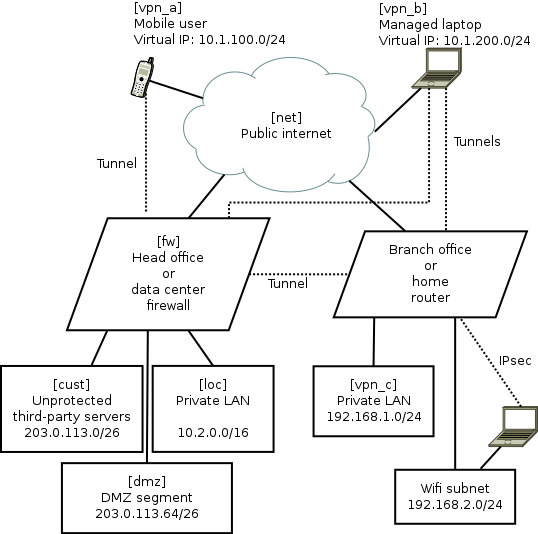
There is intense interest in communications privacy at the moment thanks to the Snowden scandal. Open source software has offered credible solutions for privacy and encryption for many years. Sadly, making these solutions work together is not always plug-and-play. In fact, secure networking, like VoIP, has been plagued by problems with interoperability and firewall/filtering issues although now the solutions are starting to become apparent. Here I will look at some of them, such as the use of firewall zones to simplify management or the use of ECDSA certificates to avoid UDP fragmentation problems. I've drawn together a lot of essential tips from different documents and mailing list discussions to demonstrate how to solve a real-world networking problem. A typical network scenario and requirements Here is a diagram of the network that will be used to help us examine the capabilities of these open source solutions. Some comments about the diagram:
  • The names in square brackets are the zones for Shorewall, they are explained later.
  • The dotted lines are IPsec tunnels over the untrusted Internet.
  • The road-warrior users (mobiles and laptops) get virtual IP addresses from the VPN gateway. The branch offices/home routers do not use virtual IPs.
  • The mobile phones are largely untrusted: easily lost or stolen, many apps have malware, they can only tunnel to the central VPN and only access a very limited range of services.
  • The laptops are managed devices so they are trusted with access to more services. For efficiency they can connect directly to branch office/home VPNs as well as the central server.
  • Smart-phone user browsing habits are systematically monitored by mobile companies with insidious links into mass-media and advertising. Road-warriors sometimes plug-in at client sites or hotels where IT staff may monitor their browsing. Therefore, all these users want to tunnel all their browsing through the VPN.
  • The central VPN gateway/firewall is running strongSwan VPN and Shorewall firewall on Linux. It could be Debian, Fedora or Ubuntu. Other open source platforms such as OpenBSD are also very well respected for building firewall and VPN solutions, but Shorewall, which is one of the key ingredients in this recipe, only works on Linux at present.
  • The branch office/home network could be another strongSwan/Shorewall server or it could also be an OpenWRT router
  • The default configuration for most wifi routers creates a bridge joining wifi users with wired LAN users. Not here, it has been deliberately configured as an independent network. Road-warriors who attach to the wifi must use VPN tunnelling to access the local wired network. In OpenWRT, it is relatively easy to make the Wifi network an independent subnet. This is an essential security precaution because wifi passwords should not be considered secure: they are often transmitted to third parties, for example, by the cloud backup service in many newer smart phones.
Package mayhem The major components are packaged on all the major Linux distributions. Nonetheless, in every case, I found that it is necessary to re-compile fresh strongSwan packages from sources. It is not so hard to do but it is necessary and worth the effort. Here are related blog entries where I provide the details about how to re-build fresh versions of the official packages with all necessary features enabled: Using X.509 certificates as a standard feature of the VPN For convenience, many people building a point-to-point VPN start with passwords (sometimes referred to as pre-shared keys (PSK)) as a security mechanism. As the VPN grows, passwords become unmanageable. In this solution, we only look at how to build a VPN secured by X.509 certificates. The certificate concept is not hard. In this scenario, there are a few things that make it particularly easy to work with certificates:
  • strongSwan comes with a convenient command line tool, ipsec pki. Many of it's functions are equivalent to things you can do with OpenSSL or GnuTLS. However, the ipsec pki syntax is much more lightweight and simply provides a convenient way to do the things you need to do when maintaining a VPN.
  • Many of the routine activities involved in certificate maintainence can be scripted. My recent blog about using Android clients with strongSwan gives a sample script demonstrating how ipsec pki commands can be used to prepare a PKCS#12 (.p12) file that can be easily loaded into an Android device using the SD-card.
  • For building a VPN, there is no need to use a public certificate authority such as Verisign. Consequently, there is no need to fill in all their forms or make any payments for each device/certificate. Some larger organisations do choose to outsource their certificate management to such firms. For smaller organisations, an effective and sometimes better solution can be achieved by maintaining the process in-house with a private root CA.
UDP fragmentation during IPsec IKEv2 key exchange and ECDSA A common problem for IPsec VPNs using X.509 certificates is the fragmentation of key exchange datagrams during session setup. Sometimes it works, sometimes it doesn't. Various workarounds exist, such as keeping copies of all certificates from potential peers on every host. As the network grows, this becomes inconvenient to maintain and to some extent it eliminates the benefits of using PKI. Fortunately, there is a solution: Elliptic Curve Cryptography (ECC). Many people currently use RSA key-pairs. Best practice suggests using RSA keys of at least 2048 bits and often 4096 bits. Using ECC with a smaller 384-bit key is considered to be equivalent to a 7680 bit RSA key pair. Consequently, ECDSA certificates are much smaller than RSA certificates. Furthermore, at these key sizes, the key exchange packets are almost always smaller than the typical 1500 byte MTU. A further demand for ECDSA is arising due to the use of ECC within smart cards. Many smartcards don't support any RSA key larger than 2048 bits. The highly secure 384-bit ECC key is implemented in quite a few common smart cards. Smart card vendors have shown a preference for the ECC keys due to the US Government's preference for ECC and the lower computational overheads make them more suitable for constrained execution environments. Anyone who wants to use smart cards as part of their VPN or general IT security now, or in the future, needs to consider ECC/ECDSA. Making the network simple with Shorewall zones For this example, we are not just taking some easy point-to-point example. We have a real-world, multi-site, multi-device network with road warriors. Simplifying this architecture is important to help us understand and secure it. The solution? Each of these is abstracted to a "zone" in Shorewall. In the diagram above, the zone names are in square brackets. The purpose of each zone is described below:
Zone name Description
loc This is the private LAN and contains servers like databases, private source code respositories and NFS file servers
dmz This is the DMZ and contains web servers that are accessible from the public internet. Some of these servers talk to databases or message queues in the LAN network loc
vpn_a These are road warriors that are not very trustworthy, such as mobile devices. They are occasionally stolen and usually full of spyware (referred to by users as "apps"). They have limited access to ports on some DMZ servers, e.g. for sending and receiving mail using SMTP and IMAP (those ports are not exposed to the public Internet at large). They use the VPN tunnel for general internet access/browsing, to avoid surveillance by their mobile carrier.
vpn_b These are managed laptops that have a low probability of malware infection. They may well be using smart cards for access control. Consequently, they are more trusted than the vpn_a users and have access to some extra intranet pages and file servers. Like the smart-phone users, they use the VPN tunnel for general internet access/browsing, to avoid surveillance by third-party wifi hotspot operators.
vpn_c This firewall zone represents remote sites with managed hardware, such as branch offices or home networks with IPsec routers running OpenWRT.
cust These are servers hosted for third-parties or collaborative testing/development purposes. They have their own firewall arrangements if necessary.
net This zone represents traffic from the public Internet.
A practical Shorewall configuration Shorewall is chosen to manage the iptables and ip6tables firewall rules. Shorewall provides a level of abstraction that makes netfilter much more manageable than manual iptables scripting. The Shorewall concept of zones is very similar to the zones implemented in OpenWRT and this is an extremely useful paradigm for firewall management. Practical configuration of Shorewall is very well explained in the Shorewall quick start. The one thing that is not immediately obvious is a strategy for planning the contents of the /etc/shorewall/policy and /etc/shorewall/rules files. The exact details for making it work effectively with a modern IPsec VPN are not explained in a single document, so I've gathered those details below as well. An effective way to plan the Shorewall zone configuration is with a table like this:
Destination zone
loc dmz vpn_a vpn_b vpn_c cust net
Source zone loc \
dmz ? \ X X X
vpn_a ? ? \ X X
vpn_b ? ? X \ X
vpn_c X \
cust X ? X X X \
net X ? X X X \
The symbols in the table are defined:
Symbol Meaning
ACCEPT in policy file
X REJECT or DROP in policy file
? REJECT or DROP in policy file, but ACCEPT some specific ports in the rules file
Naturally, this modelling technique is valid for both IPv4 and IPv6 firewalling (with Shorewall6) Looking at the diagram in two dimensions, it is easy to spot patterns. Each pattern can be condensed into a single entry in the rules file. For example, it is clear from the first row that the loc zone can access all other zones. That can be expressed very concisely with a single line in the policy file:
loc all ACCEPT
Specific Shorewall tips for use with IPsec VPNs and strongSwan Shorewall has several web pages dedicated to VPNs, including the IPsec specific documentation.. Personally, I found that I had to gather a few details from several of these pages to make an optimal solution. Here are those tips:
  • Ignore everything about the /etc/shorewall/tunnels file. It is not needed and not used any more
  • Name the VPN zones (we call them vpn_a, vpn_b and vpn_c) in the zones file but there is no need to put them in the /etc/shorewall/interfaces file.
  • The /etc/shorewall/hosts file is not just for hosts and can be used to specify network ranges, such as those associated with the VPN virtual IP addresses. The ranges you put in this file should match the rightsourceip pool assignments in strongSwan's /etc/ipsec.conf
  • One of the examples suggests using mss=1400 in the /etc/shorewall/zones file. I found that is too big and leads to packets being dropped in some situations. To start with, try a small value such as 1024 and then try larger values later after you prove everything works. Setting mss for IPsec appears to be essential.
  • Do not use the routefilter feature in the /etc/shorewall/interfaces file as it is not compatible with IPsec
Otherwise, just follow the typical examples from the Shorewall quick start guide and configure it to work the way you want. Here is an example /etc/shorewall/zones file:
fw firewall
net ipv4
dmz ipv4
loc ipv4
cust ipv4
vpn_a ipsec mode=tunnel mss=1024
vpn_b ipsec mode=tunnel mss=1024
vpn_c ipsec mode=tunnel mss=1024
Here is an example /etc/shorewall/hosts file describing the VPN ranges from the diagram:
vpn_a eth0:10.1.100.0/24 ipsec
vpn_b eth0:10.1.200.0/24 ipsec
vpn_c eth0:192.168.1.0/24 ipsec
Here is an example /etc/shorewall/policy file based on the table above:
loc all ACCEPT
vpn_c all ACCEPT
cust net ACCEPT
net cust ACCEPT
all all REJECT
Here is an example /etc/shorewall/rules file based on the network:
SECTION ALL
# allow connections to the firewall itself to start VPNs:
# Rule  source    dest    protocol/port details
ACCEPT   all       fw                ah
ACCEPT   all       fw                esp
ACCEPT   all       fw                udp 500
ACCEPT   all       fw                udp 4500
# allow access to HTTP servers in DMZ:
ACCEPT   all       dmz               tcp 80
# allow connections from HTTP servers to MySQL database in private LAN:
ACCEPT   dmz       loc:10.2.0.43     tcp 3306
# allow connections from all VPN users to IMAPS server in private LAN:
ACCEPT vpn_a,vpn_b,vpn_c loc:10.2.0.58 tcp 993
# allow VPN users (but not the smartphones in vpn_a) to the
# PostgresQL database for PostBooks accounting system:
ACCEPT vpn_b,vpn_c loc:10.2.0.48      tcp 5432
SECTION ESTABLISHED
ACCEPT   all       all
SECTION RELATED
ACCEPT   all       all
Once the files are created, Shorewall can be easily activated with:
# shorewall compile && shorewall restart
strongSwan IPsec VPN setup Like Shorewall, strongSwan is also very well documented and I'm just going to focus on those specific areas that are relevant to this type of VPN project.
  • Allow the road-warriors to send all browsing traffic over the VPN means including leftsubnet=0.0.0.0/0 in the VPN server's /etc/ipsec.conf file. Be wary though: sometimes the road-warriors start sending the DHCP renewal over the tunnel instead of to their local DHCP server.
  • As we are using Shorewall zones for firewalling, you must set the options leftfirewall=no and lefthostaccess=no in ipsec.conf. Shorewall already knows about the remote networks as they are defined in the /etc/shorewall/hosts file and so firewall rules don't need to be manipulated each time a tunnel goes up or down.
  • As discussed above, X.509 certificates are used for peer authentication. In the certificate Distinguished Name (DN), store the zone name in the Organizational Unit (OU) component, for example, OU=vpn_c, CN=gw.branch1.example.org
  • In the ipsec.conf file, match the users to connections using wildcard specifications such as rightid="OU=vpn_a, CN=*"
  • Put a subjectAltName with hostname in every certificate. The --san option to the ipsec pki commands adds the subjectAltName.
  • Keep the certificate distinguished names (DN) short, this makes the certificate smaller and reduces the risk of fragmented authentication packets. Many examples show a long and verbose DN such as C=GB, O=Acme World Wide Widget Corporation, OU=Engineering, CN=laptop1.eng.acme.example.org. On a private VPN, it is rarely necessary to have all that in the DN, just include OU for the zone name and CN for the host name.
  • As discussed above, use the ECDSA scheme for keypairs (not RSA) to ensure that the key exchange datagrams don't suffer from fragmentation problems. For example, generate a keypair with the command ipsec pki --gen --type ecdsa --size 384 > user1Key.der
  • Road warriors should have leftid=%fromcert in their ipsec.conf file. This forces them to use the Distinguished Name and not the subjectAltName (SAN) to identify themselves.
  • For road warriors who require virtual tunnel IPs, configure them to request both IPv4 and IPv6 addresses (dual stack) with leftsourceip=%config4,%config6 and on the VPN gateway, configure the ranges as arguments to rightsourceip
  • To ensure that roadwarriors query the LAN DNS, add the DNS settings to strongswan.conf and make sure road warriors are using a more recent strongSwan version that can dynamically update /etc/resolv.conf. Protecting DNS traffic is important for privacy reasons. It also makes sure that the road-warriors can discover servers that are not advertised in public DNS records.
Central firewall/VPN gateway configuration Although they are not present in the diagram, IPv6 networks are also configured in these strongSwan examples. It is very easy to combine IPv4 and IPv6 into a single /etc/ipsec.conf file. As long as the road-warriors have leftsourceip=%config4,%config6 in their own configurations, they will operate dual-stack IPv4/IPv6 whenver they connect to the VPN. Here is an example /etc/ipsec.conf for the central VPN gateway:
config setup
        charonstart=yes
        charondebug=all
        plutostart=no
conn %default
        ikelifetime=60m
        keylife=20m
        rekeymargin=3m
        keyingtries=1
        keyexchange=ikev2
conn branch1
        left=198.51.100.1
        leftsubnet=203.0.113.0/24,10.0.0.0/8,2001:DB8:12:80:/64
        leftcert=fw1Cert.der
        leftid=@fw1.example.org
        leftfirewall=no
        lefthostaccess=no
        right=%any
        rightid=@branch1-fw.example.org
        rightsubnet=192.168.1.0/24
        auto=add
conn rw_vpn_a
        left=198.51.100.1
        leftsubnet=0.0.0.0/0,::0/0
        leftcert=fw1Cert.der
        leftid=@fw1.example.org
        leftfirewall=no
        lefthostaccess=no
        right=%any
        rightid="OU=vpn_a, CN=*"
        rightsourceip=10.1.100.0/24,2001:DB8:1000:100::/64
        auto=add
conn rw_vpn_b
        left=198.51.100.1
        leftsubnet=0.0.0.0/0,::0/0
        leftcert=fw1Cert.der
        leftid=@fw1.example.org
        leftfirewall=no
        lefthostaccess=no
        right=%any
        rightid="OU=vpn_b, CN=*"
        rightsourceip=10.1.200.0/24,2001:DB8:1000:200::/64
        auto=add
Sample branch office or home router VPN configuration Here is an example /etc/ipsec.conf for the Linux server or OpenWRT VPN at the branch office or home:
conn head_office
        left=%defaultroute
        leftid=@branch1-fw.example.org
        leftcert=branch1-fwCert.der
        leftsubnet=192.168.1.0/24,2001:DB8:12:80:/64
        leftfirewall=no
        lefthostaccess=no
        right=fw1.example.org
        rightid=@fw1.example.org
        rightsubnet=203.0.113.0/24,10.0.0.0/8,2001:DB8:1000::/52
        auto=start
# notice we only allow vpn_b users, not vpn_a
# these users are given virtual IPs from our own
# 192.168.1.0 subnet
conn rw_vpn_b
        left=branch1-fw.example.org
        leftsubnet=192.168.1.0/24,2001:DB8:12:80:/64
        leftcert=branch1-fwCert.der
        leftid=@branch1-fw.example.org
        leftfirewall=no
        lefthostaccess=no
        right=%any
        rightid="OU=vpn_b, CN=*"
        rightsourceip=192.168.1.160/27,2001:DB8:12:80::8000/116
        auto=add
Further topics Shorewall and Shorewall6 don't currently support a unified configuration. This can make it slightly tedious to duplicate rules between the two IP variations. However, the syntax for IPv4 and IPv6 configuration is virtually identical. Shorewall only currently supports Linux netfilter rules. In theory it could be extended to support other types of firewall API, such as pf used by OpenBSD and the related BSD family of systems. A more advanced architecture would split the single firewall into multiple firewall hosts, like the inner and outer walls of a large castle. The VPN gateway would also become a standalone host in the DMZ. This would require more complex routing table entries. Smart cards with PIN numbers provide an effective form of two-factor authentication that can protect certificates for remote users. Smart cards are documented well by strongSwan already so I haven't repeated any of that material in this article. Managing a private X.509 certificate authority in practice may require slightly more effort than I've described, especially when an organisation grows. Small networks and home users don't need to worry about these details too much, but for most deployments it is necessary to consider things like certificate revocation lists and special schemes to protect the root certificate's private key. EJBCA is one open source project that might help. Some users may want to consider ways to prevent the road-warriors from accidentally browsing the Internet when the IPsec tunnel is not active. Such policies could be implemented with some basic iptables firewalls rules in the road-warrior devices. Summary Using these strategies and configuration tips, planning and building a VPN will hopefully be much simpler. Please feel free to ask questions on the mailing lists for any of the projects discussed in this blog.

11 July 2013

Daniel Pocock: Using debcheckout to build strongSwan 5.0 on Debian wheezy

Normally most people try to use packages from a stable Linux distribution because of their convenience and security support. Sometimes it's necessary to use a newer version, I recently had to do this with strongSwan and I'm sharing the procedure for other people to try. These days, it is actually very very easy to build a new version of a package from source and this procedure will work for many Debian packages. Debian wheezy ships with strongSwan version 4.5 packages. These are lacking support for a couple of features I needed, including dual-stack IPv4/IPv6 virtual IPs on a single user connection and maintaining the DNS server list on road-warriors Oddly enough, for a variety of reasons, I had to rebuild strongSwan on all the platforms where I wanted to use it (not just on Debian). I recently described how to build it with ECDSA support on Fedora and also how to build it with ECDSA support on OpenWRT. Following all of these procedures you will end up with strongSwan packages on all systems that can interoperate using dual stack IPv4, IPv6 and establish connections quickly, securely and reliably using ECC certificates. Get the build dependencies Many packages require extra tools and header files when building. These are packages that are not usually installed or required when running the package. However, they are very easy to get. For strongSwan:
sudo apt-get update
sudo apt-get install devscripts fakeroot
sudo apt-get build-dep strongswan
This should download and install the necessary dependencies. Notice we also installed the devscripts package, it provides the very handy debcheckout utility. Obtain and build the package Now for the real work. Fortunately this is not too hard either:
mkdir ~/ws
cd ~/ws
debcheckout strongswan
cd strongswan
dpkg-buildpackage -rfakeroot -uc -b
Look in the directory ~/ws and you will find the .deb package files. Problems? On my own system, I observed that I could upgrade from the existing packages to the v5.0.4-6 package without any change to the configuration files. It just worked. Hopefully, these packages will eventually end up in Debian's backports catalog where you can install them without compiling. Nonetheless, problems for these packages can still be submitted through Debian's bug tracker - just make sure you clearly indicate that you built the package from source and give the git commit number (output of the command cd ~/ws/strongswan && git show head -1) Before trying the package and definitely before reporting any problem, it is worth checking the bug tracker and the Package Tracking System for known issues

9 July 2013

Daniel Pocock: Enabling Elliptic Curve Cryptography in OpenWRT and strongSwan VPNs

OpenWRT currently ships an OpenSSL package with Elliptic Curve Cryptography (ECC) disabled. This is very inconvenient as ECC is now standard in other distributions like Debian and Ubuntu and it is necessary to solve certain problems such as making IPsec VPNs work reliably It is relatively easy to enable it, this also provides a useful opportunity to see how the OpenWRT build system works. Preparing the build environment The build was done on a Debian 7 (wheezy) workstation. It is necessary to install some packages that provide tools needed for the build:
apt-get install gcc binutils flex make unzip gawk libz-dev linux-libc-dev
Rebuild the OpenSSL and StrongSwan packages This was tested with an ar71xx CPU-based router. You can easily change the config (run make menuconfig just before make defconfig) for other variations of router.
Running strongSwan IPsec on a router requires a router with plenty of flash, RAM and CPU power. Cheap routers with limited flash will not be able to install the packages at all. I tested on the Buffalo WZR-HP-AG300H-EU which has 32MB flash and 128MB RAM Here are the commands executed on the Debian build workstation:
mkdir ~/ws
cd ~/ws
svn checkout svn://svn.openwrt.org/openwrt/trunk openwrt-trunk
cd openwrt-trunk
./scripts/feeds update -a
./scripts/feeds install -a
wget -O .config \
  http://danielpocock.com/sites/danielpocock.com/files/openwrt.config.txt
sed -i -e 's/no-ec//' package/libs/openssl/Makefile 
make defconfig
make -j 13
The "make" command will build all the packages. It takes some time. Copy the packages to a router The actual location of the packages in your source tree depends on the CPU architecture you chose to build for. You can find them with a command such as:
find . -name '*.ipk'
Here we look at how to copy the packages for the ar71xx based router into the /tmp directory on the router. The router IP is 192.168.1.1 below:
cd ./bin/ar71xx/packages/
scp libopenssl_1.0.1e-1_ar71xx.ipk strongswan*.ipk root@192.168.1.1:/tmp
Installing the packages It is relatively easy to install the packages using the opkg utility on OpenWRT. When using self-compiled packages, you are likely to get errors about the checksums. OpenWRT compares the checksum of the package to the checksum from the package catalog file. You can delete the catalog file (e.g. rm /var/opkg-lists/attitude_adjustment) and then opkg will install the package without complaining. The file is automatically placed there each time you run opkg update so there is no harm in deleting it. In my earlier blog, I looked at how to link Android clients to the strongSwan VPN. Unfortunately Android has a bug in ECC support too and must still be used with RSA certificates. Nonetheless, the OpenWRT VPN will be quite happy talking to Linux laptops and servers - you may need to rebuild OpenSSL and StrongSwan on any Fedora, Red Hat or CentOS systems that require ECC support too. As you migrate from RSA to ECC certificates it is quite feasible to have both types of certificates in use at the same time. strongSwan supports this type of hybrid environment. To make the migration to ECC go smoothly it is desirable to ensure all boxes have ECC support at the earliest opportunity.

25 June 2013

Daniel Pocock: Configuring strongSwan on Debian, RHEL and Fedora with the Android client

In my earlier blog post about VPNs, I looked at a range of VPN options. The strongSwan wiki documentation is generally quite good but it doesn't describe the exact procedure for an Android user anywhere. This blog aims to fill that gap. Here I am sharing some working examples of how to configure and use RSA certificate authentication between a Linux box and an Android phone using strongSwan. There are several commands to execute for each step, but they can be easily scripted. Here are the versions in play: Certificate creation: private certificate authority "example.org CA root" For production, I would highly recommend creating your own root CA on a smart card and managing it from a clean machine without any network connection. To start quickly for testing, just create a CA using the steps from the strongSwan wiki, in particular:
umask 0177
ipsec pki --gen > caKey.der
ipsec pki --self --in caKey.der \
   --dn "C=CH, O=Acme Ltd, CN=example.org CA root" \
   --ca > caCert.der
Certificate creation: VPN gateway machine vpn.example.org Now you need to create a key for the server. The key thing to observe here is the use of the "--san" argument: the Android client expects a subjectAltName in the certificate from the server. The VPN gateway has the hostname vpn.example.org:
ipsec pki --gen > vpnKey.der
ipsec pki --pub --in vpnKey.der   \
   ipsec pki --issue --cacert caCert.der --cakey caKey.der \
  --dn 'CN=vpn.example.org' \
  --san vpn.example.org > vpnCert.der 
cp vpnKey.der /etc/ipsec.d/private/
cp vpnCert.der /etc/ipsec.d/certs/
Certificate creation: mobile user For the Android client, it is necessary to create a private key and certificate and then embed them together with a copy of the root certificate in a PKCS#12 file. We will need OpenSSL or GnuTLS for some of these steps. The pkcs12 command will prompt for a password: make up a long, obscure password, you will only use it once when importing the certificate into the phone. Here is a script you can use for each client certificate you want to create:
#!/bin/bash -e
umask 0177
TARGET_HOST=$1
DOMAIN=example.org
IPSEC=/usr/sbin/ipsec
KEY_FILE="$ TARGET_HOST Key.der"
CRT_FILE="$ TARGET_HOST Cert.der"
if [ -f $ KEY_FILE  ];
then
  echo "$KEY_FILE exists"
  exit 1
fi
$ IPSEC  pki --gen > $ KEY_FILE  
$ IPSEC  pki --pub --in  $ KEY_FILE    \
  $ IPSEC  pki --issue \
  --cacert caCert.der --cakey caKey.der \
  --dn "CN=$ TARGET_HOST .$ DOMAIN " > $ CRT_FILE 
[ -f caCert.pem ]   \
   openssl x509 -in caCert.der -inform der -out caCert.pem -outform pem
openssl rsa \
   -in $ KEY_FILE  -out $ TARGET_HOST Key.pem -inform der
openssl x509 \
   -in $ CRT_FILE  -inform der \
   -out $ TARGET_HOST Cert.pem -outform pem
openssl pkcs12 \
   -export \
   -in $ TARGET_HOST Cert.pem \
   -inkey $ TARGET_HOST Key.pem \
   -certfile caCert.pem \
   -out $ TARGET_HOST .p12
# delete the key files, leaving only the key in the p12 file:
rm $ KEY_FILE  $ TARGET_HOST Key.pem
Assuming you call that script make-client-creds, you would run it once for each Android device:
$ ./make-client-creds phone1
$ ./make-client-creds phone2
...
Loading the PKCS#12 file into the phone Copy the cert bundle (the p12 file only) to the SD card in the phone. You can mount the phone over USB or using ADB, e.g.
$ adb push phone1.p12 /sdcard/
Now go to the Android settings, select Security and Install from SD card. Follow the prompts. Setting up the VPN gateway Add the following line to /etc/ipsec.secrets
: RSA vpnKey.der
and add a stanza like the following to /etc/ipsec.conf
conn private-droid
	left=vpn.example.org
	leftsubnet=insert gateway IP here/32
	leftcert=vpnCert.der
	leftid=@vpn.example.org
	leftfirewall=no
	lefthostaccess=no
	right=%any
	rightsourceip=192.168.10.0/24
	auto=add
Finally, restart ipsec and you should be ready.
# service ipsec restart
Install the app on the phone Finally, install the app on the phone. This bit should be quite easy. Once installed, press the option ADD VPN, put in the DNS name of the VPN gateway (must match the name in the certificate, e.g. vpn.example.org from the example above) and tell it to use IKEv2 Certificate as the authentication type. Press to select a certificate and highlight the certificate that you installed earlier. Checking for problems You should see a message on the phone telling you it is connected to the VPN. If it fails, it will let you see the log messages. If you see the error Constraint check failed it often means that the subjectAltName was not included in the VPN gateway's certificate (see the steps above) or the DNS name doesn't match the name in the certificate. On the server side, this command shows who is connected:
# ipsec status
Making it secure with iptables Once the packets are decrypted by strongSwan on the VPN gateway, the kernel will route them appropriately just like any other packet. Use standard Linux netfilter/iptables rules to ensure that routing is restricted appropriately so that the clients can access the services they need and nothing else. Support and discussion Please feel free to post comments below or discuss on the strongSwan Users mailing list

24 June 2013

Daniel Pocock: Private WANs may be less secure than VPNs

The latest round of Snowden revelations concern a British GCHQ program dubbed "Mastering the Internet (MTI)". The program involves, among other things, tapping the world's under-sea fibre-optic cables and systematically monitoring all communications. One of the most significant facts that appears is the benefit of using IPsec and VPNs over the public Internet instead of trusting un-encrypted traffic to pass over private WAN connections. The definition of a private WAN connection is quite broad: many ISPs in the UK, for example, use the British Telecom OpenReach platform to tunnel DSL connections back to their data centers and offer virtual WANs to their business customers. Can any wifi be trusted? It should be assumed that all Wifi networks can be compromised at-will by a sophisticated attacker. This is another situation where VPNs may be part of the solution: even WPA2 secured wifi segments should be treated as untrusted public Internet networks and not bridged or routed onto any private subnets. Users with devices on a wifi network should be forced to use a VPN over wifi connection, even when the wifi is within the same building as the private network. Tor may be compromised by an attacker with this much data As I've mentioned in previous blogs with a focus on real-time communications there is no such thing as perfect privacy. Simply encrypting data with IPsec does not prevent the attacker knowing the volume of data transmitted or the time it was transmitted. Using a service like Tor for onion-routing provides some benefit. However, an attacker with sufficient infiltration of many points in the network may be able to deduce the real origins of a data transfer over Tor using some combination of packet sizes and timestamps. "Mastering the Internet (MTI)" may have sufficient coverage to achieve that. Tor could overcome this by putting dummy data into the network and adding fragmentation, but such schemes may add latency, reduce throughput and require significant effort to upgrade existing users. Gaining intelligence from encrypted data VoIP signals are typically compressed using some type of codec. These are dedicated, lossy compression schemes optimised for voice signals. Some codecs use a fixed compression ratio. Other codecs use a variable compression ratio (VBR): a simple example involves sending shorter packets to indicate a period of silence. Encrypting these packets prevents an attacker seeing what is inside them but the attacker can easily detect the lengths of the packets. Researchers have demonstrated that statistical techniques can be applied to VBR dataflows to identify syllables used in speech and then make a hypothesis about what has been said. (This would be an interesting hack to try and reproduce by collecting data with tcpdump and analysing it with R) Identifying phrases in encrypted VoIP using statistical analysis In many cases like those described, it is necessary to go beyond default encryption settings and put extra dummy data or frame padding into the data flow to gain a more fool-proof level of privacy. Simply connecting VoIP phones to an IPsec network doesn't automatically make them secure. The rise of the free-software VPN Even if the default configurations are not always universally resilient to every type of attack, many free software prodcuts provide an excellent building block for VPNs. Having the source code and specifications on hand, free software developers can then innovate to mix-and-match different technologies or add random data flows to mask the real activity on the network. In a recent hosting migration project, I successfully used the rather trivial VPN package tinc to bridge the ethernet segments between virtual machines in the old and new networks. This allowed virtual machines to be moved one-by-one over a period of a week. This is a remarkably simple solution that can protect the integrity of communications on a private subnet. A more comprehensive solution is strongSwan which provides support for industry-standard IPsec in various topologies. They now offer a full IPsec client for Android phones (hopefully it will be made available on f-droid: using a Google account to access Google Play may result in Google accidentally helping you "back up" your settings, including credentials, to their cloud, undermining the privacy of the system) An IPsec VPN can be deployed to all hosts on a network: then they can use opportunistic encryption for any type of communication without needing to worry about the underlying network. Furthermore, it is possible to add smart cards to further boost VPN security while using free software for the whole solution. For those interested in looking beyond Linux solutions, the *BSD range of operating systems, particularly OpenBSD provide a compelling alternative. This paper about OpenBSD's iked, which is also available on other platforms as OpenIKEd is very recent and provides a thorough overview of it's current status. One notable limitation is that their MOBIKE support is not yet complete. Many older VPNs likely to need an ugprade When I first started deploying Linux VPNs in the 90s the market was favourable for any type of Linux VPN. In extreme cases (which were surprisingly common at the time) companies accustomed to paying $20,000 per month for a leased line would happily pay a flat fee of $100,000 to purchase a VPN that was cobbled together using less than $10,000 of commodity hardware and some free software. Many of the first generation of these VPNs were built using RSA key lengths and algorithms no longer considered secure, such as DES. Some of these solutions (or products derived from them) may still remain in use today: managers may be slightly embarrassed to put aside their $100,000 VPN and replace it with a $50 router that is more secure. While that is the more extreme example, there are many intermediate solutions out there in the field. There are clear opportunities here to upgrade users to free software solutions.

12 January 2013

Russ Allbery: Review: Asimov's, April/May 2011

Review: Asimov's Science Fiction, April/May 2011
Editor: Sheila Williams
Issue: Volume 35, No. 4 & 5
ISSN: 1065-2698
Pages: 192
Williams's editorial this issue is about the tendency of SF to take a rose-colored view of the world, which on the surface seems odd given the tendency of recent SF towards dystopia. But she makes a good point that the portrayal of the past is rose-colored, linking that into the current steampunk trend. She doesn't take the argument quite as far as I'd like, but I'm glad to see editorials raising points like this. I'm inclined to think that a lot of the rose-colored frame of the past is because few of us want to read about real historic conditions at any length, even for edification, because the stench and discomfort isn't fun to read about. Silverberg's column is another discussion of programmatic plot generators, which mostly makes the point that plot ideas are the easy part of writing. James Gunn contributes an extended biography of Isaac Asimov that probably won't be new to long-time genre readers but may fill in some details (although it politely sticks to mostly flattering material). Spinrad's book review column is one of his better ones; it looks at two novels by China Mi ville and two by Ian McDonald and explores differences in world-building. Spinrad predictably makes the case in favor of science fiction with rules and against the New Weird, but the discussion along the way was worth reading. "The Day the Wires Came Down" by Alexander Jablokov: Speaking of steampunk, here's an example. There is even an airship, although the primary technological focus is suspended street cars. Jablokov postulates a city-wide transportation network of suspended carriages called telpher cars, along with a city built around the telpher cables: stores on roofs, windows displaying merchandise to passing cars, and even a history of heated competition and dirty tricks between competing telpher networks. The story is set, as the title would indicate, on the last day of the network. It's being shut down for cost, with some hints that progress is destroying something precious. There is a plot here, revolving around some mysteries of the history of the telpher network and the roles of several people in that history. But the story is primarily a celebration of old technology. It's a rail fan's story recast with a steampunk technology, featuring the same mix of fascination with mechanics and a sense that the intricate details are falling out of common knowledge (and perhaps usefulness). As a story, it's a bit slow-moving, but I enjoyed the elegiac tone. (7) "An Empty House with Many Doors" by Michael Swanwick: This is a very short story, more of an emotional profile, involving a man's reaction to the death of his wife. Oh, and parallel universes. It's sort of the inverse of Niven's classic "All the Myriad Ways." Similar to Niven's story, I found the idea vaguely interesting but the conclusion and emotional reaction unbelievable and alien. (5) "The Homecoming" by Mike Resnick: Resnick tends to yank on the heart-strings rather sharply in his stories, so I knew roughly what to expect when a father comes home to find his son is visiting. A son who, rather against his father's wishes, has been significantly altered to be able to live with aliens. Throw in a mother with serious dementia, and you can probably predict what Resnick does with this. Still, most of the story is a two-sided conversation, and I thought he succeeded in doing justice to both sides, even though one of them was destined to lose. (6) "North Shore Friday" by Nick Mamatas: Illegal Greek immigrants, a family-run system for getting them married off before the INS catch them, government psi probes and eavesdropping on thoughts, joint projects between computer and religion departments, secret government experiments, and even ghosts... this story is a complex mess, with numerous thoughts stuck into small boxes and scattered through the surface story. It's one of those stories where figuring out what's going on, and even how to read the story in a sensible way, is much of the fun. If you find that fun, that is; if not, it will probably be frustrating. I wished there was a bit more plot, but there's something delightful about how much stuff Mamatas packs into it. (6) "Clockworks" by William Preston: This is a prequel to Preston's earlier "Helping Them Take the Old Man Down". Like that story, it's primarily a pulp adventure, but layered with another level of analysis and thoughtfulness that tries to embed the pulp adventure in our understanding of human behavior and the nature of the world, although this one stays a bit more pulp than its predecessor. As with Preston's other story, we don't get directly in the head of the Old Man (here, just called the man, but identifiable from clues in both stories as Doc Savage); instead, the protagonist is a former villain named Simon Lukic who the man hopes to have fixed by operating on his brain. The undercurrent that lies beneath a more typical pulp adventure is the question of whether Lukic is actually healed. I think there was a bit too much daring-do and human perfection, but it's a perfectly servicable pulp story with some depth. (6) "The Fnoor Hen" by Rudy Rucker: If you've read any of Rucker's work before, you probably know what to expect: a mind-boggling blizzard of mathematically-inspired technobabble that turns into vaguely coherent surrealism. (You can probably tell that I'm not much of a fan, although the clear good humor in these stories makes it hard to dislike them too much.) There's a mutated chicken and some sort of alternate mathematical space and then something that seems like magic... I'd be lying if I said that I followed this story. If you like Rucker, this seems like the sort of thing that you'd like. (4) "Smoke City" by Christopher Barzak: At the start of this story, I thought it was going to be an emotional parable about immigration. The progatonist lives two lives: one in our world, and one in the Smoke City of industry, a world of hard labor, pollution, and little reward, with families in both. But nearly all of the story is set within Smoke City, and the parable turns out to be a caustic indictment of industry and its exploitation of labor. I kind of wish Barzak hadn't used rape as a metaphor, but when the captains of industry show up, I can't argue with how deeply and accurately the story shoves in the knife. There isn't much subtlety here, but it's still one of the better stories in this issue. (7) "A Response from EST17" by Tom Purdom: I'm very happy to see Purdom's writing appearing regularly. His stories are always quiet and matter-of-fact, and at first seem to miss emotional zest, but they almost always grow on me. He lets the reader fill in their own emotional reactions to events, and there's always a lot going on. This story is a first-contact story, except that the "humans" here are not human at all. They're automated probes sent by two separate human civilizations, with different programming and different governance algorithms, and they quickly start competing negotiations. The aliens they've discovered similarly have factions, who start talking to the different probes in an elaborate dance of gathering information without giving too much away. The twist is that this pattern has replayed itself many times in the past, and information itself can be a weapon. I enjoyed this one from start to finish. (7) "The One That Got Away" by Esther M. Friesner: Friesner is best known, at least to me, for humorous fantasy, and this story is advertised as such from early on. The first-person protagonist is a prostitute in a seaside town. She's bemused to finally be invited over by a sailor who's been eyeing her all evening, but that sailor has something else in mind than normal business. For much of this story, the fantasy element is unclear; when it finally comes, it was an amusing twist. (7) "The Flow and Dream" by Jack Skillingstead: This is a mildly interesting variation on the old SF story of hibernating humans (on a generation ship or elsewhere) waking up to a transformed world. Here, it's not a ship, it's a planet, and the hiberation was to wait for terraforming rather than for transit. The twist comes from an excessively literal computer and the fun of putting together the pieces. Sadly, the story trails off at the end without much new to say. (5) "Becalmed" by Kristine Kathryn Rusch: "Becalmed" takes place immediately before "Becoming One with the Ghosts" and explains the incident that created the situation explored in that story. The first-person protagonist of "Becalmed" is a linguist, an expert in learning alien languages so that the Fleet can understand the civilizations that it runs across. But something went horribly wrong at their last stop, something that she's largely suppressed, and now she's confined to quarters and possibly in deep trouble. As is the ship; they're in foldspace, and they have been for days. "Becalmed" is structed like a mystery, centered around recovering the protagonist's memories. It's also a bit of a legal procedural; the ship is trying to determine what to do with her and to what degree she's responsible. But the heart of the story is a linguistic and cultural puzzle. This is another great SF story from Rusch, whose name on a cover will make me eager to start reading a new magazine. I love both angles on the universe she's built, but I think I like the Fleet even better than the divers. The Fleet captures some of the magic of the original Star Trek, but with much more mature characters, more believable situations, and a more sensible and nuanced version of the Prime Directive. Rusch writes substantial, interesting plots that hold my interest. I'd love to see more like this. (8) Rating: 7 out of 10

22 October 2012

Yves-Alexis Perez: Debian, Xfce 4.10 and Xfce 4.11

It's been six months since Xfce 4.10 has been released. And it's been four months since Wheezy is frozen. Due to this timing (and the fact Squeeze has 4.6 and doing a 4.6 4.10 upgrade needed some tuning in various packages), it was decided to not try to push 4.10 into Wheezy that late in the release cycle. So Xfce 4.10 was uploaded to experimental instead, and as it needs a full rebuild of all panel plugins against 4.10 panel (another reason for not trying to push it to Wheezy), those have not been uploaded. You can try Xfce 4.10 using experimental, but you'll need to remove the xfce4-goodies metapackage and the various depending plugin (since they'll just crash if you try to load them on 4.10 panel). Multiple people asked me (either on IRC, by private or public mail) when 4.10 will be uploaded to unstable and transition to testing. Like last time, the answer is : not before Wheezy is released. Right now, we're more interested in stabilizing Wheezy and squashing the bugs there than adding new ones in unstable. So, if you want to have Xfce 4.10 in Debian sid/testing sooner, then the easiest and fastest way is to fix some release critical bugs so we can release sooner, and then start breaking sid by uploading a whole lot of new stuff there. Note that this is true also for other software like GNOME, KDE stack (I have no idea how to call it these days), the Linux kernel, strongswan or whatever. About development releases of Xfce 4.11 (like the recently released exo 0.9 and Thunar 1.5), well, since we already use experimental for 4.10, there's not much chance they get uploaded anytime soon. We could try to package them and let people build it themselves, or I could host it somewhere on my server for people to try. But as I already said, we're more interested in fixing bug in Wheezy right now, and people interested in finding bugs in Xfce development releases (so they are fixed for the final one) should build it themselves and report everything they find on the Xfce bugzilla. TL;DR: if you care about new, shiny stuff, please help fixing RC bugs in Wheezy.

16 October 2012

David Welton: The Dreaded Google Lockdown

It's one of those things that you read about, but are never really sure about: you think "maybe he was doing something fishy, and isn't tellling it straight in the public account of the incident". So I'll try to stick to "just the facts". A few weeks ago, I dug up some old book reviews I'd done, and posted to Facebook, and opened a site here: http://davids-book-reviews.blogspot.com/ as a way of collecting them. Naturally, I also added Amazon referral links, because, hey, it helps feed my reading habit! Last month I got enough to buy two whole Kindle books, so we're not exactly talking about "get rich quick" territory here. We're not even talking about anything remotely close to my day job, for that matter. But hey, if I can get a little bit extra to spend on books, it's nice. The reviews were basically quick notes on books I read. Nothing that I or the rest of humanity can't get along without, but I felt like writing up a little something for myself and people I know on the internet - maybe it'll help someone else find an interesting book to read. Several days later, I believe on October 8th, I woke up to find my phone was 'not signed in to Google', and, after repeated attempts, wouldn't sign in. Same thing with my Nexus 7. Logging in to my computer, in something of a cold sweat at this point, I find I can't get into Gmail or anything else, either. Luckily, on the computer, Google's system did redirect me to a page where they mentioned suspicious activity, and gave me the chance to reactivate things by sending an SMS to my phone. This did work quickly, and did a little bit to alleviate some of my stress. I understand that locking things down quickly is probably to my benefit as well as theirs in the event of an actual security breach of someone's account: it keeps the attacker from doing any more damage. However, it was sure a bad way to start a Monday morning. However, the actual 'blog' (sorry, I hate the word!) was still blocked. It too has a form to fill out to prove that you're human. Although: as a computer guy, you'd think that with all the clever people at Google, they would be able to tell from my access patterns to the site, browser footprint, IP addresses and so forth, that...well, I am me. In any event though, they promised to review the blog within two days. So, I waited patiently. A week later, still nothing. Then, the next day, I went back to check on the status, and they had reset the review request: it no longer said anything about October 8th, when I had originally made the reinstatement request. So I filled in their form again, asking to have my blog back. That was yesterday, we'll see what happens next. As far as I can tell, I did not violate their actual terms of conditions, which say nothing about referral links: http://www.blogger.com/content.g Since the people at Google are loth to speak with their users directly, it seems as if one of the best ways of getting support is to complain loudly and publicly about this kind of shennanigan. And to forestall the somewhat inevitable comments on anything related to Google: 1) Yes, I know I signed an agreement where they say they can do whatever the hell they want and I can f**k off if I don't like it. Try and do anything on line with a major company and not get a contract like that, or for even more entertainment value, try and negotiate the contract with t he company. Good luck. If you don't say yes, you're pretty much on your own; there doesn't seem to be much of a market for "more humane terms and conditions" out there. 2) I know, I know, relying on the Google beast is a great way to set yourself up for a big fall if anything ever goes wrong, because it's impossible to appeal, or pretty much even to talk with a human. But with a limited amount of time in my life, to date, Google has been a pretty good deal. I suppose it's something of a "black swan" situation: everything seems fine until one day WHACK, and Google pulls the carpet from under your legs. Conclusions? Well, I hope someone out there can help me recover my content. I wrote it myself, and I would like to save my book reviews somewhere. What alternatives are there to the Google colossus? Not too many that I can see that are anywhere at all as convenient. Edit: 2012-10-17: I don't know what did it, but they have reinstated the site. Strange and disconcerting, but I guess things are ok for the time being. Thanks to whoever it was at Google that finally had a look.

17 June 2012

Gregor Herrmann: RC bugs 2012/24

here's my weekly list of RC bugs that I've worked on:

28 April 2012

Russell Coker: Nando s Voucher Interpretation

Every year my parents buy a book of vouchers for various businesses in Victoria. It s one of those deals where businesses (mostly restaurants) pay for advertising space to have their tear-off vouchers in the book (which typically allow a discount of between $5 and $30) and the customers buy the book for something like $40 (I m not really sure as I don t pay). Every year I take my pick of the vouchers that don t suit my parents, the Nando s chain of chicken and chips restaurants that specialises in Peri-Peri spicy sauce [1] is one that doesn t suit my parents (they prefer the traditional English-Australian food). The Nando s vouchers say Enjoy one complimentary 1/4 flame-grilled peri-peri chicken item when another 1/4 flame-grilled peri-peri chicken item is purchased with no explanation of exactly what an item is. Every Nando s store that I ve been to in the past has interpreted item as chicken and chips, usually they include the drink that comes with the quarter chicken meal in the item that is free. I can do without a second soda as it s really cheap from the supermarket and I m not going to drink two at one meal anyway so I m not bothered when someone interprets the voucher as not involving a free drink. But the lack of chips is annoying. At the Nando s store on Swanston St between La Trobe St and Little Lonsdale St they interpret item as being just the 1/4 chicken. I think that most people would regard this as an unusual interpretation. If the intent was to only offer 1/4 chicken then the voucher could have stated that a free 1/4 chicken was offered and removed all doubt. The fact that the voucher says a free 1/4 flame-grilled peri-peri chicken item instead of offering a free Quarter Chicken (which is the description for chicken on it s own on the Nandos menus) seems to be a reasonable indication that more than just the free chicken is offered. I won t be attending the Nandos store on Swanston St again and recommend that others avoid it too. Failing to offer the full value on the voucher is annoying, it decreases the value for money (which is a problem given how expensive Nandos is), and it makes me wonder what other cost-saving measures might be used at that store. I ve got a stack of vouchers (many of which will expire before being used) and the Melbourne CBD has many places to eat. No related posts.

23 October 2011

Andrew Pollock: [life] Miss Representation

A few months after Zoe was born, it hit me that we didn't just have to raise a baby to grow up happy and healthy, we were raising a girl, and had to worry about making sure she had a healthy self-image and mind as well, and having to worry about how the world she was coming into was going to have an impact on that. I think it might have been around the time that I became aware of the book Cinderella Ate My Daughter that I had this realisation. I started taking more of an interest in, what I guess I'd call feminist issues. I became a seed funder for the Ada Initiative, and I tend to prick my ears up when I hear about feminist issues. So when an email went by on the parents list at work about a screening of an independent documentary film called Miss Representation, I watched the trailer, and since I'm currently swanning around sans wife and child, ponied up the $10 to go and see a screening of it in Palo Alto, which was followed by a Q&A session with the writer/director/producer. I basically went along on the strength of the trailer, and being a father of a daughter, and didn't do much more reading into the who the writer/director/producer was. It turns out that Jennifer Siebel is Gavin Newsom's wife. I didn't figure that out until I got home and did my homework, so some of the references she made in the conversation after the screening didn't make a lot of sense to me at the time. The documentary itself was very poignant, but I found that after about 40 or 50 minutes, I felt that the point was made, and I would have preferred to see more about what to do about it. But I guess what to do about it is to be aware of the problem. I had some trouble accepting the statistic quoted at the beginning of the film that the average teenager spends more than 10 hours each day consuming media. If they sleep for 8 hours, and go to school for 6 hours, that means they're spending every other waking minute consuming media, and I just don't buy that. Apparently Jennifer is working on a couple of related follow-up documentaries, so it'll be interesting to see what they're about and what they're like, and how they're presented to the viewing public. One of the things that disappointed me a bit was this film doesn't look like it's going to do any sort of mainstream theatre run. I'm not sure why, but it seems like the way they're going is for more of a grassroots, small screening thing, possibly as a way of trying to get it added to (I presume private) school curricula. It is getting a couple of showings on Oprah Winfrey's cable channel OWN, but that doesn't seem like enough to me. I think it'd really cause people to sit up and take notice if it got half-decent box office numbers and a bit more press coverage as a result. It's the kind of thing I could see going viral if it gets more exposure. The other thing that really disappointed me was the lack of men in the audience. I think I could have counted on both hands the number of men there. But I have to say that I wouldn't have heard about it (yet, anyway) if it weren't for that email that went by on the mailing list at work, so maybe it just doesn't have much of a profile yet. I view this documentary in the same calibre as Super Size Me, or anything that Michael Moore has put out. It's a documentary trying to highlight an issue with American culture. It should get as widespread a viewing as possible to get the conversation going. Instead, as best I can tell, there's two DVDs billed as "educational material", with what I consider prohibitive pricetags. I want to purchase a copy of the film for posterity (if nothing more, it'll be interesting to show Zoe a snapshot of American culture from around when she was born), but I'd also like to get my hands on the age-appropriate educational stuff so that I can use it with Zoe. The likelihood of Zoe going to a school that incorporates the material into its curriculum is slim (she'll be educated in Australia), so I'd really like to be able to use it at home. I'll end with this thought provoking article that also did the rounds of the parents list at work a few months ago.

17 August 2011

Joey Hess: summer trips wrapup

Finally back from a solid month away. For the past three days I've been coding, which feels good after all that time away.

4 February 2011

Marco d'Itri: Being an early adopter

This object from the old 6bone whois database is the earliest trace I could find of my IPv6-related activities:
inet6num:     3FFE:1001:210::/48
netname:      ILSWAN-NET-6BONE
descr:        Italian Linux Society geographically dispersed test network
country:      IT
admin-c:      MDI-RIPE
tech-c:       MDI-RIPE
rev-srv:      attila.bofh.it
rev-srv:      spock.linux.it
mnt-by:       MNT-ILS-6BONE
changed:      md@linux.it 20000530
changed:      md@linux.it 20010123
source:       6BONE

4 January 2011

Gregor Herrmann: RC bugs 2010/50 - 2010/52

the release team has started to usertag [0] the remaining RC bugs yeah, another step towards the release!

here are my small contributions around RC bugs: [0] if I got it right: update: all tags combined: http://tinyurl.com/squeeze-sort (thanks to the RT for the URL & to zack for the pointer)

3 November 2010

Scott Kitterman: Liquor and Guessing

Those of us who work in technical areas like to believe that because we are engaging in technical endeavors rather than social endeavors, our work is defined and predictable. This hints that we know the future. I think Scott Adams captured the thought well:
We should not be so cocky. While the technical world is more structured and predictable than other areas, it has its limits too. One can only see so far down into complexity before predictability is lost in the detail. That s where we get so called Heisenbugs . Looking out to the future we can only see so far as well. Recently I ve been reading The Black Swan. It is a useful reminder that the future isn t as linear and predictable as we d like to pretend it is. One idea that has stuck in my head is the idea that in order to take something into account that one will know in the future in one s predictions, one must already know it. There is an inherent limit to how far we can see. How is this relevant to distribution developers? Each time we set off to develop a new release, we make an assessment of how to best expend the available resources (our own, our company s, our group of people we can talk into doing stuff) to make things better . We do the best we can, but we must always be mindful of the fact that we press forward using our best engineering judgement, but as we look into the future, eventually this is all just liquor and guessing too.

Andrew McMillan: Something a little different

During my recent trip to Massachusetts for CalConnect XIX I passed back via New York, surfing a few nights on the couch at the Washington Cube Garden1. This was just enough time for my new Davis VantagePro2 to arrive by UPS ground (phew!) causing me much consternation, as the box was about twice as wide as I expected it to be. On opening it I discovered that the reason for the size was the physical dimensions of the rain gauge, leading me to realise that I had actually bought exactly what I wanted: a high quality weather station. Also leading me to wonder how the hell I was going to get it halfway around the world with me the next day. Unfortunately that extra wide carrying case was in no way going to fit inside my suitcase. Fortunately it came with a handle. And those wonderful people at Air New Zealand gave me a Koru Gold upgrade for a 50th birthday present, so it was time to put it to the test... Travelling on the subway out to JFK was it's own little adventure, but I made it out to terminal 5 and wandered around a bit before concluding I needed to be in terminal 7. Once I was in the right place I found the fancy people's check in counter and the nice lady there was only too happy for me to carry it to New Zealand, though she did aver that perhaps the security scanners would be dubious. Not a hitch there though: I guess they're used to letting everything through that's not specifically denied, so weather stations are fine because nobody would be silly enough to even think of doing that... Being Koru Gold really helped at this point though, because it enabled me to queue jump use the priority boarding line when getting onto the plane, and every airline in the US seems to have gone all-out for this "checked baggage costs more" approach, so the planes all fly with empty baggage holds and totally overstuffed overhead lockers. If this progresses I shouldn't wonder that the planes will get so top-heavy they roll over, but through the miracles of priority boarding I was able to commandeer all the locker space I needed before anyone else had even made it past row 40. I confess that I was a little worried that it wouldn't be quite such plain sailing getting through LAX. I mean we all know what reputation this delightful little exit port has. In the event it was totally anitclimactic. If it has a handle on it, and it's about the same size and shape as a largish carryon then it's fine. There have been no recorded stabbings with wind vanes anyway - at least on aeroplanes - so clearly they are perfectly safe. Finally back in my country of birth, thinking I was home free, I breathed a sigh of relief transferred my bags and nipped off to the Koru lounge for a much needed shower and change of clothes after I snuck the station through another scanner. By now the handle had broken, so it was looking decidedly more 'box' like and less 'carryon' like, and when I eventually rolled up at the gate with my boarding pass the attendant made a valiant attempt to relieve me of it, but she was too slow and I danced around her and swanned up the gangway to take my seat. I was slow, this time, having missed the first boarding call, and all overhead lockers were crammed full. There was no seat in front of me to put the weather station under. Fortunately a nearby cupboard proved fit for purpose and it was secreted there and we were underway. At this point the guy two seats over said "didn't I see that weather station in New York?". Of course being bright yellow does make it a little conspicuous I guess, and I'm not renowned for my own inconspicuousness myself. So that's how I got my new weather station home, and you can see right away that doing things the easy way would never even occur to me. Possibly this is why I run Linux: there just isn't enough challenge when you run a different operating system. On Windows someone has always written a program for your new weather station, and a Mac user wouldn't be seen dead with it because it's black and beige and comes in a bright yellow box! So now I had to find some code to write. I looked around and very rapidly discovered that some software called vproweather was available, which would happily talk to my weather station and download the data from it, write web pages, stuff it into a MySQL database and so forth. All, obviously, far too easy, so I thought aha! I could convert that to PostgreSQL, and then I would be happy and relax with the thought of a job well done. So I downloaded the code in question an impressive several hundred kb of C code, cranked open a text editor and started to crawl through it and see where I could add the magic pixie dust to make it work with PostgreSQL. But it was not to be. My eyes glazed over or scales fell from them or something, and I realised that this particular edifice was beyond my help. Back to square one. I downloaded the Vantage Serial Protocol docs from the Davis Instruments website did some quick googling and decided I should write a module to talk this protocol. And I should write it in Perl (it was a Thursday, and Perl always seems more sensible on a Thursday, and not because of Douglas Adams, either). I beavered away into the night. Rain threatened, so I raced outside and installed the new weather station on the roof in the hopes that it's magnificent rain collector would collect. I raced back inside and was able to count the first (and so far, only) tip of the bucket. And so I now release upon the world Davis::VantagePro my first perl module. Well, the first one I care to share with the world, anyway. I have stressed it with very little testing, lumbered it with no planning or design whatsoever and so I feel it only fair that I should cast it upon the world with very little thought for it's survival or existential goals.

1 I seem to recall one night we came up with some fantastic names for Micah & Biella's Washington Square apartment, but I couldn't remember any of the good ones and had to slap a new one on there. I should also mention my stay at the Acetarium in Boston, which was a fabulous few days, but it would pad this blog post needlessly, and I've already done that.

Next.

Previous.