Search Results: "sten"

23 August 2026

Wouter Verhelst: Programming and GR 2026 002

Programming language generations When I was young, I learned about a model of classifying programming language: the system of programming language generations. In this model, first generation programming languages are, basically, where you program the computer in the language that is defined by its architecture. On a Von Neumann machine, with its load-and-store architecture, you do that by inputting a string of numbers. The first programmer in human history -- her name was Ada Lovelace -- wrote in a first-generation language. 1GLs aren't so much invented as they are a byproduct of the computers for which they're created. Second-generation languages are the assembler languages. Because humans are not computers, and because decoding long lines of numbers to understand what the computer is doing, when programming became a full-time job, the programmers that did it decided that doing all this assembling manually is too complicated, so they quickly wrote assemblers to automate the process for them. They still could understand the 1GL output of the 2GL assembler, but most of them quickly forgot how to write software in a first-generation language. Not that anyone cared, as the translation from a 2GL to a 1GL is lossless and you can just revert it. Third-generation languages are higher-level languages. When the first 3GLs were invented (such as COBOL and, more famously, FORTRAN) in the late 1950s and early 1960s, it was believed by some that the work of programming a computer so accessible to non-programmers that the job of programmer would eventually cease to exist, and people would just ask the computer what they needed by entering COBOL instructions. This of course was ridiculous and incorrect, because converting algorithms to computer instructions, whether at the 2GL or 3GL level, is a specialized skill that some automation can perhaps make simpler but never completely take away the need for. At the time, some people also felt to some extent that using 3GL wasn't the same thing as actually programming 3GLs, but eventually the world moved on and embraced things. The invention of 3GL environments reduced, but did not completely take away, the need for people to understand 2GLs, as compiler and operating system authors still need to understand them, and some highly optimized code still continues to be written in 2GLs to this day. Fourth-generation languages abstract away some or all of the process of programming. For instance, a database-related 4GL will hide away the complexities of storing data in particular locations, how to fetch that data, how to index it such that you can fetch it efficiently, how to loop over the data to get you a summary of that data, and instead allows you to express the required information in an abstract way, expecing the computer to fill in the blanks. When SQL, an early 4GL, was invented, some people believed that the language made accessing databases so simple that the requirement to implement database applications would eventually cease to exist and we would just hand SQL prompts to users who need to access data. This of course was ridiculous and incorrect, because understanding data schemas and using that understanding to query data from a database is a specialized skill that perhaps a higher abstraction can help you make simpler, but that in the longer run it can never completely take away the need for. The invention of 4GLs also reduced, but did not completely take away, the need for people to understand how to do the things that the 4GLs automate for you manually, as the people who do write those things still need to understand them, and there are also environments where these particular 4GLs are rather not appropriate or just very slow. The first definition of programming language generations that I read about in the 1980s simply stated that fifth-generation languages did not yet exist, but that they would in the future, and that in those, you would "tell the computer what to do, and it would then do that". Now that we have a way of doing so, it could be said that by some definition, we now actually do have a number of 5GLs. The existence of these LLM systems has caused some, especially the people who build and exploit these systems, to exclaim that programming as we know it today is going to cease to exist, and everyone will just ask an LLM to generate a program, which will then do so. That is of course ridiculous and incorrect, as no automaton can generate software from nothing; input is still required for the model to be able to produce something that approaches usability, and being able to word that input in a correct and productive fashion will be a skill that future programmers can benefit from. I ran some experiments a while back, and from that concluded that, if we look only at the technical side, LLM use can, in some niches, increase productivity for a programmer. There are certainly things that you shouldn't use an LLM for, but equally there can be cases where use of an LLM to perform some task that traditionally would have been done by a programmer would be a net positive. But LLMs, as they exist today, are highly problematic. They require vast amounts of data to build the model. The companies that build these models are disrespectful of people who run web services, and as a result, everyone now has to implement various types of application firewalls just to not make systems fall over from the overwhelming requests for data. They are also disregarding the licenses that are attached to these vast amounts of data, which makes me, as a person who believes in the tenets of free software, sad. They require vast amounts of energy, causing an already-critical global warming crisis to, well, not improve. They require vast amounts of coolant to dissipate the energy concentrated in their data centers, causing further environmental effects. In this, they are problematic and to be avoided. But these are side states of the current state of affairs; I do not believe that they are inherently implied to be able to build and operate an LLM -- any LLM. I guess it's fair to say that my feelings towards LLM usage are complex and many-faceted. I haven't been involved in many debates about the subject, debates that to me seem to be mostly focused on "LLM good" vs "LLM bad" arguments that aren't as nuanced as the position that I would believe is more accurate. This is not because I don't care, but partially because I've been busy in my personal life recently and partially because the whole thing seems somewhat disheartening. But then Debian popped up GR 2026-002, meaning, I now have to come up with an opinion about various candidate statements in the context of the above, which is... not easy. But I did it anyway. There are 8 choices on the ballot, and they all have some truth and some falsehood to them. My position about LLMs can be summarized as:
  • The current state of affairs wrt LLMs is disastrous and we should not encourage them
  • However, there's no technical reason why this must remain true for all time
  • And so any statement should keep in mind what might happen in the future and that the current disastrousness of the whole thing isn't guaranteed to continue to exist for all eternity.
With that, let's go over them.

GR vote options

Proposal A Its summary, from the GR text:
This proposal aims to expressly forbid any contributions to Debian written with the use or assistance of large language models (LLMs) or other generative AI tools.
This falls squarely in the "LLM bad" camp, outlawing all generative-AI contributions, disregarding potential future ones where the problematic situations that exist today are not present. It makes a change to the social contract, which is especially difficult to reverse (on purpose), and which therefore also will require a 3:1 supermajority, but if we want to ban LLM-assisted contributions, this is probably the best way to do it.

Proposal B This one tries to allow AI-assisted contributions under certain conditions. It's mostly an "LLM good" proposal, with some caveats that can be discribed as "make sure you know what you're doing".

Proposal C This proposal is both a weaker (in some places) and stronger (in other places) version of Proposal A. It makes changes to the code of conduct instead of to the social contract, and it also wants to, at least, suggest policy to parties beyond the Debian project. By not changing the social contract, however, it is more likely to reach its simple majority requirement than proposal A. I don't think the language that it wants to add to the code of conduct is particularly well phrased, however.

Proposal D This is a weaker form of proposal B. The language is more compact and there are a few requirements that are spelled out in proposal B that are not spelled out in proposal D, but if you read between the lines you'll see that the requirement is still there really and I don't understand why proposals B and D were not merged into one.

Proposal E This proposal tries to hold a middle ground between "LLM good" and "LLM bad". It appreciates that things are quite muddled at the present time, and that perhaps the situation might might change in the future. It acknowledges that certain questions remain unanswered and that perhaps future considerations might therefore be different. But it essentially refuses to take a stance on whether LLMs should be accepted by the project or not.

Proposal F Similar to proposal E, this proposal tries to discourage Debian contributors from using LLMs, while still allowing people to use it should they want to, but with some requests and requirements to mark LLM-assisted contributions to account for those people who don't want to interact with LLM-generated software. As such, it is a proposal similar to proposal E that leans closer to the "LLM bad" camp.

Proposal G
This proposal aims to ensure that contributions directly to Debian are created by humans, while at the same time avoiding restrictions on the tools those humans may choose to use when contributing
Another "LLM bad" proposal, it however restricts the "bad" bits to only the direct output of the LLM. If you use an LLM to do something and then clean-room re-implement the same thing yourself, that's apparently fine.

Proposal H This proposal condemns the use of LLM for its environmental and moral problems, but explicitly not for its technical considerations. I feel that it is closest to my position as explained above.

Voting Expressing a vote on a ballot so convoluted and complicated like this one takes time. I have to read and understand every ballot option, and formulate an order of them. And I shouldn't just state which option has my preference; Debian's voting process allows a rich expression of opinion on ballot options. Anyway, I eventually ended up voting in a way that I think is consistent with my opinion. But it wasn't easy.

22 August 2026

Aigars Mahinovs: Optimistic take on AI

As I am writing this, there is a vote ongoing in the Debian project on how to deal with AI in general and AI-assisted contributions to Debian specifically. Massive discussions have happened in debian-vote and other locations. I have also asked questions there and offered my perspective. IMHO now is the time to summarize that, after all the discussions that I've had with people on multiple sides of this debate both online and offline, and explain how I will be voting and why. Hopefully that will be helpful to someone else as well. None of this has been compiled with AI assistance, but only because I think that forming opinions is not something where AI can really be helpful. Spellcheck was used though. So, first I will describe how I see each of the 8 proposals, then what my vote will be, and then a bit more detail on the reasoning and thinking behind this. WARNING - this went long. With all the above considered I will vote like this (earlier options are preferred over later options): Details on rationale Hypocrisy - I find any proposal that would ban AI-assisted contributions to Debian, but at the same time not ban including AI-assisted contributions from upstream projects to be inherently hypocritical. If LLMs and AI are the very incarnation of evil (a puppy-killing machine, as the analogy went in some emails), then any rational proposal would involve excluding any and ALL code contaminated by this evil from the project. What does it matter if puppies were killed in writing the debian subfolder of the source code or the src subfolder? No proposals went there because everyone knows that such a ban would be the death of the relevance of the project for the future. Debian would be frozen on some old version of the Linux kernel forever and other software would be falling to the same problem too, for example as projects on GitHub start enabling AI-supported reviews with patch suggestions. Soon the "development" of Debian could just be stopped as there is nothing to develop without any upstreams. Assumptions - a lot of proposals mention various "concerns" with at most one word, like "practical" or "community" without an explanation of what exactly they mean by that. The proposers assumed that everyone lives in the same info bubble as they do and already know everything that they mean and already agree to that. That is false. Proposal A was a positive stand-out in this area. Debian has contributors all over the world with very different exposure to different information sources and very different world views. If you want to convince the project as a whole that LLMs are bad because of "ethics", then you do really need to explain what you mean by that and give links to sources, at least as well as Proposal A did. All other proposals were really weak in this area. Copyright - the question on how copyright law interacts with training LLMs and their outputs is still not settled law. The closest legal statements we have so far are that - just because an LLM is trained on copyrighted material does not make that LLM itself be a derivative work of the training data (you, however, cannot just create and distribute a "library" of copyrighted materials just because you plan to train LLMs on it). The output of the LLM might not be subject to copyright law at all, like a photo taken by a monkey. It would then be public domain and thus can be modified and then licensed by the user of the LLM. It might also be a derived work of the context of the inference (so for software - if you refactor a GPL project, the refactoring itself is likely GPL too). Any stricter interpretations would break a lot of existing copyright doctrine, such as raising questions like: "does the output of any programmer now become a derived work of the programming manual books they read in college?". In any case it is really not up to Debian to legislate the nuances of copyright law. And I strongly disagree with the concept that an author can tell me how I am allowed to use the learnings that I gained by reading their work. That is not how either copyright or society works. I can look at 10 pictures of a sunset and draw my own, inspired by the ones I saw. No one can forbid me that expression. The same must be true for a machine learning and replicating patterns. Ethics - I've re-read all proposals and emails and the only real specifically ethical concern I could find was the complaint that some LLMs (or their training farms) are running their web scrapers too aggressively and that causes extra load on services. Like that is not an LLM problem. Scraping the web is not an inherent part of the LLM training or inference process. It's just a few misconfigured scripts. We saw the exact same thing in the early days of web search engine proliferation. Then we banned/blocked the misconfigured engines and the survivors learned that obeying robots.txt is one of the rules for surviving. Literally the exact same problem and it will be solved the same way. Did we ban all search engines back then just because some of them were misconfigured? No. Some claims (like in Proposal C) are just bombastic hyperbole ("hazards to users' mental health", "fraud", ...) and on top of that have zero relevance to the topic at hand - AI-assisted contributions to Debian. What "hazard to users' mental health" is created when a Coderabbit spots that a lock is not taken before accessing a resource in a particular function and suggests an AI-generated patch to fix it? What "fraud" is committed by this? There is no sane answer. I get that some people are very busy fighting some culture wars and sometimes, some AI-bros happen to be on the other side of one such war, so it is useful to label everything coming from the AI sphere as "bad" in all possible and impossible ways. You do you. In private. Why pull Debian into that? Why force your position on everyone else in the project? Why deny everyone in the project access to useful tooling, just because you have strong feelings about some of the people promoting some of those tools? This seems to me a repeating pattern here - blaming the technology as a whole or blaming all providers of this type of technology for failings (ethical or technical) of some of those providers. Like refusing to wear all shoes and condemning all shoemakers and sellers, just because some American billionaires figured out a way to make and sell cheap shoes by killing puppies. Not refusing and condemning those providers, but condemning all for the actions of a few. Resource usage - this is a big topic for many and it has reasonable points to it. The LLM and AI technology has no inherent need to be damaging to the environment in any way for it to function. It does not need to burn oil or dig up cobalt. It does not need to sacrifice a ton of water to the Gods. It is perfectly possible to run AI (both inference and training) purely from green, electrical energy and cool data centers in equally sustainable ways, like with simple air-source heat pumps (also known as air conditioning) or even use it beneficially (many data centers are used for heating surrounding buildings via district heating). However, some AI companies do use non-green power for their data centers, some do use locally-limited fresh water for evaporative cooling (evaporated water still rains down as rain, it is not really lost, but that may happen in another location so lack of water can still happen locally). Some even run unlicensed natural gas turbines in their data centers to provide them with power. And those specific providers can and should be shunned and condemned. Not the other ones, who are doing the right things. Not the technology or its users or its outputs. There is a very wide spectrum of options on how an AI system could be powered: starting from local execution on already existing private hardware powered by one's own local solar power (good), to a data center stuffed with borrowed AI-only cards powered by a gas turbine or coal power station that operates solely to supply this data center (bad). Proposals that talk about ecological impact, but do not even consider where on that (very wide) spectrum to draw the line between "good", "acceptable", "discouraged" and "bad" well, I cannot see those proposals being actually serious about the environment to begin with. It feels like they just refer to it for points. And if we go into the power question deeper, well the grid dynamics and economics become very, very complex and often also non-intuitive. Like, all large software companies with data centers (that also happen to provide AI services), like Google, Meta, Apple, Microsoft and others do actually care about sustainability (in part because their customers care and vote with their wallets) and so all of them use 100% green energy for their data centers (including AI data centers) .... "on an annual scale". Wait, what does that mean? Well, the electrical grid is special - the amount of electricity produced and consumed on the whole electrical grid together has to match almost exactly every second. If there is just a single second where there is significantly more energy consumed from the grid than is produced, the frequency will plummet and you get a brownout and risk a grid collapse. The same is true in reverse - that causes a voltage swell. So grid operators manage energy flows every second and command power stations to increase and decrease generation all the time. Some power stations are easier to regulate dynamically than others. In the end, all that means is that even if your data center has a contract for 100% green energy with your power company, at some seconds across the year there might not be enough green energy in the grid to fully supply ALL people and companies that have 100% green energy contracts. This gets compensated in other seconds, so that across the year ("on an annual scale") for each kWh that your data center pulled from the grid, the same amount of kWh of 100% green energy flows into the grid. But it might not happen at the exact same second. Pedantic companies, like Google, take that discrepancy and count that as CO2 emissions for themselves. And then they and the power companies (they have contracts with) invest billions into new green energy projects, better grids and better batteries so that eventually this discrepancy goes down to zero. In this way green AI data centers with their increasing consumption of green energy are actually doing a lot of good work in making our electrical grid more green. They are making more resources than they are consuming. And that is just the tip of the iceberg. This is a deep topic that really abhors generalizations like "more consumption = bad". I've heard similar discussions in the context of electric cars - "so you got an electric car? you'd have fewer emissions if you drove no car at all!". That might be so. And I would also reduce my emissions to zero if I stopped breathing, but I really do not want that kind of thinking to be propagated further, especially when impressionable young people are around who may take it to its logical (but wrong!) conclusion. Instead I talk about how early adopters use electric cars to gather experience and achieve volume to start the network effects working. Once network effects of many electric cars on the roads are sufficient, it becomes an economically logical choice to get an electric car. People who cannot avoid having a car start to switch over. And at the point of mass switchover the reduction of emissions is so massive that those early adopters failing to go all the way to riding a bicycle becomes a rounding error. But surely that does not apply to LLMs? They are only increasing consumption and bring no benefit? Benefit - and here we have to actually talk about benefits. Because you cannot make any cost-benefit analysis if you do not actually fully investigate the benefits. Are there environmental benefits from running those AI models? Yes, in a lot of very diverse ways. Hard to measure, however. There are projects that are easy to quantify - like that Google AI project on contrail avoidance. An advanced, special model trained and executed in Google AI data centers was able to predict where in the air contrails would be produced and could generate proposed course adjustments to commercial flights to avoid specific heights in specific locations at specific times. This stopped these aircraft from creating contrails and those contrails did not make a further contribution to global warming. That benefit in a year was many times higher than the environmental cost of training and running that AI model. And it can keep running for many years accumulating further benefits. On a personal scale, I've had problems that I bashed my head (and computer and CI resources) against without much success years ago solved with a few minutes of compute. Having a good enough candidate solution quickly is much cheaper from a resource perspective than spending days trying different things, running my PC for it, trying different patches on CI executions, doing different rebuilds. I've seen very significant benefits in AI-assisted development in enterprise environments where code way more complex than what is in Debian (especially in Debian tools and packaging) gets analysed, reviewed, modified or even refactored or rewritten in another language with AI assistance. And it generally works. The commonly mentioned "hallucinations" are a thing of last year in the coding context. Nowadays the AIs work in special coding harnesses and use real tools as foundational facts. You cannot "hallucinate" an API call or parameter if you have to run and pass the unit tests and integration tests by your harness before you can return "success" to the caller. I've personally seen high-level AI models read very complex software projects across multiple repositories and point out a very specific design consideration that was encoded in the code logic, but never mentioned in comments or documentation. It was so obscure that even I did not immediately know what it was talking about (and I wrote that code). Only on close inspection of code interaction across three repos did I remember that there was indeed that bug 2 years ago that I fixed by doing the change that this AI picked up (it wasn't in the history of this git repo due to repo migration). It mentioned this because it was very relevant to the task I initially gave it to review. These LLMs in a proper harness with proper system instructions and usage approach are not just fancy spell checkers or auto-complete. They function more like very advanced pattern matchers. They have learned millions of patterns from training data. When they look at the code, they see hundreds or thousands of overlapping patterns. When you ask them to make or change something, they pull out a pattern (or ten) from their training and apply those patterns to the context of your program. You get something that looks just like the surrounding code, same style choices, same language, same comment voice, but it implements something new there, based on other patterns learned. If you've studied design patterns in your CS class, this will be familiar. But people can learn and remember maybe 20-30 patterns, while an LLM can have a million patterns and can combine them when needed. So it takes a pattern of Python code, pattern of standalone script, pattern of parsing command line parameters, pattern of classes, pattern for background threads, pattern for file tree traversing, pattern for pipes, ... and squishes them together to make a solution for your query. And then tries to debug it with compilation, tests and execution until it works as expected. Even if there is zero LLM development going forward, it will take many years to fully appreciate the benefits we can extract from the already trained models. They don't even have to be retrained - for existing languages they just keep working. For new language variations, like a new Python version, you can feed the changelog into context and they will be able to work with a Python version that they never saw in training. And patterns are mostly abstract, so not really specific to any language - human or programming. This is another big enabler that LLMs have created that we have not really explored yet. LLMs have created really free software. People can actually create software that is perfectly suited just for them and no one else. They don't even have to know how to program and don't even need to speak English. I've seen people writing prompts in their native language and LLMs creating and then adjusting web apps or Android/iPhone apps and deploying them to the user's own phone. It was too buggy to work last year, but this year it is actually very functional for simpler use-cases. And the code looks just fine too - I've seen external contractors in a business setting deliver far worse. If you start with a good initial system prompt, the project will have architecture documentation, use-case documentation, unit tests, integration tests, deployment harness, testing and production deployments, audit logs, monitoring, clear git commits, CI validation on commit, ... Modern AI systems have the capabilty to deliver software freedom to people who are not coders. I really can not overstate the consequences this may have on the world. Community - I find the concerns that new people will be using LLMs so much that they will no longer be understanding the actual code they are contributing a bit regressive. I don't see any significant difference between this and people relying on compilers, on high-level languages or on debhelper. Writing modern debhelper packaging feels more like writing configuration and not writing code. It takes really significant effort to dig down through layers of abstraction to find what actually is being executed in debian/rules. AI does not really make this worse. In fact, I find that AI can make it much easier to understand arcane syntax because you can ask an LLM to explain what is happening in any part of the code and it will do a pretty good job of it, digging down through the layers of abstraction for you. All the pro-AI proposals include the requirement that each human contributor needs to understand and stand behind their AI-assisted contribution and I believe that is a good requirement and also a sufficient requirement. Modern LLMs not only produce clear and concise code, but they are also capable of producing good comments explaining why the code is how it is, good commit messages explaining the change and reason behind it and also making corresponding changes to test suites and documentation. You know - the housekeeping stuff that is often skipped because it slows down the actual feature development, but then its lack becomes a problem for future contributors. Responsible use of AI assistance is a great chance to actually strengthen our community and make our software easier to maintain. That said, I have no qualms about flat-out rejecting contributions that do not make sense. And it does not matter if they are made with or without AI assistance. If the contributor will not explain their patch, it might be they do not understand what their AI produced or it could be that the contribution is deliberately hiding a backdoor being planted. It is also quite common for a contribution of a new feature to be rejected because the author/maintainer does not believe that it is a good fit for the project. Featuritis is a real disease. AI or not. There have always been drive-by contributions to various projects. They will continue to exist. Each of them should be evaluated on its merits - is this feature valuable to our users and is the added complexity (if any) worth the functionality? A lot of security bug reports are "drive-by" contributions as well. And many of them nowadays are discovered, exploited and patched with AI assistance. We could reject them, but that just leaves us holding the bag on the now-known exploits. And the New Maintainer process should be able to figure out if an upcoming Developer has actually understood the nuances of Debian packaging or not. A contributor with upload rights to the archive has to be able to create a basic package with no support tooling (maybe even without using debhelper?) and be able to understand and modify more complex packages (possibly with tooling support). IMHO that is a separate discussion that is worth having, involving experts from the educational sector. Conclusion IMHO the Debian project should not restrict what tooling individual contributors use to contribute. Expecting high-quality contributions and that contributors understand what they are contributing (as a first level of review) is enough. However, Debian should provide its contributors (internal or external) with guidance on how to contribute in the best way possible. That could include: In addition to that it would be helpful for Debian, as a project, to reach out to AI service providers to: Questions? Feedback? Just ask here or here.

18 August 2026

John Goerzen: AI in Debian: The Vote, Proposals, and Nuance

Let me start with a hypothesis:
For human developers, using coding LLMs magnifies their difference in skill levels.
I am one that rarely thinks things are always black and white. Back in March, I wrote Artifial Intelligence: Shades of Gray. Since then, I ve had more of a chance to experiment with LLMs myself. I also happen to work for an employer that is taking a very pragmatic approach to LLMs: teams and individuals use it as they see fit, but if they are causing considerable expense, they have to justify it. In various settings, I have seen the egregious examples of AI slop we all know about. As I wrote in March, I have seen it both waste more time than it saves, and save a ton of time. I have come to see that, as a tool, it is most valuable when it is running under the supervision of an experienced engineer. It is at its worst when it has no such supervision; the vibe coding and other low-quality slop we see. A coding agent is like a junior developer or research assistant. When properly supervised, they help projects move along more quickly by letting a senior developer focus on the more difficult, less mundane aspects of the project. But one couldn t expect a junior developer to consistently deliver high-quality code and architecture on their own. Let s put a pin in this idea and look at the story in Debian. LLM use in Debian There is a vote happening in Debian around the use of LLMs. In typical Debian fashion, there are 8 options to choose from, many of them similar. Most of these proposals acknowledge there are different types of tasks done in Debian, but the proposals don t differentiate between them well. Let me do so here. These are some of the LLM-relevant tasks people in Debian perform: I m going to focus my remarks here on packaging upstream software for Debian, since this is by far the most time-consuming developer task project-wide. It matters to our users that we get this right, and packaging quality is one of the things that sets Debian apart from other distros. Packaging things for Debian requires knowledge of some specific tools, such as debhelper, that aren t widely used anywhere else. In most cases, it is fairly rote time-consuming work. In other words, by its design, it requires people with senior-level skills to do grunt work. I can t overstate how massive a burden this grunt work is. I maintain some packages for Go and Rust. By Debian policy, all of those packages dependencies must also exist as Debian packages, and be used to build against. When upstream adopts a newer version of some library, it can unleash cascading dependencies that can take hours to sort out. Worse, the Rust team and the Go team use entirely different ways of managing packages (Go uses one Git repo per package, while Rust has a monorepo with specialized scripts to import Cargo packages and generate Debian ones). On top of that, we can t just modify things like usual; we have to use quilt. And on top of that, I m also a backports maintainer, so all the work (and usually even more) has to be done there also. Now let s pull on that pin from the earlier conversation. This is exactly the kind of scenario that a well-supervised coding LLM is most effective in. I could see a seasoned developer saving hours, maybe even days, by turning over the mundane tasks of managing trees of cascading dependencies over to a coding tool and verifying and directing the process. (Yes, I have been using em-dashes for years; LLMs have copied people like me, not the other way around! This post was not written with any AI assistance.) Actually, this is almost a dream scenario for a coding assistant. The result is time-consuming to formulate but easy to review, which is the opposite of the way these things often go. I can assure you with 100% certainty that humans aren t adding a lot of value in this process. It would be wrong to believe that a human is carefully reading every line of code in dozens of updated or new library packages. The problem set is too big, the time too short, and the code too varied and complex. Coding agents seem to be most effective when there are strong test suites that they can test changes against. Debian builds, especially of modern packages, tend to have this property. Many packages have test suites that are run during build. And, if the package builds in an isolated environment (and especially if its downstream dependencies do also), then there is a decent chance that it s fairly correct. Maybe needing some manual tweaking here and there, but generally a successful build is a reasonable indicator. You can argue that it would make more sense for Debian to just include dependencies in source packages, along with some version information to support security rebuilds, and I d tend to agree with you. But we are where we are. This would be one of the more significant leaps forward in developer productivity, but it complicates things like copyright reviews. Where are LLMs run? What is the environmental impact? Most of the proposals seem to make the assumption that LLMs must always run in some large, hosted datacenter. As I noted in my March article, I have had credible results on even an older GPU running on solar power. That said, it is undeniable that LLMs are fueling a datacenter boom, and this in turn is producing a significant new demand for resources. Most notably for the global scale: electricity, which is sometimes generated using carbon-emitting technologies. Bill McKibben, who has been a leading voice in the fight against climate change since the 1980s, has made some interesting points recently: he s noted that solar power is the fastest kind of generation we can build, and a number of large AI companies are investing heavily in solar, even to the point of fully offsetting new datacenter s needs. On the other hand, he s also noted that some companies are buying inefficient and dirty gas turbines. It is decidedly a mixed bag. The heavy investment in solar can have knock-on positive effects for infrastructure. Obviously, not every picture here is rosy. This analysis doesn t touch on the real land and water use situation, either. On the other hand, if an LLM allows me to do in an hour what I would have done in a day, that s a day of not heating or cooling the work area generally not sustaining a human for the purpose of writing code for Debian. HVAC energy consumption dwarfs my GPU, and I d imagine probably also the slice of LLM energy used. Holistically, I would have to conclude the picture is mixed. It is possible to use LLMs in a pretty green way, and also in a pretty dirty way. Assuming Conditions Never Change A flaw in most of these proposals is they assume that the conditions at this present moment will always hold. In fact, that the conditions at the present moment will not continue is something both AI cheerleaders and AI skeptics agree on. For instance: Ed Zitron has done a ton of research into the financing side of AI, and has concluded that the current model is unsustainable and headed for a significant bubble burst. I m not positioned to personally evaluate those claims, but if that happens, what is the result? Perhaps it is a steeply increasing cost of inference for the frontier models, slower pace of training/evolution for them, etc. In a recent episode of Oxide and Friends, Simon Willison discussed the open weight models that are now available. They have been making remarkable strides in efficiency and capabilities, to the point where $50,000 of hardware can now run high-end open weight models with capabilities that are at least in the same ballpark as the American frontier models. This puts running high-end models locally squarely within reach of universities and small- to medium-sized businesses, with power requirements that can be met with standard commercial solar and wind installations. The lack of nuance in the more restrictive proposals is particularly concerning. Proposal A doesn t allow the use or assitance of LLMs . So it bans my solar-powered GPU. It bans using LLMs to find security issues. It bans all sorts of things that don t seem to be ban-worthy, alongside the things that do. And it codifies it in the very hard-to-change social contract. That proposal, and some like it, seem to imply that all LLM output is bad. I grant you that AI slop is a real and legitimate concern, and many Open Source projects have to deal with it. On the other hand, we have all seen first-hand how the security of the Linux kernel has benefited dramatically from AI analysis. It is certain that black hats are using these tools. If we refuse to use modern security tools, our security will be compromised (and what is the environmental and social impact of THAT?) I find the statement Generative AI is characterized by producing output of a nature that would ordinarily be produced and consumed by humans to be particularly interesting. The same was once said of compilers. The Real Concerns You might think from reading this that I am some AI cheerleader. I m not. I share the ethics of the FLOSS movement, and have for decades. I abhor the power and lack of ethics that many big names in the field are running with at the moment. I ve had to put up Anubis on this blog, for instance. I have personally experienced the effects of AI slop, especially at review time. This is a real problem, though I don t think the more draconian policies are likely to help (the looser you must disclose stand a fighting chance, but I m not sure they would help, either.) Done poorly, AI threatens developer burnout by overwhelming them with poor code and verbose but useless explanations. Done well, AI can help prevent developer burnout by automating tedious and low-value tasks. Shouldn t our goal be that humans submit work to Debian, using tools they prefer, and take responsibility for it? Does it matter if someone uses ed, vim, emacs, or vscode? If they use LSP or just run gcc manually? I d say we benefit from the diversity. Wouldn t we be better off to benefit from the diversity here, and judge work as we always have: on its merits, not what tools were used to create it? Fundamentally, a GR is a long and arduous process. It s not easy to reverse later. Amending the Social Contract is even longer and more arduous (I should know; I may have been the first one to try). The LLM landscape is fast-moving. None of us can really predict where it will be in a year. Will the current market leading companies even still exist? Will it be at all credible to refuse to use AI-assisted security tools? What is the most effective way to deal with AI slop? What level of utility will we be able to achieve with models run locally? Some of these proposals would make sense if drafted in some way short of a GR, which would allow more maneuverability as the landscape changes. Brief analysis of the options Considering the proposals: In favor of nuance I find that black-and-white thinking is almost always something to be avoided. I see it too often. I see it in politics, I see it in our software, I see it in discussions around AI. Are there deeply unethical things happening in AI? Absolutely. Are they doing some impressive things? Also yes. We have accepted this nuance in other areas. For instance, almost all the hardware Debian runs on has closed-source hardware, and has components manufactured or assembled in countries with some of the worst human rights records on the planet. I m not saying this is a great state of affairs. It is something we should speak up about and act upon. But the worse state of affairs would be no Debian because the hardware is impure .

11 August 2026

Freexian Collaborators: Debian Contributions: DebConf 26 organization, d-i VLAN support and more! (by Anupa Ann Joseph)

Debian Contributions: 2026-07 Contributing to Debian is part of Freexian s mission. This article covers the latest achievements of Freexian and their collaborators. All of this is made possible by organizations subscribing to our Long Term Support contracts and consulting services.

DebConf 26 organization, by Lucas Kanashiro, Santiago Ruano Rinc n, Stefano Rivera and Antonio Terceiro The 27th Annual Debian Conference was held in Santa Fe, Argentina, and several Freexian fellows were quite busy by being involved in the organization team.
  • Santiago continued helping with duties related to the local team, e.g. preparing or proof-reading some announcements, reviewing the proposed food and the menus for the different diet required.
  • During the conference, Kanashiro and Santiago also carried over tasks related to the content of the conference, including updating the schedule as it became necessary during the event.
  • Stefano worked within the core video team, setting up equipment in talk rooms and coordinating the live video streaming. Stefano also supported the front desk and local organisers as a website developer and conference book-keeper.
  • Antonio kept working on website maintenance, specially in support of the content team. During DebConf he also ran a hands-on workshop to help interested contributors get started with developing the DebConf websites.

d-i VLAN support, by Colin Watson In environments that use IEEE 802.1Q VLANs, some hosts (such as routers attached to trunk ports) may need to apply VLAN tags themselves rather than relying on switches to do so. There has been a long-running request to add support for these to the Debian installer with a proposed patch set put together by several people over the years, and a Freexian customer asked us to help get this over the line. Colin reviewed the latest version of the patch set, applied a number of corrections, added Netplan support, spent some time testing a variety of possible paths through the installer, and landed this. There s also now documentation for this in the next version of the installation guide.

Miscellaneous contributions
  • Carles wrote documentation for installing Mailman3 and migrating from Mailman2. Added it into Mailman3 upstream documentation.
  • Carles, using po-debconf-manager: reviewed 2 packages, submitted 2 packages
  • Carles organized Catalan translation update. Created a Debian Wiki page to have an overview of the work / coordination during next months. Reviewed and submitted some pages.
  • Carles improved the documentation for building the debian.org Web in MR 1154 and MR 1557. Fixed debian-reference documentation. Added sections on Mutt Wiki page (handling of mailto, viewing HTML parts web browser), update and improve bash-completion Wiki page. Added a troubleshooting section in Signal Wiki.
  • Thorsten did another upload of hplip to fix RC bugs. He also spent some time taking care of older bugs. Most of the time such bugs had been fixed in a previous upload but haven t been closed in the BTS. He also uploaded a new upstream version of foomatic-db. Last but not least, he gave some user support with the package epson-inkjet-printer-escpr. There seems to be a new software available for Epson printers. Unfortunately the license is not compatible with DFSG and so this software will never make it into Debian.
  • During DebCamp 26, the Golang team had a dedicated Sprint to transition the Golang toolchain (namely on dh-golang) to make builds aware of the module defined upstream with the aim of solving important issues. To help in these efforts, Santiago made changes in the Salsa CI pipeline and documented on how to use it to check if a package requires adjustments after the toolchain update.
  • Santiago continued co-mentoring Aryan Karamtoth on the Linux livepatching project, specifically providing feedback about the implementation of dlp-tools.
  • Stefano reviewed and merged a migration of Debian reimbursements from wkhtmltopdf to weasyprint, unblocking an upgrade to Debian trixie.
  • Stefano s cPython upstream merge request adding multiarch tags to stable ABI extensions was finally merged.
  • Stefano iterated on his upstream cPython merge request to add CI coverage for Debian s multi-arch expectations.
  • Stefano uploaded Python 3.15.0 beta 4 to Debian experimental.
  • Stefano uploaded Python 3.13 to trixie, fixing a regression in a previous trixie point update he made.
  • Helmut continued to report undeclared file conflicts.
  • Helmut sent patches for three cross build failures.
  • Helmut proposed a MR to port piuparts to pathlib.
  • Antonio has done quite some work on Debian CI, including rebuilding the Debian CI armhf/armel worker VMs, and releasing debci 4.2, implementing a backup scheme, and several improvements to the codebase such as improving the incus-lxc backend in preparation for switching to the upcoming switch to using it by default as announced in the latest bits from the ci.debian.net operators.
  • Emilio helped with transitions, particularly with Python 3.14 as default and Perl 5.42. During the Perl transition, an issue was identified with how britney schedules autopkgtests for binNMUs, and that testing was reverted for the time being.
  • Colin restructured openssh-* binary packages to better support the upcoming GSS-API package split. This caused several autopkgtest regressions in other packages because openssh-server no longer depends on openssh-client, all of which have fixes either pending review or merged now.
  • Lucas started a discussion around the creation of a Debian packaging video course for newcomers in the context of the Outreach team.
  • Lucas reviewed some contributions to ruby3.4 and provided feedback.
  • Anupa worked with Jean-Pierre Giraud on the point release announcements for Debian 13.6 and Debian 12.15.
  • Anupa joined Jean-Pierre Giraud to prepare the Micronews for DebConf 26 press coverage.

7 August 2026

Thorsten Alteholz: My Debian Activities in July 2026

Debian LTS/ELTS This was my hundred-forty-fifth month that I did some work for the Debian LTS initiative, started by Raphael Hertzog at Freexian. During my allocated time I uploaded or worked on: Unfortunately the number of assigned hours was rather low this month. So besides doing some days of FD at the end of the month, where I also had to process a new package list for ELTS, and a review of the rsync package (prepared by Sylvain), not much happened here. Debian Printing This month I uploaded a new upstream versions: Besides the package upload, I also took care of some older bugs of hplip. This work is generously funded by Freexian! Debian Lomiri This month I continued the upload of lomiri packages with new upstream versions. Thanks to the help of my other colleagues, this project could be finished now. This work is generously funded by Fre(i)e Software GmbH! Debian Astro This month I uploaded a new upstream version or a bugfix version of: Debian IoT Unfortunately I had no time to work in this category this month. Debian Mobcom This month I uploaded a new upstream version or a bugfix version of: Next month I intend to upload new upstream versions of all Osmocom packages. As far as I can tell, these uploads will happen without soname changes. I like that :-). misc This month I uploaded a new upstream version or a bugfix version of:

2 August 2026

Ben Hutchings: FOSS activity in July 2026

31 July 2026

Otto Kek l inen: Estonia, the country of the fit and the wit

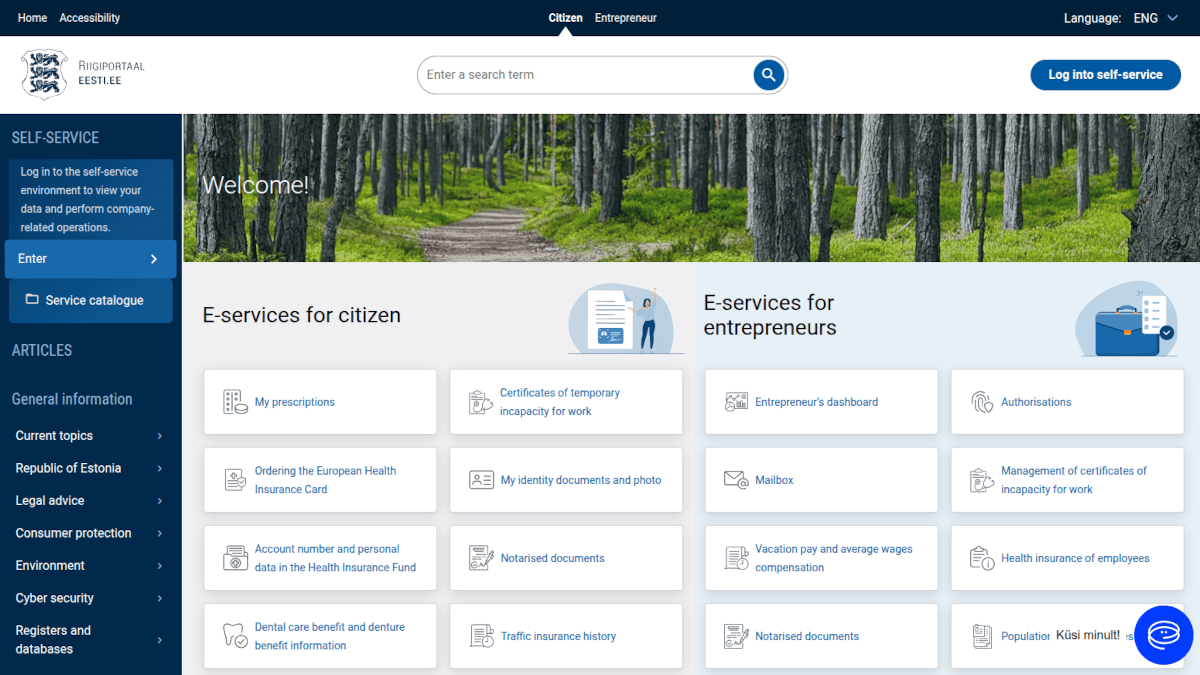
Featured image of post Estonia, the country of the fit and the witWhile many Western democracies seem to be in a state of decay and are no longer the safe, civilized and prosperous countries they once were, there are still some European countries that are governed well. One of those that stand out is Estonia. Estonia is probably most well known for multiple software companies that originated from there, such as Wise, Bolt, Pipedrive and Skype. The government itself is also famous for being early in issuing government IDs with an embedded smart chip for online authentication already in the 1990s. Via the national portal at eesti.ee all residents can access extensive eServices ranging from viewing their health benefits to filing taxes. Estonia has also been running an e-Residency program since 2014, where they issue digital ID cards to foreigners, making it easy for them to remotely log into the government portals and for example, establish businesses, file annual reports and so forth. Note that the e-Residency is not a path to physical residency. Estonia does, however, have a separate Digital Nomad visa program that makes it easy for non-EU citizens to also physically establish themselves in Estonia, assuming, of course, you meet the criteria, which includes, among others, a minimum monthly income of 3960 from outside Estonia. EU citizens naturally have free mobility inside the EU and can simply get an apartment and register as a resident in Estonia if they so choose. And there are plenty of reasons to do so.


Estonians value health, education and entrepreneurship I moved to Estonia about one and a half years ago. In my observations Estonia strikes me as a country that values health, education (in particular programming and natural sciences) and entrepreneurship highly. I don t know how Estonians achieve it, but they look pretty fit and rarely obese. Estonia has rye bread and sauna in their culture just like Finland, and in addition the flat terrain and well-planned bike routes and extensive network of parks (and pull-up bars everywhere) seem to create an environment where it is easy to live in a healthier way. The consumption of processed foods and candy also seems relatively low among Estonians. The gym chain MyFitness also seems to be present everywhere. Even the Tallinn airport has a calisthenics workout station right at the departure gates, which anyone is free to use while waiting for their flight to take off. One of the top longevity influencers in Europe, Siim Land, is Estonian. Estonia has lots of good bike paths, parks and outdoor gyms There is even a calisthenics station with pull-up bar and more at the departure gates at Tallinn airport Estonians also seem to value the school system highly. The government has been actively raising teacher pay and has a stated goal of reaching 120% of the national average by 2027. The students are also expected to value the education and respect their teachers. According to the TALIS 2024 survey (OECD s international teacher survey), Estonian teachers spend significantly more time on actual teaching and learning and waste less time on interruptions or keeping classroom order compared to the OECD average. This is among the highest rates internationally, meaning they spend relatively little time on maintaining order or dealing with disruptions. While the international education benchmark PISA scores have been dropping globally, Estonia has consistently been climbing the ranks in past decades. In the latest PISA study (from 2022), Estonia ranked number one in Europe for reading, mathematics and science. In the overall results, Estonia ranked seventh globally, only behind countries such as Japan, Korea and Singapore. Valuing entrepreneurship is evident in how the taxation system is set up in Estonia. Famously, in Estonia, companies can defer taxes on annual earnings and reinvest all of their profit in growing the company. Taxes are due only later, when paid out from the company, for example as dividends. For individuals, receiving dividends from any Estonian or foreign company is tax-free as long as the company paying dividends already paid corporate tax on the same income. The tax system is also very simple. For all individuals, all types of income, including salary and capital gains, are always taxed at a flat rate of 22%. This removes the incentive for anyone to try to convert income into different types, setting up holding company structures and other optimizations as there is no gain. All entrepreneurs can simply focus on growing their business and forget extra bureaucracy. There is also no marginal tax rate cliff to stop working at everyone is encouraged to always try to produce as much value as they can. A simple tax system is also reflected in the fact that anyone can easily read all tax rules that apply to individuals in plain English on the Estonian tax authority website, and one does not need to hire any accountants simply to file taxes. Estonia also has a very straightforward investment account system: any person can freely open a self-directed investment account at any brokerage at no extra cost and report it as such to the tax authority, and then use it to save for an apartment, retirement, or other purposes, and defer all income taxes until withdrawal. There are no caps or time limits, and all residents are encouraged to save and invest as much as they can and thus take responsibility for their own wealth accumulation. It seems that culturally Estonians respect people who are active and progress in their careers and businesses more than in other countries. Unlike in Finland, successful people are admired and living on government welfare is not romanticized. At the same time, the government benefits are less generous so people can t live comfortably on them and, for example, many of the asylum seekers Estonia accepted have since left on their own initiative to other European countries in search of better benefits.

Low crime, high trust Another thing that strikes me when walking the streets of Tallinn is that there are no drug addicts, beggars, thugs or the like. The difference compared to, for example, Vancouver (where I lived previously) is stark. In public buildings, people leave their coats and bags hanging in the lobby while visiting. Private houses and apartment block yards are not fenced. In my building, I noticed people even leave their bikes unlocked in the bike shed. I have also seen the staff of a coffee stall in a shopping mall going for a break and leaving everything unattended, not worrying that anyone would take anything while the staff is away. Nobody is stealing anything from the unattended coffee shop while staff is having a break at  lemiste shopping mall This is not just my personal experience. According to the Numbeo crime index, Estonia has one of the lowest crime rates in the world. Also, comparing drug and property crime stats, for example, Finland has twice as much crime per capita, and places like Vancouver in Canada almost five times more. I don t have any clear explanation for why crime is so much lower in Estonia, but some suggest that higher social cohesion and lower levels of welfare contribute to people standing to lose more if they behave antisocially. Compared to Finland, Estonia also more readily jails repeat offenders, and those who are put on trial will experience a swifter court process thanks to simplified legal processes and more efficient governance.


Moving to Estonia: quick checklist Moving to Estonia is very easy for any EU citizen, in particular if your work is not location-dependent (e.g., remote work or an online business) and you are simply looking for the cleanest and safest environment to live in. First, check into a hotel in Tallinn, check out various neighborhoods to figure out what area you like (my favorites are Kalaranna, Kalamaja, Noblessner and Volta) and start browsing available apartments in English at kv.ee. Most professionals speak fluent English, so there should not be any difficulty in reaching out to people by email or phone. Tallinn is famous for the old town The economic boom of recent decades created a lot of new construction, with Kalaranna being among the newest areas The next step is to buy a local prepaid SIM card at e.g., an R-Kiosk or a convenience store as signing up for other matters later on will require an Estonian phone number. Once you have an apartment and e.g., signed a rental agreement, you can register in the population registry online. After that, you have proof you are a local resident with an address and telephone number in Estonia. With local resident status, you can go to the police station to get a local ID card. Don t bother scheduling an appointment, just go to the Tammesaare police station in Tallinn, take a queue number and wait. Once it is your turn, they will guide you on how to use the photo booth, fingerprint registration device, and file your application. A few days later you will receive an email confirming whether your application was accepted, and after a few more days, you will get another email notifying you that your ID card has been printed and is available for pick-up at the same location. This will also be your first practical experience of how fast and efficient the government in Estonia is. Once you have the local ID card, you can use the smart card feature to log into all the government eServices and sort out the rest of the relocation process, such as registering tax residency and getting a family doctor. The main eServices portal in Estonia: eesti.ee
How did Estonia evolve to be like this? After Estonia regained its independence after the fall of the Soviet Union in 1991, the first elected government in 1992 was led by a very progressive 31-year-old Prime Minister Mart Laar, who managed to set up some very good policies and laid the foundation of a society that has evolved well in the decades since. Estonia was very lucky to have people in power in the 1990s who didn t simply copy what other Western countries were doing, but who tried to think about things from first principles and create Estonia s own model for efficient and fair governance. As a post-Soviet country, the population had also been vaccinated against overly socialist and unrealistic ideals, and everyone had a healthy distrust of the government s ability to solve problems and emphasis was placed on people s liberty to work for themselves as they best see fit. The improvement in living standards over the past 35+ years has also been witnessed by the population, and voting behavior supports keeping the country on the same trajectory. General living standards still continue to improve as the nominal wage growth sits at around 6%, clearly above the annual inflation rate of about 3%. In 2026, the Estonian economy is expected to grow about 2.4%, which is faster than the EU average. The growth in Estonia is not the result of any accounting tricks - Estonia is part of the euro and can t print its own currency, nor has it been funding the public sector with excessive debt. With a 24% debt-to-GDP ratio, Estonia consistently ranks as one of the most responsibly managed countries among advanced Western economies. As wages in Estonia soon catch up with the EU average, and higher defence spending has forced the government to raise taxes in recent years, the economic growth that Estonia has enjoyed for 35+ years since it exited the Soviet Union might slow down a bit in future years. The policies that fueled this growth in living standards, however, are likely to stay.

The tiger leap There is one specific government policy in Estonia s history that I think should be highlighted in particular. Estonia was very progressive by announcing the Tiigrih pe (Tiger Leap) program in 1996 with the goal of equipping all schools with computers and teaching all students the basics of programming. This surely had a large influence on why Estonia has so many successful software companies, why the government eServices are so mature that even neighboring countries like Finland are striving to copy the Estonian government s IT architecture called X-road. The Tiigrih pe project was originally suggested in the mid-1990s by Toomas Hendrik Ilves, then ambassador of Estonia to the United States, Canada and Mexico, and later President of Estonia in 2006 2016. While he was a psychologist by education, he was also a self-taught amateur programmer and used his political influence to promote sensible adoption of information technology in both Estonia and the EU. The history of Estonia has several prominent figures who were not lawyers by profession but engineers, scientists and historians who were very practical in their political decisions, which I think is now reflected in how government processes were formed. The video below shows how the Estonian government advertises itself and what values they choose to highlight:

Should other countries adopt policies from Estonia? Of course, not everything is perfect in Estonia either. The fertility rate of 1.16 in Estonia is very low. This trend is present globally, but in Estonia it is way below the EU average. Also, the service culture is something that needs to improve in Estonia. While services are in general fast and efficient, the attitude of people working in cafes and stores does not reflect a willingness to fill in gaps if the standard process falls short, nor are visitors actively made to feel welcome as individual humans, but are treated as mere process inputs. However, many of the things listed earlier I think should be studied by policymakers elsewhere. Societies are complex systems and there is of course no guarantee that copying a single policy to another country with different ethnicities, history and ingrained culture would lead to the same policy outcomes. But considering that Estonia is a small country without favorable geography and no natural resources, and that it started out from a place of total chaos, low economic activity and high crime in 1992 to rise to what it is now in 2026, the success it has seen is surely largely a result of good policies, governance and culture that other countries can and should mimic.

29 July 2026

Russ Allbery: Review: Midlife in Gretna Green

Review: Midlife in Gretna Green, by Linzi Day
Series: Midlife Recorder #1
Publisher: Linzi Day
Copyright: July 2022
ISBN: 9798837010774
Format: Kindle
Pages: 464
Midlife in Gretna Green is a self-published fantasy novel. It's urban fantasy in the sense that it's set in our world but with magic that most people don't know about, but the primary setting is a parish in rural Scotland and therefore the genre is not urban in that sense. It was Linzi Day's published first novel. As the story opens, Niki McKnight is a widow in Manchester, England with a job in the Register Office she likes, a boss she hates, and a Bichon Frise dog she adores. In the year since her husband Nick died, she's put her life on hold and made as few decisions as possible, despite some concerned pushing from her best friend Aysha. The death of her grandmother is not entirely unexpected, but her inheritance is about to upend her life. Niki assumes that her grandmother has a modest cottage and a small estate, and therefore being the named heir will mostly involve cleaning up the details of a modest life. She is caught by surprise by a requirement in the will that she live in Gretna Green for a year and a day in order to inherit. Her initial reaction is to treat this as an absurd impossibility given her life and job in Manchester, but she slowly realizes something strange is going on. Her grandmother's lawyer is lying to her, he refuses to tell her the value of the estate and seems to think it's more valuable than she expected, and her grandmother's tiny cottage does not seem to be following the seasons of the rest of the world. There is something magical at work. I will not spoil the rest of the reveal. I will say that this is a magical house book because, if you are anything like me, that is why you will want to read this series. There are not enough magical house books, and this is one of the better kind that allow the house to be a full speaking character. Midlife in Gretna Green is an unapologetic fantasy of personal agency. Niki starts the novel with a miserable manager, a messy pile of unread mail she doesn't want to deal with, and a lot of personal emotional baggage. She gets handed a position that requires and rewards standing up for herself and being decisive. It comes with a pile of unresolved but not horribly complex problems that were waiting for someone who would listen, make sensible decisions, and treat other people with respect. Oh, and there are a few assholes in the way, but they seriously underestimate the power she has to put a stop to their bullshit. This is the sort of book that traditional publishers tended not to buy (although Day apparently did get an offer for this one and turned it down), and I'm not sure why. Editors thought protagonists should have to work harder for their payoff? Some lingering Calvinist dourness in English language publishing mistrusted triumphant books? Obvious wish fulfillment was considered embarrassing or low-class and thus didn't warrant publication? This didn't apply to the endless bildungsromans about magically talented boys, so some level of sexism was probably in play. Maybe this is finally changing? It reminds me of the bias against romance novels and their guaranteed happily ever after, and in the case of romance there was too much money for publishers to leave it on the table. In any case, the growth of self-publishing has created an alternative market that let these books reach an audience and I for one am here for it. A lot of wish-fulfillment books, and a lot of self-published books, are not very good, but the ones that have a spark of originality and character can be a delight worth tolerating the somewhat rocky editing and pacing problems that a full editorial staff might have cleaned up.
I loved reading books about kickass women who took no crap and fixed their lives up exactly how they wanted them to be. But how did they get to be that way? They always started out awesome in the books. Seriously, did they kick ass at sixteen? Or did their superpower kickassery not kick in until they were thirty? Forty? If so, then I was screwed. Would I need to wait till I was fifty or until a genie arrived offering wishes? I already felt as if I d spent my whole life waiting for something wild and wonderful to happen.
Niki is a Specific Type to a somewhat hilarious degree, and I'm not sure if Day is playing into that intentionally or if she's projecting herself into the book. The amount of self-insertion is not zero: Day also lives in Gretna Green, owns a Bichon Frise, and worked as an assistant registrar and civil celebrant. Niki also drinks wine regularly, has a psychic gift, occasionally reads tarot cards, is an accommodating pushover at work who struggles to say no to her abusive boss, has impostor syndrome problems, and swears by a fictional self-help book about grief that provides the quotes at the starts of chapters. There is a cat, because of course there's a cat. (The fictional self-help book is a spot-on parody played entirely straight in the story. I think Day is having some fun with the reader? I can't tell!) This is what I mean by unapologetic. It's easy to read Niki as a stereotype, but she's a stereotype a lot of real people can identify with and there's something highly satisfying in watching her find her footing. I like wish fulfillment books; it's fun to see someone's wishes come true! Particularly in the year of 2026, there's something immensely satisfying in seeing an ordinary, insecure person get a massive amount of power and use it to make the world better. I don't need everything to be hard, fraught, and laden with costs in fiction, although I wouldn't want every book I read to be like this. Also, the world building is great. It's not polished; there's a bit of a grab bag feeling to it, I'm dubious the magic system has any underlying rigorous rule set, and Niki's powers, once she has access to them, are more of a semi-sentient genie than a skill she has to learn with hard practice. But the magic is fun. The sentient house is one of the best characters, particularly after Niki realizes how underused it has been, and I am a sucker for any good sentient house book. The cat is a far more interesting character than I first thought she would be. And Niki's new magical job is more complicated and less typical than the normal Celtic-inspired fantasy that I thought it was going to be at first. My primary warning about this book is that Niki starts out beaten down and grieving her dead husband, and it took me about five pages to decide that her dead husband was a complete piece of shit who was not worth any of the grief Niki puts into him. She also doesn't stand up for herself for the first hundred pages or so, which made me want to yell at the book a few times. Both of these problems go away farther into the book, and Niki does eventually figure out that Nick was abusive trash, but I was relieved when the "make endless excuses for worthless men" portion of the story was finally over. You have to stick with it until Niki gets brave enough to try being the protagonist; once that happens, it becomes great fun. It is fairly obvious that Midlife in Gretna Green was self-published, and I wish it had gotten the editing that it deserved. My copy had a couple of obvious formatting errors, the plot veers about more than was strictly necessary, and I think a careful editing pass could have tightened the writing by about fifty pages or so without losing any important detail. If that sort of thing bothers you, make sure you're in self-published fiction mode before starting this one. But it also has that irrepressible, bubbling-with-ideas feeling of a book where nothing has suppressed the author's enthusiasm. It's a very grabby book; once Niki starts embracing her new life, I could barely put it down. If you're in the mood for a good fantasy wish-fulfillment story that has no romance and a whole lot of "why are things run this way, no, we're changing that," highly recommended. I had so much fun with this book, and the series is currently making the rounds of my whole family. Don't read this when you're looking for something challenging and literary and deep; save it for when you desperately want to watch someone just fix something for once, damn it. Followed by Painting the Blues in Gretna Green, which I have already read, breaking my usual rule of writing reviews before reading the next book in a series. Rating: 8 out of 10

22 July 2026

Freexian Collaborators: Monthly report about Debian Long Term Support, June 2026 (by Thorsten Alteholz)

The Debian LTS Team, funded by [Freexian s Debian LTS offering] (https://www.freexian.com/lts/debian/), is pleased to report its activities for June.

Activity summary During the month of June, 20 contributors have been paid to work on Debian LTS (links to individual contributor reports are located below). The team released 48 DLAs fixing 231 CVEs. Debian 12 ( bookworm ) has been handed over to the LTS Team on June 11th. During this handover Sylvain helped to update relevant tools and documentation. If you benefit from Debian, especially during the full 5-year lifecycle, please consider subscribing as a sponsor of Debian LTS: https://www.freexian.com/lts/debian/. Moreover, Debian 11 ( bullseye ) will reach the end of the Debian LTS period on August 31st. After that, Freexian will continue the security support under the Extended LTS offer. The team published several notable updates:
  • haveged update (DLA-4616-1), prepared by Thorsten, to address local privilege escalation.
  • tomcat9 update (DLA-4619-1), prepared by Markus, to address, among others, an authentication bypass.
  • apache2 update (DLA-4620-1), prepared by Bastien, to address a HTTP/2 bomb.
  • apache2 update (DLA-4629-1), prepared by Bastien, to address, among others, remote code execution and privilege escalation.
  • libinput update (DLA-4626-1), prepared by Santiago, to address local privilege escalation and arbitrary code execution.
  • asterisk update (DLA-4631-1), prepared by Thorsten, to address, among others, wrong processing of invalid or untrusted certificates.
  • nginx update (DLA-4634-1), prepared by Charles, to address a remote code execution and denial of service.
  • firefox-esr update (DLA-4635-1), prepared by Emilio, to address dozens of CVEs, among other things, related to arbitrary code execution and privilege escalation.
  • thunderbird update (DLA-4636-1), prepared by Emilio, to address dozens of CVEs, among other things, related to arbitrary code execution.
  • chromium update (DLA-4654-1), prepared by Emilio, to address dozens of CVEs, among other things, related to arbitrary code execution.
Contributions from outside the LTS Team: We are greatly thankful for the contributions from people outside the LTS Team:
  • Salvatore Bonaccorso prepared a libhttp-daemon-perl update, that was released by Santiago as DLA-4639-1.
  • Salvatore also directly uploaded libgd-perl DLA-4638-1 and libconfig-inifiles-perl DLA-4637-1.
  • Peter Palfrader prepared a tor update, that was released by Santiago as DLA-4656-1.
  • Pieter Lenaerts prepared a beets update, that was released by Emmanuel as DLA-4641-1.
  • Noah Meyerhans prepared a cloud-init update DLA-4645-1.
The LTS Team has also contributed with updates to the latest Debian releases:
  • Besides publishing DLA-4642-1 for package u-boot Andreas also prepared an NMU for an upload to sid and prepared a stable-proposed-update (SPU) bug for trixie, which was already acknowledged by a stable release manager (SRM).
  • Andreas also prepared an upload of package atril for trixie, which was handled by the security team as DSA-6349-1.
  • Besides publishing DLA-4620-1 for package apache Bastien also prepared an upload for trixie, which was handled by the security team as DSA-6323-1.
  • Tobi uploaded package mesa to trixie and bookworm.
  • Thorsten fixed some (not security related but RC) issues in package dahdi-linux. This was in preparation to fix lots of security issues in asterisk. Unfortunately the maintainer ignored the corresponding debdiff and prefered to upload a new upstream version. Anyway, the concerns of the security team about security support of asterisk could be overcome and asterisk can migrate to tesing and again be part of a Debian release.

Individual Debian LTS contributor reports

Thanks to our sponsors Sponsors that joined recently are in bold.

21 July 2026

Vasudev Kamath: Releasing debvulns-exporter: Prometheus exporter for Debian System Vulnerabilities

Following up on my previous post, I am releasing debvulns-exporter, a Prometheus exporter for tracking Debian system vulnerabilities. The underlying vulnerability analysis logic remains identical to the previously released MCP server and CLI utility.
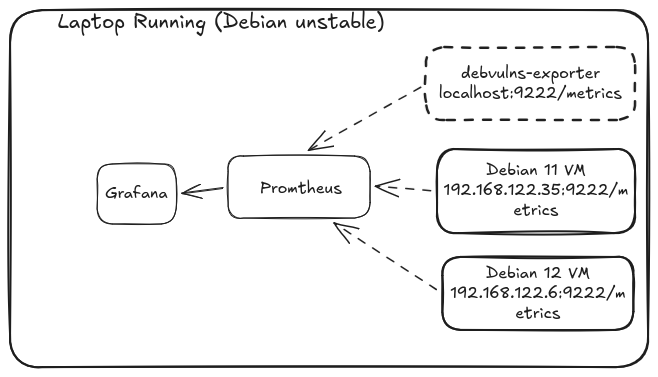
Why an Exporter? In my engineering workflows, I frequently deal with Debian and vulnerability management. Most enterprise environments rely on commercial, paid vulnerability platforms like Tenable or Rapid7. While these platforms provide extensive feature sets, I noticed a distinct lack of open-source tools tailored for this specific pipeline. While debsecan exists, it lacks a structured, parseable format suitable for building dashboards aimed at management consumption. What started as an experimental MCP server for learning purposes evolved into a practical question: why not convert it into a Prometheus exporter? Given that Prometheus is the de facto standard metrics platform across the industry, this architecture was the logical next step.
Design and Exported Metrics The exporter is implemented as a native Prometheus exporter utilizing the prometheus-client library. It operates using two threads: one handles fetching the vulnerability data, parsing EPSS feeds, and cross-referencing installed packages to identify local vulnerabilities; the second handles serving the metrics endpoint. The full architecture details and metrics specifications can be found in the design doc. The specification was drafted during a technical brainstorming session with Claude 4.6 Sonnet on Antigravity prior to writing the implementation.
Testing and Dashboarding To validate the exporter, I spun up older Debian 11 and Debian 12 cloud images sourced from the Debian Cloud team. The older image was intentionally selected to guarantee a standard baseline of unpatched vulnerabilities for testing. The local evaluation topology is structured as shown below: Rather than constructing the Grafana dashboard from scratch, I used Claude 4.6 Sonnet via Antigravity to generate the layout configuration. The generated dashboard for the local testbed functions effectively: The complete, ready-to-import Grafana dashboard configuration is included directly in the debvulns source code.
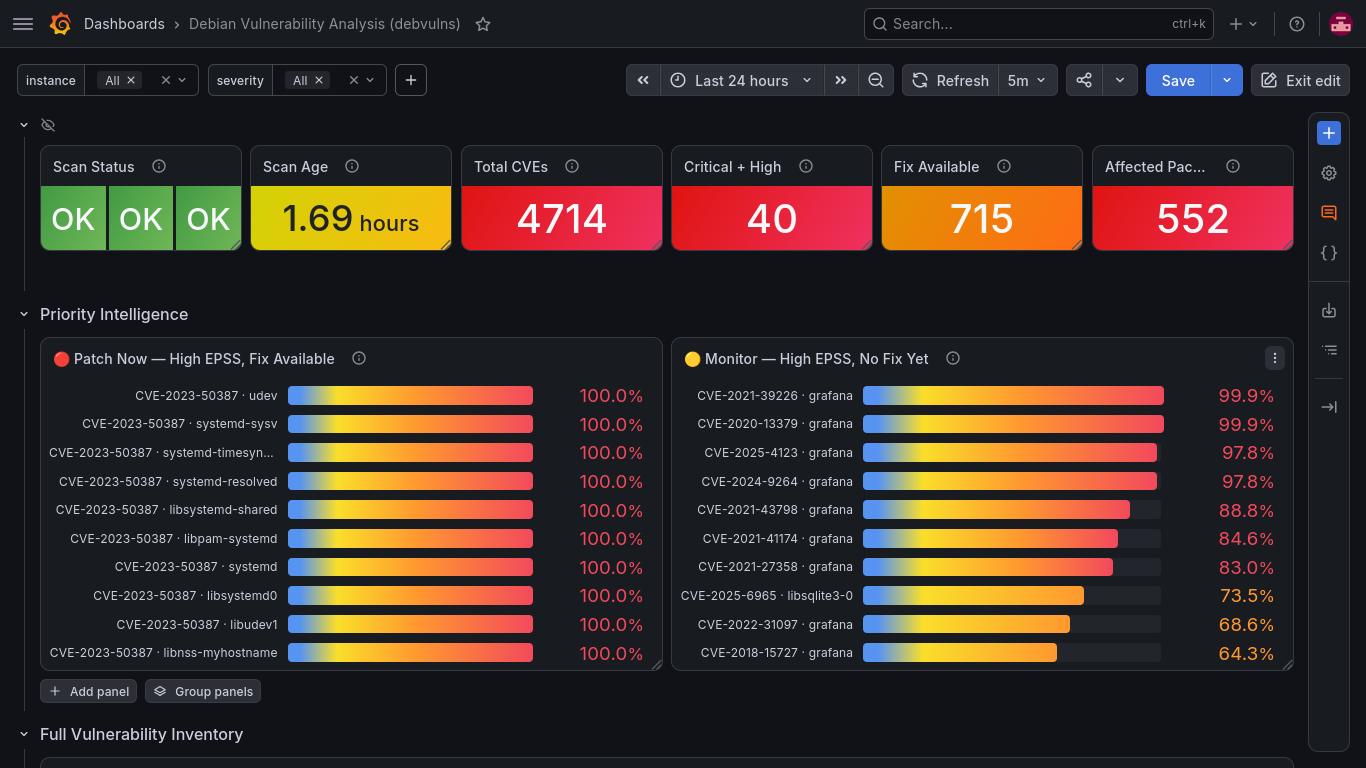
Renaming the project To prevent namespace conflicts and confusion with the native debsecan utility in Debian, I have unified the ecosystem under the debvulns moniker. The core CLI is named debvulns, the exporter is debvulns-exporter, and the MCP component is debvulns-mcp. The migration release has been published to PyPI, and the new consolidated repository is active at debvulns.
Conclusion While this began as a personal utility to fill a niche tool gap, I expect it will be useful for others managing Debian infrastructure at scale. My next objective is to formalize Debian packaging for both the CLI and the exporter. The MCP component will likely remain available as an independent artifact. Until then, happy hacking. Note: As a core design choice, debvulns still uses native debsecan as its ground-truth standard. The tool continuously cross-verifies its output against debsecan to ensure perfect functional parity and data consistency.

19 July 2026

Russell Coker: ECC and DDR5

Hamming Codes ECC RAM corrects errors that occur in memory before it gets to the CPU. The most common form of ECC is the Hamming Code [1] which when it has R redundant bits can correct single bit errors and detect double-bit errors in messages with 2^R-R-1 bits of data. For PC use that means if you want to protect 32bits of data you need R=6 and with 64bits you need R=7. The standard for DDR4 and similar RAM is 72 bits of data width on the bus and Hamming codes to correct single bit errors and detect double bit errors for 65bits of data. The computers we use have 64bits of data so that allows an extra bit that could be an extra parity, I don t know what if anything is done with this extra bit. RDIMM vs UDIMM One point of confusion in such things is the difference between Registered memory AKA RDIMMs [2] and regular PC/laptop memory which is often referred to as UDIMMs. The register is just a buffer which due to complex issues that aren t relevant to this post means that DIMMs can be larger and you can have more DIMMs in a system but latency may be slightly worse. It is technically quite possible to create RDIMMs without ECC (64bits wide instead of 72) but I have never seen a system that used such RAM. I have used more than a few systems with ECC UDIMMs and I recommend avoiding them if convenient as ECC UDIMMs are expensive on the second hand market while ECC RDIMMs can get very cheap. There are servers with ECC RDIMMs that are very unsuitable for home use (such as dual-CPU 1RU servers which are very noisy) so once they are past the 5 year tax write-off period the server chassis gets sent to ewaste and the RAM goes on the second hand market, the glut of RAM without systems to use it forces the price down. For the systems most commonly seen there are RDIMM systems with ECC and UDIMM systems without ECC. Chipkill If every bit in RAM was independent of every other bit then the basic Hamming code would solve most problems. However multiple bits in the same chip may be affected by the same problem, or one chip on the DIMM might entirely fail. With every RDIMM having 18 or 36 DRAM chips there are 2 or 4 bits per chip. On DIMMs with 36 DRAM chips one chip could fail and have the errors reliably detected with a Hamming code. On DIMMs with 18 DRAM chips one failed chip can t necessarily be detected with Hamming codes. IBM trademarked the term ChipKill for ECC systems which can cope with a single DRAM chip failing [3]. This is referred to as Advanced ECC on Dell and HP servers which require an even number of DIMMs. If anyone knows what coding method is used for ChipKill type systems then please let me know. Systems with advanced ECC also often have features like hot-spare for RAM and RAID-1 type functionality which is interesting but not something most people who read my blog will ever want to use. DDR5 DDR5 has on-die ECC to deal with the increased error incidence from smaller and faster memory [4], this is specified as 8 bits of error correction per 128 bits of data which implies basic Hamming codes. The on-die ECC is not a replacement for regular ECC, it s a mitigation for new problems introduced. My experience of memory errors is that the majority of repeatable errors (where a system would get an error with Memtest86+ or an ECC error report repeatedly) were DIMM seating issues, I could unplug and reinsert the DIMM in question and then the same tests would pass. Those errors would not be affected by on-die ECC. One thing that concerns me is the possibility of on-die ECC interacting with ECC on the motherboard and reducing it s effectiveness. I haven t been able to find out enough about how this works to determine if that s the case. My concern is that an error of 3+ bits that s corrected with a basic Hamming code might be more likely to create an error condition that Advanced ECC can t fix than the original error. Currently the best published research on the effectiveness of ECC on RAM errors is the Google paper published in 2009 which is based on DDR and DDR2 RAM [5]. So I don t expect that we will see published research about even DDR4 ECC any time soon. I presume that Google and the other cloud providers are still doing such research and providing the information to DRAM vendors under NDA so we have to just hope that the DRAM vendors do what s required to make things work correctly and allow us to buy products based on that research. DDR5 EC4 vs EC8 DDR5 supports 2*32bit subchannels instead of just supporting 64bit words [6]. For DDR5 ECC RAM there are variants EC4 which has 36bits of data per subchannel and EC8 which has 40 bits. EC8 allows Hamming codes on each subchannel indepdendently. I haven t found a reference on how exactly EC4 works, it could be reading 64bits at a time (not taking advantage of the subchannels) to use Hamming codes or it could have 1 parity bit for each subchannel and just assume that there s no need to check Hamming codes unless the subchannel parity fails. EC8 allows full Hamming code checks on 32bits of data and presumably ChipKill on 64bits. It s widely claimed that all DDR5 RDIMMs are EC8 and all DDR5 ECC UDIMMs are EC4. A quick search on ebay turned up adverts for EC4 and EC8 RDIMMs and links to apparently reliable sites confirming that some of the RDIMMs are EC4. There are reports of EC8 UDIMMs even though I couldn t find any advertised. This seems to mirror the situation with DDR4 where non-ECC RDIMMs are apparently available somewhere and ECC UDIMMs are something I ve used a few times but most people have never seen. I then searched for information on what servers support. The Dell R760 server supports both EC4 and EC8 RDIMMs but you can t have both in the same system. The existence of EC4 DIMMs is wrong. They shouldn t make substandard gear, the manufacturing price difference between 72 and 80 bit wide DIMMs isn t going to be great and the end result is some systems with inadequate specs and extra difficulty in upgrading systems with more things to check for compatibility. Why ECC is Needed Here s an interesting article about Mozilla s claim that 15% of Firefox crashes are due to RAM hardware errors [7], this seems to be based on repeatable errors and therefore won t count errors where a bit flip happens once a day or less. Some years ago I reported a BTRFS corruption issue on my desktop PC to the BTRFS developers and one of them stated that the corruption in question didn t match any pattern expected from a BTRFS bug and recommended that I run Memtest86+. The memory test revealed that I was getting about one memory corruption per 5 hours so if I had used Firefox on that system any crashes probably wouldn t have been regarded as hardware errors with RAM. Those errors caused filesystem corruption and some data loss, if I hadn t been using BTRFS that could have gone unnoticed for years. On another occasion I had a VM I was using for testing software I was developing that had some unexpected errors. After working on it for a day I had shared the errors with a mailing list of other developers who also spent some time investigating it. Eventually I began to suspect a hardware problem, I went on site and when I rebooted the system to run Memtest86+ it didn t even boot as it had errors that stopped the BIOS from even working correctly. It was strange that the system was apparently working correctly and restarting the KVM VM resulted in the same errors happening in the same code and nothing else on the VM apparently having a problem. It turned out that the system had a motherboard problem that made all but one of the DIMM sockets unusable so I ended up sending it to e-waste. That wasted a day of my time and some hours of other people s time. Presumably on other occasions developer time is wasted due to hardware errors and no-one even realises. What Society Needs We need ECC RAM to be more widely used. Ideally we would have some government action to force this given the ongoing cost to society in corrupted data and lost time due to RAM hardware errors. I think that at minimum we need sufficient taxes on non-ECC RAM (and EC4 RAM for DDR5) to make it more expensive when bought new than ECC RAM. We need to have greater knowledge of the benefits of ECC RAM among computer experts, people need to recommend that computers be purchased with ECC RAM whenever possible and that systems which can t have ECC RAM (laptops and phones) shouldn t be used for storing important data. We need to avoid silly things like having so many variants of RAM to confuse people and make it needlessly difficult to get ECC RAM working.

15 July 2026

Freexian Collaborators: Debian Contributions: Python 3.14 as default transition, DebConf 26 preparations, debvm, pconr and more! (by Anupa Ann Joseph)

Debian Contributions: 2026-06 Contributing to Debian is part of Freexian s mission. This article covers the latest achievements of Freexian and their collaborators. All of this is made possible by organizations subscribing to our Long Term Support contracts and consulting services.

Python 3.14 as default transition, by Stefano Rivera Debian has had Python 3.13 and 3.14 in unstable and testing since December 2025, with Python 3.13 as the default version (/usr/bin/python3 = 3.13). This gave time for packages to implement support and detect issues in their test suites. A slot to transition to 3.14 as default was requested from the release team in March, and they indicated that we would likely be able to schedule it in late June. In preparation, Stefano reviewed the open bugs against Python interpreters and squashed some in uploads of the latest point releases of Python: 3.13.14 and 3.14.6. Also in June, Python 3.15.0 beta 2 and beta 3 released. Stefano uploaded these to Debian experimental. The 3.15 betas were reason to attempt to revive review of a blocked upstream patch to support Debian multiarch in stable ABI Python extensions, now that Python 3.15 is adding a new stable ABI abi3t.

DebConf 26 preparations, by Stefano Rivera, Antonio Terceiro, Lucas Kanashiro, Santiago Ruano Rinc n and Anupa Ann Joseph DebConf 26, the annual Debian Developer Conference, is being held in Santa Fe, Argentina, in July. Stefano Rivera, Antonio Terceiro, Lucas Kanashiro, Santiago Ruano and Anupa Ann Joseph contributed to the preparations for the event.
  • As usual, Stefano has been supporting the conference website and registration, helping the local team to get accurate data on attendee numbers.
  • Antonio has been supporting the conference website and helping the content team to put together the conference schedule.
  • Santiago has been helping the local team on different topics regarding logistics.
  • Anupa assisted with the accommodation arrangements for DebCamp and DebConf, working alongside Nattie.
  • Lucas has been coordinating the conference schedule and communicating with some speakers.

debvm, by Helmut Grohne The debvm tool used for creating and running ephemeral virtual machines saw a number of small improvements. The requirement of having a filesystem label has been removed in favor of using a uuid and /etc/fstab is no longer created. A memory balloon is enabled by default and this enables qemu to automatically release free guest memory to the host. Booting Ubuntu VMs regressed as a result of their use of uutils and has been fixed. The --architecture flag is back to be able to better support Hurd, which is a work-in-progress of Johannes Schauer Marin Rodrigues. Thanks to Jochen Sprickerhof, you can more easily create VMs for autopkgtest-virt-qemu using --hook-dir=/usr/share/mmdebstrap/hooks/autopkgtest-create-qemu. There also are a few documentation and error message improvements. All of this is pending in git waiting to be uploaded once development slows down. While booting a machine from virtiofsd succeeded, turning the proof-of-concept into production remains for later.

pconr, by Helmut Grohne At DebConf25, Helmut reported on a schroot substitute called unschroot. The second iteration uses varlink IPC to construct a container. That varlink API is now separated into a new project called programmable container runtime. It is meant to provide more flexibility in constructing containers than established solutions such as the unshare command from util-linux, bubblewrap or podman provide while still managing repetitive complexity such as process orchestration for the developer. A new example that uses this infrastructure is a better containment for mmdebstrap eliminating chroot escape. There also is an asyncvarlink/0.3.2 release taking steps to become more maintainable in Debian to eventually get pconr into Debian.

Miscellaneous contributions
  • Stefano did routine uploads (mostly new upstream versions) of python-pip, python-pipx, hatchling, dh-python, beautifulsoup4, python-virtualenv, python-mitogen.
  • Stefano uploaded a snowball mini-transition: snowball, snowball-data, and pystemmer
  • Stefano did some debian.net team admin, setting up a container and later a VM for vote.debian.net.
  • Stefano responded to a semi-escalation to the Debian Technical Committee, after some communication between an upstream, a bug reporter, and a Debian package maintainer went sideways and got heated.
  • Emilio managed several transitions, and filed bugs against the few remaining GCC 13 rdeps.
  • Antonio did salsa maintenance work, debugging service issues, approving user registrations, and processing support requests.
  • Antonio worked on Debian CI maintenance, including but not limited to deploying new armhf and armel workers, fixing bugs and preparing an upcoming release of debci.
  • Antonio did several maintenance tasks for MiniDebConf websites.
  • Antonio uploaded ruby-bunny, ruby-sinatra and ruby-mustermann, fixing a few FTBFS bugs among them.
  • Carles using po-debconf-manager: Reviewed Catalan translations for 5 packages, submitted 6 packages. Added a draft blog/update about the po-debconf-manager project.
  • Carles submitted a new Geeqie Catalan translation: it had accumulated a large number of untranslated strings over the last 4 years.
  • Carles contributed to the Debian wiki: improved documentation for the Framework Laptop and added a new section Battery charging control (after doing some debugging and testing). He wrote a page about Signal Desktop. Carles started looking at testing/documenting Mailman2 -> Mailman3 migration.
  • Carles, in relation to the migration process, double checked old pages without relevant information in the Debian wiki.
  • Thorsten did another upload of package hplip to fix some bugs.
  • In the context of the Google Summer of Code 2026 project, Santiago continued co-mentoring Aryan Karamtoth, who is working on the Linux live-patching project. As part of the team, Santiago guided Aryan to help design the different workflows and to study the different tools available, including the upstream klp-build (that was introduced in v6.19), and compare it with SUSE s klp-build.
  • Colin clarified the bug tracking system s documentation to indicate that maintainers may sometimes reasonably ask users to file bugs upstream themselves.
  • Colin fixed 15 packages for pytest 9.1.
  • Colin fixed a depthcharge-tools regression with Python 3.14 as default that broke debian-installer builds.
  • Helmut continued to report undeclared file conflicts and correspond about them.
  • Helmut wrote patches for strace to enable cross building and a 32bit personality on arm64.
  • Helmut continued maintaining rebootstrap working fixing build failures in fontconfig, gettext and sqlite3 as well as changing the way packages from gcc builds are installed to better serve a need reported by Samuel Thibault.

14 July 2026

Jonas Meurer: zed-xdebug

Nextcloud PHP debugging with Xdebug in Zed editor I started to switch from PhpStorm to Zed as IDE recently as Zed is open source and has a much smaller footprint and is more slick than PhpStorm. One thing that I didn't get running immediately was Xdebug integration, so I did a bit of research and asked Claude for help. Here's a quick writeup of how to get it running. I have Zed installed as Flatpak on a Debian Trixie host system. The PHP process runs in a nextcloud-docker-dev Docker container.

Install Zed and configure debugging there Install Zed: flatpak install flathub dev.zed.Zed In Zed: open the Extensions view and install PHP. Configure the debugger: Create ~/.var/app/dev.zed.Zed/config/zed/debug.json:
[
   
    "label": "PHP: Listen to Xdebug",
    "adapter": "Xdebug",
    "request": "launch",
    "port": 9003,
    "pathMappings":  
      "/var/www/html":             "/home/<user>/devel/nextcloud/server",
      "/var/www/html/apps-extra":  "/home/<user>/devel/nextcloud/server/apps-extra",
      "/var/www/html/apps-shared": "/home/<user>/devel/nextcloud/apps-shared"
     
   
]
Add one entry per bind-mounted app directory. After creating the file, restart Zed. Inside Zed, select "debugger: start" from command palette and then "PHP: Listen to Xdebug". Verify Zed is listening. Running ss -tlnp grep 9003 on the host should show *:9003 with Zed as the process.

Configure Xdebug inside the container /usr/local/etc/php/conf.d/xdebug.ini:
xdebug.mode = debug
xdebug.idekey = PHPSTORM
xdebug.trace_output_name=trace.%R.%u
xdebug.profiler_output_name=profile.%R.%u
xdebug.output_dir=/shared/xdebug
xdebug.log = /var/log/xdebug.log
xdebug.log_level = 3
; Try to discover the client host, otherwise fall back to the docker host
xdebug.discover_client_host=true
xdebug.client_host=host.docker.internal
; When you cannot specify a trigger, use "xdebug.start_with_request = yes" to autostart debugging for all requests
; https://xdebug.org/docs/all_settings#start_with_request
xdebug.start_with_request = trigger
; Set xdebug.mode trace to use this
; More details at https://derickrethans.nl/flamboyant-flamegraphs.html
xdebug.trace_format=3
xdebug.trace_output_name=xdebug.%R.%u
Apply changes by restarting apache in the container: apache2ctl -k graceful Notes:
  • host.docker.internal resolves on Linux Docker only if the container was started with --add-host=host.docker.internal:host-gateway (nextcloud-docker-dev already does this).
  • discover_client_host = true makes xdebug follow X-Forwarded-For - useful behind Nextcloud's dev reverse proxy.

Test xdebug with a PHP command inside the container Run XDEBUG_SESSION=PHPSTORM php occ status inside the container and check /var/log/xdebug.log.

Install the browser extension Install Xdebug Helper (Firefox/Chrome). In its preferences, set the IDE Key to PhpStorm. It will set the XDEBUG_SESSION cookie when toggled to Debug. Click the Xdebug Helper icon in the browser and set it to Debug.

Test Xdebug with browser extension Load the URL that exercises the code path with the breakpoint. Zed should stop the code exection at the breakpoint.

11 July 2026

Reproducible Builds: Reproducible Builds in June 2026

Welcome to the June 2026 report from the Reproducible Builds project! In these reports, we outline the most important things that we have been up to over the past month. As a quick recap about what problem our project intends to solve, whilst anyone may inspect the source code of free software for malicious flaws, almost all software is distributed to end users as pre-compiled binaries. The motivation behind the reproducible builds effort is to ensure no flaws have been introduced during this compilation process by promising identical results are always generated from a given source, thus allowing multiple third-parties to come to a consensus on whether a build was compromised or not. If you are interested in contributing to the project, please visit our Contribute page on our website. In this month s report, we cover:

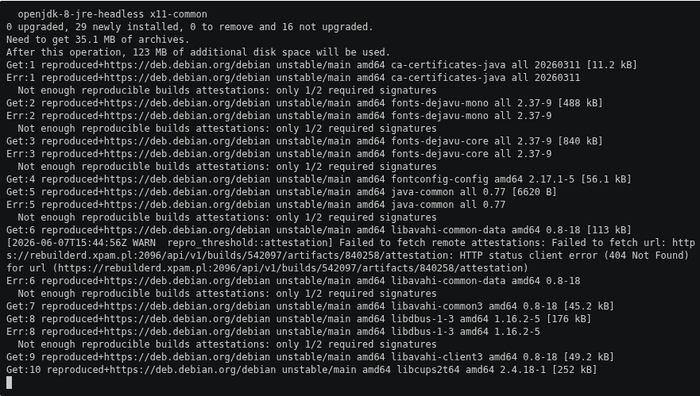
  1. Only installing reproducible packages with repro-threshold
  2. Distribution work
  3. diffoscope development
  4. From our mailing list
  5. Documentation updates
  6. Patches
  7. Four new scholarly papers


Only installing reproducible packages with repro-threshold A very interesting demonstration is now available showing how you might configure your Debian system to only install packages that have been reproduced by m/n rebuilders. This is implemented via a reproduced+https:// APT transport ( a mechanism for communicating between the APT client and its repository source commonly HTTP):
Every package download is intercepted by repro-threshold, which queries two independent rebuilders for a signed attestation before allowing installation to proceed. [It] is important to note that [an] install will only succeed if all package dependencies are also reproducible.
The demo gives examples of how to quickly experiment with this using a Docker container.

Distribution work In Debian this month: The IzzyOnDroid Android APK repository reached its next milestone this month, now covering 2 out of every 3 apps (66.7%) with reproducible builds. Their documentation for debugging and fixing failed builds has steadily grown as well. More clients have picked up showing reproducibility results (e.g. Droid-ify), and Neo Store now can be configured to stick to only reproducible applications. Further, an independent builder has been added to the build farm, increasing the trust level even more as APK builds can have multiple confirmations now. At the same time, IzzyOnDroid s rbtlog got several new features. The most outstanding is caching for frequently used resources such as reproducible-apk-tools, command-line tools and NodeJS in order to counter ongoing issues with GitHub availability, while at the same time saving bandwidth and build time. This change also enables some other some smaller enhancements such as being able to configure build timeouts per recipe for those builds running longer than the average, release pattern filtering for update checks or having a field for maintainer notes to shortly summing up e.g. why a reproducible build failed.
Lastly, Bernhard M. Wiedemann posted another openSUSE monthly update for their reproducibility work there.

diffoscope development diffoscope is our in-depth and content-aware diff utility that can locate and diagnose reproducibility issues. This month, Chris Lamb made the following changes, including preparing and uploading versions 319, 320, 321, 322 and 323 to Debian:
  • Debian adds an extra Flags: line in the output of ocamlobjinfo, so adjust the test for cross-distribution compatibility. [ ]
  • Bump debhelper compatibility level to 14. [ ]
  • Fix compatibility with Ocaml 5.4.1. [ ]
  • Use --long-form-style arguments when calling apktool in order to support apktool version 3. [ ]
  • Support Androguard version 4 and previous versions at the same time. [ ]
  • Update copyright years. [ ]
In addition, Jochen Sprickerhof added better header detection for the Sphinx documentation system [ ], Michael Daniels fixed the tests when run with zipdetails version 4.006 [ ] and Zbigniew J drzejewski-Szmek added a version of the deprecated os.path.commonprefix method [ ]. In addition, Vagrant Cascadian updated diffoscope in GNU Guix to version 321 and 323.
Chris Lamb also made the following changes to strip-nondeterminism, our tool to remove specific non-deterministic results from a completed build:
  • Skip symlinks when manually called via /usr/bin/strip-nondeterminism. (#1139000)
  • Update debian/watch format. [ ]
  • Drop Rules-Requires-Root: no and Priority: optional fields. [ ]
  • Bump Standards-Version to version 4.7.4. [ ]

From our mailing list On our mailing list this month:
  • kpcyrd posted to our mailing list regarding the waves of malware uploads to aur.archlinux.org . Curiously, every incident I looked at used npmjs.com for malware delivery , specifically where the npm package includes an (automatically executed) preinstall script that is an ELF binary.
  • kpcyrd also announced the release of debian-repro-status version 0.4.0, a tool written to give you an approximate idea of how viable it would be to enforce a reproducible packages only update policy for the computer system you ve built :
    The change updates dependencies to the latest versions, and adds support for multiple -H options, to query results from multiple rebuilderd instances. The results are also now fetched concurrently.
  • kpcyrd also reported that, whilst taking a screenshot for the above release, they noticed that the debian:sid container now is 100% reproducible.
  • Finally, kpcyrd also created a pull request against the add-determinism package to update the itertools and zip Python dependencies.

Documentation updates Yet again, there were a number of improvements made to our website this month including:
  • Chris Lamb added a reminder re. using the UTC variants of the Javascript Date methods. [ ]
  • Mattia Rizzolo moved OTF to the old sponsors list. Thank you for your support!. [ ]
  • kpcyrd updated the Rust documentation to recommend using the --release argument for consistency. [ ]

Patches The Reproducible Builds project detects, dissects and attempts to fix as many currently-unreproducible packages as possible. We endeavour to send all of our patches upstream where applicable or possible. This month, we wrote a large number of such patches, including:

Four new scholarly papers Kenichiro Muto and Kuniyasu Suzaki of the Institute of Information Security in Yokohama, Japan published an interesting paper this month titled Attestable Build Chain: Enabling Trust in Reproducible Builds (PDF). Their abstract is as follows: Ensuring trust in software supply chains requires verifying not only artifacts but also the processes that produce them. Although Reproducible Builds (R-B) require rebuilding to validate artifacts, they cannot verify whether the build was executed with the intended toolchain and inputs and may reproduce unintended or compromised builds without detection. We present Attestable Build Chain, a framework for externally verifying build-time execution without rebuilding. Rather than preventing compromise, it provides verifiable, tamper-evident evidence of actual build-time execution, enabling verification of build process integrity from observed file accesses during the build. [ ]
Julien Malka, Stefano Zacchiroli and Th o Zimmermann published a 50-page report detailing A Decade of Software Reproducibility in the Nix Package Ecosystem:
We find that functional package management enables extremely high rebuildability over time (near-universal ability to reconstitute historical build environments and rebuild software packages), while bitwise reproducibility has steadily improved and reaches a high point in recent years (up to 93% in 2024). Early years show substantially lower bitwise reproducibility, indicating that functional package management alone does not guarantee bitwise-identical outputs, and that the observed high level of bitwise reproducibility is not solely due to the package management approach. Common causes of unreproducibility, both in the rebuildability and bitwise reproducibility dimensions, include management of dates in build and test processes; we quantify their prevalence and other common causes using manual analysis of logs of rebuild failures and automated analysis of diffoscope.
A PDF of their report is available online

Tim Bastin of L3montree GmbH and Jacek Galowicz of Applicative Systems GmbH from DevGuard published a paper detailing How We Built a Sovereign, Reproducible Container Supply Chain for DevGuard:
This paper presents how the DevGuard project rebuilt its OCI container pipeline around reproducible Nix builds and independent dual-platform digest verification. DevGuard images are built hermetically from pinned source revisions, signed with Sigstore/Cosign, and verified through digest comparison across GitHub Actions and sovereign GitLab infrastructure hosted on container.gov.de. We describe the practical integration of reproducible OCI image builds into existing CI/CD workflows and argue that independently reproducible container digests provide a stronger integrity guarantee against build tampering than provenance alone. The paper further discusses remaining trust assumptions and the relevance of sovereign build infrastructure for government and regulated environments.
Finally, Yiseul Choi, Junga Kim, Jun-Ho Hong and Seongmin Kim of the Department of Convergence Security Engineering at the Sungshin Women s University in Seoul, Korea titled Attestation-based verification of SBOM integrity via consumer-side reproducibility:
Software bills of materials (SBOMs) support supply chain transparency, but they do not prove that a delivered SBOM reproducibly corresponds to its software artifact. Existing signing and provenance mechanisms protect integrity and traceability, yet lack consumer-side reproducible verification. We propose an SBOM integrity verification framework combining procedure disclosure, consumer-side reproduction, authority-generated reference evidence, and digest comparison. A trusted authority records a reference digest, and consumers compare it with locally reproduced and delivered SBOM digests. Experiments on 100 real-world container images show detection of artifact tampering, SBOM substitution, distribution modification, and adaptive tampering beyond signature-based approaches


Finally, if you are interested in contributing to the Reproducible Builds project, please visit our Contribute page on our website. However, you can get in touch with us via:

7 July 2026

Thorsten Alteholz: My Debian Activities in June 2026

Debian LTS/ELTS This was my hundred-forty-fourth month that I did some work for the Debian LTS initiative, started by Raphael Hertzog at Freexian. During my allocated time I uploaded or worked on: Besides fixing all CVEs of asterisk in Bullseye, I started to look at asterisk in other releases as well. Rather surprisingly asterisk is only part of Unstable and Bullseye. All other releases don t include any version of asterisk at all. So first things first, besides some security related RC bugs, asterisk did not migrate due to RC-bugs in dahdi-linux. As I maintain osmocom-dahdi-linux (which supports less/other hardware), I looked at the open issues and after some rounds I could upload a new upstream version, fixed some bugs and resolved issues with piuparts. dahdi-linux meanwhile migrated to testing, job done!
As a next step I looked at the open CVEs. Some of them had been already fixed in previous uploads but had not been marked accordingly. So I fixed all remaining ones and sent a debdiff to the maintainer. Unfortunately there was some kind of overlap in our work and he ignored my debdiff but uploaded a new upstream version. Anyway, job done as well, no open security issues anymore. The only thing that hinders asterisk from migrating to testing is the reproducible build. So if anybody has some spare time Other things I worked on were the regression update of rsync. Some of the elven new patches need to be backported, but I am confidentially to finish this month. I already reviewed the rsync uploads of Sylvain to Buster and Stretch, so I don t expect any big hurdles here. I am also making progress to find the correct patches for hplip and cups. Debian Printing This month I uploaded a new upstream versions: This work is generously funded by Freexian! Debian Lomiri This month new upstream versions of dozens of lomiri packages have been released and I uploaded lots of them to Debian. After they migrate to testing, I am also going to sync them to the Ubuntu PPA. This work is generously funded by Fre(i)e Software GmbH! Debian Astro This month I uploaded a new upstream version or a bugfix version of: Debian IoT This month I uploaded a new upstream version or a bugfix version of: Debian Mobcom This month I uploaded a new upstream version or a bugfix version of: misc This month I uploaded a new upstream version or a bugfix version of:

6 July 2026

Russ Allbery: Review: The Player of Games

Review: The Player of Games, by Iain M. Banks
Series: Culture #2
Publisher: HarperPrism
Copyright: 1989
Printing: February 1987
ISBN: 0-06-105356-2
Format: Trade paperback
Pages: 295
The Player of Games is political space opera and the second book in the shared Culture setting. As with most Culture books, the reading order is not particularly important. It won the 1989 Locus Award for best science fiction novel and sometimes competes with Use of Weapons as the consensus best Culture novel. This review is a re-read and yet another experiment in how to re-review a book. This time, I decided to write a full second review with substantial spoilers so that I can talk in more detail about the book. If you want to avoid spoilers, or just want to see how my thoughts have evolved from my first reading, see my original review from 2005. Gurgeh plays games. He is probably the best strategy game player in the entirety of the galaxy-spanning Culture. He has written papers on game theory, won innumerable major championships, and is a celebrity in the circle of like-minded aficionados. Gurgeh is also bored and in the middle of the Culture equivalent of a mid-life crisis. As the story opens, he's vaguely unsatisfied and adrift, unenthused by his normal activities, and searching vaguely for something that will break through his ennui. He is caught by surprise by the thrill he gets from a moment's misunderstanding in which an opponent suspects him of cheating, which sets him up to be (apparently) clumsily blackmailed by a deeply unpleasant drone named Mawhrin-Skel. SPOILERS BELOW. If you have not read this book, consider stopping here and instead reading my original no spoiler review. The first hundred pages of The Player of Games is a slow, somewhat plodding introduction to Gurgeh, his social circle, and life in (one part of) the Culture. I remember being fascinated by this part the first time I read this book. It was only the second Culture novel I read and the first set in the Culture proper, so the world-building underlying this odd post-scarcity utopia on a vast intelligent habitat with sentient drones, complex privacy rules, endless cocktail parties, and apparently directionless socialites was intriguingly unlike the other science fiction I was reading at the time. This time through, I have to admit I was less impressed. Gurgeh is not very likable, and his desultory mid-life crisis is a little boring. None of his friends have enough depth to appear as more than side notes, in part because Gurgeh doesn't seem to care enough about any of them to make them interesting to the reader. I've since read seven other Culture novels, so Banks's cocktail parties hold less charm and I was impatient for the real action to begin. These chapters are still important, though, because they establish how utterly average Gurgeh is. He has one unique talent, a deep affinity with and obsession with strategy games, and is otherwise a bit of a depressed narcissist with a few casual relationships, a friend that he barely confides in, and a comfortable and familiar life. He is not in any way a hero or a charismatic figure; he just happens to be exceptionally good at one thing, enough to make him famous among people who care about that one thing and probably unknown to anyone else apart from the occasional idly perused news headline. He is the Culture's equivalent of the world chess champion. The Contact division of the Culture has a problem. The Empire of Azad in the Lesser Magellanic Cloud is a nasty, expansionist culture of the sort that Contact would like to deal with before it causes broader problems. The Culture's normal approaches are thwarted by an unusual organizing principle: The empire is built around and takes its name from the game of Azad, a highly complex strategy game developed over thousands of years. Azad is the civil service exams, means of political and religious dispute resolution, selection mechanism for the emperor, and civic religion. Faced with that oddity, Contact turned to Special Circumstances, the Culture's more aggressive and less restrained way of dealing with tricky problems. Special Circumstances, in turn, needs someone who can learn how to play the game of Azad. They want Gurgeh to take a very long trip. For all of Gurgeh's dissatisfaction, he's not impulsive enough to take a five year journey away from his life and everyone he knows just to play a novel game. Conveniently, Mawhrin-Skel's blackmail resolves this reluctance. The game of Azad requires some suspension of disbelief. Banks provides a few glimpses at the mechanics of the game, but those details are insufficient to reconstruct the rules, and some of the claims made about its properties are improbable at best. The best mental model I could build for it is a strategy or simulation game built around units and territory control, with supplemental side games used to build up resources for the main boards, but it's more of a plot device and a set piece than a world-building invention. The significance of Azad the game is its role in society: The Empire of Azad believes they have constructed a game whose complexity so closely models reality that the skills required for success in the game are precisely the skills required for success in the empire. The Empire of Azad is wrong, and this is one of the core themes of The Player of Games. As with many Culture novels, what Special Circumstances tells Gurgeh is, at best, incomplete. Gurgeh is a refutation of the basis of belief in Azad; this is why it is important thematically that he is an average, somewhat unlikable citizen of the Culture whose only special characteristic is skill at learning and playing games. Azad is the myth of meritocracy given physical form as a game. It provides the anchor of the empire for the same reason that societies on Earth place enormous weight on standardized tests, capitalist success, or public debates. All societies face the problem of selecting good leaders and testing opposing beliefs, and all societies attempt to find some form of shortcut, some set of general principles, tests, or objective metrics used to select the best person via a process that people consider plausible and fair. The game of Azad is a paragon of apparently meritocratic process. No matter who you are or what your background is, if you excel at the game that, in theory, objectively tests your skills, you are given a position of power. In practice, the Empire of Azad is not that naive. Manipulation outside of the game happens, only some players have the opportunity and resources to spend years learning the game at a deep level, and only their dominant sex truly stands a chance in games that matter. But neither is Azad's place in society a fiction. There is corruption around the edges, and a lot of people are filtered out before the games begin, but the highest echelons of society are true believers. The game does decide both rank and policy; Banks is arguing against a strong form of apparently working meritocracy. Gurgeh represents a refutation of this meritocracy through the mechanism that breaks every supposed meritocracy: The map is not and cannot be the territory. Any objective evaluation criteria is necessarily separate from what it is trying to measure, and in that separation there is always an opportunity. Gurgeh has none of the background, training, or mindset expected for a player of Azad because he could not possibly care less about any of the things Azad represents to the Empire. What he has instead is a preternatural skill at games and vast experience with the most intricate strategy games the Culture, a much larger society, has been able to devise. He also has both the patience and the resources to devote himself entirely to learning a game for several years, and past experience in doing that with other games. If Azad represents the civil service exams, Gurgeh is the person who has no interest in ruling but adores memorizing facts and taking tests. The theory behind the exams is that the skills to pass the exam only come with the correct mindset to do the job for which the exam is testing. Gurgeh is an existence proof that this is not always the case. Banks also uses Azad to show another aspect of the failure of meritocracy: A society whose rulers are chosen through a competition takes on the shape of that competition. The Empire of Azad is run by the winners of competitive games, so the empire is a winner-take-all system of dominance and status hierarchy. Here, I think Banks lays the point on a little thick; the empire is an irredeemable hellhole of misogyny, sexual abuse, slavery, genocide, and military colonialism to a degree that is a bit hard to justify solely from the game. There is a beautiful turning point about two-thirds of the way through the book where Gurgeh's face is shoved into just how vile Azad society is and reconsiders his approach to the tournament as a result, and I think it may have been a bit stronger if the morality had been a little less blatant and absolute. To the extent that Gurgeh has political beliefs, he represents a Culture flavor of soft liberalism. He has opinions about acceptable and unacceptable ways to treat people, but he grew up in a utopia and his opinions are mostly theoretical. When he sees just how vile people can be outside of that utopia, he is revolted and appalled and redoubles his efforts to fight that society in the only way he knows how, inside of a game. This part of the book follows the standard, if enjoyable, plot of a flawed but fundamentally decent person discovering a true injustice and becoming enraged at it. In a lot of books, that would have been where the plot stops. Banks is doing something more subtle and more interesting, though. Gurgeh wipes the board with his next challenger, but that soft liberalism eventually proves inadequate. To learn the game of Azad and to play in the tournament, Gurgeh has been wrapping himself in Azad culture and its language, and in that frame of mind he is losing the climactic game of the book. It's only when he is pushed to think in Marain, the native language of the Culture, that he understands what is happening in the game and how to defeat Nicosar, the emperor. This, on the surface, is a bit too close to the strong hypothesis of linguistic relativity to be entirely plausible, but such an objection would miss the point that Banks is making here. Marain is a construct, the product of considerable effort within the Culture to match language to the most nuance and complexity that brains can understand, and it is a language, one of the most social and collective artifacts a society can produce. Gurgeh is a remarkable individual with an impressive talent, but individual skill and achievement can only take him so far. The critical final piece is the support of societal infrastructure intentionally built and maintained to help him make better decisions. Once I noticed that point, I saw it everywhere in the book. The empire repeatedly attempts to subvert or distract Gurgeh with drugs, pleasure, politics, or danger, and at each point there is some critical piece of Culture social infrastructure that blunts the attack. Illicit substances and forbidden vices are less tempting to someone for whom the illicit has been demystified by the Culture's gentler approach to rules and boundaries. Embedded biological mechanisms allow him to divert drugs so that they don't affect him. At first, it's easy to read this as an exercise of self-control, but on this re-read I saw how much behind-the-scenes infrastructure supports Gurgeh's ability to ignore temptation. This social support notably does not take the form of some ideological principle or moral framework. Gurgeh is not a monk or an ascetic, as is obvious from the first third of the book, and he has no political ideology to speak of. He is a flawed person with a streak of danger-seeking and self-aggrandizement, which the Culture exploited to get him involved in Azad. But through a lot of hard work, technological and social, the Culture has given him a robust foundation and a set of mental and biological tools that make him remarkably hard to corrupt. The implication is that if Gurgeh has that support, so does every other member of the Culture. It's neither a religion or an ideology; it's well-maintained infrastructure, complex and nuanced and pragmatic, and composed of innumerable small solutions to specific problems. I think the true climax of this book takes place the night before the final day of the game, in the tower meeting between Gurgeh and Nicosar. Gurgeh has realized that he's already won; there's nothing Nicosar can do to salvage the game. He's also seen that the game represents a cultural conflict and conversation between the Culture and Azad and he's overwhelmed by the beauty of that communication and sadness that the game is about to be over. Gurgeh's true passion is the game. It is doubtless easier for him to be magnanimous because he's winning, but he also loves the structure of the game itself and what two players can create in a sort of collaborative competition. Gurgeh tries to express all of this to Nicosar. It is one of the most centrist liberal moments I've ever read in a novel, the pure essence of "reaching across the aisle" or "disagreeing agreeably." Gurgeh has seen something beautiful, something he's created with Nicosar, a moment of true communication, and he wants to share it. Surely Nicosar sees the same thing; surely now that he sees Gurgeh has won, he can appreciate the board structure, savor the moment, understand the transient beauty of a game that is about to end and how perfectly it captures the meeting of their different cultures. That moment does Gurgeh real credit. It's a rare sign of emotional and spiritual depth in a character who often seems superficial. Nicosar meets this outreach with unhinged, furious contempt. He despises everything Gurgeh represents, everything the Culture is, and the next day he tries to kill Gurgeh on the board of the game. It is a devastating critique of liberal tolerance, all the more so because Gurgeh's attitude and outreach is truly admirable. It is perhaps the most sympathetic moment that Gurgeh has in the entire book, the moment where the reader thinks "oh, I get it, I understand what he really cares about." Gurgeh assumes that Nicosar is not his position or culture, that they have made a moment of connection that transcends all the awful things he previously learned about the empire of Azad. That Nicosar, despite being the emperor of the society that is currently doing so many things Gurgeh finds repulsive, cannot be as bad as his society. And Nicosar considers that outreach to be weak, disgusting, and vile, and does everything that he can to destroy it. One of the oddest twists of our current moment is the obsession that some billionaires have with stories that are moral arguments against exactly what those billionaires are currently doing. The most obvious example is Peter Thiel, who is obsessed with The Lord of the Rings and has devoted his life to becoming Saruman, a character who is notably not one of the protagonists. It's as if something in them recognizes the power of the story, but some deep shame or narcissism or simple aversion allows them to completely ignore what the story means. Elon Musk is obsessed with the Culture novels. He names the SpaceX rockets following Culture Ship naming conventions and has claimed that one of his goals is to bring about a Culture-style utopia. And in 1989, years before anyone had ever heard of him, Banks cast him as the villain of The Player of Games. There is so much of Nicosar in Musk: the superficial charm, the limited brilliance (Nicosar is a very good Azad player), the ambition, the pride, and the vicious, spitting contempt for everything the Culture represents at every level deeper than superficial materialism. And Banks is as clear about his opinion of Nicosar as he is about anything in any Culture novel. One of the oldest fictional answers to what a society does with people like Nicosar is the consequences of hubris. By being unable to accept defeat, by holding a vision of the world so tightly, they become brittle and unstable and bring about their own collapse. In a broad sense, that is what happens in The Player of Games with a bit of pushing from Special Circumstances. By the politics of the game, Nicosar had already won; the results of Gurgeh's earlier games had already been faked, the final game had no political consequences, and everyone who knew its true outcome could be disposed of. Gurgeh's win could have been covered up and ignored. But Nicosar could not endure the thought that he would be beaten by someone like Gurgeh, playing Azad the way that Gurgeh was playing it. Gurgeh had to be destroyed on the board of the game; Nicosar's pride did not allow any other outcome, even if it meant Nicosar's death. However, Special Circumstances didn't let hubris be the end of the story. In the climax of the book, the drone protecting Gurgeh also makes sure that Nicosar dies. There is a fig leaf of plausible deniability, but it's so obvious that even the unobservant Gurgeh sees through it immediately. It's hard to escape the feeling that was Banks's answer to what to do with people like Nicosar: They cannot live within society, because they will not live peacefully within society. I enjoyed The Player of Games as much this time through as I did the first time, but for entirely different reasons. In my first read, I focused on the world-building of the Culture, the political machinations, and the concept of games as conversations between the players. This time, I was struck by the political commentary just below the surface. Special Circumstances wanted to resolve the problem of the Empire of Azad without a military conflict and occupation that would be long, brutal, expensive, and demoralizing. They found an answer that relied on the diversity of the Culture. A vast, utopian civilization in which people can pursue whatever interests make them happy produces innumerable microspecialized oddities, people with astonishing talents in some small field that only a tiny fraction of people care about. It produces, in other words, innumerable keys for locks that you may never encounter, but which are invaluable if you happen to stumble across that lock. Gurgeh is not a hero. He is not a paragon of moral virtue, or even a charming charismatic, He is an entirely average member of an extraordinary society, the beneficiary of thousands of years of concerted effort at producing a robust, flexible foundation on which to raise robust, flexible citizens with a shared sense of basic morality. Those people, by themselves, do not solve all of life's problems; the structure of Special Circumstances and its willingness to bend rules in order to maintain them is the tension and deus ex machina in all of the Culture novels. But much of the strength of Special Circumstances is that it has an entire civilization of people like Gurgeh to draw upon when it needs them. It has those people because the Culture comprehensively rejects competitive meritocracy, something that some readers of the Culture novels appear incapable of comprehending. Rating: 9 out of 10

5 July 2026

Dirk Eddelbuettel: Rcpp 1.1.2 on CRAN: Usual Improvements in Semi-Annual Update

rcpp logo Team Rcpp is excited to share that an brandnew new version 1.1.2 of Rcpp is now on CRAN, has also been uploaded to Debian, and has already built for r2u and r-universe; Windows etc builds at CRAN should follow in due course. Rcpp has long established itself as the most popular way of enhancing R with C or C++ code. Right now, 3236 packages on CRAN depend on Rcpp for making analytical code go faster and further. On CRAN, 13.4% of all packages depend (directly) on Rcpp, and 61.4% of all compiled packages do. From the cloud mirror of CRAN (which is but a subset of all CRAN downloads), Rcpp has been downloaded 121.6 million times. The two published papers (also included in the package as preprint vignettes) have, respectively, 2263 (JSS, 2011) and 471 (TAS, 2018) citations, while the the book (Springer useR!, 2013) has another 742. The is the second update in the 1.1.* series which had, among other changes, switched to C++11 as the minimum standard. This release continues as usual with the six-months January-July cycle started with release 1.0.5 in July 2020. Interim snapshots are always available via the r-universe page and repo. We continue to strongly encourage the use of these development released and their testing we tend to run our systems with them too. Having said that, we would like to reiterate that we strongly object to the upstream R release and change management which in this 4.6.* cycle made several abrupt changes forcing packages which consume header files to make very abrupt change. Rcpp, just like numerous other CRAN packages demonstrates that API changes can be undertaken responsibly in a managed manner which allows for transition periods followed by possible warning periods, deprecations periods and finally (but only at long last) errors. What happened here is a speed run to the final stage of forced errors. Uncool and irritating for something as widely used as R. This forced us to make an interim release 1.1.1-1.1 even though we have of course had a policy of always keeping properly tested, installable, and error-free releases candidate version in the main repository branch and hence available via R-universe tested packages for all relevant platforms, and even via binaries for most (including Ubuntu LTS). It would be nice if R Core found a way to take advantage of this. Maybe development cycles, running apart for a year as they do for R, should also include selected packages. Once again I am not attempting to summarize the different changes. The full list follows below and details all these changes, their respective PRs and, if applicable, issue tickets. Big thanks from all of us to all contributors!

Changes in Rcpp release version 1.1.2 (2026-07-01)
  • Changes in Rcpp API:
    • Use of execinfo.h is again conditional to avoid build complexity (Dirk in #1445 addressing #1442)
    • An internal state component for Datetime is now int (Dirk in #1448 and #1449 fixing #1447)
    • Three new (in R 4.6.0) attribute accessors are used conditionally (Dirk in #1450 closing #1432)
    • An UBSAN error in the Sugar-based NA comparison has been corrected (I aki in #1453 fixing #1452)
    • Treatment of Inf outside of integer range in Sugar function has been corrected (I aki in #1458 fixing #1455)
    • Integer overflow protection has been added for sugar functions (I aki in #1457 fixing #1454)
    • The parent environment is now accessed via R_ParentEnv (Dirk in #1460 fixing #1459)
    • Change to returning dataptr again for better handling of empty vectors (I aki in #1462 fixing #1461)
    • Undefined behavior errors in use of ListOf proxies have been addressed (I aki in #1464 fixing #1463)
    • Under newer R version, R_UnboundValue is no longer used (I aki in #1466 fixing #1465)
    • New R API access point R_getRegisteredNamespace() is used with current R versions (Dirk in #1469 fixing #1468)
    • The Nullable::as() exporter now uses an explicit cast to the templated type (Dirk in #1471 fixing #1470)
    • A memory leak in the variadic Rcpp::warning() template has been fixed (Kevin in #1475 fixing #1474)
    • The Nullable::operatorT() has been added as a 'opt-out' (Dirk in #1477 with coordination in #1472)
    • Add templated integer-index overload for operator[] on small systems such as WASM (Jeroen Ooms in #1482)
    • The attribute accessors in AttributeProxyPolicy no longer rely on get__() (Kevin in #1484 fixing #1483)
  • Changes in Rcpp Documentation:
    • Reference in the bibliography used by the package vignettes have been updated.
  • Changes in Rcpp Deployment:
    • Excute permissions are set consistently on scripts with shebangs (Mattias Ellert in #1467)
    • R 4.5.* has been added to the CI matrix (Dirk in #1476)
    • Three nag messages issued when obsolete build flag accessors are used now show Rcpp::: (Dirk in #1480 fixing #1456)
    • Reference GitHub Actions have been updated to their current versions (Dirk in #1481)
  • Non-release Changes:
    • A non-release hotfix 1.1.1-1 used by CRAN accommodates breaking changes to the API in R 4.6.0. It would be nice to have the same level of release management in R itself that CRAN expects from us.

Thanks to my CRANberries, you can also look at a diff to the previous interim release along with pre-releases 1.1.1-1 and 1.1.1-1.1 that were needed because R-devel once again sudden decided to move fast and break things. Not our doing. And there also should not have been a need to two such uploads but it was amateur hour all around. Questions, comments etc should go to the GitHub discussion or issue section, or the Rcpp list. Bugs reports are welcome at the GitHub issue tracker as well. GitHub offers decent search for issue, pull requests and discussions; as many topics have been covered it is worth checking as well.

This post by Dirk Eddelbuettel originated on his Thinking inside the box blog. If you like this or other open-source work I do, you can sponsor me at GitHub.

3 July 2026

Colin Watson: Free software activity in June 2026

My Debian contributions this month were all sponsored by Freexian. You can also support my work directly via Liberapay or GitHub Sponsors. Thanks to new sponsor @fernandocc17! bugs.debian.org documentation Sometimes I ask users to file bugs upstream themselves because I think they d be better placed to have the ensuing discussion with the upstream maintainers directly rather than everything having to go through me. Of course sometimes they don t want to do so, perhaps because it requires creating another account somewhere. Rarely, I ve had people refuse to do this because the letter of the bug tracking system s documentation seemed to tell them not to. Since I don t believe that was the intention, I corrected this. OpenSSH I spent two and a half hours extensively revising debian/copyright so that lrc believes it to be in sync with the output of licensecheck. I m unconvinced that this was remotely worth the mind-numbing effort - as far as I can tell, it makes no difference to the practical legal position, to policy compliance, or to any reasonable user - but the DFSG team increasingly seems to be objecting to any discrepancies here any time a package crosses their radar, so this was a pre-emptive measure to avoid problems with some upcoming trips through the NEW queue. OpenSSL 4.0 I fielded a few of the OpenSSL 4.0 build failure bugs: Python packaging New upstream versions: pytest 9.1 was uploaded to unstable this month, resulting in quite a few new build/test failure bugs. I tried to keep on top of as many of these as I could; most of them had one of a small number of similar causes. Python 3.14 became the default Python version in unstable towards the end of the month, starting a transition. These usually involve quite a bit of work, and there s much more to do, but I fixed a few things: Other build/test failures: Other bugs: Rust packaging New upstream versions: Code reviews Other bits and pieces

Matthew Garrett: Securing agentic identity

As is the case for many people working in the security industry, the last few months of my life have been focused on dealing with people wanting to use LLMs everywhere. From an enterprise security perspective that s not an inherent problem - what s more of a problem is that people want those agents to have access to resources like their calendar and email and so on, and now we have somewhat non-deterministic agents that seem very enthusiastic to achieve what you asked whether that s a good idea or not, and we re combining this with credentials that give them access to sensitive data, and leaving those credentials on disk where they can be committed into git repos or exfiltrated to some other service to make use of them on the agent s behalf or well just any other number of things, at which point your CEO s email is suddenly readable by everyone and you re having a bad day. As I mentioned in my last post, pretty much every strong mechanism for keeping credentials in place is just not supported in the wider world. We can imagine a universe where agents use hardware (or at least hypervisor) backed certificates to obtain credentials and any that end up leaking are worthless as a result. But, sadly, that s not an option for most people using existing identity providers. The state of the art is that you use the device code flow and a human authenticates and the token ends up back inside the agent environment and then it proceeds to do whatever it wants with it and you just hope that you wake up the next morning without an awful infoleak occurring. (An aside: I do not like the device code flow as used in enterprise environments, and I never will. The identity provider doesn t have a real opportuity to inspect the security posture of the system asking for the token, and as a result some identity providers will restrict tokens that are issued in this way. The common alternative of doing stuff using a more standard flow and having a redirect URI pointing at localhost works fine for local systems and is a pain for remote ones, even if you can commit crimes with SSH forwarding. I m going to suggest something that I think is better, and you are free to disagree) I m not in a position to get every identity provider and service provider to change their security posture, so I m somewhat stuck in terms of the tokens they re willing to issue me - largely either JWTs or opaque access tokens, with no support for any mechanism of binding that token to an instance. The token that s going to have to be provided to the remote service is something I have little influence over. But that doesn t mean I can t influence the token that lands inside the agent s environment. I can issue a placeholder token to the agent, and force it to communicate via a proxy that swaps out the placeholder for the real thing. The worst the agent can do is exfiltrate the placeholder token, and as long as malicious actors don t have access to that proxy, it doesn t matter - nobody else can do anything with the placeholder. This isn t a terribly novel insight, and it seems like almost everybody has reinvented this on their own. But a lot of these implementations involve you somehow obtaining the real token in advance and then pasting that into something that generates a placeholder that you provide to your agent environment somehow, and it s all a bit clunky and awkward, and it also means that you need to deal with something that keeps track of the mapping between placeholders and real tokens and oh no we ve just invented a secret store, and if you want this to work at scale and reliably you re just invented a high availability distributed secret store, and a lot of people who ve read that are now shaking their heads and reaching for gin. Can we simplify this, and improve security at the same time? I think we can! Remember when I said as long as malicious actors don t have access to that proxy, it doesn t matter ? What if they do? What if they compromise one machine inside your environment and are then able to email a bunch of employees and convince their agents to send more tokens back to them and then delete the email before a human reads it? Now you have someone inside the wall with access to those tokens, and presumably with access to the proxy, and now they can be anyone whose agent was gullible enough to think sending them a token was a good idea. This isn t good! So, I thought for a while, and I came up with a new idea. We can have a broker service that obtains credentials for us. We can run that centrally, away from the agents. A client in an agentic environment can request a token, and that can result in a URL being generated and the user being directed to open a URL in a browser and authenticate. When the user authenticates, the authentication flow redirects the confirmation back via the broker, and the broker obtains the real auth token. The obvious thing to do now would be to return the auth token to the client in the agentic environment, but we don t do that. Instead, we mint a new JWT, and add a new claim - one that contains an encrypted copy of the token. In the process we can copy over all the original claims, because those aren t secret - and now even if the client inspects the token to figure out what access it has, it ll get a correct answer. We sign the new token with our own signing key, and pass that back to the client. The client now has a legitimate JWT that is utterly useless, because the signature isn t trusted by anyone other than us. How does it use it? It makes an API request via a proxy, including the new token in the Authorization: header. The proxy verifies the signature on the token, and then decrypts the original token and swaps out the fake token for the real one. The remote API sees what it expects, and everyone is happy. There s never a real token in the agentic environment, but also we don t need to store anyting anywhere. The only state is the encryption keys, and those can be injected into the environment at startup. You need to scale? Just start more of these processes. You need to support multiple availability zones? Just start more of these processes in different places. No persistent data is ever held in the broker or the proxy. You don t need to care about distributed databases or secret stores. This felt wonderfully elegant and I felt smug about coming up with a better idea, and then I went to a bar earlier this week and sat down to read RFC 8705 and the guy next to me saw that over my shoulder and asked what I was reading and I explained why I was interested and we talked about agentic identity and then he mentioned that fly.io had something that sounded very similar and I read that and gosh yes it is very similar, so damn you fly.io for stealing my ideas 3 years before I even had them. Anyway. Now I need to do better. Remember that there s still a risk around anyone who has access to the proxy having access to the encrypted keys? We can remove that risk as well. It s not uncommon for agentic environments to have an identity issued via something like SPIFFE, at which point they have a client certificate. You can probably guess where I m going with this. If we require that an agent present a client cert to the broker when requesting a token, we can embed a representation of that client cert into the token we mint. The proxy can then require mTLS for the client connection, and can verify that the presented certificate matches the one represented in the token. If it does then whoever s using the token has access to the private key associated with the environment it was issued to. If we then ensure that the private keys backing these certificates are either hardware or hypervisor backed, and as such tied to a specific instance, we now have a high degree of confidence that the token can only be used in its intended environment. Even if our identity provider doesn t support RFC 8705, we can. This is fairly straightforward where you re using a platform where your identity provider is also the environment that s consuming your tokens, and more annoying for third parties. The broker potentially needs some amount of third party vendor knowledge to make that work for everyone. This is even more the case where login isn t via your identity provider (thanks, github), but none of this is insurmountable - just annoying. And where vendors issue opaque tokens rather than JWTs, this still isn t a problem; we can just mint a new JWT that includes the opaque token as an encrypted claim, and include the same certificate binding. The opaque token ends up being the thing that s presented to the third party, but only after we ve verified the mTLS binding. In an ideal world none of this would be necessary - someone would spin up a new agentic environment, a user would prove their identity, and a certificate embodying that identity would be issued to the environment with a private key that can t be exfiltrated. That certificate would be sufficient to obtain new certificates associated with the same private key, and we could still bind that into mTLS identity. This would be much simpler, but browsers don t support it, so it s not likely to happen any time soon. Anyway. Even if we can t have the best thing, we can do better than we are at the moment, and also it would be lovely if we could standardise on this rather than have everyone build their own thing. The end.

1 July 2026

Ben Hutchings: FOSS activity in June 2026

This month s work was dominated by the transition of Debian 12 bookworm to support by the LTS team, and by review of some large updates to Linux stable branches. Linux 6.12 is currently available in bookworm-backports, but that suite will stop accepting uploads after the last bookworm point release. I updated some supporting packages in bookworm in preparation for adding Linux 6.12 there. I also prepared for the possibility that bookworm-backports would close earlier. Since the LTS team is still also maintaining Debian 11 bullseye until August, I reviewed upstream changes for both Linux 5.10 and 6.1 stable branches and reported a number of regressions and other issues.

Next.

Previous.