Search Results: "rover"

4 August 2023

Shirish Agarwal: Birth Control, Consent, Rape & Violence.

Consent, Violence, Sexual Abuse This again would be somewhat of a mature post. So children, please refrain from reading. When I hear the above words, my first thought goes to Aamir Khan s Season 1 Episode 2 in Satyamev Jayate. This was the first time that the topic of child sexual abuse was bought in the forefront in the hall rather than a topic to be discussed in the corner. Unfortunately, that episode is still in Hindi and no English subtitles available even today shows a lack of sensitivity in Indian s part to still come to terms with Child abuse that happens in India. The numbers that they had shared at that time were shocking. More than 50 per cent children experience sexual abuse and mostly from friends or relatives. That means 1 in every 2 children. And this was in 2012. But the problem of child sexual abuse didn t start then, it started in the 1960 s, 70 s. In the 1960 s, 1970s we didn t have much of cinema and TV and whatever there was pretty limited. There were few B movie producers, but most of them came into their own in the 1980s. So what influenced Indians in those days were softcore magazines that either had a mature aunt or a teen and they would tease and sooner or later the man would sort of overpower them and fulfill his needs. Even mainstream Indian cinema used similar tropes. One of the most memorable songs of that era Wada Karo Nahi Chodoge Tum Meera Saath from Aa Gale Lag jaa. A bit of context for the song. This is where Shashi Kapoor sees, he tries to ask her to date him, she says no. He tries to put an act where he shows he can t skate or rather pretends. And kinda takes a promise from her that she will date him if he is able to skate. And viola, the next moment he is not just skating, but dancing and singing as well. And the whole he touches her and you can see that is uncomfortable and yet after a while he woos her. Now this is problematic today because we are seeing it from today s lens. It might also have problematic with the feminists of that time, but they probably would have been called overly sensitive or something like that. And this is what went in Universal cinema. But this is just tip of the surface. There were and are multiple poems and even art in those times that flirted and even sort of engaged with sexual molestation, rape both in poems as well as literature, both in Hindi and various regional literature. Similar to stuff that Keats and some other poets (problematic stuff) they wrote and where both men and women were in two minds, whether to take all the other good literature out or kinda make the difference between the art and artist. Now, while Aamir spoke about consent it wasn t in any official capacity or even a legal capacity. The interesting thing was that there was an Act that kinda put some safeguards but had been doing rounds for almost a decade. Because the extremists on both sides, Hindus and Muslims were not in favor of that Act, it was still doing rounds. Aamir s episode on 6th May 2012 and the discussions in mainstream media following that forced the Indian legislature to make POSCO as a law on 22nd May 2012. Almost 6 months to 2 weeks, Nirbhaya happened and changes to the law happened in another 6 months. Both voyeurism and stalking were made jailable offenses and consent became part of lingua franca in the Supreme Court. Couple of weeks back, I had shared in the Manipur case the part about fingering . In the same Act, another change that was done that insertion of any part including foreign objects in any of the openings would be classed as rape . So in that Manipur case, at least those 2-3 people who have been identified as clear perpetrators according to the law of land would be rapists and should have the highest punishment. Unfortunately, the system is rigged against women as Vrinda Grover had shared just couple of weeks back. How a 6 month fast track case (to be completed within 6 months) becomes a 10 year old case tells you the efficacy of the system. The reality is far more worse than is shared or known. Just a few months ago, GOI shared some data on Sexual Harassment in 2018-19. And this is after constant pressurizing by Activists that GOI doesn t like. In fact, in 2021, Unicef had shared data about how India was one of the five countries where child brides are still prevalent. India denied but didn t produce any alternative data. The firing of Mr. James over NHFS data sets doesn t give it any brownie points to the present Government. What has happened in the last few years is that the Government for reasons of its own had been scrubbing and censoring a lot of data. I won t go far, just 2 day old story which I had shared just couple of days back. Roughly a 25 year old RPF constable kills his superior and kills 3 Muslims after going to various coaches and then the Government uses the defence of temporary insanity.
Even the mental instability defence has twists and turns
Incidentally, Press Trust of India is s private organization and not the public broadcaster of the old. And incidentally, just a few days back, it came to light that they hadn t paid Income tax for last 2-3 years. Because of issues in reward money, the public came to know otherwise they wouldn t have known. Coming back to the topic itself, there was a video where you could hear and see the accused stating after killing the three Muslims that if you want to remain in India, then you have to vote for only Modi or Yogi, otherwise this will happen. That video was scrubbed both from Twitter as well as YouTube. All centralized platforms at the very least, whether it is Google (Youtube) or Twitter or Meta uses its own media ID. Meta s being most problematic but that probably being a discussion for another day. The same censorship tools are applied rigorously and lot of incidents are buried. Cases of girls being thrown in lakes just after lakes or low numbers of conviction in case of gang rapes are more often than not disappears.
The above article shared just a few days ago that how low the conviction rates of gang rapes are in Gujarat tells you the story. You might get the story today, but wait for a few weeks and you will find that the story has disappeared. What most people do not know or understand is that the web is increasingly a public repository of idea, imaginations and trust and authoritarian regimes like Government of India is increasingly using both official as well as unofficial methods to suppress the same. To see that in the last 9 odd years, GOI has made the highest number of takedown requests and been either number one or number two tells all. My question is where we do from here ??? If even the Minister and her Ministry can do only whataboutery rather than answer the questions, then how we are supposed to come up solutions. And even if a solution exists, without the state and Center agreeing and co-operating with civil society, any solution will be far off the desired result. I am sorry that I at least have no answers

30 July 2023

Russell Coker: Links July 2023

Phys.org has an interesting article about finding evidence for nanohertz gravity waves [1]. 1nano-Herz is a wavelength of 31.7 light years! Wired has an interesting story about OpenAI saying that no further advances will be made with larger training models [2]. Bruce Schneier and Nathan Sanders wrote an insightful article about the need for government run GPT type systems [3]. He focuses on the US, but having other countries/groups of countries do it would be good too. We could have a Chinese one, an EU one, etc. I don t think it would necessarily make sense for a small country like Australia to have one but it would make a lot more sense than having nuclear submarines (which are much more expensive). The Roadmap project is a guide for learning new technologies [4]. The content seems quite good. Bigthink has an informative and darkly amusing article Horror stories of cryonics: The gruesome fates of futurists hoping for immortality [5]. From this month in Australia psilocybin (active ingredient in Magic Mushrooms) can be prescribed for depression and MDMA (known as Ecstacy on the streets) can be prescribed for PTSD [6]. That s great news! Slate has an interesting article about the Operation Underground Railroad organisation that purports to help sex trafficed chilren [7]. This is noteworthy now with the controverst over the recent movie about that. Apparently they didn t provide much help for kids after they had been rescued and at least some of the kids were trafficed specifically to fulfill the demand that they created by offering to pay for it. Vigilantes aren t as effective as law enforcement. The ACCC is going to prevent Apple and Google from forcing app developers to give them a share of in-app purchases in Australia [8]. We need this in every country! This site has links to open source versions of proprietary games [9]. Vice has an interesting article about the Hungarian neuroscientist Viktor T th who taught rats to play Doom 2 [10]. The next logical step is to have mini tanks that they can use in real battlefields. Like the Mason s Rats episode of Love Death and Robots on Netflix. Brian Krebs wrote a mind boggling pair of blog posts about the Ashley Adison hack [11]. A Jewish disgruntled ex-employee sending anti-semitic harassment to the Jewish CEO and maybe cooperating with anti-semitic organisations to harass him is one of the people involved, but he killed himself (due to mental health problems) before the hack took place. Long Now has an insightful blog post about digital avatars being used after the death of the people they are based on [12]. Tavis Ormandy s description of the zenbleed bug is interesting [13]. The technique for finding the bug is interesting as well as the information on how the internals of the CPUs in question work. I don t think this means AMD is bad, trying to deliver increasing performance while limited by the laws of physics is difficult and mistakes are sometimes made. Let s hope the microcode updates are well distributed. The Hacktivist documentary about Andrew Bunnie Huang is really good [14]. Bunnie s lecture about supply chain attacks is worth watching [15]. Most descriptions of this issue don t give nearly as much information. However bad you thought this problem was, after you watch this lecture you will realise it s worse than that!

26 July 2023

Shirish Agarwal: Manipur Violence, Drugs, Binging on Northshore, Alaska Daily, Doogie Kamealoha and EU Digital Resilence Act.

Manipur Videos Warning: The text might be mature and will have references to violence so if there are kids or you are sensitive, please excuse. Few days back, saw the videos and I cannot share the rage, shame and many conflicting emotions that were going through me. I almost didn t want to share but couldn t stop myself. The woman in the video were being palmed, fingered, nude, later reportedly raped and murdered. And there have been more than a few cases. The next day saw another video that showed beheaded heads, and Kukis being killed just next to their houses. I couldn t imagine what those people must be feeling as the CM has been making partisan statements against them. One of the husbands of the Kuki women who had been paraded, fondled is an Army Officer in the Indian Army. The Meiteis even tried to burn his home but the Army intervened and didn t let it get burnt. The CM s own statement as shared before tells his inability to bring the situation out of crisis. In fact, his statement was dumb stating that the Internet shutdown was because there were more than 100 such cases. And it s spreading to the nearby Northeast regions. Now Mizoram, the nearest neighbor is going through similar things where the Meitis are not dominant. The Mizos have told the Meitis to get out. To date, the PM has chosen not to visit Manipur. He just made a small 1 minute statement about it saying how the women have shamed India, an approximation of what he said.While it s actually not the women but the men who have shamed India. The Wire has been talking to both the Meitis, the Kukis, the Nagas. A Kuki women sort of bared all. She is right on many counts. The GOI while wanting to paint the Kukis in a negative light have forgotten what has been happening in its own state, especially its own youth as well as in other states while also ignoring the larger geopolitics and business around it. Taliban has been cracking as even they couldn t see young boys, women becoming drug users. I had read somewhere that 1 in 4 or 1 in 5 young person in Afghanistan is now in its grip. So no wonder,the Taliban is trying to eradicate and shutdown drug use among it s own youth. Circling back to Manipur, I was under the wrong impression that the Internet shutdown is now over. After those videos became viral as well as the others I mentioned, again the orders have been given and there is shutdown. It is not fully shut but now only Govt. offices have it. so nobody can share a video that goes against any State or Central Govt. narrative  A real sad state of affairs  Update: There is conditional reopening whatever that means  When I saw the videos, the first thing is I felt was being powerless, powerless to do anything about it. The second was if I do not write about it, amplify it and don t let others know about it then what s the use of being able to blog

Mental Health, Binging on various Webseries Both the videos shocked me and I couldn t sleep that night or the night after. it. Even after doing work and all, they would come in unobtrusively in my nightmares  While I felt a bit foolish, I felt it would be nice to binge on some webseries. Little I was to know that both Northshore and Alaska Daily would have stories similar to what is happening here  While the story in Alaska Daily is fictional it resembles very closely to a real newspaper called Anchorage Daily news. Even there the Intuit women , one of the marginalized communities in Alaska. The only difference I can see between GOI and the Alaskan Government is that the Alaskan Government was much subtle in doing the same things. There are some differences though. First, the State is and was responsive to the local press and apart from one close call to one of its reporters, most reporters do not have to think about their own life in peril. Here, the press cannot look after either their livelihood or their life. It was a juvenile kid who actually shot the video, uploaded and made it viral. One needs to just remember the case details of Siddique Kappan. Just for sharing the news and the video he was arrested. Bail was denied to him time and time again citing that the Police were investigating . Only after 2 years and 3 months he got bail and that too because none of the charges that the Police had they were able to show any prima facie evidence. One of the better interviews though was of Vrinda Grover. For those who don t know her, her Wikipedia page does tell a bit about her although it is woefully incomplete. For example, most recently she had relentlessly pursued the unconstitutional Internet Shutdown that happened in Kashmir for 5 months. Just like in Manipur, the shutdown was there to bury crimes either committed or being facilitated by the State. For the issues of livelihood, one can take the cases of Bipin Yadav and Rashid Hussain. Both were fired by their employer Dainik Bhaskar because they questioned the BJP MP Smriti Irani what she has done for the state. The problems for Dainik Bhaskar or for any other mainstream media is most of them rely on Government advertisements. Private investment in India has fallen to record lows mostly due to the policies made by the Centre. If any entity or sector grows a bit then either Adani or Ambani will one way or the other take it. So, for most first and second generation entrepreneurs it doesn t make sense to grow and then finally sell it to one of these corporates at a loss  GOI on Adani, Ambani side of any deal. The MSME sector that is and used to be the second highest employer hasn t been able to recover from the shocks of demonetization, GST and then the pandemic. Each resulting in more and more closures and shutdowns. Most of the joblessness has gone up tremendously in North India which the Government tries to deny. The most interesting points in all those above examples is within a month or less, whatever the media reports gets scrubbed. Even the firing of the journos that was covered by some of the mainstream media isn t there anymore. I have to use secondary sources instead of primary sources. One can think of the chilling effects on reportage due to the above. The sad fact is even with all the money in the world the PM is unable to come to the Parliament to face questions.
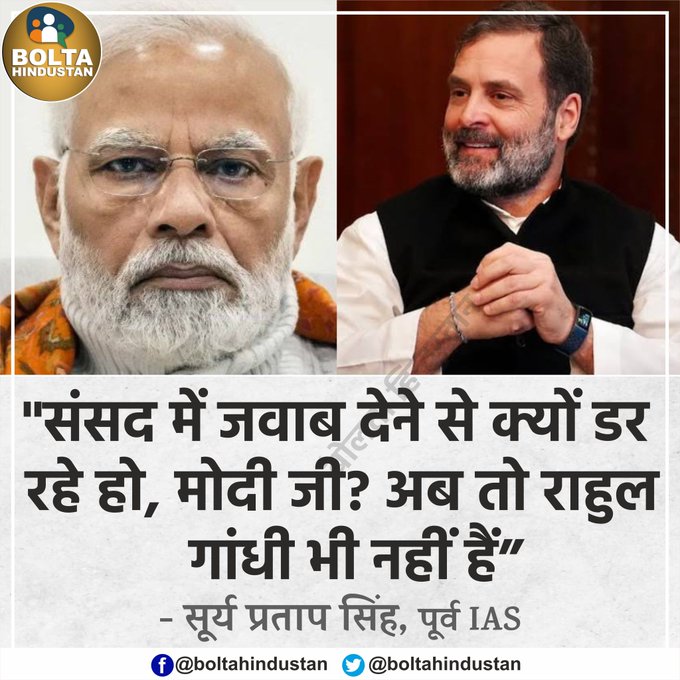
Why is PM not answering in Parliament,, even Rahul Gandhi is not there - Surya Pratap Singh, prev. IAS Officer.
The above poster/question is by Surya Pratap Singh, a retired IAS officer. He asks why the PM is unable to answer in either of the houses. As shared before, the Govt. wants very limited discussion. Even yesterday, the Lok Sabha TV just showed the BJP MP s making statements but silent or mic was off during whatever questions or statements made by the opposition. If this isn t mockery of Indian democracy then I don t know what is  Even the media landscape has been altered substantially within the last few years. Both Adani and Ambani have distributed the media pie between themselves. One of the last bastions of the free press, NDTV was bought by Adani in a hostile takeover. Both Ambani and Adani are close to this Goverment. In fact, there is no sector in which one or the other is not present. Media houses like Newsclick, The Wire etc. that are a fraction of mainstream press are where most of the youth have been going to get their news as they are not partisan. Although even there, GOI has time and again interfered. The Wire has had too many 504 Gateway timeouts in the recent months and they had been forced to move most of their journalism from online to video, rather Youtube in order to escape both the censoring and the timeouts as shared above. In such a hostile environment, how both the organizations are somehow able to survive is a miracle. Most local reportage is also going to YouTube as that s the best way for them to not get into Govt. censors. Not an ideal situation, but that s the way it is. The difference between Indian and Israeli media can be seen through this
The above is a Screenshot shared by how the Israeli media has reacted to the Israeli Government s Knesset over the judicial overhaul . Here, the press itself erodes its own by giving into the Government day and night

Binging on Webseries Saw Northshore, Three Pines, Alaska Daily and Doogie Kamealoha M.D. which is based on Doogie Howser M.D. Of the four, enjoyed Doogie Kamealoha M.D. the most but then it might be because it s a copy of Doogie Howser, just updated to the new millenia and there are some good childhood memories associated with that series. The others are also good. I tried to not see European stuff as most of them are twisted and didn t want that space.

EU Digital Operational Resilience Act and impact on FOSS Few days ago, apparently the EU shared the above Act. One can read about it more here. This would have more impact on FOSS as most development of various FOSS distributions happens in EU. Fair bit of Debian s own development happens in Germany and France. While there have been calls to make things more clearer, especially for FOSS given that most developers do foss development either on side or as a hobby while their day job is and would be different. The part about consumer electronics and FOSS is a tricky one as updates can screw up your systems. Microsoft has had a huge history of devices not working after an update or upgrade. And this is not limited to Windows as they would like to believe. Even apple seems to be having its share of issues time and time again. One would have hoped that these companies that make billions of dollars from their hardware and software sales would be doing more testing and Q&A and be more aware about security issues. FOSS, on the other hand while being more responsive doesn t make as much money vis-a-vis the competitors. Let s take the most concrete example. The most successful mobile phone having FOSS is Purism. But it s phone, it has priced itself out of the market. A huge part of that is to do with both economies of scale and trying to get an infrastructure and skills in the States where none or minimally exists. Compared that to say Pinepro that is manufactured in Hong Kong and is priced 1/3rd of the same. For most people it is simply not affordable in these times. Add to that the complexity of these modern cellphones make it harder, not easier for most people to be vigilant and update the phone at all times. Maybe we need more dumphones such as Light and Punkt but then can those be remotely hacked or not, there doesn t seem to be any answers on that one. I haven t even seen anybody even ask those questions. They may have their own chicken and egg issues. For people like me who have lost hearing, while I can navigate smartphones for now but as I become old I don t see anything that would help me. For many an elderly population, both hearing and seeing are the first to fade. There doesn t seem to be any solutions targeted for them even though they are 5-10% of any population at the very least. Probably more so in Europe and the U.S. as well as Japan and China. All of them are clearly under-served markets but dunno a solution for them. At least to me that s an open question.

30 April 2023

Russell Coker: Links April 2023

Cory Doctorow has an insightful article Gig Work is the Opposite of Steampunk [1] about the horrors that companies like Amazon are forcing on their employees. Valerie Aurora and Leigh Honeywell wrote an insightful article about the al Capone theory of sexual harassment [2]. Why people who sexually harass others usually perform other anti-social activity that is also easier to prosecute. The IEEE has an interesting article about using ML for parts of the CPU design process, both the technical issues and the controversy about competing ideas which is probably caused by sexism [3]. Love and taxes are forever my heart is a line from an anime dating sim game that prepares US taxes [4]. Unfortunately it was removed from Steam. The existence of the game is a weird social commentary and removing the game because you can t have an anime hottie do taxes is bizarre but also understandable given liability issues. There s no mention in the review of whether male hotties are available for people who prefer dating guys. As an aside my accountant looks like he is allergic to exercise The Killdozer Book web site (which has an invalid SSL certificate so you have to click on advanced in Chrome to get to the content) has an insightful article debunking some of the stories about the Killdozer [5]. He wasn t some sort of hero of freedom, he was just a jerk who reneged on a deal hoping to get more money, thought that laws shouldn t apply to him, and killed himself because of it. Apparently some big tech companies are knowingly hiring people to not work unlike the usual large corporate case of unknowingly hiring people to not work [6]. Silicon Valley is a good TV show, and it s apparently realistic. Ron Garrett wrote in insightful blog post about theoretical attacks on Bitcoin and how Bitcoin could be used [7]. The conclusion is not good for Bitcoin. Compiler Explorer is a program that shows how various C++ compilers produce assembly code for various architectures, this site hosts the main active instance [8]. There are other instances, here is an instance that produces code for the Ruzzian Elbrus architecture [9]. The Elbrus Wikipedia page is interesting [10]. Apparently the Ruzzians don t want this information to be spread, LOL. The Smithsonian Magazine has an interesting article about pet parrots being taught to video call each other [11]. Apparently parrots are social animals and can develop psychological problems if kept alone, so the video calls can be good for them. Also the owners had to monitor the chats to ensure that they played nicely together, just like play-dates for kids! Phoronix has an amusing article about the drama regarding the AMD Spectral Chicken bit in the Linux kernel source [12]. This page listing bad free software licenses is amusing [13]. The ACS has an interesting article about how Samsung fakes photos of the moon and presumably could fake other photos of notable objects that don t change [14]. The way that they proved the forgery was interesting.

28 April 2023

Shirish Agarwal: John Grisham s books, Evolution removed from textbooks

Gray Mountain John Grisham I have been perusing John Grisham s books, some read and some re-read again. Almost all of the books that Mr. Grisham wrote are relevant even today. The Gray Mountain talks about how mountain top removal was done in Applachia, the U.S. (South). In fact NASA made a summary which either was borrowed from this book or the author borrowed from NASA, either could be true although seems it might be the former. And this is when GOI just made a new Forest Conservation Bill 2023 which does the opposite. There are many examples of the same, the latest from my own city as an e.g. Vetal Tekdi is and was a haven for people animals, birds all kinds of ecosystem and is a vital lung of the city, one of the few remaining green spaces in the city but BJP wants to commercialize it as it has been doing for everything, I haven t been to the Himalayas since 4-5 years back as I hear the rape of the land daily. Even after Joshimath tragedy, if people are not opening the eyes what can I do  The more I say, the more depressed I will become so will leave it for now. In many ways the destruction seems similar to the destruction that happened in Brazil under Jair Bolsonaro. So as can be seen from what I have shared this book was mostly about environment and punitive damages and also how punitive damages have been ceiling in America (South). This was done via lobbying by the coal groups and apparently destroyed people s lives, communities, even whole villages. It also shared how most people called black lung and how those claims had been denied by Coal Companies all the time. And there are hardly any unions. While the book itself is a fiction piece, there is a large amount of truth in it. And that is one of the reasons people write a fiction book. You could write about reality using fictional names and nobody can sue you while you set the reality as it is. In many ways, it is a tell-all.

The Testament John Grisham One of the things I have loved about John Grisham is he understands human condition. In this book it starts with an eccentric billionaire who makes a will which leaves all his property to an illegitimate child who coincidentally also lives in Brazil, she is a missionary. The whole book is about human failings as well as about finding the heir. I am not going to give much detail as the book itself is fun.

The Appeal John Grisham In this, we are introduced to a company that does a chemical spill for decades and how that leads to lobbying and funding Judicial elections. It does go into quite a bit of length how private money coming from Big business does all kind of shady things to get their person elected to the Supreme Court. Sadly, this seems to happen all the time, for e.g. two weeks ago. This piece from the Atlantic also says the same. Again, won t tell as there is a bit of irony at the end of the book.

The Rainmaker John Grisham This in short is about how Insurance Companies stiff people. It s a wonderful story that has all people in grey including our hero. An engaging book that sorta tells how the Insurance Industry plays the game. In India, the companies are safe as they ask for continuance for years together and their object is to delay the hearings till the grandchildren are not alive unlike in the U.S. or UK. It also does tell how more lawyers are there then required. Both of which are the same in my country.

The Litigators John Grisham This one is about Product Liability, both medicines as well as toys for young kids. What I do find funny a bit is how the law in States allows people to file cases but doesn t protect people while in EU they try their best that if there is any controversy behind any medicine or product, they will simply ban it. Huge difference between the two cultures.

Evolution no longer part of Indian Education A few days ago, NCERT (one of the major bodies) that looks into Indian Education due to BJP influence has removed Darwin s Theory of Evolution. You can t even debate because the people do not understand adaptability. So the only conclusion is that Man suddenly appeared out of nowhere. If that is so, then we are the true aliens. They discard the notion that we and Chimpanzees are similar. Then they also have to discard this finding that genetically we are 96% similar.

19 April 2023

Ian Jackson: The Rust Foundation's bad draft trademark policy

tl;dr The Rust Foundation s proposed new trademark policy is far too restrictive, and will cause (more) drama unless it is substantially revised. Process Rust is a trademark owned by the Foundation. The Rust Foundation still seems to be finding its feet. Evidently, one of the items on its backlog was to update the trademark policy. Apparently they have been working on this for some time, in an informal working group. In August, there was a survey. (I saw it in This Week In Rust, the community-curated newsletter where most important stuff appears, and responded.) I don t think the results of this survey have been published anywhere. Last week (12th April) the Foundation published an official Inside Rust blog post linking to a draft. They included a link to a feedback survey, closing on the 17th of April i.e., it was open for 5 days. This is far too short a period for formal feedback on such a draft. Especially given that this process has apparently already been generating significant controversy within parts of the Rust community. Substance Overall, this policy is poor. It is far too restrictive. It is likely to lead to (further) controversy and argument, including conflicts with Rust s downstreams. It does not serve the needs of the Rust community. In particular, the Rust community does not need the trademark to: The community does need the trademark to: It might be useful to use the trademark to strengthen licensing or CoC compliance. For example, good faith redistributions of a modified Rust, as Rust , would be Free Software, even though the copyright licence permits proprietary derivatives; so use of the Rust trademark should probably require use of a Free licence. There should be a series of blanket permissions to use the word Rust in for example: Currently there aren t. For example the current Debian practice of calling Rust libraries rust-<name-of-crate> is probably in violation. There are a number of more detailed problems with the wording. Values The policy has all the hallmarks of excessive influence from traditional trademark lawyers and not enough influence from the Free Software community. I would like to remind the Free Software activists on the inside of this process that the lawyers are there to serve you and the community. The values embodied in trademark law often conflict with the values of the Free Software community. The Rust Project should adopt a trademark policy which follows the community s values - even if that might weaken our ability to sue evildoers. Next steps The Foundation should take a step back and pause the process. Then, the Foundation should restart the process from a much earlier stage, with much wider publicity. Each stage should be widely advertised to the whole community, with opportunities for feedback. This should include publishing the results of the August 2022 survey. The Foundation should publish a sketch of the legal advice they have received, publicly say what the plausible options are and what their consequences might be (for the community, for downstreams, and for the Foundation s enforcement ability). (Some of this will no doubt repeat the work that has been done in the informal trademark working group. That work wasn t widely enough advertised.) Echoes of a dispute from 2006 Mozilla made a very similar mistake with Firefox in 2006. The official policy stated that no-one was allowed to distribute Firefox with any patches, unless those patches had been pre-approved by Mozilla. Debian is committed to Software Freedom. This must includes the freedom to modify the software as one sees fit, even if the original authors don t agree. Now, overly-restrictive trademark policies are hardly new. Debian often takes the practical view that usually the upstream with such a policy doesn t really mean it. But Mozilla decided they did mean it. They contacted Debian asking for Debian to get their patches approved. Since that wasn t acceptable to Debian, they stopped using the word Firefox . For a decade, Debian s Firefox browser was called Iceweasel . We don t want something similar happening to Rust .

comment count unavailable comments

19 March 2023

Russ Allbery: Review: Allow Me to Retort

Review: Allow Me to Retort, by Elie Mystal
Publisher: The New Press
Copyright: 2022
ISBN: 1-62097-690-0
Format: Kindle
Pages: 257
If you're familiar with Elie Mystal's previous work (writer for The Nation, previously editor for Above the Law, Twitter gadfly, and occasional talking head on news commentary programs), you'll have a good idea what to expect from this book: pointed liberal commentary, frequently developing into rants once he works up a head of steam. The subtitle of A Black Guy's Guide to the Constitution tells you that the topic is US constitutional law, which is very on brand. You're going to get succinct and uncompromising opinions at the intersection of law and politics. If you agree with them, you'll probably find them funny; if you disagree with them, you'll probably find them infuriating. In other words, Elie Mystal is the sort of writer one reads less for "huh, I disagreed with you but that's a good argument" and more for "yeah, you tell 'em, Elie!" I will be very surprised if this book changes anyone's mind about a significant political debate. I'm not sure if people who disagree are even in the intended audience. I'm leery of this sort of book. Usually its function is to feed confirmation bias with some witty rejoinders and put-downs that only sound persuasive to people who already agree with them. If I want that, I can just read Twitter (and you will be unsurprised to know that Mystal has nearly 500,000 Twitter followers). This style can also be boring at book length if the author is repeating variations on a theme. There is indeed a lot of that here, particularly in the first part of this book. If you don't generally agree with Mystal already, save yourself the annoyance and avoid this like the plague. It's just going to make you mad, and I don't think you're going to get anything useful out of it. But as I got deeper into this book, I think Mystal has another, more interesting purpose that's aimed at people who do largely agree. He's trying to undermine a very common US attitude (even on the left) about the US constitution. I don't know if most people from the US (particularly if they're white and male) realize quite how insufferably smug we tend to be about the US constitution. When you grow up here, the paeans to the constitution and the Founding Fathers (always capitalized like deities) are so ubiquitous and unremarked that it's difficult not to absorb them at a subconscious level. There is a national mythology about the greatness of our charter of government that crosses most political divides. In its modern form, this comes with some acknowledgment that some of its original provisions (the notorious three-fifths of a person clause, for instance) were bad, but we subsequently fixed them and everything is good now. Nearly everyone gets taught this in school, and it's almost never challenged. Even the edifices of the US left, such as the ACLU and the NAACP, tend to wrap themselves in the constitution. It's an enlightening experience to watch someone from the US corner a European with a discussion of the US constitution and watch the European plan escape routes while their soul attempts to leave their body. And I think it's telling that having that experience, as rare as it might be given how oblivious we can be, is still more common than a white person having a frank conversation with a black person in the US about the merits of the constitution as written. For various reasons, mostly because this is not very safe for the black person, this rarely happens. This book is primarily Mystal giving his opinion on various current controversies in constitutional law, but the underlying refrain is that the constitution is a trash document written by awful people that sets up a bad political system. That system has been aggressively defended by reactionary Supreme Courts, which along with the designed difficulty of the amendment process has prevented fixing many obviously broken parts. This in turn has led to numerous informal workarounds and elaborate "interpretations" to attempt to make the system vaguely functional. In other words, Mystal is trying to tell the US reader to stop being so precious about this specific document, and is using its truly egregious treatment of black people as the main fulcrum for his argument. Along the way, he gives an abbreviated tour of the highlights of constitutional law, but if you're at all interested in politics you've probably heard most of that before. The main point, I think, is to dig up any reverence left over from a US education, haul it out into the light of day, and compare it to the obvious failures of the constitution as a body of law and the moral failings of its authors. Mystal then asks exactly why we should care about original intent or be so reluctant to change the resulting system of government. (Did I mention you should not bother with this book if you don't agree with Mystal politically? Seriously, don't do that to yourself.) Readers of my reviews will know that I'm fairly far to the left politically, particularly by US standards, and yet I found it fascinating how much lingering reverence Mystal managed to dig out of me while reading this book. I found myself getting defensive in places, which is absurd because I didn't write this document. But I grew up surrounded by nigh-universal social signaling that the US constitution was the greatest political document ever, and in a religious tradition that often argued that it was divinely inspired. If one is exposed to enough of this, it becomes part of your background understanding of the world. Sometimes it takes someone being deliberately provocative to haul it back up to the surface where it can be examined. This book is not solely a psychological intervention in national mythology. Mystal gets into detailed legal arguments as well. I thought the most interesting was the argument that the bizarre and unconvincing "penumbras" and "emanations" reasoning in Griswold v. Connecticut (which later served as the basis of Roe v. Wade) was in part because the Lochner era Supreme Court had, in the course of trying to strike down all worker protection laws, abused the concept of substantive due process so badly that Douglas was unwilling to use it in the majority opinion and instead made up entirely new law. Mystal argues that the Supreme Court should have instead tackled the true meaning of substantive due process head-on and decided Griswold on 14th Amendment equal protection and substantive due process grounds. This is probably a well-known argument in legal circles, but I'd not run into it before (and Mystal makes it far more interesting and entertaining than my summary). Mystal also joins the tradition of thinking of the Reconstruction Amendments (the 13th, 14th, and 15th amendments passed after the Civil War) as a second revolution and an attempt to write a substantially new constitution on different legal principles, an attempt that subsequently failed in the face of concerted and deadly reactionary backlash. I first encountered this perspective via Jamelle Bouie, and it added a lot to my understanding of Reconstruction to see it as a political fight about the foundational principles of US government in addition to a fight over continuing racism in the US south. Maybe I was unusually ignorant of it (I know I need to read W.E.B. DuBois), but I think this line of reasoning doesn't get enough attention in popular media. Mystal provides a good introduction. But, that being said, Allow Me to Retort is more of a vibes book than an argument. As in his other writing, Mystal focuses on what he sees as the core of a controversy and doesn't sweat the details too much. I felt like he was less trying to convince me and more trying to model a different way of thinking and talking about constitutional law that isn't deferential to ideas that are not worthy of deference. He presents his own legal analysis and possible solutions to current US political challenges, but I don't think the specific policy proposals are the strong part of this book. The point, instead, is to embrace a vigorous politics based on a modern understanding of equality, democracy, and human rights, without a lingering reverence for people who mostly didn't believe in any of those things. The role of the constitution in that politics is a flawed tool rather than a sacred text. I think this book is best thought of as an internal argument in the US left. That argument is entirely within the frame of the US legal tradition, so if you're not in the US, it will be of academic interest at best (and probably not even that). If you're on the US right, Mystal offers lots of provocative pull quotes to enjoy getting outraged over, but he provides that service on Twitter for free. But if you are on the US left, I think Allow Me to Retort is worth more consideration than I'd originally given it. There's something here about how we engage with our legal history, and while Mystal's approach is messy, maybe that's the only way you can get at something that's more emotion than logic. In some places it degenerates into a Twitter rant, but Mystal is usually entertaining even when he's ranting. I'm not sorry I read it. Rating: 7 out of 10

8 February 2023

Chris Lamb: Most anticipated films of 2023

Very few highly-anticipated movies appear in January and February, as the bigger releases are timed so they can be considered for the Golden Globes in January and the Oscars in late February or early March, so film fans have the advantage of a few weeks after the New Year to collect their thoughts on the year ahead. In other words, I'm not actually late in outlining below the films I'm most looking forward to in 2023...

Barbie No, seriously! If anyone can make a good film about a doll franchise, it's probably Greta Gerwig. Not only was Little Women (2019) more than admirable, the same could be definitely said for Lady Bird (2017). More importantly, I can't help feel she was the real 'Driver' behind Frances Ha (2012), one of the better modern takes on Claudia Weill's revelatory Girlfriends (1978). Still, whenever I remember that Barbie will be a film about a billion-dollar toy and media franchise with a nettlesome history, I recall I rubbished the "Facebook film" that turned into The Social Network (2010). Anyway, the trailer for Barbie is worth watching, if only because it seems like a parody of itself.

Blitz It's difficult to overstate just how important the aerial bombing of London during World War II is crucial to understanding the British psyche, despite it being a constructed phenomenon from the outset. Without wishing to underplay the deaths of over 40,000 civilian deaths, Angus Calder pointed out in the 1990s that the modern mythology surrounding the event "did not evolve spontaneously; it was a propaganda construct directed as much at [then neutral] American opinion as at British." It will therefore be interesting to see how British Grenadian Trinidadian director Steve McQueen addresses a topic so essential to the British self-conception. (Remember the controversy in right-wing circles about the sole Indian soldier in Christopher Nolan's Dunkirk (2017)?) McQueen is perhaps best known for his 12 Years a Slave (2013), but he recently directed a six-part film anthology for the BBC which addressed the realities of post-Empire immigration to Britain, and this leads me to suspect he sees the Blitz and its surrounding mythology with a more critical perspective. But any attempt to complicate the story of World War II will be vigorously opposed in a way that will make the recent hullabaloo surrounding The Crown seem tame. All this is to say that the discourse surrounding this release may be as interesting as the film itself.

Dune, Part II Coming out of the cinema after the first part of Denis Vileneve's adaptation of Dune (2021), I was struck by the conception that it was less of a fresh adaptation of the 1965 novel by Frank Herbert than an attempt to rehabilitate David Lynch's 1984 version and in a broader sense, it was also an attempt to reestablish the primacy of cinema over streaming TV and the myriad of other distractions in our lives. I must admit I'm not a huge fan of the original novel, finding within it a certain prurience regarding hereditary military regimes and writing about them with a certain sense of glee that belies a secret admiration for them... not to mention an eyebrow-raising allegory for the Middle East. Still, Dune, Part II is going to be a fantastic spectacle.

Ferrari It'll be curious to see how this differs substantially from the recent Ford v Ferrari (2019), but given that Michael Mann's Heat (1995) so effectively re-energised the gangster/heist genre, I'm more than willing to kick the tires of this about the founder of the eponymous car manufacturer. I'm in the minority for preferring Mann's Thief (1981) over Heat, in part because the former deals in more abstract themes, so I'd have perhaps prefered to look forward to a more conceptual film from Mann over a story about one specific guy.

How Do You Live There are a few directors one can look forward to watching almost without qualification, and Hayao Miyazaki (My Neighbor Totoro, Kiki's Delivery Service, Princess Mononoke Howl's Moving Castle, etc.) is one of them. And this is especially so given that The Wind Rises (2013) was meant to be the last collaboration between Miyazaki and Studio Ghibli. Let's hope he is able to come out of retirement in another ten years.

Indiana Jones and the Dial of Destiny Given I had a strong dislike of Indiana Jones and the Kingdom of the Crystal Skull (2008), I seriously doubt I will enjoy anything this film has to show me, but with 1981's Raiders of the Lost Ark remaining one of my most treasured films (read my brief homage), I still feel a strong sense of obligation towards the Indiana Jones name, despite it feeling like the copper is being pulled out of the walls of this franchise today.

Kafka I only know Polish filmmaker Agnieszka Holland through her Spoor (2017), an adaptation of Olga Tokarczuk's 2009 eco-crime novel Drive Your Plow Over the Bones of the Dead. I wasn't an unqualified fan of Spoor (nor the book on which it is based), but I am interested in Holland's take on the life of Czech author Franz Kafka, an author enmeshed with twentieth-century art and philosophy, especially that of central Europe. Holland has mentioned she intends to tell the story "as a kind of collage," and I can hope that it is an adventurous take on the over-furrowed biopic genre. Or perhaps Gregor Samsa will awake from uneasy dreams to find himself transformed in his bed into a huge verminous biopic.

The Killer It'll be interesting to see what path David Fincher is taking today, especially after his puzzling and strangely cold Mank (2020) portraying the writing process behind Orson Welles' Citizen Kane (1941). The Killer is said to be a straight-to-Netflix thriller based on the graphic novel about a hired assassin, which makes me think of Fincher's Zodiac (2007), and, of course, Se7en (1995). I'm not as entranced by Fincher as I used to be, but any film with Michael Fassbender and Tilda Swinton (with a score by Trent Reznor) is always going to get my attention.

Killers of the Flower Moon In Killers of the Flower Moon, Martin Scorsese directs an adaptation of a book about the FBI's investigation into a conspiracy to murder Osage tribe members in the early years of the twentieth century in order to deprive them of their oil-rich land. (The only thing more quintessentially American than apple pie is a conspiracy combined with a genocide.) Separate from learning more about this disquieting chapter of American history, I'd love to discover what attracted Scorsese to this particular story: he's one of the few top-level directors who have the ability to lucidly articulate their intentions and motivations.

Napoleon It often strikes me that, despite all of his achievements and fame, it's somehow still possible to claim that Ridley Scott is relatively underrated compared to other directors working at the top level today. Besides that, though, I'm especially interested in this film, not least of all because I just read Tolstoy's War and Peace (read my recent review) and am working my way through the mind-boggling 431-minute Soviet TV adaptation, but also because several auteur filmmakers (including Stanley Kubrick) have tried to make a Napoleon epic and failed.

Oppenheimer In a way, a biopic about the scientist responsible for the atomic bomb and the Manhattan Project seems almost perfect material for Christopher Nolan. He can certainly rely on stars to queue up to be in his movies (Robert Downey Jr., Matt Damon, Kenneth Branagh, etc.), but whilst I'm certain it will be entertaining on many fronts, I fear it will fall into the well-established Nolan mould of yet another single man struggling with obsession, deception and guilt who is trying in vain to balance order and chaos in the world.

The Way of the Wind Marked by philosophical and spiritual overtones, all of Terrence Malick's films are perfumed with themes of transcendence, nature and the inevitable conflict between instinct and reason. My particular favourite is his stunning Days of Heaven (1978), but The Thin Red Line (1998) and A Hidden Life (2019) also touched me ways difficult to relate, and are one of the few films about the Second World War that don't touch off my sensitivity about them (see my remarks about Blitz above). It is therefore somewhat Malickian that his next film will be a biblical drama about the life of Jesus. Given Malick's filmography, I suspect this will be far more subdued than William Wyler's 1959 Ben-Hur and significantly more equivocal in its conviction compared to Paolo Pasolini's ardently progressive The Gospel According to St. Matthew (1964). However, little beyond that can be guessed, and the film may not even appear until 2024 or even 2025.

Zone of Interest I was mesmerised by Jonathan Glazer's Under the Skin (2013), and there is much to admire in his borderline 'revisionist gangster' film Sexy Beast (2000), so I will definitely be on the lookout for this one. The only thing making me hesitate is that Zone of Interest is based on a book by Martin Amis about a romance set inside the Auschwitz concentration camp. I haven't read the book, but Amis has something of a history in his grappling with the history of the twentieth century, and he seems to do it in a way that never sits right with me. But if Paul Verhoeven's Starship Troopers (1997) proves anything at all, it's all in the adaption.

22 January 2023

Dirk Eddelbuettel: BH 1.81.0-1 oon CRAN: New Upstream, New Library, sprintf Change

Boost Boost is a very large and comprehensive set of (peer-reviewed) libraries for the C++ programming language, containing well over one hundred individual libraries. The BH package provides a sizeable subset of header-only libraries for (easier, no linking required) use by R. It is fairly widely used: the (partial) CRAN mirror logs (aggregated from the cloud mirrors) show over 32.6 million package downloads. Version 1.81.0 of Boost was released in December following the regular Boost release schedule of April, August and December releases. As the commits and changelog show, we packaged it almost immediately and started testing following our annual update cycle which strives to balance being close enough to upstream and not stressing CRAN and the user base too much. The reverse depends check revealed about a handful of packages requiring changes or adjustments which is a pretty good outcome given the over three hundred direct reverse dependencies. So we opened issue #88 to coordinate the issue over the winter break during which CRAN also closes (just as we did before), and also send a wider PSA tweet as a heads-up. Our sincere thanks to the two packages that already updated, and the four that likely will soon. Our thanks also to CRAN for reviewing the package impact over the last few days since I uploaded the package earlier this week. There are a number of changes I have to make each time in BH, and it is worth mentioning them. Because CRAN cares about backwards compatibility and the ability to be used on minimal or older systems, we still adjust the filenames of a few files to fit a jurassic constraints of just over a 100 characters per filepath present in some long-outdated versions of tar. Not a big deal. We also, and that is more controversial, silence a number of #pragma diagnostic messages for g++ and clang++ because CRAN insists on it. I have no choice in that matter. Next, and hopefully this time only, we also found and replaced a few remaining sprintf uses and replaced them with snprintf. Many of the Boost libraries did that, so I hope by the next upgrade for Boost 1.84.0 next winter this will be fully taken care of. Lastly, and also only this time, we silenced a warning about Boost switching to C++14 in the next release 1.82.0 in April. This may matter for a number of packages having a hard-wired selection of C++11 as their C++ language standard. Luckily our compilers are good enough for C++14 so worst case I will have to nudge a few packages next December. This release adds one new library for url processing which struck us as potentially quite useful. The more detailed NEWS log follows.

Changes in version 1.81.0-1 (2023-01-17)
  • Upgrade to Boost 1.81.0 (#87)
  • Added url (new in 1.81.0)
  • Converted remaining sprintf to snprintf (#90 fixing #89)
  • Comment-out gcc warning messages in three files

Via my CRANberries, there is a diffstat report relative to the previous release. Comments and suggestions about BH are welcome via the issue tracker at the GitHub repo. If you like this or other open-source work I do, you can now sponsor me at GitHub.

This post by Dirk Eddelbuettel originated on his Thinking inside the box blog. Please report excessive re-aggregation in third-party for-profit settings.

8 January 2023

Russ Allbery: Review: Postwar

Review: Postwar, by Tony Judt
Publisher: Penguin Books
Copyright: 2005
ISBN: 1-4406-2476-3
Format: Kindle
Pages: 835
Tony Judt (1948 2010) was a British-American historian and Erich Maria Remarque Professor in European Studies at New York University. Postwar is his magnum opus, a history of Europe from 1945 to 2005. A book described as a history of Europe could be anything from a textbook to a political analysis, so the first useful question to ask is what sort of history. That's a somewhat difficult question to answer. Postwar mentions a great deal of conventional history, including important political movements and changes of government, but despite a stated topic that would suit a survey textbook, it doesn't provide that sort of list of facts and dates. Judt expects the reader to already be familiar with the broad outlines of modern European history. However, Postwar is also not a specialty history and avoids diving too deep into any one area. Trends in art, philosophy, and economics are all mentioned to set a broader context, but still only at the level of a general survey. My best description is that Postwar is a comprehensive social and political history that attempts to focus less on specific events and more on larger trends of thought. Judt grounds his narrative in concrete, factual events, but the emphasis is on how those living in Europe, at each point in history, thought of their society, their politics, and their place in both. Most of the space goes to exploring those nuances of thought and day-to-day life. In the US university context, I'd place this book as an intermediate-level course in modern European history, after the survey course that provides students with a basic framework but before graduate-level specializations in specific topics. If you have not had a solid basic education in European history (and my guess is that most people from the US have not), Judt will provide the necessary signposts, but you should expect to need to look up the signposts you don't recognize. I, as the dubious beneficiary of a US high school history education now many decades in the past, frequently resorted to Wikipedia for additional background. Postwar uses a simple chronological structure in four parts: the immediate post-war years and the beginning of the Cold War (1945 1953), the era of rapidly growing western European prosperity (1953 1971), the years of recession and increased turmoil leading up to the collapse of communism (1971 1989), and the aftermath of the collapse of communism and the rise of the European Union (1989 2005). Each part is divided into four to eight long chapters that trace a particular theme. Judt usually starts with the overview of a theme and then follows the local manifestations of it on a spiral through European countries in whatever order seems appropriate. For the bulk of the book that covers the era of the Cold War, when experiences were drastically different inside or outside the Soviet bloc, he usually separates western and eastern Europe into alternating chapters. Reviewing this sort of book is tricky because so much will depend on how well you already know the topic. My interest in history is strictly amateur and I tend to avoid modern history (usually I find it too depressing), so for me this book was remedial, filling in large knowledge gaps that I ideally shouldn't have had. Postwar was a runner up for the Pulitzer Prize for General Non-Fiction, so I think I'm safe saying you won't go far wrong reading it, but here's the necessary disclaimer that the rest of my reactions may not be useful if you're better versed in modern European history than I was. (This would not be difficult.) That said, I found Postwar invaluable because of its big-picture focus. The events and dates are easy enough to find on the Internet; what was missing for me in understanding Europe was the intent and social structures created by and causing those events. For example, from early in the book:
On one thing, however, all were agreed resisters and politicians alike: "planning". The disasters of the inter-war decades the missed opportunities after 1918, the great depression that followed the stock-market crash of 1929, the waste of unemployment, the inequalities, injustices and inefficiencies of laissez-faire capitalism that had led so many into authoritarian temptation, the brazen indifference of an arrogant ruling elite and the incompetence of an inadequate political class all seemed to be connected by the utter failure to organize society better. If democracy was to work, if it was to recover its appeal, it would have to be planned.
It's one thing to be familiar with the basic economic and political arguments between degrees of free market and planned economies. It's quite another to understand how the appeal of one approach or the discredit of another stems from recent historical experience, and that's what a good history can provide. Judt does not hesitate to draw these sorts of conclusions, and I'm sure some of them are controversial. But while he's opinionated, he's rarely ideological, and he offers no grand explanations. His discussion of the Yugoslav Wars stands out as an example: he mentions various theories of blame (a fraught local ethnic history, the decision by others to not intervene until the situation was truly dire), but largely discards them. Judt's offered explanation is that local politicians saw an opportunity to gain power by inflaming ethnic animosity, and a large portion of the population participated in this process, either passively or eagerly. Other explanations are both unnecessarily complex and too willing to deprive Yugoslavs of agency. I found this refreshingly blunt. When is more complex analysis a way to diffuse responsibility and cling to an ideological fantasy that the right foreign policy would have resolved a problem? A few personal grumblings do creep in, particularly in the chapters on the 1970s (and I think it's not a coincidence that this matches Judt's own young adulthood, a time when one is prone to forming a lot of opinions). There is a brief but stinging criticism of postmodernism in scholarship, which I thought was justified but probably incomplete, and a decidedly grumpy dismissal of punk music, which I thought was less fair. But these are brief asides that don't detract from the overall work. Indeed, they, along with the occasional wry asides ("respecting long-established European practice, no one asked the Poles for their views [on Poland's new frontiers]") add a lot of character. Insofar as this book has a thesis, it's in the implications of the title: Europe only exited the postwar period at the end of the 20th century. Political stability through exhaustion, the overwhelming urgency of economic recovery, and the degree to which the Iron Curtain and the Cold War froze eastern Europe in amber meant that full European recovery from World War II was drawn out and at times suspended. It's only after 1989 and its subsequent upheavals that European politics were able to move beyond postwar concerns. Some of that movement was a reemergence of earlier European politics of nations and ethnic conflict. But, new on the scene, was a sense of identity as Europeans, one that western Europe circled warily and eastern Europe saw as the only realistic path forward.
What binds Europeans together, even when they are deeply critical of some aspect or other of its practical workings, is what it has become conventional to call in disjunctive but revealing contrast with "the American way of life" the "European model of society".
Judt also gave me a new appreciation of how traumatic people find the assignment of fault, and how difficult it is to wrestle with guilt without providing open invitations to political backlash. People will go to great lengths to not feel guilty, and pressing the point runs a substantial risk of creating popular support for ideological movements that are willing to lie to their followers. The book's most memorable treatment of this observation is in the epilogue, which traces popular European attitudes towards the history of the Holocaust through the whole time period. The largest problem with this book is that it is dense and very long. I'm a fairly fast reader, but this was the only book I read through most of my holiday vacation and it still took a full week into the new year to finish it. By the end, I admit I was somewhat exhausted and ready to be finished with European history for a while (although the epilogue is very much worth waiting for). If you, unlike me, can read a book slowly among other things, that may be a good tactic. But despite feeling like this was a slog at times, I'm very glad that I read it. I'm not sure if someone with a firmer grounding in European history would have gotten as much out of it, but I, at least, needed something this comprehensive to wrap my mind around the timeline and fill in some embarrassing gaps. Judt is not the most entertaining writer (although he has his moments), and this is not the sort of popular history that goes out of its way to draw you in, but I found it approachable and clear. If you're looking for a solid survey of modern European history with this type of high-level focus, recommended. Rating: 8 out of 10

31 December 2022

Chris Lamb: Favourite films of 2022

In my four most recent posts, I went over the memoirs and biographies, the non-fiction, the fiction and the 'classic' fiction I enjoyed reading in 2022. But in the very last of my roundup posts and in relatively less detail I'll be quickly sketching out the favourite movies that were new to me in 2022:

La Ronde (1950) An all-knowing narrator (Adolf Wohlbr ck) guides us through a series of vignettes in 1900s Vienna a soldier meets an eager young lady of the evening, and later he has an affair with a young lady who becomes a maid and who then does similarly with the young man of the house. On and on it goes, spinning on the carousel of life. A wonderfully beguiling movie, and a reminder that 'innocent' and 'charming' doesn't always imply 'childish'.

A Man Escaped (1956) A Man Escaped is the story of a WW2 resistance fighter who wishes to escape from a prison. Filmed in Robert Bresson's quasi-minimalistic style (and touching on his usual themes of Christian redemption), this deceptively simple-looking film rewards deeper analysis.

The Music Room (1958) In The Music Room, Satyajit Ray (best known for his Apu Trilogy) tells the story of a wealthy landlord who lives a decadent life with his wife and son. His passion is for music, however, and he spends a significant portion of his fortune on concerts held for the locals in his magnificent music room (or 'jalsaghar). However, his obsession for music (and its attendant quest for respect from his peers) is his eventual undoing, as he sacrifices both his family and wealth whilst trying to retain it. Indeed, The Music Room is less of an examination of a single rich man (or of the hypnotic sitar music by Vilayat Khan) than of the dying Bengali landowning class, which I read as symbolic of what was about to vanish from Indian culture in the post-Independence drive toward modernity. Still, this is a multi-layered and textured film, as this is also an intensely moving portrait of a highly-detached man as well.

The Hustler (1961) 'Fast Eddie' Felson is a small-time pool hustler with a lot of talent but a self-destructive attitude. His bravado causes him to challenge the legendary Minnesota Fats to a high-stakes match. The stakes are always much bigger than just money though, as Fast Eddie's ego is on the line. Despite not caring so much about the game, I was completely gripped by Paul Newman's superb performance. Almost certainly the best film about pool ever made, and probably the best sports film as well.

Picnic at Hanging Rock (1975) One Valentine's Day in early-1900s Australia, an upper-class school takes its girls on a field trip to a scenic volcanic formation in the middle of the brush. Despite all the rules against it, however, several of the girls venture off onto the rock, and it's not until the end of the day that the group realises some of the girls and one of the teachers have disappeared without a trace. A mesmerising film about colonialism, sexual repression and Antonioni-esque alienation, Picnic at Hanging Rock's dreamlike aesthetic is haunting.

Jeanne Dielman, 23, quai du Commerce, 1080 Bruxelles (1976) Jeanne Dielman is a three-and-a-half-hour film that shows a widowed housewife doing her daily chores and taking care of her apartment. Yet in its uncompromising nature, it raises the tedium of her life to the level of profundity. I watched this radically political film a few months before it was recently voted as the 'greatest of all time'), but despite its relentless rigorous nature (and long running time), the conclusion when it comes is shattering.

Raise the Red Lantern (1991) Set in China during the 1920s, Raise the Red Lantern tells the story of a young woman who has become the new concubine of a wealthy man. However, as he has three wives already (each living in a separate house within his castle) she becomes are engaged in an extremely complicated competition attention and the privileges that come with it. Richly colourful, both in its visuals and symbolism, this is film both specifically about China at the time and human universals.

Moonlight (2016) A heartbreaking story of a young man's struggle to find himself, told across three defining chapters in his life as he experiences the pain and beauty of falling in love, whilst grappling with his own sexuality within the ambient weather of race and class in the United States. Absolutely spellbinding and visually stunning.

Drive My Car (2021) Yusuke Kafuku is a stage director who is unable to cope with the loss of his wife, and has therefore accepted an invitation to direct Anton Chekhov's [Uncle Vanya][https://en.wikipedia.org/wiki/Uncle_Vanya] at a festival in Hiroshima, Japan. Yet whilst many reviewers have focused on the compelling relationship between Yusuke and Misaki (the introverted young woman who has been appointed to drive his car), what I found devastating was the embedded meditation on language, communication, understanding and empathy, especially concerning what happens when these break down or are no longer possible. Drive My Car touches on the limits of each of these phenomena connecting to the next: being able to speak the same language as another doesn't mean you can communicate with them; and being able to communicate doesn't mean you can understand someone, let alone empathise with them. All of this through the near-ungraspable emotion of grief as well, and the portion of this film where the actress was silently employing Korean Sign Language was the most moving thing I saw this year.

30 December 2022

Chris Lamb: Favourite books of 2022: Non-fiction

In my three most recent posts, I went over the memoirs and biographies, classics and fiction books that I enjoyed the most in 2022. But in the last of my book-related posts for 2022, I'll be going over my favourite works of non-fiction. Books that just missed the cut here include Adam Hochschild's King Leopold's Ghost (1998) on the role of Leopold II of Belgium in the Congo Free State, Johann Hari's Stolen Focus (2022) (a personal memoir on relating to how technology is increasingly fragmenting our attention), Amia Srinivasan's The Right to Sex (2021) (a misleadingly named set of philosophic essays on feminism), Dana Heller et al.'s The Selling of 9/11: How a National Tragedy Became a Commodity (2005), John Berger's mindbending Ways of Seeing (1972) and Louise Richardson's What Terrorists Want (2006).

The Great War and Modern Memory (1975)
Wartime: Understanding and Behavior in the Second World War (1989) Paul Fussell Rather than describe the battles, weapons, geopolitics or big personalities of the two World Wars, Paul Fussell's The Great War and Modern Memory & Wartime are focused instead on how the two wars have been remembered by their everyday participants. Drawing on the memoirs and memories of soldiers and civilians along with a brief comparison with the actual events that shaped them, Fussell's two books are a compassionate, insightful and moving piece of analysis. Fussell primarily sets himself against the admixture of nostalgia and trauma that obscures the origins and unimaginable experience of participating in these wars; two wars that were, in his view, a "perceptual and rhetorical scandal from which total recovery is unlikely." He takes particular aim at the dishonesty of hindsight:
For the past fifty years, the Allied war has been sanitised and romanticised almost beyond recognition by the sentimental, the loony patriotic, the ignorant and the bloodthirsty. I have tried to balance the scales. [And] in unbombed America especially, the meaning of the war [seems] inaccessible.
The author does not engage in any of the customary rose-tinted view of war, yet he remains understanding and compassionate towards those who try to locate a reason within what was quite often senseless barbarism. If anything, his despondency and pessimism about the Second World War (the war that Fussell himself fought in) shines through quite acutely, and this is especially the case in what he chooses to quote from others:
"It was common [ ] throughout the [Okinawa] campaign for replacements to get hit before we even knew their names. They came up confused, frightened, and hopeful, got wounded or killed, and went right back to the rear on the route by which they had come, shocked, bleeding, or stiff. They were forlorn figures coming up to the meat grinder and going right back out of it like homeless waifs, unknown and faceless to us, like unread books on a shelf."
It would take a rather heartless reader to fail to be sobered by this final simile, and an even colder one to view Fussell's citation of such an emotive anecdote to be manipulative. Still, stories and cruel ironies like this one infuse this often-angry book, but it is not without astute and shrewd analysis as well, especially on the many qualitative differences between the two conflicts that simply cannot be captured by facts and figures alone. For example:
A measure of the psychological distance of the Second [World] War from the First is the rarity, in 1914 1918, of drinking and drunkenness poems.
Indeed so. In fact, what makes Fussell's project so compelling and perhaps even unique is that he uses these non-quantitive measures to try and take stock of what happened. After all, this was a war conducted by humans, not the abstract school of statistics. And what is the value of a list of armaments destroyed by such-and-such a regiment when compared with truly consequential insights into both how the war affected, say, the psychology of postwar literature ("Prolonged trench warfare, whether enacted or remembered, fosters paranoid melodrama, which I take to be a primary mode in modern writing."), the specific words adopted by combatants ("It is a truism of military propaganda that monosyllabic enemies are easier to despise than others") as well as the very grammar of interaction:
The Field Service Post Card [in WW1] has the honour of being the first widespread exemplary of that kind of document which uniquely characterises the modern world: the "Form". [And] as the first widely known example of dehumanised, automated communication, the post card popularised a mode of rhetoric indispensable to the conduct of later wars fought by great faceless conscripted armies.
And this wouldn't be a book review without argument-ending observations that:
Indicative of the German wartime conception [of victory] would be Hitler and Speer's elaborate plans for the ultimate reconstruction of Berlin, which made no provision for a library.
Our myths about the two world wars possess an undisputed power, in part because they contain an essential truth the atrocities committed by Germany and its allies were not merely extreme or revolting, but their full dimensions (embodied in the Holocaust and the Holodomor) remain essentially inaccessible within our current ideological framework. Yet the two wars are better understood as an abyss in which we were all dragged into the depths of moral depravity, rather than a battle pitched by the forces of light against the forces of darkness. Fussell is one of the few observers that can truly accept and understand this truth and is still able to speak to us cogently on the topic from the vantage point of experience. The Second World War which looms so large in our contemporary understanding of the modern world (see below) may have been necessary and unavoidable, but Fussell convinces his reader that it was morally complicated "beyond the power of any literary or philosophic analysis to suggest," and that the only way to maintain a na ve belief in the myth that these wars were a Manichaean fight between good and evil is to overlook reality. There are many texts on the two World Wars that can either stir the intellect or move the emotions, but Fussell's two books do both. A uniquely perceptive and intelligent commentary; outstanding.

Longitude (1995) Dava Sobel Since Man first decided to sail the oceans, knowing one's location has always been critical. Yet doing so reliably used to be a serious problem if you didn't know where you were, you are far more likely to die and/or lose your valuable cargo. But whilst finding one's latitude (ie. your north south position) had effectively been solved by the beginning of the 17th century, finding one's (east west) longitude was far from trustworthy in comparison. This book first published in 1995 is therefore something of an anachronism. As in, we readily use the GPS facilities of our phones today without hesitation, so we find it difficult to imagine a reality in which knowing something fundamental like your own location is essentially unthinkable. It became clear in the 18th century, though, that in order to accurately determine one's longitude, what you actually needed was an accurate clock. In Longitude, therefore, we read of the remarkable story of John Harrison and his quest to create a timepiece that would not only keep time during a long sea voyage but would survive the rough ocean conditions as well. Self-educated and a carpenter by trade, Harrison made a number of important breakthroughs in keeping accurate time at sea, and Longitude describes his novel breakthroughs in a way that is both engaging and without talking down to the reader. Still, this book covers much more than that, including the development of accurate longitude going hand-in-hand with advancements in cartography as well as in scientific experiments to determine the speed of light: experiments that led to the formulation of quantum mechanics. It also outlines the work being done by Harrison's competitors. 'Competitors' is indeed the correct word here, as Parliament offered a huge prize to whoever could create such a device, and the ramifications of this tremendous financial incentive are an essential part of this story. For the most part, though, Longitude sticks to the story of Harrison and his evolving obsession with his creating the perfect timepiece. Indeed, one reason that Longitude is so resonant with readers is that many of the tropes of the archetypical 'English inventor' are embedded within Harrison himself. That is to say, here is a self-made man pushing against the establishment of the time, with his groundbreaking ideas being underappreciated in his life, or dishonestly purloined by his intellectual inferiors. At the level of allegory, then, I am minded to interpret this portrait of Harrison as a symbolic distillation of postwar Britain a nation acutely embarrassed by the loss of the Empire that is now repositioning itself as a resourceful but plucky underdog; a country that, with a combination of the brains of boffins and a healthy dose of charisma and PR, can still keep up with the big boys. (It is this same search for postimperial meaning I find in the fiction of John le Carr , and, far more famously, in the James Bond franchise.) All of this is left to the reader, of course, as what makes Longitute singularly compelling is its gentle manner and tone. Indeed, at times it was as if the doyenne of sci-fi Ursula K. LeGuin had a sideline in popular non-fiction. I realise it's a mark of critical distinction to downgrade the importance of popular science in favour of erudite academic texts, but Latitude is ample evidence that so-called 'pop' science need not be patronising or reductive at all.

Closed Chambers: The Rise, Fall, and Future of the Modern Supreme Court (1998) Edward Lazarus After the landmark decision by the U.S. Supreme Court in *Dobbs v. Jackson Women's Health Organization that ended the Constitutional right to abortion conferred by Roe v Wade, I prioritised a few books in the queue about the judicial branch of the United States. One of these books was Closed Chambers, which attempts to assay, according to its subtitle, "The Rise, Fall and Future of the Modern Supreme Court". This book is not merely simply a learned guide to the history and functioning of the Court (although it is completely creditable in this respect); it's actually an 'insider' view of the workings of the institution as Lazurus was a clerk for Justice Harry Blackmun during the October term of 1988. Lazarus has therefore combined his experience as a clerk and his personal reflections (along with a substantial body of subsequent research) in order to communicate the collapse in comity between the Justices. Part of this book is therefore a pure history of the Court, detailing its important nineteenth-century judgements (such as Dred Scott which ruled that the Constitution did not consider Blacks to be citizens; and Plessy v. Ferguson which failed to find protection in the Constitution against racial segregation laws), as well as many twentieth-century cases that touch on the rather technical principle of substantive due process. Other layers of Lazurus' book are explicitly opinionated, however, and they capture the author's assessment of the Court's actions in the past and present [1998] day. Given the role in which he served at the Court, particular attention is given by Lazarus to the function of its clerks. These are revealed as being far more than the mere amanuenses they were hitherto believed to be. Indeed, the book is potentially unique in its the claim that the clerks have played a pivotal role in the deliberations, machinations and eventual rulings of the Court. By implication, then, the clerks have plaedy a crucial role in the internal controversies that surround many of the high-profile Supreme Court decisions decisions that, to the outsider at least, are presented as disinterested interpretations of Constitution of the United States. This is of especial importance given that, to Lazarus, "for all the attention we now pay to it, the Court remains shrouded in confusion and misunderstanding." Throughout his book, Lazarus complicates the commonplace view that the Court is divided into two simple right vs. left political factions, and instead documents an ever-evolving series of loosely held but strongly felt series of cabals, quid pro quo exchanges, outright equivocation and pure personal prejudices. (The age and concomitant illnesses of the Justices also appears to have a not insignificant effect on the Court's rulings as well.) In other words, Closed Chambers is not a book that will be read in a typical civics class in America, and the only time the book resorts to the customary breathless rhetoric about the US federal government is in its opening chapter:
The Court itself, a Greek-style temple commanding the crest of Capitol Hill, loomed above them in the dim light of the storm. Set atop a broad marble plaza and thirty-six steps, the Court stands in splendid isolation appropriate to its place at the pinnacle of the national judiciary, one of the three independent and "coequal" branches of American government. Once dubbed the Ivory Tower by architecture critics, the Court has a Corinthian colonnade and massive twenty-foot-high bronze doors that guard the single most powerful judicial institution in the Western world. Lights still shone in several offices to the right of the Court's entrance, and [ ]
Et cetera, et cetera. But, of course, this encomium to the inherent 'nobility' of the Supreme Court is quickly revealed to be a narrative foil, as Lazarus soon razes this dangerously na ve conception to the ground:
[The] institution is [now] broken into unyielding factions that have largely given up on a meaningful exchange of their respective views or, for that matter, a meaningful explication or defense of their own views. It is of Justices who in many important cases resort to transparently deceitful and hypocritical arguments and factual distortions as they discard judicial philosophy and consistent interpretation in favor of bottom-line results. This is a Court so badly splintered, yet so intent on lawmaking, that shifting 5-4 majorities, or even mere pluralities, rewrite whole swaths of constitutional law on the authority of a single, often idiosyncratic vote. It is also a Court where Justices yield great and excessive power to immature, ideologically driven clerks, who in turn use that power to manipulate their bosses and the institution they ostensibly serve.
Lazurus does not put forward a single, overarching thesis, but in the final chapters, he does suggest a potential future for the Court:
In the short run, the cure for what ails the Court lies solely with the Justices. It is their duty, under the shield of life tenure, to recognize the pathologies affecting their work and to restore the vitality of American constitutionalism. Ultimately, though, the long-term health of the Court depends on our own resolve on whom [we] select to join that institution.
Back in 1998, Lazurus might have had room for this qualified optimism. But from the vantage point of 2022, it appears that the "resolve" of the United States citizenry was not muscular enough to meet his challenge. After all, Lazurus was writing before Bush v. Gore in 2000, which arrogated to the judicial branch the ability to decide a presidential election; the disillusionment of Barack Obama's failure to nominate a replacement for Scalia; and many other missteps in the Court as well. All of which have now been compounded by the Trump administration's appointment of three Republican-friendly justices to the Court, including hypocritically appointing Justice Barrett a mere 38 days before the 2020 election. And, of course, the leaking and ruling in Dobbs v. Jackson, the true extent of which has not been yet. Not of a bit of this is Lazarus' fault, of course, but the Court's recent decisions (as well as the liberal hagiographies of 'RBG') most perforce affect one's reading of the concluding chapters. The other slight defect of Closed Chambers is that, whilst it often implies the importance of the federal and state courts within the judiciary, it only briefly positions the Supreme Court's decisions in relation to what was happening in the House, Senate and White House at the time. This seems to be increasingly relevant as time goes on: after all, it seems fairly clear even to this Brit that relying on an activist Supreme Court to enact progressive laws must be interpreted as a failure of the legislative branch to overcome the perennial problems of the filibuster, culture wars and partisan bickering. Nevertheless, Lazarus' book is in equal parts ambitious, opinionated, scholarly and dare I admit it? wonderfully gossipy. By juxtaposing history, memoir, and analysis, Closed Chambers combines an exacting evaluation of the Court's decisions with a lively portrait of the intellectual and emotional intensity that has grown within the Supreme Court's pseudo-monastic environment all while it struggles with the most impactful legal issues of the day. This book is an excellent and well-written achievement that will likely never be repeated, and a must-read for anyone interested in this ever-increasingly important branch of the US government.

Crashed: How a Decade of Financial Crises Changed the World (2018)
Shutdown: How Covid Shook the World's Economy (2021) Adam Tooze The economic historian Adam Tooze has often been labelled as an unlikely celebrity, but in the fourteen years since the global financial crisis of 2008, a growing audience has been looking for answers about the various failures of the modern economy. Tooze, a professor of history at New York's Columbia University, has written much that is penetrative and thought-provoking on this topic, and as a result, he has generated something of a cult following amongst economists, historians and the online left. I actually read two Tooze books this year. The first, Crashed (2018), catalogues the scale of government intervention required to prop up global finance after the 2008 financial crisis, and it characterises the different ways that countries around the world failed to live up to the situation, such as doing far too little, or taking action far too late. The connections between the high-risk subprime loans, credit default swaps and the resulting liquidity crisis in the US in late 2008 is fairly well known today in part thanks to films such as Adam McKay's 2015 The Big Short and much improved economic literacy in media reportage. But Crashed makes the implicit claim that, whilst the specific and structural origins of the 2008 crisis are worth scrutinising in exacting detail, it is the reaction of states in the months and years after the crash that has been overlooked as a result. After all, this is a reaction that has not only shaped a new economic order, it has created one that does not fit any conventional idea about the way the world 'ought' to be run. Tooze connects the original American banking crisis to the (multiple) European debt crises with a larger crisis of liberalism. Indeed, Tooze somehow manages to cover all these topics and more, weaving in Trump, Brexit and Russia's 2014 annexation of Crimea, as well as the evolving role of China in the post-2008 economic order. Where Crashed focused on the constellation of consequences that followed the events of 2008, Shutdown is a clear and comprehensive account of the way the world responded to the economic impact of Covid-19. The figures are often jaw-dropping: soon after the disease spread around the world, 95% of the world's economies contracted simultaneously, and at one point, the global economy shrunk by approximately 20%. Tooze's keen and sobering analysis of what happened is made all the more remarkable by the fact that it came out whilst the pandemic was still unfolding. In fact, this leads quickly to one of the book's few flaws: by being published so quickly, Shutdown prematurely over-praises China's 'zero Covid' policy, and these remarks will make a reader today squirm in their chair. Still, despite the regularity of these references (after all, mentioning China is very useful when one is directly comparing economic figures in early 2021, for examples), these are actually minor blemishes on the book's overall thesis. That is to say, Crashed is not merely a retelling of what happened in such-and-such a country during the pandemic; it offers in effect a prediction about what might be coming next. Whilst the economic responses to Covid averted what could easily have been another Great Depression (and thus showed it had learned some lessons from 2008), it had only done so by truly discarding the economic rule book. The by-product of inverting this set of written and unwritten conventions that have governed the world for the past 50 years, this 'Washington consensus' if you well, has yet to be fully felt. Of course, there are many parallels between these two books by Tooze. Both the liquidity crisis outlined in Crashed and the economic response to Covid in Shutdown exposed the fact that one of the central tenets of the modern economy ie. that financial markets can be trusted to regulate themselves was entirely untrue, and likely was false from the very beginning. And whilst Adam Tooze does not offer a singular piercing insight (conveying a sense of rigorous mastery instead), he may as well be asking whether we're simply going to lurch along from one crisis to the next, relying on the technocrats in power to fix problems when everything blows up again. The answer may very well be yes.

Looking for the Good War: American Amnesia and the Violent Pursuit of Happiness (2021) Elizabeth D. Samet Elizabeth D. Samet's Looking for the Good War answers the following question what would be the result if you asked a professor of English to disentangle the complex mythology we have about WW2 in the context of the recent US exit of Afghanistan? Samet's book acts as a twenty-first-century update of a kind to Paul Fussell's two books (reviewed above), as well as a deeper meditation on the idea that each new war is seen through the lens of the previous one. Indeed, like The Great War and Modern Memory (1975) and Wartime (1989), Samet's book is a perceptive work of demystification, but whilst Fussell seems to have been inspired by his own traumatic war experience, Samet is not only informed by her teaching West Point military cadets but by the physical and ontological wars that have occurred during her own life as well. A more scholarly and dispassionate text is the result of Samet's relative distance from armed combat, but it doesn't mean Looking for the Good War lacks energy or inspiration. Samet shares John Adams' belief that no political project can entirely shed the innate corruptions of power and ambition and so it is crucial to analyse and re-analyse the role of WW2 in contemporary American life. She is surely correct that the Second World War has been universally elevated as a special, 'good' war. Even those with exceptionally giddy minds seem to treat WW2 as hallowed:
It is nevertheless telling that one of the few occasions to which Trump responded with any kind of restraint while he was in office was the 75th anniversary of D-Day in 2019.
What is the source of this restraint, and what has nurtured its growth in the eight decades since WW2 began? Samet posits several reasons for this, including the fact that almost all of the media about the Second World War is not only suffused with symbolism and nostalgia but, less obviously, it has been made by people who have no experience of the events that they depict. Take Stephen Ambrose, author of Steven Spielberg's Band of Brothers miniseries: "I was 10 years old when the war ended," Samet quotes of Ambrose. "I thought the returning veterans were giants who had saved the world from barbarism. I still think so. I remain a hero worshiper." If Looking for the Good War has a primary thesis, then, it is that childhood hero worship is no basis for a system of government, let alone a crusading foreign policy. There is a straight line (to quote this book's subtitle) from the "American Amnesia" that obscures the reality of war to the "Violent Pursuit of Happiness." Samet's book doesn't merely just provide a modern appendix to Fussell's two works, however, as it adds further layers and dimensions he overlooked. For example, Samet provides some excellent insight on the role of Western, gangster and superhero movies, and she is especially good when looking at noir films as a kind of kaleidoscopic response to the Second World War:
Noir is a world ruled by bad decisions but also by bad timing. Chance, which plays such a pivotal role in war, bleeds into this world, too.
Samet rightfully weaves the role of women into the narrative as well. Women in film noir are often celebrated as 'independent' and sassy, correctly reflecting their newly-found independence gained during WW2. But these 'liberated' roles are not exactly a ringing endorsement of this independence: the 'femme fatale' and the 'tart', etc., reflect a kind of conditional freedom permitted to women by a post-War culture which is still wedded to an outmoded honour culture. In effect, far from being novel and subversive, these roles for women actually underwrote the ambient cultural disapproval of women's presence in the workforce. Samet later connects this highly-conditional independence with the liberation of Afghan women, which:
is inarguably one of the more palatable outcomes of our invasion, and the protection of women's rights has been invoked on the right and the left as an argument for staying the course in Afghanistan. How easily consequence is becoming justification. How flattering it will be one day to reimagine it as original objective.
Samet has ensured her book has a predominantly US angle as well, for she ends her book with a chapter on the pseudohistorical Lost Cause of the Civil War. The legacy of the Civil War is still visible in the physical phenomena of Confederate statues, but it also exists in deep-rooted racial injustice that has been shrouded in euphemism and other psychological devices for over 150 years. Samet believes that a key part of what drives the American mythology about the Second World War is the way in which it subconsciously cleanses the horrors of brother-on-brother murder that were seen in the Civil War. This is a book that is not only of interest to historians of the Second World War; it is a work for anyone who wishes to understand almost any American historical event, social issue, politician or movie that has appeared since the end of WW2. That is for better or worse everyone on earth.

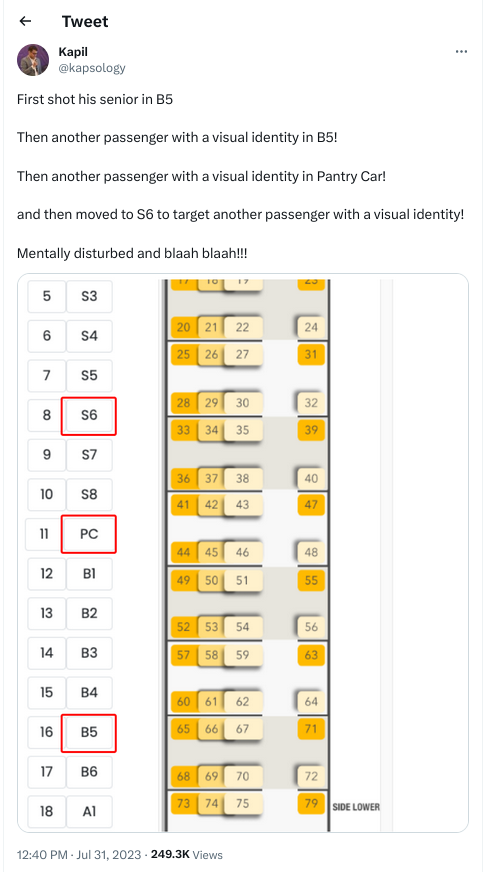
14 December 2022

Russ Allbery: Review: Contact

Review: Contact, by Carl Sagan
Publisher: Pocket Books
Copyright: 1985
Printing: October 1986
ISBN: 0-671-43422-5
Format: Mass market
Pages: 434
Contact is a standalone first-contact science fiction novel. Carl Sagan (1934 1996) was best known as a non-fiction writer, astronomer, and narrator of the PBS non-fiction program Cosmos. This is his first and only novel. Ellie Arroway is the director of Project Argus, a radio telescope array in the New Mexico desert whose primary mission is SETI: the search for extra-terrestrial intelligence by scanning the skies for unexpected radio signals. Its assignment to SETI is controversial; there are radio astronomy projects waiting, and although 25% of the telescope time is assigned to non-SETI projects, some astronomers think the SETI mission should be scrapped and Argus fully diverted to more useful research. That changes overnight when Argus picks up a signal from Vega, binary pulses representing the sequence of prime numbers. The signal of course doesn't stop when the Earth rotates, so Ellie and her team quickly notify every radio observatory they can get hold of to follow the signal as it passes out of their line of sight. Before long, nearly every country with a radio telescope is involved, and Russian help is particularly vital since they have ship-mounted equipment. The US military and intelligence establishment isn't happy about this and make a few attempts to shove the genie back into the bottle and keep any further discoveries secret, without a lot of success. (Sagan did not anticipate the end of the Cold War, and yet ironically relations with the Russians in his version of the 1990s are warmer by far than they are today. Not that this makes the military types any happier.) For better or worse, making sense of the alien signal becomes a global project. You may be familiar with this book through its 1997 movie adaptation starring Jodie Foster. What I didn't know before reading this book is that it started life as a movie treatment, co-written with Ann Druyan, in 1979. When the movie stalled, Sagan expanded it into a novel. (Given the thanks to Druyan in the author's note, it may not be far wrong to name her as a co-author.) If you've seen the movie, you will have a good idea of what will happen, but the book gives the project a more realistic international scope. Ellie has colleagues carefully selected from all over the world, including for the climactic moment of the story. The biggest problem with Contact as a novel is that Sagan is a non-fiction writer who didn't really know how to write a novel. The long, detailed descriptions of the science and the astronomical equipment fit a certain type of SF story, but the descriptions of the characters, even Ellie, are equally detailed and yet use the same style. The book starts with an account of Ellie's childhood and path into science written like a biography or a magazine profile, not like a novel in which she's the protagonist. The same is true of the other characters: we get characterization of a sort, but the tone ranges from Wikipedia article to long-form essay and never quite feels like a story. Ellie is the most interesting character in the book, partly because the way Sagan writes her is both distant but oddly compelling. Sagan (or perhaps Druyan?) tries hard to show what life is like for a woman born in the middle of the 20th century who is interested in science and I think mostly succeeds, although Ellie's reactions to sexism felt weirdly emotionless. The descriptions of her relationships are even odder and the parts where this book felt the least like a novel, but Sagan does sell some of that tone as reflective of Ellie's personality. She's a scientist, the work is the center of her life, and everything else, even when important, is secondary. It doesn't entirely make the writing style work, but it helps. Sagan does attempt to give Ellie a personal development arc related to her childhood and her relationships with her father and step-father. I thought the conclusion to that was neither believable nor anywhere near as important as Sagan thought it was, which was off-putting. Better were her ongoing arguments with evangelical Christians, one of whom is a close-minded ass and the other of which is a far more interesting character. They felt wedged into this book, and I'm dubious a realistic version of Ellie would have been the person to have those debates, but it's a subject Sagan clearly has deep personal interest in and that shows in how they're written. The other problem with Contact as a novel is that Sagan does not take science fiction seriously as a genre, instead treating it as a way to explore a thought experiment. To a science fiction reader, or at least to this science fiction reader, the interesting bits of this story involve the aliens. Those are not the bits Sagan is interested in. His attention is on how this sort of contact, and project, would affect humanity and human politics. We do get some more traditional science fiction near the end of the book, but Sagan then immediately backs away from it, minimizes that part of the story, and focuses exclusively on the emotional and philosophical implications for humans of his thought experiment. Since I found his philosophical musings about agnosticism and wonder and discovery less interesting than the actual science fiction bits, I found this somewhat annoying. The ending felt a bit more like a cheap trick than a satisfying conclusion. Interestingly, this entire novel is set in an alternate universe, for reasons entirely unexplained (at least that I noticed) in the book. It's set in the late 1990s but was written in 1985, so of course this is an alternate future, but the 1985 of this world still isn't ours. Yuri Gagarin was the first man to set foot on the moon, and the space program and the Cold War developed in subtly different ways. I'm not sure why Sagan made that choice, but it felt to me like he was separating his thought experiment farther from our world to give the ending more plausible deniability. There are, at the time of the novel, permanent orbital colonies for (mostly) rich people, because living in space turns out to greatly extend human lifespans. That gives Sagan an opportunity to wax poetic about the life-altering effects of seeing Earth from space, which in his alternate timeline rapidly sped up nuclear disarmament and made the rich more protective of the planet. This is an old bit of space boosterism that isn't as common these days, mostly because it's become abundantly clear that human psychology doesn't work this way. Sadly, rich sociopaths remain sociopaths even when you send them into space. I was a bit torn between finding Sagan's predictions charmingly hopeful and annoyingly daft. I don't think this novel is very successful as a novel. It's much longer than it needs to be and long parts of it drag. But it's still oddly readable; even knowing the rough shape of the ending in advance, I found it hard to put down once the plot properly kicks into gear about two-thirds of the way through. There's a lot in here that I'd argue with Sagan about, but he's thoughtful and makes a serious attempt to work out the political and scientific ramifications of such a discovery in detail. Despite the dry tone, he does a surprisingly good job capturing the anticipation and excitement of a very expensive and risky scientific experiment. I'm not sure I would recommend this book to anyone, but I'm also the person who found Gregory Benford's Timescape to be boring and tedious, despite its rave reviews as a science fiction novel about the practice of science. If that sort of book is more your jam, you may like Contact better than I did. Rating: 6 out of 10

19 October 2022

Shirish Agarwal: Pune Rains, Uncosted Budgets, Hearing Loss Covid, Fracking

Pune Rains Lemme start with a slightly funny picture that tells as much about Pune, my city as anything else does.
Pune- Leave your attitude behind, we have our own
This and similar tags, puns and whatnot you will find if you are entering Pune from the road highway. You can also find similar similar symbols and Puns all over the city and they are partly sarcasm and ironic and partly the truth. Puneities work from the attitude that they know everything rather than nothing, including yours truly  . What is the basis of that or why is there such kind of confidence I have no clue or idea, it is what it is. Approximately 24 hrs. ago, apparently we had a cloudburst. What I came to know later is that we got 100 mm of rain. Sharing from local news site. Much more interesting was a thread made on Reddit where many people half-seriously asked where they can buy a boat. One of the reasons being even if it s October, in fact, we passed middle of October and it s still raining. Even today in the evening, it rained for quite a while. As I had shared in a few blog posts before, June where rains should have started, it didn t, it actually started late July or even August, so something has shifted. The current leadership does not believe in Anthropogenic Climate Change or human activity induced climate change even though that is a reality. I could share many links and even using the term above should give links to various studies. Most of the people who are opposed to it are either misinformed or influenced from the fossil fuel industry. Again, could share many links, but will share just one atm. I have talked to quite a few people about it but nobody has ever been able to give a convincing answer as to why GM had to crush the cars. Let s even take the argument that it was the worst manufactured car in history and there have been quite a few, have the others been crushed? If not, then the reason shared or given by most people sounds hollow. And if you look into it, they had an opportunity that they let go, and now most of them are scrambling and yet most of the legacy auto manufacturers will be out of existence if they don t get back into the game in the next 2-3 years. There have been a bunch of announcements but we are yet to see. The Chinese though have moved far ahead, although one has to remark that they have been doing that for the last decade, so they have a 10-year head start, hardly surprising then. But I need to get back to the subject, another gentleman on Reddit remarked that if you start to use boat, and others start to use boat, then the Govt. will tax it. In fact, somebody had shared the below the other day
Different types of taxes collected by GOI
Many of the taxes that I have shared above are by the Modi Govt. who came on the platform, manifesto that once they come to power they will reduce taxes for the common man, they have reduced taxes but only for the Corporates. For the common man, the taxes have only gone up, both direct tax and indirect tax. Any reference to the Tory party who have also done similar things and have also shared that it is labor who had done large expenditures even though they have been 8 years in power, I am sure for most is purely coincidental. Incidentally, that is the same tack that was taken even by the Republican party. They all like to give tax benefits to the 1% while for the rest is austerity claiming some reason, even if it has been proven to be false.
Corporate Tax Rate, Revenue Loss to Govt.
The figures mentioned above are findings of parliamentary panel so nobody can accuse of anybody having a bias. Also, I probably had shared this but still feel the need to re-share it as people still believe that 2G scam happened even though there are plenty of arguments I can share to prove how it was all a fabricated lie.
Vinod Rai Mafinama in Uttarakhand High Court.
Part 2 of the same Mafinama.
How pathetic Mr. Rai s understanding of economics is can be gauged from the fact that he was made Chairman of IDFC and subsequently had to be thrown out. That whole lie was engineered to throw UPA out and it worked. There are and have been many such coincidences happening over the last 8 years, parallel stories happening in India and UK. This was just yesterday, about a year back Air India was given back to the Tatas, There was controversy about the supposed auctions as only Indigo was the only other party allowed to be at auction but not allowed to buy but more as a spectator as they already have 60% of the Indian civil aviation market. And there was lot of cheering from the Govt. side that finally Air India has been bought home to its true owners, the Tatas. The Tatas too started cheering and sharing how they will take down all the workers, worker unions and everything will be happy glory within a year. In fact, just couple of days back they shared new plans. Btw for the takeover of Air India, they had bought loans from the Banks and they are in the category of too big to fail. As I have shared couple of times before, RBI has not shared any inspection reports of nationalized or private banks after 2013/14. While by law, RBI is supposed to do inspection reports every 3 months and share them in the Public domain. And if you ask any of their supporter, for everything they will say UPA did x or y, which only goes to show morally bankrupt the present Govt. is. Coming back to the topic, before I forget, the idea of sharing their plans is so that they can again borrow money from the banks. But that is not the only story. Just one day back, Smita Prakash, one of the biggest cheerleaders of the present Govt. (she is the boss at Asia News International (ANI)) posted how Air India had treated her sister and other 21 passengers. Basically, they had bought business tickets but the whole cabin was dirty, they complained and they were forced to sit in economy class, not just her cousin sister but the other 21 odd passengers too. Of course Ms Smita became calm as her sister was given free air tickets on Vistara and other goodies. Of course, after that she didn t post anything about the other 21 odd passengers after that. And yes, I understand she is supposed to be a reporter but as can be seen from the twitter thread, there is or was no follow up. Incidentally, she is one of many who has calling others about Revdi culture (freebies to the masses.) but guess that only applies to other people not her or her sister. Again, if there are any coincidences of similar nature in the UK or when Trump was P.M. of the U.S. they are just coincidental .

The Uncosted budget India and the UK have many parallels, it s mind boggling. Before we get into the nitty-gritties, saw something that would be of some interest to the people here.
For those who might not be able to see above, apparently there is place in UK called Tufton Street where there are quite a few organizations that are shadowy and whose finances are not known as to how they are financed. Ms. Truss and quite a few of the people in the cabinet are from the same shadowy organizations. Mr. Kwasi Kwarteng, the just-departed chancellor is and was part of the same group. Now even for me it was a new term to learn and understand what is an uncosted budget is. To make it much more easier I share the example using a common person who goes to the bank for a loan

Now M/S X wants a loan of say Rs. 1000/- for whatever reason. He/she/they go to the bank and asks give me a loan of say INR 1000/- The banks asks them to produce a statement of accounts to show what their financial position is. They produce a somewhat half-filled statement of accounts In which all liabilities are shown, but incomes are not. The bank says you already have so much liabilities, how are you gonna pay those, accounts have to be matched otherwise you are not solvent. M/s X adamantly refuses to do any changes citing that they don t need to. At this point, M/s X credit rating goes down and nobody in the market will give them a loan. At the same time, the assets they had held, their value also depreciates because it became known that they can t act responsibly. So whose to say whether or not M/s X has those number of assets and priced them accurately. But the drama doesn t end there, M/s X says this is the responsibility of actually Mr. Z ( cue The Bank of England) as they are my accountant/lawyer etc. M/s Z says as any lawyer/accountant should. This is not under my remit. If the clients either gives incomplete information or false information or whatever then it is their responsibility not mine. And in fact, the Chancellor is supposed to be the one who is given the responsibility of making the budget. The Chancellor is very similar to our Finance Minister. Because the UK has constitutional monarchy, I am guessing the terms are slightly different, otherwise the functionality seems to be the same. For two weeks, there was lot of chaos, lot of pension funds lost quite a bit in the market and in the end Mr. Kwasi Kwarteng was ousted out of the job. Incredibly, the same media and newspapers who had praised Mr. Kwarteng just few weeks back as the best Tory budget, they couldn t wait to bury him. And while I have attempted to simplify what happened, the best explanation of what has happened can be found in an article from the guardian. Speculation is rife in the UK as to who s ruling atm as the new Chancellor has reversed almost all the policies that Ms. Truss had bought and she is now more or less a figurehead. Mr. Hunt, the new chancellor doesn t have anybody behind him. Apparently, the gentleman wanted to throw his hat the ring in the Tory leadership contest that was held about a month back and he couldn t get 20 MP s to support him. Another thing that is different between UK and India is that in UK by law the PM has to answer questions put up to him or her by the opposition leaders. That is the way accountability is measured there. This is known as PMQ s or Prime Minister Questions and Answers. One can just go to YouTube or any streaming service and give Liz Truss and PMQ s and if they are interested of a certain date, give a date and they can see how she answered the questions thrown at her. Unfortunately, all she could do in both times were non-answers. In fact, the Tories seem to be using some of Labor s policies after they had bad-mouthed the same policies. Politics of right-wing both in the UK and the US seems so out of touch with the people whom they are supposed to protect and administer. An article about cyclists which is sort of half-truth, half irony shows how screwed up the policies are of the RW (right-wing). Now they are questions about the pensions triple-lock. Sadly, it is the working class who would suffer the most, most of the rich have already moved their money abroad several years ago. The Financial Times, did share a video about how things have been unfolding

Seems Ms. Truss forgot to add Financial Times in the list of anti-growth coalition she is so fond of. Also, the Tory party seems to want to create more tax havens in the UK and calling them investment zones. Of course, most of the top tax havens are situated around the UK itself. I wouldn t go more into as that would probably require its own article, although most of that information is all in public domain. Fracking I don t really want to take much time as the blog post has become long. There have been many articles written why Fracking is bad and that is why even the Tories had put in their Manifesto that they won t allow Fracking but apparently, today they are trying to reopen Fracking. And again how bad it is and can be found out by the article in Guardian.

28 September 2022

Jelmer Vernooij: Northcape 4000

This summer, I signed up to participate in the Northcape 4000 <https://www.northcape4000.com/>, an annual 4000km bike ride between Rovereto (in northern Italy) and the northernmost point of Europe, the North cape. The Northcape event has been held for several years, and while it always ends on the North Cape, the route there varies. Last years route went through the Baltics, but this years was perhaps as direct as possible - taking us through Italy, Austria, Switzerland, Germany, the Czech republic, Germany again, Sweden, Finland and finally Norway. The ride is unsupported, meaning you have to find your own food and accomodation and can only avail yourself of resupply and sleeping options on the route that are available to everybody else as well. The event is not meant to be a race (unlike the Transcontinental, which starts at the same day), so there is a minimum time to finish it in (10 days) and a maximum (21 days). Unfortunately, this meant skipping some other events I d wanted attend (DebConf, MCH).

25 September 2022

Shirish Agarwal: Rama II, Arthur C. Clarke, Aliens

Rama II This would be more of a short post about the current book I am reading. Now people who have seen Arrival would probably be more at home. People who have also seen Avatar would also be familiar to the theme or concept I am sharing about. Now before I go into detail, it seems that Arthur C. Clarke wanted to use a powerful god or mythological character for the name and that is somehow the RAMA series started. Now the first book in the series explores an extraterrestrial spaceship that earth people see/connect with. The spaceship is going somewhere and is doing an Earth flyby so humans don t have much time to explore the spaceship and it is difficult to figure out how the spaceship worked. The spaceship is around 40 km. long. They don t meet any living Ramans but mostly automated systems and something called biots. As I m still reading it, I can t really say what happens next. Although in Rama or Rama I, the powers that be want to destroy it while in the end last they don t. Whether they could have destroyed it or not would be whole another argument. What people need to realize is that the book is a giant What IF scenario.

Aliens If there were any intelligent life in the Universe, I don t think they will take the pain of visiting Earth. And the reasons are far more mundane than anything else. Look at how we treat each other. One of the largest democracies on Earth, The U.S. has been so divided. While the progressives have made some good policies, the Republicans are into political stunts, consider the political stunt of sending Refugees to Martha s Vineyard. The ex-president also made a statement that he can declassify anything just by thinking about it. Now understand this, a refugee is a legal migrant whose papers would be looked into by the American Govt. and till the time he/she/their application is approved or declined they can work, have a house, or do whatever to support themselves. There is a huge difference between having refugee status and being an undocumented migrant. And it isn t as if the Republicans don t know this, they did it because they thought they will be able to get away with it. Both the above episodes don t throw us in a good light. If we treat others like the above, how can we expect to be treated? And refugees always have a hard time, not just in the U.S, , the UK you name it. The UK just some months ago announced a controversial deal where they will send Refugees to Rwanda while their refugee application is accepted or denied, most of them would be denied. The Indian Government is more of the same. A friend, a casual acquaintance Nishant Shah shared the same issues as I had shared a few weeks back even though he s an NRI. So, it seems we are incapable of helping ourselves as well as helping others. On top of it, we have the temerity of using the word alien for them. Now, just for a moment, imagine you are an intelligent life form. An intelligent life-form that could coax energy from the stars, why would you come to Earth, where the people at large have already destroyed more than half of the atmosphere and still arguing about it with the other half. On top of it, we see a list of authoritarian figures like Putin, Xi Jinping whose whole idea is to hold on to power for as long as they can, damn the consequences. Mr. Modi is no different, he is the dumbest of the lot and that s saying something. Most of the projects made by him are in disarray, Pune Metro, my city giving an example. And this is when Pune was the first applicant to apply for a Metro. Just like the UK, India too has tanked the economy under his guidance. Every time they come closer to target dates, the targets are put far into the future, for e.g. now they have said 2040 for a good economy. And just like in other countries, he has some following even though he has a record of failure in every sector of the economy, education, and defense, the list is endless. There isn t a single accomplishment by him other than screwing with other religions. Most of my countrymen also don t really care or have a bother to see how the economy grows and how exports play a crucial part otherwise they would be more alert. Also, just like the UK, India too gave tax cuts to the wealthy, most people don t understand how economies function and the PM doesn t care. The media too is subservient and because nobody asks the questions, nobody seems to be accountable :(.

Religion There is another aspect that also has been to the fore, just like in medieval times, I see a great fervor for religion happening here, especially since the pandemic and people are much more insecure than ever before. Before, I used to think that insecurity and religious appeal only happen in the uneducated, and I was wrong. I have friends who are highly educated and yet still are blinded by religion. In many such cases or situations, I find their faith to be a sham. If you have faith, then there shouldn t be any room for doubt or insecurity. And if you are not in doubt or insecure, you won t need to talk about your religion. The difference between the two is that a person is satiated himself/herself/themselves with thirst and hunger. That person would be in a relaxed mode while the other person would continue to create drama as there is no peace in their heart. Another fact is none of the major religions, whether it is Christianity, Islam, Buddhism or even Hinduism has allowed for the existence of extraterrestrials. We have already labeled them as aliens even before meeting them & just our imagination. And more often than not, we end up killing them. There are and have been scores of movies that have explored the idea. Independence day, Aliens, Arrival, the list goes on and on. And because our religions have never thought about the idea of ET s and how they will affect us, if ET s do come, all the religions and religious practices would panic and die. That is the possibility why even the 1947 Roswell Incident has been covered up . If the above was not enough, the bombing of Hiroshima and Nagasaki by the Americans would always be a black mark against humanity. From the alien perspective, if you look at the technology that they have vis-a-vis what we have, they will probably think of us as spoilt babies and they wouldn t be wrong. Spoilt babies with nuclear weapons are not exactly a healthy mix

Earth To add to our fragile ego, we didn t even leave earth even though we have made sure we exploit it as much as we can. We even made the anthropocentric or homocentric view that makes man the apex animal and to top it we have this weird idea that extraterrestrials come here or will invade for water. A species that knows how to get energy out of stars but cannot make a little of H2O. The idea belies logic and again has been done to death. Why we as humans are so insecure even though we have been given so much I fail to understand. I have shared on numerous times the Kardeshev Scale on this blog itself. The above are some of the reasons why Arthur C. Clarke s works are so controversial and this is when I haven t even read the whole book. It forces us to ask questions that we normally would never think about. And I have to repeat that when these books were published for the first time, they were new ideas. All the movies, from Stanley Kubrick s 2001: Space Odyssey, Aliens, Arrival, and Avatar, somewhere or the other reference some aspect of this work. It is highly possible that I may read and re-read the book couple of times before beginning the next one. There is also quite a bit of human drama, but then that is to be expected. I have to admit I did have some nice dreams after reading just the first few pages, imagining being given the opportunity to experience an Extraterrestrial spaceship that is beyond our wildest dreams. While the Governments may try to cover up or something, the ones who get to experience that spacecraft would be unimaginable. And if they were able to share the pictures or a Livestream, it would be nothing short of amazing. For those who want to, there is a lot going on with the New James Webb Telescope. I am sure it would give rise to more questions than answers.

6 September 2022

Shirish Agarwal: Debian on Phone

History Before I start, the game I was talking about is called Cell To Singularity. Now I haven t gone much in the game as I have shared but think that the Singularity it refers to is the Technological Singularity that people think will happen. Whether that will happen or not is open to debate to one and all. This is going to be a bit long one. Confession Time :- When I was sharing in the blog post, I had no clue that we actually had sessions on it in this year s Debconf. I just saw the schedule yesterday and then came to know. Then I saw Guido s two talks, one at Debconf as well as one as Froscon. In fact, saw the Froscon talk first, and then the one at Debconf. Both the talks are nearly the same except for a thing here or a thing there. Now because I was not there so my understanding and knowledge would be disadvantageously asymmetrical to Guido and others who were there and could talk and share more. Having a Debian mobile or Debian on the mobile could also make Debian more popular and connectable to the masses, one of the things that were not pointed out in the Debian India BOF sadly. At the same time, there are some facts that are not on the table and hence not thought about. Being a B.Com person, I have been following not just the technical but also how the economics work and smartphone penetration in India is pretty low or historically been very low, say around 3-4% while the majority that people use, almost 90-95% of the market uses what are called non-smartphones or dumbphones. Especially during the pandemic and even after that the dumbphones market actually went up while smartphones stagnated and even came down. There is a lot of inventory at most of the dealers that they can t get rid of. From a dealer perspective, it probably makes more sense to buy and sell dumbphones more in number as the turnaround of capital is much faster and easier than for smartphones. I have seen people spend a number of hours and rightly so in order to make their minds up on a smartphone while for a dumbphone, it is a 10-minute thing. Ask around, figure out who is selling at the cheapest, and just buy. Most of these low-end phones are coming from China. In fact, even in the middle and getting even into smartphones, the Chinese are the masters from whom we buy, even as they have occupied Indian territory. In the top five, Samsung comes at number three of four (sharing about Samsung as a fan and having used them.) even though battery times are atrocious, especially with Android 12L. The only hope that most of the smartphone manufacturers have is lowering the sticker prices and hoping that 5G Adoption picks up and that is what they are betting on but that comes with its own share of drawbacks as can be seen.

GNOME, MATE, memory leaks, Payments FWIW, while I do have GNOME and do use a couple of tools from the GNOME stack, I hate GNOME with a passion. I have been a mate user for almost a decade now and really love the simplicity that mate has vis-a-vis GNOME. And with each release, MATE has only become better. So, it would be nice if we can have MATE on the mobile phone. How adaptive the apps might be on the smaller area, I dunno. It would be interesting to find out if and how people are looking at debugging memory leaks on mobile phones. Although finding memory leaks on any platform is good, finding them and fixing them on a mobile phone is pretty much critical as most phones have fixed & relatively small amounts of memory and it is and can get quickly exhausted. One of the things that were asked in the Q&A was about payments. The interesting thing is both UK and India are the same or markedly similar in regard as far as contactless payments being concerned. What most Indians have or use is basically UPI which is basically backed by your bank. Unlike in some other countries where you have a selection of wallets and even temporary/permanent virtual accounts whereby you can minimize your risks in case your mobile gets stolen or something, here we don t have that. There are three digital wallets that I know Paytm Not used (have heard it s creepy, but don t really know), Google pay (Unfortunately, this is the one I use, they bought multiple features, and in the last couple of years have really taken the game away from Paytm but also creepy.). The last one is Samsung Pay (haven t really used it as their find my phone app. always crashes, dunno how it is supposed to work.) But I do find that the apps. are vulnerable. Every day there is some or other news of fraud happening. Previously, only States like Bihar and Jharkhand used to be infamous for cybercrime as a hub, but now even States like Andhra Pradesh have joined and surpassed them :(. People have lost lakhs and crores, this is just a few days back. Some more info. on UPI can be found here and GitHub has a few implementation examples that anybody could look at and run away with it.

Balancing on three things For any new mobile phone to crack the market, it has to balance three things. One, achieve economies of scale. Unless, that is not taken care of or done, however good or bad the product might be, it remains a niche and dies after some time. While Guido shared about Openmoko and N900, one of the more interesting bits from a user perspective at least was the OLPC project. There are many nuances that the short article didn t go through. While I can t say for other countries, at least in India, no education initiative happens without corruption. And perhaps Nicholas s hands were tied while other manufacturers would and could do to achieve their sales targets. In India, it flopped because there was no way for volunteers to buy or get OLPC unless they were part of a school or college. There was some traction in FOSS communities, but that died down once OLPC did the partnership with MS-Windows, and proverbially broke the camel s back. FWIW, I think the idea, the concept, and even the machine were far ahead of their time. The other two legs are support and Warranty Without going into any details, I can share and tell there were quite a few OLPC type attempts using conventional laptops or using Android and FOSS or others or even using one of the mainstream distributions but the problems have always been polishing, training and support. Guido talked about privacy as a winning feature but fails to take into account that people want to know that their privacy isn t being violated. If a mobile phone answers to Hey Google does it mean it was passively gathering, storing, and sending info to third parties, we just don t know. The mobile phone could be part of the right to repair profile while at the same time it can force us to ask many questions about the way things currently are and going to be. Six months down the line all the flagships of all companies are working on being able to take and share through satellites (Satellite Internet) and perhaps maybe a few non-flagships. Of course, if you are going to use a satellite, then you are going to drain that much more quickly. In all and every event there are always gonna be tradeoffs. The Debian-mobile mailing list doesn t seem to have many takers. The latest I could find there is written by Paul Wise. I am in a similar boat (Samsung; SM-M526B; Lahaina; arm64-v8a) v12. It is difficult to know which release would work on your machine, make sure that the building from the source is not tainted and pristine and needs a way to backup and restore if you need to. I even tried installing GNURoot Debian and the Xserver alternative they had shared but was unable to use the touch interface on the fakeroot instance  . The system talks about a back key but what back key I have no clue.

Precursor Events Debconf 2023 As far as precursor events are concerned before Debconf 23 in India, all the festivals that we have could be used to showcase Debian. In fact, the ongoing Ganesh Chaturthi would have been the perfect way to showcase Debian and apps. according to the audience. Even the festival of Durga Puja, Diwali etc. can be used. When commercial organizations use the same festivals, why can t we? What perhaps we would need to figure out is the funding part as well as getting permissions from Municipal authorities. One of the things for e.g. that we could do is buy either a permanent 24 monitor or a 34 TV and use that to display Debian and apps. The bigger, the better. Something that we could use day to day and also is used for events. This would require significant amounts of energy so we could approach companies, small businesses and individuals both for volunteering as well as helping out with funding. Somebody asked how we could do online stuff and why it is somewhat boring. What could be done for e.g. instead of 4-5 hrs. of things, break it into manageable 45 minute pieces. 4-5 hrs. is long and is gonna fatigue the best of people. Make it into 45-minute negotiable chunks, and intersphere it with jokes, hacks, anecdotes, and war stories. People do not like or want to be talked down to but rather converse. One of the things that I saw many of the artists do is have shows and limit the audience to 20-24 people on zoom call or whatever videoconferencing system you have and play with them. The passive audience enjoys the play between the standup guy and the crowd he works on, some of them may be known to him personally so he can push that envelope a bit more. The same thing can be applied here. Share the passion, and share why we are doing something. For e.g. you could do smem -t -k less and give a whole talk about how memory is used and freed during a session, how are things different on desktop and ARM as far as memory architecture is concerned (if there is). What is being done on the hardware side, what is on the software side and go on and on. Then share about troubleshooting applications. Valgrind is super slow and makes life hell, is there some better app ? Doesn t matter if you are a front-end or a back-end developer you need to know this and figure out the best way to deal with in your app/program. That would have lot of value. And this is just an e.g. to help trigger more ideas from the community. I am sure others probably have more fun ideas as to what can be done. I am stopping here now otherwise would just go on, till later. Feel free to comment, feedback. Hope it generates some more thinking and excitement on the grey cells.

22 August 2022

Jonathan Wiltshire: Team Roles and Tuckman s Model, for Debian teams

When I first moved from being a technical consultant to a manager of other consultants, I took a 5-day course Managing Technical Teams a bootstrap for managing people within organisations, but with a particular focus on technical people. We do have some particular quirks, after all Two elements of that course keep coming to mind when doing Debian work, and they both relate to how teams fit together and get stuff done. Tuckman s four stages model In the mid-1960s Bruce W. Tuckman developed a four-stage descriptive model of the stages a project team goes through in its lifetime. They are:
Resolved disagreements and personality clashes result in greater intimacy, and a spirit of co-operation emerges.
Teams need to understand these stages because a team can regress to earlier stages when its composition or goals change. A new member, the departure of an existing member, changes in supervisor or leadership style can all lead a team to regress to the storming stage and fail to perform for a time. When you see a team member say this, as I observed in an IRC channel recently, you know the team is performing:
nice teamwork these busy days Seen on IRC in the channel of a performing team
Tuckman s model describes a team s performance overall, but how can team members establish what they can contribute and how can they go doing so confidently and effectively? Belbin s Team Roles
The types of behaviour in which people engage are infinite. But the range of useful behaviours, which make an effective contribution to team performance, is finite. These behaviours are grouped into a set number of related clusters, to which the term Team Role is applied. Belbin, R M. Team Roles at Work. Oxford: Butterworth-Heinemann, 2010
Dr Meredith Belbin s thesis, based on nearly ten years research during the 1970s and 1980s, is that each team has a number of roles which need to be filled at various times, but they re not innate characteristics of the people filling them. People may have attributes which make them more or less suited to each role, and they can consciously take up a role if they recognise its need in the team at a particular time. Belbin s nine team roles are: (adapted from https://www.belbin.com/media/3471/belbin-team-role-descriptions-2022.pdf) A well-balanced team, Belbin asserts, isn t comprised of multiples of nine individuals who fit into one of these roles permanently. Rather, it has a number of people who are comfortable to wear some of these hats as the need arises. It s even useful to use the team roles as language: for example, someone playing a shaper might say the way we ve always done this is holding us back , to which a co-ordinator s could respond Steve, Joanna put on your Plant hats and find some new ideas. Talk to Susan and see if she knows someone who s tackled this before. Present the options to Nigel and he ll help evaluate which ones might work for us. Teams in Debian There are all sort of teams in Debian those which are formally brought into operation by the DPL or the constitution; package maintenance teams; public relations teams; non-technical content teams; special interest teams; and a whole heap of others. Teams can be formal and informal, fleeting or long-lived, two people working together or dozens. But they all have in common the Tuckman stages of their development and the Belbin team roles they need to fill to flourish. At some stage in their existence, they will all experience new or departing team members and a period of re-forming, norming and storming perhaps fleetingly, perhaps not. And at some stage they will all need someone to step into a team role, play the part and get the team one step further towards their goals. Footnote Belbin Associates, the company Meredith Belbin established to promote and continue his work, offers a personalised report with guidance about which roles team members show the strongest preferences for, and how to make best use of them in various settings. They re quick to complete and can also take into account observers , i.e. how others see a team member. All my technical staff go through this process blind shortly after they start, so as not to bias their input, and then we discuss the roles and their report in detail as a one-to-one. There are some teams in Debian for which this process and discussion as a group activity could be invaluable. I have no particular affiliation with Belbin Associates other than having used the reports and the language of team roles for a number of years. If there s sufficient interest for a BoF session at the next DebConf, I could probably be persuaded to lead it.
Photo by Josh Calabrese on Unsplash

20 July 2022

Enrico Zini: Deconstruction of the DAM hat

Further reading Talk notes Intro Debian Account Managers Responsibility for official membership What DAM is not Unexpected responsibilities DAM warnings DAM warnings? House rules Interpreting house rules Governance by bullying How about the Community Team? How about DAM? How about the DPL? Concentrating responsibility Empowering developers What needs to happen

29 June 2022

Russell Coker: Philips 438P1 43 4K Monitor

I have just returned a Philips 438P1 43 4K Monitor [1] and gone back to my Samsung 28 4K monitor model LU28E590DS/XY AKA UE590. The main listed differences are the size and the fact that the Samsung is TN but the Philips is IPS. Here s a comparison of TN and IPS technologies [2]. Generally I think that TN is probably best for a monitor but in theory IPS shouldn t be far behind. The Philips monitor has a screen with a shiny surface which may be good for a TV but isn t good for a monitor. Also it seemed to blur the pixels a bit which again is probably OK for a TV that is trying to emulate curved images but not good for a monitor where it s all artificial straight lines. The most important thing for me in a monitor is how well it displays text in small fonts, for that I don t really want the round parts of the letters to look genuinely round as a clear octagon or rectangle is better than a fuzzy circle. There is some controversy about the ideal size for monitors. Some people think that nothing larger than 28 is needed and some people think that a 43 is totally usable. After testing I determined that 43 is really too big, I had to move to see it all. Also for my use it s convenient to be able to turn a monitor slightly to allow someone else to get a good view and a 43 monitor is too large to move much (maybe future technology for lighter monitors will change this). Previously I had been unable to get my Samsung monitor to work at 4K resolution with 60Hz and had believed it was due to cheap video cards. I got the Philips monitor to work with HDMI so it s apparent that the Samsung monitor doesn t do 4K@60Hz on HDMI. This isn t a real problem as the Samsung monitor doesn t have built in speakers. The Philips monitor has built in speakers for HDMI sound which means one less cable to my PC and no desk space taken by speakers. I bought the Philips monitor on eBay in opened unused condition. Inside the box was a sheet with a printout stating that the monitor blanks the screen periodically, so the seller knew that it wasn t in unused condition, it was tested and failed the test. If the Philips monitor had been as minimally broken as described then I might have kept it. However it seems that certain patterns of input caused it to reboot. For example I could be watching Netflix and have it drop out, I would press the left arrow to watch that bit again and have it drop out again. On one occasion I did a test and found that a 5 second section of Netflix content caused the monitor to reboot on 6/8 times I viewed it. The workaround I discovered was to switch between maximised window and full-screen mode when it had a dropout. So I just press left-arrow and then F and I can keep watching. That s not what I expect from a $700 monitor! I considered checking for Philips firmware updates but decided against it because I didn t want to risk voiding the warranty if it didn t work correctly and I decided I just didn t like the monitor that much. Ideally for my next monitor I ll get a 4K screen of about 35 , TN, and a screen that s not shiny. At the moment there doesn t seem to be many monitors between 32 and 43 in size, so 32 may do. I am quite happy with the Samsung monitor so getting the same but slightly larger is fine. It s a pity they stopped making 5K displays.

Next.

Previous.