Search Results: "ressu"

10 July 2023

Shirish Agarwal: PLIO, Mum, Debconf, Pressure Cooker, RISC-V,

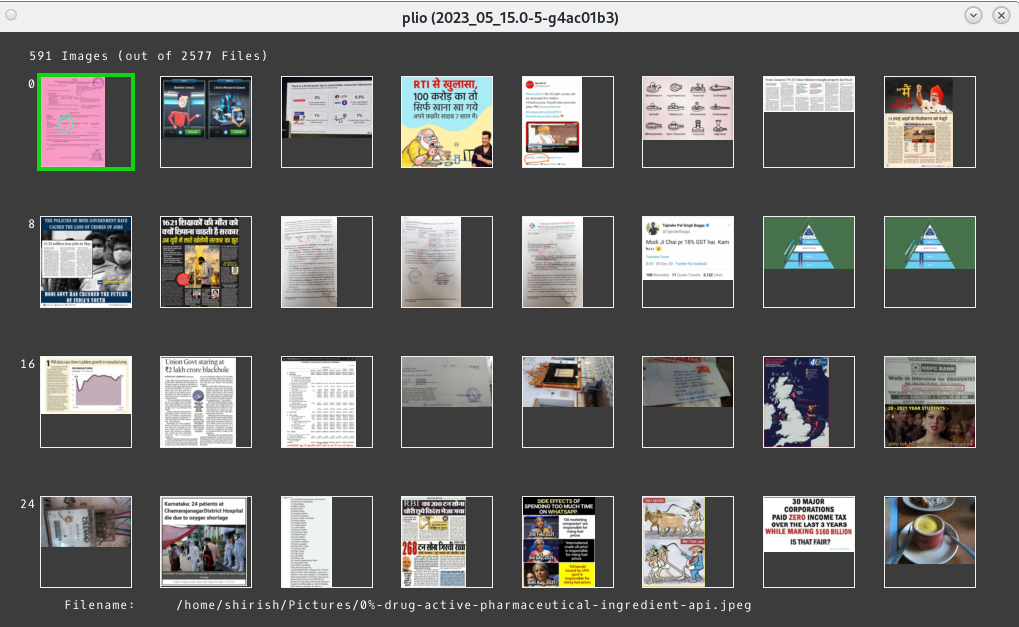
PLIO I have been looking for an image viewer that can view images via modification date by default. The newer, the better. Alas, most of the image viewers do not do that. Even feh somehow fails. What I need is default listing of images as thumbnails by modification date. I put it up on Unix Stackexchange couple of years ago. Somebody shared ristretto but that just gives listing and doesn t give the way I want it. To be more illustrative, maybe this may serve as a guide to what I mean.
There is an RFP for it. While playing with it, I also discovered another benefit of the viewer, a sort of side-benefit, it tells you if any images have gone corrupt or whatever and you get that info. on the CLI so you can try viewing that image with the path using another viewer or viewers before deleting them. One of the issues is there doesn t seem to be a magnify option by default. While the documentation says use the ^ key to maximize it, it doesn t maximize. Took me a while to find it as that isn t a key that I use most of the time. Ironically, that is the key used on the mobile quite a bit. Anyways, so that needs to be fixed. Sadly, it doesn t have creation date or modification date sort, although the documentation does say it does (at least the modification date) but it doesn t show at my end. I also got Warning: UNKNOWN command detected! but that doesn t tell me enough as to what the issue is. Hopefully the developer will fix the issues and it will become part of Debian as many such projects are. Compiling was dead easy even with gcc-12 once I got freeimage-dev.

Mum s first death anniversary I do not know where the year went by or how. The day went in a sort of suspended animation. The only thing I did was eat and sleep that day, didn t feel like doing anything. Old memories, even dreams of fighting with her only to realize in the dream itself it s fake, she isn t there anymore  Something that can never be fixed

Debconf Kochi I should have shared it few days ago but somehow slipped my mind. While it s too late for most people to ask for bursary for Debconf Kochi, if you are anywhere near Kochi in the month of September between the dates. September 3 to September 17 nearby Infopark, Kochi you could walk in and talk to people. This would be for people who either have an interest in free software, FOSS or Debian specific. For those who may not know, while Debian is a Linux Distribution having ports to other kernels as well as well as hardware. While I may not be able to provide the list of all the various flavors as well as hardware, can say it is quite a bit. For e.g. there is a port to RISC-V that was done few years back (2018). Why that is needed will be shared below. There is always something new to look forward in a Debconf.

Pressure Cooker and Potatoes This was asked to me in the last Debconf (2016) by few people. So as people are coming to India, it probably is a good time to sort of reignite the topic :). So a Pressure Cooker boils your veggies and whatnot while still preserving the nutrients. While there are quite a number of brands I would suggest either Prestige or Hawkins, I have had good experience with both. There are also some new pressure cookers that have come that are somewhat in the design of the Thai Wok. So if that is something that you are either comfortable with or looking for, you could look at that. One of the things that you have to be sort of aware of and be most particular is the pressure safety valve. Just putting up pressure cooker safety valve in your favorite search-engine should show you different makes and whatnot. While they are relatively cheap, you need to see it is not cracked, used or whatever. The other thing is the Pressure Cooker whistle as well. The easiest thing to cook are mashed potatoes in a pressure cooker. A pressure Cooker comes in Litres, from 1 Ltr. to 20 Ltr. The larger ones are obviously for hotels or whatnot. General rule of using Pressure cooker is have water 1/4th, whatever vegetable or non-veg you want to boil 1/2 and let the remaining part for the steam. Now the easiest thing to do is have wash the potatoes and put 1/4th water of the pressure cooker. Then put 1/2 or less or little bit more of the veggies, in this instance just Potatoes. You can put salt to or that can be done later. The taste will be different. Also, there are various salts so won t really go into it as spices is a rabbit hole. Anyways, after making sure that there is enough space for the steam to be built, Put the handle on the cooker and basically wait for 5-10 minutes for the pressure to be built. You will hear a whistling sound, wait for around 5 minutes or a bit more (depends on many factors, kind of potatoes, weather etc.) and then just let it cool off naturally. After 5-10 minutes or a bit more, the pressure will be off. Your mashed potatoes are ready for either consumption or for further processing. I am assuming gas, induction cooking will have its own temperature, have no idea about it, hence not sharing that. Pressure Cooker, first put on the heaviest settings, once it starts to whistle, put it on medium for 5-10 minutes and then let it cool off. The first time I had tried that, I burned the cooker. You understand things via trial and error.

Poha recipe This is a nice low-cost healthy and fulfilling breakfast called Poha that can be made anytime and requires at the most 10-15 minutes to prepare with minimal fuss. The main ingredient is Poha or flattened rice. So how is it prepared. I won t go into the details of quantity as that is upto how hungry people are. There are various kinds of flattened rice available in the market, what you are looking for is called thick Poha or zhad Poha (in Marathi). The first step is the trickiest. What do you want to do is put water on Poha but not to let it be soggy. There is an accessory similar to tea filter but forgot the name, it basically drains all the extra moisture and you want Poha to be a bit fluffy and not soggy. The Poha should breathe for about 5 minutes before being cooked. To cook, use a heavy bottomed skillet, put some oil in it, depends on what oil you like, again lot of variations, you can use ground nut or whatever oil you prefer. Then use single mustard seeds to check temperature of the oil. Once the mustard seeds starts to pop, it means it s ready for things. So put mustard seeds in, finely chopped onion, finely chopped coriander leaves, a little bit of lemon juice, if you want potatoes, then potatoes too. Be aware that Potatoes will soak oil like anything, so if you are going to have potatoes than the oil should be a bit more. Some people love curry leaves, others don t. I like them quite a bit, it gives a slightly different taste. So the order is
  1. Oil
  2. Mustard seeds (1-2 teaspoon)
  3. Curry leaves 5-10
  4. Onion (2-3 medium onions finely chopped, onion can also be used as garnish.)
  5. Potatoes (2-3 medium ones, mashed)
  6. Small green chillies or 1-2 Red chillies (if you want)
  7. Coriander Leaves (one bunch finely chopped)
  8. Peanuts (half a glass)
Make sure that you are stirring them quite a bit. On a good warm skillet, this should hardly take 5 minutes. Once the onions are slighly brown, you are ready to put Poha in. So put the poha, add turmeric, salt, and sugar. Again depends on number of people. If I made for myself and mum, usually did 1 teaspoon of salt, not even one fourth of turmeric, just a hint, it is for the color, 1 to 2 teapoons of sugar and mix them all well at medium flame. Poha used to be two or three glasses. If you don t want potato, you can fry them a bit separately and garnish with it, along with coriander, coconut and whatnot. In Kerala, there is possibility that people might have it one day or all days. It serves as a snack at anytime, breakfast, lunch, tea time or even dinner if people don t want to be heavy. The first few times I did, I did manage to do everything wrong. So, if things go wrong, let it be. After a while, you will find your own place. And again, this is just one way, I m sure this can be made as elaborate a meal as you want. This is just something you can do if you don t want noodles or are bored with it. The timing is similar. While I don t claim to be an expert in cooking in anyway or form, if people have questions feel free to ask. If you are single or two people, 2 Ltr. Pressure cooker is enough for most Indians, Westerners may take a slightly bit larger Pressure Cooker, maybe a 3 Ltr. one may be good for you. Happy Cooking and Experimenting  I have had the pleasure to have Poha in many ways. One of my favorite ones is when people have actually put tadka on top of Poha. You do everything else but in a slight reverse order. The tadka has all the spices mixed and is concentrated and is put on top of Poha and then mixed. Done right, it tastes out of this world. For those who might not have had the Indian culinary experience, most of which is actually borrowed from the Mughals, you are in for a treat. One of the other things I would suggest to people is to ask people where there can get five types of rice. This is a specialty of South India and a sort of street food. I know where you can get it Hyderabad, Bangalore, Chennai but not in Kerala, although am dead sure there is, just somehow have missed it. If asked, am sure the Kerala team should be able to guide. That s all for now, feeling hungry, having dinner as have been sharing about cooking.

RISC-V There has been lot of conversations about how India could be in the microprocesor spacee. The x86 and x86-64 is all tied up in Intel and AMD so that s a no go area. Let me elaborate a bit why I say that. While most of the people know that IBM was the first producers of transistors as well as microprocessors. Coincidentally, AMD and Intel story are similar in some aspects but not in others. For a long time Intel was a market leader and by hook or crook it remained a market leader. One of the more interesting companies in the 1980s was Cyrix which sold lot of low-end microprocessors. A lot of that technology also went into Via which became a sort of spiritual successor of Cyrix. It is because of Cyrix and Via that Intel was forced to launch the Celeron model of microprocessors.

Lawsuits, European Regulation For those who have been there in the 1990s may have heard the term Wintel that basically meant Microsoft Windows and Intel and they had a sort of monopoly power. While the Americans were sorta ok with it, the Europeans were not and time and time again they forced both Microsoft as well as Intel to provide alternatives. The pushback from the regulators was so great that Intel funded AMD to remain solvent for few years. The successes that we see today from AMD is Lisa Su s but there is a whole lot of history as well as bad blood between the two companies. Lot of lawsuits and whatnot. Lot of cross-licensing agreements between them as well. So for any new country it would need lot of cash just for licensing all the patents there are and it s just not feasible for any newcomer to come in this market as they would have to fork the cash for the design apart from manufacturing fab.

ARM Most of the mobiles today sport an ARM processor. At one time it meant Advanced RISC Machines but now goes by Arm Ltd. Arm itself licenses its designs and while there are lot of customers, you are depending on ARM and they can change any of the conditions anytime they want. You are also hoping that ARM does not steal your design or do anything else with it. And while people trust ARM, it is still a risk if you are a company.

RISC and Shakti There is not much to say about RISC other than this article at Register. While India does have large ambitions, executing it is far trickier than most people believe as well as complex and highly capital intensive. The RISC way could be a game-changer provided India moves deftly ahead. FWIW, Debian did a RISC port in 2018. From what I can tell, you can install it on a VM/QEMU and do stuff. And while RISC has its own niches, you never know what happens next.One can speculate a lot and there is certainly a lot of momentum behind RISC. From what little experience I have had, where India has failed time and time again, whether in software or hardware is support. Support is the key, unless that is not fixed, it will remain a dream  On a slightly sad note, Foxconn is withdrawing from the joint venture it had with Vedanta.

27 April 2023

Arturo Borrero Gonz lez: Kubecon and CloudNativeCon 2023 Europe summary

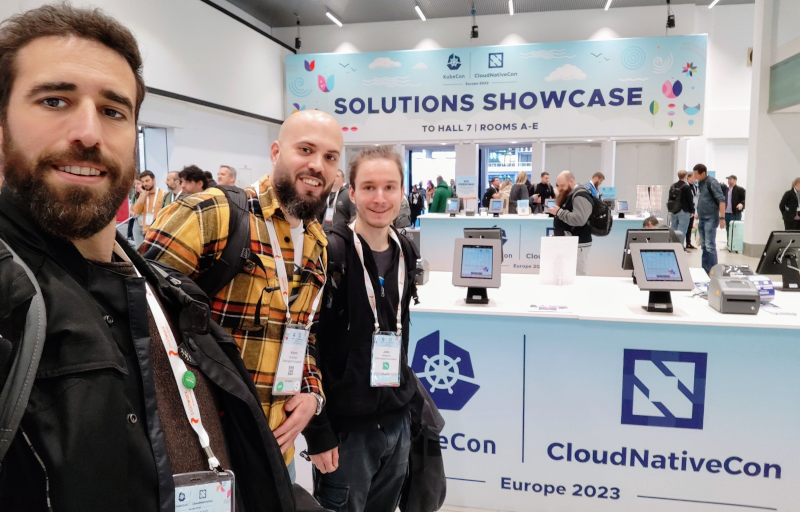
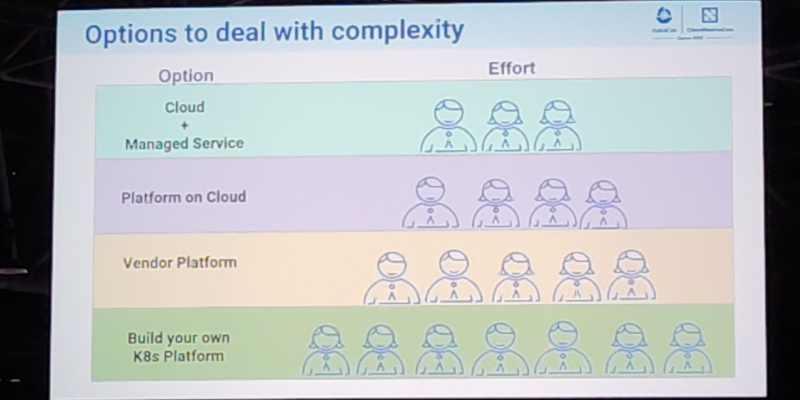
Post logo This post serves as a report from my attendance to Kubecon and CloudNativeCon 2023 Europe that took place in Amsterdam in April 2023. It was my second time physically attending this conference, the first one was in Austin, Texas (USA) in 2017. I also attended once in a virtual fashion. The content here is mostly generated for the sake of my own recollection and learnings, and is written from the notes I took during the event. The very first session was the opening keynote, which reunited the whole crowd to bootstrap the event and share the excitement about the days ahead. Some astonishing numbers were announced: there were more than 10.000 people attending, and apparently it could confidently be said that it was the largest open source technology conference taking place in Europe in recent times. It was also communicated that the next couple iteration of the event will be run in China in September 2023 and Paris in March 2024. More numbers, the CNCF was hosting about 159 projects, involving 1300 maintainers and about 200.000 contributors. The cloud-native community is ever-increasing, and there seems to be a strong trend in the industry for cloud-native technology adoption and all-things related to PaaS and IaaS. The event program had different tracks, and in each one there was an interesting mix of low-level and higher level talks for a variety of audience. On many occasions I found that reading the talk title alone was not enough to know in advance if a talk was a 101 kind of thing or for experienced engineers. But unlike in previous editions, I didn t have the feeling that the purpose of the conference was to try selling me anything. Obviously, speakers would make sure to mention, or highlight in a subtle way, the involvement of a given company in a given solution or piece of the ecosystem. But it was non-invasive and fair enough for me. On a different note, I found the breakout rooms to be often small. I think there were only a couple of rooms that could accommodate more than 500 people, which is a fairly small allowance for 10k attendees. I realized with frustration that the more interesting talks were immediately fully booked, with people waiting in line some 45 minutes before the session time. Because of this, I missed a few important sessions that I ll hopefully watch online later. Finally, on a more technical side, I ve learned many things, that instead of grouping by session I ll group by topic, given how some subjects were mentioned in several talks. On gitops and CI/CD pipelines Most of the mentions went to FluxCD and ArgoCD. At that point there were no doubts that gitops was a mature approach and both flux and argoCD could do an excellent job. ArgoCD seemed a bit more over-engineered to be a more general purpose CD pipeline, and flux felt a bit more tailored for simpler gitops setups. I discovered that both have nice web user interfaces that I wasn t previously familiar with. However, in two different talks I got the impression that the initial setup of them was simple, but migrating your current workflow to gitops could result in a bumpy ride. This is, the challenge is not deploying flux/argo itself, but moving everything into a state that both humans and flux/argo can understand. I also saw some curious mentions to the config drifts that can happen in some cases, even if the goal of gitops is precisely for that to never happen. Such mentions were usually accompanied by some hints on how to operate the situation by hand. Worth mentioning, I missed any practical information about one of the key pieces to this whole gitops story: building container images. Most of the showcased scenarios were using pre-built container images, so in that sense they were simple. Building and pushing to an image registry is one of the two key points we would need to solve in Toolforge Kubernetes if adopting gitops. In general, even if gitops were already in our radar for Toolforge Kubernetes, I think it climbed a few steps in my priority list after the conference. Another learning was this site: https://opengitops.dev/. Group On etcd, performance and resource management I attended a talk focused on etcd performance tuning that was very encouraging. They were basically talking about the exact same problems we have had in Toolforge Kubernetes, like api-server and etcd failure modes, and how sensitive etcd is to disk latency, IO pressure and network throughput. Even though Toolforge Kubernetes scale is small compared to other Kubernetes deployments out there, I found it very interesting to see other s approaches to the same set of challenges. I learned how most Kubernetes components and apps can overload the api-server. Because even the api-server talks to itself. Simple things like kubectl may have a completely different impact on the API depending on usage, for example when listing the whole list of objects (very expensive) vs a single object. The conclusion was to try avoiding hitting the api-server with LIST calls, and use ResourceVersion which avoids full-dumps from etcd (which, by the way, is the default when using bare kubectl get calls). I already knew some of this, and for example the jobs-framework-emailer was already making use of this ResourceVersion functionality. There have been a lot of improvements in the performance side of Kubernetes in recent times, or more specifically, in how resources are managed and used by the system. I saw a review of resource management from the perspective of the container runtime and kubelet, and plans to support fancy things like topology-aware scheduling decisions and dynamic resource claims (changing the pod resource claims without re-defining/re-starting the pods). On cluster management, bootstrapping and multi-tenancy I attended a couple of talks that mentioned kubeadm, and one in particular was from the maintainers themselves. This was of interest to me because as of today we use it for Toolforge. They shared all the latest developments and improvements, and the plans and roadmap for the future, with a special mention to something they called kubeadm operator , apparently capable of auto-upgrading the cluster, auto-renewing certificates and such. I also saw a comparison between the different cluster bootstrappers, which to me confirmed that kubeadm was the best, from the point of view of being a well established and well-known workflow, plus having a very active contributor base. The kubeadm developers invited the audience to submit feature requests, so I did. The different talks confirmed that the basic unit for multi-tenancy in kubernetes is the namespace. Any serious multi-tenant usage should leverage this. There were some ongoing conversations, in official sessions and in the hallway, about the right tool to implement K8s-whitin-K8s, and vcluster was mentioned enough times for me to be convinced it was the right candidate. This was despite of my impression that multiclusters / multicloud are regarded as hard topics in the general community. I definitely would like to play with it sometime down the road. On networking I attended a couple of basic sessions that served really well to understand how Kubernetes instrumented the network to achieve its goal. The conference program had sessions to cover topics ranging from network debugging recommendations, CNI implementations, to IPv6 support. Also, one of the keynote sessions had a reference to how kube-proxy is not able to perform NAT for SIP connections, which is interesting because I believe Netfilter Conntrack could do it if properly configured. One of the conclusions on the CNI front was that Calico has a massive community adoption (in Netfilter mode), which is reassuring, especially considering it is the one we use for Toolforge Kubernetes. Slide On jobs I attended a couple of talks that were related to HPC/grid-like usages of Kubernetes. I was truly impressed by some folks out there who were using Kubernetes Jobs on massive scales, such as to train machine learning models and other fancy AI projects. It is acknowledged in the community that the early implementation of things like Jobs and CronJobs had some limitations that are now gone, or at least greatly improved. Some new functionalities have been added as well. Indexed Jobs, for example, enables each Job to have a number (index) and process a chunk of a larger batch of data based on that index. It would allow for full grid-like features like sequential (or again, indexed) processing, coordination between Job and more graceful Job restarts. My first reaction was: Is that something we would like to enable in Toolforge Jobs Framework? On policy and security A surprisingly good amount of sessions covered interesting topics related to policy and security. It was nice to learn two realities:
  1. kubernetes is capable of doing pretty much anything security-wise and create greatly secured environments.
  2. it does not by default. The defaults are not security-strict on purpose.
It kind of made sense to me: Kubernetes was used for a wide range of use cases, and developers didn t know beforehand to which particular setup they should accommodate the default security levels. One session in particular covered the most basic security features that should be enabled for any Kubernetes system that would get exposed to random end users. In my opinion, the Toolforge Kubernetes setup was already doing a good job in that regard. To my joy, some sessions referred to the Pod Security Admission mechanism, which is one of the key security features we re about to adopt (when migrating away from Pod Security Policy). I also learned a bit more about Secret resources, their current implementation and how to leverage a combo of CSI and RBAC for a more secure usage of external secrets. Finally, one of the major takeaways from the conference was learning about kyverno and kubeaudit. I was previously aware of the OPA Gatekeeper. From the several demos I saw, it was to me that kyverno should help us make Toolforge Kubernetes more sustainable by replacing all of our custom admission controllers with it. I already opened a ticket to track this idea, which I ll be proposing to my team soon. Final notes In general, I believe I learned many things, and perhaps even more importantly I re-learned some stuff I had forgotten because of lack of daily exposure. I m really happy that the cloud native way of thinking was reinforced in me, which I still need because most of my muscle memory to approach systems architecture and engineering is from the old pre-cloud days. List of sessions I attended on the first day: List of sessions I attended on the second day: List of sessions I attended on third day: The videos have been published on Youtube.

14 April 2023

Russ Allbery: Review: Babel

Review: Babel, by R.F. Kuang
Publisher: Harper Voyage
Copyright: August 2022
ISBN: 0-06-302144-7
Format: Kindle
Pages: 544
Babel, or the Necessity of Violence: An Arcane History of the Oxford Translators' Revolution, to give it its full title, is a standalone dark academia fantasy set in the 1830s and 1840s, primarily in Oxford, England. The first book of R.F. Kuang's previous trilogy, The Poppy War, was nominated for multiple awards and won the Compton Crook Award for best first novel. Babel is her fourth book. Robin Swift, although that was not his name at the time, was born and raised in Canton and educated by an inexplicable English tutor his family could not have afforded. After his entire family dies of cholera, he is plucked from China by a British professor and offered a life in England as his ward. What follows is a paradise of books, a hell of relentless and demanding instruction, and an unpredictably abusive emotional environment, all aiming him towards admission to Oxford University. Robin will join University College and the Royal Institute of Translation. The politics of this imperial Britain are almost precisely the same as in our history, but one of the engines is profoundly different. This world has magic. If words from two different languages are engraved on a metal bar (silver is best), the meaning and nuance lost in translation becomes magical power. With a careful choice of translation pairs, and sometimes additional help from other related words and techniques, the silver bar becomes a persistent spell. Britain's industrial revolution is in overdrive thanks to the country's vast stores of silver and the applied translation prowess of Babel. This means Babel is also the only part of very racist Oxford that accepts non-white students and women. They need translators (barely) more than they care about maintaining social hierarchy; translation pairs only work when the translator is fluent in both languages. The magic is also stronger when meanings are more distinct, which is creating serious worries about classical and European languages. Those are still the bulk of Babel's work, but increased trade and communication within Europe is eroding the meaning distinctions and thus the amount of magical power. More remote languages, such as Chinese and Urdu, are full of untapped promise that Britain's colonial empire wants to capture. Professor Lowell, Robin's dubious benefactor, is a specialist in Chinese languages; Robin is a potential tool for his plans. As Robin discovers shortly after arriving in Oxford, he is not the first of Lowell's tools. His predecessor turned against Babel and is trying to break its chokehold on translation magic. He wants Robin to help. This is one of those books that is hard to review because it does some things exceptionally well and other things that did not work for me. It's not obvious if the latter are flaws in the book or a mismatch between book and reader (or, frankly, flaws in the reader). I'll try to explain as best I can so that you can draw your own conclusions. First, this is one of the all-time great magical system hooks. The way words are tapped for power is fully fleshed out and exceptionally well-done. Kuang is a professional translator, which shows in the attention to detail on translation pairs. I think this is the best-constructed and explained word-based magic system I've read in fantasy. Many word-based systems treat magic as its own separate language that is weirdly universal. Here, Kuang does the exact opposite, and the result is immensely satisfying. A fantasy reader may expect exploration of this magic system to be the primary point of the book, however, and this is not the case. It is an important part of the book, and its implications are essential to the plot resolution, but this is not the type of fantasy novel where the plot is driven by character exploration of the magic system. The magic system exists, the characters use it, and we do get some crunchy details, but the heart of the book is elsewhere. If you were expecting the typical relationship of a fantasy novel to its magic system, you may get a bit wrong-footed. Similarly, this is historical fantasy, but it is the type of historical fantasy where the existence of magic causes no significant differences. For some people, this is a pet peeve; personally, I don't mind that choice in the abstract, but some of the specifics bugged me. The villains of this book assert that any country could have done what Britain did in developing translation magic, and thus their hoarding of it is not immoral. They are obviously partly lying (this is a classic justification for imperialism), but it's not clear from the book how they are lying. Technologies (and magic here works like a technology) tend to concentrate power when they require significant capital investment, and tend to dilute power when they are portable and easy to teach. Translation magic feels like the latter, but its effect in the book is clearly the former, and I was never sure why. England is not an obvious choice to be a translation superpower. Yes, it's a colonial empire, but India, southeast Asia, and most certainly Africa (the continent largely not appearing in this book) are home to considerably more languages from more wildly disparate families than western Europe. Translation is not a peculiarly European idea, and this magic system does not seem hard to stumble across. It's not clear why England, and Oxford in particular, is so dramatically far ahead. There is some sign that Babel is keeping the mechanics of translation magic secret, but that secret has leaked, seems easy to develop independently, and is simple enough that a new student can perform basic magic with a few hours of instruction. This does not feel like the kind of power that would be easy to concentrate, let alone to the extreme extent required by the last quarter of this book. The demand for silver as a base material for translation magic provides a justification for mercantilism that avoids the confusing complexities of currency economics in our actual history, so fine, I guess, but it was a bit disappointing for this great of an idea for a magic system to have this small of an impact on politics. I'll come to the actual thrust of this book in a moment, but first something else Babel does exceptionally well: dark academia. The remainder of Robin's cohort at Oxford is Remy, a dark-skinned Muslim from Calcutta; Victoire, a Haitian woman raised in France; and Letty, the daughter of a British admiral. All of them are non-white except Letty, and Letty and Victoire additionally have to deal with the blatant sexism of the time. (For example, they have to live several miles from Oxford because women living near the college would be a "distraction.") The interpersonal dynamics between the four are exceptionally well done. Kuang captures the dislocation of going away to college, the unsettled life upheaval that makes it both easy and vital to form suddenly tight friendships, and the way that the immense pressure from classes and exams leaves one so devoid of spare emotional capacity that those friendships become both unbreakable and badly strained. Robin and Remy almost immediately become inseparable in that type of college friendship in which profound trust and constant companionship happen first and learning about the other person happens afterwards. It's tricky to talk about this without spoilers, but one of the things Kuang sets up with this friend group is a pointed look at intersectionality. Babel has gotten a lot of positive review buzz, and I think this is one of the reasons why. Kuang does not pass over or make excuses for characters in a place where many other books do. This mostly worked for me, but with a substantial caveat that I think you may want to be aware of before you dive into this book. Babel is set in the 1830s, but it is very much about the politics of 2022. That does not necessarily mean that the politics are off for the 1830s; I haven't done the research to know, and it's possible I'm seeing the Tiffany problem (Jo Walton's observation that Tiffany is a historical 12th century women's name, but an author can't use it as a medieval name because readers think it sounds too modern). But I found it hard to shake the feeling that the characters make sense of their world using modern analytical frameworks of imperialism, racism, sexism, and intersectional feminism, although without using modern terminology, and characters from the 1830s would react somewhat differently. This is a valid authorial choice; all books are written for the readers of the time when they're published. But as with magical systems that don't change history, it's a pet peeve for some readers. If that's you, be aware that's the feel I got from it. The true center of this book is not the magic system or the history. It's advertised directly in the title the necessity of violence although it's not until well into the book before the reader knows what that means. This is a book about revolution, what revolution means, what decisions you have to make along the way, how the personal affects the political, and the inadequacy of reform politics. It is hard, uncomfortable, and not gentle on its characters. The last quarter of this book was exceptional, and I understand why it's getting so much attention. Kuang directly confronts the desire for someone else to do the necessary work, the hope that surely the people with power will see reason, and the feeling of despair when there are no good plans and every reason to wait and do nothing when atrocities are about to happen. If you are familiar with radical politics, these aren't new questions, but this is not the sort of thing that normally shows up in fantasy. It does not surprise me that Babel struck a nerve with readers a generation or two younger than me. It captures that heady feeling on the cusp of adulthood when everything is in flux and one is assembling an independent politics for the first time. Once I neared the end of the book, I could not put it down. The ending is brutal, but I think it was the right ending for this book. There are two things, though, that I did not like about the political arc. The first is that Victoire is a much more interesting character than Robin, but is sidelined for most of the book. The difference of perspectives between her and Robin is the heart of what makes the end of this book so good, and I wish that had started 300 pages earlier. Or, even better, I wish Victoire has been the protagonist; I liked Robin, but he's a very predictable character for most of the book. Victoire is not; even the conflicts she had earlier in the book, when she didn't get much attention in the story, felt more dynamic and more thoughtful than Robin's mix of guilt and anxiety. The second is that I wish Kuang had shown more of Robin's intellectual evolution. All of the pieces of why he makes the decisions that he does are present in this book, and Kuang shows his emotional state (sometimes in agonizing detail) at each step, but the sense-making, the development of theory and ideology beneath the actions, is hinted at but not shown. This is a stylistic choice with no one right answer, but it felt odd because so much of the rest of the plot is obvious and telegraphed. If the reader shares Robin's perspective, I think it's easy to fill in the gaps, but it felt odd to read Robin giving clearly thought-out political analyses at the end of the book without seeing the hashing-out and argument with friends required to develop those analyses. I felt like I had to do a lot of heavy lifting as the reader, work that I wish had been done directly by the book. My final note about this book is that I found much of it extremely predictable. I think that's part of why reviewers describe it as accessible and easy to read; accessibility and predictability can be two sides of the same coin. Kuang did not intend for this book to be subtle, and I think that's part of the appeal. But very few of Robin's actions for the first three-quarters of the book surprised me, and that's not always the reading experience I want. The end of the book is different, and I therefore found it much more gripping, but it takes a while to get there. Babel is, for better or worse, the type of fantasy where the politics, economics, and magic system exist primarily to justify the plot the author wanted. I don't think the societal position of the Institute of Translation that makes the ending possible is that believable given the nature of the technology in question and the politics of the time, and if you are inclined to dig into the specifics of the world-building, I think you will find it frustrating. Where it succeeds brilliantly is in capturing the social dynamics of hothouse academic cohorts, and in making a sharp and unfortunately timely argument about the role of violence in political change, in a way that the traditionally conservative setting of fantasy rarely does. I can't say Babel blew me away, but I can see why others liked it so much. If I had to guess, I'd say that the closer one is in age to the characters in the book and to that moment of political identity construction, the more it's likely to appeal. Rating: 7 out of 10

3 April 2023

Russ Allbery: Review: The Nordic Theory of Everything

Review: The Nordic Theory of Everything, by Anu Partanen
Publisher: Harper
Copyright: 2016
Printing: June 2017
ISBN: 0-06-231656-7
Format: Kindle
Pages: 338
Anu Partanen is a Finnish journalist who immigrated to the United States. The Nordic Theory of Everything, subtitled In Search of a Better Life, is an attempt to explain the merits of Finnish approaches to government and society to a US audience. It was her first book. If you follow US policy discussion at all, you have probably been exposed to many of the ideas in this book. There was a time when the US left was obsessed with comparisons between the US and Nordic countries, and while that obsession has faded somewhat, Nordic social systems are still discussed with envy and treated as a potential model. Many of the topics of this book are therefore predictable: parental leave, vacation, health care, education, happiness, life expectancy, all the things that are far superior in Nordic countries than in the United States by essentially every statistical measure available, and which have been much-discussed. Partanen brings two twists to this standard analysis. The first is that this book is part memoir: she fell in love with a US writer and made the decision to move to the US rather than asking him to move to Finland. She therefore experienced the transition between social and government systems first-hand and writes memorably on the resulting surprise, trade-offs, anxiety, and bafflement. The second, which I've not seen previously in this policy debate, is a fascinating argument that Finland is a far more individualistic country than the United States precisely because of its policy differences.
Most people, including myself, assumed that part of what made the United States a great country, and such an exceptional one, was that you could live your life relatively unencumbered by the downside of a traditional, old-fashioned society: dependency on the people you happened to be stuck with. In America you had the liberty to express your individuality and choose your own community. This would allow you to interact with family, neighbors, and fellow citizens on the basis of who you were, rather than on what you were obligated to do or expected to be according to old-fashioned thinking. The longer I lived in America, therefore, and the more places I visited and the more people I met and the more American I myself became the more puzzled I grew. For it was exactly those key benefits of modernity freedom, personal independence, and opportunity that seemed, from my outsider s perspective, in a thousand small ways to be surprisingly missing from American life today. Amid the anxiety and stress of people s daily lives, those grand ideals were looking more theoretical than actual.
The core of this argument is that the structure of life in the United States essentially coerces dependency on other people: employers, spouses, parents, children, and extended family. Because there is no universally available social support system, those relationships become essential for any hope of a good life, and often for survival. If parents do not heavily manage their children's education, there is a substantial risk of long-lasting damage to the stability and happiness of their life. If children do not care for their elderly parents, they may receive no care at all. Choosing not to get married often means choosing precarity and exhaustion because navigating society without pooling resources with someone else is incredibly difficult.
It was as if America, land of the Hollywood romance, was in practice mired in a premodern time when marriage was, first and foremost, not an expression of love, but rather a logistical and financial pact to help families survive by joining resources.
Partanen contrasts this with what she calls the Nordic theory of love:
What Lars Tr g rdh came to understand during his years in the United States was that the overarching ambition of Nordic societies during the course of the twentieth century, and into the twenty-first, has not been to socialize the economy at all, as is often mistakenly assumed. Rather the goal has been to free the individual from all forms of dependency within the family and in civil society: the poor from charity, wives from husbands, adult children from parents, and elderly parents from their children. The express purpose of this freedom is to allow all those human relationships to be unencumbered by ulterior motives and needs, and thus to be entirely free, completely authentic, and driven purely by love.
She sees this as the common theme through most of the policy differences discussed in this book. The Finnish approach is to provide neutral and universal logistical support for most of life's expected challenges: birth, child-rearing, education, health, unemployment, and aging. This relieves other social relations family, employer, church of the corrosive strain of dependency and obligation. It also ensures people's basic well-being isn't reliant on accidents of association.
If the United States is so worried about crushing entrepreneurship and innovation, a good place to start would be freeing start-ups and companies from the burdens of babysitting the nation s citizens.
I found this fascinating as a persuasive technique. Partanen embraces the US ideal of individualism and points out that, rather than being collectivist as the US right tends to assume, Finland is better at fostering individualism and independence because the government works to removes unnecessary premodern constraints on individual lives. The reason why so many Americans are anxious and frantic is not a personal failing or bad luck. It's because the US social system is deeply hostile to healthy relationships and individual independence. It demands a constant level of daily problem-solving and crisis management that is profoundly exhausting, nearly impossible to navigate alone, and damaging to the ideal of equal relationships. Whether this line of argument will work is another question, and I'm dubious for reasons that Partanen (probably wisely) avoids. She presents the Finnish approach as a discovery that the US would benefit from, and the US approach as a well-intentioned mistake. I think this is superficially appealing; almost all corners of US political belief at least give lip service to individualism and independence. However, advocates of political change will eventually need to address the fact that many US conservatives see this type of social coercion as an intended feature of society rather than a flaw. This is most obvious when one looks at family relationships. Partanen treats the idea that marriage should be a free choice between equals rather than an economic necessity as self-evident, but there is a significant strain of US political thought that embraces punishing people for not staying within the bounds of a conservative ideal of family. One will often find, primarily but not exclusively among the more religious, a contention that the basic unit of society is the (heterosexual, patriarchal) family, not the individual, and that the suffering of anyone outside that structure is their own fault. Not wanting to get married, be the primary caregiver for one's parents, or abandon a career in order to raise children is treated as malignant selfishness and immorality rather than a personal choice that can be enabled by a modern social system. Here, I think Partanen is accurate to identify the Finnish social system as more modern. It embraces the philosophical concept of modernity, namely that social systems can be improved and social structures are not timeless. This is going to be a hard argument to swallow for those who see the pressure towards forming dependency ties within families as natural, and societal efforts to relieve those pressures as government meddling. In that intellectual framework, rather than an attempt to improve the quality of life, government logistical support is perceived as hostility to traditional family obligations and an attempt to replace "natural" human ties with "artificial" dependence on government services. Partanen doesn't attempt to have that debate. Two other things struck me in this book. The first is that, in Partanen's presentation, Finns expect high-quality services from their government and work to improve it when it falls short. This sounds like an obvious statement, but I don't think it is in the context of US politics, and neither does Partanen. She devotes a chapter to the topic, subtitled "Go ahead: ask what your country can do for you." This is, to me, one of the most frustrating aspects of US political debate. Our attitude towards government is almost entirely hostile and negative even among the political corners that would like to see government do more. Failures of government programs are treated as malice, malfeasance, or inherent incompetence: in short, signs the program should never have been attempted, rather than opportunities to learn and improve. Finland had mediocre public schools, decided to make them better, and succeeded. The moment US public schools start deteriorating, we throw much of our effort into encouraging private competition and dismantling the public school system. Partanen doesn't draw this connection, but I see a link between the US desire for market solutions to societal problems and the level of exhaustion and anxiety that is so common in US life. Solving problems by throwing them open to competition is a way of giving up, of saying we have no idea how to improve something and are hoping someone else will figure it out for a profit. Analyzing the failures of an existing system and designing incremental improvements is hard and slow work. Throwing out the system and hoping some corporation will come up with something better is disruptive but easy. When everyone is already overwhelmed by life and devoid of energy to work on complex social problems, it's tempting to give up on compromise and coalition-building and let everyone go their separate ways on their own dime. We cede the essential work of designing a good society to start-ups. This creates a vicious cycle: the resulting market solutions are inevitably gated by wealth and thus precarious and artificially scarce, which in turn creates more anxiety and stress. The short-term energy savings from not having to wrestle with a hard problem is overwhelmed by the long-term cost of having to navigate a complex and adversarial economic relationship. That leads into the last point: schools. There's a lot of discussion here about school quality and design, which I won't review in detail but which is worth reading. What struck me about Partanen's discussion, though, is how easy the Finnish system is to use. Finnish parents just send their kids to the most convenient school and rarely give that a second thought. The critical property is that all the schools are basically fine, and therefore there is no need to place one's child in an exceptional school to ensure they have a good life. It's axiomatic in the US that more choice is better. This is a constant refrain in our political discussion around schools: parental choice, parental control, options, decisions, permission, matching children to schools tailored for their needs. Those choices are almost entirely absent in Finland, at least in Partanen's description, and the amount of mental and emotional energy this saves is astonishing. Parents simply don't think about this, and everything is fine. I think we dramatically underestimate the negative effects of constantly having to make difficult decisions with significant consequences, and drastically overstate the benefits of having every aspect of life be full of major decision points. To let go of that attempt at control, however illusory, people have to believe in a baseline of quality that makes the choice less fraught. That's precisely what Finland provides by expecting high-quality social services and working to fix them when they fall short, an effort that the United States has by and large abandoned. A lot of non-fiction books could be turned into long articles without losing much substance, and I think The Nordic Theory of Everything falls partly into that trap. Partanen repeats the same ideas from several different angles, and the book felt a bit padded towards the end. If you're already familiar with the policy comparisons between the US and Nordic countries, you will have seen a lot of this before, and the book bogs down when Partanen strays too far from memoir and personal reactions. But the focus on individualism and eliminating dependency is new, at least to me, and is such an illuminating way to look at the contrast that I think the book is worth reading just for that. Rating: 7 out of 10

5 February 2023

Jonathan Dowland: 2022 in reading

In 2022 I read 34 books (-19% on last year). In 2021 roughly a quarter of the books I read were written by women. I was determined to push that ratio in 2022, so I made an effort to try and only read books by women. I knew that I wouldn't manage that, but by trying to, I did get the ratio up to 58% (by page count). I'm not sure what will happen in 2023. My to-read pile has some back-pressure from books by male authors I postponed reading in 2022 (in particular new works by Christopher Priest and Adam Roberts). It's possible the ratio will swing back the other way, which would mean it would not be worth repeating the experiment. At least if the ratio is the point of the exercise. But perhaps it isn't: perhaps the useful outcome is more qualitative than quantitative. I tried to read some new (to me) authors. I really enjoyed Shirley Jackson (The Haunting of Hill House, We Have Always Lived In The Castle). I Struggled with Angela Carter's Heroes and Villains although I plan to return to her other work, in particular, The Bloody Chamber. I also got through Donna Tartt's The Secret History on the recommendation of a friend. I had to push through the first 15% or so but it turned out to be worth it.
a book cover for Shirley Jackson's 'We have always lived in the castle'
a book cover for Margaret Atwood's 'The Handmaid's Tale'
a book cover for Adam Roberts' 'The This'
a book cover for Emily St. John Mandel's 'Sea of Tranquility'

I finally read (and loved) The Handmaid's Tale, which I had never read despite loving Atwood. My top non-fiction book was The Nanny State Made Me by Stuart Maconie. I still read far more fiction than non-fiction. Or perhaps I'm not keeping track of non- fiction as well. I feel non-fiction requires a different approach to reading: not necessarily linear; it's not always important to read the whole book; it's often important to re-read sections. It might not make sense to consider them in the same bracket. My favourite novels this year were Sea of Tranquility by Emily St. John Mandel, a standalone sort-of sequel to The Glass House but in a very different genre; and The This by Adam Roberts, which was equally remarkable. The This has an interesting narrative device in the first third where a stream of tweets is presented in parallel with the main text. This works well, and does a good job of capturing the figurative river of tweet-like stuff that is woven into our lives at the moment. But I can't help but wonder how they tackle that in the audiobook.

16 January 2023

Russ Allbery: Review: The Truth

Review: The Truth, by Terry Pratchett
Series: Discworld #25
Publisher: Harper
Copyright: November 2000
Printing: August 2014
ISBN: 0-06-230736-3
Format: Mass market
Pages: 435
The Truth is the 25th Discworld novel. Some reading order guides group it loosely into an "industrial revolution" sequence following Moving Pictures, but while there are thematic similarities I'll talk about in a moment, there's no real plot continuity. You could arguably start reading Discworld here, although you'd be spoiled for some character developments in the early Watch novels. William de Worde is paid to write a newsletter. That's not precisely what he calls it, and it's not clear whether his patrons know that he publishes it that way. He's paid to report on news of Ankh-Morpork that may be of interest of various rich or influential people who are not in Ankh-Morpork, and he discovered the best way to optimize this was to write a template of the newsletter, bring it to an engraver to make a plate of it, and run off copies for each of his customers, with some minor hand-written customization. It's a comfortable living for the estranged younger son of a wealthy noble. As the story opens, William is dutifully recording the rumor that dwarfs have discovered how to turn lead into gold. The rumor is true, although not in the way that one might initially assume.
The world is made up of four elements: Earth, Air, Fire, and Water. This is a fact well known even to Corporal Nobbs. It's also wrong. There's a fifth element, and generally it's called Surprise. For example, the dwarfs found out how to turn lead into gold by doing it the hard way. The difference between that and the easy way is that the hard way works.
The dwarfs used the lead to make a movable type printing press, which is about to turn William de Worde's small-scale, hand-crafted newsletter into a newspaper. The movable type printing press is not unknown technology. It's banned technology, because the powers that be in Ankh-Morpork know enough to be deeply suspicious of it. The religious establishment doesn't like it because words are too important and powerful to automate. The nobles and the Watch don't like it because cheap words cause problems. And the engraver's guild doesn't like it for obvious reasons. However, Lord Vetinari knows that one cannot apply brakes to a volcano, and commerce with the dwarfs is very important to the city. The dwarfs can continue. At least for now. As in Moving Pictures, most of The Truth is an idiosyncratic speedrun of the social effects of a new technology, this time newspapers. William has no grand plan; he's just an observant man who likes to write, cares a lot about the truth, and accidentally stumbles into editing a newspaper. (This, plus being an estranged son of a rich family, feels very on-point for journalism.) His naive belief is that people want to read true things, since that's what his original patrons wanted. Truth, however, may not be in the top five things people want from a newspaper. This setup requires some narrative force to push it along, which is provided by a plot to depose Vetinari by framing him for murder. The most interesting part of that story is Mr. Pin and Mr. Tulip, the people hired to do the framing and then dispose of the evidence. They're a classic villain type: the brains and the brawn, dangerous, terrifying, and willing to do horrible things to people. But one thing Pratchett excels at is taking a standard character type, turning it a bit sideways, and stuffing in things that one wouldn't think would belong. In this case, that's Mr. Tulip's deep appreciation for, and genius grasp of, fine art. It should not work to have the looming, awful person with anger issues be able to identify the exact heritage of every sculpture and fine piece of goldsmithing, and yet somehow it does. Also as in Moving Pictures (and, in a different way, Soul Music), Pratchett tends to anthropomorphize technology, giving it a life and motivations of its own. In this case, that's William's growing perception of the press as an insatiable maw into which one has to feed words. I'm usually dubious of shifting agency from humans to things when doing social analysis (and there's a lot of social analysis here), but I have to concede that Pratchett captures something deeply true about the experience of feedback loops with an audience. A lot of what Pratchett puts into this book about the problematic relationship between a popular press and the truth is obvious and familiar, but he also makes some subtle points about the way the medium shapes what people expect from it and how people produce content for it that are worthy of Marshall McLuhan. The interactions between William and the Watch were less satisfying. In our world, the US press is, with only rare exceptions, a thoughtless PR organ for police propaganda and the exonerative tense. Pratchett tackles that here... sort of. William vaguely grasps that his job as a reporter may be contrary to the job of the Watch to maintain order, and Vimes's ambivalent feelings towards "solving crimes" push the story in that direction. But this is also Vimes, who is clearly established as one of the good sort and therefore is a bad vehicle for talking about how the police corrupt the press. Pratchett has Vimes and Vetinari tacitly encourage William, which works within the story but takes the pressure off the conflict and leaves William well short of understanding the underlying politics. There's a lot more that could be said about the tension between the press and the authorities, but I think the Discworld setup isn't suitable for it. This is the sort of book that benefits from twenty-four volumes of backstory and practice. Pratchett's Ankh-Morpork cast ticks along like a well-oiled machine, which frees up space that would otherwise have to be spent on establishing secondary characters. The result is a lot of plot and social analysis shoved into a standard-length Discworld novel, and a story that's hard to put down. The balance between humor and plot is just about perfect, the references and allusions aren't overwhelming, and the supporting characters, both new and old, are excellent. We even get a good Death sequence. This is solid, consistent stuff: Discworld as a mature, well-developed setting with plenty of stories left to tell. Followed by Thief of Time in publication order, and later by Monstrous Regiment in the vaguely-connected industrial revolution sequence. Rating: 8 out of 10

18 December 2022

Russell Coker: Wall Facers

I m currently reading the second book of the TriSolar Sci-Fi series by Cixin Liu, I ve only just started it so this post can t have spoilers for it and I will also only have minimal spoilers for the first book (nothing more than you will get from pop culture references to it). In the second book there are people called Wall Facers who have broad powers to shape the course of the Human response to an alien invasion in 400+ years time. The idea is that as the aliens have an ability to see everything that can be seen on Earth any ideas that leave the brain of one person can be snooped on, so if some people act independently without communicating their plans they can take the aliens by surprise. While that is probably going to work out well in the books history in general seems to show that people who act independently without any useful feedback from others tend to perform poorly, every king and dictator seems to demonstrate this. Efficient Work I ve been thinking about what I would do if I had significant powers to guide the response to an alien threat in some hundreds of years. The first thing to do would be to get all people working as efficiently as possible. Without the imminent threat of alien invasion we can have debates about how much time to spend working vs leisure time. Should we make 24 hours per week the new normal work week? But if the threat of annihilation is looming then the discussion should be about how to get as many people as possible working as much as possible. Currently 1/4 of the world population lack access to safe drinking water [1], there s a plan to achieve universal and equitable access to safe and affordable drinking water for all by 2030 . But 2030 isn t soon enough, another 8 years where 1/4 of children born won t reach their potential due to poor water is unacceptable. Currently 13% of the world population don t have access to electricity and 40% don t have access to clean fuels for cooking [2]. Lack of energy access reduces health and opportunities for education. Healthcare is another major obstacle to human development and therefore economic development. Even some allegedly first-world countries like the US lack universal affordable healthcare. I think we could reasonably get safe water to 99% of the world population before 2025 if we tried hard (IE applied a small fraction of the resources of a single war to it). Getting electricity to 95% of the world population and clean cooking fuels to 90% of the world population are probably achievable goals for 2025 as well. Healthcare is a slightly harder problem as we need to train more nurses and doctors. A registered nurse apparently needs 3 years of training after completing high school. We may have to improve high schools to get more students up to the standard of nursing degrees. If it takes 3 years to improve schools in year 9+ and then 3 years to get more high school graduates that would mean that it would take about 9 years to get an increase in nurses. Doing this would require increasing the capacity of universities and making university almost free (as it was for decades). So in about 2031 we could start sending a significant number of nurses from developed countries to help out developing countries. Becoming a doctor apparently requires 8 years of study plus a minimum of 3 years residency . So if doctors were entirely trained in first world countries then we wouldn t be able to send many doctors to developing countries until 2039. If the residency was performed in other countries then it could be as early as 2036. According to the WHO currently only half the world s population have adequate healthcare [3]. To get adequate healthcare to the world we need to more than double the number of doctors because currently we don t have enough in countries with decent healthcare systems such as Australia. It would probably take to at least 2060 to get enough doctors trained. The end goal of course would be to have every country able to train enough of it s citizens to provide all medical services, but countries that have serious widespread healthcare problems that reduce the number of people who can pursue higher education will have difficulty in that until some of the healthcare problems are alleviated. Education Obviously education is important to all achievements. Currently education seems very poorly run, it is possible to create a school system that teaches children effectively without the bullying that is common in Australia and without the sort of pressure that South Korea is infamous for. One of the main issues to resolve with the school system is the idea that everyone should learn at the same speed, that goal can only be achieved by making the majority of the students learn slowly. Students should be able to freely skip ahead as their skill permits and finish school at any age. Also high school isn t for everyone, the tech schools that teach trades need to be brought back. Deceiving Aliens A plot point in the TriSolar series is that the aliens can see each other s thoughts, the local communication (their equivalent to talking) is based on reading each other s thoughts without the possibility of deception. While deceptive written communication is potentially possible for them they haven t developed skills in that area. As a first step towards exploiting this humans could focus more on linguistic development that increases language complexity, such as the way the English language adopts words from other languages and gives them slightly different meanings for example the difference between driver and chauffeur and the difference between dog and hound is not obvious to many Europeans who otherwise speak English fluently. When involved in conversation it s possible to convey meaning without directly stating things, this is used extensively by people who are interested in security. My observations of this are based on conversations with people who do government work, but I imagine that criminal organisations also do similar things for similar reasons. An increased focus on poetry in schools might be helpful in developing skills for conveying ideas to people who think in human ways where the message is unclear to non-humans who have no experience of deception. I wonder whether the ability to understand human poetry would make aliens less hostile to humans, if they can think like us then they would be less likely to want to exterminate us. Poker is a game that depends on the ability to deceive others, I ve never been any good at it. I wonder if making it part of the school curriculum would help improve the overall human ability to deceive aliens. I don t think that such schools would become dens of sociopathy as depicted in Kakegurui, but it might have some negative results. Spreading education to a larger portion of the world s population requires more use of electronic education. Anything learned via text can be more easily assimilated by aliens than things that are learned directly from other people. For high school and the basics of a university degree this is fine. But for more advanced education it seems that having a large face to face component might help keep the value away from the aliens. More Ideas? What do you think I missed on this list? I wasn t trying to list every possibility, just the more important ones. Also for any goals other than increasing inequality for it s own sake we should improve health and education for the world.

10 December 2022

Simon Josefsson: How to complicate buying a laptop

I m about to migrate to a new laptop, having done a brief pre-purchase review of options on Fosstodon and reaching a decision to buy the NovaCustom NV41. Given the rapid launch and decline of Mastodon instances, I thought I d better summarize my process and conclusion on my self-hosted blog until the fediverse self-hosting situation improves. Since 2010 my main portable computing device has been the Lenovo X201 that replaced the Dell Precision M65 that I bought in 2006. I have been incredibly happy with the X201, even to the point that in 2015 when I wanted to find a replacement, I couldn t settle on a decision and eventually realized I couldn t articulate what was wrong with the X201 and decided to just buy another X201 second-hand for my second office. There is still no deal-breaker with the X201, and I m doing most of my computing on it including writing this post. However, today I can better articulate what is lacking with the X201 that I desire, and the state of the available options on the market has improved since my last attempt in 2015. Briefly, my desired properties are: My workload for the machine is Emacs, Firefox, Nextcloud client, GNOME, Evolution (mail & calendar), LibreOffice Calc/Writer, compiling software and some podman/qemu for testing. I have used Debian as the main operating system for the entire life of this laptop, but have experimented with PureOS recently. My current X201 is useful enough for this, although support for 4K displays and a faster machine wouldn t hurt. Based on my experience in 2015 that led me to make no decision, I changed perspective. This is a judgement call and I will not be able to fulfil all criteria. I will have to decide on a balance and the final choice will include elements that I really dislike, but still it will hopefully be better than nothing. The conflict for me mainly center around these parts: A simple choice for me would be to buy one of the FSF RYF certified laptops. Right now that list only contains the 10+ year old Lenovo series, and I actually already have a X200 with libreboot that I bought earlier for comparison. The reason the X200 didn t work out as a replacement for me was the lack of a mouse trackpad, concerns about non-free EC firmware, Intel ME uncertainty (is it really neutralized?) and non-free CPU microcode (what are the bugs that it fixes?), but primarily that for some reason that I can t fully articulate it feels weird to use a laptop manufactured by Lenovo but modified by third parties to be useful. I believe in market forces to pressure manufacturers into Doing The Right Thing, and feel that there is no incentive for Lenovo to use libreboot in the future when this market niche is already fulfilled by re-sellers modifying Lenovo laptops. So I d be happier buying a laptop from someone who is natively supportive of they way I m computing. I m sure this aspect could be discussed a lot more, and maybe I ll come back to do that, and could even reconsider my thinking (the right-to-repair argument is compelling). I will definitely continue to monitor the list of RYF-certified laptops to see if future entries are more suitable options for me. Eventually I decided to buy the NovaCustom NV41 laptop, and it arrived quickly and I m in the process of setting it up. I hope to write a separate blog about it next.

3 November 2022

Alastair McKinstry: New Planning and Environment Court will reform planning appeals pro...

New Planning and Environment Court will reform planning appeals process #GreensInGovernment The Green Party has fulfilled an important Programme for Government commitment following the cabinet's decision to establish a new division of the High Court to specialise in environmental and planning issues. This is a major reform that will allow planning law to operate in a more efficient and environmentally friendly manner. Steven Matthews TD, Green Party Spokesperson for Planning and Local Government, explained the aim of the new court; The goal is to ensure that our judicial system has the capacity to decide cases as quickly as possible within a growing and increasingly complex body of Irish and EU environmental law. Timely access to justice is a cornersto ne of the effective rule of law and an international legal commitment Ireland has entered under the Aarhus Convention. This is extremely pressing given the urgent need to ease the pressure on the housing system and develop the infrastructure we need to transition to a zero-carbon economy." The Green Party is committed to ensuring the new Court will have the resources to fulfil its role. The Government will pass new legislation to allow the number of judges to be increased and provide the necessary exchequer funding to pay for these judges. The new Court will hear all the cases currently taken by the High Court s Commercial Planning and Strategic Infrastructure Development List and other major environmental cases. This is likely to include all major infrastructure cases as well as many cases relating to EU Environmental Law such as Environmental Impact Assessment, Strategic Environmental Assessment, Birds/Habitats, the Water Framework Directive and the Industrial Emissions Directive.

1 September 2022

Shirish Agarwal: Culture, Books, Friends

Culture Just before I start, I would like to point out that this post may or would probably be NSFW. Again, what is SFW (Safe at Work) and NSFW that so much depends on culture and perception of culture from wherever we are or wherever we take birth? But still, to be on the safe side I have put it as NSFW. Now there have been a few statements and ideas that gave me a pause. This will be a sort of chaotic blog post as I am in such a phase today. For e.g. while I do not know which culture or which country this comes from, somebody shared that in some cultures one can talk/comment May your poop be easy and with a straight face. I dunno which culture is this but if somebody asked me that I would just die from laughing or maybe poop there itself. While I can understand if it is a constipated person, but a whole culture? Until and unless their DNA is really screwed, I don t think so but then what do I know? I do know that we shit when we have extreme reactions of either joy or fear. And IIRC, this comes from mammal response when they were in dangerous situations and we got the same as humans evolved. I would really be interested to know which culture is that. I did come to know that the Japanese do wish that you may not experience hard work or something to that effect while ironically they themselves are becoming extinct due to hard work and not enough relaxation, toxic workplace is common in Japan according to social scientists and population experts. Another term that I couldn t figure out is The Florida Man Strikes again and this term is usually used when somebody does something stupid or something weird. While it is exclusively used in the American context, I am curious to know how that came about. Why does Florida have such people or is it an exaggeration? I have heard the term e.g. What happens in Vegas, stays in Vegas . Think it is also called Sin city although why just Vegas is beyond me?

Omicron-8712 Blood pressure machine I felt so stupid. I found another site or e-commerce site called Wellness Forever. They had the blood pressure machine I wanted, an Omron-8172. I bought it online and they delivered the same within half an hour. Amazon took six days and in the end, didn t deliver it at all. I tried taking measurements from it yesterday. I have yet to figure out what it all means but I did get measurements of 109 SYS, 88 DIA and Pulse is 72. As far as the pulse is concerned, guess that is normal, the others just don t know. If only I had known this couple of months ago. I was able to register the product as well as download and use the Omron Connect app. For roughly INR 2.5k you have a sort of health monitoring system. It isn t Star Trek Tricorder in any shape or form but it will have to do while the tricorder gets invented. And while we are on the subject let s not forget Elizabeth Holmes and the scam called Theranos. It really is something to see How Elizabeth Holmes modeled so much of herself on Steve Jobs mimicking how he left college/education halfway. A part of me is sad that Theranos is not real. Joe Scott just a few days ago shared some perspectives on the same just a few days ago. The idea in itself is pretty seductive, to say the least, and that is the reason the scam went on for more than a decade and perhaps would have been longer if some people hadn t gotten the truth out. I do see potentially, something like that coming on as A.I. takes a bigger role in automating testing. Half a decade to a decade from now, who knows if there is an algorithm that is able to do what is needed? If such a product were to come to the marketplace at a decent price, it would revolutionize medicine, especially in countries like India, South Africa, and all sorts of remote places. Especially, with all sorts of off-grid technologies coming and maturing in the marketplace. Before I forget, there is a game called Cell on Android that tells or shares about the evolution of life on earth. It also shares credence to the idea that life has come 6 times on Earth and has been destroyed multiple times by asteroids. It is in the idle sort of game format, so you can see the humble beginnings from the primordial soup to various kinds of cells and bacteria to finally a mammal. This is where I am and a long way to go.

Indian Bureaucracy One of the few things that Britishers gave to India, is the bureaucracy and the bureaucracy tests us in myriad ways. It would be full 2 months on 5th September and I haven t yet got a death certificate. And I need that for a sundry number of things. The same goes for a disability certificate. What is and was interesting is my trip to the local big hospital called Sassoon Hospital. My mum had shared incidents that occurred in the 1950s when she and the family had come to Pune. According to her, when she was alive, while Sassoon was the place to be, it was big and chaotic and you never knew where you are going. That was in 1950, I had the same experience in 2022. The term/adage the more things change, the more they remain the same seems to be held true for Sassoon Hospital. Btw, those of you who think the Devil exists, he is totally a fallacy. There is a popular myth that the devil comes to deal that he/she/they come to deal with you when somebody close to you passes, I was waiting desperately for him when mum passed. Any deal that he/she/they would have offered me I would have gladly taken, but all my wait was all for nothing. While I believe evil exists, that is manifested by humans and nobody else. The whole idea and story of the devil is just to control young children and nothing beyond that

Debconf 2023, friends, JPEGOptim, and EV s Quite a number of friends had gone to Albania this year as India won the right to host Debconf for the year 2023. While I did lurk on the Debconf orga IRC channel, I m not sure how helpful I would be currently. One news that warmed my heart is some people would be coming to India to check the site way before and make sure things go smoothly. Nothing like having more eyes (in this case bodies) to throw at a problem and hopefully it will be sorted. While I have not been working for the last couple of years, one of the things that I had to do and have been doing is moving a lot of stuff online. This is in part due to the Government s own intention of having everything on the cloud. One of the things I probably may have shared it more than enough times is that the storage most of these sites give is like the 1990s. I tried jpegoptim and while it works, it degrades the quality of the image quite a bit. The whole thing seems backward, especially as newer and newer smartphones are capturing more data per picture (megapixel resolution), case in point Samsung Galaxy A04 that is being introduced. But this is not only about newer phones, even my earlier phone, Samsung J-5/500 which I bought in 2016 took images at 5 MB. So it is not a new issue but a continuous issue. And almost all Govt. sites have the upper band fixed at 1 MB. But this is not limited to Govt. sites alone, most sites in India are somewhat frozen in the 1990s. And it isn t as if resources for designing web pages using HTML5, CSS3, Javascript, Python, or Java aren t available. If worse comes to worst, one can even use amp to make his, her or their point. But this is if they want to do stuff. I would be sharing a few photos with commentary, there are still places where I can put photos apart from social media

Friends Last week, Saturday suddenly all the friends decided to show up. I have no clue one way or the other why but am glad they showed up.
Mahendra, Akshat, Shirish and Sagar Sukhose (Mangesh's friend). Mahendra, Akshat, Shirish and Sagar Sukhose (Mangesh s friend) at Bal Gandharva..
Electric scooter as shared by Akshat seen in Albania Electric scooter as shared by Akshat seen in Albania
Somebody making a  real-life replica of Wall Street on F.C. Road (Commercial, all glass)Somebody making a real-life replica of Wall Street on F.C. Road (Commercial, all glass)
Ganesh Idol near my houseGanesh Idol near my house
Wearing new clothesWearing new clothes
I will have to be a bit rapid about what I am sharing above so here goes nothing

1. The first picture shows Mahendra, Akshat, me, and Sagar Sukhose (Mangesh s friend). The picture was taken by Mangesh Diwate. We talked quite a bit of various things that could be done in Debian. A few of the things that I shared were (bringing more stuff from BSD to Debian, I am sure there s still quite a lot of security software that could be advantageous to have in Debian.) The best person to talk to or guide about this would undoubtedly be Paul Wise or as he is affectionally called Pabs. He is one of the shy ones and yet knows so much about how things work. The one and only time I met him is 2016. The other thing that we talked about is porting Debian to one of the phones. This has been done in the past and done by a Puneitie some 4-5 years back. While I don t recollect the gentleman s name, I remember that the porting was done on a Motorola phone as that was the easiest to do. He had tried some other mobile but that didn t work. Making Debian available on phone is hard work. Just to have an idea, I went to the xda developers forum and found out that while M51 has been added, my specific phone model is not there. A Samsung Galaxy M52G Android (samsung; SM-M526B; lahaina; arm64-v8a) v12 . You look at the chat and you understand how difficult the process might be. One of the other ideas that Akshat pitched was Debian Astro, this is something that is close to the heart of many, including me. I also proposed to have some kind of web app or something where we can find and share about the various astronomy and related projects done by various agencies. While there is a NASA app, nothing comes close to JSR and that site just shares stuff, no speculation. There are so many projects taken or being done by the EU, JAXA, ISRO, and even middle-east countries are trying but other than people who are following some of the developments, we hear almost nothing. Even the Chinese have made some long strides but most people know nothing about the same. And it s sad to know that those developments are not being known, shared, or even speculated about as much as say NASA or SpaceX is. How do we go about it and how do we get people to contribute or ask questions around it would be interesting. 2. The second picture was something that was shared by Akshat. Akshat was sharing how in Albania people are moving on these electric scooters . I dunno if that is the right word for it or what. I had heard from a couple of friends who had gone to Vietnam a few years ago how most people in Vietnam had modified their scooters and they were snaking lines of electric wires charging scooters. I have no clue whether they were closer to Vespa or something like above. In India, the Govt. is in partnership with the oil, gas, and coal mafia just as it was in Australia (the new Govt. in Australia is making changes) the same thing is here. With the humongous profits that the oil sector provides the petro states and others, Corruption is bound to happen. We talk and that s the extent of things. 3. The third picture is from a nearby area called F.C. Road or Fergusson College Road. The area has come up quite sharply (commercially) in the last few years. Apparently, Mr. Kushal is making a real-life replica of Wall Street which would be given to commercial tenants. Right now the real estate market is tight in India, we will know how things pan out in the next few years. 4. Number four is an image of a Ganesh idol near my house. There is a 10-day festival of the elephant god that people used to celebrate every year. For the last couple of years because of the pandemic, people were unable to celebrate the festival as it is meant to celebrate. This time some people are going overboard while others are cautious and rightfully so. 5. Last and not least, one of the things that people do at this celebration is to have new clothes, so I shared a photo of a gentleman who had bought and was wearing new clothes. While most countries around the world are similar, Latin America is very similar to India in many ways, perhaps Gunnar can share. especially about religious activities. The elephant god is known for his penchant for sweets and that can be seen from his rounded stomach, that is also how he is celebrated. He is known to make problems disappear or that is supposed to be his thing. We do have something like 4 billion gods, so each one has to be given some work or quality to justify the same

30 August 2022

John Goerzen: The PC & Internet Revolution in Rural America

Inspired by several others (such as Alex Schroeder s post and Szcze uja s prompt), as well as a desire to get this down for my kids, I figure it s time to write a bit about living through the PC and Internet revolution where I did: outside a tiny town in rural Kansas. And, as I ve been back in that same area for the past 15 years, I reflect some on the challenges that continue to play out. Although the stories from the others were primarily about getting online, I want to start by setting some background. Those of you that didn t grow up in the same era as I did probably never realized that a typical business PC setup might cost $10,000 in today s dollars, for instance. So let me start with the background.

Nothing was easy This story begins in the 1980s. Somewhere around my Kindergarten year of school, around 1985, my parents bought a TRS-80 Color Computer 2 (aka CoCo II). It had 64K of RAM and used a TV for display and sound. This got you the computer. It didn t get you any disk drive or anything, no joysticks (required by a number of games). So whenever the system powered down, or it hung and you had to power cycle it a frequent event you d lose whatever you were doing and would have to re-enter the program, literally by typing it in. The floppy drive for the CoCo II cost more than the computer, and it was quite common for people to buy the computer first and then the floppy drive later when they d saved up the money for that. I particularly want to mention that computers then didn t come with a modem. What would be like buying a laptop or a tablet without wifi today. A modem, which I ll talk about in a bit, was another expensive accessory. To cobble together a system in the 80s that was capable of talking to others with persistent storage (floppy, or hard drive), screen, keyboard, and modem would be quite expensive. Adjusted for inflation, if you re talking a PC-style device (a clone of the IBM PC that ran DOS), this would easily be more expensive than the Macbook Pros of today. Few people back in the 80s had a computer at home. And the portion of those that had even the capability to get online in a meaningful way was even smaller. Eventually my parents bought a PC clone with 640K RAM and dual floppy drives. This was primarily used for my mom s work, but I did my best to take it over whenever possible. It ran DOS and, despite its monochrome screen, was generally a more capable machine than the CoCo II. For instance, it supported lowercase. (I m not even kidding; the CoCo II pretty much didn t.) A while later, they purchased a 32MB hard drive for it what luxury! Just getting a machine to work wasn t easy. Say you d bought a PC, and then bought a hard drive, and a modem. You didn t just plug in the hard drive and it would work. You would have to fight it every step of the way. The BIOS and DOS partition tables of the day used a cylinder/head/sector method of addressing the drive, and various parts of that those addresses had too few bits to work with the big drives of the day above 20MB. So you would have to lie to the BIOS and fdisk in various ways, and sort of work out how to do it for each drive. For each peripheral serial port, sound card (in later years), etc., you d have to set jumpers for DMA and IRQs, hoping not to conflict with anything already in the system. Perhaps you can now start to see why USB and PCI were so welcomed.

Sharing and finding resources Despite the two computers in our home, it wasn t as if software written on one machine just ran on another. A lot of software for PC clones assumed a CGA color display. The monochrome HGC in our PC wasn t particularly compatible. You could find a TSR program to emulate the CGA on the HGC, but it wasn t particularly stable, and there s only so much you can do when a program that assumes color displays on a monitor that can only show black, dark amber, or light amber. So I d periodically get to use other computers most commonly at an office in the evening when it wasn t being used. There were some local computer clubs that my dad took me to periodically. Software was swapped back then; disks copied, shareware exchanged, and so forth. For me, at least, there was no online to download software from, and selling software over the Internet wasn t a thing at all.

Three Different Worlds There were sort of three different worlds of computing experience in the 80s:
  1. Home users. Initially using a wide variety of software from Apple, Commodore, Tandy/RadioShack, etc., but eventually coming to be mostly dominated by IBM PC clones
  2. Small and mid-sized business users. Some of them had larger minicomputers or small mainframes, but most that I had contact with by the early 90s were standardized on DOS-based PCs. More advanced ones had a network running Netware, most commonly. Networking hardware and software was generally too expensive for home users to use in the early days.
  3. Universities and large institutions. These are the places that had the mainframes, the earliest implementations of TCP/IP, the earliest users of UUCP, and so forth.
The difference between the home computing experience and the large institution experience were vast. Not only in terms of dollars the large institution hardware could easily cost anywhere from tens of thousands to millions of dollars but also in terms of sheer resources required (large rooms, enormous power circuits, support staff, etc). Nothing was in common between them; not operating systems, not software, not experience. I was never much aware of the third category until the differences started to collapse in the mid-90s, and even then I only was exposed to it once the collapse was well underway. You might say to me, Well, Google certainly isn t running what I m running at home! And, yes of course, it s different. But fundamentally, most large datacenters are running on x86_64 hardware, with Linux as the operating system, and a TCP/IP network. It s a different scale, obviously, but at a fundamental level, the hardware and operating system stack are pretty similar to what you can readily run at home. Back in the 80s and 90s, this wasn t the case. TCP/IP wasn t even available for DOS or Windows until much later, and when it was, it was a clunky beast that was difficult. One of the things Kevin Driscoll highlights in his book called Modem World see my short post about it is that the history of the Internet we usually receive is focused on case 3: the large institutions. In reality, the Internet was and is literally a network of networks. Gateways to and from Internet existed from all three kinds of users for years, and while TCP/IP ultimately won the battle of the internetworking protocol, the other two streams of users also shaped the Internet as we now know it. Like many, I had no access to the large institution networks, but as I ve been reflecting on my experiences, I ve found a new appreciation for the way that those of us that grew up with primarily home PCs shaped the evolution of today s online world also.

An Era of Scarcity I should take a moment to comment about the cost of software back then. A newspaper article from 1985 comments that WordPerfect, then the most powerful word processing program, sold for $495 (or $219 if you could score a mail order discount). That s $1360/$600 in 2022 money. Other popular software, such as Lotus 1-2-3, was up there as well. If you were to buy a new PC clone in the mid to late 80s, it would often cost $2000 in 1980s dollars. Now add a printer a low-end dot matrix for $300 or a laser for $1500 or even more. A modem: another $300. So the basic system would be $3600, or $9900 in 2022 dollars. If you wanted a nice printer, you re now pushing well over $10,000 in 2022 dollars. You start to see one barrier here, and also why things like shareware and piracy if it was indeed even recognized as such were common in those days. So you can see, from a home computer setup (TRS-80, Commodore C64, Apple ][, etc) to a business-class PC setup was an order of magnitude increase in cost. From there to the high-end minis/mainframes was another order of magnitude (at least!) increase. Eventually there was price pressure on the higher end and things all got better, which is probably why the non-DOS PCs lasted until the early 90s.

Increasing Capabilities My first exposure to computers in school was in the 4th grade, when I would have been about 9. There was a single Apple ][ machine in that room. I primarily remember playing Oregon Trail on it. The next year, the school added a computer lab. Remember, this is a small rural area, so each graduating class might have about 25 people in it; this lab was shared by everyone in the K-8 building. It was full of some flavor of IBM PS/2 machines running DOS and Netware. There was a dedicated computer teacher too, though I think she was a regular teacher that was given somewhat minimal training on computers. We were going to learn typing that year, but I did so well on the very first typing program that we soon worked out that I could do programming instead. I started going to school early these machines were far more powerful than the XT at home and worked on programming projects there. Eventually my parents bought me a Gateway 486SX/25 with a VGA monitor and hard drive. Wow! This was a whole different world. It may have come with Windows 3.0 or 3.1 on it, but I mainly remember running OS/2 on that machine. More on that below.

Programming That CoCo II came with a BASIC interpreter in ROM. It came with a large manual, which served as a BASIC tutorial as well. The BASIC interpreter was also the shell, so literally you could not use the computer without at least a bit of BASIC. Once I had access to a DOS machine, it also had a basic interpreter: GW-BASIC. There was a fair bit of software written in BASIC at the time, but most of the more advanced software wasn t. I wondered how these .EXE and .COM programs were written. I could find vague references to DEBUG.EXE, assemblers, and such. But it wasn t until I got a copy of Turbo Pascal that I was able to do that sort of thing myself. Eventually I got Borland C++ and taught myself C as well. A few years later, I wanted to try writing GUI programs for Windows, and bought Watcom C++ much cheaper than the competition, and it could target Windows, DOS (and I think even OS/2). Notice that, aside from BASIC, none of this was free, and none of it was bundled. You couldn t just download a C compiler, or Python interpreter, or whatnot back then. You had to pay for the ability to write any kind of serious code on the computer you already owned.

The Microsoft Domination Microsoft came to dominate the PC landscape, and then even the computing landscape as a whole. IBM very quickly lost control over the hardware side of PCs as Compaq and others made clones, but Microsoft has managed in varying degrees even to this day to keep a stranglehold on the software, and especially the operating system, side. Yes, there was occasional talk of things like DR-DOS, but by and large the dominant platform came to be the PC, and if you had a PC, you ran DOS (and later Windows) from Microsoft. For awhile, it looked like IBM was going to challenge Microsoft on the operating system front; they had OS/2, and when I switched to it sometime around the version 2.1 era in 1993, it was unquestionably more advanced technically than the consumer-grade Windows from Microsoft at the time. It had Internet support baked in, could run most DOS and Windows programs, and had introduced a replacement for the by-then terrible FAT filesystem: HPFS, in 1988. Microsoft wouldn t introduce a better filesystem for its consumer operating systems until Windows XP in 2001, 13 years later. But more on that story later.

Free Software, Shareware, and Commercial Software I ve covered the high cost of software already. Obviously $500 software wasn t going to sell in the home market. So what did we have? Mainly, these things:
  1. Public domain software. It was free to use, and if implemented in BASIC, probably had source code with it too.
  2. Shareware
  3. Commercial software (some of it from small publishers was a lot cheaper than $500)
Let s talk about shareware. The idea with shareware was that a company would release a useful program, sometimes limited. You were encouraged to register , or pay for, it if you liked it and used it. And, regardless of whether you registered it or not, were told please copy! Sometimes shareware was fully functional, and registering it got you nothing more than printed manuals and an easy conscience (guilt trips for not registering weren t necessarily very subtle). Sometimes unregistered shareware would have a nag screen a delay of a few seconds while they told you to register. Sometimes they d be limited in some way; you d get more features if you registered. With games, it was popular to have a trilogy, and release the first episode inevitably ending with a cliffhanger as shareware, and the subsequent episodes would require registration. In any event, a lot of software people used in the 80s and 90s was shareware. Also pirated commercial software, though in the earlier days of computing, I think some people didn t even know the difference. Notice what s missing: Free Software / FLOSS in the Richard Stallman sense of the word. Stallman lived in the big institution world after all, he worked at MIT and what he was doing with the Free Software Foundation and GNU project beginning in 1983 never really filtered into the DOS/Windows world at the time. I had no awareness of it even existing until into the 90s, when I first started getting some hints of it as a port of gcc became available for OS/2. The Internet was what really brought this home, but I m getting ahead of myself. I want to say again: FLOSS never really entered the DOS and Windows 3.x ecosystems. You d see it make a few inroads here and there in later versions of Windows, and moreso now that Microsoft has been sort of forced to accept it, but still, reflect on its legacy. What is the software market like in Windows compared to Linux, even today? Now it is, finally, time to talk about connectivity!

Getting On-Line What does it even mean to get on line? Certainly not connecting to a wifi access point. The answer is, unsurprisingly, complex. But for everyone except the large institutional users, it begins with a telephone.

The telephone system By the 80s, there was one communication network that already reached into nearly every home in America: the phone system. Virtually every household (note I don t say every person) was uniquely identified by a 10-digit phone number. You could, at least in theory, call up virtually any other phone in the country and be connected in less than a minute. But I ve got to talk about cost. The way things worked in the USA, you paid a monthly fee for a phone line. Included in that monthly fee was unlimited local calling. What is a local call? That was an extremely complex question. Generally it meant, roughly, calling within your city. But of course, as you deal with things like suburbs and cities growing into each other (eg, the Dallas-Ft. Worth metroplex), things got complicated fast. But let s just say for simplicity you could call others in your city. What about calling people not in your city? That was long distance , and you paid often hugely by the minute for it. Long distance rates were difficult to figure out, but were generally most expensive during business hours and cheapest at night or on weekends. Prices eventually started to come down when competition was introduced for long distance carriers, but even then you often were stuck with a single carrier for long distance calls outside your city but within your state. Anyhow, let s just leave it at this: local calls were virtually free, and long distance calls were extremely expensive.

Getting a modem I remember getting a modem that ran at either 1200bps or 2400bps. Either way, quite slow; you could often read even plain text faster than the modem could display it. But what was a modem? A modem hooked up to a computer with a serial cable, and to the phone system. By the time I got one, modems could automatically dial and answer. You would send a command like ATDT5551212 and it would dial 555-1212. Modems had speakers, because often things wouldn t work right, and the telephone system was oriented around speech, so you could hear what was happening. You d hear it wait for dial tone, then dial, then hopefully the remote end would ring, a modem there would answer, you d hear the screeching of a handshake, and eventually your terminal would say CONNECT 2400. Now your computer was bridged to the other; anything going out your serial port was encoded as sound by your modem and decoded at the other end, and vice-versa. But what, exactly, was the other end? It might have been another person at their computer. Turn on local echo, and you can see what they did. Maybe you d send files to each other. But in my case, the answer was different: PC Magazine.

PC Magazine and CompuServe Starting around 1986 (so I would have been about 6 years old), I got to read PC Magazine. My dad would bring copies that were being discarded at his office home for me to read, and I think eventually bought me a subscription directly. This was not just a standard magazine; it ran something like 350-400 pages an issue, and came out every other week. This thing was a monster. It had reviews of hardware and software, descriptions of upcoming technologies, pages and pages of ads (that often had some degree of being informative to them). And they had sections on programming. Many issues would talk about BASIC or Pascal programming, and there d be a utility in most issues. What do I mean by a utility in most issues ? Did they include a floppy disk with software? No, of course not. There was a literal program listing printed in the magazine. If you wanted the utility, you had to type it in. And a lot of them were written in assembler, so you had to have an assembler. An assembler, of course, was not free and I didn t have one. Or maybe they wrote it in Microsoft C, and I had Borland C, and (of course) they weren t compatible. Sometimes they would list the program sort of in binary: line after line of a BASIC program, with lines like 64, 193, 253, 0, 53, 0, 87 that you would type in for hours, hopefully correctly. Running the BASIC program would, if you got it correct, emit a .COM file that you could then run. They did have a rudimentary checksum system built in, but it wasn t even a CRC, so something like swapping two numbers you d never notice except when the program would mysteriously hang. Eventually they teamed up with CompuServe to offer a limited slice of CompuServe for the purpose of downloading PC Magazine utilities. This was called PC MagNet. I am foggy on the details, but I believe that for a time you could connect to the limited PC MagNet part of CompuServe for free (after the cost of the long-distance call, that is) rather than paying for CompuServe itself (because, OF COURSE, that also charged you per the minute.) So in the early days, I would get special permission from my parents to place a long distance call, and after some nerve-wracking minutes in which we were aware every minute was racking up charges, I could navigate the menus, download what I wanted, and log off immediately. I still, incidentally, mourn what PC Magazine became. As with computing generally, it followed the mass market. It lost its deep technical chops, cut its programming columns, stopped talking about things like how SCSI worked, and so forth. By the time it stopped printing in 2009, it was no longer a square-bound 400-page beheamoth, but rather looked more like a copy of Newsweek, but with less depth.

Continuing with CompuServe CompuServe was a much larger service than just PC MagNet. Eventually, our family got a subscription. It was still an expensive and scarce resource; I d call it only after hours when the long-distance rates were cheapest. Everyone had a numerical username separated by commas; mine was 71510,1421. CompuServe had forums, and files. Eventually I would use TapCIS to queue up things I wanted to do offline, to minimize phone usage online. CompuServe eventually added a gateway to the Internet. For the sum of somewhere around $1 a message, you could send or receive an email from someone with an Internet email address! I remember the thrill of one time, as a kid of probably 11 years, sending a message to one of the editors of PC Magazine and getting a kind, if brief, reply back! But inevitably I had

The Godzilla Phone Bill Yes, one month I became lax in tracking my time online. I ran up my parents phone bill. I don t remember how high, but I remember it was hundreds of dollars, a hefty sum at the time. As I watched Jason Scott s BBS Documentary, I realized how common an experience this was. I think this was the end of CompuServe for me for awhile.

Toll-Free Numbers I lived near a town with a population of 500. Not even IN town, but near town. The calling area included another town with a population of maybe 1500, so all told, there were maybe 2000 people total I could talk to with a local call though far fewer numbers, because remember, telephones were allocated by the household. There was, as far as I know, zero modems that were a local call (aside from one that belonged to a friend I met in around 1992). So basically everything was long-distance. But there was a special feature of the telephone network: toll-free numbers. Normally when calling long-distance, you, the caller, paid the bill. But with a toll-free number, beginning with 1-800, the recipient paid the bill. These numbers almost inevitably belonged to corporations that wanted to make it easy for people to call. Sales and ordering lines, for instance. Some of these companies started to set up modems on toll-free numbers. There were few of these, but they existed, so of course I had to try them! One of them was a company called PennyWise that sold office supplies. They had a toll-free line you could call with a modem to order stuff. Yes, online ordering before the web! I loved office supplies. And, because I lived far from a big city, if the local K-Mart didn t have it, I probably couldn t get it. Of course, the interface was entirely text, but you could search for products and place orders with the modem. I had loads of fun exploring the system, and actually ordered things from them and probably actually saved money doing so. With the first order they shipped a monster full-color catalog. That thing must have been 500 pages, like the Sears catalogs of the day. Every item had a part number, which streamlined ordering through the modem.

Inbound FAXes By the 90s, a number of modems became able to send and receive FAXes as well. For those that don t know, a FAX machine was essentially a special modem. It would scan a page and digitally transmit it over the phone system, where it would at least in the early days be printed out in real time (because the machines didn t have the memory to store an entire page as an image). Eventually, PC modems integrated FAX capabilities. There still wasn t anything useful I could do locally, but there were ways I could get other companies to FAX something to me. I remember two of them. One was for US Robotics. They had an on demand FAX system. You d call up a toll-free number, which was an automated IVR system. You could navigate through it and select various documents of interest to you: spec sheets and the like. You d key in your FAX number, hang up, and US Robotics would call YOU and FAX you the documents you wanted. Yes! I was talking to a computer (of a sorts) at no cost to me! The New York Times also ran a service for awhile called TimesFax. Every day, they would FAX out a page or two of summaries of the day s top stories. This was pretty cool in an era in which I had no other way to access anything from the New York Times. I managed to sign up for TimesFax I have no idea how, anymore and for awhile I would get a daily FAX of their top stories. When my family got its first laser printer, I could them even print these FAXes complete with the gothic New York Times masthead. Wow! (OK, so technically I could print it on a dot-matrix printer also, but graphics on a 9-pin dot matrix is a kind of pain that is a whole other article.)

My own phone line Remember how I discussed that phone lines were allocated per household? This was a problem for a lot of reasons:
  1. Anybody that tried to call my family while I was using my modem would get a busy signal (unable to complete the call)
  2. If anybody in the house picked up the phone while I was using it, that would degrade the quality of the ongoing call and either mess up or disconnect the call in progress. In many cases, that could cancel a file transfer (which wasn t necessarily easy or possible to resume), prompting howls of annoyance from me.
  3. Generally we all had to work around each other
So eventually I found various small jobs and used the money I made to pay for my own phone line and my own long distance costs. Eventually I upgraded to a 28.8Kbps US Robotics Courier modem even! Yes, you heard it right: I got a job and a bank account so I could have a phone line and a faster modem. Uh, isn t that why every teenager gets a job? Now my local friend and I could call each other freely at least on my end (I can t remember if he had his own phone line too). We could exchange files using HS/Link, which had the added benefit of allowing split-screen chat even while a file transfer is in progress. I m sure we spent hours chatting to each other keyboard-to-keyboard while sharing files with each other.

Technology in Schools By this point in the story, we re in the late 80s and early 90s. I m still using PC-style OSs at home; OS/2 in the later years of this period, DOS or maybe a bit of Windows in the earlier years. I mentioned that they let me work on programming at school starting in 5th grade. It was soon apparent that I knew more about computers than anybody on staff, and I started getting pulled out of class to help teachers or administrators with vexing school problems. This continued until I graduated from high school, incidentally often to my enjoyment, and the annoyance of one particular teacher who, I must say, I was fine with annoying in this way. That s not to say that there was institutional support for what I was doing. It was, after all, a small school. Larger schools might have introduced BASIC or maybe Logo in high school. But I had already taught myself BASIC, Pascal, and C by the time I was somewhere around 12 years old. So I wouldn t have had any use for that anyhow. There were programming contests occasionally held in the area. Schools would send teams. My school didn t really send anybody, but I went as an individual. One of them was run by a local college (but for jr. high or high school students. Years later, I met one of the professors that ran it. He remembered me, and that day, better than I did. The programming contest had problems one could solve in BASIC or Logo. I knew nothing about what to expect going into it, but I had lugged my computer and screen along, and asked him, Can I write my solutions in C? He was, apparently, stunned, but said sure, go for it. I took first place that day, leading to some rather confused teams from much larger schools. The Netware network that the school had was, as these generally were, itself isolated. There was no link to the Internet or anything like it. Several schools across three local counties eventually invested in a fiber-optic network linking them together. This built a larger, but still closed, network. Its primary purpose was to allow students to be exposed to a wider variety of classes at high schools. Participating schools had an ITV room , outfitted with cameras and mics. So students at any school could take classes offered over ITV at other schools. For instance, only my school taught German classes, so people at any of those participating schools could take German. It was an early Zoom room. But alongside the TV signal, there was enough bandwidth to run some Netware frames. By about 1995 or so, this let one of the schools purchase some CD-ROM software that was made available on a file server and could be accessed by any participating school. Nice! But Netware was mainly about file and printer sharing; there wasn t even a facility like email, at least not on our deployment.

BBSs My last hop before the Internet was the BBS. A BBS was a computer program, usually ran by a hobbyist like me, on a computer with a modem connected. Callers would call it up, and they d interact with the BBS. Most BBSs had discussion groups like forums and file areas. Some also had games. I, of course, continued to have that most vexing of problems: they were all long-distance. There were some ways to help with that, chiefly QWK and BlueWave. These, somewhat like TapCIS in the CompuServe days, let me download new message posts for reading offline, and queue up my own messages to send later. QWK and BlueWave didn t help with file downloading, though.

BBSs get networked BBSs were an interesting thing. You d call up one, and inevitably somewhere in the file area would be a BBS list. Download the BBS list and you ve suddenly got a list of phone numbers to try calling. All of them were long distance, of course. You d try calling them at random and have a success rate of maybe 20%. The other 80% would be defunct; you might get the dreaded this number is no longer in service or the even more dreaded angry human answering the phone (and of course a modem can t talk to a human, so they d just get silence for probably the nth time that week). The phone company cared nothing about BBSs and recycled their numbers just as fast as any others. To talk to various people, or participate in certain discussion groups, you d have to call specific BBSs. That s annoying enough in the general case, but even more so for someone paying long distance for it all, because it takes a few minutes to establish a connection to a BBS: handshaking, logging in, menu navigation, etc. But BBSs started talking to each other. The earliest successful such effort was FidoNet, and for the duration of the BBS era, it remained by far the largest. FidoNet was analogous to the UUCP that the institutional users had, but ran on the much cheaper PC hardware. Basically, BBSs that participated in FidoNet would relay email, forum posts, and files between themselves overnight. Eventually, as with UUCP, by hopping through this network, messages could reach around the globe, and forums could have worldwide participation asynchronously, long before they could link to each other directly via the Internet. It was almost entirely volunteer-run.

Running my own BBS At age 13, I eventually chose to set up my own BBS. It ran on my single phone line, so of course when I was dialing up something else, nobody could dial up me. Not that this was a huge problem; in my town of 500, I probably had a good 1 or 2 regular callers in the beginning. In the PC era, there was a big difference between a server and a client. Server-class software was expensive and rare. Maybe in later years you had an email client, but an email server would be completely unavailable to you as a home user. But with a BBS, I could effectively run a server. I even ran serial lines in our house so that the BBS could be connected from other rooms! Since I was running OS/2, the BBS didn t tie up the computer; I could continue using it for other things. FidoNet had an Internet email gateway. This one, unlike CompuServe s, was free. Once I had a BBS on FidoNet, you could reach me from the Internet using the FidoNet address. This didn t support attachments, but then email of the day didn t really, either. Various others outside Kansas ran FidoNet distribution points. I believe one of them was mgmtsys; my memory is quite vague, but I think they offered a direct gateway and I would call them to pick up Internet mail via FidoNet protocols, but I m not at all certain of this.

Pros and Cons of the Non-Microsoft World As mentioned, Microsoft was and is the dominant operating system vendor for PCs. But I left that world in 1993, and here, nearly 30 years later, have never really returned. I got an operating system with more technical capabilities than the DOS and Windows of the day, but the tradeoff was a much smaller software ecosystem. OS/2 could run DOS programs, but it ran OS/2 programs a lot better. So if I were to run a BBS, I wanted one that had a native OS/2 version limiting me to a small fraction of available BBS server software. On the other hand, as a fully 32-bit operating system, there started to be OS/2 ports of certain software with a Unix heritage; most notably for me at the time, gcc. At some point, I eventually came across the RMS essays and started to be hooked.

Internet: The Hunt Begins I certainly was aware that the Internet was out there and interesting. But the first problem was: how the heck do I get connected to the Internet?

Computer labs There was one place that tended to have Internet access: colleges and universities. In 7th grade, I participated in a program that resulted in me being invited to visit Duke University, and in 8th grade, I participated in National History Day, resulting in a trip to visit the University of Maryland. I probably sought out computer labs at both of those. My most distinct memory was finding my way into a computer lab at one of those universities, and it was full of NeXT workstations. I had never seen or used NeXT before, and had no idea how to operate it. I had brought a box of floppy disks, unaware that the DOS disks probably weren t compatible with NeXT. Closer to home, a small college had a computer lab that I could also visit. I would go there in summer or when it wasn t used with my stack of floppies. I remember downloading disk images of FLOSS operating systems: FreeBSD, Slackware, or Debian, at the time. The hash marks from the DOS-based FTP client would creep across the screen as the 1.44MB disk images would slowly download. telnet was also available on those machines, so I could telnet to things like public-access Archie servers and libraries though not Gopher. Still, FTP and telnet access opened up a lot, and I learned quite a bit in those years.

Continuing the Journey At some point, I got a copy of the Whole Internet User s Guide and Catalog, published in 1994. I still have it. If it hadn t already figured it out by then, I certainly became aware from it that Unix was the dominant operating system on the Internet. The examples in Whole Internet covered FTP, telnet, gopher all assuming the user somehow got to a Unix prompt. The web was introduced about 300 pages in; clearly viewed as something that wasn t page 1 material. And it covered the command-line www client before introducing the graphical Mosaic. Even then, though, the book highlighted Mosaic s utility as a front-end for Gopher and FTP, and even the ability to launch telnet sessions by clicking on links. But having a copy of the book didn t equate to having any way to run Mosaic. The machines in the computer lab I mentioned above all ran DOS and were incapable of running a graphical browser. I had no SLIP or PPP (both ways to run Internet traffic over a modem) connectivity at home. In short, the Web was something for the large institutional users at the time.

CD-ROMs As CD-ROMs came out, with their huge (for the day) 650MB capacity, various companies started collecting software that could be downloaded on the Internet and selling it on CD-ROM. The two most popular ones were Walnut Creek CD-ROM and Infomagic. One could buy extensive Shareware and gaming collections, and then even entire Linux and BSD distributions. Although not exactly an Internet service per se, it was a way of bringing what may ordinarily only be accessible to institutional users into the home computer realm.

Free Software Jumps In As I mentioned, by the mid 90s, I had come across RMS s writings about free software most probably his 1992 essay Why Software Should Be Free. (Please note, this is not a commentary on the more recently-revealed issues surrounding RMS, but rather his writings and work as I encountered them in the 90s.) The notion of a Free operating system not just in cost but in openness was incredibly appealing. Not only could I tinker with it to a much greater extent due to having source for everything, but it included so much software that I d otherwise have to pay for. Compilers! Interpreters! Editors! Terminal emulators! And, especially, server software of all sorts. There d be no way I could afford or run Netware, but with a Free Unixy operating system, I could do all that. My interest was obviously piqued. Add to that the fact that I could actually participate and contribute I was about to become hooked on something that I ve stayed hooked on for decades. But then the question was: which Free operating system? Eventually I chose FreeBSD to begin with; that would have been sometime in 1995. I don t recall the exact reasons for that. I remember downloading Slackware install floppies, and probably the fact that Debian wasn t yet at 1.0 scared me off for a time. FreeBSD s fantastic Handbook far better than anything I could find for Linux at the time was no doubt also a factor.

The de Raadt Factor Why not NetBSD or OpenBSD? The short answer is Theo de Raadt. Somewhere in this time, when I was somewhere between 14 and 16 years old, I asked some questions comparing NetBSD to the other two free BSDs. This was on a NetBSD mailing list, but for some reason Theo saw it and got a flame war going, which CC d me. Now keep in mind that even if NetBSD had a web presence at the time, it would have been minimal, and I would have not all that unusually for the time had no way to access it. I was certainly not aware of the, shall we say, acrimony between Theo and NetBSD. While I had certainly seen an online flamewar before, this took on a different and more disturbing tone; months later, Theo randomly emailed me under the subject SLIME saying that I was, well, SLIME . I seem to recall periodic emails from him thereafter reminding me that he hates me and that he had blocked me. (Disclaimer: I have poor email archives from this period, so the full details are lost to me, but I believe I am accurately conveying these events from over 25 years ago) This was a surprise, and an unpleasant one. I was trying to learn, and while it is possible I didn t understand some aspect or other of netiquette (or Theo s personal hatred of NetBSD) at the time, still that is not a reason to flame a 16-year-old (though he would have had no way to know my age). This didn t leave any kind of scar, but did leave a lasting impression; to this day, I am particularly concerned with how FLOSS projects handle poisonous people. Debian, for instance, has come a long way in this over the years, and even Linus Torvalds has turned over a new leaf. I don t know if Theo has. In any case, I didn t use NetBSD then. I did try it periodically in the years since, but never found it compelling enough to justify a large switch from Debian. I never tried OpenBSD for various reasons, but one of them was that I didn t want to join a community that tolerates behavior such as Theo s from its leader.

Moving to FreeBSD Moving from OS/2 to FreeBSD was final. That is, I didn t have enough hard drive space to keep both. I also didn t have the backup capacity to back up OS/2 completely. My BBS, which ran Virtual BBS (and at some point also AdeptXBBS) was deleted and reincarnated in a different form. My BBS was a member of both FidoNet and VirtualNet; the latter was specific to VBBS, and had to be dropped. I believe I may have also had to drop the FidoNet link for a time. This was the biggest change of computing in my life to that point. The earlier experiences hadn t literally destroyed what came before. OS/2 could still run my DOS programs. Its command shell was quite DOS-like. It ran Windows programs. I was going to throw all that away and leap into the unknown. I wish I had saved a copy of my BBS; I would love to see the messages I exchanged back then, or see its menu screens again. I have little memory of what it looked like. But other than that, I have no regrets. Pursuing Free, Unixy operating systems brought me a lot of enjoyment and a good career. That s not to say it was easy. All the problems of not being in the Microsoft ecosystem were magnified under FreeBSD and Linux. In a day before EDID, monitor timings had to be calculated manually and you risked destroying your monitor if you got them wrong. Word processing and spreadsheet software was pretty much not there for FreeBSD or Linux at the time; I was therefore forced to learn LaTeX and actually appreciated that. Software like PageMaker or CorelDraw was certainly nowhere to be found for those free operating systems either. But I got a ton of new capabilities. I mentioned the BBS didn t shut down, and indeed it didn t. I ran what was surely a supremely unique oddity: a free, dialin Unix shell server in the middle of a small town in Kansas. I m sure I provided things such as pine for email and some help text and maybe even printouts for how to use it. The set of callers slowly grew over the time period, in fact. And then I got UUCP.

Enter UUCP Even throughout all this, there was no local Internet provider and things were still long distance. I had Internet Email access via assorted strange routes, but they were all strange. And, I wanted access to Usenet. In 1995, it happened. The local ISP I mentioned offered UUCP access. Though I couldn t afford the dialup shell (or later, SLIP/PPP) that they offered due to long-distance costs, UUCP s very efficient batched processes looked doable. I believe I established that link when I was 15, so in 1995. I worked to register my domain, complete.org, as well. At the time, the process was a bit lengthy and involved downloading a text file form, filling it out in a precise way, sending it to InterNIC, and probably mailing them a check. Well I did that, and in September of 1995, complete.org became mine. I set up sendmail on my local system, as well as INN to handle the limited Usenet newsfeed I requested from the ISP. I even ran Majordomo to host some mailing lists, including some that were surprisingly high-traffic for a few-times-a-day long-distance modem UUCP link! The modem client programs for FreeBSD were somewhat less advanced than for OS/2, but I believe I wound up using Minicom or Seyon to continue to dial out to BBSs and, I believe, continue to use Learning Link. So all the while I was setting up my local BBS, I continued to have access to the text Internet, consisting of chiefly Gopher for me.

Switching to Debian I switched to Debian sometime in 1995 or 1996, and have been using Debian as my primary OS ever since. I continued to offer shell access, but added the WorldVU Atlantis menuing BBS system. This provided a return of a more BBS-like interface (by default; shell was still an uption) as well as some BBS door games such as LoRD and TradeWars 2002, running under DOS emulation. I also continued to run INN, and ran ifgate to allow FidoNet echomail to be presented into INN Usenet-like newsgroups, and netmail to be gated to Unix email. This worked pretty well. The BBS continued to grow in these days, peaking at about two dozen total user accounts, and maybe a dozen regular users.

Dial-up access availability I believe it was in 1996 that dial up PPP access finally became available in my small town. What a thrill! FINALLY! I could now FTP, use Gopher, telnet, and the web all from home. Of course, it was at modem speeds, but still. (Strangely, I have a memory of accessing the Web using WebExplorer from OS/2. I don t know exactly why; it s possible that by this time, I had upgraded to a 486 DX2/66 and was able to reinstall OS/2 on the old 25MHz 486, or maybe something was wrong with the timeline from my memories from 25 years ago above. Or perhaps I made the occasional long-distance call somewhere before I ditched OS/2.) Gopher sites still existed at this point, and I could access them using Netscape Navigator which likely became my standard Gopher client at that point. I don t recall using UMN text-mode gopher client locally at that time, though it s certainly possible I did.

The city Starting when I was 15, I took computer science classes at Wichita State University. The first one was a class in the summer of 1995 on C++. I remember being worried about being good enough for it I was, after all, just after my HS freshman year and had never taken the prerequisite C class. I loved it and got an A! By 1996, I was taking more classes. In 1996 or 1997 I stayed in Wichita during the day due to having more than one class. So, what would I do then but enjoy the computer lab? The CS dept. had two of them: one that had NCD X terminals connected to a pair of SunOS servers, and another one running Windows. I spent most of the time in the Unix lab with the NCDs; I d use Netscape or pine, write code, enjoy the University s fast Internet connection, and so forth. In 1997 I had graduated high school and that summer I moved to Wichita to attend college. As was so often the case, I shut down the BBS at that time. It would be 5 years until I again dealt with Internet at home in a rural community. By the time I moved to my apartment in Wichita, I had stopped using OS/2 entirely. I have no memory of ever having OS/2 there. Along the way, I had bought a Pentium 166, and then the most expensive piece of computing equipment I have ever owned: a DEC Alpha, which, of course, ran Linux.

ISDN I must have used dialup PPP for a time, but I eventually got a job working for the ISP I had used for UUCP, and then PPP. While there, I got a 128Kbps ISDN line installed in my apartment, and they gave me a discount on the service for it. That was around 3x the speed of a modem, and crucially was always on and gave me a public IP. No longer did I have to use UUCP; now I got to host my own things! By at least 1998, I was running a web server on www.complete.org, and I had an FTP server going as well.

Even Bigger Cities In 1999 I moved to Dallas, and there got my first broadband connection: an ADSL link at, I think, 1.5Mbps! Now that was something! But it had some reliability problems. I eventually put together a server and had it hosted at an acquantaince s place who had SDSL in his apartment. Within a couple of years, I had switched to various kinds of proper hosting for it, but that is a whole other article. In Indianapolis, I got a cable modem for the first time, with even tighter speeds but prohibitions on running servers on it. Yuck.

Challenges Being non-Microsoft continued to have challenges. Until the advent of Firefox, a web browser was one of the biggest. While Netscape supported Linux on i386, it didn t support Linux on Alpha. I hobbled along with various attempts at emulators, old versions of Mosaic, and so forth. And, until StarOffice was open-sourced as Open Office, reading Microsoft file formats was also a challenge, though WordPerfect was briefly available for Linux. Over the years, I have become used to the Linux ecosystem. Perhaps I use Gimp instead of Photoshop and digikam instead of well, whatever somebody would use on Windows. But I get ZFS, and containers, and so much that isn t available there. Yes, I know Apple never went away and is a thing, but for most of the time period I discuss in this article, at least after the rise of DOS, it was niche compared to the PC market.

Back to Kansas In 2002, I moved back to Kansas, to a rural home near a different small town in the county next to where I grew up. Over there, it was back to dialup at home, but I had faster access at work. I didn t much care for this, and thus began a 20+-year effort to get broadband in the country. At first, I got a wireless link, which worked well enough in the winter, but had serious problems in the summer when the trees leafed out. Eventually DSL became available locally highly unreliable, but still, it was something. Then I moved back to the community I grew up in, a few miles from where I grew up. Again I got DSL a bit better. But after some years, being at the end of the run of DSL meant I had poor speeds and reliability problems. I eventually switched to various wireless ISPs, which continues to the present day; while people in cities can get Gbps service, I can get, at best, about 50Mbps. Long-distance fees are gone, but the speed disparity remains.

Concluding Reflections I am glad I grew up where I did; the strong community has a lot of advantages I don t have room to discuss here. In a number of very real senses, having no local services made things a lot more difficult than they otherwise would have been. However, perhaps I could say that I also learned a lot through the need to come up with inventive solutions to those challenges. To this day, I think a lot about computing in remote environments: partially because I live in one, and partially because I enjoy visiting places that are remote enough that they have no Internet, phone, or cell service whatsoever. I have written articles like Tools for Communicating Offline and in Difficult Circumstances based on my own personal experience. I instinctively think about making protocols robust in the face of various kinds of connectivity failures because I experience various kinds of connectivity failures myself.

(Almost) Everything Lives On In 2002, Gopher turned 10 years old. It had probably been about 9 or 10 years since I had first used Gopher, which was the first way I got on live Internet from my house. It was hard to believe. By that point, I had an always-on Internet link at home and at work. I had my Alpha, and probably also at least PCMCIA Ethernet for a laptop (many laptops had modems by the 90s also). Despite its popularity in the early 90s, less than 10 years after it came on the scene and started to unify the Internet, it was mostly forgotten. And it was at that moment that I decided to try to resurrect it. The University of Minnesota finally released it under an Open Source license. I wrote the first new gopher server in years, pygopherd, and introduced gopher to Debian. Gopher lives on; there are now quite a few Gopher clients and servers out there, newly started post-2002. The Gemini protocol can be thought of as something akin to Gopher 2.0, and it too has a small but blossoming ecosystem. Archie, the old FTP search tool, is dead though. Same for WAIS and a number of the other pre-web search tools. But still, even FTP lives on today. And BBSs? Well, they didn t go away either. Jason Scott s fabulous BBS documentary looks back at the history of the BBS, while Back to the BBS from last year talks about the modern BBS scene. FidoNet somehow is still alive and kicking. UUCP still has its place and has inspired a whole string of successors. Some, like NNCP, are clearly direct descendents of UUCP. Filespooler lives in that ecosystem, and you can even see UUCP concepts in projects as far afield as Syncthing and Meshtastic. Usenet still exists, and you can now run Usenet over NNCP just as I ran Usenet over UUCP back in the day (which you can still do as well). Telnet, of course, has been largely supplanted by ssh, but the concept is more popular now than ever, as Linux has made ssh be available on everything from Raspberry Pi to Android. And I still run a Gopher server, looking pretty much like it did in 2002. This post also has a permanent home on my website, where it may be periodically updated.

26 August 2022

Antoine Beaupr : How to nationalize the internet in Canada

Rogers had a catastrophic failure in July 2022. It affected emergency services (as in: people couldn't call 911, but also some 911 services themselves failed), hospitals (which couldn't access prescriptions), banks and payment systems (as payment terminals stopped working), and regular users as well. The outage lasted almost a full day, and Rogers took days to give any technical explanation on the outage, and even when they did, details were sparse. So far the only detailed account is from outside actors like Cloudflare which seem to point at an internal BGP failure. Its impact on the economy has yet to be measured, but it probably cost millions of dollars in wasted time and possibly lead to life-threatening situations. Apart from holding Rogers (criminally?) responsible for this, what should be done in the future to avoid such problems? It's not the first time something like this has happened: it happened to Bell Canada as well. The Rogers outage is also strangely similar to the Facebook outage last year, but, to its credit, Facebook did post a fairly detailed explanation only a day later. The internet is designed to be decentralised, and having large companies like Rogers hold so much power is a crucial mistake that should be reverted. The question is how. Some critics were quick to point out that we need more ISP diversity and competition, but I think that's missing the point. Others have suggested that the internet should be a public good or even straight out nationalized. I believe the solution to the problem of large, private, centralised telcos and ISPs is to replace them with smaller, public, decentralised service providers. The only way to ensure that works is to make sure that public money ends up creating infrastructure controlled by the public, which means treating ISPs as a public utility. This has been implemented elsewhere: it works, it's cheaper, and provides better service.

A modest proposal Global wireless services (like phone services) and home internet inevitably grow into monopolies. They are public utilities, just like water, power, railways, and roads. The question of how they should be managed is therefore inherently political, yet people don't seem to question the idea that only the market (i.e. "competition") can solve this problem. I disagree. 10 years ago (in french), I suggested we, in Qu bec, should nationalize large telcos and internet service providers. I no longer believe is a realistic approach: most of those companies have crap copper-based networks (at least for the last mile), yet are worth billions of dollars. It would be prohibitive, and a waste, to buy them out. Back then, I called this idea "R seau-Qu bec", a reference to the already nationalized power company, Hydro-Qu bec. (This idea, incidentally, made it into the plan of a political party.) Now, I think we should instead build our own, public internet. Start setting up municipal internet services, fiber to the home in all cities, progressively. Then interconnect cities with fiber, and build peering agreements with other providers. This also includes a bid on wireless spectrum to start competing with phone providers as well. And while that sounds really ambitious, I think it's possible to take this one step at a time.

Municipal broadband In many parts of the world, municipal broadband is an elegant solution to the problem, with solutions ranging from Stockholm's city-owned fiber network (dark fiber, layer 1) to Utah's UTOPIA network (fiber to the premises, layer 2) and municipal wireless networks like Guifi.net which connects about 40,000 nodes in Catalonia. A good first step would be for cities to start providing broadband services to its residents, directly. Cities normally own sewage and water systems that interconnect most residences and therefore have direct physical access everywhere. In Montr al, in particular, there is an ongoing project to replace a lot of old lead-based plumbing which would give an opportunity to lay down a wired fiber network across the city. This is a wild guess, but I suspect this would be much less expensive than one would think. Some people agree with me and quote this as low as 1000$ per household. There is about 800,000 households in the city of Montr al, so we're talking about a 800 million dollars investment here, to connect every household in Montr al with fiber and incidentally a quarter of the province's population. And this is not an up-front cost: this can be built progressively, with expenses amortized over many years. (We should not, however, connect Montr al first: it's used as an example here because it's a large number of households to connect.) Such a network should be built with a redundant topology. I leave it as an open question whether we should adopt Stockholm's more minimalist approach or provide direct IP connectivity. I would tend to favor the latter, because then you can immediately start to offer the service to households and generate revenues to compensate for the capital expenditures. Given the ridiculous profit margins telcos currently have 8 billion $CAD net income for BCE (2019), 2 billion $CAD for Rogers (2020) I also believe this would actually turn into a profitable revenue stream for the city, the same way Hydro-Qu bec is more and more considered as a revenue stream for the state. (I personally believe that's actually wrong and we should treat those resources as human rights and not money cows, but I digress. The point is: this is not a cost point, it's a revenue.) The other major challenge here is that the city will need competent engineers to drive this project forward. But this is not different from the way other public utilities run: we have electrical engineers at Hydro, sewer and water engineers at the city, this is just another profession. If anything, the computing science sector might be more at fault than the city here in its failure to provide competent and accountable engineers to society... Right now, most of the network in Canada is copper: we are hitting the limits of that technology with DSL, and while cable has some life left to it (DOCSIS 4.0 does 4Gbps), that is nowhere near the capacity of fiber. Take the town of Chattanooga, Tennessee: in 2010, the city-owned ISP EPB finished deploying a fiber network to the entire town and provided gigabit internet to everyone. Now, 12 years later, they are using this same network to provide the mind-boggling speed of 25 gigabit to the home. To give you an idea, Chattanooga is roughly the size and density of Sherbrooke.

Provincial public internet As part of building a municipal network, the question of getting access to "the internet" will immediately come up. Naturally, this will first be solved by using already existing commercial providers to hook up residents to the rest of the global network. But eventually, networks should inter-connect: Montr al should connect with Laval, and then Trois-Rivi res, then Qu bec City. This will require long haul fiber runs, but those links are not actually that expensive, and many of those already exist as a public resource at RISQ and CANARIE, which cross-connects universities and colleges across the province and the country. Those networks might not have the capacity to cover the needs of the entire province right now, but that is a router upgrade away, thanks to the amazing capacity of fiber. There are two crucial mistakes to avoid at this point. First, the network needs to remain decentralised. Long haul links should be IP links with BGP sessions, and each city (or MRC) should have its own independent network, to avoid Rogers-class catastrophic failures. Second, skill needs to remain in-house: RISQ has already made that mistake, to a certain extent, by selling its neutral datacenter. Tellingly, MetroOptic, probably the largest commercial dark fiber provider in the province, now operates the QIX, the second largest "public" internet exchange in Canada. Still, we have a lot of infrastructure we can leverage here. If RISQ or CANARIE cannot be up to the task, Hydro-Qu bec has power lines running into every house in the province, with high voltage power lines running hundreds of kilometers far north. The logistics of long distance maintenance are already solved by that institution. In fact, Hydro already has fiber all over the province, but it is a private network, separate from the internet for security reasons (and that should probably remain so). But this only shows they already have the expertise to lay down fiber: they would just need to lay down a parallel network to the existing one. In that architecture, Hydro would be a "dark fiber" provider.

International public internet None of the above solves the problem for the entire population of Qu bec, which is notoriously dispersed, with an area three times the size of France, but with only an eight of its population (8 million vs 67). More specifically, Canada was originally a french colony, a land violently stolen from native people who have lived here for thousands of years. Some of those people now live in reservations, sometimes far from urban centers (but definitely not always). So the idea of leveraging the Hydro-Qu bec infrastructure doesn't always work to solve this, because while Hydro will happily flood a traditional hunting territory for an electric dam, they don't bother running power lines to the village they forcibly moved, powering it instead with noisy and polluting diesel generators. So before giving me fiber to the home, we should give power (and potable water, for that matter), to those communities first. So we need to discuss international connectivity. (How else could we consider those communities than peer nations anyways?c) Qu bec has virtually zero international links. Even in Montr al, which likes to style itself a major player in gaming, AI, and technology, most peering goes through either Toronto or New York. That's a problem that we must fix, regardless of the other problems stated here. Looking at the submarine cable map, we see very few international links actually landing in Canada. There is the Greenland connect which connects Newfoundland to Iceland through Greenland. There's the EXA which lands in Ireland, the UK and the US, and Google has the Topaz link on the west coast. That's about it, and none of those land anywhere near any major urban center in Qu bec. We should have a cable running from France up to Saint-F licien. There should be a cable from Vancouver to China. Heck, there should be a fiber cable running all the way from the end of the great lakes through Qu bec, then up around the northern passage and back down to British Columbia. Those cables are expensive, and the idea might sound ludicrous, but Russia is actually planning such a project for 2026. The US has cables running all the way up (and around!) Alaska, neatly bypassing all of Canada in the process. We just look ridiculous on that map. (Addendum: I somehow forgot to talk about Teleglobe here was founded as publicly owned company in 1950, growing international phone and (later) data links all over the world. It was privatized by the conservatives in 1984, along with rails and other "crown corporations". So that's one major risk to any effort to make public utilities work properly: some government might be elected and promptly sell it out to its friends for peanuts.)

Wireless networks I know most people will have rolled their eyes so far back their heads have exploded. But I'm not done yet. I want wireless too. And by wireless, I don't mean a bunch of geeks setting up OpenWRT routers on rooftops. I tried that, and while it was fun and educational, it didn't scale. A public networking utility wouldn't be complete without providing cellular phone service. This involves bidding for frequencies at the federal level, and deploying a rather large amount of infrastructure, but it could be a later phase, when the engineers and politicians have proven their worth. At least part of the Rogers fiasco would have been averted if such a decentralized network backend existed. One might even want to argue that a separate institution should be setup to provide phone services, independently from the regular wired networking, if only for reliability. Because remember here: the problem we're trying to solve is not just technical, it's about political boundaries, centralisation, and automation. If everything is ran by this one organisation again, we will have failed. However, I must admit that phone services is where my ideas fall a little short. I can't help but think it's also an accessible goal maybe starting with a virtual operator but it seems slightly less so than the others, especially considering how closed the phone ecosystem is.

Counter points In debating these ideas while writing this article, the following objections came up.

I don't want the state to control my internet One legitimate concern I have about the idea of the state running the internet is the potential it would have to censor or control the content running over the wires. But I don't think there is necessarily a direct relationship between resource ownership and control of content. Sure, China has strong censorship in place, partly implemented through state-controlled businesses. But Russia also has strong censorship in place, based on regulatory tools: they force private service providers to install back-doors in their networks to control content and surveil their users. Besides, the USA have been doing warrantless wiretapping since at least 2003 (and yes, that's 10 years before the Snowden revelations) so a commercial internet is no assurance that we have a free internet. Quite the contrary in fact: if anything, the commercial internet goes hand in hand with the neo-colonial internet, just like businesses did in the "good old colonial days". Large media companies are the primary censors of content here. In Canada, the media cartel requested the first site-blocking order in 2018. The plaintiffs (including Qu becor, Rogers, and Bell Canada) are both content providers and internet service providers, an obvious conflict of interest. Nevertheless, there are some strong arguments against having a centralised, state-owned monopoly on internet service providers. FDN makes a good point on this. But this is not what I am suggesting: at the provincial level, the network would be purely physical, and regional entities (which could include private companies) would peer over that physical network, ensuring decentralization. Delegating the management of that infrastructure to an independent non-profit or cooperative (but owned by the state) would also ensure some level of independence.

Isn't the government incompetent and corrupt? Also known as "private enterprise is better skilled at handling this, the state can't do anything right" I don't think this is a "fait accomplit". If anything, I have found publicly ran utilities to be spectacularly reliable here. I rarely have trouble with sewage, water, or power, and keep in mind I live in a city where we receive about 2 meters of snow a year, which tend to create lots of trouble with power lines. Unless there's a major weather event, power just runs here. I think the same can happen with an internet service provider. But it would certainly need to have higher standards to what we're used to, because frankly Internet is kind of janky.

A single monopoly will be less reliable I actually agree with that, but that is not what I am proposing anyways. Current commercial or non-profit entities will be free to offer their services on top of the public network. And besides, the current "ha! diversity is great" approach is exactly what we have now, and it's not working. The pretense that we can have competition over a single network is what led the US into the ridiculous situation where they also pretend to have competition over the power utility market. This led to massive forest fires in California and major power outages in Texas. It doesn't work.

Wouldn't this create an isolated network? One theory is that this new network would be so hostile to incumbent telcos and ISPs that they would simply refuse to network with the public utility. And while it is true that the telcos currently do also act as a kind of "tier one" provider in some places, I strongly feel this is also a problem that needs to be solved, regardless of ownership of networking infrastructure. Right now, telcos often hold both ends of the stick: they are the gateway to users, the "last mile", but they also provide peering to the larger internet in some locations. In at least one datacenter in downtown Montr al, I've seen traffic go through Bell Canada that was not directly targeted at Bell customers. So in effect, they are in a position of charging twice for the same traffic, and that's not only ridiculous, it should just be plain illegal. And besides, this is not a big problem: there are other providers out there. As bad as the market is in Qu bec, there is still some diversity in Tier one providers that could allow for some exits to the wider network (e.g. yes, Cogent is here too).

What about Google and Facebook? Nationalization of other service providers like Google and Facebook is out of scope of this discussion. That said, I am not sure the state should get into the business of organising the web or providing content services however, but I will point out it already does do some of that through its own websites. It should probably keep itself to this, and also consider providing normal services for people who don't or can't access the internet. (And I would also be ready to argue that Google and Facebook already act as extensions of the state: certainly if Facebook didn't exist, the CIA or the NSA would like to create it at this point. And Google has lucrative business with the US department of defense.)

What does not work So we've seen one thing that could work. Maybe it's too expensive. Maybe the political will isn't there. Maybe it will fail. We don't know yet. But we know what does not work, and it's what we've been doing ever since the internet has gone commercial.

Subsidies The absurd price we pay for data does not actually mean everyone gets high speed internet at home. Large swathes of the Qu bec countryside don't get broadband at all, and it can be difficult or expensive, even in large urban centers like Montr al, to get high speed internet. That is despite having a series of subsidies that all avoided investing in our own infrastructure. We had the "fonds de l'autoroute de l'information", "information highway fund" (site dead since 2003, archive.org link) and "branchez les familles", "connecting families" (site dead since 2003, archive.org link) which subsidized the development of a copper network. In 2014, more of the same: the federal government poured hundreds of millions of dollars into a program called connecting Canadians to connect 280 000 households to "high speed internet". And now, the federal and provincial governments are proudly announcing that "everyone is now connected to high speed internet", after pouring more than 1.1 billion dollars to connect, guess what, another 380 000 homes, right in time for the provincial election. Of course, technically, the deadline won't actually be met until 2023. Qu bec is a big area to cover, and you can guess what happens next: the telcos threw up their hand and said some areas just can't be connected. (Or they connect their CEO but not the poor folks across the lake.) The story then takes the predictable twist of giving more money out to billionaires, subsidizing now Musk's Starlink system to connect those remote areas. To give a concrete example: a friend who lives about 1000km away from Montr al, 4km from a small, 2500 habitant village, has recently got symmetric 100 mbps fiber at home from Telus, thanks to those subsidies. But I can't get that service in Montr al at all, presumably because Telus and Bell colluded to split that market. Bell doesn't provide me with such a service either: they tell me they have "fiber to my neighborhood", and only offer me a 25/10 mbps ADSL service. (There is Vid otron offering 400mbps, but that's copper cable, again a dead technology, and asymmetric.)

Conclusion Remember Chattanooga? Back in 2010, they funded the development of a fiber network, and now they have deployed a network roughly a thousand times faster than what we have just funded with a billion dollars. In 2010, I was paying Bell Canada 60$/mth for 20mbps and a 125GB cap, and now, I'm still (indirectly) paying Bell for roughly the same speed (25mbps). Back then, Bell was throttling their competitors networks until 2009, when they were forced by the CRTC to stop throttling. Both Bell and Vid otron still explicitly forbid you from running your own servers at home, Vid otron charges prohibitive prices which make it near impossible for resellers to sell uncapped services. Those companies are not spurring innovation: they are blocking it. We have spent all this money for the private sector to build us a private internet, over decades, without any assurance of quality, equity or reliability. And while in some locations, ISPs did deploy fiber to the home, they certainly didn't upgrade their entire network to follow suit, and even less allowed resellers to compete on that network. In 10 years, when 100mbps will be laughable, I bet those service providers will again punt the ball in the public courtyard and tell us they don't have the money to upgrade everyone's equipment. We got screwed. It's time to try something new.

Updates There was a discussion about this article on Hacker News which was surprisingly productive. Trigger warning: Hacker News is kind of right-wing, in case you didn't know. Since this article was written, at least two more major acquisitions happened, just in Qu bec: In the latter case, vMedia was explicitly saying it couldn't grow because of "lack of access to capital". So basically, we have given those companies a billion dollars, and they are not using that very money to buy out their competition. At least we could have given that money to small players to even out the playing field. But this is not how that works at all. Also, in a bizarre twist, an "analyst" believes the acquisition is likely to help Rogers acquire Shaw. Also, since this article was written, the Washington Post published a review of a book bringing similar ideas: Internet for the People The Fight for Our Digital Future, by Ben Tarnoff, at Verso books. It's short, but even more ambitious than what I am suggesting in this article, arguing that all big tech companies should be broken up and better regulated:
He pulls from Ethan Zuckerman s idea of a web that is plural in purpose that just as pool halls, libraries and churches each have different norms, purposes and designs, so too should different places on the internet. To achieve this, Tarnoff wants governments to pass laws that would make the big platforms unprofitable and, in their place, fund small-scale, local experiments in social media design. Instead of having platforms ruled by engagement-maximizing algorithms, Tarnoff imagines public platforms run by local librarians that include content from public media.
(Links mine: the Washington Post obviously prefers to not link to the real web, and instead doesn't link to Zuckerman's site all and suggests Amazon for the book, in a cynical example.) And in another example of how the private sector has failed us, there was recently a fluke in the AMBER alert system where the entire province was warned about a loose shooter in Saint-Elz ar except the people in the town, because they have spotty cell phone coverage. In other words, millions of people received a strongly toned, "life-threatening", alert for a city sometimes hours away, except the people most vulnerable to the alert. Not missing a beat, the CAQ party is promising more of the same medicine again and giving more money to telcos to fix the problem, suggesting to spend three billion dollars in private infrastructure.

14 August 2022

Jamie McClelland: Web caching is hard

Web caching is hard. And also, maybe I m not that good under pressure? In any event, I made the following mistakes while trying to debug a web site using our nginx cache that bit the dust under heavy load today: Action: I ran curl -I https://website.org/ and it hung. Wrong assumption: Something is wrong with nginx. Why else would it just hang? Reconsidered conclusion: The resource (the home page) is a MISS, so nginx has to retrieve it from the origin, but the origin is over-loaded and timing out, so my request is also timing out. Maybe something is wrong with the nginx caching configuration since the home page really should be a HIT but that s another problem. Action: I changed the configuration from our normal caching set of directives to our aggressive caching set of directives, reloaded nginx and curl -I https://website.org/ still hung. Wrong assumption: aggressive caching isn t working and I need a different configuration. Reconsidered conclusion: The home page still has failed to be loaded from the origin, so every request for it is going to be a MISS, and is going to hang, until nginx is able to fill the cache with it. The configuration change might be the right change; we just need the origin to calm down before we will know. Action: I restarted PHP on the origin to free up PHP processes so my home page request can fill the cache and still curl -I https://website.org/ hangs. Wrong assumption: WTF! The world is ending! Reconsidered conclusion: The regular traffic which is accessing other pages (not the home page) consumed all the available PHP processes on the origin before my request for the home page could complete, so nginx is still unable to fill the cache with the home page. Action: Once we got things under control, I changed the caching level from aggressive back down to normal. I ran curl -I https://website.org/ and it was HIT ing. I concluded that we don t need the aggressive cache after all. Got some coffee, came back later and ran it again and it consistently showed MISS. Wrong assumption: What?!? Did something change on the origin to stop the cache from working?? Reconsidered conclusion: The aggressive cache set the cache for 5 minutes. Even after changing to normal caching, the home page was still cached so it was served from the cache. After 5 minutes, the cache expired. Now, the normal cache setting are in play to determine whether the request would be cached or not. In other words, you have to wait for the cache to expire (or bust the cache) before you can effectively know if the new cache settings are working.

Russ Allbery: Review: Still Not Safe

Review: Still Not Safe, by Robert L. Wears & Kathleen M. Sutcliffe
Publisher: Oxford University Press
Copyright: November 2019
ISBN: 0-19-027128-0
Format: Kindle
Pages: 232
Still Not Safe is an examination of the recent politics and history of patient safety in medicine. Its conclusions are summarized by the opening paragraph of the preface:
The American moral and social philosopher Eric Hoffer reportedly said that every great cause begins as a movement, becomes a business, and eventually degenerates into a racket. The reform movement to make healthcare safer is clearly a great cause, but patient safety efforts are increasingly following Hoffer's path.
Robert Wears was Professor of Emergency Medicine at the University of Florida specializing in patient safety. Kathleen Sutcliffe is Professor of Medicine and Business at Johns Hopkins. This book is based on research funded by a grant from the Robert Wood Johnson Foundation, for which both Wears and Sutcliffe were primary investigators. (Wears died in 2017, but the acknowledgments imply that at least early drafts of the book existed by that point and it was indeed co-written.) The anchor of the story of patient safety in Still Not Safe is the 1999 report from the Institute of Medicine entitled To Err is Human, to which the authors attribute an explosion of public scrutiny of medical safety. The headline conclusion of that report, which led nightly news programs after its release, was that 44,000 to 120,000 people died each year in the United States due to medical error. This report prompted government legislation, funding for new safety initiatives, a flurry of follow-on reports, and significant public awareness of medical harm. What it did not produce, in the authors' view, is significant improvements in patient safety. The central topic of this book is an analysis of why patient safety efforts have had so little measurable effect. The authors attribute this to three primary causes: an unwillingness to involve safety experts from outside medicine or absorb safety lessons from other disciplines, an obsession with human error that led to profound misunderstandings of the nature of safety, and the misuse of safety concerns as a means to centralize control of medical practice in the hands of physician-administrators. (The term used by the authors is "managerial, scientific-bureaucratic medicine," which is technically accurate but rather awkward.) Biggest complaint first: This book desperately needed examples, case studies, or something to make these ideas concrete. There are essentially none in 230 pages apart from passing mentions of famous cases of medical error that added to public pressure, and a tantalizing but maddeningly nonspecific discussion of the atypically successful effort to radically improve the safety of anesthesia. Apparently anesthesiologists involved safety experts from outside medicine, avoided a focus on human error, turned safety into an engineering problem, and made concrete improvements that had a hugely positive impact on the number of adverse events for patients. Sounds fascinating! Alas, I'm just as much in the dark about what those improvements were as I was when I started reading this book. Apart from a vague mention of some unspecified improvements to anesthesia machines, there are no concrete descriptions whatsoever. I understand that the authors were probably leery of giving too many specific examples of successful safety initiatives since one of their core points is that safety is a mindset and philosophy rather than a replicable set of actions, and copying the actions of another field without understanding their underlying motivations or context within a larger system is doomed to failure. But you have to give the reader something, or the book starts feeling like a flurry of abstract assertions. Much is made here of the drawbacks of a focus on human error, and the superiority of the safety analysis done in other fields that have moved beyond error-centric analysis (and in some cases have largely discarded the word "error" as inherently unhelpful and ambiguous). That leads naturally to showing an analysis of an adverse incident through an error lens and then through a more nuanced safety lens, making the differences concrete for the reader. It was maddening to me that the authors never did this. This book was recommended to me as part of a discussion about safety and reliability in tech and the need to learn from safety practices in other fields. In that context, I didn't find it useful, although surprisingly that's because the thinking in medicine (at least as presented by these authors) seems behind the current thinking in distributed systems. The idea that human error is not a useful model for approaching reliability is standard in large tech companies, nearly all of which use blameless postmortems for exactly that reason. Tech, similar to medicine, does have a tendency to be insular and not look outside the field for good ideas, but the approach to large-scale reliability in tech seems to have avoided the other traps discussed here. (Security is another matter, but security is also adversarial, which creates different problems that I suspect require different tools.) What I did find fascinating in this book, although not directly applicable to my own work, is the way in which a focus on human error becomes a justification for bureaucratic control and therefore a concentration of power in a managerial layer. If the assumption is that medical harm is primarily caused by humans making avoidable mistakes, and therefore the solution is to prevent humans from making mistakes through better training, discipline, or process, this creates organizations that are divided into those who make the rules and those who follow the rules. The long-term result is a practice of medicine in which a small number of experts decide the correct treatment for a given problem, and then all other practitioners are expected to precisely follow that treatment plan to avoid "errors." (The best distributed systems approaches may avoid this problem, but this failure mode seems nearly universal in technical support organizations.) I was startled by how accurate that portrayal of medicine felt. My assumption prior to reading this book was that the modern experience of medicine as an assembly line with patients as widgets was caused by the pressure for higher "productivity" and thus shorter visit times, combined with (in the US) the distorting effects of our broken medical insurance system. After reading this book, I've added a misguided way of thinking about medical error and risk avoidance to that analysis. One of the authors' points (which, as usual, I wish they'd made more concrete with a case study) is that the same thought process that lets a doctor make a correct diagnosis and find a working treatment is the thought process that may lead to an incorrect diagnosis or treatment. There is not a separable state of "mental error" that can be eliminated. Decision-making processes are more complicated and more integrated than that. If you try to prevent "errors" by eliminating flexibility, you also eliminate vital tools for successfully treating patients. The authors are careful to point out that the prior state of medicine in which each doctor was a force to themselves and there was no role for patient safety as a discipline was also bad for safety. Reverting to the state of medicine before the advent of the scientific-bureaucratic error-avoiding culture is also not a solution. But, rather at odds with other popular books about medicine, the authors are highly critical of safety changes focused on human error prevention, such as mandatory checklists. In their view, this is exactly the sort of attempt to blindly copy the machinery of safety in another field (in this case, air travel) without understanding the underlying purpose and system of which it's a part. I am not qualified to judge the sharp dispute over whether there is solid clinical evidence that checklists are helpful (these authors claim there is not; I know other books make different claims, and I suspect it may depend heavily on how the checklist is used). But I found the authors' argument that one has to design systems holistically for safety, not try to patch in safety later by turning certain tasks into rote processes and humans into machines, to be persuasive. I'm not willing to recommend this book given how devoid it is of concrete examples. I was able to fill in some of that because of prior experience with the literature on site reliability engineering, but a reader who wasn't previously familiar with discussions of safety or reliability may find much of this book too abstract to be comprehensible. But I'm not sorry I read it. I hadn't previously thought about the power dynamics of a focus on error, and I think that will be a valuable observation to keep in mind. Rating: 6 out of 10

12 August 2022

Shirish Agarwal: Mum and Books

The last day
The first lesson I would like everybody to know and have is to buy two machines, especially a machine to check low blood pressure. I had actually ordered one from Amazon but they never delivered. I hope to sue them in consumer court in due course of time. The other one is a blood sugar machine which I ordered and did get, but the former is more important than the latter, and the reason why will be known soon. Mum had stopped eating solids and was entirely on liquids for the last month of her life. I did try enticing her however I could with aromatic food but failed. Add to that we had weird weather this entire year. June is supposed to be when the weather turns and we have gentle showers, but this whole June it felt like we were in an oven. She asked for liquids whenever and although I hated that she was not eating solids, at least she was having liquids (juices and whatnot) and that s how I pacified myself. I had been repeatedly told by family and extended family to get a full-time nurse but she objected time and again for the same and I had to side with her. Then July 1st came around and part of extended family also came, and they impressed both on me and her to get a nurse so finally, I was able to get her nurse. I was also being pulled in various directions (outside my stuff, mumma s stuff) and doing whatever she needed in terms of supplies. On July 4th, think she had low blood pressure but without a machine, one cannot know. At least that s what I know. If somebody knows anything better, please share, who knows it may save lives. I don t have a blood pressure monitor even to date

There used to be 5-6 doctors in our locality before the Pandemic, but because of the Pandemic and whatever other reasons, almost all doctors had given up attending house calls. And the house where I live is a 100-year-old house so it has narrow passageways and we have no lift. So taking her in and out is a challenge and an ordeal, and something that is not easily done. I had to do some more works so I asked the nurse to stay a bit over 8 p.m. I came and the nurse left for the day. That day I had been distracted for a number of reasons which I don t remember what was but at that point in time, doing those works seemed important. I called out to her but she didn t respond. I remember the night before she had been agitated while sleeping, I slept nearby and kept an eye on her. I had called her a few times to ask whether she needed something but she didn t respond. (this is about the earlier night). That evening, it was raining quite a bit, I called her a few times but she didn t speak. I kissed her on the cheek and realized she is cold. Mumma usually becomes very agitated if she feels cold and shouts at me. I realized she is cold and her body a bit stiff. I was supposed to eat but just couldn t. I dunno what I suspected, I just hired a rickshaw and went around till 9 p.m. and it was a fruitless search for a doctor. I returned home, and again called her but there was no response. Because she was not responding, I became fearful, had a shat, and then dialed the hospital. Asking for the ambulance, it took about an hr. but finally, the ambulance came in. It was now 11 o clock or 2300 hrs. when the ambulance arrived in. It took another half an hr. getting few kids who had come from some movie or something to get them to help mum get down through the passage to the ambulance. We finally reached the hospital at 2330. The people on casualty that day were known to me, and they also knew my hearing problem, so it was much easier to communicate. Half an hour later, they proclaimed her dead. Fortunately or not, I had just bought the newer mobile phone just a few days back. And right now, In India, WhatsApp is one of the most used apps. So I was able to chat with everybody and tell them what was happening or rather what has happened. Of all, mamaji (mother s brother) shared that most members of the family would not be able to come except a cousin sister who lives in Mumbai. I was instructed to get the body refrigerated for a few hrs. It is only then I came to know various ways in which the body is refrigerated and how cruel it would have been towards Atal Bihari Vajpayee s family, but that is politics. I had to go to quite a few places and was back home around 3 a.m. I was supposed to sleep, but sleep was out of the question. I whiled away a few hrs. playing, seeing movies, something or the other to keep myself distracted as literally, I had no idea what to do. Morning came, took a bath, went outside, had some snacks, came home and somewhere then slept. One of my Mausi s (mother s sister) was insisting to get the body burnt in the morning itself but I wanted at least one relative to be there on the last journey. Cousin sister and her husband came to Pune around 4 p.m. I somehow woke, ringing, the vibration I do not know what. I took a short bath, rushed to the place where we had kept the body, got the body and from there where we had asked permission to get the body burned. More than anything else, I felt so sad that except for cousin sister, and me, nobody was with her on the last journey. Even that day, it was raining hard, so people avoided going out. Brother-in-law tried to give me some money, but I brushed it off. I just wanted their company, money is and was never the criteria. So, in the evening we had a meal, my cousin sister, brother-in-law, their two daughters and me. The next day we took the bones and ash to Alandi and did what was needed. I have tried to resurrect the day so many times in my head trying to figure out what I could have done better and am inconclusive. Having a blood pressure monitor for sure would have prevented the tragedy or at least post-phoned for it for a few more days, weeks, years, dunno. I am not medically inclined.

The Books I have to confess, the time they said she is no more, I was hoping that the doctors would say, we have a pill, would you like to take it, it would reunite you with mum. Maybe it wa crazy or whatever, but if such a situation had been, I would have easily gone for it. If I were to go, some people might miss me, but nobody would miss me terribly, and at least I would be with her. There was nothing to look forward to. What saved me from going mad was Michael Crichton s Timeline. It is a fascinating and seductive book. I had actually read it years ago but had forgotten. So many days and nights I was able to sleep hoping that quantum teleportation can be achieved. Anybody in my space would be easily enticed. What joy would it be if I were to meet mum once again. I can tell my other dumb child what to do so she lives for few more years. I could talk to her, just be with her for some time. It is a powerful and seductive idea. I can see so many cults and whatnot that can be formed around it, there may already be, who knows. Another good book that helped me to date has been Through The, Rings Of Fire (Hardcover, J. D. Benedict Thyagarajan). It is an autobiography of Venkat Chalasany (story of an orphan boy who became a successful builder in Pune and the setbacks he had.) While the author has very strong views and I sometimes feel very naive views about things, I was taken a ride of my own city as it was in 1970s and 1980s. I could very well imagine all the different places and people as if they were happening right now. While I have finished the main story, there is still a bit left to read and I read 5-10 minutes every day as it s like a sweet morsel, it s like somebody sharing a tale passed without me having to make an effort. And no lies, the author has been pretty upfront where he has exaggerated or told lies or simply made-up stuff. I was thinking of adding something about movies and some more info or impressions about android but it seems that would have to wait, I do hope, it does work for somebody, even if a single life can be saved from what I shared above, my job is done.

19 July 2022

Craig Small: Linux Memory Statistics

Pretty much everyone who has spent some time on a command line in Linux would have looked at the free command. This command provides some overall statistics on the memory and how it is used. Typical output looks something like this:
             total        used        free      shared  buff/cache  available
Mem:      32717924     3101156    26950016      143608     2666752  29011928
Swap:      1000444           0     1000444
Memory sits in the first row after the headers then we have the swap statistics. Most of the numbers are directly fetched from the procfs file /proc/meminfo which are scaled and presented to the user. A good example of a simple stat is total, which is just the MemTotal row located in that file. For the rest of this post, I ll make the rows from /proc/meminfo have an amber background. What is Free, and what is Used? While you could say that the free value is also merely the MemFree row, this is where Linux memory statistics start to get odd. While that value is indeed what is found for MemFree and not a calculated field, it can be misleading. Most people would assume that Free means free to use, with the implication that only this amount of memory is free to use and nothing more. That would also mean the used value is really used by something and nothing else can use it. In the early days of free and Linux statistics in general that was how it looked. Used is a calculated field (there is no MemUsed row) and was, initially, Total - Free. The problem was, Used also included Buffers and Cached values. This meant that it looked like Linux was using a lot of memory for something. If you read old messages before 2002 that are talking about excessive memory use, they quite likely are looking at the values printed by free. The thing was, under memory pressure the kernel could release Buffers and Cached for use. Not all of the storage but some of it so it wasn t all used. To counter this, free showed a row between Memory and Swap with Used having Buffers and Cached removed and Free having the same values added:
             total       used       free     shared    buffers     cached
Mem:      32717924    6063648   26654276          0     313552    2234436
-/+ buffers/cache:    3515660   29202264
Swap:      1000444          0    1000444
You might notice that this older version of free from around 2001 shows buffers and cached separately and there s no available column (we ll get to Available later.) Shared appears as zero because the old row was labelled MemShared and not Shmem which was changed in Linux 2.6 and I m running a system way past that version. It s not ideal, you can say that the amount of free memory is something above 26654276 and below 29202264 KiB but nothing more accurate. buffers and cached are almost never all-used or all-unused so the real figure is not either of those numbers but something in-between. Cached, just not for Caches That appeared to be an uneasy truce within the Linux memory statistics world for a while. By 2014 we realised that there was a problem with Cached. This field used to have the memory used for a cache for files read from storage. While this value still has that component, it was also being used for tmpfs storage and the use of tmpfs went from an interesting idea to being everywhere. Cheaper memory meant larger tmpfs partitions went from a luxury to something everyone was doing. The problem is with large files put into a tmpfs partition the Free would decrease, but so would Cached meaning the free column in the -/+ row would not change much and understate the impact of files in tmpfs. Lucky enough in Linux 2.6.32 the developers added a Shmem row which was the amount of memory used for shmem and tmpfs. Subtracting that value from Cached gave you the real cached value which we call main_cache and very briefly this is what the cached value would show in free. However, this caused further problems because not all Shem can be reclaimed and reused and probably swapped one set of problematic values for another. It did however prompt the Linux kernel community to have a look at the problem. Enter Available There was increasing awareness of the issues with working out how much memory a system has free within the kernel community. It wasn t just the output of free or the percentage values in top, but load balancer or workload placing systems would have their own view of this value. As memory management and use within the Linux kernel evolved, what was or wasn t free changed and all the userland programs were expected somehow to keep up. The kernel developers realised the best place to get an estimate of the memory not used was in the kernel and they created a new memory statistic called Available. That way if how the memory is used or set to be unreclaimable they could change it and userland programs would go along with it. procps has a fallback for this value and it s a pretty complicated setup.
  1. Find the min_free_kybtes setting in sysfs which is the minimum amount of free memory the kernel will handle
  2. Add a 25% to this value (e.g. if it was 4000 make it 5000), this is the low watermark
  3. To find available, start with MemFree and subtract the low watermark
  4. If half of both Inactive(file) and Active(file) values are greater than the low watermark, add that half value otherwise add the sum of the values minus the low watermark
  5. If half of Slab Claimable is greater than the low watermark, add that half value otherwise add Slab Claimable minus the low watermark
  6. If what you get is less than zero, make available zero
  7. Or, just look at Available in /proc/meminfo
For the free program, we added the Available value and the +/- line was removed. The main_cache value was Cached + Slab while Used was calculated as Total - Free - main_cache - Buffers. This was very close to what the Used column in the +/- line used to show. What s on the Slab? The next issue that came across was the use of slabs. At this point, main_cache was Cached + Slab, but Slab consists of reclaimable and unreclaimable components. One part of Slab can be used elsewhere if needed and the other cannot but the procps tools treated them the same. The Used calculation should not subtract SUnreclaim from the Total because it is actually being used. So in 2015 main_cache was changed to be Cached + SReclaimable. This meant that Used memory was calculated as Total - Free - Cached - SReclaimable - Buffers. Revenge of tmpfs and the return of Available The tmpfs impacting Cached was still an issue. If you added a 10MB file into a tmpfs partition, then Free would reduce by 10MB and Cached would increase by 10MB meaning Used stayed unchanged even though 10MB had gone somewhere. It was time to retire the complex calculation of Used. For procps 4.0.1 onwards, Used now means not available . We take the Total memory and subtract the Available memory. This is not a perfect setup but it is probably going to be the best one we have and testing is giving us much more sensible results. It s also easier for people to understand (take the total value you see in free, then subtract the available value). What does that mean for main_cache which is part of the buff/cache value you see? As this value is no longer in the used memory calculation, it is less important. Should it also be reverted to simply Cached without the reclaimable Slabs? The calculated fields In summary, what this means for the calculated fields in procps at least is: Almost everything else, with the exception of some bounds checking, is what you get out of /proc/meminfo which is straight from the kernel.

27 March 2022

Russ Allbery: Review: A Song for a New Day

Review: A Song for a New Day, by Sarah Pinsker
Publisher: Berkley
Copyright: September 2019
ISBN: 1-9848-0259-3
Format: Kindle
Pages: 372
Luce Cannon was touring with a session band when the shutdown began. First came the hotel evacuation in the middle of the night due to bomb threats against every hotel in the state. Then came the stadium bombing just before they were ready to go on stage. Luce and most of the band performed anyway, with a volunteer crew and a shaken crowd. It was, people later decided, the last large stage show in the United States before the congregation laws shut down public gatherings. That was the end of Luce's expected career, and could have been the end of music, or at least public music. But Luce was stubborn and needed the music. Rosemary grew up in the aftermath: living at home with her parents well away from other people, attending school virtually, and then moving seamlessly into a virtual job for Superwally, the corporation that ran essentially everything. A good fix for some last-minute technical problems with StageHoloLive's ticketing system got her an upgraded VR hoodie and complimentary tickets to the first virtual concert she'd ever attended. She found the experience astonishing, prompting her to browse StageHoloLive job openings and then apply for a technical job and, on a whim, an artist recruiter role. That's how Rosemary found herself, quite nerve-wrackingly, traveling out into the unsafe world to look for underground musicians who could become StageHoloLive acts. A Song for a New Day was published in 2019 and had a moment of fame at the beginning of 2020, culminating in the Nebula Award for best novel, because it's about lockdowns, isolation, and the suppression of public performances. There's even a pandemic, although it's not a respiratory disease (it's some variety of smallpox or chicken pox) and is only a minor contributing factor to the lockdowns in this book. The primary impetus is random violence. Unfortunately, the subsequent two years have not been kind to this novel. Reading it in 2022, with the experience of the past two years fresh in my mind, was a frustrating and exasperating experience because the world setting is completely unbelievable. This is not entirely Pinsker's fault; this book was published in 2019, was not intended to be about our pandemic, and therefore could not reasonably predict its consequences. Still, it required significant effort to extract the premise of the book from the contradictory evidence of current affairs and salvage the pieces of it I still enjoyed. First, Pinsker's characters are the most astonishingly incurious and docile group of people I've seen in a recent political SF novel. This extends beyond the protagonists, where it could arguably be part of their characterization, to encompass the entire world (or at least the United States; the rest of the world does not appear in this book at all so far as I can recall). You may be wondering why someone bombs a stadium at the start of the book. If so, you are alone; this is not something anyone else sees any reason to be curious about. Why is random violence spiraling out of control? Is there some coordinated terrorist activity? Is there some social condition that has gotten markedly worse? Race riots? Climate crises? Wars? The only answer this book offers is a completely apathetic shrug. There is a hint at one point that the government may have theories that they're not communicating, but no one cares about that either. That leads to the second bizarre gap: for a book that hinges on political action, formal political structures are weirdly absent. Near the end of the book, one random person says that they have been inspired to run for office, which so far as I can tell is the first mention of elections in the entire book. The "government" passes congregation laws shutting down public gatherings and there are no protests, no arguments, no debate, but also no suppression, no laws against the press or free speech, no attempt to stop that debate. There's no attempt to build consensus for or against the laws, and no noticeable political campaigning. That's because there's no need. So far as one can tell from this story, literally everyone just shrugs and feels sad and vaguely compliant. Police officers exist and enforce laws, but changing those laws or defying them in other than tiny covert ways simply never occurs to anyone. This makes the book read a bit like a fatuous libertarian parody of a docile populace, but this is so obviously not the author's intent that it wouldn't be satisfying to read even as that. To be clear, this is not something that lasts only a few months in an emergency when everyone is still scared. This complete political docility and total incuriosity persists for enough years that Rosemary grows up within that mindset. The triggering event was a stadium bombing followed by an escalating series of random shootings and bombings. (The pandemic in the book only happens after everything is locked down and, apart from adding to Rosemary's agoraphobia and making people inconsistently obsessed with surface cleanliness, plays little role in the novel.) I lived through 9/11 and the Oklahoma City bombing in the US, other countries have been through more protracted and personally dangerous periods of violence (the Troubles come to mind), and never in human history has any country reacted to a shock of violence (or, for that matter, disease) like the US does in this book. At points it felt like one of those SF novels where the author is telling an apparently normal story and all the characters turn out to be aliens based on spiders or bats. I finally made sense of this by deciding that the author wasn't using sudden shocks like terrorism or pandemics as a model, even though that's what the book postulates. Instead, the model seems to be something implicitly tolerated and worked around: US school shootings, for instance, or the (incorrect but widespread) US belief in a rise of child kidnappings by strangers. The societal reaction here looks less like a public health or counter-terrorism response and more like suburban attitudes towards child-raising, where no child is ever left unattended for safety reasons but we routinely have school shootings no other country has at the same scale. We have been willing to radically (and ineffectually) alter the experience of childhood due to fears of external threat, and that's vaguely and superficially similar to the premise of this novel. What I think Pinsker still misses (and which the pandemic has made glaringly obvious) is the immense momentum of normality and the inability of adults to accept limitations on their own activities for very long. Even with school shootings, kids go to school in person. We now know that parts of society essentially collapse if they don't, and political pressure becomes intolerable. But by using school shootings as the model, I managed to view Pinsker's setup as an unrealistic but still potentially interesting SF extrapolation: a thought experiment that ignores countervailing pressures in order to exaggerate one aspect of society to an extreme. This is half of Pinsker's setup. The other half, which made less of a splash because it didn't have the same accident of timing, is the company Superwally: essentially "what if Amazon bought Walmart, Google, Facebook, Netflix, Disney, and Live Nation." This is a more typical SF extrapolation that left me with a few grumbles about realism, but that I'll accept as a plot device to talk about commercialization, monopolies, and surveillance capitalism. But here again, the complete absence of formal political structures in this book is not credible. Superwally achieves an all-pervasiveness that in other SF novels results in corporations taking over the role of national governments, but it still lobbies the government in much the same way and with about the same effectiveness as Amazon does in our world. I thought this directly undermined some parts of the end of the book. I simply did not believe that Superwally would be as benign and ineffectual as it is shown here. Those are a lot of complaints. I found reading the first half of this book to be an utterly miserable experience and only continued reading out of pure stubbornness and completionism. But the combination of the above-mentioned perspective shift and Pinsker's character focus did partly salvage the book for me. This is not a book about practical political change, even though it makes gestures in that direction. It's primarily a book about people, music, and personal connection, and Pinsker's portrayal of individual and community trust in all its complexity is the one thing the book gets right. Rosemary's character combines a sort of naive arrogance with self-justification in a way that I found very off-putting, but the pivot point of the book is the way in which Luce and her community extends trust to her anyway, as part of staying true to what they believe. The problem that I think Pinsker was trying to write about is atomization, which leads to social fragmentation into small trust networks with vast gulfs between them. Luce and Rosemary are both characters who are willing to bridge those gulfs in their own ways. Pinsker does an excellent job describing the benefits, the hurt, the misunderstandings, the risk, and the awkward process of building those bridges between communities that fundamentally do not understand each other. There's something deep here about the nature of solidarity, and how you need both people like Luce and people like Rosemary to build strong and effective communities. I've kept thinking about that part. It's also helpful for a community to have people who are curious about cause and effect, and who know how a bill becomes a law. It's hard to sum up this book, other than to say that I understand why it won a Nebula but it has deep world-building flaws that have become far more obvious over the past two years. Pinsker tries hard to capture the feeling of live music for both the listener and the performer and partly succeeded even for me, which probably means others will enjoy that part of the book immensely. The portrayal of the difficult dynamics of personal trust was the best part of the book for me, but you may have to build scaffolding and bracing for your world-building disbelief in order to get there. On the whole, I think A Song for a New Day is worth reading, but maybe not right now. If you do read it now, tell yourself at the start that this is absolutely not about the pandemic and that everything political in this book is a hugely simplified straw-man extrapolation, and hopefully you'll find the experience less frustrating than I found it. Rating: 6 out of 10

10 January 2022

Louis-Philippe V ronneau: Grading using the Wacom Intuos S

I've been teaching economics for a few semesters already and, slowly but surely, I'm starting to get the hang of it. Having to deal with teaching remotely hasn't been easy though and I'm really hoping the winter semester will be in-person again. Although I worked way too much last semester1, I somehow managed to transition to using a graphics tablet. I bought a Wacom Intuos S tablet (model CTL-4100) in late August 2021 and overall, I have been very happy with it. Wacom Canada offers a small discount for teachers and I ended up paying 115 CAD (~90 USD) for the tablet, an overall very reasonable price. Unsurprisingly, the Wacom support on Linux is very good and my tablet worked out of the box. The only real problem I had was by default, the tablet sometimes boots up in Android mode, making it unusable. This is easily solved by pressing down on the pad's first and last buttons for a few seconds, until the LED turns white. The included stylus came with hard plastic nibs, but I find them too slippery. I eventually purchased hard felt nibs, which increase the friction and makes for a more paper-like experience. They are a little less durable, but I wrote quite a fair bit and still haven't gone through a single one yet. Learning curve Learning how to use a graphical tablet took me at least a few weeks! When writing on a sheet of paper, the eyes see what the hand writes directly. This is not the case when using a graphical tablet: you are writing on a surface and see the result on your screen, a completely different surface. This dissociation takes a bit of practise to master, but after going through more than 300 pages of notes, it now feels perfectly normal. Here is a side-by-side comparison of my very average hand-writing2:
  1. on paper
  2. using the tablet, the first week
  3. using the tablet, after a couple of months
Comparison of my writing, on paper, using the tablet and using the tablet after a few weeks I still prefer the result of writing on paper, but I think this is mostly due to me not using the pressure sensitivity feature. The support in xournal wasn't great, but now that I've tried it in xournalpp (more on this below), I think I will be enabling it in the future. The result on paper is also more consistent, but I trust my skills will improve over time. Pressure sensitivity on vs off Use case The first use case I have for the tablet is grading papers. I've been asking my students to submit their papers via Moodle for a few semesters already, but until now, I was grading them using PDF comments. The experience wasn't great3 and was rather slow compared to grading physical copies. I'm also a somewhat old-school teacher: I refuse to teach using slides. Death by PowerPoint is real. I write on the blackboard a lot4 and I find it much easier to prepare my notes by hand than by typing them, as the end result is closer to what I actually end up writing down on the board. Writing notes by hand on sheets of paper is a chore too, especially when you revisit the same materiel regularly. Being able to handwrite digital notes gives me a lot more flexibility and it's been great. So far, I have been using xournal to write notes and grade papers, and although it is OK, it has a bunch of quirks I dislike. I was waiting for xournalpp to be packaged in Debian, and it now is5! I'm looking forward to using it next semester. Towards a better computer monitor I have also been feeling the age of my current computer monitor. I am currently using an old 32" 1080p TV from LG and up until now, I had been able to deal with the drawbacks. The colors are pretty bad and 1080p for such a large display isn't great, but I got used to it. What I really noticed when I started using my graphics tablet was the input lag. It's bad enough that there's a clear jello effect when writing and it eventually gives me a headache. It's so bad I usually prefer to work on my laptop, which has a nicer but noticeably smaller panel. I'm currently looking to replace this aging TV6 by something more modern. I have been waiting out since I would like to buy something that will last me another 10 years if possible. Sadly, 32" high refresh rate 4K monitors aren't exactly there yet and I haven't found anything matching my criteria. I would probably also need a new GPU, something that is not easy to come by these days.

  1. I worked at two colleges at the same time, teaching 2 different classes (one of which I was giving for the first time...) to 6 groups in total. I averaged more than 60h per week for sure.
  2. Yes, I only write in small caps. Students love it, as it's much easier to read on the blackboard.
  3. Although most PDF readers support displaying comments, some of my more clueless students still had trouble seeing them and I had to play tech support more than I wanted.
  4. Unsurprisingly, my students also love it. One of the most common feedback I get at the end of the semester is they hate slides too and are very happy I'm one of the few teachers who writes on the board.
  5. Many thanks to Barak A. Pearlmutter for maintaining this package.
  6. It dates back from 2010, when my mom replaced our old CRT by a flat screen. FullHD TVs were getting affordable and I wasn't sad to see our tiny 20-something inches TV go. I eventually ended up with the LG flatscreen a few years later when I moved out in my first apartment and my mom got something better.

3 January 2022

Russ Allbery: Review: Crashed

Review: Crashed, by Adam Tooze
Publisher: Penguin Books
Copyright: 2018
Printing: 2019
ISBN: 0-525-55880-2
Format: Kindle
Pages: 615
The histories of the 2008 financial crisis that I have read focus almost exclusively on the United States. They also stop after the bank rescue and TARP or, if they press on into the aftermath, focus on the resulting damage to the US economy and the widespread pain of falling housing prices and foreclosure. Crashed does neither, instead arguing that 2008 was a crisis of European banks as much as American banks. It extends its history to cover the sovereign debt crisis in the eurozone, treating it as a continuation of the same crisis in a different guise. In the process, Tooze makes a compelling argument that one can draw a clear, if wandering, line from the moral revulsion at the propping up of the international banking system to Brexit and Trump. Qualifications first, since they are important for this type of comprehensive and, in places, surprising and counterintuitive history. Adam Tooze is Kathryn and Shelby Cullom Davis Professor of History at Columbia University and the director of its European Institute. His previous books have won multiple awards, and Crashed won the Lionel Gelber Prize for non-fiction on foreign policy. That it won a prize in that topic, rather than history or economics, is a hint at Tooze's chosen lens. The first half of the book is the lead-up and response to the crisis provoked by the collapse in value of securitized US mortgages and leading to the failure of Lehman Brothers, the failure in all but name of AIG, and a massive bank rescue. The financial instruments at the center of the crisis are complex and difficult to understand, and Tooze provides only brief explanation. This therefore may not be the best first book on the crisis; for that, I would still recommend Bethany McClean and Joe Nocera's All the Devils Are Here, although it's hard to beat Michael Lewis's storytelling in The Big Short. Tooze is not interested in dwelling on a blow-by-blow account of the crisis and initial response, and some of his account feels perfunctory. He is instead interested in describing its entangled global sweep. The new detail I took from the first half of Crashed is the depth of involvement of the European banks in what is often portrayed as a US crisis. Tooze goes into more specifics than other accounts on the eurodollar market, run primarily through the City of London, and the vast dollar-denominated liabilities of European banks. When the crisis struck, the breakdown of liquidity markets left those banks with no source of dollar funding to repay dollar-denominated short-term loans. The scale of dollar borrowing by European banks was vast, dwarfing the currency reserves or trade surpluses of their home countries. An estimate from the Bank of International Settlements put the total dollar funding needs for European banks at more than $2 trillion. The institution that saved the European banks was the United States Federal Reserve. This was an act of economic self-protection, not largesse; in the absence of dollar liquidity, the fire sale of dollar assets by European banks in a desperate attempt to cover their loans would have exacerbated the market crash. But it's remarkable in its extent, and in how deeply this contradicts the later public political position that 2008 was an American recession caused by American banks. 52% of the mortgage-backed securities purchased by the Federal Reserve in its quantitative easing policies (popularly known as QE1, QE2, and QE3) were sold by foreign banks. Deutsche Bank and Credit Suisse unloaded more securities on the Fed than any American bank by a significant margin. And when that wasn't enough, the Fed went farther and extended swap lines to major national banks, providing them dollar liquidity that they could then pass along to their local institutions. In essence, in Tooze's telling, the US Federal Reserve became the reserve bank for the entire world, preventing a currency crisis by providing dollars to financial systems both foreign and domestic, and it did so with a remarkable lack of scrutiny. Its swap lines avoided public review until 2010, when Bloomberg won a court fight to extract the records. That allowed the European banks that benefited to hide the extent of their exposure.
In Europe, the bullish CEOs of Deutsche Bank and Barclays claimed exceptional status because they avoided taking aid from their national governments. What the Fed data reveal is the hollowness of those boasts. The banks might have avoided state-sponsored recapitalization, but every major bank in the entire world was taking liquidity assistance on a grand scale from its local central bank, and either directly or indirectly by way of the swap lines from the Fed.
The emergency steps taken by Timothy Geithner in the Treasury Department were nearly as dramatic as those of the Federal Reserve. Without regard for borders, and pushing the boundary of their legal authority, they intervened massively in the world (not just the US) economy to save the banking and international finance system. And it worked. One of the benefits of a good history is to turn stories about heroes and villains into more nuanced information about motives and philosophies. I came away from Sheila Bair's account of the crisis furious at Geithner's protection of banks from any meaningful consequences for their greed. Tooze's account, and analysis, agrees with Bair in many respects, but Bair was continuing a personal fight and Tooze has more space to put Geithner into context. That context tells an interesting story about the shape of political economics in the 21st century. Tooze identifies Geithner as an institutionalist. His goal was to keep the system running, and he was acutely aware of what would happen if it failed. He therefore focused on the pragmatic and the practical: the financial system was about to collapse, he did whatever was necessary to keep it working, and that effort was successful. Fairness, fault, and morals were treated as irrelevant. This becomes more obvious when contrasted with the eurozone crisis, which started with a Greek debt crisis in the wake of the recession triggered by the 2008 crisis. Greece is tiny by the standards of the European economy, so at first glance there is no obvious reason why its debt crisis should have perturbed the financial system. Under normal circumstances, its lenders should have been able to absorb such relatively modest losses. But the immediate aftermath of the 2008 crisis was not normal circumstances, particularly in Europe. The United States had moved aggressively to recapitalize its banks using the threat of compensation caps and government review of their decisions. The European Union had not; European countries had done very little, and their banks were still in a fragile state. Worse, the European Central Bank had sent signals that the market interpreted as guaranteeing the safety of all European sovereign debt equally, even though this was explicitly ruled out by the Lisbon Treaty. If Greece defaulted on its debt, not only would that be another shock to already-precarious banks, it would indicate to the market that all European debt was not equal and other countries may also be allowed to default. As the shape of the Greek crisis became clearer, the cost of borrowing for all of the economically weaker European countries began rising towards unsustainable levels. In contrast to the approach taken by the United States government, though, Europe took a moralistic approach to the crisis. Jean-Claude Trichet, then president of the European Central Bank, held the absolute position that defaulting on or renegotiating the Greek debt was unthinkable and would not be permitted, even though there was no realistic possibility that Greece would be able to repay. He also took a conservative hard line on the role of the ECB, arguing that it could not assist in this crisis. (Tooze is absolutely scathing towards Trichet, who comes off in this account as rigidly inflexible, volatile, and completely irrational.) Germany's position, represented by Angela Merkel, was far more realistic: Greece's debt should be renegotiated and the creditors would have to accept losses. This is, in Tooze's account, clearly correct, and indeed is what eventually happened. But the problem with Merkel's position was the potential fallout. The German government was still in denial about the health of its own banks, and political opinion, particularly in Merkel's coalition, was strongly opposed to making German taxpayers responsible for other people's debts. Stopping the progression of a Greek default to a loss of confidence in other European countries would require backstopping European sovereign debt, and Merkel was not willing to support this. Tooze is similarly scathing towards Merkel, but I'm not sure it's warranted by his own account. She seemed, even in his account, boxed in by domestic politics and the tight constraints of the European political structure. Regardless, even after Trichet's term ended and he was replaced by the far more pragmatic Mario Draghi, Germany and Merkel continued to block effective action to relieve Greece's debt burden. As a result, the crisis lurched from inadequate stopgap to inadequate stopgap, forcing crippling austerity, deep depressions, and continued market instability while pretending unsustainable debt would magically become payable through sufficient tax increases and spending cuts. US officials such as Geithner, who put morals and arguably legality aside to do whatever was needed to save the system, were aghast. One takeaway from this is that expansionary austerity is the single worst macroeconomic idea that anyone has ever had.
In the summer of 2012 [the IMF's] staff revisited the forecasts they had made in the spring of 2010 as the eurozone crisis began and discovered that they had systematically underestimated the negative impact of budget cuts. Whereas they had started the crisis believing that the multiplier was on average around 0.5, they now concluded that from 2010 forward it had been in excess of 1. This meant that cutting government spending by 1 euro, as the austerity programs demanded, would reduce economic activity by more than 1 euro. So the share of the state in economic activity actually increased rather than decreased, as the programs presupposed. It was a staggering admission. Bad economics and faulty empirical assumptions had led the IMF to advocate a policy that destroyed the economic prospects for a generation of young people in Southern Europe.
Another takeaway, though, is central to Tooze's point in the final section of the book: the institutionalists in the United States won the war on financial collapse via massive state interventions to support banks and the financial system, a model that Europe grudgingly had to follow when attempting to reject it caused vast suffering while still failing to stabilize the financial system. But both did so via actions that were profoundly and obviously unfair, and only questionably legal. Bankers suffered few consequences for their greed and systematic mismanagement, taking home their normal round of bonuses while millions of people lost their homes and unemployment rates for young men in some European countries exceeded 50%. In Europe, the troika's political pressure against Greece and Italy was profoundly anti-democratic. The financial elite achieved their goal of saving the financial system. It could have failed, that failure would have been catastrophic, and their actions are defensible on pragmatic grounds. But they completely abandoned the moral high ground in the process. The political forces opposed to centrist neoliberalism attempted to step into that moral gap. On the Left, that came in the form of mass protest movements, Occupy Wall Street, Bernie Sanders, and parties such as Syriza in Greece. The Left, broadly, took the moral side of debtors, holding that the primary pain of the crisis should instead be born by the wealthy creditors who were more able to absorb it. The Right by contrast, in the form of the Tea Party movement inside the Republican Party in the United States and the nationalist parties in Europe, broadly blamed debtors for taking on excessive debt and focused their opposition on use of taxpayer dollars to bail out investment banks and other institutions of the rich. Tooze correctly points out that the Right's embrace of racist nationalism and incoherent demagoguery obscures the fact that their criticism of the elite center has real merit and is partly shared by the Left. As Tooze sketches out, the elite centrist consensus held in most of Europe, beating back challenges from both the Left and the Right, although it faltered in the UK, Poland, and Hungary. In the United States, the Democratic Party similarly solidified around neoliberalism and saw off its challenges from the Left. The Republican Party, however, essentially abandoned the centrist position, embracing the Right. That left the Democratic Party as the sole remaining neoliberal institutionalist party, supplemented by a handful of embattled Republican centrists. Wall Street and its money swung to the Democratic Party, but it was deeply unpopular on both the Left and the Right and this shift may have hurt them more than helped. The Democrats, by not abandoning the center, bore the brunt of the residual anger over the bank bailout and subsequent deep recession. Tooze sees in that part of the explanation for Trump's electoral victory over Hilary Clinton. This review is already much too long, and I haven't even mentioned Tooze's clear explanation of the centrality of treasury bonds to world finances, or his discussions of Russian and Ukraine, China, or Brexit, all of which I thought were excellent. This is not only an comprehensive history of both of the crises and international politics of the time period. It is also a thought-provoking look at how drastic of interventions are required to keep the supposed free market working, who is left to suffer after those interventions, and the political consequences of the choice to prioritize the stability of a deeply inequitable and unsafe financial system. At least in the United States, there is now a major political party that is likely to oppose even mundane international financial institutions, let alone another major intervention. The neoliberal center is profoundly weakened. But nothing has been done to untangle the international financial system, and little has been done to reduce its risk. The world will go into the next financial challenge still suffering from a legitimacy crisis. Given the miserly, condescending, and dismissive treatment of the suffering general populace after moving heaven and earth to save the banking system, that legitimacy crisis is arguably justified, but an uncontrolled crash of the financial system is not likely to be any kinder to the average citizen than it is to the investment bankers. Crashed is not the best-written book at a sentence-by-sentence level. Tooze's prose is choppy and a bit awkward, and his paragraphs occasionally wander away from a clear point. But the content is excellent and thought-provoking, filling in large sections of the crisis picture that I had not previously been aware of and making a persuasive argument for its continuing effects on current politics. Recommended if you're not tired of reading about financial crises. Rating: 8 out of 10

29 December 2021

Chris Lamb: Favourite books of 2021: Memoir/biography

Just as I did for 2020, I won't publically disclose exactly how many books I read in 2021, but they evidently provoked enough thoughts that felt it worth splitting my yearly writeup into separate posts. I will reveal, however, that I got through more books than the previous year, and, like before, I enjoyed the books I read this year even more in comparison as well. How much of this is due to refining my own preferences over time, and how much can be ascribed to feeling less pressure to read particular books? It s impossible to say, and the question is complicated further by the fact I found many of the classics I read well worth of their entry into the dreaded canon. But enough of the throat-clearing. In today's post I'll be looking at my favourite books filed under memoir and biography, in no particular order. Books that just missed the cut here include: Bernard Crick's celebrated 1980 biography of George Orwell, if nothing else because it was a pleasure to read; Hilary Mantel's exhilaratingly bitter early memoir, Giving up the Ghost (2003); and Patricia Lockwood's hilarious Priestdaddy (2017). I also had a soft spot for Tim Kreider's We Learn Nothing (2012) as well, despite not knowing anything about the author in advance, likely a sign of good writing. The strangest book in this category I read was definitely Michelle Zauner's Crying in H Mart. Based on a highly-recommended 2018 essay in the New Yorker, its rich broth of genuine yearning for a departed mother made my eyebrows raise numerous times when I encountered inadvertent extra details about Zauner's relationships.

Beethoven: A Life in Nine Pieces (2020) Laura Tunbridge Whilst it might immediately present itself as a clickbait conceit, organising an overarching narrative around just nine compositions by Beethoven turns out to be an elegant way of saying something fresh about this grizzled old bear. Some of Beethoven's most famous compositions are naturally included in the nine (eg. the Eroica and the Hammerklavier piano sonata), but the book raises itself above conventional Beethoven fare when it highlights, for instance, his Septet, Op. 20, an early work that is virtually nobody's favourite Beethoven piece today. The insight here is that it was widely popular in its time, played again and again around Vienna for the rest of his life. No doubt many contemporary authors can relate to this inability to escape being artistically haunted by an earlier runaway success. The easiest way to say something interesting about Beethoven in the twenty-first century is to talk about the myth of Beethoven instead. Or, as Tunbridge implies, perhaps that should really be 'Beethoven' in leaden quotation marks, given so much about what we think we know about the man is a quasi-fictional construction. Take Anton Schindler, Beethoven's first biographer and occasional amanuensis, who destroyed and fabricated details about Beethoven's life, casting himself in a favourable light and exaggerating his influence with the composer. Only a few decades later, the idea of a 'heroic' German was to be politically useful as well; the Anglosphere often need reminding that Germany did not exist as a nation-state prior to 1871, so it should be unsurprising to us that the late nineteenth-century saw a determined attempt to create a uniquely 'German' culture ex nihilo. (And the less we say about Immortal Beloved the better, even though I treasure that film.) Nevertheless, Tunbridge cuts through Beethoven's substantial legacy using surgical precision that not only avoids feeling like it is settling a score, but it also does so in a way that is unlikely to completely alienate anyone emotionally dedicated to some already-established idea of the man to bring forth the tediously predictable sentiment that Beethoven has 'gone woke'. With Alex Ross on the cult of Wagner, it seems that books about the 'myth of X' are somewhat in vogue right now. And this pattern within classical music might fit into some broader trend of deconstruction in popular non-fiction too, especially when we consider the numerous contemporary books on the long hangover of the Civil Rights era (Robin DiAngelo's White Fragility, etc.), the multifarious ghosts of Empire (Akala's Natives, Sathnam Sanghera's Empireland, etc.) or even the 'transmogrification' of George Orwell into myth. But regardless of its place in some wider canon, A Life in Nine Pieces is beautifully printed in hardback form (worth acquiring for that very reason alone), and it is one of the rare good books about classical music that can be recommended to both the connoisseur and the layperson alike.

Sea State (2021) Tabitha Lasley In her mid-30s and jerking herself out of a terrible relationship, Tabitha Lasley left London and put all her savings into a six-month lease on a flat within a questionable neighbourhood in Aberdeen, Scotland. She left to make good on a lukewarm idea for a book about oil rigs and the kinds of men who work on them: I wanted to see what men were like with no women around, she claims. The result is Sea State, a forthright examination of the life of North Sea oil riggers, and an unsparing portrayal of loneliness, masculinity, female desire and the decline of industry in Britain. (It might almost be said that Sea State is an update of a sort to George Orwell's visit to the mines in the North of England.) As bracing as the North Sea air, Sea State spoke to me on multiple levels but I found it additionally interesting to compare and contrast with Julian Barnes' The Man with Red Coat (see below). Women writers are rarely thought to be using fiction for higher purposes: it is assumed that, unlike men, whatever women commit to paper is confessional without any hint of artfulness. Indeed, it seems to me that the reaction against the decades-old genre of autofiction only really took hold when it became the domain of millennial women. (By contrast, as a 75-year-old male writer with a firmly established reputation in the literary establishment, Julian Barnes is allowed wide latitude in what he does with his sources and his writing can be imbued with supremely confident airs as a result.) Furthermore, women are rarely allowed metaphor or exaggeration for dramatic effect, and they certainly aren t permitted to emphasise darker parts in order to explore them... hence some of the transgressive gratification of reading Sea State. Sea State is admittedly not a work of autofiction, but the sense that you are reading about an author writing a book is pleasantly unavoidable throughout. It frequently returns to the topic of oil workers who live multiple lives, and Lasley admits to living two lives herself: she may be in love but she's also on assignment, and a lot of the pleasure in this candid and remarkably accessible book lies in the way these states become slowly inseparable.

Twilight of Democracy (2020) Anne Applebaum For the uninitiated, Anne Applebaum is a staff writer for The Atlantic magazine who won a Pulitzer-prize for her 2004 book on the Soviet Gulag system. Her latest book, however, Twilight of Democracy is part memoir and part political analysis and discusses the democratic decline and the rise of right-wing populism. This, according to Applebaum, displays distinctly authoritarian tendencies, and who am I to disagree? Applebaum does this through three main case studies (Poland, the United Kingdom and the United States), but the book also touches on Hungary as well. The strongest feature of this engaging book is that Appelbaum's analysis focuses on the intellectual classes and how they provide significant justification for a descent into authoritarianism. This is always an important point to be remembered, especially as much of the folk understanding of the rise of authoritarian regimes tends to place exaggerated responsibility on the ordinary and everyday citizen: the blame placed on the working-class in the Weimar Republic or the scorn heaped upon 'white trash' of the contemporary Rust Belt, for example. Applebaum is uniquely poised to discuss these intellectuals because, well, she actually knows a lot of them personally. Or at least, she used to know them. Indeed, the narrative of the book revolves around two parties she hosted, both in the same house in northwest Poland. The first party, on 31 December 1999, was attended by friends from around the Western world, but most of the guests were Poles from the broad anti-communist alliance. They all agreed about democracy, the rule of law and the route to prosperity whilst toasting in the new millennium. (I found it amusing to realise that War and Peace also starts with a party.) But nearly two decades later, many of the attendees have ended up as supporters of the problematic 'Law and Justice' party which currently governs the country. Applebaum would now cross the road to avoid them, and they would do the same to her, let alone behave themselves at a cordial reception. The result of this autobiographical detail is that by personalising the argument, Applebaum avoids the trap of making too much of high-minded abstract argument for 'democracy', and additionally makes her book compellingly spicy too. Yet the strongest part of this book is also its weakest. By individualising the argument, it often feels that Applebaum is settling a number of personal scores. She might be very well justified in doing this, but at times it feels like the reader has walked in halfway through some personal argument and is being asked to judge who is in the right. Furthermore, Applebaum's account of contemporary British politics sometimes deviates into the cartoonish: nothing was egregiously incorrect in any of her summations, but her explanation of the Brexit referendum result didn't read as completely sound. Nevertheless, this lively and entertaining book that can be read with profit, even if you disagree with significant portions of it, and its highly-personal approach makes it a refreshing change from similar contemporary political analysis (eg. David Runciman's How Democracy Ends) which reaches for that more 'objective' line.

The Man in the Red Coat (2019) Julian Barnes As rich as the eponymous red coat that adorns his cover, Julian Barnes quasi-biography of French gynaecologist Samuel-Jean Pozzi (1846 1918) is at once illuminating, perplexing and downright hilarious. Yet even that short description is rather misleading, for this book evades classification all manner number of ways. For instance, it is unclear that, with the biographer's narrative voice so obviously manifest, it is even a biography in the useful sense of the word. After all, doesn't the implied pact between author and reader require the biographer to at least pretend that they are hiding from the reader? Perhaps this is just what happens when an author of very fine fiction turns his hand to non-fiction history, and, if so, it represents a deeper incursion into enemy territory after his 1984 metafictional Flaubert's Parrot. Indeed, upon encountering an intriguing mystery in Pozzi's life crying out for a solution, Barnes baldly turns to the reader, winks and states: These matters could, of course, be solved in a novel. Well, quite. Perhaps Barnes' broader point is that, given that's impossible for the author to completely melt into air, why not simply put down your cards and have a bit of fun whilst you're at it? If there's any biography that makes the case for a rambling and lightly polemical treatment, then it is this one. Speaking of having fun, however, two qualities you do not expect in a typical biography is simply how witty they can be, as well as it having something of the whiff of the thriller about it. A bullet might be mentioned in an early chapter, but given the name and history of Monsieur Pozzi is not widely known, one is unlikely to learn how he lived his final years until the closing chapters. (Or what happened to that turtle.) Humour is primarily incorporated into the book in two main ways: first, by explicitly citing the various wits of the day ( What is a vice? Merely a taste you don t share. etc.), but perhaps more powerful is the gentle ironies, bon mots and observations in Barnes' entirely unflappable prose style, along with the satire implicit in him writing this moreish pseudo-biography to begin with. The opening page, with its steadfast refusal to even choose where to begin, is somewhat characteristic of Barnes' method, so if you don't enjoy the first few pages then you are unlikely to like the rest. (Indeed, the whole enterprise may be something of an acquired taste. Like Campari.) For me, though, I was left wryly grinning and often couldn't wait to turn the page. Indeed, at times it reminded me of a being at a dinner party with an extremely charming guest at the very peak of his form as a wit and raconteur, delighting the party with his rambling yet well-informed discursive on his topic de jour. A significant book, and a book of significance.

Next.

Previous.