Search Results: "phil"

22 December 2025

Isoken Ibizugbe: Everybody Struggles

That s right: everyone struggles. You could be working on a project only to find a mountain of new things to learn, or your code might keep failing until you start to doubt yourself. I feel like that sometimes, wondering if I m good enough. But in those moments, I whisper to myself: You don t know it yet; once you do, it will get easy. While contributing to the Debian openQA project, there was so much to learn, from understanding what Debian actually is to learning the various installation methods and image types. I then had to tackle the installation and usage of openQA itself. I am incredibly grateful for the installation guideprovided by Roland Clobus and the documentation on writing code for openQA.

Overcoming Technical Hurdles Even with amazing guides, I hit major roadblocks. Initially, I was using Windows with VirtualBox, but openQA couldn t seem to run the tests properly. Despite my mentors (Roland and Phil) suggesting alternatives, the issues persisted. I actually installed openQA twice on VirtualBox and realized that if you miss even one small step in the installation, it becomes very difficult to move forward. Eventually, I took the big step and dual-booted my machine to Linux. Even then, the challenges didn t stop. My openQA Virtual Machine (VM) ran out of allocated space and froze, halting my testing. I reached out on the IRC chat and received the help I needed to get back on track.

My Research Line-up When I m struggling for information, I follow my go-to first step for research, followed by other alternatives:
  1. Google: This is my first stop. It helped me navigate the switch to a Linux OS and troubleshoot KVM connection issues for the VM. Whether it s an Ubuntu forum or a technical blog, I skim through until I find what can help.
  2. The Upstream Documentation: If Google doesn t have the answer, I go straight to the official openQA documentation. This is a goldmine. It explains functions, how to use them, and lists usable test variables.
  3. The Debian openQA UI: While working on the apps_startstop tests, I look at previous similar tests on openqa.debian.net/tests. I checked the Settings tab to see exactly what variables were used and how the test was configured.
  1. Salsa (Debian s GitLab): I reference the Salsa Debian openQA README and the developer guides sometimes; Getting started, Developer docs on how to write tests
I also had to learn the basics of the Perl programming language during the four-week contribution stage. While we don t need to be Perl experts, I found it essential to understand the logic so I can explain my work to others. I ve spent a lot of time studying the codebase, which is time-consuming but incredibly valuable. For example, my apps_startstop test command originally used a long list of applications via ENTRYPOINT. I began to wonder if there was a more efficient way. With Roland s guidance, I explored the main.pm file. This helped me understand how the apps_startstop function works and how it calls variables. I also noticed there are utility functions that are called in tests. I also check them and try to understand their function, so I know if I need them or not. I know I still have a lot to learn, and yes, the doubt still creeps in sometimes. But I am encouraged by the support of my mentors and the fact that they believe in my ability to contribute to this project.
If you re struggling too, just remember: you don t know it yet; once you do, it will get easy.

Russell Coker: Samsung 65 QN900C 8K TV

As a follow up from my last post about my 8K TV [1] I tested out a Samsung 65 QN900C Neo QLED 8K that s on sale in JB Hifi. According to the JB employee I spoke to they are running out the last 8K TVs and have no plans to get more. In my testing of that 8K TV YouTube had a 3840*2160 viewport which is better than the 1920*1080 of my Hisense TV. When running a web browser the codeshack page reported it as 1920*1080 with a 1.25* pixel density (presumably a configuration option) that gave a usable resolution of 1536*749. The JB Hifi employee wouldn t let me connect my own device via HDMI but said that it would work at 8K. I said so if I buy it I can return it if it doesn t do 8K HDMI? and then he looked up the specs and found that it would only do 4K input on HDMI. It seems that actual 8K resolution might work on a Samsung streaming device but that s not very useful particularly as there probably isn t much 8K content on any streaming service. Basically that Samsung allegedly 8K TV only works at 4K at best. It seems to be impossible to buy an 8K TV or monitor in Australia that will actually display 8K content. ASUS has a 6K 32 monitor with 6016*3384 resolution for $2016 [2]. When counting for inflation $2016 wouldn t be the most expensive monitor I ve ever bought and hopefully prices will continue to drop. Rumour has it that there are 8K TVs available in China that actually take 8K input. Getting one to Australia might not be easy but it s something that I will investigate. Also I m trying to sell my allegedly 8K TV.

8 December 2025

Isoken Ibizugbe: Beginning My Outreachy Journey With Debian

Hello, my name is Isoken, I m a software engineer and product manager from Nigeria. I am excited and grateful to begin this journey as an Outreachy intern working on the project Debian Images Testing with OpenQA . I am particularly drawn to helping solve problems for people; it keeps bugging me till I can find a way to help. This interest in problem-solving and improving quality is what drew me to this project. OpenQA is an automated test tool that simulates a user s interaction by looking at the screen and sending actions like mouse clicks and keyboard inputs. It takes screenshots and compares the image to known reference images to verify if the system is behaving correctly. During the contribution phase (which was 4 weeks), I got to know about Debian software, it s different mode of installation and available different desktop environments, at first I felt intimidated as most of it was new to me, but the setup material and docs for the project made it easy for me, the fact that it looked like a gradual process, getting to know the program, registering the steps in mind and then take notes of every step and visuals, writing it in a way another developer would understand (this is called detail level 3), and then translate it to test code level 1. I contributed to improving the installation documents and a detail level 3 doc for a bug report on the system locale being incorrect. This strengthened my documentation skills and ability to adjust to the writing style of the project. I also started working on app start-stop tests for two desktop environments. I was able to explore, check the applications, and note their differences and similarities. It was really interesting to me; this was where I started writing on coding level 1, and my tests started passing. I will spend the next few weeks continuing on it and hopefully creating a way to synergize the tests and make it easy to maintain later on. I am also grateful for the assistance from other candidates during the contribution stage and the privilege of having the mentors, Tassia Camoes Araujo and Roland Clobus, and Philip Hands, to guide and correct me through the internship period. I will share my progress regularly here on the blog. You can follow the progress of the work here on the main repo. Wish me luck on the rest of this journey

Hellen Chemtai: Debian Images Testing with OpenQA Outreachy Internship

Hello there . I am a software developer and tester. Some of my interests include bash scripting , website full-stack development and also open source software contribution. Outreachy is dedicated to the open source community. The OpenQA community in itself had the right project I wanted to contribute to. It was a really great match for my interests and skills. The project is Debian Images testing with OpenQA. The contribution period was very intense. It was a learning phase at first. I made adjustments to my computer to ensure it would handle the tasks. I also had many trials , failures and problem solving to do. There was a lot of questions asked. My mentors were really helpful. What worked for me in the end was:
  1. Communicating in the social network with fellow contributors and helping out whenever they got stuck.
  2. Writing the small steps I made during the contribution period, from dual booting to all errors encountered and the ways I solved them in a google docs application.
  3. The small steps I made and the word application were then added to the list of contributions I made.
  4. I also wrote and edited the main application in small phases and was detailed on my experiences
  5. Last but not least I did work on my first task. It was speech testing and capturing all audio. I got a lot help from the mentors through out the process.

Every week is a learning phase to me. I encounter newer issues , lets say my latest issue was connecting the Virtual Machine to a newer Wi-Fi network. It took a whole day to get a solution but I eventually solved it. I regularly share my issues and write the solutions so that it would be helpful to anyone in the future. By the end of the internship period, I hope to have contributed to the Debian OpenQA Open Source community.This is by working on the tasks and working with the Opensuse broader community on any issues. I want to build a network with my mentors: Philip, Tassia, Roland and other mentors in the community in order to create future opportunities for contributions, mentoring and just general communication.

17 November 2025

Rodrigo Siqueira: XDC 2025

It has been a long time since I published any update in this space. Since this was a year of colossal changes for me, maybe it is also time for me to make something different with this blog and publish something just for a change why not start talking about XDC 2025? This year, I attended XDC 2025 in Vienna as an Igalia developer. I was thrilled to see some faces from people I worked with in the past and people I m working with now. I had a chance to hang out with some folks I worked with at AMD (Harry, Alex, Leo, Christian, Shashank, and Pierre), many Igalians ( an, Job, Ricardo, Paulo, Tvrtko, and many others), and finally some developers from Valve. In particular, I met T mur in person for the first time, even though we have been talking for months about GPU recovery. Speaking of GPU recovery, we held a workshop on this topic together. The workshop was packed with developers from different companies, which was nice because it added different angles on this topic. We began our discussion by focusing on the topic of job resubmission. Christian began sharing a brief history of how the AMDGPU driver started handling resubmission and the associated issues. After learning from erstwhile experience, amdgpu ended up adopting the following approach:
  1. When a job cause a hang, call driver specific handler.
  2. Stop the scheduler.
  3. Copy all jobs from the ring buffer, minus the job that caused the issue, to a temporary ring.
  4. Reset the ring buffer.
  5. Copy back the other jobs to the ring buffer.
  6. Resume the scheduler.
Below, you can see one crucial series associated with amdgpu recovery implementation: The next topic was a discussion around the replacement of drm_sched_resubmit_jobs() since this function became deprecated. Just a few drivers still use this function, and they need a replacement for that. Some ideas were floating around to extract part of the specific implementation from some drivers into a generic function. The next day, Philipp Stanner continued to discuss this topic in his workshop, DRM GPU Scheduler. Another crucial topic discussed was improving GPU reset debuggability to narrow down which operations cause the hang (keep in mind that GPU recovery is a medicine, not the cure to the problem). Intel developers shared their strategy for dealing with this by obtaining hints from userspace, which helped them provide a better set of information to append to the devcoredump. AMD could adopt this alongside dumping the IB data into the devcoredump (I am already investigating this). Finally, we discussed strategies to avoid hang issues regressions. In summary, we have two lines of defense: Lighting talk This year, as always, XDC was super cool, packed with many engaging presentations which I highly recommend everyone check out. If you are interested, check the schedule and the presentation recordings available on the X.Org Foundation Youtube page. Anyway, I hope this blog post marks the inauguration of a new era for this site, where I will start posting more content ranging from updates to tutorials. See you soon.

27 October 2025

Russ Allbery: Review: On Vicious Worlds

Review: On Vicious Worlds, by Bethany Jacobs
Series: Kindom Trilogy #2
Publisher: Orbit
Copyright: October 2024
ISBN: 0-316-46362-0
Format: Kindle
Pages: 444
On Vicious Worlds is a science fiction thriller with bits of cyberpunk and a direct sequel to These Burning Stars. This is one of those series where each book has massive spoilers for the previous book and builds on characters and situations from that book. I would not read it out of order. It is Bethany Jacobs's second novel. Whooboy, how to review this without spoilers. There are so many major twists in the first book with lingering consequences that it's nearly impossible. I said at the end of my review of These Burning Stars that I was impressed with the ending for reasons that I can't reveal. One thread of this book follows the aftermath: What do you do after the plan? If you have honed yourself for one purpose, can you repurpose yourself? The other thread of the book is a murder mystery. The protectors of the community are being picked off, one by one. The culprit might be a hacker so good that they are causing Jun, the expert hacker of the first book, serious problems. Meanwhile, the political fault lines of the community are cracking open under pressure, and the leaders are untested, exhausted, and navigating difficult emotional terrain. These two story threads alternate, and interspersed are yet more flashbacks. As with the first book, the flashbacks fill in the backstory of Chono and and Esek. This time, though, we get Six's viewpoint. The good news is that On Vicious Worlds tones down the sociopathy considerably without letting up on the political twists. This is the book where Chono comes into her own. She has much more freedom of action, despite being at the center of complicated and cut-throat politics, and I thoroughly enjoyed her principled solidity. She gets a chance to transcend her previous role as an abuse victim, and it's worth the wait. The bad news is that this is very much a middle book of a trilogy. While there are a lot of bloody battles, emotional drama, political betrayals, and plot twists, the series plot has not advanced much by the end of the book. I would not say the characters were left in the same position they started the character development is real and the perils have changed but neither would I say that any of the open questions from These Burning Stars have resolved. The last book I read used science-fiction world-building to tell a story about moral philosophy that was somewhat less drama-filled than one might have expected. That is so not the case here. On Vicious Worlds is, if anything, even more dramatic than the first book of the series. In Chono's thread, the slow burn attempt to understand Six's motives has been replaced with almost non-stop melodrama, full of betrayals, reversals, risky attempts, and emotional roller coasters. Jun's part of the story is a bit more sedate at first, but there too the interpersonal drama setting is headed towards 10. This is the novel equivalent of an action movie. Jun, and her part of the story, are fine. I like the new viewpoint character, I find their system of governance somewhat interesting (although highly optimized for small groups), and I think the climax worked. But I'm invested in this series for Chono and Six. Both of them, but particularly Six, are absurdly over the top, ten people's worth of drama stuffed into one character, unable to communicate in anything less than dramatic gestures and absurd plans, but I find them magnetically fascinating. I'm not sure if written characters can have charisma, but if so, they have it. I liked this entry in the series, but then I also liked the first book. It's trauma-filled and dramatic and involved a bit too much bloody maiming for my tastes, but this whole series is about revolutions and what happens when you decide to fight, and sometimes I'm in the mood for complicated and damaged action heroes who loathe oppression and want to kill some people. This is the sort of series book that will neither be the reason you read the series nor the reason why you stop reading. If you enjoyed These Burning Stars, this is more of the same, with arguably better character development but less plot catharsis. If you didn't like These Burning Stars, this probably won't change your mind, although if you hated it specifically because of Esek's sociopathy, I think you would find this book more congenial. But maybe not; Jacobs is still the same author, and most of the characters in this series are made of sharp edges. I'm still in; I have already pre-ordered the next book. Followed by This Brutal Moon, due out in December of 2025 and advertised as the conclusion. Rating: 7 out of 10

26 October 2025

Russ Allbery: Review: Ancestral Night

Review: Ancestral Night, by Elizabeth Bear
Series: White Space #1
Publisher: Saga Press
Copyright: 2019
ISBN: 1-5344-0300-0
Format: Kindle
Pages: 501
Ancestral Night is a far-future space opera novel and the first of a series. It shares a universe with Bear's earier Jacob's Ladder trilogy, and there is a passing reference to the events of Grail that would be a spoiler if you put the pieces together, but it's easy to miss. You do not need to read the earlier series to read this book (although it's a good series and you might enjoy it). Halmey Dz is a member of the vast interstellar federation called the Synarche, which has put an end to war and other large-scale anti-social behavior through a process called rightminding. Every person has a neural implant that can serve as supplemental memory, off-load some thought processes, and, crucially, regulate neurotransmitters and hormones to help people stay on an even keel. It works, mostly. One could argue Halmey is an exception. Raised in a clade that took rightminding to an extreme of suppression of individual personality into a sort of hive mind, she became involved with a terrorist during her legally mandated time outside of her all-consuming family before she could make an adult decision to stay with them (essentially a rumspringa). The result was a tragedy that Halmey doesn't like to think about, one that's left deep emotional scars. But Halmey herself would argue she's not an exception: She's put her history behind her, found partners that she trusts, and is a well-adjusted member of the Synarche.
Eventually, I realized that I was wasting my time, and if I wanted to hide from humanity in a bottle, I was better off making it a titanium one with a warp drive and a couple of carefully selected companions.
Halmey does salvage: finding ships lost in white space and retrieving them. One of her partners is Connla, a pilot originally from a somewhat atavistic world called Spartacus. The other is their salvage tug.
The boat didn't have a name. He wasn't deemed significant enough to need a name by the authorities and registries that govern such things. He had a registration number 657-2929-04, Human/Terra and he had a class, salvage tug, but he didn't have a name. Officially. We called him Singer. If Singer had an opinion on the issue, he'd never registered it but he never complained. Singer was the shipmind as well as the ship or at least, he inhabited the ship's virtual spaces the same way we inhabited the physical ones but my partner Connla and I didn't own him. You can't own a sentience in civilized space.
As Ancestral Night opens, the three of them are investigating a tip of a white space anomoly well off the beaten path. They thought it might be a lost ship that failed a transition. What they find instead is a dead Ativahika and a mysterious ship equipped with artificial gravity. The Ativahikas are a presumed sentient race of living ships that are on the most alien outskirts of the Synarche confederation. They don't communicate, at least so far as Halmey is aware. She also wasn't aware they died, but this one is thoroughly dead, next to an apparently abandoned ship of unknown origin with a piece of technology beyond the capabilities of the Synarche. The three salvagers get very little time to absorb this scene before they are attacked by pirates. I have always liked Bear's science fiction better than her fantasy, and this is no exception. This was great stuff. Halmey is a talkative, opinionated infodumper, which is a great first-person protagonist to have in a fictional universe this rich with delightful corners. There are some Big Dumb Object vibes (one of my favorite parts of salvage stories), solid character work, a mysterious past that has some satisfying heft once it's revealed, and a whole lot more moral philosophy than I was expecting from the setup. All of it is woven together with experienced skill, unsurprising given Bear's long and prolific career. And it's full of delightful world-building bits: Halmey's afthands (a surgical adaptation for zero gravity work) and grumpiness at the sheer amount of gravity she has to deal with over the course of this book, the Culture-style ship names, and a faster-than-light travel system that of course won't pass physics muster but provides a satisfying quantity of hooky bits for plot to attach to. The backbone of this book is an ancient artifact mystery crossed with a murder investigation. Who killed the Ativahika? Where did the gravity generator come from? Those are good questions with interesting answers. But the heart of the book is a philosophical conflict: What are the boundaries between identity and society? How much power should society have to reshape who we are? If you deny parts of yourself to fit in with society, is this necessarily a form of oppression? I wrote a couple of paragraphs of elaboration, and then deleted them; on further thought, I don't want to give any more details about what Bear is doing in this book. I will only say that I was not expecting this level of thoughtfulness about a notoriously complex and tricky philosophical topic in a full-throated adventure science fiction novel. I think some people may find the ending strange and disappointing. I loved it, and weeks after finishing this book I'm still thinking about it. Ancestral Night has some pacing problems. There is a long stretch in the middle of the book that felt repetitive and strained, where Bear holds the reader at a high level of alert and dread for long enough that I found it enervating. There are also a few political cheap shots where Bear picks the weakest form of an opposing argument instead of the strongest. (Some of the cheap shots are rather satisfying, though.) The dramatic arc of the book is... odd, in a way that I think was entirely intentional given how well it works with the thematic message, but which is also unsettling. You may not get the catharsis that you're expecting. But all of this serves a purpose, and I thought that purpose was interesting. Ancestral Night is one of those books that I liked more a week after I finished it than I did when I finished it.
Epiphanies are wonderful. I m really grateful that our brains do so much processing outside the line of sight of our consciousnesses. Can you imagine how downright boring thinking would be if you had to go through all that stuff line by line?
Also, for once, I think Bear hit on exactly the right level of description rather than leaving me trying to piece together clues and hope I understood the plot. It helps that Halmey loves to explain things, so there are a lot of miniature infodumps, but I found them interesting and a satisfying throwback to an earlier style of science fiction that focused more on world-building than on interpersonal drama. There is drama, but most of it is internal, and I thought the balance was about right. This is solid, well-crafted work and a good addition to the genre. I am looking forward to the rest of the series. Followed by Machine, which shifts to a different protagonist. Rating: 8 out of 10

23 October 2025

Russ Allbery: Review: Politics on the Edge

Review: Politics on the Edge, by Rory Stewart
Publisher: Penguin Books
Copyright: 2023, 2025
Printing: 2025
ISBN: 979-8-217-06167-9
Format: Kindle
Pages: 429
Rory Stewart is a former British diplomat, non-profit executive, member of Parliament, and cabinet minister. Politics on the Edge is a memoir of his time in the UK Parliament from 2019 to 2019 as a Tory (Conservative) representing the Penrith and The Border constituency in northern England. It ends with his failed run against Boris Johnson for leader of the Conservative Party and Prime Minister. This book provoked many thoughts, only some of which are about the book. You may want to get a beverage; this review will be long. Since this is a memoir told in chronological order, a timeline may be useful. After Stewart's time as a regional governor in occupied Iraq (see The Prince of the Marshes), he moved to Kabul to found and run an NGO to preserve traditional Afghani arts and buildings (the Turquoise Mountain Foundation, about which I know nothing except what Stewart wrote in this book). By his telling, he found that work deeply rewarding but thought the same politicians who turned Iraq into a mess were going to do the same to Afghanistan. He started looking for ways to influence the politics more directly, which led him first to Harvard and then to stand for Parliament. The bulk of this book covers Stewart's time as MP for Penrith and The Border. The choice of constituency struck me as symbolic of Stewart's entire career: He was not a resident and had no real connection to the district, which he chose for political reasons and because it was the nearest viable constituency to his actual home in Scotland. But once he decided to run, he moved to the district and seems sincerely earnest in his desire to understand it and become part of its community. After five years as a backbencher, he joined David Cameron's government in a minor role as Minister of State in the Department for Environment, Food, and Rural Affairs. He then bounced through several minor cabinet positions (more on this later) before being elevated to Secretary of State for International Development under Theresa May. When May's government collapsed during the fight over the Brexit agreement, he launched a quixotic challenge to Boris Johnson for leader of the Conservative Party. I have enjoyed Rory Stewart's writing ever since The Places in Between. This book is no exception. Whatever one's other feelings about Stewart's politics (about which I'll have a great deal more to say), he's a talented memoir writer with an understated and contemplative style and a deft ability to shift from concrete description to philosophical debate without bogging down a story. Politics on the Edge is compelling reading at the prose level. I spent several afternoons happily engrossed in this book and had great difficulty putting it down. I find Stewart intriguing since, despite being a political conservative, he's neither a neoliberal nor any part of the new right. He is instead an apparently-sincere throwback to a conservatism based on epistemic humility, a veneration of rural life and long-standing traditions, and a deep commitment to the concept of public service. Some of his principles are baffling to me, and I think some of his political views are obvious nonsense, but there were several things that struck me throughout this book that I found admirable and depressingly rare in politics. First, Stewart seems to learn from his mistakes. This goes beyond admitting when he was wrong and appears to include a willingness to rethink entire philosophical positions based on new experience.
I had entered Iraq supporting the war on the grounds that we could at least produce a better society than Saddam Hussein's. It was one of the greatest mistakes in my life. We attempted to impose programmes made up by Washington think tanks, and reheated in air-conditioned palaces in Baghdad a new taxation system modelled on Hong Kong; a system of ministers borrowed from Singapore; and free ports, modelled on Dubai. But we did it ultimately at the point of a gun, and our resources, our abstract jargon and optimistic platitudes could not conceal how much Iraqis resented us, how much we were failing, and how humiliating and degrading our work had become. Our mission was a grotesque satire of every liberal aspiration for peace, growth and democracy.
This quote comes from the beginning of this book and is a sentiment Stewart already expressed in The Prince of the Marshes, but he appears to have taken this so seriously that it becomes a theme of his political career. He not only realized how wrong he was on Iraq, he abandoned the entire neoliberal nation-building project without abandoning his belief in the moral obligation of international aid. And he, I think correctly, identified a key source of the error: an ignorant, condescending superiority that dismissed the importance of deep expertise.
Neither they, nor indeed any of the 12,000 peacekeepers and policemen who had been posted to South Sudan from sixty nations, had spent a single night in a rural house, or could complete a sentence in Dinka, Nuer, Azande or Bande. And the international development strategy written jointly between the donor nations resembled a fading mission statement found in a new space colony, whose occupants had all been killed in an alien attack.
Second, Stewart sincerely likes ordinary people. This shone through The Places in Between and recurs here in his descriptions of his constituents. He has a profound appreciation for individual people who have spent their life learning some trade or skill, expresses thoughtful and observant appreciation for aspects of local culture, and appears to deeply appreciate time spent around people from wildly different social classes and cultures than his own. Every successful politician can at least fake gregariousness, and perhaps that's all Stewart is doing, but there is something specific and attentive about his descriptions of other people, including long before he decided to enter politics, that makes me think it goes deeper than political savvy. Third, Stewart has a visceral hatred of incompetence. I think this is the strongest through-line of his politics in this book: Jobs in government are serious, important work; they should be done competently and well; and if one is not capable of doing that, one should not be in government. Stewart himself strikes me as an insecure overachiever: fiercely ambitious, self-critical, a bit of a micromanager (I suspect he would be difficult to work for), but holding himself to high standards and appalled when others do not do the same. This book is scathing towards multiple politicians, particularly Boris Johnson whom Stewart clearly despises, but no one comes off worse than Liz Truss.
David Cameron, I was beginning to realise, had put in charge of environment, food and rural affairs a Secretary of State who openly rejected the idea of rural affairs and who had little interest in landscape, farmers or the environment. I was beginning to wonder whether he could have given her any role she was less suited to apart perhaps from making her Foreign Secretary. Still, I could also sense why Cameron was mesmerised by her. Her genius lay in exaggerated simplicity. Governing might be about critical thinking; but the new style of politics, of which she was a leading exponent, was not. If critical thinking required humility, this politics demanded absolute confidence: in place of reality, it offered untethered hope; instead of accuracy, vagueness. While critical thinking required scepticism, open-mindedness and an instinct for complexity, the new politics demanded loyalty, partisanship and slogans: not truth and reason but power and manipulation. If Liz Truss worried about the consequences of any of this for the way that government would work, she didn't reveal it.
And finally, Stewart has a deeply-held belief in state capacity and capability. He and I may disagree on the appropriate size and role of the government in society, but no one would be more disgusted by an intentional project to cripple government in order to shrink it than Stewart. One of his most-repeated criticisms of the UK political system in this book is the way the cabinet is formed. All ministers and secretaries come from members of Parliament and therefore branches of government are led by people with no relevant expertise. This is made worse by constant cabinet reshuffles that invalidate whatever small amounts of knowledge a minister was able to gain in nine months or a year in post. The center portion of this book records Stewart's time being shuffled from rural affairs to international development to Africa to prisons, with each move representing a complete reset of the political office and no transfer of knowledge whatsoever.
A month earlier, they had been anticipating every nuance of Minister Rogerson's diary, supporting him on shifts twenty-four hours a day, seven days a week. But it was already clear that there would be no pretence of a handover no explanation of my predecessor's strategy, and uncompleted initiatives. The arrival of a new minister was Groundhog Day. Dan Rogerson was not a ghost haunting my office, he was an absence, whose former existence was suggested only by the black plastic comb.
After each reshuffle, Stewart writes of trying to absorb briefings, do research, and learn enough about his new responsibilities to have the hope of making good decisions, while growing increasingly frustrated with the system and the lack of interest by most of his colleagues in doing the same. He wants government programs to be successful and believes success requires expertise and careful management by the politicians, not only by the civil servants, a position that to me both feels obviously correct and entirely at odds with politics as currently practiced. I found this a fascinating book to read during the accelerating collapse of neoliberalism in the US and, to judge by current polling results, the UK. I have a theory that the political press are so devoted to a simplistic left-right political axis based on seating arrangements during the French Revolution that they are missing a significant minority whose primary political motivation is contempt for arrogant incompetence. They could be convinced to vote for Sanders or Trump, for Polanski or Farage, but will never vote for Biden, Starmer, Romney, or Sunak. Such voters are incomprehensible to those who closely follow and debate policies because their hostile reaction to the center is not about policies. It's about lack of trust and a nebulous desire for justice. They've been promised technocratic competence and the invisible hand of market forces for most of their lives, and all of it looks like lies. Everyday living is more precarious, more frustrating, more abusive and dehumanizing, and more anxious, despite (or because of) this wholehearted embrace of economic "freedom." They're sick of every complaint about the increasing difficulty of life being met with accusations about their ability and work ethic, and of being forced to endure another round of austerity by people who then catch a helicopter ride to a party on some billionaire's yacht. Some of this is inherent in the deep structural weaknesses in neoliberal ideology, but this is worse than an ideological failure. The degree to which neoliberalism started as a project of sincere political thinkers is arguable, but that is clearly not true today. The elite class in politics and business is now thoroughly captured by people whose primary skill is the marginal manipulation of complex systems for their own power and benefit. They are less libertarian ideologues than narcissistic mediocrities. We are governed by management consultants. They are firmly convinced their organizational expertise is universal, and consider the specific business of the company, or government department, irrelevant. Given that context, I found Stewart's instinctive revulsion towards David Cameron quite revealing. Stewart, later in the book, tries to give Cameron some credit by citing several policy accomplishments and comparing him favorably to Boris Johnson (which, true, is a bar Cameron probably flops over). But I think Stewart's baffled astonishment at Cameron's vapidity says a great deal about how we have ended up where we are. This last quote is long, but I think it provides a good feel for Stewart's argument in this book.
But Cameron, who was rumoured to be sceptical about nation-building projects, only nodded, and then looking confidently up and down the table said, "Well, at least we all agree on one extremely straightforward and simple point, which is that our troops are doing very difficult and important work and we should all support them." It was an odd statement to make to civilians running humanitarian operations on the ground. I felt I should speak. "No, with respect, we do not agree with that. Insofar as we have focused on the troops, we have just been explaining that what the troops are doing is often futile, and in many cases making things worse." Two small red dots appeared on his cheeks. Then his face formed back into a smile. He thanked us, told us he was out of time, shook all our hands, and left the room. Later, I saw him repeat the same line in interviews: "the purpose of this visit is straightforward... it is to show support for what our troops are doing in Afghanistan". The line had been written, in London, I assumed, and tested on focus groups. But he wanted to convince himself it was also a position of principle. "David has decided," one of his aides explained, when I met him later, "that one cannot criticise a war when there are troops on the ground." "Why?" "Well... we have had that debate. But he feels it is a principle of British government." "But Churchill criticised the conduct of the Boer War; Pitt the war with America. Why can't he criticise wars?" "British soldiers are losing their lives in this war, and we can't suggest they have died in vain." "But more will die, if no one speaks up..." "It is a principle thing. And he has made his decision. For him and the party." "Does this apply to Iraq too?" "Yes. Again he understands what you are saying, but he voted to support the Iraq War, and troops are on the ground." "But surely he can say he's changed his mind?" The aide didn't answer, but instead concentrated on his food. "It is so difficult," he resumed, "to get any coverage of our trip." He paused again. "If David writes a column about Afghanistan, we will struggle to get it published." "But what would he say in an article anyway?" I asked. "We can talk about that later. But how do you get your articles on Afghanistan published?" I remembered how the US politicians and officials had shown their mastery of strategy and detail. I remembered the earnestness of Gordon Brown when I had briefed him on Iraq. Cameron seemed somehow less serious. I wrote as much in a column in the New York Times, saying that I was afraid the party of Churchill was becoming the party of Bertie Wooster.
I don't know Stewart's reputation in Britain, or in the constituency that he represented. I know he's been accused of being a self-aggrandizing publicity hound, and to some extent this is probably true. It's hard to find an ambitious politician who does not have that instinct. But whatever Stewart's flaws, he can, at least, defend his politics with more substance than a corporate motto. One gets the impression that he would respond favorably to demonstrated competence linked to a careful argument, even if he disagreed. Perhaps this is an illusion created by his writing, but even if so, it's a step in the right direction. When people become angry enough at a failing status quo, any option that promises radical change and punishment for the current incompetents will sound appealing. The default collapse is towards demagogues who are skilled at expressing anger and disgust and are willing to promise simple cures because they are indifferent to honesty. Much of the political establishment in the US, and possibly (to the small degree that I can analyze it from an occasional news article) in the UK, can identify the peril of the demagogue, but they have no solution other than a return to "politics as usual," represented by the amoral mediocrity of a McKinsey consultant. The rare politicians who seem to believe in something, who will argue for personal expertise and humility, who are disgusted by incompetence and have no patience for facile platitudes, are a breath of fresh air. There are a lot of policies on which Stewart and I would disagree, and perhaps some of his apparent humility is an affectation from the rhetorical world of the 1800s that he clearly wishes he were inhabiting, but he gives the strong impression of someone who would shoulder a responsibility and attempt to execute it with competence and attention to detail. He views government as a job, where coworkers should cooperate to achieve defined goals, rather than a reality TV show. The arc of this book, like the arc of current politics, is the victory of the reality TV show over the workplace, and the story of Stewart's run against Boris Johnson is hard reading because of it, but there's a portrayal here of a different attitude towards politics that I found deeply rewarding. If you liked Stewart's previous work, or if you want an inside look at parliamentary politics, highly recommended. I will be thinking about this book for a long time. Rating: 9 out of 10

10 October 2025

Louis-Philippe V ronneau: Montreal's Debian & Stuff - September 2025

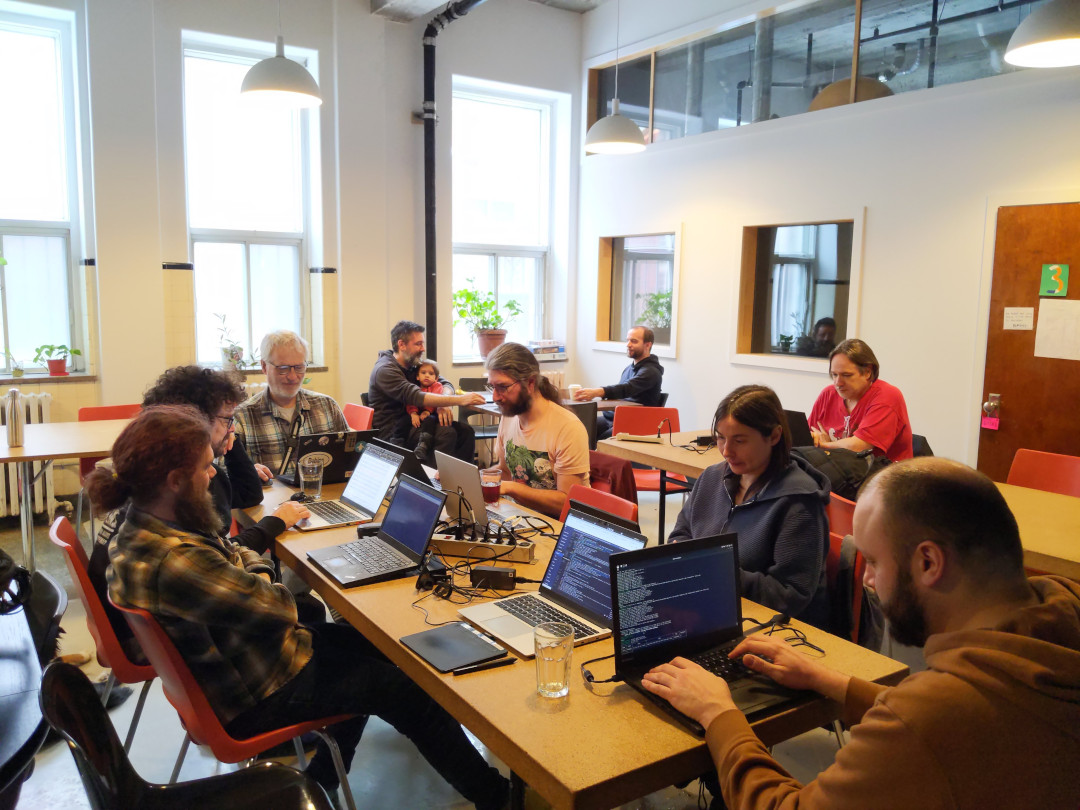
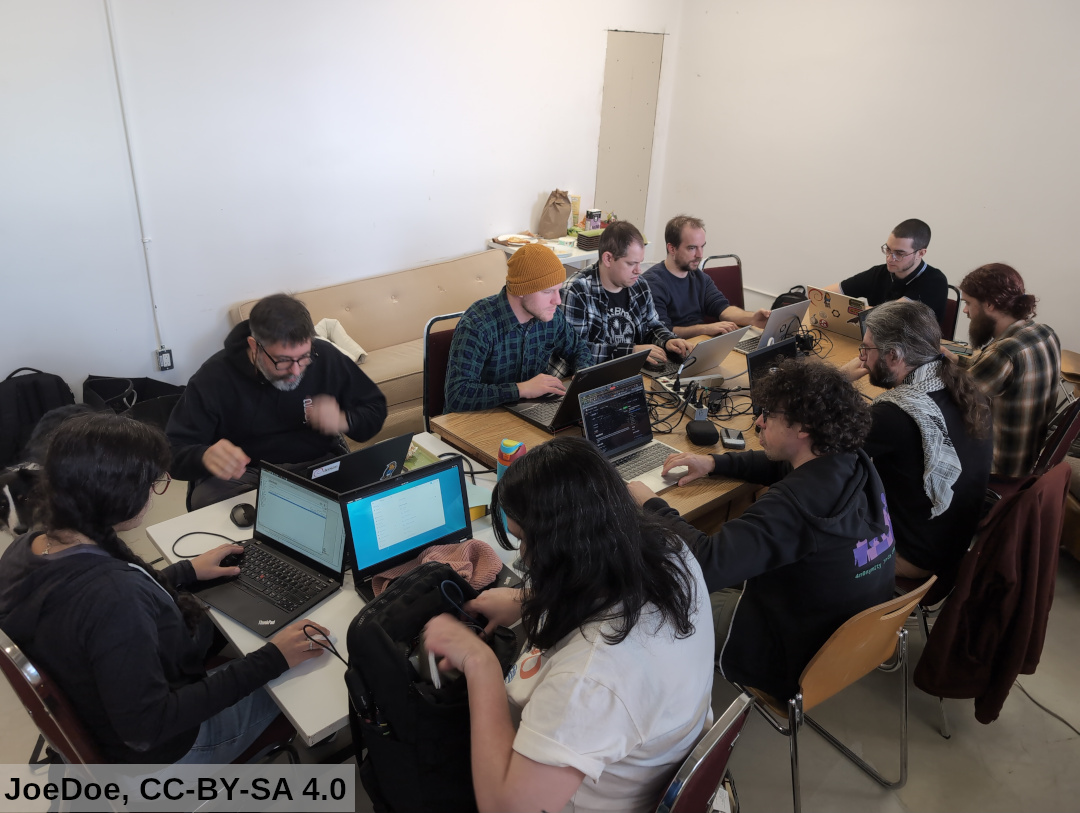
Our Debian User Group met on September 27th for our first meeting since our summer hiatus. As always, it was fun and productive! Here's what we did: pollo: sergiodj: LeLutin: tvaz: viashimo: tassia: Pictures This time again, we were hosted at La Balise (formely ATS ). It's nice to see this community project continuing to improve: the social housing apartments on the top floors should be opening this month! Lots of construction work was also ongoing to make the Espace des Possibles more accessible from the street level. Group photo Some of us ended up grabbing a drink after the event at l'Isle de Garde, a pub right next to the venue, but I didn't take any pictures.
30 September 2025

Russell Coker: Links September 2025

Werdahias wrote an informative blog post about Dark Mode for QT programs on non-QT environments (mostly GNOME based), we need more blog posts about this sort of thing [1]. Astral Codex Ten has an interesting blog post about the rise of Christianity, trying to work out why it took over so quickly [2]. Frances Haugen s whistleblower statement about Facebook is worth reading, Facebook seems to be one of the most evil companies in the world [3]. Interesting blog post by Philip Bennett about trying to repair a 28 player Galaxian game from 1990 [4]. Bruce Schneier and Nathan E. Sanders wrote an insightful article about AI in Government [5]. Krebs has an interesting analysis of Conservatives whinging about alleged discrimination due to their use of spam lists [6]. Nick Cheesman wrote an insightful article on the failures of Meritocracy with ANU as a case study [7]. I am mystified as to why ABC categorised it under Religion. David Brin wrote an interesting short SciFi story about dealing with blackmail [8]. Charles Stross has an interesting take on AI economics etc [9]. Corey Doctorow wrote an interesting blog post about the impending economic crash becuase of all the money tied up in AI investments [10].

24 September 2025

Philipp Kern: PSA: APT::Default-Release might be holding back updates from you

If you are like me that you are installing machines with testing and then go and flip them over to the current stable for a while using APT::Default-Release, you might not be receiving all relevant updates. In fact this setting is kind of discouraged in favor of more extensive pinning configuration.However, the field does support regexps, so instead of just specifying, say, "trixie", you can put this in place: APT::Default-Release "/^trixie( -security -proposed-updates -updates)$/";That should bring the security and stable updates back in.It feels like we are recently learning a lot about the drawbacks of these overlays and how they need to be configured properly...

12 July 2025

Louis-Philippe V ronneau: Adulting

In the last past weeks, I have done something I had been meaning to do for a while but always pushed back at the bottom of my TODO pile: prepare for my death. I am still quite young and perfectly healthy (mentally and physically) and I do plan to live a long and full life, but death is something that comes from us all and can strike anytime. Having witnessed friends and colleagues who lost loved ones who did not prepare adequately for their passing, dealing with all this legal stuff ahead of time seems like the best gift you can leave them. Writing my will was the easiest part of this "preparation for death" process. I have few material possessions and I'm leaving everything to my SO. As for the copyright for my code, I have decided everything I wrote will be licensed under CC0 (public domain) when I die. Quebec where I live also accepts holograph wills, which means I didn't have to hire a notary. Apart from the will, I also wrote a protection mandate1, filled out Quebec's organ donation form2, took a contract for prearranged funeral services3 and finally, wrote a disaster recovery plan. This recovery plan was by far the longest and most tedious part of this entire ordeal. If all your machines use full-disk encryption and you die or forget your passwords (for example after a head injury), can your data be recovered? How do you arbitrate between easy recovery and data security? If all your local devices burn down and you also pass away in the process, how will your next of kin access your remote backups and extract the relevant data (in my case, my password manager)? I had to ask myself many complex questions in this process and although I won't be sharing my disaster recovery plan here (security through obscurity), I urge you to take the time to do something similar yourself and make sure you will leave a house in order when you go away.

  1. in case I become incapacitated and can't make choices by myself anymore.
  2. it's sadly still opt-in here...
  3. you pay now for the services you want, the money is kept in a trust in your name and you can't be charged extra when you do pass away. This protects you from inflation and is a great way to make sure your next of kin don't have to deal with the complexities of funeral services while grieving.

4 June 2025

Gunnar Wolf: Computational modelling of robot personhood and relationality

This post is an unpublished review for Computational modelling of robot personhood and relationality
If humans and robots were to be able to roam around the same spaces, mutually recognizing each other for what they are, how would interaction be? How can we model such interactions in a way that we can reason about and understand the implications of a given behavior? This book aims at answering this question. The book is split into two very different parts. Chapters 1 through 3 are mostly written with a philosophical angle. It starts by framing the possibility of having sentient androids exist in the same plane as humans, without them trying to pass as us or vice versa. The first chapters look at issues related to personhood, that is, how androids can be treated as valid interaction partners in a society with humans, and how interactions with them can be seen as meaningful. In doing so, several landmarks of the past 40 years in the AI field are reviewed. The issues of the Significant Concerns that make up a society and give it coherence and of Personhood and Relationality , describing how this permeates from a society into each of the individuals that make it up, the relations between them and the social objects that bring individuals closer together (or farther apart) are introduced and explained. The second part of the book is written from a very different angle, and the change in pace took me somewhat by surprise. Each subsequent chapter presents a different angle of the Affinity system, a model that follows some aspects of human behavior over time and in a given space. Chapter 4 introduces the Affinity environment: a 3D simulated environment with simulated physical laws and characteristics, where a number of agents (30-50 is mentioned as usual) interact. Agents have a series of attributes ( value memory ), can adhere to different programs ( narratives ), and gain or lose on some vectors ( economy ). They can sense the world around them with sensors, and can modify the world or signal other agents using effectors. The last two chapters round out the book, as expected: the first presents a set of results from analyzing a given set of value systems, and the second gives readers the conclusions reached by the author. However, I was expecting more either having at least a link to download the Affinity system and continue exploring it or modifying some of the aspects it models to get it to model a set of agents with different stories and narratives, or extend it to yet unforseen behaviors, or at least have the author present a more complete comparison of results than the evaluation of patterns resulting from a given run. The author is a well-known, prolific author in the field, and I was expecting bigger insights from this book. Nevertheless, the book is an interesting and fun read, with important insights in both the first and second parts. There is a certain lack of connection between their respective rhythms, and the second part indeed builds on the concepts introduced in the first one. Overall, I enjoyed reading the book despite expecting more.

29 May 2025

Dirk Eddelbuettel: #48: r2u Talk Re-Recorded

Welcome to post 48 in the R4 series, and to video 8 in this series. Last week I had the honour of giving the opening talk at the 11eme Rencontres R at the Universit de Mons in Belgium as an invited plenary talk. Big thanks again to Philippe Grosjean and Kathy Huet for the invitation, and for organising a lovely conference. Being the opening talk, we were still sorting out projector issues when I started so I forgot to set a timer, and consequently ran out of time like a newbie. It occured to me that I could simply re-record the talk in front of my slides just as I do for my STAT 447 students. So I sat down this morning and did this, and the video is now online:

The slides are available as well. For questions or other feedback, please consider using the r2u GitHub repo issues section.

This post by Dirk Eddelbuettel originated on his Thinking inside the box blog. If you like this or other open-source work I do, you can now sponsor me at GitHub.

28 May 2025

Jonathan Dowland: Linux Mount Namespaces

I've been refreshing myself on the low-level guts of Linux container technology. Here's some notes on mount namespaces. In the below examples, I will use more than one root shell simultaneously. To disambiguate them, the examples will feature a numbered shell prompt: 1# for the first shell, and 2# for the second. Preliminaries Namespaces are normally associated with processes and are removed when the last associated process terminates. To make them persistent, you have to bind-mount the corresponding virtual file from an associated processes's entry in /proc, to another path1. The receiving path needs to have its "propogation" property set to "private". Most likely your system's existing mounts are mostly "public". You can check the propogation setting for mounts with
1# findmnt -o+PROPAGATION
We'll create a new directory to hold mount namespaces we create, and set its Propagation to private, via a bind-mount of itself to itself.
1# mkdir /root/mntns
1# mount --bind --make-private /root/mntns /root/mntns
The namespace itself needs to be bind-mounted over a file rather than a directory, so we'll create one.
1# touch /root/mntns/1
Creating and persisting a new mount namespace
1# unshare --mount=/root/mntns/1
We are now 'inside' the new namespace in a new shell process. We'll change the shell prompt to make this clearer
PS1='inside# '
We can make a filesystem change, such as mounting a tmpfs
inside# mount -t tmpfs /mnt /mnt
inside# touch /mnt/hi-there
And observe it is not visible outside that namespace
2# findmnt /mnt
2# stat /mnt/hi-there
stat: cannot statx '/mnt/hi-there': No such file or directory
Back to the namespace shell, we can find an integer identifier for the namespace via the shell processes /proc entry:
inside# readlink /proc/$$/ns/mnt
It will be something like mnt:[4026533646]. From another shell, we can list namespaces and see that it exists:
2# lsns -t mnt
        NS TYPE NPROCS   PID USER             COMMAND
 
4026533646 mnt       1 52525 root             -bash
If we exit the shell that unshare created,
inside# exit
running lsns again should2 still list the namespace, albeit with the NPROCS column now reading 0.
2# lsns -t mnt
We can see that a virtual filesystem of type nsfs is mounted at the path we selected when we ran unshare:
2# grep /root/mntns/1 /proc/mounts 
nsfs /root/mntns/1 nsfs rw 0 0
Entering the namespace from another process This is relatively easy:
1# nsenter --mount=/root/mntns/1
1# stat /mnt/hi-there
  File: /mnt/hi-there
 
More to come in future blog posts! References These were particularly useful in figuring this out:

  1. This feels really weird to me. At least at first. I suppose it fits with the "everything is a file" philosophy.
  2. I've found lsns in util-linux 2.38.1 (from 2022-08-04) doesn't list mount namespaces with no associated processes; but 2.41 (from 2025-03-18) does. The fix landed in 2022-11-08. For extra fun, I notice that a namespace can be held persistent with a file descriptor which is unlinked from the filesystem

21 April 2025

Louis-Philippe V ronneau: One last Bookworm for the road report from the Montreal 2025 BSP

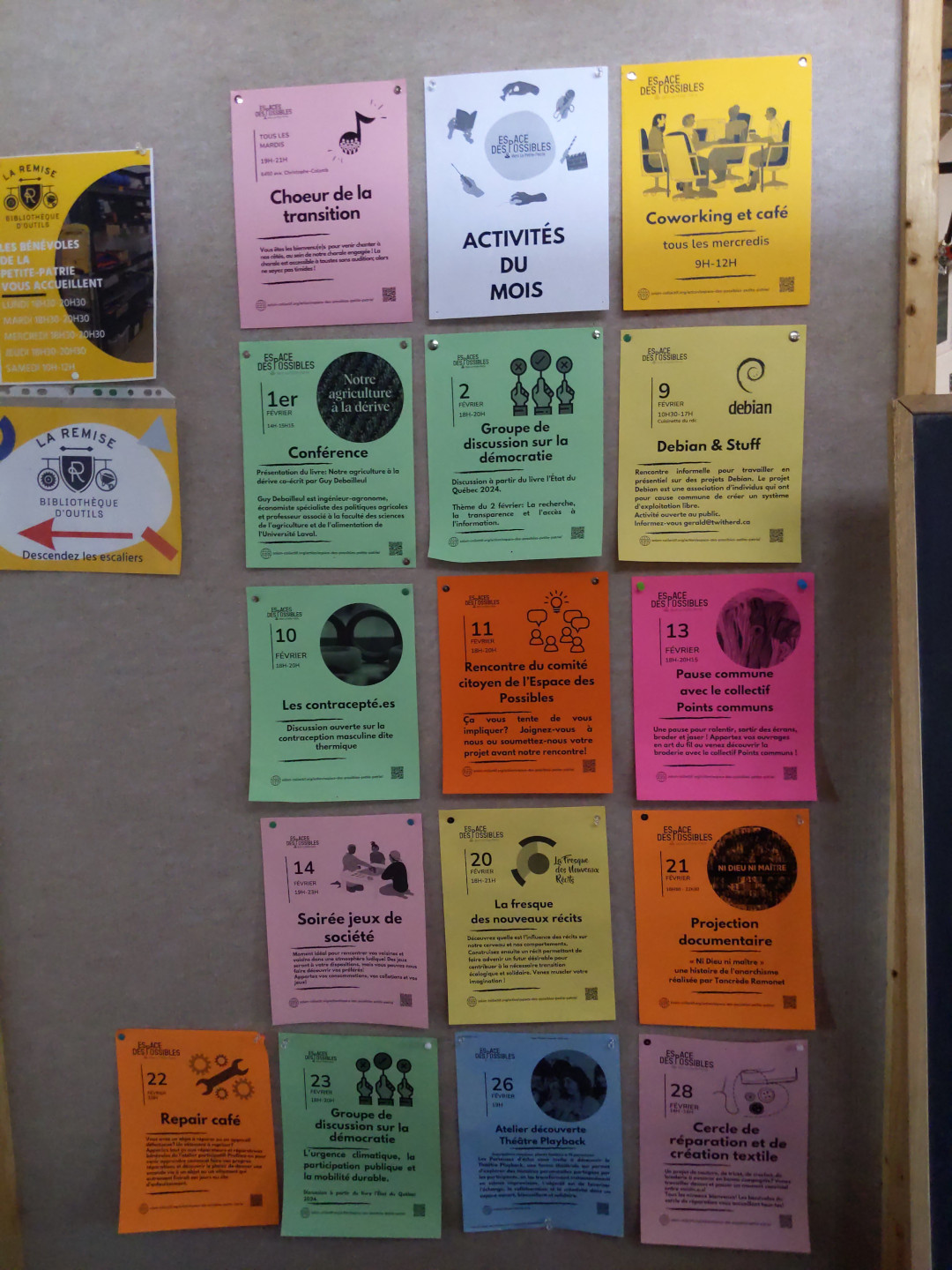
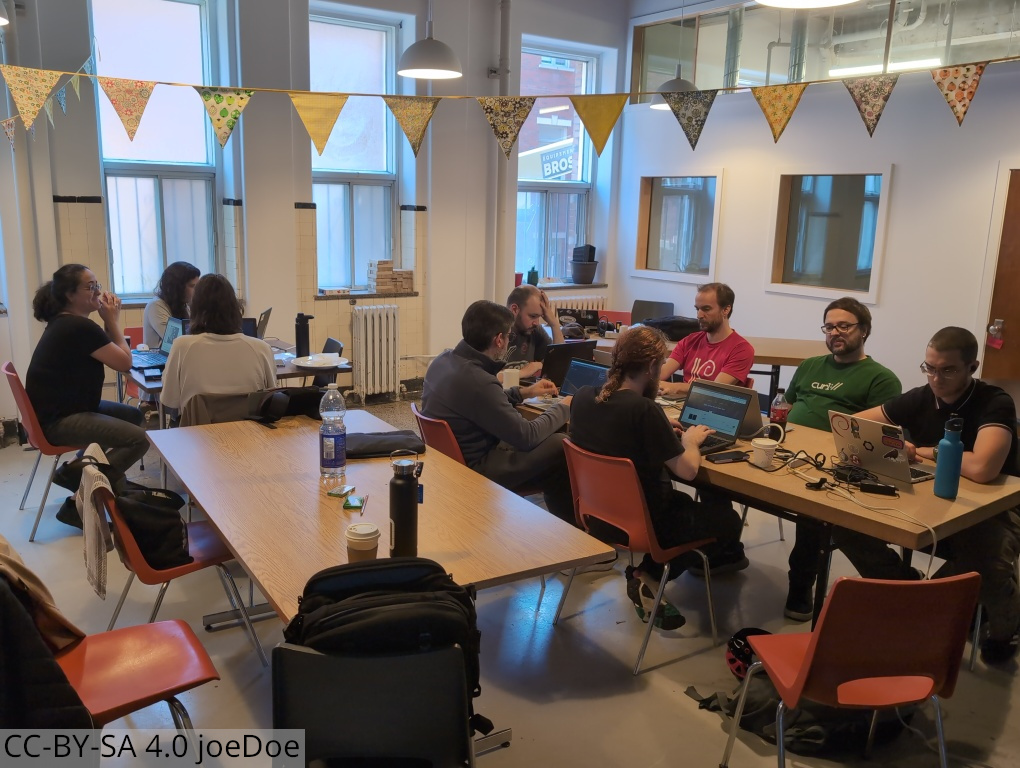
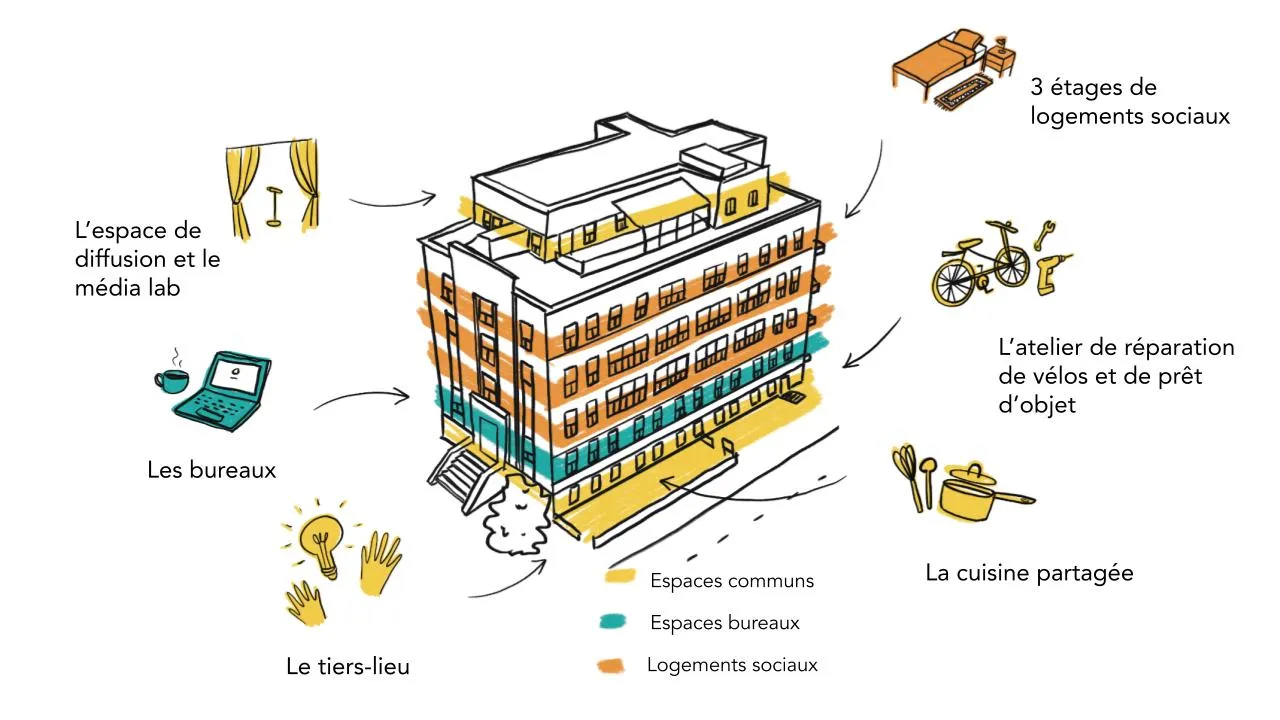
Hello, hello, hello! This report for the Bug Squashing Party we held in Montreal on March 28-29th is very late ... but better late than never? We're now at our fifth BSP in a row1, which is both nice and somewhat terrifying. Have I really been around for five Debian releases already? Geez... This year, around 13 different people showed up, including some brand new folks! All in all, we ended up working on 77 bugs, 61 of which have since been closed. This is somewhat skewed by the large number of Lintian bugs I closed by merging and releasing the very many patches submitted by Maytham Alsudany (hello Maytham!), but that was still work :D For our past few events, we have been renting a space at Ateliers de la transition socio- cologique. This building used to be nunnery (thus the huge cross on the top floor), but has since been transformed into a multi-faceted project. A drawing of the building where the BSP was hosted BSPs are great and this one was no exception. You should try to join an upcoming event or to organise one if you can. It is loads of fun and you will be helping the Debian project release its next stable version sooner! As always, thanks to Debian for granting us a budget for the food and to rent the venue. Pictures Here are a bunch of pictures of the BSP, mixed in with some other pictures I took at this venue during a previous event. Some of the people present on Friday, in the smaller room we had that day A picture of a previous event, which includes many of the folks present at the BSP and the larger room we used on Saturday A sticker on the door of the bathroom with text saying 'All Employees Must Wash Away Sin Before Returning To Work', a tongue-in-cheek reference to the building's previous purpose A wall with posters for upcoming events A drawing on one of the single-occupancy rooms in the building, warning people the door can't be opened from the inside (yikes!) A table at the entrance with many flyers for social and political events
  1. See our previous BSPs in 2017, 2019, 2021 and 2023!

1 March 2025

Debian Brasil: Debian Day 2024 in Santa Maria - Brazil

by por Andrew Gon alves Debian Day in Santa Maria - RS 2024 was held after a 5-year hiatus from the previous version of the event. It took place on the morning of August 16, in the Blue Hall of the Franciscan University (UFN) with support from the Debian community and the Computing Practices Laboratory of UFN. The event was attended by students from all semesters of the Computer Science, Digital Games and Informational Systems, where we had the opportunity to talk to the participants. Around 60 students attended a lecture introducing them to Free and Open Source Software, Linux and were introduced to the Debian project, both about the philosophy of the project and how it works in practice and the opportunities that have opened up for participants by being part of Debian. After the talk, a packaging demonstration was given by local DD Francisco Vilmar, who demonstrated in practice how software packaging works in Debian. I would like to thank all the people who helped us: And thanks to all the participants who attended this event asking intriguing questions and taking an interest in the world of Free Software. Photos: DD em Santa Maria 1 DD em Santa Maria 2 DD em Santa Maria 3 DD em Santa Maria 4

21 February 2025

Jonathan Dowland: haskell streaming libraries

For my PhD, my colleagues/collaborators and I built a distributed stream-processing system using Haskell. There are several other Haskell stream-processing systems. How do they compare? First, let's briefly discuss and define streaming in this context. Structure and Interpretation of Computer Programs introduces Streams as an analogue of lists, to support delayed evaluation. In brief, the inductive list type (a list is either an empty list or a head element pre-pended to another list) is replaced with a structure with a head element and a promise which, when evaluated, will generate the tail (which in turn may have a head element and a promise to generate another tail, culminating in the equivalent of an empty list.) Later on SICP also covers lazy evaluation. However, the streaming we're talking about originates in the relational community, rather than the functional one, and is subtly different. It's about building a pipeline of processing that receives and emits data but doesn't need to (indeed, cannot) reference the whole stream (which may be infinite) at once. Haskell streaming systems Now let's go over some Haskell streaming systems. conduit (2011-) Conduit is the oldest of the ones I am reviewing here, but I doubt it's the first in the Haskell ecosystem. If I've made any obvious omissions, please let me know! Conduit provides a new set of types to model streaming data, and a completely new set of functions which are analogues of standard Prelude functions, e.g. sumC in place of sum. It provides its own combinator(s) such as . ( aka fuse) which is like composition but reads left-to-right. The motivation for this is to enable (near?) constant memory usage for processing large streams of data -- presumably versus using a list-based approach and to provide some determinism: the README gives the example of "promptly closing file handles". I think this is another way of saying that it uses strict evaluation, or at least avoids lazy evaluation for some things. Conduit offers interleaved effects: which is to say, IO can be performed mid-stream. Conduit supports distributed operation via Data.Conduit.Network in the conduit-extra package. Michael Snoyman, principal Conduit author, wrote up how to use it here: https://www.yesodweb.com/blog/2014/03/network-conduit-async To write a distributed Conduit application, the application programmer must manually determine the boundaries between the clients/servers and write specific code to connect them. pipes (2012-) The Pipes Tutorial contrasts itself with "Conventional Haskell stream programming": whether that means Conduit or something else, I don't know. Paraphrasing their pitch: Effects, Streaming Composability: pick two. That's the situation they describe for stream programming prior to Pipes. They argue Pipes offers all three. Pipes offers it's own combinators (which read left-to-right) and offers interleaved effects. At this point I can't really see what fundamentally distinguishes Pipes from Conduit. Pipes has some support for distributed operation via the sister library pipes-network. It looks like you must send and receive ByteStrings, which means rolling your own serialisation for other types. As with Conduit, to send or receive over a network, the application programmer must divide their program up into the sub-programs for each node, and add the necessary ingress/egress code. io-streams (2013-) io-streams emphasises simple primitives. Reading and writing is done under the IO Monad, thus, in an effectful (but non-pure) context. The presence or absence of further stream data are signalled by using the Maybe type (Just more data or Nothing: the producer has finished.) It provides a library of functions that shadow the standard Prelude, such as S.fromList, S.mapM, etc. It's not clear to me what the motivation for io-streams is, beyond providing a simple interface. There's no declaration of intent that I can find about (e.g.) constant-memory operation. There's no mention of or support (that I can find) for distributed operation. streaming (2015-) Similar to io-streams, Streaming emphasises providing a simple interface that gels well with traditional Haskell methods. Streaming provides effectful streams (via a Monad -- any Monad?) and a collection of functions for manipulating streams which are designed to closely mimic standard Prelude (and Data.List) functions. Streaming doesn't push its own combinators: the examples provided use $ and read right-to-left. The motivation for Streaming seems to be to avoid memory leaks caused by extracting pure lists from IO with traditional functions like mapM, which require all the list constructors to be evaluated, the list to be completely deconstructed, and then a new list constructed. Like io-streams, the focus of the library is providing a low-level streaming abstraction, and there is no support for distributed operation. streamly (2017-) Streamly appears to have the grand goal of providing a unified programming tool as suited for quick-and-dirty programming tasks (normally the domain of scripting languages) and high-performance work (C, Java, Rust, etc.). Their intended audience appears to be everyone, or at least, not just existing Haskell programmers. See their rationale Streamly offers an interface to permit composing concurrent (note: not distributed) programs via combinators. It relies upon fusing a streaming pipeline to remove intermediate list structure allocations and de-allocations (i.e. de-forestation, similar to GHC rewrite rules) The examples I've seen use standard combinators (e.g. Control.Function.&, which reads left-to-right, and Applicative). Streamly provide benchmarks versus Haskell pure lists, Streaming, Pipes and Conduit: these generally show Streamly several orders of magnitude faster. I'm finding it hard to evaluate Streamly. It's big, and it's focus is wide. It provides shadows of Prelude functions, as many of these libraries do. wrap-up It seems almost like it must be a rite-of-passage to write a streaming system in Haskell. Stones and glass houses, I'm guilty of that too. The focus of the surveyed libraries is mostly on providing a streaming abstraction, normally with an analogous interface to standard Haskell lists. They differ on various philosophical points (whether to abstract away the mechanics behind type synonyms, how much to leverage existing Haskell idioms, etc). A few of the libraries have some rudimentary support for distributed operation, but this is limited to connecting separate nodes together: in some cases serialising data remains the application programmer's job, and in all cases the application programmer must manually carve up their processing according to a fixed idea of what nodes they are deploying to. They all define a fixed-function pipeline.

11 February 2025

Freexian Collaborators: Debian Contributions: Python 3.13 as the default Python 3 version, Fixing qtpaths6 for cross compilation, sbuild support for Salsa CI, Rails 7 transition, DebConf preparations and more! (by Anupa Ann Joseph)

Debian Contributions: 2025-01 Contributing to Debian is part of Freexian s mission. This article covers the latest achievements of Freexian and their collaborators. All of this is made possible by organizations subscribing to our Long Term Support contracts and consulting services.

Python 3.13 is now the default Python 3 version in Debian, by Stefano Rivera and Colin Watson The Python 3.13 as default transition has now completed. The next step is to remove Python 3.12 from the archive, which should be very straightforward, it just requires rebuilding C extension packages in no particular order. Stefano fixed some miscellaneous bugs blocking the completion of the 3.13 as default transition.

Fixing qtpaths6 for cross compilation, by Helmut Grohne While Qt5 used to use qmake to query installation properties, Qt6 is moving more and more to CMake and to ease that transition it relies on more qtpaths. Since this tool is not naturally aware of the architecture it is called for, it tends to produce results for the build architecture. Therefore, more than 100 packages were picking up a multiarch directory for the build architecture during cross builds. In collaboration with the Qt/KDE team and Sandro Knau in particular (none affiliated with Freexian), we added an architecture-specific wrapper script in the same way qmake has one for Qt5 and Qt6 already. The relevant CMake module has been updated to prefer the triplet-prefixed wrapper. As a result, most of the KDE packages now cross build on unstable ready in time for the trixie release.

/usr-move, by Helmut Grohne In December, Emil S dergren reported that a live-build was not working for him and in January, Colin Watson reported that the proposed mitigation for debian-installer-utils would practically fail. Both failures were to be attributed to a wrong understanding of implementation-defined behavior in dpkg-divert. As a result, all M18 mitigations had to be reviewed and many of them replaced. Many have been uploaded already and all instances have received updated patches. Even though dumat has been in operation for more than a year, it gained recent changes. For one thing, analysis of architectures other than amd64 was requested. Chris Hofstaedler (not affiliated with Freexian) kindly provided computing resources for repeatedly running it on the larger set. Doing so revealed various cross-architecture undeclared file conflicts in gcc, glibc, and binutils-z80, but it also revealed a previously unknown /usr-move issue in rpi.rpi-common. On top of that, dumat produced false positive diagnostics and wrongly associated Debian bugs in some cases, both of which have now been fixed. As a result, a supposedly fixed python3-sepolicy issue had to be reopened.

rebootstrap, by Helmut Grohne As much as we think of our base system as stable, it is changing a lot and the architecture cross bootstrap tooling is very sensitive to such changes requiring permanent maintenance. A problem that recently surfaced was that building a binutils cross toolchain would result in a binutils-for-host package that would not be practically installable as it would depend on a binutils-common package that was not built. This turned into an examination of binutils-common and noticing that it actually differed across architectures even though it should not. Johannes Schauer Marin Rodrigues (not affiliated with Freexian) and Colin Watson kindly helped brainstorm possible solutions. Eventually, Helmut provided a patch to move gprofng bits out of binutils-common. Independently, Matthias Klose (not affiliated with Freexian) split out binutils-gold into a separate source package. As a result, binutils-common is now equal across architectures and can be marked Multi-Arch: foreign resolving the initial problem.

Salsa CI, by Santiago Ruano Rinc n Santiago continued the work about the sbuild support for Salsa CI, that was mentioned in the previous month report. The !568 merge request that created the new build image was merged, making it easier to test !569 with external projects. Santiago used a fork of the debusine repo to try the draft !569, and some issues were spotted, and part of them fixed. This is the last debusine pipeline run with the current !569: https://salsa.debian.org/santiago/debusine/-/pipelines/794233. One of the last improvements relates to how to enable projects to customize the pipeline, in an equivalent way than they currently do in the extract-source and build jobs. While this is work-in-progress, the results are rather promising. Next steps include deciding on introducing schroot support for bookworm, bookworm-security, and older releases, as they are done in the official debian buildd.

DebConf preparations, by Stefano Rivera and Santiago Ruano Rinc n DebConf will be happening in Brest, France, in July. Santiago continued the DebConf 25 organization work, looking for catering providers. Both Stefano and Santiago have been reaching out to some potential sponsors. DebConf depends on sponsors to cover the organization cost, if your company depends on Debian, please consider sponsoring DebConf. Stefano has been winding up some of the finances from previous DebConfs. Finalizing reimbursements to team members from DebConf 23, and handling some outstanding issues from DebConf 24. Stefano and the rest of the DebConf committee have been reviewing bids for DebConf 26, to select the next venue.

Ruby 3.3 is now the default Ruby interpreter, by Lucas Kanashiro Ruby 3.3 is about to become the default Ruby interpreter for Trixie. Many bugs were fixed by Lucas and the Debian Ruby team during the sprint hold in Paris during Jan 27-31. The next step is to remove support of Ruby 3.1, which is the alternative Ruby interpreter for now. Thanks to the Debian Release team for all the support, especially Emilio Pozuelo Monfort.

Rails 7 transition, by Lucas Kanashiro Rails 6 has been shipped by Debian since Bullseye, and as a WEB framework, many issues (especially security related issues) have been encountered and the maintainability of it becomes harder and harder. With that in mind, during the Debian Ruby team sprint last month, the transition to Rack 3 (an important dependency of rails containing many breaking changes) was started in Debian unstable, it is ongoing. Once it is done, the Rails 7 transition will take place, and Rails 7 should be shipped in Debian Trixie.

Miscellaneous contributions
  • Stefano improved a poor ImportError for users of the turtle module on Python 3, who haven t installed the python3-tk package.
  • Stefano updated several packages to new upstream releases.
  • Stefano added the Python extension to the re2 package, allowing for the use of the Google RE2 regular expression library as a direct replacement for the standard library re module.
  • Stefano started provisioning a new physical server for the debian.social infrastructure.
  • Carles improved simplemonitor (documentation on systemd integration, worked with upstream for fixing a bug).
  • Carles upgraded packages to new upstream versions: python-ring-doorbell and python-asyncclick.
  • Carles did po-debconf translations to Catalan: reviewed 44 packages and submitted translations to 90 packages (via salsa merge requests or bugtracker bugs).
  • Carles maintained po-debconf-manager with small fixes.
  • Rapha l worked on some outstanding DEP-14 merge request and participated in the associated discussion. The discussions have been more contentious than anticipated, somewhat exacerbated by Otto s desire to conclude fast while the required tool support is not yet there.
  • Rapha l, with the help of Philipp Kern from the DSA team, upgraded tracker.debian.org to use Django 4.2 (from bookworm-backports) which in turn enabled him to configure authentication via salsa.debian.org. It s now possible to login to tracker.debian.org with your salsa credentials!
  • Rapha l updated zim a nice desktop wiki that is very handy to organize your day-to-day digital life to the latest upstream version (0.76).
  • Helmut sent patches for 10 cross build failures.
  • Helmut continued working on a tool for memory-based concurrency limit of builds.
  • Helmut NMUed libtool, opensysusers and virtualbox.
  • Enrico tried to support Helmut in working out tricky usrmerge situations
  • Thorsten Alteholz uploaded a new upstream version of brlaser.
  • Colin Watson upgraded 33 Python packages to new upstream versions, including fixes for CVE-2024-42353, CVE-2024-47532, and CVE-2025-22153.
  • Emilio Pozuelo managed various transitions, and fixed various RC bugs (telepathy-glib, xorg, xserver-xorg-video-vesa, apitrace, mesa).
  • Anupa attended the monthly team meeting for Debian publicity team and shared the social media stats.
  • Anupa assisted Jean-Pierre Giraud in the point release announcement for Debian 12.9 and published the Micronews.
  • Anupa took part in multiple Debian publicity team discussions regarding our presence in social media platforms.

9 February 2025

Philipp Kern: 20 years

20 years ago, I got my Debian Developer account. I was 18 at the time, it was Shrove Tuesday and - as is customary - I was drunk when I got the email. There was so much that I did not know - which is also why the process took 1.5 years from the time I applied. I mostly only maintained a package or two. I'm still amazed that Christian Perrier and Joerg Jaspert put sufficient trust in me at that time. Nevertheless now feels like a good time for a personal reflection of my involvement in Debian.
During my studies I took on more things. In January 2008 I joined the Release Team as an assistant, which taught me a lot of code review. I have been an Application Manager on the side.
Going to my first Debconf was really a turning point. My first one was Mar del Plata in Argentina in August 2008, when I was 21. That was quite an excitement, traveling that far from Germany for the first time. The personal connections I made there made quite the difference. It was also a big boost for motivation. I attended 8 (Argentina), 9 (Spain), 10 (New York), 11 (Bosnia and Herzegovina), 12 (Nicaragua), 13 (Switzerland), 14 (Portland), 15 (Germany), 16 (South Africa), and hopefully I'll make it to this year's in Brest. At all of them I did not see much of the countries as I prioritized all of my time focused on Debian, even skipping some of the day trips in favor of team meetings. Yet I am very grateful to the project (and to my employer) for shipping me there.I ended up as Stable Release Manager for a while, from August 2008 - when Martin Zobel-Helas moved into DSA - until I got dropped in March 2020. I think my biggest achievements were pushing for the creation of -updates in favor of a separate volatile archive and a change of the update policy to allow for more common sense updates in the main archive vs. the very strict "breakage or security" policy we had previously. I definitely need to call out Adam D. Barratt for being the partner in crime, holding up the fort for even longer.In 2009 I got too annoyed at the existing wanna-build team not being responsive anymore and pushed for the system to be given to a new team. I did not build it and significant contributions were done by other people (like Andreas Barth and Joachim Breitner, and later Aurelien Jarno). I mostly reworked the way the system was triggered, investigated when it broke and was around when people wanted things merged.
In the meantime I worked sys/netadmin jobs while at university, both paid and as a volunteer with the students' council. For a year or two I was the administrator of a System z mainframe IBM donated to my university. We had a mainframe course and I attended two related conferences. That's where my s390(x) interest came from, although credit for the port needs to go to Aurelien Jarno.
Since completing university in 2013 I have been working for a company for almost 12 years. Debian experience was very relevant to the job and I went on maintaining a Linux distro or two at work - before venturing off into security hardening. People in megacorps - in my humble opinion - disappear from the volunteer projects because a) they might previously have been studying and thus had a lot more time on their hands and b) the job is too similar to the volunteer work and thus the same brain cells used for work are exhausted and can't be easily reused for volunteer work. I kept maintaining a couple of things (buildds, some packages) - mostly because of a sense of commitment and responsibility, but otherwise kind of scaled down my involvement. I also felt less connected as I dropped off IRC.Last year I finally made it to Debian events again: MiniDebconf in Berlin, where we discussed the aftermath of the xz incident, and the Debian BSP in Salzburg. I rejoined IRC using the Matrix bridge. That also rekindled my involvement, with me guiding a new DD through NM and ending up in DSA. To be honest, only in the last two or three years I felt like a (more) mature old-timer.
I have a new gig at work lined up to start soon and next to that I have sysadmining for Debian. It is pretty motivating to me that I can just get things done - something that is much harder to achieve at work due to organizational complexities. It balances out some frustration I'd otherwise have. The work is different enough to be enjoyable and the people I work with are great.

The future
I still think the work we do in Debian is important, as much as I see a lack of appreciation in a world full of containers. We are reaping most of the benefits of standing on the shoulders of giants and of great decisions made in the past (e.g. the excellent Debian policy, but also the organizational model) that made Debian what it is today.Given the increase in size and complexity of what Debian ships - and the somewhat dwindling resource of developer time, it would benefit us to have better processes for large-scale changes across all packages. I greatly respect the horizontal effects that are currently being driven and that suck up a lot of energy.A lot of our infrastructure is also aging and not super well maintained. Many take it for granted that the services we have keep existing, but most are only maintained by a person or two, if even. Software stacks are aging and it is even a struggle to have all necessary packages in the next release.Hopefully I can contribute a bit or two to these efforts in the future.

Next.

Previous.