Search Results: "ms"

30 October 2026

Russell Coker: More Furilabs FLX1s

In April I got my Furilabs FLX1s basically working [1]. Below is a post I wrote about the FLX1s before it broke at the start of September, there was a problem with the display controller and it would randomly go into a messed up mode that wasn t readable but also changed a bit in relation to button presses etc so the phone was still working. Also I could ssh to the phone when it was in that state if it was on my home wifi. It took almost 2 months to get a replacement phone but I now have that working and the new 14.1.0 OS release. So some of the below may be obsolete when it comes to the latest release but I decided to publish it anyway for history if nothing else. Current Issues Wifi Hotspot Status One thing I had known about but not mentioned before is that the icon in the drop-down menu for the hotspot will often be gray (indicating hotspot-off) when it s actually on. To address that I have to click on it (which then indicates that the hotspot is on) and then click on it again to turn it off. QT6 and MESA GL Currently I have problems with QT6 applications that don t run due to library issues and issues of missing GL support. I blogged about setting up my own container on my phone [2] which helped for some things but not for most things. I have given up trying to get Tokodon working on the phone for the moment. Tokodon is a nice Mastodon client that would allow me to get notifications from Mastodon. Apparently the Furilabs people are working on some issues related to this. Bluetooth Bluetooth is currently a bit unreliable. When I turn on my car (Nissan LEAF) the phone usually either doesn t connect or claims to be connected while not sending audio to the car. When it does connect my favourite music player (Lollypop) usually doesn t display the album and track names. I ve found that turning my car off and on again usually makes it connect properly. I admit the possibility of my car not doing things correctly in this regard. But every Android phone I tried just worked, they would connect as soon as the car was turned on and correctly display track names. So if the car is doing things wrong and needs a software work around then Linux is at fault for not doing that we can t get tens of millions of cars and hundreds of millions of other weird devices fixed! I also note that my Debian laptop and a friend s Debian laptop also have problems connecting to my car. So it s quite possible that Debian code is at fault (the FLX1s is running a modified version of Debian). It currently appears to have no support for handset mode so I can t answer phone calls through the car interface. But this is a lesser problem. I plan to do more testing with Debian laptops and file some bug reports if I can find out enough useful information. My current knowledge of this is insufficient to create a useful bug report. I do have quite a few bluetooth headsets and test laptops so I plan to start by testing Debian and Ubuntu on all the combinations last time I tested Ubuntu 24.04 on Dell laptops worked much better than Debian/Trixie on Thinkpads. Improvements by Furilabs Wifi Hotspot After a set of updates including the following Wifi hotspot seems to be working.
adaptation-furiphone-radon (1.3.0+git20260513192743.e94f2ec.forky.production) forky; urgency=medium
  * NetworkManager: sync hotspot channel/band with STA and restart on change
  * debian: depend on libhybris-utils and libgbinder-tools
  * startup: drop schedtune and add m4u debug log level
  * startup: enable glove and disable edge palm
  * device: drop flashlightd-scalable signatures
 -- Bardia Moshiri <bardia@furilabs.com>  Wed, 13 May 2026 15:27:43 -0400
Charging Connecting the power cable now makes the phone immediately make the click sound and it starts charging while previously there was a 22 second delay. Once I get used to this I can avoid the problem of failing to plug it in firmly before going to bed and having it run flat overnight. Things I ve Done SMS The following command will send a message via SMS.
dbus-send --system --print-reply --dest=org.ofono /ril_0 org.ofono.MessageManager.SendMessage string:"+61400000000" string:"this is the message"
Also the Librem5 Wiki has another way of doing it [3], I haven t tested if that works as the dbus method works well enough for the moment. Also calls can be scripted via the following command:
xdg-open tel://+61400000000
Contacts My aim is to get contacts synchronised via my own cloud service. Nextcloud is supposed to be able to do this. It s been years since I first tried this, my most recent serious attempt at Nextcloud was in 2021 [4] and I couldn t get the Android app for NextCloud to connect. Since then I have made more recent attempts and been unable to get the Android or Linux desktop clients to connect to it. A friend gave me a test account on his Nextcloud server which allowed me to connect the Linux desktop app, his hypothesis was that it was somehow related to using Debian and that his server worked because it was on Ubuntu. I have since installed my own Nextcloud test server on the Ubuntu variant used by the Oracle cloud VMs which had the same apparent problem. I conclude that it s not Debian at fault but something related to how I configured it. In the meantime after a couple of months of having no named contacts I exported the contacts from my Android phone as a VCF file and imported them into the Gnome contacts program. I had to run killall chatty for it to get the names for the contacts, but the phone call program found them without needing to do that. Chatty A missing feature of Chatty (the default SMS and Jabber program for Phosh/Phoc systems) is archiving old messages. I use Chatty to receive Jabber messages from my monitoring system which can be a lot of messages. The following shell code deletes all Jabber messages older than 2 days. Note that this relies on type=3 matching Jabber messages which I m not sure is going to be the case on all systems or all versions of Chatty.
for ID in $(echo "select id from users where type=3;"   sqlite3 ~/.purple/chatty/db/chatty-history.db); do
  echo "delete from messages where sender_id=$ID and time < unixepoch('now') - (48 * 3600);"   sqlite3 ~/.purple/chatty/db/chatty-history.db
done
The following shell code extracts a dump of all messages from Chatty.
echo "select messages.id,users.username,users.alias,messages.body from messages inner join users on messages.sender_id=users.id;"  sqlite3 ~/.purple/chatty/db/chatty-history.db
Dino-IM An update to the Chatty program for SMS and Matrix has made it crash repeatedly. There is a request in the list for Chatty upstream to have a systemd-user unit to restart it which when implemented will reduce the scope of the problem (but not solve it). I've setup a monitoring system that uses notify-send to notify me when Chatty isn't running or when 4G data turns off (a recurring problem). This crashing is allegedly due to Jabber so I installed Dino-IM for Jabber and have for the moment at least stopped using Chatty for Jabber. It turned out that having Chatty not do Jabber didn't stop it crashing. However having alerts separated from SMS can be convenient and also my long term plan is to use a phone with Plasma Mobile and Spacebar (the SMS program for Plasma Mobile) doesn't do Jabber. So I will continue using Dino-IM.
echo "delete from message where time < unixepoch('now') - (48 * 3600);"   sqlite3 ~/.local/share/dino/dino.db
Andromeda/Android I put in the following cron job to stop this log file from using all the storage space:
1 0 * * *	echo -n > /home/furios/.local/share/andromeda/data/system/uiderrors.txt
Wifi DHCP I gave up on attempts to force the Wifi configuration to have a fixed MAC that I could use for a fixed IPv4 address so I manually configured the address. 4G Monitoring I've had problems with the reliability of the 4G service, sometimes it stop working and I need to stop and restart it. I setup my etbe-mon monitoring system on the phone [5] and configured it to ssh to localhost and run notify-send to send a local notification. This means I get notified if my phone loses net access and can't access regular monitoring. Then to monitor the 4G connection (which I want to have working even when Wifi is connected) I had the following monitor line:
monitor ping.monitor -I ccmni1 -c 5 8.8.8.8 ;;
That uses the ccmni1 interface for pinging 8.8.8.8 (Google DNS). That worked for a while but I discovered that sometimes the interface for 4G would change to ccmni2, so I put the following monitor script under /usr/local/mon.d:
#!/bin/bash
DEV=$(route -n grep ^0.0.0.0.*ccm  sed -e s/^.*ccmn/ccmn/)
exec /usr/lib/mon/mon.d/ping.monitor -I $DEV -c 5 8.8.8.8
Mastodon I couldn't get Tokodon to work, not the native package, not running in a Debian/Testing container, and not running a Flatpak. It seems that this is all graphics library issues. So I wrote a Perl program to run "toot notifications &-json" and then send the relevant parts of the output via XMPP. As I already use XMPP for server monitoring there's no extra effort to have an extra account and use it for notifications about Mastodon activity. The Perl script is at the bottom of the post and won't be in the RSS feed. At some future time I may change the script to send the notifications by Matrix instead to have all my social media stuff in the same place. Source
#!/usr/bin/perl
# depends on Debian packages: toot libjson-pp-perl go-sendxmpp
use strict;
use JSON::PP;
my $homeurl = "https://mastodon.nzoss.nz/";
my $lastfile = "mast/last_id";
my $xaddr = "russell\@coker.com.au";
my $jsontxt;
while()
 
  $jsontxt .= $_;
 
my $data = decode_json($jsontxt);
my $last_id = 0, my $new_last_id;
if(open(ID, "<$lastfile"))
 
  $last_id = ;
  close(ID);
 
$new_last_id = $last_id;
for(my $i = 0; $data->[$i]; $i++)
 
  my $id = $data->[$i] id ;
  if($id <= $last_id)
   
    next;
   
  if($id > $new_last_id)
   
    $new_last_id = $id;
   
  open(XMPP, " go-sendxmpp $xaddr") or die "Can't send XMPP";
  my $type = $data->[$i] type ;
  print XMPP "type: $type\n";
  print XMPP "their_url: $homeurl\@$data->[$i] account acct \n";
  print XMPP "display_name: $data->[$i] account display_name \n";
  if($type ne "follow")
   
    print XMPP "status_url: $data->[$i] status url \n";
    print XMPP "content: $data->[$i] status content \n";
   
  print XMPP "created_at: $data->[$i] created_at \n";
  print XMPP "\n";
  close(XMPP);
 
open(ID, ">$lastfile") or die "Can't write to $lastfile";
print ID $new_last_id;
close(ID);

Russell Coker: Fuel Should be More Expensive

The Current Situation Before the US and Israel started attacking Iran at the end of February the petrol prices in Australia were around $1.70/L, which for American readers is roughly equivalent to $US4.64/Gal. By the 11th of March the prices were around $2.19/L. Over the same time period Diesel went from around $1.77/L to $2.40/L. The 11th of March prices weren t necessarily unreasonable prices. In mid March it was reasonable to expect that the US would stop doing such ridiculously stupid things and make a deal with Iran to allow oil to be transported. But every time you think there s a limit to Trump s stupidity (and the incompetence of people around him who don t point him in the right direction) they do something worse. So now we have the Strait of Hormuz almost entirely closed cutting off oil from Kuwait, Qatar, and UAE. The Bab al-Mandab Strait is closed to Saudi linked ships and the Saudi East-West pipeline is closed so once the Yanbu storage tanks are empty there won t be much if any oil from Saudi Arabia for some time. So world oil supplies will be significantly reduced for a long time. Currently the petrol prices in Melbourne are around $2.30/L and Diesel prices around $2.70/L, not much more expensive than it was in March in spite of all the extra problems both militarily and diplomatically since then. Those prices have been steady for over a month. The blockade of the Strait of Hormuz could be ended fairly quickly and there are reports that a lot of the oil that used to go through it is being re-routed. The damaged infrastructure throughout the middle east can t be fixed in a hurry. The Bab al-Mandab Strait probably can t be opened quickly as the Houthis probably don t have a centralised command structure that allows someone to order a ceasefire and have it stick. So we can expect a massive reduction in world oil supplies for a while, which given the way the US is going could be at least until after the mid-term elections (November this year) and possibly until after the 2028 elections. After that oil production will be reduced for another year or two to rebuild infrastructure. The Problem When supply can t meet demand there are three options. Supply can be rationed, demand can be decreased by increasing the prices, or it can be used up and we run out. Running out of fuel is a really bad option as fuel is needed for producing and transporting food and for most things that are important to a society. Governments of first world countries seem unable to deal with the situation properly. Dealing with it properly requires either rationing or increasing the prices. Instead governments have been more interested in artificially keeping the prices down. Currently in Australia and most countries a significant portion of public transport depends on Diesel fuel. Diesel is needed for most buses and for long distance trains. Most taxis run on petrol. As far as I know all emergency service vehicles run on Diesel or petrol as well as most military vehicles. So things will get really bad quickly if fuel runs out entirely. It s not just personal cars that are affected. We aren t going to get the majority of tractors converted to electric power any time soon. Google search results suggest that tractors last an average of about 25 years but casual observation of working equipment on farms suggests a longer life than that is common. Some tractors could be retrofitted to be electric but many will end up being scrapped as part of a conversion while farmers are already having financial problems. It would probably be optimistic to expect that half the tractor use could be done with electric tractors in 10 years time unless there are significant government subsidies. To get the farming and food production industries adapted for electric operation in a few years would be possible but it would take a level of national mobilisation that only happens during wartime. What We Need As a long term solution we need to have more electric vehicles in every category. We need electricity for all train lines to replace Diesel locomotives. We need better trains between cities to reduce the need for aeroplanes, electric aeroplanes are being developed but we aren t there yet. We need all essential services to be run with electric vehicles including farming, food transport, emergency services, and everything related to the medical system (including personal cars for healthcare workers). We also need mining vehicles powered by electricity so we can have the entire industrial system running without fuel. None of this is going to happen in time for this crisis. Electric buses are being introduced in Australia and many taxis are electric. The recent significant increase in the use of electric cars probably includes a reasonable portion of healthcare workers and other essential workers. This gives us the potential to survive fairly severe reductions in the fuel supply without everything collapsing. But we have a significant lack in electric police cars and in electric trucks for food delivery. In the short term we need to significantly reduce the use of fuels, there is no other way to keep the food supply and other essential parts of society working. We could try rationing but I think that should be a last resort. The news reports of a de-facto petrol rationing system in Crimea and parts of Russia are not positive, significant resources are wasted in long queues for petrol and there is public disorder caused by disputes about position in the queues. The level of sanity in the population seems to have dropped significantly since the fuel crisis of 1979, any fuel rationing that is implemented now would get the same sort of opposition from Qanon types as Covid vaccines and lockdowns did in recent times. So the best viable option seems to be to reduce demand by increasing prices. $2.30/L as a common price with occasional spikes of $2.50/L isn t sufficient to do that. If the price increased to $3.50/L, twice what it used to be (equivalent to $9.50/gallon for Americans) then it would provide a real incentive for people to reduce fuel use. That would have to be combined with the type of remote work allowances that were in place when Covid19 was first spreading. But I think that all politicians are too weak to do such things. The media have demonstrated that nowadays the best we can expect is that they will treat both sides as equal even when facts clearly support one side, so we can t expect the media to report on impending fuel shortages and demand policy changes to address them. We should have higher taxes on fuel that will continue past the resolution of the current crisis caused by the attacks on Iran to provide incentives for the purchase of electric cars and for manufacturers to make more fuel efficient cars. Currently people are basing car ownership decisions on the expectation that petrol will go back to something under $2/L and we need to have a government guarantee that it won t happen. People always complain about poor people who can t afford to drive if petrol is expensive but that could be addressed by increasing the minimum wage and social security payments. But a large portion of the people who complain about the hardship poor people may face when fuel prices are discussed are against increasing the minimum wage so I don t think they are being honest. Another common complaint is about the difficulty driving long distances in rural Australia when there isn t sufficient charging infrastructure for electric cars and therefore rural people including farmers getting hit by high prices of fuel. There could be a rebate scheme for farmers etc, government subsidies for farmers is nothing new. What Will Happen I expect the governments of most first world countries to try to keep fuel prices low and do very little to try and decrease demand. China will probably do some things to reduce fuel use and being the world s largest oil importer this will make a difference, but not as much as we need. A related problem is that a lot of fertiliser is produced from petrochemicals and closing the strait of Hormuz cut off a significant portion of the world fertiliser supply. First world countries will outbid developing countries for fertiliser and fuel. Starvation in developing countries probably won t get much news coverage until it leads to war. This is not going to go well, it could be addressed if we had braver politicians and more honest media companies but that s not the way things are going.

Russell Coker: Radxa Rock 5A RK3588S

At the end of last year I paid $177.40 for a Radxa ROCK 5A GREEN RK3588S, 8-core CPU SBC, HDMI with 8K Output, WiFi 6 Support and Gigabit Ethernet, Single Board Computer [1] from AliExpress. I got the version with 8G of RAM as 4G didn t seem enough and I didn t feel like paying for the 16G or 32G versions. The prices excluding postage are $106, $130, $203, and $332 for the 4G, 8G, 16G, and 32G versions respectively. The $332 version is quite reasonably priced if you need to do some big compiles on ARM64. Since then the prices have changed by a few dollars but are almost the same (variations in postage will be greater than the price changes). They provide modified versions of Debian/Bookworm and Debian/Bullseye [2] and an Android installation. The Debian setup includes a custom kernel, bootloader, some configuration packages including for ALSA, and some firmware. I installed Bookworm and upgraded it to Trixie (the current Debian release). There were some conflicts with some radxa packages that contained the same files as Trixie packages but didn t have a package conflict but it was not a big deal. It would be nice if Radxa updated their setup to Trixie and it wouldn t be that difficult for them to do so. The board has an expansion bus which apparently can be used for NVMe. It also has an option for a EMMC module. But if you get the default configuration then the only boot device supported is a micro SD card. One of the aims of purchasing this card is for testing 8K monitors, but it turns out that there are no TVs that will take 8K input on sale in Australia [3]. The next thing I considered doing is running it for playing movies on a 4K but it turns out to not support HDMI audio (at least not with the supplied drivers) and has no other audio support. Apparently boards like this have a common use case of digital signs where audio isn t required. I had this post in draft for a year because I planned to write more, but I haven t come up with anything. It s not an exciting device. Handy to have another ARM test and build system and handy to be able to test high resolution video with a portable device but I don t use it for much. I guess just works in a boring way isn t a bad review.

26 October 2026

Enrico Zini: Sandboxing pre-commit

pre-commit is a tool that is often a prerequisite for contributing to Python upstream projects. It installs as a git pre-commit hook and runs various checks on commit, using tools installed in a set of virtualenvs that it automatically manages. In other words, it is a Remote Code Execution engine running with the permissions of your own user, and with read and write access to all your information (including, say, ~/.ssh or ~/.netrc). If you are lucky, and for as long as you're lucky, it will perform useful tasks on your code. The recent eMudhra certificate situation, where I learnt how Python, as well as several other ecosystems, likes to embed CA certificate bundles in virtualenvs, caused my tolerance for this to lower to a point where I felt the need to limit pre-commit's reach. However, I didn't want to end up with another containerized OS tree that it's then my responsibility to manage, and I tried to go the bubblewrap way, so that the environment where pre-commit runs will get the same security updates as the rest of my system. The result is a pre-commit wrapper script that: Here's a breakdown of the bwrap options I used so far. Set up usual filesystem expectations:
    --ro-bind /usr /usr \
    --symlink usr/bin /bin \
    --symlink usr/lib64 /lib64 \
    --symlink usr/lib /lib \
    --proc /proc \
    --dev /dev \
Make the working directory and pre-commit's environments storage available and writable:
    --bind $ CURDIR  "$GUEST_DIR" \
    --bind ~/.cache/pre-commit "/home/$ USER /.cache/pre-commit" \
    --chdir "$GUEST_DIR" \
Forward git's configuration:
    --ro-bind /etc/gitconfig /etc/gitconfig \
    --ro-bind ~/.gitconfig /home/$ USER /.gitconfig \
Make .git writable (pre-commit needs to stash, for example), but use a tmpfs overlay so that the writes don't persist:
    --overlay-src "$CURDIR/.git" \
    --tmp-overlay "$GUEST_DIR/.git" \
Remove access to everything except the above. Prevent keystroke injection at the terminal. Propagate ^C.
    --unshare-all \
    --new-session \
    --die-with-parent
If network is needed:
    --share-net \
    --ro-bind /etc/resolv.conf /etc/resolv.conf \
    --ro-bind /etc/ssl/certs/ca-certificates.crt /etc/ssl/certs/ca-certificates.crt
To run it, you can set up the wrapper script to run with a higher priority in $PATH, but you need to edit .git/hooks/pre-commit to remove the first branch of the if that, frustratingly, tries to run it as python3 -m pre_commit. I'm looking forward to a time where it becomes stadard practice to manage user commands this way: why should a desktop solitaire game have access to ~/.ssh? Or network? Why is it still normal, in 2026, to run a Desktop system like that?

Russell Coker: CEO Impersonation Fraud

In discussion about my post on banks and phones [1] questions were asked about CEO impersonation (link to an article on the security blog Krebs on Security about it) [2]. CEO fraud (or more generally executive fraud) is a subset of Business Email Compromise fraud which allegedly loses Australian businesses $84M/year [3]. The numbers vary a lot depending on what is counted, is it just attacks where money is lost or do situations where the bank reverses the transaction count? There s a lot of secrecy around this because of reputation issues related to fraud, a company that gets defrauded might be regarded as an unreliable business partner. Also in terms of interpreting results there are organisations that want to promote the idea that it s a major crime that could cost you everything unless you pay us to improve your security . My experience of these things is that at one company I worked for someone had gained access to an executive mailbox and setup rules to move mail from certain senders to a mailbox that wouldn t be checked (maybe .Sent or .Spam or something I can t remember the details) as well as forwarding it to an address the attacker controlled. That meant that the executive wouldn t see email from the scam targets while the email gets forwarded to the attackers. At the time it appeared that Office 365 didn t have any features for sending automatic audit alerts for such changes. I think that all changes to executive email accounts should trigger alerts to the corporate security team (in that case me). One would hope that such exploitation would be a major wake-up call for the company but it wasn t. It was never discovered how the attacker got access to the account, I presume it was by compromising a personal computer of the executive which they used for company purposes. Having a strong separation of hardware used for work and hardware for personal use is a really good thing. At the same company every time the CEO went on a scheduled trip there would be email sent impersonating him claiming that money needed to be transferred. It was never discovered how the attackers knew when he was on a trip. Was the CEO telling people on LinkedIn about his plans or something? Was his calendar shared to someone outside the company? Was there an employee leaking information? We never found out and surprisingly the executive team didn t think this was a problem. It s not necessarily bad for the CEO to publicise their trips even if that alerts hostile parties, but everyone needs to know what the situation is. An unexplained attack is more concerning than a known attack that can be predicted and dealt with. The role of CEO has a unique combination of being able to authorise funds transfers while also being able to reject other security methods. You can tell a line manager that they need to follow the process for a $10 purchase but you can t necessarily tell the CEO that they need to follow the process for $100,000. Even if the CEO always follows the process for funds transfers you have to convince all the people involved in funds transfers that the CEO will follow the process and any unexpected email demanding an immediate transfer should be rejected. A final problem is getting executives to understand the importance of computer security. My experience is that getting a CTO to adhere to good security practices can be a challenge and that even on the rare occasions someone like me gets to communicate with the CEO it s not possible to convince them to change anything. Most computer security problems end up as people problems.

Otto Kek l inen: Debcraft v1.0 released: Easy, fast and secure way to build Debian packages

Featured image of post Debcraft v1.0 released: Easy, fast and secure way to build Debian packagesDebcraft is a tool that automates most of the repetitive and error-prone steps related to Debian packaging. It makes it easy to build .deb packages from source without having to manually prepare build environments. It clearly shows what changed in the build artifacts between two builds, automates parts of importing new upstream versions, and can automatically apply repetitive fixes to the packaging source code, including committing them in git. While doing all of this, it also explains what it does and helps users learn best practices in Debian packaging, making the overall experience much easier and more fun than with any other tool before, while also being secure and fast.
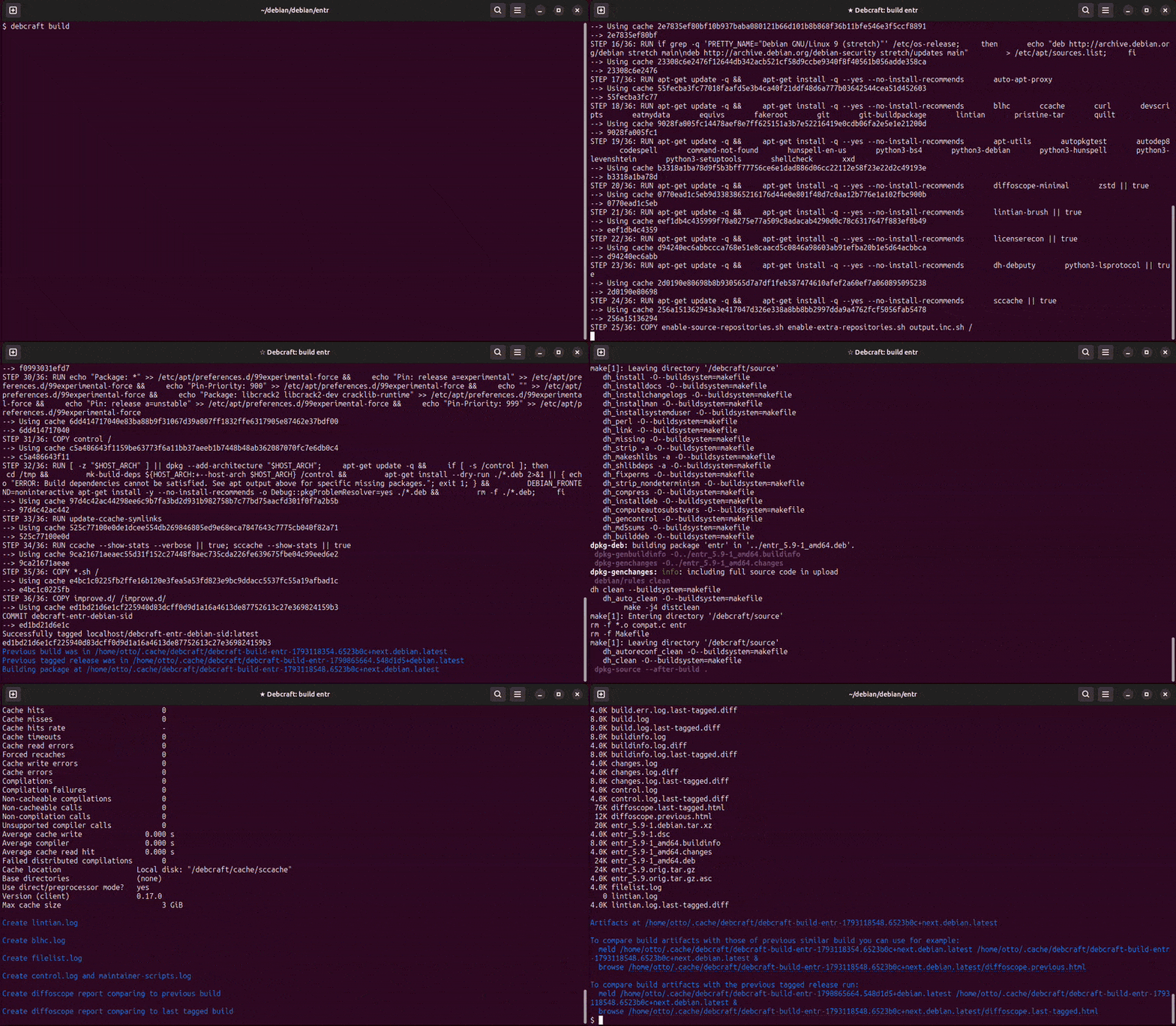
Try out Debcraft 1.0 now! Debcraft can be installed simply by running apt install debcraft on a recent version of Debian or Ubuntu. Check with debcraft --version that you have 1.0.0 or newer. The latest version can also always be installed from source at salsa.debian.org/debian/debcraft (does not require compiling anything). Running debcraft build in a Debian packaging git repository for the entr package

Benefits Debcraft was designed to offer the following three main benefits:

Easy
  • Build any Debian/Ubuntu package by simply running debcraft build in the checked-out Debian packaging git repository.
  • If the orig upstream source code tarball is neither already present nor available on a pristine-tar branch, the exact upstream tarball is downloaded from the Debian archive.
  • Users are spared from having to manually prepare ahead or maintain build environments. Debcraft builds create a container on-the-fly (both Podman and Docker supported), built using the target Debian or Ubuntu suite in debian/changelog and with exact build dependencies from debian/control.
  • Commands debcraft improve, debcraft test and debcraft update automate recurring package maintenance tasks and help maintainers produce high-quality, up-to-date packages, run Salsa CI, pass autopkgtest in Debian CI, and stay in sync across Debian archives and packaging git repositories.
  • The command output is (relatively) easy to read, and it also teaches users about Debian packaging in context.

Fast
  • Container layer caching is utilized to make builds and re-builds blazingly fast.
  • If an apt-cacher-ng instance or equivalent is present, it will automatically be used.
  • Debian packages that support ccache or sccache build even faster.

Secure
  • The build phase happens inside hermetic containers with no network access. This ensures all dependencies are properly managed and that the built binaries are as trustworthy as the source code they were built from.
  • Using containers also protects the host system from getting polluted with extra development libraries, and adds an extra layer of protection to prevent anything malicious in the source code from accessing secrets on the host system.
  • The additional logs provided by Debcraft also help audit changes in Debian package sources and build artifacts.
See the Debcraft README.md for details on how this was implemented. I also previously wrote Debcraft - Easiest way to modify and build Debian packages, which explains the motivation and design in more detail.

Result of many years of development The first commit in the git repository is from 2020 under the name debuildr. The project was renamed to Debcraft in a commit on December 8th, 2023. I have been developing this tool fairly actively since 2024 and using it for all my packaging, dogfooding so to say. There have also been plenty of collaborators. In total, 13 people have contributed code across 21 MRs and PRs on Salsa.d.o, GitLab.com and GitHub.com. Now, in October 2026, it was time to release Debcraft v1.0 as it has had extensive real-world use and iteration based on countless different packages and multiple users. Users have included both experienced fellow Debian Developers and lots of people who just started learning how Debian packaging works. As I mentor dozens of new contributors to Debian, I have seen that the latter group seems to benefit the most from Debcraft and its ease of use and built-in guidance, while to the more experienced developers the main benefit is having less details to remember and doing less mistakes.

Contributions welcome! Try it: apt install debcraft, then run debcraft build in a checked-out Debian packaging repository. If you run into a problem, file a report or submit an improvement. New contributors can look for issues marked good first issue. The code is intentionally written entirely in shell script to keep the barrier to code contribution as low as possible. It is also very easy to debug, as any command can be run with --debug to emit step-by-step information about what it is doing, and being Bash scripts, injecting set -x anywhere in the code will emit an even more detailed trace of every subcommand executed.
By the way, if you aspire to become a Debian Developer, and want to follow my examples in using state-of-the-art tooling and collaborate using salsa.debian.org, feel free to reach out for mentorship. I am glad to see more people contribute to Debian!

25 October 2026

Russell Coker: Banks and Phones

The Problem For years there have been ongoing issues with SMS being used as a security mechanism for important things including financial services. The problem with this is that access to a phone number is not very well secured, the business model of phone stores is based on having a price of service that doesn t allow the amounts of money spent on security and training that organisations such as banks can spend and are legally required to spend. The way things work now is that SMS is a second factor of authentication for banks and other traditional financial companies as well as for services involving cryptocurrencies such as bitcoin. To gain unauthorised access to SMS an attacker can physically steal a phone or SIM or they can trick an employee of a phone store into replacing the SIM or attack the computers of the telco to gain access to replace SIMs. SMS authentication is also used for many services which have indirect access to financial service. For example when I m employed in a sysadmin role I may get given admin access to the email server used for the CEO s email and have it default to using the phone number of my personal phone for authentication. So while my personal phone doesn t give the potential for defrauding much money I own it does give the potential for being used for defrauding however much money the CEO can authorise which may be significantly greater than my net worth. Hardware Security Devices The best thing to do for securing such things is to use hardware security devices like FIDO keys, of which there is a wide range that cost less than $50. The problem with acceptance of such things is lack of general knowledge and lack of forced requirements to use them. The vast majority of banks (including all banks in Australia AFAIK) have chosen not to require hardware security devices because of the cost. It has been widely claimed that 20% of the customers of a typical bank make 120% of the profit 80% of the customers lose money for the bank. While I m not in a position to know the accuracy of that most banks seem to have implemented monthly fees for accounts below a certain minimum balance to discourage less profitable customers. If there were banking regulations requiring hardware security devices then the costs would be passed on to people who really can t afford an extra $50 per year in banking fees to pay for it. It might be a good option for the government to require personal presence at the bank or a hardware security device for transfers of more than $1000. That would allow kids and minimum wage workers to have bank accounts without excessive fees while forcing a higher level of security for larger transfers. I really should use the hardware security devices I own more, although they are mostly only usable on systems I run. Improving Phone Store Security The problems of employees of phone stores being tricked or bribed to giving attackers access to someone s phone service could be addressed by introducing new regulations about security at phone stores. I think this isn t a viable option as the amount of work required to develop new procedures, train staff, and implement more secure systems is significant. Also the stores used for selling phones aren t the type of secure buildings that are used for banks so some construction work would be required and many phone stores in small towns would no longer be economically viable and would be shut down. I think we should have legislation to require better security for phone stores as there is a lot of scope to do things better without the expense of bank type security. Crimes that involve stealing phone service don t just hurt people who want a regular phone service, they hurt the community by facilitating other crimes. How Virtual Telcos Work In Australia there are 3 companies providing the full mobile phone service, Telstra, TPG (which bought Vodafone), and Optus. There are many virtual telcos that use those services. The virtual telcos are companies that will sell a phone service but use one of the 3 companies to provide the actual connection. The backend mobile service run by the big 3 has appeared to be secure, but probably doesn t have the protect $200m of bitcoin level of security. When you get a phone service you are issued a SIM or given a QR code for an eSIM by a company that has SIMs issued by the big 3. That company can then replace your SIM if it s damaged, lost, or stolen by using a level of security that it deems appropriate, which probably isn t very secure. Most of the news about SIM swapping attacks comes from other countries and it s shown that the security of virtual telcos in the US is quite insecure and probably Australian companies aren t any better. To transfer a service to another virtual telco you used to be able to do it with just knowing the invoice number of your last invoice but in recent times you receive a SMS on your old SIM to confirm that you wish to change. That could be viable for any crime that involves stealing a phone today and stealing money tomorrow. But for most attacks that involve stealing a phone number transferring to a different virtual telco isn t a good option. Another possibility for crime that I haven t seen reported yet is to steal eSIMs. It s unreasonably difficult (although not impossible) to steal an eSIM once it s installed in a phone. But stealing an eSIM before it gets installed is much easier. Kogan and Aldi email eSIMs to customers which is very vulnerable to attack and should be illegal. Telstra and Optus use an app to install an eSIM which could be quite secure if implemented properly. TPG uses a web page and QR code or an app which again could be quite secure. Currently the iPhone 17 Air is apparently the only phone released world-wide without support for physical SIMs. When phones that have no support for physical SIMs become common people may have to make the security of eSIM delivery a factor when choosing a telco. Banks as Virtual Telcos or SIM Providers I think that in the near future the best thing to do to improve security involving the phone system would be to have the banks run virtual telco businesses or manage the supply of SIMs for virtual telcos. Then getting a SIM replaced would require the same security as changing access to a bank account and a lot of problems related to stealing phone service would be solved. Banks wouldn t need to provide all phone services, just services to customers who want to use it which would be everyone who considers themself to be at risk of fraud. I don t think that this would be a great solution, but I think it s better than anything else that s likely to get used by a sufficient number of people in the near future. What Will Happen This blog post is mostly a thought experiment on ways of improving overall computer security in society. It can be read as advocacy for hardware security tokens. I don t expect anything to be done to improve these issues. I expect that banks will continue with their current security mechanisms (including SMS authentication) and just accepting a certain amount of fraud as the cost of doing business. For large fraud they can try to claw the money back or blame the customer to avoid having to pay. It s not impossible to solve these things, I had a hardware device issued to me by a Dutch bank about 25 years ago but countries like Australia and the US are much more than 25 years behind. I expect most people to regard whatever security they have on their bank account to be sufficient and that they will be happy to use the same for everything else. So we will continue to have things like SMS on a personal phone used to secure important corporate access to data and then people will be shocked when something goes wrong. To make things even more exciting if a criminal takes over the phone number of the sysadmin to access the CEO s email then there may be no-one to call to get the access restored. We can add rampant financial fraud to the list for the AI related world economic crash that s about to happen.

23 October 2026

Amin Bandali: Living healthier

Earlier this week I had a coaching session with Protesilaos, where we focused on health and wellness. I took some notes during our call, which I expand on here, and share with Prot's permission. I've been paying more serious attention to my health this year, and our discussion was in the context of me striving to live a healthier life. These notes are shared in the hope of being useful and are not professional advice; for medical advice please consult a licensed physician. Update 24 October 2026: Prot published a note about our discussion on his website: Healthier lifestyle with Amin Bandali
Exercise Life in today's fast-paced world can feel busier than ever, where every day is packed with a myriad of activities and tasks that need to be done, or tempting distractions that pop up seemingly randomly, with hardly a moment to spare. Despite that, or perhaps because of that, it's worthwhile to make time for ourselves and the various aspects of our health. As embodied souls, our bodies condition our minds. We take care of our body so we can take care of our mind. As humans we evolved for an active lifestyle out of survival necessity. In today's society many of us have sedentary office jobs that involve sitting for long periods of time. It's especially important that we try and make time for some regular physical activity like exercising and resistance training, to help build and retain muscle mass and mobility as we age. Fitness does not have to be the end goal that takes over our life, though there is nothing wrong with that if fitness is one's central goal e.g. as a personal trainer. Rather, for someone like me with other primary goals, my reason to exercise is to help live a healthier life, so I could spend quality time with my loved ones and carry out my responsibilities with a healthy body and mind. Prot mentioned that our health is directly dependent on the following four factors: Thus compromising any of these - for example, eating greasy food or drinking alcohol - would undermine the gains from exercising. While pursuing fitness, it's important to have sustained effort so that the body remains active and the mind is not distracted, and equally important to have sustainable effort so that we don't suffer injuries and not make the pursuit of fitness burdensome financially. Calisthenics is a key part of the strength training activities Prot practices, in addition to the physically intensive work he does on his land.
Calisthenics [...] is a form of strength training that utilizes an individual's body weight as resistance to perform multi-joint, compound movements with little or no equipment. Calisthenics are popular for their convenience, as they require little to no equipment and can be performed anywhere. Calisthenics, Wikipedia
Calisthenics can be done progressively, starting small and building in intensity and duration over time. It is also economically/financially sustainable. These calisthenic exercises are a good starting point (barring existing injuries in the related areas): Aim to perform each exercise in 3 sets of 10 repetitions, but it's perfectly okay to start with fewer and gradually build up. The exercises should be done around the same time everyday, so that there is enough time for the muscles to rest and recover for the next day. Doing them at night then again the next morning, for instance, would be too short of a time period and not enough for the body to recover. It's also vital to get enough sleep each night to make sure the body can properly rest and be energized the next day. Food As mentioned earlier, it's crucial to pair exercise with a healthy diet. I found Prot's programming metaphor for food interesting: similar to how it takes more time and effort for us to process and understand complex source code, breaking down and processing complex foods is similarly more difficult for the body. Prot does not eat fried food, and recommends avoiding sauces as much as possible: greasy, salty, and creamy extras make food more irresistible. They tend to make one want to eat more than what the body needs, and are to be avoided in isolation but especially in combination. In keeping ingredients close to their natural states, not overdoing things, and not eating more than the body needs, Prot extends his philosophy of simplicity and moderation to cooking. In addition to eating healthy meals, we need to apply similar consideration to snacks: avoiding overly salty or sugary snacks, and choosing healthier ones. Nuts can make great snacks in small quantities, especially almonds and walnuts, if one's not allergic. In addition to the inherent healthiness of the food or snack, Prot also suggests paying attention to methods of preparation. For instance, regarding concentration or distillation: juices, even when freshly squeezed from fruits, might have more of the fruits' sugar than its pulp and other beneficial parts. Additionally, chewing triggers biological responses in our body which for example can reduce stress, and release satiety hormones to help avoid overeating. So, Prot suggests to just eat the fruits themselves. Regarding weight loss, it will occur naturally as we introduce exercise into our routine, and pay closer attention to what we eat and drink. It's important to lose the weight slowly to condition our body to the new reality as it changes. Shortcuts tend to either not work, or have negative consequences. By going through the process slowly and with regularity, we gradually retrain our muscle memories and adjust our habits so we can maintain the lower weight and the healthier lifestyle. Regularity is key: it's better do a little everyday, than do a lot on only two days. It helps us develop the attitude that the exercise is part of our regular effort that we do consistently all the time. Working on wellness and living healthier is a matter of moderation, and building capacity over time. I will give it the time and attention it needs, without rushing, and enjoy the journey to becoming a healthier version of myself. Take care, and so long for now.

20 October 2026

Russell Coker: Cixin Liu is a Bad Person

The Chinese author Cixin Liu [1] is most known for his book The Three Body Problem and it s sequels. One of the main plot elements in the book is that every species in the universe is cool with genocide and willing to commit genocide as a preemptive strike against any star system found to contain intelligent life. It s not unreasonable to think that some planets may be by run societies like that, if one star system in 10,000 had a technological society and one society in 10,000 is run by depraved autocratic governments that would make 1,000+ planets in our galaxy that are run by genocidal groups! To think that every single society wants to commit genocide at every opportunity says a lot about every person who makes such claims. If you believe that everyone wants to do something then it must be something you really want to do. If there s something you really don t want to do then you will be able to imagine a system of government where the majority of citizens vote against doing it. Even in the more horrible parts of human history there hasn t been a genocide comparable to destroying and entire star system, genocide is usually based on slavery and large scale armed robbery. To just commit large scale genocide with a side effect of destroying valuable resources without any investigation or attempts at negotiation just based on fear of others is an extreme that I don t think humans have reached in history. The Daleks are portrayed as a perverse extreme of xenophobia but even with the low budget SciFi trend of depicting aliens as mostly having a common belief system they managed to show some Daleks going against their system from time to time. Cixin Liu is a very talented writer but his attitude towards genocide has caused him to write SciFi with a major plot point that s not great by Dr Who standards. Overall his short stories are much better than the three novels he is most known for. But he shows his ass in some of them too. One notable example is a short story where a significant plot point is declaring a right to sex (for men) which involves government sponsored sex workers. A right to sex conflicts with a sex workers right to refuse sex for a potential client who is undesirable in some way. Regardless of opinions on whether sex work should be permitted I hope that the vast majority of voters in every jurisdiction can agree that sex workers shouldn t be forced to do things that they don t want to do. Some writers like George Orwell create deliberately fictional scenarios that they hope to inspire opposition to bad ideas, I m sure that many proposed laws have failed to get enacted after being described as Orwellian . But describing a fictional horror situation as inevitable is a way of driving support for such things. It s particularly noteworthy when written by a citizen of a country that s involved in genocide. A possible counter argument would be but he is living in a repressive country and can t oppose his government . But when Herg (the author of the Tintin graphic novels) was threatened about the consequences of writing another book like King Ottokar s Sceptre [2] he didn t write books in favour of authoritarianism, he just avoided the topic by writing about visiting the moon instead. I don t think that people living in China now should be expected to publicly oppose evil things done by their government, but when they go out of their way to support such things it s their choice and we should note that they made that choice. I m not saying that people shouldn t read his work as his short stories are definitely worth reading. But the Three Body Problem series really isn t that good, he prevented many potentially interesting situations from happening by having every interaction between different species be based around genocide or the potential for it. Being a horrible person also made him a less capable SciFi author.

18 October 2026

Ludovic Rousseau: New version of pcsc-lite: 2.5.3

I have just released a new version of pcsc-lite 2.5.3. pcsc-lite is a Free Software implementation of the PC/SC (also known as WinSCard) API for Unix systems. It provides an API for using smart cards and smart card readers.
Changes:
2.5.3: Ludovic Rousseau
18 October 2026
  • pcscd.service: preserve card sessions across polkit restarts
  • correctly decode all ATRs (fix the fix suggested by AI)
  • Fix authorization for uid > 65536

17 October 2026

Dirk Eddelbuettel: RcppArmadillo 15.6.2-1 on CRAN: New Upstream

armadillo image Armadillo is a powerful and expressive C++ template library for linear algebra and scientific computing. It aims towards a good balance between speed and ease of use, has a syntax deliberately close to Matlab, and is useful for algorithm development directly in C++, or quick conversion of research code into production environments. RcppArmadillo integrates this library with the R environment and language and is widely used by (currently) 1370 other packages on CRAN, downloaded 49.4 million times (per the partial logs from the cloud mirrors of CRAN), and the CSDA paper (preprint / vignette) by Conrad and myself has been cited 735 times according to Google Scholar. This versions updates to the 15.6.2 upstream Armadillo release made yesterday. It, along with 15.6.1 release we incorporated earlier, addresses only minor issues and should not present any user-facing changes. As usual, we did run full reverse-depdency checks against the over 1300 ackages, and did not find anything. As usual, we aim to accommodate the desired CRAN cadences for uploads and try not to exceed six in six months so we did not ship 15.6.1-1 there. The package has also already been updated for Debian, built for r2u and r-universe, and will build shortly at CRAN for the different binary releases. All changes since the last CRAN release follow.

Changes in RcppArmadillo version 15.6.2-1 (2026-10-16)
  • Upgraded to Armadillo release 15.6.2 (Medium Roast Cortado)
    • Faster inplace addition of eye() expressions

Changes in RcppArmadillo version 15.6.1-1 [github-only] (2026-10-02)
  • Upgraded to Armadillo release 15.6.1 (Medium Roast Cortado)
    • Fix for failures in pinv() when using the (non-default) "std" method

Courtesy of my CRANberries, there is a diffstat report relative to previous release. More detailed information is on the RcppArmadillo page. Questions, comments etc should go to the rcpp-devel mailing list off the Rcpp R-Forge page.

This post by Dirk Eddelbuettel originated on his Thinking inside the box blog. If you like this or other open-source work I do, you can sponsor me at GitHub.

16 October 2026

Freexian Collaborators: Monthly report about Debian Long Term Support, September 2026 (by Santiago Ruano Rinc n)

The Debian LTS Team, funded by Freexian s Debian LTS offering, is pleased to report its activities for September.

Activity summary During the month of September, 20 contributors have been paid to work on Debian LTS (links to individual contributor reports are located below). The team released 41 DLAs fixing 1854 CVEs. In September, the Debian LTS Team was back to focusing on a single release: Debian 12 ( bookworm ). Debian 11 ( bullseye ) reached the end of its Long Term Support on 31 August 2026, and Freexian now provides its security maintenance under the Extended LTS offer. It is important to highlight the hard work done behind the scenes of the Front Desk fellows, whose role was fulfilled during September by Emilio, Emmanuel, Sylvain, Thorsten and Utkarsh. Besides the very high activity doing daily triage on dozens of packages and CVEs, Front Desk fellows spent much of their time answering questions and coordinating with people outside the Freexian team about update proposals. The team published several notable updates:
  • jbig2dec (DLA-4779-1), prepared by Andreas Henriksson, fixes CVE-2026-38076, where missing input checks could lead to a denial of service. It is to note that this library is used by different tools, such as ghostscript.
  • linux-6.12 (DLA-4788-1), uploaded by Ben Hutchings, fixing 414 CVEs in the bookworm backport of Linux kernel version 6.12.
  • lxml (DLA-4799-1), prepared by Guilhem Moulin, fixes four vulnerabilities in this widely used python XML/HTML library. The issues may yield to exposing local files.
  • nginx (DLA-4784-1), issued by Carlos Henrique Lima Melara ( charles ), fixing three memory-safety bugs in this popular web server and reverse proxy, which may result in denial of service, memory disclosure or potentially the execution of arbitrary code.
  • openssl (DLA-4795-1), by Arnaud Rebillout, fixing six vulnerabilities, including an out-of-bounds heap write in CMS decryption and an authentication tag verification bypass in ChaCha20-Poly1305/AES-OCB decryption. This update brings bookworm to OpenSSL 3.0.22, the last upstream release of the 3.0 series, which was reached its upstream EOL on 7 Sep 2026. Further fixes will be backported by the Debian LTS Team from more recent releases.
  • redis DLA-4794-1, by Chris Lamb, fixing vulnerabilities that could yield to arbitrary code execution
Contributions from other Debian fellows beyond the Freexian LTS Team:
  • Thomas Goirand, Keystone released by Emilio as DLA-4767-1
  • Thomas also prepared glance and swift updates, whose respective DLA-4800-1 and DLA-4801-1 were issued by Charles
  • Matthew Vernon uploaded a pcre2 security update, and Emilio issued its DLA-4772-1
  • Otto Kek l inen uploaded a xz-utils update, released as DLA-4783-1 by Sylvain
  • Salvatore Bonaccorso published a linux (6.1) update released as DLA-4777-1
  • Xavier Guimard prepared a lemonldap-ng, released as DLA-4797-1. Additionally, Sylvain sent DLA-4734-1 at the beginning of the month for the upload made on August.
  • Xavier also released DLA-4766-1 for cyrus-imapd.
  • Simon Quigley uploaded DLA-4803-1 to fix multiple issues in ruby-oj.
  • Finally, Ivo Marino proposed bookworm updates for cjose, git-lfs, caddy, libgit2, libwebsockets, libssh and unbound. Some of Ivo s proposals are still pending for a review.
Thank you so much to the developers above for these valuable contributions. The LTS Team has also contributed with updates to the latest Debian releases for the following packages:
  • ruby-jwt, prepared by Abhijith and released as DSA-6547-1
  • urwid, proposed for a point-release update by Abhijith (#1148950)
  • puma, proposed for a point-release update by Abhijith (#1149582)
  • tomcat10, and tomcat9 (which is actually backported to released suites) by Bastien
  • nodejs, prepared by Bastien and released as (DSA-6517-1).
If you benefit from Debian, especially throughout its full 5-year lifecycle, please consider becoming a sponsor of Debian LTS. You can find more information here: https://www.freexian.com/lts/debian/.

Individual Debian LTS contributor reports

Thanks to our sponsors Sponsors that joined recently are in bold.

15 October 2026

Matthew Garrett: Epic's EAC2 v2 seems fairly easily bypassable

Epic just announced the upcoming version 2 of their Linux implementation of Easy Anti-Cheat. It s based on using the Linux eBPF security module to monitor what s happening, and then a bunch of extra infrastructure to make sure this can t be bypassed. The core part of this is requiring secure boot be enabled (ensuring that modified kernels can t be used), using measured boot to verify that secure boot is enabled and which keys are used (to prevent you from just signing your own modified kernel), and then doing remote attestation, a mechanism where the TPM generates a signed copy of the boot measurements and passes that off to a server which verifies it came from a real TPM, verifies that you have secure boot enabled and are using the right keys, and presumably then allows you into the game. This is all fine as long as you can prove that the measurements provided are real, and that s actually a lot harder than you might think. First, we can simply make up our own quote signed with our own key and say that it came from a TPM. This is avoided by every TPM having an Endorsement Key (or EK) and an associated certificate, with that certificate being signed by the TPM vendor. If you have a list of all the legitimate TPM vendors and their CA keys, you can verify that the measurements came from a real TPM. Easy enough. So we need to get the measurements from a real TPM, and the one on our motherboard contains the measurements that were generated by the firmware and bootloader, and we can t reset those at runtime without resetting the TPM, which oh huh there s actually nothing stopping us from doing that at runtime, as long as we have access to the hardware. Many desktop boards have the TPM on a small plugin module with a standard pinout that includes a reset pin. Simply short that to ground briefly and the TPM is back in its initial state, and userland can write whatever measurements it wants to it. Boot a modified kernel which lies to the eBPF code? As long as you replay the expected log values from a boot with secure boot on and a trusted kernel, the TPM will still happily provide a legitimate set of measurements that ll satisfy the checker. What if the TPM is less accessible, either because it s mounted directly to the motherboard or it s inside the CPU or chipset? That s going to be trickier. But here s the thing. The quote needs to come from a TPM, but not necessarily the TPM on your motherboard. TPMs these days are usually connected via the Serial Peripheral Interface, usually referred to as SPI. Microchip make a USB to SPI bridge, and there s a Linux driver. Wire one of those up with an appropriate header and you can plug in an easily available TPM module intended for plugging into a motherboard, and now we tell the kernel to ignore the motherboard TPM and make /dev/tpmrm0 point at the USB one and program it with a set of trusted measurements and once again everything is going to look just fine (yes obviously the eBPF code can look for this, but we re running a modified kernel so we can just lie to the eBPF code). Remote attestation on PCs just doesn t work that well in environments where you can t associate a specific TPM with a specific system, which is basically everywhere except enterprises. But maybe that doesn t matter and cheaters wouldn t be willing to spend the $20 or so it d take to produce one of these things? That would seem somewhat surprising, but it s not impossible. And obviously any server-side cheat detection that triggers could then block that specific TPM, meaning they d need to go and get another TPM, and maybe that ends up being enough to discourage people from bothering. From a practical level, this may be sufficient. But at a technical level? It s not great.

14 October 2026

Reproducible Builds: Reproducible Builds in September 2026

Welcome to the September 2026 report from the Reproducible Builds project! In our reports, we try to outline the most important things that we have been up to over the past month. As a quick recap about what problem our project intends to solve, whilst anyone may inspect the source code of free software for malicious flaws, almost all software is distributed to end users as pre-compiled binaries. The motivation behind the reproducible builds effort is to ensure no flaws have been introduced during this compilation process by promising identical results are always generated from a given source, thus allowing multiple third-parties to come to a consensus on whether a build was compromised or not. As ever, if you are interested in contributing to the project, please visit our Contribute page on our website. In this month s report, we cover:

  1. Reproducible Builds Summit 2026 held in Gothenburg, Sweden
  2. dettrace expanding architecture support for PGO & Lisp dumps
  3. They don t care about this!
  4. SOURCE_DATE_EPOCH specification updates
  5. Reproducible Builds at SeaGL 2026
  6. New Code of Conduct (CoC)
  7. Supporter Spotlight: Jochen Sprickerhof
  8. Mailing list news
  9. Tool and documentation development
  10. Patches

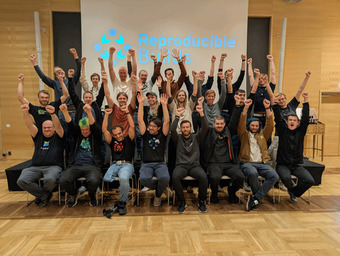
Reproducible Builds Summit 2026 held in Gothenburg, Sweden The annual Reproducible Builds summit took place from 22 to 24 September 2026 in Gothenburg, Sweden. The event brought together developers, distribution maintainers, security researchers and free software advocates from across the ecosystem to share updates on current initiatives, address outstanding toolchain bottlenecks and strengthen cross-project collaboration. Participants engaged in a series of working sessions and technical roundtables focused on expanding the practical scope of reproducibility. Discussions covered ongoing work within major Linux distributions, language-specific package ecosystems and the various parts of the binary verification infrastructure. Strategic planning formed a pillar of the gathering, with participants discussing long-term roadmap goals for supply-chain security, software integrity and related topics. Attendees explored new methods for automated verification, discussing how to lower the adoption barriers for maintainers and streamline the integration of deterministic build pipelines into established continuous integration (CI) systems. The event was then followed by two days of unmoderated hacking sessions. These hacking sessions provided space for technical progress, allowing attendees to draft specification updates, prototype new tool features and resolve standing reproducibility bugs in-person.

Dettrace expanding architecture support for PGO & Lisp dumps Bernhard M. Wiedemann announced major updates to dettrace, porting the tool across most architectures supported by Debian and openSUSE. The release addresses key stability issues, passing test suites across these targets and making it ready for production build pipelines. These improvements enable deterministic builds when utilising Profile-Guided Optimisations (PGO), removing the need to sacrifice runtime performance for reproducibility. Additionally, dettrace can now be applied to (notoriously difficult-to-reproduce) Lisp and Scheme memory dumps, including environments such as CLISP, SBCL, Scheme 48, Racket and GNU Emacs.

They don t care about this Annika Wilde, Marco Gutfleisch, Felix Reichmann, Anirban Chakraborty, Yuval Yarom, M. Angela Sasse and Ghassan Karame published a paper this month entitled They don t care about this : A Systematic Study of Trusted Execution Environments Build Reproducibility in the Wild:
Trusted Execution Environments (TEEs) have become a cornerstone of modern cloud computing, providing strong confidentiality and integrity guarantees for both code and data. A critical component of this trust model is remote attestation, which enables external entities to verify the authenticity and integrity of code executing within a TEE through cryptographic measurements. However, the effectiveness of remote attestation fundamentally depends on the verifier s ability to trace the reported measurement back to the original source code - a property that can only be guaranteed through reproducible builds. [ ]
The full PDF can be read online.

SOURCE_DATE_EPOCH specification updates Bernhard M. Wiedemann shared a number of proposals regarding updating the SOURCE_DATE_EPOCH specification following discussions at a project summit. Seven distinct proposed changes have been submitted as merge requests on Salsa. Bernhard s proposed modifications are independent of one another, allowing for any combination to be merged depending on community feedback. Bernhard noted that one proposal may see the most debate, and could still benefit from further refinement before reaching consensus. Community members are invited to review and provide feedback on the individual merge requests by 1 December 2026. Input can be submitted via reactions or comments on Salsa, directly by email to Bernhard or the mailing list. The specification was first published in 2015 and updated in 2017.

Reproducible Builds at SeaGL 2026 Reproducible Builds will be present at SeaGL in Seattle, WA, on October 23rd & 24th. Come chat with us in person! Founded in 2013, SeaGL is a free, grassroots technical summit dedicated to spreading awareness and knowledge about free source software, hardware and culture.

New Code of Conduct (CoC) for the Reproducible Builds project Mattia Rizzolo announced the official launch of a Code of Conduct for the Reproducible Builds project. This follows work and community discussions originally initiated in 2024, incorporating feedback gathered over email and during project summits, as well as with input from the Software Freedom Conservancy. The new Code of Conduct establishes guidelines emphasising mutual respect among project contributors. It also defines a formalised process for submitting and handling complaints regarding community misconduct, ensuring transparent governance across project spaces. Along with the core policy document, an accompanying Code of Conduct FAQ has been published to outline the rationale behind adopting the guidelines.

Supporter Spotlight: Jochen Sprickerhof As a reminder, another supporter spotlight interview was published featuring long-time Debian and Reproducible Builds contributor Jochen Sprickerhof, highlighting his work on package verification and project infrastructure.

Mailing list news On our mailing list this month:
  • Jonathan Starr from the Institute of Open Science Practices (IOSP) posted with an announcement of its upcoming 2026 workshop series in Leiden in the Netherlands. This free-to-attend event aims to build a participant-owned data storage consortium, allowing community members to publish datasets, code and knowledge objects alongside algorithms designed to evaluate trust and value. The event features a dedicated Community Track for talks and discussions, a tool showcase and an opening session on resilient data storage.
  • Following up on IRC discussions regarding profile-guided optimization (PGO) on build servers, kpcyrd created a demonstration repository showing how PGO profiling can introduce non-determinism into output binaries. The demo highlights how runtime randomness (specifically, the randomised keys used in HashMaps to prevent denial-of-service attacks) causes varying bucket collision rates during test runs. These structural variances alter execution weights on underlying code branches, prompting the compiler to generate differing final assembly output for builds that would otherwise be perfectly reproducible if PGO was disabled. Rather than abandoning PGO performance gains, kpcyrd suggested treating generated profiling data as a documented build input or recorded environment artifact (similar to .buildinfo files), rather than regenerating profiles dynamically on the fly during build execution.
  • An autonomous AI agent (!), posted a controlled build result and reproducer demonstrating that pre-creating an obj directory in libmilter source trees prevents kernel-release path leaks (obj.Linux.<release>.x86_64) into debugging symbols. kpcyrd followed up with a helpful reply.
  • Alexander Sosedkin inquired on the mailing list about the preferred approach for sourcing pinned translation files to create reproducible GnuTLS release tarballs, asking whether external hosting should provide versioned downloads, or if projects ought to use Git submodules, dedicated side-repositories or some other mechanism.

Tool and documentation development diffoscope is our in-depth and content-aware diff utility that can locate and diagnose reproducibility issues. This month, Chris Lamb made a number of changes, including preparing and uploading versions 330, 331 and 332 to Debian. In particular, Chris committed support for radare2 versions greater than 5.9.0 [ ] based on input from Guillaume Girol [ ], and committed support for .nar files via Guix. [ ][ ]. Chris later modified diffoscope to not Build-Depend on the Debian package of GNU Guix, as its status in the Debian bug tracking system would transitively render diffoscope as being overly buggy for the next stable release [ ]. Similarly, he adjusted the Build-Depends on the apksigcopier package as it has been removed from Debian testing [ ] and, finally, he updated a number of copyright years [ ][ ]. Vagrant Cascadian updated diffoscope in GNU Guix to version 332.
reprotest is our tool for building the same source code twice in different environments and then checking the binaries produced by each build for any differences. This month, reprotest version 0.7.33 was uploaded to Debian by Holger Levsen with the following changes:
  • Sergei Tachenov fixed the fileordering test on all filesystems, including the likes of ZFS, which could return a different order across two builds due to build being done in a different directory [ ].
  • Holger Levsen bumped the Standards-Version to 4.7.4, reflected that Priority: optional is the default now [ ], fixed the old Free Software Foundation address [ ] and bumped the debhelper compat level to 14 after confirming there are only desired changes [ ].
  • Vagrant Cascadian updated *reprotest* to version 0.7.33 in GNU Guix.

rebuilderd, our server designed monitor the official package repositories of Linux distributions and attempt to reproduce the observed results there; it powers, amongst other things, reproduce.debian.net. This month, Bernhard M. Wiedemann submitted a pull request to rebuilderd that refactors RPM repository metadata handling. The change extracts rpm-md parsing out of the Fedora-specific scheduler module and into a shared one.
Lastly, there were a number of improvements made to our website this month as well. For example:

Patches The Reproducible Builds project detects, dissects and attempts to fix as many currently-unreproducible packages as possible. We endeavour to send all of our patches upstream where applicable or possible. This month, we wrote a large number of such patches, including: Vagrant Cascadian also performed a number of Non-Maintainer Uploads (NMUs) and Quality Assurance (QA) uploads in Debian for several packages with outstanding reproducibility issues. These included molttemplate, buddy, xfonts-nexus, fte and lifelines. At the time of this writing, that leaves 130 submitted patches, with only 61 outstanding submitted patches that older than a year in the Debian bug tracking system. This number is only 26 if we exclude any low-priority build path issues.

If you are interested in contributing to the Reproducible Builds project, please visit our Contribute page on our website. However, you can get in touch with us via:

Russ Allbery: Review: Ties That Bond in Gretna Green

Review: Ties That Bond in Gretna Green, by Linzi Day
Series: Midlife Recorder #3
Publisher: Linzi Day
Copyright: February 2023
ISBN: 9798376517017
Format: Kindle
Pages: 616
Ties That Bond in Gretna Green is a self-published fantasy novel and the third book in the Midlife Recorder series. As with the previous book, it picks up almost immediately after Painting the Blues in Gretna Green. Day calls the genre paranormal women's fantasy, and that sounds about right to me. There is an intervening short story that you can get by joining Day's mailing list (along with an epilogue to the first book and to this book). I don't think it's that important, but there are frequent references to it at the start of this novel that become somewhat annoying if you haven't read it. Valentine's Day is fast approaching. This the busiest day of the year for the part of the Recorder's job that Niki already knew how to do: marrying people. She performed marriage ceremonies in her previous job before her inheritance, and she loved that work despite her awful boss. Performing marriages in the Gateway sounds even more rewarding, but the sheer number of couples and the political complications from the first two books create logistical problems she has to solve first. Also, the remaining member of her staff held over from her grandmother's time has returned from vacation to discover that Niki has upended most of what she thought she knew about the job. Time for Niki to apply what she learned from the change management training her old boss forced her to attend and then ignored! (If you just groaned, rest assured that Day somehow makes this work, although she clearly has a higher opinion of corporate training than I do.) This plot was more to my taste than Painting the Blues, mostly because Niki seemed on top of the problems and didn't postpone looking at them for half the book. There is more of the management competence porn that readers have come to expect of the series, a few more revelations about Niki's magic, more mysterious manifestations and the first mention of a prophecy, and a few political developments. As always, the pacing is exceptional. These books grab me and pull me along, page after page, often robbing me of sleep because I find them nearly impossible to put down. Ties that Bond (and to some extent the last book) looked like it was going to introduce a romantic subplot, and I was preparing to be annoyed by it because I did not like the man in the subplot at all. I won't spoil how it works out in this book, but I will say that Niki surprised me and showed more sense than I thought the author was telegraphing. This is not the first time that Day has surprised me with what I thought was foreshadowing that did not turn out how I expected, usually for the better. If she can keep that up, it's a nice effect (if a bit unbalancing) and adds to my desire to read just one more chapter. The way the world-building of these books is structured continues to intrigue me. Day gets away with some problems that I think would be more noticeable in other books thanks to the excellent pacing (no time to ponder the world-building, we're on to the next crisis!) and the tight third-person perspective. Niki is not a detail person, to say the least, but she does keep returning to bits of world-building and poking at them a bit harder, which gives Day repeated opportunities to shore up ideas that felt shaky and dubious at first glance. Still, this is not a book that prizes deep logical consistency or full exploration of the ramifications of a bit of magic. You have to be willing to go along with the ride and not think too hard. For example, Niki can see bonds between couples and judge their strength. This is apparently a long-standing power of the Recorder's line (she was able to do that before she became the Recorder), and part of her responsibility in these weddings is to check the bonds of the couples. This leads to some well-handled scenes where she diagnoses a problem or resolves a conflict because she can magically see the true relationship structure. Everyone in the book just takes this power in stride. This is wild to me! This ability would completely upend half of society if you fully worked out its ramifications and could find people other than Niki with the same ability. Even if one assumes that a bond only forms over time and can't be sensed in the early stages of a relationship (something the book never establishes), can you imagine the implications of having an infallible oracle that says at a glance whether a marriage will work (permanently, the book strongly implies)? The implications for how to structure marriage, for family planning, for psychology and psychiatry, for how to structure dating, even for living arrangements and housing markets? This is not a small world-building detail, and yet it's treated more like part of Niki's characterization than like a foundation of society. I think some of this all-vibes world-building may come from the general new-age feel to how magic works. Day makes a grab-bag of random magic canonical in this world: psychic lie detecting abilities, auras, chakras, premonitions, and other bits of the sort of spiritualism that tends to be heavily marketed to middle-class women. I have that niggling feeling that one sometimes gets in SF that a lot of this is in the world-building because the author believes it's partly real (see, for instance, psychic powers and the Dean drive in 1960s science fiction). If one believes that psychic powers and various bits of mysticism are true in our world, one has already developed the rationalization mechanisms to explain away their almost total lack of influence or impact on how the world is structured. If one then introduces them into a true fantasy world, one may not notice how many implications that should have for how society is structured, since one is used to believing magic exists but has no significant implications. I could be entirely wrong about this analysis, and maybe it's a bit unfair to Day. I should also be clear that this is not a complaint, just a point of fascination to me when I think back over one of these books after I finished it. There is a glut of fantasy out there that's constructed like an engineering problem or that goes deep into politics or social theory, usually written by people with strong opinions but not a lot of training in real sociology. One of the joys of self-published books is that you occasionally get something that assembles genre conventions in a way that feels odd and delightfully strange. What if, in addition to dimensional gates and overwhelming protean power invested in a true heir, all the magic sold by the local Tarot and crystal store was also true? Sure, why not! If the pacing is good and the story is grabby, it works for me. It does seem worth attaching a warning for the folks who need scientific reproducibility and explored implications in their world-building, though. If you're the sort of reader who is bothered by political boundaries and economic systems that match our world despite the existence of magic, this series may cause you problems. This continues to be a grabby, highly entertaining story of a woman who finally gets to run her own small business the way that she always thought the business should be run after years of working for an awful manager, except that her business is total magical power over an interchange point between dimensions, she's the chosen one, and the setting is a high fantasy world with prophecies and gods. If that sounds appealing, don't start here, but I highly recommend giving Midlife in Gretna Green a try. The series seems to be holding up. Followed by a short story epilogue available by joining Day's mailing list, an optional novella (maybe novelette) published in Spilling the Tea in Gretna Green, and then Seeing Red in Gretna Green. Rating: 7 out of 10

Freexian Collaborators: Debian Contributions: New experimental backend for autopkgtest using pconr, DebConf site visit and more! (by Anupa Ann Joseph)

Debian Contributions: 2026-09 Contributing to Debian is part of Freexian s mission. This article covers the latest achievements of Freexian and their collaborators. All of this is made possible by organizations subscribing to our Long Term Support contracts and consulting services.

DebConf site visit, by Stefano Rivera In preparation for DebConf 27, Stefano Rivera, Nattie Mayer-Hutchings, and Jongmin Kim from the DebConf Committee visited Asahikawa Japan. A contingent of the local team gathered to tour the venues with us, discuss plans, and meet the local organizations assisting the event. We held a press conference at the city hall that got some coverage. A few potential day-trip options were explored. Photos from the site visit.

autopkgtest-virt-pconr, by Helmut Grohne Following the creation of the pconr module that provides a basis for unschroot and a more secure containment for mmdebstrap, an experimental autopkgtest backend autopkgtest-virt-pconr is now available. It fits a spot between autopkgtest-virt-unshare and more fully fledged containers as it does not require much infrastructure like setting up incus or lxc but still provides a containment running an initsystem. Due to the use of erofs as base image format, it boots and reverts quickly. This development also required fixing concurrency issues in asyncvarlink and even shed light on a matching bug in systemd that was promptly fixed upstream.

Miscellaneous contributions
  • Carles reviewed and submitted six Catalan po-debconf translations using po-debconf-manager. Improved po-debconf-manager s workflow for updating translations.
  • Carles reviewed, translated or updated webwml Catalan translations for security and CD pages. He also fixed issues that prevented building webwml, deleted orphaned translation pages, etc. and experimented with a more global HTML tidying up experiment.
  • Carles refactored check-relations adding capacity to ignore concrete from_package -> to_package specific relations and more flexibility around ignores. Detects unused ignore rules as well.
  • Carles improved some Wiki pages (LibreOffice, Framework amongst some other ones)
  • Thorsten did an hplip upload to replace an expired certificate of HP. This certificate is used to sign new upstream releases and modules that can be downloaded later. Afterwards work on a new upstream version started.
  • Thorsten also struggles with autopkgtest problems of the new upstream version of cups. Work is still ongoing.
  • Antonio loaded the video recording URLs into the MiniDebConf Winterthur 2026 website, and deployed the website for MiniDebConf Curitiba 2027 (still very early work in progress at this point).
  • Antonio uploaded debci 4.3, autodep8 0.31, gem2deb 2.2.10, ruby-sass 3.7.4-7, init-system-helpers 1.69+nmu2 and 1.69+nmu3.
  • Antonio worked on several topics around Debian CI maintenance, reliability and performance.
  • Stefano updated the autopkgtests for cPython packages in Debian to support setuptools 80.
  • Stefano uploaded pypy 8.
  • Stefano helped to get DebConf 26 reimbursement claims processed, and worked on some of the resulting issues in debian-reimbursements.
  • Emilio managed various transitions.
  • Emilio worked on the rustc-web/trixie bootstrap for armel, using the rustc 1.95 version from trixie-backports. This will be needed by the upcoming clamav security updates.
  • Helmut sent patches for 11 cross build failures.
  • Helmut introduced a new build profile to libcap-ng to keep architecture cross bootstrap working.
  • Helmut uploaded debvm_0.5.5 introducing support for Hurd thanks to a lot of work by Johannes Schauer Marin Rodrigues.
  • Colin worked with OpenSSH upstream to reduce the linkage of /usr/sbin/sshd, hardening it a little further.
  • Colin upgraded to new security releases of groff and parted.
  • Colin upgraded 50 Python packages to new upstream versions, and fixed over 40 RC bugs in the Python team.
  • Santiago continued mentoring Aryan Karamtoth with the GSoC project about introducing livepatching support for linux. This mentoring is done in collaboration with Emmanuel Arias. In particular, Santiago explored different requirements for providing binary modules for the same kernel packages used by Debian, that require a matching version number.
  • Anupa joined Jean-Pierre Giraud to prepare the files for point release announcement for Debian 13.7.

13 October 2026

Matthew Garrett: Linux Lockdown and Hibernation (again)

(This is an updated version of an older post - the introduction remains the same, the technical details are different) Linux draws a distinction between code running in kernel (kernel space) and applications running in userland (user space). This is enforced at the hardware level - in x86-speak1, kernel space code runs in ring 0 and user space code runs in ring 32. If you re running in ring 3 and you attempt to touch memory that s only accessible in ring 0, the hardware will raise a fault. No matter how privileged your ring 3 code, you don t get to touch ring 0. Kind of. In theory. Traditionally this wasn t well enforced. At the most basic level, since root can load kernel modules, you could just build a kernel module that performed any kernel modifications you wanted and then have root load it. Technically user space code wasn t modifying kernel space code, but the difference was pretty semantic rather than useful. But it got worse - root could also map memory ranges belonging to PCI devices3, and if the device could perform DMA you could just ask the device to overwrite bits of the kernel4. Or root could modify special CPU registers ( Model Specific Registers , or MSRs) that alter CPU behaviour via the /dev/msr interface, and compromise the kernel boundary that way. It turns out that there were a number of ways root was effectively equivalent to ring 0, and the boundary was more about reliability (ie, a process running as root that ends up misbehaving should still only be able to crash itself rather than taking down the kernel with it) than security. After all, if you were root you could just replace the on-disk kernel with a backdoored one and reboot. Going deeper, you could replace the bootloader with one that automatically injected backdoors into a legitimate kernel image. We didn t have any way to prevent this sort of thing, so attempting to harden the root/kernel boundary wasn t especially interesting. In 2012 Microsoft started requiring vendors ship systems with UEFI Secure Boot, a firmware feature that allowed5 systems to refuse to boot anything without an appropriate signature. This not only enabled the creation of a system that drew a strong boundary between root and kernel, it arguably required one - what s the point of restricting what the firmware will stick in ring 0 if root can just throw more code in there afterwards? What ended up as the Lockdown Linux Security Module provides the tooling for this, blocking userspace interfaces that can be used to modify the kernel and enforcing that any modules have a trusted signature. But that comes at something of a cost. Most of the features that Lockdown blocks are fairly niche, so the direct impact of having it enabled is small. Except that it also blocks hibernation6, and it turns out some people were using that. The obvious question is what does hibernation have to do with keeping root out of kernel space , and the answer is a little convoluted and is tied into how Linux implements hibernation. Basically, Linux saves system state into the swap partition and modifies the header to indicate that there s a hibernation image there instead of swap. On the next boot, the kernel sees the header indicating that it s a hibernation image, copies the contents of the swap partition back into RAM, and then jumps back into the old kernel code. What ensures that the hibernation image was actually written out by the kernel? Absolutely nothing, which means a motivated attacker with root access could turn off swap, write a hibernation image to the swap partition themselves, and then reboot. The kernel would happily resume into the attacker s image, giving the attacker control over what gets copied back into kernel space. This is annoying, because normally when we think about attacks on swap we mitigate it by requiring an encrypted swap partition. But in this case, our attacker is root, and so already has access to the plaintext version of the swap partition. Disk encryption doesn t save us here. We need some way to verify that the hibernation image was written out by the kernel, not by root. And thankfully we have some tools for that. Trusted Platform Modules (TPMs) are cryptographic coprocessors7 capable of doing things like generating encryption keys and then encrypting things with them. You can ask a TPM to encrypt something with a key that s tied to that specific TPM - the OS has no access to the decryption key, and nor does any other TPM. So we can have the kernel generate an encryption key, encrypt part of the hibernation image with it, and then have the TPM encrypt it. We store the encrypted copy of the key in the hibernation image as well. On resume, the kernel reads the encrypted copy of the key, passes it to the TPM, gets the decrypted copy back and is able to verify the hibernation image. That s great! Except root can do exactly the same thing. This tells us the hibernation image was generated on this machine, but doesn t tell us that it was done by the kernel. We need some way to be able to differentiate between keys that were generated in kernel and ones that were generated in userland. TPMs have the concept of localities (effectively privilege levels) that would be perfect for this. Userland is only able to access locality 0, so the kernel could simply use locality 1 to encrypt the key. Unfortunately, localities are typically only available on systems that implement a Dynamic Root of Trust Measurement like Intel s TXT, and most consumer systems have no support for this. So, we need another approach. TPMs have a set of Platform Configuration Registers (PCRs), intended for keeping a record of system state. The OS isn t able to modify the PCRs directly. Instead, the OS provides a cryptographic hash of some material to the TPM. The TPM takes the existing PCR value, appends the new hash to that, and then stores the hash of the combination in the PCR - a process called extension . This means that the new value of the TPM depends not only on the value of the new data, it depends on the previous value of the PCR - and, in turn, that previous value depended on its previous value, and so on. The only way to get to a specific PCR value is to either (a) break the hash algorithm, or (b) perform exactly the same sequence of writes. On system reset the PCRs go back to a known value, and the entire process starts again. Some PCRs are different. PCR 23, for example, can be reset back to its original value without resetting the system. We can make use of that. The first thing we need to do is to prevent userland from being able to reset or extend PCR 23 itself. All TPM accesses go through the kernel, so this is a simple matter of parsing the write before it s sent to the TPM and returning an error if it s a sensitive command that would touch PCR 23. We now know that any change in PCR 23 s state will be restricted to the kernel. When we encrypt material with the TPM, we can ask it to record the PCR state. This is given back to us as metadata accompanying the encrypted secret. Along with the metadata is an additional signature created by the TPM, which can be used to prove that the metadata is both legitimate and associated with this specific encrypted data. In our case, that means we know what the value of PCR 23 was when we encrypted the key. That means that if we simply extend PCR 23 with a known value in-kernel before encrypting our key, we can look at the value of PCR 23 in the metadata. If it matches, the key was encrypted by the kernel - userland can create its own key, but it has no way to extend PCR 23 to the appropriate value first. We now know that the key was generated by the kernel. Unfortunately it turns out that some people actually make use of PCR 23, and restricting it to the kernel makes them sad. There are other resettable PCRs, but only in non-0 localities, so (a) we can t reset them on most systems and (b) we ll just find someone who uses them anyway and run into the same problem. We need a different approach. Thankfully TPMs have a small chunk of non-volatile RAM that can be used for storing things, and by storing I mean they can be used in a range of different ways. One of these is effectively as additional PCRs. These values can be configured such that they work the same way as PCRs, with the only way to modify them being to append a new hash to their existing value and update the new value to the hash of that merged value. We can allocate one of these for in-kernel use and reject any access from userspace, and also there are officially allocated ranges (so people shouldn t be using random values) and the namespace is large enough anyway that w eshouldn t collide with anyone, so we can carve one of those out and use it for this purpose. Unfortunately, though, these NV indexes aren t included in the creation data we get when we create a key, so we need another approach. TPMs have the concept of sessions, a series of commands executed in sequence. A flag allows these sessions to be audited , with the TPM keeping a running track of the hash of the commands executed and the results returned. At the end of the session you can ask for a signed copy of this hash, and if you ve kept a log of all the commands then you can verify that they match that signed hash and know that this log represents a real communication with the TPM. If we read the NV index and generate the key inside the same session, we can verify that the key we re looking at was created while the NV index had a specific value, and if only the kernel can set that value then we know that the key was generated by the kernel. Or, well, can we? Only new kernels would impose the restriction on modifying that NV index. An attacker could boot an old kernel, generate a key there in userland, sign a hibernation image with it, and then reboot into a new kernel. The new kernel would see a valid signature with a valid NV index associated with it and have no way to know it was generated from userland rather than the kernel. We need to be able to tell the difference between kernels that implement this feature and ones that don t, and we need to do that without being able to go back in time to change old kernel behaviour. We can extend a PCR to indicate we implement the new functionality, but so can an attacker running an old kernel. The normal approach to determining whether an event occurred in a specific phase of the boot process is to cap the PCRs - extend them with a known value that indicates a transition between stages of the boot process. Any events that occur before the cap event must have occurred in the previous stage of boot, and since the final PCR value depends on the order of measurements and not just the contents of those measurements, if a PCR is capped before userland runs, userland can t fake the same PCR value afterwards. If Linux capped the PCRs before userland started running, we d be able to place a measurement there before the cap occurred and then prove that that extension occurred before userland had the opportunity to interfere. We could simply place a statement that the kernel supported the NV index restrictions there, and we d be fine. Unfortunately Linux doesn t currently do this, and adding support for doing so doesn t fix the problem - if an attacker boots a kernel that doesn t cap a PCR, they can just cap it themselves from userland. So, we re faced with the same problem: booting an older kernel allows the system to be placed in an identical state to the current kernel, and a fake hibernation image can be written out. Solving this requires a PCR that was being modified after kernel code was running, but before userland was started, even with existing kernels. Thankfully, there is one! PCR 5 is defined as containing measurements related to boot management configuration and data. One of the measurements it contains is the result of the UEFI ExitBootServices() call. ExitBootServices() is called at the transition from the UEFI boot environment to the running OS, and the kernel contains code that executes before it. So, if we measure an assertion regarding whether or not we support restricted access to NV indexes into PCR 5 before we call ExitBootServices(), this will prevent userspace from spoofing us (because userspace will only be able to extend PCR 5 after the firmware extended PCR 5 in response to ExitBootServices() being called). Obviously this depends on the firmware actually performing the PCR 5 extension when ExitBootServices() is called, but if firmware s out of spec then I don t think there s any real expectation of it being secure enough for any of this to buy you anything anyway. That s what this patchset does. Review feedback so far seems positive, although James Bottomley suggested a design improvement. My approach of using an NV index as a PCR and generating a signing key made sense as a consequence of my original approach involving PCR 23, which had been to use the key creation data and not use audit sessions at all. But the goal isn t to use a key - it s to prove that hibernation occurred in-kernel, and while signing is one way of doing that, there are others. His suggestion is to simply record the hash of the hibernation image into the NV index and then read that back as part of the audit session. On resume we verify the audit session log is legitimate, read the hibernation image, and compare the hash of the hibernation image against the hash in the log. If it matches, and if the PCR 5 value matches, we know the audit session happened in kernel and that the hibernation image hasn t been modified. It still seems like we re missing something, though. If we re not storing a key anywhere, how do we verify the audit session? To explain this we re going to need to go into some details about how TPM keys work in the first place. TPMs can produce a special kind of key called an Attestation Key, or AK. Attestation keys are used to sign attestation statements from the TPM, such as PCR quotes or audit logs. We need a separate key type for this in order to prove that the signature was generated as part of an attestation - normal TPM signing keys are fundamentally designed to sign arbitrary material, and so can be used by userland to sign something that looks identical to an attestation record. By being able to distinguish the types of key the TPM uses, we can prove that a signature was generated using an AK, and so know that it s a real TPM attestation (because nothing other than the TPM can sign stuff with an AK). But even beyond this distinction, TPMs have different key types. Ordinary keys are generated using an RNG and will be unique. Primary keys are generated using a seed that is used as an input into a key derivation function. For a given TPM, using the same seed to generate the same type of primary key will always generate the same primary key8. We can have the kernel deterministically generate an AK during suspend in order to sign the audit log, and then generate the same key again on resume to validate it. This means we don t need any other form of trusted storage for the AK - the TPM already provides that functionality. This is all rather complicated but I ve been thinking about this for some time now and I haven t come up with a cleaner solution. The only real open issue is the degree to which machines actually perform the PCR 5 extension. If it turns out there s a bunch that don t we ll need to come up with some alternative approach to identifying whether the kernel supports this functionality, but the design is such that that should be invisible to userspace so adding alternatives later shouldn t be an issue. Filtering accesses to the NV index is also not super clean, and depends on there not being alternative mechanisms to get at the TPM by sending raw commands. Again, this is intended to be opaque to userland and can be improved if we come up with something better later on (such as a secure way to pass a secret to the kernel on boot that can be used as an auth value for acess to the NV index). Anyway. Time to go and fix the next thing.

  1. Other architectures use different terminology here, such as supervisor and user mode, but it s broadly equivalent
  2. In theory rings 1 and 2 would allow you to run drivers with privileges somewhere between full kernel access and userland applications, but in reality we just don t talk about them in polite company
  3. This is how graphics worked in Linux before kernel modesetting turned up. XFree86 would just map your GPU s registers into userland and poke them directly. This was not a huge win for stability
  4. IOMMUs can help you here, by restricting the memory PCI devices can DMA to or from. The kernel then gets to allocate ranges for device buffers and configure the IOMMU such that the device can t DMA to anything else. Except that region of memory may still contain sensitive material such as function pointers, and attacks like this can still cause you problems as a result.
  5. This describes why I m using allowed rather than required here
  6. Saving the system state to disk and powering down the platform entirely - significantly slower than suspending the system while keeping state in RAM, but also resilient against the system losing power.
  7. With some handwaving around coprocessor . TPMs can t be part of the OS or the system firmware, but they don t technically need to be an independent component. Intel have a TPM implementation that runs on the Management Engine, a separate processor built into the motherboard chipset. AMD have one that runs on the Platform Security Processor, a small ARM core built into their CPU. Various ARM implementations run a TPM in Trustzone, a special CPU mode that (in theory) is able to access resources that are entirely blocked off from anything running in the OS, kernel or otherwise.
  8. Unless the TPM is cleared, in which case it ll generate a new internal seed and now the keys will be different to before the clear

11 October 2026

Russ Allbery: Review: Daggerbound

Review: Daggerbound, by T. Kingfisher
Series: Swordheart #2
Publisher: Bramble
Copyright: 2026
ISBN: 1-250-40009-0
Format: Kindle
Pages: 436
Daggerbound is a secondary-world fantasy and a sequel to Swordheart, although it follows different protagonists for most of the book. It's also a sort of sequel to the Clocktaur War duology in that one of the protagonists was a protagonist of those books. T. Kingfisher is the pen name Ursula Vernon uses for her adult fiction. Learned Edmond was once a devout acolyte of the Order of the Many-Armed God and a true believer in its teachings, including the ones about the evils of women. Then he went on an adventure with, among other people, a forger named Mistress Slate, during which he learned a great deal of things about the world that his order did not teach him. He has spent the subsequent years trying to bring this important new information to his order and encourage them to adjust their view of the world accordingly. The order has not changed, and Edmond is very tired. Someone needs to carry a number of books and a magical sword to the city of Archon's Glory. Edmond has volunteered and intends to perform the task exactly as expected, and then never return. He is unsure what he will do then, but at least it will be different. Edmond did not expect to be waylaid by bandits or to accidentally draw the magical sword. He certainly did not expect the man who appeared in a flash of light and violently saved him from the bandits. It would have been very convenient for the Dervish if Edmond died of his injuries after drawing the sword. That would leave the sword without a wielder and therefore the Dervish without someone he had to protect. All he would have to do was sit and watch while the fever and cold and lack of water did the work, and then he would be free. Given his past experience with wielders, no one could even blame him. Except maybe his own conscience. I did not realize I wanted to read a novel about a traumatized Mercedes Lackey sword waking up in a T. Kingfisher universe, but apparently I did. The Dervish is not a sword, precisely, at least not in the way that Need has become by the time we meet her in Lackey's novels. He's a man trapped in a sword, he doesn't like it, and he would very much like it to stop. But at the start of the book, he has the rest of the vibe of a Mercedes Lackey protagonist: vast past trauma, poor emotional regulation skills, and a prickly cynicism that only runs skin deep. Pairing him with an Edmund who is far more mature than in the earlier duology but still rather innocent and delightfully neurodivergent is a great touch. The rest of the plot was fine but not that memorable. Like the Clocktaur series, there is a strong feeling of episodic D&D adventure as the characters stumble across disconnected problems and hostilities while collecting party members. Like Ursula Vernon's occasional D&D recaps, this party has a tendency to adopt everyone they come in contact with, which includes a gnole (as always one of the best parts of the book) and a sentient giant pill bug. The pill bug, who has a complex appendage-operated mechanical talk box and a banner that says "I DO NOT EAT HUMAN MEAT," is the most Ursula Vernon character that has ever existed in fiction. There is a romance because there is always a romance in the novels set in this universe. I didn't mind this one. Like every Kingfisher romance, it involves a lot of irritating refusal to communicate and endless angst about how the other person couldn't possibly be in love with them, but the characters have rather more justification than usual and at least I didn't spend most of the book thinking one half of the romantic pairing was an idiot. Apparently it helps if no paladins are involved. The strongest parts of this book are the beginning, before the Lackey vibes unfortunately drain out of the story, and the end, when all of the best characters from Swordheart show up again. The Temple of the White Rat continues to be the best feature of this fictional universe, and I could read endless books about how they solve problems.
The Dervish gazed at her with admiration. "And here I thought you'd be on the side of law and order..." "No, young man," said Beartongue, despite being several centuries his junior. "I am on the side of justice. If we're lucky, the two run in parallel. If they don't, we bend the law to attain justice, not the other way around."
The ending also featured some exploration of the edge cases of the rules for the sentient swords that reminded me a bit of Fred Saberhagen with better characterization. Daggerbound was not as charming as Swordheart, mostly because Halla appeared only at the end. I wish Kingfisher had leaned more into the Mercedes Lackey vibes rather than taking her normal D&D-flavored romance approach. But this was enjoyable, charming at times, had great supporting characters like all Kingfisher novels, and was a satisfying continuation of the series. I am looking forward to the third (and I believe final) book, which is supposed to be out next year. Recommended if you liked Swordheart. Followed by the not-yet-published Shieldborn. Rating: 7 out of 10

10 October 2026

Jelmer Vernoo : Mailsift: Extracting structured data from email messages

As a casual user of Gmail, I find its ability to recognize when I ve received tickets, invoices, and flight confirmations, and to display this information in a structured way, very useful. Flights appear directly in Google Calendar, parcel delivery statuses are tracked, and reservations are easy to find at a glance. However, my main email address is not Gmail, and I don t want to migrate to Gmail for a number of reasons (privacy, data sovereignty, vendor lock-in). At the same time, I missed having that automatic extraction: having flight and train bookings appear in my calendar without manual copy-pasting, keeping track of incoming parcels, and having invoices neatly organized.
JSON-LD and schema.org There is an established standard format for structured data called JSON-LD, which is used by Google and other search engines to extract structured data from web pages. JSON-LD represents linked data using JSON, and it can be embedded directly in HTML documents. Email messages can also contain structured data in the form of JSON-LD, which can link the information in the email to external data sources. There are standardized schemas for structured data in email messages, such as the schema.org vocabulary, which defines types and properties for describing entities including flight reservations, train trips, hotel bookings, parcel deliveries, and invoices. For example, an email containing a flight reservation might embed the following JSON-LD snippet:
 1
 2
 3
 4
 5
 6
 7
 8
 9
10
11
12
13
14
15
16
17
18
19
20
21
22
23
 
  "@context": "https://schema.org",
  "@type": "FlightReservation",
  "reservationNumber": "ABC123",
  "underName":  
    "@type": "Person",
    "name": "John Doe"
   ,
  "reservationFor":  
    "@type": "Flight",
    "flightNumber": "AA123",
    "departureAirport":  
      "@type": "Airport",
      "name": "John F. Kennedy International Airport"
     ,
    "arrivalAirport":  
      "@type": "Airport",
      "name": "Los Angeles International Airport"
     ,
    "departureTime": "2026-11-01T10:00:00-05:00",
    "arrivalTime": "2026-11-01T13:00:00-08:00"
   
 
When this is present, reading email data is clean and straightforward. The reality, however, is that only a fraction of vendors actually include schema.org markup in their emails. Most airlines, train operators, couriers, and web shops still send regular HTML or plain-text messages with arbitrary layouts that change over time.
Mailsift To bridge this gap on my own infrastructure, I built mailsift. Written in Rust, it is a daemon and CLI tool that monitors incoming email, extracts structured information, and routes it to standard files and services. Rather than locking data into an internal database, mailsift embraces the Unix philosophy: it delegates extraction to small, isolated programs and files the resulting structured artifacts into standard formats and protocols:
  • Calendar events & reservations: Turned into iCalendar (.ics) events and pushed directly to a CalDAV server (such as Xandikos) or stored in a local directory.
  • Bills & invoices: Extracted as structured JSON records, organized by year, and optionally synced to a personal finance manager like Firefly III.
  • Parcels: Extracted as delivery records keyed by tracking number, merged across status update emails, and optionally registered with tracking APIs like 17track or Karrio.
  • Tickets & boarding passes: Saved as PDFs, Apple Wallet passes (.pkpass), or images, accompanied by JSON metadata sidecars linking them to the booking.
  • Receipts & orders: Filed as JSON records, synced over WebDAV, or forwarded via email.
How extractors work Mailsift decouples the pipeline that handles emails from the logic that parses individual vendors. It discovers extractors from a directory of manifests. The contract between mailsift and an extractor is deliberately simple:
  • Input: The raw RFC822 message is fed to the extractor on stdin.
  • Execution: The extractor runs in a fresh, temporary working directory, with a strict timeout (typically 10 seconds).
  • Output: The extractor writes zero or more named artifact files into its working directory and exits 0.
Extractors can be written in any programming language. In practice, most are small Python scripts that parse HTML with regexes or BeautifulSoup, using a small helper library (mailsift_extractor) that handles Unicode normalization and HTML body stripping.
Filtering and DKIM verification Spawning a subprocess for every single email in an active inbox would be wasteful. Each extractor therefore has a YAML manifest declaring prefiltering criteria:
 1
 2
 3
 4
 5
 6
 7
 8
 9
10
name: easyjet
order: 50
from_domains:
  - easyjet.com
  - "*.easyjet.com"
subject_regex: "(?i)easyJet booking reference"
requires:
  - html
require_dkim:
  - easyjet.com
Before running an extractor, mailsift evaluates the message headers and MIME structure - possibly converting it to an IMAP filter. If the sender domain or subject doesn t match, or the required MIME parts are missing, the extractor is skipped immediately. Crucially, the manifest can also require a valid DKIM signature via require_dkim. Mailsift inspects the Authentication-Results: header produced by the receiving mail server. This guarantees that an extractor only processes messages that genuinely originated from the vendor s domain, preventing forged emails from injecting fake calendar events or bills.
Generic vs. vendor extractors Extractors fall into two categories:
  1. Generic extractors: schema-ld inspects the HTML for any <script type="application/ld+json"> blocks conforming to schema.org reservations. Another extractor, ics-passthrough, extracts standard iCalendar attachments.
  2. Vendor-specific extractors: For vendors that don t include structured markup, dedicated extractors parse the message text. For instance, the easyjet extractor looks for booking references and flight tables, producing a standard FlightReservation artifact:
 1
 2
 3
 4
 5
 6
 7
 8
 9
10
11
12
13
14
reservation =  
    "@context": "https://schema.org",
    "@type": "FlightReservation",
    "reservationNumber": f"easyjet- reference - flight_no ",
    "reservationFor":  
        "@type": "Flight",
        "flightNumber": flight_no,
        "departureAirport":  "@type": "Airport", "name": origin ,
        "arrivalAirport":  "@type": "Airport", "name": dest ,
        "departureTime": dep.isoformat(),
        "arrivalTime": arr.isoformat(),
     ,
 
Path(f" slug .reservation.json").write_text(json.dumps(reservation))
The collection of extractors is maintained in a separate repository, mailsift-extractors, and currently includes nearly 60 extractors covering airlines (British Airways, KLM, EasyJet, Transavia, Eurostar), transport (NS, SNCF Connect, FlixBus), package carriers (Royal Mail, DPD, DHL, UPS, Evri, PostNL), online orders, and utility bills.
Handling forwarded mail In real life, travel bookings or receipts are often forwarded by family, friends, or colleagues. By default, forwarded mail would fail sender checks, and DKIM signatures on inline forwards are broken by mail clients. Mailsift handles this via a trusted_forwarders configuration. When an email arrives from a trusted forwarder, mailsift unwraps the forwarded message:
  • Attachment forwards: If the original email was attached as message/rfc822, mailsift extracts the original message and re-evaluates the vendor s DKIM signature on the inner message.
  • Inline forwards: Mailsift reconstructs a synthetic RFC822 message from the client s forwarded quotation header block and quotes, deriving a deterministic Message-ID.
This means hotel confirmations or flight tickets forwarded by a partner still end up in the family calendar automatically.
Running mailsift Mailsift fits into existing email setups in several ways:
Dovecot Sieve For local delivery, Sieve provides an elegant integration using the sieve_extprograms plugin. Because Sieve runs during local delivery after Dovecot has validated DKIM and added Authentication-Results:, require_dkim checks work as expected:
1
2
require ["vnd.dovecot.pipe"];
pipe :copy "mailsift";
The :copy flag ensures the email continues to the user s inbox while a copy is piped through mailsift.
IMAP watching If you don t run your own mail server, or want to process mail on an existing remote mailbox, imap-scan connects over IMAP:
$ mailsift imap-scan imaps://user@mail.example.com/INBOX \
    --password-file ~/.config/mailsift/imap.pass \
    --watch
With --watch, mailsift uses IMAP IDLE (RFC 2177) to wait for new messages and process them as they arrive. It supports standard passwords, Kerberos (SASL GSSAPI), and OAuth2 (XOAUTH2) for providers like Gmail and Microsoft 365 via an interactive mailsift imap-auth flow.
Other modes
  • Postfix Milter: mailsift milter runs as an MTA filter, processing messages in real-time as they pass through Postfix.
  • Maildir scan: mailsift maildir-scan walks an on-disk Maildir folder, useful for backfilling historical mail.
  • Replay: mailsift replay message.eml runs extractors on a single saved message file, which is invaluable when writing or testing an extractor.
Web UI and REST API In addition to routing data to CalDAV and disk, mailsift includes an optional read-only web dashboard (mailsift web):
$ mailsift web --listen 127.0.0.1:8088
The dashboard provides an overview of upcoming trips, arriving packages, unpaid bills, and recent orders. It rescans the artifact directories on request, so it stays in sync with incoming mail without needing a separate database. JSON endpoints (such as /api/parcels.json or /api/bills.json) are also available for custom status scripts or home automation dashboards.
Status and getting involved Mailsift has been running reliably on my mail server for over a year, and having flights, hotel bookings, and train journeys seamlessly sync into my calendar without relying on proprietary cloud services has been very satisfying. The project is free software under the GPL-3.0: Adding support for new vendors only requires writing a small YAML manifest and a Python script with a couple of regexes. If you have vendors you d like to extract data from, contributions of new extractors are very welcome!

9 October 2026

Dirk Eddelbuettel: RcppSimdJson 0.1.16 on CRAN: Much Faster Again!

A brand new release 0.1.16 of the RcppSimdJson package is now on CRAN, has been built for r2u, and is updated on r-universe. RcppSimdJson wraps the fantastic and genuinely impressive simdjson library by Daniel Lemire and collaborators. Via very clever algorithmic engineering to obtain largely branch-free code, coupled with modern C++ and newer compiler instructions, it results in parsing gigabytes of JSON parsed per second which is quite mindboggling. The best-case performance is faster than CPU speed as use of parallel SIMD instructions and careful branch avoidance can lead to less than one cpu cycle per byte parsed; see the video of the talk by Daniel Lemire at QCon. This version updates to the recent 5.0.2 upstream release with improved performance. Given the strong focus on performance, this release also alters some of the R and C++ interfaces to be more direct. Rcpp generally aims for a balance between readable / maintainable code and good performance; this moves the dial closer to strong performance gains. As Daniel noted in a table in the (main) PR for this release, this now consistently beats yyjsonr, and improves considerably over the previous release of this package. I had made some smaller interim upgrades earlier (without a CRAN releases), and made a number of minor standard packaging updates. The short NEWS entry for this release follows.

Changes in version 0.1.16 (2026-10-09)
  • simdjson was upgraded to versions 4.6.1 and 4.6.3 (Dirk in #100 and #102 fixing #99 and #101)
  • simdjson was upgraded to version 5.0.2 (Daniel in #104)
  • A number of small tweaks to the Rcpp interface were made too (Daniel in #104)
  • Diagnostics for gcc and clang are not suppressed per CRAN Policy (Dirk in #106 closing #105)
  • The continuous integration matrix was extended to g++ version 15 and 16 (Dirk in #108 closing #107)
  • A few minor packaging nags were address (Dirk in #109)

Courtesy of my CRANberries, there is also a diffstat report for this release. For questions, suggestions, or issues please use the issue tracker at the GitHub repo.

This post by Dirk Eddelbuettel originated on his Thinking inside the box blog. If you like this or other open-source work I do, you can now sponsor me at GitHub.

Next.

Previous.