Search Results: "joey"

24 April 2021

Joey Hess: here's your shot

The nurse releases my shoulder and drops the needle in a sharps bin, slaps on a smiley bandaid. "And we're done!" Her cheeryness seems genuine but a little strained. There was a long line. "You're all boosted, and here's your vaccine card." Waiting out the 15 minutes in observation, I look at the card.
Moderna COVID-19/22 vaccine booster
3/21/2025              lot #5829126
    NOT A VACCINE PASSPORT  
(Tear at perforated line.)
- - - - - - - - - - - - - - - - - -
Here's your shot at
$$ ONE HUNDRED MILLION $$
       Scratch
       and win
I bite my nails, when I'm not wearing this mask. So I scrub inneffectively at the grainy silver box. Not like the woman across from me, three kids in tow, who's zipping through her sheaf of scratchers. The message on mine becomes clear: 1 month free Amazon Prime Ah well.

8 April 2021

Sean Whitton: consfigurator-live-build

One of my goals for Consfigurator is to make it capable of installing Debian to my laptop, so that I can stop booting to GRML and manually partitioning and debootstrapping a basic system, only to then turn to configuration management to set everything else up. My configuration management should be able to handle the partitioning and debootstrapping, too. The first stage was to make Consfigurator capable of debootstrapping a basic system, chrooting into it, and applying other arbitrary configuration, such as installing packages. That s been in place for some weeks now. It s sophisticated enough to avoid starting up newly installed services, but I still need to add some bind mounting. Another significant piece is teaching Consfigurator how to partition block devices. That s quite tricky to do in a sufficiently general way I want to cleanly support various combinations of LUKS, LVM and regular partitions, including populating /etc/crypttab and /etc/fstab. I have some ideas about how to do it, but it ll probably take a few tries to get the abstractions right. Let s imagine that code is all in place, such that Consfigurator can be pointed at a block device and it will install a bootable Debian system to it. Then to install Debian to my laptop I d just need to take my laptop s disk drive out and plug it into another system, and run Consfigurator on that system, as root, pointed at the block device representing my laptop s disk drive. For virtual machines, it would be easy to write code which loop-mounts an empty disk image, and then Consfigurator could be pointed at the loop-mounted block device, thereby making the disk image file bootable. This is adequate for virtual machines, or small single-board computers with tiny storage devices (not that I actually use any of those, but I want Consfigurator to be able to make disk images for them!). But it s not much good for my laptop. I casually referred to taking out my laptop s disk drive and connecting it to another computer, but this would void my laptop s warranty. And Consfigurator would not be able to update my laptop s NVRAM, as is needed on UEFI systems. What s wanted here is a live system which can run Consfigurator directly on the laptop, pointed at the block device representing its physical disk drive. Ideally this live system comes with a chroot with the root filesystem for the new Debian install already built, so that network access is not required, and all Consfigurator has to do is partition the drive and copy in the contents of the chroot. The live system could be set up to automatically start doing that upon boot, but another option is to just make Consfigurator itself available to be used interactively. The user boots the live system, starts up Emacs, starts up Lisp, and executes a Consfigurator deployment, supplying the block device representing the laptop s disk drive as an argument to the deployment. Consfigurator goes off and partitions that drive, copies in the contents of the chroot, and executes grub-install to make the laptop bootable. This is also much easier to debug than a live system which tries to start partitioning upon boot. It would look something like this:
    ;; melete.silentflame.com is a Consfigurator host object representing the
    ;; laptop, including information about the partitions it should have
    (deploy-these :local ...
      (chroot:partitioned-and-installed
        melete.silentflame.com "/srv/chroot/melete" "/dev/nvme0n1"))
Now, building live systems is a fair bit more involved than installing Debian to a disk drive and making it bootable, it turns out. While I want Consfigurator to be able to completely replace the Debian Installer, I decided that it is not worth trying to reimplement the relevant parts of the Debian Live tool suite, because I do not need to make arbitrary customisations to any live systems. I just need to have some packages installed and some files in place. Nevertheless, it is worth teaching Consfigurator how to invoke Debian Live, so that the customisation of the chroot which isn t just a matter of passing options to lb_config(1) can be done with Consfigurator. This is what I ve ended up with in Consfigurator s source code:
(defpropspec image-built :lisp (config dir properties)
  "Build an image under DIR using live-build(7), where the resulting live
system has PROPERTIES, which should contain, at a minimum, a property from
CONSFIGURATOR.PROPERTY.OS setting the Debian suite and architecture.  CONFIG
is a list of arguments to pass to lb_config(1), not including the '-a' and
'-d' options, which Consfigurator will supply based on PROPERTIES.
This property runs the lb_config(1), lb_bootstrap(1), lb_chroot(1) and
lb_binary(1) commands to build or rebuild the image.  Rebuilding occurs only
when changes to CONFIG or PROPERTIES mean that the image is potentially
out-of-date; e.g. if you just add some new items to PROPERTIES then in most
cases only lb_chroot(1) and lb_binary(1) will be re-run.
Note that lb_chroot(1) and lb_binary(1) both run after applying PROPERTIES,
and might undo some of their effects.  For example, to configure
/etc/apt/sources.list, you will need to use CONFIG not PROPERTIES."
  (:desc (declare (ignore config properties))
         #?"Debian Live image built in $ dir ")
  (let* (...)
    ;; ...
     (eseqprops
      ;; ...
      (on-change
          (eseqprops
           (on-change
               (file:has-content ,auto/config ,(auto/config config) :mode #o755)
             (file:does-not-exist ,@clean)
             (%lbconfig ,dir)
             (%lbbootstrap t ,dir))
           (%lbbootstrap nil ,dir)
           (deploys ((:chroot :into ,chroot)) ,host))
        (%lbchroot ,dir)
        (%lbbinary ,dir)))))
Here, %lbconfig is a property running lb_config(1), %lbbootstrap one which runs lb_bootstrap(1), etc. Those properties all just change directory to the right place and run the command, essentially, with a little extra code to handle failed debootstraps and the like. The ON-CHANGE and ESEQPROPS combinators work together to sequence the interaction of the Debian Live suite and Consfigurator. This way, we only rebuild the chroot if the configuration changed, and we only rebuild the image if the chroot changed. Now over in my personal consfig:
(try-register-data-source
 :git-snapshot :name "consfig" :repo #P"src/cl/consfig/" ...)
(defproplist hybrid-live-iso-built :lisp ()
  "Build a Debian Live system in /srv/live/spw.
Typically this property is not applied in a DEFHOST form, but rather run as
needed at the REPL.  The reason for this is that otherwise the whole image will
get rebuilt each time a commit is made to my dotfiles repo or to my consfig."
  (:desc "Sean's Debian Live system image built")
  (live-build:image-built.
      '("--archive-areas" "main contrib non-free" ...)
      "/srv/live/spw"
    (os:debian-stable "buster" :amd64)
    (basic-props)
    (apt:installed "whatever" "you" "want")
    (git:snapshot-extracted "/etc/skel/src" "dotfiles")
    (file:is-copy-of "/etc/skel/.bashrc" "/etc/skel/src/dotfiles/.bashrc")
    (git:snapshot-extracted "/root/src/cl" "consfig")))
The first argument to LIVE-BUILD:IMAGE-BUILT. is additional arguments to lb_config(1). The third argument onwards are the properties for the live system. The cool thing is GIT:SNAPSHOT-EXTRACTED the calls to this ensure that a copy of my Emacs configuration and my consfig end up in the live image, ready to be used interactively to install Debian, as described above. I ll need to add something like (chroot:host-chroot-bootstrapped melete.silentflame.com "/srv/chroot/melete") too. As with everything Consfigurator-related, Joey Hess s Propellor is the giant upon whose shoulders I m standing.

29 December 2020

Joey Hess: Withrawing github-backup

I am no longer maintaining github-backup. I'll contine hosting its website and git repo for the time being, but it needs a new maintainer if it's going to survive. I don't really think it needs to survive. If the farce of youtube-dl being removed from github, thus losing access to all its issues and pull requests, taught us anything, it's that having that happen does not make many people reconsider their dependence on github. (Not even youtube-dl it turns out, which is back on there.) Clearly people don't generally have any interest in backing that stuff up. As far as the git repositories on Github, they are getting archived very effectively by softwareheritage.org which vaccumes up all git repositories from Github. Which points to a problem, because the same can't be said for git repositories not hosted on Github. There's a form to submit them but the submissions often get hung up needing manual review, and it doesn't seem to pull in new commits actively if at all, based on the few git repositories I've had archived there so far. That seems like something it might be worth building some software to manage. But it's also just another case of Github's mass bending reality around it; the average Github user doesn't care about this and still gets archived; the average self-hosting git user may care about this slightly more, but most won't get archived, even if that software did get built.

14 December 2020

Jonathan Dowland: git rebasing and lab books

For my PhD work, I've been working on preparing an experimental branch of StrIoT for merging down to the main branch. This has been a long-lived branch (a year!) within which I've been exploring some ideas. Some of the code I want to keep, and some I don't. The history of the experimental branch is consequently messy. Looking it over and considering what a reviewer needs to see, there's a lot of things that are irrelevant and potentially distracting. And so, I've been going through an iterative process of steadily whittling down the history to the stuff that matters: some strings of commits are dropped, others squashed together, and others re-ordered. The resulting branch is a historic fiction. This is common practice. Joey Hess ruminated about it 5 years ago in "our beautiful fake histories", pointing out that the real history is also useful, and perhaps worth preserving. After a recent conversation with my supervisor I realised the situation was analagous to writing a research paper (or a thesis): the process of getting to the conclusion which the thesis documents is messy, with false starts, wrong directions, and plenty of roads-not-travelled. The eventual write-up focusses on the path that lead to the conclusion, and a lot of the side-quest stuff disappears. The "true history" then, is captured elsewhere: in lab books, diaries and the like, and these have their own value. So do my messy exploratory branches, before they've been cleaned up for merging.

2 November 2020

Joey Hess: how to publish git repos that cannot be republished to github

So here's an interesting thing. Certain commit hashes are rapidly heading toward being illegal on Github. So, if you clone a git repo from somewhere else, you had better be wary of pushing it to Github. Because if it happened to contain one of those hashes, that could get you banned from Github. Which, as we know, is your resume. Now here's another interesting thing. It's entirely possible for me to add one of those commit hashes to any of my repos, which of course, I self host. I can do it without adding any of the content which Github/Microsoft, as a RIAA member, wishes to suppress. When you clone the my repo, here's how it looks:
# git log
commit 1fff890c0980a72d669aaffe9b13a7a077c33ecf (HEAD -> master, origin/master, origin/HEAD)
Author: Joey Hess <joeyh@joeyh.name>
Date:   Mon Nov 2 18:29:17 2020 -0400
    remove submodule
commit 8864d5c1182dccdd1cfc9ee6e5d694ae3c70e7af
Author: Joey Hess <joeyh@joeyh.name>
Date:   Mon Nov 2 18:29:00 2020 -0400
    add
# git ls-tree HEAD^
160000 commit b5[redacted cuz DMCA+Nov 3 = too much]    back up your cat videos with this
100644 blob 45b983be36b73c0788dc9cbcb76cbb80fc7bb057    hello
I did this by adding a submodule in one commit, without committing the .gitmodules file, and them removing the submodule in a subsequent commit. What would then happen if you cloned my git repo and pushed it to Github? The next person to complain at me about my not having published one of my git repos to Github, and how annoying it is that they have to clone it from somewhere else in order to push their own fork of it to Github, and how no, I would not be perpertuating Github's monopolism in doing so, and anyway, Github's monopoloy is not so bad actually ...
#!/bin/sh
printf "Enter the url of the illegal repo, Citizen: "
read wha
git submodule add "$wha" wha
git rm .gitmodules
git commit -m wha
git rm wha
git commit -m wha

16 September 2020

Joey Hess: comically bad shipping estimates and middlemen

My inverter has unfortunately died, and I wanted to replace it with the same model. Ideally before I lose the contents of the fridge. It's a 24v inverter, which is not at all as easy to find a replacement for as a 12v inverter would be. Somehow Walmart was the only retailer that had it available with a delivery estimate: Just 2 days. It's the second day now, with no indication they've shipped it. I noticed the "sold and shipped by Zoro", so went and found it on that website. So, the reality is it ships direct from China via container ship. As does every product from Zoro, which all show as 2 day delivery on Walmart's website. I don't think this is a pandemic thing. I think it's a trying to compete with Amazon and failing thing.
My other comically bad shipping estimate this pandemic was from Amazon though. There was a run this summer on Kayaks, because social distancing is great on the water. I found a high quality inflatable kayak. Amazon said "only 2 left in stock" and promised delivery in 1 week. One week later, it had not shipped, and they updated the delivery estimate forward 1 week. A week after that, ditto. Eventually I bought a new model from the same manufacturer, Advanced Elements. Unfortunately, that kayak exploded the second time I inflated it, due to a manufacturing defect. So I got in touch with Advanced Elements and they offered a replacement. I asked if, instead, they maybe still had any of the older model of kayak I had tried to order. They checked their warehouse, and found "the last one" in a corner somewhere. No shipping estimate was provided. It arrived in 3 days.

6 August 2020

Joey Hess: Mr Process's wild ride

When a unix process is running in a directory, and that directory gets renamed, the process is taken on a ride to a new location in the filesystem. Suddenly, any "../" paths it might be using point to new, and unexpected locations. This can be a source of interesting behavior, and also of security holes. Suppose root is poking around in ~user/foo/bar/ and decides to vim ../../etc/conffile If the user notices this process is running, they can mv ~/foo/bar /tmp and when vim saves the file, it will write to /tmp/bar/../../etc/conffile AKA /etc/conffile. (Vim does warn that the file has changed while it was being edited. Other editors may not. Or root may be feeling especially BoFH and decide to overwrite the user's changes to their file. Or the rename could perhaps be carefully timed to avoid vim's overwrite protection.) Or, suppose root, in the same place, decides to archive ../../etc with tar, and then delete it:
tar cf etc.tar ../../etc; rm -rf ../../etc
Now the user has some time to take root's shell on a ride, before the rm starts ... and make it delete all of /etc! Anyone know if this class of security hole has a name?

10 June 2020

Joey Hess: bracketing and async exceptions in haskell

I've been digging into async exceptions in haskell, and getting more and more concerned. In particular, bracket seems to be often used in ways that are not async exception safe. I've found multiple libraries with problems. Here's an example:
withTempFile a = bracket setup cleanup a
  where
    setup = openTempFile "/tmp" "tmpfile"
    cleanup (name, h) = do
        hClose h
        removeFile name
This looks reasonably good, it makes sure to clean up after itself even when the action throws an exception. But, in fact that code can leave stale temp files lying around. If the thread receives an async exception when hClose is running, it will be interrupted before the file is removed. We normally think of bracket as masking exceptions, but it doesn't prevent async exceptions in all cases. See Control.Exception on "interruptible operations", which can receive async exceptions even when other exceptions are masked. It's a bit surprising, but hClose is such an interruptable operation, because it flushes the write buffer. The only way to know is to read the code. It can be quite hard to determine if an operation is interruptable, since it can come down to whether it retries a STM transaction, or uses a MVar that is not always full. I've been auditing libraries and I often have to look at code several dependencies away, and even then may not be sure if a library has this problem. So far, around half of the libraries I've looked at, that use bracket or onException or the like probably have this problem. What can libraries do? My impression of the state of things now is that you should be very cautious using race or cancel or withAsync or the like, unless the thread is small and easy to audit for these problems. Kind of a shame, since I had wanted to be able to cancel a thread that is big and sprawling and uses all the libraries mentioned above.
This work was sponsored by Jake Vosloo and Graham Spencer on Patreon.

11 April 2020

Joey Hess: lemons

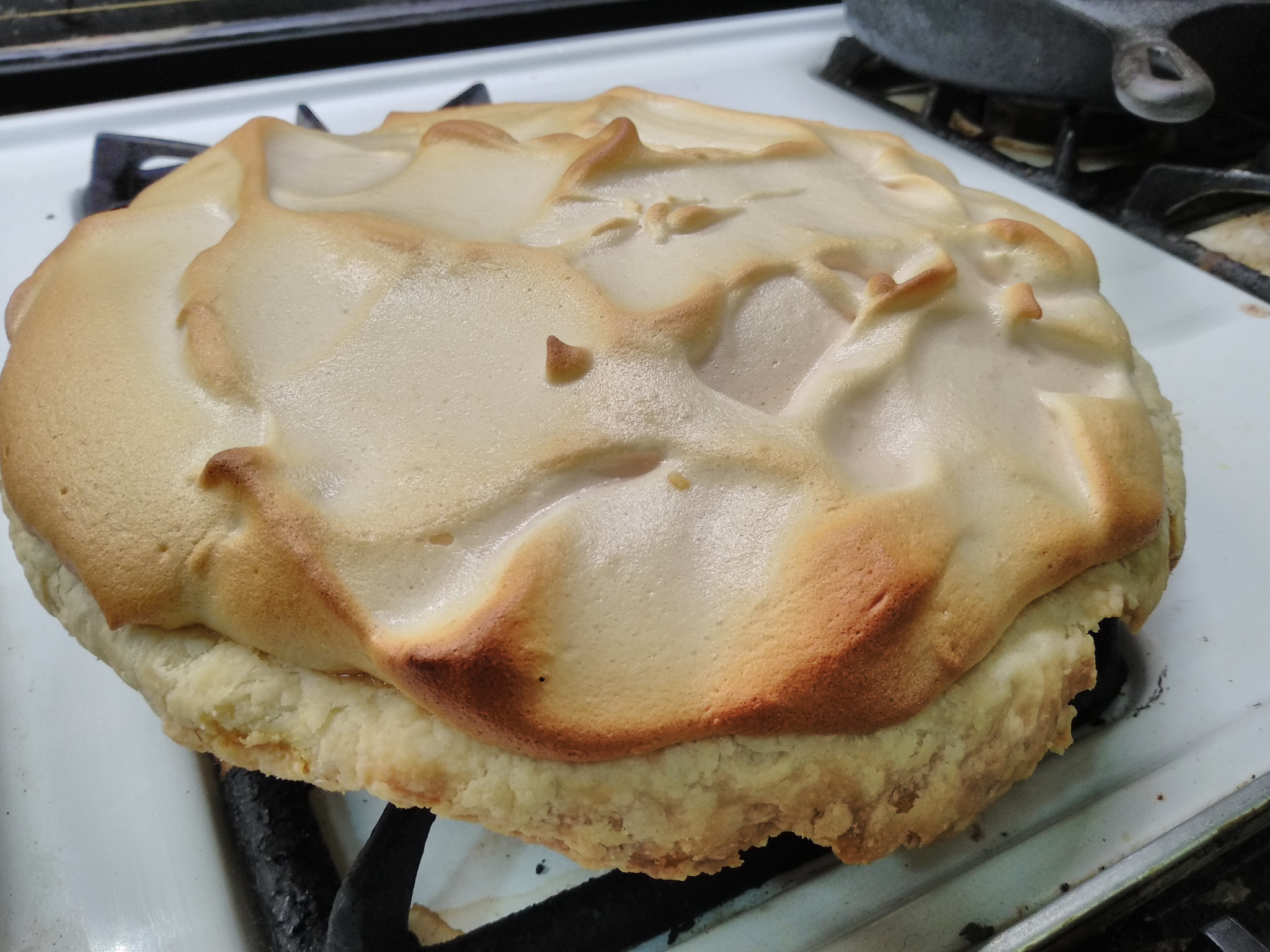
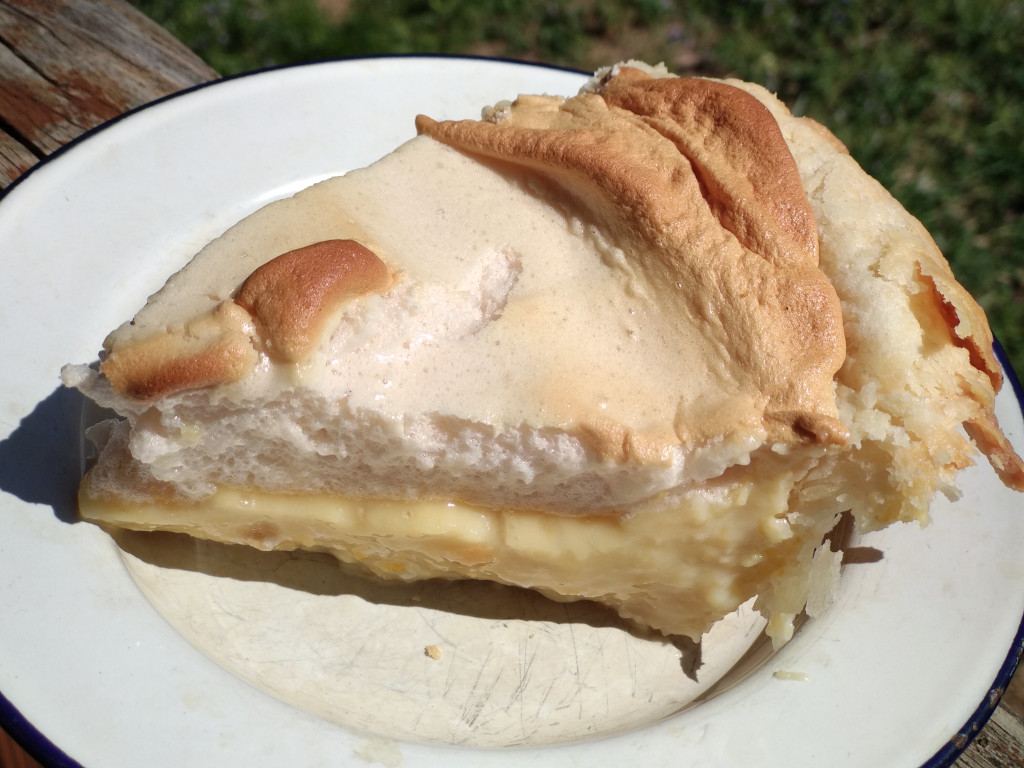
Lemon is one of my things. I homegrow meyer lemons and mostly eat them whole. My mom makes me lemon meringue pie on my birthday. I thought I knew how much work that must be. Gorgeous whole lemon-meringue pie Well, that was harder than anticipated, and so worth it. Glad my mom was there on jitsi to give moral support while I hand whisked the egg whites and cursed. I also got a homemade mask whose quarantimer expired just in time. But all I really want want for my birthday, this April 11th 2020, is for the coronavirus to have peaked today. I mean, having a pandemic peak on your birthday is sour, but it's better than the alternative. Please give me that gift. Stay home. Even when some are saying it's over, watch the graphs. Don't go visit even just one person, even on their birthday. I think you can do it. Yes? Joey in a rainbow tie-die mask, holding a thumb up. Lemon-meringue pie slice

4 April 2020

Joey Hess: solar powered waterfall controlled by a GPIO port

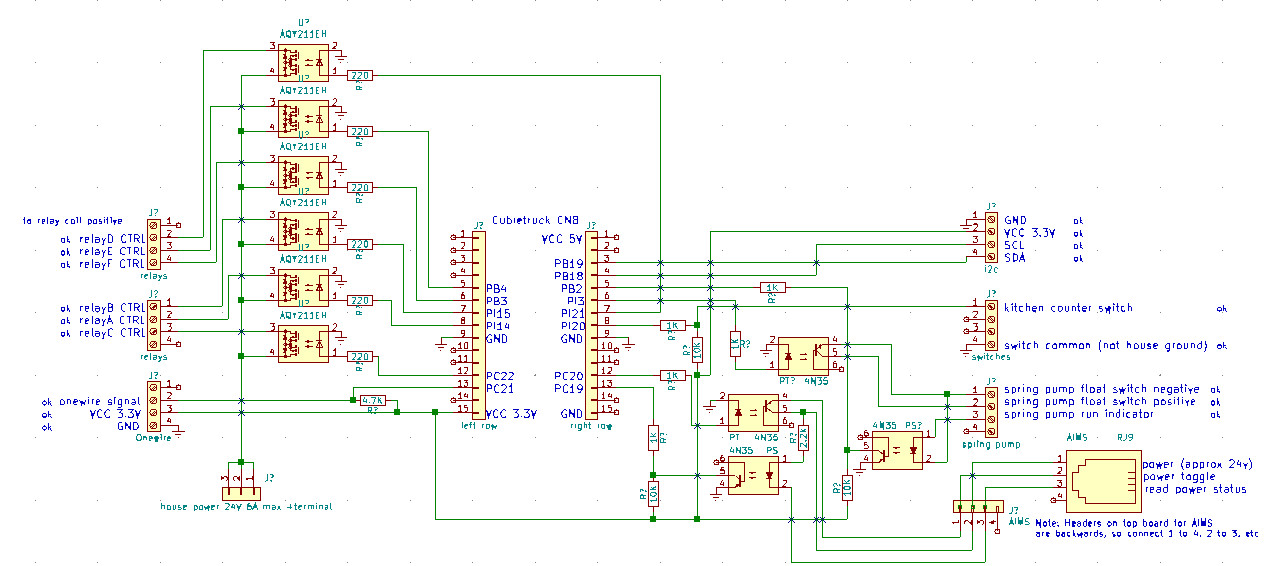
This waterfall is beside my yard. When it's running, I know my water tanks are full and the spring is not dry. Also it's computer controlled, for times when I don't want to hear it. I'll also use the computer control later on to avoid running the pump excessively and wearing it out, and for some safety features like not running when the water is frozen. This is a whole hillside of pipes, water tanks, pumps, solar panels, all controlled by a GPIO port. Easy enough; the pump controller has a float switch input and the GPIO drives a 4n35 optoisolator to open or close that circuit. Hard part will be burying all the cable to the pump. And then all the landscaping around the waterfall. There's a bit of lag to turning it on and off. It can take over an hour for it to start flowing, and around half an hour to stop. The water level has to get high enough in the water tanks to overcome some airlocks and complicated hydrodynamic flow stuff. Then when it stops, all that excess water has to drain back down. Anyway, enjoy my soothing afternoon project and/or massive rube goldberg machine, I certainly am.

1 April 2020

Joey Hess: DIN distractions

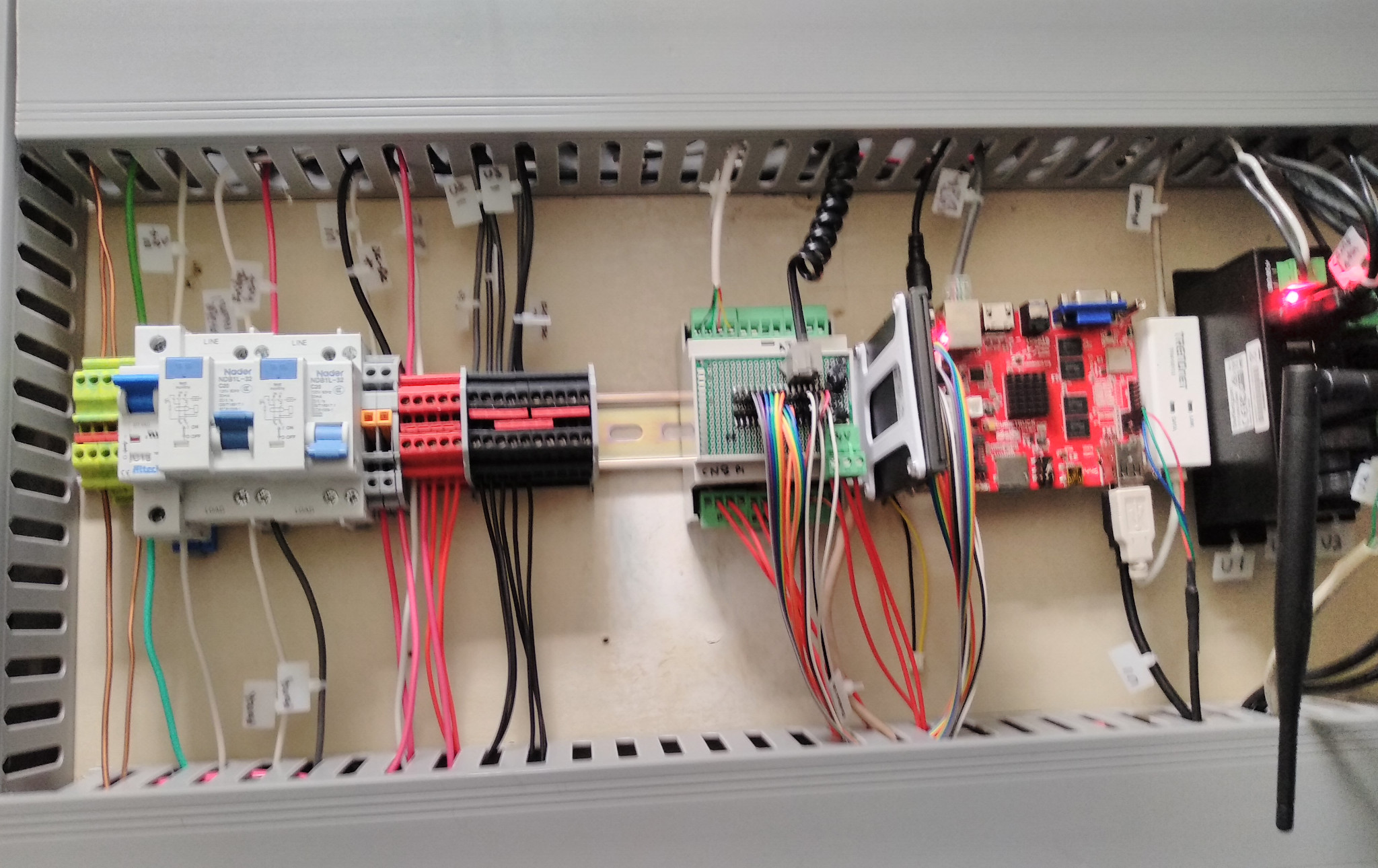
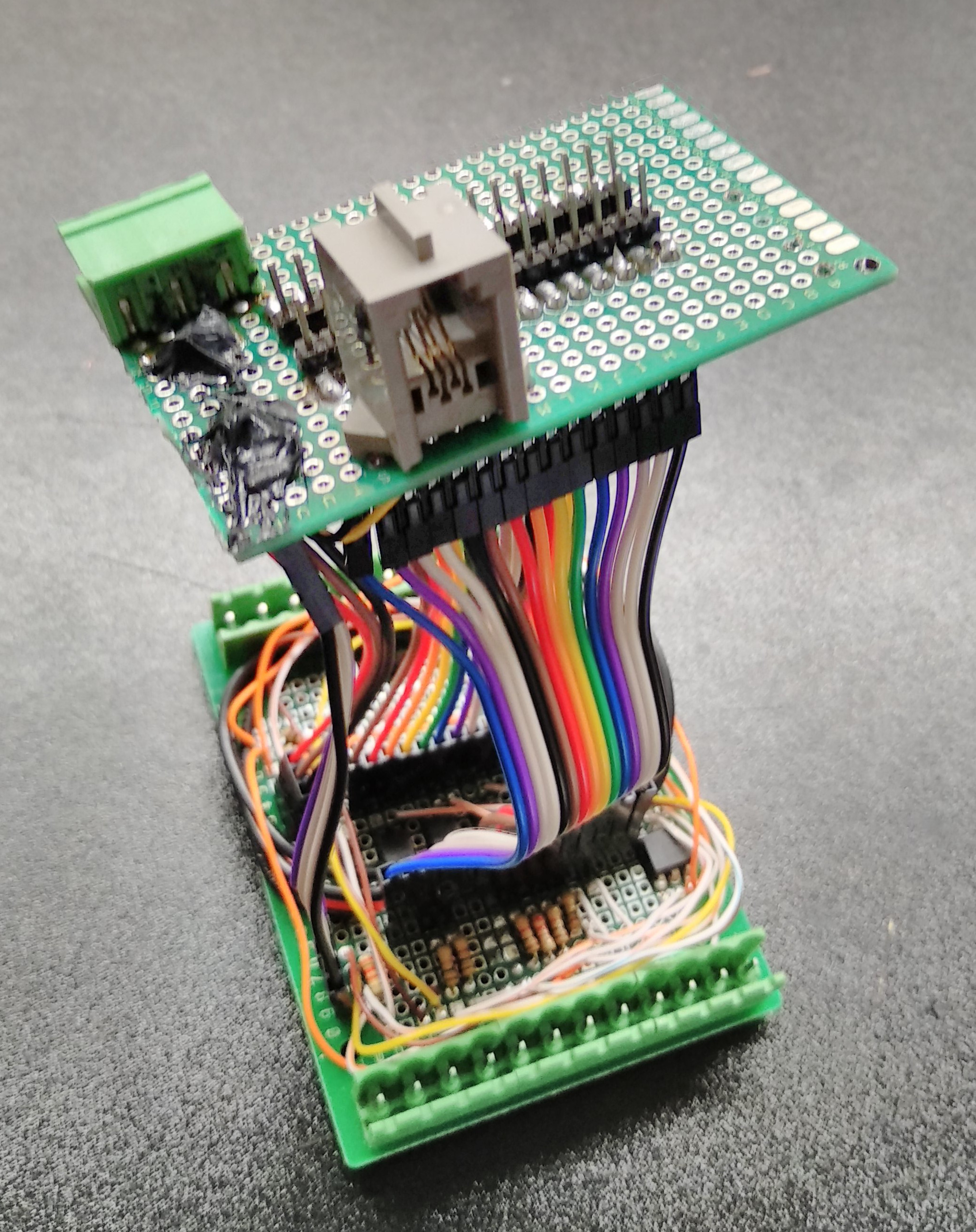
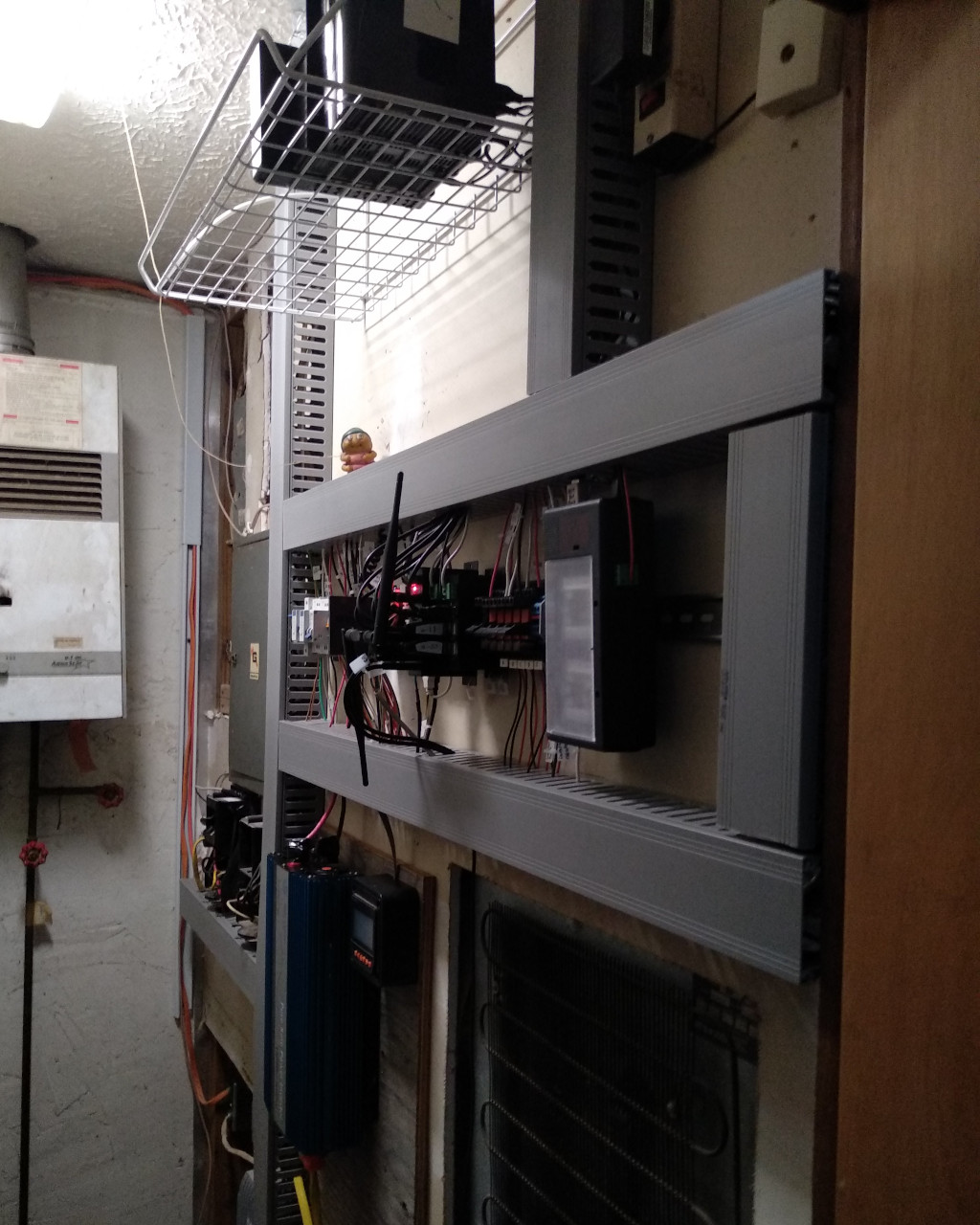
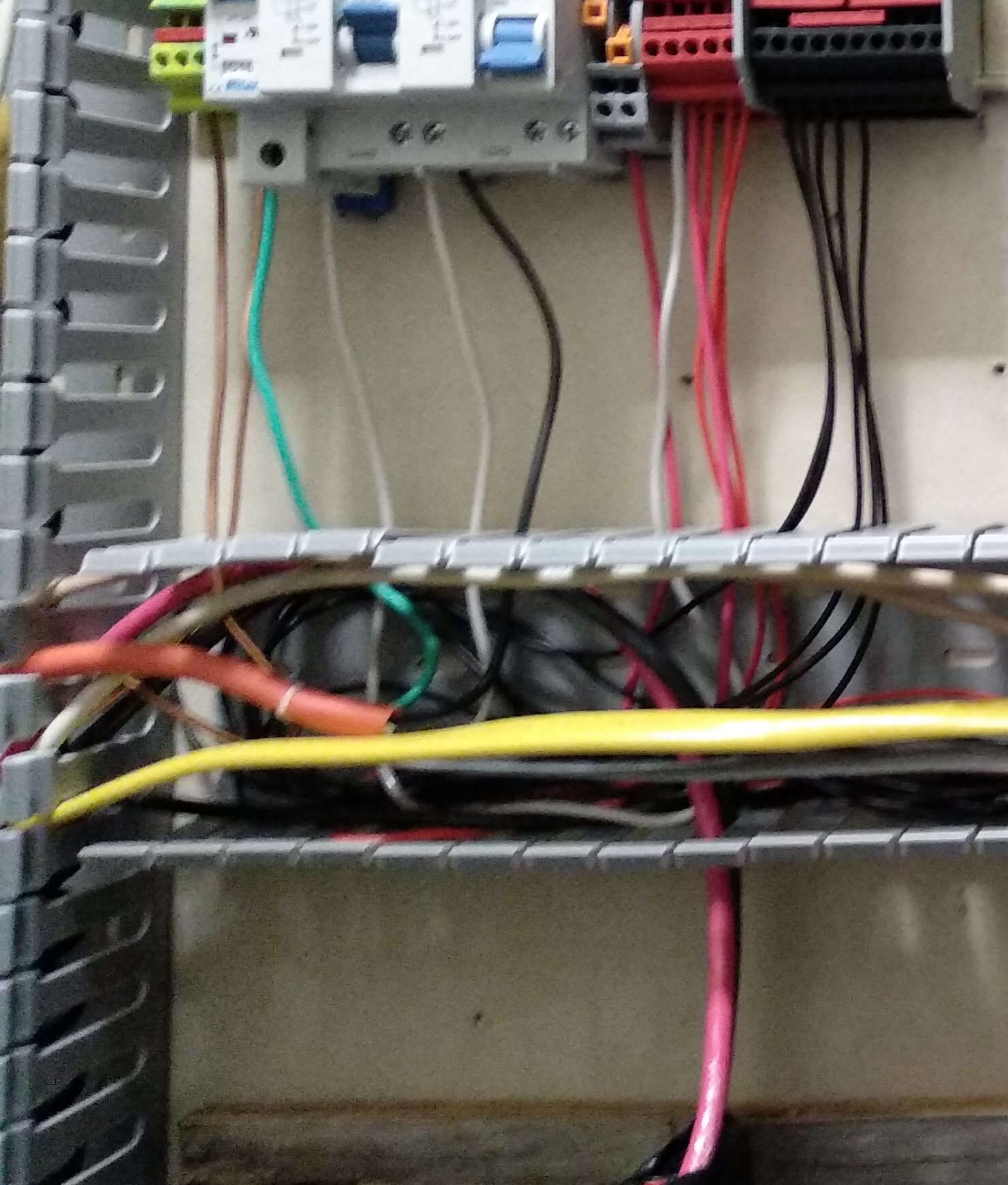
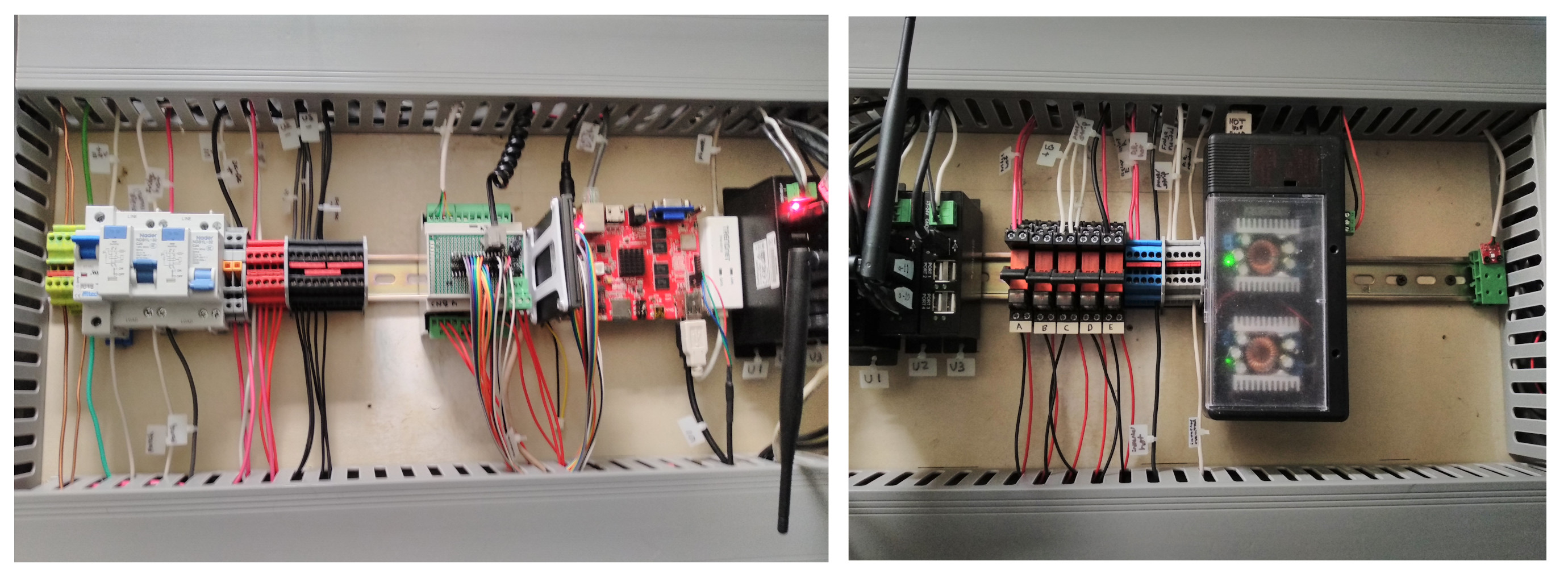
My offgrid house has an industrial automation panel. A row of electrical devices, mounted on a metal rail. Many wires neatly extend from it above and below, disappearing into wire gutters. I started building this in February, before covid-19 was impacting us here, when lots of mail orders were no big problem, and getting an unusual 3D-printed DIN rail bracket for a SSD was just a couple clicks. I finished a month later, deep into social isolation and quarentine, scrounging around the house for scrap wire, scavenging screws from unused stuff and cutting them to size, and hoping I would not end up in a "need just one more part that I can't get" situation. It got rather elaborate, and working on it was often a welcome distraction from the news when I couldn't concentrate on my usual work. I'm posting this now because people sometimes tell me they like hearing about my offfgrid stuff, and perhaps you could use a distraction too. The panel has my house's computer on it, as well as both AC and DC power distribution, breakers, and switching. Since the house is offgrid, the panel is designed to let every non-essential power drain be turned off, from my offgrid fridge to the 20 terabytes of offline storage to the inverter and satellite dish, the spring pump for my gravity flow water system, and even the power outlet by the kitchen sink. Saving power is part of why I'm using old-school relays and stuff and not IOT devices, the other reason is of course: IOT devices are horrible dystopian e-waste. I'm taking the utopian Star Trek approach, where I can command "full power to the vacuum cleaner!" Two circuit boards, connected by numerous ribbon cables, and clearly hand-soldered. The smaller board is suspended above the larger. An electrical schematic, of moderate complexity. At the core of the panel, next to the cubietruck arm board, is a custom IO daughterboard. Designed and built by hand to fit into a DIN mount case, it uses every GPIO pin on the cubietruck's main GPIO header. Making this board took 40+ hours, and was about half the project. It got pretty tight in there. This was my first foray into DIN rail mount, and it really is industrial lego -- a whole universe of parts that all fit together and are immensely flexible. Often priced more than seems reasonable for a little bit of plastic and metal, until you look at the spec sheets and the ratings. (Total cost for my panel was $400.) It's odd that it's not more used outside its niche -- I came of age in the Bay Area, surrounded by rack mount equipment, but no DIN mount equipment. Hacking the hardware in a rack is unusual, but DIN invites hacking. Admittedly, this is a second system kind of project, replacing some unsightly shelves full of gear and wires everywhere with something kind of overdone. But should be worth it in the long run as new gear gets clipped into place and it evolves for changing needs. Also, wire gutters, where have you been all my life? A cramped utility room with an entire wall covered with electronic gear, including the DIN rail, which is surrounded by wire gutters Detail of a wire gutter with the cover removed. Numerous large and small wires run along it and exit here and there. Finally, if you'd like to know what everything on the DIN rail is, from left to right: Ground block, 24v DC disconnect, fridge GFI, spare GFI, USB hub switch, computer switch, +24v block, -24v block, IO daughterboard, 1tb SSD, arm board, modem, 3 USB hubs, 5 relays, AC hot block, AC neutral block, DC-DC power converters, humidity sensor. Full width of DIN rail.

23 March 2020

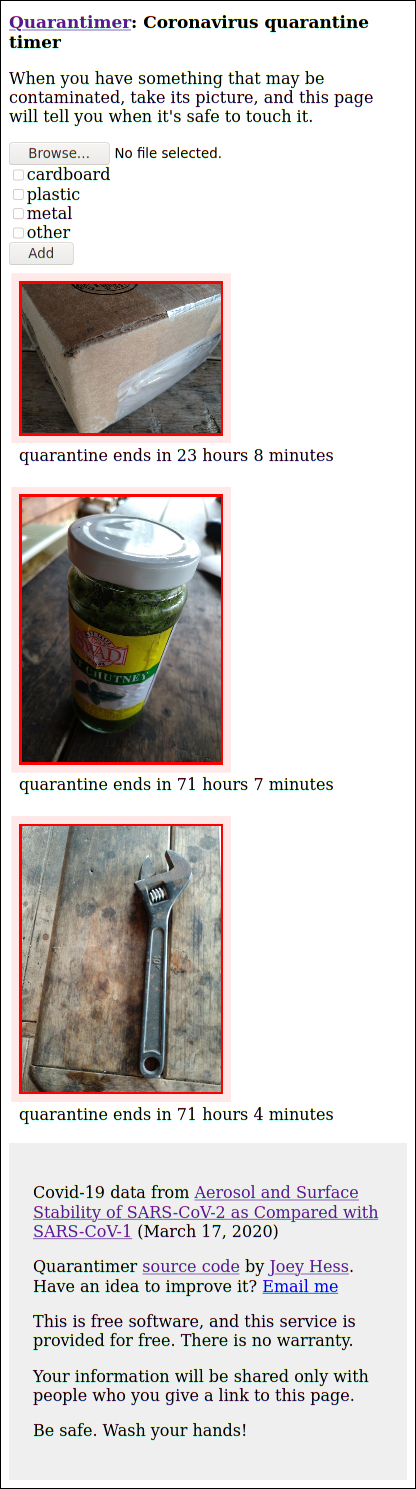
Joey Hess: quarantimer: a coronovirus quarantine timer for your things

I am trying to avoid bringing coronovirus into my house on anything, and I also don't want to sterilize a lot of stuff. (Tedious and easy to make a mistake.) Currently it seems that the best approach is to leave stuff to sit undisturbed someplace safe for long enough for the virus to degrade away. Following that policy, I've quickly ended up with a porch full of stuff in different stages of quarantine, and I am quickly losing track of how long things have been in quarantine. If you have the same problem, here is a solution: https://quarantimer.app/ Open it on your mobile device, and you can take photos of each thing, select the kind of surfaces it has, and it will track the quarantine time for you. You can share the link to other devices or other people to collaborate. I anticipate the javascript and css will improve, but it's good enough for now. I will provide this website until the crisis is over. Of course, it's free software and you can also host your own. If this seems useful, please tell your friends and family about it. Be well!
This is made possible by my supporters on Patreon, particularly Jake Vosloo.

23 November 2017

Sean Whitton: Using Propellor to provision your Debian development laptop

sbuild is a tool used by those maintaining packages in Debian, and derived distributions such as Ubuntu. When used correctly, it can catch a lot of categories of bugs before packages are uploaded. It does this by building the package in a clean environment, and then running the package through the Lintian, piuparts, adequate and autopkgtest tools. However, configuring sbuild so that it makes use of all of these tools is cumbersome. In response to this complexity, I wrote a module for the Propellor configuration management system to prepare a system such that a user can just go ahead and run the sbuild(1) command. This module is useful on one s development laptop if you need to reinstall your OS, you don t have to look up the instructions for setting up sbuild again. But it s also useful on throwaway build boxes. I can instruct propellor to provision a new virtual machine to build packages with sbuild, and all the different tools mentioned above will be connected together for me. I just uploaded Propellor version 5.1.0 to Debian unstable. The version overhauls the API and internals of the Sbuild module to take better advantage of Propellor s design. I won t get into those details in this post. What I d like to do is demonstrate how you can set up sbuild on your own machines, using Propellor. Getting started with Propellor apt-get install propellor, and then propellor --init. You ll be offered two setups, options A and B. I suggest starting with option B. If you never use Propellor for anything other than provisioning sbuild, you can stick with option B. If this tutorial makes you want to check out more features of Propellor, you might consider switching to option A and importing your old configuration. Open ~/.propellor/config.hs. You will see something like this:
-- The hosts propellor knows about.
hosts :: [Host]
hosts =
        [ mybox
        ]
-- An example host.
mybox :: Host
mybox = host "mybox.example.com" $ props
        & osDebian Unstable X86_64
        & Apt.stdSourcesList
        & Apt.unattendedUpgrades
        & Apt.installed ["etckeeper"]
        & Apt.installed ["ssh"]
        & User.hasSomePassword (User "root")
        & File.dirExists "/var/www"
        & Cron.runPropellor (Cron.Times "30 * * * *")
You ll want to customise this so that it reflects your computer. My laptop is called iris, so I might replace the above with this:
-- The hosts propellor knows about.
hosts :: [Host]
hosts =
        [ iris
        ]
-- My laptop.
iris :: Host
iris = host "iris.silentflame.com" $ props
        & osDebian Testing X86_64
The list of lines beginning with & are the properties of the host iris. Here, I ve removed all properties except the osDebian property, which informs propellor that iris runs Debian testing and has the amd64 architecture. The effect of this is that Propellor will not try to change anything about iris. In this tutorial, we are not going to let Propellor configure anything about iris other than setting up sbuild. (The osDebian property is a pure info property, which means that it tells Propellor information about the host to which other properties might refer, but it doesn t itself change anything about iris.) Telling Propellor to configure sbuild First, add to the import lines at the top of config.hs the lines:
import qualified Propellor.Property.Sbuild as Sbuild
import qualified Propellor.Property.Schroot as Schroot
to enable use of the Sbuild module. Here is the full config for iris, which I ll go through line-by-line:
-- The hosts propellor knows about.
hosts :: [Host]
hosts =
        [ iris
        ]
-- My laptop.
iris :: Host
iris = host "iris.silentflame.com" $ props
        & osDebian Testing X86_64
        & Apt.useLocalCacher
        & sidSchrootBuilt
        & Sbuild.usableBy (User "spwhitton")
        & Schroot.overlaysInTmpfs
        & Cron.runPropellor (Cron.Times "30 * * * *")
  where
        sidSchrootBuilt = Sbuild.built Sbuild.UseCcache $ props
                & osDebian Unstable X86_64
                & Sbuild.update  period  Daily
                & Sbuild.useHostProxy iris
Running Propellor to configure your laptop propellor iris.silentflame.com. In this configuration, you don t need to worry about whether the hostname iris.silentflame.com actually resolves to your laptop. However, it must be possible to ssh root@localhost. This should be enough that spwhitton can:
$ sbuild -A --run-lintian --run-autopkgtest --run-piuparts foo.dsc
Further configuration It is easy to add new schroots; for example, for building backports:
        ...
        & stretchSchrootBuilt
        ...
  where
        ...
        stretchSchrootBuilt = Sbuild.built Sbuild.UseCcache $ props
                & osDebian (Stable "stretch") X86_64
                & Sbuild.update  period  Daily
                & Sbuild.useHostProxy iris
You can also add additional properties to configure your chroot. Perhaps on your LAN you need sbuild to install packages via https, and you already have an apt cacher available. You can replace the apt-cacher-ng configuration like this:
  where
        sidSchrootBuilt = Sbuild.built Sbuild.UseCcache $ props
                & osDebian Unstable X86_64
                & Sbuild.update  period  Daily
                & Apt.mirror "https://foo.mirror/debian/"
                & Apt.installed ["apt-transport-https"]
Thanks Thanks to Propellor s author, Joey Hess, for help navigating Propellor s type system while performing the overhaul included in version 5.1.0. Also for a conversation at DebConf17 which enabled this work by clearing some misconceptions of mine.

19 November 2017

Joey Hess: custom ARM disk image generation with propellor

Following up on propelling disk images, Propellor can now build custom ARM disk images for a variety of different ARM boards. The disk image build can run on a powerful laptop or server, so it's super fast and easy compared with manually installing Debian on an ARM board. Here's a simple propellor config for a Olimex LIME board, with ssh access and a root password:
lime :: Host
lime = host "lime.example.com" $ props
    & osDebian Unstable ARMHF
    & Machine.olimex_A10_OLinuXino_LIME
    & hasPartition (partition EXT4  mountedAt  "/"  setSize  MegaBytes 8192)
        & hasPassword (User "root")
        & Ssh.installed
    & Ssh.permitRootLogin (RootLogin True)
To make a disk image for that board, I only have to add this property to my laptop:
& imageBuiltFor lime
    (RawDiskImage "/srv/lime.img")
    (Debootstrapped mempty)
Propellor knows what kernel to install and how to make the image bootable for a bunch of ARM boards, including the Olimex LIME, the SheevaPlug, Banana Pi, and CubieTruck. To build the disk image targeting ARM, propellor uses qemu. So it's helpful that, after the first build, propellor incrementally updates disk images, quite quickly and efficiently. Once the board has the image installed, you can run propellor on it to further maintain it, and if there's a hardware problem, you can quickly replace it with an updated image.
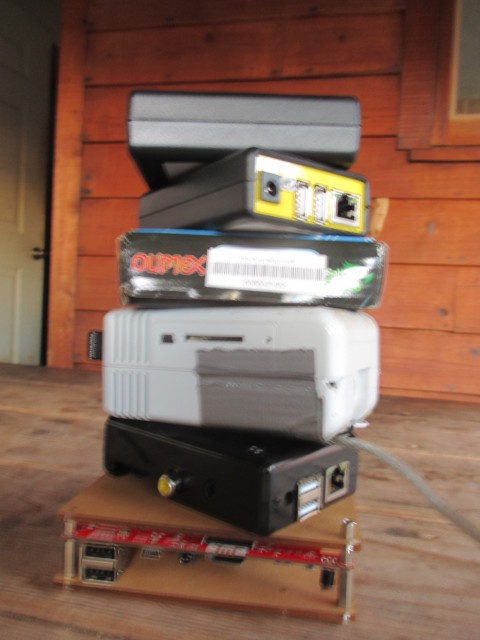
computer tower that I will be maintaining with propellor
It's fairly simple to teach propellor about other ARM boards, so it should be quite easy to keep propellor knowing about all ARM boards supported by Debian (and other distros). Here's how I taught it about the Olimex LIME:
olimex_A10_OLinuXino_LIME :: Property (HasInfo + DebianLike)
olimex_A10_OLinuXino_LIME = FlashKernel.installed "Olimex A10-OLinuXino-LIME"
     requires  sunixi "A10-OLinuXino-Lime"
     requires  armmp
My home server is a CubieTruck which serves as a wireless access point, solar panel data collector, and git-annex autobuilder. It's deployed from a disk image built by propellor, using this config. I've been involved with building disk image for ARM boards for a long time -- it was part of my job for five years -- and this is the first time I've been entirely happy with the process.

18 November 2017

Joey Hess: stupid long route

There's an old net story from the 80's, which I can't find right now, but is about two computers, 10 feet apart, having a ridiculously long network route between them, packets traveling into other states or countries and back, when they could have flowed over a short cable. Ever since I read that, I've been collecting my own ridiculously long routes. ssh bouncing from country to country, making letters I type travel all the way around the world until they echo back on my screen. Tasting the latency that's one of the only ways we can viscerally understand just how big a tangle of wires humanity has built. Yesterday, I surpassed all that, and I did it in a way that hearkens right back to the original story. I had two computers, 20 feet apart, I wanted one to talk to the other, and the route between the two ended up traveling not around the Earth, but almost the distance to the Moon. I was rebuilding my home's access point, and ran into a annoying bug that prevented it from listening to wifi. I knew it was still connected over ethernet to the satellite receiver. I connected my laptop to the satellite receiver over wifi. But, I didn't know the IP address to reach the access point. Then I remembered I had set it up so incoming ssh to the satellite receiver was directed to the access point. So, I sshed to a computer in New Jersey. And from there I sshed to my access point. And the latency was amazing. Because, every time I pressed a key: Not bad for a lazy solution to a problem that could have been solved by walking across the room, eh? Previously: roundtrip latency from a cabin with dialup in 2011

2 November 2017

Antoine Beaupr : October 2017 report: LTS, feed2exec beta, pandoc filters, git mediawiki

Debian Long Term Support (LTS) This is my monthly Debian LTS report. This time I worked on the famous KRACK attack, git-annex, golang and the continuous stream of GraphicsMagick security issues.

WPA & KRACK update I spent most of my time this month on the Linux WPA code, to backport it to the old (~2012) wpa_supplicant release. I first published a patchset based on the patches shipped after the embargo for the oldstable/jessie release. After feedback from the list, I also built packages for i386 and ARM. I have also reviewed the WPA protocol to make sure I understood the implications of the changes required to backport the patches. For example, I removed the patches touching the WNM sleep mode code as that was introduced only in the 2.0 release. Chunks of code regarding state tracking were also not backported as they are part of the state tracking code introduced later, in 3ff3323. Finally, I still have concerns about the nonce setup in patch #5. In the last chunk, you'll notice peer->tk is reset, to_set to negotiate a new TK. The other approach I considered was to backport 1380fcbd9f ("TDLS: Do not modify RNonce for an TPK M1 frame with same INonce") but I figured I would play it safe and not introduce further variations. I should note that I share Matthew Green's observations regarding the opacity of the protocol. Normally, network protocols are freely available and security researchers like me can easily review them. In this case, I would have needed to read the opaque 802.11i-2004 pdf which is behind a TOS wall at the IEEE. I ended up reading up on the IEEE_802.11i-2004 Wikipedia article which gives a simpler view of the protocol. But it's a real problem to see such critical protocols developed behind closed doors like this. At Guido's suggestion, I sent the final patch upstream explaining the concerns I had with the patch. I have not, at the time of writing, received any response from upstream about this, unfortunately. I uploaded the fixed packages as DLA 1150-1 on October 31st.

Git-annex The next big chunk on my list was completing the work on git-annex (CVE-2017-12976) that I started in August. It turns out doing the backport was simpler than I expected, even with my rusty experience with Haskell. Type-checking really helps in doing the right thing, especially considering how Joey Hess implemented the fix: by introducing a new type. So I backported the patch from upstream and notified the security team that the jessie and stretch updates would be similarly easy. I shipped the backport to LTS as DLA-1144-1. I also shared the updated packages for jessie (which required a similar backport) and stretch (which didn't) and those Sebastien Delafond published those as DSA 4010-1.

Graphicsmagick Up next was yet another security vulnerability in the Graphicsmagick stack. This involved the usual deep dive into intricate and sometimes just unreasonable C code to try and fit a round tree in a square sinkhole. I'm always unsure about those patches, but the test suite passes, smoke tests show the vulnerability as fixed, and that's pretty much as good as it gets. The announcement (DLA 1154-1) turned out to be a little special because I had previously noticed that the penultimate announcement (DLA 1130-1) was never sent out. So I made a merged announcement to cover both instead of re-sending the original 3 weeks late, which may have been confusing for our users.

Triage & misc We always do a bit of triage even when not on frontdesk duty, so I: I also did smaller bits of work on: The latter reminded me of the concerns I have about the long-term maintainability of the golang ecosystem: because everything is statically linked, an update to a core library (say the SMTP library as in CVE-2017-15042, thankfully not affecting LTS) requires a full rebuild of all packages including the library in all distributions. So what would be a simple update in a shared library system could mean an explosion of work on statically linked infrastructures. This is a lot of work which can definitely be error-prone: as I've seen in other updates, some packages (for example the Ruby interpreter) just bit-rot on their own and eventually fail to build from source. We would also have to investigate all packages to see which one include the library, something which we are not well equipped for at this point. Wheezy was the first release shipping golang packages but at least it's shipping only one... Stretch has shipped with two golang versions (1.7 and 1.8) which will make maintenance ever harder in the long term.
We build our computers the way we build our cities--over time, without a plan, on top of ruins. - Ellen Ullman

Other free software work This month again, I was busy doing some serious yak shaving operations all over the internet, on top of publishing two of my largest LWN articles to date (2017-10-16-strategies-offline-pgp-key-storage and 2017-10-26-comparison-cryptographic-keycards).

feed2exec beta Since I announced this new project last month I have released it as a beta and it entered Debian. I have also wrote useful plugins like the wayback plugin that saves pages on the Wayback machine for eternal archival. The archive plugin can also similarly save pages to the local filesystem. I also added bash completion, expanded unit tests and documentation, fixed default file paths and a bunch of bugs, and refactored the code. Finally, I also started using two external Python libraries instead of rolling my own code: the pyxdg and requests-file libraries, the latter which I packaged in Debian (and fixed a bug in their test suite). The program is working pretty well for me. The only thing I feel is really missing now is a retry/fail mechanism. Right now, it's a little brittle: any network hiccup will yield an error email, which are readable to me but could be confusing to a new user. Strangely enough, I am particularly having trouble with (local!) DNS resolution that I need to look into, but that is probably unrelated with the software itself. Thankfully, the user can disable those with --loglevel=ERROR to silence WARNINGs. Furthermore, some plugins still have some rough edges. For example, The Transmission integration would probably work better as a distinct plugin instead of a simple exec call, because when it adds new torrents, the output is totally cryptic. That plugin could also leverage more feed parameters to save different files in different locations depending on the feed titles, something would be hard to do safely with the exec plugin now. I am keeping a steady flow of releases. I wish there was a way to see how effective I am at reaching out with this project, but unfortunately GitLab doesn't provide usage statistics... And I have received only a few comments on IRC about the project, so maybe I need to reach out more like it says in the fine manual. Always feels strange to have to promote your project like it's some new bubbly soap... Next steps for the project is a final review of the API and release production-ready 1.0.0. I am also thinking of making a small screencast to show the basic capabilities of the software, maybe with asciinema's upcoming audio support?

Pandoc filters As I mentioned earlier, I dove again in Haskell programming when working on the git-annex security update. But I also have a small Haskell program of my own - a Pandoc filter that I use to convert the HTML articles I publish on LWN.net into a Ikiwiki-compatible markdown version. It turns out the script was still missing a bunch of stuff: image sizes, proper table formatting, etc. I also worked hard on automating more bits of the publishing workflow by extracting the time from the article which allowed me to simply extract the full article into an almost final copy just by specifying the article ID. The only thing left is to add tags, and the article is complete. In the process, I learned about new weird Haskell constructs. Take this code, for example:
-- remove needless blockquote wrapper around some tables
--
-- haskell newbie tips:
--
-- @ is the "at-pattern", allows us to define both a name for the
-- construct and inspect the contents as once
--
--   is the "empty record pattern": it basically means "match the
-- arguments but ignore the args"
cleanBlock (BlockQuote t@[Table  ]) = t
Here the idea is to remove <blockquote> elements needlessly wrapping a <table>. I can't specify the Table type on its own, because then I couldn't address the table as a whole, only its parts. I could reconstruct the whole table bits by bits, but it wasn't as clean. The other pattern was how to, at last, address multiple string elements, which was difficult because Pandoc treats spaces specially:
cleanBlock (Plain (Strong (Str "Notifications":Space:Str "for":Space:Str "all":Space:Str "responses":_):_)) = []
The last bit that drove me crazy was the date parsing:
-- the "GAByline" div has a date, use it to generate the ikiwiki dates
--
-- this is distinct from cleanBlock because we do not want to have to
-- deal with time there: it is only here we need it, and we need to
-- pass it in here because we do not want to mess with IO (time is I/O
-- in haskell) all across the function hierarchy
cleanDates :: ZonedTime -> Block -> [Block]
-- this mouthful is just the way the data comes in from
-- LWN/Pandoc. there could be a cleaner way to represent this,
-- possibly with a record, but this is complicated and obscure enough.
cleanDates time (Div (_, [cls], _)
                 [Para [Str month, Space, Str day, Space, Str year], Para _])
    cls == "GAByline" = ikiwikiRawInline (ikiwikiMetaField "date"
                                           (iso8601Format (parseTimeOrError True defaultTimeLocale "%Y-%B-%e,"
                                                           (year ++ "-" ++ month ++ "-" ++ day) :: ZonedTime)))
                        ++ ikiwikiRawInline (ikiwikiMetaField "updated"
                                             (iso8601Format time))
                        ++ [Para []]
-- other elements just pass through
cleanDates time x = [x]
Now that seems just dirty, but it was even worse before. One thing I find difficult in adapting to coding in Haskell is that you need to take the habit of writing smaller functions. The language is really not well adapted to long discourse: it's more about getting small things connected together. Other languages (e.g. Python) discourage this because there's some overhead in calling functions (10 nanoseconds in my tests, but still), whereas functions are a fundamental and important construction in Haskell that are much more heavily optimized. So I constantly need to remind myself to split things up early, otherwise I can't do anything in Haskell. Other languages are more lenient, which does mean my code can be more dirty, but I feel get things done faster then. The oddity of Haskell makes frustrating to work with. It's like doing construction work but you're not allowed to get the floor dirty. When I build stuff, I don't mind things being dirty: I can cleanup afterwards. This is especially critical when you don't actually know how to make things clean in the first place, as Haskell will simply not let you do that at all. And obviously, I fought with Monads, or, more specifically, "I/O" or IO in this case. Turns out that getting the current time is IO in Haskell: indeed, it's not a "pure" function that will always return the same thing. But this means that I would have had to change the signature of all the functions that touched time to include IO. I eventually moved the time initialization up into main so that I had only one IO function and moved that timestamp downwards as simple argument. That way I could keep the rest of the code clean, which seems to be an acceptable pattern. I would of course be happy to get feedback from my Haskell readers (if any) to see how to improve that code. I am always eager to learn.

Git remote MediaWiki Few people know that there is a MediaWiki remote for Git which allow you to mirror a MediaWiki site as a Git repository. As a disaster recovery mechanism, I have been keeping such a historical backup of the Amateur radio wiki for a while now. This originally started as a homegrown Python script to also convert the contents in Markdown. My theory then was to see if we could switch from Mediawiki to Ikiwiki, but it took so long to implement that I never completed the work. When someone had the weird idea of renaming a page to some impossible long name on the wiki, my script broke. I tried to look at fixing it and then remember I also had a mirror running using the Git remote. It turns out it also broke on the same issue and that got me looking in the remote again. I got lost in a zillion issues, including fixing that specific issue, but I especially looked at the possibility of fetching all namespaces because I realized that the remote fetches only a part of the wiki by default. And that drove me to submit namespace support as a patch to the git mailing list. Finally, the discussion came back to how to actually maintain that contrib: in git core or outside? Finally, it looks like I'll be doing some maintenance that project outside of git, as I was granted access to the GitHub organisation...

Galore Yak Shaving Then there's the usual hodgepodge of fixes and random things I did over the month.
There is no [web extension] only XUL! - Inside joke

19 October 2017

Clint Adams: Scuttlebutt at the precinct

So who s getting patchwork into Debian?
Posted on 2017-10-19
Tags: bamamba

18 October 2017

Joey Hess: extending Scuttlebutt with Annah

This post has it all. Flotillas of sailboats, peer-to-peer wikis, games, and de-frogging. But, I need to start by talking about some tech you may not have heard of yet... So, how could these be combined together, and what might the result look like? Well, I could start by posting a Scuttlebutt message that defines what True is. And another Scuttlebutt message defining False. And then, another Scuttlebutt message to define the AND function, which would link to my messages for True and False. Continue this until I've built up enough Annah code to write some almost useful programs. Annah can't do any IO on its own (though it can model IO similarly to how Haskell does), so for programs to be actually useful, there needs to be Scuttlebutt client support. The way typing works in Annah, a program's type can be expressed as a Scuttlebutt link. So a Scuttlebutt client that wants to run Annah programs of a particular type can pick out programs that link to that type, and will know what type of data the program consumes and produces. Here are a few ideas of what could be built, with fairly simple client-side support for different types of Annah programs... This kind of extensibility in a peer-to-peer system is exciting! With these new systems, we can consider lessons from the world wide web and replicate some of the good parts, while avoiding the bad. Javascript has been both good and bad for the web. The extensibility is great, and yet it's a neverending security and privacy nightmare, and it ties web pages ever more tightly to programs hidden away on servers. I believe that Annah combined with Scuttlebutt will comprehensively avoid those problems. Shall we build it?
This exploration was sponsored by Jake Vosloo on Patreon.

9 October 2017

Antonio Terceiro: pristine-tar updates

Introduction pristine-tar is a tool that is present in the workflow of a lot of Debian people. I adopted it last year after it has been orphaned by its creator Joey Hess. A little after that Tomasz Buchert joined me and we are now a functional two-person team. pristine-tar goals are to import the content of a pristine upstream tarball into a VCS repository, and being able to later reconstruct that exact same tarball, bit by bit, based on the contents in the VCS, so we don t have to store a full copy of that tarball. This is done by storing a binary delta files which can be used to reconstruct the original tarball from a tarball produced with the contents of the VCS. Ultimately, we want to make sure that the tarball that is uploaded to Debian is exactly the same as the one that has been downloaded from upstream, without having to keep a full copy of it around if all of its contents is already extracted in the VCS anyway. The current state of the art, and perspectives for the future pristine-tar solves a wicked problem, because our ability to reconstruct the original tarball is affected by changes in the behavior of tar and of all of the compression tools (gzip, bzip2, xz) and by what exact options were used when creating the original tarballs. Because of this, pristine-tar currently has a few embedded copies of old versions of compressors to be able to reconstruct tarballs produced by them, and also rely on a ever-evolving patch to tar that is been carried in Debian for a while. So basically keeping pristine-tar working is a game of Whac-A-Mole. Joey provided a good summary of the situation when he orphaned pristine-tar. Going forward, we may need to rely on other ways of ensuring integrity of upstream source code. That could take the form of signed git tags, signed uncompressed tarballs (so that the compression doesn t matter), or maybe even a different system for storing actual tarballs. Debian bug #871806 contains an interesting discussion on this topic. Recent improvements Even if keeping pristine-tar useful in the long term will be hard, too much of Debian work currently relies on it, so we can t just abandon it. Instead, we keep figuring out ways to improve. And I have good news: pristine-tar has recently received updates that improve the situation quite a bit. In order to be able to understand how better we are getting at it, I created a "visualization of the regression test suite results. With the help of data from there, let s look at the improvements made since pristine-tar 1.38, which was the version included in stretch. pristine-tar 1.39: xdelta3 by default. This was the first release made after the stretch release, and made xdelta3 the default delta generator for newly-imported tarballs. Existing tarballs with deltas produced by xdelta are still supported, this only affects new imports. The support for having multiple delta generator was written by Tomasz, and was already there since 1.35, but we decided to only flip the switch after using xdelta3 was supported in a stable release. pristine-tar 1.40: improved compression heuristics pristine-tar uses a few heuristics to produce the smaller delta possible, and this includes trying different compression options. In the release Tomasz included a contribution by Lennart Sorensen to also try the --gnu, which gretly improved the support for rsyncable gzip compressed files. We can see an example of the type of improvement we got in the regression test suite data for delta sizes for faad2_2.6.1.orig.tar.gz: In 1.40, the delta produced from the test tarball faad2_2.6.1.orig.tar.gz went down from 800KB, almost the same size of tarball itself, to 6.8KB pristine-tar 1.41: support for signatures This release saw the addition of support for storage and retrieval of upstream signatures, contributed by Chris Lamb. pristine-tar 1.42: optionally recompressing tarballs I had this idea and wanted to try it out: most of our problems reproducing tarballs come from tarballs produced with old compressors, or from changes in compressor behavior, or from uncommon compression options being used. What if we could just recompress the tarballs before importing then? Yes, this kind of breaks the pristine bit of the whole business, but on the other hand, 1) the contents of the tarball are not affected, and 2) even if the initial tarball is not bit by bit the same that upstream release, at least future uploads of that same upstream version with Debian revisions can be regenerated just fine. In some cases, as the case for the test tarball util-linux_2.30.1.orig.tar.xz, recompressing is what makes it possible to reproduce the tarball (and thus import it with pristine-tar) possible at all: util-linux_2.30.1.orig.tar.xz can only be imported after being recompressed In other cases, if the current heuristics can t produce a reasonably small delta, recompressing makes a huge difference. It s the case for mumble_1.1.8.orig.tar.gz: with recompression, the delta produced from mumble_1.1.8.orig.tar.gz goes from 1.2MB, or 99% of the size to the original tarball, to 14.6KB, 1% of the size of original tarball Recompressing is not enabled by default, and can be enabled by passing the --recompress option. If you are using pristine-tar via a wrapper tool like gbp-buildpackage, you can use the $PRISTINE_TAR environment variable to set options that will affect any pristine-tar invocations. Also, even if you enable recompression, pristine-tar will only try it if the delta generations fails completely, of if the delta produced from the original tarball is too large. You can control what too large means by using the --recompress-threshold-bytes and --recompress-threshold-percent options. See the pristine-tar(1) manual page for details.

26 September 2017

Enrico Zini: Systemd timer units

These are the notes of a training course on systemd I gave as part of my work with Truelite. .timer units Configure activation of other units (usually a .service unit) at some given time. The functionality is similar to cron, with more features and a finer time granularity. For example, in Debian Stretch apt has a timer for running apt update which runs at a random time to distribute load on servers:
# /lib/systemd/system/apt-daily.timer
[Unit]
Description=Daily apt download activities
After=network-online.target
Wants=network-online.target
[Timer]
OnCalendar=*-*-* 6,18:00
RandomizedDelaySec=12h
Persistent=true
[Install]
WantedBy=timers.target
The corresponding apt-daily.service file then only runs when the system is on mains power, to avoid unexpected batter drains for systems like laptops:
# /lib/systemd/system/apt-daily.service
[Unit]
Description=Daily apt download activities
Documentation=man:apt(8)
ConditionACPower=true
[Service]
Type=oneshot
ExecStart=/usr/lib/apt/apt.systemd.daily update
Note that if you want to schedule tasks with an accuracy under a minute (for example to play a beep every 5 seconds when running on battery), you need to also configure AccuracySec= for the timer to a delay shorter than the default 1 minute. This is how to make your computer beep when on battery:
# /etc/systemd/system/beep-on-battery.timer
[Unit]
Description=Beeps every 10 seconds
[Install]
WantedBy=timers.target
[Timer]
AccuracySec=1s
OnUnitActiveSec=10s
# /etc/systemd/system/beep-on-battery.service
[Unit]
Description=Beeps when on battery
ConditionACPower=false
[Service]
Type=oneshot
ExecStart=/usr/bin/aplay /tmp/beep.wav
See:

Next.

Previous.