Search Results: "jmtd"

17 April 2025

Jonathan Dowland: Hledger UI themes

Last year I intended to write an update on my use of hledger, but that was waylaid for various reasons and I need to revisit how (if) I'm using it, so that's put off for longer. I do want to mention one contribution I made upstream: a dark theme for the UI, and some unfinished work on consistent colours. Consistent terminal colours are an interesting issue: the most common terminal colour modes (8 and 256) use indexing into a palette, but the definition of the colours is ambiguous: the 8-colour palette is formally specified by ANSI as names (red, green, etc.); the 256-colour palette is effectively defined by xterm (a useful chart) but I'm not sure all terminal emulators that support it have chosen the same colour values. A consequence of indexed-colour is that the end-user may redefine what the colour values are. Whether this is a good thing or a bad thing depends on your point of view. As an end-user, it's attractive to be able to tune the colour scheme; but as a software author, it means you have no real idea what your users are going to see, and matters like ensuring contrast are impossible. Some terminals support 24-bit "true" colour, in which the colours are specified as an RGB triplet. Using these mean the software author can be reasonably sure all users will see the same thing (for a fungible definition of "same"), at the cost of user configurability. However, since it's less well supported, we start having to worry about fallback behaviour. In the case of hledger-ui, which provides several colour schemes, that's probably OK, because the user configurability is achieved by choosing one of the schemes. (or writing your own, in extremis). However, the dark theme I contributed uses the 8-colour palette, in common with the other themes, and my explorations into using predictable colours are unfinished.

15 April 2025

Jonathan Dowland: submitted

Today I submitted my PhD thesis, 8 years since I started (give or take). Next step, Viva. Normal service may resume shortly

28 February 2025

Jonathan Dowland: printables.com feed

I wanted to follow new content posted to Printables.com with a feed reader, but Printables.com doesn't provide one. Neither do the other obvious 3d model catalogues. So, I started building one. I have something that spits out an Atom feed and a couple of beta testers gave me some valuable feedback. I had planned to make it public, with the ultimate goal being to convince Printables.com to implement feeds themselves. Meanwhile, I stumbled across someone else who has done basically the same thing. Here are 3rd party feeds for The format of their feeds is JSON-Feed, which is new to me. FreshRSS and NetNewsWire seems happy with it. (I went with Atom.) I may still release my take, if I find time to make one improvmment that my beta-testers suggested.

21 February 2025

Jonathan Dowland: haskell streaming libraries

For my PhD, my colleagues/collaborators and I built a distributed stream-processing system using Haskell. There are several other Haskell stream-processing systems. How do they compare? First, let's briefly discuss and define streaming in this context. Structure and Interpretation of Computer Programs introduces Streams as an analogue of lists, to support delayed evaluation. In brief, the inductive list type (a list is either an empty list or a head element pre-pended to another list) is replaced with a structure with a head element and a promise which, when evaluated, will generate the tail (which in turn may have a head element and a promise to generate another tail, culminating in the equivalent of an empty list.) Later on SICP also covers lazy evaluation. However, the streaming we're talking about originates in the relational community, rather than the functional one, and is subtly different. It's about building a pipeline of processing that receives and emits data but doesn't need to (indeed, cannot) reference the whole stream (which may be infinite) at once. Haskell streaming systems Now let's go over some Haskell streaming systems. conduit (2011-) Conduit is the oldest of the ones I am reviewing here, but I doubt it's the first in the Haskell ecosystem. If I've made any obvious omissions, please let me know! Conduit provides a new set of types to model streaming data, and a completely new set of functions which are analogues of standard Prelude functions, e.g. sumC in place of sum. It provides its own combinator(s) such as . ( aka fuse) which is like composition but reads left-to-right. The motivation for this is to enable (near?) constant memory usage for processing large streams of data -- presumably versus using a list-based approach and to provide some determinism: the README gives the example of "promptly closing file handles". I think this is another way of saying that it uses strict evaluation, or at least avoids lazy evaluation for some things. Conduit offers interleaved effects: which is to say, IO can be performed mid-stream. Conduit supports distributed operation via Data.Conduit.Network in the conduit-extra package. Michael Snoyman, principal Conduit author, wrote up how to use it here: https://www.yesodweb.com/blog/2014/03/network-conduit-async To write a distributed Conduit application, the application programmer must manually determine the boundaries between the clients/servers and write specific code to connect them. pipes (2012-) The Pipes Tutorial contrasts itself with "Conventional Haskell stream programming": whether that means Conduit or something else, I don't know. Paraphrasing their pitch: Effects, Streaming Composability: pick two. That's the situation they describe for stream programming prior to Pipes. They argue Pipes offers all three. Pipes offers it's own combinators (which read left-to-right) and offers interleaved effects. At this point I can't really see what fundamentally distinguishes Pipes from Conduit. Pipes has some support for distributed operation via the sister library pipes-network. It looks like you must send and receive ByteStrings, which means rolling your own serialisation for other types. As with Conduit, to send or receive over a network, the application programmer must divide their program up into the sub-programs for each node, and add the necessary ingress/egress code. io-streams (2013-) io-streams emphasises simple primitives. Reading and writing is done under the IO Monad, thus, in an effectful (but non-pure) context. The presence or absence of further stream data are signalled by using the Maybe type (Just more data or Nothing: the producer has finished.) It provides a library of functions that shadow the standard Prelude, such as S.fromList, S.mapM, etc. It's not clear to me what the motivation for io-streams is, beyond providing a simple interface. There's no declaration of intent that I can find about (e.g.) constant-memory operation. There's no mention of or support (that I can find) for distributed operation. streaming (2015-) Similar to io-streams, Streaming emphasises providing a simple interface that gels well with traditional Haskell methods. Streaming provides effectful streams (via a Monad -- any Monad?) and a collection of functions for manipulating streams which are designed to closely mimic standard Prelude (and Data.List) functions. Streaming doesn't push its own combinators: the examples provided use $ and read right-to-left. The motivation for Streaming seems to be to avoid memory leaks caused by extracting pure lists from IO with traditional functions like mapM, which require all the list constructors to be evaluated, the list to be completely deconstructed, and then a new list constructed. Like io-streams, the focus of the library is providing a low-level streaming abstraction, and there is no support for distributed operation. streamly (2017-) Streamly appears to have the grand goal of providing a unified programming tool as suited for quick-and-dirty programming tasks (normally the domain of scripting languages) and high-performance work (C, Java, Rust, etc.). Their intended audience appears to be everyone, or at least, not just existing Haskell programmers. See their rationale Streamly offers an interface to permit composing concurrent (note: not distributed) programs via combinators. It relies upon fusing a streaming pipeline to remove intermediate list structure allocations and de-allocations (i.e. de-forestation, similar to GHC rewrite rules) The examples I've seen use standard combinators (e.g. Control.Function.&, which reads left-to-right, and Applicative). Streamly provide benchmarks versus Haskell pure lists, Streaming, Pipes and Conduit: these generally show Streamly several orders of magnitude faster. I'm finding it hard to evaluate Streamly. It's big, and it's focus is wide. It provides shadows of Prelude functions, as many of these libraries do. wrap-up It seems almost like it must be a rite-of-passage to write a streaming system in Haskell. Stones and glass houses, I'm guilty of that too. The focus of the surveyed libraries is mostly on providing a streaming abstraction, normally with an analogous interface to standard Haskell lists. They differ on various philosophical points (whether to abstract away the mechanics behind type synonyms, how much to leverage existing Haskell idioms, etc). A few of the libraries have some rudimentary support for distributed operation, but this is limited to connecting separate nodes together: in some cases serialising data remains the application programmer's job, and in all cases the application programmer must manually carve up their processing according to a fixed idea of what nodes they are deploying to. They all define a fixed-function pipeline.

13 February 2025

Jonathan Dowland: 10 years at Red Hat

Red Hat Fedora company logo
I've just passed my 10th anniversary of starting at Red Hat! As a personal milestone, this is the longest I've stayed in a job: I managed 10 years at Newcastle University, although not in one continuous role. I haven't exactly worked in one continuous role at Red Hat either, but it feels like what I do Today is a logical evolution from what I started doing, whereas in Newcastle I jumped around a bit. I've seen some changes: in my time here, we changed the logo from Shadow Man; we transitioned to using Google Workspace for lots of stuff, instead of in-house IT; we got bought by IBM; we changed President and CEO, twice. And millions of smaller things. I won't reach an 11th: my Organisation in Red Hat is moving to IBM. I think this is sad news for Red Hat: they're losing some great people. But I'm optimistic for the future of my Organisation.

12 February 2025

Jonathan Dowland: FOSDEM 2025

I'm going to FOSDEM 2025! As usual, I'll be in the Java Devroom for most of that day, which this time around is Saturday. Please recommend me any talks! This is my shortlist so far:

20 January 2025

Jonathan Dowland: dsafilter 20th Anniversary

Happy 20th birthday, dsafilter! dsafilter is a mail filter I wrote two decades ago to solve a problem I had: I was dutifully subscribed to debian-security-announce to learn of new security package updates, but most were not relevant to me. The filter creates a new, summarizing mail, reporting on whether the DSA was applicable to any package installed on the system running the filter, and attached the original DSA mail for reference. Users can then choose to drop mails for packages that aren't relevant. In 2005 I'd been a Debian user for about 6 years, I'd met a few Debian developers in person and I was interested in getting involved. I started my journey to Developer later that same year. I published dsafilter, and I think I sent an announcement to debian-devel, but didn't do a great deal to socialise it, so I suspect nobody else is using it. That said, I have been for the two decades, and I still am! What's notable to me about that is that I haven't had to modify the script at all to keep up with software changes, in particular, from the interpreter. I wrote it as a Ruby script. If I had chosen Perl, it would probably be the same story, but if I'd chosen Python, there's no chance at all that it would still be working today. If it sounds interesting to you, please give it a try. I think it might be due some spring cleaning.

2 December 2024

Jonathan Dowland: jungle/acid/etc

I thought it had been a full year since I last shared a playlist, but it's been two! I had a plan to produce more, but it seems I haven't. Instead here's a few tracks I've discovered recently which share a common theme. In August I stumbled across a Sound on Sound video interviewing Pete Cannon, who creates authentically old-school Jungle music using tools and techniques from the time, including AKAI samplers and the Commodore Amiga computer.
Here's three tracks that I found since then. Some 8-bit Amiga-jungle, by some slower-paced acid house from someone ostensibly based on Whitley Bay, by and a darker piece I heard on the radio. by

9 November 2024

Jonathan Dowland: Progressively enhancing CGI apps with htmx

I was interested in learning about htmx, so I used it to improve the experience of posting comments on my blog. It seems much of modern web development is structured around having a JavaScript program on the front-end (browser) which exchanges data encoded in JSON asynchronously with the back-end servers. htmx uses a novel (or throwback) approach: it asynchronously fetches snippets of HTML from the back-end, and splices the results into the live page. For example, a htmx-powered button may request a URI on the server, receive HTML in response, and then the button itself would be replaced by the resulting HTML, within the page. I experimented with incorporating it into an existing, old-school CGI web app: IkiWiki, which I became a co-maintainer of this year, and powers my blog. Throughout this project I referred to the excellent book Server-Driven Web Apps with htmx. Comment posting workflow I really value blog comments, but the UX for posting them on my blog was a bit clunky. It went like this:
  1. you load a given page (such as this blog post), which is a static HTML document. There's a link to add a comment to the page.
  2. The link loads a new page which is generated dynamically and served back to you via CGI. This contains a HTML form for you to write your comment.
  3. The form submits to the server via HTTP POST. IkiWiki validates the form content. Various static pages (in particular the one you started on, in Step 1) are regenerated.
  4. the server response to the request in (3) is a HTTP 302 redirect, instructing the browser to go back to the page in Step 1.
First step: fetching a comment form First, I wanted the "add a comment" link to present the edit box in the current page. This step was easiest: add four attributes to the "comment on this page" anchor tag:
hx-get="<CGI ENDPOINT GOES HERE>"
suppresses the normal behaviour of the tag, so clicking on it doesn't load a new page.
issues an asynchronous HTTP GET to the CGI end-point, which returns the full HTML document for the comment edit form
hx-select=".editcomment form"
extract the edit-comment form from within that document
hx-swap=beforeend and hx-target=".addcomment"
append (courtesy of beforeend) the form into the source page after the "add comment" anchor tag (.addcomment)
Now, clicking "comment on this page" loads in the edit-comment box below it without moving you away from the source page. All that without writing any new code! Second step: handling previews
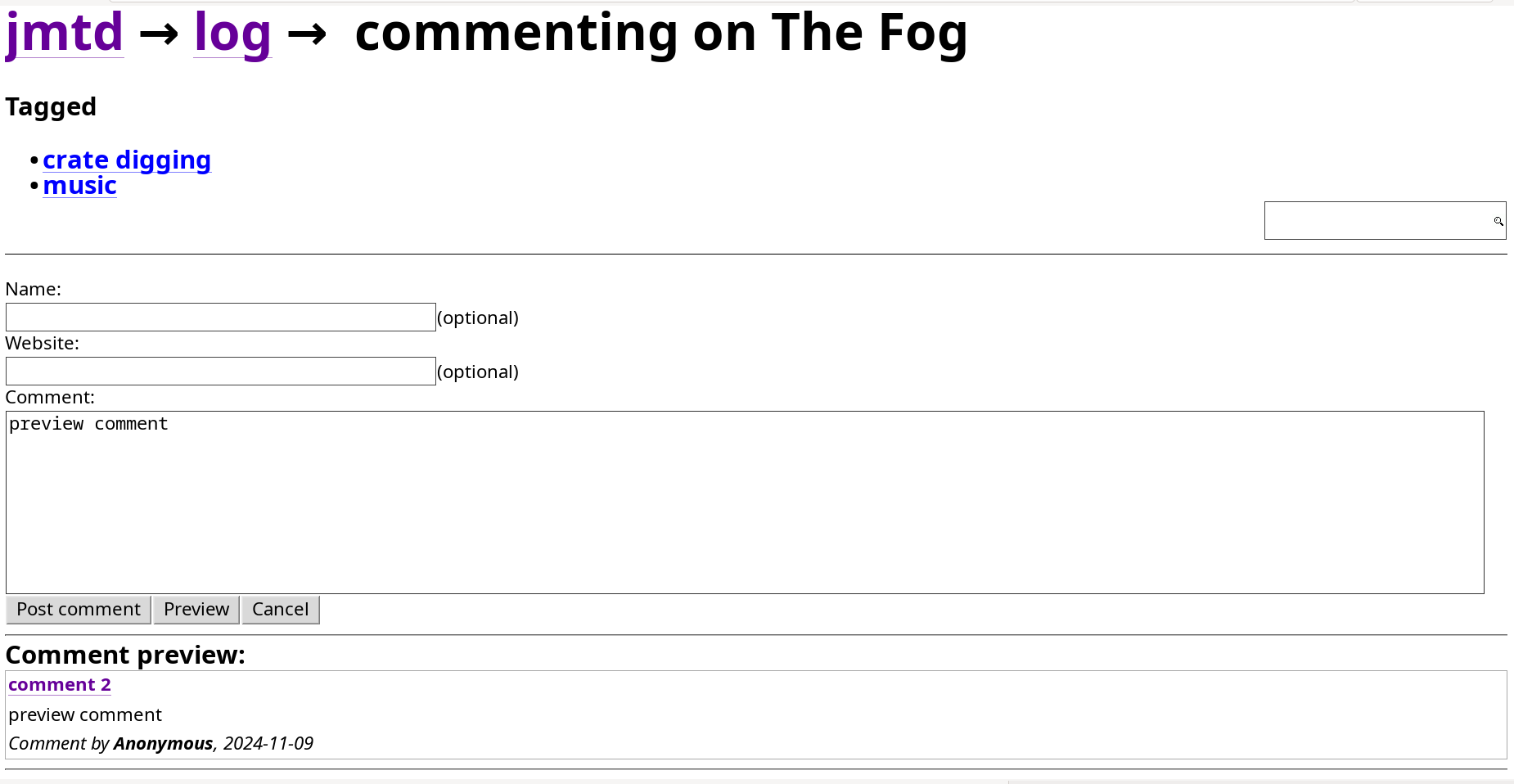
The old Preview Comment page The old Preview Comment page
In the traditional workflow, clicking on "Preview" loaded a new page containing the edit form (but not the original page or any existing comments) with a rendering of the comment-in-progress below it. I wasn't originally interested in supporting the "Preview" feature, but I needed to for reasons I'll explain later. Rather than load new pages, I wanted "Preview" to insert a rendering of the comment-in-progress being inserted into the current page's list of comments, marked up to indicate that it's a preview. IkiWiki provides some templates which you can override to customise your site. I've long overridden page.tmpl, the template used for all pages. I needed to add a new empty div tag in order to have a "hook" to target with the previewed comment. The rest of this was achieved with htmx attributes on the "Preview" button, similar to in the last step: hx-post to define a target URI when you click the button (and specify HTTP POST); hx-select to filter the resulting HTML and extract the comment; hx-target to specify where to insert it. Now, clicking "Preview" does not leave the current page, but fetches a rendering of your comment-in-progress, and splices it into the comment list, appropriately marked up to be clear it's a preview. Third step: handling submitted comments IkiWiki is highly configurable, and many different things could happen once you post a comment. On my personal blog, all comments are held for moderation before they are published. The page you were served after submitting a comment was rather bare-bones, a status message "Your comment will be posted after moderator review", without the original page content or comments. I wanted your comment to appear in the page immediately, albeit marked up to indicate it was awaiting review. Since the traditional workflow didn't render or present your comment to you, I had to cheat. handling moderated comments
Moderation message upon submitting a comment Moderation message upon submitting a comment
One of my goals with this project was not to modify IkiWiki itself. I had to break this rule for moderated comments. When returning the "comment is moderated" page, IkiWiki uses HTTP status code 200, the same as for other scenarios. I wrote a tiny patch to return HTTP 202 (Accepted, but not processed) instead. I now have to write some actual JavaScript. htmx emits the htmx:beforeSwap event after an AJAX call returns, but before the corresponding swap is performed. I wrote a function that is triggered on this event, filters for HTTP 202 responses, triggers the "Preview" button, and then alters the result to indicate a moderated, rather than previewed, comment. (That's why I bothered to implement previews). You can read the full function here: jon.js. Summary I've done barely any front-end web development for years and I found working with htmx to be an enjoyable experience. You can leave a comment on this very blog post if you want to see it in action. I couldn't resist adding an easter egg: Brownie points if you can figure out what it is. Adding htmx to an existing CGI-based website let me improve one of the workflows in a gracefully-degrading way (without JavaScript, the old method will continue to work fine) without modifying the existing application itself (well, almost) and without having to write very much code of my own at all: nearly all of the configuration was declarative.

7 November 2024

Jonathan Dowland: John Carpenter's "The Fog"

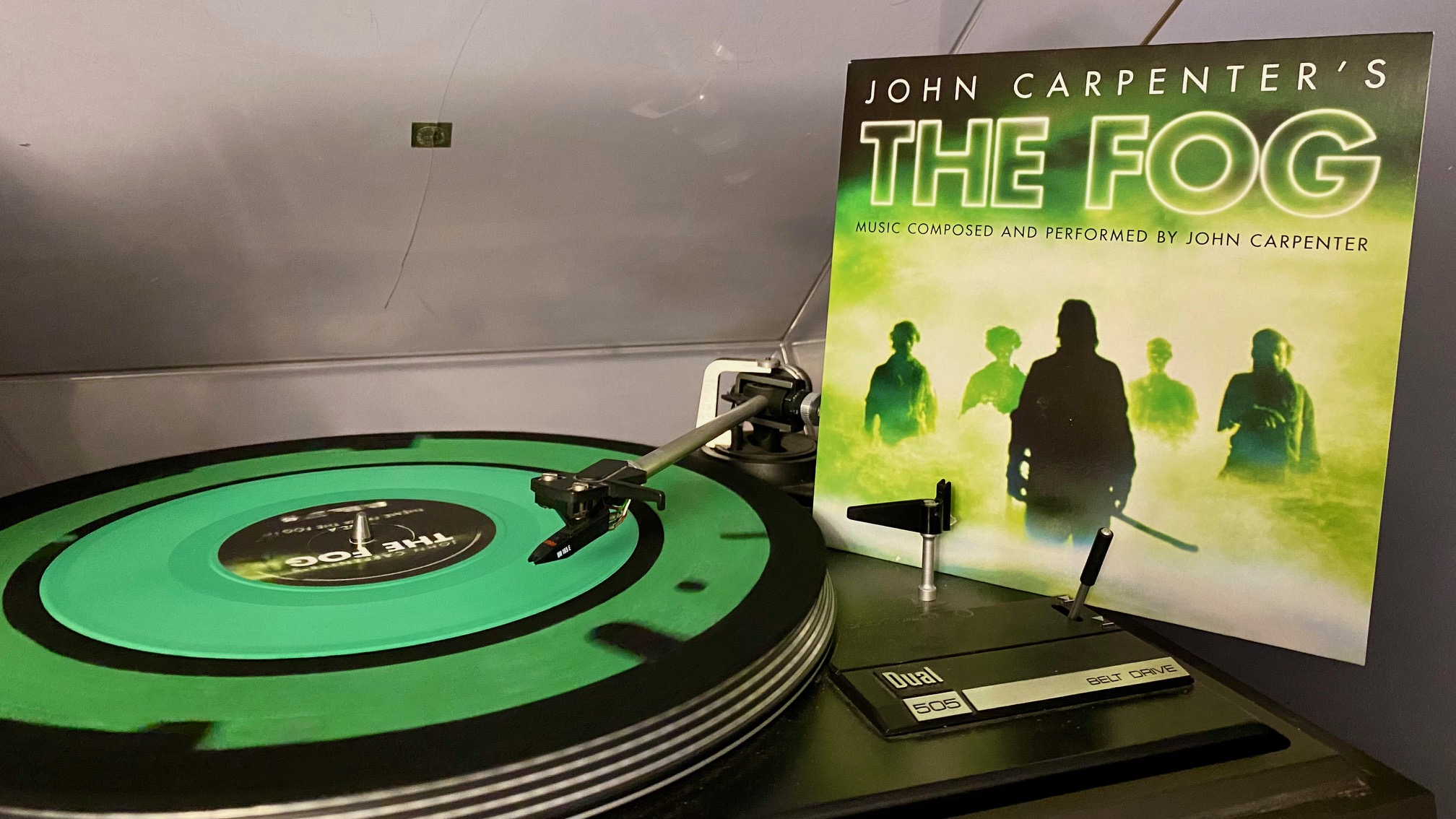
'The Fog' 7 inch vinyl record
A gift from my brother. Coincidentally I ve had John Carpenter s Halloween echoing around my my head for weeks: I ve been deconstructing it and trying to learn to play it.

25 October 2024

Jonathan Dowland: Behringer Model-D (synths I didn't buy)

Whilst researching what synth to buy, I learned of the Behringer1 Model-D2: a 2018 clone of the 1970 Moog Minimoog, in a desktop form factor.
Behringer Model-D Behringer Model-D
In common with the original Minimoog, it's a monophonic analogue synth, featuring three audible oscillators3 , Moog's famous 12-ladder filter and a basic envelope generator. The model-d has lost the keyboard from the original and added some patch points for the different stages, enabling some slight re-routing of the audio components.
1970 Moog Minimoog 1970 Moog Minimoog
Since I was focussing on more fundamental, back-to-basics instruments, this was very appealing to me. I'm very curious to find out what's so compelling about the famous Moog sound. The relative lack of features feels like an advantage: less to master. The additional patch points makes it a little more flexible and offer a potential gateway into the world of modular synthesis. The Model-D is also very affordable: about 200 GBP. I'll never own a real Moog. For this to work, I would need to supplement it with some other equipment. I'd need a keyboard (or press the Micron into service as a controller); I would want some way of recording and overdubbing (same as with any synth). There are no post-mix effects on the Model-D, such as delay, reverb or chorus, so I may also want something to add those. What stopped me was partly the realisation that there was little chance that a perennial beginner, such as I, could eek anything novel out of a synthesiser design that's 54 years old. Perhaps that shouldn't matter, but it gave me pause. Whilst the Model-D has patch points, I don't have anything to connect to them, and I'm firmly wanting to avoid the Modular Synthesis money pit. The lack of effects, and polyphony could make it hard to live-sculpt a tone. I started characterizing the Model-D as the "heart" choice, but it seemed wise to instead go for a "head" choice. Maybe another day!

  1. There's a whole other blog post of material I could write about Behringer and their clones of classic synths, some long out of production, and others, not so much. But, I decided to skip on that for now.
  2. taken from the fact that the Minimoog was a productised version of Moog's fourth internal prototype, the model D.
  3. 2 oscillators is more common in modern synths

23 October 2024

Jonathan Dowland: Arturia Microfreak

Arturia Microfreak. [  CC-BY-SA 4](https://commons.wikimedia.org/wiki/File:MicroFreak.jpg) Arturia Microfreak. CC-BY-SA 4
I nearly did, but ultimately I didn't buy an Arturia Microfreak. The Microfreak is a small form factor hybrid synth with a distinctive style. It's priced at the low end of the market and it is overflowing with features. It has a weird 2-octave keyboard which is a stylophone-style capacitive strip rather than weighted keys. It seems to have plenty of controls, but given the amount of features it has, much of that functionality is inevitably buried in menus. The important stuff is front and centre, though. The digital oscillators are routed through an analog filter. The Microfreak gained sampler functionality in a firmware update that surprised and delighted its owners.
I watched a load of videos about the Microfreak, but the above review from musician Stimming stuck in my mind because it made a comparison between the Microfreak and Teenage Engineering's OP-1.
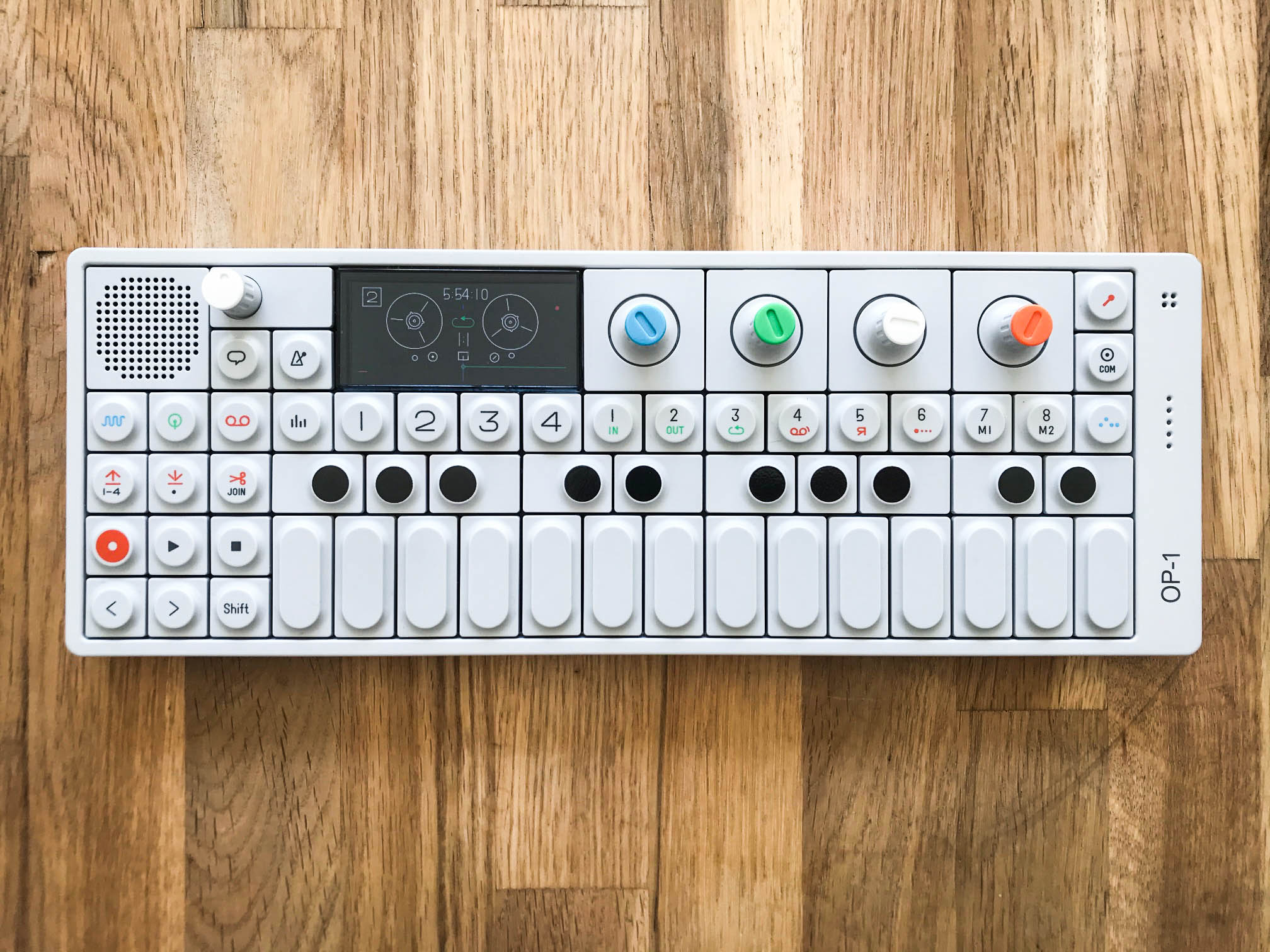
The Teenage Engineering OP-1. The Teenage Engineering OP-1.
I'd been lusting after the OP-1 since it appeared in 2011: a pocket-sized1 music making machine with eleven synthesis engines, a sampler, and less conventional features such as an FM radio, a large colour OLED display, and a four track recorder. That last feature in particular was really appealing to me: I loved the idea of having an all-in-one machine to try and compose music. Even then, I was not keen on involving conventional computers in music making. Of course in many ways it is a very compromised machine. I never did buy a OP-1, and by now they've replaced it with a new model (the OP-1 field) that costs 50% more (but doesn't seem to do 50% more) I'm still not buying one. Framing the Microfreak in terms of the OP-1 made the penny drop for me. The Microfreak doesn't have the four-track functionality, but almost no synth has: I'm going to have to look at something external to provide that. But it might capture a similar sense of fun; it's something I could use on the sofa, in the spare room, on the train, during lunchbreaks at work, etc. On the other hand, I don't want to make the same mistake as with the Micron: too much functionality requiring some experience to understand what you want so you can go and find it in the menus. I also didn't get a chance to audition the unusual keyboard: there's only one music store carrying synths left in Newcastle and they didn't have one. So I didn't buy the Microfreak. Maybe one day in the future once I'm further down the road. Instead, I started to concentrate my search on more fundamental, back-to-basics instruments

  1. Big pockets, mind

Jonathan Dowland: Why hardware synths?

Russell wrote a great comment on my last post (thanks!):
What benefits do these things offer when a general purpose computer can do so many things nowadays? Is there a USB keyboard that you can connect to a laptop or phone to do these things? I presume that all recent phones have the compute power to do all the synthesis you need if you have the right software. Is it just a lack of software and infrastructure for doing it on laptops/phones that makes synthesisers still viable?
I've decided to turn my response into a post of its own. The issue is definitely not compute power. You can indeed attach a USB keyboard to a computer and use a plethora of software synthesisers, including very faithful emulations of all the popular classics. The raw compute power of modern hardware synths is comparatively small: I ve been told the modern Korg digital synths are on a par with a raspberry pi. I ve seen some DSPs which are 32 bit ARMs, and other tools which are roughly equivalent to arduinos. I can think of four reasons hardware synths remain popular with some despite the above:
  1. As I touched on in my original synth post, computing dominates my life outside of music already. I really wanted something separate from that to keep mental distance from work.
  2. Synths have hard real-time requirements. They don't have raw power in compute terms, but they absolutely have to do their job within microseconds of being instructed to, with no exceptions. Linux still has a long way to go for hard real-time.
  3. The Linux audio ecosystem is complex. Dealing with pipewire, pulseaudio, jack, alsa, oss, and anything else I've forgotten, as well as their failure modes, is too time consuming.
  4. The last point is to do with creativity and inspiration. A good synth is more than the sum of its parts: it's an instrument, carefully designed and its components integrated by musically-minded people who have set out to create something to inspire. There are plenty of synths which aren't good instruments, but have loads of features: they re boxes of "stuff". Good synths can't do it all: they often have limitations which you have to respond to, work around or with, creatively. This was expressed better than I could by Trent Reznor in the video archetype of a synthesiser:

15 October 2024

Jonathan Dowland: Whisper (pipewire tool)

It's time to mint a new blog tag I want to write to pour praise on some software I recently discovered. I'm not up to speed on Pipewire the latest piece of Linux plumbing related to audio nor how it relates to the other bits (Pulseaudio, ALSA, JACK, what else?). I recently tried to plug something into the line-in port on my external audio interface, and wished to hear it on the machine. A simple task, you'd think. I'll refrain from writing about the stuff that didn't work well and focus on the thing that did: A little tool called Whisper, which is designed to let you listen to a microphone through your speakers.
_Whisper_'s UI. Screenshot from upstream. Whisper's UI. Screenshot from upstream.
Whisper does a great job of hiding the complexity of what lies beneath and asking two questions: which microphone, and which speakers? In my case this alone was not quite enough, as I was presented with two identically-named "SB Live Extigy" "microphone" devices, but that's easily resolved with trial and error. More stuff like this please!

12 October 2024

Jonathan Dowland: Code formatting in documents

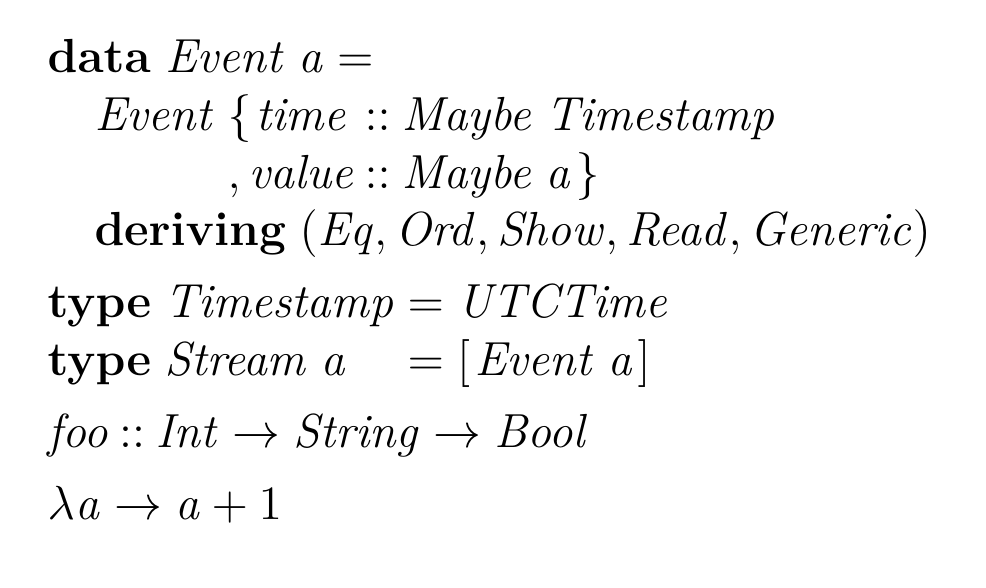
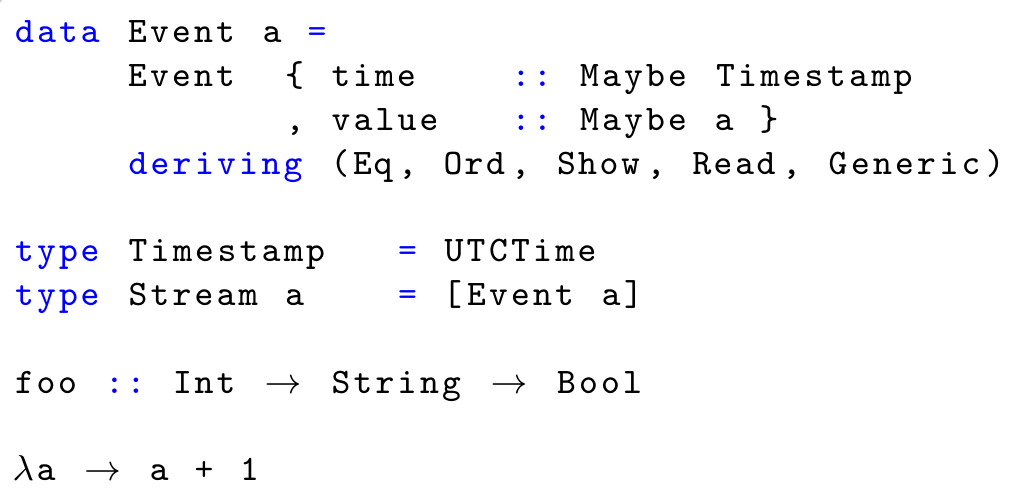
I've been exploring typesetting and formatting code within text documents such as papers, or my thesis. Up until now, I've been using the listings package without thinking much about it. By default, some sample Haskell code processed by listings looks like this (click any of the images to see larger, non-blurry versions):
default output of listings on a Haskell code sample
It's formatted with a monospaced font, with some keywords highlighted, but not syntactic symbols. There are several other options for typesetting and formatting code in LaTeX documents. For Haskell in particular, there is the preprocessor lhs2tex, The default output of which looks like this:
default output of lhs2tex on a Haskell code sample
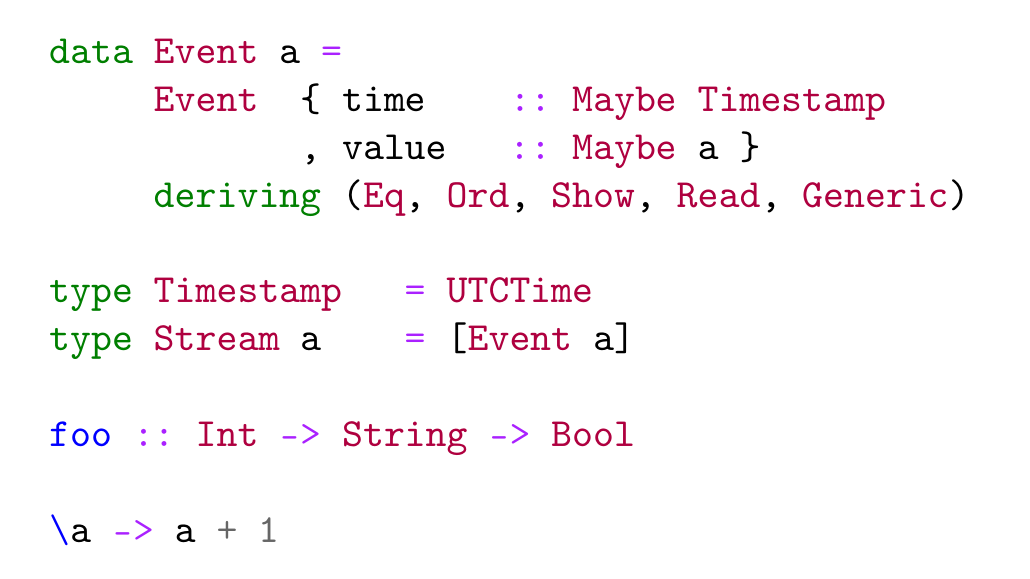
A proportional font, but it's taken pains to preserve vertical alignment, which is syntactically significant for Haskell. It looks a little cluttered to me, and I'm not a fan of nearly everything being italic. Again, symbols aren't differentiated, but it has substituted them for more typographically pleasing alternatives: -> has become , and \ is now . Another option is perhaps the newest, the LaTeX package minted, which leverages the Python Pygments program. Here's the same code again. It defaults to monospace (the choice of font seems a lot clearer to me than the default for listings), no symbolic substitution, and liberal use of colour:
default output of minted on a Haskell code sample
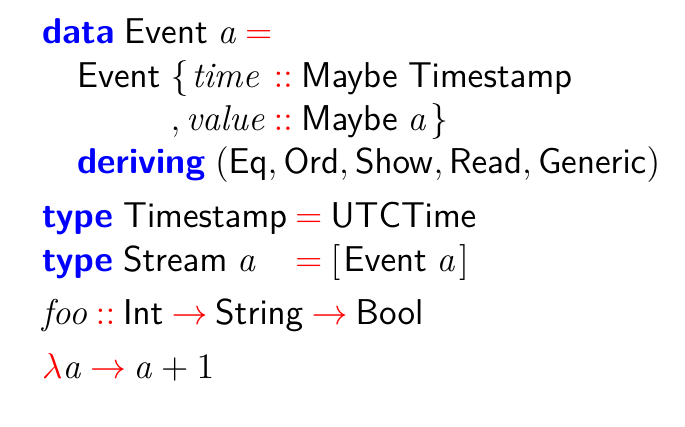
An informal survey of the samples so far showed that the minted output was the most popular. All of these packages can be configured to varying degrees. Here are some examples of what I've achieved with a bit of tweaking
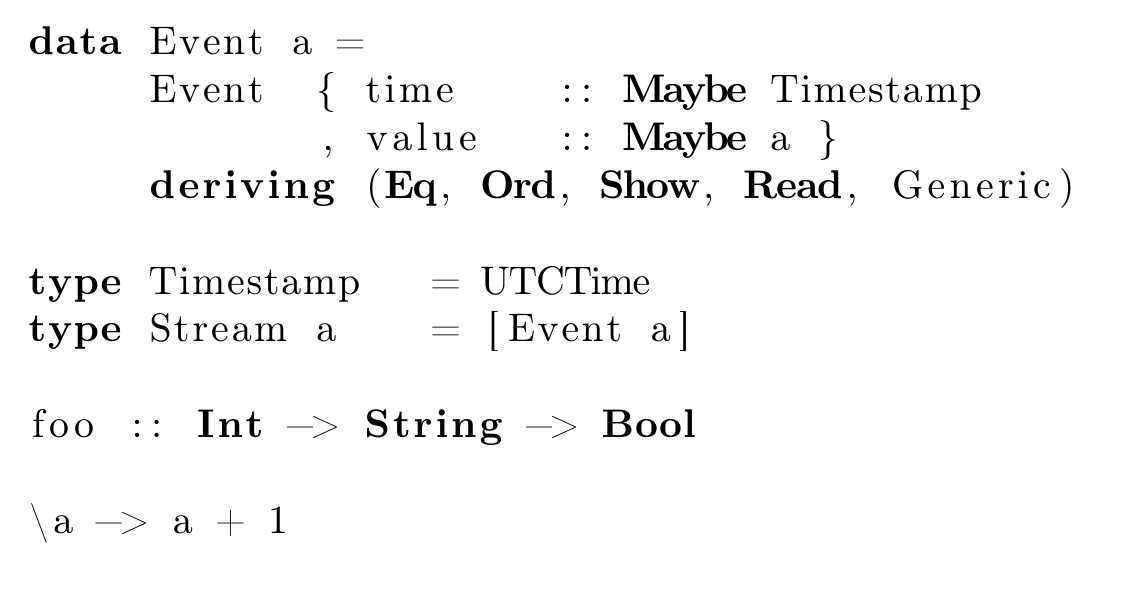
_listings_ adjusted with colour and some symbols substituted (but sadly not the two together) listings adjusted with colour and some symbols substituted (but sadly not the two together)
_lhs2tex_ adjusted to be less italic, sans-serif and use some colour lhs2tex adjusted to be less italic, sans-serif and use some colour
All of this has got me wondering whether there are straightforward empirical answers to some of these questions of style. Firstly, I'm pretty convinced that symbolic substitution is valuable. When writing Haskell, we write ->, \, /= etc. not because it's most legible, but because it's most practical to type those symbols on the most widely available keyboards and popular keyboard layouts.1 Of the three options listed here, symbolic substitution is possible with listings and lhs2tex, but I haven't figured out if minted can do it (which is really the question: can pygments do it?) I'm unsure about proportional versus monospaced fonts. We typically use monospaced fonts for editing computer code, but that's at least partly for historical reasons. Vertical alignment is often very important in source code, and it can be easily achieved with monospaced text; it's also sometimes important to have individual characters (., etc.) not be de-emphasised by being smaller than any other character. lhs2tex, at least, addresses vertical alignment whilst using proportional fonts. I guess the importance of identifying individual significant characters is just as true in a code sample within a larger document as it is within plain source code. From a (brief) scan of research on this topic, it seems that proportional fonts result in marginally quicker reading times for regular prose. It's not clear whether those results carry over into reading computer code in particular, and the margin is slim in any case. The drawbacks of monospaced text mostly apply when the volume of text is large, which is not the case for the short code snippets I am working with. I still have a few open questions:

  1. The Haskell package Data.List.Unicode lets the programmer use a range of unicode symbols in place of ASCII approximations, such as instead of elem, instead of /=. Sadly, it's not possible to replace the denotation for an anonymous function, \, with this way.

4 October 2024

Jonathan Dowland: synths

Although I've never written about them, I've been interested in music synthesisers for ages. My colleagues know this. Whilst I've been off sick, they had a whip-round and bought me a voucher for Andertons, a UK-based music store, to cheer me up. I'm absolutely floored by this generosity. And so, I'm now on a quest to buy a synthesizer! Although, not my first one.
Alesis Micron on my desk, taunting me Alesis Micron on my desk, taunting me
I bought my first synth, an Alesis Micron, from a colleague at $oldjob, 16 years ago. For various reasons, I've struggled to engage with it, and it's mostly been gathering dust on my desk in all that time. (I might write more about the Micron in a later blog post). "Bad Gear" sums it up better than I could:
So, I'm not truly buying my "first" synth, but for all intents and purposes I'm on a similar journey to if I was, and I thought it might be fun to write about it. Goals I want something which has as many of its parameters presented physically, as knobs or sliders etc., as possible. One reason I've failed to engage with the Micron (so far) is it's at the other end of this spectrum, with hundreds of tunable parameters but a small handful of knobs. To change parameters you have to go diving into menus presented on a really old-fashioned, small LCD display. If you know what you are looking for, you can probably find it; but if you just want to experiment and play around, it's off-putting. Secondly, I want something I can use away from a computer, as much as possible. Computers are my day-job, largely dominate my existing hobbies, and are unavoidable even in some of the others (like 3d printing). Most of the computers I interact with run Linux. And for all its strengths, audio management is not one of them. If I'm going to carve out some of my extremely limited leisure time to explore this stuff, I don't to spend any of it (at least now) fighting Pulseaudio/ALSA/Pipewire/JACK/OSS/whatever, or any of the other foibles that might crop up1. Thirdly, I'd like something which, in its soul, is an instrument. You can get some amazing little synth boxes with a huge number of features in them. Something with a limited number of features but which really feels well put together would suit me better. So next time, I'll write about the 2-3 top candidates on my list. Can you guess what they might be?

  1. To give another example. The other day I sat down to try and use the Micron, which had its audio out wired into an external audio interface, in turn plugged into my laptop's Thunderbolt dock. For a while I couldn't figure out why I couldn't hear anything, until I realised the Thunderbolt dock was having "a moment" and not presenting its USB devices to the laptop. Hobby time window gone!

17 September 2024

Jonathan Dowland: ouch, part 2

Things developed since my last post. Some lesions opened up on my ankle which was initially good news: the pain substantially reduced. But they didn t heal fast enough and so medics decided on surgical debridement. That was last night. It seemed to be successful and I m in recovery from surgery as I write. It s hard to predict the near-future, a lot depends on how well and fast I heal. I ve got a negative-pressure dressing on it, which is incredible: a constantly maintained suction to aid in debridement and healing. Modern medicine feels like a sci fi novel.

Jonathan Dowland: ouch, part 3

The debridement operation was a success: nothing bad grew afterwards. I was discharged after a couple of nights with crutches, instructions not to weight-bear, a remarkable, portable negative-pressure "Vac" pump that lived by my side, and some strong painkillers. About two weeks later, I had a skin graft. The surgeon took some skin from my thigh and stitched it over the debridement wound. I was discharged same-day, again with the Vac pump, and again with instructions not to weight-bear, at least for a few days. This time I only kept the Vac pump for a week, and after a dressing change (the first time I saw the graft), I was allowed to walk again. Doing so is strangely awkward, and sometimes a little painful. I have physio exercises to help me regain strength and understanding about what I can do. The donor site remained bandaged for another week before I saw it. I was expecting a stitched cut, but the surgeons have removed the top few layers only, leaving what looks more like a graze or sun-burn. There are four smaller, tentative-looking marks adjacent, suggesting they got it right on the fifth attempt. I'm not sure but I think these will all fade away to near-invisibility with time, and they don't hurt at all. I've now been off work for roughly 12 weeks, but I think I am returning very soon. I am looking forward to returning to some sense of normality. It's been an interesting experience. I thought about writing more about what I've gone through, in particular my experiences in Hospital, dealing with the bureaucracy and things falling "between the gaps". Hanif Kureishi has done a better job than I could. It's clear that the NHS is staffed by incredibly passionate people, but there are a lot of structural problems that interfere with care.

4 September 2024

Jonathan Dowland: loading (unintended consequences?)

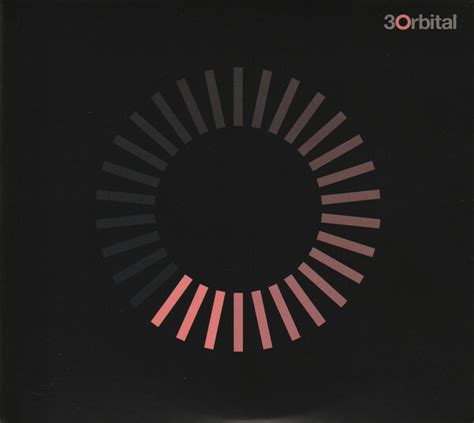
For their 30th anniversary (ish; the Covid pandemic pushed the date out a bit) British electronic music duo Orbital released the compilation 30 something. The track list mostly looks like a best hits list, which given their prior compilation celebrating 20 years looks much the same would appear superfluous. However, they ve rearranged and re-recorded all their songs for 30, to reflect their live arrangements. The reworkings are sufficiently distinct from the original versions (in some cases I prefer them) and elevate the release. The couple of new tracks are also fun, and many of the remixes on the second disc are worth a listen too.
cover art from Orbital - 30 Something
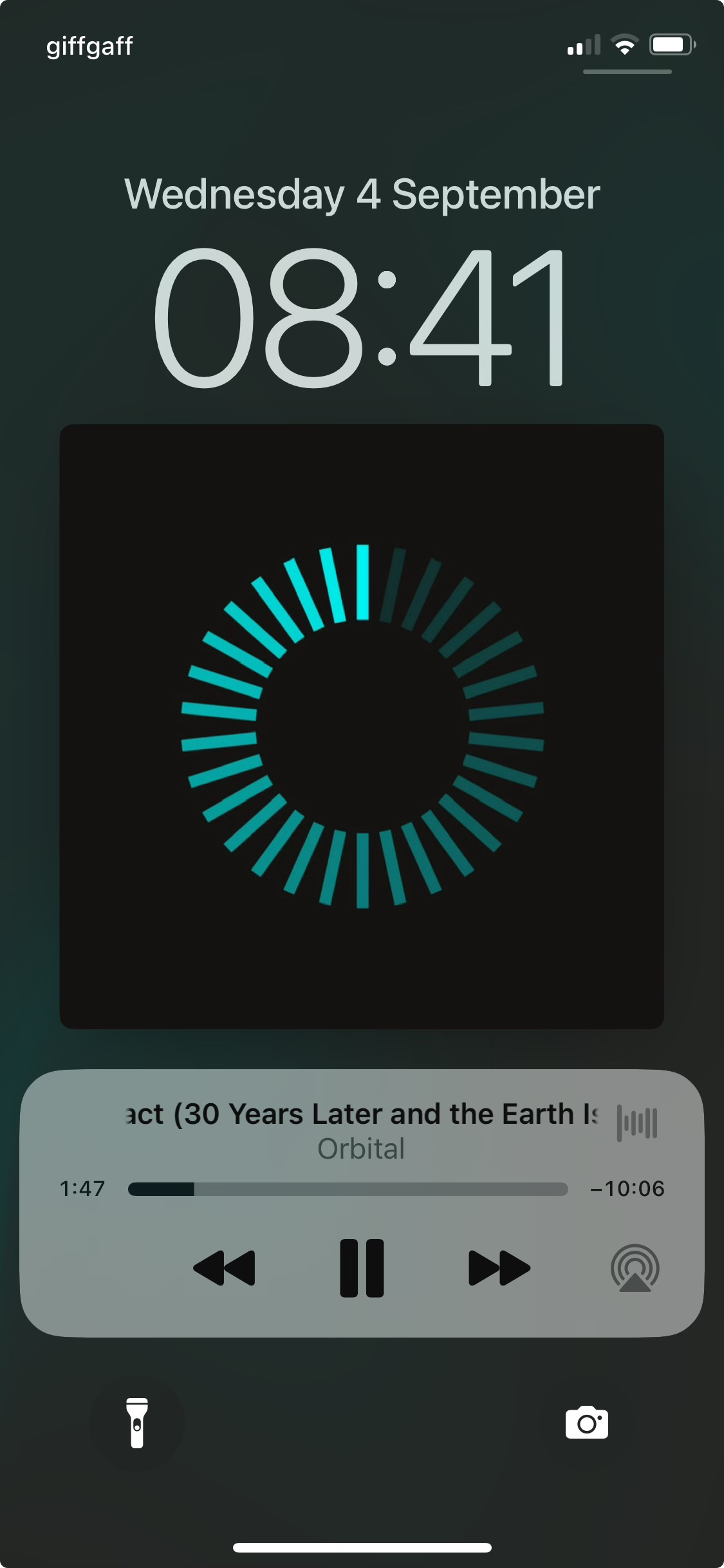
But what I actually sat down to write about was the cover artwork. They often have designs which riff on the notion of a circle (given their name) and the 30-something art (both for the album and single takes from it) adapts a loading spinner-like device from computing (I suppose it mostly closely resembles the spinner from macOS). A possibly unintended effect of the pattern occurs when you view it on a display which is adjusting its brightness, such as if you re listening to it on a phone, the screen is off, and you pick it up. The brightest part of the spinner is visible first, and the rest fade into visibility in sequence. The first time you see this is unexpected and very cool. (I've tried to recreate it in the picture below, but I don't think it's worked.) Although I've suffixed the titled of this post unintended consequences?, It's quite possible this was deliberate.
screenshot of the artwork displayed on my phone
I ve got the pattern on a t-shirt and my kids love to call out Daddy s loading! In my convalescence it s taken on a special sort of resonance because at times I ve felt I m in a holding state: waiting for an appointment to be made; waiting a polite interval before chasing an appointment; waiting for treatment to start after attending an appointment. Thankfully I m at the end of that now, I hope.

24 August 2024

Jonathan Dowland: Fediverse and feeds

It's clear that Twitter has been circling the drain for years, but things have been especially bad in recent times. I haven't quit (I have some sympathy with the viewpoint don't cede territory to fascists) but I try to read it much less, and I certainly post much less. Especially at the moment, I really appreciate distractions. Last time I wrote about Mastodon (by which I meant the Fediverse1), I was looking for a new instance to try. I settled on Debian's social instance2. I'm now trying to put any energy I might spend engaging on Twitter, into engaging in the Fediverse instead. (You can follow me via the handle @jon@dow.land, I think, which should repoint to my actual handle, @jmtd@pleroma.debian.social.) There are other potential successors to Twitter: two big ones are Bluesky and Facebook-owned Threads. They are effectively cookie-cutter copies of the Twitter model, and so, we will repeat the same mistakes there. Sadly I see the majority of communities and sub-cultures I follow are migrating to one or the other of these. The Fediverse (or the Mastodon-ish bits of it) should avoid the fate of Twitter. JWZ puts it better and more succinctly than I can. The Fedi experience is, sadly, pretty clunky. So I want to try and write a bit from time to time with tips and tricks that might improve people's experiences. First up, something I discovered only today about Mastodon instances. As JWZ noted, If you are worried about picking the "right" Mastodon instance, don't. Just spin the wheel.. You can spend too much time trying to guess a good answer to this. Better to just get started. At the same time, individual instances are supposed to cater to specific niches. So it could be useful to sample the public posts from an entire instance. For example, to find people to follow, or decide to hop over to that instance yourself. You can't (I think) follow an entire instance from within yours, but, they usually have a public page which shows you the latest traffic. For example, the infosec-themed instance infosec.exchange has one here: https://infosec.exchange/public/local These pages don't provide RSS or Atom feeds3, sadly. I hope that's on the software's roadmap, and hasn't been spurned for ideological reasons. For now at least, OpenRSS provide RSS/Atom feeds for many Mastodon instances. For example, an RSS/Atom feed of the above: https://openrss.org/infosec.exchange/public/local One can add these feeds to your Feed reader and over time get a flavour for the kind of discourse that takes place on given instances. I think the OpenRSS have to manually add Mastodon instances to their service. I tried three instances and only one (infosec.exchange) worked. I'm not sure but I think trying an instance that doesn't work automatically puts it on OpenRSS's backlog.

  1. the Fediverse-versus-Mastodon nomenclature problem is just the the tip of the iceberg, in terms of adoption problems. Mastodon provides a twitter-like service that participates in the Fediverse. But it isn't correct to call the twitter-like service "Mastodon" because other softwares also participate in/provide that service. And it's not correct to call it "Fediverse" because that describes a bigger thing, with e.g. youtube clones also taking part. I'm not sure what the right term should be for "the twitter-like thing". Also, everything I wrote here is probably subtly wrong.
  2. Debian's instance actually runs Pleroma, an alternative to Mastodon. Why should it matter? I think it's healthy for there to be more than one implementation in an open ecosystem. However the experience can be janky, as the features don't perfectly align, some Mastodon features/APIs are not documented/standardised/etc.
  3. I have to remind myself that the concept of RSS/Atom feeds and Feedreaders might need explaining to a modern audience too. Perhaps in another blog post.

Next.

Previous.