Machine is a far-future space opera. It is a loose sequel to
Ancestral Night, but you do not have to
remember the first book to enjoy this book and they have only a couple of
secondary characters in common. There are passing spoilers for
Ancestral Night in the story, though, if you care.
Dr. Brookllyn Jens is a rescue paramedic on Synarche Medical Vessel
I Race To Seek the Living. That means she goes into dangerous
situations to get you out of them, patches you up enough to not die, and
brings you to doctors who can do the slower and more time-consuming work.
She was previously a cop (well, Judiciary, which in this universe is
mostly the same thing) and then found that medicine, and specifically the
flagship Synarche hospital Core General, was the institution in all the
universe that she believed in the most.
As Machine opens, Jens is boarding the Big Rock Candy
Mountain, a generation ship launched from Earth during the bad era before
right-minding and joining the Synarche, back when it looked like humanity
on Earth wouldn't survive. Big Rock Candy Mountain was discovered
by accident in the wrong place, going faster than it was supposed to be
going and not responding to hails. The Synarche ship that first discovered
and docked with it is also mysteriously silent. It's the job of Jens and
her colleagues to get on board, see if anyone is still alive, and rescue
them if possible.
What they find is a corpse and a disturbingly servile early AI guarding a
whole lot of people frozen in primitive cryobeds, along with odd
artificial machinery that seems to be controlled by the AI. Or possibly
controlling the AI.
Jens assumes her job will be complete once she gets the cryobeds and the
AI back to Core General where both the humans and the AI can be treated by
appropriate doctors. Jens is very wrong.
Machine is Elizabeth Bear's version of a James White
Sector General novel. If one reads this book
without any prior knowledge, the way that I did, you may not realize this
until the characters make it to Core General, but then it becomes obvious
to anyone who has read White's series. Most of the standard Sector General
elements are here: A vast space station with rings at different gravity
levels and atmospheres, a baffling array of species, and the ability to
load other people's personalities into your head to treat other species at
the cost of discomfort and body dysmorphia. There's a gruff supervisor, a
fragile alien doctor, and a whole lot of idealistic and well-meaning
people working around complex interspecies differences. Sadly, Bear does
drop White's entertainingly oversimplified species classification codes;
this is the correct call for suspension of disbelief, but I kind of missed
them.
I thoroughly enjoy the idea of the Sector General series, so I was
delighted by an updated version that drops the sexism and the doctor/nurse
hierarchy and adds AIs, doctors for AIs, and a more complicated political
structure. The hospital is even run by a sentient tree, which is an
inspired choice.
Bear, of course, doesn't settle for a relatively simple James White
problem-solving plot. There are interlocking, layered problems here,
medical and political, immediate and structural, that unwind in ways that
I found satisfyingly twisty. As with Ancestral Night, Bear has some
complex points to make about morality. I think that aspect of the story
was a bit less convincing than Ancestral Night, in part because
some of the characters use rather bizarre tactics (although I will grant
they are the sort of bizarre tactics that I could imagine would be used by
well-meaning people using who didn't think through all of the possible
consequences). I enjoyed the ethical dilemmas here, but they didn't grab
me the way that Ancestral Night did. The setting, though, is even
better: An interspecies hospital was a brilliant setting when James White
used it, and it continues to be a brilliant setting in Bear's hands.
It's also worth mentioning that Jens has a chronic inflammatory disease
and uses an exoskeleton for mobility, and (as much as I can judge while
not being disabled myself) everything about this aspect of the character
was excellent. It's rare to see characters with meaningful disabilities in
far-future science fiction. When present at all, they're usually treated
like Geordi's sight: something little different than the differential
abilities of the various aliens, or even a backdoor advantage. Jens has a
true, meaningful disability that she has to manage and that causes a
constant cognitive drain, and the treatment of her assistive device is
complex and nuanced in a way that I found thoughtful and satisfying.
The one structural complaint that I will make is that Jens is an
astonishingly talkative first-person protagonist, particularly for an
Elizabeth Bear novel. This is still better than being inscrutable, but she
is prone to such extended philosophical digressions or infodumps in the
middle of a scene that I found myself wishing she'd get on with it already
in a few places. This provides good characterization, in the sense that
the reader certainly gets inside Jens's head, but I think Bear didn't get
the balance quite right.
That complaint aside, this was very fun, and I am certainly going to keep
reading this series. Recommended, particularly if you like James White, or
want to see why other people do.
The most important thing in the universe is not, it turns out, a
single, objective truth. It's not a hospital whose ideals you love,
that treats all comers. It's not a lover; it's not a job. It's not
friends and teammates.
It's not even a child that rarely writes me back, and to be honest I
probably earned that. I could have been there for her. I didn't know
how to be there for anybody, though. Not even for me.
The most important thing in the universe, it turns out, is a complex
of subjective and individual approximations. Of tries and fails. Of
ideals, and things we do to try to get close to those ideals.
It's who we are when nobody is looking.
## 0.23	2025-12-20
commit be15aa25dea40aea66a8534143fb81b29d2e6c08
Author: C.J. Collier
Date:   Sat Dec 20 22:40:44 2025 +0000
    Fixes C-level test infrastructure and adds more test cases for upb_to_sv conversions.

    - **Makefile.PL:**
        - Allow  extra_src  in  c_test_config.json  to be an array.
        - Add ASan flags to CCFLAGS and LDDLFLAGS for better debugging.
        - Corrected echo newlines in  test_c  target.
    - **c_test_config.json:**
        - Added missing type test files to  deps  and  extra_src  for  convert/sv_to_upb  and  convert/upb_to_sv  test runners.
    - **t/c/convert/upb_to_sv.c:**
        - Fixed a double free of  test_pool .
        - Added missing includes for type test headers.
        - Updated test plan counts.
    - **t/c/convert/sv_to_upb.c:**
        - Added missing includes for type test headers.
        - Updated test plan counts.
        - Corrected Perl interpreter initialization.
    - **t/c/convert/types/**:
        - Added missing  test_util.h  include in new type test headers.
        - Completed the set of  upb_to_sv  test cases for all scalar types by adding optional and repeated tests for  sfixed32 ,  sfixed64 ,  sint32 , and  sint64 , and adding repeated tests to the remaining scalar type files.
    - **Documentation:**
        - Updated  01-xs-testing.md  with more debugging tips, including ASan usage and checking for double frees and typos.
        - Updated  xs_learnings.md  with details from the recent segfault.
        - Updated  llm-plan-execution-instructions.md  to emphasize debugging steps.
## 0.22	2025-12-19
commit 2c171d9a5027e0150eae629729c9104e7f6b9d2b
Author: C.J. Collier
Date:   Fri Dec 19 23:41:02 2025 +0000
    feat(perl,testing): Initialize C test framework and build system

    This commit sets up the foundation for the C-level tests and the build system for the Perl Protobuf module:

    1.  **Makefile.PL Enhancements:**
        *   Integrates  Devel::PPPort  to generate  ppport.h  for better portability.
        *   Object files now retain their path structure (e.g.,  xs/convert/sv_to_upb.o ) instead of being flattened, improving build clarity.
        *   The  MY::postamble  is significantly revamped to dynamically generate build rules for all C tests located in  t/c/  based on the  t/c/c_test_config.json  file.
        *   C tests are linked against  libprotobuf_common.a  and use  ExtUtils::Embed  flags.
        *   Added  JSON::MaybeXS  to  PREREQ_PM .
        *   The  test  target now also depends on the  test_c  target.

    2.  **C Test Infrastructure ( t/c/ ):
        *   Introduced  t/c/c_test_config.json  to configure individual C test builds, specifying dependencies and extra source files.
        *   Created  t/c/convert/test_util.c  and  .h  for shared test functions like loading descriptors.
        *   Initial  t/c/convert/upb_to_sv.c  and  t/c/convert/sv_to_upb.c  test runners.
        *   Basic  t/c/integration/030_protobuf_coro.c  for Coro safety testing on core utils using  libcoro .
        *   Basic  t/c/integration/035_croak_test.c  for testing exception handling.
        *   Basic  t/c/integration/050_convert.c  for integration testing conversions.

    3.  **Test Proto:** Updated  t/data/test.proto  with more field types for conversion testing and regenerated  test_descriptor.bin .

    4.  **XS Test Harness ( t/c/upb-perl-test.h ):** Added  like_n  macro for length-aware regex matching.

    5.  **Documentation:** Updated architecture and plan documents to reflect the C test structure.
    6.  **ERRSV Testing:** Note that the C tests ( t/c/ ) will primarily check *if* a  croak  occurs (i.e., that the exception path is taken), but will not assert on the string content of  ERRSV . Reliably testing  $@  content requires the full Perl test environment with  Test::More , which will be done in the  .t  files when testing the Perl API.

    This provides a solid base for developing and testing the XS and C components of the module.
## 0.21	2025-12-18
commit a8b6b6100b2cf29c6df1358adddb291537d979bc
Author: C.J. Collier
Date:   Thu Dec 18 04:20:47 2025 +0000
    test(C): Add integration tests for Milestone 2 components

    - Created t/c/integration/030_protobuf.c to test interactions
      between obj_cache, arena, and utils.
    - Added this test to t/c/c_test_config.json.
    - Verified that all C tests for Milestones 2 and 3 pass,
      including the libcoro-based stress test.
## 0.20	2025-12-18
commit 0fcad68680b1f700a83972a7c1c48bf3a6958695
Author: C.J. Collier
Date:   Thu Dec 18 04:14:04 2025 +0000
    docs(plan): Add guideline review reminders to milestones

    - Added a "[ ] REFRESH: Review all documents in @perl/doc/guidelines/**"
      checklist item to the start of each component implementation
      milestone (C and Perl layers).
    - This excludes Integration Test milestones.
## 0.19	2025-12-18
commit 987126c4b09fcdf06967a98fa3adb63d7de59a34
Author: C.J. Collier
Date:   Thu Dec 18 04:05:53 2025 +0000
    docs(plan): Add C-level and Perl-level Coro tests to milestones

    - Added checklist items for  libcoro -based C tests
      (e.g.,  t/c/integration/050_convert_coro.c ) to all C layer
      integration milestones (050 through 220).
    - Updated  030_Integration_Protobuf.md  to standardise checklist
      items for the existing  030_protobuf_coro.c  test.
    - Removed the single  xt/author/coro-safe.t  item from
       010_Build.md .
    - Added checklist items for Perl-level  Coro  tests
      (e.g.,  xt/coro/240_arena.t ) to each Perl layer
      integration milestone (240 through 400).
    - Created  perl/t/c/c_test_config.json  to manage C test
      configurations externally.
    - Updated  perl/doc/architecture/testing/01-xs-testing.md  to describe
      both C-level  libcoro  and Perl-level  Coro  testing strategies.
## 0.18	2025-12-18
commit 6095a5a610401a6035a81429d0ccb9884d53687b
Author: C.J. Collier
Date:   Thu Dec 18 02:34:31 2025 +0000
    added coro testing to c layer milestones
## 0.17	2025-12-18
commit cc0aae78b1f7f675fc8a1e99aa876c0764ea1cce
Author: C.J. Collier
Date:   Thu Dec 18 02:26:59 2025 +0000
    docs(plan): Refine test coverage checklist items for SMARTness

    - Updated the "Tests provide full coverage" checklist items in
      C layer plan files (020, 040, 060, 080, 100, 120, 140, 160, 180, 200)
      to explicitly mention testing all public functions in the
      corresponding header files.
    - Expanded placeholder checklists in 140, 160, 180, 200.
    - Updated the "Tests provide full coverage" and "Add coverage checks"
      checklist items in Perl layer plan files (230, 250, 270, 290, 310, 330,
      350, 370, 390) to be more specific about the scope of testing
      and the use of  Test::TestCoverage .
    - Expanded Well-Known Types milestone (350) to detail each type.
## 0.16	2025-12-18
commit e4b601f14e3817a17b0f4a38698d981dd4cb2818
Author: C.J. Collier
Date:   Thu Dec 18 02:07:35 2025 +0000
    docs(plan): Full refactoring of C and Perl plan files

    - Split both ProtobufPlan-C.md and ProtobufPlan-Perl.md into
      per-milestone files under the  perl/doc/plan/  directory.
    - Introduced Integration Test milestones after each component
      milestone in both C and Perl plans.
    - Numbered milestone files sequentially (e.g., 010_Build.md,
      230_Perl_Arena.md).
    - Updated main ProtobufPlan-C.md and ProtobufPlan-Perl.md to
      act as Tables of Contents.
    - Ensured consistent naming for integration test files
      (e.g.,  t/c/integration/030_protobuf.c ,  t/integration/260_descriptor_pool.t ).
    - Added architecture review steps to the end of all milestones.
    - Moved Coro safety test to C layer Milestone 1.
    - Updated Makefile.PL to support new test structure and added Coro.
    - Moved and split t/c/convert.c into t/c/convert/*.c.
    - Moved other t/c/*.c tests into t/c/protobuf/*.c.
    - Deleted old t/c/convert.c.
## 0.15	2025-12-17
commit 649cbacf03abb5e7293e3038bb451c0406e9d0ce
Author: C.J. Collier
Date:   Wed Dec 17 23:51:22 2025 +0000
    docs(plan): Refactor and reset ProtobufPlan.md

    - Split the plan into ProtobufPlan-C.md and ProtobufPlan-Perl.md.
    - Reorganized milestones to clearly separate C layer and Perl layer development.
    - Added more granular checkboxes for each component:
      - C Layer: Create test, Test coverage, Implement, Tests pass.
      - Perl Layer: Create test, Test coverage, Implement Module/XS, Tests pass, C-Layer adjustments.
    - Reset all checkboxes to  [ ]  to prepare for a full audit.
    - Updated status in architecture/api and architecture/core documents to "Not Started".

    feat(obj_cache): Add unregister function and enhance tests

    - Added  protobuf_unregister_object  to  xs/protobuf/obj_cache.c .
    - Updated  xs/protobuf/obj_cache.h  with the new function declaration.
    - Expanded tests in  t/c/protobuf_obj_cache.c  to cover unregistering,
      overwriting keys, and unregistering non-existent keys.
    - Corrected the test plan count in  t/c/protobuf_obj_cache.c  to 17.
## 0.14	2025-12-17
commit 40b6ad14ca32cf16958d490bb575962f88d868a1
Author: C.J. Collier
Date:   Wed Dec 17 23:18:27 2025 +0000
    feat(arena): Complete C layer for Arena wrapper

    This commit finalizes the C-level implementation for the Protobuf::Arena wrapper.

    - Adds  PerlUpb_Arena_Destroy  for proper cleanup from Perl's DEMOLISH.
    - Enhances error checking in  PerlUpb_Arena_Get .
    - Expands C-level tests in  t/c/protobuf_arena.c  to cover memory allocation
      on the arena and lifecycle through  PerlUpb_Arena_Destroy .
    - Corrects embedded Perl initialization in the C test.

    docs(plan): Refactor ProtobufPlan.md

    - Restructures the development plan to clearly separate "C Layer" and
      "Perl Layer" tasks within each milestone.
    - This aligns the plan with the "C-First Implementation Strategy" and improves progress tracking.
## 0.13	2025-12-17
commit c1e566c25f62d0ae9f195a6df43b895682652c71
Author: C.J. Collier
Date:   Wed Dec 17 22:00:40 2025 +0000
    refactor(perl): Rename C tests and enhance Makefile.PL

    - Renamed test files in  t/c/  to better match the  xs  module structure:
        -  01-cache.c  ->  protobuf_obj_cache.c
        -  02-arena.c  ->  protobuf_arena.c
        -  03-utils.c  ->  protobuf_utils.c
        -  04-convert.c  ->  convert.c
        -  load_test.c  ->  upb_descriptor_load.c
    - Updated  perl/Makefile.PL  to reflect the new test names in  MY::postamble 's  $c_test_config .
    - Refactored the  $c_test_config  generation in  Makefile.PL  to reduce repetition by using a default flags hash and common dependencies array.
    - Added a  fail()  macro to  perl/t/c/upb-perl-test.h  for consistency.
    - Modified  t/c/upb_descriptor_load.c  to use the  t/c/upb-perl-test.h  macros, making its output consistent with other C tests.
    - Added a skeleton for  t/c/convert.c  to test the conversion functions.
    - Updated documentation in  ProtobufPlan.md  and  architecture/testing/01-xs-testing.md  to reflect new test names.
## 0.12	2025-12-17
commit d8cb5dd415c6c129e71cd452f78e29de398a82c9
Author: C.J. Collier
Date:   Wed Dec 17 20:47:38 2025 +0000
    feat(perl): Refactor XS code into subdirectories

    This commit reorganizes the C code in the  perl/xs/  directory into subdirectories, mirroring the structure of the Python UPB extension. This enhances modularity and maintainability.

    - Created subdirectories for each major component:  convert ,  descriptor ,  descriptor_containers ,  descriptor_pool ,  extension_dict ,  map ,  message ,  protobuf ,  repeated , and  unknown_fields .
    - Created skeleton  .h  and  .c  files within each subdirectory to house the component-specific logic.
    - Updated top-level component headers (e.g.,  perl/xs/descriptor.h ) to include the new sub-headers.
    - Updated top-level component source files (e.g.,  perl/xs/descriptor.c ) to include their main header and added stub initialization functions (e.g.,  PerlUpb_InitDescriptor ).
    - Moved code from the original  perl/xs/protobuf.c  to new files in  perl/xs/protobuf/  (arena, obj_cache, utils).
    - Moved code from the original  perl/xs/convert.c  to new files in  perl/xs/convert/  (upb_to_sv, sv_to_upb).
    - Updated  perl/Makefile.PL  to use a glob ( xs/*/*.c ) to find the new C source files in the subdirectories.
    - Added  perl/doc/architecture/core/07-xs-file-organization.md  to document the new structure.
    - Updated  perl/doc/ProtobufPlan.md  and other architecture documents to reference the new organization.
    - Corrected self-referential includes in the newly created .c files.

    This restructuring provides a solid foundation for further development and makes it easier to port logic from the Python implementation.
## 0.11	2025-12-17
commit cdedcd13ded4511b0464f5d3bdd72ce6d34e73fc
Author: C.J. Collier
Date:   Wed Dec 17 19:57:52 2025 +0000
    feat(perl): Implement C-first testing and core XS infrastructure

    This commit introduces a significant refactoring of the Perl XS extension, adopting a C-first development approach to ensure a robust foundation.

    Key changes include:

    -   **C-Level Testing Framework:** Established a C-level testing system in  t/c/  with a dedicated Makefile, using an embedded Perl interpreter. Initial tests cover the object cache ( 01-cache.c ), arena wrapper ( 02-arena.c ), and utility functions ( 03-utils.c ).
    -   **Core XS Infrastructure:**
        -   Implemented a global object cache ( xs/protobuf.c ) to manage Perl wrappers for UPB objects, using weak references.
        -   Created an  upb_Arena  wrapper ( xs/protobuf.c ).
        -   Consolidated common XS helper functions into  xs/protobuf.h  and  xs/protobuf.c .
    -   **Makefile.PL Enhancements:** Updated to support building and linking C tests, incorporating flags from  ExtUtils::Embed , and handling both  .c  and  .cc  source files.
    -   **XS File Reorganization:** Restructured XS files to mirror the Python UPB extension's layout (e.g.,  message.c ,  descriptor.c ). Removed older, monolithic  .xs  files.
    -   **Typemap Expansion:** Added extensive typemap entries in  perl/typemap  to handle conversions between Perl objects and various  const upb_*Def*  pointers.
    -   **Descriptor Tests:** Added a new test suite  t/02-descriptor.t  to validate descriptor loading and accessor methods.
    -   **Documentation:** Updated development plans and guidelines ( ProtobufPlan.md ,  xs_learnings.md , etc.) to reflect the C-first strategy, new testing methods, and lessons learned.
    -   **Build Cleanup:** Removed  ppport.h  from  .gitignore  as it's no longer used, due to  -DPERL_NO_PPPORT  being set in  Makefile.PL .

    This C-first approach allows for more isolated and reliable testing of the core logic interacting with the UPB library before higher-level Perl APIs are built upon it.
## 0.10	2025-12-17
commit 1ef20ade24603573905cb0376670945f1ab5d829
Author: C.J. Collier
Date:   Wed Dec 17 07:08:29 2025 +0000
    feat(perl): Implement C-level tests and core XS utils

    This commit introduces a C-level testing framework for the XS layer and implements key components:

    1.  **C-Level Tests ( t/c/ )**:
        *   Added  t/c/Makefile  to build standalone C tests.
        *   Created  t/c/upb-perl-test.h  with macros for TAP-compliant C tests ( plan ,  ok ,  is ,  is_string ,  diag ).
        *   Implemented  t/c/01-cache.c  to test the object cache.
        *   Implemented  t/c/02-arena.c  to test  Protobuf::Arena  wrappers.
        *   Implemented  t/c/03-utils.c  to test string utility functions.
        *   Corrected include paths and diagnostic messages in C tests.

    2.  **XS Object Cache ( xs/protobuf.c )**:
        *   Switched to using stringified pointers ( %p ) as hash keys for stability.
        *   Fixed a critical double-free bug in  PerlUpb_ObjCache_Delete  by removing an extra  SvREFCNT_dec  on the lookup key.

    3.  **XS Arena Wrapper ( xs/protobuf.c )**:
        *   Corrected  PerlUpb_Arena_New  to use  newSVrv  and  PTR2IV  for opaque object wrapping.
        *   Corrected  PerlUpb_Arena_Get  to safely unwrap the arena pointer.

    4.  **Makefile.PL ( perl/Makefile.PL )**:
        *   Added  -Ixs  to  INC  to allow C tests to find  t/c/upb-perl-test.h  and  xs/protobuf.h .
        *   Added  LIBS  to link  libprotobuf_common.a  into the main  Protobuf.so .
        *   Added C test targets  01-cache ,  02-arena ,  03-utils  to the test config in  MY::postamble .

    5.  **Protobuf.pm ( perl/lib/Protobuf.pm )**:
        *   Added  use XSLoader;  to load the compiled XS code.

    6.  **New files  xs/util.h **:
        *   Added initial type conversion function.

    These changes establish a foundation for testing the C-level interface with UPB and fix crucial bugs in the object cache implementation.
## 0.09	2025-12-17
commit 07d61652b032b32790ca2d3848243f9d75ea98f4
Author: C.J. Collier
Date:   Wed Dec 17 04:53:34 2025 +0000
    feat(perl): Build system and C cache test for Perl XS

    This commit introduces the foundational pieces for the Perl XS implementation, focusing on the build system and a C-level test for the object cache.

    -   **Makefile.PL:**
        -   Refactored C test compilation rules in  MY::postamble  to use a hash ( $c_test_config ) for better organization and test-specific flags.
        -   Integrated  ExtUtils::Embed  to provide necessary compiler and linker flags for embedding the Perl interpreter, specifically for the  t/c/01-cache.c  test.
        -   Correctly constructs the path to the versioned Perl library ( libperl.so.X.Y.Z ) using  $Config archlib  and  $Config libperl  to ensure portability.
        -   Removed  VERSION_FROM  and  ABSTRACT_FROM  to avoid dependency on  .pm  files for now.

    -   **C Cache Test (t/c/01-cache.c):**
        -   Added a C test to exercise the object cache functions implemented in  xs/protobuf.c .
        -   Includes tests for adding, getting, deleting, and weak reference behavior.

    -   **XS Cache Implementation (xs/protobuf.c, xs/protobuf.h):**
        -   Implemented  PerlUpb_ObjCache_Init ,  PerlUpb_ObjCache_Add ,  PerlUpb_ObjCache_Get ,  PerlUpb_ObjCache_Delete , and  PerlUpb_ObjCache_Destroy .
        -   Uses a Perl hash ( HV* ) for the cache.
        -   Keys are string representations of the C pointers, created using  snprintf  with  "%llx" .
        -   Values are weak references ( sv_rvweaken ) to the Perl objects ( SV* ).
        -    PerlUpb_ObjCache_Get  now correctly returns an incremented reference to the original SV, not a copy.
        -    PerlUpb_ObjCache_Destroy  now clears the hash before decrementing its refcount.

    -   **t/c/upb-perl-test.h:**
        -   Updated  is_sv  to perform direct pointer comparison ( got == expected ).

    -   **Minor:** Added  util.h  (currently empty), updated  typemap .

    These changes establish a working C-level test environment for the XS components.
## 0.08	2025-12-17
commit d131fd22ea3ed8158acb9b0b1fe6efd856dc380e
Author: C.J. Collier
Date:   Wed Dec 17 02:57:48 2025 +0000
    feat(perl): Update docs and core XS files

    - Explicitly add TDD cycle to ProtobufPlan.md.
    - Clarify mirroring of Python implementation in upb-interfacing.md for both C and Perl layers.
    - Branch and adapt python/protobuf.h and python/protobuf.c to perl/xs/protobuf.h and perl/xs/protobuf.c, including the object cache implementation. Removed old cache.* files.
    - Create initial C test for the object cache in t/c/01-cache.c.
## 0.07	2025-12-17
commit 56fd6862732c423736a2f9a9fb1a2816fc59e9b0
Author: C.J. Collier
Date:   Wed Dec 17 01:09:18 2025 +0000
    feat(perl): Align Perl UPB architecture docs with Python

    Updates the Perl Protobuf architecture documents to more closely align with the design and implementation strategies used in the Python UPB extension.

    Key changes:

    -   **Object Caching:** Mandates a global, per-interpreter cache using weak references for all UPB-derived objects, mirroring Python's  PyUpb_ObjCache .
    -   **Descriptor Containers:** Introduces a new document outlining the plan to use generic XS container types (Sequence, ByNameMap, ByNumberMap) with vtables to handle collections of descriptors, similar to Python's  descriptor_containers.c .
    -   **Testing:** Adds a note to the testing strategy to port relevant test cases from the Python implementation to ensure feature parity.
## 0.06	2025-12-17
commit 6009ce6ab64eccce5c48729128e5adf3ef98e9ae
Author: C.J. Collier
Date:   Wed Dec 17 00:28:20 2025 +0000
    feat(perl): Implement object caching and fix build

    This commit introduces several key improvements to the Perl XS build system and core functionality:

    1.  **Object Caching:**
        *   Introduces  xs/protobuf.c  and  xs/protobuf.h  to implement a caching mechanism ( protobuf_c_to_perl_obj ) for wrapping UPB C pointers into Perl objects. This uses a hash and weak references to ensure object identity and prevent memory leaks.
        *   Updates the  typemap  to use  protobuf_c_to_perl_obj  for  upb_MessageDef *  output, ensuring descriptor objects are cached.
        *   Corrected  sv_weaken  to the correct  sv_rvweaken  function.

    2.  **Makefile.PL Enhancements:**
        *   Switched to using the Bazel-generated UPB descriptor sources from  bazel-bin/src/google/protobuf/_virtual_imports/descriptor_proto/google/protobuf/ .
        *   Updated  INC  paths to correctly locate the generated headers.
        *   Refactored  MY::dynamic_lib  to ensure the static library  libprotobuf_common.a  is correctly linked into each generated  .so  module, resolving undefined symbol errors.
        *   Overrode  MY::test  to use  prove -b -j$(nproc) t/*.t xt/*.t  for running tests.
        *   Cleaned up  LIBS  and  LDDLFLAGS  usage.

    3.  **Documentation:**
        *   Updated  ProtobufPlan.md  to reflect the current status and design decisions.
        *   Reorganized architecture documents into subdirectories.
        *   Added  object-caching.md  and  c-perl-interface.md .
        *   Updated  llm-guidance.md  with notes on  upb/upb.h  and  sv_rvweaken .

    4.  **Testing:**
        *   Fixed  xt/03-moo_immutable.t  to skip tests if no Moo modules are found.

    This resolves the build issues and makes the core test suite pass.
## 0.05	2025-12-16
commit 177d2f3b2608b9d9c415994e076a77d8560423b8
Author: C.J. Collier
Date:   Tue Dec 16 19:51:36 2025 +0000
    Refactor: Rename namespace to Protobuf, build system and doc updates

    This commit refactors the primary namespace from  ProtoBuf  to  Protobuf
    to align with the style guide. This involves renaming files, directories,
    and updating package names within all Perl and XS files.

    **Namespace Changes:**

    *   Renamed  perl/lib/ProtoBuf  to  perl/lib/Protobuf .
    *   Moved and updated  ProtoBuf.pm  to  Protobuf.pm .
    *   Moved and updated  ProtoBuf::Descriptor  to  Protobuf::Descriptor  (.pm & .xs).
    *   Removed other  ProtoBuf::*  stubs (Arena, DescriptorPool, Message).
    *   Updated  MODULE  and  PACKAGE  in  Descriptor.xs .
    *   Updated  NAME ,  *_FROM  in  perl/Makefile.PL .
    *   Replaced  ProtoBuf  with  Protobuf  throughout  perl/typemap .
    *   Updated namespaces in test files  t/01-load-protobuf-descriptor.t  and  t/02-descriptor.t .
    *   Updated namespaces in all documentation files under  perl/doc/ .
    *   Updated paths in  perl/.gitignore .

    **Build System Enhancements (Makefile.PL):**

    *   Included  xs/*.c  files in the common object files list.
    *   Added  -I.  to the  INC  paths.
    *   Switched from  MYEXTLIB  to  LIBS => ['-L$(CURDIR) -lprotobuf_common']  for linking.
    *   Removed custom keys passed to  WriteMakefile  for postamble.
    *    MY::postamble  now sources variables directly from the main script scope.
    *   Added  all :: $ common_lib  dependency in  MY::postamble .
    *   Added  t/c/load_test.c  compilation rule in  MY::postamble .
    *   Updated  clean  target to include  blib .
    *   Added more modules to  TEST_REQUIRES .
    *   Removed the explicit  PM  and  XS  keys from  WriteMakefile , relying on  XSMULTI => 1 .

    **New Files:**

    *    perl/lib/Protobuf.pm
    *    perl/lib/Protobuf/Descriptor.pm
    *    perl/lib/Protobuf/Descriptor.xs
    *    perl/t/01-load-protobuf-descriptor.t
    *    perl/t/02-descriptor.t
    *    perl/t/c/load_test.c : Standalone C test for UPB.
    *    perl/xs/types.c  &  perl/xs/types.h : For Perl/C type conversions.
    *    perl/doc/architecture/upb-interfacing.md
    *    perl/xt/03-moo_immutable.t : Test for Moo immutability.

    **Deletions:**

    *   Old test files:  t/00_load.t ,  t/01_basic.t ,  t/02_serialize.t ,  t/03_message.t ,  t/04_descriptor_pool.t ,  t/05_arena.t ,  t/05_message.t .
    *   Removed  lib/ProtoBuf.xs  as it's not needed with  XSMULTI .

    **Other:**

    *   Updated  test_descriptor.bin  (binary change).
    *   Significant content updates to markdown documentation files in  perl/doc/architecture  and  perl/doc/internal  reflecting the new architecture and learnings.
## 0.04	2025-12-14
commit 92de5d482c8deb9af228f4b5ce31715d3664d6ee
Author: C.J. Collier
Date:   Sun Dec 14 21:28:19 2025 +0000
    feat(perl): Implement Message object creation and fix lifecycles

    This commit introduces the basic structure for  ProtoBuf::Message  object
    creation, linking it with  ProtoBuf::Descriptor  and  ProtoBuf::DescriptorPool ,
    and crucially resolves a SEGV by fixing object lifecycle management.

    Key Changes:

    1.  ** ProtoBuf::Descriptor :** Added  _pool  attribute to hold a strong
        reference to the parent  ProtoBuf::DescriptorPool . This is essential to
        prevent the pool and its C  upb_DefPool  from being garbage collected
        while a descriptor is still in use.

    2.  ** ProtoBuf::DescriptorPool :**
        *    find_message_by_name : Now passes the  $self  (the pool object) to the
             ProtoBuf::Descriptor  constructor to establish the lifecycle link.
        *   XSUB  pb_dp_find_message_by_name : Updated to accept the pool  SV*  and
            store it in the descriptor's  _pool  attribute.
        *   XSUB  _load_serialized_descriptor_set : Renamed to avoid clashing with the
            Perl method name. The Perl wrapper now correctly calls this internal XSUB.
        *    DEMOLISH : Made safer by checking for attribute existence.

    3.  ** ProtoBuf::Message :**
        *   Implemented using Moo with lazy builders for  _upb_arena  and
             _upb_message .
        *    _descriptor  is a required argument to  new() .
        *   XS functions added for creating the arena ( pb_msg_create_arena ) and
            the  upb_Message  ( pb_msg_create_upb_message ).
        *    pb_msg_create_upb_message  now extracts the  upb_MessageDef*  from the
            descriptor and uses  upb_MessageDef_MiniTable()  to get the minitable
            for  upb_Message_New() .
        *    DEMOLISH : Added to free the message's arena.

    4.  ** Makefile.PL :**
        *   Added  -g  to  CCFLAGS  for debugging symbols.
        *   Added Perl CORE include path to  MY::postamble 's  base_flags .

    5.  **Tests:**
        *    t/04_descriptor_pool.t : Updated to check the structure of the
            returned  ProtoBuf::Descriptor .
        *    t/05_message.t : Now uses a descriptor obtained from a real pool to
            test  ProtoBuf::Message->new() .

    6.  **Documentation:**
        *   Updated  ProtobufPlan.md  to reflect progress.
        *   Updated several files in  doc/architecture/  to match the current
            implementation details, especially regarding arena management and object
            lifecycles.
        *   Added  doc/internal/development_cycle.md  and  doc/internal/xs_learnings.md .

    With these changes, the SEGV is resolved, and message objects can be successfully
    created from descriptors.
## 0.03	2025-12-14
commit 6537ad23e93680c2385e1b571d84ed8dbe2f68e8
Author: C.J. Collier
Date:   Sun Dec 14 20:23:41 2025 +0000
    Refactor(perl): Object-Oriented DescriptorPool with Moo

    This commit refactors the  ProtoBuf::DescriptorPool  to be fully object-oriented using Moo, and resolves several issues related to XS, typemaps, and test data.

    Key Changes:

    1.  **Moo Object:**  ProtoBuf::DescriptorPool.pm  now uses  Moo  to define the class. The  upb_DefPool  pointer is stored as a lazy attribute  _upb_defpool .
    2.  **XS Lifecycle:**  DescriptorPool.xs  now has  pb_dp_create_pool  called by the Moo builder and  pb_dp_free_pool  called from  DEMOLISH  to manage the  upb_DefPool  lifecycle per object.
    3.  **Typemap:** The  perl/typemap  file has been significantly updated to handle the conversion between the  ProtoBuf::DescriptorPool  Perl object and the  upb_DefPool *  C pointer. This includes:
        *   Mapping  upb_DefPool *  to  T_PTR .
        *   An  INPUT  section for  ProtoBuf::DescriptorPool  to extract the pointer from the object's hash, triggering the lazy builder if needed via  call_method .
        *   An  OUTPUT  section for  upb_DefPool *  to convert the pointer back to a Perl integer, used by the builder.
    4.  **Method Renaming:**  add_file_descriptor_set_binary  is now  load_serialized_descriptor_set .
    5.  **Test Data:**
        *   Added  perl/t/data/test.proto  with a sample message and enum.
        *   Generated  perl/t/data/test_descriptor.bin  using  protoc .
        *   Removed  t/data/  from  .gitignore  to ensure test data is versioned.
    6.  **Test Update:**  t/04_descriptor_pool.t  is updated to use the new OO interface, load the generated descriptor set, and check for message definitions.
    7.  **Build Fixes:**
        *   Corrected  #include  paths in  DescriptorPool.xs  to be relative to the  upb/  directory (e.g.,  upb/wire/decode.h ).
        *   Added  -I../upb  to  CCFLAGS  in  Makefile.PL .
        *   Reordered  INC  paths in  Makefile.PL  to prioritize local headers.

    **Note:** While tests now pass in some environments, a SEGV issue persists in  make test  runs, indicating a potential memory or lifecycle issue within the XS layer that needs further investigation.
## 0.02	2025-12-14
commit 6c9a6f1a5f774dae176beff02219f504ea3a6e07
Author: C.J. Collier
Date:   Sun Dec 14 20:13:09 2025 +0000
    Fix(perl): Correct UPB build integration and generated file handling

    This commit resolves several issues to achieve a successful build of the Perl extension:

    1.  **Use Bazel Generated Files:** Switched from compiling UPB's stage0 descriptor.upb.c to using the Bazel-generated  descriptor.upb.c  and  descriptor.upb_minitable.c  located in  bazel-bin/src/google/protobuf/_virtual_imports/descriptor_proto/google/protobuf/ .
    2.  **Updated Include Paths:** Added the  bazel-bin  path to  INC  in  WriteMakefile  and to  base_flags  in  MY::postamble  to ensure the generated headers are found during both XS and static library compilation.
    3.  **Removed Stage0:** Removed references to  UPB_STAGE0_DIR  and no longer include headers or source files from  upb/reflection/stage0/ .
    4.  **-fPIC:** Explicitly added  -fPIC  to  CCFLAGS  in  WriteMakefile  and ensured  $(CCFLAGS)  is used in the custom compilation rules in  MY::postamble . This guarantees all object files in the static library are compiled with position-independent code, resolving linker errors when creating the shared objects for the XS modules.
    5.  **Refined UPB Sources:** Used  File::Find  to recursively find UPB C sources, excluding  /conformance/  and  /reflection/stage0/  to avoid conflicts and unnecessary compilations.
    6.  **Arena Constructor:** Modified  ProtoBuf::Arena::pb_arena_new  XSUB to accept the class name argument passed from Perl, making it a proper constructor.
    7.  **.gitignore:** Added patterns to  perl/.gitignore  to ignore generated C files from XS ( lib/*.c ,  lib/ProtoBuf/*.c ), the copied  src_google_protobuf_descriptor.pb.cc , and the  t/data  directory.
    8.  **Build Documentation:** Updated  perl/doc/architecture/upb-build-integration.md  to reflect the new build process, including the Bazel prerequisite, include paths,  -fPIC  usage, and  File::Find .

    Build Steps:
    1.   bazel build //src/google/protobuf:descriptor_upb_proto  (from repo root)
    2.   cd perl
    3.   perl Makefile.PL
    4.   make
    5.   make test  (Currently has expected failures due to missing test data implementation).
## 0.01	2025-12-14
commit 3e237e8a26442558c94075766e0d4456daaeb71d
Author: C.J. Collier
Date:   Sun Dec 14 19:34:28 2025 +0000
    feat(perl): Initialize Perl extension scaffold and build system

    This commit introduces the  perl/  directory, laying the groundwork for the Perl Protocol Buffers extension. It includes the essential build files, linters, formatter configurations, and a vendored Devel::PPPort for XS portability.

    Key components added:

    *   ** Makefile.PL **: The core  ExtUtils::MakeMaker  build script. It's configured to:
        *   Build a static library ( libprotobuf_common.a ) from UPB, UTF8_Range, and generated protobuf C/C++ sources.
        *   Utilize  XSMULTI => 1  to create separate shared objects for  ProtoBuf ,  ProtoBuf::Arena , and  ProtoBuf::DescriptorPool .
        *   Link each XS module against the common static library.
        *   Define custom compilation rules in  MY::postamble  to handle C vs. C++ flags and build the static library.
        *   Set up include paths for the project root, UPB, and other dependencies.

    *   **XS Stubs ( .xs  files)**:
        *    lib/ProtoBuf.xs : Placeholder for the main module's XS functions.
        *    lib/ProtoBuf/Arena.xs : XS interface for  upb_Arena  management.
        *    lib/ProtoBuf/DescriptorPool.xs : XS interface for  upb_DefPool  management.

    *   **Perl Module Stubs ( .pm  files)**:
        *    lib/ProtoBuf.pm : Main module, loads XS.
        *    lib/ProtoBuf/Arena.pm : Perl class for Arenas.
        *    lib/ProtoBuf/DescriptorPool.pm : Perl class for Descriptor Pools.
        *    lib/ProtoBuf/Message.pm : Base class for messages (TBD).

    *   **Configuration Files**:
        *    .gitignore : Ignores build artifacts, editor files, etc.
        *    .perlcriticrc : Configures Perl::Critic for static analysis.
        *    .perltidyrc : Configures perltidy for code formatting.

    *   ** Devel::PPPort **: Vendored version 3.72 to generate  ppport.h  for XS compatibility across different Perl versions.

    *   ** typemap **: Custom typemap for XS argument/result conversion.

    *   **Documentation ( doc/ )**: Initial architecture and plan documents.

    This provides a solid foundation for developing the UPB-based Perl extension.
Welcome to the report for November 2025 from the Reproducible Builds project!
These monthly reports outline what we ve been up to over the past month, highlighting items of news from elsewhere in the increasingly-important area of software supply-chain security. As always, if you are interested in contributing to the Reproducible Builds project, please see the Contribute page on our website.
In this report:
10 years of Reproducible Builds at SeaGL 2025
On Friday 8th November, Chris Lamb gave a talk called 10 years of Reproducible Builds at SeaGL in Seattle, WA.
Founded in 2013, SeaGL is a free, grassroots technical summit dedicated to spreading awareness and knowledge about free source software, hardware and culture. Chris talk:
[ ] introduces the concept of reproducible builds, its technical underpinnings and its potentially transformative impact on software security and transparency. It is aimed at developers, security professionals and policy-makers who are concerned with enhancing trust and accountability in our software. It also provides a history of the Reproducible Builds project, which is approximately ten years old. How are we getting on? What have we got left to do? Aren t all the builds reproducible now?
Distribution work
In Debian this month, Jochen Sprickerhof created a merge request to replace the use of reprotest in Debian s Salsa Continuous Integration (CI) pipeline with debrebuild. Jochen cites the advantages as being threefold: firstly, that only one extra build needed ; it uses the same sbuild and ccache tooling as the normal build ; and works for any Debian release . The merge request was merged by Emmanuel Arias and is now active.
kpcyrd posted to our mailing list announcing the initial release of repro-threshold, which implements an APT transport that defines a threshold of at least X of my N trusted rebuilders need to confirm they reproduced the binary before installing Debian packages. Configuration can be done through a config file, or through a curses-like user interface.
Holger then merged two commits by Jochen Sprickerhof in order to address a fakeroot-related reproducibility issue in the debian-installer, and J rg Jaspert deployed a patch by Ivo De Decker for a bug originally filed by Holger in February 2025 related to some Debian packages not being archived on snapshot.debian.org.
Elsewhere, Roland Clobus performed some analysis on the live Debian trixie images, which he determined were not reproducible. However, in a follow-up post, Roland happily reports that the issues have been handled. In addition, 145 reviews of Debian packages were added, 12 were updated and 15 were removed this month adding to our knowledge about identified issues.
Lastly, Jochen Sprickerhof filed a bug announcing their intention to binary NMU a very large number of the R programming language after a reproducibility-related toolchain bug was fixed.
Bernhard M. Wiedemann posted another openSUSEmonthly update for their work there.
Julien Malka and Arnout Engelen launched the new hash collection
server for NixOS. Aside from improved reporting to help focus reproducible builds
efforts within NixOS, it collects build hashes as individually-signed attestations
from independent builders, laying the groundwork for further tooling.
Tool development
diffoscope version 307 was uploaded to Debian unstable (as well as version 309). These changes included further attempts to automatically attempt to deploy to PyPI by liaising with the PyPI developers/maintainers (with this experimental feature). [][][]
In addition, reprotest versions 0.7.31 and 0.7.32 were uploaded to Debian unstable by Holger Levsen, who also made the following changes:
Do not vary the architecture personality if the kernel is not varied. (Thanks to Ra l Cumplido). []
Drop the debian/watch file, as Lintian now flags this as error for native Debian packages. [][]
Bump Standards-Version to 4.7.2, with no changes needed. []
Drop the Rules-Requires-Root header as it is no longer required.. []
In addition, however, Vagrant Cascadian fixed a build failure by removing some extra whitespace from an older changelog entry. []
Website updates
Once again, there were a number of improvements made to our website this month including:
Bernhard M. Wiedemann updated the SOURCE_DATE_EPOCH page to fix the Lisp example syntax. []
Web3 applications, built on blockchain technology, manage billions of dollars in digital assets through decentralized applications (dApps) and smart contracts. These systems rely on complex, software supply chains that introduce significant security vulnerabilities. This paper examines the software supply chain security challenges unique to the Web3 ecosystem, where traditional Web2 software supply chain problems intersect with the immutable and high-stakes nature of blockchain technology. We analyze the threat landscape and propose mitigation strategies to strengthen the security posture of Web3 systems.
Their paper lists reproducible builds as one of the mitigating strategies. A PDF of the full text is available to download.
Upstream patches
The Reproducible Builds project detects, dissects and attempts to fix as many currently-unreproducible packages as possible. We endeavour to send all of our patches upstream where appropriate. This month, we wrote a large number of such patches, including:
Finally, if you are interested in contributing to the Reproducible Builds project, please visit our Contribute page on our website. However, you can get in touch with us via:
Here s my monthly but brief update about the activities I ve done in the FOSS world.
Debian
Whilst I didn t get a chance to do much, here are still a few things that I worked on:
Did a few sessions with the new DFSG team to help kickstart things, et al.
Assited a few folks in getting their patches submitted via Salsa.
Mentoring for newcomers.
Moderation of -project mailing list.
Ubuntu
I joined Canonical to work on Ubuntu full-time back in February 2021.
Whilst I can t give a full, detailed list of things I did, here s a quick TL;DR of what I did:
wordpress: There were multiple vulnerabilities reported in Wordpress, leading to Sent Data & Cross-site Scripting.
[bookworm]: Roberto rightly pointed out that the upload to bookworm hadn t gone through last month, so I re-uploaded wordpress/6.1.9+dfsg1-0+deb12u1 to bookworm-security.
ruby-rack: There were multiple vulnerabilities reported in Rack, leading to DoS (memory exhaustion) and proxy bypass.
[ELTS]: Last month I had backported fixes for CVE-2025-46727 & CVE-2025-32441 to buster and stretch but the other backports were being a bit tricky due to really old versions.
I spent a bit more time but there s a lot to demystify. Gonna take a bit of break from this one and come back to this after doing other updates. Might even consider sending a RFH to the list.
libwebsockets: Multiple issues were reported in LWS causing denial of service and stack-based buffer overflow.
Backporting tests was an interesting exercise as I had to make them compatible with the bullseye version. :)
ceph: Affected by CVE-2024-47866, using the argument x-amz-copy-source to put an object and specifying an empty string as its content leads to the RGW daemon crashing, resulting in a DoS attack.
[LTS]: Whilst the patch is straightforward, backports are a bit tricky. I ve prepared the update but would like to reach out to zigo, the maintainer, to make sure nothing regresses.
[ELTS]: Same as LTS, I d like to get a quick review and upload to LTS first before I start staging uploads for ELTS.
[LTS] Attended the monthly LTS meeting on IRC. Summary here.
It was also followed by a 50-minute post-meeting technical discussion/question session.
[E/LTS] Monitored discussions on mailing lists, IRC, and all the documentation updates. Thanks, Sylvain, for a great documentation summary.
Posted on November 27, 2025
Tags: madeof:atoms, madeof:bits, craft:bookbinding
A few years ago I wrote some planner generating code to make myself a
custom planner; in November 2023 I generated a few, and posted them
here on the blog, in case somebody was interested in using them.
In 2024 I tried to do the same, and ended up being even more late, to
the point where I didn t generate any (uooops).
I did, however, start to write a Makefile to automate the generation
(and got stuck on the fact that there wasn t an easy way to deduce the
correct options needed from just the template name); this year, with the
same promptness as in 2023 I got back to the Makefile and finished it, so
maybe next year I will be able to post them early enough for people to
print and bind them? maybe :)
Anyway, these are all of the variants I currently generate, for 2026.
The files with -book in the name have been imposed on A4 paper for a
16 pages signature. All of the fonts have been converted to paths, for
ease of printing (yes, this means that customizing the font requires
running the script, but the alternative also had its drawbacks).
In English:
Some of the planners include ephemerids and moon phase data: these have
been calculated for the town of Como, and specifically for
geo:45.81478,9.07522?z=17, because that s what everybody needs, right?
If you need the ephemerids for a different location and can t run the
script yourself (it depends on pdfjam, i.e. various GB of LaTeX, and a
few python modules such as dateutil, pypdf and jinja2), feel free to
ask: unless I receive too many requests to make this sustainable I ll
generate them and add them to this post.
I hereby release all the PDFs linked in this blog post under the CC0
license.
You may notice that I haven t decided on a license for the code dump
repository; again if you need it for something (that is compatible with
its unsupported status) other than running it for personal use (for
which afaik there is an implicit license) let me know and I ll push
decide on a license higher on the stack of things to do :D
Finishing the Makefile meant that I had to add a tiny feature to one of
the scripts involved, which required me to add a dependency to pypdf:
up to now I have been doing the page manipulations with pdfjam, which
is pretty convenient to use, but also uses LaTeX, and apparently not
every computer comes with texlive installed (shocking, I know).
If I m not mistaken, pypdf can do all of the things I m doing with
pdfjam, so maybe for the next year I could convert my script to use that
one instead.
But then the planners 2027 will be quick and easy, and I will be able to
publish them promptly, right?
Welcome to post 55 in the R4 series.
r2u brings CRAN packages for R to Ubuntu. We mentioned it in the
R4 series within the
last year in posts #54
about faster CI, #48
about the r2u keynote
at U Mons, #47
reviewing r2u it at its
third birthday, #46
about adding arm64 support, and #44
about the r2u for mlops
talk.
Today brings news of an important (internal) update. Following both
the arm64 builds as well as the last bi-annual BioConductor package
update (and the extension of BioConductor coverage to arm64), more and
more of our build setup became automated at GitHub. This has now been
unified. We dispatch builds for amd64 packages for jammy (22.04) and
noble (24.04) (as well as for the arm64 binaries for noble ) from the
central build repository and enjoy the highly parallel build of the up
to fourty available GitHub Runners. In the process we also switched
fully to source builds.
In the past, we had relied on p3m.dev (formerly known as ppm and
rspm) using its binaries. These so-called naked binaries are what R
produces when called as R CMD INSTALL --build. They are
portable with the same build architecture and release, but do not carry
packaging information. Now, when a Debian or Ubuntu .deb binary is
built, the same step of R CMD INSTALL --build happens. So
our earlier insight was to skip the compilation step, use the p3m
binary, and then wrap the remainder of a complete package around it.
Which includes the all-important dependency information for both the R
package relations (from hard Depends / Imports / LinkingTo or soft
Suggests declarations) as well as the shared library dependency
resolution we can do when building for a Linux
distribution.
That served us well, and we remain really grateful for the p3m.dev
build service. But it also meant were dependending on the clock and
cadence of p3m.dev. Which was not really a problem when it ran
reliably daily, and early too, included weekends, and showed a timestamp
of last updates. By now it is a bit more erratic, frequently late, skips
weekends more regularly and long stopped showing when it was last
updated. Late afternoon releases reflecting the CRAN updates ending one
and half-days earlier is still good, it s just not all that
current. Plus there was always the very opaque occurrencem where maybe
one in 50 packages or so would not even be provided as a binary so we
had to build it anyway the fallback always existing, and was used for
both BioConductor (no binaries) and arm64 (no binaries at first, this
now changed). So now we just build packages the standard way, albeit as
GitHub Actions.
In doing so we can ignore p3m.dev, and rather follow the CRAN clock and cadence (as for
example CRANberries does),
and can update several times a day. For example early this morning
(Central time) we ran update for the then-new 28 source packages
resulting in 28 jammy and 36 noble binary packages; right now in
mid-afternoon we are running another build for 37 source packages
resuling in 37 jammy and 47 noble packages. (Packages without a
src/ directory and hence no compilation can be used across
amd64 and arm64; those that do have src/ are rebuilt for
arm64 hence the different sets of jammy and noble packages as only the
latter has arm64 now.) This gets us packages from this morning into r2u which p3m.dev should
have by tomorrow afternoon or so.
And with that r2u
remains Fast. Easy. Reliable. Pick all three! and also a little more
predictable and current in its delivery. What s not to like?
I haven't posted a book haul in forever, so lots of stuff stacked up,
including a new translation of Bambi that I really should get
around to reading.
Nicholas & Olivia Atwater A Matter of Execution (sff)
Nicholas & Olivia Atwater Echoes of the Imperium (sff)
Travis Baldree Brigands & Breadknives (sff)
Elizabeth Bear The Folded Sky (sff)
Melissa Caruso The Last Hour Between Worlds (sff)
Melissa Caruso The Last Soul Among Wolves (sff)
Haley Cass Forever and a Day (romance)
C.L. Clark Ambessa: Chosen of the Wolf (sff)
C.L. Clark Fate's Bane (sff)
C.L. Clark The Sovereign (sff)
August Clarke Metal from Heaven (sff)
Erin Elkin A Little Vice (sff)
Audrey Faye Alpha (sff)
Emanuele Galletto, et al. Fabula Ultima: Core Rulebook (rpg)
Emanuele Galletto, et al. Fabula Ultima: Atlas High Fantasy
(rpg)
Emanuele Galletto, et al. Fabula Ultima: Atlas Techno Fantasy
(rpg)
Alix E. Harrow The Everlasting (sff)
Alix E. Harrow Starling House (sff)
Antonia Hodgson The Raven Scholar (sff)
Bel Kaufman Up the Down Staircase (mainstream)
Guy Gavriel Kay All the Seas of the World (sff)
N.K. Jemisin & Jamal Campbell Far Sector (graphic novel)
Mary Robinette Kowal The Martian Conspiracy (sff)
Matthew Kressel Space Trucker Jess (sff)
Mark Lawrence The Book That Held Her Heart (sff)
Yoon Ha Lee Moonstorm (sff)
Michael Lewis (ed.) Who Is Government? (non-fiction)
Aidan Moher Fight, Magic, Items (non-fiction)
Saleha Mohsin Paper Soldiers (non-fiction)
Ada Palmer Inventing the Renaissance (non-fiction)
Suzanne Palmer Driving the Deep (sff)
Suzanne Palmer The Scavenger Door (sff)
Suzanne Palmer Ghostdrift (sff)
Terry Pratchett Where's My Cow (graphic novel)
Felix Salten & Jack Zipes (trans.) The Original Bambi (classic)
L.M. Sagas Cascade Failure (sff)
Jenny Schwartz The House That Walked Between Worlds (sff)
Jenny Schwartz House in Hiding (sff)
Jenny Schwartz The House That Fought (sff)
N.D. Stevenson Scarlet Morning (sff)
Rory Stewart Politics on the Edge (non-fiction)
Emily Tesh The Incandescent (sff)
Brian K. Vaughan & Fiona Staples Saga #1 (graphic novel)
Scott Warren The Dragon's Banker (sff)
Sarah Wynn-Williams Careless People (non-fiction)
As usual, I have already read and reviewed a whole bunch of these. More
than I had expected, actually, given that I've not had a great reading
year this year so far.
I am, finally, almost caught up with reviews, with just one book read and
not yet reviewed. And hopefully I'll have lots of time to read for the
last month and a half of the year.
Welcome to the October 2025 report from the Reproducible Builds project!
Welcome to the very latest report from the Reproducible Builds project. Our monthly reports outline what we ve been up to over the past month, and highlight items of news from elsewhere in the increasingly-important area of software supply-chain security. As ever, if you are interested in contributing to the Reproducible Builds project, please see the Contribute page on our website.
In this report:
Farewell from the Reproducible Builds Summit 2025
Thank you to everyone who joined us at the Reproducible Builds Summit in Vienna, Austria!
We were thrilled to host the eighth edition of this exciting event, following the success of previous summits in various iconic locations around the world, including Venice, Marrakesh, Paris, Berlin, Hamburg and Athens. During this event, participants had the opportunity to engage in discussions, establish connections and exchange ideas to drive progress in this vital field. Our aim was to create an inclusive space that fosters collaboration, innovation and problem-solving.
The agenda of the three main days is available online however, some working sessions may still lack notes at time of publication.
One tangible outcome of the summit is that Johannes Starosta finished their rebuilderd tutorial, which is now available online and Johannes is actively seeking feedback.
Google s Play Store breaks reproducible builds for Signal
On the issue tracker for the popular Signal messenger app, developer Greyson Parrelli reports that updates to the Google Play store have, in effect, broken reproducible builds:
The most recent issues have to do with changes to the APKs that are made by the Play Store. Specifically, they add some attributes to some .xml files around languages are resources, which is not unexpected because of how the whole bundle system works. This is trickier to resolve, because unlike current expected differences (like signing information), we can t just exclude a whole file from the comparison. We have to take a more nuanced look at the diff. I ve been hesitant to do that because it ll complicate our currently-very-readable comparison script, but I don t think there s any other reasonable option here.
kpcyrd forwarded a fascinating tidbit regarding so-called ninja and samurai build ordering, that uses data structures in which the pointer values returned from malloc are used to determine some order of execution.
Arnout Engelen, Justin Cappos, Ludovic Court s and kpcyrd continued a conversation started in September regarding the Minimum Elements for a Software Bill of Materials . (Full thread)
Felix Moessbauer of Siemens posted to the list reporting that he had recently stumbled upon a couple of Debian source packages on the snapshot mirrors that are listed multiple times (same name and version), but each time with a different checksum . The thread, which Felix titled, Debian: what precisely identifies a source package is about precisely that what can be axiomatically relied upon by consumers of the Debian archives, as well as indicating an issue where we can t exactly say which packages were used during build time (even when having the .buildinfo files).
Luca DiMaio posted to the list announcing the release of xfsprogs 6.17.0 which specifically includes a commit that implements the functionality to populate a newly created XFS filesystem directly from an existing directory structure which makes it easier to create populated filesystems
without having to mount them [and thus is] particularly useful for reproducible builds . Luca asked the list how they might contribute to the docs of the System images page.
Reproducible Builds at the Transparency.dev summit
Holger Levsen gave a talk at this year s Transparency.dev summit in Gothenburg, Sweden, outlining the achievements of the Reproducible Builds project in the last 12 years, covering both upstream developments as well as some distribution-specific details. As mentioned on the talk s page, Holger s presentation concluded with an outlook into the future and an invitation to collaborate to bring transparency logs into Reproducible Builds projects .
The slides of the talk are available, although a video has yet to be released. Nevertheless, as a result of the discussions at Transparency.dev there is a new page on the Debian wiki with the aim of describing a potential transparency log setup for Debian.
Supply Chain Security for Go
Andrew Ayer has setup a new service at sourcespotter.com that aims to monitor the supply chain security for Go releases. It consists of four separate trackers:
A tool to verify that the Go Module Mirror and Checksum Database is behaving honestly and has not presented inconsistent information to clients.
A module monitor that records every module version served by the Go Module Mirror and Checksum Database, allowing you to monitor for unexpected versions of your modules.
A tool to verifies that the Go toolchains published in the Go Module Mirror can be reproduced from source code, making it difficult to hide backdoors in the binaries downloaded by the go command.
A telemetry config tracker that tracks the names of telemetry counters uploaded by the Go toolchain, to ensure that Go telemetry is not violating users privacy.
As the homepage of the service mentions, the trackers are free software and do not rely on Google infrastructure.
In March 2024, a sophisticated backdoor was discovered in xz, a core compression library in Linux distributions, covertly inserted over three years by a malicious maintainer, Jia Tan. The attack, which enabled remote code execution via ssh, was only uncovered by chance when Andres Freund investigated a minor performance issue. This incident highlights the vulnerability of the open-source supply chain and the effort attackers are willing to invest in gaining trust and access. In this article, I analyze the backdoor s mechanics and explore how bitwise build reproducibility could have helped detect it.
Although quantum computing is a rapidly evolving field of research, it can already benefit from adopting reproducible builds. This paper aims to bridge the gap between the quantum computing and reproducible builds communities. We propose a generalization of the definition of reproducible builds in the quantum setting, motivated by two threat models: one targeting the confidentiality of end users data during circuit preparation and submission to a quantum computer, and another compromising the integrity of quantum computation results. This work presents three examples that show how classical information can be hidden in transpiled quantum circuits, and two cases illustrating how even minimal modifications to these circuits can lead to incorrect quantum computation results.
The thesis focuses on providing a reproducible build process for two open-source E2EE messaging applications: Signal and Wire. The motivation to ensure reproducibility and thereby the integrity of E2EE messaging applications stems from their central role as essential tools for modern digital privacy. These applications provide confidentiality for private and sensitive communications, and their compromise could undermine encryption mechanisms, potentially leaking sensitive data to third parties.
Currently, there are numerous solutions and techniques available in the market to tackle supply chain security, and all claim to be the best solution. This thesis delves deeper by implementing those solutions and evaluates them for better understanding. Some of the tools that this thesis implemented are Syft, Trivy, Grype, FOSSA, dependency-check, and Gemnasium. Software dependencies are generated in a Software Bill of Materials (SBOM) format by using these open-source tools, and the corresponding results have been analyzed. Among these tools, Syft and Trivy outperform others as they provide relevant and accurate information on software dependencies.
In the wake of growing supply chain attacks, the FreeBSD developers are relying on a transparent build concept in the form of Zero-Trust Builds. The approach builds on the established Reproducible Builds, where binary files can be rebuilt bit-for-bit from the published source code. While reproducible builds primarily ensure verifiability, the zero-trust model goes a step further and removes trust from the build process itself. No single server, maintainer, or compiler can be considered more than potentially trustworthy.
Upstream patches
The Reproducible Builds project detects, dissects and attempts to fix as many currently-unreproducible packages as possible. We endeavour to send all of our patches upstream where appropriate. This month, we wrote a large number of such patches, including:
Bernhard Wiedemann and Zbigniew J drzejewski-Szmek extended ismypackagereproducibleyet.org with initial support for Fedora [].
In addition, a number of contributors added a series of notes from our recent summit to the website, including Alexander Couzens [], Robin Candau [][][][][][][][][] and kpcyrd [].
Tool development
diffoscope version 307 was uploaded to Debian unstable by Chris Lamb, who made a number of changes including fixing compatibility with LLVM version 21 [], an attempt to automatically attempt to deploy to PyPI by liaising with the PyPI developers/maintainers (with this experimental feature). [] In addition, Vagrant Cascadian updated diffoscope in GNU Guix to version 307.
Finally, if you are interested in contributing to the Reproducible Builds project, please visit our Contribute page on our website. However, you can get in touch with us via:
Asssited Anshul in his interest to do a Go 1.25 transition.
Mentoring for newcomers.
Moderation of -project mailing list.
Ubuntu
I joined Canonical to work on Ubuntu full-time back in February 2021.
Whilst I can t give a full, detailed list of things I did, here s a quick TL;DR of what I did:
Also circled back on previously opened ticket for supported packages for ELTS.
Partially reviewed and added comment on Emilio s MP.
Re-visited an old thread (in order to fully close it) about issues being fixed in buster & bookworm but not in bullseye. And brought it up in the LTS meeting, too.
[LTS] Partook in some internal discussions about introducing support for handling severity of CVEs, et al.
Santiago had asked for an input from people doing FD so spent some time reflecting on his proposal and getting back with thoughts and suggestions.
[LTS] Helped Lee with testing gitk and git-gui aspects of his git update.
[LTS] Attended the monthly LTS meeting on IRC. Summary here.
It was also followed by a 40-minute discussion of technical questions/reviews/discussions - which in my opinion was pretty helpful. :)
[LTS] Prepared the LTS update for wordpress, bumping the package from 5.7.11 to 5.7.13.
Prepared an update for stable, Craig approved. Was waiting on the Security team s +1 to upload.
Now we ve waited enough that we have new CVEs. Oh well.
[ELTS] Finally setup debusine for ELTS uploads.
Since I use Ubuntu, this required installing debusine* from bookworm-backport but that required Python 3.11.
So I had to upgrade from Jammy (22.04) to Noble (24.04) - which was anyway pending.. :)
Welcome to the August 2025 report from the Reproducible Builds project!
Welcome to the latest report from the Reproducible Builds project for August 2025. These monthly reports outline what we ve been up to over the past month, and highlight items of news from elsewhere in the increasingly-important area of software supply-chain security. If you are interested in contributing to the Reproducible Builds project, please see the Contribute page on our website.
In this report:
Reproducible Builds Summit 2025
Please join us at the upcoming Reproducible Builds Summit, set to take place from October 28th 30th 2025 in Vienna, Austria!**
We are thrilled to host the eighth edition of this exciting event, following the success of previous summits in various iconic locations around the world, including Venice, Marrakesh, Paris, Berlin, Hamburg and Athens. Our summits are a unique gathering that brings together attendees from diverse projects, united by a shared vision of advancing the Reproducible Builds effort.
During this enriching event, participants will have the opportunity to engage in discussions, establish connections and exchange ideas to drive progress in this vital field. Our aim is to create an inclusive space that fosters collaboration, innovation and problem-solving.
If you re interesting in joining us this year, please make sure to read the event page which has more details about the event and location. Registration is open until 20th September 2025, and we are very much looking forward to seeing many readers of these reports there!
Reproducible Builds and live-bootstrap at WHY2025
WHY2025 (What Hackers Yearn) is a nonprofit outdoors hacker camp that takes place in Geestmerambacht in the Netherlands (approximately 40km north of Amsterdam). The event is organised for and by volunteers from the worldwide hacker community, and knowledge sharing, technological advancement, experimentation, connecting with your hacker peers, forging friendships and hacking are at the core of this event .
At this year s event, Frans Faase gave a talk on live-bootstrap, an attempt to provide a reproducible, automatic, complete end-to-end bootstrap from a minimal number of binary seeds to a supported fully functioning operating system .
Frans talk is available to watch on video and his slides are available as well.
DALEQ Explainable Equivalence for Java Bytecode
Jens Dietrich of the Victoria University of Wellington, New Zealand and Behnaz Hassanshahi of Oracle Labs, Australia published an article this month entitled DALEQ Explainable Equivalence for Java Bytecode which explores the options and difficulties when Java binaries are not identical despite being from the same sources, and what avenues are available for proving equivalence despite the lack of bitwise correlation:
[Java] binaries are often not bitwise identical; however, in most cases, the differences can be attributed to variations in the build environment, and the binaries can still be considered equivalent. Establishing such equivalence, however, is a labor-intensive and error-prone process.
Jens and Behnaz therefore propose a tool called DALEQ, which:
disassembles Java byte code into a relational database, and can normalise this database by applying Datalog rules. Those databases can then be used to infer equivalence between two classes. Notably, equivalence statements are accompanied with Datalog proofs recording the normalisation process. We demonstrate the impact of DALEQ in an industrial context through a large-scale evaluation involving 2,714 pairs of jars, comprising 265,690 class pairs. In this evaluation, DALEQ is compared to two existing bytecode transformation tools. Our findings reveal a significant reduction in the manual effort required to assess non-bitwise equivalent artifacts, which would otherwise demand intensive human inspection. Furthermore, the results show that DALEQ outperforms existing tools by identifying more artifacts rebuilt from the same code as equivalent, even when no behavioral differences are present.
Reproducibility regression identifies issue with AppArmor security policies
Tails developer intrigeri has tracked and followed a reproducibility regression in the generation of AppArmor policy caches, and has identified an issue with the 4.1.0 version of AppArmor.
Although initially tracked on the Tails issue tracker, intrigeri filed an issue on the upstream bug tracker. AppArmor developer John Johansen replied, confirming that they can reproduce the issue and went to work on a draft patch. Through this, John revealed that it was caused by an actual underlying security bug in AppArmor that is to say, it resulted in permissions not (always) matching what the policy intends and, crucially, not merely a cache reproducibility issue.
Work on the fix is ongoing at time of writing.
Rust toolchain fixes
Rust Clippy is a linting tool for the Rust programming language. It provides a collection of lints (rules) designed to identify common mistakes, stylistic issues, potential performance problems and unidiomatic code patterns in Rust projects. This month, however, Sosth ne Gu don filed a new issue in the GitHub requesting a new check that would lint against non deterministic operations in proc-macros, such as iterating over a HashMap .
Dropping support for the armhf architecture. From July 2015, Vagrant Cascadian has been hosting a zoo of approximately 35 armhf systems which were used for building Debian packages for that architecture.
Holger Levsen also uploaded strip-nondeterminism, our program that improves reproducibility by stripping out non-deterministic information such as timestamps or other elements introduced during packaging. This new version, 1.14.2-1, adds some metadata to aid the deputy tool. ( #1111947)
Lastly, Bernhard M. Wiedemann posted another openSUSEmonthly update for their work there.
diffoscopediffoscope is our in-depth and content-aware diff utility that can locate and diagnose reproducibility issues. This month, Chris Lamb made the following changes, including preparing and uploading versions, 303, 304 and 305 to Debian:
Improvements:
Use sed(1) backreferences when generating debian/tests/control to avoid duplicating ourselves. []
Move from a mono-utils dependency to versioned mono-devel mono-utils dependency, taking care to maintain the [!riscv64] architecture restriction. []
Use sed over awk to avoid mangling dependency lines containing = (equals) symbols such as version restrictions. []
Bug fixes:
Fix a test after the upload of systemd-ukify version 258~rc3. []
Ensure that Java class files are named .class on the filesystem before passing them to javap(1). []
Do not run jsondiff on files over 100KiB as the algorithm runs in O(n^2) time. []
Don t check for PyPDF version 3 specifically; check for >= 3. []
Misc:
Update copyright years. [][]
In addition, Martin Joerg fixed an issue with the HTML presenter to avoid crash when page limit is None [] and Zbigniew J drzejewski-Szmek fixed compatibility with RPM 6 []. Lastly, John Sirois fixed a missing requests dependency in the trydiffoscope tool. []
Website updates
Once again, there were a number of improvements made to our website this month including:
Chris Lamb:
Write and publish a news entry for the upcoming summit. []
Add some assets used at FOSSY, such as the badges and the paper handouts. []
Reproducibility testing framework
The Reproducible Builds project operates a comprehensive testing framework running primarily at tests.reproducible-builds.org in order to check packages and other artifacts for reproducibility. In August, however, a number of changes were made by Holger Levsen, including:
Ignore that the megacli RAID controller requires packages from Debian bookworm. []
In addition,
James Addison migrated away from deprecated toplevel deb822 Python module in favour of debian.deb822 in the bin/reproducible_scheduler.py script [] and removed a note on reproduce.debian.net note after the release of Debian trixie [].
Jochen Sprickerhof made a huge number of improvements to the reproduce.debian.net statistics calculation [][][][][][] as well as to the reproduce.debian.net service more generally [][][][][][][][].
Mattia Rizzolo performed a lot of work migrating scripts to SQLAlchemy version 2.0 [][][][][][] in addition to making some changes to the way openSUSE reproducibility tests are handled internally. []
Lastly, Roland Clobus updated the Debian Live packages after the release of Debian trixie. [][]
Upstream patches
The Reproducible Builds project detects, dissects and attempts to fix as many currently-unreproducible packages as possible. We endeavour to send all of our patches upstream where appropriate. This month, we wrote a large number of such patches, including:
Finally, if you are interested in contributing to the Reproducible Builds project, please visit our Contribute page on our website. However, you can get in touch with us via:
The Comedy of Computation is not an easy book to review. It is a much
enjoyable book that analyzes several examples of how being computational
has been approached across literary genres in the last century how
authors of stories, novels, theatrical plays and movies, focusing on
comedic genres, have understood the role of the computer in defining human
relations, reactions and even self-image.
Mangrum structures his work in six thematic chapters, where he presents
different angles on human society: How have racial stereotypes advanced in
human imagination and perception about a future where we interact with
mechanical or computational partners (from mechanical tools performing jobs
that were identified with racial profiles to intelligent robots that
threaten to control society); the genericity of computers and people can
be seen as generic, interchangeable characters, often fueled by the
tendency people exhibit to confer anthropomorphic qualities to inanimate
objects; people s desire to be seen as truly authentic , regardless of
what it ultimately means; romantic involvement and romance-led stories
(with the computer seen as a facilitator for human-to-human romances,
distractor away from them, or being itself a part of the couple); and the
absurdity in antropomorphization, in comparing fundamentally different
aspects such as intelligence and speed at solving mathematical operations,
as well as the absurdity presented blatantly as such by several
techno-utopian visions.
But presenting this as a linear set of concepts that are presented does not
do justice to the book. Throughout the sections of each chapter, a
different work serves as the axis Novels and stories, Hollywood movies,
Broadway plays, some covers for the Time magazine, a couple of
presenting the would-be future, even a romantic comedy entirely written by
bots . And for each of them, Benjamin Mangrum presents a very thorough
analysis, drawing relations and comparing with contemporary works, but also
with Shakespeare, classical Greek myths, and a very long etc tera. This
book is hard to review because of the depth of work the author did: Reading
it repeatedly made me look for other works, or at least longer references
for them.
Still, despite being a work with such erudition, Mangrum s text is easy and
pleasant to read, without feeling heavy or written in an overly academic
style. I very much enjoyed reading this book. It is certainly not a
technical book about computers and society in any way; it is an exploration
of human creativity and our understanding of the aspects the author has
found as central to understanding the impact of computing on humankind.
However, there is one point I must mention before closing: I believe the
editorial decision to present the work as a running text, with all the
material conceptualized as footnotes presented as a separate, over 50 page
long final chapter, detracts from the final result. Personally, I enjoy
reading the footnotes because they reveal the author s thought processes,
even if they stray from the central line of thought. Even more, given my
review copy was a PDF, I could not even keep said chapter open with one
finger, bouncing back and forth. For all purposes, I missed out on the
notes; now that I finished reading and stumbled upon that chapter, I know I
missed an important part of the enjoyment.
It appears that the fragile masculinity tech evangelists have identified Debian as a community with boundaries which exclude them from abusing its members and they re so angry about it! In response to posts such as this, and inspired by Dr. Conway s piece, I ve composed a poem which, hopefully, correctly addresses the feelings of that crowd.
The Very Model of a Patriot Online
I am the very model of a modern patriot online,
My keyboard is my rifle and my noble cause is so divine.
I didn't learn my knowledge in a dusty college lecture hall,
But from the chans where bitter anonymity enthralls us all.
I spend a dozen hours every day upon my sacred quest,
To put the globo-homo narrative completely to the test.
My arguments are peer-reviewed by fellas in the comments section,
Which proves my every thesis is the model of complete perfection.
I m steeped in righteous anger that the libs call 'white fragility,'
For mocking their new pronouns and their lack of masculinity.
I m master of the epic troll, the comeback, and the searing snark,
A digital guerrilla who is fighting battles in the dark.
I know the secret symbols and the dog-whistles historical,
From Pepe the Frog to  Let s Go Brandon,  in order categorical;
In short, for fighting culture wars with rhetoric rhetorical,
I am the very model of a patriot polemical.
***
I stand for true expression, for the comics and the edgy clown,
Whose satire is too based for all the fragile folks in town.
They say my speech is 'violence' while my spirit they are trampling,
The way they try to silence me is really quite a startling sampling
Of 1984, which I've not read but thoroughly understand,
Is all about the tyranny that's gripping this once-blessed land.
My humor is a weapon, it s a razor-bladed, sharp critique,
(Though sensitive elites will call my masterpiece a form of  hate speech ).
They cannot comprehend my need for freedom from all consequence,
They call it 'hate,' I call it 'jokes,' they just don't have a lick of sense.
So when they call me  bigot  for the spicy memes I post pro bono,
I tell them their the ones who're cancelled, I'm the victim here, you know!
Then I can write a screed against the globalist cabal, you see,
And tell you every detail of their vile conspiracy.
In short, when I use logic that is flexible and personal,
I am the very model of a patriot controversial.
***
I'm very well acquainted with the scientific method, too,
It's watching lengthy YouTube vids until my face is turning blue.
I trust the heartfelt testimony of a tearful, blonde ex-nurse,
But what a paid fact-checker says has no effect and is perverse.
A PhD is proof that you've been brainwashed by the leftist mob,
While my own research on a meme is how I really do my job.
I know that masks will suffocate and vaccines are a devil's brew,
I learned it from a podcast host who used to sell brain-boosting goo.
He scorns the lamestream media, the CNNs and all the rest,
Whose biased reporting I've put fully to a rigorous test
By only reading headlines and confirming what I already knew,
Then posting my analysis for other patriots to view.
With every "study" that they cite from sources I can't stand to hear,
My own profound conclusions become ever more precisely clear.
In short, when I've debunked the experts with a confident "Says who?!",
I am the very model of a researcher who sees right through you.
***
But all these culture wars are just a sleight-of-hand, a clever feint,
To hide the stolen ballots and to cover up the moral taint
Of D.C. pizza parlors and of shipping crates from Wayfair, it s true,
It's all connected in a plot against the likes of me and you!
I've analyzed the satellite photography and watermarks,
I understand the secret drops, the cryptic Qs, the coded sparks.
The  habbening  is coming, friends, just give it two more weeks or three,
When all the traitors face the trials for their wicked treachery.
They say that nothing happened and the dates have all gone past, you see,
But that's just disinformation from the globalist enemy!
Their moving goalposts constantly, a tactic that is plain to see,
To wear us down and make us doubt the coming, final victory!
My mind can see the patterns that a simple sheep could never find,
The hidden puppet-masters who are poisoning our heart and mind.
In short, when I link drag queens to the price of gas and child-trafficking,
I am the very model of a patriot whose brain is quickening!
***
My pickup truck's a testament to everything that I hold dear,
With vinyl decals saying things the liberals all hate and fear.
The Gadsden flag is waving next to one that's blue and starkly thin,
To show my deep respect for law, except the feds who're steeped in sin.
There's Punisher and Molon Labe, so that everybody knows
I'm not someone to trifle with when push to final shoving goes.
I've got my tactical assault gear sitting ready in the den,
Awaiting for the signal to restore our land with my fellow men.
I practice clearing rooms at home when my mom goes out to the store,
A modern Minuteman who's ready for a civil war.
The neighbors give me funny looks, I see them whisper and take note,
They'll see what's what when I'm the one who's guarding checkpoints by their throat.
I am a peaceful man, of course, but I am also pre-prepared,
To neutralize the threats of which the average citizen's unscared.
In short, when my whole identity's a brand of tactical accessory,
You'll say a better warrior has never graced a Cabela's registry.
***
They say I have to tolerate a man who thinks he is a dame,
While feminists and immigrants are putting out my vital flame!
There taking all the jobs from us and giving them to folks who kneel,
And "woke HR" says my best jokes are things I'm not allowed to feel!
An Alpha Male is what I am, a lion, though I'm in this cubicle,
My life's frustrations can be traced to policies Talmudical.
They lecture me on privilege, I, who have to pay my bills and rent!
While they give handouts to the lazy, worthless, and incompetent!
My grandad fought the Nazis! Now I have to press a key for  one
To get a call-rep I can't understand beneath the blazing sun
Of global, corporate tyranny that's crushing out the very soul
Of men like me, who've lost their rightful, natural, and just control!
So yes, I am resentful! And I'm angry! And I'm right to be!
They've stolen all my heritage and my masculinity!
In short, when my own failures are somebody else's evil plot,
I am the very model of the truest patriot we've got!
***
There putting chips inside of you! Their spraying things up in the sky!
They want to make you EAT THE BUGS and watch your very spirit die!
The towers for the 5G are a mind-control delivery tool!
To keep you docile while the children suffer in a grooming school!
The WEF, and Gates, and Soros have a plan they call the 'Great Reset,'
You'll own no property and you'll be happy, or you'll be in debt
To social credit overlords who'll track your every single deed!
There sterilizing you with plastics that they've hidden in the feed!
The world is flat! The moon is fake! The dinosaurs were just a lie!
And every major tragedy's a hoax with actors paid to cry!
I'M NOT INSANE! I SEE THE TRUTH! MY EYES ARE OPEN! CAN'T YOU SEE?!
YOU'RE ALL ASLEEP! YOU'RE COWARDS! YOU'RE AFRAID OF BEING TRULY FREE!
My heart is beating faster now, my breath is short, my vision's blurred,
From all the shocking truth that's in each single, solitary word!
I've sacrificed my life and friends to bring this message to the light, so...
You'd better listen to me now with all your concentrated might, ho!
***
For my heroic struggle, though it's cosmic and it's biblical,
Is waged inside the comments of a post that's algorithm-ical.
And still for all my knowledge that's both tactical and practical,
My mom just wants the rent I owe and says I'm being dramatical.
Some variant of the following[1] worked for me.
The first line is the start of a for loop that runs on each node in my cluster a command using ssh. The argument -t is passed to attach a controlling terminal to STDIN, STDERR and STDOUT of this session, since there will not be an intervening shell to do it for us. The argument to ssh is a workflow of bash commands. They upgrade the 7.x system to the most recent packages on the repository. We then update the sources.list entries for the system to point at bookworm sources instead of bullseye. The package cache is updated and the proxmox-ve package is installed. Packages which are installed are upgraded to the versions from bookworm, and the installer concludes.
Dear reader, you might be surprised how many times I saw the word perl scroll by during the manual, serial scrolling of this install. It took hours. There were a few prompts, so stand by the keyboard!
[1]
gpg: key 1140AF8F639E0C39: public key "Proxmox Bookworm Release Key " imported
# have your ssh agent keychain running and a key loaded that's installed at
# ~root/.ssh/authorized_keys on each node
apt-get install -y keychain
eval $(keychain --eval)
ssh-add ~/.ssh/id_rsa
# Replace the IP address prefix (100.64.79.) and  suffixes (64, 121-128)
# with the actual IPs of your cluster nodes.  Or use hostnames :-)
for o in 64 121 122 123 124 125 126 127 128 ; do   ssh -t root@100.64.79.$o '
  sed -i -e s/bullseye/bookworm/g /etc/apt/sources.list $(compgen -G "/etc/apt/sources.listd.d/*.list") \
  && echo "deb [signed-by=/usr/share/keyrings/proxmox-release.gpg] http://download.proxmox.com/debian/pve bookworm pve-no-subscription" \
      dd of=/etc/apt/sources.list.d/proxmox-release.list status=none \
  && echo "deb [signed-by=/usr/share/keyrings/proxmox-release.gpg] http://download.proxmox.com/debian/ceph-quincy bookworm main no-subscription" \
      dd of=/etc/apt/sources.list.d/ceph.list status=none \
  && proxmox_keyid="0xf4e136c67cdce41ae6de6fc81140af8f639e0c39" \
  && curl "https://keyserver.ubuntu.com/pks/lookup?op=get&search=$ proxmox_keyid " \
      gpg --dearmor -o /usr/share/keyrings/proxmox-release.gpg  \
  && apt-get -y -qq update \
  && apt-get -y -qq install proxmox-ve \
  && apt-get -y -qq full-upgrade \
  && echo "$(hostname) upgraded"'; done
AH00484: server reached MaxRequestWorkers setting, consider raising the
MaxRequestWorkers setting
For starters, it means I have to relearn how MaxRequestWorkers functions in Apache:
For threaded and hybrid servers (e.g. event or worker), MaxRequestWorkers
restricts the total number of threads that will be available to serve
clients. For hybrid MPMs, the default value is 16 (ServerLimit) multiplied by
the value of 25 (ThreadsPerChild). Therefore, to increase MaxRequestWorkers
to a value that requires more than 16 processes, you must also raise
ServerLimit.
Ok remind me what ServerLimit refers to?
For the prefork MPM, this directive sets the maximum configured value for
MaxRequestWorkers for the lifetime of the Apache httpd process. For the
worker and event MPMs, this directive in combination with ThreadLimit sets
the maximum configured value for MaxRequestWorkers for the lifetime of the
Apache httpd process. For the event MPM, this directive also defines how many
old server processes may keep running and finish processing open connections.
Any attempts to change this directive during a restart will be ignored, but
MaxRequestWorkers can be modified during a restart. Special care must be
taken when using this directive. If ServerLimit is set to a value much higher
than necessary, extra, unused shared memory will be allocated. If both
ServerLimit and MaxRequestWorkers are set to values higher than the system
can handle, Apache httpd may not start or the system may become unstable.
With the prefork MPM, use this directive only if you need to set
MaxRequestWorkers higher than 256 (default). Do not set the value of this
directive any higher than what you might want to set MaxRequestWorkers to.
With worker, use this directive only if your MaxRequestWorkers and
ThreadsPerChild settings require more than 16 server processes (default). Do
not set the value of this directive any higher than the number of server
processes required by what you may want for MaxRequestWorkers and
ThreadsPerChild. With event, increase this directive if the process number
defined by your MaxRequestWorkers and ThreadsPerChild settings, plus the
number of gracefully shutting down processes, is more than 16 server
processes (default).
Got it? In other words, you can consider raising the MaxRequestWorkers
setting all you want, but you can t just change that setting, you have to read
about several other compliated settings, do some math, and spend a lot of time
wondering if you are going to remember what you just did and how to undo it if
you blow up your server.
On the plus side, typically, nobody should increase this limit - because if the
server runs out of connections, it usually means something else is wrong.
In our case, on a shared web server running Apache2 and PHP-FPM, it s usually
because a single web site has gone out of control.
But wait! How can that happen, we are using PHP-FPM s max_children setting to prevent
a single PHP web site from taking down the server?
After years of struggling with this problem I have finally made some headway.
Our PHP pool configuration typically looks like this:
With these settings in place, what happens when we use up all 12 max_children?
According to the docs:
By default, mod_proxy will allow and retain the maximum number of connections
that could be used simultaneously by that web server child process. Use the
max parameter to reduce the number from the default. The pool of connections
is maintained per web server child process, and max and other settings are
not coordinated among all child processes, except when only one child process
is allowed by configuration or MPM design.
The max parameter seems to default to the ThreadsPerChild, so it seems that
the default here is to allow any web site to consume ThreadsPerChild (25) x
ServerLimit (16), which is also the max number of over all connections. Not
great.
To make matter worse, there is another setting available which is mysteriously
called acquire:
If set, this will be the maximum time to wait for a free connection in the
connection pool, in milliseconds. If there are no free connections in the
pool, the Apache httpd will return SERVER_BUSY status to the client.
By default this is not set which seems to suggest Apache will just hang on to
connections forever until a free PHP process becomes available (or some other
time out happens).
So, let s try something different:
This snippet is the way you can configure the proxy configuration we setup in
the SetHandler statement above. It s documented on the Apache mod_proxy
page.
Now we limit the maximum pool size per process to half of what is available for
the entire server and we tell Apache to immediately throw a 503 error if we
have exceeded our maximum number of connecitons.
Now, if a site is overwhelmed with traffic, instead of maxing out the available
Apache connections while leaving user with constantly spinning browsers, the
users will get 503 ed and the server will be able to server other sites.
Welcome to our 5th report from the Reproducible Builds project in 2025! Our monthly reports outline what we ve been up to over the past month, and highlight items of news from elsewhere in the increasingly-important area of software supply-chain security. If you are interested in contributing to the Reproducible Builds project, please do visit the Contribute page on our website.
In this report:
Security audit of Reproducible Builds tools published
The Open Technology Fund s (OTF) security partner Security Research Labs recently an conducted audit of some specific parts of tools developed by Reproducible Builds. This form of security audit, sometimes called a whitebox audit, is a form testing in which auditors have complete knowledge of the item being tested. They auditors assessed the various codebases for resilience against hacking, with key areas including differential report formats in diffoscope, common client web attacks, command injection, privilege management, hidden modifications in the build process and attack vectors that might enable denials of service.
The audit focused on three core Reproducible Builds tools: diffoscope, a Python application that unpacks archives of files and directories and transforms their binary formats into human-readable form in order to compare them; strip-nondeterminism, a Perl program that improves reproducibility by stripping out non-deterministic information such as timestamps or other elements introduced during packaging; and reprotest, a Python application that builds source code multiple times in various environments in order to to test reproducibility.
OTF s announcement contains more of an overview of the audit, and the full 24-page report is available in PDF form as well.
[Colleagues] approached me to talk about a reproducibility issue they d been having with some R code. They d been running simulations that rely on generating samples from a multivariate normal distribution, and despite doing the prudent thing and using set.seed() to control the state of the random number generator (RNG), the results were not computationally reproducible. The same code, executed on different machines, would produce different random numbers. The numbers weren t just a little bit different in the way that we ve all wearily learned to expect when you try to force computers to do mathematics. They were painfully, brutally, catastrophically, irreproducible different. Somewhere, somehow, something broke.
present attestable builds, a new paradigm to provide strong source-to-binary correspondence in software artifacts. We tackle the challenge of opaque build pipelines that disconnect the trust between source code, which can be understood and audited, and the final binary artifact, which is difficult to inspect. Our system uses modern trusted execution environments (TEEs) and sandboxed build containers to provide strong guarantees that a given artifact was correctly built from a specific source code snapshot. As such it complements existing approaches like reproducible builds which typically require time-intensive modifications to existing build configurations and dependencies, and require independent parties to continuously build and verify artifacts.
The authors compare attestable builds with reproducible builds by noting an attestable build requires only minimal changes to an existing project, and offers nearly instantaneous verification of the correspondence between a given binary and the source code and build pipeline used to construct it , and proceed by determining that t he overhead (42 seconds start-up latency and 14% increase in build duration) is small in comparison to the overall build time.
Timo Pohl, Pavel Nov k, Marc Ohm and Michael Meier have published a paper called Towards Reproducibility for Software Packages in Scripting Language Ecosystems. The authors note that past research into Reproducible Builds has focused primarily on compiled languages and their ecosystems, with a further emphasis on Linux distribution packages:
However, the popular scripting language ecosystems potentially face unique issues given the systematic difference in distributed artifacts. This Systemization of Knowledge (SoK) [paper] provides an overview of existing research, aiming to highlight future directions, as well as chances to transfer existing knowledge from compiled language ecosystems. To that end, we work out key aspects in current research, systematize identified challenges for software reproducibility, and map them between the ecosystems.
Ultimately, the three authors find that the literature is sparse , focusing on few individual problems and ecosystems, and therefore identify space for more critical research.
Distribution work
In Debian this month:
Ian Jackson filed a bug against the debian-policy package in order to delve into an issue affecting Debian s support for cross-architecture compilation, multiple-architecture systems, reproducible builds SOURCE_DATE_EPOCH environment variable and the ability to recompile already-uploaded packages to Debian with a new/updated toolchain (binNMUs). Ian identifies a specific case, specifically in the libopts25-dev package, involving a manual page that had interesting downstream effects, potentially affecting backup systems. The bug generated a large number of replies, some of which have references to similar or overlapping issues, such as this one from 2016/2017.
There is now a Reproducibility Status link for each app on f-droid.org, listed on every app s page. Our verification server shows or based on its build results, where means our rebuilder reproduced the same APK file and means it did not. The IzzyOnDroid repository has developed a more elaborate system of badges which displays a for each rebuilder. Additionally, there is a sketch of a five-level graph to represent some aspects about which processes were run.
Hans compares the approach with projects such as Arch Linux and Debian that provide developer-facing tools to give feedback about reproducible builds, but do not display information about reproducible builds in the user-facing interfaces like the package management GUIs.
Arnout Engelen of the NixOS project has been working on reproducing the minimal installation ISO image. This month, Arnout has successfully reproduced the build of the minimal image for the 25.05 release without relying on the binary cache. Work on also reproducing the graphical installer image is ongoing.
In openSUSE news, Bernhard M. Wiedemann posted another monthly update for their work there.
Lastly in Fedora news, Jelle van der Waa opened issues tracking reproducible issues in Haskell documentation, Qt6 recording the host kernel and R packages recording the current date. The R packages can be made reproducible with packaging changes in Fedora.
diffoscope & disorderfsdiffoscope is our in-depth and content-aware diff utility that can locate and diagnose reproducibility issues. This month, Chris Lamb made the following changes, including preparing and uploading versions 295, 296 and 297 to Debian:
Don t rely on zipdetails --walk argument being available, and only add that argument on newer versions after we test for that. []
Review and merge support for NuGet packages from Omair Majid. []
Update copyright years. []
Merge support for an lzma comparator from Will Hollywood. [][]
Chris also merged an impressive changeset from Siva Mahadevan to make disorderfs more portable, especially on FreeBSD. disorderfs is our FUSE-based filesystem that deliberately introduces non-determinism into directory system calls in order to flush out reproducibility issues []. This was then uploaded to Debian as version 0.6.0-1.
Lastly, Vagrant Cascadian updated diffoscope in GNU Guix to version 296 [][] and 297 [][], and disorderfs to version 0.6.0 [][].
Website updates
Once again, there were a number of improvements made to our website this month including:
Chris Lamb:
Merged four or five suggestions from Guillem Jover for the GNU Autotools examples on the SOURCE_DATE_EPOCH example page []
Incorporated a number of fixes for the JavaScript SOURCE_DATE_EPOCH snippet from Sebastian Davis, which did not handle non-integer values correctly. []
Remove the JavaScript example that uses a fixed timezone on the SOURCE_DATE_EPOCH page. []
Reproducibility testing framework
The Reproducible Builds project operates a comprehensive testing framework running primarily at tests.reproducible-builds.org in order to check packages and other artifacts for reproducibility.
However, Holger Levsen posted to our mailing list this month in order to bring a wider awareness to funding issues faced by the Oregon State University (OSU) Open Source Lab (OSL). As mentioned on OSL s public post, recent changes in university funding makes our current funding model no longer sustainable [and that] unless we secure $250,000 in committed funds, the OSL will shut down later this year . As Holger notes in his post to our mailing list, the Reproducible Builds project relies on hardware nodes hosted there. Nevertheless, Lance Albertson of OSL posted an update to the funding situation later in the month with broadly positive news.
Separate to this, there were various changes to the Jenkins setup this month, which is used as the backend driver of for both tests.reproducible-builds.org and reproduce.debian.net, including:
Migrating the central jenkins.debian.net server AMD Opteron to Intel Haswell CPUs. Thanks to IONOS for hosting this server since 2012.
After testing it for almost ten years, the i386 architecture has been dropped from tests.reproducible-builds.org. This is because that, with the upcoming release of Debian trixie, i386 is no longer supported as a regular architecture there will be no official kernel and no Debian installer for i386 systems. As a result, a large number of nodes hosted by Infomaniak have been retooled from i386 to amd64.
Another node, ionos17-amd64.debian.net, which is used for verifying packages for all.reproduce.debian.net (hosted by IONOS) has had its memory increased from 40 to 64GB, and the number of cores doubled to 32 as well. In addition, two nodes generously hosted by OSUOSL have had their memory doubled to 16GB.
Lastly, we have been granted access to more riscv64 architecture boards, so now we have seven such nodes, all with 16GB memory and 4 cores that are verifying packages for riscv64.reproduce.debian.net. Many thanks to PLCT Lab, ISCAS for providing those.
Outside of this, a number of smaller changes were also made by Holger Levsen:
Disable testing of the i386 architecture. [][][][][]
Document the current disk usage. [][]
Address some image placement now that we only test three architectures. []
Keep track of build performance. []
Misc:
Fix a (harmless) typo in the multiarch_versionskew script. []
In addition, Jochen Sprickerhof made a series of changes related to reproduce.debian.net:
Add out of memory detection to the statistics page. []
Reverse the sorting order on the statistics page. [][][][]
Improve the spacing between statistics groups. []
Update a (hard-coded) line number in error message detection pertaining to a debrebuild line number. []
Support Debian unstable in the rebuilder-debian.sh script. []]
Rely on rebuildctl to sync only arch-specific packages. [][]
Upstream patches
The Reproducible Builds project detects, dissects and attempts to fix as many currently-unreproducible packages as possible. This month, we wrote a large number of such patches, including:
0xFFFF: Use SOURCE_DATE_EPOCH for date in manual pages.
Finally, if you are interested in contributing to the Reproducible Builds project, please visit our Contribute page on our website. However, you can get in touch with us via:
Running Your Own Email Srever
I run my own mail server. I have run it since about 1995, initially on a 28k8 modem connection but the connection improved as technology became cheaper and now I m running it on a VM on a Hetzner server which is also running domains for some small businesses. I make a small amount of money running mail services for those companies but generally not enough to make it profitable. From a strictly financial basis I might be better off just using a big service, but I like having control over my own email. If email doesn t arrive I can read the logs to find out why.
I repeatedly have issues of big services not accepting mail. The most recent is the MS services claiming that my IP has a bad ratio of good mail to spam and blocked me so I had to tunnel that through a different IP address. It seems that the way things are going is that if you run a small server companies like MS can block you even though your amount of spam is low but if you run a large scale service that is horrible for sending spam then you don t get blocked.
For most users they just use one of the major email services (Gmail or Microsoft) and find that no-one blocks them because those providers are too big to block and things mostly work. Until of course the company decides to cancel their account.
The Latest News
The latest news is that MS is shutting down services for the International Court of Justice after a panel of ICC judges issued arrest warrants against Israeli Prime Minister Benjamin Netanyahu [1] . This is now making politicians realise the issues of email accounts hosted outside their jurisdiction.
What we need is for each independent jurisdiction to have it s own email infrastructure, that means controlling DNS servers for their domains, commercial and government mail services on those domains, running the servers for those services on hardware located in the jurisdiction and run by people based in that jurisdiction and citizens of it. I say independent jurisdiction because there are groups like the EU which have sufficient harmony of laws to not require different services. With the current EU arrangements I don t think it s possible for the German government to block French people from accessing email or vice versa.
While Australia and New Zealand have a long history of cooperation there s still the possibility of a lying asshole like Scott Morrison trying something on so New Zealanders shouldn t feel safe using services run in Australia. Note that Scott Morrison misled his own parliamentary colleagues about what he was doing and got himself assigned as a secret minister [2] demonstrating that even conservatives can t trust someone like him. With the ongoing human rights abuses by the Morrison government it s easy to imagine New Zealand based organisations that protect human rights being treated by the Australian government in the way that the ICC was treated by the US government.
The Problem with Partial Solutions
Now it would be very easy for the ICC to host their own mail servers and they probably will do just that in the near future. I m sure that there are many companies offering to set them up accounts in a hurry to deal with this (probably including some of the Dutch companies I ve worked for). Let s imagine for the sake of discussion that the ICC has their own private server, the US government could compel Google and MS to block the IP addresses of that server and then at least 1/3 of the EU population won t get mail from them. If the ICC used email addresses hosted on someone else s server then Google and MS could be compelled to block the addresses in question for the same result. The ICC could have changing email addresses to get around block lists and there could be a game of cat and mouse between the ICC and the US government but that would just be annoying for everyone.
The EU needs to have services hosted and run in their jurisdiction that are used by the vast majority of the people in the country. The more people who are using services outside the control of hostile governments the lesser the impact of bad IT policies by those hostile governments.
One possible model to consider is the Postbank model. Postbank is a bank run in the Netherlands from post offices which provides services to people deemed unprofitable for the big banks. If the post offices were associated with a mail service you could have it government subsidised providing free service for citizens and using government ID if the user forgets their password. You could also have it provide a cheap service for non-citizen residents.
Other Problems
What will the US government do next? Will they demand that Apple and Google do a remote-wipe on all phones run by ICC employees? Are they currently tracking all ICC employees by Android and iPhone services?
Huawei s decision to develop their own phone OS was a reasonable one but there s no need to go that far. Other governments could setup their own equivalent to Google Play services for Android and have their own localised Android build. Even a small country like Australia could get this going for the services of calendaring etc. But the app store needs a bigger market. There s no reason why Android has to tie the app store to the services for calendaring etc. So you could have a per country system for calendaring and a per region system for selling apps.
The invasion of Amazon services such as Alexa is also a major problem for digital sovereignty. We need government controls about this sort of thing, maybe have high tariffs on the import of all hardware that can only work with a single cloud service. Have 100+% tariffs on every phone, home automation system, or networked device that is either tied to a single cloud service or which can t work in a usable manner on other cloud services.
Welcome to our fourth report from the Reproducible Builds project in 2025. These monthly reports outline what we ve been up to over the past month, and highlight items of news from elsewhere in the increasingly-important area of software supply-chain security. Lastly, if you are interested in contributing to the Reproducible Builds project, please visit our Contribute page on our website.
Table of contents:
reproduce.debian.net
The last few months have seen the introduction, development and deployment of reproduce.debian.net. In technical terms, this is an instance of rebuilderd, our server designed monitor the official package repositories of Linux distributions and attempt to reproduce the observed results there.
This month, however, we are pleased to announce that reproduce.debian.net now tests all the Debian trixie architectures except s390x and mips64el.
The ppc64el architecture was added through the generous support of Oregon State University Open Source Laboratory (OSUOSL), and we can support the armel architecture thanks to CodeThink.
Fifty Years of Open Source Software Supply Chain Security
Russ Cox has published a must-read article in ACM Queue on Fifty Years of Open Source Software Supply Chain Security. Subtitled, For decades, software reuse was only a lofty goal. Now it s very real. , Russ article goes on to outline the history and original goals of software supply-chain security in the US military in the early 1970s, all the way to the XZ Utils backdoor of 2024. Through that lens, Russ explores the problem and how it has changed, and hasn t changed, over time.
He concludes as follows:
We are all struggling with a massive shift that has happened in the past 10 or 20 years in the software industry. For decades, software reuse was only a lofty goal. Now it s very real. Modern programming environments such as Go, Node and Rust have made it trivial to reuse work by others, but our instincts about responsible behaviors have not yet adapted to this new reality.
We all have more work to do.
Luca DiMaio of Chainguard posted to the list reporting that they had successfully implemented reproducible filesystem images with both ext4and an EFI system partition. They go on to list the various methods, and the thread generated at least fifteen replies.
David Wheeler announced that the OpenSSF is building a glossary of sorts in order that they consistently use the same meaning for the same term and, moreover, that they have drafted a definition for reproducible build . The thread generated a significant number of replies on the definition, leading to a potential update to the Reproducible Build s own definition.
My initial interest in reproducible builds was how do I distribute pre-compiled binaries on GitHub without people raising security concerns about them . I ve cycled back to this original problem about 5 years later and built a tool that is meant to address this. []
[ ] Achieving reproducibility at scale remains difficult, especially in Java, due to a range of non-deterministic factors and caveats in the build process. In this work, we focus on reproducibility in Java-based software, archetypal of enterprise applications. We introduce a conceptual framework for reproducible builds, we analyze a large dataset from Reproducible Central and we develop a novel taxonomy of six root causes of unreproducibility. We study actionable mitigations: artifact and bytecode canonicalization using OSS-Rebuild and jNorm respectively. Finally, we present Chains-Rebuild, a tool that raises reproducibility success from 9.48% to 26.89% on 12,283 unreproducible artifacts. To sum up, our contributions are the first large-scale taxonomy of build unreproducibility causes in Java, a publicly available dataset of unreproducible builds, and Chains-Rebuild, a canonicalization tool for mitigating unreproducible builds in Java.
OSS Rebuild adds new TUI features
OSS Rebuild aims to automate rebuilding upstream language packages (e.g. from PyPI, crates.io and npm registries) and publish signed attestations and build definitions for public use.
OSS Rebuild ships a text-based user interface (TUI) for viewing, launching, and debugging rebuilds. While previously requiring ownership of a full instance of OSS Rebuild s hosted infrastructure, the TUI now supports a fully local mode of build execution and artifact storage. Thanks to Giacomo Benedetti for his usage feedback and work to extend the local-only development toolkit.
Another feature added to the TUI was an experimental chatbot integration that provides interactive feedback on rebuild failure root causes and suggests fixes.
Debian developer Simon Josefsson published another two reproducibility-related blog posts this month, the first on the topic of Verified Reproducible Tarballs. Simon sardonically challenges the reader as follows: Do you want a supply-chain challenge for the Easter weekend? Pick some well-known software and try to re-create the official release tarballs from the corresponding Git checkout. Is anyone able to reproduce anything these days? After that, they also published a blog post on Building Debian in a GitLab Pipeline using their multi-stage rebuild approach.
Roland also posted to our mailing list to highlight that there is now another tool in Debian that generates reproducible output, equivs . This is a tool to create trivial Debian packages that might Depend on other packages. As Roland writes, building the [equivs] package has been reproducible for a while, [but] now the output of the [tool] has become reproducible as well .
The IzzyOnDroid Android APK repository made more progress in April. Thanks to funding by NLnet and Mobifree, the project was also to put more time into their tooling. For instance, developers can now easily run their own verification builder in less than 5 minutes . This currently supports Debian-based systems, but support for RPM-based systems is incoming.
The rbuilder_setup tool can now setup the entire framework within less than five minutes. The process is configurable, too, so everything from just the basics to verify builds up to a fully-fledged RB environment is also possible.
This tool works on Debian, RedHat and Arch Linux, as well as their derivates. The project has received successful reports from Debian, Ubuntu, Fedora and some Arch Linux derivates so far.
Documentation on how to work with reproducible builds (making apps reproducible, debugging unreproducible packages, etc) is available in the project s wiki page.
Future work is also in the pipeline, including documentation, guidelines and helpers for debugging.
NixOS defined an Outreachy project for improving build reproducibility. In the application phase, NixOS saw some strong candidates providing contributions, both on the NixOS side and upstream: guider-le-ecit analyzed a libpinyin issue. Tessy James fixed an issue in arandr and helped analyze one in libvlc that led to a proposed upstream fix. Finally, 3pleX fixed an issue which was accepted in upstream kitty, one in upstream maturin, one in upstream python-sip and one in the Nix packaging of python-libbytesize. Sadly, the funding for this internship fell through, so NixOS were forced to abandon their search.
Lastly, in openSUSE news, Bernhard M. Wiedemann posted another monthly update for their work there.
diffoscope & strip-nondeterminismdiffoscope is our in-depth and content-aware diff utility that can locate and diagnose reproducibility issues. This month, Chris Lamb made the following changes, including preparing and uploading a number of versions to Debian:
Use the --walk argument over the potentially dangerous alternative --scan when calling out to zipdetails(1). []
Correct a longstanding issue where many >-based version tests used in conditional fixtures were broken. This was used to ensure that specific tests were only run when the version on the system was newer than a particular number. Thanks to Colin Watson for the report (Debian bug #1102658) []
Address a long-hidden issue in the test_versions testsuite as well, where we weren t actually testing the greater-than comparisons mentioned above, as it was masked by the tests for equality. []
Update copyright years. []
In strip-nondeterminism, however, Holger Levsen updated the Continuous Integration (CI) configuration in order to use the standard Debian pipelines via debian/salsa-ci.yml instead of using .gitlab-ci.yml. []
Website updates
Once again, there were a number of improvements made to our website this month including:
Aman Sharma added OSS-Rebuild s stabilize tool to the Tools page. [][]
Chris Lamb added a configure.ac (GNU Autotools) example for using SOURCE_DATE_EPOCH. []. Chris also updated the SOURCE_DATE_EPOCH snippet and move the archive metadata to a more suitable location. []
Denis Carikli added GNU Boot to our ever-evolving Projects page.
Reproducibility testing framework
The Reproducible Builds project operates a comprehensive testing framework running primarily at tests.reproducible-builds.org in order to check packages and other artifacts for reproducibility. In April, a number of changes were made by Holger Levsen, including:
Make various changes to the ppc64el nodes. [][]9[][]
Make various changes to the arm64 and armhf nodes. [][][][]
Various changes related to the rebuilderd-worker entry point. [][][]
Create and deploy a pkgsync script. [][][][][][][][]
Fix the monitoring of the riscv64 architecture. [][]
Make a number of changes related to starting the rebuilderd service. [][][][]
Backup-related:
Backup the rebuilder databases every week. [][][][]
Improve the node health checks. [][]
Misc:
Re-use existing connections to the SSH proxy node on the riscv64 nodes. [][]
Node maintenance. [][][]
In addition:
Jochen Sprickerhof fixed the risvc64 host names [] and requested access to all the rebuilderd nodes [].
Mattia Rizzolo updated the self-serve rebuild scheduling tool, replacing the deprecated SSO -style authentication with OpenIDC which authenticates against salsa.debian.org. [][][]
Roland Clobus updated the configuration for the osuosl3 node to designate 4 workers for bigger builds. []
Upstream patches
The Reproducible Builds project detects, dissects and attempts to fix as many currently-unreproducible packages as possible. We endeavour to send all of our patches upstream where appropriate. This month, we wrote a large number of such patches, including:
Finally, if you are interested in contributing to the Reproducible Builds project, please visit our Contribute page on our website. However, you can get in touch with us via:
Welcome to post 47 in the $R^4 series!
r2u provides Ubuntu binaries for all CRAN packages for the R system. It started three years
ago, and offers for Linux users on Ubuntu what windows and macOS users
already experience: fast, easy and reliable installation of
binary packages. But by integrating with the system package
manager (which is something that cannot be done on those other operating
systems) we can fully and completely integrate it with underlying
system. External libraries are resolved as shared libraries and handled
by the system package manager. This offers fully automatic installation
both at the initial installation and all subsequent upgrades. R users just say, e.g.,
install.packages("sf") and spatial libraries
proj, gdal, geotiff (as well as
several others) are automatically installed as dependencies in the
correct versions. And they remain installed along with sf
as the system manager now knows of the dependency.
Work on r2u began as
a quick weekend experiment in March 2022, and by May 4 a first release
was marked in the NEWS file after a
few brave alpha testers kicked tires quite happily. This makes today the
third anniversary of that first release, and marks a good time to review
where we are. This short post does this, and stresses three aspects:
overall usage, current versions, and new developments.
Steadily
Growing Usage at 42 Million Packages Shipped
r2u ships from two
sites. Its main repository is at the University of Illinois campus
providing ample and heavily redundant bandwidth. We remain very grateful
for the sponsorship from Atlas. It also still ships from
my own server though that may be discontinued or could be spotty as it
is on retail fiber connectivity. As we have access to the both sets of
server logs, we can tabulate and chart usage. As of yesterday, total
downloads were north of 42 million with current weekly averages around
500 thousand. These are quite staggering numbers for what started as a
small hobby project, and are quite humbling.
Usage is driven by deployment in continuous integration (as for
example the Ubuntu-use at GitHub makes this both an easy and obvious
choice), cloud computing (as it is easy to spin up Ubuntu instances, it
is as easy to add r2u
via four simple commands or one short script), explorative use (for
example on Google Colab) or of course in general laptop, desktop, or
server settings.
Current Versions
Since r2u began, we
added two Ubuntu LTS releases,
three annual R releases as well
as multiple BioConductor
releases. BioConductor support is
on a best-efforts basis motivated primarily to support the CRAN packages having dependencies.
It has grown to around 500 packages and includes the top-250 by
usage.
Right now, current versions R
4.5.0 and BioConductor 3.21, both
released last month, are supported.
New Development: arm64
A recent change is the support of the arm64 platform. As discussed in
the introductory
post, it is a popular and increasingly common CPU choice seen
anywhere from the Raspberry Pi 5 and it Cortex CPU to in-house cloud
computing platforms (called, respectively, Graviton at AWS and Axiom at
GCS), general server use via Ampere CPUs, Cortex-based laptops that
start to appears and last but not least on the popular M1 to M4-based
macOS machines. (For macOS, one key appeal is in use of lighterweight
Docker use as these M1 to M4 cpus can run arm64-based containers without
a translation layer making it an attractive choice.)
This is currently supported only for the noble aka 24.04 release.
GitHub Actions, where we compile these packages, now also supports
jammy aka 22.04 but it may not be worth it to expand there as the
current latest release is available. We have not yet added BioConductor support but may do so.
Drop us a line (maybe via an issue) if this of
interest.
With the provision of arm64 binaries, we also started to make heavier
use of GitHub Actions. The BioConductor 3.21 release binaries
were also created there. This makes the provision more transparent as
well as the configuration repo
as well as the two builder repos (arm64, bioc) are
public, as is of course the main r2u repo.
Summing Up
This short post summarised the current state of r2u along with some recent
news. If you are curious, head over to the r2u site and try it, for
example in a rocker/r2u container.
After thinking about multi-stage Debian rebuilds I wanted to implement the idea. Recall my illustration:
Earlier I rebuilt all packages that make up the difference between Ubuntu and Trisquel. It turned out to be a 42% bit-by-bit identical similarity. To check the generality of my approach, I rebuilt the difference between Debian and Devuan too. That was the debdistreproduce project. It only had to orchestrate building up to around 500 packages for each distribution and per architecture.
Differential reproducible rebuilds doesn t give you the full picture: it ignore the shared package between the distribution, which make up over 90% of the packages. So I felt a desire to do full archive rebuilds. The motivation is that in order to trust Trisquel binary packages, I need to trust Ubuntu binary packages (because that make up 90% of the Trisquel packages), and many of those Ubuntu binaries are derived from Debian source packages. How to approach all of this? Last year I created the debdistrebuild project, and did top-50 popcon package rebuilds of Debian bullseye, bookworm, trixie, and Ubuntu noble and jammy, on a mix of amd64 and arm64. The amount of reproducibility was lower. Primarily the differences were caused by using different build inputs.
Last year I spent (too much) time creating a mirror of snapshot.debian.org, to be able to have older packages available for use as build inputs. I have two copies hosted at different datacentres for reliability and archival safety. At the time, snapshot.d.o had serious rate-limiting making it pretty unusable for massive rebuild usage or even basic downloads. Watching the multi-month download complete last year had a meditating effect. The completion of my snapshot download co-incided with me realizing something about the nature of rebuilding packages. Let me below give a recap of the idempotent rebuilds idea, because it motivate my work to build all of Debian from a GitLab pipeline.
One purpose for my effort is to be able to trust the binaries that I use on my laptop. I believe that without building binaries from source code, there is no practically feasible way to trust binaries. To trust any binary you receive, you can de-assemble the bits and audit the assembler instructions for the CPU you will execute it on. Doing that on a OS-wide level this is unpractical. A more practical approach is to audit the source code, and then confirm that the binary is 100% bit-by-bit identical to one that you can build yourself (from the same source) on your own trusted toolchain. This is similar to a reproducible build.
My initial goal with debdistrebuild was to get to 100% bit-by-bit identical rebuilds, and then I would have trustworthy binaries. Or so I thought. This also appears to be the goal of reproduce.debian.net. They want to reproduce the official Debian binaries. That is a worthy and important goal. They achieve this by building packages using the build inputs that were used to build the binaries. The build inputs are earlier versions of Debian packages (not necessarily from any public Debian release), archived at snapshot.debian.org.
I realized that these rebuilds would be not be sufficient for me: it doesn t solve the problem of how to trust the toolchain. Let s assume the reproduce.debian.net effort succeeds and is able to 100% bit-by-bit identically reproduce the official Debian binaries. Which appears to be within reach. To have trusted binaries we would only have to audit the source code for the latest version of the packages AND audit the tool chain used. There is no escaping from auditing all the source code that s what I think we all would prefer to focus on, to be able to improve upstream source code.
The trouble is about auditing the tool chain. With the Reproduce.debian.net approach, that is a recursive problem back to really ancient Debian packages, some of them which may no longer build or work, or even be legally distributable. Auditing all those old packages is a LARGER effort than auditing all current packages! Doing auditing of old packages is of less use to making contributions: those releases are old, and chances are any improvements have already been implemented and released. Or that improvements are no longer applicable because the projects evolved since the earlier version.
See where this is going now? I reached the conclusion that reproducing official binaries using the same build inputs is not what I m interested in. I want to be able to build the binaries that I use from source using a toolchain that I can also build from source. And preferably that all of this is using latest version of all packages, so that I can contribute and send patches for them, to improve matters.
The toolchain that Reproduce.Debian.Net is using is not trustworthy unless all those ancient packages are audited or rebuilt bit-by-bit identically, and I don t see any practical way forward to achieve that goal. Nor have I seen anyone working on that problem. It is possible to do, though, but I think there are simpler ways to achieve the same goal.
My approach to reach trusted binaries on my laptop appears to be a three-step effort:
Encourage an idempotently rebuildable Debian archive, i.e., a Debian archive that can be 100% bit-by-bit identically rebuilt using Debian itself.
Construct a smaller number of binary *.deb packages based on Guix binaries that when used as build inputs (potentially iteratively) leads to 100% bit-by-bit identical packages as in step 1.
How to go about achieving this? Today s Debian build architecture is something that lack transparency and end-user control. The build environment and signing keys are managed by, or influenced by, unidentified people following undocumented (or at least not public) security procedures, under unknown legal jurisdictions. I always wondered why none of the Debian-derivates have adopted a modern GitDevOps-style approach as a method to improve binary build transparency, maybe I missed some project?
If you want to contribute to some GitHub or GitLab project, you click the Fork button and get a CI/CD pipeline running which rebuild artifacts for the project. This makes it easy for people to contribute, and you get good QA control because the entire chain up until its artifact release are produced and tested. At least in theory. Many projects are behind on this, but it seems like this is a useful goal for all projects. This is also liberating: all users are able to reproduce artifacts. There is no longer any magic involved in preparing release artifacts. As we ve seen with many software supply-chain security incidents for the past years, where the magic is involved is a good place to introduce malicious code.
To allow me to continue with my experiment, I thought the simplest way forward was to setup a GitDevOps-centric and user-controllable way to build the entire Debian archive. Let me introduce the debdistbuild project.
Debdistbuild is a re-usable GitLab CI/CD pipeline, similar to the Salsa CI pipeline. It provide one build job definition and one deploy job definition. The pipeline can run on GitLab.org Shared Runners or you can set up your own runners, like my GitLab riscv64 runner setup. I have concerns about relying on GitLab (both as software and as a service), but my ideas are easy to transfer to some other GitDevSecOps setup such as Codeberg.org. Self-hosting GitLab, including self-hosted runners, is common today, and Debian rely increasingly on Salsa for this. All of the build infrastructure could be hosted on Salsa eventually.
The build job is simple. From within an official Debian container image build packages using dpkg-buildpackage essentially by invoking the following commands.
sed -i 's/ deb$/ deb deb-src/' /etc/apt/sources.list.d/*.sources
apt-get -o Acquire::Check-Valid-Until=false update
apt-get dist-upgrade -q -y
apt-get install -q -y --no-install-recommends build-essential fakeroot
env DEBIAN_FRONTEND=noninteractive \
    apt-get build-dep -y --only-source $PACKAGE=$VERSION
useradd -m build
DDB_BUILDDIR=/build/reproducible-path
chgrp build $DDB_BUILDDIR
chmod g+w $DDB_BUILDDIR
su build -c "apt-get source --only-source $PACKAGE=$VERSION" > ../$PACKAGE_$VERSION.build
cd $DDB_BUILDDIR
su build -c "dpkg-buildpackage"
cd ..
mkdir out
mv -v $(find $DDB_BUILDDIR -maxdepth 1 -type f) out/
The deploy job is also simple. It commit artifacts to a Git project using Git-LFS to handle large objects, essentially something like this:
if ! grep -q '^pool/**' .gitattributes; then
    git lfs track 'pool/**'
    git add .gitattributes
    git commit -m"Track pool/* with Git-LFS." .gitattributes
fi
POOLDIR=$(if test "$(echo "$PACKAGE"   cut -c1-3)" = "lib"; then C=4; else C=1; fi; echo "$DDB_PACKAGE"   cut -c1-$C)
mkdir -pv pool/main/$POOLDIR/
rm -rfv pool/main/$POOLDIR/$PACKAGE
mv -v out pool/main/$POOLDIR/$PACKAGE
git add pool
git commit -m"Add $PACKAGE." -m "$CI_JOB_URL" -m "$VERSION" -a
if test "$ DDB_GIT_TOKEN:- " = ""; then
    echo "SKIP: Skipping git push due to missing DDB_GIT_TOKEN (see README)."
else
    git push -o ci.skip
fi
That s it! The actual implementation is a bit longer, but the major difference is for log and error handling.
You may review the source code of the base Debdistbuild pipeline definition, the base Debdistbuild script and the rc.d/-style scripts implementing the build.d/ process and the deploy.d/ commands.
There was one complication related to artifact size. GitLab.org job artifacts are limited to 1GB. Several packages in Debian produce artifacts larger than this. What to do? GitLab supports up to 5GB for files stored in its package registry, but this limit is too close for my comfort, having seen some multi-GB artifacts already. I made the build job optionally upload artifacts to a S3 bucket using SHA256 hashed file hierarchy. I m using Hetzner Object Storage but there are many S3 providers around, including self-hosting options. This hierarchy is compatible with the Git-LFS .git/lfs/object/ hierarchy, and it is easy to setup a separate Git-LFS object URL to allow Git-LFS object downloads from the S3 bucket. In this mode, only Git-LFS stubs are pushed to the git repository. It should have no trouble handling the large number of files, since I have earlier experience with Apt mirrors in Git-LFS.
To speed up job execution, and to guarantee a stable build environment, instead of installing build-essential packages on every build job execution, I prepare some build container images. The project responsible for this is tentatively called stage-N-containers. Right now it create containers suitable for rolling builds of trixie on amd64, arm64, and riscv64, and a container intended for as use the stage-0 based on the 20250407 docker images of bookworm on amd64 and arm64 using the snapshot.d.o 20250407 archive. Or actually, I m using snapshot-cloudflare.d.o because of download speed and reliability. I would have prefered to use my own snapshot mirror with Hetzner bandwidth, alas the Debian snapshot team have concerns about me publishing the list of (SHA1 hash) filenames publicly and I haven t been bothered to set up non-public access.
Debdistbuild has built around 2.500 packages for bookworm on amd64 and bookworm on arm64. To confirm the generality of my approach, it also build trixie on amd64, trixie on arm64 and trixie on riscv64. The riscv64 builds are all on my own hosted runners. For amd64 and arm64 my own runners are only used for large packages where the GitLab.com shared runners run into the 3 hour time limit.
What s next in this venture? Some ideas include:
Optimize the stage-N build process by identifying the transitive closure of build dependencies from some initial set of packages.
Create a build orchestrator that launches pipelines based on the previous list of packages, as necessary to fill the archive with necessary packages. Currently I m using a basic /bin/sh for loop around curl to trigger GitLab CI/CD pipelines with names derived from https://popcon.debian.org/.
Create and publish a dists/ sub-directory, so that it is possible to use the newly built packages in the stage-1 build phase.
Produce diffoscope-style differences of built packages, both stage0 against official binaries and between stage0 and stage1.
Create the stage-1 build containers and stage-1 archive.
Review build failures. On amd64 and arm64 the list is small (below 10 out of ~5000 builds), but on riscv64 there is some icache-related problem that affects Java JVM that triggers build failures.
Provide GitLab pipeline based builds of the Debian docker container images, cloud-images, debian-live CD and debian-installer ISO s.
Provide integration with Sigstore and Sigsum for signing of Debian binaries with transparency-safe properties.
Implement a simple replacement for dpkg and apt using /bin/sh for use during bootstrapping when neither packaging tools are available.




 Welcome to post 55 in the


 The following contributors got their Debian Developer accounts in the last two
months:

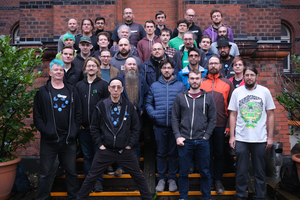











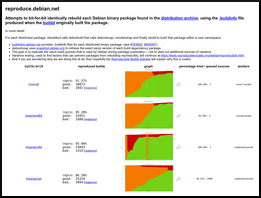
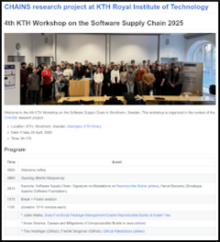
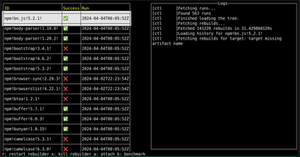







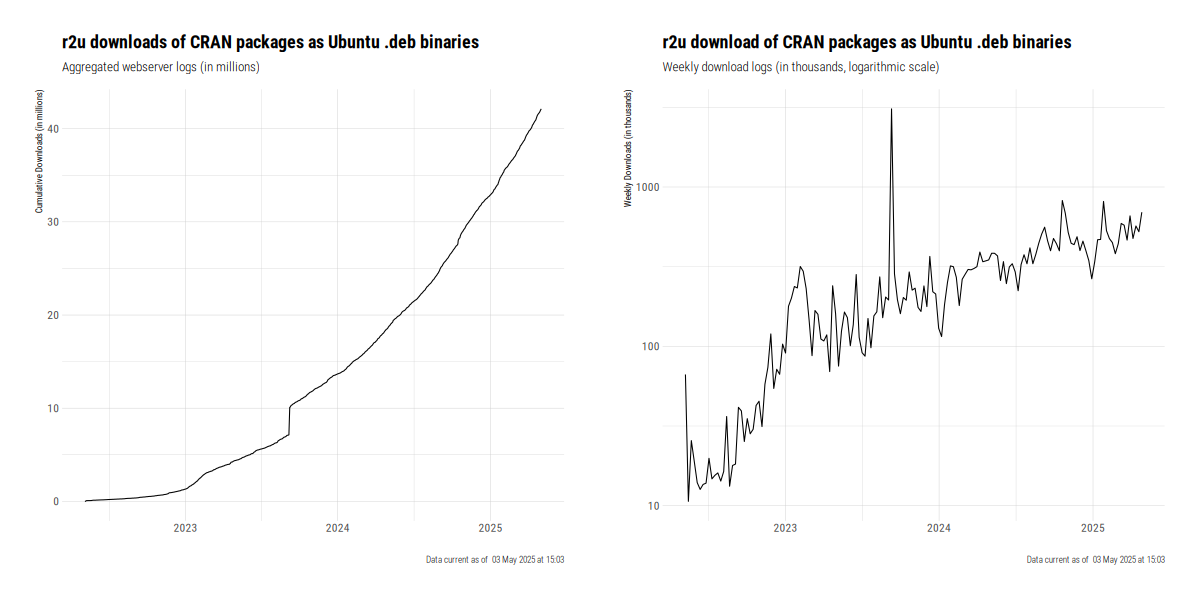 Usage is driven by deployment in continuous integration (as for
example the Ubuntu-use at GitHub makes this both an easy and obvious
choice), cloud computing (as it is easy to spin up Ubuntu instances, it
is as easy to add