Search Results: "hug"

21 February 2026

Jonathan Dowland: Lanzarote

I want to get back into the habit of blogging, but I've struggled. I've had several ideas of topics to try and write about, but I've not managed to put aside the time to do it. I thought I'd try and bash out a one-take, stream-of-conciousness-style post now, to get back into the swing. I'm writing from the lounge of my hotel room in Lanzarote, where my family have gone for the School break. The weather at home has been pretty awful this year, and this week is traditionally quite miserable at the best of times. It's been dry with highs of around 25 . It's been an unusual holiday in one respect: one of my kids is struggling with Autistic Burnout. We were really unsure whether taking her was a good idea: and certainly towards the beginning of the holiday felt we may have made a mistake. Writing now, at the end, I'm not so sure. But we're very unlikely to have anything resembling a traditional summer holiday for the foreseeable. Managing Autistic Burnout and the UK ways the UK healthcare and education systems manage it (or fail to) has been a huge part of my recent life. Perhaps I should write more about that. This coming week the government are likely to publish plans for reforming Special Needs support in Education. Like many other parents, we wait in hope and fear to see what they plan. In anticipation of spending a lot of time in the hotel room with my preoccupied daughter I (unusually) packed a laptop and set myself a nerd-task: writing a Pandoc parser ("reader") for the MoinMoin Wiki markup language. There's some unfinished prior art from around 2011 by Simon Michael (of hledger) to work from. The motivation was our plan to migrate the Debian Wiki away from MoinMoin. We've since decided to approach that differently but I might finish the Reader anyway, it's been an interesting project (and a nice excuse to write Haskell) and it will be useful for others. Unusually (for me) I've not been reading fiction on this trip: I took with me Human Compatible by Prof Stuart Russell: discussing how to solve the problem of controlling a future Artificial Intelligence. I've largely avoided the LLM hype cycle we're suffering through at the moment, and I have several big concerns about it (moral, legal, etc.), and felt it was time to try and make my concerns more well-formed and test them. This book has been a big help in doing so, although it doesn't touch on the issue of copyright, which is something I am particularly interested in at the moment.

3 February 2026

Valhalla's Things: A Day Off

Posted on February 3, 2026
Tags: madeof:atoms, madeof:bits
Today I had a day off. Some of it went great. Some less so. I woke up, went out to pay our tribute to NotOurCat, and it was snowing! yay! And I had a day off, so if it had snowed enough that shovelling was needed, I had time to do it (it didn t, it started to rain soon afterwards, but still, YAY snow!). Then I had breakfast, with the fruit rye bread I had baked yesterday, and I treated myself to some of the strong Irish tea I have left, instead of the milder ones I want to finish before buying more of the Irish. And then, I bought myself a fancy new expensive fountain pen. One that costs 16 ! more than three times as much as my usual ones! I hope it will work as well, but I m quite confident it should. I ll find out when it arrives from Germany (together with a few ink samples that will result in a future blog post with some SCIENCE). I decided to try and use bank transfers instead of my visa debit card when buying from online shops that give the option to do so: it s a tiny bit more effort, but it means I m paying 0.25 to my bank1 rather than the seller having to pay some unknown amount to an US based payment provider. Unluckily, the fountain pen website offered a huge number of payment methods, but not bank transfers. sigh. And then, I could start working a bit on the connecting wires for the LED strips for our living room: I soldered two pieces, six wires each (it s one RGB strip, 4 pins, and a warm white one requiring two more), then did a bit of tests, including writing some micropython code to add a test mode that lights up each colour in sequence, and the morning was almost gone. For some reason this project, as simple as it is, is taking forever. But it is showing progress. There was a break, when the postman delivered a package of chemicals 2 for a future project or two. There will be blog posts! After lunch I spent some time finishing eyelets on the outfit I wanted to wear this evening, as I had not been able to finish it during fosdem. This one will result in two blog posts! Meanwhile, in the morning I didn t remember the name of the program I used to load software on micropython boards such as the one that will control the LED strips (that s thonny), and while searching for it in the documentation, I found that there is also a command line program I can use, mpremote, and that s a much better fit for my preferences! I mentioned it in an xmpp room full of nerds, and one of them mentioned that he could try it on his Inkplate, when he had time, and I was nerd-sniped into trying it on mine, which had been sitting unused showing the temperatures in our old house on the last day it spent there and needs to be updated for the sensors in the new house. And that lead to the writing of some notes on how to set it up from the command line (good), and to the opening on one upstream issue (bad), because I have an old model, and the board-specific library isn t working. at all. And that s when I realized that it was 17:00, I still had to cook the bread I had been working on since yesterday evening (ciabatta, one of my favourites, but it needs almost one hour in the oven), the outfit I wanted to wear in the evening was still not wearable, the table needed cleaning and some panicking was due. Thankfully, my mother was cooking dinner, so I didn t have to do that too. I turned the oven on, sewed the shoulder seams of the bodice while spraying water on the bread every 5 minutes, and then while it was cooking on its own, started to attach a closure to the skirt, decided that a safety pin was a perfectly reasonable closure for the first day an outfit is worn, took care of the table, took care of the bread, used some twine to close the bodice, because I still haven t worked out what to use for laces, realized my bodkin is still misplaced, used a long and sharp and big needle meant for sewing mattresses instead of a bodkin, managed not to stab myself, and less than half an hour late we could have dinner. There was bread, there was Swedish crispbread, there were spreads (tuna, and beans), and vegetables, and then there was the cake that caused my mother to panic when she added her last honey to the milk and it curdled (my SO and I tried it, it had no odd taste, we decided it could be used) and it was good, although I had to get a second slice just to be 100% sure of it. And now I m exhausted, and I ve only done half of the things I had planned to do, but I d still say I ve had quite a good day.

  1. Banca Etica, so one that avoids any investment in weapons and a number of other problematic things.
  2. not food grade, except for one, but kitchen-safe.

19 January 2026

Russell Coker: Furilabs FLX1s

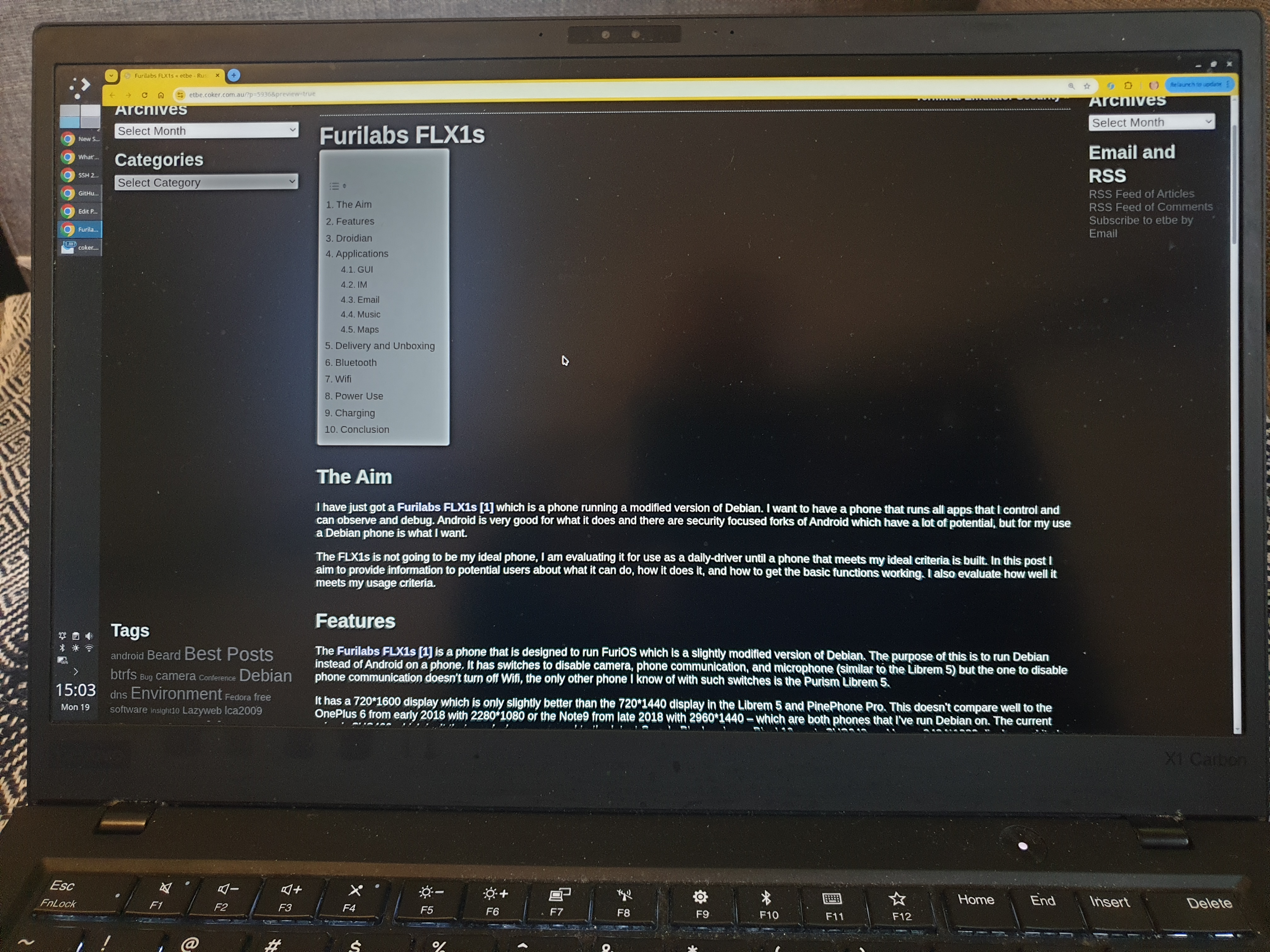
The Aim I have just got a Furilabs FLX1s [1] which is a phone running a modified version of Debian. I want to have a phone that runs all apps that I control and can observe and debug. Android is very good for what it does and there are security focused forks of Android which have a lot of potential, but for my use a Debian phone is what I want. The FLX1s is not going to be my ideal phone, I am evaluating it for use as a daily-driver until a phone that meets my ideal criteria is built. In this post I aim to provide information to potential users about what it can do, how it does it, and how to get the basic functions working. I also evaluate how well it meets my usage criteria. I am not anywhere near an average user. I don t think an average user would ever even see one unless a more technical relative showed one to them. So while this phone could be used by an average user I am not evaluating it on that basis. But of course the features of the GUI that make a phone usable for an average user will allow a developer to rapidly get past the beginning stages and into more complex stuff. Features The Furilabs FLX1s [1] is a phone that is designed to run FuriOS which is a slightly modified version of Debian. The purpose of this is to run Debian instead of Android on a phone. It has switches to disable camera, phone communication, and microphone (similar to the Librem 5) but the one to disable phone communication doesn t turn off Wifi, the only other phone I know of with such switches is the Purism Librem 5. It has a 720*1600 display which is only slightly better than the 720*1440 display in the Librem 5 and PinePhone Pro. This doesn t compare well to the OnePlus 6 from early 2018 with 2280*1080 or the Note9 from late 2018 with 2960*1440 which are both phones that I ve run Debian on. The current price is $US499 which isn t that good when compared to the latest Google Pixel series, a Pixel 10 costs $US649 and has a 2424*1080 display and it also has 12G of RAM while the FLX1s only has 8G. Another annoying thing is how rounded the corners are, it seems that round corners that cut off the content are a standard practice nowadays, in my collection of phones the latest one I found with hard right angles on the display was a Huawei Mate 10 Pro which was released in 2017. The corners are rounder than the Note 9, this annoys me because the screen is not high resolution by today s standards so losing the corners matters. The default installation is Phosh (the GNOME shell for phones) and it is very well configured. Based on my experience with older phone users I think I could give a phone with this configuration to a relative in the 70+ age range who has minimal computer knowledge and they would be happy with it. Additionally I could set it up to allow ssh login and instead of going through the phone support thing of trying to describe every GUI setting to click on based on a web page describing menus for the version of Android they are running I could just ssh in and run diff on the .config directory to find out what they changed. Furilabs have done a very good job of setting up the default configuration, while Debian developers deserve a lot of credit for packaging the apps the Furilabs people have chosen a good set of default apps to install to get it going and appear to have made some noteworthy changes to some of them. Droidian The OS is based on Android drivers (using the same techniques as Droidian [2]) and the storage device has the huge number of partitions you expect from Android as well as a 110G Ext4 filesystem for the main OS. The first issue with the Droidian approach of using an Android kernel and containers for user space code to deal with drivers is that it doesn t work that well. There are 3 D state processes (uninterrupteable sleep which usually means a kernel bug if the process remains in that state) after booting and doing nothing special. My tests running Droidian on the Note 9 also had D state processes, in this case they are D state kernel threads (I can t remember if the Note 9 had regular processes or kernel threads stuck in D state). It is possible for a system to have full functionality in spite of some kernel threads in D state but generally it s a symptom of things not working as well as you would hope. The design of Droidian is inherently fragile. You use a kernel and user space code from Android and then use Debian for the rest. You can t do everything the Android way (with the full OS updates etc) and you also can t do everything the Debian way. The TOW Boot functionality in the PinePhone Pro is really handy for recovery [3], it allows the internal storage to be accessed as a USB mass storage device. The full Android setup with ADB has some OK options for recovery, but part Android and part Debian has less options. While it probably is technically possible to do the same things in regard to OS repair and reinstall the fact that it s different from most other devices means that fixes can t be done in the same way. Applications GUI The system uses Phosh and Phoc, the GNOME system for handheld devices. It s a very different UI from Android, I prefer Android but it is usable with Phosh. IM Chatty works well for Jabber (XMPP) in my tests. It supports Matrix which I didn t test because I don t desire the same program doing Matrix and Jabber and because Matrix is a heavy protocol which establishes new security keys for each login so I don t want to keep logging in on new applications. Chatty also does SMS but I couldn t test that without the SIM caddy. I use Nheko for Matrix which has worked very well for me on desktops and laptops running Debian. Email I am currently using Geary for email. It works reasonably well but is lacking proper management of folders, so I can t just subscribe to the important email on my phone so that bandwidth isn t wasted on less important email (there is a GNOME gitlab issue about this see the Debian Wiki page about Mobile apps [4]). Music Music playing isn t a noteworthy thing for a desktop or laptop, but a good music player is important for phone use. The Lollypop music player generally does everything you expect along with support for all the encoding formats including FLAC0 a major limitation of most Android music players seems to be lack of support for some of the common encoding formats. Lollypop has it s controls for pause/play and going forward and backward one track on the lock screen. Maps The installed map program is gnome-maps which works reasonably well. It gets directions via the Graphhopper API [5]. One thing we really need is a FOSS replacement for Graphhopper in GNOME Maps. Delivery and Unboxing I received my FLX1s on the 13th of Jan [1]. I had paid for it on the 16th of Oct but hadn t received the email with the confirmation link so the order had been put on hold. But after I contacted support about that on the 5th of Jan they rapidly got it to me which was good. They also gave me a free case and screen protector to apologise, I don t usually use screen protectors but in this case it might be useful as the edges of the case don t even extend 0.5mm above the screen. So if it falls face down the case won t help much. When I got it there was an open space at the bottom where the caddy for SIMs is supposed to be. So I couldn t immediately test VoLTE functionality. The contact form on their web site wasn t working when I tried to report that and the email for support was bouncing. Bluetooth As a test of Bluetooth I connected it to my Nissan LEAF which worked well for playing music and I connected it to several Bluetooth headphones. My Thinkpad running Debian/Trixie doesn t connect to the LEAF and to headphones which have worked on previous laptops running Debian and Ubuntu. A friend s laptop running Debian/Trixie also wouldn t connect to the LEAF so I suspect a bug in Trixie, I need to spend more time investigating this. Wifi Currently 5GHz wifi doesn t work, this is a software bug that the Furilabs people are working on. 2.4GHz wifi works fine. I haven t tested running a hotspot due to being unable to get 4G working as they haven t yet shipped me the SIM caddy. Docking This phone doesn t support DP Alt-mode or Thunderbolt docking so it can t drive an external monitor. This is disappointing, Samsung phones and tablets have supported such things since long before USB-C was invented. Samsung DeX is quite handy for Android devices and that type feature is much more useful on a device running Debian than on an Android device. Camera The camera works reasonably well on the FLX1s. Until recently for the Librem 5 the camera didn t work and the camera on my PinePhone Pro currently doesn t work. Here are samples of the regular camera and the selfie camera on the FLX1s and the Note 9. I think this shows that the camera is pretty decent. The selfie looks better and the front camera is worse for the relatively close photo of a laptop screen taking photos of computer screens is an important part of my work but I can probably work around that. I wasn t assessing this camera t find out if it s great, just to find out if I have the sorts of problems I had before and it just worked. The Samsung Galaxy Note series of phones has always had decent specs including good cameras. Even though the Note 9 is old comparing to it is a respectable performance. The lighting was poor for all photos. FLX1s
Note 9
Power Use In 93 minutes having the PinePhone Pro, Librem 5, and FLX1s online with open ssh sessions from my workstation the PinePhone Pro went from 100% battery to 26%, the Librem 5 went from 95% to 69%, and the FLX1s went from 100% to 99%. The battery discharge rate of them was reported as 3.0W, 2.6W, and 0.39W respectively. Based on having a 16.7Wh battery 93 minutes of use should have been close to 4% battery use, but in any case all measurements make it clear that the FLX1s will have a much longer battery life. Including the measurement of just putting my fingers on the phones and feeling the temperature (FLX1s felt cool and the others felt hot). The PinePhone Pro and the Librem 5 have an optional Caffeine mode which I enabled for this test, without that enabled the phone goes into a sleep state and disconnects from Wifi. So those phones would use much less power with caffeine mode enabled, but they also couldn t get fast response to notifications etc. I found the option to enable a Caffeine mode switch on the FLX1s but the power use was reported as being the same both with and without it. Charging One problem I found with my phone is that in every case it takes 22 seconds to negotiate power. Even when using straight USB charging (no BC or PD) it doesn t draw any current for 22 seconds. When I connect it it will stay at 5V and varying between 0W and 0.1W (current rounded off to zero) for 22 seconds or so and then start charging. After the 22 second display the phone will make the tick sound indicating that it s charging and the power meter will measure that it s drawing some current. I added the table from my previous post about phone charging speed [6] with an extra row for the FLX1s. For charging from my PC USB ports the results were the worst ever, the port that does BC did not work at all it was looping trying to negotiate after a 22 second negotiation delay the port would turn off. The non-BC port gave only 2.4W which matches the 2.5W given by the spec for a High-power device which is what that port is designed to give. In a discussion on the Purism forum about the Librem5 charging speed one of their engineers told me that the reason why their phone would draw 2A from that port was because the cable was identifying itself as a USB-C port not a High-power device port. But for some reason out of the 7 phones I tested the FLX1s and the One Plus 6 are the only ones to limit themselves to what the port is apparently supposed to do. Also the One Plus 6 charges slowly on every power supply so I don t know if it is obeying the spec or just sucking. On a cheap AliExpress charger the FLX1s gets 5.9V and on a USB battery it gets 5.8V. Out of all 42 combinations of device and charger I tested these were the only ones to involve more than 5.1V but less than 9V. I welcome comments suggesting an explanation. The case that I received has a hole for the USB-C connector that isn t wide enough for the plastic surrounds on most of my USB-C cables (including the Dell dock). Also to make a connection requires a fairly deep insertion (deeper than the One Plus 6 or the Note 9). So without adjustment I have to take the case off to charge it. It s no big deal to adjust the hole (I have done it with other cases) but it s an annoyance.
Phone Top z640 Bottom Z640 Monitor Ali Charger Dell Dock Battery Best Worst
FLX1s FAIL 5.0V 0.49A 2.4W 4.8V 1.9A 9.0W 5.9V 1.8A 11W 4.8V 2.1A 10W 5.8V 2.1A 12W 5.8V 2.1A 12W 5.0V 0.49A 2.4W
Note9 4.8V 1.0A 5.2W 4.8V 1.6A 7.5W 4.9V 2.0A 9.5W 5.1V 1.9A 9.7W 4.8V 2.1A 10W 5.1V 2.1A 10W 5.1V 2.1A 10W 4.8V 1.0A 5.2W
Pixel 7 pro 4.9V 0.80A 4.2W 4.8V 1.2A 5.9W 9.1V 1.3A 12W 9.1V 1.2A 11W 4.9V 1.8A 8.7W 9.0V 1.3A 12W 9.1V 1.3A 12W 4.9V 0.80A 4.2W
Pixel 8 4.7V 1.2A 5.4W 4.7V 1.5A 7.2W 8.9V 2.1A 19W 9.1V 2.7A 24W 4.8V 2.3A 11.0W 9.1V 2.6A 24W 9.1V 2.7A 24W 4.7V 1.2A 5.4W
PPP 4.7V 1.2A 6.0W 4.8V 1.3A 6.8W 4.9V 1.4A 6.6W 5.0V 1.2A 5.8W 4.9V 1.4A 5.9W 5.1V 1.2A 6.3W 4.8V 1.3A 6.8W 5.0V 1.2A 5.8W
Librem 5 4.4V 1.5A 6.7W 4.6V 2.0A 9.2W 4.8V 2.4A 11.2W 12V 0.48A 5.8W 5.0V 0.56A 2.7W 5.1V 2.0A 10W 4.8V 2.4A 11.2W 5.0V 0.56A 2.7W
OnePlus6 5.0V 0.51A 2.5W 5.0V 0.50A 2.5W 5.0V 0.81A 4.0W 5.0V 0.75A 3.7W 5.0V 0.77A 3.7W 5.0V 0.77A 3.9W 5.0V 0.81A 4.0W 5.0V 0.50A 2.5W
Best 4.4V 1.5A 6.7W 4.6V 2.0A 9.2W 8.9V 2.1A 19W 9.1V 2.7A 24W 4.8V 2.3A 11.0W 9.1V 2.6A 24W
Conclusion The Furilabs support people are friendly and enthusiastic but my customer experience wasn t ideal. It was good that they could quickly respond to my missing order status and the missing SIM caddy (which I still haven t received but believe is in the mail) but it would be better if such things just didn t happen. The phone is quite user friendly and could be used by a novice. I paid $US577 for the FLX1s which is $AU863 by today s exchange rates. For comparison I could get a refurbished Pixel 9 Pro Fold for $891 from Kogan (the major Australian mail-order company for technology) or a refurbished Pixel 9 Pro XL for $842. The Pixel 9 series has security support until 2031 which is probably longer than you can expect a phone to be used without being broken. So a phone with a much higher resolution screen that s only one generation behind the latest high end phones and is refurbished will cost less. For a brand new phone a Pixel 8 Pro which has security updates until 2030 costs $874 and a Pixel 9A which has security updates until 2032 costs $861. Doing what the Furilabs people have done is not a small project. It s a significant amount of work and the prices of their products need to cover that. I m not saying that the prices are bad, just that economies of scale and the large quantity of older stock makes the older Google products quite good value for money. The new Pixel phones of the latest models are unreasonably expensive. The Pixel 10 is selling new from Google for $AU1,149 which I consider a ridiculous price that I would not pay given the market for used phones etc. If I had a choice of $1,149 or a feature phone I d pay $1,149. But the FLX1s for $863 is a much better option for me. If all I had to choose from was a new Pixel 10 or a FLX1s for my parents I d get them the FLX1s. For a FOSS developer a FLX1s could be a mobile test and development system which could be lent to a relative when their main phone breaks and the replacement is on order. It seems to be fit for use as a commodity phone. Note that I give this review on the assumption that SMS and VoLTE will just work, I haven t tested them yet. The UI on the FLX1s is functional and easy enough for a new user while allowing an advanced user to do the things they desire. I prefer the Android style and the Plasma Mobile style is closer to Android than Phosh is, but changing it is something I can do later. Generally I think that the differences between UIs matter more when on a desktop environment that could be used for more complex tasks than on a phone which limits what can be done by the size of the screen. I am comparing the FLX1s to Android phones on the basis of what technology is available. But most people who would consider buying this phone will compare it to the PinePhone Pro and the Librem 5 as they have similar uses. The FLX1s beats both those phones handily in terms of battery life and of having everything just work. But it has the most non free software of the three and the people who want the $2000 Librem 5 that s entirely made in the US won t want the FLX1s. This isn t the destination for Debian based phones, but it s a good step on the way to it and I don t think I ll regret this purchase.

11 January 2026

Otto Kek l inen: Stop using MySQL in 2026, it is not true open source

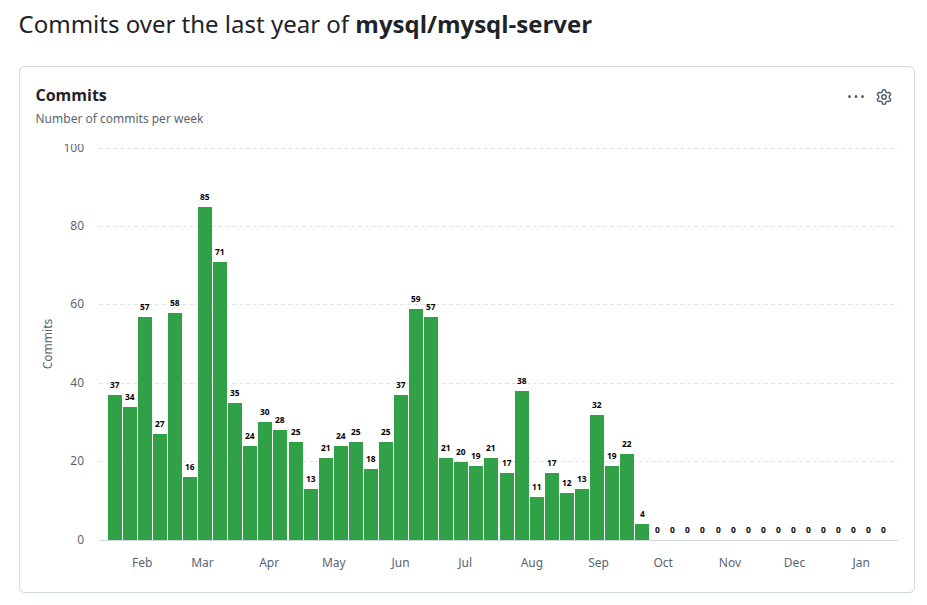
Featured image of post Stop using MySQL in 2026, it is not true open sourceIf you care about supporting open source software, and still use MySQL in 2026, you should switch to MariaDB like so many others have already done. The number of git commits on github.com/mysql/mysql-server has been significantly declining in 2025. The screenshot below shows the state of git commits as of writing this in January 2026, and the picture should be alarming to anyone who cares about software being open source. MySQL GitHub commit activity decreasing drastically

This is not surprising Oracle should not be trusted as the steward for open source projects When Oracle acquired Sun Microsystems and MySQL along with it back in 2009, the European Commission almost blocked the deal due to concerns that Oracle s goal was just to stifle competition. The deal went through as Oracle made a commitment to keep MySQL going and not kill it, but (to nobody s surprise) Oracle has not been a good steward of MySQL as an open source project and the community around it has been withering away for years now. All development is done behind closed doors. The publicly visible bug tracker is not the real one Oracle staff actually uses for MySQL development, and the few people who try to contribute to MySQL just see their Pull Requests and patch submissions marked as received with mostly no feedback and then those changes may or may not be in the next MySQL release, often rewritten, and with only Oracle staff in the git author/committer fields. The real author only gets a small mention in a blog post. When I was the engineering manager for the core team working on RDS MySQL and RDS MariaDB at Amazon Web Services, I oversaw my engineers contributions to both MySQL and MariaDB (the latter being a fork of MySQL by the original MySQL author, Michael Widenius). All the software developers in my org disliked submitting code to MySQL due to how bad the reception by Oracle was to their contributions. MariaDB is the stark opposite with all development taking place in real-time on github.com/mariadb/server, anyone being able to submit a Pull Request and get a review, all bugs being openly discussed at jira.mariadb.org and so forth, just like one would expect from a true open source project. MySQL is open source only by license (GPL v2), but not as a project.

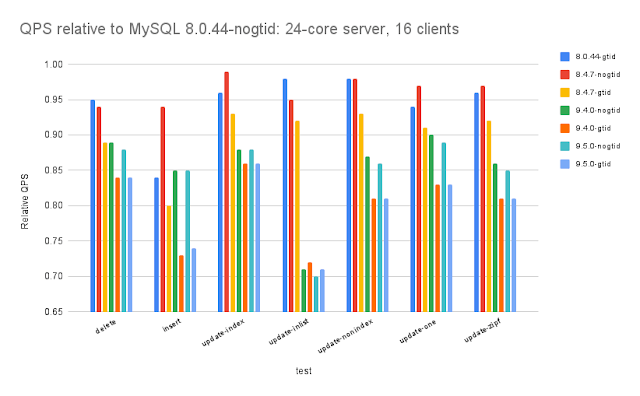
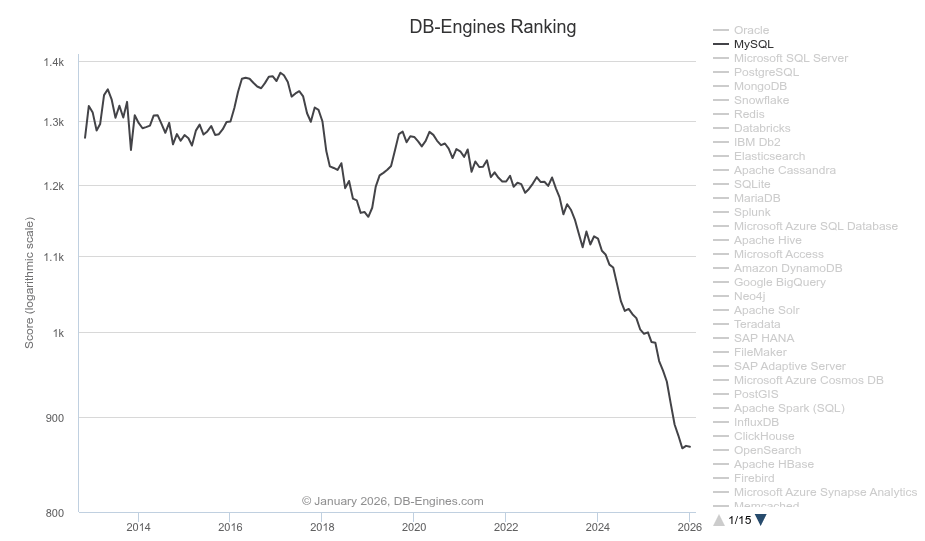
MySQL s technical decline in recent years Despite not being a good open source steward, Oracle should be given credit that it did keep the MySQL organization alive and allowed it to exist fairly independently and continue developing and releasing new MySQL versions well over a decade after the acquisition. I have no insight into how many customers they had, but I assume the MySQL business was fairly profitable and financially useful to Oracle, at least as long as it didn t gain too many features to threaten Oracle s own main database business. I don t know why, perhaps because too many talented people had left the organization, but it seems that from a technical point of view MySQL clearly started to deteriorate from 2022 onward. When MySQL 8.0.29 was released with the default ALTER TABLE method switched to run in-place, it had a lot of corner cases that didn t work, causing the database to crash and data to corrupt for many users. The issue wasn t fully fixed until a year later in MySQL 8.0.32. To many users annoyance Oracle announced the 8.0 series as evergreen and introduced features and changes in the minor releases, instead of just doing bugfixes and security fixes like users historically had learnt to expect from these x.y.Z maintenance releases. There was no new major MySQL version for six years. After MySQL 8.0 in 2018 it wasn t until 2023 when MySQL 8.1 was released, and it was just a short-term preview release. The first actual new major release MySQL 8.4 LTS was released in 2024. Even though it was a new major release, many users got disappointed as it had barely any new features. Many also reported degraded performance with newer MySQL versions, for example the benchmark by famous MySQL performance expert Mark Callaghan below shows that on write-heavy workloads MySQL 9.5 throughput is typically 15% less than in 8.0. Benchmark showing new MySQL versions being slower than the old Due to newer MySQL versions deprecating many features, a lot of users also complained about significant struggles regarding both MySQL 5.7->8.0 and 8.0->8.4 upgrades. With few new features and heavy focus on code base cleanup and feature deprecation, it became obvious to many that Oracle had decided to just keep MySQL barely alive, and put all new relevant features (e.g. vector search) into Heatwave, Oracle s closed-source and cloud-only service for MySQL customers. As it was evident that Oracle isn t investing in MySQL, Percona s Peter Zaitsev wrote Is Oracle Finally Killing MySQL in June 2024. At this time MySQL s popularity as ranked by DB-Engines had also started to tank hard, a trend that likely accelerates in 2026. MySQL dropping significantly in DB-Engines ranking In September 2025 news reported that Oracle was reducing its workforce and that the MySQL staff was getting heavily reduced. Obviously this does not bode well for MySQL s future, and Peter Zaitsev posted already in November stats showing that the latest MySQL maintenance release contained fewer bug fixes than before.

Open source is more than ideology: it has very real effects on software security and sovereignty Some say they don t care if MySQL is truly open source or not, or that they don t care if it has a future in coming years, as long as it still works now. I am afraid people thinking so are taking a huge risk. The database is often the most critical part of a software application stack, and any flaw or problem in operations, let alone a security issue, will have immediate consequences, and not caring will eventually get people fired or sued. In open source problems are discussed openly, and the bigger the problem, the more people and companies will contribute to fixing it. Open source as a development methodology is similar to the scientific method with free flow of ideas that are constantly contested and only the ones with the most compelling evidence win. Not being open means more obscurity, more risk and more just trust us bro attitude. This open vs. closed is very visible for example in how Oracle handles security issues. We can see that in 2025 alone MySQL published 123 CVEs about security issues, while MariaDB had 8. There were 117 CVEs that only affected MySQL and not MariaDB in 2025. I haven t read them all, but typically the CVEs hardly contain any real details. As an example, the most recent one CVE-2025-53067 states Easily exploitable vulnerability allows high privileged attacker with network access via multiple protocols to compromise MySQL Server. There is no information a security researcher or auditor could use to verify if any original issue actually existed, or if it was fixed, or if the fix was sufficient and fully mitigating the issue or not. MySQL users just have to take the word of Oracle that it is all good now. Handling security issues like this is in stark contrast to other open source projects, where all security issues and their code fixes are open for full scrutiny after the initial embargo is over and CVE made public. There is also various forms of enshittification going on one would not see in a true open source project, and everything about MySQL as a software, documentation and website is pushing users to stop using the open source version and move to the closed MySQL versions, and in particular to Heatwave, which is not only closed-source but also results in Oracle fully controlling customer s databases contents. Of course, some could say this is how Oracle makes money and is able to provide a better product. But stories on Reddit and elsewhere suggest that what is going on is more like Oracle milking hard the last remaining MySQL customers who are forced to pay more and more for getting less and less.

There are options and migrating is easy, just do it A large part of MySQL users switched to MariaDB already in the mid-2010s, in particular everyone who had cared deeply about their database software staying truly open source. That included large installations such as Wikipedia, and Linux distributions such as Fedora and Debian. Because it s open source and there is no centralized machine collecting statistics, nobody knows what the exact market shares look like. There are however some application specific stats, such as that 57% of WordPress sites around the world run MariaDB, while the share for MySQL is 42%. For anyone running a classic LAMP stack application such as WordPress, Drupal, Mediawiki, Nextcloud, or Magento, switching the old MySQL database to MariaDB is be straightforward. As MariaDB is a fork of MySQL and mostly backwards compatible with it, swapping out MySQL for MariaDB can be done without changing any of the existing connectors or database clients, as they will continue to work with MariaDB as if it was MySQL. For those running custom applications and who have the freedom to make changes to how and what database is used, there are tens of mature and well-functioning open source databases to choose from, with PostgreSQL being the most popular general database. If your application was built from the start for MySQL, switching to PostgreSQL may however require a lot of work, and the MySQL/MariaDB architecture and storage engine InnoDB may still offer an edge in e.g. online services where high performance, scalability and solid replication features are of highest priority. For a quick and easy migration MariaDB is probably the best option. Switching from MySQL to the Percona Server is also very easy, as it closely tracks all changes in MySQL and deviates from it only by a small number of improvements done by Percona. However, also precisely because of it being basically just a customized version of the MySQL Server, it s not a viable long-term solution for those trying to fully ditch the dependency on Oracle. There are also several open source databases that have no common ancestry with MySQL, but strive to be MySQL-compatible. Thus most apps built for MySQL can simply switch to using them without needing SQL statements to be rewritten. One such database is TiDB, which has been designed from scratch specifically for highly scalable and large systems, and is so good that even Amazon s latest database solution DSQL was built borrowing many ideas from TiDB. However, TiDB only really shines with larger distributed setups, so for the vast majority of regular small- and mid-scale applications currently using MySQL, the most practical solution is probably to just switch to MariaDB, which on most Linux distributions can simply be installed by running apt/dnf/brew install mariadb-server. Whatever you end up choosing, as long as it is not Oracle, you will be better off.

5 January 2026

Jonathan McDowell: Free Software Activities for 2025

Given we ve entered a new year it s time for my annual recap of my Free Software activities for the previous calendar year. For previous years see 2019, 2020, 2021, 2022, 2023 + 2024.

Conferences My first conference of the year was FOSDEM. I d submitted a talk proposal about system attestation in production environments for the attestation devroom, but they had a lot of good submissions and mine was a bit more this is how we do it rather than here s some neat Free Software that does it . I m still trying to work out how to make some of the bits we do more open, but the problem is a lot of the neat stuff is about taking internal knowledge about what should be running and making sure that s the case, and what you end up with if you abstract that is a toolkit that still needs a lot of work to get something useful. I d more luck at DebConf25 where I gave a talk (Don t fear the TPM) trying to explain how TPMs could be useful in a Debian context. Naturally the comments section descended into a discussion about UEFI Secure Boot, which is a separate, if related, thing. DebConf also featured the usual catch up with fellow team members, hanging out with folk I hadn t seen in ages, and generally feeling a bit more invigorated about Debian. Other conferences I considered, but couldn t justify, were All Systems Go! and the Linux Plumbers Conference. I ve no doubt both would have had a bunch of interesting and relevant talks + discussions, but not enough this year. I m going to have to miss FOSDEM this year, due to travel later in the month, and I m uncertain if I m going to make DebConf (for a variety of reasons). That means I don t have a Free Software conference planned for 2026. Ironically FOSSY moving away from Portland makes it a less appealing option (I have Portland friends it would be good to visit). Other than potential Debian MiniConfs, anything else European I should consider?

Debian I continue to try and keep RetroArch in shape, with 1.22.2+dfsg-1 (and, shortly after, 1.22.2+dfsg-2 - git-buildpackage in trixie seems more strict about Build-Depends existing in the outside environment, and I keep forgetting I need Build-Depends-Arch and Build-Depends-Indep to be pretty much the same with a minimal Build-Depends that just has enough for the clean target) getting uploaded in December, and 1.20.0+dfsg-1, 1.20+dfsg-2 + 1.20+dfsg-3 all being uploaded earlier in the year. retroarch-assets had 1.20.0+dfsg-1 uploaded back in April. I need to find some time to get 1.22.0 packaged. libretro-snes9x got updated to 1.63+dfsg-1. sdcc saw 4.5.0+dfsg-1, 4.5.0+dfsg-2, 4.5.0+dfsg-3 (I love major GCC upgrades) and 4.5.0-dfsg-4 uploads. There s an outstanding bug around a LaTeX error building the manual, but this turns out to be a bug in the 2.5 RC for LyX. Huge credit to Tobias Quathamer for engaging with this, and Pavel Sanda + J rgen Spitzm ller from the LyX upstream for figuring out the issue + a fix. Pulseview saw 0.4.2-4 uploaded to fix issues with the GCC 15 + CMake upgrades. I should probably chase the sigrok upstream about new releases; I think there are a bunch of devices that have gained support in git without seeing a tagged release yet. I did an Electronics Team upload for gputils 1.5.2-2 to fix compilation with GCC 15. While I don t do a lot with storage devices these days if I can help it I still pay a little bit of attention to sg3-utils. That resulted in 1.48-2 and 1.48-3 uploads in 2025. libcli got a 1.10.7-3 upload to deal with the libcrypt-dev split out. Finally I got more up-to-date versions of libtorrent (0.15.7-1) and rtorrent (also 0.15.7-1) uploaded to experimental. There s a ppc64el build failure in libtorrent, but having asked on debian-powerpc this looks like a flaky test/code and I should probably go ahead and upload to unstable. I sponsored some uploads for Michel Lind - the initial uploads of plymouth-theme-hot-dog, and the separated out pykdumpfile package. Recognising the fact I wasn t contributing in a useful fashion to the Data Protection Team I set about trying to resign in an orderly fashion - see Andreas call for volunteers that went out in the last week. Shout out to Enrico for pointing out in the past that we should gracefully step down from things we re not actually managing to do, to avoid the perception it s all fine and no one else needs to step up. Took me too long to act on it. The Debian keyring team continues to operate smoothly, maintaining our monthly release cadence with a 3 month rotation ensuring all team members stay familiar with the process, and ensure their setups are still operational (especially important after Debian releases). I handled the 2025.03.23, 2025.06.24, 2025.06.27, 2025.09.18, 2025.12.08 + 2025.12.26 pushes.

Linux TPM related fixes were the theme of my kernel contributions in 2025, all within a work context. Some were just cleanups, but several fixed real issues that were causing us issues. I ve also tried to be more proactive about reviewing diffs in the TPM subsystem; it feels like a useful way to contribute, as well as making me more actively pay attention to what s going on there.

Personal projects I did some work on onak, my OpenPGP keyserver. That resulted in a 0.6.4 release, mainly driven by fixes for building with more recent CMake + GCC versions in Debian. I ve got a set of changes that should add RFC9580 (v6) support, but there s not a lot of test keys out there at present for making sure I m handling things properly. Equally there s a plan to remove Berkeley DB from Debian, which I m completely down with, but that means I need a new primary backend. I ve got a draft of LMDB support to replace that, but I need to go back and confirm I ve got all the important bits implemented before publishing it and committing to a DB layout. I d also like to add sqlite support as an option, but that needs some thought about trying to take proper advantage of its features, rather than just treating it as a key-value store. (I know everyone likes to hate on OpenPGP these days, but I continue to be interested by the whole web-of-trust piece of it, which nothing else I m aware of offers.) That about wraps up 2025. Nothing particularly earth shaking in there, more a case of continuing to tread water on the various things I m involved. I highly doubt 2026 will be much different, but I think that s ok. I scratch my own itches, and if that helps out other folk too then that s lovely, but not the primary goal.

3 January 2026

Russ Allbery: Review: Challenges of the Deeps

Review: Challenges of the Deeps, by Ryk E. Spoor
Series: Arenaverse #3
Publisher: Baen
Copyright: March 2017
ISBN: 1-62579-564-5
Format: Kindle
Pages: 438
Challenges of the Deeps is the third book in the throwback space opera Arenaverse series. It is a direct sequel to Spheres of Influence, but Spoor provides a substantial recap of the previous volumes for those who did not read the series in close succession (thank you!). Ariane has stabilized humanity's position in the Arena with yet another improbable victory. (If this is a spoiler for previous volumes, so was telling you the genre of the book.) Now is a good opportunity to fulfill the promise humanity made to their ally Orphan: accompaniment on a journey into the uncharted deeps of the Arena for reasons that Orphan refuses to explain in advance. Her experienced crew provide multiple options to serve as acting Leader of Humanity until she gets back. What can go wrong? The conceit of this series is that as soon as a species achieves warp drive technology, their ships are instead transported into the vast extradimensional structure of the Arena where a godlike entity controls the laws of nature and enforces a formal conflict resolution process that looks alternatingly like a sporting event, a dueling code, and technology-capped total war. Each inhabitable system in the real universe seems to correspond to an Arena sphere, but the space between them is breathable atmosphere filled with often-massive storms. In other words, this is an airship adventure as written by E.E. "Doc" Smith. Sort of. There is an adventure, and there are a lot of airships (although they fight mostly like spaceships), but much of the action involves tense mental and physical sparring with a previously unknown Arena power with unclear motives. My general experience with this series is that I find the Arena concept fascinating and want to read more about it, Spoor finds his much-less-original Hyperion Project in the backstory of the characters more fascinating and wants to write about that, and we reach a sort of indirect, grumbling (on my part) truce where I eagerly wait for more revelations about the Arena and roll my eyes at the Hyperion stuff. Talking about Hyperion in detail is probably a spoiler for at least the first book, but I will say that it's an excuse to embed versions of literary characters into the story and works about as well as most such excuses (not very). The characters in question are an E.E. "Doc" Smith mash-up, a Monkey King mash-up, and a number of other characters that are obviously references to something but for whom I lack enough hints to place (which is frustrating). Thankfully we get far less human politics and a decent amount of Arena world-building in this installment. Hyperion plays a role, but mostly as foreshadowing for the next volume and the cause of a surprising interaction with Arena rules. One of the interesting wrinkles of this series is that humanity have an odd edge against the other civilizations in part because we're borderline insane sociopaths from the perspective of the established powers. That's an old science fiction trope, but I prefer it to the Campbell-style belief in inherent human superiority. Old science fiction tropes are what you need to be in the mood for to enjoy this series. This is an unapologetic and intentional throwback to early pulp: individuals who can be trusted with the entire future of humanity because they're just that moral, super-science, psychic warfare, and even coruscating beams that would make E.E. "Doc" Smith proud. It's an occasionally glorious but mostly silly pile of technobabble, but Spoor takes advantage of the weird, constructed nature of the Arena to provide more complex rules than competitive superlatives. The trick is that while this is certainly science fiction pulp, it's also a sort of isekai novel. There's a lot of anime and manga influence just beneath the surface. I'm not sure why it never occurred to me before reading this series that melodramatic anime and old SF pulps have substantial aesthetic overlap, but of course they do. I loved the Star Blazers translated anime that I watched as a kid precisely because it had the sort of dramatic set pieces that make the Lensman novels so much fun. There is a bit too much Wu Kong in this book for me (although the character is growing on me a little), and some of the maneuvering around the mysterious new Arena actor drags on longer than was ideal, but the climax is great stuff if you're in the mood for dramatic pulp adventure. The politics do not bear close examination and the writing is serviceable at best, but something about this series is just fun. I liked this book much better than Spheres of Influence, although I wish Spoor would stop being so coy about the nature of the Arena and give us more substantial revelations. I'm also now tempted to re-read Lensman, which is probably a horrible idea. (Spoor leaves the sexism out of his modern pulp.) If you got through Spheres of Influence with your curiosity about the Arena intact, consider this one when you're in the mood for modern pulp, although don't expect any huge revelations. It's not the best-written book, but it sits squarely in the center of a genre and mood that's otherwise a bit hard to find. Followed by the Kickstarter-funded Shadows of Hyperion, which sadly looks like it's going to concentrate on the Hyperion Project again. I will probably pick that up... eventually. Rating: 6 out of 10

Louis-Philippe V ronneau: 2025 A Musical Retrospective

2026 already! The winter weather here has really been beautiful and I always enjoy this time of year. Writing this yearly musical retrospective has now become a beloved tradition of mine1 and I enjoy retracing the year's various events through albums I listened to and concerts I went to. Albums In 2025, I added 141 new albums to my collection, around 60% more than last year's haul. I think this might have been too much? I feel like I didn't have time to properly enjoy all of them and as such, I decided to slow down my acquisition spree sometimes in early December, around the time I normally do the complete opposite. This year again, I bought the vast majority of my music on Bandcamp. Most of the other albums I bought as CDs and ripped them. Concerts In 2025, I went to the following 25 (!!) concerts: Although I haven't touched metalfinder's code in a good while, my instance still works very well and I get the occasional match when a big-name artist in my collection comes in town. Most the venues that advertise on Bandsintown are tied to Ticketmaster though, which means most underground artists (i.e. most of the music I listen to) end up playing elsewhere. As such, shout out again to the Gancio project and to the folks running the Montreal instance. It continues to be a smash hit and most of the interesting concerts end up being advertised there. See you all in 2026!

  1. see the 2022, 2023 and 2024 entries

31 December 2025

Bits from Debian: DebConf26 dates announced

Alt Debconf26 by Romina Molina As announced in Brest, France, in July, the Debian Conference is heading to Santa Fe, Argentina. The DebConf26 team and the local organizers team in Argentina are excited to announce Debconf26 dates, the 27th edition of the Debian Developers and Contributors Conference: DebCamp, the annual hacking session, will run from Monday July 13th to Sunday to July 19th 2026, followed by DebConf from Monday July 20th to Saturday July 25th 2026. For all those who wish to meet us in Santa Fe, the next step will be the opening of registration on January 26, 2026. The call for proposals period for anyone wishing to submit a conference or event proposal will be launched on the same day. DebConf26 is looking for sponsors; if you are interested or think you know of others who would be willing to help, please have a look at our sponsorship page and get in touch with sponsors@debconf.org. About Debian The Debian Project was founded in 1993 by Ian Murdock to be a truly free community project. Since then the project has grown to be one of the largest and most influential Open Source projects. Thousands of volunteers from all over the world work together to create and maintain Debian software. Available in 70 languages, and supporting a huge range of computer types, Debian calls itself the universal operating system. About DebConf DebConf is the Debian Project's developer conference. In addition to a full schedule of technical, social and policy talks, DebConf provides an opportunity for developers, contributors and other interested people to meet in person and work together more closely. It has taken place annually since 2000 in locations as varied as Scotland, Bosnia and Herzegovina, India, Korea. More information about DebConf is available from https://debconf.org/. For further information, please visit the DebConf26 web page at https://debconf26.debconf.org/ or send mail to press@debian.org. Debconf26 is made possible by Proxmox and others.

Petter Reinholdtsen: Some of my 2025 free software activities

I guess it is about time I posted a new summary of the free software and open culture activites and projects I have been involved in the last year. The days have been so packed the last year that I have failed with my intention to post at least one blog post per month, so this summary became rather long. I am sorry about this. This year was the year I got tired of the lack of new releases of the multimedia related libraries published via Xiph, and I decided to wrap up the current state and make the releases myself. In a burst of activity early this year, I collected and tested patches, coordinated with other developers and finally made new tarballs and release announcement for theora, and new tarball releases for liboggz, kate and fishsound. This upstreamed several patches accumulated in Debian and other Linux distributions for the last 15 years or so. To change the world and the future, it is important to start with the kids, and one such avenue of change have been created by the current president of FSF Europe, Matthias Kirschner. He wrote a book for children, Ada & Zangemann, and I have been involved in its translation framework for the entire year. The source code has been transformed to Docbook and I have been conducting and coordinating translations into Norwegian Bokm l and Nynorsk, as well as preparing paper editions of the book and an animation movie with Norwegian voices. The Bokm l edition is very close to ready, and will be available early in 2026, and the movie release will follow shortly after this. I intend announce this on my blog and elsewhere when this happen. Please get in touch if you want to help spread the word about this book in Norwegian. I hope we can get the author to Norway when making the Norwegian releases. This year I continued a push for the system I made a few years ago to improve hardware dongle handling on Linux. The Isenkram system use hardware mapping information provided by relevant packages using the AppStream system to propose which Linux distribution packages to install on a given machine to support dongles like cameras, finger print readers, smart card readers, LEGO controllers, ECC memory and other hardware. I have followed up on the list of packages providing such mapping, either to get it into Debian or to upstream the necessary metadata. I am not sure if we are at a point where package maintainers on their own add such information to their packages, but there are Debian lintian reports suggesting it and I have send patches to all packages I am aware of that should include such mappings. Most of the patches are included in Debian now, only 27 was left the last time I checked. As part of my involvement with Debian, I continued my push to get all orphaned packages without a version control repository migrated to git. I am not sure how many packages I went through, but it was in the range of 200-300 packages. In addition to this I updated, sponsored, pushed maintainers for updates upstreamed patches for and fixed RC issues with battery-stats, bs1770gain, isenkram, libonvif, mfiutil, opensnitch, simplescreenrecorder, vlc-plugin-bittorrent and wakeonlan. I've also followed up LEGO related packages, dahdi support for Asterisk, llama.cpp and whisper.cpp in particular for the AMD GPU I was donated by AMD, as well as tried yet again to convince the upstream developers of the photogrammetric workstion e-foto to get their program into a state that could be included in Debian. As I do not buy into the story that it is great to expose oneself to the whims of and priorities of commercial entities to have access to cultural expressions like films and music, I still maintain a huge collection of movies. For this to work well, I have ended up as part of the people maintaining lsdvd upstream and wrapped up a new release fixing several crash bugs caused by DVDs with intentionally broken metadata, and introduced code to list a DVD ID in the lsdvd output. Related to this, I have also worked some add-ons for my main video and music player, and took over upstream maintenance of the Invidious add-on, which sadly stopped working for non-authenticated users when web scrapers made it impossible for Invidious installations to provide a open API, as well as contributed to the NRK and projector control add-ons. As part of my involvement in the Norwegian archiving community and standardisation work, we organised a Noark 5 workshop this spring discussing how to decide what to keep and what to delete in digital archives. We finally managed to apply for Noark 5 certification for the free software archive API Nikita, as well as worked to test and improve the performance of Nikita together with people on my day job at the university. Manufacturing using Free Software is still a focus for me, and I have continued my involved with the LinuxCNC community, organising a developer gathering this summer with the help and sponsoring from the initial start in 2023 from NUUG Foundation and sponsoring from Debian and Redpill-Linpro. We plan to repeat the event also in 2026, but this time NUUG Foundation have told us they do not want a role, so we have found another friendly organisation to handle the money. A popular machine controller with LinuxCNC is the MESA set of electronics, which is centred around a FPGA which now can be programmed using only Free Software. We discussed during this summers gathering how hard it would be to compile the current FPGA source using a Free Software tool chain, and I started looking into this, locating tools to transform the VHDL source into something the Yosys tool chain can handle. Still lot to do there, and I hope to get further next year. An important part of Free Software manufacturing is the ability to design parts and create programs that can be passed to machines making parts, also known as CAD/CAM. The most prominent project for this is FreeCAD, and I have been both pushing to get opencamlib integrated with it in Debian as well as fixing bugs in the handling of Fanuc controlled machines, do make it easier to generate instructions for machines I have access to. I expect to also continue this also next year. This year the UN conference Internet Governance Forum (IGF) was held in Norway, and I tried my best to get a stand for the Norwegian Unix Users Group (NUUG) there. Sadly the effort failed, due to lack of interest with the NUUG Board, but I was happy to see several members at least attend some of the activities related to IGF. Sadly to participate at IGF one need to hand over quite private information, so I decided not to participate in any of the closed forum events myself. Related to NUUG I have been a member of the election board proposing board member candidates to the general assembly, and been part of the program committee of the "Big Tech m vekk" (Big Tech must go away) festival organised by Attac in concert with NUUG and EFN. I've also assisted the Norwegian open TV channel Frikanalen with access to their machines located in a machine room at the university. Related to the University, I have become involved in a small team of students working to build and program robots for the Robocup@Home competition. For 2026 we also plan to use the new features of FreeCAD to make parts for the open hardware robot arm OpenArm. This is also the group that will handle the money for the LinuxCNC gathering in 2026. Also related to the university I was looking into the Linux security auditing system Falco earlier this year, making improvements to the detection rules. This activity is on hold at the moment, and do not expect to continue with this in 2026. I will most likely have to cut down a bit on my free software and open culture activities going forward, as NUUG Foundation, who have funded one day a week for such activities for several years no, sadly have decided they do not want to continue doing this. I am very grateful for their contributions over the years, both with freeing up time for me and supporting several events and projects where I have been involved or taken the initiative on. Now they are reorganizing with more focus on paperwork and applications. As usual, if you use Bitcoin and want to show your support of my activities, please send Bitcoin donations to my address 15oWEoG9dUPovwmUL9KWAnYRtNJEkP1u1b.

17 December 2025

Jonathan McDowell: 21 years of blogging

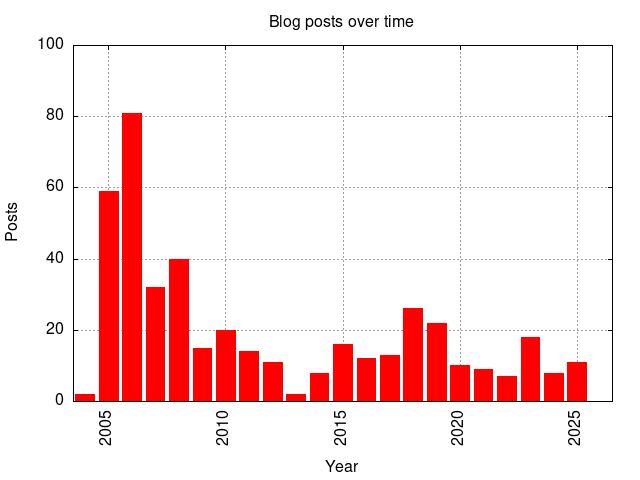
21 years ago today I wrote my first blog post. Did I think I d still be writing all this time later? I ve no idea to be honest. I ve always had the impression my readership is small, and people who mostly know me in some manner, and I post to let them know what I m up to in more detail than snippets of IRC conversation can capture. Or I write to make notes for myself (I frequently refer back to things I ve documented here). I write less about my personal life than I used to, but I still occasionally feel the need to mark some event. From a software PoV I started out with Blosxom, migrated to MovableType in 2008, ditched that, when the Open Source variant disappeared, for Jekyll in 2015 (when I also started putting it all in git). And have stuck there since. The static generator format works well for me, and I outsource comments to Disqus - I don t get a lot, I can t be bothered with the effort of trying to protect against spammers, and folk who don t want to use it can easily email or poke me on the Fediverse. If I ever feel the need to move from Jekyll I ll probably take a look at Hugo, but thankfully at present there s no push factor to switch. It s interesting to look at my writing patterns over time. I obviously started keen, and peaked with 81 posts in 2006 (I ve no idea how on earth that happened), while 2013 had only 2. Generally I write less when I m busy, or stressed, or unhappy, so it s kinda interesting to see how that lines up with various life events. Blog posts over time During that period I ve lived in 10 different places (well, 10 different houses/flats, I think it s only 6 different towns/cities), on 2 different continents, working at 6 different employers, as well as a period where I was doing my Masters in law. I ve travelled around the world, made new friends, lost contact with folk, started a family. In short, I have lived, even if lots of it hasn t made it to these pages. At this point, do I see myself stopping? No, not really. I plan to still be around, like Flameeyes, to the end. Even if my posts are unlikely to hit the frequency from back when I started out.

Sven Hoexter: exfatprogs: Do not try defrag.exfat / mkfs.exfat Windows compatibility in Trixie

exfatprogs 1.3.0 added a new defrag.exfat utility which turned out to be not reliable and cause data loss. exfatprogs 1.3.1 disabled the utility, and I followed that decision with the upload to Debian/unstable yesterday. But as usual it will take some time until it's migrating to testing. Thus if you use testing do not try defag.exfat! At least not without a vetted and current backup. Beside of that there is a compatibility issue with the way mkfs.exfat, as shipped in trixie (exfatprogs 1.2.9), handles drives which have a physical sector size of 4096 bytes but emulate a logical size of 512 bytes. With exfatprogs 1.2.6 a change was implemented to prefer the physical sector size on those devices. That turned out to be not compatible with Windows, and was reverted in exfatprogs 1.3.0. Sadly John Ogness ran into the issue and spent some time to debug it. I've to admit that I missed the relevance of that change. Huge kudos to John for the bug report. Based on that I prepared an update for the next trixie point release. If you hit that issue on trixie with exfatprogs 1.2.9-1 you can work around it by formating with mkfs.exfat -s 512 /dev/sdX to get Windows compatibility. If you use exfatprogs 1.2.9-1+deb13u1 or later, and want the performance gain back, and do not need Windows compatibility, you can format with mkfs.exfat -s 4096 /dev/sdX.

30 November 2025

Otto Kek l inen: DEP-18: A proposal for Git-based collaboration in Debian

Featured image of post DEP-18: A proposal for Git-based collaboration in DebianI am a huge fan of Git, as I have witnessed how it has made software development so much more productive compared to the pre-2010s era. I wish all Debian source code were in Git to reap the full benefits. Git is not perfect, as it requires significant effort to learn properly, and the ecosystem is complex with even more things to learn ranging from cryptographic signatures and commit hooks to Git-assisted code review best practices, forge websites, and CI systems. Sure, there is still room to optimize its use, but Git certainly has proven itself and is now the industry standard. Thus, some readers might be surprised to learn that Debian development in 2025 is not actually based on Git. In Debian, the version control is done by the Debian archive itself. Each commit is a new upload to the archive, and the commit message is the debian/changelog entry. The commit log is available at snapshots.debian.org. In practice, most Debian Developers (people who have the credentials to upload to the Debian archive) do use Git and host their packaging source code on salsa.debian.org the GitLab instance of Debian. This is, however, based on each DD s personal preferences. The Debian project does not have any policy requiring that packages be hosted on salsa.debian.org or be in version control at all.

Is collaborative software development possible without git and version control software? Debian, however, has some peculiarities that may be surprising to people who have grown accustomed to GitHub, GitLab or various company-internal code review systems. In Debian:
  • The source code of the next upload is not public but resides only on the developer s laptop.
  • Code contributions are plain patch files, based on the latest revision released in the Debian archive (where the unstable area is equivalent to the main development branch).
  • These patches are submitted by email to a bug tracker that does no validation or testing whatsoever.
  • Developers applying these patches typically have elaborate Mutt or Emacs setups to facilitate fetching patches from email.
  • There is no public staging area, no concept of rebasing patches or withdrawing a patch and replacing it with a better version.
  • The submitter won t see any progress information until a notification email arrives after a new version has been uploaded to the Debian archive.
This system has served Debian for three decades. It is not broken, but using the package archive just feels well, archaic. There is a more efficient way, and indeed the majority of Debian packages have a metadata field Vcs-Git that advertises which version control repository the maintainer uses. However, newcomers to Debian are surprised to notice that not all packages are hosted on salsa.debian.org but at various random places with their own account and code submission systems, and there is nothing enforcing or even warning if the code there is out of sync with what was uploaded to Debian. Any Debian Developer can at any time upload a new package with whatever changes, bypassing the Git repository, even when the package advertised a Git repository. All PGP signed commits, Git tags and other information in the Git repository are just extras currently, as the Debian archive does not enforce or validate anything about them. This also makes contributing to multiple packages in parallel hard. One can t just go on salsa.debian.org and fork a bunch of repositories and submit Merge Requests. Currently, the only reliable way is to download source packages from Debian unstable, develop patches on top of them, and send the final version as a plain patch file by email to the Debian bug tracker. To my knowledge, no system exists to facilitate working with the patches in the bug tracker, such as rebasing patches 6 months later to detect if they or equivalent changes were applied or if sending refreshed versions is needed. To newcomers in Debian, it is even more surprising that there are packages that are on salsa.debian.org but have the Merge Requests feature disabled. This is often because the maintainer does not want to receive notification emails about new Merge Requests, but rather just emails from bugs.debian.org. This may sound arrogant, but keep in mind that these developers put in the effort to set up their Mutt/Emacs workflow for the existing Debian process, and extending it to work with GitLab notifications is not trivial. There are also purists who want to do everything via the command-line (without having to open a browser, run JavaScript and maintain a live Internet connection), and tools like glab are not convenient enough for the full workflow.

Inefficient ways of working prevent Debian from flourishing I would claim, based on my personal experiences from the past 10+ years as a Debian Developer, that the lack of high-quality and productive tooling is seriously harming Debian. The current methods of collaboration are cumbersome for aspiring contributors to learn and suboptimal to use for both new and seasoned contributors. There are no exit interviews for contributors who left Debian, no comprehensive data on reasons to contribute or stop contributing, nor are there any metrics tracking how many people tried but failed to contribute to Debian. Some data points to support my concerns do exist:
  • The contributor database shows that the number of contributors is growing slower than Debian s popularity.
  • Most packages are maintained by one person working alone (just pick any package at random and look at the upload history).


Debian should embrace git, but decision-making is slow Debian is all about community and collaboration. One would assume that Debian prioritized above all making collaboration tools and processes simpler, faster and less error-prone, as it would help both current and future package maintainers. Yet, it isn t so, due to some reasons unique to Debian. There is no single company or entity running Debian, and it has managed to operate as a pure meritocracy and do-cracy for over 30 years. This is impressive and admirable. Unfortunately, some of the infrastructure and technical processes are also nearly 30 years old and very difficult to change for the same reason: the nature of Debian s distributed decision-making process. As a software developer and manager with 25+ years of experience, I strongly feel that developing software collaboratively using Git is a major step forward that Debian needs to take, in one form or another, and I hope to see other DDs voice their support if they agree.

Debian Enhancement Proposal 18 Following how consensus is achieved in Debian, I started drafting DEP-18 in 2024, and it is currently awaiting enough thumbs up at https://salsa.debian.org/dep-team/deps/-/merge_requests/21 to get into CANDIDATE status next. In summary, the DEP-18 proposes that everyone keen on collaborating should:
  1. Maintain Debian packaging sources in Git on Salsa.
  2. Use Merge Requests to show your work and to get reviews.
  3. Run Salsa CI before upload.
The principles above are not novel. According to stats at e.g. trends.debian.net, and UDD, ~93% of all Debian source packages are already hosted on salsa.debian.org. As of June 1st, 2025, only 1640 source packages remain that are not hosted on Salsa. The purpose of DEP-18 is to state in writing what Debian is currently doing for most packages, and thus express what among others new contributors should be learning and doing, so basic collaboration is smooth and free from structural obstacles. Most packages are also already allowing Merge Requests and using Salsa CI, but there hasn t been any written recommendation anywhere in Debian to do so. The Debian Policy (v.4.7.2) does not even mention the word Salsa a single time. The current process documentation on how to do non-maintainer uploads or salvaging packages are all based on uploading packages to the archive, without any consideration of using git-based collaboration such as posting a Merge Request first. Personally I feel posting a Merge Request would be a better approach, as it would invite collaborators to discuss and provide code reviews. If there are no responses, the submitter can proceed to merge, but compared to direct uploads to the Debian archive, the Merge Request practice at least tries to offer a time and place for discussions and reviews to happen. It could very well be that in the future somebody comes up with a new packaging format that makes upstream source package management easier, or a monorepo with all packages, or some other future structures or processes. Having a DEP to state how to do things now does not prevent people from experimenting and innovating if they intentionally want to do that. The DEP is merely an expression of the minimal common denominators in the packaging workflow that maintainers and contributors should follow, unless they know better.

Transparency and collaboration Among the DEP-18 recommendations is:
The recommended first step in contributing to a package is to use the built-in Fork feature on Salsa. This serves two purposes. Primarily, it allows any contributor to publish their Git branches and submit them as Merge Requests. Additionally, the mere existence of a list of Forks enables contributors to discover each other, and in rare cases when the original package is not accepting improvements, collaboration could arise among the contributors and potentially lead to permanent forks in the general meaning. Forking is a fundamental part of the dynamics in open source that helps drive quality and agreement. The ability to fork ultimately serves as the last line of defense of users rights. Git supports this by making both temporary and permanent forks easy to create and maintain.

Further, it states:
Debian packaging work should be reasonably transparent and public to allow contributors to participate. A maintainer should push their pending changes to Salsa at regular intervals, so that a potential contributor can discover if a particular change has already been made or a bug has been fixed in version control, and thus avoid duplicate work. Debian maintainers should make reasonable efforts to publish planned changes as Merge Requests on Salsa and solicit feedback and reviews. While pushing changes directly on the main Git branch is the fastest workflow, second only to uploading all changes directly to Debian repositories, it is not an inclusive way to develop software. Even packages that are maintained by a single maintainer should at least occasionally publish Merge Requests to allow new contributors to step up and participate.
I think these are key aspects leading to transparency and true open source collaboration. Even though this talks about Salsa which is based on GitLab the concepts are universal and will work also on other forges, like Forgejo or GitHub. The point is that sharing work-in-progress on a real-time platform, with CI and other supporting features, empowers and motivates people to iterate on code collaboratively. As an example of an anti-pattern, Oracle MySQL publishes the source code for all their releases and is license-compliant, but as they don t publish their Git commits in real-time, it does not feel like a real open source project. Non-Oracle employees are not motivated to participate as second-class developers who are kept in the dark. Debian should embrace git and sharing work in real-time, embodying a true open source spirit.

Recommend, not force Note that the Debian Enhancement Proposals are not binding. Only the Debian Policy and Technical Committee decisions carry that weight. The nature of collaboration is voluntary anyway, so the DEP does not need to force anything on people who don t want to use salsa.debian.org. The DEP-18 is also not a guide for package maintainers. I have my own views and have written detailed guides in blog articles if you want to read more on, for example, how to do code reviews efficiently. Within DEP-18, there is plenty of room to work in many different ways, and it does not try to force one single workflow. The goal here is to simply have agreed-upon minimal common denominators among those who are keen to collaborate using salsa.debian.org, not to dictate a complete code submission workflow. Once we reach this, there will hopefully be less friction in the most basic and recurring collaboration tasks, giving DDs more energy to improve other processes or just invest in having more and newer packages for Debian users to enjoy.


Next steps In addition to lengthy online discussions on mailing lists and DEP reviews, I also presented on this topic at DebConf 2025 in Brest, France. Unfortunately the recording is not yet up on Peertube. The feedback has been overwhelmingly positive. However, there are a few loud and very negative voices that cannot be ignored. Maintaining a Linux distribution at the scale and complexity of Debian requires extraordinary talent and dedication, and people doing this kind of work often have strong views, most of the time for good reasons. We do not want to alienate existing key contributors with new processes, so maximum consensus is desirable. We also need more data on what the 1000+ current Debian Developers view as a good process to avoid being skewed by a loud minority. If you are a current or aspiring Debian Developer, please add a thumbs up if you think I should continue with this effort (or a thumbs down if not) on the Merge Request that would make DEP-18 have candidate status. There is also technical work to do. Increased Git use will obviously lead to growing adoption of the new tag2upload feature, which will need to get full git-buildpackage support so it can integrate into salsa.debian.org without turning off Debian packaging security features. The git-buildpackage tool itself also needs various improvements, such as making contributing to multiple different packages with various levels of diligence in debian/gbp.conf maintenance less error-prone. Eventually, if it starts looking like all Debian packages might get hosted on salsa.debian.org, I would also start building a review.debian.org website to facilitate code review aspects that are unique to Debian, such as tracking Merge Requests across GitLab projects in ways GitLab can t do, highlighting which submissions need review most urgently, feeding code reviews and approvals into the contributors.debian.org database for better attribution, and so forth. Details on this vision will be in a later blog post, so subscribe to updates!

19 November 2025

Gunnar Wolf: While it is cold-ish season in the North hemisphere...

Last week, our university held a Mega Vaccination Center . Things cannot be small or regular with my university, ever! According to the official information, during last week 31,000 people were given a total of 74,000 vaccine dosis against influenza, COVID-19, pneumococcal disease and measles (specific vaccines for each person selected according to an age profile). I was a tiny blip in said numbers. One person, three shots. Took me three hours, but am quite happy to have been among the huge crowd. Long, long line ( photo credit: La Jornada, 2025.11.14) Really vaccinated! And why am I bringing this up? Because I have long been involved in organizing DebConf, the best conference ever, naturally devoted to improving Debian GNU/Linux. And last year, our COVID reaction procedures ended up hurting people we care about. We, as organizers, are taking it seriously to shape a humane COVID handling policy that is, at the same time, responsible and respectful for people who are (reasonably!) afraid to catch the infection. No, COVID did not disappear in 2022, and its effects are not something we can turn a blind eye to. Next year, DebConf will take place in Santa Fe, Argentina, in July. This means, it will be a Winter DebConf. And while you can catch COVID (or influenza, or just a bad cold) at any time of year, odds are a bit higher. I know not every country still administers free COVID or influenza vaccines to anybody who requests them. And I know that any protection I might have got now will be quite weaker by July. But I feel it necessary to ask of everyone who can get it to get a shot. Most Northern Hemisphere countries will have a vaccination campaign (or at least, higher vaccine availability) before Winter. If you plan to attend DebConf (hell If you plan to attend any massive gathering of people travelling from all over the world to sit at a crowded auditorium) during the next year, please Act responsibly. For yourself and for those surrounding you. Get vaccinated. It won t absolutely save you from catching it, but it will reduce the probability. And if you do catch it, you will probably have a much milder version. And thus, you will spread it less during the first days until (and if!) you start developing symptoms.

16 November 2025

Vasudev Kamath: Moving blog from self hosting to Github Pages

I haven't been blogging as much as I used to. For a while, I've been hosting my blog on a single-core DigitalOcean droplet, which cost me around $7 per month. It also hosted my mail server. Most of the time, the droplet was idle, and I wasn't actively using my personal email much. Since it was self-hosted, I didn't have confidence that it would always be up, so I relied on Gmail as my personal email for everything from banking to social media. Now, I feel this cost is just a waste of money, even though it's not huge. So, I decided to move my blog back to GitHub Pages, now published using GitHub Workflows. I've stopped my mail server for the time being, and it won't be reachable for a while. For any personal queries or comments, please reach me on my Personal Gmail. I'm not sure how active I'll be with blogging again, but I'll try my best to return to my old habit of writing at least a post every week or two. Not because people will read it, but because it gives me the option to explore new things, experiment, and take notes along the way.

3 November 2025

Kentaro Hayashi: Migrating from hugo-theme-learn to alternative theme

Introduction For personal web site, I use hugo and hugo-theme-learn for statically generated contents. Recently I've noticed that these combination of specific version is not compatible with. (Not so frequently update contents, so it was delayed to found this situation)

What was the actual error?
ERROR deprecated: .Site.IsMultiLingual was deprecated in Hugo v0.124.0 and subsequently removed. Use hugo.IsMultilingual instead.
Total in 21 ms
It seems that hugo-theme-learn is not compatible with recent Hugo anymore.

How to deal with it? With checking upstream issue, I've found the following issue. What are people migrating too? 'hugo-theme-relearn' was noted as an alternative. As 'hugo-theme-learn' is not actively maintained anymore, so it is easy to migrate from hugo-theme-learn to hugo-theme-relearn. For example, it needs just a few lines of configuration.
diff --git a/website/config.toml b/website/config.toml
index 702d4da..99ddf03 100644
--- a/website/config.toml
+++ b/website/config.toml
@@ -3,7 +3,7 @@ languageCode = "en-US"
 defaultContentLanguage = "en"
-theme = "hugo-theme-learn"
+theme = "hugo-theme-relearn"
 themesdir = "themes"
 metaDataFormat = "yaml"
 defaultContentLanguageInSubdir= true
@@ -16,6 +16,7 @@ defaultContentLanguageInSubdir= true
   disableNextPrev = true
   disableSearch = true
   disableShortcutsTitle = true
+  themeVariant = 'learn'
 [markup]
   [markup.goldmark]
It was sad that hugo-theme-learn is not maintained actively, but many thank to this greateful hugo theme. And also thanks the effort to fork it as hugo-theme-relearn.

2 November 2025

Guido G nther: Free Software Activities October 2025

Quiete some things made progress last month: We put out Phosh 0.50 release, got closer to enabling media roles for audio by default in Phosh (see related post) and reworked our images builds. You should also (hopefully) notice some nice quality of life improvements once changes land in a distro near you and you're using Phosh. See below for details: phosh phoc phosh-mobile-settings stevia (formerly phosh-osk-stub) phosh-tour meta-phosh xdg-desktop-portal-phosh libphosh-rs Calls Phrog phosh-recipes feedbackd feedbackd-device-themes Chatty Squeekboard Debian Cellbroadcastd gnome-settings-daemon gnome-control-center gnome-initial-setup sdm845-mainline gnome-session alpine droid-juicer phosh-site phosh-debs Linux Wireplumber Phosh.mobi e.V. demo-phones Reviews This is not code by me but reviews on other peoples code. The list is (as usual) slightly incomplete. Thanks for the contributions! Comments? Join the Fediverse thread

8 October 2025

Sven Hoexter: Backstage Render Markdown in a Collapsible Block

Brief note to maybe spare someone else the trouble. If you want to hide e.g. a huge table in Backstage (techdocs/mkdocs) behind a collapsible element you need the md_in_html extension and use the markdown attribute for it to kick in on the <details> html tag. Add the extension to your mkdocs.yaml:
markdown_extensions:
  - md_in_html
Hide the table in your markdown document in a collapsible element like this:
<details markdown>
<summary>Long Table</summary>
  Foo   Bar  
 - - 
  Fizz   Buzz  
</details>
It's also required to have an empty line between the html tag and starting the markdown part. Rendered for me that way in VSCode, GitHub and Backstage.

3 October 2025

Guido G nther: Free Software Activities September 2025

Another short status update of what happened on my side last month. Nothing stands out too much, I enjoyed doing the OSK changes the most as that helped to improve the typing experience further. Also doing a small bit of kernel work again was fun (still need to figure out the 6mq's touch controller repsonsiveness though). See below for details on the above and more: phosh phoc phosh-mobile-settings stevia (formerly phosh-osk-stub) xdg-desktop-portal-phosh pfs libphosh-rs Phrog feedbackd feedbackd-device-themes Debian gnome-settings-daemon git-buildpackage govarnam Sessions twenty-twenty-hugo tuwunnel Linux mutter Phosh debs phosh-site Reviews This is not code by me but reviews I did on other peoples code. The list is (as usual) slightly incomplete. Thanks for the contributions! Help Development If you want to support my work see donations. Comments? Join the Fediverse thread

30 September 2025

Antoine Beaupr : Proper services

During 2025-03-21-another-home-outage, I reflected upon what's a properly ran service and blurted out what turned out to be something important I want to outline more. So here it is, again, on its own for my own future reference.
Typically, I tend to think of a properly functioning service as having four things:
  1. backups
  2. documentation
  3. monitoring
  4. automation
  5. high availability (HA)
Yes, I miscounted. This is why you need high availability. A service doesn't properly exist if it doesn't at least have the first 3 of those. It will be harder to maintain without automation, and inevitably suffer prolonged outages without HA.

The five components of a proper service

Backups Duh. If data is maliciously or accidentally destroyed, you need a copy somewhere. Preferably in a way that malicious Joe can't get to. This is harder than you think.

Documentation I have an entire template for this. Essentially, it boils down to using https://diataxis.fr/ and this "audit" guide. For me, the most important parts are:
  • disaster recovery (includes backups, probably)
  • playbook
  • install/upgrade procedures (see automation)
You probably know this is hard, and this is why you're not doing it. Do it anyways, you'll think it sucks, it will grow out of sync with reality, but you'll be really grateful for whatever scraps you wrote when you're in trouble. Any docs, in other words, is better than no docs, but are no excuse for doing the work correctly.

Monitoring If you don't have monitoring, you'll know it fails too late, and you won't know it recovers. Consider high availability, work hard to reduce noise, and don't have machine wake people up, that's literally torture and is against the Geneva convention. Consider predictive algorithm to prevent failures, like "add storage within 2 weeks before this disk fills up". This is also harder than you think.

Automation Make it easy to redeploy the service elsewhere. Yes, I know you have backups. That is not enough: that typically restores data and while it can also include configuration, you're going to need to change things when you restore, which is what automation (or call it "configuration management" if you will) will do for you anyways. This also means you can do unit tests on your configuration, otherwise you're building legacy. This is probably as hard as you think.

High availability Make it not fail when one part goes down. Eliminate single points of failures. This is easier than you think, except for storage and DNS ("naming things" not "HA DNS", that is easy), which, I guess, means it's harder than you think too.

Assessment In the above 5 items, I currently check two in my lab:
  1. backups
  2. documentation
And barely: I'm not happy about the offsite backups, and my documentation is much better at work than at home (and even there, I have a 15 year backlog to catchup on). I barely have monitoring: Prometheus is scraping parts of the infra, but I don't have any sort of alerting -- by which I don't mean "electrocute myself when something goes wrong", I mean "there's a set of thresholds and conditions that define an outage and I can look at it". Automation is wildly incomplete. My home server is a random collection of old experiments and technologies, ranging from Apache with Perl and CGI scripts to Docker containers running Golang applications. Most of it is not Puppetized (but the ratio is growing). Puppet itself introduces a huge attack vector with kind of catastrophic lateral movement if the Puppet server gets compromised. And, fundamentally, I am not sure I can provide high availability in the lab. I'm just this one guy running my home network, and I'm growing older. I'm thinking more about winding things down than building things now, and that's just really sad, because I feel we're losing (well that escalated quickly).

Side note about Tor The above applies to my personal home lab, not work! At work, of course, it's another (much better) story:
  1. all services have backups
  2. lots of services are well documented, but not all
  3. most services have at least basic monitoring
  4. most services are Puppetized, but not crucial parts (DNS, LDAP, Puppet itself), and there are important chunks of legacy coupling between various services that make the whole system brittle
  5. most websites, DNS and large parts of email are highly available, but key services like the the Forum, GitLab and similar applications are not HA, although most services run under replicated VMs that can trivially survive a total, single-node hardware failure (through Ganeti and DRBD)

6 September 2025

Reproducible Builds: Reproducible Builds in August 2025

Welcome to the August 2025 report from the Reproducible Builds project! Welcome to the latest report from the Reproducible Builds project for August 2025. These monthly reports outline what we ve been up to over the past month, and highlight items of news from elsewhere in the increasingly-important area of software supply-chain security. If you are interested in contributing to the Reproducible Builds project, please see the Contribute page on our website. In this report:

  1. Reproducible Builds Summit 2025
  2. Reproducible Builds and live-bootstrap at WHY2025
  3. DALEQ Explainable Equivalence for Java Bytecode
  4. Reproducibility regression identifies issue with AppArmor security policies
  5. Rust toolchain fixes
  6. Distribution work
  7. diffoscope
  8. Website updates
  9. Reproducibility testing framework
  10. Upstream patches

Reproducible Builds Summit 2025 Please join us at the upcoming Reproducible Builds Summit, set to take place from October 28th 30th 2025 in Vienna, Austria!** We are thrilled to host the eighth edition of this exciting event, following the success of previous summits in various iconic locations around the world, including Venice, Marrakesh, Paris, Berlin, Hamburg and Athens. Our summits are a unique gathering that brings together attendees from diverse projects, united by a shared vision of advancing the Reproducible Builds effort. During this enriching event, participants will have the opportunity to engage in discussions, establish connections and exchange ideas to drive progress in this vital field. Our aim is to create an inclusive space that fosters collaboration, innovation and problem-solving. If you re interesting in joining us this year, please make sure to read the event page which has more details about the event and location. Registration is open until 20th September 2025, and we are very much looking forward to seeing many readers of these reports there!

Reproducible Builds and live-bootstrap at WHY2025 WHY2025 (What Hackers Yearn) is a nonprofit outdoors hacker camp that takes place in Geestmerambacht in the Netherlands (approximately 40km north of Amsterdam). The event is organised for and by volunteers from the worldwide hacker community, and knowledge sharing, technological advancement, experimentation, connecting with your hacker peers, forging friendships and hacking are at the core of this event . At this year s event, Frans Faase gave a talk on live-bootstrap, an attempt to provide a reproducible, automatic, complete end-to-end bootstrap from a minimal number of binary seeds to a supported fully functioning operating system . Frans talk is available to watch on video and his slides are available as well.

DALEQ Explainable Equivalence for Java Bytecode Jens Dietrich of the Victoria University of Wellington, New Zealand and Behnaz Hassanshahi of Oracle Labs, Australia published an article this month entitled DALEQ Explainable Equivalence for Java Bytecode which explores the options and difficulties when Java binaries are not identical despite being from the same sources, and what avenues are available for proving equivalence despite the lack of bitwise correlation:
[Java] binaries are often not bitwise identical; however, in most cases, the differences can be attributed to variations in the build environment, and the binaries can still be considered equivalent. Establishing such equivalence, however, is a labor-intensive and error-prone process.
Jens and Behnaz therefore propose a tool called DALEQ, which:
disassembles Java byte code into a relational database, and can normalise this database by applying Datalog rules. Those databases can then be used to infer equivalence between two classes. Notably, equivalence statements are accompanied with Datalog proofs recording the normalisation process. We demonstrate the impact of DALEQ in an industrial context through a large-scale evaluation involving 2,714 pairs of jars, comprising 265,690 class pairs. In this evaluation, DALEQ is compared to two existing bytecode transformation tools. Our findings reveal a significant reduction in the manual effort required to assess non-bitwise equivalent artifacts, which would otherwise demand intensive human inspection. Furthermore, the results show that DALEQ outperforms existing tools by identifying more artifacts rebuilt from the same code as equivalent, even when no behavioral differences are present.
Jens also posted this news to our mailing list.

Reproducibility regression identifies issue with AppArmor security policies Tails developer intrigeri has tracked and followed a reproducibility regression in the generation of AppArmor policy caches, and has identified an issue with the 4.1.0 version of AppArmor. Although initially tracked on the Tails issue tracker, intrigeri filed an issue on the upstream bug tracker. AppArmor developer John Johansen replied, confirming that they can reproduce the issue and went to work on a draft patch. Through this, John revealed that it was caused by an actual underlying security bug in AppArmor that is to say, it resulted in permissions not (always) matching what the policy intends and, crucially, not merely a cache reproducibility issue. Work on the fix is ongoing at time of writing.

Rust toolchain fixes Rust Clippy is a linting tool for the Rust programming language. It provides a collection of lints (rules) designed to identify common mistakes, stylistic issues, potential performance problems and unidiomatic code patterns in Rust projects. This month, however, Sosth ne Gu don filed a new issue in the GitHub requesting a new check that would lint against non deterministic operations in proc-macros, such as iterating over a HashMap .

Distribution work In Debian this month: Lastly, Bernhard M. Wiedemann posted another openSUSE monthly update for their work there.

diffoscope diffoscope is our in-depth and content-aware diff utility that can locate and diagnose reproducibility issues. This month, Chris Lamb made the following changes, including preparing and uploading versions, 303, 304 and 305 to Debian:
  • Improvements:
    • Use sed(1) backreferences when generating debian/tests/control to avoid duplicating ourselves. [ ]
    • Move from a mono-utils dependency to versioned mono-devel mono-utils dependency, taking care to maintain the [!riscv64] architecture restriction. [ ]
    • Use sed over awk to avoid mangling dependency lines containing = (equals) symbols such as version restrictions. [ ]
  • Bug fixes:
    • Fix a test after the upload of systemd-ukify version 258~rc3. [ ]
    • Ensure that Java class files are named .class on the filesystem before passing them to javap(1). [ ]
    • Do not run jsondiff on files over 100KiB as the algorithm runs in O(n^2) time. [ ]
    • Don t check for PyPDF version 3 specifically; check for >= 3. [ ]
  • Misc:
    • Update copyright years. [ ][ ]
In addition, Martin Joerg fixed an issue with the HTML presenter to avoid crash when page limit is None [ ] and Zbigniew J drzejewski-Szmek fixed compatibility with RPM 6 [ ]. Lastly, John Sirois fixed a missing requests dependency in the trydiffoscope tool. [ ]

Website updates Once again, there were a number of improvements made to our website this month including:

Reproducibility testing framework The Reproducible Builds project operates a comprehensive testing framework running primarily at tests.reproducible-builds.org in order to check packages and other artifacts for reproducibility. In August, however, a number of changes were made by Holger Levsen, including:
  • reproduce.debian.net-related:
    • Run 4 workers on the o4 node again in order to speed up testing. [ ][ ][ ][ ]
    • Also test trixie-proposed-updates and trixie-updates etc. [ ][ ]
    • Gather seperate statistics for each tested release. [ ]
    • Support sources from all Debian suites. [ ]
    • Run new code from the prototype database rework branch for the amd64-pull184 pseudo-architecture. [ ][ ]
    • Add a number of helpful links. [ ][ ][ ][ ][ ][ ][ ][ ][ ]
    • Temporarily call debrebuild without the --cache argument to experiment with a new version of devscripts. [ ][ ][ ]
    • Update public TODO. [ ]
  • Installation tests:
    • Add comments to explain structure. [ ]
    • Mark more old jobs as old or dead . [ ][ ][ ]
    • Turn the maintenance job into a no-op. [ ]
  • Jenkins node maintenance:
    • Increase penalties if the osuosl5 or ionos7 nodes are down. [ ]
    • Stop trying to fix network automatically. [ ]
    • Correctly mark ppc64el architecture nodes when down. [ ]
    • Upgrade the remaining arm64 nodes to Debian trixie in anticipation of the release. [ ][ ]
    • Allow higher SSD temperatures on the riscv64 architecture. [ ]
  • Debian-related:
    • Drop the armhf architecture; many thanks to Vagrant for physically hosting the nodes for ten years. [ ][ ]
    • Add Debian forky, and archive bullseye. [ ][ ][ ][ ][ ][ ][ ]
    • Document the filesystem space savings from dropping the armhf architecture. [ ]
    • Exclude i386 and armhfr from JSON results. [ ]
    • Update TODOs for when Debian trixie and forky have been released. [ ][ ]
  • tests.reproducible-builds.org-related:
  • Misc:
    • Detect errors with openQA erroring out. [ ]
    • Drop the long-disabled openwrt_rebuilder jobs. [ ]
    • Use qa-jenkins-dev@alioth-lists.debian.net as the contact for jenkins.debian.net. [ ]
    • Redirect reproducible-builds.org/vienna25 to reproducible-builds.org/vienna2025. [ ]
    • Disable all OpenWrt reproducible CI jobs, in coordination with the OpenWrt community. [ ][ ]
    • Make reproduce.debian.net accessable via IPv6. [ ]
    • Ignore that the megacli RAID controller requires packages from Debian bookworm. [ ]
In addition,
  • James Addison migrated away from deprecated toplevel deb822 Python module in favour of debian.deb822 in the bin/reproducible_scheduler.py script [ ] and removed a note on reproduce.debian.net note after the release of Debian trixie [ ].
  • Jochen Sprickerhof made a huge number of improvements to the reproduce.debian.net statistics calculation [ ][ ][ ][ ][ ][ ] as well as to the reproduce.debian.net service more generally [ ][ ][ ][ ][ ][ ][ ][ ].
  • Mattia Rizzolo performed a lot of work migrating scripts to SQLAlchemy version 2.0 [ ][ ][ ][ ][ ][ ] in addition to making some changes to the way openSUSE reproducibility tests are handled internally. [ ]
  • Lastly, Roland Clobus updated the Debian Live packages after the release of Debian trixie. [ ][ ]

Upstream patches The Reproducible Builds project detects, dissects and attempts to fix as many currently-unreproducible packages as possible. We endeavour to send all of our patches upstream where appropriate. This month, we wrote a large number of such patches, including:

Finally, if you are interested in contributing to the Reproducible Builds project, please visit our Contribute page on our website. However, you can get in touch with us via:

Next.

Previous.