Search Results: "evo"

19 March 2026

Otto Kek l inen: Automated security validation: How 7,000+ tests shaped MariaDB's new AppArmor profile


Featured image of post Automated security validation: How 7,000+ tests shaped MariaDB's new AppArmor profileLinux kernel security modules provide a good additional layer of security around individual programs by restricting what they are allowed to do, and at best block and detect zero-day security vulnerabilities as soon as anyone tries to exploit them, long before they are widely known and reported. However, the challenge is how to create these security profiles without accidentally also blocking legitimate actions. For MariaDB in Debian and Ubuntu, a new AppArmor profile was recently created by leveraging the extensive test suite with 7000+ tests, giving good confidence that AppArmor is unlikely to yield false positive alerts with it. AppArmor is a Mandatory Access Control (MAC) system, meaning that each process controlled by AppArmor has a sort of an allowlist called profile that defines all capabilities and file paths a program can access. If a program tries to do something not covered by the rules in its AppArmor profile, the action will be denied on the Linux kernel level and a warning logged in the system journal. This additional security layer is valuable because even if a malicious user found a security vulnerability some day in the future, the AppArmor profile severely restricts the ability to exploit it and gain access to the operating system. AppArmor was originally developed by Novell for use in SUSE Linux, but nowadays the main driver is Canonical and AppArmor is extensively used in Ubuntu and Debian, and many of their derivatives (e.g. Linux Mint, Pop!_OS, Zorin OS) and in Arch. AppArmor s benefit compared to the main alternative SELinux (used mainly in the RedHat/Fedora ecosystem) is that AppArmor is easier to manage. AppArmor continues to be actively developed, with new major version 5.0 expected to arrive soon. I also have some personal history contributing some notification handler scripts in Python and I also created the website that AppArmor.net still runs.

Regular review of denials in the system log required Any system administrator using Debian/Ubuntu needs to know how to check for AppArmor denials. The point of using AppArmor is kind of moot if nobody is checking the denials. When AppArmor blocks an action, it logs the event to the system audit or kernel logs. Understanding these logs is crucial for troubleshooting custom configurations or identifying potential security incidents. To view recent denials, check /var/log/audit/audit.log or run journalctl -ke --grep=apparmor. A typical denial entry for MariaDB will look like this (split across multiple lines for legibility):
msg=audit(1700000000.123:456): apparmor="DENIED" operation="open"
profile="/usr/sbin/mariadbd" name="/custom/data/path/test.ibd" pid=1234
comm="mariadbd" requested_mask="r" denied_mask="r" fsuid=1000 ouid=0
How to interpret this output:
  • msg=audit( ): The audit timestamp and event serial number.
  • apparmor= DENIED : Indicates AppArmor blocked the action.
  • operation: The action being attempted (e.g., open, mknod, file_mmap, file_perm).
  • profile: The specific AppArmor profile that triggered the denial (in this case the /usr/sbin/mariadbd profile).
  • name: The file path or resource that was blocked. In the example above, a custom data path was denied access because it wasn t defined in the profile s allowed abstractions.
  • comm: The command name that triggered the denial (here mariadbd).
  • requested_mask / denied_mask: Shows the permissions requested (e.g., r for read, w for write).
  • pid: The process ID.
  • fsuid: The user ID of the process attempting the action.
  • ouid: The owner user ID of the target file.
If an action seems legit and should not be denied, the sysadmin needs to update the existing rules at /etc/apparmor.d/ or drop a local customization file in at /etc/apparmor.d/local/. If the denied action looks malicious, the sysadmin should start a security investigation and if needed report a suspected zero-day vulnerability to the upstream software vendor (e.g. Ubuntu customers to Canonical, or MariaDB customers to MariaDB).

AppArmor in MariaDB - not a novel thing, and not easy to implement well Based on old bug reports, there was an AppArmor profile already back in 2011, but it was removed in MariaDB 5.1.56 due to backlash from users running into various issues. A new profile was created in 2015, but kept opt-in only due to the risk of side effects. It likely had very few users and saw minimal maintenance, getting only a handful of updates in the past 10 years. The primary challenge in using mandatory access control systems with MariaDB lies in the sheer breadth of MariaDB s operational footprint with diverse storage engines and plugins. Also the code base in MariaDB assumes that system calls to Linux always work which they do under normal circumstances and do not handle errors well if AppArmor suddenly denies a system call. MariaDB is also a large and complex piece of software to run and operate, and it can be very challenging for system administrators to root-cause that a misbehavior in their system was due to AppArmor blocking a single syscall. Ironically, AppArmor is most beneficial exactly due to the same reasons for MariaDB. The larger and more complex a software is, the larger are the odds of a security vulnerability arising between the various components. And AppArmor profile helps reduce this complexity down to a single access list. Over the years there has been users requesting to get the AppArmor profile back, such as Debian Bug#875890 since 2017. The need was raised recently again by the Ubuntu security team during the MariaDB Ubuntu main inclusion review in 2025, which prompted a renewed effort by Debian/Ubuntu developers, mainly myself and Aquila Macedo, with upstream MariaDB assistance from Daniel Black.

A fresh approach: leverage the MariaDB test suite for automated testing and the open source community for reviews The key to creating a robust AppArmor profile is the ability to know in detail what is expected and normal behavior of the system. One could in theory read all of the source code in MariaDB, but with over two million lines, it is of course not feasible in practice. However, MariaDB does have a very extensive 7000+ test suite, and running it should trigger most code paths in MariaDB. Utilizing the test suite was key in creating the new AppArmor profile for MariaDB: we installed MariaDB on a Ubuntu system, enabled AppArmor in complain mode and iterated on the allowlist by running the full mariadb-test-run with all MariaDB plugins and features enabled until we had a comprehensive yet clean list of rules. To be extra diligent, we also reworked the autopkgtest for MariaDB in Debian and Ubuntu CI systems to run with the AppArmor profile enabled and to print all AppArmor notices at the end of the run, making it easy to detect now and in the future if the MariaDB test suite triggers any AppArmor denials. If any test fails, the release would not get promoted further, protecting users from regressions. While developing and triggering manual test runs we used the maximal achievable test suite with 7177 tests. The test is however so extensive it takes over two hours to run, and it also has some brittle tests, so the standard test run in Debian and Ubuntu autopkgtest is limited just to MariaDB s main suite with about 1000 tests. Having some tests fail while testing the AppArmor profile was not a problem, because we didn t need all the tests to pass we merely needed them to run as many code paths as possible to see if they run any system calls not accounted for in the AppArmor profile. Note that extending the profile was not just mechanical copying of log messages to the profile. For example, even though a couple of tests involve running the dash shell, we decided to not allow it, as it opens too much of a path for a potential exploit to access the operating system. The result of this effort is a modernized, robust profile that is now production-ready. Those interested in the exact technical details can read the Debian Bug#1130272 and the Merge Request discussions at salsa.debian.org, which hosts the Debian packaging source code.

Now available in Debian unstable, soon Ubuntu feedback welcome! Even though the file is just 200 lines long, the work to craft it spanned several weeks. To minimize risk we also did a gradual rollout by releasing the first new profile version in complain mode, so AppArmor only logs would-be-denials without blocking anything. The AppArmor profile was switched to enforce mode only in the very latest MariaDB revision 1:11.8.6-4 in Debian, and a NEWS item issued to help increase user awareness of this change. It is also slated for the upcoming Ubuntu 26.04 Resolute Raccoon release next month, providing out-of-the-box hardening for the wider ecosystem. While automated testing is extensive, it cannot simulate everything. Most notably various complicated replication topologies and all Galera setups are likely not covered. Thus, I am calling on the community to deploy this profile and monitor for any audit denials in the kernel logs. If you encounter unexpected behavior or legitimate denials, please submit a bug report via the Debian Bug Tracking System. To ensure you are running the latest MariaDB version, run apt install --update --yes mariadb-server. To view the latest profile rules, run cat /etc/apparmor.d/mariadbd and to see if it is enforced review the output of aa-status. To quickly check if there were any AppArmor denials, simply run journalctl -k grep -i apparmor grep -i mariadb.


Systemd hardening also adopted as security features keep evolving For those interested in MariaDB security hardening, note that also new systemd hardening options were rolled out in Debian/Ubuntu recently. Note that Debian and Ubuntu are mainly volunteer-driven open source developer communities, and if you find this topic interesting and you think you have the necessary skills, feel free to submit your improvement ideas as Merge Requests at salsa.debian.org/mariadb-team. If your improvement suggestions are not Debian/Ubuntu specific, please submit them directly to upstream at GitHub.com/MariaDB.

16 March 2026

Freexian Collaborators: Monthly report about Debian Long Term Support, February 2026 (by Thorsten Alteholz)

The Debian LTS Team, funded by [Freexian s Debian LTS offering] (https://www.freexian.com/lts/debian/), is pleased to report its activities for February.

Activity summary During the month of February, 20 contributors have been paid to work on Debian LTS (links to individual contributor reports are located below). The team released 35 DLAs fixing 527 CVEs. We also welcomed Arnaud Rebillout to the team and had to say farewell to Roberto, who left the team after more than nine years as part of it. The team continued preparing security updates in its usual rhythm. Beyond the updates targeting Debian 11 ( bullseye ), which is the current release under LTS, the team also proposed updates for more recent releases (Debian 12 ( bookworm ) and Debian 13 ( trixie )), including Debian unstable. Notable security updates:
  • Guilhem Moulin prepared DLA 4492-1 for gnutls28 to fix vulnerabilities which may lead to Denial of Service.
  • Utkarsh Gupta prepared DLA 4464-1 for xrdp, to fix a a vulnerability that could allow remote attackers to execute arbitrary code on the target system.
  • Emilio Pozuelo Monfort prepared DLA-4465-1 to replace ClamAV 1.0 with ClamAV 1.4. This latter is the current LTS version supported by upstream.
  • Markus Koschany prepared DLA 4468-1 for tomcat9, to fix a vulnerability that can be used to bypass security constraints.
  • Santiago Ruano Rinc n prepared DLA 4471-1 to update package debian-security-support, the Debian security coverage checker.
  • Bastien Roucari s prepared DLA 4473-1 for zabbix, to fix a potential remote code execution vulnerability.
  • Paride Legovini prepared DLA 4478-1 for tcpflow, to fix a vulnerability that might result in DoS and potentially code execution.
  • Thorsten Alteholz prepared DLA 4477-1 for munge, to fix a vulnerability which may allow local users to leak the MUNGE cryptographic key and forge arbitrary credentials.
  • Ben Hutchings prepared DLA 4475-1 and DLA 4476-1 for Linux kernel updates.
  • Chris Lamb prepared DLA 4482-1 for ceph, to fix SSL certificate checking in the Python bindings.
  • Andreas Henriksson prepared DLA 4491-1 to fix vulnerabilities in glib2.0, which could result in denial of service, memory corruption or potentially arbitrary code execution.
Contributions from outside the LTS Team:
  • The update of nova was prepared by the maintainer, Thomas Goirand. The corresponding DLA 4486-1 was published by Carlos Henrique Lima Melara.
  • The updates of thunderbird were prepared by the maintainer Christoph Goehre. The corresponding DLA 4466-1 and DLA 4495-1 was published by Emilio Pozuelo Monfort.
The LTS Team has also contributed with updates to the latest Debian releases:
  • Jochen prepared a point update of wireshark for bookworm (#1127945).
  • Jochen prepared point updates of erlang for trixie (#1127606) and bookworm (#1127607).
  • Bastien helped preparing DSA 6160-1 for netty and uploaded a fixed package to unstable.
  • Bastien prepared a point update of zabbix for trixie (#1127437).
  • Tobias prepared a point update of modsecurity-crs for bookworm (#1128655).
  • Tobias prepared a point update of busybox for bookworm (#1129503).
  • Tobias helped preparing DSA 6138-1 for libpng1.6.
  • Daniel prepared point updates of python-authlib for trixie (#1129477) and bookworm (#1129246).
  • Ben uploaded several Linux kernel packages to trixie-backports and bookworm-backports.
  • Ben prepared point updates of wireless-regdb for trixie and bookworm.
Other than the work related to updates, Sylvain made several improvements to the documentation and tooling used by the team. Some milestones in the lifecycle of two Debian releases are just around the corner. The support of Debian 12 will be handed over to the LTS team on June 11th 2026. After August 31st, support for Debian 11 will move from Debian LTS to ELTS managed by Freexian.

Individual Debian LTS contributor reports

Thanks to our sponsors Sponsors that joined recently are in bold.

15 March 2026

Russell Coker: The Difference Between Email and Instant Messaging

Introduction With various forms of IM becoming so prevalent and a lot of communication that used to be via email happening via IM I ve been thinking about the differences between Email and IM. I think it s worth comparing them not for the purpose of convincing people to use one or the other (most people will use whatever is necessary to communicate with the people who are important to them) but for the purpose of considering ways to improve them and use them more effectively. Also I don t think that users of various electronic communications systems have had a free choice in what to use for at least 25 years and possibly much longer depending on how you define a free choice. What you use is determined by who you want to communicate with and by what systems are available in your region. So there s no possibility of an analysis of this issue giving a result of let s all change what we use as almost everyone lacks the ability to make a choice. What the Difference is Not The name Instant Messaging implies that it is fast, and probably faster than other options. This isn t necessarily the case, when using a federated IM system such as Matrix or Jabber there can be delays while the servers communicate with each other. Email used to be a slow communication method, in the times of UUCP and Fidonet email there could be multiple days of delay in sending email. In recent times it s expected that email is quite fast, many web sites have options for authenticating an email address which have to be done within 5 minutes so the common expectation seems to be that all email is delivered to the end user in less than 5 minutes. When an organisation has a mail server on site (which is a common configuration choice for a small company) the mail delivery can be faster than common IM implementations. The Wikipedia page about Instant Messaging [1] links to the Wikipedia page about Real Time Computing [2] which is incorrect. Most IM systems are obviously designed for minimum average delays at best. For most software it s not a bad thing to design for the highest performance on average and just let users exercise patience when they get an unusual corner case that takes much longer than expected. If an IM message takes a few minutes to arrive then that s life on the Internet which was the catchphrase of an Australian Internet entrepreneur in the 90s that infuriated some of his customers. Protocol and Data Format Differences Data Formats Email data contains the sender, one or more recipients, some other metadata (time, subject, etc), and the message body. The recipients are typically an arbitrary list of addresses which can only be validated by the destination mail servers. The sender addresses weren t validated in any way and are now only minimally validated as part of anti-spam measures. IM data is sent through predefined connections called rooms or channels. When an IM message is sent to a room it can tag one or more members of the room to indicate that they may receive a special notification of the message. In many implementations it s possible to tag a user who isn t in the room which may result in them being invited to the room. But in IM there is no possibility to add a user to the CC list for part of a discussion and then just stop CCing messages to them later on in the discussion. Protocols Internet email is a well established system with an extensive user base. Adding new mandatory features to the protocols isn t viable because many old systems won t be updated any time soon. So while it is possible to send mail that s SSL encrypted and has a variety of authentication mechanisms that isn t something that can be mandatory for all email. Most mail servers are configured to use the SSL option if it s available but send in cleartext otherwise, so a hostile party could launch a Man In the Middle (MITM) attack and pretend to be the mail server in question but without SSL support. Modern IM protocols tend to be based on encryption, even XMPP (Jabber) which is quite an old IM protocol can easily be configured to only support encrypted messaging and it s reasonable to expect that all other servers that will talk to you will at least support SSL. Even for an IM system that is run by a single company the fact that communication with the servers is encrypted by SSL makes it safer than most email. A security model of this can only be read by you, me, and the staff at an American corporation isn t the worst type of Internet security. The Internet mail infrastructure makes no attempt to send mail in order and the design of the Simple Mail Transfer Protocol (SMTP) means that a network problem after a message has been sent but before the recipient has confirmed receipt will mean that the message is duplicated and this is not considered to be a problem. The IM protocols are designed to support reliable ordered transfer of messages and Matrix (the most recently designed IM protocol) has cryptographic connections between users. Forgery For most email systems there is no common implementation that prevents forging email. For Internet email transferred via SMTP it s possible to use technologies like SPF and DKIM/DMARC to make recipients aware of attempts at forgery, but many recipient systems will still allow email that fails such checks to be delivered. The default configuration tends to be permitting everything and all of the measures to prevent forgery require extra configuration work and often trade-offs as some users desire features that go against security. The default configuration of most mail servers doesn t even prevent trivial forgeries of email from the domain(s) owned by that server. For evidence check the SPF records of some domains that you communicate with and see if they end with -all (to block email from bad sources), ~all (to allow email from bad sources through after possibly logging an error), ?all (to be neutral on mail from unknown sources, or just lack a SPF record entirely. The below shows that of the the top four mail servers in the world only outlook.com has a policy to reject mail from bad sources.
# dig -t txt _spf.google.com grep spf1
_spf.google.com.	300	IN	TXT	"v=spf1 ip4:74.125.0.0/16 ip4:209.85.128.0/17 ip6:2001:4860:4864::/56 ip6:2404:6800:4864::/56 ip6:2607:f8b0:4000::/36 ip6:2800:3f0:4000::/36 ip6:2a00:1450:4000::/36 ip6:2c0f:fb50:4000::/36 ~all"
# dig -t txt outlook.com grep spf1
outlook.com.		126	IN	TXT	"v=spf1 include:spf2.outlook.com -all"
# dig -t txt _spf.mail.yahoo.com grep spf1
_spf.mail.yahoo.com.	1800	IN	TXT	"v=spf1 ptr:yahoo.com ptr:yahoo.net ip4:34.2.71.64/26 ip4:34.2.75.0/26 ip4:34.2.84.64/26 ip4:34.2.85.64/26 ip4:34.2.64.0/22 ip4:34.2.68.0/23 ip4:34.2.70.0/23 ip4:34.2.72.0/22 ip4:34.2.78.0/23 ip4:34.2.80.0/23 ip4:34.2.82.0/23 ip4:34.2.84.0/24 ip4:34.2.86.0" "/23 ip4:34.2.88.0/23 ip4:34.2.90.0/23 ip4:34.2.92.0/23 ip4:34.2.85.0/24 ip4:34.2.94.0/23 ?all"
# dig -t txt icloud.com grep spf1
icloud.com.		3586	IN	TXT	"v=spf1 ip4:17.41.0.0/16 ip4:17.58.0.0/16 ip4:17.142.0.0/15 ip4:17.57.155.0/24 ip4:17.57.156.0/24 ip4:144.178.36.0/24 ip4:144.178.38.0/24 ip4:112.19.199.64/29 ip4:112.19.242.64/29 ip4:222.73.195.64/29 ip4:157.255.1.64/29" " ip4:106.39.212.64/29 ip4:123.126.78.64/29 ip4:183.240.219.64/29 ip4:39.156.163.64/29 ip4:57.103.64.0/18" " ip6:2a01:b747:3000:200::/56 ip6:2a01:b747:3001:200::/56 ip6:2a01:b747:3002:200::/56 ip6:2a01:b747:3003:200::/56 ip6:2a01:b747:3004:200::/56 ip6:2a01:b747:3005:200::/56 ip6:2a01:b747:3006:200::/56 ~all"
In most IM systems there is a strong connection between people who communicate. If I send you two direct messages they will appear in the same room, and if someone else tries forging messages from me (EG by replacing the c and e letters in my address with Cyrillic letters that look like them or by mis-spelling my name) a separate room will be created and it will be obvious that something unexpected is happening. Protecting against the same attacks in email requires the user carefully reading the message, given that it s not uncommon for someone to start a message to me with Hi Russel (being unable to correctly copy my name from the To: field of the message they are writing) it s obvious that any security measure relying on such careful reading will fail. The IM protections against casual forgery also apply to rooms with multiple users, a new user can join a room for the purpose of spamming but they can t send a casual message impersonating a member of the room. A user can join a Matrix room I m in with the name Russell from another server but the potential for confusion will be minimised by a message notifying everyone that another Russell has joined the room and the list of users will show two Russells. For email the protections against forgery when sending to a list server are no different than those when sending to an individual directly which means very weak protections. Authenticating the conversation context once as done with IM is easier and more reliable than authenticating each message independently. Is Email Sucking the Main Technical Difference? It seems that the problems with forgery, spam, and general confusion when using email are a large part of the difference between email and IM. But in terms of technical issues the fact that email has significantly more users (if only because you need an email account to sign up for an IM system) is a major difference. Internet email is currently a universal system (apart from when it breaks from spam) and it has historically been used to gateway to other email systems like Fidonet, Uucp, and others. The lack of tight connection between parties that exchange messages in email makes it easier to bridge between protocols but harder to authenticate communication. Most of the problems with Internet email are not problems for everyone at all times, they are technical trade-offs that work well for some situations and for some times. Unfortunately many of those trade-offs are for things that worked well 25+ years ago. The GUI From a user perspective there doesn t have to be a great difference between email and IM. Email is usually delivered quickly enough to be in the same range as IM. The differences in layout between IM client software and email client software is cosmetic, someone could write an email client that organises messages in the same way as Slack or another popular IM system such that the less technical users wouldn t necessarily know the difference. The significant difference in the GUI for email and IM software was a design choice. Conversation Organisation The most significant difference in the operation of email and IM at the transport level is the establishment of connections in IM. Another difference is the fact that there are no standards implemented for the common IM implementations to interoperate which is an issue of big corporations creating IM systems and deliberately making them incompatible. The methods for managing email need to be improved. Having an inbox that s an unsorted mess of mail isn t useful if you want to track one discussion, breaking it out into different sub folders for common senders (similar to IM folders for DMs) as a standard feature without having to setup rules for each sender would be nice. Someone could design an email program with multiple layouts, one being the traditional form (which seems to be copied from Eudora [3]) and one with the inbox (or other folders) split up into conversations. There are email clients that support managing email threads which can be handy in some situations but often isn t the best option for quickly responding to messages that arrived recently. Archiving Most IM systems have no method for selectively archiving messages, there s a request open for a bookmark function in Matrix and there s nothing stopping a user from manually copying a message. But there s nothing like the convenient ability to move email to an archive folder in most IM systems. Without good archiving IM is a transient medium. This is OK for conversations but not good for determining the solutions to technical problems unless there is a Wiki or other result which can be used without relying on archives. Composing Messages In a modern email client when sending a message it prompts you for things that it considers complete, so if you don t enter a Subject or have the word attached in the message body but no file is attached to the message then it will prompt you to confirm that you aren t making a mistake. In an IM client the default is usually that pressing ENTER sends the message so every paragraph is a new message. IM clients are programmed to encourage lots of short messages while email clients are programmed to encourage more complete messages. Social Issues Quality The way people think about IM and email is very different, as one example there was never a need for a site like nohello.net for email. The idea that it s acceptable to use even lower quality writing in IM than people tend to use in email seems to be a major difference between the communication systems. It can be a good thing to have a chatty environment with messages that are regarded as transient for socialising, but that doesn t seem ideal for business use. Ownership Email is generally regarded as being comparable to physical letters. It is illegal and widely considered to be socially wrong to steal a letter from someone s letterbox if you regret sending it. In email the only unsend function I m aware of is that in Microsoft software which is documented to only work within the same organisation, and that only works if the recipient hasn t read the message. The message is considered to be owned by the recipient. But for IM it s a widely supported and socially acceptable function to delete or edit messages that have been sent. The message is regarded as permanently the property of the sender. What Should We Do? Community Creators When creating a community (and I use this in the broadest sense including companies) you should consider what types of communication will work well. When I started the Flounder group [4] I made a deliberate decision that non-free communication systems go against the aim of the group, I started it with a mailing list and then created a Matrix room which became very popular. Now the list hardly gets any use. It seems that most of the communication in the group is fairly informal and works better with IM. Does it make sense to use both? Should IM systems be supplemented with other systems that facilitate more detail such as a Wiki or a Lemmy room/instance [5] to cover the lack of long form communication? I have created a Lemmy room for Flounder but it hasn t got much interest so far. It seems that almost no-one makes a strategic decision about such issues. Software Developers It would be good to have the same options for archiving IM as there are for email. Also some options to encourage quality in IM communication similar to the way email clients want confirmation before sending messages without a subject or that might be missing an attachment. It would also be good to have better options for managing conversations in email. The Inbox as currently used is good for some things but a button to switch between that and a conversation view would be good. There are email clients that allow selecting message sort order and aggregation (kmail has a good selection of options) but they are designed for choosing a single setup that you like not between multiple views based on the task you are doing. It would be good to have links between different communication systems, if users had the option of putting their email address in their IM profile it would make things much easier. Having entirely separate systems for email and IM isn t good for users. Users The overall communications infrastructure could be improved if more people made tactical decisions about where and how to communicate. Keep the long messages to email and the chatty things to IM. Also for IM just do the communication not start with hello . To discourage wasting time I generally don t reply to messages that just say hello unless it s the first ever IM from someone. Conclusion A large part of the inefficiencies in electronic communication are due to platforms and usage patterns evolving with little strategic thought. The only apparent strategic thought is coming from corporations that provide IM services and have customer lock in at the core of their strategies. Free software developers have done great work in developing software to solve tactical problems but the strategies of large scale communications aren t being addressed. Email is loosely coupled and universal while IM is tightly coupled, authenticated, and often siloed. This makes email a good option for initial contact but a risk for ongoing discussions. There is no great solution to these issues as they are largely a problem due to the installed user base. But I think we can mitigate things with some GUI design changes and strategic planning of communication.

11 March 2026

Dirk Eddelbuettel: RcppDE 0.1.9 on CRAN: Maintenance

Another maintenance release of our RcppDE package arrived at CRAN, and has been built for r2u. RcppDE is a port of DEoptim, a package for derivative-free optimisation using differential evolution, from plain C to C++. By using RcppArmadillo the code became a lot shorter and more legible. Our other main contribution is to leverage some of the excellence we get for free from using Rcpp, in particular the ability to optimise user-supplied compiled objective functions which can make things a lot faster than repeatedly evaluating interpreted objective functions as DEoptim does (and which, in fairness, most other optimisers do too). The gains can be quite substantial. This release is again maintenance. We aid Rcpp in the transition away from calling Rf_error() by relying in Rcpp::stop() which has better behaviour and unwinding when errors or exceptions are encountered. We also overhauled the references in the vignette, added an Armadillo version getter and made the regular updates to continuous integration. Courtesy of my CRANberries, there is also a diffstat report. More detailed information is on the RcppDE page, or the repository.

This post by Dirk Eddelbuettel originated on his Thinking inside the box blog. If you like this or other open-source work I do, you can sponsor me at GitHub.

6 March 2026

Thorsten Alteholz: My Debian Activities in February 2026

Debian LTS/ELTS This was my hundred-fortieth month that I did some work for the Debian LTS initiative, started by Raphael Hertzog at Freexian. During my allocated time I uploaded or worked on: Some CVEs could be marked as not-affected for one or all LTS/ELTS-releases. I also worked on package evolution-data-server and attended the monthly LTS/ELTS meeting. Debian Printing This month I uploaded a new upstream versions: This work is generously funded by Freexian! Debian Lomiri This month I continued to worked on unifying packaging on Debian and Ubuntu. This makes it easier to work on those packages independent of the used platform. This work is generously funded by Fre(i)e Software GmbH! Debian Astro This month I uploaded a new upstream version or a bugfix version of: Debian IoT This month I uploaded a new upstream version or a bugfix version of: Unfortunately development of openoverlayrouter finally stopped, so I had to remove this package from the archive. Debian Mobcom This month I uploaded a new upstream version or a bugfix version of: misc This month I uploaded a new upstream version or a bugfix version of: I also sponsored the upload of some Matomo dependencies. Thanks a lot to William for preparing the packages

23 February 2026

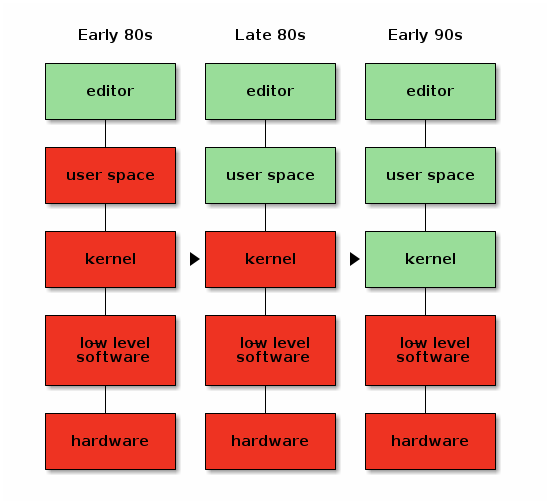
Wouter Verhelst: On Free Software, Free Hardware, and the firmware in between

When the Free Software movement started in the 1980s, most of the world had just made a transition from free university-written software to non-free, proprietary, company-written software. Because of that, the initial ethical standpoint of the Free Software foundation was that it's fine to run a non-free operating system, as long as all the software you run on that operating system is free. Initially this was just the editor. But as time went on, and the FSF managed to write more and more parts of the software stack, their ethical stance moved with the times. This was a, very reasonable, pragmatic stance: if you don't accept using a non-free operating system and there isn't a free operating system yet, then obviously you can't write that free operating system, and the world won't move towards a point where free operating systems exist. In the early 1990s, when Linus initiated the Linux kernel, the situation reached the point where the original dream of a fully free software stack was complete. Or so it would appear. Because, in fact, this was not the case. Computers are physical objects, composed of bits of technology that we refer to as "hardware", but in order for these bits of technology to communicate with other bits of technology in the same computer system, they need to interface with each other, usually using some form of bus protocol. These bus protocols can get very complicated, which means that a bit of software is required in order to make all the bits communicate with each other properly. Generally, this software is referred to as "firmware", but don't let that name deceive you; it's really just a bit of low-level software that is very specific to one piece of hardware. Sometimes it's written in an imperative high-level language; sometimes it's just a set of very simple initialization vectors. But whatever the case might be, it's always a bit of software. And although we largely had a free system, this bit of low-level software was not yet free. Initially, storage was expensive, so computers couldn't store as much data as today, and so most of this software was stored in ROM chips on the exact bits of hardware they were meant for. Due to this fact, it was easy to deceive yourself that the firmware wasn't there, because you never directly interacted with it. We knew it was there; in fact, for some larger pieces of this type of software it was possible, even in those days, to install updates. But that was rarely if ever done at the time, and it was easily forgotten. And so, when the free software movement slapped itself on the back and declared victory when a fully free operating system was available, and decided that the work of creating a free software environment was finished, that only keeping it recent was further required, and that we must reject any further non-free encroachments on our fully free software stack, the free software movement was deceiving itself. Because a computing environment can never be fully free if the low-level pieces of software that form the foundations of that computing environment are not free. It would have been one thing if the Free Software Foundation declared it ethical to use non-free low-level software on a computing environment if free alternatives were not available. But unfortunately, they did not. In fact, something very strange happened. In order for some free software hacker to be able to write a free replacement for some piece of non-free software, they obviously need to be able to actually install that theoretical free replacement. This isn't just a random thought; in fact it has happened. Now, it's possible to install software on a piece of rewritable storage such as flash memory inside the hardware and boot the hardware from that, but if there is a bug in your software -- not at all unlikely if you're trying to write software for a piece of hardware that you don't have documentation for -- then it's not unfathomable that the replacement piece of software will not work, thereby reducing your expensive piece of technology to something about as useful as a paperweight. Here's the good part. In the late 1990s and early 2000s, the bits of technology that made up computers became so complicated, and the storage and memory available to computers so much larger and cheaper, that it became economically more feasible to create a small, tiny, piece of software stored in a ROM chip on the hardware, with just enough knowledge of the bus protocol to download the rest from the main computer. This is awesome for free software. If you now write a replacement for the non-free software that comes with the hardware, and you make a mistake, no wobbles! You just remove power from the system, let the DRAM chips on the hardware component fully drain, return power, and try again. You might still end up with a brick of useless silicon if some of the things you sent to your technology make it do things that it was not designed to do and therefore you burn through some critical bits of metal or plastic, but the chance of this happening is significantly lower than the chance of you writing something that impedes the boot process of the piece of hardware and you are unable to fix it because the flash is overwritten. There is anecdotal evidence that there are free software hackers out there who do so. So, yay, right? You'd think the Free Software foundation would jump at the possibility to get more free software? After all, a large part of why we even have a Free Software Foundation in the first place, was because of some piece of hardware that was misbehaving, so you would think that the foundation's founders would understand the need for hardware to be controlled by software that is free. The strange thing, what has always been strange to me, is that this is not what happened. The Free Software Foundation instead decided that non-free software on ROM or flash chips is fine, but non-free software -- the very same non-free software, mind -- that touches the general storage device that you as a user use, is not. Never mind the fact that the non-free software is always there, whether it sits on your storage device or not. Misguidedness aside, if some people decide they would rather not update the non-free software in their hardware and use the hardware with the old and potentially buggy version of the non-free software that it came with, then of course that's their business. Unfortunately, it didn't quite stop there. If it had, I wouldn't have written this blog post. You see, even though the Free Software Foundation was about Software, they decided that they needed to create a hardware certification program. And this hardware certification program ended up embedding the strange concept that if something is stored in ROM it's fine, but if something is stored on a hard drive it's not. Same hardware, same software, but different storage. By that logic, Windows respects your freedom as long as the software is written to ROM. Because this way, the Free Software Foundation could come to a standstill and pretend they were still living in the 90s. An unfortunate result of the "RYF" program is that it means that companies who otherwise would have been inclined to create hardware that was truly free, top to bottom, are now more incentivised by the RYF program to create hardware in which the non-free low-level software can't be replaced. Meanwhile, the rest of the world did not pretend to still be living in the nineties, and free hardware communities now exist. Because of how the FSF has marketed themselves out of the world, these communities call themselves "Open Hardware" communities, rather than "Free Hardware" ones, but the principle is the same: the designs are there, if you have the skill you can modify it, but you don't have to. In the mean time, the open hardware community has evolved to a point where even CPUs are designed in the open, which you can design your own version of. But not all hardware can be implemented as RISC-V, and so if you want a full system that builds RISC-V you may still need components of the system that were originally built for other architectures but that would work with RISC-V, such as a network card or a GPU. And because the FSF has done everything in their power to disincentivise people who would otherwise be well situated to build free versions of the low-level software required to support your hardware, you may now be in the weird position where we seem to have somehow skipped a step.
My own suspicion is that the universe is not only queerer than we suppose, but queerer than we can suppose.
-- J.B.S. Haldane (comments for this post will not pass moderation. Use your own blog!)

17 February 2026

Freexian Collaborators: Monthly report about Debian Long Term Support, January 2026 (by Santiago Ruano Rinc n)

The Debian LTS Team, funded by Freexian s Debian LTS offering, is pleased to report its activities for January.

Activity summary During the month of January, 20 contributors have been paid to work on Debian LTS (links to individual contributor reports are located below). The team released 33 DLAs fixing 216 CVEs. The team continued preparing security updates in its usual rhythm. Beyond the updates targeting Debian 11 ( bullseye ), which is the current release under LTS, the team also proposed updates for more recent releases (Debian 12 ( bookworm ) and Debian 13 ( trixie )), including Debian unstable. We highlight several notable security updates here below. Notable security updates:
  • python3.9, prepared by Andrej Shadura (DLA-4455-1), fixing multiple vulnerabilities in the Python interpreter.
  • php, prepared by Guilhem Moulin (DLA-4447-1), fixing two vulnerabilities that could yield to request forgery or denial of service.
  • apache2, prepared by Bastien Roucari s DLA-4452-1, fixing four CVEs.
  • linux-6.1, prepared by Ben Hutchings (DLA-4436-1), as a regular update of the linux 6.1 backport to Debian 11.
  • python-django, prepared by Chris Lamb (DLA-4458-1), resolving multiple vulnerabilities.
  • firefox-esr prepared by Emilio Pozuelo Monfort (DLA-4439-1)
  • gnupg2, prepared by Roberto S nchez (DLA-4437-1), fixing multiple issues, including CVE-2025-68973 that could potentially be exploited to execute arbitrary code.
  • apache-log4j2, prepared by Markus Koschany (DLA-4444-1)
  • ceph, prepared by Utkarsh Gupta (DLA-4460-1)
  • inetutils, prepared by Andreas Henriksson (DLA-4453-1), fixing an authentication bypass in telnetd.
Moreover, Sylvain Beucler studied the security support status of p7zip, a fork of 7zip that has become unmaintained upstream. To avoid letting the users continue using an unsupported package, Sylvain has investigated a path forward in collaboration with the security team and the 7zip maintainer, looking to replace p7zip with 7zip. It is to note however that 7zip developers don t reveal the information about the patches that fix CVEs, making it difficult to backport single patches to fix vulnerabilities in Debian released versions. Contributions from outside the LTS Team: Thunderbird, prepared by maintainer Christoph Goehre. The DLA (DLA-4442-1) was published by Emilio. The LTS Team has also contributed with updates to the latest Debian releases:
  • Bastien uploaded gpsd to unstable, and proposed updates for trixie #1126121 and bookworm #1126168 to fix two CVEs.
  • Bastien also prepared the imagemagick updates for trixie and bookworm, released as DSA-6111-1, along with the bullseye update DLA-4448-1.
  • Chris proposed a trixie point update for python-django (#112646), and the work for bookworm was completed in February (#1079454). The longstanding bookworm update required tracking down a regression in the django-storages packages.
  • Markus prepared tomcat10 updates for trixie and bookworm (DSA-6120-1), and tomcat11 for trixie (DSA-6121-1)
  • Thorsten Alteholz prepared bookworm point updates for zvbi (#1126167) to fix five CVEs; taglib (#1126273) to fix one CVE; and libuev (#1126370) to fix one CVE.
  • Utkarsh prepared an unstable update of node-lodash to fix one CVE.
Other than the work related to updates, Sylvain made several improvements to the documentation and tooling used by the team.

Individual Debian LTS contributor reports

Thanks to our sponsors Sponsors that joined recently are in bold.

8 February 2026

Louis-Philippe V ronneau: Montreal Subway Foot Traffic Data, 2025 edition

Another year of data from Soci t de Transport de Montr al, Montreal's transit agency! A few highlights this year:
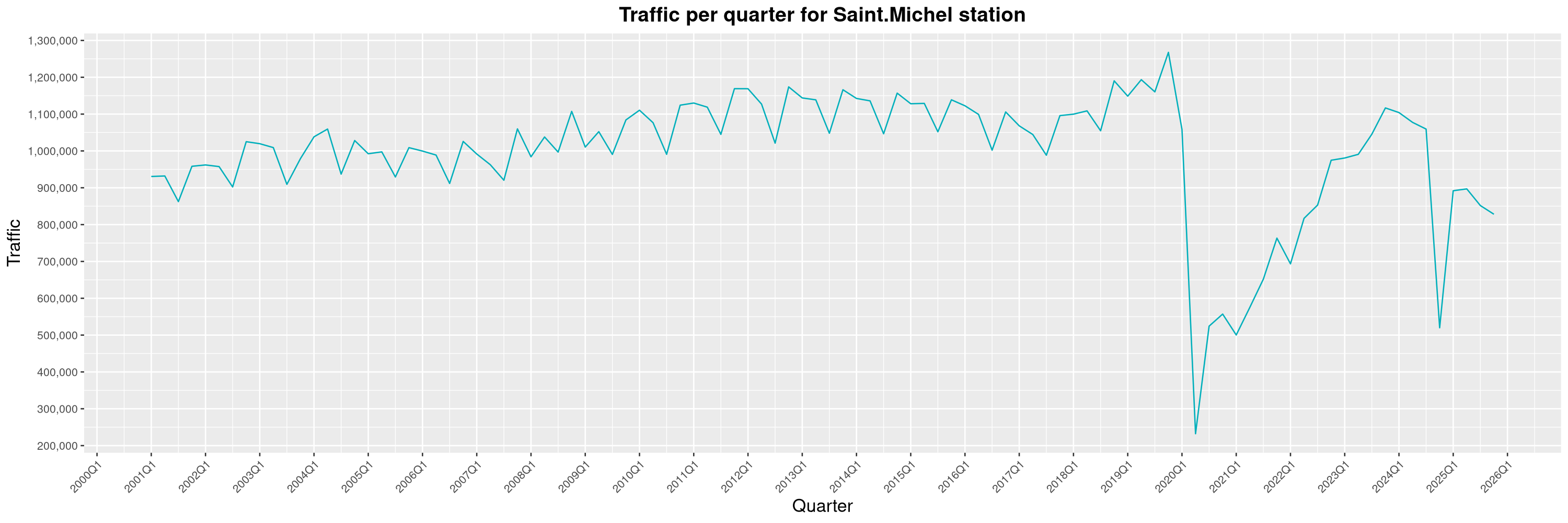
  1. Although the Saint-Michel station closed for emergency repairs in November 2024, traffic never bounced back to its pre-closure levels and is still stuck somewhere around 2022 Q2 levels. I wonder if this could be caused by the roadwork on Jean-Talon for the new Blue Line stations making it harder for folks in Montreal-Nord to reach the station by bus.
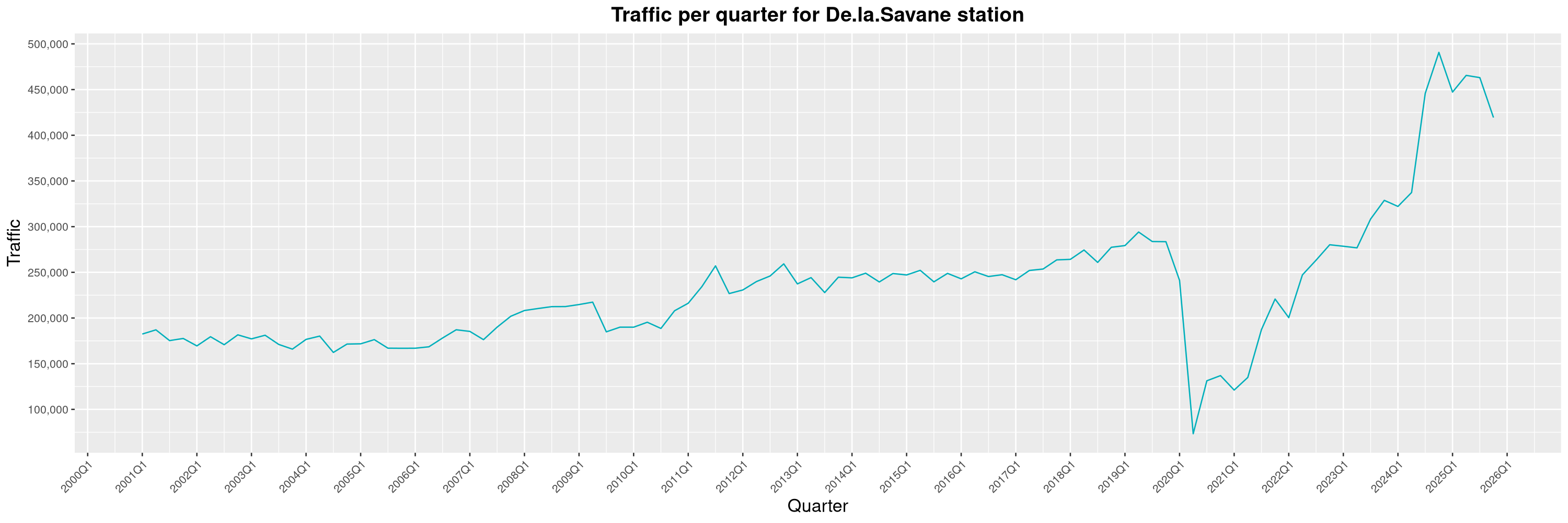
  2. The effects of the opening of the Royalmount shopping center has had a durable impact on the traffic at the De la Savane station. I reported on this last year, but it seems this wasn't just a fad.
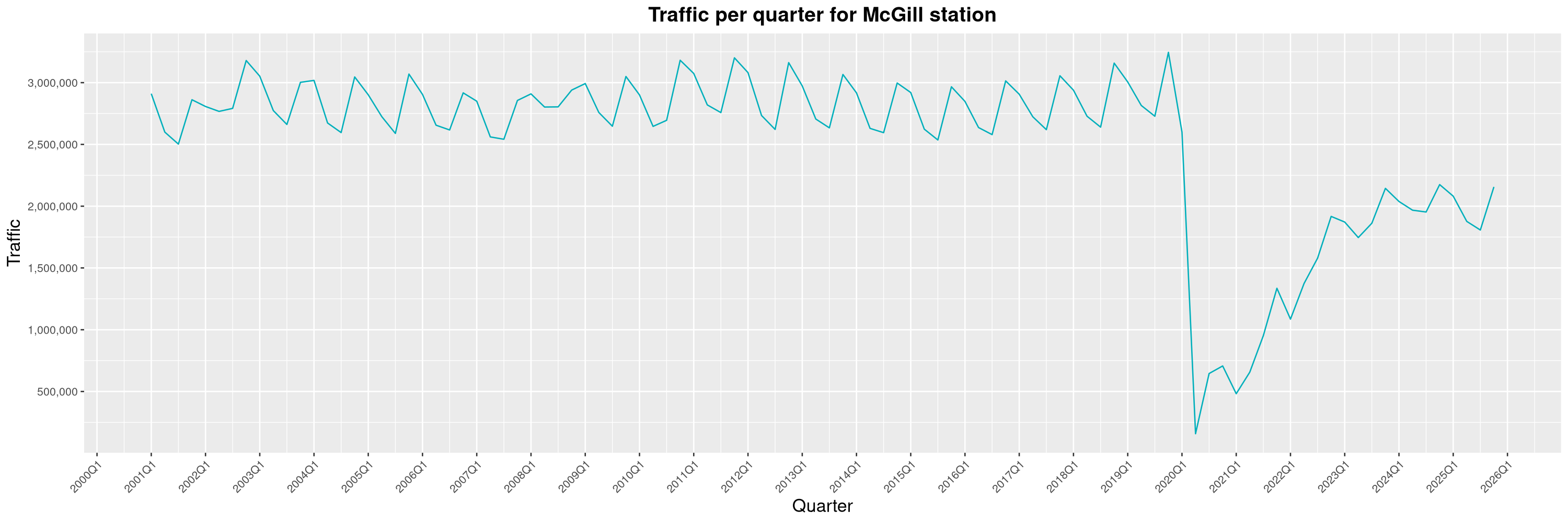
  3. With the completion of the Deux-Montagnes branch of the R seau express m tropolitain (REM, a light-rail, above the surface transit network still in construction), the transfer stations to the Montreal subway have seen major traffic increases. The douard-Montpetit station has nearly reached its previous all-time record of 2015 and the McGill station has recovered from the general slump all the other stations have had in 2025.
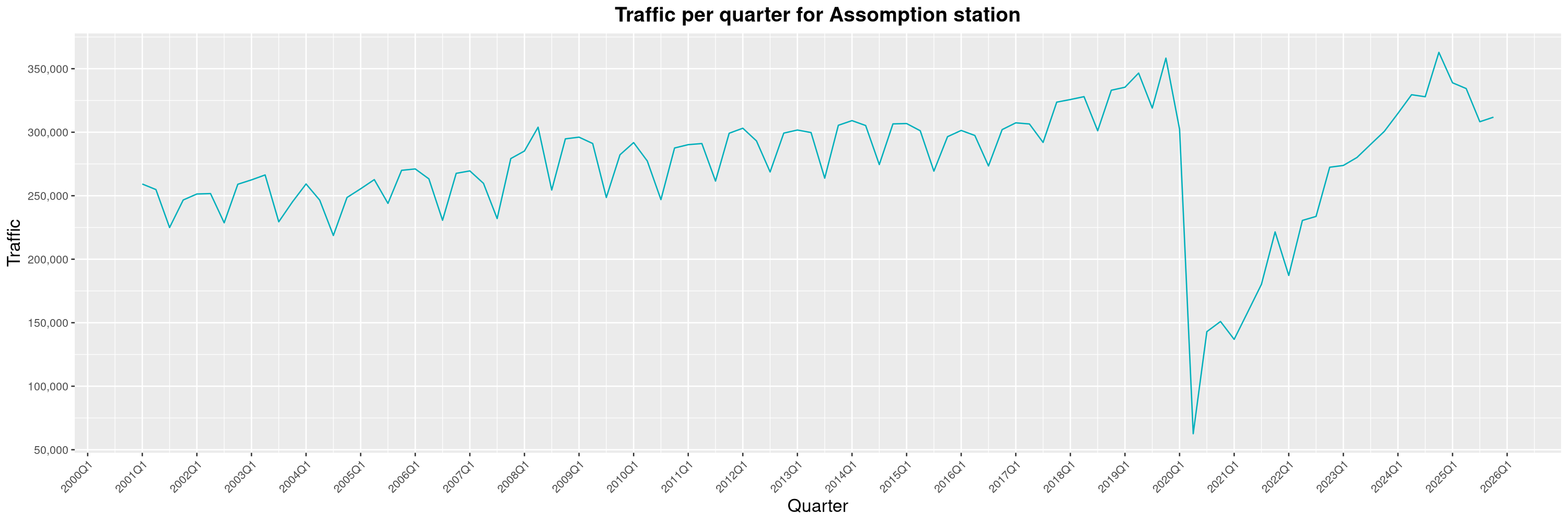
  4. The Assomption station, which used to have one of the lowest number of riders of the subway network, has had a tremendous growth in the past few years. This is mostly explained by the many high-rise projects that were built around the station since the end of the COVID-19 pandemic.
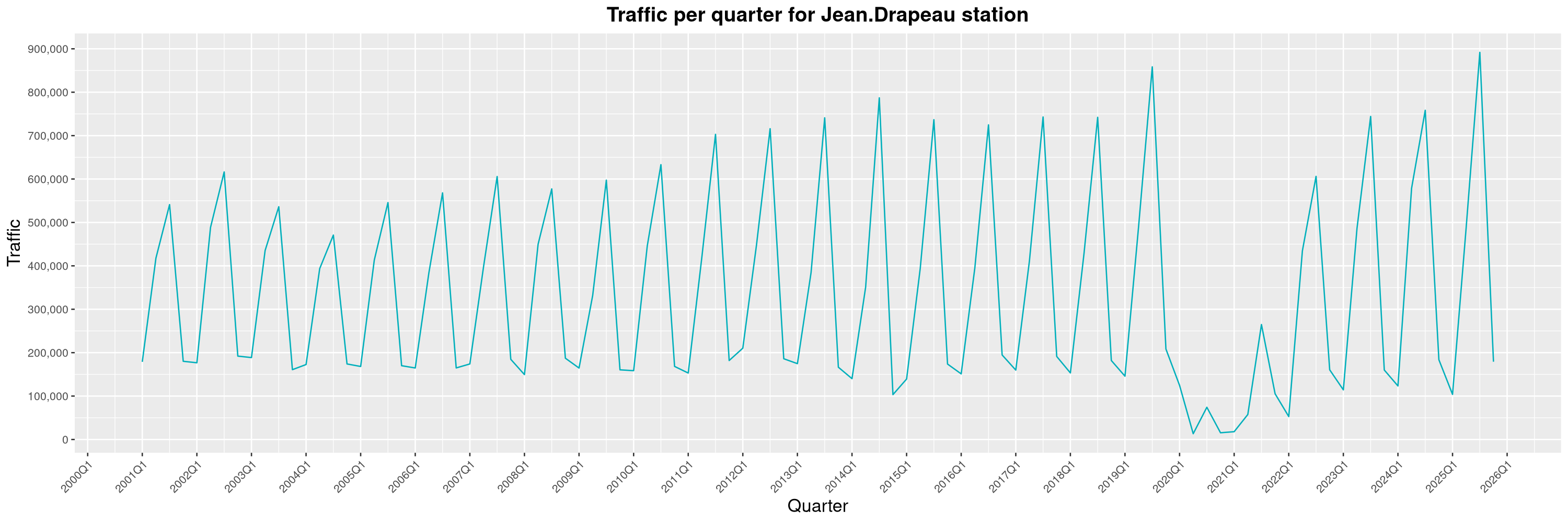
  5. Although still affected by a very high seasonality, the Jean-Drapeau station broke its previous record of 2019, a testament of the continued attraction power of the various summer festivals taking place on the Sainte-H l ne et Notre-Dame islands.
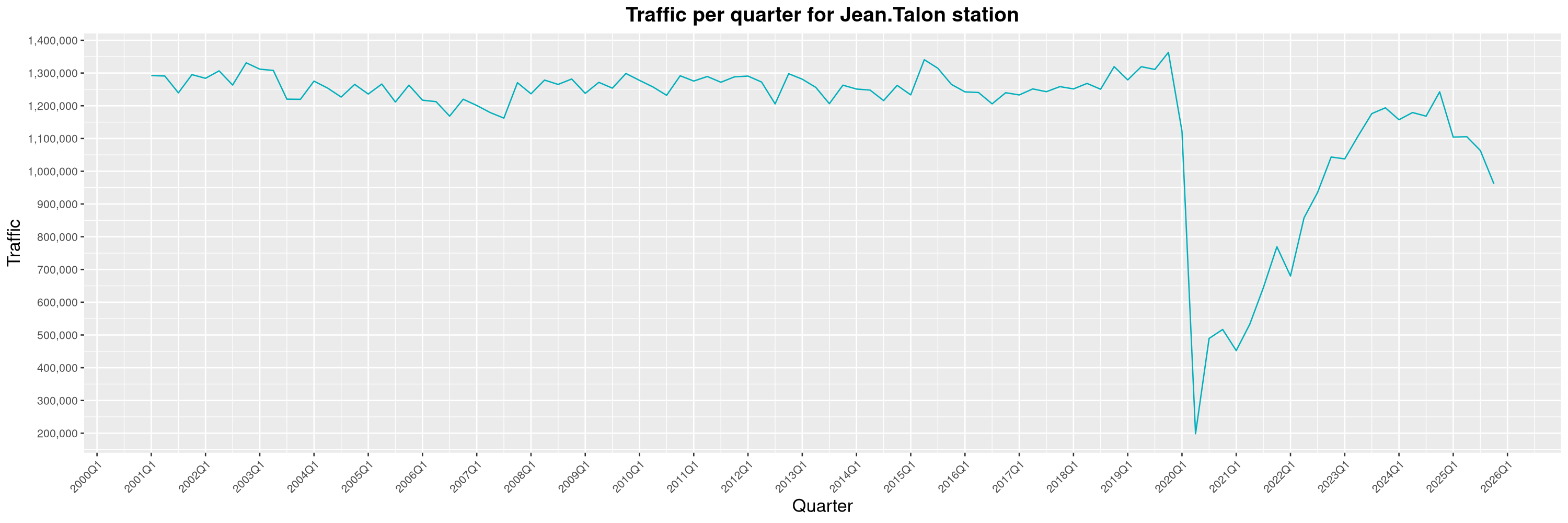
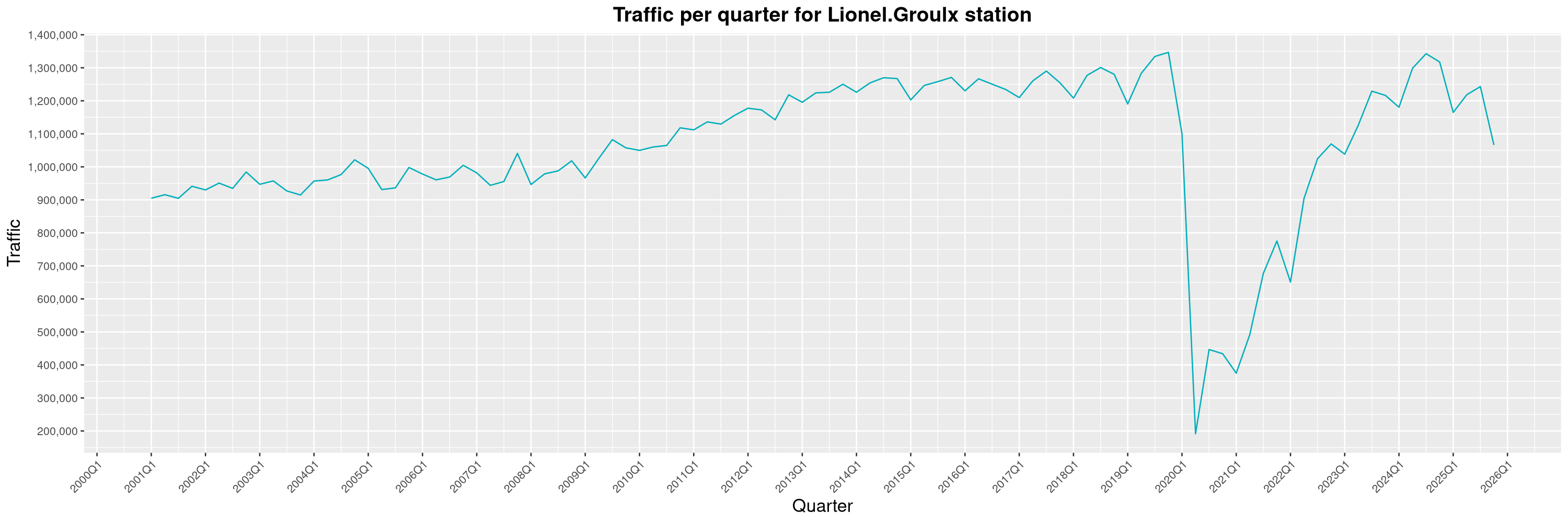
More generally, it seems the Montreal subway has had a pretty bad year. Traffic had been slowly climbing back since the COVID-19 pandemic, but this is the first year since 2020 such a sharp decline can be witnessed. Even major stations like Jean-Talon or Lionel-Groulx are on a downward trend and it is pretty worrisome. As for causes, a few things come to mind. First of all, as the number of Montrealers commuting to work by bike continues to rise1, a modal shift from public transit to active mobility is to be expected. As local experts put it, this is not uncommon and has been seen in other cities before. Another important factor that certainly turned people away from the subway this year has been the impacts of the continued housing crisis in Montreal. As more and more people get kicked out of their apartments, many have been seeking refuge in the subway stations to find shelter. Sadly, this also brought a unprecedented wave of incivilities. As riders' sense of security sharply decreased, the STM eventually resorted to banning unhoused people from sheltering in the subway. This decision did bring back some peace to the network, but one can posit damage had already been done and many casual riders are still avoiding the subway for this reason. Finally, the weekslong STM worker's strike in Q4 had an important impact on general traffic, as it severely reduced the opening hours of the subway. As for the previous item, once people find alternative ways to get around, it's always harder to bring them back. Hopefully, my 2026 report will be a more cheerful one... By clicking on a subway station, you'll be redirected to a graph of the station's foot traffic. Licences

  1. Mostly thanks to major improvements to the cycling network and the BIXI bikesharing program.

1 February 2026

Russ Allbery: Review: Paladin's Faith

Review: Paladin's Faith, by T. Kingfisher
Series: The Saint of Steel #4
Publisher: Red Wombat Studio
Copyright: 2023
ISBN: 1-61450-614-0
Format: Kindle
Pages: 515
Paladin's Faith is the fourth book in T. Kingfisher's loosely connected series of fantasy novels about the berserker former paladins of the Saint of Steel. You could read this as a standalone, but there are numerous (spoilery) references to the previous books in the series. Marguerite, who was central to the plot of the first book in the series, Paladin's Grace, is a spy with a problem. An internal power struggle in the Red Sail, the organization that she's been working for, has left her a target. She has a plan for how to break their power sufficiently that they will hopefully leave her alone, but to pull it off she's going to need help. As the story opens, she is working to acquire that help in a very Marguerite sort of way: breaking into the office of Bishop Beartongue of the Temple of the White Rat. The Red Sail, the powerful merchant organization Marguerite worked for, makes their money in the salt trade. Marguerite has learned that someone invented a cheap and reproducible way to extract salt from sea water, thus making the salt trade irrelevant. The Red Sail wants to ensure that invention never sees the light of day, and has forced the artificer into hiding. Marguerite doesn't know where they are, but she knows where she can find out: the Court of Smoke, where the artificer has a patron.
Having grown up in Anuket City, Marguerite was familiar with many clockwork creations, not to mention all the ways that they could go horribly wrong. (Ninety-nine times out of a hundred, it was an explosion. The hundredth time, it ran amok and stabbed innocent bystanders, and the artificer would be left standing there saying, "But I had to put blades on it, or how would it rake the leaves?" while the gutters filled up with blood.)
All Marguerite needs to put her plan into motion is some bodyguards so that she's not constantly distracted and anxious about being assassinated. Readers of this series will be unsurprised to learn that the bodyguards she asks Beartongue for are paladins, including a large broody male one with serious self-esteem problems. This is, like the other books in this series, a slow-burn romance with infuriating communication problems and a male protagonist who would do well to seek out a sack of hammers as a mentor. However, it has two things going for it that most books in this series do not: a long and complex plot to which the romance takes a back seat, and Marguerite, who is not particularly interested in playing along with the expected romance developments. There are also two main paladins in this story, not just one, and the other is one of the two female paladins of the Saint of Steel and rather more entertaining than Shane. I generally like court intrigue stories, which is what fills most of this book. Marguerite is an experienced operative, so the reader gets some solid competence porn, and the paladins are fish out of water but are also unexpectedly dangerous, which adds both comedy and satisfying table-turning. I thoroughly enjoyed the maneuvering and the culture clashes. Marguerite is very good at what she does, knows it, and is entirely uninterested in other people's opinions about that, which short-circuits a lot of Shane's most annoying behavior and keeps the story from devolving into mopey angst like some of the books in this series have done. The end of this book takes the plot in a different direction that adds significantly to the world-building, but also has a (thankfully short) depths of despair segment that I endured rather than enjoyed. I am not really in the mood for bleak hopelessness in my fiction at the moment, even if the reader is fairly sure it will be temporary. But apart from that, I thoroughly enjoyed this book from beginning to end. When we finally meet the artificer, they are an absolute delight in that way that Kingfisher is so good at. The whole story is infused with the sense of determined and competent people refusing to stop trying to fix problems. As usual, the romance was not for me and I think the book would have been better without it, but it's less central to the plot and therefore annoyed me less than any of the books in this series so far. My one major complaint is the lack of gnoles, but we get some new and intriguing world-building to make up for it, along with a setup for a fifth book that I am now extremely curious about. By this point in the series, you probably know if you like the general formula. Compared to the previous book, Paladin's Hope, I thought Paladin's Faith was much stronger and more interesting, but it's clearly of the same type. If, like me, you like the plots but not the romance, the plot here is more substantial. You will have to decide if that makes up for a romance in the typical T. Kingfisher configuration. Personally, I enjoyed this quite a bit, except for the short bleak part, and I'm back to eagerly awaiting the next book in the series. Rating: 8 out of 10

31 January 2026

Michael Prokop: apt, SHA-1 keys + 2026-02-01

You might have seen Policy will reject signature within a year warnings in apt(-get) update runs like this:
root@424812bd4556:/# apt update
Get:1 http://foo.example.org/debian demo InRelease [4229 B]
Hit:2 http://deb.debian.org/debian trixie InRelease
Hit:3 http://deb.debian.org/debian trixie-updates InRelease
Hit:4 http://deb.debian.org/debian-security trixie-security InRelease
Get:5 http://foo.example.org/debian demo/main amd64 Packages [1097 B]
Fetched 5326 B in 0s (43.2 kB/s)
All packages are up to date.
Warning: http://foo.example.org/debian/dists/demo/InRelease: Policy will reject signature within a year, see --audit for details
root@424812bd4556:/# apt --audit update
Hit:1 http://foo.example.org/debian demo InRelease
Hit:2 http://deb.debian.org/debian trixie InRelease
Hit:3 http://deb.debian.org/debian trixie-updates InRelease
Hit:4 http://deb.debian.org/debian-security trixie-security InRelease
All packages are up to date.    
Warning:  http://foo.example.org/debian/dists/demo/InRelease: Policy will reject signature within a year, see --audit for details
Audit:  http://foo.example.org/debian/dists/demo/InRelease: Sub-process /usr/bin/sqv returned an error code (1), error message is:
   Signing key on 54321ABCD6789ABCD0123ABCD124567ABCD89123 is not bound:
              No binding signature at time 2024-06-19T10:33:47Z
     because: Policy rejected non-revocation signature (PositiveCertification) requiring second pre-image resistance
     because: SHA1 is not considered secure since 2026-02-01T00:00:00Z
Audit: The sources.list(5) entry for 'http://foo.example.org/debian' should be upgraded to deb822 .sources
Audit: Missing Signed-By in the sources.list(5) entry for 'http://foo.example.org/debian'
Audit: Consider migrating all sources.list(5) entries to the deb822 .sources format
Audit: The deb822 .sources format supports both embedded as well as external OpenPGP keys
Audit: See apt-secure(8) for best practices in configuring repository signing.
Audit: Some sources can be modernized. Run 'apt modernize-sources' to do so.
If you ignored this for the last year, I would like to tell you that 2026-02-01 is not that far away (hello from the past if you re reading this because you re already affected). Let s simulate the future:
root@424812bd4556:/# apt --update -y install faketime
[...]
root@424812bd4556:/# export LD_PRELOAD=/usr/lib/x86_64-linux-gnu/faketime/libfaketime.so.1 FAKETIME="2026-08-29 23:42:11" 
root@424812bd4556:/# date
Sat Aug 29 23:42:11 UTC 2026
root@424812bd4556:/# apt update
Get:1 http://foo.example.org/debian demo InRelease [4229 B]
Hit:2 http://deb.debian.org/debian trixie InRelease                                 
Err:1 http://foo.example.org/debian demo InRelease
  Sub-process /usr/bin/sqv returned an error code (1), error message is: Signing key on 54321ABCD6789ABCD0123ABCD124567ABCD89123 is not bound:            No binding signature at time 2024-06-19T10:33:47Z   because: Policy rejected non-revocation signature (PositiveCertification) requiring second pre-image resistance   because: SHA1 is not considered secure since 2026-02-01T00:00:00Z
[...]
Warning: An error occurred during the signature verification. The repository is not updated and the previous index files will be used. OpenPGP signature verification failed: http://foo.example.org/debian demo InRelease: Sub-process /usr/bin/sqv returned an error code (1), error message is: Signing key on 54321ABCD6789ABCD0123ABCD124567ABCD89123 is not bound:            No binding signature at time 2024-06-19T10:33:47Z   because: Policy rejected non-revocation signature (PositiveCertification) requiring second pre-image resistance   because: SHA1 is not considered secure since 2026-02-01T00:00:00Z
[...]
root@424812bd4556:/# echo $?
100
Now, the proper solution would have been to fix the signing key underneath (via e.g. sq cert lint &dash&dashfix &dash&dashcert-file $PRIVAT_KEY_FILE > $PRIVAT_KEY_FILE-fixed). If you don t have access to the according private key (e.g. when using an upstream repository that has been ignoring this issue), you re out of luck for a proper fix. But there s a workaround for the apt situation (related see apt commit 0989275c2f7afb7a5f7698a096664a1035118ebf):
root@424812bd4556:/# cat /usr/share/apt/default-sequoia.config
# Default APT Sequoia configuration. To overwrite, consider copying this
# to /etc/crypto-policies/back-ends/apt-sequoia.config and modify the
# desired values.
[asymmetric_algorithms]
dsa2048 = 2024-02-01
dsa3072 = 2024-02-01
dsa4096 = 2024-02-01
brainpoolp256 = 2028-02-01
brainpoolp384 = 2028-02-01
brainpoolp512 = 2028-02-01
rsa2048  = 2030-02-01
[hash_algorithms]
sha1.second_preimage_resistance = 2026-02-01    # Extend the expiry for legacy repositories
sha224 = 2026-02-01
[packets]
signature.v3 = 2026-02-01   # Extend the expiry
Adjust this according to your needs:
root@424812bd4556:/# mkdir -p /etc/crypto-policies/back-ends/
root@424812bd4556:/# cp /usr/share/apt/default-sequoia.config /etc/crypto-policies/back-ends/apt-sequoia.config
root@424812bd4556:/# $EDITOR /etc/crypto-policies/back-ends/apt-sequoia.config
root@424812bd4556:/# cat /etc/crypto-policies/back-ends/apt-sequoia.config
# APT Sequoia override configuration
[asymmetric_algorithms]
dsa2048 = 2024-02-01
dsa3072 = 2024-02-01
dsa4096 = 2024-02-01
brainpoolp256 = 2028-02-01
brainpoolp384 = 2028-02-01
brainpoolp512 = 2028-02-01
rsa2048  = 2030-02-01
[hash_algorithms]
sha1.second_preimage_resistance = 2026-09-01    # Extend the expiry for legacy repositories
sha224 = 2026-09-01
[packets]
signature.v3 = 2026-02-01   # Extend the expiry
Then we re back into the original situation, being a warning instead of an error:
root@424812bd4556:/# apt update
Hit:1 http://deb.debian.org/debian trixie InRelease
Get:2 http://foo.example.org/debian demo InRelease [4229 B]
Hit:3 http://deb.debian.org/debian trixie-updates InRelease
Hit:4 http://deb.debian.org/debian-security trixie-security InRelease
Warning: http://foo.example.org/debian/dists/demo/InRelease: Policy will reject signature within a year, see --audit for details
[..]
Please note that this is a workaround, and not a proper solution.

26 January 2026

Otto Kek l inen: Ubuntu Pro subscription - should you pay to use Linux?

Featured image of post Ubuntu Pro subscription - should you pay to use Linux?Ubuntu Pro is a subscription offering for Ubuntu users who want to pay for the assurance of getting quick and high-quality security updates for Ubuntu. I tested it out to see how it works in practice, and to evaluate how well it works as a commercial open source service model for Linux. Anyone running Ubuntu can subscribe to it at ubuntu.com/pro/subscribe by selecting the setup type Desktops for the price of $25 per year (+applicable taxes) for Enterprise users. There is also a free version for personal use. Once you have an account, you can find your activation token at ubuntu.com/pro/dashboard, and use it to activate Ubuntu Pro on your desktop or laptop Ubuntu machine by running sudo pro attach <token>:
$ sudo pro attach aabbcc112233aabbcc112233
Enabling default service esm-apps
Updating package lists
Ubuntu Pro: ESM Apps enabled
Enabling default service esm-infra
Updating package lists
Ubuntu Pro: ESM Infra enabled
Enabling default service livepatch
Installing canonical-livepatch snap
Canonical livepatch enabled.
Unable to determine current instance-id
This machine is now attached to 'Ubuntu Pro Desktop'
You can at any time confirm the Ubuntu Pro status by running:
$ sudo pro status --all
SERVICE ENTITLED STATUS DESCRIPTION
anbox-cloud yes disabled Scalable Android in the cloud
cc-eal yes n/a Common Criteria EAL2 Provisioning Packages
esm-apps yes enabled Expanded Security Maintenance for Applications
esm-infra yes enabled Expanded Security Maintenance for Infrastructure
fips yes n/a NIST-certified FIPS crypto packages
fips-preview yes n/a Preview of FIPS crypto packages undergoing certification with NIST
fips-updates yes disabled FIPS compliant crypto packages with stable security updates
landscape yes enabled Management and administration tool for Ubuntu
livepatch yes disabled Canonical Livepatch service
realtime-kernel yes disabled Ubuntu kernel with PREEMPT_RT patches integrated
  generic yes disabled Generic version of the RT kernel (default)
  intel-iotg yes n/a RT kernel optimized for Intel IOTG platform
  raspi yes n/a 24.04 Real-time kernel optimised for Raspberry Pi
ros yes n/a Security Updates for the Robot Operating System
ros-updates yes n/a All Updates for the Robot Operating System
usg yes disabled Security compliance and audit tools
Enable services with: pro enable <service>
Account: Otto Kekalainen
Subscription: Ubuntu Pro Desktop
Valid until: Thu Mar 3 08:08:38 2026 PDT
Technical support level: essential
For a regular desktop/laptop user the most relevant service is the esm-apps, which delivers extended security updates to many applications typically used on desktop systems. Another relevant command to confirm the current subscription status is:
$ sudo pro security-status
2828 packages installed:
2143 packages from Ubuntu Main/Restricted repository
660 packages from Ubuntu Universe/Multiverse repository
13 packages from third parties
12 packages no longer available for download
To get more information about the packages, run
pro security-status --help
for a list of available options.
This machine is receiving security patching for Ubuntu Main/Restricted
repository until 2029.
This machine is attached to an Ubuntu Pro subscription.
Ubuntu Pro with 'esm-infra' enabled provides security updates for
Main/Restricted packages until 2034.
Ubuntu Pro with 'esm-apps' enabled provides security updates for
Universe/Multiverse packages until 2034. You have received 26 security
updates.
This confirms the scope of the security support. You can even run sudo pro security-status --esm-apps to get a detailed breakdown of the installed software packages in scope for Expanded Security Maintenance (ESM).

Experiences from using Ubuntu Pro for over a year Personally I have been using it on two laptop systems for well over a year now and everything seems to have worked well. I see apt is downloading software updates from https://esm.ubuntu.com/apps/ubuntu, but other than that there aren t any notable signs of Ubuntu Pro being in use. That is a good thing after all one is paying for assurance that everything works with minimum disruptions, so the system that enables smooth sailing should stay in the background and not make too much noise of itself.

Using Landscape to manage multiple Ubuntu laptops Landscape portal reports showing security update status and resource utilization Landscape.canonical.com is a fleet management system that shows information like security update status and resource utilization for the computers you administer. Ubuntu Pro attached systems under one s account are not automatically visible in Landscape, but have to be enrolled in it. To enroll an Ubuntu Pro attached desktop/laptop to Landscape, first install the required package with sudo apt install landscape-client and then run sudo landscape-config --account-name <account name> to start the configuration wizard. You can find your account name in the Landscape portal. On the last wizard question Request a new registration for this computer now? [y/N] hit y to accept. If successful, the new computer will be visible on the Landscape portal page Pending computers , from where you can click to accept it. Landscape portal page showing pending computer registration If I had a large fleet of computers, Landscape might come in useful. Also it is obvious Landscape is intended primarily for managing server systems. For example, the default alarm trigger on systems being offline, which is common for laptops and desktop computers, is an alert-worthy thing only on server systems. It is good to know that Landscape exists, but on desktop systems I would probably skip it, and only stick to the security updates offered by Ubuntu Pro without using Landscape.

Landscape is evolving The screenshots above are from the current Landscape portal which I have been using so far. Recently Canonical has also launched a new web portal, with a fresh look: New Landscape dashboard with fresh look This shows Canonical is actively investing in the service and it is likely going to sit at the center of their business model for years to come.

Other offerings by Canonical for individual users Canonical, the company behind the world s most popular desktop Linux distribution Ubuntu, has been offering various commercial support services for corporate customers since the company launched back in 2005, but there haven t been any offerings available to individual users since Ubuntu One, with file syncing, a music store and more, was wound down back in 2014. Canonical and the other major Linux companies, Red Hat and SUSE, have always been very enterprise-oriented, presumably because achieving economies of scale is much easier when maintaining standardized corporate environments compared to dealing with a wide range of custom configurations that individual consumer customers might have. I remember some years ago Canonical offered desktop support under the Ubuntu Advantage product name, but the minimum subscription was for 5 desktop systems, which typically isn t an option for a regular home consumer. I am glad to see Ubuntu Pro is now available and I honestly hope people using Ubuntu will opt into it. The more customers it has, the more it incentivizes Canonical to develop and maintain features that are important for desktop and home users.

Pay for Linux because you can, not because you have to Open source is a great software development model for rapid innovation and adoption, but I don t think the business models in the space are yet quite mature. Users who get long-term value should participate more in funding open source maintenance work. While some donation platforms like GitHub Sponsors, OpenCollective and the like have gained popularity in recent years, none of them seem to generate recurring revenue comparable to the scale of how popular open source software is now in 2026. I welcome more paid schemes, such as Ubuntu Pro, as I believe it is beneficial for the whole ecosystem. I also expect more service providers to enter this space and experiment with different open source business models and various forms of decentralized funding. Linux and open source are primarily free as in speech, but as a side effect license fees are hard to enforce and many use Linux without paying for it. The more people, corporations and even countries rely on it to stay sovereign in the information society, the more users should think about how they want to use Linux and who they want to pay to maintain it and other critical parts of the open source ecosystem.

21 January 2026

Evgeni Golov: Validating cloud-init configs without being root

Somehow this whole DevOps thing is all about generating the wildest things from some (usually equally wild) template. And today we're gonna generate YAML from ERB, what could possibly go wrong?! Well, actually, quite a lot, so one wants to validate the generated result before using it to break systems at scale. The YAML we generate is a cloud-init cloud-config, and while checking that we generated a valid YAML document is easy (and we were already doing that), it would be much better if we could check that cloud-init can actually use it. Enter cloud-init schema, or so I thought. Turns out running cloud-init schema is rather broken without root privileges, as it tries to load a ton of information from the running system. This seems like a bug (or multiple), as the data should not be required for the validation of the schema itself. I've not found a way to disable that behavior. Luckily, I know Python. Enter evgeni-knows-better-and-can-write-python:
#!/usr/bin/env python3
import sys
from cloudinit.config.schema import get_schema, validate_cloudconfig_file, SchemaValidationError
try:
    valid = validate_cloudconfig_file(config_path=sys.argv[1], schema=get_schema())
    if not valid:
        raise RuntimeError("Schema is not valid")
except (SchemaValidationError, RuntimeError) as e:
    print(e)
    sys.exit(1)
The canonical1 version if this lives in the Foreman git repo, so go there if you think this will ever receive any updates. The hardest part was to understand thevalidate_cloudconfig_file API, as it will sometimes raise an SchemaValidationError, sometimes a RuntimeError and sometimes just return False. No idea why. But the above just turns it into a couple of printed lines and a non zero exit code, unless of course there are no problems, then you get peaceful silence.

19 January 2026

Jonathan Dowland: FOSDEM 2026

I'm going to FOSDEM 2026! I'm presenting in the Containers dev room. My talk is Java Memory Management in Containers and it's scheduled as the first talk on the first day. I'm the warm-up act! The Java devroom has been a stalwart at FOSDEM since 2004 (sometimes in other forms), but sadly there's no Java devroom this year. There's a story about that, but it's not mine to tell. Please recommend to me any interesting talks! Here's a few that caught my eye: Debian/related: Containers: Research: Other:

16 January 2026

Freexian Collaborators: Monthly report about Debian Long Term Support, December 2025 (by Santiago Ruano Rinc n)

The Debian LTS Team, funded by [Freexian s Debian LTS offering] (https://www.freexian.com/lts/debian/), is pleased to report its activities for December.

Activity summary During the month of December, 18 contributors have been paid to work on Debian LTS (links to individual contributor reports are located below). The team released 41 DLAs fixing 252 CVEs. The team currently focuses on preparing security updates for Debian 11 bullseye , but also looks for contributing with updates for Debian 12 bookworm , Debian 13 trixie and even Debian unstable. Notable security updates:
  • libsoup2.4 (DLA-4398-1), prepared by Andreas Henrikson, fixing several vulnerabilities.
  • glib2.0 (DLA-4412-1), published by Emilio Pozuelo Monfort, addressing multiple issues.
  • lasso (DLA-4397-1), prepared by Sylvain Beucler, addressing multiple issues, including a critical remote code execution (RCE) vulnerability (CVE-2025-47151)
  • roundcube (DLA 4415-1), prepared by Guilhem Moulin, fixing a cross-site-scripting (XSS) (CVE-2025-68461) and an information disclosure (CVE-2025-68460) vulnerabilities
  • mediawiki (DLA 4428-1), published by Guilhem, fixing multiple vulnerabilities could lead to information disclosure, denial of service or privilege escalation.
  • While the DLA has not been published yet, Charles Henrique Melara proposed upstream fixes for seven CVEs in ffmpeg: https://code.ffmpeg.org/FFmpeg/FFmpeg/pulls/21275.
  • python-apt (DLA 4408-1), prepared by Utkarsh Gupta, in coordination with the Debian Security Team and Julian Andres Klode, the apt s maintainer.
  • libpng1.6 (DLA-4396-1), published by Tobias Frost, completing the work started the previous month.
Notable non-security updates:
  • tzdata (DLA-4403-1), prepared by Emilio, including the latest changes to the leap second list and its expiry date, which was set for the end of December.
Contributions from outside the LTS Team:
  • Christoph Berg, co-maintainer of PostgreSQL in Debian, prepared a postgresql-13 update, released as DLA-4420-1
The LTS Team has also contributed with updates to the latest Debian releases:

Individual Debian LTS contributor reports

Thanks to our sponsors Sponsors that joined recently are in bold.

9 January 2026

Simon Josefsson: Debian Taco Towards a GitSecDevOps Debian

One of my holiday projects was to understand and gain more trust in how Debian binaries are built, and as the holidays are coming to an end, I d like to introduce a new research project called Debian Taco. I apparently need more holidays, because there are still more work to be done here, so at the end I ll summarize some pending work. Debian Taco, or TacOS, is a GitSecDevOps rebuild of Debian GNU/Linux. The Debian Taco project publish rebuilt binary packages, package repository metadata (InRelease, Packages, etc), container images, cloud images and live images. All packages are built from pristine source packages in the Debian archive. Debian Taco does not modify any Debian source code nor add or remove any packages found in Debian. No servers are involved! Everything is built in GitLab pipelines and results are published through modern GitDevOps mechanism like GitLab Pages and S3 object storage. You can fork the individual projects below on GitLab.com and you will have your own Debian-derived OS available for tweaking. (Of course, at some level, servers are always involved, so this claim is a bit of hyperbole.)

Goals The goal of TacOS is to be bit-by-bit identical with official Debian GNU/Linux, and until that has been completed, publish diffoscope output with differences. The idea is to further categorize all artifact differences into one of the following categories: 1) An obvious bug in Debian. For example, if a package does not build reproducible. 2) An obvious bug in TacOS. For example, if our build environment does not manage to build a package. 3) Something else. This would be input for further research and consideration. This category also include things where it isn t obvious if it is a bug in Debian or in TacOS. Known examples: 3A) Packages in TacOS are rebuilt the latest available source code, not the (potentially) older package that were used to build the Debian packages. This could lead to differences in the packages. These differences may be useful to analyze to identify supply-chain attacks. See some discussion about idempotent rebuilds. Our packages are all built from source code, unless we have not yet managed to build something. In the latter situation, Debian Taco falls back and uses the official Debian artifact. This allows an incremental publication of Debian Taco that still is 100% complete without requiring that everything is rebuilt instantly. The goal is that everything should be rebuilt, and until that has been completed, publish a list of artifacts that we use verbatim from Debian.

Debian Taco Archive The Debian Taco Archive project generate and publish the package archive (dists/tacos-trixie/InRelease, dists/tacos-trixie/main/binary-amd64/Packages.gz, pool/* etc), similar to what is published at https://deb.debian.org/debian/. The output of the Debian Taco Archive is available from https://debdistutils.gitlab.io/tacos/archive/.

Debian Taco Container Images The Debian Taco Container Images project provide container images of Debian Taco for trixie, forky and sid on the amd64, arm64, ppc64el and riscv64 architectures. These images allow quick and simple use of Debian Taco interactively, but makes it easy to deploy for container orchestration frameworks.

Debian Taco Cloud Images The Debian Taco Cloud Images project provide cloud images of Debian Taco for trixie, forky and sid on the amd64, arm64, ppc64el and riscv64 architectures. Launch and install Debian Taco for your cloud environment!

Debian Taco Live Images The Debian Taco Live Images project provide live images of Debian Taco for trixie, forky and sid on the amd64 and arm64 architectures. These images allows running Debian Taco on physical hardware (or virtual machines), and even installation for permanent use.

Debian Taco Build Images and Packages Packages are built using debdistbuild, which was introduced in a blog about Build Debian in a GitLab Pipeline. The first step is to prepare build images, which is done by the Debian Taco Build Images project. They are similar to the Debian Taco containers but have build-essential and debdistbuild installed on them. Debdistbuild is launched in a per-architecture per-suite CI/CD project. Currently only trixie-amd64 is available. That project has built some essential early packages like base-files, debian-archive-keyring and hostname. They are stored in Git LFS backed by a S3 object storage. These packages were all built reproducibly. So this means Debian Taco is still 100% bit-by-bit identical to Debian, except for the renaming. I ve yet to launch a more massive wide-scale package rebuild until some outstanding issues have been resolved. I earlier rebuilt around 7000 packages from Trixie on amd64, so I know that the method easily scales.

Remaining work Where is the diffoscope package outputs and list of package differences? For another holiday! Clearly this is an important remaining work item. Another important outstanding issue is how to orchestrate launching the build of all packages. Clearly a list of packages is needed, and some trigger mechanism to understand when new packages are added to Debian. One goal was to build packages from the tag2upload browse.dgit.debian.org archive, before checking the Debian Archive. This ought to be really simple to implement, but other matters came first.

GitLab or Codeberg? Everything is written using basic POSIX /bin/sh shell scripts. Debian Taco uses the GitLab CI/CD Pipeline mechanism together with a Hetzner S3 object storage to serve packages. The scripts have only weak reliance on GitLab-specific principles, and were designed with the intention to support other platforms. I believe reliance on a particular CI/CD platform is a limitation, so I d like to explore shipping Debian Taco through a Forgejo-based architecture, possibly via Codeberg as soon as I manage to deploy reliable Forgejo runners. The important aspects that are required are: 1) Pipelines that can build and publish web sites similar to GitLab Pages. Codeberg has a pipeline mechanism. I ve successfully used Codeberg Pages to publish the OATH Toolkit homepage homepage. Glueing this together seems feasible. 2) Container Registry. It seems Forgejo supports a Container Registry but I ve not worked with it at Codeberg to understand if there are any limitations. 3) Package Registry. The Deban Taco live images are uploaded into a package registry, because they are too big for being served through GitLab Pages. It may be converted to using a Pages mechanism, or possibly through Release Artifacts if multi-GB artifacts are supported on other platforms. I hope to continue this work and explaining more details in a series of posts, stay tuned!

Russell Coker: LEAF ZE1 After 6 Months

About 6 months ago I got a Nissan LEAF ZE1 (2019 model) [1]. Generally it s going well and I m happy with most things about it. One issue is that as there isn t a lot of weight in the front with the batteries in the centre of the car the front wheels slip easily when accelerating. It s a minor thing but a good reason for wanting AWD in an electric car. When I got the car I got two charging devices, the one to charge from a regular 240V 10A power point (often referred to as a granny charger ) and a cable with a special EV charging connector on each end. The cable with an EV connector on each end is designed for charging that s faster than the granny charger but not as fast as the rapid chargers which have the cable connected to the supply so the cable temperature can be monitored and/or controlled. That cable can be used if you get a fast charger setup at your home (which I never plan to do) and apparently at some small hotels and other places with home-style EV charging. I m considering just selling that cable on ebay as I don t think I have any need to personally own a cable other than the granny charger . The key fob for the LEAF has a battery installed, it s either CR2032 or CR2025 mine has CR2025. Some reports on the Internet suggest that you can stuff a CR2032 battery in anyway but that didn t work for me as the thickness of the battery stopped some of the contacts from making a good connection. I think I could have got it going by putting some metal in between but the batteries aren t expensive enough to make it worth the effort and risk. It would be nice if I could use batteries from my stockpile of CR2032 batteries that came from old PCs but I can afford to spend a few dollars on it. My driveway is short and if I left the charger out it would be visible from the street and at risk of being stolen. I m thinking of chaining the charger to a tree and having some sort of waterproof enclosure for it so I don t have to go to the effort of taking it out of the boot every time I use it. Then I could also configure the car to only charge during the peak sunlight hours when the solar power my home feeds into the grid has a negative price (we have so much solar power that it s causing grid problems). The cruise control is a pain to use, so much so that I haven t yet got it to work usefully ever. The features look good in the documentation but in practice it s not as good as the Kia one I ve used previously where I could just press one button to turn it on, another button to set the current speed as the cruise control speed, and then just have it work. The electronic compass built in to the dash turned out to be surprisingly useful. I regret not gluing a compass to the dash of previous cars. One example is when I start google navigation for a journey and it says go South on street X and I need to know which direction is South so I don t start in the wrong direction. Another example is when I know that I m North of a major road that I need to take to get to my destination so I just need to go roughly South and that is enough to get me to a road I recognise. In the past when there is a bird in the way I don t do anything different, I keep driving at the same speed and rely on the bird to see me and move out of the way. Birds have faster reactions than humans and have evolved to move at the speeds cars travel on all roads other than freeways, also birds that are on roads are usually ones that have an eye in each side of their head so they can t not see my car approaching. For decades this has worked, but recently a bird just stood on the road and got squashed. So I guess that I should honk when there s birds on the road. Generally everything about the car is fine and I m happy to keep driving it.

5 January 2026

Vincent Bernat: Using eBPF to load-balance traffic across UDP sockets with Go

Akvorado collects sFlow and IPFIX flows over UDP. Because UDP does not retransmit lost packets, it needs to process them quickly. Akvorado runs several workers listening to the same port. The kernel should load-balance received packets fairly between these workers. However, this does not work as expected. A couple of workers exhibit high packet loss:
$ curl -s 127.0.0.1:8080/api/v0/inlet/metrics \
>   sed -n s/akvorado_inlet_flow_input_udp_in_dropped//p
packets_total listener="0.0.0.0:2055",worker="0"  0
packets_total listener="0.0.0.0:2055",worker="1"  0
packets_total listener="0.0.0.0:2055",worker="2"  0
packets_total listener="0.0.0.0:2055",worker="3"  1.614933572278264e+15
packets_total listener="0.0.0.0:2055",worker="4"  0
packets_total listener="0.0.0.0:2055",worker="5"  0
packets_total listener="0.0.0.0:2055",worker="6"  9.59964121598348e+14
packets_total listener="0.0.0.0:2055",worker="7"  0
eBPF can help by implementing an alternate balancing algorithm.

Options for load-balancing There are three methods to load-balance UDP packets across workers:
  1. One worker receives the packets and dispatches them to the other workers.
  2. All workers share the same socket.
  3. Each worker has its own socket, listening to the same port, with the SO_REUSEPORT socket option.

SO_REUSEPORT option Tom Hebert added the SO_REUSEPORT socket option in Linux 3.9. The cover letter for his patch series explains why this new option is better than the two existing ones from a performance point of view:
SO_REUSEPORT allows multiple listener sockets to be bound to the same port. [ ] Received packets are distributed to multiple sockets bound to the same port using a 4-tuple hash. The motivating case for SO_RESUSEPORT in TCP would be something like a web server binding to port 80 running with multiple threads, where each thread might have it s own listener socket. This could be done as an alternative to other models:
  1. have one listener thread which dispatches completed connections to workers, or
  2. accept on a single listener socket from multiple threads.
In case #1, the listener thread can easily become the bottleneck with high connection turn-over rate. In case #2, the proportion of connections accepted per thread tends to be uneven under high connection load. [ ] We have seen the disproportion to be as high as 3:1 ratio between thread accepting most connections and the one accepting the fewest. With SO_REUSEPORT the distribution is uniform. The motivating case for SO_REUSEPORT in UDP would be something like a DNS server. An alternative would be to receive on the same socket from multiple threads. As in the case of TCP, the load across these threads tends to be disproportionate and we also see a lot of contection on the socket lock.
Akvorado uses the SO_REUSEPORT option to dispatch the packets across the workers. However, because the distribution uses a 4-tuple hash, a single socket handles all the flows from one exporter.

SO_ATTACH_REUSEPORT_EBPF option In Linux 4.5, Craig Gallek added the SO_ATTACH_REUSEPORT_EBPF option to attach an eBPF program to select the target UDP socket. In Linux 4.6, he extended it to support TCP. The socket(7) manual page documents this mechanism:1
The BPF program must return an index between 0 and N-1 representing the socket which should receive the packet (where N is the number of sockets in the group). If the BPF program returns an invalid index, socket selection will fall back to the plain SO_REUSEPORT mechanism.
In Linux 4.19, Martin KaFai Lau added the BPF_PROG_TYPE_SK_REUSEPORT program type. Such an eBPF program selects the socket from a BPF_MAP_TYPE_REUSEPORT_ARRAY map instead. This new approach is more reliable when switching target sockets from one instance to another for example, when upgrading, a new instance can add its sockets and remove the old ones.

Load-balancing with eBPF and Go Altering the load-balancing algorithm for a group of sockets requires two steps:
  1. write and compile an eBPF program in C,2 and
  2. load it and attach it in Go.

eBPF program in C A simple load-balancing algorithm is to randomly choose the destination socket. The kernel provides the bpf_get_prandom_u32() helper function to get a pseudo-random number.
volatile const __u32 num_sockets; //  
struct  
    __uint(type, BPF_MAP_TYPE_REUSEPORT_SOCKARRAY);
    __type(key, __u32);
    __type(value, __u64);
    __uint(max_entries, 256);
  socket_map SEC(".maps"); //  
SEC("sk_reuseport")
int reuseport_balance_prog(struct sk_reuseport_md *reuse_md)
 
    __u32 index = bpf_get_prandom_u32() % num_sockets; //  
    bpf_sk_select_reuseport(reuse_md, &socket_map, &index, 0); //  
    return SK_PASS; //  
 
char _license[] SEC("license") = "GPL";
In , we declare a volatile constant for the number of sockets in the group. We will initialize this constant before loading the eBPF program into the kernel. In , we define the socket map. We will populate it with the socket file descriptors. In , we randomly select the index of the target socket.3 In , we invoke the bpf_sk_select_reuseport() helper to record our decision. Finally, in , we accept the packet.

Header files If you compile the C source with clang, you get errors due to missing headers. The recommended way to solve this is to generate a vmlinux.h file with bpftool:
$ bpftool btf dump file /sys/kernel/btf/vmlinux format c > vmlinux.h
Then, include the following headers:4
#include "vmlinux.h"
#include <bpf/bpf_helpers.h>
For my 6.17 kernel, the generated vmlinux.h is quite big: 2.7 MiB. Moreover, bpf/bpf_helpers.h is shipped with libbpf. This adds another dependency for users. As the eBPF program is quite small, I prefer to put the strict minimum in vmlinux.h by cherry-picking the definitions I need.

Compilation The eBPF Library for Go ships bpf2go, a tool to compile eBPF programs and to generate some scaffolding code. We create a gen.go file with the following content:
package main
//go:generate go tool bpf2go -tags linux reuseport reuseport_kern.c
After running go generate ./..., we can inspect the resulting objects with readelf and llvm-objdump:
$ readelf -S reuseport_bpfeb.o
There are 14 section headers, starting at offset 0x840:
  [Nr] Name              Type             Address           Offset
[ ]
  [ 3] sk_reuseport      PROGBITS         0000000000000000  00000040
  [ 6] .maps             PROGBITS         0000000000000000  000000c8
  [ 7] license           PROGBITS         0000000000000000  000000e8
[ ]
$ llvm-objdump -S reuseport_bpfeb.o
reuseport_bpfeb.o:  file format elf64-bpf
Disassembly of section sk_reuseport:
0000000000000000 <reuseport_balance_prog>:
;  
       0:   bf 61 00 00 00 00 00 00     r6 = r1
;     __u32 index = bpf_get_prandom_u32() % num_sockets;
       1:   85 00 00 00 00 00 00 07     call 0x7
[ ]

Usage from Go Let s set up 10 workers listening to the same port.5 Each socket enables the SO_REUSEPORT option before binding:6
var (
    err error
    fds []uintptr
    conns []*net.UDPConn
)
workers := 10
listenAddr := "127.0.0.1:0"
listenConfig := net.ListenConfig 
    Control: func(_, _ string, c syscall.RawConn) error  
        c.Control(func(fd uintptr)  
            err = unix.SetsockoptInt(int(fd), unix.SOL_SOCKET, unix.SO_REUSEPORT, 1)
            fds = append(fds, fd)
         )
        return err
     ,
 
for range workers  
    pconn, err := listenConfig.ListenPacket(t.Context(), "udp", listenAddr)
    if err != nil  
        t.Fatalf("ListenPacket() error:\n%+v", err)
     
    udpConn := pconn.(*net.UDPConn)
    listenAddr = udpConn.LocalAddr().String()
    conns = append(conns, udpConn)
 
The second step is to load the eBPF program, initialize the num_sockets variable, populate the socket map, and attach the program to the first socket.7
// Load the eBPF collection.
spec, err := loadReuseport()
if err != nil  
    t.Fatalf("loadVariables() error:\n%+v", err)
 
// Set "num_sockets" global variable to the number of file descriptors we will register
if err := spec.Variables["num_sockets"].Set(uint32(len(fds))); err != nil  
    t.Fatalf("NumSockets.Set() error:\n%+v", err)
 
// Load the map and the program into the kernel.
var objs reuseportObjects
if err := spec.LoadAndAssign(&objs, nil); err != nil  
    t.Fatalf("loadReuseportObjects() error:\n%+v", err)
 
t.Cleanup(func()   objs.Close()  )
// Assign the file descriptors to the socket map.
for worker, fd := range fds  
    if err := objs.reuseportMaps.SocketMap.Put(uint32(worker), uint64(fd)); err != nil  
        t.Fatalf("SocketMap.Put() error:\n%+v", err)
     
 
// Attach the eBPF program to the first socket.
socketFD := int(fds[0])
progFD := objs.reuseportPrograms.ReuseportBalanceProg.FD()
if err := unix.SetsockoptInt(socketFD, unix.SOL_SOCKET, unix.SO_ATTACH_REUSEPORT_EBPF, progFD); err != nil  
    t.Fatalf("SetsockoptInt() error:\n%+v", err)
 
We are now ready to process incoming packets. Each worker is a Go routine incrementing a counter for each received packet:8
var wg sync.WaitGroup
receivedPackets := make([]int, workers)
for worker := range workers  
    conn := conns[worker]
    packets := &receivedPackets[worker]
    wg.Go(func()  
        payload := make([]byte, 9000)
        for  
            if _, err := conn.Read(payload); err != nil  
                if errors.Is(err, net.ErrClosed)  
                    return
                 
                t.Logf("Read() error:\n%+v", err)
             
            *packets++
         
     )
 
Let s send 1000 packets:
sentPackets := 1000
conn, err := net.Dial("udp", conns[0].LocalAddr().String())
if err != nil  
    t.Fatalf("Dial() error:\n%+v", err)
 
defer conn.Close()
for range sentPackets  
    if _, err := conn.Write([]byte("hello world!")); err != nil  
        t.Fatalf("Write() error:\n%+v", err)
     
 
If we print the content of the receivedPackets array, we can check the balancing works as expected, with each worker getting about 100 packets:
=== RUN   TestUDPWorkerBalancing
    balancing_test.go:84: receivedPackets[0] = 107
    balancing_test.go:84: receivedPackets[1] = 92
    balancing_test.go:84: receivedPackets[2] = 99
    balancing_test.go:84: receivedPackets[3] = 105
    balancing_test.go:84: receivedPackets[4] = 107
    balancing_test.go:84: receivedPackets[5] = 96
    balancing_test.go:84: receivedPackets[6] = 102
    balancing_test.go:84: receivedPackets[7] = 105
    balancing_test.go:84: receivedPackets[8] = 99
    balancing_test.go:84: receivedPackets[9] = 88
    balancing_test.go:91: receivedPackets = 1000
    balancing_test.go:92: sentPackets     = 1000

Graceful restart You can also use SO_ATTACH_REUSEPORT_EBPF to gracefully restart an application. A new instance of the application binds to the same address and prepare its own version of the socket map. Once it attaches the eBPF program to the first socket, the kernel steers incoming packets to this new instance. The old instance needs to drain the already received packets before shutting down. To check we are not losing any packet, we spawn a Go routine to send as many packets as possible:
sentPackets := 0
notSentPackets := 0
done := make(chan bool)
conn, err := net.Dial("udp", conns1[0].LocalAddr().String())
if err != nil  
    t.Fatalf("Dial() error:\n%+v", err)
 
defer conn.Close()
go func()  
    for  
        if _, err := conn.Write([]byte("hello world!")); err != nil  
            notSentPackets++
          else  
            sentPackets++
         
        select  
        case <-done:
            return
        default:
         
     
 ()
Then, while the Go routine runs, we start the second set of workers. Once they are running, they start receiving packets. If we gracefully stop the initial set of workers, not a single packet is lost!9
=== RUN   TestGracefulRestart
    graceful_test.go:135: receivedPackets1[0] = 165
    graceful_test.go:135: receivedPackets1[1] = 195
    graceful_test.go:135: receivedPackets1[2] = 194
    graceful_test.go:135: receivedPackets1[3] = 190
    graceful_test.go:135: receivedPackets1[4] = 213
    graceful_test.go:135: receivedPackets1[5] = 187
    graceful_test.go:135: receivedPackets1[6] = 170
    graceful_test.go:135: receivedPackets1[7] = 190
    graceful_test.go:135: receivedPackets1[8] = 194
    graceful_test.go:135: receivedPackets1[9] = 155
    graceful_test.go:139: receivedPackets2[0] = 1631
    graceful_test.go:139: receivedPackets2[1] = 1582
    graceful_test.go:139: receivedPackets2[2] = 1594
    graceful_test.go:139: receivedPackets2[3] = 1611
    graceful_test.go:139: receivedPackets2[4] = 1571
    graceful_test.go:139: receivedPackets2[5] = 1660
    graceful_test.go:139: receivedPackets2[6] = 1587
    graceful_test.go:139: receivedPackets2[7] = 1605
    graceful_test.go:139: receivedPackets2[8] = 1631
    graceful_test.go:139: receivedPackets2[9] = 1689
    graceful_test.go:147: receivedPackets = 18014
    graceful_test.go:148: sentPackets     = 18014
Unfortunately, gracefully shutting down a UDP socket is not trivial in Go.10 Previously, we were terminating workers by closing their sockets. However, if we close them too soon, the application loses packets that were assigned to them but not yet processed. Before stopping, a worker needs to call conn.Read() until there are no more packets. A solution is to set a deadline for conn.Read() and check if we should stop the Go routine when the deadline is exceeded:
payload := make([]byte, 9000)
for  
    conn.SetReadDeadline(time.Now().Add(50 * time.Millisecond))
    if _, err := conn.Read(payload); err != nil  
        if errors.Is(err, os.ErrDeadlineExceeded)  
            select  
            case <-done:
                return
            default:
                continue
             
         
        t.Logf("Read() error:\n%+v", err)
     
    *packets++
 
With TCP, this aspect is simpler: after enabling the net.ipv4.tcp_migrate_req sysctl, the kernel automatically migrates waiting connections to a random socket in the same group. Alternatively, eBPF can also control this migration. Both features are available since Linux 5.14.

Addendum After implementing this strategy in Akvorado, all workers now drop packets!
$ curl -s 127.0.0.1:8080/api/v0/inlet/metrics \
>   sed -n s/akvorado_inlet_flow_input_udp_in_dropped//p
packets_total listener="0.0.0.0:2055",worker="0"  838673
packets_total listener="0.0.0.0:2055",worker="1"  843675
packets_total listener="0.0.0.0:2055",worker="2"  837922
packets_total listener="0.0.0.0:2055",worker="3"  841443
packets_total listener="0.0.0.0:2055",worker="4"  840668
packets_total listener="0.0.0.0:2055",worker="5"  850274
packets_total listener="0.0.0.0:2055",worker="6"  835488
packets_total listener="0.0.0.0:2055",worker="7"  834479
The root cause is the default limit of 32 records for Kafka batch sizes. This limit is too low because the brokers have a large overhead when handling each batch: they need to ensure they persist correctly before acknowledging them. Increasing the limit to 4096 records fixes this issue. While load-balancing incoming flows with eBPF remains useful, it did not solve the main issue. At least the even distribution of dropped packets helped identify the real bottleneck.

  1. The current version of the manual page is incomplete and does not cover the evolution introduced in Linux 4.19. There is a pending patch about this.
  2. Rust is another option. However, the program we use is so trivial that it does not make sense to use Rust.
  3. As bpf_get_prandom_u32() returns a pseudo-random 32-bit unsigned value, this method exhibits a very slight bias towards the first indexes. This is unlikely to be worth fixing.
  4. Some examples include <linux/bpf.h> instead of "vmlinux.h". This makes your eBPF program dependent on the installed kernel headers.
  5. listenAddr is initially set to 127.0.0.1:0 to allocate a random port. After the first iteration, it is updated with the allocated port.
  6. This is the setupSockets() function in fixtures_test.go.
  7. This is the setupEBPF() function in fixtures_test.go.
  8. The complete code is in balancing_test.go
  9. The complete code is in graceful_test.go
  10. In C, we would poll() both the socket and a pipe used to signal for shutdown. When the second condition is triggered, we drain the socket by executing a series of non-blocking read() until we get EWOULDBLOCK.

3 January 2026

Louis-Philippe V ronneau: 2025 A Musical Retrospective

2026 already! The winter weather here has really been beautiful and I always enjoy this time of year. Writing this yearly musical retrospective has now become a beloved tradition of mine1 and I enjoy retracing the year's various events through albums I listened to and concerts I went to. Albums In 2025, I added 141 new albums to my collection, around 60% more than last year's haul. I think this might have been too much? I feel like I didn't have time to properly enjoy all of them and as such, I decided to slow down my acquisition spree sometimes in early December, around the time I normally do the complete opposite. This year again, I bought the vast majority of my music on Bandcamp. Most of the other albums I bought as CDs and ripped them. Concerts In 2025, I went to the following 25 (!!) concerts: Although I haven't touched metalfinder's code in a good while, my instance still works very well and I get the occasional match when a big-name artist in my collection comes in town. Most the venues that advertise on Bandsintown are tied to Ticketmaster though, which means most underground artists (i.e. most of the music I listen to) end up playing elsewhere. As such, shout out again to the Gancio project and to the folks running the Montreal instance. It continues to be a smash hit and most of the interesting concerts end up being advertised there. See you all in 2026!

  1. see the 2022, 2023 and 2024 entries

1 January 2026

Russ Allbery: Review: This Brutal Moon

Review: This Brutal Moon, by Bethany Jacobs
Series: Kindom Trilogy #3
Publisher: Orbit
Copyright: December 2025
ISBN: 0-316-46373-6
Format: Kindle
Pages: 497
This Brutal Moon is a science fiction thriller with bits of cyberpunk and space opera. It concludes the trilogy begun with These Burning Stars. The three books tell one story in three volumes, and ideally you would read all three in close succession. There is a massive twist in the first book that I am still not trying to spoil, so please forgive some vague description. At the conclusion of These Burning Stars, Jacobs had moved a lot of pieces into position, but it was not yet clear to me where the plot was going, or even if it would come to a solid ending in three volumes as promised by the series title. It does. This Brutal Moon opens with some of the political maneuvering that characterized These Burning Stars, but once things start happening, the reader gets all of the action they could wish for and then some. I am pleased to report that, at least as far as I'm concerned, Jacobs nails the ending. Not only is it deeply satisfying, the characterization in this book is so good, and adds so smoothly to the characterization of the previous books, that I saw the whole series in a new light. I thought this was one of the best science fiction series finales I've ever read. Take that with a grain of salt, since some of those reasons are specific to me and the mood I was in when I read it, but this is fantastic stuff. There is a lot of action at the climax of this book, split across at least four vantage points and linked in a grand strategy with chaotic surprises. I kept all of the pieces straight and understood how they were linked thanks to Jacobs's clear narration, which is impressive given the number of pieces in motion. That's not the heart of this book, though. The action climax is payoff for the readers who want to see some ass-kicking, and it does contain some moving and memorable moments, but it relies on some questionable villain behavior and a convenient plot device introduced only in this volume. The action-thriller payoff is competent but not, I think, outstanding. What put this book into a category of its own were the characters, and specifically how Jacobs assembles sweeping political consequences from characters who, each alone, would never have brought about such a thing, and in some cases had little desire for it. Looking back on the trilogy, I think Jacobs has captured, among all of the violence and action-movie combat and space-opera politics, the understanding that political upheaval is a relay race. The people who have the personalities to start it don't have the personality required to nurture it or supply it, and those who can end it are yet again different. This series is a fascinating catalog of political actors the instigator, the idealist, the pragmatist, the soldier, the one who supports her friends, and several varieties and intensities of leaders and it respects all of them without anointing any of them as the One True Revolutionary. The characters are larger than life, yes, and this series isn't going to win awards for gritty realism, but it's saying something satisfyingly complex about where we find courage and how a cause is pushed forward by different people with different skills and emotions at different points in time. Sometimes accidentally, and often in entirely unexpected ways. As before, the main story is interwoven with flashbacks. This time, we finally see the full story of the destruction of the moon of Jeve. The reader has known about this since the first volume, but Jacobs has a few more secrets to show (including, I will admit, setting up a plot device) and some pointed commentary on resource extraction economies. I think this part of the book was a bit obviously constructed, although the characterization was great and the visible junction points of the plot didn't stop me from enjoying the thrill when the pieces came together. But the best part of this book was the fact there was 10% of it left after the climax. Jacobs wrote an actual denouement, and it was everything I wanted and then some. We get proper story conclusions for each of the characters, several powerful emotional gut punches, some remarkably subtle and thoughtful discussion of political construction for a series that tended more towards space-opera action, and a conclusion for the primary series relationship that may not be to every reader's taste but was utterly, perfectly, beautifully correct for mine. I spent a whole lot of the last fifty pages of this book trying not to cry, in the best way. The character evolution over the course of this series is simply superb. Each character ages like fine wine, developing more depth, more nuance, but without merging. They become more themselves, which is an impressive feat across at least four very different major characters. You can see the vulnerabilities and know what put them there, you can see the strengths they developed to compensate, and you can see why they need the support the other characters provide. And each of them is so delightfully different. This was so good. This was so precisely the type of story that I was in the mood for, with just the type of tenderness for its characters that I wanted, that I am certain I am not objective about it. It will be one of those books where other people will complain about flaws that I didn't see or didn't care about because it was doing the things I wanted from it so perfectly. It's so good that it elevated the entire trilogy; the journey was so worth the ending. I'm afraid this review will be less than helpful because it's mostly nonspecific raving. This series is such a spoiler minefield that I'd need a full spoiler review to be specific, but my reaction is so driven by emotion that I'm not sure that would help if the characters didn't strike you the way that they struck me. I think the best advice I can offer is to say that if you liked the emotional tone of the end of These Burning Stars (not the big plot twist, the character reaction to the political goal that you learn drove the plot), stick with the series, because that's a sign of the questions Jacobs is asking. If you didn't like the characters at the end (not the middle) of the first novel, bail out, because you're going to get a lot more of that. Highly, highly recommended, and the best thing I've read all year, with the caveats that you should read the content notes, and that some people are going to bounce off this series because it's too intense and melodramatic. That intensity will not let up, so if that's not what you're in the mood for, wait on this trilogy until you are. Content notes: Graphic violence, torture, mentions of off-screen child sexual assault, a graphic corpse, and a whole lot of trauma. One somewhat grumbly postscript: This is the sort of book where I need to not read other people's reviews because I'll get too defensive of it (it's just a book I liked!). But there is one bit of review commentary I've seen about the trilogy that annoys me enough I have to mention it. Other reviewers seem to be latching on to the Jeveni (an ethnic group in the trilogy) as Space Jews and then having various feelings about that. I can see some parallels, I'm not going to say that it's completely wrong, but I also beg people to read about a fictional oppressed ethnic and religious minority and not immediately think "oh, they must be stand-ins for Jews." That's kind of weird? And people from the US, in particular, perhaps should not read a story about an ethnic group enslaved due to their productive skill and economic value and think "they must be analogous to Jews, there are no other possible parallels here." There are a lot of other comparisons that can be made, including to the commonalities between the methods many different oppressed minorities have used to survive and preserve their culture. Rating: 10 out of 10

22 December 2025

Isoken Ibizugbe: Everybody Struggles

That s right: everyone struggles. You could be working on a project only to find a mountain of new things to learn, or your code might keep failing until you start to doubt yourself. I feel like that sometimes, wondering if I m good enough. But in those moments, I whisper to myself: You don t know it yet; once you do, it will get easy. While contributing to the Debian openQA project, there was so much to learn, from understanding what Debian actually is to learning the various installation methods and image types. I then had to tackle the installation and usage of openQA itself. I am incredibly grateful for the installation guideprovided by Roland Clobus and the documentation on writing code for openQA.

Overcoming Technical Hurdles Even with amazing guides, I hit major roadblocks. Initially, I was using Windows with VirtualBox, but openQA couldn t seem to run the tests properly. Despite my mentors (Roland and Phil) suggesting alternatives, the issues persisted. I actually installed openQA twice on VirtualBox and realized that if you miss even one small step in the installation, it becomes very difficult to move forward. Eventually, I took the big step and dual-booted my machine to Linux. Even then, the challenges didn t stop. My openQA Virtual Machine (VM) ran out of allocated space and froze, halting my testing. I reached out on the IRC chat and received the help I needed to get back on track.

My Research Line-up When I m struggling for information, I follow my go-to first step for research, followed by other alternatives:
  1. Google: This is my first stop. It helped me navigate the switch to a Linux OS and troubleshoot KVM connection issues for the VM. Whether it s an Ubuntu forum or a technical blog, I skim through until I find what can help.
  2. The Upstream Documentation: If Google doesn t have the answer, I go straight to the official openQA documentation. This is a goldmine. It explains functions, how to use them, and lists usable test variables.
  3. The Debian openQA UI: While working on the apps_startstop tests, I look at previous similar tests on openqa.debian.net/tests. I checked the Settings tab to see exactly what variables were used and how the test was configured.
  1. Salsa (Debian s GitLab): I reference the Salsa Debian openQA README and the developer guides sometimes; Getting started, Developer docs on how to write tests
I also had to learn the basics of the Perl programming language during the four-week contribution stage. While we don t need to be Perl experts, I found it essential to understand the logic so I can explain my work to others. I ve spent a lot of time studying the codebase, which is time-consuming but incredibly valuable. For example, my apps_startstop test command originally used a long list of applications via ENTRYPOINT. I began to wonder if there was a more efficient way. With Roland s guidance, I explored the main.pm file. This helped me understand how the apps_startstop function works and how it calls variables. I also noticed there are utility functions that are called in tests. I also check them and try to understand their function, so I know if I need them or not. I know I still have a lot to learn, and yes, the doubt still creeps in sometimes. But I am encouraged by the support of my mentors and the fact that they believe in my ability to contribute to this project.
If you re struggling too, just remember: you don t know it yet; once you do, it will get easy.

Next.

Previous.