Search Results: "dom"

1 September 2026

Dirk Eddelbuettel: gaussfacts 0.0.4 on CRAN: New Feature

Gauss Another new release of the gaussfacts package arrived on CRAN. This follows a recent one a good week ago, which had been the first in pretty much exactly a decade! gaussfacts provides a fortunes-inspired function to display randomly-chosen facts about Carl Friedrich Gauss, based on the collection curated by Mike Cavers via the gaussfacts web site (with an archive.org link it case it vanishes again). Each call of gaussfact() displays another (randomly chosen, or indexed) fact. This release corrects an old typo, thanks to an issue filed right after the last release. It also adds a small (but useful) feature that (most if not all of) the other fortunes-alike packages already have: the ability to look up by (matching) character string. So to take an example, asking for dice gets us these two cracker quotes that still make me smile:
> gaussfacts::gaussfact("dice")     # match string
God does not play dice, unless Gauss promises to let him win once in a while. 
God does not play dice with the universe, but Gauss does. 
> 
Thanks for an issue filed, we also corrected an old typo. The NEWS file entry follows.

Changes in version 0.0.4 (2026-09-01)
  • Support character argument to support lookup via regular expression
  • Correct one old typo in README.md

Otherwise, and always worth noting, this update had a particularly speedy passage at CRAN taking a whole six minutes: Thanks to my CRANberries, there is a diff to the previous release. Questions, comments etc should go to the GitHub issue tracker off the GitHub repo.

This post by Dirk Eddelbuettel originated on his Thinking inside the box blog. If you like this or other open-source work I do, you can sponsor me at GitHub.

31 August 2026

Jonathan McDowell: What do I want in a Linux distribution?

I ve been a Debian user since 1999, and a Debian developer since 2000. Given recent events it s worth thinking about why that that is, and why I haven t switched to something else in the past quarter century. My first Linux distro was Slackware, off a CD in a book, some time in the mid 90s. After starting university I ran SUSE for a while, then moved to RedHat (both back before they had commercial variants significantly different to what was available freely). The main motivation for switching was package management; I was running a machine at home, and a machine at university. Keeping track of what was installed on each, and what versions, was getting annoying with Slackware. Most of the folk I knew were running RedHat, and I mostly played with SUSE because I m contrary before realising it was different enough that I couldn t easily make use of 3rd party RPMs. I came to Debian via friends in Cambridge, who spoke highly of it. The first Debian machine I installed was fourier, the initial host for Black Cat Networks, and I never looked back. (For additional context I should also point out I have contributed, in the distant past, to, and run, OpenWRT, OpenEmbedded, and FreeBSD.) I d like to try and work out what is it I get from Debian that I d need in anything else. Originally I tried to order the requirements in some sort of priority, but it s sometimes hard to work out what I d drop if I had to compromise somewhere, so it s a somewhat loose ordering.
Stable releases, with security support
I run Linux in lots of places, from remote servers/VMs, to my house router, to my desktop/laptop. Some of those I don t want to be updating regularly with new software releases, I need something I can be sure is going to keep working, but will get necessary security + critical updates. A rolling distro that provides security via the latest upstream release doesn t provide that guarantee. Equally there need to be regular stable releases, or things become too stale. (The one time I considered moving away from Debian was during the 3 year Sarge / 3.1 release cycle. I think if things hadn t improved I d have jumped ship to Ubuntu at the time.)
A good selection of packages
One of the reasons I moved from RedHat to Debian was the wide range of packages available as part of the standard OS. Pulling it all into the distro helps with quality control, compared to random 3rd party packages. A centralised bug system and repository is a win too. Perhaps packages at all is something I should list, but I take it as a given if you re running a distro. I need to know what I have installed on my machine, what version that software is, what files it owns, and what it depends on.
Free Software
This is important to me. I ll make pragmatic compromises about software I run on my systems if it makes sense, but I want to start from a place that does not require anything non-free. I ve run a company on Debian, and I ve worked on numerous products that ran it under the hood. The DFSG give me confidence I can do that.
Smooth upgrades
Debian s ability to upgrade a system smoothly is one of the reasons I first moved to it. The first upgrade I did was remotely on a machine sitting on a 2Mb/s leased line. I was nervous doing the reboot at the end, but it came back fine. At the time the equivalent procedure with RedHat involved rebooting into the OS installer to do the upgrade.
I know things have moved on since then, and really it should all be scripted, and machines should be cattle not pets, but for personal use I run a small enough number of machines that having the upgrade path between releases is a must have.
Community
The original pull of the Debian community was the knowledge I could get involved, and upload packages that were missing that I was using. That s how I first got involved, uploading things Black Cat used, which made life easier for us in the long run. I don t have time to maintain all the software I use myself, and I don t want to be beholden to a commercial entity to do so for me, so a distribution that allows me to help out where I can as part of the community seems to me to be the right way to do things.
Architecture support
Perhaps less important, especially when I started using Debian, but these days I have amd64, arm64, armhf, and riscv machines. Everything except for the risvc box is doing something useful, and would need replaced if I couldn t keep running it, and I expect RISC-V to transition into that state in the next few years as the hardware improves.
Binary packages
I ran a FreeBSD desktop for some time. It might have been the way I was holding it, but binary package installs were generally not something reliable, especially after the initial install, and I ended up building things from ports from source quite often. That worked incredibly well (I used to think people who raved about Gentoo really should just go do it properly and use FreeBSD), but I don t want to spend time compiling things, especially on some of my machines (my router should not need a compiler, for example).
Ultimately I don t want to have to actively think about the Linux distribution I use. Debian has mostly given me that; I know it will generally be suitable for most environments I want to use it in (embedded situations where OpenWRT or OpenEmbedded are better choices being the exception, but that s less frequent these days), and I can rely on getting timely security updates (thanks to all those who work on that within Debian!). I m not sure there s currently an alternative that would suit my needs? I d love to hear if there s something I should look at, even if I m not necessary making a move just yet!

30 August 2026

Dirk Eddelbuettel: random 0.2.7 on CRAN: Maintenance

Another pure maintenance release of the random package for truly (hardware-based) random numbers as provided by random.org is now on CRAN. The random package provides true (physical) random number from sampling atmospheric noise. One possible use case is to seed an (algorithmic) quasi-random number generator for genuine unpredictability. This release, the first in nine years, updates the package files, URLs, and continuous integration setup. We also ensure all posted URLs in the two vignettes (and other documentation) are reachable. Courtesy of my CRANberries, there is also a diffstat report for this release.

This post by Dirk Eddelbuettel originated on his Thinking inside the box blog. If you like this or other open-source work I do, you can sponsor me at GitHub.

28 August 2026

Otto Kek l inen: The growing divide between AI hype and software engineering reality

Featured image of post The growing divide between AI hype and software engineering realityIt is widely accepted that there is an AI bubble in the financial markets at the moment. The moderate opinion is however that LLMs are constantly improving and will eventually take over more and more tasks from humans and increase productivity. But are LLMs actually getting smarter, or just better at fooling us? There is a growing faction of technical experts that argue that LLMs are actually so bad for real progress, that they are banning their use and requiring human-only work to ensure quality and efficient use of humans time. A recent review of AI policies of 120 open source projects by Rakshit Yadav shows that 37 chose to have a total AI ban. In the Linux kernel AI-assisted contributions are allowed, but the LLM used needs to be attributed for transparency, while projects like GCC, QEMU, SDL, Gentoo, Zig and Ghostty have adopted policies to reject all AI-assisted contributions. There are also development platforms such as Codeberg and Sourcehut and app stores like Flathub that have banned AI use to generate software, documentation, bug reports, review comments and basically anything that is intended for humans to read. The projects that allow AI use typically still require that there must be a human-in-the-loop and the submitter must have read and filtered everything the LLM spits out before another human is exposed to it, in an effort to contain the spread of AI slop. Right now, the Linux distribution Debian is having a vote among its developers on whether AI should be allowed or banned for use to contribute to Debian. One of the proposals on the ballot is a total ban of AI for code, documentation, translations, bug reports and more. The initial reaction from most people is astonishment why don t these techies want to use the latest and greatest technology mankind has produced so far? Is it that they don t want Debian to improve faster with the help of AI? Or is it actually so that LLMs are a scam and incapable of being truly useful for Debian? These people are distinguished experts in their own field, and certainly not stupid, so it is worth pausing to understand why they are proposing AI banning policies. Also, keep in mind that the AI datacenters themselves run on Debian or other Linux-based systems. All the open source software in the world has been fed to LLMs and software development is one of the main use cases for AI currently. So why is it that the maintainers of many open source projects don t want to receive LLM-assisted contributions, despite the LLMs basically all running on top of those same software stacks and having been trained on how to do software development using the very same open source software codebases?

Why LLMs are so deceptive The output of an LLM often looks very compelling, professional and correct. Humans have evolved to trust or distrust new information based on easy to detect secondary factors like what authority the speaker holds, or how confidently and eloquently the message is conveyed. Humans are however very bad at fact-checking and cross-referencing new information, as it requires a lot of effort, and humans like saving energy and being as lazy as possible.

Information asymmetry The less you know about something, the easier it is to fool you on that topic. Nobel prizes in economics have been given in for research on how information asymmetry distorts markets and leads to suboptimal outcomes. In the field of software engineering we have now witnessed a flood of aspiring software developers using AI to create software that looks like it might work, but that is actually full of flaws. These people are well-intended, but they simply lack the expertise to understand what they are actually doing, and don t possess the necessary judgement to decide when an LLM spits out something truly useful and when it is creating mostly garbage. This asymmetry in expertise I think explains the majority of the conflict currently witnessed in open source projects the senior developers are flooded with requests to review code that is bad and a waste of time for everyone involved, while availability of AI grows the pool of people who could contribute and create more code slop at an ever-increasing speed. The information asymmetry could to some degree be evened out if seniors teach juniors to do software engineering well, but it is of course not feasible to quickly mass educate everyone. Also, it seems that many don t want to learn but instead expect to have all understanding outsourced to LLMs. Many seniors have noticed this and have stopped teaching juniors as the seniors don t like the feeling of having their time wasted by teaching people who don t want to learn. Juniors probably all understand that it would be better to learn to design and write software yourself, but using LLMs just feels too easy. I can fully relate to why people choose to take the path of least resistance. Unfortunately, that path often leads to a dead end.

Humans fall too easily for anthropomorphism The human brain is wired to think that inanimate objects are alive and have feelings. Small children talk to their stuffed animals as if they were real, and lots of adults experience feelings of things happening in their surroundings due to some acts of gods or elves being angry or whatever. When we see a machine writing just like a human, or even more convincingly hear it talk and respond to our talk like a living thing, our brain automatically starts assuming it is a living thing with intelligence and feelings. The fact that these creatures live in the abstract cloud and only appear through a portal we hold in our palm and behave in a way that was designed for maximum engagement makes the illusion even stronger. I recommend people try out running LLMs locally on their laptop to see the raw thing spitting out tokens and have some of the illusion shattered. Also stop saying please to an LLM. It does not have any feelings.

Understanding temperature In my experience understanding the concept of temperature in LLMs helps see why an LLM might confidently generate a plausible-looking but totally wrong code change. The large language models are statistical machines that, based on the input (previous tokens) to the neural network, try to predict what to output (next token). When running an LLM, if the temperature is configured to be zero, the output is very predictable and always follows the paths of the strongest connections (a.k.a. weights) between nodes and layers of the neural network. Unlike in living creatures where the brain learns and changes all the time, the weights of an LLM can only change during training. When an LLM is in normal use (during inference, generating next tokens) the weights are fixed, and if temperature is zero, the answer to a specific question will always be exactly the same. This is of course a bit boring and too machine-like, so typically LLMs have a bit of temperature set, which introduces random variation in what connections the neural network traverses. Again, I recommend people try running small LLMs locally where temperature and other settings are fully exposed and configurable to see this themselves. It is a good antidote to falling for the illusion that LLMs would actually be intelligent.

Why benchmarks don t tell the whole story If LLMs continue to produce so much garbage, why are benchmarks showing that they are constantly improving? AI models are indeed improving all the time. For example the CAIS AI dashboard visualizes how frontier models have evolved in the past few years. However, the best models still have a pass rate of only about 50% on the Humanity s Last Exam. On SWE-bench the best model today resolves just under 77%. That means there is a significant number of times when the AI is wrong. This matches my personal experiences, and the renowned Greg Kroah-Hartman recently wrote on the Linux developers mailing list that even with the best of the current and next generation tools, at least 1/3 of the results they generate are flat out wrong or harmful . When generating cat videos the error rate does not matter, but in engineering, things absolutely must be correct. Sure, humans also make mistakes, but well educated and properly incentivized humans are so much more capable than LLMs in many regards. We can achieve complex things that work reliably, such as operating worldwide commercial air traffic without planes falling down every day. There are currently a lot of humans who are incentivized to maintain the narrative that general artificial intelligence is coming soon and will take over everything. In fact, the whole financial system is currently skewed towards such a vision because the promise of falling labour costs and increased profits and monopolistic control of everything attracts capital like nothing before. In this environment we need to remember that machines and economic systems are ultimately servants of humans, and not the other way around.

It s just a tool LLMs are not a scam, but a useful tool and technology that has its uses. But the idea that AI has or will surpass humans any time soon in either capabilities or efficiency is simply not true, and we should listen to the people who created humanity s so far most complex systems (computers and software), who are saying that LLMs are in many cases so bad, that it might be better to ban them in certain places completely for the time being than to waste far more valuable human time on reading the text and code they generate. The time asymmetry is not a new phenomenon as there has been various script kiddies for a long time. As an example, a person running a memory leak scanner without understanding the results and spending 10 minutes to file a bug report could force an open soruce maintainer to spend an hour on proving and explaining that the finding is false. What is new is how much the AI users blindly trust the outputs they get, and open source is uniquely vulnerable as there are no managers protecting developers use of time.

What I do, recommend, and expect to see in the next stages I am using AI tools daily, and constantly experimenting with new models and new ways to use them. Sometimes they work, and often they don t. Sometimes looping AI on itself can make it fix its own errors, but sometimes it just gets derailed and will never arrive at the correct solution. When an LLM fails to make a calendar entry for the right time based on reading my email it is easy for me to spot that it is wrong. I try to avoid using LLMs for anything where I can t exercise judgement myself on whether the result was correct or not. I also really hope that other people would not send me anything where their own effort was less than the effort I have to make reading and understanding it. This principle is not new many have heard the requirement that reading code must require less effort than what it took to write it. I have always kept a high bar on software code and asked fellow developers to make sure their code is well structured, easy to follow and documented. LLMs unfortunately make it easier for people to cheat in this regard, but if cheating is easier, maybe the punishment and deterrence needs to be higher now too. Now with many open source projects adopting policies that put guardrails on AI use, I expect we will soon start witnessing cases where the policies are enforced and it will be interesting to see how violations are judged. As a society we might also need to develop new social standards and rules in what is acceptable treatment of other humans in human-to-machine interactions, and perhaps also new standards in showing what humans are responsible for what machine as the machines start acting more and more independently. I encourage people to take part in these discussions, and in case of doubt, err on the side that favors real human interactions. Contrary to what many business people seem to think, and even though I am in general a techno-optimist myself, I don t feel there is any need to rush with AI adoption.

24 August 2026

Dirk Eddelbuettel: gaussfacts 0.0.3 on CRAN: Maintenance

Gauss A new release of gaussfacts package arrived on CRAN the first in pretty much exactly a decade! gaussfacts provides a fortunes-inspired function to display randomly-chosen facts about Carl Friedrich Gauss, based on the collection curated by Mike Cavers via the gaussfacts web site (with an archive.org link it case it vanishes again). Each call of gaussfact() displays another (randomly chosen, or indexed) fact. An example:
> gaussfacts::gaussfact(9)
Gauss once played himself in a zero-sum game and won $50. 
> 
This releases, as detailed below, accumulates a number of smaller maintenance changes including switching to Authors@R. Functionality has not changed. Oddly enough, it appears that I did not blog about the package when I created it in August 2016. So to (partially) make up for that, the NEWS for all three releases follow.

Changes in version 0.0.3 (2026-08-23)
  • Several rounds of continuous integration maintenance and enhancements
  • Additional README.md badges
  • Updates to DESCRIPTION as CRAN requirements change
  • A duplicate data entry has been removed (Tim Pokart in #4)
  • Documentation prefers https URLs
  • Updated continunous integration multiple times
  • Correct man page removing an erroneous duplicate word

Changes in version 0.0.2 (2016-08-03)
  • Support 'ind' argument to reference by position
  • Clean-up encoding and support extended character set (#2 closes #1)
  • Updated continunous integration (#3)

Changes in version 0.0.1 (2016-06-19)
  • Initial version and CRAN upload

Thanks to my CRANberries, there is a diff to the previous release. Questions, comments etc should go to the GitHub issue tracker off the GitHub repo.

This post by Dirk Eddelbuettel originated on his Thinking inside the box blog. If you like this or other open-source work I do, you can sponsor me at GitHub.

Vincent Bernat: An interactive tour of the spanning tree protocol

Warning This post contains interactive examples. To visualize and interact with them, you need to leave your RSS reader.

Imagine you rent office space for a three-day event. You quickly set up a few Ethernet switches and tape some cables on the floor to get everyone online. Unfortunately, Stan, your clumsiest coworker, kicks out a cable every time he gets up for coffee. You could add extra cables, but then you d get a broadcast storm: Ethernet packets that loop and multiply until nothing else gets through. That s where the spanning tree protocol (STP) comes in. STP blocks just enough of your spare cables to leave a loop-free tree. When Stan strikes again, it rebuilds the tree in a second, leaving some time for Blobby, your one-person support crew, to reconnect the cable.1 See for yourself: the diagram below runs a real STP implementation in your browser!
:demo
A1 @0,0 prio=4096
A2 @0,1
A3 @0,2
A4 @0,3
B1 @1,0 prio=8192
B2 @1,1
B3 @1,2
B4 @1,3
C1 @2,0 prio=8192
C2 @2,1
C3 @2,2
C4 @2,3
A1 -- A2 hazard=0
A2 -- A3 hazard=0
A3 -- A4 hazard=0
B1 -- B2
B2 -- B3
B3 -- B4
C1 -- C2 hazard=0
C2 -- C3 hazard=0
C3 -- C4 hazard=0
A1 -- B1 cost=10
B1 -- C1 cost=10
A4 -- B4 cost=20
B4 -- C4 cost=20
Leo @-0.3,0.7 proto=none icon= 
Mia @-0.3,1.3 proto=none icon= 
Joy @0.3,0.7  proto=none icon= 
Roy @0.3,1.3  proto=none icon= 
A2 -- Leo hazard=0 A2:edge
A2 -- Mia hazard=0 A2:edge
A2 -- Joy hazard=0 A2:edge
A2 -- Roy hazard=0 A2:edge
Max @-0.3,1.7 proto=none icon= 
Zoe @-0.3,2.3 proto=none icon= 
Ada @0.3,1.7  proto=none icon= 
Amy @0.3,2.3  proto=none icon= 
A3 -- Max hazard=0 A3:edge
A3 -- Zoe hazard=0 A3:edge
A3 -- Ada hazard=0 A3:edge
A3 -- Amy hazard=0 A3:edge
Eli @0.7,0.7 proto=none icon= 
Jay @0.7,1.3 proto=none icon= 
Kai @1.3,0.7  proto=none icon= 
Ben @1.3,1.3  proto=none icon= 
B2 -- Eli hazard=0.2 B2:edge
B2 -- Jay hazard=0.2 B2:edge
B2 -- Kai hazard=0.2 B2:edge
B2 -- Ben hazard=0.2 B2:edge
Ava @0.7,1.7 proto=none icon= 
Lea @0.7,2.3 proto=none icon= 
Ivy @1.3,1.7  proto=none icon= 
Rex @1.3,2.3  proto=none icon= 
B3 -- Ava hazard=0.2 B3:edge
B3 -- Lea hazard=0.2 B3:edge
B3 -- Ivy hazard=0.2 B3:edge
B3 -- Rex hazard=0.2 B3:edge
Ana @1.7,0.7 proto=none icon= 
Eve @1.7,1.3 proto=none icon= 
Abe @2.3,0.7  proto=none icon= 
Ian @2.3,1.3  proto=none icon= 
C2 -- Ana hazard=0 C2:edge
C2 -- Eve hazard=0 C2:edge
C2 -- Abe hazard=0 C2:edge
C2 -- Ian hazard=0 C2:edge
Ned @1.7,1.7 proto=none icon= 
Lou @1.7,2.3 proto=none icon= 
Fay @2.3,1.7  proto=none icon= 
Sue @2.3,2.3  proto=none icon= 
C3 -- Ned hazard=0 C3:edge
C3 -- Lou hazard=0 C3:edge
C3 -- Fay hazard=0 C3:edge
C3 -- Sue hazard=0 C3:edge

Note This article is also available as a video, but I advise you to keep reading here to try the interactive demonstrations.

The basics Designed in the 80s, the spanning tree protocol has evolved into a rapid flavor (RSTP) and a VLAN-aware variation (MSTP).2 Any sound-minded network engineer knows there are better alternatives, like BGP EVPN VXLAN. Yet, because any switch speaks it, the venerable spanning tree protocol still fills a niche. We focus on RSTP: it replaced the original protocol in 2004. To eliminate network loops, RSTP implements a complex state machine. Timers, link state changes, and the link-local control frames a bridge receives from its neighbors drive its transitions. These Ethernet frames are the Bridge Protocol Data Units (BPDUs). You can watch them in action below: hit the Start button.
:protocol rstp
:tx-hold 10
A1 @0,1
C11 @1,0 prio=4096 icon= 
C12 @1,2 prio=4096 icon= 
C21 @2,0 prio=4096 icon= 
C22 @2,2 prio=4096 icon= 
A2 @3,1
H1 @0,0.2 proto=none icon= 
H2 @0,1.8 proto=none icon= 
H3 @3,0.2 proto=none icon= 
H4 @3,1.8 proto=none icon= 
A1 -- C11
A1 -- C12
A2 -- C21
A2 -- C22
C11 -- C12
C11 -- C21
C11 -- C21
C11 -- C22
C12 -- C21
C12 -- C22
C21 -- C22
A1 -- H1 A1:edge
A1 -- H2 A1:edge
A2 -- H3 A2:edge
A2 -- H4 A2:edge
After some time, the topology converges to a tree: from the root C11, there is a path to each bridge3 and no loop. In the upper right corner, the interface displays a tree icon followed by the time it took to reach this state. Cut a link and see how the protocol finds an alternate path to reach C12 in less than a second. You can stop the simulation, move it forward step by step, reset it to its initial state, or slow it down with the snail mode . Don t worry about all the displayed information: I explain it later.

Note While you scroll, the current simulation stays in view so you can look at it while reading. Uncheck this box to disable this behavior: .

All examples run in your browser, powered by MSTPD an open-source user-space4 implementation of RSTP.5

Historical interlude Radia Perlman, an inductee of the Internet Hall of Fame in 2014, summarized the ancestor of STP she invented at DEC with this poem, later included in a US patent:
I think that I shall never see
A graph more lovely than a tree.
A tree whose crucial property
Is loop-free connectivity.
A tree which must be sure to span
So packets can reach every LAN.
First, the root must be selected.
By ID, it is elected.
Least cost paths from root are traced.
In the tree, these paths are placed.
A mesh is made by folks like me,
Then bridges find a spanning tree. Radia Perlman, Algorhyme.

Electing the root bridge To build a tree, RSTP first elects the bridge with the lowest bridge identifier as the root bridge. The bridge identifier combines the priority and the MAC address: 8192.6e:2b:10:a0:5f:29. In the example below, S1 and S2 have priorities of 4,096 and 8,192: S1 becomes root. S4 has a priority of 12,288, while S3 keeps the default priority of 32,768:6 S4 becomes root. S5 and S6 don t have a specific priority, so the lowest MAC address wins and S5 becomes root.
:protocol rstp
S1 @0,0 prio=4096
S2 @0,1 prio=8192
S1 -- S2
S3 @1,0
S4 @1,1 prio=12288
S3 -- S4
S5 @2,0
S6 @2,1
S5 -- S6
Initially, each bridge advertises itself as root:7
Spanning Tree Protocol
    Protocol Identifier: Spanning Tree Protocol (0x0000)
    Protocol Version Identifier: Rapid Spanning Tree (2)
    BPDU Type: Rapid/Multiple Spanning Tree (0x02)
    Root Identifier: 8192.02:00:00:01:00:01
    Bridge Identifier: 8192.02:00:00:01:00:01
Once a bridge receives a BPDU advertising a better root bridge, it propagates this new information to its neighbors.
Spanning Tree Protocol
    Protocol Identifier: Spanning Tree Protocol (0x0000)
    Protocol Version Identifier: Rapid Spanning Tree (2)
    BPDU Type: Rapid/Multiple Spanning Tree (0x02)
    Root Identifier: 4096.02:00:00:00:00:00
    Bridge Identifier: 8192.02:00:00:00:00:01

Assigning roles to ports The second step is to assign a role to each port. RSTP defines five roles, each denoted by a letter:
  • root (R),
  • designated (D),
  • alternate (A),
  • disabled (X), or
  • backup (B).8
Each non-root bridge chooses its root port, the one with the lowest-cost path to the root. Unless you override it, each bridge derives the link cost from the speed: 20,000 for 1 Gbps. In case of equality, the lowest port identifier wins. Each remaining port becomes a designated port if the BPDU it sends is better than the BPDU it receives. Otherwise, it becomes an alternate port. Later, if the root port goes down, the best alternate port becomes the new root port. The tiebreakers for the best BPDU are:
  1. the lowest root bridge identifier,
  2. the lowest accumulated cost to the root,
  3. the lowest bridge identifier, and
  4. the lowest port identifier.
:protocol rstp
S1 @1,0  prio=4096 icon= 
S2 @0,1
S3 @2,1
S1 -- S2
S1 -- S3
S1 -- S3
S2 -- S3
In the example above, after convergence, S1 is the root bridge because it has a priority of 4,096, while the other bridges have a priority of 32,768. All its ports are designated ports because the accumulated cost to the root is 0. S2 s port facing S1 becomes a root port because it has the lowest accumulated cost to the root 20,000 vs 40,000. S3 has two ports facing S1, and the one with the lowest port identifier becomes the root port 0x8000 vs 0x8001. The other candidate is an alternate port because the remote port on the link sends a better BPDU, with an accumulated cost of 0. On the segment between S2 and S3, S2 s port wins: while both bridges have the same accumulated cost to the root (20,000), S2 s bridge identifier is smaller 32768.02:00:00:00:00:01 vs 32768.02:00:00:00:00:02.
Spanning Tree Protocol
    Protocol Identifier: Spanning Tree Protocol (0x0000)
    Protocol Version Identifier: Rapid Spanning Tree (2)
    BPDU Type: Rapid/Multiple Spanning Tree (0x02)
    Root Identifier: 4096.02:00:00:00:00:00
    Root Path Cost: 20000
    Bridge Identifier: 32768.02:00:00:00:00:01
    Port identifier: 0x8002
If you cut the active link between S1 and S3, S3 promotes the best alternate port to root port. If you also disable the second link, S3 chooses the remaining alternate port as a root port. But if you disable the link between S1 and S2, S2 needs a bit more work to elect a new root port because it does not have an alternate port. Unless a specific event happens, designated ports send BPDUs every 2 seconds.9 If a bridge does not receive BPDUs from its neighbor for 3 consecutive hello periods, it considers the neighbor dead and removes the port information.

Port state transition Each port can have one of three states. The diagram displays a background color for each state:
  • discarding (red),
  • learning (yellow), or
  • forwarding (green).
A root port transitions automatically to the forwarding state. An alternate port stays in the discarding state. A designated port has two options to transition from the discarding state to the forwarding state:
  • If the port is an edge port, either through configuration or because the remote device does not speak any flavor of STP, the bridge assumes the device won t participate in the protocol and cannot create a loop. In this case, the designated port immediately transitions to the forwarding state.
  • Otherwise, it sends a proposal to its downstream neighbor. If the remote bridge agrees that the received BPDU is better than any other BPDU stored for other ports, it elects the receiving port as its root port and starts the synchronization process: it transitions all non-edge non-synced designated ports to the discarding state to avoid a loop. Then, it sends back an agreement. Upon receiving the agreement, the peer designated port transitions to the forwarding state.10
:protocol rstp
S1 @1,0 prio=4096 icon= 
S2 @1,1
S3 @0,2
S4 @2,2
S5 @0,3 prio=8192 icon= 
S6 @2,3
H1 @0,1.2   proto=none icon= 
H2 @2,1.2   proto=none icon= 
H3 @2.5,1.3 proto=none icon= 
H4 @2.5,2.3 proto=none icon= 
S1 -- S2
S2 -- S3
S2 -- S4
S3 -- S5
S4 -- S6
S4 -- S3
S5 -- S6
S3 -- H1 S3:edge
S4 -- H2 S4:edge
S4 -- H3 S4:edge
S6 -- H4 S6:edge
In the topology above, H1, H2, H3, and H4 are end devices not participating in the protocol. We configure the ports they connect to as edge ports, so these ports immediately move to the forwarding state. Use the step button to move the simulation forward. The clock moves to 1 second. Step again and S1 and S2 send a proposal to each other. Here is the proposal from S2:
Spanning Tree Protocol
    Protocol Identifier: Spanning Tree Protocol (0x0000)
    Protocol Version Identifier: Rapid Spanning Tree (2)
    BPDU Type: Rapid/Multiple Spanning Tree (0x02)
    BPDU flags: 0x4e, Agreement, Port Role: Designated, Proposal
        0... .... = Topology Change Acknowledgment: No
        .1.. .... = Agreement: Yes
        ..0. .... = Forwarding: No
        ...0 .... = Learning: No
        .... 11.. = Port Role: Designated (3)
        .... ..1. = Proposal: Yes
        .... ...0 = Topology Change: No
    Root Identifier: 32768.02:00:00:00:00:01
    Root Path Cost: 0
    Bridge Identifier: 32768.02:00:00:00:00:01
    Port identifier: 0x8001
S1 ignores it: its own root identifier is lower. When S2 receives a similar proposal from S1, it accepts S1 as its root bridge. It also elects the port to S1 as the root port and starts the synchronization process. The two designated ports are already discarding, so no change here. Step again and S2 sends two BPDUs to S1. In one of them, the agreement bit is 1 and the proposal bit is 0. It also shows that S2 accepted S1 as the root bridge and its root port is now in the forwarding state. When receiving this BPDU, S1 transitions its own designated port to the forwarding state. From this point, the link between S1 and S2 forwards user traffic.
Spanning Tree Protocol
    Protocol Identifier: Spanning Tree Protocol (0x0000)
    Protocol Version Identifier: Rapid Spanning Tree (2)
    BPDU Type: Rapid/Multiple Spanning Tree (0x02)
    BPDU flags: 0x79, Agreement, Forwarding, Learning, Port Role: Root, Topology Change
        0... .... = Topology Change Acknowledgment: No
        .1.. .... = Agreement: Yes
        ..1. .... = Forwarding: Yes
        ...1 .... = Learning: Yes
        .... 10.. = Port Role: Root (2)
        .... ..0. = Proposal: No
        .... ...1 = Topology Change: Yes
    Root Identifier: 4096.02:00:00:00:00:00
    Root Path Cost: 20000
    Bridge Identifier: 32768.02:00:00:00:00:01
    Port identifier: 0x8001
Let s look at what happened to S5. Reset the simulation and step twice. S5 exchanges BPDUs with both S3 and S6. Since S5 has a lower root identifier than S3 and S6, it stays the root bridge, while S3 and S6 accept the proposal and elect their root ports. S3 and S6 start the synchronization process. S6 s port to H4 keeps forwarding because it is an edge port. Move one step. Both S3 and S6 send an agreement back to S5, which transitions both designated ports to the forwarding state. Yet, the link between S5 and S3 keeps discarding user traffic! If you look carefully, S3 s port toward S5 is now a designated port, not a root port. During the same step, S3 also receives a better BPDU from S2 with S1 as the root bridge. It elects its port to S2 as the root port and downgrades the port to S5 to a designated port, which stays in the discarding state. On the next step, things get a bit tricky. S3 sends a proposal to S5:11
Spanning Tree Protocol
    Protocol Identifier: Spanning Tree Protocol (0x0000)
    Protocol Version Identifier: Rapid Spanning Tree (2)
    BPDU Type: Rapid/Multiple Spanning Tree (0x02)
    BPDU flags: 0x4f, Agreement, Port Role: Designated, Proposal, Topology Change
        0... .... = Topology Change Acknowledgment: No
        .1.. .... = Agreement: Yes
        ..0. .... = Forwarding: No
        ...0 .... = Learning: No
        .... 11.. = Port Role: Designated (3)
        .... ..1. = Proposal: Yes
        .... ...1 = Topology Change: Yes
    Root Identifier: 4096.02:00:00:00:00:00
    Root Path Cost: 40000
    Bridge Identifier: 32768.02:00:00:00:00:02
    Port identifier: 0x8002
S5 elects S1 as its root bridge and the port toward S3 as its root port. It starts its synchronization process, but the designated port to S6 does not move into the discarding state. Why? That port stays a designated port and its neighbor S6 has already sent an agreement on the link, so the port keeps its synced status. Now, let s step back to look at what happens to S6. At this point, S6 believes S5 is the root bridge. Step once and S4 sends a new proposal to S6. S6 accepts the proposal, elects S1 as the root bridge and the port to S4 as its root port. The role of the port facing S5 changes: from a root port, it becomes a designated port. Because its peer keeps advertising an inferior BPDU on the link, this port becomes disputed and moves to the discarding state. The root port transitions to the forwarding state and the link starts forwarding immediately because S4 s designated port is already in the forwarding state. If we step one more time, S5 and S6 exchange two BPDUs. The one from S5 is better because of its lower bridge identifier. S5 s port stays a designated port, while S6 downgrades its own port to an alternate port. Let s rewind to the start one last time: cut the link between S1 and S2, run the simulation until the topology is stable, stop the simulation, and restore the link between S1 and S2. During the first step, S1 and S2 exchange proposals. S2 elects S1 as the root bridge instead of S5 and the port to S1 as the root port. It downgrades the previous root port to a designated port and moves it into the discarding state. The other designated port stays synced and keeps its forwarding state. At the next step, S2 sends an agreement to S1 and the link between them starts forwarding user traffic. It also sends a proposal to S3, but not to S4. Instead, it sends a regular BPDU to S4. S4 still elects S1 as its root bridge and the port to S2 as its root port. It demotes its previous root port, the one to S3, to a designated port, which transitions to the discarding state because of the root port change. The other alternate port, to S6, also becomes a designated port and stays in the discarding state. The new root port moves to the forwarding state. On the next step, S4 s port to S3 settles as an alternate port after receiving a better BPDU from S3. RSTP is a giant state machine split into smaller ones: bridge detection, port information, port protocol migration, port role selection, port role transitions, port receive, port state transitions, port timers, port transmit, and topology change. Some of them are per bridge, some per port. Each bridge runs an instance. Time, operational port state changes, and the BPDUs it receives from other instances drive the transitions. Being event-driven makes RSTP more efficient but also more difficult to understand.
Western Australian Government Railways class Msa Garratt articulated steam locomotive: elevation and plan drawing
Placeholder for the Port Information state machine extracted from IEEE 802.1Q-2005, page 182. Pending IEEE authorization for reproduction, this is the blueprint for the Western Australian Government Railways class Msa Garratt articulated steam locomotive.

Topology change notification A bridge populates a MAC address table: it associates each source MAC address with the port that last received it. When forwarding an Ethernet frame, it looks up this table to choose the right port.12 When a link fails, a connected fridge reachable through one port may become reachable through another one. The affected bridges should flush the MAC addresses they learned, because these entries may now be wrong. For this purpose, RSTP implements topology change notifications using a flooding mechanism. When a non-edge port transitions to the forwarding state, a bridge generates BPDUs with the topology change (TC) bit set. It sends them to all the non-edge designated ports and to the root port. It also flushes the MAC address table on these ports. When a bridge receives such a BPDU, it propagates the notification to all non-edge designated ports and the root port, except the one the notification came from. It also flushes the MAC address table on these ports. In the examples, the BPDUs with the TC bit set to 1 have a red circle.
:protocol rstp
S1 @1,0 prio=4096 icon= 
S2 @0,1
S3 @1,1
S4 @2,1
S5 @1,2
LPT @0.1,2 proto=none icon= 
S1 -- S2
S1 -- S3
S1 -- S4
S2 -- S3
S2 -- S5
S4 -- S5
S5 -- LPT S5:edge
Start the simulation and wait a few seconds for the topology to settle. Stop the simulation and disable the link between S2 and S5. S5 elects the port facing S4 as the root port, which transitions immediately to the forwarding state. Step once and S5 emits a BPDU with the TC bit set to 1:
Spanning Tree Protocol
    Protocol Identifier: Spanning Tree Protocol (0x0000)
    Protocol Version Identifier: Rapid Spanning Tree (2)
    BPDU Type: Rapid/Multiple Spanning Tree (0x02)
    BPDU flags: 0x79, Agreement, Forwarding, Learning, Port Role: Root, Topology Change
        0... .... = Topology Change Acknowledgment: No
        .1.. .... = Agreement: Yes
        ..1. .... = Forwarding: Yes
        ...1 .... = Learning: Yes
        .... 10.. = Port Role: Root (2)
        .... ..0. = Proposal: No
        .... ...1 = Topology Change: Yes
    Root Identifier: 4096.02:00:00:00:00:00
    Root Path Cost: 40000
    Bridge Identifier: 32768.02:00:00:00:00:04
    Port identifier: 0x8002
S4 receives this BPDU. It flushes the MAC address table on the port facing S1: while LPT was previously reachable through this port, it is now reachable through S5. Step once. S4 sends S1 a BPDU with the TC bit set to 1. When S1 receives this BPDU, it flushes the MAC address table on the ports facing S2 and S3. Step once and S1 sends a notification to S2 and S3. Step once again and S2 sends a notification to S3, while S3 does nothing because the port toward S2 is an alternate port. S3 does not flush any MAC address table: LPT is still reachable through its port to S1. If you step a bit more, you will see that some of the periodic BPDUs keep the TC bit set to 1. Each port runs a timer equal to the hello timer plus one second.13 The timer starts when the port emits a notification. Until it expires, the port sets the TC bit to 1 in every BPDU it sends. You can also see some periodic BPDUs without the TC bit: they originate from a port that only received a notification and therefore did not arm its timer.

Security RSTP is weak against configuration errors and malicious actors. A bridge not talking RSTP can create a loop. An attacker can insert themselves into the topology to disrupt the service, spy on the traffic, or alter it. To mitigate such problems, you need to identify the edge ports. An edge port connects to an end device, like a PC or a printer. Such devices do not generate BPDUs and cannot create a loop. RSTP defines two related flags:
  • When true, AdminEdge initializes a port as an edge port. It defaults to false.
  • When true, AutoEdge lets a port become an edge port when it does not receive BPDUs for 3 seconds. It defaults to true.
If an edge port receives a BPDU, regardless of the values of these two flags, it reverts to a non-edge port.
R0 @1.5,1.5 prio=8192
# AutoEdge=true, AdminEdge=false, bridge
S1 @3,1.58
R0 -- S1
# AutoEdge=true, AdminEdge=false, end device
H1 @2.84,2.18 icon=  proto=none
R0 -- H1
# AutoEdge=true, AdminEdge=true, bridge
S2 @2.18,2.84
R0 -- S2 R0:edge
# AutoEdge=true, AdminEdge=true, end device
H2 @1.58,3 icon=  proto=none
R0 -- H2 R0:edge
# AutoEdge=false, AdminEdge=true, bridge
S3 @0.68,2.76
R0 -- S3 R0:edge R0:no-auto-edge
# AutoEdge=false, AdminEdge=true, end device
H3 @0.24,2.32 icon=  proto=none
R0 -- H3 R0:edge R0:no-auto-edge
# AutoEdge=false, AdminEdge=false, bridge
S4 @0,1.42
R0 -- S4 R0:no-auto-edge
# AutoEdge=false, AdminEdge=false, end device
H4 @0.16,0.82 icon=  proto=none
R0 -- H4 R0:no-auto-edge
# Network port, bridge
S5 @0.82,0.16
R0 -- S5 R0:network S5:network
# Network port, end device
H5 @1.42,0 icon=  proto=none
R0 -- H5 R0:network
# AdminEdge=true, bpdu-guard=true, bridge
S6 @2.32,0.24
R0 -- S6 R0:bpdu-guard R0:edge
# AdminEdge=true, bpdu-guard=true, end device
H6 @2.76,0.68 icon=  proto=none
R0 -- H6 R0:bpdu-guard R0:edge
In the topology above, S1, S2, S3, S4, S5, and S6 act as bridges, while H1, H2, H3, H4, H5, and H6 act as end devices:
  • S1 and H1 are on a port without a specific configuration: AutoEdge is true, AdminEdge is false,
  • S2 and H2 are on a port where AdminEdge is true,
  • S3 and H3 are on a port where AutoEdge is false and AdminEdge is true,
  • S4 and H4 are on a port where AutoEdge is false.
If you start the simulation and wait about 20 seconds, links to S1, S2, S3, S4, H1, H2, H3, and H4 eventually forward user traffic: none of the flags matter. But what about the two remaining pairs? S5 and H5 connect to a network port. Such a port enables a non-standard feature: bridge assurance. The port transmits BPDUs regardless of its role. If it does not receive BPDUs for 3 consecutive hello periods, it transitions to the discarding state. On the link between R0 and S5, you can see BPDUs traveling in both directions, unlike the other links, where only designated ports send BPDUs. S6 and H6 connect to a port where AdminEdge is true and BPDU guard is enabled. This is another non-standard feature that shuts down a port if it receives a BPDU. In summary, if you expect a port to be an edge port, you should set AdminEdge to true and enable BPDU guard. Otherwise, declare it as a network port.

Why RSTP today? A compelling use case for RSTP today is an out-of-band network for a datacenter, since you can tolerate an outage of a few seconds. The configuration is minimal and you can use cheap switches, like a Cisco 2960X.14 You need two switches acting as root bridges, and you build several loops to connect OOB switches in each cabinet. This simple design survives one failure on each loop.15
:protocol rstp
:tx-hold 10
# Root bridges
R1 @0,1 prio=0
R2 @0,2 prio=4096
R1 -- R2 cost=200 R1:network R2:network
# First loop
C1  @1,0 icon= 
C4  @2,0 icon= 
C7  @3,0 icon= 
C10 @4,0 icon= 
C12 @5,0 icon= 
C13 @5,3 icon= 
C15 @4,3 icon= 
C18 @3,3 icon= 
C21 @2,3 icon= 
C24 @1,3 icon= 
R1  -- C1  R1:network C1:network
C1  -- C4  C1:network C4:network
C4  -- C7  C4:network C7:network
C7  -- C10 C7:network C10:network
C10 -- C12 C10:network C12:network
C12 -- C13 C12:network C13:network
C13 -- C15 C13:network C15:network
C15 -- C18 C15:network C18:network
C18 -- C21 C18:network C21:network
C21 -- C24 C21:network C24:network
C24 -- R2  C24:network R2:network
# Second loop
C2  @1,0.5 icon= 
C5  @2,0.5 icon= 
C8  @3,0.5 icon= 
C11 @4,0.5 icon= 
C14 @4,2.5 icon= 
C17 @3,2.5 icon= 
C20 @2,2.5 icon= 
C23 @1,2.5 icon= 
R1  -- C2  R1:network C2:network
C2  -- C5  C2:network C5:network
C5  -- C8  C5:network C8:network
C8  -- C11 C8:network C11:network
C11 -- C14 C11:network C14:network
C14 -- C17 C14:network C17:network
C17 -- C20 C17:network C20:network
C20 -- C23 C20:network C23:network
C23 -- R2  C23:network R2:network
# Third loop
C3  @1,1 icon= 
C6  @2,1 icon= 
C9  @3,1 icon= 
C16 @3,2 icon= 
C19 @2,2 icon= 
C22 @1,2 icon= 
R1  -- C3  R1:network C3:network
C3  -- C6  C3:network C6:network
C6  -- C9  C6:network C9:network
C9  -- C16 C9:network C16:network
C16 -- C19 C16:network C19:network
C19 -- C22 C19:network C22:network
C22 -- R2  C22:network R2:network
This topology converges in about 6 seconds. Each loop should stay small (around 16 bridges) to reduce the probability of a double failure and to avoid sharing too much bandwidth. The design can evolve a bit without adding too much complexity: one VLAN per loop or one bridge domain per loop.

How large can a network be? The maximum age, whose default value is 20, governs the maximum distance of a bridge from the root. The topology below is too big for BPDUs from R1 to reach beyond S20.16
:protocol rstp
:tx-hold 10
:max-age 20
R1 @0,0 prio=4096 icon= 
R2 @0,5 prio=4096 icon= 
S1  @1,0
S2  @2,0
S3  @3,0
S4  @4,0
S5  @5,0
S6  @6,0
S7  @6,1
S8  @5,1
S9  @4,1
S10 @3,1
S11 @2,1
S12 @1,1
S13 @1,2
S14 @2,2
S15 @3,2
S16 @4,2
S17 @5,2
S18 @6,2
S19 @6,3
S20 @5,3
S21 @4,3
S22 @3,3
S23 @2,3
S24 @1,3
S25 @1,4
S26 @2,4
S27 @3,4
S28 @4,4
S29 @5,4
S30 @6,4
S31 @6,5
S32 @5,5
S33 @4,5
S34 @3,5
S35 @2,5
S36 @1,5
R1  -- S1
S1  -- S2
S2  -- S3
S3  -- S4
S4  -- S5
S5  -- S6
S6  -- S7
S7  -- S8
S8  -- S9
S9  -- S10
S10 -- S11
S11 -- S12
S12 -- S13
S13 -- S14
S14 -- S15
S15 -- S16
S16 -- S17
S17 -- S18
S18 -- S19
S19 -- S20
S20 -- S21
S21 -- S22
S22 -- S23
S23 -- S24
S24 -- S25
S25 -- S26
S26 -- S27
S27 -- S28
S28 -- S29
S29 -- S30
S30 -- S31
S31 -- S32
S32 -- S33
S33 -- S34
S34 -- S35
S35 -- S36
S36 -- R2
R1  -- R2 cost=200 down
Once the topology settles, part of the network considers R1 the root, while the other votes for R2. At the boundary, S20 tries to start a synchronization with S21 to move its designated port to the forwarding state. The BPDU looks like this:
Spanning Tree Protocol
    Protocol Identifier: Spanning Tree Protocol (0x0000)
    Protocol Version Identifier: Rapid Spanning Tree (2)
    BPDU Type: Rapid/Multiple Spanning Tree (0x02)
    BPDU flags: 0x4e, Agreement, Port Role: Designated, Proposal
    Root Identifier: 4096.02:00:00:00:00:00
    Root Path Cost: 400000
    Bridge Identifier: 32768.02:00:00:00:00:15
    Port identifier: 0x8002
    Message Age: 20
    Max Age: 20
S21 rejects it because the message age equals the maximum age. On the other hand, the BPDU S21 sends to S20 looks like this:
Spanning Tree Protocol
    Protocol Identifier: Spanning Tree Protocol (0x0000)
    Protocol Version Identifier: Rapid Spanning Tree (2)
    BPDU Type: Rapid/Multiple Spanning Tree (0x02)
    BPDU flags: 0x7c, Agreement, Forwarding, Learning, Port Role: Designated
    Root Identifier: 4096.02:00:00:00:00:01
    Root Path Cost: 320000
    Bridge Identifier: 32768.02:00:00:00:00:16
    Port identifier: 0x8001
    Message Age: 16
    Max Age: 20
This is not enough to change S20 s root port because S20 has a lower root identifier 4096.02:00:00:00:00:00 vs 4096.02:00:00:00:00:01. Fixing the link between R1 and R2 resolves the issue. The maximum message age any packet carries is now 18, below the configured maximum age. But it only works until another link breaks. A plausible fix is to increase the maximum age to 40.17

How fast is RSTP? RSTP usually converges in a couple of seconds at startup. It often repairs a tree in less than a second. Even the 38-bridge topology takes less than 10 seconds to converge.18 Some topologies can take a bit more time to recover when the root bridge becomes unavailable.19
:protocol rstp
R0 @1,0 prio=0
S1 @1,1 prio=4096
S2 @0,2 prio=8192
S3 @2,2
R0 -- S1
S1 -- S2
S2 -- S3
S3 -- S1
In the topology above, start the simulation, wait for convergence, hit stop, and cut the link between R0 and S1. The topology is already optimal, but RSTP has a hard time converging again. First, S1 loses its root port. It has no more information about R0 and elects itself as the root bridge. It keeps its ports to S2 and S3 as designated ports in the forwarding state. Step once and it sends a BPDU to both S2 and S3 to let them know about the root change. When receiving it, S2 accepts S1 as its root because it does not have a better root on another port. It elects the port to S1 as its root port. The other port stays a designated port. Both ports keep forwarding. When receiving the BPDU from S1, S3 behaves differently: it knows R0 as a better root than S1 through its alternate port to S2. It promotes this port to a root port and demotes the port facing S1 to a designated port, which requires a new agreement. Step once and S3 sends a proposal to S1 with R0 as the root bridge. S1 elects R0 as the root bridge and promotes its port to S3 as a root port. During the same step, S3 also receives a BPDU from S2 stating that S1 is the root bridge. Therefore, S3 has no port left with R0 as the root bridge: it elects S1 as the root bridge and its port to S2 as the root port. Step once and its next BPDU to S1 includes this information: S1 elects itself again as the root bridge. But during the same wave, S1 sends a proposal to S2 with R0 as the root bridge. While S1 and S3 agree that S1 is the root bridge, S2 now believes this is R0! In turn, S2 again convinces S3 that R0 is the root bridge, S3 convinces S1, S1 convinces S2, and S2 convinces S3. This could go on forever, but it does not. The BPDUs saying R0 is root eventually age out when the message age goes past the maximum age. In the example above, at the eleventh second, S2 sends a BPDU to S3 with R0 as root, but S3 drops it because its message age reached the maximum. With some luck, the topology can also converge faster if a port stops transmitting new BPDUs after tripping the transmit hold count, whose default value is 6 per second.

About MSTP MSTP is the VLAN-aware version of RSTP: it runs several instances of RSTP and lets the administrator map each VLAN to a specific instance. For example, you can map VLANs 100 to 200 to a first instance, and 300 to 400 to a second instance. The remaining VLANs map to a special instance named the Internal Spanning Tree (IST). MSTP adds its own complexity, but the gist is that you have several logical topologies acting independently. If you want to dig deeper, have a look at MSTP Tutorial Part I: Inside a Region.

About the interactive examples The interactive examples run MSTPD directly in your browser, compiled to WebAssembly with emscripten. A C API replaces the code talking to the Linux kernel: it manages bridges and ports, exports state as JSON, and drives time deterministically. A JavaScript wrapper makes it more user-friendly:
import   loadMSTPD   from "./dist/mstpd.mjs";
const mstp = await loadMSTPD();
// Create 3 bridges
const a = mstp.createBridge("A",   priority: 4096  );
const b = mstp.createBridge("B",   priority: 8192  );
const c = mstp.createBridge("C");
// Each bridge has two ports
const a1 = a.addPort("a-b",   portno: 1  );
const a2 = a.addPort("a-c",   portno: 2  );
const b1 = b.addPort("b-a",   portno: 1  );
const b2 = b.addPort("b-c",   portno: 2  );
const c1 = c.addPort("c-a",   portno: 1  );
const c2 = c.addPort("c-b",   portno: 2  );
// Build a triangle topology
mstp.link(a1, b1);
mstp.link(a2, c1);
mstp.link(b2, c2);
// Enable all bridges and ports
for (const br of [a, b, c]) br.enable();
for (const p of [a1, a2, b1, b2, c1, c2]) p.enable();
// Execute 40 seconds' worth of wall clock and display the topology
mstp.step(40);
console.log("Topology:", mstp.topology());
Several dozen unit tests explore the features of MSTPD and check that they work correctly in this environment:
$ node --test *.test.mjs
  two bridges: lower priority becomes root (41.657342ms)
  triangle loop: exactly one port blocks and all agree on the root (5.832ms)
  breaking the active link reconverges and restoring recovers (18.730753ms)
[ ]
  tests 40
  pass 40
  fail 0
[ ]
  duration_ms 396.190897
Additional JavaScript code looks for specific <pre> blocks containing a topology definition and turns them into interactive widgets. You can inspect and modify the definition by hitting the edit button. There is also a cool trick to tell whether the topology has converged. After each step, we save a snapshot of the simulation memory, play 50 seconds worth of simulation to check if the topology is stable, and travel back in time by restoring that snapshot. The complete code lives on GitHub. I am happy with the result. It can be difficult to follow everything happening during a single step, but stepping forward and backward helps. I plan to use the same approach in future blog posts about networking features.

Note Michael Lynch reviewed a first draft of this article. He authored Refactoring English, a book to sharpen your writing for blog posts, documentation, commit messages, and tutorials. Any errors are still mine!


  1. The sprites for Stan and Blobby come from Craftpix, the coffee cups from Yanin.
  2. STP was introduced in IEEE 802.1D-1990. It is still present in IEEE 802.1D-1998 but was withdrawn in IEEE 802.1D-2004 in favor of RSTP, introduced in IEEE 802.1w-2001. MSTP was introduced in IEEE 802.1s-2002 and merged into IEEE 802.1Q-2003. Both of them are part of IEEE 802.1Q-2022 along with SPB a protocol I had never heard of until writing this article.
  3. From here, I use bridge instead of the more common word switch.
  4. The Linux kernel only runs STP. It delegates the other protocols to user space.
  5. MSTPD implements the state machine from IEEE 802.1Q-2005, but on Linux it runs RSTP only. Linux 5.18 added support for forwarding multiple spanning tree, but MSTPD does not use it yet. See PR #150 for progress on this front.
  6. The priority is a multiple of 4,096: with MSTP, the lower 12 bits of the bridge priority encode the MST instance identifier, leaving only the upper 4 bits for the configured priority.
  7. To inspect the BPDUs crossing a link, select it, click the Download packets button, and open the file with Wireshark.
  8. A backup port only exists if the bridge has several ports on the same collision domain. This should not happen in a switched network.
  9. This is the value of the hello timer. It used to be configurable, but IEEE 802.1Q-2005 pins it to 2. MSTPD does not allow another value.
  10. If the peer port does not receive an agreement after the hello timer elapses or the maximum age if the port has just come up it falls back to the timer-based method for compatibility with STP: it transitions to the learning state, waits again for the hello timer to expire, and transitions to the forwarding state.
  11. As in many proposals, S3 also sets the agreement bit to 1. The proposal bit says I am the designated port on this link and I want to transition to the forwarding state. The agreement bit says I am already in sync with the rest of my bridge on this root information. Both can be true.
  12. If it finds no entry, the bridge duplicates the Ethernet frame on all ports, except the incoming one. The same happens if the destination MAC address is the broadcast one (ff:ff:ff:ff:ff:ff). This behavior bootstraps the learning process.
  13. This timer makes RSTP resistant to packet loss.
  14. You can get them for less than US$100 through a broker. All the ports run PVST+ by default and automatically fall back to plain RSTP.
  15. An alternative would be Ethernet Ring Protection Switching (ERPS) another protocol I had never heard of until researching this article.
  16. If you look closely at what happens at t=2s, you can see that R2 is gaining popularity as root: S17 to S36 believe R2 is the root bridge. S16 does not follow because we hit the maximum age. Later, S17 to S20 reverse their position. I ll let you explore the state of the various bridges to understand the root cause.
  17. When increasing the maximum age to 40, you also need to increase the forward delay to 21 (:forward-delay 21), as the standard enforces this condition: 2 (Forward Delay 1) Max Age. For this specific topology, you could also increase the maximum age to 37 and forward-delay to 20.
  18. The simulation may seem slow, but it does not run in real time. Look at the current timestamp in the upper right corner to know the wall clock, e.g. t=8s. Once the topology stabilizes, the same corner shows the convergence time, e.g. 2s.
  19. Khaled Elmeleegy, Alan Cox, and Eugene Ng formalized this phenomenon in On Count-to-Infinity Induced Forwarding Loops in Ethernet Networks and later in Understanding and Mitigating the Effects of Count to Infinity in Ethernet Networks. They propose a fix that did not find its way into a standard.

Freexian Collaborators: Monthly report about Debian Long Term Support, July 2026 (by Santiago Ruano Rinc n)

The Debian LTS Team, funded by Freexian s Debian LTS offering, is pleased to report its activities for July.

Activity summary During the month of July, 23 contributors have been paid to work on Debian LTS (links to individual contributor reports are located below). The team released 52 DLAs fixing 2159 CVEs. In July, the Debian Stable Release Managers published the last point release of Debian 12 ( bookworm ), after which the Debian LTS team took full responsibility of Debian 12. This completes the handover from the Security Team, that took place in June. This also marks the second month in a row where the Debian LTS has been focusing on two simultaneous Debian releases. Other than Debian 12, the team is maintaining Debian 11 ( bullseye ), which will reach the end of its Long Term Support on 31 August 2026. After that date, Freexian will continue the security support under the Extended LTS offer. The team published several notable updates:
  • jq (DLA 4662-1 and DLA 4661-1) prepared by Andreas Henriksson in collaboration with Jochen Sprickerhof, addressing multiple vulnerabilities.
  • Several updates for the different linux supported versions prepared by Ben Hutchings, in collaboration with Emilio Pozuelo Monfort. Other than the regular security advisories: DLA 4664-1, DLA 4665-1, DLA 4671-1, DLA 4688-1, and DLA 4700-1, Ben started preparing packages of 6.12 via bookworm-backports.
  • nginx (DLA 4667-1), updated for bookworm by Carlos Henrique Lima Melara, as a follow up of the bullseye update (DLA 4660-1), that was prepared in June.
  • grub2/bullseye (DLA 4685-1), prepared by Emilio. Other than addressing several security issues, this DLA was needed for being able to update the shim boot loader.
  • samba (DLA 4692-1), uploaded by Markus Koschany, to fix several security flaws in bullseye, including issues that could yield to remote code execution.
  • imagemagick (DLA 4680-1 and DLA 4696-1), prepared by Bastien Roucari s, addressing several issues that could lead to denial of service, information disclosure or potentially arbitrary code execution in some scenarios.
  • poppler (DLA 4709-1), by Guilhem Moulin, fixing several vulnerabilities.
  • nss (DLA-4694-1), by Jochen, fixing flaws that may result in or denial of service or potentially the execution of arbitrary code.
Contributions from outside the LTS Team: The LTS Team has also contributed with updates to the latest Debian releases:
  • Bastien also proposed two updates for imagemagick. The first one released as DSA 6383-1, and the second as a trixie point update proposal (#1142554).
  • python-httplib2 by Emmanuel Arias, and released by the security team as DSA 6441-1 in August.
  • hplip (DSA 6402-1), prepared by Thorsten Alteholz, to address privilege escalation and arbitrary code execution related flaws.
  • libnfs trixie update (#1142351), by Thorsten
  • patool update for trixie #1141607, by Abhijith PA
Other contributions: Besides the work on security updates, different documentation and tooling changes were needed, especially in the context of the Debian 12 handover. This work was mainly done by Sylvain Beucler.

Individual Debian LTS contributor reports

Thanks to our sponsors Sponsors that joined recently are in bold.

23 August 2026

Sergio Cipriano: Two Debian Days in one week

Two Debian Days in one week The Debian Project was officially founded by Ian Murdock on August 16, 1993. The Debian community celebrates its birthday, Debian Day, on or around this date every year. This year, I had the chance to attend two of them: one in Jo o Pessoa, Para ba, and another in Bras lia, the capital of Brazil.

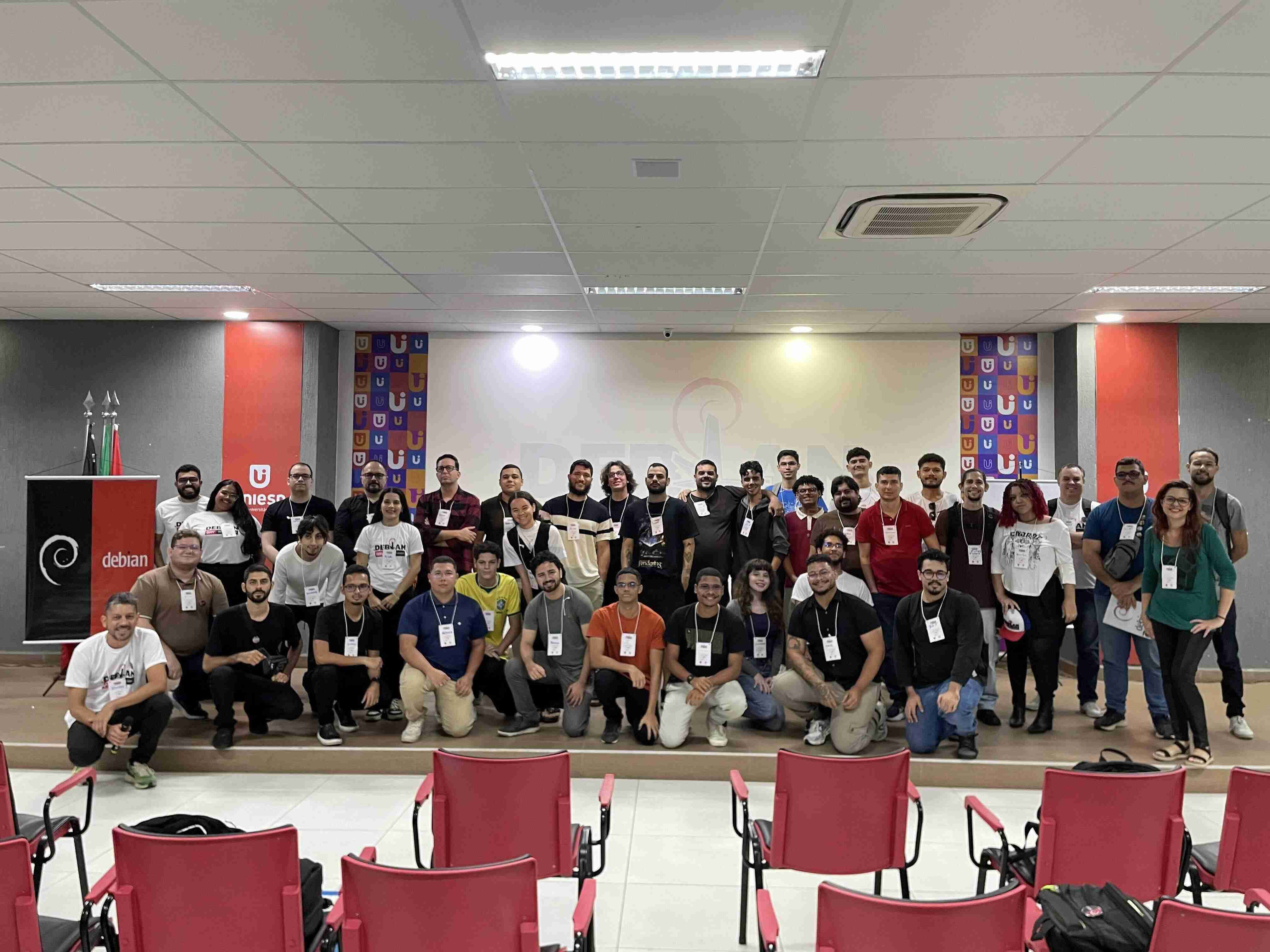
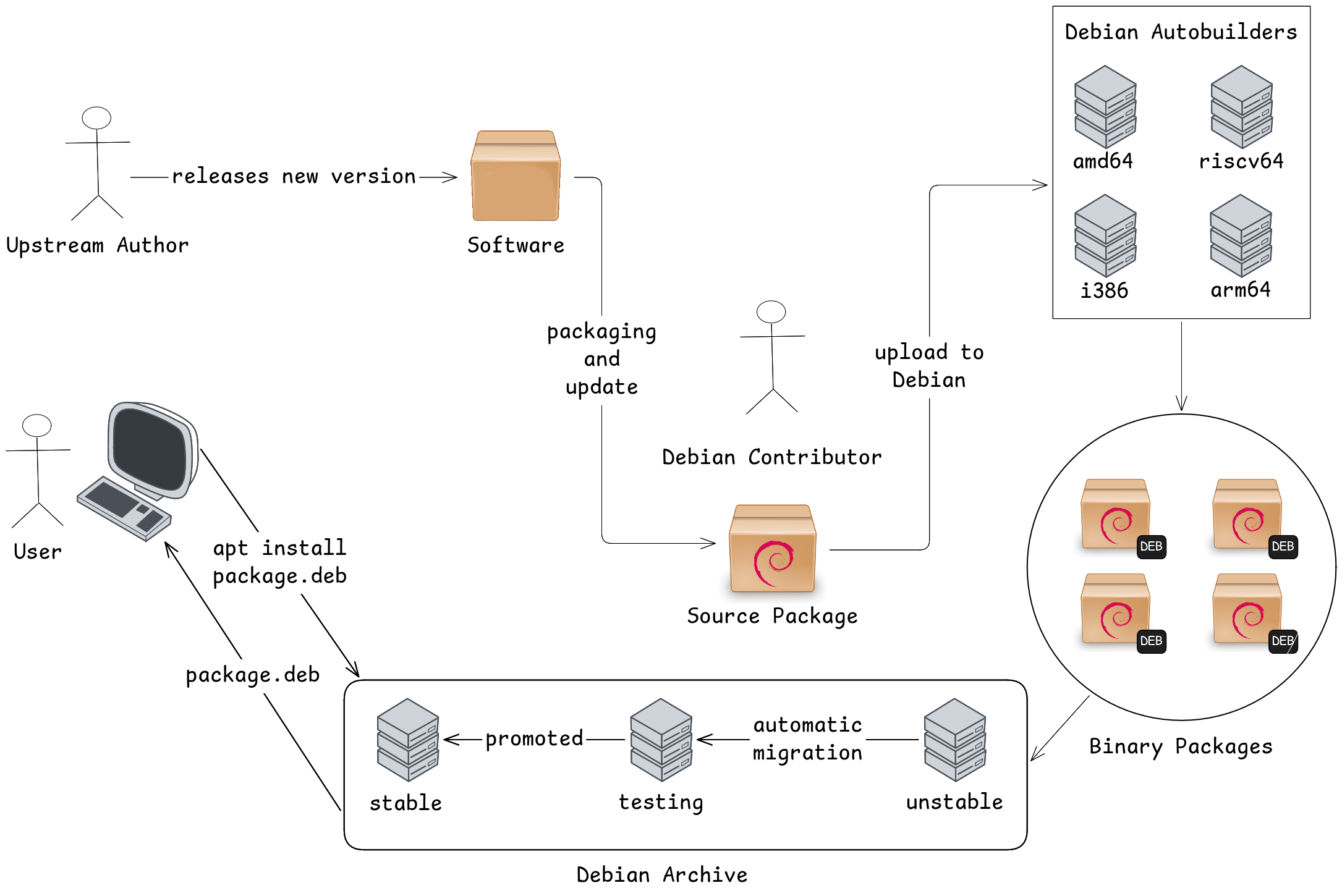
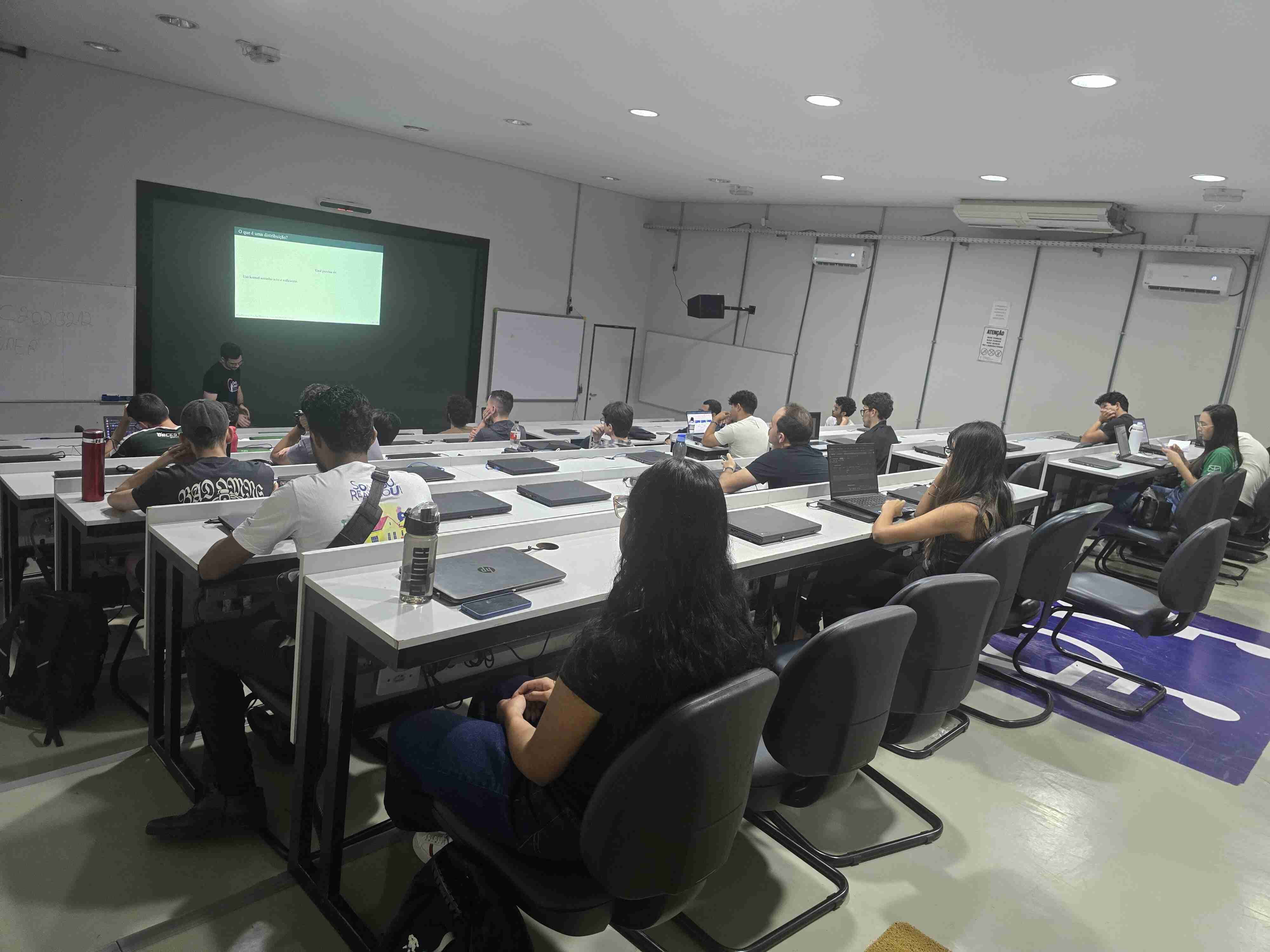
Jo o Pessoa Debian Day Jo o Pessoa Group Photo In Jo o Pessoa, we had a two-day event. The first day was dedicated entirely to workshops, and I ran a packaging workshop for newcomers. It was the first time I had been responsible for a workshop, and it was a great experience. We didn't have a lot of time, so I decided to start with a 30-minute talk explaining a few things about Debian. For example, I made this image to explain the packaging workflow: Debian upload workflow This image was based on The Debian Administrator's Handbook, and I think the participants really enjoyed learning about this workflow. When I showed the slide with this image, it was the moment when I received the most questions. After the talk, I explained my way of working and what they were going to do. The hardest part was setting up the environment, since my approach uses sbuild + gbp. They were running different Debian releases and, because of my inexperience with workshops, I had some of them configure sbuild with unshare, even though it is only available in stable through backports. Some of them even managed to learn how to use backports, while others decided to start again using the "old" way. One thing that helped a lot was the Debian Brasil Wiki. It has all the instructions for configuring sbuild in Portuguese, along with great examples. The Brazilian wiki is an opinionated version of the Debian Wiki. We generally prefer to use it for the convenience of having the exact workflow we follow, as well as an up-to-date Portuguese version of our process. If you want to learn more about the Brazilian community, you can find more details in the schedules from previous DebConfs. We almost always had a talk about the community and its activities. In the end, everyone successfully set up their development environment, and all six participants made their first contribution to Debian. If you take a look at my upload tracking page, you will see that every upload made on August 15, 2026 was a sponsored upload from this event. One of them appear twice in the list because I sponsored the upload and also made some other changes. I also asked all of them to put this in their changelog:
* My first contribution!
The idea was to make it clear to other people that they were only working on small Lintian issues as a way of learning and understanding the process. By the way, I made a UDD query to find packages with the following Lintian tag: redundant-rules-requires-root-no-field. To fix this issue, they only had to remove one line from the debian/control file. It is obvious that these uploads are not particularly useful. I call them "motivational uploads" because my goal is to help newcomers understand the process and immediately give them the reward of having made a contribution to Debian. I'll try to keep in touch with them. My plan is to hold another session, this time remotetly, to help them continue contributing to Debian. In fact, I already have another package prepared by one of them waiting for my review. The second day was a full-day event featuring a bunch of talks from the local community. I gave a talk explaining the new members process. I was the only Debian Developer at the event, and I think having a DD there made a real difference. Being there to answer questions, and simply being present, makes Debian feel more tangible and accessible to people. A big shout-out to Rafael Rocha, who put in a lot of work to make this event happen, with the help of many volunteers who contributed along the way.

Bras lia Debian Day talk in Bras lia One thing I really like about Debian Days is that each place has its own way of doing things. In Jo o Pessoa, we had a MiniDebConf-like event, while in Bras lia, we had something smaller but still very valuable. We decided to keep things simple: talk to a few students at the University of Bras lia (UnB) and then go somewhere to eat and have a few drinks.

A bit of history For those who don't know, the DebConf 19 was held in Curitiba, Brazil. After the event, Arthur Diniz got really excited about Debian and decided to go back to his University, UnB, to share his experience and encourage more people to contribute to Debian. I attended one of his talks, thanks to Joenio Costa, who invited Arthur to give the talk. Joenio was also my professor at the time and a Debian contributor. I really liked what Arthur had to say about free software, and he did a great job of presenting the Debian community as a friendly and welcoming place. So I decided to attend local meetings of the Debian Bras lia community, which had been inactive for a long time. Lucas Kanashiro was the Debian Developer who answered our questions and, as I mentioned earlier, simply being there made Debian feel more tangible. Everything stopped when the pandemic began. Then, towards the end of 2020, I saw a message in the Debian Bras lia channel saying that the meetings were back, this time remotely. I was hesitant to join because, back in 2019, I hadn't managed to make a packaging contribution, even with their help. I had eventually given up on the process. So this time, I decided to join the meeting with something already prepared for review. I watched all of Eriberto's packaging videos, picked a random package, and joined the meeting. I remember Kanashiro being excited that someone had just shown up with something ready for review. At the time, it was only the second meeting since Debian Bras lia had come back online, and none of the newcomers had started working on contributions yet. During the same meeting, he also convinced us, the newcomers, to give a talk about Debian just three days later. The MiniDebConf Online Brazil 2020 was happening on Sunday, and the meeting was on the Thursday before it. Since he has great convincing skills, I went along with the idea and prepared the talk with Francisco Ferreira. That was the rebirth of the Debian Bras lia community. Since then, we have maintained a close connection with the University of Bras lia, and today, at least seven Debian Developers are from UnB, whether as former students or former professors. The reason I told this story is that, even though the Debian Day we held in Bras lia was smaller, it is part of something that has been working for us for several years: staying close to an University. We've managed to attract and retain many people who share the same values and interests. I've hope you all had a great Debian Day. If you're reading this and aren't part of the Debian community but would like to join, get in touch!

22 August 2026

Aigars Mahinovs: Optimistic take on AI

As I am writing this, there is a vote ongoing in the Debian project on how to deal with AI in general and AI-assisted contributions to Debian specifically. Massive discussions have happened in debian-vote and other locations. I have also asked questions there and offered my perspective. IMHO now is the time to summarize that, after all the discussions that I've had with people on multiple sides of this debate both online and offline, and explain how I will be voting and why. Hopefully that will be helpful to someone else as well. None of this has been compiled with AI assistance, but only because I think that forming opinions is not something where AI can really be helpful. Spellcheck was used though. So, first I will describe how I see each of the 8 proposals, then what my vote will be, and then a bit more detail on the reasoning and thinking behind this. WARNING - this went long. With all the above considered I will vote like this (earlier options are preferred over later options): Details on rationale Hypocrisy - I find any proposal that would ban AI-assisted contributions to Debian, but at the same time not ban including AI-assisted contributions from upstream projects to be inherently hypocritical. If LLMs and AI are the very incarnation of evil (a puppy-killing machine, as the analogy went in some emails), then any rational proposal would involve excluding any and ALL code contaminated by this evil from the project. What does it matter if puppies were killed in writing the debian subfolder of the source code or the src subfolder? No proposals went there because everyone knows that such a ban would be the death of the relevance of the project for the future. Debian would be frozen on some old version of the Linux kernel forever and other software would be falling to the same problem too, for example as projects on GitHub start enabling AI-supported reviews with patch suggestions. Soon the "development" of Debian could just be stopped as there is nothing to develop without any upstreams. Assumptions - a lot of proposals mention various "concerns" with at most one word, like "practical" or "community" without an explanation of what exactly they mean by that. The proposers assumed that everyone lives in the same info bubble as they do and already know everything that they mean and already agree to that. That is false. Proposal A was a positive stand-out in this area. Debian has contributors all over the world with very different exposure to different information sources and very different world views. If you want to convince the project as a whole that LLMs are bad because of "ethics", then you do really need to explain what you mean by that and give links to sources, at least as well as Proposal A did. All other proposals were really weak in this area. Copyright - the question on how copyright law interacts with training LLMs and their outputs is still not settled law. The closest legal statements we have so far are that - just because an LLM is trained on copyrighted material does not make that LLM itself be a derivative work of the training data (you, however, cannot just create and distribute a "library" of copyrighted materials just because you plan to train LLMs on it). The output of the LLM might not be subject to copyright law at all, like a photo taken by a monkey. It would then be public domain and thus can be modified and then licensed by the user of the LLM. It might also be a derived work of the context of the inference (so for software - if you refactor a GPL project, the refactoring itself is likely GPL too). Any stricter interpretations would break a lot of existing copyright doctrine, such as raising questions like: "does the output of any programmer now become a derived work of the programming manual books they read in college?". In any case it is really not up to Debian to legislate the nuances of copyright law. And I strongly disagree with the concept that an author can tell me how I am allowed to use the learnings that I gained by reading their work. That is not how either copyright or society works. I can look at 10 pictures of a sunset and draw my own, inspired by the ones I saw. No one can forbid me that expression. The same must be true for a machine learning and replicating patterns. Ethics - I've re-read all proposals and emails and the only real specifically ethical concern I could find was the complaint that some LLMs (or their training farms) are running their web scrapers too aggressively and that causes extra load on services. Like that is not an LLM problem. Scraping the web is not an inherent part of the LLM training or inference process. It's just a few misconfigured scripts. We saw the exact same thing in the early days of web search engine proliferation. Then we banned/blocked the misconfigured engines and the survivors learned that obeying robots.txt is one of the rules for surviving. Literally the exact same problem and it will be solved the same way. Did we ban all search engines back then just because some of them were misconfigured? No. Some claims (like in Proposal C) are just bombastic hyperbole ("hazards to users' mental health", "fraud", ...) and on top of that have zero relevance to the topic at hand - AI-assisted contributions to Debian. What "hazard to users' mental health" is created when a Coderabbit spots that a lock is not taken before accessing a resource in a particular function and suggests an AI-generated patch to fix it? What "fraud" is committed by this? There is no sane answer. I get that some people are very busy fighting some culture wars and sometimes, some AI-bros happen to be on the other side of one such war, so it is useful to label everything coming from the AI sphere as "bad" in all possible and impossible ways. You do you. In private. Why pull Debian into that? Why force your position on everyone else in the project? Why deny everyone in the project access to useful tooling, just because you have strong feelings about some of the people promoting some of those tools? This seems to me a repeating pattern here - blaming the technology as a whole or blaming all providers of this type of technology for failings (ethical or technical) of some of those providers. Like refusing to wear all shoes and condemning all shoemakers and sellers, just because some American billionaires figured out a way to make and sell cheap shoes by killing puppies. Not refusing and condemning those providers, but condemning all for the actions of a few. Resource usage - this is a big topic for many and it has reasonable points to it. The LLM and AI technology has no inherent need to be damaging to the environment in any way for it to function. It does not need to burn oil or dig up cobalt. It does not need to sacrifice a ton of water to the Gods. It is perfectly possible to run AI (both inference and training) purely from green, electrical energy and cool data centers in equally sustainable ways, like with simple air-source heat pumps (also known as air conditioning) or even use it beneficially (many data centers are used for heating surrounding buildings via district heating). However, some AI companies do use non-green power for their data centers, some do use locally-limited fresh water for evaporative cooling (evaporated water still rains down as rain, it is not really lost, but that may happen in another location so lack of water can still happen locally). Some even run unlicensed natural gas turbines in their data centers to provide them with power. And those specific providers can and should be shunned and condemned. Not the other ones, who are doing the right things. Not the technology or its users or its outputs. There is a very wide spectrum of options on how an AI system could be powered: starting from local execution on already existing private hardware powered by one's own local solar power (good), to a data center stuffed with borrowed AI-only cards powered by a gas turbine or coal power station that operates solely to supply this data center (bad). Proposals that talk about ecological impact, but do not even consider where on that (very wide) spectrum to draw the line between "good", "acceptable", "discouraged" and "bad" well, I cannot see those proposals being actually serious about the environment to begin with. It feels like they just refer to it for points. And if we go into the power question deeper, well the grid dynamics and economics become very, very complex and often also non-intuitive. Like, all large software companies with data centers (that also happen to provide AI services), like Google, Meta, Apple, Microsoft and others do actually care about sustainability (in part because their customers care and vote with their wallets) and so all of them use 100% green energy for their data centers (including AI data centers) .... "on an annual scale". Wait, what does that mean? Well, the electrical grid is special - the amount of electricity produced and consumed on the whole electrical grid together has to match almost exactly every second. If there is just a single second where there is significantly more energy consumed from the grid than is produced, the frequency will plummet and you get a brownout and risk a grid collapse. The same is true in reverse - that causes a voltage swell. So grid operators manage energy flows every second and command power stations to increase and decrease generation all the time. Some power stations are easier to regulate dynamically than others. In the end, all that means is that even if your data center has a contract for 100% green energy with your power company, at some seconds across the year there might not be enough green energy in the grid to fully supply ALL people and companies that have 100% green energy contracts. This gets compensated in other seconds, so that across the year ("on an annual scale") for each kWh that your data center pulled from the grid, the same amount of kWh of 100% green energy flows into the grid. But it might not happen at the exact same second. Pedantic companies, like Google, take that discrepancy and count that as CO2 emissions for themselves. And then they and the power companies (they have contracts with) invest billions into new green energy projects, better grids and better batteries so that eventually this discrepancy goes down to zero. In this way green AI data centers with their increasing consumption of green energy are actually doing a lot of good work in making our electrical grid more green. They are making more resources than they are consuming. And that is just the tip of the iceberg. This is a deep topic that really abhors generalizations like "more consumption = bad". I've heard similar discussions in the context of electric cars - "so you got an electric car? you'd have fewer emissions if you drove no car at all!". That might be so. And I would also reduce my emissions to zero if I stopped breathing, but I really do not want that kind of thinking to be propagated further, especially when impressionable young people are around who may take it to its logical (but wrong!) conclusion. Instead I talk about how early adopters use electric cars to gather experience and achieve volume to start the network effects working. Once network effects of many electric cars on the roads are sufficient, it becomes an economically logical choice to get an electric car. People who cannot avoid having a car start to switch over. And at the point of mass switchover the reduction of emissions is so massive that those early adopters failing to go all the way to riding a bicycle becomes a rounding error. But surely that does not apply to LLMs? They are only increasing consumption and bring no benefit? Benefit - and here we have to actually talk about benefits. Because you cannot make any cost-benefit analysis if you do not actually fully investigate the benefits. Are there environmental benefits from running those AI models? Yes, in a lot of very diverse ways. Hard to measure, however. There are projects that are easy to quantify - like that Google AI project on contrail avoidance. An advanced, special model trained and executed in Google AI data centers was able to predict where in the air contrails would be produced and could generate proposed course adjustments to commercial flights to avoid specific heights in specific locations at specific times. This stopped these aircraft from creating contrails and those contrails did not make a further contribution to global warming. That benefit in a year was many times higher than the environmental cost of training and running that AI model. And it can keep running for many years accumulating further benefits. On a personal scale, I've had problems that I bashed my head (and computer and CI resources) against without much success years ago solved with a few minutes of compute. Having a good enough candidate solution quickly is much cheaper from a resource perspective than spending days trying different things, running my PC for it, trying different patches on CI executions, doing different rebuilds. I've seen very significant benefits in AI-assisted development in enterprise environments where code way more complex than what is in Debian (especially in Debian tools and packaging) gets analysed, reviewed, modified or even refactored or rewritten in another language with AI assistance. And it generally works. The commonly mentioned "hallucinations" are a thing of last year in the coding context. Nowadays the AIs work in special coding harnesses and use real tools as foundational facts. You cannot "hallucinate" an API call or parameter if you have to run and pass the unit tests and integration tests by your harness before you can return "success" to the caller. I've personally seen high-level AI models read very complex software projects across multiple repositories and point out a very specific design consideration that was encoded in the code logic, but never mentioned in comments or documentation. It was so obscure that even I did not immediately know what it was talking about (and I wrote that code). Only on close inspection of code interaction across three repos did I remember that there was indeed that bug 2 years ago that I fixed by doing the change that this AI picked up (it wasn't in the history of this git repo due to repo migration). It mentioned this because it was very relevant to the task I initially gave it to review. These LLMs in a proper harness with proper system instructions and usage approach are not just fancy spell checkers or auto-complete. They function more like very advanced pattern matchers. They have learned millions of patterns from training data. When they look at the code, they see hundreds or thousands of overlapping patterns. When you ask them to make or change something, they pull out a pattern (or ten) from their training and apply those patterns to the context of your program. You get something that looks just like the surrounding code, same style choices, same language, same comment voice, but it implements something new there, based on other patterns learned. If you've studied design patterns in your CS class, this will be familiar. But people can learn and remember maybe 20-30 patterns, while an LLM can have a million patterns and can combine them when needed. So it takes a pattern of Python code, pattern of standalone script, pattern of parsing command line parameters, pattern of classes, pattern for background threads, pattern for file tree traversing, pattern for pipes, ... and squishes them together to make a solution for your query. And then tries to debug it with compilation, tests and execution until it works as expected. Even if there is zero LLM development going forward, it will take many years to fully appreciate the benefits we can extract from the already trained models. They don't even have to be retrained - for existing languages they just keep working. For new language variations, like a new Python version, you can feed the changelog into context and they will be able to work with a Python version that they never saw in training. And patterns are mostly abstract, so not really specific to any language - human or programming. This is another big enabler that LLMs have created that we have not really explored yet. LLMs have created really free software. People can actually create software that is perfectly suited just for them and no one else. They don't even have to know how to program and don't even need to speak English. I've seen people writing prompts in their native language and LLMs creating and then adjusting web apps or Android/iPhone apps and deploying them to the user's own phone. It was too buggy to work last year, but this year it is actually very functional for simpler use-cases. And the code looks just fine too - I've seen external contractors in a business setting deliver far worse. If you start with a good initial system prompt, the project will have architecture documentation, use-case documentation, unit tests, integration tests, deployment harness, testing and production deployments, audit logs, monitoring, clear git commits, CI validation on commit, ... Modern AI systems have the capabilty to deliver software freedom to people who are not coders. I really can not overstate the consequences this may have on the world. Community - I find the concerns that new people will be using LLMs so much that they will no longer be understanding the actual code they are contributing a bit regressive. I don't see any significant difference between this and people relying on compilers, on high-level languages or on debhelper. Writing modern debhelper packaging feels more like writing configuration and not writing code. It takes really significant effort to dig down through layers of abstraction to find what actually is being executed in debian/rules. AI does not really make this worse. In fact, I find that AI can make it much easier to understand arcane syntax because you can ask an LLM to explain what is happening in any part of the code and it will do a pretty good job of it, digging down through the layers of abstraction for you. All the pro-AI proposals include the requirement that each human contributor needs to understand and stand behind their AI-assisted contribution and I believe that is a good requirement and also a sufficient requirement. Modern LLMs not only produce clear and concise code, but they are also capable of producing good comments explaining why the code is how it is, good commit messages explaining the change and reason behind it and also making corresponding changes to test suites and documentation. You know - the housekeeping stuff that is often skipped because it slows down the actual feature development, but then its lack becomes a problem for future contributors. Responsible use of AI assistance is a great chance to actually strengthen our community and make our software easier to maintain. That said, I have no qualms about flat-out rejecting contributions that do not make sense. And it does not matter if they are made with or without AI assistance. If the contributor will not explain their patch, it might be they do not understand what their AI produced or it could be that the contribution is deliberately hiding a backdoor being planted. It is also quite common for a contribution of a new feature to be rejected because the author/maintainer does not believe that it is a good fit for the project. Featuritis is a real disease. AI or not. There have always been drive-by contributions to various projects. They will continue to exist. Each of them should be evaluated on its merits - is this feature valuable to our users and is the added complexity (if any) worth the functionality? A lot of security bug reports are "drive-by" contributions as well. And many of them nowadays are discovered, exploited and patched with AI assistance. We could reject them, but that just leaves us holding the bag on the now-known exploits. And the New Maintainer process should be able to figure out if an upcoming Developer has actually understood the nuances of Debian packaging or not. A contributor with upload rights to the archive has to be able to create a basic package with no support tooling (maybe even without using debhelper?) and be able to understand and modify more complex packages (possibly with tooling support). IMHO that is a separate discussion that is worth having, involving experts from the educational sector. Conclusion IMHO the Debian project should not restrict what tooling individual contributors use to contribute. Expecting high-quality contributions and that contributors understand what they are contributing (as a first level of review) is enough. However, Debian should provide its contributors (internal or external) with guidance on how to contribute in the best way possible. That could include: In addition to that it would be helpful for Debian, as a project, to reach out to AI service providers to: Questions? Feedback? Just ask here or here.

Emmanuel Kasper: Create a development VM using Debian cloud images

Following on the rationale of the previous post, here is how I create a development VM based on ready to use disk images made by the debian cloud team. I could as well install the VM myself using an ISO, but why download a collection of packages in a ISO only to copy them right onto a disk image ? From the list of images available at https://cloud.debian.org/images/cloud/ we will start with the generic qcow2 disk image, it has cloud-init, which allows initial automatic configuration, and snapshots of the VM via the qcow2 disk format. As for the virtualization, I am using virsh virt-install and virt-manager, which are part of the libvirt framework. Libvirt offers an excellent API accessible over qemu/KVM via shell (virsh), GUI (virt-manager) and Web (cockpit) . To use libvirt, properly you need to make sure your standard user is member of the libvirt group, and the libvirt default network is started via virsh net-autostart default. Also make sure you set export LIBVIRT_DEFAULT_URI=qemu:///system to use the system wide instance of libvirt, which is needed for the default bridged networking. Download the debian cloud image:
$ wget https://cloud.debian.org/images/cloud/trixie/daily/latest/debian-13-generic-amd64-daily.qcow2
Add the disk image as a libvirt volume:
$ export SIZE=$(stat -Lc%s debian-13-generic-amd64-daily.qcow2)
$ virsh vol-create-as default dev-vm $SIZE --format qcow2
$ virsh vol-upload --pool default dev-vm debian-13-generic-amd64-daily.qcow2
Create a VM with the root password set to root :
$ echo root > password.txt
$ virt-install --name dev-vm --memory 4096 --noreboot \
	--os-variant detect=on,name=linux2024 \
	--disk vol=default/dev-vm \
	--import \
	--boot uefi \
	--cloud-init root-password-file=password.txt,clouduser-ssh-key=$HOME/.ssh/.ssh/id_ed25519,disable=on
At the point libvirt will create a VM (a domain in libvirt parlance) and start it.
Starting install...
Allocating 'virtinst-ns9oa7_i-cloudinit.iso'                  368 kB  00:00     
Transferring 'virtinst-ns9oa7_i-cloudinit.iso'                368 kB  00:00     
Creating domain...                                                    00:00     
Connected to domain 'dev-vm'
BdsDxe: starting Boot0001 "UEFI Misc Device" from PciRoot(0x0)/Pci(0x2,0x3)/Pci(0x0,0x0)
Booting  Debian GNU/Linux'
Loading Linux 6.12.101+deb13-amd64 ...
Loading initial ramdisk ...
EFI stub: Loaded initrd from LINUX_EFI_INITRD_MEDIA_GUID device path
EFI stub: UEFI Secure Boot is enabled.
[    0.000000] Linux version 6.12.101+deb13-amd64 (debian-kernel@lists.debian.org) (x86_64-linux-gnu-gcc-14 (Debian 14.2.0-19) 14.2.0, GNU ld (GNU Binutils for Debian) 2.44) #1 SMP PREEMPT_DYNAMIC Debian 6.12.101-1 (2026-08-05)
[    0.000000] Command line: BOOT_IMAGE=/boot/vmlinuz-6.12.101+deb13-amd64 root=PARTUUID=2b4578e2-9d2e-4b32-b6a4-b5b2ca607ef6 ro console=tty0 console=ttyS0,115200 earlyprintk=ttyS0,115200 consoleblank=0
...
Once the VM is created you have now three ways to access it:
# open a serial console to the VM
$ virsh console dev-vm
# access the graphical console
$ virt-manager
# Access the VM via SSH with the precreated cloud user "debian"
$ virsh domifaddr dev-vm
 Name       MAC address          Protocol     Address
-------------------------------------------------------------------------------
 vnet7      52:54:00:23:e6:61    ipv4         192.168.122.225/24
$ ssh debian@192.168.122.225
In the next blog post we will see how to configure the IDE (vscodium) to run confortably in the VM.

21 August 2026

Emmanuel Kasper: Moving software development to separate VM to reduce credential scavenging

Rationale: I was remembered via https://unit42.paloaltonetworks.com/chaindrop-npm-worm-analysis/ (linked from https://anarc.at/blog/2026-08-18-people-vs-ai-overlords/) of the risk of downloading untrusted packages in a dev environment. If you read the blog post above you will see that it is way to easy do have a random npm, or even python package in a dev environment scavenge your long running credentials from your workstation, either on disk, or reading from memory ! I will thus move to the following set up:
  • things running directly in my workstation will require either to come from a trusted source (Debian package that is) or run in a sandboxed infrastructure (Podman rootless is the best thing here, followed by Flatpaks)
  • everything else, will run in a Libvirt VM based on Debian cloud images. For me it will be mostly in the beginning the VSCodium editor, with its myriad of extensions.
I am aware of whole blown solutions like QubeOS however I don t indent to reinstall the whole OS, and QubeOS does not run on ARM64 which is one of the environment I am using. I will try to document this setup in two blog posts, one about the VM creation using Debian Cloud Images, the second one about running a graphical env in the VM with some filesystem passthrough. Stay tuned !

16 August 2026

Bits from Debian: Debian turns 33!

It has now been thirty-three years since the Debian project was announced to the world by Ian Murdock, on August 16, 1993. This anniversary is an opportunity to reaffirm the goals, characteristics, and qualities of the Debian project: it s an association of individuals who have made common cause to create a free operating system. Our distribution is characterized by a commitment to software freedom, as enshrined in the Debian Social Contract and the Debian Free Software Guidelines. It focuses on security and stability. This stability is crucial to Debian position in the free software ecosystem. With our users as our priority, Debian makes special efforts regarding accessibility with Debian-Accessibility and diversity with our Outreach Programs. Debian Day is a great opportunity to get together, whether for a local meetup, or simply to grab a coffee with other members of the Debian community. Check out the Debian Day wiki to see if there is a celebration near you. And if there isn't, maybe you can organize it next year! Today is also an opportunity for you to start or resume your contributions to Debian. For example, you can install the how-can-i-help package and see if there is a bug in any of the software that you use that you can help to fix, contribute small tips on how to install Debian on your machines to our wiki pages, or put a Debian live image in an USB memory and give it to some person near you, who still didn't discover Debian. Thanks to everybody who has contributed to develop our beloved operating system in these 33 years, and Happy birthday Debian!

15 August 2026

Russell Coker: Hacked by Chinafans

What Happened On 2026/08/10 at 2:11 am Australian eastern standard time (2026/08/09 16:11 UTC) someone created a post titled Hacked by Chinafans on my documents blog [1]. The person in question created an account named 67965e42a3c3 on that site with the email address 67965e42a3c3@google.com associated with it (I tried emailing that address and it bounced). At 04:28:41am Australian eastern standard time (18:28 UTC) I was sent an email titled Have you been hacked by a reader of my blogs who subscribed to the RSS feed of my documents blog (a blog that I never expected anyone to read by RSS). Along the lines of the wisdom of crowds should we have the unexpected observation and problem reporting of crowds ? I appreciate the notification, I might not have noticed until the next time I watched an unusually good movie otherwise. The account in question was apparently created on 2026-07-21 at 16:43:47 (presumably UTC) even though at the time I believe creating accounts was not permitted. As an aside the timestamp of account creation is stored in the user_registered column of the wp_users table in the database, there doesn t appear to be a way to access this in a standard WordPress installation other than doing a SQL query.
2026-07-24 15:43:17 status triggers-pending wordpress:all 7.0+dfsg1-1
2026-07-24 15:43:19 upgrade wordpress:all 7.0+dfsg1-1 7.0.2+dfsg1-1
Above are the relevant sections of my dpkg log showing the WordPress versions in use. I was running version 7.0+dfsg1-1 at the time the account was apparently created. I am confident in the accuracy of the dpkg logs and believe that they did not compromise the OS, I am not sure whether they ran hostile SQL code to change fields in the MySQL database so had to consider the possibility that the account creation time could have been set to a deliberately misleading value. I checked backups of the MySQL database stored off-site and found that the account in question was not in the 2026-07-21 backup (which was done before 16:43) but in the 2026-07-22 backup. The WordPress release history [2] has version 7.0.1 released on 2026-07-09 and version 7.0.2 released on 2026-07-17. So presumably the attacker diffed the code on those releases, found an exploitable bug, and used it to create an account on my blog with admin privs. Then they waited a few weeks to see if I would notice and published a blog post when I didn t notice. WordPress Deficiencies
  1. WordPress doesn t seem to store the version it s running at the time of operations. So anyone who doesn t have a suitable external log of versions deployed (such as the dpkg.log file for a Debian managed installation) won t know for sure which version was running. It supports automatic updates but you can t be sure that they happened soon after the release.
  2. There is no log of IP addresses used for operations. There are apparently some 3rd party modules to log such things and web pages documenting how to modify the PHP to add it but nothing in the standard distribution.
  3. Software should have a standard distribution with some support for logging of security relevant data. The typical situation is that people don t plan for logging such things until after they have been attacked so the data should be recorded without users going out of their way to log it.
  4. A log of security relevant data should be stored in a database table with only insert access (no update, delete, or drop).
  5. Ideally a CMS would support different database accounts for different purposes. Someone from an internal network or VPN could talk to an instance of the web server which has a database username and password giving full access. Everyone from outside the trusted range gets an instance of the web server with database access only allowing to read the posts and appearance configuration and to enter comments. If the database didn t allow the account used for public access to create new admin users or create posts then it would be a lot harder for attackers.
  6. Ideally for everything that stores user account data there would be an easy way of getting a list of users in a plain text format to allow running diff. The design of WordPress has two tables, one for users and one for encoded metadata about users of which one will be the access level. The following SQL command will give a list of all users that aren t subscribers (everyone above the minimum level of access which is typical for new users) along with their encoded password and access level. This could be used in a monitoring system to alert about new privileged users. The TABLE_PREFIX variable is for the prefix for WordPress tables, which is wp_ by default but can be any legal value.
    select $TABLE_PREFIXusers.user_login, $TABLE_PREFIXusers.user_pass, $TABLE_PREFIXusermeta.meta_value from  $TABLE_PREFIXusers join $TABLE_PREFIXusermeta on $TABLE_PREFIXusers.id = $TABLE_PREFIXusermeta.user_id and meta_key='$TABLE_PREFIXcapabilities' and meta_value != 'a:1: s:10:"subscriber";b:1; ';
What Next? The blog post they created had a couple of links to Telegram which could presumably be used to contact them. If anyone involved in computer security wants a copy of the original post to do so then they can contact me by any of the usual methods. I am interested in communication with the attacker if they wish, Telegram is not a service I use but I presume that anyone capable of doing this sort of attack is also capable of finding other ways of contacting me. I have idly considered changing to a static site generator, here is a good list of static site generators [3]. I have also idly considered other platforms for blogging such as Lemmy. I don t know if Lemmy is better than WordPress for security and updates, but there are plenty of free instances running where it wouldn t be an issue I have to work on. 15 Years It s been 15 years since my blog server was cracked by a trojaned ssh client [4]. At least this time it was only one service that was compromised.

9 August 2026

Reproducible Builds: Reproducible Builds in July 2026

Welcome to the July 2026 report from the Reproducible Builds project! In our reports, we try to outline the most important things that we have been up to over the past month. As a quick recap about what problem our project intends to solve, whilst anyone may inspect the source code of free software for malicious flaws, almost all software is distributed to end users as pre-compiled binaries. The motivation behind the reproducible builds effort is to ensure no flaws have been introduced during this compilation process by promising identical results are always generated from a given source, thus allowing multiple third-parties to come to a consensus on whether a build was compromised or not. If you are interested in contributing to the project, please visit the Contribute page on our website. In this month s report, we cover:

  1. Tool development
  2. Distribution work
  3. Three new scholarly papers
  4. Patches
  5. Misc news

Tool development diffoscope is our in-depth and content-aware diff utility that can locate and diagnose reproducibility issues. This month, Chris Lamb made the following changes, including preparing and uploading versions 324, 325 and 326 to Debian:
  • Fix tests to work with zipdetails 4.0008. (#1141359)
  • Bump debhelper compatibility level to 13. [ ]
  • Update copyright years. [ ]
In addition, Paul Spooren made changes to allow trailing garbage in Gzip files [ ] and Vagrant Cascadian added an external tool reference for the pedump binary to use the mono package under GNU Guix. [ ]
disorderfs is our FUSE-based filesystem that deliberately introduces non-determinism into system calls to reliably flush out reproducibility issues. This month, Christelle Gloor added the option to sort by ctime as returned by the lstat(2) syscall. [ ], which Chris Lamb uploaded whilst bumping the Standards-Version to version 4.7.4 [ ]. Bernhard Wiedemann also updated disorderfs to version 0.7.0 in openSUSE.
Yet again, there were a number of improvements made to our website this month as well. For example, Chris Lamb, by request of Digital Ocean, changed the target of a referral link so that they can manage incoming referrers [ ] and pushed a number of changes to the Tools page [ ].

Distribution work In Debian this month, 32 reviews of Debian packages were added, 26 were updated and a total of 21 were removed this month, adding to our extensive knowledge about identified issues. A number of issue types were added by Chris Lamb, including:
  • python_towncrier_build_date [ ][ ]
  • log_files_installed_in_package [ ]
  • fontforge_varies_by_timezone [ ][ ]
Chris also added a further note for the build_date_in_manpage_generated_by_spf13_cobra issue. [ ]
In addition, there is a new page showing verification rebuilds of OpenWrt APK packages and firmware images, powered by rebuilderd:

Three new scholarly papers Yan Li, Nan Jiang, Qihang Zhou, Shaowen Xu, Yamin Xie and Xiaoqi Jia of the Chinese Academy of Sciences published a paper titled VCAligner: Aligning Source Distribution Versions with Upstream Git Commits to Secure Supply Chain:
We present VCAligner, a content-based alignment methodology that constructs inverted indexes over VCS histories to precisely map released artifacts to their originating commits, independent of fragile version tags. We evaluated VCAligner on a dataset of 2,984 verifiable PyPI packages derived from the 4,000 most-downloaded projects linked to public GitHub upstreams. Our results reveal a critical weakness in conventional tag-based heuristics: while they appear effective on 85% of the dataset, the residual 15% failure rate generates a catastrophic downstream audit workload of over 10.3 million commits. In contrast, VCAligner reduces this burden by two orders of magnitude ( 158 ), bounding the total workload to under 65,000 commits. Furthermore, we provide the large-scale characterization of Packaging Noise, classifying artifact divergence into structural additions (Path Phantoms) and content mutations (Blob Phantoms), thereby isolating the distinct attack surfaces of malicious injection and code tampering.

Jens Dietrich and Spencer Sun from the Victoria University of Wellington together with Tim W. White and Behnaz Hassanshahi from Oracle Inc pre-published their paper No Snake Oil: Verifying Python Package Builds (PDF):
Python has become the default language for interacting with AI, with packages being distributed through registries like the Python Package Index (PyPI). This creates a need to analyse supply chains comprising such packages. One such analysis is to rebuild packages in order to identify compromised builds injecting malware. Independent rebuilds in hardened environments have the added advantage that they can generate and record provenance in order to increase the trustworthiness of packages. Two tools that are designed to automate such rebuilds and run them at scale are macaron and oss-rebuild. We study 12,180 popular releases from PyPI and find that the byte-for-byte equivalence rate is generally low. We analyse the reasons why they produce different wheels, and find that equivalence between the original and rebuilt wheels can often still be established, preserving most of the guarantees users expect from rebuildable releases. We present and evaluate daleq4py, a tool to establish the equivalence of Python wheels through the kernel of a normalisation function that is based on provenance-preserving datalog rules. Experimental results show that daleq4py substantially expands the set of rebuilds that can be accepted as equivalent. Although only 15.4% of macaron rebuilds and 19.1% of oss-rebuild rebuilds are byte-for-byte identical to the published PyPI wheels, daleq4py establishes wheel equivalence for 60.2% and 78.9% of source-equivalent rebuilds, respectively.

Denise Nanni, Julien Malka, Stefano Zacchiroli and Th o Zimmermann from T l com Paris together with Gabriele D Angelo from the University of Bologna pre-published their paper Understanding Build Reproducibility in the F-Droid Ecosystem (PDF), which was accepted at the 2026 ACM Conference on Reproducibility and Replicability:
The security of open source applications benefits considerably from the possibility of rebuilding their source and verifying the output. F-Droid, a prominent distribution for open source Android applications, systematically rebuilds them from source and tests their bitwise reproducibility at app publishing time. However, F-Droid offers no guarantee that app reproducibility will continue to hold in the future. As software ecosystems evolve, reproducibility may degrade, with potential negative consequences for software preservation and security. We present the first empirical study of build reproducibility in the F-Droid app ecosystem. Analyzing historical reproducibility logs, we find that the overall bitwise reproducibility rate has been steadily increasing over time (as new versions of apps are published). We then evaluate how reproducibility holds in time for fixed app versions, by attempting to rebuild 18 904 app versions that F-Droid had previously confirmed bitwise reproducible, published between September 2018 and February 2026, achieving an 83% rebuild success rate, and identify missing dependencies as the dominant cause of failure, accounting for 76% of non-rebuildable cases. Among successfully rebuilt apps, 94% are also bitwise reproducible-i.e., they still yield bitwise identical artifacts upon rebuild. Together, these results show that while bitwise reproducibility largely holds for apps that can be rebuilt, rebuildability itself is highly sensitive to temporal decay.

Patches The Reproducible Builds project detects, dissects and attempts to fix as many currently-unreproducible packages as possible. We endeavour to send all of our patches upstream where applicable or possible. This month, we wrote a large number of such patches, including:

Misc news On our mailing list this month, Colin Winter of Markovian Protocol wrote to our mailing list on the topic of Reproducible verification for retained logs:
Reproducible builds remove trust in the builder: anyone re-derives the same artifact from the same source, byte for byte. The same shape applies one layer over, to a retained record. Most record-keeping regimes (the EU AI Act s Article 12 logging is the current example) require that events be recorded and logs retained, but not that a retained log be verifiable, by a party who was not present, as unaltered and existing when claimed. That leaves an integrity obligation resting on trusting the party being audited.
(Full thread)

Finally, if you are interested in contributing to the Reproducible Builds project, please visit our Contribute page on our website. However, you can get in touch with us via:

6 August 2026

Gunnar Wolf: Subscription Bombing Email under Attack

This post is an unpublished review for Subscription Bombing Email under Attack
One of the most important inputs one can have when designing a response strategy against a security attack is a good characterization. This article describes a relatively newly described attack mode (subscription bombing), hypothetizes on the motivations that can lie behind it, and presents some countermeasures that can be taken by different actors to reduce its impact. At its core, suscription bombing is a classical reflection attack: it uses a third party service so that the answer to a relatively simple request is amplified and results in a distributed denial of service (DDoS) for the victim. And, as with most DDoS attacks, its effectivity lies in that there is not much a person can do against traffic coming from seemingly random different providers all around the world. The core differentiatof for subscription bombing is that the attack s victim is not a network port, but an individual s e-mail address. The attacker builds a database of service providers that allow interested users to sign up for newsletter on their activities, or a mailing list, or even just to create a new account on a given Web system. This action will generate a (seemingly legitimate) confirmation mail sent to the victim. But the attacker scripts together hundreds of thousands of such request, creating a deluge of confirmation mails sent to the unsuspecting victim. The authors explain the goals an attacker might pursue by performing this kind of attack. They suppose this can be due to harassment (a disgruntled employee being denied a salary raise, a political adversary, or even a romantic ex-partner wanting to inconvenience the victim s use of their e-mail). More worryingly, the attack can be used as a distraction: by sending a high volume of mails in a controlled timeframe, the attacker can reduce the probability of the victim noticing a specific attack warning them of, i.e., financial fraud, unwanted purchases, or break-in attempts into their accounts. Attacks targetting mailboxes at private mail servers can also lead to overloading an account s limit, causing it to reject mails after the attack is delivered and before the folder is cleaned. And it can also pave the way for follow-up, targetted deception attacks, where the attackers call the victim pretending to be the company s IT department, and get them to install a remote desktop monitoring and management tool, with which they can effectively seize control of the victim s data. To do this, they present a study they made over 24 cases of victims, from which 47,970 total e-mails were received between October and December 2024, with individual attacks receiving between 81 and 3,387 e-mails per hour, from where they presented several descriptive analysis. The authors explored cyber criminal s offers on underground websites, comparing flooding services and pricing schemes. Finally, mitigation strategies are discussed. Mitigation is quite problematic, as none of the mail servers is acting in either a hostile way or lacking permissions they are performing just the task they should. The authors suggest four mitigation strategies for mail server operators to reduce the burden on their users, although none of them is easily automatizab (rate-limit the number of emails a given inbox can receive from previously unseen senders; educate users about this kind of attacks; group similar newsletter or account reset mails during active attacks; and automatically unsubscribe or bounce newsletter messages when a surge is detected). They also recommend newsletter providers and services accepting the unrestricted creation of user accounts to provide some hardening to increase the effort wrongdoers need to spend to abuse their services, such as requiring CAPTCHAs or requiring users to take several steps before requesting a subscription, although they recognize this adds friction to the process providers are most interested in providing; filtering and triaging known-good and known-bad domains, although this is hard to implement on a preemptive fashion, and adhering to easy unsubscription standards, such as easily identifiable headers with which mass unsubscription could be performed more easily victims, instead of hunting for the right places to click, potentially even in mails written in an unknown language. The described problem is interesting, and properly tackling it can be a game changer for many users who will suffer this kind of abuse, and the article is easy to read and soundly supports its claims.

4 August 2026

Dirk Eddelbuettel: #058: Reverse Dependencies Made Easy, Fast, Reliable

Welcome to post 58 in the R4 series. R and the CRAN repositories maintain a very high level of what we might call quality assurrance by requiring that newly-added code does not break any existing dependencies. This is frequently called a reverse-dependency check . For any given CRAN package one can quickly determine it reverse dependencies. Calling tools::package_dependencies(pkgName, reverse=TRUE) will for a scalar or vector-valued argument return a named list with the reverse dependencies. It is then a matter of looping over this list. There are helper functions in base R as well as in contributed packages on and off CRAN. I also wrote my own with package prrd which, while possibly a wee bit specialised and under-documented has served me well to check on Rcpp and related packages which can indeed have a large number of reverse dependencies. I recently looked into one of these contributed runner packages, and while I will refrain from naming its implementation language let me just mention that the term cargo cult may be a real thing here. What go me interested in this was the fact that if one has a simple-to-use runner then the fact that r2u makes it fast, easy, reliable: pick all three (to borrow its slogan) to deal with actual depencies if Ubuntu has indeed been selected as the host. We will maintain the position that if you can in fact integrate with the system-wide package management then any alternative per-repo package management approach not doing so will likely be dominated by an approach that does integrate with the system facilities. Which is what precisely what r2u does, and offers. And why it is used enough to by now have shipped eighty eight million binary packages. So I tested it for the reverse-dependency check task. What I learned by looking into the (much more complicated) runner was that it at the end of the day it hands the actual task of running the reverse dependecies off to a helper function rev_check that is part of the xfun package by Yuhui. I quickly found that besides xfun we would also need its suggested dependency tinytex which in turn would error unless the tlmgr binary was present. So as the sole requirement (on an Ubuntu system with r2u) turns out to be
$ apt install r-cran-xfun r-cran-tinytex texlive-base
where we do it all in one apt call (as root in the container). (Given r2u we could also call install.packages(c("xfun","tinytext")) followed by apt install texlive-base but it is simpler for this setup step to be just one call). With that we are basically done. I did this (twice) using a rocker/r2u container with r2u preinstalled, mounting a local work and scrap directory for the container. In it we expand the package to be tested (i.e. tar xaf pkgName_*tar.gz for a given source package pkgName from CRAN) and then just call with the package name and expanded direcrtory. I.e. I used this call to test my package AsioHeaders (which has just three reverse dependencies) to both name it and to point to the expanded source directory created for this purposed:
> system.time( res <- xfun::rev_check("AsioHeaders", src="AsioHeaders") )
## ... earlier output omitted for brevity here ...
   user  system elapsed 
 35.732   3.333 149.683 
> res
   httpgd ipaddress websocket 
        0         0         0 
> 
and about a good two minutes later I would get the timing result and the summary in variable res. As I checked the current CRAN version, the check was as expected free of concerns or issues. To support this, r2u did indeed go off and install about sixty seven binary packages (and the total includes all binary dependencies fully resolved) delivering on the just works promise by the r2u documentation. As another check, I did the same for RcppAnnoy which has seven reverse dependencies and needed about two hundred CRAN packages to be installed. The full test took just over four minutes with the timing function reporting some nice gains from parallelisation as total user compute time was on the order of just under eight minutes. Again, test results were clean and free of worries as expected:
> system.time( res <- xfun::rev_check("RcppAnnoy", src="RcppAnnoy") )
## ... earlier output omitted for brevity here ...
   user  system elapsed 
471.765 378.220 266.855 
> res
   bbknnR  bigANNOY  blocking     scDHA    Seurat      uwot VectrixDB 
        0         0         0         0         0         0         0 
> 
Overall this was a rather useful quick excursion as it demonstrates that - existing functions can be used to orchestrate a reverse dependency check - with reasonable dependency scale we can do this on a single machine quite easily taking advantage of parallel computing on multi-core machines - using r2u gives us fast, easy, reliable package installation making testing of packages we might not otherwise use or know a breeze - doing this in an ephemeral Docker container facilitates easy build-up of required resources and leaves no side effects behind which might affect our normal development environment

This post by Dirk Eddelbuettel originated on his Thinking inside the box blog. If you like this or other open-source work I do, you can now sponsor me at GitHub.

Petter Reinholdtsen: FreeCAD MCP with llama.cpp, toy or tool?

After seeing a video a few months ago demonstrating how a proprietary CAM solution uses machine learning and large language models to automatically generate CNC instructions, and successfully testing it on a real CNC, I began wondering if the same could be achieved with free software. I still do not know the answer, but I may be getting closer to finding out. Two weeks ago, I came across the video "I Connected Claude AI to FreeCAD (And It Models Parts Like an Engineer)" by Make Form, which introduced me to the FreeCAD MCP project. Even though the video creator apparently believes it is acceptable to download and run random binaries from the Internet on a local machine (his setup uses UCX), I do not. I would probably have left the project alone entirely if I had not noticed that all of its dependencies are already available in Debian. This significantly boosted my motivation, so I set out to test it using packages built from source on Debian rather than relying on untrusted binaries. The first hurdle was that the MCP SDK for Python was not present on my Debian Forky test machine. I initially believed it was missing from Debian altogether, but it has been available in Debian Unstable for about a month and is only absent from Forky because some automated tests fail on architectures like riscv64 and s390. Fortunately, backporting it was straightforward using apt-get source -b python3-mcp . The next hurdle involved an outdated version of the Validators Python library. Since I am a member of Debian's Python team, which maintains this package, updating it to a sufficient version for FreeCAD MCP was relatively easy. I could not upgrade to the latest upstream release due to a new dependency on an Ethereum-related library, so I settled on a 2024 version. With those dependencies in place, I proceeded to create a Debian package for FreeCAD MCP. I had previously submitted a request for packaging of FreeCAD MCP to gauge interest while deciding whether to prioritize maintaining it myself. Because salsa.debian.org blocks access from Tor users like myself, I published my draft packaging scripts in a Git repository on Codeberg as the Debian FreeCAD MCP project and got it working with the FreeCAD 1.1 version in Forky. I initially struggled with the button controls for the MCP feature, which led me to submit a pull request titled "Fixed startup sync of checkable toolbar buttons" proposing a fix. Once this confusion was resolved and the MCP setup was enabled via the GUI, I was able to run FreeCAD completely headless using xvfb-run on a machine without an X server to generate models. I am using a private LLM service running the Debian package of llama.cpp with the Qwen 3.6 model downloaded from Hugging Face, configured with a maximum context window of 105k tokens. I also tested the Bonsai model on my test laptop; initially, its context window was too small (8k and 16k could not accommodate the FreeCAD MCP instructions), but even after increasing it to 32k, it proved useless for generating FreeCAD models so far. I've used Claw Code, Aider and Open Code with my server so far, and for this test I ended up with OpenCode because it was easy to set up to use an MCP. Because none of my LLM services are set up to be multimodal (capable of processing both text and images in this case), I configured the MCP to return only textual feedback from FreeCAD. I am unsure if this is a major limitation, though I suspect it might be. My testing experience remains limited, with no clear successes yet. Part of the issue likely stems from my ability to provide effective instructions for modeling 3D objects (I am relatively new to FreeCAD, English is not my first language, and I lack a precise vocabulary for describing construction features to an LLM). Nevertheless, the LLM has demonstrated the capacity to create 3D models in FreeCAD. In one of my first tests, I asked it to generate a cube and then produce CAM/G-code instructions for a CNC machine. It did output G-code (which remains untested), but I was surprised to find that it bypassed FreeCAD's built-in CAM module entirely and instead generated an external Python script to produce the code. This was not quite what I intended, though my instructions were probably unclear. The Qwen model with OpenCode seems to strongly prefer programming directly; it frequently executes Python snippets inside FreeCAD to achieve its goals rather than using the standard sketch-and-extrude workflow I am accustomed to. In another test, I asked the LLM to create a parameterized pipe assembly to see which of FreeCAD's parametric tools it would choose, but found no evidence of traditional parametric features in the output. When prompted, the LLM explained that the parameters were embedded directly in the Python script used to generate the model, rather than in native FreeCAD features. With more explicit instructions, it eventually created a FreeCAD spreadsheet to manage the parameters. The resulting model looked much closer to my expectations and could have been useful with further refinement. My so far last experiment was less successful: I asked it to design a pipe clamp, but the LLM repeatedly failed to position the clamping screws in a way that would actually secure the brackets around the pipe. It is unclear whether this limitation lies with the model, my prompt, or other factors. Based on my testing so far, I am uncertain whether FreeCAD MCP is merely a fun toy or a genuinely useful tool. I will only commit time to maintaining it in Debian if it proves to be practically valuable. I would welcome feedback from anyone who has experience with the project, preferably via the original request-for-packaging mailing list thread. Alternatively, I am available in the FreeCAD and Debian AI IRC channels for further discussion. As usual, if you use Bitcoin and wish to support my activities, please send donations to 15oWEoG9dUPovwmUL9KWAnYRtNJEkP1u1b.

Anuradha Weeraman: Plan 9 from Bell Labs, the little OS that could

Plan 9 Fourth Edition showing the rio windowing systemScreenshot by VulcanSphere via Wikimedia Commons MIT License
I first heard of Plan 9 from my friend Vajra in 1999 or so, as we were distro-hopping on early Linux distributions and trying to find our way. Vajra is now a Nebula Award-winning science fiction author - have a look at his work. We had just been through Tom's Root Boot, a UNIX-like operating system crammed into a single floppy, and through it discovered a whole new world outside of DOS 6.22. Combing through old UNIX manuals, we went in search of the perfect OS, through Slackware, Caldera, TurboLinux, SUSE and Red Hat. I finally settled on Debian, which lived up to everything I stood for. Plan 9 was distinct. It came out of the Computing Sciences Research Center at Bell Labs, built by Rob Pike, Ken Thompson, Dave Presotto and Phil Winterbottom, with Dennis Ritchie heading the department. The name is a joke at their own expense, borrowed from Ed Wood's 1959 Plan 9 from Outer Space, routinely nominated as the worst film ever made. Thompson and Ritchie had, of course, built the original UNIX; it almost seemed as if they were building a new OS from the lessons learnt from building it - which was in turn built on the lessons from Multics. I remember the awe I felt playing around with Plan 9, and I've not been able to replicate it since. Plan 9 was different in a couple of fundamental ways: per-process namespaces, and a protocol that abstracted locality of resources to processes. As a consequence of these core primitives, the OS surface area was distinctly small. The entire system from the core kernel, to the system call interface, to the compiler, linker and shell was reduced to a form small enough that a single developer could hold it in their head. Lessons from the implementation of UNIX helped the designers make the system leaner, and in Ken Thompson's words, it's the "best operating system out except that it doesn't have the apps that everybody demands" [1]. It also took the concept of "everything is a file" in UNIX to a whole new level. The network stack is a filesystem (/net), processes are files, the display is a file (/dev/draw). Because every resource speaks 9P and every process has its own namespace, you can mount another machine's /net into your namespace and your program makes network calls through that machine's stack without knowing or caring. No sockets API, no RPC layer, just ordinary file system operations through a simple system call interface. Some would say that OS research is dead, and that backwards-compatibility and POSIX killed it. Rob Pike himself argued as much in his 2000 talk, "Systems Software Research is Irrelevant" - but we didn't care at the time. There was so much happening that we didn't have time to take it all in. And then Linux happened, and Software Freedom became a focal point (more on that in a later post). In the summer of 2020, with the world deep in Covid lockdowns, I decided to build a toy operating system, just to try my hand at the the thing that I had always wanted to do. I spent three feverish months working on Odyssey and, looking back, it is perhaps the most fun I have ever had. I would not dare compare it to the magnum opus that is Plan 9, but it gave me perspective: how hard it is to build an OS from scratch, and above all, how fun it is to build an OS from scratch, and why the original creators kept coming back to the same problem. The highlight of those three months was booting the OS and watching it render "The Great Wave off Kanagawa". Nothing in my professional achievements to date captures what that meant to me.
Odyssey rendering The Great Wave off Kanagawa during boot Odyssey displaying "The Great Wave Off Kanagawa"
Decades on from the first time I booted Plan 9, I look back with nothing but awe and respect for the creators of this little operating system and marvel at the foresight that went into it. While many readers will not have heard of Plan 9, they have almost certainly worked with the ideas that came from it: 9P (if you ever used the Windows Subsystem for Linux), UTF-8 (if you ever used any modern operating system), per-process namespaces (if you've ever run a container), Go (whose assembler still uses Plan 9 syntax). Plan 9 still lives on in 9front, a community-maintained fork. Separately, Yoann Padioleau [2] has produced a set of annotated books at principia-softwarica.org, presenting the Plan 9 source in the spirit of Donald Knuth's literate programming - an admirable effort to introduce new readers to the art of operating systems engineering. Pike thought systems research had become irrelevant, and Thompson thought Plan 9 would never "make it" [1]. Both were right about the industry, but may have been pessimistic about the impact. The system lost as a product but won as a set of ideas, assimilated one at a time by modern operating systems. Success is not always measured by popularity. The mark that Plan 9 left behind is greater than what's reflected in its current user base. To me, Plan 9 will always be the OS that punched above its weight class, the little OS that could. References [1] Ken Thompson Interview, March 6, 2024 [2] Yoann Padioleau Principia Softwarica, May 9, 2026

2 August 2026

Russell Coker: Packet Edit Meme and Debian SE Linux

There s yet another Linux kernel exploit based on container functions, here s the result when run as user_t on a SE Linux system:
$ ./packet_edit_meme 
[*] target /bin/su as uid 1000; entry at file offset 0x4340; shellcode 48 bytes
unshare: Permission denied
[-] page-cache corruption failed
Here is the audit log entry for this failure:
type=AVC msg=audit(1785640621.498:1843): avc:  denied    create   for  pid=1770 comm="packet_edit_mem" scontext=user_u:user_r:user_t:s0 tcontext=user_u:user_r:user_t:s0 tclass=user_namespace permissive=0
Here s the result of running it from the unconfined_t domain:
$ ./packet_edit_meme 
[*] target /bin/su as uid 1001; entry at file offset 0x4340; shellcode 48 bytes
[+] su entry overwritten; exec'ing su -> interactive root shell
# id
uid=0(root) gid=0(root) groups=0(root),1001(test2) context=unconfined_u:unconfined_r:unconfined_t:s0-s0:c0.c1023
# 
Daniel Baumann wrote a blog post describing how this is fixed for Debian systems without SE Linux.

26 July 2026

Russ Allbery: Review: Radiant Star

Review: Radiant Star, by Ann Leckie
Publisher: Orbit
Copyright: May 2026
ISBN: 0-316-29068-8
Format: Kindle
Pages: 359
Radiant Star is a science fiction novel set in the Imperial Radch universe without being a direct sequel to the other books in that universe. It will badly spoil the end of Ancillary Mercy, and I recommend reading that trilogy first, but it's independent of the other books in the same universe.
In the 3,008th year after the manifestation of the Radiant Star (the 1,024th since the founding of the Consorority itself), Zaved, a newly minted consoror, disappeared a mere two days after the ceremony that elevated her to womanhood. She left a note that read, Bored. Back whenever. This was not normal or even remotely acceptable behavior in a consoror, particularly one who held as much promise as Zaved had, but what could the consorors do?
Zaved, faced with the unpleasant prospect of running out of money during her galactic tour, plied a rich benefactor with tales of how talented, polite, and obedient the boys of the Consorority are. Her plan worked brilliantly. After funding further non-boring adventures, she arrived home in Ooioiaa with a chest full of money and a pregnancy. Great for Zaved and the Consorority; kind of a shame for her son Jonr, who is to be delivered to her benefactor after proper training. Oh well, telling Jonr about that is a problem for future Zaved. After a strained childhood in which he convinces himself he is a misfit with few redeeming qualities, Jonr ends up in a suspension pod. Before shipping can be arranged, however, external events intervene, leaving Jonr sitting unnoticed in a warehouse. The planet of Aaa is in a highly inconvenient location, drifting as it does through interstellar space unattached to any star. It would be as irrelevant and overlooked as any other random interstellar object except for two critical properties. The first is that Aaa and its sole city of Ooioiaa are sacred to a religion of obscure origin. Its primary population are members of a religious cult who believe the Radiant Star manifested in the Temporal Location on Ooioiaa and will eventually return to bring light to the galaxy. The second interesting property of Aaa is that it is drifting ever so slowly towards a strategic system of military importance. The first property brings pilgrims and their accompanying bounty of money, food, and other resources necessary to dig a small city out of rock, make it habitable, and supplement the sparse and strange native edible life. The second property brings the Radchaai, who easily conquer the city of Ooioiaa and are now faced with the unpleasant task of running it. Some decades after the Radchaai conquest, having never left Aaa, Jonr is woken up. He will not be sent off into the broader galaxy as a slave to pay off a vacation debt. Instead, he will be one of the many protagonists in this novel about the perils of living through supply chain disruptions on a planet full of status-obsessed religious fanatics who would drown in a rain shower. The other books set in this universe make abundantly clear that the Radch is a voracious colonial power that enslaves native populations and enforces their own cultural preferences at the point of a gun. A reader familiar with this series is predisposed to take whatever side is not the Radch. Radiant Star adds a complication, however. Charak Svo, the Radchaai governor, is impatient with native inhabitants and strongly dislikes their religion, but she is reasonably competent. The religious factions that ran Ooioiaa before the arrival of the Radchaai, on the other hand, are dogmatic authoritarians with the collective wisdom of a sack of turnips. Charak does not get everything right and is arguably responsible for at least one catastrophe. By the end of the book, though, I was firmly convinced that had the original religious government still been in charge, everyone would have died. I found the structure of this book a little odd. The omniscient narrator tells the story in the form of a history. The target audience appears to be future inhabitants of Ooioiaa and adherents to the Radiant Star religion, and the narrator is often maddeningly uninterested in topics that a reader of the rest of the Imperial Radch books is intensely curious about. This same property carries through to the plot: I was interested in how all of the tensions in this obviously absurd society could be resolved or, preferably, overturned entirely. The narrator, on the other hand, is far more interested in Serque Tais's intent to become the last saint in the Temporal Location, and in the details of the subsequent political, economic, and religious fallout. Leckie has written three novels set in the Imperial Radch after the original trilogy: Provenance, Translation State, and now Radiant Star. I am sure that I'm not the only person who wants a direct continuation of the original trilogy, but I'm drawing the conclusion that Leckie doesn't want to write that. Instead, she's writing around the edges of the subsequent events, in effect showing readers the shape of them and their broader implications without showing the details. Now that I can see what she's doing, I kind of like it. Given what we now know from the books written around the edges, the ensuing events in the center of galactic politics are chaotic in a way that could easily devolve into tedious accounts of messy conflicts. Seeing the effects from afar lets the reader fill in some of the blanks and speculate, and it makes the moments where we get a concrete update (such as at the end of this book) all the more rewarding. I still find it odd, though, to read a book where the narrator's interests so sharply diverge from mine. I wish I could say that Radiant Star sucked me in as the story developed, but it never did. Part of the problem is that I think this book is intended as a very dry farce, and farce often doesn't work with my reading style. I prefer to attach myself to a protagonist and hope they do competent things, and this book is full of characters who are being themselves far too aggressively and loudly to have time to be competent at anything. My favorite moments were therefore the small pockets of people with sense: The governor, Jonr, his charge, and the delightfully strange Justice of Albis. I enjoyed all of them, but I had trouble caring about the overall plot and kept putting this book down for days between chapters. I think this is mostly personal taste, though. Like all of Leckie's novels since the original Imperial Radch trilogy, Radiant Star is competently executed and a little strange. When that strangeness aligns with your tastes, it's a great deal of fun and rather unlike other science fiction novels. In this case, it didn't quite work for me, but I suspect it will for others. I still want another Leckie novel with a ship as a protagonist, though. Content notes: Rather disturbing (although bloodless) religious practices, mass death. Rating: 6 out of 10

Next.

Previous.