Search Results: "dod"

11 January 2017

Reproducible builds folks: Reproducible Builds: week 89 in Stretch cycle

What happened in the Reproducible Builds effort between Sunday January 1 and Saturday January 7 2017: GSoC and Outreachy updates Toolchain development Packages reviewed and fixed, and bugs filed Chris Lamb: Dhole: Reviews of unreproducible packages 13 package reviews have been added, 4 have been updated and 6 have been removed in this week, adding to our knowledge about identified issues. 2 issue types have been added/updated: Upstreaming of reproducibility fixes Merged: Opened: Weekly QA work During our reproducibility testing, the following FTBFS bugs have been detected and reported by: diffoscope development diffoscope 67 was uploaded to unstable by Chris Lamb. It included contributions from :
[ Chris Lamb ]
* Optimisations:
  - Avoid multiple iterations over archive by unpacking once for an ~8X
    runtime optimisation.
  - Avoid unnecessary splitting and interpolating for a ~20X optimisation
    when writing --text output.
  - Avoid expensive diff regex parsing until we need it, speeding up diff
    parsing by 2X.
  - Alias expensive Config() in diff parsing lookup for a 10% optimisation.
* Progress bar:
  - Show filenames, ELF sections, etc. in progress bar.
  - Emit JSON on the the status file descriptor output instead of a custom
    format.
* Logging:
  - Use more-Pythonic logging functions and output based on __name__, etc.
  - Use Debian-style "I:", "D:" log level format modifier.
  - Only print milliseconds in output, not microseconds.
  - Print version in debug output so that saved debug outputs can standalone
    as bug reports.
* Profiling:
  - Also report the total number of method calls, not just the total time.
  - Report on the total wall clock taken to execute diffoscope, including
    cleanup.
* Tidying:
  - Rename "NonExisting" -> "Missing".
  - Entirely rework diffoscope.comparators module, splitting as many separate
    concerns into a different utility package, tidying imports, etc.
  - Split diffoscope.difference into diffoscope.diff, etc.
  - Update file references in debian/copyright post module reorganisation.
  - Many other cleanups, etc.
* Misc:
  - Clarify comment regarding why we call python3(1) directly. Thanks to J r my
    Bobbio <lunar@debian.org>.
  - Raise a clearer error if trying to use --html-dir on a file.
  - Fix --output-empty when files are identical and no outputs specified.
[ Reiner Herrmann ]
* Extend .apk recognition regex to also match zip archives (Closes: #849638)
[ Mattia Rizzolo ]
* Follow the rename of the Debian package "python-jsbeautifier" to
  "jsbeautifier".
[ siamezzze ]
* Fixed no newline being classified as order-like difference.
reprotest development reprotest 0.5 was uploaded to unstable by Chris Lamb. It included contributions from:
[ Ximin Luo ]
* Stop advertising variations that we're not actually varying.
  That is: domain_host, shell, user_group.
* Fix auto-presets in the case of a file in the current directory.
* Allow disabling build-path variations. (Closes: #833284)
* Add a faketime variation, with NO_FAKE_STAT=1 to avoid messing with
  various buildsystems. This is on by default; if it causes your builds
  to mess up please do file a bug report.
* Add a --store-dir option to save artifacts.
Other contributions (not yet uploaded): reproducible-builds.org website development tests.reproducible-builds.org Misc. This week's edition was written by Chris Lamb, Holger Levsen and Vagrant Cascadian, reviewed by a bunch of Reproducible Builds folks on IRC & the mailing lists.

4 January 2017

Dominique Dumont: New with cme: a GUI to configure Systemd services

Hello Systemd is powerful, but creating a new service is a task that require creating several files in non obvious location (like /etc/systemd/system or ~/.local/share/systemd/user/). Each file features 2 or more sections (e.g. [Unit], [Service]). And each section supports a lot of parameters. Creating such Systemd configuration files can be seen as a daunting task for beginners. cme project aims to make this task easier by providing a GUI that: For instance, on my laptop, the command cme edit systemd-user shows 2 custom services ( free-imap-tunnel@ and gmail-imap-tunnel@ ) with: cme_edit_systemd_001 The GUI above shows the units for my custom systemd files:
$ ls ~/.config/systemd/user/
free-imap-tunnel@.service
free-imap-tunnel.socket
gmail-imap-tunnel@.service
gmail-imap-tunnel.socket
sockets.target.wants
and the units installed by Debian packages:
$ find /usr/lib/systemd/user/ -maxdepth 1 \
  '(' -name '*.service' -o -name '*.socket' ')' \
  -printf '%f\n'  sort  head -15
at-spi-dbus-bus.service
colord-session.service
dbus.service
dbus.socket
dirmngr.service
dirmngr.socket
glib-pacrunner.service
gpg-agent-browser.socket
gpg-agent-extra.socket
gpg-agent.service
gpg-agent.socket
gpg-agent-ssh.socket
obex.service
pulseaudio.service
pulseaudio.socket
The screenshot above shows the content of the service defined by the following file:
$ cat ~/.config/systemd/user/free-imap-tunnel@.service
[Unit]
Description=Tunnel IMAPS connections to Free with Systemd
[Service]
StandardInput=socket
# no need to install corkscrew
ExecStart=-/usr/bin/socat - PROXY:127.0.0.1:imap.free.fr:993,proxyport=8888
Note that empty parameters are not shown because the hide empty value checkbox on top right is enabled. Likewise, cme is able to edit system files like user files with sudo cme edit systemd: cme_edit_systemd_001 For more details on how to use the GUI to edit systemd files, please see: Using a GUI may not be your cup of tea. cme can also be used as a validation tool. Let s add a parameter with an excessive value to my service:
$ echo "CPUShares = 1000000" >> ~/.local/share/systemd/user/free-imap-tunnel@.service
And check the file with cme:
$ cme check systemd-user 
cme: using Systemd model
loading data
Configuration item 'service:"free-imap-tunnel@" Service CPUShares' has a wrong value:
        value 1000000 > max limit 262144
ok, let s fix this with cme. The wrong value can either be deleted:
$ cme modify systemd-user 'service:"free-imap-tunnel@" Service CPUShares~'
cme: using Systemd model
Changes applied to systemd-user configuration:
- service:"free-imap-tunnel@" Service CPUShares: '1000000' -> ''
Or modified:
$ cme modify systemd-user 'service:"free-imap-tunnel@" Service CPUShares=2048'
cme: using Systemd model
Changes applied to systemd-user configuration:
- service:"free-imap-tunnel@" Service CPUShares: '1000000' -> '2048'
You can also view the specification of a service using cme:
$ cme dump systemd-user 'service:"free-imap-tunnel@"'---
Service:
  CPUShares: 2048
  ExecStart:
    - '-/usr/bin/socat -  PROXY:127.0.0.1:imap.free.fr:993,proxyport=8888'
  StandardInput: socket
Unit:
  Description: Tunnel IMAPS connections to Free with Systemd
The output above matches the content of the service configuration file:
$ cat ~/.local/share/systemd/user/free-imap-tunnel@.service
## This file was written by cme command.
## You can run 'cme edit systemd-user' to modify this file.
## You may also modify the content of this file with your favorite editor.
[Unit]
Description=Tunnel IMAPS connections to Free with Systemd
[Service]
StartupCPUWeight=100
CPUShares=2048
StartupCPUShares=1024
StandardInput=socket
# no need to install corkscrew now
ExecStart=-/usr/bin/socat -  PROXY:127.0.0.1:imap.free.fr:993,proxyport=8888
Last but not least, you can use cme shell if you want an interactive ui but cannot use a graphical interface:
$ cme shell systemd-user 
cme: using Systemd model
 >:$ cd service:"free-imap-tunnel@"  Service  
 >: service:"free-imap-tunnel@" Service $ ll -nz Exec*
name        type   value                                                             
 
ExecStart   list   -/usr/bin/socat -  PROXY:127.0.0.1:imap.free.fr:993,proxyport=8888
 >: service:"free-imap-tunnel@" Service $ ll -nz
name               type      value                                                             
 
StartupCPUWeight   integer   100                                                               
CPUShares          integer   2048                                                              
StartupCPUShares   integer   1024                                                              
StandardInput      enum      socket                                                            
ExecStart          list      -/usr/bin/socat -  PROXY:127.0.0.1:imap.free.fr:993,proxyport=8888
 >: service:"free-imap-tunnel@" Service $ set CPUShares=1024
 >: service:"free-imap-tunnel@" Service $ ll -nz CPUShares 
name        type      value
 
CPUShares   integer   1024 
 >: service:"free-imap-tunnel@" Service $ quit
Changes applied to systemd-user configuration:
- service:"free-imap-tunnel@" Service CPUShares: '2048' -> '1024'
write back data before exit ? (Y/n)
Currently, only service, socket and timer units are supported. Please create a bug report on github if you need more. Installation instructions are detailed at the beginning of Managing Systemd configuration with cme wiki page. As all softwares, cme probably has bugs. Please report any issue you might have with it. For more information: All in all, systemd is quite complex to setup. I hope I made a little bit easier to deal with. All the best
Tagged: config-model, configuration, Perl, systemd

27 December 2016

Dominique Dumont: New dzil command to install author dependencies as Debian packages

Hello Dist::Zilla is a great tool to limit tedious tasks while working on Perl modules. For instance, dzil provides tools like dzil authordeps or dzil listdeps to list dependencies.
This list of Perl modules can then be installed with cpanm:
dzil authordeps --missing   cpanm
dzil listdeps --missing   cpanm
On a Debian system, one may prefer to install Perl modules using Debian packages. Installing build dependencies can be done with apt build-dep, but apt does not handle Dist::Zilla author dependencies. The new authordebs Dist::Zilla sub-command was wriiten to fill this gap. When run in a directory containing the source of a Perl module that uses Dist::Zilla, you can run dzil installdebs to list the Debian packages required to run the dzil command. You can also run dzil installdebs -install to install author dependencies (using sudo under the hood). See: On Debian, authordebs is provided by libdist-zilla-app-command-authordebs-perl All the best
Tagged: debian, dist-zilla, Perl

22 December 2016

John Goerzen: Singing with Kids

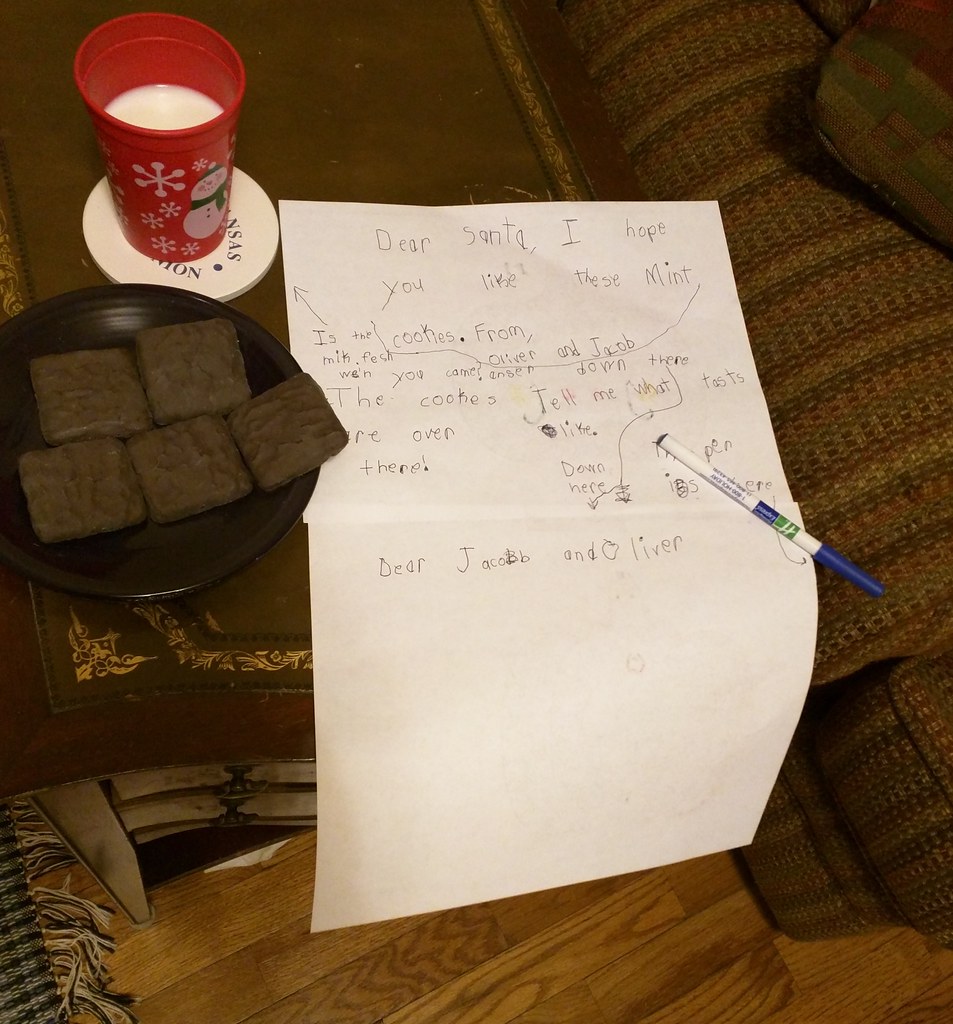
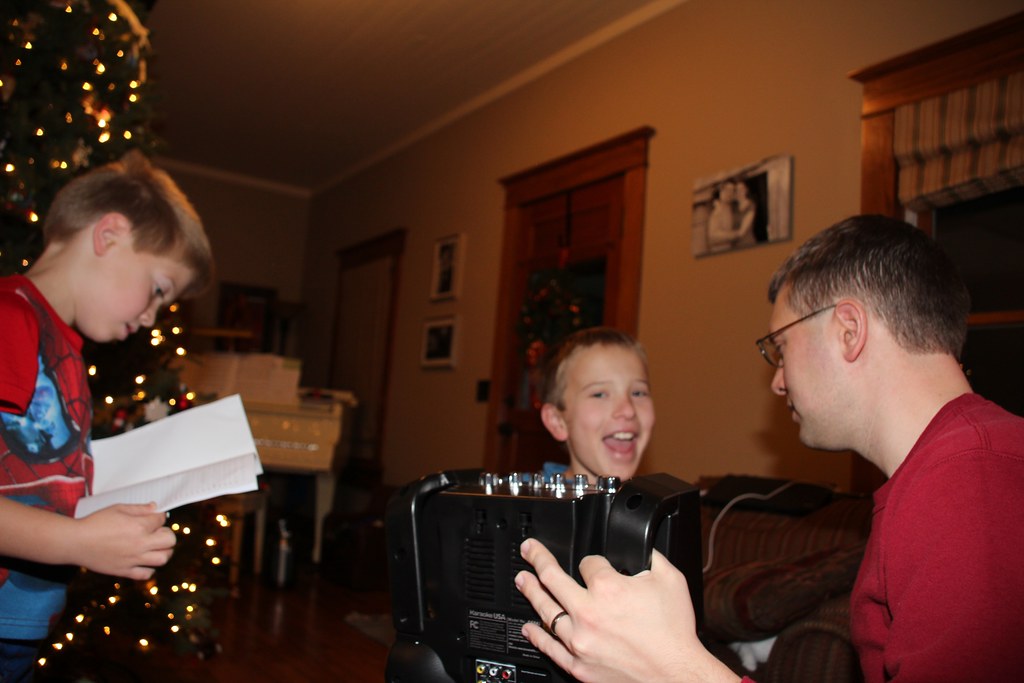
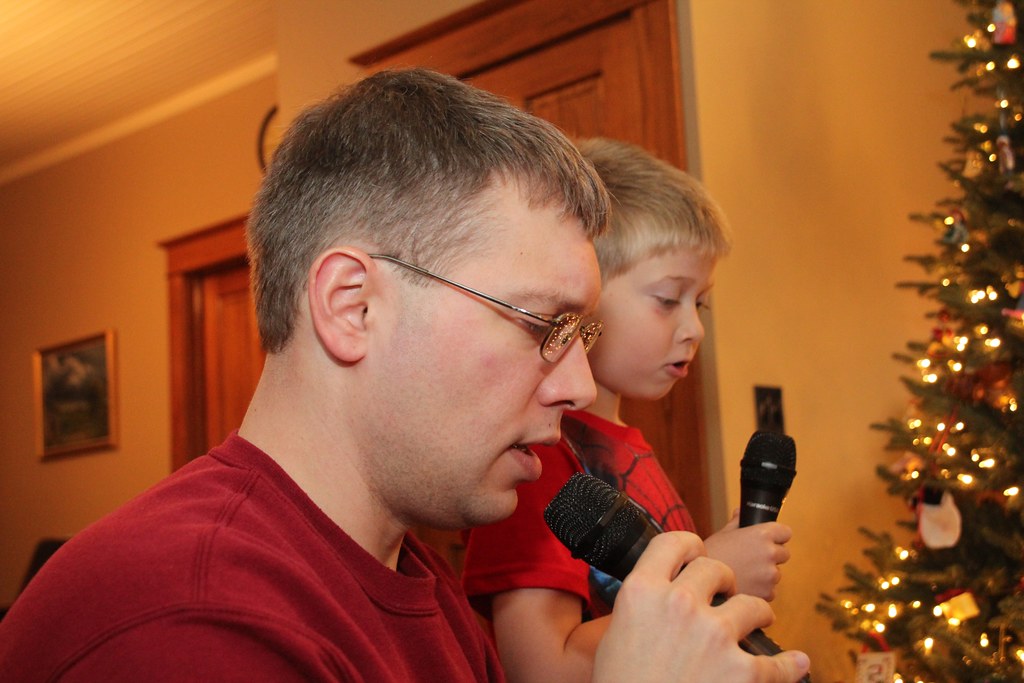
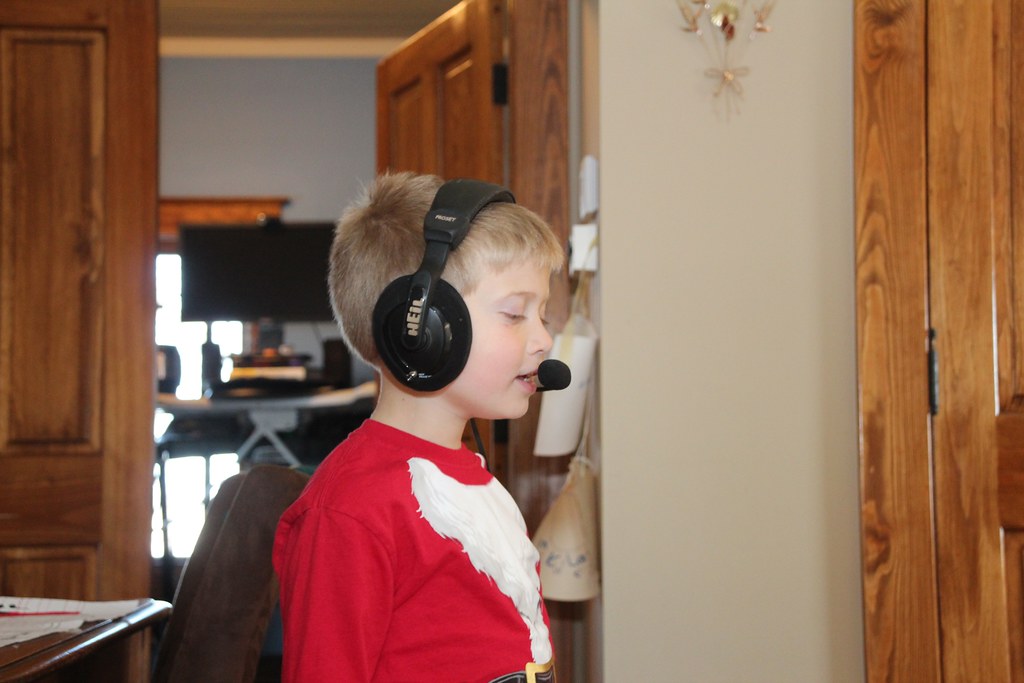
For four years now, we ve had a tradition: I go up to the attic one night, make a lot of noise, and pretend to be Santa. The boys don t think Santa is real, but they get a huge kick out of this anyway. The other day, this wound up with me singing a duet with my 7-year-old Oliver, and seeing a hugely delighted 10-year-old Jacob. All last week, the boys had been lobbying for me to be Santa . They aren t going to be able to be here on Christmas day this year, so I thought why not let them have some fun. I chose one present to give them early too. So, Saturday night, I said they could get ready for Santa. They found some cookies somewhere, got out some milk. And Oliver wrote this wonderful note to Santa : IMG_20161217_204244_cropped That is a note I m going to keep for a long time. He helpfully drew arrows pointing to the milk, cookies, and even the pen. He even started Santa s reply at the bottom! So, Saturday night, I snuck up to the attic, pretended to be Santa, and ate some cookies, drank some milk, and wrote Oliver a note. And I left a present. Jacob has been really getting into music lately, and Laura suggested I find something for the boys. I went looking for something that could record also, and came up with what has got to be a kid s dream: a karaoke machine. The particular one I found came with two microphones, a CD player, audio recording onto SD card (though it s a little dodgy), and a screen for showing words on any music that s karaoke-enhanced. Cue gasps of awe and excitement from the boys when we came down in our PJs and sweats at 6:45 Sunday morning to check it out. IMG_8895 Jacob excitedly began exploring all the knobs and options on it (they were particularly fond of the echo feature), while Oliver wanted to sing. So we found one of his favorite Christmas songs, and here he is singing it with me. IMG_8908 When you have a system with a line in, line out, and several microphone jacks, you can get creative. With a few bits of adapters from my attic, the headset I use for amateur radio worked with it perfectly. Add on a little mic extension cord, and pretty soon Oliver was pretending to be an announcer for a football game! IMG_8919 Then, Oliver decided he would act out a football game while Jacob and I were the announcers. Something tells me there will be much fun had with this over the next while! Just wait until I show them how to hook up a handheld radio to it in order to make a remotely-activated loudspeaker

22 November 2016

Steve Langasek: A new chapter

I don't often write on this blog, and when I do, it's either tech related, or light life stuff. Over the next few weeks, it's going to get a lot more political. If you currently follow this blog for its technical content, you may be tempted to tune out. I would encourage you to stay and listen. I'm passionate about the technology that I work on; but the greatest problems facing our world today are not ones that will be solved with software. American democracy is in bad shape, and it's because of what we're doing to it. This is not a problem of the Right or of the Left; it is not a problem that began with the election of Donald Trump, and it's not a problem that will go away at the end of his term. It is partly a structural problem with the way our elections work, but more than that it's a problem of how we're splitting into separate tribes, isolating ourselves from those who don't agree with us. As Russ Allbery wrote the morning after the election, everything about how we organize ourselves online today - and how we let Facebook and Twitter organize us - leads us to surround ourselves with people who already think the same way we do. That leaves all of us with huge blind spots for other people in our country, and it stifles the free exchange of ideas that is so essential for a healthy democracy. We need leaders who will work to make America a better and more just place for all our neighbors, not just a two-party system that plays tug-of-war using two different sets of voters that feel shut out. And the way we organize ourselves today (online and off) does not let us recognize those leaders. There's a lot of talk now about Facebook changing how it decides what to show people; and maybe they can manage to help everyone's online experience be a little less of a bubble. But part of the change needs to come from us. We need to be willing to engage, civilly, with people whose perspective is different from ours, and make the effort to understand where the other is coming from. So for the next few weeks, I'm going to talk. And I'm going to listen. I have no unique qualifications to speak about the country's issues. But I do have a perspective of my own, which might be different enough from yours to be useful. I was born and raised in Iowa, and graduated from college there. This election cycle, I learned that Iowa holds the distinction of being the state with the lowest percentage of college-educated whites. I'm part of that statistic, because a few years after graduating I moved to Portland, Oregon - a place that's notoriously so far to the left of what we think of as the middle, that it actually has anarchists who would shamefully use a peaceful protest as cover to commit property crime. So I know a few things about the people in each state, that I think the other should hear. I'm also that rarest of creatures, a Portlander who goes to church (Catholic). But I still choose as my neighbors the weird, wonderful, and welcoming community that we have here, whatever Glenn Beck might think. I have a son, and I worry about what kind of world he'll grow up to live in. I work in software, which means I'm doing a lot better than a lot of people in the country right now; it also means that from where I sit, I see trends already in progress that will have an effect on the working class and the middle class that makes NAFTA look like a gnat's fart in comparison. And so I worry for what kind of world we will all live in, if we don't make some changes fast. Let's have a conversation. No comments enabled on this blog, but you can find me on G+ or on Facebook.

15 November 2016

H ctor Or n Mart nez: Open Build Service in Debian needs YOU!

Open Build Service is a generic system to build and distribute packages from sources in an automatic, consistent and reproducible way.
openSUSE distributions build system is based on a generic framework named Open Build Service (OBS), I have been using these tools in my work environment, and I have to say, as Debian developer, that it is a great tool. In the current blog post I plan for you to learn the very basics of such tool and provide you with a tutorial to get, at least, a Debian package building.

Fig 1 Open Build Service Architecture

The figure above shows Open Build Service, from now on OBS, software architecture. There are several parts which we should differenciate: Each one of the above packages can be installed in separated machines as a distributed architecture, it is very easy to split the system into several machines running the services, however in the tutorial below everything installs in one machine.
BACKEND The backend is composed of several scripts written either in shell or Perl. There are several services running in the backend: The backend manages source packages (any format such RPM, DEB, ) and schedules them for a build in the worker. Once the package is built it can be published in a repository for the wider audience or kept unpublished and used by other builds.
WORKER System can have several worker machines which are encharged to perform the package builds. There are different options that can be configured (see /etc/default/obsworker) such enabling switch, number of worker instances, jobs per instance. This part of the system is written in shell and/or Perl language.
WEB UI / API The frontend allows in a clickable way to get around most options OBS provides: setup projects, upload/branch/delete packages, submit review requests, etc. As an example, you can see a live instance running at https://build.opensuse.org/ The frontend parts are really a Ruby-on-rails web application, we (mainly thanks to Andrew Lee with ruby team help) have tried to get it nicely running, however we have had lots of issues due to javascripts or rubygems malfunctioning. Current webui is visible and provides some package status, however most actions do not work properly, or configurations cannot be applied as editor does not save changes, projects or packages in a project are not listed either. If you are a Ruby-on-rails expert or if you are able to help us out with some of the webui issues we get at Debian that would be really appreciated from our side.
OSC CLI OSC is a managing command line tool, written in Python, that interfaces with OBS API to be able to perform actions, edit configurations, do package reviews, etc.
Now that we have done a general overview of the system, let me introduce you to OBS with a practical tutorial. TUTORIAL: Build a Debian package against Debian 8.0 using Download On Demand (DoD) service.

20 October 2016

H ctor Or n Mart nez: Build a Debian package against Debian 8.0 using Download On Demand (DoD) service

In the previous post Open Build Service software architecture has been overviewed. In the current blog post, a tutorial on setting up a package build with OBS from Debian packages is presented. Steps: Generate a test environment by creating Stretch/SID VM Really, use whatever suits you best, but please create an untrusted test environment for this one. In the current tutorial it assumes $hostname is stretch , which should be stretch or sid suite. Be aware that copy & paste configuration files from current post might lead you into broken characters (i.e. ). Debian Stretch weekly netinst CD Enable experimental repository
# echo "deb http://httpredir.debian.org/debian experimental main" >> /etc/apt/sources.list.d/experimental.list
# apt-get update
Install and setup OBS server, api, worker and osc CLI packages
# apt-get install obs-server obs-api obs-worker osc
In the install process mysql database is needed, therefore if mysql server is not setup, a password needs to be provided.
When OBS API database obs-api is created, we need to pick a password for it, provide opensuse . The obs-api package will configure apache2 https webserver (creating a dummy certificate for stretch ) to serve OBS webui.
Add stretch and obs aliases to localhost entry in your /etc/hosts file.
Enable worker by setting ENABLED=1 in /etc/default/obsworker
Try to connect to the web UI https://stretch/
Login into OBS webui, default login credentials: Admin/opensuse).
From command line tool, try to list projects in OBS
 $ osc -A https://stretch ls
Accept dummy certificate and provide credentials (defaults: Admin/opensuse)
If the install proceeds as expected follow to the next step. Ensure all OBS services are running
# backend services
obsrun     813  0.0  0.9 104960 20448 ?        Ss   08:33   0:03 /usr/bin/perl -w /usr/lib/obs/server/bs_dodup
obsrun     815  0.0  1.5 157512 31940 ?        Ss   08:33   0:07 /usr/bin/perl -w /usr/lib/obs/server/bs_repserver
obsrun    1295  0.0  1.6 157644 32960 ?        S    08:34   0:07  \_ /usr/bin/perl -w /usr/lib/obs/server/bs_repserver
obsrun     816  0.0  1.8 167972 38600 ?        Ss   08:33   0:08 /usr/bin/perl -w /usr/lib/obs/server/bs_srcserver
obsrun    1296  0.0  1.8 168100 38864 ?        S    08:34   0:09  \_ /usr/bin/perl -w /usr/lib/obs/server/bs_srcserver
memcache   817  0.0  0.6 346964 12872 ?        Ssl  08:33   0:11 /usr/bin/memcached -m 64 -p 11211 -u memcache -l 127.0.0.1
obsrun     818  0.1  0.5  78548 11884 ?        Ss   08:33   0:41 /usr/bin/perl -w /usr/lib/obs/server/bs_dispatch
obsserv+   819  0.0  0.3  77516  7196 ?        Ss   08:33   0:05 /usr/bin/perl -w /usr/lib/obs/server/bs_service
mysql      851  0.0  0.0   4284  1324 ?        Ss   08:33   0:00 /bin/sh /usr/bin/mysqld_safe
mysql     1239  0.2  6.3 1010744 130104 ?      Sl   08:33   1:31  \_ /usr/sbin/mysqld --basedir=/usr --datadir=/var/lib/mysql --plugin-dir=/usr/lib/mysql/plugin --log-error=/var/log/mysql/error.log --pid-file=/var/run/mysqld/mysqld.pid --socket=/var/run/mysqld/mysqld.sock --port=3306
# web services
root      1452  0.0  0.1 110020  3968 ?        Ss   08:34   0:01 /usr/sbin/apache2 -k start
root      1454  0.0  0.1 435992  3496 ?        Ssl  08:34   0:00  \_ Passenger watchdog
root      1460  0.3  0.2 651044  5188 ?        Sl   08:34   1:46      \_ Passenger core
nobody    1465  0.0  0.1 444572  3312 ?        Sl   08:34   0:00      \_ Passenger ust-router
www-data  1476  0.0  0.1 855892  2608 ?        Sl   08:34   0:09  \_ /usr/sbin/apache2 -k start
www-data  1477  0.0  0.1 856068  2880 ?        Sl   08:34   0:09  \_ /usr/sbin/apache2 -k start
www-data  1761  0.0  4.9 426868 102040 ?       Sl   08:34   0:29 delayed_job.0
www-data  1767  0.0  4.8 425624 99888 ?        Sl   08:34   0:30 delayed_job.1
www-data  1775  0.0  4.9 426516 101708 ?       Sl   08:34   0:28 delayed_job.2
nobody    1788  0.0  5.7 496092 117480 ?       Sl   08:34   0:03 Passenger RubyApp: /usr/share/obs/api
nobody    1796  0.0  4.9 488888 102176 ?       Sl   08:34   0:00 Passenger RubyApp: /usr/share/obs/api
www-data  1814  0.0  4.5 282576 92376 ?        Sl   08:34   0:22 delayed_job.1000
www-data  1829  0.0  4.4 282684 92228 ?        Sl   08:34   0:22 delayed_job.1010
www-data  1841  0.0  4.5 282932 92536 ?        Sl   08:34   0:22 delayed_job.1020
www-data  1855  0.0  4.9 427988 101492 ?       Sl   08:34   0:29 delayed_job.1030
www-data  1865  0.2  5.0 492500 102964 ?       Sl   08:34   1:09 clockworkd.clock
www-data  1899  0.0  0.0  87100  1400 ?        S    08:34   0:00 /usr/bin/searchd --pidfile --config /usr/share/obs/api/config/production.sphinx.conf
www-data  1900  0.1  0.4 161620  8276 ?        Sl   08:34   0:51  \_ /usr/bin/searchd --pidfile --config /usr/share/obs/api/config/production.sphinx.conf
# OBS worker
root      1604  0.0  0.0  28116  1492 ?        Ss   08:34   0:00 SCREEN -m -d -c /srv/obs/run/worker/boot/screenrc
root      1605  0.0  0.9  75424 18764 pts/0    Ss+  08:34   0:06  \_ /usr/bin/perl -w ./bs_worker --hardstatus --root /srv/obs/worker/root_1 --statedir /srv/obs/run/worker/1 --id stretch:1 --reposerver http://obs:5252 --jobs 1
Create an OBS project for Download on Demand (DoD) Create a meta project file:
$ osc -A https://stretch:443 meta prj Debian:8 -e
<project name= Debian:8 >
<title>Debian 8 DoD</title>
<description>Debian 8 DoD</description>
<person userid= Admin role= maintainer />
<repository name= main >
<download arch= x86_64 url= http://deb.debian.org/debian/jessie/main repotype= deb />
<arch>x86_64</arch>
</repository>
</project>
Visit webUI to check project configuration Create a meta project configuration file:
$ osc -A https://stretch:443 meta prjconf Debian:8 -e
Add the following file, as found at build.opensuse.org
Repotype: debian
# create initial user
Preinstall: base-passwd
Preinstall: user-setup
# required for preinstall images
Preinstall: perl
# preinstall essentials + dependencies
Preinstall: base-files base-passwd bash bsdutils coreutils dash debconf
Preinstall: debianutils diffutils dpkg e2fslibs e2fsprogs findutils gawk
Preinstall: gcc-4.9-base grep gzip hostname initscripts insserv libacl1
Preinstall: libattr1 libblkid1 libbz2-1.0 libc-bin libc6 libcomerr2 libdb5.3
Preinstall: libgcc1 liblzma5 libmount1 libncurses5 libpam-modules
Preinstall: libpcre3 libsmartcols1
Preinstall: libpam-modules-bin libpam-runtime libpam0g libreadline6
Preinstall: libselinux1 libsemanage-common libsemanage1 libsepol1 libsigsegv2
Preinstall: libslang2 libss2 libtinfo5 libustr-1.0-1 libuuid1 login lsb-base
Preinstall: mount multiarch-support ncurses-base ncurses-bin passwd perl-base
Preinstall: readline-common sed sensible-utils sysv-rc sysvinit sysvinit-utils
Preinstall: tar tzdata util-linux zlib1g
Runscripts: base-passwd user-setup base-files gawk
VMinstall: libdevmapper1.02.1
Order: user-setup:base-files
# Essential packages (this should also pull the dependencies)
Support: base-files base-passwd bash bsdutils coreutils dash debianutils
Support: diffutils dpkg e2fsprogs findutils grep gzip hostname libc-bin 
Support: login mount ncurses-base ncurses-bin perl-base sed sysvinit 
Support: sysvinit-utils tar util-linux
# Build-essentials
Required: build-essential
Prefer: build-essential:make
# build script needs fakeroot
Support: fakeroot
# lintian support would be nice, but breaks too much atm
#Support: lintian
# helper tools in the chroot
Support: less kmod net-tools procps psmisc strace vim
# everything below same as for Debian:6.0 (apart from the version macros ofc)
# circular dependendencies in openjdk stack
Order: openjdk-6-jre-lib:openjdk-6-jre-headless
Order: openjdk-6-jre-headless:ca-certificates-java
Keep: binutils cpp cracklib file findutils gawk gcc gcc-ada gcc-c++
Keep: gzip libada libstdc++ libunwind
Keep: libunwind-devel libzio make mktemp pam-devel pam-modules
Keep: patch perl rcs timezone
Prefer: cvs libesd0 libfam0 libfam-dev expect
Prefer: gawk locales default-jdk
Prefer: xorg-x11-libs libpng fam mozilla mozilla-nss xorg-x11-Mesa
Prefer: unixODBC libsoup glitz java-1_4_2-sun gnome-panel
Prefer: desktop-data-SuSE gnome2-SuSE mono-nunit gecko-sharp2
Prefer: apache2-prefork openmotif-libs ghostscript-mini gtk-sharp
Prefer: glib-sharp libzypp-zmd-backend mDNSResponder
Prefer: -libgcc-mainline -libstdc++-mainline -gcc-mainline-c++
Prefer: -libgcj-mainline -viewperf -compat -compat-openssl097g
Prefer: -zmd -OpenOffice_org -pam-laus -libgcc-tree-ssa -busybox-links
Prefer: -crossover-office -libgnutls11-dev
# alternative pkg-config implementation
Prefer: -pkgconf
Prefer: -openrc
Prefer: -file-rc
Conflict: ghostscript-library:ghostscript-mini
Ignore: sysvinit:initscripts
Ignore: aaa_base:aaa_skel,suse-release,logrotate,ash,mingetty,distribution-release
Ignore: gettext-devel:libgcj,libstdc++-devel
Ignore: pwdutils:openslp
Ignore: pam-modules:resmgr
Ignore: rpm:suse-build-key,build-key
Ignore: bind-utils:bind-libs
Ignore: alsa:dialog,pciutils
Ignore: portmap:syslogd
Ignore: fontconfig:freetype2
Ignore: fontconfig-devel:freetype2-devel
Ignore: xorg-x11-libs:freetype2
Ignore: xorg-x11:x11-tools,resmgr,xkeyboard-config,xorg-x11-Mesa,libusb,freetype2,libjpeg,libpng
Ignore: apache2:logrotate
Ignore: arts:alsa,audiofile,resmgr,libogg,libvorbis
Ignore: kdelibs3:alsa,arts,pcre,OpenEXR,aspell,cups-libs,mDNSResponder,krb5,libjasper
Ignore: kdelibs3-devel:libvorbis-devel
Ignore: kdebase3:kdebase3-ksysguardd,OpenEXR,dbus-1,dbus-1-qt,hal,powersave,openslp,libusb
Ignore: kdebase3-SuSE:release-notes
Ignore: jack:alsa,libsndfile
Ignore: libxml2-devel:readline-devel
Ignore: gnome-vfs2:gnome-mime-data,desktop-file-utils,cdparanoia,dbus-1,dbus-1-glib,krb5,hal,libsmbclient,fam,file_alteration
Ignore: libgda:file_alteration
Ignore: gnutls:lzo,libopencdk
Ignore: gnutls-devel:lzo-devel,libopencdk-devel
Ignore: pango:cairo,glitz,libpixman,libpng
Ignore: pango-devel:cairo-devel
Ignore: cairo-devel:libpixman-devel
Ignore: libgnomeprint:libgnomecups
Ignore: libgnomeprintui:libgnomecups
Ignore: orbit2:libidl
Ignore: orbit2-devel:libidl,libidl-devel,indent
Ignore: qt3:libmng
Ignore: qt-sql:qt_database_plugin
Ignore: gtk2:libpng,libtiff
Ignore: libgnomecanvas-devel:glib-devel
Ignore: libgnomeui:gnome-icon-theme,shared-mime-info
Ignore: scrollkeeper:docbook_4,sgml-skel
Ignore: gnome-desktop:libgnomesu,startup-notification
Ignore: python-devel:python-tk
Ignore: gnome-pilot:gnome-panel
Ignore: gnome-panel:control-center2
Ignore: gnome-menus:kdebase3
Ignore: gnome-main-menu:rug
Ignore: libbonoboui:gnome-desktop
Ignore: postfix:pcre
Ignore: docbook_4:iso_ent,sgml-skel,xmlcharent
Ignore: control-center2:nautilus,evolution-data-server,gnome-menus,gstreamer-plugins,gstreamer,metacity,mozilla-nspr,mozilla,libxklavier,gnome-desktop,startup-notification
Ignore: docbook-xsl-stylesheets:xmlcharent
Ignore: liby2util-devel:libstdc++-devel,openssl-devel
Ignore: yast2:yast2-ncurses,yast2-theme-SuSELinux,perl-Config-Crontab,yast2-xml,SuSEfirewall2
Ignore: yast2-core:netcat,hwinfo,wireless-tools,sysfsutils
Ignore: yast2-core-devel:libxcrypt-devel,hwinfo-devel,blocxx-devel,sysfsutils,libstdc++-devel
Ignore: yast2-packagemanager-devel:rpm-devel,curl-devel,openssl-devel
Ignore: yast2-devtools:perl-XML-Writer,libxslt,pkgconfig
Ignore: yast2-installation:yast2-update,yast2-mouse,yast2-country,yast2-bootloader,yast2-packager,yast2-network,yast2-online-update,yast2-users,release-notes,autoyast2-installation
Ignore: yast2-bootloader:bootloader-theme
Ignore: yast2-packager:yast2-x11
Ignore: yast2-x11:sax2-libsax-perl
Ignore: openslp-devel:openssl-devel
Ignore: java-1_4_2-sun:xorg-x11-libs
Ignore: java-1_4_2-sun-devel:xorg-x11-libs
Ignore: kernel-um:xorg-x11-libs
Ignore: tetex:xorg-x11-libs,expat,fontconfig,freetype2,libjpeg,libpng,ghostscript-x11,xaw3d,gd,dialog,ed
Ignore: yast2-country:yast2-trans-stats
Ignore: susehelp:susehelp_lang,suse_help_viewer
Ignore: mailx:smtp_daemon
Ignore: cron:smtp_daemon
Ignore: hotplug:syslog
Ignore: pcmcia:syslog
Ignore: avalon-logkit:servlet
Ignore: jython:servlet
Ignore: ispell:ispell_dictionary,ispell_english_dictionary
Ignore: aspell:aspel_dictionary,aspell_dictionary
Ignore: smartlink-softmodem:kernel,kernel-nongpl
Ignore: OpenOffice_org-de:myspell-german-dictionary
Ignore: mediawiki:php-session,php-gettext,php-zlib,php-mysql,mod_php_any
Ignore: squirrelmail:mod_php_any,php-session,php-gettext,php-iconv,php-mbstring,php-openssl
Ignore: simias:mono(log4net)
Ignore: zmd:mono(log4net)
Ignore: horde:mod_php_any,php-gettext,php-mcrypt,php-imap,php-pear-log,php-pear,php-session,php
Ignore: xerces-j2:xml-commons-apis,xml-commons-resolver
Ignore: xdg-menu:desktop-data
Ignore: nessus-libraries:nessus-core
Ignore: evolution:yelp
Ignore: mono-tools:mono(gconf-sharp),mono(glade-sharp),mono(gnome-sharp),mono(gtkhtml-sharp),mono(atk-sharp),mono(gdk-sharp),mono(glib-sharp),mono(gtk-sharp),mono(pango-sharp)
Ignore: gecko-sharp2:mono(glib-sharp),mono(gtk-sharp)
Ignore: vcdimager:libcdio.so.6,libcdio.so.6(CDIO_6),libiso9660.so.4,libiso9660.so.4(ISO9660_4)
Ignore: libcdio:libcddb.so.2
Ignore: gnome-libs:libgnomeui
Ignore: nautilus:gnome-themes
Ignore: gnome-panel:gnome-themes
Ignore: gnome-panel:tomboy
Substitute: utempter
%ifnarch s390 s390x ppc ia64
Substitute: java2-devel-packages java-1_4_2-sun-devel
%else
 %ifnarch s390x
Substitute: java2-devel-packages java-1_4_2-ibm-devel
 %else
Substitute: java2-devel-packages java-1_4_2-ibm-devel xorg-x11-libs-32bit
 %endif
%endif
Substitute: yast2-devel-packages docbook-xsl-stylesheets doxygen libxslt perl-XML-Writer popt-devel sgml-skel update-desktop-files yast2 yast2-devtools yast2-packagemanager-devel yast2-perl-bindings yast2-testsuite
#
# SUSE compat mappings
#
Substitute: gcc-c++ gcc
Substitute: libsigc++2-devel libsigc++-2.0-dev
Substitute: glibc-devel-32bit
Substitute: pkgconfig pkg-config
%ifarch %ix86
Substitute: kernel-binary-packages kernel-default kernel-smp kernel-bigsmp kernel-debug kernel-um kernel-xen kernel-kdump
%endif
%ifarch ia64
Substitute: kernel-binary-packages kernel-default kernel-debug
%endif
%ifarch x86_64
Substitute: kernel-binary-packages kernel-default kernel-smp kernel-xen kernel-kdump
%endif
%ifarch ppc
Substitute: kernel-binary-packages kernel-default kernel-kdump kernel-ppc64 kernel-iseries64
%endif
%ifarch ppc64
Substitute: kernel-binary-packages kernel-ppc64 kernel-iseries64
%endif
%ifarch s390
Substitute: kernel-binary-packages kernel-s390
%endif
%ifarch s390x
Substitute: kernel-binary-packages kernel-default
%endif
%define debian_version 800
Macros:
%debian_version 800
Visit webUI to check project configuration Create an OBS project linked to DoD
$ osc -A https://stretch:443 meta prj test -e
<project name= test >
<title>test</title>
<description>test</description>
<person userid= Admin role= maintainer />
<repository name= Debian_8.0 >
<path project= Debian:8 repository= main />
<arch>x86_64</arch>
</repository>
</project>
Visit webUI to check project configuration Adding a package to the project
$ osc -A https://stretch:443 co test ; cd test
$ mkdir hello ; cd hello ; apt-get source -d hello ; cd - ; 
$ osc add hello 
$ osc ci -m "New import" hello
The package should go to dispatched state then get in blocked state while it downloads build dependencies from DoD link, eventually it should start building. Please check the journal logs to check if something went wrong or gets stuck. Visit webUI to check hello package build state OBS logging to the journal Check in the journal logs everything went fine:
$ sudo journalctl -u obsdispatcher.service -u obsdodup.service -u obsscheduler@x86_64.service -u obsworker.service -u obspublisher.service
Troubleshooting Currently we are facing few issues with web UI: And there are more issues that have not been reported, please do reportbug obs-api .

30 September 2016

Chris Lamb: Free software activities in September 2016

Here is my monthly update covering what I have been doing in the free software world (previous month):
Reproducible builds

Whilst anyone can inspect the source code of free software for malicious flaws, most Linux distributions provide binary (or "compiled") packages to end users. The motivation behind the Reproducible Builds effort is to allow verification that no flaws have been introduced either maliciously and accidentally during this compilation process by promising identical binary packages are always generated from a given source. My work in the Reproducible Builds project was also covered in our weekly reports #71, #72, #71 & #74. I made the following improvements to our tools:

diffoscope

diffoscope is our "diff on steroids" that will not only recursively unpack archives but will transform binary formats into human-readable forms in order to compare them.

  • Added a global Progress object to track the status of the comparison process allowing for graphical and machine-readable status indicators. I also blogged about this feature in more detail.
  • Moved the global Config object to a more Pythonic "singleton" pattern and ensured that constraints are checked on every change.

disorderfs

disorderfs is our FUSE filesystem that deliberately introduces nondeterminism into the results of system calls such as readdir(3).

  • Display the "disordered" behaviour we intend to show on startup. (#837689)
  • Support relative paths in command-line parameters (previously only absolute paths were permitted).

strip-nondeterminism

strip-nondeterminism is our tool to remove specific information from a completed build.

  • Fix an issue where temporary files were being left on the filesystem and add a test to avoid similar issues in future. (#836670)
  • Print an error if the file to normalise does not exist. (#800159)
  • Testsuite improvements:
    • Set the timezone in tests to avoid a FTBFS and add a File::StripNondeterminism::init method to the API to to set tzset everywhere. (#837382)
    • "Smoke test" the strip-nondeterminism(1) and dh_strip_nondeterminism(1) scripts to prevent syntax regressions.
    • Add a testcase for .jar file ordering and normalisation.
    • Check the stripping process before comparing file attributes to make it less confusing on failure.
    • Move to a lookup table for descriptions of stat(1) indices and use that for nicer failure messages.
    • Don't uselessly test whether the inode number has changed.
  • Run perlcritic across the codebase and adopt some of its prescriptions including explicitly using oct(..) for integers with leading zeroes, avoiding mixing high and low-precedence booleans, ensuring subroutines end with a return statement, etc.

I also submitted 4 patches to fix specific reproducibility issues in golang-google-grpc, nostalgy, python-xlib & torque.


Debian https://lamby-www.s3.amazonaws.com/yadt/blog.Image/image/original/28.jpeg

Patches contributed

Debian LTS

This month I have been paid to work 12.75 hours on Debian Long Term Support (LTS). In that time I did the following:
  • "Frontdesk" duties, triaging CVEs, etc.
  • Issued DLA 608-1 for mailman fixing a CSRF vulnerability.
  • Issued DLA 611-1 for jsch correcting a path traversal vulnerability.
  • Issued DLA 620-1 for libphp-adodb patching a SQL injection vulnerability.
  • Issued DLA 631-1 for unadf correcting a buffer underflow issue.
  • Issued DLA 634-1 for dropbear fixing a buffer overflow when parsing ASN.1 keys.
  • Issued DLA 635-1 for dwarfutils working around an out-of-bounds read issue.
  • Issued DLA 638-1 for the SELinux policycoreutils, patching a sandbox escape issue.
  • Enhanced Brian May's find-work --unassigned switch to take an optional "except this user" argument.
  • Marked matrixssl and inspircd as being unsupported in the current LTS version.

Uploads
  • python-django 1:1.10.1-1 New upstream release and ensure that django-admin startproject foo creates files with the correct shebang under Python 3.
  • gunicorn:
    • 19.6.0-5 Don't call chown(2) if it would be a no-op to avoid failure under snap.
    • 19.6.0-6 Remove now-obsolete conffiles and logrotate scripts; they should have been removed in 19.6.0-3.
  • redis:
    • 3.2.3-2 Call ulimit -n 65536 by default from SysVinit scripts to normalise the behaviour with systemd. I also bumped the Debian package epoch as the "2:" prefix made it look like we are shipping version 2.x. I additionaly backported this upload to Debian Jessie.
    • 3.2.4-1 New upstream release, add missing -ldl for dladdr(3) & add missing dependency on lsb-base.
  • python-redis (2.10.5-2) Bump python-hiredis to Suggests to sync with Ubuntu and move to a machine-readable debian/copyright. I also backported this upload to Debian Jessie.
  • adminer (4.2.5-3) Move mysql-server dependencies to default-mysql-server. I also backported this upload to Debian Jessie.
  • gpsmanshp (1.2.3-5) on behalf of the QA team:
    • Move to "minimal" debhelper style, making the build reproducible. (#777446 & #792991)
    • Reorder linker command options to build with --as-needed (#729726) and add hardening flags.
    • Move to machine-readable copyright file, add missing #DEBHELPER# tokens to postinst and prerm scripts, tidy descriptions & other debian/control fields and other smaller changes.

I sponsored the upload of 5 packages from other developers:

I also NMU'd:


FTP Team

As a Debian FTP assistant I ACCEPTed 147 packages: alljoyn-services-1604, android-platform-external-doclava, android-platform-system-tools-aidl, aufs, bcolz, binwalk, bmusb, bruteforce-salted-openssl, cappuccino, captagent, chrome-gnome-shell, ciphersaber, cmark, colorfultabs, cppformat, dnsrecon, dogtag-pki, dxtool, e2guardian, flask-compress, fonts-mononoki, fwknop-gui, gajim-httpupload, glbinding, glewmx, gnome-2048, golang-github-googleapis-proto-client-go, google-android-installers, gsl, haskell-hmatrix-gsl, haskell-relational-query, haskell-relational-schemas, haskell-secret-sharing, hindsight, i8c, ip4r, java-string-similarity, khal, khronos-opencl-headers, liblivemedia, libshell-config-generate-perl, libshell-guess-perl, libstaroffice, libxml2, libzonemaster-perl, linux, linux-grsec-base, linux-signed, lua-sandbox, lua-torch-trepl, mbrola-br2, mbrola-br4, mbrola-de1, mbrola-de2, mbrola-de3, mbrola-ir1, mbrola-lt1, mbrola-lt2, mbrola-mx1, mimeo, mimerender, mongo-tools, mozilla-gnome-keyring, munin, node-grunt-cli, node-js-yaml, nova, open-build-service, openzwave, orafce, osmalchemy, pgespresso, pgextwlist, pgfincore, pgmemcache, pgpool2, pgsql-asn1oid, postbooks-schema, postgis, postgresql-debversion, postgresql-multicorn, postgresql-mysql-fdw, postgresql-unit, powerline-taskwarrior, prefix, pycares, pydl, pynliner, pytango, pytest-cookies, python-adal, python-applicationinsights, python-async-timeout, python-azure, python-azure-storage, python-blosc, python-can, python-canmatrix, python-chartkick, python-confluent-kafka, python-jellyfish, python-k8sclient, python-msrestazure, python-nss, python-pytest-benchmark, python-tenacity, python-tmdbsimple, python-typing, python-unidiff, python-xstatic-angular-schema-form, python-xstatic-tv4, quilt, r-bioc-phyloseq, r-cran-filehash, r-cran-png, r-cran-testit, r-cran-tikzdevice, rainbow-mode, repmgr, restart-emacs, restbed, ruby-azure-sdk, ruby-babel-source, ruby-babel-transpiler, ruby-diaspora-prosody-config, ruby-haikunator, ruby-license-finder, ruby-ms-rest, ruby-ms-rest-azure, ruby-rails-assets-autosize, ruby-rails-assets-blueimp-gallery, ruby-rails-assets-bootstrap, ruby-rails-assets-bootstrap-markdown, ruby-rails-assets-emojione, ruby-sprockets-es6, ruby-timeliness, rustc, skytools3, slony1-2, snmp-mibs-downloader, syslog-ng, test-kitchen, uctodata, usbguard, vagrant-azure, vagrant-mutate & vim.

19 September 2016

Mike Gabriel: Rocrail changed License to some dodgy non-free non-License

The Background Story A year ago, or so, I took some time to search the internet for Free Software that can be used for controlling model railways via a computer. I was happy to find Rocrail [1] being one of only a few applications available on the market. And even more, I was very happy when I saw that it had been licensed under a Free Software license: GPL-3(+). A month ago, or so, I collected my old M rklin (Digital) stuff from my parents' place and started looking into it again after +15 years, together with my little son. Some weeks ago, I remembered Rocrail and thought... Hey, this software was GPLed code and absolutely suitable for uploading to Debian and/or Ubuntu. I searched for the Rocrail source code and figured out that it got hidden from the web some time in 2015 and that the license obviously has been changed to some non-free license (I could not figure out what license, though). This made me very sad! I thought I had found a piece of software that might be interesting for testing with my model railway. Whenever I stumble over some nice piece of Free Software that I plan to use (or even only play with), I upload this to Debian as one of the first steps. However, I highly attempt to stay away from non-free sofware, so Rocrail has become a no-option for me back in 2015. I should have moved on from here on... Instead... Proactively, I signed up with the Rocrail forum and asked the author(s) if they see any chance of re-licensing the Rocrail code under GPL (or any other FLOSS license) again [2]? When I encounter situations like this, I normally offer my expertise and help with such licensing stuff for free. My impression until here already was that something strange must have happened in the past, so that software developers choose GPL and later on stepped back from that decision and from then on have been hiding the source code from the web entirely. Going deeper... The Rocrail project's wiki states that anyone can request GitBlit access via the forum and obtain the source code via Git for local build purposes only. Nice! So, I asked for access to the project's Git repository, which I had been granted. Thanks for that. Trivial Source Code Investigation... So far so good. I investigated the source code (well, only the license meta stuff shipped with the source code...) and found that the main COPYING files (found at various locations in the source tree, containing a full version of the GPL-3 license) had been replaced by this text:
Copyright (c) 2002 Robert Jan Versluis, Rocrail.net
All rights reserved.
Commercial usage needs permission.
The replacement happened with these Git commits:
commit cfee35f3ae5973e97a3d4b178f20eb69a916203e
Author: Rob Versluis <r.j.versluis@rocrail.net>
Date:   Fri Jul 17 16:09:45 2015 +0200
    update copyrights
commit df399d9d4be05799d4ae27984746c8b600adb20b
Author: Rob Versluis <r.j.versluis@rocrail.net>
Date:   Wed Jul 8 14:49:12 2015 +0200
    update licence
commit 0daffa4b8d3dc13df95ef47e0bdd52e1c2c58443
Author: Rob Versluis <r.j.versluis@rocrail.net>
Date:   Wed Jul 8 10:17:13 2015 +0200
    update
Getting in touch again, still being really interested and wanting to help... As I consider such a non-license as really dangerous when distributing any sort of software, be it Free or non-free Software, I posted the below text on the Rocrail forum:
Hi Rob,
I just stumbled over this post [3] [link reference adapted for this
blog post), which probably is the one you have referred to above.
It seems that Rocrail contains features that require a key or such
for permanent activation.  Basically, this is allowed and possible
even with the GPL-3+ (although Free Software activists will  not
appreciate that). As the GPL states that people can share the source
code, programmers can  easily deactivate license key checks (and
such) in the code and re-distribute that patchset as they  like.
Furthermore, the current COPYING file is really non-protective at
all. It does not really protect   you as copyright holder of the
code. Meaning, if people crash their trains with your software, you  
could actually be legally prosecuted for that. In theory. Or in the
U.S. ( ;-) ). Main reason for  having a long long license text is to
protect you as the author in case your software causes t trouble to
other people. You do not have any warranty disclaimer in your COPYING
file or elsewhere. Really not a good idea.
In that referenced post above, someone also writes about the nuisance
of license discussions in  this forum. I have seen various cases
where people produced software and did not really care for 
licensing. Some ended with a letter from a lawyer, some with some BIG
company using their code  under their copyright holdership and their
own commercial licensing scheme. This is not paranoia,  this is what
happens in the Free Software world from time to time.
A model that might be much more appropriate (and more protective to
you as the author), maybe, is a  dual release scheme for the code. A
possible approach could be to split Rocrail into two editions:  
Community Edition and Professional/Commercial Edition. The Community
Edition must be licensed in a  way that it allows re-using the code
in a closed-source, non-free version of Rocrail (e.g.   MIT/Expat
License or Apache2.0 License). Thus, the code base belonging to the
community edition  would be licensed, say..., as Apache-2.0 and for
the extra features in the Commercial Edition, you  may use any
non-free license you want (but please not that COPYING file you have
now, it really  does not protect your copyright holdership).
The reason for releasing (a reduced set of features of a) software as
Free Software is to extend  the user base. The honey jar effect, as
practise by many huge FLOSS projects (e.g. Owncloud,  GitLab, etc.).
If people could install Rocrail from the Debian / Ubuntu archives
directly, I am  sure that the user base of Rocrail will increase.
There may also be developers popping up showing  an interest in
Rocrail (e.g. like me). However, I know many FLOSS developers (e.g.
like me) that  won't waste their free time on working for a non-free
piece of software (without being paid).
If you follow (or want to follow) a business model with Rocrail, then
keep some interesting  features in the Commercial Edition and don't
ship that source code. People with deep interest may  opt for that.
Furthermore, another option could be dual licensing the code. As the
copyright holder of Rocrail  you are free to juggle with licenses and
apply any license to a release you want. For example, this  can be
interesing for a free-again Rocrail being shipped via Apple's iStore. 
Last but not least, as you ship the complete source code with all
previous changes as a Git project  to those who request GitBlit
access, it is possible to obtain all earlier versions of Rocrail. In 
the mail I received with my GitBlit credentials, there was some text
that  prohibits publishing the  code. Fine. But: (in theory) it is
not forbidden to share the code with a friend, for local usage.  This
friend finds the COPYING file, frowns and rewinds back to 2015 where
the license was still  GPL-3+. GPL-3+ code can be shared with anyone
and also published, so this friend could upload the  2015-version of
Rocrail to Github or such and start to work on a free fork. You also
may not want  this.
Thanks for working on this piece of software! It is highly
interesing, and I am still sad, that it  does not come with a free
license anymore. I won't continue this discussion and move on, unless
you  are interested in any of the above information and ask for more
expertise. Ping me here or directly  via mail, if needed. If the
expertise leads to parts of Rocrail becoming Free Software again, the 
expertise is offered free of charge ;-).
light+love
Mike
Wow, the first time I got moderated somewhere... What an experience! This experience now was really new. My post got immediately removed from the forum by the main author of Rocrail (with the forum's moderator's hat on). The new experience was: I got really angry when I discovererd having been moderated. Wow! Really a powerful emotion. No harassment in my words, no secrets disclosed, and still... my free speech got suppressed by someone. That feels intense! And it only occurred in the virtual realm, not face to face. Wow!!! I did not expect such intensity... The reason for wiping my post without any other communication was given as below and quite a statement to frown upon (this post has also been "moderately" removed from the forum thread [2] a bit later today):
Mike,
I think its not a good idea to point out a way to get the sources back to the GPL periode.
Therefore I deleted your posting.
(The phpBB forum software also allows moderators to edit posts, so the critical passage could have been removed instead, but immediately wiping the full message, well...). Also, just wiping my post and not replying otherwise with some apology to suppress my words, really is a no-go. And the reason for wiping the rest of the text... Any Git user can easily figure out how to get a FLOSS version of Rocrail and continue to work on that from then on. Really. Now the political part of this blog post... Fortunately, I still live in an area of the world where the right of free speech is still present. I found out: I really don't like being moderated!!! Esp. if what I share / propose is really noooo secret at all. Anyone who knows how to use Git can come to the same conclusion as I have come to this morning. [Off-topic, not at all related to Rocrail: The last votes here in Germany indicate that some really stupid folks here yearn for another this time highly idiotic wind of change, where free speech may end up as a precious good.] To other (Debian) Package Maintainers and Railroad Enthusiasts... With this blog post I probably close the last option for Rocrail going FLOSS again. Personally, I think that gate was already closed before I got in touch. Now really moving on... Probably the best approach for my new train conductor hobby (as already recommended by the woman at my side some weeks back) is to leave the laptop lid closed when switching on the train control units. I should have listened to her much earlier. I have finally removed the Rocrail source code from my computer again without building and testing the application. I neither have shared the source code with anyone. Neither have I shared the Git URL with anyone. I really think that FLOSS enthusiasts should stay away from this software for now. For my part, I have lost my interest in this completely... References light+love,
Mike

7 July 2016

Michal &#268;iha&#345;: uTidylib 0.3

Several years ago I've complained about uTidylib not being maintained upstream. Since that time I've occasionally pushed some fixes to my GitHub repository with uTidylib code, but without any clear intentions to take it over. Time has gone and there was still no progress and I started to consider becoming upstream maintainer as well. I quickly got approval from Cory Dodt, who was the original author of this code, unfortunately he is not owner of the PyPI entry and the claim request seems to have no response (if you know how to get in touch with "cntrlr" or how to take over PyPI module please let me know). Anyway the amount of patches in my repository is big enough to warrant new release. Additionally Debian bug report about supporting new HTML tidy library came in and that made me push towards releasing 0.3 version of the uTidylib. As you might guess, the amount of changes against original uTidylib is quite huge, to name the most important ones: Anyway as I can not update PyPI entry, the downloads are currently available only on my website: https://cihar.com/software/utidylib/

Filed under: Debian English uTidylib 0 comments

18 June 2016

Dominique Dumont: An improved Perl API for cme and Config::Model

Hello While hacking on a script to update build dependencies on a Debian package, it occured to me that using Config::Model in a Perl program should be no more complicated than using cme from a shell script. That was an itch that I scratched immediately. Fast forward a few days, Config::Model now features new cme() and modify() functions that have a behavior similar to cme modify command. For instance, the following program is enough to update popcon s configuration file:
use strict; # let's not forget best practices ;-)
use warnings;
use Config::Model qw(cme); # cme function must be imported
cme('popcon')->modify("PARTICIPATE=yes");
The object returned by cme() is a Config;:Model::Instance. All its methods are available for a finer control. For instance:
my $instance = cme('popcon');
$instance->load("PARTICIPATE=yes");
$instance->apply_fixes;
$instance->say_changes; 
$instance->save;
When run as root, the script above shows:
Changes applied to popcon configuration:
- PARTICIPATE: 'no' -> 'yes'
If need be, you can also retrieve the root node of the configuration tree to use Config;:Model::Node methods:
my $root_node = cme('popcon')->config_root;
say "is popcon active ? ",$root_node->fetch_element_value('PARTICIPATE');
In summary, using cme in a Perl program is now as easy as using cme from a shell script. To provide feedback, comments, ideas, patches or to report problems, please follow the instructions from CONTRIBUTING page on github. All the best
Tagged: config-model, configuration, Perl

25 April 2016

Antoine Beaupr : My free software activities, April 2016

Debian Long Term Support (LTS) This is my 5th month working on Debian LTS, started by Raphael Hertzog at Freexian. This is my largest month so far, in which I worked on completing the Xen and NSS packages updates from last month, but also spent a significant amount of time working on phpMyAdmin and libidn.

Updates to NSS and Xen completed This basically consisted on following up on the reviews from other security people. I basically continued building up on Brian's work and tested the package on a test server at Koumbit, which seems to have survived well the upgrade. The details are in this post to the debian-lts mailing list. As for NSS, the package was mostly complete, but I forgot to ship the tests for some reason, so I added them back. I also wrote the release team to see if it was possible to update NSS to the same version in all suites. Unfortunately, this issue is still pending, but I still hope we can find better ways of managing that package in the long term.

IDN and phpMyAdmin Most of my time this month was spent working on IDN and phpMyAdmin. Unfortunately, it turns out that someone else had worked on the libidn package. This is partly my fault: I forgot to check in the dsa-needed.txt file for assignment before working on the package. But considering how in flux the workflow currently is with the switch between the main security team and the LTS team for the wheezy maintenance, I don't feel too bad. Still, I prepared a package which was a bit more painful than it should have been because of GNUlib. I didn't even know about GNUlib before, oddly enough, and after that experience, I feel that it should just not exist at all anymore. I have filed a bug to remove that dependency at the very least, but I do not clearly see how such a tool is necessary on Debian at this point in time. But phpMyAdmin, no one had worked on that. And I understand why: even though it's a very popular package, there were quite a few outstanding issues (8!) in Wheezy, with 10-15 patches to be ported. Plus, it's ... well, PHP. And old PHP at that, with parts of it with modern autoloader classes, and other with mixed HTML and PHP content, require (and not require_once) and all sorts of nasty things you still find in the PHP universe. I nevertheless managed to produce a new Debian package for wheezy and test it on Koumbit's test servers. Hopefully, that can land into Wheezy soon.

Long term software support I am a little worried that we are, both in Jessie and Wheezy sitting in between stable releases for phpMyAdmin, something that is a recurring issue for a lot of packages in Debian stable or LTS. Sometimes, it just happens that the version that happens to be in Debian testing when it is released as stable is just not a supported release upstream. It's the case for phpMyAdmin in Jessie (4.3, whereas 4.0 and 4.4 are supported) and Wheezy (3.4, although it's unclear how long that was supported upstream). But even if the next Debian stable (Stretch), would pick a stable release upstream, there is actually no phpMyAdmin release that has a support window as long as Debian stable (roughly 3 years), let alone as long as Debian LTS (5 years). This is a similar problem with NSS: upstream is simply not supporting their product in the long term, or at least not in the terms we are used to in the Debian community (ie. only security fixes or regressions). This is, in my opinion, a real concern for the reliability and sustainability of the computing infrastructure we are creating. While some developers are of the opinion that software older than 18 months is too old, here we are shipping hardware and software in space or we have Solaris, which is supported for 16 years! Now that is a serious commitment and something we can rely on. 18 months is really, really, a tiny short time in the history of our civilization. I know computer programmers and engineers like to think of themselves in elitist terms, that they are changing the world every other year. But the truth is that things have not changed much in the last 4 decades where computing has existed, both in terms of security or functionality. Two quotes from my little quotes collection come to mind here:
Software gets slower faster than hardware gets faster. - Wirth's law The future is already here it's just not very evenly distributed. - William Gibson
Because of course, the response to my claims that computing is not really advancing is "but look! we have supercomputers in our pockets now!" Yes, of course, we do have those fancy phones and they are super-connected, but they are a threat to our fundamental rights and freedom. And those glittering advances always pale in comparison to what could be done if we wouldn't be wasting our time rewriting the same software over and over again on different, often proprietary, platforms, simply because of the megalomaniac fantasies of egoistic programmers. It would be great to build something that lasts, for a while. Software that does not need to be updated every 16 months. You'd think that something as basic as a screensaver release could survive what is basically the range of human infancy. Yet it seems we like to run mindlessly in the minefield of software development, one generation following the other without questioning the underlying assumption of infinite growth that permeates our dying civilization. I have talked about this before of course, but working with the LTS project just unnerves me so bad that I just needed to let out another rant. (For the record, I really have a lot of respect for JWZ and all the work he has done in the free software world. I frequently refer to his "no-bullshit" backup guide and use Xscreensaver daily. But I do think he was wrong in this case: asking Debian to remove Xscreensaver is just too much. The response from the maintainer was exemplary of how to handle such issues in the future. I restarted Xscreensaver after the stable update, and the message is gone, and things are still all fine. Thanks JWZ and Tormod for keeping things rolling.)

Other free software work With that in mind, I obviously didn't stop doing other computing work this month. In fact, I did a lot of work to try to generally fix the internet, that endless and not-quite-gratifying hobby so many of us are destroying our bodies to accomplish.

Build tools I have experimented a bit more with different build tools. I got worried because at some point cowbuilder got orphaned and I figured I could refresh the way I build packages for LTS. I looked into sbuild, but that ended up not bringing much improvements over my current cowbuilder setup (which I really need to document better). I was asked by the new maintainer to open a bug report to make such setups easier by guessing the basepath better, so we'll see how that goes. I did enjoy the simplicity of gitpkg and discovered cowpoke which made it about 2 times faster to build packages because I could use another server to build larger packages. I also found that gitpkg doesn't use -n by default when calling gzip, which makes it harder to reproduce tarballs when they are themselves built reproducibly, which is the case for Github tarballs (really nice of them). So I filed bug #820842 about that. It would be pretty awesome if such buildds would be available for Debian Developers to do their daily tasks. It could simply be a machine that would spin up a chroot with cowbuilder or it could even be a full, temporary VM although that would take way more resources than a simple VM with a cowbuilder setup. In the meantime, I should probably look at whalebuilder as an alternative to cowbuilder. It is a tool that supports building packages within a Docker chroot, which means that packages are built from a clean environment like pbuilder, and using COW optimisations but also without privileges or network access, which is a huge plus especially when you build untrusted packages.

Ikiwiki admonitions I have done some work to implement Moinmoin-like admonitions in Ikiwiki, something I am quite happy about since it's something I was really missing about Moinmoin. Admonitions bring a really nice way to outline certain blocks with varying severity levels and distinct styles. For example:
Admonitions are great!
This was done with a macro, but basically, since Markdown allows more or less arbitrary HTML, this can also be done with the <div> tag. I like that we don't have a new weird markup here. Yet, I still liked the sub-parser feature of MoinMoin, something that can be implemented in Ikiwiki, but it's a little more clunky. Normally, you'd probably do this with the inline macro and subpages, but it's certainly less intuitive that directly inlined content.

Ereader I got a new e-reader! I was hesitant between the Kobo Aura H20 and the Kobo Glo HD, which were the ones available at Bestbuy. So I bought both and figured I would return the other. That was a painful decision! In the end, both machines are pretty nice:
  • Aura H2O
    • Pros:
      • waterproof
      • larger screen (makes it easier to see web pages and better for the eyes)
      • naturally drawn to it
    • Cons:
      • heavier
      • larger (fits in outside pocket though)
      • port cover finicky
      • more expensive (180$) - prices may go down in future
  • Aura Glo HD
    • Pros
      • smaller (fits in inside pocket of both coats)
      • better resolution in theory (can't notice in practice)
      • cheaper (100$)
      • may be less common on the future (larger models more common? just a guess)
    • Cons
      • no SD card
      • smaller screen
      • power button in the middle
... but in the end, I ended up settling down on the Glo, mostly for the price. Heck, I saved around 100$, so for that amount, I could have gotten two machines so that if one breaks I would still have the other. I have ordered a cover for it on Deal Extreme about two weeks ago, and it still hasn't arrived. I suspect it's going to take a few more months to get there, by which point I may have changed e-reader again. Note that both e-readers needed an update to calibre, so I started working on a calibre backport (#818309) which I will complete soon. So anyways, I looked into better ways of transferring articles from the web to the e-reader, something which I do quite a bit to avoid spending too much time on the computer. Since the bookmark manager I use (Bookie) is pretty much dead, I started looking at other alternatives. And partly inspired by Framasoft's choice of Wallabag for their bookmarking service (Framabag), I started to look into that software, especially since my friend who currently runs the Bookie instance is thinking of switching to Wallabag as well. It seems the simplest way to browse articles remotely through a standard protocol is by implementing OPDS support in Wallabag. OPDS is a standard developed in part by the Internet Archive and it allows for browsing book collections and downloading them. Articles and bookmarks would then be presented as individual books that would be accessible from any OPDS-compatible device. Unfortunately, the Kobo e-readers don't support OPDS out of the box: you need to setup some OPDS-compatible reader like Koreader. And that I found nearly impossible to do: I was able to setup KSM (the "start menu", not to be confused with that KSM), but not Koreader in KSM. Besides, I do not want a separate OS running here on the tablet: I just want to start Koreader every once in a while. KSM just starts another system when you reboot the e-reader, something which is not really convenient on the Kobo. Basically, I just want to add Koreader as a tile in the home screen on the e-reader. I found the documentation on that topic to be sparse and hard to follow. It is often dispersed across multiple forum threads and involves uploading random binaries, often proprietary, to the e-reader. It had been a long time since I was asked to "register my software" frenetically, and I hadn't missed that one bit. So I decided to stay away from this until that solution and its documentation matures a bit.

Streaming re-established I have worked a bit on my home radio stream. I simply turned the Liquidsoap stream back online, and did a few tweaks to the documentation that I had built back then. All that experimenting led me to do two NMUs. One was for gmpc-plugins to fix a FTBFS (bug #807735) and to properly kill the shout streamer when completing the playback (bug #820908). The other was to fix the ezstream manpage (bug #573928), a patch that had been sitting there for 5 years! This was to try to find an easy way to stream random audio (say from a microphone) to the Icecast server, something which is surprisingly difficult, consider how basic that functionality is. I was surprised to see that Darkice just completely fails to start (bug #821040) and I had to fallback to the simplest ices2 software to stream the audio. I am still having issues with Liquidsoap: it's really unstable! As a server, I would expect it to keep running for days if not years. Unfortunately, there's always something that makes it crash. I had assertion failed (bug #821112) and I keep seeing it crash after 2-3 days fairly reliably, a bug I reported 3 years ago and that is still not fixed (bug #727307). Switching back the stream to Vorbis (because I was having problems with the commandline mp3 players and ogg123 is much more lightweight) created another set of problems too, this time with the phone. It seems that Android cannot stream Vorbis at all, something that is even worse in Cyanogenmod... I also had to tweak my MPD config to make the Android client be able to load the larger playlists (see dmix buffer is full).

Android apps So I have also done quite a bit of work again on my phone. I finally was told how to access from Termux from adb shell which is pretty cool because now I can start a screen on my phone and then, when I'm tired of tapping to type, I can just reconnect to it when I plug in a USB cable on my laptop. I sent a pull request to fix the documentation regarding that. I also tried to see how my SMS and Signal situation could be improved. Right now, I have two different apps to do SMS on my phone: I use both Signal and the VoIP.ms SMS client, because I do not have a contract or SIM card in my phone. Both work well independently, but it's somewhat annoying to have to switch between the two. (In fact, I feel that Signal itself has an issue with how it depends on the network to send encrypted messages: I often have to "ping" people in clear text (and therefore in the other app) so that they connect to their data plan to fetch my "secure" signal messages...) Anyways, I figured it would be nice if at least there would be a SMS fallback in Signal that would allow me to send regular text messages from signal through Voip.MS. That was dismissed really fast. Moxie even closed the conversation completely, something I had never experienced before, and doesn't feel exactly pleasant. The Voip.MS side was of course not impressed and basically shrugged it off because Signal was not receptive. I also tried to clear up the Libresignal confusion: there are 3 different projects named "Libresignal", and I am not sure I figured out the right thing, even though the issue is now closed and there's a FAQ that is supposed to make all that clear. Nevertheless, I opened two distinct feature requests to try to steer the conversation into a more productive direction: GCM-less calls and GCM support. But I'm not sure neither will go anywhere. In the meantime, I am using the official signal client, which I downloaded using gplaycli and which I keep up to date with Aptoide. Even though the reliability of that site is definitely questionable, it seems that once you have a trusted version, it is safe to upgrade, regardless of the source because there is a trust path between you and the developer. I also filed a few issues with varying levels of success/response from the community:

Random background radiation And then there's of course the monthly background noise of all the projects I happened to not only stumble on, but also file bugs or patches against:

21 February 2016

Vincent Sanders: Stack 'em, pack 'em and rack 'em.

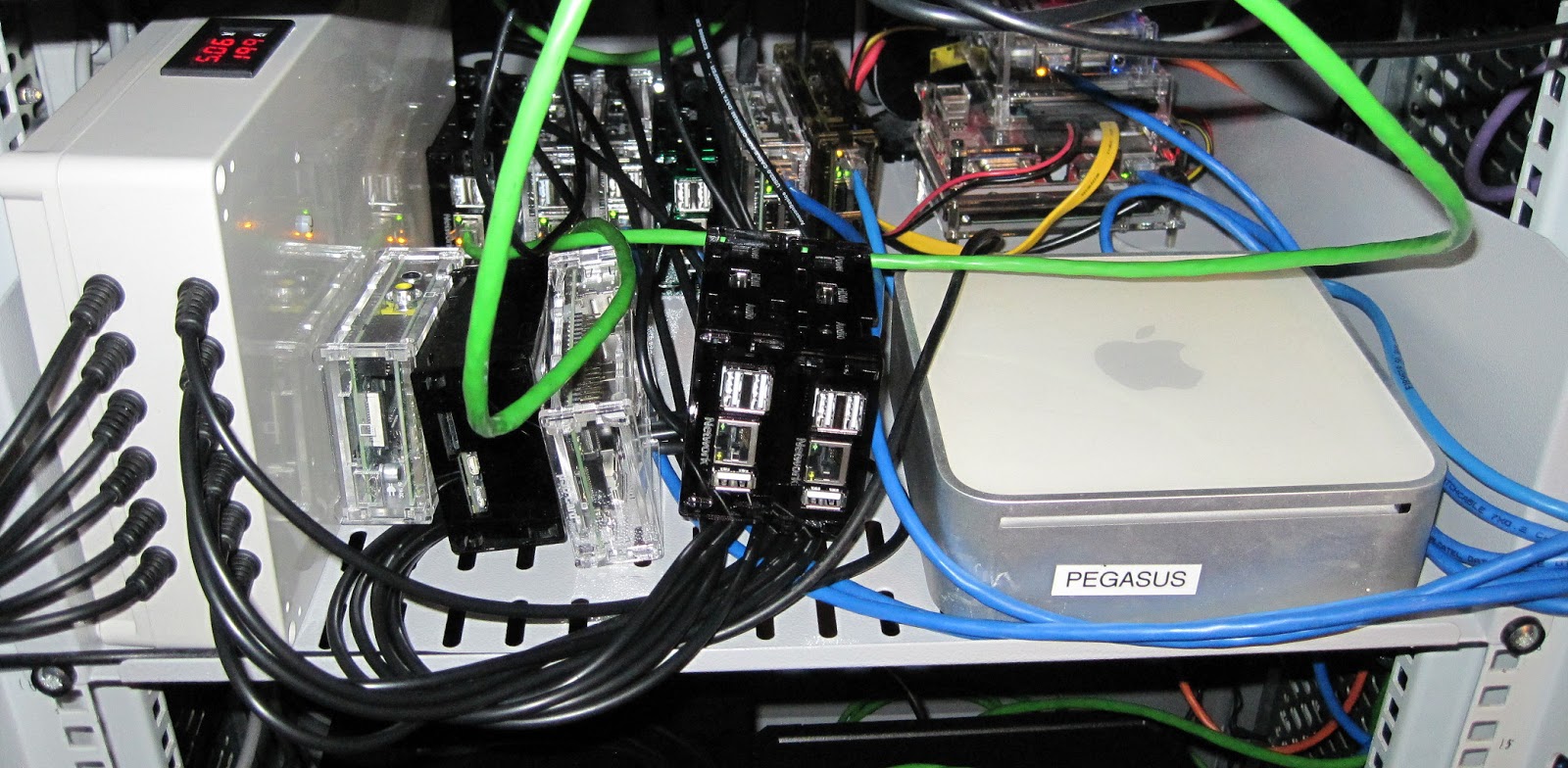
As you may be aware I have a bit of a problem with Single Board Computers in that I have a lot of them. Keeping them organised has turned into a bit of a problem.

cluttered shelf of SBC
I designed clip cases for many of these systems giving me a higher storage density on my rack shelves and built a power supply to reduce the cabling complexity. These helped but I still ended up with a cluttered shelf full of SBC.

I decided I would make a rack enclosure to hold the SBC, I was limited to material I could easily CNC machine which limited me to acrylic plastics or wood.

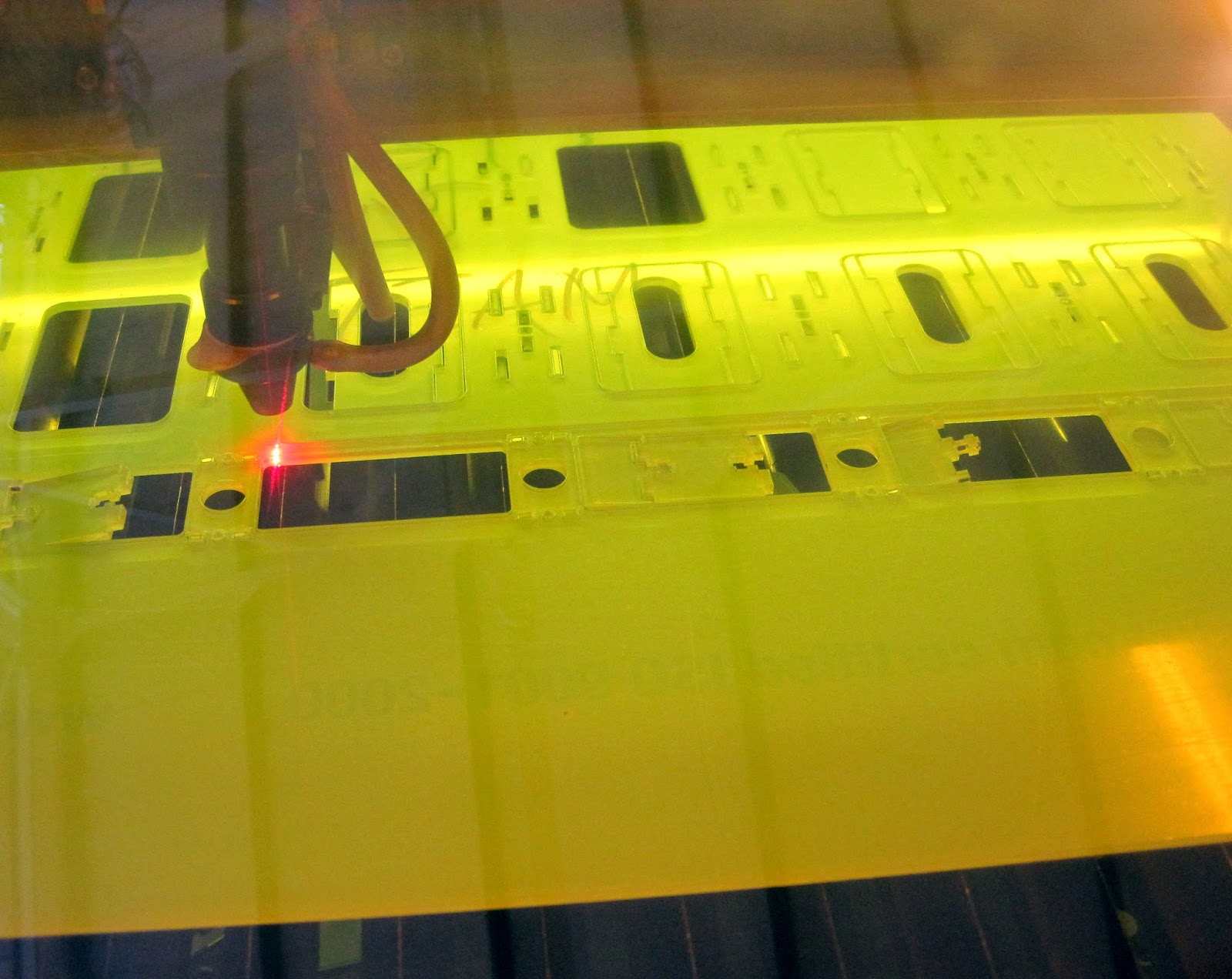
laser cutting the design, viewed through heavily tinted filterInitially I started with the idea of housing the individual boards in a toast rack arrangement. This would mean that the enclosure would have to be at least 2U high to fit the boards all the existing cases would have to be discarded. This approach was dropped when the drawbacks of having no flexibility and only being able to fit the units that were selected at design time became apparent (connector cutouts and mounting hole placement.

Instead I changed course to try and incorporate the existing cases which already solved the differing connector and mounting placement problem and gave me a uniform size to consider. Once I had this approach the design came pretty quickly. I used a tube girder construction 1U in height to get as much strength as possible from the 3mm acrylic plastic I would use.

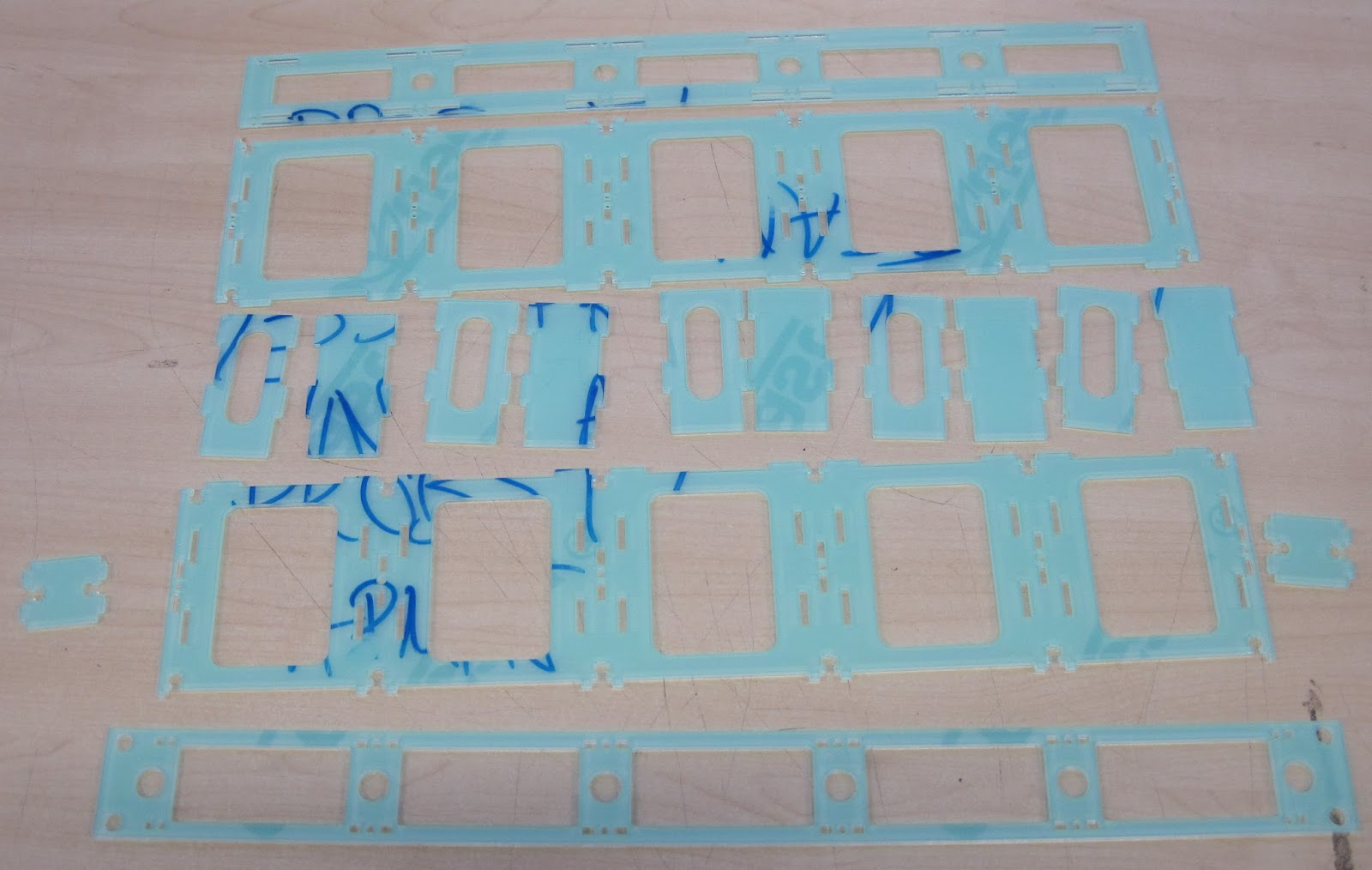
laser cut pieces arranged for assembly still with protective film on
The design was simply laser cut from sheet stock and fastened together with M3 nut and bolts. Once I corrected the initial design errors (I managed to get almost every important dimension wrong on the first attempt) the result was a success.

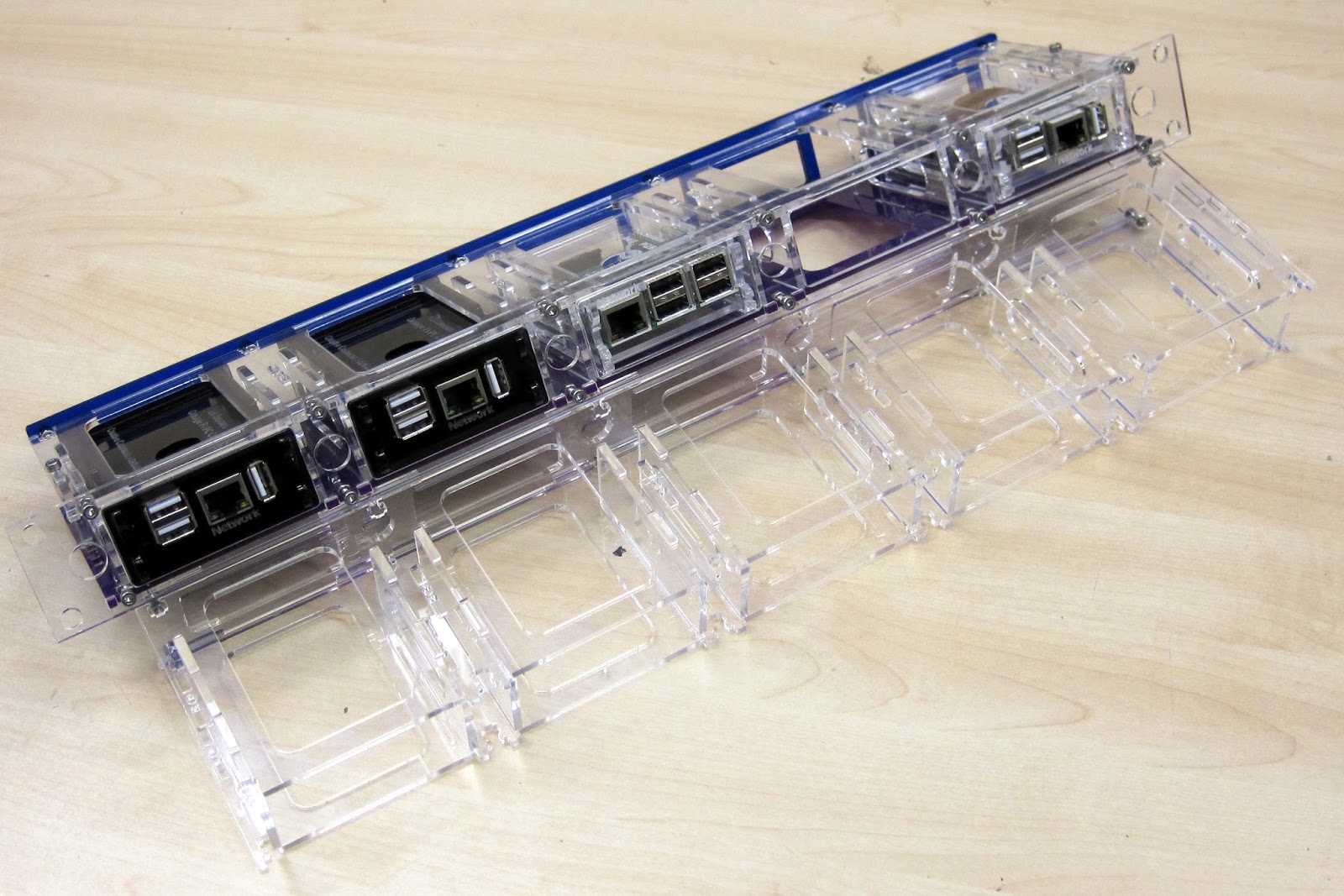
working prototype resting on initial version
The prototype is a variety of colours because makespace ran out of suitably sized clear acrylic stock but the colouring has no effect on the result other than aesthetical. The structure gives a great deal of rigidity and there is no sagging or warping, indeed testing on the prototype got to almost 50Kg loading without a failure (one end clamped and the other end loaded at 350mm distance)

I added some simple rotating latches at the front which keep the modules held in place and allow units to be removed quickly if necessary.

rack slots installed and in use
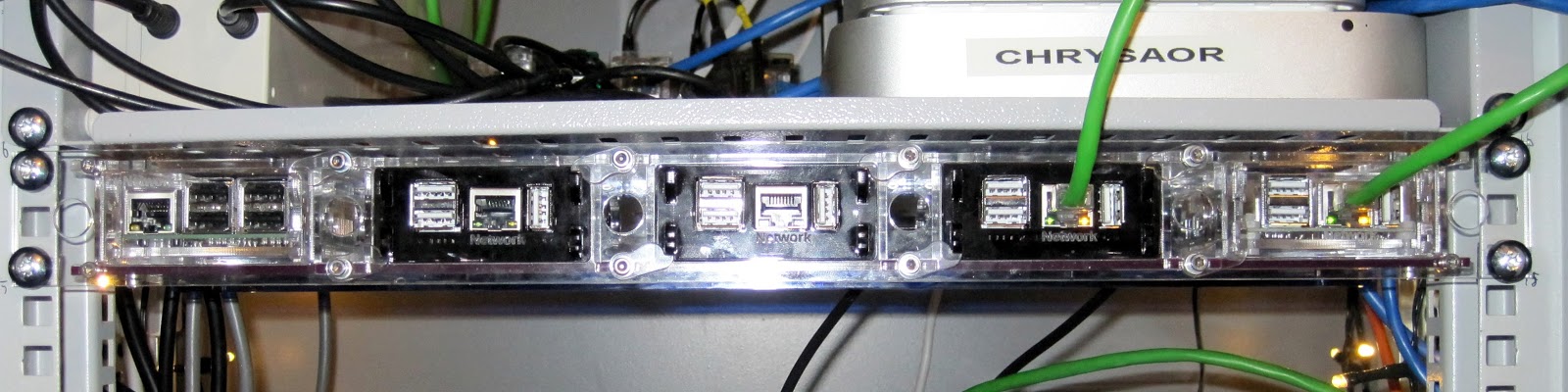
Overall this project was successful and I can now pack five SBC per U neatly. It does limit me to using systems cased in my "slimline" designs (68x30x97mm) which currently means the Raspberry Pi B+ style and the Orange Pi PC.

Once small drawback is access to I/O and power connectors. These need to be right angled and must be unplugged before unit removal which can be a little fiddly. Perhaps a toast rack design of cases would have given easier connector access but I am happy with this trade off of space for density.

As usual the design files are freely available, perhaps they could be useful as a basis for other laser cut rack enclosure designs.

15 June 2015

Lunar: Reproducible builds: week 7 in Stretch cycle

What happened about the reproducible builds effort for this week: Presentations On June 7th, Reiner Herrmann presented the project at the Gulaschprogrammiernacht 15 in Karlsruhe, Germany. Video and audio recordings in German are available, and so are the slides in English. Toolchain fixes Daniel Kahn Gillmor's report on help2man started a discussion with Brendan O'Dea and Ximin Luo about standardizing a common environment variable that would provide a replacement for an embedded build date. After various proposals and research by Ximin about date handling in several programming languages, the best solution seems to define SOURCE_DATE_EPOCH with a value suitable for gmtime(3).
  1. Martin Borgert wondered if Sphinx could be changed in a way that would avoid having to tweak debian/rules in packages using it to produce HTML documentation.
Daniel Kahn Gillmor opened a new report about icont producing unreproducible binaries. Packages fixed The following 32 packages became reproducible due to changes in their build dependencies: agda, alex, c2hs, clutter-1.0, colorediffs-extension, cpphs, darcs-monitor, dispmua, haskell-curl, haskell-glfw, haskell-glib, haskell-gluraw, haskell-glut, haskell-gnutls, haskell-gsasl, haskell-hfuse, haskell-hledger-interest, haskell-hslua, haskell-hsqml, haskell-hssyck, haskell-libxml-sax, haskell-openglraw, haskell-readline, haskell-terminfo, haskell-x11, jarjar-maven-plugin, kxml2, libcgi-struct-xs-perl, libobject-id-perl, maven-docck-plugin, parboiled, pegdown. The following packages became reproducible after getting fixed: Some uploads fixed some reproducibility issues but not all of them: Patches submitted which did not make their way to the archive yet: reproducible.debian.net A new variation to better notice when a package captures the environment has been introduced. (h01ger) The test on Debian packages works by building the package twice in a short time frame. But sometimes, a mirror push can happen between the first and the second build, resulting in a package built in a different build environment. This situation is now properly detected and will run a third build automatically. (h01ger) OpenWrt, the distribution specialized in embedded devices like small routers, is now being tested for reproducibility. The situation looks very good for their packages which seems mostly affected by timestamps in the tarball. System images will require more work on debbindiff to be better understood. (h01ger) debbindiff development Reiner Herrmann added support for decompling Java .class file and .ipk package files (used by OpenWrt). This is now available in version 22 released on 2015-06-14. Documentation update Stephen Kitt documented the new --insert-timestamp available since binutils-mingw-w64 version 6.2 available to insert a ready-made date in PE binaries built with mingw-w64. Package reviews 195 obsolete reviews have been removed, 65 added and 126 updated this week. New identified issues: Misc. Holger Levsen reported an issue with the locales-all package that Provides: locales but is actually missing some of the files provided by locales. Coreboot upstream has been quick to react after the announcement of the tests set up the week before. Patrick Georgi has fixed all issues in a couple of days and all Coreboot images are now reproducible (without a payload). SeaBIOS is one of the most frequently used payload on PC hardware and can now be made reproducible too. Paul Kocialkowski wrote to the mailing list asking for help on getting U-Boot tested for reproducibility. Lunar had a chat with maintainers of Open Build Service to better understand the difference between their system and what we are doing for Debian.

5 June 2015

Laura Arjona: Games

Nota: Este art culo, en espa ol, aqu . I m not a gamer, although probably I ve played with machines/computers more than most of the girls of my age. My path has been: handheld machine, Pong and tenis in my uncle s console, MSX (with that one, in addition to playing, I learnt what was an algorithm and a program, and I started to write small programs in Basic, and I copied and ran the source code of small games and programs to make graphics, which I found in MSX magazines). My parents considered that arcade machines in bars were like slot machines so they were banned for us (even pinball, only table soccer was saved from them, and only if my father was playing with us). In the MSX I played Magical Tree, Galaxians, Arkanoid, Konami s Sports Games, Spanish games from Dinamic, and some arcades like Golden Axe, Xenon, and maybe some more. The next computers (PC AT, later a 286) were not so for gaming; let s say that we played more with the printer (Harvard Graphics, Bannermania ). Later, I was interested in other things more than in computer games, and later there were highschool homework, dBase III, and later the University and programming again and more, and it was the end of gaming, computer was for office and Uni homework.
Later, it came the internet and since then, reading and writing and communicating was more interesting for me than playing. I was not good at playing, and if you are not good, you play less, and you don t get better, so you begin to find other ways to loose your time, or to win it :) The new generation My son is 6 years old now, and I m living with him a second adventure about games. Games have changed a lot, and the family computing try to stay in the libre software side whenever I am the one that can decide, so sometimes some challenges arise. Android (phone and tablet) The kid has played games in the phone and tablet with Android since he was a baby. We tried some of the last years popular games. I am not so keen of banning things, but I don t feel comfortable with the popular games for Android (advertisements, nonfree software, addictive elements, massive data recollection and possible surveillance ), so I try to control without being Cruella de Vil . Some techniques I use: On the other side, in my phone there is no Google Play, so we have been able to discover the section Games of F-Droid. We have tried (all of them available in F-Droid, emphasis in the ones that he liked best): 2048, AndroFish, Bomber, Coloring for Kids, Core, Dodge, Falling Blocks, Free Fall, Frozen Bubble, HeriSwap (this one in the tablet), Hex, HyperRogue, Meerkat Challenge, Memory, Pixel Dungeon, Robotfindskitten, Slow it!, Tux Memory, Tux Rider, Vector Pinball. Playing in my phone with CyanogenMod and having downloaded the games from F-Droid provides a relief similar to the one when playing a non-computer game. At least with the games that I have listed above. Maybe it is because they are simpler games, or they make me remember the ones that I played time ago. But it s also because of the peace of mind of knowing that they are libre software, that have been audited by the F-Droid community, that they don t abuse the user. The same happens with Debian, what takes me to the next part of this blogpost. Computer games: Debian The kid has learnt to play with the tablet and the phone before than with the computer, because our computers have no joysticks nor touchscreens. He learnt to use the touchpad before than the mouse, because it s easier and we have no mouse at home. He learnt to use the mouse at school, where they work with educative games via CD or via web, using Flash :( So Flash player appears and dissapears from my Debian setup depending on his willness to play with the school games . Until few time ago, in the computer we played with GCompris, ChildsPlay, and TuxPaint.
When he learnt to use the arrow keys, I installed Hannah and he liked a lot, specially when we learnt to do hannah -l 900 :) Later, in ClanTV there were advertisements about some online computer games about their favorite series, resulting in that they need Flash or a framework called Unity3D (no, it s not Ubuntu s Unity), and after digging a bit I decided that I was not going to install that #@%! in my Debian, so when he insisted in play those games, I booted the Windows 7 partition in his father s laptop and I installed it there. Windows is slow and sad in the computer, and those web games with that framework are not very light, so luckily they have not become very interesting. We have not played in the computer much more, maybe some incursion in Minetest, what takes me to the next section. (Not without stating my eternal thanks to the Games Team in Debian. I think they do a very important work and I think that next year I ll try to get involved in some way, because I know that the future of our family computer games is tied to libre games in Debian). PlayStation 3 and Minecraft Some time ago my husband bought a PlayStation 3 for home. The shop had discounts prices and so. He would play together with the kid an so.
The machine came home with some games for free (included in the price), but most of them were classified for +13 or so, so the only two left were Pro Evolution Soccer, and Minecraft.
I decided not to connect the machine to the network. Maybe we are loosing cool things, but I feel safer like that. So, no ethernet cable plugged, no registration in the Sony shop (or whatever its name is). The controllers are quite complex for the three of us. They are DualShock don t-know-what, and I think there is something (software) that makes the game adaptative to the person playing, because my husband is worse player after the son plays, if they play in turns and use the same controller. The kid liked Minecraft. I didn t know anything about that game (well, I knew that there was a libre clone called Minetest), so, for learning the basics I had a look at the wiki and searched videos about how to and we began learning. Now, the kid can read a bit so he needs less help, and he has watched a lot of videos about Minecraft, so he is interested in exploring and building. I had a look at Minetest, and I installed it in Debian. Having to use the keyboard is a disadvantage, and we didn t know how to dig, so it was not much attractive at first sight. I have looked a bit about how to use the PS3 controller in the computer, via USB, and it seems to work, but I suppose I need to write something to match each controller button with the corresponding key and subsequent action in Minetest. This is work, and I am lazy, and the boy seems not very interested in playing with the computer. Watching the videos we have infered that it s possible to download saved games and worlds to upload them in the videogame console. We have done some tests. I wanted to upload a saved game about an amusement park, but the file was in a folder of name NPEB01899* and even when the PS3 saw it to copy it from USB to the console, later it didn t appear in the list of saved games (our sved games were in folders named BLES01976). And renaming the folder didn t work, of course. I understood that we had met Sony s restrictions, so I searched for more info. The games are saved using an encryption key and you are not able to use saved games from consoles in other world zone or using a media different than ours (the game can be played using a disc or purchasing it in the digital shop, it seems). Very ugly all of this! I read somewhere that there is certain software (libre software, BTW) that allows to break the encryption and re-encrypt the saved game with the zone and type of media of your console, but it seems the program only works for Windows, and it needs a console ID that we have not, because we didn t register the console in the PlayStation network. All these things look shaky grounds for me, unpleasant stuff, I don t want to spend time on this, maybe I should learn a bit more about Minetest and make it work and interesting and tell Sony go fly a kite. Finally, I found a saved game in the same format as ours (BLES01976), it s not an amusement park but it is a world with interesting places to explore and many things already built, so I ve tried to import it and it worked, so my son will be happy for some time, I suppose. We have tried Minetest in the tablet too, but the touchscreen is not comfortable for this kind of games. I feel quite frustrated and angry about this issue of Sony s restrictions on saved games. So I suppose that in the next months I ll try to learn more about Minetest in Debian, game controllers in Debian, and games in Debian in general. So I hope to be able to offer cool stuff to my son, and he becomes more interested in playing in a safe environment which does not abuse the user. And with this, I finish Libre games in GNU/Linux, Debian, and info about games in internet When we have searched info about games in internet, I found that many times you need to go out from the secure environment: webpages with links to downloads that who knows if they contain what they say they contain, advertisements, videoblogs with a language not adequate for kids (or any person that loves their mother language) That s why I believe the path is to go into detail about libre games provided by the distro you use (Debian in my case). Here I bookmark a list of website with info that surely will be useful for me, to read in depth: We ll see how it goes. Comments? You can comment in this Pump.io thread.
Filed under: My experiences and opinion Tagged: Debian, English, F-Droid, Free culture, Free Software, Games, libre software, Moving into free software

10 March 2015

Joey Hess: 7drl 2015 day 4 coding through exhaustion

Slow start today; I was pretty exhausted after yesterday and last night's work. Somehow though, I got past the burn and made major progress today. All the complex movement of both the player and the scroll is finished now, and all that remains is to write interesting spells, and a system for learning spells, and to balance out the game difficulty.
I haven't quite said what Scroll is about yet, let's fix that: In Scroll, you're a bookworm that's stuck on a scroll. You have to dodge between words and use spells to make your way down the page as the scroll is read. Go too slow and you'll get wound up in the scroll and crushed. The character is multiple chars in size (size is the worm's only stat), and the worm interacts with the scroll in lots of ways, like swallowing letters, or diving through a hole to the other side of the scroll. While it can swallow some letters, if it gets too full, it can't move forward anymore, so letters are mostly consumed to be used as spell components. I think that I will manage to get away without adding any kind of monsters to the game; the scroll (and whoever is reading it) is the antagonist. As I'm writing this very post, I'm imagining the worm wending its way through my paragraphs. This dual experience of text, where you're both reading its content and hyper-aware of its form, is probably the main thing I wanted to explore in writing Scroll. As to the text that fills the scroll, it's broadly procedurally generated, in what I hope are unusual and repeatedly surprising (and amusing) ways. I'm not showing any screenshots of the real text, because I don't want to give that surprise away. But, the other thing about Scroll is that it's scroll, a completely usable (if rather difficult..) Unix pager!

15 February 2015

Matthew Palmer: The Vicious Circle of Documentation

Ever worked at a company (or on a codebase, or whatever) where it seemed like, no matter what the question was, the answer was written down somewhere you could easily find it? Most people haven t, sadly, but they do exist, and I can assure you that it is an absolute pleasure. On the other hand, practically everyone has experienced completely undocumented systems and processes, where knowledge is shared by word-of-mouth, or lost every time someone quits. Why are there so many more undocumented systems than documented ones out there, and how can we cause more well-documented systems to exist? The answer isn t people are lazy , and the solution is simple though not easy.

Why Johnny Doesn t Read When someone needs to know something, they might go look for some documentation, or they might ask someone else or just guess wildly. The behaviour look for documentation is often reinforced negatively, by the result documentation doesn t exist . At the same time, the behaviours ask someone and guess wildly are positively reinforced, by the results I get my question answered and/or at least I can get on with my work . Over time, people optimise their behaviour by skipping the look for documentation step, and just go straight to asking other people (or guessing wildly).

Why Johnny Doesn t Write When someone writes documentation, they re hoping that people will read it and not have to ask them questions in order to be productive and do the right thing. Hence, the behaviour write documentation is negatively reinforced by the results I still get asked questions , and nobody does things the right way around here, dammit! Worse, though, is that there is very little positive reinforcement for the author: when someone does read the docs, and thus doesn t ask a question, the author almost certainly doesn t know they dodged a bullet. Similarly, when someone does things the right way, it s unlikely that anyone will notice. It s only the mistakes that catch the attention. Given that the experience of writing documentation tends to skew towards the negative, it s not surprising that eventually, the time spent writing documentation is reallocated to other, more utility-producing activities.

Death Spiral The combination of these two situations is self-reinforcing. While a suitably motivated reader might start by strictly looking for documentation, or an author initially be enthused to always fully documenting their work, over time the reflex will be for readers to just go ask someone, because there s never any documentation! , and for authors to not write documentation because nobody bothers to read what I write anyway! . It is important to recognise that this iterative feedback loop is the natural state of the reader/author ecosystem, resulting in something akin to thermodynamic entropy. To avoid the system descending into chaos, energy needs to be constantly applied to keep the system in order.

The Solution Effective methods for avoiding the vicious circle can be derived from the things that cause it. Change the forces that apply themselves to readers and authors, and they will behave differently. On the reader s side, the most effective way to encourage people to read documentation is for it to consistently exist. This means that those in control of a project or system mustn t consider something done until the documentation is in a good state. Patches shouldn t be landed, and releases shouldn t be made, unless the documentation is altered to match the functional changes being made. Yes, this requires discipline, which is just a form of energy application to prevent entropic decay. Writing documentation should be an explicit and well-understood part of somebody s job description. Whoever is responsible for documentation needs to be given the time to do it properly. Writing well takes time and mental energy, and that time needs to be factored into the plans. Never forget that skimping on documentation, like short-changing QA or customer support, is a false economy that will cost more in the long term than it saves in the short term. Even if the documentation exists, though, some people are going to tend towards asking people rather than consulting the documentation. This isn t a moral failing on their part, but only happens when they believe that asking someone is more beneficial to them than going to the documentation. To change the behaviour, you need to change the belief. You could change the belief by increasing the cost of asking. You could fire (or hellban) anyone who ever asks a question that is answered in the documentation. But you shouldn t. You could yell RTFM! at everyone who asks a question. Thankfully that s one acronym that s falling out of favour. Alternately, you can reduce the cost of getting the answer from the documentation. Possibly the largest single productivity boost for programmers, for example, has been the existence of Google. Whatever your problem, there s a pretty good chance that a search or two will find a solution. For your private documentation, you probably don t have the power of Google available, but decent full-text search systems are available. Use them. Finally, authors would benefit from more positive reinforcement. If you find good documentation, let the author know! It requires a lot of effort (comparatively) to look up an author s contact details and send them a nice e-mail. The like button is a more low-energy way of achieving a similar outcome you click the button, and the author gets a warm, fuzzy feeling. If your internal documentation system doesn t have some way to close the loop and let readers easily give authors a bit of kudos, fix it so it does. Heck, even if authors just know that a page they wrote was loaded N times in the past week, that s better than the current situation, in which deafening silence persists, punctuated by the occasional plaintive cry of Hey, do you know how to ? . Do you have any other ideas for how to encourage readers to read, and for authors to write?

3 January 2015

Russ Allbery: Review: The Ring of Charon

Review: The Ring of Charon, by Roger MacBride Allen
Series: Hunted Earth #1
Publisher: Tor
Copyright: December 1990
ISBN: 0-8125-3014-4
Format: Mass market
Pages: 500
Larry Chao is a junior scientist at a gravity research on Pluto, at the very outer limits of human reach in the solar system. The facility is for researching artificial gravity, which is one reason it's in the middle of nowhere. Another is that their experimental generator is built in a ring around Charon, and the close proximity of the two bodies is useful for scientific observation. Unfortunately, there hasn't been much to observe. They can create very short-lived gravity fields in very small areas, but nothing like the artificial gravity that was the original promise of the facility. As a result, the government is shutting the facility down. The authoritarian director, Simon Raphael, is... not exactly happy with that decision, but resigned to it and running the facility to completion with a sullen anger. When Larry makes a startling breakthrough at nearly the last minute for the society, Simon is uninterested and hostile. This leads Larry and his fellow scientist Sondra Berghoff to attempt a more radical demonstration of Larry's success and prove to the rest of the solar system that the facility should be kept open. That decision has a far deeper impact on humanity and the solar system than they could have possibly imagined. The Ring of Charon and its sequel, Shattered Sphere, were recommended to me as good harder science fiction. It took me a while to track down copies in fact, it took an in-person trip to Powell's. Once I found them, a relatively straightforward, old-school science fiction novel seemed like just the thing to read during my commute. Allen delivers there. I'm not spoiling the main plot driver of the book even though it's given away on the back cover, since it's some time in coming in the novel. But The Ring of Charon turns into a multi-viewpoint cross between a disaster novel and a scientific investigation. Larry and Sondra stay central to the plot, of course, but Allen adds a variety of other characters who are attempting to figure out what happened to the solar system and then deal with the consequences: everyone from scientists to pilots to communications officers in weird surrealistic stations. The science is mostly believable, apart from the scientific breakthrough that motivates the plot. Characterization isn't absent completely, but it's simple and unsubtle; dialogue is a bit wooden, characters aren't entirely multidimensional, but Allen does a reasonably good job with both pacing and the sense of mystery and investigation, and a surprisingly good job portraying organizational politics. As you might guess from the tone of my review, this is not the book to reach for if you want something ground-breaking. It's a very conventional, multi-viewpoint SF novel full of scientists and investigation of unknown and possibly hostile phenomena. If you've read much science fiction, you've read books like this before. But one thing that Allen does surprisingly well, which makes The Ring of Charon stand a bit above the pack, is that he doesn't write villains. Even Simon, who goes out of his way to make the reader hate him at the start of the book, becomes a surprisingly sympathetic character. The characters who are usually villains or at least foils in books like this the smooth PR person, the religious man, the blindly-focused scientist who isn't interested in anyone else's theories never turn into caricatures, play important roles in the plot, and turn out to be competent in their fields of expertise. There are actual villains, sort of, but I found myself feeling sympathetic even towards them, at least in places. Allen takes a rather old SF dodge to achieve conflict without an evil enemy, and, because of that, the end of the book felt like a bit of an anticlimax. But I did like the feel of the book where there isn't a good versus evil fight, just a wide variety of people (and others) trying to understand and control the universe in the best ways they know how. I'm not sure I can quite recommend this book. The quality of the writing is not particularly high, and I'm not generally a fan of the disaster novel style of storytelling. But despite not being very original, there's just something likable about it. It moves along reasonably well for a 500 page book, and it's refreshingly light on irritating stereotypes. I think one has to be in the right mood when reading it and set expectations accordingly, but it fit what I was looking for when I picked it up. One warning, though: although The Ring of Charon reaches a climax, the major plot conflict is not resolved at the end of this book, so you may want to have the sequel around. Followed by Shattered Sphere. Rating: 6 out of 10

21 December 2014

Russ Allbery: Review: 2014 Hugos: Novelettes

Review: 2014 Hugos: Novelettes, edited by Loncon 3
Publisher: Loncon 3
Copyright: 2014
Format: Kindle
This is another weird "book review" covering the Hugo-nominated novelettes for the 2014 Hugos (given for works published in 2014) at Loncon 3, the 2014 Worldcon. The "editor" is the pool of attendees and supporting members who chose to nominate works, all of which had been previously edited by other editors in their original publication. I received all of these as part of the Hugo voter's packet for being a supporting member, but they all appear to be available for free on the Internet (at least at the time of this writing). "The Exchange Officers" by Brad Torgersen: An okay, if not particularly ground-breaking, military SF story, ruined for me by the ham-handed introduction of superficial jingoism. The protagonists are doing a tour as remote operators of humanoid battle suits in orbit: not a new premise, but a servicable one. Since this is military SF, they predictably have to defend a space installation against attackers. So we get a bit of drama, a bit of zero-g combat, and the fun of people learning how to remotely operate suits. You've probably read this before, but it passes the time reasonably well. Unfortunately, Torgersen decided to make the villains the Chinese military for no adequately-explained reason. (Well, I'm being kind; I suspect the reason is the standard yellow peril nonsense, but that's less generous.) So there is snide commentary about how only the military understand the Chinese threat and a fair bit of old-fashioned jingoism mixed in to the story, to its detriment. If you like this sort of thing, it's a typical example, although it escapes me why people thought it was exceptional enough to warrant nomination. (5) "The Lady Astronaut of Mars" by Mary Robinette Kowal: Once again, my clear favorite among the stories also won, which is a lovely pattern. Elma was the female astronaut in an alternate history in which manned space exploration continued to grow, leading to permanent settlement on Mars. She spent lots of time being photographed, being the smiling face of the space program, while her husband worked on the math and engineering of the launches. Now, she's an old woman, taking care of her failing and frail husband, her career behind her. Or so she thinks, before an offer that forces an impossible choice between space and staying with her husband for his final days. This is indeed the tear-jerker that it sounds like, but it's not as maudlin as it might sound. Kowal does an excellent job with Elma's characterization: she's no-nonsense, old enough to be confident in her opinions, and knows how to navigate through the world. The story is mixed with nostalgia and memories, including a reminder of just what Elma meant to others. It touches on heroism, symbolism, and the horrible choices around dying loved ones, but I thought it did so deftly and with grace. I was expecting the story to be too obvious, but I found I enjoyed the quotidian feel. It's not a story to read if you want to be surprised, but I loved the small touches. (9) "Opera Vita Aeterna" by Vox Day: Before the review, a note that I consider obligatory. The author of this story is an aggressively misogynistic white supremacist, well-known online for referring to black people as savages and arguing women should not be allowed to vote. To what extent you choose to take that into account when judging his fiction is up to you, but I don't think it should go unsaid. "Opera Vita Aeterna" is the story of a monastery in a typical fantasy world (at least as far as one can tell from this story; readers of Vox Day's fantasy series will probably know more background). At the start of the story, it gets an unexpected visit from an elf. Not just any elf, either, but one of the most powerful magicians of his society. He comes to the monastery out of curiousity about the god that the monks worship and stays for a project of illuminating their scriptures, while having theological debates with the abbot. This story is certainly not the offensive tirade that you might expect from its author. Its biggest problem is that nothing of substance happens in the story, either theologically or via more conventional action. It's a lot of description, a lot of talking, a lot of warmed-over Christian apologetics that dodges most of the hard problems, and a lot of assertions that the elf finds something of interest in this monastery. I can believe this could be the case, but Vox Day doesn't really show why. There is, at the end of the story, some actual drama, but I found it disappointing and pointless. It leads nowhere. The theology has the same problem: elves supposedly have no souls, which is should be the heart of a theological question or conflict Vox Day is constructing, but that conflict dies without any resolution. We know nothing more about the theology of this world at the end of the story than we do at the beginning. Some of the descriptions here aren't bad, and the atmosphere seems to want to develop into a story. But that development never happens, leaving the whole work feeling fundamentally pointless. (4) "The Truth of Fact, the Truth of Feelng" by Ted Chiang: This is another oddly-constructed story, although I think a bit more successful. It's a story in two interwoven parts. One is a fictional essay, told in a non-fiction style, about a man living in a future world with ubiquitous life recording and very efficient search software. Any part of one's life can be easily found and reviewed. The other is the story of a boy from a tribal culture during European colonialism. He learns to read and write, and from that a respect for written records, which come into conflict with the stories that the tribe elders tell about the past. The purpose of both of these stories is to question both the value and the implications of recording everything in a way that preserves and guarantees the facts instead of individual interpretations. The boy's story calls this into question; the narrator's story offers ambiguous support for its value and a deeper plea for giving people space to change. I found the style a bit difficult to get used to, since much of it did not feel like a story. But it grew on me as I read it, and the questions Chiang raises have stuck with me since. The problem of how and when to allow for change in others when we have perfect (or at least vastly improved) memory is both important and complicated, and this is one of the better presentations of the problem that I've seen. It's more of a think-y piece, and closer to non-fiction than a story, but I thought it was worth reading. (8) "The Waiting Stars" by Aliette de Bodard: I keep wanting to like de Bodard's space opera world of AIs and living ships, but it never quite works for me. I've read several stories set in this universe now, and it has some neat ideas, but I always struggle with the characters. This story at least doesn't have quite as much gruesome pregnancy as the previous ones (although there's still some). "The Waiting Stars" opens with a raid on a ship graveyard, an attempt to rescue and "reboot" an AI starship under the guidance of another Mind. This is intermixed with another story about a woman who was apparently rescued in childhood from birthing ship Minds and raised in a sort of foster institution. This feels like a flashback at first, but its interaction with the rest of the story is something more complicated. The conceptual trick de Bodard pulls here is thought-provoking, but once again I struggled to care about all of the characters. I also found the ending discouraging and unsatisfying, which didn't help. Someone who isn't me might really like this story, but it wasn't my thing. (6) Rating: 6 out of 10

4 December 2014

Olivier Berger: Shell script to connecting to a Shibboleth protected web app with curl

Here s a shell script I ve created (reusing one meant for CAS protected resources), which will allow to connect to a Web application protected by the Shibboleth SSO mechanism.
It uses cURL to navigate through the various jumps required by the protocol, perform the necessary posts, etc.
I haven t read the Shibboleth specs, so it may not be the best way, and may not work in all cases, but that was enough for my case, at least. Feel free to improve it on Github Gists. After the connection is succesful, one may reuse the .cookieJar file to perform further cURL connections, or even some automated content mirroring with httrack, for instance (see a previous experiment of mine with httrack for Moodle).

Next.

Previous.